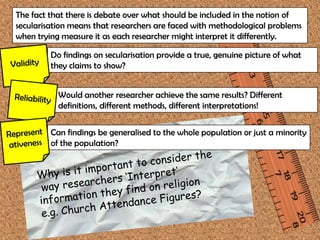
The fact that there is debate over what should be included in the notion of
secularisation means that researchers are faced with methodological problems
when trying measure it as each researcher might interpret it differently.

         Do findings on secularisation provide a true, genuine picture of what
         they claims to show?


           Would another researcher achieve the same results? Different
           definitions, different methods, different interpretations!


         Can findings be generalised to the whole population or just a minority
         of the population?
Arguments For Secularisation:
1) A Decline in Religious Thinking & Belief……
           Weber (1864 – 1920): Disenchantment & Rationalisation
           Weber argued that with the advent of industrialisation, people
           would start to look towards science and rationality rather than
           religion and the supernatural.
         This would create a ‘Desacrilisation of Consciousness’
          – ‘a loss of the capacity to experience a sense of
         sacredness & mystery in life’.


                                 Bruce (2008): Suggests that Religious beliefs
                                 have become ‘Marginalised’ – people only
                                 turn to them as a last resort:

                                 ‘When we have tried every cure for
                                 cancer, some of us pray’.
Lyotard (1984) & Bauman (2000):
             Decline in Metanarratives & the Fragmentation of Belief:
             Postmodernists like Lyotard & Bauman argue that
             Metanarratives like religion have lost their influence as people
             are more likely to control their own identitiesin a ‘Liquid’, ‘Pick-n-
             Mix’ world.
             People now have more choice to create
             ‘do-it-yourself’ identities and enter the
             ‘Spiritual Supermarket’ when it comes to
             their beliefs.
‘Religion’ has lost it’s power and influence and has become
watered down & fragmented to the extent that it becomes
meaningless.
Arguments For Secularisation:
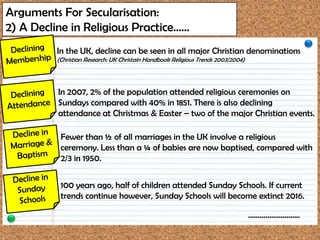
2) A Decline in Religious Practice……
          In the UK, decline can be seen in all major Christian denominations
          (Christian Research: UK Christain Handbook Religious Trends 2003/2004)


          In 2007, 2% of the population attended religious ceremonies on
          Sundays compared with 40% in 1851. There is also declining
          attendance at Christmas & Easter – two of the major Christian events.

           Fewer than ½ of all marriages in the UK involve a religious
           ceremony. Less than a ¼ of babies are now baptised, compared with
           2/3 in 1950.


           100 years ago, half of children attended Sunday Schools. If current
           trends continue however, Sunday Schools will become extinct 2016.

                                                                                   ………………………
Despite the growing numbers of NAMs & NRMs, membership is still
very small. Also the growth of new NRMs/ NAMs is insignificant to
the number of religious movements that are collapsing.

Bruce (2001) points out that less people are opting for carers
within the clergy:
1900: 45 000 British Clerics
2000: 34 000 “          “
Arguments For Secularisation:
3) Decline of Power & Influence of Religious Institutions……
Herberg (1960): ‘Secularisation from Within’
   Herberg suggests that religions are going against their
   traditions and regulations themselves and as such are
   showing weakness. He points out the ordination of women
   as evidence of this & also the downplaying of ‘miracles’
   and the literal interpretations of scripture, the acceptance
   of homosexuality as evidence of this.
It is also worth noting that the use of Latin in Catholic services is no
longer mandatory and is now voluntary.

    Lyon (2000): ‘Jesus in Disneyland’
    Lyon argues that religion is going through a process of
    ‘Disneyfication’ in that it is becoming trivialised and taken less
    seriously. He suggests that, in the post-modern ‘market’
    world, people are want to customise their identities and are free to
    do so as religion is fast-becoming just another commodity on the
    market shelf.
SociologyExchange.co.uk Shared Resource

SociologyExchange.co.uk Shared Resource

  • 4.
    The fact thatthere is debate over what should be included in the notion of secularisation means that researchers are faced with methodological problems when trying measure it as each researcher might interpret it differently. Do findings on secularisation provide a true, genuine picture of what they claims to show? Would another researcher achieve the same results? Different definitions, different methods, different interpretations! Can findings be generalised to the whole population or just a minority of the population?
  • 6.
    Arguments For Secularisation: 1)A Decline in Religious Thinking & Belief…… Weber (1864 – 1920): Disenchantment & Rationalisation Weber argued that with the advent of industrialisation, people would start to look towards science and rationality rather than religion and the supernatural. This would create a ‘Desacrilisation of Consciousness’ – ‘a loss of the capacity to experience a sense of sacredness & mystery in life’. Bruce (2008): Suggests that Religious beliefs have become ‘Marginalised’ – people only turn to them as a last resort: ‘When we have tried every cure for cancer, some of us pray’.
  • 7.
    Lyotard (1984) &Bauman (2000): Decline in Metanarratives & the Fragmentation of Belief: Postmodernists like Lyotard & Bauman argue that Metanarratives like religion have lost their influence as people are more likely to control their own identitiesin a ‘Liquid’, ‘Pick-n- Mix’ world. People now have more choice to create ‘do-it-yourself’ identities and enter the ‘Spiritual Supermarket’ when it comes to their beliefs. ‘Religion’ has lost it’s power and influence and has become watered down & fragmented to the extent that it becomes meaningless.
  • 9.
    Arguments For Secularisation: 2)A Decline in Religious Practice…… In the UK, decline can be seen in all major Christian denominations (Christian Research: UK Christain Handbook Religious Trends 2003/2004) In 2007, 2% of the population attended religious ceremonies on Sundays compared with 40% in 1851. There is also declining attendance at Christmas & Easter – two of the major Christian events. Fewer than ½ of all marriages in the UK involve a religious ceremony. Less than a ¼ of babies are now baptised, compared with 2/3 in 1950. 100 years ago, half of children attended Sunday Schools. If current trends continue however, Sunday Schools will become extinct 2016. ………………………
  • 10.
    Despite the growingnumbers of NAMs & NRMs, membership is still very small. Also the growth of new NRMs/ NAMs is insignificant to the number of religious movements that are collapsing. Bruce (2001) points out that less people are opting for carers within the clergy: 1900: 45 000 British Clerics 2000: 34 000 “ “
  • 11.
    Arguments For Secularisation: 3)Decline of Power & Influence of Religious Institutions……
  • 13.
    Herberg (1960): ‘Secularisationfrom Within’ Herberg suggests that religions are going against their traditions and regulations themselves and as such are showing weakness. He points out the ordination of women as evidence of this & also the downplaying of ‘miracles’ and the literal interpretations of scripture, the acceptance of homosexuality as evidence of this. It is also worth noting that the use of Latin in Catholic services is no longer mandatory and is now voluntary. Lyon (2000): ‘Jesus in Disneyland’ Lyon argues that religion is going through a process of ‘Disneyfication’ in that it is becoming trivialised and taken less seriously. He suggests that, in the post-modern ‘market’ world, people are want to customise their identities and are free to do so as religion is fast-becoming just another commodity on the market shelf.