Sociology in Modules 2nd Edition Schaefer Solutions Manual
1.
Sociology in Modules2nd Edition Schaefer
Solutions Manual download
https://testbankfan.com/product/sociology-in-modules-2nd-edition-
schaefer-solutions-manual/
Find test banks or solution manuals at testbankfan.com today!
2.
We have selectedsome products that you may be interested in
Click the link to download now or visit testbankfan.com
for more options!.
Sociology in Modules 2nd Edition Schaefer Test Bank
https://testbankfan.com/product/sociology-in-modules-2nd-edition-
schaefer-test-bank/
Sociology in Modules 3rd Edition Schaefer Test Bank
https://testbankfan.com/product/sociology-in-modules-3rd-edition-
schaefer-test-bank/
Sociology in Modules 4th Edition T Schaefer Test Bank
https://testbankfan.com/product/sociology-in-modules-4th-edition-t-
schaefer-test-bank/
Financial Accounting 3rd Edition Spiceland Test Bank
https://testbankfan.com/product/financial-accounting-3rd-edition-
spiceland-test-bank/
3.
Taxation of BusinessEntities 4th Edition Spilker Test
Bank
https://testbankfan.com/product/taxation-of-business-entities-4th-
edition-spilker-test-bank/
Legal Environment Of Business A Managerial Approach Theory
To Practice 1st Edition Melvin Test Bank
https://testbankfan.com/product/legal-environment-of-business-a-
managerial-approach-theory-to-practice-1st-edition-melvin-test-bank/
International Economics 9th Edition Husted Test Bank
https://testbankfan.com/product/international-economics-9th-edition-
husted-test-bank/
Statistical Reasoning for Everyday Life 5th Edition
Bennett Test Bank
https://testbankfan.com/product/statistical-reasoning-for-everyday-
life-5th-edition-bennett-test-bank/
Evolution 2nd Edition Bergstrom Test Bank
https://testbankfan.com/product/evolution-2nd-edition-bergstrom-test-
bank/
4.
Fundamentals of BusinessMath Canadian 3rd Edition Jerome
Solutions Manual
https://testbankfan.com/product/fundamentals-of-business-math-
canadian-3rd-edition-jerome-solutions-manual/
5.
IM – 7| 1
CHAPTER
7 DEVIANCE, CRIME, AND
SOCIAL CONTROL
CHAPTER OUTLINE
MODULE 23: SOCIAL CONTROL
Conformity and Obedience
Informal and Formal Social Control
Law and Society
MODULE 24: WHAT IS
DEVIANCE?
Deviance and Social Stigma
Deviance and Technology
Sociological Perspectives on Deviance
MODULE 25: CRIME
Types of Crime
Crime Statistics
Boxes
Sociology on Campus: Binge Drinking
Trendspotting: Incarceration Nation
Research Today: Does Crime Pay?
Sociology on Campus: Campus Crime
Taking Sociology to Work: Stephanie
Vezzani, Special Agent, U.S. Secret
Service
Social Policy and Social Control: The
Death Penalty in the United States and
Worldwide
6.
IM – 7| 2
LEARNING OBJECTIVES WHAT’S NEW IN CHAPTER 7
1. Define and discuss the elements of social
control.
2. Discuss the classic Milgram experiment and
its implications for obedience and
conformity.
3. Discuss what is meant by informal and
formal social control.
4. Define deviance and social stigma.
5. Discuss the various functionalist concepts
and views explaining deviance.
6. Discuss the various interactionist concepts
and views explaining deviance.
7. Discuss the explanations of deviance from
the conflict and feminist perspectives.
8. Describe the various types of crime.
9. Discuss the nature and extent of crime in the
United States.
Module 25: Crime
• Subsection on hate crime, with figure,
“Categorization of Reported Hate
Crimes”
• Reorganized section on crime statistics,
with subsections on (a) index crimes and
victimization surveys, (b) crime trends,
and (c) international crime rates.
• Social Policy section on the death
penalty, with Mapping Life Worldwide
map, “Death Penalty Status by Country”
CHAPTER SUMMARY
The term social control refers to techniques and strategies for preventing deviant human behavior. Social
control occurs in families, peer groups, and bureaucratic organizations. Members of society are expected
to act in accordance with social norms. Sanctions, which may be either penalties or rewards, help to
induce behavior consistent with social norms.
Conformity is defined as going along with one’s peers even though they have no special right to direct
our behavior. Obedience is defined as compliance with higher authorities in a hierarchal structure. Social
controls may occur casually and informally through such means as smiles, laughter, and ridicule.
Authorized agents, such as police officers, physicians, school administrators, employers, and military
officers, carry out formal social control. Law is defined as governmental social control and reflects
continually changing standards of what is right and wrong.
Sociologists define deviance as behavior that violates the standards of conduct or expectations of a group
or society. Deviance involves the violations of group norms that may or may not be formalized into law.
It is a comprehensive concept that includes not only criminal behavior, but also many actions not subject
to prosecution. Deviance can be understood only within its social context. The term stigma was coined by
Erving Goffman to describe the labels society uses to devalue the members of certain social groups.
People are often stigmatized for deviant behaviors they may no longer engage in.
7.
IM – 7| 3
According to the functionalist view, deviance is a normal part of human existence. Functionalists suggest
that deviance helps to define the limits of proper behavior. Robert Merton adapted Émile Durkheim’s
notion of anomie to explain why people accept or reject the goals of a society. Merton’s theory posits five
basic forms of adaptations: (1) conformity, (2) innovation, (3) ritualism, (4) retreatism, and (5) rebellion.
Merton’s anomie theory, though popular, has had relatively few applications.
The interactionist perspective is reflected in theories based on cultural transmission, social
disorganization, and labeling. Cultural transmission, associated with criminologist Edwin Sutherland,
suggests that criminal behavior is learned through interactions with others. He used the term differential
association to describe the process through which exposure to attitudes favorable to criminal acts leads to
violation of rules. Social disorganization theory suggests that deviance increases when communal
relationships in neighborhoods and social networks are weakened or absent. Labeling theory emphasizes
how a person comes to be labeled as deviant or to accept the label. Labeling theory is also referred to as
the societal-reaction approach. The popularity of labeling theory is evident in the emergence of the social
constructionist perspective, which purports that deviance is the product of the culture in which we live.
Social constructionists focus on the decision-making process that creates the deviant identity.
The conflict view of deviance suggests that people with power protect their own interests and define
deviance to suit their own needs. Relating to differential justice, Richard Quinney argues that lawmaking
is often an attempt by the powerful to coerce others into their own brand of morality. Akin to the roots of
conflict theory, the feminist perspective suggests that deviance, including crime, tends to flow from
economic relationships. Feminists suggest that cultural views and attitudes toward women influence how
women are perceived and labeled.
Crime represents a deviation from formal social norms administered by the state. Types of crime include
professional crime, organized crime, white-collar and technology-based crime, corporate crime,
transnational crime, and victimless crime. There has been a significant decline in violent crime in the
United States. The accuracy of measuring crime and tabulating crime statistics varies widely. The
National Crime Victimization Survey was initiated in 1972 to question ordinary people about crime
victimization.
RESOURCE INTEGRATOR
Focus Questions Resources
1. What are the various
means of social control?
IN THE TEXT
Key Terms: social control, sanctions, conformity, obedience, informal
social control, formal social control, law, control theory
Boxes: Sociology on Campus: Binge Drinking
IN THE INSTRUCTOR’S MANUAL
Additional Lecture Ideas: Ethical Implications of Milgram’s Research
(7-1); Social Control on the Streets (7-2)
Classroom Discussion Topics: Group Pressure (7-2); The Power of
Authority (7-3); Field Trip to Prison (7-4); Public Opinion on Death
Penalty (7-9)
8.
IM – 7| 4
Student Research and Assignments: Obedience—Another Look;
Labeling of People with AIDS; Labeling; Community Crime Watch
Video Resources: Asylum; Bowling for Columbine; Death Devices;
Deviance and Social Control; Obedience to Authority
REEL SOCIETY VIDEO
Topic Index: Conformity; Sanctions
2. How do sociologists
define deviance?
IN THE TEXT
Key Terms: deviance, stigma
IN THE INSTRUCTOR’S MANUAL
Additional Lecture Ideas: Deviance or Sport (7-3); Primary and
Secondary Deviance (7-4)
Classroom Discussion Topics: Wallbangin (7-1); Conversing with
Deviants (7-5); Deviance Is in the Eye of the Beholder (7-6); Which Acts
are Deviant? (7-7); Positive Deviance (7-8)
Student Research and Assignments: Labeling of People with AIDS;
Labeling
Video Resources: Deviance
REEL SOCIETY VIDEO
Topic Index: Deviance
3. How do functionalists,
conflict theorists,
feminists, and
interactionists explain
deviance?
IN THE TEXT
Key Terms: anomie, anomie theory of deviance, cultural transmission,
differential association, social disorganization theory, labeling theory,
societal-reaction approach, social constructionist perspective, differential
justice
Boxes: Research Today: Does Crime Pay?
IN THE INSTRUCTOR’S MANUAL
Additional Lecture Ideas: Discretionary Justice (7-5); Controversies
about Campus Crime (7-6); Being a Hit Man (7-7)
Classroom Discussion Topics: Wallbangin (7-1); Conversing with
Deviants (7-5); Deviance Is in the Eye of the Beholder (7-6); Which Acts
Are Deviant? (7-7); Positive Deviance (7-8)
Student Research and Assignments: Labeling of People with AIDS;
Labeling; Crime and Violence within the Hispanic Community; Blacks in
Prisons; Race and Criminology; Rape Education Videos; White-Collar
Crime
Video Resources: Bowling for Columbine; Cops on Trial; Deadline; Race
on Trial
REEL SOCIETY VIDEO
Topic Index: Anomie Theory of Deviance
9.
IM – 7| 5
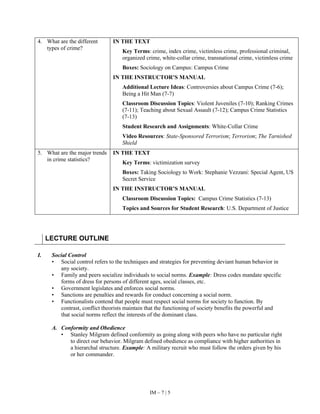
4. What are the different
types of crime?
IN THE TEXT
Key Terms: crime, index crime, victimless crime, professional criminal,
organized crime, white-collar crime, transnational crime, victimless crime
Boxes: Sociology on Campus: Campus Crime
IN THE INSTRUCTOR’S MANUAL
Additional Lecture Ideas: Controversies about Campus Crime (7-6);
Being a Hit Man (7-7)
Classroom Discussion Topics: Violent Juveniles (7-10); Ranking Crimes
(7-11); Teaching about Sexual Assault (7-12); Campus Crime Statistics
(7-13)
Student Research and Assignments: White-Collar Crime
Video Resources: State-Sponsored Terrorism; Terrorism; The Tarnished
Shield
5. What are the major trends
in crime statistics?
IN THE TEXT
Key Terms: victimization survey
Boxes: Taking Sociology to Work: Stephanie Vezzani: Special Agent, US
Secret Service
IN THE INSTRUCTOR’S MANUAL
Classroom Discussion Topics: Campus Crime Statistics (7-13)
Topics and Sources for Student Research: U.S. Department of Justice
LECTURE OUTLINE
I. Social Control
• Social control refers to the techniques and strategies for preventing deviant human behavior in
any society.
• Family and peers socialize individuals to social norms. Example: Dress codes mandate specific
forms of dress for persons of different ages, social classes, etc.
• Government legislates and enforces social norms.
• Sanctions are penalties and rewards for conduct concerning a social norm.
• Functionalists contend that people must respect social norms for society to function. By
contrast, conflict theorists maintain that the functioning of society benefits the powerful and
that social norms reflect the interests of the dominant class.
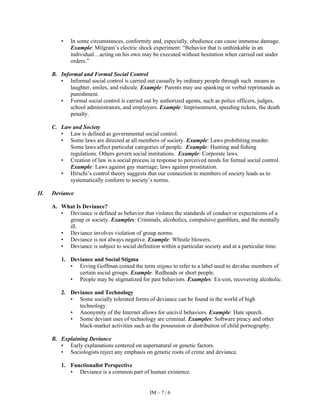
A. Conformity and Obedience
• Stanley Milgram defined conformity as going along with peers who have no particular right
to direct our behavior. Milgram defined obedience as compliance with higher authorities in
a hierarchal structure. Example: A military recruit who must follow the orders given by his
or her commander.
10.
IM – 7| 6
• In some circumstances, conformity and, especially, obedience can cause immense damage.
Example: Milgram’s electric shock experiment: “Behavior that is unthinkable in an
individual…acting on his own may be executed without hesitation when carried out under
orders.”
B. Informal and Formal Social Control
• Informal social control is carried out casually by ordinary people through such means as
laughter, smiles, and ridicule. Example: Parents may use spanking or verbal reprimands as
punishment.
• Formal social control is carried out by authorized agents, such as police officers, judges,
school administrators, and employers. Example: Imprisonment, speeding tickets, the death
penalty.
C. Law and Society
• Law is defined as governmental social control.
• Some laws are directed at all members of society. Example: Laws prohibiting murder.
Some laws affect particular categories of people. Example: Hunting and fishing
regulations. Others govern social institutions. Example: Corporate laws.
• Creation of law is a social process in response to perceived needs for formal social control.
Example: Laws against gay marriage; laws against prostitution.
• Hirschi’s control theory suggests that our connection to members of society leads us to
systematically conform to society’s norms.
II. Deviance
A. What Is Deviance?
• Deviance is defined as behavior that violates the standards of conduct or expectations of a
group or society. Examples: Criminals, alcoholics, compulsive gamblers, and the mentally
ill.
• Deviance involves violation of group norms.
• Deviance is not always negative. Example: Whistle blowers.
• Deviance is subject to social definition within a particular society and at a particular time.
1. Deviance and Social Stigma
• Erving Goffman coined the term stigma to refer to a label used to devalue members of
certain social groups. Example: Redheads or short people.
• People may be stigmatized for past behaviors. Examples: Ex-con, recovering alcoholic.
2. Deviance and Technology
• Some socially tolerated forms of deviance can be found in the world of high
technology.
• Anonymity of the Internet allows for uncivil behaviors. Example: Hate speech.
• Some deviant uses of technology are criminal. Examples: Software piracy and other
black-market activities such as the possession or distribution of child pornography.
B. Explaining Deviance
• Early explanations centered on supernatural or genetic factors.
• Sociologists reject any emphasis on genetic roots of crime and deviance.
1. Functionalist Perspective
• Deviance is a common part of human existence.
11.
IM – 7| 7
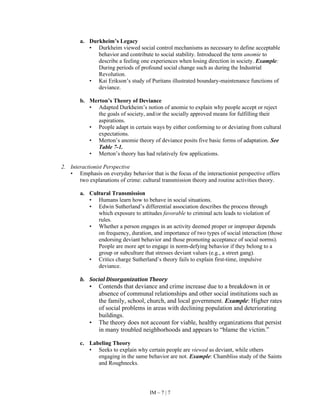
a. Durkheim’s Legacy
• Durkheim viewed social control mechanisms as necessary to define acceptable
behavior and contribute to social stability. Introduced the term anomie to
describe a feeling one experiences when losing direction in society. Example:
During periods of profound social change such as during the Industrial
Revolution.
• Kai Erikson’s study of Puritans illustrated boundary-maintenance functions of
deviance.
b. Merton’s Theory of Deviance
• Adapted Durkheim’s notion of anomie to explain why people accept or reject
the goals of society, and/or the socially approved means for fulfilling their
aspirations.
• People adapt in certain ways by either conforming to or deviating from cultural
expectations.
• Merton’s anomie theory of deviance posits five basic forms of adaptation. See
Table 7-1.
• Merton’s theory has had relatively few applications.
2. Interactionist Perspective
• Emphasis on everyday behavior that is the focus of the interactionist perspective offers
two explanations of crime: cultural transmission theory and routine activities theory.
a. Cultural Transmission
• Humans learn how to behave in social situations.
• Edwin Sutherland’s differential association describes the process through
which exposure to attitudes favorable to criminal acts leads to violation of
rules.
• Whether a person engages in an activity deemed proper or improper depends
on frequency, duration, and importance of two types of social interaction (those
endorsing deviant behavior and those promoting acceptance of social norms).
People are more apt to engage in norm-defying behavior if they belong to a
group or subculture that stresses deviant values (e.g., a street gang).
• Critics charge Sutherland’s theory fails to explain first-time, impulsive
deviance.
b. Social Disorganization Theory
• Contends that deviance and crime increase due to a breakdown in or
absence of communal relationships and other social institutions such as
the family, school, church, and local government. Example: Higher rates
of social problems in areas with declining population and deteriorating
buildings.
• The theory does not account for viable, healthy organizations that persist
in many troubled neighborhoods and appears to “blame the victim.”
c. Labeling Theory
• Seeks to explain why certain people are viewed as deviant, while others
engaging in the same behavior are not. Example: Chambliss study of the Saints
and Roughnecks.
12.
IM – 7| 8
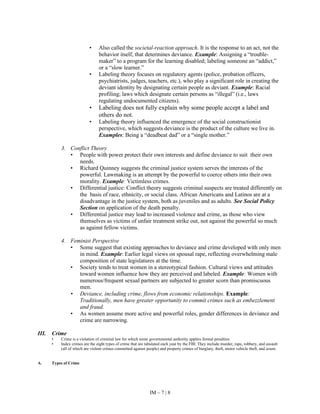
• Also called the societal-reaction approach. It is the response to an act, not the
behavior itself, that determines deviance. Example: Assigning a “trouble-
maker” to a program for the learning disabled; labeling someone an “addict,”
or a “slow learner.”
• Labeling theory focuses on regulatory agents (police, probation officers,
psychiatrists, judges, teachers, etc.), who play a significant role in creating the
deviant identity by designating certain people as deviant. Example: Racial
profiling; laws which designate certain persons as “illegal” (i.e., laws
regulating undocumented citizens).
• Labeling does not fully explain why some people accept a label and
others do not.
• Labeling theory influenced the emergence of the social constructionist
perspective, which suggests deviance is the product of the culture we live in.
Examples: Being a “deadbeat dad” or a “single mother.”
3. Conflict Theory
• People with power protect their own interests and define deviance to suit their own
needs.
• Richard Quinney suggests the criminal justice system serves the interests of the
powerful. Lawmaking is an attempt by the powerful to coerce others into their own
morality. Example: Victimless crimes.
• Differential justice: Conflict theory suggests criminal suspects are treated differently on
the basis of race, ethnicity, or social class. African Americans and Latinos are at a
disadvantage in the justice system, both as juveniles and as adults. See Social Policy
Section on application of the death penalty.
• Differential justice may lead to increased violence and crime, as those who view
themselves as victims of unfair treatment strike out, not against the powerful so much
as against fellow victims.
4. Feminist Perspective
• Some suggest that existing approaches to deviance and crime developed with only men
in mind. Example: Earlier legal views on spousal rape, reflecting overwhelming male
composition of state legislatures at the time.
• Society tends to treat women in a stereotypical fashion. Cultural views and attitudes
toward women influence how they are perceived and labeled. Example: Women with
numerous/frequent sexual partners are subjected to greater scorn than promiscuous
men.
• Deviance, including crime, flows from economic relationships. Example:
Traditionally, men have greater opportunity to commit crimes such as embezzlement
and fraud.
• As women assume more active and powerful roles, gender differences in deviance and
crime are narrowing.
III. Crime
• Crime is a violation of criminal law for which some governmental authority applies formal penalties.
• Index crimes are the eight types of crime that are tabulated each year by the FBI. They include murder, rape, robbery, and assault
(all of which are violent crimes committed against people) and property crimes of burglary, theft, motor vehicle theft, and arson.
A. Types of Crime
13.
IM – 7| 9
1. Victimless Crimes
• The willing exchange among adults of widely desired, but illegal, goods and services.
Examples: Prostitution, drug abuse, gambling.
• Proponents of decriminalization are troubled by attempts to legislate a moral code for
adults. These crimes are impossible to prevent, and an overburdened criminal justice
system should concentrate on offenses with real victims.
• Critics of decriminalization object to the notion that these crimes are “victimless.”
Examples: Over-drinking, compulsive gambling, and illegal drugs cause personal and
property damage. Prostitution reinforces idea that women are “toys” or objects to be
used for men’s pleasure. Alcohol and drug abuse can lead to drunk driving, etc.
2. Professional Crime
• Professional criminal (career criminal) is a person who pursues crime as a day-to-day
occupation. Example: Burglary or safecracking.
• They devote their entire working time to planning and executing crimes. They develop
skilled techniques and enjoy a certain degree of status among other criminals.
• Edward Sutherland (1937) offered pioneering insights into behavior of professional
criminals by publishing an annotated account written by a professional thief.
3. Organized Crime
• The work of a group that regulates relations between various criminal enterprises
involved in illegal activities, including smuggling and sale of illegal drugs, prostitution,
and gambling.
• Organized crime is a secret activity that evades law enforcement. It takes over
legitimate business, gains influence over labor unions, corrupts public officials,
intimidates witnesses, and taxes merchants for protection services.
• The global nature of organized crime can be found in the acts of transnational
organized crime affiliates, whose criminal activities include drug and arms smuggling,
money laundering, and trafficking in illegal immigrants and stolen goods.
4. White-Collar and Technology-Based Crime
• White-collar crime: illegal acts committed in the course of business activities by
affluent, “respectable” people. Examples: Income tax evasion, embezzlement, bribery.
• Edwin Sutherland coined the term white-collar crime in 1939 in reference to
individuals. The term has been broadened to include offenses by businesses and
corporations.
• Corporate crime is any criminal act by a corporation that is punishable by the
government. It takes many forms and includes individuals, organizations, and
institutions among its victims. Examples: Stock fraud and manipulation, accounting
fraud, production of unsafe goods, environmental pollution, anticompetitive behavior,
public health violations, and bribery and corruption.
• Computer crime: High technology allows criminals to carry out embezzlement or
electronic fraud, often leaving few traces. A 2009 study by the FBI White Collar
Crime Center found over 270,000 Internet crimes are reported every year.
• Convictions for such illegal acts do not generally harm a person’s reputation, status, or
career aspirations as much as conviction for a street crime.
5. Transnational Crime
14.
IM – 7| 10
• Crime that occurs across multiple national borders. Rather than concentrating on
specific countries, international crime spans the globe. Examples: terrorism, trafficking
in human beings (includes sex trade), trafficking in endangered species, drugs, and
stolen art/antiquities. See Table 7-3 for types of transnational crime.
• Not exclusive of other types of crime. Organized criminal networks are increasingly
global. Technology facilitates illegal activities. Example: child pornography.
B. Crime Statistics
• Crime statistics are not as accurate or reliable as social scientists would like.
1. Understanding Crime Statistics
a. Crime Rates
• There has been a significant decline in violent crime nationwide. Some suggest as
the reasons for the decline: a booming economy, community-oriented policing, gun
control laws, and an increase in the prison population.
• The proportion of major crimes committed by women has increased. Feminist
scholars draw our attention to one significant countertrend: the proportion of
major crimes committed by women has increased. However, violent crimes
committed by women, which have never been common, have declined.
b. Measuring Crime Rates
• Measuring of crime rates is conducted several ways.
• Crime Index: published annually by the FBI as part of the Uniform Crime Reports:
includes statistics on murder, rape, robbery, assault, burglary, larceny-theft, motor
vehicle theft, and arson. Disproportionately devoted to property crimes.
• Limitation of official crime statistics: They include only crimes actually reported to
law enforcement agencies.
• National Crime Victimization Survey (NCVS). Initiated in 1972, it is an annual
report compiled by the Bureau of Justice Statistics. Based on interviews of over
84,000 U.S. households, asking ordinary people whether they were victims of
specific crimes during the preceding year.
2. International Crime Rates
• Violent crime rates are higher in the United States than in Western Europe. U.S. may
place a greater individual emphasis on economic achievement. And, culture of the U.S.
has long tolerated many forms of violence.
• England, Italy, Australia, and New Zealand have higher rates of car theft.
• Russia has experienced an increase in violent crime since the overthrow of the
Communist party rule.
IV. Social Policy and Social Control: The Death Penalty in the United States and Worldwide
A. The Issue
• Questions surrounding the death penalty, from supporters of capital punishment and critics,
include: How can the government prevent the execution of innocent men and women? Is it right
to resort to a punishment that imitates the crime it seeks to condemn? Is life in prison enough of a
punishment for a truly heinous crime?
B. The Setting
15.
IM – 7| 11
• Today, the death penalty is still on the books in most states in the U.S. In other parts
of the world, serious thought has been given to the ethical implications of the ultimate
penalty. As of late 2010, 95 nations had renounced capital punishment, and many
more use it only sparingly, if at all. Different sociological theories approach the issue
in different ways.
C. Sociological Insights
1. Functionalist Perspectice
o Viewed from Émile Durkheim’s functionalist perspective, sanctions against
deviant acts help to reinforce society’s standards of proper behavior.
Supporters of capital punishment insist that fear of execution will prevent at
least some criminals from committing serious offenses
2. Conflict Perspective
o Conflict theorists counter that the persistence of social inequality in today’s society
puts poor people at a disadvantage in the criminal justice system
D. Policy Implications
• Recently, policy initiatives have moved in two different directions.In several death penalty
states, legislators are considering broadening the range of offenses for which convicted
criminals may be sentenced to execution. In these states, child molesters who did not murder
their victims could become eligible for the death penalty, along with certain repeat offenders.
The countertrend, a movement away from the death penalty, is based on doubts about
whether an execution can be carried out humanely.
KEY TERMS
Anomie Durkheim’s term for the loss of direction felt in a society when social control of individual
behavior has become ineffective.
Anomie theory of deviance Robert Merton’s theory of deviance as an adaptation of socially prescribed
goals or of the means governing their attainment, or both.
Conformity Going along with one’s peers—individuals of our own status who have no special right to
direct our behavior.
Control theory A view of conformity and deviance that suggests that our connection to members of
society leads us to systematically conform to society’s norms.
Crime A violation of criminal law for which some governmental authority applies formal penalties.
Cultural transmission A school of criminology that argues that criminal behavior is learned through
social interactions.
Deviance Behavior that violates the standards of conduct or expectations of a group or society.
Differential association A theory of deviance proposed by Edwin Sutherland that holds that violation of
rules results from exposure to attitudes favorable to criminal acts.
Differential justice Differences in the way social control is exercised over different groups.
16.
IM – 7| 12
Formal social control Social control carried out by authorized agents, such as police officers, judges,
school administrators, and employers.
Index crimes The eight types of crime reported annually by the FBI in the Uniform Crime Reports:
murder, rape, robbery, assault, burglary, theft, motor vehicle theft, and arson.
Hate crime A criminal offense committed because of the offender’s bias against a race, religion, ethnic
group, national origin, or sexual orientation. Also referred to as bias crime.
Informal social control Social control carried out casually by ordinary people through such means as
laughter, smiles, and ridicule.
Labeling theory An approach to deviance that attempts to explain why certain people are viewed as
deviants while others engaged in the same behavior are not.
Law Governmental social control.
Obedience Compliance with higher authorities in a hierarchical structure.
Organized crime The work of a group that regulates relations among various criminal enterprises,
including prostitution, gambling, and the smuggling and sale of illegal drugs.
Professional criminal A person who pursues crime as a day-to-day occupation, developing skilled
techniques and enjoying a certain degree of status among other criminals.
Routine activities theory The notion that criminal victimization increases when motivated offenders and
vulnerable targets converge.
Sanction A penalty or reward for conduct concerning a social norm.
Social constructionist perspective An approach to deviance that emphasizes the role of culture in the
creation of the deviant identity.
Social control The techniques and strategies for preventing deviant human behavior in any society.
Social disorganization theory The theory that crime and deviance are caused by the absence or
breakdown of communal relationships and social institutions.
Societal-reaction approach Another name for labeling theory.
Stigma A label used to devalue members of certain social groups.
Transnational crime Crime that occurs across multiple national borders.
Victimization survey A questionnaire or interview given to a sample of the population to determine
whether people have been victims of crime.
Victimless crime A term used by sociologists to describe the willing exchange among adults of widely
desired, but illegal, goods and services.
White-collar crime Illegal acts committed by affluent, “respectable” individuals in the course of
business activities.
17.
IM – 7| 13
ADDITIONAL LECTURE IDEAS
7-1: Ethical Implications of Milgram’s Research
In Chapter 2 of the text we discussed some of the difficult ethical issues that confront social
science researchers. While conducting his experiments on obedience to authority, Stanley Milgram was
well aware that his study might leave subjects (especially those who had “shocked” others) with
disturbing aftereffects. Thus, as part of the normal procedure for the project, each subject was informed
that the “victim” had not actually received dangerous shocks, was carefully debriefed, and was given time
to discuss the experiment with someone on Milgram’s staff. Obedient subjects were assured that their
behavior was normal. Afterwards, they even had friendly meetings with unharmed “learners.” See
Milgram. Obedience to Authority. New York: Harper & Row, 1975, p. 24.
All subjects also received a follow-up questionnaire, which again allowed them to communicate
their feelings about the experiment. Almost 84 percent stated that they were glad to have been in the
study, while roughly 15 percent were neutral, and only 1.3 percent indicated negative feelings. In
addition, 74 percent noted that they had learned something of personal importance from the experience.
One subject wrote, “The experiment has strengthened my belief that man should avoid harm to his fellow
man even at the risk of violating authority.” Another commented, “If this experiment serves to jar people
out of complacency, it will have served its end” (195–196).
These measures, while impressive, are not conclusive; the experiment still could have been
harmful to participants who had to face their willingness to inflict pain on others. Therefore, Milgram had
a psychiatrist examine 40 subjects of the experiment. None showed any indications of “traumatic
reactions” (197). Yet even this test cannot guarantee that the same was true of the nearly 1,000 remaining
participants in the obedience experiments. See Kenneth Ring et al., “Mode of Debriefing,” Representative
Research in Social Psychology 1 (1970): 67–88.
A troubling question underlies Milgram’s important research, and also applies, to a lesser extent,
to the studies conducted by Solomon Asch. What are the long-range consequences of social science
research that misleads, deceives, and may actually harm participants? If the public comes to believe that
researchers are not sensitive to ethical issues—and will risk hurting subjects in the pursuit of
knowledge—it may become increasingly difficult to recruit subjects for worthwhile and ethically
scrupulous experiments. See Bem Allen. Social Behavior: Fact and Falsehood. Chicago: Nelson Hall,
1978, pp. 58–63. See also Diane Baumrind, “Some Thoughts on Ethics of Research,” American
Sociologist 19 (June 1964): 421–423.
7-2: Social Control on the Streets
Walking or standing on the sidewalk is legal. Or is it? In an effort to prevent behavior that some
communities regard as undesirable, walking or standing in public places is now being subjected to
sanctions. In the case of laws on vagrancy, these restrictions are not all new. The first full-fledged law
against vagrancy was passed in England in 1349. Much of this early legislation was motivated by concern
that people idly standing around might be carriers of disease. Many early statutes required such idle
people to take jobs that might be available. Later statutes shifted from a concern with disease and idleness
to a concern with criminal activities or people regarded as a “nuisance.”
How does society define or come to label people as a “nuisance?” Obviously, not all people are
equally likely to be subjected to such labeling. The homeless and young people come to mind as two
groups that have been subjected to social control over their ability to stand or walk at certain times or in
certain places. In the 1990s, curfew restrictions became increasingly popular, as some communities began
banning unescorted young people from their streets and even prohibiting them from driving after
18.
IM – 7| 14
prescribed hours. In many cases the curfew laws had been on the books for 50 years, but were only now
enforced in an effort to reduce teenage crime. Certain shopping malls began banning unescorted young
people out of concern that large groups of such youths were frightening away adults seeking to make
purchases. Criminologist James Alan Fox is skeptical of most of the new curfew laws, because he has
noted that most teenagers, whether law-abiding or delinquent, are asleep by the time the weekend curfew
hour, usually midnight, begins. Yet some communities, such as New Orleans, have school-night curfews
that begin as early as 8 PM.
Limiting movement at night may not produce the desired outcome. Analysis of most juvenile
crime shows it occurs around 3 PM, when school lets out and young people are still grouped together but
without adult supervision. Obviously, efforts to prevent crime by restricting movement need to consider
movement patterns.
Sources used for this essay include: Fox Butterfield, “Successes Reported for Curfews, but
Doubts Persist,” New York Times (June 3, 1996): A1, A13; William J. Chambliss, “A Sociological
Analysis of the Law of Vagrancy,” Social Problems 12 (Summer 1964): 67-77; and David A. Savage,
“Curfews Are Popular, but Results Mixed,” Los Angeles Times (June 1, 1996): A1, A19.
7-3: Deviance or Sport
A type of athletic contest is the subject of a clash in interpretations as to whether it constitutes
sport or violence. In question are two rival organizations, the Ultimate Fighting Championship and
Extreme Fighting, which mount competitions between two combatants. These competitions take place in
an octagonal ring surrounded by a chain-link fence, and the only rules are no eye-gouging or biting.
Chokeholds, headbutts, and rabbit punches to the brain stem are legal. So are knees to the throat and
elbows to the kidney. The fight is over when a doctor intervenes or when a fighter “taps out,” slamming a
hand repeatedly on the mat.
Although live audiences to such events, called “extreme fighting,” are limited, up to 350,000
households watched the “competition” between Dan “The Beast” Severn and “The Russian Bear” Oleg
Taktarov at home on pay-per-view TV.
Several states and cities have passed legislation banning such events, and as word spreads more
are considering that option. The stated purpose of such events is to determine which form of the martial
arts—judo, kickboxing, tae kwon do, jujitsu, kung fu, or another discipline—is superior. Supporters
defend this type of competition and note that it pays off financially. They argue that football is more
violent and that the critics are elitist, merely reflecting their negative opinion of the millions of people in
the United States who compete in the martial arts.
The issues are not really new. What is defined as deviant in the realm of sport and entertainment?
In different cultures boxing, bullfighting, and cockfighting are variously cheered on or seen as criminal
and barbaric.
Even more popular is the WWE, World Wrestling Entertainment, which regularly features
spectacles of outrageous proportion, including wrestlers urinating on one another; forcing another
wrestler to drink one’s chewed tobacco; pouring “vomit” over someone’s head; forcing someone (usually
a woman) to walk on all fours and bark like a dog; as well as graphic simulations of sexual acts. This
“sport” remains incredibly popular among many Americans, especially young men. Some parents even
bring their young children to see the show.
Sources: James Brooke, “Modern-Day Gladiators Head for Denver, but the Welcome Mat Is
Rolled Up,” New York Times (December 10, 1995): 12; Andrea Stone, “Fans See Fun in Brawls Where
Anything Goes,” USA Today (December 16, 1995): A1, A2. See Wrestling with Manhood: Boys,
Bullying, and Battering (Media Education Foundation, 2003, 60 minutes).
19.
IM – 7| 15
7-4: Primary and Secondary Deviance
Edwin Lemert has offered a useful clarification of the labeling approach. He distinguishes
between primary and secondary deviance. Primary deviance is the rationalized violation of rules that
define acceptable behavior. A person who abuses alcohol temporarily after the death of a loved one or
after a business failure is generally not regarded as deviant. Similarly, a college student who uses cocaine
once to find out what his or her friends are talking about will probably not be regarded as a “drug abuser.”
Excused or undetected deviant acts do not generate the self-image of a “delinquent” or a “criminal” and
may involve the use of techniques of neutralization.
Lemert argues that if people who are in a position to apply socially respected labels learn of
deviant behavior, an act of deviance will take on a much different meaning. Secondary deviance occurs
when a person has been labeled as “deviant.” This labeling arises more frequently when a person engages
in repeated acts of misconduct. As a result of the labeling process, the person may reorganize his or her
life around this new deviant status and thus embark on a life of norm-violating behavior.
For example, suppose that an adolescent boy is brought before a court and charged with his first
offense, shoplifting. He may regard the experience with fear and awe at the time. But if he is “let off”
based on his previous good conduct, the memory of the court appearance will fade. The act thus remains
one of primary deviance: the boy is labeled a “good kid” who “made a mistake.” Suppose, however, that
he is bitterly condemned by his family and rejected by his friends. If the youth perceives that he is being
viewed as a delinquent, he may begin to see himself that way. Once he accepts this self-image, the
incident is transformed into one of secondary deviance. Lemert’s work emphasizes the process of
developing a deviant identity over time, just as one can gradually accept the identity of “born leader” or
“class clown.” See Edwin Lemert. Social Psychology. New York: McGraw-Hill, 1951. See also Lemert.
Human Deviance: Social Problems and Social Control. Englewood Cliffs, NJ: Prentice Hall, 1967.
7-5: Discretionary Justice
Conflict theorists contend that social control is applied differentially to different suspects because
of the suspects’ social class backgrounds, nationality, or race. In a 1988 report by the Bureau of Justice
Statistics, summarized below in tabular form, discretionary practices were outlined at various levels of the
criminal justice system.
Source: Department of Justice. Report of the Nation on Crime and Justice (2nd ed.). Washington,
DC: U.S. Government Printing Office, 1988. (190)
DISCRETION WITHIN THE CRIMINAL JUSTICE SYSTEM
CRIMINAL JUSTICE OFFICIALS DISCRETIONARY POWERS
Police • Enforce specific laws
• Investigate specific crimes
• Search people, vicinities, buildings
• Arrest or detain people
Prosecutors • File charges or petitions for judicial decision
• Seek indictments
• Drop cases
• Reduce charges
• Recommend sentences
Not without reasondoes the oldest Christian church require of
those entering on marriage the most solemn review of all the past
life, the confession and repentance of every sin of thought, word,
and deed, and the reception of the holy sacrament; for thus the man
and woman who approach the august duty of creating a home are
reminded of the sanctity and beauty of what they undertake.
In this art of home-making I have set down in my mind certain
first principles, like the axioms of Euclid, and the first is,—
No home is possible without love.
All business marriages and marriages of convenience, all mere
culinary marriages and marriages of mere animal passion, make the
creation of a true home impossible in the outset. Love is the jewelled
foundation of this New Jerusalem descending from God out of
heaven, and takes as many bright forms as the amethyst, topaz, and
sapphire of that mysterious vision. In this range of creative art all
things are possible to him that loveth, but without love nothing is
possible.
We hear of most convenient marriages in foreign lands, which may
better be described as commercial partnerships. The money on each
side is counted; there is enough between the parties to carry on the
firm, each having the appropriate sum allotted to each. No love is
pretended, but there is great politeness. All is so legally and
thoroughly arranged, that there seems to be nothing left for future
quarrels to fasten on. Monsieur and Madame have each their
apartments, their carriages, their servants, their income, their
friends, their pursuits,—understand the solemn vows of marriage to
mean simply that they are to treat each other with urbanity in those
few situations where the path of life must necessarily bring them
together.
We are sorry that such an idea of marriage should be gaining
foothold in America. It has its root in an ignoble view of life,—an
utter and pagan darkness as to all that man and woman are called
to do in that highest relation where they act as one. It is a mean
22.
and low contrivanceon both sides, by which all the grand work of
home-building, all the noble pains and heroic toils of home-
education,—that education where the parents learn more than they
teach,—shall be (let us use the expressive Yankee idiom) shirked.
It is a curious fact that in those countries where this system of
marriages is the general rule there is no word corresponding to our
English word home. In many polite languages of Europe it would be
impossible neatly to translate the sentiment with which we began
this essay, that a man’s house is not always his home.
Let any one try to render the song, “Sweet Home,” into French,
and one finds how Anglo-Saxon is the very genius of the word. The
structure of life, in all its relations, in countries where marriages are
matter of arrangement, and not of love, excludes the idea of home.
How does life run in such countries? The girl is recalled from her
convent or boarding-school, and told that her father has found a
husband for her. No objection on her part is contemplated or
provided for; none generally occurs, for the child is only too happy
to obtain the fine clothes and the liberty which she has been taught
come only with marriage. Be the man handsome or homely,
interesting or stupid, still he brings these.
How intolerable such a marriage! we say, with the close intimacies
of Anglo-Saxon life in our minds. They are not intolerable, because
they are provided for by arrangements which make it possible for
each to go his or her several way, seeing very little of the other. The
son or daughter, which in due time makes its appearance in this
menage, is sent out to nurse in infancy, sent to boarding-school in
youth, and in maturity portioned and married, to repeat the same
process for another generation. Meanwhile, father and mother keep
a quiet establishment, and pursue their several pleasures. Such is
the system.
Houses built for this kind of life become mere sets of reception-
rooms, such as are the greater proportion of apartments to let in
Paris, where a hearty English or American family, with their children
23.
about them, couldscarcely find room to establish themselves.
Individual character, it is true, does something to modify this
programme. There are charming homes in France and Italy, where
warm and noble natures, thrown together, perhaps, by accident, or
mated by wise paternal choice, infuse warmth into the coldness of
the system under which they live. There are in all states of society
some of such domesticity of nature that they will create a home
around themselves under any circumstances, however barren.
Besides, so kindly is human nature, that Love uninvited before
marriage, often becomes a guest after, and with Love always comes
a home.
My next axiom is,—
There can be no true home without liberty.
The very idea of home is of a retreat where we shall be free to act
out personal and individual tastes and peculiarities, as we cannot do
before the wide world. We are to have our meals at what hour we
will, served in what style suits us. Our hours of going and coming
are to be as we please. Our favorite haunts are to be here or there,
our pictures and books so disposed as seems to us good, and our
whole arrangements the expression, so far as our means can
compass it, of our own personal ideas of what is pleasant and
desirable in life. This element of liberty, if we think of it, is the chief
charm of home. “Here I can do as I please,” is the thought with
which the tempest-tossed earth-pilgrim blesses himself or herself,
turning inward from the crowded ways of the world. This thought
blesses the man of business, as he turns from his day’s care, and
crosses the sacred threshold. It is as restful to him as the slippers
and gown and easy-chair by the fireside. Everybody understands him
here. Everybody is well content that he should take his ease in his
own way. Such is the case in the ideal home. That such is not always
the case in the real home comes often from the mistakes in the
house-furnishing. Much house-furnishing is too fine for liberty.
In America there is no such thing as rank and station which
impose a sort of prescriptive style on people of certain income. The
24.
consequence is thatall sorts of furniture and belongings, which in
the Old World have a recognized relation to certain possibilities of
income, and which require certain other accessories to make them in
good keeping, are thrown in the way of all sorts of people.
Young people who cannot expect by any reasonable possibility to
keep more than two or three servants, if they happen to have the
means in the outset, furnish a house with just such articles as in
England would suit an establishment of sixteen. We have seen
houses in England having two or three house-maids, and tables
served by a butler and two waiters, where the furniture, carpets,
china, crystal, and silver were in one and the same style with some
establishments in America where the family was hard pressed to
keep three Irish servants.
This want of servants is the one thing that must modify everything
in American life; it is, and will long continue to be, a leading feature
in the life of a country so rich in openings for man and woman that
domestic service can be only the stepping-stone to something
higher. Nevertheless, we Americans are great travellers; we are
sensitive, appreciative, fond of novelty, apt to receive and
incorporate into our own life what seems fair and graceful in that of
other people. Our women’s wardrobes are made elaborate with the
thousand elegancies of French toilet,—our houses filled with a
thousand knick-knacks of which our plain ancestors never dreamed.
Cleopatra did not set sail on the Nile in more state and beauty than
that in which our young American bride is often ushered into her
new home. Her wardrobe all gossamer lace and quaint frill and
crimp and embroidery, her house a museum of elegant and costly
gewgaws; and amid the whole collection of elegancies and fragilities,
she, perhaps, the frailest.
Then comes the tug of war. The young wife becomes a mother,
and while she is retired to her chamber, blundering Biddy rusts the
elegant knives, or takes off the ivory handles by soaking in hot
water,—the silver is washed in greasy soap-suds, and refreshed now
and then with a thump, which cocks the nose of the teapot awry, or
25.
makes the handleassume an air of drunken defiance. The fragile
China is chipped here and there around its edges with those minute
gaps so vexatious to a woman’s soul; the handles fly hither and
thither in the wild confusion of Biddy’s washing-day hurry, when
cook wants her to help hang out the clothes. Meanwhile, Bridget
sweeps the parlor with a hard broom, and shakes out showers of
ashes from the grate, forgetting to cover the damask lounges, and
they directly look as rusty and time-worn as if they had come from
an auction-store; and all together unite in making such havoc of the
delicate ruffles and laces of the bridal outfit and baby-layette, that,
when the poor young wife comes out of her chamber after her nurse
has left her, and, weakened and embarrassed with the demands of
the new-comer, begins to look once more into the affairs of her little
world, she is ready to sink with vexation and discouragement. Poor
little princess. Her clothes are made as princesses wear them, her
baby’s clothes like a young duke’s, her house furnished like a lord’s,
and only Bridget and Biddy and Polly to do the work of cook,
scullery-maid, butler, footman, laundress, nursery-maid, house-maid,
and lady’s maid. Such is the array that in the Old Country would be
deemed necessary to take care of an establishment got up like hers.
Everything in it is too fine,—not too fine to be pretty, not in bad
taste in itself, but too fine for the situation, too fine for comfort or
liberty.
What ensues in a house so furnished? Too often ceaseless fretting
of the nerves, in the wife’s despairing, conscientious efforts to keep
things as they should be. There is no freedom in a house where
things are too expensive and choice to be freely handled and easily
replaced. Life becomes a series of petty embarrassments and
restrictions, something is always going wrong, and the man finds his
fireside oppressive,—the various articles of his parlor and table seem
like so many temper-traps and spring-guns, menacing explosion and
disaster.
There may be, indeed, the most perfect home-feeling, the utmost
coseyness and restfulness, in apartments crusted with gilding,
carpeted with velvet, and upholstered with satin. I have seen such,
26.
where the home-likelook and air of free use was as genuine as in a
Western log-cabin; but this was in a range of princely income that
made all these things as easy to be obtained or replaced as the most
ordinary of our domestic furniture. But so long as articles must be
shrouded from use, or used with fear and trembling, because their
cost is above the general level of our means, we had better be
without them, even though the most lucky of accidents may put
their possession in our power.
But it is not merely by the effort to maintain too much elegance
that the sense of home-liberty is banished from a house. It is
sometimes expelled in another way, with all painstaking and
conscientious strictness, by the worthiest and best of human beings,
the blessed followers of Saint Martha. Have we not known them, the
dear, worthy creatures, up before daylight, causing most scrupulous
lustrations of every pane of glass and inch of paint in our parlors, in
consequence whereof every shutter and blind must be kept closed
for days to come, lest the flies should speck the freshly washed
windows and wainscoting? Dear shade of Aunt Mehitabel, forgive our
boldness? Have we not been driven for days, in our youth, to read
our newspaper in the front veranda, in the kitchen, out in the barn,
—anywhere, in fact, where sunshine could be found, because there
was not a room in the house that was not cleaned, shut up, and
darkened? Have we not shivered with cold, all the glowering, gloomy
month of May, because the august front-parlor having undergone
the spring-cleaning, the andirons were snugly tied up in the tissue-
paper, and an elegant frill of the same material was trembling before
the mouth of the once glowing fireplace? Even so, dear soul, full of
loving-kindness and hospitality as thou wast, yet ever making our
house seem like a tomb! And with what patience wouldst thou sit
sewing by a crack in the shutters, an inch wide, rejoicing in thy
immaculate paint and clear glass! But was there ever a thing of thy
spotless and unsullied belongings which a boy might use? How I
trembled to touch thy scoured tins, that hung in appalling
brightness! with what awe I asked for a basket to pick strawberries!
and where in the house could I find a place to eat a piece of
27.
gingerbread? How likea ruffian, a Tartar, a pirate, I always felt,
when I entered thy domains! and how, from day to day, I wondered
at the immeasurable depths of depravity which were always leading
me to upset something, or break or tear or derange something, in
thy exquisitely kept premises! Somehow, the impression was burned
with overpowering force into my mind, that houses and furniture,
scrubbed floors, white curtains, bright tins and brasses were the
great, awful, permanent facts of existence,—and that men and
women, and particularly children, were the meddlesome intruders
upon this divine order, every trace of whose inter-meddling must be
scrubbed out and obliterated in the quickest way possible. It seemed
evident to me that houses would be far more perfect, if nobody lived
in them at all; but that, as men had really and absurdly taken to
living in them, they must live as little as possible. My only idea of a
house was a place full of traps and pitfalls for boys, a deadly
temptation to sins which beset one every moment; and when I read
about a sailor’s free life on the ocean, I felt an untold longing to go
forth and be free in like manner.
But a truce to these fancies, and back again to our essay.
If liberty in a house is a comfort to a husband, it is a necessity to
children. When we say liberty, we do not mean license. We do not
mean that Master Johnny be allowed to handle elegant volumes with
bread-and-butter fingers, or that little Miss be suffered to drum on
the piano, or practise line-drawing with a pin on varnished furniture.
Still it is essential that the family-parlors be not too fine for the
family to sit in,—too fine for the ordinary accidents, haps and
mishaps, of reasonably well-trained children. The elegance of the
parlor where papa and mamma sit and receive their friends should
wear an inviting, not a hostile and bristling, aspect to little people.
Its beauty and its order gradually form in the little mind a love of
beauty and order, and the insensible carefulness of regard.
Nothing is worse for a child than to shut him up in a room which
he understands is his, because he is disorderly,—where he is
expected, of course, to maintain and keep disorder. We have
28.
sometimes pitied thepoor little victims who show their faces
longingly at the doors of elegant parlors, and are forthwith collared
by the domestic police and consigned to some attic-apartment,
called a play-room, where chaos continually reigns. It is a mistake to
suppose, because children derange a well-furnished apartment, that
they like confusion. Order and beauty are always pleasant to them
as to grown people, and disorder and defacement are painful; but
they know neither how to create the one nor to prevent the other,—
their little lives are a series of experiments, often making disorder by
aiming at some new form of order. Yet, for all this, I am not one of
those who feel that in a family everything should bend to the sway
of these little people. They are the worst of tyrants in such houses,—
still, where children are, though the fact must not appear to them,
nothing must be done without a wise thought of them.
Here, as in all high art, the old motto is in force, “Ars est celare
artem.” Children who are taught too plainly by every anxious look
and word of their parents, by every family arrangement, by the
impressment of every chance guest into the service, that their
parents consider their education as the one important matter in
creation, are apt to grow up fantastical, artificial, and hopelessly self-
conscious. The stars cannot stop in their courses, even for our
personal improvement, and the sooner children learn this, the better.
The great art is to organize a home which shall move on with a
strong, wide, generous movement, where the little people shall act
themselves out as freely and impulsively as can consist with the
comfort of the whole, and where the anxious watching and planning
for them shall be kept as secret from them as possible.
It is well that one of the sunniest and airiest rooms in the house
be the children’s nursery. It is good philosophy, too, to furnish it
attractively, even if the sum expended lower the standard of parlor-
luxuries. It is well that the children’s chamber, which is to act
constantly on their impressible natures for years, should command a
better prospect, a sunnier aspect, than one which serves for a day’s
occupancy of the transient guest. It is well that journeys should be
made or put off in view of the interests of the children,—that guests
29.
should be invitedwith a view to their improvement,—that some
intimacies should be chosen and some rejected on their account. But
it is not well that all this should, from infancy, be daily talked out
before the child, and he grow up in egotism from moving in a sphere
where everything from first to last is calculated and arranged with
reference to himself. A little appearance of wholesome neglect
combined with real care and never-ceasing watchfulness has often
seemed to do wonders in this work of setting human beings on their
own feet for the life-journey.
Education is the highest object of home, but education in the
widest sense,—education of the parents no less than of the children.
In a true home the man and the woman receive, through their
cares, their watchings, their hospitality, their charity, the last and
highest finish that earth can put upon them. From that they must
pass upward, for earth can teach them no more.
The home-education is incomplete, unless it include the idea of
hospitality and charity. Hospitality is a Biblical and apostolic virtue,
and not so often recommended in Holy Writ without reason.
Hospitality is much neglected in America for the very reasons
touched upon above. We have received our ideas of propriety and
elegance of living from old countries, where labor is cheap, where
domestic service is a well-understood, permanent occupation,
adopted cheerfully for life, and where of course there is such a
subdivision of labor as insures great thoroughness in all its branches.
We are ashamed or afraid to conform honestly and hardily to a state
of things purely American. We have not yet accomplished what our
friend the Doctor calls “our weaning,” and learned that dinners with
circuitous courses and divers other Continental and English
refinements, well enough in their way, cannot be accomplished in
families with two or three untrained servants, without an expense of
care and anxiety which makes them heart-withering to the delicate
wife, and too severe a trial to occur often. America is the land of
subdivided fortunes, of a general average of wealth and comfort,
and there ought to be, therefore, an understanding in the social
basis far more simple than in the Old World.
30.
Many families ofsmall fortunes know this,—they are quietly living
so,—but they have not the steadiness to share their daily average
living with a friend, a traveller, or guest, just as the Arab shares his
tent and the Indian his bowl of succotash. They cannot have
company, they say. Why? Because it is such a fuss to get out the
best things, and then to put them back again. But why get out the
best things? Why not give your friend, what he would like a
thousand times better, a bit of your average home-life, a seat at any
time at your board, a seat at your fire? If he sees that there is a
handle off your teacup, and that there is a crack across one of your
plates, he only thinks, with a sigh of relief, “Well, mine aren’t the
only things that meet with accidents,” and he feels nearer to you
ever after; he will let you come to his table and see the cracks in his
teacups, and you will condole with each other on the transient
nature of earthly possessions. If it become apparent in these entirely
undressed rehearsals that your children are sometimes disorderly,
and that your cook sometimes overdoes the meat, and that your
second girl sometimes is awkward in waiting, or has forgotten a
table propriety, your friend only feels, “Ah, well, other people have
trials as well as I,” and he thinks, if you come to see him, he shall
feel, easy with you.
“Having company” is an expense that may always be felt; but easy
daily hospitality, the plate always on your table for a friend, is an
expense that appears on no account-book, and a pleasure that is
daily and constant.
Under this head of hospitality, let us suppose a case. A traveller
comes from England; he comes in good faith and good feeling to see
how Americans live. He merely wants to penetrate into the interior
of domestic life, to see what there is genuinely and peculiarly
American about it. Now here is Smilax, who is living, in a small, neat
way, on his salary from the daily press. He remembers hospitalities
received from our traveller in England, and wants to return them. He
remembers, too, with dismay, a well-kept establishment, the well-
served table, the punctilious, orderly servants. Smilax keeps two, a
cook and chambermaid, who divide the functions of his
31.
establishment between them.What shall he do? Let him say, in a
fair, manly way, “My dear fellow, I’m delighted to see you. I live in a
small way, but I’ll do my best for you, and Mrs. Smilax will be
delighted. Come and dine with us, so and so, and we’ll bring in one
or two friends.” So the man comes, and Mrs. Smilax serves up such
a dinner as lies within the limits of her knowledge and the capacities
of her servants. All plain, good of its kind, unpretending, without an
attempt to do anything English or French,—to do anything more
than if she were furnishing a gala-dinner for her father or returned
brother. Show him your house freely, just as it is, talk to him freely
of it, just as he in England showed you his larger house and talked
to you of his finer things. If the man is a true man, he will thank you
for such unpretending, sincere welcome; if he is a man of straw,
then he is not worth wasting Mrs. Smilax’s health and spirits for, in
unavailing efforts to get up a foreign dinner-party.
A man who has any heart in him values a genuine, little bit of
home more than anything else you can give him. He can get French
cooking at a restaurant; he can buy expensive wines at first-class
hotels, if he wants them; but the traveller, though ever so rich and
ever so well-served at home, is, after all, nothing but a man as you
are, and he is craving something that doesn’t seem like an hotel,—
some bit of real, genuine heart-life. Perhaps he would like better
than anything to show you the last photograph of his wife, or to
read to you the great, round-hand letter of his ten-year-old which he
has got to-day. He is ready to cry when he thinks of it. In this mood
he goes to see you, hoping for something like home, and you first
receive him in a parlor opened only on state-occasions, and that has
been circumstantially and exactly furnished, as the upholsterer
assures you, as every other parlor of the kind in the city is furnished.
You treat him to a dinner got up for the occasion, with hired waiters,
—a dinner which it has taken Mrs. Smilax a week to prepare for, and
will take her a week to recover from,—for which the baby has been
snubbed and turned off, to his loud indignation, and your young
four-year-old sent to his aunts. Your traveller eats your dinner, and
finds it inferior, as a work of art, to other dinners,—a poor imitation.
32.
He goes awayand criticises; you hear of it, and resolve never to
invite a foreigner again. But if you had given him a little of your
heart, a little home-warmth and feeling,—if you had shown him your
baby, and let him romp with your four-year-old, and eat a genuine
dinner with you,—would he have been false to that? Not so likely. He
wanted something real and human,—you gave him a bad dress-
rehearsal, and dress-rehearsals always provoke criticism.
Besides hospitality, there is, in a true home, a mission of charity. It
is a just law which regulates the possession of great or beautiful
works of art in the Old World, that they shall in some sense be
considered the property of all who can appreciate. Fine grounds
have hours when the public may be admitted,—pictures and statues
may be shown to visitors; and this is a noble charity. In the same
manner the fortunate individuals who have achieved the greatest of
all human works of art should employ it as a sacred charity. How
many, morally wearied, wandering, disabled, are healed and
comforted by the warmth of a true home! When a mother has sent
her son to the temptations of a distant city, what news is so glad to
her heart as that he has found some quiet family where he visits
often and is made to feel AT HOME? How many young men have good
women saved from temptation and shipwreck by drawing them often
to the sheltered corner by the fireside! The poor artist,—the
wandering genius who has lost his way in this world, and stumbles
like a child among hard realities,—the many men and women who,
while they have houses, have no homes,—see from afar, in their
distant, bleak life-journey, the light of a true home-fire, and, if made
welcome there, warm their stiffened limbs, and go forth stronger to
their pilgrimage. Let those who have accomplished this beautiful and
perfect work of divine art be liberal of its influence. Let them not
seek to bolt the doors and draw the curtains; for they know not, and
will never know till the future life, of the good they may do by the
ministration of this great charity of home.
We have heard much lately of the restricted sphere of woman. We
have been told how many spirits among women are of a wider,
stronger, more heroic mould than befits the mere routine of
33.
housekeeping. It maybe true that there are many women far too
great, too wise, too high, for mere housekeeping. But where is the
woman in any way too great or too high, or too wise, to spend
herself in creating a home? What can any woman make diviner,
higher, better? From such homes go forth all heroisms, all
inspirations, all great deeds. Such mothers and such homes have
made the heroes and martyrs, faithful unto death, who have given
their precious lives to us during these three years of our agony!
Homes are the work of art peculiar to the genius of woman. Man
helps in this work, but woman leads; the hive is always in confusion
without the queen-bee. But what a woman must she be who does
this work perfectly! She comprehends all, she balances and arranges
all; all different tastes and temperaments find in her their rest, and
she can unite at one hearthstone the most discordant elements. In
her is order, yet an order ever veiled and concealed by indulgence.
None are checked, reproved, abridged of privileges by her love of
system; for she knows that order was made for the family, and not
the family for order. Quietly she takes on herself what all others
refuse or overlook. What the unwary disarrange she silently rectifies.
Everybody in her sphere breathes easy, feels free; and the driest
twig begins in her sunshine to put out buds and blossoms. So quiet
are her operations and movements, that none sees that it is she who
holds all things in harmony; only, alas, when she is gone, how many
things suddenly appear disordered, inharmonious, neglected! All
these threads have been smilingly held in her weak hand. Alas, if
that is no longer there!
Can any woman be such a housekeeper without inspiration? No.
In the words of the old church-service, “Her soul must ever have
affiance in God.” The New Jerusalem of a perfect home cometh
down from God out of heaven. But to make such a home is ambition
high and worthy enough for any woman, be she what she may.
One thing more. Right on the threshold of all perfection lies the
cross to be taken up. No one can go over or around that cross in
science or in art. Without labor and self-denial neither Raphael nor
34.
Michel Angelo norNewton was made perfect. Nor can man or
woman create a true home who is not willing in the outset to
embrace life heroically, to encounter labor and sacrifice. Only to such
shall this divinest power be given to create on earth that which is
the nearest image of heaven.
36.
T
IV.
THE ECONOMY OFTHE BEAUTIFUL.
ALKING to you in this way once a month, O my confidential
reader, there seems to be danger, as in all intervals of friendship,
that we shall not readily be able to take up our strain of
conversation just where we left off. Suffer me, therefore, to remind
you that the month past left us seated at the fireside, just as we had
finished reading of what a home was, and how to make one.
The fire had burned low, and great, solid hickory coals were
winking dreamily at us from out their fluffy coats of white ashes,—
just as if some household sprite there were opening now one eye
and then the other, and looking in a sleepy, comfortable way at us.
The close of my piece, about the good house mother, had seemed
to tell on my little audience. Marianne had nestled close to her
mother, and laid her head on her knee; and though Jenny sat up
straight as a pin, yet her ever-busy knitting was dropped in her lap,
and I saw the glint of a tear in her quick, sparkling eye,—yes,
actually a little bright bead fell upon her work; whereupon she
started up actively, and declared that the fire wanted just one more
stick to make a blaze before bedtime; and then there was such a
raking among the coals, such an adjusting of the andirons, such
vigorous arrangement of the wood, and such a brisk whisking of the
hearth-brush, that it was evident Jenny had something on her mind.
When all was done, she sat down again and looked straight into
the blaze, which went dancing and crackling up, casting glances and
37.
flecks of lighton our pictures and books, and making all the old,
familiar furniture seem full of life and motion.
“I think that’s a good piece,” she said, decisively. “I think those are
things that should be thought about.”
Now Jenny was the youngest of our flock, and therefore, in a
certain way, regarded by my wife and me as perennially “the baby”;
and these little, old-fashioned, decisive ways of announcing her
opinions seemed so much a part of her nature, so peculiarly
“Jennyish,” as I used to say, that my wife and I only exchanged
amused glances over her head, when they occurred.
In a general way, Jenny, standing in the full orb of her feminine
instincts like Diana in the moon, rather looked down on all masculine
views of women’s matters as “tolerabiles ineptiæ”; but towards her
papa she had gracious turns of being patronizing to the last degree;
and one of these turns was evidently at its flood-tide, as she
proceeded to say,—
“I think papa is right,—that keeping house and having a home,
and all that, is a very serious thing, and that people go into it with
very little thought about it. I really think those things papa has been
saying there ought to be thought about.”
“Papa,” said Marianne, “I wish you would tell me exactly how you
would spend that money you gave me for house-furnishing. I should
like just your views.”
“Precisely,” said Jenny, with eagerness; “because it is just as papa
says,—a sensible man, who has thought, and had experience, can’t
help having some ideas, even about women’s affairs, that are worth
attending to. I think so, decidedly.”
I acknowledged the compliment for my sex and myself with my
best bow.
“But then, papa,” said Marianne, “I can’t help feeling sorry that
one can’t live in such a way as to have beautiful things around one.
I’m sorry they must cost so much, and take so much care, for I am
38.
made so thatI really want them. I do so like to see pretty things! I
do like rich carpets and elegant carved furniture, and fine china and
cut-glass and silver. I can’t bear mean, common-looking rooms. I
should so like to have my house look beautiful!”
“Your house ought not to look mean and common,—your house
ought to look beautiful,” I replied. “It would be a sin and a shame to
have it otherwise. No house ought to be fitted up for a future home
without a strong and a leading reference to beauty in all its
arrangements. If I were a Greek, I should say that the first
household libation should be made to beauty; but, being an old-
fashioned Christian, I would say that he who prepares a home with
no eye to beauty neglects the example of the great Father who has
filled our earth-home with such elaborate ornament.”
“But then, papa, there’s the money!” said Jenny, shaking her little
head wisely. “You men don’t think of that. You want us girls, for
instance, to be patterns of economy, but we must always be wearing
fresh, nice things; you abhor soiled gloves and worn shoes: and yet
how is all this to be done without money? And it’s just so in
housekeeping. You sit in your arm-chairs and conjure up visions of
all sorts of impossible things to be done; but when mamma there
takes out that little account-book, and figures away on the cost of
things, where do the visions go?”
“You are mistaken, my little dear, and you talk just like a
woman,”—(this was my only way of revenging myself,)—“that is to
say, you jump to conclusions, without sufficient knowledge. I
maintain that in house-furnishing, as well as woman-furnishing,
there’s nothing so economical as beauty.”
“There’s one of papa’s paradoxes!” said Jenny.
“Yes,” said I, “that is my thesis, which I shall nail up over the
mantel-piece there, as Luther nailed his to the church-door. It is time
to rake up the fire now; but to-morrow night I will give you a paper
on the Economy of the Beautiful.”
39.
“Come, now weare to have papa’s paradox,” said Jenny, as soon
as the tea-things had been carried out.
Entre nous, I must tell you that insensibly we had fallen into the
habit of taking our tea by my study-fire. Tea, you know, is a mere
nothing in itself, its only merit being its social and poetic
associations, its warmth and fragrance,—and the more socially and
informally it can be dispensed, the more in keeping with its airy and
cheerful nature.
Our circle was enlightened this evening by the cheery visage of
Bob Stephens, seated, as of right, close to Marianne’s work-basket.
“You see, Bob,” said Jenny, “papa has undertaken to prove that
the most beautiful things are always the cheapest.”
“I’m glad to hear that,” said Bob,—“for there’s a carved antique
bookcase and study-table that I have my eye on, and if this can in
any way be made to appear—”
“O, it won’t be made to appear,” said Jenny, settling herself at her
knitting, “only in some transcendental, poetic sense, such as papa
can always make out. Papa is more than half a poet, and his truths
turn out to be figures of rhetoric, when one comes to apply them to
matters of fact.”
“Now, Miss Jenny, please remember my subject and thesis,” I
replied,—“that in house-furnishing there is nothing so economical as
beauty; and I will make it good against all comers, not by figures of
rhetoric, but by figures of arithmetic. I am going to be very matter-
of-fact and commonplace in my details, and keep ever in view the
addition-table. I will instance a case which has occurred under my
own observation.”
40.
The Economy ofthe Beautiful.
Two of the houses lately built on the new land in Boston were
bought by two friends, Philip and John. Philip had plenty of money,
and paid the cash down for his house, without feeling the slightest
vacancy in his pocket. John, who was an active, rising young man,
just entering on a flourishing business, had expended all his
moderate savings for years in the purchase of his dwelling, and still
had a mortgage remaining, which he hoped to clear off by his future
successes. Philip begins the work of furnishing as people do with
whom money is abundant, and who have simply to go from shop to
shop and order all that suits their fancy and is considered ‘the thing’
in good society. John begins to furnish with very little money. He has
a wife and two little ones, and he wisely deems that to insure to
them a well-built house, in an open, airy situation, with
conveniences for warming, bathing, and healthy living, is a wise
beginning in life; but it leaves him little or nothing beyond.
Behold, then, Philip and his wife, well pleased, going the rounds of
shops and stores in fitting up their new dwelling, and let us follow
step by step. To begin with the wall-paper. Imagine a front and back
parlor, with folding-doors, with two south windows on the front, and
two looking on a back court, after the general manner of city
houses. We will suppose they require about thirty rolls of wall-paper.
Philip buys the heaviest French velvet, with gildings and traceries, at
four dollars a roll. This, by the time it has been put on, with gold
mouldings, according to the most established taste of the best
paper-hangers, will bring the wall-paper of the two rooms to a figure
something like two hundred dollars. Now they proceed to the carpet-
stores, and there are thrown at their feet by obsequious clerks
velvets and Axminsters, with flowery convolutions and medallion-
centres, as if the flower-gardens of the tropics were whirling in
waltzes, with graceful lines of arabesque,—roses, callas, lilies,
knotted, wreathed, twined, with blue and crimson and golden
41.
ribbons, dazzling marvelsof color and tracery. There is no restraint
in price,—four or six dollars a yard, it is all the same to them,—and
soon a magic flower-garden blooms on the floors, at a cost of five
hundred dollars. A pair of elegant rugs, at fifty dollars apiece,
complete the inventory, and bring our rooms to the mark of eight
hundred dollars for papering and carpeting alone. Now come the
great mantel-mirrors for four hundred more, and our rooms
progress. Then comes the upholsterer, and measures our four
windows, that he may skilfully barricade them from air and sunshine.
The fortifications against heaven, thus prepared, cost, in the shape
of damask, cord, tassels, shades, laces, and cornices, about two
hundred dollars per window. To be sure, they make the rooms close
and sombre as the grave; but they are of the most splendid stuffs;
and if the sun would only reflect, he would see, himself, how foolish
it was for him to try to force himself into a window guarded by his
betters. If there is anything cheap and plebeian, it is sunshine and
fresh air! Behold us, then, with our two rooms papered, carpeted,
and curtained for two thousand dollars; and now are to be put in
them sofas, lounges, étagères, centre-tables, screens, chairs of
every pattern and device, for which it is but moderate to allow a
thousand more. We have now two parlors furnished at an outlay of
three thousand dollars, without a single picture, a single article of
statuary, a single object of Art of any kind, and without any light to
see them by, if they were there. We must say for our Boston
upholsterers and furniture-makers that such good taste generally
reigns in their establishments that rooms furnished at hap-hazard
from them cannot fail of a certain air of good taste, so far as the
individual things are concerned. But the different articles we have
supposed, having been ordered without reference to one another or
the rooms, have, when brought together, no unity of effect, and the
general result is scattering and confused. If asked how Philip’s
parlors look, your reply is, “O, the usual way of such parlors,—
everything that such people usually get,—medallion-carpets, carved
furniture, great mirrors, bronze mantel-ornaments, and so on.” The
only impression a stranger receives, while waiting in the dim twilight
42.
of these rooms,is that their owner is rich, and able to get good,
handsome things, such as all other rich people get.
Now our friend John, as often happens in America, is moving in
the same social circle with Philip, visiting the same people,—his
house is the twin of the one Philip has been furnishing, and how
shall he, with a few hundred dollars, make his rooms even
presentable beside those which Philip has fitted up elegantly at three
thousand?
Now for the economy of beauty. Our friend must make his prayer
to the Graces,—for, if they cannot save him, nobody can. One thing
John has to begin with, that rare gift to man, a wife with the magic
cestus of Venus,—not around her waist, but, if such a thing could
be, in her finger-ends. All that she touches falls at once into
harmony and proportion. Her eye for color and form is intuitive: let
her arrange a garret, with nothing but boxes, barrels, and cast-off
furniture in it, and ten to one she makes it seem the most attractive
place in the house. It is a veritable “gift of good faërie,” this tact of
beautifying and arranging, that some women have,—and, on the
present occasion, it has a real, material value, that can be estimated
in dollars and cents. Come with us and you can see the pair taking
their survey of the yet unfurnished parlors, as busy and happy as a
couple of bluebirds picking up the first sticks and straws for their
nest.
“There are two sunny windows to begin with,” says the good fairy,
with an appreciative glance. “That insures flowers all winter.”
“Yes,” says John; “I never would look at a house without a good
sunny exposure. Sunshine is the best ornament of a house, and
worth an extra thousand a year.”
“Now for our wall-paper,” says she. “Have you looked at wall-
papers, John?”
“Yes; we shall get very pretty ones for thirty-seven cents a roll; all
you want of a paper, you know, is to make a ground-tint to throw
43.
out your picturesand other matters, and to reflect a pleasant tone of
light.”
“Well, John, you know Uncle James says that a stone-color is the
best,—but I can’t bear those cold blue grays.”
“Nor I,” says John. “If we must have gray, let it at least be a gray
suffused with gold or rose-color, such as you see at evening in the
clouds.”
“So I think,” responds she; “but, better, I should like a paper with
a tone of buff,—something that produces warm yellowish reflections,
and will almost make you think the sun is shining in cold gray
weather; and then there is nothing that lights up so cheerfully in the
evening. In short, John, I think the color of a zafferano rose will be
just about the shade we want.”
“Well, I can find that, in good American paper, as I said before, at
from thirty-seven to forty cents a roll. Then, our bordering: there’s
an important question, for that must determine the carpet, the
chairs, and everything else. Now what shall be the ground-tint of our
rooms?”
“There are only two to choose between,” says the lady,—“green
and marroon: which is the best for the picture?”
“I think,” says John, looking above the mantel-piece, as if he saw
a picture there,—“I think a border of marroon velvet, with marroon
furniture, is the best for the picture.”
“I think so too,” said she; “and then we will have that lovely
marroon and crimson carpet that I saw at Lowe’s;—it is an ingrain,
to be sure, but has a Brussels pattern, a mossy, mixed figure, of
different shades of crimson; it has a good warm, strong color, and
when I come to cover the lounges and our two old arm-chairs with
marroon rep, it will make such a pretty effect.”
“Yes,” said John; “and then, you know, our picture is so bright, it
will light up the whole. Everything depends on the picture.”
44.
Now as to“the picture,” it has a story must be told. John, having
been all his life a worshipper and adorer of beauty and beautiful
things, had never passed to or from his business without stopping at
the print-shop windows, and seeing a little of what was there.
On one of these occasions he was smitten to the heart with the
beauty of an autumn landscape, where the red maples and
sumachs, the purple and crimson oaks, all stood swathed and
harmonized together in the hazy Indian-summer atmosphere. There
was a great yellow chestnut-tree, on a distant hill, which stood out
so naturally that John instinctively felt his fingers tingling for a
basket, and his heels alive with a desire to bound over on to the
rustling hillside and pick up the glossy brown nuts. Everything was
there of autumn, even to the golden-rod and purple asters and
scarlet creepers in the foreground.
John went in and inquired. It was by an unknown French artist,
without name or patrons, who had just come to our shores to study
our scenery, and this was the first picture he had exposed for sale.
John had just been paid a quarter’s salary; he bethought him of
board-bill and washerwoman, sighed, and faintly offered fifty dollars.
To his surprise he was taken up at once, and the picture became
his. John thought himself dreaming. He examined his treasure over
and over, and felt sure that it was the work of no amateur beginner,
but of a trained hand and a true artist-soul. So he found his way to
the studio of the stranger, and apologized for having got such a gem
for so much less than its worth. “It was all I could give, though,” he
said; “and one who paid four times as much could not value it
more.” And so John took one and another of his friends, with longer
purses than his own, to the studio of the modest stranger; and now
his pieces command their full worth in the market, and he works
with orders far ahead of his ability to execute, giving to the canvas
the traits of American scenery as appreciated and felt by the subtile
delicacy of the French mind,—our rural summer views, our autumn
glories, and the dreamy, misty delicacy of our snowy winter
landscapes. Whoso would know the truth of the same, let him
45.
inquire for themodest studio of Morvillier, at Maiden, scarce a bow-
shot from our Boston.
This picture had always been the ruling star of John’s house, his
main dependence for brightening up his bachelor-apartments; and
when he came to the task of furbishing those same rooms for a fair
occupant, the picture was still his mine of gold. For a picture,
painted by a real artist, who studies Nature minutely and
conscientiously, has something of the charm of the good Mother
herself,—something of her faculty of putting on different aspects
under different lights. John and his wife had studied their picture at
all hours of the day: they had seen how it looked when the morning
sun came aslant the scarlet maples and made a golden shimmer
over the blue mountains, how it looked toned down in the cool
shadows of afternoon, and how it warmed up in the sunset, and
died off mysteriously into the twilight; and now, when larger parlors
were to be furnished, the picture was still the tower of strength, the
rallying-point of their hopes.
“Do you know, John,” said the wife, hesitating, “I am really in
doubt whether we shall not have to get at least a few new chairs
and a sofa for our parlors? They are putting in such splendid things
at the other door that I am positively ashamed of ours; the fact is,
they look almost disreputable,—like a heap of rubbish.”
“Well,” said John, laughing, “I don’t suppose all together sent to
an auction-room would bring us fifty dollars, and yet, such as they
are, they answer the place of better things for us; and the fact is,
Mary, the hard impassable barrier in the case is, that there really is
no money to get any more.”
“Ah, well, then, if there isn’t, we must see what we can do with
these, and summon all the good fairies to our aid,” said Mary.
“There’s your little cabinet-maker, John, will look over the things,
and furbish them up; there’s that broken arm of the chair must be
mended, and everything revarnished; then I have found such a
lovely rep, of just the richest shade of marroon, inclining to crimson,
46.
and when wecome to cover the lounges and arm-chairs and sofas
and ottomans all alike, you know they will be quite another thing.”
“Trust you for that, Mary! By the by, I’ve found a nice little
woman, who has worked on upholstery, who will come in by the day,
and be the hands that shall execute the decrees of your taste.”
“Yes, I am sure we shall get on capitally. Do you know that I’m
almost glad we can’t get new things? It’s a sort of enterprise to see
what we can do with old ones.”
“Now, you see, Mary,” said John, seating himself on a lime-cask
which the plasterers had left, and taking out his memorandum-book,
“you see, I’ve calculated this thing all over; I’ve found a way by
which I can make our rooms beautiful and attractive without a cent
expended on new furniture.”
“Well, let’s hear.”
“Well, my way is short and simple. We must put things into our
rooms that people will look at, so that they will forget to look at the
furniture, and never once trouble their heads about it. People never
look at furniture so long as there is anything else to look at; just as
Napoleon, when away on one of his expeditions, being told that the
French populace were getting disaffected, wrote back, ‘Gild the
dome des Invalides,’ and so they gilded it, and the people, looking at
that, forgot everything else.”
“But I’m not clear yet,” said Mary, “what is coming of this rhetoric.”
“Well, then, Mary, I’ll tell you. A suit of new carved black-walnut
furniture, severe in taste and perfect in style, such as I should
choose at David and Saul’s, could not be got under three hundred
dollars, and I haven’t the three hundred to give. What, then, shall
we do? We must fall back on our resources; we must look over our
treasures. We have our proof cast of the great glorious head of the
Venus di Milo; we have those six beautiful photographs of Rome,
that Brown brought to us; we have the great German lithograph of
the San Sisto Mother and Child, and we have the two angel-heads,
from the same; we have that lovely golden twilight sketch of
47.
Heade’s; we havesome sea-photographs of Bradford’s; we have an
original pen-and-ink sketch by Billings; and then, as before, we have
‘our picture.’ What has been the use of our watching at the gates
and waiting at the doors of Beauty all our lives, if she hasn’t thrown
us out a crust now and then, so that we might have it for time of
need? Now, you see, Mary, we must make the toilet of our rooms
just as a pretty woman makes hers when money runs low, and she
sorts and freshens her ribbons, and matches them to her hair and
eyes, and, with a bow here, and a bit of fringe there, and a button
somewhere else, dazzles us into thinking that she has an infinity of
beautiful attire. Our rooms are new and pretty of themselves, to
begin with; the tint of the paper, and the rich coloring of the border,
corresponding with the furniture and carpets, will make them seem
prettier. And now for arrangement. Take this front-room. I propose
to fill those two recesses each side of the fireplace with my books, in
their plain pine cases, just breast-high from the floor: they are
stained a good dark color, and nobody need stick a pin in them to
find out that they are not rosewood. The top of these shelves on
either side to be covered with the same stuff as the furniture,
finished with a crimson fringe. On top of the shelves on one side of
the fireplace I shall set our noble Venus di Milo, and I shall buy at
Cicci’s the lovely Clytie, and put it the other side. Then I shall get of
Williams and Everett two of their chromo-lithographs, which give you
all the style and charm of the best English water-color school. I will
have the lovely Bay of Amalfi over my Venus, because she came
from those suns and skies of Southern Italy, and I will hang Lake
Como over my Clytie. Then, in the middle, over the fireplace, shall
be ‘our picture.’ Over each door shall hang one of the lithographed
angel-heads of the San Sisto, to watch our going-out and coming-in;
and the glorious Mother and Child shall hang opposite the Venus di
Milo, to show how Greek and Christian unite in giving the noblest
type to womanhood. And then, when we have all our sketches and
lithographs framed and hung here and there, and your flowers
blooming as they always do, and your ivies wandering and rambling
as they used to, and hanging in the most graceful ways and places,
and all those little shells and ferns and vases, which you are always
48.
conjuring with, tastefullyarranged, I’ll venture to say that our rooms
will be not only pleasant, but beautiful, and that people will oftener
say, ‘How beautiful!’ when they enter, than if we spent three times
the money on new furniture.”
In the course of a year after this conversation, one and another of
my acquaintances were often heard speaking of John Merton’s
house. “Such beautiful rooms,—so charmingly furnished,—you must
go and see them. What does make them so much pleasanter than
those rooms in the other house, which have everything in them that
money can buy?” So said the folk,—for nine people out of ten only
feel the effect of a room, and never analyze the causes from which it
flows: they know that certain rooms seem dull and heavy and
confused, but they don’t know why; that certain others seem
cheerful, airy, and beautiful, but they know not why. The first
exclamation, on entering John’s parlors, was so often, “How
beautiful!” that it became rather a byword in the family. Estimated
by their mere money-value, the articles in the rooms were of very
trifling worth; but as they stood arranged and combined, they had
all the effect of a lovely picture. Although the statuary was only
plaster, and the photographs and lithographs such as were all within
the compass of limited means, yet every one of them was a good
thing of its own kind, or a good reminder of some of the greatest
works of Art. A good plaster cast is a daguerrotype, so to speak, of a
great statue, though it may be bought for five or six dollars, while its
original is not to be had for any namable sum. A chromo-lithograph
of the best sort gives all the style and manner and effect of Turner
or Stanfield, or any of the best of modern artists, though you buy it
for five or ten dollars, and though the original would command a
thousand guineas. The lithographs from Raphael’s immortal picture
give you the results of a whole age of artistic culture, in a form
within the compass of very humble means. There is now selling for
five dollars at Williams and Everett’s a photograph of Cheney’s
crayon drawing of the San Sisto Madonna and Child, which has the
very spirit of the glorious original. Such a picture, hung against the
wall of a child’s room, would train its eye from infancy; and yet how
49.
many will freelyspend five dollars in embroidery on its dress, that
say they cannot afford works of Art!
There was one advantage which John and his wife found in the
way in which they furnished their house, that I have hinted at
before: it gave freedom to their children. Though their rooms were
beautiful, it was not with the tantalizing beauty of expensive and
frail knick-knacks. Pictures hung against the wall, and statuary safely
lodged on brackets, speak constantly to the childish eye, but are out
of the reach of childish fingers, and are not upset by childish romps.
They are not like china and crystal, liable to be used and abused by
servants; they do not wear out; they are not spoiled by dust, nor
consumed by moths. The beauty once there is always there; though
the mother be ill and in her chamber, she has no fears that she shall
find it all wrecked and shattered. And this style of beauty,
inexpensive as it is, compared with luxurious furniture, is a means of
cultivation. No child is ever stimulated to draw or to read by an
Axminster carpet or a carved centre-table; but a room surrounded
with photographs and pictures and fine casts suggests a thousand
inquiries, stimulates the little eye and hand. The child is found with
its pencil, drawing; or he asks for a book on Venice, or wants to hear
the history of the Roman Forum.
But I have made my article too long. I will write another on the
moral and intellectual effects of house-furnishing.
“I have proved my point, Miss Jenny, have I not? In house-
furnishing, nothing is more economical than beauty.”
“Yes, papa,” said Jenny; “I give it up.”
51.
W
V.
RAKING UP THEFIRE.
E have a custom at our house which we call raking up the fire.
That is to say, the last half-hour before bedtime, we draw in,
shoulder to shoulder, around the last brands and embers of
our hearth, which we prick up and brighten, and dispose for a few
farewell flickers and glimmers. This is a grand time for discussion.
Then we talk over parties, if the young people have been out of an
evening,—a book, if we have been reading one; we discuss and
analyze characters,—give our views on all subjects, æsthetic,
theological, and scientific, in a way most wonderful to hear; and, in
fact, we sometimes get so engaged in our discussions that every
spark of the fire burns out, and we begin to feel ourselves shivering
around the shoulders, before we can remember that it is bedtime.
So, after the reading of my last article, we had a “raking-up
talk,”—to wit, Jenny, Marianne, and I, with Bob Stephens;—my wife,
still busy at her work-basket, sat at the table a little behind us.
Jenny, of course, opened the ball in her usual incisive manner.
“But now, papa, after all you say in your piece there, I cannot help
feeling, that, if I had the taste and the money too, it would be better
than the taste alone with no money. I like the nice arrangements
and the books and the drawings; but I think all these would appear
better still with really elegant furniture.”
“Who doubts that?” said I. “Give me a large tub of gold coin to dip
into, and the furnishing and beautifying of a house is a simple affair.
52.
The same tastethat could make beauty out of cents and dimes
could make it more abundantly out of dollars and eagles. But I have
been speaking for those who have not, and cannot get, riches, and
who wish to have agreeable houses; and I begin in the outset by
saying that beauty is a thing to be respected, reverenced, and
devoutly cared for,—and then I say that BEAUTY IS CHEAP, nay, to put it
so that the shrewdest Yankee will understand it, BEAUTY IS THE CHEAPEST
THING YOU CAN HAVE, because in many ways it is a substitute for
expense. A few vases of flowers in a room, a few blooming, well-
kept plants, a few prints framed in fanciful frames of cheap domestic
fabric, a statuette, a bracket, an engraving, a pencil-sketch, above
all, a few choice books,—all these arranged by a woman who has
the gift in her finger-ends often produce such an illusion on the
mind’s eye that one goes away without once having noticed that the
cushion of the arm-chair was worn out, and that some veneering
had fallen off the centre-table.
“I have a friend, a schoolmistress, who lives in a poor little cottage
enough, which, let alone of the Graces, might seem mean and
sordid, but a few flowerseeds and a little weeding in the spring make
it, all summer, an object which everybody stops to look at. Her
æsthetic soul was at first greatly tried with the water-barrel which
stood under the eaves spout,—a most necessary evil, since only thus
could her scanty supply of soft water for domestic purposes be
secured. One of the Graces, however, suggested to her a happy
thought. She planted a row of morning-glories round the bottom of
her barrel, and drove a row of tacks around the top, and strung her
water-butt with twine, like a great harpsichord. A few weeks covered
the twine with blossoming plants, which every morning were a mass
of many-colored airy blooms, waving in graceful sprays, and looking
at themselves in the water. The water-barrel, in fact, became a
celebrated stroke of ornamental gardening, which the neighbors
came to look at.”
“Well, but,” said Jenny, “everybody hasn’t mamma’s faculty with
flowers. Flowers will grow for some people, and for some they won’t.
Nobody can see what mamma does so very much, but her plants
53.
always look freshand thriving and healthy,—her things blossom just
when she wants them, and do anything else she wishes them to;
and there are other people that fume and fuss and try, and their
things won’t do anything at all. There’s Aunt Easygo has plant after
plant brought from the greenhouse, and hanging-baskets, and all
sorts of things; but her plants grow yellow and drop their leaves,
and her hanging-baskets get dusty and poverty-stricken, while
mamma’s go on flourishing as heart could desire.”
“I can tell you what your mother puts into her plants,” said I,
—“just what she has put into her children, and all her other home-
things,—her heart. She loves them; she lives in them; she has in
herself a plant-life and a plant-sympathy. She feels for them as if she
herself were a plant; she anticipates their wants,—always
remembers them without an effort, and so the care flows to them
daily and hourly. She hardly knows when she does the things that
make them grow,—but she gives them a minute a hundred times a
day. She moves this nearer the glass,—draws that back,—detects
some thief of a worm on one,—digs at the root of another, to see
why it droops,—washes these leaves, and sprinkles those,—waters,
and refrains from watering, all with the habitual care of love. Your
mother herself doesn’t know why her plants grow; it takes a
philosopher and a writer for the ‘Atlantic’ to tell her what the cause
is.”
Here I saw my wife laughing over her work-basket as she
answered,—
“Girls, one of these days, I will write an article for the ‘Atlantic,’
that your papa need not have all the say to himself: however, I
believe he has hit the nail on the head this time.”
“Of course he has,” said Marianne. “But, mamma, I am afraid to
begin to depend much on plants for the beauty of my rooms, for
fear I should not have your gift,—and of all forlorn and hopeless
things in a room, ill-kept plants are the most so.”
54.
“I would notrecommend,” said I, “a young house-keeper, just
beginning, to rest much for her home ornament on plant-keeping,
unless she has an experience of her own love and talent in this line,
which makes her sure of success; for plants will not thrive, if they
are forgotten or overlooked, and only tended in occasional intervals;
and, as Marianne says, neglected plants are the most forlorn of all
things.”
“But, papa,” said Marianne, anxiously, “there, in those patent
parlors of John’s that you wrote of, flowers acted a great part.”
“The charm of those parlors of John’s may be chemically
analyzed,” I said. “In the first place, there is sunshine, a thing that
always affects the human nerves of happiness. Why else is it that
people are always so glad to see the sun after a long storm? Why?
are bright days matters of such congratulation? Sunshine fills a
house with a thousand beautiful and fanciful effects of light and
shade,—with soft, luminous, reflected radiances, that give
picturesque effects to the pictures, books, statuettes of an interior.
John, happily, had no money to buy brocatelle curtains,—and
besides this, he loved sunshine too much to buy them, if he could.
He had been enough with artists to know that heavy damask
curtains darken precisely that part of the window where the light
proper for pictures and statuary should come in, namely, the upper
part. The fashionable system of curtains lights only the legs of the
chairs and the carpets, and leaves all the upper portion of the room
in shadow. John’s windows have shades which can at pleasure be
drawn down from the top or up from the bottom, so that the best
light to be had may always be arranged for his little interior.”
“Well, papa,” said Marianne, “in your chemical analysis of John’s
rooms, what is the next thing to the sunshine?”
“The next,” said I, “is harmony of color. The wall-paper, the
furniture, the carpets, are of tints that harmonize with one another.
This is a grace in rooms always, and one often neglected. The
French have an expressive phrase with reference to articles which
are out of accord,—they say that they swear at each other. I have
55.
been in roomswhere I seemed to hear the wall-paper swearing at
the carpet, and the carpet swearing back at the wall-paper, and each
article of furniture swearing at the rest. These appointments may all
of them be of the most expensive kind, but with such dis-harmony
no arrangement can ever produce anything but a vulgar and
disagreeable effect. On the other hand, I have been in rooms where
all the material was cheap, and the furniture poor, but where, from
some instinctive knowledge of the reciprocal effect of colors,
everything was harmonious, and produced a sense of elegance.
“I recollect once travelling on a Western canal through a long
stretch of wilderness, and stopping to spend the night at an obscure
settlement of a dozen houses. We were directed to lodgings in a
common frame-house at a little distance, where, it seemed, the only
hotel was kept. When we entered the parlor, we were struck with
utter amazement at its prettiness, which affected us before we
began to ask ourselves how it came to be pretty. It was, in fact, only
one of the miracles of harmonious color working with very simple
materials. Some woman had been busy there, who had both eyes
and fingers. The sofa, the common wooden rocking-chairs, and
some ottomans, probably made of old soap-boxes, were all covered
with American nankeen of a soft yellowish-brown, with a bordering
of blue print. The window-shades, the table-cover, and the piano-
cloth, all repeated the same colors, in the same cheap material. A
simple straw matting was laid over the floor, and, with a few books,
a vase of flowers, and one or two prints, the room had a home-like,
and even elegant air, that struck us all the more forcibly from its
contrast with the usual tawdry, slovenly style of such parlors.
“The means used for getting up this effect were the most
inexpensive possible,—simply the following-out, in cheap material, a
law of uniformity and harmony, which always will produce beauty. In
the same manner, I have seen a room furnished, whose effect was
really gorgeous in color, where the only materials used were Turkey-
red cotton and a simple ingrain carpet of corresponding color.
56.
Welcome to ourwebsite – the perfect destination for book lovers and
knowledge seekers. We believe that every book holds a new world,
offering opportunities for learning, discovery, and personal growth.
That’s why we are dedicated to bringing you a diverse collection of
books, ranging from classic literature and specialized publications to
self-development guides and children's books.
More than just a book-buying platform, we strive to be a bridge
connecting you with timeless cultural and intellectual values. With an
elegant, user-friendly interface and a smart search system, you can
quickly find the books that best suit your interests. Additionally,
our special promotions and home delivery services help you save time
and fully enjoy the joy of reading.
Join us on a journey of knowledge exploration, passion nurturing, and
personal growth every day!
testbankfan.com