Sociology in Modules 2nd Edition Schaefer
Solutions Manual download
https://testbankdeal.com/product/sociology-in-modules-2nd-
edition-schaefer-solutions-manual/
Explore and download more test bank or solution manual
at testbankdeal.com
We have selected some products that you may be interested in
Click the link to download now or visit testbankdeal.com
for more options!.
Sociology in Modules 2nd Edition Schaefer Test Bank
https://testbankdeal.com/product/sociology-in-modules-2nd-edition-
schaefer-test-bank/
Sociology in Modules 3rd Edition Schaefer Test Bank
https://testbankdeal.com/product/sociology-in-modules-3rd-edition-
schaefer-test-bank/
Sociology in Modules 4th Edition T Schaefer Test Bank
https://testbankdeal.com/product/sociology-in-modules-4th-edition-t-
schaefer-test-bank/
Foundations of Financial Management Canadian 11th Edition
Block Test Bank
https://testbankdeal.com/product/foundations-of-financial-management-
canadian-11th-edition-block-test-bank/
World History 7th Edition Duiker Test Bank
https://testbankdeal.com/product/world-history-7th-edition-duiker-
test-bank/
Bank Management and Financial Services 9th Edition Rose
Test Bank
https://testbankdeal.com/product/bank-management-and-financial-
services-9th-edition-rose-test-bank/
Basic Marketing A Strategic Marketing Planning Approach
18th Edition Perreault Test Bank
https://testbankdeal.com/product/basic-marketing-a-strategic-
marketing-planning-approach-18th-edition-perreault-test-bank/
Basic College Mathematics 6th Edition Martin-Gay Test Bank
https://testbankdeal.com/product/basic-college-mathematics-6th-
edition-martin-gay-test-bank/
Mosbys Canadian Textbook for The Support Worker 4th
Edition Sorrentino Test Bank
https://testbankdeal.com/product/mosbys-canadian-textbook-for-the-
support-worker-4th-edition-sorrentino-test-bank/
Using Financial Accounting Information The Alternative to
Debits and Credits 9th Edition Porter Solutions Manual
https://testbankdeal.com/product/using-financial-accounting-
information-the-alternative-to-debits-and-credits-9th-edition-porter-
solutions-manual/
IM – 7 | 1
CHAPTER
7 DEVIANCE, CRIME, AND
SOCIAL CONTROL
CHAPTER OUTLINE
MODULE 23: SOCIAL CONTROL
Conformity and Obedience
Informal and Formal Social Control
Law and Society
MODULE 24: WHAT IS
DEVIANCE?
Deviance and Social Stigma
Deviance and Technology
Sociological Perspectives on Deviance
MODULE 25: CRIME
Types of Crime
Crime Statistics
Boxes
Sociology on Campus: Binge Drinking
Trendspotting: Incarceration Nation
Research Today: Does Crime Pay?
Sociology on Campus: Campus Crime
Taking Sociology to Work: Stephanie
Vezzani, Special Agent, U.S. Secret
Service
Social Policy and Social Control: The
Death Penalty in the United States and
Worldwide
IM – 7 | 2
LEARNING OBJECTIVES WHAT’S NEW IN CHAPTER 7
1. Define and discuss the elements of social
control.
2. Discuss the classic Milgram experiment and
its implications for obedience and
conformity.
3. Discuss what is meant by informal and
formal social control.
4. Define deviance and social stigma.
5. Discuss the various functionalist concepts
and views explaining deviance.
6. Discuss the various interactionist concepts
and views explaining deviance.
7. Discuss the explanations of deviance from
the conflict and feminist perspectives.
8. Describe the various types of crime.
9. Discuss the nature and extent of crime in the
United States.
Module 25: Crime
• Subsection on hate crime, with figure,
“Categorization of Reported Hate
Crimes”
• Reorganized section on crime statistics,
with subsections on (a) index crimes and
victimization surveys, (b) crime trends,
and (c) international crime rates.
• Social Policy section on the death
penalty, with Mapping Life Worldwide
map, “Death Penalty Status by Country”
CHAPTER SUMMARY
The term social control refers to techniques and strategies for preventing deviant human behavior. Social
control occurs in families, peer groups, and bureaucratic organizations. Members of society are expected
to act in accordance with social norms. Sanctions, which may be either penalties or rewards, help to
induce behavior consistent with social norms.
Conformity is defined as going along with one’s peers even though they have no special right to direct
our behavior. Obedience is defined as compliance with higher authorities in a hierarchal structure. Social
controls may occur casually and informally through such means as smiles, laughter, and ridicule.
Authorized agents, such as police officers, physicians, school administrators, employers, and military
officers, carry out formal social control. Law is defined as governmental social control and reflects
continually changing standards of what is right and wrong.
Sociologists define deviance as behavior that violates the standards of conduct or expectations of a group
or society. Deviance involves the violations of group norms that may or may not be formalized into law.
It is a comprehensive concept that includes not only criminal behavior, but also many actions not subject
to prosecution. Deviance can be understood only within its social context. The term stigma was coined by
Erving Goffman to describe the labels society uses to devalue the members of certain social groups.
People are often stigmatized for deviant behaviors they may no longer engage in.
IM – 7 | 3
According to the functionalist view, deviance is a normal part of human existence. Functionalists suggest
that deviance helps to define the limits of proper behavior. Robert Merton adapted Émile Durkheim’s
notion of anomie to explain why people accept or reject the goals of a society. Merton’s theory posits five
basic forms of adaptations: (1) conformity, (2) innovation, (3) ritualism, (4) retreatism, and (5) rebellion.
Merton’s anomie theory, though popular, has had relatively few applications.
The interactionist perspective is reflected in theories based on cultural transmission, social
disorganization, and labeling. Cultural transmission, associated with criminologist Edwin Sutherland,
suggests that criminal behavior is learned through interactions with others. He used the term differential
association to describe the process through which exposure to attitudes favorable to criminal acts leads to
violation of rules. Social disorganization theory suggests that deviance increases when communal
relationships in neighborhoods and social networks are weakened or absent. Labeling theory emphasizes
how a person comes to be labeled as deviant or to accept the label. Labeling theory is also referred to as
the societal-reaction approach. The popularity of labeling theory is evident in the emergence of the social
constructionist perspective, which purports that deviance is the product of the culture in which we live.
Social constructionists focus on the decision-making process that creates the deviant identity.
The conflict view of deviance suggests that people with power protect their own interests and define
deviance to suit their own needs. Relating to differential justice, Richard Quinney argues that lawmaking
is often an attempt by the powerful to coerce others into their own brand of morality. Akin to the roots of
conflict theory, the feminist perspective suggests that deviance, including crime, tends to flow from
economic relationships. Feminists suggest that cultural views and attitudes toward women influence how
women are perceived and labeled.
Crime represents a deviation from formal social norms administered by the state. Types of crime include
professional crime, organized crime, white-collar and technology-based crime, corporate crime,
transnational crime, and victimless crime. There has been a significant decline in violent crime in the
United States. The accuracy of measuring crime and tabulating crime statistics varies widely. The
National Crime Victimization Survey was initiated in 1972 to question ordinary people about crime
victimization.
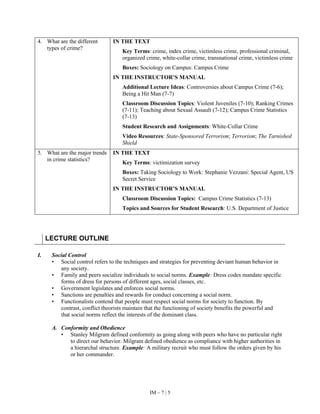
RESOURCE INTEGRATOR
Focus Questions Resources
1. What are the various
means of social control?
IN THE TEXT
Key Terms: social control, sanctions, conformity, obedience, informal
social control, formal social control, law, control theory
Boxes: Sociology on Campus: Binge Drinking
IN THE INSTRUCTOR’S MANUAL
Additional Lecture Ideas: Ethical Implications of Milgram’s Research
(7-1); Social Control on the Streets (7-2)
Classroom Discussion Topics: Group Pressure (7-2); The Power of
Authority (7-3); Field Trip to Prison (7-4); Public Opinion on Death
Penalty (7-9)
IM – 7 | 4
Student Research and Assignments: Obedience—Another Look;
Labeling of People with AIDS; Labeling; Community Crime Watch
Video Resources: Asylum; Bowling for Columbine; Death Devices;
Deviance and Social Control; Obedience to Authority
REEL SOCIETY VIDEO
Topic Index: Conformity; Sanctions
2. How do sociologists
define deviance?
IN THE TEXT
Key Terms: deviance, stigma
IN THE INSTRUCTOR’S MANUAL
Additional Lecture Ideas: Deviance or Sport (7-3); Primary and
Secondary Deviance (7-4)
Classroom Discussion Topics: Wallbangin (7-1); Conversing with
Deviants (7-5); Deviance Is in the Eye of the Beholder (7-6); Which Acts
are Deviant? (7-7); Positive Deviance (7-8)
Student Research and Assignments: Labeling of People with AIDS;
Labeling
Video Resources: Deviance
REEL SOCIETY VIDEO
Topic Index: Deviance
3. How do functionalists,
conflict theorists,
feminists, and
interactionists explain
deviance?
IN THE TEXT
Key Terms: anomie, anomie theory of deviance, cultural transmission,
differential association, social disorganization theory, labeling theory,
societal-reaction approach, social constructionist perspective, differential
justice
Boxes: Research Today: Does Crime Pay?
IN THE INSTRUCTOR’S MANUAL
Additional Lecture Ideas: Discretionary Justice (7-5); Controversies
about Campus Crime (7-6); Being a Hit Man (7-7)
Classroom Discussion Topics: Wallbangin (7-1); Conversing with
Deviants (7-5); Deviance Is in the Eye of the Beholder (7-6); Which Acts
Are Deviant? (7-7); Positive Deviance (7-8)
Student Research and Assignments: Labeling of People with AIDS;
Labeling; Crime and Violence within the Hispanic Community; Blacks in
Prisons; Race and Criminology; Rape Education Videos; White-Collar
Crime
Video Resources: Bowling for Columbine; Cops on Trial; Deadline; Race
on Trial
REEL SOCIETY VIDEO
Topic Index: Anomie Theory of Deviance
IM – 7 | 5
4. What are the different
types of crime?
IN THE TEXT
Key Terms: crime, index crime, victimless crime, professional criminal,
organized crime, white-collar crime, transnational crime, victimless crime
Boxes: Sociology on Campus: Campus Crime
IN THE INSTRUCTOR’S MANUAL
Additional Lecture Ideas: Controversies about Campus Crime (7-6);
Being a Hit Man (7-7)
Classroom Discussion Topics: Violent Juveniles (7-10); Ranking Crimes
(7-11); Teaching about Sexual Assault (7-12); Campus Crime Statistics
(7-13)
Student Research and Assignments: White-Collar Crime
Video Resources: State-Sponsored Terrorism; Terrorism; The Tarnished
Shield
5. What are the major trends
in crime statistics?
IN THE TEXT
Key Terms: victimization survey
Boxes: Taking Sociology to Work: Stephanie Vezzani: Special Agent, US
Secret Service
IN THE INSTRUCTOR’S MANUAL
Classroom Discussion Topics: Campus Crime Statistics (7-13)
Topics and Sources for Student Research: U.S. Department of Justice
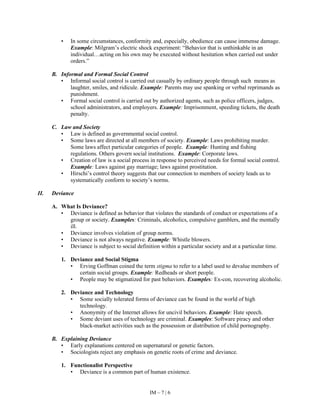
LECTURE OUTLINE
I. Social Control
• Social control refers to the techniques and strategies for preventing deviant human behavior in
any society.
• Family and peers socialize individuals to social norms. Example: Dress codes mandate specific
forms of dress for persons of different ages, social classes, etc.
• Government legislates and enforces social norms.
• Sanctions are penalties and rewards for conduct concerning a social norm.
• Functionalists contend that people must respect social norms for society to function. By
contrast, conflict theorists maintain that the functioning of society benefits the powerful and
that social norms reflect the interests of the dominant class.
A. Conformity and Obedience
• Stanley Milgram defined conformity as going along with peers who have no particular right
to direct our behavior. Milgram defined obedience as compliance with higher authorities in
a hierarchal structure. Example: A military recruit who must follow the orders given by his
or her commander.
IM – 7 | 6
• In some circumstances, conformity and, especially, obedience can cause immense damage.
Example: Milgram’s electric shock experiment: “Behavior that is unthinkable in an
individual…acting on his own may be executed without hesitation when carried out under
orders.”
B. Informal and Formal Social Control
• Informal social control is carried out casually by ordinary people through such means as
laughter, smiles, and ridicule. Example: Parents may use spanking or verbal reprimands as
punishment.
• Formal social control is carried out by authorized agents, such as police officers, judges,
school administrators, and employers. Example: Imprisonment, speeding tickets, the death
penalty.
C. Law and Society
• Law is defined as governmental social control.
• Some laws are directed at all members of society. Example: Laws prohibiting murder.
Some laws affect particular categories of people. Example: Hunting and fishing
regulations. Others govern social institutions. Example: Corporate laws.
• Creation of law is a social process in response to perceived needs for formal social control.
Example: Laws against gay marriage; laws against prostitution.
• Hirschi’s control theory suggests that our connection to members of society leads us to
systematically conform to society’s norms.
II. Deviance
A. What Is Deviance?
• Deviance is defined as behavior that violates the standards of conduct or expectations of a
group or society. Examples: Criminals, alcoholics, compulsive gamblers, and the mentally
ill.
• Deviance involves violation of group norms.
• Deviance is not always negative. Example: Whistle blowers.
• Deviance is subject to social definition within a particular society and at a particular time.
1. Deviance and Social Stigma
• Erving Goffman coined the term stigma to refer to a label used to devalue members of
certain social groups. Example: Redheads or short people.
• People may be stigmatized for past behaviors. Examples: Ex-con, recovering alcoholic.
2. Deviance and Technology
• Some socially tolerated forms of deviance can be found in the world of high
technology.
• Anonymity of the Internet allows for uncivil behaviors. Example: Hate speech.
• Some deviant uses of technology are criminal. Examples: Software piracy and other
black-market activities such as the possession or distribution of child pornography.
B. Explaining Deviance
• Early explanations centered on supernatural or genetic factors.
• Sociologists reject any emphasis on genetic roots of crime and deviance.
1. Functionalist Perspective
• Deviance is a common part of human existence.
IM – 7 | 7
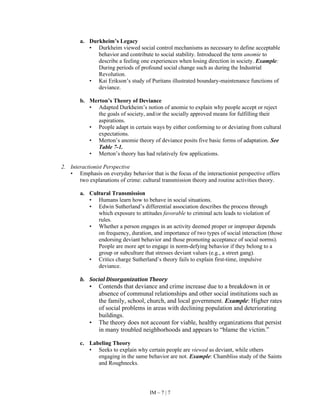
a. Durkheim’s Legacy
• Durkheim viewed social control mechanisms as necessary to define acceptable
behavior and contribute to social stability. Introduced the term anomie to
describe a feeling one experiences when losing direction in society. Example:
During periods of profound social change such as during the Industrial
Revolution.
• Kai Erikson’s study of Puritans illustrated boundary-maintenance functions of
deviance.
b. Merton’s Theory of Deviance
• Adapted Durkheim’s notion of anomie to explain why people accept or reject
the goals of society, and/or the socially approved means for fulfilling their
aspirations.
• People adapt in certain ways by either conforming to or deviating from cultural
expectations.
• Merton’s anomie theory of deviance posits five basic forms of adaptation. See
Table 7-1.
• Merton’s theory has had relatively few applications.
2. Interactionist Perspective
• Emphasis on everyday behavior that is the focus of the interactionist perspective offers
two explanations of crime: cultural transmission theory and routine activities theory.
a. Cultural Transmission
• Humans learn how to behave in social situations.
• Edwin Sutherland’s differential association describes the process through
which exposure to attitudes favorable to criminal acts leads to violation of
rules.
• Whether a person engages in an activity deemed proper or improper depends
on frequency, duration, and importance of two types of social interaction (those
endorsing deviant behavior and those promoting acceptance of social norms).
People are more apt to engage in norm-defying behavior if they belong to a
group or subculture that stresses deviant values (e.g., a street gang).
• Critics charge Sutherland’s theory fails to explain first-time, impulsive
deviance.
b. Social Disorganization Theory
• Contends that deviance and crime increase due to a breakdown in or
absence of communal relationships and other social institutions such as
the family, school, church, and local government. Example: Higher rates
of social problems in areas with declining population and deteriorating
buildings.
• The theory does not account for viable, healthy organizations that persist
in many troubled neighborhoods and appears to “blame the victim.”
c. Labeling Theory
• Seeks to explain why certain people are viewed as deviant, while others
engaging in the same behavior are not. Example: Chambliss study of the Saints
and Roughnecks.
IM – 7 | 8
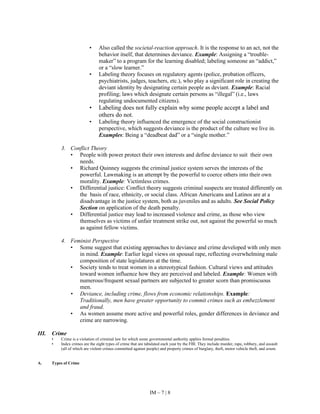
• Also called the societal-reaction approach. It is the response to an act, not the
behavior itself, that determines deviance. Example: Assigning a “trouble-
maker” to a program for the learning disabled; labeling someone an “addict,”
or a “slow learner.”
• Labeling theory focuses on regulatory agents (police, probation officers,
psychiatrists, judges, teachers, etc.), who play a significant role in creating the
deviant identity by designating certain people as deviant. Example: Racial
profiling; laws which designate certain persons as “illegal” (i.e., laws
regulating undocumented citizens).
• Labeling does not fully explain why some people accept a label and
others do not.
• Labeling theory influenced the emergence of the social constructionist
perspective, which suggests deviance is the product of the culture we live in.
Examples: Being a “deadbeat dad” or a “single mother.”
3. Conflict Theory
• People with power protect their own interests and define deviance to suit their own
needs.
• Richard Quinney suggests the criminal justice system serves the interests of the
powerful. Lawmaking is an attempt by the powerful to coerce others into their own
morality. Example: Victimless crimes.
• Differential justice: Conflict theory suggests criminal suspects are treated differently on
the basis of race, ethnicity, or social class. African Americans and Latinos are at a
disadvantage in the justice system, both as juveniles and as adults. See Social Policy
Section on application of the death penalty.
• Differential justice may lead to increased violence and crime, as those who view
themselves as victims of unfair treatment strike out, not against the powerful so much
as against fellow victims.
4. Feminist Perspective
• Some suggest that existing approaches to deviance and crime developed with only men
in mind. Example: Earlier legal views on spousal rape, reflecting overwhelming male
composition of state legislatures at the time.
• Society tends to treat women in a stereotypical fashion. Cultural views and attitudes
toward women influence how they are perceived and labeled. Example: Women with
numerous/frequent sexual partners are subjected to greater scorn than promiscuous
men.
• Deviance, including crime, flows from economic relationships. Example:
Traditionally, men have greater opportunity to commit crimes such as embezzlement
and fraud.
• As women assume more active and powerful roles, gender differences in deviance and
crime are narrowing.
III. Crime
• Crime is a violation of criminal law for which some governmental authority applies formal penalties.
• Index crimes are the eight types of crime that are tabulated each year by the FBI. They include murder, rape, robbery, and assault
(all of which are violent crimes committed against people) and property crimes of burglary, theft, motor vehicle theft, and arson.
A. Types of Crime
IM – 7 | 9
1. Victimless Crimes
• The willing exchange among adults of widely desired, but illegal, goods and services.
Examples: Prostitution, drug abuse, gambling.
• Proponents of decriminalization are troubled by attempts to legislate a moral code for
adults. These crimes are impossible to prevent, and an overburdened criminal justice
system should concentrate on offenses with real victims.
• Critics of decriminalization object to the notion that these crimes are “victimless.”
Examples: Over-drinking, compulsive gambling, and illegal drugs cause personal and
property damage. Prostitution reinforces idea that women are “toys” or objects to be
used for men’s pleasure. Alcohol and drug abuse can lead to drunk driving, etc.
2. Professional Crime
• Professional criminal (career criminal) is a person who pursues crime as a day-to-day
occupation. Example: Burglary or safecracking.
• They devote their entire working time to planning and executing crimes. They develop
skilled techniques and enjoy a certain degree of status among other criminals.
• Edward Sutherland (1937) offered pioneering insights into behavior of professional
criminals by publishing an annotated account written by a professional thief.
3. Organized Crime
• The work of a group that regulates relations between various criminal enterprises
involved in illegal activities, including smuggling and sale of illegal drugs, prostitution,
and gambling.
• Organized crime is a secret activity that evades law enforcement. It takes over
legitimate business, gains influence over labor unions, corrupts public officials,
intimidates witnesses, and taxes merchants for protection services.
• The global nature of organized crime can be found in the acts of transnational
organized crime affiliates, whose criminal activities include drug and arms smuggling,
money laundering, and trafficking in illegal immigrants and stolen goods.
4. White-Collar and Technology-Based Crime
• White-collar crime: illegal acts committed in the course of business activities by
affluent, “respectable” people. Examples: Income tax evasion, embezzlement, bribery.
• Edwin Sutherland coined the term white-collar crime in 1939 in reference to
individuals. The term has been broadened to include offenses by businesses and
corporations.
• Corporate crime is any criminal act by a corporation that is punishable by the
government. It takes many forms and includes individuals, organizations, and
institutions among its victims. Examples: Stock fraud and manipulation, accounting
fraud, production of unsafe goods, environmental pollution, anticompetitive behavior,
public health violations, and bribery and corruption.
• Computer crime: High technology allows criminals to carry out embezzlement or
electronic fraud, often leaving few traces. A 2009 study by the FBI White Collar
Crime Center found over 270,000 Internet crimes are reported every year.
• Convictions for such illegal acts do not generally harm a person’s reputation, status, or
career aspirations as much as conviction for a street crime.
5. Transnational Crime
IM – 7 | 10
• Crime that occurs across multiple national borders. Rather than concentrating on
specific countries, international crime spans the globe. Examples: terrorism, trafficking
in human beings (includes sex trade), trafficking in endangered species, drugs, and
stolen art/antiquities. See Table 7-3 for types of transnational crime.
• Not exclusive of other types of crime. Organized criminal networks are increasingly
global. Technology facilitates illegal activities. Example: child pornography.
B. Crime Statistics
• Crime statistics are not as accurate or reliable as social scientists would like.
1. Understanding Crime Statistics
a. Crime Rates
• There has been a significant decline in violent crime nationwide. Some suggest as
the reasons for the decline: a booming economy, community-oriented policing, gun
control laws, and an increase in the prison population.
• The proportion of major crimes committed by women has increased. Feminist
scholars draw our attention to one significant countertrend: the proportion of
major crimes committed by women has increased. However, violent crimes
committed by women, which have never been common, have declined.
b. Measuring Crime Rates
• Measuring of crime rates is conducted several ways.
• Crime Index: published annually by the FBI as part of the Uniform Crime Reports:
includes statistics on murder, rape, robbery, assault, burglary, larceny-theft, motor
vehicle theft, and arson. Disproportionately devoted to property crimes.
• Limitation of official crime statistics: They include only crimes actually reported to
law enforcement agencies.
• National Crime Victimization Survey (NCVS). Initiated in 1972, it is an annual
report compiled by the Bureau of Justice Statistics. Based on interviews of over
84,000 U.S. households, asking ordinary people whether they were victims of
specific crimes during the preceding year.
2. International Crime Rates
• Violent crime rates are higher in the United States than in Western Europe. U.S. may
place a greater individual emphasis on economic achievement. And, culture of the U.S.
has long tolerated many forms of violence.
• England, Italy, Australia, and New Zealand have higher rates of car theft.
• Russia has experienced an increase in violent crime since the overthrow of the
Communist party rule.
IV. Social Policy and Social Control: The Death Penalty in the United States and Worldwide
A. The Issue
• Questions surrounding the death penalty, from supporters of capital punishment and critics,
include: How can the government prevent the execution of innocent men and women? Is it right
to resort to a punishment that imitates the crime it seeks to condemn? Is life in prison enough of a
punishment for a truly heinous crime?
B. The Setting
Visit https://testbankdead.com
now to explore a rich
collection of testbank,
solution manual and enjoy
exciting offers!
IM – 7 | 11
• Today, the death penalty is still on the books in most states in the U.S. In other parts
of the world, serious thought has been given to the ethical implications of the ultimate
penalty. As of late 2010, 95 nations had renounced capital punishment, and many
more use it only sparingly, if at all. Different sociological theories approach the issue
in different ways.
C. Sociological Insights
1. Functionalist Perspectice
o Viewed from Émile Durkheim’s functionalist perspective, sanctions against
deviant acts help to reinforce society’s standards of proper behavior.
Supporters of capital punishment insist that fear of execution will prevent at
least some criminals from committing serious offenses
2. Conflict Perspective
o Conflict theorists counter that the persistence of social inequality in today’s society
puts poor people at a disadvantage in the criminal justice system
D. Policy Implications
• Recently, policy initiatives have moved in two different directions.In several death penalty
states, legislators are considering broadening the range of offenses for which convicted
criminals may be sentenced to execution. In these states, child molesters who did not murder
their victims could become eligible for the death penalty, along with certain repeat offenders.
The countertrend, a movement away from the death penalty, is based on doubts about
whether an execution can be carried out humanely.
KEY TERMS
Anomie Durkheim’s term for the loss of direction felt in a society when social control of individual
behavior has become ineffective.
Anomie theory of deviance Robert Merton’s theory of deviance as an adaptation of socially prescribed
goals or of the means governing their attainment, or both.
Conformity Going along with one’s peers—individuals of our own status who have no special right to
direct our behavior.
Control theory A view of conformity and deviance that suggests that our connection to members of
society leads us to systematically conform to society’s norms.
Crime A violation of criminal law for which some governmental authority applies formal penalties.
Cultural transmission A school of criminology that argues that criminal behavior is learned through
social interactions.
Deviance Behavior that violates the standards of conduct or expectations of a group or society.
Differential association A theory of deviance proposed by Edwin Sutherland that holds that violation of
rules results from exposure to attitudes favorable to criminal acts.
Differential justice Differences in the way social control is exercised over different groups.
IM – 7 | 12
Formal social control Social control carried out by authorized agents, such as police officers, judges,
school administrators, and employers.
Index crimes The eight types of crime reported annually by the FBI in the Uniform Crime Reports:
murder, rape, robbery, assault, burglary, theft, motor vehicle theft, and arson.
Hate crime A criminal offense committed because of the offender’s bias against a race, religion, ethnic
group, national origin, or sexual orientation. Also referred to as bias crime.
Informal social control Social control carried out casually by ordinary people through such means as
laughter, smiles, and ridicule.
Labeling theory An approach to deviance that attempts to explain why certain people are viewed as
deviants while others engaged in the same behavior are not.
Law Governmental social control.
Obedience Compliance with higher authorities in a hierarchical structure.
Organized crime The work of a group that regulates relations among various criminal enterprises,
including prostitution, gambling, and the smuggling and sale of illegal drugs.
Professional criminal A person who pursues crime as a day-to-day occupation, developing skilled
techniques and enjoying a certain degree of status among other criminals.
Routine activities theory The notion that criminal victimization increases when motivated offenders and
vulnerable targets converge.
Sanction A penalty or reward for conduct concerning a social norm.
Social constructionist perspective An approach to deviance that emphasizes the role of culture in the
creation of the deviant identity.
Social control The techniques and strategies for preventing deviant human behavior in any society.
Social disorganization theory The theory that crime and deviance are caused by the absence or
breakdown of communal relationships and social institutions.
Societal-reaction approach Another name for labeling theory.
Stigma A label used to devalue members of certain social groups.
Transnational crime Crime that occurs across multiple national borders.
Victimization survey A questionnaire or interview given to a sample of the population to determine
whether people have been victims of crime.
Victimless crime A term used by sociologists to describe the willing exchange among adults of widely
desired, but illegal, goods and services.
White-collar crime Illegal acts committed by affluent, “respectable” individuals in the course of
business activities.
IM – 7 | 13
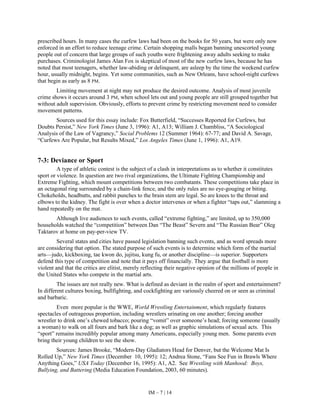
ADDITIONAL LECTURE IDEAS
7-1: Ethical Implications of Milgram’s Research
In Chapter 2 of the text we discussed some of the difficult ethical issues that confront social
science researchers. While conducting his experiments on obedience to authority, Stanley Milgram was
well aware that his study might leave subjects (especially those who had “shocked” others) with
disturbing aftereffects. Thus, as part of the normal procedure for the project, each subject was informed
that the “victim” had not actually received dangerous shocks, was carefully debriefed, and was given time
to discuss the experiment with someone on Milgram’s staff. Obedient subjects were assured that their
behavior was normal. Afterwards, they even had friendly meetings with unharmed “learners.” See
Milgram. Obedience to Authority. New York: Harper & Row, 1975, p. 24.
All subjects also received a follow-up questionnaire, which again allowed them to communicate
their feelings about the experiment. Almost 84 percent stated that they were glad to have been in the
study, while roughly 15 percent were neutral, and only 1.3 percent indicated negative feelings. In
addition, 74 percent noted that they had learned something of personal importance from the experience.
One subject wrote, “The experiment has strengthened my belief that man should avoid harm to his fellow
man even at the risk of violating authority.” Another commented, “If this experiment serves to jar people
out of complacency, it will have served its end” (195–196).
These measures, while impressive, are not conclusive; the experiment still could have been
harmful to participants who had to face their willingness to inflict pain on others. Therefore, Milgram had
a psychiatrist examine 40 subjects of the experiment. None showed any indications of “traumatic
reactions” (197). Yet even this test cannot guarantee that the same was true of the nearly 1,000 remaining
participants in the obedience experiments. See Kenneth Ring et al., “Mode of Debriefing,” Representative
Research in Social Psychology 1 (1970): 67–88.
A troubling question underlies Milgram’s important research, and also applies, to a lesser extent,
to the studies conducted by Solomon Asch. What are the long-range consequences of social science
research that misleads, deceives, and may actually harm participants? If the public comes to believe that
researchers are not sensitive to ethical issues—and will risk hurting subjects in the pursuit of
knowledge—it may become increasingly difficult to recruit subjects for worthwhile and ethically
scrupulous experiments. See Bem Allen. Social Behavior: Fact and Falsehood. Chicago: Nelson Hall,
1978, pp. 58–63. See also Diane Baumrind, “Some Thoughts on Ethics of Research,” American
Sociologist 19 (June 1964): 421–423.
7-2: Social Control on the Streets
Walking or standing on the sidewalk is legal. Or is it? In an effort to prevent behavior that some
communities regard as undesirable, walking or standing in public places is now being subjected to
sanctions. In the case of laws on vagrancy, these restrictions are not all new. The first full-fledged law
against vagrancy was passed in England in 1349. Much of this early legislation was motivated by concern
that people idly standing around might be carriers of disease. Many early statutes required such idle
people to take jobs that might be available. Later statutes shifted from a concern with disease and idleness
to a concern with criminal activities or people regarded as a “nuisance.”
How does society define or come to label people as a “nuisance?” Obviously, not all people are
equally likely to be subjected to such labeling. The homeless and young people come to mind as two
groups that have been subjected to social control over their ability to stand or walk at certain times or in
certain places. In the 1990s, curfew restrictions became increasingly popular, as some communities began
banning unescorted young people from their streets and even prohibiting them from driving after
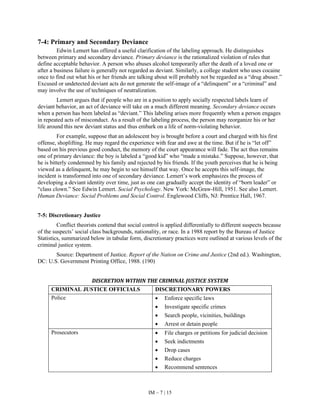
IM – 7 | 14
prescribed hours. In many cases the curfew laws had been on the books for 50 years, but were only now
enforced in an effort to reduce teenage crime. Certain shopping malls began banning unescorted young
people out of concern that large groups of such youths were frightening away adults seeking to make
purchases. Criminologist James Alan Fox is skeptical of most of the new curfew laws, because he has
noted that most teenagers, whether law-abiding or delinquent, are asleep by the time the weekend curfew
hour, usually midnight, begins. Yet some communities, such as New Orleans, have school-night curfews
that begin as early as 8 PM.
Limiting movement at night may not produce the desired outcome. Analysis of most juvenile
crime shows it occurs around 3 PM, when school lets out and young people are still grouped together but
without adult supervision. Obviously, efforts to prevent crime by restricting movement need to consider
movement patterns.
Sources used for this essay include: Fox Butterfield, “Successes Reported for Curfews, but
Doubts Persist,” New York Times (June 3, 1996): A1, A13; William J. Chambliss, “A Sociological
Analysis of the Law of Vagrancy,” Social Problems 12 (Summer 1964): 67-77; and David A. Savage,
“Curfews Are Popular, but Results Mixed,” Los Angeles Times (June 1, 1996): A1, A19.
7-3: Deviance or Sport
A type of athletic contest is the subject of a clash in interpretations as to whether it constitutes
sport or violence. In question are two rival organizations, the Ultimate Fighting Championship and
Extreme Fighting, which mount competitions between two combatants. These competitions take place in
an octagonal ring surrounded by a chain-link fence, and the only rules are no eye-gouging or biting.
Chokeholds, headbutts, and rabbit punches to the brain stem are legal. So are knees to the throat and
elbows to the kidney. The fight is over when a doctor intervenes or when a fighter “taps out,” slamming a
hand repeatedly on the mat.
Although live audiences to such events, called “extreme fighting,” are limited, up to 350,000
households watched the “competition” between Dan “The Beast” Severn and “The Russian Bear” Oleg
Taktarov at home on pay-per-view TV.
Several states and cities have passed legislation banning such events, and as word spreads more
are considering that option. The stated purpose of such events is to determine which form of the martial
arts—judo, kickboxing, tae kwon do, jujitsu, kung fu, or another discipline—is superior. Supporters
defend this type of competition and note that it pays off financially. They argue that football is more
violent and that the critics are elitist, merely reflecting their negative opinion of the millions of people in
the United States who compete in the martial arts.
The issues are not really new. What is defined as deviant in the realm of sport and entertainment?
In different cultures boxing, bullfighting, and cockfighting are variously cheered on or seen as criminal
and barbaric.
Even more popular is the WWE, World Wrestling Entertainment, which regularly features
spectacles of outrageous proportion, including wrestlers urinating on one another; forcing another
wrestler to drink one’s chewed tobacco; pouring “vomit” over someone’s head; forcing someone (usually
a woman) to walk on all fours and bark like a dog; as well as graphic simulations of sexual acts. This
“sport” remains incredibly popular among many Americans, especially young men. Some parents even
bring their young children to see the show.
Sources: James Brooke, “Modern-Day Gladiators Head for Denver, but the Welcome Mat Is
Rolled Up,” New York Times (December 10, 1995): 12; Andrea Stone, “Fans See Fun in Brawls Where
Anything Goes,” USA Today (December 16, 1995): A1, A2. See Wrestling with Manhood: Boys,
Bullying, and Battering (Media Education Foundation, 2003, 60 minutes).
IM – 7 | 15
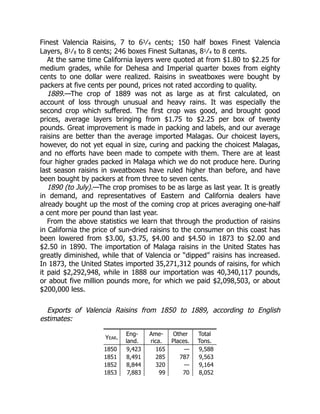
7-4: Primary and Secondary Deviance
Edwin Lemert has offered a useful clarification of the labeling approach. He distinguishes
between primary and secondary deviance. Primary deviance is the rationalized violation of rules that
define acceptable behavior. A person who abuses alcohol temporarily after the death of a loved one or
after a business failure is generally not regarded as deviant. Similarly, a college student who uses cocaine
once to find out what his or her friends are talking about will probably not be regarded as a “drug abuser.”
Excused or undetected deviant acts do not generate the self-image of a “delinquent” or a “criminal” and
may involve the use of techniques of neutralization.
Lemert argues that if people who are in a position to apply socially respected labels learn of
deviant behavior, an act of deviance will take on a much different meaning. Secondary deviance occurs
when a person has been labeled as “deviant.” This labeling arises more frequently when a person engages
in repeated acts of misconduct. As a result of the labeling process, the person may reorganize his or her
life around this new deviant status and thus embark on a life of norm-violating behavior.
For example, suppose that an adolescent boy is brought before a court and charged with his first
offense, shoplifting. He may regard the experience with fear and awe at the time. But if he is “let off”
based on his previous good conduct, the memory of the court appearance will fade. The act thus remains
one of primary deviance: the boy is labeled a “good kid” who “made a mistake.” Suppose, however, that
he is bitterly condemned by his family and rejected by his friends. If the youth perceives that he is being
viewed as a delinquent, he may begin to see himself that way. Once he accepts this self-image, the
incident is transformed into one of secondary deviance. Lemert’s work emphasizes the process of
developing a deviant identity over time, just as one can gradually accept the identity of “born leader” or
“class clown.” See Edwin Lemert. Social Psychology. New York: McGraw-Hill, 1951. See also Lemert.
Human Deviance: Social Problems and Social Control. Englewood Cliffs, NJ: Prentice Hall, 1967.
7-5: Discretionary Justice
Conflict theorists contend that social control is applied differentially to different suspects because
of the suspects’ social class backgrounds, nationality, or race. In a 1988 report by the Bureau of Justice
Statistics, summarized below in tabular form, discretionary practices were outlined at various levels of the
criminal justice system.
Source: Department of Justice. Report of the Nation on Crime and Justice (2nd ed.). Washington,
DC: U.S. Government Printing Office, 1988. (190)
DISCRETION WITHIN THE CRIMINAL JUSTICE SYSTEM
CRIMINAL JUSTICE OFFICIALS DISCRETIONARY POWERS
Police • Enforce specific laws
• Investigate specific crimes
• Search people, vicinities, buildings
• Arrest or detain people
Prosecutors • File charges or petitions for judicial decision
• Seek indictments
• Drop cases
• Reduce charges
• Recommend sentences
Other documents randomly have
different content
1883.
1884.
1885.
average of from seven to eight cents a pound, anything especially choice
bringing better prices.
—In 1883 California made a big stride forward in packing and
curing, and fancy raisins were put up in layers and cartoons. The Dehesa
brand and other fancy brands made their appearance, and as high as one
dollar was paid for quarters of five pounds each, and T. C. White’s and Miss
Austin’s brands became famous.
—In 1884, the year following that in which the duty was reduced to
two cents, the following prices prevailed:
In January the following quotations are recorded: Malaga layers, $3.50 for
wholes, $5.00 for halves, and $5.50 for quarters in frames. Valencia raisins,
fifteen cents per pound. Loose Muscatels, $1.60. London layers, $4.00.
Briggs, wholes $2.50,—usual advance of twenty-five cents on fractions.
Blowers, wholes $——, quarters $3.50, eighths $3.75. Other raisins, $2.50 in
large lots; quarter and eighth boxes twenty-five cents higher.
In August the following were the quotations: Malaga layers, $3.50 for
wholes, $4.00 for halves, and $4.50 for quarters in frames. Valencias, fifteen
cents per pound. Loose Muscatels, $1.90. London layers, $3.00. Briggs,
wholes $1.40, halves $1.75, quarters $2.25, eighths $2.75. Blowers, wholes
$2.25, halves $2.50, quarters $2.75, eighths $3.00.
In October the following quotations are to be found: Common layers,
$1.00 to $1.25 for wholes, $1.50 for halves, $1.75 for quarters, $2.25 for
eighths. London layers, $1.35 to $1.50 for wholes, $1.95 for halves, $2.00
for quarters, $2.50 for eighths.
In November, 1884, the following comment is made: The California raisin
pack will probably be 100,000 boxes. There would have been much more
but for the October rains, that prevented proper curing. The crop in Europe
is short, too, and prices are much higher than they were a year ago. It is
said that 15,000 boxes have been sold for the East. We quote: Malaga
layers, $3.75 for wholes, $4.00 for halves, and $4.50 for quarters in frames.
Valencia raisins, fifteen cents per pound. Loose Muscatels, $1.90. London
layers, $4.00. Briggs, wholes $1.75, halves $2.00, quarters $2.35 to $2.50.
Blowers, wholes $2.00, halves $2.25, quarters $2.50, eighths $2.75.
California layers, wholes $1.50, halves $1.75, quarters $2.00.
—In 1885 the market showed a gratifying ability to absorb at
profitable rates a good article, for prices ran: California common layers,
$1.75 for wholes, $2.00 for halves, $2.25 for quarters. Briggs, wholes $2.00,
with an advance of twenty-five cents on fractions. Blowers, $2.25 for
wholes, with an advance of twenty-five cents on fractions.
1886.
1887.
1888.
—In 1886 quotations show that only extra choice Malagas were
imported, and that, too, for a limited trade. Prices were: Malaga layers,
$4.00 for wholes, $4.25 and $4.75 for halves and quarters. Valencia raisins,
fifteen cents per pound. London layers, $3.00. California layers, wholes
$1.75,—usual advance of twenty-five cents on fractions. Briggs, wholes
$2.00, halves $2.25, etc. Blowers, wholes $2.25,—usual advance on
fractions.
For 1886 the market is reviewed as follows: The past year has been the
greatest for California dried fruit that the State has ever seen. There has
been an increase in every item, and a specially heavy increase in the matter
of raisins, the production of which has increased so fast that they have
become a leading article of merchandise. Where we were large importers
and generous consumers, more in proportion to our size than any one else
in the world, we have almost totally ceased importation and are among the
largest producers and exporters in the world, next to Spain itself. The total
receipts of imported raisins at New York for the season of 1886-87 were as
follows: 911,816 boxes of Valencias, 427,936 boxes of Malagas, 400 half
boxes of Malagas, 88,657 boxes of Sultanas. The California pack is this year
almost doubled, and shows great improvement in quality and packing.
—In October, 1887, prices were quoted as follows: London layers,
per box, $2.00 to $2.25. Loose Muscatels, from $1.50 to $1.80.
Riverside, El Cajon and Fresno raisins of excellent quality are now in the
market, and Butler and Forsyth raisins in Fresno begin to rival the very best
imported brands. Many large packing-houses are established in Fresno,
Riverside and El Cajon.
—The pack reaches in California 850,000 boxes, and the Fresno as
well as the Riverside raisins are very large and choice. Forsyth and Butler
raisins take the lead, some of the choicest layers bringing as high as one
dollar per five-pound quarter box. Only 112,000 boxes of Malaga raisins are
imported to the United States.
In October, 1888, the following prices were obtained for imported raisins
at auction sale in New York: 645 boxes best London Layers, $3.25 to
$3.121⁄2; 348 Imperial Cabinets, $3.35 to $3.20; 200 fine Dehesa Bunches,
$4.50 to $3.75; 50 Imperial Dehesa Bunches, $5.65; 104 Dehesa Bunches,
$4.05 to $4.00; 100 Finest Selected Clusters, $4.45 to $4.40; 50 Finest
Royal Clusters, $4.75; 3 Imperial Excelsior Dehesa Loose Muscatels, $5.00;
140 Imperial Loose Muscatels, $3.30 to $2.15; 1 Imperial Excelsior Dehesa
Clusters, $5.50; 9 Imperial Dehesa Clusters, $5.121⁄2 to $5.00; 2 Dehesa
Dessert Fruit, $4.10; 1,194 Finest Valencia Layers, 81⁄8 to 8 cents; 899
1889.
1890 (to July).
Finest Valencia Raisins, 7 to 63⁄4 cents; 150 half boxes Finest Valencia
Layers, 81⁄8 to 8 cents; 246 boxes Finest Sultanas, 81⁄4 to 8 cents.
At the same time California layers were quoted at from $1.80 to $2.25 for
medium grades, while for Dehesa and Imperial quarter boxes from eighty
cents to one dollar were realized. Raisins in sweatboxes were bought by
packers at five cents per pound, prices not rated according to quality.
—The crop of 1889 was not as large as at first calculated, on
account of loss through unusual and heavy rains. It was especially the
second crop which suffered. The first crop was good, and brought good
prices, average layers bringing from $1.75 to $2.25 per box of twenty
pounds. Great improvement is made in packing and labels, and our average
raisins are better than the average imported Malagas. Our choicest layers,
however, do not yet equal in size, curing and packing the choicest Malagas,
and no efforts have been made to compete with them. There are at least
four higher grades packed in Malaga which we do not produce here. During
last season raisins in sweatboxes have ruled higher than before, and have
been bought by packers at from three to seven cents.
—The crop promises to be as large as last year. It is greatly
in demand, and representatives of Eastern and California dealers have
already bought up the most of the coming crop at prices averaging one-half
a cent more per pound than last year.
From the above statistics we learn that through the production of raisins
in California the price of sun-dried raisins to the consumer on this coast has
been lowered from $3.00, $3.75, $4.00 and $4.50 in 1873 to $2.00 and
$2.50 in 1890. The importation of Malaga raisins in the United States has
greatly diminished, while that of Valencia or “dipped” raisins has increased.
In 1873, the United States imported 35,271,312 pounds of raisins, for which
it paid $2,292,948, while in 1888 our importation was 40,340,117 pounds,
or about five million pounds more, for which we paid $2,098,503, or about
$200,000 less.
Exports of Valencia Raisins from 1850 to 1889, according to English
estimates:
Year.
Eng-
land.
Ame-
rica.
Other
Places.
Total
Tons.
1850 9,423 165 — 9,588
1851 8,491 285 787 9,563
1852 8,844 320 — 9,164
1853 7,883 99 70 8,052
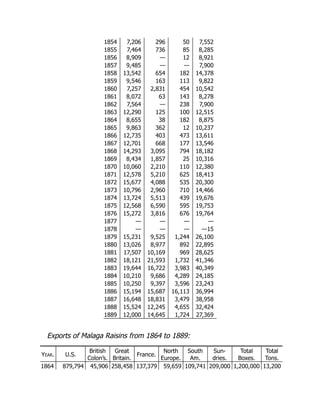
1854 7,206 296 50 7,552
1855 7,464 736 85 8,285
1856 8,909 — 12 8,921
1857 9,485 — — 7,900
1858 13,542 654 182 14,378
1859 9,546 163 113 9,822
1860 7,257 2,831 454 10,542
1861 8,072 63 143 8,278
1862 7,564 — 238 7,900
1863 12,290 125 100 12,515
1864 8,655 38 182 8,875
1865 9,863 362 12 10,237
1866 12,735 403 473 13,611
1867 12,701 668 177 13,546
1868 14,293 3,095 794 18,182
1869 8,434 1,857 25 10,316
1870 10,060 2,210 110 12,380
1871 12,578 5,210 625 18,413
1872 15,677 4,088 535 20,300
1873 10,796 2,960 710 14,466
1874 13,724 5,513 439 19,676
1875 12,568 6,590 595 19,753
1876 15,272 3,816 676 19,764
1877 — — — —
1878 — — — —15
1879 15,231 9,525 1,244 26,100
1880 13,026 8,977 892 22,895
1881 17,507 10,169 969 28,625
1882 18,121 21,593 1,732 41,346
1883 19,644 16,722 3,983 40,349
1884 10,210 9,686 4,289 24,185
1885 10,250 9,397 3,596 23,243
1886 15,194 15,687 16,113 36,994
1887 16,648 18,831 3,479 38,958
1888 15,524 12,245 4,655 32,424
1889 12,000 14,645 1,724 27,369
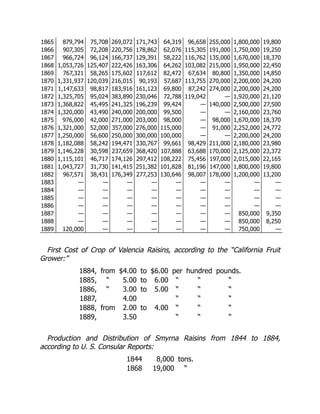
Exports of Malaga Raisins from 1864 to 1889:
Year. U.S.
British
Colon’s.
Great
Britain.
France.
North
Europe.
South
Am.
Sun-
dries.
Total
Boxes.
Total
Tons.
1864 879,794 45,906 258,458 137,379 59,659 109,741 209,000 1,200,000 13,200
1865 879,794 75,708 269,072 171,743 64,319 96,658 255,000 1,800,000 19,800
1866 907,305 72,208 220,756 178,862 62,076 115,305 191,000 1,750,000 19,250
1867 966,724 96,124 166,737 129,391 58,222 116,762 135,000 1,670,000 18,370
1868 1,053,726 125,407 222,426 163,306 64,262 103,082 215,000 1,950,000 22,450
1869 767,321 58,265 175,602 117,612 82,472 67,634 80,800 1,350,000 14,850
1870 1,331,937 120,039 216,015 90,193 57,687 113,755 270,000 2,200,000 24,200
1871 1,147,633 98,817 183,916 161,123 69,800 87,242 274,000 2,200,000 24,200
1872 1,325,705 95,024 383,890 230,046 72,788 119,042 — 1,920,000 21,120
1873 1,368,822 45,495 241,325 196,239 99,424 — 140,000 2,500,000 27,500
1874 1,320,000 43,490 240,000 200,000 99,500 — — 2,160,000 23,760
1875 976,000 42,000 271,000 203,000 98,000 — 98,000 1,670,000 18,370
1876 1,321,000 52,000 357,000 276,000 115,000 — 91,000 2,252,000 24,772
1877 1,250,000 56,600 250,000 300,000 100,000 — — 2,200,000 24,200
1878 1,182,088 58,242 194,471 330,767 99,661 98,429 211,000 2,180,000 23,980
1879 1,146,228 30,598 237,659 368,420 107,888 63,688 170,000 2,125,000 23,372
1880 1,115,101 46,717 174,126 297,412 108,222 75,456 197,000 2,015,000 22,165
1881 1,043,727 31,730 141,415 251,382 101,828 81,196 147,000 1,800,000 19,800
1882 967,571 38,431 176,349 277,253 130,646 98,007 178,000 1,200,000 13,200
1883 — — — — — — — — —
1884 — — — — — — — — —
1885 — — — — — — — — —
1886 — — — — — — — — —
1887 — — — — — — — 850,000 9,350
1888 — — — — — — — 850,000 8,250
1889 120,000 — — — — — — 750,000 —
First Cost of Crop of Valencia Raisins, according to the “California Fruit
Grower:”
1884, from $4.00 to $6.00 per hundred pounds.
1885, “ 5.00 to 6.00 “ “ “
1886, “ 3.00 to 5.00 “ “ “
1887, 4.00 “ “ “
1888, from 2.00 to 4.00 “ “ “
1889, 3.50 “ “ “
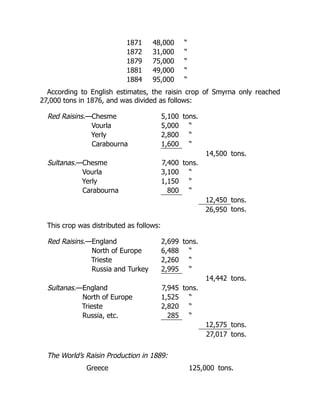
Production and Distribution of Smyrna Raisins from 1844 to 1884,
according to U. S. Consular Reports:
1844 8,000 tons.
1868 19,000 “
1871 48,000 “
1872 31,000 “
1879 75,000 “
1881 49,000 “
1884 95,000 “
According to English estimates, the raisin crop of Smyrna only reached
27,000 tons in 1876, and was divided as follows:
Red Raisins.—Chesme 5,100 tons.
Vourla 5,000 “
Yerly 2,800 “
Carabourna 1,600 “
14,500 tons.
Sultanas.—Chesme 7,400 tons.
Vourla 3,100 “
Yerly 1,150 “
Carabourna 800 “
12,450 tons.
26,950 tons.
This crop was distributed as follows:
Red Raisins.—England 2,699 tons.
North of Europe 6,488 “
Trieste 2,260 “
Russia and Turkey 2,995 “
14,442 tons.
Sultanas.—England 7,945 tons.
North of Europe 1,525 “
Trieste 2,820 “
Russia, etc. 285 “
12,575 tons.
27,017 tons.
The World’s Raisin Production in 1889:
Greece 125,000 tons.
Smyrna 120,000 “
Valencia 28,000 “
Lipari, Calabria and Pantellaria 15,000 “
California 10,000 “
Malaga 8,000 “
Scattered 5,000 “
Chile 1,000 “
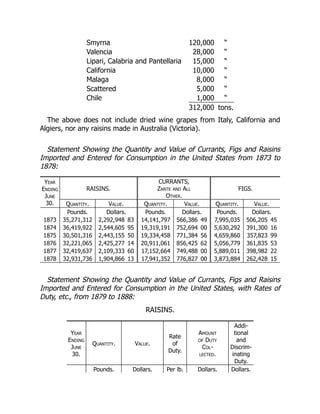
312,000 tons.
The above does not include dried wine grapes from Italy, California and
Algiers, nor any raisins made in Australia (Victoria).
Statement Showing the Quantity and Value of Currants, Figs and Raisins
Imported and Entered for Consumption in the United States from 1873 to
1878:
Year
Ending
June
30.
RAISINS.
CURRANTS,
Zante and All
Other.
FIGS.
Quantity. Value. Quantity. Value. Quantity. Value.
Pounds. Dollars. Pounds. Dollars. Pounds. Dollars.
1873 35,271,312 2,292,948 83 14,141,797 566,386 49 7,995,035 506,205 45
1874 36,419,922 2,544,605 95 19,319,191 752,694 00 5,630,292 391,300 16
1875 30,501,316 2,443,155 50 19,334,458 771,384 56 4,659,860 357,823 99
1876 32,221,065 2,425,277 14 20,911,061 856,425 62 5,056,779 361,835 53
1877 32,419,637 2,109,333 60 17,152,664 749,488 00 5,889,011 398,982 22
1878 32,931,736 1,904,866 13 17,941,352 776,827 00 3,873,884 262,428 15
Statement Showing the Quantity and Value of Currants, Figs and Raisins
Imported and Entered for Consumption in the United States, with Rates of
Duty, etc., from 1879 to 1888:
RAISINS.
Year
Ending
June
30.
Quantity. Value.
Rate
of
Duty.
Amount
of Duty
Col-
lected.
Addi-
tional
and
Discrim-
inating
Duty.
Pounds. Dollars. Per lb. Dollars. Dollars.
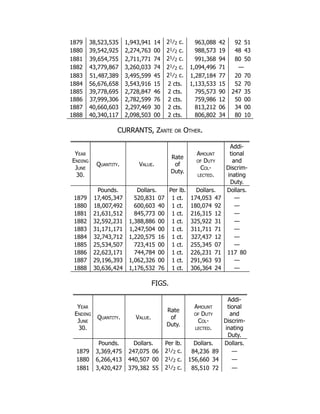
1879 38,523,535 1,943,941 14 21⁄2 c. 963,088 42 92 51
1880 39,542,925 2,274,763 00 21⁄2 c. 988,573 19 48 43
1881 39,654,755 2,711,771 74 21⁄2 c. 991,368 94 80 50
1882 43,779,867 3,260,033 74 21⁄2 c. 1,094,496 71 —
1883 51,487,389 3,495,599 45 21⁄2 c. 1,287,184 77 20 70
1884 56,676,658 3,543,916 15 2 cts. 1,133,533 15 52 70
1885 39,778,695 2,728,847 46 2 cts. 795,573 90 247 35
1886 37,999,306 2,782,599 76 2 cts. 759,986 12 50 00
1887 40,660,603 2,297,469 30 2 cts. 813,212 06 34 00
1888 40,340,117 2,098,503 00 2 cts. 806,802 34 80 10
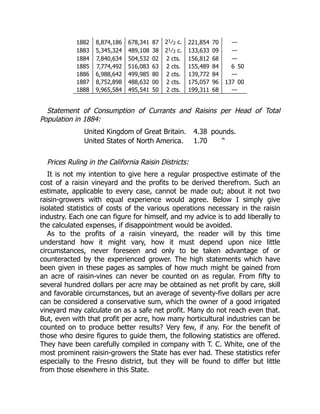
CURRANTS, Zante or Other.
Year
Ending
June
30.
Quantity. Value.
Rate
of
Duty.
Amount
of Duty
Col-
lected.
Addi-
tional
and
Discrim-
inating
Duty.
Pounds. Dollars. Per lb. Dollars. Dollars.
1879 17,405,347 520,831 07 1 ct. 174,053 47 —
1880 18,007,492 600,603 40 1 ct. 180,074 92 —
1881 21,631,512 845,773 00 1 ct. 216,315 12 —
1882 32,592,231 1,388,886 00 1 ct. 325,922 31 —
1883 31,171,171 1,247,504 00 1 ct. 311,711 71 —
1884 32,743,712 1,220,575 16 1 ct. 327,437 12 —
1885 25,534,507 723,415 00 1 ct. 255,345 07 —
1886 22,623,171 744,784 00 1 ct. 226,231 71 117 80
1887 29,196,393 1,062,326 00 1 ct. 291,963 93 —
1888 30,636,424 1,176,532 76 1 ct. 306,364 24 —
FIGS.
Year
Ending
June
30.
Quantity. Value.
Rate
of
Duty.
Amount
of Duty
Col-
lected.
Addi-
tional
and
Discrim-
inating
Duty.
Pounds. Dollars. Per lb. Dollars. Dollars.
1879 3,369,475 247,075 06 21⁄2 c. 84,236 89 —
1880 6,266,413 440,507 00 21⁄2 c. 156,660 34 —
1881 3,420,427 379,382 55 21⁄2 c. 85,510 72 —
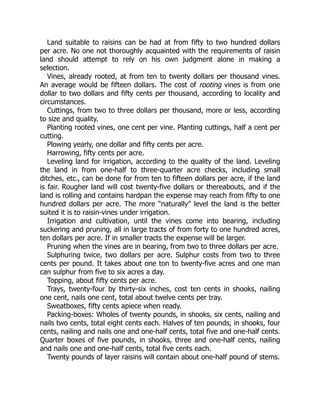
1882 8,874,186 678,341 87 21⁄2 c. 221,854 70 —
1883 5,345,324 489,108 38 21⁄2 c. 133,633 09 —
1884 7,840,634 504,532 02 2 cts. 156,812 68 —
1885 7,774,492 516,083 63 2 cts. 155,489 84 6 50
1886 6,988,642 499,985 80 2 cts. 139,772 84 —
1887 8,752,898 488,632 00 2 cts. 175,057 96 137 00
1888 9,965,584 495,541 50 2 cts. 199,311 68 —
Statement of Consumption of Currants and Raisins per Head of Total
Population in 1884:
United Kingdom of Great Britain. 4.38 pounds.
United States of North America. 1.70 “
Prices Ruling in the California Raisin Districts:
It is not my intention to give here a regular prospective estimate of the
cost of a raisin vineyard and the profits to be derived therefrom. Such an
estimate, applicable to every case, cannot be made out; about it not two
raisin-growers with equal experience would agree. Below I simply give
isolated statistics of costs of the various operations necessary in the raisin
industry. Each one can figure for himself, and my advice is to add liberally to
the calculated expenses, if disappointment would be avoided.
As to the profits of a raisin vineyard, the reader will by this time
understand how it might vary, how it must depend upon nice little
circumstances, never foreseen and only to be taken advantage of or
counteracted by the experienced grower. The high statements which have
been given in these pages as samples of how much might be gained from
an acre of raisin-vines can never be counted on as regular. From fifty to
several hundred dollars per acre may be obtained as net profit by care, skill
and favorable circumstances, but an average of seventy-five dollars per acre
can be considered a conservative sum, which the owner of a good irrigated
vineyard may calculate on as a safe net profit. Many do not reach even that.
But, even with that profit per acre, how many horticultural industries can be
counted on to produce better results? Very few, if any. For the benefit of
those who desire figures to guide them, the following statistics are offered.
They have been carefully compiled in company with T. C. White, one of the
most prominent raisin-growers the State has ever had. These statistics refer
especially to the Fresno district, but they will be found to differ but little
from those elsewhere in this State.
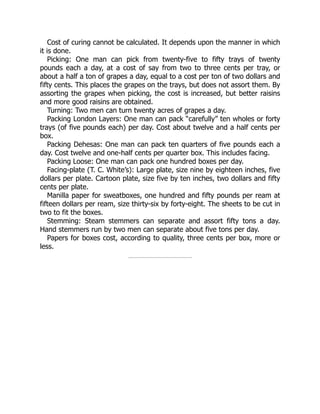
Land suitable to raisins can be had at from fifty to two hundred dollars
per acre. No one not thoroughly acquainted with the requirements of raisin
land should attempt to rely on his own judgment alone in making a
selection.
Vines, already rooted, at from ten to twenty dollars per thousand vines.
An average would be fifteen dollars. The cost of rooting vines is from one
dollar to two dollars and fifty cents per thousand, according to locality and
circumstances.
Cuttings, from two to three dollars per thousand, more or less, according
to size and quality.
Planting rooted vines, one cent per vine. Planting cuttings, half a cent per
cutting.
Plowing yearly, one dollar and fifty cents per acre.
Harrowing, fifty cents per acre.
Leveling land for irrigation, according to the quality of the land. Leveling
the land in from one-half to three-quarter acre checks, including small
ditches, etc., can be done for from ten to fifteen dollars per acre, if the land
is fair. Rougher land will cost twenty-five dollars or thereabouts, and if the
land is rolling and contains hardpan the expense may reach from fifty to one
hundred dollars per acre. The more “naturally” level the land is the better
suited it is to raisin-vines under irrigation.
Irrigation and cultivation, until the vines come into bearing, including
suckering and pruning, all in large tracts of from forty to one hundred acres,
ten dollars per acre. If in smaller tracts the expense will be larger.
Pruning when the vines are in bearing, from two to three dollars per acre.
Sulphuring twice, two dollars per acre. Sulphur costs from two to three
cents per pound. It takes about one ton to twenty-five acres and one man
can sulphur from five to six acres a day.
Topping, about fifty cents per acre.
Trays, twenty-four by thirty-six inches, cost ten cents in shooks, nailing
one cent, nails one cent, total about twelve cents per tray.
Sweatboxes, fifty cents apiece when ready.
Packing-boxes: Wholes of twenty pounds, in shooks, six cents, nailing and
nails two cents, total eight cents each. Halves of ten pounds, in shooks, four
cents, nailing and nails one and one-half cents, total five and one-half cents.
Quarter boxes of five pounds, in shooks, three and one-half cents, nailing
and nails one and one-half cents, total five cents each.
Twenty pounds of layer raisins will contain about one-half pound of stems.
Cost of curing cannot be calculated. It depends upon the manner in which
it is done.
Picking: One man can pick from twenty-five to fifty trays of twenty
pounds each a day, at a cost of say from two to three cents per tray, or
about a half a ton of grapes a day, equal to a cost per ton of two dollars and
fifty cents. This places the grapes on the trays, but does not assort them. By
assorting the grapes when picking, the cost is increased, but better raisins
and more good raisins are obtained.
Turning: Two men can turn twenty acres of grapes a day.
Packing London Layers: One man can pack “carefully” ten wholes or forty
trays (of five pounds each) per day. Cost about twelve and a half cents per
box.
Packing Dehesas: One man can pack ten quarters of five pounds each a
day. Cost twelve and one-half cents per quarter box. This includes facing.
Packing Loose: One man can pack one hundred boxes per day.
Facing-plate (T. C. White’s): Large plate, size nine by eighteen inches, five
dollars per plate. Cartoon plate, size five by ten inches, two dollars and fifty
cents per plate.
Manilla paper for sweatboxes, one hundred and fifty pounds per ream at
fifteen dollars per ream, size thirty-six by forty-eight. The sheets to be cut in
two to fit the boxes.
Stemming: Steam stemmers can separate and assort fifty tons a day.
Hand stemmers run by two men can separate about five tons per day.
Papers for boxes cost, according to quality, three cents per box, more or
less.
THROUGH THE CALIFORNIA RAISIN DISTRICTS.
THROUGH SAN JOAQUIN VALLEY TO FRESNO.
We are on our way up the valley. The train left San Francisco in the
morning. We have crossed the bay and rounded the Contra Costa
Mountains, and Mount Diablo, with its majestic twin peaks, lies already
behind us. We have just crossed the San Joaquin river not far from its
mouth; the west side of the valley is on our right; on the left looms up the
Sierra Nevada, far away it is true, but grand and imposing, gradually
decreasing, as it were, towards the south, finally to disappear among the
clouds at the farther end of the valley. It is in the middle of August; the day
is warm, but there has been a shower in the mountains, as is usual at this
season of the year, a sprinkling of rain has purified the atmosphere in the
foothills, which stand out clear and bright, a contrast to the dusty road in
the center of the valley, over which the smoking train carries us at a rapid
speed. On both sides of us stretch apparently endless plains, thirty miles
wide,—to the Coast Range on one side, to the Sierra Nevada on the other,—
plains dry and yellow, parched in the brilliant sun, shaded by no clouds, but
cooled by a steady breeze from the northwest following us up the valley. Up,
we say, but it is hardly any more up than down, the ascent being about one
foot to the mile; it is rather a journey over one of the most level plains on
the continent, but still the popular usage insists upon saying “up the valley.”
Acres and acres of already harvested grainfields are seen on both sides,
crossed by roads at right angles; here and there are stacks of grain which
have not yet been threshed, or heaps of straw, where the threshing engine
has done its work; on almost every section of land we see a farmhouse and
barn, a few gum-trees or cottonwoods, and many a windmill and elevated
tank informs us where the farmer gets his water for his house and his
scanty trees. All this we see under a blazing sun and a quivering air.
This is the great San Joaquin valley, the fertile center of California. Of the
much spoken of irrigation of California, we see almost nothing; the land is
dry and thirsty, the soil is loose, and the engine forces the dust in a cloud
before us. Nothing green is seen anywhere except a few scattered trees far,
far apart. Here and there we pass a little town with wooden houses and
dusty streets, with wooden churches whose spires do not pierce the sky. We
cross many streams, several of which are dry, or have sluggish waters, while
some wind their way down the valley between banks covered with willows
and cottonwoods. Yet there is something grand in this immense stretch of
open, level country, with its frame of snowy mountains, with its fertile fields
waiting for the winter’s rain or irrigating ditch to produce abundantly of
almost anything that can be grown in any temperate country in the world.
The numerous grain stacks speak of the fertility of the soil and of abundant
harvests, while the vegetation along the rivers indicates that water is all that
is needed to make this large valley like a fruitful garden.
We have passed Lathrop and Modesto and numerous smaller stations
between; the picture is everywhere the same. At Atwater we met the first
signs of irrigation, and saw young vineyards and orchards on either side,
and as we approach Merced we pass large irrigating ditches flowing with
water, and in the distance many houses and farms. The country is getting
greener, and the deep color of the soil is a sign that it is rich and fertile. At
Merced there is a Yosemite air. The large El Capitan Hotel stands out like a
landmark, and the garden with its flowers and shade trees, and the marble
fountain with its rippling waters, speak loudly of beauty and refinement.
Close to Merced are situated some of the new promising colonies which
are making raisin-growing one of their specialties, and in whatever direction
we look we see signs of such new enterprises, all young, of course, as
irrigation has only lately been brought in here, where no dense settlements
could exist without it. Much of the land is yet held in very large tracts, but
they are being rapidly subdivided and sold out to actual settlers as fast as
there is any demand for them. To our right lies a splendid body of perfectly
level land occupied by the Yosemite Colony with many settlers already on
the land, whose new and cosy cottages mark their future homes.
In the distance, on the slope of the low hills, stand out prominently a
number of houses, some of them quite pretentious, white and gleaming in
their new dress. This is the Rotterdam Colony, a settlement of Hollanders
who have only lately arrived here. There is not a colony anywhere which
promises to be more interesting, and which is likely to prove a greater
success. The Dutch as a people had succeeded with colonization long before
any other nation began a similar work, and, as immigrants to this State,
they are most desirable. Industrious, saving, intelligent and persevering,
with good land, plenty of water at all times of the year, and with a good
location which insures health and comfort, there is no reason why they
should not succeed. The colony is most beautifully situated on high sloping
ground,—a veritable mesa land overlooking the vast Merced plains, and only
four or five miles distant from the city. These Hollander colonists are the
very best kind of settlers the State can get,—not the ignorant peasantry of
Europe, but intelligent and well-educated people, which any community can
be proud of. There is great activity in the colony just now. Thousands of
acres are covered with magnificent grain, which, without any more rain,
would give a profit of from twenty to twenty-five dollars per acre, and thus
materially help to pay for the land. A hundred or more horses and mules
with their drivers are plowing and harrowing the soil; and such a plowing is
not often seen anywhere. The plows are set about a foot deep, and the
work is done by the canal company just to help the settlers along and give
them a good start. What more can they expect? Good treatment is in
Merced dealt out to everybody,—a good policy which should be followed in
every new colony in the land. We stop at the newly-built house of Mr.
Canne, a gentleman of middle age with a large family, and hearty and
pleasing, as is so characteristic of the Dutch. His house is large, very
comfortable and airy, with large verandas overlooking the country far and
wide. Inside everything is cosy and neat, with lots of mementoes from
quaint old Holland, with colored china on the walls and odd tables and
odder bric-a-brac, family heirlooms from generations back. The old
grandma, with her eighty-one years, has come along with the younger folks,
happy as they, and, as they, meeting bravely and with confidence new times
and experiences in the new country which they have chosen as their home.
Our wishes for good luck are not needed; it is sure to come when such
people are settled upon such land, and when everybody enjoys everybody
else’s good-will. The land which is now being broken is to be planted to
olives, almonds, oranges, peaches and vines,—a very good selection indeed,
and one which cannot fail to prove profitable. The deep red soil on the mesa
will grow almost anything, and with proper care and management this
colony must in the near future become one of the most attractive and
prosperous in the State.
The Rotterdam Colony is bounded on one side by the now famous and
often described Crocker and Huffman reservoir. Those who believe that a
reservoir in the foothills is not the proper thing should come and take a look
at this one, and be convinced that it is. The location is a most favorable one,
being ninety feet above the town of Merced, and elevated sufficiently to
irrigate the whole of the level surrounding district, containing two hundred
and sixty thousand acres. The water covers now about six hundred and
forty acres which were formerly a real and natural valley, across the mouth
of which the dam checking the water was thrown. The average depth of
water is about thirty feet, while in some places it is fifty odd feet deep. The
statistics of this reservoir and dam have been given often enough, but more
or less correctly. The dam checking the water is four thousand feet long,
two hundred and seventy-five feet wide at the base, twenty feet on the top
and sixty feet high in the center. It took four hundred mules and two
hundred and fifty men two years to build it. The reservoir and canal tapping
Merced river cost together two million dollars to build, and the work was
constructed in such a substantial and scientifically correct manner, that it will
be likely to last for ages. There is no other irrigation system in the State that
is as well planned and carried out. This can and must be said to the honor
of the constructors. The canal which taps the river is twenty-seven miles
long, from sixty to seventy feet wide on the bottom, one hundred feet on
the top, and has fall enough to carry four thousand cubic feet of water per
second.
We have already remarked that the country between the dam and the city
of Merced is a magnificent and level body of land, all eminently suited for
irrigation. From the water tower in the reservoir, we overlook all this land,
now in its spring dress a very beautiful sight indeed. The vast sheet of
water, like a placid lake, in which the Sierra Nevada reflects its snowy peaks,
the prairie extending far and wide, divided between luxuriant grainfields and
unbroken lands now covered with their spring carpet of flowers in the colors
of the rainbow,—yellow, white, blue, violet, red and shades of each, and
dotted over with the new settlers’ homes, freshly built and freshly painted,—
what more lovely view could we wish, a sight of beauty and of plenty. As we
drive back to town, we are more than at first impressed with the lay of the
land. The surface is level and without hills or knolls, but is cut through by
many natural channels or creeks from fifteen to twenty feet deep, insuring a
natural drainage, invaluable in a country where irrigation is required.
The soil in this part of Merced county appears to be made up entirely of
alluvial deposits from the various creeks which in winter irrigate the plains
with their natural overflow. The largest of these creeks is Bear creek, its
deep channel resembling rather an irrigation ditch constructed on the latest
engineering principles than a natural stream. Its banks are even and
slanting, while its bed is deep below the surface.
But our time to stay was short. We have left Merced and many smaller
towns behind us, crossed many more dry streams, and passed the large
vineyards at Minturn, where sherry and port of excellent quality are made.
We have again crossed the main channel of the upper San Joaquin, not far
from where it emerges from the Sierra Nevada, its silvery waters winding
their way over the thirsty plains between steep and barren banks. We have
crossed a few irrigating ditches full to overflowing with water, and see a few
orchards and vineyards with their bright green scattered about on the yellow
plains. There is suddenly a general stir in the cars, hats and bundles are
taken down from the racks, most of the passengers prepare to move, the
locomotive whistles, houses and trees are seen on both sides through the
car windows, the train comes to a standstill, there is a hum of voices, a
waiting crowd swarms around the cars, a throng of people pushes in, and
another throng pushes out. We are among the latter, as we are now in
Fresno, the largest raisin center on the continent.
Fresno, as seen from the railroad station, is not as inviting as it might be,
and the thousands of travelers who pass by on the cars, headed farther
south, can judge but little of the town and the district behind it. The country
is so level, that the only way to get a good view of the country is to ascend
some elevated building, the courthouse being the highest, and through its
location the best suited building for the purpose. The early forenoon, before
the noonday sun has acquired its full power, is the best time for this. Once
up there, the view is decidedly magnificent, and more extensive than we
had ever expected while below. Under us lies a lovely park of trees,—
umbrella, elm, locust and fan palms, covering about four blocks. From it
stretch the regular streets in all directions, lined by cottages as well as with
costly dwelling-houses, shaded with stately trees of various kinds. The
business portion of the town presents itself particularly well,—large and
costly hotels, with comforts that the tired travelers enjoy so much, imposing
bank blocks of brick and stone, with towers and ornamental roofs, solid
structures with continuous lines of stores, etc., mark this part of town. For a
mile in every direction the town stretches out, the center thickly built, the
outskirts with sparsely scattered houses. Adjoining these the country begins,
—vineyards as far as we can trace, groups of houses shaded by trees in
different tints of green, while broken rows of endless poplars traverse the
verdant plains and lose themselves in the distant horizon. The Sierra
Nevada, with their snowclad summits, and the Coast Range in the west,
cloudy and less distinct, form the frame for two sides of this attractive
picture, while to the north and the south the open horizon, where sky and
plains meet, limits the extensive view.
The street-car lines of Fresno do not run very far out in the country, and
to see the latter we must procure a team. The colonies or settlements of
small farms immediately join the town limits; we are thus with one step out
in the country. On either side we see continuous rows of vineyards,—the
leaves green and brilliant, the vines planted in squares and pruned low, with
the branches trailing on the ground. To begin with, the houses stand closely,
almost as in a village. As we get farther out there is a house on every
twenty-acre farm, or every one-eighth of a mile. The cottages are neat and
tasty, surrounded by shade trees, while rose-trees and shrubbery adorn the
yard, and climbers shelter the verandas from the sun. At every step, almost,
we pass teams going in various directions,—teams loaded with raisin boxes,
teams with raisin trays, teams crowded with raisin pickers hurrying out to
the vineyards, teams driven by raisin-growers or colonists generally, who
rush to and from town to transact business connected with their one great
industry. Everywhere is bustle and life; every one is in a hurry, as the grape-
picking has begun, and the weather is favorable; no one has any time to
lose. Some of the avenues are lined with elm-trees, others with fig-trees,
with their luscious, drooping fruit, others again are bordered with evergreen
and towering gums, with weeping branches and silvery bark. Every acre is
carefully cultivated; there is room for only a few weeds. As far as we drive
the same scene is everywhere, a scene like that in the outskirts of a
populous city, where villas and pleasure grounds alternate with the
cultivated acres, here those of the raisin-grower, and where every foot of
ground is guarded with zealous care and made to produce to its utmost
capacity. It is a pretty sight, a sight of thrift and intelligence, of enterprise
and of success, of wealth and of refinement, found nowhere else outside of
the fruit-growing and raisin-producing districts of California.
The raisin harvest has just begun; the vineyards are full of workers,
grape-pickers are stooping by every vine, and are arranging the grapes on
small square or oblong trays, large enough to be easily handled; teams with
trucks are passing between the vines distributing the trays or piling them up
in small, square stacks at every row. Some trays with their amber grapes lie
flat on the ground in long continuous rows between the vines, others again
are slightly raised so as to catch as much of the sun as possible. In some
vineyards the laborers are turning the partially cured and dried raisins by
placing one tray on top of another, and then turning them quickly over. In
other places, again, the trays with the raisins already cured are stacked in
low piles, so as to exclude the sun and air, and at other stacks a couple of
men at each are busy assorting the grapes, and placing the various grades
in different sweatboxes, large enough to hold one hundred pounds each. In
every vineyard, large and small, we find the hands at work, and every one
able and willing to do a day’s work is engaged to harvest the large crop. The
most of the pickers are Chinese, at least in the larger vineyards, while in the
smaller vineyards, where large gangs of men are not absolutely necessary,
white men and boys are generally employed. The fame of the raisin section
and the harvest has spread far and wide, and at picking time laborers
gather from all parts of the State to take part in the work, and find
remunerative wages at from $1.25 to $1.50 per day. The country now
swarms with pickers of all nationalities,—Germans, Armenians, Chinese,
Americans, Scandinavians, etc., and as the schools have closed in order to
allow the children to take part in the work, boys of all sizes are frequently
seen kneeling at the vines.
The crop this year is very heavy, many vines yielding two trays or even
three, containing twenty pounds each, and, as the trays are generally placed
in alternate rows between the vines, we see, as we pass, continuous lines of
them filled with grapes in various stages of curing, from the green to the
amber-colored and the dark of the fully-cured raisin. The aroma from the
drying berries is noticeable, and the breeze is laden with the spicy and
pronounced odor of the Muscatel raisins.
The average size of a colony lot is twenty acres. Many settlers own two or
three lots, a few owning four or five. But it must not be understood that the
whole of these lots are planted to raisin grapes. While most of the larger
tracts are almost exclusively planted to raisin grapes, the smaller farms of
twenty acres contain as a rule only a few acres of vines, the balance being
occupied by alfalfa, berries, garden, fruit trees, and yard for houses and
barns. From three to fifteen acres of raisin-vines are found on every twenty-
acre farm; none is without its patch of raisin-vines. We step off and inspect
many of the places, large as well as small. Magnificent vineyards are owned
by T. C. White, one of the oldest and most successful vineyardists, and by
other parties, only second in importance to his. The vineyard of the late Miss
Austin is yet in its prime, the evergreen trees and hedges being as inviting
as in days of old. New vineyards which have not yet come into bearing are
seen on every side, while in places whole orchards or single rows of trees
have yielded to the axe to be replaced by the better-paying raisin-vines.
Some of the best-paying and largest vineyards are found east of Fresno
City. From the very outskirts of the city we pass through raisin vineyards,
very few fields being planted with anything else. Near the town some
vineyards have given place to town lots, and whole villages are growing up
in the old vineyards. We pass by the large vineyard of Frank Ball, containing
about 120 acres, all in vines except a small reserve for house, barn and
alfalfa field. Adjoining on the same road is the Bretzner vineyard of forty odd
acres, the vines loaded with grapes. We turn to the left and, passing the
vineyards of Merriam and Reed, see on our left the magnificent Cory
vineyard of eighty acres, bordered by a wonderfully beautiful row of
umbrella trees, with crowns as even as veritable gigantic umbrellas, and
through the foliage of which not a ray of light can penetrate. A little farther
on, also to the left, is the Gordon vineyard, lined by fan palms and fig trees.
A large sign across the main road announces that we now enter the Butler
vineyard, the largest and most famous vineyard in the State, with its six
hundred acres nearly all in vines,—the largest vineyard in one body and
owned by one man in the world. Magnificent avenues of poplars, magnolias
and fan palms stretch in various directions leading to the outbuildings, of
which the packing and drying houses appear most prominently. Mr. Butler’s
home is one of the most attractive, shaded by umbrella trees and fantastic
fan palms, and surrounded by flowers and evergreens. From his vineyard
alone over five hundred carloads of raisins have been shipped, the yearly
product being over one hundred thousand boxes of raisins,—a thousand
tons. The vineyard now swarms with laborers; the teams wait in long lines
to load the ready raisin-boxes, while the spaces between the vines, as far as
we can see, are almost covered with continuous rows of trays, all loaded
with Muscat grapes in all stages of drying.
We travel constantly eastward; on both sides are raisin vineyards, large
and small. The four hundred acres owned by the Fresno Vineyard Company
are devoted to wine grapes, and large wineries and cellars built of adobe
show the wealth and extensive business of the place. No vacant land
anywhere, nothing but vineyards, the only breaks being groves of trees
shading the homes, wine cellars or packing-houses of the proprietor. Farther
to the north lies in an unbroken row the well-known Eisen vineyard, where
the first raisins were made in this district, but where now principally wine is
produced; the Nevada and Temperance Colonies, devoted mostly to raisins;
the Pew, the Kennedy, the Forsyth, Woodworth’s, Duncan’s, Goodman’s and
Backman’s raisin vineyards, all splendidly cared for and lined by fig trees. Of
these the Forsyth vineyard deserves more than a passing notice, as it is
more inviting to an hour’s rest than any other. Containing 160 acres, nearly
all in vines, it is one of the best properties of the county. The place shows
an uncommon taste and refinement, and is beautified by avenues of poplars
and magnolias, by groves of acacia and umbrella trees, by palms and
flowers, and by roses and climbing plants. A pond with its lilies, overhung by
weeping willows and shaded by stately elms, is an unusual sight even in this
county of abundant irrigation. The packing-houses and dryer all display a
taste and practical arrangement hardly seen elsewhere. A climb to the top of
the tank-house is well worth the trouble. The view becomes wonderfully
enlarged; we overlook the level plains, all in vines, with houses and groves
scattered about like islands in a sea,—no wild, unbroken country anywhere.
In the distance is Fresno City, to the north the view is hemmed in by new
vineyards and colonies,—a mass of trees and vines in straight and regular
rows. The courteous owner conducts us through his packing-house and
shows us how the bunches are placed in layers and carefully made to fit
every corner in the box, how the boxes are covered with papers and artistic
labels and finally made ready for the market. As we pass out we get a
glimpse of the equalizing room, crowded to the ceiling with sweatboxes, in
which the raisins assume an even and uniform moisture. And what luscious
bunches they are, large, sweet, thin skinned and highly flavored. Malaga
produces nothing better, and much not as good. And, when we are all
through tasting and admiring, we are invited into the cosy and artistically
furnished dwelling, where in the cool shade the lunch and the rest are as
welcome and interesting as the vineyards and packing-houses outside.
As we turn again towards town, we pass the well-kept Goodman vineyard,
after which we enter the large Barton vineyard, now partly owned by an
English syndicate. The old 640 acres are nearly all in wine grapes, while
several hundred acres of young raisin grapes have lately been added. One
of the most extensive wine cellars in the State is found here, all kept in
splendid shape,—hardly a speck of dirt, not a foot of waste land seen
anywhere. The mansion is stately, situated on a small hill surrounded by fine
groves of gum-trees, evergreen hedges and ornamental grounds. Should we
care to go farther east, we might visit the Eisen vineyard, where the first
Muscats were planted in the county. The famous avenue is half a mile long,
and one of the most beautiful in the State, lined on both sides with
blooming and beautiful oleanders alternating with poplars over a hundred
feet high. We might also visit the Locan vineyard and orchard, and admire
the orange-trees, which speak of what the country can produce in this line.
But the time is too short; we might travel a week over this level but
beautiful country, and every day, every minute, see something new and
interesting among all these vineyards, with their packing-houses, and raisins
exposed on trays to dry.
When we return to town, a visit to the packing-houses is one of the most
interesting that can be made. Of these packing establishments Fresno has
four or five, besides several in the colonies or in the larger vineyards. Three
of these packing-houses are the largest in the State. The building of each
one of them, though large, is full and overcrowded. Women at long tables
pack the raisins in boxes, at other tables men weigh and assort raisins and
take them out of the large sweatboxes in which they left the field. At some
tables fancy packing is done, and women “face” the boxes by placing large
selected raisins in rows on the top layers. At another table the raisin-boxes
are covered with fine colored labels, then nailed and made ready for
shipment. Some four hundred men and women are busy with this work
under one roof, all earning wages of from one to two dollars a day each. We
catch a glimpse of the equalizing room, where fifty tons of raisins are stored
at one time for a week or more in order to become of even moisture, the
floor being sometimes sprinkled with water to make the air sufficiently
moist. As we go out we see the raisin-boxes already packed being loaded on
cars and shipped east by the train-load, from four to six such raisin trains
leaving every week, each train of from ten to twenty cars. On the other side
of the packing-house is a continuous row of teams from the country, all
loaded with raisins, brought by the country growers to the packers in town.
It takes a gang of men to receive, weigh and unload them. In another
department we see the large stemmer and grader, which runs by steam,
and stems and assorts from thirty to forty tons per day, the clean and
uniform raisins running out in a continuous stream, each grade in separate
boxes. There is a restless activity on every side. The large raisin crop this
year is very large; it must be handled in a few months, and every grower
and packer is pushing the work to his utmost ability.
When we consider that most of the crop, which this year will reach five
hundred thousand boxes, comes from the country immediately surrounding
Fresno City, and that the San Joaquin valley is 250 miles long by 75 miles
wide, almost all the land capable of being highly cultivated and of producing
abundant crops of one thing or another, then alone can we realize what the
future has in store for this wonderful valley, an agricultural empire in the
very center of California.
FROM LOS ANGELES TO SANTA ANA.
We are fairly out of Los Angeles when the character of the scenery
changes. The railroad here runs through one of the most fertile counties in
the State,—the rich bottom lands being formed by the deposits of ages from
the overflow of rivers and creeks from the Sierra Madre range. Not an acre
of waste land is to be seen anywhere. Everything is clothed in the softest
green, and only in the far distance are seen the hills and higher mountains
of a brownish violet color, with the boldest outlines against the sky. A more
diversified farming district is seldom seen. Orchards of prunes, walnuts,
apples and figs are met with on either side of the track, here and there
expansive vineyards with their characteristic green, or groves of straight and
stately gums, like immense square blocks of verdure, planted all along from
the nearest fields to the far distant hills. We pass in succession Ballona,
Florence, Downey and Norwalk. The country around the two latter places
seems especially attractive,—orchards as far as we can see, vineyards and
native pastures. We pass villages and farmhouses, here and there a more
pretentious villa, and, in some spots more lovely than the surrounding,
many a mansion has been erected with luxury and taste.
We are soon in Orange county, and the scene changes some, the soil
being, if possible, more fertile. We pass large orange groves of the deepest
green, and immense fields of corn, squashes, pumpkins, peanuts, beans,
and here and there walnut groves and plantations of young fig trees.
Anaheim, Orange and Santa Ana come in quick succession; we are in the
center of a raisin district of the very greatest interest. We can hardly realize
the change. Not having been here since the boom, everything seems almost
new. Santa Ana has grown to be the queen of the valley, and is
undoubtedly, together with its two sister cities, Orange and Tustin, one of
the most prosperous as well as lovely places to be found in the beautiful
South. As we board the street car and ride up town from the depot, we
realize the change even more. On every side are signs of wealth and
refinement, of new ideas and new capital, both mostly imported from the
East. Broad avenues one hundred feet wide, on either side, lined with trees
of various kinds, cultivated fields immediately beyond, which, with cottages,
villas and churches, all speak of a prosperous and intelligent population.
Santa Ana has her share of these stately structures. The Brunswick is as
fine and substantial a building as any one could wish,—lofty and airy and of
imposing architecture, large rooms and spacious halls. The boom that has
been so much misjudged has done much more than settle up the country
and bring capital. It has left behind substantial improvements and a taste
for architecture, the arts and sciences, which can but be of permanent value
to the country. It brought the country at one bound from its former frontier
life and characteristics to a high degree of civilization and refinement. It
brought capital, soil, climate and energy together in a way that is hardly
found anywhere else out of our State. The boom is over, but the benefits of
the boom are yet here, and are permanent.
Santa Ana, Orange and Tustin are like three precious stones in a ring of
verdure. Only a few miles apart, they are like the villas on the outskirts of a
central imaginary city, from which the wealthy and poor likewise fled to a
more retired country life, to enjoy both seclusion and society, both the
pleasures of country life and the advantages of an active city, where every
luxury and necessity can be found at the door of every home.
Santa Ana has a fine, large, central business street, with new and costly
brick blocks containing stores of every description. In this climate, however,
we can see no necessity for ice, and the manufacturer and mixer of cool
drinks can but find his business unprofitable. Up and down this street a line
of cars runs all day long at fixed hours, connecting with other lines in Tustin
and Orange. A trip or two on any of the lines is one of real pleasure.
Tustin is only two or three miles away, nearer the hills. The car, an open
one with many seats, winds its way under shady lanes on either side,
bordered by large and graceful pepper trees covered with spicy and fragrant
blossoms. Here and there we see alongside the pavement an enormous
sycamore tree, a monument of olden days and the native vegetation of the
country. On both sides of the avenue are sidewalks of cement, and they
who prefer walking can do so for miles under the shady trees without
getting dusty or becoming heated by the sun. These sidewalks are marvels
of beauty and comfort. On one side are old and graceful trees with drooping
limbs, on the other are well-kept cypress hedges trimmed square and even,
or long natural barriers of ever-blooming geraniums in numerous varieties,
of every favorite shade of color from crimson to palest pink. Over the
hedges we look into blue-grass lawns, green and well kept and exceedingly
attractive. Suddenly we are in the middle of Tustin City. A beautiful, even
magnificent bank building on one corner, a store on the opposite, two or
three smaller shops and the inevitable splendid and elaborate hotel, and the
town is fully described. Immediately adjoining are the beautiful and
evergreen lawns and trees,—the city and country actually combined.
A trip to Orange reveals the very same features, only we pass through a
more fertile country, with vineyards and orchards on every side, orange
groves of various ages, walnut orchards, fields of tall corn, peanuts, beans
and melons. Between all wind the shaded avenues with pepper and gum,
cypress, pine or yellow flowering grevillea. The soil is everywhere of the
richest kind, of a color between ashy green and chocolate. Nowhere have
we seen such magnificent Indian corn,—whole fields where the stalks are
from twelve to sixteen feet high. Orange is a more pretentious town than
Tustin, but hardly any more beautiful, and far less secluded and quiet. There
are two large and fine hotels, the one of brick being in town, while the
other, the family hotel, lies in the suburbs in bowers of evergreen trees and
gardens. In the middle of the town there is a plaza with a fountain and an
exquisite little garden well planned and better kept. The lawns are like the
softest velvet, and are bordered with blue and green flowers, with beds of
sweetest mignonette, while bananas and palms spread their stately foliage
in the center.
The climate of this part of Southern California is excellent. The
thermometer stands at midday at eighty in the shade; in the evening there
is always a breeze. Many of those I meet complain as usual, and greet me
with the inevitable, “How warm it is to-day,” and our as inevitable answer is,
that we cannot feel it, and that it just seems delightful to us. People here
observe and feel the changes of temperature much more than we do farther
north. With us they share the habit of complaining even if there is nothing
to complain of.
The vineyards of Santa Ana have suffered much from a vine disease
which may be compared with consumption or the Oriental plague in man.
But every one thinks here that the pest will run its course and become
harmless, and even now some of the vineyards are being replanted with
fresh vines. The oranges do eminently well, but they must be sprayed and
constant watch kept for the red scale imported here from Australia by an
enterprising nurseryman. The plantations of walnuts are being rapidly
extended, and nurseries of young walnut trees just appearing above the
ground are seen in many places, the plants probably amounting to millions.
The walnut generally planted is the seedling soft-shell and the common
Santa Ana walnut, than which there is none choicer and more valued on the
coast. Prunes are also a favorite crop, and pay well if not allowed to
overbear, in which case the succeeding crop will be small. The same may be
said of the apricot. These trees are here fine and healthy, and of a deeper
and finer green than is seen almost anywhere else; but last year the trees
bore too much, and this year the crop is by far not what it should be.
The resources of this country are such that the partial failure of a single
crop will cause no serious injury. New resources are developed every day;
there are few plants that do not thrive here. In the gardens as well as in the
fields we see the tender semi-tropical plants, which cannot stand any frost,
growing close to varieties from the North. Bananas, date palms, walnuts and
oranges grow in the same field with peaches, apples and prunes. Pepper
and camphor trees and the tender grevillea are on one side of the avenue,
while on the other side we may find elm, eucalyptus or even the beautiful
umbrella.
Irrigation is practiced on every farm. Fifteen thousand acres are covered
by water stock, but not all irrigated yet. Just now the orange groves are
irrigated, and I observe their methods. The land is always leveled before
anything is planted, as there is too little water here to waste any on unlevel
land. One way to irrigate an orchard is to plow furrows in between the rows
of trees, and then let the water run in them. Another way is to check the
whole orchard with small levees, inclosing thus a little square around every
tree, and the square check of one tree meeting the same of the adjoining
tree. This is actually flooding the land. Deciduous trees and vines grow
without irrigation, but to get a good crop irrigation is necessary. The large,
dry and rocky creek beds speak of the water that is wasted in winter time in
flowing to the sea. Practically nothing of it is then saved. Irrigation districts
under the Wright law are formed and forming, and everybody seems
hopeful that in course of time there will be water enough to irrigate all the
land that is good enough to be irrigated. Some of the finest ranches in the
State lie right at the feet of Santa Ana. The San Joaquin ranch contains one
hundred thousand acres, I am told, and it is not yet cut up, and thus some
of the best land around Santa Ana is yet only used as pasture. The owners
failed to sell in the time of the boom and must now wait until the land that
is already covered with ditches will be fully settled before they can sell, but
the time, we predict, is not very far off.
SANTA ANA TO SAN DIEGO.
A railroad trip from Santa Ana to San Diego offers many points of interest.
It carries us through both the most highly cultivated and through the
absolutely vacant, not to say barren, lands. We leave the orange grove and
walnut plantations of Santa Ana, and are carried almost immediately past
the lovely and shaded Tustin, where pepper groves and lime hedges,
gardens and splendid villas, combine nature with art, taste and enterprise to
create a veritable oasis for those favored ones who can remain there. We
rush for a few minutes through these highly cultivated lands, and suddenly
find ourselves out on a wide, open plain, comprising about eighty thousand
acres, without a house to be seen anywhere, with no orchards, no
vineyards, no signs of civilized life. And still the soil is the richest, the native
vegetation of grasses the most luxuriant. The soil is apparently subirrigated,
and could grow almost anything the farmer might plant there. Along the
horizon, stretching from the mountains way down on the plains like an
immense plumed serpent in its wavy and coiling track, is seen a continuous
band of sycamore trees, outlining the bed of a stream. It is like stepping out
of one room into another. What can be the reason of the sudden change?
This vast body of land, containing over 126,000 acres, is an old Mexican
grant, the remnant of one of those Mexican cancers, which to such an
extent has retarded the development of California. Sure enough, we see
wire fences everywhere, and cattle with spreading horns and sheep without
number. But we see no sign of the cultivator, no horses, no signs of
progress. The owner held onto the land, probably expecting it to bring a
price many times the sum it was worth. He died, and so died the boom, and
now the land is under administration. When the time comes that this large
San Joaquin grant can be sold to farmers in small tracts, it will very greatly
increase the cultivable area of Orange county.
But we pass on, leaving the open country; we are soon in among the
rolling lands, among foothills not unlike those of the Sierra Nevada in the
San Joaquin valley. To the left are the San Bernardino Mountains, here and
there a peak of boldest outline, and streams and cañons winding their way
to the sea. At El Toro a number of passengers got off to take the stage to
Laguna, a seaside hotel, where the farmers and business men of every
color, from the heated interior valleys, delight to spend a day in fishing,
hunting for abalones, or in watching the breakers roll against the sandy
beach. A little farther on we stop at El Capistrano, or rather at San Juan
Capistrano, the old ruined mission, situated in the most beautiful little valley,
with its winding and sycamore shaded creek. The mission must have been
one of the very largest in the State. The ruins are yet very extensive,
consisting of long and regular adobe walls, and one-half of a yet magnificent
looking church, in the regular Spanish style of architecture. A rather large
size town of Mexican houses, with a Mexican population, and venerable fig
trees, tall and wavy palm trees, and large but unkempt gardens, give the
place a rather more important look than it perhaps deserves. There is but
little sign that the boom was ever here. Still the valley is so beautiful and
evidently so fertile, that it needs only work and taste to make it equal to the
very best. We see yet the old mission pear trees, large and untrimmed, not
unlike our drooping oaks, loaded with pears to such an extent that there
appears hardly room for a blackbird to get through. The mission grapevines
are all dead. Gigantic vines, which covered trellises and arbors, and which
perhaps bore tons of grapes, with trunks as heavy as the body of a boy, are
there yet, but without leaves and young shoots; they are dead, having
surrendered to the vine pest of the country.
After leaving Capistrano we follow the little creek to the sea. The valley is
from one-half to one mile wide. Here and there are flourishing little
vineyards, but mostly pastures and cornfields or patches of beans. At last
we reach the sea, the Pacific, calm and blue, with breakers lashing the
shore. To the right we leave the rocky promontory of the Capistrano
Mountains, and for an hour or more run on the very beach. In stormy
weather the spray of the breakers must wet the cars, which run only a
stone’s throw from the water’s edge. This part of the route is the most
interesting and the most refreshing to one coming from the interior plains.
We are now in San Diego county. The shore is abrupt and bluffy, the hills
bordering on the sea.
At Oceanside we meet the first of the boom towns, one of those that
sprang up for pleasure and profit, towns of magnificent villas, broad streets
and avenues, lined with infant blue gums, with rows and hedges of the
ever-bright geraniums, and with large and splendid-looking hotels, with airy
balconies, verandas and lookout towers, swept by the fresh breezes of the
sea. The vicinity of every such station is heralded by the characteristic white
stakes that mark the town lots, and by rows of small, intensely blue, gums;
by a sprinkling of cottages, small and large, perhaps a mile or two before
the whistle of the steam-engine brings us to a standstill. The first things
that meet our eye at every station are large and splendid lawns, young
plantations of palm trees and other plants characteristic of the Southern
coast climate, flowers of brightest hue, all started by the enterprising
immigrants who came here to buy climate, sun and air, and to enjoy the
breakers and the ocean every day in the year. After Oceanside, we touch at
Carlsbad and Del Mar, both seaside resorts with magnificent villas costing
from twenty to forty thousand dollars each, and with fine but young
plantations and gardens. I was especially charmed with Del Mar, with its
large, tasteful hotel on the bluff, and quite a large colony of villas and
mansions in various sizes and styles close around,—a bright and charming
picture, a place where a traveler feels at home at once, where he would like
to pass the balance of all the days he can spare from business and toil.
The scene changes again as the cars carry us through the foothills, along
the bed of creeks, or across lagoons connected with the sea, or over gaping
chasms. We look down deep into the valleys below, where shady sycamores
and white cottages mark the farmers’ homes, and where vine-clad hills
offset the native brown of the country. I am surprised to see how the
grapevines thrive so luxuriantly so very close to the shore. In some places
there are fine and thrifty vines within a stone’s throw of the breakers, only
protected by a slight undulation in the ground from the most direct wind. Of
course, grapes on those vines cannot be expected to be very sweet; it is
wonderful enough that they are there at all.
The water supply of this part of San Diego county has been very much
underrated. The railroad crosses perhaps a dozen different creeks, all
showing living water, and which are far from being entirely dried up. With a
Supreme Court more enlightened, and with proper legislation as to the
needs of the country, San Diego county may yet be able to store water
enough to irrigate very large areas of land, where colonies of thrifty farmers
may create and maintain prosperous orchards and vineyards as a support
and backbone to the many pleasure resorts.
But we are out of the hills. Smiling and glistening in the evening sun lies
San Diego Bay, with the elevated Point Loma, the ever-present breakers on
the bar, and away out on the low peninsula the gigantic and turreted pile of
the Hotel del Coronado, to say nothing of San Diego itself, with its miles of
marked town lots and villas. But I shall not endeavor to describe this town
and its bay and climate. The latter may possibly not be excelled anywhere;
the former lacks a most essential thing,—an abundance of trees and
vegetation. Still, with the water that has lately been brought here the trees
and flowers will come soon enough we hope, when green lawns, bananas
and palms will be ready to tell the tale, and young plantations will be seen
on the hills and around roadway homes. But I forget I am bound for El
Cajon and its raisin vineyards, and must catch the train.
EL CAJON.
The country lying between San Diego and El Cajon does not at this time
of the year present many attractive features. The little train, consisting of a
locomotive, tender and a passenger car, wriggles itself between brown,
rolling hills, over small cañons, dry and sandy, without any other vegetation
than grass, and here and there a few evergreen shrubs. Close to San Diego
we pass along the Chollas valley and creek, where an attempt has been
made at colonization, as we understand it in the San Joaquin valley. The
land is divided up in ten and twenty-acre tracts and dotted over with small
and unpretentious cottages, as well as with fine and expensive mansions.
Young orchards of pears, olives, prunes, oranges and figs are seen wedged
in between vacant and unbroken land. In the river bottom are Chinese
gardens, with windmills, and patches of cabbage, corn and small truck.
Much of this land is irrigated with water from the Sweetwater dam, some
twelve miles away on the Sweetwater river. On the bottom land there are a
few Muscat vineyards, for the supply of the San Diego market. I noticed the
grapes there. They were of the Muscat of Alexandria variety, very large and
fine both as to bunch and berry, and very sweet. I have seen no finer
Alexandrias anywhere.
But we have hardly time to observe this cultivated spot before we are out
again among the rolling hills. The engine pants heavily, and we are
constantly ascending. The same low hills everywhere,—no settlers, no
gardens, no plantations of any kind. The soil is brown adobe mixed with
gravel and small boulders; in fact there is nothing to see and admire. For
twenty miles there are two or three small stations, but there were no station
houses to be seen nor any settlements around. The railroad is apparently
made to tap a better country in the interior. But even in this uninhabited
country the boom started to penetrate in earnest. Large signs announcing
the sale of town lots, wide streets once plowed up across each other at right
angles, square blocks which are plowed around or otherwise mapped out,
here and there a white post with a number and a name, and we have a
good idea of a town where the lots sold for $250 apiece or more.
All at once the engine whistles, the area widens and we see in front of us
a large, flat valley, apparently almost circular, from four to five miles across,
bounded by lower and higher hills, behind which a few higher peaks look
down gray and solemn. This is El Cajon. We step out on the platform of the
station, and the view is fine. The valley lies below us, the bottom is
apparently flat, but in reality slightly undulating and somewhat sloping
towards the center. Rows of vines begin at the station, and from here
vineyards stretch in all directions for miles and miles, sometimes in large
blocks of regular shape, then again in irregular patches among otherwise
cultivated lands half way up on the lower hills. Dotted all over the valley are
farmhouses in all styles, elegant and tasty or plain and simple, enough only
to keep out the rain and the sun. Around every such cluster of buildings
there is a little plantation of eucalyptus and cypress, and a few ornamental
plants. Here and there at long intervals is seen a row of gums, black and
somber, as if they were on duty as shields from wind and fog. We are soon
in the bus on the way to town. The roads are straight and well kept,
bordered with young eucalyptus and cypress, and with vineyards on both
sides with the rows of vines remarkably distinct; we can follow each one of
them distinctly for several miles over the undulating ground until they end
on the steeper slopes of the hills, or run into the little cañons bordering the
valley. El Cajon has no pretentions to being a town; it is an unassuming and
quiet little village, whose inhabitants, when they speak of “town,” always
mean San Diego, twenty miles away. El Cajon has a dozen houses, all told,
one of each kind of the most necessary stores and shops, but Wells, Fargo &
Co. have not yet discovered this quiet place. Nevertheless, it has two hotels,
one small and unassuming, which runs a bus to the station, and where
everybody seems to meet; the other, large and pretentious, both as to bay-
windows and name,—Corona del Cajon, but apparently void of much
internal life. The railroad to El Cajon was finished only some eight months
ago. If it had been running three years ago during the Southern boom, the
valley would perhaps to-day be rivaling Pasadena and Riverside in thrifty
farms and residences.
El Cajon is the most important raisin-producing district in San Diego
county, and so exclusively and to such an extent have the raisin grapes been
planted here that we hardly see anything else. Vineyards as far as we can
see in all directions; vineyards in the rolling bottom of the valley; vineyards
also on the steeper slopes of the hills; nothing else than Muscats of
Alexandria for business, and only a few other vines around the cottages for
home use. A drive through the valley brings us in close contact with what
we saw from the more elevated station. One vineyard joins the other, with
only a road between, and there are no rows of poplars and only very rarely
a row of eucalyptus or cypress. The view is open on every side, and from
every point we can see over the valley and the low hills surrounding it. The
vines have at this time of the year left off growing and have assumed a dark
green color, not relieved by any young and more vividly colored shoots. The
grapes hang ripe under the branches, and the trays are in many places
distributed in piles over the field. There are two packing-houses in the
valley; the one now under way is 40 by 130 feet, being built of redwood,
and apparently most carefully put up. I see no sign of irrigation anywhere,
and every one tells me that it is not required. But I cannot help thinking that
a little water judiciously used would have kept the vines growing much
longer, and would have naturally increased the crop, which now only
averages two and one-half tons of green grapes per acre. There are many
very beautiful mansions in the valley, surrounded by very praiseworthy
attempts at landscape gardening, but the absence of water for irrigation
makes itself felt everywhere, both in regard to the size of the plants and
their color. Water can be had in abundance at a depth of from only twelve to
eighteen feet, and windmills and reservoirs would do much towards a
substitute for ditches. As we drive through the valley and up the divide
between El Cajon and the Sweetwater valley, the view is very attractive
indeed,—on one side the many well-kept vineyards of El Cajon, on the other,
way below us, the narrow and winding valley of the Sweetwater.
The Sweetwater valley, or rather continuation of valleys, is much smaller
than El Cajon, perhaps only a quarter or half mile wide, but it is more
favorable to raisins, grapes or vegetation of any kind. Olive orchards of good
size trees, vineyards with large and yet growing vines, cornfields and
pastures, and the winding and shaded little creek in the center of the valley,
give the latter a freshness and beauty not surpassed anywhere.
On our way on the railroad as well as through El Cajon valley, we have
frequently passed alongside of or under the now famous Cuyamaca flume,
carrying water to San Diego and Coronado. This flume is a fine structure,
running sometimes in the ground, sometimes again on elevated trestle-work
over the ravines, or spanning the gaps between lofty hills. The whole length
of the flume is thirty-six miles, and the cost of construction was $112,000.
Its size is five feet, ten inches wide, and sixteen inches deep, but by an
addition of two more boards the depth of the water can be increased to
three feet, ten inches,—a large body of water for this country, where water
is comparatively scarce. The flume heads in a magnificent dam at the head
of San Diego river, and it would suffice to irrigate quite a large stretch of
country if the people were only willing to use the water. But the farmers
here have been so repeatedly told that the land absolutely needs no
irrigation, and indeed would be ruined by the same, that the most of them
now fully believe this to be the case. The water is therefore not diverted
anywhere along the route of the flume, and even in El Cajon and other
places, where the crop of almost every kind of fruit would be doubled by
judicious irrigation, no effort to use the same is made. I could find no one
who irrigated, and as a consequence the company that owns the flume have
not yet put in the extra boards that would more than double the carrying
capacity of the flume.
One of the most interesting places in San Diego county is the famous
Sweetwater dam. It takes only two and one-half hours to visit it and return,
and a trip to it will repay the trouble. We start out southeast and cross to
National City, only a few miles from San Diego, and really a suburb of that
town. National City is decidedly new, an attempt at something grand, which
it will take sometime to finish. The most interesting thing there, in a
horticultural sense, is the olive orchards of Kimball Brothers. They are
scattered in two or three places, and comprise about fifty acres altogether.
The trees are as large as good size apple trees, bushy and silvery, and are
heavily laden with fruit. The land around each tree was checked up, each
tree having a little square for itself, and a Chinaman with a hoe was busy
irrigating. In one corner of the orchard was a large circular reservoir five or
six feet high, and perhaps twenty feet across, to facilitate the irrigation. The
train starts from here directly in among the hills, following the bed of the
Sweetwater river. The bottom land is now being settled up by farmers and
gardeners, who were busy taking their first lessons in irrigation. The
plantations of course are very young, the irrigation works having been
finished quite recently. At Sunnyside there are a few older orchards of
oranges and olives, but, as a whole, the country is uncultivated.
Five minutes more and we are at the dam. There is no station, except a
little wooden platform, and we had to scramble over a rough hill to get
down to the dam. The gorge there is probably one hundred feet wide and
several hundred feet deep, with almost perpendicular sides. There is no
other vegetation visible than grass and a few low shrubs scattered around.
It is a most excellent place for a dam. The Sweetwater dam is built almost
entirely of masonry and cement, and, both as regards construction and size,
is one of the very best in the world. It is built in the shape of an arch, with
the convex part up stream, and gives an impression of solidity and safety
not always found in structures of this kind. The masonry dam is forty-six
feet wide at the bottom, at the top twelve feet. The length of the top is 340
feet, and at the bottom of the cañon the base of the dam is about one
hundred feet, while the height is about ninety feet in the center. At one end
of the dam is a wasteway and gates for letting the water out in case of a
flood. The gates slide on an inclined plane, and consist simply of three-inch
boards with pegs in each end, which are caught by a hook when they are to
be raised. The capacity of the wasteway is said to be fifteen hundred cubic
feet per second, or as much as the Sweetwater river is ever likely to carry,
even during flood time. For one who is accustomed to headgates and
waterways in the Fresno canals, this waterway looks very small indeed. But
the engineers say it is large enough, and we suppose they must be right.
The water is delivered through a large iron pipe thirty-six inches in diameter,
covered for some distance down the cañon with masonry. For 29,807 feet,
this pipe line runs down the valley or on the mesa lands adjoining it. It will
deliver fifty million gallons of water per day, and can now irrigate ten
thousand acres of land. The whole cost of construction was $502,000, and
the time consumed in building was two years.
The reservoir, as it now stands, is a magnificent sheet of water with
tributary watersheds of 186 square miles, and a water surface of about
three and one-half square miles. It is a grand illustration of the enterprise of
the San Diego capitalists, of the skill and success of the California engineers,
and of what may possibly be accomplished on nearly every stream in San
Diego county. It is a structure of which any country might be proud, and
which has few equals and no superiors anywhere in the world.
On our way back we meet a picnic party of schoolgirls, who with their
teachers have spent the day in the country. They fill the cars with smiles
and chat, with flowers in bouquets and garlands, in baskets and by the
armful. We are treated to flowers and to beautiful Muscat grapes culled from
the vineyards,—enormous bunches and berries almost as large as plums.
These grapes are a revelation to me, grown here within the reach of the
fogs of the ocean, and irrigated with water from the dam or flume. Verily, I
have never seen choicer grapes anywhere, and I am satisfied that they
could not be surpassed by any for raisins. What a fertile country this will be
when irrigation is better understood and more practiced. Could we but see it
when that time comes.
RIVERSIDE.
There is no place in Southern California where the effects of a close and
intelligent study of horticultural matters are so visible as in Riverside. Money
alone may build villas and mansions; but the intelligent and ever watchful
horticulturist alone can, out of climate, soil, water and capital, produce a
Riverside. It is charming beyond description; it must be seen to be realized.
The best time to get a full and good view of Riverside is early in the
morning, just at sunrise, and there is no better place to view it from than
the hill on which the Hotel Rubidoux was to have been built. I arose before
sunrise, and struggled up the steep hillside. It well repaid me for the
trouble, as few more beautiful views can be had. The whole settlement can
be taken in at a glance,—the town close by imbedded in orange groves and
vineyards, and the dense verdure of the country stretching for ten miles
down the valley, and almost connecting with the yet farther off South
Riverside. On the eastern side we see the San Bernardino Mountains, with
the “Old Greyback,” and between the mountains and the settlements a
lower range of steep hills appear, which in a continuous range either bar the
way or like isolated islands shoot boldly up from the mesa land.
The Riverside colony forms a continuous settlement along the mesa,
skirting the river, the deep green of the orange orchards harmonizing
splendidly with the lighter green of the vineyards. At close intervals there
are houses in every direction, with the bluest smoke rising straight up from
their chimneys, and thence carried in long, tiny bands and columns down
the valley just level with the tree tops. It is a pity the hotel on this hill was
never finished—a great many more would then have enjoyed the almost
unequaled view. An extension of the main business street in town leads up
to this hill. On both sides of the street there are fine orange orchards and
neat houses,—real country homes, sidewalks of cement where rows of fan-
palms take the place of regular shade trees along their sides. The business
portion of Riverside is confined to two streets crossing each other at right
angles. If we stand in the center of this crossing we take it all in, the houses
extending a block and a half in the four different directions. Some of the
houses and brick blocks are very large and expensive, while many again are
smaller, but all are costly and elegant, with new and perhaps startling
ornamental designs. Whatever Southern California does, it does well, and
even the cheapest structures have an air of character and taste which can
hardly be too much admired.
When one speaks of Riverside he means the whole settlement that is
irrigated, and to live in Riverside may mean to live in town, or it may mean
a suburban residence ten miles away. In the latter locality the benefits of
the country are happily combined with the luxuries of city life. Street cars
run from the center of the business part of town down to the end of the
settlement. It is a cheap way to view the settlement to board one of these
early cars. You can see as much as any one may care to see, but of course
cannot stop and examine. The whole drive is one not to be matched
anywhere else. From the moment you leave town you pass orchards and
vineyards separated from each other by only a road or cypress hedge. Every
foot of ground is taken up. The main effort of all the settlers appears to be
to make everything attractive, from the very sidewalk to the elaborate
garden and the villa. Nearer town, every street has sidewalks of cement,
and bordering them are continuous hedges of cypress trimmed in various
styles, and in front of every house are lawns and plats of shrubbery and
flowers, as neatly kept as if visitors were expected day or night. Some of the
villas partake of the character of mansions, with towers, balconies and
painted windows, while here and there in some of the finest orchards are
yet seen some of the first houses built, small and unpretentious. The
individual tastes of the owners are clearly discernible. One has a row of
palms running along his sidewalk, another has palms and grevilleas, while
others prefer the pepper and gum. The manner of trimming the hedges is
charming; it has here become quite an art. Some hedges have square,
others roofed tops, and at every corner there is a little pillar of cypress with
diamond or globular top, not at all artificial or stiff.
The vast majority of the plantations consist of orange groves. The
color of the trees is splendid, every leaf being bright and shining, and
there is no sign of smut or scale. The large and upright Seedlings are
easily distinguished from the smaller but bushy Navels. The tendency
is now to plant mostly the latter, and most of the old Seedling trees
are being budded over. The original Navel tree, which is the prime
cause of the prosperity of Riverside and of the fame of its oranges, is
yet standing by a modest cottage, which appears not to have kept
pace with the times. The tree is small, perhaps twelve feet high,
having been constantly cut back for buds. From this tree have sprung
all the rest. No other Navel tree imported from Brazil or Australia
resembles it in quality of fruit or in bearing capacity. It is probably a
chance “sport” originally imported by the Agricultural Department at
Washington, its companion trees being different in the most essential
points which make this variety so valuable and so famous. This
beautiful and choice orange, now generally known as the “Washington
Navel,” is slightly oblong or egg-shaped, and the skin is very smooth,
with no ridges at the poles, the latter being characteristic of the other
Navel varieties. The crop of Navels this year is good. Many growers
expect from three to four boxes to the tree, and, as each box brings
from three to four dollars, it is evident the business pays. The
valuable and permanent improvements everywhere show this to be
the case; the account books of the grower need not be searched to
demonstrate it. Here and there we also see a lemon orchard with its
larger trees of a different green. A few years ago many lemon
orchards were dug up, as no one understood the secret of saving the
lemons till the warm season, when alone they can bring a good price.
But at last one of the growers wrung the secret from Nature, and now
buys up all the young lemons he can find and stores them away to be
used from six to ten months later, just when they are most in
demand. In company with that courteous horticulturist, the editor of
the Riverside Press, E. W. Holmes, we visited this gentleman, G. W.
Garcelon. To him is due much credit for having discovered the
process. He presented us with lemons of the small and proper size
that had been picked green eight months ago. They were equal to the
best imported, both as to smallness of size, acidity, thinness of skin
Welcome to our website – the perfect destination for book lovers and
knowledge seekers. We believe that every book holds a new world,
offering opportunities for learning, discovery, and personal growth.
That’s why we are dedicated to bringing you a diverse collection of
books, ranging from classic literature and specialized publications to
self-development guides and children's books.
More than just a book-buying platform, we strive to be a bridge
connecting you with timeless cultural and intellectual values. With an
elegant, user-friendly interface and a smart search system, you can
quickly find the books that best suit your interests. Additionally,
our special promotions and home delivery services help you save time
and fully enjoy the joy of reading.
Join us on a journey of knowledge exploration, passion nurturing, and
personal growth every day!
testbankdeal.com


Sociology in Modules 2nd Edition Schaefer Solutions Manual

  • 1.
    Sociology in Modules2nd Edition Schaefer Solutions Manual download https://testbankdeal.com/product/sociology-in-modules-2nd- edition-schaefer-solutions-manual/ Explore and download more test bank or solution manual at testbankdeal.com
  • 2.
    We have selectedsome products that you may be interested in Click the link to download now or visit testbankdeal.com for more options!. Sociology in Modules 2nd Edition Schaefer Test Bank https://testbankdeal.com/product/sociology-in-modules-2nd-edition- schaefer-test-bank/ Sociology in Modules 3rd Edition Schaefer Test Bank https://testbankdeal.com/product/sociology-in-modules-3rd-edition- schaefer-test-bank/ Sociology in Modules 4th Edition T Schaefer Test Bank https://testbankdeal.com/product/sociology-in-modules-4th-edition-t- schaefer-test-bank/ Foundations of Financial Management Canadian 11th Edition Block Test Bank https://testbankdeal.com/product/foundations-of-financial-management- canadian-11th-edition-block-test-bank/
  • 3.
    World History 7thEdition Duiker Test Bank https://testbankdeal.com/product/world-history-7th-edition-duiker- test-bank/ Bank Management and Financial Services 9th Edition Rose Test Bank https://testbankdeal.com/product/bank-management-and-financial- services-9th-edition-rose-test-bank/ Basic Marketing A Strategic Marketing Planning Approach 18th Edition Perreault Test Bank https://testbankdeal.com/product/basic-marketing-a-strategic- marketing-planning-approach-18th-edition-perreault-test-bank/ Basic College Mathematics 6th Edition Martin-Gay Test Bank https://testbankdeal.com/product/basic-college-mathematics-6th- edition-martin-gay-test-bank/ Mosbys Canadian Textbook for The Support Worker 4th Edition Sorrentino Test Bank https://testbankdeal.com/product/mosbys-canadian-textbook-for-the- support-worker-4th-edition-sorrentino-test-bank/
  • 4.
    Using Financial AccountingInformation The Alternative to Debits and Credits 9th Edition Porter Solutions Manual https://testbankdeal.com/product/using-financial-accounting- information-the-alternative-to-debits-and-credits-9th-edition-porter- solutions-manual/
  • 5.
    IM – 7| 1 CHAPTER 7 DEVIANCE, CRIME, AND SOCIAL CONTROL CHAPTER OUTLINE MODULE 23: SOCIAL CONTROL Conformity and Obedience Informal and Formal Social Control Law and Society MODULE 24: WHAT IS DEVIANCE? Deviance and Social Stigma Deviance and Technology Sociological Perspectives on Deviance MODULE 25: CRIME Types of Crime Crime Statistics Boxes Sociology on Campus: Binge Drinking Trendspotting: Incarceration Nation Research Today: Does Crime Pay? Sociology on Campus: Campus Crime Taking Sociology to Work: Stephanie Vezzani, Special Agent, U.S. Secret Service Social Policy and Social Control: The Death Penalty in the United States and Worldwide
  • 6.
    IM – 7| 2 LEARNING OBJECTIVES WHAT’S NEW IN CHAPTER 7 1. Define and discuss the elements of social control. 2. Discuss the classic Milgram experiment and its implications for obedience and conformity. 3. Discuss what is meant by informal and formal social control. 4. Define deviance and social stigma. 5. Discuss the various functionalist concepts and views explaining deviance. 6. Discuss the various interactionist concepts and views explaining deviance. 7. Discuss the explanations of deviance from the conflict and feminist perspectives. 8. Describe the various types of crime. 9. Discuss the nature and extent of crime in the United States. Module 25: Crime • Subsection on hate crime, with figure, “Categorization of Reported Hate Crimes” • Reorganized section on crime statistics, with subsections on (a) index crimes and victimization surveys, (b) crime trends, and (c) international crime rates. • Social Policy section on the death penalty, with Mapping Life Worldwide map, “Death Penalty Status by Country” CHAPTER SUMMARY The term social control refers to techniques and strategies for preventing deviant human behavior. Social control occurs in families, peer groups, and bureaucratic organizations. Members of society are expected to act in accordance with social norms. Sanctions, which may be either penalties or rewards, help to induce behavior consistent with social norms. Conformity is defined as going along with one’s peers even though they have no special right to direct our behavior. Obedience is defined as compliance with higher authorities in a hierarchal structure. Social controls may occur casually and informally through such means as smiles, laughter, and ridicule. Authorized agents, such as police officers, physicians, school administrators, employers, and military officers, carry out formal social control. Law is defined as governmental social control and reflects continually changing standards of what is right and wrong. Sociologists define deviance as behavior that violates the standards of conduct or expectations of a group or society. Deviance involves the violations of group norms that may or may not be formalized into law. It is a comprehensive concept that includes not only criminal behavior, but also many actions not subject to prosecution. Deviance can be understood only within its social context. The term stigma was coined by Erving Goffman to describe the labels society uses to devalue the members of certain social groups. People are often stigmatized for deviant behaviors they may no longer engage in.
  • 7.
    IM – 7| 3 According to the functionalist view, deviance is a normal part of human existence. Functionalists suggest that deviance helps to define the limits of proper behavior. Robert Merton adapted Émile Durkheim’s notion of anomie to explain why people accept or reject the goals of a society. Merton’s theory posits five basic forms of adaptations: (1) conformity, (2) innovation, (3) ritualism, (4) retreatism, and (5) rebellion. Merton’s anomie theory, though popular, has had relatively few applications. The interactionist perspective is reflected in theories based on cultural transmission, social disorganization, and labeling. Cultural transmission, associated with criminologist Edwin Sutherland, suggests that criminal behavior is learned through interactions with others. He used the term differential association to describe the process through which exposure to attitudes favorable to criminal acts leads to violation of rules. Social disorganization theory suggests that deviance increases when communal relationships in neighborhoods and social networks are weakened or absent. Labeling theory emphasizes how a person comes to be labeled as deviant or to accept the label. Labeling theory is also referred to as the societal-reaction approach. The popularity of labeling theory is evident in the emergence of the social constructionist perspective, which purports that deviance is the product of the culture in which we live. Social constructionists focus on the decision-making process that creates the deviant identity. The conflict view of deviance suggests that people with power protect their own interests and define deviance to suit their own needs. Relating to differential justice, Richard Quinney argues that lawmaking is often an attempt by the powerful to coerce others into their own brand of morality. Akin to the roots of conflict theory, the feminist perspective suggests that deviance, including crime, tends to flow from economic relationships. Feminists suggest that cultural views and attitudes toward women influence how women are perceived and labeled. Crime represents a deviation from formal social norms administered by the state. Types of crime include professional crime, organized crime, white-collar and technology-based crime, corporate crime, transnational crime, and victimless crime. There has been a significant decline in violent crime in the United States. The accuracy of measuring crime and tabulating crime statistics varies widely. The National Crime Victimization Survey was initiated in 1972 to question ordinary people about crime victimization. RESOURCE INTEGRATOR Focus Questions Resources 1. What are the various means of social control? IN THE TEXT Key Terms: social control, sanctions, conformity, obedience, informal social control, formal social control, law, control theory Boxes: Sociology on Campus: Binge Drinking IN THE INSTRUCTOR’S MANUAL Additional Lecture Ideas: Ethical Implications of Milgram’s Research (7-1); Social Control on the Streets (7-2) Classroom Discussion Topics: Group Pressure (7-2); The Power of Authority (7-3); Field Trip to Prison (7-4); Public Opinion on Death Penalty (7-9)
  • 8.
    IM – 7| 4 Student Research and Assignments: Obedience—Another Look; Labeling of People with AIDS; Labeling; Community Crime Watch Video Resources: Asylum; Bowling for Columbine; Death Devices; Deviance and Social Control; Obedience to Authority REEL SOCIETY VIDEO Topic Index: Conformity; Sanctions 2. How do sociologists define deviance? IN THE TEXT Key Terms: deviance, stigma IN THE INSTRUCTOR’S MANUAL Additional Lecture Ideas: Deviance or Sport (7-3); Primary and Secondary Deviance (7-4) Classroom Discussion Topics: Wallbangin (7-1); Conversing with Deviants (7-5); Deviance Is in the Eye of the Beholder (7-6); Which Acts are Deviant? (7-7); Positive Deviance (7-8) Student Research and Assignments: Labeling of People with AIDS; Labeling Video Resources: Deviance REEL SOCIETY VIDEO Topic Index: Deviance 3. How do functionalists, conflict theorists, feminists, and interactionists explain deviance? IN THE TEXT Key Terms: anomie, anomie theory of deviance, cultural transmission, differential association, social disorganization theory, labeling theory, societal-reaction approach, social constructionist perspective, differential justice Boxes: Research Today: Does Crime Pay? IN THE INSTRUCTOR’S MANUAL Additional Lecture Ideas: Discretionary Justice (7-5); Controversies about Campus Crime (7-6); Being a Hit Man (7-7) Classroom Discussion Topics: Wallbangin (7-1); Conversing with Deviants (7-5); Deviance Is in the Eye of the Beholder (7-6); Which Acts Are Deviant? (7-7); Positive Deviance (7-8) Student Research and Assignments: Labeling of People with AIDS; Labeling; Crime and Violence within the Hispanic Community; Blacks in Prisons; Race and Criminology; Rape Education Videos; White-Collar Crime Video Resources: Bowling for Columbine; Cops on Trial; Deadline; Race on Trial REEL SOCIETY VIDEO Topic Index: Anomie Theory of Deviance
  • 9.
    IM – 7| 5 4. What are the different types of crime? IN THE TEXT Key Terms: crime, index crime, victimless crime, professional criminal, organized crime, white-collar crime, transnational crime, victimless crime Boxes: Sociology on Campus: Campus Crime IN THE INSTRUCTOR’S MANUAL Additional Lecture Ideas: Controversies about Campus Crime (7-6); Being a Hit Man (7-7) Classroom Discussion Topics: Violent Juveniles (7-10); Ranking Crimes (7-11); Teaching about Sexual Assault (7-12); Campus Crime Statistics (7-13) Student Research and Assignments: White-Collar Crime Video Resources: State-Sponsored Terrorism; Terrorism; The Tarnished Shield 5. What are the major trends in crime statistics? IN THE TEXT Key Terms: victimization survey Boxes: Taking Sociology to Work: Stephanie Vezzani: Special Agent, US Secret Service IN THE INSTRUCTOR’S MANUAL Classroom Discussion Topics: Campus Crime Statistics (7-13) Topics and Sources for Student Research: U.S. Department of Justice LECTURE OUTLINE I. Social Control • Social control refers to the techniques and strategies for preventing deviant human behavior in any society. • Family and peers socialize individuals to social norms. Example: Dress codes mandate specific forms of dress for persons of different ages, social classes, etc. • Government legislates and enforces social norms. • Sanctions are penalties and rewards for conduct concerning a social norm. • Functionalists contend that people must respect social norms for society to function. By contrast, conflict theorists maintain that the functioning of society benefits the powerful and that social norms reflect the interests of the dominant class. A. Conformity and Obedience • Stanley Milgram defined conformity as going along with peers who have no particular right to direct our behavior. Milgram defined obedience as compliance with higher authorities in a hierarchal structure. Example: A military recruit who must follow the orders given by his or her commander.
  • 10.
    IM – 7| 6 • In some circumstances, conformity and, especially, obedience can cause immense damage. Example: Milgram’s electric shock experiment: “Behavior that is unthinkable in an individual…acting on his own may be executed without hesitation when carried out under orders.” B. Informal and Formal Social Control • Informal social control is carried out casually by ordinary people through such means as laughter, smiles, and ridicule. Example: Parents may use spanking or verbal reprimands as punishment. • Formal social control is carried out by authorized agents, such as police officers, judges, school administrators, and employers. Example: Imprisonment, speeding tickets, the death penalty. C. Law and Society • Law is defined as governmental social control. • Some laws are directed at all members of society. Example: Laws prohibiting murder. Some laws affect particular categories of people. Example: Hunting and fishing regulations. Others govern social institutions. Example: Corporate laws. • Creation of law is a social process in response to perceived needs for formal social control. Example: Laws against gay marriage; laws against prostitution. • Hirschi’s control theory suggests that our connection to members of society leads us to systematically conform to society’s norms. II. Deviance A. What Is Deviance? • Deviance is defined as behavior that violates the standards of conduct or expectations of a group or society. Examples: Criminals, alcoholics, compulsive gamblers, and the mentally ill. • Deviance involves violation of group norms. • Deviance is not always negative. Example: Whistle blowers. • Deviance is subject to social definition within a particular society and at a particular time. 1. Deviance and Social Stigma • Erving Goffman coined the term stigma to refer to a label used to devalue members of certain social groups. Example: Redheads or short people. • People may be stigmatized for past behaviors. Examples: Ex-con, recovering alcoholic. 2. Deviance and Technology • Some socially tolerated forms of deviance can be found in the world of high technology. • Anonymity of the Internet allows for uncivil behaviors. Example: Hate speech. • Some deviant uses of technology are criminal. Examples: Software piracy and other black-market activities such as the possession or distribution of child pornography. B. Explaining Deviance • Early explanations centered on supernatural or genetic factors. • Sociologists reject any emphasis on genetic roots of crime and deviance. 1. Functionalist Perspective • Deviance is a common part of human existence.
  • 11.
    IM – 7| 7 a. Durkheim’s Legacy • Durkheim viewed social control mechanisms as necessary to define acceptable behavior and contribute to social stability. Introduced the term anomie to describe a feeling one experiences when losing direction in society. Example: During periods of profound social change such as during the Industrial Revolution. • Kai Erikson’s study of Puritans illustrated boundary-maintenance functions of deviance. b. Merton’s Theory of Deviance • Adapted Durkheim’s notion of anomie to explain why people accept or reject the goals of society, and/or the socially approved means for fulfilling their aspirations. • People adapt in certain ways by either conforming to or deviating from cultural expectations. • Merton’s anomie theory of deviance posits five basic forms of adaptation. See Table 7-1. • Merton’s theory has had relatively few applications. 2. Interactionist Perspective • Emphasis on everyday behavior that is the focus of the interactionist perspective offers two explanations of crime: cultural transmission theory and routine activities theory. a. Cultural Transmission • Humans learn how to behave in social situations. • Edwin Sutherland’s differential association describes the process through which exposure to attitudes favorable to criminal acts leads to violation of rules. • Whether a person engages in an activity deemed proper or improper depends on frequency, duration, and importance of two types of social interaction (those endorsing deviant behavior and those promoting acceptance of social norms). People are more apt to engage in norm-defying behavior if they belong to a group or subculture that stresses deviant values (e.g., a street gang). • Critics charge Sutherland’s theory fails to explain first-time, impulsive deviance. b. Social Disorganization Theory • Contends that deviance and crime increase due to a breakdown in or absence of communal relationships and other social institutions such as the family, school, church, and local government. Example: Higher rates of social problems in areas with declining population and deteriorating buildings. • The theory does not account for viable, healthy organizations that persist in many troubled neighborhoods and appears to “blame the victim.” c. Labeling Theory • Seeks to explain why certain people are viewed as deviant, while others engaging in the same behavior are not. Example: Chambliss study of the Saints and Roughnecks.
  • 12.
    IM – 7| 8 • Also called the societal-reaction approach. It is the response to an act, not the behavior itself, that determines deviance. Example: Assigning a “trouble- maker” to a program for the learning disabled; labeling someone an “addict,” or a “slow learner.” • Labeling theory focuses on regulatory agents (police, probation officers, psychiatrists, judges, teachers, etc.), who play a significant role in creating the deviant identity by designating certain people as deviant. Example: Racial profiling; laws which designate certain persons as “illegal” (i.e., laws regulating undocumented citizens). • Labeling does not fully explain why some people accept a label and others do not. • Labeling theory influenced the emergence of the social constructionist perspective, which suggests deviance is the product of the culture we live in. Examples: Being a “deadbeat dad” or a “single mother.” 3. Conflict Theory • People with power protect their own interests and define deviance to suit their own needs. • Richard Quinney suggests the criminal justice system serves the interests of the powerful. Lawmaking is an attempt by the powerful to coerce others into their own morality. Example: Victimless crimes. • Differential justice: Conflict theory suggests criminal suspects are treated differently on the basis of race, ethnicity, or social class. African Americans and Latinos are at a disadvantage in the justice system, both as juveniles and as adults. See Social Policy Section on application of the death penalty. • Differential justice may lead to increased violence and crime, as those who view themselves as victims of unfair treatment strike out, not against the powerful so much as against fellow victims. 4. Feminist Perspective • Some suggest that existing approaches to deviance and crime developed with only men in mind. Example: Earlier legal views on spousal rape, reflecting overwhelming male composition of state legislatures at the time. • Society tends to treat women in a stereotypical fashion. Cultural views and attitudes toward women influence how they are perceived and labeled. Example: Women with numerous/frequent sexual partners are subjected to greater scorn than promiscuous men. • Deviance, including crime, flows from economic relationships. Example: Traditionally, men have greater opportunity to commit crimes such as embezzlement and fraud. • As women assume more active and powerful roles, gender differences in deviance and crime are narrowing. III. Crime • Crime is a violation of criminal law for which some governmental authority applies formal penalties. • Index crimes are the eight types of crime that are tabulated each year by the FBI. They include murder, rape, robbery, and assault (all of which are violent crimes committed against people) and property crimes of burglary, theft, motor vehicle theft, and arson. A. Types of Crime
  • 13.
    IM – 7| 9 1. Victimless Crimes • The willing exchange among adults of widely desired, but illegal, goods and services. Examples: Prostitution, drug abuse, gambling. • Proponents of decriminalization are troubled by attempts to legislate a moral code for adults. These crimes are impossible to prevent, and an overburdened criminal justice system should concentrate on offenses with real victims. • Critics of decriminalization object to the notion that these crimes are “victimless.” Examples: Over-drinking, compulsive gambling, and illegal drugs cause personal and property damage. Prostitution reinforces idea that women are “toys” or objects to be used for men’s pleasure. Alcohol and drug abuse can lead to drunk driving, etc. 2. Professional Crime • Professional criminal (career criminal) is a person who pursues crime as a day-to-day occupation. Example: Burglary or safecracking. • They devote their entire working time to planning and executing crimes. They develop skilled techniques and enjoy a certain degree of status among other criminals. • Edward Sutherland (1937) offered pioneering insights into behavior of professional criminals by publishing an annotated account written by a professional thief. 3. Organized Crime • The work of a group that regulates relations between various criminal enterprises involved in illegal activities, including smuggling and sale of illegal drugs, prostitution, and gambling. • Organized crime is a secret activity that evades law enforcement. It takes over legitimate business, gains influence over labor unions, corrupts public officials, intimidates witnesses, and taxes merchants for protection services. • The global nature of organized crime can be found in the acts of transnational organized crime affiliates, whose criminal activities include drug and arms smuggling, money laundering, and trafficking in illegal immigrants and stolen goods. 4. White-Collar and Technology-Based Crime • White-collar crime: illegal acts committed in the course of business activities by affluent, “respectable” people. Examples: Income tax evasion, embezzlement, bribery. • Edwin Sutherland coined the term white-collar crime in 1939 in reference to individuals. The term has been broadened to include offenses by businesses and corporations. • Corporate crime is any criminal act by a corporation that is punishable by the government. It takes many forms and includes individuals, organizations, and institutions among its victims. Examples: Stock fraud and manipulation, accounting fraud, production of unsafe goods, environmental pollution, anticompetitive behavior, public health violations, and bribery and corruption. • Computer crime: High technology allows criminals to carry out embezzlement or electronic fraud, often leaving few traces. A 2009 study by the FBI White Collar Crime Center found over 270,000 Internet crimes are reported every year. • Convictions for such illegal acts do not generally harm a person’s reputation, status, or career aspirations as much as conviction for a street crime. 5. Transnational Crime
  • 14.
    IM – 7| 10 • Crime that occurs across multiple national borders. Rather than concentrating on specific countries, international crime spans the globe. Examples: terrorism, trafficking in human beings (includes sex trade), trafficking in endangered species, drugs, and stolen art/antiquities. See Table 7-3 for types of transnational crime. • Not exclusive of other types of crime. Organized criminal networks are increasingly global. Technology facilitates illegal activities. Example: child pornography. B. Crime Statistics • Crime statistics are not as accurate or reliable as social scientists would like. 1. Understanding Crime Statistics a. Crime Rates • There has been a significant decline in violent crime nationwide. Some suggest as the reasons for the decline: a booming economy, community-oriented policing, gun control laws, and an increase in the prison population. • The proportion of major crimes committed by women has increased. Feminist scholars draw our attention to one significant countertrend: the proportion of major crimes committed by women has increased. However, violent crimes committed by women, which have never been common, have declined. b. Measuring Crime Rates • Measuring of crime rates is conducted several ways. • Crime Index: published annually by the FBI as part of the Uniform Crime Reports: includes statistics on murder, rape, robbery, assault, burglary, larceny-theft, motor vehicle theft, and arson. Disproportionately devoted to property crimes. • Limitation of official crime statistics: They include only crimes actually reported to law enforcement agencies. • National Crime Victimization Survey (NCVS). Initiated in 1972, it is an annual report compiled by the Bureau of Justice Statistics. Based on interviews of over 84,000 U.S. households, asking ordinary people whether they were victims of specific crimes during the preceding year. 2. International Crime Rates • Violent crime rates are higher in the United States than in Western Europe. U.S. may place a greater individual emphasis on economic achievement. And, culture of the U.S. has long tolerated many forms of violence. • England, Italy, Australia, and New Zealand have higher rates of car theft. • Russia has experienced an increase in violent crime since the overthrow of the Communist party rule. IV. Social Policy and Social Control: The Death Penalty in the United States and Worldwide A. The Issue • Questions surrounding the death penalty, from supporters of capital punishment and critics, include: How can the government prevent the execution of innocent men and women? Is it right to resort to a punishment that imitates the crime it seeks to condemn? Is life in prison enough of a punishment for a truly heinous crime? B. The Setting
  • 15.
    Visit https://testbankdead.com now toexplore a rich collection of testbank, solution manual and enjoy exciting offers!
  • 16.
    IM – 7| 11 • Today, the death penalty is still on the books in most states in the U.S. In other parts of the world, serious thought has been given to the ethical implications of the ultimate penalty. As of late 2010, 95 nations had renounced capital punishment, and many more use it only sparingly, if at all. Different sociological theories approach the issue in different ways. C. Sociological Insights 1. Functionalist Perspectice o Viewed from Émile Durkheim’s functionalist perspective, sanctions against deviant acts help to reinforce society’s standards of proper behavior. Supporters of capital punishment insist that fear of execution will prevent at least some criminals from committing serious offenses 2. Conflict Perspective o Conflict theorists counter that the persistence of social inequality in today’s society puts poor people at a disadvantage in the criminal justice system D. Policy Implications • Recently, policy initiatives have moved in two different directions.In several death penalty states, legislators are considering broadening the range of offenses for which convicted criminals may be sentenced to execution. In these states, child molesters who did not murder their victims could become eligible for the death penalty, along with certain repeat offenders. The countertrend, a movement away from the death penalty, is based on doubts about whether an execution can be carried out humanely. KEY TERMS Anomie Durkheim’s term for the loss of direction felt in a society when social control of individual behavior has become ineffective. Anomie theory of deviance Robert Merton’s theory of deviance as an adaptation of socially prescribed goals or of the means governing their attainment, or both. Conformity Going along with one’s peers—individuals of our own status who have no special right to direct our behavior. Control theory A view of conformity and deviance that suggests that our connection to members of society leads us to systematically conform to society’s norms. Crime A violation of criminal law for which some governmental authority applies formal penalties. Cultural transmission A school of criminology that argues that criminal behavior is learned through social interactions. Deviance Behavior that violates the standards of conduct or expectations of a group or society. Differential association A theory of deviance proposed by Edwin Sutherland that holds that violation of rules results from exposure to attitudes favorable to criminal acts. Differential justice Differences in the way social control is exercised over different groups.
  • 17.
    IM – 7| 12 Formal social control Social control carried out by authorized agents, such as police officers, judges, school administrators, and employers. Index crimes The eight types of crime reported annually by the FBI in the Uniform Crime Reports: murder, rape, robbery, assault, burglary, theft, motor vehicle theft, and arson. Hate crime A criminal offense committed because of the offender’s bias against a race, religion, ethnic group, national origin, or sexual orientation. Also referred to as bias crime. Informal social control Social control carried out casually by ordinary people through such means as laughter, smiles, and ridicule. Labeling theory An approach to deviance that attempts to explain why certain people are viewed as deviants while others engaged in the same behavior are not. Law Governmental social control. Obedience Compliance with higher authorities in a hierarchical structure. Organized crime The work of a group that regulates relations among various criminal enterprises, including prostitution, gambling, and the smuggling and sale of illegal drugs. Professional criminal A person who pursues crime as a day-to-day occupation, developing skilled techniques and enjoying a certain degree of status among other criminals. Routine activities theory The notion that criminal victimization increases when motivated offenders and vulnerable targets converge. Sanction A penalty or reward for conduct concerning a social norm. Social constructionist perspective An approach to deviance that emphasizes the role of culture in the creation of the deviant identity. Social control The techniques and strategies for preventing deviant human behavior in any society. Social disorganization theory The theory that crime and deviance are caused by the absence or breakdown of communal relationships and social institutions. Societal-reaction approach Another name for labeling theory. Stigma A label used to devalue members of certain social groups. Transnational crime Crime that occurs across multiple national borders. Victimization survey A questionnaire or interview given to a sample of the population to determine whether people have been victims of crime. Victimless crime A term used by sociologists to describe the willing exchange among adults of widely desired, but illegal, goods and services. White-collar crime Illegal acts committed by affluent, “respectable” individuals in the course of business activities.
  • 18.
    IM – 7| 13 ADDITIONAL LECTURE IDEAS 7-1: Ethical Implications of Milgram’s Research In Chapter 2 of the text we discussed some of the difficult ethical issues that confront social science researchers. While conducting his experiments on obedience to authority, Stanley Milgram was well aware that his study might leave subjects (especially those who had “shocked” others) with disturbing aftereffects. Thus, as part of the normal procedure for the project, each subject was informed that the “victim” had not actually received dangerous shocks, was carefully debriefed, and was given time to discuss the experiment with someone on Milgram’s staff. Obedient subjects were assured that their behavior was normal. Afterwards, they even had friendly meetings with unharmed “learners.” See Milgram. Obedience to Authority. New York: Harper & Row, 1975, p. 24. All subjects also received a follow-up questionnaire, which again allowed them to communicate their feelings about the experiment. Almost 84 percent stated that they were glad to have been in the study, while roughly 15 percent were neutral, and only 1.3 percent indicated negative feelings. In addition, 74 percent noted that they had learned something of personal importance from the experience. One subject wrote, “The experiment has strengthened my belief that man should avoid harm to his fellow man even at the risk of violating authority.” Another commented, “If this experiment serves to jar people out of complacency, it will have served its end” (195–196). These measures, while impressive, are not conclusive; the experiment still could have been harmful to participants who had to face their willingness to inflict pain on others. Therefore, Milgram had a psychiatrist examine 40 subjects of the experiment. None showed any indications of “traumatic reactions” (197). Yet even this test cannot guarantee that the same was true of the nearly 1,000 remaining participants in the obedience experiments. See Kenneth Ring et al., “Mode of Debriefing,” Representative Research in Social Psychology 1 (1970): 67–88. A troubling question underlies Milgram’s important research, and also applies, to a lesser extent, to the studies conducted by Solomon Asch. What are the long-range consequences of social science research that misleads, deceives, and may actually harm participants? If the public comes to believe that researchers are not sensitive to ethical issues—and will risk hurting subjects in the pursuit of knowledge—it may become increasingly difficult to recruit subjects for worthwhile and ethically scrupulous experiments. See Bem Allen. Social Behavior: Fact and Falsehood. Chicago: Nelson Hall, 1978, pp. 58–63. See also Diane Baumrind, “Some Thoughts on Ethics of Research,” American Sociologist 19 (June 1964): 421–423. 7-2: Social Control on the Streets Walking or standing on the sidewalk is legal. Or is it? In an effort to prevent behavior that some communities regard as undesirable, walking or standing in public places is now being subjected to sanctions. In the case of laws on vagrancy, these restrictions are not all new. The first full-fledged law against vagrancy was passed in England in 1349. Much of this early legislation was motivated by concern that people idly standing around might be carriers of disease. Many early statutes required such idle people to take jobs that might be available. Later statutes shifted from a concern with disease and idleness to a concern with criminal activities or people regarded as a “nuisance.” How does society define or come to label people as a “nuisance?” Obviously, not all people are equally likely to be subjected to such labeling. The homeless and young people come to mind as two groups that have been subjected to social control over their ability to stand or walk at certain times or in certain places. In the 1990s, curfew restrictions became increasingly popular, as some communities began banning unescorted young people from their streets and even prohibiting them from driving after
  • 19.
    IM – 7| 14 prescribed hours. In many cases the curfew laws had been on the books for 50 years, but were only now enforced in an effort to reduce teenage crime. Certain shopping malls began banning unescorted young people out of concern that large groups of such youths were frightening away adults seeking to make purchases. Criminologist James Alan Fox is skeptical of most of the new curfew laws, because he has noted that most teenagers, whether law-abiding or delinquent, are asleep by the time the weekend curfew hour, usually midnight, begins. Yet some communities, such as New Orleans, have school-night curfews that begin as early as 8 PM. Limiting movement at night may not produce the desired outcome. Analysis of most juvenile crime shows it occurs around 3 PM, when school lets out and young people are still grouped together but without adult supervision. Obviously, efforts to prevent crime by restricting movement need to consider movement patterns. Sources used for this essay include: Fox Butterfield, “Successes Reported for Curfews, but Doubts Persist,” New York Times (June 3, 1996): A1, A13; William J. Chambliss, “A Sociological Analysis of the Law of Vagrancy,” Social Problems 12 (Summer 1964): 67-77; and David A. Savage, “Curfews Are Popular, but Results Mixed,” Los Angeles Times (June 1, 1996): A1, A19. 7-3: Deviance or Sport A type of athletic contest is the subject of a clash in interpretations as to whether it constitutes sport or violence. In question are two rival organizations, the Ultimate Fighting Championship and Extreme Fighting, which mount competitions between two combatants. These competitions take place in an octagonal ring surrounded by a chain-link fence, and the only rules are no eye-gouging or biting. Chokeholds, headbutts, and rabbit punches to the brain stem are legal. So are knees to the throat and elbows to the kidney. The fight is over when a doctor intervenes or when a fighter “taps out,” slamming a hand repeatedly on the mat. Although live audiences to such events, called “extreme fighting,” are limited, up to 350,000 households watched the “competition” between Dan “The Beast” Severn and “The Russian Bear” Oleg Taktarov at home on pay-per-view TV. Several states and cities have passed legislation banning such events, and as word spreads more are considering that option. The stated purpose of such events is to determine which form of the martial arts—judo, kickboxing, tae kwon do, jujitsu, kung fu, or another discipline—is superior. Supporters defend this type of competition and note that it pays off financially. They argue that football is more violent and that the critics are elitist, merely reflecting their negative opinion of the millions of people in the United States who compete in the martial arts. The issues are not really new. What is defined as deviant in the realm of sport and entertainment? In different cultures boxing, bullfighting, and cockfighting are variously cheered on or seen as criminal and barbaric. Even more popular is the WWE, World Wrestling Entertainment, which regularly features spectacles of outrageous proportion, including wrestlers urinating on one another; forcing another wrestler to drink one’s chewed tobacco; pouring “vomit” over someone’s head; forcing someone (usually a woman) to walk on all fours and bark like a dog; as well as graphic simulations of sexual acts. This “sport” remains incredibly popular among many Americans, especially young men. Some parents even bring their young children to see the show. Sources: James Brooke, “Modern-Day Gladiators Head for Denver, but the Welcome Mat Is Rolled Up,” New York Times (December 10, 1995): 12; Andrea Stone, “Fans See Fun in Brawls Where Anything Goes,” USA Today (December 16, 1995): A1, A2. See Wrestling with Manhood: Boys, Bullying, and Battering (Media Education Foundation, 2003, 60 minutes).
  • 20.
    IM – 7| 15 7-4: Primary and Secondary Deviance Edwin Lemert has offered a useful clarification of the labeling approach. He distinguishes between primary and secondary deviance. Primary deviance is the rationalized violation of rules that define acceptable behavior. A person who abuses alcohol temporarily after the death of a loved one or after a business failure is generally not regarded as deviant. Similarly, a college student who uses cocaine once to find out what his or her friends are talking about will probably not be regarded as a “drug abuser.” Excused or undetected deviant acts do not generate the self-image of a “delinquent” or a “criminal” and may involve the use of techniques of neutralization. Lemert argues that if people who are in a position to apply socially respected labels learn of deviant behavior, an act of deviance will take on a much different meaning. Secondary deviance occurs when a person has been labeled as “deviant.” This labeling arises more frequently when a person engages in repeated acts of misconduct. As a result of the labeling process, the person may reorganize his or her life around this new deviant status and thus embark on a life of norm-violating behavior. For example, suppose that an adolescent boy is brought before a court and charged with his first offense, shoplifting. He may regard the experience with fear and awe at the time. But if he is “let off” based on his previous good conduct, the memory of the court appearance will fade. The act thus remains one of primary deviance: the boy is labeled a “good kid” who “made a mistake.” Suppose, however, that he is bitterly condemned by his family and rejected by his friends. If the youth perceives that he is being viewed as a delinquent, he may begin to see himself that way. Once he accepts this self-image, the incident is transformed into one of secondary deviance. Lemert’s work emphasizes the process of developing a deviant identity over time, just as one can gradually accept the identity of “born leader” or “class clown.” See Edwin Lemert. Social Psychology. New York: McGraw-Hill, 1951. See also Lemert. Human Deviance: Social Problems and Social Control. Englewood Cliffs, NJ: Prentice Hall, 1967. 7-5: Discretionary Justice Conflict theorists contend that social control is applied differentially to different suspects because of the suspects’ social class backgrounds, nationality, or race. In a 1988 report by the Bureau of Justice Statistics, summarized below in tabular form, discretionary practices were outlined at various levels of the criminal justice system. Source: Department of Justice. Report of the Nation on Crime and Justice (2nd ed.). Washington, DC: U.S. Government Printing Office, 1988. (190) DISCRETION WITHIN THE CRIMINAL JUSTICE SYSTEM CRIMINAL JUSTICE OFFICIALS DISCRETIONARY POWERS Police • Enforce specific laws • Investigate specific crimes • Search people, vicinities, buildings • Arrest or detain people Prosecutors • File charges or petitions for judicial decision • Seek indictments • Drop cases • Reduce charges • Recommend sentences
  • 21.
    Other documents randomlyhave different content
  • 22.
    1883. 1884. 1885. average of fromseven to eight cents a pound, anything especially choice bringing better prices. —In 1883 California made a big stride forward in packing and curing, and fancy raisins were put up in layers and cartoons. The Dehesa brand and other fancy brands made their appearance, and as high as one dollar was paid for quarters of five pounds each, and T. C. White’s and Miss Austin’s brands became famous. —In 1884, the year following that in which the duty was reduced to two cents, the following prices prevailed: In January the following quotations are recorded: Malaga layers, $3.50 for wholes, $5.00 for halves, and $5.50 for quarters in frames. Valencia raisins, fifteen cents per pound. Loose Muscatels, $1.60. London layers, $4.00. Briggs, wholes $2.50,—usual advance of twenty-five cents on fractions. Blowers, wholes $——, quarters $3.50, eighths $3.75. Other raisins, $2.50 in large lots; quarter and eighth boxes twenty-five cents higher. In August the following were the quotations: Malaga layers, $3.50 for wholes, $4.00 for halves, and $4.50 for quarters in frames. Valencias, fifteen cents per pound. Loose Muscatels, $1.90. London layers, $3.00. Briggs, wholes $1.40, halves $1.75, quarters $2.25, eighths $2.75. Blowers, wholes $2.25, halves $2.50, quarters $2.75, eighths $3.00. In October the following quotations are to be found: Common layers, $1.00 to $1.25 for wholes, $1.50 for halves, $1.75 for quarters, $2.25 for eighths. London layers, $1.35 to $1.50 for wholes, $1.95 for halves, $2.00 for quarters, $2.50 for eighths. In November, 1884, the following comment is made: The California raisin pack will probably be 100,000 boxes. There would have been much more but for the October rains, that prevented proper curing. The crop in Europe is short, too, and prices are much higher than they were a year ago. It is said that 15,000 boxes have been sold for the East. We quote: Malaga layers, $3.75 for wholes, $4.00 for halves, and $4.50 for quarters in frames. Valencia raisins, fifteen cents per pound. Loose Muscatels, $1.90. London layers, $4.00. Briggs, wholes $1.75, halves $2.00, quarters $2.35 to $2.50. Blowers, wholes $2.00, halves $2.25, quarters $2.50, eighths $2.75. California layers, wholes $1.50, halves $1.75, quarters $2.00. —In 1885 the market showed a gratifying ability to absorb at profitable rates a good article, for prices ran: California common layers, $1.75 for wholes, $2.00 for halves, $2.25 for quarters. Briggs, wholes $2.00, with an advance of twenty-five cents on fractions. Blowers, $2.25 for wholes, with an advance of twenty-five cents on fractions.
  • 23.
    1886. 1887. 1888. —In 1886 quotationsshow that only extra choice Malagas were imported, and that, too, for a limited trade. Prices were: Malaga layers, $4.00 for wholes, $4.25 and $4.75 for halves and quarters. Valencia raisins, fifteen cents per pound. London layers, $3.00. California layers, wholes $1.75,—usual advance of twenty-five cents on fractions. Briggs, wholes $2.00, halves $2.25, etc. Blowers, wholes $2.25,—usual advance on fractions. For 1886 the market is reviewed as follows: The past year has been the greatest for California dried fruit that the State has ever seen. There has been an increase in every item, and a specially heavy increase in the matter of raisins, the production of which has increased so fast that they have become a leading article of merchandise. Where we were large importers and generous consumers, more in proportion to our size than any one else in the world, we have almost totally ceased importation and are among the largest producers and exporters in the world, next to Spain itself. The total receipts of imported raisins at New York for the season of 1886-87 were as follows: 911,816 boxes of Valencias, 427,936 boxes of Malagas, 400 half boxes of Malagas, 88,657 boxes of Sultanas. The California pack is this year almost doubled, and shows great improvement in quality and packing. —In October, 1887, prices were quoted as follows: London layers, per box, $2.00 to $2.25. Loose Muscatels, from $1.50 to $1.80. Riverside, El Cajon and Fresno raisins of excellent quality are now in the market, and Butler and Forsyth raisins in Fresno begin to rival the very best imported brands. Many large packing-houses are established in Fresno, Riverside and El Cajon. —The pack reaches in California 850,000 boxes, and the Fresno as well as the Riverside raisins are very large and choice. Forsyth and Butler raisins take the lead, some of the choicest layers bringing as high as one dollar per five-pound quarter box. Only 112,000 boxes of Malaga raisins are imported to the United States. In October, 1888, the following prices were obtained for imported raisins at auction sale in New York: 645 boxes best London Layers, $3.25 to $3.121⁄2; 348 Imperial Cabinets, $3.35 to $3.20; 200 fine Dehesa Bunches, $4.50 to $3.75; 50 Imperial Dehesa Bunches, $5.65; 104 Dehesa Bunches, $4.05 to $4.00; 100 Finest Selected Clusters, $4.45 to $4.40; 50 Finest Royal Clusters, $4.75; 3 Imperial Excelsior Dehesa Loose Muscatels, $5.00; 140 Imperial Loose Muscatels, $3.30 to $2.15; 1 Imperial Excelsior Dehesa Clusters, $5.50; 9 Imperial Dehesa Clusters, $5.121⁄2 to $5.00; 2 Dehesa Dessert Fruit, $4.10; 1,194 Finest Valencia Layers, 81⁄8 to 8 cents; 899
  • 24.
    1889. 1890 (to July). FinestValencia Raisins, 7 to 63⁄4 cents; 150 half boxes Finest Valencia Layers, 81⁄8 to 8 cents; 246 boxes Finest Sultanas, 81⁄4 to 8 cents. At the same time California layers were quoted at from $1.80 to $2.25 for medium grades, while for Dehesa and Imperial quarter boxes from eighty cents to one dollar were realized. Raisins in sweatboxes were bought by packers at five cents per pound, prices not rated according to quality. —The crop of 1889 was not as large as at first calculated, on account of loss through unusual and heavy rains. It was especially the second crop which suffered. The first crop was good, and brought good prices, average layers bringing from $1.75 to $2.25 per box of twenty pounds. Great improvement is made in packing and labels, and our average raisins are better than the average imported Malagas. Our choicest layers, however, do not yet equal in size, curing and packing the choicest Malagas, and no efforts have been made to compete with them. There are at least four higher grades packed in Malaga which we do not produce here. During last season raisins in sweatboxes have ruled higher than before, and have been bought by packers at from three to seven cents. —The crop promises to be as large as last year. It is greatly in demand, and representatives of Eastern and California dealers have already bought up the most of the coming crop at prices averaging one-half a cent more per pound than last year. From the above statistics we learn that through the production of raisins in California the price of sun-dried raisins to the consumer on this coast has been lowered from $3.00, $3.75, $4.00 and $4.50 in 1873 to $2.00 and $2.50 in 1890. The importation of Malaga raisins in the United States has greatly diminished, while that of Valencia or “dipped” raisins has increased. In 1873, the United States imported 35,271,312 pounds of raisins, for which it paid $2,292,948, while in 1888 our importation was 40,340,117 pounds, or about five million pounds more, for which we paid $2,098,503, or about $200,000 less. Exports of Valencia Raisins from 1850 to 1889, according to English estimates: Year. Eng- land. Ame- rica. Other Places. Total Tons. 1850 9,423 165 — 9,588 1851 8,491 285 787 9,563 1852 8,844 320 — 9,164 1853 7,883 99 70 8,052
  • 25.
    1854 7,206 29650 7,552 1855 7,464 736 85 8,285 1856 8,909 — 12 8,921 1857 9,485 — — 7,900 1858 13,542 654 182 14,378 1859 9,546 163 113 9,822 1860 7,257 2,831 454 10,542 1861 8,072 63 143 8,278 1862 7,564 — 238 7,900 1863 12,290 125 100 12,515 1864 8,655 38 182 8,875 1865 9,863 362 12 10,237 1866 12,735 403 473 13,611 1867 12,701 668 177 13,546 1868 14,293 3,095 794 18,182 1869 8,434 1,857 25 10,316 1870 10,060 2,210 110 12,380 1871 12,578 5,210 625 18,413 1872 15,677 4,088 535 20,300 1873 10,796 2,960 710 14,466 1874 13,724 5,513 439 19,676 1875 12,568 6,590 595 19,753 1876 15,272 3,816 676 19,764 1877 — — — — 1878 — — — —15 1879 15,231 9,525 1,244 26,100 1880 13,026 8,977 892 22,895 1881 17,507 10,169 969 28,625 1882 18,121 21,593 1,732 41,346 1883 19,644 16,722 3,983 40,349 1884 10,210 9,686 4,289 24,185 1885 10,250 9,397 3,596 23,243 1886 15,194 15,687 16,113 36,994 1887 16,648 18,831 3,479 38,958 1888 15,524 12,245 4,655 32,424 1889 12,000 14,645 1,724 27,369 Exports of Malaga Raisins from 1864 to 1889: Year. U.S. British Colon’s. Great Britain. France. North Europe. South Am. Sun- dries. Total Boxes. Total Tons. 1864 879,794 45,906 258,458 137,379 59,659 109,741 209,000 1,200,000 13,200
  • 26.
    1865 879,794 75,708269,072 171,743 64,319 96,658 255,000 1,800,000 19,800 1866 907,305 72,208 220,756 178,862 62,076 115,305 191,000 1,750,000 19,250 1867 966,724 96,124 166,737 129,391 58,222 116,762 135,000 1,670,000 18,370 1868 1,053,726 125,407 222,426 163,306 64,262 103,082 215,000 1,950,000 22,450 1869 767,321 58,265 175,602 117,612 82,472 67,634 80,800 1,350,000 14,850 1870 1,331,937 120,039 216,015 90,193 57,687 113,755 270,000 2,200,000 24,200 1871 1,147,633 98,817 183,916 161,123 69,800 87,242 274,000 2,200,000 24,200 1872 1,325,705 95,024 383,890 230,046 72,788 119,042 — 1,920,000 21,120 1873 1,368,822 45,495 241,325 196,239 99,424 — 140,000 2,500,000 27,500 1874 1,320,000 43,490 240,000 200,000 99,500 — — 2,160,000 23,760 1875 976,000 42,000 271,000 203,000 98,000 — 98,000 1,670,000 18,370 1876 1,321,000 52,000 357,000 276,000 115,000 — 91,000 2,252,000 24,772 1877 1,250,000 56,600 250,000 300,000 100,000 — — 2,200,000 24,200 1878 1,182,088 58,242 194,471 330,767 99,661 98,429 211,000 2,180,000 23,980 1879 1,146,228 30,598 237,659 368,420 107,888 63,688 170,000 2,125,000 23,372 1880 1,115,101 46,717 174,126 297,412 108,222 75,456 197,000 2,015,000 22,165 1881 1,043,727 31,730 141,415 251,382 101,828 81,196 147,000 1,800,000 19,800 1882 967,571 38,431 176,349 277,253 130,646 98,007 178,000 1,200,000 13,200 1883 — — — — — — — — — 1884 — — — — — — — — — 1885 — — — — — — — — — 1886 — — — — — — — — — 1887 — — — — — — — 850,000 9,350 1888 — — — — — — — 850,000 8,250 1889 120,000 — — — — — — 750,000 — First Cost of Crop of Valencia Raisins, according to the “California Fruit Grower:” 1884, from $4.00 to $6.00 per hundred pounds. 1885, “ 5.00 to 6.00 “ “ “ 1886, “ 3.00 to 5.00 “ “ “ 1887, 4.00 “ “ “ 1888, from 2.00 to 4.00 “ “ “ 1889, 3.50 “ “ “ Production and Distribution of Smyrna Raisins from 1844 to 1884, according to U. S. Consular Reports: 1844 8,000 tons. 1868 19,000 “
  • 27.
    1871 48,000 “ 187231,000 “ 1879 75,000 “ 1881 49,000 “ 1884 95,000 “ According to English estimates, the raisin crop of Smyrna only reached 27,000 tons in 1876, and was divided as follows: Red Raisins.—Chesme 5,100 tons. Vourla 5,000 “ Yerly 2,800 “ Carabourna 1,600 “ 14,500 tons. Sultanas.—Chesme 7,400 tons. Vourla 3,100 “ Yerly 1,150 “ Carabourna 800 “ 12,450 tons. 26,950 tons. This crop was distributed as follows: Red Raisins.—England 2,699 tons. North of Europe 6,488 “ Trieste 2,260 “ Russia and Turkey 2,995 “ 14,442 tons. Sultanas.—England 7,945 tons. North of Europe 1,525 “ Trieste 2,820 “ Russia, etc. 285 “ 12,575 tons. 27,017 tons. The World’s Raisin Production in 1889: Greece 125,000 tons.
  • 28.
    Smyrna 120,000 “ Valencia28,000 “ Lipari, Calabria and Pantellaria 15,000 “ California 10,000 “ Malaga 8,000 “ Scattered 5,000 “ Chile 1,000 “ 312,000 tons. The above does not include dried wine grapes from Italy, California and Algiers, nor any raisins made in Australia (Victoria). Statement Showing the Quantity and Value of Currants, Figs and Raisins Imported and Entered for Consumption in the United States from 1873 to 1878: Year Ending June 30. RAISINS. CURRANTS, Zante and All Other. FIGS. Quantity. Value. Quantity. Value. Quantity. Value. Pounds. Dollars. Pounds. Dollars. Pounds. Dollars. 1873 35,271,312 2,292,948 83 14,141,797 566,386 49 7,995,035 506,205 45 1874 36,419,922 2,544,605 95 19,319,191 752,694 00 5,630,292 391,300 16 1875 30,501,316 2,443,155 50 19,334,458 771,384 56 4,659,860 357,823 99 1876 32,221,065 2,425,277 14 20,911,061 856,425 62 5,056,779 361,835 53 1877 32,419,637 2,109,333 60 17,152,664 749,488 00 5,889,011 398,982 22 1878 32,931,736 1,904,866 13 17,941,352 776,827 00 3,873,884 262,428 15 Statement Showing the Quantity and Value of Currants, Figs and Raisins Imported and Entered for Consumption in the United States, with Rates of Duty, etc., from 1879 to 1888: RAISINS. Year Ending June 30. Quantity. Value. Rate of Duty. Amount of Duty Col- lected. Addi- tional and Discrim- inating Duty. Pounds. Dollars. Per lb. Dollars. Dollars.
  • 29.
    1879 38,523,535 1,943,94114 21⁄2 c. 963,088 42 92 51 1880 39,542,925 2,274,763 00 21⁄2 c. 988,573 19 48 43 1881 39,654,755 2,711,771 74 21⁄2 c. 991,368 94 80 50 1882 43,779,867 3,260,033 74 21⁄2 c. 1,094,496 71 — 1883 51,487,389 3,495,599 45 21⁄2 c. 1,287,184 77 20 70 1884 56,676,658 3,543,916 15 2 cts. 1,133,533 15 52 70 1885 39,778,695 2,728,847 46 2 cts. 795,573 90 247 35 1886 37,999,306 2,782,599 76 2 cts. 759,986 12 50 00 1887 40,660,603 2,297,469 30 2 cts. 813,212 06 34 00 1888 40,340,117 2,098,503 00 2 cts. 806,802 34 80 10 CURRANTS, Zante or Other. Year Ending June 30. Quantity. Value. Rate of Duty. Amount of Duty Col- lected. Addi- tional and Discrim- inating Duty. Pounds. Dollars. Per lb. Dollars. Dollars. 1879 17,405,347 520,831 07 1 ct. 174,053 47 — 1880 18,007,492 600,603 40 1 ct. 180,074 92 — 1881 21,631,512 845,773 00 1 ct. 216,315 12 — 1882 32,592,231 1,388,886 00 1 ct. 325,922 31 — 1883 31,171,171 1,247,504 00 1 ct. 311,711 71 — 1884 32,743,712 1,220,575 16 1 ct. 327,437 12 — 1885 25,534,507 723,415 00 1 ct. 255,345 07 — 1886 22,623,171 744,784 00 1 ct. 226,231 71 117 80 1887 29,196,393 1,062,326 00 1 ct. 291,963 93 — 1888 30,636,424 1,176,532 76 1 ct. 306,364 24 — FIGS. Year Ending June 30. Quantity. Value. Rate of Duty. Amount of Duty Col- lected. Addi- tional and Discrim- inating Duty. Pounds. Dollars. Per lb. Dollars. Dollars. 1879 3,369,475 247,075 06 21⁄2 c. 84,236 89 — 1880 6,266,413 440,507 00 21⁄2 c. 156,660 34 — 1881 3,420,427 379,382 55 21⁄2 c. 85,510 72 —
  • 30.
    1882 8,874,186 678,34187 21⁄2 c. 221,854 70 — 1883 5,345,324 489,108 38 21⁄2 c. 133,633 09 — 1884 7,840,634 504,532 02 2 cts. 156,812 68 — 1885 7,774,492 516,083 63 2 cts. 155,489 84 6 50 1886 6,988,642 499,985 80 2 cts. 139,772 84 — 1887 8,752,898 488,632 00 2 cts. 175,057 96 137 00 1888 9,965,584 495,541 50 2 cts. 199,311 68 — Statement of Consumption of Currants and Raisins per Head of Total Population in 1884: United Kingdom of Great Britain. 4.38 pounds. United States of North America. 1.70 “ Prices Ruling in the California Raisin Districts: It is not my intention to give here a regular prospective estimate of the cost of a raisin vineyard and the profits to be derived therefrom. Such an estimate, applicable to every case, cannot be made out; about it not two raisin-growers with equal experience would agree. Below I simply give isolated statistics of costs of the various operations necessary in the raisin industry. Each one can figure for himself, and my advice is to add liberally to the calculated expenses, if disappointment would be avoided. As to the profits of a raisin vineyard, the reader will by this time understand how it might vary, how it must depend upon nice little circumstances, never foreseen and only to be taken advantage of or counteracted by the experienced grower. The high statements which have been given in these pages as samples of how much might be gained from an acre of raisin-vines can never be counted on as regular. From fifty to several hundred dollars per acre may be obtained as net profit by care, skill and favorable circumstances, but an average of seventy-five dollars per acre can be considered a conservative sum, which the owner of a good irrigated vineyard may calculate on as a safe net profit. Many do not reach even that. But, even with that profit per acre, how many horticultural industries can be counted on to produce better results? Very few, if any. For the benefit of those who desire figures to guide them, the following statistics are offered. They have been carefully compiled in company with T. C. White, one of the most prominent raisin-growers the State has ever had. These statistics refer especially to the Fresno district, but they will be found to differ but little from those elsewhere in this State.
  • 31.
    Land suitable toraisins can be had at from fifty to two hundred dollars per acre. No one not thoroughly acquainted with the requirements of raisin land should attempt to rely on his own judgment alone in making a selection. Vines, already rooted, at from ten to twenty dollars per thousand vines. An average would be fifteen dollars. The cost of rooting vines is from one dollar to two dollars and fifty cents per thousand, according to locality and circumstances. Cuttings, from two to three dollars per thousand, more or less, according to size and quality. Planting rooted vines, one cent per vine. Planting cuttings, half a cent per cutting. Plowing yearly, one dollar and fifty cents per acre. Harrowing, fifty cents per acre. Leveling land for irrigation, according to the quality of the land. Leveling the land in from one-half to three-quarter acre checks, including small ditches, etc., can be done for from ten to fifteen dollars per acre, if the land is fair. Rougher land will cost twenty-five dollars or thereabouts, and if the land is rolling and contains hardpan the expense may reach from fifty to one hundred dollars per acre. The more “naturally” level the land is the better suited it is to raisin-vines under irrigation. Irrigation and cultivation, until the vines come into bearing, including suckering and pruning, all in large tracts of from forty to one hundred acres, ten dollars per acre. If in smaller tracts the expense will be larger. Pruning when the vines are in bearing, from two to three dollars per acre. Sulphuring twice, two dollars per acre. Sulphur costs from two to three cents per pound. It takes about one ton to twenty-five acres and one man can sulphur from five to six acres a day. Topping, about fifty cents per acre. Trays, twenty-four by thirty-six inches, cost ten cents in shooks, nailing one cent, nails one cent, total about twelve cents per tray. Sweatboxes, fifty cents apiece when ready. Packing-boxes: Wholes of twenty pounds, in shooks, six cents, nailing and nails two cents, total eight cents each. Halves of ten pounds, in shooks, four cents, nailing and nails one and one-half cents, total five and one-half cents. Quarter boxes of five pounds, in shooks, three and one-half cents, nailing and nails one and one-half cents, total five cents each. Twenty pounds of layer raisins will contain about one-half pound of stems.
  • 32.
    Cost of curingcannot be calculated. It depends upon the manner in which it is done. Picking: One man can pick from twenty-five to fifty trays of twenty pounds each a day, at a cost of say from two to three cents per tray, or about a half a ton of grapes a day, equal to a cost per ton of two dollars and fifty cents. This places the grapes on the trays, but does not assort them. By assorting the grapes when picking, the cost is increased, but better raisins and more good raisins are obtained. Turning: Two men can turn twenty acres of grapes a day. Packing London Layers: One man can pack “carefully” ten wholes or forty trays (of five pounds each) per day. Cost about twelve and a half cents per box. Packing Dehesas: One man can pack ten quarters of five pounds each a day. Cost twelve and one-half cents per quarter box. This includes facing. Packing Loose: One man can pack one hundred boxes per day. Facing-plate (T. C. White’s): Large plate, size nine by eighteen inches, five dollars per plate. Cartoon plate, size five by ten inches, two dollars and fifty cents per plate. Manilla paper for sweatboxes, one hundred and fifty pounds per ream at fifteen dollars per ream, size thirty-six by forty-eight. The sheets to be cut in two to fit the boxes. Stemming: Steam stemmers can separate and assort fifty tons a day. Hand stemmers run by two men can separate about five tons per day. Papers for boxes cost, according to quality, three cents per box, more or less.
  • 33.
    THROUGH THE CALIFORNIARAISIN DISTRICTS. THROUGH SAN JOAQUIN VALLEY TO FRESNO. We are on our way up the valley. The train left San Francisco in the morning. We have crossed the bay and rounded the Contra Costa Mountains, and Mount Diablo, with its majestic twin peaks, lies already behind us. We have just crossed the San Joaquin river not far from its mouth; the west side of the valley is on our right; on the left looms up the Sierra Nevada, far away it is true, but grand and imposing, gradually decreasing, as it were, towards the south, finally to disappear among the clouds at the farther end of the valley. It is in the middle of August; the day is warm, but there has been a shower in the mountains, as is usual at this season of the year, a sprinkling of rain has purified the atmosphere in the foothills, which stand out clear and bright, a contrast to the dusty road in the center of the valley, over which the smoking train carries us at a rapid speed. On both sides of us stretch apparently endless plains, thirty miles wide,—to the Coast Range on one side, to the Sierra Nevada on the other,— plains dry and yellow, parched in the brilliant sun, shaded by no clouds, but cooled by a steady breeze from the northwest following us up the valley. Up, we say, but it is hardly any more up than down, the ascent being about one foot to the mile; it is rather a journey over one of the most level plains on the continent, but still the popular usage insists upon saying “up the valley.” Acres and acres of already harvested grainfields are seen on both sides, crossed by roads at right angles; here and there are stacks of grain which have not yet been threshed, or heaps of straw, where the threshing engine has done its work; on almost every section of land we see a farmhouse and barn, a few gum-trees or cottonwoods, and many a windmill and elevated tank informs us where the farmer gets his water for his house and his scanty trees. All this we see under a blazing sun and a quivering air. This is the great San Joaquin valley, the fertile center of California. Of the much spoken of irrigation of California, we see almost nothing; the land is dry and thirsty, the soil is loose, and the engine forces the dust in a cloud before us. Nothing green is seen anywhere except a few scattered trees far, far apart. Here and there we pass a little town with wooden houses and dusty streets, with wooden churches whose spires do not pierce the sky. We
  • 34.
    cross many streams,several of which are dry, or have sluggish waters, while some wind their way down the valley between banks covered with willows and cottonwoods. Yet there is something grand in this immense stretch of open, level country, with its frame of snowy mountains, with its fertile fields waiting for the winter’s rain or irrigating ditch to produce abundantly of almost anything that can be grown in any temperate country in the world. The numerous grain stacks speak of the fertility of the soil and of abundant harvests, while the vegetation along the rivers indicates that water is all that is needed to make this large valley like a fruitful garden. We have passed Lathrop and Modesto and numerous smaller stations between; the picture is everywhere the same. At Atwater we met the first signs of irrigation, and saw young vineyards and orchards on either side, and as we approach Merced we pass large irrigating ditches flowing with water, and in the distance many houses and farms. The country is getting greener, and the deep color of the soil is a sign that it is rich and fertile. At Merced there is a Yosemite air. The large El Capitan Hotel stands out like a landmark, and the garden with its flowers and shade trees, and the marble fountain with its rippling waters, speak loudly of beauty and refinement. Close to Merced are situated some of the new promising colonies which are making raisin-growing one of their specialties, and in whatever direction we look we see signs of such new enterprises, all young, of course, as irrigation has only lately been brought in here, where no dense settlements could exist without it. Much of the land is yet held in very large tracts, but they are being rapidly subdivided and sold out to actual settlers as fast as there is any demand for them. To our right lies a splendid body of perfectly level land occupied by the Yosemite Colony with many settlers already on the land, whose new and cosy cottages mark their future homes. In the distance, on the slope of the low hills, stand out prominently a number of houses, some of them quite pretentious, white and gleaming in their new dress. This is the Rotterdam Colony, a settlement of Hollanders who have only lately arrived here. There is not a colony anywhere which promises to be more interesting, and which is likely to prove a greater success. The Dutch as a people had succeeded with colonization long before any other nation began a similar work, and, as immigrants to this State, they are most desirable. Industrious, saving, intelligent and persevering, with good land, plenty of water at all times of the year, and with a good location which insures health and comfort, there is no reason why they should not succeed. The colony is most beautifully situated on high sloping ground,—a veritable mesa land overlooking the vast Merced plains, and only
  • 35.
    four or fivemiles distant from the city. These Hollander colonists are the very best kind of settlers the State can get,—not the ignorant peasantry of Europe, but intelligent and well-educated people, which any community can be proud of. There is great activity in the colony just now. Thousands of acres are covered with magnificent grain, which, without any more rain, would give a profit of from twenty to twenty-five dollars per acre, and thus materially help to pay for the land. A hundred or more horses and mules with their drivers are plowing and harrowing the soil; and such a plowing is not often seen anywhere. The plows are set about a foot deep, and the work is done by the canal company just to help the settlers along and give them a good start. What more can they expect? Good treatment is in Merced dealt out to everybody,—a good policy which should be followed in every new colony in the land. We stop at the newly-built house of Mr. Canne, a gentleman of middle age with a large family, and hearty and pleasing, as is so characteristic of the Dutch. His house is large, very comfortable and airy, with large verandas overlooking the country far and wide. Inside everything is cosy and neat, with lots of mementoes from quaint old Holland, with colored china on the walls and odd tables and odder bric-a-brac, family heirlooms from generations back. The old grandma, with her eighty-one years, has come along with the younger folks, happy as they, and, as they, meeting bravely and with confidence new times and experiences in the new country which they have chosen as their home. Our wishes for good luck are not needed; it is sure to come when such people are settled upon such land, and when everybody enjoys everybody else’s good-will. The land which is now being broken is to be planted to olives, almonds, oranges, peaches and vines,—a very good selection indeed, and one which cannot fail to prove profitable. The deep red soil on the mesa will grow almost anything, and with proper care and management this colony must in the near future become one of the most attractive and prosperous in the State. The Rotterdam Colony is bounded on one side by the now famous and often described Crocker and Huffman reservoir. Those who believe that a reservoir in the foothills is not the proper thing should come and take a look at this one, and be convinced that it is. The location is a most favorable one, being ninety feet above the town of Merced, and elevated sufficiently to irrigate the whole of the level surrounding district, containing two hundred and sixty thousand acres. The water covers now about six hundred and forty acres which were formerly a real and natural valley, across the mouth of which the dam checking the water was thrown. The average depth of
  • 36.
    water is aboutthirty feet, while in some places it is fifty odd feet deep. The statistics of this reservoir and dam have been given often enough, but more or less correctly. The dam checking the water is four thousand feet long, two hundred and seventy-five feet wide at the base, twenty feet on the top and sixty feet high in the center. It took four hundred mules and two hundred and fifty men two years to build it. The reservoir and canal tapping Merced river cost together two million dollars to build, and the work was constructed in such a substantial and scientifically correct manner, that it will be likely to last for ages. There is no other irrigation system in the State that is as well planned and carried out. This can and must be said to the honor of the constructors. The canal which taps the river is twenty-seven miles long, from sixty to seventy feet wide on the bottom, one hundred feet on the top, and has fall enough to carry four thousand cubic feet of water per second. We have already remarked that the country between the dam and the city of Merced is a magnificent and level body of land, all eminently suited for irrigation. From the water tower in the reservoir, we overlook all this land, now in its spring dress a very beautiful sight indeed. The vast sheet of water, like a placid lake, in which the Sierra Nevada reflects its snowy peaks, the prairie extending far and wide, divided between luxuriant grainfields and unbroken lands now covered with their spring carpet of flowers in the colors of the rainbow,—yellow, white, blue, violet, red and shades of each, and dotted over with the new settlers’ homes, freshly built and freshly painted,— what more lovely view could we wish, a sight of beauty and of plenty. As we drive back to town, we are more than at first impressed with the lay of the land. The surface is level and without hills or knolls, but is cut through by many natural channels or creeks from fifteen to twenty feet deep, insuring a natural drainage, invaluable in a country where irrigation is required. The soil in this part of Merced county appears to be made up entirely of alluvial deposits from the various creeks which in winter irrigate the plains with their natural overflow. The largest of these creeks is Bear creek, its deep channel resembling rather an irrigation ditch constructed on the latest engineering principles than a natural stream. Its banks are even and slanting, while its bed is deep below the surface. But our time to stay was short. We have left Merced and many smaller towns behind us, crossed many more dry streams, and passed the large vineyards at Minturn, where sherry and port of excellent quality are made. We have again crossed the main channel of the upper San Joaquin, not far from where it emerges from the Sierra Nevada, its silvery waters winding
  • 37.
    their way overthe thirsty plains between steep and barren banks. We have crossed a few irrigating ditches full to overflowing with water, and see a few orchards and vineyards with their bright green scattered about on the yellow plains. There is suddenly a general stir in the cars, hats and bundles are taken down from the racks, most of the passengers prepare to move, the locomotive whistles, houses and trees are seen on both sides through the car windows, the train comes to a standstill, there is a hum of voices, a waiting crowd swarms around the cars, a throng of people pushes in, and another throng pushes out. We are among the latter, as we are now in Fresno, the largest raisin center on the continent. Fresno, as seen from the railroad station, is not as inviting as it might be, and the thousands of travelers who pass by on the cars, headed farther south, can judge but little of the town and the district behind it. The country is so level, that the only way to get a good view of the country is to ascend some elevated building, the courthouse being the highest, and through its location the best suited building for the purpose. The early forenoon, before the noonday sun has acquired its full power, is the best time for this. Once up there, the view is decidedly magnificent, and more extensive than we had ever expected while below. Under us lies a lovely park of trees,— umbrella, elm, locust and fan palms, covering about four blocks. From it stretch the regular streets in all directions, lined by cottages as well as with costly dwelling-houses, shaded with stately trees of various kinds. The business portion of the town presents itself particularly well,—large and costly hotels, with comforts that the tired travelers enjoy so much, imposing bank blocks of brick and stone, with towers and ornamental roofs, solid structures with continuous lines of stores, etc., mark this part of town. For a mile in every direction the town stretches out, the center thickly built, the outskirts with sparsely scattered houses. Adjoining these the country begins, —vineyards as far as we can trace, groups of houses shaded by trees in different tints of green, while broken rows of endless poplars traverse the verdant plains and lose themselves in the distant horizon. The Sierra Nevada, with their snowclad summits, and the Coast Range in the west, cloudy and less distinct, form the frame for two sides of this attractive picture, while to the north and the south the open horizon, where sky and plains meet, limits the extensive view. The street-car lines of Fresno do not run very far out in the country, and to see the latter we must procure a team. The colonies or settlements of small farms immediately join the town limits; we are thus with one step out in the country. On either side we see continuous rows of vineyards,—the
  • 38.
    leaves green andbrilliant, the vines planted in squares and pruned low, with the branches trailing on the ground. To begin with, the houses stand closely, almost as in a village. As we get farther out there is a house on every twenty-acre farm, or every one-eighth of a mile. The cottages are neat and tasty, surrounded by shade trees, while rose-trees and shrubbery adorn the yard, and climbers shelter the verandas from the sun. At every step, almost, we pass teams going in various directions,—teams loaded with raisin boxes, teams with raisin trays, teams crowded with raisin pickers hurrying out to the vineyards, teams driven by raisin-growers or colonists generally, who rush to and from town to transact business connected with their one great industry. Everywhere is bustle and life; every one is in a hurry, as the grape- picking has begun, and the weather is favorable; no one has any time to lose. Some of the avenues are lined with elm-trees, others with fig-trees, with their luscious, drooping fruit, others again are bordered with evergreen and towering gums, with weeping branches and silvery bark. Every acre is carefully cultivated; there is room for only a few weeds. As far as we drive the same scene is everywhere, a scene like that in the outskirts of a populous city, where villas and pleasure grounds alternate with the cultivated acres, here those of the raisin-grower, and where every foot of ground is guarded with zealous care and made to produce to its utmost capacity. It is a pretty sight, a sight of thrift and intelligence, of enterprise and of success, of wealth and of refinement, found nowhere else outside of the fruit-growing and raisin-producing districts of California. The raisin harvest has just begun; the vineyards are full of workers, grape-pickers are stooping by every vine, and are arranging the grapes on small square or oblong trays, large enough to be easily handled; teams with trucks are passing between the vines distributing the trays or piling them up in small, square stacks at every row. Some trays with their amber grapes lie flat on the ground in long continuous rows between the vines, others again are slightly raised so as to catch as much of the sun as possible. In some vineyards the laborers are turning the partially cured and dried raisins by placing one tray on top of another, and then turning them quickly over. In other places, again, the trays with the raisins already cured are stacked in low piles, so as to exclude the sun and air, and at other stacks a couple of men at each are busy assorting the grapes, and placing the various grades in different sweatboxes, large enough to hold one hundred pounds each. In every vineyard, large and small, we find the hands at work, and every one able and willing to do a day’s work is engaged to harvest the large crop. The most of the pickers are Chinese, at least in the larger vineyards, while in the
  • 39.
    smaller vineyards, wherelarge gangs of men are not absolutely necessary, white men and boys are generally employed. The fame of the raisin section and the harvest has spread far and wide, and at picking time laborers gather from all parts of the State to take part in the work, and find remunerative wages at from $1.25 to $1.50 per day. The country now swarms with pickers of all nationalities,—Germans, Armenians, Chinese, Americans, Scandinavians, etc., and as the schools have closed in order to allow the children to take part in the work, boys of all sizes are frequently seen kneeling at the vines. The crop this year is very heavy, many vines yielding two trays or even three, containing twenty pounds each, and, as the trays are generally placed in alternate rows between the vines, we see, as we pass, continuous lines of them filled with grapes in various stages of curing, from the green to the amber-colored and the dark of the fully-cured raisin. The aroma from the drying berries is noticeable, and the breeze is laden with the spicy and pronounced odor of the Muscatel raisins. The average size of a colony lot is twenty acres. Many settlers own two or three lots, a few owning four or five. But it must not be understood that the whole of these lots are planted to raisin grapes. While most of the larger tracts are almost exclusively planted to raisin grapes, the smaller farms of twenty acres contain as a rule only a few acres of vines, the balance being occupied by alfalfa, berries, garden, fruit trees, and yard for houses and barns. From three to fifteen acres of raisin-vines are found on every twenty- acre farm; none is without its patch of raisin-vines. We step off and inspect many of the places, large as well as small. Magnificent vineyards are owned by T. C. White, one of the oldest and most successful vineyardists, and by other parties, only second in importance to his. The vineyard of the late Miss Austin is yet in its prime, the evergreen trees and hedges being as inviting as in days of old. New vineyards which have not yet come into bearing are seen on every side, while in places whole orchards or single rows of trees have yielded to the axe to be replaced by the better-paying raisin-vines. Some of the best-paying and largest vineyards are found east of Fresno City. From the very outskirts of the city we pass through raisin vineyards, very few fields being planted with anything else. Near the town some vineyards have given place to town lots, and whole villages are growing up in the old vineyards. We pass by the large vineyard of Frank Ball, containing about 120 acres, all in vines except a small reserve for house, barn and alfalfa field. Adjoining on the same road is the Bretzner vineyard of forty odd acres, the vines loaded with grapes. We turn to the left and, passing the
  • 40.
    vineyards of Merriamand Reed, see on our left the magnificent Cory vineyard of eighty acres, bordered by a wonderfully beautiful row of umbrella trees, with crowns as even as veritable gigantic umbrellas, and through the foliage of which not a ray of light can penetrate. A little farther on, also to the left, is the Gordon vineyard, lined by fan palms and fig trees. A large sign across the main road announces that we now enter the Butler vineyard, the largest and most famous vineyard in the State, with its six hundred acres nearly all in vines,—the largest vineyard in one body and owned by one man in the world. Magnificent avenues of poplars, magnolias and fan palms stretch in various directions leading to the outbuildings, of which the packing and drying houses appear most prominently. Mr. Butler’s home is one of the most attractive, shaded by umbrella trees and fantastic fan palms, and surrounded by flowers and evergreens. From his vineyard alone over five hundred carloads of raisins have been shipped, the yearly product being over one hundred thousand boxes of raisins,—a thousand tons. The vineyard now swarms with laborers; the teams wait in long lines to load the ready raisin-boxes, while the spaces between the vines, as far as we can see, are almost covered with continuous rows of trays, all loaded with Muscat grapes in all stages of drying. We travel constantly eastward; on both sides are raisin vineyards, large and small. The four hundred acres owned by the Fresno Vineyard Company are devoted to wine grapes, and large wineries and cellars built of adobe show the wealth and extensive business of the place. No vacant land anywhere, nothing but vineyards, the only breaks being groves of trees shading the homes, wine cellars or packing-houses of the proprietor. Farther to the north lies in an unbroken row the well-known Eisen vineyard, where the first raisins were made in this district, but where now principally wine is produced; the Nevada and Temperance Colonies, devoted mostly to raisins; the Pew, the Kennedy, the Forsyth, Woodworth’s, Duncan’s, Goodman’s and Backman’s raisin vineyards, all splendidly cared for and lined by fig trees. Of these the Forsyth vineyard deserves more than a passing notice, as it is more inviting to an hour’s rest than any other. Containing 160 acres, nearly all in vines, it is one of the best properties of the county. The place shows an uncommon taste and refinement, and is beautified by avenues of poplars and magnolias, by groves of acacia and umbrella trees, by palms and flowers, and by roses and climbing plants. A pond with its lilies, overhung by weeping willows and shaded by stately elms, is an unusual sight even in this county of abundant irrigation. The packing-houses and dryer all display a taste and practical arrangement hardly seen elsewhere. A climb to the top of
  • 41.
    the tank-house iswell worth the trouble. The view becomes wonderfully enlarged; we overlook the level plains, all in vines, with houses and groves scattered about like islands in a sea,—no wild, unbroken country anywhere. In the distance is Fresno City, to the north the view is hemmed in by new vineyards and colonies,—a mass of trees and vines in straight and regular rows. The courteous owner conducts us through his packing-house and shows us how the bunches are placed in layers and carefully made to fit every corner in the box, how the boxes are covered with papers and artistic labels and finally made ready for the market. As we pass out we get a glimpse of the equalizing room, crowded to the ceiling with sweatboxes, in which the raisins assume an even and uniform moisture. And what luscious bunches they are, large, sweet, thin skinned and highly flavored. Malaga produces nothing better, and much not as good. And, when we are all through tasting and admiring, we are invited into the cosy and artistically furnished dwelling, where in the cool shade the lunch and the rest are as welcome and interesting as the vineyards and packing-houses outside. As we turn again towards town, we pass the well-kept Goodman vineyard, after which we enter the large Barton vineyard, now partly owned by an English syndicate. The old 640 acres are nearly all in wine grapes, while several hundred acres of young raisin grapes have lately been added. One of the most extensive wine cellars in the State is found here, all kept in splendid shape,—hardly a speck of dirt, not a foot of waste land seen anywhere. The mansion is stately, situated on a small hill surrounded by fine groves of gum-trees, evergreen hedges and ornamental grounds. Should we care to go farther east, we might visit the Eisen vineyard, where the first Muscats were planted in the county. The famous avenue is half a mile long, and one of the most beautiful in the State, lined on both sides with blooming and beautiful oleanders alternating with poplars over a hundred feet high. We might also visit the Locan vineyard and orchard, and admire the orange-trees, which speak of what the country can produce in this line. But the time is too short; we might travel a week over this level but beautiful country, and every day, every minute, see something new and interesting among all these vineyards, with their packing-houses, and raisins exposed on trays to dry. When we return to town, a visit to the packing-houses is one of the most interesting that can be made. Of these packing establishments Fresno has four or five, besides several in the colonies or in the larger vineyards. Three of these packing-houses are the largest in the State. The building of each one of them, though large, is full and overcrowded. Women at long tables
  • 42.
    pack the raisinsin boxes, at other tables men weigh and assort raisins and take them out of the large sweatboxes in which they left the field. At some tables fancy packing is done, and women “face” the boxes by placing large selected raisins in rows on the top layers. At another table the raisin-boxes are covered with fine colored labels, then nailed and made ready for shipment. Some four hundred men and women are busy with this work under one roof, all earning wages of from one to two dollars a day each. We catch a glimpse of the equalizing room, where fifty tons of raisins are stored at one time for a week or more in order to become of even moisture, the floor being sometimes sprinkled with water to make the air sufficiently moist. As we go out we see the raisin-boxes already packed being loaded on cars and shipped east by the train-load, from four to six such raisin trains leaving every week, each train of from ten to twenty cars. On the other side of the packing-house is a continuous row of teams from the country, all loaded with raisins, brought by the country growers to the packers in town. It takes a gang of men to receive, weigh and unload them. In another department we see the large stemmer and grader, which runs by steam, and stems and assorts from thirty to forty tons per day, the clean and uniform raisins running out in a continuous stream, each grade in separate boxes. There is a restless activity on every side. The large raisin crop this year is very large; it must be handled in a few months, and every grower and packer is pushing the work to his utmost ability. When we consider that most of the crop, which this year will reach five hundred thousand boxes, comes from the country immediately surrounding Fresno City, and that the San Joaquin valley is 250 miles long by 75 miles wide, almost all the land capable of being highly cultivated and of producing abundant crops of one thing or another, then alone can we realize what the future has in store for this wonderful valley, an agricultural empire in the very center of California. FROM LOS ANGELES TO SANTA ANA. We are fairly out of Los Angeles when the character of the scenery changes. The railroad here runs through one of the most fertile counties in the State,—the rich bottom lands being formed by the deposits of ages from the overflow of rivers and creeks from the Sierra Madre range. Not an acre of waste land is to be seen anywhere. Everything is clothed in the softest green, and only in the far distance are seen the hills and higher mountains of a brownish violet color, with the boldest outlines against the sky. A more diversified farming district is seldom seen. Orchards of prunes, walnuts,
  • 43.
    apples and figsare met with on either side of the track, here and there expansive vineyards with their characteristic green, or groves of straight and stately gums, like immense square blocks of verdure, planted all along from the nearest fields to the far distant hills. We pass in succession Ballona, Florence, Downey and Norwalk. The country around the two latter places seems especially attractive,—orchards as far as we can see, vineyards and native pastures. We pass villages and farmhouses, here and there a more pretentious villa, and, in some spots more lovely than the surrounding, many a mansion has been erected with luxury and taste. We are soon in Orange county, and the scene changes some, the soil being, if possible, more fertile. We pass large orange groves of the deepest green, and immense fields of corn, squashes, pumpkins, peanuts, beans, and here and there walnut groves and plantations of young fig trees. Anaheim, Orange and Santa Ana come in quick succession; we are in the center of a raisin district of the very greatest interest. We can hardly realize the change. Not having been here since the boom, everything seems almost new. Santa Ana has grown to be the queen of the valley, and is undoubtedly, together with its two sister cities, Orange and Tustin, one of the most prosperous as well as lovely places to be found in the beautiful South. As we board the street car and ride up town from the depot, we realize the change even more. On every side are signs of wealth and refinement, of new ideas and new capital, both mostly imported from the East. Broad avenues one hundred feet wide, on either side, lined with trees of various kinds, cultivated fields immediately beyond, which, with cottages, villas and churches, all speak of a prosperous and intelligent population. Santa Ana has her share of these stately structures. The Brunswick is as fine and substantial a building as any one could wish,—lofty and airy and of imposing architecture, large rooms and spacious halls. The boom that has been so much misjudged has done much more than settle up the country and bring capital. It has left behind substantial improvements and a taste for architecture, the arts and sciences, which can but be of permanent value to the country. It brought the country at one bound from its former frontier life and characteristics to a high degree of civilization and refinement. It brought capital, soil, climate and energy together in a way that is hardly found anywhere else out of our State. The boom is over, but the benefits of the boom are yet here, and are permanent. Santa Ana, Orange and Tustin are like three precious stones in a ring of verdure. Only a few miles apart, they are like the villas on the outskirts of a central imaginary city, from which the wealthy and poor likewise fled to a
  • 44.
    more retired countrylife, to enjoy both seclusion and society, both the pleasures of country life and the advantages of an active city, where every luxury and necessity can be found at the door of every home. Santa Ana has a fine, large, central business street, with new and costly brick blocks containing stores of every description. In this climate, however, we can see no necessity for ice, and the manufacturer and mixer of cool drinks can but find his business unprofitable. Up and down this street a line of cars runs all day long at fixed hours, connecting with other lines in Tustin and Orange. A trip or two on any of the lines is one of real pleasure. Tustin is only two or three miles away, nearer the hills. The car, an open one with many seats, winds its way under shady lanes on either side, bordered by large and graceful pepper trees covered with spicy and fragrant blossoms. Here and there we see alongside the pavement an enormous sycamore tree, a monument of olden days and the native vegetation of the country. On both sides of the avenue are sidewalks of cement, and they who prefer walking can do so for miles under the shady trees without getting dusty or becoming heated by the sun. These sidewalks are marvels of beauty and comfort. On one side are old and graceful trees with drooping limbs, on the other are well-kept cypress hedges trimmed square and even, or long natural barriers of ever-blooming geraniums in numerous varieties, of every favorite shade of color from crimson to palest pink. Over the hedges we look into blue-grass lawns, green and well kept and exceedingly attractive. Suddenly we are in the middle of Tustin City. A beautiful, even magnificent bank building on one corner, a store on the opposite, two or three smaller shops and the inevitable splendid and elaborate hotel, and the town is fully described. Immediately adjoining are the beautiful and evergreen lawns and trees,—the city and country actually combined. A trip to Orange reveals the very same features, only we pass through a more fertile country, with vineyards and orchards on every side, orange groves of various ages, walnut orchards, fields of tall corn, peanuts, beans and melons. Between all wind the shaded avenues with pepper and gum, cypress, pine or yellow flowering grevillea. The soil is everywhere of the richest kind, of a color between ashy green and chocolate. Nowhere have we seen such magnificent Indian corn,—whole fields where the stalks are from twelve to sixteen feet high. Orange is a more pretentious town than Tustin, but hardly any more beautiful, and far less secluded and quiet. There are two large and fine hotels, the one of brick being in town, while the other, the family hotel, lies in the suburbs in bowers of evergreen trees and gardens. In the middle of the town there is a plaza with a fountain and an
  • 45.
    exquisite little gardenwell planned and better kept. The lawns are like the softest velvet, and are bordered with blue and green flowers, with beds of sweetest mignonette, while bananas and palms spread their stately foliage in the center. The climate of this part of Southern California is excellent. The thermometer stands at midday at eighty in the shade; in the evening there is always a breeze. Many of those I meet complain as usual, and greet me with the inevitable, “How warm it is to-day,” and our as inevitable answer is, that we cannot feel it, and that it just seems delightful to us. People here observe and feel the changes of temperature much more than we do farther north. With us they share the habit of complaining even if there is nothing to complain of. The vineyards of Santa Ana have suffered much from a vine disease which may be compared with consumption or the Oriental plague in man. But every one thinks here that the pest will run its course and become harmless, and even now some of the vineyards are being replanted with fresh vines. The oranges do eminently well, but they must be sprayed and constant watch kept for the red scale imported here from Australia by an enterprising nurseryman. The plantations of walnuts are being rapidly extended, and nurseries of young walnut trees just appearing above the ground are seen in many places, the plants probably amounting to millions. The walnut generally planted is the seedling soft-shell and the common Santa Ana walnut, than which there is none choicer and more valued on the coast. Prunes are also a favorite crop, and pay well if not allowed to overbear, in which case the succeeding crop will be small. The same may be said of the apricot. These trees are here fine and healthy, and of a deeper and finer green than is seen almost anywhere else; but last year the trees bore too much, and this year the crop is by far not what it should be. The resources of this country are such that the partial failure of a single crop will cause no serious injury. New resources are developed every day; there are few plants that do not thrive here. In the gardens as well as in the fields we see the tender semi-tropical plants, which cannot stand any frost, growing close to varieties from the North. Bananas, date palms, walnuts and oranges grow in the same field with peaches, apples and prunes. Pepper and camphor trees and the tender grevillea are on one side of the avenue, while on the other side we may find elm, eucalyptus or even the beautiful umbrella. Irrigation is practiced on every farm. Fifteen thousand acres are covered by water stock, but not all irrigated yet. Just now the orange groves are
  • 46.
    irrigated, and Iobserve their methods. The land is always leveled before anything is planted, as there is too little water here to waste any on unlevel land. One way to irrigate an orchard is to plow furrows in between the rows of trees, and then let the water run in them. Another way is to check the whole orchard with small levees, inclosing thus a little square around every tree, and the square check of one tree meeting the same of the adjoining tree. This is actually flooding the land. Deciduous trees and vines grow without irrigation, but to get a good crop irrigation is necessary. The large, dry and rocky creek beds speak of the water that is wasted in winter time in flowing to the sea. Practically nothing of it is then saved. Irrigation districts under the Wright law are formed and forming, and everybody seems hopeful that in course of time there will be water enough to irrigate all the land that is good enough to be irrigated. Some of the finest ranches in the State lie right at the feet of Santa Ana. The San Joaquin ranch contains one hundred thousand acres, I am told, and it is not yet cut up, and thus some of the best land around Santa Ana is yet only used as pasture. The owners failed to sell in the time of the boom and must now wait until the land that is already covered with ditches will be fully settled before they can sell, but the time, we predict, is not very far off. SANTA ANA TO SAN DIEGO. A railroad trip from Santa Ana to San Diego offers many points of interest. It carries us through both the most highly cultivated and through the absolutely vacant, not to say barren, lands. We leave the orange grove and walnut plantations of Santa Ana, and are carried almost immediately past the lovely and shaded Tustin, where pepper groves and lime hedges, gardens and splendid villas, combine nature with art, taste and enterprise to create a veritable oasis for those favored ones who can remain there. We rush for a few minutes through these highly cultivated lands, and suddenly find ourselves out on a wide, open plain, comprising about eighty thousand acres, without a house to be seen anywhere, with no orchards, no vineyards, no signs of civilized life. And still the soil is the richest, the native vegetation of grasses the most luxuriant. The soil is apparently subirrigated, and could grow almost anything the farmer might plant there. Along the horizon, stretching from the mountains way down on the plains like an immense plumed serpent in its wavy and coiling track, is seen a continuous band of sycamore trees, outlining the bed of a stream. It is like stepping out of one room into another. What can be the reason of the sudden change? This vast body of land, containing over 126,000 acres, is an old Mexican
  • 47.
    grant, the remnantof one of those Mexican cancers, which to such an extent has retarded the development of California. Sure enough, we see wire fences everywhere, and cattle with spreading horns and sheep without number. But we see no sign of the cultivator, no horses, no signs of progress. The owner held onto the land, probably expecting it to bring a price many times the sum it was worth. He died, and so died the boom, and now the land is under administration. When the time comes that this large San Joaquin grant can be sold to farmers in small tracts, it will very greatly increase the cultivable area of Orange county. But we pass on, leaving the open country; we are soon in among the rolling lands, among foothills not unlike those of the Sierra Nevada in the San Joaquin valley. To the left are the San Bernardino Mountains, here and there a peak of boldest outline, and streams and cañons winding their way to the sea. At El Toro a number of passengers got off to take the stage to Laguna, a seaside hotel, where the farmers and business men of every color, from the heated interior valleys, delight to spend a day in fishing, hunting for abalones, or in watching the breakers roll against the sandy beach. A little farther on we stop at El Capistrano, or rather at San Juan Capistrano, the old ruined mission, situated in the most beautiful little valley, with its winding and sycamore shaded creek. The mission must have been one of the very largest in the State. The ruins are yet very extensive, consisting of long and regular adobe walls, and one-half of a yet magnificent looking church, in the regular Spanish style of architecture. A rather large size town of Mexican houses, with a Mexican population, and venerable fig trees, tall and wavy palm trees, and large but unkempt gardens, give the place a rather more important look than it perhaps deserves. There is but little sign that the boom was ever here. Still the valley is so beautiful and evidently so fertile, that it needs only work and taste to make it equal to the very best. We see yet the old mission pear trees, large and untrimmed, not unlike our drooping oaks, loaded with pears to such an extent that there appears hardly room for a blackbird to get through. The mission grapevines are all dead. Gigantic vines, which covered trellises and arbors, and which perhaps bore tons of grapes, with trunks as heavy as the body of a boy, are there yet, but without leaves and young shoots; they are dead, having surrendered to the vine pest of the country. After leaving Capistrano we follow the little creek to the sea. The valley is from one-half to one mile wide. Here and there are flourishing little vineyards, but mostly pastures and cornfields or patches of beans. At last we reach the sea, the Pacific, calm and blue, with breakers lashing the
  • 48.
    shore. To theright we leave the rocky promontory of the Capistrano Mountains, and for an hour or more run on the very beach. In stormy weather the spray of the breakers must wet the cars, which run only a stone’s throw from the water’s edge. This part of the route is the most interesting and the most refreshing to one coming from the interior plains. We are now in San Diego county. The shore is abrupt and bluffy, the hills bordering on the sea. At Oceanside we meet the first of the boom towns, one of those that sprang up for pleasure and profit, towns of magnificent villas, broad streets and avenues, lined with infant blue gums, with rows and hedges of the ever-bright geraniums, and with large and splendid-looking hotels, with airy balconies, verandas and lookout towers, swept by the fresh breezes of the sea. The vicinity of every such station is heralded by the characteristic white stakes that mark the town lots, and by rows of small, intensely blue, gums; by a sprinkling of cottages, small and large, perhaps a mile or two before the whistle of the steam-engine brings us to a standstill. The first things that meet our eye at every station are large and splendid lawns, young plantations of palm trees and other plants characteristic of the Southern coast climate, flowers of brightest hue, all started by the enterprising immigrants who came here to buy climate, sun and air, and to enjoy the breakers and the ocean every day in the year. After Oceanside, we touch at Carlsbad and Del Mar, both seaside resorts with magnificent villas costing from twenty to forty thousand dollars each, and with fine but young plantations and gardens. I was especially charmed with Del Mar, with its large, tasteful hotel on the bluff, and quite a large colony of villas and mansions in various sizes and styles close around,—a bright and charming picture, a place where a traveler feels at home at once, where he would like to pass the balance of all the days he can spare from business and toil. The scene changes again as the cars carry us through the foothills, along the bed of creeks, or across lagoons connected with the sea, or over gaping chasms. We look down deep into the valleys below, where shady sycamores and white cottages mark the farmers’ homes, and where vine-clad hills offset the native brown of the country. I am surprised to see how the grapevines thrive so luxuriantly so very close to the shore. In some places there are fine and thrifty vines within a stone’s throw of the breakers, only protected by a slight undulation in the ground from the most direct wind. Of course, grapes on those vines cannot be expected to be very sweet; it is wonderful enough that they are there at all.
  • 49.
    The water supplyof this part of San Diego county has been very much underrated. The railroad crosses perhaps a dozen different creeks, all showing living water, and which are far from being entirely dried up. With a Supreme Court more enlightened, and with proper legislation as to the needs of the country, San Diego county may yet be able to store water enough to irrigate very large areas of land, where colonies of thrifty farmers may create and maintain prosperous orchards and vineyards as a support and backbone to the many pleasure resorts. But we are out of the hills. Smiling and glistening in the evening sun lies San Diego Bay, with the elevated Point Loma, the ever-present breakers on the bar, and away out on the low peninsula the gigantic and turreted pile of the Hotel del Coronado, to say nothing of San Diego itself, with its miles of marked town lots and villas. But I shall not endeavor to describe this town and its bay and climate. The latter may possibly not be excelled anywhere; the former lacks a most essential thing,—an abundance of trees and vegetation. Still, with the water that has lately been brought here the trees and flowers will come soon enough we hope, when green lawns, bananas and palms will be ready to tell the tale, and young plantations will be seen on the hills and around roadway homes. But I forget I am bound for El Cajon and its raisin vineyards, and must catch the train. EL CAJON. The country lying between San Diego and El Cajon does not at this time of the year present many attractive features. The little train, consisting of a locomotive, tender and a passenger car, wriggles itself between brown, rolling hills, over small cañons, dry and sandy, without any other vegetation than grass, and here and there a few evergreen shrubs. Close to San Diego we pass along the Chollas valley and creek, where an attempt has been made at colonization, as we understand it in the San Joaquin valley. The land is divided up in ten and twenty-acre tracts and dotted over with small and unpretentious cottages, as well as with fine and expensive mansions. Young orchards of pears, olives, prunes, oranges and figs are seen wedged in between vacant and unbroken land. In the river bottom are Chinese gardens, with windmills, and patches of cabbage, corn and small truck. Much of this land is irrigated with water from the Sweetwater dam, some twelve miles away on the Sweetwater river. On the bottom land there are a few Muscat vineyards, for the supply of the San Diego market. I noticed the grapes there. They were of the Muscat of Alexandria variety, very large and
  • 50.
    fine both asto bunch and berry, and very sweet. I have seen no finer Alexandrias anywhere. But we have hardly time to observe this cultivated spot before we are out again among the rolling hills. The engine pants heavily, and we are constantly ascending. The same low hills everywhere,—no settlers, no gardens, no plantations of any kind. The soil is brown adobe mixed with gravel and small boulders; in fact there is nothing to see and admire. For twenty miles there are two or three small stations, but there were no station houses to be seen nor any settlements around. The railroad is apparently made to tap a better country in the interior. But even in this uninhabited country the boom started to penetrate in earnest. Large signs announcing the sale of town lots, wide streets once plowed up across each other at right angles, square blocks which are plowed around or otherwise mapped out, here and there a white post with a number and a name, and we have a good idea of a town where the lots sold for $250 apiece or more. All at once the engine whistles, the area widens and we see in front of us a large, flat valley, apparently almost circular, from four to five miles across, bounded by lower and higher hills, behind which a few higher peaks look down gray and solemn. This is El Cajon. We step out on the platform of the station, and the view is fine. The valley lies below us, the bottom is apparently flat, but in reality slightly undulating and somewhat sloping towards the center. Rows of vines begin at the station, and from here vineyards stretch in all directions for miles and miles, sometimes in large blocks of regular shape, then again in irregular patches among otherwise cultivated lands half way up on the lower hills. Dotted all over the valley are farmhouses in all styles, elegant and tasty or plain and simple, enough only to keep out the rain and the sun. Around every such cluster of buildings there is a little plantation of eucalyptus and cypress, and a few ornamental plants. Here and there at long intervals is seen a row of gums, black and somber, as if they were on duty as shields from wind and fog. We are soon in the bus on the way to town. The roads are straight and well kept, bordered with young eucalyptus and cypress, and with vineyards on both sides with the rows of vines remarkably distinct; we can follow each one of them distinctly for several miles over the undulating ground until they end on the steeper slopes of the hills, or run into the little cañons bordering the valley. El Cajon has no pretentions to being a town; it is an unassuming and quiet little village, whose inhabitants, when they speak of “town,” always mean San Diego, twenty miles away. El Cajon has a dozen houses, all told, one of each kind of the most necessary stores and shops, but Wells, Fargo &
  • 51.
    Co. have notyet discovered this quiet place. Nevertheless, it has two hotels, one small and unassuming, which runs a bus to the station, and where everybody seems to meet; the other, large and pretentious, both as to bay- windows and name,—Corona del Cajon, but apparently void of much internal life. The railroad to El Cajon was finished only some eight months ago. If it had been running three years ago during the Southern boom, the valley would perhaps to-day be rivaling Pasadena and Riverside in thrifty farms and residences. El Cajon is the most important raisin-producing district in San Diego county, and so exclusively and to such an extent have the raisin grapes been planted here that we hardly see anything else. Vineyards as far as we can see in all directions; vineyards in the rolling bottom of the valley; vineyards also on the steeper slopes of the hills; nothing else than Muscats of Alexandria for business, and only a few other vines around the cottages for home use. A drive through the valley brings us in close contact with what we saw from the more elevated station. One vineyard joins the other, with only a road between, and there are no rows of poplars and only very rarely a row of eucalyptus or cypress. The view is open on every side, and from every point we can see over the valley and the low hills surrounding it. The vines have at this time of the year left off growing and have assumed a dark green color, not relieved by any young and more vividly colored shoots. The grapes hang ripe under the branches, and the trays are in many places distributed in piles over the field. There are two packing-houses in the valley; the one now under way is 40 by 130 feet, being built of redwood, and apparently most carefully put up. I see no sign of irrigation anywhere, and every one tells me that it is not required. But I cannot help thinking that a little water judiciously used would have kept the vines growing much longer, and would have naturally increased the crop, which now only averages two and one-half tons of green grapes per acre. There are many very beautiful mansions in the valley, surrounded by very praiseworthy attempts at landscape gardening, but the absence of water for irrigation makes itself felt everywhere, both in regard to the size of the plants and their color. Water can be had in abundance at a depth of from only twelve to eighteen feet, and windmills and reservoirs would do much towards a substitute for ditches. As we drive through the valley and up the divide between El Cajon and the Sweetwater valley, the view is very attractive indeed,—on one side the many well-kept vineyards of El Cajon, on the other, way below us, the narrow and winding valley of the Sweetwater.
  • 52.
    The Sweetwater valley,or rather continuation of valleys, is much smaller than El Cajon, perhaps only a quarter or half mile wide, but it is more favorable to raisins, grapes or vegetation of any kind. Olive orchards of good size trees, vineyards with large and yet growing vines, cornfields and pastures, and the winding and shaded little creek in the center of the valley, give the latter a freshness and beauty not surpassed anywhere. On our way on the railroad as well as through El Cajon valley, we have frequently passed alongside of or under the now famous Cuyamaca flume, carrying water to San Diego and Coronado. This flume is a fine structure, running sometimes in the ground, sometimes again on elevated trestle-work over the ravines, or spanning the gaps between lofty hills. The whole length of the flume is thirty-six miles, and the cost of construction was $112,000. Its size is five feet, ten inches wide, and sixteen inches deep, but by an addition of two more boards the depth of the water can be increased to three feet, ten inches,—a large body of water for this country, where water is comparatively scarce. The flume heads in a magnificent dam at the head of San Diego river, and it would suffice to irrigate quite a large stretch of country if the people were only willing to use the water. But the farmers here have been so repeatedly told that the land absolutely needs no irrigation, and indeed would be ruined by the same, that the most of them now fully believe this to be the case. The water is therefore not diverted anywhere along the route of the flume, and even in El Cajon and other places, where the crop of almost every kind of fruit would be doubled by judicious irrigation, no effort to use the same is made. I could find no one who irrigated, and as a consequence the company that owns the flume have not yet put in the extra boards that would more than double the carrying capacity of the flume. One of the most interesting places in San Diego county is the famous Sweetwater dam. It takes only two and one-half hours to visit it and return, and a trip to it will repay the trouble. We start out southeast and cross to National City, only a few miles from San Diego, and really a suburb of that town. National City is decidedly new, an attempt at something grand, which it will take sometime to finish. The most interesting thing there, in a horticultural sense, is the olive orchards of Kimball Brothers. They are scattered in two or three places, and comprise about fifty acres altogether. The trees are as large as good size apple trees, bushy and silvery, and are heavily laden with fruit. The land around each tree was checked up, each tree having a little square for itself, and a Chinaman with a hoe was busy irrigating. In one corner of the orchard was a large circular reservoir five or
  • 53.
    six feet high,and perhaps twenty feet across, to facilitate the irrigation. The train starts from here directly in among the hills, following the bed of the Sweetwater river. The bottom land is now being settled up by farmers and gardeners, who were busy taking their first lessons in irrigation. The plantations of course are very young, the irrigation works having been finished quite recently. At Sunnyside there are a few older orchards of oranges and olives, but, as a whole, the country is uncultivated. Five minutes more and we are at the dam. There is no station, except a little wooden platform, and we had to scramble over a rough hill to get down to the dam. The gorge there is probably one hundred feet wide and several hundred feet deep, with almost perpendicular sides. There is no other vegetation visible than grass and a few low shrubs scattered around. It is a most excellent place for a dam. The Sweetwater dam is built almost entirely of masonry and cement, and, both as regards construction and size, is one of the very best in the world. It is built in the shape of an arch, with the convex part up stream, and gives an impression of solidity and safety not always found in structures of this kind. The masonry dam is forty-six feet wide at the bottom, at the top twelve feet. The length of the top is 340 feet, and at the bottom of the cañon the base of the dam is about one hundred feet, while the height is about ninety feet in the center. At one end of the dam is a wasteway and gates for letting the water out in case of a flood. The gates slide on an inclined plane, and consist simply of three-inch boards with pegs in each end, which are caught by a hook when they are to be raised. The capacity of the wasteway is said to be fifteen hundred cubic feet per second, or as much as the Sweetwater river is ever likely to carry, even during flood time. For one who is accustomed to headgates and waterways in the Fresno canals, this waterway looks very small indeed. But the engineers say it is large enough, and we suppose they must be right. The water is delivered through a large iron pipe thirty-six inches in diameter, covered for some distance down the cañon with masonry. For 29,807 feet, this pipe line runs down the valley or on the mesa lands adjoining it. It will deliver fifty million gallons of water per day, and can now irrigate ten thousand acres of land. The whole cost of construction was $502,000, and the time consumed in building was two years. The reservoir, as it now stands, is a magnificent sheet of water with tributary watersheds of 186 square miles, and a water surface of about three and one-half square miles. It is a grand illustration of the enterprise of the San Diego capitalists, of the skill and success of the California engineers, and of what may possibly be accomplished on nearly every stream in San
  • 54.
    Diego county. Itis a structure of which any country might be proud, and which has few equals and no superiors anywhere in the world. On our way back we meet a picnic party of schoolgirls, who with their teachers have spent the day in the country. They fill the cars with smiles and chat, with flowers in bouquets and garlands, in baskets and by the armful. We are treated to flowers and to beautiful Muscat grapes culled from the vineyards,—enormous bunches and berries almost as large as plums. These grapes are a revelation to me, grown here within the reach of the fogs of the ocean, and irrigated with water from the dam or flume. Verily, I have never seen choicer grapes anywhere, and I am satisfied that they could not be surpassed by any for raisins. What a fertile country this will be when irrigation is better understood and more practiced. Could we but see it when that time comes. RIVERSIDE. There is no place in Southern California where the effects of a close and intelligent study of horticultural matters are so visible as in Riverside. Money alone may build villas and mansions; but the intelligent and ever watchful horticulturist alone can, out of climate, soil, water and capital, produce a Riverside. It is charming beyond description; it must be seen to be realized. The best time to get a full and good view of Riverside is early in the morning, just at sunrise, and there is no better place to view it from than the hill on which the Hotel Rubidoux was to have been built. I arose before sunrise, and struggled up the steep hillside. It well repaid me for the trouble, as few more beautiful views can be had. The whole settlement can be taken in at a glance,—the town close by imbedded in orange groves and vineyards, and the dense verdure of the country stretching for ten miles down the valley, and almost connecting with the yet farther off South Riverside. On the eastern side we see the San Bernardino Mountains, with the “Old Greyback,” and between the mountains and the settlements a lower range of steep hills appear, which in a continuous range either bar the way or like isolated islands shoot boldly up from the mesa land. The Riverside colony forms a continuous settlement along the mesa, skirting the river, the deep green of the orange orchards harmonizing splendidly with the lighter green of the vineyards. At close intervals there are houses in every direction, with the bluest smoke rising straight up from their chimneys, and thence carried in long, tiny bands and columns down the valley just level with the tree tops. It is a pity the hotel on this hill was never finished—a great many more would then have enjoyed the almost
  • 55.
    unequaled view. Anextension of the main business street in town leads up to this hill. On both sides of the street there are fine orange orchards and neat houses,—real country homes, sidewalks of cement where rows of fan- palms take the place of regular shade trees along their sides. The business portion of Riverside is confined to two streets crossing each other at right angles. If we stand in the center of this crossing we take it all in, the houses extending a block and a half in the four different directions. Some of the houses and brick blocks are very large and expensive, while many again are smaller, but all are costly and elegant, with new and perhaps startling ornamental designs. Whatever Southern California does, it does well, and even the cheapest structures have an air of character and taste which can hardly be too much admired. When one speaks of Riverside he means the whole settlement that is irrigated, and to live in Riverside may mean to live in town, or it may mean a suburban residence ten miles away. In the latter locality the benefits of the country are happily combined with the luxuries of city life. Street cars run from the center of the business part of town down to the end of the settlement. It is a cheap way to view the settlement to board one of these early cars. You can see as much as any one may care to see, but of course cannot stop and examine. The whole drive is one not to be matched anywhere else. From the moment you leave town you pass orchards and vineyards separated from each other by only a road or cypress hedge. Every foot of ground is taken up. The main effort of all the settlers appears to be to make everything attractive, from the very sidewalk to the elaborate garden and the villa. Nearer town, every street has sidewalks of cement, and bordering them are continuous hedges of cypress trimmed in various styles, and in front of every house are lawns and plats of shrubbery and flowers, as neatly kept as if visitors were expected day or night. Some of the villas partake of the character of mansions, with towers, balconies and painted windows, while here and there in some of the finest orchards are yet seen some of the first houses built, small and unpretentious. The individual tastes of the owners are clearly discernible. One has a row of palms running along his sidewalk, another has palms and grevilleas, while others prefer the pepper and gum. The manner of trimming the hedges is charming; it has here become quite an art. Some hedges have square, others roofed tops, and at every corner there is a little pillar of cypress with diamond or globular top, not at all artificial or stiff.
  • 56.
    The vast majorityof the plantations consist of orange groves. The color of the trees is splendid, every leaf being bright and shining, and there is no sign of smut or scale. The large and upright Seedlings are easily distinguished from the smaller but bushy Navels. The tendency is now to plant mostly the latter, and most of the old Seedling trees are being budded over. The original Navel tree, which is the prime cause of the prosperity of Riverside and of the fame of its oranges, is yet standing by a modest cottage, which appears not to have kept pace with the times. The tree is small, perhaps twelve feet high, having been constantly cut back for buds. From this tree have sprung all the rest. No other Navel tree imported from Brazil or Australia resembles it in quality of fruit or in bearing capacity. It is probably a chance “sport” originally imported by the Agricultural Department at Washington, its companion trees being different in the most essential points which make this variety so valuable and so famous. This beautiful and choice orange, now generally known as the “Washington Navel,” is slightly oblong or egg-shaped, and the skin is very smooth, with no ridges at the poles, the latter being characteristic of the other Navel varieties. The crop of Navels this year is good. Many growers expect from three to four boxes to the tree, and, as each box brings from three to four dollars, it is evident the business pays. The valuable and permanent improvements everywhere show this to be the case; the account books of the grower need not be searched to demonstrate it. Here and there we also see a lemon orchard with its larger trees of a different green. A few years ago many lemon orchards were dug up, as no one understood the secret of saving the lemons till the warm season, when alone they can bring a good price. But at last one of the growers wrung the secret from Nature, and now buys up all the young lemons he can find and stores them away to be used from six to ten months later, just when they are most in demand. In company with that courteous horticulturist, the editor of the Riverside Press, E. W. Holmes, we visited this gentleman, G. W. Garcelon. To him is due much credit for having discovered the process. He presented us with lemons of the small and proper size that had been picked green eight months ago. They were equal to the best imported, both as to smallness of size, acidity, thinness of skin
  • 57.
    Welcome to ourwebsite – the perfect destination for book lovers and knowledge seekers. We believe that every book holds a new world, offering opportunities for learning, discovery, and personal growth. That’s why we are dedicated to bringing you a diverse collection of books, ranging from classic literature and specialized publications to self-development guides and children's books. More than just a book-buying platform, we strive to be a bridge connecting you with timeless cultural and intellectual values. With an elegant, user-friendly interface and a smart search system, you can quickly find the books that best suit your interests. Additionally, our special promotions and home delivery services help you save time and fully enjoy the joy of reading. Join us on a journey of knowledge exploration, passion nurturing, and personal growth every day! testbankdeal.com