





What to expect from this presentation?20 eye-catching facts about social media around the world.>1.000 facts & figures about social media in more than 30 countries.Topics cover main adoption & usage, brand interactions, role of employees in using social media and much more.
For questions, feedback and remarks, please contact:Prof. Steven Van BelleghemManaging partner InSites ConsultingSteven@InSites.euTwitter: @steven_insites
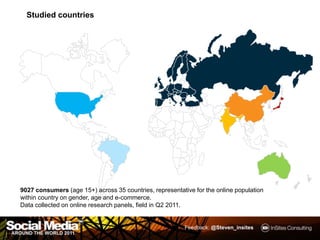
Studied countries9027 consumers (age 15+) across 35 countries, representative for the online population within country on gender, age and e-commerce.Data collected on online research panels, field in Q2 2011. Feedback: @Steven_insites
Awareness of Facebook is close to 100%More than 1 billion people (>70% of internet population) use social networks.
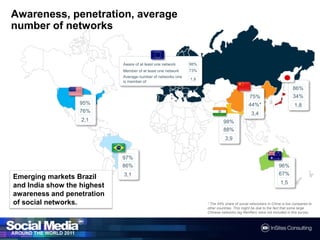
People use more than Facebook. In Europe, people join on average 1,9 social networks. In USA it’s 2,1; Brazil 3,1 and India 3,9.
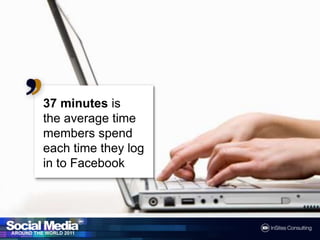
Average Facebook session lasts 37 minutes, Twitter 23 minutes.More than 400 million people use Facebook daily.
There is a big Twitter paradox:80% is aware of Twitter, only 16%is using it.
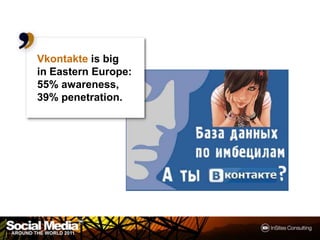
Vkontakte is big in Eastern Europe: 55% awareness, 39% penetration.
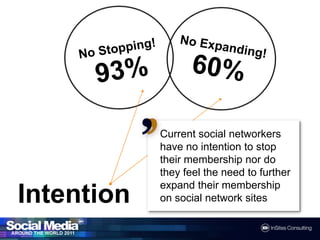
Difficult for new social networks to succeed. 60% does not want any new social networks. 93% is happy with what they have and won’t in- or decrease.
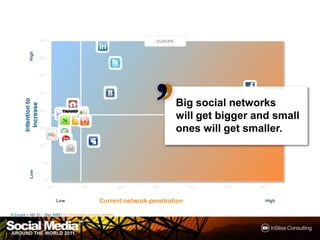
40%LinkedIn 35%Twitter30%Facebook 25%Vkontakte Netlog 20%Tagged Orkut Xing Ning Hyves Badoo 15%QZone Hi5 Bebo MySpace 10%Friendster 5%0%0%10%20%30%40%50%60%EUROPEHighBig social networks will get bigger and small ones will get smaller.IntentiontoIncreaseLowCurrentnetworkpenetrationLowHighN Europe = Min 43 – Max 4968 / F = If member of socialnetwork
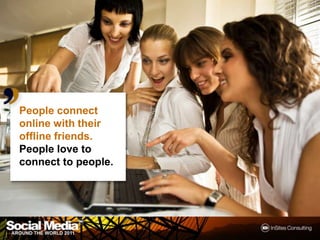
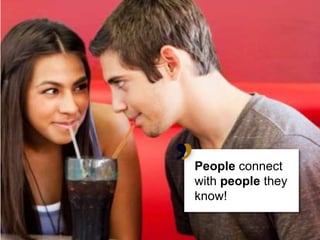
People connect online with their offline friends.People love to connect to people.
>50% of social network users are connected to brands.
Offline brand experiences are the main online conversation starters.
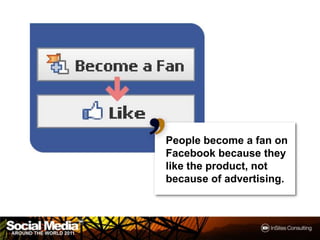
People become a fan on Facebook because they like the product, not because of advertising.
36% posted content about a brand onsocial networks.
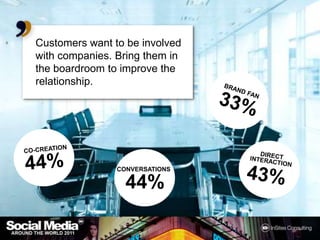
Consumers want to be in the boardroom. 44% is asking to take part in co-creation of products & advertising.
Positive experiences are bigger conversation starters than negative experiences. People like positive stuff.
Consumers prefer e-mail over social networks to ask questions to brands.
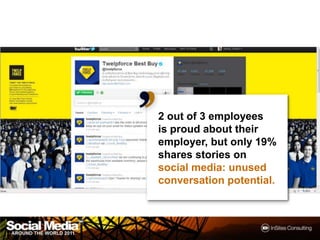
2 out of 3 employees is proud about their employer, but only 19% shares stories on social media: unused conversation potential.
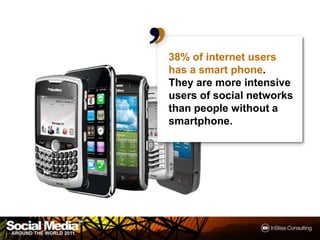
38% of internet users has a smart phone. They are more intensive users of social networks than people without a smartphone.
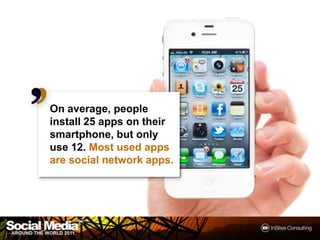
On average, people install 25 apps on their smartphone, but only use 12. Most used apps are social network apps.
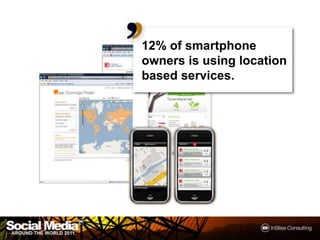
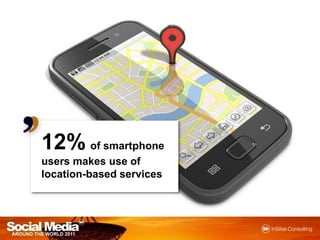
12% of smartphone owners is using location based services.
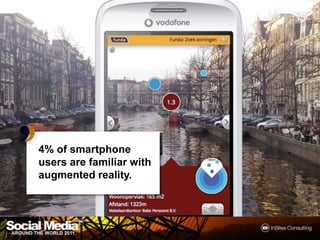
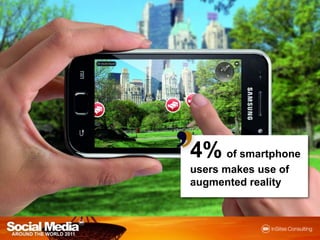
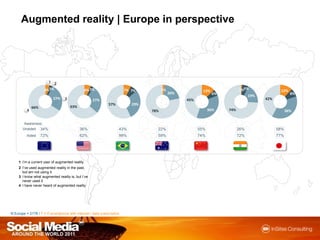
4% of smartphone users are familiar with augmented reality.
12% use LBS
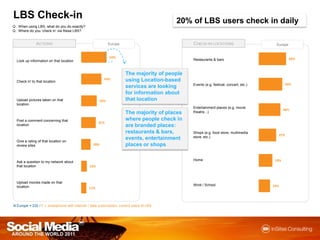
20%of location-basedusers checks in daily
Next part of the presentation is a document full with stats about social media.Feel free to use them and  share them.We hope they help you to better understand the major changes the world is going through.Questions, feedback or suggestions:Steven@InSites.euOr on Twitter: @Steven_InSites
Social Network adoption, usageandotherkeyfacts.Connections on socialnetworks: People & brands.The role of employees in making companies more human.Mobile internet, locationbased & augmentedreality.
98% of Europeans are aware of Social Media.73% of Europeans are member of at least 1 social netwerk.Awareness and usage of social networks is high; In Europe, 98% know at least one social network and 73% are member of at least one network. Social networkers are member of 1.9 networks on average.Emerging markets like China, India and Brazil have a higher social network penetration than (Western) Europe. Membership penetration, average number of networks and daily usage are higher in these countries. In Brazil, 86% are member of at least one network. Brazilian social networkers are member of 3.1 networks on average and 66% log in on a daily basis. Figures for India are comparable or even higher.
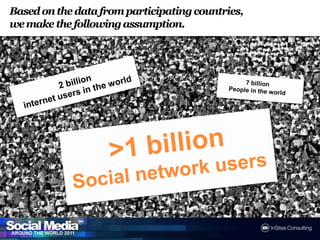
Based on the data from participating countries, we make the following assumption.2 billion internet users in the world7 billion People in the world>1 billionSocialnetwork users
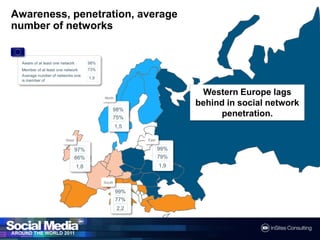
Awareness, penetration, averagenumber of networksWestern Europe lags behind in social network penetration.NorthEastWestSouth
Awareness, penetration, averagenumberof networksEmerging markets Brazil and India show the highest awareness and penetration of social networks.* The 44% share of socialnetworkersin China is low comparedtoothercountries. Thismightbedueto the factthatsome large Chinese networks (eg RenRen) werenotincluded in this survey.
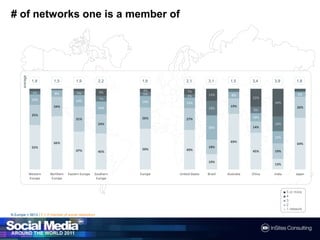
In Europe, 50% is member of only 1 social network, mostly Facebook.
# of networks one is a member of1,81,51,92,21,92,13,11,53,43,91,8average■5 or more ■ 4■3■2■1 networkN Europe = 5613 / F = If member of socialnetwork(s)
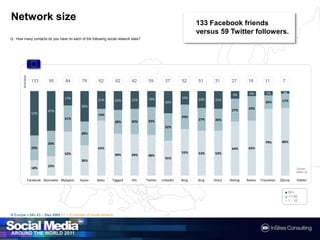
Network size133 Facebook friends versus 59 Twitter followers.Q :How many contacts do you have on each of the following social network sites?averageCounts below 30■50+■ 11-50■ 1 - 10N Europe = Min 43 – Max 4968 / F = If member of socialnetwork
>600 millionpeopleusesocialnetworksat leastdaily
58% of Facebookuserslog-in at leastDaily (>400M)
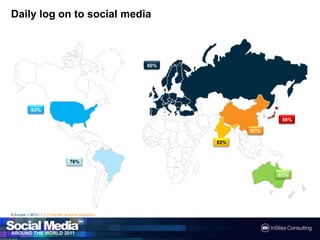
Daily log on tosocial media60%63%58%67%82%76%61%N Europe = 5613 / F = If member of socialnetwork(s)
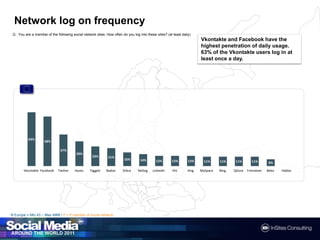
Network log on frequencyQ :You are a member of the following social network sites. How often do you log into these sites? (at least daily)Vkontakte and Facebook have the highest penetration of daily usage. 63% of the Vkontakte users log in at least once a day.N Europe = Min 43 – Max 4968 / F = If member of socialnetwork
37 minutesis the averagetime members spendeach time they log in toFacebook
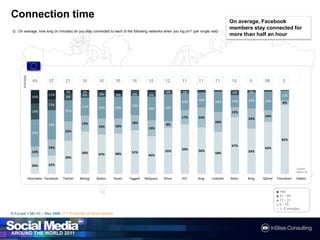
Connection timeOn average, Facebook members stay connected for more than half an hourQ :On average, how long (in minutes) do you stay connected to each of the following networks when you log on? (per single visit)averageCounts below 30■>60 ■ 31 - 60 ■11 - 31■6 - 10■1- 5 minutesN Europe = Min 43 – Max 4968 / F = If member of socialnetwork
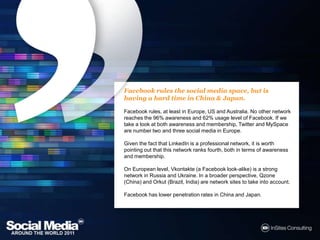
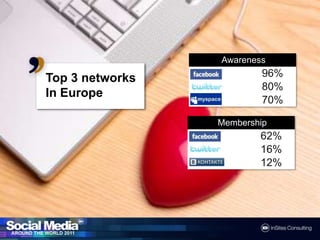
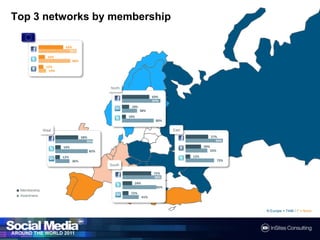
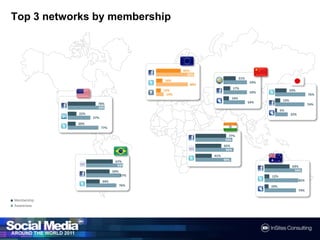
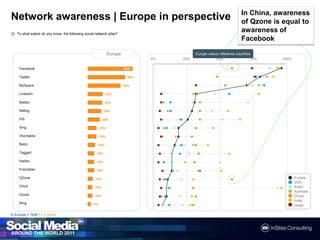
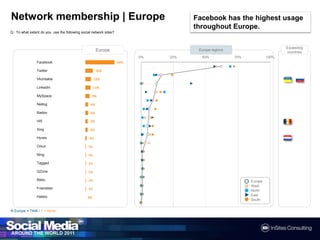
Facebook rules the social media space, but is having a hard time in China & Japan.Facebook rules, at least in Europe, US and Australia. No other network reaches the 96% awareness and 62% usage level of Facebook. If we take a look at both awareness and membership, Twitter and MySpace are number two and three social media in Europe. Given the fact that LinkedIn is a professional network, it is worth pointing out that this network ranks fourth, both in terms of awareness and membership. On European level, Vkontakte (a Facebook look-alike) is a strong network in Russia and Ukraine. In a broader perspective, Qzone (China) and Orkut (Brazil, India) are network sites to take into account.Facebook has lower penetration rates in China and Japan.
Top 3 networksIn Europe
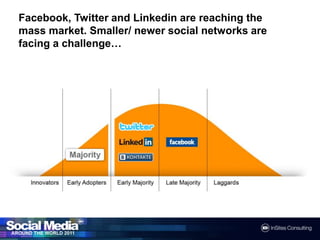
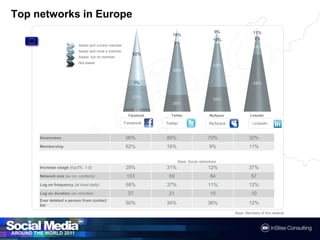
Facebook, TwitterandLinkedin are reaching the mass market. Smaller/ newersocialnetworks are facing a challenge…
Top 3 networksbymembershipNorth69%97%18%38%10%80%EastWest57%58%94%95%39%14%55%82%12%12%72%36%South72%98%24%85%■ Membership■ Awareness15%41%N Europe = 7446 / F = None
Top 3 networksbymembership31%59%17%29%59%76%14%13%54%70%74%93%5%22%32%57%20%77%77%93%65%96%41%90%67%93%63%94%59%87%12%85%34%76%10%79%■ Membership■ Awareness
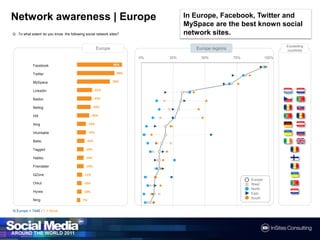
In Europe, Facebook, Twitter and MySpace are the best known social network sites. Network awareness | EuropeQ :To what extent do you know the following social network sites?EuropeEurope regionsExceeding countriesN Europe = 7446 / F = None
In China, awareness of Qzone is equal to awareness of FacebookNetwork awareness | Europe in perspectiveQ : To what extent do you know the following social network sites?EuropeEurope versus referencecountriesN Europe = 7446 / F = None
Network membership | EuropeFacebook has the highest usage throughout Europe.Q : To what extent do you use the following social network sites?EuropeEurope regionsExceeding countriesN Europe = 7446 / F = None
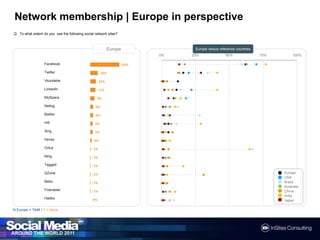
Network membership | Europe in perspectiveQ : To what extent do you use the following social network sites?EuropeEurope versus referencecountriesN Europe = 7446 / F = None
No Expanding!No Stopping!60%93%Currentsocialnetworkershave no intention to stop their membership nor do they feel the need to further expand their membership on social network sitesIntention
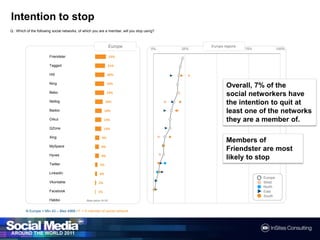
Intentionto stopQ :Which of the following social networks, of which you are a member, will you stop using?EuropeEurope regionsOverall, 7% of the social networkers have the intention to quit at least one of the networks they are a member of.Members of Friendster are most likely to stopBase below N=30N Europe = Min 43 – Max 4968 / F = If member of socialnetwork
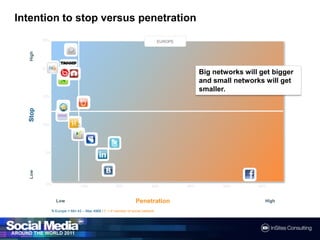
Intention to stop versus penetration25%Friendster Tagged Hi5 20%Bebo Netlog Ning 15%Badoo QZone Orkut Hyves 10%Xing MySpace Twitter5%LinkedIn Vkontakte Facebook 0%10%20%30%40%50%60%EUROPEHighBig networks will get bigger and small networks will get smaller.StopLowPenetrationLowHighN Europe = Min 43 – Max 4968 / F = If member of socialnetwork
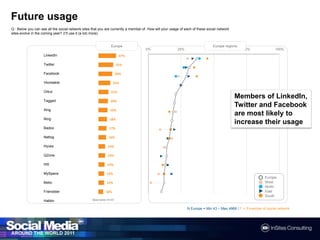
FutureusageQ : Below you can see all the social network sites that you are currently a member of. How will your usage of each of these social network sites evolve in the coming year? (I’ll use it (a lot) more)EuropeEurope regionsMembers of LinkedIn, Twitter and Facebook are most likely to increase their usageBase below N=30N Europe = Min 43 – Max 4968 / F = If member of socialnetwork
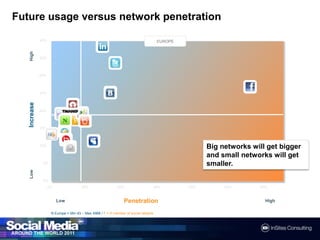
40%LinkedIn 35%Twitter30%Facebook 25%Vkontakte Netlog 20%Tagged Orkut Xing Ning Hyves Badoo 15%QZone Hi5 Bebo MySpace 10%Friendster 5%0%0%10%20%30%40%50%60%Futureusage versus networkpenetrationEUROPEHighIncreaseBig networks will get bigger and small networks will get smaller.LowPenetrationLowHighN Europe = Min 43 – Max 4968 / F = If member of socialnetwork
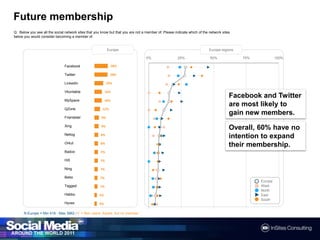
FuturemembershipQ : Below you see all the social network sites that you know but that you are not a member of. Please indicate which of the network sites below you would consider becoming a member of.EuropeEurope regionsFacebook and Twitter are most likely to gain new members.Overall, 60% have no intention to expand their membership.N Europe = Min 418 - Max 3962 / F = Non users: Aware, but no member
We gave you a lot of facts, to capture the key points, we summarized the key data in a few overview slides.
Top networks in EuropeFacebookTwitterMySpaceLinkedInBase: SocialnetworkersBase: Members of thisnetwork
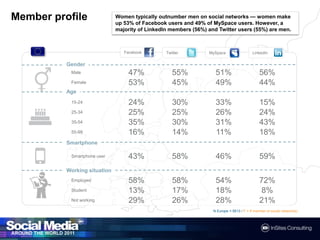
Member profileWomen typically outnumber men on social networks — women make up 53% of Facebook users and 49% of MySpace users. However, a majority of LinkedIn members (56%) and Twitter users (55%) are men.FacebookTwitterMySpaceLinkedInGenderAgeSmartphoneWorkingsituationN Europe = 5613 / F = If member of socialnetwork(s)
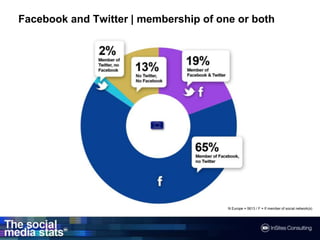
The Twitter Paradox: high awareness versus low usage. What’s next?Compared to Facebook, Twitter is still a pretty small network of people. Twitter is well known, but has not reached the penetration level of Facebook yet. Future adoption looks good, but there is still a long way to go. Facebook and Twitter are a perfect couple, both sites serve different needs. When people join Twitter, their Facebook usage does not decrease. Twitter users are typically using more social media than non Twitter users.
FacebookandTwitter| membership of one or bothN Europe = 5613 / F = If member of socialnetwork(s)
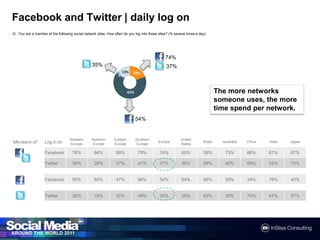
FacebookandTwitter| daily log onQ : You are a member of the following social network sites. How often do you log into these sites? (% several times a day)74%35%37%The more networks someone uses, the more time spend per network.54%
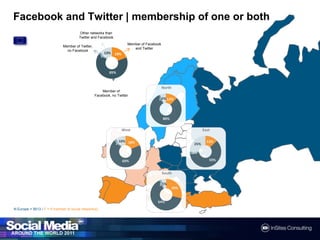
FacebookandTwitter| membership of one or bothOthernetworksthanTwitterandFacebookMember of FacebookandTwitterMember of Twitter, no FacebookMember of Facebook, no TwitterN Europe = 5613 / F = If member of socialnetwork(s)
Social Network adoption, usageandotherkeyfacts.Connections on socialnetworks: People & brands.The role of employees in making companies more human.Mobile internet, locationbased & augmentedreality.
People love people.So brands, behave like one.People link online with people they know offline. Social networking is a way for people to meet up with others on the net. Checking the status of others, chatting & messaging are the main activities on social networks, all two-way communication streams. Not having any contact is the main reason for defriending.People also join social networks to get information about (new) products / brands. However, they do not like traditional marketing messages. People prefer people above brands. This means that companies and brands should approach their use of social media differently. It’s about being human and taking personal identity above an institutional identity.
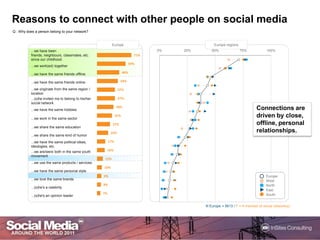
People connectwithpeopletheyknow!
Reasonstoconnectwithotherpeople on social mediaQ : Why does a person belong to your network?Europe regionsEuropeConnections are driven by close, offline, personal relationships. N Europe = 5613 / F = If member of socialnetwork(s)
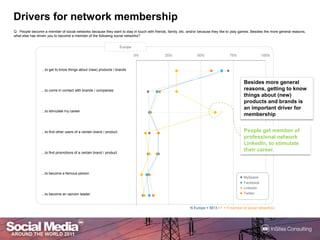
Besidesconnectingwithothers, getting information about (new) products and brands is driving membership of social networks
Drivers fornetworkmembershipQ : People become a member of social networks because they want to stay in touch with friends, family, etc. and/or because they like to play games. Besides the more general reasons, what else has driven you to become a member of the following social networks?EuropeBesides more general reasons, getting to know things about (new) products and brands is an important driver for membership People get member of professional network LinkedIn, to stimulate their career.●MySpace●Facebook●Linkedin● TwitterN Europe = 5613 / F = If member of socialnetwork(s)
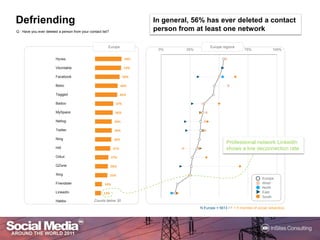
More than half of the socialnetworkers has ever deletedsomeonefrom his/her network.Mainreasonfordefriending is a lackof contact.
DefriendingIn general, 56% has ever deleted a contact person from at least one networkQ :Have you ever deleted a person from your contact list?Europe regionsEuropeProfessional networkLinkedIn shows a low deconnectionrateCounts below 30N Europe = 5613 / F = If member of socialnetwork(s)
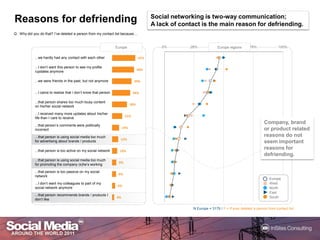
Social networking is two-way communication;A lack of contact is the main reason for defriending.ReasonsfordefriendingQ :Why did you do that? I’ve deleted a person from my contact list because…Europe regionsEuropeCompany, brand or product related reasons do not seem important reasons for defriending.N Europe = 3179 / F = If ever deleted a person from contact list
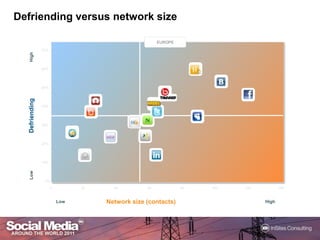
Defriending versus networksizeEUROPE70%High60%50%40%Defriending30%20%10%Low0%020406080100120140Network size (contacts)LowHigh
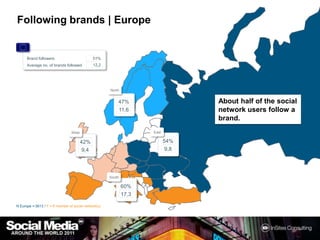
>50% follow brands on social media.Personal brand experience and conversations about brands by peers are drivers to connect.About half of the European social networkers follow a company or brand on social networks. People in the south of Europe are following more brands (17.3 on average) than other regions. People connect with a brand because they have used it and secondly because other people invited or recommended them to do so – they did not connect because companies / brands asked them to!
Following brands | EuropeNorthAbout half of the social network users follow a brand.EastWestSouthN Europe = 5613 / F = If member of socialnetwork(s)
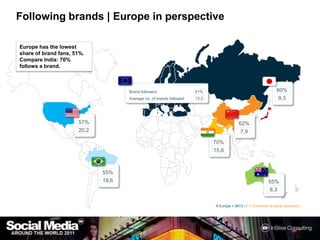
Following brands | Europe in perspectiveEurope has the lowest share of brand fans, 51%. Compare India: 70% follows a brand.N Europe = 5613 / F = If member of socialnetwork(s)
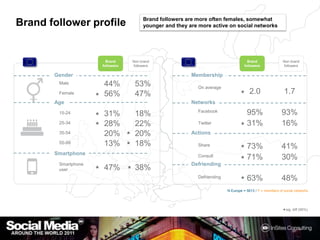
Brand followers are more often females, somewhat younger and they are more active on social networksBrand follower profileBrand followersNon brand followersBrand followersNon brand followersGenderMembershipNetworksAgeActionsSmartphoneDefriendingN Europe = 5613 / F = members of socialnetworkssig. diff (95%)
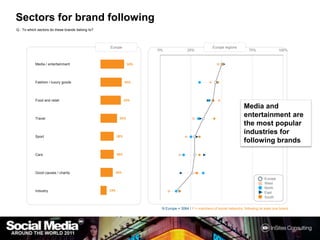
Sectors for brand followingQ : To which sectors do these brands belong to?Europe regionsEuropeMedia and entertainment are the most popular industries for following brandsN Europe = 3064 / F = members of socialnetworks, following at leastone brand
Average consumer follows a brand to get a direct personal benefit.Social networkers expect some sort of benefit of companies on social networks. People are mainly focused on the direct benefit. Companies should in first instance offer product information, update on promotions and announce events. There is still a huge opportunity for companies to get in touch with their customers. 58% has never experienced any action by a company / brand on social network sites.
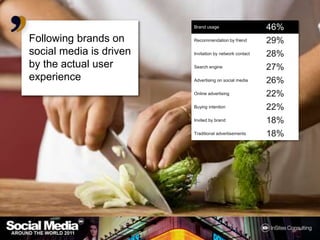
Following brands on social media is driven by the actual user experience
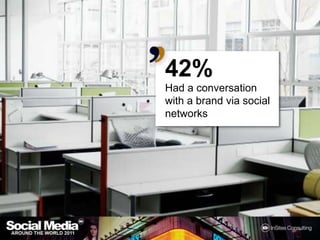
42%Had a conversation with a brand via socialnetworks
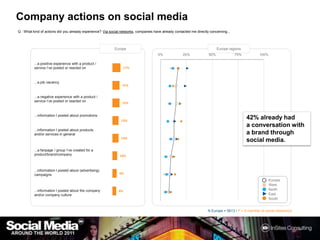
Company actions on social mediaQ :What kind of actions did you already experience? Via social networks, companies have already contacted me directly concerning...Europe regionsEurope42% already had a conversation with a brand through social media.N Europe = 5613 / F = If member of socialnetwork(s)
Customers want to be involved with companies. Bring them in the boardroom to improve the relationship.BRAND FAN33%CO-CREATION44%DIRECT INTERACTION43%CONVERSATIONS44%
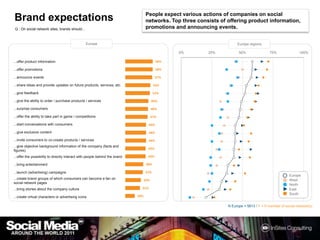
People expect various actions of companies on social networks. Top three consists of offering product information, promotions and announcing events.Brand expectationsQ :On social network sites, brands should…EuropeEurope regionsN Europe = 5613 / F = If member of socialnetwork(s)
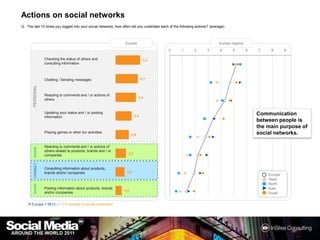
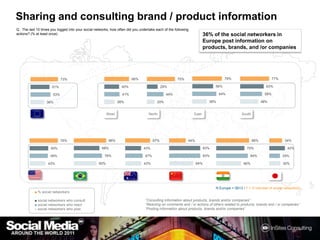
Social media is aboutcommunicationbetweenpeople.People use social networks to communicate with each other: Checking the status of others, chatting, sending messages, reacting to comments or actions of others. If we look at actions specifically related to companies, products or brands, it shows that 36% of the social networkers in Europe post information about brands, 53% reacts on comments and 51% consults information.Consumers prefer to react on brand updates rather than start a conversation with a brand themselves. Content planning and regular content updates are a way to increase the engagement with fans.
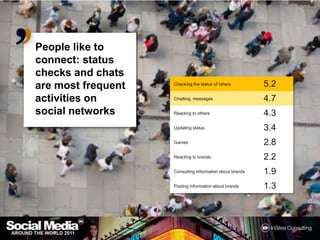
People like to connect: status checks and chats are most frequent activities on social networks
Actions on socialnetworksQ : The last 10 times you logged into your social networks, how often did you undertake each of the following actions? (average)PERSONALEuropeEurope regionsshareconsultCommunication between people is the main purpose of social networks. shareN Europe = 5613 / F = If member of socialnetwork(s)
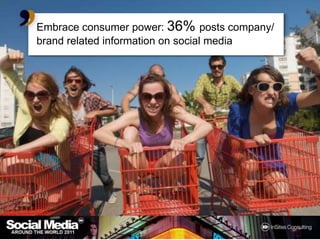
Embrace consumer power: 36% posts company/ brand related information on social media
Sharingand consulting brand / product informationQ : The last 10 times you logged into your social networks, how often did you undertake each of the following actions? (% at least once)36% of the social networkers in Europe post information on products, brands, and /or companiesWestNorthEastSouthN Europe = 5613 / F = If member of socialnetwork(s)■ % social networkers■ social networkers who consult■ social networkers who react■ social networkers who post
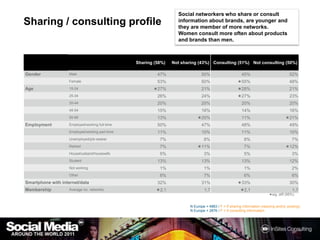
Social networkers who share or consult information about brands, are younger and they are member of more networks.Women consult more often about products and brands than men.Sharing / consulting profilesig. diff (95%)N Europe = 4863 / F = Ifsharinginformation (reactingand/or posting)N Europe = 2876 / F = If consulting information
Offline brand experiences are the best online conversation starter.If people share information about a brand, company or product, it’s often about the product / brand experience they had. Good news: Positive experiences dominate negative experiences. And; one third of the European social networkers say their sharing behavior increased (a lot) since last year.
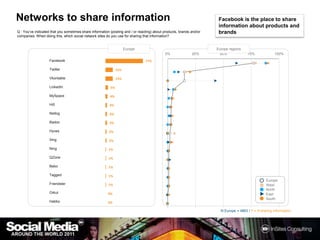
Networks to share informationFacebook is the place to share information about products and brandsQ : You’ve indicated that you sometimes share information (posting and / or reacting) about products, brands and/or companies. When doing this, which social network sites do you use for sharing that information?EuropeEurope regionsN Europe = 4863 / F = Ifsharing information
People prefer to share positive brand experiences on social media
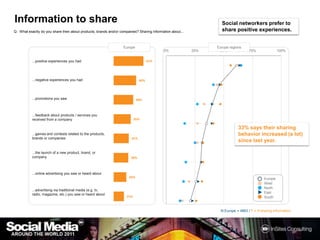
Information to shareSocial networkers prefer to share positive experiences. Q :What exactly do you share then about products, brands and/or companies? Sharing information about...EuropeEurope regions33% says their sharing behavior increased (a lot) since last year.N Europe = 4863 / F = Ifsharing information
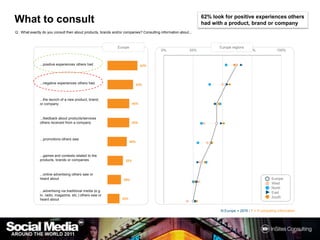
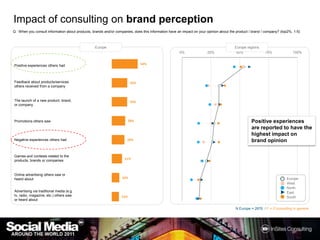
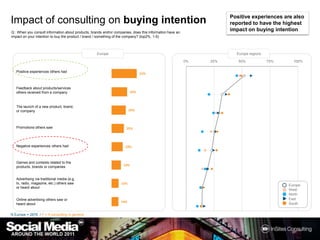
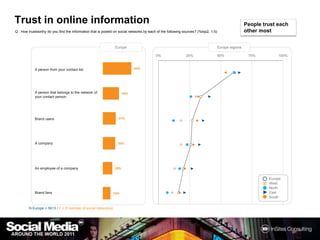
Most trusted source are peers. Their experiences are key driver in consumer decision making.Consumers trust each other most. When people look for information on products, companies or brands, they tend to look for information that is coming from experiences other persons had. This experience can be both positive (63%) and negative (53%). Positive brand experiences have the highest impact on brand perception and buying intention.
62% look for positive experiences others had with a product, brand or companyWhatto consultQ : What exactly do you consult then about products, brands and/or companies? Consulting information about...Europe regionsEuropeN Europe = 2876 / F = If consulting information
Impact of consulting on brand perceptionQ : When you consult information about products, brands and/or companies, does this information have an impact on your opinion about the product / brand / company? (top2%, 1-5)Europe regionsEuropePositive experiences are reported to have the highest impact on brand opinionN Europe = 2876  / F = If consulting in general
Positive experiences are also reported to have the highest impact on buying intentionImpact of consulting on buyingintentionQ : When you consult information about products, brands and/or companies, does this information have an impact on your intention to buy the product / brand / something of the company? (top2%, 1-5)Europe regionsEuropeN Europe = 2876  / F = If consulting in general
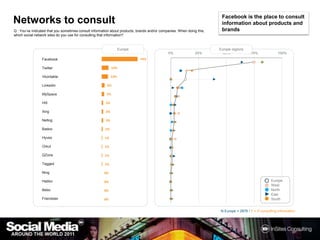
Facebook is the place to consult information about products and brandsNetworks to consultQ :You’ve indicated that you sometimes consult information about products, brands and/or companies. When doing this, which social network sites do you use for consulting that information?Europe regionsEuropeN Europe = 2876 / F = If consulting information
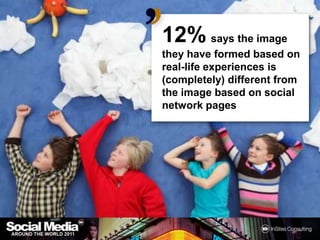
12%says the image they have formed based on real-life experiences is (completely) different from the image based on social network pages
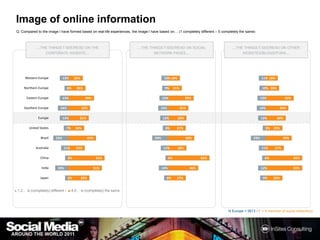
Western Europe13%22%10%18%11%18%Northern Europe6%26%9%21%10%20%Eastern Europe13%39%13%39%13%42%Southern Europe16%33%15%31%14%34%Europe13%31%12%28%12%30%United States7%24%8%27%5%25%Brazil23%42%24%40%23%39%Australia11%25%11%28%11%27%China5%55%4%63%6%55%India20%51%14%46%12%55%Japan5%32%6%27%9%25%Image of online informationQ :Compared to the image I have formed based on real-life experiences, the image I have based on… (1 completely different – 5 completely the same)...the things I see/read on the corporate website... ...the things I see/read on social network pages... ...the things I see/read on other websites/blogs/fora... ■ 1,2… is (completely) different /  ■ 4,5… is (completely) the sameN Europe = 5613 / F = If member of socialnetwork(s)
Trust in online informationPeople trust each other mostQ : How trustworthy do you find the information that is posted on social networks by each of the following sources? (%top2, 1-5)EuropeEurope regionsN Europe = 5613 / F = If member of socialnetwork(s)
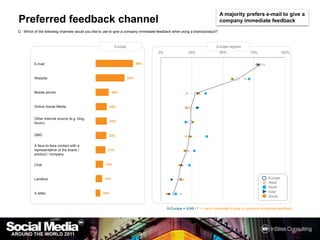
Create opportunities for product feedbackMore than half of the European respondents in this survey are willing to provide feedback while using a brand/product!No matter what topic, the preferred channel to give feedback is e-mail, or the company website.
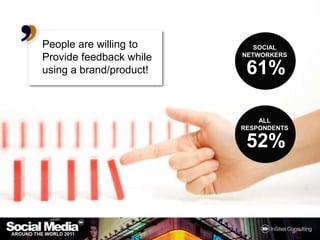
People are willing to Provide feedback while using a brand/product!SOCIAL NETWORKERSALLRESPONDENTS61%52%
A majority prefers e-mail to give a company immediate feedbackPreferred feedback channelQ :Which of the following channels would you like to use to give a company immediate feedback while using a brand/product?Europe regionsEuropeN Europe = 4248 / F = (very) interestedtogive a company immediate feedback
Social Network adoption, usageandotherkeyfacts.Connections on socialnetworks: People & brands.The role of employees in making companies more human.Mobile internet, locationbased & augmentedreality.
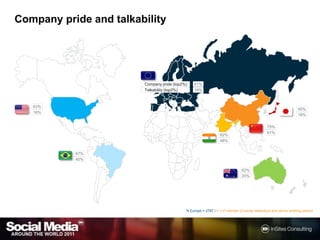
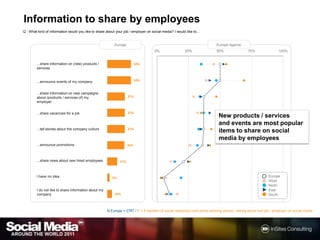
Employees as brand ambassadorsA majority is proud of the company they work for. There is clearly potential to get more proud employees talk on social media.On social media, people in Europe do not talk that much about the company they work for. Talkability is limited to 19%. If they talk about their job, people like to share information about new products or services and announce company events.
61%of employed social networkers is proud of the company they work for
19%talks abouttheir company on socialmedia. Employees areclearly unused social potential.
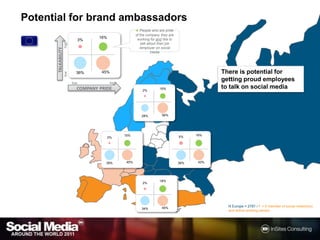
Potentialfor brand ambassadors● People who are pride of the company they are working for and like to talk about their job /employer on social mediahightalkabilityThere is potential for getting proud employees to talk on social medialowlowhighcompany prideN Europe = 2787 / F = If member of social network(s) and active working person
Company prideandtalkabilityCompany pride (top2%)61%Talkability (top2%)19%63%40%16%18%75%61%62%48%67%40%62%20%N Europe = 2787 / F = If member of socialnetwork(s) andactiveworking person
Information to share by employeesQ :What kind of information would you like to share about your job / employer on social media? I would like to...Europe regionsEuropeNew products / services and events are most popular items to share on social media by employeesN Europe = 2787 / F = If member of socialnetwork(s) andactiveworking person, talkingabout heir job / employer on social media
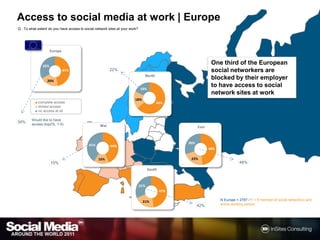
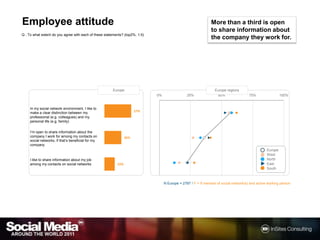
Majority employees is not allowed to use social media.Two thirds of the European social networkers have (limited) access to social network sites at work. Within Europe, Northern Europe has the highest level of access, Western Europe the lowest. Current attitude of companies towards social media is quite formal and does not feel very emotional. Given the fact that social networking is all about relationships, it seems wise to have a more human approach on social media.Employees can contribute in these. More than a third is open to share information about the company they work for among their contacts on social networks, if that’s beneficial for the company.
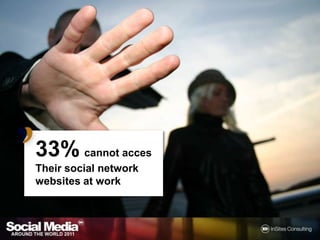
33%cannot accesTheir social networkwebsites at work
Access tosocial media at work | EuropeQ :To what extent do you have access to social network sites at your work? One third of the European social networkers are blocked by their employer to have access to social network sites at work22%■ complete access■limited access■no access at allWouldliketo have access (top2%, 1-5)34%48%15%N Europe = 2787 / F = If member of socialnetwork(s) andactiveworking person42%
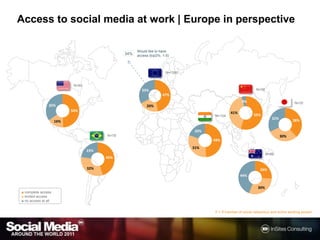
Access tosocial media at work| Europe in perspectiveWouldliketo have access (top2%, 1-5)34%N=1590N=62N=56N=35N=104N=78N=66■ complete access■limited access■no access at allF = If member of socialnetwork(s) andactiveworking person
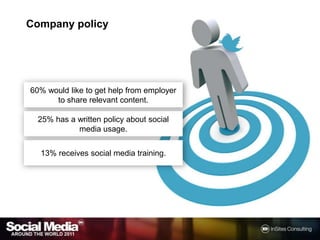
Company policy60% wouldliketo get help fromemployerto share relevant content.25% has a written policy about social media usage.13% receives social media training.
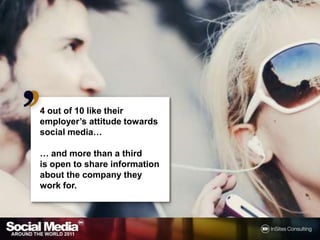
4 out of 10 like their employer’s attitude towards social media…… and more than a third is open to share information about the company they work for.
Employee attitudeMore than a third is open to share information about the company they work for.Q :To what extent do you agree with each of these statements? (top2%, 1-5)Europe regionsEuropeN Europe = 2787 / F = If member of socialnetwork(s) andactiveworking person
Social Network adoption, usageandotherkeyfacts.Connections on socialnetworks: People & brands.The role of employees in making companies more human.Mobile internet, location based & augmented reality.
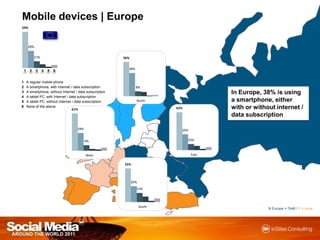
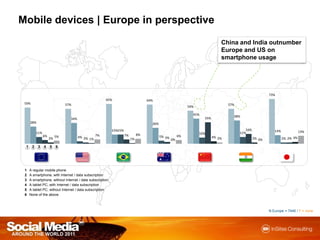
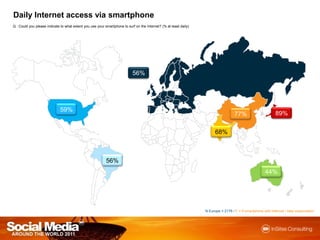
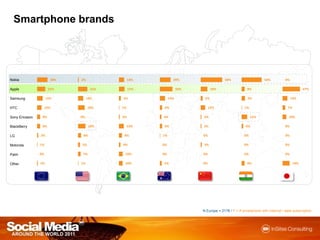
Always onConsumers are taking up mobile devices, especially in China and India. This implies new ways to reach consumers, through simply more display space, branded applications or even Location-based services. In Europe, 38% is using a smartphone, either with or without internet / data subscription. More than half is using their smartphone on a daily basis for accessing the internet.Nokia and Apple are most widely spread amongstsmartphone users.When it comes to mobile services, people expect brands to offer content and convenience.
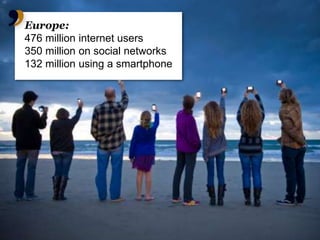
Europe:476 million internet users350 million on socialnetworks132 millionusing a smartphone
Mobile devices| EuropeIn Europe, 38% is using a smartphone, either with or without internet / data subscriptionN Europe = 7446 / F = none
Mobile devices| Europe in perspectiveChina and India outnumber Europe and US on smartphone usageN Europe = 7446 / F = none
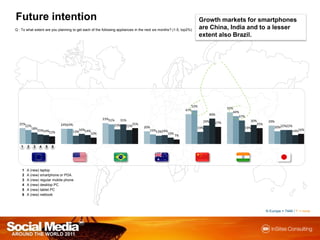
FutureintentionGrowth markets for smartphones are China, India and to a lesser extent also Brazil.Q : To what extent are you planning to get each of the following appliances in the next six months? (1-5, top2%)N Europe = 7446 / F = none
Daily Internet access via smartphoneQ :Could you please indicate to what extent you use your smartphone to surf on the Internet? (% at least daily)56%59%89%77%68%56%44%N Europe = 2178 / F = If smartphone with internet / data subscription
Smartphone brandsN Europe = 2178 / F = If smartphone with internet / data subscription
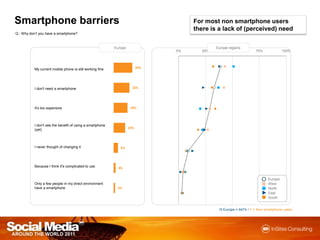
Smartphone barriersFor most non smartphone users there is a lack of (perceived) needQ :Why don’t you have a smartphone?Europe regionsEuropeN Europe = 4474 / F = Non smartphone users
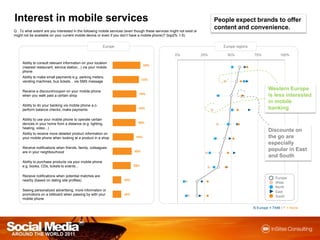
Interest in mobile servicesPeople expect brands to offer content and convenience.Q :To what extent are you interested in the following mobile services (even though these services might not exist or might not be available on your current mobile device or even if you don’t have a mobile phone)? (top2% 1-5)Europe regionsEuropeWestern Europe is less interested in mobile bankingDiscounts on the go are especially popular in East and SouthN Europe = 7446 / F = None
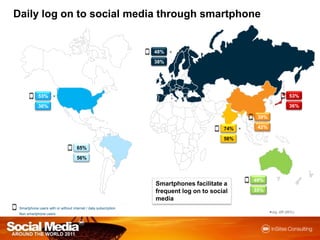
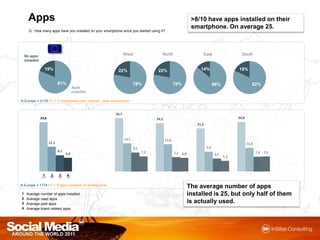
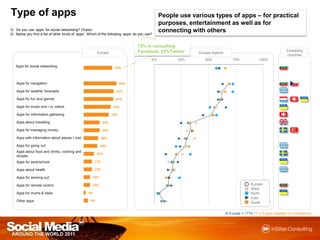
Smartphones owners have a more intensive social media usage.Social media has definitely gone mobile. Social media sites can be easily used through smartphones, which shows for example in a higher daily log on by smartphone users.Consumers have installed 25 apps on average, are using 12 apps and they even have quite some branded apps installed (7 apps on average). They use these apps for various purposes: contact, convenience and entertainment. More than half is using apps for social networking.
Daily log on tosocial media throughsmartphone48%38%53%53%36%36%39%42%74%56%65%56%49%Smartphones facilitate a frequent log on to social media35%Smartphone users with or without internet / data subscriptionsig. diff (95%)Non smartphone users
Apps>8/10 have apps installed on their smartphone. On average 25.Q : How many apps have you installed on your smartphone since you started using it?No appsinstalledAppsinstalledN Europe = 2178 / F = Ifsmartphonewith internet / data subscriptionThe average number of apps installed is 25, but only half of them is actually used.N Europe = 1774 / F = Ifappsinstalled on smartphone
Type of appsPeople use various types of apps – for practical purposes, entertainment as well as for connecting with othersQ :Do you use ‘apps’ for social networking? (%yes)Q :Below you find a list of other kinds of ‘apps’. Which of the following ‘apps’ do you use? 72% is consulting Facebook, 22%TwitterExceeding countriesEurope regionsEuropeN Europe = 1774 / F = Ifappsinstalled on smartphone
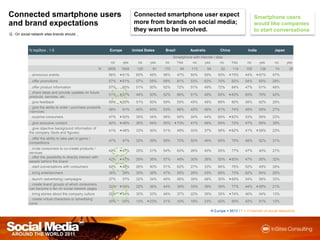
Smartphone users expect more conversations & collaboration with brands.Social networkers who have a smartphone, more often follow brands on social media. Marketers can expect more impact reaching social networkers through smartphones, but mobile social networkers expect more from companies and brands. They want to be more involved –almost half is interested to co-create – and they expect companies and brands to start conversations.
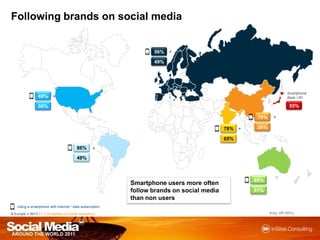
56%of connectedsmartphone users followa brand on social media
Following brands on social media56%49%SmartphoneBase <3069%55%50%78%28%78%65%86%49%65%Smartphone users more often follow brands on social media than non users51%Using a smartphonewith internet / data subscriptionsig. diff (95%)N Europe = 5613 / F = If member of socialnetwork(s)
Connectedsmartphoneusersand brand expectationsConnected smartphone user expect more from brands on social media; they want to be involved.Smartphone users would like companies to start conversationsQ :On social network sites brands should…N Europe = 5613 / F = If member of socialnetwork(s)
Location-based servicesLocation-Based Services refers to a broad range of services that are based on information about the physical location of a user and/or device.Location-based services provide the user with information such as "Where is the nearest ATM?" or they can be push-based and deliver coupons or other marketing information to customers who are in a specific geographical area.
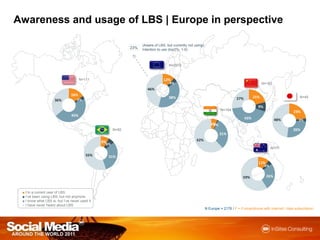
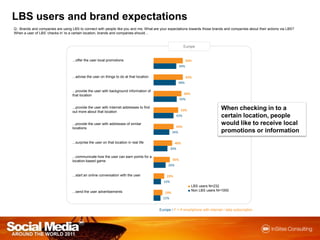
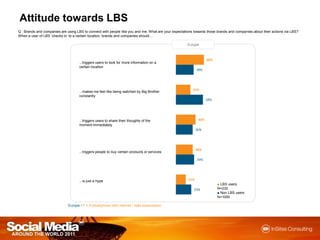
Location-based services are a nicheapplication at this point.Location-based services sound great: Companies can connect to consumers who are checking into places with their mobile phones and show their intention to buy, attend, travel, party, etcetera. This is real relevant reach. However, the reach of location-based services (lbs) is limited. Only 12% is currently using lbs, mainly Facebook Places, Foursquare and Gowalla. People are encouraged by social media to share information, but they seem somewhat less enthusiastic to share their location. The issue is mainly due to privacy and a lack of awareness. Both users and non users expect brands and companies to offer local discounts wherever they go, or advise on things to do /information regarding the place they are.
12%of smartphoneusers makes use of location-based services
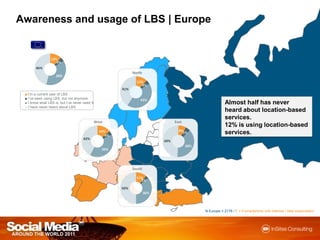
Awareness andusage of LBS | Europe■ I’m a current user of LBS■ I’ve been using LBS, but not anymore■ I know what LBS is, but I’ve never used it■ I have never heard about LBSAlmost half has never heard about location-based services.12% is using location-based services.N Europe = 2178 / F = Ifsmartphonewith internet / data subscription
Awareness andusage of LBS | Europe in perspective(Awareof LBS, but currentlynotusing):Intentiontouse (top2%, 1-5)23%N=2972N=111N=163N=45N=164N=92N=77■ I’m a current user of LBS■ I’ve been using LBS, but not anymore■ I know what LBS is, but I’ve never used it■ I have never heard about LBSN Europe = 2178 / F = Ifsmartphonewith internet / data subscription
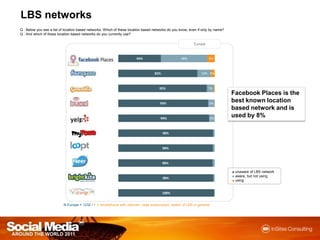
LBS networksQ : Below you see a list of location based networks. Which of these location based networks do you know, even if only by name?Q : And which of these location based networks do you currently use?										EuropeFacebook Places is the best known location based network and is used by 8%■unaware of LBS network■aware, but notusing■usingN Europe = 1232 / F = smartphonewith internet / data subscription, aware of LBS in general
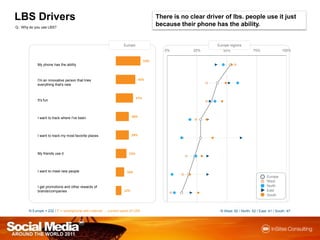
LBS DriversThere is no clear driver of lbs. people use it just because their phone has the ability.Q : Why do you use LBS?EuropeEurope regionsN Europe = 232 / F = smartphonewith internet .., current users of LBSN West: 92 / North: 52 / East: 41 / South: 47
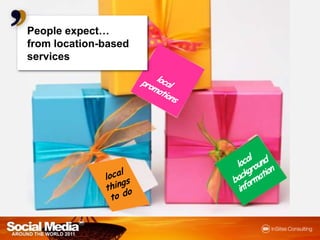
People expect…from location-basedserviceslocal  promotionslocal background informationlocalthingstodo
LBS users and brand expectationsQ : Brands and companies are using LBS to connect with people like you and me. What are your expectations towards those brands and companies about their actions via LBS? When a user of LBS ‘checks in’ to a certain location, brands and companies should…EuropeWhen checking in to a certain location, people would like to receive local promotions or information■LBS users N=232■Non LBS users N=1000Europe / F = Ifsmartphonewith internet / data subscription
LBS Check-in20% of LBS users check in dailyQ : When using LBS, what do you do exactly?Q : Where do you ‘check in’ via these LBS?ActionsCheck-in locationsEuropeEuropeThe majority of people using Location-based services are looking for information about that locationThe majority of places where people check in are branded places: restaurants & bars, events, entertainment places or shopsN Europe = 232 / F = smartphonewith internet / data subscription, current users of LBS
Attitude towards LBSQ : Brands and companies are using LBS to connect with people like you and me. What are your expectations towards those brands and companies about their actions via LBS? When a user of LBS ‘checks in’ to a certain location, brands and companies should…Europe■LBS users N=232■Non LBS users N=1000Europe / F = Ifsmartphonewith internet / data subscription
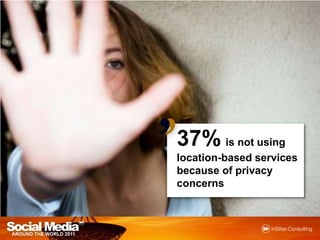
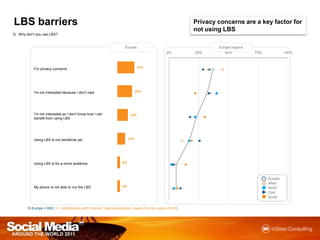
37%is not using location-based servicesbecause of privacy concerns
LBS barriersPrivacy concerns are a key factor for not using LBSQ : Why don’t you use LBS?EuropeEurope regionsN Europe = 680 / F = smartphonewith internet / data subscription, aware but non users of LBS
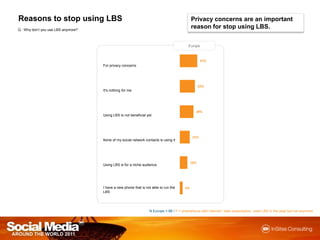
Reasonsto stop using LBSPrivacy concerns are an important reason for stop using LBS.Q : Why don’t you use LBS anymore?EuropeN Europe = 88 / F = smartphonewith internet / data subscription, used LBS in the past but notanymore
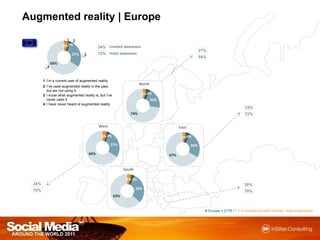
Augmented realityAugmented reality refers to a three-dimensional online world. It provides the user with a live view of the real-life environment, mixed with virtual computer-generated content. Using your mobile phone, you can ‘scan’ the real living environment, looking for information (text, pictures, videos, etc.) on every person/object you ‘scan’.
4%of smartphone users makes use of augmented reality
Augmentedreality| Europe12Unaided awareness34%27%Aided awareness72%364%433%72%34%36%70%79%N Europe = 2178 / F = Ifsmartphonewith internet / data subscription
Augmentedreality| Europe in perspective1234Awareness:Unaided34%36%43%22%55%26%58%Aided72%62%99%59%74%72%77%N Europe = 2178 / F = Ifsmartphonewith internet / data subscription
Appendix: methodology
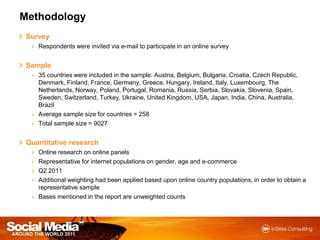
MethodologySurveyRespondents were invited via e-mail to participate in an online surveySample35 countries were included in the sample: Austria, Belgium, Bulgaria, Croatia, Czech Republic, Denmark, Finland, France, Germany, Greece, Hungary, Ireland, Italy, Luxembourg, The Netherlands, Norway, Poland, Portugal, Romania, Russia, Serbia, Slovakia, Slovenia, Spain, Sweden, Switzerland, Turkey, Ukraine, United Kingdom, USA, Japan, India, China, Australia, BrazilAverage sample size for countries = 258Total sample size = 9027Quantitative researchOnline research on online panelsRepresentative for internet populations on gender, age and e-commerceQ2 2011Additional weighting had been applied based upon online country populations, in order to obtain a representative sampleBases mentioned in the report are unweightedcounts
If you liked the data, do us a favor and please, share this slideshow with your network.

Socialmediaaroundtheworld2011

  • 2.
    What to expectfrom this presentation?20 eye-catching facts about social media around the world.>1.000 facts & figures about social media in more than 30 countries.Topics cover main adoption & usage, brand interactions, role of employees in using social media and much more.
  • 3.
    For questions, feedbackand remarks, please contact:Prof. Steven Van BelleghemManaging partner InSites ConsultingSteven@InSites.euTwitter: @steven_insites
  • 4.
    Studied countries9027 consumers(age 15+) across 35 countries, representative for the online population within country on gender, age and e-commerce.Data collected on online research panels, field in Q2 2011. Feedback: @Steven_insites
  • 5.
    Awareness of Facebookis close to 100%More than 1 billion people (>70% of internet population) use social networks.
  • 6.
    People use morethan Facebook. In Europe, people join on average 1,9 social networks. In USA it’s 2,1; Brazil 3,1 and India 3,9.
  • 7.
    Average Facebook sessionlasts 37 minutes, Twitter 23 minutes.More than 400 million people use Facebook daily.
  • 8.
    There is abig Twitter paradox:80% is aware of Twitter, only 16%is using it.
  • 9.
    Vkontakte is bigin Eastern Europe: 55% awareness, 39% penetration.
  • 10.
    Difficult for newsocial networks to succeed. 60% does not want any new social networks. 93% is happy with what they have and won’t in- or decrease.
  • 11.
    40%LinkedIn 35%Twitter30%Facebook 25%VkontakteNetlog 20%Tagged Orkut Xing Ning Hyves Badoo 15%QZone Hi5 Bebo MySpace 10%Friendster 5%0%0%10%20%30%40%50%60%EUROPEHighBig social networks will get bigger and small ones will get smaller.IntentiontoIncreaseLowCurrentnetworkpenetrationLowHighN Europe = Min 43 – Max 4968 / F = If member of socialnetwork
  • 12.
    People connect onlinewith their offline friends.People love to connect to people.
  • 13.
    >50% of socialnetwork users are connected to brands.
  • 14.
    Offline brand experiencesare the main online conversation starters.
  • 15.
    People become afan on Facebook because they like the product, not because of advertising.
  • 16.
    36% posted contentabout a brand onsocial networks.
  • 17.
    Consumers want tobe in the boardroom. 44% is asking to take part in co-creation of products & advertising.
  • 18.
    Positive experiences arebigger conversation starters than negative experiences. People like positive stuff.
  • 19.
    Consumers prefer e-mailover social networks to ask questions to brands.
  • 20.
    2 out of3 employees is proud about their employer, but only 19% shares stories on social media: unused conversation potential.
  • 21.
    38% of internetusers has a smart phone. They are more intensive users of social networks than people without a smartphone.
  • 22.
    On average, peopleinstall 25 apps on their smartphone, but only use 12. Most used apps are social network apps.
  • 23.
    12% of smartphoneowners is using location based services.
  • 24.
    4% of smartphoneusers are familiar with augmented reality.
  • 25.
  • 26.
  • 27.
    Next part ofthe presentation is a document full with stats about social media.Feel free to use them and share them.We hope they help you to better understand the major changes the world is going through.Questions, feedback or suggestions:Steven@InSites.euOr on Twitter: @Steven_InSites
  • 28.
    Social Network adoption,usageandotherkeyfacts.Connections on socialnetworks: People & brands.The role of employees in making companies more human.Mobile internet, locationbased & augmentedreality.
  • 30.
    98% of Europeansare aware of Social Media.73% of Europeans are member of at least 1 social netwerk.Awareness and usage of social networks is high; In Europe, 98% know at least one social network and 73% are member of at least one network. Social networkers are member of 1.9 networks on average.Emerging markets like China, India and Brazil have a higher social network penetration than (Western) Europe. Membership penetration, average number of networks and daily usage are higher in these countries. In Brazil, 86% are member of at least one network. Brazilian social networkers are member of 3.1 networks on average and 66% log in on a daily basis. Figures for India are comparable or even higher.
  • 31.
    Based on thedata from participating countries, we make the following assumption.2 billion internet users in the world7 billion People in the world>1 billionSocialnetwork users
  • 32.
    Awareness, penetration, averagenumberof networksWestern Europe lags behind in social network penetration.NorthEastWestSouth
  • 33.
    Awareness, penetration, averagenumberofnetworksEmerging markets Brazil and India show the highest awareness and penetration of social networks.* The 44% share of socialnetworkersin China is low comparedtoothercountries. Thismightbedueto the factthatsome large Chinese networks (eg RenRen) werenotincluded in this survey.
  • 34.
    In Europe, 50%is member of only 1 social network, mostly Facebook.
  • 35.
    # of networksone is a member of1,81,51,92,21,92,13,11,53,43,91,8average■5 or more ■ 4■3■2■1 networkN Europe = 5613 / F = If member of socialnetwork(s)
  • 36.
    Network size133 Facebookfriends versus 59 Twitter followers.Q :How many contacts do you have on each of the following social network sites?averageCounts below 30■50+■ 11-50■ 1 - 10N Europe = Min 43 – Max 4968 / F = If member of socialnetwork
  • 37.
  • 38.
    58% of Facebookuserslog-inat leastDaily (>400M)
  • 39.
    Daily log ontosocial media60%63%58%67%82%76%61%N Europe = 5613 / F = If member of socialnetwork(s)
  • 40.
    Network log onfrequencyQ :You are a member of the following social network sites. How often do you log into these sites? (at least daily)Vkontakte and Facebook have the highest penetration of daily usage. 63% of the Vkontakte users log in at least once a day.N Europe = Min 43 – Max 4968 / F = If member of socialnetwork
  • 41.
    37 minutesis theaveragetime members spendeach time they log in toFacebook
  • 42.
    Connection timeOn average,Facebook members stay connected for more than half an hourQ :On average, how long (in minutes) do you stay connected to each of the following networks when you log on? (per single visit)averageCounts below 30■>60 ■ 31 - 60 ■11 - 31■6 - 10■1- 5 minutesN Europe = Min 43 – Max 4968 / F = If member of socialnetwork
  • 43.
    Facebook rules thesocial media space, but is having a hard time in China & Japan.Facebook rules, at least in Europe, US and Australia. No other network reaches the 96% awareness and 62% usage level of Facebook. If we take a look at both awareness and membership, Twitter and MySpace are number two and three social media in Europe. Given the fact that LinkedIn is a professional network, it is worth pointing out that this network ranks fourth, both in terms of awareness and membership. On European level, Vkontakte (a Facebook look-alike) is a strong network in Russia and Ukraine. In a broader perspective, Qzone (China) and Orkut (Brazil, India) are network sites to take into account.Facebook has lower penetration rates in China and Japan.
  • 44.
  • 45.
    Facebook, TwitterandLinkedin arereaching the mass market. Smaller/ newersocialnetworks are facing a challenge…
  • 46.
  • 47.
  • 48.
    In Europe, Facebook,Twitter and MySpace are the best known social network sites. Network awareness | EuropeQ :To what extent do you know the following social network sites?EuropeEurope regionsExceeding countriesN Europe = 7446 / F = None
  • 49.
    In China, awarenessof Qzone is equal to awareness of FacebookNetwork awareness | Europe in perspectiveQ : To what extent do you know the following social network sites?EuropeEurope versus referencecountriesN Europe = 7446 / F = None
  • 50.
    Network membership |EuropeFacebook has the highest usage throughout Europe.Q : To what extent do you use the following social network sites?EuropeEurope regionsExceeding countriesN Europe = 7446 / F = None
  • 51.
    Network membership |Europe in perspectiveQ : To what extent do you use the following social network sites?EuropeEurope versus referencecountriesN Europe = 7446 / F = None
  • 52.
    No Expanding!No Stopping!60%93%Currentsocialnetworkershaveno intention to stop their membership nor do they feel the need to further expand their membership on social network sitesIntention
  • 53.
    Intentionto stopQ :Whichof the following social networks, of which you are a member, will you stop using?EuropeEurope regionsOverall, 7% of the social networkers have the intention to quit at least one of the networks they are a member of.Members of Friendster are most likely to stopBase below N=30N Europe = Min 43 – Max 4968 / F = If member of socialnetwork
  • 54.
    Intention to stopversus penetration25%Friendster Tagged Hi5 20%Bebo Netlog Ning 15%Badoo QZone Orkut Hyves 10%Xing MySpace Twitter5%LinkedIn Vkontakte Facebook 0%10%20%30%40%50%60%EUROPEHighBig networks will get bigger and small networks will get smaller.StopLowPenetrationLowHighN Europe = Min 43 – Max 4968 / F = If member of socialnetwork
  • 55.
    FutureusageQ : Belowyou can see all the social network sites that you are currently a member of. How will your usage of each of these social network sites evolve in the coming year? (I’ll use it (a lot) more)EuropeEurope regionsMembers of LinkedIn, Twitter and Facebook are most likely to increase their usageBase below N=30N Europe = Min 43 – Max 4968 / F = If member of socialnetwork
  • 56.
    40%LinkedIn 35%Twitter30%Facebook 25%VkontakteNetlog 20%Tagged Orkut Xing Ning Hyves Badoo 15%QZone Hi5 Bebo MySpace 10%Friendster 5%0%0%10%20%30%40%50%60%Futureusage versus networkpenetrationEUROPEHighIncreaseBig networks will get bigger and small networks will get smaller.LowPenetrationLowHighN Europe = Min 43 – Max 4968 / F = If member of socialnetwork
  • 57.
    FuturemembershipQ : Belowyou see all the social network sites that you know but that you are not a member of. Please indicate which of the network sites below you would consider becoming a member of.EuropeEurope regionsFacebook and Twitter are most likely to gain new members.Overall, 60% have no intention to expand their membership.N Europe = Min 418 - Max 3962 / F = Non users: Aware, but no member
  • 58.
    We gave youa lot of facts, to capture the key points, we summarized the key data in a few overview slides.
  • 59.
    Top networks inEuropeFacebookTwitterMySpaceLinkedInBase: SocialnetworkersBase: Members of thisnetwork
  • 60.
    Member profileWomen typicallyoutnumber men on social networks — women make up 53% of Facebook users and 49% of MySpace users. However, a majority of LinkedIn members (56%) and Twitter users (55%) are men.FacebookTwitterMySpaceLinkedInGenderAgeSmartphoneWorkingsituationN Europe = 5613 / F = If member of socialnetwork(s)
  • 61.
    The Twitter Paradox:high awareness versus low usage. What’s next?Compared to Facebook, Twitter is still a pretty small network of people. Twitter is well known, but has not reached the penetration level of Facebook yet. Future adoption looks good, but there is still a long way to go. Facebook and Twitter are a perfect couple, both sites serve different needs. When people join Twitter, their Facebook usage does not decrease. Twitter users are typically using more social media than non Twitter users.
  • 62.
    FacebookandTwitter| membership ofone or bothN Europe = 5613 / F = If member of socialnetwork(s)
  • 63.
    FacebookandTwitter| daily logonQ : You are a member of the following social network sites. How often do you log into these sites? (% several times a day)74%35%37%The more networks someone uses, the more time spend per network.54%
  • 64.
    FacebookandTwitter| membership ofone or bothOthernetworksthanTwitterandFacebookMember of FacebookandTwitterMember of Twitter, no FacebookMember of Facebook, no TwitterN Europe = 5613 / F = If member of socialnetwork(s)
  • 65.
    Social Network adoption,usageandotherkeyfacts.Connections on socialnetworks: People & brands.The role of employees in making companies more human.Mobile internet, locationbased & augmentedreality.
  • 67.
    People love people.Sobrands, behave like one.People link online with people they know offline. Social networking is a way for people to meet up with others on the net. Checking the status of others, chatting & messaging are the main activities on social networks, all two-way communication streams. Not having any contact is the main reason for defriending.People also join social networks to get information about (new) products / brands. However, they do not like traditional marketing messages. People prefer people above brands. This means that companies and brands should approach their use of social media differently. It’s about being human and taking personal identity above an institutional identity.
  • 68.
  • 69.
    Reasonstoconnectwithotherpeople on socialmediaQ : Why does a person belong to your network?Europe regionsEuropeConnections are driven by close, offline, personal relationships. N Europe = 5613 / F = If member of socialnetwork(s)
  • 70.
    Besidesconnectingwithothers, getting informationabout (new) products and brands is driving membership of social networks
  • 71.
    Drivers fornetworkmembershipQ :People become a member of social networks because they want to stay in touch with friends, family, etc. and/or because they like to play games. Besides the more general reasons, what else has driven you to become a member of the following social networks?EuropeBesides more general reasons, getting to know things about (new) products and brands is an important driver for membership People get member of professional network LinkedIn, to stimulate their career.●MySpace●Facebook●Linkedin● TwitterN Europe = 5613 / F = If member of socialnetwork(s)
  • 72.
    More than halfof the socialnetworkers has ever deletedsomeonefrom his/her network.Mainreasonfordefriending is a lackof contact.
  • 73.
    DefriendingIn general, 56%has ever deleted a contact person from at least one networkQ :Have you ever deleted a person from your contact list?Europe regionsEuropeProfessional networkLinkedIn shows a low deconnectionrateCounts below 30N Europe = 5613 / F = If member of socialnetwork(s)
  • 74.
    Social networking istwo-way communication;A lack of contact is the main reason for defriending.ReasonsfordefriendingQ :Why did you do that? I’ve deleted a person from my contact list because…Europe regionsEuropeCompany, brand or product related reasons do not seem important reasons for defriending.N Europe = 3179 / F = If ever deleted a person from contact list
  • 75.
  • 77.
    >50% follow brandson social media.Personal brand experience and conversations about brands by peers are drivers to connect.About half of the European social networkers follow a company or brand on social networks. People in the south of Europe are following more brands (17.3 on average) than other regions. People connect with a brand because they have used it and secondly because other people invited or recommended them to do so – they did not connect because companies / brands asked them to!
  • 78.
    Following brands |EuropeNorthAbout half of the social network users follow a brand.EastWestSouthN Europe = 5613 / F = If member of socialnetwork(s)
  • 79.
    Following brands |Europe in perspectiveEurope has the lowest share of brand fans, 51%. Compare India: 70% follows a brand.N Europe = 5613 / F = If member of socialnetwork(s)
  • 80.
    Brand followers aremore often females, somewhat younger and they are more active on social networksBrand follower profileBrand followersNon brand followersBrand followersNon brand followersGenderMembershipNetworksAgeActionsSmartphoneDefriendingN Europe = 5613 / F = members of socialnetworkssig. diff (95%)
  • 81.
    Sectors for brandfollowingQ : To which sectors do these brands belong to?Europe regionsEuropeMedia and entertainment are the most popular industries for following brandsN Europe = 3064 / F = members of socialnetworks, following at leastone brand
  • 82.
    Average consumer followsa brand to get a direct personal benefit.Social networkers expect some sort of benefit of companies on social networks. People are mainly focused on the direct benefit. Companies should in first instance offer product information, update on promotions and announce events. There is still a huge opportunity for companies to get in touch with their customers. 58% has never experienced any action by a company / brand on social network sites.
  • 83.
    Following brands onsocial media is driven by the actual user experience
  • 84.
    42%Had a conversationwith a brand via socialnetworks
  • 85.
    Company actions onsocial mediaQ :What kind of actions did you already experience? Via social networks, companies have already contacted me directly concerning...Europe regionsEurope42% already had a conversation with a brand through social media.N Europe = 5613 / F = If member of socialnetwork(s)
  • 86.
    Customers want tobe involved with companies. Bring them in the boardroom to improve the relationship.BRAND FAN33%CO-CREATION44%DIRECT INTERACTION43%CONVERSATIONS44%
  • 87.
    People expect variousactions of companies on social networks. Top three consists of offering product information, promotions and announcing events.Brand expectationsQ :On social network sites, brands should…EuropeEurope regionsN Europe = 5613 / F = If member of socialnetwork(s)
  • 88.
    Social media isaboutcommunicationbetweenpeople.People use social networks to communicate with each other: Checking the status of others, chatting, sending messages, reacting to comments or actions of others. If we look at actions specifically related to companies, products or brands, it shows that 36% of the social networkers in Europe post information about brands, 53% reacts on comments and 51% consults information.Consumers prefer to react on brand updates rather than start a conversation with a brand themselves. Content planning and regular content updates are a way to increase the engagement with fans.
  • 89.
    People like toconnect: status checks and chats are most frequent activities on social networks
  • 90.
    Actions on socialnetworksQ: The last 10 times you logged into your social networks, how often did you undertake each of the following actions? (average)PERSONALEuropeEurope regionsshareconsultCommunication between people is the main purpose of social networks. shareN Europe = 5613 / F = If member of socialnetwork(s)
  • 91.
    Embrace consumer power:36% posts company/ brand related information on social media
  • 92.
    Sharingand consulting brand/ product informationQ : The last 10 times you logged into your social networks, how often did you undertake each of the following actions? (% at least once)36% of the social networkers in Europe post information on products, brands, and /or companiesWestNorthEastSouthN Europe = 5613 / F = If member of socialnetwork(s)■ % social networkers■ social networkers who consult■ social networkers who react■ social networkers who post
  • 93.
    Social networkers whoshare or consult information about brands, are younger and they are member of more networks.Women consult more often about products and brands than men.Sharing / consulting profilesig. diff (95%)N Europe = 4863 / F = Ifsharinginformation (reactingand/or posting)N Europe = 2876 / F = If consulting information
  • 94.
    Offline brand experiencesare the best online conversation starter.If people share information about a brand, company or product, it’s often about the product / brand experience they had. Good news: Positive experiences dominate negative experiences. And; one third of the European social networkers say their sharing behavior increased (a lot) since last year.
  • 95.
    Networks to shareinformationFacebook is the place to share information about products and brandsQ : You’ve indicated that you sometimes share information (posting and / or reacting) about products, brands and/or companies. When doing this, which social network sites do you use for sharing that information?EuropeEurope regionsN Europe = 4863 / F = Ifsharing information
  • 96.
    People prefer toshare positive brand experiences on social media
  • 97.
    Information to shareSocialnetworkers prefer to share positive experiences. Q :What exactly do you share then about products, brands and/or companies? Sharing information about...EuropeEurope regions33% says their sharing behavior increased (a lot) since last year.N Europe = 4863 / F = Ifsharing information
  • 98.
    Most trusted sourceare peers. Their experiences are key driver in consumer decision making.Consumers trust each other most. When people look for information on products, companies or brands, they tend to look for information that is coming from experiences other persons had. This experience can be both positive (63%) and negative (53%). Positive brand experiences have the highest impact on brand perception and buying intention.
  • 99.
    62% look forpositive experiences others had with a product, brand or companyWhatto consultQ : What exactly do you consult then about products, brands and/or companies? Consulting information about...Europe regionsEuropeN Europe = 2876 / F = If consulting information
  • 100.
    Impact of consultingon brand perceptionQ : When you consult information about products, brands and/or companies, does this information have an impact on your opinion about the product / brand / company? (top2%, 1-5)Europe regionsEuropePositive experiences are reported to have the highest impact on brand opinionN Europe = 2876 / F = If consulting in general
  • 101.
    Positive experiences arealso reported to have the highest impact on buying intentionImpact of consulting on buyingintentionQ : When you consult information about products, brands and/or companies, does this information have an impact on your intention to buy the product / brand / something of the company? (top2%, 1-5)Europe regionsEuropeN Europe = 2876 / F = If consulting in general
  • 102.
    Facebook is theplace to consult information about products and brandsNetworks to consultQ :You’ve indicated that you sometimes consult information about products, brands and/or companies. When doing this, which social network sites do you use for consulting that information?Europe regionsEuropeN Europe = 2876 / F = If consulting information
  • 103.
    12%says the imagethey have formed based on real-life experiences is (completely) different from the image based on social network pages
  • 104.
    Western Europe13%22%10%18%11%18%Northern Europe6%26%9%21%10%20%EasternEurope13%39%13%39%13%42%Southern Europe16%33%15%31%14%34%Europe13%31%12%28%12%30%United States7%24%8%27%5%25%Brazil23%42%24%40%23%39%Australia11%25%11%28%11%27%China5%55%4%63%6%55%India20%51%14%46%12%55%Japan5%32%6%27%9%25%Image of online informationQ :Compared to the image I have formed based on real-life experiences, the image I have based on… (1 completely different – 5 completely the same)...the things I see/read on the corporate website... ...the things I see/read on social network pages... ...the things I see/read on other websites/blogs/fora... ■ 1,2… is (completely) different / ■ 4,5… is (completely) the sameN Europe = 5613 / F = If member of socialnetwork(s)
  • 105.
    Trust in onlineinformationPeople trust each other mostQ : How trustworthy do you find the information that is posted on social networks by each of the following sources? (%top2, 1-5)EuropeEurope regionsN Europe = 5613 / F = If member of socialnetwork(s)
  • 106.
    Create opportunities forproduct feedbackMore than half of the European respondents in this survey are willing to provide feedback while using a brand/product!No matter what topic, the preferred channel to give feedback is e-mail, or the company website.
  • 107.
    People are willingto Provide feedback while using a brand/product!SOCIAL NETWORKERSALLRESPONDENTS61%52%
  • 108.
    A majority preferse-mail to give a company immediate feedbackPreferred feedback channelQ :Which of the following channels would you like to use to give a company immediate feedback while using a brand/product?Europe regionsEuropeN Europe = 4248 / F = (very) interestedtogive a company immediate feedback
  • 109.
    Social Network adoption,usageandotherkeyfacts.Connections on socialnetworks: People & brands.The role of employees in making companies more human.Mobile internet, locationbased & augmentedreality.
  • 111.
    Employees as brandambassadorsA majority is proud of the company they work for. There is clearly potential to get more proud employees talk on social media.On social media, people in Europe do not talk that much about the company they work for. Talkability is limited to 19%. If they talk about their job, people like to share information about new products or services and announce company events.
  • 112.
    61%of employed socialnetworkers is proud of the company they work for
  • 113.
    19%talks abouttheir companyon socialmedia. Employees areclearly unused social potential.
  • 114.
    Potentialfor brand ambassadors●People who are pride of the company they are working for and like to talk about their job /employer on social mediahightalkabilityThere is potential for getting proud employees to talk on social medialowlowhighcompany prideN Europe = 2787 / F = If member of social network(s) and active working person
  • 115.
    Company prideandtalkabilityCompany pride(top2%)61%Talkability (top2%)19%63%40%16%18%75%61%62%48%67%40%62%20%N Europe = 2787 / F = If member of socialnetwork(s) andactiveworking person
  • 116.
    Information to shareby employeesQ :What kind of information would you like to share about your job / employer on social media? I would like to...Europe regionsEuropeNew products / services and events are most popular items to share on social media by employeesN Europe = 2787 / F = If member of socialnetwork(s) andactiveworking person, talkingabout heir job / employer on social media
  • 117.
    Majority employees isnot allowed to use social media.Two thirds of the European social networkers have (limited) access to social network sites at work. Within Europe, Northern Europe has the highest level of access, Western Europe the lowest. Current attitude of companies towards social media is quite formal and does not feel very emotional. Given the fact that social networking is all about relationships, it seems wise to have a more human approach on social media.Employees can contribute in these. More than a third is open to share information about the company they work for among their contacts on social networks, if that’s beneficial for the company.
  • 118.
    33%cannot accesTheir socialnetworkwebsites at work
  • 119.
    Access tosocial mediaat work | EuropeQ :To what extent do you have access to social network sites at your work? One third of the European social networkers are blocked by their employer to have access to social network sites at work22%■ complete access■limited access■no access at allWouldliketo have access (top2%, 1-5)34%48%15%N Europe = 2787 / F = If member of socialnetwork(s) andactiveworking person42%
  • 120.
    Access tosocial mediaat work| Europe in perspectiveWouldliketo have access (top2%, 1-5)34%N=1590N=62N=56N=35N=104N=78N=66■ complete access■limited access■no access at allF = If member of socialnetwork(s) andactiveworking person
  • 121.
    Company policy60% wouldliketoget help fromemployerto share relevant content.25% has a written policy about social media usage.13% receives social media training.
  • 122.
    4 out of10 like their employer’s attitude towards social media…… and more than a third is open to share information about the company they work for.
  • 123.
    Employee attitudeMore thana third is open to share information about the company they work for.Q :To what extent do you agree with each of these statements? (top2%, 1-5)Europe regionsEuropeN Europe = 2787 / F = If member of socialnetwork(s) andactiveworking person
  • 124.
    Social Network adoption,usageandotherkeyfacts.Connections on socialnetworks: People & brands.The role of employees in making companies more human.Mobile internet, location based & augmented reality.
  • 126.
    Always onConsumers aretaking up mobile devices, especially in China and India. This implies new ways to reach consumers, through simply more display space, branded applications or even Location-based services. In Europe, 38% is using a smartphone, either with or without internet / data subscription. More than half is using their smartphone on a daily basis for accessing the internet.Nokia and Apple are most widely spread amongstsmartphone users.When it comes to mobile services, people expect brands to offer content and convenience.
  • 127.
    Europe:476 million internetusers350 million on socialnetworks132 millionusing a smartphone
  • 128.
    Mobile devices| EuropeInEurope, 38% is using a smartphone, either with or without internet / data subscriptionN Europe = 7446 / F = none
  • 129.
    Mobile devices| Europein perspectiveChina and India outnumber Europe and US on smartphone usageN Europe = 7446 / F = none
  • 130.
    FutureintentionGrowth markets forsmartphones are China, India and to a lesser extent also Brazil.Q : To what extent are you planning to get each of the following appliances in the next six months? (1-5, top2%)N Europe = 7446 / F = none
  • 131.
    Daily Internet accessvia smartphoneQ :Could you please indicate to what extent you use your smartphone to surf on the Internet? (% at least daily)56%59%89%77%68%56%44%N Europe = 2178 / F = If smartphone with internet / data subscription
  • 132.
    Smartphone brandsN Europe= 2178 / F = If smartphone with internet / data subscription
  • 133.
    Smartphone barriersFor mostnon smartphone users there is a lack of (perceived) needQ :Why don’t you have a smartphone?Europe regionsEuropeN Europe = 4474 / F = Non smartphone users
  • 134.
    Interest in mobileservicesPeople expect brands to offer content and convenience.Q :To what extent are you interested in the following mobile services (even though these services might not exist or might not be available on your current mobile device or even if you don’t have a mobile phone)? (top2% 1-5)Europe regionsEuropeWestern Europe is less interested in mobile bankingDiscounts on the go are especially popular in East and SouthN Europe = 7446 / F = None
  • 135.
    Smartphones owners havea more intensive social media usage.Social media has definitely gone mobile. Social media sites can be easily used through smartphones, which shows for example in a higher daily log on by smartphone users.Consumers have installed 25 apps on average, are using 12 apps and they even have quite some branded apps installed (7 apps on average). They use these apps for various purposes: contact, convenience and entertainment. More than half is using apps for social networking.
  • 136.
    Daily log ontosocial media throughsmartphone48%38%53%53%36%36%39%42%74%56%65%56%49%Smartphones facilitate a frequent log on to social media35%Smartphone users with or without internet / data subscriptionsig. diff (95%)Non smartphone users
  • 137.
    Apps>8/10 have appsinstalled on their smartphone. On average 25.Q : How many apps have you installed on your smartphone since you started using it?No appsinstalledAppsinstalledN Europe = 2178 / F = Ifsmartphonewith internet / data subscriptionThe average number of apps installed is 25, but only half of them is actually used.N Europe = 1774 / F = Ifappsinstalled on smartphone
  • 138.
    Type of appsPeopleuse various types of apps – for practical purposes, entertainment as well as for connecting with othersQ :Do you use ‘apps’ for social networking? (%yes)Q :Below you find a list of other kinds of ‘apps’. Which of the following ‘apps’ do you use? 72% is consulting Facebook, 22%TwitterExceeding countriesEurope regionsEuropeN Europe = 1774 / F = Ifappsinstalled on smartphone
  • 139.
    Smartphone users expectmore conversations & collaboration with brands.Social networkers who have a smartphone, more often follow brands on social media. Marketers can expect more impact reaching social networkers through smartphones, but mobile social networkers expect more from companies and brands. They want to be more involved –almost half is interested to co-create – and they expect companies and brands to start conversations.
  • 140.
    56%of connectedsmartphone usersfollowa brand on social media
  • 141.
    Following brands onsocial media56%49%SmartphoneBase <3069%55%50%78%28%78%65%86%49%65%Smartphone users more often follow brands on social media than non users51%Using a smartphonewith internet / data subscriptionsig. diff (95%)N Europe = 5613 / F = If member of socialnetwork(s)
  • 142.
    Connectedsmartphoneusersand brand expectationsConnectedsmartphone user expect more from brands on social media; they want to be involved.Smartphone users would like companies to start conversationsQ :On social network sites brands should…N Europe = 5613 / F = If member of socialnetwork(s)
  • 143.
    Location-based servicesLocation-Based Servicesrefers to a broad range of services that are based on information about the physical location of a user and/or device.Location-based services provide the user with information such as "Where is the nearest ATM?" or they can be push-based and deliver coupons or other marketing information to customers who are in a specific geographical area.
  • 144.
    Location-based services area nicheapplication at this point.Location-based services sound great: Companies can connect to consumers who are checking into places with their mobile phones and show their intention to buy, attend, travel, party, etcetera. This is real relevant reach. However, the reach of location-based services (lbs) is limited. Only 12% is currently using lbs, mainly Facebook Places, Foursquare and Gowalla. People are encouraged by social media to share information, but they seem somewhat less enthusiastic to share their location. The issue is mainly due to privacy and a lack of awareness. Both users and non users expect brands and companies to offer local discounts wherever they go, or advise on things to do /information regarding the place they are.
  • 145.
    12%of smartphoneusers makesuse of location-based services
  • 146.
    Awareness andusage ofLBS | Europe■ I’m a current user of LBS■ I’ve been using LBS, but not anymore■ I know what LBS is, but I’ve never used it■ I have never heard about LBSAlmost half has never heard about location-based services.12% is using location-based services.N Europe = 2178 / F = Ifsmartphonewith internet / data subscription
  • 147.
    Awareness andusage ofLBS | Europe in perspective(Awareof LBS, but currentlynotusing):Intentiontouse (top2%, 1-5)23%N=2972N=111N=163N=45N=164N=92N=77■ I’m a current user of LBS■ I’ve been using LBS, but not anymore■ I know what LBS is, but I’ve never used it■ I have never heard about LBSN Europe = 2178 / F = Ifsmartphonewith internet / data subscription
  • 148.
    LBS networksQ :Below you see a list of location based networks. Which of these location based networks do you know, even if only by name?Q : And which of these location based networks do you currently use? EuropeFacebook Places is the best known location based network and is used by 8%■unaware of LBS network■aware, but notusing■usingN Europe = 1232 / F = smartphonewith internet / data subscription, aware of LBS in general
  • 149.
    LBS DriversThere isno clear driver of lbs. people use it just because their phone has the ability.Q : Why do you use LBS?EuropeEurope regionsN Europe = 232 / F = smartphonewith internet .., current users of LBSN West: 92 / North: 52 / East: 41 / South: 47
  • 150.
    People expect…from location-basedserviceslocal promotionslocal background informationlocalthingstodo
  • 151.
    LBS users andbrand expectationsQ : Brands and companies are using LBS to connect with people like you and me. What are your expectations towards those brands and companies about their actions via LBS? When a user of LBS ‘checks in’ to a certain location, brands and companies should…EuropeWhen checking in to a certain location, people would like to receive local promotions or information■LBS users N=232■Non LBS users N=1000Europe / F = Ifsmartphonewith internet / data subscription
  • 152.
    LBS Check-in20% ofLBS users check in dailyQ : When using LBS, what do you do exactly?Q : Where do you ‘check in’ via these LBS?ActionsCheck-in locationsEuropeEuropeThe majority of people using Location-based services are looking for information about that locationThe majority of places where people check in are branded places: restaurants & bars, events, entertainment places or shopsN Europe = 232 / F = smartphonewith internet / data subscription, current users of LBS
  • 153.
    Attitude towards LBSQ: Brands and companies are using LBS to connect with people like you and me. What are your expectations towards those brands and companies about their actions via LBS? When a user of LBS ‘checks in’ to a certain location, brands and companies should…Europe■LBS users N=232■Non LBS users N=1000Europe / F = Ifsmartphonewith internet / data subscription
  • 154.
    37%is not usinglocation-based servicesbecause of privacy concerns
  • 155.
    LBS barriersPrivacy concernsare a key factor for not using LBSQ : Why don’t you use LBS?EuropeEurope regionsN Europe = 680 / F = smartphonewith internet / data subscription, aware but non users of LBS
  • 156.
    Reasonsto stop usingLBSPrivacy concerns are an important reason for stop using LBS.Q : Why don’t you use LBS anymore?EuropeN Europe = 88 / F = smartphonewith internet / data subscription, used LBS in the past but notanymore
  • 157.
    Augmented realityAugmented realityrefers to a three-dimensional online world. It provides the user with a live view of the real-life environment, mixed with virtual computer-generated content. Using your mobile phone, you can ‘scan’ the real living environment, looking for information (text, pictures, videos, etc.) on every person/object you ‘scan’.
  • 158.
    4%of smartphone usersmakes use of augmented reality
  • 159.
    Augmentedreality| Europe12Unaided awareness34%27%Aidedawareness72%364%433%72%34%36%70%79%N Europe = 2178 / F = Ifsmartphonewith internet / data subscription
  • 160.
    Augmentedreality| Europe inperspective1234Awareness:Unaided34%36%43%22%55%26%58%Aided72%62%99%59%74%72%77%N Europe = 2178 / F = Ifsmartphonewith internet / data subscription
  • 161.
  • 162.
    MethodologySurveyRespondents were invitedvia e-mail to participate in an online surveySample35 countries were included in the sample: Austria, Belgium, Bulgaria, Croatia, Czech Republic, Denmark, Finland, France, Germany, Greece, Hungary, Ireland, Italy, Luxembourg, The Netherlands, Norway, Poland, Portugal, Romania, Russia, Serbia, Slovakia, Slovenia, Spain, Sweden, Switzerland, Turkey, Ukraine, United Kingdom, USA, Japan, India, China, Australia, BrazilAverage sample size for countries = 258Total sample size = 9027Quantitative researchOnline research on online panelsRepresentative for internet populations on gender, age and e-commerceQ2 2011Additional weighting had been applied based upon online country populations, in order to obtain a representative sampleBases mentioned in the report are unweightedcounts
  • 167.
    If you likedthe data, do us a favor and please, share this slideshow with your network.