SOCIAL
WELFARE
PROGRAMMES
IN INDIADR. HARIMU BARGAYARY
POSTGRADUATE RESIDENT
DEPT. OF COMMUNITY MEDICINE
2
1. Introduction
2. Child Welfare
3. Women Welfare
4. Old Age Welfare Schemes
5. Welfare for the Disabled Persons
6. Poverty Alleviation Programs
3
SOCIAL WELFARE
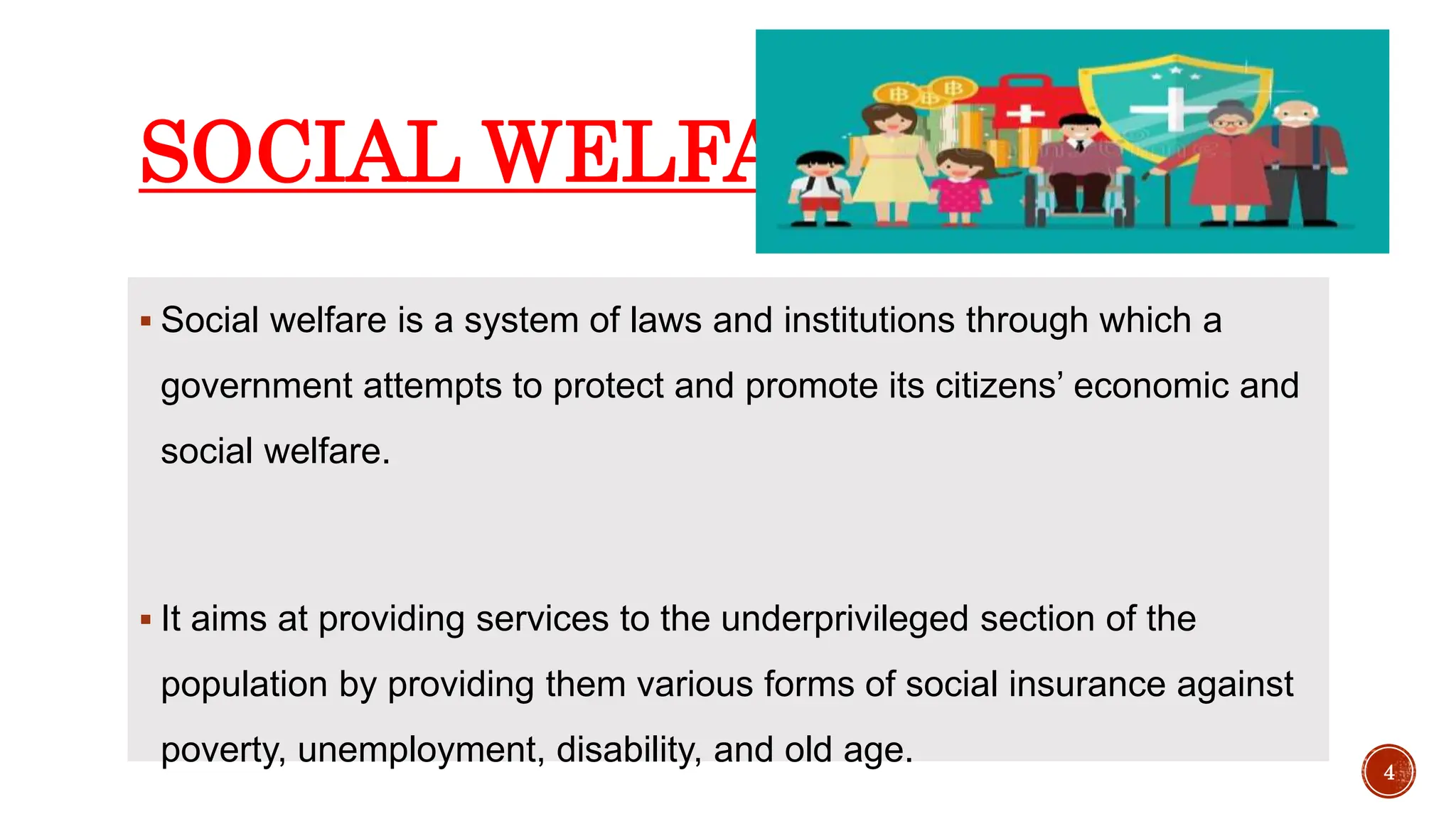
 Social welfare is a system of laws and institutions through which a
government attempts to protect and promote its citizens’ economic and
social welfare.
 It aims at providing services to the underprivileged section of the
population by providing them various forms of social insurance against
poverty, unemployment, disability, and old age. 4
SOCIAL WELFARE &
INDIAN CONSTITUTION
 Preamble & Directive Principles of State policy –
India is making a determined attempt to fulfil its ideal of welfare state both in
principle and through economic planning.
 The ministries of Government of India (GoI) have come up with various government
programs called Schemes or Plans (Yojana).
 These schemes could be formed by - the central government
- the state government
- specific or joint collaboration between the
centre and the state
5
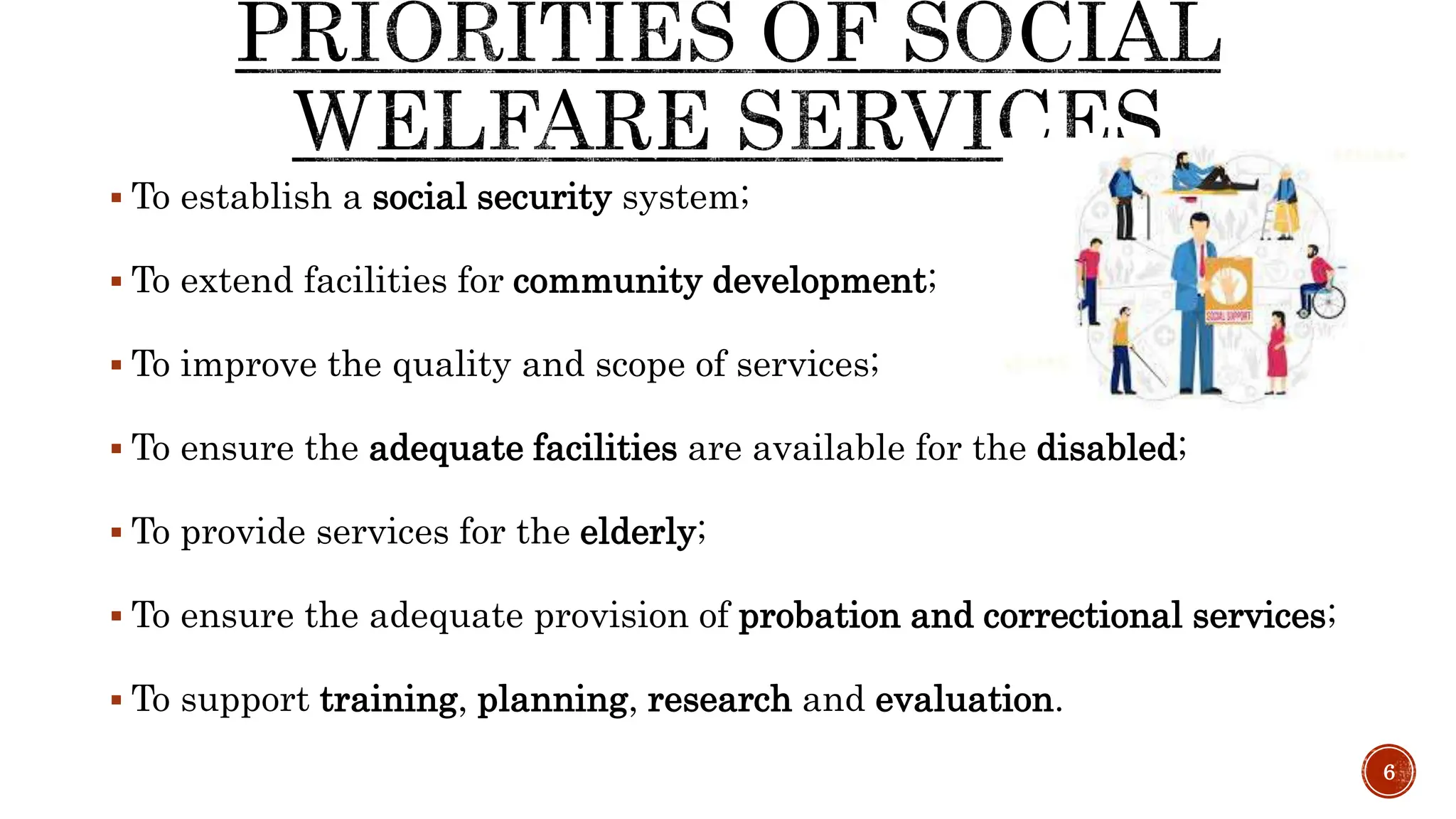
 To establish a social security system;
 To extend facilities for community development;
 To improve the quality and scope of services;
 To ensure the adequate facilities are available for the disabled;
 To provide services for the elderly;
 To ensure the adequate provision of probation and correctional services;
 To support training, planning, research and evaluation.
6
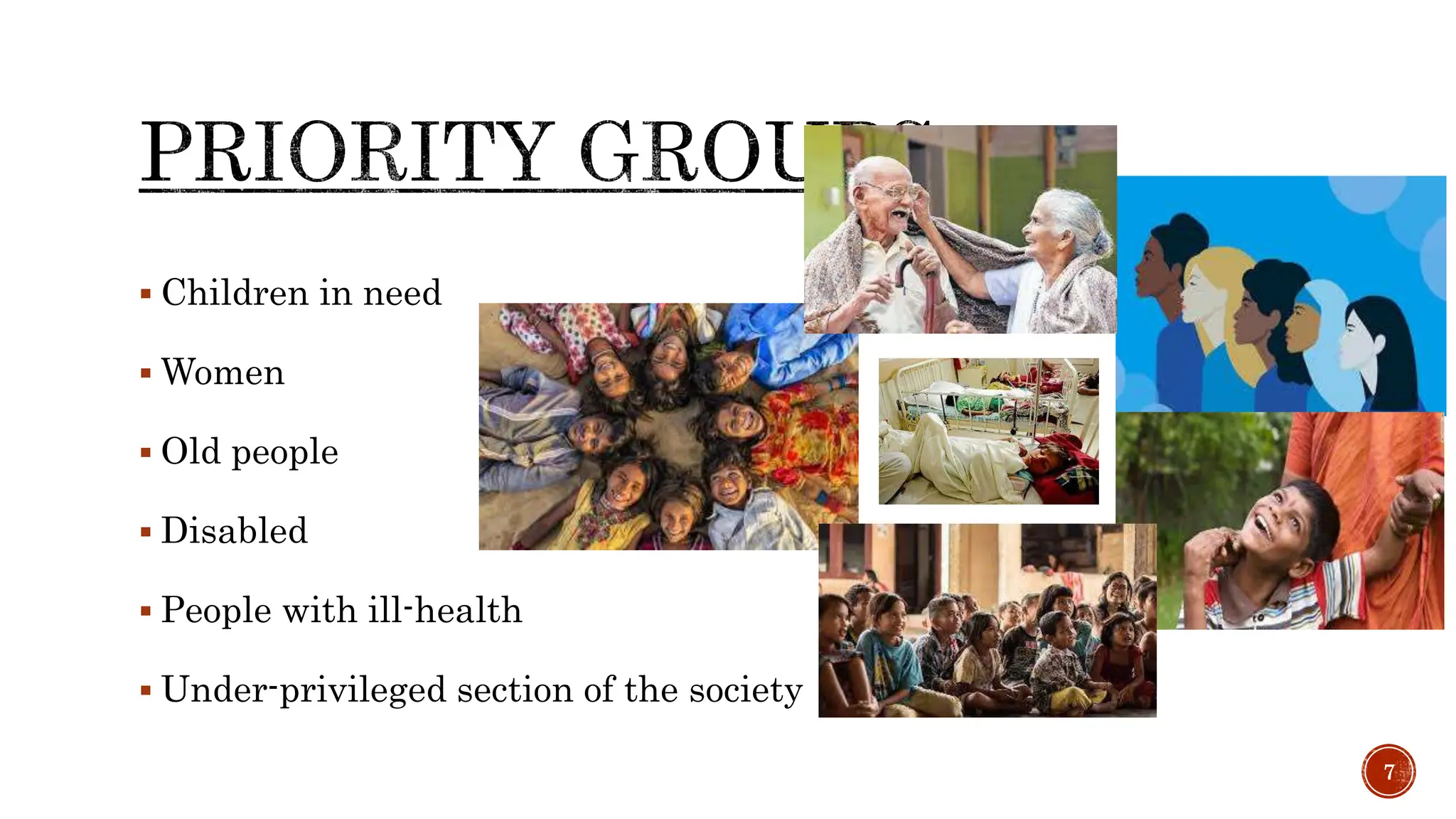
 Children in need
 Women
 Old people
 Disabled
 People with ill-health
 Under-privileged section of the society
7
CHILD
WELFARE
8
CHILD WELFARE
PROGRAMMES IN INDIA
 Two major centrally sponsored child welfare programmes are –
1. Integrated Child Development Services (ICDS) scheme
for the development of the child, and
2. Integrated Child Protection Scheme (ICPS) for the care
and protection of the child in conflict with law and in need of
care and protection.
9
10
 Launched in 1975.
 Flagship program implemented by the Government of India to
address the nutritional and developmental needs of
children < 6years age, pregnant women, and lactating mothers.
 Implemented through Anganwadi centers.
11
1. To improve the nutritional and health status of children in the age group 0-6 years
2. To lay the foundations for proper psychological, physical and social development of
the child;
3. To reduce mortality and morbidity malnutrition and school dropout;
4. To achieve an effective coordination of policy and implementation among the various
departments working for the promotion of child development; and
5. To enhance the capability of the mother and nutritional needs of the child through
proper nutrition and health education.
12
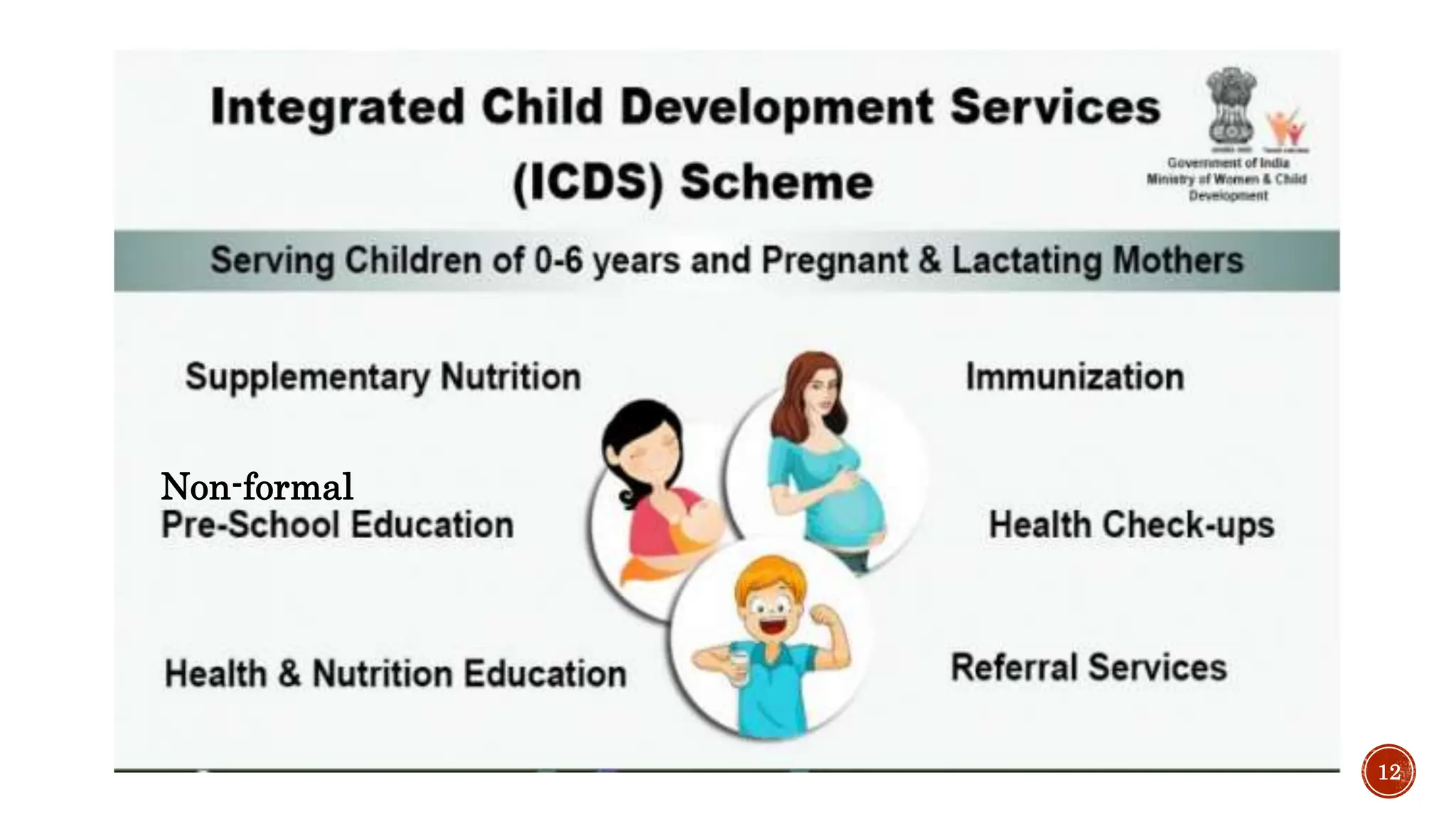
Non-formal
13
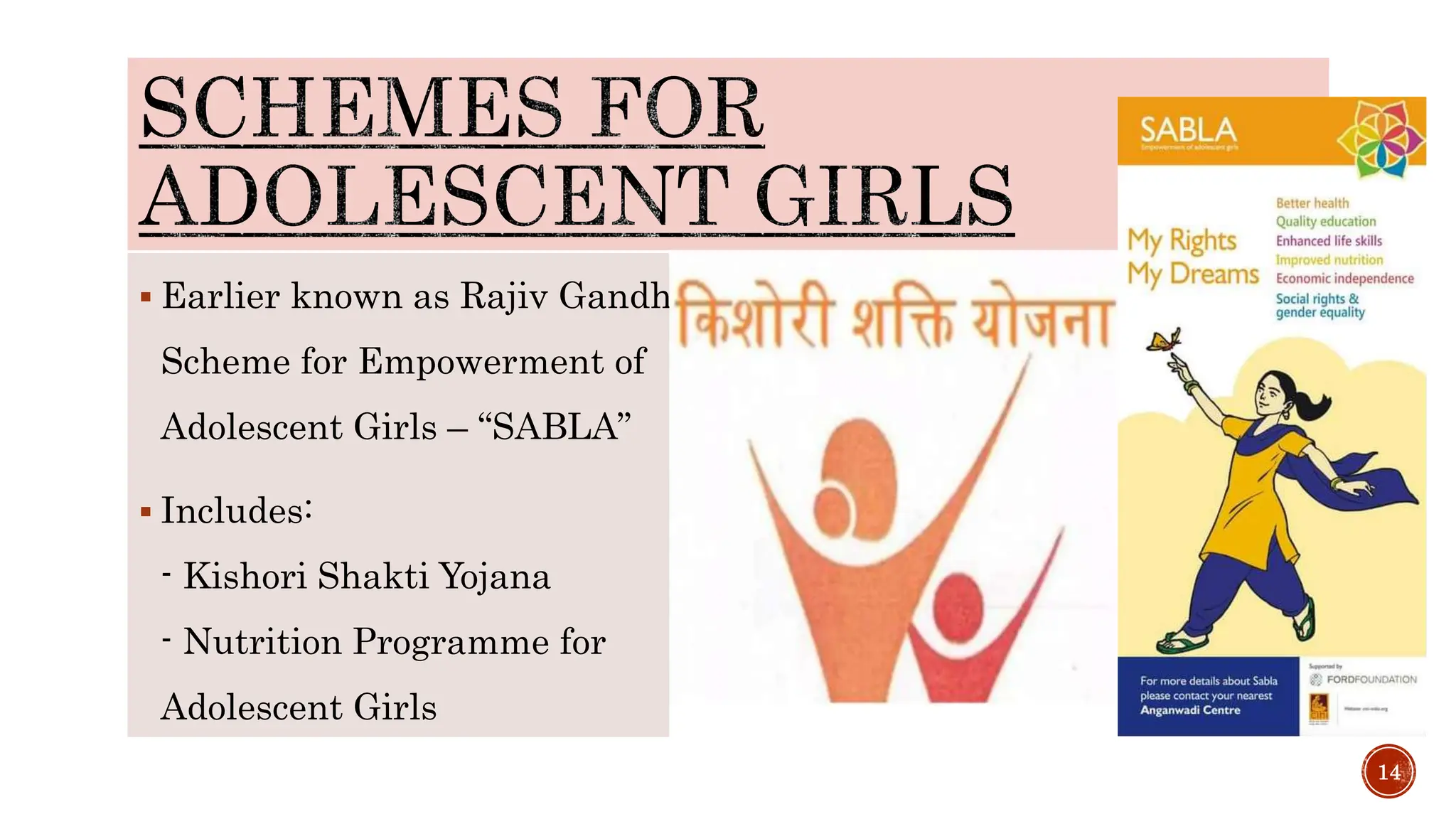
 Earlier known as Rajiv Gandhi
Scheme for Empowerment of
Adolescent Girls – “SABLA”
 Includes:
- Kishori Shakti Yojana
- Nutrition Programme for
Adolescent Girls
14
15
•Introduced in: 2010
•Implemented By: MoWCD
•Implemented Through: Existing AWCs under ICDS.
•Coverage: Pan-India
•Key Objective: To facilitate, educate and empower Adolescent
Girls (AGs)
•Target Group: Out of school girls in the age group of 11-14
years.
•The scheme aims at motivating out of school girls to go back
to formal schooling or vocational /skill training.
• Nutrition: Provision for providing specified amount of
calories, protein and micronutrients to AGs, etc.
• Non-nutrition: Health check-up, mainstreaming out of
school girls into the school system, IFA
supplementation, LSE, etc.
INTEGRATED CHILD
PROTECTION SCHEME (ICPS)
 Launched during 2009-2010 as a Government – Civil Society Partnership
Scheme.
 Aim:
- to build a protective environment for children in difficult circumstances,
as well as other vulnerable children.
16
a. Institutionalize essential services and strengthen structures;
b. Build the capacities at all the levels;
c. Create a database and knowledge base for child protection services;
d. Strengthen child protection at family and community level;
e. Ensure inter-sectoral response and coordinate with allied systems; and
f. Raise public awareness and educate the public on child rights and protection.
17
18
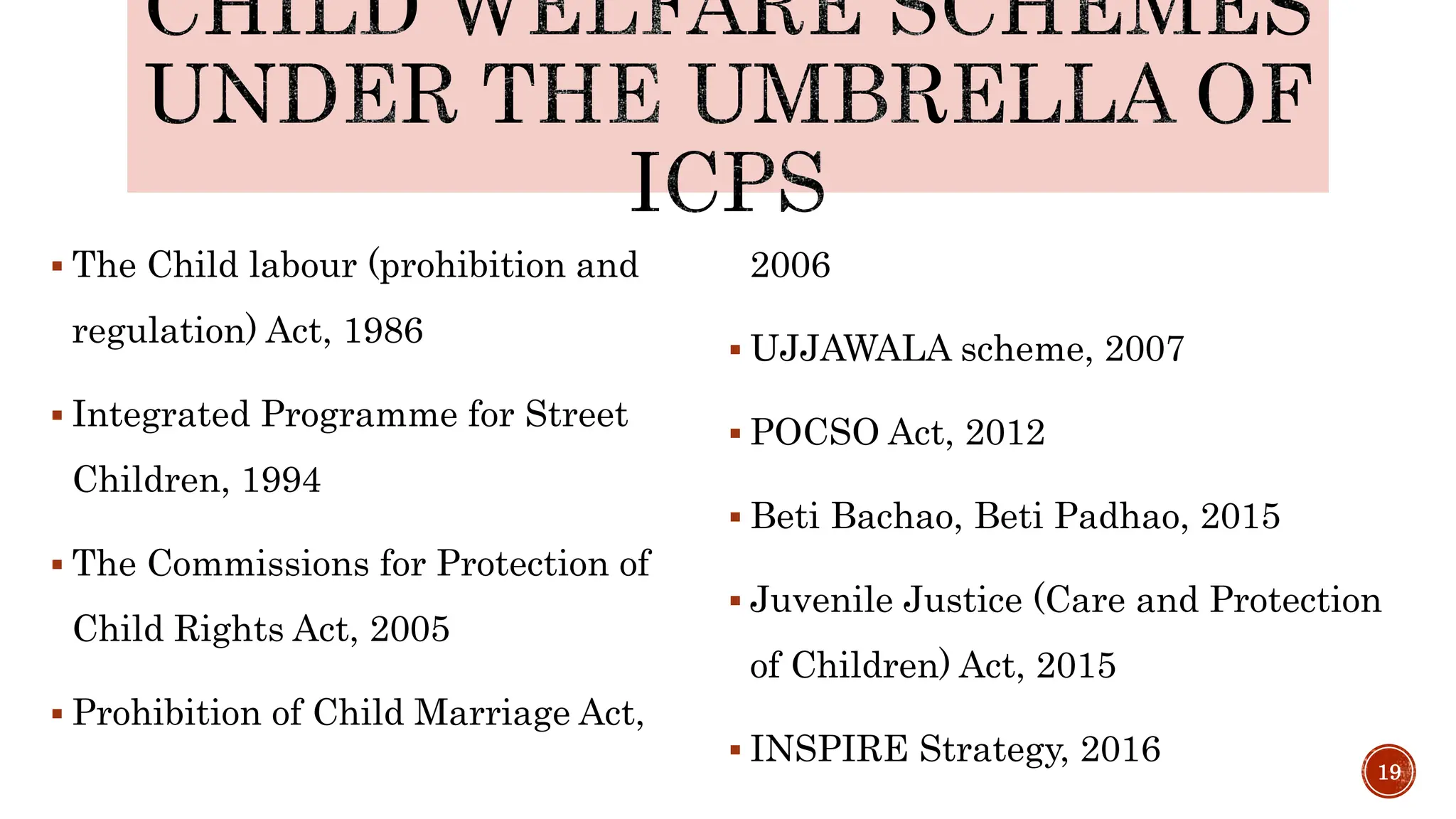
 The Child labour (prohibition and
regulation) Act, 1986
 Integrated Programme for Street
Children, 1994
 The Commissions for Protection of
Child Rights Act, 2005
 Prohibition of Child Marriage Act,
2006
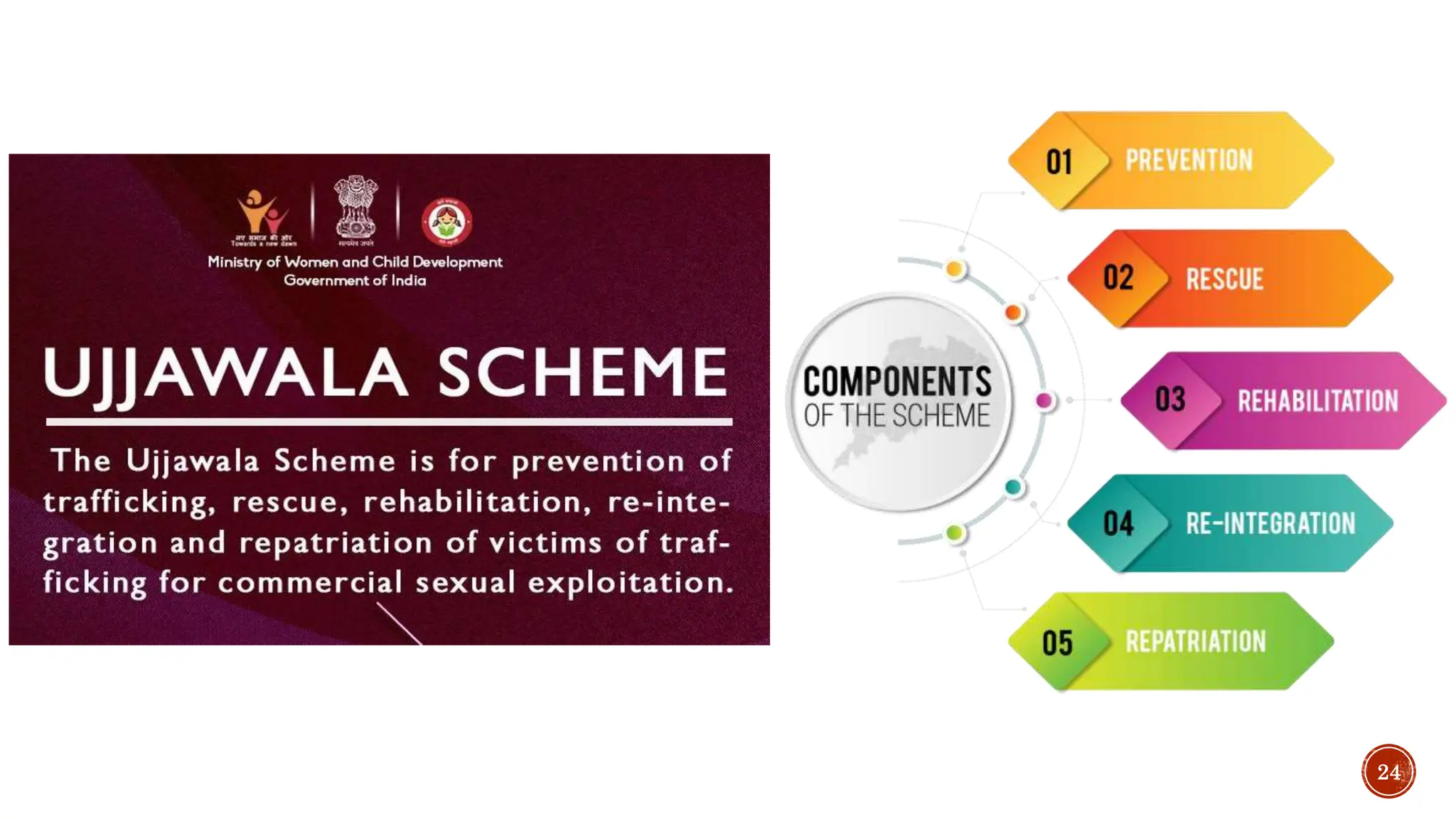
 UJJAWALA scheme, 2007
 POCSO Act, 2012
 Beti Bachao, Beti Padhao, 2015
 Juvenile Justice (Care and Protection
of Children) Act, 2015
 INSPIRE Strategy, 2016 19
THE CHILD LABOUR
(PROHIBITION AND
REGULATION) ACT
 Launched on 23rd December, 1986.
 Objective: - to prohibit engagement of children in certain employments;
- to regulate the conditions of work of children in certain
other employment.
20
Except for Family-based work & Recognized School-based activities,
Children are not permitted to work in occupations concerned with:-
 Passenger, goods mail transport by
railway
 Carpet weaving
 Cinder picking, cleaning of ash-pits
 Cement manufacturing
 Building construction
 Matches & Explosives
manufacturing
 Beedi making
 Cashew descalding & processing
 Soldering process in electronic
industries
THE INTEGRATED
PROGRAMME FOR STREET
CHILDREN, 1960
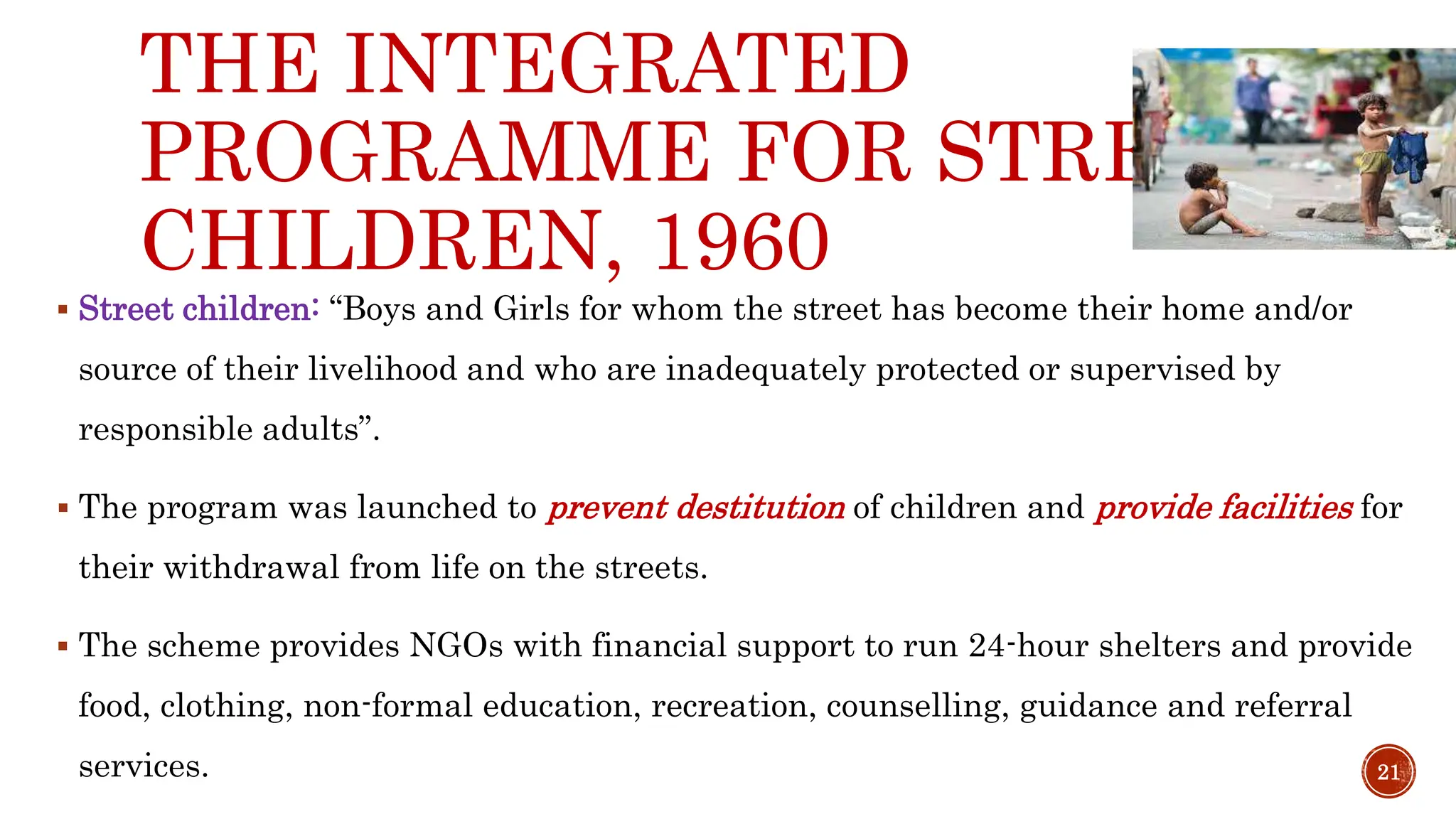
 Street children: “Boys and Girls for whom the street has become their home and/or
source of their livelihood and who are inadequately protected or supervised by
responsible adults”.
 The program was launched to prevent destitution of children and provide facilities for
their withdrawal from life on the streets.
 The scheme provides NGOs with financial support to run 24-hour shelters and provide
food, clothing, non-formal education, recreation, counselling, guidance and referral
services. 21
 Examine and review the safeguards for the protection of child
rights and recommend measures for their effective
implementation;
 Inquire into violation of child rights and recommend initiation of
proceedings in such cases;
 Examine factors that inhibit the enjoyment of rights of children in
need;
 Spread child rights literacy among various sections of the
society and promote awareness of the safeguards available for
protection of these rights;
 Inspect juvenile custodial home, or any other place of residence
or institution meant for children where children are detained or
lodged for the purpose of treatment, reformation or protection
and take up with these authorities for remedial action.
22
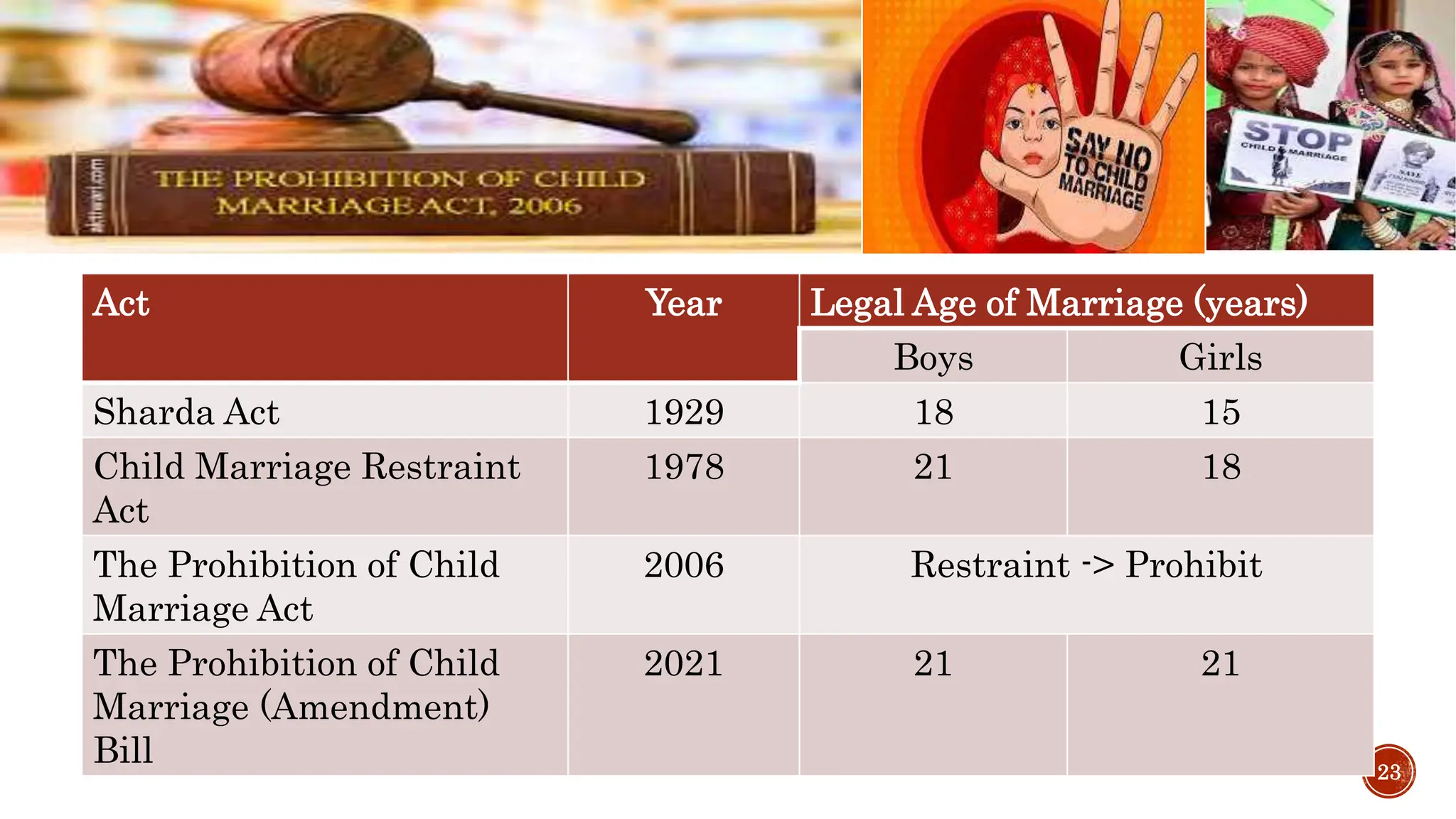
Act Year Legal Age of Marriage (years)
Boys Girls
Sharda Act 1929 18 15
Child Marriage Restraint
Act
1978 21 18
The Prohibition of Child
Marriage Act
2006 Restraint -> Prohibit
The Prohibition of Child
Marriage (Amendment)
Bill
2021 21 21
23
24
PROTECTION OF
CHILDREN FROM SEXUAL
OFFENCES ACT - 2012
 Indian legal framework to address and prevent sexual offenses against children
<18years age.
 It provides for stringent penalties and expedited legal procedures for the speedy
trial.
 The act defines various sexual offenses against children and mandates the
establishment of special courts for the exclusive trial of POCSO cases.
 It places a strong emphasis on the protection of the child's privacy during legal
proceedings and encourages the use of child-friendly methods for recording their
statements.
 The POCSO Act aims to safeguard the rights and well-being of children, ensuring
their safety from sexual exploitation. 25
26
LAUNCHED ON 22 JANUARY 2015
MANTRA: ‘BETA BETI, EK
SAMAAN’
27
Key elements of the scheme:
Enforcement of PC & PNDT Act by nation-wide awareness and advocacy
campaign and multi-sectoral action
28
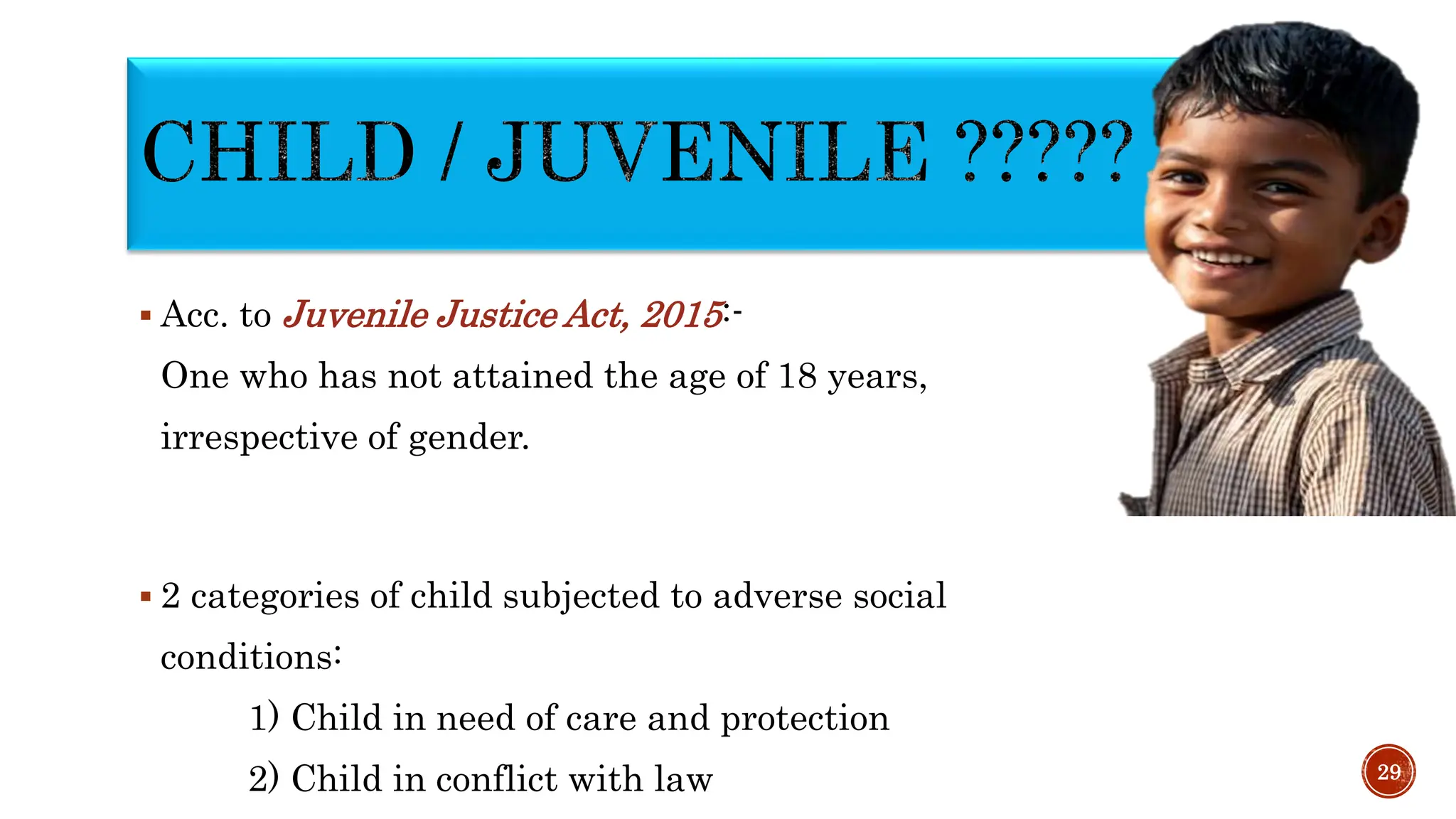
 Acc. to Juvenile Justice Act, 2015:-
One who has not attained the age of 18 years,
irrespective of gender.
 2 categories of child subjected to adverse social
conditions:
1) Child in need of care and protection
2) Child in conflict with law 29
30
31
JUVENILE JUSTICE (CARE &
PROTECTION) AMENDMENT
ACT, 2021
 District Magistrates (DM), including Additional district magistrates
can issue Adoption orders.
 Prohibits opening of New CCI without sanctioned by DM.
 DMs must now make sure that CCIs under their district follow all
norms and procedures.
 DMs will do background check of CWC members.
 CWC members should report to DM regularly.
32
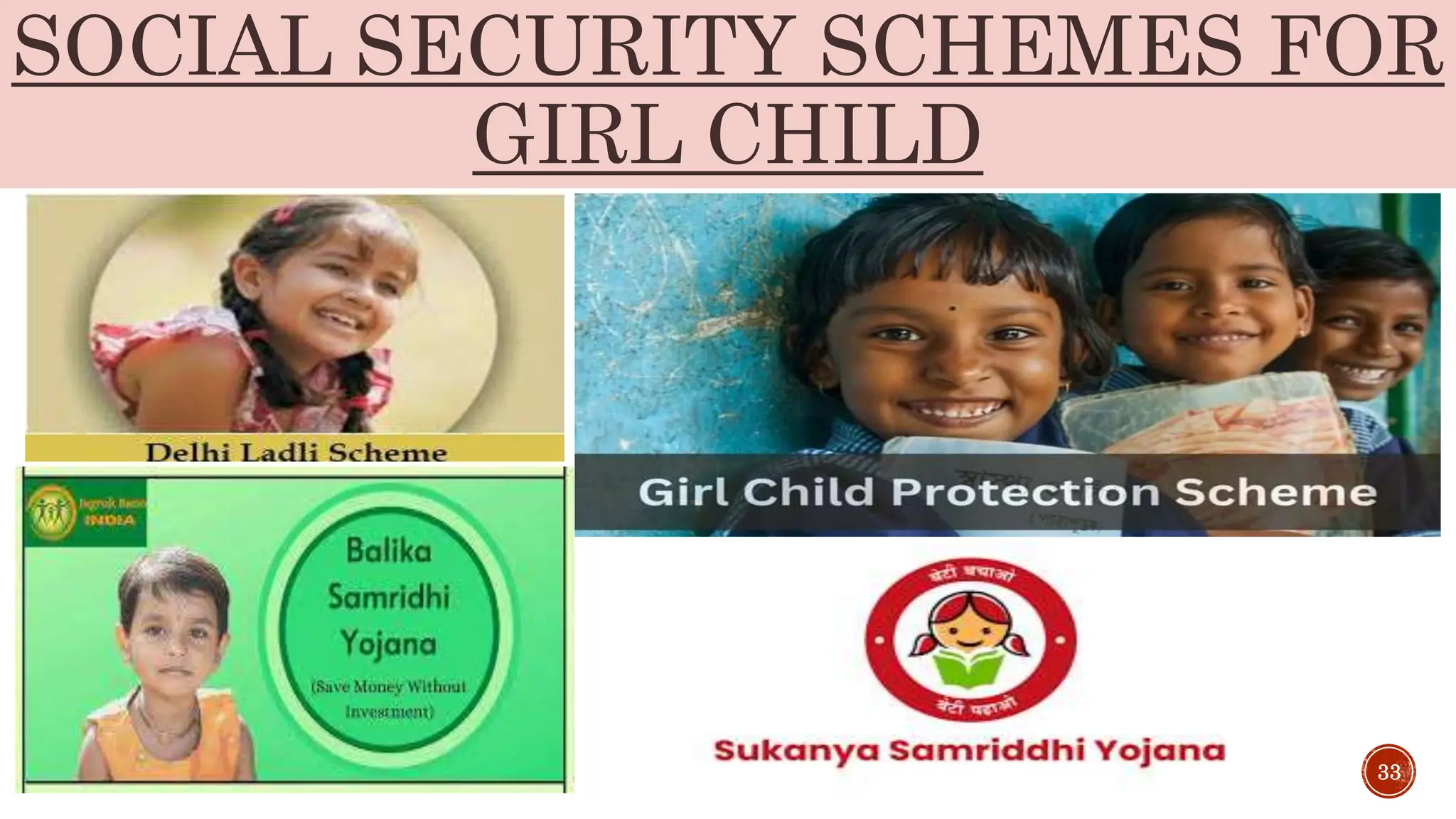
SOCIAL SECURITY SCHEMES FOR
GIRL CHILD
33
34
WOMEN
WELFA
RE
35
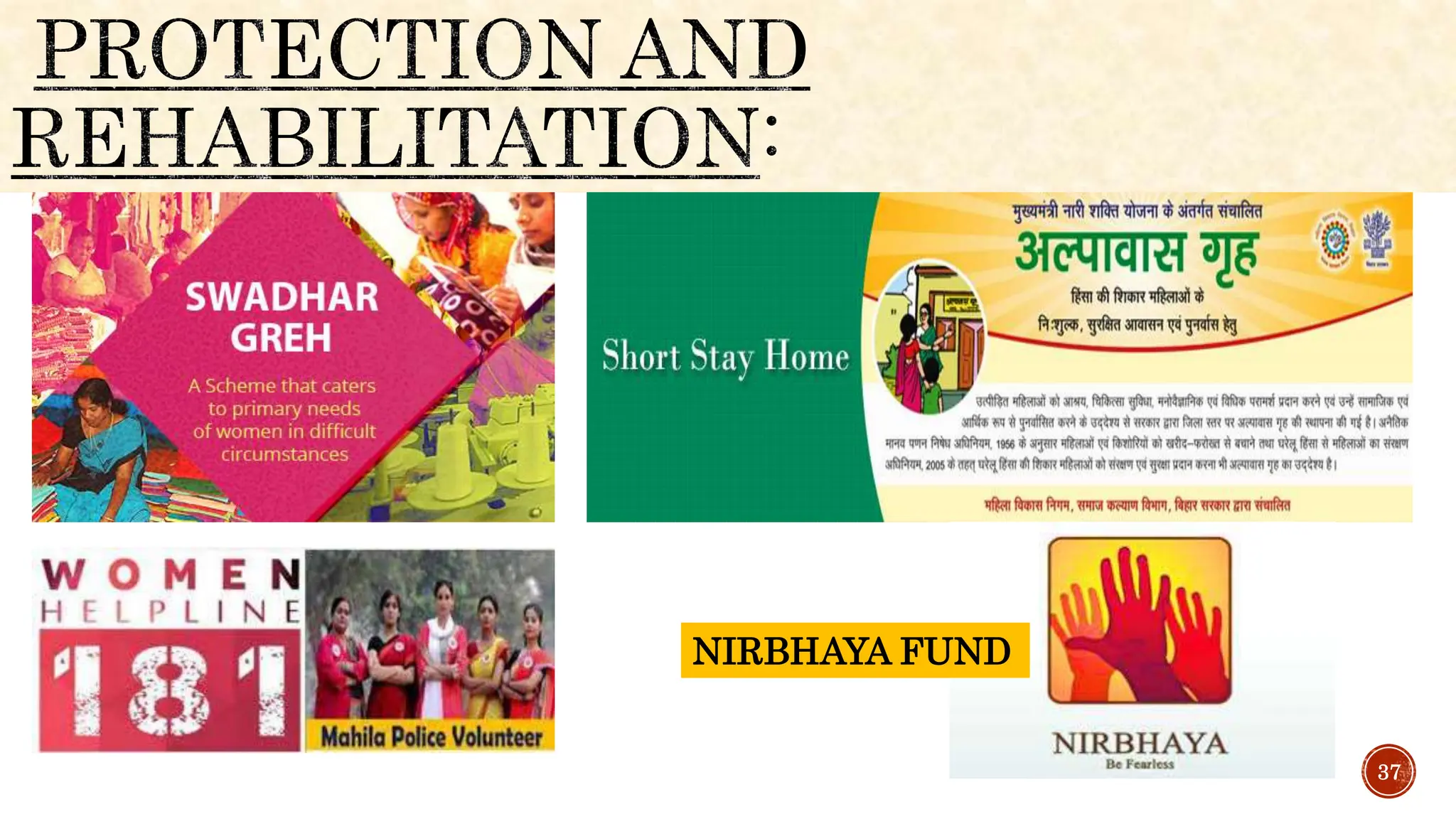
 Protection and Rehabilitation of Women in difficult circumstances
 Nutritional and Health Needs of Women
 Employment and Educational Needs of Women
 Better Networking and Co-ordination between Agencies working for
Women
36
37
NIRBHAYA FUND
38
 Launched on
March, 2018.
 Goals:
- to achieve
improvement in
Nutritional status of
children < 6years,
adolescent girls, pregnant
women and lactating
mothers. 39
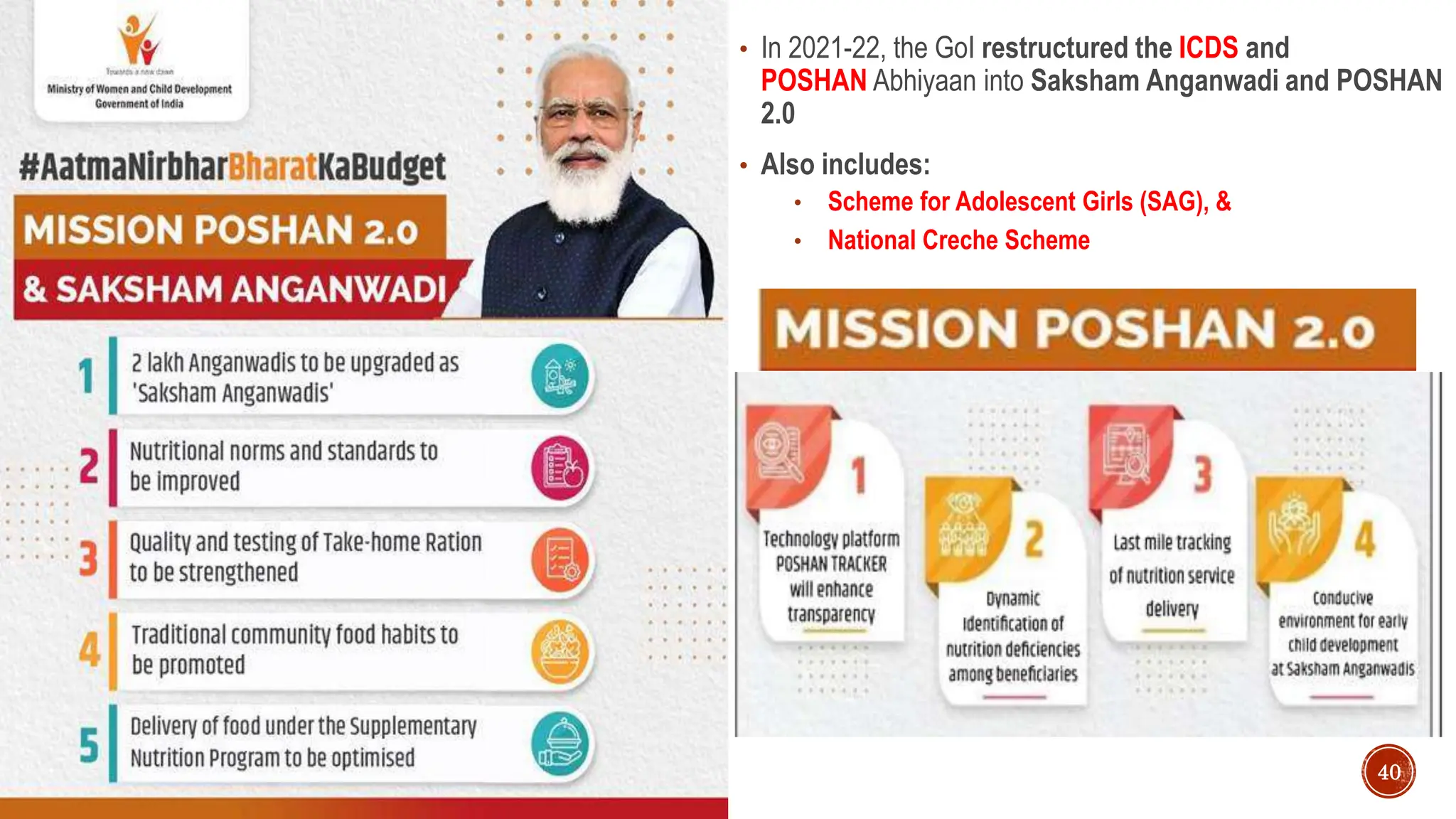
• In 2021-22, the GoI restructured the ICDS and
POSHAN Abhiyaan into Saksham Anganwadi and POSHAN
2.0
• Also includes:
• Scheme for Adolescent Girls (SAG), &
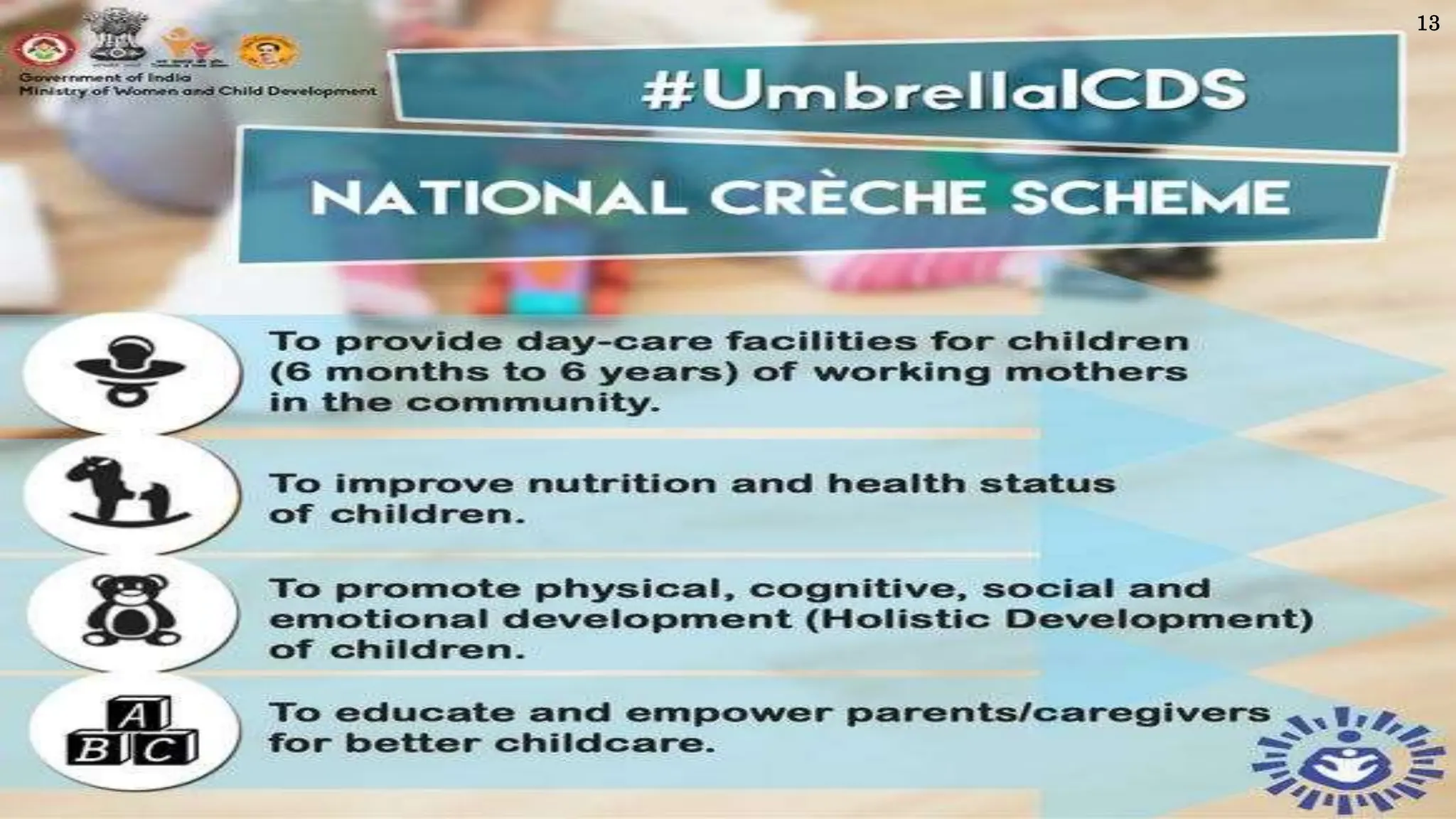
• National Creche Scheme
40
41
42
Incentives
category
Mother ASHA
LPS Rural Rs. 1400/- Rs. 600/-
Urban Rs. 1000/- Rs. 200/-
HPS Rural Rs. 700/- Rs. 200/-
Urban Rs. 600/- Rs. 200/-
In LPS
States
All births, delivered in a health centre – Government or
Accredited Private health institutions.
In
HPS
Upto 2 live births.
43
OLD AGE WELFARE
SCHEMES
44
 Launched in the year 2010.
 Aim:
- to provide separate, specialized and
comprehensive healthcare to the senior citizens at
various level of state healthcare delivery system
including outreach services.
45
Strategies
Preventive
&
promotive
care
Management
of illness
Health
manpower
development
for geriatric
services
Medical
rehabilitatio
n
Therapeutic
intervention
Information,
Education &
Communication
46
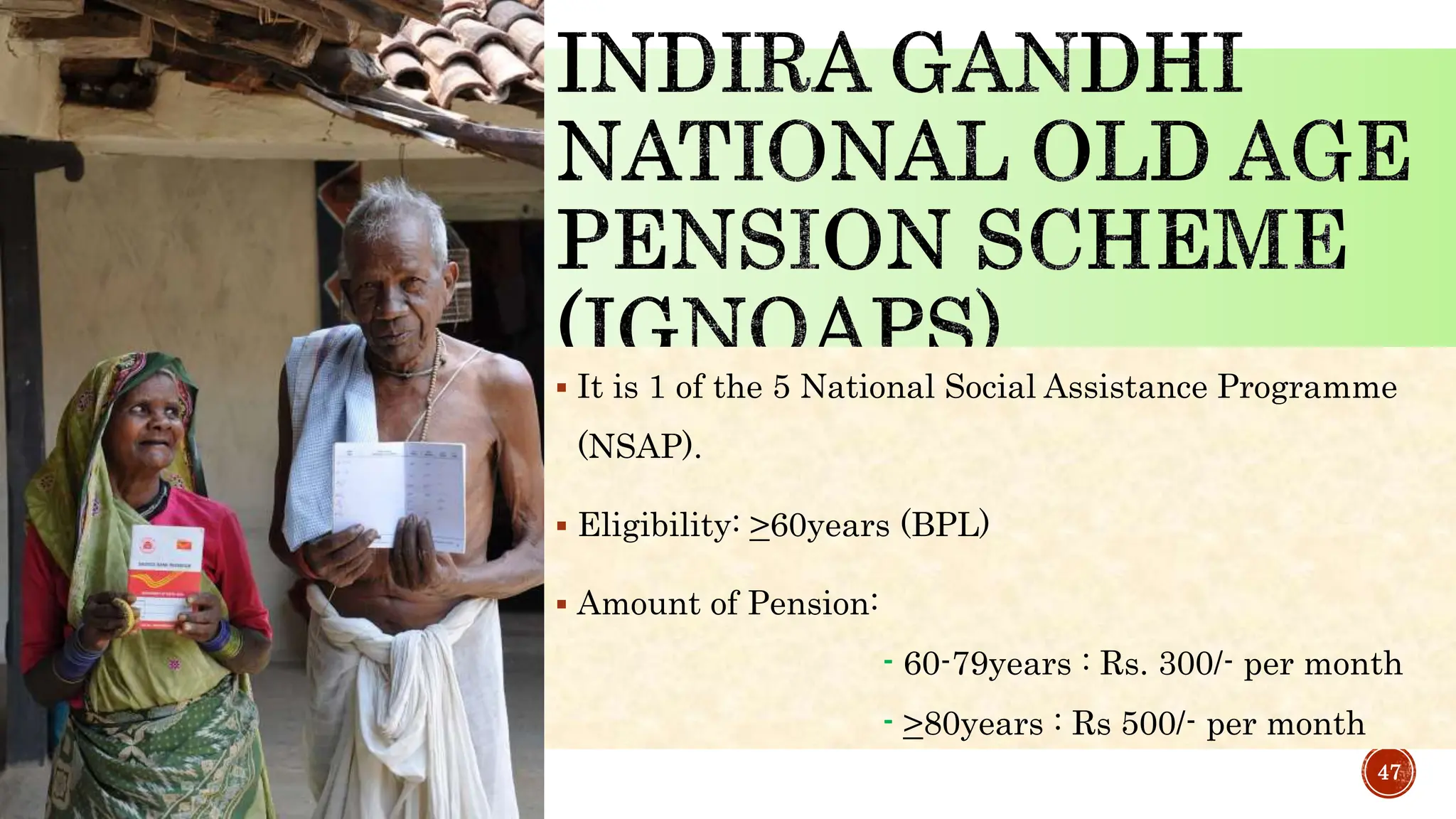
 It is 1 of the 5 National Social Assistance Programme
(NSAP).
 Eligibility: >60years (BPL)
 Amount of Pension:
- 60-79years : Rs. 300/- per month
- >80years : Rs 500/- per month
47
 Launched on 1st April, 2017.
 Aim: to provide Physical Aids and Assisted-living Devices free of cost for Senior
citizens belonging to BPL category.
 Eligibility: Senior citizen belonging to BPL category and suffering from any of the
age related disability/infirmity
 Aids & Assistive devices: Walking sticks, elbow crutches, walkers, hearing-aids,
wheelchairs, artificial dentures and spectacles.
48
49
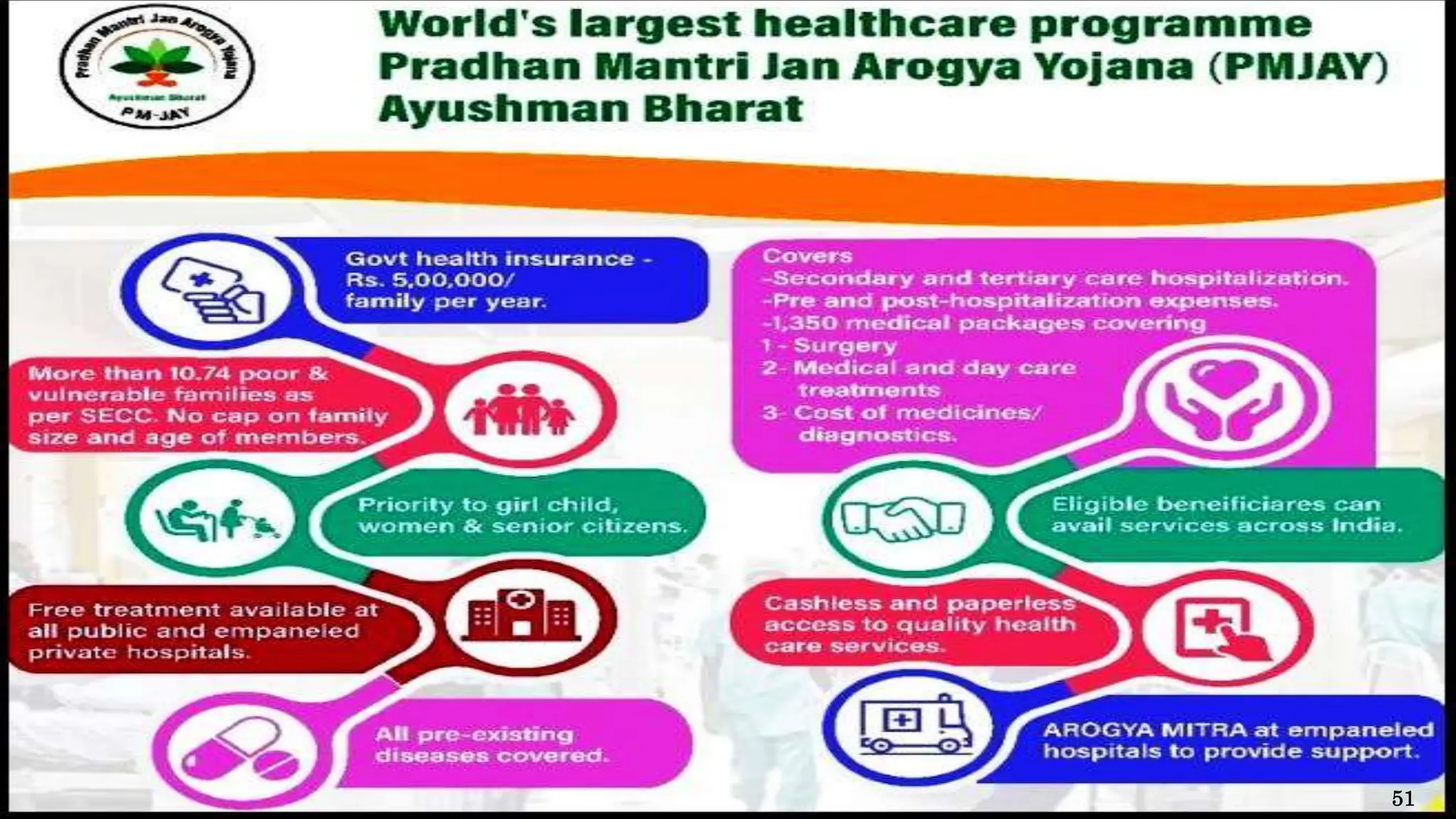
AYUSHMAN BHARAT
PROGRAMME
Launched on
February, 2018
2 major Health
Initiative
1.
Establishment
of Health and
Wellness
Centres
2. National
Health
Protection
Scheme:
AB-PMJAY
50
51
MAINTENANCE AND WELFARE OF
PARENTS AND SENIOR CITIZENS
ACT, 2007
 The children and heirs are legally obliged to provide maintenance
by monthly allowance.
 The Act provides an inexpensive and speedy procedure to claim
monthly maintenance.
 The Act has provisions to protect the life and property of the elderly.
 The Act also provides for the state governments to establish at least
one old age home in every district of the state, and also ensure
adequate medical care for senior citizens. 52
WELFARE FOR
THE
DISABLED
PERSONS 53
DEPARTMENT OF
EMPOWERMENT OF
PERSONS WITH
DISABILITIES
(DIVYANGJAN), 2014
 Initially known as Department of Disability Affairs, 2012.
1.Vision: To build an inclusive society in which equal opportunities are provided for the
growth and development of Persons with Disabilities.
2.Mission: To empower Persons with Disabilities, through its various Acts/
Institutions/Organizations and Schemes for rehabilitation and to create an enabling
environment that provides such persons with equal opportunities, protection of their
rights and enables them to participate as independent and productive members of society.
54
 The Department administers the following three Acts:-
1. The Rights of Persons with Disabilities Act, 2016
2. The National Trust for the Welfare of Persons with Autism,
Cerebral Palsy, Mental Retardation and Multiple Disabilities Act,
1999
3. Rehabilitation Council of India Act, 1992
55
56
 Launched on International Day of Persons with Disabilities on 3rd December 2015.
• Components of AIC:
• Built Environment Accessibility
• Transportation System Accessibility
• Information and Communication Eco-System Accessibility
57
58
Launched on 2nd March, 2021
• Unique Disability Identification (UDID) Portal
• DeenDayal Disabled Rehabilitation Scheme
• Assistance to Disabled Persons for Purchase/fitting of Aids
and Appliances
• National Fellowship for Students with Disabilities
59
NATIONAL DIVYANGJAN
FINANCE AND DEVELOPMENT
CORPORATION (NDFDC)
 Apex institution for channelizing funds for promoting economic
development activities and self-employment ventures for the benefit
of PwDs
 Two flagship schemes:
- Divyangjan Swavalamban Yojana (DSY); and
- Vishesh Microfinance Yojana (VMY)
60
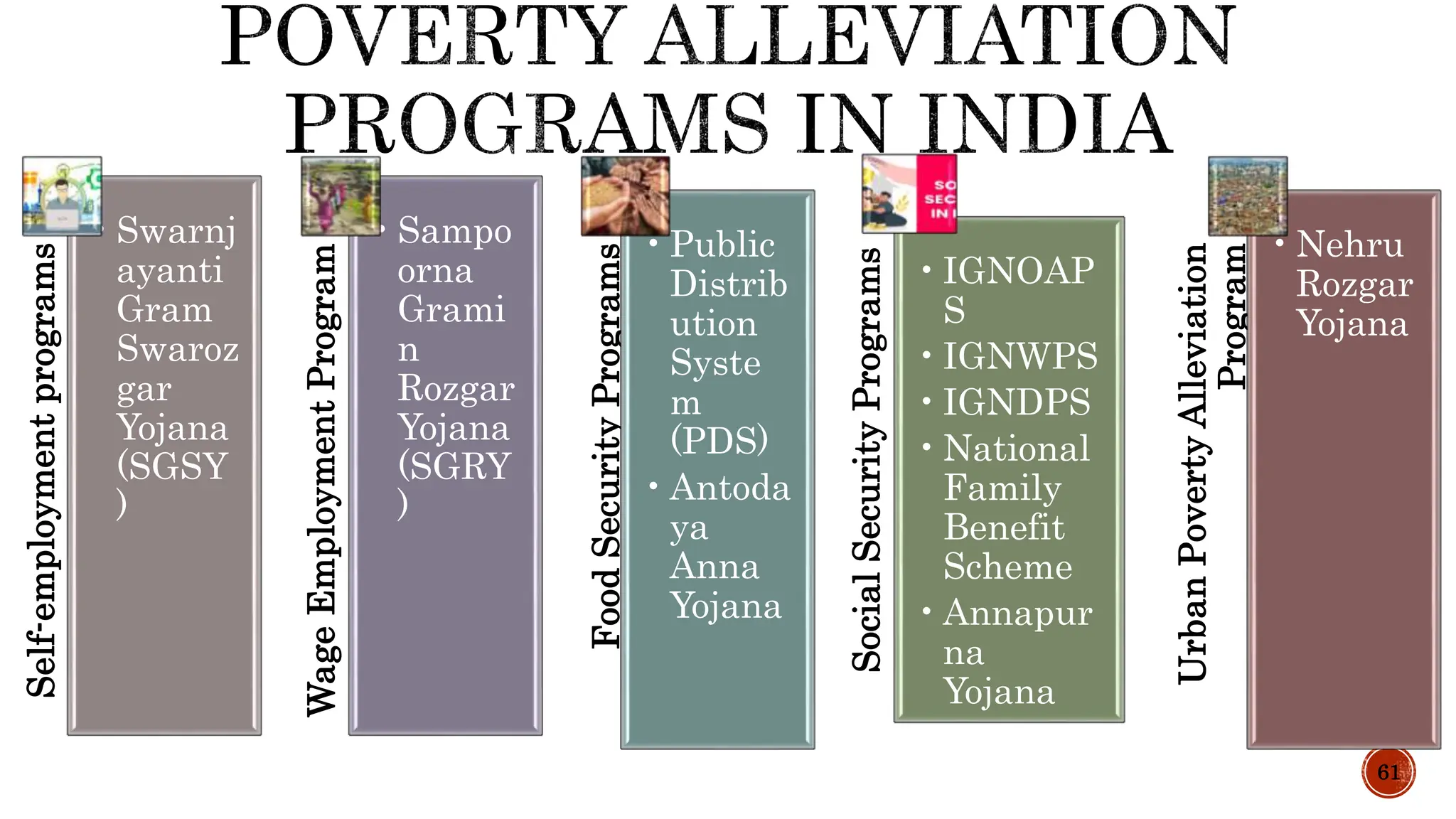
Self-employment
programs
•Swarnj
ayanti
Gram
Swaroz
gar
Yojana
(SGSY
)
Wage
Employment
Program
•Sampo
orna
Grami
n
Rozgar
Yojana
(SGRY
)
Food
Security
Programs
•Public
Distrib
ution
Syste
m
(PDS)
•Antoda
ya
Anna
Yojana
Social
Security
Programs
•IGNOAP
S
•IGNWPS
•IGNDPS
•National
Family
Benefit
Scheme
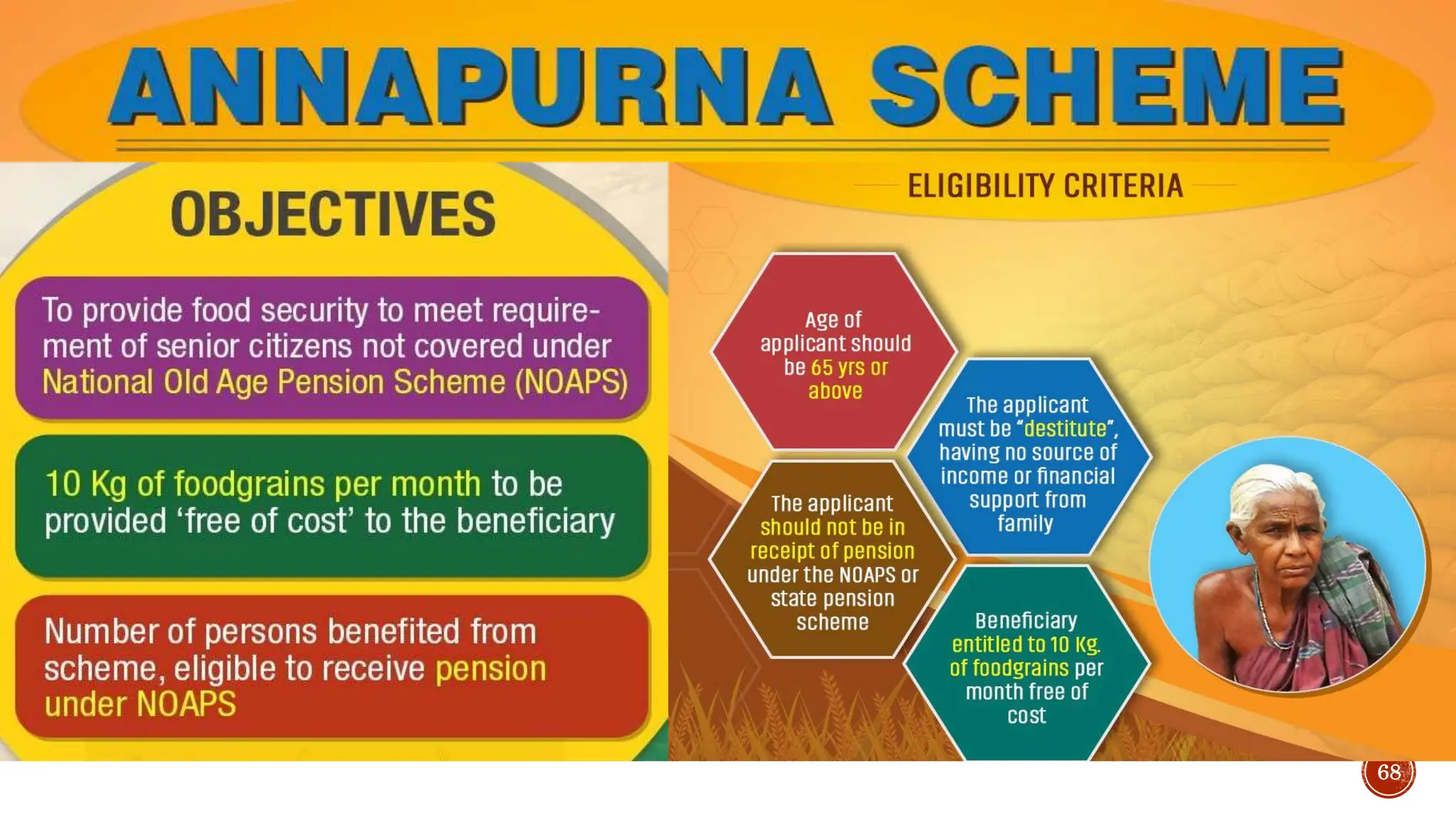
•Annapur
na
Yojana
Urban
Poverty
Alleviation
Program
•Nehru
Rozgar
Yojana
61
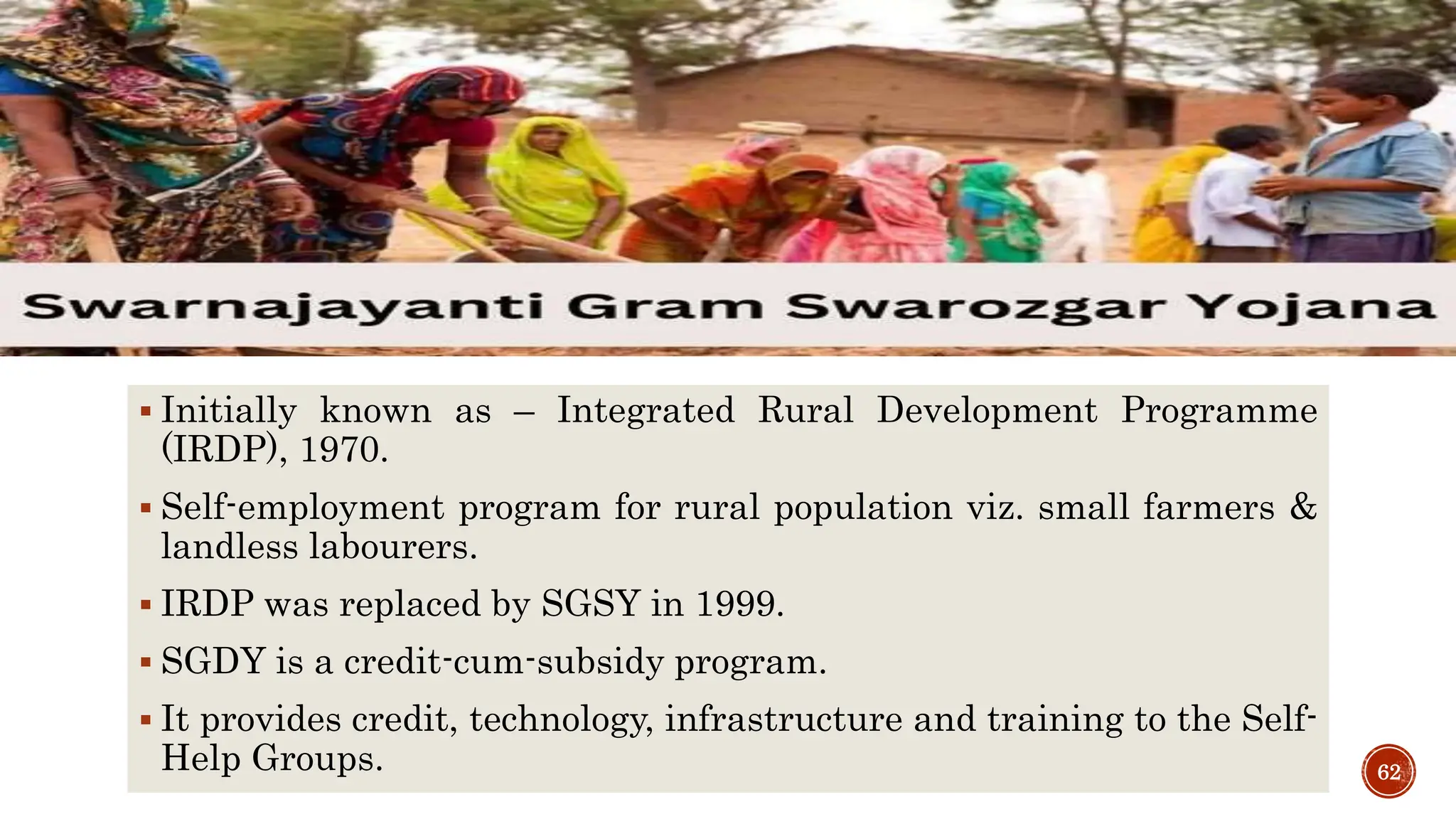
 Initially known as – Integrated Rural Development Programme
(IRDP), 1970.
 Self-employment program for rural population viz. small farmers &
landless labourers.
 IRDP was replaced by SGSY in 1999.
 SGDY is a credit-cum-subsidy program.
 It provides credit, technology, infrastructure and training to the Self-
Help Groups. 62
SAMPOORNA GRAMEEN
ROZGAR YOJANA
 Launched in 2001.
 It merged various existing schemes:
- Jawahar Gram Samriddhi Rozgar Yojana
- Employment Assurance Scheme
 Objectives:
- Generation of Employment for the rural poor.
- Creation of Community Assets and Infrastructure.
- Ensuring food and nutrition security for the rural poor.
63
 PDS has evolved as a system of management of scarcity
through distribution of food grains at affordable price.
 Antodaya Anna Yojana launched in December, 2000.
 Under the scheme:
Every BPL family gets 35 Kg. food grains In Western Districts
- (20 Kgs Rice and 15 Kgs Wheat), in Eastern Districts - (25 Kg
Rice and 10 Kg Wheat) each month at a fixed price.
The price of wheat is Rs. 3 per Kg. and rice at Rs. 2 per Kg.
 Commodities allocated are: Rice, Wheat, Sugar and Kerosene.
(Also pulses, edible oil, iodised salt in some states) 64
 Eligibility: 40-79 years of age (BPL).
 Amount of Pension: - Rs 300/- per month upto 80years
- Rs 500/- per month 80years onwards
65
66
 Eligibility: 18-79 years of age (BPL).
 Amount of Pension: - Rs 300/- per month upto 80years
- Rs 500/- per month 80years onwards
 Eligibility: 18-59 years of age (BPL).
 Amount of Grant: - Lump sum of Rs
20,000/- will be given in the case of
death of primary breadwinner
67
NATIONAL FAMILY BENEFIT
SCHEME
68
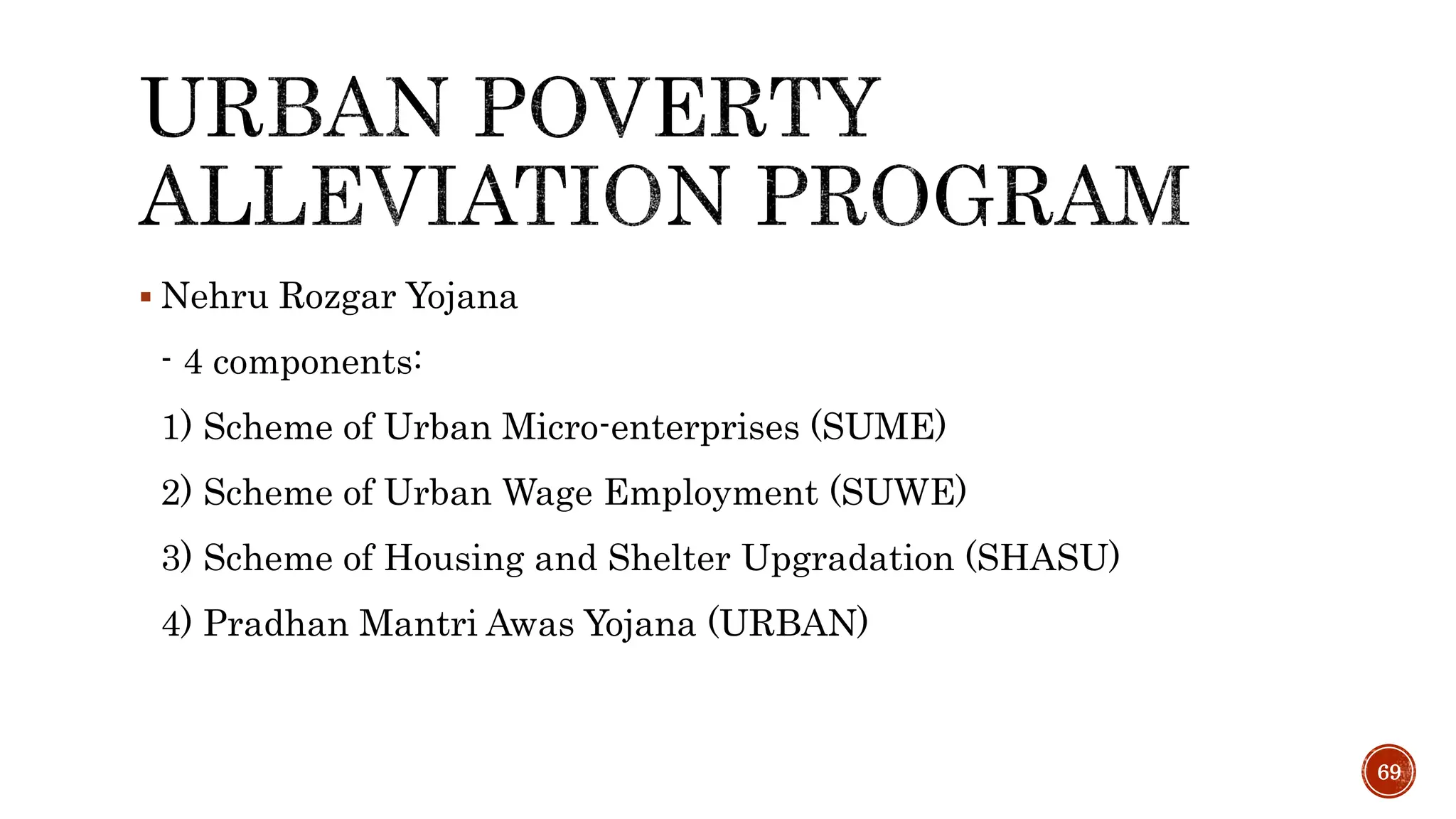
 Nehru Rozgar Yojana
- 4 components:
1) Scheme of Urban Micro-enterprises (SUME)
2) Scheme of Urban Wage Employment (SUWE)
3) Scheme of Housing and Shelter Upgradation (SHASU)
4) Pradhan Mantri Awas Yojana (URBAN)
69
70
1. Park’s Textbook of Preventive and Social Medicine – 27th edition by K. Park.
2. IAPSM’s Textbook of COMMUNITY MEDICINE – 2nd edition by AM Kadri.
3. Textbook of COMMUNITY MEDICINE – 5th edition by Rajvir Bhalwar.
4. https://socialjustice.gov.in/
5. https://wcd.nic.in/
6. https://www.peoplesforum.in/ujjawala.php
7. https://www.indiacode.nic.in/
8. https://disabilityaffairs.gov.in/content/
9. https://www.nhfdc.nic.in/about-ndfdc/our-organisation
10. https://nfsa.gov.in/portal/PDS_page
11. https://google.com/ for images
71
72

SOCIAL WELFARE PROGRAMMES IN INDIA.pptx

  • 1.
    SOCIAL WELFARE PROGRAMMES IN INDIADR. HARIMUBARGAYARY POSTGRADUATE RESIDENT DEPT. OF COMMUNITY MEDICINE
  • 2.
    2 1. Introduction 2. ChildWelfare 3. Women Welfare 4. Old Age Welfare Schemes 5. Welfare for the Disabled Persons 6. Poverty Alleviation Programs
  • 3.
  • 4.
    SOCIAL WELFARE  Socialwelfare is a system of laws and institutions through which a government attempts to protect and promote its citizens’ economic and social welfare.  It aims at providing services to the underprivileged section of the population by providing them various forms of social insurance against poverty, unemployment, disability, and old age. 4
  • 5.
    SOCIAL WELFARE & INDIANCONSTITUTION  Preamble & Directive Principles of State policy – India is making a determined attempt to fulfil its ideal of welfare state both in principle and through economic planning.  The ministries of Government of India (GoI) have come up with various government programs called Schemes or Plans (Yojana).  These schemes could be formed by - the central government - the state government - specific or joint collaboration between the centre and the state 5
  • 6.
     To establisha social security system;  To extend facilities for community development;  To improve the quality and scope of services;  To ensure the adequate facilities are available for the disabled;  To provide services for the elderly;  To ensure the adequate provision of probation and correctional services;  To support training, planning, research and evaluation. 6
  • 7.
     Children inneed  Women  Old people  Disabled  People with ill-health  Under-privileged section of the society 7
  • 8.
  • 9.
    CHILD WELFARE PROGRAMMES ININDIA  Two major centrally sponsored child welfare programmes are – 1. Integrated Child Development Services (ICDS) scheme for the development of the child, and 2. Integrated Child Protection Scheme (ICPS) for the care and protection of the child in conflict with law and in need of care and protection. 9
  • 10.
    10  Launched in1975.  Flagship program implemented by the Government of India to address the nutritional and developmental needs of children < 6years age, pregnant women, and lactating mothers.  Implemented through Anganwadi centers.
  • 11.
    11 1. To improvethe nutritional and health status of children in the age group 0-6 years 2. To lay the foundations for proper psychological, physical and social development of the child; 3. To reduce mortality and morbidity malnutrition and school dropout; 4. To achieve an effective coordination of policy and implementation among the various departments working for the promotion of child development; and 5. To enhance the capability of the mother and nutritional needs of the child through proper nutrition and health education.
  • 12.
  • 13.
  • 14.
     Earlier knownas Rajiv Gandhi Scheme for Empowerment of Adolescent Girls – “SABLA”  Includes: - Kishori Shakti Yojana - Nutrition Programme for Adolescent Girls 14
  • 15.
    15 •Introduced in: 2010 •ImplementedBy: MoWCD •Implemented Through: Existing AWCs under ICDS. •Coverage: Pan-India •Key Objective: To facilitate, educate and empower Adolescent Girls (AGs) •Target Group: Out of school girls in the age group of 11-14 years. •The scheme aims at motivating out of school girls to go back to formal schooling or vocational /skill training. • Nutrition: Provision for providing specified amount of calories, protein and micronutrients to AGs, etc. • Non-nutrition: Health check-up, mainstreaming out of school girls into the school system, IFA supplementation, LSE, etc.
  • 16.
    INTEGRATED CHILD PROTECTION SCHEME(ICPS)  Launched during 2009-2010 as a Government – Civil Society Partnership Scheme.  Aim: - to build a protective environment for children in difficult circumstances, as well as other vulnerable children. 16
  • 17.
    a. Institutionalize essentialservices and strengthen structures; b. Build the capacities at all the levels; c. Create a database and knowledge base for child protection services; d. Strengthen child protection at family and community level; e. Ensure inter-sectoral response and coordinate with allied systems; and f. Raise public awareness and educate the public on child rights and protection. 17
  • 18.
  • 19.
     The Childlabour (prohibition and regulation) Act, 1986  Integrated Programme for Street Children, 1994  The Commissions for Protection of Child Rights Act, 2005  Prohibition of Child Marriage Act, 2006  UJJAWALA scheme, 2007  POCSO Act, 2012  Beti Bachao, Beti Padhao, 2015  Juvenile Justice (Care and Protection of Children) Act, 2015  INSPIRE Strategy, 2016 19
  • 20.
    THE CHILD LABOUR (PROHIBITIONAND REGULATION) ACT  Launched on 23rd December, 1986.  Objective: - to prohibit engagement of children in certain employments; - to regulate the conditions of work of children in certain other employment. 20 Except for Family-based work & Recognized School-based activities, Children are not permitted to work in occupations concerned with:-  Passenger, goods mail transport by railway  Carpet weaving  Cinder picking, cleaning of ash-pits  Cement manufacturing  Building construction  Matches & Explosives manufacturing  Beedi making  Cashew descalding & processing  Soldering process in electronic industries
  • 21.
    THE INTEGRATED PROGRAMME FORSTREET CHILDREN, 1960  Street children: “Boys and Girls for whom the street has become their home and/or source of their livelihood and who are inadequately protected or supervised by responsible adults”.  The program was launched to prevent destitution of children and provide facilities for their withdrawal from life on the streets.  The scheme provides NGOs with financial support to run 24-hour shelters and provide food, clothing, non-formal education, recreation, counselling, guidance and referral services. 21
  • 22.
     Examine andreview the safeguards for the protection of child rights and recommend measures for their effective implementation;  Inquire into violation of child rights and recommend initiation of proceedings in such cases;  Examine factors that inhibit the enjoyment of rights of children in need;  Spread child rights literacy among various sections of the society and promote awareness of the safeguards available for protection of these rights;  Inspect juvenile custodial home, or any other place of residence or institution meant for children where children are detained or lodged for the purpose of treatment, reformation or protection and take up with these authorities for remedial action. 22
  • 23.
    Act Year LegalAge of Marriage (years) Boys Girls Sharda Act 1929 18 15 Child Marriage Restraint Act 1978 21 18 The Prohibition of Child Marriage Act 2006 Restraint -> Prohibit The Prohibition of Child Marriage (Amendment) Bill 2021 21 21 23
  • 24.
  • 25.
    PROTECTION OF CHILDREN FROMSEXUAL OFFENCES ACT - 2012  Indian legal framework to address and prevent sexual offenses against children <18years age.  It provides for stringent penalties and expedited legal procedures for the speedy trial.  The act defines various sexual offenses against children and mandates the establishment of special courts for the exclusive trial of POCSO cases.  It places a strong emphasis on the protection of the child's privacy during legal proceedings and encourages the use of child-friendly methods for recording their statements.  The POCSO Act aims to safeguard the rights and well-being of children, ensuring their safety from sexual exploitation. 25
  • 26.
  • 27.
    LAUNCHED ON 22JANUARY 2015 MANTRA: ‘BETA BETI, EK SAMAAN’ 27 Key elements of the scheme: Enforcement of PC & PNDT Act by nation-wide awareness and advocacy campaign and multi-sectoral action
  • 28.
  • 29.
     Acc. toJuvenile Justice Act, 2015:- One who has not attained the age of 18 years, irrespective of gender.  2 categories of child subjected to adverse social conditions: 1) Child in need of care and protection 2) Child in conflict with law 29
  • 30.
  • 31.
  • 32.
    JUVENILE JUSTICE (CARE& PROTECTION) AMENDMENT ACT, 2021  District Magistrates (DM), including Additional district magistrates can issue Adoption orders.  Prohibits opening of New CCI without sanctioned by DM.  DMs must now make sure that CCIs under their district follow all norms and procedures.  DMs will do background check of CWC members.  CWC members should report to DM regularly. 32
  • 33.
    SOCIAL SECURITY SCHEMESFOR GIRL CHILD 33
  • 34.
  • 35.
  • 36.
     Protection andRehabilitation of Women in difficult circumstances  Nutritional and Health Needs of Women  Employment and Educational Needs of Women  Better Networking and Co-ordination between Agencies working for Women 36
  • 37.
  • 38.
  • 39.
     Launched on March,2018.  Goals: - to achieve improvement in Nutritional status of children < 6years, adolescent girls, pregnant women and lactating mothers. 39
  • 40.
    • In 2021-22,the GoI restructured the ICDS and POSHAN Abhiyaan into Saksham Anganwadi and POSHAN 2.0 • Also includes: • Scheme for Adolescent Girls (SAG), & • National Creche Scheme 40
  • 41.
  • 42.
    42 Incentives category Mother ASHA LPS RuralRs. 1400/- Rs. 600/- Urban Rs. 1000/- Rs. 200/- HPS Rural Rs. 700/- Rs. 200/- Urban Rs. 600/- Rs. 200/- In LPS States All births, delivered in a health centre – Government or Accredited Private health institutions. In HPS Upto 2 live births.
  • 43.
  • 44.
  • 45.
     Launched inthe year 2010.  Aim: - to provide separate, specialized and comprehensive healthcare to the senior citizens at various level of state healthcare delivery system including outreach services. 45
  • 46.
  • 47.
     It is1 of the 5 National Social Assistance Programme (NSAP).  Eligibility: >60years (BPL)  Amount of Pension: - 60-79years : Rs. 300/- per month - >80years : Rs 500/- per month 47
  • 48.
     Launched on1st April, 2017.  Aim: to provide Physical Aids and Assisted-living Devices free of cost for Senior citizens belonging to BPL category.  Eligibility: Senior citizen belonging to BPL category and suffering from any of the age related disability/infirmity  Aids & Assistive devices: Walking sticks, elbow crutches, walkers, hearing-aids, wheelchairs, artificial dentures and spectacles. 48
  • 49.
  • 50.
    AYUSHMAN BHARAT PROGRAMME Launched on February,2018 2 major Health Initiative 1. Establishment of Health and Wellness Centres 2. National Health Protection Scheme: AB-PMJAY 50
  • 51.
  • 52.
    MAINTENANCE AND WELFAREOF PARENTS AND SENIOR CITIZENS ACT, 2007  The children and heirs are legally obliged to provide maintenance by monthly allowance.  The Act provides an inexpensive and speedy procedure to claim monthly maintenance.  The Act has provisions to protect the life and property of the elderly.  The Act also provides for the state governments to establish at least one old age home in every district of the state, and also ensure adequate medical care for senior citizens. 52
  • 53.
  • 54.
    DEPARTMENT OF EMPOWERMENT OF PERSONSWITH DISABILITIES (DIVYANGJAN), 2014  Initially known as Department of Disability Affairs, 2012. 1.Vision: To build an inclusive society in which equal opportunities are provided for the growth and development of Persons with Disabilities. 2.Mission: To empower Persons with Disabilities, through its various Acts/ Institutions/Organizations and Schemes for rehabilitation and to create an enabling environment that provides such persons with equal opportunities, protection of their rights and enables them to participate as independent and productive members of society. 54
  • 55.
     The Departmentadministers the following three Acts:- 1. The Rights of Persons with Disabilities Act, 2016 2. The National Trust for the Welfare of Persons with Autism, Cerebral Palsy, Mental Retardation and Multiple Disabilities Act, 1999 3. Rehabilitation Council of India Act, 1992 55
  • 56.
  • 57.
     Launched onInternational Day of Persons with Disabilities on 3rd December 2015. • Components of AIC: • Built Environment Accessibility • Transportation System Accessibility • Information and Communication Eco-System Accessibility 57
  • 58.
    58 Launched on 2ndMarch, 2021
  • 59.
    • Unique DisabilityIdentification (UDID) Portal • DeenDayal Disabled Rehabilitation Scheme • Assistance to Disabled Persons for Purchase/fitting of Aids and Appliances • National Fellowship for Students with Disabilities 59
  • 60.
    NATIONAL DIVYANGJAN FINANCE ANDDEVELOPMENT CORPORATION (NDFDC)  Apex institution for channelizing funds for promoting economic development activities and self-employment ventures for the benefit of PwDs  Two flagship schemes: - Divyangjan Swavalamban Yojana (DSY); and - Vishesh Microfinance Yojana (VMY) 60
  • 61.
  • 62.
     Initially knownas – Integrated Rural Development Programme (IRDP), 1970.  Self-employment program for rural population viz. small farmers & landless labourers.  IRDP was replaced by SGSY in 1999.  SGDY is a credit-cum-subsidy program.  It provides credit, technology, infrastructure and training to the Self- Help Groups. 62
  • 63.
    SAMPOORNA GRAMEEN ROZGAR YOJANA Launched in 2001.  It merged various existing schemes: - Jawahar Gram Samriddhi Rozgar Yojana - Employment Assurance Scheme  Objectives: - Generation of Employment for the rural poor. - Creation of Community Assets and Infrastructure. - Ensuring food and nutrition security for the rural poor. 63
  • 64.
     PDS hasevolved as a system of management of scarcity through distribution of food grains at affordable price.  Antodaya Anna Yojana launched in December, 2000.  Under the scheme: Every BPL family gets 35 Kg. food grains In Western Districts - (20 Kgs Rice and 15 Kgs Wheat), in Eastern Districts - (25 Kg Rice and 10 Kg Wheat) each month at a fixed price. The price of wheat is Rs. 3 per Kg. and rice at Rs. 2 per Kg.  Commodities allocated are: Rice, Wheat, Sugar and Kerosene. (Also pulses, edible oil, iodised salt in some states) 64
  • 65.
     Eligibility: 40-79years of age (BPL).  Amount of Pension: - Rs 300/- per month upto 80years - Rs 500/- per month 80years onwards 65
  • 66.
    66  Eligibility: 18-79years of age (BPL).  Amount of Pension: - Rs 300/- per month upto 80years - Rs 500/- per month 80years onwards
  • 67.
     Eligibility: 18-59years of age (BPL).  Amount of Grant: - Lump sum of Rs 20,000/- will be given in the case of death of primary breadwinner 67 NATIONAL FAMILY BENEFIT SCHEME
  • 68.
  • 69.
     Nehru RozgarYojana - 4 components: 1) Scheme of Urban Micro-enterprises (SUME) 2) Scheme of Urban Wage Employment (SUWE) 3) Scheme of Housing and Shelter Upgradation (SHASU) 4) Pradhan Mantri Awas Yojana (URBAN) 69
  • 70.
  • 71.
    1. Park’s Textbookof Preventive and Social Medicine – 27th edition by K. Park. 2. IAPSM’s Textbook of COMMUNITY MEDICINE – 2nd edition by AM Kadri. 3. Textbook of COMMUNITY MEDICINE – 5th edition by Rajvir Bhalwar. 4. https://socialjustice.gov.in/ 5. https://wcd.nic.in/ 6. https://www.peoplesforum.in/ujjawala.php 7. https://www.indiacode.nic.in/ 8. https://disabilityaffairs.gov.in/content/ 9. https://www.nhfdc.nic.in/about-ndfdc/our-organisation 10. https://nfsa.gov.in/portal/PDS_page 11. https://google.com/ for images 71
  • 72.

Editor's Notes

  • #11 The program is implemented through Anganwadi centers, which serve as grassroots-level delivery points for these services in rural and urban areas across the country
  • #13 Services provided under ICDS
  • #14 Launched on 2017
  • #15 Additional schemes for Adolescent girls in relation to Nutrition and Health
  • #16 (AGs) so as to enable them to become self-reliant and aware citizens life skill education
  • #17 The child in India is not only grappling with multiple problems of malnutrition, anaemia, infant mortality and low levels of immunisation but also child abuse, trafficking, child marriages and child labour.
  • #23 affected by terrorism, communal violence, riots, natural disaster, domestic violence, HIV/AIDS, trafficking, maltreatment, torture and exploitation, pornography and prostitution and recommend appropriate remedial measures
  • #25 Launched in 2007
  • #26 , including child pornography and sexual harassment,
  • #33 Child Care Institution, Child welfare care
  • #49 Senior Citizens, belonging to BPL category and suffering from any of the age related disability/infirmity viz. Low vision, Hearing impairment, Loss of teeth and Locomotor disability will be provided with such assisted-living devices which can restore near normalcy in their bodily functions, overcoming the disability/infirmity manifested. The Scheme is expected to benefit all Senior Citizens across the country. viz. Low vision, Hearing impairment, Loss of teeth and Locomotor disability
  • #55 To build an inclusive society in which equal opportunities are provided for the growth and development of Persons with Disabilities so that they can lead productive, safe and dignified lives.
  • #61 PwDs: Person with Disabilities; DivyangjanSwavalambanYojana(DSY), which is individual centric; Vishesh Microfinance Yojana (VMY), which is for Self Help Groups / Joint liability  groups through various partner agencies for the welfare  and rehabilitation  of  Persons with Disabilities in the country.
  • #62 Indira Gandhi National Old Pension Scheme; Indira Gandhi National Widow Pension Scheme; Indira Gandhi National Disability Pension Scheme - Jawahar Rozgar Yojana (JRY) Jawahar Gram Samridhi Yojana (JGSY) Employment Assurance Scheme (EAS) - Integrated Rural Development Programme (IRDP)
  • #71 Hind Kusht Nivaran Sangh, All India Blind Relief Society