The 2010 European Report on Development 
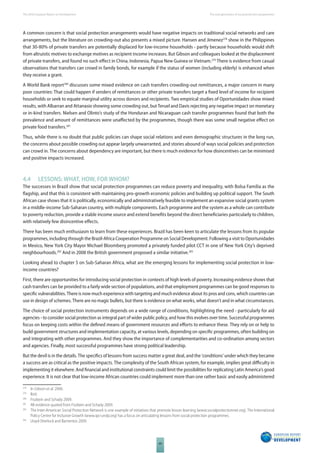
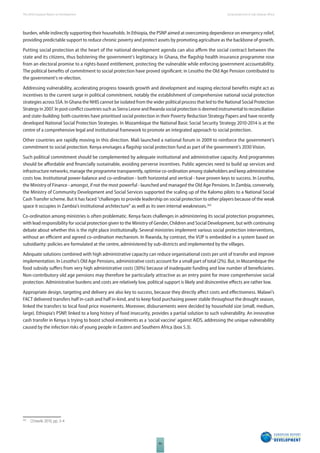
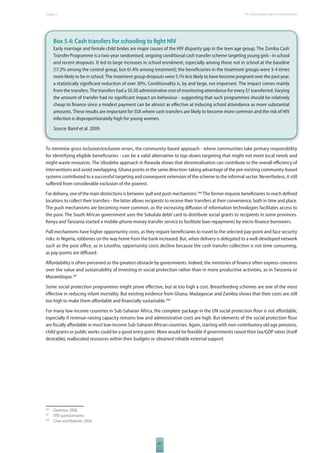
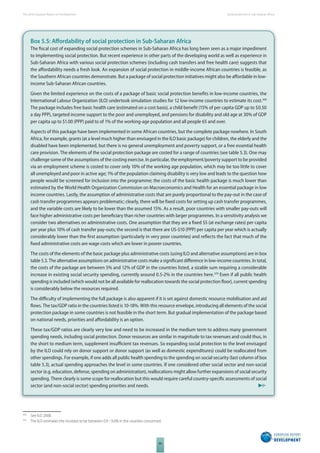
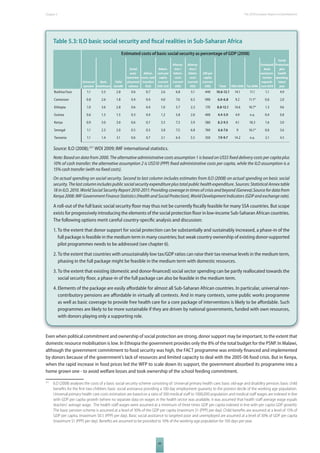
SOCIAL PROTECTION FOR 
INCLUSIVE DEVELOPMENT 
A NEW PERSPECTIVE IN EU CO-OPERATION WITH AFRICA 
MOBILISING EUROPEAN RESEARCH 
FOR DEVELOPMENT POLICIES 
IN PARTNERSHIP WITH
SOCIAL PROTECTION FOR 
INCLUSIVE DEVELOPMENT 
A NEW PERSPECTIVE IN EU CO-OPERATION WITH AFRICA 
MOBILISING EUROPEAN RESEARCH 
FOR DEVELOPMENT POLICIES 
IN PARTNERSHIP WITH
The 2010 European Report on Development, Social Protection for Inclusive Development, 
Robert Schuman Centre for Advanced Studies, European University Institute, San Domenico di Fiesole. 
© European Communities, 2010 
Reproduction is authorised provided the source is acknowledged. Printed in Belgium. 
Disclaimer: 
The views expressed in the European Report on Development (ERD) and other documents and 
individuals quoted in this brochure are their own and do not necessarily refl ect the opinion of the 
European Commission or the Member States of the European Union.
The 2010 European Report on Development 
III 
Foreword 
FOREWORD 
1.4 billion people, nearly three times the population of the European Union, are living in extreme poverty. 
This remains the most pressing global challenge of our times and increases the imperative to act. Development 
is the ultimate human interest story. 
The international development landscape is changing rapidly. New players are emerging and co-operation 
between developing countries is on the rise. Development is also increasingly being pursued in concert with 
other global challenges, such as climate change, migration, security and access to energy. Global economic 
instability, illustrated by the recent triple food-oil-fi nancial/economic crisis, has slowed growth and increased 
poverty in a number of countries. It has also shed light on the structural vulnerability of many developing 
countries and their increasing heterogeneity. Finally, critical voices are growing as regards the role, impact and 
governance of aid in the context of tight budget constraints and increased public scrutiny in donor countries. 
Then, there is the looming 2015 deadline for achieving the Millennium Development Goals. As announced in 
September 2010 in New York, the EU remains highly committed to this front over the coming years. 
Development lies primarily on the responsibility of each country to mobilise its own human, natural and 
economic resources and to put them at the service of virtuous policies. Despite relatively robust economic 
growth in much of Africa in recent years, poverty is still a major structural challenge there, as is the enormous 
vulnerability of households and entire societies to economic and natural shocks. Eradicating poverty and 
establishing eff ective ‘shock absorbers’ to cushion the blows must be embedded in national development 
strategies as well as in the dialogue and co-operation with external partners. 
That is why this second edition of the European Report on Development, elaborated under the lead of the 
European University Institute in the context of the “Mobilising European Research for Development Policies” 
initiative1, is so welcome and timely. Through empirical evidence, enhanced collaboration between researchers 
and policy makers and innovative thinking, it puts forward a convincing case for the role that social protection 
can play in tackling poverty, reducing the impact of shocks and promoting sustainable growth and inclusive 
development in the long run. 
The report’s conclusion that the profi le and place of social protection in development policy should be upgraded 
is a valuable one, and one that African countries, EU Member States, other donors and international organisations 
should pay close attention to. African leaders have recently reaffi rmed their political commitment to social policy 
and social protection by adopting the Khartoum Declaration on Social Policy Action towards Social Inclusion 
(November 2010). And social protection is increasingly on the political agenda of the international community, 
as demonstrated by the recent UN and G20 gatherings. 
As Europeans, we are familiar with the power of social protection and intra-European solidarity to cushion 
blows and help those aff ected stand on their feet again. With its diversity of social models and the valuable 
transition experience of the new Member States, Europe is well placed to support home-grown social protection 
initiatives in Africa. 
Today, we Europeans take social protection almost for granted, Africans deserve to be granted the opportunity 
to benefi t from it, too. 
1 The ERD is supported by the European Commission and seven Member States, namely: Finland, France, Germany, Luxembourg, Spain, 
Sweden and the United Kingdom. 
Josep Borrell Fontelles 
President of the European 
University Institute 
Fokion Fotiadis 
Director General of the European Commission for Development 
and Relations with African, Caribbean and Pacifi c States
The 2010 European Acknowledgements Report on Development 
ACKNOWLEDGEMENTS 
This Report has been prepared by a team led by Giorgia Giovannetti, including Charlotte Bué, Stefan 
Dercon, Arjan de Haan, Stephan Klasen, Leandro Prados de la Escosura, Rachel Sabates-Wheeler, Marco 
Sanfi lippo, Thierry Verdier and Pascal Vennesson. The team was based at the Robert Schuman Centre for 
Advanced Studies of the European University Institute (EUI). Ingo Linsenmann was the Project-Director 
and Claudio Mazzetti the Project-Manager. 
The team is particularly grateful to François Bourguignon for his scientifi c advice, Mina Baliamoune-Lutz, 
Guido Boni, Paolo Brunori, Jacques Charmes, Stefan Devereux, Nicholas Freeland, Nicolas Gérard, Margaret 
Grosh, Stefania Innocenti, Amy Heyman, Göran Holmqvist, Feridoon Koohi-Kamali, Frances Lund, Ramon 
Marimon, Luca Mancini, Jan Orbie, Eva Rossi, Sándor Sipos for their enduring advice and support. 
The Report benefi ted from comments and useful inputs from William A. Amponsah, Arup Banerji, Stefano 
Bartolini, Jonathan Beynon, Alok Bhargava, Christine Bockstal, Ollivier Bodin, Michael Cichon, Sarah Cook, 
Bob Deacon, Bina Desai, Bethan Emmett, Sanjev Gupta, Kennet Harttgen, Josep Jordán Galduf, Sven 
Kuehn Von Burgsdorff , Lynde Kuipers, Franklyn Lisk, Peter Little, Markus Loewe, George Mavrotas, Maxine 
Molyneux, Françoise Moreau, Hjordis Ogendo, Alexander Sarris, Stewart-Shaw Mills, Diery Seck, Marcela 
Villarreal and Timo Voipio. Francesco Barbieri, Fabrizio Bernardi, Piera Calcinaghi, Monique Cavallari, Mei 
Lan Goei, Laura Jurisevic, Francesca Luchetti, Elisabetta Spagnoli, Angelica Salvi and Margherita Velucchi 
contributed to various stages of the Report. Bruce Ross-Larson was the principal editor, Chris Engert 
handled the linguistic revision of the background papers. We thank all of them. 
We are indebted to authors of the background papers and notes: Jimi Adesina, Luca Alinovi, Thankom 
Arun, Francesca Bastagli, Kwabena Gyimah-Brempong, Agar Brugiavini, Nauro Campos, Daniele Checchi, 
Deepta Chopra, Fabrizio Coricelli, Paul Collier, Lucia Corno, Luca De Benedictis, Marco D’Errico, Cheikh Faye, 
Olivier Louis dit Guerin, Samuel Hickey, Goran Holmqvist, David Hulme, Seth Kaplan, Pramila Krishnan, 
Alain Letourmy, Hervé Mamboueni, Erdgin Mane, Jesse McConnell, Anna McCord, Mark McGillivray, 
Allister McGregor, Maria Pia Mendola, Victor Murinde, Yaw Nyarko, Mary O’Reilly, Abena Oduro, Marius 
Olivier, Noemi Pace, Donato Romano and Wouter Van Ginneken. 
A special thanks goes to participants to the New Faces for African Development initiative, who have 
enthusiastically contributed to bring fresh and new views into the report, presenting their work at 
conference and writing papers: Laura Alfers, Aua Balda, Henning de Klerk, Gaoussou Diarra, Ignatius 
Gutsa, Aderiran D. Ikumola, Joy M. Kiiru, Gloria Momoh, Patrick M. Nga Ndjobo, Kolawole E. Omomowo, 
Chrystelle T. Temah, Ousmane Traore, Eric H. Yeboah and Urbain T. Yogo. 
We would also like to thank the many people, whether African stakeholders or EU practitioners, who took 
the time to answer our questionnaires. Their insights and input were invaluable. Furthermore, thanks 
go to the many Member State offi cials who provided us with precious information on their activities. 
It is impossible to thank everyone, as many contributed to the process which led to the publication of this 
report participating to the preparatory events: Florence (February 5th), Brussels (March 12th), Florence (May 
6th-7th), Paris (June 17th-18th), Dakar (June 28th-30th), Florence (September 17th) and Brussels (November 
4th). The complete lists of participants to these events can be found in the web page; we would like to 
gratefully acknowledge here the contributions they all brought to the consultative process by actively 
participating to the discussion. Many thanks also go to the Institutions hosting ERD events: the French 
Ministry of Foreign and European Aff airs and the Paris School of Economics in Paris, the UNDP Dakar and 
Crepol (Center for Research on Political Economy) in Dakar. 
This report is funded by the European Commission and the following 
Member States, represented in the ERD steering committee: 
IV 
- Finland 
- France 
- Germany 
- Luxembourg 
- Spain 
- Sweden 
- United Kingdom
The 2010 European Report on Development 
V 
Table of Content s 
TABLE OF CONTENTS 
OVERVIEW 1 
CHAPTER 1 
THE MOMENTUM FOR SOCIAL PROTECTION IN SUBSAHARAN AFRICA 12 
1.1 Sub-Saharan Africa: no longer a “doomed subcontinent” 12 
1.1.1 Tangible progress in governance 12 
1.1.2 Improvements in the macroeconomic environment 14 
1.2 The persistence of structural challenges 14 
1.2.1 Macroeconomic vulnerability with limited transformation in livelihoods 14 
1.2.2 Confl icts and countries in situation of fragility 15 
1.2.3 Poverty and low human development 15 
1.2.4 Precarious lives 15 
1.2.5 Embedded inequalities 16 
1.3 Three crises in three years: facts and consequences 16 
1.3.1 Resilience to the global fi nancial crisis 17 
1.3.2 The social consequences of the crises 18 
1.3.3 Public responses to the crises in Sub-Saharan Africa 19 
1.4 The case for social protection in Sub-Saharan Africa 19 
1.5 The momentum for social protection 21 
1.5.1 The impetus in Africa 21 
1.5.1.1 Towards a Pan-African social protection agenda 21 
1.5.1.2 Embedding social protection at the sub-regional level 22 
1.5.1.3 The national level: putting social protection into practice 23 
1.5.2 The momentum in the global development agenda 24 
1.5.2.1 Initiatives to confront the crises 24 
1.5.2.2 Towards a global consensus for social protection? 25 
1.6 The supporting role of international assistance 26 
1.6.1 Offi cial development assistance and beyond 26 
1.6.2 New players, new rules 26 
1.6.3 Supporting social protection in Sub-Saharan Africa: identifying a role for the European Union 27 
1.7 Looking forward 28 
CHAPTER 2 
SOCIAL PROTECTION TO FIGHT PERSISTENT POVERTY AND VULNERABILITY 30 
2.1 The persistence of poverty and vulnerability in Sub-Saharan Africa 30 
2.1.1 Adapting to a precarious life: network transfers, remittances and their limits 30 
2.1.2 Poverty traps or the vicious circle of poverty and risk 32 
2.1.3 The economic cost of failing to provide social protection 32 
2.2 Social protection: instruments and functions 33 
2.2.1 Social insurance 34 
2.2.2 Social assistance 34 
2.2.3 Eff orts to improve access 35 
2.3 The complementary role of social protection in the development agenda 36 
2.3.1 Social protection and growth 36 
2.3.2 Social insurance and micro-fi nance 37 
2.3.3 Social and political transformation - and social protection 39
Table of Contents The 2010 European Report on Development 
CHAPTER 3 
THE DESIGN, DELIVERY AND POLITICS OF SOCIAL PROTECTION 42 
3.1 Design of social protection programmes 43 
3.1.1 Conditional and unconditional transfers 43 
3.1.2 Targeted and universal programmes 44 
3.1.3 Monetary, in-kind and combination transfers 46 
3.1.4 Technology and administrative arrangements 48 
3.2 Delivering social protection 49 
3.2.1 Distribution channels 49 
3.2.2 Delivery constraints in fragile and confl ict-aff ected states 49 
3.2.3 Building resilient social protection institutions: social protection and state building 49 
3.3 The policy space for social protection 50 
3.3.1 Aff ordability 50 
3.3.2 Financing 50 
3.3.3 The politics of social protection 50 
3.4 Building the elements of a social protection framework 53 
3.5 Seven criteria can measure success in social protection programming 53 
CHAPTER 4 
THE NEW GENERATION OF SOCIAL PROTECTION PROGRAMMES: 
REASONS FOR SUCCESS AND LESSONS FOR ELSEWHERE 56 
4.1 Innovation in social protection instruments 57 
4.2 Preconditions for successful programmes 59 
4.2.1 Fiscal costs and sustainability 59 
4.2.2 Institutions for successful programmes 59 
4.2.3 Links and synergies with other public policies 61 
4.2.4 Political commitment 61 
4.3 Maximising benefi ts, minimising disincentives 63 
4.3.1 Targeting and universalism 64 
4.3.2 Inclusion/exclusion 65 
4.3.3 Reducing poverty, inequality and vulnerability 66 
4.3.4 Minimising negative impacts 67 
4.4 Lessons: what, how, for whom? 68 
CHAPTER 5 
SOCIAL PROTECTION IN SUBSAHARAN AFRICA 72 
5.1 Some current features of social protection in Sub-Saharan Africa 72 
5.1.1 Limited formalisation in social protection and employment 73 
5.1.2 A continuing role for safety net programmes as part of emergency responses 74 
5.1.3 A move towards targeted social assistance programmes through pilots 75 
5.1.4 A push towards universally provided support 75 
5.2 Expanding social insurance through existing formal sector schemes or micro-insurance 75 
5.2.1 Building on formal sector social protection systems 76 
5.2.2 Expanding market-based and community-based social insurance 77 
5.3 Learning from African examples on the road to social protection 79 
5.3.1 Contribution-based social protection for better health in Ghana 80 
5.3.2 Universal benefi ts for vulnerable groups: social pensions in Lesotho 81 
5.3.3 Developing social protection systems in Rwanda 82 
5.3.4 Targeted rural support on a large scale: Productive Safety Net Programme in Ethiopia 83 
5.3.5 Reaching children when vulnerable: school feeding in Kenya 85 
5.4 Lessons from the case studies 85 
VI
The 2010 European Report on Development 
VII 
Table of Content s 
CHAPTER 6 
SUPPORTING SOCIAL PROTECTION IN SUBSAHARAN AFRICA: FROM DONORSHIP TO PARTNERSHIP 92 
6.1 The donors’ role: international partnerships for social protection 92 
6.1.1 The supporting role of development assistance 92 
6.1.1.1 Between solidarity and interest: rationale for donor engagement 92 
6.1.1.2 The case for international support to social protection in Sub-Saharan Africa 93 
6.1.2 The modalities and politics of international assistance to social protection 94 
6.1.2.1 Social transfer pilots 94 
6.1.2.2 Budget support 94 
6.1.2.3 Capacity-building, technical assistance and dialogue 96 
6.1.2.4 Looking forward: innovative support modalities 97 
6.2 Lessons from implementation 98 
6.2.1 Misguided donor attempts and disagreements 98 
6.2.2 Piloting, scaling up and sustainability 98 
6.2.3 Building a donor-government consensus 99 
6.2.4 Supporting social protection systems 99 
6.3 Challenges for the donor community 100 
6.3.1 Supporting without driving: ownership and sustainability 100 
6.3.1.1 The fuzzy boundaries between donor support, infl uence and interference 100 
6.3.1.2 Donor infl uence and ownership 101 
6.3.1.3 Detrimental impact on sustainability and coherence 101 
6.3.2 Harmonising without undermining ownership 102 
6.3.2.1 The burden of donor fragmentation 102 
6.3.2.2 Donor harmonisation in the fi eld of social protection 102 
6.3.2.3 Harmonisation and ownership: the need for balance 103 
6.3.3 Supporting countries in situation of fragility 103 
6.3.3.1 Fragile donor engagement 103 
6.3.3.2 The scope of support to social protection in countries in situation of fragility 103 
6.3.3.3 Delivering social protection in countries in situation of fragility 104 
6.4 Conclusion 106 
CHAPTER 7 
SOCIAL PROTECTION FOR INCLUSIVE DEVELOPMENT: 
ENGAGEMENT, CHALLENGES AND RECOMMENDATIONS FOR THE EUROPEAN UNION 108 
7.1 From theory to practice: social protection in European Union development policy(ies) 108 
7.1.1 The state of play: budding and diverse European Union engagement 108 
7.1.1.1 The European Commission 109 
7.1.1.2 The Member States 110 
7.1.2 Building partnerships for social protection: the European Union way 111 
7.1.2.1 Engaging with civil society 111 
7.1.2.2 Co-operating with the International Labour Organization 111 
7.1.2.3 Supporting a regional approach 112 
7.1.2.4 Supporting South-South cooperation for social protection 112 
7.2 Challenges in expanding and improving European Union support to social protection 113 
7.2.1 The (ir)relevance of the European Union 113 
7.2.1.1 A demand-driven approach: perspectives for the European Union in Sub-Saharan Africa 113 
7.2.1.2 Engaging through political dialogue 113 
7.2.2 Policy coherence for development 114 
7.2.2.1 Social protection in the wider coherence framework 114 
7.2.2.2 EU response and responsibility 115 
7.2.3 Division of labour and aid eff ectiveness 115
The 2010 European Table of Contents Report on Development 
7.2.3.1 EU commitment to the aid eff ectiveness and division of labour agenda 115 
7.2.3.2 Social protection in the framework of in-country division of labour 115 
7.2.3.3 Support to social protection and cross-country division of labour 116 
7.3 Policy recommendations: moving towards a European approach on social protection 
for inclusive development 117 
REFERENCES CHAPTER 1 121 
REFERENCES CHAPTER 2 123 
REFERENCES CHAPTER 3 125 
REFERENCES CHAPTER 4 127 
REFERENCES CHAPTER 5 129 
REFERENCES CHAPTER 6 131 
REFERENCES CHAPTER 7 132 
ANNEX 134 
VIII
The 2010 European Report on Development 
IX 
Table s 
TABLES 
Table 1: Social protection in the developing world 2 
Table 1.1: Long-term GDP growth and population trends 14 
Table 1.2: Percentage of households reporting a particular event or shock aff ecting their wealth or standard of living 
considerably in last four years, Ethiopia 2006 16 
Table 2.1: Structure of transfers and remittances in income in Africa 31 
Table 3.1: Cash or food transfers: advantages and disadvantages 47 
Table 4.1: Recent successful social protection programmes 57 
Table 4.2: Impact of programmes 63 
Table 5.1: Informal employment in status in employment, countries and regions, 1990s and 2000s 74 
Table 5.2: Lessons from selected social protection programmes in SSA 79 
Table 5.3: ILO basic social security and fi scal realities in Sub-Saharan Africa 89 
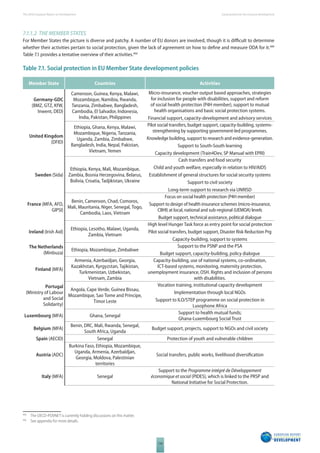
Table 7.1: Social protection in EU Member State development policies 110
The 2010 European Boxes Report on Development 
BOXES 
Box 1: European Report on Development defi nition of social protection 1 
Box 2: Five emerging success stories 3 
Box 1.1: The food and fuel crises had a severe impact on Sub-Saharan Africa 17 
Box 1.2: Why the fi nancial crisis has not been so bad in SSA 17 
Box 1.3: The right to social security in Sub-Saharan African constitutions 22 
Box 1.4: Recent perspectives on social protection in Sub-Saharan Africa 23 
Box 1.5: The UN joint initiative to promote a social protection fl oor 24 
Box 1.6: The momentum for social protection in EU development policy 28 
Box 2.1: Examples of social protection instruments, by function 33 
Box 2.2: Migration and social protection: access to portable provision 35 
Box 2.3: Thinking through policy complementarities: agriculture and social protection 36 
Box 3.1: Sustainable livelihoods and graduation 42 
Box 3.2: Targeting Methodologies 44 
Box 3.3: The right to social security: commitments and enforcement 45 
Box 3.4: Cash transfers and high food prices: Ethiopia’s Productive Safety Net Programme 46 
Box 3.5: The social contract 51 
Box 3.6: The European social model(s) 52 
Box 4.1: Social assistance in South Africa 57 
Box 4.2: Self Employed Women’s Association 58 
Box 4.3: The politics of formulating a social protection policy 61 
Box 4.4: Lessons from European Union experiences 69 
Box 5.1: Models of social protection in Sub-Saharan Africa 73 
Box 5.2: Extending social protection to non-formal sector workers: The international quest for an alternative 76 
Box 5.3: Community based health insurance in Africa 78 
Box 5.4: Cash transfers for schooling to fi ght HIV 87 
Box 5.5: Aff ordability of social protection in Sub-Saharan Africa 88 
Box 6.1: A distributive justice perspective 92 
Box 6.2: A Cash-on-Delivery aid contract for social transfers – what could it look like? 95 
Box 6.3: Randomised control trials and social protection programmes 97 
Box 6.4: Supporting and delivering social protection despite fragility 104 
Box 7.1: The Ghana-Luxembourg Social Trust 111 
X
The 2010 European Report on Development 
XI 
LIST OF ACRONYMS 
ACF Action Contre la Faim 
ACP African, Caribbean and Pacifi c countries 
ADC Austrian Development Cooperation 
AECID Spanish Agency for International Development Cooperation 
AFD Agence Française de Développement 
AfDB African Development Bank 
APRM African Peer Review Mechanism 
ASEM Asia-Europe Meeting 
AU African Union 
AUSAID Australian Agency for International Development 
BMZ Bundesministerium für wirtschaftliche Zusammenarbeit und Entwicklung 
CBHI Community Based Health Insurance 
CCT Conditional Cash Transfer 
CIDA Canadian International Development Agency 
CNLS Comité national de Lutte contre le Sida 
COD Cash-on-Delivery 
COM European Commission 
DAC Development Assistance Committee 
DECT Dowa Emergency Cash Transfers 
DED Deutscher Entwicklungsdienst 
DEVCO Development and Co-operation Directorate-General 
DFID Department for International Development 
DG Development Directorate General Development and Relations with African, Caribbean and Pacifi c States 
DRC Democratic Republic of the Congo 
EAC East African Community 
ECDPM European Centre for Development Policy Management 
EDPRS Economic Development and Poverty Reduction Strategy 
EPRI European Parliaments Research Initiatives 
ERD European Report on Development 
ESM European Social Model 
EU European Union 
FACT Food and Cash Transfer 
FAO Food and Agriculture Organization 
FDI Foreign Direct Investment 
FOSIS Fondo de Solidaridad e Inversion Social 
FSP Food Security Programme 
FTI-DoL Fast Track Initiative on Division of Labour 
GDC German Development Cooperation 
GDP Gross Domestic Product 
GLST Ghana-Luxembourg Social Trust 
GNI Gross National Income 
GSP Generalised System of Preferences 
GST Global Social Trust 
GTZ Deutsche Gesellschaft für Technische Zusammenarbeit
XII 
The 2010 European Report on Development 
HGSF Home-Grown School Feeding programme 
HSGIC Government Implementation Committee 
IBSA India-Brazil-South Africa 
ICT Information and Communications Technologies 
IDS Institute of Development Studies 
IFPRI International Food Policy Research Institute 
ILO International Labour Organization 
IMF International Monetary Fund 
IPC-IG International Policy Centre for Inclusive Growth 
IPU Inter-Parliamentary Union 
ISSA International Social Security Association 
KfW Kreditanstalt Für Wiederaufbau 
LEAP Livelihood Empowerment Against Poverty 
MDGs Millennium Development Goals 
MINALOC Ministry of Local Government, Good Governance, Community Development and Social Aff airs 
Minbuza Ministry of Foreign Aff airs (The Netherlands) 
MMAS Ministry of Women and Social Action 
MOFNP Ministry of Finance and National Planning 
NaCSA National Commission for Social Action 
NCMS China’s New Cooperative Medical Scheme 
NEPAD New Partnership for Africa’s Development 
NGO Non-governmental organization 
NHIS National Health Insurance Scheme 
NREGA National Rural Employment Guarantee Act 
OAP Old Age Pensions 
ODA Offi cial Development Assistance 
OECD DAC Development Assistance Committee - Organization for Economic Cooperation and Development 
OHCHR Offi ce of the High Commissioner for Human Rights 
OVC Orphans and Vulnerable Children 
P4H Providing for Health 
PCD Policy Coherence for Development 
PIDES Programme intégré de Développement économique et Social 
POVNET Network on Poverty Reduction 
PPPs Public-Private-Partnerships 
PRAF Programa de Asignación Familiar 
PRODIAF Programme de Promotion du Dialogue social en Afrique 
PROGRESA Programa Nacional de Educacion, Salud y Alimentacion 
PRP Protracted Relief Programme 
PRSP Poverty Reduction Strategy Paper 
PSA Programa Subsidio de Alimentos 
PSNP Productive Safety Net Programme 
R4D Research for Development 
RPS Red de Protección Social 
SADC Southern African Development Community 
SBS Sector Budget Support 
SCADD Stratégie de Croissance Accélérée et de Développement Durable 
List of Acronyms
The 2010 European Report on Development 
XIII 
SEC/SOC Department of Social Security 
SEWA Self-Employed Women’s Association 
SIDA Swedish International Development Cooperation Agency 
SNNPR Southern Nations, Nationalities, and People’s Region 
SPF Social Policy Framework for Africa 
SSA Sub-Saharan Africa 
STEP Strategies and Tools against social Exclusion and Poverty 
TIM Temporary International Mechanism 
UCT Unconditional Cash Transfer 
UEMOA Union Economique et Monétaire Ouest Africaine 
UN United Nations 
UNAIDS Joint United Nations Programme on HIV/AIDS 
UNCTAD United Nations Conference on Trade and Development 
UNDESA United Nations Department of Economic and Social Aff airs 
UNDP United Nations Development Programme 
UNECA United Nations Economic Commission for Africa 
UNESCO United Nations Educational, Scientifi c and Cultural Organization 
UNFPA United Nations Fund for Population Activities 
UN-HABITAT United Nations Human Settlements Programme 
UNHCR United Nations High Commissioner for Refugees 
UNICEF United Nations Children’s Fund 
UNODC United Nations Offi ce on Drugs and Crime 
UNRISD United Nations Research Institute for Social Development 
UNRWA United Nations Relief and Works Agency for Palestine Refugees in the Near East 
USAID United States Agency for International Development 
VUP Vision 2020 Umurenge Programme 
WB World Bank 
WFP World Food Programme 
WHO World Health Organization 
WMO World Meteorological Organization 
WPF World Population Foundation 
WTO World Trade Organization 
List of Acronyms
The 2010 European Overview Report on Development 
OVERVIEW 
The European Report on Development examines the need and potential for expanding social protection in Sub-Saharan Africa, 
as well as its feasibility and likely development impact. In contrast with the view that Sub-Saharan Africa cannot aff ord social 
protection, innovative approaches to building broad-based social protection schemes and systems have been promoted by African 
countries, and implemented with success across the region. Global post-crises uncertainty reinforces the need for measures that 
shield Africa’s population against risks and shocks, and that reduce poverty and promote human development. 
‘Social protection for inclusive development’ is a timely topic: interest in social protection has been growing, both in Sub-Saharan 
Africa and elsewhere. In the 2010 G20 ‘Seoul Development Consensus’, growth with resilience was identifi ed as a key pillar, with 
specifi c emphasis on social protection mechanisms that support resilient and inclusive growth. More broadly, a consensus is 
emerging that social protection is not only a right, but also an indispensable instrument in supporting progress towards achieving 
inclusive growth and the Millennium Development Goals (MDGs). This momentum stems largely from the growing recognition 
that social policy is a crucial piece of the development puzzle, as affi rmed in the 2008 African Union’s ‘Social Policy Framework for 
Africa’ and 2010 ‘Khartoum Declaration on Social Policy Action Towards Social Inclusion’. 
In this context, this report provides an opportunity to take stock, learn from experience and suggest priorities for the European 
Union (EU) and its Member States. Social protection, at the very heart of the European social model, should become an integral 
part of EU development policies and its commitment to the social dimension of globalisation. 
Box 1: European Report on Development defi nition of social protection 
This report defi nes social protection as: “A specifi c set of actions to address the vulnerability of people’s life through social 
insurance, off ering protection against risk and adversity throughout life; through social assistance, off ering payments 
and in kind transfers to support and enable the poor; and through inclusion eff orts that enhance the capability of the 
marginalised to access social insurance and assistance.” 
This defi nition points to core functions: off ering mechanisms to avoid serious hardship for the poor and non-poor alike 
in the face of serious risks, off ering means to assist the poor in their attempts to escape poverty, and improving access to 
both for marginalised groups. Social protection is more than mere ‘safety nets’ that can cushion the impacts of serious 
crises: it is part of a comprehensive approach to getting people out of poverty, allowing them not only to benefi t from 
growth, but also to productively take part in growth. 
THE CASE FOR SOCIAL PROTECTION 
Sub-Saharan Africa is a widely diverse region facing daunting challenges. It has immense economic and human potential, and 
in many of its countries the situation has improved markedly in the last decade. Governance and macroeconomic management 
are better. Growth and foreign investment are stronger. And poverty is starting to decline, alongside some progress towards the 
MDGs. However, the macro-economy remains vulnerable, and the region is burdened by countries in situations of fragility with 
recurring confl icts, persistent high levels of poverty, vulnerability to climate change and natural hazards, and overall low human 
development. Furthermore, progress has suff ered a serious setback in the last two years, primarily due to the impact of the food 
crisis, exacerbated by the fuel and fi nancial crises. Rising food prices and declining growth rates (from around 5% during 2000-08 
to 2.5% in 2009) are likely to have slowed poverty reduction in many African countries. Although a return to a higher growth path 
now seems well under way, the risks of further crises, coupled with persistent risks for households, require active social policies, 
starting with an investment in social protection. 
Indeed, many Africans live in risky environments that constantly threaten their livelihoods. Mutual support networks and remittances 
help, but they often fail to protect against shocks linked to economic downturns, serious health problems and a changing climate. 
The lack of social protection forces families to sell assets, reduce their food intake and take children out of school, thereby deepening 
their poverty. Reducing these risks – and cushioning their impact – is a critical development challenge, not least as climate change 
will bring also additional risk and uncertainty in the future. Social protection could also off er a route out of poverty traps characterised 
by persistent poverty, limited economic opportunities, and poor health and education. 
Social protection is no substitute for economic growth, or for standard growth-focused investment, such as building infrastructure 
or providing health and education. But it can foster growth by protecting assets and encouraging households to invest in riskier 
but higher productivity and higher return activities, and can increase social spending returns by off ering poor people the means 
to use available services. The long-term eff ects of protecting and promoting human capital can be substantial. Children can be 
1
The 2010 European Report on Development 
2 
Overview 
sheltered from hardship, improving their life chances through better health, nutrition and cognitive development, thus providing 
the human capital base for future growth. 
Well-designed social protection can foster market-based solutions, such as micro-fi nance activities providing credit or insurance, 
and provide the means to reach the very poorest, as well as off ering protection when market-based solutions fail to work. 
Social protection can also be part of a strategy to empower the most vulnerable groups, tackling inequalities to make growth 
more inclusive. It can play a central role in building cohesive societies, and more broadly in reinforcing the state-citizen compact, 
with the state’s legitimacy bolstered by its ability to deliver on its side of the social contract. It can thus contribute to the sustainability 
of growth in Africa by reinforcing social stability and political accountability. 
In short, by off ering direct and indirect benefi ts, social protection can turn vicious circles virtuous. It is also a right enshrined in 
the ‘Universal Declaration of Human Rights’, too often overlooked in the development agenda as a luxury only for middle- or 
high-income countries. Social protection programmes, properly designed and delivered, can be aff ordable in a range of social, 
demographic, and economic conditions. Such programmes have been successful in Sub-Saharan Africa, whether in middle-income 
stable countries, such as Mauritius, or in low-income post-confl ict fragile countries, such as Rwanda. 
THE MOMENTUM FOR SOCIAL PROTECTION IN AFRICA 
Following the 2004 ‘Ouagadougou Declaration and Plan of Action’ and the 2006 ‘Livingstone and Yaoundé Calls for Action’, 
the 2008 ‘African Union Social Policy Framework for Africa’ and 2010 ‘Social Ministers’ Khartoum Declaration on Social Policy Action 
Towards Social Inclusion’ are key milestones towards a Pan-African consensus on the need and scope for social protection. The build-up 
of a continental social protection agenda continues unabated, complemented by sub-regional initiatives and commitments. 
At the national level, many Sub-Saharan countries have made considerable strides towards the institutionalisation of social protection: 
Burkina Faso, Ghana, Kenya, Mozambique, Rwanda, Sierra Leone and Uganda, among others, have adopted or are in the process of 
adopting social protection strategies as part of building comprehensive social protection systems. Botswana, Lesotho, Mauritius, 
Namibia, South Africa and Swaziland already have social pension systems in place. Countries such as Benin, Burkina, Côte d’Ivoire, 
Gabon, Mali, Senegal and Tanzania are reforming their social protection mechanisms to implement universal health coverage, 
following in the successful footsteps of Ghana and Rwanda. There remains scope for improvement, but social protection is already 
entrenched in Sub-Saharan Africa, at least in many of its countries. 
WHAT HAVE WE LEARNT SO FAR? 
This report reviews the new generation of social protection programmes, emphasising the reasons for success and failure. 
With certain preconditions in place, social protection is possible and feasible even in Sub-Saharan Africa’s low-income countries. 
Evidence from the report shows that social protection programmes can mitigate risks and substantially reduce chronic poverty 
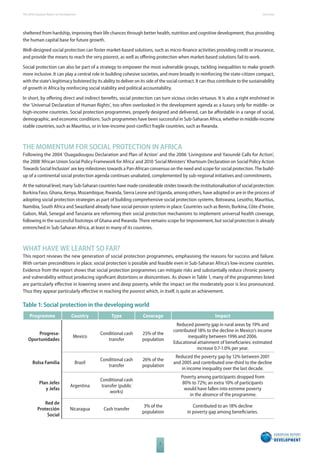
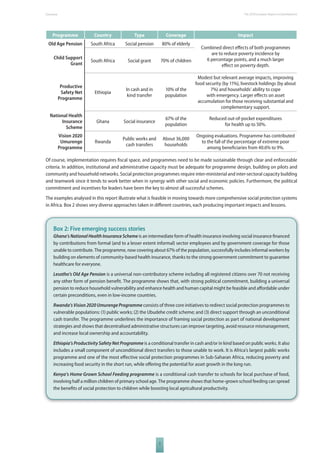
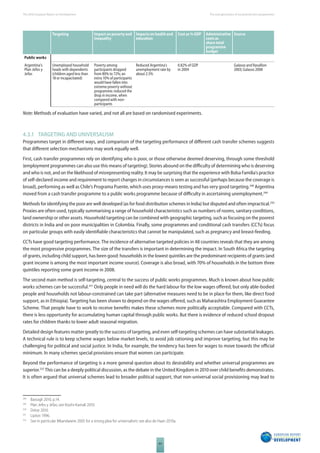
and vulnerability without producing signifi cant distortions or disincentives. As shown in Table 1, many of the programmes listed 
are particularly eff ective in lowering severe and deep poverty, while the impact on the moderately poor is less pronounced. 
Thus they appear particularly eff ective in reaching the poorest which, in itself, is quite an achievement. 
Table 1: Social protection in the developing world 
Programme Country Type Coverage Impact 
Progresa- 
Oportunidades 
Mexico 
Conditional cash 
transfer 
25% of the 
population 
Reduced poverty gap in rural areas by 19% and 
contributed 18% to the decline in Mexico’s income 
inequality between 1996 and 2006. 
Educational attainment of benefi ciaries: estimated 
increase 0.7-1.0% per year. 
Bolsa Familia Brazil 
Conditional cash 
transfer 
26% of the 
population 
Reduced the poverty gap by 12% between 2001 
and 2005 and contributed one-third to the decline 
in income inequality over the last decade. 
Plan Jefes 
y Jefas 
Argentina 
Conditional cash 
transfer (public 
works) 
Poverty among participants dropped from 
80% to 72%; an extra 10% of participants 
would have fallen into extreme poverty 
in the absence of the programme. 
Red de 
Protección 
Social 
Nicaragua Cash transfer 
3% of the 
population 
Contributed to an 18% decline 
in poverty gap among benefi ciaries.
The 2010 European Overview Report on Development 
Programme Country Type Coverage Impact 
Old Age Pension South Africa Social pension 80% of elderly 
3 
Combined direct eff ects of both programmes 
are to reduce poverty incidence by 
6 percentage points, and a much larger 
eff ect on poverty depth. 
Child Support 
Grant 
South Africa Social grant 70% of children 
Productive 
Safety Net 
Programme 
Ethiopia 
In cash and in 
kind transfer 
10% of the 
population 
Modest but relevant average impacts, improving 
food security (by 11%), livestock holdings (by about 
7%) and households’ ability to cope 
with emergency. Larger eff ects on asset 
accumulation for those receiving substantial and 
complementary support. 
National Health 
Insurance 
Scheme 
Ghana Social insurance 
67% of the 
population 
Reduced out-of-pocket expenditures 
for health up to 50%. 
Vision 2020 
Umurenge 
Programme 
Rwanda 
Public works and 
cash transfers 
About 36,000 
households 
Ongoing evaluations. Programme has contributed 
to the fall of the percentage of extreme poor 
among benefi ciaries from 40.6% to 9%. 
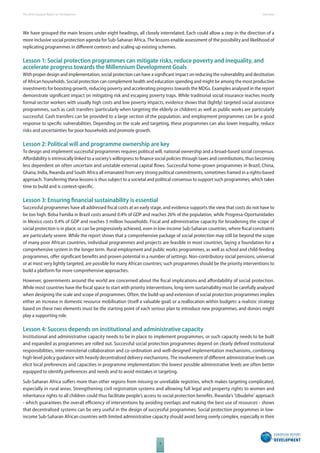
Of course, implementation requires fi scal space, and programmes need to be made sustainable through clear and enforceable 
criteria. In addition, institutional and administrative capacity must be adequate for programme design, building on pilots and 
community and household networks. Social protection programmes require inter-ministerial and inter-sectoral capacity building 
and teamwork since it tends to work better when in synergy with other social and economic policies. Furthermore, the political 
commitment and incentives for leaders have been the key to almost all successful schemes. 
The examples analysed in this report illustrate what is feasible in moving towards more comprehensive social protection systems 
in Africa. Box 2 shows very diverse approaches taken in diff erent countries, each producing important impacts and lessons. 
Box 2: Five emerging success stories 
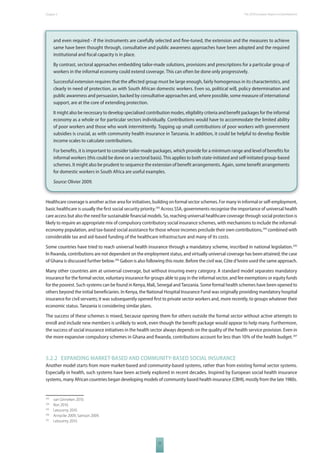
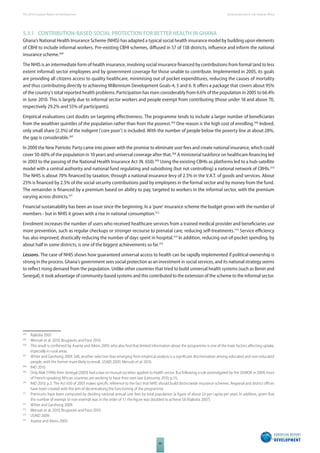
Ghana’s National Health Insurance Scheme is an intermediate form of health insurance involving social insurance fi nanced 
by contributions from formal (and to a lesser extent informal) sector employees and by government coverage for those 
unable to contribute. The programme, now covering about 67% of the population, successfully includes informal workers by 
building on elements of community-based health insurance, thanks to the strong government commitment to guarantee 
healthcare for everyone. 
Lesotho’s Old Age Pension is a universal non-contributory scheme including all registered citizens over 70 not receiving 
any other form of pension benefi t. The programme shows that, with strong political commitment, building a universal 
pension to reduce household vulnerability and enhance health and human capital might be feasible and aff ordable under 
certain preconditions, even in low-income countries. 
Rwanda’s Vision 2020 Umurenge Programme consists of three core initiatives to redirect social protection programmes to 
vulnerable populations: (1) public works; (2) the Ubudehe credit scheme; and (3) direct support through an unconditional 
cash transfer. The programme underlines the importance of framing social protection as part of national development 
strategies and shows that decentralised administrative structures can improve targeting, avoid resource mismanagement, 
and increase local ownership and accountability. 
Ethiopia’s Productivity Safety Net Programme is a conditional transfer in cash and/or in kind based on public works. It also 
includes a small component of unconditional direct transfers to those unable to work. It is Africa’s largest public works 
programme and one of the most eff ective social protection programmes in Sub-Saharan Africa, reducing poverty and 
increasing food security in the short run, while off ering the potential for asset growth in the long run. 
Kenya’s Home Grown School Feeding programme is a conditional cash transfer to schools for local purchase of food, 
involving half a million children of primary school age. The programme shows that home-grown school feeding can spread 
the benefi ts of social protection to children while boosting local agricultural productivity.
The 2010 European Report on Development 
4 
Overview 
We have grouped the main lessons under eight headings, all closely interrelated. Each could allow a step in the direction of a 
more inclusive social protection agenda for Sub-Saharan Africa. The lessons enable assessment of the possibility and likelihood of 
replicating programmes in diff erent contexts and scaling up existing schemes. 
Lesson 1: Social protection programmes can mitigate risks, reduce poverty and inequality, and 
accelerate progress towards the Millennium Development Goals 
With proper design and implementation, social protection can have a signifi cant impact on reducing the vulnerability and destitution 
of African households. Social protection can complement health and education spending and might be among the most productive 
investments for boosting growth, reducing poverty and accelerating progress towards the MDGs. Examples analysed in the report 
demonstrate signifi cant impact on mitigating risk and escaping poverty traps. While traditional social insurance reaches mostly 
formal sector workers with usually high costs and low poverty impacts, evidence shows that (lightly) targeted social assistance 
programmes, such as cash transfers (particularly when targeting the elderly or children) as well as public works are particularly 
successful. Cash transfers can be provided to a large section of the population, and employment programmes can be a good 
response to specifi c vulnerabilities. Depending on the scale and targeting, these programmes can also lower inequality, reduce 
risks and uncertainties for poor households and promote growth. 
Lesson 2: Political will and programme ownership are key 
To design and implement successful programmes requires political will, national ownership and a broad-based social consensus. 
Aff ordability is intrinsically linked to a society’s willingness to fi nance social policies through taxes and contributions, thus becoming 
less dependent on often uncertain and unstable external capital fl ows. Successful home-grown programmes in Brazil, China, 
Ghana, India, Rwanda and South Africa all emanated from very strong political commitments, sometimes framed in a rights-based 
approach. Transferring these lessons is thus subject to a societal and political consensus to support such programmes, which takes 
time to build and is context-specifi c. 
Lesson 3: Ensuring fi nancial sustainability is essential 
Successful programmes have all addressed fi scal costs at an early stage, and evidence supports the view that costs do not have to 
be too high. Bolsa Familia in Brazil costs around 0.4% of GDP and reaches 26% of the population, while Progresa-Oportunidades 
in Mexico costs 0.4% of GDP and reaches 5 million households. Fiscal and administrative capacity for broadening the scope of 
social protection is in place, or can be progressively achieved, even in low-income Sub-Saharan countries, where fi scal constraints 
are particularly severe. While the report shows that a comprehensive package of social protection may still be beyond the scope 
of many poor African countries, individual programmes and projects are feasible in most countries, laying a foundation for a 
comprehensive system in the longer term. Rural employment and public works programmes, as well as school and child-feeding 
programmes, off er signifi cant benefi ts and proven potential in a number of settings. Non-contributory social pensions, universal 
or at most very lightly targeted, are possible for many African countries; such programmes should be the priority interventions to 
build a platform for more comprehensive approaches. 
However, governments around the world are concerned about the fi scal implications and aff ordability of social protection. 
While most countries have the fi scal space to start with priority interventions, long-term sustainability must be carefully analysed 
when designing the scale and scope of programmes. Often, the build-up and extension of social protection programmes implies 
either an increase in domestic resource mobilisation (itself a valuable goal) or a reallocation within budgets: a realistic strategy 
based on these two elements must be the starting point of each serious plan to introduce new programmes, and donors might 
play a supporting role. 
Lesson 4: Success depends on institutional and administrative capacity 
Institutional and administrative capacity needs to be in place to implement programmes, or such capacity needs to be built 
and expanded as programmes are rolled out. Successful social protection programmes depend on clearly defi ned institutional 
responsibilities, inter-ministerial collaboration and co-ordination and well-designed implementation mechanisms, combining 
high-level policy guidance with heavily decentralised delivery mechanisms. The involvement of diff erent administrative levels can 
elicit local preferences and capacities in programme implementation: the lowest possible administrative levels are often better 
equipped to identify preferences and needs and to avoid mistakes in targeting. 
Sub-Saharan Africa suff ers more than other regions from missing or unreliable registries, which makes targeting complicated, 
especially in rural areas. Strengthening civil registration systems and allowing full legal and property rights to women and 
inheritance rights to all children could thus facilitate people’s access to social protection benefi ts. Rwanda’s ‘Ubudehe’ approach 
- which guarantees the overall effi ciency of interventions by avoiding overlaps and making the best use of resources - shows 
that decentralised systems can be very useful in the design of successful programmes. Social protection programmes in low-income 
Sub-Saharan African countries with limited administrative capacity should avoid being overly complex, especially in their
The 2010 European Overview Report on Development 
targeting mechanisms, and have to be easy to implement, to limit the worst inclusion errors and misuse. Basic transparency and 
accountability, at all levels of society, should be strengthened, thereby reducing corruption. Proper dissemination of information 
could play a key role in this. 
Lesson 5: Piloting, monitoring and evaluation build support and fi ne-tune design 
Given diff ering country-specifi c conditions and needs, and the requirement to demonstrate impact to sustain political support, 
it is critical that programmes are implemented in a transparent way, with careful monitoring of all aspects of implementation. Pilots 
and staggered roll-outs that are carefully evaluated using advanced impact techniques allow for learning, fi ne-tuning, and building 
political support. The success of some of the Latin American experiences in conditional cash transfer programmes has depended 
critically on robust evaluations and proven impact. There is less available evidence on impact in many of the new Sub-Saharan 
African programmes, and evidence is tenuous even for some of the programmes discussed in more detail in this report. Robust 
impact evaluations as well as careful assessment of pilots and experiments should therefore be a priority, as these are critical to 
understanding strengths and weaknesses and to building political support. Donor support for such evaluations could be helpful. 
Lesson 6: Minimising disincentives, building on existing informal systems and complementing 
market-based micro-fi nance schemes is crucial 
Social protection programmes can create disincentive eff ects, such as adverse work incentives. But incentive issues in most of the 
recent innovative social protection programmes are less serious than presumed. For example, most non-contributory old age 
pensions, including South Africa’s pension programmes, or Ethiopia’s public works programmes, suff er from very few disincentive 
eff ects. Social protection can also crowd out existing contributory or informal social protection schemes, but the evidence here 
is much less conclusive and requires further work. Crowding out between new programmes and existing (informal or formal) 
schemes requires constant monitoring and, if needs be, adjustments. While building on existing programmes for formal sector 
workers is unlikely to be a solution, the evidence suggests that it is possible to build on existing informal schemes, as with health 
insurance in Ghana, to limit perverse incentives. Microfi nance initiatives, especially those linked to micro-insurance, also off er 
complementary services for social protection and can be used as platforms to build contributory social protection systems. 
But micro-fi nance and other market-based solutions are unlikely to reach the poorest, and are insuffi cient for many serious risks, 
which require well-designed and broad-based social protection programmes. 
Lesson 7: Maximising synergies between social protection programmes and other investments is 
important 
Expanded social protection can support complementary investments in health, education, agriculture and other productive 
sectors. It is a quick and fl exible way to improve poverty outcomes, pertinent in times of crises or when reforms in other social 
sectors are materialising only very slowly. It can off er the fi nancial means necessary to use health and education services, and to 
invest in agriculture or other productive activities. It can off er protection so that households can take the risks involved in new 
activities or migrate to take advantage of economic opportunities. It can also protect human capital investments by securing 
children’s nutrition and educational opportunities during crises. It off ers a direct means of including the poor and marginalised 
groups in development eff orts, contributing to social cohesion and trust. It can thus be a critical element in overall development 
policy, leveraging its many synergies. That is why social protection should be seen not as a narrow social sector concern but as part 
of an overall development strategy that explicitly capitalises on these complementarities. For instance, Progresa-Oportunidades 
in Mexico marks the importance of the transition towards an integrated approach, ensuring the simultaneous provision of a basic 
package of health, education and nutrition, taking advantage of their complementarities. 
Lesson 8: Social protection promotes gender equality, empowers women and reduces social 
exclusion 
The evidence shows that well-designed social protection programmes can address concerns about gender and social exclusion. 
They can contribute to reducing social and ethnic disparities, and can cater for the specifi c needs of women. Gender-sensitive 
programmes can produce positive multiplier eff ects in terms of health, education for girls, maternal prenatal screening, and can 
enhance positive externalities to families by transferring cash to women, while ensuring that women’s burdens are not increased 
and stereotypes are not reinforced. 
FROM LESSONS TO PRIORITIES 
These are general lessons, and the report recognises that Africa is very heterogeneous and that country characteristics call for tailor-made 
approaches. In countries in situations of fragility, for instance, the preconditions for success may not hold. With extremely 
weak administrative capacity or very poor governance, it is more diffi cult to design and implement successful social protection 
schemes. Social protection instruments have to be adapted to specifi c vulnerabilities and needs, such as (re)inserting youths and 
ex-combatants into society. 
5
The 2010 European Report on Development 
6 
Overview 
To summarise, there are opportunities for introducing social protection in contexts of high poverty. The type of programme will 
depend on how some preconditions are satisfi ed, bearing in mind that national and international dynamics evolve and can create 
room for manoeuvre. Successful programmes rely on and help to build up necessary government structures and implementation 
capacity. The lessons show the importance of complementarities and co-ordination across sectors and agencies as well as that of 
monitoring and evaluation. However, the specifi cities of lessons matter a great deal, with the conditions for success being critical 
for positive impacts. The transferability of lessons from Latin America, Asia, South Africa, or even neighbouring countries in 
Sub-Saharan Africa will depend on the country’s ability to manage implementation challenges. 
While recognising these heterogeneities, this report suggests that in many low-income Sub-Saharan African countries, some simple 
programmes - such as non-contributory social pensions or child benefi ts - are generally administratively feasible, particularly with 
technologically-innovative cash-delivery systems that avoid targeting errors, cut costs and speed up the delivery processes. They can 
also be fi scally sustainable, with few negative incentive eff ects. And they can garner broad political support. It is crucial, however, 
that any programme, once launched, can survive possible changes in local government and can also be sustained if there is a 
political alternation. Over time, more complex administrative arrangements, including co-ordinated packages, can become feasible 
as countries accumulate experience and build up domestic resources. In the longer term, Sub-Saharan African countries can build 
on these programmes to create a platform for social protection that consists of several co-ordinated programmes, depending on 
particular needs, fi scal realities and demonstrated impacts. Such a social-assistance-based platform of social protection schemes 
must be consistent with a strategy to move progressively to a system based predominantly on domestic fi nancing - either through 
the tax system, or some form of contributory social insurance, or systems combining the two. In any case, programmes or systems 
cannot merely be replicated across countries and continents, but have to be adapted to local circumstances. 
FROM DONORSHIP TO PARTNERSHIP 
Given the challenges ahead, African partners may need support from the international community during a transition phase. 
The budding emergence of a global consensus on social protection among development stakeholders, notably embodied within 
the UN Social Protection Floor initiative, strengthens and complements the rising impetus in Africa. In the aftermath of the crises, 
several donors (bilateral and multi-lateral, traditional and emerging) have committed to supporting developing countries on 
the path towards social protection systems. However, international partners should play only a supporting role: the principles of 
ownership, alignment and mutual responsibility enshrined in the 2005 ‘Paris Declaration on Aid Eff ectiveness’ and the 2008 ‘Accra 
Agenda for Action’ put developing partners squarely in the driver’s seat; our evidence shows that there is no other way to build 
and sustain successful programmes. 
As social protection rises up the development agenda, lessons should also be drawn from previous donor experiences. Traditional 
donor engagement - often poorly co-ordinated, faddish, project-based and fi nancially unreliable - is ill-suited to furthering the 
social protection agenda. For example, donor-driven social transfer pilots have depended heavily on outside funding and have 
rarely generated political buy-in from national governments, undermining ownership and sustainability. 
As is increasingly the case across Africa, donors can support the expansion of social protection programmes fully integrated with 
an overall national development strategy by shifting from donorship to partnership. This new approach requires international 
partners to align behind partner country eff orts and priorities in a co-ordinated fashion, to provide predictable funding on the 
path to sustainability, and to invest in building capacities and facilitating learning. 
In this shifting development landscape, South-South co-operation can play an increasingly important role. Emerging donors, such 
as Brazil, Chile, India and Mexico, themselves leaders in developing innovative social protection solutions, have become explicitly 
interested in assisting other developing countries in this fi eld; their approaches, models and experiences might be considered 
most relevant by their developing counterparts, especially in Sub-Saharan Africa. These new players are bringing about change, 
thus calling for the redefi nition of the EU’s comparative advantages and roles. 
THE EUROPEAN UNION’S ROLES: ENGAGEMENT, CHALLENGES AND POLICY RECOMMENDATIONS 
Given its wealth of experiences and its commitment to development and to the social dimension of globalisation and decent work, 
the EU (Commission and Member States) is well-suited to supporting social protection in the developing world. The European social 
model is characterised by unity in core values and commitment to social protection, within a diversity of national experiences in 
the evolution, functioning and approaches to social protection. The Africa-EU Strategic Partnership off ers a platform to engage 
with partner countries on these and their own experiences, and to support a social protection agenda through political dialogue 
and mutual learning, while eschewing a too-Eurocentric perspective. 
Several EU donors, including the Commission, are already supporting country-led social protection initiatives. However, there is still 
much to be done by the EU to overcome persistent challenges and to make the most of its comparative advantages and collective 
critical mass. First and foremost, more engagement is needed, building on lessons and examples of good practice.
The 2010 European Overview Report on Development 
The European Report on Development therefore recommends that the EU enhance and improve its support to social protection 
in Sub-Saharan African and other developing countries. To this end, it identifi es seven priorities for the EU and its Member States: 
PRIORITY 1: MAKE SOCIAL PROTECTION AN INTEGRAL PART OF EUROPEAN UNION DEVELOPMENT POLICY 
The EU should adopt a comprehensive policy framework for social protection, tied to concrete, time-bound commitments and 
dedicated resources. This indispensable step should enhance the visibility of social protection and create opportunities for discussions 
on the EU’s collective value added. It could also leverage much needed EU (Commission and Member States) resources and support. 
To this end, opportunities in the pipeline - such as the Green Papers on ‘EU development policy in support of inclusive growth 
and sustainable development - Increasing the impact of EU development policy’ and on ‘The future of EU budget support’, 
the implementation of the Joint Africa-EU Strategy Action Plan 2011-2013, the setting-up of the European External Action Service 
and of the new Commission Directorate-General in charge of development policy and implementation (DEVCO), as well as the 
negotiations on the future fi nancial instruments for external relations - should be seized upon to ensure that the wide array of 
EU approaches and instruments is geared towards providing long-term, predictable and appropriate support to social protection. 
PRIORITY 2: PROMOTE AND SUPPORT DOMESTIC PROCESSES 
To ensure ownership and lay the foundations for long-term sustainability, the EU should promote the implementation of an African-owned 
social protection agenda at continental, sub-regional and national levels, starting with the African Union (AU) ‘Social Policy 
Framework’. When and where possible, the EU should support comprehensive social protection systems embedded in a rights-based 
framework. As a minimum, EU partners should ensure that their interventions are consistent with domestic priorities and 
needs, minimising donor micro-management and policy intrusion. 
Appropriate donor roles might include the provision of technical and fi nancial assistance to build capacities at all levels (national, 
provincial and local; governmental and non-governmental) and to support the high initial and fi xed start-up costs (such as the 
establishment of systems for identifi cation, registration, targeting, delivery, and monitoring and evaluation). 
Strengthening domestic constituencies is also key to building ownership. The EU should promote multi-stakeholder participatory 
approaches, and support domestic social protection champions (government offi cials, parliamentarians, non-state actors). 
PRIORITY 3: ASSIST IN TACKLING AFFORDABILITY 
Since domestic resource mobilisation is critical to the sustainability of social protection programmes, the EU should support partners 
in Sub-Saharan Africa on the path to tax reform and revenue collection. Policy dialogue on the fi nancial and fi scal aspects of social 
protection (tax reform, budget allocations, donor exit strategies) as well as broader public fi nancial management issues is paramount. 
Development aid can also act as a catalyst for social protection and inclusive growth by relaxing the aff ordability constraint in a 
transition phase. First and foremost, EU donors need to honour their offi cial development assistance commitments (0.7% of GNI 
by 2015), despite the global fi nancial crisis and ensuing budget constraints. They should also explore innovative fi nancing options, 
such as the establishment of a Social Protection Fund for Africa. 
Donor commitments should be credible and their funding predictable and reliable, especially when donors choose to support 
recurrent spending. Longer-term commitments, as in Zambia, provide positive examples in this regard. Special attention should 
be paid to domestic fi scal sustainability. An exit strategy should be devised and agreed on from the outset to avoid creating islands 
of welfare vulnerable to donor fads and vicissitudes. 
PRIORITY 4: TAILOR INTERVENTION MODALITIES TO SPECIFIC CONTEXTS AND NEEDS 
There is no ‘one size fi ts all’ for support to social protection in Sub-Saharan Africa. Approaches should be informed by a deep-rooted 
understanding of local contexts and underlying politics, to assess what is most appropriate and what is feasible. 
This report suggests that a package including budget support, policy dialogue and capacity building might be most appropriate 
to promote ownership and support social protection systems fully integrated with an overall national development strategy. 
However, the feasibility of budget support depends on local conditions, with public fi nance management and governance being 
critical issues. Budget support should be underpinned by a credible aid contract between mutually-accountable partners, with a 
focus on results. To enhance the quality of dialogue, sector-wide budget support might be preferable. Innovative solutions such 
as ‘cash on delivery’ contracts could also be explored. 
Donor-driven pilots should be limited, because they rarely, if ever, prove sustainable. However, pilots are useful for experimenting 
with and evaluating options or kick-starting schemes for future scaling up, and should be embedded in domestic processes, 
7
The 2010 European Report on Development 
8 
Overview 
preferably state-led. Working through and with the state should indeed be favoured to reinforce the social contract. Nonetheless, 
support to informal and community-based schemes (such as mutuelles de santé in West Africa) should also be provided, as they 
can be built on within the framework of a wider system (as in Rwanda). 
In countries in situations of fragility, paying attention to local perceptions of legitimacy (whom to work with) and extending the 
social protection palette (from humanitarian to security) is crucial. The sequencing of interventions should be agreed on by the 
international community: an agenda focusing on emergency assistance and transfers, public works, input supplies and basic 
healthcare might be a fi rst priority, before tackling the longer-term challenge of building state capacity for implementing social 
protection schemes. 
Overall, monitoring and evaluation are key to ensuring accountability and facilitating learning. To enable scaling up or replication, 
assessing impact is crucial, as is identifying best practices and bottlenecks in existing schemes. EU donors should support innovations 
in impact-evaluation techniques (such as robust impact assessment and randomisation) and allocate appropriate resources to 
monitoring and evaluation. 
In order to improve decision-making and to better tailor programme design, the EU should also explore solutions to improve the 
accuracy and timeliness of poverty and vulnerability data, including support to the UN Global Pulse Initiative. 
PRIORITY 5: SUPPORT KNOWLEDGEBUILDING AND LESSONSHARING 
EU donors should commission and support research into the various impacts and benefi ts of social protection for development, 
so as to feed the learning process and enable evidence-based investments and decision-making. Further studies are needed to 
show the impact of social protection on growth and vulnerability in the medium-term (notably the ability of the poor to build 
assets and sustainably escape poverty), but also on political stability, social cohesion and the social contract. The scope of research 
should be widened to a broader diversity of experiences, using a multi-disciplinary approach. Results should be disseminated 
among policy-makers. 
Most importantly, EU donors should support Africa’s capacity to develop its own analysis and thinking on social protection. Funding 
local research would enhance the legitimacy and relevance of the knowledge produced, and allow for easier dissemination. 
Embedding social protection in the Africa-EU political dialogue at all levels is essential to facilitate lesson sharing and to enhance 
political will on both sides. 
EU Member States should also share lessons of their experiences in social protection by putting together easily accessible information, 
and organising study tours, conferences, workshops and trainings in response to partner country demands. 
Given the increasing relevance of South-South learning, the EU should provide support when Southern partners request it, building 
on examples of good practice. An ambitious triangular partnership for learning on social protection could be envisioned, in the 
form of regular exchanges between the relevant stakeholders in the various EU political dialogues and strategic partnerships. 
The EU should also contribute to best practices guidelines based on the implementation of social protection mechanisms in 
developing countries, as agreed by the G20 in Seoul. 
PRIORITY 6: IMPROVE THE COORDINATION, COMPLEMENTARITY AND COHERENCE OF EUROPEAN UNION ACTION 
EU support to social protection should fully comply with the aid eff ectiveness agenda as well as EU treaty obligations. 
An EU-wide ‘social protection and development’ network of experts (from development ministries and agencies, labour and social 
aff airs ministries, civil society) should be established. A fi rst important task for the network would be to undertake a mapping of 
EU support to social protection; such an initiative would usher better division of labour by highlighting gaps and overlaps, and 
facilitating the identifi cation of comparative advantages. 
Key to this eff ort is an agreement on whether to approach social protection as a sector. This report suggests that mainstreaming 
social protection as a cross-cutting issue might be more appropriate, but the EU position should be further informed both by 
discussions in this new network as well as in the OECD-POVNET network and with partner countries. 
Implementing the ‘EU Code of Conduct’ should provide an opportunity to rationalise programme development and support at 
country level. The EU should take the lead in co-ordinating with the wider donor community, within and beyond the Development 
Assistance Committee of the OECD, and in co-operation with partner countries. 
EU cross-country division of labour should be improved, paying particular attention to tackling the ‘orphans’ (especially in countries 
in situations of fragility). In this respect, given its global presence, the Commission has a key role to play, as do EU donors with ties 
to ‘forgotten’ countries.
The 2010 European Overview Report on Development 
Improving policy coherence for social protection is also crucial. Further to the implementation of the ‘2010-2013 Policy Coherence 
for Development Work Programme’, the EU should commission research to assess the impact of non-development policies, 
such as trade, migration and agriculture, on social protection in developing countries. More political will is needed to translate the 
EU’s commitment to Policy Coherence for Development into practice, and promote it credibly in the wider development community 
(e.g. Fourth High Level Summit on Aid Eff ectiveness, G20, Fourth UN Conference on the Least Developed Countries (LDC-IV). 
PRIORITY 7: STRENGTHEN EUROPEAN UNION PARTNERSHIPS FOR A PROGRESSIVE SOCIAL PROTECTION AGENDA 
Support to social protection has been limited in the EU’s external action, in particular in the framework of its commitment to the 
social dimension of globalisation and decent work. The EU should work in close collaboration with strategic partners to promote a 
progressive international agenda for social protection and fairer globalisation, in particular with the International Labour Organization 
and other UN agencies involved in social protection, given their experience and legitimacy in the fi eld. 
The EU should also support and co-operate further with the AU Social Aff airs Department and the African Development Bank’s 
Human and Social Development Department, as these are key to feeding and sustaining the African ‘social’ momentum. 
In light of its experience, and given its emphasis on regional integration in development policy, the EU should seek to advance the 
case for regional co-operation in social development and social protection, building on the existing momentum and instruments. 
Partnerships with the private sector could also advance the social protection agenda. With proper co-ordination and policy-design, 
the EU can leverage private actions. New and innovative public-private-partnerships (PPPs) should be explored. 
CONCLUSION 
In summary, the time is ripe for a new Africa-EU social protection agenda. There is a growing consensus on the benefi ts of social 
protection, and the post-crises environment, as well as the likely risks linked to climate change call for a renewed and enhanced 
partnership. 
Social protection programmes exist and, if some preconditions hold, they can have a positive impact on inclusive growth and 
poverty reduction, reaching large parts of the population, and eliciting broad political support. Further, if well designed, they can 
complement informal community-based systems as well as market-based solutions. Regular, independent and robust evaluations 
are crucial for the generation of credible information and empirical proof of the programmes’ achievements. This, in turn, is key to 
securing support, and therefore political sustainability and success. 
Achievements so far show that with commitment, vision and support, building up social protection is feasible in Sub-Saharan Africa, 
even in low-income countries. The choice of specifi c new programmes or the scaling up of existing schemes, however, is country 
specifi c and depends on partner countries’ demographic, geographic and economic contexts as well as on political commitment 
and priorities. 
9
The 2010 European Chapter 1 Report on Development 
11 
CHAPTER ONE 
THE MOMENTUM 
FOR SOCIAL PROTECTION 
IN SUBSAHARAN AFRICA
The 2010 European Report on Development 
CHAPTER 1 
THE MOMENTUM FOR SOCIAL PROTECTION 
IN SUBSAHARAN AFRICA 
The momentum for social protection in Africa has been building, with signifi cant commitment and 
achievements at Pan-African, sub-regional and national levels. 
In the aftermath of the food, fuel and fi nancial crises, a global consensus is emerging that social protection 
is a crucial missing piece of the development puzzle, indispensable for achieving resilient pro-poor growth 
and the Millennium Development Goals. 
Indeed, social protection can contribute directly to growth and complement other investments by 
increasing the returns from social spending. 
It can also spread the benefi ts of growth to those most vulnerable and most excluded, thus improving 
social cohesion and strengthening the state-citizen contract. 
By off ering such direct and indirect benefi ts, it has the potential to turn vicious circles virtuous. 
Social protection is not a luxury: it is necessary and feasible for Sub-Saharan Africa (SSA). A variety of schemes have already been 
implemented in the region, and the successes in improving development prospects show that social protection is within reach. With 
the rapid sequence of the food, fuel and fi nancial crises between 2007 and 2009, social protection is needed more than ever to cushion 
shocks and tackle Africa’s persistent challenges of poverty and vulnerability. As schemes have been extended during the recent crises, 
the momentum for more systematic social protection is building within Sub-Saharan Africa and internationally. The time is ripe for a 
European Report on Development to make a case for social protection in Africa, building on evidence to emphasise the crucial role of 
home-grown eff orts and the potential supporting role of international partners, particularly the European Union (EU).1 
1.1 SUBSAHARAN AFRICA: NO LONGER A “DOOMED SUBCONTINENT” 
Sub-Saharan Africa has often been regarded as a doomed subcontinent where “the only things that seemed to thrive were poverty 
and confl ict”.2 During its lost decades (1980s and 1990s), SSA lagged behind while other developing countries took off , particularly 
in Asia and Latin America. 
However, the situation has taken a turn for the better, roughly since the beginning of the Millennium. A number of SSA countries 
have defi ed stereotypes by making signifi cant (if still insuffi cient) strides towards the Millennium Development Goals (MDGs), 
achieving steady economic growth and providing a wide range of success stories.3 
SSA however is not a monolithic entity, but rather a widely diverse region, where countries follow diff erent - and rarely linear - 
paths.4 Undeniably, some countries have fared worse than others, failing to progress or even backtracking. This bleak picture of 
SSA as a whole systematically overshadowed the fundamental changes by the “emerging” SSA countries.5 
1.1.1 TANGIBLE PROGRESS IN GOVERNANCE 
First and foremost, many SSA countries have achieved marked progress in governance, which has become a centrepiece of the 
continental development agenda. African commitment to improving governance is perhaps best embodied by the establishment 
in 2002 of the African Peer Review Mechanism (APRM), in the framework of the New Partnership for Africa’s Development (NEPAD).6 
As of the end of 2009, 30 of the 53 African Union (AU)7 states had voluntarily signed on to this innovative Africa-driven eff ort, which 
2 Johnson-Sirleaf, E. “Introduction” in Radelet 2010. 
3 World Bank Chief Economist for Africa S. Devarajan and his colleagues came up with a list of 42 success stories, 20 of which are detailed in case studies. 
12 
https://blogs.worldbank.org/africacan/african-successes. 
4 Many former growth leaders in the 1960s became laggards by 2000 (such as Côte d’Ivoire, Gabon, Togo), while countries such as Burkina Faso, 
Ghana and Senegal were lagging behind after independence but have become “champions of growth” in the last 10 years (Fosu, 2009). 
5 For a recent defense of this viewpoint, see Radelet 2010. 
6 In July 2002, NEPAD adopted a “Declaration on Democracy, Political, Economic and Corporate Governance” which included a commitment to implement an 
African Peer Review Mechanism (APRM). The Memorandum of Understanding on the APRM was adopted by the Head of State and Government Implementation 
Committee in March 2003, and entered immediately into force. 
7 Algeria, Angola, Benin, Burkina Faso, Cape Verde, Cameroon, Congo Republic, Djibouti, Egypt, Ethiopia, Gabon, Ghana, Kenya, Lesotho, Malawi, Mali, Mauritania, 
Mauritius, Mozambique, Nigeria, Rwanda, São Tomé and Príncipe, Senegal, Sierra Leone, South Africa, Sudan, Tanzania, Togo, Uganda and Zambia.
The 2010 European Chapter 1 Report on Development 
stands as the continent’s major self-monitoring governance mechanism. Persistent challenges notwithstanding, the APRM is thus 
far credited for bringing governance to the fore, and enabling collegial dialogue on controversial issues by off ering “comprehensive 
and candid diagnosis of key governance problems”.8 
A recent review of the APRM process in nine AU countries by the Africa Governance Monitoring and Advocacy Project contends that 
“the verdict on the APRM process is mixed” but that it has at least enabled some national debate.9 Going even further, a Partnership 
Africa-Canada study on the APRM in seven SSA countries asserts that “changes are being introduced in the ways governments 
and countries are being run”.10 And other AU initiatives, such as the 2007 African Charter on Democracy, Elections and Governance,11 
seem to indicate that governance has become a widely shared continental priority. 
At the national level, SSA countries such as Mauritius and Botswana stand out as consistent performers having achieved stability and 
good governance over a signifi cant period. Indeed, as shown by the latest Worldwide Governance Indicators, “being a developing 
economy does not automatically translate to poor governance”.12 After being ravaged by genocide in 1994, Rwanda has, for example, 
become a symbol of African turnaround, achieving economic growth,13 social progress and signifi cant improvements in governance. 
Although the campaign leading to the August 2010 re-election of President Kagame has raised international concerns,14 Rwanda 
is broadly deemed a peaceful country with stable institutions, whose “strong performance” allows the EU to disburse 75% of its 
aid to the country through budget support.15 It is also one of the rare African countries to be “on track” towards the MDGs and has 
almost met MDG-3, on gender equality and women empowerment, with more than 56% of women in parliament and eff ective 
gender parity in primary and secondary education.16 
Liberia’s recovery from confl ict (1989-2003) is also being hailed as a success story, especially so after the 2005 election of Ellen 
Johnson-Sirleaf, the fi rst female African president. The Mo Ibrahim Index of African Governance17 shows that Liberia registered the 
biggest improvement during 2005-09, its score rising from 32 to 44. Among other accomplishments, it was in 2009 the fi rst African 
country to become fully compliant with the Extractive Industries Transparency Initiative, a highly symbolic achievement given the 
role of natural resources in the Liberian confl ict. 
The Worldwide Governance Indicators and Mo Ibrahim Index also highlight substantial improvements in countries such as Ghana, 
Angola, Sierra Leone and Togo. Of course, these indicators cannot capture all the nuances and challenges, as governance remains 
an utterly sensitive and controversial issue. “Improved” countries often started from a very low standard, their performance and 
progress should not be overblown. Nor should it mask the fact that other SSA countries have stagnated or declined. That said, 
the rise in the number of SSA democracies (from 3 in 1989 to 23 in 2008)18 and democratic elections (an estimated 50 between 2005 
and 2009), as well as the numerous home-grown governance initiatives (at all levels), suggest that SSA governments are broadly 
becoming more accountable, thanks not least to regional and sub-regional leadership. 
8 The South African Institute of International Aff airs has a “Governance and APRM Programme” which monitors the process (http://www.saiia.org.za/). See for 
13 
example Gruzd 2010. 
9 AfriMAP 2010. 
10 Bing Pappoe 2010. 
11 The Charter ought to be ratifi ed by 15 Member States to enter into force. As of July 2010, 29 states have signed it, but only 6 (Ethiopia, Ghana, Lesotho, 
Mauritania, Sierra Leone, Uganda) have ratifi ed. 
12 ”Governance Matters 2010 Worldwide Governance Indicators highlight governance successes, reversals and failures”, [http://www.brookings.edu/ 
opinions/2010/0924_wgi_kaufmann.aspx]. The Worldwide Governance Indicators project reports aggregate and individual governance indicators for 
213 economies over 1996-2009, for six dimensions of governance: voice and accountability; political stability and absence of violence; government eff ectiveness; 
regulatory quality; rule of law; and control of corruption. 
13 Economic growth averaged 8% a year during 1998-2008. Rwanda also ranked 58 of 183 countries in the 2011 World Bank “Ease of Doing Business” Index and 
is being hailed for its consistent progress and reform (World Bank 2010d, p.6). 
14 Accusations of oppression and violence (see http://www.amnesty.org/en/region/rwanda) prompted President Kagame to defend Rwanda’s democracy as 
a “model for Africa” (Kagame 2010). 
15 IP/10/1206, 29/09/10. Commissioner Piebalgs’ fi rst visit to Rwanda to assess EU’s aid impact on the ground and sign €52 million fi nancial agreements on 
regional cooperation and governance. 
16 Rwanda is used as the “success story” example on www.mdgmonitor.org/ (November 2010). 
17 The Mo Ibrahim Index measure the extent of delivery to the citizen of a large number of economic, social and political goods and services by governments 
and non-state actors. The Index groups indicators into four main categories: safety and rule of law; participation and human rights; sustainable economic 
opportunity; and human development (http://www.moibrahimfoundation.org). 
18 Radelet 2010, p.54. According to Freedom House (Freedom in Sub-Saharan Africa 2009), the proportion of “free” and “partly free” countries in SSA has risen 
from 41% in 1980 to 69% in 2009.
The 2010 European Report on Development 
14 
The momentum for social protection in Sub-Saharan Africa 
1.1.2 IMPROVEMENTS IN THE MACROECONOMIC ENVIRONMENT 
SSA has been among the world’s fastest growing regions, at an average of around 5% over 2000-08, more than two percentage 
points higher than in the previous decade. Growth has not been homogeneous between geographic areas or individual countries, 
with some resource-rich countries (such as Angola and Equatorial Guinea) experiencing double-digit rates, pushed by the rise 
in commodity prices. This recent growth acceleration was more than a mere result of a resource boom. The macroeconomic 
environment in general improved. The African Development Bank19 has outlined that, compared with the previous decade, SSA 
countries have recently contained infl ation, keeping it well below double digits, improved their terms of trade and recorded general 
improvements in their fi scal balances. 
Table 1.1: Long-term GDP growth and population trends 
1980-2000 1980-1990 1990-2000 2000-2009 
Sub-Saharan Africa 
GDP growth (annual %) 2.18 2.07 2.19 4.61 
Population growth (annual %) 2.81 2.90 2.71 2.52 
World 
GDP growth (annual %) 2.94 3.03 2.85 2.56 
Population growth (annual %) 1.59 1.74 1.46 1.21 
South- East Asia & 
Pacifi c 
GDP growth (annual %) 9.25 10.08 8.56 10.17 
Population growth (annual %) 3.44 3.78 3.11 2.37 
Source: ERD elaboration on the World Bank, World Development Indicators, online database accessed on 15 October 2010. 
This generally favourable environment has often been accompanied by an increase in country capacity to mobilize domestic 
resources. Collected taxes on the continent rose from 22% of GDP in 1990 to 27% in 2007.20 This increase depends heavily on the 
rise in taxes from resource extraction, which in 2007 represented about 14% of continental GDP, and more than two-thirds of 
total taxes for resource-abundant countries such as Angola, Chad, Congo, Equatorial Guinea, Nigeria and Sudan.21 Trade taxes, 
by contrast, have steadily declined over time, but they are still a relevant source for manufacturing producers such as Ethiopia, 
the Gambia, Lesotho, Namibia and Swaziland. The share of taxes in GDP ranges from the very low values in countries such as 
Equatorial Guinea (1.6% of GDP on average between 2001 and 2008) to the highest in Lesotho (50.6%). 
External capital fl ows in the form of foreign direct investment (FDI) and foreign aid have also grown considerably, with donor 
support for debt relief being especially important. Over 2000-07, Development Assistance Committee (DAC) donors cancelled 
$43 billion in the debt of African countries. And between 2000 and 2008, the debt to GNI ratio, one of the main indicators of debt 
distress, fell from 127% to 57%. 
A large impulse to the recent African economic growth has been the increasing economic interaction with the group of emerging 
economies. Sino-African economic and political relationships have recently boomed. Since the mid-1990s, bilateral trade between 
China and Africa has grown tenfold, totalling more than $100 billion in 2008. This has allowed many African countries to diversify 
their geographic distribution of exports, avoiding a large drop in exports as a result of the fall in the demand of developed countries 
in the global fi nancial crisis. China and India are also becoming major sources of capital to African partners in FDI and aid. 
1.2 THE PERSISTENCE OF STRUCTURAL CHALLENGES 
Despite the progress, SSA still faces several daunting challenges: a vulnerable macro-economy, with limited transformation in 
livelihoods; countries in situation of fragility and recurring confl ict; and persistent high poverty and low human development. 
The result is that lives for many are still precarious. 
1.2.1 MACROECONOMIC VULNERABILITY WITH LIMITED TRANSFORMATION IN LIVELIHOODS 
It is too early to speak of large-scale economic transformation and job creation in most SSA countries. Agriculture is still contributing 
a large share of GDP, and self-employed smallholder farmers make up most of the workforce. The urban economy is growing, but 
much employment is still in the informal sector. The reliance of most SSA economies on a few primary products makes export 
revenues and GDP growth more unstable and volatile than in other countries.22 Climatic variability and shocks also contribute 
to high growth variability, given that most agriculture is rain-fed.23 
19 AfdB 2010. 
20 AfdB, OECD, UNECA 2010, p. 84. 
21 AfdB, OECD, UNECA 2010. 
22 See Unctad 2009 and European Report on Development 2009. 
23 World Bank 2008.
The 2010 European Chapter 1 Report on Development 
The result is that most livelihoods provide only modest earnings and are very risky. Not least in rain-fed agriculture, where the 
vagaries of climate greatly increase the income risks. High variability in GDP rapidly changes market conditions for those in the 
informal sector, leading to high fl uctuations in their earnings and employment, putting pressure on living standards, the more so 
when safety nets or social security exclude them. 
1.2.2 CONFLICTS AND COUNTRIES IN SITUATION OF FRAGILITY 
Confl ict is still rife in SSA and is a major cause of loss of lives and livelihoods. According to recent evidence, the number of internally 
displaced in SSA is almost twice that in other low-income countries, and the number of refugees originating from SSA (more than 
2.6 million) is a larger share of the total population than in other developing regions.24 State fragility - the state’s incapacity or 
unwillingness to provide basic services to citizens - is also widespread25 and represents a major source of vulnerability. The fi rst edition 
of the European Report on Development, published in 2009,26 showed that SSA countries in situations of fragility lag substantially 
behind other developing countries on key development indicators. And the condition of fragility constitutes a severe obstacle to 
sustaining growth and achieving the MDGs.27 
In countries in situation of fragility - especially those in the midst of confl ict - the array of risks against which people require protection 
is substantially broadened, and extends well beyond the economic.28 The so-called Catch 22 of social protection, - “the greater the 
need for social protection, the lower capacity of the state to provide it” - is thus of particular relevance in situations of fragility.29 
1.2.3 POVERTY AND LOW HUMAN DEVELOPMENT 
Progress has been made towards the MDGs and other dimensions of poverty in Sub-Saharan Africa. But levels of deprivation remain 
high, aff ecting the speed of reducing poverty sustainably. Latest data suggest that the fi nancial and productive asset base of the 
poor remains low. Since the 1990s the incidence of poverty has declined rapidly worldwide.30 In SSA, extreme poverty (defi ned 
as poverty below $1.25 per day) dropped from 58% in 1990 to 51% in 2005, but the number of poor rose to 388 million, from 
296 million in 1990, due to rapid population growth.31 
The population’s health and education are still showing widespread deprivation, aff ecting the opportunities for the poor, now and 
into the future. Despite progress in boosting enrolment in primary schools, a new generation of illiterates has recently joined the 
labour force: 21% of youths aged 15 to 24 are illiterate.32 And in 10 years this may not be much better: the net enrolment rate (the 
percentage of children of primary school age actually attending primary school) in primary education is still only 73%.33 
Poor health also undermines the scope for rapid poverty reduction. Life expectancy, one of the simplest direct summary statistics 
of the health of the African population, is 52 years, well below any other regions. Sub-Saharan Africa is by far the most heavily 
aff ected region of the world by HIV/AIDS, accounting for two-thirds of the 33.4 million adults and children living with HIV and for 
71% of all new HIV infections in 2008. 
The burden of other diseases is also still very high, with the vast majority (around 90%) of the world population at medium and high 
levels of risk of malaria living in SSA.34 Climate change is threatening to spread the malaria and other diseases into areas currently 
less aff ected. With only 31% of the SSA population having adequate sanitation, the consequences of disease are further amplifi ed, 
putting persistent pressure on health care systems. This disease burden undermines the productive capacity of adults - and the health 
of children, compromising their future ability to escape poverty. 
1.2.4 PRECARIOUS LIVES 
High poverty, a low asset base and dependence on risky livelihoods mean that any attempts to build a better life are easily derailed by 
a wide variety of serious shocks. In Ethiopia, 67% of urban and 86% of rural households report having experienced at least one shock 
24 United Nations High Commissioner for Refugees evidence reported in UNDP 2009. The number of refugees is high but declining, and overall is less prominent 
compared with the case of South Asia, which however has a larger population. 
25 See ERD 2009 for a discussion of the diff erent defi nitions of countries in situation of fragility. 
26 European Report on Development 2009. 
27 ERD 2009; Bourguignon et al. 2008. 
28 Darcy 2004. 
29 Devereux 2000. 
30 For example, East Asia saw extreme poverty plummet from 55% in 1990 to 17% in 2005 and this is likely to improve a further 6% by 2015. 
31 See World Bank and IMF 2010. 
32 World Bank 2010b. 
33 World Bank 2010b. 
34 http://www.map.ox.ac.uk/milestones/7/. 
15
The 2010 European Report on Development 
16 
The momentum for social protection in Sub-Saharan Africa 
in the preceding four years (table 1.2). Because most rural households depend on rain-fed agriculture, they are regularly aff ected 
by drought, frost and too much rain. Crop pests are still very prevalent too, as are livestock deaths. Both rural and urban households 
suff er from economic hardship from illness and death in the family. Market risks, related to input and output prices shocks, are also 
source of hardship, refl ecting the high dependence on fl uctuating markets by the self-employed, including farmers. Crime represents 
a generalised risk, too. All these risks have the potential to make people drift into poverty, and hinder any escape by the poor. 
Table 1.2: Percentage of households reporting a particular event or shock aff ecting their wealth or 
standard of living considerably in last four years, Ethiopia 2006 
Urban Ethiopia Rural Ethiopia 
Any shock? 67 86 
Illness in family 22 31 
Price shocks 21 38 
Job loss 18 6 
Death in family 15 14 
Theft/crime 13 14 
Livestock death 6 36 
Land eviction 6 3 
Crop pests 6 40 
Drought 5 44 
Rain/fl ood 3 22 
Frost 1 12 
Source: Young Lives data, www.younglives.co.uk. 
The result is a life defi ned by vulnerability to persistent poverty35 for the poor and also for many of the non-poor. The threat of a 
life of poverty will persist, with little hope or opportunity to escape soon, even for the next generation. 
1.2.5 EMBEDDED INEQUALITIES 
Some age groups are particularly at risk. For young children, deprivations in nutrition and other care in early life could result in 
permanent deprivations in other dimensions in later life. For the large number of orphaned children linked to continuing HIV-AIDS 
crisis in parts of Africa or the elderly or disabled, earning opportunities are severely constrained. Vulnerability to persistent poverty 
is also closely linked to livelihood opportunities: the majority of the Sub-Saharan African population is still engaged in agriculture 
or self-employed, mostly by necessity, exposed to much business risk and with limited capital to cope with this risk. 
Social and political factors also increase vulnerability for specifi c social groups. Inequality is high in Africa, with incomes of the top 
10% of earners 22 times higher than those of the bottom 10%, higher than the world average of 18.36 Deeply embedded horizontal 
inequalities continue to exist along regional, ethnic, religious, or gender lines, and tend to persist. These are refl ected in economic, 
social and political structures, exacerbating the already poor conditions of some population groups,37 excluded from opportunities 
off ered by economic growth.38 Poor women - as heads of households, farmers, factory workers, informal service providers - 
as well as internally displaced people and refugees, are among the most vulnerable.39 
1.3 THREE CRISES IN THREE YEARS: FACTS AND CONSEQUENCES 
Three diff erent crises - food, fuel and fi nancial - occurred in a very short time span, between 2007 and 2009. Given the structural 
challenges and the high vulnerability to poverty of large parts of the population, they put serious pressures on African economies 
and the welfare of its people. 
35 In this report, the term persistent poverty is used to emphasise a state of deep poverty that lasts well into the future, with little hope of escape. Although it is 
possible to highlight particular theoretical and conceptual distinctions, for policy purposes, it is not distinct and used interchangeably with ‘chronic’ poverty 
and ‘trapped in poverty’ as used by others. 
36 Ferreira and Ravallion 2008 and http://databank.worldbank.org/ 
37 Stewart and Langer 2008. 
38 World Bank 2007. 
39 World Bank and IMF 2010.
The 2010 European Chapter 1 Report on Development 
A closer look at the impact of these three crises in SSA highlights two contrasting elements: higher than expected resilience to 
the fi nancial crisis, and widespread social eff ects, especially of the food crisis. The episodes also show that crises could exacerbate 
the structural weaknesses of SSA countries, inducing long-lasting consequences. 
Box 1.1: The food and fuel crises had a severe impact on Sub-Saharan Africa 
A worldwide commodity price boom picked up pace in 2007, with food prices rising more than 45% from the end of 
2006. Many prices reached record highs in current dollar terms, including those for crude oil, tin, nickel, soybeans, 
corn and wheat. The surge was led by some major food crops (corn, wheat and edible oil) but then spread to other 
food items. Since the food prices increases had been passed through to domestic markets in most countries, the social 
impact has been considerable for the urban poor. In some countries, the food and fuel crisis increased social tensions, 
even riots in Burkina Faso, Cameroon, Niger and Mozambique. 
Source: Based on IMF, 2010, Impact of high food and fuel prices on developing countries. IMF: Washington, DC. 
1.3.1 RESILIENCE TO THE GLOBAL FINANCIAL CRISIS 
According to the International Monetary Fund (IMF), “perhaps one of the least noticed aspects of the global downturn has been 
the resilience of the Sub-Saharan Africa region”.40 Indeed, despite dire warnings in early 2009 about the negative impact of the 
global fi nancial crisis on developing countries, the macroeconomic impact so far has been surprisingly modest (box 1.2). In 2009, 
average GDP growth in SSA was 2.6%.41 If South Africa, the regional heavyweight and one of the African countries most seriously 
aff ected, is excluded, growth would average around 4%, exceeding the population growth of 2.5%. Growth is expected to be close 
to 5% in 2010 and 5.5% in 2011, thus reverting to the high growth rates before the crisis.42 
Box 1.2: Why the fi nancial crisis has not been so bad in SSA 
Four main groups of factors explain the reasons for the better-than-expected performance in SSA: 
• In contrast to some previous crises, the current fi nancial crisis originated entirely in the developed world, and the 
transmission channels to SSA were mainly indirect. SSA was mostly aff ected by the initial and short-lived collapse 
of world trade, which hindered its exports, as well as by the decline in capital fl ows and the fall in commodity prices 
associated with falling global demand. Therefore, SSA countries most closely integrated with the world economy and 
capital markets (such as South Africa) saw the biggest shrinkage of GDP in 2009, while raw material exporters were 
mainly aff ected through the commodity linkage. 
• The crisis proved to be much more short-lived than expected due to the high 2009 and 2010 growth in emerging markets, 
particularly China and India. Their demand for commodities - as well as that from other emerging markets - held up 
strongly, allowing a quick recovery of commodity prices, which kept most of SSA out of recession. 
• SSA’s resilience can chiefl y be attributed to “entering the crisis on a stronger footing”.43 Indeed, the big improvements in 
macroeconomic management and reforms before the crisis helped most SSA countries weather the storm. Obviously, this 
broad statement hides marked diff erences in performance across countries: those with high fi scal and current account 
defi cits were harder hit and are likely to come out of the crisis much slower than others. 
• Most SSA countries addressed the short-term problems associated with the crisis rather quickly, some with help from 
the international community. Reserves were drawn down by some $9 billion in 2009, and offi cial lenders increased fl ows 
by $4 billion, potentially cushioning the decline in capital fl ows.44 Governments also used their fi scal space to stabilise 
the economy, allowing their budgets to go signifi cantly into defi cit. These one-off fi scal defi cits will have allowed some 
countries to “shield pro-poor and pro-growth public spending”, such as health and education.45 
17 
40 IMF 2010a. 
41 IMF 2010b. 
42 IMF 2010b. 
43 AfdB 2010. 
44 World Bank 2010c, table B6.1. 
45 IMF 2010a.
The 2010 European Report on Development 
18 
The momentum for social protection in Sub-Saharan Africa 
SSA resilience to the global financial crisis should not overshadow the fact that the rapid sequence of the three crises 
put SSA countries under severe stress. The sharp rise in primary commodity prices, especially in staple food prices in 2007 and 
2008, had major implications for many SSA countries and their people. Because most African countries are net food importers, they 
were hit hard by the more than doubling of staple food prices in less than a year. Domestic food prices rose substantially. For many 
farmers growing food crops, this is likely to have raised incomes. But because large parts of the population, including many farmers, 
are net buyers of food,46 real incomes have declined. At the same time, the peak in fuel prices made imports unaff ordable for many 
oil importers and resulted in high defi cits and losses of foreign reserves. The fi nancial crisis, the last in the sequence, materialized 
immediately after the food and fuel crises, particularly hitting the middle-income SSA countries, more integrated in global markets. 
Africa may have coped well this time, but it remains vulnerable to such serious shocks, not least in food prices. The food crisis 
highlighted weaknesses in economic structure and in food production and distribution. Food price rises and fl uctuations as recently 
witnessed may well become more common with climate change. While food prices fell during the fi nancial crisis, they are already 
trending upward as the world economy recovers and weather shocks are disrupting supplies.47 
When such shocks hit households, they can sustain consumption and investments with additional income from working longer 
hours, from assets, from remittances, from cash or in-kind transfers or from some form of publicly provided safety net or other 
support system. But the demand for these supports can clash with falling revenues and external aid in the global recession. 
With reduced resources, the depth and the duration of the income shock can be larger, with dire aggregate social consequences, 
particularly for the poorest and most vulnerable. 
1.3.2 THE SOCIAL CONSEQUENCES OF THE CRISES 
It is diffi cult to assess the impact of the three crises separately, but their rapid succession depleted the reserves of countries 
and families alike, exacerbating their vulnerability to further shocks. Many of the social impacts, furthermore, may take time to 
realize. Empirical evidence on the direct impact of the crises is not readily available, as data on the post-crisis period are only 
starting to become available. But it is likely that large price shocks, not least in food, will have had important distributional eff ects, 
with producers gaining and consumers hit hard. 
Poverty is likely to have directly increased because of the food crisis, even if partially off set by improving living standards of net food 
producers among African farmers.48 World cereal prices doubled between 2006 and 2008,49 though in most countries, including in 
Africa, the actual increase was lower. But even with only half this increase, a 4.4 percentage point increase in poverty among net 
consumers would have followed - for about 33 million more poor below the $1.25 per day poverty line in SSA.50 
Conversely, the global crisis and the resulting growth slowdown in Africa are in general expected to have resulted not in large 
increases in poverty, but in a slower pace of poverty reduction. Some aggregate studies have reported that improvements recorded 
in the fi ght against poverty in SSA will slow down.51 Before the fi nancial crisis, SSA had been set to reach a poverty rate of 35.9% 
by 2015 but the latest estimates put this at 38%, implying that 20 million fewer people will be lifted out of poverty by 2015 and 
many millions more will suff er from hunger and undernourishment.52 
One of mechanism for the global crisis to aff ect poverty is employment, especially in countries more integrated in the world 
economy. International Labour Organization (ILO)53 reported considerable job losses in forestry and cotton industries in Cameroon. 
In South Africa formal employment fell from 13.7 million in the second quarter of 2008 to 12.9 million in the third quarter of 2009, 
while in Nigeria the unemployment rate rose to 19.7% in March 2009, almost 5 percentage points more than in the previous year.54 
Slower growth and the distributional consequences linked to these crises are also having impacts on other welfare indicators, 
especially for children. The nutrition and health consequences are likely to have been high: one recent estimate indicates 30,000 
to 50,000 more children under the age of fi ve dying in 2009 than would have occurred without the crises, with signifi cantly higher 
impacts on girls.55 A United Nations Children’s Fund study fi nds that child well-being in Ghana is aff ected most by a sharp increase 
46 World Bank 2008. 
47 Moreover, the recent (September 2010) Russian drought and grain export ban has enhanced the threat posed for an imminent recurrence of food price crisis. 
48 Wodon and Zamam 2010. 
49 FAO Price Index (http://faostat.fao.org/). 
50 Calculated from Wodon and Zamam using data from Chen et al. 2008, and from World Bank and IMF 2010. 
51 World Bank and IMF 2010. 
52 The crisis is expected to set back or reverse to alleviate poverty in Africa, as at least 7% annual growth is generally considered necessary for outpacing 
population growth and making signifi cant progress in alleviating the toll of hunger, unemployment, and disease. 
53 ILO 2010b. 
54 ILO 2010a,b. 
55 See Friedman and Schady 2009, who adopt household level data for their simulations.
The 2010 European Chapter 1 Report on Development 
of monetary poverty and an increase in hunger, in Burkina Faso by a reduction in schooling and increase in child labour and in 
Cameroon by all dimensions equally.56 
Finally, there is some evidence suggesting a link between the crises and increased social tensions and violence in some SSA countries, 
such as riots and other tension linked to rising commodity prices during 2008, especially in countries with weak governance.57 
Bakrania and Lucas report information from Amnesty International showing demonstrations against the rising living costs in Benin, 
Mozambique, Senegal and Zimbabwe.58 
1.3.3 PUBLIC RESPONSES TO THE CRISES IN SUBSAHARAN AFRICA 
The recent crises were diff erent from many previous ones affl icting SSA. Recent strong growth, generally better macroeconomic 
management and debt relief opened some fi scal space for countercyclical measures. Furthermore, domestic policy was not at the 
root of these crises. To avoid the negative eff ects of the recent crises, many SSA countries have shown a renewed interest in social 
policies. The result has been that social spending such as on health and education has been broadly protected, while various social 
protection programmes have been expanded and strengthened.59 Some countries actually expanded their social spending and 
social protection programmes as part of fi scal stimulus packages. 
For example, South Africa has devoted 56% of its stimulus package to social programmes, including improvements in health 
and education, social grants, public works, nutrition and HIV prevention.60 Similarly, 39% of Kenya’s stimulus package has been 
distributed among social programmes, especially in the health and education sectors. The Tanzanian government increased social 
expenditures up to 28.5% of GDP in 2009, increasing the number of people enrolled in the national employment creation scheme 
and launching several infrastructure programmes (amounting to 2.5% of national GDP), with a positive impact on employment, 
including in the rural areas.61 In Nigeria, large infrastructure programmes (36.4% of the total stimulus) created job opportunities 
all over the country.62 In Ethiopia, the productive safety net programme, established in 2005, was expanded to provide assistance 
to an additional 4.4 million people.63 But having stretched their budgets with short-term measures, it is likely that governments 
will fi nd it diffi cult to sustain these social expenditures in the long run.64 
In summary, most SSA countries may have weathered the fi nancial crisis storm rather well. But the eff ects of the food and fuel 
crises, as well as reduced growth prospects associated with the aftermath of the global fi nancial crisis, may undermine human 
development and poverty reduction in the medium term. The recent expansion of various safety net programmes represents an 
opportunity to improve social protection systems and sustain them during the return to growth, as a means of making this growth 
more inclusive, but with budgetary and administrative fl exibility. 
1.4 THE CASE FOR SOCIAL PROTECTION IN SUBSAHARAN AFRICA 
This report will demonstrate that, while not a panacea, social protection provides a much needed missing piece of the development 
puzzle. It is a critical part of every social sector, which complements and leverages other interventions in support of inclusive 
development. 
It would be wrong to start any discussion on the scope and nature of policy responses without fi rst considering the way individuals, 
families and communities actively try to reduce their vulnerability to persistent poverty in Sub-Saharan Africa. Not passively waiting 
for outside support, they often try to limit the consequences of poverty and risk through their livelihoods and the networks and 
communities they belong to. Understanding the strengths and weaknesses of these responses off ers leads on how to design and 
organise public policy responses. Some of them will be discussed in chapter 2. But the discussion here shows that existing coping 
mechanisms are not enough to protect the poor and vulnerable. A clear role remains for a proactive and specifi c public policy to 
reduce vulnerability and poverty in Sub-Saharan Africa. 
56 Bibi et al. 2010. 
57 See von Braun 2008 and Ardnt et al. 2008. 
58 Bakrania and Lucas 2009. The African Economic Outlook (AfdB, OECD, UNECA 2010) reports that demonstrations remained strong also in 2009, leading to a 
(small) increase in the number of episodes of violence, but the intensity was smaller on average than in previous years. 
59 World Bank and IMF 2010. 
60 Zhang et al. 2009. 
61 ILO 2010b. 
62 ILO 2010b. 
63 World Bank and IMF 2010. 
64 Based on data from past crises collected for 11 SSA countries (Burundi, Liberia, Madagascar, Togo, Zimbabwe, Congo Republic, Lesotho, Mali, Senegal, Tanzania 
and Zambia), Prasad and Gerecke (2010) suggest that many countries tend to reduce their specifi c social security expenditures during crises and increase 
them after one. Indeed, according to recent information published by Oxfam, social protection expenditures in Africa are expected to fall from 0.94% of GDP 
in 2008 to 0.61% in 2010; it remains to be seen if they will now increase (Oxfam 2010). 
19
The 2010 European Report on Development 
20 
The momentum for social protection in Sub-Saharan Africa 
Social protection is defi ned in this report as a specifi c set of actions to address the vulnerability of people’s life through social 
insurance, off ering protection against risk and adversity throughout life; through social assistance, off ering payments and in kind 
transfers to support and enable the poor; and through inclusion eff orts that enhance the capability of the marginalised to access 
social insurance and assistance. The focus in this Report is on public actions - on programmes and measures by governments and 
other public agencies to promote and increase social protection, but also on measures to support, facilitate or even just create 
space or condone private and community-based actions for social protection. 
This defi nition points to core functions: off ering mechanisms to avoid serious hardship for the poor and non-poor alike in the face 
of serious risks, off ering means to assist the poor in their attempts to escape poverty and improving access to both for marginalized 
groups. It means more than mere ‘safety nets’, cushioning the impacts of serious crises, which should nevertheless be part of 
strategies to get people out of poverty and allow them to benefi t from and productively take part in growth. 
Social protection is no substitute for economic growth and the need to create jobs and to increase the returns to the activities of the 
poor. It cannot be a substitute for standard growth-focused investments, such as infrastructure and support to productive sectors. 
However, it is not incompatible with economic growth: as chapters 4 and 5 will make clear, many of these programmes usually are 
not prohibitively expensive. The contributions to the local economy are generally positive, through demand eff ects, and the poor 
end up spending locally most of the transfers received from social assistance, while assets can be protected for future accumulation. 
Social protection can contribute directly to growth. It off ers fi nancial means and protection for risks and circumstances for which 
insurance and credit markets often fail to provide solutions, such as large climatic or economic shocks. The presence of social 
protection off ers opportunities to engage in economic risk-taking and innovation without putting oneself at serious risk of 
destitution. By addressing market failures, well-designed social protection mechanisms can stimulate effi ciency and growth. 
Social protection is also likely to be a complementary investment to growth focused investment: the long-run eff ects from the 
protection of health and human capital are likely to be substantial as children can be protected from hardship, improving their life 
chances through better health, nutrition and cognitive development, providing the human capital base for future growth.65 In any 
case, and without any doubt, it will make growth more pro-poor and inclusive, by directly distributing some of the benefi ts from 
growth and off er a credible route to improve performance in terms of the MDGs. 
Nor is social protection a substitute for increased investment in health and education, or in other social spending. But it can increase 
the returns from social spending, by off ering the means to use the services on off er, without forcing cutbacks on food and education 
or other necessary goods and services. Some schemes even ensure that children benefi t from social spending, as with conditional 
transfers, now widespread in Latin America. 
Through redistribution and well-designed schemes, social protection can help spread the benefi ts of growth to the most vulnerable 
and often most excluded groups (such as women, the elderly, the disabled and those aff ected by HIV/AIDS) acting as an important 
element in a strategy to empower them and make growth more inclusive. 
Social protection can hence play a central role in improving social cohesion, and more broadly in strengthening the state-citizen 
contract. By providing protection to its citizens, the state can deliver on its end of the social contract, bolstering its legitimacy. 
This is particularly relevant in fragile countries where resilient state-building is among the chief challenges. By reinforcing social 
stability and political accountability, social protection can thus contribute to the sustainability of the current growth spurt in Africa. 
In short, by off ering direct and indirect benefi ts, social protection has the potential to turn vicious circles virtuous. It is also a 
fundamental human right enshrined in the Universal Declaration of Human Rights and in other various international, regional and 
national law covenants. But social protection has too often been overlooked in the development agenda as being secondary, a 
luxury unattainable unless in middle or rich income countries. Experience shows that it can be aff ordable and feasible, even in 
Sub-Saharan Africa’s low-income countries. 
65 Spence (Chair). 2008.
The 2010 European Chapter 1 Report on Development 
1.5 THE MOMENTUM FOR SOCIAL PROTECTION 
Interest in social protection has been growing, both within SSA and internationally. Slowly but steadily, a consensus is emerging 
among the many development stakeholders that social protection is not only a right - it is also an indispensable instrument for 
achieving pro-poor inclusive growth and the MDGs. 
21 
1.5.1 THE IMPETUS IN AFRICA 
1.5.1.1 TOWARDS A PANAFRICAN SOCIAL PROTECTION AGENDA 
In recent years, African governments have taken important steps towards a consensus on the need and scope for social protection 
in Africa. The 2004 Ouagadougou Declaration and Plan of Action can be regarded as the fi rst milestone towards the development 
of a comprehensive Pan-African social protection agenda since the African Union Constitutive Act of 2000. Adopted during the 
3rd extraordinary session of the Assembly of Heads of State and Government of the African Union, the Plan’s main message is to empower 
people, open employment opportunities and enhance social protection and security while promoting the Decent Work Agenda.66 
In March 2006, the AU and the Zambian government spearheaded the organisation of an intergovernmental regional conference 
on “A transformative agenda for the 21st century: examining the case for basic social protection in Africa”. The outcome was the 
Livingstone Call for Action, a key milestone in Africa’s path to social protection. The agreement states that social protection is both 
an empowerment and rights agenda; social transfers play a role in reducing poverty and promoting growth and a sustainable basic 
package of social transfers is aff ordable. For implementation, African governments are encouraged to put together costed national 
social transfer plans integrated with national development plans and national budgets.67 A few months later, in September 2006, 
the Yaoundé Call for Action reiterated the importance of social protection, specifi cally calling for comprehensive social protection 
schemes for older people with particular emphasis on universal social pensions, as well as for the elaboration of comprehensive 
national co-ordination frameworks.68 
Following up on these landmarks, the AU Social Aff airs Commission launched in 2008 what is known as the Livingstone 2 process. 
In collaboration with HelpAge International and host governments, it organised six national (Burkina Faso, Cameroon, Mozambique, 
Rwanda, Sierra Leone and Tunisia) and three regional (Eastern and Southern Africa, North Africa and West and Central Africa) 
dialogues on ‘Investing in social protection in Africa’.69 This process contributed to the revision of the Social Policy Framework 
for Africa, fi rst presented in Johannesburg in 2005, and ultimately adopted during the fi rst AU Conference of Ministers in charge 
of Social Development held in October 2008 in Windhoek, Namibia. The Framework is an important overarching document 
encompassing 18 priority areas, among which social protection. It advocates for a “minimum package of essential social protection”, 
which should cover “essential health care and benefi ts for children, informal workers, the unemployed, older persons and persons 
with disabilities” and is expected to have “a signifi cant impact on poverty alleviation, improvement of living standards, reduction 
of inequalities and promotion of economic growth”. Such a package is deemed aff ordable, and should serve as a “platform for 
broadening and extending social protection as more fi scal space is created”. To this end, the Framework recommends that national 
governments recognise social protection as a state obligation with legal provisions, include it in national development plans and 
Poverty Reduction Strategy Papers (PRSPs), review and reform existing social protection programmes, develop costed plans and 
include the minimum package in the national budget.70 
In the wake of the Social Protection Framework, the AU commissioned a study with a view of informing and building up African 
constituency on national social protection programmes.71 In this respect, Pan-African civil society involvement is shaping up, 
with the launch of the African Civil Society Platform for Social Protection in 2008. Numerous social protection-related events 
have also taken place on the continent, notably the November 2010 2nd Session of the AU Conference of Ministers in charge of 
Social Development.72 The resulting Khartoum Declaration on Social Policy Action towards Social Inclusion reaffi rms the African 
commitment to “the acceleration of implementation of relevant social protection measures to directly benefi t the wellbeing of the 
Family in Africa”,73 with particular focus on persons with disabilities, children and the elderly. The build-up of a Pan-African social 
protection agenda therefore continues unabated to the present day. 
66 Taylor 2009, pp. 25-26. 
67 Livingstone Call for action, Livingstone, Zambia, 23 March 2006. 
68 Yaoundé Call for Action, Yaoundé, Cameroon, 13 September 2006. 
69 African Union and HelpAge 2008. 
70 African Union 2008. §2.2.3. 
71 This study was published in 2009 (Taylor 2009). 
72 Among others: the fi rst International Social Security Association “Regional Social Security Forum for Africa”, Kigali (Rwanda) in 2008; “Second African Decent 
Work Symposium” in Yaoundé (Cameroon) in October 2010; “World Social Security Forum” in Cape Town (South Africa) in December 2010. 
73 African Union 2010a. To accelerate the operationalisation of the Social Protection Floor, it was agreed to initiate and develop capacity-building programmes 
for Member States; collect data on social protection systems and disseminate best practices; embrace the principle of the Social Protection Floor: increase 
social sector investment; and harmonise social policy interventions at regional level. (African Union 2010b)
The 2010 European Report on Development 
22 
The momentum for social protection in Sub-Saharan Africa 
1.5.1.2 EMBEDDING SOCIAL PROTECTION AT THE SUBREGIONAL LEVEL 
The impetus for social protection has also been building within regional communities. Southern African Development Community 
(SADC) has notably exerted signifi cant leadership in the fi eld of social protection. Indeed, Article 10 of the 2003 Charter of 
Fundamental Social Rights in SADC, states that “Member States shall create an enabling environment so that every worker in 
the Region shall have a right to adequate social protection”.74 The Code on Social Security in the SADC in 2007, approaches social 
protection as “including all forms of social security” but “going beyond the social security concept. It also covers social services and 
developmental social welfare, and is not restricted to protection against income insecurity caused by particular contingencies. Its 
objective, therefore, is to enhance human welfare”.75 In order to entrench commitment to this wider vision, the SADC Parliamentary 
Forum has announced that it will move to have social protection made part of national constitutions.76 
Box 1.3: The right to social security in Sub-Saharan African constitutions 
Several SSA constitutions - some more incisively than others - contain a solemn affi rmation of the right to social security, 
imposing on legislators a duty to act, and on citizens a legitimate expectation to receive access to basic social security. 
The South Africa and Kenya constitutions off er interesting examples of how the right to social security can be constitutionally 
framed. 
The 1996 post-apartheid South African constitution includes a bill of rights, in which it is affi rmed that “everyone has the 
right to have access to social security, including, if they are unable to support themselves and their dependents, appropriate 
social assistance” (article 27§1c). It is, however, specifi ed that the state has a duty only to take “reasonable legislative measures 
[emphasis added], within its available resources, to achieve the progressive realization of each of these rights” (art. 27§2). 
The 2010 Constitution of Kenya, subjected to referendum and approved by 67% of Kenyan voters, grants “every person” 
a number of economic and social rights, including the right to social security (article 43§1e). It further asserts that “the 
State shall provide appropriate social security to persons who are unable to support themselves and their dependents” 
(article 43§3). 
But most SSA constitutions do not yet provide for a specifi c right to social security. Instead they usually include less 
binding references to the objective of achieving social justice and protecting those in need. Or they simply state that 
enforcing provisions relating to social security is a subject reserve to parliamentary action, thus not granting a right but 
only intervening in the attribution of powers between the various organs of the state.In such constitutions the competence 
to decide entitlements to social security is usually remitted to legislators - who will act only if socio-political and economic 
conditions will so allow. 
Social protection is also one of the East African Community’s (EAC) priority areas of co-operation: Article 39 of the Protocol on 
the Establishment of the East African Community Common Market calls for the “harmonisation of social policies”, including the 
implementation of “programmes to expand and improve social protection”.77 In particular, EAC has recently committed to improving 
social protection for persons with disabilities.78 Meanwhile, the Inter-Governmental Authority on Development focuses on the link 
between social protection and food security: the Regional Food Security and Risk Management79 programme has a social protection 
component, with the aim of developing social protection strategies and reforms in the region. The Economic Community of West 
African States has thus far focused mostly on harmonisation of labour law and child protection,80 while the Union Economique 
et Monétaire Ouest Africaine has adopted a regional framework for the mutuelles de santé in 2009, and is now moving forward 
towards its application and the extension of social health protection.81 These selected initiatives showcase the growing sub-regional 
commitment to social protection, as well as the diversity of approaches and priorities in the diff erent SSA sub-regions. 
74 SADC 2003. 
75 SADC 2007. 
76 Bafana 2010. 
77 EAC 2009. Article 39 §3h. The Protocol was adopted and signed by the EAC Heads of State on 20 November 2009 : it entered into force on 20 May 2010. 
78 “EAC set to improve social protection for the disabled in East Africa”, www.newstimeafrica.com/. 
79 Regional Food Security and Risk Management Programme. 
80 Deacon et al. 2010, “Human and Social Aff airs Department”: http://ww.comm.ecowas.int/. 
81 http://learning.itcilo.org/ilo/step/mutuellesdesante/ and Agence française de Développement internal document.
The 2010 European Chapter 1 Report on Development 
1.5.1.3 THE NATIONAL LEVEL: PUTTING SOCIAL PROTECTION INTO PRACTICE 
The AU 2008 consultations, supported by HelpAge International, highlighted the need to develop comprehensive national social 
protection strategies and to include social protection in national development plans and/or PRSPs. As stressed by Mutangadura, 
“national development plans and PRSPs set out the development strategy and the priorities for public expenditure and can help 
show how social protection can be mainstreamed in all the relevant sectors”.82 Many SSA countries have now included a section on 
social protection in their PRSPs: for example, social protection did not fi gure in Burkina Faso’s fi rst PRSP in 2000, but was included 
in the second generation PRSP (2004-10) under the goal of “ensuring access to basic social services and social protection for the 
poor”, and is expected to gain even more prominence in the third. As far as for national development strategies, Tanzania was in 
2005 one of the fi rst countries to mainstream social protection in its National Development Strategy for Growth and Reduction of 
Poverty (known as Mkukuta), and Rwanda and Zambia have since followed suit.83 
Box 1.4: Recent perspectives on social protection in Sub-Saharan Africa 
In the last decade, the momentum for social protection in SSA has been building, as shown also by explicit references to 
social protection as a key strategy in “Poverty Reduction Strategy Papers” (PRSPs). Even though the adoption of PRSPs is 
spun by World Bank and International Monetary Fund conditionality, the diversity in perspectives on and defi nition of social 
protection suggests that domestic processes and preferences played a role.84 Moreover, PRSPs provide the opportunity to 
create space for social protection on the policy agenda.85 
Not all governments have given the same centrality to social protection in their PRSPs. Some defi nitions are rather succinct 
and vague, as is the case of Nigeria or of the Republic of Benin which simply refers to social protection as ‘’all systems 
and measures that provide social assistances and various social services’’, suggesting only limited specifi c role for social 
protection within overall social policy. Other defi nitions seem to suggest a more purposeful commitment and are generally 
rather close to internationally agreed defi nitions: social protection is made of a set of instruments, the objective is to tackle 
vulnerability and poverty, there are particular categories of individuals need to be covered. All the PRSP defi nitions focus on 
poverty, while vulnerability appears less regularly. Benin, Cape Verde, Côte d’Ivoire and Uganda list the categories of people 
in need of promotion and protection in their defi nition. The Tanzanian PRSP is the only one explicitly putting emphasis on 
the role of traditional informal mechanisms to provide social protection, while the Republic of Benin and Cape Verde PRSPs 
are the only ones stressing the progress already made in social protection systems in their countries.86 
Furthermore, many African countries have designed and adopted a national social protection strategy within the last fi ve years. 
In this respect, improvements in democratic governance might have created some space for social protection as a political issue, 
with governments being increasingly held accountable on delivering their end of the social contract. Ghana adopted its National 
Social Protection Strategy in 2007, a comprehensive and rights-based document that is the outcome of a long and inclusive process. 
The strategy is mainstreamed into the government development framework and budgeting process, and a monitoring and evaluation 
(M&E) component is included. Examples of the ‘institutionalisation’ of social protection abound, with Burkina Faso, Ghana, Kenya, 
Mozambique, Rwanda, Sierra Leone and Uganda, among others, all having established or in the process of establishing social 
protection agendas, strategies or systems. 
While policy frameworks are undeniably important, implementation is the critical test. Commitments do not always translate 
immediately and eff ectively on the ground. Conversely, some countries do not yet have a comprehensive social protection framework 
but have nonetheless implemented groundbreaking initiatives. In addition to the already embedded traditional and informal 
networks of social protection, a wide range of social protection schemes has been implemented with success across SSA in recent 
years, including cash and food transfers, public works programmes, pensions and grants, community-based health insurance, 
micro-insurance, school feedings and input subsidies. In other words, while there is still major scope for improvement, social 
protection is already entrenched in SSA, or at least in many of its countries. 
82 Mutangadura 2008. 
83 Zambia: Fifth National Development Plan 2006-10. Rwanda: Economic Development and Poverty Reduction Strategy 2008-12. 
84 All HIPC papers are available at http://www.imf.org/external/np/hipc/index.asp 
85 Oduro 2010. 
86 See Brunori and O’Reilly 2010 for a comprehensive list of defi nitions. 
23
The 2010 European Report on Development 
24 
The momentum for social protection in Sub-Saharan Africa 
1.5.2 THE MOMENTUM IN THE GLOBAL DEVELOPMENT AGENDA 
1.5.2.1 INITIATIVES TO CONFRONT THE CRISES 
Social protection is embedded in the UN Agenda. The United Nations has a mandate to promote and enforce a rights-based 
approach, with the right to social protection enshrined in several UN covenants. Most important, the 1948 Universal Declaration of 
Human Rights proclaims that “Everyone, as a member of society, has the right to social security” (Art.22), and that “Everyone has 
the right to a standard of living adequate for the health and well-being of himself and of his family” (Art.25).87 
Social protection is also one of the four pillars of Decent Work, itself at the core of the MDGs (target 1B).88 The ILO launched 
a Global Campaign for Social Security and Coverage for All in 2002, explicitly tying social protection to achieving the MDGs. 
The ensuing debate on a Global Social Floor was revitalised by the crises. In April 2009, the UN Chief Executives Board agreed on 
nine global initiatives to confront the crises, including a “social protection fl oor”. The social protection fl oor has since been endorsed 
by many SSA countries and other international development actors. Most notably, the September 2010 MDG Summit outcome 
document stated that “promoting universal access to social services and providing social protection fl oors can make an important 
contribution to consolidating and achieving further development gains”.89 
Box 1.5: The UN joint initiative to promote a social protection fl oor 
by the Department of Social Security (SEC/SOC) of the International Labour Organization 
The Social Protection Floor promotes an overarching vision of national systems of social protection as a key part of national 
development strategies. Its goal is to help countries identify and fi ll the gaps in social protection through coherent and 
eff ective measures to optimize the impact of limited resources on reducing poverty and insecurity - in order to ensure real 
access to services and essential social transfers. The term social protection fl oor expresses the idea of a global social policy 
that promotes comprehensive and coherent strategies established at national level to guarantee everyone a minimum 
level of access to basic services and income security. The joint initiative aims to co-ordinate the capacity, resources and 
responses of the United Nations as well as bilateral actors joining the initiative. Moreover, it aims to promote consistency 
of measures taken with states and national actors. The purpose is not to promote one single solution but a fl exible set of 
guarantees that contribute to the respect of human rights: 
• Some basic public services: access to geographical and fi nancial services (such as water supply and sanitation, health care 
and education). 
• Social transfers: a set of basic social transfers to the poor and vulnerable to ensure their minimum income security and 
access to basic health care. 
The initiative for a joint SPF provides support for states as well as social partners and civil society actors to build social 
protection for all, one of the pillars in the latest generation of strategies to reduce poverty. Several countries in Sub-Saharan 
Africa have joined the initiative. 
In Burkina Faso for example, the United Nations agencies and the European Commission delegation, the World Bank, 
International Monetary Fund (IMF) and bilateral partners such as Canada and the Netherlands, meet regularly and pool 
their activities with regard to social protection. This working group is supported by an interdepartmental committee 
(chaired by the Ministry of the Economy and Finance) in charge of drafting the main priorities of social protection within 
the Strategy for Accelerated Growth and Sustainable Development of Burkina (SCADD 2011-15, third generation Poverty 
Reduction Strategy Papers) and lead the development of a national policy of social protection. A fi rst stage review of the 
current social protection programmes (World Bank and UNICEF 2010), discussed at a national forum in April 2010, shows 
that they are currently fragmented and often small-scale, demonstrating the importance of creating a unifi ed and coherent 
policy. The system under study in Burkina Faso seeks to exploit the strengths of diff erent schemes and work around their 
constraints. Therefore, rather than concentrating all the insurance know-how or the management of all mechanisms of a 
social protection component, it is about spreading them across multiple schemes depending on their added value and 
expertise. The focus also lies on strengthening the health coverage of workers in the formal sector and increasing access 
to health services for people in the informal economy and rural areas who have no coverage. 
87 See also Box 3.3. 
88 The Decent Work Agenda has four pillars; standards and rights at work; employment creation and enterprise development; social protection; social dialogue. 
MDG-1, Target 1B: “achieve full and productive employment and decent work for all, including women and young people”. 
89 United Nations General Assembly 2010.
The 2010 European Chapter 1 Report on Development 
Building a social protection fl oor is an incremental process; access to essential health services is generally a top priority at the 
starting point. Several countries in SSA, including Mali, Benin, Ghana, Côte d’Ivoire, Rwanda and Burkina Faso have begun to 
build a pluralistic approach, based on the synergy between the traditional mechanisms of social security, micro-insurance 
and social transfers. These mechanisms of conventional insurance, micro-insurance and free care often already exist in a 
fragmented and sometimes competing fashion, and cannot individually solve the challenge of extending social protection. 
The principles of universality, progressiveness and pluralism underpin the overall construction of the SPF. They also rely on 
the two social protection fl oor dimensions: vertically they strengthen guarantees in the formal economy, and horizontally 
they promote the right of everyone to a minimum level of social protection. 
The initiative is supported by a coalition of 19 United Nations agencies, several bilateral (Belgium, Germany, United 
Kingdom, Finland, Portugal…) and multi-lateral (ADB, European Union…) donors as well as international non-governmental 
organisations. Others, such as the G20, the OECD or the IMF, have either endorsed or agreed to explore the concept. In 
October 2010, the tripartite delegates from 47 African Member States of the International Labour Organization adopted 
the Yaoundé Declaration on the Implementation of the Social Protection Floor. 
Further to the UN social protection fl oor, multi-lateral (AfDB, IMF, WB), bilateral (EU and Member States, Australian Agency 
for International Aid, Canadian International Development Agency, Japan International Cooperation Agency, Norwegian Agency 
for Development Co-Operation, Unite States Agency for International Development) and non-governmental (Save the Children, 
Care International, HelpAge International) development actors have (re)committed in support of social protection policies. Indeed, 
while some were already involved beforehand (notably Department for International Development, German Development 
Cooperation, Swedish International Development Cooperation Agency, World Bank, non-governmental organisations), the rapid 
sequence of the three crises triggered a new wave of interest and commitments. 
In April 2009, the G20 vowed to provide $50 billion to support social protection, in view of “ensuring a fair and sustainable recovery 
for all”.90 At the same time, the EU and its Member States committed to taking measures to help developing countries cope with 
the crisis and strengthen their social protection systems and programmes.91 Likewise, the International Monetary Fund and the 
World Bank advocated for more social protection and safety nets, with the latter announcing that it would triple its support within 
two years ($12 billion for 2009-2010).92 
1.5.2.2 TOWARDS A GLOBAL CONSENSUS FOR SOCIAL PROTECTION? 
International actors operate under distinct defi nitions and understandings of social protection,93 promote varying approaches and 
instruments (pilots versus frameworks, conditional cash transfers versus unconditional cash transfers, targeted versus universal, 
rights-based versus bottom-up) and are active in widely diverse regions. Nonetheless, while their policies and practices are 
undeniably diff erent, there is a good deal of common ground. 
A form of consensus has been reached within organisations and groupings: the UN social fl oor is a joint system-wide initiative 
involving 19 UN agencies;94 OECD-DAC members adopted a common policy statement on social protection in 2009;95 social protection 
is at the core of India-Brazil-South Africa’s (IBSA) social development strategies;96 and as seen previously, the 53 AU states have 
rallied behind the Social Policy Framework for Africa. 
There are many similarities across these commitments. For instance, the AU “minimum package” and UN “social fl oor” share 
conceptual closeness. More broadly, these platforms converge on a number of issues: the “multiple benefi cial impacts” (AU) of social 
protection as a “pro-poor growth” (OECD) instrument; the necessity to “move from fl agships” (IBSA) in favour of a “comprehensive 
approach to social protection” (UN) using the “most appropriate combination of tools” and underpinned by “comprehensive long 
term national social protection action plans” (AU); the conviction that “social protection programmes can be aff ordable” (OECD); 
“the need for a critical involvement of the state” (IBSA) and the recognition that “social protection should be a state obligation, 
with provision for it in national legislation” (AU). 
90 G-20 2009. 
91 Council of the European Union 2009. 
92 Development Committee Press Conference, Remarks by World Bank President R. Zoellick, 26/04/09. 
93 See Brunori and O’Reilly 2010 for an overview of defi nitions. 
94 ILO, WHO (leads), FAO, IMF, OHCHR, UNAIDS, UNDESA, UNDP, UNESCO, UNFPA, UN-HABITAT, UNHCR, UNICEF, UNODC, UN Regional Commissions, UNRWA, 
25 
WFP, WMO, WB. 
95 OECD 2009. 
96 IBSA 2010.
The 2010 European Report on Development 
26 
The momentum for social protection in Sub-Saharan Africa 
Bringing these threads together, the United Nations General Assembly agreed in September 2010 that “social protection systems 
that address and reduce inequality and social exclusion are essential for protecting the gains towards the achievement of the 
MDGs”.97 And G20 leaders “recognized the importance of addressing the concerns of the most vulnerable” in the Seoul Development 
Consensus (November 2010), putting specifi c emphasis on their “determination” to provide social protection mechanisms that 
support resilient and inclusive growth.98 
This emerging consensus may well serve as a prelude to paradigm shift, moving beyond the safety nets and poverty reduction 
approach to promote and enforce a wider social development vision.99 For the time being, however, despite growing interest 
in social protection, the issue “eff ectively constitutes the last and lowliest arrival on an already crowded poverty policy agenda, 
behind growth, good governance and a broader focus on poverty reduction”,100 not to mention security and international stability. 
1.6 THE SUPPORTING ROLE OF INTERNATIONAL ASSISTANCE 
There is still a lot to be done for the “consensus” to fully translate into practice. Given the challenges ahead, African partners may 
need support from the international community. However, it should be stressed that the very nature of the relation between 
“those who give” and “those who receive” is changing.101 The 2005 Paris Declaration and 2008 Accra Agenda have enshrined 
the principles of ownership, alignment and mutual responsibility in putting developing countries squarely in the driver’s seat. 
This is all the more relevant for social protection, given the already strong home-grown African impetus. Donors (among them the 
EU) can therefore provide support, but their role should not be overstated. 
1.6.1 OFFICIAL DEVELOPMENT ASSISTANCE AND BEYOND 
During the Gleneagles Summit in 2005, G8 members pledged to double their offi cial development assistance (ODA) to Africa 
by 2010, an increase amounting roughly to $25 billion. As the deadline nears, the OECD forecasts that Africa is only likely to get 
$12 billion, in large part because of some major EU donors’ underperformance.102 Besides, aid fl ows might contract further, as the 
crisis has undermined many OECD-DAC governments’ ability (and willingness) to meet ODA commitments. 
In this context of scarce resources and wavering political will, a signifi cant share of ODA may be allocated to climate change, 
potentially shrinking the ‘traditional’ ODA budget further. Given that social protection is still low on the development agenda, 
fi nancing for it might be under threat, which in turn could aff ect the aff ordability and sustainability of social protection schemes 
in aid-dependent SSA countries. 
New solutions are being explored and tested to address the development fi nance shortfall.103 At the invitation of the European 
Council, the European Commission presented a report investigating innovative fi nancing and assessing new potential options 
in April 2010.104 Meanwhile, the Leading Group on Innovative Financing for Development proposal for a “Global Solidarity Levy” to 
fi nance global public goods was introduced at the September 2010 MDGs Summit.105 While the outcome of this proposal remains 
uncertain, the idea of innovative fi nance is undeniably making its way into mainstream development thinking. 
1.6.2 NEW PLAYERS, NEW RULES 
Power and wealth are shifting at the global level. Indeed, “as power shifts away from Europe and the United States, the rules 
of international engagement are themselves being redefi ned”.106 Global governance is growing increasingly multi-polar, which 
translates into a major revolution in the world of international development assistance. “Emerging” donors (some of which have 
actually been donors for decades) - Brazil, China, India, Kuwait, Republic of Korea, Saudi Arabia, South Africa, Turkey, United Arab 
Emirates, Venezuela - have invested the fi eld of development assistance and are thought to represent around 10% of global ODA, 
though this might very well be a signifi cant underestimation.107 Most strikingly, there are now more countries giving ODA outside 
97 United Nations General Assembly 2010. 
98 G20 2010a,b. 
99 See for example: Mkandawire 2004 and 2007; Adesina 2010a,b; Deacon 2010. 
100 Hickey 2008, p.257. 
101 Not to mention that they can be one and the same. 
102 OECD 2010a. France, Germany, Italy, Austria, Portugal and Greece are expected to fail to meet the EU ODA target of 0.51% of GDP in 2010. Some Member 
States have already cut their aid budgets (Ireland, Spain) while others have postponed their commitments (France). 
103 A recent report estimates that the shortfall in fi nance required to meet international development and environmental commitments could be in the range 
of $324-336 billion per year between 2012 and 2017, of which $156 billion for climate change and $168-180 billion for ODA. [Innovative fi nancing to fund 
development Leading Group 2010, p.4]. 
104 European Council 2009 §27; European Commission 2010a. 
105 Innovative fi nancing to fund development Leading Group 2010. 
106 Refl ection Group on the Future of the EU 2030 (2010). See also OECD 2010b. 
107 OECD 2010b, p.87.
The 2010 European Chapter 1 Report on Development 
the DAC than within it. Furthermore, total private assistance already exceeds aid through the multi-lateral system, and may very well 
overtake bilateral aid.108 “Traditional” donors (i.e. OECD-DAC members and affi liates) have thus lost their monopoly on international 
assistance, and operate in a signifi cantly changed aid market. While DAC donors’ budgets are under strain, new players such as China, 
India or some private actors such as the Bill and Melinda Gates Foundation play an increasingly important role in providing funds. 
The revolution in the development landscape goes beyond money. Emerging donors have begun to change the rules of the game 
by increasing their aid and giving on terms of their own choosing.109 Indeed, new players operate in substantially diff erent ways, 
at the margins of the hard-fought DAC ‘soft law’ and ODA reporting norms.110 On the one hand, this adds to the complexity and 
lack of accountability of an already unmanageable aid governance system characterised by an ever-growing proliferation of actors 
and fragmentation of interventions. On the other hand, the newfound variety in development assistance provides SSA and other 
developing countries with increased policy-space, as well as new development prospects and opportunities. Emerging donors 
off er a South-South alternative - stressing economic co-operation, political solidarity and non-interference - to the North-South 
so-called impasse.111 
This is of particular relevance in the case of support to social protection. Southern donors - or other ‘partners’ - have grown explicitly 
interested in assisting fellow developing countries in social protection, not least as many of them, such as India, Brazil and China 
have themselves been leaders in developing social protection in the developing world. IBSA countries increasingly put emphasis 
on sharing their own experiences through international co-operation.112 In fact, Brazil has already actively engaged in South-South 
learning, for example through the “Africa-Brazil Cooperation Programme on Social Development”.113 Others, such as Mexico and 
Chile, have also gotten involved. As their momentum is growing, the approaches, models and experiences of these “emerging” 
Southern donors might be considered most relevant by their “developing” counterparts, particularly in SSA. 
1.6.3 SUPPORTING SOCIAL PROTECTION IN SUBSAHARAN AFRICA: IDENTIFYING A ROLE FOR THE EU 
Though these new rules call for some adjustments, they also provide new opportunities. The EU has already embarked on the path 
to establishing “trilateral” partnerships for development114 and has taken the lead on innovative fi nance.115 Most importantly, the 
Africa-EU relationship is now underpinned by a “strategic partnership” aimed at transitioning from a donor-benefi ciary type of a 
relation to a truly equal partnership.116 Though still in the early stages, these initiatives lay the foundations for a reinvigorated EU 
approach to development co-operation. 
On these new bases, the EU ought to (re)defi ne its value added in development by making the most of its strengths. For instance, 
making social protection an integral part of its development policy fi ts with the EU’s commitment to the Social Dimension of 
Globalisation (meant to “promote an inclusive globalisation that benefi ts the poor through adequate social policies”),117 while 
capitalising on the “contribution which the European model can make…to provide sustainable social protection systems”.118 
Yet thus far the EU’s external social dimension has mostly translated into the promotion of decent international labour standards, 
while social protection does not seem to have been given real prominence.119 
A shift is nonetheless perceptible, as the EU and its Member States grow increasingly aware that supporting social protection is a 
rewarding investment in inclusive development and pro-poor growth. References to social protection have appeared in a number 
of EU policy documents, whether in relation to specifi c issues (employment, health, food security, taxation) or to the broader 
pursuit of the MDGs. 
108 Bader et al. 2010, p.10. 
109 Woods 2008, p. 1205. 
110 For example, they tend to “demand few of the human rights, governance or environmental conditions preferred by Western donors. Instead (they) may 
impose conditions on procurement” [Fengler and Kharas 2010, p.10]. 
111 Deacon 2007. 
112 IBSA 2010, IPC-IG 2010. 
113 See Chapter 6 section 6.1.2.3. 
114 Especially with China (European Commission, 2008) and Brazil (Brazil-EU Joint Action Plan 2008). 
115 European Commission 2010b, pp.26-28. 
116 African Union-European Union 2007; European Commission 2005; European Commission 2010f. 
117 European Commission 2009, p.101. 
118 European Commission 2004 p.7. 
119 See Orbie and Tortell 2008; Eichhorst et al. 2010. The EU has for example promoted core labour standards through bilateral and multi-lateral agreements, 
such as the GSP+, which links preferential trade agreements to the ratifi cation of key international conventions. 
27
The 2010 European Report on Development 
28 
The momentum for social protection in Sub-Saharan Africa 
Box 1.6: The momentum for social protection in EU development policy120 
“In the context of poverty eradication, the Community aims to prevent social exclusion and to combat discrimination against 
all groups. It will promote social dialogue and protection” (European Consensus, 2005). 
“The Council emphasises the importance of integrating the diff erent components of decent work into country-led 
development and poverty reduction strategies, including (…) social protection” (Council Conclusions, 2006). 
“The Council recognizes that partner countries and donors need to scale-up eff orts to create more, better and more 
productive employment, and to develop systems of social protection with broader and eff ective coverage which should 
be guided by each country’s needs and circumstances” (Council Conclusions, 2007). 
“The EU will take targeted social-protection measures in a gender sensitive way and support developing countries’ actions 
to cope with the direct social impact of the crisis through the creation and strengthening of social protection systems and 
programmes, including enhancement of fi nancial and in-kind transfers” (Council Conclusions, 2009). 
“Targeted interventions should focus on the most vulnerable, including women, children and people with disabilities, 
through support to wide- coverage social protection systems which are a key element of social cohesion and stability” 
(European Commission, 2010). 
“The EU and its Member States should …set up of co-ordination mechanisms between agriculture, health, education, and 
social protection sectors” (European Commission, 2010). 
“The EU should support third countries eff orts to formulate eff ective policies to mobilise domestic revenues, scale up fair 
fi nancing of health systems and develop or strengthen social protection mechanisms in the health sector” (European 
Commission, 2010). 
“By reducing inequality and supporting the most disadvantaged people, social protection promotes human capital 
investments, enhances productivity, improves socio-political stability, and contributes to the creation of sound institutions” 
(European Commission, 2010). 
Despite the explicit recognition of the link between social protection and development and a specifi c Council request,121 there is 
still no EU framework for the integration of social protection into the EU’s development policy. To advocate for higher prioritisation 
and integration of social protection in EU development policy, this Report will feed the ongoing discussion on how the EU can 
“build on its deep experience of support for social and human development” to “support the development of eff ective national 
social protection systems”.122 
1.7 LOOKING FORWARD 
The European Report on Development (ERD) 2010 examines the need, the potential, the feasibility and the likely development 
impact of an agenda to support the expansion of social protection in SSA. The uncertain post-crises context calls for social protection 
measures, which could help SSA countries overcome their structural weaknesses over the long term. The 2008 African Union Social 
Policy Framework and 2010 Khartoum Declaration on Social Policy Action Towards Social Inclusion attests to Africa’s commitment 
to social development in general and social protection in particular. Innovative schemes and approaches to build broad-based 
social protection systems have been developed and implemented with success across Sub-Saharan Africa. The Report thus provides 
an opportunity to take stock, to learn from SSA and other countries’ experiences and to suggest opportunities for the EU and its 
Member States to support a progressive agenda for enhancing social protection in Africa. 
120 In order of quotation: European Consensus on Development §97; Council of the European Union 20066, 2007 and 2009; European Commission 2010c, 2010d, 
2010e. 
121 Council of the European Union 2007 §20.“The Council invites the Commission to prepare a proposal on social protection in EU development cooperation 
with a view to present it by the end of 2008”. 
122 European Commission, 2010f.
The 2010 European Chapter 2 Report on Development 
29 
CHAPTER TWO 
SOCIAL PROTECTION TO FIGHT 
PERSISTENT POVERTY AND 
VULNERABILITY
The 2010 European Report on Development 
CHAPTER 2 
SOCIAL PROTECTION TO FIGHT 
PERSISTENT POVERTY AND VULNERABILITY 
ERD defi nes social protection as a set of public actions that addresses the vulnerability of people’s lives in 
three ways: social insurance, social assistance and social inclusion. 
Social insurance off ers protection against risk and adversity throughout life, helping people cope with 
adverse shocks and events, preventing even deeper slides into destitution. 
Social assistance off ers payments in cash and in kind to support people in their eff orts to reach minimum 
asset thresholds and to escape poverty. 
Social inclusion enhances the ability of the poor, vulnerable, and excluded to obtain social insurance and 
assistance–securing legal rights and entitlements and gaining access to insurance markets and community 
systems. 
Social protection is a central but often missing piece of the development agenda. Its primary objectives are to tackle vulnerability, 
poverty and exclusion. Successful social protection has to start from the problems facing the poor and non-poor alike, and the 
existing responses, including those rooted in markets and community-based networks. It is no substitute for growth-focused 
strategies for poverty reduction; it can, however, contribute directly and indirectly to growth, making it more inclusive. And the 
careful design and delivery of social protection can overcome market failures. It is this complementary role in a growth-based 
poverty reduction agenda that makes social protection, as viewed in this report, go well beyond traditional safety nets. 
2.1 THE PERSISTENCE OF POVERTY AND VULNERABILITY IN SUBSAHARAN AFRICA 
2.1.1 ADAPTING TO A PRECARIOUS LIFE: NETWORK TRANSFERS, REMITTANCES AND THEIR LIMITS 
Successful social protection has to start from a careful understanding of the problems facing large parts of the population in SSA, 
as well as the existing market and community-based responses. As the previous chapter highlighted, the structural challenges of 
persistent economic vulnerability with limited transformation in livelihoods, high poverty and low human development result in 
precarious lives with a high risk of adversity from climatic, health, economic, employment and other shocks. 
Mutual support and solidarity systems - where households and communities support each other in times of hardship - are well 
documented in SSA. They typically off er support in kind or in cash when needs arise. Some are based on informal reciprocity with 
families, neighbours, clans and networks. Examples are ethnic-based support in Côte d’Ivoire,123 clan and neighbourhood networks 
helping with medical costs in Tanzania124 and child fostering arrangements in which children are sent to be cared for by other 
families when hardship aff ects their parents in Burkina Faso.125 
Other support systems are more structured and use formal group structures, such as burial societies, paying for funerals and other 
expenses when anyone of the family members dies. Their prevalence and sophisticated functioning is well documented for groups 
in Benin, Ethiopia, South Africa and Tanzania.126 For example, more than 90% of rural Ethiopians are members of at least one group. 
In South Africa, despite increasing fi nancial deepening and state-provided social protection, more than a fi fth of the population 
belongs to one of these informal institutions. 
These systems are also continually adapting to new challenges and opportunities. Despite their informality and small scale, many 
funeral societies in Ethiopia appear to off er other services, such as forms of health, fi re and livestock insurance. 
National and international migration is another way to manage risks by creating multi-locational households and setting up mutual 
support system. International migrants in Europe still appear to be linked with mutual support networks back home, as documented 
for Ghanaian migrants in the Netherlands127 and for the Somali Diaspora in the UK.128 
123 Grimard 1997. 
124 De Weerdt and Dercon 2006. 
125 Akresh 2009. 
126 Dercon et al. 2007; Schneider 2008; LeMay-Boucher 2007. 
127 Mazzucato 2009. 
128 Lindley 2007; UNDP 2008. While data are scarce, these remittances represent about 23% of the Somali household income (UNDP/World Bank 2008) with up 
to 40% of Somali households benefi ting from the money sent by the Diaspora (Chalmers and Hassan 2008). 
30
The 2010 European Chapter 2 Report on Development 
The scale of private transfers and remittances in African households is substantial, dwarfi ng any publicly provided transfers 
(table 2.1). While the defi nitions are not identical across countries, the patterns are similar: transfers and remittances correspond 
to about 14 percent of income on average. This includes public transfers, which in all places are small. In Tanzania, for example, 
they make up less than a tenth of total transfers. 
Table 2.1: Structure of transfers and remittances in income in Africa 
31 
Countries 
Share of total household 
income provided by transfers 
and remittances 
Botswana (2002-03) 14.6 
Burkina Faso (2003) 11.9 
Ethiopia (2004) 7.1 
Ghana (2008) 8.4 
Madagascar (1999) 9.6 
Mali (2006) 18.2 
Mauritius (2006-07) 13.5 
Tanzania (2007) 16.1 
Average across countries 14.1 
Source: Compiled by Charmes 2010 from income-expenditures surveys or living standards surveys. 
Transfers and remittances through informal support networks and migration are clearly a crucial part of income for many households 
in Africa. Responsive to serious income shocks for families, they provide a form of family and network-based insurance against 
hardship.129 But their role in off ering protection and assistance is easily overstated: there are serious shortcomings in these existing 
systems, limiting their eff ectiveness as an alternative to publicly supported social protection. First, they are eff ective only for 
idiosyncratic shocks: shocks that do not aff ect everyone in an extended family or community. Large climatic or economic shocks 
are diffi cult to insure through transfers. Recent work on Ethiopia, Malawi, Mali and Tanzania shows that agricultural losses linked 
to climatic shocks still result in signifi cant declines in food consumption.130 The emerging evidence on the impact of the recent 
food and fuel price crisis suggests similar weaknesses. 
Second, even for idiosyncratic shocks, such as health or the death of members of in the extended family or community, informal 
systems typically off er only partial insurance. For example, health costs appear to be partly insured by mutual support networks 
in Tanzania, but not perfectly, with serious health episodes leading to losses in income and consumption of about 8%, despite 
network transfers.131 And within rural communities, the poor are less protected by mutual support networks than the rich.132 
Third, the evidence on remittances from migrants in Africa shows that, within receiving communities, the rich tend to receive 
substantially more transfers than the poor: they are not equalising.133 Similarly, within mutual insurance networks in Africa, 
there usually is only limited redistribution.134 
129 Dercon 2002; Azam and Gubert 2006. 
130 Davies 2010; Beegle et al. 2007; Dercon et al. 2004; Harrower and Hoddinott 2005. Cogneau and Jedwab (2010) shows that other shocks, such as related to 
prices of inputs and outputs aff ecting whole communities also matter signifi cantly, as shown for Cocoa price drops in Côte d’Ivoire. 
131 De Weerdt and Dercon 2006. 
132 De Weerdt 2002. 
133 Azam and Gubert 2006. 
134 Fafchamps 2004; Barrett et al. 2001; Carter and May 1999.
The 2010 European Report on Development 
32 
Social protection to fi ght persistent poverty and vulnerability 
2.1.2 POVERTY TRAPS OR THE VICIOUS CIRCLE OF POVERTY AND RISK 
A high-risk environment, low-asset holdings, and limitations on mutual support systems mean high vulnerability to poverty 
for large fractions of the population in Sub-Saharan Africa. Social and political processes of marginalization aggravate this, 
while existing social protection systems, as well as network and family-based systems, prove insuffi cient in avoiding it. The result: 
many are repeatedly risk facing serious and often ever harsher deprivations in various dimensions of poverty, as in their food 
consumption, nutrition, health and educational opportunities. For the poor it also means that they risk a life trapped in persistent 
poverty: a state of deep poverty with little hope or opportunity of escape. For many of the non-poor this implies a life of vulnerability 
to poverty that may persist. 
Persistent poverty can come about from “asset poverty traps”, situations in which households or even communities with few 
livelihood opportunities and no access to capital face depleted productive assets, off ering such low returns that they are likely 
to remain stuck in deep poverty forever. The only escape would be through some windfall (due to luck or some intervention). 
In a high-risk environment, one could easily fall when a serious shock strikes, but then fi nd it very hard to escape. 
Evidence from Kenya suggests asset poverty traps among pastoralists, with a threshold linked to a minimum herd size, below 
which all scope for recovery and accumulation is impossible.135 The implication is that a serious shock, such as drought or livestock 
disease, could push stock levels below this threshold, from which no recovery would be possible with own resources and eff orts. 
Well-defi ned thresholds are hard to prove empirically, because diff erent households face diff erent opportunities and constraints. 
The underlying narrative - suggesting processes of asset depletion from which no recovery is possible, leading to persistent poverty 
with little hope of escaping - has strong empirical support in high-risk environments that characterise Sub-Saharan Africa. It also 
has consequences for policy design. Ensuring that households do not enter into this vicious circle of low assets and high risk is 
far less costly than trying to improve their welfare once this vicious circle is under way. Delaying action and support increases 
considerably the cost of alleviating poverty. 
This narrative has strong support in the medical evidence on child nutrition. In general, human nutrition can typically fully recover 
from relatively brief periods of malnutrition in adolescence or adulthood, though perhaps at the cost of higher risks of illness. In early 
childhood, this is not the case, and there is substantial evidence that nutritional deprivation, especially before the age of 3, leads to 
permanent losses in physiological development, with serious consequences in later life. It can lead not just to stunting, that is low 
height-for-age, during childhood, but also permanently small stature.136 Stunting is a good proxy for further complications, such 
as limited brain development, causally associated with lower cognitive and non-cognitive development.137 Because no recovery is 
possible, this is a nutritional poverty trap. More than a third of children below age 6 in Sub-Saharan Africa are stunted, suggesting 
serious deprivations during early childhood but permanent losses in stature and cognitive development. 
Serious shocks, such as drought and confl ict in Zimbabwe and Ethiopia in the 1980s, have been shown to impact on young 
children, aff ecting their nutrition, subsequent learning and their earnings when adults.138 Family incomes of those aff ected by 
crop failure in Ethiopia and Tanzania were found to be signifi cantly lower more than ten years later, compared to those in the 
community that were not aff ected. 139 Large scale harvest failures are not the only crisis for which large impacts have been identifi ed. 
Other shocks have also been shown to lead to permanent losses akin to a poverty trap. The high HIV-prevalence and mortality rates 
in Sub-Saharan Africa have led to many orphans. A careful review of survey evidence from South-Africa since 1995 concluded that 
paternal orphanhood is systematically related to lower educational attainment; evidence from Tanzania showed both stunting 
and lower education for orphans.140 
2.1.3 THE ECONOMIC COST OF FAILING TO PROVIDE SOCIAL PROTECTION 
Widespread stunting, lower educational achievement and loss of assets linked to shocks such as drought and illness aff ect the 
productive capacity of the economy, aff ecting future growth prospects and the scope for poverty reduction. There are further 
important economic costs to the lack of even the most basic social protection. The lack of minimal fi nancial assets is not just a cause 
of poverty now - it is also a cause of substantial underinvestment by the poor. The World Development Report 2006141 documented 
carefully some of these consequences, contributing to limited investment in small fi rms or smallholder agriculture. 
Vulnerability is also not just about the experience of shocks and poverty, but also a fundamental sense of insecurity, of potential 
harm people must feel wary of: something bad can happen and spell ruin. By choosing livelihood strategies with less risk, many 
135 Barrett and Carter 2006. 
136 Grantham-McGregor et al. 2007. 
137 Grantham-McGregor et al. 2007. 
138 Alderman et Hoddinott 2010; Dercon and Porter 2010. 
139 Beegle et al. 2008; Dercon 2006. 
140 Ardington and Leibbrandt 2010; Beegle et al. 2010. 
141 World Bank 2006
The 2010 European Chapter 2 Report on Development 
households forgo profi table high-return opportunities. Profi table specialisation is avoided in favour of safer crops, assets or 
technology.142 These choices result not only in higher poverty - they also reduce effi ciency in the economy, caused by failing insurance 
markets. For example, fear of not being able to pay back fertiliser credit due to crop risk has been shown to result in lower fertiliser 
adoption and lower returns in cereal production in Ethiopia.143 The dependence on mutual support systems to cope with shocks 
also involves costs, possibly leading to clientilism and patronage relationships - undermining the local economy.144 In general, 
in high-risk environments with limited protection, innovation and investment are stifl ed, reducing growth.145 
2.2 SOCIAL PROTECTION: INSTRUMENTS AND FUNCTIONS 
Social protection is one of the tools to combat the persistence of poverty and vulnerability. In this Report, it is defi ned as the 
specifi c set of public actions to address the vulnerability of people’s life through social insurance, off ering protection against risk 
and adversity throughout life; through social assistance, off ering payments to support and enable the poor; and through inclusion 
eff orts, enhancing the ability of the marginalised to obtain social insurance and assistance. 
Following Drèze and Sen146, the focus here is on public actions, those of the state at national or local level, as well as those of others, 
such as non-governmental organisations or civil society organisations, working collaboratively or even adversarially alongside the 
state. The focus is nevertheless implicitly on the state, because it has a central role in achieving social protection. This does not 
mean that the government should be the sole agent for implementing policies or that the instruments used to achieve should 
all be confi ned to government programmes and interventions - far from it. The private sector, micro-insurance institutions and 
community-based insurance networks could improve social protection. 
But well-known market failures in insurance provision limit the role of private insurance markets. And problems of collective action 
and the scale requirements for effi cient risk-sharing mean that, for many risks, micro-insurance or community-based mechanisms 
may not be eff ective, and government is likely to be essential. This will be the case for covariate or catastrophic risks. Furthermore, 
as adverse selection means that markets may exclude some of the most vulnerable and poor, an active social protection policy 
will be essential for their inclusion. One of the key concerns is to balance the state, private and more informal or community-based 
mechanisms for social protection. 
The defi nition of social protection focuses on three closely interlinked means of achieving social protection: social insurance, social 
assistance and social inclusion eff orts. Box 2.1 below lays out examples of the range of diff erent social protection instruments 
according to whether they fulfi l an assistance, an insurance or an ‘access’ role. These functions may of course overlap, and many 
social protection interventions aim to achieve more than one objective. 
Box 2.1: Examples of social protection instruments, by function 
Social insurance 
• Contributory pension schemes 
• Health insurance 
• Unemployment insurance 
• Disability insurance 
• Work injury insurance. 
Social assistance 
• Child support grants 
• School feeding programmes 
• Public works/workfare programmes/employment guarantee schemes 
• Cash transfer programmes/income guarantee schemes 
• Emergency relief 
• Social pensions and other old age benefi ts. 
33 
142 Barrett and Carter 2006; Dercon 2004. 
143 Dercon and Christiaensen 2010. 
144 Fafchamps 2004; Dercon 2004. 
145 World Bank 2006, chapter 5. 
146 Drèze and Sen 1988.
The 2010 European Report on Development 
34 
Social protection to fi ght persistent poverty and vulnerability 
Eff orts to improve access to social protection 
• Labour market and work place regulation 
• Rights based entitlements to income, work and other forms social protection 
• Affi rmative action or universal coverage arrangements 
• Awareness campaigns 
• Regulatory frameworks or support for private or community-based insurance provision. 
2.2.1 SOCIAL INSURANCE 
Off ering protection through social insurance is one of the most classic roles of social protection: helping people cope with adverse 
shocks and events. The transfers are contingent on certain events or triggers. They usually have a contributory element, not unlike 
premium payments as in insurance,147 though this may be subsidised or at times even waived, with resources supplemented by public 
or other resources.148 Pension schemes and contributory health and unemployment insurance schemes are common examples. 
The importance of social insurance is clear from the discussion in the previous section: adverse shocks can trigger a vicious 
downward circle towards persistent poverty. For the poor, it can make them slide ever deeper into destitution; for the non-poor, 
it puts them at risk of poverty. Social insurance thus goes beyond standard safety nets and relief, avoiding structural and dynamic 
processes of poverty and destitution. 
Furthermore, the emphasis on social insurance rather than some generic relief or safety net is important as well: it suggests a 
contractual arrangement, a right and entitlement to protection from adversity. The ex-ante expectation of being entitled to be 
insured against risks is reinforced by the usual contributory nature of the social insurance programmes. This feature is not only 
important within a right-based understanding of social protection. It is also functionally important as a mechanism to reduce the 
sense of insecurity that is central to vulnerability: bad things can spell ruin. This fear of bad outcomes leads to avoiding risky but 
potentially profi table livelihood opportunities. 
Providing guaranteed protection against various forms of adversity allows the poor to take advantage of emerging opportunities, 
which in turn could be a key mechanism to ensure that the poor are included in growth and economic development. But for this 
to be credible, a clear right and entitlement has to be established. It therefore also connects to a specifi c institutional and political 
capacity of long-run commitment to protect and enforce eff ectively such right and entitlement. 
The defi nition also highlights the role of social insurance across the life-cycle - at various moments in life, timely and suffi cient 
protection against adversity is especially crucial. Specifi c forms of social insurance for families with young children, such as avoiding 
nutritional defi ciency in early childhood, has especially high returns in avoiding future poverty, with likely benefi ts for economic 
growth through the link to human capital formation. 
2.2.2 SOCIAL ASSISTANCE 
Protecting against further hardship is unlikely to be suffi cient for many of the poor whose assets, health or human capital have 
reached critically low levels, so that escaping from poverty through their own eff orts is hardly possible, and who risk remaining in 
persistent poverty. The second function of social protection, social assistance, aims to address this problem: by providing support 
for these groups, but also to enabling them to escape poverty. 
Social assistance encompasses all forms of public action designed to transfer resources to groups deemed eligible due to the 
deprivation. It is usually fi nanced through a government or donor budget, without prior contributions by the benefi ciaries. It can 
be targeted through some means testing or some other identifi cation of specifi c need, or provided universally within some general 
category, such as the elderly or children of a particular age group. It often aims to reach categories of people who could not be 
reached through contributory or other insurance schemes. 
Instruments that classically fall within social assistance are varied, ranging from school feeding programmes to public works and 
non-contributory (‘social’) pensions. A substantial majority of these instruments can be identifi ed as a form of social transfer. 
147 The insurance element is understood here as “the elimination of the uncertain risk of loss for the individual or household, by combining a larger number of 
similarly exposed individuals or households into a common fund that makes good the loss caused to any one member” (van Ginneken 1999, p.6). 
148 For wage earners, premiums can be linked to earnings, but they could also be directly collected from members. In some cases, government and the market 
can both support insurance as is the case of a classic tripartite contributory pension scheme (individual, government and employer).
The 2010 European Chapter 2 Report on Development 
Such transfers have long been crucial for poverty reduction in developed countries, and they are now increasingly seen as an 
essential policy instrument for poverty reduction in low- and middle-income countries.149 
The earlier narrative of asset poverty traps helps to defi ne how much support is needed. This may well have to be considerable if 
minimum asset thresholds are to be reached to get any real prospect of breaking the vicious circles of poverty and risk. And diff erent 
groups may need diff erent levels of support, and some disadvantaged groups - such as those physically impaired orphans or the 
elderly - may well require higher transfers. Similarly, needs are higher or lower in diff erent time periods, and may also well have to 
be linked with social insurance, with changing contributions dependent on shocks, events and circumstances.150 
2.2.3 EFFORTS TO IMPROVE ACCESS 
The last function of social protection is linked to the fi rst two, but worth extra emphasis. Poverty is often characterised by processes 
of social and political marginalisation, resulting in the exclusion of particular groups of the poor. Examples are women, specific 
ethnic groups, local outsiders such as migrants, and groups stigmatised by livelihoods choices (such as garbage pickers or street 
children) or by diseases (such as those diagnosed with HIV-AIDS). Access can also be limited by geographical location or lack of 
information. Eff orts to expand social protection through social insurance and social assistance must pay particular attention to 
include these groups, a central tenet of a social protection framework.151 Box 2.2 discusses some of these issues for migrants, one 
potentially excluded group. 
Box 2.2: Migration and social protection: access to portable provision 
The need to manage risk and secure livelihoods can drive to migration decisions by families, and remittances provide a key 
source of income to many families in the developing world. At the same time, migration calls for various forms of social 
protection, for the migrant and the migrant’s family that remains at home. Migrants are typically excluded from various forms 
of formal social protection, but as a result, labour markets may become negatively aff ected. For instance, migrants, knowing 
that they will not fully benefi t from social security contributions or tax contributions, may prefer to avoid contributions 
and work informally or misreport earnings. Furthermore, if, after working for many years in a formal labour market where 
contributions have been deducted, migrants are not able to ‘repatriate’ this income (such as a foregone pension) to their 
country of origin, they may choose not to return home. 
Some developing countries, in particular some of the main migrant-sending countries to the European Union (EU), 
have protected a large share of their emigrant population through bilateral portability arrangements. But bilateral social 
security agreements are typically insuffi cient for developing countries that do not have very well-developed social security 
systems. The EU, as a regional trading bloc with free movement of labour, has the most sophisticated system of social 
security portability, but other regional economic blocs of mainly low-income countries have few mechanisms and capacity 
to support these arrangements. A policy challenge is to make South-South migration safer for migrants in order to maximise 
the benefi ts from this important livelihood strategy. 
Source: Avato et al. 2010; Holzmann et al. 2005; Sabates-Wheeler and Koettl 2010. 
Social protection can be an important mechanism to reverse exclusion and set precedents for empowerment and a more systematic 
inclusion of these groups in the relationship between citizens and the state. By doing so, social inclusion complements and 
promotes the institutional eff ectiveness and political sustainability of social insurance and social assistance. It also ensures that 
social protection concerns itself with social justice while pursuing poverty reduction and growth.152 
Specifi c actions could take a variety of forms (see box 2.1). Sensitisation and awareness-raising campaigns can transform public 
attitudes and behaviour. And changes to the regulatory framework can protect vulnerable or minority groups from discrimination 
and abuse. Other actions include securing legal rights and entitlements, and eff orts to promote access to insurance markets or 
community-based systems by the poor and vulnerable. 
149 For example: “[T]he Commission for Africa identifi ed social transfers as a key tool in tackling extreme poverty in Sub-Saharan Africa….The greater use of 
social transfers in developing countries worldwide is endorsed by the World Bank’s WDR for 2006 which recognises their potential impact on poverty and 
inequality as well as their contribution to promoting and distributing growth” (DFID 2005, p. 2). 
150 De Janvry et al. 2006. 
151 They are a central problem in social protection provision across the world. One example of an access barrier comes from India. Access to the Public Distribution 
System is restricted to state-residents. Mobile populations across state boundaries are frequently left without access to this social assistance. Similarly, in the 
United States, Ku and Matani (2001) found that insured non-citizens and their children have less access to medical care than insured native-born citizens have. 
152 For a detailed exposition of a ‘transformative’ agenda for social protection, see Sabates-Wheeler and Devereux 2008. 
35
The 2010 European Report on Development 
36 
Social protection to fi ght persistent poverty and vulnerability 
2.3 THE COMPLEMENTARY ROLE OF SOCIAL PROTECTION IN THE DEVELOPMENT AGENDA 
2.3.1 SOCIAL PROTECTION AND GROWTH 
Large-scale poverty reduction in Africa will depend on economic growth and sustained job creation. Higher incomes will mean 
that increasingly fewer people will be stuck in poverty but more will be able to withstand shocks. Is the need for social protection 
then not simply a sign that this process is not taking place? This argument should not be discarded. Many of the poor are stuck in 
poverty because they have limited opportunities. Much of their vulnerability to shocks and persistent poverty is closely linked to 
their livelihood opportunities: working on farms in highly risky agriculture or being self-employed in a small business in a risky 
market environment. 
Poverty reduction throughout the world is characterised by the absorption of large parts of the labour force in stable wage jobs. 
Higher incomes for those remaining in self-employment and agriculture would mean opportunities to build up assets or other 
means to withstand shocks and misfortune. For many, the threat of persistent poverty and asset poverty traps would be unravelled. 
While some particularly vulnerable groups will always require forms of social protection, the scale of the task would shrink with 
sustained growth. Social protection is no substitute for this process. 
But social protection has an important role in this development agenda. It is one mechanism for making growth pro-poor and 
inclusive. It off ers a direct and simple means of redistributing some of the gains from growth to those not able to productively 
contribute to the economy - such as the elderly or disabled - who otherwise risk staying behind. The structural challenges of African 
economies also imply that high risks remain. 
During periods of growth, livelihoods rarely change smoothly. For many, it involves taking risks, including migrating and entering 
into activities previously not performed. Such changes are essential to allow the poor to take part and benefi t from economic 
transformation - but as the fast-growing economies in Asia and Latin America have shown, while improving many lives, it tends to 
involve serious hardship for some, even if temporarily, even leading to persistent poverty. This will make others reluctant participants, 
slowing poverty reduction during growth periods. Well-designed social protection during growth spells can speed this process, 
making growth pro-poor. It can also put in place the mechanisms to avoid any downturns to reverse reductions in poverty. 
Well-designed social protection can also contribute to growth. Social transfers and other social assistance can off er the productive 
assets the poor need to engage productively in the economy, and allow them to graduate from dependence.153 Public works 
programmes can also build relevant public goods and infrastructure in local communities, contributing to growth. Well-designed 
social insurance can plug gaps in private insurance markets and complement community-based systems. By overcoming market 
failures, it can contribute to effi ciency, allowing households to use their resources more eff ectively, and encourage the risk-taking 
and innovation essential for growth.154 
Social protection can also make spending on other sectors more eff ective, such as social spending on health and education, or 
agricultural spending (box 2.3). One way is to make social transfers conditional on health or education attendance, as applied in 
many programmes in Latin America, so that progress in health and education outcomes is guaranteed, irrespective of the cash 
payments transferred to the benefi ciaries. But conditions are not the only way to achieve higher returns from social spending. 
Both social insurance and social assistance can protect family investments in human capital, such as education and health, by 
ensuring that children stay in school or that nutrition does not suff er when a fi nancial shock hits. Because these losses in nutrition 
and education are often irreversible, they imply that earlier social investments are wasted, which could have been avoided with 
appropriate social protection.155 
Box 2.3: Thinking through policy complementarities: agriculture and social protection 
Agricultural policies typically focus on raising the productivity of agriculture through modern inputs, extension services 
to improve practices and developing output markets. Social protection policies rarely feature, except as a safety net to 
provide relief during crises such as drought. But this may miss the possibilities from a clear understanding of the possible 
synergies with social protection policies. 
153 World Bank 2006. 
154 Ravallion 2006. 
155 Alderman and Hoddinott 2010.
The 2010 European Chapter 2 Report on Development 
Social protection policies can help poor rural people expand and effi ciently use their assets, and adopt higher return activities. 
They can off er employment and income during slack periods in the agricultural calendar, allowing farmers to earn cash for 
working capital or build up their asset stock. They can build infrastructure, such as rehabilitate roads, improve irrigation or 
contribute to soil conservation. They can off er social insurance against catastrophic events, allowing farmers to maintain 
their assets or protect investments in human capital and in the health and nutrition of adults and children. Improving 
access to social protection can also support and promote better (market or community-based) insurance systems, such as 
micro-insurance for health, or insurance against drought events, such as index-based insurance. 
But caution is required to ensure that incentives and distortions from social protection programmes do not aff ect the 
potential growth of agriculture. Relief programmes and long-term public works programmes could reduce the incentives 
to engage in productive agriculture. Informal support systems may also be undermined and just replaced by a dependence 
on public resources. 
While disincentives are worth keeping in mind - and programme designers should ensure that social protection schemes 
do not inadvertently create disincentives - the available evidence shows that they are not pervasive or severe for most of 
the recent rural-based social protection programmes. 
Source: Alderman and Hoddinott 2010; Doward et al. 2006. 
2.3.2 SOCIAL INSURANCE AND MICROFINANCE 
From an economic point of view, social insurance steps in when both private insurance markets and informal insurance systems 
appear to fail. Social assistance provides grants where credit markets would usually provide the required liquidity, not least if 
profi table opportunities could be pursued if credit were available. While standard markets for credit and insurance appear to be 
failing the poor throughout the world, micro-fi nance institutions have spread widely, and especially for credit are off ering services 
to the poor. So why promote social insurance and not expand micro-fi nance? Each has its strengths and weaknesses, and there 
is a clear and complementary space for social insurance alongside a more focused approach of micro-fi nance to reduce poverty 
and vulnerability. 
Insurance through micro-fi nance institutions has gained considerable attention in recent years. These institutions now off er a 
variety of products, including life, health and insurance against climatic shocks. While still far behind the scale of micro-credit, 
they attempt market-based solutions to what seem to be similar problems. Is micro-fi nance a better alternative to social insurance? 
The current evidence suggests that it holds promise, but that it is unlikely to substitute entirely, for at least six reasons. 
• First, insurance is a very diffi cult product to sell, as it is not easily understood, even in rich and well-educated settings. Consumer 
37 
education will take time. 
• Second, as a new product, it requires considerable trust before households will start buying it.156 Note the diff erence with 
micro-credit. In micro-credit, the provider fi rst gives money as a loan and then has to try to fi nd a means of recouping it later. 
In micro-insurance, the provider fi rst has to convince the consumer to give them money, who then has to trust the provider to 
give them a payout in particular circumstances. For poor households, this parting with money will be seen as very risky, adding 
to their vulnerability, rather than reducing it. 
• Third, building trust and providing consumer education are costly, so it is unlikely to be possible to provide insurance products 
without fi rst subsidising them, or at least providing them not profi tably. 
• Fourth, pricing insurance requires detailed actuarial data, currently limited in poor settings in Sub-Saharan Africa. Without these 
data, setting up insurance schemes will be risky business activities, and regulators are unlikely to favour such fi nancial institutions. 
• Fifth, private insurance is ill-suited to deal with catastrophic risks and large and covariate disasters, because it would have to 
be priced high and require costly reinsurance. 
• Sixth, diff erent forms of insurance are aff ected by information asymmetries. For example, health insurance is diffi cult to implement 
due to adverse selection: when only those likely to be ill buy health insurance. Property or fi re insurance suff ers from moral 
hazard: as people buying it can become less careful. This leads to pricing and supply problems in the insurance market, leaving 
some not insured. 
156 See, for example, Cai et al.2009.
The 2010 European Report on Development 
38 
Social protection to fi ght persistent poverty and vulnerability 
So a market solution for social protection will be insuffi cient, defi nitely in the short run but also beyond. Just as in rich economies, 
it would lead to underinsurance, in which poor understanding drives people to buy insuffi cient or inadequate cover. And many 
perils would not be covered because the market would undersupply the products. Pricing would also be aff ected, with products 
too expensive. As a result, it is likely that micro-insurance cannot just substitute for social insurance activities, at least not in the 
short run. But it holds a promise of providing cost-eff ective protection for many specifi c hazards, and could be part of a social 
insurance system, including payments of premiums for specifi ed benefi ts. 
Much could be learned from attempts to provide private micro-insurance for the design and sustainability of social insurance 
schemes. Foremost is that insurance involves a contract that, with appropriate regulatory frameworks, can be enforced: this feature 
leads to credibility and guarantees for the customer. A clear entitlement and right to social insurance would be required to mimic 
this, as a means of off ering true protection. 
Private insurance markets fi nd it hard to deal with catastrophic risks, and social insurance would face similar problems. 
Making appropriate arrangements to deal with these instances, drawing inspiration from the principles of reinsurance, would be 
required. And many of the problems of insurance, such as trust and moral hazard, also apply to social insurance provided by the 
state or other agents, undermining its eff ectiveness and increasing its costs. 
Could not more use be made of the existing mutual support and other informal insurance systems to improve social protection? 
Informal insurance systems are embedded in local society, exploiting people’s social connections and the high degree of trust and 
information that this delivers. Clan-based and network-based systems rely on shared knowledge and understanding, but also norms 
of behaviour that make the sustainability of these systems easier. Mutual support groups, such as funeral societies, tend to have 
strict membership rules and regular meetings to enforce their bond. Insurance delivery, including social insurance, can benefi t from 
these relationships to limit some of the typical problems of moral hazard and trust. In other words, informal insurance systems could 
reach the poor through either market insurance or social insurance. This would both limit the costs and increase the eff ectiveness. 
For risks that need large-scale risk pooling, such as covariate risks, social insurance could complement existing mutual support 
systems, without crowding them out. One caveat is that the strength of these organisations is their independence from market or 
state structures. For example, funeral societies in Ethiopia and Tanzania are considered among the most democratic and inclusive 
institutions, mostly devoid of elite or political capture. Scaling them up could undermine them. 
Social assistance provides liquidity to specifi c groups of people, in the form of grants. Why should this not be credit, provided by 
micro-credit institutions? Microcredit, a key part of the general development mantra, is a key instrument to reach and empower the 
poor. While it is still not straightforward to fi nd clear and undisputed evidence that micro-credit off ers the transformation of lives 
promised,157 the evident appeal and success of the larger Asian and Latin American micro-credit institutions suggest a powerful, 
more market-based alternative to off ering much broader social insurance to the poor. One argument for broader social assistance 
is that micro-credit programmes fi nd it notoriously diffi cult to reach the poorest.158 For example, one of the largest micro-fi nance 
institutions in the world, BRAC, (initially based only in Bangladesh but now also in several African countries), has started to design 
specifi c ultra-poor programmes to fi nd ways of allowing some of the poorest group to graduate into their micro-credit programmes. 
Furthermore, credit is not costless to the poor: in most delivery models, little distinction is made between a failure to repay 
due to improper behaviour or to genuine bad luck. This led some to refer to ‘microdebt’ programmes rather than micro-credit, 
as obligations are created that cannot be fulfi lled after shocks. Cases have been documented in which moneylenders were used 
to refi nance micro-credit loans that needed to be paid back, creating a debt trap.159 Despite being off ered credit for inputs, 
fear of indebtedness and the hardship that it would bring has reduced the uptake of modern inputs in rural Ethiopia.160 In short, 
micro-credit may not be suitable or off er a solution to all the poor. 
Nevertheless, the success of micro-credit programmes of reaching millions across the world illustrates a possible lesson for social 
assistance programmes. Microcredit involves a clear contract between provider and borrower, with clearly spelled out rights and 
obligations. In the contracts by some micro-credit institutions, repayment off ers a credible promise for larger loans. Off ering such 
guaranteed path of rights and obligations would strengthen the scope for using social assistance as an enabling force. 
The emergence of better functioning credit markets, helped by micro-credit schemes, may also be hurt by a growing role for 
social protection systems. Conceptually, the problem lies in off ering a welfare fl oor. For those close to this fl oor, it may encourage 
‘gambling for resurrection’ behaviour, as observed in fi rms with limited liability legislation.161 Off ering loans to people who have 
little to lose from not repaying, because they can get a minimum payment through social protection schemes, would encourage 
157 Armandáriz de Aghion and Murdoch 2005. 
158 Armandáriz de Aghion and Murdoch 2005. 
159 Matin 1997; Adams and von Pischke 1992. 
160 Dercon and Christiaensen 2010. 
161 Stiglitz 1981.
The 2010 European Chapter 2 Report on Development 
excessive risk-taking, and would not be in the interest of micro-credit institutions that aim to remain solvent. The result is that social 
protection may crowd out the poorest from credit markets, as not even micro-credit institutions would off er credit. 
This problem can be avoided, and off ers a clear reason to design social protection, especially social insurance, around specifi c risks, 
such as health, disability, unemployment and drought - and not against some general earnings risk. In fact, providing well-designed 
insurance and social protection, focusing on defi ned risks that are not easily manipulated, could encourage more uptake of micro-credit 
for profi table opportunities. And it would avoid micro-credit programmes become microdebt programmes. 
2.3.3 SOCIAL AND POLITICAL TRANSFORMATION  AND SOCIAL PROTECTION 
Much poverty, including that in Sub-Saharan Africa, is closely linked to social and political processes, such as ethnicity, wealth 
inequality, corruption, lack of democracy, violence and military force. The debate on social protection cannot be blind to this. 
Social protection can hardly be expected to fi ght these processes. In some instances, social insurance and assistance may even be 
seen as perpetuating these structural forces, and helping to avoid real, social and political transformation. 
But well-designed social protection can play a positive role. It can encourage the inclusion of poor and marginalised groups in 
development processes. For example, Juntos, a cash transfer programmes in Peru, can be credited with many Andean peasants 
receiving, for the fi rst time ever, something from the state, rather than experiencing its oppression and violence. Even if the transfer 
is small, the experience can be an important step in broader social and political processes. 
Social protection can also have important consequences for the political economy of redistribution. Indeed, social protection 
mechanisms may help reduce the patronage structure often associated with informal insurance arrangements between the poor and 
the local elites.162 The break-up of such dependency relationships may in turn reduce clientelistic politics and neo-patrimonialism,163 
enhancing political competition that may be more supportive of eff ective public action in favour of the poor.164 In this sense, social 
protection can have a political multiplier eff ect on poverty reduction. 
For social protection to succeed, it is important to defi ne its appropriate place alongside other public action for development. 
It is complementary to other public actions, and is more eff ective in reducing poverty when growth and job creation are encouraged 
- and when market-based solutions, such as micro-credit and insurance, are part of the continuing fi ght to persistent poverty. 
The appropriate scale for social protection is not just a technocratic question: it is essentially political. How much support is 
one willing to provide the poorest groups? To what extent should people themselves take responsibility to pay for protection? 
What is politically feasible and sustainable? 
On the technical side, trade-off s come from the intensity of substitutions and complementarities across policy instruments. 
To the extent that fi nancing social protection competes with other public funding allocations (such as education, infrastructure 
or private sector development), an important trade-off is the tightness of the budget of government. In principle, for given 
social objectives and implementation conditions, the question hinges on identifying social rates of returns of the competing 
and complementary policy instruments and fi guring out what combination maximises these objectives under these conditions. 
Note that this perspective requires some analysis and evaluation capacity, something that often needs to be built progressively 
along the policy process. 
Beyond the technical perspective, however, social objectives are defi ned by political tradeoff s while implementation conditions 
refl ect the social and historical specifi cs. As argued later in this report, a case-by-case perspective is needed for eff ective policy 
implementation. It is also important to keep in mind the potential confl icting and complementing dimensions in the policy portfolio. 
Social protection instruments benefi ting specifi cally certain groups may generate political antagonism and polarisation from other 
groups when not perceived as “win-win” social strategies. So, social assistance targeted to the “very poor” may produce antagonism 
with groups of “not-so-poor”, or more generally generate opposition by richer classes and be described as “assistentialism”. 
At the same time, social inclusion and empowerment of marginalised groups can trigger political multiplier eff ects that change the 
balance of power and facilitate future policy trade-off s in favour of protecting the poor. Understanding these diff erent dynamics 
in the political space is thus important in determining what is feasible and sustainable in policymaking. 
162 Fafchamps 1992; De Weerdt 2004. 
163 Bratton and Van de Walle 1994. 
164 See for instance Moser (1998) for some suggestive evidence of the negative links between patronage and poverty reduction eff orts. 
39
The 2010 European Chapter 3 Report on Development 
41 
CHAPTER THREE 
THE DESIGN, DELIVERY AND 
POLITICS OF SOCIAL PROTECTION
The 2010 European Report on Development 
CHAPTER 3 
THE DESIGN, DELIVERY AND POLITICS OF SOCIAL PROTECTION 
Social protection can fruitfully achieve short to medium terms objectives of food security, livelihood 
stability, and poverty alleviation. However, as a long term objective, social protection should aspire 
to reduce poverty and inequality through setting up social protection systems that exploit synergies 
between diff erent sectoral programmes and development initiatives. 
The careful design and delivery of diff erent social protection policies and instruments are critical to 
combat persistent poverty and vulnerability and facilitate inclusive growth. 
In the sub-Saharan African context a large informal sector, a large smallholder farm sector, restricted 
public budgets and the existence of a number confl ict-aff ected and fragile states means that the scaling 
up/extending and delivery of social protection is challenging. 
Sustainability of social protection policy and instruments requires political commitment. This is often 
dependent on the commitment by those in power, middle class buy-in to a range of programmes and a 
clear sense of long-term fi scal sustainability, achieved primarily through own fi scal space, supplemented 
by stable long-term donor support. 
From our defi nition of social protection, introduced in previous chapters, we can usefully extrapolate a set of social protection 
objectives and a range of ‘instruments’ or mechanisms, classifi ed by function (insurance, assistance and inclusion). 
The primary objectives of social protection are to tackle i) vulnerability; ii) poverty and iii) exclusion from social protection provision. 
Other objectives can be met through careful design and delivery of social protection, i.e. the promotion of i) pro-poor and inclusive 
development and; ii) economic growth. The novelty in a social protection agenda, as opposed to an old-style safety-nets agenda, is 
in linking these objectives so that the mechanisms for reducing poverty and vulnerability also reduce dependency and thus enable 
many of the ‘productive’ poor to achieve sustainable livelihoods. This new agenda focuses on facilitating poor and vulnerable 
households to move, or graduate, into independent sustainable livelihoods through carefully designed social protection programmes. 
Many conditional and unconditional cash transfer programmes are built on this model. 
Box 3.1: Sustainable livelihoods and graduation 
The term ‘sustainable’ refers to the explicit ambition of social protection to provide and promote resilient livelihoods. 
For instance, the Productive Safety Net Programme in Ethiopia (PSNP) is a social transfer (food and cash) that is in large 
part conditioned on public works participation, and delivered in conjunction with a range of agricultural extension and 
household asset building initiatives. The ambition of the PSNP is to graduate households into a situation of food security 
where they no longer require the social transfer and can pursue independent livelihoods. According to the Programme, 
“a household has graduated when, in the absence of receiving PSNP transfers, it can meet its food needs for all 12 months 
and is able to withstand modest shocks”.165 Chile Solidario is another example of social protection provided through a set 
of complementary initiatives - a cash transfer with conditions and supported by service provisioning. Other Latin American 
programmes, such as Oportunidades166 and Bolsa Familia, also have an ambition for participants to ‘graduate’ from the 
programmes. 
Social protection can also fruitfully achieve short- to medium-term goals of food security, livelihood stability and poverty alleviation. 
However, as a long-term objective, social protection should aspire to reduce poverty and inequality through setting up nationally 
developed and owned social protection systems that exploit synergies between diff erent sectoral programmes and development 
initiatives. Social protection is not merely embodied in a menu of instruments to reach a range of objectives, but should also be 
built on an aspirational, forward-looking agenda that acknowledges the need for co-ordinated development activities grounded 
in political commitment. With these objectives in mind we now turn to an exposition of the range of social protection instruments. 
165 Food Security Coordination Bureau 2007, p.1. 
166 This programme, formerly known as PROGRESA, was renamed Oportunidades in 2001. In this report we will refer to the programme as Oportunidades. 
42
The 2010 European Chapter 3 Report on Development 
3.1 DESIGN OF SOCIAL PROTECTION PROGRAMMES 
Social protection programmes can be designed in a variety of ways that allow them to achieve their objectives. Some can be 
conditional on the achievement of certain requirements, and others do not impose conditions on their recipients. Some may 
choose to target specifi c groups to achieve their goals, and others may have a more universal approach. Depending on the goals 
and the resources, they may distribute monetary or in-kind transfers. Moreover, the design of a social protection programme must 
take into account the means for distributing the payment. All these design features can assist a programme in achieving its goals 
and reaching the most vulnerable. 
3.1.1 CONDITIONAL AND UNCONDITIONAL TRANSFERS 
Conditional transfers, very popular in Latin America, attempt to break the intergenerational cycle of poverty by requiring compliance 
with conditions that promote investments in human capital. The requirements are often linked to access to education, health 
and nutrition services, such as enrolment in school (for example PROGRESA in Mexico), maintenance of a certain attendance rate, 
regular health check-ups, vaccinations and participation in nutrition education programmes (such as school feeding). One of 
the prerequisites for administering a conditional transfer is the good provision of services. Furthermore, programmes that use a 
conditional transfer need increased fi nancing to cover the administrative costs that accompany evaluations of whether conditions 
are being met. Since the transfer is often to the female head of the household, conditional transfers have been lauded for giving 
women fi nancial independence, but they have also been criticised for reinforcing the role of women as caregivers.167 An example 
of a conditional cash transfer (CCT) is Oportunidades (formerly PROGRESA) in Mexico. Mothers of school-aged children who are 
enrolled and attending school 85 percent of the time receive a cash transfer. And mothers who bring their younger children to 
health check-ups and ensure that they receive vaccinations also receive a cash transfer. 
Unconditional transfers, by contrast, impose no requirements on the recipient. They include non-contributory social pensions, 
basic income grants, disability grants and child support grants. The unconditionality of these types of grants is often based upon 
the belief that the recipient knows how to spend the money better than the implementing organisation - and by distributing 
it without conditions the recipient can spend it on items critical to his or her survival or enhancement. Unconditional transfers 
have gained popularity in regions with weaker social services, without the capacity to supply the educational and health facilities 
required by conditional transfers. They also tend to have lower administrative costs than CCTs, because they do not require staff 
to keep records and investigate whether the recipient is meeting the conditions. Due to the unconditional nature of the transfer, 
there is no guarantee that the recipient will spend it on activities that are benefi cial to their livelihood (though some evidence 
from South Africa suggests that they will). 
As with all design features of income transfers, conditions have advantages and disadvantages and are context-specifi c. Some 
authors claim that that conditions relating to health and education are unnecessary because people in poverty would have sent 
their children to school, or used primary health care, even without conditions. But it is important to pay attention to the marginal 
benefi ciaries. For instance, “in rural Mexico, drop-out rates at the start of secondary school, especially for girls, were unacceptably 
high. Estimates of the impact of Oportunidades on enrolment rates suggest that two years after the start of the programme 
these had increased by around 1 percentage point (from a base of 90-94 percent) for boys in primary school and as much as 
9.3 percentage points (from a base of 67 percent) for girls in secondary school. The impact of the conditionality is measured by the 
marginal households that enrolled their children, or did not withdraw them as they would otherwise have done. Whether this is 
worth the 2% of transfer costs absorbed by implementing conditions in Oportunidades is a separate issue”.168 
Another concern with conditions is the extent to which they impose non-trivial compliance costs on benefi ciaries that are not 
accounted for in setting benefi ts. These include time spent by mothers ensuring that conditions are met, fi lling forms, and queuing 
at schools or clinics. To the extent that these are non-trivial and are not accounted for in setting the level of the transfer, they are 
likely to compound the adverse situation of those in poverty. 
So, while conditions are important for ‘marginal’ benefi ciaries and can increase access and use for basic services, the eff ectiveness 
of a conditional versus an unconditional transfer is context-specifi c and needs to be evaluated. The ‘anti-conditionality’ camp 
argues that income produces the required impact, not the condition. Few studies have evaluated this claim. The most that can be 
said is that conditions are likely to be eff ective, if at all, at the margins.169 A further political economy argument can be made for 
conditions: that it may buy the support of non-benefi ciaries, by not giving something for nothing. 
43 
167 Molyneux 2007. 
168 Caldes and Ahmed 2004. 
169 Barrientos 2007.
The 2010 European Report on Development 
44 
The design, delivery and politics of social protection 
3.1.2 TARGETED AND UNIVERSAL PROGRAMMES 
There is much debate around whether to target social transfers from a moral, empirical and political perspective. Targeted 
programmes attempt to identify a vulnerable group and channel the transfer to it, while excluding other portions of the population 
deemed less vulnerable. Targeting may be either on the basis of income poverty or categorical targeting, including certain 
geographical areas and specifi c categories of people, such as orphans, vulnerable children and unemployed persons. Methods of 
targeting include self-selection, community-based mechanisms and means testing. Although these programmes aim to include 
very specifi c groups, they have been criticised for the exclusion and stigmatisation of vulnerable populations, for social tension 
in communities, and for the administrative costs that are incurred through the initial targeting itself and the re-assessment of 
the population.170 But as Hoddinott171 argues, “on balance, existing evidence suggests that targeted programmes, as currently 
practiced around the developing world, do indeed deliver a greater share of programme benefi ts to poor households”. Furthermore, 
he asserts that in targeted programmes the allocation mechanisms can be more transparent. 
Box 3.2: Targeting Methodologies 
Possible targeting methodologies include: 
Means testing: Based on an assessment of income, assets or wealth of applicants. Those below a predefi ned threshold are 
defi ned as eligible. 
Proxy indicators: Based on characteristics like location (geographic targeting), age and gender, that are believed to be 
highly correlated with wellbeing or deprivation. 
Proxy means testing: Based on a weighted combination of characteristics believed to be highly correlated with well-being 
or deprivation. 
Categorical targeting: Based on characteristics of interest to policymakers (such as orphans or people living with disabilities), 
which might or might not be correlated with well-being or deprivation. 
Self-targeting: Based on voluntary participation in the programme, often requiring participants to identify themselves as 
eligible for support. 
Community-based: Based on an eligibility assessment performed by the community where a programme is implemented. 
Universal targeting: Everyone - or everyone in a particular category - is eligible. 
In terms of cost, those in favour of targeted programmes argue that universal programmes are ineffi cient in two ways. 
First, a universal programme will provide transfers to non-poor households. And second, some poor households receive transfers 
greater than their poverty gaps. Such ineffi ciencies reduce the poverty impact of the universal transfer and may be less eff ective 
in reducing poverty. Research by Coady and collegues172 reinforces the belief that targeted programmes can provide both greater 
effi ciency and eff ectiveness. By developing a comparative measure that can indicate the share of programme resources transferred 
to a certain segment of the population, they show the extent to which the poorest population segment (by income) benefi ts from 
a transfer programme. In 85 programmes analysed, they show that 25% more resources were transferred to poor households 
under targeted programmes than would have been the case with a universal programme. They also found that countries with 
better capacity for programme implementation do better at directing benefi ts towards poorer members of the population, as do 
countries where governments are more likely to be held accountable for their behaviour. 
While this research by Coady and collegues is compelling, when evaluated in light of real-world programming, it may be spurious. 
Their fi ndings assume that the same amount of resources will be available to a targeted programme as to a universal programme. 
In the real world, this is rarely so: governments can devote far greater resources to universal programmes (because they are 
popular) than to targeted programmes (because they are not). So it is possible that far more resources will be transferred to poor 
households through a universal programme. 
Such statistics cannot, however, refute the criticisms of ineffi ciency and ineff ectiveness aimed at targeted transfers highlighted by 
Hoddinott173. As in the argument between conditional and non-conditional transfers, the increased costs of targeted programmes 
may reduce the impact of the transfer. In calculating the cost of establishing a means tested targeted Child Support Grant in South 
Africa, it was estimated that one application had an administrative cost of US$2.85 while the cost to the applicant was on average 
170 Samson 2009. 
171 Hoddinott 2007. 
172 Coady et al. 2004a. 
173 Hoddinott 2007.
The 2010 European Chapter 3 Report on Development 
a further US$3.80 and required six hours. When this is scaled up to include all those children eligible for the grant, the cost is 
somewhere between US$17.2 million for children 0-8 using cut-off s and US$34.0 million for all children using infl ation-adjusted 
cut-off s.174 Such ineffi ciencies can justify the call for universal programmes. 
Many advocating for and working on social protection call for universal programming and a universal social minimum. Access to 
social protection, it is argued, is enshrined in the Universal Declaration of Human Rights expressed as the fundamental right to 
social security (Art. 22), to social protection (Art. 23) and to security in the event of unemployment, sickness, disability, widowhood, 
old age or other lack of livelihood (Art. 25) and an adequate standard of living of all citizens. Thomson175 goes further in linking 
a social minimum and the foundational values of human rights notably autonomy, agency and dignity.176 These three values, he 
suggests, are refl ected and promoted in the fundamental purpose of a social minimum. 
Box 3.3: The right to social security: commitments and enforcement 
Following the 1948 Universal Declaration of Human Rights, the right to social security was incorporated in several 
international177 and regional178 treaties. The 1966 International Covenant on Economic, Social and Cultural Rights “recognizes 
the right of everyone to social security, including social insurance” (Art. 9). The right to social security encompasses the 
right to access and maintain benefi ts, whether in cash or in kind, without discrimination in order to secure protection, 
inter alia, from lack of work-related income caused by sickness, disability, maternity, employment injury, unemployment, 
old age, or death of a family member; unaff ordable access to health care; and insuffi cient family support, particularly for 
children and adult dependents.179 
But implementation of Article 9 has been lacking. In 2008 the UN Committee on Economic, Social and Cultural Rights 
expressed its concern over the “very low levels of access to social security with a large majority (about 80%) of the global 
population currently lacking access to formal social security. Among these 80%, 20% live in extreme poverty”.180 Indeed, while 
social rights are recognised and proclaimed, they are often referred to as “the rights of the poor”, and thereby ‘poor rights’. 
They rarely benefi t from the same regime and guarantees as the other fundamental rights, and are not easily enforceable. 
In this respect, the 1981 African Charter on Human and Peoples’ Dignity omits the right to social security. According to the 
former Secretary of the African Commission on Human and Peoples’ Rights, it was “not an oversight but rather [took] into 
account the current economic environment in the majority of African states, whose resources could not adequately support 
a social security system. It [was] therefore left to the discretion of each state to provide its own social security system”. 181 
While the evidence suggests that targeting generally increases the share of benefi ts going to poor people, there are exceptions. 
Coady and collegues182 note that 14% of programmes were regressive - that is, the poorest 20% of households received less than 
20% of programme benefi ts - a fi gure that rises to 25% if self-targeted food subsidies are included. Nor does targeting mean that 
all poor households will be included - there can be errors of exclusion related to the inability of the programme to correctly identify 
potential benefi ciaries; exclusion based on lack of information for recipients; and at times self-exclusion. 
Poor targeting often refl ects bad design or bad implementation. Hoddinott183 asserts that successful targeting requires that 
programme administrators know who the poor are and where, and how they can best be reached. It also requires the ability to 
identify these individuals, households or groups. Absent either of these and targeting will not be eff ective.184 However, knowing 
who and where the poor are and how best to identify them is not simply an aspect of good or bad programme design, it is related to 
capacity and context. In many places in Africa (and also in high income countries) it is extremely diffi cult to obtain this information 
due to poor data and weak administrative capacity. In some places, then, categorical targeting approaches can be a best-fi t solution 
to the inherent problems of poverty targeting. 
174 Budlender et al. 2005. 
175 Thomson 2007. 
176 Thomson 2007. 
177 The 1966 International Convention on the Elimination of All forms of Racial Discrimination (Art. 2 and 5), the 1979 UN Convention on the Elimination of All Forms 
of Discrimination against Women (Art. 11 and 14), the 1989 UN Convention on the Rights of the Child (Art.26), and the 2006 Convention on the Rights of Persons 
with Disabilities (Art 28). The 1952 ILO Social Security (Minimum Standards) Conventions n°102 defi nes the nine classical branches of social security. 
178 The 1961 European Social Charter (Art 12, and Arts 8 (1), 14,16, and 17); the 2000 Charter Of Fundamental Rights Of The European Union (Art. 34); the Protocol Of 
San Salvador (Art. 9); the American Declaration of the Rights and Duties of Man (Art.16). 
45 
179 UN Economic and Social Council 2008, p.2. 
180 Ibid, p.3. 
181 Baricako 1999 p, 51. 
182 Coady et al. 2004a,b 
183 Hoddinott 2007 
184 Hoddinott 2007.
The 2010 European Report on Development 
46 
The design, delivery and politics of social protection 
3.1.3 MONETARY, INKIND AND COMBINATION TRANSFERS 
Many welfare or social protection transfers are in the form of cash. One benefi t of monetary transfers (as opposed to in-kind transfers) 
is that they give households fl exibility in how they spend the transfer. In addition, cash transfers can support local markets by 
allowing recipients to purchase items from local businesses, which can lead to spillovers and multipliers.185 But in circumstances of 
rapid food price infl ation and not adjusting the value of the transfer in line with changing prices, the infl exibility of the amount of 
cash distributed may hinder the recipient from procuring the basic food necessities. In addition, the distribution of cash transfers 
must take into account their susceptibility to seizure, either through corruption or robbery. 
Unlike cash transfers, the value of in-kind transfers to the recipient, whether food or other items such as agricultural inputs, is 
relatively less aff ected by infl ation. Of course, food and inputs are equally aff ected by infl ation: it is just that when they are used as 
in-kind transfers the risk of infl ation is borne by governments or donors and not by benefi ciaries. In-kind transfers, such as school 
feeding programmes or public works programmes that pay in food, assist families in attaining a basic level of nutrition. And food-for- 
education programmes have increased school enrolment and attendance.186 Critiques of in-kind transfers, particularly food 
transfers, argue that if they come from an outside source (not from the local community) they can reduce local trade, and reinforce 
market failures.187 And if the food is purchased from outside sources, it can be extremely expensive to import. 
Unlike monetary transfers, in-kind transfers do not allow families to choose their own consumption pattern, unless it is sold for cash. 
The extent to which non-emergency food transfers benefi t the nutrition of the recipient is also unclear. Public works programmes 
that pay in food may require the recipients to burn more calories than they earn. And the nutritional results for food-for-education 
programmes are ambiguous due to the diff erent types of food distributed.188 
A rising trend in social protection programming is to combine cash and in-kind transfers, particularly in micro-fi nance programmes 
that target the ultra-poor.189 BRAC’s Targeting the Ultra Poor in Bangladesh190 or Fonkoze’s Chemen Lavi Miyo in Haiti combine 
a cash transfer, business education and a productive asset, usually either livestock or entrepreneurial supplies, which primarily 
assist women in generating income. Such programmes have been praised for their ability to graduate women from ultra poor to 
moderately poor. But they are relatively expensive to administer, at least initially, due to the close relationship between the recipient 
and the implementing organisation and the cost of the initial transfer. 
Furthermore, they are much more than simply micro-fi nance - they comprise an asset transfer, a cash (and/or food) transfer, plus 
other services. They are expensive because they are providing a comprehensive package of assistance (the asset plus improved 
housing), insurance (the cash/food transfer, and free health care) and inclusion (legal services, training, counselling). Microfinance 
programmes that target the ultra-poor are not the only programmes that combine both monetary and in-kind transfers. Examples 
of other social protection initiatives that use a combination are also seen in Ethiopia, Lesotho, Malawi and Zambia.191 Box 3.4 provides 
insights about the eff ects of food price infl ation on one comprehensive programme. 
Box 3.4: Cash transfers and high food prices: Ethiopia’s Productive Safety Net Programme 
Typically, cash transfers provide just enough to buy some local commodities - usually basic food items. Sometimes people 
are able to pay for other groceries, school fees or some health costs. There is no restriction on what benefi ciaries can buy 
(other than when they receive vouchers for specifi c goods). People are, however, sensitised about the purpose of the 
programme, so that subsistence food consumption in poor households is protected. 
This raises two important questions: 
• Food prices vary between global and local markets, and within countries. So what prices are used to set the cash transfer 
level? 
• Prices can change signifi cantly due to general price infl ation, seasonal cycles, or price spikes associated with famines. 
So what happens if the prices change after the cash transfer level is set? 
Research from the U.K. Institute of Development Studies analysed survey data (from 2006 to 2008) on benefi ciaries of 
Ethiopia’s Productive Safety Net Programme (PSNP) and a non-benefi ciary control group, to clarify the cash/food debate. 
185 Samson 2009, p.49. 
186 Adelman et al 2007, p.3. 
187 Samson 2009, p.49. 
188 See Adelman et al 2007, p.3. 
189 Huda and Siamanowitz 2009 have categorised these types of microfi nance initiatives as programmes that combine the strengths of both social protection 
and microfi nance. 
190 This programme is now known as Challenging the Frontiers of Poverty Reduction (CFPR). 
191 Samson 2009, p.56.
The 2010 European Chapter 3 Report on Development 
The PSNP is one of the few social protection programmes that deliver both cash and food transfers to its benefi ciaries, 
giving a rare opportunity for comparative analysis. Using econometric methods the research compares the impact of 
diff erent payment modes. 
Ethiopia has had high infl ation since 2007, reducing the real purchasing power of PSNP cash payments. So the real benefi t 
for cash recipients tends to be smaller than that for food recipients. This was confi rmed by the current research, which 
also found that: 
• The PNSP had a positive eff ect on income growth and food security, especially for food only and mixed (cash plus food) 
47 
payment households. 
• The PSNP food recipients had quick income growth relative to cash recipients (whose income gains had been eroded 
by infl ation). 
• Benefi ciaries are starting to prefer food transfers over cash payments. 
• Food transfers or ‘cash plus food’ packages enable higher levels of income growth, livestock accumulation and self-reported 
food security. 
This raises issues for global humanitarian response and social protection policy. Can cash transfers be quick enough to 
respond to dramatic price rises (or even regular food price seasonality)? Do policymakers have the budgetary fl exibility 
to adjust cash transfer amounts frequently? What is the right mix of cash and food transfers in when food prices are 
unpredictable? 
Be nefi ciaries would benefi t from receiving adjusted cash payments or extended payments during drought years or when 
prices rise. But this would require fl exibility in programme design, delivery and (especially) budgeting, all extremely 
challenging for administrators. The PSNP budget would have needed to treble in two years, even if all the transfers were in 
food. With food transfers the government and donors bear the risk, while the benefi ciaries bear the risk with cash transfers. 
Any social protection programme aiming for household food security, therefore, has to buff er social transfers against shocks 
such as high food prices. This would need a design that includes: 
• Infl ation forecasting. 
• Assessing local markets. 
• Building a contingency fund into programme budgets. 
• Taking into account diff erent benefi ciary group characteristics. 
• Choosing between alternative payment methods. 
Table 3.1: Cash or food transfers: advantages and disadvantages 
Food Cash 
Advantages 
Donor food surpluses are available More cost-effi cient than food 
Immediately increases food availability Allows more benefi ciary choice 
Directly addresses nutritional defi cits More fungible than food 
Can be self-targeting Encourages production 
Usage favours women, children, older persons Stimulates the market 
Lower security risk 
Disadvantages 
High transport and storage costs Limited donor resources are available 
Losses from spoilage and theft Losses from infl ation 
Less easily exchanged than cash Can be used for nonfood consumption 
Disincentive eff ects on production Usage favours men 
Competes with local markets and trade Heightened security risk 
Source: Sabates-Wheeler and Devereux 2010.
The 2010 European Report on Development 
48 
The design, delivery and politics of social protection 
3.1.4 TECHNOLOGY AND ADMINISTRATIVE ARRANGEMENTS 
Social protection payments in Europe are typically deposited in a bank account or sent by cheque through the post, options not 
always feasible in developing countries. In many areas, banks may not be operating, and if they are, the poor are often excluded 
from them. As a result, social protection has created other methods to distribute transfers, adapted to local contexts. Devereux 
and Vincent192 state that these methods either involve a ‘push’ or a ‘pull’ mechanism: either the transfer is sent to the recipient or 
the recipient has to collect the transfer. Furthermore, the transfer can be disbursed in cash or in kind, or it can be on a smartcard 
or mobile phone. 
One ‘pull’ mechanism distributes transfers through local post offi ces or other public places, where government offi cials or non-governmental 
organisation (NGO) staff distribute hard currency, payments in kind, or a combination of both. Lesotho uses post offi ces 
to distribute its social pensions, but other countries have discovered the drawbacks.193 Fixed payment locations require recipients 
to travel to the location and queue to receive their transfer, losing a day of work and incurring travel costs. Furthermore, in Malawi’s 
Food and Cast Transfers (FACT) project, recipients carried both transfers and were thus easily identifi able, possibly resulting in theft 
or stigmatisation.194 For the distributor, these programmes demand labour and administration, requiring staff to count cash, stuff 
envelopes and hand out money. The manual handling of cash can also result in theft and corruption. In addition, the distributor 
has to consider security measures, because the payment location will have a large sum of money and be an easy target for theft. 
In recent years, the use of innovative technology to disburse payments using ‘push’ mechanisms has increased. These programmes 
often disburse payments through smartcards, including biometric smartcards, and mobile phones. Implementing organisations 
have installed fi xed pay-points that use ATMs, where the money can be collected at the recipient’s convenience, and created mobile 
paypoints, which travel to the recipient’s community. Namibia uses biometric smartcards to disburse social pensions, allowing 
elderly Namibians to withdraw their pension from either fi xed or mobile payment units using their smartcard and fi ngerprints.195 
In Kenya a project launched in Kerio Valley enabled citizens to send, receive and save money through their mobile phones. 
Concern Worldwide and its partner, the Catholic Diocese of Eldoret, distributed a mobile phone and a solar charger to groups of 
people, while individuals received SIM cards.196 Since 2008 the use of mobile phones as a means of sending, receiving and saving 
money has been available to any Kenyans using Safaricom or Vodafone as their mobile provider.197 These technologically advanced 
methods have been lauded for their effi ciency, their cost-eff ectiveness, and for smartcards in some locations, their ability to give 
the poor access to the formal fi nancial infrastructure.198 But they can be expensive initially, and the costs may be too high for small 
programmes.199 
192 Devereux and Vicente 2010 
193 Lesotho as an example–Devereux and Vincent 2010, p. 370. 
194 Ibid, pp.375-76. 
195 Ibid, p. 371. 
196 Idea came from Devereux and Vincent, but information from Datta et al. 2008. 
197 Vodafone has also expanded the money transfer through mobiles to Afghanistan and Tanzania, with plans to launch programmes in Fiji, South Africa and 
Qatar. 
198 Devereux and Vincent 2010, pp. 371-72 
199 Ibid.
The 2010 European Chapter 3 Report on Development 
49 
3.2 DELIVERING SOCIAL PROTECTION 
3.2.1 DISTRIBUTION CHANNELS 
Social protection can be provided through a spectrum of market and non-market distribution systems. At one extreme, perfect 
markets have no formal restrictions on access, price or quantity (non-existent in practice), and at the other, non-market systems 
restrict access to certain individuals, a fi xed quantity and a fi xed price (food aid provided in fi xed quantities for free to all registered 
households in an internally displaced persons camp). 
Provisioning can be formal (governments or organisations who distribute to those who meet a fi xed criterion, such as chronic 
illness; or market-based health insurance) or non-formal (individuals distributing alms outside a temple or church to those that 
appear needy). It can be arms-length (universal cash transfers paid by the government into recipient’s bank accounts), or relation-based 
(membership in home-town associations that provide security for community and household shocks). In between, are 
many combinations and many variations on these features (for example, market-based pensions topped up by state non-market 
distribution). 
3.2.2 DELIVERY CONSTRAINTS IN FRAGILE AND CONFLICTAFFECTED STATES 
Many of the challenges faced in delivering social protection in countries in situation of fragility200 are similar to the challenges 
faced in low-income countries - but magnifi ed. For instance, the case for comprehensive social protection in Malawi or Zambia 
(non-fragile states) includes fi scal, administrative/logistical and governance constraints, but in Afghanistan or Somalia (or northern 
Uganda, or Zimbabwe) the challenges are much greater: 
• Fiscal defi cits. Many fragile states are eff ectively bankrupt. With the bulk of resources oriented towards security, they have very 
low fi scal-raising capacity and are close to 100% aid-dependent. How to pay for social protection in this context? 
• Administrative defi cits. Fragile states are either subject to generalised low-level sporadic violence or have parts of the country 
that are insecure and possibly inaccessible (warlords or counter-insurgency groups). Their infrastructure is destroyed, and their 
administrative capacity low. How to deliver social protection in this context? 
• Democratic defi cits. Fragile states either have no government, weak governments or illegitimate governments that represent 
part of the populace but not all. Where vulnerability is partly due to exclusion from political processes, how can social protection 
be based on citizenship rights and an eff ective social contract? How to avoid adverse politicisation (e.g. in targeting)? 
The challenge is to identify innovative mechanisms to fi nance and deliver social protection and other basic services in a way that 
builds democratic structures and a social contract. A useful way to think about social protection within fragile situations is along 
the following lines. First, in the relationships among social protection, livelihoods and state building, focus on how to leverage 
social protection to promote a social contract and transform lives. Second, understand and facilitate channels of access to social 
provisioning for poor and vulnerable groups. And third, use social protection to bridge the gap between humanitarian short-term 
relief and longer term development eff orts. 
The challenges facing fragile states make it more diffi cult to reach the long-term goal of a government-owned and fi nanced 
package of social protection policies and programmes. In fragile states and confl ict-aff ected contexts there are overlapping needs 
for both humanitarian, recovery and development assistance. Relief and social protection are often framed in opposition, but such 
a divide is unhelpful and inappropriate. Humanitarian relief and social protection often work together, and in fragile situations it 
is imperative that they work together. Ultimately, the common objective is to “encourage states to live up to their responsibilities 
to protect and assist their citizens”, both through disaster relief and longer term social assistance.201 
3.2.3 BUILDING RESILIENT SOCIAL PROTECTION INSTITUTIONS: SOCIAL PROTECTION AND STATE BUILDING 
Investing in social protection can contribute to state building by stabilising incomes and consumption through legitimate means 
thereby providing a sense of security and trust - and by transforming relationships between citizens, the state and the private sector 
(internal and external). Theoretically social protection can deliver tangible peace dividends in fragile and confl ict-aff ected situations, 
and there is emerging evidence to indicate that this is the case.202 But such relationships need to be rigorously and empirically 
tested. Diff erent instrument and strategies that deliver social protection will be more appropriate in some contexts and not others. 
200 Several classifi cations and rankings of state fragility exist. However, ERD 2009 pointed out that no matter how this group is defi ned, countries in situation of 
fragility are characterized - among other key factors - by deep failures in their state institutions, the inability to provide basic services to their citizens and by 
a low capacity to mobilize domestic resources. 
201 Harvey 2009, p.188. 
202 See, for example, Jennings 2006 on Yemen.
The 2010 European Report on Development 
50 
The design, delivery and politics of social protection 
In other words, there is a need to explore the conditions that enable and constrain diff erent forms and mechanisms of delivery of 
social provision. Typologies and scenarios are required that enable policymakers to identify appropriate social provisioning and 
state-civil society engagements in fragile situations. 
3.3 THE POLICY SPACE FOR SOCIAL PROTECTION 
Three issues that need to be considered in the debate surrounding the politics of social protection are their aff ordability, 
their fi nancing and their political feasibility. 
3.3.1 AFFORDABILITY 
Many governments object to introducing large social protection programmes, because they are seen as unaff ordable for low-income 
countries. In the context of the Social Protection Floor Initiative, the International Labour Organization203 assessed the 
aff ordability of basic old-age and disability pensions, basic child benefi ts, essential health care and an unemployment scheme (social 
assistance). It found that the above basic social protection packages are aff ordable in the 12 African and Asian countries analysed, 
most of the time costing less than 4% of the gross domestic product (GDP), with the majority of the schemes in the 12 countries 
costing less than 2% of GDP. In countries where infrastructure or military costs are large, this assumption is likely to be unrealistic. 
But PROGRESA (now Oportunidades), which reached 40% of rural Mexican households in 2003, costs 0.4% of GDP. The National 
Rural Employment Guarantee Act, a public works programme that guarantees 100 days of work a year, cost only 1% of Indian GDP. 
3.3.2 FINANCING 
Social protection programmes are fi nanced in a variety of ways, including national government revenues, aid from international 
donors, private or NGO fi nancing sources or household saving and out-of-pocket spending. 
The domestic fi nancing of social protection is derived from national government revenues, including natural resource revenues, 
direct taxes, social security contributions, taxes on goods and services, and taxes on trade. In addition, governments can reallocate 
money from other areas that receive high levels of funding (such military budgets) to social protection measures. The use of domestic 
revenues - especially those collected through taxation - to fi nance development programmes is preferable, as it creates a sense 
of responsibility and accountability. But if money for social protection is raised through taxation, it can be politically unpopular, 
especially among people who will be taxed most. 
Concern has been expressed in a number of Sub-Saharan countries recently about ‘feeding dependency’ through large-scale social 
transfer and social protection programmes. The line between the ‘deserving’ and ‘undeserving’ poor can get drawn between those 
with chronic and long-term needs (such as people living with disabilities) and poor people who have the ability to work but have 
limited opportunities. The political appetite to provide social assistance to this latter group, sometimes dubbed as ‘poor and lazy’, 
is waning and will continue to wane if evidence is not forthcoming on the growth potential of social protection. 
International donors can distribute aid to support initiatives in the form of general or sectoral budget support, pooled funds, multi-donor 
trust funds, or programme and project aid.204 But all these modalities need to be assessed for the objectives and programme 
types being implemented (whether aid is for restructuring or for supplementary fi nancial assistance) and consistent with domestic 
needs and priorities. Aid is also volatile and unreliable, with donors often unable to commit to the long-term fi nancing necessary 
for sustainable social protection programmes. 
3.3.3 THE POLITICS OF SOCIAL PROTECTION 
No matter how economically sound or aff ordable social protection systems are proven to be (theoretically and empirically), 
decisions about and implementation of social protection remain deeply political. The history of social protection in Europe clearly 
demonstrates the importance of political commitment for creating social protection systems. Bismarck’s social policy proposals in 
1878 explicitly aimed at cementing a bond between the state and workers. Swedish social policy between 1889 and 1913 rested on 
a fi rm national feeling and creating ties between classes.205 Around the world, programmes for social protection - like public policies 
more widely, as the health care debate in the United States has demonstrated - are the results of political histories, institutions, 
notions of justice and interactions between interest groups. The sustainability of social protection programmes largely rests on 
the political will of the government, and the use of that will to fi nance and give priority to such programmes.206 
203 ILO 2008. 
204 Pal et al 2005, p.41. 
205 De Neubourg 2009, p.64. 
206 Samson 2009, p.48.
The 2010 European Chapter 3 Report on Development 
Political commitment comes into existence in diff erent ways. Some social protection schemes are promoted through popular 
demand and bottom-up activities, requiring organised groups to articulate that demand, in diff erent forms, as was for example 
the case in India. Support from the middle classes can also be key. The European welfare state building experience shows that “any 
sustainable solution to building decent societies requires universal forms of social provision that also meet the need of the middle 
class”.207 In China, social protection is expanding as the government is under pressure to enhance services for the entire population. 
Commitment can also come from the top. Many recent initiatives to build social protection are informed by governments’ felt need 
to expand assistance to the poor, often in situations of extremely high or rising inequalities, as was the case in post-apartheid South 
Africa or in Brazil under Lula. Shocks can also trigger (re)commitment: new schemes were introduced in South-East Asia following 
the deep impact of the 1997 fi nancial crisis. Political views of whether social protection is necessary, and whether certain groups 
are ‘deserving’ of social assistance, are likely to be signifi cant in the establishment of social protection, as well as its modalities. 
Universal programmes are often thought to fi nd more broad-based support, but there also is a role of ‘targeting within universalism’, 
as in South Africa, where targeted pensions form one part of emerging universal social protection. 
The political system matters, even though history shows that regimes of all stripes, spun by diff erent incentives, have implemented 
social protection schemes. Stable party systems (Ghana) and sometimes elected authoritarian or one-party systems (Ethiopia) do 
tend to be more progressive in social protection. Elections might indeed off er a window of opportunity, as an incentive to initiate 
social protection or increase public spending to gain electoral support (Lesotho in 2007). Design and targeting of social protection 
programmes can also be infl uenced by informal patron-client politics, for example favouring certain patrons (Social Action Fund 
for northern Uganda) or to secure support for the regime in power (selective food aid in Kenya).208 
Institutional features are also critical. Social departments and ministries, most likely to lobby for social protection, tend to be overruled 
by more powerful fi nance ministries, which often see social protection measures as costly handouts. Offi cials and agencies bearing 
the responsibility for social protection play a key role; the eff ectiveness of the schemes depends on their capacity to implement 
them, and their integrity in doing so. 
Social protection schemes create their own demand and institutional dynamics. They can create a feeling of entitlement, particularly 
when they are rights-based. This is both a challenge and a bonus. It is a challenge because programmes need to be organised in 
a way that sustains the original objectives. And it is a bonus because benefi ciary participation can be instrumental in enhancing 
the positive impacts of programmes through increased accountability. 
More broadly, there is a clear link between state social protection responses and its legitimacy and stability, which has led to a recent 
emphasis on the social contract (box 3.5). At the most basic level, the capacity of the government to respond to its citizens in their 
hour of need can make and break government in the eyes of the public.209 This applies particularly in times of crisis, unrest, confl ict 
or fragility. In Kenya the government is extending cash transfers and making signifi cant fi scal allocations to social protection, even 
in the fi nancial crisis, to promote stability following the civil disturbances in 2008. Similarly, the implementation of cash transfer 
programmes can be used to extend support to populations with limited allegiance to the state and establish symbolic legitimacy 
for a confl ict government, in terms of its ability to honour the state-citizen compact after confl ict.210 
Box 3.5: The social contract211 
Aspirationally, social protection is concerned with (re)establishing and (re)negotiating the social contract between the state 
and its citizens. The state’s (in)ability or (un)willingness to protect its most vulnerable citizens, as well as to provide access 
to basic services for all, can be crucial for its legitimacy. Social protection has an impact on social cohesion, as high levels 
of exclusion and marginalisation (and the ensuing possible anomy) can entail violent reactions. Put bluntly, “the political 
function of social protection is to provide social balance”.212 
The social contract approach to social protection is increasingly popular in international development literature and practice, 
even though there is little evidence of donors promoting it. A social contract perspective not only off ers analytical purchase 
on how the politics of social protection play out in practice, but also an organising framework for promoting social protection. 
51 
207 Deacon 2010. 
208 This paragraph draws on Hickey 2007. 
209 Cook and Kabeer 2009, p.16. 
210 This paragraph draws on McCord 2010. 
211 This box draws on Hickey 2010. 
212 BMZ 2009, p.8.
The 2010 European Report on Development 
52 
The design, delivery and politics of social protection 
The social contract underpins the modern state. It establishes the grounds for political authority, and the legitimating 
basis for citizens living together. According to Flanagan, it can thus be defi ned as “the set of mutual rights and obligations 
binding citizens with their polity”.213 As applied to social protection, it can be understood as an agreement on who should 
be protected, and how. The type of social contract agreed on has a direct and profound impact on the kind of social 
protection adopted. 
Social protection measures can contribute to strengthening the state’s position. By being responsive to citizens’ needs, 
the state eff ectively provides a guarantee of its legitimacy, and potentially the legitimacy of the tax. Conversely, when the 
state does not provide for these needs, its relevance and legitimacy are undermined in the eyes of citizens.214 This is likely 
to breed distrust and alienation, which in turn may lead to destabilisation or confl ict.215 
A social contract perspective places national governments and their citizens at the centre of the analysis and debate, 
and highlights the key role of the state as a provider of social protection while drawing attention to state accountability 
and legitimacy. Bypassing the state does not work is thus the fi rst lesson of the social contract approach. Donors thus 
need a clear focus on working with state structures, including local governments, and on how the state role can promote 
a social contract. 
Finally, regional dynamics can enhance political commitment. There has been a new wave of Latin American social protection 
programmes, and as chapter 1 shows, the current Pan-African momentum is putting social protection on national policy agendas. 
In Europe there has historically been much cross-country study and learning, especially in the light of European integration. 
While the diversity of social policy and social protection solutions has risen sharply through the more than 50 years of European 
integration and the enlargement from 6 to 27 Member States, new entrants have adopted their own variants of the European 
Social Model (box 3.6).216 
Box 3.6: The European social model(s) 
The “European Social Model” (ESM) has become one of the defi ning features of the European Union (EU), within and outside 
its borders. As part of the Lisbon Agenda, it has been defi ned as “characterised in particular by systems that off er a high 
level of social protection, by the importance of the social dialogue, and by services of general interest covering activities 
vital for social cohesion”.217 Social protection is thus an essential component of the ESM, and is considered a productive 
investment, crucial both to economic growth and social cohesion. The ESM is - or should be - about “combining economic 
dynamism and social justice”.218 
But there is no such thing as a single ‘standard’ model. Instead, there are as many models as Member States, usually 
conceptualised along lines of geography (Anglo-Saxon, Nordic, Mediterranean, Continental, Eastern) or regime (social-democratic, 
liberal, conservative).219 
In this light, the ESM should be understood “as a unity of values with a diversity of systems”.220 These values - human dignity, 
equality, solidarity, non-discrimination - are enshrined in the Treaties (TEU Article 2) and in the Charter of Fundamental 
Rights of the European Union (Preamble), as is the right to social protection (Charter Articles 32-34, TFEU Article 9).221 
A high attachment to solidarity and equality - embodied by redistribution within and between EU countries - also translates 
to strong support for development aid abroad.222 
213 Flanagan, in Hickey 2010. 
214 Adesina 2007, p.23-24. 
215 Inspired by Ortiz, p.62. For example, Chidambarahm show that in India, declining state involvement in welfare provision increases the propagation of right 
wing religious idelogy amongst the urban poor (Chidambarahm 2010). 
216 Golinowska et al, 2009. For a more critical viewpoint, see Scharpf 2002. 
217 European Council 2000. 
218 Giddens 2005. 
219 See for example: Esping-Endersen 1990; Ferrera 1998. 
220 European Parliament 2006. 
221 Charter of Fundamental Rights of the European Union 2000; Consolidated Treaty on European Union 2009; Consolidated Treaty on the Functioning of the European 
Union 2009. After Lisbon, the Charter was given binding legal eff ect equal to the Treaties. 
222 According to the latest Eurobarometer (European Commission 2010, p.6), 89% of Europeans attach a high value to development cooperation with 45% fi nding 
it very important and 44% fairly important.
The 2010 European Chapter 3 Report on Development 
Looking at the EU from a global perspective therefore sheds light on the ESM’s distinctiveness: inequality in the EU tends to 
be signifi cantly lower, particularly when compared with the United States.223 As highlighted by the World Commission on 
the Social Dimension of Globalization, the ESM “contains elements that could inspire better, more inclusive management 
of the global economy”.224 
But its success should certainly not be exaggerated. The UK government’s current welfare reforms and the social unrest in 
France over retirement pensions attest to the challenges. But, the extent to which these models and the entitlements they 
provide are entrenched in European mindsets demonstrates that social protection is one of the key tenets of the state-citizen 
compact. In this sense, social protection is at the heart of European societies and European construction. 
3.4 BUILDING THE ELEMENTS OF A SOCIAL PROTECTION FRAMEWORK 
Criteria are needed to build a framework for thinking about sustainable social protection that aims to achieve the expressed 
objectives (stated in introduction): 
• Tackling vulnerability, poverty and exclusion from social protection provision. 
• Promoting pro-poor and inclusive development and economic growth. 
3.5 SEVEN CRITERIA CAN MEASURE SUCCESS IN SOCIAL PROTECTION PROGRAMMING 
Suitable design. Social protection programmes and policies must be appropriate for each context and must respond and be 
tailored to context-specifi c vulnerabilities. As much as possible they should be synergistic with other sectoral development policies. 
The co-ordination of development initiatives, with social protection as just one element, is paramount. 
Appropriate targeting. Given the strict resource constraints facing many governments in Sub-Saharan Africa, as well as the constraints 
on donors, targeting social provision becomes necessary to distributing benefi ts. Targeting methods must be sensitive to existing 
cultural power hierarchies (in a pastoral community, clan-based targeting through elders may be most appropriate). But targeting 
design must not further entrench exclusion and discrimination. 
Appropriate delivery systems. Social protection can be distributed through market, government and network-based channels, and 
at times a combination. The appropriate mechanism will depend on the political context of the programme and the characteristics 
of the target population. For instance, in the context of confl ict or immediate post-confl ict, it may not be safe to deliver cash 
physically. Technological solutions, such as mobile phone payments, may be safer and more effi cient. And for informal sectors 
workers, their interaction with the labour market and formal revenue collection systems may mean that wage-based pension 
deductions are not appropriate. 
Sustained political commitment. Social protection is predominantly a national issue. And to have long-term traction and sustainability 
nationally, it must refl ect and be embedded in national political, economic and social imperatives. It is thus crucial for donors to 
understand better the politics of social protection as well as why some countries prefer some types of initiative and not others, and 
why some initiatives work in some locations and not others. Harmonised and aligned donor support for national policymaking is 
likely to facilitate a nationally owned strategy for social protection with synergies across sectors. 
Financial aff ordability. Aff ordability is often perceived as the key constraint to the start-up and sustained commitment to large scale 
social protection. This implies that the benefi ts of social protection have to be better evidenced to justify budgetary reallocation 
within government or donor budgets. Improved domestic resource mobilisation is also essential. Donors can and should support 
African partners in this endeavour. Furthermore, donors can provide fi nancial support, whether to fund initial costs or recurrent 
expenditure. For the latter, the question as to how donors can promote government confi dence about aff ordability and sustainability, 
while minimising policy intrusion, is key. 
Administrative capacity. As the following chapters will show, when certain types of transfer are a priority of national governments, 
they deliver signifi cant social protection at scale. Examples include the universal social pensions in Lesotho, Namibia and South 
Africa and the national implementation of the Productive Safety New Programme in Ethiopia. Key to successful implementation 
is ensuring that targeting, delivery and compliance procedures are as simple as possible. 
223 For instance the EU27 Gini coeffi cient is of 30.6, as opposed to 45 in the United States. It is also higher in Japan (38.1.), China (41.5), the Russian Federation 
(43.7) and Mexico (48.1). Sources: Eurostat, CIA factsheets, World Development Indicators). 
224 World Commission on the Social Dimension of Globalization 2004. p.20. 
53
The 2010 European Report on Development 
54 
The design, delivery and politics of social protection 
Strong evaluation methods and proven impacts. Evidence-based policy recommendations are especially critical for supporting 
both the uptake and longevity of social protection programming. Without strong monitoring and evaluation systems, any claims 
of what social protection can or cannot achieve remain conjecture, frequently promulgated as the ‘truth’ by political activists. 
Building a robust evidence base for the process and outcomes of diff erent social protection initiatives will allow improvements to 
design and delivery, strengthen programme credibility, politically, and enable learning for replication and scaling up.
The 2010 European Chapter 4 Report on Development 
55 
CHAPTER FOUR 
THE NEW GENERATION OF SOCIAL 
PROTECTION PROGRAMMES: 
REASONS FOR SUCCESS AND 
LESSONS FOR ELSEWHERE
The 2010 European Report on Development 
CHAPTER 4 
THE NEW GENERATION OF SOCIAL PROTECTION PROGRAMMES: 
REASONS FOR SUCCESS AND LESSONS FOR ELSEWHERE 
Programmes from around the world show that there are good opportunities for introducing social 
protection where levels of poverty are high. There are no magic bullets, but there is considerable evidence 
on what works, what doesn’t and in what circumstances. 
Successful programmes have distinctive features that make them suitable for their context. In all cases of 
successful programmes, there is strong political leadership, which mobilises political and elite support. 
Preconditions for success also include adequate administrative capacity, and links to (and synergies 
with) other social policies. Moreover, successful social protection programmes have addressed the fi scal 
sustainability challenge by reaching large segments of the poor at limited cost. 
An important element of their success has been that programmes have been shown to have clear impacts 
on the well-being of intended benefi ciaries, measured by indicators of poverty, inequality and human 
development. Rigorous impact assessment has been key to determining strengths and weaknesses, 
as well as to building political support. But more evidence of the programmes’ impact on risk and 
vulnerability reduction and on income smoothing over the life cycle is still needed: investigating those 
longer-term eff ects is a crucial aspect of a forward-looking policy research agenda. 
A new generation of social protection programmes has emerged outside the OECD over the last two decades. This chapter describes 
why and where these programmes have emerged, and what lessons can be drawn for other countries, particularly in Sub-Saharan 
Africa, the subject of chapter 5. 
While the new successful social protection programmes have not emerged to the same extent in the poorest countries, there are 
various reasons to explore their lessons for poorer countries. Historically, policy learning is a very important channel for policy 
development. And because many low-income countries are now on a fairly stable path of economic growth, it is useful for them 
to start thinking about the kinds of programmes that become more necessary (politically, demographically) and more feasible 
(fi scally) as time goes by. 
The chapter is organised as follows. It fi rst discusses the main innovations of successful programmes; not that innovation 
is a precondition, but successful programmes have developed distinct features that make them suitable for their context. 
Second, there are preconditions that make programmes a success. There need to be fi scal space, and programmes need to be 
made sustainable through clear and enforceable graduation criteria. Administrative capacity must be adequate for programme 
design, including piloting and building on existing programmes. Programmes tend to work better when they are part of or linked 
to other social policies, such as health and education. Political commitment and incentives for or pressure on leaders to put in place 
social protection programmes have been key to most successful programmes, if not all. These preconditions are not absolutes, and 
there is much room for manoeuvre. History shows for example countries with little fi scal space still had signifi cant commitment to 
universal social services, such as Cuba, Sri Lanka and the Indian state Kerala.225 However, all successful programmes are embedded 
in specifi c socio-economic and political contexts, and this provides important lessons for other countries. 
Third, social protection programmes need to have clear impacts on the well-being of the intended benefi ciaries (indeed, monitoring 
these benefi ts has been part of many programmes). Key criteria include the impacts on poverty, inequality and human development 
indicators, where much evidence exists. Given the emphasis on social protection, there should be evidence on or measures of 
reduction of risks or vulnerability and income smoothing over the life cycle, but this appears less explicit. Successful programmes 
enhance inclusion and minimise exclusion, for example, through an emphasis on rights, clear eligibility rules, an emphasis on 
universality, and mainstreaming gender. They also minimise the disincentives on labour markets and the crowding-out of personal 
support networks - again evidence shows that the right design can help do this. 
56 
225 Ahmad et al. 1991.
The 2010 European Chapter 4 Report on Development 
Table 4.1: Recent successful social protection programmes 
57 
Programme 
Impact on 
well-being 
Political will Piloting, 
monitoring, 
evaluation 
Financial 
sustainability 
Administrative 
capacity 
Minimising 
disincentives 
Maximising 
spillovers 
Addressing 
gender 
and social 
exclusion 
Social 
pensions in 
South Africa 
Reduces 
poverty and 
inequality, 
investment 
in education 
and health of 
children 
High political 
commitment 
and renewal 
social contract 
Expansion of 
race-based 
pension system; 
managed by 
South African 
Social Security 
Agency 
Around 2% 
of GDP, 7% of 
government 
expenditure: 
costly, but 
aff ordable 
Centralised 
delivery 
mechanisms; 
payout: direct 
transfers and 
cash 
Limited 
disincentive for 
adults living 
with pensioners 
Pensions 
(centre-piece) 
expansion social 
security system 
Means test 
excludes richest; 
no gender bias; 
readdresses 
race inequality 
Bolsa 
Familia Brazil 
(conditional 
cash transfer) 
Reduces 
poverty and 
inequality; 
enhances 
educations 
performance 
Very high 
political and 
popular support 
for programme 
National public 
bank selects 
and pays 
benefi ciaries 
0.4% of GDP, 
administrative 
costs declined 
over time 
Detailed 
national 
legislation, 
decentralised 
administration; 
Municipalities 
maintain 
benefi ciary 
information 
Impact on 
labour supply 
small if any 
Flagship of 
Zero Hunger 
strategy; 
Conditional 
cash transfers 
depend on 
availability of 
schools 
Address women 
needs, reduces 
social group 
disparities 
National Rural 
Employment 
Guarantee Act 
(public works) 
Impact diff ers 
per localities; up 
to 100 days of 
employment 
Flagship 
scheme of the 
2004 coalition 
government; 
strong civil 
society 
advocacy 
Builds on 
Maharashtra 
experience 
Entirely tax 
financed 
with shared 
(centre-state) 
contributions; 
no pre-set 
allocation 
Rights based, 
with central 
legislation, 
decentralised 
implementation, 
grassroots 
monitoring 
Some impact 
on market 
wages and 
labour supply 
expected 
Supports rural 
infrastructure 
in poorest areas 
(little evidence 
so far) 
All rural 
households; 
special targets 
and provisions 
women and 
marginalised 
Vimo 
SEWA India 
(community 
[labour] 
based health 
insurance) 
Covers part 
of health risks 
of members; 
Impact 
on health 
behaviour 
limited 
Membership 
organisation 
with strong 
advocacy 
agenda 
Gradual 
expansion 
as strategy 
to enforce 
membership 
organisation 
Relies on 
members’ 
contribution 
Professional 
offi ce staff 
and grassroot 
workers 
No evidence 
that it crowds 
out informal 
networks 
Part of women’s 
organisation; 
link to formal 
insurance 
company 
Organisation 
focuses on 
working women 
New 
Cooperative 
Medical 
Scheme China 
(tax-supported 
health 
insurance) 
Impact on 
poverty limited, 
but some 
evidence of 
improvement in 
access 
Very high 
degree of 
political 
support; legally 
enshrined 
National 
scheme 
followed 
county-wise 
piloting and 
review 
Individual 
contribution, 
state co-fi nance; 
state-owned 
banks account 
for NCMS 
Centralised 
rules, local 
implementation 
and 
responsibility 
Health costs 
(co-payments) 
remain high 
Conceived 
as one pillar 
national health 
care (and 
‘harmonious 
society’) 
Inclusive rural 
programme, 
access to health 
care still varies 
Source: Woolard et al. 2010 and studies quoted there; Bastagli 2010; Grosh et al. 2008; Ranson et al. 2006; Glewwe and Kassouf 2010; 
Texeira 2010; Warmerdam and de Haan 2010 and studies quoted there. 
4.1 INNOVATION IN SOCIAL PROTECTION INSTRUMENTS 
Social pensions have appeared as a cornerstone of building a social security system in South Africa in a context of high inequalities, 
particularly those based on race (box 4.1). While social insurance appears much harder to reform, South Africa has built an impressive 
set of social protection policies, particularly for children and the elderly. Pensions can be provided fairly easily to all qualifying 
elderly, at low costs and with few disincentives. But the benefi ts can go well beyond enhancing the well-being of the individual, 
having positive impacts on younger generations. 
Box 4.1: Social assistance in South Africa 
Historical contingencies, political commitments and diff erent speeds of reforms eff orts led South Africa in the 1990s and 
early 2000s to an expansive social protection system. The system is built on unconditional means-tested social grants 
for disadvantaged groups, primarily the elderly, children and those with disabilities. However, inequalities remain and 
social security programmes still have a clear racial pattern. Unemployment insurance covers a small part of the working 
population. Payouts reach only around 10%of the unemployed. Health insurance covers only some formal sector workers. 
And a contributory pension system exists only for the higher earning formal workers. 
Most previous social grants had explicitly or implicitly discriminated against the black population. Reforming this system to 
equalise access was thus seen as straightforward and politically feasible for the previously disadvantaged majority. Since 
all grants focused on the ‘deserving’ or ‘innocent’ poor (elderly, children and those with disabilities), political support for 
these measures was broad. 
Nearly 14 million people (a third of the population) are covered by the new social protection system, which addresses the 
old racial bias. The grants are rather generous, often exceeding per capita income. Other social assistance measures (public
The 2010 European Report on Development 
58 
The new generation of social protection programmes 
works, school meals, disaster relief) play a much smaller role. The targeting of grants is generally good. Households in the 
lowest quintiles are the main recipients of grants, and the grant is among the most important income source, and for many 
households in these quintiles, the only income source. 
Coverage is broad: 70% of households in the bottom three quintiles report some grant income in 2008. This increased 
dramatically with the rollout of the child support grant in the last few years, reaching many households. Social grants 
have reduced poverty, and the expansion of grants likely contributed to the fall in poverty since 2000. The benefi ts go far 
beyond the direct ones. Old-age pension increases the nutrition, education and health outcomes of children in benefi ciary 
households. The fact that most grant recipients are female also enhances the positive impact on children. 
Source: Woolard et al. 2010. 
Many new social protection systems also arose in a context of high inequalities, and political incentives to address them. Among the 
most important innovation in most of them, like Bolsa Familia, was the use of conditionalities. Households receive benefi ts when 
they follow specifi c actions, such as children attending school for a minimum amount of time, and pregnant women and nursing 
mothers attending health clinics. This has enhanced well-being, but also, according to casual evidence, the political support for 
the targeted programme. 
Public works, a well-tested response to unemployment or underemployment, have been widely used for centuries. The programme 
that has attracted most attention recently is the Indian National Rural Employment Guarantee Scheme. Building on experience in 
the state of Maharashtra, and under civil society pressure in response to the ‘Shining India’ development strategy that neglected 
the poor and as fl agship programme of the later ‘Inclusive Growth’ strategy of the Congress Party-led government, it has run 
for several years, with some success, though yet very partially assessed. Among the most innovative features is its rights-based 
character, through which all citizens are entitled to 100 days of paid work. This emphasis on rights was directly linked to a broader 
movement for social rights, including those to food and to information. 
Group-based social protection has diff erent objectives and ways of operating. Its most unique or innovative features lie perhaps 
more in organising members than in the forms of social protection provided. In India a range of community-based health insurance 
schemes have developed,226 in response to generally poor health services in the country. Gujarat’s Self Employed Women’s Association 
has developed a range of services for its members, including social insurance and health insurance (box 4.2). It also advocated for 
new legislation to ensure that self-employed workers in the unorganised sector can have access to social protection. 
Box 4.2: Self Employed Women’s Association 
The Self Employed Women’s Association (SEWA), based in Ahmedabad, helps women achieve full employment, with security 
of work, income, food and social security (health care and child care in particular) and become autonomous and self-reliant 
in their decision-making. It sees itself as an organisation and a movement, of self-employed workers, combining elements 
of the traditional labour movement, the co-operative movement and the women’s movement. Primarily a movement of 
self-employed workers, it has about 700,000 members. 
It has been a key advocate in debates on extension of social security, notably in the context of the 2003 draft legislation 
around universal health insurance, life insurance and pensions. Contributory social insurance schemes are thought to be 
more empowering, as they facilitate greater accountability vis-à-vis offi cials. 
In 1992 SEWA started an integrated insurance programme, Vimo SEWA, which provides life, asset and hospitalisation 
insurance as an integrated package. Membership is voluntary, and not restricted to SEWA members. Women, the principal 
members, can also buy insurance for husbands and children. Health insurance covers (reimburses) hospitalisation expenses 
only, to a maximum of Rs. 2000 per member a year (US$46, in 2006). The choice of health care provider is left to the member. 
The organisation consists of a combination of local grass-root workers and professional offi ce staff . 
The scheme has shown to provide signifi cant fi nancial protection for its members, with high rates of reimbursement, 
and reduced out-of-pocket spending. But it has not aff ected hospital use, as fi nancial and practical (distance, household 
responsibilities) deterrents remain. Submitting claims for repayment is also diffi cult. 
Sources: www.sewa.org; www.wiego.org/news; and experience at a SEWA/WIEGO/Cornell workshop on ‘Membership based 
organisations of the poor’ (http://www.wiego.org/ahmedabad/); Jhabvala 2008; Ranson et al. 2006, de Haan and Sen 2007. 
226 Ranson et al. 2006.
The 2010 European Chapter 4 Report on Development 
Probably the world’s largest social protection instrument is China’s New Cooperative Medical Scheme (NCMS), developed in response 
to the decline in health care services after the economic reforms started in 1978. It is seen as a response to poverty as well as gaps 
in health care. The central government fi rst launched NCMS pilots in 300 of China’s more than 2,000 rural counties. NCMS has been 
implemented according to a centrally determined framework, which grants local governments the autonomy to make adjustments 
given their regional peculiarities. The policy guidelines stipulate that enrolment is voluntary and that catastrophic expenditures 
must be covered. While lack of funding and constraints to access still limit its eff ectiveness, particularly for the poorest populations, 
the scheme promises much improvement for the rural population. 
4.2 PRECONDITIONS FOR SUCCESSFUL PROGRAMMES 
Social protection programmes are successful when conditions are in place relating to aff ordability, administrative capacity, links 
to other sectors and political commitment. 
4.2.1 FISCAL COSTS AND SUSTAINABILITY 
Successful programmes around the world have addressed the fi scal costs by reaching a large proportion of the poor population 
at limited costs.227 Bolsa Familia in Brazil reaches 26% of the population, but is reported to cost less than half a percent of GDP, 
probably slowly edging upward as the programme has been expanding. However, its cost remains tiny when compared with 
the country’s total spending on social security. Oportunidades in Mexico costs 0.4% of GDP while reaching 5 million households. 
Chile Solidario similarly is deemed aff ordable, enabled by Chile’s considerable economic growth over the last decades.228 China is 
extending its social protection programme alongside other public policies in education and health, but in a fi scally conservative 
way and concern for welfare dependency, and for some observers is still underfunding social programmes. 
Longer term liabilities can be addressed as well. Explicit design features for phasing out help to reduce spending as time passes. 
In South Africa, where social grants consume about 3% of GDP, amounts are varied to manage the fi scal costs. Demographic changes 
in South Africa will give an upward push to spending on pensions, but these may be moderated by raising the age of eligibility, while 
spending on child grants may decline because of reduced numbers of children. In Brazil, Bolsa Familia payments are made as long 
as eligibility persists. The mean real transfer value fell between 2001 and 2005, as benefi t values were not increased until 2007.229 
Concerns about fi scal costs are further mitigated by the positive impacts beyond the mere cash transfers. Many of the cash transfers 
are conditional, and have a proven impact on increasing rates of school enrolment and health care attendance.230 Even transfers to 
the elderly have been shown to assist in paying for the school costs of grand-children. Public works have an additional objective of 
creating infrastructure, an economic ‘investment’ as well as an income transfer. More often than not, social protection is regarded 
as ‘consumption’ expenditure, and there is a common preference for allocating domestic resources to ‘productive’ expenditure; 
therefore, the evidence from successful programmes show that social protection is also ‘productive’. 
Many of the positive examples have happened where available resources have made it possible (and perhaps politically necessary) 
to invest in programmes to assist the poor. African governments are rightly worried about donor funding for social protection, 
because of the long-term liabilities, uncertain aid fl ows and limited revenue. New initiatives thus need to have careful cost estimates 
built into inter-sectoral expenditure plans and visions of revenue generation. 
4.2.2 INSTITUTIONS FOR SUCCESSFUL PROGRAMMES 
Social protection schemes can appear straightforward in design, but the institutional demands can be considerable. For the design 
of new schemes, it is important that these demands are considered seriously, and that introduction follows not only careful design 
and piloting but also strengthening institutions. 
The implementation of successful social protection programmes typically combines high-level policy guidance with heavily 
decentralised delivery and clearly defi ned objectives (or clarifi es them when confusion arises). National Rural Employment Guarantee 
Act (NREGA) in India is based on an act of government, with states responsible for implementation, cascading down to district and 
block level functionaries. Village councils (gram panchayats) carry out ‘social audits’ and much attention is given to information to 
the public, both to benefi ciaries and to advocacy groups often directly involved in monitoring progress. 
227 Coverage of the programmes varies but tends to be broad, while spending in the Latin American examples is kept low with total benefi ts per recipient being 
relatively low: between 4% of benefi ciary consumption in Honduras to 20% in Mexico (Bastagli 2010, p.7). 
228 Data on individual programmes quoted Bastagli 2010; data on other social security spending from Weigand and Grosh 2008. 
229 Bastagli 2010, p.7. 
230 See, for example, the recent International Food Policy Research Institute study at http://www.ifpri.org/pressrelease/study-fi nds-bolsa-familia-children-healthier- 
59 
doing-better-school.
The 2010 European Report on Development 
60 
The new generation of social protection programmes 
Such elaborate schemes typically start with small experiments and pilots or build on the experience and institutions of other 
programmes. NREGA in India follows decades of experience with the employment scheme in Maharashtra, but national 
implementation of NREGA has been defi cient in areas where public policy implementation is generally weak. Vimo Self Employed 
Women’s Association (SEWA) was part of the organisation’s development more broadly, but has generally evolved as numbers of 
members have expanded. The NCMS in China was rolled out nationally after a period of pilots in a number of counties, and local 
implementation remains decentralised. 
The Bolsa Familia programme, now reaching 12 million Brazilian families, was the national successor of Bolsa Escola (not a ‘pilot’). 
Bolsa Escola started in the city of Campinas and was extended to several other localities, and nationally in 2001, before Bolsa 
Familia was launched in 2003. Bolsa Familia was an integral part of the Fome Zero (Zero Hunger) strategy, to enhance access to 
food, strengthen family-based farming, generate income and promote a partnership between civil society and government.231 
The integrated Chile Solidario, covering about 300,000 poorest households through psychosocial or family support, monetary 
transfers and priority access to social programmes, followed the realisation in 1999 that 25 agencies were implementing 
134 programmes with poverty objectives.232 
Administrative costs matter a great deal. The cost of the grant system in South Africa is just over 5% of pay-outs. This seems low 
and is partly related to the high levels of South African grants. Per benefi ciary, the administrative cost is about US$40-50 a year, 
which is signifi cant. Administration is helped by a relatively well-developed state infrastructure, high levels of human capital in 
state bureaucracies and relatively low corruption. For the child grant, the system is specifi cally designed to improve the state 
infrastructure by making birth registration a mandatory precondition. In Latin America, administration costs have varied,233 partly 
refl ecting policy implementation and changes to targeting.234 Costs as a share of the total budget were 10% for Oportunidades 
(with the identifi cation of benefi ciaries accounting for a high share of the operational costs) but 30-40% for Honduras’ Programa 
de Asignación Familiar (PRAF) and Nicaragua’s Red de Protección Social (RPS). Administrative costs have tended to decline over 
time, but less (so far) in Nicaragua’s RPS.235 
The way cash transfers are paid out can keep the administrative costs down and reduce corruption. Electronic payments have 
been important in many schemes. Oportunidades, for example, uses ATM cards, and benefi ciaries started to save money in bank 
accounts when the government provided them.236 
In many programmes the benefi ts are in kind (food, partly enforced by donor practices and by interest in national food security), 
but recently there has been a move towards cash, alongside the increased attention to cash transfer programmes, informed by 
concerns of the eff ects on local food production. This shift is generally welcome, and cash should be provided unless basic goods 
are insuffi ciently available in local markets (where a cash injection would lead to infl ation). Successful programmes carefully consider 
impacts on specifi c groups such as women and owners of land and cattle, in specifi c contexts. 
Some design features require specifi c and sometimes elaborate administrative mechanisms. Benefi ciary records need to be prepared, 
verifi ed and renewed with regular intervals, a challenge in Mexico.237 Compliance with conditions needs to be monitored, and 
mechanisms to deal with non-compliance established, as in Chile and Brazil.238 Mauritius reportedly abandoned its non-contributory 
pension means test since it was prone to corruption.239 In China, strong neighbourhood committees help in targeting the social 
assistance programme di bao.240 
Even in countries with strong administrative capacity, making sure benefi ts go to the right people - and that they all have access 
to the benefi ts and knowledge of the programmes - remains challenging and can create local tensions. Many authors argue that 
the cost of targeting can outweigh the benefi ts, thus providing one argument for universal programmes.241 
231 Soares and Silva 2010. 
232 Soares and Silva 2010. Synergies with other programmes are discussed further below. 
233 Grosh et al. 2008 noted administrative costs between 4% and 12% of total outlays for conditional cash transfers. 
234 Bastagli 2010. 
235 Administrative costs for Mexico’s Oportunidades declined from 57% in 1997 to 6% in 2003; and costs for Brazil’s conditional cash transfers declined from 
15% to 5%, Bastagli 2010. 
236 Seira 2010. 
237 Bastagli 2010, p.10. 
238 Bastagli 2010, p.9. 
239 Willmore 2003, in Wermer 2008. 
240 Ravallion 2006. 
241 Also Bastagli 2010, p.17.
The 2010 European Chapter 4 Report on Development 
4.2.3 LINKS AND SYNERGIES WITH OTHER PUBLIC POLICIES 
Bolsa Familia, South Africa’s pensions and China’s NCMS all are an integral part of broader social policies: they may be the fl agship, 
but they remain one programme among others and can have negative and positive impacts on other public policies, their objectives 
and institutions.242 Five links between specifi c social protection instruments and other public policies are relevant for successful 
programmes. 
• First, decisions on allocation of funding are made in the context of broader budget considerations. In China, despite calls for 
increasing spending on social programmes, a strong emphasis remains on investment in infrastructure, particularly by lower-level 
governments, consistent with the programme of modernisation, which is moving only slowly towards higher social spending. 
• Second, politically it may be very powerful if social protection programmes are seen to support the work of health, education 
and agricultural ministries. Co-ordination with other public policies is important, at diff erent levels of policy implementation. 
Recall that the integrated Chile Solidario’s was driven by a need to co-ordinate large numbers of programmes and agencies. 
• Third, the conditionalities of the new generation of cash transfers require the use of health and education facilities. Cash transfers 
do increase the use of medical facilities, implying that they need to be available, and in cases where they are not, the conditions 
needed to be waived. Coordination between agencies and ministries is thus important. In Latin America this has included terms 
of agreement and subsidies.243 In China the introduction of insurance is accompanied by a range of other measures, including 
strengthening the supply of services. 
• Fourth, one objective of public works is building infrastructure, typically in rural areas, and thus potentially supporting the 
objectives of agriculture and rural development ministries. Evidence on whether this objective is achieved is limited, because 
much research has focused on direct benefi ts in days of work and incomes. Common concerns include the quality of the work, 
which seems the result of giving priority to generation of employment, as well as not co-ordinating with relevant technical 
departments. 
• Fifth, accountability mechanisms - including terms of agreement - are being improved in cash transfer programmes. To improve 
services, Brazil’s federal government pays administrative subsidies to local authorities, based on need and eff ort, helping poorer 
municipalities to catch up.244 
It is thus important that synergies, co-ordination and communication mechanisms are developed among institutions, responsibilities 
clarifi ed and collaboration and information sharing promoted. 
4.2.4 POLITICAL COMMITMENT 
The diff erent ways political commitment comes into existence shape the programmes. NREGA in India was underpinned by a very 
strong civil society advocacy, comprising non-governmental organisations and academics, working closely with reform-minded 
politicians and civil servants (box 4.3). The Self Employed Women’s Association arose as a popular response to the decline of 
traditional industries in Ahmedabad. 
Box 4.3: The politics of formulating a social protection policy 
By D. Chopra (Institute of Development Studies, University of Sussex) 
The National Rural Employment Guarantee Act 2005 (NREGA) is India’s largest social welfare programme. Formulated with the 
principles of a rights-based approach, it guarantees 100 days of employment to every rural household that demands work. 
Employment generation programmes in the form of public works programmes have had a long history in India, but NREGA 
marks two important departures. First, it is demand-led, its biggest strength as a rights based social protection instrument. 
Second, it is made by an Act of Parliament, rather than a programme that can be changed or done away with easily when 
governments change. This ensures long-term sustainability and political commitment towards social protection. 
The formulation of the Act followed a political process bringing together disparate actors from varied backgrounds, in a 
context of sustained economic growth, with welfare demands expressed through the channels of democracy and civil society. 
The idea of an employment guarantee came from several quarters, including senior state bureaucrats and civil society activists 
who advocated for employment to be provided on a sustained basis to counter the ill eff ects of the agrarian crisis. 
242 Jehoma 2010. 
243 Bastagli 2010, p.19. 
244 Bastagli 2010, p.19. The introduction of component of the New Deal in the United States implied or was part of a drastic reorganisation of centre-state fi scal relations. 
61
The 2010 European Report on Development 
62 
The new generation of social protection programmes 
A positive judicial ruling on the public interest litigation on the ‘right to food’ provided an emphasis on the language of 
rights, while formation of state-level consortiums provided space for ideas and actors to come together. 
The idea of a National Employment Guarantee policy was articulated initially at the level of the state government, with 
a partnership of civil society activists and political party leaders propelling it to a national idea. This then found place in 
the Manifesto of the then-opposition party, which won unexpectedly in 2004. The employment guarantee was accorded 
high priority in the National Common Minimum Programme, a joint statement of intent by the new coalition government. 
While this provided a window of opportunity for the Act’s formulation, the enactment phase brought forth opposition, 
counter-opposition and political negotiation. But high-level political support, as well as astute monitoring by civil society 
activists, made sure that the policy was not derailed. 
The NREGA was passed in October 2004, with the fi nal phase of working out rules, fi nancial details, and developing 
monitoring and evaluation procedures. The Act was rolled out initially in 200 districts in February 2005, and by April 2008, 
it had been extended to the entire country. 
There were four main drivers of the political processes towards the formulation of the Act: 
• The creation of spaces and networks. 
• Powerful, astute and sympathetic state actors and networks. 
• Active and responsible civil society actors and their networks. 
• Political compulsions. 
Advocacy strategies included the creation of networks and inter-linkages among various actors (both state and non-state), 
the use of personal connections and multiple entry-points to gain access to formal decision-making processes, the creation 
and use of windows of opportunity for negotiations, deliberations and compromise, and fi nally, the use of the principle of 
accountability such that promises made were held up as targets to be fulfi lled. 
The actors who were prominent by their absence in all these political processes were international donors and aid agencies. 
The story of NREGA’s formulation thus highlights the importance of state-society interaction in the making of social 
protection programmes. National social protection programmes that arise out of such close interactions between state 
and civil society are more likely to be economically and politically sustainable in nationally owned long-term policies. 
While NREGA is not a full rights-based approach (limited to households, 100 days, hard manual work, gender issues), the 
language of rights and entitlements makes it a potential tool for political mobilisation and change in political dynamics 
at the grassroots. 
Source: D. Chopra, Phd Thesis, Cambridge 2010. 
NREGA shows that mobilisation and bottom-up activities need to be supported by national policies. SEWA shows that grassroots 
organisations can also encounter opposition. But several social protection schemes stem directly from a strong political commitment 
to tackle extremely high or rising inequalities - or to rebuild the social contract. 
• In South Africa the relatively rapid build-up of a system of social grants, which now covers about one-third of the population, was 
an explicit attempt - alongside other policies - to address previous (race-based) inequalities and redress the wrongs of the past. 
• In Brazil where inequality is also extremely high, the expansion of Bolsa Familia enhanced political support for the Lula 
administration and the Workers’ Party (as demonstrated in presidential elections), even though much of the (other) social 
security provisions remain highly regressive, and the foundations for the programme were laid under Cardoso’s government. 
It seems the investment in social protection is not seen as a trade-off with growth: Jorge Abraão of the government research 
institute Ipea is quoted as saying: “The bankers are winning, the industrialists are winning, but the poor are also winning”.245 
• Chile Solidario aims at promoting social cohesion through redistribution. 
Each of these cases is diff erent of course, but it is evident - as in Europe’s expansion of social policies - that social protection is an 
integral part of broader political agendas and contexts. 
Chapter 3 already highlighted the importance of the political and administrative system and how social protection can shape broader 
institutions. China’s social protection system, including health, is an impressive but complex example of state-led expansion of 
pro-poor policies. Economic reforms after 1978 implied huge demographic changes, reforms of state-owned enterprises, which 
245 http://www.irishtimes.com/newspaper/weekend/2010/0925/1224279643776.html.
The 2010 European Chapter 4 Report on Development 
previously formed much of China’s welfare state, and explicit acceptance of rising inequalities. The costs became apparent in the 
late 1980s, and the Communist Party has come to perceive its legitimacy as dependent on providing social protection to those who 
have benefi ted less from economic reforms. By 2005 under the Hu-Wen administration, this became encapsulated under the idea 
of ‘harmonious society’, which among other things implies a universal social security system (described in a 2004 White Paper). 
The resolve towards improving social services was strengthened after the 2008 crisis,246 and ‘inclusive growth’ is now an objective 
articulated by the Party’s central committee. 
Crises often lead to perceived needs to expand social protection, and force political leaders to use - as it’s often said - the crisis as an 
opportunity. Many social protection and other public policies have emerged during times of crisis. Witness political constellations 
that are diff erent from ‘normal situations’: the New Deal in the United States in the 1930s, the European welfare state after the 1930s 
crisis and war and the expansion of new social protection schemes in South-east Asia after the 1997 crisis. And as in South Korea 
after 1997, post-crisis changes in social protection can also be directly related to signifi cant political and institutional changes.247 
Rights-based schemes, such as NREGA and the pensions and child grants in South Africa, are particularly important for the social 
contract (chapter 3). Social services create links between the state and its citizens, with specifi c obligations (symbolised by conditions, 
or contributions in insurance schemes) and expectations (the permanence of NREGA, the ‘harmonious society’ promised by China’s 
leaders). Over time, a specifi c mode of organisation of public services can become deeply ingrained in a country’s political history 
and consensus, as with the National Health Service in the United Kingdom, or continue to be disputed, as with the health reforms 
in the United States. In either case, the debates over modes of provision are about much more than just technical choices - they 
are deeply interlinked with political and ideological national struggles. 
The inevitable links between the technical and political aspects of social protection are directly relevant for international agencies. 
These agencies have played little or no role in funding the successful social protection programmes, analysed here, partly because 
loans and aid are needed less in middle-income countries than in poorer countries, partly because of a reluctance to borrow for 
‘consumption’ activities, and partly because of conscious decisions to keep donors out of the political processes. But in many cases 
international technical assistance is involved in design and - notably - monitoring. With modes of fi nancing central to both the 
technical design and politics of social protection, aid for social protection can be problematic. It can easily become a political and 
populist tool without (or with diffi culties in transition to) generating the accountability of home-grown social protection schemes. 
4.3 MAXIMISING BENEFITS, MINIMISING DISINCENTIVES 
Successful programmes all have shown clear evidence of how they have achieved their objectives, through evidence on poverty 
impact (though less on risk and vulnerability), on exclusion and inclusion, and on avoiding or minimising potential disincentives 
(table 4.2). 
Table 4.2: Impact of programmes 
63 
Targeting Impact on poverty and 
inequality 
Impacts on health and 
education 
Cost as % GDP Administrative 
costs as 
share total 
programme 
budget 
Source 
Cash transfers 
Nicaragua Red 
de Protección 
Social (social 
safety net) 
Poor households with 
children aged 7-13 in 
primary school, and 
children aged 0-5 
(health) 
18% decline in poverty 
gap among benefi ciaries 
Enrolment increased 13 
percentage points; health 
checks for poor children 
increased 13 percentage 
points; improved child 
height 
0.2% of GDP 40% Maluccio and Flores 2005 
Mexico 
Oportunidades 
Rural households in 
extreme poverty; 
benefi ts 32% of bottom 
quintile and 2% of top 
quintile 
Reduce poverty gap 19% 
in rural areas between 
1996 and 2006; 18% of 
post-transfer decline in 
Gini over 1996-2006 
Improved enrolment and 
completion. 
Educational attainment 
of benefi ciaries: 
estimated increase 
0.7-1.0% per year. 
0.36% of GDP 10% Behrman et al. 2005; 
Esquivel et al. 2009; 
Parker et al. 2008, 
Skoufi as et al. 2010 
Bolsa Familia 
Brazil 
Poor families with 
children up to 15 years 
old and/or pregnant or 
breastfeeding women; 
per capita income of 
US$17 per month 
Reduce poverty gap 
of 12% between 2001 
and 2005; contribute an 
estimated one-third to 
the decline in the Gini 
0.35% of GDP 1.41% of 
government 
expenditure 
in 2005 
Bastagli 2008; 
Paes de Barros et al. 2009 
246 de Haan 2010b. 
247 Kwon 2009.
The 2010 European Report on Development 
64 
The new generation of social protection programmes 
Targeting Impact on poverty and 
inequality 
Impacts on health and 
education 
Cost as % GDP Administrative 
costs as 
share total 
programme 
budget 
Source 
Public works 
Argentina’s 
Plan Jefes y 
Jefas 
Unemployed household 
heads with dependents 
(children aged less than 
18 or incapacitated) 
Poverty among 
participants dropped 
from 80% to 72%; an 
extra 10% of participants 
would have fallen into 
extreme poverty without 
programme; reduced the 
drop in income, when 
compared with non-participants 
Reduced Argentina’s 
unemployment rate by 
about 2.5% 
0.82% of GDP 
in 2004 
Galasso and Ravallion 
2003; Galasso 2008 
Note: Methods of evaluation have varied, and not all are based on randomised experiments. 
4.3.1 TARGETING AND UNIVERSALISM 
Programmes target in diff erent ways, and comparison of the targeting performance of diff erent cash transfer schemes suggests 
that diff erent selection mechanisms may work equally well. 
First, cash transfer programmes rely on identifying who is poor, or those otherwise deemed deserving, through some threshold 
(employment programmes can also use this means of targeting). Stories abound on the diffi culty of determining who is deserving 
and who is not, and on the likelihood of misrepresenting reality. It may be surprising that the experience with Bolsa Familia’s practice 
of self-declared income and requirement to report changes in circumstances is seen as successful (perhaps because the coverage is 
broad), performing as well as Chile’s Programa Puente, which uses proxy-means testing and has very good targeting.248 Argentina 
moved from a cash transfer programme to a public works programme because of diffi culty in ascertaining unemployment.249 
Methods for identifying the poor are well developed (as for food distribution schemes in India) but disputed and often impractical.250 
Proxies are often used, typically summarising a range of household characteristics such as numbers of rooms, sanitary conditions, 
land ownership or other assets. Household targeting can be combined with geographic targeting, such as focusing on the poorest 
districts in India and on poor municipalities in Colombia. Finally, some programmes and conditional cash transfers (CCTs) focus 
on particular groups with easily identifi able characteristics that cannot be manipulated, such as pregnancy and breast-feeding. 
CCTs have good targeting performance. The incidence of alternative targeted policies in 48 countries reveals that they are among 
the most progressive programmes. The size of the transfers is important in determining the impact. In South Africa the targeting 
of grants, including child support, has been good: households in the lowest quintiles are the predominant recipients of grants (and 
grant income is among the most important income source). Coverage is also broad, with 70% of households in the bottom three 
quintiles reporting some grant income in 2008. 
The second main method is self-targeting, central to the success of public works programmes. Much is known about how public 
works schemes can be successful.251 Only people in need will do the hard labour for the low wages off ered, but only able-bodied 
people and households not labour-constrained can take part (alternative measures need to be in place for them, like direct food 
support, as in Ethiopia). Targeting has been shown to depend on the wages off ered, such as Maharashtra Employment Guarantee 
Scheme. That people have to work to receive benefi ts makes these schemes more politically acceptable. Compared with CCTs, 
there is less opportunity for accumulating human capital through public works. But there is evidence of reduced school dropout 
rates for children thanks to lower adult seasonal migration. 
Detailed design features matter greatly to the success of targeting, and even self-targeting schemes can have substantial leakages. 
A technical rule is to keep scheme wages below market levels, to avoid job rationing and improve targeting, but this may be 
challenging for political and social justice. In India, for example, the tendency has been for wages to move towards the offi cial 
minimum. In many schemes special provisions ensure that women can participate. 
Beyond the performance of targeting is a more general question about its desirability and whether universal programmes are 
superior.252 This can be a deeply political discussion, as the debate in the United Kingdom in 2010 over child benefi ts demonstrates. 
It is often argued that universal schemes lead to broader political support, that non-universal social provisioning may lead to 
248 Bastagli 2010, p.14. 
249 Plan Jefes y Jefas; see Koohi-Kamali 2010. 
250 Drèze 2010. 
251 Lipton 1996. 
252 See in particular Mkandawire 2005 for a strong plea for universalism; see also de Haan 2010a.
The 2010 European Chapter 4 Report on Development 
resentment, and that services for the poor tend to be poor services.253 And as discussed earlier, targeting may be costly and 
administratively diffi cult to implement,254 reducing the gains in moving from a universal to a targeted scheme. 
Those issues are context-specifi c, however. While moving towards targeting may be politically unpopular, many targeted schemes 
- including public works, but also cash transfers - do fi nd broad political support. Because norms regarding state responsibilities 
diff er across countries (say, for the acceptance of inequality in income or opportunities) and change over time, it is likely that the 
support for or aversion against targeting will diff er too. 
Part of the question around targeting and universalism goes beyond the specifi c programmes. The South Africa social pension 
complements the systems of pensions from which the better-off benefi t. Bolsa Familia is a targeted scheme in the context of a 
much broader policy to abolish hunger, in the context of other social security schemes that are regressive and very hard to reform. 
There can be a clear and necessary role for ‘targeting within universalism’, and a role of targeting while moving towards universalism. 
4.3.2 INCLUSION/EXCLUSION 
Targeted transfers raise particular questions of inclusion and exclusion. First, ‘errors of inclusion’ and ‘errors of exclusion’ need to be 
minimised. The success of programmes like Bolsa Familia has partly depended on the ability to reduce these errors, having created an 
image that it reaches the right people, through relative modest benefi ts,255 conditions that automatically exclude those not in need 
and simple proxy indicators such as family composition. But exclusion errors continue, particularly near the eligibility cut-off s and 
where poor households cannot meet the conditions (or do so at costs of intra-household tensions and distribution of burdens).256 
In some cases and programmes additional measures can ensure that intended benefi ciaries participate and benefi t. For women 
to participate in employment programmes, dedicated facilities are essential: NREGA achieves a quota for participation by women, 
and makes provisions for crèches mandatory (co-ordinated with child and health services). To address discrimination on the basis 
of race or caste, additional measures are required to ensure that all benefi t, and - as for gender - disaggregated monitoring is 
required to track progress. 
Many successful programmes rely on decentralised implementation structures. This is essential for addressing local constraints to 
inclusion, including ensuring simple things like the use of local languages in programme information. It is also critical to ensure 
complementarity with other government programmes. But this carries risks as well, as local institutions can also act in discriminatory 
ways. Even formal rules for the representation of these deprived groups (such as reserving positions for women) are by themselves 
no guarantee that these groups’ interests are adequately represented. While decentralisation and local participation have become 
part of the implementation of social protection and other government programmes, the literature so far seems to agree that it is 
necessary but not suffi cient.257 
One disadvantage of targeting lies in the risk of stigmatisation and deepening social divisions: the qualitative nature of much of 
the evidence should not hinder the inclusion of these examples in discussions on the costs and benefi ts of targeting.258 Social 
divisions that overlap with economic inequalities can be reinforced if benefi ts are targeted at those deprived groups, as ‘those 
in need’ can become regarded as ‘inferior’ (or such perceptions reinforced). The Maharashtra Employment Guarantee Scheme 
had as one of its motives to reduce migration to cities, thus manifesting and perhaps reinforcing ideas of undesirability of rural 
populations in cities. Moreover, the stigma attached to welfare programmes can stop eligible individuals from applying, despite 
material benefi ts seem convenient.259 Adato noted rising unease and resentment from the distinction between benefi ciaries and 
non-benefi ciaries in Oportunidades.260 
Questions of stigma can spill over into politics, particularly if the economic inequalities overlap with group identities. India has 
an extensive framework of benefi ts for deprived groups, in the form of separate programmes of affi rmative action, and through 
253 Adesina 2010. 
254 See Bastagli 2010, p.15, and the discussion below. Administrative costs of identifying benefi ciaries amounted to one-quarter of administration costs of 
Honduras’ PRAF, and a third of the operational costs of Oportunidades in early years of implementation. 
255 Modest in comparison to some of the examples in Africa; this is important as the levels of benefi ts may imply diff erent dynamics for programmes. Benefi ts 
65 
are higher in the South African examples. 
256 Alvarez et al. (quoted in Bastagli 2010, p.16) found that indigenous populations and the extreme poor in high-inequality communities were more likely to fail 
to meet the conditions in Oportunidades. Molyneux 2007 highlights the increased burden for mothers. 
257 IFPRI 2010 on NREGA. 
258 Bastagli 2010, p.16-17. 
259 Martinelli and Parker 2006, with reference to Oportunidades. 
260 Bastagli 2010, p.16.
The 2010 European Report on Development 
66 
The new generation of social protection programmes 
provisions in social protection programmes, including the food distribution system. These may have strengthened identifi cation 
with social groups, and indirectly contributed to the ascendency of social identity in state and national politics.261 
Crucial to assessing social protection are the impacts on gender equality, particularly since many of the older social security systems 
have tended to reinforce gender inequalities. Many practices now indicate that gender concerns are incorporated much more.262 
This includes the special provisions for women in employment programmes: NREGA’s quota for women has been consistently 
achieved, and as a rule women are paid the same wages as men. Gender-specifi c measures in other schemes include higher transfers 
for school-age girls and free health care for pregnancy and breastfeeding. 
Most of the CCTs in Latin America target households, but women tend to be the primary recipient. It is expected - based on evidence 
- that women spend money in ways that have more benefi cial impacts on children, and indeed there is evidence that women see 
the programmes as an aid in meeting their responsibility for children. Having even small resources can boost women’s bargaining 
power in the household - and their confi dence, self-esteem and sense of control over changes in life circumstances. And community 
interaction and entering public spaces associated with training and benefi ciary events can contribute to women’s social capital. 
There has also been criticism of the empowerment and gender equity aspects of social protection schemes. Central among them 
is the concern that the programmes - or the way they are implemented - reinforce women’s traditional role within the household. 
They are primarily seen as guardians of children, rewarded for being good mothers, and thus ‘at the service of the state’.263 Some 
analysts have also emphasised that design of social protection programmes is inadequately grounded in analysis of gender 
inequalities and discrimination, focusing particularly on how unequal distribution within households contribute to the vulnerability 
of women and children. Identifying women as primary carers in social protection can be positive if it recognises and supports 
women’s care work. Links to other and complementary programmes - such as health and education, and rights and awareness 
training - need to be strong. 
4.3.3 REDUCING POVERTY, INEQUALITY AND VULNERABILITY 
The impact of specifi c programmes depends on a wide range of goals, eligibility requirements and other factors. While many of 
the new social protection instruments have been more pro-poor or progressive than old-style public transfers,264 the impacts are 
context-specifi c, and need to be seen as part of broader sets of public policies and economic trends. 
First, the reach of the social protection programmes has varied greatly. Brazil’s Bolsa Familia reaches 26% of the population, but 
Nicaragua’s RPS only 3% (so far).265 The numbers for SEWA’s health insurance are impressive (more than 100,000 members) but this 
remains small compared with needs. The Chinese medical health insurance very rapidly reached over 90% coverage, refl ecting the 
country’s strong administrative capacity. 
Second, the value of benefi ts also varies signifi cantly. The value of CCTs in Latin America varies from about 20% of household income 
or spending in Mexico’s Oportunidades, to 10% in Bolsa Familia and to 4% in Honduras’s PRAF.266 In South Africa’s programmes the 
transfers are much higher: the value of the old-age pension is 175% of median income, and that of the child support grant 40%.267 
Daily income from India’s NREGA is relatively high, while total income depends on the number of days worked (which varies widely 
despite the commitment for 100 days). Benefi ts from health insurance schemes tend to be carefully described, and the coverage 
of costs tend to be limited. 
Of course, the size of the transfers limits their redistributive, poverty and inequality impacts.268 Impacts on the poverty gap are 
clearer than on the poverty headcount, and some people have argued this may be a more relevant (though perhaps not politically 
popular) measure. Measured impacts on poverty gaps were 12% for Bolsa Familia, 18% among benefi ciaries of Nicaragua’s RPS and 
19% for Oportunidades in rural Mexico. Bolsa Familia has been credited with contributing a third of Brazil’s reduction in inequality 
over the last decade, while Oportunidades accounted for almost a fi fth of the post-transfer decline in rural Mexico’s Gini.269 
261 De Haan 2010c. The risks of stigma form one argument in favour of universal programmes. But this can be mitigated by the conditions for implementing 
these programmes. In India the new programmes are put in place under the pressure of movements to guarantee rights, including the right to food and 
right to information (and governance innovations like social audits are institutionalised). These can help to strengthen citizenship, and state-citizen relations 
and accountability, though this tends to be more successful in areas where political mobilisation is already strong. 
262 Soares and Silva 2010. 
263 Molyneux 2007. 
264 Skoufi as et al. 2010. 
265 Bastagli 2010, p.8. 
266 Bastagli 2010, p.7; each programme has diff erent rules and procedures for adjusting benefi ts. 
267 Woolard et al. 2010: table 7. 
268 Coady et al. and Lindert et al., both quoted in Bastagli 2010; Skoufi as et al. 2010 (they also highlight that programmes generally do not diff erentiate the size 
of transfers to further redistribute income). 
269 Bastagli 2010, p.12.
The 2010 European Chapter 4 Report on Development 
Cash transfer schemes in Latin America have shown positive benefi ts in education and health care service use - though more so for 
use than for outcomes, such as scores on achievement tests.270 School enrolment, attendance and completion improved in Mexico’s 
Oportunidades and Nicaragua’s RPS, particularly for poorer children. In health, positive eff ects include increased use of preventive 
infant care and checkups during pregnancy, after birth and in early childhood. The RPS contributed a substantial increase in health 
checks for and weighing of poor children (13 percentage points). Honduras’ PRAF increased preventive health visits by 20 percentage 
points, and Colombia’s Familias en Acción 17-40 percentage points. There is some evidence of improvement in child nutrition and 
child health for Familias en Acción, Oportunidades and Nicaragua’s RPS, but other programmes did not show such results. 
The impact of public works is mostly on smoothing fl uctuations in job opportunities and income. Public works are off ered during lean 
seasons, and it is fairly easy for governments to have a range of projects ready for implementation when droughts or fl oods hit. They 
have been successful in many contexts, often as part of a broader relief eff ort. The direct benefi ts from employment programmes 
extend beyond the participants by creating infrastructure, typically in poor areas, focused on the needs of the marginalised in those 
communities. Some public works programmes proved eff ective in protecting assets of the poor against income shocks and asset 
depletions, but the record for creating assets was much more mixed.271 Recent discussion on India’s NREGA tends to concentrate on 
the impact on employment and income, with generally much less attention to asset generation. There is no necessary trade-off , but 
this does highlight the need for balancing objectives - and for collaboration among the agencies responsible for implementation 
and the line ministries and technical agencies responsible for infrastructure and rural development. 
4.3.4 MINIMISING NEGATIVE IMPACTS 
Politically perhaps the most challenging question is whether social protection, particularly cash transfers, contains disincentives. 
For example, in East Asia there is great concern to avoid the mistakes of the European welfare states. Will cash transfers lead 
benefi ciaries to reduce their or their family members’ eff orts to obtain a livelihood and participate in the labour force? Disincentive 
eff ects also would imply that the measurement of poverty impact would overstate the impact of policy. A large literature on these 
questions does not provide uniform answers, but it seems that programme design can ensure that disincentives do not occur. 
In the literature on the European welfare state, studies have shown the kinds of disincentives that are most common, and the policy 
reforms that have addressed them. In a long-term study of the welfare states of OECD countries, Lindert concludes that there is 
no net cost (‘free lunch’) to the welfare state and that at macro level more extensive social protection arrangements do not lead 
to lower economic growth.272 Critical to this analysis are the conditions under which this lunch is indeed free, notably enhancing 
‘voice’ and existence of competing group interests that control the extension of social protection arrangements. 
This does not mean that those costs do not occur, and the history of European welfare states shows how ‘mistakes’ have been 
addressed. A fi rst question is whether income grants lead to undesirable reduced labour participation. Means-tested programmes 
can promote dependency, and the disincentives - particularly through implicit taxes on incomes - can be high (as in the U.S. 
Aid to Families with Dependent Children). Targeting that narrowly identifi es benefi ciaries and is based on a clear and fi xed cutoff 
risks generating incentives for individuals to maintain low incomes to secure eligibility. 
There is much encouraging evidence here: participation in cash transfers did not reduce work eff ort in Mexico and Brazil.273 
Disincentive eff ects on adult labour supply are found only for the programme that made the most generous transfers, such as 
Nicaragua’s RPS.274 
Reasons for the absence of these eff ects are not entirely clear, and various explanations have been put forward.275 First, because 
benefi ciaries of cash transfers generally are very poor, it is unlikely that they can aff ord to reduce labour. Second, the conditions 
may play a role: for some households the lost income from child work and the higher school expenditures may off set the amount 
of the transfer, as shown in the Cambodia Education Sector Support Project, and Bono de Desarrollo Humano in Ecuador. 
Third, households perceiving transfers to be temporary rather than permanent are less likely to change their work eff orts.276 
But even in South Africa’s old-age pension, which is relatively generous and likely to be regarded as a permanent entitlement, 
new evidence shows that recipient households did not replace working adults’ work eff ort by prime-age adults. In fact, they 
increased it slightly, possibly because the pensions relieve fi nancial and child care constraints.277 
270 Bastagli 2010, p.13. 
271 Koohi-Kamali 2010. 
272 Lindert 2009. 
273 Skoufi as and Di Maro for Mexico and Foguel and de Barros for Brazil in Bastgali 2010, p.14; Fiszbein and Schady 2009, p.117-18. 
274 Fiszbein and Schady 2009; Bastagli 2010, p.15. 
275 Fiszbein and Schady 2009. 
276 Nicaragua’s RPS declines in value over three years. In Chile’s Programa Puente, the Bono de protecciòn value falls every six months during the two years that 
67 
benefi ciary families are entitled to the transfer. 
277 Early research on the OAP suggested that it had substantial negative eff ects on adult labour supply (Bertrand et al. 2003 in Fiszbein and Schady 2009); more 
recent research (Ardington et al. 2008 in Fiszbein and Schady 2009) disputes those fi ndings.
The 2010 European Report on Development 
68 
The new generation of social protection programmes 
A common concern is that social protection arrangements would have negative impacts on traditional social networks and care 
arrangements, but the literature on crowding-out also presents a mixed picture. Hansen and Jimenez278 show in the Philippines 
that 30-80% of private transfers are potentially displaced for low-income households - partly because households would shift 
from altruistic motives to exchange motives as recipient income increases. But Gibson and colleagues looked at the displacement 
of private transfers, and found no such eff ect in China, Indonesia, Papua New Guinea or Vietnam.279 There is evidence from casual 
observations that transfers can crowd in family bonds, for example if the status of women (including elderly) is enhanced when 
they receive a grant. 
A World Bank report280 discusses some mixed evidence on cash transfers crowding-out remittances, a major concern in many 
poor countries: That could happen if senders of remittances or other private transfers target a fi xed level of income for recipient 
households or seek to equate marginal utility across donors and recipients. Two empirical studies of Oportunidades show mixed 
results, with Albarran and Attanasio showing some crowding out, but Teruel and Davis rejecting any negative impact on monetary 
or in-kind transfers. Nielsen and Olinto’s study of the Honduran and Nicaraguan cash transfer programmes found that both the 
prevalence and amount of remittances were unaff ected by the programmes, though there was some small negative eff ect on 
private food transfers.281 
Thus, while there is no doubt that public policies can shape social relations and even demographic structures in the long run, 
the concerns about possible crowding out appear largely unwarranted, and stories abound of ways social policies and protection 
can crowd in. The concerns about dependency are important, but there is much evidence for how disincentives can be minimised 
and positive impacts increased. 
4.4 LESSONS: WHAT, HOW, FOR WHOM? 
The successes in Brazil show that social protection programmes can reduce poverty and inequality, with Bolsa Familia as the 
fl agship, and that this is consistent with maintaining pro-growth economic policies and building up political support. The South 
African case shows that it is politically, economically and administratively feasible to implement an expansive social grants system 
in a middle-income Sub-Saharan country, with multiple components. Each programme and the system as a whole can contribute 
to poverty reduction, provide a stable income source and extend benefi ts beyond the direct benefi ciaries particularly to children, 
with relatively few disincentive eff ects. 
There has been much enthusiasm to learn from these experiences. Brazil has been keen to articulate the lessons from its popular 
programmes, including through the Brazil-Africa Cooperation Programme on Social Development. Following a visit to Oportunidades 
in Mexico, New York City Mayor Michael Bloomberg promoted a privately funded pilot CCT in one of New York City’s deprived 
neighbourhoods.282 And in 2008 the British government proposed a similar initiative.283 
Looking ahead to chapter 5 on Sub-Saharan Africa, what are the emerging lessons for implementing social protection in low-income 
countries? 
First, there are opportunities for introducing social protection in contexts of high levels of poverty. Increasing evidence shows that 
cash transfers can be provided to a fairly wide section of populations, and that employment programmes can be good responses to 
specifi c vulnerabilities. There is now much experience with targeting and much evidence about its pros and cons, which countries can 
use in design of schemes. There are no magic bullets, but there is evidence on what works, what doesn’t and in what circumstances. 
The choice of social protection instruments depends on a wide range of conditions, highlighting the need - particularly for aid 
agencies - to consider social protection as integral part of wider public policy, and how this evolves over time. Successful programmes 
focus on keeping costs within the defi ned means of government resources and eff orts to enhance these. They rely on or help to 
build government structures and implementation capacity, at various levels, depending on specifi c programmes, often building on 
and integrating with other programmes. And they show the importance of complementarities and co-ordination among sectors 
and agencies. Finally, most successful programmes have strong political leadership. 
But the devil is in the details. The specifi cs of lessons from success matter a great deal, and the ‘conditions’ under which they became 
a success are as critical as the positive impacts. The complexity of the South African system, for example, implies great diffi culty in 
implementing it elsewhere. And fi nancial and institutional constraints could limit the possibilities for replicating Latin America’s good 
experience. It is not clear that low-income African countries could implement more than one rather basic and easily administered 
278 In Gibson et al. 2006. 
279 Ibid. 
280 Fiszbein and Schady 2009. 
281 All evidence quoted from Fiszbein and Schady 2009. 
282 The Inter-American Social Protection Network is one example of initiatives that promote lesson learning (www.socialprotectionnet.org). The International 
Policy Centre for Inclusive Growth (www.ipc-undp.org) has a focus on articulating lessons from social protection programmes. 
283 Lloyd-Sherlock and Barrientos 2009.
The 2010 European Chapter 4 Report on Development 
grant. While choosing one programme will reduce complexity, it raises questions about priorities, and minimises chances of synergies 
between programmes. In any case, the choice of a programme needs to be embedded in an encompassing vision of social policy 
and public policy more generally, adopting a medium to long-term vision and prioritising institutional development.284 
Unlike the piloting in Africa described in Chapter 6, the policy developments around social protection in Brazil, China, India and 
South Africa were locally owned. Donor-led pilots seldom produce local ownership. But donors such as the European Union can 
resort to more innovative and contractual approaches, like sharing their experiences with their development partners, and even 
learn from them (box 4.4). 
Box 4.4: Lessons from European Union experiences 
Europeans have a wealth of experiences - in their diversity, complexity and history - which could be shared with partners 
eager to reshape the interrelationships in political, economic and social development. 
Lesson learning, or perhaps more accurately experience-sharing, can take many forms. 
• First, just as relevant as recent experiences are the various historical paths which led to the development of the European 
welfare state from the early beginnings, usually in the 19th century. 
• Second, sharing both negative and positive lessons can be helpful. Based on European Union (EU) experiences and 
challenges, SSA countries could learn what not to do for system sustainability. 
• Third, European experiences are a powerful reminder that endowments and resources are far from the only preconditions 
leading to welfare states. When Scandinavian countries embarked on modest social insurance programmes in the 19th 
century, they had small populations, relatively scarce resources, a predominantly agrarian society and a peripheral 
position in the expanding capitalist world system. Gradually, these programmes extended and expanded to become 
the foundations of some of the most comprehensive social protection system worldwide.285 
• Fourth, sharing experiences does not mean advocating the adoption of one single model. In fact, the EU shows exactly 
the opposite of the “one-size-fi ts-all” belief in social protection, with multiple routes to achieve broadly similar goals. 
So, sharing European experiences means opening, not narrowing, the range of trajectories that led to the creation of 
social protection. 
The EU off ers a vast array of natural and well-studied experiments of diff erent social protection responses to similar social 
challenges. In short, Europe possesses a rich set of trajectories, mechanisms and outcomes in the fi eld of social protection 
to share with for the developing world. 
The aim is not to replicate and export, but to share and learn from each other. Indeed, developing countries have a lot to 
teach too, and learning from social protection solutions in the global South (including SSA) could help EU countries address 
new challenges (such as growing fl exibility and informalisation of the labour market) and protect groups of especially 
vulnerable people (such as Roma and undocumented immigrants). 
Source: Gough 2008. 
69 
284 Bastagli 2010, p.20. 
285 Kuhnle and Hort 2004.
The 2010 European Chapter 5 Report on Development 
CHAPTER 4: 
THE NEW GENERATION OF SOCIAL PROTECTION PROGRAMMES: 
REASONS FOR SUCCESS AND LESSONS FOR ELSEWHERE 
MAIN MESSAGE: THE NEW GENERATION OF SOCIAL PROTECTION PROGRAMMES 
Programmes from around the world show that there are good opportunities for introducing social 
protection where levels of poverty are high. There are no magic bullets, but there is considerable evidence 
on what works, what doesn’t and in what circumstances. 
Successful programmes have distinctive features that make them suitable for their context. In all cases of 
successful programmes, there is strong political leadership, which mobilises political and elite support. 
Preconditions for success also include adequate administrative capacity, and links to (and synergies 
with) other social policies. Moreover, successful social protection programmes have addressed the fi scal 
sustainability challenge by reaching large segments of the poor at limited cost. 
An important element of their success has been that programmes have been shown to have clear impacts 
on the well-being of intended benefi ciaries, measured by indicators of poverty, inequality and human 
development. Rigorous impact assessment has been key to determining strengths and weaknesses, 
as well as to building political support. But more evidence of the programmes’ impact on risk and 
vulnerability reduction and on income smoothing over the life cycle is still needed: investigating those 
longer-term eff ects is a crucial aspect of a forward-looking policy research agenda. 
A new generation of social protection programmes has emerged outside the OECD over the last two decades. This chapter describes 
why and where these programmes have emerged, and what lessons can be drawn for other countries, particularly in Sub-Saharan 
Africa, the subject of chapter 5. 
71 
CHAPTER FIVE 
SOCIAL PROTECTION 
IN SUBSAHARAN AFRICA
The 2010 European Report on Development 
CHAPTER 5 
SOCIAL PROTECTION IN SUBSAHARAN AFRICA 
In Sub-Saharan Africa, the limited formalisation of the economy makes it impossible to build up 
comprehensive social protection systems around formal sector employment. Safety nets remain 
important, as a response to emergencies; sometimes they can provide a building bloc for more permanent 
social protection programmes. In addition, there has been a considerable expansion of specifi c targeted 
programmes, with many still in a pilot stage. Furthermore, schemes based on (near) universality are 
spreading, mostly in southern Africa. 
Several programmes satisfy (some of) the preconditions for success and address problems in ways that 
appear to adequately tackle context-specifi c challenges–illustrating what is possible in moving towards 
more comprehensive social protection systems in Africa. 
The cases analysed show that it can be politically, fi scally and administratively possible, also for low-income 
Sub-Saharan African countries, to provide social protection on a scope and scale previously 
thought out of reach. While the immediate introduction of a comprehensive social protection package 
may often be unfeasible, non-contributory old age pensions and/or public works programmes are 
particularly suitable as a starting point. Over time, building up contribution-based systems, possibly 
in conjunction with market-based micro-insurance, can complement these eff orts to expand social 
protection. 
This chapter reviews the state of social protection in Sub-Saharan Africa, showing its strengths and weaknesses, and identifying the 
scope for expanding and replicating some existing programmes. It discusses some of the main features of recent social protection 
activities in Africa. It explores ways of building on existing formal sector social insurance mechanisms. It also reports recent eff orts 
to use market-based or community-based approaches by expanding insurance through micro-insurance activities in areas such 
as health. It then focuses on specifi c programmes across Africa that appear to have been successful according to at least some of 
the criteria developed in chapters 3 and 4, highlighting features that make them plausible examples of programmes that could 
be successfully scaled up across Africa. 
5.1 SOME CURRENT FEATURES OF SOCIAL PROTECTION IN SUBSAHARAN AFRICA 
Social protection programmes have proliferated in SSA (box 5.1). Some programmes, such as pensions in Namibia and South Africa, 
expanded systems in place before independence to populations previously excluded or marginalised. Others have been newly 
developed to protect targeted populations from poverty and vulnerability. Four of their features, potentially complementary, shape 
the debate on the directions of social protection in Sub-Saharan Africa. 
• First, social protection continues to have limited formalisation, and its expansion is constrained by the lack of formal wage 
72 
employment among the poor. 
• Second, safety nets remain important, as a response to emergencies, and are widespread. 
• Third, there has been a considerable expansion of the number of specifi c targeted programmes, aimed at particularly poor and 
vulnerable groups, though many remain in a pilot stage. 
• Fourth, in some countries, especially in southern Africa, schemes based on universality, or broadly defi ned target groups, 
are spreading.
The 2010 European Chapter 5 Report on Development 
Box 5.1: Models of social protection in Sub-Saharan Africa 
Social assistance built through strong national constituencies 
In 1940 South Africa extended its old age non-contributory pension to its black population, and in 1994, with the end 
of Apartheid, its social pensions were de-racialised, and now reach 2 million people. This model (unconditional, regular, 
categorical, means-tested income transfers) has spread across southern Africa to Botswana, Lesotho, Namibia and Swaziland. 
Driven by domestic political constituencies, it is funded by domestic taxation, not foreign aid. 
According to Mkandawire, in southern African countries (plus some eastern African states, such as Kenya) social protection 
systems have been shaped by the colonial heritage and are largely aff ected by the degree of formalisation of the economies. 
In labour reserve economies, a welfare state including pensions, education and health services emerged to protect the white 
population. At independence these countries had fairly sophisticated tax collection mechanisms, and social policy became 
an instrument to redress colonial injustices, often making schemes applicable to everyone. 
Donor-supported social protection policies 
In other parts of Africa offi cial, non-emergency social protection policies started to evolve in the last 10 years. Most of these 
programmes are donor-funded, and donors often are heavily involved in their design and management. There are two 
main variants - pure income transfer programmes and income transfer plus service programmes. 
The pure income transfer programmes are targeted, unconditional and regular. Those involving other activities are less 
common and focus mainly on cash for work rather than education or health service delivery (as with the Latin American 
schemes). Malawi’s improving livelihoods through public works programme and several schemes in Ethiopia, including 
the Productive Safety Net Programs, are experimenting with this model. These schemes are strongly supported by foreign 
aid. While some schemes have strong domestic political support and largely are nationally driven (including Ethiopia’s 
programmes), political elites are reported to be suspicious of cash transfers but are prepared to go along with such schemes 
if donors are paying. 
Source: Nino-Zarazua et al. 2010; Mkandawire 2010. 
5.1.1 LIMITED FORMALISATION IN SOCIAL PROTECTION AND EMPLOYMENT 
While African economies have become substantially market-based in recent decades, linking more to the global economy, informal 
systems of employment and social protection still predominate. 
Family or community mutual support and solidarity systems, often with pre-colonial roots, remain important for welfare and, 
by design or by default, are closely interlinked with government eff orts to reduce poverty or vulnerability. The transfers and 
remittances involved are on average 14% of income across a variety of countries in the region (table 2.1, chapter 2). But they provide 
only limited protection. 
Informal mechanisms typically are most suited to deal with small idiosyncratic shocks that aff ect only some people in the community. 
Their eff ectiveness tends to be eroded by serious shocks that aff ect entire communities, sequential adverse shocks or trends that 
reduce the capacity or willingness to provide generosity to those in special need.286 At best, they off er only ‘partial’ insurance, leaving 
considerable costs to the needy. The coverage and scale of protection do not favour the poor, and instead are more available to 
richer families.287 
Still, providing formal social protection should take into account existing mechanisms, as any crowding out of informal mechanisms 
may reduce welfare gains from social protection and waste resources if substitution is all that is achieved.288 Conversely, building 
on existing mechanisms and exploiting their complementarities can achieve better targeting and overall welfare outcomes. 
Social security systems from rich and middle-income countries are typically based on employment, with contributions from 
employers and employees building up the required reserves. But in most of SSA, the share of the working population in formal 
employment remains very low. The predominant livelihood is self-employment, either in agriculture or the informal sector. 
More than half the population in SSA depends on employment in agriculture. In some of the poorest countries this is still substantially 
higher: in Ethiopia, for example, close to 80% of the population lives from smallholder agriculture. Even within non-agriculture, 
73 
286 Platteau 1991; Fafchamps and Lund 2003. 
287 Azam and Gubert 2006; Barrett et al. 2001. 
288 Morduch 1999.
The 2010 European Report on Development 
74 
Social protection in Sub-Saharan Africa 
most recent estimates suggest that informal employment (defi ned as the absence of a written contract or social protection) 
constitutes about 70% of total non-agricultural employment.289 Contrary to other areas in the world, a key feature of informal 
employment in Sub-Saharan Africa is that it is mainly comprised of the self-employed (own-account workers and unpaid family 
workers, estimated to be more than 70%) and paid employment (even on a casual basis) is a minor part of it with the exceptions 
of South Africa and Kenya (table 5.1). 
The challenges to expand contributory social insurance schemes in such settings are substantial. Employment-based social insurance 
would result in relatively limited coverage and largely bypass the poor and rural populations: other models are required too. 
As a result, the rich country model of basing social protection primarily on social security systems linked to formal employment is 
not applicable in Africa; but, as we discuss below, expanding formal social insurance systems, possibly in combination with micro-insurance, 
might be a building bloc towards more comprehensive social protection. 
Table 5.1: Informal employment in status in employment, countries and regions, 1990s and 2000s. 
Regions/countries 
Percentage self-employed in informal 
employment 
Years 1990s-2000 
Sub-Saharan Africa 71.7 
Benin 95.4 
Burkina Faso 86.9 
Chad 92.7 
Guinea 95 
Kenya 42 
Mali (78.1) 
Mauritania 72.8 
Mozambique 63.3 (73.2) 
South Africa 25.2 (20.8) 
Latin America 61.2 
Southern and South Eastern Asia 57.4 
Source: Charmes 2010. 
5.1.2 A CONTINUING ROLE FOR SAFETY NET PROGRAMMES AS PART OF EMERGENCY RESPONSES 
The second feature of existing social protection in Africa relates to policy measures designed to deal with transient livelihood 
distress, usually linked to some crises. The famine and emergency programmes so common in recent decades are typical. 
These ‘safety net’ programmes are mainly food aid and humanitarian assistance - providing food, temporary shelter, potable water 
and basic health services to ‘victims’ of civil war and environmental crises. Such programmes are important for survival, but they 
usually are temporary and generally have limited relevance for long-term social protection systems. They do not create permanent 
obligations (governments) or rights (for individuals). 
In rare cases, the long-term need for support in the wake of emergencies has given rise to more systematic approaches, transforming 
safety net programmes into more comprehensive social protection schemes with features that move far beyond disaster relief. 
To take a prominent example, the largest public works programme in Africa at the centre of the Productive Safety Net Programme 
(PSNP) in Ethiopia has its roots in a drought in 2002-03, and the risk of famine was generally averted through relief operations 
of the government with donor support. The PSNP now routinely provides cash - or food-for-work - in the lean season to about 
8 million people. 
While this is not a typical practice, similar opportunities arose in the wake of the food and fuel crises in 2007-09, when many countries 
instituted or expanded safety net programmes, including public works (as in South Africa, Tanzania, Nigeria and Ethiopia).290 
But their long-term form and functioning as part of more durable and comprehensive social protection mechanisms remain 
to be seen. 
289 Charmes, 2010 
290 World Bank 2010.
The 2010 European Chapter 5 Report on Development 
5.1.3 A MOVE TOWARDS TARGETED SOCIAL ASSISTANCE PROGRAMMES THROUGH PILOTS 
Despite the continuing dominance of safety net programmes as part of emergency responses, some policymakers recognised the 
need to shift the focus from transient to chronic poverty, not least when a signifi cant part of emergency responses appear oriented 
to the same recipients every year. Accordingly, a social assistance approach arose, using ‘poverty targeting’, aimed at reaching 
individuals persistently unable to achieve basic food security. Along this perspective, one would anticipate the support required 
by chronically poor families and provide regular transfers to them. 
Related to this shift was a move from food to cash transfers. This was motivated by the recognition that cash can be delivered 
more effi ciently than food, was more supportive of the development of local food markets, preserved recipients’ sovereignty of 
choice in spending and could benefi t from innovative use of electronic technologies for secure and low cost delivery. Several pilot 
projects, such as the Kalomo project in Zambia in 2004 and Food and Cash Transfer (FACT) in Malawi in 2005-06, correspond to 
this approach. The Hunger Safety Net Programme in northern Kenya is also part of this line of thinking, as is the Livelihoods and 
Empowerment Against Poverty (LEAP) in Ghana, albeit funded by the Ghanaian government and incorporating conditions for 
benefi ts. While these projects increase the capacity to reach and ameliorate situations of chronic extreme poverty through cash 
transfers, they also reveal limits of targeting costs and political leverage.291 
Until now, many of these programmes were in fact just pilot projects, usually fi nanced by donors and implemented by non-governmental 
organisations (NGOs), and scaling up has not been systematic even when results appeared positive. Indeed, because 
of fears of dependency and concerns about the fi scal sustainability of the budget allocation necessary to address chronic poverty 
in this way, governments have proved reluctant to scale up or institutionalise these poverty targeted transfers. The attitude also 
refl ects the lack of political support of these schemes in a large part of the population almost as poor as the potential recipients 
but that does not benefi t from them. 
5.1.4 A PUSH TOWARDS UNIVERSALLY PROVIDED SUPPORT 
Fully scaled-up publicly funded social transfers to specifi c and well-defi ned population groups are universal in the sense that they 
apply to all citizens who meet the eligibility criteria to receive benefi ts. Part of the literature refers to them as ‘categorical’ since 
they cover a well-defi ned category of individuals rather than the whole population. This approach to social protection, rooted in 
an orthodox view of social security, corresponds to providing protection in relation to major life-cycle risks (old age, childhood 
and disability). 
Following this line, a group of southern African and island states (Botswana, Lesotho, Mauritius, Namibia, Seychelles, South Africa, 
Swaziland) have non-contributory universal or very lightly targeted social pensions, and in some cases child grants and disability 
benefi ts, as legislated rights. 
Compared with the poverty-targeted approach, these transfers overcome important social and political limits. Their (near) 
universality stimulates wider support in the population among the better off as well as the poor, avoids the socially divisive 
interpersonal comparisons that arise with targeted transfers, and provides political leverage. But the very same universality means 
that they have a higher cost, because individuals who do not require such transfers nevertheless receive them. And imperfect 
defi nitions of categories can leave gaps in the social protection system. 
5.2 EXPANDING SOCIAL INSURANCE THROUGH EXISTING FORMAL SECTOR SCHEMES OR MICRO 
75 
INSURANCE 
Most low-income Sub-Saharan African countries have long had contribution-based social insurance systems, often modelled on 
systems developed in colonial times. Their key feature is that very few people are covered by formal social insurance schemes: 
not more than 5% to 10% of the workforce - principally in the form of pensions for civil servants and employees of large (formal) 
private enterprises.292 In parallel, micro-insurance initiatives are off ering market-based solutions to social insurance for the poor, 
premium-based and tailored to their needs. The constraints of just expanding existing formal sector schemes are considerable, but 
building up contribution-based systems, possibly in conjunction with market-based micro-insurance schemes, can complement 
eff orts to expand social assistance. 
291 Ellis 2010. 
292 In some middle-income SSA countries, such as Mauritius and South Africa, social insurance coverage varies between 40% and 60%, comparable with middle-income 
countries in Asia, Latin America and North Africa.
The 2010 European Report on Development 
76 
Social protection in Sub-Saharan Africa 
5.2.1 BUILDING ON FORMAL SECTOR SOCIAL PROTECTION SYSTEMS 
Most contributory systems cover government and other formal sector workers which are still a low proportion of the labour force 
(table 5.1). The result is that these systems cover a lower proportion of the labour force in Sub-Saharan Africa than in any other 
region of the world; the poor, the informal and the rural are largely excluded. 
With formal-sector social security so limited, one option would be to expand it to cover a large share of the population. This is diffi cult 
as most of the African labour force is either self-employed (as farmers or in the informal sector) or has unwritten labour contracts 
in the informal sector. Consider Namibia. The Social Security Act of 1994 gave self-employed workers the possibility of voluntarily 
joining the social security system. But because informal employers cannot off er the legally required employer’s contribution, 
a double contribution by workers is required, resulting in low uptake. 
Some schemes try to integrate formal sector social insurance with more broad-based social protection. An example is Ghana’s Social 
Security and National Insurance Trust, which created the Informal Sector Fund. Previously, the social security system excluded 80% 
of the nation’s labour force. An initial Trust scheme was based on voluntary contributions and gave informal workers increased 
old-age security via pensions. But inadequate incentives and poor awareness contributed to low uptake. Having later identifi ed 
strong demand in the informal sector for retirement savings, the Trust rolled out a pilot in June 2005. Following its apparent success, 
it then created the Informal Sector Fund in February 2008. The fund’s success stems from provisions that enable participants to 
use their savings as collateral and have access to micro-credit for productive purposes. 
In some contexts it may well be possible to integrate formal sector social insurance programmes into a larger legal and social 
protection framework, to include groups otherwise excluded. This has been possible for domestic workers in South Africa, where 
- as a result of legislative changes - more than 600,000 domestic workers were registered with the Unemployment Fund between 
2003 and 2008. Greater public awareness of the expanding rights framework and willingness to comply with and use the new 
mechanisms explain this extension (box 5.2). 
Box 5.2: Extending social protection to non-formal sector workers: 
The international quest for an alternative 
By Marius Olivier, Director of International Institute for Social Law and Policy 
In 2006 the International Labour Conference adopted the Employment Relationship Recommendation 198, which contains 
a number of clauses relevant for coverage extension to the informal sector. The Recommendation requires the adoption 
of measures by member states to: 
• Combat disguised employment relationships (clause 4(b)). 
• Ensure protection to employed workers in relationships involving multiple parties (clause 4(c)). 
• Ensure eff ective protection to workers aff ected by uncertainty regarding the existence of an employment relationship (clause 5). 
• Use measures to help determine the existence of an employment relationship and to distinguish between being employed 
or self-employed (clause 11). 
The Recommendation has limited application because it does not cover all relationships where work is being performed. 
For example, work performed under a genuine independent contract is not treated as an employment relationship. 
Alternative conceptual and institutional arrangements, linked to appropriate regulatory responses, are clearly discernable. 
Progressive statutory adjustments in various jurisdictions in both developed and developing countries are increasingly 
extending the scope of application of labour law to persons who work in a dependent of subordinate relationship. However, 
deliberate revision of the social security laws to aff ect this change is required, to ensure that this conceptual widening 
would also apply to social security. 
Extending social security coverage to those who work informally should also recognise that a range of complementary 
institutional measures is needed to achieve meaningful extension of protection. Merely extending existing social insurance 
arrangements without adjusting them to the special informal economy context has not proved particularly successful, as 
some experiences in Africa show. Social assistance measures are crucial, also (ideally) as a bridge towards extending social 
insurance over the longer term. South Africa’s old-age grant followed by the systematic introduction of social insurance-based 
pension arrangements is an interesting example. 
Successful informal and self-initiated (bottom-up) arrangements are equally important, if institutional frameworks are large 
enough and organised. Widescale extension of coverage to the whole or most of the informal economy may be possible
The 2010 European Chapter 5 Report on Development 
and even required - if the instruments are carefully selected and fi ne-tuned, the extension and the measures to achieve 
same have been thought through, consultative and public awareness approaches have been adopted and the required 
institutional and fi scal capacity is in place. 
By contrast, sectoral approaches embedding tailor-made solutions, provisions and prescriptions for a particular group of 
workers in the informal economy could extend coverage. This can often be done only progressively. 
Successful extension requires that the aff ected group must be large enough, fairly homogenous in its characteristics, and 
clearly in need of protection, as with South African domestic workers. Even so, political will, policy determination and 
public awareness and persuasion, backed by consultative approaches and, where possible, some measure of international 
support, are at the core of extending protection. 
It might also be necessary to develop specialised contribution modes, eligibility criteria and benefi t packages for the informal 
economy as a whole or for particular sectors individually. Contributions would have to accommodate the limited ability 
of poor workers and those who work intermittently. Topping up small contributions of poor workers with government 
subsidies is crucial, as with community health insurance in Tanzania. In addition, it could be helpful to develop fl exible 
income scales to calculate contributions. 
For benefi ts, it is important to consider tailor-made packages, which provide for a minimum range and level of benefi ts for 
informal workers (this could be done on a sectoral basis). This applies to both state-initiated and self-initiated group-based 
schemes. It might also be prudent to sequence the extension of benefi t arrangements. Again, some benefi t arrangements 
for domestic workers in South Africa are useful examples. 
Source: Olivier 2009. 
Healthcare coverage is another active area for initiatives, building on formal sector schemes. For many in informal or self-employment, 
basic healthcare is usually the fi rst social security priority.293 Across SSA, governments recognise the importance of universal health 
care access but also the need for sustainable fi nancial models. So, reaching universal healthcare coverage through social protection is 
likely to require an appropriate mix of compulsory contributory social insurance schemes, with mechanisms to include the informal-economy 
population, and tax-based social assistance for those whose incomes preclude their own contributions,294 combined with 
considerable tax and aid-based funding of the healthcare infrastructure and many of its costs. 
Some countries have tried to reach universal health insurance through a mandatory scheme, inscribed in national legislation.295 
In Rwanda, contributions are not dependent on the employment status, and virtually universal coverage has been attained; the case 
of Ghana is discussed further below.296 Gabon is also following this route. Before the civil war, Côte d’Ivoire used the same approach. 
Many other countries aim at universal coverage, but without insuring every category. A standard model separates mandatory 
insurance for the formal sector, voluntary insurance for groups able to pay in the informal sector, and fee exemptions or equity funds 
for the poorest. Such systems can be found in Kenya, Mali, Senegal and Tanzania. Some formal health schemes have been opened to 
others beyond the initial benefi ciaries. In Kenya, the National Hospital Insurance Fund was originally providing mandatory hospital 
insurance for civil servants; it was subsequently opened fi rst to private sector workers and, more recently, to groups whatever their 
economic status. Tanzania is considering similar plans. 
The success of these schemes is mixed, because opening them for others outside the formal sector without active attempts to 
enroll and include new members is unlikely to work, even though the benefi t package would appear to help many. Furthermore, 
the success of social insurance initiatives in the health sector always depends on the quality of the health service provision. Even in 
the more expansive compulsory schemes in Ghana and Rwanda, contributions account for less than 10% of the health budget.297 
5.2.2 EXPANDING MARKETBASED AND COMMUNITYBASED SOCIAL INSURANCE 
Another model starts from more market-based and community-based systems, rather than from existing formal sector systems. 
Especially in health, such systems have been actively explored in recent decades. Inspired by European social health insurance 
systems, many African countries began developing models of community based health insurance (CBHI), mostly from the late 1980s. 
77 
293 van Ginneken 2010. 
294 Ron 2010. 
295 Letourmy 2010. 
296 Annycke 2009; Samson 2009. 
297 Letourmy 2010.
The 2010 European Report on Development 
78 
Social protection in Sub-Saharan Africa 
CBHI is managed by community organisations broadly defi ned, and includes schemes run by health facilities, NGOs, trade unions, 
local communities, local government or co-operatives - to share the fi nancial risk of individual healthcare expenditure and facilitate 
the entry of low-income households to the health care system.298 Individuals voluntarily join a not-for-profi t organisation and 
pay regular premiums for access to health services or cost reimbursements. They usually decide collectively on the services and 
the contributions. In most cases, there is no fi scal protection or any government intervention to underwrite these risks (box 5.3). 
Box 5.3: Community based health insurance in Africa 
In SSA the majority of the CBHIs came into existence to respond to political instability, economic constraints and the 
absence of formal social protection for vulnerable populations. Due to a strong francophone tradition, the “Mutuelles de 
Santé” are more common in West and Central Africa than in other parts of the continent. In Senegal CBHIs have a very long 
tradition; in the Democratic Republic of the Congo and Guinea, the “Mutuelles de Santé” emerged in the second half of 
the 1980s mainly because of the withdrawal of government fi nancing to the health sector and the consequent need for 
other resources. All existing mutual schemes in Benin, Ghana, Kenya, Mali and Uganda were set in the 1990s. In Ghana and 
Kenya they originated from the need to stabilise hospital revenues after user fees proved unsatisfactory and government 
subsidies had declined. 
Most African CBHIs are small, with around 100 benefi ciaries on average. Despite several thousand of them, their small size 
implies low coverage: only an estimated 8.2% of the target population. Although often building on values of traditional 
solidarity, they are insurance groups. A large part of the premium is used to pay health claims: administrative costs stand 
around 5-10% of total CBHIs expenses. 
Mutual organisations have the potential to address many of the challenges associated with insuring the poor. These schemes, 
thanks to their simplicity, accessibility and local management, reduce adverse selection by grouping people according to 
their risk level and insuring them as a group. They also have a history of relatively democratic governance by providing 
their members the chance to participate in group meetings and elect scheme offi cials, and by providing volunteer service. 
In these ways, they can increase healthcare access to low income rural and informal sector workers, improving community 
health standards and preventing health risks. 
Some disadvantages might hinder their successful scaling up. Much of the evidence has pointed to weak management 
capacity, limited resources that can be mobilised, high start-up costs, frequent exclusion of the ultra poor, and generally 
a small risk pool, so that insurance is costly or often not sustainable. 
Source: Tabor 2005; Jutting 2009. 
CBHI schemes are examples of micro-insurance, typically defi ned as schemes off ering an insurance product accessible to low-income 
households. They can be off ered by micro-fi nance institutions, community-based or other mutual schemes, banks, 
private commercial insurers and NGOs. They off er the equivalent of contribution-based social protection, but use market-based 
or community systems. A recent estimate by the International Labour Organization-Micro-insurance Facility, based on a survey of 
more than 500 schemes, suggests that around 15 million people in Sub-Saharan Africa, or 2.6% of the population living under $2 
a day, were covered by micro-insurance.299 About 56% of the total was in South Africa, where funeral and life insurance is widely 
sold even to poor families. Credit life (using life insurance to insure micro-fi nance loans) represents the lion share of the remaining 
6.5 million micro-insurance policies in the rest of Sub-Saharan Africa, followed by life insurance, with less than 2 million health 
insurance policies (including CBHI) and only small numbers of property or agricultural insurance.300 
These small numbers refl ect the diffi culties of using insurance-based models to include the poorer groups. As chapter 2 discussed, 
some of the problems are well-known but not easily addressed: insurance is a diffi cult concept and requires considerable consumer 
education and understanding. It also requires trust as clients fi rst part with their money in the expectation that a payment will 
occur if the insured bad outcome arises. These problems, not unique to micro-insurance, are likely to aff ect any attempts to expand 
voluntary contribution social insurance. With more micro-fi nance institutions showing an interest in these products and gaining 
experience with credit life, more varied insurance products for the poor are likely to emerge and be on off er. 
Governments and donors could stimulate these schemes. One route, already mentioned, is to make them mandatory as well as 
heavily subsidised, as part of a push to expand universal coverage, as in Ghana and Rwanda. Short of such support, expanding 
voluntary systems using insurance principles remains important. Indeed, it may be an essential step in developing sustainable social 
298 Jutting 2009. 
299 Matul et al. 2010. 
300 Ibid.
The 2010 European Chapter 5 Report on Development 
protection systems. First, the need for regular premiums may make special treatment of some of the poorest important, but to avoid 
undermining the sustainability of the risk pool, these would require government or donor support. Second, assistance could be 
provided to broaden the risk pool, including pooling the risks of diff erent schemes,301 facilitating access to reinsurance by private 
insurance companies and underwriting the sustainability of schemes using fi scal or aid resources. Third, governments or donors 
could commit to support such schemes against collapse due to large covariate shocks, such as drought or during economic crises, 
by underwriting their capital or other means. 302 At least as important as direct support, appropriate regulation and monitoring 
would help, as would technical and administrative expertise.303 
5.3 LEARNING FROM AFRICAN EXAMPLES ON THE ROAD TO SOCIAL PROTECTION 
This section briefl y reviews fi ve examples of social protection programmes in Sub-Saharan Africa, chosen not because they must 
be put in place everywhere, but because they satisfy some of the preconditions for success, and address real problems in ways 
that appear to respond to the context. They illustrate what is feasible in moving towards more comprehensive social protection 
systems in Africa (table 5.2). 
Table 5.2: Lessons from selected social protection programmes in SSA 
79 
Country Name 
Description Preconditions Impact 
Programme 
Descrip-tion 
Financial 
sustainability 
Administrative 
and 
institutions 
Political 
commitment 
Linkages and 
synergies 
Poverty Inclusion - 
exclusion 
Externalities 
Lesotho 
Old Age Pensions (OAP) 
2004 
Universal 
non-contribu-tory 
old-age 
pension 
Estimated to cost 
less than 2% of 
GDP 
Administered 
by the Ministry 
of Finance and 
Developing 
Planning, 
with a special 
unit solely 
responsible for 
such work 
Rose entirely 
from the do-mestic 
political 
agenda until 
becoming an 
entitlement 
through the Old 
Age Pension Act 
in 2005 
Part of the 
poverty 
reduction 
strategy and 
Lesotho 2020 
No clear evidence on 
poverty, but similar 
schemes in South Africa 
had substantial eff ects 
for the elderly and their 
households 
Boosts elderly 
inclusion in the 
household and 
the community 
Increases 
household food 
and health 
security. Has 
little impact on 
asset building 
Kenya 
Home-grown School 
Feeding programme 
(HGSF) 2008 
School 
feeding 
In 2009 the 
fi nance ministry 
allocated about 
$5 million 
Managed by 
the Ministry of 
Education, in co-operation 
with 
the World Food 
Programme 
High. 
Government 
took over the 
programme 
previously 
managed by 
World Food 
Programme 
Linking social 
sector policies 
with social 
protection 
Positive impact on 
children’s diet quality, 
health, learning 
capability and 
performance, school 
attendance 
Only the 
neediest district 
are targeted in 
arid and semi-arid 
areas 
Positive 
spillovers on 
education and 
employment 
Ethiopia 
Productive Safety Net Programme 
(PSNP) 2005 
In cash 
and in kind 
transfer 
(conditional 
on working 
on public 
works 
scheme) 
Government 
covers only 8% 
of total budget 
(accounting for 
1.2% of GDP) 
while nine donor 
agencies provide 
the rest 
Administered by 
districts. Cash 
is disbursed to 
participants 
in districts 
with higher 
administrative 
capacity, while 
food is disbursed 
in ‘low capacity’ 
districts with 
weak markets 
High Part of an 
integrated 
Food Safety 
Programme 
implemented 
by the state, 
including 
household asset 
building and 
community 
investment 
Modest but relevant 
average impacts, 
improving food security 
(by 11%), livestock 
holdings (by about 
7%) and households’ 
ability to cope with 
emergency. Those paid 
in cash only fared poorly 
compared with those 
paid in food or in both. 
Larger eff ects on asset 
accumulation for those 
receiving substantial and 
complementary support. 
Excluded labour-constrained 
poor 
households due 
to an inability to 
meet conditions 
for work hours/ 
days 
Good impact on 
food security, 
but only 
moderate asset 
accumulation 
Ghana 
National Health 
Insurance Scheme 
(NHIS) 2003 
Social 
insurance 
Financed from 
domestic 
taxation 
(70-75%); 
formal sector 
contribution 
(20-25%) and 
informal sector 
premia (5%) 
Regulated by 
the central 
NHI Council, 
which manages 
the NHI Fund. 
Operationalised 
in regions and 
districts 
Originated from 
the National 
Health Insurance 
Act passed in 
2003 
One pillar of the 
Social Protection 
Strategy, linked 
to the provision 
of cash transfers 
through LEAP 
Reduced out-of-pocket 
expenditures for health 
Mostly excludes 
people from the 
poorest quintiles 
Health security 
improves 
productivity 
(VUP) 2008 
Rwanda 
Vision 2020 
Umurenge Pro-gramme 
Public works 
and cash 
transfers 
Absorbs 50% 
of the national 
budget for social 
protection 
Builds on the 
participatory 
community-based 
approach 
of Ubudehe 
Strongly 
committed to 
reduce poverty 
and vulnerability 
through an 
integrated social 
protection 
strategy 
One pillar of the 
country’s poverty 
reduction 
strategy 2008-12 
Payments are used 
to satisfy basic 
consumption needs and 
stimulate savings. The 
number of extreme poor 
among benefi ciaries has 
fallen from 40.6% to 9%. 
In the fi rst 
phase of 
implementation 
a number of 
extreme poor 
were excluded 
Foster 
employment 
opportunities off 
farms; improve 
the (formal) 
market economy 
301 Tabor 2005, p.49. 
302 Jutting 2009. 
303 Tabor 2005, p.49.
The 2010 European Report on Development 
80 
Social protection in Sub-Saharan Africa 
5.3.1 CONTRIBUTIONBASED SOCIAL PROTECTION FOR BETTER HEALTH IN GHANA 
Ghana’s National Health Insurance Scheme (NHIS) has adapted a typical social health insurance model by building upon elements 
of CBHI to include informal workers. Pre-existing CBHI schemes, diff used in 57 of 138 districts, infl uence and inform the national 
insurance scheme.304 
The NHIS is an intermediate form of health insurance, involving social insurance fi nanced by contributions from formal (and to less 
extent informal) sector employees and by government coverage for those unable to contribute. Implemented in 2005, its goals 
are providing all citizens access to quality healthcare, minimising out of pocket expenditures, reducing the causes of mortality 
and thus contributing directly to achieving Millennium Development Goals-4, 5 and 6. It off ers a package that covers about 95% 
of the country’s total reported health problems. Participation has risen considerably from 6.6% of the population in 2005 to 66.4% 
in June 2010. This is largely due to informal sector workers and people exempt from contributing (those under 18 and above 70, 
respectively 29.2% and 55% of participants). 
Empirical evaluations cast doubts on targeting eff ectiveness. The programme tends to include a larger number of benefi ciaries 
from the wealthier quintiles of the population rather than from the poorest.305 One reason is the high cost of enrolling.306 Indeed, 
only small share (2.3%) of the indigent (‘core poor’) is included. With the number of people below the poverty line at about 28%, 
the gap is considerable.307 
In 2000 the New Patriotic Party came into power with the promise to eliminate user fees and create national insurance, which could 
cover 50-60% of the population in 10 years and universal coverage after that.308 A ministerial taskforce on healthcare fi nancing led 
in 2003 to the passing of the National Health Insurance Act (N. 650).309 Using the existing CBHIs as platforms led to a hub-satellite 
model with a central authority and national fund regulating and subsidising (but not controlling) a national network of CBHIs.310 
The NHIS is about 70% fi nanced by taxation, through a national insurance levy of 2.5% in the V.A.T. of goods and services. About 
25% is fi nanced by 2.5% of the social security contributions paid by employees in the formal sector and by money from the fund. 
The remainder is fi nanced by a premium based on ability to pay, targeted to workers in the informal sector, with the premium 
varying across districts.311 
Financial sustainability has been an issue since the beginning. In a ‘pure’ insurance scheme the budget grows with the number of 
members - but in NHIS it grows with a rise in national consumption.312 
Enrolment increases the number of users who received healthcare services from a trained medical provider and benefi ciaries use 
more prevention, such as regular checkups or stronger recourse to prenatal care, reducing self-treatments.313 Service effi ciency 
has also improved, drastically reducing the number of days spent in hospital.314 In addition, reducing out-of-pocket spending, by 
about half in some districts, is one of the biggest achievements so far.315 
Lessons. The case of NHIS shows how guaranteed universal access to health can be rapidly implemented if political ownership is 
strong in the process. Ghana’s government sees social protection as an investment in social services, and its national strategy seems 
to refl ect rising demand from the population. Unlike other countries that tried to build universal health systems (such as Benin and 
Senegal), it took advantage of community-based systems and this contributed to the extension of the scheme to the informal sector. 
304 Rajkotia 2007. 
305 Mensah et al. 2010; Brugiavini and Pace 2010. 
306 This result is confi rmed by Asante and Aikins 2009, who also fi nd that limited information about the programme is one of the main factors aff ecting uptake, 
especially in rural areas. 
307 Witter and Garshong 2009. Still, another selection bias emerging from empirical analysis is a signifi cant discrimination among educated and non-educated 
people, with the former more likely to enroll. USAID 2009; Mensah et al. 2010. 
308 R4D 2010. 
309 Only Mali (1996) then Senegal (2003) had a law on mutual societies applied to health sector. But following a rule promulgated by the UEMOA in 2009, most 
of French-speaking African countries are working to have their own law (Letourmy 2010, p.11). 
310 R4D 2010, p.3. The Act 650 of 2003 makes specifi c reference to the fact that NHIS should build districtwide insurance schemes. Regional and district offi ces 
have been created with the aim of decentralising the functioning of the programme. 
311 Premiums have been computed by dividing national annual user fees by total population (a fi gure of about $4 per capita per year). In addition, given that 
the number of exempt to non-exempt was in the order of 1:1 the fi gure was doubled to achieve $8 (Rajkotia 2007). 
312 Witter and Garshong 2009. 
313 Mensah et al. 2010; Brugiavini and Pace 2010. 
314 USAID 2009. 
315 Asante and Aikins 2009.
The 2010 European Chapter 5 Report on Development 
5.3.2 UNIVERSAL BENEFITS FOR VULNERABLE GROUPS: SOCIAL PENSIONS IN LESOTHO 
The Lesotho Old Age Pension (OAP) programme - entirely home-grown and fi nanced - shows that even low-income countries can 
provide regular cash transfers to specifi c categories of the population,316 through a harmonised and integrated pension system. 
This universal non-contributory scheme, announced by the Lesotho Congress for Democracy in April 2004, offi cially started six 
months later. In January 2005 it was formally legislated as an entitlement in the Old Age Pensions Act, with 'making Lesotho one 
of the few Sub-Saharan African countries providing universal non-contributory pensions, and the only least developed country 
(with Nepal).317 Purely home-grown, its introduction is clearly related to, and modelled after, the social pensions in neighbouring 
South Africa. In March 2009, there were 78,064 registered recipients,318 60% of them women.319 
Eligibility is based on age and citizenship: all registered citizens over 70, not receiving any other form of pension benefi t, are entitled 
to a monthly grant, which in 2004 was equal to 150 Maloti ($25), two Maloti above the national poverty line. During the 2007 general 
election Old Age Pensions became part of the political battle, and with the re-election of the Lesotho Congress for Democracy the 
Finance Minister announced a 33% increase in the cash transfer (to 200 Maloti, then $29 a month). A further increase (to 300 Maloti, 
$42) was approved in April 2009. Both the age target and the value of the cash transfer in Lesotho diff er considerably from other 
countries with non-contributory pensions. In Botswana pension grants are more restrictive with a 220 pula (around $32) benefi t 
to resident citizens over 65, while in Namibia the retirement age is 60, and the amount is around $60 (500 NAD). In South Africa it 
is more generous at R1080 (around $130) for eligible pensioners above 60. 
When the old age pensions were introduced, Lesotho was facing declining remittances, high unemployment and high HIV/AIDS 
infections. The government gave prominence to social protection in the Lesotho National Vision 2020 and the Poverty Reduction 
Strategy. The pensions - as well as free primary education, subsidised medical treatments and cash transfers to the poorest - are 
part of an ‘egalitarian, redistributive philosophy of the government’.320 
In contrast with the supply-driven processes in South Africa and Namibia, where social pensions were introduced to respond to 
given needs and to support specifi c interest groups or to safeguard governments’ political positions,321 the non-contributory Old 
Age Pension in Lesotho appears to have been driven by equity concerns, with strong government support and motivated by regional 
geopolitics. It had been part of political Manifesto of the Lesotho Congress for Democracy (and its predecessor) since 1993.322 
Self-reliance has been emphasised: during parliamentary debate the Minister of Finance explicitly expressed his intention to 
remain independent of external fi nancing by claiming that Lesotho could not ‘depend on getting foreign aid to pay pensions’.323 
The pensions continue to be entirely fi nanced out of domestic resources, and the donor community was informed of their formal 
provision only during the registration process in October 2004. 
The cost of the programme, estimated at about at Maloti 205 million in 2008/2009 and Maloti 288 million in 2009/2010, might not 
be a serious burden on the budget, as tax revenues remain high.324 But sustainability depends on demographic trends, HIV and 
AIDS dynamics, and on the stress of recent crises on the national budget.325 
In Lesotho the old age grant is administrated by the Ministry of Finance and Developing Planning, and a special independent unit 
has sole responsibility of ruling it. Generally, as in Namibia, social pensions are managed by social ministries (often weaker).326 
Many studies point out that social pensions reduce poverty among older people and their households, though robust evidence is 
not available for Lesotho. A small study of 215 pensioners interviewed after the introduction of the pension scheme327 suggests that 
poverty declined. More robust evidence for a similar programme in South Africa shows that it reduces poverty, improves nutrition 
outcomes for children living with pensioners and has few disincentives.328 
The elderly, once dependent on other household members, become resource providers329 and participate more in their households 
and communities. Part of the pension contributes to family welfare by covering educational costs. A regular cash fl ow, it also enables 
households to increase their access to short-term credit for goods, repaid as soon as the pension money comes. According to the 
316 Ellis et al. 2009. 
317 Ellis et al. 2009; Devereux et al. 2005, p.23. 
318 APRM 2010. 
319 Devereux et al. 2005, p.23. 
320 Pelham 2007, p.18. 
321 See Pelham 2007, p.7. 
322 Nyanguru 2007. 
323 Pelham 2007. 
324 According to the African Economic Outlook 2010, Lesotho displays the highest tax eff ort index, which measures how well the country is doing in term of tax collection. 
325 APRM 2010. 
326 Devereux et al. 2010. 
327 Bello et al. 2007. 
328 See Woolard et al. 2010 and chapter 4 for a summary on the evidence. 
329 Nyanguru 2007. 
81
The 2010 European Report on Development 
82 
Social protection in Sub-Saharan Africa 
African Peer Review Mechanism Lesotho report, many people feel “that the old age pension is playing a major role in reducing 
poverty as well as the dependence [of the elderly] on other household members”.330 
If benefi ts are to be scaled up, administrative capacity would have to be strengthened (such as more personnel). Moreover, given 
their low life expectancy, senior citizens argue for a reduction of the age of targeted population, in line with the programmes in 
Namibia, South Africa, and Swaziland. However, this would require a substantial fi scal eff ort and could undermine sustainability. 
Lessons. Old age pensions reduce poverty and enable families with pensioners to reduce their vulnerability and enhance their 
health and human capital, particularly important in countries with high HIV/AIDS rates. The fact that pensions became an electoral 
issue shows that citizens have now started seeing old age grants as a right and welfare assistance as a state duty. Thus the social 
contract is redefi ned, with the state expected to deliver on its end of the contract by providing a minimum level of protection to its 
citizens. In return, the state’s ability to respond to some of its most vulnerable citizens’ needs might bolster its legitimacy. Indeed, 
the establishment of the old age pensions by Lesotho Congress for Democracy (and promise of an increase) played a major role 
on its re-election in 2007. A survey confi rmed that many voters had chosen the party to support based on its commitment to the 
Old Age Pension programme.331 
5.3.3 DEVELOPING SOCIAL PROTECTION SYSTEMS IN RWANDA 
Framing social protection programmes within a national plan stands out clearly in Rwanda, where the government is strongly 
committed to reducing social, economic and structural weaknesses and relies on social protection as a pillar of its long-term 
development strategy. This strong commitment resulted in the specifi c provisions for the protection of survivors of the genocide 
and children by two articles (14 and 23) of the new constitution adopted in 2003. The administrative features, with decentralised 
units, make Rwanda a benchmark. 
Government eff orts to strengthen social protection culminated in 2010 with the national social protection strategy (not yet 
adopted). It aims to achieve the objectives set by Vision 2020 and the Economic Development and Poverty Reduction Strategy, 
covering 2008-2012. According to this strategy, providing social protection to all strengthens the social contract between the 
government and its citizens. 
Rwanda can count on an already well-developed set of social protection programmes, including universal health insurance 
(covering 91% of the population), free education, social transfers such as a pension scheme, the Vision 2020 Umurenge Programme 
(VUP), the support to survivors of the genocide and the “one cow per family” programme. Central to this system is administrative 
decentralisation, driven by the Ministry of Local Government, Good Governance, Community Development and Social Aff airs. 
Ubudehe enables the community to identify area-specifi c programmes and vulnerable individuals or households within their 
community.332 
Over the next 20 years, Rwanda’s national social protection aims at building a system including a social protection fl oor, greater 
access to public services for the poor and vulnerable and more participation of informal sector in the contributory social security 
system.333 Over the medium term, it aims at reinforcing existing programmes as well as establishing a universal old age grant for 
people over 65. The government allocated about 4.7% of the budget to the social protection sector in 2009/2010, an amount 
expected to reach 4.9% in 2010/2011 and 5.1% in 2011/2012.334 
The VUP, central in the national strategy, has three core initiatives to redirect social protection programmes to vulnerable populations: 
public works, the Ubudehe credit scheme and direct support. Currently supported by the Department for International Development 
(DFID), the World Bank and the European Union, it was launched as a pilot in 2008 with the public work component, followed in 
2009 by the cash transfer. The credit scheme was the last to be implemented, in February 2010. Rapidly scaling up, the VUP is meant 
to cover all sectors335 of the country by 2013.336 
The public works component, intended for people able to work, builds on the community-based participatory approach of Ubudehe 
and embodies the decentralisation objectives and structures outlined by the government. Communities identify benefi ciaries and 
propose community projects. In the fi rst phase, 30 sectors were selected for their socio-economic characteristics.337 In each sector 
benefi ciaries are chosen for two main criteria. First, the household must fall within one of the bottom two Ubudehe categories 
(those in abject poverty and the very poor), identifi ed in a national participatory poverty assessment. Second, the total land holding 
330 APRM 2010, p.185. 
331 Devereux et al. 2010. 
332 Ubudehe is a traditional practice and culture of collective action to solve community problems. 
333 The social protection fl oor, which will build on the existing programmes, will include an old-age grant, a disability grant, a child grant and cash for work programme. 
334 Government of Rwanda 2009 in McConnel 2010. 
335 A sector (Umurenge) is an administrative entity below the district level. The population of Rwanda is distributed in 30 districts and 416 sectors. 
336 Devereux and Ndejuro 2009. 
337 Government of Rwanda 2007.
The 2010 European Chapter 5 Report on Development 
of the household should not exceed 0.25 hectare. During the fi rst phase of the implementation, targeting was badly conducted, 
with many extremely poor excluded.338 
The VUP registers eligible households for direct support or public works for an initial period of 12 months, after which their status 
is reassessed. If they no longer satisfy the eligibility criteria, they graduate from the programme and stop receiving assistance. 
The 2010 national strategy of social protection - realising that not all households can graduate out of poverty after a one year of 
work - plans to create an employment guarantee scheme, which will guarantee 100 days of work a year, with wages below market.339 
Investment in social protection has increased since the VUP. According to the government, VUP will need $72 per person each year.340 
In the fi rst year of the pilot the programme cost an estimated $44 million. Public works capture about half the total in salaries and 
equipment, while the rest goes for the credit scheme (30%) and the cash transfer (20%). 
The government claims that the programme promotes off -farm employment by improving productive capacities.341 Indeed, money 
distributed among the poorest should monetise and eventually formalise the economy. A fi rst programme review, commissioned 
by DFID in December 2009, showed that a large part of the income transferred to benefi ciaries satisfi es basic consumption needs.342 
A rapid assessment of VUP programme by Kimetrica International Limited (July 2010) reported that the VUP also encourages savings. 
About 55% of the benefi ciaries saved part of their VUP benefi ts, using them to acquire food commodities (53.3%) and to purchase 
productive assets such as livestock (24.5%), farm inputs (18.3%) and education (13.1%). The same report stated that the number 
of benefi ciary householders belonging to the ‘most vulnerable’ category dropped dramatically from 41% to 9%. Indeed, the fi rst 
offi cial results of the monitoring and evaluations activities presented in September 2010 show that extreme income poverty fell 
from 39% in 2006 to 34.5% in 2009, substantially attributable to the programme.343 Poverty reduction has been higher in male-headed 
households (-6%), while female-headed households had no signifi cant reduction (-0.4%), raising questions about gender 
specifi cities in the programme.344 
Lessons. This is one of the most notable examples of a programme entirely rooted into the national development strategy with 
a strong commitment by the central government. This has also led donors to harmonise and to align themselves to the position 
of the government, keeping a role but avoiding fragmentation. The country has taken advantage of its highly decentralised 
administrative structure and developed an innovative approach to targeting (the Ubudehe approach), which tends to improve the 
overall effi ciency of interventions, avoiding overlapping and thus making a better use of resources. 
5.3.4 TARGETED RURAL SUPPORT ON A LARGE SCALE: PRODUCTIVE SAFETY NET PROGRAMME IN ETHIOPIA 
The Ethiopian Productivity Safety Net Programme (PSNP) is a conditional transfer in cash and/or in kind of food grains based on 
public works.345 It also includes a small component of unconditional direct transfers to those unable to work, such as children, 
the elderly, HIV infected. More than 80% of benefi ciaries receive transfers in exchange for work, less than 20% direct support.346 
The PSNP aims to reduce poverty in the short run, and expand asset growth in the long run. With more than 8.3 million benefi ciaries, 
it has a budget of about $500 million, the biggest public works scheme in Africa, and one of the largest outside Africa. 
The government has a fi rm commitment to agricultural development and a strong desire to move from emergency appeals to 
predictable social protection for the rural poor.347 It contributes more than 8% of the PSNP budget (about 1.2% of GDP), while nine 
donor agencies provide the rest. The European Commission’s contribution (second largest) has been €160 million since 2006.348 
Eligibility is based on continuous food shortages for at least three months over the previous three years - and thus on continuous 
relief over that period, and on adult able-bodied members who also work for nonworking members. The food ration covers the 
energy requirements of the average family of six, off ering 1,800 kcal per head per day. The wage rate, below market, is set at a 
transfer equivalent of 3 kilograms of cereal in cash, or in a ‘full’ food basket (cereal plus some pulses and oil), in return for eight 
hours a day, fi ve days of work per month per each household member. The same amount of food is made available for unconditional 
support transfers to those unable to work.349 
338 Devereux and Ndejuro 2009. 
339 The daily wage for public works ranges between RwF 700 and 1,000 (about $2) a day. 
340 Government of Rwanda 2007. 
341 Government of Rwanda 2007. 
342 Devereux and Ndejuru 2009. 
343 Asselin 2010 in Hartwig 2010. 
344 Hartwig 2010. 
345 In the last decades Ethiopia has suff ered from food insecurity, making it one of the largest recipients of emergency food aid in Africa. The emergency approach 
has had limited impact protecting assets and mitigating drought shocks to the incomes of millions. 
83 
346 Gebru et al. 2010. 
347 Devereux and Guenther 2009. 
348 World Bank 2009. 
349 Sharp et al. 2006.
The 2010 European Report on Development 
84 
Social protection in Sub-Saharan Africa 
Projects have an upper limit of 20% administrative and capital expenditure:350 the programme operates, especially in the highlands, 
during the ‘hunger season’ in eight regions.351 The PSNP is complemented by food security schemes for credit, investment, and 
agricultural technical support through a Household Asset Building Programme, and a Community Complementary Investments 
programme, all under the government’s umbrella of the Food Security Programme (FSP) to improve participants’ lives enabling 
them to graduate from the PSNP. A household has graduated when, in the absence of receiving PSNP transfers, it can meet its food 
needs for all 12 months of a year and withstand modest shocks. However, reluctance among the participants to leave the PSNP is 
widespread because of weak incentives.352 
A special feature of the PSNP as a public works programme, addressed primarily to food insecurity, is its dual mode of payment in 
cash or in food. Some studies suggest that PSNP targeting excludes labour-constrained poor households. Evidence on this issue 
is weak. In any case, during lean, labour-surplus seasons, when employment availability through PSNP matters most, there is 
practically no market for private employment in PSNP regions. And marginal farmers, mostly food-defi cit producers, and landless 
labourers are equally likely to seek entry into PSNP projects.353 
According to recent assessments, the PSNP protects assets, in that the benefi ciaries show signifi cantly more growth in income 
and assets than non-benefi ciaries; however, the evidence is based on non-representative panel data.354 Income growth and asset 
growth (livestock) over 2006-08 for those receiving wages in food were 59% and 62% respectively, though no similar eff ect was 
detected for participants receiving only cash. Using a larger and nationally representative panel data survey, Gilligan and other 
colleagues suggest more modest (but relevant) impacts for the PSNP, also between 2006 and 2008: an increase in food security 
by 11% (measured by the increase in the number of months the household can satisfy food needs) and a 7% increase in livestock 
holdings.355 These eff ects, while relevant, are well below those anticipated. This may be related to the irregular payments in this 
period of the scheme, as well as higher household saving than anticipated. Eff ects are larger for those who receive a large transfer 
from PSNP or support from other components as part of the FSPs. 
There is some evidence of limited crowding out of private transfers, but little evidence of a disincentive for labour participation. 
A study by Save the Children356 in the Amhara region between January 2007 and February 2008 indicates that the price of maize rose 
from 2 to 3 birr a day. The government responded with a rise in the PSNP wage rate from 6 to 8 birr a day. But maize prices continued 
to rise, and at the end of the 2008 PSNP transfer in July, the 8 birr wage rate secured only 1.2 kg of cereal on local markets - a 56% 
loss in purchasing power for the poorest and most food-insecure households in rural Amhara over just seven months. Evidence 
on the local market responses in food insure regions to food price increases do not support the PSNP cash approach in this period. 
The Southern Nations, Nationalities, and People’s Region, hardest hit region during the 2008 food price increases, illustrates this 
point. It had been one of the PSNP’s most successful regions, shifting almost entirely to cash transfers in 2007, only to suff er a large 
nutrition and child mortality crisis under the 2008 food price infl ation. This resulted in PSNP participants’ very strong preference 
for food payments.357 
Usual worries about possible development of dependency syndrome have been dispelled by empirical evidence.358 They fi nd no 
evidence that the PSNP leads to disinvestment in livestock or trees. On the contrary, the number of livestock and trees increases for 
household in the PSNP.359 On the downside, Gilligan and colleagues360 report relatively low participation rates in the public works 
component, problems with timely payment of wages, and less joint participation in PSNP and other food security programmes 
than anticipated - all pointing to administrative problems in managing this large scheme. 
Lessons. As a public works programme to address food insecurity, the PSNP is a good example of a safety net programme that 
has been transformed into a social assistance scheme. It has had an impact on poverty reduction and income growth and on asset 
protection and accumulation. Its direct support also promotes the social inclusion, targeting some of the most marginal groups, 
such as orphans. Part of its predictability comes from the continuing backing from donors. 
Suitably modifi ed, it could be emulated by other SSA countries on smaller scale, possibly confi ned to the most food insecure regions. 
If food security is the main aim, the food-cash payment feature should not be discarded lightly. But implementation elsewhere in 
SSA would require some indexing of cash to food payment to avoid disparity. One example is Malawi’s FACT project. Its innovative 
350 Devereux 2006. 
351 Hobson 2009. 
352 IDL Group 2010. 
353 Koohi-Kamali 2010. 
354 Sabates-Wheeler and Devereux 2010; Devereux and Guenther 2009. 
355 Gilligan et al. 2009. 
356 Save the Children 2008. 
357 Sabates-Wheeler and Devereux 2010. 
358 Andersson et al. 2009. 
359 Ibid. 
360 Gilligan et al. 2009.
The 2010 European Chapter 5 Report on Development 
feature, index-linking the monthly cash transfers to the previous month’s market prices of food to maintain food-cash parity, 
minimises the impact of food price infl ation.361 
5.3.5 REACHING CHILDREN WHEN VULNERABLE: SCHOOL FEEDING IN KENYA 
In the Kenya Home-Grown School Feeding programme (HGSF) local and international entities are collaborating to break the 
intergenerational cycle of hunger and poverty. It targets benefi ts to both children and local farmers, with secondary benefi ciaries 
including traders and local cooks, thus stimulating the local economy through public procurement to a local school. 
The World Food Programme (WFP) has managed such interventions in Kenya for the past 30 years. It has gradually transferred 
the programme management to the government, converting an emergency response to poverty and hunger into a durable 
intervention. In 2008 the Ministry of Education, with the WFP, launched the HGSF - to alleviate hunger while supporting education. 
The government’s taking over the programme can be read as a declaration of commitment, and when the WFP left aside a few 
covered districts, the government included them. 
The government aims at assuming the responsibility to feed half a million of primary school children and cover 50,000 children 
more every year - in arid and semiarid districts. The cost of a school meal in Kenya was 11 KES per student per day in 2008, and 12.4 
KES in 2009.362 Benefi ciary schools receive from the government 7 KES per student as a cash transfer at the beginning of the term. 
The cash is transferred directly to schools for local purchases of food produced by small-scale farmers. 
The School Management Committee in each assisted school procures food to supply lunchtime meals. It also sets the school policy, 
assists the headmaster in managing school aff airs and promotes fundraising and school enrolment. A subcommittee deals with 
food storage and hires staff for food preparation. All this links local communities and schools. 
For targeting, the government and the WFP identify where destitute people are located and how to reach them. In view of the 
reduced resources for school feeding, some priority districts are identifi ed according to a weighted indicator comprising education, 
poverty and food insecurity. The method ensures proper targeting to the neediest districts, and is used every year to re-target 
the programme. 
In 2009 the Ministry of Finance allocated KSH 400 million (about $5 million), and the Japanese Government Counterpart Fund 
added KSH 150 million ($1.8 million). The same government funds were to be allocated in 2010. To keep the prices of basic food 
items aff ordable, the government has created incentives to increase food production by investing in the agricultural sector and 
sustaining smallholder farmers.363 
No impact assessment of this programme exists at this stage. Previous programmes in Kenya had a positive impact on children’s 
diet quality, health school attendance and learning capability and performance. It is expected that the HGSF could have a similarly 
positive impact.364 
Lessons. School feeding programmes can contribute considerably to children’s health and schooling attendance and performance. 
The programme creates a fi xed and predictable demand for food from local markets, creates opportunities for the community to 
interact with school activities, raises the income of a signifi cant number of small-scale farmers and increases employment in various 
communities. School meals allow households to save a part of their annual income, and the food bought directly from small-scale 
farmers empowers farmers and community groups, contributing to local development. 
5.4 LESSONS FROM THE CASE STUDIES 
These cases show that it is politically, fi scally and administratively feasible for low-income Sub-Saharan African countries to provide 
social protection programmes on a scale and scope previously thought out of reach. This suggests that there is room for more 
Sub-Saharan African countries to consider introducing similar programmes that match their fi scal and administrative capacities. 
Specifi c country conditions, including political commitment and prior experience, dictate the scope for tailored solutions. Political 
will is crucial not only to initially trigger the programme but also to commit to sustainable social protection schemes and to scale 
them up in the long term. 
In some cases, the government’s commitment was driven primarily by the need to address the main vulnerabilities aff ecting 
the population, in view of achieving long term resilience. In Lesotho the Old Age Pension was introduced to reduce the elderly’s 
85 
361 Devereux 2008. 
362 Reported in WFP 2010. 
363 USAID 2009. 
364 WFP 2010.
The 2010 European Report on Development 
86 
Social protection in Sub-Saharan Africa 
burden, while indirectly supporting their households. In Ethiopia, the PSNP aimed at overcoming dependence on emergency relief, 
providing predictable support to reduce chronic poverty and protect assets by promoting agriculture as the backbone of growth. 
Putting social protection at the heart of the national development agenda can also affi rm the social contract between the 
state and its citizens, thus bolstering the government’s legitimacy. In Ghana, the fl agship health insurance programme rose 
from an electoral promise to a rights-based entitlement, protecting the vulnerable while enforcing government accountability. 
The political benefi ts of commitment to social protection have proved signifi cant: in Lesotho the Old Age Pension contributed to 
the government’s re-election. 
Addressing vulnerability, accelerating progress towards growth and development and reaping electoral benefi ts might act as 
incentives to the current surge in political commitment, notably the establishment of comprehensive national social protection 
strategies across SSA. In Ghana the NHIS cannot be isolated from the wider political process that led to the National Social Protection 
Strategy in 2007. In post-confl ict countries such as Sierra Leone and Rwanda social protection is deemed instrumental to reconciliation 
and state-building: both countries have prioritised social protection in their Poverty Reduction Strategy Papers and have recently 
developed National Social Protection Strategies. In Mozambique the National Basic Social Security Strategy 2010-2014 is at the 
centre of a comprehensive legal and institutional framework to promote an integrated approach to social protection. 
Other countries are rapidly moving in this direction. Mali launched a national forum in 2009 to reinforce the government’s 
commitment to social protection. Kenya envisages a fl agship social protection fund as part of the government’s 2030 Vision. 
Such political commitment should be complemented by adequate institutional and administrative capacity. And programmes 
should be aff ordable and fi nancially sustainable, avoiding perverse incentives. Public agencies need to build up services and 
infrastructure networks, manage the programme transparently, optimise co-ordination among stakeholders and keep administrative 
costs low. Institutional power-balance and co-ordination - both horizontal and vertical - have proven keys to success. In Lesotho, 
the Ministry of Finance - amongst, if not the most powerful - launched and managed the Old Age Pensions. In Zambia, conversely, 
the Ministry of Community Development and Social Services supported the scaling up of the Kalomo pilots to a National Social 
Cash Transfer scheme. But it has faced “challenges to provide leadership on social protection to other players because of the weak 
space it occupies in Zambia’s institutional architecture” as well as its own internal weaknesses.365 
Co-ordination among ministries is often problematic. Kenya faces challenges in administering its social protection programmes, 
with lead responsibility for social protection given to the Ministry of Gender, Children and Social Development, but with continuing 
debate about whether this is the right place institutionally. Several ministries implement various social protection interventions, 
without an effi cient and agreed co-ordination mechanism. In Rwanda, by contrast, the VUP is embedded in a system based on 
subsidiarity: policies are formulated at the centre, administered by sub-districts and implemented by the villages. 
Adequate solutions combined with high administrative capacity can reduce organisational costs per unit of transfer and improve 
implementation. In Lesotho’s Old Age Pensions, administrative costs account for a small part of total (2%). But, in Mozambique the 
food subsidy suff ers from very high administrative costs (30%) because of inadequate funding and low number of benefi ciaries. 
Non-contributory old age pensions may therefore be particularly attractive as an entry point for more comprehensive social 
protection. Administrative burdens and costs are relatively low, political support is likely and disincentive eff ects are rather low. 
Appropriate design, targeting and delivery are also key to success, because they directly aff ect costs and eff ectiveness. Malawi’s 
FACT delivered transfers half in-cash and half in-kind, and to keep food purchasing power stable throughout the drought season, 
linked the transfers to local food price movements. Moreover, disbursements were decided by household size (small, medium, 
large). Ethiopia’s PSNP, linked to a long history of food insecurity, provides a partial solution to such vulnerability. An innovative 
cash transfer in Kenya is trying to boost school enrolments as a ‘social vaccine’ against AIDS, addressing the unique vulnerability 
caused by the infection risks of young people in Eastern and Southern Africa (box 5.3). 
365 Chiwele 2010, pp. 3-4
The 2010 European Chapter 5 Report on Development 
Box 5.4: Cash transfers for schooling to fi ght HIV 
Early marriage and female child brides are major causes of the HIV disparity gap in the teen age group. The Zomba Cash 
Transfer Programme is a two-year randomised, ongoing conditional cash transfer scheme targeting young girls - in school 
and recent dropouts. It led to large increases in school enrolment, especially among those not in school at the baseline 
(17.2% among the control group, but 61.4% among treatment); the benefi ciaries in the treatment groups were 3-4 times 
more likely to be in school. The treatment group dropouts were 5.1% less likely to have become pregnant over the past year, 
a statistically signifi cant reduction of over 30%. Conditionality is, by and large, not important. The impact comes mainly 
from the transfers. The transfers had a $0.50 administrative cost of monitoring attendance for every $1 transferred. Varying 
the amount of transfer had no signifi cant impact on behaviour - suggesting that such programmes should be relatively 
cheap to fi nance since a modest payment can be almost as eff ective at inducing school attendance as more substantial 
amounts. These results are important for SSA where cash transfers are likely to become more common and the risk of HIV 
infection is disproportionately high for young women. 
Source: Baird et al. 2009. 
To minimise gross inclusion/exclusion errors, the community-based approach - where communities take primary responsibility 
for identifying eligible benefi ciaries - can be a valid alternative to top-down targeting that might not meet local needs and 
might waste resources. The Ubudehe approach in Rwanda shows that decentralisation can contribute to the overall effi ciency of 
interventions and avoid overlapping. Ghana points in the same direction: taking advantage of the pre-existing community-based 
systems contributed to a successful targeting and consequent extension of the scheme to the informal sector. Nevertheless, it still 
suff ered from considerable exclusion of the poorest. 
For delivery, one of the main distinctions is between ‘pull and push mechanisms’.366 The former requires benefi ciaries to reach defi ned 
locations to collect their transfers - the latter allows recipients to receive their transfers at their convenience, both in time and place. 
The push mechanisms are becoming more common, as the increasing diff usion of information technologies facilitates access to 
the poor. The South African government uses the Sekulula debit card to distribute social grants to recipients in some provinces. 
Kenya and Tanzania started a mobile-phone money transfer service to facilitate loan repayments by micro-fi nance borrowers. 
Pull mechanisms have higher opportunity costs, as they require benefi ciaries to travel to the selected pay-point and face security 
risks: in Nigeria, robberies on the way home from the bank increased. But, when delivery is delegated to a well-developed network 
such as the post offi ce, as in Lesotho, opportunity costs decline because the cash transfer collection is not time consuming, 
as pay-points are diff used. 
Aff ordability is often perceived as the greatest obstacle by governments. Indeed, the ministries of fi nance often express concerns 
over the value and sustainability of investing in social protection rather than in more productive activities, as in Tanzania or 
Mozambique.367 
Some social protection programmes might prove eff ective, but at too high a cost. Breastfeeding schemes are one of the most 
eff ective in reducing infant mortality. But existing evidence from Ghana, Madagascar and Zambia shows that their costs are still 
too high to make them aff ordable and fi nancially sustainable.368 
For many low-income countries in Sub-Saharan Africa, the complete package in the UN social protection fl oor is not aff ordable, 
especially if revenue-raising capacity remains low and administrative costs are high. But elements of the social protection fl oor 
are fi scally aff ordable in most low-income Sub-Saharan African countries. Again, starting with non-contributory old age pensions, 
child grants or public works could be a good entry point. More would be feasible if governments raised their tax/GDP ratios (itself 
desirable), reallocated resources within their budgets or obtained reliable external support. 
87 
366 Devereux 2008. 
367 ERD questionnaires. 
368 Chee and Makinen 2006.
The 2010 European Report on Development 
88 
Social protection in Sub-Saharan Africa 
Box 5.5: Aff ordability of social protection in Sub-Saharan Africa 
The fi scal cost of expanding social protection schemes in Sub-Saharan Africa has long been seen as a major impediment 
to implementing social protection. But recent experience in other parts of the developing world as well as experience in 
Sub-Saharan Africa with various social protection schemes (including cash transfers and free health care) suggests that 
the aff ordability needs a fresh look. An expansion of social protection in middle-income African countries is feasible, as 
the Southern African countries demonstrate. But a package of social protection initiatives might also be aff ordable in low-income 
Sub-Saharan African countries. 
Given the limited experience on the costs of a package of basic social protection benefi ts in low-income countries, the 
International Labour Organization (ILO) undertook simulation studies for 12 low-income countries to estimate its cost.369 
The package includes free basic health care (estimated on a cost basis), a child benefi t (15% of per capita GDP up to $ 0.50 
a day PPP), targeted income support to the poor and unemployed, and pensions for disability and old age at 30% of GDP 
per capita up to $1.00 (PPP) paid to of 1% of the working-age population and all people 65 and over. 
Aspects of this package have been implemented in some African countries, but the complete package nowhere. In South 
Africa, for example, grants (at a level much higher than envisaged in the ILO basic package) for children, the elderly and the 
disabled have been implemented, but there is no general unemployment and poverty support, or a free essential health 
care provision. The elements of the social protection package are costed for a range of countries (see table 5.3). One may 
challenge some of the assumptions of the costing exercise. In particular, the employment/poverty support to be provided 
via an employment scheme is costed to cover only 10% of the working age population, which may be too little to cover 
all unemployed and poor in active age; 1% of the population claiming disability is very low and leads to the question how 
people would be screened for inclusion into the programme; the costs of the basic health package is much lower than 
estimated by the World Health Organization Commission on Macroeconomics and Health for an essential package in low 
income countries. Lastly, the assumption of administrative costs that are purely proportional to the pay-out in the case of 
cash transfer programmes appears problematic; clearly, there will be fi xed costs for setting up cash transfer programmes, 
and the variable costs are likely to be lower than the assumed 15%. As a result, poor countries with smaller pay-outs will 
face higher administrative costs per benefi ciary than richer countries with larger programmes. In a sensitivity analysis we 
consider two alternatives on administrative costs. One assumption that they are a fi xed $5 (at exchange rates) per capita 
per year plus 10% of cash transfer pay-outs; the second is that there are US-$10 (PPP) per capita per year which is actually 
considerably lower than the fi rst assumption (particularly in very poor countries) and refl ects the fact that much of the 
fi xed administrative costs are wage costs which are lower in poorer countries. 
The costs of the elements of the basic package plus administrative costs (using ILO and alternative assumptions) are in box 
table 5.3. The alternative assumptions on administrative costs make a signifi cant diff erence in low-income countries. In total, 
the costs of the package are between 5% and 12% of GDP in the countries listed, a sizable sum requiring a considerable 
increase in existing social security spending, currently around 0.5-2% in the countries here.370 Even if all public health 
spending is included (which would not be all available for reallocation towards the social protection fl oor), current spending 
is considerably below the resources required. 
The diffi culty of implementing the full package is also apparent if it is set against domestic resource mobilisation and aid 
fl ows. The tax/GDP ratio in the countries listed is 10-18%. With this resource envelope, introducing all elements of the social 
protection package in some countries is not feasible in the short term. But gradual implementation of the package based 
on national needs, priorities and aff ordability is an option. 
These tax/GDP ratios are clearly very low and need to be increased in the medium term to address many government 
spending needs, including social protection. Donor resources are similar in magnitude to tax revenues and could thus, in 
the short to medium term, supplement insuffi cient tax revenues. So expanding social protection to the level envisaged 
by the ILO could rely on donor support or donor support (as well as domestic expenditures) could be reallocated from 
other spendings. For example, if one adds all public health spending to the spending on social security (last column of box 
table 5.3), actual spending approaches the level in some countries. If one considered other social sector and non-social 
sector (e.g. education, defense, spending on administration), reallocations might allow further expansions of social security 
spending. There clearly is some scope for reallocation but this would require careful country-specifi c assessments of social 
sector (and non-social sector) spending priorities and needs. 
369 See ILO 2008. 
370 The ILO estimates the increase to be between 0.9 - 9.6% in the counties concerned.
The 2010 European Chapter 5 Report on Development 
Table 5.3: ILO basic social security and fi scal realities in Sub-Saharan Africa 
Estimated costs of basic social security as percentage of GDP (2008) 
89 
Universal 
pension 
Basic 
healthcare 
Child 
benefi t 
Social 
assis-tance/ 
em-ployment 
scheme 
Admin. 
costs, cash 
transfers 
(ILO) 
Admin. 
costs per 
capita 
(current 
USD, ILO) 
Alterna-tive 
1 
Admin. 
costs 
(current 
USD) 
Alterna-tive 
2 
Admin. 
costs 
(current 
US$) 
GNI per 
capita 
(current 
USD) Total ODA 2006 Tax 2006 
Estimated 
basic 
social pro-tection 
expendi-ture 
2010 
Social 
Protection 
plus 
health 
spending, 
latest 
year 
Burkina Faso 1.1 5.5 2.8 0.6 0.7 2.6 6.8 5.1 440 10.6-12.1 14.1 11.1 1.1 4.9 
Cameroon 0.8 2.6 1.8 0.4 0.4 4.0 7.6 6.5 990 6.0-6.8 9.2 11.1* 0.6 2.0 
Ethiopia 1.0 3.6 2.8 0.6 0.4 1.0 5.7 2.3 170 8.8-12.1 14.6 10.7* 1.3 9.6 
Guinea 0.6 1.5 1.5 0.3 0.4 1.2 5.8 2.0 400 4.4-5.9 4.9 n.a. 0.4 0.8 
Kenya 0.9 3.0 3.0 0.6 0.7 3.5 7.3 5.9 580 8.2-9.5 4.1 18.3 1.6 3.0 
Senegal 1.1 2.5 2.0 0.5 0.5 3.8 7.5 6.8 760 6.6-7.6 9 16.1* 0.6 3.6 
Tanzania 1.1 1.4 3.1 0.6 0.7 2.1 6.4 5.5 350 7.9-9.7 14.2 n.a. 2.1 4.5 
Source: ILO (2008); 371 WDI 2009; IMF international statistics. 
Note: Based on data from 2000. The alternative administrative costs assumption 1 is based on US$5 fi xed delivery costs per capita plus 
10% of cash transfer; the alternative assumption 2 is US$10 (PPP) fi xed administrative costs per capita, while the ILO assumption is a 
15% cash transfer (with no fi xed costs). 
On actual spending on social security. Second to last column includes estimates from ILO (2008) on actual spending on basic social 
security. The last column includes public social security expenditure plus total public health expenditure. Sources: Statistical Annex table 
18 in ILO. 2010. World Social Security Report 2010-2011: Providing coverage in times of crisis and beyond (Geneva).Source for data from 
Kenya 2008: IMF Government Finance Statistics (Health and Social Protection), World Development Indicators (GDP and exchange rate). 
A roll-out of the full basic social security fl oor may thus not be currently fi scally feasible for many SSA countries. But scope 
exists for progressively introducing the elements of the social protection fl oor in low-income Sub-Saharan African countries. 
The following options merit careful country-specifi c analysis and discussion: 
1. To the extent that donor support for social protection can be substantially and sustainably increased, a phase-in of the 
full package is feasible in the medium term in many countries; but weak country ownership of existing donor-supported 
pilot programmes needs to be addressed (see chapter 6). 
2. To the extent that countries with unsustainably low tax/GDP ratios can raise their tax revenue levels in the medium term, 
phasing in the full package might be feasible in the medium term with domestic resources. 
3. To the extent that existing (domestic and donor-fi nanced) social sector spending can be partly reallocated towards the 
social security fl oor, a phase-in of the full package can also be feasible in the medium term. 
4. Elements of the package are easily aff ordable for almost all Sub-Saharan African countries. In particular, universal non-contributory 
pensions are aff ordable in virtually all contexts. And in many contexts, some public works programme 
as well as basic coverage to provide free health care for a core package of interventions is likely to be aff ordable. Such 
programmes are likely to be more sustainable if they are driven by national governments, funded with own resources, 
with donors playing only a supporting role. 
Even when political commitment and ownership of social protection are strong, donor support may be important, to the extent that 
domestic resource mobilisation is low. In Ethiopia the government provides only the 8% of the total budget for the PSNP. In Malawi, 
although the government commitment to food security was high, the FACT programme was entirely fi nanced and implemented 
by donors because of the government’s lack of resources and limited capacity to deal with the 2005-06 food crisis. But in Kenya, 
when the rapid increase in food prices led the WFP to scale down its support, the government absorbed its programme into a 
home grown one - to avoid welfare losses and took ownership of the school feeding commitment. 
371 ILO (2008) analyses the costs of a basic social security scheme consisting of: Universal primary health care; basic old-age and disability pension; basic child 
benefi ts for the fi rst two children; basic social assistance providing a 100 day employment guaranty to the poorest decile of the working age population. 
Universal primary health care costs estimation are based on a ratio of 300 medical staff to 1000,000 population and medical staff wages are indexed in line 
with GDP per capita growth (where no separate data on wages in the health sector was available, it was assumed that health staff average wage equals 
teachers' average wage. The health staff wages were assumed at a minimum of three times GDP per capita indexed in line with per capita GDP growth). 
The basic pension scheme is assumed at a level of 30% of the GDP per capita (maximum $1 (PPP) per day). Child benefi ts are assumed at a level of 15% of 
GDP per capita, (maximum $0.5 (PPP) per day). Basic social assistance to targeted poor and unemployed are assumed at a level of 30% of GDP per capita 
(maximum $1 (PPP) per day). Benefi ts are assumed to be provided to 10% of the working-age population for 100 days per year.
The 2010 European Report on Development 
90 
Social protection in Sub-Saharan Africa 
In sum, the cases selected as well as the evidence in box 5.4 shows that some types of large-scale social protection programmes 
are aff ordable in SSA. Social pensions in Lesotho, though relatively costly in terms of GDP (2%), have been entirely covered by 
tax-based resources, quite high in the country. The NHIS in Ghana, now covering a large part of the population, relies on diff erent 
sources of fi nance, all domestic. Indeed, aff ordability depends on a society’s willingness to fi nance social policies through taxes, 
budget reallocations and contributions. Political will and aff ordability thus go hand in hand.
The 2010 European Chapter 6 Report on Development 
CHAPTER 4: 
THE NEW GENERATION OF SOCIAL PROTECTION PROGRAMMES: 
REASONS FOR SUCCESS AND LESSONS FOR ELSEWHERE 
MAIN MESSAGE: THE NEW GENERATION OF SOCIAL PROTECTION PROGRAMMES 
Programmes from around the world show that there are good opportunities for introducing social 
protection where levels of poverty are high. There are no magic bullets, but there is considerable evidence 
on what works, what doesn’t and in what circumstances. 
Successful programmes have distinctive features that make them suitable for their context. In all cases of 
successful programmes, there is strong political leadership, which mobilises political and elite support. 
Preconditions for success also include adequate administrative capacity, and links to (and synergies 
with) other social policies. Moreover, successful social protection programmes have addressed the fi scal 
sustainability challenge by reaching large segments of the poor at limited cost. 
An important element of their success has been that programmes have been shown to have clear impacts 
on the well-being of intended benefi ciaries, measured by indicators of poverty, inequality and human 
development. Rigorous impact assessment has been key to determining strengths and weaknesses, 
as well as to building political support. But more evidence of the programmes’ impact on risk and 
vulnerability reduction and on income smoothing over the life cycle is still needed: investigating those 
longer-term eff ects is a crucial aspect of a forward-looking policy research agenda. 
A new generation of social protection programmes has emerged outside the OECD over the last two decades. This chapter describes 
why and where these programmes have emerged, and what lessons can be drawn for other countries, particularly in Sub-Saharan 
Africa, the subject of chapter 5. 
91 
CHAPTER SIX 
SUPPORTING SOCIAL PROTECTION 
IN SUBSAHARAN AFRICA
The 2010 European Report on Development 
CHAPTER 6 
SUPPORTING SOCIAL PROTECTION IN SUBSAHARAN AFRICA: 
FROM DONORSHIP TO PARTNERSHIP 372 
In Sub-Saharan Africa, donors have exerted signifi cant infl uence on the social protection agenda. 
However, they often lack understanding of the domestic processes in which their interventions are 
embedded, undermining the ownership and sustainability of their initiatives–so new approaches are 
needed. 
A shift from donorship to partnership requires international actors to align behind partner country 
eff orts and priorities in a coordinated way, to provide predictable funding that promotes sustainability 
and to invest in building capacity and facilitating learning. 
Approaches and support need to be tailored to each context–from unstable countries in situation 
of fragility to states with entrenched social protection–according to partner country demands and 
vulnerable people’s needs. 
Adapting to the changing development landscape and to the growing relevance of South-South 
cooperation is key. 
6.1 THE DONORS’ ROLE: INTERNATIONAL PARTNERSHIPS FOR SOCIAL PROTECTION 
6.1.1 THE SUPPORTING ROLE OF DEVELOPMENT ASSISTANCE 
6.1.1.1 BETWEEN SOLIDARITY AND INTEREST: RATIONALE FOR DONOR ENGAGEMENT 
There is a case for the North’s responsibility in ensuring a measure of “welfare world”,373 with aid conceived not as charity but as a 
“transfer of wealth required to redress distributive injustice”.374 In this light, redistribution should take place not only within countries 
but also between them: aid for social protection fi ts particularly well with this global distributive justice perspective (box 6.1). 
Box 6.1: A distributive justice perspective 
The issue of justice in international relations is “broader than that of distributive justice…but the problems of international 
distributive justice are by far the most troublesome”.375 Indeed, distributive justice raises fundamental questions about the 
structural roots of global inequalities, the extent to which they ought to be addressed, by whom and how. In essence, can 
and should domestic principles of distributive justice - notably enshrined in Rawls’ Theory of Justice376 - be extended globally? 
The answer depends utterly on the worldview adopted, broadly ranging from Hobbesian to Kantian, from realist to 
cosmopolitan. On the cosmopolitan side of the spectrum, Beitz argues that “international economic interdependence 
lends support to a principle of global distributive justice similar to that which applies within domestic society”.377 
In an interdependent world, economic and social cooperation transcend borders, producing benefi ts and burdens with 
distributive implications, and creating a new basis for international morality. Therefore, “the role of a principle of 
distributive justice would be to specify what a fair distribution of those benefi ts and burdens would be like”,378 extending 
the Rawlsian veil of ignorance and diff erence principle globally. 
372 This chapter draws on the European Report on Development “Questionnaire on social protection in EU development policy” which was circulated in the fi eld. 
39 questionnaires were completed by practitioners from 11 EU donors (Belgium, European Commission, France, Germany, Ireland, Italy, Luxembourg, Spain, 
Sweden, The Netherlands, United Kingdom), covering 23 developing countries in SSA and elsewhere (Afghanistan, Belarus, Bolivia, Burkina Faso, Cambodia, 
Democratic Republic of Congo, El Salvador, Ethiopia, Ghana, India, Indonesia, Kenya, Lesotho, Mali, Mozambique, Nepal, Paraguay, Rwanda, Senegal, Tanzania, 
Ukraine, Vietnam and Zambia). 
373 Mitrany 1975, p.219. 
374 Beitz 1979, p.172. 
375 Hoff mann 1981, p.141. 
376 Rawls 1971. Later on, Rawls disagreed with Beitz’ position, and advocated a much more restrictive application of his own theory beyond the domestic realm (Rawls 1999). 
377 Beitz 1979, p.144. 
378 Ibid, p.152 and 176. 
92
The 2010 European Chapter 6 Report on Development 
In the current global architecture, however - with authority, legitimacy and sense of community still fi rmly rooted in the 
sovereign nation-state - the idea of a global redistribution agency with its own permanent tax-base appears remote. 
Therefore, the international aid structure stands as an embryonic international fi scal system by default, with grant transfers 
of offi cial development assistance (ODA) akin to “pure redistribution of global income”.379 
But international aid mostly redistributes between countries rather than between peoples. Whether it actually benefi ts 
the poorest and most vulnerable - redressing the greatest distributive injustices - essentially depends on domestic social 
policies. Research shows that aid’s distributional impact is somewhat equality-enhancing, especially for the poorest decile.380 
Yet, “estimates of the eff ect of redistribution through aid are dwarfed when compared to the extent of redistribution that 
takes place within countries that are equipped with eff ective redistribution schemes”.381 
Insofar as it directly supports and strengthens domestic redistribution, international assistance to social protection - 
especially if it were to be fi nanced by an innovative tax or fund - could thus become a crucial instrument of global distributive 
justice. Its impact would, however, remain dependent on the reform of other policies such as trade, key to addressing the 
underlying causes of rising global distributive inequality. 
The widening gap between the world’s richest and poorest - 10% of the population receives 85% of the total world wealth382 - also 
calls for international redistribution through aid, as increasing inequality may lead to global instability and insecurity. To avoid 
repercussions on their own shores (terrorism, illegal migrations, confl icts), developed countries have a vested interest in supporting 
developing countries on their path to resilience. Support to social protection contributes to international stability by improving 
the welfare of the South’s poorest and most vulnerable. 
Furthermore, by building on the African momentum and making social protection an integral part of their development policies, 
international partners could seize a previously missed opportunity and reap the dividends of improved development aid performance. 
Not investing in social protection means that health, hunger and education in particular (but not only) are signifi cantly and negatively 
aff ected and that this in turn is a drag on national economic growth. Conversely, supporting social protection is key to accelerating 
progress towards the Millennium Development Goals (MDGs) and inclusive development. Social protection is therefore a central 
tenet of a “global social contract”383 that would benefi t donors and recipients. 
6.1.1.2 THE CASE FOR INTERNATIONAL SUPPORT TO SOCIAL PROTECTION IN SUBSAHARAN AFRICA 
To implement the recommendations of the Social Policy Framework for Africa (SPF) - specifi cally those pertaining to social protection 
- African partners mention the need for “technical and fi nancial support” from their development partners.384 First and foremost, 
“strengthened development partner support for sustainable fi nancing of social protection”385 is important, particularly in SSA 
countries where aid dependency is high and fi scal space low. When the domestic economy is not resilient enough to fund social 
protection programmes, donors can make a diff erence by relaxing the aff ordability constraint. 
Based on the International Labour Organization (ILO) costing exercises, the potential for external fi nancing of social transfers exists 
a priori in terms of the mere magnitudes: for instance, a 50% co-fi nancing of a basic transfer package could be accommodated,386 
provided however that donors meet their aid pledges to Africa (doubtful for many)387 and allocate a sizable portion of their aid to 
social protection (not yet the case).388 
More sustainable and predictable donor fi nancial support is thus necessary to help SSA countries cope with the growing demand 
for social protection. Donors can provide not only money but also support through technical assistance, capacity-building and 
lesson-sharing. Moving from donorship to partnership, they can off er a combination of knowledge, technical assistance and funding, 
tailored to partner countries’ needs. In doing so, they could play a helpful supporting role. 
379 Bourguignon et al. 2009, p.1. Aid can be conceived as both a global safety net and a redistribution mechanism, acting as a “permanent instrument of 
93 
international regulation” (Naudet et al. 2007, p.103). 
380 Bourguignon et al., p.1 and 5. 
381 Ibid, p.5. 
382 Ortiz 2007, p.63. 
383 Birdsall 2008. 
384 African Union 2008, section 3.2.5. 
385 Ibid, section 2.2.3. 
386 This paragraph draws from Holmqvist 2010. 
387 See chapter 1, section 1.6.1. 
388 The amount of ODA allocated to social protection –to the extent that is measurable– remains quite low. According to OECD statistics, 1.6% of total DAC-ODA 
is allocated to computer reservation system code 16010 (social welfare services). However, the exact proportion allocated to social protection is problematic, 
even more in SSA (OECD-POVNET 2010).
The 2010 European Report on Development 
94 
Supporting social protection in Sub-Saharan Africa 
While a role for international development partners is envisioned in the SPF, it is emphatically stressed that their support should 
always be aligned with African processes and priorities (African Union, regional, country and local).389 The ideal would be sustainable 
demand-driven donor engagement, aligned with country-owned strategies and harmonised around joint fi nancing mechanisms. 
Needless to say, the reality of external support to social protection diverges substantially from this scenario. 
6.1.2 THE MODALITIES AND POLITICS OF INTERNATIONAL ASSISTANCE TO SOCIAL PROTECTION 
Development partners have a range of options to best tailor their interventions to the needs of the partner countries, and to their 
own agendas. Until now, they have tended to favour three approaches - piloting social transfers, providing budget support and 
building capacity. 
6.1.2.1 SOCIAL TRANSFER PILOTS 
Social transfers have generally been adopted across the donor community as the policy instrument of choice. Donors, both 
bilateral and multi-lateral, have promoted and fi nanced a large number of pilots across SSA, with a preference for cash transfers. 
Many social transfers are funded, designed and implemented exclusively by donors (Hunger Safety Net Programme and OVC Cash 
Transfer in Kenya; Social Cash Transfers in Zambia; Mchinji, Food and Cash Transfer [FACT] and Dowa Emergency Cash Transfers 
[DECT] in Malawi, etc), while others (Productive Safety Net Programme [PSNP] in Ethiopia, Programa Subsidio de Alimentos [PSA] 
in Mozambique, Livelihood Empowerment Against Poverty [LEAP] in Ghana, Vision 2020 Umurenge Programme [VUP] in Rwanda, 
etc) are government-led with donor support. The distinction is not always clear-cut as situations might evolve: for example the 
Mozambican PSA, exclusively domestically fi nanced for almost 20 years, is now relying on donor funding to strengthen and scale 
up this domestically embedded programme. 
For donors, social transfers are seen as a cost-eff ective and pragmatic means to directly deliver resources to the poor. The small-scale 
pilot experiments are expected to provide persuasive evidence of the positive impact of such transfers, convincing governments 
to take over fi nancing of the programmes and scale them up at the national level. However, celebrated pilots such as Kalomo in 
Zambia and Mchinji in Malawi have been successful in addressing poverty among targeted groups, but have typically not been 
adopted by governments or taken to scale. Donor-funded transfers rarely, if ever, graduate from donor-led small-scale evidence-building 
pilots with an expiry date to sustainable government-led national social provisioning schemes. 
Without denying their positive impact on some people’s lives, externally driven pilots are thus quite problematic. While they allow 
for donor and non-governmental organisation (NGO) ‘fl ag planting’ and useful lessons, they tend to “create temporary islands of 
access to internationally fi nanced social welfare“, at the cost of both ownership and sustainability.390 
6.1.2.2 BUDGET SUPPORT 
Another option is to provide governments with general (linked to the implementation of a national development strategy) or sector 
(linked to the implementation of a specifi c sector strategy) budget support.391 From an aid eff ectiveness perspective, budget support 
is in line with, and indeed facilitates, the implementation of the Paris and Accra Aid Eff ectiveness Agendas. From an aff ordability 
perspective, it might directly provide cash-strained governments with the means to deliver on the ILO ‘basic package’ (or other 
social protection schemes). From a social contract perspective, it provides the best opportunity for ownership of social protection 
systems, with the government accountable not only to donors, but also to its own citizens. 
Several development partners already resort to budget support to fund social protection schemes and systems in SSA. 
In Mozambique, Department for International Development and the Netherlands provide funding through what is best described 
as sector budget support: the funds are allocated between delivery of the PSA cash transfer and institutional capacity-building for 
the National Institute of Social Action, which implements the PSA, and to less extent for the Ministry of Women and Social Action 
(MMAS). In Tanzania, the German Development Cooperation (GDC) provides budget support and participates in the health basket 
in the framework of the Tanzanian-German Program to Support Health. In Rwanda, the European Union (EU) delegation is part of 
a team currently preparing a sector-wide budget support to social protection. 
389 See African Union 2008 and Taylor 2009. 
390 Devereux and White 2010. 
391 “Budget support is the transfer of fi nancial resources of an external fi nancing agency to the National Treasury of a partner country, following the respect by the latter 
of agreed conditions for payment. The fi nancial resources thus received are part of the global resources of the partner country, and consequently used in accordance 
with the public fi nancial management system of the partner country. The EU only provides budget support to countries that meet the following three eligibility criteria, 
derived from the legal frameworks governing EU support to each region: when there is in place or under implementation a) a well defi ned national (or sectoral in the 
case of SBS) policy and strategy; b) a stability-oriented macroeconomic framework; c) a credible and relevant programme to improve public fi nancial management. 
All disbursements are conditional on continued adherence to these three standard eligibility criteria (refl ected in the "general conditions"), and may also be subject 
to "specifi c conditions" refl ecting performance criteria and indicators (often focused on results) in priority areas” European Commission 2010 p. 3.
The 2010 European Chapter 6 Report on Development 
But budget support is no panacea. For instance, while it is theoretically conducive to ownership, it “gives donors a right of scrutiny 
and dialogue/assessment in respect of the partner country’s whole budget”392 - which might be construed as direct interference 
in sovereign aff airs given the “intrinsically political nature of the national budget”.393 Furthermore, there are some fi scal concerns 
about the direct provision of budget support for social protection, which may lead to unsustainable levels of recurrent spending.394 
Governance and public fi nancial management issues may also arise, particularly in ‘fragile’ or ‘diffi cult’ countries, where state 
institutions are either incapacitated or illegitimate.395 
To deliver on its promise, budget support needs to be underpinned by a credible aid contract, with the link between funding 
and results established. By shifting the focus from inputs to measurable outcomes, the “managing for results” approach fosters a 
“performance culture” aimed at strengthening mutual accountability and improving decision-making. The European Commission 
has been among the pioneers: in the so-called ‘MDG contract’ for instance, outcome results indicators serve as a basis for assessing 
progress and allocating variable tranche disbursements.396 
The Centre for Global Development “Cash-on-Delivery” (COD) approach has taken some additional steps in refi ning the idea of 
paying for results. The core idea is a contract which defi nes a mutually desired outcome and a fi xed payment for each unit of progress 
towards it. The contract is all about results; choices about how to reach these results are left to the partner and disbursements 
are made upon delivery and after independent monitoring.397 Building on this literature, Holmqvist suggests the architecture 
of a COD-aid contract for social transfers as a potential improvement for budget support. Such a contract would combine three 
attractive features: 
• A credible burden-sharing formula over time that provides predictability for partner countries and an exit strategy for donors. 
• A hands-off approach by donors that respect partner countries’ ownership of design and implementation. 
• Clarity over results that aid money has paid for, which may be communicated to the donors’ home constituencies. 
This approach would require a long-term engagement by donors, aligned with country-owned strategies, and harmonised around 
a joint fi nancing mechanism.398 
Box 6.2: A Cash-on-Delivery aid contract for social transfers - what could it look like? 
Parties: Country X (the Country) and a group of donor agencies (the Funders). 
Purpose: The Country has defi ned increased coverage of social transfers to certain target groups as an essential ingredient 
in its social protection strategy. The purpose of this contract is to facilitate this expansion. 
Goal: Long-term and predictable social transfers should be made available to individuals in groups defi ned by a set of 
criteria C (i.e. eligibility criteria for diff erent kinds of social transfers defi ned by the Country: children, unemployed, elderly, 
disabled...). Expansion towards full coverage will be gradual, estimated to take X years/decades. (Benefi t levels may vary over 
time and depending on target group and do not have to be predefi ned in this contract, more than possibly by a ceiling.) 
Baseline: In year X social transfers to groups defi ned by criteria C amounted to XXX USD at current value. 
Unit of measurement and payment: The Funders commit to pay, on an annual basis, the Country 75% of the value of social 
transfers delivered the previous year over and above the baseline, provided the transfers have reached individuals in groups 
defi ned by criteria C. Upon fi rst renewing the contract (after fi ve years) the base line will be adjusted annually, becoming 
equal to the amount of social transfers paid fi ve years earlier. 
Once disbursed by the Funders there are no restrictions on the use of the funds by the Country. 
In providing the transfers no discrimination shall be made by the Country based on ethnic, religious or political affi liation 
of potential benefi ciaries. Apart from that the Country is free to set priorities while expanding towards intended coverage 
(adjusting benefi t levels, targeting criteria, conditions, starting with certain subgroups or geographical areas). 
Reporting: The Country will report on the number of benefi ciaries and benefi t levels, in a format that facilitates analysis of 
the information’s validity. Reporting should be open to the public. 
392 European Commission 2008a, p.21. 
393 European Commission 2010, p.8. 
394 Penrose 2010. 
395 European Commission 2010, p.14. Few donors provide budget support to countries in situation of fragility. The European Commission, the African Development 
Bank, the International Monetary Fund and the World Bank are currently working on a “common approach paper”. 
396 Based on European Commission 2008b; European Commission 2010 p.10; OECD 2008b, p.6-8; Paris Declaration on Aid Eff ectiveness “Managing for results”. 
397 Birdsall and Savedoff 2010. See also: http://www.cgdev.org/section/initiatives/_active/codaid 
398 Holmqvist 2010. 
95
The 2010 European Report on Development 
96 
Supporting social protection in Sub-Saharan Africa 
Verifi cation: An independent Verifi cation Agent will assess the report, based on random sampling. The Verifi cation Agent 
will also assess if the process of delivering transfers have been aff ected by any form of systematic discrimination not 
permitted under this contract. 
Term: The contract term is fi ve years, with the expectation that it will be renewed in fi ve-year increments. 
Other possible conditions: 
• Cap on benefi t levels: benefi t levels to fall below some specifi ed ceilings. 
• Cap on annual disbursement by Funders. 
• More generosity in the start-up phase by fi nancing a lower percentage of social transfers below baseline the fi rst 
x number of years. 
6.1.2.3 CAPACITYBUILDING, TECHNICAL ASSISTANCE AND DIALOGUE 
When designing and implementing social protection schemes and systems, SSA partners often face not only fi nancial constraints, 
but also technical and human capacity constraints. Development partners can provide support by focusing on building capacity, 
off ering technical assistance and policy advice and sharing lessons on their own successes and failures. Support to national capacity-building 
is eff ectively an indispensable investment in long-term sustainability, crucial to ensuring that schemes and systems will 
function following the withdrawal of international assistance.399 Capacity-building includes a wide range of activities and involves 
an array of stakeholders (ministries, governmental institutions at central and decentralised levels, communities, NGOs, academia). 
In this respect, the ILO plays a key role, as “the objective of the ILO Social Security Department is the enhanced capacity of 
constituents”.400 This is achieved through the provision of technical co-operation ranging from policy and legal advice on the 
design of social security schemes and strategies, through actuarial and fi nancial advisory services (actuarial reviews and models, 
social budgeting, costing assessments), and to national Social Protection Expenditure and Performance Reviews and training at 
the ILO Turin Centre. 
Other development partners also invest in capacity-building, whether when answering specifi c partner country requests (as 
for technical assistance or policy advice)401 or as an institutionalised part of a programme (such as the PSNP). In Mozambique, 
development partners supporting the PSA provide institutional capacity-building and technical assistance on a range of issues, 
including enhancing fi duciary risk management capacity, information management systems, monitoring and evaluation, building 
knowledge and developing an evidence base.402 In Rwanda the Ubudehe project has a component of capacity-building for 
decentralised entities staff and local community representatives.403 
Nongovernmental partners can also contribute. For example, the University of Maastricht has struck a partnership with the University 
of Zambia and the Ministry of Community Development and Social Services to provide advice on the design of courses on social 
protection, as well as training for technocrats and policymakers, with a view to build both short-term and long-term capacities.404 
In recent years, the development of South-South learning has off ered “an innovative approach to capacity-building for partner 
governments”.405 Chile is sharing its experience through international co-operation,406 while India-Brazil-South Africa countries 
envisage “improved technical co-operation and transfer of social technology” to Africa.407 Brazil has already helped Ghana design 
the LEAP. It has also promoted South-South learning with Guinea Bissau, Mozambique, Nigeria, South Africa and Zambia through 
the Africa-Brazil Cooperation Programme on Social Development. Recent events such as the Global South-South Development Expo, 
the Policy Dialogue and a South-South Learning Event on Long-Term Social Protection for Inclusive Growth and the launch of the 
South-South Learning on Social Protection Gateway conspicuously attest to the growing importance of South-South dialogue.408 
399 OECD 2009, p.30. 
400 SEC/SOC website: http://www.ilo.org/public/english/protection/secsoc/areas/index.htm. 
401 In Kenya the government is keen to get expertise but also to build its own capacity. There is usually a government offi cial assigned to work alongside the 
technical assistance provided (Questionnaire). 
402 ERD questionnaires. Development partners: DFID, Royal Netherlands Embassy, ILO, UNICEF. 
403 ERD questionnaire. The EU is one of the main supporters of the scheme. 
404 MCDSS, “Capacity building”: http://www.mcdss.gov.zm/capacity_building.php. 
405 OECD 2009, p.30. 
406 See http://www.fosis.cl/ “Cooperacion internacional”. In Mozambique Fondo de Solidaridad e Inversion Social provides capacity-building to the MMAS, jointly 
designing a pilot initiative based on the ‘Programa Puente’ model. 
407 IPC-IG 2010, p.5 
408 The Expo (http://www.southsouthexpo.org/) took place in November 2010 in Geneva and the Gateway (http://south-south.ipc-undp.org/) was launched 
in October 2010 during the Policy dialogue and South-South Learning Event in Johannesburg (http://pressroom.ipc-undp.org/about/3-day-workshop-on-social- 
protection/).
The 2010 European Chapter 6 Report on Development 
Indeed, dialogue is also essential to build a strong partnership between partners, share lessons and enhance political will on both 
sides. It can take place bilaterally or multi-laterally, formally or informally, within thematic working groups or at a higher political 
level. The EU distinguishes political dialogue (on political governance and underlying principles) from policy dialogue (on the 
role of conditionality and the links to performance and results).409 Both are necessary and complementary to advance the social 
protection agenda while ensuring mutual accountability. 
6.1.2.4 LOOKING FORWARD: INNOVATIVE SUPPORT MODALITIES410 
Donors could also play a greater role in supporting the high initial and fi xed start-up costs of establishing a national-scale social 
protection programme. This would include national identifi cation systems (such as using smartcards), delivery mechanisms 
(through the retail sector using point-of-sale devices, or through telecommunications and cellphone providers), and independent 
monitoring and evaluation. 
These could all have a signifi cant and far-reaching impact. For instance, identifi cation systems could be used for other purposes 
(such as health records, voter registration, driving licenses); the issuing of point-of-sale devices would strengthen the private retail 
sector; using telecommunications would improve connections and market information. Using the private sector where it has a 
comparative advantage could reduce government capacity constraints. Improving monitoring and evaluation would strengthen 
local research capacity and the quality of debate, and most important independent evaluations would enhance credibility and 
trust in the programmes. For example, innovative methods such as randomisation could be explored to test the eff ectiveness of 
particular design options, programmes or packages (box 6.3). 
Box 6.3: Randomised control trials and social protection programmes 
In the last 10 years, randomised control trials (RCTs) have become an integral research tool for development economists to 
test the eff ectiveness of social programmes. Understanding the eff ect of a programme on a population means to answer: 
How would individuals who participated in a programme have fared in its absence? How would individuals who did not 
participate in a programme have fared in its presence? The RCT approach is based on the random assignment of individuals 
to treatment and control groups. The random assignment of treated individuals makes it possible to obtain an unbiased 
estimate of the eff ect of the programme on the outcome - that is, the treatment eff ect. 
Kremer and Miguel411 evaluated the eff ect on educational achievement of providing deworming drugs in schools. 
They proved that deworming reduced school absenteeism in treatment schools by one-quarter. Moreover, it substantially 
improved the health and school participation of untreated children. The programme, cheaper than alternative ways of 
boosting school participation, is currently being scaled up in India, Kenya, Madagascar and Tanzania. 
Kremer, Miguel and Thornton412 investigated the eff ect of a merit scholarship programme in Kenya: girls who scored well 
on academic exams at the end of 6th grade had their school fees paid and received a cash grant for school supplies over the 
next two years. The results show that girls eligible for the scholarship registered substantial gains in academic exam scores. 
The experiment also provides evidence of positive externalities: girls with low pretest scores, unlikely to win scholarships, 
improved their test scores in the treatment schools. 
RCTs have also evaluated health care. Dupas and Cohen413 tested the impact of distributing insecticide-treated bednets on 
the incidence of malaria. They randomised the price at which prenatal clinics could sell anti-malarial insecticide-treated 
nets (ITNs) to pregnant women showing that - contrary to the hypothesis that cost sharing reduces the waste of resources 
on those that will not use the product - women who received free ITNs are not less likely to use them than those who paid 
positive prices. In a recent project, Dupas414 randomly provided information to teenagers in Kenya on the relative risk of HIV 
infection by partner’s age. The campaign reduced teen pregnancy by 28% among treated girls, a proxy for the incidence 
of unprotected sex. 
409 European Commission 2010, p.9. 
410 We are indebted to Nicholas Freeland for his suggestions on these issues. 
411 Kremer and Miguel 2010. 
412 Kremer et al. 2009. 
413 Dupas and Cohen 2010. 
414 Dupas 2009. 
97
The 2010 European Report on Development 
98 
Supporting social protection in Sub-Saharan Africa 
Karlan and Zinman415 investigated whether expanding access to credit to support consumption helps borrowers, particularly 
when loans are extended at high interest rates to higher risk consumers. They found that 26% of treated household reported 
an improvement in food consumption, suggesting a positive eff ect for credit in short-term expenses. 
In summary, there are multiple of avenues for support, which should complement each other in appropriate and tailored ‘packages’. 
But the art of providing assistance is contested terrain: for example ‘advice’ can be perceived as an imposition, and ‘dialogue’ 
as a monologue. Despite the already signifi cant eff orts invested, “success to date has been patchy”,416 notably because external 
and internal actors are often at odds. It is thus important to draw lessons from the failures, diffi culties and relative successes in 
overcoming diff erences. 
6.2 LESSONS FROM IMPLEMENTATION 
6.2.1 MISGUIDED DONOR ATTEMPTS AND DISAGREEMENTS417 
In the last decade, instances of donor and government disagreements showcase the sometimes wide schism between their respective 
preferences, priorities and constraints. For instance, several SSA governments have recently engaged in major state-led initiatives, 
choosing to eschew external (fi nancial or technical) assistance rather than support donor-initiated schemes perceived as less 
appropriate to their needs and priorities. In Lesotho and Swaziland, social pensions for all older citizens were introduced respectively 
in 2004 and 2005. These home-grown initiatives were initially met with a degree of hostility from donors, who instead advocated 
for emergency cash transfers in the aftermath of the drought. The pensions are now hailed as successes, as they have quickly 
become appropriated by both government and citizens and “positively politicised”, 418 in contrast to the donor-driven schemes. 
In Malawi and Zambia, the governments chose to invest in agricultural inputs - the Input Subsidy Programme in Malawi and the 
Targeted Food Security Pack and Fertilizer Support Programme in Zambia - with the aim of achieving household and national 
food security by promoting small-holder production. In Malawi, the government reintroduced subsidies on fertilizers and maize 
in 2005, after international partners had recommended they be abandoned.419 The Input Subsidy Programme focused not on the 
most destitute, but on the poor farmers who at least had some land and the ability to work the plots, thus guaranteeing a return 
on their investment in the form of more effi cient grain output. It was entirely funded and driven by the government, while donors 
strongly resisted and chose instead to implement and support the Mchinji, FACT and DECT social transfer schemes.420 In the end, 
the subsidy programme was deemed a success with strong political and popular support, while the transfers proved effi cient but 
failed to garner domestic support.421 International partners eventually came around to support the subsidies, even though this 
type of ‘productive’ intervention does not conform to the conventional portfolio of social protection instruments they promote. 
The lesson of these four stories appears clear: social protection programmes should emerge from domestic policy processes and 
refl ect indigenous political agendas and priorities - even if they fall outside ‘conventional wisdom’ - rather than being parachuted 
in from outside. As already stressed, donor-driven initiatives rarely become government-led interventions. 
6.2.2 PILOTING, SCALING UP AND SUSTAINABILITY 422 
A more nuanced look into the Zambian case shows that it might become an exception to the rule. In 2004 the Kalomo District Social 
Cash Transfer Scheme was introduced with fi nancial and technical support by the GDC and Care International. It was then expanded 
to fi ve pilots, and is widely celebrated in the (Northern) social protection discourse. While Kalomo may be presented as a success 
story, the government has preferred to allocate its limited domestic resources to its own schemes, rather than take responsibility 
for the pilots and scale them up. Indeed, donors have found an ally in the Ministry of Community Development and Social Services 
(MCDSS), but they have had to grapple with enduring resistance from the Ministry of Finance and National Planning (MOFNP) - due 
to concerns regarding the creation of dependency and lack of sustainability as well as a preference for more productive investments. 
415 Karlan and Zinman 2010. 
416 Devereux et al 2010. 
417 This section draws on ERD commissioned papers by Adesina, Devereux and McCord. 
418 See case study on Lesotho in chapter 5; Devereux 2010. 
419 In 1987 international fi nancial institutions imposed the Fertiliser Subsidy Removal Programme, with dire consequences. In the late 1990s a group of donors 
introduced ‘Starter Packs’, which were scaled down to a ‘Targeted Input Programme’ in 2002 and abandoned in 2004 (Devereux and White 2010). 
420 FACT ran in 2005-06; DECT in 2006-07. 
421 Devereux and White 2010, p.58-59. 
422 This section draws on insights from DFID and Irish Aid advisers in Zambia (ERD questionnaire).
The 2010 European Chapter 6 Report on Development 
In recent months, however, dialogue has strengthened around the fi fth and sixth national development plans and the MOFNP has 
also begun to ‘buy-in’ the pilots. DFID and Irish Aid, responding positively to a government request, introduced an extended medium-term 
fi nancing commitment, which guarantees fi nancing of the pilot for 10 years. Stimulating a shift in the government’s response, 
this has resulted in the development of a medium term fi nancing plan, wherein government fi nancing increases incrementally 
to cover the majority of programme costs by the end of the donor fi nancing period. Providing both funds and capacity-building, 
DFID, Irish Aid, ILO, United Nations Children’s Fund (UNICEF) and now Finland are therefore set to support and accompany the 
Social Protection Expansion Programme.423 
The Zambian case suggests that a credible extended donor commitment can have an impact on government willingness to take 
on the future liabilities implied in adopting cash transfer pilots. While it is too soon to tell, it may provide the all-too-rare example 
of a donor-initiated pilot gradually transitioning into a government-owned scheme. 
6.2.3 BUILDING A DONORGOVERNMENT CONSENSUS 
From a donor government perspective, the lessons from the PSNP in Ethiopia are most valuable. Indeed, it is mostly funded 
by a group of external partners (more than 90%),424 is fully implemented by the government and was jointly designed by both. 
As such, it is “a live example of the opportunities and challenges facing donors and governments as they seek to forge consensus 
over social protection”.425 
While all partners, spun by diff erent incentives, initially agreed on the necessity of the programme, the process leading to its 
implementation was fraught with disagreements. Within the donor group, views diverged on food transfers, conditional cash 
transfers (CCTs) versus unconditional cash transfers (UCTs) or entitlements versus productive features.426 Not without diffi culty, 
donors nonetheless agreed on key ‘red lines’, which in turn led to strong disagreements with the government. Two main clusters 
of divergence emerged. First, the government wanted to launch the PSNP directly at scale and implement it through its own 
structures, whereas donors favoured a phased rollout with extensive NGO involvement. Second, donors advocated for UCTs, while 
the government insisted on CCTs in return for public works, advocating ‘productive’ rather than ‘welfare’ features.427 
Ultimately, the PSNP was the product of an eminently political bargaining process, with the government managing to impose its 
vision (launch at scale and through its structures) while allowing for compromise (the PSNP is 80% conditional on public works but 
there is a 20% unconditional element) and quelling donor fears (by establishing a dedicated budget line though which funding 
could be earmarked). For their part, international partners established a donor group and strong co-ordination mechanisms to 
“suppress their individual voices in favour of the collective”.428 The result is a programme that is owned domestically, while being 
funded by external partners (through pooled resources and multi-year fi nancing) that also provide technical assistance and 
capacity-building in a unifi ed stream. 
Not only an accomplishment in itself, the PSNP has also raised the profi le of social protection in Ethiopia, laying the foundations 
for fruitful - if sometimes contentious - dialogue between partners, with strong government leadership. The government has 
designed and established a National Platform for Social Protection in 2009, and the Growth and Transformation Plan for 2011- 
2015 is expected to fl ag changes in the social security system as a priority.429 While results of these latest developments are still to 
materialise, the PSNP might have been the fi rst step in an incremental transition towards a broader social protection system, led 
by the government and supported by international partners.430 
6.2.4 SUPPORTING SOCIAL PROTECTION SYSTEMS 
On the ‘ideal’ scenario outlined at the beginning of this chapter, supporting partner countries’ eff orts to build their own 
comprehensive strategies and systems of social protection is the most adequate approach. It implies a combination of the various 
aid modalities tailored to country needs, and most important, aligned behind domestic policy processes and priorities. While this 
remains mostly an ideal to strive for - and depends decisively on partner countries’ own engagement - a shift in this direction is 
perceptible in a few countries. 
423 Finnish support was approved in November 2010 (see appendix). 
424 EU, World Bank, USAID, WFP, DFID, Sida, Irish Aid, the Netherlands, CIDA. 
425 IDL, p.4. 
426 Gebru et al. 2010, p.335. Because of its close cooperation with the government and its food fi rst approach, relations between the World Food Programme 
99 
and other international partners were often strained (ibid, p.341). 
427 Devereux and White 2010, p.67. 
428 Gebru et al., p.335. 
429 Mentioned in ERD questionnaires completed by EU, DFID, Irish Aid and Sida advisers. But it appears that the social security system is meant to cover only the 
formal sector. 
430 It should however be acknowledged that Human Rights Watch published a report on how in which the PSNP is specifi cally mentioned as being “vulnerable 
to political capture” and instrumentalised to discriminate against opponents and reinforce political control (Human Rights Watch 2010).
The 2010 European Report on Development 
100 
Supporting social protection in Sub-Saharan Africa 
A good example is Rwanda, which is moving towards a comprehensive social protection system.431 In recent years strong government 
initiative and commitment seem to have been usefully complemented by a real dialogue with development partners, and their 
support to home-grown programmes such as the VUP and Ubudehe. In the framework of this dialogue, development partners 
have contributed to the preparation of the National Social Protection Strategy, which charts the course of a future partnership for 
social protection with the government. 
The strategy notably foresees the implementation of “enhanced coordination” mechanisms, which would require development 
partners to regularly report their social protection interventions to district authorities, to ensure that they are aligned with district 
priorities. At the national level, the strategy envisages the development of a “sectorwide funding mechanism” which will “ensure 
that funding is aligned to government priorities and will enable donors to engage over the whole sector”.432 The government and 
its development partners are currently drafting a memorandum of understanding for a sector budget support to social protection, 
attesting to the quality of the partnership on the path to a Rwandan social protection system.433 
While probably the most advanced, Rwanda is not an isolated case. In Ghana the National Social Protection Strategy (NSPS) and 
LEAP “emerged from several years of partnership and dialogue”,434 not only with the traditional development partners in the 
Vulnerability and Exclusion Working Group, but also with Southern partners (Brazil, South Africa, Turkey, Zambia) that provided 
expertise and assistance. In Mozambique the recently adopted National Basic Social Security Strategy 2010-2014 and Working Group 
on Social Action provide a solid framework “to defi ne common strategies promoting the agenda for the expansion of Basic Social 
Protection”.435 In Burkina Faso development partners are providing support to the government on its path towards a national policy 
of social protection.436 In Uganda DFID, Irish Aid and UNICEF have engaged in a fi ve-year co-ordinated partnership to support the 
recently launched Expanding Social Protection Programme, to develop and implement “a coherent and viable national strategic 
and fi scal framework for social protection”.437 
In sum, all the reviewed experiences, whether successes or failures, point towards one cardinal lesson: international assistance to 
social protection works better when it complements rather than supplants local eff orts and initiatives. There can be no sustainable 
success without strong domestic ownership, backed if necessary and whenever possible by co-ordinated and aligned development 
partner support. To achieve this, the donor community ought to be more self-refl ective and tackle outstanding challenges. 
6.3 CHALLENGES FOR THE DONOR COMMUNITY 
6.3.1 SUPPORTING WITHOUT DRIVING: OWNERSHIP AND SUSTAINABILITY 
6.3.1.1 THE FUZZY BOUNDARIES BETWEEN DONOR SUPPORT, INFLUENCE AND INTERFERENCE 438 
Donor intervention through aid is problematic, whichever the sector. Donors and partner countries have often diff erent and 
sometimes confl icting priorities and preferences. On targeting, for example, donors have tended to advocate support to various 
target groups according to their institutional mandates and programming preferences, with popular target groups being the elderly, 
children and the poorest 10%. These preferences might not be consistent with domestic priorities, as illustrated by Malawi, which 
chose to favour a potentially productive fringe of the population. ‘Single-issue’ (age, gender, hunger, labour) development actors 
continually produce evidence to back their advocacy eff orts - often stressing the ‘small’ portion of GDP a programme tackling their 
chosen issue would require - and to blame governments for their ‘lack of political will’. 
Donors and governments may also operate under diff erent time constraints. For the country, building a political constituency for 
social protection takes time, as do the debates and negotiations to agree on a vision and compromise acceptable for all stakeholders. 
The change can only be incremental, as it was in countries now boasting advanced social protection systems. For donors however, 
there may be pressure to meet short-term spending targets and to achieve visible results. Donors actively engaged in supporting 
social protection might thus try to push the agenda at a too fast pace, at the expense of a solid national impulse and contract. 
431 See chapter 5. This paragraph is based on the National Strategy for Social Protection (May 2010 draft) and on three EU (COM, DFID, GTZ) fi eld advisers’ answers 
to the ERD questionnaire. 
432 Government of Rwanda, MINALOC 2010, §4.4 and §6.2. 
433 In his opening remarks for the First National Consultation of the Civil Society of Rwanda on Social Protection (20 October 2010), the Government of Rwanda 
representative credited ‘development partners that without exception have worked through their institutions to align on government’s vision’. 
434 ERD questionnaire. 
435 Mausse and Cunha 2010. 
436 See box 1.5. and http://sites.google.com/site/protectionsocialeauburkinafaso/. 
437 Offi cial ESP website: http://www.socialprotection.go.ug/. The ESP was launched in September 2010. It will initially focus on two cash transfers, the Old Age 
Grant and Vulnerability Family Support Grant, jointly fi nanced by DFID and Irish Aid, with technical support from UNICEF and the World Bank. 
438 This section draws on ERD background papers (Adesina, Hickey, Holmqvist, McCord).
The 2010 European Chapter 6 Report on Development 
Indeed, social protection pertains to the very social (and fi scal) contract between a state and its citizens.439 In this light, social 
protection is at the core of state sovereignty, which means that external intervention is an absolute political minefi eld. For example, 
by choosing to work with NGOs rather than through state structures, donors might undermine existing contracts for social protection 
and aff ect the domestic social balance.440 The line between ‘promoting’ social protection in partner countries, and outright 
attempting to shape (or alter) the domestic social contract from outside is therefore sometimes thin (and blurry). 
6.3.1.2 DONOR INFLUENCE AND OWNERSHIP 
Donors seeking to promote social protection have tended to focus on persuading governments to commit to a largely new and 
externally conceived policy agenda, often inspired by their own social protection experiences and models, and shaped by their 
own preferences. 
As a result, the social protection concepts introduced by the donor community may not be appropriate to the local context and 
challenges. According to Devereux and White: “The dominance of international actors in designing, fi nancing and even delivering 
protection in Africa has been responsible for certain biases in the types of programmes implemented and their scale, location and 
duration … these biases have inevitably resulted in the exclusion of other forms of social protection … In practice, social protection 
in Africa has become dominated by unconditional cash transfers, often projectised at sub-national level, typically fi nanced by 
bilateral or multi-lateral donors and implemented by NGOs, and mostly located in anglophone countries”.441 
From the African side, Adesina argues that donor promotion of the social protection agenda is indeed often akin to a “policy 
merchandising”, whereby donors lobby (or “bully”) a “captive audience” and push for self-serving solutions, undermining a wider 
vision of social protection in SSA in the process.442 Even the evidence from donors is considered problematic, as their research can 
be seen as “self-interested”, or “often thin and suspect”.443 The promotion of “African success stories” can also be seen as a means 
to “remove the donor-scent on the schemes” and persuade key ‘champions’ (mostly in the social and welfare ministries) to promote 
a social protection agenda that is otherwise not domestically appropriated. 
Fundamentally, this raises the issue of the relevancy of aid as a tool to promote policy and institutional reforms from the outside. 
There is an inherent contradiction between the donors’ “eff orts to promote their own vision of social protection on the one hand, 
and their eff orts to secure government ownership on the other”.444 Partner governments tolerate external initiatives (such as donor-funded 
cash transfers) even if they do not refl ect their domestic priorities, in part due to power imbalances between government 
and donors, and in part because they do not have the policy and fi scal space to implement their own. But this tolerance does not 
necessarily imply ownership, political endorsement or fi nancial commitment. 
6.3.1.3 DETRIMENTAL IMPACT ON SUSTAINABILITY AND COHERENCE 
Lack of ownership directly aff ects the sustainability of many current social protection schemes in SSA. As previously mentioned, 
governments are reluctant to take over initiatives that they have not initiated. This stems partly from the fact that donors are seen 
as unreliable and their funding as transient. The threat of donor-faddism is always looming (pushing a priority for several years 
only to drop it suddenly and move on to another). Thus “there exists a continued perception among some governments that social 
protection is just another development fad, and a reluctance to institute or support systems that may have to be dismantled if 
donor funds are withdrawn”.445 As is the case with other support to recurrent spending, the perspective of donor failure (withdrawal 
without an exit strategy) is particularly problematic given the permanent nature of social protection activities. 
These concerns are by no means unfounded. While DFID and Irish Aid have taken over the Kalomo social transfers after the GDC 
pulled out, other stories do not have such a ‘happy ending’. In Côte d’Ivoire, the World Food Programme had to halve the size of 
school meals to 460,000 children due to a funding shortfall.446 In Burkina Faso, when a World Bank fi nanced cash-transfer project 
came to an end after its scheduled two-year implementation, (former) benefi ciaries expressed their worry that things would 
simply “go back to the way they were”, and that they would fall back into poverty traps and precarious lives after having enjoyed a 
439 See chapter 3. 
440 Hickey 2010. 
441 Devereux and White 2010, p.55. 
442 Adesina 2010. 
443 Ibid. This point was also raised by a couple of African respondents to an ERD questionnaire. 
444 Adapted from Hickey et al. 2008. 
445 Marcus 2007. 
446 World Food Programme 2010. 
101
The 2010 European Report on Development 
102 
Supporting social protection in Sub-Saharan Africa 
measure of welfare.447 Without predictable and reliable long-term commitments, partner governments - and most important the 
vulnerable populations - are left at the mercy of donor fads, project cycles and fi nancial vicissitudes. 
Nor do donors - even the ‘traditional’ ones - form a homogeneous community. They are political actors, who represent diff erent 
national traditions, and defend diff erent agendas, under their own political constraints and according to their own ideologies. They 
may advocate diff erent - and sometimes divergent - solutions, often informed by institutional mandates and priorities rather than 
the need for coherent government-led programming. There is thus a need to rationalise programming and fi nancing in relation to 
social protection, and to minimise donor competition around alternative approaches and instruments - in order to address social 
protection provisioning from a perspective that takes government preferences into account, and does not fragment provision 
and programming.448 
6.3.2 HARMONISING WITHOUT UNDERMINING OWNERSHIP 
6.3.2.1 THE BURDEN OF DONOR FRAGMENTATION 
One of the main challenges donors have to face is implementing the aid eff ectiveness agenda. In Rome (2003), Paris (2005) and Accra 
(2008),449 donors committed to harmonising their activities, while promoting partner country ownership. But according to the 2008 
OECD Survey on the monitoring of the Paris Declaration, “some progress has been made, but not enough. Without further reform 
and further action, it will be impossible to meet the 2010 targets for improving the eff ectiveness of aid”.450 The degree of donor 
proliferation and fragmentation is of particular concern, as there has been no progress since the adoption of the Paris Declaration.451 
On the contrary, it would seem that fragmentation is worsening, especially in low-income countries “which may have the least 
institutional capacity to cope with costs of fragmentation”.452 The ensuing aid burden bears disproportionately on aid-dependent 
partners, often constrained to direct their already scarce (human and fi nancial) resources to dealing with donor-related tasks. 
6.3.2.2 DONOR HARMONISATION IN THE FIELD OF SOCIAL PROTECTION 
Given the fact that few donors are actively engaged in support of social protection, harmonisation is yet to become a major issue. 
Nonetheless, concerns have already started to arise: in Ghana for example, “while so far donor engagement has been quite joined 
up and coherent, there is a worry that this might fragment a bit as/if numbers of donors grow - as there are a number of key issues 
that [we] may not agree on, for example to condition cash grants or not”.453 
In some countries eff ective co-ordination and dialogue mechanisms appear to be in place, not only between donors but also between 
donors and partner country. In Ethiopia, Mozambique and Zambia, donors have pooled their resources and co-ordinated their 
support to specifi c projects (respectively the PSNP, PSA and Social Cash Transfers). In Ghana, Kenya and Rwanda working groups 
currently allow for strong co-ordination and dialogue between parties. As seen previously, these mechanisms are usually linked 
to high government ownership, and therefore facilitate support to comprehensive social protection approaches. 
But in many other countries there is no formal co-ordination mechanism for social protection. The issue might be dealt with in 
other forums: as in Lesotho, where social protection is mentioned through other co-ordination mechanisms, like the National OVC 
Coordination Committee, or the diff erent health and food security fora. Even when there is a specifi c social protection working 
group, some donors (which do not consider social protection as a sector) might prefer discussing the issue within the working 
groups of the sectors through which they intervene (health, gender, disability, children’s rights). This ‘institutionalised fragmentation’ 
proves diffi cult to overcome. 
Furthermore, donor harmonisation goes well beyond the existence (or lack) of formal co-ordination mechanisms. Indeed, it is not 
uncommon for diff erent donors to be implementing diff erent fragmented programmes with diff erent units of the same ministry 
working in diff erent policy silos. In such cases, donor fragmentation compounds local institutional fragmentation, subverting 
447 The transfer, which ended in June 2010, targeted vulnerable orphans and HIV/AIDS aff ected persons in Nahouri province. It was implemented by the Comité 
national de Lutte contre le Sida and benefi ted 3,250 households. UNICEF and the World Bank are currently looking into options to support a new project 
(project visit report). 
448 This paragraph draws from McCord 2010. 
449 Rome Declaration on Aid Harmonization (2003); Paris Declaration on Aid Effectiveness (2005); Accra Agenda for Action (2008). Available on 
www.oecd.org/dac “Aid eff ectiveness” 
450 OECD 2008a, p.3. 
451 Frot and Santiso 2009. 
452 Ibid. 
453 ERD questionnaire.
The 2010 European Chapter 6 Report on Development 
coherent policymaking. Coherence is all the more threatened when donors not only implement diff erent programmes but also 
promote competing visions and instruments, possibly undermining the national eff ort towards expanding social protection.454 
6.3.2.3 HARMONISATION AND OWNERSHIP: THE NEED FOR BALANCE 
Both harmonisation and ownership are among the main objectives of the Paris Declaration, but the fi rst can be detrimental to the 
second. On the one hand, “partner countries expect harmonisation to be led by themselves, and to follow and support alignment 
to their systems”.455 On the other hand, the donor community has its own incentives to harmonise, and might engage in too much 
harmonisation too soon, with little involvement from partner countries, themselves unevenly invested in the process. In such a 
scenario, “giving excessive priority to harmonisation among donors is seen as running counter to ownership”.456 
Furthermore, too much harmonisation might awaken fears of donors ‘ganging up’ to impose their views on what should be done 
and how: when donor agencies commit to the same policy line, SSA policymakers can fi nd themselves in a cold place arguing 
the case against the prevailing - and not always appropriate - social protection discourse.457 Finding the right balance between 
harmonisation and ownership is thus not easy: from the donor standpoint, it implies aligning behind a collection of domestic 
policies not all of which may be a priority, instead of piloting and promoting their diff erent organisations’ interests.458 Furthermore, 
while supporting home-grown domestically legitimate strategies should be the preferred option, the challenge of fragility often 
calls for alternative solutions. 
6.3.3 SUPPORTING COUNTRIES IN SITUATION OF FRAGILITY 
6.3.3.1 FRAGILE DONOR ENGAGEMENT 
As chapter 3 highlighted, many of the challenges in delivering social protection in countries in situation of fragility are similar to 
the challenges in low-income countries - but magnifi ed. This is also true of donor intervention: while providing support is always 
challenging, it is all the more diffi cult to fi nd the right balance and approach in countries in situation of fragility, where “international 
actors can aff ect outcomes in both positive and negative ways”.459 In view of “maximising the positive impact of engagement and 
minimising unintentional harm”, OECD donors have agreed on 10 principles for good international engagement in fragile states.460 
There is, however, diversity in fragility. While international partners tend to predominantly support social protection in states falling 
into the “gradual improvement” and “post-confl ict/crisis or political transition situations” categories, more diffi cult environments 
of “prolonged crisis or impasse” and “deteriorating governance” benefi t from less assistance.461 The focus here is thus mostly on 
these two latter categories, assessing the possible modalities of support to social protection and attempting to learn from the 
signifi cant range of solutions already implemented. 
6.3.3.2 THE SCOPE OF SUPPORT TO SOCIAL PROTECTION IN COUNTRIES IN SITUATION OF FRAGILITY 
In countries in situation of fragility - especially those in the midst or aftermath of a confl ict - “applying the concept of social 
protection requires some adaptation of normal usage”.462 Indeed, the very scope of social protection is broadened, while the array 
of intervention possibilities is somewhat constrained. International partners may therefore need to deviate from their traditional 
understandings, adapting their instruments and approaches accordingly. 
For instance, the third principle for good international engagement in fragile countries is to “focus on state-building as the central 
objective”. But in some cases of confl ict or deteriorating governance, the state may very well be part or even the source of the 
problem, party to the confl ict or discriminating against some of its own citizens. So while working with and through the state is 
usually the preferred solution to promote ownership and reinforce the social contract, international actors may be unwilling to 
454 This paragraph draws on Adesina 2010. 
455 Woods et al. 2008, p.20-21. 
456 Ibid, p.20-21. 
457 Adesina 2010. 
458 As in Rwanda (ERD questionnaire). 
459 OECD 2007. 
460 (1) Take context as the starting point; (2) Do no harm; (3) Focus on state-building as the central objective; (4) Prioritise prevention; (5) Recognise the links 
between political, security and development objectives, (6) Promote non-discrimination as the basis for inclusive and stable societies; (7) Align with local 
priorities in diff erent ways and diff erent contexts; (8) Agree on practical coordination mechanisms between actors; (9) Act fast…but stay engaged long 
enough to give success a chance; (10) Avoid pockets of exclusion. [OECD 2010a]. 
103 
461 These are the four OECD categories of fragile states. 
462 Darcy 2004.
The 2010 European Report on Development 
104 
Supporting social protection in Sub-Saharan Africa 
do so when the state is perceived as lacking legitimacy. In other cases the state may not be a viable partner, as it may be too weak 
(even ‘collapsed’) or have lost control over some or most of its territory. 
Therefore, when engaging with the state is impossible or undesirable, alternative bypass solutions need to be devised. Other 
international and local actors might become the go-to partners to deliver social protection. In this context, “taking context as a 
starting point” (the fi rst principle for good international engagement) appears fundamental. Paying attention to local perceptions 
of legitimacy is crucial when deciding whom to work with in fragile situations (the state at centralised or decentralised levels, more 
unorthodox political arrangements such as local patrons, communities, private sector, local and international NGOs, UN agencies).463 
A deeply rooted understanding of the local context is also needed when deciding which instruments are most appropriate.464 
It has been argued that despite concerns (for example, on the feasibility and appropriateness of cash transfers), “there is nothing 
inherent in the fragility of the state that should lead some instruments to being routinely excluded … rather than restricting the 
range of instruments available the focus should be on adapting them to contexts of fragility”.465 The wider range of risks and diffi cult 
conditions indeed call for an even broader palette of social protection instruments, embedded in a continuum from humanitarian 
to security interventions. First and foremost, humanitarian aid is often the primary mechanism for providing social protection. 
Relief in the form of food aid or school feedings might, for example, be among the most appropriate and feasible instruments. 
Pushing the envelope further, disarmament, demobilisation and reintegration packages might be construed as a form of social 
protection, which provide vulnerable populations with transitional safety nets. As evidenced by the attention paid to ex-combatants 
and survivors of the genocide in the Rwandan social protection system and strategy, crises and confl icts produce new categories 
of vulnerable citizens in need of protection, and whose inclusion is crucial to post-confl ict reconstruction.466 
In sum, supporting social protection in situations of fragility is a daunting challenge, with the problems magnifi ed and the solutions 
rarefi ed. External intervention, if not carefully prepared and tailored to the context, might off set fragile balances. But such constraints 
should not deter donors from providing support in fragile states. 
6.3.3.3 DELIVERING SOCIAL PROTECTION IN COUNTRIES IN SITUATION OF FRAGILITY 
In SSA and elsewhere an array of donor-supported schemes has been implemented. While experiences cannot be merely replicated, 
these solutions can shed light on the (non-exhaustive) range of possibilities. Further to the examples showcased here, there is 
certainly much to learn from the African Development Bank’s (AfDB) support to social protection, which puts emphasis on fragile 
states.467 
Box 6.4: Supporting and delivering social protection despite fragility 
Joint programmes bypassing the state 
The Protracted Relief Programme (PRP) in Zimbabwe and Temporary International Mechanism (TIM) in the Palestinian Territories 
provide examples of joint support to social protection where the state is not deemed a viable partner. Launched in 2004 by 
the Department for International Development, the PRP combines humanitarian assistance with longer term livelihoods 
support through a toolkit of instruments (agricultural support, social transfers, community-based care, access to water and 
sanitation). A multi-donor venture in its second phase (2008-2013),468 it is implemented by 21 international and local non-governmental 
organisations (NGOs), with support from technical partners and UN agencies.469 Bypassing central government 
structures, the PRP is estimated to benefi t about two million people, 15-20% of the Zimbabwean population. 
463 OECD 2010b. 
464 See ERD 2009. 
465 Harvey et al. 2007, p.19. Concerns about cash transfers include diffi culties in targeting and possible discriminatory eff ects, risks of corruption and infl ation, 
lack of functioning markets and government capacity, safety threats during delivery, creation of dependency and expectations of long-term support. 
466 The already established Fonds d’Aide aux Rescapés du Genocide and disability payments for ex-combatants will fi gure among the building blocks of the 
social protection fl oor (Government of Rwanda, MINALOC 2010). 
467 “The [Human and Social Development] Department contributes to the reconstruction of socio-economic infrastructure in post confl ict settings, with an 
emphasis on labour-based public works, skills building and employment/income generation. The Bank also works in close collaboration with other development 
partners in contributing to selected demobilisation, demilitarisation and reintegration eff orts to create opportunities for those most aff ected by confl ict“ 
(http://www.afdb.org/). 
468 Further to the £54.8 million provided by DFID, Australia, Denmark, Norway, the Netherlands, the EU and the World Bank will contribute £24million for 2008-13 
(House of Commons 2010). 
469 Offi cial PRP website: http://www.prpzim.info/. While ‘incremental re-engagement’ is envisaged, no DFID money goes through Zimbabwean government 
systems at present (House of Commons 2010).
The 2010 European Chapter 6 Report on Development 
In a similar vein the TIM was established in 2006 to circumvent the Hamas government: under ‘Window III’, 
the European Commission and other donors provided pooled support in the form of social allowances to an estimated 
one million vulnerable Palestinians.470 
Social transfers in crisis or confl ict situations 
In Somalia, cash transfers were implemented with success, despite the ‘failed state’ conditions. Both in Northern and Southern 
Somalia, consortia of international (Oxfam, Action Contre la Faim, Horn Relief) and local NGOs implemented cash grants 
and cash for work projects, using remittance or money transfer companies for distribution. Evaluations concluded that 
the injection of cash was well targeted and benefi cial to household and local economies.471 These examples - along with 
others such as Save the Children’s cash for work projects in the Democratic Republic of the Congo (DRC) and the National 
Rural Access Programme in Afghanistan472 - therefore suggest that cash transfers are feasible even in confl ict environments. 
Furthermore, cash transfers can help address emergencies such as a food crisis (the United Nations Children’s Fund pilot 
cash transfer in Niger),473 while hybrid solutions like cash vouchers can provide relief to vulnerable people in unstable 
situations (the cash voucher fair in DRC).474 In-kind social transfers can also play an essential role: during the Côte d’Ivoire 
confl ict, World Food Programme school feedings were credited with mitigating the impact of the crisis on children.475 
Public works in post-confl ict transitions 
In post-confl ict situations public works schemes can help literally and fi guratively rebuild the country. In Liberia, as in Sierra 
Leone, the government put particular emphasis on youth employment, because providing economic opportunities to 
marginalised and destitute youth groups (including ex-combatants) is key to their (re)integration into society, and thereby 
to social cohesion and stability. With international support both the Sierra Leone National Commission for Social Action 
(NaCSA) and the Liberia Agency for Country Empowerment have successfully implemented community-based public works 
projects. In 2010 the World Bank approved fi nancing for two new projects: Youth, Employment and Skills in Liberia and the 
Youth Employment Support Project in Sierra Leone.476 The AfDB has also supported the NaCSA in Sierra Leone since 2003, 
and has recently started implementing a labour-based public works project in Liberia.477 
In unstable and emergency settings, success is often fragile. While new solutions to deliver relief are continually devised and tested,478 
new obstacles constantly arise. For example, the al-Shabab Islamist group which controls most of Southern Somalia has ordered a 
ban on mobile phone money transfers, deemed ‘unIslamic’.479 Such a ban would gravely hinder the transfer of remittances, as well 
as innovative cash transfer delivery mechanisms. But situations can improve, and countries in situation of fragility can turn into 
social protection beacons, as with Rwanda. On the path towards rehabilitation and resilience, punctual schemes might provide 
a springboard for improved solutions (the Palestinian National Cash Transfer Program) or become part of a broader and more 
ambitious policy framework (the National Policy Framework for Social Protection in Sierra Leone). At the very least, supporting social 
protection in countries in situation of fragility is an obligation under the humanity principle and a means to provide basic welfare 
to people living in diffi cult environments.480 
470 Two direct cash assistance schemes (Low Income Cases and Social Hardship Cases) were implemented under TIM Window III, with a total budget of 
105 
€425.7 million. 
471 Ali et al. 2005; Majid 2006. 
472 Harvey et al. 2007, p.10. 
473 UNICEF 2010a. This is the fi rst time UNICEF uses cash ($40 a month for three months and 30,000 vulnerable families) in an emergency setting. 
474 UNICEF 2010b. In three weeks, 65,000 people displaced by violence received cash vouchers they could use to purchase critical supplies. 
475 WFP 2008. 
476 http://web.worldbank.org/. “Projects and operations”. 
477 http://www.afdb.org/en/projects-operations/project-portfolio/ (consulted in November 2010). 
478 See for example: Harvey et al. 2010. 
479 “Al-Shabab bans mobile phone money transfers in Somalia” 2010 (http://www.bbc.co.uk/). 
480 Harvey et al. 2007.
The 2010 European Report on Development 
106 
Supporting social protection in Sub-Saharan Africa 
6.4 CONCLUSION 
Experience shows that traditional donor engagement has often been biased towards not necessarily appropriate, poorly co-ordinated 
and fi nancially unreliable types of social protection. Furthermore, donors often lack understanding of the domestic political 
processes in which their interventions are embedded, undermining the potential for ownership and sustainability of their initiatives. 
New approaches are therefore required. Rather than driving the agenda, donors need to become partners accompanying SSA 
countries’ transition towards the establishment of social protection strategies and systems. Such a shift from donorship to partnership 
would require international partners to align behind partner countries’ eff orts and priorities in a co-ordinated way, to provide 
predictable funding allowing for sustainability, and to invest in building capacities and facilitating learning. 
Furthermore, roles and approaches need to be tailored to each context - from unstable fragile states to countries where social 
protection is entrenched - according to partners’ countries demand and vulnerable peoples’ needs. The traditional donor community 
also needs to adapt to the changing development landscape and to the growing role and relevance of South-South co-operation. 
These lessons provide a starting point for EU involvement in support of social protection.
The 2010 European Chapter 7 Report on Development 
107 
CHAPTER SEVEN 
SOCIAL PROTECTION FOR 
INCLUSIVE DEVELOPMENT: 
ENGAGEMENT, CHALLENGES 
AND RECOMMENDATIONS 
FOR THE EUROPEAN UNION
The 2010 European Report on Development 
CHAPTER 7 
SOCIAL PROTECTION FOR INCLUSIVE DEVELOPMENT: 
ENGAGEMENT, CHALLENGES AND RECOMMENDATIONS 
FOR THE EUROPEAN UNION 
Given its wealth of social protection experiences, its commitment to the social dimension of globalisation, 
and its leadership role in development, the EU is well-suited to support social protection in the developing 
world. 
Several EU donors, including the Commission, are already active in supporting country-led social 
protection initiatives. However, more engagement is needed to overcome persistent challenges and to 
fully translate the EU’s potential comparative advantage into practice. 
The ERD identifi es seven priorities to enhance and improve EU support to social protection in developing 
countries: (1) make social protection an integral part of EU development policy, adopting a comprehensive 
policy framework, tied to concrete time-bound commitments and dedicated resources; (2) promote 
and support domestic processes laying the foundations for long-term sustainability; (3) assist in tackling 
aff ordability by helping to increase domestic revenue mobilisation, providing reliable and predictable aid, 
and exploring innovative fi nance options; (4) tailor intervention modalities to specifi c contexts and needs; 
(5) support knowledge-building and lesson-sharing; (6) improve the coordination, complementarity and 
coherence of EU action; (7) strengthen EU partnerships for a progressive social protection agenda. 
Given its wealth of experiences and its commitment to development and to the social dimension of globalisation, the European 
Union (EU) (Commission and Member States) is well suited to support social protection in the developing world. However, 
more engagement is needed - bearing in mind the lessons outlined in the previous chapter - to translate its potential comparative 
advantage into practice. 
The European social model is characterised by unity in commitment to social protection within a diversity of national experiences 
in the evolution, functioning and approaches to social protection. EU development partners have acquired a wealth of expertise 
in (re)building social protection systems, from the 19th century early welfare state to the new Member States’ transition processes. 
The Cotonou Agreement and the Africa-EU Strategic Partnership off er platforms to engage with African partner countries on these 
and their own experiences through political dialogue and mutual learning. 
And the EU has ambitious development policy commitments - from the European Consensus to offi cial development assistance (ODA) 
targets - while moving from a donor-benefi ciary relationship to a partnership involving contractual approaches and predictable 
financing.481 As such, it is potentially well positioned to support partner-led social protection systems integrated within their overall 
development strategies. 
7.1 FROM THEORY TO PRACTICE: SOCIAL PROTECTION IN EU DEVELOPMENT POLICYIES482 
7.1.1 THE STATE OF PLAY: BUDDING AND DIVERSE EU ENGAGEMENT 
Since each EU donor abides by its own defi nition of social protection (when it has one), mapping out who does what and where 
is a daunting challenge. Only the activities of a handful of EU leading donors in social protection - Department for International 
Development (DFID), German Development Cooperation (GDC), and to less extent the European Commission and Swedish 
International Development Cooperation Agency (Sida) - are fairly well known and documented. But several other EU players engage 
in less known, sometimes tangentially related, initiatives that contribute to the breadth and depth of EU support to social protection. 
481 European Commission 2010b p.3, European Consensus on Development 2006. 
482 Most of the information in this section was provided by the EU Commission and Member States. The ERD team liaised with headquarters to obtain updated 
and comprehensive information about their activities. In addition, 39 ERD “Questionnaires on social protection in EU development policy” were completed 
by practitioners from 11 EU donors (see note in chapter 6). 
108
The 2010 European Chapter 7 Report on Development 
7.1.1.1 THE EUROPEAN COMMISSION 
The European Commission is supporting the design, implementation and reinforcement of home-grown social protection schemes 
and systems. But the absence of a comprehensive policy position on social protection in the context of its development policy 
undermines its action and leadership. 
The Commission’s interventions range from short-term safety nets to social protection policy reform, across the developing world. 
It supports countries developing or reforming their social protection systems by providing funding and technical assistance, building 
capacities and engaging in political dialogue. In Afghanistan, it is working with the government, civil society and a number of 
bilateral and multi-lateral donors to design and implement a social protection system. In Armenia, Kyrgyz Republic and Tajikistan, 
it provides sector policy support to improve the design, management, delivery and eff ectiveness of national policies in the social 
protection sector. In Azerbaijan, China, Moldova and Syria, the focus is on reforming existing systems. In El Salvador, the Commission 
has been supporting the Comunidades Solidarias social transfer programme and is formulating a sector budget support for the 
government’s social protection policies. In Paraguay, it backs the implementation of the Social Protection Network shaped around 
a conditional cash transfer programme for vulnerable families launched by the government in 2006 - and is preparing a social 
protection sector budget support. 
The largest social protection programme supported by the Commission is in Ethiopia, where it has provided close to €100M to the 
Productive Safety Net Programme (PSNP) for cash transfers to benefi ciaries and for capacity-building, and technical assistance. 
But direct support to social protection elsewhere in SSA is fairly sparse, especially given the EU’s commitment to both the social 
dimension of globalisation and to Africa. In Lesotho the Commission provides funds and technical assistance to the Child Grant 
Programme for Orphan and Vulnerable Children (OVCs), in collaboration with the United Nations Children’s Fund. In Rwanda it has 
helped fi nance the Ubudehe community-based programme, and is preparing €20M in sector budget support for social protection. 
In Burkina Faso, ECHO, the Directorate General of the Commission for humanitarian aid, is set to carry out a cash transfer pilot with 
the World Food Programme. In addition, a Commission-funded EU-International Labour Organization (ILO) project on ‘Improving 
social protection and Promoting Employment‘ is under way in Burkina Faso and Ethiopia. 
Social protection usually is not considered a focal sector, but there are entry points for the Commission to provide support within 
the framework of its bilateral co-operation (such as employment and social cohesion, rural development or food security).483 
According to an assessment of the 2007-13 National and Regional Indicative Programmes, priority support broadly related to social 
issues is foreseen in 23 partner countries (such as social protection, child labour, anti-fraud, decent work and vocational training).484 
And social protection increasingly fi gures in the EU political dialogue with SSA and other regions.485 
Although not always specifi cally oriented towards social protection, innovative EU instruments can also help in protecting the most 
vulnerable. For instance, the EU Food Facility (€1 billion over three years) supports the establishment of safety nets to maintain or 
increase agricultural production capacity and meet the basic food needs of the most vulnerable populations in the countries hardest 
hit by the food crisis. The Vulnerability Flex mechanism (€500 million over two years) supports the most vulnerable and least resilient 
African, Caribbean and Pacifi c (ACP) countries at their request to help them maintain priority spending, notably in social sectors. 
The Commission is one of the largest providers of budget support, both in proportion (37% in 2009 under the 10th European 
Development Fund) and volume (almost €8 billion to Africa over 2003-09).486 The innovative ‘MDG contracts’ hold particular 
promise to foster sustainable partnerships towards the establishment of social protection systems, given the longer term 
(six years) predictability of the funding they provide and the contract-based approach they promote. Indicators are agreed on with 
partner countries in the framework of their national development strategies: in Rwanda four MDG contract indicators are related 
to social protection. 
The profi le of social protection seems to be rising at EU level, as indicated by recent EU policy positions487 and commissioned 
research (European Report on Development, study on ‘Social Protection in Central America’, concept note on social transfers). 
The Commission has also started investing in its own capacity-building, raising awareness of this non-traditional sector among its 
headquarters and delegation personnel (Capacity4Dev, social protection training courses, reference document on ‘social transfers 
and the fi ght against hunger’). These initiatives might indicate a much needed shift towards greater EU involvement in the policy 
and intellectual debate, and a higher priority for social protection in EU development policy in the future.488 
483 The COM can also provide support through thematic programmes, such as Investing in people. 
484 European Commission 2009, p.109. 
485 See section 7.2.1.2 
486 European Commission 2010a, c. The EU provided €13billion in budget support between 2003 and 2009, 56% went to ACP countries and 5% to South Africa. 
Social protection fi gures as a priority in general budget support to Cape Verde, while sector budget support is in the pipeline in Rwanda. 
487 See chapter 1 section 1.6.3. 
488 Especially as various consultations (on the modernisation of EU development policy, the future of budget support and the funding of EU external action 
after 2013) are taking place, ahead of the scheduled Communication on Modernising European Development Policy (and potential revision of the European 
Consensus), the 2014-2020 Financial Perspectives and the new programming cycle. 
109
The 2010 European Report on Development 
110 
Social protection for inclusive development 
7.1.1.2 THE MEMBER STATES 
For Member States the picture is diverse and patchy. A number of EU donors are involved, though it is diffi cult to determine 
whether their activities pertain to social protection, given the lack of agreement on how to defi ne and measure ODA for it.489 
Table 7.1 provides a tentative overview of their activities.490 
Table 7.1. Social protection in EU Member State development policies 
Member State Countries Activities 
Germany-GDC 
(BMZ, GTZ, KfW, 
Inwent, DED) 
Cameroon, Guinea, Kenya, Malawi, 
Mozambique, Namibia, Rwanda, 
Tanzania, Zimbabwe, Bangladesh, 
Cambodia, El Salvador, Indonesia, 
India, Pakistan, Philippines 
Micro-insurance, voucher output based approaches, strategies 
for inclusion for people with disabilities, support and reform 
of social health protection (P4H member), support to mutual 
health organisations and basic social protection systems. 
Financial support, capacity-development and advisory services 
United Kingdom 
(DFID) 
Ethiopia, Ghana, Kenya, Malawi, 
Mozambique, Nigeria, Tanzania, 
Uganda, Zambia, Zimbabwe, 
Bangladesh, India, Nepal, Pakistan, 
Vietnam, Yemen 
Pilot social transfers, budget support, capacity-building, systems-strengthening 
by supporting government-led programmes. 
Knowledge building, support to research and evidence-generation. 
Support to South-South learning 
Capacity development (Train4Dev, SP Manual with EPRI) 
Sweden (Sida) 
Ethiopia, Kenya, Mali, Mozambique, 
Zambia, Bosnia Herzegovina, Belarus, 
Bolivia, Croatia, Tadjikistan, Ukraine 
Cash transfers and food security 
Child and youth welfare, especially in relation to HIV/AIDS 
Establishment of general structures for social security systems 
Support to civil society 
Long-term support to research via UNRISD 
France (MFA, AFD, 
GIPSI) 
Benin, Cameroon, Chad, Comoros, 
Mali, Mauritania, Niger, Senegal, Togo, 
Cambodia, Laos, Vietnam 
Focus on social health protection (P4H member) 
Support to design of health insurance schemes (micro-insurance, 
CBHI) at local, national and sub-regional (UEMOA) levels 
Budget support, technical assistance, political dialogue 
Ireland (Irish Aid) 
Ethiopia, Lesotho, Malawi, Uganda, 
Zambia, Vietnam 
High level Hunger Task force as entry point for social protection 
Pilot social transfers, budget support, Disaster Risk Reduction Prg 
Capacity-building, support to systems 
The Netherlands 
(Minbuza) 
Ethiopia, Mozambique, Zimbabwe 
Support to the PSNP and the PSA 
Budget support, capacity-building, policy dialogue 
Finland (MFA) 
Armenia, Azerbaidjan, Georgia, 
Kazakhstan, Kyrgyzstan, Tajikistan, 
Turkmenistan, Uzbekistan, 
Vietnam, Zambia 
Capacity-building, use of national systems, co-ordination, 
ICT-based systems, monitoring, maternity protection, 
unemployment insurance, OSH. Rights and inclusion of persons 
with disabilities. 
Portugal 
(Ministry of Labour 
and Social 
Solidarity) 
Angola, Cape Verde, Guinea Bissau, 
Mozambique, Sao Tome and Principe, 
Timor Leste 
Vocation training, institutional capacity development 
Implementation through local NGOs 
Support to ILO/STEP programme on social protection in 
Lusophone Africa 
Luxembourg (MFA) Ghana, Senegal 
Support to health mutual funds; 
Ghana-Luxembourg Social Trust 
Belgium (MFA) 
Benin, DRC, Mali, Rwanda, Senegal, 
South Africa, Uganda 
Budget support, projects, support to NGOs and civil society 
Spain (AECID) Senegal Protection of youth and vulnerable children 
Austria (ADC) 
Burkina Faso, Ethiopia, Mozambique, 
Uganda, Armenia, Azerbaïdjan, 
Georgia, Moldova, Palestinian 
territories 
Social transfers, public works, livelihood diversifi cation 
Italy (MFA) Senegal 
Support to the Programme intégré de Développement 
économique et social (PIDES), which is linked to the PRSP and 
National Initiative for Social Protection. 
489 The OECD-POVNET is currently holding discussions on this matter. 
490 See appendix for more details.
The 2010 European Chapter 7 Report on Development 
The extent to which the EU and its Member States make the most of their comparative advantage in the fi eld of social protection 
is debatable. As evidenced by the absence of an agreed collective EU policy framework and commitment, social protection still 
appears low on the EU development agenda. So EU support remains mostly fragmented and uncoordinated, leaving many aid 
orphans without assistance. 
7.1.2 BUILDING PARTNERSHIPS FOR SOCIAL PROTECTION: THE EU WAY 
EU donors could learn from each other’s best practices and innovative approaches, which provide a solid foundation for improved 
EU engagement. To this end, it is important to focus not only on specifi c instruments and projects or country experiences,491 
but also on the way the EU and its Member States act - and the partnerships they strike when promoting and supporting social 
protection in SSA. 
7.1.2.1 ENGAGING WITH CIVIL SOCIETY 
On the path towards comprehensive social protection systems, building ownership is essential, as domestic support is key to 
encouraging the inception and ensuring the sustainability of social protection initiatives. While insuffi cient attention has been 
paid to local grassroots constituency overall, some EU partners have contributed to empowering key civil society stakeholders. 
In Zambia, Irish Aid and DFID have supported the Civil Society Social Protection Platform, which shaped the social protection agenda 
and now has a key co-ordination and advocacy role. A twinning project between the Tanzanian Council on Social Development 
and its Finnish counterpart supports the capacity-building of civil society social protection ‘champions’. Many other EU donors, 
such as Sida and Portugal, also support non-governmental organisation (NGO) projects on various aspects of social protection. 
Trade unions and the private sector are also partners. In Benin, Rwanda and South Africa, Belgium supports the Programme syndical 
de l’Institut de formation syndicale internationale, which aims at building trade-union capacity in health and labour security to secure 
better protection in both formal and informal sectors. In Senegal the Agence Française de Développement (AFD) is experimenting 
with innovative micro-insurance in partnership with the private sector. In Guinea the GDC is planning public-private partnerships 
with mining and private companies to develop micro-insurance. All these initiatives complement support to state-led processes, 
strengthening the state-citizen social contract by building capacities on both sides. 
7.1.2.2 COOPERATING WITH THE INTERNATIONAL LABOUR ORGANIZATION 
The ILO provides support to the extension of social protection in SSA and is a forum shaping the international political consensus 
on social issues and social protection, as with the UN Social Protection Floor (SPF). Embedding EU policies for social protection in 
the broader ILO framework might therefore confer more legitimacy. Indeed, it was recently decided to extend the scope of the 
ILO-Commission strategic partnership in the fi eld of development to social protection to ensure that the four pillars of decent work 
would be covered.492 The joint ‘Improving Social Protection and Promoting Employment’ project launched in 2010 is implemented 
in Burkina Faso, Cambodia, Ethiopia and Honduras. Its objective is to promote, though a national consensus, an integrated strategy 
of social protection and employment policies within the development framework of these countries.493 
Several Member States have also struck social protection-related partnerships with the ILO. Belgian co-operation has been funding 
the Programme de Promotion du Dialogue social en Afrique (PRODIAF), while Portugal supports the ILO/Strategies and Tools against 
social Exclusion and Poverty programme on the extension of social protection in Lusophone African countries.494 As for innovative 
approaches, Luxembourg pioneered the implementation of the Global Social Trust (GST) (box 7.1). 
Box 7.1: The Ghana-Luxembourg Social Trust 
In 2002 the ILO developed the Global Social Trust concept, “based on the values of social justice, international solidarity, 
equality and responsibility”.495 The idea is that individuals in developed countries contribute a modest monthly sum as 
additional voluntary social insurance contributions into a trust fund, which is then used to fi nance the extension of social 
protection in developing countries. The Ghana-Luxembourg Social Trust (GLST), launched in January 2010, is the fi rst. 
491 EU donors are involved in a number of best practices analysed in chapter 6. 
492 European Commission 2009, p.105. 
493 Internal document forwarded by the EU. 
494 PRODIAF (www.prodiaf.org/) focuses on Francophone Africa and is also supported by France. Centro de Informação em Protecção Social (www.cipsocial. 
111 
org/) provides information in Portuguese. 
495 GLST brochure, available on www.solidaritesyndicale.lu/glst.php. See also ILO 2005.
The 2010 European Report on Development 
112 
Social protection for inclusive development 
The GLST pilot is a means-tested conditional cash transfer to poor pregnant women in four area councils of Dangme West. 
Co-fi nanced by the Luxembourg government (two-thirds) and OGB-L Solidarité Syndicale, a workers union non-governmental 
organisation (one-third), the programme is a collaborative eff ort between OGB-L, the ILO and the government of Ghana, 
from design to implementation. 
Embedded in the wider Ghanaian social protection system, the GLST uses existing local structures whenever possible. 
It is strongly linked to the Livelihood Empowerment Against Poverty scheme, whose methodology and poverty ranking 
were used to target benefi ciaries. The underlying idea is to develop the project in a way that would facilitate transition 
towards government ownership. Ultimately, the objective is therefore to persuade the government - by demonstrating 
the favourable impact of the pilot - to take over and scale up implementation and fi nancing at the end of the fi ve-year 
project cycle. 
7.1.2.3 SUPPORTING A REGIONAL APPROACH 
Given their own regionalisation experience, the EU and its Member States have long promoted regional integration through 
development co-operation. The Commission has been providing fi nancial and technical support to Regional Food Security and 
Risk Management programme, which aims at helping IGAD region countries develop social protection frameworks and strategies. 
In September 2010 the AFD approved a project to increase health insurance coverage and support Union Economique et Monétaire 
Ouest Africaine member states in designing and implementing social health protection national strategies and systems, with a 
strong focus on building regional capacities.496 Such initiatives are particularly important, as regional approaches may be needed 
to tackle social protection challenges that transcend national borders (such as pastoralists in the Horn of Africa). And regional 
organisations can sustain the Pan-African momentum and support their Member States. 
7.1.2.4 SUPPORTING SOUTHSOUTH COOPERATION FOR SOCIAL PROTECTION 
As seen in chapter 6, the extent to which ‘traditional’ donors cast themselves as policy directors and purveyors of technical 
assistance for social protection is controversial. Furthermore, the shift in the donor landscape and the rising demand for South-South 
co-operation on social protection call for repositioning. In this light, EU development partners have started to act not only as direct 
providers of assistance and advice but also as facilitators. 
In particular, DFID supported the South-South transfer of knowledge between the Brazilian Ministry of Social Development and fi ght 
Against Hunger, and its government counterpart in Ghana, leading to the Livelihood Empowerment Against Poverty programme. 
Following this success, the DFID-backed Africa-Brazil Cooperation Programme on Social Development was launched in 2008 to 
further strengthen Africa-Brazil co-operation in social protection. And the ‘South-South Learning on Social Protection Gateway’ 
was launched in 2010, once again with support from DFID. 
GDC provides funding to the Chilean Fondo de Solidaridad e Inversion Social (FOSIS) to develop its horizontal and triangular co-operation 
potential.497 In addition, France has committed to support the SPF Initiative by promoting South-South co-operation and 
triangular co-operation between Argentina, Brazil, Mexico and countries in Africa and Asia.498 These blossoming ‘EU-South-South’ 
initiatives not only constitute a fi rst step in addressing the shift in the donor landscape, but also in implementing the African Union 
Social Policy Framework recommendation on “taking advantage of South-South co-operation and regional and international best 
practice”.499 
From leading donors to niche players, and best practices to innovative experiments, there is much to learn about the mostly unknown 
and untapped potential of EU support to social protection, in SSA and elsewhere. To make the most of this potential however, 
EU partners should tackle the challenges outlined in chapter 6 and overcome more EU-specifi c obstacles. 
496 Projet d’appui à l’extension de la couverture du risque maladie dans les États membres de l’UEMOA (PACRM). The main partner of the project will be the Direction 
de la Santé, de la Protection sociale et de la Mutualité of the UEMOA Commission. 
497 This cooperation led to the production of a Modelo de Transferencia para la Cooperación Horizontal y Triangular CD-ROM, which aims at facilitating sharing of 
the FOSIS experience. 
498 This is included in the new 2010 framework partnership agreement between France and the ILO. 
499 African Union 2008, §2.2.3 “Recommended actions”.
The 2010 European Chapter 7 Report on Development 
7.2 CHALLENGES IN EXPANDING AND IMPROVING EU SUPPORT TO SOCIAL PROTECTION 
113 
7.2.1 THE IRRELEVANCE OF THE EU 
7.2.1.1 A DEMANDDRIVEN APPROACH: PERSPECTIVES FOR THE EU IN SUBSAHARAN AFRICA 
In SSA, development aid provides the EU with a “lever to advance social concerns”500 and its own ‘social’ vision of globalisation.501 
However, despite the EU’s wealth of expertise and experiences in social protection and their potential for lesson-sharing,502 
an excessively Euro-centric perspective (assuming that the EU has an inherent and prevalent comparative advantage) should be 
eschewed. As acknowledged by EU donors, resorting to the “model” terminology and approach is ill advised, and runs counter 
to ownership. Furthermore, while there is growing interest for social protection in SSA, it is not necessarily directed towards the 
specifi c European brand of social protection or towards EU donors as partners. 
The European social model is the product of specifi c processes under distinctive sets of conditions, which diff er from those in SSA. 
The dominance of the informal sector, the scarce fi scal resources and challenges such as the HIV/AIDS epidemics call for a diff erent 
set of answers, which also vary from country to country. In this sense, while the EU has interesting stories about social protection, 
they certainly are not the only stories, and not necessarily the most relevant. Africans may be more interested in learning from 
social experiences that have worked well in other SSA countries, and that can be adapted to their local situation and their limited 
resources and capacity. 
Latin American and Asian experiences - the wealth and breadth of which have been broached in chapter 4 - are increasingly in 
demand, as demonstrated by the surge in South-South learning events and schemes. The most relevant experiences and support 
may thus very well come from developing partners (African or otherwise), as well as from non-EU ‘traditional’ partners, particularly 
multi-lateral. The challenge therefore lies in bridging the EU’s “capability-expectations gap”503 in support to social protection not 
only by improving its capabilities, but also by taking a hard look at what partners actually expect of the EU. 
In line with ownership, EU support and advice should therefore be demand-driven, wherever and whenever possible. Experiences 
from the fi eld show that there is indeed signifi cant demand for EU assistance.504 Interest may lie in specifi c aspects of EU social 
protection systems. For example, a team of Senegalese government offi cials recently went on a study tour in Italy, to observe and 
learn from the framework and mechanisms aimed at protecting vulnerable children. The Tanzanian-German Programme to Support 
Health is an example of institutionalised partnership geared towards a specifi c component of the social protection toolbox.505 Overall, 
demand for technical assistance and capacity-building is strong. In Rwanda for example, EU partners responded to a government 
request for long-term technical assistants in Programme Development and Management, Finance and M&E. 
EU partners’ value added may also stem from their activities in other developing countries. DFID, with extensive experience in 
supporting social protection across SSA, can act as a broker, sharing lessons and best practices from countries with similar levels 
of development and challenges. Likewise, other EU donors with experience in SSA or other regions - GDC in Asia, Sida in Eastern 
Europe, the Commission in Latin America - can directly mediate South-South learning. 
7.2.1.2 ENGAGING THROUGH POLITICAL DIALOGUE 
Part of the EU’s comparative advantage lies in the breadth and depth of its institutional partnerships. Demand for exchanges on 
social development and social protection appears to be growing, from SSA and other partners. For instance, social protection 
fi gured high on the agenda of the last Asia-Europe Meeting (ASEM). At the October 2010 Summit, ASEM leaders called for “further 
sharing of experiences and for technical assistance in implementing social welfare policies”.506 Social protection has been identifi ed 
as one of the six priorities of the EuroSocial II Programme on social cohesion, which enables exchanges between EU and Latin 
American policymakers. And a China-EU high-level roundtable on social security is held annually in the framework of the Social 
Security Reform Cooperation Project. 
Social protection is also included in the political dialogue with India-Brazil-South Africa countries, within the framework of their 
respective strategic partnerships with the EU. The South Africa-EU Strategic Partnership Action Plan (2007) suggests that a dialogue 
500 Eichhorst et al. 2010. 
501 See chapter 1, section 1.6.3 
502 See boxes 3.6 and 4.4. 
503 Famously coined by Christopher Hill (Hill 1993). 
504 This section is based on insights from the literature, discussions during ERD conferences and two ERD questionnaires (African stakeholders and EU practitioners’ 
perspectives). 
505 Within the framework of the programme (http://www.tgpsh.or.tz). Interventions include capacity development and long-term technical support at central, 
regional and district levels. 
506 ASEM 2010, p.6.
The 2010 European Report on Development 
114 
Social protection for inclusive development 
could be initiated in the area of social policy, including the Decent Work Agenda. The second EU-India Action Plan (2008) recommends 
increasing “exchanges in the fi elds of sustainable extension of social protection”. And the Brazil-Union Strategic Partnership Joint 
Action Plan (2008) commits to a host of social protection-related activities, such as the “intensifi cation of exchanges on South- 
South co-operation based on the Brazilian model of access to equitable basic social protection systems”, and the strengthening 
of “co-operation and dialogue in the fi eld of social security systems, especially by extending them to atypical and precarious 
workers”.507 These dialogues bring the EU/South/South ‘trialogue’ full circle, as all parties (SSA, emerging South, EU) have grown 
more interested in exchanges on social protection. 
Indeed, Article 25§3 of the Cotonou Agreement states that “cooperation shall promote and support the development and 
implementation of policies and of systems of social protection and security in order to enhance social cohesion and to promote 
self-help and community solidarity”. In the 2010 second revision of the Agreement, a specifi c provision was added on improving 
health systems, including supporting safety nets.508 
The “Strategic Partnership on Migration, Mobility and Employment” has become a forum for discussion on employment and 
decent work, including social protection, in the framework of the Joint Africa-EU Strategy and its fi rst Action Plan (2008-2010).509 
The second Action Plan (2011-2013) envisages to further enhance dialogue on the implementation of the Ouagadougou Action Plan 
and the global Decent Work Agenda. The AU and EU Commissions notably commit to jointly launch a project with the objective of 
extending social protection coverage in particular in the informal economy. They will organise an event to allow the exchange of 
experiences between relevant experts and other key stakeholders including governments, the private sector, social partners, civil 
society and international organisations.510 But even though the dialogue holds much promise, progress has been limited thus far.511 
So the challenge is not simply to make social protection a cornerstone of the partnership - the challenge is to actually deliver on it. 
7.2.2 POLICY COHERENCE FOR DEVELOPMENT 
7.2.2.1 SOCIAL PROTECTION IN THE WIDER COHERENCE FRAMEWORK 
The EU’s commitment to Policy Coherence for Development (PCD) is enshrined in the Treaties, 512 the European Consensus on 
Development and numerous agreed policy documents and conclusions at EU and OECD-DAC level. The EU 2009 Report on Policy 
Coherence for Development emphasises that “the challenge of extending social protection in both formal and informal economies 
needs to be addressed, which also means improving coherence between policies in the trade, fi nancial and social/development 
sectors and institutions at all levels”.513 Indeed, the external dimension of EU policies may have more impact on social protection 
in SSA (detrimental or benefi cial) than EU development policy itself. 
For example, trade reforms can in some instances increase labour market vulnerabilities in the short term by increasing the share of 
informal employment.514 Globalization based on trade openness can therefore hinder the provision and expansion of social protection 
in SSA. Indeed, informality makes social protection all the more necessary (informal workers are among the most vulnerable), 
but also all the more daunting to implement (most of the existing schemes cannot be easily extended to the self-employed and 
informal economy). Openness can also impose limitations on government capacity to build fi scal space, and in particular lower 
spending on such items as social insurance, when it is most needed to mitigate higher exposure to external shocks.515 
Beyond trade, policies ranging from the revision of property rights (with implications for land access and use, fi shery rights, water 
access, mining) to those for migration (with demand for skilled immigration leading to brain drain) can aff ect redistribution and 
social protection in SSA. 
507 Brazil-European Union Strategic Partnership Joint Action Plan, 2nd Brazil-European Union Summit, Rio de Janeiro, 22 December 2008, pp.9-10. 
508 Partnership Agreement ACP-EC- Signed in Cotonou on 23rd June 2000, revised in Luxembourg on 25th June 2005; Second Revision of the Cotonou Agreement- 
Agreed consolidated text, 11 March 2010. 
509 For example, a “Workshop on Employment, Social Protection and Decent Work in Africa - Sharing experience on the informal economy” was organised in 
Dakar, Senegal, on 30 June - 2 July 2010. 
510 African Union -European Union. 2010, p.62 and 64. 
511 European Commission 2009, p.109; Bossuyt and Sherriff 2010; Bello 2010. 
512 Article 208 if the Treaty on the Functioning of the EU: “… The Union shall take account of the objectives of development cooperation in the policies that it 
implements which are likely to aff ect developing countries”. 
513 European Commission 2009. 
514 Bacchetta et al. 2009. 
515 OECD, ILO, WB, WTO 2010, p.25.
The 2010 European Chapter 7 Report on Development 
7.2.2.2 EU RESPONSE AND RESPONSIBILITY 
Thus far, the EU’s response to concerns about the impact of globalisation on employment, working conditions, income and social 
protection has focused mostly on promoting decent work and core labour standards through trade policy instruments at bilateral 
and multi-lateral levels (as with the GSP+). While this is certainly necessary, such standards do not apply to the informal economy, 
and therefore do not protect an overwhelming majority of the African population. More attention should thus be paid to the 
sequencing of the EU’s response, as support to endogenous reform and active labour policies is needed to cushion the short-term 
costs (increase in informality) and ensure the transition towards long-term benefi ts (more resilient economies). 
As regards other challenges, the 2010-2013 Policy Coherence for Development Work Programme envisages a number of responses - 
setting principles for responsible investment in agricultural land, lowering costs of transfers for remittances, setting EU principles 
for the recruitment of health workers and carrying out Sustainability Impact Assessments - which constitute a modest fi rst step in 
addressing and preventing incoherence. 
Policy coherence is, however, an utterly sensitive political issue, with accountability towards EU stakeholders (such as agricultural 
and fi shery lobbies) tending to prevail over development considerations. To translate the EU’s commitment to PCD into practice, 
greater political commitment and co-ordination are needed at Member State and EU level. And an approach resting on improved 
understanding of linkages and costs as well as on collectively agreed impact assessments could accelerate progress. 
While the EU and its Member States certainly should improve their coherence, a wider engagement of the global community is 
required. Like the EU, emerging donors (and powers) have a responsibility to ensure that their external policies do not adversely 
aff ect other developing countries, hindering their transition towards resilient economies and inclusive societies. But policy coherence 
remains low on the global development agenda, and ‘new’ donors rarely subscribe to the OECD-DAC’s soft law. Considering its 
commitment to the social dimension of globalisation, the EU hence has a role to play in pushing PCD to the forefront of the global 
agenda, particularly in the framework of the G-20. 
7.2.3 DIVISION OF LABOUR AND AID EFFECTIVENESS 
7.2.3.1 EU COMMITMENT TO THE AID EFFECTIVENESS AND DIVISION OF LABOUR AGENDA 
EU donors have committed to an ambitious division of labour and aid eff ectiveness agenda, at international (Paris Declaration and 
Accra Agenda) and EU (Code of Conduct on Division of Labour in Development Policy, Operational Framework on Aid Eff ectiveness) levels.516 
In practice, implementation of these commitments remains politically thorny and operationally daunting, and progress has generally 
been slow. Fragmentation and proliferation still prevail, often at the cost of coherence, ownership and overall development impact. 
Even so, EU donors are moving forward, notably in the context of the Fast Track Initiative on Division of Labour (FTI-DoL), to identify 
problems and propose a roadmap to remedy them.517 In SSA, Ethiopia was the fi rst country to be extensively reviewed (donor 
mapping, fragmentation table, sectoral matrix): the exercise showed that donors’ involvement is not always aligned with their 
self-assessed comparative advantage, or with the signifi cance of the aid relationship as perceived by both donors and recipients. An 
EU Action Plan to address these issues has been drafted by the Commission and will be discussed with the Ethiopian government. 
A similar process is under way in Mali (where a number of withdrawals and delegated co-operations have already occurred). Rwanda 
and Sierra Leone should be next. 
7.2.3.2 SOCIAL PROTECTION IN THE FRAMEWORK OF INCOUNTRY DIVISION OF LABOUR 
These processes have concrete implications for EU support to social protection. For the time being, only a few EU donors are active 
in social protection. This of course means that more engagement is needed, but also provides EU partners with the opportunity to 
adopt ‘good’ practices - as in Mozambique, where DFID and the Netherlands support the Programa Subsidio de Alimentos by jointly 
channelling funds and aligning on government systems518 - from the outset, while they are progressively getting more involved. 
More broadly, the move towards EU joint programming - and the proposal for progressive synchronisation of EU and national 
programming cycles based on partner country development strategies and own cycles519 - could allow for a more concerted EU 
eff ort in support of comprehensive social protection systems, while promoting partner country ownership. 
516 Paris Declaration on Aid Eff ectiveness (2005); Accra Agenda for Action (2008); Council of the European Union 2007; Council of the European Union 2009. 
517 The FTI-DoL aims at accelerating the implementation of the EU Code of Conduct in selected pilot partner countries. Within the framework of the initiative, 
EU lead and supporting facilitators have been identifi ed for each partner country. The EU Fast Track Initiative is being implemented in 32 partner countries, 
18 of which are in Sub-Saharan Africa (Council of the European Union 2009). 
518 DFID and The Netherlands provide budget support through a Single Treasury Account. Along with ILO and UNICEF, they signed a MoU with the government 
in 2008, which includes joint support to institutional development. The government only submits one report to all partners. 
115 
519 Council of the European Union, 2010a, §33.
The 2010 European Report on Development 
116 
Social protection for inclusive development 
The EU aid eff ectiveness agenda also raises the issue of whether social protection should be considered as a sector. There is certainly 
a case to be made about the suitability of the sector approach to social protection issues. Clearly identifying social protection as 
a sector might help prioritise the issue and secure spending. It could also improve coherence of the overall approach to social 
protection, as well as its integration within the wider development framework. At country level, it would facilitate the establishment 
of working groups and enhance the quality of policy dialogue. In fact, the EU Green Paper on the future of budget support specifically 
identifi es social protection as a relevant area for sector policy dialogue.520 
But given the EU donors’ commitment to concentrate their active involvement in a maximum of three sectors per country,521 
adopting a sector approach poses the risk of eviction. Indeed, in a context of streamlining, it might be diffi cult to ensure that 
social protection fi gures among the chosen sectors, as it is not yet a widespread priority on the development agenda. The most 
appropriate way to deal with this issue may therefore very well be to align with partner priorities at country level. As stressed in 
the Code of Conduct, “appreciation of what constitutes a sector should … match the defi nition of the partner country, that should 
have identifi ed the sector as a priority in its poverty reduction strategy or equivalent”.522 A good example is Rwanda, where the 
National Social Protection Strategy clearly advocates for a sector-wide approach, backed by joint budget support. 
Within donor policies, social protection might be promoted as a cross-cutting issue, with multiple entry points to allow for spending, 
including budget support whenever possible and appropriate. Such an approach would require a strong overarching EU policy 
framework and co-ordination mechanisms, which would ensure overall coherence and unequivocally put social protection on EU 
donors’ agenda. 
7.2.3.3 SUPPORT TO SOCIAL PROTECTION AND CROSSCOUNTRY DIVISION OF LABOUR 
Another key challenge is the cross-country division of labour. Indeed, “aid as it is currently allocated generates inequity in its 
distribution”,523 characterised by a high concentration in ‘darling’ countries, while many others are ‘orphans’. Such is the case 
for 15 African fragile states, which are expected to experience a fall in country programmable aid over 2009-10, some of them 
(Chad, Côte d’Ivoire, Liberia, Togo) to the extent of about 20%.524 In the fi eld of social protection, imbalances are particularly glaring: 
international support (including EU) tends to focus on a handful of ‘darlings’ (Ethiopia, Ghana, Kenya, Malawi, Rwanda, Zambia) 
that have the potential of becoming ‘success stories’. Meanwhile, many of the most in need - often countries in situation of fragility 
whose weak capacity to domestically aff ord social protection has been further undermined by the crises - get scarce, if any, support. 
The EU has explicitly committed to tackling this challenge in the Code of Conduct, the Operational Framework and recent Council 
Conclusions.525 For the time being, it was agreed to organise a regular and systematic exchange of information (notably on decisions 
to enter or exit a country) and to meet each year at expert level “to analyse and discuss the results of the exchange of information 
with a view to in particular reducing cross-country aid fragmentation and donor proliferation”.526 This is a timid but important fi rst 
step, considering that the geographic allocation of aid is often motivated by preferences (historical, commercial, strategic, cultural) 
integral to states’ sovereign foreign policy prerogatives. 
While the EU, given its advanced integration and co-operation, may be the best forum to start dealing with these issues, eff ective 
in-country and cross-country divisions of labour also depend on other players’ co-operation (emerging and non-EU DAC donors, 
foundations and NGOs, vertical funds). In social protection, in-country (PSNP Development Partner Group) and cross-country 
(Providing for Health)527 partnerships often reach beyond the EU. In fact, harmonisation rarely takes place exclusively or primarily 
at the EU level, instead involving relevant ‘donorwide’ partners. While collaborating with other donors to optimise synergies, the 
EU should strive to assert its role by scaling up its engagement and taking the lead in promoting a progressive social protection 
agenda in co-operation with SSA partners. 
520 European Commission 2010a, p.9. 
521 But the Code is “voluntary, fl exible and self-policing” and donors can still intervene through budget support. (Council of the European Union 2007). 
522 Ibid. “Guiding principle 1”. 
523 Piebalgs and Rodríguez Ramos 2010. 
524 OECD 2010. Meanwhile, 6 out of 43 fragile countries receive 51% of total ODA to fragile states (Afghanistan, 13.5%; Ethiopia, 9.5%; Iraq, 9.4%; West Bank and 
Gaza, 7.3%; Sudan, 6.6%; Uganda, 4.7%). 
525 See in particular Council of the European Union 2010b. 
526 Ibid. 
527 The Providing for Health (P4H) initiative is an international platform (France, Germany, ILO, World Health Organization and World Bank) for dialogue and 
harmonised collaboration to support low- and middle-income countries in reaching their goals and objectives on social health protection and universal 
coverage.
The 2010 European Chapter 7 Report on Development 
7.3 POLICY RECOMMENDATIONS: MOVING TOWARDS A EUROPEAN APPROACH ON SOCIAL 
PROTECTION FOR INCLUSIVE DEVELOPMENT 
Globally, the EU (Commission and Member States) is the largest provider of ODA in the world. But social protection is not yet fully 
on the EU development map, despite the compatibility between the EU’s social model based on redistribution and international 
redistribution aimed at strengthening partner country social models. The EU still does not have a comprehensive framework or 
strategy to promote social protection as an integral part of development policy. Actors such as the European Working Group on Social 
Protection and Decent Work in Development Cooperation have been putting pressure to give social protection “the prominence it 
deserves”528 in EU development policy, which in turn would lend credibility to its commitment to the social dimension of globalisation. 
The EU’s lack of collective leadership is reminiscent of its propensity to ´punch below´ its weight in development policy, mainly due 
to its diffi culty to ´speak with one voice´. More broadly, the role and standing of the EU and its members in the changing global 
landscape and governance of the aid system are increasingly challenged. As stressed by the Refl ection Group on the future of the 
EU 2030, “the EU can no longer aff ord to muddle through”.529 It needs to reposition and (re)defi ne its comparative advantage at 
the global level, including that in the realm of development co-operation. 
The ongoing refl ection on the modernisation of EU development policy and spending programmes provides an opportunity to 
make social protection a key element of the EU’s support to inclusive development. Several EU donors, including the Commission, 
are already supporting country-led social protection initiatives. But there is still much to be done by the EU to overcome persistent 
challenges, and to make the most of its comparative advantages and collective critical mass. First and foremost, more engagement 
is needed. 
As shown in this Report, social protection is not only a right but also an investment critical to the success of the wider development 
approach. Tackling vulnerability and inequality has a direct impact on building resilience and achieving inclusive growth. Social 
protection can thus be a strategic instrument to achieve MDGs targets linked to education, health, gender and poverty outcomes 
and improve sustainability in many other sectors. It can be a forward-looking tool to address African current and future needs 
linked to demographic trends, migration, climate change and global instability. It can also be an essential means to reinforce social 
cohesion and the social contract, thus enhancing political accountability and social stability. In short, it is a key missing piece of 
the development puzzle, which can signifi cantly improve the impact of EU development policies. 
The European Report on Development therefore recommends that the EU enhance and improve its support to social protection 
in developing countries. To this end, it identifi es seven priorities for the EU and its Member States: 
PRIORITY 1: MAKE SOCIAL PROTECTION AN INTEGRAL PART OF EU DEVELOPMENT POLICY 
The EU should adopt a comprehensive policy framework for social protection, tied to concrete time-bound commitments and 
dedicated resources. This indispensable step should enhance the visibility of social protection and create opportunities for discussing 
the EU’s collective value added. It could also leverage much-needed EU (Commission and Member States) resources and support. 
To this end, opportunities in the pipeline should be seized upon to ensure that the wide array of EU approaches and instruments 
is geared towards providing long-term, predictable and appropriate support to social protection. Ongoing consultations on the 
modernisation of EU development policy, the future of budget support and the funding of EU external action after 2013530 off er 
the chance to prioritise and embed social protection in EU policies and instruments in the future. The setting-up of the European 
External Action Service (EEAS) and of the new Commission Directorate General in charge of development policy and implementation 
(DEVCO), as well as the implementation of the Joint Africa-EU Strategy Action Plan 2011-2013, provide further opportunities to translate 
the EU’s budding commitment to social protection into practice. 
Specifi c attention should also be paid to building capacities of EU staff , particularly in the fi eld. Joint Commission-Member States 
training sessions could raise awareness and foster common understandings of social protection within the EU, while facilitating 
dialogue with SSA partners. 
528 European Working Group on Social Protection and Decent Work 2010. 
529 Refl ection Group on the Future of the EU 2030 (2010), p.35. 
530 Public consultations on the EU development policy in support of inclusive growth and sustainable development. Increasing the impact of EU development policy 
and on The future of EU budget support to third countries Green Papers; public consultation on What funding for the EU external action after 2013? Feedback 
received on the Africa-Europe 2020: 1.5 billion people, 80 countries, two continents, one future Communication can also play a role. 
117
The 2010 European Report on Development 
118 
Social protection for inclusive development 
PRIORITY 2: PROMOTE AND SUPPORT DOMESTIC PROCESSES 
To ensure ownership and lay the foundations for long-term sustainability, the EU should promote the implementation of an African-owned 
social protection agenda at continental, sub-regional and national levels, starting with the AU Social Policy Framework. 
When and where possible, the EU should support comprehensive social protection systems embedded in a rights-based framework. 
As a minimum, EU partners should ensure that their interventions are consistent with domestic priorities and needs, minimising 
donor micro-management and policy intrusion. Appropriate donor roles might include the provision of technical and fi nancial 
assistance to build capacities at all levels (national, provincial and local; governmental and non-governmental) and to support the 
high initial and fi xed start-up costs (such as establishing systems for identifi cation, registration, targeting, delivery and monitoring 
and evaluation). 
Strengthening domestic constituencies is also key to building ownership. The EU should promote multi-stakeholder participatory 
approaches, and support domestic social protection champions (government offi cials, parliamentarians, non-state actors). 
In doing so, it should use both formal and informal channels, and enhance dialogue with potential ‘veto’ players, for instance in 
Finance Ministries. 
PRIORITY 3: ASSIST IN TACKLING AFFORDABILITY 
Since domestic resource mobilisation is critical to the sustainability of social protection programmes, the EU should support SSA 
partners on the path to tax reform and revenue collection. Policy dialogue on the fi nancial and fi scal aspects of social protection 
(tax reform, budget allocations, donor exit strategies) as well as broader public fi nancial management issues is paramount. 
Development aid can also act as a catalyst for social protection and inclusive growth by relaxing the aff ordability constraint in a 
transition phase. First and foremost, EU donors need to honour their ODA commitments (0.7% of GNI by 2015), despite the global 
fi nancial crisis and ensuing budget constraints. 
Given the EU’s leadership in innovative fi nance so far, it is well placed to explore innovative fi nancing options for social protection, 
such as the replication potential of the ILO GST concept. More broadly, the feasibility of a Social Protection Fund for Africa that 
“ring-fences aid and other donor support for specifi c high-priority programmes”531 could be explored, in collaboration with the 
African Development Bank (AfDB). Such a solution could leverage additional funds while enabling a widespread eff ort across the 
continent. When assessing these options, specifi c attention should be paid to their impact and design: new vertical funds or pilots 
should not be at the expense of co-ordination, alignment and ownership. 
Donor commitments should be credible, and their funding predictable and reliable, especially when donors choose to support 
recurrent spending. Long-term commitments as in Zambia or innovative instruments like the EU “MDG contracts” provide positive 
examples in this regard. Special attention should be paid to domestic fi scal sustainability. An exit strategy should be devised and 
agreed on from the outset to avoid creating islands of welfare prone to donor fads and vicissitudes. 
PRIORITY 4: TAILOR INTERVENTION MODALITIES TO SPECIFIC CONTEXTS AND NEEDS 
There is no “one size fi ts all” for support to social protection in SSA. Approaches should be informed by a deep-rooted understanding 
of the local contexts and underlying politics, to assess both what is most appropriate and what is feasible. 
This Report suggests that a package including budget support, policy dialogue and capacity building might be most appropriate 
to promote ownership and support social protection systems fully integrated with an overall national development strategy. 
But the feasibility of budget support depends on local conditions, with public fi nance management and governance being critical 
issues. Budget support should be underpinned by a credible aid contract between mutually accountable partners, with a focus 
on results. To enhance the quality of dialogue, sectorwide budget support might be preferable. Innovative solutions such as ‘Cash 
on Delivery’ contracts could also be explored. 
Donor-driven pilots should be limited, because they rarely, if ever, prove sustainable. Pilots do, however, remain useful to evaluate 
or experiment with options or kick-start schemes for future scaling up, and they should be embedded in domestic processes, 
preferably state-led. Working through and with the state should indeed be favoured to reinforce the social contract. But support 
should also be provided to informal and community-based schemes (such as mutuelles de santé in West Africa), that can be built 
on in the framework of a wider system (as in Rwanda). 
In countries in situation of fragility, paying attention to local perceptions of legitimacy (whom to work with) and extending the 
social protection palette (from humanitarian to security) is crucial. The sequencing of interventions should be agreed on by the 
international community, whose support can be pooled. An agenda focusing on emergency assistance and transfers, public works, 
531 Taylor 2009.
The 2010 European Chapter 7 Report on Development 
input supplies and basic healthcare might be a fi rst priority, before tackling the longer-term challenge of building state capacity 
for implementing social protection schemes. 
Overall, monitoring and evaluation are keys to ensuring accountability and facilitating learning. To enable scaling up or replication, 
assessing impact is crucial, as is identifying best practices and bottlenecks in existing schemes. EU donors should allocate appropriate 
resources to monitoring and evaluation and improve impact evaluation techniques. They could support the use of innovations in 
robust impact assessments, including piloting with baseline and follow-up surveys in areas that benefi t from the pilot and control 
areas. Where feasible, the use of randomisation in testing the eff ectiveness of particular packages, design options or staggered 
scaling up could be considered. 
To improve decision-making and better tailor programme design, the EU should also explore solutions to improve the accuracy 
and timeliness of poverty and vulnerability data, including through support to the UN Global Pulse Initiative. 
PRIORITY 5: SUPPORT KNOWLEDGEBUILDING AND LESSONSHARING 
EU donors should commission and support research into the various impacts and benefi ts of social protection for development, 
to feed the learning process and enable evidence-based investments and decision-making. Further studies are needed to show 
the impact of social protection on growth and vulnerability in the medium-term (notably the ability of the poor to build assets and 
sustainably escape poverty), but also on political stability, social cohesion and the social contract. The scope of research should be 
widened to a broader diversity of experiences (beyond ‘darling’ donor schemes), using a multi-disciplinary approach. Surveys of 
local perceptions and needs would also contribute to appropriate decision-making and design. Results of these initiatives should 
be disseminated among policy-makers. 
Most important, EU donors should support Africa’s capacity to further develop its own analysis and thinking on social protection. 
Funding local research would enhance the legitimacy and relevance of the knowledge produced and allow for easier dissemination 
(in national or local languages, for instance). 
Embedding social protection in the Africa-EU dialogue at all levels (bilateral, regional, continental; political and policy dialogue) is 
essential to facilitate lesson-sharing and to enhance political will on both sides. 
EU Member States should also share lessons of their experiences in social protection by putting together easily accessible information 
(the European Transition Compendium is a good example) and organising study tours, conferences and workshops in response to 
partner country demands. 
Given the increasing relevance of South-South learning, the EU should provide support when southern partners request it, building 
on examples of good practice. An ambitious triangular partnership for learning on social protection could be envisioned, in the 
form of regular exchanges between the relevant stakeholders in the various EU political dialogues and strategic partnerships. 
The EU should also contribute to best practice guidelines based on the implementation of social protection mechanisms in 
developing countries, as agreed by the G-20 in Seoul. 
PRIORITY 6: IMPROVE THE COORDINATION, COMPLEMENTARITY AND COHERENCE OF EU ACTION 
EU support to social protection should fully comply with the aid eff ectiveness agenda and with EU treaty obligations. 
An EU-wide “social protection and development” network of experts (from development ministries and agencies, labour and 
social aff airs ministries, civil society) should be established, bearing in mind that complementarity with OECD-POVNET is essential. 
A fi rst important task for the network would be to map EU assistance to social protection. Such an initiative would not only facilitate 
lesson-sharing and exchanges of best practices, but also usher in better divisions of labour by highlighting gaps and overlaps and 
identifying comparative advantages. 
Key to this eff ort is an agreement on whether to approach social protection as a sector. This Report suggests that mainstreaming 
social protection as a cross-cutting issue might be more appropriate, but the EU position should be further informed by discussions 
in this new EU network, with the OECD-POVNET network and with partner countries. 
Implementing the EU Code of Conduct should provide an opportunity to rationalise programme development and support at 
country level. The EU should take the lead in co-ordinating with the wider donor community, within and beyond the Development 
Assistance Committee of the OECD, and in co-operation with partner countries. 
EU cross-country division of labour should be improved, paying particular attention to tackling the ‘orphans’ (especially in situations 
of fragility). In this respect, given its global presence, the Commission has a key role to play, as do EU donors with ties to forgotten 
countries. 
119
The 2010 European Report on Development 
120 
Social protection for inclusive development 
Improving policy coherence for social protection is also crucial. Further to the implementation of the 2010-2013 Policy Coherence 
for Development Work Programme, the EU should commission research to assess the impact of policies such as trade, migration 
and agriculture, on social protection in developing countries. More political will is needed to translate the EU’s commitment to 
PCD into practice, and to promote it credibly in the wider development community (such as the Fourth High Level Summit on Aid 
Eff ectiveness, G-20, Fourth UN Conference on the Least Developed Countries LDC-IV). 
PRIORITY 7: STRENGTHEN EU PARTNERSHIPS FOR A PROGRESSIVE SOCIAL PROTECTION AGENDA 
Support to social protection has been limited in the EU’s external action, in particular in the framework of its commitment to the 
social dimension of globalisation and decent work. The EU should work closely with strategic partners to promote a progressive 
international agenda for social protection and fairer globalisation. Supporting the ILO and other UN agencies involved in social 
protection is crucial, given their experience and legitimacy in the fi eld. 
The EU should also support and co-operate further with the AU Social Aff airs Department and the AfDB’s Human and Social 
Development Department, important for feeding and sustaining the African ‘social’ momentum. 
In light of its experience and given its emphasis on regional integration in development policy, the EU should advance the case for 
regional co-operation in social development and social protection, building on the existing momentum and instruments. 
Partnerships with the private sector could also advance the social protection agenda. With proper co-ordination and policy-design, 
the EU can leverage private actions. New and innovative public-private partnerships should be explored. 
 
In summary, the time is ripe for a new Africa-EU social protection agenda. There is a growing consensus on the benefi ts of social 
protection, and the post-crises environment, as well as the likely risks linked to climate change, call for a renewed and enhanced 
partnership. 
Social protection programmes can, if some preconditions hold, have a positive impact on inclusive growth and poverty reduction, 
reaching large parts of the population and eliciting broad political support. And if well designed, they can complement informal 
community-based systems as well as market-based solutions. Regular, independent and robust evaluations are crucial for the 
generation of credible evidence of the programmes’ achievements. This in turn is key to securing support (less susceptible to 
political alternation), and therefore political sustainability and success. 
Achievements so far show that with commitment, vision and support, building up social protection is feasible in Sub-Saharan 
Africa, even in low-income countries. The choice of specifi c new programmes or the scaling up of existing schemes is, however, 
country specifi c and depends on partner countries’ demographic, geographic and economic contexts, as well as on their political 
commitment and priorities. 

The 2010 European References Report on Development 
REFERENCES 
REFERENCES CHAPTER 1 
Adesina, J. 2010a. “Return to a Wider Vision of Development: 
Social Policy in Reframing a New Agenda.” Keynote Address 
delivered at the 48th Session of the United Nations Commission 
for Social Development. New York. 
- - - . 2010b. “Rethinking the Social Protection Paradigm: Social 
Policy in Africa’s Development.” Background paper for the 
European Report on Development 2010. 
AfDB (African Development Bank). 2010. “Containing the impact 
of the global crisis and paving the way to recovery in Africa.” 
Paper presented at Meeting of the Committee of Finance 
Ministers and Central Bank Governors, 21 February 2010, Cape 
Town, South Africa. 
AfDB (African Development Bank), OECD (Organisation for 
Economic Co-operation and Development) and UNECA (United 
Nations Economic Commission for Africa). 2010. African 
Economic Outlook. Paris: OECD. 
AfriMAP (African Governance Monitoring and Advocacy Project). 
2010. “The African Peer Review Mechanism. A compilation of 
studies of the process in nine African countries (Algeria, Benin, 
Burkina Faso, Ghana, Kenya, Mauritius, Nigeria, Rwanda, South 
Africa).” Available at www.afrimap.org/. 
African Union. 2008. Social Policy Framework for Africa. 
Adopted by the African Union Conference of Ministries in charge 
of Social Development, 27-31 October 2008, Windhoek, Namibia. 
- - - . 2010a. “Khartoum Declaration on Social Policy Action 
towards Social Inclusion.” Draft, 2nd Session of the AU Conference 
of Ministers for Social Development, 21-25 November, Khartoum, 
Sudan. 
- - - . 2010b. “Meeting Report.” 2nd Session of the AU Conference 
of Ministers for Social Development, 21-25 November, Khartoum, 
Sudan. 
African Union-European Union. 2007. The Africa-EU Strategic 
Partnership. A Joint Africa-EU Strategy. EU-Africa Summit, 
9 December, Lisbon. 
African Union and HelpAge. 2008. Investing in Social Protection 
in Africa: Summary Report of National Consultations Held in 
Burkina Faso, Cameroon, Mozambique, Rwanda, Sierra Leone 
and Tunisia. London: HelpAge International. 
Arndt, C., N. Maximiano, R. Benfi ca, A. Nucifora and J. T. Thurlow. 
2008. “Higher Fuel and Food Prices: Impacts and Responses for 
Mozambique.” Agricultural Economics 39: 497-511. 
Bader O., M. Gavas, S. Maxwell and D. Johnson. 2010. “Governance 
of the Aid System and the Role of the EU.” Available at http:// 
www.owen.org/wp-content/uploads/Governance-of-the-aid-system. 
121 
pdf. 
Bafana, B. 2010. “Social Protection, a Human Right?” Inter Press 
Service News Agency. Available at http://ipsnews.net/news. 
asp?idnews=52879. 
Bakrania, S. and B. Lucas. 2009. “The Impact of the Financial Crisis 
on Confl ict and State Fragility in Sub-Saharan Africa.” GSDRC 
(Governance and Social Development Resource Centre) Issue 
Paper, July. 
Bibi, S., J. Cockburn, I. Fofana and L. Tiberti. 2010. “Impacts of the 
Global Crisis and Policy Responses on Child Well-Being.” Florence: 
Innocenti Research Centre, UNICEF. 
Bing Pappoe, A. 2010. “Reviewing Africa’s Peer Review 
Mechanism: A Seven-Country Survey (Benin, Burkina Faso, 
Ethiopia, Ghana, Kenya, Nigeria, and South Africa).” Available at 
http://www.pacweb.org/ 
Bourguignon, F., A. Benassy-Quéré, S. Dercon, A. Estache, J. W. 
Gunning, R. Kanbur, S. Klasen, S. Maxwell, J. P. Platteau and A. 
Spadaro. 2008. “Millennium Development Goals at Midpoint: 
Where Do We Stand and Where Do We Need to Go?” Background 
paper for the European Report on Development 2009. 
Brunori, P. and O’Reilly M. 2010. “Social protection for 
development: a review of defi nitions.” Background paper for 
the European Report on Development 2010. 
Chen, S. and M. Ravallion. 2008. “The Developing World is Poorer 
than We Thought, But No Less Successful in the Fight Against 
Poverty.” World Bank Policy Research Working Paper No. 4703. 
Washington, DC: World Bank. 
Council of the European Union. 2006. “Council Conclusions on 
Decent work” 21 November 2006, Brussels. 
- - - . 2007. “Council Conclusions on Promoting Employment 
through EU Development Cooperation.” 21 June 2007, Brussels. 
- - - . 2009. “Council Conclusions on Supporting Developing 
Countries in Coping With the Crisis.” 18 May 2009, Brussels. 
Darcy, J. 2004. “Confl ict and Social Protection: Social Protection 
in Situations of Violent Confl ict and Its Aftermath.” Theme Paper 
n. 5. London: DFID 
Deacon, B. 2007. Global Social Policy and Governance. London: 
SAGE. 
- - - . 2010. “Global Social Floor or Global Social Investment: From 
the ‘Global Politics of Poverty Alleviation’ to the ‘Global Politics 
of Welfare State (Re)building.’” Paper presented at the European 
Report on Development Conference, 17-18 June, Paris. 
Deacon, B., M. C. Macovei, L. Van Langenhove and N. Yeates, eds. 
2010. World-Regional Social Policy and Global Governance. 
New Research and Policy Agendas in Africa, Asia, Europe and 
Latin America. London: Routledge. 
Devereux, S. 2000. “Social Safety Nets for Poverty Alleviation in 
Southern Africa.” ESCOR Report R7017.
The 2010 European Report on Development 
122 
References 
EAC (East African Community). 2009. Protocol on the 
Establishment of the East African Community Common Market. 
Adopted by the EAC Heads of States in Arusha on November 
20, 2009. 
Eichhorst, W., M. Kendzia, J. Knudsen and D. Wahl-Brink. 2010. 
External Dimension of EU Social Policy. IZA (Institute for the 
Study of Labor) Research Report No. 26. Bonn, Germany: IZA. 
European Commission. 2004. “The Social Dimension of 
Globalisation-the EU’s Policy Contribution on Extending Benefi ts 
to All.” Communication from the Commission, COM(2004) 383, 
18 May 2004. Brussels. 
- - - . 2005. “EU Strategy for Africa: Towards a Euro-African Pact 
to Accelerate Africa’s Development.” Communication from the 
Commission, COM(2005) 489. 12 October 2005. Brussels. 
- - - . 2008. “The EU, Africa and China: Towards Trilateral Dialogue 
and Cooperation.” Communication from the Commission, 
COM(2008) 654, 17 October 2008. Brussels. 
- - - . 2009. Commission staff working document accompanying 
the Report from the Commission to the Council EU 2009 
Report on Policy Coherence for Development. SEC(2009) 1137, 
17 September 2009. Brussels. 
- - - . 2010a. “Innovative Financing at a Global Level.” Commission 
staff working document SEC(2010) 409, 1 April 2010. Brussels. 
- - - . 2010b. “Financing for Development: Annual Progress Report 
2010. Getting Back on Track to Reach the EU 2015 Target on ODA 
Spending?” Staff working document SEC(2010) 420, 21 April 2010. 
Brussels. 
- - - . 2010c. “A Twelve-point EU Action Plan in Support of the 
MDGs.” Communication from the Commission, COM(2010) 159, 
21 April 2010. Brussels. 
- - - . 2010d. “An EU Policy Framework to Assist Developing 
Countries in Addressing Food Security Challenges.” 
Communication from the Commission, COM(2010) 127, 31 March 
2010. Brussels. 
- - - . 2010e. “The EU Role in Global Health.” Communication 
from the Commission, COM(2010) 128, 31 March 2010. Brussels. 
- - - . 2010f. “EU Development Policy in Support of Inclusive 
Growth and Sustainable Development. Increasing the Impact 
of EU Development Policy.” Green Paper COM(2010) 629, 
10 November 2010. Brussels. 
European Council. 2009. “Conclusions of the European Council 
of October 29-30, 2009.” Brussels. 
European Report on Development. 2009. Overcoming Fragility 
in Africa. Forging a new European approach. San Domenico di 
Fiesole: Robert Schuman Centre for Advanced Studies, European 
University Institute. 
Fengler, W and H. Kharas. 2010. Delivering Aid Diff erently. 
Lessons from the Field. Washington, DC: Brookings Institution 
Press. 
Ferreira, F. and M. Ravallion. 2008. “Global Poverty and Inequality: 
A Review of the Evidence.” World Bank Policy Research Working 
Paper No. 4623. Washington, DC: World Bank. 
Fosu, A. 2009. “Understanding the African Growth record: 
the Importance of Policy Syndroms and Governance.” WIDER 
Discussion Paper No. 2009/02. Helsinki: WIDER. 
Friedman, J. and N. Schady. 2009. “How Many More Infants Are 
Likely to Die in Africa as a Result of the Global Financial Crisis?” 
World Bank Policy Research Working Paper Series No. 5023. 
Washington, DC: World Bank. 
Hickey, S. 2008. “Conceptualising the Politics of Social protection 
in Africa.” In A. Barrientos and D. Hulme (eds.) Social Protection 
for the Poor and Poorest: Concepts, Policies and Politics. 
London: Palgrave Macmillan. 
G-20. 2009. “Global Plan for Recovery and Reform.” London 
Summit, 2 April 2009. 
- - - . 2010a. “The G-20 Seoul Summit Leaders’ Declaration.” 
11-12 November 2010, Seoul. 
- - - . 2010b. “Multi-year Action Plan on Development.” Annex II 
to the Seoul Summit Declaration, 11-12 November 2010, Seoul. 
Gruzd, S. 2010. “Peer Review under Scrutiny.” Available at www. 
saiia.org.za/governance-and-aprm-opinion/peer-review-under-scrutiny. 
html. 
IBSA. 2010. “Social Development Strategies.” A paper from the 
India-Brazil-South Africa Dialogue Forum, 15 April 2010, Brasilia. 
ILO (International Labour Organization). 2010a. Global 
Employment Trends - January 2010. Geneva: ILO. 
- - - . 2010b. “The Right to Social Security and the Relevance 
of ILO instruments.” Information note Panel 2, Second African 
Decent Work Symposium, “Building a Social Protection Floor with 
the Global Jobs Pact.” 6-8 October 2010, Yaoundé. 
IMF (International Monetary Fund). 2010a. Regional Economic 
Outlook: Sub-Saharan Africa Back to High Growth? Washington, 
DC: IMF. 
- - - . 2010b. World Economic Outlook. Washington, DC: IMF. 
Innovative Financing to Fund Development Leading Group. 2010. 
Report 2010: Globalizing Solidarity: The Case for Financial 
Levies. Report of the Committee of Experts to the Taskforce 
on International Financial Transactions and Development. 
Paris: French Ministry of Foreign and European Aff airs. 
IPC-IG (International Policy Centre for Inclusive Growth). 2010. 
“What Can IBSA Off er to the Global Community?” Poverty in 
Focus No. 21. Brasilia: IPC-IG. 
Kagame, P. 2010. “Rwanda’s Democracy is Still the Model for 
Africa.” Financial Times, 19 August 2010. 
Mkandawire, T. (ed.) 2004. Social Policy in a Development 
Context. Basingstoke, UK: Palgrave Macmillan.
The 2010 European References Report on Development 
- - - . 2007. “Transformative Social Policy and Innovation in 
Developing Countries.” The European Journal of Development 
Research. 19 (1): 13-29. 
Mutangadura, G. 2008. A Review of Social Protection Experiences 
in Africa. Available at www.wahenga.net/taxonomy/term/5. 
Oduro, A. D. 2010. “Formal and informal social protection in Sub- 
Saharan Africa.” Background paper for the European Report on 
Development 2010. 
OECD (Organisation for Economic Co-operation and 
Development). 2009. “The Role of Employment and Social 
Protection. Making Economic Growth More Pro-poor.” Policy 
statement, DAC High Level Meeting, 27-28 May 2009. Paris: OECD. 
- - - . 2010a. “Development Aid Rose in 2009 and Most Donors 
will Meet 2010 Aid Targets.” Press release, 14 April. Paris: OECD. 
- - - . 2010b. Shifting Wealth Perspectives on Global 
Development 2010. Paris: OECD. 
Orbie, J. and L. Tortell (eds.). 2008. The European Union and the 
Social Dimension of Globalization. London: Routledge. 
Oxfam. 2010. The Impact of the Global Economic Crisis on the 
Budgets of Low-Income Countries. London: Oxfam International. 
Radelet, S. 2010. Emerging Africa. How 17 Countries Are Leading 
the Way. Center for Global Development. Washington, DC: 
Brookings Institution Press. 
Refl ection Group on the Future of the EU 2030. 2010. “Project 
Europe 2030: Challenges and Opportunities.” Available at www. 
refl ectiongroup.eu/. 
SADC (Southern African Development Community). 2003. 
Charter of Fundamental Social Rights in SADC. Adopted in 
Dar-es-Salaam, Tanzania, 26 August 2003. 
- - - . 2007. Code on Social Security in the SADC. Adopted during 
the Meeting of SADC Ministers of Employment and Labour and 
Social Partners, 8-9 February 2007, Lusaka, Zambia. Available at 
www.socialsecurityextension.org/. 
Spence, M. 2008. The Growth Report: Strategies for Sustained 
Growth and Inclusive Development. Washington, DC: 
Commission on Growth and Development. 
Stewart, F. and A. Langer. 2008. “Horizontal Inequalities: 
Explaining Persistence and Change.” In Stewart, F. (ed.) 
Horizontal Inequality and Confl ict: Understanding Group 
Violence in Multiethnic Societies. Basingstoke, UK: Palgrave 
Macmillan. 
Taylor, V. 2009. Social Protection in Africa: An Overview of the 
Challenges. Report prepared for the African Union. 
United Nations General Assembly. 2010. Keeping the Promise: A 
Forward-looking Review to Promote an Agreed Action Agenda 
to Achieve the Millennium Development Goals by 2015. Report 
of the follow-up to the outcome of the Millennium Summit. 
United Nations, New York. 
123 
UNCTAD (United Nations Conference on Trade and Development). 
2009. Handbook of Statistics. Geneva: UNCTAD. 
UNDP (United Nations Development Programme). 2009. Human 
Development Report. Overcoming Barriers: Human Mobility 
and Development. New York: UNDP. 
Von Braun, J. 2008. “Food and Financial Crises: Implications for 
Agriculture and the Poor.” Brief prepared for the CGIAR annual 
general meeting, 1 December, Maputo, Mozambique. 
Wodon, Q. and H. Zamam. 2010. “Higher Food Prices in Sub- 
Saharan Africa: Poverty Impact and Policy Responses.” World 
Bank Research Observer 25 (1): 157-176. 
Woods, N. 2008. “Whose Aid? Whose Infl uence? China, Emerging 
Donors and the Silent Revolution in Development Assistance.” 
International Aff airs 84 (6): 1205-1221. 
World Bank. 2007. World Development Report 2007: 
Development and the Next Generation. Washington, DC: World 
Bank. 
- - - . 2008. World Development Report 2008: Agriculture for 
Development. Washington, DC: World Bank. 
- - - . 2010a. World Development Indicators. Online database 
accessed on 13-10-2010. 
- - - . 2010b. Africa Pulse. Issue 2, October. Washington, DC: 
World Bank. 
- - - . 2010c. Regional Economic Prospects. Washington, DC: 
World Bank. 
- - -.2010d. Doing Business 2011. Making a Difference for 
Entrepreneurs. Washington, DC: World Bank. 
World Bank and IMF (International Monetary Fund). 2010. 
Global Monitoring Report 2010 - The MDGs After the Crisis. 
Washington, DC: World Bank and IMF. 
Zhang, Y., N. Thelen and A. Rao. 2009. “Social Protection in Fiscal 
Stimulus Packages: Some Evidence.” UNDP/ODS Working Paper. 
New York: UNDP. 
REFERENCES CHAPTER 2 
Adams, D. and J. Von Pischke. 1992. “Microenterprise Credit 
Programs: Deja Vu.” World Development 20 (10): 1463-1470. 
Alderman, H. and J. Hoddinott. 2010. “Growth-Promoting Social 
Safety Nets.” 2020 Focus Brief on the World’s Poor and Hungry 
People. International Food Policy Research Institute, Washington, 
DC. 
Akresh, R. 2009. “Flexibility of Household Structure: Child 
Fostering Decisions in Burkina Faso.” Journal of Human 
Resources 44 (4): 976-997. 
Ardington , C. and M. Leibbrandt 2010. “Orphanhood and 
Sch ooling in South Africa: Trends in the Vulnerability of Orphans 
between 1993 and 2005.” Economic Development and Cultural 
Change 58 (3): 507-536.
The 2010 European Report on Development 
124 
References 
Armendá riz de Aghion, B. and J. Murdoch. 2005. The Economics 
of Microfi nance. Cambridge, MA: MIT Press. 
Avato, J., J. Koettl and R. Sabates-Wheeler. 2010. “Social security 
regimes, global estimates and good practices: The status of social 
protection for international Migrants.” World Development 
38(4): 455-466. 
Azam, J. P. and F. Gubert. 2006. “Migrants’ Remittances and the 
Household in Africa: a Review of Evidence.” Journal of African 
Economics 15 (2): 426-462. 
Barrett, C. B., T. Reardon and P. Webb. 2001. “Nonfarm income 
diversifi cation and household livelihood strategies in rural Africa: 
concepts, dynamics, and policy implications.” Food Policy 26 
(4): 315-331. 
Barrett, C. and M. Carter. 2006. “The Economics of Poverty Traps 
and Persistent Poverty: An Asset-Based Approach.” Journal of 
Development Studies 42 (2):178-199. 
Beegle, K., J. de Weerdt and S. Dercon. 2007. “Orphanhood and 
the Long-run Impact on Children.” Paper presented at AIID 
annual workshop on The Economic Consequences of AIDS, 
14-15 December, Amsterdam. 
Beeg le, K., R. H. Dehejia, R. Gatti and S. Krutikova. 2008. “The 
consequences of child labor: evidence from longitudinal data 
in rural Tanzania.” World Bank Policy Research Working Paper 
No. 4677. Washington, DC: World Bank. 
Beegle, K., J. De Weerdt and S. Dercon. 2010. “Orphanhood and 
human capital destruction: Is there persistence into adulthood?” 
Available at http://www.economics.ox.ac.uk/members/stefan. 
dercon/Microsoft%20Word%20-%20orphans%20Beegle%20 
DeWeerdt%20Dercon%20Demo%20feb2008%20REVISED%20 
JUNE2008%20_2_.pdf 
Bratton, M. and N. van de Walle. 1994. “Neo-patrimonial Regimes 
and Political Transitions in Africa.” World Politics 46 (4): 453-89. 
Cai, H., Y. Chen, H. Fang and L. Zhou. 2009. “Microinsurance, 
Trust and Economic Development: Evidence from a Randomized 
Natural Field Experiment.” Penn Institute for Economic Research 
Working Paper No. 09-034. Philadelphia: Department of 
Economics, University of Pennsylvania. 
Chalmers, C. and M. Aden Hassan. 2008. UK Somali Remittances 
Survey. London: Profi le Business Intelligence/DFID. 
Charmes, J. 2010. “Informal employment, social protection and 
social capital: dimensions of resilience in Sub-Saharan Africa.” 
Background paper for European Report on Development 2010. 
Carter, M. and J. May. 1999. “One Kind of Freedom: Poverty 
Dynamics in Post-Apartheid South Africa.” Agricultural and 
Applied Economics Staff Paper Series. Madison, WI: University 
of Wisconsin-Madison. 
Cogneau, D. and R. Jedwab. 2010. “Commodity Price Shocks and 
Child Outcomes: The 1990 Cocoa Crisis in Côte d’Ivoire” Available 
at www.cepremap.ens.fr/depot/docweb/docweb1018.pdf. 
Davies, S. 2010. “Do Shocks have a Persistent Impact on 
Consumption? The Case of Rural Malawi.” Progress in 
Development Studies 10 (1): 75-79. 
Dercon, S. 2002. “Income Risk, Coping Strategies, and Safety 
Nets.” World Bank Research Observer 17 (2): 141-166. 
- - - . 2004. “Growth and Shocks: evidence from Rural Ethiopia.” 
Journal of Development Economics 74 (2): 309-329. 
- - - . 2006 “Economic reform, growth and the poor: Evidence 
from rural Ethiopia.” Journal of Development Economics 81 
(1): 1-24. 
Dercon, S. and L. Christiaensen. Forthcoming. “Consumption 
Risk, Technology Adoption and Poverty Traps: Evidence from 
Ethiopia.” Journal of Development Economics. 
Dercon, S., A. Bigsten, P. Collier, B. Gauthier, M. Fafchamps, 
J. Gunning, A. Oduro, R. Oostendorp, C. Pattillo, M. Soderbom, 
F. Teal and A. Zeufack. 2004. “Do African Manufacturing Firms 
Learn From Exporting.” Journal of Development Studies 40 (3): 
115-141. 
Dercon, S., J. Das, J. Habyarimana and P. Krishnan. 2007. “Teacher 
Shocks and Student Learning.” Journal of Human Resources 42 
(4): 141-166 
Dercon, S. and C. Porter. 2010. “Live aid revisited: long-term 
impacts of the 1984 Ethiopian famine on children.” Paper 
presented at the conference “Ten Years of War Against Poverty”, 
8-10 September 2010, Chronic Poverty Research Centre, 
Manchester. 
De Janvry, A., E. Sadoulet, P. Solomon and R. Vakis. 2006. 
“Uninsured Risk and Asset Protection: Can Conditional Cash 
Transfer Programs Serve as Safety Nets.” Social Protection 
Discussion Paper Series No. 0604. Washington, DC: World Bank. 
De Weerdt, J. 2002. “Risk-sharing and Endogenous Network 
Formation.” WIDER Discussion Paper No. 2002/57. Helsinki: 
WIDER. 
De Weerdt, M. 2004. “Is a Friend in Need a Friend Indeed?” In 
Dercon, S. (ed.) Insurance Against Poverty. New York: Oxford 
University Press. 
De Weerdt, J. and S. Dercon. 2006. “Risk-sharing networks and 
insurance against illness.” Journal of Development Economics 
81 (2): 337-356. 
DFID (Department for International Development). 2005. Social 
transfers and chronic poverty: emerging evidence and the 
challenge ahead. A DFID practice paper. London: DFID. 
Doward, A., R. Sabates-Wheeler, I. MacAuslan, C. Buckley, J. Kydd 
and E. Chirwa. 2006. “Promoting Agriculture for Social Protection 
or Social Protection for Agriculture: Policy and Research Issues.” 
Future Agricultures Research Paper 002. Brighton: University of 
Sussex. 
Drèze, J. and A. Sen. 1989. Hunger and Public Action. Oxford, 
UK: Oxford University Press.
The 2010 European References Report on Development 
Fafchamps, M. 1992. “Solidarity Networks in Pre-Industrial 
Societies: Rational Peasants with A Moral Economy.” Economic 
Development and Cultural Change 41 (1): 147-174. 
- - - . 1999. Rural poverty, risk, and development. Rome: FAO. 
- - - . 2004. “Social Capital and Development.” Economics Series 
Working Papers No. 214. Oxford, UK: University of Oxford, 
Department of Economics. 
Grimard, F. 1997. “Household Consumption Smoothing 
Through Ethnic Ties: Evidence From Côte d’Ivoire.” Journal of 
Development Economics 53 (2): 391-422. 
Grantham-McGregor, S., Y. B. Cheung, S. Cueto, P. Glewwe, L. 
Richter and B. Strupp. 2007. “Developmental Potential in the 
fi rst 5 years for Children in Developing Countries”. The Lancet. 
369 (9555): 60-70. 
Harrower, S. and J. Hoddinott. 2005. “Consumption Smoothing 
in Zone Lacustre, Mali.” Journal of African Economies 14 (4): 
489-519. 
Holzmann, R., J. Koettl and T.Chernetsky. 2005. “Portability 
regimes of pension and health care benefi ts for international 
migrants: An analysis of issues and good practices.” Geneva: 
Global Commission on International Migration. 
Kanbur, R. and A. J. Venables, (eds.) 2005. Spatial Inequality and 
Development. New York: Oxford University Press. 
Ku, L. and S. Matani. 2001. “Left out: immigrants’ access to health 
care and insurance.” Health Aff airs 20: 247-256. 
LeMay-Boucher, P. 2007. “Informal Insurance Networks in Benin.” 
CERT Discussion Papers N. 0707 Edinburgh: Centre for Economic 
Reform and Transformation. 
Lindley A. 2007. “Remittances in Fragile Settings: A Somali Case 
Study Households.” Confl ict Network Working Paper No. 27. 
Brighton: University of Sussex. 
Mazzucato, V. 2009. “Informal Insurance Arrangements in 
Ghanaian Migrants’ Transnational Networks: The Role of Reverse 
Remittances and Geographic Proximity.” World Development 
37 (6): 1105-1115. 
Matin, I. 1997. “Repayment Performance of Grameen Bank 
Borrowers: The ‘Unzipped’ State.” Savings and Development 
21 (4): 451-470. 
Moser, C. 1998. “The Asset Vulnerability Framework: Reassessing 
Urban Poverty Reduction Strategies.” World Development 26 
(1): 1-19. 
Ravallion, M. 2006. “Transfers and Safety Nets in Poor Countries: 
Revisiting the Trade-Off s and Policy Options.” In Banerjee, A., 
R. Benabou and D. Mookerjee (eds.) Understanding Poverty. 
New York: Oxford University Press. 
Sabates-Wheeler, R. and S. Devereux. 2008. “Transformative 
Social Protection: The Currency of Social Justice.” In Barrientos, A. 
and D. Hulme (eds.) Social Protection for the Poor and Poorest. 
Risk, Needs and Rights. London: Palgrave Macmillan. 
125 
Sabates-Wheeler, R. and J. Koettl. 2010. “Social Protection for 
Migrants: The challenges of delivery in the context of changing 
migration fl ows.” International Social Security Review 63 (3): 
115-144. 
Schneider, D. 2008. “Burial Societies in South Africa.” Princeton: 
Princeton University. 
Stiglitz, J. E and A. Weiss. 1981. “Credit Rationing in Markets with 
Imperfect Information.” American Economic Association 71 
(3): 393-410. 
UNDP (United Nations Development Programme). 2008. Somalia 
QUESTS project annual reports 2007/8. Geneva: UNDP. 
Van Ginneken, W. 1999. Social Security for the Excluded 
Majority: Case Studies of Developing Countries. Geneva: ILO. 
World Bank. 2006. World Development Report 2006. 
Washington, DC: World Bank. 
REFERENCES CHAPTER 3 
Adelman, S., D. Gilligan and K. Lehrer. 2007. “How Eff ective Are 
Food-for-Education Programs?” 2020 Focus Brief on the World’s 
Poor and Hungry People. Washington, DC: International Food 
Policy Research Institute. 
Adesina, J. (ed.) 2007. Social Policy in Sub-Saharan African 
Context: In Search of Inclusive Development. Geneva: UNRISD. 
Alesina, A. and P. Giuliano. 2009. “Preferences for Redistribution.” 
NBER Working Papers No. 14825. Cambridge, MA: National 
Bureau of Economic Research. 
Baricako, G. 1999. “The African Charter and the African 
Commission on Human and Peoples’ Rights: A Mandate to 
Promote and Protect Economic, Social and Cultural Rights in 
Africa.” Report of a Regional Seminar on Economic, Social 
and Cultural Rights, 9-12 March 1998, Abidjan, International 
Commission of Jurists, pp 45-61. 
Barrientos, A. 2004. “Financing Social Protection.” Briefi ng Paper. 
London: DFID. 
- - - . 2007. “Understanding conditions in income transfer 
programmes: a Brief(est) note.” IDS Bulletin 38 (3): 66-68. 
BMZ (Federal Ministry for Economic Cooperation and 
Development). 2009. Sector Strategy on Global Development. 
Bonn: BMZ. 
Budlender, D., S. Rosa and K. Hall. 2005. “At All Costs? Applying 
the Means Test for the Child Support Grant.” University of Cape 
Town, Children’s Institute and the Centre for Actuarial Research, 
Cape Town, South Africa. 
Caldes, N and A. Ahmed. 2004. “Food for Education Programmes: 
Review of Impacts. IFPRI Draft, April. Washington, DC: IFPRI. 
Chidambarahm, S. 2010. “Sectarian welfare in India’s slums: 
governance, patronage and the role for charitable NGOs.” 
Presented at Midwest Conference on Asian Aff airs, 3 October, 
Ohio State University.
The 2010 European Report on Development 
126 
References 
Coady, D., M. Grosh and J. Hoddinott. 2004a. “The Targeting of 
Transfers in Developing Countries: Review of Experience and 
Lessons.” Washington, DC: World Bank and IFPRI. 
- - - . 2004b. “Targeting Outcomes Redux.” World Bank Research 
Observer 19: 61-85. 
Cook, S. and N. Kabeer. 2009. A Global Review of Social 
Protection. Brighton, UK: Institute of Development Studies. 
Datta, D., A. Ejakait and M. Odak. 2008. “Mobile Phone-Based 
Cash Transfer: Lessons from the Kenya Emergency Response.” 
Humanitarian Exchange Magazine, Issue 40. 
Daude, C. and A. Melguizo. 2010. “Taxation and More 
Representation? On Fiscal Policy, Social Mobility and Democracy 
in Latin America.” OECD Development Centre Working Papers 
294. Paris: OECD Development Centre. 
Deacon, B. 2010. “Global Social Floor or Global Social Investment: 
from the ‘global politics of poverty alleviation’ to the ‘global 
politics of welfare state (re)building.” Paper presented at the 
European Report on Development Conference, 17-18 June, Paris. 
De Neubourg, C. 2009. “Social Protection and Nation Building: 
An Essay on Why and How Universalist Social Policy Contributes 
to Stable Nation-states.” In Townsend, P. (ed.) Building Decent 
Societies. Rethinking the Role of Social Security in Development. 
Basingstoke, UK: ILO and Palgrave Macmillan. 
Devereux, S., M. Davies, A. McCord, R. Slater, N. Freeland, F. Ellis, 
P. White and R. Sabates-Wheeler. 2010. “Social Protection in 
Africa: Where Next?” Discussion document available at www. 
wahenga.net. 
Devereux, S. and K. Vincent. 2001. “Using technology to 
deliver social protection: exploring opportunities and risks.” 
Development in Practice 20 (3): 367-379. 
Dorward, A., R. Sabates-Wheeler, I. MacAuslan, C. Buckley, 
J. Kydd and E. Chirwa. 2006. “Promoting Agriculture for Social 
Protection or Social Protection for Agriculture: Policy and 
Research Issues.” Brighton. Future Agricultures Consortium 
Institute of Development Studies. 
Esping-Andersen, G. 1990. The Three Worlds of Welfare 
Capitalism. Cambridge, UK: Polity Press. 
European Commission. 2010. “Europeans, development aid and 
the Millennium Development Goals.” Special Eurobarometer 
N. 352, conducted by TNS Opinion&Social, Brussels. 
European Council. 2000. “Presidency Conclusions.” European 
Council Meeting, 7-9 December, Nice. 
European Parliament. 2006. Report on a European social model 
for the future. 13 July 2006, Brussels. 
European Report on Development. 2009. Overcoming Fragility 
in Africa. Forging a new European approach. San Domenico di 
Fiesole: Robert Schuman Centre for Advanced Studies, European 
University Institute. 
Ferrera, M. 1998. “The Four Social Europes: between Universalism 
and Selectivity.” In Rhodes, M. and Y. Meny (eds.) The Future of 
European welfare: a new social contract? London: Palgrave 
Macmillan. 
FSCB (Food Security Coordination Bureau). 2007. “Productive 
Safety Net Programme: Graduation Guidance Note.” Addis 
Ababa: Ministry of Agriculture and Rural Development. 
Giddens, A. 2005. “The world does not owe us a living: the future 
of the European Social Model.” Policy network paper, mimeo. 
Golinowska, S., P. Hengstenber and M. Zurowski, eds. 2009. 
Diversity and commonality in European social policies: the 
forging of a European Social Model. Warsaw: Wydawnictwo 
Naukowe Scholar-Friedrich Ebert Stiftung. 
Graham, C. 2002. “Public Attitudes Matter: A Conceptual Frame 
for Accounting for Political Economy in Safety Nets and Social 
Assistance Policies.” Social Protection Discussion Paper Series 
No. 0233. Washington, DC: World Bank. 
Harvey, P. 2009. “Social protection in Fragile States: Lessons 
Learned.” In Promoting pro-poor growth: Social Protection, 
ed. OECD, pp.183-199. Paris: OECD. 
Hickey, S. 2007. “Conceptualising the Politics of Social Protection.” 
Brooks World Poverty Institute, Working Paper No. 4. Manchester: 
University of Manchester. 
- - - . 2010. “The politics of social protection in Africa: what do 
we get from a social contract approach?” Background paper for 
European Report on Development 2010. 
Hoddinott, J. 2007. “Social Protection: To Target or Not to Target.” 
IDS Bulletin 38 (3): 90-94. 
Huda, K. and A. Simanowitz. 2009. “A Graduation Pathway 
for Haiti’s Poorest: Lessons Learnt from Fonkoze.” Enterprise 
Development and Microfi nance 20 (2): 86-106. 
ILO (International Labour Organization). 2008. “Can Low-Income 
Countries Aff ord Basic Social Security?” Social Security Policy 
Briefi ngs Paper No. 3. Geneva: ILO, Social Security Department. 
Jennings, M. (2006). Institutional Analysis of Social Fund for 
Development, Republic of Yemen. London: DFID. 
Levy, S. and E. Rodriguez. 2004. “Economic Crisis, Political 
Transition and Poverty Policy Reform: Mexico’s Progresa- 
Oportunidades Program.” Policy Dialogue Series. Washington, 
DC: IADB. 
MacAuslan, I. and R. Sabates-Wheeler. Forthcoming. “Structures 
of Access to Social Protection for Migrants.” In Sabates-Wheeler, 
R. and R. Feldman (eds.) Social Protection and Migration: 
Claiming Social Rights Beyond Borders. New York: Palgrave 
Macmillan. 
Mkandawire, T. 2001. “Social Policy in a Development Context”. 
Discussion Paper. Geneva: UNRISD.
The 2010 European References Report on Development 
McCord, A. 2010. “Diff ering Government and Donor Perspectives 
on Cash Transfer Based Social Protection in Sub-Saharan 
Africa: The implications for EU Social Protection Programming. 
Background paper to European Report on Development 2010. 
Molyneux, M. 2007. “Two cheers for CCTs.” IDS Bulletin 38 (3): 
69-74. 
Ortiz, I. 2007. Social policy. New York: UNDESA. 
Pal, K., C. Behrendt, F. Léger, M. Cichon and K. Hagemejer. 2005. 
“Can Low Income Countries Aff ord Basic Social Protection? First 
Results of a Modelling Exercise.” Issues in Social Protection 
Discussion Paper No. 13. Geneva: ILO. 
Recondo, D. 2008. “Local Participatory Democracy in Latin 
America: Lessons from Mexico and Colombia.” In Dani, A. 
and A. de Haan Inclusive States: Social Policy and Structural 
Inequalities. Washington, DC: World Bank. 
Sabates-Wheeler, R. and S. Devereux. 2008. “Transformative 
Social Protection: The Currency of Social Justice.” In Barrientos, 
A. and D. Hulme Social Protection for the Poor and Poorest. Risk, 
Needs and Rights. London: Palgrave Macmillan. 
- - - . 2010. “Cash Transfers and High Food Prices: Explaining 
Outcomes on Ethiopia’s Productive Safety Net Programme.” 
Food Policy 35(4): 274-285. 
Sabates-Wheeler, R. and I. Macauslan. 2008. “Migration and 
Social Protection: Exposing Problems of Access.” Development 
50 (4): 26-32. 
Safaricom. M-PESA. www.safaricom.co.ke/index.php?id=745. 
Samson, M. 2009. “Social Cash Transfers and Pro-Poor Growth.” 
In Promoting Pro-Poor Growth: Social Protection, ed. OECD 
(Organisation for Economic Co-operation and Development). 
Paris: OECD. 
Samson, M., I. Van Niekerk and K. Mac Quene. 2010. Designing 
and Implementing Social Transfers Programmes. Cape Town: 
EPRI Press. 
Scharpf, F. 2002. “The European Social Model: coping with the 
challenges of diversity.” Journal of Common Market Studies 
40 (4): 645-670. 
Sjoblom, D. and J. Farrington. 2009. “The Indian National 
Rural Employment Guarantee Act: Will it Reduce Poverty and 
Boost the Economy?” Project Briefi ng No. 7. London: Overseas 
Development Institute. 
Thomson, K. 2007. “A Universal Social Minimum - Half-baked 
‘Apple Pie in the Sky’? A Reply to Sabates-Wheeler and Devereux.” 
IDS Bulletin 38 (65): 64-65. 
United Nations Economic and Social Council. 2007. “The right 
to social security (art.9).” General Comment No. 19, Committee 
on Economic, Social and Cultural Rights, 39th session, 5-23 
November. 
127 
Vodafone. “Access to Communications in Emerging Markets.” 
www.vodafone.com/ start/responsibility/access_to_ 
communications/emerging_markets/m-transactions.html. 
WCSDG (World Commission on the Social Dimension of 
Globalization). 2004. A fair globalization: creating opportunities 
for all. Geneva: ILO. 
REFERENCES CHAPTER 4 
Adesina, J. 2010. “Rethinking the Social Protection Paradigm: 
Social Policy in Africa’s Development.” Background paper for 
European Report on Development 2010. 
Ahmad, E., J. Drèze, J. Hills and A. Sen (eds.) 1991. Social Security 
in Developing Countries. Oxford (US): UNU/Oxford University 
Press. 
Bastagli, F. 2008. “The design, implementation and impact of 
conditional cash transfers: An evaluation of Brazil’s Bolsa Familia.” 
PhD thesis. London: London School of Economics. 
- - - . 2010. “Poverty, Inequality and Public Cash Transfers: Lessons 
from Latin America.” Background paper for European Report on 
Development 2010. 
Behrman, J .R., S. W. Parker and P. E. Todd. 2005. “Long-Term 
Impacts of the Oportunidades Conditional Cash Transfer 
Program on Rural Youth in Mexico.” Discussion Paper No. 122. 
Goettingen: Ibero-America Institute for Economic Research, 
University of Goettingen. 
Drèze, J. 2010. “Presentation on Experiences and Success Stories 
in Poverty Reduction in India.” International Seminar on Poverty 
in Bihar: Pattern, Dimensions and Eradication Strategies (Panel 
5), 18-20 April, Patna, India. 
Esquivel, G., N. Lustig and J. Scott. 2009. “A decade of falling 
inequality in Mexico: Market forces or state action?” Prepared for 
the project Markets, the State and the Dynamics of Inequality. 
New York: UNDP. 
Galasso, E. 2008. Assessing Social Protection to the Poor: 
Evidence from Argentina. Washington, DC: World Bank, 
Development Research Group. 
Galasso, E. and M. Ravallion. 2003. “Social Protection in a Crisis: 
Argentina’s Plan jefes y jefas.” World Bank Policy Research 
Working Paper No. 3165. Washington, DC: World Bank. 
Gough, I. 2008. “European Welfare States: Explanations and 
Lessons for Developing Countries.” In Dani, A. and A. de Haan 
Inclusive States: Social Policy and Structural Inequalities. 
Washington, DC: World Bank. 
Gibson, J., S. Olivia and S. Rozelle. 2006. “How Widespread are 
Non-Linear Crowding Out Eff ects? The Response of Private 
Transfers to Income in Four Developing Countries.” Working 
Papers in Economics No. 06/01. Waikato: University of Waikato, 
Department of Economics.
The 2010 European Report on Development 
128 
References 
Glewwe, P. and A. Kassouf. 2010. “What Is the Impact of the Bolsa 
Família Programme on Education?” One Pager N. 107. Brasilia: 
IPC-IG. 
Grosh, M., C. del Ninno, E. Tesliuc and A. Ouerghi. 2008. For 
Protection and Promotion - The Design and Implementation 
of Eff ective Safety Nets. Washington, DC: World Bank. 
de Haan, A. 2010a. Towards a New Poverty Agenda in Asia. New 
Delhi: SAGE. 
- - - . 2010b. “A Defi ning Moment? China’s Social Policy Response 
to the Financial Crisis.” Journal of International Development 
22 (6): 758-771. 
- - - . 2010c. “Rescuing Exclusion from the Poverty Debate: Group 
Disparities and Social Transformation in India.” Paper presented 
at Bath Symposium, 13-14 September, Bath. 
de Haan, A., and S. Sen. 2007. “Working Class Struggles, Labour 
Elites, and Closed Shops: Lessons from Indian Trade Unions and 
Experiences of Organisation.” In Chen, M., R. Jhabvala, R. Kanbur 
and C. Richards (eds.) Membership-Based Organizations of the 
Poor. London and New York: Routledge. 
Fiszbein, A. and N. Schady. 2009. Conditional Cash Transfers. 
Reducing Present and Future Poverty. Washington, DC: World 
Bank. 
IFPRI (International Food Policy Research Institute). 2010. How 
to Overcome the Governance Challenges of Implementing 
NREGA: Insights from Bihar Using Process-infl uence Mapping. 
Washington, DC: IFPRI. 
Jehoma, S. 2010. “Presentation on South Africa.” UNDP 
Policy Dialogue on Long-Term Social Protection, 11 October, 
Johannesburg. 
Koohi-Kamali, F. 2010. “Public Works and Social Protection” 
Background paper for European Report on Development 2010. 
Kuhnle, S. and S. Hort 2004. “The Developmental Welfare State 
in Scandinavia. Lessons for the Developing World.” Social 
Development-Social Policy and Development Programme Paper 
No. 17. New York: United Nations Research Institute. 
Kwon, H. 2009. “Social Policy Responses to Economic Crisis 
in Korea: a developmental approach.” Paper for Workshop 
Economic Crisis: Opportunity for Social Policy, February, Beijing. 
Lindert, P. H. 2009. “Can the European Welfare Model be 
Exported.” In Townsend, P. (ed.) Building Decent Societies. 
Rethinking the Role of Social Security in Development. 
Basingstoke, UK: International Labour Organization and Palgrave 
Macmillan. 
Lipton, M. 1996. “Successes in Anti-Poverty.” Discussion Paper 
No. 8. Geneva: ILO. 
Lloyd-Sherlock, P. and A. Barrientos. 2009. “Editorial Introduction: 
The International Signifi cance of Latin American Social Policy.” 
Social Policy and Administration 43 (4): 325-327. 
Maluccio, J. and R. Flores. 2005. “Impact evaluation of a 
conditional cash transfer programme: The Nicaraguan Red de 
Proteccion Social.” Research Report No. 141. Washington, DC: 
IFPRI. 
Martinelli, C. and S. W. Parker. 2006. “Deception and Misreporting 
in a Social Program.” Working Papers 0602, Centro de 
Investigacion Economica, ITAM. 
Mkandawire, T. 2005. “Targeting and Universalism in Poverty 
Reduction.” Working Paper No. 23. Geneva: UNRISD. 
Molyneux, M. 2007. “Change and Continuity in Social Protection 
in Latin America: Mothers at the Service of the State?” Programme 
on Gender and Development, Paper No. 1. Geneva: UNRISD. 
Paes de Barros, R., M. de Carvalho and S. Franco. 2009. “O papel 
das transferencias publicas na queda recente da desigualidade 
de renda brasileira.” In Desigualidade de renda no Brasil: 
uma analise da queda recente. Brasilia: Istituto de Pesquesa 
Economica Aplicada (IPEA). 
Ranson, M., T. Sinha, M. Chatterjee, A. Acharya, A. Bhavsar, 
S. Morris and A. Mills. 2006. “Making Health Insurance Work 
for the Poor: Learning from the Self-Employed Women’s 
Association’s (SEWA) Commuity-Based Health Insurance Scheme 
in India.” Social Science and Medicine 62 (3): 707-720. 
Parker, S., L. Rubaclava and G. Teurel. 2008. “Evaluating 
conditional schooling and health programs.” In Schultz, T. P. and 
J.A. Strauss (eds.) Handbook of Development Economics, Vol. 
4. New York: Elsevier B.V. 
Ravallion, M. 2006. “Di Bao: a guaranteed minimum income in 
urban China?” World Bank Policy Research Working Paper Series 
No. 3805. Washington, DC: World Bank. 
Seira, E. 2010. “Electronic Payments of Cash Transfer Programmes 
and Financial Inclusion.” Preliminary Paper. Available at 
http://papers.ssrn.com/sol3/papers.cfm?abstract_id=1628874. 
Skoufi as, A., K. Lindert and J. Shapiro. 2010. “Globalization and 
the Role of Public Transfers in Redistributing Income in Latin 
America and the Caribbean.” World Development 38 (6): 895- 
907. 
Soares, F. and E. Silva. 2010. “Empowering or Reinforcing 
Traditional Roles: Can CCTs Address Gender Vulnerabilities?” 
One Pager No. 115. Brasilia: IPC-IG. 
Teixeira, C. 2010. “A Heterogeneity Analysis of the Bolsa Família 
Programme Eff ect on Men and Women?” Work Supply No. 61, 
Working Papers. Brasilia: IPC-IG. 
Warmerdam, W. and A. de Haan. 2010. “China’s New Cooperative 
Medical Scheme (NCMS).” Background note for European Report 
on Development 2010. 
Weigand, C. and M. Grosh. 2008. “Levels and Patterns of Safety 
Net Spending in Developing and Transition Countries.” World 
Bank Social Protection Discussion Paper No. 0817. Washington, 
DC: World Bank.
The 2010 European References Report on Development 
Wermer, N. 2008. “Literature Review: Social Protection of the 
Rural Population.” Geneva: UNRISD. 
Woolard, I., K. Harttgen and S. Klasen. 2010. “The Evolution and 
Impact of Social Security in South Africa.” Background note for 
European Report on Development 2010. 
REFERENCES CHAPTER 5 
Andersson, C., A. Mekkonnen and J. Stage. 2009. “Impacts of 
the Productive Safety Net Program in Ethiopia on livestock and 
tree holdings of rural households.” Journal of Development 
Economic 94 (1): 119-126. 
Annycke, P. 2009. “Extension of social insurance coverage: A 
review of statistics and some country experiences.” Working 
Paper No. 13. Geneva: International Social Security Association. 
APRM (African Peer Review Mechanism). 2010. Country Report: 
Kingdom of Lesotho. Addis Ababa: African Union. 
Ardington, E. and F. Lund. 1995. “Pensions and Development: 
social security as complementary to programmes of 
reconstruction and development.” Development Southern 
Africa 12 (4): 557-577. 
Asante, F. and M. Aikins, 2009. “Does the NHIS cover the poor?” 
Accra: Danida. 
Azam, J. P. and F. Gubert. 2006. “Migrants’ Remittances and the 
Household in Africa: A Review of Evidence.” Journal of African 
Economies 15: 426-462. 
Baird, S., C. McIntosh and B. Ozler. 2009. “Designing Cost- 
Eff ective Cash Transfer Programs to Boost Schooling among 
Young Women in Sub-Sahara Africa.” Paper presented at the 
Northeast Universities Development Consortium, 7-8 November 
2009, Boston, MA. 
Barrett, C. B., T. Reardon and P. Webb. 2001. “Nonfarm income 
diversifi cation and household livelihood strategies in rural Africa: 
concepts, dynamics, and policy implications.” Food Policy 26 
(4): 315-331. 
Bello, H. M., E. M. Letete, M. T. Rapapa and L. L. Chokobane. 
2007. “An evaluation of the poverty reduction impact of the 
non-contributory old age pension scheme in Lesotho: the 
case of Manonyane.” Paper presented at the Charlotte Maxeke 
Conference on the economics of social protection, 12-15 June, 
Pilansberg, South Africa. 
Brugiavini, A. and N. Pace. 2010. “Extending health insurance: 
eff ects of the NHIS in Ghana.” Background paper for European 
Report on Development 2010. 
Charmes, J. 2010. “Informal employment, social protection and 
social capital: dimensions of resilience in Sub-Saharan Africa.” 
Background paper for European Report on Development 2010. 
Chee, G. and M. Makinen. 2006. “Comparative analysis of cost 
eff ectiveness of LINKAGES’ infant and young child feeding 
programs in Ghana, Madagascar and Zambia.” Abt Associates 
Inc, Bethesda, MD. 
129 
Chiwele, D. K. 2010. “Assessing Administrative Capacity and 
Costs of Cash Transfer Schemes in Zambia.” IPC-IG Country Study 
N. 20. Brasilia: IPC-IG. 
Devereux, S. 2008. “Innovations in the Design and Delivery of 
Social Transfers: Lessons Learned from Malawi.” Centre for Social 
Protection. Brighton, UK: Institute of Development Studies. 
Devereux, S. and B. Guenther. 2009. “Agriculture and Social 
Protection in Ethiopia.” FAC (Future Agricultural Consortium) 
Working Paper No. SP03. Brighton: FAC. 
Devereux, S. 2006. “Cash Transfers and Social Protection”, Paper 
presented to the regional workshop on Cash transfer activities 
in southern Africa, 9-10 October 2006, Johannesburg. 
Devereux, S. and A. Ndejuru. 2009. “Annual Review of DFID 
Support to the Vision 2020 Umurenge Programme (VUP).” Kigali: 
DFID. 
Devereux, S., M. Davies, A. McCord, R. Slater, N. Freeland, F. Ellis, 
P. White and R. Sabates-Wheeler. 2010. “Social Protection in 
Africa: Where Next?” Discussion document available at www. 
wahenga.net/node/1760. 
Devereux, S., J. Marshall, J. MacAskill and L. Pelham. 2005. 
Making Cash Count. London: Save the children UK and HelpAge 
International; Brighton: Institute for Development Studies. 
Devereux, S. and P. White. 2010. “Social Protection in Africa: 
Evidence, Politics, and Rights.” Poverty and Public Policy, 2(3): 
53-77. 
Ellis, F. Forthcoming. “‘We Are All Poor Here’: Economic Diff erence, 
Social Divisiveness, and Targeting Cash Transfers in Sub- Saharan 
Africa.” Journal of Development Studies. 
Ellis, F., S. Devereux and P. White. 2009. Social Protection in 
Africa. Cheltenham, UK: Edward Elgar. 
Fafchamps, M. and S. Lund. 2003. “Risk-Sharing Networks in Rural 
Philippines.” Journal of Development Economics 71 (2): 261-287. 
Gebru, F., U. Gentilini, S. Wickrema and A. Yirga. 2010. “Engaging 
in a multi-actor platform: WFP’s experience with the Productive 
Safety Net Programme in Ethiopia.” In Revolution: From 
Food Aid to Food Assistantce - Activities and Platforms, eds. 
S. W. Omamo, U. Gentilini and S. Sandstrom. Rome: WFP. 
Gilligan, D., J. Hoddinott, N. Kumar, and A. S. Taff esse. 2009. 
“Can Social Protection Work in Africa? Evidence on the Impact 
of Ethiopia’s Productive Safety Net Programme on Food Security, 
Assets and Incentives.” Washington, DC: IFPRI. 
Government of Rwanda. 2007. Vision 2020 Umurenge - An 
Integrated Local Development Programme to Accelerate 
Poverty Eradication, Rural Growth and Social Protection. EDPRS 
Flagship Programme Document. Kigali: Government of Rwanda. 
Hartwig, R. 2010. “The Vision 2020 Umurenge Programme (VUP) 
in Rwanda - A Background Paper.” The Hague: International 
Institute of Social Studies.
The 2010 European Report on Development 
130 
References 
Hobson, M. 2009. “The food price crisis and its impact on 
the Ethiopian Productive Safety Net Programme in 2008.” 
Humanitarian Practice Network, issue 2, March, available at 
www.odihpn.org. 
IDLgroup. 2010. PSNP: Assessment of Graduation Report. 
Available at www.theIDLgroup.com. 
ILO (International Labour Organization). 1989. Introduction to 
Social Security. Geneva: ILO. 
- - - . 2008. “Can low-income countries afford basic social 
security?”, Social security policy briefi ngs; Paper 3. Geneva: ILO. 
Jutting, J. 2009. “Innovations in Health Insurance: Community-based 
Models.” Focus 17 Brief 11. Rome: IFPRI. 
Koohi-Kamali, F. 2010. “Public Works and Social Protection.” 
Background paper for European Report on Development 2010. 
Letourmy, A. 2010. “How to Implement Health Insurance in Sub- 
Saharan Africa?” Background paper for European Report on 
Development 2010. 
Matul, M., M. McCord, C. Phily and J. Harms. 2010. “The Landscape 
of Microinsurance in Africa.” Microinsurance Facility Working 
Paper No. 4. International Labour Organization, Geneva. 
Mensha, J., J. Oppong, K. Bobi-Barimah, G. Frempong, and 
W. Sabi. 2010. “An evaluation of the Ghana National health 
insurance scheme in the context of the health MDGs.” GDN 
working paper No. 40. Global Development Network, New Dehli. 
McConnel, J. 2010. “Social Protection in a Context of Fragility.” 
Background paper for European Report on Development 2010. 
Mkandawire, T. 2010. “On Tax Eff orts and Colonial Heritage in 
Africa.” Working Paper No. 2010:10. Stockholm: Institute for 
Futures Studies. 
Morduch, J. 1999. “Between the Market and State: Can Informal 
Insurance Patch the Safety Net?” World Bank Research Observer 
14 (2): 187-208. 
Nino-Zarazua, M., A. Barrientos, S. Hickey and D. Hulme, 2010. 
“Social protection in Sub-Saharan Africa: Will the green shoots 
blossom?” Brooks World Poverty Institute Working Paper 
No. 116. Manchester: University of Manchester. 
Nyanguru, A. C. 2007. “The Economic and Social Impacts of 
Old Age Pension on the Protection of Basotho Elderly and 
their Households.” Paper presented at the Charlotte Maxeke 
Conference on the Economics of Social Protection, 12-15 June, 
Pilansberg, South Africa. 
Olivier, M. 2009. “Informality, employment contracts and 
extension of social insurance coverage.” Report prepared for 
the International Social Security Association. 
Pelham, L. 2007. “The politics behind the non contributory old 
age social pension in Lesotho, Namibia and South Africa.” Chronic 
Poverty Research Centre Working paper No. 83. Manchester: 
University of Manchester. 
Platteau, J. P. 1991. “Traditional Systems of Social Security and 
Hunger Insurance: Past Achievements and Modern Challenges.” 
In Ahmad et al. (eds.) Social Security in Developing Countries. 
Oxford, UK: Clarendon Press. 
Rajkotia, Y. 2007. The Political Development of the Ghanaian 
National Health Insurance System: Lessons in Health 
Governance. Bethesda, MD: Health Systems 20/20 project, Abt 
Associates. 
Ron, A. 2010. “Health Care as a Social Security Benefit: 
Institutional Approaches to Extending Coverage” International 
Social Security Review 63 (1): 77-94. 
Resource for Development. 2010. “Moving Toward Universal 
Health Coverage - Ghana.” Mimeo. 
Sabates-Wheeler, R. and S. Devereux. 2010. “Cash Transfers and 
High Food Prices: Explaining Outcomes on Ethiopia’s Productive 
Safety Net Programme.” Food Policy 35(4): 274-285. 
Samson, M. 2009. “Good practice review: Extending social 
security coverage in Africa.” Working Paper No. 2. Geneva: 
International Social Security Association. 
Save the Children. 2008. “Cash, Food, Payments and Risk: A 
Review of the Productive Safety Net Programme.” London: Save 
the Children. 
Sharp, K., T. Brown and A. Teshome. 2006. “Targeting Ethiopia’s 
Productive Safety Net Programme (PSNP).” Bristol: Overseas 
Development Institute, IDLgroup. 
Tabor, S. R. 2005. “Community-Based Health Insurance and Social 
Protection Policy.” Social Protection Discussion Paper Series No. 
0503. Washington, DC: World Bank. 
USAID (United States Agency for International Development). 
2009. “An Evaluation of the effects of the national health 
insurance scheme in Ghana.” Washington, DC. USAID. 
Van Ginneken, W. 2010. “Social Security Coverage Extension: 
A Review of Recent Evidence.” International Social Security 
Review 63 (1): 57-76. 
World Food Programme (WFP). 2010. “Impact evaluation of WFP 
school feeding programmes in Kenya (1998-2008): a mixed-methods 
approach.” Rome: WFP. 
Witter, S. and B. Garshong. 2009. “Something old or something 
new? Social health insurance in Ghana.” BMC International 
International Health and Human Rights 9: 20. 
World Bank. 2009. “Project Appraisal Document on a Proposed 
Credit to the FDR of Ethiopia for a Productive Safety Net APL III 
Project.” Washington DC: World Bank. 
World Bank. 2010. Global Monitoring Report. Washington DC: 
World Bank. 
Woolard, I., K. Harttgen and S. Klasen. 2010. “The Evolution and 
Impact of Social Security in South Africa.” Background paper for 
European Report on Development 2010.
The 2010 European References Report on Development 
REFERENCES CHAPTER 6 
Accra Agenda for Action. 2008. Available at www.oecd.org/dac. 
Adesina, J. 2010. “Rethinking the Social Protection Paradigm: 
Social Policy in Africa’s Development”. Background paper for 
the European Report on Development 2010. 
African Union. 2008. Social Policy Framework for Africa. 
Adopted by the African Union Conference of Ministries in charge 
of Social Development, 27-31 October 2008, Windhoek, Namibia. 
Ali, D., F. Toure and T. Kiewied. 2005. “Cash Relief in a Contested 
Area: Lessons from Somalia”. Humanitarian Practice Network 
Paper. London: Overseas Development Institute. 
Beitz, C. 1979. Political Theory of International Relations. 
Princeton, NJ: Princeton University Press. 
Birdsdall, N. 2008. “The Development Agenda as a Global Social 
Contract; or Are We All in This Boat Together.” Lecture at the 
Dutch Scientifi c Council, 7th December 2008, The Hague, The 
Netherlands. 
Birdsall, N. and W. Savedoff . 2010. “Cash on Delivery - A New 
Approach to Foreign Aid.”, Briefi ng paper. Washington DC: Centre 
for Global Development. 
Bourguignon, F., Levin V., and D, Rosenblatt. 2009. “International 
Redistribution of Income”, World Development, 37(1):1-10. 
Darcy, J. 2004. Confl ict and Social Protection: Social Protection 
in Situations of Violent Confl ict and its Aftermath. London: 
Overseas Development Institute. 
Devereux, S. 2010. “Building Social Protection Systems in 
Southern Africa”. Background paper for the European Report 
on Development 2010. 
Devereux, S. and P. White. 2010. “Social Protection in Africa: 
Evidence, Politics, and Rights.” Poverty and Public Policy 2 (3): 
53-77. 
Devereux, S., M. Davies, A. McCord, R. Slater, N. Freeland, F. Ellis, 
P. White and R. Sabates-Wheeler. 2010. “Social Protection in 
Africa: Where Next?” Discussion document available at www. 
wahenga.net. 
Dufl o, E., P. Dupas, M. Kremer and S. Sinei. 2006a. “Education and 
HIV/AIDS prevention: evidence from a randomized evaluation 
in Western Kenya.” Policy Research Working Paper No. 4024. 
Washington, DC: World Bank. 
Duflo, E., R. Glennerster and M. Kremer. 2006b. “Using 
randomization in development economics research: A toolkit.” 
CEPR Discussion Paper 6059, available at http://ideas.repec. 
org/p/cpr/ceprdp/6059.html. 
Dupas, P. 2009. “Do Teenagers Respond to HIV Risk Information? 
Evidence from a Field Experiment in Kenya.” American Economic 
Journal: Applied Economics.3(1): 1-36. 
Dupas, P. and J. Cohen. 2010. “Free Distribution or Cost-Sharing? 
Evidence from a Randomized Malaria Prevention Experiment.” 
Quarterly Journal of Economics 125 (1): 1-45. 
131 
European Commission. 2008a. Budget support. A question of 
mutual trust. Brussels: European Commission. 
- - - . 2008b. “The MDG Contract. An approach for longer term and 
more predicable general budget support.” European Commission 
paper available at: http://ec.europa.eu/development/icenter/ 
repository/MDG-Contract-Paper-0608_en.pdf 
- - - . 2010. “The future of EU budget support to third countries”, 
Green paper, COM(586) 2010, 19 October 2010, Brussels. 
Frot E, and J. Santiso. 2009. “Crushed aid: fragmentation in 
sectoral aid”. Working Paper No. 284. Paris: OECD Development 
Centre. 
Gebru, F., U. Gentilini, S. Wickrema and A. Yirga. 2010. “Engaging 
in a Multi-actor Platform: WFP’s Experience with the Productive 
Safety Net Programme in Ethiopia.” In S. W. Omamo, U. Gentilini 
and S. Sandstrom (eds) Revolution: From Food Aid to Food 
Assistantce - Activities and Platforms. Rome: WFP. 
Government of Rwanda, MINALOC. 2010. National Social 
Protection Strategy. Final Draft, 12 May. Kigali: Government of 
Rwanda. 
Harvey, P., K. Haver, J. Hoff mann and B. Murphy. 2010. Delivering 
Money: Cash Transfer Mechanisms in Emergencies. Published 
on behalf of the Cash Learning Partnership with support from 
the EU. London: Save the Children. 
Harvey, P. and R. Holmes. 2007. The Potential for Joint 
Programmes for Long-term Cash Transfers in Unstable 
Situations. A report commissioned by DFID. London: Overseas 
Development Institute. 
Harvey, P., R. Holmes, R. Slater and E. Martin. 2007. Social 
Protection in Fragile States. London: Overseas Development 
Institute. 
Hickey, S. 2010. “The Politics of Social Protection in Africa: What 
do We Get from a Social Contract Approach?” Background paper 
for European Report on Development 2010. 
Hickey, S., R. Sabates-Wheeler, G. Guenther and I. Macauslan. 
2008. Promoting Social Protection and Social Transfers: DFID 
the Politics of Infl uencing. 
Hoff mann, S. 1981. Duties beyond borders: on the limits and 
possibilities of ethical international politics. Syracuse: Syracuse 
University Press. 
Holmqvist, G. 2010. “External Financing of Social Protection: 
Opportunities and Risks.” Background paper for European 
Report on Development 2010. 
House of Commons. 2010. DFID’s assistance to Zimbabwe. 
Eighth Report to the International Development Committee, 
26 March, 2010, London. 
Human Rights Watch. 2010. Development without freedom. 
How aid underwrites repression in Ethiopia. New York: Human 
Rights Watch.
The 2010 European Report on Development 
132 
References 
IDLgroup. Building Consensus for Social Protection: Insights 
from Ethiopia’s Productive Safety Nets Programme (PSNP). 
Report for DFID by the IDLgroup. 
International Policy Centre for Inclusive Growth (IPC-IG). 2010. 
“What Can IBSA Off er to the Global Community?” Poverty in 
Focus No. 21. Brasilia: IPC-IGG. 
Karlan, D. and J. Zinman. 2010. “Expanding Credit Access: Using 
Randomized Supply Decisions to Estimate the Impacts.” Working 
paper available at http://karlan.yale.edu/p/expandingaccess_ 
manila_may10_v4.pdf 
Kremer, M. and E. Miguel. 2004. “Worms: Identifying Impacts on 
Education and Health in the Presence of Treatment Externalities.” 
Econometrica 72 (1): 159-217. 
Kremer, M., E. Miguel and R. Thornton. 2009. “Incentives to 
Learn.” Review of Economics and Statistics 91(3): 437-456. 
Majid, N. 2006. “Alternative interventions in insecure 
environments: the case of cash in Southern Somalia.” 
Humanitarian Exchange Magazine, March, Issue No. 37. 
Available at http://www.odihpn.org/. 
Marcus, R. 2007. “Tackling Obstacles to Social Protection for 
Chronically Poor People.” Chronic Poverty Research Centre Policy 
Brief No. 3, Manchester. 
Mausse, M. and N. Cunha. Forthcoming. Mozambique and 
the Social Protection Floor. In Vol. 17 of the UNDP Special Unit 
for South-South Cooperation series on “Sharing Innovative 
Experiences.” 
McCord, A. 2010. “Diff ering Government and Donor Perspectives 
on Cash Transfer Based Social Protection in Sub-Saharan Africa: 
the Implications for EU Social Protection Programming”. 
Background paper for the European Report on Development 
2010. 
Mitrany, D. 1975. The functional theory of politics. London: 
Martin Robertson. 
Naudet, J-D., Severino J-M and O, Charnoz. 2007. “Aide 
internationale: vers une justice sociale globale?” Esprit, 334:101- 
111. 
Organisation for Economic Co-operation and Development 
(OECD). 2007. Principles for Good International Engagement 
in Fragile States and Situations. Paris: OECD. 
- - - . 2008a. Better Aid. 2008 Survey on Monitoring of the Paris 
Declaration. Paris: OECD. 
- - - . 2008b. Emerging Good Practice in Managing for 
Development Results, SourceBook, 3rd edition. Paris: OECD. 
- - - . 2009. “Policy Guidance Note: Social Protection, Poverty 
Reduction and Pro-Poor Growth.” In Promoting Pro-Poor 
Growth. Employment and Social Protection, ed. OECD. Paris: 
OECD. 
- - - . 2010a. Ensuring Fragile States Are not Left Behind. Paris: 
OECD. 
- - - . 2010b. The State’s Legitimacy in Fragile Situations. 
Unpacking Complexity. Paris: OECD. 
OECD-POVNET (Organisation for Economic Co-operation and 
Development - DAC Network on Poverty Reduction). 2010. 
Measuring ODA for social protection. Paris: OECD. 
Ortiz, I. 2007. Social Policy. New York: UNDESA. 
Paris Declaration on Aid Eff ectiveness. 2005. Available at: www. 
oecd.org/dac 
Penrose, P. 2010. “Guidance Note for European Commission Staff 
on Fiscal Policy and Social Protection”, mimeo. 
Rawls, J. 1971. A Theory of Justice. Cambridge, Mass: Harvard 
University Press. 
------. 1999. The Law of Peoples. Cambridge, Mass: Harvard 
University Press. 
Rome Declaration on Aid Harmonization. 2003. Available at 
www.oecd.org/dac 
Taylor, V. 2009. Social Protection in Africa: An Overview of the 
Challenges. Report prepared for the Africa Union. 
UNICEF. 2010a. “Infusions of Cash Tackle Immediate Needs in 
Niger’s Drought-Aff ected Areas.” Available at http://www.unicef. 
org/infobycountry/niger_56364.html 
- - - . 2010b. “Cash Vouchers Give Options to Families Displaced 
by Violence in Eastern DR Congo.” Available at http://www. 
unicef.org/infobycountry/drcongo_56433.html 
WPF. 2008. Development project Côte d’Ivoire Support to 
Sustainable School Feeding. Rome: World Food Programme. 
- - - . 2010. “WFP Reduces Rations for 460,000 Children in Côte 
D’Ivoire.” Available at http://www.wfp.org/news/news-release/ 
wfp-reduces-rations-460000-children-cote-divoire 
Woods, B., D. Kabell, F. Sagasti and N. Muwanga. 2008. DAC 
Synthesis Report on the First Phase of the Evaluation of the 
Implementation of the Paris Declaration. Paris: OECD. 
REFERENCES CHAPTER 7 
Accra Agenda for Action. 2008. Available on www.oecd.org/dac. 
African Union. 2008. Social Policy Framework for Africa. 
Adopted by the African Union Conference of Ministries in charge 
of Social Development, 27-31 October 2008, Windhoek, Namibia. 
African Union -European Union. 2010. Joint Africa EU Strategy 
Action Plan 2011-2013. Adopted during the 3rd Africa-EU Summit, 
Tripoli, 30 November 2010. 
ASEM (Asia-Europe Meeting). 2010. “Greater well-being and more 
dignity for all citizens.” Chair’s Statement of the 8th Asia-Europe 
Meeting, 4-5 October 2010, Brussels.
The 2010 European References Report on Development 
Bacchetta, M., E. Ekkehard and J. Bustamante. 2009. 
Globalization and informal jobs in developing countries. A 
joint study of the International Labour Offi ce and the Secretariat 
of the World Trade Organization. Geneva. 
Bello, O. 2010. “The EU-Africa partnership: At a strategic 
crossroads”. FRIDE Policy Brief. Madrid: FRIDE. 
Bossuyt, J. and A. Sherriff . 2010. “What next for the Joint Africa-EU 
Strategy? Perspectives on revitalising an innovative framework.” 
ECDPM Discussion Paper No. 94. Maastricht: ECDPM. 
Council of the European Union. 2007. “EU Code of Conduct on 
Complementarity and Division of Labour in Development Policy.” 
Conclusions of the Council and of the Representatives of the 
Governments of the Member States meeting within the Council. 
15 May 2007, Brussels. 
- - - . 2009. “Council Conclusions on an Operational Framework 
on Aid Eff ectiveness.” 17 May 2009, Brussels. 
- - - . 2010a. “Council conclusions on the Millennium Development 
Goals for the United Nations High-Level Plenary meeting in New 
York and beyond.” 14 June 2010, Brussels. 
- - - . 2010b. “Council conclusions on cross-country division of 
labour.” 15 June 2010, Brussels. 
Eichhorst, W., M. Kendzia, J. Knudsen and D.Wahl-Brink.2010. 
External dimension of EU social policy. IZA (Institute for the 
Study of Labor) Research Report No. 26. Bonn, Germany: IZA. 
European Commission. 2009. Commission staff working 
document accompanying the Report from the Commission 
to the Council EU 2009 Report on Policy Coherence for 
Development. SEC(2009) 1137, 17 September 2009. Brussels. 
- - - . 2010a. “The future of EU budget support to third countries”, 
Green paper from the Commission to the Council, the European 
Parliament, the European Economic and Social Committee and the 
Committee of Regions, COM(2010) 586, 19 October 2010. Brussels. 
- - - . 2010b. “EU Development Policy in Support of Inclusive 
Growth and Sustainable Development. Increasing the Impact 
of EU Development Policy.” Green Paper, COM(2010) 629. 10 
November 2010. Brussels. 
133 
- - - . 2010c. Annual Report 2010 on the European Union’s 
development and external assistance policies and their 
implementation in 2009. Brussels: European Commission. 
European Consensus on Development. 2006. Joint declaration 
by the Council and the representatives of the governments of 
the Member States meeting within the Council, the European 
Parliament and the Commission on the development policy of 
the European Union. Offi cial Journal C 46 of 24.2.2006. 
European Working Group on Social Protection and Decent Work 
and the Grow up Free from Poverty Coalition. 2010. “Protecting 
people, transforming lives. Why social protection should be an 
essential part of the EU’s development cooperation strategy.” 
Brussels. 
Hill, C. 1993. “The capability-expectations gap, or conceptualizing 
Europe’s international role.” Journal of Common Market Studies 
31 (3): 305-328. 
ILO. 2005. “Improving social protection for the poor: health 
insurance in Ghana. The Ghana Social Trust Pilot pre-project.” 
Geneva: ILO. 
Joint Africa-EU Strategy Strategic Partnership on Migration, 
Mobility and Employment. 2010. “Outcome document of the 
Workshop on Employment, social protection and decent work 
in Africa - Sharing experience on the informal economy”, 30 June 
- 2 July, Dakar. 
OECD. 2010. Annual Report on Resource Flows to Fragile States. 
Ensuring fragile states are not left behind. Paris: OECD. 
OECD, ILO, World Bank and WTO. 2010. The benefi ts of trade for 
employment and growth. Report prepared for submission to the 
G20 Summit meeting, 11-12 November 2010, Seoul. 
Paris Declaration on Aid Eff ectiveness. 2005. Available at www. 
oecd.org/dac. 
Piebalgs, A. and S. Rodríguez Ramos. 2010. “Cross-country 
division of labour.” Draft Letter to Ministers, EU informal 
ministerial at La Granja, 17 February 2010. 
Taylor, V. 2009. Social Protection in Africa: An Overview of the 
Challenges. Report prepared for the Africa Union.
The 2010 European Report on Development 
134 
Annex 
ANNEX MATERIAL INCLUDED IN THE CD 
1. APPENDICES 
Social protection in EU Member States development policies: 
Overview and Mapping of activities 
Questioning social protection experts in Sub-Saharan Africa - 
Pilot study and future outcome. 
2. BACKGROUND PAPERS FOR THE EUROPEAN REPORT ON 
DEVELOPMENT 2010 
Adesina, J. Rethinking the Social Protection Paradigm: Social 
Policy in Africa’s Development 
Alinovi, L., D’Errico, M., Mane, E. and Romano, D. Livelihoods 
Strategies and Household Resilience to Food Insecurity: An 
Empirical Analysis to Kenya 
Arun, T. and Murinde, V. Microfi nance Regulation and for Social 
Protection 
Baliamoune Lutz, M. Social Protection and Africa’s Progress 
Towards Achieving MDGs 
Bastagli, F. Poverty, Inequality and Public Cash Transfers: Lessons 
from Latin America 
Boni, G. The Flexibility of the Labour Market in Sub-Saharan 
Africa: Francophone countries, South Africa and Mozambique, 
Comparative Remarks. 
Brugiavini, A. and Pace, N. Extending Health Insurance: Eff ects 
of the National Health Insurance Scheme in Ghana 
Brunori, P. and O’Reilly, M. Social Protection for Development: 
A Review of Defi nitions 
Bué, C. EU Perspectives on Social Protection in Partner Countries 
Campos, N. F. and Coricelli, F. How to Maximize the Development 
Impact of Social Protection Policies in Africa? The Role of 
Financial Development 
Charmes, J. Informal Employment, Social Protection and Social 
Capital: Dimensions of Resilience in Sub-Saharan Africa 
Checchi, D. and Salvi, A. Does Education Represent a Social 
Protection for Lifetime in Sub-Saharan Africa? 
Collier, P. Social Protection in Resource-Rich Low-Income 
Countries 
Devereux, S. Building Social Protection Systems in Southern 
Africa 
Hickey, S. The Politics of Social Protection in Africa: Towards a 
new Social Contract? 
Holmqvist, G. External Financing of Social Protection - 
Opportunities and Risks 
Kaplan, S. Why State Cohesion and Ideology Matter to the Poor-and 
to International Aid Programmes 
Koohi-Kamali, F. Public Works and Social Protection 
Mamboueni-Mboumba, H. Social Opportunity versus Urban Bias: 
Pre-fi nancing Community Health-care in Rural Congo 
McConnell, J. Social Protection in a Context of Fragility 
McCord, A. Diff ering Government and Donor Perspectives on 
Cash Transfer Based Social Protection in Sub-Saharan Africa: 
The Implications of EU Social Protection Programming 
McGregor, A. Community Responsive Social Protection: Monitoring 
Shifting Vulnerabilities for Women and Children in Zambia 
Mendola, M. Migration and Social Protection in Rural 
Mozambique 
Nyarko, Y. and Gyimah-Brempong, K. Social Safety Nets: the Role 
of Education, Remittances and Migration 
Nyarko, Y., Gyimah-Brempong, K. and Peter-Hellwig, K. Review 
of African Household Survery Data on Social Safety-nets and the 
Role of Education, Remittances and Migration 
Oduro, A. Formal and Informal Social Protection in Africa 
Prados de la Escosura, L. Human Development in Africa: A Long-run 
Perspective 
Woolard, I., Harttgen, K. and Klasen, S. The Evolution and Impact 
of Social Security in South Africa 
3. THE CONSULTATIVE PROCESS OF THE EUROPEAN REPORT 
ON DEVELOPMENT 2010 
The consultative process of the European Report on Development 
2010 included the following events: 
1. First brainstorming of the European Report on Development 
2010, Florence, Italy, 5 February 2010. 
2. Workshop on the ERD 2010 Draft Outline, Brussels, Belgium, 
5 March 2010. 
3. Conference on “Experiences and Lessons from Social 
Protection Programmes across the Developing Word: What 
Role for the EU?”, Paris, France, 17-18 June 2010. 
4. Conference on “Promoting Resilience through Social 
Protection in Sub-Saharan Africa”, Dakar, Senegal, 
28-30 June 2010. 
5. Presentation of the Zero Draft Report, Florence, Italy, 
17 September 2010. 
6. Presentation of the Advanced Draft Report, Brussels, 
Belgium, 4 November 2010. 
Volume 1B documents the consultative process by providing the 
fi nal programmes, the list of participants, and the conference 
reports. Conference presentations and podcasts, where available, 
can be downloaded from the project website.
The 2010 European Notes Report on Development 
135
The 2010 European Report on Development 
136 
Notes
The 2010 European Notes Report on Development 
137
SOCIAL PROTECTION FOR 
INCLUSIVE DEVELOPMENT 
A NEW PERSPECTIVE IN EU CO-OPERATION WITH AFRICA 
MOBILISING EUROPEAN RESEARCH 
FOR DEVELOPMENT POLICIES 
IN PARTNERSHIP WITH

Social protection for_inclusive_development

  • 1.
    The 2010 EuropeanReport on Development SOCIAL PROTECTION FOR INCLUSIVE DEVELOPMENT A NEW PERSPECTIVE IN EU CO-OPERATION WITH AFRICA MOBILISING EUROPEAN RESEARCH FOR DEVELOPMENT POLICIES IN PARTNERSHIP WITH
  • 3.
    SOCIAL PROTECTION FOR INCLUSIVE DEVELOPMENT A NEW PERSPECTIVE IN EU CO-OPERATION WITH AFRICA MOBILISING EUROPEAN RESEARCH FOR DEVELOPMENT POLICIES IN PARTNERSHIP WITH
  • 4.
    The 2010 EuropeanReport on Development, Social Protection for Inclusive Development, Robert Schuman Centre for Advanced Studies, European University Institute, San Domenico di Fiesole. © European Communities, 2010 Reproduction is authorised provided the source is acknowledged. Printed in Belgium. Disclaimer: The views expressed in the European Report on Development (ERD) and other documents and individuals quoted in this brochure are their own and do not necessarily refl ect the opinion of the European Commission or the Member States of the European Union.
  • 5.
    The 2010 EuropeanReport on Development III Foreword FOREWORD 1.4 billion people, nearly three times the population of the European Union, are living in extreme poverty. This remains the most pressing global challenge of our times and increases the imperative to act. Development is the ultimate human interest story. The international development landscape is changing rapidly. New players are emerging and co-operation between developing countries is on the rise. Development is also increasingly being pursued in concert with other global challenges, such as climate change, migration, security and access to energy. Global economic instability, illustrated by the recent triple food-oil-fi nancial/economic crisis, has slowed growth and increased poverty in a number of countries. It has also shed light on the structural vulnerability of many developing countries and their increasing heterogeneity. Finally, critical voices are growing as regards the role, impact and governance of aid in the context of tight budget constraints and increased public scrutiny in donor countries. Then, there is the looming 2015 deadline for achieving the Millennium Development Goals. As announced in September 2010 in New York, the EU remains highly committed to this front over the coming years. Development lies primarily on the responsibility of each country to mobilise its own human, natural and economic resources and to put them at the service of virtuous policies. Despite relatively robust economic growth in much of Africa in recent years, poverty is still a major structural challenge there, as is the enormous vulnerability of households and entire societies to economic and natural shocks. Eradicating poverty and establishing eff ective ‘shock absorbers’ to cushion the blows must be embedded in national development strategies as well as in the dialogue and co-operation with external partners. That is why this second edition of the European Report on Development, elaborated under the lead of the European University Institute in the context of the “Mobilising European Research for Development Policies” initiative1, is so welcome and timely. Through empirical evidence, enhanced collaboration between researchers and policy makers and innovative thinking, it puts forward a convincing case for the role that social protection can play in tackling poverty, reducing the impact of shocks and promoting sustainable growth and inclusive development in the long run. The report’s conclusion that the profi le and place of social protection in development policy should be upgraded is a valuable one, and one that African countries, EU Member States, other donors and international organisations should pay close attention to. African leaders have recently reaffi rmed their political commitment to social policy and social protection by adopting the Khartoum Declaration on Social Policy Action towards Social Inclusion (November 2010). And social protection is increasingly on the political agenda of the international community, as demonstrated by the recent UN and G20 gatherings. As Europeans, we are familiar with the power of social protection and intra-European solidarity to cushion blows and help those aff ected stand on their feet again. With its diversity of social models and the valuable transition experience of the new Member States, Europe is well placed to support home-grown social protection initiatives in Africa. Today, we Europeans take social protection almost for granted, Africans deserve to be granted the opportunity to benefi t from it, too. 1 The ERD is supported by the European Commission and seven Member States, namely: Finland, France, Germany, Luxembourg, Spain, Sweden and the United Kingdom. Josep Borrell Fontelles President of the European University Institute Fokion Fotiadis Director General of the European Commission for Development and Relations with African, Caribbean and Pacifi c States
  • 6.
    The 2010 EuropeanAcknowledgements Report on Development ACKNOWLEDGEMENTS This Report has been prepared by a team led by Giorgia Giovannetti, including Charlotte Bué, Stefan Dercon, Arjan de Haan, Stephan Klasen, Leandro Prados de la Escosura, Rachel Sabates-Wheeler, Marco Sanfi lippo, Thierry Verdier and Pascal Vennesson. The team was based at the Robert Schuman Centre for Advanced Studies of the European University Institute (EUI). Ingo Linsenmann was the Project-Director and Claudio Mazzetti the Project-Manager. The team is particularly grateful to François Bourguignon for his scientifi c advice, Mina Baliamoune-Lutz, Guido Boni, Paolo Brunori, Jacques Charmes, Stefan Devereux, Nicholas Freeland, Nicolas Gérard, Margaret Grosh, Stefania Innocenti, Amy Heyman, Göran Holmqvist, Feridoon Koohi-Kamali, Frances Lund, Ramon Marimon, Luca Mancini, Jan Orbie, Eva Rossi, Sándor Sipos for their enduring advice and support. The Report benefi ted from comments and useful inputs from William A. Amponsah, Arup Banerji, Stefano Bartolini, Jonathan Beynon, Alok Bhargava, Christine Bockstal, Ollivier Bodin, Michael Cichon, Sarah Cook, Bob Deacon, Bina Desai, Bethan Emmett, Sanjev Gupta, Kennet Harttgen, Josep Jordán Galduf, Sven Kuehn Von Burgsdorff , Lynde Kuipers, Franklyn Lisk, Peter Little, Markus Loewe, George Mavrotas, Maxine Molyneux, Françoise Moreau, Hjordis Ogendo, Alexander Sarris, Stewart-Shaw Mills, Diery Seck, Marcela Villarreal and Timo Voipio. Francesco Barbieri, Fabrizio Bernardi, Piera Calcinaghi, Monique Cavallari, Mei Lan Goei, Laura Jurisevic, Francesca Luchetti, Elisabetta Spagnoli, Angelica Salvi and Margherita Velucchi contributed to various stages of the Report. Bruce Ross-Larson was the principal editor, Chris Engert handled the linguistic revision of the background papers. We thank all of them. We are indebted to authors of the background papers and notes: Jimi Adesina, Luca Alinovi, Thankom Arun, Francesca Bastagli, Kwabena Gyimah-Brempong, Agar Brugiavini, Nauro Campos, Daniele Checchi, Deepta Chopra, Fabrizio Coricelli, Paul Collier, Lucia Corno, Luca De Benedictis, Marco D’Errico, Cheikh Faye, Olivier Louis dit Guerin, Samuel Hickey, Goran Holmqvist, David Hulme, Seth Kaplan, Pramila Krishnan, Alain Letourmy, Hervé Mamboueni, Erdgin Mane, Jesse McConnell, Anna McCord, Mark McGillivray, Allister McGregor, Maria Pia Mendola, Victor Murinde, Yaw Nyarko, Mary O’Reilly, Abena Oduro, Marius Olivier, Noemi Pace, Donato Romano and Wouter Van Ginneken. A special thanks goes to participants to the New Faces for African Development initiative, who have enthusiastically contributed to bring fresh and new views into the report, presenting their work at conference and writing papers: Laura Alfers, Aua Balda, Henning de Klerk, Gaoussou Diarra, Ignatius Gutsa, Aderiran D. Ikumola, Joy M. Kiiru, Gloria Momoh, Patrick M. Nga Ndjobo, Kolawole E. Omomowo, Chrystelle T. Temah, Ousmane Traore, Eric H. Yeboah and Urbain T. Yogo. We would also like to thank the many people, whether African stakeholders or EU practitioners, who took the time to answer our questionnaires. Their insights and input were invaluable. Furthermore, thanks go to the many Member State offi cials who provided us with precious information on their activities. It is impossible to thank everyone, as many contributed to the process which led to the publication of this report participating to the preparatory events: Florence (February 5th), Brussels (March 12th), Florence (May 6th-7th), Paris (June 17th-18th), Dakar (June 28th-30th), Florence (September 17th) and Brussels (November 4th). The complete lists of participants to these events can be found in the web page; we would like to gratefully acknowledge here the contributions they all brought to the consultative process by actively participating to the discussion. Many thanks also go to the Institutions hosting ERD events: the French Ministry of Foreign and European Aff airs and the Paris School of Economics in Paris, the UNDP Dakar and Crepol (Center for Research on Political Economy) in Dakar. This report is funded by the European Commission and the following Member States, represented in the ERD steering committee: IV - Finland - France - Germany - Luxembourg - Spain - Sweden - United Kingdom
  • 7.
    The 2010 EuropeanReport on Development V Table of Content s TABLE OF CONTENTS OVERVIEW 1 CHAPTER 1 THE MOMENTUM FOR SOCIAL PROTECTION IN SUBSAHARAN AFRICA 12 1.1 Sub-Saharan Africa: no longer a “doomed subcontinent” 12 1.1.1 Tangible progress in governance 12 1.1.2 Improvements in the macroeconomic environment 14 1.2 The persistence of structural challenges 14 1.2.1 Macroeconomic vulnerability with limited transformation in livelihoods 14 1.2.2 Confl icts and countries in situation of fragility 15 1.2.3 Poverty and low human development 15 1.2.4 Precarious lives 15 1.2.5 Embedded inequalities 16 1.3 Three crises in three years: facts and consequences 16 1.3.1 Resilience to the global fi nancial crisis 17 1.3.2 The social consequences of the crises 18 1.3.3 Public responses to the crises in Sub-Saharan Africa 19 1.4 The case for social protection in Sub-Saharan Africa 19 1.5 The momentum for social protection 21 1.5.1 The impetus in Africa 21 1.5.1.1 Towards a Pan-African social protection agenda 21 1.5.1.2 Embedding social protection at the sub-regional level 22 1.5.1.3 The national level: putting social protection into practice 23 1.5.2 The momentum in the global development agenda 24 1.5.2.1 Initiatives to confront the crises 24 1.5.2.2 Towards a global consensus for social protection? 25 1.6 The supporting role of international assistance 26 1.6.1 Offi cial development assistance and beyond 26 1.6.2 New players, new rules 26 1.6.3 Supporting social protection in Sub-Saharan Africa: identifying a role for the European Union 27 1.7 Looking forward 28 CHAPTER 2 SOCIAL PROTECTION TO FIGHT PERSISTENT POVERTY AND VULNERABILITY 30 2.1 The persistence of poverty and vulnerability in Sub-Saharan Africa 30 2.1.1 Adapting to a precarious life: network transfers, remittances and their limits 30 2.1.2 Poverty traps or the vicious circle of poverty and risk 32 2.1.3 The economic cost of failing to provide social protection 32 2.2 Social protection: instruments and functions 33 2.2.1 Social insurance 34 2.2.2 Social assistance 34 2.2.3 Eff orts to improve access 35 2.3 The complementary role of social protection in the development agenda 36 2.3.1 Social protection and growth 36 2.3.2 Social insurance and micro-fi nance 37 2.3.3 Social and political transformation - and social protection 39
  • 8.
    Table of ContentsThe 2010 European Report on Development CHAPTER 3 THE DESIGN, DELIVERY AND POLITICS OF SOCIAL PROTECTION 42 3.1 Design of social protection programmes 43 3.1.1 Conditional and unconditional transfers 43 3.1.2 Targeted and universal programmes 44 3.1.3 Monetary, in-kind and combination transfers 46 3.1.4 Technology and administrative arrangements 48 3.2 Delivering social protection 49 3.2.1 Distribution channels 49 3.2.2 Delivery constraints in fragile and confl ict-aff ected states 49 3.2.3 Building resilient social protection institutions: social protection and state building 49 3.3 The policy space for social protection 50 3.3.1 Aff ordability 50 3.3.2 Financing 50 3.3.3 The politics of social protection 50 3.4 Building the elements of a social protection framework 53 3.5 Seven criteria can measure success in social protection programming 53 CHAPTER 4 THE NEW GENERATION OF SOCIAL PROTECTION PROGRAMMES: REASONS FOR SUCCESS AND LESSONS FOR ELSEWHERE 56 4.1 Innovation in social protection instruments 57 4.2 Preconditions for successful programmes 59 4.2.1 Fiscal costs and sustainability 59 4.2.2 Institutions for successful programmes 59 4.2.3 Links and synergies with other public policies 61 4.2.4 Political commitment 61 4.3 Maximising benefi ts, minimising disincentives 63 4.3.1 Targeting and universalism 64 4.3.2 Inclusion/exclusion 65 4.3.3 Reducing poverty, inequality and vulnerability 66 4.3.4 Minimising negative impacts 67 4.4 Lessons: what, how, for whom? 68 CHAPTER 5 SOCIAL PROTECTION IN SUBSAHARAN AFRICA 72 5.1 Some current features of social protection in Sub-Saharan Africa 72 5.1.1 Limited formalisation in social protection and employment 73 5.1.2 A continuing role for safety net programmes as part of emergency responses 74 5.1.3 A move towards targeted social assistance programmes through pilots 75 5.1.4 A push towards universally provided support 75 5.2 Expanding social insurance through existing formal sector schemes or micro-insurance 75 5.2.1 Building on formal sector social protection systems 76 5.2.2 Expanding market-based and community-based social insurance 77 5.3 Learning from African examples on the road to social protection 79 5.3.1 Contribution-based social protection for better health in Ghana 80 5.3.2 Universal benefi ts for vulnerable groups: social pensions in Lesotho 81 5.3.3 Developing social protection systems in Rwanda 82 5.3.4 Targeted rural support on a large scale: Productive Safety Net Programme in Ethiopia 83 5.3.5 Reaching children when vulnerable: school feeding in Kenya 85 5.4 Lessons from the case studies 85 VI
  • 9.
    The 2010 EuropeanReport on Development VII Table of Content s CHAPTER 6 SUPPORTING SOCIAL PROTECTION IN SUBSAHARAN AFRICA: FROM DONORSHIP TO PARTNERSHIP 92 6.1 The donors’ role: international partnerships for social protection 92 6.1.1 The supporting role of development assistance 92 6.1.1.1 Between solidarity and interest: rationale for donor engagement 92 6.1.1.2 The case for international support to social protection in Sub-Saharan Africa 93 6.1.2 The modalities and politics of international assistance to social protection 94 6.1.2.1 Social transfer pilots 94 6.1.2.2 Budget support 94 6.1.2.3 Capacity-building, technical assistance and dialogue 96 6.1.2.4 Looking forward: innovative support modalities 97 6.2 Lessons from implementation 98 6.2.1 Misguided donor attempts and disagreements 98 6.2.2 Piloting, scaling up and sustainability 98 6.2.3 Building a donor-government consensus 99 6.2.4 Supporting social protection systems 99 6.3 Challenges for the donor community 100 6.3.1 Supporting without driving: ownership and sustainability 100 6.3.1.1 The fuzzy boundaries between donor support, infl uence and interference 100 6.3.1.2 Donor infl uence and ownership 101 6.3.1.3 Detrimental impact on sustainability and coherence 101 6.3.2 Harmonising without undermining ownership 102 6.3.2.1 The burden of donor fragmentation 102 6.3.2.2 Donor harmonisation in the fi eld of social protection 102 6.3.2.3 Harmonisation and ownership: the need for balance 103 6.3.3 Supporting countries in situation of fragility 103 6.3.3.1 Fragile donor engagement 103 6.3.3.2 The scope of support to social protection in countries in situation of fragility 103 6.3.3.3 Delivering social protection in countries in situation of fragility 104 6.4 Conclusion 106 CHAPTER 7 SOCIAL PROTECTION FOR INCLUSIVE DEVELOPMENT: ENGAGEMENT, CHALLENGES AND RECOMMENDATIONS FOR THE EUROPEAN UNION 108 7.1 From theory to practice: social protection in European Union development policy(ies) 108 7.1.1 The state of play: budding and diverse European Union engagement 108 7.1.1.1 The European Commission 109 7.1.1.2 The Member States 110 7.1.2 Building partnerships for social protection: the European Union way 111 7.1.2.1 Engaging with civil society 111 7.1.2.2 Co-operating with the International Labour Organization 111 7.1.2.3 Supporting a regional approach 112 7.1.2.4 Supporting South-South cooperation for social protection 112 7.2 Challenges in expanding and improving European Union support to social protection 113 7.2.1 The (ir)relevance of the European Union 113 7.2.1.1 A demand-driven approach: perspectives for the European Union in Sub-Saharan Africa 113 7.2.1.2 Engaging through political dialogue 113 7.2.2 Policy coherence for development 114 7.2.2.1 Social protection in the wider coherence framework 114 7.2.2.2 EU response and responsibility 115 7.2.3 Division of labour and aid eff ectiveness 115
  • 10.
    The 2010 EuropeanTable of Contents Report on Development 7.2.3.1 EU commitment to the aid eff ectiveness and division of labour agenda 115 7.2.3.2 Social protection in the framework of in-country division of labour 115 7.2.3.3 Support to social protection and cross-country division of labour 116 7.3 Policy recommendations: moving towards a European approach on social protection for inclusive development 117 REFERENCES CHAPTER 1 121 REFERENCES CHAPTER 2 123 REFERENCES CHAPTER 3 125 REFERENCES CHAPTER 4 127 REFERENCES CHAPTER 5 129 REFERENCES CHAPTER 6 131 REFERENCES CHAPTER 7 132 ANNEX 134 VIII
  • 11.
    The 2010 EuropeanReport on Development IX Table s TABLES Table 1: Social protection in the developing world 2 Table 1.1: Long-term GDP growth and population trends 14 Table 1.2: Percentage of households reporting a particular event or shock aff ecting their wealth or standard of living considerably in last four years, Ethiopia 2006 16 Table 2.1: Structure of transfers and remittances in income in Africa 31 Table 3.1: Cash or food transfers: advantages and disadvantages 47 Table 4.1: Recent successful social protection programmes 57 Table 4.2: Impact of programmes 63 Table 5.1: Informal employment in status in employment, countries and regions, 1990s and 2000s 74 Table 5.2: Lessons from selected social protection programmes in SSA 79 Table 5.3: ILO basic social security and fi scal realities in Sub-Saharan Africa 89 Table 7.1: Social protection in EU Member State development policies 110
  • 12.
    The 2010 EuropeanBoxes Report on Development BOXES Box 1: European Report on Development defi nition of social protection 1 Box 2: Five emerging success stories 3 Box 1.1: The food and fuel crises had a severe impact on Sub-Saharan Africa 17 Box 1.2: Why the fi nancial crisis has not been so bad in SSA 17 Box 1.3: The right to social security in Sub-Saharan African constitutions 22 Box 1.4: Recent perspectives on social protection in Sub-Saharan Africa 23 Box 1.5: The UN joint initiative to promote a social protection fl oor 24 Box 1.6: The momentum for social protection in EU development policy 28 Box 2.1: Examples of social protection instruments, by function 33 Box 2.2: Migration and social protection: access to portable provision 35 Box 2.3: Thinking through policy complementarities: agriculture and social protection 36 Box 3.1: Sustainable livelihoods and graduation 42 Box 3.2: Targeting Methodologies 44 Box 3.3: The right to social security: commitments and enforcement 45 Box 3.4: Cash transfers and high food prices: Ethiopia’s Productive Safety Net Programme 46 Box 3.5: The social contract 51 Box 3.6: The European social model(s) 52 Box 4.1: Social assistance in South Africa 57 Box 4.2: Self Employed Women’s Association 58 Box 4.3: The politics of formulating a social protection policy 61 Box 4.4: Lessons from European Union experiences 69 Box 5.1: Models of social protection in Sub-Saharan Africa 73 Box 5.2: Extending social protection to non-formal sector workers: The international quest for an alternative 76 Box 5.3: Community based health insurance in Africa 78 Box 5.4: Cash transfers for schooling to fi ght HIV 87 Box 5.5: Aff ordability of social protection in Sub-Saharan Africa 88 Box 6.1: A distributive justice perspective 92 Box 6.2: A Cash-on-Delivery aid contract for social transfers – what could it look like? 95 Box 6.3: Randomised control trials and social protection programmes 97 Box 6.4: Supporting and delivering social protection despite fragility 104 Box 7.1: The Ghana-Luxembourg Social Trust 111 X
  • 13.
    The 2010 EuropeanReport on Development XI LIST OF ACRONYMS ACF Action Contre la Faim ACP African, Caribbean and Pacifi c countries ADC Austrian Development Cooperation AECID Spanish Agency for International Development Cooperation AFD Agence Française de Développement AfDB African Development Bank APRM African Peer Review Mechanism ASEM Asia-Europe Meeting AU African Union AUSAID Australian Agency for International Development BMZ Bundesministerium für wirtschaftliche Zusammenarbeit und Entwicklung CBHI Community Based Health Insurance CCT Conditional Cash Transfer CIDA Canadian International Development Agency CNLS Comité national de Lutte contre le Sida COD Cash-on-Delivery COM European Commission DAC Development Assistance Committee DECT Dowa Emergency Cash Transfers DED Deutscher Entwicklungsdienst DEVCO Development and Co-operation Directorate-General DFID Department for International Development DG Development Directorate General Development and Relations with African, Caribbean and Pacifi c States DRC Democratic Republic of the Congo EAC East African Community ECDPM European Centre for Development Policy Management EDPRS Economic Development and Poverty Reduction Strategy EPRI European Parliaments Research Initiatives ERD European Report on Development ESM European Social Model EU European Union FACT Food and Cash Transfer FAO Food and Agriculture Organization FDI Foreign Direct Investment FOSIS Fondo de Solidaridad e Inversion Social FSP Food Security Programme FTI-DoL Fast Track Initiative on Division of Labour GDC German Development Cooperation GDP Gross Domestic Product GLST Ghana-Luxembourg Social Trust GNI Gross National Income GSP Generalised System of Preferences GST Global Social Trust GTZ Deutsche Gesellschaft für Technische Zusammenarbeit
  • 14.
    XII The 2010European Report on Development HGSF Home-Grown School Feeding programme HSGIC Government Implementation Committee IBSA India-Brazil-South Africa ICT Information and Communications Technologies IDS Institute of Development Studies IFPRI International Food Policy Research Institute ILO International Labour Organization IMF International Monetary Fund IPC-IG International Policy Centre for Inclusive Growth IPU Inter-Parliamentary Union ISSA International Social Security Association KfW Kreditanstalt Für Wiederaufbau LEAP Livelihood Empowerment Against Poverty MDGs Millennium Development Goals MINALOC Ministry of Local Government, Good Governance, Community Development and Social Aff airs Minbuza Ministry of Foreign Aff airs (The Netherlands) MMAS Ministry of Women and Social Action MOFNP Ministry of Finance and National Planning NaCSA National Commission for Social Action NCMS China’s New Cooperative Medical Scheme NEPAD New Partnership for Africa’s Development NGO Non-governmental organization NHIS National Health Insurance Scheme NREGA National Rural Employment Guarantee Act OAP Old Age Pensions ODA Offi cial Development Assistance OECD DAC Development Assistance Committee - Organization for Economic Cooperation and Development OHCHR Offi ce of the High Commissioner for Human Rights OVC Orphans and Vulnerable Children P4H Providing for Health PCD Policy Coherence for Development PIDES Programme intégré de Développement économique et Social POVNET Network on Poverty Reduction PPPs Public-Private-Partnerships PRAF Programa de Asignación Familiar PRODIAF Programme de Promotion du Dialogue social en Afrique PROGRESA Programa Nacional de Educacion, Salud y Alimentacion PRP Protracted Relief Programme PRSP Poverty Reduction Strategy Paper PSA Programa Subsidio de Alimentos PSNP Productive Safety Net Programme R4D Research for Development RPS Red de Protección Social SADC Southern African Development Community SBS Sector Budget Support SCADD Stratégie de Croissance Accélérée et de Développement Durable List of Acronyms
  • 15.
    The 2010 EuropeanReport on Development XIII SEC/SOC Department of Social Security SEWA Self-Employed Women’s Association SIDA Swedish International Development Cooperation Agency SNNPR Southern Nations, Nationalities, and People’s Region SPF Social Policy Framework for Africa SSA Sub-Saharan Africa STEP Strategies and Tools against social Exclusion and Poverty TIM Temporary International Mechanism UCT Unconditional Cash Transfer UEMOA Union Economique et Monétaire Ouest Africaine UN United Nations UNAIDS Joint United Nations Programme on HIV/AIDS UNCTAD United Nations Conference on Trade and Development UNDESA United Nations Department of Economic and Social Aff airs UNDP United Nations Development Programme UNECA United Nations Economic Commission for Africa UNESCO United Nations Educational, Scientifi c and Cultural Organization UNFPA United Nations Fund for Population Activities UN-HABITAT United Nations Human Settlements Programme UNHCR United Nations High Commissioner for Refugees UNICEF United Nations Children’s Fund UNODC United Nations Offi ce on Drugs and Crime UNRISD United Nations Research Institute for Social Development UNRWA United Nations Relief and Works Agency for Palestine Refugees in the Near East USAID United States Agency for International Development VUP Vision 2020 Umurenge Programme WB World Bank WFP World Food Programme WHO World Health Organization WMO World Meteorological Organization WPF World Population Foundation WTO World Trade Organization List of Acronyms
  • 16.
    The 2010 EuropeanOverview Report on Development OVERVIEW The European Report on Development examines the need and potential for expanding social protection in Sub-Saharan Africa, as well as its feasibility and likely development impact. In contrast with the view that Sub-Saharan Africa cannot aff ord social protection, innovative approaches to building broad-based social protection schemes and systems have been promoted by African countries, and implemented with success across the region. Global post-crises uncertainty reinforces the need for measures that shield Africa’s population against risks and shocks, and that reduce poverty and promote human development. ‘Social protection for inclusive development’ is a timely topic: interest in social protection has been growing, both in Sub-Saharan Africa and elsewhere. In the 2010 G20 ‘Seoul Development Consensus’, growth with resilience was identifi ed as a key pillar, with specifi c emphasis on social protection mechanisms that support resilient and inclusive growth. More broadly, a consensus is emerging that social protection is not only a right, but also an indispensable instrument in supporting progress towards achieving inclusive growth and the Millennium Development Goals (MDGs). This momentum stems largely from the growing recognition that social policy is a crucial piece of the development puzzle, as affi rmed in the 2008 African Union’s ‘Social Policy Framework for Africa’ and 2010 ‘Khartoum Declaration on Social Policy Action Towards Social Inclusion’. In this context, this report provides an opportunity to take stock, learn from experience and suggest priorities for the European Union (EU) and its Member States. Social protection, at the very heart of the European social model, should become an integral part of EU development policies and its commitment to the social dimension of globalisation. Box 1: European Report on Development defi nition of social protection This report defi nes social protection as: “A specifi c set of actions to address the vulnerability of people’s life through social insurance, off ering protection against risk and adversity throughout life; through social assistance, off ering payments and in kind transfers to support and enable the poor; and through inclusion eff orts that enhance the capability of the marginalised to access social insurance and assistance.” This defi nition points to core functions: off ering mechanisms to avoid serious hardship for the poor and non-poor alike in the face of serious risks, off ering means to assist the poor in their attempts to escape poverty, and improving access to both for marginalised groups. Social protection is more than mere ‘safety nets’ that can cushion the impacts of serious crises: it is part of a comprehensive approach to getting people out of poverty, allowing them not only to benefi t from growth, but also to productively take part in growth. THE CASE FOR SOCIAL PROTECTION Sub-Saharan Africa is a widely diverse region facing daunting challenges. It has immense economic and human potential, and in many of its countries the situation has improved markedly in the last decade. Governance and macroeconomic management are better. Growth and foreign investment are stronger. And poverty is starting to decline, alongside some progress towards the MDGs. However, the macro-economy remains vulnerable, and the region is burdened by countries in situations of fragility with recurring confl icts, persistent high levels of poverty, vulnerability to climate change and natural hazards, and overall low human development. Furthermore, progress has suff ered a serious setback in the last two years, primarily due to the impact of the food crisis, exacerbated by the fuel and fi nancial crises. Rising food prices and declining growth rates (from around 5% during 2000-08 to 2.5% in 2009) are likely to have slowed poverty reduction in many African countries. Although a return to a higher growth path now seems well under way, the risks of further crises, coupled with persistent risks for households, require active social policies, starting with an investment in social protection. Indeed, many Africans live in risky environments that constantly threaten their livelihoods. Mutual support networks and remittances help, but they often fail to protect against shocks linked to economic downturns, serious health problems and a changing climate. The lack of social protection forces families to sell assets, reduce their food intake and take children out of school, thereby deepening their poverty. Reducing these risks – and cushioning their impact – is a critical development challenge, not least as climate change will bring also additional risk and uncertainty in the future. Social protection could also off er a route out of poverty traps characterised by persistent poverty, limited economic opportunities, and poor health and education. Social protection is no substitute for economic growth, or for standard growth-focused investment, such as building infrastructure or providing health and education. But it can foster growth by protecting assets and encouraging households to invest in riskier but higher productivity and higher return activities, and can increase social spending returns by off ering poor people the means to use available services. The long-term eff ects of protecting and promoting human capital can be substantial. Children can be 1
  • 17.
    The 2010 EuropeanReport on Development 2 Overview sheltered from hardship, improving their life chances through better health, nutrition and cognitive development, thus providing the human capital base for future growth. Well-designed social protection can foster market-based solutions, such as micro-fi nance activities providing credit or insurance, and provide the means to reach the very poorest, as well as off ering protection when market-based solutions fail to work. Social protection can also be part of a strategy to empower the most vulnerable groups, tackling inequalities to make growth more inclusive. It can play a central role in building cohesive societies, and more broadly in reinforcing the state-citizen compact, with the state’s legitimacy bolstered by its ability to deliver on its side of the social contract. It can thus contribute to the sustainability of growth in Africa by reinforcing social stability and political accountability. In short, by off ering direct and indirect benefi ts, social protection can turn vicious circles virtuous. It is also a right enshrined in the ‘Universal Declaration of Human Rights’, too often overlooked in the development agenda as a luxury only for middle- or high-income countries. Social protection programmes, properly designed and delivered, can be aff ordable in a range of social, demographic, and economic conditions. Such programmes have been successful in Sub-Saharan Africa, whether in middle-income stable countries, such as Mauritius, or in low-income post-confl ict fragile countries, such as Rwanda. THE MOMENTUM FOR SOCIAL PROTECTION IN AFRICA Following the 2004 ‘Ouagadougou Declaration and Plan of Action’ and the 2006 ‘Livingstone and Yaoundé Calls for Action’, the 2008 ‘African Union Social Policy Framework for Africa’ and 2010 ‘Social Ministers’ Khartoum Declaration on Social Policy Action Towards Social Inclusion’ are key milestones towards a Pan-African consensus on the need and scope for social protection. The build-up of a continental social protection agenda continues unabated, complemented by sub-regional initiatives and commitments. At the national level, many Sub-Saharan countries have made considerable strides towards the institutionalisation of social protection: Burkina Faso, Ghana, Kenya, Mozambique, Rwanda, Sierra Leone and Uganda, among others, have adopted or are in the process of adopting social protection strategies as part of building comprehensive social protection systems. Botswana, Lesotho, Mauritius, Namibia, South Africa and Swaziland already have social pension systems in place. Countries such as Benin, Burkina, Côte d’Ivoire, Gabon, Mali, Senegal and Tanzania are reforming their social protection mechanisms to implement universal health coverage, following in the successful footsteps of Ghana and Rwanda. There remains scope for improvement, but social protection is already entrenched in Sub-Saharan Africa, at least in many of its countries. WHAT HAVE WE LEARNT SO FAR? This report reviews the new generation of social protection programmes, emphasising the reasons for success and failure. With certain preconditions in place, social protection is possible and feasible even in Sub-Saharan Africa’s low-income countries. Evidence from the report shows that social protection programmes can mitigate risks and substantially reduce chronic poverty and vulnerability without producing signifi cant distortions or disincentives. As shown in Table 1, many of the programmes listed are particularly eff ective in lowering severe and deep poverty, while the impact on the moderately poor is less pronounced. Thus they appear particularly eff ective in reaching the poorest which, in itself, is quite an achievement. Table 1: Social protection in the developing world Programme Country Type Coverage Impact Progresa- Oportunidades Mexico Conditional cash transfer 25% of the population Reduced poverty gap in rural areas by 19% and contributed 18% to the decline in Mexico’s income inequality between 1996 and 2006. Educational attainment of benefi ciaries: estimated increase 0.7-1.0% per year. Bolsa Familia Brazil Conditional cash transfer 26% of the population Reduced the poverty gap by 12% between 2001 and 2005 and contributed one-third to the decline in income inequality over the last decade. Plan Jefes y Jefas Argentina Conditional cash transfer (public works) Poverty among participants dropped from 80% to 72%; an extra 10% of participants would have fallen into extreme poverty in the absence of the programme. Red de Protección Social Nicaragua Cash transfer 3% of the population Contributed to an 18% decline in poverty gap among benefi ciaries.
  • 18.
    The 2010 EuropeanOverview Report on Development Programme Country Type Coverage Impact Old Age Pension South Africa Social pension 80% of elderly 3 Combined direct eff ects of both programmes are to reduce poverty incidence by 6 percentage points, and a much larger eff ect on poverty depth. Child Support Grant South Africa Social grant 70% of children Productive Safety Net Programme Ethiopia In cash and in kind transfer 10% of the population Modest but relevant average impacts, improving food security (by 11%), livestock holdings (by about 7%) and households’ ability to cope with emergency. Larger eff ects on asset accumulation for those receiving substantial and complementary support. National Health Insurance Scheme Ghana Social insurance 67% of the population Reduced out-of-pocket expenditures for health up to 50%. Vision 2020 Umurenge Programme Rwanda Public works and cash transfers About 36,000 households Ongoing evaluations. Programme has contributed to the fall of the percentage of extreme poor among benefi ciaries from 40.6% to 9%. Of course, implementation requires fi scal space, and programmes need to be made sustainable through clear and enforceable criteria. In addition, institutional and administrative capacity must be adequate for programme design, building on pilots and community and household networks. Social protection programmes require inter-ministerial and inter-sectoral capacity building and teamwork since it tends to work better when in synergy with other social and economic policies. Furthermore, the political commitment and incentives for leaders have been the key to almost all successful schemes. The examples analysed in this report illustrate what is feasible in moving towards more comprehensive social protection systems in Africa. Box 2 shows very diverse approaches taken in diff erent countries, each producing important impacts and lessons. Box 2: Five emerging success stories Ghana’s National Health Insurance Scheme is an intermediate form of health insurance involving social insurance fi nanced by contributions from formal (and to a lesser extent informal) sector employees and by government coverage for those unable to contribute. The programme, now covering about 67% of the population, successfully includes informal workers by building on elements of community-based health insurance, thanks to the strong government commitment to guarantee healthcare for everyone. Lesotho’s Old Age Pension is a universal non-contributory scheme including all registered citizens over 70 not receiving any other form of pension benefi t. The programme shows that, with strong political commitment, building a universal pension to reduce household vulnerability and enhance health and human capital might be feasible and aff ordable under certain preconditions, even in low-income countries. Rwanda’s Vision 2020 Umurenge Programme consists of three core initiatives to redirect social protection programmes to vulnerable populations: (1) public works; (2) the Ubudehe credit scheme; and (3) direct support through an unconditional cash transfer. The programme underlines the importance of framing social protection as part of national development strategies and shows that decentralised administrative structures can improve targeting, avoid resource mismanagement, and increase local ownership and accountability. Ethiopia’s Productivity Safety Net Programme is a conditional transfer in cash and/or in kind based on public works. It also includes a small component of unconditional direct transfers to those unable to work. It is Africa’s largest public works programme and one of the most eff ective social protection programmes in Sub-Saharan Africa, reducing poverty and increasing food security in the short run, while off ering the potential for asset growth in the long run. Kenya’s Home Grown School Feeding programme is a conditional cash transfer to schools for local purchase of food, involving half a million children of primary school age. The programme shows that home-grown school feeding can spread the benefi ts of social protection to children while boosting local agricultural productivity.
  • 19.
    The 2010 EuropeanReport on Development 4 Overview We have grouped the main lessons under eight headings, all closely interrelated. Each could allow a step in the direction of a more inclusive social protection agenda for Sub-Saharan Africa. The lessons enable assessment of the possibility and likelihood of replicating programmes in diff erent contexts and scaling up existing schemes. Lesson 1: Social protection programmes can mitigate risks, reduce poverty and inequality, and accelerate progress towards the Millennium Development Goals With proper design and implementation, social protection can have a signifi cant impact on reducing the vulnerability and destitution of African households. Social protection can complement health and education spending and might be among the most productive investments for boosting growth, reducing poverty and accelerating progress towards the MDGs. Examples analysed in the report demonstrate signifi cant impact on mitigating risk and escaping poverty traps. While traditional social insurance reaches mostly formal sector workers with usually high costs and low poverty impacts, evidence shows that (lightly) targeted social assistance programmes, such as cash transfers (particularly when targeting the elderly or children) as well as public works are particularly successful. Cash transfers can be provided to a large section of the population, and employment programmes can be a good response to specifi c vulnerabilities. Depending on the scale and targeting, these programmes can also lower inequality, reduce risks and uncertainties for poor households and promote growth. Lesson 2: Political will and programme ownership are key To design and implement successful programmes requires political will, national ownership and a broad-based social consensus. Aff ordability is intrinsically linked to a society’s willingness to fi nance social policies through taxes and contributions, thus becoming less dependent on often uncertain and unstable external capital fl ows. Successful home-grown programmes in Brazil, China, Ghana, India, Rwanda and South Africa all emanated from very strong political commitments, sometimes framed in a rights-based approach. Transferring these lessons is thus subject to a societal and political consensus to support such programmes, which takes time to build and is context-specifi c. Lesson 3: Ensuring fi nancial sustainability is essential Successful programmes have all addressed fi scal costs at an early stage, and evidence supports the view that costs do not have to be too high. Bolsa Familia in Brazil costs around 0.4% of GDP and reaches 26% of the population, while Progresa-Oportunidades in Mexico costs 0.4% of GDP and reaches 5 million households. Fiscal and administrative capacity for broadening the scope of social protection is in place, or can be progressively achieved, even in low-income Sub-Saharan countries, where fi scal constraints are particularly severe. While the report shows that a comprehensive package of social protection may still be beyond the scope of many poor African countries, individual programmes and projects are feasible in most countries, laying a foundation for a comprehensive system in the longer term. Rural employment and public works programmes, as well as school and child-feeding programmes, off er signifi cant benefi ts and proven potential in a number of settings. Non-contributory social pensions, universal or at most very lightly targeted, are possible for many African countries; such programmes should be the priority interventions to build a platform for more comprehensive approaches. However, governments around the world are concerned about the fi scal implications and aff ordability of social protection. While most countries have the fi scal space to start with priority interventions, long-term sustainability must be carefully analysed when designing the scale and scope of programmes. Often, the build-up and extension of social protection programmes implies either an increase in domestic resource mobilisation (itself a valuable goal) or a reallocation within budgets: a realistic strategy based on these two elements must be the starting point of each serious plan to introduce new programmes, and donors might play a supporting role. Lesson 4: Success depends on institutional and administrative capacity Institutional and administrative capacity needs to be in place to implement programmes, or such capacity needs to be built and expanded as programmes are rolled out. Successful social protection programmes depend on clearly defi ned institutional responsibilities, inter-ministerial collaboration and co-ordination and well-designed implementation mechanisms, combining high-level policy guidance with heavily decentralised delivery mechanisms. The involvement of diff erent administrative levels can elicit local preferences and capacities in programme implementation: the lowest possible administrative levels are often better equipped to identify preferences and needs and to avoid mistakes in targeting. Sub-Saharan Africa suff ers more than other regions from missing or unreliable registries, which makes targeting complicated, especially in rural areas. Strengthening civil registration systems and allowing full legal and property rights to women and inheritance rights to all children could thus facilitate people’s access to social protection benefi ts. Rwanda’s ‘Ubudehe’ approach - which guarantees the overall effi ciency of interventions by avoiding overlaps and making the best use of resources - shows that decentralised systems can be very useful in the design of successful programmes. Social protection programmes in low-income Sub-Saharan African countries with limited administrative capacity should avoid being overly complex, especially in their
  • 20.
    The 2010 EuropeanOverview Report on Development targeting mechanisms, and have to be easy to implement, to limit the worst inclusion errors and misuse. Basic transparency and accountability, at all levels of society, should be strengthened, thereby reducing corruption. Proper dissemination of information could play a key role in this. Lesson 5: Piloting, monitoring and evaluation build support and fi ne-tune design Given diff ering country-specifi c conditions and needs, and the requirement to demonstrate impact to sustain political support, it is critical that programmes are implemented in a transparent way, with careful monitoring of all aspects of implementation. Pilots and staggered roll-outs that are carefully evaluated using advanced impact techniques allow for learning, fi ne-tuning, and building political support. The success of some of the Latin American experiences in conditional cash transfer programmes has depended critically on robust evaluations and proven impact. There is less available evidence on impact in many of the new Sub-Saharan African programmes, and evidence is tenuous even for some of the programmes discussed in more detail in this report. Robust impact evaluations as well as careful assessment of pilots and experiments should therefore be a priority, as these are critical to understanding strengths and weaknesses and to building political support. Donor support for such evaluations could be helpful. Lesson 6: Minimising disincentives, building on existing informal systems and complementing market-based micro-fi nance schemes is crucial Social protection programmes can create disincentive eff ects, such as adverse work incentives. But incentive issues in most of the recent innovative social protection programmes are less serious than presumed. For example, most non-contributory old age pensions, including South Africa’s pension programmes, or Ethiopia’s public works programmes, suff er from very few disincentive eff ects. Social protection can also crowd out existing contributory or informal social protection schemes, but the evidence here is much less conclusive and requires further work. Crowding out between new programmes and existing (informal or formal) schemes requires constant monitoring and, if needs be, adjustments. While building on existing programmes for formal sector workers is unlikely to be a solution, the evidence suggests that it is possible to build on existing informal schemes, as with health insurance in Ghana, to limit perverse incentives. Microfi nance initiatives, especially those linked to micro-insurance, also off er complementary services for social protection and can be used as platforms to build contributory social protection systems. But micro-fi nance and other market-based solutions are unlikely to reach the poorest, and are insuffi cient for many serious risks, which require well-designed and broad-based social protection programmes. Lesson 7: Maximising synergies between social protection programmes and other investments is important Expanded social protection can support complementary investments in health, education, agriculture and other productive sectors. It is a quick and fl exible way to improve poverty outcomes, pertinent in times of crises or when reforms in other social sectors are materialising only very slowly. It can off er the fi nancial means necessary to use health and education services, and to invest in agriculture or other productive activities. It can off er protection so that households can take the risks involved in new activities or migrate to take advantage of economic opportunities. It can also protect human capital investments by securing children’s nutrition and educational opportunities during crises. It off ers a direct means of including the poor and marginalised groups in development eff orts, contributing to social cohesion and trust. It can thus be a critical element in overall development policy, leveraging its many synergies. That is why social protection should be seen not as a narrow social sector concern but as part of an overall development strategy that explicitly capitalises on these complementarities. For instance, Progresa-Oportunidades in Mexico marks the importance of the transition towards an integrated approach, ensuring the simultaneous provision of a basic package of health, education and nutrition, taking advantage of their complementarities. Lesson 8: Social protection promotes gender equality, empowers women and reduces social exclusion The evidence shows that well-designed social protection programmes can address concerns about gender and social exclusion. They can contribute to reducing social and ethnic disparities, and can cater for the specifi c needs of women. Gender-sensitive programmes can produce positive multiplier eff ects in terms of health, education for girls, maternal prenatal screening, and can enhance positive externalities to families by transferring cash to women, while ensuring that women’s burdens are not increased and stereotypes are not reinforced. FROM LESSONS TO PRIORITIES These are general lessons, and the report recognises that Africa is very heterogeneous and that country characteristics call for tailor-made approaches. In countries in situations of fragility, for instance, the preconditions for success may not hold. With extremely weak administrative capacity or very poor governance, it is more diffi cult to design and implement successful social protection schemes. Social protection instruments have to be adapted to specifi c vulnerabilities and needs, such as (re)inserting youths and ex-combatants into society. 5
  • 21.
    The 2010 EuropeanReport on Development 6 Overview To summarise, there are opportunities for introducing social protection in contexts of high poverty. The type of programme will depend on how some preconditions are satisfi ed, bearing in mind that national and international dynamics evolve and can create room for manoeuvre. Successful programmes rely on and help to build up necessary government structures and implementation capacity. The lessons show the importance of complementarities and co-ordination across sectors and agencies as well as that of monitoring and evaluation. However, the specifi cities of lessons matter a great deal, with the conditions for success being critical for positive impacts. The transferability of lessons from Latin America, Asia, South Africa, or even neighbouring countries in Sub-Saharan Africa will depend on the country’s ability to manage implementation challenges. While recognising these heterogeneities, this report suggests that in many low-income Sub-Saharan African countries, some simple programmes - such as non-contributory social pensions or child benefi ts - are generally administratively feasible, particularly with technologically-innovative cash-delivery systems that avoid targeting errors, cut costs and speed up the delivery processes. They can also be fi scally sustainable, with few negative incentive eff ects. And they can garner broad political support. It is crucial, however, that any programme, once launched, can survive possible changes in local government and can also be sustained if there is a political alternation. Over time, more complex administrative arrangements, including co-ordinated packages, can become feasible as countries accumulate experience and build up domestic resources. In the longer term, Sub-Saharan African countries can build on these programmes to create a platform for social protection that consists of several co-ordinated programmes, depending on particular needs, fi scal realities and demonstrated impacts. Such a social-assistance-based platform of social protection schemes must be consistent with a strategy to move progressively to a system based predominantly on domestic fi nancing - either through the tax system, or some form of contributory social insurance, or systems combining the two. In any case, programmes or systems cannot merely be replicated across countries and continents, but have to be adapted to local circumstances. FROM DONORSHIP TO PARTNERSHIP Given the challenges ahead, African partners may need support from the international community during a transition phase. The budding emergence of a global consensus on social protection among development stakeholders, notably embodied within the UN Social Protection Floor initiative, strengthens and complements the rising impetus in Africa. In the aftermath of the crises, several donors (bilateral and multi-lateral, traditional and emerging) have committed to supporting developing countries on the path towards social protection systems. However, international partners should play only a supporting role: the principles of ownership, alignment and mutual responsibility enshrined in the 2005 ‘Paris Declaration on Aid Eff ectiveness’ and the 2008 ‘Accra Agenda for Action’ put developing partners squarely in the driver’s seat; our evidence shows that there is no other way to build and sustain successful programmes. As social protection rises up the development agenda, lessons should also be drawn from previous donor experiences. Traditional donor engagement - often poorly co-ordinated, faddish, project-based and fi nancially unreliable - is ill-suited to furthering the social protection agenda. For example, donor-driven social transfer pilots have depended heavily on outside funding and have rarely generated political buy-in from national governments, undermining ownership and sustainability. As is increasingly the case across Africa, donors can support the expansion of social protection programmes fully integrated with an overall national development strategy by shifting from donorship to partnership. This new approach requires international partners to align behind partner country eff orts and priorities in a co-ordinated fashion, to provide predictable funding on the path to sustainability, and to invest in building capacities and facilitating learning. In this shifting development landscape, South-South co-operation can play an increasingly important role. Emerging donors, such as Brazil, Chile, India and Mexico, themselves leaders in developing innovative social protection solutions, have become explicitly interested in assisting other developing countries in this fi eld; their approaches, models and experiences might be considered most relevant by their developing counterparts, especially in Sub-Saharan Africa. These new players are bringing about change, thus calling for the redefi nition of the EU’s comparative advantages and roles. THE EUROPEAN UNION’S ROLES: ENGAGEMENT, CHALLENGES AND POLICY RECOMMENDATIONS Given its wealth of experiences and its commitment to development and to the social dimension of globalisation and decent work, the EU (Commission and Member States) is well-suited to supporting social protection in the developing world. The European social model is characterised by unity in core values and commitment to social protection, within a diversity of national experiences in the evolution, functioning and approaches to social protection. The Africa-EU Strategic Partnership off ers a platform to engage with partner countries on these and their own experiences, and to support a social protection agenda through political dialogue and mutual learning, while eschewing a too-Eurocentric perspective. Several EU donors, including the Commission, are already supporting country-led social protection initiatives. However, there is still much to be done by the EU to overcome persistent challenges and to make the most of its comparative advantages and collective critical mass. First and foremost, more engagement is needed, building on lessons and examples of good practice.
  • 22.
    The 2010 EuropeanOverview Report on Development The European Report on Development therefore recommends that the EU enhance and improve its support to social protection in Sub-Saharan African and other developing countries. To this end, it identifi es seven priorities for the EU and its Member States: PRIORITY 1: MAKE SOCIAL PROTECTION AN INTEGRAL PART OF EUROPEAN UNION DEVELOPMENT POLICY The EU should adopt a comprehensive policy framework for social protection, tied to concrete, time-bound commitments and dedicated resources. This indispensable step should enhance the visibility of social protection and create opportunities for discussions on the EU’s collective value added. It could also leverage much needed EU (Commission and Member States) resources and support. To this end, opportunities in the pipeline - such as the Green Papers on ‘EU development policy in support of inclusive growth and sustainable development - Increasing the impact of EU development policy’ and on ‘The future of EU budget support’, the implementation of the Joint Africa-EU Strategy Action Plan 2011-2013, the setting-up of the European External Action Service and of the new Commission Directorate-General in charge of development policy and implementation (DEVCO), as well as the negotiations on the future fi nancial instruments for external relations - should be seized upon to ensure that the wide array of EU approaches and instruments is geared towards providing long-term, predictable and appropriate support to social protection. PRIORITY 2: PROMOTE AND SUPPORT DOMESTIC PROCESSES To ensure ownership and lay the foundations for long-term sustainability, the EU should promote the implementation of an African-owned social protection agenda at continental, sub-regional and national levels, starting with the African Union (AU) ‘Social Policy Framework’. When and where possible, the EU should support comprehensive social protection systems embedded in a rights-based framework. As a minimum, EU partners should ensure that their interventions are consistent with domestic priorities and needs, minimising donor micro-management and policy intrusion. Appropriate donor roles might include the provision of technical and fi nancial assistance to build capacities at all levels (national, provincial and local; governmental and non-governmental) and to support the high initial and fi xed start-up costs (such as the establishment of systems for identifi cation, registration, targeting, delivery, and monitoring and evaluation). Strengthening domestic constituencies is also key to building ownership. The EU should promote multi-stakeholder participatory approaches, and support domestic social protection champions (government offi cials, parliamentarians, non-state actors). PRIORITY 3: ASSIST IN TACKLING AFFORDABILITY Since domestic resource mobilisation is critical to the sustainability of social protection programmes, the EU should support partners in Sub-Saharan Africa on the path to tax reform and revenue collection. Policy dialogue on the fi nancial and fi scal aspects of social protection (tax reform, budget allocations, donor exit strategies) as well as broader public fi nancial management issues is paramount. Development aid can also act as a catalyst for social protection and inclusive growth by relaxing the aff ordability constraint in a transition phase. First and foremost, EU donors need to honour their offi cial development assistance commitments (0.7% of GNI by 2015), despite the global fi nancial crisis and ensuing budget constraints. They should also explore innovative fi nancing options, such as the establishment of a Social Protection Fund for Africa. Donor commitments should be credible and their funding predictable and reliable, especially when donors choose to support recurrent spending. Longer-term commitments, as in Zambia, provide positive examples in this regard. Special attention should be paid to domestic fi scal sustainability. An exit strategy should be devised and agreed on from the outset to avoid creating islands of welfare vulnerable to donor fads and vicissitudes. PRIORITY 4: TAILOR INTERVENTION MODALITIES TO SPECIFIC CONTEXTS AND NEEDS There is no ‘one size fi ts all’ for support to social protection in Sub-Saharan Africa. Approaches should be informed by a deep-rooted understanding of local contexts and underlying politics, to assess what is most appropriate and what is feasible. This report suggests that a package including budget support, policy dialogue and capacity building might be most appropriate to promote ownership and support social protection systems fully integrated with an overall national development strategy. However, the feasibility of budget support depends on local conditions, with public fi nance management and governance being critical issues. Budget support should be underpinned by a credible aid contract between mutually-accountable partners, with a focus on results. To enhance the quality of dialogue, sector-wide budget support might be preferable. Innovative solutions such as ‘cash on delivery’ contracts could also be explored. Donor-driven pilots should be limited, because they rarely, if ever, prove sustainable. However, pilots are useful for experimenting with and evaluating options or kick-starting schemes for future scaling up, and should be embedded in domestic processes, 7
  • 23.
    The 2010 EuropeanReport on Development 8 Overview preferably state-led. Working through and with the state should indeed be favoured to reinforce the social contract. Nonetheless, support to informal and community-based schemes (such as mutuelles de santé in West Africa) should also be provided, as they can be built on within the framework of a wider system (as in Rwanda). In countries in situations of fragility, paying attention to local perceptions of legitimacy (whom to work with) and extending the social protection palette (from humanitarian to security) is crucial. The sequencing of interventions should be agreed on by the international community: an agenda focusing on emergency assistance and transfers, public works, input supplies and basic healthcare might be a fi rst priority, before tackling the longer-term challenge of building state capacity for implementing social protection schemes. Overall, monitoring and evaluation are key to ensuring accountability and facilitating learning. To enable scaling up or replication, assessing impact is crucial, as is identifying best practices and bottlenecks in existing schemes. EU donors should support innovations in impact-evaluation techniques (such as robust impact assessment and randomisation) and allocate appropriate resources to monitoring and evaluation. In order to improve decision-making and to better tailor programme design, the EU should also explore solutions to improve the accuracy and timeliness of poverty and vulnerability data, including support to the UN Global Pulse Initiative. PRIORITY 5: SUPPORT KNOWLEDGEBUILDING AND LESSONSHARING EU donors should commission and support research into the various impacts and benefi ts of social protection for development, so as to feed the learning process and enable evidence-based investments and decision-making. Further studies are needed to show the impact of social protection on growth and vulnerability in the medium-term (notably the ability of the poor to build assets and sustainably escape poverty), but also on political stability, social cohesion and the social contract. The scope of research should be widened to a broader diversity of experiences, using a multi-disciplinary approach. Results should be disseminated among policy-makers. Most importantly, EU donors should support Africa’s capacity to develop its own analysis and thinking on social protection. Funding local research would enhance the legitimacy and relevance of the knowledge produced, and allow for easier dissemination. Embedding social protection in the Africa-EU political dialogue at all levels is essential to facilitate lesson sharing and to enhance political will on both sides. EU Member States should also share lessons of their experiences in social protection by putting together easily accessible information, and organising study tours, conferences, workshops and trainings in response to partner country demands. Given the increasing relevance of South-South learning, the EU should provide support when Southern partners request it, building on examples of good practice. An ambitious triangular partnership for learning on social protection could be envisioned, in the form of regular exchanges between the relevant stakeholders in the various EU political dialogues and strategic partnerships. The EU should also contribute to best practices guidelines based on the implementation of social protection mechanisms in developing countries, as agreed by the G20 in Seoul. PRIORITY 6: IMPROVE THE COORDINATION, COMPLEMENTARITY AND COHERENCE OF EUROPEAN UNION ACTION EU support to social protection should fully comply with the aid eff ectiveness agenda as well as EU treaty obligations. An EU-wide ‘social protection and development’ network of experts (from development ministries and agencies, labour and social aff airs ministries, civil society) should be established. A fi rst important task for the network would be to undertake a mapping of EU support to social protection; such an initiative would usher better division of labour by highlighting gaps and overlaps, and facilitating the identifi cation of comparative advantages. Key to this eff ort is an agreement on whether to approach social protection as a sector. This report suggests that mainstreaming social protection as a cross-cutting issue might be more appropriate, but the EU position should be further informed both by discussions in this new network as well as in the OECD-POVNET network and with partner countries. Implementing the ‘EU Code of Conduct’ should provide an opportunity to rationalise programme development and support at country level. The EU should take the lead in co-ordinating with the wider donor community, within and beyond the Development Assistance Committee of the OECD, and in co-operation with partner countries. EU cross-country division of labour should be improved, paying particular attention to tackling the ‘orphans’ (especially in countries in situations of fragility). In this respect, given its global presence, the Commission has a key role to play, as do EU donors with ties to ‘forgotten’ countries.
  • 24.
    The 2010 EuropeanOverview Report on Development Improving policy coherence for social protection is also crucial. Further to the implementation of the ‘2010-2013 Policy Coherence for Development Work Programme’, the EU should commission research to assess the impact of non-development policies, such as trade, migration and agriculture, on social protection in developing countries. More political will is needed to translate the EU’s commitment to Policy Coherence for Development into practice, and promote it credibly in the wider development community (e.g. Fourth High Level Summit on Aid Eff ectiveness, G20, Fourth UN Conference on the Least Developed Countries (LDC-IV). PRIORITY 7: STRENGTHEN EUROPEAN UNION PARTNERSHIPS FOR A PROGRESSIVE SOCIAL PROTECTION AGENDA Support to social protection has been limited in the EU’s external action, in particular in the framework of its commitment to the social dimension of globalisation and decent work. The EU should work in close collaboration with strategic partners to promote a progressive international agenda for social protection and fairer globalisation, in particular with the International Labour Organization and other UN agencies involved in social protection, given their experience and legitimacy in the fi eld. The EU should also support and co-operate further with the AU Social Aff airs Department and the African Development Bank’s Human and Social Development Department, as these are key to feeding and sustaining the African ‘social’ momentum. In light of its experience, and given its emphasis on regional integration in development policy, the EU should seek to advance the case for regional co-operation in social development and social protection, building on the existing momentum and instruments. Partnerships with the private sector could also advance the social protection agenda. With proper co-ordination and policy-design, the EU can leverage private actions. New and innovative public-private-partnerships (PPPs) should be explored. CONCLUSION In summary, the time is ripe for a new Africa-EU social protection agenda. There is a growing consensus on the benefi ts of social protection, and the post-crises environment, as well as the likely risks linked to climate change call for a renewed and enhanced partnership. Social protection programmes exist and, if some preconditions hold, they can have a positive impact on inclusive growth and poverty reduction, reaching large parts of the population, and eliciting broad political support. Further, if well designed, they can complement informal community-based systems as well as market-based solutions. Regular, independent and robust evaluations are crucial for the generation of credible information and empirical proof of the programmes’ achievements. This, in turn, is key to securing support, and therefore political sustainability and success. Achievements so far show that with commitment, vision and support, building up social protection is feasible in Sub-Saharan Africa, even in low-income countries. The choice of specifi c new programmes or the scaling up of existing schemes, however, is country specifi c and depends on partner countries’ demographic, geographic and economic contexts as well as on political commitment and priorities. 9
  • 26.
    The 2010 EuropeanChapter 1 Report on Development 11 CHAPTER ONE THE MOMENTUM FOR SOCIAL PROTECTION IN SUBSAHARAN AFRICA
  • 27.
    The 2010 EuropeanReport on Development CHAPTER 1 THE MOMENTUM FOR SOCIAL PROTECTION IN SUBSAHARAN AFRICA The momentum for social protection in Africa has been building, with signifi cant commitment and achievements at Pan-African, sub-regional and national levels. In the aftermath of the food, fuel and fi nancial crises, a global consensus is emerging that social protection is a crucial missing piece of the development puzzle, indispensable for achieving resilient pro-poor growth and the Millennium Development Goals. Indeed, social protection can contribute directly to growth and complement other investments by increasing the returns from social spending. It can also spread the benefi ts of growth to those most vulnerable and most excluded, thus improving social cohesion and strengthening the state-citizen contract. By off ering such direct and indirect benefi ts, it has the potential to turn vicious circles virtuous. Social protection is not a luxury: it is necessary and feasible for Sub-Saharan Africa (SSA). A variety of schemes have already been implemented in the region, and the successes in improving development prospects show that social protection is within reach. With the rapid sequence of the food, fuel and fi nancial crises between 2007 and 2009, social protection is needed more than ever to cushion shocks and tackle Africa’s persistent challenges of poverty and vulnerability. As schemes have been extended during the recent crises, the momentum for more systematic social protection is building within Sub-Saharan Africa and internationally. The time is ripe for a European Report on Development to make a case for social protection in Africa, building on evidence to emphasise the crucial role of home-grown eff orts and the potential supporting role of international partners, particularly the European Union (EU).1 1.1 SUBSAHARAN AFRICA: NO LONGER A “DOOMED SUBCONTINENT” Sub-Saharan Africa has often been regarded as a doomed subcontinent where “the only things that seemed to thrive were poverty and confl ict”.2 During its lost decades (1980s and 1990s), SSA lagged behind while other developing countries took off , particularly in Asia and Latin America. However, the situation has taken a turn for the better, roughly since the beginning of the Millennium. A number of SSA countries have defi ed stereotypes by making signifi cant (if still insuffi cient) strides towards the Millennium Development Goals (MDGs), achieving steady economic growth and providing a wide range of success stories.3 SSA however is not a monolithic entity, but rather a widely diverse region, where countries follow diff erent - and rarely linear - paths.4 Undeniably, some countries have fared worse than others, failing to progress or even backtracking. This bleak picture of SSA as a whole systematically overshadowed the fundamental changes by the “emerging” SSA countries.5 1.1.1 TANGIBLE PROGRESS IN GOVERNANCE First and foremost, many SSA countries have achieved marked progress in governance, which has become a centrepiece of the continental development agenda. African commitment to improving governance is perhaps best embodied by the establishment in 2002 of the African Peer Review Mechanism (APRM), in the framework of the New Partnership for Africa’s Development (NEPAD).6 As of the end of 2009, 30 of the 53 African Union (AU)7 states had voluntarily signed on to this innovative Africa-driven eff ort, which 2 Johnson-Sirleaf, E. “Introduction” in Radelet 2010. 3 World Bank Chief Economist for Africa S. Devarajan and his colleagues came up with a list of 42 success stories, 20 of which are detailed in case studies. 12 https://blogs.worldbank.org/africacan/african-successes. 4 Many former growth leaders in the 1960s became laggards by 2000 (such as Côte d’Ivoire, Gabon, Togo), while countries such as Burkina Faso, Ghana and Senegal were lagging behind after independence but have become “champions of growth” in the last 10 years (Fosu, 2009). 5 For a recent defense of this viewpoint, see Radelet 2010. 6 In July 2002, NEPAD adopted a “Declaration on Democracy, Political, Economic and Corporate Governance” which included a commitment to implement an African Peer Review Mechanism (APRM). The Memorandum of Understanding on the APRM was adopted by the Head of State and Government Implementation Committee in March 2003, and entered immediately into force. 7 Algeria, Angola, Benin, Burkina Faso, Cape Verde, Cameroon, Congo Republic, Djibouti, Egypt, Ethiopia, Gabon, Ghana, Kenya, Lesotho, Malawi, Mali, Mauritania, Mauritius, Mozambique, Nigeria, Rwanda, São Tomé and Príncipe, Senegal, Sierra Leone, South Africa, Sudan, Tanzania, Togo, Uganda and Zambia.
  • 28.
    The 2010 EuropeanChapter 1 Report on Development stands as the continent’s major self-monitoring governance mechanism. Persistent challenges notwithstanding, the APRM is thus far credited for bringing governance to the fore, and enabling collegial dialogue on controversial issues by off ering “comprehensive and candid diagnosis of key governance problems”.8 A recent review of the APRM process in nine AU countries by the Africa Governance Monitoring and Advocacy Project contends that “the verdict on the APRM process is mixed” but that it has at least enabled some national debate.9 Going even further, a Partnership Africa-Canada study on the APRM in seven SSA countries asserts that “changes are being introduced in the ways governments and countries are being run”.10 And other AU initiatives, such as the 2007 African Charter on Democracy, Elections and Governance,11 seem to indicate that governance has become a widely shared continental priority. At the national level, SSA countries such as Mauritius and Botswana stand out as consistent performers having achieved stability and good governance over a signifi cant period. Indeed, as shown by the latest Worldwide Governance Indicators, “being a developing economy does not automatically translate to poor governance”.12 After being ravaged by genocide in 1994, Rwanda has, for example, become a symbol of African turnaround, achieving economic growth,13 social progress and signifi cant improvements in governance. Although the campaign leading to the August 2010 re-election of President Kagame has raised international concerns,14 Rwanda is broadly deemed a peaceful country with stable institutions, whose “strong performance” allows the EU to disburse 75% of its aid to the country through budget support.15 It is also one of the rare African countries to be “on track” towards the MDGs and has almost met MDG-3, on gender equality and women empowerment, with more than 56% of women in parliament and eff ective gender parity in primary and secondary education.16 Liberia’s recovery from confl ict (1989-2003) is also being hailed as a success story, especially so after the 2005 election of Ellen Johnson-Sirleaf, the fi rst female African president. The Mo Ibrahim Index of African Governance17 shows that Liberia registered the biggest improvement during 2005-09, its score rising from 32 to 44. Among other accomplishments, it was in 2009 the fi rst African country to become fully compliant with the Extractive Industries Transparency Initiative, a highly symbolic achievement given the role of natural resources in the Liberian confl ict. The Worldwide Governance Indicators and Mo Ibrahim Index also highlight substantial improvements in countries such as Ghana, Angola, Sierra Leone and Togo. Of course, these indicators cannot capture all the nuances and challenges, as governance remains an utterly sensitive and controversial issue. “Improved” countries often started from a very low standard, their performance and progress should not be overblown. Nor should it mask the fact that other SSA countries have stagnated or declined. That said, the rise in the number of SSA democracies (from 3 in 1989 to 23 in 2008)18 and democratic elections (an estimated 50 between 2005 and 2009), as well as the numerous home-grown governance initiatives (at all levels), suggest that SSA governments are broadly becoming more accountable, thanks not least to regional and sub-regional leadership. 8 The South African Institute of International Aff airs has a “Governance and APRM Programme” which monitors the process (http://www.saiia.org.za/). See for 13 example Gruzd 2010. 9 AfriMAP 2010. 10 Bing Pappoe 2010. 11 The Charter ought to be ratifi ed by 15 Member States to enter into force. As of July 2010, 29 states have signed it, but only 6 (Ethiopia, Ghana, Lesotho, Mauritania, Sierra Leone, Uganda) have ratifi ed. 12 ”Governance Matters 2010 Worldwide Governance Indicators highlight governance successes, reversals and failures”, [http://www.brookings.edu/ opinions/2010/0924_wgi_kaufmann.aspx]. The Worldwide Governance Indicators project reports aggregate and individual governance indicators for 213 economies over 1996-2009, for six dimensions of governance: voice and accountability; political stability and absence of violence; government eff ectiveness; regulatory quality; rule of law; and control of corruption. 13 Economic growth averaged 8% a year during 1998-2008. Rwanda also ranked 58 of 183 countries in the 2011 World Bank “Ease of Doing Business” Index and is being hailed for its consistent progress and reform (World Bank 2010d, p.6). 14 Accusations of oppression and violence (see http://www.amnesty.org/en/region/rwanda) prompted President Kagame to defend Rwanda’s democracy as a “model for Africa” (Kagame 2010). 15 IP/10/1206, 29/09/10. Commissioner Piebalgs’ fi rst visit to Rwanda to assess EU’s aid impact on the ground and sign €52 million fi nancial agreements on regional cooperation and governance. 16 Rwanda is used as the “success story” example on www.mdgmonitor.org/ (November 2010). 17 The Mo Ibrahim Index measure the extent of delivery to the citizen of a large number of economic, social and political goods and services by governments and non-state actors. The Index groups indicators into four main categories: safety and rule of law; participation and human rights; sustainable economic opportunity; and human development (http://www.moibrahimfoundation.org). 18 Radelet 2010, p.54. According to Freedom House (Freedom in Sub-Saharan Africa 2009), the proportion of “free” and “partly free” countries in SSA has risen from 41% in 1980 to 69% in 2009.
  • 29.
    The 2010 EuropeanReport on Development 14 The momentum for social protection in Sub-Saharan Africa 1.1.2 IMPROVEMENTS IN THE MACROECONOMIC ENVIRONMENT SSA has been among the world’s fastest growing regions, at an average of around 5% over 2000-08, more than two percentage points higher than in the previous decade. Growth has not been homogeneous between geographic areas or individual countries, with some resource-rich countries (such as Angola and Equatorial Guinea) experiencing double-digit rates, pushed by the rise in commodity prices. This recent growth acceleration was more than a mere result of a resource boom. The macroeconomic environment in general improved. The African Development Bank19 has outlined that, compared with the previous decade, SSA countries have recently contained infl ation, keeping it well below double digits, improved their terms of trade and recorded general improvements in their fi scal balances. Table 1.1: Long-term GDP growth and population trends 1980-2000 1980-1990 1990-2000 2000-2009 Sub-Saharan Africa GDP growth (annual %) 2.18 2.07 2.19 4.61 Population growth (annual %) 2.81 2.90 2.71 2.52 World GDP growth (annual %) 2.94 3.03 2.85 2.56 Population growth (annual %) 1.59 1.74 1.46 1.21 South- East Asia & Pacifi c GDP growth (annual %) 9.25 10.08 8.56 10.17 Population growth (annual %) 3.44 3.78 3.11 2.37 Source: ERD elaboration on the World Bank, World Development Indicators, online database accessed on 15 October 2010. This generally favourable environment has often been accompanied by an increase in country capacity to mobilize domestic resources. Collected taxes on the continent rose from 22% of GDP in 1990 to 27% in 2007.20 This increase depends heavily on the rise in taxes from resource extraction, which in 2007 represented about 14% of continental GDP, and more than two-thirds of total taxes for resource-abundant countries such as Angola, Chad, Congo, Equatorial Guinea, Nigeria and Sudan.21 Trade taxes, by contrast, have steadily declined over time, but they are still a relevant source for manufacturing producers such as Ethiopia, the Gambia, Lesotho, Namibia and Swaziland. The share of taxes in GDP ranges from the very low values in countries such as Equatorial Guinea (1.6% of GDP on average between 2001 and 2008) to the highest in Lesotho (50.6%). External capital fl ows in the form of foreign direct investment (FDI) and foreign aid have also grown considerably, with donor support for debt relief being especially important. Over 2000-07, Development Assistance Committee (DAC) donors cancelled $43 billion in the debt of African countries. And between 2000 and 2008, the debt to GNI ratio, one of the main indicators of debt distress, fell from 127% to 57%. A large impulse to the recent African economic growth has been the increasing economic interaction with the group of emerging economies. Sino-African economic and political relationships have recently boomed. Since the mid-1990s, bilateral trade between China and Africa has grown tenfold, totalling more than $100 billion in 2008. This has allowed many African countries to diversify their geographic distribution of exports, avoiding a large drop in exports as a result of the fall in the demand of developed countries in the global fi nancial crisis. China and India are also becoming major sources of capital to African partners in FDI and aid. 1.2 THE PERSISTENCE OF STRUCTURAL CHALLENGES Despite the progress, SSA still faces several daunting challenges: a vulnerable macro-economy, with limited transformation in livelihoods; countries in situation of fragility and recurring confl ict; and persistent high poverty and low human development. The result is that lives for many are still precarious. 1.2.1 MACROECONOMIC VULNERABILITY WITH LIMITED TRANSFORMATION IN LIVELIHOODS It is too early to speak of large-scale economic transformation and job creation in most SSA countries. Agriculture is still contributing a large share of GDP, and self-employed smallholder farmers make up most of the workforce. The urban economy is growing, but much employment is still in the informal sector. The reliance of most SSA economies on a few primary products makes export revenues and GDP growth more unstable and volatile than in other countries.22 Climatic variability and shocks also contribute to high growth variability, given that most agriculture is rain-fed.23 19 AfdB 2010. 20 AfdB, OECD, UNECA 2010, p. 84. 21 AfdB, OECD, UNECA 2010. 22 See Unctad 2009 and European Report on Development 2009. 23 World Bank 2008.
  • 30.
    The 2010 EuropeanChapter 1 Report on Development The result is that most livelihoods provide only modest earnings and are very risky. Not least in rain-fed agriculture, where the vagaries of climate greatly increase the income risks. High variability in GDP rapidly changes market conditions for those in the informal sector, leading to high fl uctuations in their earnings and employment, putting pressure on living standards, the more so when safety nets or social security exclude them. 1.2.2 CONFLICTS AND COUNTRIES IN SITUATION OF FRAGILITY Confl ict is still rife in SSA and is a major cause of loss of lives and livelihoods. According to recent evidence, the number of internally displaced in SSA is almost twice that in other low-income countries, and the number of refugees originating from SSA (more than 2.6 million) is a larger share of the total population than in other developing regions.24 State fragility - the state’s incapacity or unwillingness to provide basic services to citizens - is also widespread25 and represents a major source of vulnerability. The fi rst edition of the European Report on Development, published in 2009,26 showed that SSA countries in situations of fragility lag substantially behind other developing countries on key development indicators. And the condition of fragility constitutes a severe obstacle to sustaining growth and achieving the MDGs.27 In countries in situation of fragility - especially those in the midst of confl ict - the array of risks against which people require protection is substantially broadened, and extends well beyond the economic.28 The so-called Catch 22 of social protection, - “the greater the need for social protection, the lower capacity of the state to provide it” - is thus of particular relevance in situations of fragility.29 1.2.3 POVERTY AND LOW HUMAN DEVELOPMENT Progress has been made towards the MDGs and other dimensions of poverty in Sub-Saharan Africa. But levels of deprivation remain high, aff ecting the speed of reducing poverty sustainably. Latest data suggest that the fi nancial and productive asset base of the poor remains low. Since the 1990s the incidence of poverty has declined rapidly worldwide.30 In SSA, extreme poverty (defi ned as poverty below $1.25 per day) dropped from 58% in 1990 to 51% in 2005, but the number of poor rose to 388 million, from 296 million in 1990, due to rapid population growth.31 The population’s health and education are still showing widespread deprivation, aff ecting the opportunities for the poor, now and into the future. Despite progress in boosting enrolment in primary schools, a new generation of illiterates has recently joined the labour force: 21% of youths aged 15 to 24 are illiterate.32 And in 10 years this may not be much better: the net enrolment rate (the percentage of children of primary school age actually attending primary school) in primary education is still only 73%.33 Poor health also undermines the scope for rapid poverty reduction. Life expectancy, one of the simplest direct summary statistics of the health of the African population, is 52 years, well below any other regions. Sub-Saharan Africa is by far the most heavily aff ected region of the world by HIV/AIDS, accounting for two-thirds of the 33.4 million adults and children living with HIV and for 71% of all new HIV infections in 2008. The burden of other diseases is also still very high, with the vast majority (around 90%) of the world population at medium and high levels of risk of malaria living in SSA.34 Climate change is threatening to spread the malaria and other diseases into areas currently less aff ected. With only 31% of the SSA population having adequate sanitation, the consequences of disease are further amplifi ed, putting persistent pressure on health care systems. This disease burden undermines the productive capacity of adults - and the health of children, compromising their future ability to escape poverty. 1.2.4 PRECARIOUS LIVES High poverty, a low asset base and dependence on risky livelihoods mean that any attempts to build a better life are easily derailed by a wide variety of serious shocks. In Ethiopia, 67% of urban and 86% of rural households report having experienced at least one shock 24 United Nations High Commissioner for Refugees evidence reported in UNDP 2009. The number of refugees is high but declining, and overall is less prominent compared with the case of South Asia, which however has a larger population. 25 See ERD 2009 for a discussion of the diff erent defi nitions of countries in situation of fragility. 26 European Report on Development 2009. 27 ERD 2009; Bourguignon et al. 2008. 28 Darcy 2004. 29 Devereux 2000. 30 For example, East Asia saw extreme poverty plummet from 55% in 1990 to 17% in 2005 and this is likely to improve a further 6% by 2015. 31 See World Bank and IMF 2010. 32 World Bank 2010b. 33 World Bank 2010b. 34 http://www.map.ox.ac.uk/milestones/7/. 15
  • 31.
    The 2010 EuropeanReport on Development 16 The momentum for social protection in Sub-Saharan Africa in the preceding four years (table 1.2). Because most rural households depend on rain-fed agriculture, they are regularly aff ected by drought, frost and too much rain. Crop pests are still very prevalent too, as are livestock deaths. Both rural and urban households suff er from economic hardship from illness and death in the family. Market risks, related to input and output prices shocks, are also source of hardship, refl ecting the high dependence on fl uctuating markets by the self-employed, including farmers. Crime represents a generalised risk, too. All these risks have the potential to make people drift into poverty, and hinder any escape by the poor. Table 1.2: Percentage of households reporting a particular event or shock aff ecting their wealth or standard of living considerably in last four years, Ethiopia 2006 Urban Ethiopia Rural Ethiopia Any shock? 67 86 Illness in family 22 31 Price shocks 21 38 Job loss 18 6 Death in family 15 14 Theft/crime 13 14 Livestock death 6 36 Land eviction 6 3 Crop pests 6 40 Drought 5 44 Rain/fl ood 3 22 Frost 1 12 Source: Young Lives data, www.younglives.co.uk. The result is a life defi ned by vulnerability to persistent poverty35 for the poor and also for many of the non-poor. The threat of a life of poverty will persist, with little hope or opportunity to escape soon, even for the next generation. 1.2.5 EMBEDDED INEQUALITIES Some age groups are particularly at risk. For young children, deprivations in nutrition and other care in early life could result in permanent deprivations in other dimensions in later life. For the large number of orphaned children linked to continuing HIV-AIDS crisis in parts of Africa or the elderly or disabled, earning opportunities are severely constrained. Vulnerability to persistent poverty is also closely linked to livelihood opportunities: the majority of the Sub-Saharan African population is still engaged in agriculture or self-employed, mostly by necessity, exposed to much business risk and with limited capital to cope with this risk. Social and political factors also increase vulnerability for specifi c social groups. Inequality is high in Africa, with incomes of the top 10% of earners 22 times higher than those of the bottom 10%, higher than the world average of 18.36 Deeply embedded horizontal inequalities continue to exist along regional, ethnic, religious, or gender lines, and tend to persist. These are refl ected in economic, social and political structures, exacerbating the already poor conditions of some population groups,37 excluded from opportunities off ered by economic growth.38 Poor women - as heads of households, farmers, factory workers, informal service providers - as well as internally displaced people and refugees, are among the most vulnerable.39 1.3 THREE CRISES IN THREE YEARS: FACTS AND CONSEQUENCES Three diff erent crises - food, fuel and fi nancial - occurred in a very short time span, between 2007 and 2009. Given the structural challenges and the high vulnerability to poverty of large parts of the population, they put serious pressures on African economies and the welfare of its people. 35 In this report, the term persistent poverty is used to emphasise a state of deep poverty that lasts well into the future, with little hope of escape. Although it is possible to highlight particular theoretical and conceptual distinctions, for policy purposes, it is not distinct and used interchangeably with ‘chronic’ poverty and ‘trapped in poverty’ as used by others. 36 Ferreira and Ravallion 2008 and http://databank.worldbank.org/ 37 Stewart and Langer 2008. 38 World Bank 2007. 39 World Bank and IMF 2010.
  • 32.
    The 2010 EuropeanChapter 1 Report on Development A closer look at the impact of these three crises in SSA highlights two contrasting elements: higher than expected resilience to the fi nancial crisis, and widespread social eff ects, especially of the food crisis. The episodes also show that crises could exacerbate the structural weaknesses of SSA countries, inducing long-lasting consequences. Box 1.1: The food and fuel crises had a severe impact on Sub-Saharan Africa A worldwide commodity price boom picked up pace in 2007, with food prices rising more than 45% from the end of 2006. Many prices reached record highs in current dollar terms, including those for crude oil, tin, nickel, soybeans, corn and wheat. The surge was led by some major food crops (corn, wheat and edible oil) but then spread to other food items. Since the food prices increases had been passed through to domestic markets in most countries, the social impact has been considerable for the urban poor. In some countries, the food and fuel crisis increased social tensions, even riots in Burkina Faso, Cameroon, Niger and Mozambique. Source: Based on IMF, 2010, Impact of high food and fuel prices on developing countries. IMF: Washington, DC. 1.3.1 RESILIENCE TO THE GLOBAL FINANCIAL CRISIS According to the International Monetary Fund (IMF), “perhaps one of the least noticed aspects of the global downturn has been the resilience of the Sub-Saharan Africa region”.40 Indeed, despite dire warnings in early 2009 about the negative impact of the global fi nancial crisis on developing countries, the macroeconomic impact so far has been surprisingly modest (box 1.2). In 2009, average GDP growth in SSA was 2.6%.41 If South Africa, the regional heavyweight and one of the African countries most seriously aff ected, is excluded, growth would average around 4%, exceeding the population growth of 2.5%. Growth is expected to be close to 5% in 2010 and 5.5% in 2011, thus reverting to the high growth rates before the crisis.42 Box 1.2: Why the fi nancial crisis has not been so bad in SSA Four main groups of factors explain the reasons for the better-than-expected performance in SSA: • In contrast to some previous crises, the current fi nancial crisis originated entirely in the developed world, and the transmission channels to SSA were mainly indirect. SSA was mostly aff ected by the initial and short-lived collapse of world trade, which hindered its exports, as well as by the decline in capital fl ows and the fall in commodity prices associated with falling global demand. Therefore, SSA countries most closely integrated with the world economy and capital markets (such as South Africa) saw the biggest shrinkage of GDP in 2009, while raw material exporters were mainly aff ected through the commodity linkage. • The crisis proved to be much more short-lived than expected due to the high 2009 and 2010 growth in emerging markets, particularly China and India. Their demand for commodities - as well as that from other emerging markets - held up strongly, allowing a quick recovery of commodity prices, which kept most of SSA out of recession. • SSA’s resilience can chiefl y be attributed to “entering the crisis on a stronger footing”.43 Indeed, the big improvements in macroeconomic management and reforms before the crisis helped most SSA countries weather the storm. Obviously, this broad statement hides marked diff erences in performance across countries: those with high fi scal and current account defi cits were harder hit and are likely to come out of the crisis much slower than others. • Most SSA countries addressed the short-term problems associated with the crisis rather quickly, some with help from the international community. Reserves were drawn down by some $9 billion in 2009, and offi cial lenders increased fl ows by $4 billion, potentially cushioning the decline in capital fl ows.44 Governments also used their fi scal space to stabilise the economy, allowing their budgets to go signifi cantly into defi cit. These one-off fi scal defi cits will have allowed some countries to “shield pro-poor and pro-growth public spending”, such as health and education.45 17 40 IMF 2010a. 41 IMF 2010b. 42 IMF 2010b. 43 AfdB 2010. 44 World Bank 2010c, table B6.1. 45 IMF 2010a.
  • 33.
    The 2010 EuropeanReport on Development 18 The momentum for social protection in Sub-Saharan Africa SSA resilience to the global financial crisis should not overshadow the fact that the rapid sequence of the three crises put SSA countries under severe stress. The sharp rise in primary commodity prices, especially in staple food prices in 2007 and 2008, had major implications for many SSA countries and their people. Because most African countries are net food importers, they were hit hard by the more than doubling of staple food prices in less than a year. Domestic food prices rose substantially. For many farmers growing food crops, this is likely to have raised incomes. But because large parts of the population, including many farmers, are net buyers of food,46 real incomes have declined. At the same time, the peak in fuel prices made imports unaff ordable for many oil importers and resulted in high defi cits and losses of foreign reserves. The fi nancial crisis, the last in the sequence, materialized immediately after the food and fuel crises, particularly hitting the middle-income SSA countries, more integrated in global markets. Africa may have coped well this time, but it remains vulnerable to such serious shocks, not least in food prices. The food crisis highlighted weaknesses in economic structure and in food production and distribution. Food price rises and fl uctuations as recently witnessed may well become more common with climate change. While food prices fell during the fi nancial crisis, they are already trending upward as the world economy recovers and weather shocks are disrupting supplies.47 When such shocks hit households, they can sustain consumption and investments with additional income from working longer hours, from assets, from remittances, from cash or in-kind transfers or from some form of publicly provided safety net or other support system. But the demand for these supports can clash with falling revenues and external aid in the global recession. With reduced resources, the depth and the duration of the income shock can be larger, with dire aggregate social consequences, particularly for the poorest and most vulnerable. 1.3.2 THE SOCIAL CONSEQUENCES OF THE CRISES It is diffi cult to assess the impact of the three crises separately, but their rapid succession depleted the reserves of countries and families alike, exacerbating their vulnerability to further shocks. Many of the social impacts, furthermore, may take time to realize. Empirical evidence on the direct impact of the crises is not readily available, as data on the post-crisis period are only starting to become available. But it is likely that large price shocks, not least in food, will have had important distributional eff ects, with producers gaining and consumers hit hard. Poverty is likely to have directly increased because of the food crisis, even if partially off set by improving living standards of net food producers among African farmers.48 World cereal prices doubled between 2006 and 2008,49 though in most countries, including in Africa, the actual increase was lower. But even with only half this increase, a 4.4 percentage point increase in poverty among net consumers would have followed - for about 33 million more poor below the $1.25 per day poverty line in SSA.50 Conversely, the global crisis and the resulting growth slowdown in Africa are in general expected to have resulted not in large increases in poverty, but in a slower pace of poverty reduction. Some aggregate studies have reported that improvements recorded in the fi ght against poverty in SSA will slow down.51 Before the fi nancial crisis, SSA had been set to reach a poverty rate of 35.9% by 2015 but the latest estimates put this at 38%, implying that 20 million fewer people will be lifted out of poverty by 2015 and many millions more will suff er from hunger and undernourishment.52 One of mechanism for the global crisis to aff ect poverty is employment, especially in countries more integrated in the world economy. International Labour Organization (ILO)53 reported considerable job losses in forestry and cotton industries in Cameroon. In South Africa formal employment fell from 13.7 million in the second quarter of 2008 to 12.9 million in the third quarter of 2009, while in Nigeria the unemployment rate rose to 19.7% in March 2009, almost 5 percentage points more than in the previous year.54 Slower growth and the distributional consequences linked to these crises are also having impacts on other welfare indicators, especially for children. The nutrition and health consequences are likely to have been high: one recent estimate indicates 30,000 to 50,000 more children under the age of fi ve dying in 2009 than would have occurred without the crises, with signifi cantly higher impacts on girls.55 A United Nations Children’s Fund study fi nds that child well-being in Ghana is aff ected most by a sharp increase 46 World Bank 2008. 47 Moreover, the recent (September 2010) Russian drought and grain export ban has enhanced the threat posed for an imminent recurrence of food price crisis. 48 Wodon and Zamam 2010. 49 FAO Price Index (http://faostat.fao.org/). 50 Calculated from Wodon and Zamam using data from Chen et al. 2008, and from World Bank and IMF 2010. 51 World Bank and IMF 2010. 52 The crisis is expected to set back or reverse to alleviate poverty in Africa, as at least 7% annual growth is generally considered necessary for outpacing population growth and making signifi cant progress in alleviating the toll of hunger, unemployment, and disease. 53 ILO 2010b. 54 ILO 2010a,b. 55 See Friedman and Schady 2009, who adopt household level data for their simulations.
  • 34.
    The 2010 EuropeanChapter 1 Report on Development of monetary poverty and an increase in hunger, in Burkina Faso by a reduction in schooling and increase in child labour and in Cameroon by all dimensions equally.56 Finally, there is some evidence suggesting a link between the crises and increased social tensions and violence in some SSA countries, such as riots and other tension linked to rising commodity prices during 2008, especially in countries with weak governance.57 Bakrania and Lucas report information from Amnesty International showing demonstrations against the rising living costs in Benin, Mozambique, Senegal and Zimbabwe.58 1.3.3 PUBLIC RESPONSES TO THE CRISES IN SUBSAHARAN AFRICA The recent crises were diff erent from many previous ones affl icting SSA. Recent strong growth, generally better macroeconomic management and debt relief opened some fi scal space for countercyclical measures. Furthermore, domestic policy was not at the root of these crises. To avoid the negative eff ects of the recent crises, many SSA countries have shown a renewed interest in social policies. The result has been that social spending such as on health and education has been broadly protected, while various social protection programmes have been expanded and strengthened.59 Some countries actually expanded their social spending and social protection programmes as part of fi scal stimulus packages. For example, South Africa has devoted 56% of its stimulus package to social programmes, including improvements in health and education, social grants, public works, nutrition and HIV prevention.60 Similarly, 39% of Kenya’s stimulus package has been distributed among social programmes, especially in the health and education sectors. The Tanzanian government increased social expenditures up to 28.5% of GDP in 2009, increasing the number of people enrolled in the national employment creation scheme and launching several infrastructure programmes (amounting to 2.5% of national GDP), with a positive impact on employment, including in the rural areas.61 In Nigeria, large infrastructure programmes (36.4% of the total stimulus) created job opportunities all over the country.62 In Ethiopia, the productive safety net programme, established in 2005, was expanded to provide assistance to an additional 4.4 million people.63 But having stretched their budgets with short-term measures, it is likely that governments will fi nd it diffi cult to sustain these social expenditures in the long run.64 In summary, most SSA countries may have weathered the fi nancial crisis storm rather well. But the eff ects of the food and fuel crises, as well as reduced growth prospects associated with the aftermath of the global fi nancial crisis, may undermine human development and poverty reduction in the medium term. The recent expansion of various safety net programmes represents an opportunity to improve social protection systems and sustain them during the return to growth, as a means of making this growth more inclusive, but with budgetary and administrative fl exibility. 1.4 THE CASE FOR SOCIAL PROTECTION IN SUBSAHARAN AFRICA This report will demonstrate that, while not a panacea, social protection provides a much needed missing piece of the development puzzle. It is a critical part of every social sector, which complements and leverages other interventions in support of inclusive development. It would be wrong to start any discussion on the scope and nature of policy responses without fi rst considering the way individuals, families and communities actively try to reduce their vulnerability to persistent poverty in Sub-Saharan Africa. Not passively waiting for outside support, they often try to limit the consequences of poverty and risk through their livelihoods and the networks and communities they belong to. Understanding the strengths and weaknesses of these responses off ers leads on how to design and organise public policy responses. Some of them will be discussed in chapter 2. But the discussion here shows that existing coping mechanisms are not enough to protect the poor and vulnerable. A clear role remains for a proactive and specifi c public policy to reduce vulnerability and poverty in Sub-Saharan Africa. 56 Bibi et al. 2010. 57 See von Braun 2008 and Ardnt et al. 2008. 58 Bakrania and Lucas 2009. The African Economic Outlook (AfdB, OECD, UNECA 2010) reports that demonstrations remained strong also in 2009, leading to a (small) increase in the number of episodes of violence, but the intensity was smaller on average than in previous years. 59 World Bank and IMF 2010. 60 Zhang et al. 2009. 61 ILO 2010b. 62 ILO 2010b. 63 World Bank and IMF 2010. 64 Based on data from past crises collected for 11 SSA countries (Burundi, Liberia, Madagascar, Togo, Zimbabwe, Congo Republic, Lesotho, Mali, Senegal, Tanzania and Zambia), Prasad and Gerecke (2010) suggest that many countries tend to reduce their specifi c social security expenditures during crises and increase them after one. Indeed, according to recent information published by Oxfam, social protection expenditures in Africa are expected to fall from 0.94% of GDP in 2008 to 0.61% in 2010; it remains to be seen if they will now increase (Oxfam 2010). 19
  • 35.
    The 2010 EuropeanReport on Development 20 The momentum for social protection in Sub-Saharan Africa Social protection is defi ned in this report as a specifi c set of actions to address the vulnerability of people’s life through social insurance, off ering protection against risk and adversity throughout life; through social assistance, off ering payments and in kind transfers to support and enable the poor; and through inclusion eff orts that enhance the capability of the marginalised to access social insurance and assistance. The focus in this Report is on public actions - on programmes and measures by governments and other public agencies to promote and increase social protection, but also on measures to support, facilitate or even just create space or condone private and community-based actions for social protection. This defi nition points to core functions: off ering mechanisms to avoid serious hardship for the poor and non-poor alike in the face of serious risks, off ering means to assist the poor in their attempts to escape poverty and improving access to both for marginalized groups. It means more than mere ‘safety nets’, cushioning the impacts of serious crises, which should nevertheless be part of strategies to get people out of poverty and allow them to benefi t from and productively take part in growth. Social protection is no substitute for economic growth and the need to create jobs and to increase the returns to the activities of the poor. It cannot be a substitute for standard growth-focused investments, such as infrastructure and support to productive sectors. However, it is not incompatible with economic growth: as chapters 4 and 5 will make clear, many of these programmes usually are not prohibitively expensive. The contributions to the local economy are generally positive, through demand eff ects, and the poor end up spending locally most of the transfers received from social assistance, while assets can be protected for future accumulation. Social protection can contribute directly to growth. It off ers fi nancial means and protection for risks and circumstances for which insurance and credit markets often fail to provide solutions, such as large climatic or economic shocks. The presence of social protection off ers opportunities to engage in economic risk-taking and innovation without putting oneself at serious risk of destitution. By addressing market failures, well-designed social protection mechanisms can stimulate effi ciency and growth. Social protection is also likely to be a complementary investment to growth focused investment: the long-run eff ects from the protection of health and human capital are likely to be substantial as children can be protected from hardship, improving their life chances through better health, nutrition and cognitive development, providing the human capital base for future growth.65 In any case, and without any doubt, it will make growth more pro-poor and inclusive, by directly distributing some of the benefi ts from growth and off er a credible route to improve performance in terms of the MDGs. Nor is social protection a substitute for increased investment in health and education, or in other social spending. But it can increase the returns from social spending, by off ering the means to use the services on off er, without forcing cutbacks on food and education or other necessary goods and services. Some schemes even ensure that children benefi t from social spending, as with conditional transfers, now widespread in Latin America. Through redistribution and well-designed schemes, social protection can help spread the benefi ts of growth to the most vulnerable and often most excluded groups (such as women, the elderly, the disabled and those aff ected by HIV/AIDS) acting as an important element in a strategy to empower them and make growth more inclusive. Social protection can hence play a central role in improving social cohesion, and more broadly in strengthening the state-citizen contract. By providing protection to its citizens, the state can deliver on its end of the social contract, bolstering its legitimacy. This is particularly relevant in fragile countries where resilient state-building is among the chief challenges. By reinforcing social stability and political accountability, social protection can thus contribute to the sustainability of the current growth spurt in Africa. In short, by off ering direct and indirect benefi ts, social protection has the potential to turn vicious circles virtuous. It is also a fundamental human right enshrined in the Universal Declaration of Human Rights and in other various international, regional and national law covenants. But social protection has too often been overlooked in the development agenda as being secondary, a luxury unattainable unless in middle or rich income countries. Experience shows that it can be aff ordable and feasible, even in Sub-Saharan Africa’s low-income countries. 65 Spence (Chair). 2008.
  • 36.
    The 2010 EuropeanChapter 1 Report on Development 1.5 THE MOMENTUM FOR SOCIAL PROTECTION Interest in social protection has been growing, both within SSA and internationally. Slowly but steadily, a consensus is emerging among the many development stakeholders that social protection is not only a right - it is also an indispensable instrument for achieving pro-poor inclusive growth and the MDGs. 21 1.5.1 THE IMPETUS IN AFRICA 1.5.1.1 TOWARDS A PANAFRICAN SOCIAL PROTECTION AGENDA In recent years, African governments have taken important steps towards a consensus on the need and scope for social protection in Africa. The 2004 Ouagadougou Declaration and Plan of Action can be regarded as the fi rst milestone towards the development of a comprehensive Pan-African social protection agenda since the African Union Constitutive Act of 2000. Adopted during the 3rd extraordinary session of the Assembly of Heads of State and Government of the African Union, the Plan’s main message is to empower people, open employment opportunities and enhance social protection and security while promoting the Decent Work Agenda.66 In March 2006, the AU and the Zambian government spearheaded the organisation of an intergovernmental regional conference on “A transformative agenda for the 21st century: examining the case for basic social protection in Africa”. The outcome was the Livingstone Call for Action, a key milestone in Africa’s path to social protection. The agreement states that social protection is both an empowerment and rights agenda; social transfers play a role in reducing poverty and promoting growth and a sustainable basic package of social transfers is aff ordable. For implementation, African governments are encouraged to put together costed national social transfer plans integrated with national development plans and national budgets.67 A few months later, in September 2006, the Yaoundé Call for Action reiterated the importance of social protection, specifi cally calling for comprehensive social protection schemes for older people with particular emphasis on universal social pensions, as well as for the elaboration of comprehensive national co-ordination frameworks.68 Following up on these landmarks, the AU Social Aff airs Commission launched in 2008 what is known as the Livingstone 2 process. In collaboration with HelpAge International and host governments, it organised six national (Burkina Faso, Cameroon, Mozambique, Rwanda, Sierra Leone and Tunisia) and three regional (Eastern and Southern Africa, North Africa and West and Central Africa) dialogues on ‘Investing in social protection in Africa’.69 This process contributed to the revision of the Social Policy Framework for Africa, fi rst presented in Johannesburg in 2005, and ultimately adopted during the fi rst AU Conference of Ministers in charge of Social Development held in October 2008 in Windhoek, Namibia. The Framework is an important overarching document encompassing 18 priority areas, among which social protection. It advocates for a “minimum package of essential social protection”, which should cover “essential health care and benefi ts for children, informal workers, the unemployed, older persons and persons with disabilities” and is expected to have “a signifi cant impact on poverty alleviation, improvement of living standards, reduction of inequalities and promotion of economic growth”. Such a package is deemed aff ordable, and should serve as a “platform for broadening and extending social protection as more fi scal space is created”. To this end, the Framework recommends that national governments recognise social protection as a state obligation with legal provisions, include it in national development plans and Poverty Reduction Strategy Papers (PRSPs), review and reform existing social protection programmes, develop costed plans and include the minimum package in the national budget.70 In the wake of the Social Protection Framework, the AU commissioned a study with a view of informing and building up African constituency on national social protection programmes.71 In this respect, Pan-African civil society involvement is shaping up, with the launch of the African Civil Society Platform for Social Protection in 2008. Numerous social protection-related events have also taken place on the continent, notably the November 2010 2nd Session of the AU Conference of Ministers in charge of Social Development.72 The resulting Khartoum Declaration on Social Policy Action towards Social Inclusion reaffi rms the African commitment to “the acceleration of implementation of relevant social protection measures to directly benefi t the wellbeing of the Family in Africa”,73 with particular focus on persons with disabilities, children and the elderly. The build-up of a Pan-African social protection agenda therefore continues unabated to the present day. 66 Taylor 2009, pp. 25-26. 67 Livingstone Call for action, Livingstone, Zambia, 23 March 2006. 68 Yaoundé Call for Action, Yaoundé, Cameroon, 13 September 2006. 69 African Union and HelpAge 2008. 70 African Union 2008. §2.2.3. 71 This study was published in 2009 (Taylor 2009). 72 Among others: the fi rst International Social Security Association “Regional Social Security Forum for Africa”, Kigali (Rwanda) in 2008; “Second African Decent Work Symposium” in Yaoundé (Cameroon) in October 2010; “World Social Security Forum” in Cape Town (South Africa) in December 2010. 73 African Union 2010a. To accelerate the operationalisation of the Social Protection Floor, it was agreed to initiate and develop capacity-building programmes for Member States; collect data on social protection systems and disseminate best practices; embrace the principle of the Social Protection Floor: increase social sector investment; and harmonise social policy interventions at regional level. (African Union 2010b)
  • 37.
    The 2010 EuropeanReport on Development 22 The momentum for social protection in Sub-Saharan Africa 1.5.1.2 EMBEDDING SOCIAL PROTECTION AT THE SUBREGIONAL LEVEL The impetus for social protection has also been building within regional communities. Southern African Development Community (SADC) has notably exerted signifi cant leadership in the fi eld of social protection. Indeed, Article 10 of the 2003 Charter of Fundamental Social Rights in SADC, states that “Member States shall create an enabling environment so that every worker in the Region shall have a right to adequate social protection”.74 The Code on Social Security in the SADC in 2007, approaches social protection as “including all forms of social security” but “going beyond the social security concept. It also covers social services and developmental social welfare, and is not restricted to protection against income insecurity caused by particular contingencies. Its objective, therefore, is to enhance human welfare”.75 In order to entrench commitment to this wider vision, the SADC Parliamentary Forum has announced that it will move to have social protection made part of national constitutions.76 Box 1.3: The right to social security in Sub-Saharan African constitutions Several SSA constitutions - some more incisively than others - contain a solemn affi rmation of the right to social security, imposing on legislators a duty to act, and on citizens a legitimate expectation to receive access to basic social security. The South Africa and Kenya constitutions off er interesting examples of how the right to social security can be constitutionally framed. The 1996 post-apartheid South African constitution includes a bill of rights, in which it is affi rmed that “everyone has the right to have access to social security, including, if they are unable to support themselves and their dependents, appropriate social assistance” (article 27§1c). It is, however, specifi ed that the state has a duty only to take “reasonable legislative measures [emphasis added], within its available resources, to achieve the progressive realization of each of these rights” (art. 27§2). The 2010 Constitution of Kenya, subjected to referendum and approved by 67% of Kenyan voters, grants “every person” a number of economic and social rights, including the right to social security (article 43§1e). It further asserts that “the State shall provide appropriate social security to persons who are unable to support themselves and their dependents” (article 43§3). But most SSA constitutions do not yet provide for a specifi c right to social security. Instead they usually include less binding references to the objective of achieving social justice and protecting those in need. Or they simply state that enforcing provisions relating to social security is a subject reserve to parliamentary action, thus not granting a right but only intervening in the attribution of powers between the various organs of the state.In such constitutions the competence to decide entitlements to social security is usually remitted to legislators - who will act only if socio-political and economic conditions will so allow. Social protection is also one of the East African Community’s (EAC) priority areas of co-operation: Article 39 of the Protocol on the Establishment of the East African Community Common Market calls for the “harmonisation of social policies”, including the implementation of “programmes to expand and improve social protection”.77 In particular, EAC has recently committed to improving social protection for persons with disabilities.78 Meanwhile, the Inter-Governmental Authority on Development focuses on the link between social protection and food security: the Regional Food Security and Risk Management79 programme has a social protection component, with the aim of developing social protection strategies and reforms in the region. The Economic Community of West African States has thus far focused mostly on harmonisation of labour law and child protection,80 while the Union Economique et Monétaire Ouest Africaine has adopted a regional framework for the mutuelles de santé in 2009, and is now moving forward towards its application and the extension of social health protection.81 These selected initiatives showcase the growing sub-regional commitment to social protection, as well as the diversity of approaches and priorities in the diff erent SSA sub-regions. 74 SADC 2003. 75 SADC 2007. 76 Bafana 2010. 77 EAC 2009. Article 39 §3h. The Protocol was adopted and signed by the EAC Heads of State on 20 November 2009 : it entered into force on 20 May 2010. 78 “EAC set to improve social protection for the disabled in East Africa”, www.newstimeafrica.com/. 79 Regional Food Security and Risk Management Programme. 80 Deacon et al. 2010, “Human and Social Aff airs Department”: http://ww.comm.ecowas.int/. 81 http://learning.itcilo.org/ilo/step/mutuellesdesante/ and Agence française de Développement internal document.
  • 38.
    The 2010 EuropeanChapter 1 Report on Development 1.5.1.3 THE NATIONAL LEVEL: PUTTING SOCIAL PROTECTION INTO PRACTICE The AU 2008 consultations, supported by HelpAge International, highlighted the need to develop comprehensive national social protection strategies and to include social protection in national development plans and/or PRSPs. As stressed by Mutangadura, “national development plans and PRSPs set out the development strategy and the priorities for public expenditure and can help show how social protection can be mainstreamed in all the relevant sectors”.82 Many SSA countries have now included a section on social protection in their PRSPs: for example, social protection did not fi gure in Burkina Faso’s fi rst PRSP in 2000, but was included in the second generation PRSP (2004-10) under the goal of “ensuring access to basic social services and social protection for the poor”, and is expected to gain even more prominence in the third. As far as for national development strategies, Tanzania was in 2005 one of the fi rst countries to mainstream social protection in its National Development Strategy for Growth and Reduction of Poverty (known as Mkukuta), and Rwanda and Zambia have since followed suit.83 Box 1.4: Recent perspectives on social protection in Sub-Saharan Africa In the last decade, the momentum for social protection in SSA has been building, as shown also by explicit references to social protection as a key strategy in “Poverty Reduction Strategy Papers” (PRSPs). Even though the adoption of PRSPs is spun by World Bank and International Monetary Fund conditionality, the diversity in perspectives on and defi nition of social protection suggests that domestic processes and preferences played a role.84 Moreover, PRSPs provide the opportunity to create space for social protection on the policy agenda.85 Not all governments have given the same centrality to social protection in their PRSPs. Some defi nitions are rather succinct and vague, as is the case of Nigeria or of the Republic of Benin which simply refers to social protection as ‘’all systems and measures that provide social assistances and various social services’’, suggesting only limited specifi c role for social protection within overall social policy. Other defi nitions seem to suggest a more purposeful commitment and are generally rather close to internationally agreed defi nitions: social protection is made of a set of instruments, the objective is to tackle vulnerability and poverty, there are particular categories of individuals need to be covered. All the PRSP defi nitions focus on poverty, while vulnerability appears less regularly. Benin, Cape Verde, Côte d’Ivoire and Uganda list the categories of people in need of promotion and protection in their defi nition. The Tanzanian PRSP is the only one explicitly putting emphasis on the role of traditional informal mechanisms to provide social protection, while the Republic of Benin and Cape Verde PRSPs are the only ones stressing the progress already made in social protection systems in their countries.86 Furthermore, many African countries have designed and adopted a national social protection strategy within the last fi ve years. In this respect, improvements in democratic governance might have created some space for social protection as a political issue, with governments being increasingly held accountable on delivering their end of the social contract. Ghana adopted its National Social Protection Strategy in 2007, a comprehensive and rights-based document that is the outcome of a long and inclusive process. The strategy is mainstreamed into the government development framework and budgeting process, and a monitoring and evaluation (M&E) component is included. Examples of the ‘institutionalisation’ of social protection abound, with Burkina Faso, Ghana, Kenya, Mozambique, Rwanda, Sierra Leone and Uganda, among others, all having established or in the process of establishing social protection agendas, strategies or systems. While policy frameworks are undeniably important, implementation is the critical test. Commitments do not always translate immediately and eff ectively on the ground. Conversely, some countries do not yet have a comprehensive social protection framework but have nonetheless implemented groundbreaking initiatives. In addition to the already embedded traditional and informal networks of social protection, a wide range of social protection schemes has been implemented with success across SSA in recent years, including cash and food transfers, public works programmes, pensions and grants, community-based health insurance, micro-insurance, school feedings and input subsidies. In other words, while there is still major scope for improvement, social protection is already entrenched in SSA, or at least in many of its countries. 82 Mutangadura 2008. 83 Zambia: Fifth National Development Plan 2006-10. Rwanda: Economic Development and Poverty Reduction Strategy 2008-12. 84 All HIPC papers are available at http://www.imf.org/external/np/hipc/index.asp 85 Oduro 2010. 86 See Brunori and O’Reilly 2010 for a comprehensive list of defi nitions. 23
  • 39.
    The 2010 EuropeanReport on Development 24 The momentum for social protection in Sub-Saharan Africa 1.5.2 THE MOMENTUM IN THE GLOBAL DEVELOPMENT AGENDA 1.5.2.1 INITIATIVES TO CONFRONT THE CRISES Social protection is embedded in the UN Agenda. The United Nations has a mandate to promote and enforce a rights-based approach, with the right to social protection enshrined in several UN covenants. Most important, the 1948 Universal Declaration of Human Rights proclaims that “Everyone, as a member of society, has the right to social security” (Art.22), and that “Everyone has the right to a standard of living adequate for the health and well-being of himself and of his family” (Art.25).87 Social protection is also one of the four pillars of Decent Work, itself at the core of the MDGs (target 1B).88 The ILO launched a Global Campaign for Social Security and Coverage for All in 2002, explicitly tying social protection to achieving the MDGs. The ensuing debate on a Global Social Floor was revitalised by the crises. In April 2009, the UN Chief Executives Board agreed on nine global initiatives to confront the crises, including a “social protection fl oor”. The social protection fl oor has since been endorsed by many SSA countries and other international development actors. Most notably, the September 2010 MDG Summit outcome document stated that “promoting universal access to social services and providing social protection fl oors can make an important contribution to consolidating and achieving further development gains”.89 Box 1.5: The UN joint initiative to promote a social protection fl oor by the Department of Social Security (SEC/SOC) of the International Labour Organization The Social Protection Floor promotes an overarching vision of national systems of social protection as a key part of national development strategies. Its goal is to help countries identify and fi ll the gaps in social protection through coherent and eff ective measures to optimize the impact of limited resources on reducing poverty and insecurity - in order to ensure real access to services and essential social transfers. The term social protection fl oor expresses the idea of a global social policy that promotes comprehensive and coherent strategies established at national level to guarantee everyone a minimum level of access to basic services and income security. The joint initiative aims to co-ordinate the capacity, resources and responses of the United Nations as well as bilateral actors joining the initiative. Moreover, it aims to promote consistency of measures taken with states and national actors. The purpose is not to promote one single solution but a fl exible set of guarantees that contribute to the respect of human rights: • Some basic public services: access to geographical and fi nancial services (such as water supply and sanitation, health care and education). • Social transfers: a set of basic social transfers to the poor and vulnerable to ensure their minimum income security and access to basic health care. The initiative for a joint SPF provides support for states as well as social partners and civil society actors to build social protection for all, one of the pillars in the latest generation of strategies to reduce poverty. Several countries in Sub-Saharan Africa have joined the initiative. In Burkina Faso for example, the United Nations agencies and the European Commission delegation, the World Bank, International Monetary Fund (IMF) and bilateral partners such as Canada and the Netherlands, meet regularly and pool their activities with regard to social protection. This working group is supported by an interdepartmental committee (chaired by the Ministry of the Economy and Finance) in charge of drafting the main priorities of social protection within the Strategy for Accelerated Growth and Sustainable Development of Burkina (SCADD 2011-15, third generation Poverty Reduction Strategy Papers) and lead the development of a national policy of social protection. A fi rst stage review of the current social protection programmes (World Bank and UNICEF 2010), discussed at a national forum in April 2010, shows that they are currently fragmented and often small-scale, demonstrating the importance of creating a unifi ed and coherent policy. The system under study in Burkina Faso seeks to exploit the strengths of diff erent schemes and work around their constraints. Therefore, rather than concentrating all the insurance know-how or the management of all mechanisms of a social protection component, it is about spreading them across multiple schemes depending on their added value and expertise. The focus also lies on strengthening the health coverage of workers in the formal sector and increasing access to health services for people in the informal economy and rural areas who have no coverage. 87 See also Box 3.3. 88 The Decent Work Agenda has four pillars; standards and rights at work; employment creation and enterprise development; social protection; social dialogue. MDG-1, Target 1B: “achieve full and productive employment and decent work for all, including women and young people”. 89 United Nations General Assembly 2010.
  • 40.
    The 2010 EuropeanChapter 1 Report on Development Building a social protection fl oor is an incremental process; access to essential health services is generally a top priority at the starting point. Several countries in SSA, including Mali, Benin, Ghana, Côte d’Ivoire, Rwanda and Burkina Faso have begun to build a pluralistic approach, based on the synergy between the traditional mechanisms of social security, micro-insurance and social transfers. These mechanisms of conventional insurance, micro-insurance and free care often already exist in a fragmented and sometimes competing fashion, and cannot individually solve the challenge of extending social protection. The principles of universality, progressiveness and pluralism underpin the overall construction of the SPF. They also rely on the two social protection fl oor dimensions: vertically they strengthen guarantees in the formal economy, and horizontally they promote the right of everyone to a minimum level of social protection. The initiative is supported by a coalition of 19 United Nations agencies, several bilateral (Belgium, Germany, United Kingdom, Finland, Portugal…) and multi-lateral (ADB, European Union…) donors as well as international non-governmental organisations. Others, such as the G20, the OECD or the IMF, have either endorsed or agreed to explore the concept. In October 2010, the tripartite delegates from 47 African Member States of the International Labour Organization adopted the Yaoundé Declaration on the Implementation of the Social Protection Floor. Further to the UN social protection fl oor, multi-lateral (AfDB, IMF, WB), bilateral (EU and Member States, Australian Agency for International Aid, Canadian International Development Agency, Japan International Cooperation Agency, Norwegian Agency for Development Co-Operation, Unite States Agency for International Development) and non-governmental (Save the Children, Care International, HelpAge International) development actors have (re)committed in support of social protection policies. Indeed, while some were already involved beforehand (notably Department for International Development, German Development Cooperation, Swedish International Development Cooperation Agency, World Bank, non-governmental organisations), the rapid sequence of the three crises triggered a new wave of interest and commitments. In April 2009, the G20 vowed to provide $50 billion to support social protection, in view of “ensuring a fair and sustainable recovery for all”.90 At the same time, the EU and its Member States committed to taking measures to help developing countries cope with the crisis and strengthen their social protection systems and programmes.91 Likewise, the International Monetary Fund and the World Bank advocated for more social protection and safety nets, with the latter announcing that it would triple its support within two years ($12 billion for 2009-2010).92 1.5.2.2 TOWARDS A GLOBAL CONSENSUS FOR SOCIAL PROTECTION? International actors operate under distinct defi nitions and understandings of social protection,93 promote varying approaches and instruments (pilots versus frameworks, conditional cash transfers versus unconditional cash transfers, targeted versus universal, rights-based versus bottom-up) and are active in widely diverse regions. Nonetheless, while their policies and practices are undeniably diff erent, there is a good deal of common ground. A form of consensus has been reached within organisations and groupings: the UN social fl oor is a joint system-wide initiative involving 19 UN agencies;94 OECD-DAC members adopted a common policy statement on social protection in 2009;95 social protection is at the core of India-Brazil-South Africa’s (IBSA) social development strategies;96 and as seen previously, the 53 AU states have rallied behind the Social Policy Framework for Africa. There are many similarities across these commitments. For instance, the AU “minimum package” and UN “social fl oor” share conceptual closeness. More broadly, these platforms converge on a number of issues: the “multiple benefi cial impacts” (AU) of social protection as a “pro-poor growth” (OECD) instrument; the necessity to “move from fl agships” (IBSA) in favour of a “comprehensive approach to social protection” (UN) using the “most appropriate combination of tools” and underpinned by “comprehensive long term national social protection action plans” (AU); the conviction that “social protection programmes can be aff ordable” (OECD); “the need for a critical involvement of the state” (IBSA) and the recognition that “social protection should be a state obligation, with provision for it in national legislation” (AU). 90 G-20 2009. 91 Council of the European Union 2009. 92 Development Committee Press Conference, Remarks by World Bank President R. Zoellick, 26/04/09. 93 See Brunori and O’Reilly 2010 for an overview of defi nitions. 94 ILO, WHO (leads), FAO, IMF, OHCHR, UNAIDS, UNDESA, UNDP, UNESCO, UNFPA, UN-HABITAT, UNHCR, UNICEF, UNODC, UN Regional Commissions, UNRWA, 25 WFP, WMO, WB. 95 OECD 2009. 96 IBSA 2010.
  • 41.
    The 2010 EuropeanReport on Development 26 The momentum for social protection in Sub-Saharan Africa Bringing these threads together, the United Nations General Assembly agreed in September 2010 that “social protection systems that address and reduce inequality and social exclusion are essential for protecting the gains towards the achievement of the MDGs”.97 And G20 leaders “recognized the importance of addressing the concerns of the most vulnerable” in the Seoul Development Consensus (November 2010), putting specifi c emphasis on their “determination” to provide social protection mechanisms that support resilient and inclusive growth.98 This emerging consensus may well serve as a prelude to paradigm shift, moving beyond the safety nets and poverty reduction approach to promote and enforce a wider social development vision.99 For the time being, however, despite growing interest in social protection, the issue “eff ectively constitutes the last and lowliest arrival on an already crowded poverty policy agenda, behind growth, good governance and a broader focus on poverty reduction”,100 not to mention security and international stability. 1.6 THE SUPPORTING ROLE OF INTERNATIONAL ASSISTANCE There is still a lot to be done for the “consensus” to fully translate into practice. Given the challenges ahead, African partners may need support from the international community. However, it should be stressed that the very nature of the relation between “those who give” and “those who receive” is changing.101 The 2005 Paris Declaration and 2008 Accra Agenda have enshrined the principles of ownership, alignment and mutual responsibility in putting developing countries squarely in the driver’s seat. This is all the more relevant for social protection, given the already strong home-grown African impetus. Donors (among them the EU) can therefore provide support, but their role should not be overstated. 1.6.1 OFFICIAL DEVELOPMENT ASSISTANCE AND BEYOND During the Gleneagles Summit in 2005, G8 members pledged to double their offi cial development assistance (ODA) to Africa by 2010, an increase amounting roughly to $25 billion. As the deadline nears, the OECD forecasts that Africa is only likely to get $12 billion, in large part because of some major EU donors’ underperformance.102 Besides, aid fl ows might contract further, as the crisis has undermined many OECD-DAC governments’ ability (and willingness) to meet ODA commitments. In this context of scarce resources and wavering political will, a signifi cant share of ODA may be allocated to climate change, potentially shrinking the ‘traditional’ ODA budget further. Given that social protection is still low on the development agenda, fi nancing for it might be under threat, which in turn could aff ect the aff ordability and sustainability of social protection schemes in aid-dependent SSA countries. New solutions are being explored and tested to address the development fi nance shortfall.103 At the invitation of the European Council, the European Commission presented a report investigating innovative fi nancing and assessing new potential options in April 2010.104 Meanwhile, the Leading Group on Innovative Financing for Development proposal for a “Global Solidarity Levy” to fi nance global public goods was introduced at the September 2010 MDGs Summit.105 While the outcome of this proposal remains uncertain, the idea of innovative fi nance is undeniably making its way into mainstream development thinking. 1.6.2 NEW PLAYERS, NEW RULES Power and wealth are shifting at the global level. Indeed, “as power shifts away from Europe and the United States, the rules of international engagement are themselves being redefi ned”.106 Global governance is growing increasingly multi-polar, which translates into a major revolution in the world of international development assistance. “Emerging” donors (some of which have actually been donors for decades) - Brazil, China, India, Kuwait, Republic of Korea, Saudi Arabia, South Africa, Turkey, United Arab Emirates, Venezuela - have invested the fi eld of development assistance and are thought to represent around 10% of global ODA, though this might very well be a signifi cant underestimation.107 Most strikingly, there are now more countries giving ODA outside 97 United Nations General Assembly 2010. 98 G20 2010a,b. 99 See for example: Mkandawire 2004 and 2007; Adesina 2010a,b; Deacon 2010. 100 Hickey 2008, p.257. 101 Not to mention that they can be one and the same. 102 OECD 2010a. France, Germany, Italy, Austria, Portugal and Greece are expected to fail to meet the EU ODA target of 0.51% of GDP in 2010. Some Member States have already cut their aid budgets (Ireland, Spain) while others have postponed their commitments (France). 103 A recent report estimates that the shortfall in fi nance required to meet international development and environmental commitments could be in the range of $324-336 billion per year between 2012 and 2017, of which $156 billion for climate change and $168-180 billion for ODA. [Innovative fi nancing to fund development Leading Group 2010, p.4]. 104 European Council 2009 §27; European Commission 2010a. 105 Innovative fi nancing to fund development Leading Group 2010. 106 Refl ection Group on the Future of the EU 2030 (2010). See also OECD 2010b. 107 OECD 2010b, p.87.
  • 42.
    The 2010 EuropeanChapter 1 Report on Development the DAC than within it. Furthermore, total private assistance already exceeds aid through the multi-lateral system, and may very well overtake bilateral aid.108 “Traditional” donors (i.e. OECD-DAC members and affi liates) have thus lost their monopoly on international assistance, and operate in a signifi cantly changed aid market. While DAC donors’ budgets are under strain, new players such as China, India or some private actors such as the Bill and Melinda Gates Foundation play an increasingly important role in providing funds. The revolution in the development landscape goes beyond money. Emerging donors have begun to change the rules of the game by increasing their aid and giving on terms of their own choosing.109 Indeed, new players operate in substantially diff erent ways, at the margins of the hard-fought DAC ‘soft law’ and ODA reporting norms.110 On the one hand, this adds to the complexity and lack of accountability of an already unmanageable aid governance system characterised by an ever-growing proliferation of actors and fragmentation of interventions. On the other hand, the newfound variety in development assistance provides SSA and other developing countries with increased policy-space, as well as new development prospects and opportunities. Emerging donors off er a South-South alternative - stressing economic co-operation, political solidarity and non-interference - to the North-South so-called impasse.111 This is of particular relevance in the case of support to social protection. Southern donors - or other ‘partners’ - have grown explicitly interested in assisting fellow developing countries in social protection, not least as many of them, such as India, Brazil and China have themselves been leaders in developing social protection in the developing world. IBSA countries increasingly put emphasis on sharing their own experiences through international co-operation.112 In fact, Brazil has already actively engaged in South-South learning, for example through the “Africa-Brazil Cooperation Programme on Social Development”.113 Others, such as Mexico and Chile, have also gotten involved. As their momentum is growing, the approaches, models and experiences of these “emerging” Southern donors might be considered most relevant by their “developing” counterparts, particularly in SSA. 1.6.3 SUPPORTING SOCIAL PROTECTION IN SUBSAHARAN AFRICA: IDENTIFYING A ROLE FOR THE EU Though these new rules call for some adjustments, they also provide new opportunities. The EU has already embarked on the path to establishing “trilateral” partnerships for development114 and has taken the lead on innovative fi nance.115 Most importantly, the Africa-EU relationship is now underpinned by a “strategic partnership” aimed at transitioning from a donor-benefi ciary type of a relation to a truly equal partnership.116 Though still in the early stages, these initiatives lay the foundations for a reinvigorated EU approach to development co-operation. On these new bases, the EU ought to (re)defi ne its value added in development by making the most of its strengths. For instance, making social protection an integral part of its development policy fi ts with the EU’s commitment to the Social Dimension of Globalisation (meant to “promote an inclusive globalisation that benefi ts the poor through adequate social policies”),117 while capitalising on the “contribution which the European model can make…to provide sustainable social protection systems”.118 Yet thus far the EU’s external social dimension has mostly translated into the promotion of decent international labour standards, while social protection does not seem to have been given real prominence.119 A shift is nonetheless perceptible, as the EU and its Member States grow increasingly aware that supporting social protection is a rewarding investment in inclusive development and pro-poor growth. References to social protection have appeared in a number of EU policy documents, whether in relation to specifi c issues (employment, health, food security, taxation) or to the broader pursuit of the MDGs. 108 Bader et al. 2010, p.10. 109 Woods 2008, p. 1205. 110 For example, they tend to “demand few of the human rights, governance or environmental conditions preferred by Western donors. Instead (they) may impose conditions on procurement” [Fengler and Kharas 2010, p.10]. 111 Deacon 2007. 112 IBSA 2010, IPC-IG 2010. 113 See Chapter 6 section 6.1.2.3. 114 Especially with China (European Commission, 2008) and Brazil (Brazil-EU Joint Action Plan 2008). 115 European Commission 2010b, pp.26-28. 116 African Union-European Union 2007; European Commission 2005; European Commission 2010f. 117 European Commission 2009, p.101. 118 European Commission 2004 p.7. 119 See Orbie and Tortell 2008; Eichhorst et al. 2010. The EU has for example promoted core labour standards through bilateral and multi-lateral agreements, such as the GSP+, which links preferential trade agreements to the ratifi cation of key international conventions. 27
  • 43.
    The 2010 EuropeanReport on Development 28 The momentum for social protection in Sub-Saharan Africa Box 1.6: The momentum for social protection in EU development policy120 “In the context of poverty eradication, the Community aims to prevent social exclusion and to combat discrimination against all groups. It will promote social dialogue and protection” (European Consensus, 2005). “The Council emphasises the importance of integrating the diff erent components of decent work into country-led development and poverty reduction strategies, including (…) social protection” (Council Conclusions, 2006). “The Council recognizes that partner countries and donors need to scale-up eff orts to create more, better and more productive employment, and to develop systems of social protection with broader and eff ective coverage which should be guided by each country’s needs and circumstances” (Council Conclusions, 2007). “The EU will take targeted social-protection measures in a gender sensitive way and support developing countries’ actions to cope with the direct social impact of the crisis through the creation and strengthening of social protection systems and programmes, including enhancement of fi nancial and in-kind transfers” (Council Conclusions, 2009). “Targeted interventions should focus on the most vulnerable, including women, children and people with disabilities, through support to wide- coverage social protection systems which are a key element of social cohesion and stability” (European Commission, 2010). “The EU and its Member States should …set up of co-ordination mechanisms between agriculture, health, education, and social protection sectors” (European Commission, 2010). “The EU should support third countries eff orts to formulate eff ective policies to mobilise domestic revenues, scale up fair fi nancing of health systems and develop or strengthen social protection mechanisms in the health sector” (European Commission, 2010). “By reducing inequality and supporting the most disadvantaged people, social protection promotes human capital investments, enhances productivity, improves socio-political stability, and contributes to the creation of sound institutions” (European Commission, 2010). Despite the explicit recognition of the link between social protection and development and a specifi c Council request,121 there is still no EU framework for the integration of social protection into the EU’s development policy. To advocate for higher prioritisation and integration of social protection in EU development policy, this Report will feed the ongoing discussion on how the EU can “build on its deep experience of support for social and human development” to “support the development of eff ective national social protection systems”.122 1.7 LOOKING FORWARD The European Report on Development (ERD) 2010 examines the need, the potential, the feasibility and the likely development impact of an agenda to support the expansion of social protection in SSA. The uncertain post-crises context calls for social protection measures, which could help SSA countries overcome their structural weaknesses over the long term. The 2008 African Union Social Policy Framework and 2010 Khartoum Declaration on Social Policy Action Towards Social Inclusion attests to Africa’s commitment to social development in general and social protection in particular. Innovative schemes and approaches to build broad-based social protection systems have been developed and implemented with success across Sub-Saharan Africa. The Report thus provides an opportunity to take stock, to learn from SSA and other countries’ experiences and to suggest opportunities for the EU and its Member States to support a progressive agenda for enhancing social protection in Africa. 120 In order of quotation: European Consensus on Development §97; Council of the European Union 20066, 2007 and 2009; European Commission 2010c, 2010d, 2010e. 121 Council of the European Union 2007 §20.“The Council invites the Commission to prepare a proposal on social protection in EU development cooperation with a view to present it by the end of 2008”. 122 European Commission, 2010f.
  • 44.
    The 2010 EuropeanChapter 2 Report on Development 29 CHAPTER TWO SOCIAL PROTECTION TO FIGHT PERSISTENT POVERTY AND VULNERABILITY
  • 45.
    The 2010 EuropeanReport on Development CHAPTER 2 SOCIAL PROTECTION TO FIGHT PERSISTENT POVERTY AND VULNERABILITY ERD defi nes social protection as a set of public actions that addresses the vulnerability of people’s lives in three ways: social insurance, social assistance and social inclusion. Social insurance off ers protection against risk and adversity throughout life, helping people cope with adverse shocks and events, preventing even deeper slides into destitution. Social assistance off ers payments in cash and in kind to support people in their eff orts to reach minimum asset thresholds and to escape poverty. Social inclusion enhances the ability of the poor, vulnerable, and excluded to obtain social insurance and assistance–securing legal rights and entitlements and gaining access to insurance markets and community systems. Social protection is a central but often missing piece of the development agenda. Its primary objectives are to tackle vulnerability, poverty and exclusion. Successful social protection has to start from the problems facing the poor and non-poor alike, and the existing responses, including those rooted in markets and community-based networks. It is no substitute for growth-focused strategies for poverty reduction; it can, however, contribute directly and indirectly to growth, making it more inclusive. And the careful design and delivery of social protection can overcome market failures. It is this complementary role in a growth-based poverty reduction agenda that makes social protection, as viewed in this report, go well beyond traditional safety nets. 2.1 THE PERSISTENCE OF POVERTY AND VULNERABILITY IN SUBSAHARAN AFRICA 2.1.1 ADAPTING TO A PRECARIOUS LIFE: NETWORK TRANSFERS, REMITTANCES AND THEIR LIMITS Successful social protection has to start from a careful understanding of the problems facing large parts of the population in SSA, as well as the existing market and community-based responses. As the previous chapter highlighted, the structural challenges of persistent economic vulnerability with limited transformation in livelihoods, high poverty and low human development result in precarious lives with a high risk of adversity from climatic, health, economic, employment and other shocks. Mutual support and solidarity systems - where households and communities support each other in times of hardship - are well documented in SSA. They typically off er support in kind or in cash when needs arise. Some are based on informal reciprocity with families, neighbours, clans and networks. Examples are ethnic-based support in Côte d’Ivoire,123 clan and neighbourhood networks helping with medical costs in Tanzania124 and child fostering arrangements in which children are sent to be cared for by other families when hardship aff ects their parents in Burkina Faso.125 Other support systems are more structured and use formal group structures, such as burial societies, paying for funerals and other expenses when anyone of the family members dies. Their prevalence and sophisticated functioning is well documented for groups in Benin, Ethiopia, South Africa and Tanzania.126 For example, more than 90% of rural Ethiopians are members of at least one group. In South Africa, despite increasing fi nancial deepening and state-provided social protection, more than a fi fth of the population belongs to one of these informal institutions. These systems are also continually adapting to new challenges and opportunities. Despite their informality and small scale, many funeral societies in Ethiopia appear to off er other services, such as forms of health, fi re and livestock insurance. National and international migration is another way to manage risks by creating multi-locational households and setting up mutual support system. International migrants in Europe still appear to be linked with mutual support networks back home, as documented for Ghanaian migrants in the Netherlands127 and for the Somali Diaspora in the UK.128 123 Grimard 1997. 124 De Weerdt and Dercon 2006. 125 Akresh 2009. 126 Dercon et al. 2007; Schneider 2008; LeMay-Boucher 2007. 127 Mazzucato 2009. 128 Lindley 2007; UNDP 2008. While data are scarce, these remittances represent about 23% of the Somali household income (UNDP/World Bank 2008) with up to 40% of Somali households benefi ting from the money sent by the Diaspora (Chalmers and Hassan 2008). 30
  • 46.
    The 2010 EuropeanChapter 2 Report on Development The scale of private transfers and remittances in African households is substantial, dwarfi ng any publicly provided transfers (table 2.1). While the defi nitions are not identical across countries, the patterns are similar: transfers and remittances correspond to about 14 percent of income on average. This includes public transfers, which in all places are small. In Tanzania, for example, they make up less than a tenth of total transfers. Table 2.1: Structure of transfers and remittances in income in Africa 31 Countries Share of total household income provided by transfers and remittances Botswana (2002-03) 14.6 Burkina Faso (2003) 11.9 Ethiopia (2004) 7.1 Ghana (2008) 8.4 Madagascar (1999) 9.6 Mali (2006) 18.2 Mauritius (2006-07) 13.5 Tanzania (2007) 16.1 Average across countries 14.1 Source: Compiled by Charmes 2010 from income-expenditures surveys or living standards surveys. Transfers and remittances through informal support networks and migration are clearly a crucial part of income for many households in Africa. Responsive to serious income shocks for families, they provide a form of family and network-based insurance against hardship.129 But their role in off ering protection and assistance is easily overstated: there are serious shortcomings in these existing systems, limiting their eff ectiveness as an alternative to publicly supported social protection. First, they are eff ective only for idiosyncratic shocks: shocks that do not aff ect everyone in an extended family or community. Large climatic or economic shocks are diffi cult to insure through transfers. Recent work on Ethiopia, Malawi, Mali and Tanzania shows that agricultural losses linked to climatic shocks still result in signifi cant declines in food consumption.130 The emerging evidence on the impact of the recent food and fuel price crisis suggests similar weaknesses. Second, even for idiosyncratic shocks, such as health or the death of members of in the extended family or community, informal systems typically off er only partial insurance. For example, health costs appear to be partly insured by mutual support networks in Tanzania, but not perfectly, with serious health episodes leading to losses in income and consumption of about 8%, despite network transfers.131 And within rural communities, the poor are less protected by mutual support networks than the rich.132 Third, the evidence on remittances from migrants in Africa shows that, within receiving communities, the rich tend to receive substantially more transfers than the poor: they are not equalising.133 Similarly, within mutual insurance networks in Africa, there usually is only limited redistribution.134 129 Dercon 2002; Azam and Gubert 2006. 130 Davies 2010; Beegle et al. 2007; Dercon et al. 2004; Harrower and Hoddinott 2005. Cogneau and Jedwab (2010) shows that other shocks, such as related to prices of inputs and outputs aff ecting whole communities also matter signifi cantly, as shown for Cocoa price drops in Côte d’Ivoire. 131 De Weerdt and Dercon 2006. 132 De Weerdt 2002. 133 Azam and Gubert 2006. 134 Fafchamps 2004; Barrett et al. 2001; Carter and May 1999.
  • 47.
    The 2010 EuropeanReport on Development 32 Social protection to fi ght persistent poverty and vulnerability 2.1.2 POVERTY TRAPS OR THE VICIOUS CIRCLE OF POVERTY AND RISK A high-risk environment, low-asset holdings, and limitations on mutual support systems mean high vulnerability to poverty for large fractions of the population in Sub-Saharan Africa. Social and political processes of marginalization aggravate this, while existing social protection systems, as well as network and family-based systems, prove insuffi cient in avoiding it. The result: many are repeatedly risk facing serious and often ever harsher deprivations in various dimensions of poverty, as in their food consumption, nutrition, health and educational opportunities. For the poor it also means that they risk a life trapped in persistent poverty: a state of deep poverty with little hope or opportunity of escape. For many of the non-poor this implies a life of vulnerability to poverty that may persist. Persistent poverty can come about from “asset poverty traps”, situations in which households or even communities with few livelihood opportunities and no access to capital face depleted productive assets, off ering such low returns that they are likely to remain stuck in deep poverty forever. The only escape would be through some windfall (due to luck or some intervention). In a high-risk environment, one could easily fall when a serious shock strikes, but then fi nd it very hard to escape. Evidence from Kenya suggests asset poverty traps among pastoralists, with a threshold linked to a minimum herd size, below which all scope for recovery and accumulation is impossible.135 The implication is that a serious shock, such as drought or livestock disease, could push stock levels below this threshold, from which no recovery would be possible with own resources and eff orts. Well-defi ned thresholds are hard to prove empirically, because diff erent households face diff erent opportunities and constraints. The underlying narrative - suggesting processes of asset depletion from which no recovery is possible, leading to persistent poverty with little hope of escaping - has strong empirical support in high-risk environments that characterise Sub-Saharan Africa. It also has consequences for policy design. Ensuring that households do not enter into this vicious circle of low assets and high risk is far less costly than trying to improve their welfare once this vicious circle is under way. Delaying action and support increases considerably the cost of alleviating poverty. This narrative has strong support in the medical evidence on child nutrition. In general, human nutrition can typically fully recover from relatively brief periods of malnutrition in adolescence or adulthood, though perhaps at the cost of higher risks of illness. In early childhood, this is not the case, and there is substantial evidence that nutritional deprivation, especially before the age of 3, leads to permanent losses in physiological development, with serious consequences in later life. It can lead not just to stunting, that is low height-for-age, during childhood, but also permanently small stature.136 Stunting is a good proxy for further complications, such as limited brain development, causally associated with lower cognitive and non-cognitive development.137 Because no recovery is possible, this is a nutritional poverty trap. More than a third of children below age 6 in Sub-Saharan Africa are stunted, suggesting serious deprivations during early childhood but permanent losses in stature and cognitive development. Serious shocks, such as drought and confl ict in Zimbabwe and Ethiopia in the 1980s, have been shown to impact on young children, aff ecting their nutrition, subsequent learning and their earnings when adults.138 Family incomes of those aff ected by crop failure in Ethiopia and Tanzania were found to be signifi cantly lower more than ten years later, compared to those in the community that were not aff ected. 139 Large scale harvest failures are not the only crisis for which large impacts have been identifi ed. Other shocks have also been shown to lead to permanent losses akin to a poverty trap. The high HIV-prevalence and mortality rates in Sub-Saharan Africa have led to many orphans. A careful review of survey evidence from South-Africa since 1995 concluded that paternal orphanhood is systematically related to lower educational attainment; evidence from Tanzania showed both stunting and lower education for orphans.140 2.1.3 THE ECONOMIC COST OF FAILING TO PROVIDE SOCIAL PROTECTION Widespread stunting, lower educational achievement and loss of assets linked to shocks such as drought and illness aff ect the productive capacity of the economy, aff ecting future growth prospects and the scope for poverty reduction. There are further important economic costs to the lack of even the most basic social protection. The lack of minimal fi nancial assets is not just a cause of poverty now - it is also a cause of substantial underinvestment by the poor. The World Development Report 2006141 documented carefully some of these consequences, contributing to limited investment in small fi rms or smallholder agriculture. Vulnerability is also not just about the experience of shocks and poverty, but also a fundamental sense of insecurity, of potential harm people must feel wary of: something bad can happen and spell ruin. By choosing livelihood strategies with less risk, many 135 Barrett and Carter 2006. 136 Grantham-McGregor et al. 2007. 137 Grantham-McGregor et al. 2007. 138 Alderman et Hoddinott 2010; Dercon and Porter 2010. 139 Beegle et al. 2008; Dercon 2006. 140 Ardington and Leibbrandt 2010; Beegle et al. 2010. 141 World Bank 2006
  • 48.
    The 2010 EuropeanChapter 2 Report on Development households forgo profi table high-return opportunities. Profi table specialisation is avoided in favour of safer crops, assets or technology.142 These choices result not only in higher poverty - they also reduce effi ciency in the economy, caused by failing insurance markets. For example, fear of not being able to pay back fertiliser credit due to crop risk has been shown to result in lower fertiliser adoption and lower returns in cereal production in Ethiopia.143 The dependence on mutual support systems to cope with shocks also involves costs, possibly leading to clientilism and patronage relationships - undermining the local economy.144 In general, in high-risk environments with limited protection, innovation and investment are stifl ed, reducing growth.145 2.2 SOCIAL PROTECTION: INSTRUMENTS AND FUNCTIONS Social protection is one of the tools to combat the persistence of poverty and vulnerability. In this Report, it is defi ned as the specifi c set of public actions to address the vulnerability of people’s life through social insurance, off ering protection against risk and adversity throughout life; through social assistance, off ering payments to support and enable the poor; and through inclusion eff orts, enhancing the ability of the marginalised to obtain social insurance and assistance. Following Drèze and Sen146, the focus here is on public actions, those of the state at national or local level, as well as those of others, such as non-governmental organisations or civil society organisations, working collaboratively or even adversarially alongside the state. The focus is nevertheless implicitly on the state, because it has a central role in achieving social protection. This does not mean that the government should be the sole agent for implementing policies or that the instruments used to achieve should all be confi ned to government programmes and interventions - far from it. The private sector, micro-insurance institutions and community-based insurance networks could improve social protection. But well-known market failures in insurance provision limit the role of private insurance markets. And problems of collective action and the scale requirements for effi cient risk-sharing mean that, for many risks, micro-insurance or community-based mechanisms may not be eff ective, and government is likely to be essential. This will be the case for covariate or catastrophic risks. Furthermore, as adverse selection means that markets may exclude some of the most vulnerable and poor, an active social protection policy will be essential for their inclusion. One of the key concerns is to balance the state, private and more informal or community-based mechanisms for social protection. The defi nition of social protection focuses on three closely interlinked means of achieving social protection: social insurance, social assistance and social inclusion eff orts. Box 2.1 below lays out examples of the range of diff erent social protection instruments according to whether they fulfi l an assistance, an insurance or an ‘access’ role. These functions may of course overlap, and many social protection interventions aim to achieve more than one objective. Box 2.1: Examples of social protection instruments, by function Social insurance • Contributory pension schemes • Health insurance • Unemployment insurance • Disability insurance • Work injury insurance. Social assistance • Child support grants • School feeding programmes • Public works/workfare programmes/employment guarantee schemes • Cash transfer programmes/income guarantee schemes • Emergency relief • Social pensions and other old age benefi ts. 33 142 Barrett and Carter 2006; Dercon 2004. 143 Dercon and Christiaensen 2010. 144 Fafchamps 2004; Dercon 2004. 145 World Bank 2006, chapter 5. 146 Drèze and Sen 1988.
  • 49.
    The 2010 EuropeanReport on Development 34 Social protection to fi ght persistent poverty and vulnerability Eff orts to improve access to social protection • Labour market and work place regulation • Rights based entitlements to income, work and other forms social protection • Affi rmative action or universal coverage arrangements • Awareness campaigns • Regulatory frameworks or support for private or community-based insurance provision. 2.2.1 SOCIAL INSURANCE Off ering protection through social insurance is one of the most classic roles of social protection: helping people cope with adverse shocks and events. The transfers are contingent on certain events or triggers. They usually have a contributory element, not unlike premium payments as in insurance,147 though this may be subsidised or at times even waived, with resources supplemented by public or other resources.148 Pension schemes and contributory health and unemployment insurance schemes are common examples. The importance of social insurance is clear from the discussion in the previous section: adverse shocks can trigger a vicious downward circle towards persistent poverty. For the poor, it can make them slide ever deeper into destitution; for the non-poor, it puts them at risk of poverty. Social insurance thus goes beyond standard safety nets and relief, avoiding structural and dynamic processes of poverty and destitution. Furthermore, the emphasis on social insurance rather than some generic relief or safety net is important as well: it suggests a contractual arrangement, a right and entitlement to protection from adversity. The ex-ante expectation of being entitled to be insured against risks is reinforced by the usual contributory nature of the social insurance programmes. This feature is not only important within a right-based understanding of social protection. It is also functionally important as a mechanism to reduce the sense of insecurity that is central to vulnerability: bad things can spell ruin. This fear of bad outcomes leads to avoiding risky but potentially profi table livelihood opportunities. Providing guaranteed protection against various forms of adversity allows the poor to take advantage of emerging opportunities, which in turn could be a key mechanism to ensure that the poor are included in growth and economic development. But for this to be credible, a clear right and entitlement has to be established. It therefore also connects to a specifi c institutional and political capacity of long-run commitment to protect and enforce eff ectively such right and entitlement. The defi nition also highlights the role of social insurance across the life-cycle - at various moments in life, timely and suffi cient protection against adversity is especially crucial. Specifi c forms of social insurance for families with young children, such as avoiding nutritional defi ciency in early childhood, has especially high returns in avoiding future poverty, with likely benefi ts for economic growth through the link to human capital formation. 2.2.2 SOCIAL ASSISTANCE Protecting against further hardship is unlikely to be suffi cient for many of the poor whose assets, health or human capital have reached critically low levels, so that escaping from poverty through their own eff orts is hardly possible, and who risk remaining in persistent poverty. The second function of social protection, social assistance, aims to address this problem: by providing support for these groups, but also to enabling them to escape poverty. Social assistance encompasses all forms of public action designed to transfer resources to groups deemed eligible due to the deprivation. It is usually fi nanced through a government or donor budget, without prior contributions by the benefi ciaries. It can be targeted through some means testing or some other identifi cation of specifi c need, or provided universally within some general category, such as the elderly or children of a particular age group. It often aims to reach categories of people who could not be reached through contributory or other insurance schemes. Instruments that classically fall within social assistance are varied, ranging from school feeding programmes to public works and non-contributory (‘social’) pensions. A substantial majority of these instruments can be identifi ed as a form of social transfer. 147 The insurance element is understood here as “the elimination of the uncertain risk of loss for the individual or household, by combining a larger number of similarly exposed individuals or households into a common fund that makes good the loss caused to any one member” (van Ginneken 1999, p.6). 148 For wage earners, premiums can be linked to earnings, but they could also be directly collected from members. In some cases, government and the market can both support insurance as is the case of a classic tripartite contributory pension scheme (individual, government and employer).
  • 50.
    The 2010 EuropeanChapter 2 Report on Development Such transfers have long been crucial for poverty reduction in developed countries, and they are now increasingly seen as an essential policy instrument for poverty reduction in low- and middle-income countries.149 The earlier narrative of asset poverty traps helps to defi ne how much support is needed. This may well have to be considerable if minimum asset thresholds are to be reached to get any real prospect of breaking the vicious circles of poverty and risk. And diff erent groups may need diff erent levels of support, and some disadvantaged groups - such as those physically impaired orphans or the elderly - may well require higher transfers. Similarly, needs are higher or lower in diff erent time periods, and may also well have to be linked with social insurance, with changing contributions dependent on shocks, events and circumstances.150 2.2.3 EFFORTS TO IMPROVE ACCESS The last function of social protection is linked to the fi rst two, but worth extra emphasis. Poverty is often characterised by processes of social and political marginalisation, resulting in the exclusion of particular groups of the poor. Examples are women, specific ethnic groups, local outsiders such as migrants, and groups stigmatised by livelihoods choices (such as garbage pickers or street children) or by diseases (such as those diagnosed with HIV-AIDS). Access can also be limited by geographical location or lack of information. Eff orts to expand social protection through social insurance and social assistance must pay particular attention to include these groups, a central tenet of a social protection framework.151 Box 2.2 discusses some of these issues for migrants, one potentially excluded group. Box 2.2: Migration and social protection: access to portable provision The need to manage risk and secure livelihoods can drive to migration decisions by families, and remittances provide a key source of income to many families in the developing world. At the same time, migration calls for various forms of social protection, for the migrant and the migrant’s family that remains at home. Migrants are typically excluded from various forms of formal social protection, but as a result, labour markets may become negatively aff ected. For instance, migrants, knowing that they will not fully benefi t from social security contributions or tax contributions, may prefer to avoid contributions and work informally or misreport earnings. Furthermore, if, after working for many years in a formal labour market where contributions have been deducted, migrants are not able to ‘repatriate’ this income (such as a foregone pension) to their country of origin, they may choose not to return home. Some developing countries, in particular some of the main migrant-sending countries to the European Union (EU), have protected a large share of their emigrant population through bilateral portability arrangements. But bilateral social security agreements are typically insuffi cient for developing countries that do not have very well-developed social security systems. The EU, as a regional trading bloc with free movement of labour, has the most sophisticated system of social security portability, but other regional economic blocs of mainly low-income countries have few mechanisms and capacity to support these arrangements. A policy challenge is to make South-South migration safer for migrants in order to maximise the benefi ts from this important livelihood strategy. Source: Avato et al. 2010; Holzmann et al. 2005; Sabates-Wheeler and Koettl 2010. Social protection can be an important mechanism to reverse exclusion and set precedents for empowerment and a more systematic inclusion of these groups in the relationship between citizens and the state. By doing so, social inclusion complements and promotes the institutional eff ectiveness and political sustainability of social insurance and social assistance. It also ensures that social protection concerns itself with social justice while pursuing poverty reduction and growth.152 Specifi c actions could take a variety of forms (see box 2.1). Sensitisation and awareness-raising campaigns can transform public attitudes and behaviour. And changes to the regulatory framework can protect vulnerable or minority groups from discrimination and abuse. Other actions include securing legal rights and entitlements, and eff orts to promote access to insurance markets or community-based systems by the poor and vulnerable. 149 For example: “[T]he Commission for Africa identifi ed social transfers as a key tool in tackling extreme poverty in Sub-Saharan Africa….The greater use of social transfers in developing countries worldwide is endorsed by the World Bank’s WDR for 2006 which recognises their potential impact on poverty and inequality as well as their contribution to promoting and distributing growth” (DFID 2005, p. 2). 150 De Janvry et al. 2006. 151 They are a central problem in social protection provision across the world. One example of an access barrier comes from India. Access to the Public Distribution System is restricted to state-residents. Mobile populations across state boundaries are frequently left without access to this social assistance. Similarly, in the United States, Ku and Matani (2001) found that insured non-citizens and their children have less access to medical care than insured native-born citizens have. 152 For a detailed exposition of a ‘transformative’ agenda for social protection, see Sabates-Wheeler and Devereux 2008. 35
  • 51.
    The 2010 EuropeanReport on Development 36 Social protection to fi ght persistent poverty and vulnerability 2.3 THE COMPLEMENTARY ROLE OF SOCIAL PROTECTION IN THE DEVELOPMENT AGENDA 2.3.1 SOCIAL PROTECTION AND GROWTH Large-scale poverty reduction in Africa will depend on economic growth and sustained job creation. Higher incomes will mean that increasingly fewer people will be stuck in poverty but more will be able to withstand shocks. Is the need for social protection then not simply a sign that this process is not taking place? This argument should not be discarded. Many of the poor are stuck in poverty because they have limited opportunities. Much of their vulnerability to shocks and persistent poverty is closely linked to their livelihood opportunities: working on farms in highly risky agriculture or being self-employed in a small business in a risky market environment. Poverty reduction throughout the world is characterised by the absorption of large parts of the labour force in stable wage jobs. Higher incomes for those remaining in self-employment and agriculture would mean opportunities to build up assets or other means to withstand shocks and misfortune. For many, the threat of persistent poverty and asset poverty traps would be unravelled. While some particularly vulnerable groups will always require forms of social protection, the scale of the task would shrink with sustained growth. Social protection is no substitute for this process. But social protection has an important role in this development agenda. It is one mechanism for making growth pro-poor and inclusive. It off ers a direct and simple means of redistributing some of the gains from growth to those not able to productively contribute to the economy - such as the elderly or disabled - who otherwise risk staying behind. The structural challenges of African economies also imply that high risks remain. During periods of growth, livelihoods rarely change smoothly. For many, it involves taking risks, including migrating and entering into activities previously not performed. Such changes are essential to allow the poor to take part and benefi t from economic transformation - but as the fast-growing economies in Asia and Latin America have shown, while improving many lives, it tends to involve serious hardship for some, even if temporarily, even leading to persistent poverty. This will make others reluctant participants, slowing poverty reduction during growth periods. Well-designed social protection during growth spells can speed this process, making growth pro-poor. It can also put in place the mechanisms to avoid any downturns to reverse reductions in poverty. Well-designed social protection can also contribute to growth. Social transfers and other social assistance can off er the productive assets the poor need to engage productively in the economy, and allow them to graduate from dependence.153 Public works programmes can also build relevant public goods and infrastructure in local communities, contributing to growth. Well-designed social insurance can plug gaps in private insurance markets and complement community-based systems. By overcoming market failures, it can contribute to effi ciency, allowing households to use their resources more eff ectively, and encourage the risk-taking and innovation essential for growth.154 Social protection can also make spending on other sectors more eff ective, such as social spending on health and education, or agricultural spending (box 2.3). One way is to make social transfers conditional on health or education attendance, as applied in many programmes in Latin America, so that progress in health and education outcomes is guaranteed, irrespective of the cash payments transferred to the benefi ciaries. But conditions are not the only way to achieve higher returns from social spending. Both social insurance and social assistance can protect family investments in human capital, such as education and health, by ensuring that children stay in school or that nutrition does not suff er when a fi nancial shock hits. Because these losses in nutrition and education are often irreversible, they imply that earlier social investments are wasted, which could have been avoided with appropriate social protection.155 Box 2.3: Thinking through policy complementarities: agriculture and social protection Agricultural policies typically focus on raising the productivity of agriculture through modern inputs, extension services to improve practices and developing output markets. Social protection policies rarely feature, except as a safety net to provide relief during crises such as drought. But this may miss the possibilities from a clear understanding of the possible synergies with social protection policies. 153 World Bank 2006. 154 Ravallion 2006. 155 Alderman and Hoddinott 2010.
  • 52.
    The 2010 EuropeanChapter 2 Report on Development Social protection policies can help poor rural people expand and effi ciently use their assets, and adopt higher return activities. They can off er employment and income during slack periods in the agricultural calendar, allowing farmers to earn cash for working capital or build up their asset stock. They can build infrastructure, such as rehabilitate roads, improve irrigation or contribute to soil conservation. They can off er social insurance against catastrophic events, allowing farmers to maintain their assets or protect investments in human capital and in the health and nutrition of adults and children. Improving access to social protection can also support and promote better (market or community-based) insurance systems, such as micro-insurance for health, or insurance against drought events, such as index-based insurance. But caution is required to ensure that incentives and distortions from social protection programmes do not aff ect the potential growth of agriculture. Relief programmes and long-term public works programmes could reduce the incentives to engage in productive agriculture. Informal support systems may also be undermined and just replaced by a dependence on public resources. While disincentives are worth keeping in mind - and programme designers should ensure that social protection schemes do not inadvertently create disincentives - the available evidence shows that they are not pervasive or severe for most of the recent rural-based social protection programmes. Source: Alderman and Hoddinott 2010; Doward et al. 2006. 2.3.2 SOCIAL INSURANCE AND MICROFINANCE From an economic point of view, social insurance steps in when both private insurance markets and informal insurance systems appear to fail. Social assistance provides grants where credit markets would usually provide the required liquidity, not least if profi table opportunities could be pursued if credit were available. While standard markets for credit and insurance appear to be failing the poor throughout the world, micro-fi nance institutions have spread widely, and especially for credit are off ering services to the poor. So why promote social insurance and not expand micro-fi nance? Each has its strengths and weaknesses, and there is a clear and complementary space for social insurance alongside a more focused approach of micro-fi nance to reduce poverty and vulnerability. Insurance through micro-fi nance institutions has gained considerable attention in recent years. These institutions now off er a variety of products, including life, health and insurance against climatic shocks. While still far behind the scale of micro-credit, they attempt market-based solutions to what seem to be similar problems. Is micro-fi nance a better alternative to social insurance? The current evidence suggests that it holds promise, but that it is unlikely to substitute entirely, for at least six reasons. • First, insurance is a very diffi cult product to sell, as it is not easily understood, even in rich and well-educated settings. Consumer 37 education will take time. • Second, as a new product, it requires considerable trust before households will start buying it.156 Note the diff erence with micro-credit. In micro-credit, the provider fi rst gives money as a loan and then has to try to fi nd a means of recouping it later. In micro-insurance, the provider fi rst has to convince the consumer to give them money, who then has to trust the provider to give them a payout in particular circumstances. For poor households, this parting with money will be seen as very risky, adding to their vulnerability, rather than reducing it. • Third, building trust and providing consumer education are costly, so it is unlikely to be possible to provide insurance products without fi rst subsidising them, or at least providing them not profi tably. • Fourth, pricing insurance requires detailed actuarial data, currently limited in poor settings in Sub-Saharan Africa. Without these data, setting up insurance schemes will be risky business activities, and regulators are unlikely to favour such fi nancial institutions. • Fifth, private insurance is ill-suited to deal with catastrophic risks and large and covariate disasters, because it would have to be priced high and require costly reinsurance. • Sixth, diff erent forms of insurance are aff ected by information asymmetries. For example, health insurance is diffi cult to implement due to adverse selection: when only those likely to be ill buy health insurance. Property or fi re insurance suff ers from moral hazard: as people buying it can become less careful. This leads to pricing and supply problems in the insurance market, leaving some not insured. 156 See, for example, Cai et al.2009.
  • 53.
    The 2010 EuropeanReport on Development 38 Social protection to fi ght persistent poverty and vulnerability So a market solution for social protection will be insuffi cient, defi nitely in the short run but also beyond. Just as in rich economies, it would lead to underinsurance, in which poor understanding drives people to buy insuffi cient or inadequate cover. And many perils would not be covered because the market would undersupply the products. Pricing would also be aff ected, with products too expensive. As a result, it is likely that micro-insurance cannot just substitute for social insurance activities, at least not in the short run. But it holds a promise of providing cost-eff ective protection for many specifi c hazards, and could be part of a social insurance system, including payments of premiums for specifi ed benefi ts. Much could be learned from attempts to provide private micro-insurance for the design and sustainability of social insurance schemes. Foremost is that insurance involves a contract that, with appropriate regulatory frameworks, can be enforced: this feature leads to credibility and guarantees for the customer. A clear entitlement and right to social insurance would be required to mimic this, as a means of off ering true protection. Private insurance markets fi nd it hard to deal with catastrophic risks, and social insurance would face similar problems. Making appropriate arrangements to deal with these instances, drawing inspiration from the principles of reinsurance, would be required. And many of the problems of insurance, such as trust and moral hazard, also apply to social insurance provided by the state or other agents, undermining its eff ectiveness and increasing its costs. Could not more use be made of the existing mutual support and other informal insurance systems to improve social protection? Informal insurance systems are embedded in local society, exploiting people’s social connections and the high degree of trust and information that this delivers. Clan-based and network-based systems rely on shared knowledge and understanding, but also norms of behaviour that make the sustainability of these systems easier. Mutual support groups, such as funeral societies, tend to have strict membership rules and regular meetings to enforce their bond. Insurance delivery, including social insurance, can benefi t from these relationships to limit some of the typical problems of moral hazard and trust. In other words, informal insurance systems could reach the poor through either market insurance or social insurance. This would both limit the costs and increase the eff ectiveness. For risks that need large-scale risk pooling, such as covariate risks, social insurance could complement existing mutual support systems, without crowding them out. One caveat is that the strength of these organisations is their independence from market or state structures. For example, funeral societies in Ethiopia and Tanzania are considered among the most democratic and inclusive institutions, mostly devoid of elite or political capture. Scaling them up could undermine them. Social assistance provides liquidity to specifi c groups of people, in the form of grants. Why should this not be credit, provided by micro-credit institutions? Microcredit, a key part of the general development mantra, is a key instrument to reach and empower the poor. While it is still not straightforward to fi nd clear and undisputed evidence that micro-credit off ers the transformation of lives promised,157 the evident appeal and success of the larger Asian and Latin American micro-credit institutions suggest a powerful, more market-based alternative to off ering much broader social insurance to the poor. One argument for broader social assistance is that micro-credit programmes fi nd it notoriously diffi cult to reach the poorest.158 For example, one of the largest micro-fi nance institutions in the world, BRAC, (initially based only in Bangladesh but now also in several African countries), has started to design specifi c ultra-poor programmes to fi nd ways of allowing some of the poorest group to graduate into their micro-credit programmes. Furthermore, credit is not costless to the poor: in most delivery models, little distinction is made between a failure to repay due to improper behaviour or to genuine bad luck. This led some to refer to ‘microdebt’ programmes rather than micro-credit, as obligations are created that cannot be fulfi lled after shocks. Cases have been documented in which moneylenders were used to refi nance micro-credit loans that needed to be paid back, creating a debt trap.159 Despite being off ered credit for inputs, fear of indebtedness and the hardship that it would bring has reduced the uptake of modern inputs in rural Ethiopia.160 In short, micro-credit may not be suitable or off er a solution to all the poor. Nevertheless, the success of micro-credit programmes of reaching millions across the world illustrates a possible lesson for social assistance programmes. Microcredit involves a clear contract between provider and borrower, with clearly spelled out rights and obligations. In the contracts by some micro-credit institutions, repayment off ers a credible promise for larger loans. Off ering such guaranteed path of rights and obligations would strengthen the scope for using social assistance as an enabling force. The emergence of better functioning credit markets, helped by micro-credit schemes, may also be hurt by a growing role for social protection systems. Conceptually, the problem lies in off ering a welfare fl oor. For those close to this fl oor, it may encourage ‘gambling for resurrection’ behaviour, as observed in fi rms with limited liability legislation.161 Off ering loans to people who have little to lose from not repaying, because they can get a minimum payment through social protection schemes, would encourage 157 Armandáriz de Aghion and Murdoch 2005. 158 Armandáriz de Aghion and Murdoch 2005. 159 Matin 1997; Adams and von Pischke 1992. 160 Dercon and Christiaensen 2010. 161 Stiglitz 1981.
  • 54.
    The 2010 EuropeanChapter 2 Report on Development excessive risk-taking, and would not be in the interest of micro-credit institutions that aim to remain solvent. The result is that social protection may crowd out the poorest from credit markets, as not even micro-credit institutions would off er credit. This problem can be avoided, and off ers a clear reason to design social protection, especially social insurance, around specifi c risks, such as health, disability, unemployment and drought - and not against some general earnings risk. In fact, providing well-designed insurance and social protection, focusing on defi ned risks that are not easily manipulated, could encourage more uptake of micro-credit for profi table opportunities. And it would avoid micro-credit programmes become microdebt programmes. 2.3.3 SOCIAL AND POLITICAL TRANSFORMATION  AND SOCIAL PROTECTION Much poverty, including that in Sub-Saharan Africa, is closely linked to social and political processes, such as ethnicity, wealth inequality, corruption, lack of democracy, violence and military force. The debate on social protection cannot be blind to this. Social protection can hardly be expected to fi ght these processes. In some instances, social insurance and assistance may even be seen as perpetuating these structural forces, and helping to avoid real, social and political transformation. But well-designed social protection can play a positive role. It can encourage the inclusion of poor and marginalised groups in development processes. For example, Juntos, a cash transfer programmes in Peru, can be credited with many Andean peasants receiving, for the fi rst time ever, something from the state, rather than experiencing its oppression and violence. Even if the transfer is small, the experience can be an important step in broader social and political processes. Social protection can also have important consequences for the political economy of redistribution. Indeed, social protection mechanisms may help reduce the patronage structure often associated with informal insurance arrangements between the poor and the local elites.162 The break-up of such dependency relationships may in turn reduce clientelistic politics and neo-patrimonialism,163 enhancing political competition that may be more supportive of eff ective public action in favour of the poor.164 In this sense, social protection can have a political multiplier eff ect on poverty reduction. For social protection to succeed, it is important to defi ne its appropriate place alongside other public action for development. It is complementary to other public actions, and is more eff ective in reducing poverty when growth and job creation are encouraged - and when market-based solutions, such as micro-credit and insurance, are part of the continuing fi ght to persistent poverty. The appropriate scale for social protection is not just a technocratic question: it is essentially political. How much support is one willing to provide the poorest groups? To what extent should people themselves take responsibility to pay for protection? What is politically feasible and sustainable? On the technical side, trade-off s come from the intensity of substitutions and complementarities across policy instruments. To the extent that fi nancing social protection competes with other public funding allocations (such as education, infrastructure or private sector development), an important trade-off is the tightness of the budget of government. In principle, for given social objectives and implementation conditions, the question hinges on identifying social rates of returns of the competing and complementary policy instruments and fi guring out what combination maximises these objectives under these conditions. Note that this perspective requires some analysis and evaluation capacity, something that often needs to be built progressively along the policy process. Beyond the technical perspective, however, social objectives are defi ned by political tradeoff s while implementation conditions refl ect the social and historical specifi cs. As argued later in this report, a case-by-case perspective is needed for eff ective policy implementation. It is also important to keep in mind the potential confl icting and complementing dimensions in the policy portfolio. Social protection instruments benefi ting specifi cally certain groups may generate political antagonism and polarisation from other groups when not perceived as “win-win” social strategies. So, social assistance targeted to the “very poor” may produce antagonism with groups of “not-so-poor”, or more generally generate opposition by richer classes and be described as “assistentialism”. At the same time, social inclusion and empowerment of marginalised groups can trigger political multiplier eff ects that change the balance of power and facilitate future policy trade-off s in favour of protecting the poor. Understanding these diff erent dynamics in the political space is thus important in determining what is feasible and sustainable in policymaking. 162 Fafchamps 1992; De Weerdt 2004. 163 Bratton and Van de Walle 1994. 164 See for instance Moser (1998) for some suggestive evidence of the negative links between patronage and poverty reduction eff orts. 39
  • 56.
    The 2010 EuropeanChapter 3 Report on Development 41 CHAPTER THREE THE DESIGN, DELIVERY AND POLITICS OF SOCIAL PROTECTION
  • 57.
    The 2010 EuropeanReport on Development CHAPTER 3 THE DESIGN, DELIVERY AND POLITICS OF SOCIAL PROTECTION Social protection can fruitfully achieve short to medium terms objectives of food security, livelihood stability, and poverty alleviation. However, as a long term objective, social protection should aspire to reduce poverty and inequality through setting up social protection systems that exploit synergies between diff erent sectoral programmes and development initiatives. The careful design and delivery of diff erent social protection policies and instruments are critical to combat persistent poverty and vulnerability and facilitate inclusive growth. In the sub-Saharan African context a large informal sector, a large smallholder farm sector, restricted public budgets and the existence of a number confl ict-aff ected and fragile states means that the scaling up/extending and delivery of social protection is challenging. Sustainability of social protection policy and instruments requires political commitment. This is often dependent on the commitment by those in power, middle class buy-in to a range of programmes and a clear sense of long-term fi scal sustainability, achieved primarily through own fi scal space, supplemented by stable long-term donor support. From our defi nition of social protection, introduced in previous chapters, we can usefully extrapolate a set of social protection objectives and a range of ‘instruments’ or mechanisms, classifi ed by function (insurance, assistance and inclusion). The primary objectives of social protection are to tackle i) vulnerability; ii) poverty and iii) exclusion from social protection provision. Other objectives can be met through careful design and delivery of social protection, i.e. the promotion of i) pro-poor and inclusive development and; ii) economic growth. The novelty in a social protection agenda, as opposed to an old-style safety-nets agenda, is in linking these objectives so that the mechanisms for reducing poverty and vulnerability also reduce dependency and thus enable many of the ‘productive’ poor to achieve sustainable livelihoods. This new agenda focuses on facilitating poor and vulnerable households to move, or graduate, into independent sustainable livelihoods through carefully designed social protection programmes. Many conditional and unconditional cash transfer programmes are built on this model. Box 3.1: Sustainable livelihoods and graduation The term ‘sustainable’ refers to the explicit ambition of social protection to provide and promote resilient livelihoods. For instance, the Productive Safety Net Programme in Ethiopia (PSNP) is a social transfer (food and cash) that is in large part conditioned on public works participation, and delivered in conjunction with a range of agricultural extension and household asset building initiatives. The ambition of the PSNP is to graduate households into a situation of food security where they no longer require the social transfer and can pursue independent livelihoods. According to the Programme, “a household has graduated when, in the absence of receiving PSNP transfers, it can meet its food needs for all 12 months and is able to withstand modest shocks”.165 Chile Solidario is another example of social protection provided through a set of complementary initiatives - a cash transfer with conditions and supported by service provisioning. Other Latin American programmes, such as Oportunidades166 and Bolsa Familia, also have an ambition for participants to ‘graduate’ from the programmes. Social protection can also fruitfully achieve short- to medium-term goals of food security, livelihood stability and poverty alleviation. However, as a long-term objective, social protection should aspire to reduce poverty and inequality through setting up nationally developed and owned social protection systems that exploit synergies between diff erent sectoral programmes and development initiatives. Social protection is not merely embodied in a menu of instruments to reach a range of objectives, but should also be built on an aspirational, forward-looking agenda that acknowledges the need for co-ordinated development activities grounded in political commitment. With these objectives in mind we now turn to an exposition of the range of social protection instruments. 165 Food Security Coordination Bureau 2007, p.1. 166 This programme, formerly known as PROGRESA, was renamed Oportunidades in 2001. In this report we will refer to the programme as Oportunidades. 42
  • 58.
    The 2010 EuropeanChapter 3 Report on Development 3.1 DESIGN OF SOCIAL PROTECTION PROGRAMMES Social protection programmes can be designed in a variety of ways that allow them to achieve their objectives. Some can be conditional on the achievement of certain requirements, and others do not impose conditions on their recipients. Some may choose to target specifi c groups to achieve their goals, and others may have a more universal approach. Depending on the goals and the resources, they may distribute monetary or in-kind transfers. Moreover, the design of a social protection programme must take into account the means for distributing the payment. All these design features can assist a programme in achieving its goals and reaching the most vulnerable. 3.1.1 CONDITIONAL AND UNCONDITIONAL TRANSFERS Conditional transfers, very popular in Latin America, attempt to break the intergenerational cycle of poverty by requiring compliance with conditions that promote investments in human capital. The requirements are often linked to access to education, health and nutrition services, such as enrolment in school (for example PROGRESA in Mexico), maintenance of a certain attendance rate, regular health check-ups, vaccinations and participation in nutrition education programmes (such as school feeding). One of the prerequisites for administering a conditional transfer is the good provision of services. Furthermore, programmes that use a conditional transfer need increased fi nancing to cover the administrative costs that accompany evaluations of whether conditions are being met. Since the transfer is often to the female head of the household, conditional transfers have been lauded for giving women fi nancial independence, but they have also been criticised for reinforcing the role of women as caregivers.167 An example of a conditional cash transfer (CCT) is Oportunidades (formerly PROGRESA) in Mexico. Mothers of school-aged children who are enrolled and attending school 85 percent of the time receive a cash transfer. And mothers who bring their younger children to health check-ups and ensure that they receive vaccinations also receive a cash transfer. Unconditional transfers, by contrast, impose no requirements on the recipient. They include non-contributory social pensions, basic income grants, disability grants and child support grants. The unconditionality of these types of grants is often based upon the belief that the recipient knows how to spend the money better than the implementing organisation - and by distributing it without conditions the recipient can spend it on items critical to his or her survival or enhancement. Unconditional transfers have gained popularity in regions with weaker social services, without the capacity to supply the educational and health facilities required by conditional transfers. They also tend to have lower administrative costs than CCTs, because they do not require staff to keep records and investigate whether the recipient is meeting the conditions. Due to the unconditional nature of the transfer, there is no guarantee that the recipient will spend it on activities that are benefi cial to their livelihood (though some evidence from South Africa suggests that they will). As with all design features of income transfers, conditions have advantages and disadvantages and are context-specifi c. Some authors claim that that conditions relating to health and education are unnecessary because people in poverty would have sent their children to school, or used primary health care, even without conditions. But it is important to pay attention to the marginal benefi ciaries. For instance, “in rural Mexico, drop-out rates at the start of secondary school, especially for girls, were unacceptably high. Estimates of the impact of Oportunidades on enrolment rates suggest that two years after the start of the programme these had increased by around 1 percentage point (from a base of 90-94 percent) for boys in primary school and as much as 9.3 percentage points (from a base of 67 percent) for girls in secondary school. The impact of the conditionality is measured by the marginal households that enrolled their children, or did not withdraw them as they would otherwise have done. Whether this is worth the 2% of transfer costs absorbed by implementing conditions in Oportunidades is a separate issue”.168 Another concern with conditions is the extent to which they impose non-trivial compliance costs on benefi ciaries that are not accounted for in setting benefi ts. These include time spent by mothers ensuring that conditions are met, fi lling forms, and queuing at schools or clinics. To the extent that these are non-trivial and are not accounted for in setting the level of the transfer, they are likely to compound the adverse situation of those in poverty. So, while conditions are important for ‘marginal’ benefi ciaries and can increase access and use for basic services, the eff ectiveness of a conditional versus an unconditional transfer is context-specifi c and needs to be evaluated. The ‘anti-conditionality’ camp argues that income produces the required impact, not the condition. Few studies have evaluated this claim. The most that can be said is that conditions are likely to be eff ective, if at all, at the margins.169 A further political economy argument can be made for conditions: that it may buy the support of non-benefi ciaries, by not giving something for nothing. 43 167 Molyneux 2007. 168 Caldes and Ahmed 2004. 169 Barrientos 2007.
  • 59.
    The 2010 EuropeanReport on Development 44 The design, delivery and politics of social protection 3.1.2 TARGETED AND UNIVERSAL PROGRAMMES There is much debate around whether to target social transfers from a moral, empirical and political perspective. Targeted programmes attempt to identify a vulnerable group and channel the transfer to it, while excluding other portions of the population deemed less vulnerable. Targeting may be either on the basis of income poverty or categorical targeting, including certain geographical areas and specifi c categories of people, such as orphans, vulnerable children and unemployed persons. Methods of targeting include self-selection, community-based mechanisms and means testing. Although these programmes aim to include very specifi c groups, they have been criticised for the exclusion and stigmatisation of vulnerable populations, for social tension in communities, and for the administrative costs that are incurred through the initial targeting itself and the re-assessment of the population.170 But as Hoddinott171 argues, “on balance, existing evidence suggests that targeted programmes, as currently practiced around the developing world, do indeed deliver a greater share of programme benefi ts to poor households”. Furthermore, he asserts that in targeted programmes the allocation mechanisms can be more transparent. Box 3.2: Targeting Methodologies Possible targeting methodologies include: Means testing: Based on an assessment of income, assets or wealth of applicants. Those below a predefi ned threshold are defi ned as eligible. Proxy indicators: Based on characteristics like location (geographic targeting), age and gender, that are believed to be highly correlated with wellbeing or deprivation. Proxy means testing: Based on a weighted combination of characteristics believed to be highly correlated with well-being or deprivation. Categorical targeting: Based on characteristics of interest to policymakers (such as orphans or people living with disabilities), which might or might not be correlated with well-being or deprivation. Self-targeting: Based on voluntary participation in the programme, often requiring participants to identify themselves as eligible for support. Community-based: Based on an eligibility assessment performed by the community where a programme is implemented. Universal targeting: Everyone - or everyone in a particular category - is eligible. In terms of cost, those in favour of targeted programmes argue that universal programmes are ineffi cient in two ways. First, a universal programme will provide transfers to non-poor households. And second, some poor households receive transfers greater than their poverty gaps. Such ineffi ciencies reduce the poverty impact of the universal transfer and may be less eff ective in reducing poverty. Research by Coady and collegues172 reinforces the belief that targeted programmes can provide both greater effi ciency and eff ectiveness. By developing a comparative measure that can indicate the share of programme resources transferred to a certain segment of the population, they show the extent to which the poorest population segment (by income) benefi ts from a transfer programme. In 85 programmes analysed, they show that 25% more resources were transferred to poor households under targeted programmes than would have been the case with a universal programme. They also found that countries with better capacity for programme implementation do better at directing benefi ts towards poorer members of the population, as do countries where governments are more likely to be held accountable for their behaviour. While this research by Coady and collegues is compelling, when evaluated in light of real-world programming, it may be spurious. Their fi ndings assume that the same amount of resources will be available to a targeted programme as to a universal programme. In the real world, this is rarely so: governments can devote far greater resources to universal programmes (because they are popular) than to targeted programmes (because they are not). So it is possible that far more resources will be transferred to poor households through a universal programme. Such statistics cannot, however, refute the criticisms of ineffi ciency and ineff ectiveness aimed at targeted transfers highlighted by Hoddinott173. As in the argument between conditional and non-conditional transfers, the increased costs of targeted programmes may reduce the impact of the transfer. In calculating the cost of establishing a means tested targeted Child Support Grant in South Africa, it was estimated that one application had an administrative cost of US$2.85 while the cost to the applicant was on average 170 Samson 2009. 171 Hoddinott 2007. 172 Coady et al. 2004a. 173 Hoddinott 2007.
  • 60.
    The 2010 EuropeanChapter 3 Report on Development a further US$3.80 and required six hours. When this is scaled up to include all those children eligible for the grant, the cost is somewhere between US$17.2 million for children 0-8 using cut-off s and US$34.0 million for all children using infl ation-adjusted cut-off s.174 Such ineffi ciencies can justify the call for universal programmes. Many advocating for and working on social protection call for universal programming and a universal social minimum. Access to social protection, it is argued, is enshrined in the Universal Declaration of Human Rights expressed as the fundamental right to social security (Art. 22), to social protection (Art. 23) and to security in the event of unemployment, sickness, disability, widowhood, old age or other lack of livelihood (Art. 25) and an adequate standard of living of all citizens. Thomson175 goes further in linking a social minimum and the foundational values of human rights notably autonomy, agency and dignity.176 These three values, he suggests, are refl ected and promoted in the fundamental purpose of a social minimum. Box 3.3: The right to social security: commitments and enforcement Following the 1948 Universal Declaration of Human Rights, the right to social security was incorporated in several international177 and regional178 treaties. The 1966 International Covenant on Economic, Social and Cultural Rights “recognizes the right of everyone to social security, including social insurance” (Art. 9). The right to social security encompasses the right to access and maintain benefi ts, whether in cash or in kind, without discrimination in order to secure protection, inter alia, from lack of work-related income caused by sickness, disability, maternity, employment injury, unemployment, old age, or death of a family member; unaff ordable access to health care; and insuffi cient family support, particularly for children and adult dependents.179 But implementation of Article 9 has been lacking. In 2008 the UN Committee on Economic, Social and Cultural Rights expressed its concern over the “very low levels of access to social security with a large majority (about 80%) of the global population currently lacking access to formal social security. Among these 80%, 20% live in extreme poverty”.180 Indeed, while social rights are recognised and proclaimed, they are often referred to as “the rights of the poor”, and thereby ‘poor rights’. They rarely benefi t from the same regime and guarantees as the other fundamental rights, and are not easily enforceable. In this respect, the 1981 African Charter on Human and Peoples’ Dignity omits the right to social security. According to the former Secretary of the African Commission on Human and Peoples’ Rights, it was “not an oversight but rather [took] into account the current economic environment in the majority of African states, whose resources could not adequately support a social security system. It [was] therefore left to the discretion of each state to provide its own social security system”. 181 While the evidence suggests that targeting generally increases the share of benefi ts going to poor people, there are exceptions. Coady and collegues182 note that 14% of programmes were regressive - that is, the poorest 20% of households received less than 20% of programme benefi ts - a fi gure that rises to 25% if self-targeted food subsidies are included. Nor does targeting mean that all poor households will be included - there can be errors of exclusion related to the inability of the programme to correctly identify potential benefi ciaries; exclusion based on lack of information for recipients; and at times self-exclusion. Poor targeting often refl ects bad design or bad implementation. Hoddinott183 asserts that successful targeting requires that programme administrators know who the poor are and where, and how they can best be reached. It also requires the ability to identify these individuals, households or groups. Absent either of these and targeting will not be eff ective.184 However, knowing who and where the poor are and how best to identify them is not simply an aspect of good or bad programme design, it is related to capacity and context. In many places in Africa (and also in high income countries) it is extremely diffi cult to obtain this information due to poor data and weak administrative capacity. In some places, then, categorical targeting approaches can be a best-fi t solution to the inherent problems of poverty targeting. 174 Budlender et al. 2005. 175 Thomson 2007. 176 Thomson 2007. 177 The 1966 International Convention on the Elimination of All forms of Racial Discrimination (Art. 2 and 5), the 1979 UN Convention on the Elimination of All Forms of Discrimination against Women (Art. 11 and 14), the 1989 UN Convention on the Rights of the Child (Art.26), and the 2006 Convention on the Rights of Persons with Disabilities (Art 28). The 1952 ILO Social Security (Minimum Standards) Conventions n°102 defi nes the nine classical branches of social security. 178 The 1961 European Social Charter (Art 12, and Arts 8 (1), 14,16, and 17); the 2000 Charter Of Fundamental Rights Of The European Union (Art. 34); the Protocol Of San Salvador (Art. 9); the American Declaration of the Rights and Duties of Man (Art.16). 45 179 UN Economic and Social Council 2008, p.2. 180 Ibid, p.3. 181 Baricako 1999 p, 51. 182 Coady et al. 2004a,b 183 Hoddinott 2007 184 Hoddinott 2007.
  • 61.
    The 2010 EuropeanReport on Development 46 The design, delivery and politics of social protection 3.1.3 MONETARY, INKIND AND COMBINATION TRANSFERS Many welfare or social protection transfers are in the form of cash. One benefi t of monetary transfers (as opposed to in-kind transfers) is that they give households fl exibility in how they spend the transfer. In addition, cash transfers can support local markets by allowing recipients to purchase items from local businesses, which can lead to spillovers and multipliers.185 But in circumstances of rapid food price infl ation and not adjusting the value of the transfer in line with changing prices, the infl exibility of the amount of cash distributed may hinder the recipient from procuring the basic food necessities. In addition, the distribution of cash transfers must take into account their susceptibility to seizure, either through corruption or robbery. Unlike cash transfers, the value of in-kind transfers to the recipient, whether food or other items such as agricultural inputs, is relatively less aff ected by infl ation. Of course, food and inputs are equally aff ected by infl ation: it is just that when they are used as in-kind transfers the risk of infl ation is borne by governments or donors and not by benefi ciaries. In-kind transfers, such as school feeding programmes or public works programmes that pay in food, assist families in attaining a basic level of nutrition. And food-for- education programmes have increased school enrolment and attendance.186 Critiques of in-kind transfers, particularly food transfers, argue that if they come from an outside source (not from the local community) they can reduce local trade, and reinforce market failures.187 And if the food is purchased from outside sources, it can be extremely expensive to import. Unlike monetary transfers, in-kind transfers do not allow families to choose their own consumption pattern, unless it is sold for cash. The extent to which non-emergency food transfers benefi t the nutrition of the recipient is also unclear. Public works programmes that pay in food may require the recipients to burn more calories than they earn. And the nutritional results for food-for-education programmes are ambiguous due to the diff erent types of food distributed.188 A rising trend in social protection programming is to combine cash and in-kind transfers, particularly in micro-fi nance programmes that target the ultra-poor.189 BRAC’s Targeting the Ultra Poor in Bangladesh190 or Fonkoze’s Chemen Lavi Miyo in Haiti combine a cash transfer, business education and a productive asset, usually either livestock or entrepreneurial supplies, which primarily assist women in generating income. Such programmes have been praised for their ability to graduate women from ultra poor to moderately poor. But they are relatively expensive to administer, at least initially, due to the close relationship between the recipient and the implementing organisation and the cost of the initial transfer. Furthermore, they are much more than simply micro-fi nance - they comprise an asset transfer, a cash (and/or food) transfer, plus other services. They are expensive because they are providing a comprehensive package of assistance (the asset plus improved housing), insurance (the cash/food transfer, and free health care) and inclusion (legal services, training, counselling). Microfinance programmes that target the ultra-poor are not the only programmes that combine both monetary and in-kind transfers. Examples of other social protection initiatives that use a combination are also seen in Ethiopia, Lesotho, Malawi and Zambia.191 Box 3.4 provides insights about the eff ects of food price infl ation on one comprehensive programme. Box 3.4: Cash transfers and high food prices: Ethiopia’s Productive Safety Net Programme Typically, cash transfers provide just enough to buy some local commodities - usually basic food items. Sometimes people are able to pay for other groceries, school fees or some health costs. There is no restriction on what benefi ciaries can buy (other than when they receive vouchers for specifi c goods). People are, however, sensitised about the purpose of the programme, so that subsistence food consumption in poor households is protected. This raises two important questions: • Food prices vary between global and local markets, and within countries. So what prices are used to set the cash transfer level? • Prices can change signifi cantly due to general price infl ation, seasonal cycles, or price spikes associated with famines. So what happens if the prices change after the cash transfer level is set? Research from the U.K. Institute of Development Studies analysed survey data (from 2006 to 2008) on benefi ciaries of Ethiopia’s Productive Safety Net Programme (PSNP) and a non-benefi ciary control group, to clarify the cash/food debate. 185 Samson 2009, p.49. 186 Adelman et al 2007, p.3. 187 Samson 2009, p.49. 188 See Adelman et al 2007, p.3. 189 Huda and Siamanowitz 2009 have categorised these types of microfi nance initiatives as programmes that combine the strengths of both social protection and microfi nance. 190 This programme is now known as Challenging the Frontiers of Poverty Reduction (CFPR). 191 Samson 2009, p.56.
  • 62.
    The 2010 EuropeanChapter 3 Report on Development The PSNP is one of the few social protection programmes that deliver both cash and food transfers to its benefi ciaries, giving a rare opportunity for comparative analysis. Using econometric methods the research compares the impact of diff erent payment modes. Ethiopia has had high infl ation since 2007, reducing the real purchasing power of PSNP cash payments. So the real benefi t for cash recipients tends to be smaller than that for food recipients. This was confi rmed by the current research, which also found that: • The PNSP had a positive eff ect on income growth and food security, especially for food only and mixed (cash plus food) 47 payment households. • The PSNP food recipients had quick income growth relative to cash recipients (whose income gains had been eroded by infl ation). • Benefi ciaries are starting to prefer food transfers over cash payments. • Food transfers or ‘cash plus food’ packages enable higher levels of income growth, livestock accumulation and self-reported food security. This raises issues for global humanitarian response and social protection policy. Can cash transfers be quick enough to respond to dramatic price rises (or even regular food price seasonality)? Do policymakers have the budgetary fl exibility to adjust cash transfer amounts frequently? What is the right mix of cash and food transfers in when food prices are unpredictable? Be nefi ciaries would benefi t from receiving adjusted cash payments or extended payments during drought years or when prices rise. But this would require fl exibility in programme design, delivery and (especially) budgeting, all extremely challenging for administrators. The PSNP budget would have needed to treble in two years, even if all the transfers were in food. With food transfers the government and donors bear the risk, while the benefi ciaries bear the risk with cash transfers. Any social protection programme aiming for household food security, therefore, has to buff er social transfers against shocks such as high food prices. This would need a design that includes: • Infl ation forecasting. • Assessing local markets. • Building a contingency fund into programme budgets. • Taking into account diff erent benefi ciary group characteristics. • Choosing between alternative payment methods. Table 3.1: Cash or food transfers: advantages and disadvantages Food Cash Advantages Donor food surpluses are available More cost-effi cient than food Immediately increases food availability Allows more benefi ciary choice Directly addresses nutritional defi cits More fungible than food Can be self-targeting Encourages production Usage favours women, children, older persons Stimulates the market Lower security risk Disadvantages High transport and storage costs Limited donor resources are available Losses from spoilage and theft Losses from infl ation Less easily exchanged than cash Can be used for nonfood consumption Disincentive eff ects on production Usage favours men Competes with local markets and trade Heightened security risk Source: Sabates-Wheeler and Devereux 2010.
  • 63.
    The 2010 EuropeanReport on Development 48 The design, delivery and politics of social protection 3.1.4 TECHNOLOGY AND ADMINISTRATIVE ARRANGEMENTS Social protection payments in Europe are typically deposited in a bank account or sent by cheque through the post, options not always feasible in developing countries. In many areas, banks may not be operating, and if they are, the poor are often excluded from them. As a result, social protection has created other methods to distribute transfers, adapted to local contexts. Devereux and Vincent192 state that these methods either involve a ‘push’ or a ‘pull’ mechanism: either the transfer is sent to the recipient or the recipient has to collect the transfer. Furthermore, the transfer can be disbursed in cash or in kind, or it can be on a smartcard or mobile phone. One ‘pull’ mechanism distributes transfers through local post offi ces or other public places, where government offi cials or non-governmental organisation (NGO) staff distribute hard currency, payments in kind, or a combination of both. Lesotho uses post offi ces to distribute its social pensions, but other countries have discovered the drawbacks.193 Fixed payment locations require recipients to travel to the location and queue to receive their transfer, losing a day of work and incurring travel costs. Furthermore, in Malawi’s Food and Cast Transfers (FACT) project, recipients carried both transfers and were thus easily identifi able, possibly resulting in theft or stigmatisation.194 For the distributor, these programmes demand labour and administration, requiring staff to count cash, stuff envelopes and hand out money. The manual handling of cash can also result in theft and corruption. In addition, the distributor has to consider security measures, because the payment location will have a large sum of money and be an easy target for theft. In recent years, the use of innovative technology to disburse payments using ‘push’ mechanisms has increased. These programmes often disburse payments through smartcards, including biometric smartcards, and mobile phones. Implementing organisations have installed fi xed pay-points that use ATMs, where the money can be collected at the recipient’s convenience, and created mobile paypoints, which travel to the recipient’s community. Namibia uses biometric smartcards to disburse social pensions, allowing elderly Namibians to withdraw their pension from either fi xed or mobile payment units using their smartcard and fi ngerprints.195 In Kenya a project launched in Kerio Valley enabled citizens to send, receive and save money through their mobile phones. Concern Worldwide and its partner, the Catholic Diocese of Eldoret, distributed a mobile phone and a solar charger to groups of people, while individuals received SIM cards.196 Since 2008 the use of mobile phones as a means of sending, receiving and saving money has been available to any Kenyans using Safaricom or Vodafone as their mobile provider.197 These technologically advanced methods have been lauded for their effi ciency, their cost-eff ectiveness, and for smartcards in some locations, their ability to give the poor access to the formal fi nancial infrastructure.198 But they can be expensive initially, and the costs may be too high for small programmes.199 192 Devereux and Vicente 2010 193 Lesotho as an example–Devereux and Vincent 2010, p. 370. 194 Ibid, pp.375-76. 195 Ibid, p. 371. 196 Idea came from Devereux and Vincent, but information from Datta et al. 2008. 197 Vodafone has also expanded the money transfer through mobiles to Afghanistan and Tanzania, with plans to launch programmes in Fiji, South Africa and Qatar. 198 Devereux and Vincent 2010, pp. 371-72 199 Ibid.
  • 64.
    The 2010 EuropeanChapter 3 Report on Development 49 3.2 DELIVERING SOCIAL PROTECTION 3.2.1 DISTRIBUTION CHANNELS Social protection can be provided through a spectrum of market and non-market distribution systems. At one extreme, perfect markets have no formal restrictions on access, price or quantity (non-existent in practice), and at the other, non-market systems restrict access to certain individuals, a fi xed quantity and a fi xed price (food aid provided in fi xed quantities for free to all registered households in an internally displaced persons camp). Provisioning can be formal (governments or organisations who distribute to those who meet a fi xed criterion, such as chronic illness; or market-based health insurance) or non-formal (individuals distributing alms outside a temple or church to those that appear needy). It can be arms-length (universal cash transfers paid by the government into recipient’s bank accounts), or relation-based (membership in home-town associations that provide security for community and household shocks). In between, are many combinations and many variations on these features (for example, market-based pensions topped up by state non-market distribution). 3.2.2 DELIVERY CONSTRAINTS IN FRAGILE AND CONFLICTAFFECTED STATES Many of the challenges faced in delivering social protection in countries in situation of fragility200 are similar to the challenges faced in low-income countries - but magnifi ed. For instance, the case for comprehensive social protection in Malawi or Zambia (non-fragile states) includes fi scal, administrative/logistical and governance constraints, but in Afghanistan or Somalia (or northern Uganda, or Zimbabwe) the challenges are much greater: • Fiscal defi cits. Many fragile states are eff ectively bankrupt. With the bulk of resources oriented towards security, they have very low fi scal-raising capacity and are close to 100% aid-dependent. How to pay for social protection in this context? • Administrative defi cits. Fragile states are either subject to generalised low-level sporadic violence or have parts of the country that are insecure and possibly inaccessible (warlords or counter-insurgency groups). Their infrastructure is destroyed, and their administrative capacity low. How to deliver social protection in this context? • Democratic defi cits. Fragile states either have no government, weak governments or illegitimate governments that represent part of the populace but not all. Where vulnerability is partly due to exclusion from political processes, how can social protection be based on citizenship rights and an eff ective social contract? How to avoid adverse politicisation (e.g. in targeting)? The challenge is to identify innovative mechanisms to fi nance and deliver social protection and other basic services in a way that builds democratic structures and a social contract. A useful way to think about social protection within fragile situations is along the following lines. First, in the relationships among social protection, livelihoods and state building, focus on how to leverage social protection to promote a social contract and transform lives. Second, understand and facilitate channels of access to social provisioning for poor and vulnerable groups. And third, use social protection to bridge the gap between humanitarian short-term relief and longer term development eff orts. The challenges facing fragile states make it more diffi cult to reach the long-term goal of a government-owned and fi nanced package of social protection policies and programmes. In fragile states and confl ict-aff ected contexts there are overlapping needs for both humanitarian, recovery and development assistance. Relief and social protection are often framed in opposition, but such a divide is unhelpful and inappropriate. Humanitarian relief and social protection often work together, and in fragile situations it is imperative that they work together. Ultimately, the common objective is to “encourage states to live up to their responsibilities to protect and assist their citizens”, both through disaster relief and longer term social assistance.201 3.2.3 BUILDING RESILIENT SOCIAL PROTECTION INSTITUTIONS: SOCIAL PROTECTION AND STATE BUILDING Investing in social protection can contribute to state building by stabilising incomes and consumption through legitimate means thereby providing a sense of security and trust - and by transforming relationships between citizens, the state and the private sector (internal and external). Theoretically social protection can deliver tangible peace dividends in fragile and confl ict-aff ected situations, and there is emerging evidence to indicate that this is the case.202 But such relationships need to be rigorously and empirically tested. Diff erent instrument and strategies that deliver social protection will be more appropriate in some contexts and not others. 200 Several classifi cations and rankings of state fragility exist. However, ERD 2009 pointed out that no matter how this group is defi ned, countries in situation of fragility are characterized - among other key factors - by deep failures in their state institutions, the inability to provide basic services to their citizens and by a low capacity to mobilize domestic resources. 201 Harvey 2009, p.188. 202 See, for example, Jennings 2006 on Yemen.
  • 65.
    The 2010 EuropeanReport on Development 50 The design, delivery and politics of social protection In other words, there is a need to explore the conditions that enable and constrain diff erent forms and mechanisms of delivery of social provision. Typologies and scenarios are required that enable policymakers to identify appropriate social provisioning and state-civil society engagements in fragile situations. 3.3 THE POLICY SPACE FOR SOCIAL PROTECTION Three issues that need to be considered in the debate surrounding the politics of social protection are their aff ordability, their fi nancing and their political feasibility. 3.3.1 AFFORDABILITY Many governments object to introducing large social protection programmes, because they are seen as unaff ordable for low-income countries. In the context of the Social Protection Floor Initiative, the International Labour Organization203 assessed the aff ordability of basic old-age and disability pensions, basic child benefi ts, essential health care and an unemployment scheme (social assistance). It found that the above basic social protection packages are aff ordable in the 12 African and Asian countries analysed, most of the time costing less than 4% of the gross domestic product (GDP), with the majority of the schemes in the 12 countries costing less than 2% of GDP. In countries where infrastructure or military costs are large, this assumption is likely to be unrealistic. But PROGRESA (now Oportunidades), which reached 40% of rural Mexican households in 2003, costs 0.4% of GDP. The National Rural Employment Guarantee Act, a public works programme that guarantees 100 days of work a year, cost only 1% of Indian GDP. 3.3.2 FINANCING Social protection programmes are fi nanced in a variety of ways, including national government revenues, aid from international donors, private or NGO fi nancing sources or household saving and out-of-pocket spending. The domestic fi nancing of social protection is derived from national government revenues, including natural resource revenues, direct taxes, social security contributions, taxes on goods and services, and taxes on trade. In addition, governments can reallocate money from other areas that receive high levels of funding (such military budgets) to social protection measures. The use of domestic revenues - especially those collected through taxation - to fi nance development programmes is preferable, as it creates a sense of responsibility and accountability. But if money for social protection is raised through taxation, it can be politically unpopular, especially among people who will be taxed most. Concern has been expressed in a number of Sub-Saharan countries recently about ‘feeding dependency’ through large-scale social transfer and social protection programmes. The line between the ‘deserving’ and ‘undeserving’ poor can get drawn between those with chronic and long-term needs (such as people living with disabilities) and poor people who have the ability to work but have limited opportunities. The political appetite to provide social assistance to this latter group, sometimes dubbed as ‘poor and lazy’, is waning and will continue to wane if evidence is not forthcoming on the growth potential of social protection. International donors can distribute aid to support initiatives in the form of general or sectoral budget support, pooled funds, multi-donor trust funds, or programme and project aid.204 But all these modalities need to be assessed for the objectives and programme types being implemented (whether aid is for restructuring or for supplementary fi nancial assistance) and consistent with domestic needs and priorities. Aid is also volatile and unreliable, with donors often unable to commit to the long-term fi nancing necessary for sustainable social protection programmes. 3.3.3 THE POLITICS OF SOCIAL PROTECTION No matter how economically sound or aff ordable social protection systems are proven to be (theoretically and empirically), decisions about and implementation of social protection remain deeply political. The history of social protection in Europe clearly demonstrates the importance of political commitment for creating social protection systems. Bismarck’s social policy proposals in 1878 explicitly aimed at cementing a bond between the state and workers. Swedish social policy between 1889 and 1913 rested on a fi rm national feeling and creating ties between classes.205 Around the world, programmes for social protection - like public policies more widely, as the health care debate in the United States has demonstrated - are the results of political histories, institutions, notions of justice and interactions between interest groups. The sustainability of social protection programmes largely rests on the political will of the government, and the use of that will to fi nance and give priority to such programmes.206 203 ILO 2008. 204 Pal et al 2005, p.41. 205 De Neubourg 2009, p.64. 206 Samson 2009, p.48.
  • 66.
    The 2010 EuropeanChapter 3 Report on Development Political commitment comes into existence in diff erent ways. Some social protection schemes are promoted through popular demand and bottom-up activities, requiring organised groups to articulate that demand, in diff erent forms, as was for example the case in India. Support from the middle classes can also be key. The European welfare state building experience shows that “any sustainable solution to building decent societies requires universal forms of social provision that also meet the need of the middle class”.207 In China, social protection is expanding as the government is under pressure to enhance services for the entire population. Commitment can also come from the top. Many recent initiatives to build social protection are informed by governments’ felt need to expand assistance to the poor, often in situations of extremely high or rising inequalities, as was the case in post-apartheid South Africa or in Brazil under Lula. Shocks can also trigger (re)commitment: new schemes were introduced in South-East Asia following the deep impact of the 1997 fi nancial crisis. Political views of whether social protection is necessary, and whether certain groups are ‘deserving’ of social assistance, are likely to be signifi cant in the establishment of social protection, as well as its modalities. Universal programmes are often thought to fi nd more broad-based support, but there also is a role of ‘targeting within universalism’, as in South Africa, where targeted pensions form one part of emerging universal social protection. The political system matters, even though history shows that regimes of all stripes, spun by diff erent incentives, have implemented social protection schemes. Stable party systems (Ghana) and sometimes elected authoritarian or one-party systems (Ethiopia) do tend to be more progressive in social protection. Elections might indeed off er a window of opportunity, as an incentive to initiate social protection or increase public spending to gain electoral support (Lesotho in 2007). Design and targeting of social protection programmes can also be infl uenced by informal patron-client politics, for example favouring certain patrons (Social Action Fund for northern Uganda) or to secure support for the regime in power (selective food aid in Kenya).208 Institutional features are also critical. Social departments and ministries, most likely to lobby for social protection, tend to be overruled by more powerful fi nance ministries, which often see social protection measures as costly handouts. Offi cials and agencies bearing the responsibility for social protection play a key role; the eff ectiveness of the schemes depends on their capacity to implement them, and their integrity in doing so. Social protection schemes create their own demand and institutional dynamics. They can create a feeling of entitlement, particularly when they are rights-based. This is both a challenge and a bonus. It is a challenge because programmes need to be organised in a way that sustains the original objectives. And it is a bonus because benefi ciary participation can be instrumental in enhancing the positive impacts of programmes through increased accountability. More broadly, there is a clear link between state social protection responses and its legitimacy and stability, which has led to a recent emphasis on the social contract (box 3.5). At the most basic level, the capacity of the government to respond to its citizens in their hour of need can make and break government in the eyes of the public.209 This applies particularly in times of crisis, unrest, confl ict or fragility. In Kenya the government is extending cash transfers and making signifi cant fi scal allocations to social protection, even in the fi nancial crisis, to promote stability following the civil disturbances in 2008. Similarly, the implementation of cash transfer programmes can be used to extend support to populations with limited allegiance to the state and establish symbolic legitimacy for a confl ict government, in terms of its ability to honour the state-citizen compact after confl ict.210 Box 3.5: The social contract211 Aspirationally, social protection is concerned with (re)establishing and (re)negotiating the social contract between the state and its citizens. The state’s (in)ability or (un)willingness to protect its most vulnerable citizens, as well as to provide access to basic services for all, can be crucial for its legitimacy. Social protection has an impact on social cohesion, as high levels of exclusion and marginalisation (and the ensuing possible anomy) can entail violent reactions. Put bluntly, “the political function of social protection is to provide social balance”.212 The social contract approach to social protection is increasingly popular in international development literature and practice, even though there is little evidence of donors promoting it. A social contract perspective not only off ers analytical purchase on how the politics of social protection play out in practice, but also an organising framework for promoting social protection. 51 207 Deacon 2010. 208 This paragraph draws on Hickey 2007. 209 Cook and Kabeer 2009, p.16. 210 This paragraph draws on McCord 2010. 211 This box draws on Hickey 2010. 212 BMZ 2009, p.8.
  • 67.
    The 2010 EuropeanReport on Development 52 The design, delivery and politics of social protection The social contract underpins the modern state. It establishes the grounds for political authority, and the legitimating basis for citizens living together. According to Flanagan, it can thus be defi ned as “the set of mutual rights and obligations binding citizens with their polity”.213 As applied to social protection, it can be understood as an agreement on who should be protected, and how. The type of social contract agreed on has a direct and profound impact on the kind of social protection adopted. Social protection measures can contribute to strengthening the state’s position. By being responsive to citizens’ needs, the state eff ectively provides a guarantee of its legitimacy, and potentially the legitimacy of the tax. Conversely, when the state does not provide for these needs, its relevance and legitimacy are undermined in the eyes of citizens.214 This is likely to breed distrust and alienation, which in turn may lead to destabilisation or confl ict.215 A social contract perspective places national governments and their citizens at the centre of the analysis and debate, and highlights the key role of the state as a provider of social protection while drawing attention to state accountability and legitimacy. Bypassing the state does not work is thus the fi rst lesson of the social contract approach. Donors thus need a clear focus on working with state structures, including local governments, and on how the state role can promote a social contract. Finally, regional dynamics can enhance political commitment. There has been a new wave of Latin American social protection programmes, and as chapter 1 shows, the current Pan-African momentum is putting social protection on national policy agendas. In Europe there has historically been much cross-country study and learning, especially in the light of European integration. While the diversity of social policy and social protection solutions has risen sharply through the more than 50 years of European integration and the enlargement from 6 to 27 Member States, new entrants have adopted their own variants of the European Social Model (box 3.6).216 Box 3.6: The European social model(s) The “European Social Model” (ESM) has become one of the defi ning features of the European Union (EU), within and outside its borders. As part of the Lisbon Agenda, it has been defi ned as “characterised in particular by systems that off er a high level of social protection, by the importance of the social dialogue, and by services of general interest covering activities vital for social cohesion”.217 Social protection is thus an essential component of the ESM, and is considered a productive investment, crucial both to economic growth and social cohesion. The ESM is - or should be - about “combining economic dynamism and social justice”.218 But there is no such thing as a single ‘standard’ model. Instead, there are as many models as Member States, usually conceptualised along lines of geography (Anglo-Saxon, Nordic, Mediterranean, Continental, Eastern) or regime (social-democratic, liberal, conservative).219 In this light, the ESM should be understood “as a unity of values with a diversity of systems”.220 These values - human dignity, equality, solidarity, non-discrimination - are enshrined in the Treaties (TEU Article 2) and in the Charter of Fundamental Rights of the European Union (Preamble), as is the right to social protection (Charter Articles 32-34, TFEU Article 9).221 A high attachment to solidarity and equality - embodied by redistribution within and between EU countries - also translates to strong support for development aid abroad.222 213 Flanagan, in Hickey 2010. 214 Adesina 2007, p.23-24. 215 Inspired by Ortiz, p.62. For example, Chidambarahm show that in India, declining state involvement in welfare provision increases the propagation of right wing religious idelogy amongst the urban poor (Chidambarahm 2010). 216 Golinowska et al, 2009. For a more critical viewpoint, see Scharpf 2002. 217 European Council 2000. 218 Giddens 2005. 219 See for example: Esping-Endersen 1990; Ferrera 1998. 220 European Parliament 2006. 221 Charter of Fundamental Rights of the European Union 2000; Consolidated Treaty on European Union 2009; Consolidated Treaty on the Functioning of the European Union 2009. After Lisbon, the Charter was given binding legal eff ect equal to the Treaties. 222 According to the latest Eurobarometer (European Commission 2010, p.6), 89% of Europeans attach a high value to development cooperation with 45% fi nding it very important and 44% fairly important.
  • 68.
    The 2010 EuropeanChapter 3 Report on Development Looking at the EU from a global perspective therefore sheds light on the ESM’s distinctiveness: inequality in the EU tends to be signifi cantly lower, particularly when compared with the United States.223 As highlighted by the World Commission on the Social Dimension of Globalization, the ESM “contains elements that could inspire better, more inclusive management of the global economy”.224 But its success should certainly not be exaggerated. The UK government’s current welfare reforms and the social unrest in France over retirement pensions attest to the challenges. But, the extent to which these models and the entitlements they provide are entrenched in European mindsets demonstrates that social protection is one of the key tenets of the state-citizen compact. In this sense, social protection is at the heart of European societies and European construction. 3.4 BUILDING THE ELEMENTS OF A SOCIAL PROTECTION FRAMEWORK Criteria are needed to build a framework for thinking about sustainable social protection that aims to achieve the expressed objectives (stated in introduction): • Tackling vulnerability, poverty and exclusion from social protection provision. • Promoting pro-poor and inclusive development and economic growth. 3.5 SEVEN CRITERIA CAN MEASURE SUCCESS IN SOCIAL PROTECTION PROGRAMMING Suitable design. Social protection programmes and policies must be appropriate for each context and must respond and be tailored to context-specifi c vulnerabilities. As much as possible they should be synergistic with other sectoral development policies. The co-ordination of development initiatives, with social protection as just one element, is paramount. Appropriate targeting. Given the strict resource constraints facing many governments in Sub-Saharan Africa, as well as the constraints on donors, targeting social provision becomes necessary to distributing benefi ts. Targeting methods must be sensitive to existing cultural power hierarchies (in a pastoral community, clan-based targeting through elders may be most appropriate). But targeting design must not further entrench exclusion and discrimination. Appropriate delivery systems. Social protection can be distributed through market, government and network-based channels, and at times a combination. The appropriate mechanism will depend on the political context of the programme and the characteristics of the target population. For instance, in the context of confl ict or immediate post-confl ict, it may not be safe to deliver cash physically. Technological solutions, such as mobile phone payments, may be safer and more effi cient. And for informal sectors workers, their interaction with the labour market and formal revenue collection systems may mean that wage-based pension deductions are not appropriate. Sustained political commitment. Social protection is predominantly a national issue. And to have long-term traction and sustainability nationally, it must refl ect and be embedded in national political, economic and social imperatives. It is thus crucial for donors to understand better the politics of social protection as well as why some countries prefer some types of initiative and not others, and why some initiatives work in some locations and not others. Harmonised and aligned donor support for national policymaking is likely to facilitate a nationally owned strategy for social protection with synergies across sectors. Financial aff ordability. Aff ordability is often perceived as the key constraint to the start-up and sustained commitment to large scale social protection. This implies that the benefi ts of social protection have to be better evidenced to justify budgetary reallocation within government or donor budgets. Improved domestic resource mobilisation is also essential. Donors can and should support African partners in this endeavour. Furthermore, donors can provide fi nancial support, whether to fund initial costs or recurrent expenditure. For the latter, the question as to how donors can promote government confi dence about aff ordability and sustainability, while minimising policy intrusion, is key. Administrative capacity. As the following chapters will show, when certain types of transfer are a priority of national governments, they deliver signifi cant social protection at scale. Examples include the universal social pensions in Lesotho, Namibia and South Africa and the national implementation of the Productive Safety New Programme in Ethiopia. Key to successful implementation is ensuring that targeting, delivery and compliance procedures are as simple as possible. 223 For instance the EU27 Gini coeffi cient is of 30.6, as opposed to 45 in the United States. It is also higher in Japan (38.1.), China (41.5), the Russian Federation (43.7) and Mexico (48.1). Sources: Eurostat, CIA factsheets, World Development Indicators). 224 World Commission on the Social Dimension of Globalization 2004. p.20. 53
  • 69.
    The 2010 EuropeanReport on Development 54 The design, delivery and politics of social protection Strong evaluation methods and proven impacts. Evidence-based policy recommendations are especially critical for supporting both the uptake and longevity of social protection programming. Without strong monitoring and evaluation systems, any claims of what social protection can or cannot achieve remain conjecture, frequently promulgated as the ‘truth’ by political activists. Building a robust evidence base for the process and outcomes of diff erent social protection initiatives will allow improvements to design and delivery, strengthen programme credibility, politically, and enable learning for replication and scaling up.
  • 70.
    The 2010 EuropeanChapter 4 Report on Development 55 CHAPTER FOUR THE NEW GENERATION OF SOCIAL PROTECTION PROGRAMMES: REASONS FOR SUCCESS AND LESSONS FOR ELSEWHERE
  • 71.
    The 2010 EuropeanReport on Development CHAPTER 4 THE NEW GENERATION OF SOCIAL PROTECTION PROGRAMMES: REASONS FOR SUCCESS AND LESSONS FOR ELSEWHERE Programmes from around the world show that there are good opportunities for introducing social protection where levels of poverty are high. There are no magic bullets, but there is considerable evidence on what works, what doesn’t and in what circumstances. Successful programmes have distinctive features that make them suitable for their context. In all cases of successful programmes, there is strong political leadership, which mobilises political and elite support. Preconditions for success also include adequate administrative capacity, and links to (and synergies with) other social policies. Moreover, successful social protection programmes have addressed the fi scal sustainability challenge by reaching large segments of the poor at limited cost. An important element of their success has been that programmes have been shown to have clear impacts on the well-being of intended benefi ciaries, measured by indicators of poverty, inequality and human development. Rigorous impact assessment has been key to determining strengths and weaknesses, as well as to building political support. But more evidence of the programmes’ impact on risk and vulnerability reduction and on income smoothing over the life cycle is still needed: investigating those longer-term eff ects is a crucial aspect of a forward-looking policy research agenda. A new generation of social protection programmes has emerged outside the OECD over the last two decades. This chapter describes why and where these programmes have emerged, and what lessons can be drawn for other countries, particularly in Sub-Saharan Africa, the subject of chapter 5. While the new successful social protection programmes have not emerged to the same extent in the poorest countries, there are various reasons to explore their lessons for poorer countries. Historically, policy learning is a very important channel for policy development. And because many low-income countries are now on a fairly stable path of economic growth, it is useful for them to start thinking about the kinds of programmes that become more necessary (politically, demographically) and more feasible (fi scally) as time goes by. The chapter is organised as follows. It fi rst discusses the main innovations of successful programmes; not that innovation is a precondition, but successful programmes have developed distinct features that make them suitable for their context. Second, there are preconditions that make programmes a success. There need to be fi scal space, and programmes need to be made sustainable through clear and enforceable graduation criteria. Administrative capacity must be adequate for programme design, including piloting and building on existing programmes. Programmes tend to work better when they are part of or linked to other social policies, such as health and education. Political commitment and incentives for or pressure on leaders to put in place social protection programmes have been key to most successful programmes, if not all. These preconditions are not absolutes, and there is much room for manoeuvre. History shows for example countries with little fi scal space still had signifi cant commitment to universal social services, such as Cuba, Sri Lanka and the Indian state Kerala.225 However, all successful programmes are embedded in specifi c socio-economic and political contexts, and this provides important lessons for other countries. Third, social protection programmes need to have clear impacts on the well-being of the intended benefi ciaries (indeed, monitoring these benefi ts has been part of many programmes). Key criteria include the impacts on poverty, inequality and human development indicators, where much evidence exists. Given the emphasis on social protection, there should be evidence on or measures of reduction of risks or vulnerability and income smoothing over the life cycle, but this appears less explicit. Successful programmes enhance inclusion and minimise exclusion, for example, through an emphasis on rights, clear eligibility rules, an emphasis on universality, and mainstreaming gender. They also minimise the disincentives on labour markets and the crowding-out of personal support networks - again evidence shows that the right design can help do this. 56 225 Ahmad et al. 1991.
  • 72.
    The 2010 EuropeanChapter 4 Report on Development Table 4.1: Recent successful social protection programmes 57 Programme Impact on well-being Political will Piloting, monitoring, evaluation Financial sustainability Administrative capacity Minimising disincentives Maximising spillovers Addressing gender and social exclusion Social pensions in South Africa Reduces poverty and inequality, investment in education and health of children High political commitment and renewal social contract Expansion of race-based pension system; managed by South African Social Security Agency Around 2% of GDP, 7% of government expenditure: costly, but aff ordable Centralised delivery mechanisms; payout: direct transfers and cash Limited disincentive for adults living with pensioners Pensions (centre-piece) expansion social security system Means test excludes richest; no gender bias; readdresses race inequality Bolsa Familia Brazil (conditional cash transfer) Reduces poverty and inequality; enhances educations performance Very high political and popular support for programme National public bank selects and pays benefi ciaries 0.4% of GDP, administrative costs declined over time Detailed national legislation, decentralised administration; Municipalities maintain benefi ciary information Impact on labour supply small if any Flagship of Zero Hunger strategy; Conditional cash transfers depend on availability of schools Address women needs, reduces social group disparities National Rural Employment Guarantee Act (public works) Impact diff ers per localities; up to 100 days of employment Flagship scheme of the 2004 coalition government; strong civil society advocacy Builds on Maharashtra experience Entirely tax financed with shared (centre-state) contributions; no pre-set allocation Rights based, with central legislation, decentralised implementation, grassroots monitoring Some impact on market wages and labour supply expected Supports rural infrastructure in poorest areas (little evidence so far) All rural households; special targets and provisions women and marginalised Vimo SEWA India (community [labour] based health insurance) Covers part of health risks of members; Impact on health behaviour limited Membership organisation with strong advocacy agenda Gradual expansion as strategy to enforce membership organisation Relies on members’ contribution Professional offi ce staff and grassroot workers No evidence that it crowds out informal networks Part of women’s organisation; link to formal insurance company Organisation focuses on working women New Cooperative Medical Scheme China (tax-supported health insurance) Impact on poverty limited, but some evidence of improvement in access Very high degree of political support; legally enshrined National scheme followed county-wise piloting and review Individual contribution, state co-fi nance; state-owned banks account for NCMS Centralised rules, local implementation and responsibility Health costs (co-payments) remain high Conceived as one pillar national health care (and ‘harmonious society’) Inclusive rural programme, access to health care still varies Source: Woolard et al. 2010 and studies quoted there; Bastagli 2010; Grosh et al. 2008; Ranson et al. 2006; Glewwe and Kassouf 2010; Texeira 2010; Warmerdam and de Haan 2010 and studies quoted there. 4.1 INNOVATION IN SOCIAL PROTECTION INSTRUMENTS Social pensions have appeared as a cornerstone of building a social security system in South Africa in a context of high inequalities, particularly those based on race (box 4.1). While social insurance appears much harder to reform, South Africa has built an impressive set of social protection policies, particularly for children and the elderly. Pensions can be provided fairly easily to all qualifying elderly, at low costs and with few disincentives. But the benefi ts can go well beyond enhancing the well-being of the individual, having positive impacts on younger generations. Box 4.1: Social assistance in South Africa Historical contingencies, political commitments and diff erent speeds of reforms eff orts led South Africa in the 1990s and early 2000s to an expansive social protection system. The system is built on unconditional means-tested social grants for disadvantaged groups, primarily the elderly, children and those with disabilities. However, inequalities remain and social security programmes still have a clear racial pattern. Unemployment insurance covers a small part of the working population. Payouts reach only around 10%of the unemployed. Health insurance covers only some formal sector workers. And a contributory pension system exists only for the higher earning formal workers. Most previous social grants had explicitly or implicitly discriminated against the black population. Reforming this system to equalise access was thus seen as straightforward and politically feasible for the previously disadvantaged majority. Since all grants focused on the ‘deserving’ or ‘innocent’ poor (elderly, children and those with disabilities), political support for these measures was broad. Nearly 14 million people (a third of the population) are covered by the new social protection system, which addresses the old racial bias. The grants are rather generous, often exceeding per capita income. Other social assistance measures (public
  • 73.
    The 2010 EuropeanReport on Development 58 The new generation of social protection programmes works, school meals, disaster relief) play a much smaller role. The targeting of grants is generally good. Households in the lowest quintiles are the main recipients of grants, and the grant is among the most important income source, and for many households in these quintiles, the only income source. Coverage is broad: 70% of households in the bottom three quintiles report some grant income in 2008. This increased dramatically with the rollout of the child support grant in the last few years, reaching many households. Social grants have reduced poverty, and the expansion of grants likely contributed to the fall in poverty since 2000. The benefi ts go far beyond the direct ones. Old-age pension increases the nutrition, education and health outcomes of children in benefi ciary households. The fact that most grant recipients are female also enhances the positive impact on children. Source: Woolard et al. 2010. Many new social protection systems also arose in a context of high inequalities, and political incentives to address them. Among the most important innovation in most of them, like Bolsa Familia, was the use of conditionalities. Households receive benefi ts when they follow specifi c actions, such as children attending school for a minimum amount of time, and pregnant women and nursing mothers attending health clinics. This has enhanced well-being, but also, according to casual evidence, the political support for the targeted programme. Public works, a well-tested response to unemployment or underemployment, have been widely used for centuries. The programme that has attracted most attention recently is the Indian National Rural Employment Guarantee Scheme. Building on experience in the state of Maharashtra, and under civil society pressure in response to the ‘Shining India’ development strategy that neglected the poor and as fl agship programme of the later ‘Inclusive Growth’ strategy of the Congress Party-led government, it has run for several years, with some success, though yet very partially assessed. Among the most innovative features is its rights-based character, through which all citizens are entitled to 100 days of paid work. This emphasis on rights was directly linked to a broader movement for social rights, including those to food and to information. Group-based social protection has diff erent objectives and ways of operating. Its most unique or innovative features lie perhaps more in organising members than in the forms of social protection provided. In India a range of community-based health insurance schemes have developed,226 in response to generally poor health services in the country. Gujarat’s Self Employed Women’s Association has developed a range of services for its members, including social insurance and health insurance (box 4.2). It also advocated for new legislation to ensure that self-employed workers in the unorganised sector can have access to social protection. Box 4.2: Self Employed Women’s Association The Self Employed Women’s Association (SEWA), based in Ahmedabad, helps women achieve full employment, with security of work, income, food and social security (health care and child care in particular) and become autonomous and self-reliant in their decision-making. It sees itself as an organisation and a movement, of self-employed workers, combining elements of the traditional labour movement, the co-operative movement and the women’s movement. Primarily a movement of self-employed workers, it has about 700,000 members. It has been a key advocate in debates on extension of social security, notably in the context of the 2003 draft legislation around universal health insurance, life insurance and pensions. Contributory social insurance schemes are thought to be more empowering, as they facilitate greater accountability vis-à-vis offi cials. In 1992 SEWA started an integrated insurance programme, Vimo SEWA, which provides life, asset and hospitalisation insurance as an integrated package. Membership is voluntary, and not restricted to SEWA members. Women, the principal members, can also buy insurance for husbands and children. Health insurance covers (reimburses) hospitalisation expenses only, to a maximum of Rs. 2000 per member a year (US$46, in 2006). The choice of health care provider is left to the member. The organisation consists of a combination of local grass-root workers and professional offi ce staff . The scheme has shown to provide signifi cant fi nancial protection for its members, with high rates of reimbursement, and reduced out-of-pocket spending. But it has not aff ected hospital use, as fi nancial and practical (distance, household responsibilities) deterrents remain. Submitting claims for repayment is also diffi cult. Sources: www.sewa.org; www.wiego.org/news; and experience at a SEWA/WIEGO/Cornell workshop on ‘Membership based organisations of the poor’ (http://www.wiego.org/ahmedabad/); Jhabvala 2008; Ranson et al. 2006, de Haan and Sen 2007. 226 Ranson et al. 2006.
  • 74.
    The 2010 EuropeanChapter 4 Report on Development Probably the world’s largest social protection instrument is China’s New Cooperative Medical Scheme (NCMS), developed in response to the decline in health care services after the economic reforms started in 1978. It is seen as a response to poverty as well as gaps in health care. The central government fi rst launched NCMS pilots in 300 of China’s more than 2,000 rural counties. NCMS has been implemented according to a centrally determined framework, which grants local governments the autonomy to make adjustments given their regional peculiarities. The policy guidelines stipulate that enrolment is voluntary and that catastrophic expenditures must be covered. While lack of funding and constraints to access still limit its eff ectiveness, particularly for the poorest populations, the scheme promises much improvement for the rural population. 4.2 PRECONDITIONS FOR SUCCESSFUL PROGRAMMES Social protection programmes are successful when conditions are in place relating to aff ordability, administrative capacity, links to other sectors and political commitment. 4.2.1 FISCAL COSTS AND SUSTAINABILITY Successful programmes around the world have addressed the fi scal costs by reaching a large proportion of the poor population at limited costs.227 Bolsa Familia in Brazil reaches 26% of the population, but is reported to cost less than half a percent of GDP, probably slowly edging upward as the programme has been expanding. However, its cost remains tiny when compared with the country’s total spending on social security. Oportunidades in Mexico costs 0.4% of GDP while reaching 5 million households. Chile Solidario similarly is deemed aff ordable, enabled by Chile’s considerable economic growth over the last decades.228 China is extending its social protection programme alongside other public policies in education and health, but in a fi scally conservative way and concern for welfare dependency, and for some observers is still underfunding social programmes. Longer term liabilities can be addressed as well. Explicit design features for phasing out help to reduce spending as time passes. In South Africa, where social grants consume about 3% of GDP, amounts are varied to manage the fi scal costs. Demographic changes in South Africa will give an upward push to spending on pensions, but these may be moderated by raising the age of eligibility, while spending on child grants may decline because of reduced numbers of children. In Brazil, Bolsa Familia payments are made as long as eligibility persists. The mean real transfer value fell between 2001 and 2005, as benefi t values were not increased until 2007.229 Concerns about fi scal costs are further mitigated by the positive impacts beyond the mere cash transfers. Many of the cash transfers are conditional, and have a proven impact on increasing rates of school enrolment and health care attendance.230 Even transfers to the elderly have been shown to assist in paying for the school costs of grand-children. Public works have an additional objective of creating infrastructure, an economic ‘investment’ as well as an income transfer. More often than not, social protection is regarded as ‘consumption’ expenditure, and there is a common preference for allocating domestic resources to ‘productive’ expenditure; therefore, the evidence from successful programmes show that social protection is also ‘productive’. Many of the positive examples have happened where available resources have made it possible (and perhaps politically necessary) to invest in programmes to assist the poor. African governments are rightly worried about donor funding for social protection, because of the long-term liabilities, uncertain aid fl ows and limited revenue. New initiatives thus need to have careful cost estimates built into inter-sectoral expenditure plans and visions of revenue generation. 4.2.2 INSTITUTIONS FOR SUCCESSFUL PROGRAMMES Social protection schemes can appear straightforward in design, but the institutional demands can be considerable. For the design of new schemes, it is important that these demands are considered seriously, and that introduction follows not only careful design and piloting but also strengthening institutions. The implementation of successful social protection programmes typically combines high-level policy guidance with heavily decentralised delivery and clearly defi ned objectives (or clarifi es them when confusion arises). National Rural Employment Guarantee Act (NREGA) in India is based on an act of government, with states responsible for implementation, cascading down to district and block level functionaries. Village councils (gram panchayats) carry out ‘social audits’ and much attention is given to information to the public, both to benefi ciaries and to advocacy groups often directly involved in monitoring progress. 227 Coverage of the programmes varies but tends to be broad, while spending in the Latin American examples is kept low with total benefi ts per recipient being relatively low: between 4% of benefi ciary consumption in Honduras to 20% in Mexico (Bastagli 2010, p.7). 228 Data on individual programmes quoted Bastagli 2010; data on other social security spending from Weigand and Grosh 2008. 229 Bastagli 2010, p.7. 230 See, for example, the recent International Food Policy Research Institute study at http://www.ifpri.org/pressrelease/study-fi nds-bolsa-familia-children-healthier- 59 doing-better-school.
  • 75.
    The 2010 EuropeanReport on Development 60 The new generation of social protection programmes Such elaborate schemes typically start with small experiments and pilots or build on the experience and institutions of other programmes. NREGA in India follows decades of experience with the employment scheme in Maharashtra, but national implementation of NREGA has been defi cient in areas where public policy implementation is generally weak. Vimo Self Employed Women’s Association (SEWA) was part of the organisation’s development more broadly, but has generally evolved as numbers of members have expanded. The NCMS in China was rolled out nationally after a period of pilots in a number of counties, and local implementation remains decentralised. The Bolsa Familia programme, now reaching 12 million Brazilian families, was the national successor of Bolsa Escola (not a ‘pilot’). Bolsa Escola started in the city of Campinas and was extended to several other localities, and nationally in 2001, before Bolsa Familia was launched in 2003. Bolsa Familia was an integral part of the Fome Zero (Zero Hunger) strategy, to enhance access to food, strengthen family-based farming, generate income and promote a partnership between civil society and government.231 The integrated Chile Solidario, covering about 300,000 poorest households through psychosocial or family support, monetary transfers and priority access to social programmes, followed the realisation in 1999 that 25 agencies were implementing 134 programmes with poverty objectives.232 Administrative costs matter a great deal. The cost of the grant system in South Africa is just over 5% of pay-outs. This seems low and is partly related to the high levels of South African grants. Per benefi ciary, the administrative cost is about US$40-50 a year, which is signifi cant. Administration is helped by a relatively well-developed state infrastructure, high levels of human capital in state bureaucracies and relatively low corruption. For the child grant, the system is specifi cally designed to improve the state infrastructure by making birth registration a mandatory precondition. In Latin America, administration costs have varied,233 partly refl ecting policy implementation and changes to targeting.234 Costs as a share of the total budget were 10% for Oportunidades (with the identifi cation of benefi ciaries accounting for a high share of the operational costs) but 30-40% for Honduras’ Programa de Asignación Familiar (PRAF) and Nicaragua’s Red de Protección Social (RPS). Administrative costs have tended to decline over time, but less (so far) in Nicaragua’s RPS.235 The way cash transfers are paid out can keep the administrative costs down and reduce corruption. Electronic payments have been important in many schemes. Oportunidades, for example, uses ATM cards, and benefi ciaries started to save money in bank accounts when the government provided them.236 In many programmes the benefi ts are in kind (food, partly enforced by donor practices and by interest in national food security), but recently there has been a move towards cash, alongside the increased attention to cash transfer programmes, informed by concerns of the eff ects on local food production. This shift is generally welcome, and cash should be provided unless basic goods are insuffi ciently available in local markets (where a cash injection would lead to infl ation). Successful programmes carefully consider impacts on specifi c groups such as women and owners of land and cattle, in specifi c contexts. Some design features require specifi c and sometimes elaborate administrative mechanisms. Benefi ciary records need to be prepared, verifi ed and renewed with regular intervals, a challenge in Mexico.237 Compliance with conditions needs to be monitored, and mechanisms to deal with non-compliance established, as in Chile and Brazil.238 Mauritius reportedly abandoned its non-contributory pension means test since it was prone to corruption.239 In China, strong neighbourhood committees help in targeting the social assistance programme di bao.240 Even in countries with strong administrative capacity, making sure benefi ts go to the right people - and that they all have access to the benefi ts and knowledge of the programmes - remains challenging and can create local tensions. Many authors argue that the cost of targeting can outweigh the benefi ts, thus providing one argument for universal programmes.241 231 Soares and Silva 2010. 232 Soares and Silva 2010. Synergies with other programmes are discussed further below. 233 Grosh et al. 2008 noted administrative costs between 4% and 12% of total outlays for conditional cash transfers. 234 Bastagli 2010. 235 Administrative costs for Mexico’s Oportunidades declined from 57% in 1997 to 6% in 2003; and costs for Brazil’s conditional cash transfers declined from 15% to 5%, Bastagli 2010. 236 Seira 2010. 237 Bastagli 2010, p.10. 238 Bastagli 2010, p.9. 239 Willmore 2003, in Wermer 2008. 240 Ravallion 2006. 241 Also Bastagli 2010, p.17.
  • 76.
    The 2010 EuropeanChapter 4 Report on Development 4.2.3 LINKS AND SYNERGIES WITH OTHER PUBLIC POLICIES Bolsa Familia, South Africa’s pensions and China’s NCMS all are an integral part of broader social policies: they may be the fl agship, but they remain one programme among others and can have negative and positive impacts on other public policies, their objectives and institutions.242 Five links between specifi c social protection instruments and other public policies are relevant for successful programmes. • First, decisions on allocation of funding are made in the context of broader budget considerations. In China, despite calls for increasing spending on social programmes, a strong emphasis remains on investment in infrastructure, particularly by lower-level governments, consistent with the programme of modernisation, which is moving only slowly towards higher social spending. • Second, politically it may be very powerful if social protection programmes are seen to support the work of health, education and agricultural ministries. Co-ordination with other public policies is important, at diff erent levels of policy implementation. Recall that the integrated Chile Solidario’s was driven by a need to co-ordinate large numbers of programmes and agencies. • Third, the conditionalities of the new generation of cash transfers require the use of health and education facilities. Cash transfers do increase the use of medical facilities, implying that they need to be available, and in cases where they are not, the conditions needed to be waived. Coordination between agencies and ministries is thus important. In Latin America this has included terms of agreement and subsidies.243 In China the introduction of insurance is accompanied by a range of other measures, including strengthening the supply of services. • Fourth, one objective of public works is building infrastructure, typically in rural areas, and thus potentially supporting the objectives of agriculture and rural development ministries. Evidence on whether this objective is achieved is limited, because much research has focused on direct benefi ts in days of work and incomes. Common concerns include the quality of the work, which seems the result of giving priority to generation of employment, as well as not co-ordinating with relevant technical departments. • Fifth, accountability mechanisms - including terms of agreement - are being improved in cash transfer programmes. To improve services, Brazil’s federal government pays administrative subsidies to local authorities, based on need and eff ort, helping poorer municipalities to catch up.244 It is thus important that synergies, co-ordination and communication mechanisms are developed among institutions, responsibilities clarifi ed and collaboration and information sharing promoted. 4.2.4 POLITICAL COMMITMENT The diff erent ways political commitment comes into existence shape the programmes. NREGA in India was underpinned by a very strong civil society advocacy, comprising non-governmental organisations and academics, working closely with reform-minded politicians and civil servants (box 4.3). The Self Employed Women’s Association arose as a popular response to the decline of traditional industries in Ahmedabad. Box 4.3: The politics of formulating a social protection policy By D. Chopra (Institute of Development Studies, University of Sussex) The National Rural Employment Guarantee Act 2005 (NREGA) is India’s largest social welfare programme. Formulated with the principles of a rights-based approach, it guarantees 100 days of employment to every rural household that demands work. Employment generation programmes in the form of public works programmes have had a long history in India, but NREGA marks two important departures. First, it is demand-led, its biggest strength as a rights based social protection instrument. Second, it is made by an Act of Parliament, rather than a programme that can be changed or done away with easily when governments change. This ensures long-term sustainability and political commitment towards social protection. The formulation of the Act followed a political process bringing together disparate actors from varied backgrounds, in a context of sustained economic growth, with welfare demands expressed through the channels of democracy and civil society. The idea of an employment guarantee came from several quarters, including senior state bureaucrats and civil society activists who advocated for employment to be provided on a sustained basis to counter the ill eff ects of the agrarian crisis. 242 Jehoma 2010. 243 Bastagli 2010, p.19. 244 Bastagli 2010, p.19. The introduction of component of the New Deal in the United States implied or was part of a drastic reorganisation of centre-state fi scal relations. 61
  • 77.
    The 2010 EuropeanReport on Development 62 The new generation of social protection programmes A positive judicial ruling on the public interest litigation on the ‘right to food’ provided an emphasis on the language of rights, while formation of state-level consortiums provided space for ideas and actors to come together. The idea of a National Employment Guarantee policy was articulated initially at the level of the state government, with a partnership of civil society activists and political party leaders propelling it to a national idea. This then found place in the Manifesto of the then-opposition party, which won unexpectedly in 2004. The employment guarantee was accorded high priority in the National Common Minimum Programme, a joint statement of intent by the new coalition government. While this provided a window of opportunity for the Act’s formulation, the enactment phase brought forth opposition, counter-opposition and political negotiation. But high-level political support, as well as astute monitoring by civil society activists, made sure that the policy was not derailed. The NREGA was passed in October 2004, with the fi nal phase of working out rules, fi nancial details, and developing monitoring and evaluation procedures. The Act was rolled out initially in 200 districts in February 2005, and by April 2008, it had been extended to the entire country. There were four main drivers of the political processes towards the formulation of the Act: • The creation of spaces and networks. • Powerful, astute and sympathetic state actors and networks. • Active and responsible civil society actors and their networks. • Political compulsions. Advocacy strategies included the creation of networks and inter-linkages among various actors (both state and non-state), the use of personal connections and multiple entry-points to gain access to formal decision-making processes, the creation and use of windows of opportunity for negotiations, deliberations and compromise, and fi nally, the use of the principle of accountability such that promises made were held up as targets to be fulfi lled. The actors who were prominent by their absence in all these political processes were international donors and aid agencies. The story of NREGA’s formulation thus highlights the importance of state-society interaction in the making of social protection programmes. National social protection programmes that arise out of such close interactions between state and civil society are more likely to be economically and politically sustainable in nationally owned long-term policies. While NREGA is not a full rights-based approach (limited to households, 100 days, hard manual work, gender issues), the language of rights and entitlements makes it a potential tool for political mobilisation and change in political dynamics at the grassroots. Source: D. Chopra, Phd Thesis, Cambridge 2010. NREGA shows that mobilisation and bottom-up activities need to be supported by national policies. SEWA shows that grassroots organisations can also encounter opposition. But several social protection schemes stem directly from a strong political commitment to tackle extremely high or rising inequalities - or to rebuild the social contract. • In South Africa the relatively rapid build-up of a system of social grants, which now covers about one-third of the population, was an explicit attempt - alongside other policies - to address previous (race-based) inequalities and redress the wrongs of the past. • In Brazil where inequality is also extremely high, the expansion of Bolsa Familia enhanced political support for the Lula administration and the Workers’ Party (as demonstrated in presidential elections), even though much of the (other) social security provisions remain highly regressive, and the foundations for the programme were laid under Cardoso’s government. It seems the investment in social protection is not seen as a trade-off with growth: Jorge Abraão of the government research institute Ipea is quoted as saying: “The bankers are winning, the industrialists are winning, but the poor are also winning”.245 • Chile Solidario aims at promoting social cohesion through redistribution. Each of these cases is diff erent of course, but it is evident - as in Europe’s expansion of social policies - that social protection is an integral part of broader political agendas and contexts. Chapter 3 already highlighted the importance of the political and administrative system and how social protection can shape broader institutions. China’s social protection system, including health, is an impressive but complex example of state-led expansion of pro-poor policies. Economic reforms after 1978 implied huge demographic changes, reforms of state-owned enterprises, which 245 http://www.irishtimes.com/newspaper/weekend/2010/0925/1224279643776.html.
  • 78.
    The 2010 EuropeanChapter 4 Report on Development previously formed much of China’s welfare state, and explicit acceptance of rising inequalities. The costs became apparent in the late 1980s, and the Communist Party has come to perceive its legitimacy as dependent on providing social protection to those who have benefi ted less from economic reforms. By 2005 under the Hu-Wen administration, this became encapsulated under the idea of ‘harmonious society’, which among other things implies a universal social security system (described in a 2004 White Paper). The resolve towards improving social services was strengthened after the 2008 crisis,246 and ‘inclusive growth’ is now an objective articulated by the Party’s central committee. Crises often lead to perceived needs to expand social protection, and force political leaders to use - as it’s often said - the crisis as an opportunity. Many social protection and other public policies have emerged during times of crisis. Witness political constellations that are diff erent from ‘normal situations’: the New Deal in the United States in the 1930s, the European welfare state after the 1930s crisis and war and the expansion of new social protection schemes in South-east Asia after the 1997 crisis. And as in South Korea after 1997, post-crisis changes in social protection can also be directly related to signifi cant political and institutional changes.247 Rights-based schemes, such as NREGA and the pensions and child grants in South Africa, are particularly important for the social contract (chapter 3). Social services create links between the state and its citizens, with specifi c obligations (symbolised by conditions, or contributions in insurance schemes) and expectations (the permanence of NREGA, the ‘harmonious society’ promised by China’s leaders). Over time, a specifi c mode of organisation of public services can become deeply ingrained in a country’s political history and consensus, as with the National Health Service in the United Kingdom, or continue to be disputed, as with the health reforms in the United States. In either case, the debates over modes of provision are about much more than just technical choices - they are deeply interlinked with political and ideological national struggles. The inevitable links between the technical and political aspects of social protection are directly relevant for international agencies. These agencies have played little or no role in funding the successful social protection programmes, analysed here, partly because loans and aid are needed less in middle-income countries than in poorer countries, partly because of a reluctance to borrow for ‘consumption’ activities, and partly because of conscious decisions to keep donors out of the political processes. But in many cases international technical assistance is involved in design and - notably - monitoring. With modes of fi nancing central to both the technical design and politics of social protection, aid for social protection can be problematic. It can easily become a political and populist tool without (or with diffi culties in transition to) generating the accountability of home-grown social protection schemes. 4.3 MAXIMISING BENEFITS, MINIMISING DISINCENTIVES Successful programmes all have shown clear evidence of how they have achieved their objectives, through evidence on poverty impact (though less on risk and vulnerability), on exclusion and inclusion, and on avoiding or minimising potential disincentives (table 4.2). Table 4.2: Impact of programmes 63 Targeting Impact on poverty and inequality Impacts on health and education Cost as % GDP Administrative costs as share total programme budget Source Cash transfers Nicaragua Red de Protección Social (social safety net) Poor households with children aged 7-13 in primary school, and children aged 0-5 (health) 18% decline in poverty gap among benefi ciaries Enrolment increased 13 percentage points; health checks for poor children increased 13 percentage points; improved child height 0.2% of GDP 40% Maluccio and Flores 2005 Mexico Oportunidades Rural households in extreme poverty; benefi ts 32% of bottom quintile and 2% of top quintile Reduce poverty gap 19% in rural areas between 1996 and 2006; 18% of post-transfer decline in Gini over 1996-2006 Improved enrolment and completion. Educational attainment of benefi ciaries: estimated increase 0.7-1.0% per year. 0.36% of GDP 10% Behrman et al. 2005; Esquivel et al. 2009; Parker et al. 2008, Skoufi as et al. 2010 Bolsa Familia Brazil Poor families with children up to 15 years old and/or pregnant or breastfeeding women; per capita income of US$17 per month Reduce poverty gap of 12% between 2001 and 2005; contribute an estimated one-third to the decline in the Gini 0.35% of GDP 1.41% of government expenditure in 2005 Bastagli 2008; Paes de Barros et al. 2009 246 de Haan 2010b. 247 Kwon 2009.
  • 79.
    The 2010 EuropeanReport on Development 64 The new generation of social protection programmes Targeting Impact on poverty and inequality Impacts on health and education Cost as % GDP Administrative costs as share total programme budget Source Public works Argentina’s Plan Jefes y Jefas Unemployed household heads with dependents (children aged less than 18 or incapacitated) Poverty among participants dropped from 80% to 72%; an extra 10% of participants would have fallen into extreme poverty without programme; reduced the drop in income, when compared with non-participants Reduced Argentina’s unemployment rate by about 2.5% 0.82% of GDP in 2004 Galasso and Ravallion 2003; Galasso 2008 Note: Methods of evaluation have varied, and not all are based on randomised experiments. 4.3.1 TARGETING AND UNIVERSALISM Programmes target in diff erent ways, and comparison of the targeting performance of diff erent cash transfer schemes suggests that diff erent selection mechanisms may work equally well. First, cash transfer programmes rely on identifying who is poor, or those otherwise deemed deserving, through some threshold (employment programmes can also use this means of targeting). Stories abound on the diffi culty of determining who is deserving and who is not, and on the likelihood of misrepresenting reality. It may be surprising that the experience with Bolsa Familia’s practice of self-declared income and requirement to report changes in circumstances is seen as successful (perhaps because the coverage is broad), performing as well as Chile’s Programa Puente, which uses proxy-means testing and has very good targeting.248 Argentina moved from a cash transfer programme to a public works programme because of diffi culty in ascertaining unemployment.249 Methods for identifying the poor are well developed (as for food distribution schemes in India) but disputed and often impractical.250 Proxies are often used, typically summarising a range of household characteristics such as numbers of rooms, sanitary conditions, land ownership or other assets. Household targeting can be combined with geographic targeting, such as focusing on the poorest districts in India and on poor municipalities in Colombia. Finally, some programmes and conditional cash transfers (CCTs) focus on particular groups with easily identifi able characteristics that cannot be manipulated, such as pregnancy and breast-feeding. CCTs have good targeting performance. The incidence of alternative targeted policies in 48 countries reveals that they are among the most progressive programmes. The size of the transfers is important in determining the impact. In South Africa the targeting of grants, including child support, has been good: households in the lowest quintiles are the predominant recipients of grants (and grant income is among the most important income source). Coverage is also broad, with 70% of households in the bottom three quintiles reporting some grant income in 2008. The second main method is self-targeting, central to the success of public works programmes. Much is known about how public works schemes can be successful.251 Only people in need will do the hard labour for the low wages off ered, but only able-bodied people and households not labour-constrained can take part (alternative measures need to be in place for them, like direct food support, as in Ethiopia). Targeting has been shown to depend on the wages off ered, such as Maharashtra Employment Guarantee Scheme. That people have to work to receive benefi ts makes these schemes more politically acceptable. Compared with CCTs, there is less opportunity for accumulating human capital through public works. But there is evidence of reduced school dropout rates for children thanks to lower adult seasonal migration. Detailed design features matter greatly to the success of targeting, and even self-targeting schemes can have substantial leakages. A technical rule is to keep scheme wages below market levels, to avoid job rationing and improve targeting, but this may be challenging for political and social justice. In India, for example, the tendency has been for wages to move towards the offi cial minimum. In many schemes special provisions ensure that women can participate. Beyond the performance of targeting is a more general question about its desirability and whether universal programmes are superior.252 This can be a deeply political discussion, as the debate in the United Kingdom in 2010 over child benefi ts demonstrates. It is often argued that universal schemes lead to broader political support, that non-universal social provisioning may lead to 248 Bastagli 2010, p.14. 249 Plan Jefes y Jefas; see Koohi-Kamali 2010. 250 Drèze 2010. 251 Lipton 1996. 252 See in particular Mkandawire 2005 for a strong plea for universalism; see also de Haan 2010a.
  • 80.
    The 2010 EuropeanChapter 4 Report on Development resentment, and that services for the poor tend to be poor services.253 And as discussed earlier, targeting may be costly and administratively diffi cult to implement,254 reducing the gains in moving from a universal to a targeted scheme. Those issues are context-specifi c, however. While moving towards targeting may be politically unpopular, many targeted schemes - including public works, but also cash transfers - do fi nd broad political support. Because norms regarding state responsibilities diff er across countries (say, for the acceptance of inequality in income or opportunities) and change over time, it is likely that the support for or aversion against targeting will diff er too. Part of the question around targeting and universalism goes beyond the specifi c programmes. The South Africa social pension complements the systems of pensions from which the better-off benefi t. Bolsa Familia is a targeted scheme in the context of a much broader policy to abolish hunger, in the context of other social security schemes that are regressive and very hard to reform. There can be a clear and necessary role for ‘targeting within universalism’, and a role of targeting while moving towards universalism. 4.3.2 INCLUSION/EXCLUSION Targeted transfers raise particular questions of inclusion and exclusion. First, ‘errors of inclusion’ and ‘errors of exclusion’ need to be minimised. The success of programmes like Bolsa Familia has partly depended on the ability to reduce these errors, having created an image that it reaches the right people, through relative modest benefi ts,255 conditions that automatically exclude those not in need and simple proxy indicators such as family composition. But exclusion errors continue, particularly near the eligibility cut-off s and where poor households cannot meet the conditions (or do so at costs of intra-household tensions and distribution of burdens).256 In some cases and programmes additional measures can ensure that intended benefi ciaries participate and benefi t. For women to participate in employment programmes, dedicated facilities are essential: NREGA achieves a quota for participation by women, and makes provisions for crèches mandatory (co-ordinated with child and health services). To address discrimination on the basis of race or caste, additional measures are required to ensure that all benefi t, and - as for gender - disaggregated monitoring is required to track progress. Many successful programmes rely on decentralised implementation structures. This is essential for addressing local constraints to inclusion, including ensuring simple things like the use of local languages in programme information. It is also critical to ensure complementarity with other government programmes. But this carries risks as well, as local institutions can also act in discriminatory ways. Even formal rules for the representation of these deprived groups (such as reserving positions for women) are by themselves no guarantee that these groups’ interests are adequately represented. While decentralisation and local participation have become part of the implementation of social protection and other government programmes, the literature so far seems to agree that it is necessary but not suffi cient.257 One disadvantage of targeting lies in the risk of stigmatisation and deepening social divisions: the qualitative nature of much of the evidence should not hinder the inclusion of these examples in discussions on the costs and benefi ts of targeting.258 Social divisions that overlap with economic inequalities can be reinforced if benefi ts are targeted at those deprived groups, as ‘those in need’ can become regarded as ‘inferior’ (or such perceptions reinforced). The Maharashtra Employment Guarantee Scheme had as one of its motives to reduce migration to cities, thus manifesting and perhaps reinforcing ideas of undesirability of rural populations in cities. Moreover, the stigma attached to welfare programmes can stop eligible individuals from applying, despite material benefi ts seem convenient.259 Adato noted rising unease and resentment from the distinction between benefi ciaries and non-benefi ciaries in Oportunidades.260 Questions of stigma can spill over into politics, particularly if the economic inequalities overlap with group identities. India has an extensive framework of benefi ts for deprived groups, in the form of separate programmes of affi rmative action, and through 253 Adesina 2010. 254 See Bastagli 2010, p.15, and the discussion below. Administrative costs of identifying benefi ciaries amounted to one-quarter of administration costs of Honduras’ PRAF, and a third of the operational costs of Oportunidades in early years of implementation. 255 Modest in comparison to some of the examples in Africa; this is important as the levels of benefi ts may imply diff erent dynamics for programmes. Benefi ts 65 are higher in the South African examples. 256 Alvarez et al. (quoted in Bastagli 2010, p.16) found that indigenous populations and the extreme poor in high-inequality communities were more likely to fail to meet the conditions in Oportunidades. Molyneux 2007 highlights the increased burden for mothers. 257 IFPRI 2010 on NREGA. 258 Bastagli 2010, p.16-17. 259 Martinelli and Parker 2006, with reference to Oportunidades. 260 Bastagli 2010, p.16.
  • 81.
    The 2010 EuropeanReport on Development 66 The new generation of social protection programmes provisions in social protection programmes, including the food distribution system. These may have strengthened identifi cation with social groups, and indirectly contributed to the ascendency of social identity in state and national politics.261 Crucial to assessing social protection are the impacts on gender equality, particularly since many of the older social security systems have tended to reinforce gender inequalities. Many practices now indicate that gender concerns are incorporated much more.262 This includes the special provisions for women in employment programmes: NREGA’s quota for women has been consistently achieved, and as a rule women are paid the same wages as men. Gender-specifi c measures in other schemes include higher transfers for school-age girls and free health care for pregnancy and breastfeeding. Most of the CCTs in Latin America target households, but women tend to be the primary recipient. It is expected - based on evidence - that women spend money in ways that have more benefi cial impacts on children, and indeed there is evidence that women see the programmes as an aid in meeting their responsibility for children. Having even small resources can boost women’s bargaining power in the household - and their confi dence, self-esteem and sense of control over changes in life circumstances. And community interaction and entering public spaces associated with training and benefi ciary events can contribute to women’s social capital. There has also been criticism of the empowerment and gender equity aspects of social protection schemes. Central among them is the concern that the programmes - or the way they are implemented - reinforce women’s traditional role within the household. They are primarily seen as guardians of children, rewarded for being good mothers, and thus ‘at the service of the state’.263 Some analysts have also emphasised that design of social protection programmes is inadequately grounded in analysis of gender inequalities and discrimination, focusing particularly on how unequal distribution within households contribute to the vulnerability of women and children. Identifying women as primary carers in social protection can be positive if it recognises and supports women’s care work. Links to other and complementary programmes - such as health and education, and rights and awareness training - need to be strong. 4.3.3 REDUCING POVERTY, INEQUALITY AND VULNERABILITY The impact of specifi c programmes depends on a wide range of goals, eligibility requirements and other factors. While many of the new social protection instruments have been more pro-poor or progressive than old-style public transfers,264 the impacts are context-specifi c, and need to be seen as part of broader sets of public policies and economic trends. First, the reach of the social protection programmes has varied greatly. Brazil’s Bolsa Familia reaches 26% of the population, but Nicaragua’s RPS only 3% (so far).265 The numbers for SEWA’s health insurance are impressive (more than 100,000 members) but this remains small compared with needs. The Chinese medical health insurance very rapidly reached over 90% coverage, refl ecting the country’s strong administrative capacity. Second, the value of benefi ts also varies signifi cantly. The value of CCTs in Latin America varies from about 20% of household income or spending in Mexico’s Oportunidades, to 10% in Bolsa Familia and to 4% in Honduras’s PRAF.266 In South Africa’s programmes the transfers are much higher: the value of the old-age pension is 175% of median income, and that of the child support grant 40%.267 Daily income from India’s NREGA is relatively high, while total income depends on the number of days worked (which varies widely despite the commitment for 100 days). Benefi ts from health insurance schemes tend to be carefully described, and the coverage of costs tend to be limited. Of course, the size of the transfers limits their redistributive, poverty and inequality impacts.268 Impacts on the poverty gap are clearer than on the poverty headcount, and some people have argued this may be a more relevant (though perhaps not politically popular) measure. Measured impacts on poverty gaps were 12% for Bolsa Familia, 18% among benefi ciaries of Nicaragua’s RPS and 19% for Oportunidades in rural Mexico. Bolsa Familia has been credited with contributing a third of Brazil’s reduction in inequality over the last decade, while Oportunidades accounted for almost a fi fth of the post-transfer decline in rural Mexico’s Gini.269 261 De Haan 2010c. The risks of stigma form one argument in favour of universal programmes. But this can be mitigated by the conditions for implementing these programmes. In India the new programmes are put in place under the pressure of movements to guarantee rights, including the right to food and right to information (and governance innovations like social audits are institutionalised). These can help to strengthen citizenship, and state-citizen relations and accountability, though this tends to be more successful in areas where political mobilisation is already strong. 262 Soares and Silva 2010. 263 Molyneux 2007. 264 Skoufi as et al. 2010. 265 Bastagli 2010, p.8. 266 Bastagli 2010, p.7; each programme has diff erent rules and procedures for adjusting benefi ts. 267 Woolard et al. 2010: table 7. 268 Coady et al. and Lindert et al., both quoted in Bastagli 2010; Skoufi as et al. 2010 (they also highlight that programmes generally do not diff erentiate the size of transfers to further redistribute income). 269 Bastagli 2010, p.12.
  • 82.
    The 2010 EuropeanChapter 4 Report on Development Cash transfer schemes in Latin America have shown positive benefi ts in education and health care service use - though more so for use than for outcomes, such as scores on achievement tests.270 School enrolment, attendance and completion improved in Mexico’s Oportunidades and Nicaragua’s RPS, particularly for poorer children. In health, positive eff ects include increased use of preventive infant care and checkups during pregnancy, after birth and in early childhood. The RPS contributed a substantial increase in health checks for and weighing of poor children (13 percentage points). Honduras’ PRAF increased preventive health visits by 20 percentage points, and Colombia’s Familias en Acción 17-40 percentage points. There is some evidence of improvement in child nutrition and child health for Familias en Acción, Oportunidades and Nicaragua’s RPS, but other programmes did not show such results. The impact of public works is mostly on smoothing fl uctuations in job opportunities and income. Public works are off ered during lean seasons, and it is fairly easy for governments to have a range of projects ready for implementation when droughts or fl oods hit. They have been successful in many contexts, often as part of a broader relief eff ort. The direct benefi ts from employment programmes extend beyond the participants by creating infrastructure, typically in poor areas, focused on the needs of the marginalised in those communities. Some public works programmes proved eff ective in protecting assets of the poor against income shocks and asset depletions, but the record for creating assets was much more mixed.271 Recent discussion on India’s NREGA tends to concentrate on the impact on employment and income, with generally much less attention to asset generation. There is no necessary trade-off , but this does highlight the need for balancing objectives - and for collaboration among the agencies responsible for implementation and the line ministries and technical agencies responsible for infrastructure and rural development. 4.3.4 MINIMISING NEGATIVE IMPACTS Politically perhaps the most challenging question is whether social protection, particularly cash transfers, contains disincentives. For example, in East Asia there is great concern to avoid the mistakes of the European welfare states. Will cash transfers lead benefi ciaries to reduce their or their family members’ eff orts to obtain a livelihood and participate in the labour force? Disincentive eff ects also would imply that the measurement of poverty impact would overstate the impact of policy. A large literature on these questions does not provide uniform answers, but it seems that programme design can ensure that disincentives do not occur. In the literature on the European welfare state, studies have shown the kinds of disincentives that are most common, and the policy reforms that have addressed them. In a long-term study of the welfare states of OECD countries, Lindert concludes that there is no net cost (‘free lunch’) to the welfare state and that at macro level more extensive social protection arrangements do not lead to lower economic growth.272 Critical to this analysis are the conditions under which this lunch is indeed free, notably enhancing ‘voice’ and existence of competing group interests that control the extension of social protection arrangements. This does not mean that those costs do not occur, and the history of European welfare states shows how ‘mistakes’ have been addressed. A fi rst question is whether income grants lead to undesirable reduced labour participation. Means-tested programmes can promote dependency, and the disincentives - particularly through implicit taxes on incomes - can be high (as in the U.S. Aid to Families with Dependent Children). Targeting that narrowly identifi es benefi ciaries and is based on a clear and fi xed cutoff risks generating incentives for individuals to maintain low incomes to secure eligibility. There is much encouraging evidence here: participation in cash transfers did not reduce work eff ort in Mexico and Brazil.273 Disincentive eff ects on adult labour supply are found only for the programme that made the most generous transfers, such as Nicaragua’s RPS.274 Reasons for the absence of these eff ects are not entirely clear, and various explanations have been put forward.275 First, because benefi ciaries of cash transfers generally are very poor, it is unlikely that they can aff ord to reduce labour. Second, the conditions may play a role: for some households the lost income from child work and the higher school expenditures may off set the amount of the transfer, as shown in the Cambodia Education Sector Support Project, and Bono de Desarrollo Humano in Ecuador. Third, households perceiving transfers to be temporary rather than permanent are less likely to change their work eff orts.276 But even in South Africa’s old-age pension, which is relatively generous and likely to be regarded as a permanent entitlement, new evidence shows that recipient households did not replace working adults’ work eff ort by prime-age adults. In fact, they increased it slightly, possibly because the pensions relieve fi nancial and child care constraints.277 270 Bastagli 2010, p.13. 271 Koohi-Kamali 2010. 272 Lindert 2009. 273 Skoufi as and Di Maro for Mexico and Foguel and de Barros for Brazil in Bastgali 2010, p.14; Fiszbein and Schady 2009, p.117-18. 274 Fiszbein and Schady 2009; Bastagli 2010, p.15. 275 Fiszbein and Schady 2009. 276 Nicaragua’s RPS declines in value over three years. In Chile’s Programa Puente, the Bono de protecciòn value falls every six months during the two years that 67 benefi ciary families are entitled to the transfer. 277 Early research on the OAP suggested that it had substantial negative eff ects on adult labour supply (Bertrand et al. 2003 in Fiszbein and Schady 2009); more recent research (Ardington et al. 2008 in Fiszbein and Schady 2009) disputes those fi ndings.
  • 83.
    The 2010 EuropeanReport on Development 68 The new generation of social protection programmes A common concern is that social protection arrangements would have negative impacts on traditional social networks and care arrangements, but the literature on crowding-out also presents a mixed picture. Hansen and Jimenez278 show in the Philippines that 30-80% of private transfers are potentially displaced for low-income households - partly because households would shift from altruistic motives to exchange motives as recipient income increases. But Gibson and colleagues looked at the displacement of private transfers, and found no such eff ect in China, Indonesia, Papua New Guinea or Vietnam.279 There is evidence from casual observations that transfers can crowd in family bonds, for example if the status of women (including elderly) is enhanced when they receive a grant. A World Bank report280 discusses some mixed evidence on cash transfers crowding-out remittances, a major concern in many poor countries: That could happen if senders of remittances or other private transfers target a fi xed level of income for recipient households or seek to equate marginal utility across donors and recipients. Two empirical studies of Oportunidades show mixed results, with Albarran and Attanasio showing some crowding out, but Teruel and Davis rejecting any negative impact on monetary or in-kind transfers. Nielsen and Olinto’s study of the Honduran and Nicaraguan cash transfer programmes found that both the prevalence and amount of remittances were unaff ected by the programmes, though there was some small negative eff ect on private food transfers.281 Thus, while there is no doubt that public policies can shape social relations and even demographic structures in the long run, the concerns about possible crowding out appear largely unwarranted, and stories abound of ways social policies and protection can crowd in. The concerns about dependency are important, but there is much evidence for how disincentives can be minimised and positive impacts increased. 4.4 LESSONS: WHAT, HOW, FOR WHOM? The successes in Brazil show that social protection programmes can reduce poverty and inequality, with Bolsa Familia as the fl agship, and that this is consistent with maintaining pro-growth economic policies and building up political support. The South African case shows that it is politically, economically and administratively feasible to implement an expansive social grants system in a middle-income Sub-Saharan country, with multiple components. Each programme and the system as a whole can contribute to poverty reduction, provide a stable income source and extend benefi ts beyond the direct benefi ciaries particularly to children, with relatively few disincentive eff ects. There has been much enthusiasm to learn from these experiences. Brazil has been keen to articulate the lessons from its popular programmes, including through the Brazil-Africa Cooperation Programme on Social Development. Following a visit to Oportunidades in Mexico, New York City Mayor Michael Bloomberg promoted a privately funded pilot CCT in one of New York City’s deprived neighbourhoods.282 And in 2008 the British government proposed a similar initiative.283 Looking ahead to chapter 5 on Sub-Saharan Africa, what are the emerging lessons for implementing social protection in low-income countries? First, there are opportunities for introducing social protection in contexts of high levels of poverty. Increasing evidence shows that cash transfers can be provided to a fairly wide section of populations, and that employment programmes can be good responses to specifi c vulnerabilities. There is now much experience with targeting and much evidence about its pros and cons, which countries can use in design of schemes. There are no magic bullets, but there is evidence on what works, what doesn’t and in what circumstances. The choice of social protection instruments depends on a wide range of conditions, highlighting the need - particularly for aid agencies - to consider social protection as integral part of wider public policy, and how this evolves over time. Successful programmes focus on keeping costs within the defi ned means of government resources and eff orts to enhance these. They rely on or help to build government structures and implementation capacity, at various levels, depending on specifi c programmes, often building on and integrating with other programmes. And they show the importance of complementarities and co-ordination among sectors and agencies. Finally, most successful programmes have strong political leadership. But the devil is in the details. The specifi cs of lessons from success matter a great deal, and the ‘conditions’ under which they became a success are as critical as the positive impacts. The complexity of the South African system, for example, implies great diffi culty in implementing it elsewhere. And fi nancial and institutional constraints could limit the possibilities for replicating Latin America’s good experience. It is not clear that low-income African countries could implement more than one rather basic and easily administered 278 In Gibson et al. 2006. 279 Ibid. 280 Fiszbein and Schady 2009. 281 All evidence quoted from Fiszbein and Schady 2009. 282 The Inter-American Social Protection Network is one example of initiatives that promote lesson learning (www.socialprotectionnet.org). The International Policy Centre for Inclusive Growth (www.ipc-undp.org) has a focus on articulating lessons from social protection programmes. 283 Lloyd-Sherlock and Barrientos 2009.
  • 84.
    The 2010 EuropeanChapter 4 Report on Development grant. While choosing one programme will reduce complexity, it raises questions about priorities, and minimises chances of synergies between programmes. In any case, the choice of a programme needs to be embedded in an encompassing vision of social policy and public policy more generally, adopting a medium to long-term vision and prioritising institutional development.284 Unlike the piloting in Africa described in Chapter 6, the policy developments around social protection in Brazil, China, India and South Africa were locally owned. Donor-led pilots seldom produce local ownership. But donors such as the European Union can resort to more innovative and contractual approaches, like sharing their experiences with their development partners, and even learn from them (box 4.4). Box 4.4: Lessons from European Union experiences Europeans have a wealth of experiences - in their diversity, complexity and history - which could be shared with partners eager to reshape the interrelationships in political, economic and social development. Lesson learning, or perhaps more accurately experience-sharing, can take many forms. • First, just as relevant as recent experiences are the various historical paths which led to the development of the European welfare state from the early beginnings, usually in the 19th century. • Second, sharing both negative and positive lessons can be helpful. Based on European Union (EU) experiences and challenges, SSA countries could learn what not to do for system sustainability. • Third, European experiences are a powerful reminder that endowments and resources are far from the only preconditions leading to welfare states. When Scandinavian countries embarked on modest social insurance programmes in the 19th century, they had small populations, relatively scarce resources, a predominantly agrarian society and a peripheral position in the expanding capitalist world system. Gradually, these programmes extended and expanded to become the foundations of some of the most comprehensive social protection system worldwide.285 • Fourth, sharing experiences does not mean advocating the adoption of one single model. In fact, the EU shows exactly the opposite of the “one-size-fi ts-all” belief in social protection, with multiple routes to achieve broadly similar goals. So, sharing European experiences means opening, not narrowing, the range of trajectories that led to the creation of social protection. The EU off ers a vast array of natural and well-studied experiments of diff erent social protection responses to similar social challenges. In short, Europe possesses a rich set of trajectories, mechanisms and outcomes in the fi eld of social protection to share with for the developing world. The aim is not to replicate and export, but to share and learn from each other. Indeed, developing countries have a lot to teach too, and learning from social protection solutions in the global South (including SSA) could help EU countries address new challenges (such as growing fl exibility and informalisation of the labour market) and protect groups of especially vulnerable people (such as Roma and undocumented immigrants). Source: Gough 2008. 69 284 Bastagli 2010, p.20. 285 Kuhnle and Hort 2004.
  • 86.
    The 2010 EuropeanChapter 5 Report on Development CHAPTER 4: THE NEW GENERATION OF SOCIAL PROTECTION PROGRAMMES: REASONS FOR SUCCESS AND LESSONS FOR ELSEWHERE MAIN MESSAGE: THE NEW GENERATION OF SOCIAL PROTECTION PROGRAMMES Programmes from around the world show that there are good opportunities for introducing social protection where levels of poverty are high. There are no magic bullets, but there is considerable evidence on what works, what doesn’t and in what circumstances. Successful programmes have distinctive features that make them suitable for their context. In all cases of successful programmes, there is strong political leadership, which mobilises political and elite support. Preconditions for success also include adequate administrative capacity, and links to (and synergies with) other social policies. Moreover, successful social protection programmes have addressed the fi scal sustainability challenge by reaching large segments of the poor at limited cost. An important element of their success has been that programmes have been shown to have clear impacts on the well-being of intended benefi ciaries, measured by indicators of poverty, inequality and human development. Rigorous impact assessment has been key to determining strengths and weaknesses, as well as to building political support. But more evidence of the programmes’ impact on risk and vulnerability reduction and on income smoothing over the life cycle is still needed: investigating those longer-term eff ects is a crucial aspect of a forward-looking policy research agenda. A new generation of social protection programmes has emerged outside the OECD over the last two decades. This chapter describes why and where these programmes have emerged, and what lessons can be drawn for other countries, particularly in Sub-Saharan Africa, the subject of chapter 5. 71 CHAPTER FIVE SOCIAL PROTECTION IN SUBSAHARAN AFRICA
  • 87.
    The 2010 EuropeanReport on Development CHAPTER 5 SOCIAL PROTECTION IN SUBSAHARAN AFRICA In Sub-Saharan Africa, the limited formalisation of the economy makes it impossible to build up comprehensive social protection systems around formal sector employment. Safety nets remain important, as a response to emergencies; sometimes they can provide a building bloc for more permanent social protection programmes. In addition, there has been a considerable expansion of specifi c targeted programmes, with many still in a pilot stage. Furthermore, schemes based on (near) universality are spreading, mostly in southern Africa. Several programmes satisfy (some of) the preconditions for success and address problems in ways that appear to adequately tackle context-specifi c challenges–illustrating what is possible in moving towards more comprehensive social protection systems in Africa. The cases analysed show that it can be politically, fi scally and administratively possible, also for low-income Sub-Saharan African countries, to provide social protection on a scope and scale previously thought out of reach. While the immediate introduction of a comprehensive social protection package may often be unfeasible, non-contributory old age pensions and/or public works programmes are particularly suitable as a starting point. Over time, building up contribution-based systems, possibly in conjunction with market-based micro-insurance, can complement these eff orts to expand social protection. This chapter reviews the state of social protection in Sub-Saharan Africa, showing its strengths and weaknesses, and identifying the scope for expanding and replicating some existing programmes. It discusses some of the main features of recent social protection activities in Africa. It explores ways of building on existing formal sector social insurance mechanisms. It also reports recent eff orts to use market-based or community-based approaches by expanding insurance through micro-insurance activities in areas such as health. It then focuses on specifi c programmes across Africa that appear to have been successful according to at least some of the criteria developed in chapters 3 and 4, highlighting features that make them plausible examples of programmes that could be successfully scaled up across Africa. 5.1 SOME CURRENT FEATURES OF SOCIAL PROTECTION IN SUBSAHARAN AFRICA Social protection programmes have proliferated in SSA (box 5.1). Some programmes, such as pensions in Namibia and South Africa, expanded systems in place before independence to populations previously excluded or marginalised. Others have been newly developed to protect targeted populations from poverty and vulnerability. Four of their features, potentially complementary, shape the debate on the directions of social protection in Sub-Saharan Africa. • First, social protection continues to have limited formalisation, and its expansion is constrained by the lack of formal wage 72 employment among the poor. • Second, safety nets remain important, as a response to emergencies, and are widespread. • Third, there has been a considerable expansion of the number of specifi c targeted programmes, aimed at particularly poor and vulnerable groups, though many remain in a pilot stage. • Fourth, in some countries, especially in southern Africa, schemes based on universality, or broadly defi ned target groups, are spreading.
  • 88.
    The 2010 EuropeanChapter 5 Report on Development Box 5.1: Models of social protection in Sub-Saharan Africa Social assistance built through strong national constituencies In 1940 South Africa extended its old age non-contributory pension to its black population, and in 1994, with the end of Apartheid, its social pensions were de-racialised, and now reach 2 million people. This model (unconditional, regular, categorical, means-tested income transfers) has spread across southern Africa to Botswana, Lesotho, Namibia and Swaziland. Driven by domestic political constituencies, it is funded by domestic taxation, not foreign aid. According to Mkandawire, in southern African countries (plus some eastern African states, such as Kenya) social protection systems have been shaped by the colonial heritage and are largely aff ected by the degree of formalisation of the economies. In labour reserve economies, a welfare state including pensions, education and health services emerged to protect the white population. At independence these countries had fairly sophisticated tax collection mechanisms, and social policy became an instrument to redress colonial injustices, often making schemes applicable to everyone. Donor-supported social protection policies In other parts of Africa offi cial, non-emergency social protection policies started to evolve in the last 10 years. Most of these programmes are donor-funded, and donors often are heavily involved in their design and management. There are two main variants - pure income transfer programmes and income transfer plus service programmes. The pure income transfer programmes are targeted, unconditional and regular. Those involving other activities are less common and focus mainly on cash for work rather than education or health service delivery (as with the Latin American schemes). Malawi’s improving livelihoods through public works programme and several schemes in Ethiopia, including the Productive Safety Net Programs, are experimenting with this model. These schemes are strongly supported by foreign aid. While some schemes have strong domestic political support and largely are nationally driven (including Ethiopia’s programmes), political elites are reported to be suspicious of cash transfers but are prepared to go along with such schemes if donors are paying. Source: Nino-Zarazua et al. 2010; Mkandawire 2010. 5.1.1 LIMITED FORMALISATION IN SOCIAL PROTECTION AND EMPLOYMENT While African economies have become substantially market-based in recent decades, linking more to the global economy, informal systems of employment and social protection still predominate. Family or community mutual support and solidarity systems, often with pre-colonial roots, remain important for welfare and, by design or by default, are closely interlinked with government eff orts to reduce poverty or vulnerability. The transfers and remittances involved are on average 14% of income across a variety of countries in the region (table 2.1, chapter 2). But they provide only limited protection. Informal mechanisms typically are most suited to deal with small idiosyncratic shocks that aff ect only some people in the community. Their eff ectiveness tends to be eroded by serious shocks that aff ect entire communities, sequential adverse shocks or trends that reduce the capacity or willingness to provide generosity to those in special need.286 At best, they off er only ‘partial’ insurance, leaving considerable costs to the needy. The coverage and scale of protection do not favour the poor, and instead are more available to richer families.287 Still, providing formal social protection should take into account existing mechanisms, as any crowding out of informal mechanisms may reduce welfare gains from social protection and waste resources if substitution is all that is achieved.288 Conversely, building on existing mechanisms and exploiting their complementarities can achieve better targeting and overall welfare outcomes. Social security systems from rich and middle-income countries are typically based on employment, with contributions from employers and employees building up the required reserves. But in most of SSA, the share of the working population in formal employment remains very low. The predominant livelihood is self-employment, either in agriculture or the informal sector. More than half the population in SSA depends on employment in agriculture. In some of the poorest countries this is still substantially higher: in Ethiopia, for example, close to 80% of the population lives from smallholder agriculture. Even within non-agriculture, 73 286 Platteau 1991; Fafchamps and Lund 2003. 287 Azam and Gubert 2006; Barrett et al. 2001. 288 Morduch 1999.
  • 89.
    The 2010 EuropeanReport on Development 74 Social protection in Sub-Saharan Africa most recent estimates suggest that informal employment (defi ned as the absence of a written contract or social protection) constitutes about 70% of total non-agricultural employment.289 Contrary to other areas in the world, a key feature of informal employment in Sub-Saharan Africa is that it is mainly comprised of the self-employed (own-account workers and unpaid family workers, estimated to be more than 70%) and paid employment (even on a casual basis) is a minor part of it with the exceptions of South Africa and Kenya (table 5.1). The challenges to expand contributory social insurance schemes in such settings are substantial. Employment-based social insurance would result in relatively limited coverage and largely bypass the poor and rural populations: other models are required too. As a result, the rich country model of basing social protection primarily on social security systems linked to formal employment is not applicable in Africa; but, as we discuss below, expanding formal social insurance systems, possibly in combination with micro-insurance, might be a building bloc towards more comprehensive social protection. Table 5.1: Informal employment in status in employment, countries and regions, 1990s and 2000s. Regions/countries Percentage self-employed in informal employment Years 1990s-2000 Sub-Saharan Africa 71.7 Benin 95.4 Burkina Faso 86.9 Chad 92.7 Guinea 95 Kenya 42 Mali (78.1) Mauritania 72.8 Mozambique 63.3 (73.2) South Africa 25.2 (20.8) Latin America 61.2 Southern and South Eastern Asia 57.4 Source: Charmes 2010. 5.1.2 A CONTINUING ROLE FOR SAFETY NET PROGRAMMES AS PART OF EMERGENCY RESPONSES The second feature of existing social protection in Africa relates to policy measures designed to deal with transient livelihood distress, usually linked to some crises. The famine and emergency programmes so common in recent decades are typical. These ‘safety net’ programmes are mainly food aid and humanitarian assistance - providing food, temporary shelter, potable water and basic health services to ‘victims’ of civil war and environmental crises. Such programmes are important for survival, but they usually are temporary and generally have limited relevance for long-term social protection systems. They do not create permanent obligations (governments) or rights (for individuals). In rare cases, the long-term need for support in the wake of emergencies has given rise to more systematic approaches, transforming safety net programmes into more comprehensive social protection schemes with features that move far beyond disaster relief. To take a prominent example, the largest public works programme in Africa at the centre of the Productive Safety Net Programme (PSNP) in Ethiopia has its roots in a drought in 2002-03, and the risk of famine was generally averted through relief operations of the government with donor support. The PSNP now routinely provides cash - or food-for-work - in the lean season to about 8 million people. While this is not a typical practice, similar opportunities arose in the wake of the food and fuel crises in 2007-09, when many countries instituted or expanded safety net programmes, including public works (as in South Africa, Tanzania, Nigeria and Ethiopia).290 But their long-term form and functioning as part of more durable and comprehensive social protection mechanisms remain to be seen. 289 Charmes, 2010 290 World Bank 2010.
  • 90.
    The 2010 EuropeanChapter 5 Report on Development 5.1.3 A MOVE TOWARDS TARGETED SOCIAL ASSISTANCE PROGRAMMES THROUGH PILOTS Despite the continuing dominance of safety net programmes as part of emergency responses, some policymakers recognised the need to shift the focus from transient to chronic poverty, not least when a signifi cant part of emergency responses appear oriented to the same recipients every year. Accordingly, a social assistance approach arose, using ‘poverty targeting’, aimed at reaching individuals persistently unable to achieve basic food security. Along this perspective, one would anticipate the support required by chronically poor families and provide regular transfers to them. Related to this shift was a move from food to cash transfers. This was motivated by the recognition that cash can be delivered more effi ciently than food, was more supportive of the development of local food markets, preserved recipients’ sovereignty of choice in spending and could benefi t from innovative use of electronic technologies for secure and low cost delivery. Several pilot projects, such as the Kalomo project in Zambia in 2004 and Food and Cash Transfer (FACT) in Malawi in 2005-06, correspond to this approach. The Hunger Safety Net Programme in northern Kenya is also part of this line of thinking, as is the Livelihoods and Empowerment Against Poverty (LEAP) in Ghana, albeit funded by the Ghanaian government and incorporating conditions for benefi ts. While these projects increase the capacity to reach and ameliorate situations of chronic extreme poverty through cash transfers, they also reveal limits of targeting costs and political leverage.291 Until now, many of these programmes were in fact just pilot projects, usually fi nanced by donors and implemented by non-governmental organisations (NGOs), and scaling up has not been systematic even when results appeared positive. Indeed, because of fears of dependency and concerns about the fi scal sustainability of the budget allocation necessary to address chronic poverty in this way, governments have proved reluctant to scale up or institutionalise these poverty targeted transfers. The attitude also refl ects the lack of political support of these schemes in a large part of the population almost as poor as the potential recipients but that does not benefi t from them. 5.1.4 A PUSH TOWARDS UNIVERSALLY PROVIDED SUPPORT Fully scaled-up publicly funded social transfers to specifi c and well-defi ned population groups are universal in the sense that they apply to all citizens who meet the eligibility criteria to receive benefi ts. Part of the literature refers to them as ‘categorical’ since they cover a well-defi ned category of individuals rather than the whole population. This approach to social protection, rooted in an orthodox view of social security, corresponds to providing protection in relation to major life-cycle risks (old age, childhood and disability). Following this line, a group of southern African and island states (Botswana, Lesotho, Mauritius, Namibia, Seychelles, South Africa, Swaziland) have non-contributory universal or very lightly targeted social pensions, and in some cases child grants and disability benefi ts, as legislated rights. Compared with the poverty-targeted approach, these transfers overcome important social and political limits. Their (near) universality stimulates wider support in the population among the better off as well as the poor, avoids the socially divisive interpersonal comparisons that arise with targeted transfers, and provides political leverage. But the very same universality means that they have a higher cost, because individuals who do not require such transfers nevertheless receive them. And imperfect defi nitions of categories can leave gaps in the social protection system. 5.2 EXPANDING SOCIAL INSURANCE THROUGH EXISTING FORMAL SECTOR SCHEMES OR MICRO 75 INSURANCE Most low-income Sub-Saharan African countries have long had contribution-based social insurance systems, often modelled on systems developed in colonial times. Their key feature is that very few people are covered by formal social insurance schemes: not more than 5% to 10% of the workforce - principally in the form of pensions for civil servants and employees of large (formal) private enterprises.292 In parallel, micro-insurance initiatives are off ering market-based solutions to social insurance for the poor, premium-based and tailored to their needs. The constraints of just expanding existing formal sector schemes are considerable, but building up contribution-based systems, possibly in conjunction with market-based micro-insurance schemes, can complement eff orts to expand social assistance. 291 Ellis 2010. 292 In some middle-income SSA countries, such as Mauritius and South Africa, social insurance coverage varies between 40% and 60%, comparable with middle-income countries in Asia, Latin America and North Africa.
  • 91.
    The 2010 EuropeanReport on Development 76 Social protection in Sub-Saharan Africa 5.2.1 BUILDING ON FORMAL SECTOR SOCIAL PROTECTION SYSTEMS Most contributory systems cover government and other formal sector workers which are still a low proportion of the labour force (table 5.1). The result is that these systems cover a lower proportion of the labour force in Sub-Saharan Africa than in any other region of the world; the poor, the informal and the rural are largely excluded. With formal-sector social security so limited, one option would be to expand it to cover a large share of the population. This is diffi cult as most of the African labour force is either self-employed (as farmers or in the informal sector) or has unwritten labour contracts in the informal sector. Consider Namibia. The Social Security Act of 1994 gave self-employed workers the possibility of voluntarily joining the social security system. But because informal employers cannot off er the legally required employer’s contribution, a double contribution by workers is required, resulting in low uptake. Some schemes try to integrate formal sector social insurance with more broad-based social protection. An example is Ghana’s Social Security and National Insurance Trust, which created the Informal Sector Fund. Previously, the social security system excluded 80% of the nation’s labour force. An initial Trust scheme was based on voluntary contributions and gave informal workers increased old-age security via pensions. But inadequate incentives and poor awareness contributed to low uptake. Having later identifi ed strong demand in the informal sector for retirement savings, the Trust rolled out a pilot in June 2005. Following its apparent success, it then created the Informal Sector Fund in February 2008. The fund’s success stems from provisions that enable participants to use their savings as collateral and have access to micro-credit for productive purposes. In some contexts it may well be possible to integrate formal sector social insurance programmes into a larger legal and social protection framework, to include groups otherwise excluded. This has been possible for domestic workers in South Africa, where - as a result of legislative changes - more than 600,000 domestic workers were registered with the Unemployment Fund between 2003 and 2008. Greater public awareness of the expanding rights framework and willingness to comply with and use the new mechanisms explain this extension (box 5.2). Box 5.2: Extending social protection to non-formal sector workers: The international quest for an alternative By Marius Olivier, Director of International Institute for Social Law and Policy In 2006 the International Labour Conference adopted the Employment Relationship Recommendation 198, which contains a number of clauses relevant for coverage extension to the informal sector. The Recommendation requires the adoption of measures by member states to: • Combat disguised employment relationships (clause 4(b)). • Ensure protection to employed workers in relationships involving multiple parties (clause 4(c)). • Ensure eff ective protection to workers aff ected by uncertainty regarding the existence of an employment relationship (clause 5). • Use measures to help determine the existence of an employment relationship and to distinguish between being employed or self-employed (clause 11). The Recommendation has limited application because it does not cover all relationships where work is being performed. For example, work performed under a genuine independent contract is not treated as an employment relationship. Alternative conceptual and institutional arrangements, linked to appropriate regulatory responses, are clearly discernable. Progressive statutory adjustments in various jurisdictions in both developed and developing countries are increasingly extending the scope of application of labour law to persons who work in a dependent of subordinate relationship. However, deliberate revision of the social security laws to aff ect this change is required, to ensure that this conceptual widening would also apply to social security. Extending social security coverage to those who work informally should also recognise that a range of complementary institutional measures is needed to achieve meaningful extension of protection. Merely extending existing social insurance arrangements without adjusting them to the special informal economy context has not proved particularly successful, as some experiences in Africa show. Social assistance measures are crucial, also (ideally) as a bridge towards extending social insurance over the longer term. South Africa’s old-age grant followed by the systematic introduction of social insurance-based pension arrangements is an interesting example. Successful informal and self-initiated (bottom-up) arrangements are equally important, if institutional frameworks are large enough and organised. Widescale extension of coverage to the whole or most of the informal economy may be possible
  • 92.
    The 2010 EuropeanChapter 5 Report on Development and even required - if the instruments are carefully selected and fi ne-tuned, the extension and the measures to achieve same have been thought through, consultative and public awareness approaches have been adopted and the required institutional and fi scal capacity is in place. By contrast, sectoral approaches embedding tailor-made solutions, provisions and prescriptions for a particular group of workers in the informal economy could extend coverage. This can often be done only progressively. Successful extension requires that the aff ected group must be large enough, fairly homogenous in its characteristics, and clearly in need of protection, as with South African domestic workers. Even so, political will, policy determination and public awareness and persuasion, backed by consultative approaches and, where possible, some measure of international support, are at the core of extending protection. It might also be necessary to develop specialised contribution modes, eligibility criteria and benefi t packages for the informal economy as a whole or for particular sectors individually. Contributions would have to accommodate the limited ability of poor workers and those who work intermittently. Topping up small contributions of poor workers with government subsidies is crucial, as with community health insurance in Tanzania. In addition, it could be helpful to develop fl exible income scales to calculate contributions. For benefi ts, it is important to consider tailor-made packages, which provide for a minimum range and level of benefi ts for informal workers (this could be done on a sectoral basis). This applies to both state-initiated and self-initiated group-based schemes. It might also be prudent to sequence the extension of benefi t arrangements. Again, some benefi t arrangements for domestic workers in South Africa are useful examples. Source: Olivier 2009. Healthcare coverage is another active area for initiatives, building on formal sector schemes. For many in informal or self-employment, basic healthcare is usually the fi rst social security priority.293 Across SSA, governments recognise the importance of universal health care access but also the need for sustainable fi nancial models. So, reaching universal healthcare coverage through social protection is likely to require an appropriate mix of compulsory contributory social insurance schemes, with mechanisms to include the informal-economy population, and tax-based social assistance for those whose incomes preclude their own contributions,294 combined with considerable tax and aid-based funding of the healthcare infrastructure and many of its costs. Some countries have tried to reach universal health insurance through a mandatory scheme, inscribed in national legislation.295 In Rwanda, contributions are not dependent on the employment status, and virtually universal coverage has been attained; the case of Ghana is discussed further below.296 Gabon is also following this route. Before the civil war, Côte d’Ivoire used the same approach. Many other countries aim at universal coverage, but without insuring every category. A standard model separates mandatory insurance for the formal sector, voluntary insurance for groups able to pay in the informal sector, and fee exemptions or equity funds for the poorest. Such systems can be found in Kenya, Mali, Senegal and Tanzania. Some formal health schemes have been opened to others beyond the initial benefi ciaries. In Kenya, the National Hospital Insurance Fund was originally providing mandatory hospital insurance for civil servants; it was subsequently opened fi rst to private sector workers and, more recently, to groups whatever their economic status. Tanzania is considering similar plans. The success of these schemes is mixed, because opening them for others outside the formal sector without active attempts to enroll and include new members is unlikely to work, even though the benefi t package would appear to help many. Furthermore, the success of social insurance initiatives in the health sector always depends on the quality of the health service provision. Even in the more expansive compulsory schemes in Ghana and Rwanda, contributions account for less than 10% of the health budget.297 5.2.2 EXPANDING MARKETBASED AND COMMUNITYBASED SOCIAL INSURANCE Another model starts from more market-based and community-based systems, rather than from existing formal sector systems. Especially in health, such systems have been actively explored in recent decades. Inspired by European social health insurance systems, many African countries began developing models of community based health insurance (CBHI), mostly from the late 1980s. 77 293 van Ginneken 2010. 294 Ron 2010. 295 Letourmy 2010. 296 Annycke 2009; Samson 2009. 297 Letourmy 2010.
  • 93.
    The 2010 EuropeanReport on Development 78 Social protection in Sub-Saharan Africa CBHI is managed by community organisations broadly defi ned, and includes schemes run by health facilities, NGOs, trade unions, local communities, local government or co-operatives - to share the fi nancial risk of individual healthcare expenditure and facilitate the entry of low-income households to the health care system.298 Individuals voluntarily join a not-for-profi t organisation and pay regular premiums for access to health services or cost reimbursements. They usually decide collectively on the services and the contributions. In most cases, there is no fi scal protection or any government intervention to underwrite these risks (box 5.3). Box 5.3: Community based health insurance in Africa In SSA the majority of the CBHIs came into existence to respond to political instability, economic constraints and the absence of formal social protection for vulnerable populations. Due to a strong francophone tradition, the “Mutuelles de Santé” are more common in West and Central Africa than in other parts of the continent. In Senegal CBHIs have a very long tradition; in the Democratic Republic of the Congo and Guinea, the “Mutuelles de Santé” emerged in the second half of the 1980s mainly because of the withdrawal of government fi nancing to the health sector and the consequent need for other resources. All existing mutual schemes in Benin, Ghana, Kenya, Mali and Uganda were set in the 1990s. In Ghana and Kenya they originated from the need to stabilise hospital revenues after user fees proved unsatisfactory and government subsidies had declined. Most African CBHIs are small, with around 100 benefi ciaries on average. Despite several thousand of them, their small size implies low coverage: only an estimated 8.2% of the target population. Although often building on values of traditional solidarity, they are insurance groups. A large part of the premium is used to pay health claims: administrative costs stand around 5-10% of total CBHIs expenses. Mutual organisations have the potential to address many of the challenges associated with insuring the poor. These schemes, thanks to their simplicity, accessibility and local management, reduce adverse selection by grouping people according to their risk level and insuring them as a group. They also have a history of relatively democratic governance by providing their members the chance to participate in group meetings and elect scheme offi cials, and by providing volunteer service. In these ways, they can increase healthcare access to low income rural and informal sector workers, improving community health standards and preventing health risks. Some disadvantages might hinder their successful scaling up. Much of the evidence has pointed to weak management capacity, limited resources that can be mobilised, high start-up costs, frequent exclusion of the ultra poor, and generally a small risk pool, so that insurance is costly or often not sustainable. Source: Tabor 2005; Jutting 2009. CBHI schemes are examples of micro-insurance, typically defi ned as schemes off ering an insurance product accessible to low-income households. They can be off ered by micro-fi nance institutions, community-based or other mutual schemes, banks, private commercial insurers and NGOs. They off er the equivalent of contribution-based social protection, but use market-based or community systems. A recent estimate by the International Labour Organization-Micro-insurance Facility, based on a survey of more than 500 schemes, suggests that around 15 million people in Sub-Saharan Africa, or 2.6% of the population living under $2 a day, were covered by micro-insurance.299 About 56% of the total was in South Africa, where funeral and life insurance is widely sold even to poor families. Credit life (using life insurance to insure micro-fi nance loans) represents the lion share of the remaining 6.5 million micro-insurance policies in the rest of Sub-Saharan Africa, followed by life insurance, with less than 2 million health insurance policies (including CBHI) and only small numbers of property or agricultural insurance.300 These small numbers refl ect the diffi culties of using insurance-based models to include the poorer groups. As chapter 2 discussed, some of the problems are well-known but not easily addressed: insurance is a diffi cult concept and requires considerable consumer education and understanding. It also requires trust as clients fi rst part with their money in the expectation that a payment will occur if the insured bad outcome arises. These problems, not unique to micro-insurance, are likely to aff ect any attempts to expand voluntary contribution social insurance. With more micro-fi nance institutions showing an interest in these products and gaining experience with credit life, more varied insurance products for the poor are likely to emerge and be on off er. Governments and donors could stimulate these schemes. One route, already mentioned, is to make them mandatory as well as heavily subsidised, as part of a push to expand universal coverage, as in Ghana and Rwanda. Short of such support, expanding voluntary systems using insurance principles remains important. Indeed, it may be an essential step in developing sustainable social 298 Jutting 2009. 299 Matul et al. 2010. 300 Ibid.
  • 94.
    The 2010 EuropeanChapter 5 Report on Development protection systems. First, the need for regular premiums may make special treatment of some of the poorest important, but to avoid undermining the sustainability of the risk pool, these would require government or donor support. Second, assistance could be provided to broaden the risk pool, including pooling the risks of diff erent schemes,301 facilitating access to reinsurance by private insurance companies and underwriting the sustainability of schemes using fi scal or aid resources. Third, governments or donors could commit to support such schemes against collapse due to large covariate shocks, such as drought or during economic crises, by underwriting their capital or other means. 302 At least as important as direct support, appropriate regulation and monitoring would help, as would technical and administrative expertise.303 5.3 LEARNING FROM AFRICAN EXAMPLES ON THE ROAD TO SOCIAL PROTECTION This section briefl y reviews fi ve examples of social protection programmes in Sub-Saharan Africa, chosen not because they must be put in place everywhere, but because they satisfy some of the preconditions for success, and address real problems in ways that appear to respond to the context. They illustrate what is feasible in moving towards more comprehensive social protection systems in Africa (table 5.2). Table 5.2: Lessons from selected social protection programmes in SSA 79 Country Name Description Preconditions Impact Programme Descrip-tion Financial sustainability Administrative and institutions Political commitment Linkages and synergies Poverty Inclusion - exclusion Externalities Lesotho Old Age Pensions (OAP) 2004 Universal non-contribu-tory old-age pension Estimated to cost less than 2% of GDP Administered by the Ministry of Finance and Developing Planning, with a special unit solely responsible for such work Rose entirely from the do-mestic political agenda until becoming an entitlement through the Old Age Pension Act in 2005 Part of the poverty reduction strategy and Lesotho 2020 No clear evidence on poverty, but similar schemes in South Africa had substantial eff ects for the elderly and their households Boosts elderly inclusion in the household and the community Increases household food and health security. Has little impact on asset building Kenya Home-grown School Feeding programme (HGSF) 2008 School feeding In 2009 the fi nance ministry allocated about $5 million Managed by the Ministry of Education, in co-operation with the World Food Programme High. Government took over the programme previously managed by World Food Programme Linking social sector policies with social protection Positive impact on children’s diet quality, health, learning capability and performance, school attendance Only the neediest district are targeted in arid and semi-arid areas Positive spillovers on education and employment Ethiopia Productive Safety Net Programme (PSNP) 2005 In cash and in kind transfer (conditional on working on public works scheme) Government covers only 8% of total budget (accounting for 1.2% of GDP) while nine donor agencies provide the rest Administered by districts. Cash is disbursed to participants in districts with higher administrative capacity, while food is disbursed in ‘low capacity’ districts with weak markets High Part of an integrated Food Safety Programme implemented by the state, including household asset building and community investment Modest but relevant average impacts, improving food security (by 11%), livestock holdings (by about 7%) and households’ ability to cope with emergency. Those paid in cash only fared poorly compared with those paid in food or in both. Larger eff ects on asset accumulation for those receiving substantial and complementary support. Excluded labour-constrained poor households due to an inability to meet conditions for work hours/ days Good impact on food security, but only moderate asset accumulation Ghana National Health Insurance Scheme (NHIS) 2003 Social insurance Financed from domestic taxation (70-75%); formal sector contribution (20-25%) and informal sector premia (5%) Regulated by the central NHI Council, which manages the NHI Fund. Operationalised in regions and districts Originated from the National Health Insurance Act passed in 2003 One pillar of the Social Protection Strategy, linked to the provision of cash transfers through LEAP Reduced out-of-pocket expenditures for health Mostly excludes people from the poorest quintiles Health security improves productivity (VUP) 2008 Rwanda Vision 2020 Umurenge Pro-gramme Public works and cash transfers Absorbs 50% of the national budget for social protection Builds on the participatory community-based approach of Ubudehe Strongly committed to reduce poverty and vulnerability through an integrated social protection strategy One pillar of the country’s poverty reduction strategy 2008-12 Payments are used to satisfy basic consumption needs and stimulate savings. The number of extreme poor among benefi ciaries has fallen from 40.6% to 9%. In the fi rst phase of implementation a number of extreme poor were excluded Foster employment opportunities off farms; improve the (formal) market economy 301 Tabor 2005, p.49. 302 Jutting 2009. 303 Tabor 2005, p.49.
  • 95.
    The 2010 EuropeanReport on Development 80 Social protection in Sub-Saharan Africa 5.3.1 CONTRIBUTIONBASED SOCIAL PROTECTION FOR BETTER HEALTH IN GHANA Ghana’s National Health Insurance Scheme (NHIS) has adapted a typical social health insurance model by building upon elements of CBHI to include informal workers. Pre-existing CBHI schemes, diff used in 57 of 138 districts, infl uence and inform the national insurance scheme.304 The NHIS is an intermediate form of health insurance, involving social insurance fi nanced by contributions from formal (and to less extent informal) sector employees and by government coverage for those unable to contribute. Implemented in 2005, its goals are providing all citizens access to quality healthcare, minimising out of pocket expenditures, reducing the causes of mortality and thus contributing directly to achieving Millennium Development Goals-4, 5 and 6. It off ers a package that covers about 95% of the country’s total reported health problems. Participation has risen considerably from 6.6% of the population in 2005 to 66.4% in June 2010. This is largely due to informal sector workers and people exempt from contributing (those under 18 and above 70, respectively 29.2% and 55% of participants). Empirical evaluations cast doubts on targeting eff ectiveness. The programme tends to include a larger number of benefi ciaries from the wealthier quintiles of the population rather than from the poorest.305 One reason is the high cost of enrolling.306 Indeed, only small share (2.3%) of the indigent (‘core poor’) is included. With the number of people below the poverty line at about 28%, the gap is considerable.307 In 2000 the New Patriotic Party came into power with the promise to eliminate user fees and create national insurance, which could cover 50-60% of the population in 10 years and universal coverage after that.308 A ministerial taskforce on healthcare fi nancing led in 2003 to the passing of the National Health Insurance Act (N. 650).309 Using the existing CBHIs as platforms led to a hub-satellite model with a central authority and national fund regulating and subsidising (but not controlling) a national network of CBHIs.310 The NHIS is about 70% fi nanced by taxation, through a national insurance levy of 2.5% in the V.A.T. of goods and services. About 25% is fi nanced by 2.5% of the social security contributions paid by employees in the formal sector and by money from the fund. The remainder is fi nanced by a premium based on ability to pay, targeted to workers in the informal sector, with the premium varying across districts.311 Financial sustainability has been an issue since the beginning. In a ‘pure’ insurance scheme the budget grows with the number of members - but in NHIS it grows with a rise in national consumption.312 Enrolment increases the number of users who received healthcare services from a trained medical provider and benefi ciaries use more prevention, such as regular checkups or stronger recourse to prenatal care, reducing self-treatments.313 Service effi ciency has also improved, drastically reducing the number of days spent in hospital.314 In addition, reducing out-of-pocket spending, by about half in some districts, is one of the biggest achievements so far.315 Lessons. The case of NHIS shows how guaranteed universal access to health can be rapidly implemented if political ownership is strong in the process. Ghana’s government sees social protection as an investment in social services, and its national strategy seems to refl ect rising demand from the population. Unlike other countries that tried to build universal health systems (such as Benin and Senegal), it took advantage of community-based systems and this contributed to the extension of the scheme to the informal sector. 304 Rajkotia 2007. 305 Mensah et al. 2010; Brugiavini and Pace 2010. 306 This result is confi rmed by Asante and Aikins 2009, who also fi nd that limited information about the programme is one of the main factors aff ecting uptake, especially in rural areas. 307 Witter and Garshong 2009. Still, another selection bias emerging from empirical analysis is a signifi cant discrimination among educated and non-educated people, with the former more likely to enroll. USAID 2009; Mensah et al. 2010. 308 R4D 2010. 309 Only Mali (1996) then Senegal (2003) had a law on mutual societies applied to health sector. But following a rule promulgated by the UEMOA in 2009, most of French-speaking African countries are working to have their own law (Letourmy 2010, p.11). 310 R4D 2010, p.3. The Act 650 of 2003 makes specifi c reference to the fact that NHIS should build districtwide insurance schemes. Regional and district offi ces have been created with the aim of decentralising the functioning of the programme. 311 Premiums have been computed by dividing national annual user fees by total population (a fi gure of about $4 per capita per year). In addition, given that the number of exempt to non-exempt was in the order of 1:1 the fi gure was doubled to achieve $8 (Rajkotia 2007). 312 Witter and Garshong 2009. 313 Mensah et al. 2010; Brugiavini and Pace 2010. 314 USAID 2009. 315 Asante and Aikins 2009.
  • 96.
    The 2010 EuropeanChapter 5 Report on Development 5.3.2 UNIVERSAL BENEFITS FOR VULNERABLE GROUPS: SOCIAL PENSIONS IN LESOTHO The Lesotho Old Age Pension (OAP) programme - entirely home-grown and fi nanced - shows that even low-income countries can provide regular cash transfers to specifi c categories of the population,316 through a harmonised and integrated pension system. This universal non-contributory scheme, announced by the Lesotho Congress for Democracy in April 2004, offi cially started six months later. In January 2005 it was formally legislated as an entitlement in the Old Age Pensions Act, with 'making Lesotho one of the few Sub-Saharan African countries providing universal non-contributory pensions, and the only least developed country (with Nepal).317 Purely home-grown, its introduction is clearly related to, and modelled after, the social pensions in neighbouring South Africa. In March 2009, there were 78,064 registered recipients,318 60% of them women.319 Eligibility is based on age and citizenship: all registered citizens over 70, not receiving any other form of pension benefi t, are entitled to a monthly grant, which in 2004 was equal to 150 Maloti ($25), two Maloti above the national poverty line. During the 2007 general election Old Age Pensions became part of the political battle, and with the re-election of the Lesotho Congress for Democracy the Finance Minister announced a 33% increase in the cash transfer (to 200 Maloti, then $29 a month). A further increase (to 300 Maloti, $42) was approved in April 2009. Both the age target and the value of the cash transfer in Lesotho diff er considerably from other countries with non-contributory pensions. In Botswana pension grants are more restrictive with a 220 pula (around $32) benefi t to resident citizens over 65, while in Namibia the retirement age is 60, and the amount is around $60 (500 NAD). In South Africa it is more generous at R1080 (around $130) for eligible pensioners above 60. When the old age pensions were introduced, Lesotho was facing declining remittances, high unemployment and high HIV/AIDS infections. The government gave prominence to social protection in the Lesotho National Vision 2020 and the Poverty Reduction Strategy. The pensions - as well as free primary education, subsidised medical treatments and cash transfers to the poorest - are part of an ‘egalitarian, redistributive philosophy of the government’.320 In contrast with the supply-driven processes in South Africa and Namibia, where social pensions were introduced to respond to given needs and to support specifi c interest groups or to safeguard governments’ political positions,321 the non-contributory Old Age Pension in Lesotho appears to have been driven by equity concerns, with strong government support and motivated by regional geopolitics. It had been part of political Manifesto of the Lesotho Congress for Democracy (and its predecessor) since 1993.322 Self-reliance has been emphasised: during parliamentary debate the Minister of Finance explicitly expressed his intention to remain independent of external fi nancing by claiming that Lesotho could not ‘depend on getting foreign aid to pay pensions’.323 The pensions continue to be entirely fi nanced out of domestic resources, and the donor community was informed of their formal provision only during the registration process in October 2004. The cost of the programme, estimated at about at Maloti 205 million in 2008/2009 and Maloti 288 million in 2009/2010, might not be a serious burden on the budget, as tax revenues remain high.324 But sustainability depends on demographic trends, HIV and AIDS dynamics, and on the stress of recent crises on the national budget.325 In Lesotho the old age grant is administrated by the Ministry of Finance and Developing Planning, and a special independent unit has sole responsibility of ruling it. Generally, as in Namibia, social pensions are managed by social ministries (often weaker).326 Many studies point out that social pensions reduce poverty among older people and their households, though robust evidence is not available for Lesotho. A small study of 215 pensioners interviewed after the introduction of the pension scheme327 suggests that poverty declined. More robust evidence for a similar programme in South Africa shows that it reduces poverty, improves nutrition outcomes for children living with pensioners and has few disincentives.328 The elderly, once dependent on other household members, become resource providers329 and participate more in their households and communities. Part of the pension contributes to family welfare by covering educational costs. A regular cash fl ow, it also enables households to increase their access to short-term credit for goods, repaid as soon as the pension money comes. According to the 316 Ellis et al. 2009. 317 Ellis et al. 2009; Devereux et al. 2005, p.23. 318 APRM 2010. 319 Devereux et al. 2005, p.23. 320 Pelham 2007, p.18. 321 See Pelham 2007, p.7. 322 Nyanguru 2007. 323 Pelham 2007. 324 According to the African Economic Outlook 2010, Lesotho displays the highest tax eff ort index, which measures how well the country is doing in term of tax collection. 325 APRM 2010. 326 Devereux et al. 2010. 327 Bello et al. 2007. 328 See Woolard et al. 2010 and chapter 4 for a summary on the evidence. 329 Nyanguru 2007. 81
  • 97.
    The 2010 EuropeanReport on Development 82 Social protection in Sub-Saharan Africa African Peer Review Mechanism Lesotho report, many people feel “that the old age pension is playing a major role in reducing poverty as well as the dependence [of the elderly] on other household members”.330 If benefi ts are to be scaled up, administrative capacity would have to be strengthened (such as more personnel). Moreover, given their low life expectancy, senior citizens argue for a reduction of the age of targeted population, in line with the programmes in Namibia, South Africa, and Swaziland. However, this would require a substantial fi scal eff ort and could undermine sustainability. Lessons. Old age pensions reduce poverty and enable families with pensioners to reduce their vulnerability and enhance their health and human capital, particularly important in countries with high HIV/AIDS rates. The fact that pensions became an electoral issue shows that citizens have now started seeing old age grants as a right and welfare assistance as a state duty. Thus the social contract is redefi ned, with the state expected to deliver on its end of the contract by providing a minimum level of protection to its citizens. In return, the state’s ability to respond to some of its most vulnerable citizens’ needs might bolster its legitimacy. Indeed, the establishment of the old age pensions by Lesotho Congress for Democracy (and promise of an increase) played a major role on its re-election in 2007. A survey confi rmed that many voters had chosen the party to support based on its commitment to the Old Age Pension programme.331 5.3.3 DEVELOPING SOCIAL PROTECTION SYSTEMS IN RWANDA Framing social protection programmes within a national plan stands out clearly in Rwanda, where the government is strongly committed to reducing social, economic and structural weaknesses and relies on social protection as a pillar of its long-term development strategy. This strong commitment resulted in the specifi c provisions for the protection of survivors of the genocide and children by two articles (14 and 23) of the new constitution adopted in 2003. The administrative features, with decentralised units, make Rwanda a benchmark. Government eff orts to strengthen social protection culminated in 2010 with the national social protection strategy (not yet adopted). It aims to achieve the objectives set by Vision 2020 and the Economic Development and Poverty Reduction Strategy, covering 2008-2012. According to this strategy, providing social protection to all strengthens the social contract between the government and its citizens. Rwanda can count on an already well-developed set of social protection programmes, including universal health insurance (covering 91% of the population), free education, social transfers such as a pension scheme, the Vision 2020 Umurenge Programme (VUP), the support to survivors of the genocide and the “one cow per family” programme. Central to this system is administrative decentralisation, driven by the Ministry of Local Government, Good Governance, Community Development and Social Aff airs. Ubudehe enables the community to identify area-specifi c programmes and vulnerable individuals or households within their community.332 Over the next 20 years, Rwanda’s national social protection aims at building a system including a social protection fl oor, greater access to public services for the poor and vulnerable and more participation of informal sector in the contributory social security system.333 Over the medium term, it aims at reinforcing existing programmes as well as establishing a universal old age grant for people over 65. The government allocated about 4.7% of the budget to the social protection sector in 2009/2010, an amount expected to reach 4.9% in 2010/2011 and 5.1% in 2011/2012.334 The VUP, central in the national strategy, has three core initiatives to redirect social protection programmes to vulnerable populations: public works, the Ubudehe credit scheme and direct support. Currently supported by the Department for International Development (DFID), the World Bank and the European Union, it was launched as a pilot in 2008 with the public work component, followed in 2009 by the cash transfer. The credit scheme was the last to be implemented, in February 2010. Rapidly scaling up, the VUP is meant to cover all sectors335 of the country by 2013.336 The public works component, intended for people able to work, builds on the community-based participatory approach of Ubudehe and embodies the decentralisation objectives and structures outlined by the government. Communities identify benefi ciaries and propose community projects. In the fi rst phase, 30 sectors were selected for their socio-economic characteristics.337 In each sector benefi ciaries are chosen for two main criteria. First, the household must fall within one of the bottom two Ubudehe categories (those in abject poverty and the very poor), identifi ed in a national participatory poverty assessment. Second, the total land holding 330 APRM 2010, p.185. 331 Devereux et al. 2010. 332 Ubudehe is a traditional practice and culture of collective action to solve community problems. 333 The social protection fl oor, which will build on the existing programmes, will include an old-age grant, a disability grant, a child grant and cash for work programme. 334 Government of Rwanda 2009 in McConnel 2010. 335 A sector (Umurenge) is an administrative entity below the district level. The population of Rwanda is distributed in 30 districts and 416 sectors. 336 Devereux and Ndejuro 2009. 337 Government of Rwanda 2007.
  • 98.
    The 2010 EuropeanChapter 5 Report on Development of the household should not exceed 0.25 hectare. During the fi rst phase of the implementation, targeting was badly conducted, with many extremely poor excluded.338 The VUP registers eligible households for direct support or public works for an initial period of 12 months, after which their status is reassessed. If they no longer satisfy the eligibility criteria, they graduate from the programme and stop receiving assistance. The 2010 national strategy of social protection - realising that not all households can graduate out of poverty after a one year of work - plans to create an employment guarantee scheme, which will guarantee 100 days of work a year, with wages below market.339 Investment in social protection has increased since the VUP. According to the government, VUP will need $72 per person each year.340 In the fi rst year of the pilot the programme cost an estimated $44 million. Public works capture about half the total in salaries and equipment, while the rest goes for the credit scheme (30%) and the cash transfer (20%). The government claims that the programme promotes off -farm employment by improving productive capacities.341 Indeed, money distributed among the poorest should monetise and eventually formalise the economy. A fi rst programme review, commissioned by DFID in December 2009, showed that a large part of the income transferred to benefi ciaries satisfi es basic consumption needs.342 A rapid assessment of VUP programme by Kimetrica International Limited (July 2010) reported that the VUP also encourages savings. About 55% of the benefi ciaries saved part of their VUP benefi ts, using them to acquire food commodities (53.3%) and to purchase productive assets such as livestock (24.5%), farm inputs (18.3%) and education (13.1%). The same report stated that the number of benefi ciary householders belonging to the ‘most vulnerable’ category dropped dramatically from 41% to 9%. Indeed, the fi rst offi cial results of the monitoring and evaluations activities presented in September 2010 show that extreme income poverty fell from 39% in 2006 to 34.5% in 2009, substantially attributable to the programme.343 Poverty reduction has been higher in male-headed households (-6%), while female-headed households had no signifi cant reduction (-0.4%), raising questions about gender specifi cities in the programme.344 Lessons. This is one of the most notable examples of a programme entirely rooted into the national development strategy with a strong commitment by the central government. This has also led donors to harmonise and to align themselves to the position of the government, keeping a role but avoiding fragmentation. The country has taken advantage of its highly decentralised administrative structure and developed an innovative approach to targeting (the Ubudehe approach), which tends to improve the overall effi ciency of interventions, avoiding overlapping and thus making a better use of resources. 5.3.4 TARGETED RURAL SUPPORT ON A LARGE SCALE: PRODUCTIVE SAFETY NET PROGRAMME IN ETHIOPIA The Ethiopian Productivity Safety Net Programme (PSNP) is a conditional transfer in cash and/or in kind of food grains based on public works.345 It also includes a small component of unconditional direct transfers to those unable to work, such as children, the elderly, HIV infected. More than 80% of benefi ciaries receive transfers in exchange for work, less than 20% direct support.346 The PSNP aims to reduce poverty in the short run, and expand asset growth in the long run. With more than 8.3 million benefi ciaries, it has a budget of about $500 million, the biggest public works scheme in Africa, and one of the largest outside Africa. The government has a fi rm commitment to agricultural development and a strong desire to move from emergency appeals to predictable social protection for the rural poor.347 It contributes more than 8% of the PSNP budget (about 1.2% of GDP), while nine donor agencies provide the rest. The European Commission’s contribution (second largest) has been €160 million since 2006.348 Eligibility is based on continuous food shortages for at least three months over the previous three years - and thus on continuous relief over that period, and on adult able-bodied members who also work for nonworking members. The food ration covers the energy requirements of the average family of six, off ering 1,800 kcal per head per day. The wage rate, below market, is set at a transfer equivalent of 3 kilograms of cereal in cash, or in a ‘full’ food basket (cereal plus some pulses and oil), in return for eight hours a day, fi ve days of work per month per each household member. The same amount of food is made available for unconditional support transfers to those unable to work.349 338 Devereux and Ndejuro 2009. 339 The daily wage for public works ranges between RwF 700 and 1,000 (about $2) a day. 340 Government of Rwanda 2007. 341 Government of Rwanda 2007. 342 Devereux and Ndejuru 2009. 343 Asselin 2010 in Hartwig 2010. 344 Hartwig 2010. 345 In the last decades Ethiopia has suff ered from food insecurity, making it one of the largest recipients of emergency food aid in Africa. The emergency approach has had limited impact protecting assets and mitigating drought shocks to the incomes of millions. 83 346 Gebru et al. 2010. 347 Devereux and Guenther 2009. 348 World Bank 2009. 349 Sharp et al. 2006.
  • 99.
    The 2010 EuropeanReport on Development 84 Social protection in Sub-Saharan Africa Projects have an upper limit of 20% administrative and capital expenditure:350 the programme operates, especially in the highlands, during the ‘hunger season’ in eight regions.351 The PSNP is complemented by food security schemes for credit, investment, and agricultural technical support through a Household Asset Building Programme, and a Community Complementary Investments programme, all under the government’s umbrella of the Food Security Programme (FSP) to improve participants’ lives enabling them to graduate from the PSNP. A household has graduated when, in the absence of receiving PSNP transfers, it can meet its food needs for all 12 months of a year and withstand modest shocks. However, reluctance among the participants to leave the PSNP is widespread because of weak incentives.352 A special feature of the PSNP as a public works programme, addressed primarily to food insecurity, is its dual mode of payment in cash or in food. Some studies suggest that PSNP targeting excludes labour-constrained poor households. Evidence on this issue is weak. In any case, during lean, labour-surplus seasons, when employment availability through PSNP matters most, there is practically no market for private employment in PSNP regions. And marginal farmers, mostly food-defi cit producers, and landless labourers are equally likely to seek entry into PSNP projects.353 According to recent assessments, the PSNP protects assets, in that the benefi ciaries show signifi cantly more growth in income and assets than non-benefi ciaries; however, the evidence is based on non-representative panel data.354 Income growth and asset growth (livestock) over 2006-08 for those receiving wages in food were 59% and 62% respectively, though no similar eff ect was detected for participants receiving only cash. Using a larger and nationally representative panel data survey, Gilligan and other colleagues suggest more modest (but relevant) impacts for the PSNP, also between 2006 and 2008: an increase in food security by 11% (measured by the increase in the number of months the household can satisfy food needs) and a 7% increase in livestock holdings.355 These eff ects, while relevant, are well below those anticipated. This may be related to the irregular payments in this period of the scheme, as well as higher household saving than anticipated. Eff ects are larger for those who receive a large transfer from PSNP or support from other components as part of the FSPs. There is some evidence of limited crowding out of private transfers, but little evidence of a disincentive for labour participation. A study by Save the Children356 in the Amhara region between January 2007 and February 2008 indicates that the price of maize rose from 2 to 3 birr a day. The government responded with a rise in the PSNP wage rate from 6 to 8 birr a day. But maize prices continued to rise, and at the end of the 2008 PSNP transfer in July, the 8 birr wage rate secured only 1.2 kg of cereal on local markets - a 56% loss in purchasing power for the poorest and most food-insecure households in rural Amhara over just seven months. Evidence on the local market responses in food insure regions to food price increases do not support the PSNP cash approach in this period. The Southern Nations, Nationalities, and People’s Region, hardest hit region during the 2008 food price increases, illustrates this point. It had been one of the PSNP’s most successful regions, shifting almost entirely to cash transfers in 2007, only to suff er a large nutrition and child mortality crisis under the 2008 food price infl ation. This resulted in PSNP participants’ very strong preference for food payments.357 Usual worries about possible development of dependency syndrome have been dispelled by empirical evidence.358 They fi nd no evidence that the PSNP leads to disinvestment in livestock or trees. On the contrary, the number of livestock and trees increases for household in the PSNP.359 On the downside, Gilligan and colleagues360 report relatively low participation rates in the public works component, problems with timely payment of wages, and less joint participation in PSNP and other food security programmes than anticipated - all pointing to administrative problems in managing this large scheme. Lessons. As a public works programme to address food insecurity, the PSNP is a good example of a safety net programme that has been transformed into a social assistance scheme. It has had an impact on poverty reduction and income growth and on asset protection and accumulation. Its direct support also promotes the social inclusion, targeting some of the most marginal groups, such as orphans. Part of its predictability comes from the continuing backing from donors. Suitably modifi ed, it could be emulated by other SSA countries on smaller scale, possibly confi ned to the most food insecure regions. If food security is the main aim, the food-cash payment feature should not be discarded lightly. But implementation elsewhere in SSA would require some indexing of cash to food payment to avoid disparity. One example is Malawi’s FACT project. Its innovative 350 Devereux 2006. 351 Hobson 2009. 352 IDL Group 2010. 353 Koohi-Kamali 2010. 354 Sabates-Wheeler and Devereux 2010; Devereux and Guenther 2009. 355 Gilligan et al. 2009. 356 Save the Children 2008. 357 Sabates-Wheeler and Devereux 2010. 358 Andersson et al. 2009. 359 Ibid. 360 Gilligan et al. 2009.
  • 100.
    The 2010 EuropeanChapter 5 Report on Development feature, index-linking the monthly cash transfers to the previous month’s market prices of food to maintain food-cash parity, minimises the impact of food price infl ation.361 5.3.5 REACHING CHILDREN WHEN VULNERABLE: SCHOOL FEEDING IN KENYA In the Kenya Home-Grown School Feeding programme (HGSF) local and international entities are collaborating to break the intergenerational cycle of hunger and poverty. It targets benefi ts to both children and local farmers, with secondary benefi ciaries including traders and local cooks, thus stimulating the local economy through public procurement to a local school. The World Food Programme (WFP) has managed such interventions in Kenya for the past 30 years. It has gradually transferred the programme management to the government, converting an emergency response to poverty and hunger into a durable intervention. In 2008 the Ministry of Education, with the WFP, launched the HGSF - to alleviate hunger while supporting education. The government’s taking over the programme can be read as a declaration of commitment, and when the WFP left aside a few covered districts, the government included them. The government aims at assuming the responsibility to feed half a million of primary school children and cover 50,000 children more every year - in arid and semiarid districts. The cost of a school meal in Kenya was 11 KES per student per day in 2008, and 12.4 KES in 2009.362 Benefi ciary schools receive from the government 7 KES per student as a cash transfer at the beginning of the term. The cash is transferred directly to schools for local purchases of food produced by small-scale farmers. The School Management Committee in each assisted school procures food to supply lunchtime meals. It also sets the school policy, assists the headmaster in managing school aff airs and promotes fundraising and school enrolment. A subcommittee deals with food storage and hires staff for food preparation. All this links local communities and schools. For targeting, the government and the WFP identify where destitute people are located and how to reach them. In view of the reduced resources for school feeding, some priority districts are identifi ed according to a weighted indicator comprising education, poverty and food insecurity. The method ensures proper targeting to the neediest districts, and is used every year to re-target the programme. In 2009 the Ministry of Finance allocated KSH 400 million (about $5 million), and the Japanese Government Counterpart Fund added KSH 150 million ($1.8 million). The same government funds were to be allocated in 2010. To keep the prices of basic food items aff ordable, the government has created incentives to increase food production by investing in the agricultural sector and sustaining smallholder farmers.363 No impact assessment of this programme exists at this stage. Previous programmes in Kenya had a positive impact on children’s diet quality, health school attendance and learning capability and performance. It is expected that the HGSF could have a similarly positive impact.364 Lessons. School feeding programmes can contribute considerably to children’s health and schooling attendance and performance. The programme creates a fi xed and predictable demand for food from local markets, creates opportunities for the community to interact with school activities, raises the income of a signifi cant number of small-scale farmers and increases employment in various communities. School meals allow households to save a part of their annual income, and the food bought directly from small-scale farmers empowers farmers and community groups, contributing to local development. 5.4 LESSONS FROM THE CASE STUDIES These cases show that it is politically, fi scally and administratively feasible for low-income Sub-Saharan African countries to provide social protection programmes on a scale and scope previously thought out of reach. This suggests that there is room for more Sub-Saharan African countries to consider introducing similar programmes that match their fi scal and administrative capacities. Specifi c country conditions, including political commitment and prior experience, dictate the scope for tailored solutions. Political will is crucial not only to initially trigger the programme but also to commit to sustainable social protection schemes and to scale them up in the long term. In some cases, the government’s commitment was driven primarily by the need to address the main vulnerabilities aff ecting the population, in view of achieving long term resilience. In Lesotho the Old Age Pension was introduced to reduce the elderly’s 85 361 Devereux 2008. 362 Reported in WFP 2010. 363 USAID 2009. 364 WFP 2010.
  • 101.
    The 2010 EuropeanReport on Development 86 Social protection in Sub-Saharan Africa burden, while indirectly supporting their households. In Ethiopia, the PSNP aimed at overcoming dependence on emergency relief, providing predictable support to reduce chronic poverty and protect assets by promoting agriculture as the backbone of growth. Putting social protection at the heart of the national development agenda can also affi rm the social contract between the state and its citizens, thus bolstering the government’s legitimacy. In Ghana, the fl agship health insurance programme rose from an electoral promise to a rights-based entitlement, protecting the vulnerable while enforcing government accountability. The political benefi ts of commitment to social protection have proved signifi cant: in Lesotho the Old Age Pension contributed to the government’s re-election. Addressing vulnerability, accelerating progress towards growth and development and reaping electoral benefi ts might act as incentives to the current surge in political commitment, notably the establishment of comprehensive national social protection strategies across SSA. In Ghana the NHIS cannot be isolated from the wider political process that led to the National Social Protection Strategy in 2007. In post-confl ict countries such as Sierra Leone and Rwanda social protection is deemed instrumental to reconciliation and state-building: both countries have prioritised social protection in their Poverty Reduction Strategy Papers and have recently developed National Social Protection Strategies. In Mozambique the National Basic Social Security Strategy 2010-2014 is at the centre of a comprehensive legal and institutional framework to promote an integrated approach to social protection. Other countries are rapidly moving in this direction. Mali launched a national forum in 2009 to reinforce the government’s commitment to social protection. Kenya envisages a fl agship social protection fund as part of the government’s 2030 Vision. Such political commitment should be complemented by adequate institutional and administrative capacity. And programmes should be aff ordable and fi nancially sustainable, avoiding perverse incentives. Public agencies need to build up services and infrastructure networks, manage the programme transparently, optimise co-ordination among stakeholders and keep administrative costs low. Institutional power-balance and co-ordination - both horizontal and vertical - have proven keys to success. In Lesotho, the Ministry of Finance - amongst, if not the most powerful - launched and managed the Old Age Pensions. In Zambia, conversely, the Ministry of Community Development and Social Services supported the scaling up of the Kalomo pilots to a National Social Cash Transfer scheme. But it has faced “challenges to provide leadership on social protection to other players because of the weak space it occupies in Zambia’s institutional architecture” as well as its own internal weaknesses.365 Co-ordination among ministries is often problematic. Kenya faces challenges in administering its social protection programmes, with lead responsibility for social protection given to the Ministry of Gender, Children and Social Development, but with continuing debate about whether this is the right place institutionally. Several ministries implement various social protection interventions, without an effi cient and agreed co-ordination mechanism. In Rwanda, by contrast, the VUP is embedded in a system based on subsidiarity: policies are formulated at the centre, administered by sub-districts and implemented by the villages. Adequate solutions combined with high administrative capacity can reduce organisational costs per unit of transfer and improve implementation. In Lesotho’s Old Age Pensions, administrative costs account for a small part of total (2%). But, in Mozambique the food subsidy suff ers from very high administrative costs (30%) because of inadequate funding and low number of benefi ciaries. Non-contributory old age pensions may therefore be particularly attractive as an entry point for more comprehensive social protection. Administrative burdens and costs are relatively low, political support is likely and disincentive eff ects are rather low. Appropriate design, targeting and delivery are also key to success, because they directly aff ect costs and eff ectiveness. Malawi’s FACT delivered transfers half in-cash and half in-kind, and to keep food purchasing power stable throughout the drought season, linked the transfers to local food price movements. Moreover, disbursements were decided by household size (small, medium, large). Ethiopia’s PSNP, linked to a long history of food insecurity, provides a partial solution to such vulnerability. An innovative cash transfer in Kenya is trying to boost school enrolments as a ‘social vaccine’ against AIDS, addressing the unique vulnerability caused by the infection risks of young people in Eastern and Southern Africa (box 5.3). 365 Chiwele 2010, pp. 3-4
  • 102.
    The 2010 EuropeanChapter 5 Report on Development Box 5.4: Cash transfers for schooling to fi ght HIV Early marriage and female child brides are major causes of the HIV disparity gap in the teen age group. The Zomba Cash Transfer Programme is a two-year randomised, ongoing conditional cash transfer scheme targeting young girls - in school and recent dropouts. It led to large increases in school enrolment, especially among those not in school at the baseline (17.2% among the control group, but 61.4% among treatment); the benefi ciaries in the treatment groups were 3-4 times more likely to be in school. The treatment group dropouts were 5.1% less likely to have become pregnant over the past year, a statistically signifi cant reduction of over 30%. Conditionality is, by and large, not important. The impact comes mainly from the transfers. The transfers had a $0.50 administrative cost of monitoring attendance for every $1 transferred. Varying the amount of transfer had no signifi cant impact on behaviour - suggesting that such programmes should be relatively cheap to fi nance since a modest payment can be almost as eff ective at inducing school attendance as more substantial amounts. These results are important for SSA where cash transfers are likely to become more common and the risk of HIV infection is disproportionately high for young women. Source: Baird et al. 2009. To minimise gross inclusion/exclusion errors, the community-based approach - where communities take primary responsibility for identifying eligible benefi ciaries - can be a valid alternative to top-down targeting that might not meet local needs and might waste resources. The Ubudehe approach in Rwanda shows that decentralisation can contribute to the overall effi ciency of interventions and avoid overlapping. Ghana points in the same direction: taking advantage of the pre-existing community-based systems contributed to a successful targeting and consequent extension of the scheme to the informal sector. Nevertheless, it still suff ered from considerable exclusion of the poorest. For delivery, one of the main distinctions is between ‘pull and push mechanisms’.366 The former requires benefi ciaries to reach defi ned locations to collect their transfers - the latter allows recipients to receive their transfers at their convenience, both in time and place. The push mechanisms are becoming more common, as the increasing diff usion of information technologies facilitates access to the poor. The South African government uses the Sekulula debit card to distribute social grants to recipients in some provinces. Kenya and Tanzania started a mobile-phone money transfer service to facilitate loan repayments by micro-fi nance borrowers. Pull mechanisms have higher opportunity costs, as they require benefi ciaries to travel to the selected pay-point and face security risks: in Nigeria, robberies on the way home from the bank increased. But, when delivery is delegated to a well-developed network such as the post offi ce, as in Lesotho, opportunity costs decline because the cash transfer collection is not time consuming, as pay-points are diff used. Aff ordability is often perceived as the greatest obstacle by governments. Indeed, the ministries of fi nance often express concerns over the value and sustainability of investing in social protection rather than in more productive activities, as in Tanzania or Mozambique.367 Some social protection programmes might prove eff ective, but at too high a cost. Breastfeeding schemes are one of the most eff ective in reducing infant mortality. But existing evidence from Ghana, Madagascar and Zambia shows that their costs are still too high to make them aff ordable and fi nancially sustainable.368 For many low-income countries in Sub-Saharan Africa, the complete package in the UN social protection fl oor is not aff ordable, especially if revenue-raising capacity remains low and administrative costs are high. But elements of the social protection fl oor are fi scally aff ordable in most low-income Sub-Saharan African countries. Again, starting with non-contributory old age pensions, child grants or public works could be a good entry point. More would be feasible if governments raised their tax/GDP ratios (itself desirable), reallocated resources within their budgets or obtained reliable external support. 87 366 Devereux 2008. 367 ERD questionnaires. 368 Chee and Makinen 2006.
  • 103.
    The 2010 EuropeanReport on Development 88 Social protection in Sub-Saharan Africa Box 5.5: Aff ordability of social protection in Sub-Saharan Africa The fi scal cost of expanding social protection schemes in Sub-Saharan Africa has long been seen as a major impediment to implementing social protection. But recent experience in other parts of the developing world as well as experience in Sub-Saharan Africa with various social protection schemes (including cash transfers and free health care) suggests that the aff ordability needs a fresh look. An expansion of social protection in middle-income African countries is feasible, as the Southern African countries demonstrate. But a package of social protection initiatives might also be aff ordable in low-income Sub-Saharan African countries. Given the limited experience on the costs of a package of basic social protection benefi ts in low-income countries, the International Labour Organization (ILO) undertook simulation studies for 12 low-income countries to estimate its cost.369 The package includes free basic health care (estimated on a cost basis), a child benefi t (15% of per capita GDP up to $ 0.50 a day PPP), targeted income support to the poor and unemployed, and pensions for disability and old age at 30% of GDP per capita up to $1.00 (PPP) paid to of 1% of the working-age population and all people 65 and over. Aspects of this package have been implemented in some African countries, but the complete package nowhere. In South Africa, for example, grants (at a level much higher than envisaged in the ILO basic package) for children, the elderly and the disabled have been implemented, but there is no general unemployment and poverty support, or a free essential health care provision. The elements of the social protection package are costed for a range of countries (see table 5.3). One may challenge some of the assumptions of the costing exercise. In particular, the employment/poverty support to be provided via an employment scheme is costed to cover only 10% of the working age population, which may be too little to cover all unemployed and poor in active age; 1% of the population claiming disability is very low and leads to the question how people would be screened for inclusion into the programme; the costs of the basic health package is much lower than estimated by the World Health Organization Commission on Macroeconomics and Health for an essential package in low income countries. Lastly, the assumption of administrative costs that are purely proportional to the pay-out in the case of cash transfer programmes appears problematic; clearly, there will be fi xed costs for setting up cash transfer programmes, and the variable costs are likely to be lower than the assumed 15%. As a result, poor countries with smaller pay-outs will face higher administrative costs per benefi ciary than richer countries with larger programmes. In a sensitivity analysis we consider two alternatives on administrative costs. One assumption that they are a fi xed $5 (at exchange rates) per capita per year plus 10% of cash transfer pay-outs; the second is that there are US-$10 (PPP) per capita per year which is actually considerably lower than the fi rst assumption (particularly in very poor countries) and refl ects the fact that much of the fi xed administrative costs are wage costs which are lower in poorer countries. The costs of the elements of the basic package plus administrative costs (using ILO and alternative assumptions) are in box table 5.3. The alternative assumptions on administrative costs make a signifi cant diff erence in low-income countries. In total, the costs of the package are between 5% and 12% of GDP in the countries listed, a sizable sum requiring a considerable increase in existing social security spending, currently around 0.5-2% in the countries here.370 Even if all public health spending is included (which would not be all available for reallocation towards the social protection fl oor), current spending is considerably below the resources required. The diffi culty of implementing the full package is also apparent if it is set against domestic resource mobilisation and aid fl ows. The tax/GDP ratio in the countries listed is 10-18%. With this resource envelope, introducing all elements of the social protection package in some countries is not feasible in the short term. But gradual implementation of the package based on national needs, priorities and aff ordability is an option. These tax/GDP ratios are clearly very low and need to be increased in the medium term to address many government spending needs, including social protection. Donor resources are similar in magnitude to tax revenues and could thus, in the short to medium term, supplement insuffi cient tax revenues. So expanding social protection to the level envisaged by the ILO could rely on donor support or donor support (as well as domestic expenditures) could be reallocated from other spendings. For example, if one adds all public health spending to the spending on social security (last column of box table 5.3), actual spending approaches the level in some countries. If one considered other social sector and non-social sector (e.g. education, defense, spending on administration), reallocations might allow further expansions of social security spending. There clearly is some scope for reallocation but this would require careful country-specifi c assessments of social sector (and non-social sector) spending priorities and needs. 369 See ILO 2008. 370 The ILO estimates the increase to be between 0.9 - 9.6% in the counties concerned.
  • 104.
    The 2010 EuropeanChapter 5 Report on Development Table 5.3: ILO basic social security and fi scal realities in Sub-Saharan Africa Estimated costs of basic social security as percentage of GDP (2008) 89 Universal pension Basic healthcare Child benefi t Social assis-tance/ em-ployment scheme Admin. costs, cash transfers (ILO) Admin. costs per capita (current USD, ILO) Alterna-tive 1 Admin. costs (current USD) Alterna-tive 2 Admin. costs (current US$) GNI per capita (current USD) Total ODA 2006 Tax 2006 Estimated basic social pro-tection expendi-ture 2010 Social Protection plus health spending, latest year Burkina Faso 1.1 5.5 2.8 0.6 0.7 2.6 6.8 5.1 440 10.6-12.1 14.1 11.1 1.1 4.9 Cameroon 0.8 2.6 1.8 0.4 0.4 4.0 7.6 6.5 990 6.0-6.8 9.2 11.1* 0.6 2.0 Ethiopia 1.0 3.6 2.8 0.6 0.4 1.0 5.7 2.3 170 8.8-12.1 14.6 10.7* 1.3 9.6 Guinea 0.6 1.5 1.5 0.3 0.4 1.2 5.8 2.0 400 4.4-5.9 4.9 n.a. 0.4 0.8 Kenya 0.9 3.0 3.0 0.6 0.7 3.5 7.3 5.9 580 8.2-9.5 4.1 18.3 1.6 3.0 Senegal 1.1 2.5 2.0 0.5 0.5 3.8 7.5 6.8 760 6.6-7.6 9 16.1* 0.6 3.6 Tanzania 1.1 1.4 3.1 0.6 0.7 2.1 6.4 5.5 350 7.9-9.7 14.2 n.a. 2.1 4.5 Source: ILO (2008); 371 WDI 2009; IMF international statistics. Note: Based on data from 2000. The alternative administrative costs assumption 1 is based on US$5 fi xed delivery costs per capita plus 10% of cash transfer; the alternative assumption 2 is US$10 (PPP) fi xed administrative costs per capita, while the ILO assumption is a 15% cash transfer (with no fi xed costs). On actual spending on social security. Second to last column includes estimates from ILO (2008) on actual spending on basic social security. The last column includes public social security expenditure plus total public health expenditure. Sources: Statistical Annex table 18 in ILO. 2010. World Social Security Report 2010-2011: Providing coverage in times of crisis and beyond (Geneva).Source for data from Kenya 2008: IMF Government Finance Statistics (Health and Social Protection), World Development Indicators (GDP and exchange rate). A roll-out of the full basic social security fl oor may thus not be currently fi scally feasible for many SSA countries. But scope exists for progressively introducing the elements of the social protection fl oor in low-income Sub-Saharan African countries. The following options merit careful country-specifi c analysis and discussion: 1. To the extent that donor support for social protection can be substantially and sustainably increased, a phase-in of the full package is feasible in the medium term in many countries; but weak country ownership of existing donor-supported pilot programmes needs to be addressed (see chapter 6). 2. To the extent that countries with unsustainably low tax/GDP ratios can raise their tax revenue levels in the medium term, phasing in the full package might be feasible in the medium term with domestic resources. 3. To the extent that existing (domestic and donor-fi nanced) social sector spending can be partly reallocated towards the social security fl oor, a phase-in of the full package can also be feasible in the medium term. 4. Elements of the package are easily aff ordable for almost all Sub-Saharan African countries. In particular, universal non-contributory pensions are aff ordable in virtually all contexts. And in many contexts, some public works programme as well as basic coverage to provide free health care for a core package of interventions is likely to be aff ordable. Such programmes are likely to be more sustainable if they are driven by national governments, funded with own resources, with donors playing only a supporting role. Even when political commitment and ownership of social protection are strong, donor support may be important, to the extent that domestic resource mobilisation is low. In Ethiopia the government provides only the 8% of the total budget for the PSNP. In Malawi, although the government commitment to food security was high, the FACT programme was entirely fi nanced and implemented by donors because of the government’s lack of resources and limited capacity to deal with the 2005-06 food crisis. But in Kenya, when the rapid increase in food prices led the WFP to scale down its support, the government absorbed its programme into a home grown one - to avoid welfare losses and took ownership of the school feeding commitment. 371 ILO (2008) analyses the costs of a basic social security scheme consisting of: Universal primary health care; basic old-age and disability pension; basic child benefi ts for the fi rst two children; basic social assistance providing a 100 day employment guaranty to the poorest decile of the working age population. Universal primary health care costs estimation are based on a ratio of 300 medical staff to 1000,000 population and medical staff wages are indexed in line with GDP per capita growth (where no separate data on wages in the health sector was available, it was assumed that health staff average wage equals teachers' average wage. The health staff wages were assumed at a minimum of three times GDP per capita indexed in line with per capita GDP growth). The basic pension scheme is assumed at a level of 30% of the GDP per capita (maximum $1 (PPP) per day). Child benefi ts are assumed at a level of 15% of GDP per capita, (maximum $0.5 (PPP) per day). Basic social assistance to targeted poor and unemployed are assumed at a level of 30% of GDP per capita (maximum $1 (PPP) per day). Benefi ts are assumed to be provided to 10% of the working-age population for 100 days per year.
  • 105.
    The 2010 EuropeanReport on Development 90 Social protection in Sub-Saharan Africa In sum, the cases selected as well as the evidence in box 5.4 shows that some types of large-scale social protection programmes are aff ordable in SSA. Social pensions in Lesotho, though relatively costly in terms of GDP (2%), have been entirely covered by tax-based resources, quite high in the country. The NHIS in Ghana, now covering a large part of the population, relies on diff erent sources of fi nance, all domestic. Indeed, aff ordability depends on a society’s willingness to fi nance social policies through taxes, budget reallocations and contributions. Political will and aff ordability thus go hand in hand.
  • 106.
    The 2010 EuropeanChapter 6 Report on Development CHAPTER 4: THE NEW GENERATION OF SOCIAL PROTECTION PROGRAMMES: REASONS FOR SUCCESS AND LESSONS FOR ELSEWHERE MAIN MESSAGE: THE NEW GENERATION OF SOCIAL PROTECTION PROGRAMMES Programmes from around the world show that there are good opportunities for introducing social protection where levels of poverty are high. There are no magic bullets, but there is considerable evidence on what works, what doesn’t and in what circumstances. Successful programmes have distinctive features that make them suitable for their context. In all cases of successful programmes, there is strong political leadership, which mobilises political and elite support. Preconditions for success also include adequate administrative capacity, and links to (and synergies with) other social policies. Moreover, successful social protection programmes have addressed the fi scal sustainability challenge by reaching large segments of the poor at limited cost. An important element of their success has been that programmes have been shown to have clear impacts on the well-being of intended benefi ciaries, measured by indicators of poverty, inequality and human development. Rigorous impact assessment has been key to determining strengths and weaknesses, as well as to building political support. But more evidence of the programmes’ impact on risk and vulnerability reduction and on income smoothing over the life cycle is still needed: investigating those longer-term eff ects is a crucial aspect of a forward-looking policy research agenda. A new generation of social protection programmes has emerged outside the OECD over the last two decades. This chapter describes why and where these programmes have emerged, and what lessons can be drawn for other countries, particularly in Sub-Saharan Africa, the subject of chapter 5. 91 CHAPTER SIX SUPPORTING SOCIAL PROTECTION IN SUBSAHARAN AFRICA
  • 107.
    The 2010 EuropeanReport on Development CHAPTER 6 SUPPORTING SOCIAL PROTECTION IN SUBSAHARAN AFRICA: FROM DONORSHIP TO PARTNERSHIP 372 In Sub-Saharan Africa, donors have exerted signifi cant infl uence on the social protection agenda. However, they often lack understanding of the domestic processes in which their interventions are embedded, undermining the ownership and sustainability of their initiatives–so new approaches are needed. A shift from donorship to partnership requires international actors to align behind partner country eff orts and priorities in a coordinated way, to provide predictable funding that promotes sustainability and to invest in building capacity and facilitating learning. Approaches and support need to be tailored to each context–from unstable countries in situation of fragility to states with entrenched social protection–according to partner country demands and vulnerable people’s needs. Adapting to the changing development landscape and to the growing relevance of South-South cooperation is key. 6.1 THE DONORS’ ROLE: INTERNATIONAL PARTNERSHIPS FOR SOCIAL PROTECTION 6.1.1 THE SUPPORTING ROLE OF DEVELOPMENT ASSISTANCE 6.1.1.1 BETWEEN SOLIDARITY AND INTEREST: RATIONALE FOR DONOR ENGAGEMENT There is a case for the North’s responsibility in ensuring a measure of “welfare world”,373 with aid conceived not as charity but as a “transfer of wealth required to redress distributive injustice”.374 In this light, redistribution should take place not only within countries but also between them: aid for social protection fi ts particularly well with this global distributive justice perspective (box 6.1). Box 6.1: A distributive justice perspective The issue of justice in international relations is “broader than that of distributive justice…but the problems of international distributive justice are by far the most troublesome”.375 Indeed, distributive justice raises fundamental questions about the structural roots of global inequalities, the extent to which they ought to be addressed, by whom and how. In essence, can and should domestic principles of distributive justice - notably enshrined in Rawls’ Theory of Justice376 - be extended globally? The answer depends utterly on the worldview adopted, broadly ranging from Hobbesian to Kantian, from realist to cosmopolitan. On the cosmopolitan side of the spectrum, Beitz argues that “international economic interdependence lends support to a principle of global distributive justice similar to that which applies within domestic society”.377 In an interdependent world, economic and social cooperation transcend borders, producing benefi ts and burdens with distributive implications, and creating a new basis for international morality. Therefore, “the role of a principle of distributive justice would be to specify what a fair distribution of those benefi ts and burdens would be like”,378 extending the Rawlsian veil of ignorance and diff erence principle globally. 372 This chapter draws on the European Report on Development “Questionnaire on social protection in EU development policy” which was circulated in the fi eld. 39 questionnaires were completed by practitioners from 11 EU donors (Belgium, European Commission, France, Germany, Ireland, Italy, Luxembourg, Spain, Sweden, The Netherlands, United Kingdom), covering 23 developing countries in SSA and elsewhere (Afghanistan, Belarus, Bolivia, Burkina Faso, Cambodia, Democratic Republic of Congo, El Salvador, Ethiopia, Ghana, India, Indonesia, Kenya, Lesotho, Mali, Mozambique, Nepal, Paraguay, Rwanda, Senegal, Tanzania, Ukraine, Vietnam and Zambia). 373 Mitrany 1975, p.219. 374 Beitz 1979, p.172. 375 Hoff mann 1981, p.141. 376 Rawls 1971. Later on, Rawls disagreed with Beitz’ position, and advocated a much more restrictive application of his own theory beyond the domestic realm (Rawls 1999). 377 Beitz 1979, p.144. 378 Ibid, p.152 and 176. 92
  • 108.
    The 2010 EuropeanChapter 6 Report on Development In the current global architecture, however - with authority, legitimacy and sense of community still fi rmly rooted in the sovereign nation-state - the idea of a global redistribution agency with its own permanent tax-base appears remote. Therefore, the international aid structure stands as an embryonic international fi scal system by default, with grant transfers of offi cial development assistance (ODA) akin to “pure redistribution of global income”.379 But international aid mostly redistributes between countries rather than between peoples. Whether it actually benefi ts the poorest and most vulnerable - redressing the greatest distributive injustices - essentially depends on domestic social policies. Research shows that aid’s distributional impact is somewhat equality-enhancing, especially for the poorest decile.380 Yet, “estimates of the eff ect of redistribution through aid are dwarfed when compared to the extent of redistribution that takes place within countries that are equipped with eff ective redistribution schemes”.381 Insofar as it directly supports and strengthens domestic redistribution, international assistance to social protection - especially if it were to be fi nanced by an innovative tax or fund - could thus become a crucial instrument of global distributive justice. Its impact would, however, remain dependent on the reform of other policies such as trade, key to addressing the underlying causes of rising global distributive inequality. The widening gap between the world’s richest and poorest - 10% of the population receives 85% of the total world wealth382 - also calls for international redistribution through aid, as increasing inequality may lead to global instability and insecurity. To avoid repercussions on their own shores (terrorism, illegal migrations, confl icts), developed countries have a vested interest in supporting developing countries on their path to resilience. Support to social protection contributes to international stability by improving the welfare of the South’s poorest and most vulnerable. Furthermore, by building on the African momentum and making social protection an integral part of their development policies, international partners could seize a previously missed opportunity and reap the dividends of improved development aid performance. Not investing in social protection means that health, hunger and education in particular (but not only) are signifi cantly and negatively aff ected and that this in turn is a drag on national economic growth. Conversely, supporting social protection is key to accelerating progress towards the Millennium Development Goals (MDGs) and inclusive development. Social protection is therefore a central tenet of a “global social contract”383 that would benefi t donors and recipients. 6.1.1.2 THE CASE FOR INTERNATIONAL SUPPORT TO SOCIAL PROTECTION IN SUBSAHARAN AFRICA To implement the recommendations of the Social Policy Framework for Africa (SPF) - specifi cally those pertaining to social protection - African partners mention the need for “technical and fi nancial support” from their development partners.384 First and foremost, “strengthened development partner support for sustainable fi nancing of social protection”385 is important, particularly in SSA countries where aid dependency is high and fi scal space low. When the domestic economy is not resilient enough to fund social protection programmes, donors can make a diff erence by relaxing the aff ordability constraint. Based on the International Labour Organization (ILO) costing exercises, the potential for external fi nancing of social transfers exists a priori in terms of the mere magnitudes: for instance, a 50% co-fi nancing of a basic transfer package could be accommodated,386 provided however that donors meet their aid pledges to Africa (doubtful for many)387 and allocate a sizable portion of their aid to social protection (not yet the case).388 More sustainable and predictable donor fi nancial support is thus necessary to help SSA countries cope with the growing demand for social protection. Donors can provide not only money but also support through technical assistance, capacity-building and lesson-sharing. Moving from donorship to partnership, they can off er a combination of knowledge, technical assistance and funding, tailored to partner countries’ needs. In doing so, they could play a helpful supporting role. 379 Bourguignon et al. 2009, p.1. Aid can be conceived as both a global safety net and a redistribution mechanism, acting as a “permanent instrument of 93 international regulation” (Naudet et al. 2007, p.103). 380 Bourguignon et al., p.1 and 5. 381 Ibid, p.5. 382 Ortiz 2007, p.63. 383 Birdsall 2008. 384 African Union 2008, section 3.2.5. 385 Ibid, section 2.2.3. 386 This paragraph draws from Holmqvist 2010. 387 See chapter 1, section 1.6.1. 388 The amount of ODA allocated to social protection –to the extent that is measurable– remains quite low. According to OECD statistics, 1.6% of total DAC-ODA is allocated to computer reservation system code 16010 (social welfare services). However, the exact proportion allocated to social protection is problematic, even more in SSA (OECD-POVNET 2010).
  • 109.
    The 2010 EuropeanReport on Development 94 Supporting social protection in Sub-Saharan Africa While a role for international development partners is envisioned in the SPF, it is emphatically stressed that their support should always be aligned with African processes and priorities (African Union, regional, country and local).389 The ideal would be sustainable demand-driven donor engagement, aligned with country-owned strategies and harmonised around joint fi nancing mechanisms. Needless to say, the reality of external support to social protection diverges substantially from this scenario. 6.1.2 THE MODALITIES AND POLITICS OF INTERNATIONAL ASSISTANCE TO SOCIAL PROTECTION Development partners have a range of options to best tailor their interventions to the needs of the partner countries, and to their own agendas. Until now, they have tended to favour three approaches - piloting social transfers, providing budget support and building capacity. 6.1.2.1 SOCIAL TRANSFER PILOTS Social transfers have generally been adopted across the donor community as the policy instrument of choice. Donors, both bilateral and multi-lateral, have promoted and fi nanced a large number of pilots across SSA, with a preference for cash transfers. Many social transfers are funded, designed and implemented exclusively by donors (Hunger Safety Net Programme and OVC Cash Transfer in Kenya; Social Cash Transfers in Zambia; Mchinji, Food and Cash Transfer [FACT] and Dowa Emergency Cash Transfers [DECT] in Malawi, etc), while others (Productive Safety Net Programme [PSNP] in Ethiopia, Programa Subsidio de Alimentos [PSA] in Mozambique, Livelihood Empowerment Against Poverty [LEAP] in Ghana, Vision 2020 Umurenge Programme [VUP] in Rwanda, etc) are government-led with donor support. The distinction is not always clear-cut as situations might evolve: for example the Mozambican PSA, exclusively domestically fi nanced for almost 20 years, is now relying on donor funding to strengthen and scale up this domestically embedded programme. For donors, social transfers are seen as a cost-eff ective and pragmatic means to directly deliver resources to the poor. The small-scale pilot experiments are expected to provide persuasive evidence of the positive impact of such transfers, convincing governments to take over fi nancing of the programmes and scale them up at the national level. However, celebrated pilots such as Kalomo in Zambia and Mchinji in Malawi have been successful in addressing poverty among targeted groups, but have typically not been adopted by governments or taken to scale. Donor-funded transfers rarely, if ever, graduate from donor-led small-scale evidence-building pilots with an expiry date to sustainable government-led national social provisioning schemes. Without denying their positive impact on some people’s lives, externally driven pilots are thus quite problematic. While they allow for donor and non-governmental organisation (NGO) ‘fl ag planting’ and useful lessons, they tend to “create temporary islands of access to internationally fi nanced social welfare“, at the cost of both ownership and sustainability.390 6.1.2.2 BUDGET SUPPORT Another option is to provide governments with general (linked to the implementation of a national development strategy) or sector (linked to the implementation of a specifi c sector strategy) budget support.391 From an aid eff ectiveness perspective, budget support is in line with, and indeed facilitates, the implementation of the Paris and Accra Aid Eff ectiveness Agendas. From an aff ordability perspective, it might directly provide cash-strained governments with the means to deliver on the ILO ‘basic package’ (or other social protection schemes). From a social contract perspective, it provides the best opportunity for ownership of social protection systems, with the government accountable not only to donors, but also to its own citizens. Several development partners already resort to budget support to fund social protection schemes and systems in SSA. In Mozambique, Department for International Development and the Netherlands provide funding through what is best described as sector budget support: the funds are allocated between delivery of the PSA cash transfer and institutional capacity-building for the National Institute of Social Action, which implements the PSA, and to less extent for the Ministry of Women and Social Action (MMAS). In Tanzania, the German Development Cooperation (GDC) provides budget support and participates in the health basket in the framework of the Tanzanian-German Program to Support Health. In Rwanda, the European Union (EU) delegation is part of a team currently preparing a sector-wide budget support to social protection. 389 See African Union 2008 and Taylor 2009. 390 Devereux and White 2010. 391 “Budget support is the transfer of fi nancial resources of an external fi nancing agency to the National Treasury of a partner country, following the respect by the latter of agreed conditions for payment. The fi nancial resources thus received are part of the global resources of the partner country, and consequently used in accordance with the public fi nancial management system of the partner country. The EU only provides budget support to countries that meet the following three eligibility criteria, derived from the legal frameworks governing EU support to each region: when there is in place or under implementation a) a well defi ned national (or sectoral in the case of SBS) policy and strategy; b) a stability-oriented macroeconomic framework; c) a credible and relevant programme to improve public fi nancial management. All disbursements are conditional on continued adherence to these three standard eligibility criteria (refl ected in the "general conditions"), and may also be subject to "specifi c conditions" refl ecting performance criteria and indicators (often focused on results) in priority areas” European Commission 2010 p. 3.
  • 110.
    The 2010 EuropeanChapter 6 Report on Development But budget support is no panacea. For instance, while it is theoretically conducive to ownership, it “gives donors a right of scrutiny and dialogue/assessment in respect of the partner country’s whole budget”392 - which might be construed as direct interference in sovereign aff airs given the “intrinsically political nature of the national budget”.393 Furthermore, there are some fi scal concerns about the direct provision of budget support for social protection, which may lead to unsustainable levels of recurrent spending.394 Governance and public fi nancial management issues may also arise, particularly in ‘fragile’ or ‘diffi cult’ countries, where state institutions are either incapacitated or illegitimate.395 To deliver on its promise, budget support needs to be underpinned by a credible aid contract, with the link between funding and results established. By shifting the focus from inputs to measurable outcomes, the “managing for results” approach fosters a “performance culture” aimed at strengthening mutual accountability and improving decision-making. The European Commission has been among the pioneers: in the so-called ‘MDG contract’ for instance, outcome results indicators serve as a basis for assessing progress and allocating variable tranche disbursements.396 The Centre for Global Development “Cash-on-Delivery” (COD) approach has taken some additional steps in refi ning the idea of paying for results. The core idea is a contract which defi nes a mutually desired outcome and a fi xed payment for each unit of progress towards it. The contract is all about results; choices about how to reach these results are left to the partner and disbursements are made upon delivery and after independent monitoring.397 Building on this literature, Holmqvist suggests the architecture of a COD-aid contract for social transfers as a potential improvement for budget support. Such a contract would combine three attractive features: • A credible burden-sharing formula over time that provides predictability for partner countries and an exit strategy for donors. • A hands-off approach by donors that respect partner countries’ ownership of design and implementation. • Clarity over results that aid money has paid for, which may be communicated to the donors’ home constituencies. This approach would require a long-term engagement by donors, aligned with country-owned strategies, and harmonised around a joint fi nancing mechanism.398 Box 6.2: A Cash-on-Delivery aid contract for social transfers - what could it look like? Parties: Country X (the Country) and a group of donor agencies (the Funders). Purpose: The Country has defi ned increased coverage of social transfers to certain target groups as an essential ingredient in its social protection strategy. The purpose of this contract is to facilitate this expansion. Goal: Long-term and predictable social transfers should be made available to individuals in groups defi ned by a set of criteria C (i.e. eligibility criteria for diff erent kinds of social transfers defi ned by the Country: children, unemployed, elderly, disabled...). Expansion towards full coverage will be gradual, estimated to take X years/decades. (Benefi t levels may vary over time and depending on target group and do not have to be predefi ned in this contract, more than possibly by a ceiling.) Baseline: In year X social transfers to groups defi ned by criteria C amounted to XXX USD at current value. Unit of measurement and payment: The Funders commit to pay, on an annual basis, the Country 75% of the value of social transfers delivered the previous year over and above the baseline, provided the transfers have reached individuals in groups defi ned by criteria C. Upon fi rst renewing the contract (after fi ve years) the base line will be adjusted annually, becoming equal to the amount of social transfers paid fi ve years earlier. Once disbursed by the Funders there are no restrictions on the use of the funds by the Country. In providing the transfers no discrimination shall be made by the Country based on ethnic, religious or political affi liation of potential benefi ciaries. Apart from that the Country is free to set priorities while expanding towards intended coverage (adjusting benefi t levels, targeting criteria, conditions, starting with certain subgroups or geographical areas). Reporting: The Country will report on the number of benefi ciaries and benefi t levels, in a format that facilitates analysis of the information’s validity. Reporting should be open to the public. 392 European Commission 2008a, p.21. 393 European Commission 2010, p.8. 394 Penrose 2010. 395 European Commission 2010, p.14. Few donors provide budget support to countries in situation of fragility. The European Commission, the African Development Bank, the International Monetary Fund and the World Bank are currently working on a “common approach paper”. 396 Based on European Commission 2008b; European Commission 2010 p.10; OECD 2008b, p.6-8; Paris Declaration on Aid Eff ectiveness “Managing for results”. 397 Birdsall and Savedoff 2010. See also: http://www.cgdev.org/section/initiatives/_active/codaid 398 Holmqvist 2010. 95
  • 111.
    The 2010 EuropeanReport on Development 96 Supporting social protection in Sub-Saharan Africa Verifi cation: An independent Verifi cation Agent will assess the report, based on random sampling. The Verifi cation Agent will also assess if the process of delivering transfers have been aff ected by any form of systematic discrimination not permitted under this contract. Term: The contract term is fi ve years, with the expectation that it will be renewed in fi ve-year increments. Other possible conditions: • Cap on benefi t levels: benefi t levels to fall below some specifi ed ceilings. • Cap on annual disbursement by Funders. • More generosity in the start-up phase by fi nancing a lower percentage of social transfers below baseline the fi rst x number of years. 6.1.2.3 CAPACITYBUILDING, TECHNICAL ASSISTANCE AND DIALOGUE When designing and implementing social protection schemes and systems, SSA partners often face not only fi nancial constraints, but also technical and human capacity constraints. Development partners can provide support by focusing on building capacity, off ering technical assistance and policy advice and sharing lessons on their own successes and failures. Support to national capacity-building is eff ectively an indispensable investment in long-term sustainability, crucial to ensuring that schemes and systems will function following the withdrawal of international assistance.399 Capacity-building includes a wide range of activities and involves an array of stakeholders (ministries, governmental institutions at central and decentralised levels, communities, NGOs, academia). In this respect, the ILO plays a key role, as “the objective of the ILO Social Security Department is the enhanced capacity of constituents”.400 This is achieved through the provision of technical co-operation ranging from policy and legal advice on the design of social security schemes and strategies, through actuarial and fi nancial advisory services (actuarial reviews and models, social budgeting, costing assessments), and to national Social Protection Expenditure and Performance Reviews and training at the ILO Turin Centre. Other development partners also invest in capacity-building, whether when answering specifi c partner country requests (as for technical assistance or policy advice)401 or as an institutionalised part of a programme (such as the PSNP). In Mozambique, development partners supporting the PSA provide institutional capacity-building and technical assistance on a range of issues, including enhancing fi duciary risk management capacity, information management systems, monitoring and evaluation, building knowledge and developing an evidence base.402 In Rwanda the Ubudehe project has a component of capacity-building for decentralised entities staff and local community representatives.403 Nongovernmental partners can also contribute. For example, the University of Maastricht has struck a partnership with the University of Zambia and the Ministry of Community Development and Social Services to provide advice on the design of courses on social protection, as well as training for technocrats and policymakers, with a view to build both short-term and long-term capacities.404 In recent years, the development of South-South learning has off ered “an innovative approach to capacity-building for partner governments”.405 Chile is sharing its experience through international co-operation,406 while India-Brazil-South Africa countries envisage “improved technical co-operation and transfer of social technology” to Africa.407 Brazil has already helped Ghana design the LEAP. It has also promoted South-South learning with Guinea Bissau, Mozambique, Nigeria, South Africa and Zambia through the Africa-Brazil Cooperation Programme on Social Development. Recent events such as the Global South-South Development Expo, the Policy Dialogue and a South-South Learning Event on Long-Term Social Protection for Inclusive Growth and the launch of the South-South Learning on Social Protection Gateway conspicuously attest to the growing importance of South-South dialogue.408 399 OECD 2009, p.30. 400 SEC/SOC website: http://www.ilo.org/public/english/protection/secsoc/areas/index.htm. 401 In Kenya the government is keen to get expertise but also to build its own capacity. There is usually a government offi cial assigned to work alongside the technical assistance provided (Questionnaire). 402 ERD questionnaires. Development partners: DFID, Royal Netherlands Embassy, ILO, UNICEF. 403 ERD questionnaire. The EU is one of the main supporters of the scheme. 404 MCDSS, “Capacity building”: http://www.mcdss.gov.zm/capacity_building.php. 405 OECD 2009, p.30. 406 See http://www.fosis.cl/ “Cooperacion internacional”. In Mozambique Fondo de Solidaridad e Inversion Social provides capacity-building to the MMAS, jointly designing a pilot initiative based on the ‘Programa Puente’ model. 407 IPC-IG 2010, p.5 408 The Expo (http://www.southsouthexpo.org/) took place in November 2010 in Geneva and the Gateway (http://south-south.ipc-undp.org/) was launched in October 2010 during the Policy dialogue and South-South Learning Event in Johannesburg (http://pressroom.ipc-undp.org/about/3-day-workshop-on-social- protection/).
  • 112.
    The 2010 EuropeanChapter 6 Report on Development Indeed, dialogue is also essential to build a strong partnership between partners, share lessons and enhance political will on both sides. It can take place bilaterally or multi-laterally, formally or informally, within thematic working groups or at a higher political level. The EU distinguishes political dialogue (on political governance and underlying principles) from policy dialogue (on the role of conditionality and the links to performance and results).409 Both are necessary and complementary to advance the social protection agenda while ensuring mutual accountability. 6.1.2.4 LOOKING FORWARD: INNOVATIVE SUPPORT MODALITIES410 Donors could also play a greater role in supporting the high initial and fi xed start-up costs of establishing a national-scale social protection programme. This would include national identifi cation systems (such as using smartcards), delivery mechanisms (through the retail sector using point-of-sale devices, or through telecommunications and cellphone providers), and independent monitoring and evaluation. These could all have a signifi cant and far-reaching impact. For instance, identifi cation systems could be used for other purposes (such as health records, voter registration, driving licenses); the issuing of point-of-sale devices would strengthen the private retail sector; using telecommunications would improve connections and market information. Using the private sector where it has a comparative advantage could reduce government capacity constraints. Improving monitoring and evaluation would strengthen local research capacity and the quality of debate, and most important independent evaluations would enhance credibility and trust in the programmes. For example, innovative methods such as randomisation could be explored to test the eff ectiveness of particular design options, programmes or packages (box 6.3). Box 6.3: Randomised control trials and social protection programmes In the last 10 years, randomised control trials (RCTs) have become an integral research tool for development economists to test the eff ectiveness of social programmes. Understanding the eff ect of a programme on a population means to answer: How would individuals who participated in a programme have fared in its absence? How would individuals who did not participate in a programme have fared in its presence? The RCT approach is based on the random assignment of individuals to treatment and control groups. The random assignment of treated individuals makes it possible to obtain an unbiased estimate of the eff ect of the programme on the outcome - that is, the treatment eff ect. Kremer and Miguel411 evaluated the eff ect on educational achievement of providing deworming drugs in schools. They proved that deworming reduced school absenteeism in treatment schools by one-quarter. Moreover, it substantially improved the health and school participation of untreated children. The programme, cheaper than alternative ways of boosting school participation, is currently being scaled up in India, Kenya, Madagascar and Tanzania. Kremer, Miguel and Thornton412 investigated the eff ect of a merit scholarship programme in Kenya: girls who scored well on academic exams at the end of 6th grade had their school fees paid and received a cash grant for school supplies over the next two years. The results show that girls eligible for the scholarship registered substantial gains in academic exam scores. The experiment also provides evidence of positive externalities: girls with low pretest scores, unlikely to win scholarships, improved their test scores in the treatment schools. RCTs have also evaluated health care. Dupas and Cohen413 tested the impact of distributing insecticide-treated bednets on the incidence of malaria. They randomised the price at which prenatal clinics could sell anti-malarial insecticide-treated nets (ITNs) to pregnant women showing that - contrary to the hypothesis that cost sharing reduces the waste of resources on those that will not use the product - women who received free ITNs are not less likely to use them than those who paid positive prices. In a recent project, Dupas414 randomly provided information to teenagers in Kenya on the relative risk of HIV infection by partner’s age. The campaign reduced teen pregnancy by 28% among treated girls, a proxy for the incidence of unprotected sex. 409 European Commission 2010, p.9. 410 We are indebted to Nicholas Freeland for his suggestions on these issues. 411 Kremer and Miguel 2010. 412 Kremer et al. 2009. 413 Dupas and Cohen 2010. 414 Dupas 2009. 97
  • 113.
    The 2010 EuropeanReport on Development 98 Supporting social protection in Sub-Saharan Africa Karlan and Zinman415 investigated whether expanding access to credit to support consumption helps borrowers, particularly when loans are extended at high interest rates to higher risk consumers. They found that 26% of treated household reported an improvement in food consumption, suggesting a positive eff ect for credit in short-term expenses. In summary, there are multiple of avenues for support, which should complement each other in appropriate and tailored ‘packages’. But the art of providing assistance is contested terrain: for example ‘advice’ can be perceived as an imposition, and ‘dialogue’ as a monologue. Despite the already signifi cant eff orts invested, “success to date has been patchy”,416 notably because external and internal actors are often at odds. It is thus important to draw lessons from the failures, diffi culties and relative successes in overcoming diff erences. 6.2 LESSONS FROM IMPLEMENTATION 6.2.1 MISGUIDED DONOR ATTEMPTS AND DISAGREEMENTS417 In the last decade, instances of donor and government disagreements showcase the sometimes wide schism between their respective preferences, priorities and constraints. For instance, several SSA governments have recently engaged in major state-led initiatives, choosing to eschew external (fi nancial or technical) assistance rather than support donor-initiated schemes perceived as less appropriate to their needs and priorities. In Lesotho and Swaziland, social pensions for all older citizens were introduced respectively in 2004 and 2005. These home-grown initiatives were initially met with a degree of hostility from donors, who instead advocated for emergency cash transfers in the aftermath of the drought. The pensions are now hailed as successes, as they have quickly become appropriated by both government and citizens and “positively politicised”, 418 in contrast to the donor-driven schemes. In Malawi and Zambia, the governments chose to invest in agricultural inputs - the Input Subsidy Programme in Malawi and the Targeted Food Security Pack and Fertilizer Support Programme in Zambia - with the aim of achieving household and national food security by promoting small-holder production. In Malawi, the government reintroduced subsidies on fertilizers and maize in 2005, after international partners had recommended they be abandoned.419 The Input Subsidy Programme focused not on the most destitute, but on the poor farmers who at least had some land and the ability to work the plots, thus guaranteeing a return on their investment in the form of more effi cient grain output. It was entirely funded and driven by the government, while donors strongly resisted and chose instead to implement and support the Mchinji, FACT and DECT social transfer schemes.420 In the end, the subsidy programme was deemed a success with strong political and popular support, while the transfers proved effi cient but failed to garner domestic support.421 International partners eventually came around to support the subsidies, even though this type of ‘productive’ intervention does not conform to the conventional portfolio of social protection instruments they promote. The lesson of these four stories appears clear: social protection programmes should emerge from domestic policy processes and refl ect indigenous political agendas and priorities - even if they fall outside ‘conventional wisdom’ - rather than being parachuted in from outside. As already stressed, donor-driven initiatives rarely become government-led interventions. 6.2.2 PILOTING, SCALING UP AND SUSTAINABILITY 422 A more nuanced look into the Zambian case shows that it might become an exception to the rule. In 2004 the Kalomo District Social Cash Transfer Scheme was introduced with fi nancial and technical support by the GDC and Care International. It was then expanded to fi ve pilots, and is widely celebrated in the (Northern) social protection discourse. While Kalomo may be presented as a success story, the government has preferred to allocate its limited domestic resources to its own schemes, rather than take responsibility for the pilots and scale them up. Indeed, donors have found an ally in the Ministry of Community Development and Social Services (MCDSS), but they have had to grapple with enduring resistance from the Ministry of Finance and National Planning (MOFNP) - due to concerns regarding the creation of dependency and lack of sustainability as well as a preference for more productive investments. 415 Karlan and Zinman 2010. 416 Devereux et al 2010. 417 This section draws on ERD commissioned papers by Adesina, Devereux and McCord. 418 See case study on Lesotho in chapter 5; Devereux 2010. 419 In 1987 international fi nancial institutions imposed the Fertiliser Subsidy Removal Programme, with dire consequences. In the late 1990s a group of donors introduced ‘Starter Packs’, which were scaled down to a ‘Targeted Input Programme’ in 2002 and abandoned in 2004 (Devereux and White 2010). 420 FACT ran in 2005-06; DECT in 2006-07. 421 Devereux and White 2010, p.58-59. 422 This section draws on insights from DFID and Irish Aid advisers in Zambia (ERD questionnaire).
  • 114.
    The 2010 EuropeanChapter 6 Report on Development In recent months, however, dialogue has strengthened around the fi fth and sixth national development plans and the MOFNP has also begun to ‘buy-in’ the pilots. DFID and Irish Aid, responding positively to a government request, introduced an extended medium-term fi nancing commitment, which guarantees fi nancing of the pilot for 10 years. Stimulating a shift in the government’s response, this has resulted in the development of a medium term fi nancing plan, wherein government fi nancing increases incrementally to cover the majority of programme costs by the end of the donor fi nancing period. Providing both funds and capacity-building, DFID, Irish Aid, ILO, United Nations Children’s Fund (UNICEF) and now Finland are therefore set to support and accompany the Social Protection Expansion Programme.423 The Zambian case suggests that a credible extended donor commitment can have an impact on government willingness to take on the future liabilities implied in adopting cash transfer pilots. While it is too soon to tell, it may provide the all-too-rare example of a donor-initiated pilot gradually transitioning into a government-owned scheme. 6.2.3 BUILDING A DONORGOVERNMENT CONSENSUS From a donor government perspective, the lessons from the PSNP in Ethiopia are most valuable. Indeed, it is mostly funded by a group of external partners (more than 90%),424 is fully implemented by the government and was jointly designed by both. As such, it is “a live example of the opportunities and challenges facing donors and governments as they seek to forge consensus over social protection”.425 While all partners, spun by diff erent incentives, initially agreed on the necessity of the programme, the process leading to its implementation was fraught with disagreements. Within the donor group, views diverged on food transfers, conditional cash transfers (CCTs) versus unconditional cash transfers (UCTs) or entitlements versus productive features.426 Not without diffi culty, donors nonetheless agreed on key ‘red lines’, which in turn led to strong disagreements with the government. Two main clusters of divergence emerged. First, the government wanted to launch the PSNP directly at scale and implement it through its own structures, whereas donors favoured a phased rollout with extensive NGO involvement. Second, donors advocated for UCTs, while the government insisted on CCTs in return for public works, advocating ‘productive’ rather than ‘welfare’ features.427 Ultimately, the PSNP was the product of an eminently political bargaining process, with the government managing to impose its vision (launch at scale and through its structures) while allowing for compromise (the PSNP is 80% conditional on public works but there is a 20% unconditional element) and quelling donor fears (by establishing a dedicated budget line though which funding could be earmarked). For their part, international partners established a donor group and strong co-ordination mechanisms to “suppress their individual voices in favour of the collective”.428 The result is a programme that is owned domestically, while being funded by external partners (through pooled resources and multi-year fi nancing) that also provide technical assistance and capacity-building in a unifi ed stream. Not only an accomplishment in itself, the PSNP has also raised the profi le of social protection in Ethiopia, laying the foundations for fruitful - if sometimes contentious - dialogue between partners, with strong government leadership. The government has designed and established a National Platform for Social Protection in 2009, and the Growth and Transformation Plan for 2011- 2015 is expected to fl ag changes in the social security system as a priority.429 While results of these latest developments are still to materialise, the PSNP might have been the fi rst step in an incremental transition towards a broader social protection system, led by the government and supported by international partners.430 6.2.4 SUPPORTING SOCIAL PROTECTION SYSTEMS On the ‘ideal’ scenario outlined at the beginning of this chapter, supporting partner countries’ eff orts to build their own comprehensive strategies and systems of social protection is the most adequate approach. It implies a combination of the various aid modalities tailored to country needs, and most important, aligned behind domestic policy processes and priorities. While this remains mostly an ideal to strive for - and depends decisively on partner countries’ own engagement - a shift in this direction is perceptible in a few countries. 423 Finnish support was approved in November 2010 (see appendix). 424 EU, World Bank, USAID, WFP, DFID, Sida, Irish Aid, the Netherlands, CIDA. 425 IDL, p.4. 426 Gebru et al. 2010, p.335. Because of its close cooperation with the government and its food fi rst approach, relations between the World Food Programme 99 and other international partners were often strained (ibid, p.341). 427 Devereux and White 2010, p.67. 428 Gebru et al., p.335. 429 Mentioned in ERD questionnaires completed by EU, DFID, Irish Aid and Sida advisers. But it appears that the social security system is meant to cover only the formal sector. 430 It should however be acknowledged that Human Rights Watch published a report on how in which the PSNP is specifi cally mentioned as being “vulnerable to political capture” and instrumentalised to discriminate against opponents and reinforce political control (Human Rights Watch 2010).
  • 115.
    The 2010 EuropeanReport on Development 100 Supporting social protection in Sub-Saharan Africa A good example is Rwanda, which is moving towards a comprehensive social protection system.431 In recent years strong government initiative and commitment seem to have been usefully complemented by a real dialogue with development partners, and their support to home-grown programmes such as the VUP and Ubudehe. In the framework of this dialogue, development partners have contributed to the preparation of the National Social Protection Strategy, which charts the course of a future partnership for social protection with the government. The strategy notably foresees the implementation of “enhanced coordination” mechanisms, which would require development partners to regularly report their social protection interventions to district authorities, to ensure that they are aligned with district priorities. At the national level, the strategy envisages the development of a “sectorwide funding mechanism” which will “ensure that funding is aligned to government priorities and will enable donors to engage over the whole sector”.432 The government and its development partners are currently drafting a memorandum of understanding for a sector budget support to social protection, attesting to the quality of the partnership on the path to a Rwandan social protection system.433 While probably the most advanced, Rwanda is not an isolated case. In Ghana the National Social Protection Strategy (NSPS) and LEAP “emerged from several years of partnership and dialogue”,434 not only with the traditional development partners in the Vulnerability and Exclusion Working Group, but also with Southern partners (Brazil, South Africa, Turkey, Zambia) that provided expertise and assistance. In Mozambique the recently adopted National Basic Social Security Strategy 2010-2014 and Working Group on Social Action provide a solid framework “to defi ne common strategies promoting the agenda for the expansion of Basic Social Protection”.435 In Burkina Faso development partners are providing support to the government on its path towards a national policy of social protection.436 In Uganda DFID, Irish Aid and UNICEF have engaged in a fi ve-year co-ordinated partnership to support the recently launched Expanding Social Protection Programme, to develop and implement “a coherent and viable national strategic and fi scal framework for social protection”.437 In sum, all the reviewed experiences, whether successes or failures, point towards one cardinal lesson: international assistance to social protection works better when it complements rather than supplants local eff orts and initiatives. There can be no sustainable success without strong domestic ownership, backed if necessary and whenever possible by co-ordinated and aligned development partner support. To achieve this, the donor community ought to be more self-refl ective and tackle outstanding challenges. 6.3 CHALLENGES FOR THE DONOR COMMUNITY 6.3.1 SUPPORTING WITHOUT DRIVING: OWNERSHIP AND SUSTAINABILITY 6.3.1.1 THE FUZZY BOUNDARIES BETWEEN DONOR SUPPORT, INFLUENCE AND INTERFERENCE 438 Donor intervention through aid is problematic, whichever the sector. Donors and partner countries have often diff erent and sometimes confl icting priorities and preferences. On targeting, for example, donors have tended to advocate support to various target groups according to their institutional mandates and programming preferences, with popular target groups being the elderly, children and the poorest 10%. These preferences might not be consistent with domestic priorities, as illustrated by Malawi, which chose to favour a potentially productive fringe of the population. ‘Single-issue’ (age, gender, hunger, labour) development actors continually produce evidence to back their advocacy eff orts - often stressing the ‘small’ portion of GDP a programme tackling their chosen issue would require - and to blame governments for their ‘lack of political will’. Donors and governments may also operate under diff erent time constraints. For the country, building a political constituency for social protection takes time, as do the debates and negotiations to agree on a vision and compromise acceptable for all stakeholders. The change can only be incremental, as it was in countries now boasting advanced social protection systems. For donors however, there may be pressure to meet short-term spending targets and to achieve visible results. Donors actively engaged in supporting social protection might thus try to push the agenda at a too fast pace, at the expense of a solid national impulse and contract. 431 See chapter 5. This paragraph is based on the National Strategy for Social Protection (May 2010 draft) and on three EU (COM, DFID, GTZ) fi eld advisers’ answers to the ERD questionnaire. 432 Government of Rwanda, MINALOC 2010, §4.4 and §6.2. 433 In his opening remarks for the First National Consultation of the Civil Society of Rwanda on Social Protection (20 October 2010), the Government of Rwanda representative credited ‘development partners that without exception have worked through their institutions to align on government’s vision’. 434 ERD questionnaire. 435 Mausse and Cunha 2010. 436 See box 1.5. and http://sites.google.com/site/protectionsocialeauburkinafaso/. 437 Offi cial ESP website: http://www.socialprotection.go.ug/. The ESP was launched in September 2010. It will initially focus on two cash transfers, the Old Age Grant and Vulnerability Family Support Grant, jointly fi nanced by DFID and Irish Aid, with technical support from UNICEF and the World Bank. 438 This section draws on ERD background papers (Adesina, Hickey, Holmqvist, McCord).
  • 116.
    The 2010 EuropeanChapter 6 Report on Development Indeed, social protection pertains to the very social (and fi scal) contract between a state and its citizens.439 In this light, social protection is at the core of state sovereignty, which means that external intervention is an absolute political minefi eld. For example, by choosing to work with NGOs rather than through state structures, donors might undermine existing contracts for social protection and aff ect the domestic social balance.440 The line between ‘promoting’ social protection in partner countries, and outright attempting to shape (or alter) the domestic social contract from outside is therefore sometimes thin (and blurry). 6.3.1.2 DONOR INFLUENCE AND OWNERSHIP Donors seeking to promote social protection have tended to focus on persuading governments to commit to a largely new and externally conceived policy agenda, often inspired by their own social protection experiences and models, and shaped by their own preferences. As a result, the social protection concepts introduced by the donor community may not be appropriate to the local context and challenges. According to Devereux and White: “The dominance of international actors in designing, fi nancing and even delivering protection in Africa has been responsible for certain biases in the types of programmes implemented and their scale, location and duration … these biases have inevitably resulted in the exclusion of other forms of social protection … In practice, social protection in Africa has become dominated by unconditional cash transfers, often projectised at sub-national level, typically fi nanced by bilateral or multi-lateral donors and implemented by NGOs, and mostly located in anglophone countries”.441 From the African side, Adesina argues that donor promotion of the social protection agenda is indeed often akin to a “policy merchandising”, whereby donors lobby (or “bully”) a “captive audience” and push for self-serving solutions, undermining a wider vision of social protection in SSA in the process.442 Even the evidence from donors is considered problematic, as their research can be seen as “self-interested”, or “often thin and suspect”.443 The promotion of “African success stories” can also be seen as a means to “remove the donor-scent on the schemes” and persuade key ‘champions’ (mostly in the social and welfare ministries) to promote a social protection agenda that is otherwise not domestically appropriated. Fundamentally, this raises the issue of the relevancy of aid as a tool to promote policy and institutional reforms from the outside. There is an inherent contradiction between the donors’ “eff orts to promote their own vision of social protection on the one hand, and their eff orts to secure government ownership on the other”.444 Partner governments tolerate external initiatives (such as donor-funded cash transfers) even if they do not refl ect their domestic priorities, in part due to power imbalances between government and donors, and in part because they do not have the policy and fi scal space to implement their own. But this tolerance does not necessarily imply ownership, political endorsement or fi nancial commitment. 6.3.1.3 DETRIMENTAL IMPACT ON SUSTAINABILITY AND COHERENCE Lack of ownership directly aff ects the sustainability of many current social protection schemes in SSA. As previously mentioned, governments are reluctant to take over initiatives that they have not initiated. This stems partly from the fact that donors are seen as unreliable and their funding as transient. The threat of donor-faddism is always looming (pushing a priority for several years only to drop it suddenly and move on to another). Thus “there exists a continued perception among some governments that social protection is just another development fad, and a reluctance to institute or support systems that may have to be dismantled if donor funds are withdrawn”.445 As is the case with other support to recurrent spending, the perspective of donor failure (withdrawal without an exit strategy) is particularly problematic given the permanent nature of social protection activities. These concerns are by no means unfounded. While DFID and Irish Aid have taken over the Kalomo social transfers after the GDC pulled out, other stories do not have such a ‘happy ending’. In Côte d’Ivoire, the World Food Programme had to halve the size of school meals to 460,000 children due to a funding shortfall.446 In Burkina Faso, when a World Bank fi nanced cash-transfer project came to an end after its scheduled two-year implementation, (former) benefi ciaries expressed their worry that things would simply “go back to the way they were”, and that they would fall back into poverty traps and precarious lives after having enjoyed a 439 See chapter 3. 440 Hickey 2010. 441 Devereux and White 2010, p.55. 442 Adesina 2010. 443 Ibid. This point was also raised by a couple of African respondents to an ERD questionnaire. 444 Adapted from Hickey et al. 2008. 445 Marcus 2007. 446 World Food Programme 2010. 101
  • 117.
    The 2010 EuropeanReport on Development 102 Supporting social protection in Sub-Saharan Africa measure of welfare.447 Without predictable and reliable long-term commitments, partner governments - and most important the vulnerable populations - are left at the mercy of donor fads, project cycles and fi nancial vicissitudes. Nor do donors - even the ‘traditional’ ones - form a homogeneous community. They are political actors, who represent diff erent national traditions, and defend diff erent agendas, under their own political constraints and according to their own ideologies. They may advocate diff erent - and sometimes divergent - solutions, often informed by institutional mandates and priorities rather than the need for coherent government-led programming. There is thus a need to rationalise programming and fi nancing in relation to social protection, and to minimise donor competition around alternative approaches and instruments - in order to address social protection provisioning from a perspective that takes government preferences into account, and does not fragment provision and programming.448 6.3.2 HARMONISING WITHOUT UNDERMINING OWNERSHIP 6.3.2.1 THE BURDEN OF DONOR FRAGMENTATION One of the main challenges donors have to face is implementing the aid eff ectiveness agenda. In Rome (2003), Paris (2005) and Accra (2008),449 donors committed to harmonising their activities, while promoting partner country ownership. But according to the 2008 OECD Survey on the monitoring of the Paris Declaration, “some progress has been made, but not enough. Without further reform and further action, it will be impossible to meet the 2010 targets for improving the eff ectiveness of aid”.450 The degree of donor proliferation and fragmentation is of particular concern, as there has been no progress since the adoption of the Paris Declaration.451 On the contrary, it would seem that fragmentation is worsening, especially in low-income countries “which may have the least institutional capacity to cope with costs of fragmentation”.452 The ensuing aid burden bears disproportionately on aid-dependent partners, often constrained to direct their already scarce (human and fi nancial) resources to dealing with donor-related tasks. 6.3.2.2 DONOR HARMONISATION IN THE FIELD OF SOCIAL PROTECTION Given the fact that few donors are actively engaged in support of social protection, harmonisation is yet to become a major issue. Nonetheless, concerns have already started to arise: in Ghana for example, “while so far donor engagement has been quite joined up and coherent, there is a worry that this might fragment a bit as/if numbers of donors grow - as there are a number of key issues that [we] may not agree on, for example to condition cash grants or not”.453 In some countries eff ective co-ordination and dialogue mechanisms appear to be in place, not only between donors but also between donors and partner country. In Ethiopia, Mozambique and Zambia, donors have pooled their resources and co-ordinated their support to specifi c projects (respectively the PSNP, PSA and Social Cash Transfers). In Ghana, Kenya and Rwanda working groups currently allow for strong co-ordination and dialogue between parties. As seen previously, these mechanisms are usually linked to high government ownership, and therefore facilitate support to comprehensive social protection approaches. But in many other countries there is no formal co-ordination mechanism for social protection. The issue might be dealt with in other forums: as in Lesotho, where social protection is mentioned through other co-ordination mechanisms, like the National OVC Coordination Committee, or the diff erent health and food security fora. Even when there is a specifi c social protection working group, some donors (which do not consider social protection as a sector) might prefer discussing the issue within the working groups of the sectors through which they intervene (health, gender, disability, children’s rights). This ‘institutionalised fragmentation’ proves diffi cult to overcome. Furthermore, donor harmonisation goes well beyond the existence (or lack) of formal co-ordination mechanisms. Indeed, it is not uncommon for diff erent donors to be implementing diff erent fragmented programmes with diff erent units of the same ministry working in diff erent policy silos. In such cases, donor fragmentation compounds local institutional fragmentation, subverting 447 The transfer, which ended in June 2010, targeted vulnerable orphans and HIV/AIDS aff ected persons in Nahouri province. It was implemented by the Comité national de Lutte contre le Sida and benefi ted 3,250 households. UNICEF and the World Bank are currently looking into options to support a new project (project visit report). 448 This paragraph draws from McCord 2010. 449 Rome Declaration on Aid Harmonization (2003); Paris Declaration on Aid Effectiveness (2005); Accra Agenda for Action (2008). Available on www.oecd.org/dac “Aid eff ectiveness” 450 OECD 2008a, p.3. 451 Frot and Santiso 2009. 452 Ibid. 453 ERD questionnaire.
  • 118.
    The 2010 EuropeanChapter 6 Report on Development coherent policymaking. Coherence is all the more threatened when donors not only implement diff erent programmes but also promote competing visions and instruments, possibly undermining the national eff ort towards expanding social protection.454 6.3.2.3 HARMONISATION AND OWNERSHIP: THE NEED FOR BALANCE Both harmonisation and ownership are among the main objectives of the Paris Declaration, but the fi rst can be detrimental to the second. On the one hand, “partner countries expect harmonisation to be led by themselves, and to follow and support alignment to their systems”.455 On the other hand, the donor community has its own incentives to harmonise, and might engage in too much harmonisation too soon, with little involvement from partner countries, themselves unevenly invested in the process. In such a scenario, “giving excessive priority to harmonisation among donors is seen as running counter to ownership”.456 Furthermore, too much harmonisation might awaken fears of donors ‘ganging up’ to impose their views on what should be done and how: when donor agencies commit to the same policy line, SSA policymakers can fi nd themselves in a cold place arguing the case against the prevailing - and not always appropriate - social protection discourse.457 Finding the right balance between harmonisation and ownership is thus not easy: from the donor standpoint, it implies aligning behind a collection of domestic policies not all of which may be a priority, instead of piloting and promoting their diff erent organisations’ interests.458 Furthermore, while supporting home-grown domestically legitimate strategies should be the preferred option, the challenge of fragility often calls for alternative solutions. 6.3.3 SUPPORTING COUNTRIES IN SITUATION OF FRAGILITY 6.3.3.1 FRAGILE DONOR ENGAGEMENT As chapter 3 highlighted, many of the challenges in delivering social protection in countries in situation of fragility are similar to the challenges in low-income countries - but magnifi ed. This is also true of donor intervention: while providing support is always challenging, it is all the more diffi cult to fi nd the right balance and approach in countries in situation of fragility, where “international actors can aff ect outcomes in both positive and negative ways”.459 In view of “maximising the positive impact of engagement and minimising unintentional harm”, OECD donors have agreed on 10 principles for good international engagement in fragile states.460 There is, however, diversity in fragility. While international partners tend to predominantly support social protection in states falling into the “gradual improvement” and “post-confl ict/crisis or political transition situations” categories, more diffi cult environments of “prolonged crisis or impasse” and “deteriorating governance” benefi t from less assistance.461 The focus here is thus mostly on these two latter categories, assessing the possible modalities of support to social protection and attempting to learn from the signifi cant range of solutions already implemented. 6.3.3.2 THE SCOPE OF SUPPORT TO SOCIAL PROTECTION IN COUNTRIES IN SITUATION OF FRAGILITY In countries in situation of fragility - especially those in the midst or aftermath of a confl ict - “applying the concept of social protection requires some adaptation of normal usage”.462 Indeed, the very scope of social protection is broadened, while the array of intervention possibilities is somewhat constrained. International partners may therefore need to deviate from their traditional understandings, adapting their instruments and approaches accordingly. For instance, the third principle for good international engagement in fragile countries is to “focus on state-building as the central objective”. But in some cases of confl ict or deteriorating governance, the state may very well be part or even the source of the problem, party to the confl ict or discriminating against some of its own citizens. So while working with and through the state is usually the preferred solution to promote ownership and reinforce the social contract, international actors may be unwilling to 454 This paragraph draws on Adesina 2010. 455 Woods et al. 2008, p.20-21. 456 Ibid, p.20-21. 457 Adesina 2010. 458 As in Rwanda (ERD questionnaire). 459 OECD 2007. 460 (1) Take context as the starting point; (2) Do no harm; (3) Focus on state-building as the central objective; (4) Prioritise prevention; (5) Recognise the links between political, security and development objectives, (6) Promote non-discrimination as the basis for inclusive and stable societies; (7) Align with local priorities in diff erent ways and diff erent contexts; (8) Agree on practical coordination mechanisms between actors; (9) Act fast…but stay engaged long enough to give success a chance; (10) Avoid pockets of exclusion. [OECD 2010a]. 103 461 These are the four OECD categories of fragile states. 462 Darcy 2004.
  • 119.
    The 2010 EuropeanReport on Development 104 Supporting social protection in Sub-Saharan Africa do so when the state is perceived as lacking legitimacy. In other cases the state may not be a viable partner, as it may be too weak (even ‘collapsed’) or have lost control over some or most of its territory. Therefore, when engaging with the state is impossible or undesirable, alternative bypass solutions need to be devised. Other international and local actors might become the go-to partners to deliver social protection. In this context, “taking context as a starting point” (the fi rst principle for good international engagement) appears fundamental. Paying attention to local perceptions of legitimacy is crucial when deciding whom to work with in fragile situations (the state at centralised or decentralised levels, more unorthodox political arrangements such as local patrons, communities, private sector, local and international NGOs, UN agencies).463 A deeply rooted understanding of the local context is also needed when deciding which instruments are most appropriate.464 It has been argued that despite concerns (for example, on the feasibility and appropriateness of cash transfers), “there is nothing inherent in the fragility of the state that should lead some instruments to being routinely excluded … rather than restricting the range of instruments available the focus should be on adapting them to contexts of fragility”.465 The wider range of risks and diffi cult conditions indeed call for an even broader palette of social protection instruments, embedded in a continuum from humanitarian to security interventions. First and foremost, humanitarian aid is often the primary mechanism for providing social protection. Relief in the form of food aid or school feedings might, for example, be among the most appropriate and feasible instruments. Pushing the envelope further, disarmament, demobilisation and reintegration packages might be construed as a form of social protection, which provide vulnerable populations with transitional safety nets. As evidenced by the attention paid to ex-combatants and survivors of the genocide in the Rwandan social protection system and strategy, crises and confl icts produce new categories of vulnerable citizens in need of protection, and whose inclusion is crucial to post-confl ict reconstruction.466 In sum, supporting social protection in situations of fragility is a daunting challenge, with the problems magnifi ed and the solutions rarefi ed. External intervention, if not carefully prepared and tailored to the context, might off set fragile balances. But such constraints should not deter donors from providing support in fragile states. 6.3.3.3 DELIVERING SOCIAL PROTECTION IN COUNTRIES IN SITUATION OF FRAGILITY In SSA and elsewhere an array of donor-supported schemes has been implemented. While experiences cannot be merely replicated, these solutions can shed light on the (non-exhaustive) range of possibilities. Further to the examples showcased here, there is certainly much to learn from the African Development Bank’s (AfDB) support to social protection, which puts emphasis on fragile states.467 Box 6.4: Supporting and delivering social protection despite fragility Joint programmes bypassing the state The Protracted Relief Programme (PRP) in Zimbabwe and Temporary International Mechanism (TIM) in the Palestinian Territories provide examples of joint support to social protection where the state is not deemed a viable partner. Launched in 2004 by the Department for International Development, the PRP combines humanitarian assistance with longer term livelihoods support through a toolkit of instruments (agricultural support, social transfers, community-based care, access to water and sanitation). A multi-donor venture in its second phase (2008-2013),468 it is implemented by 21 international and local non-governmental organisations (NGOs), with support from technical partners and UN agencies.469 Bypassing central government structures, the PRP is estimated to benefi t about two million people, 15-20% of the Zimbabwean population. 463 OECD 2010b. 464 See ERD 2009. 465 Harvey et al. 2007, p.19. Concerns about cash transfers include diffi culties in targeting and possible discriminatory eff ects, risks of corruption and infl ation, lack of functioning markets and government capacity, safety threats during delivery, creation of dependency and expectations of long-term support. 466 The already established Fonds d’Aide aux Rescapés du Genocide and disability payments for ex-combatants will fi gure among the building blocks of the social protection fl oor (Government of Rwanda, MINALOC 2010). 467 “The [Human and Social Development] Department contributes to the reconstruction of socio-economic infrastructure in post confl ict settings, with an emphasis on labour-based public works, skills building and employment/income generation. The Bank also works in close collaboration with other development partners in contributing to selected demobilisation, demilitarisation and reintegration eff orts to create opportunities for those most aff ected by confl ict“ (http://www.afdb.org/). 468 Further to the £54.8 million provided by DFID, Australia, Denmark, Norway, the Netherlands, the EU and the World Bank will contribute £24million for 2008-13 (House of Commons 2010). 469 Offi cial PRP website: http://www.prpzim.info/. While ‘incremental re-engagement’ is envisaged, no DFID money goes through Zimbabwean government systems at present (House of Commons 2010).
  • 120.
    The 2010 EuropeanChapter 6 Report on Development In a similar vein the TIM was established in 2006 to circumvent the Hamas government: under ‘Window III’, the European Commission and other donors provided pooled support in the form of social allowances to an estimated one million vulnerable Palestinians.470 Social transfers in crisis or confl ict situations In Somalia, cash transfers were implemented with success, despite the ‘failed state’ conditions. Both in Northern and Southern Somalia, consortia of international (Oxfam, Action Contre la Faim, Horn Relief) and local NGOs implemented cash grants and cash for work projects, using remittance or money transfer companies for distribution. Evaluations concluded that the injection of cash was well targeted and benefi cial to household and local economies.471 These examples - along with others such as Save the Children’s cash for work projects in the Democratic Republic of the Congo (DRC) and the National Rural Access Programme in Afghanistan472 - therefore suggest that cash transfers are feasible even in confl ict environments. Furthermore, cash transfers can help address emergencies such as a food crisis (the United Nations Children’s Fund pilot cash transfer in Niger),473 while hybrid solutions like cash vouchers can provide relief to vulnerable people in unstable situations (the cash voucher fair in DRC).474 In-kind social transfers can also play an essential role: during the Côte d’Ivoire confl ict, World Food Programme school feedings were credited with mitigating the impact of the crisis on children.475 Public works in post-confl ict transitions In post-confl ict situations public works schemes can help literally and fi guratively rebuild the country. In Liberia, as in Sierra Leone, the government put particular emphasis on youth employment, because providing economic opportunities to marginalised and destitute youth groups (including ex-combatants) is key to their (re)integration into society, and thereby to social cohesion and stability. With international support both the Sierra Leone National Commission for Social Action (NaCSA) and the Liberia Agency for Country Empowerment have successfully implemented community-based public works projects. In 2010 the World Bank approved fi nancing for two new projects: Youth, Employment and Skills in Liberia and the Youth Employment Support Project in Sierra Leone.476 The AfDB has also supported the NaCSA in Sierra Leone since 2003, and has recently started implementing a labour-based public works project in Liberia.477 In unstable and emergency settings, success is often fragile. While new solutions to deliver relief are continually devised and tested,478 new obstacles constantly arise. For example, the al-Shabab Islamist group which controls most of Southern Somalia has ordered a ban on mobile phone money transfers, deemed ‘unIslamic’.479 Such a ban would gravely hinder the transfer of remittances, as well as innovative cash transfer delivery mechanisms. But situations can improve, and countries in situation of fragility can turn into social protection beacons, as with Rwanda. On the path towards rehabilitation and resilience, punctual schemes might provide a springboard for improved solutions (the Palestinian National Cash Transfer Program) or become part of a broader and more ambitious policy framework (the National Policy Framework for Social Protection in Sierra Leone). At the very least, supporting social protection in countries in situation of fragility is an obligation under the humanity principle and a means to provide basic welfare to people living in diffi cult environments.480 470 Two direct cash assistance schemes (Low Income Cases and Social Hardship Cases) were implemented under TIM Window III, with a total budget of 105 €425.7 million. 471 Ali et al. 2005; Majid 2006. 472 Harvey et al. 2007, p.10. 473 UNICEF 2010a. This is the fi rst time UNICEF uses cash ($40 a month for three months and 30,000 vulnerable families) in an emergency setting. 474 UNICEF 2010b. In three weeks, 65,000 people displaced by violence received cash vouchers they could use to purchase critical supplies. 475 WFP 2008. 476 http://web.worldbank.org/. “Projects and operations”. 477 http://www.afdb.org/en/projects-operations/project-portfolio/ (consulted in November 2010). 478 See for example: Harvey et al. 2010. 479 “Al-Shabab bans mobile phone money transfers in Somalia” 2010 (http://www.bbc.co.uk/). 480 Harvey et al. 2007.
  • 121.
    The 2010 EuropeanReport on Development 106 Supporting social protection in Sub-Saharan Africa 6.4 CONCLUSION Experience shows that traditional donor engagement has often been biased towards not necessarily appropriate, poorly co-ordinated and fi nancially unreliable types of social protection. Furthermore, donors often lack understanding of the domestic political processes in which their interventions are embedded, undermining the potential for ownership and sustainability of their initiatives. New approaches are therefore required. Rather than driving the agenda, donors need to become partners accompanying SSA countries’ transition towards the establishment of social protection strategies and systems. Such a shift from donorship to partnership would require international partners to align behind partner countries’ eff orts and priorities in a co-ordinated way, to provide predictable funding allowing for sustainability, and to invest in building capacities and facilitating learning. Furthermore, roles and approaches need to be tailored to each context - from unstable fragile states to countries where social protection is entrenched - according to partners’ countries demand and vulnerable peoples’ needs. The traditional donor community also needs to adapt to the changing development landscape and to the growing role and relevance of South-South co-operation. These lessons provide a starting point for EU involvement in support of social protection.
  • 122.
    The 2010 EuropeanChapter 7 Report on Development 107 CHAPTER SEVEN SOCIAL PROTECTION FOR INCLUSIVE DEVELOPMENT: ENGAGEMENT, CHALLENGES AND RECOMMENDATIONS FOR THE EUROPEAN UNION
  • 123.
    The 2010 EuropeanReport on Development CHAPTER 7 SOCIAL PROTECTION FOR INCLUSIVE DEVELOPMENT: ENGAGEMENT, CHALLENGES AND RECOMMENDATIONS FOR THE EUROPEAN UNION Given its wealth of social protection experiences, its commitment to the social dimension of globalisation, and its leadership role in development, the EU is well-suited to support social protection in the developing world. Several EU donors, including the Commission, are already active in supporting country-led social protection initiatives. However, more engagement is needed to overcome persistent challenges and to fully translate the EU’s potential comparative advantage into practice. The ERD identifi es seven priorities to enhance and improve EU support to social protection in developing countries: (1) make social protection an integral part of EU development policy, adopting a comprehensive policy framework, tied to concrete time-bound commitments and dedicated resources; (2) promote and support domestic processes laying the foundations for long-term sustainability; (3) assist in tackling aff ordability by helping to increase domestic revenue mobilisation, providing reliable and predictable aid, and exploring innovative fi nance options; (4) tailor intervention modalities to specifi c contexts and needs; (5) support knowledge-building and lesson-sharing; (6) improve the coordination, complementarity and coherence of EU action; (7) strengthen EU partnerships for a progressive social protection agenda. Given its wealth of experiences and its commitment to development and to the social dimension of globalisation, the European Union (EU) (Commission and Member States) is well suited to support social protection in the developing world. However, more engagement is needed - bearing in mind the lessons outlined in the previous chapter - to translate its potential comparative advantage into practice. The European social model is characterised by unity in commitment to social protection within a diversity of national experiences in the evolution, functioning and approaches to social protection. EU development partners have acquired a wealth of expertise in (re)building social protection systems, from the 19th century early welfare state to the new Member States’ transition processes. The Cotonou Agreement and the Africa-EU Strategic Partnership off er platforms to engage with African partner countries on these and their own experiences through political dialogue and mutual learning. And the EU has ambitious development policy commitments - from the European Consensus to offi cial development assistance (ODA) targets - while moving from a donor-benefi ciary relationship to a partnership involving contractual approaches and predictable financing.481 As such, it is potentially well positioned to support partner-led social protection systems integrated within their overall development strategies. 7.1 FROM THEORY TO PRACTICE: SOCIAL PROTECTION IN EU DEVELOPMENT POLICYIES482 7.1.1 THE STATE OF PLAY: BUDDING AND DIVERSE EU ENGAGEMENT Since each EU donor abides by its own defi nition of social protection (when it has one), mapping out who does what and where is a daunting challenge. Only the activities of a handful of EU leading donors in social protection - Department for International Development (DFID), German Development Cooperation (GDC), and to less extent the European Commission and Swedish International Development Cooperation Agency (Sida) - are fairly well known and documented. But several other EU players engage in less known, sometimes tangentially related, initiatives that contribute to the breadth and depth of EU support to social protection. 481 European Commission 2010b p.3, European Consensus on Development 2006. 482 Most of the information in this section was provided by the EU Commission and Member States. The ERD team liaised with headquarters to obtain updated and comprehensive information about their activities. In addition, 39 ERD “Questionnaires on social protection in EU development policy” were completed by practitioners from 11 EU donors (see note in chapter 6). 108
  • 124.
    The 2010 EuropeanChapter 7 Report on Development 7.1.1.1 THE EUROPEAN COMMISSION The European Commission is supporting the design, implementation and reinforcement of home-grown social protection schemes and systems. But the absence of a comprehensive policy position on social protection in the context of its development policy undermines its action and leadership. The Commission’s interventions range from short-term safety nets to social protection policy reform, across the developing world. It supports countries developing or reforming their social protection systems by providing funding and technical assistance, building capacities and engaging in political dialogue. In Afghanistan, it is working with the government, civil society and a number of bilateral and multi-lateral donors to design and implement a social protection system. In Armenia, Kyrgyz Republic and Tajikistan, it provides sector policy support to improve the design, management, delivery and eff ectiveness of national policies in the social protection sector. In Azerbaijan, China, Moldova and Syria, the focus is on reforming existing systems. In El Salvador, the Commission has been supporting the Comunidades Solidarias social transfer programme and is formulating a sector budget support for the government’s social protection policies. In Paraguay, it backs the implementation of the Social Protection Network shaped around a conditional cash transfer programme for vulnerable families launched by the government in 2006 - and is preparing a social protection sector budget support. The largest social protection programme supported by the Commission is in Ethiopia, where it has provided close to €100M to the Productive Safety Net Programme (PSNP) for cash transfers to benefi ciaries and for capacity-building, and technical assistance. But direct support to social protection elsewhere in SSA is fairly sparse, especially given the EU’s commitment to both the social dimension of globalisation and to Africa. In Lesotho the Commission provides funds and technical assistance to the Child Grant Programme for Orphan and Vulnerable Children (OVCs), in collaboration with the United Nations Children’s Fund. In Rwanda it has helped fi nance the Ubudehe community-based programme, and is preparing €20M in sector budget support for social protection. In Burkina Faso, ECHO, the Directorate General of the Commission for humanitarian aid, is set to carry out a cash transfer pilot with the World Food Programme. In addition, a Commission-funded EU-International Labour Organization (ILO) project on ‘Improving social protection and Promoting Employment‘ is under way in Burkina Faso and Ethiopia. Social protection usually is not considered a focal sector, but there are entry points for the Commission to provide support within the framework of its bilateral co-operation (such as employment and social cohesion, rural development or food security).483 According to an assessment of the 2007-13 National and Regional Indicative Programmes, priority support broadly related to social issues is foreseen in 23 partner countries (such as social protection, child labour, anti-fraud, decent work and vocational training).484 And social protection increasingly fi gures in the EU political dialogue with SSA and other regions.485 Although not always specifi cally oriented towards social protection, innovative EU instruments can also help in protecting the most vulnerable. For instance, the EU Food Facility (€1 billion over three years) supports the establishment of safety nets to maintain or increase agricultural production capacity and meet the basic food needs of the most vulnerable populations in the countries hardest hit by the food crisis. The Vulnerability Flex mechanism (€500 million over two years) supports the most vulnerable and least resilient African, Caribbean and Pacifi c (ACP) countries at their request to help them maintain priority spending, notably in social sectors. The Commission is one of the largest providers of budget support, both in proportion (37% in 2009 under the 10th European Development Fund) and volume (almost €8 billion to Africa over 2003-09).486 The innovative ‘MDG contracts’ hold particular promise to foster sustainable partnerships towards the establishment of social protection systems, given the longer term (six years) predictability of the funding they provide and the contract-based approach they promote. Indicators are agreed on with partner countries in the framework of their national development strategies: in Rwanda four MDG contract indicators are related to social protection. The profi le of social protection seems to be rising at EU level, as indicated by recent EU policy positions487 and commissioned research (European Report on Development, study on ‘Social Protection in Central America’, concept note on social transfers). The Commission has also started investing in its own capacity-building, raising awareness of this non-traditional sector among its headquarters and delegation personnel (Capacity4Dev, social protection training courses, reference document on ‘social transfers and the fi ght against hunger’). These initiatives might indicate a much needed shift towards greater EU involvement in the policy and intellectual debate, and a higher priority for social protection in EU development policy in the future.488 483 The COM can also provide support through thematic programmes, such as Investing in people. 484 European Commission 2009, p.109. 485 See section 7.2.1.2 486 European Commission 2010a, c. The EU provided €13billion in budget support between 2003 and 2009, 56% went to ACP countries and 5% to South Africa. Social protection fi gures as a priority in general budget support to Cape Verde, while sector budget support is in the pipeline in Rwanda. 487 See chapter 1 section 1.6.3. 488 Especially as various consultations (on the modernisation of EU development policy, the future of budget support and the funding of EU external action after 2013) are taking place, ahead of the scheduled Communication on Modernising European Development Policy (and potential revision of the European Consensus), the 2014-2020 Financial Perspectives and the new programming cycle. 109
  • 125.
    The 2010 EuropeanReport on Development 110 Social protection for inclusive development 7.1.1.2 THE MEMBER STATES For Member States the picture is diverse and patchy. A number of EU donors are involved, though it is diffi cult to determine whether their activities pertain to social protection, given the lack of agreement on how to defi ne and measure ODA for it.489 Table 7.1 provides a tentative overview of their activities.490 Table 7.1. Social protection in EU Member State development policies Member State Countries Activities Germany-GDC (BMZ, GTZ, KfW, Inwent, DED) Cameroon, Guinea, Kenya, Malawi, Mozambique, Namibia, Rwanda, Tanzania, Zimbabwe, Bangladesh, Cambodia, El Salvador, Indonesia, India, Pakistan, Philippines Micro-insurance, voucher output based approaches, strategies for inclusion for people with disabilities, support and reform of social health protection (P4H member), support to mutual health organisations and basic social protection systems. Financial support, capacity-development and advisory services United Kingdom (DFID) Ethiopia, Ghana, Kenya, Malawi, Mozambique, Nigeria, Tanzania, Uganda, Zambia, Zimbabwe, Bangladesh, India, Nepal, Pakistan, Vietnam, Yemen Pilot social transfers, budget support, capacity-building, systems-strengthening by supporting government-led programmes. Knowledge building, support to research and evidence-generation. Support to South-South learning Capacity development (Train4Dev, SP Manual with EPRI) Sweden (Sida) Ethiopia, Kenya, Mali, Mozambique, Zambia, Bosnia Herzegovina, Belarus, Bolivia, Croatia, Tadjikistan, Ukraine Cash transfers and food security Child and youth welfare, especially in relation to HIV/AIDS Establishment of general structures for social security systems Support to civil society Long-term support to research via UNRISD France (MFA, AFD, GIPSI) Benin, Cameroon, Chad, Comoros, Mali, Mauritania, Niger, Senegal, Togo, Cambodia, Laos, Vietnam Focus on social health protection (P4H member) Support to design of health insurance schemes (micro-insurance, CBHI) at local, national and sub-regional (UEMOA) levels Budget support, technical assistance, political dialogue Ireland (Irish Aid) Ethiopia, Lesotho, Malawi, Uganda, Zambia, Vietnam High level Hunger Task force as entry point for social protection Pilot social transfers, budget support, Disaster Risk Reduction Prg Capacity-building, support to systems The Netherlands (Minbuza) Ethiopia, Mozambique, Zimbabwe Support to the PSNP and the PSA Budget support, capacity-building, policy dialogue Finland (MFA) Armenia, Azerbaidjan, Georgia, Kazakhstan, Kyrgyzstan, Tajikistan, Turkmenistan, Uzbekistan, Vietnam, Zambia Capacity-building, use of national systems, co-ordination, ICT-based systems, monitoring, maternity protection, unemployment insurance, OSH. Rights and inclusion of persons with disabilities. Portugal (Ministry of Labour and Social Solidarity) Angola, Cape Verde, Guinea Bissau, Mozambique, Sao Tome and Principe, Timor Leste Vocation training, institutional capacity development Implementation through local NGOs Support to ILO/STEP programme on social protection in Lusophone Africa Luxembourg (MFA) Ghana, Senegal Support to health mutual funds; Ghana-Luxembourg Social Trust Belgium (MFA) Benin, DRC, Mali, Rwanda, Senegal, South Africa, Uganda Budget support, projects, support to NGOs and civil society Spain (AECID) Senegal Protection of youth and vulnerable children Austria (ADC) Burkina Faso, Ethiopia, Mozambique, Uganda, Armenia, Azerbaïdjan, Georgia, Moldova, Palestinian territories Social transfers, public works, livelihood diversifi cation Italy (MFA) Senegal Support to the Programme intégré de Développement économique et social (PIDES), which is linked to the PRSP and National Initiative for Social Protection. 489 The OECD-POVNET is currently holding discussions on this matter. 490 See appendix for more details.
  • 126.
    The 2010 EuropeanChapter 7 Report on Development The extent to which the EU and its Member States make the most of their comparative advantage in the fi eld of social protection is debatable. As evidenced by the absence of an agreed collective EU policy framework and commitment, social protection still appears low on the EU development agenda. So EU support remains mostly fragmented and uncoordinated, leaving many aid orphans without assistance. 7.1.2 BUILDING PARTNERSHIPS FOR SOCIAL PROTECTION: THE EU WAY EU donors could learn from each other’s best practices and innovative approaches, which provide a solid foundation for improved EU engagement. To this end, it is important to focus not only on specifi c instruments and projects or country experiences,491 but also on the way the EU and its Member States act - and the partnerships they strike when promoting and supporting social protection in SSA. 7.1.2.1 ENGAGING WITH CIVIL SOCIETY On the path towards comprehensive social protection systems, building ownership is essential, as domestic support is key to encouraging the inception and ensuring the sustainability of social protection initiatives. While insuffi cient attention has been paid to local grassroots constituency overall, some EU partners have contributed to empowering key civil society stakeholders. In Zambia, Irish Aid and DFID have supported the Civil Society Social Protection Platform, which shaped the social protection agenda and now has a key co-ordination and advocacy role. A twinning project between the Tanzanian Council on Social Development and its Finnish counterpart supports the capacity-building of civil society social protection ‘champions’. Many other EU donors, such as Sida and Portugal, also support non-governmental organisation (NGO) projects on various aspects of social protection. Trade unions and the private sector are also partners. In Benin, Rwanda and South Africa, Belgium supports the Programme syndical de l’Institut de formation syndicale internationale, which aims at building trade-union capacity in health and labour security to secure better protection in both formal and informal sectors. In Senegal the Agence Française de Développement (AFD) is experimenting with innovative micro-insurance in partnership with the private sector. In Guinea the GDC is planning public-private partnerships with mining and private companies to develop micro-insurance. All these initiatives complement support to state-led processes, strengthening the state-citizen social contract by building capacities on both sides. 7.1.2.2 COOPERATING WITH THE INTERNATIONAL LABOUR ORGANIZATION The ILO provides support to the extension of social protection in SSA and is a forum shaping the international political consensus on social issues and social protection, as with the UN Social Protection Floor (SPF). Embedding EU policies for social protection in the broader ILO framework might therefore confer more legitimacy. Indeed, it was recently decided to extend the scope of the ILO-Commission strategic partnership in the fi eld of development to social protection to ensure that the four pillars of decent work would be covered.492 The joint ‘Improving Social Protection and Promoting Employment’ project launched in 2010 is implemented in Burkina Faso, Cambodia, Ethiopia and Honduras. Its objective is to promote, though a national consensus, an integrated strategy of social protection and employment policies within the development framework of these countries.493 Several Member States have also struck social protection-related partnerships with the ILO. Belgian co-operation has been funding the Programme de Promotion du Dialogue social en Afrique (PRODIAF), while Portugal supports the ILO/Strategies and Tools against social Exclusion and Poverty programme on the extension of social protection in Lusophone African countries.494 As for innovative approaches, Luxembourg pioneered the implementation of the Global Social Trust (GST) (box 7.1). Box 7.1: The Ghana-Luxembourg Social Trust In 2002 the ILO developed the Global Social Trust concept, “based on the values of social justice, international solidarity, equality and responsibility”.495 The idea is that individuals in developed countries contribute a modest monthly sum as additional voluntary social insurance contributions into a trust fund, which is then used to fi nance the extension of social protection in developing countries. The Ghana-Luxembourg Social Trust (GLST), launched in January 2010, is the fi rst. 491 EU donors are involved in a number of best practices analysed in chapter 6. 492 European Commission 2009, p.105. 493 Internal document forwarded by the EU. 494 PRODIAF (www.prodiaf.org/) focuses on Francophone Africa and is also supported by France. Centro de Informação em Protecção Social (www.cipsocial. 111 org/) provides information in Portuguese. 495 GLST brochure, available on www.solidaritesyndicale.lu/glst.php. See also ILO 2005.
  • 127.
    The 2010 EuropeanReport on Development 112 Social protection for inclusive development The GLST pilot is a means-tested conditional cash transfer to poor pregnant women in four area councils of Dangme West. Co-fi nanced by the Luxembourg government (two-thirds) and OGB-L Solidarité Syndicale, a workers union non-governmental organisation (one-third), the programme is a collaborative eff ort between OGB-L, the ILO and the government of Ghana, from design to implementation. Embedded in the wider Ghanaian social protection system, the GLST uses existing local structures whenever possible. It is strongly linked to the Livelihood Empowerment Against Poverty scheme, whose methodology and poverty ranking were used to target benefi ciaries. The underlying idea is to develop the project in a way that would facilitate transition towards government ownership. Ultimately, the objective is therefore to persuade the government - by demonstrating the favourable impact of the pilot - to take over and scale up implementation and fi nancing at the end of the fi ve-year project cycle. 7.1.2.3 SUPPORTING A REGIONAL APPROACH Given their own regionalisation experience, the EU and its Member States have long promoted regional integration through development co-operation. The Commission has been providing fi nancial and technical support to Regional Food Security and Risk Management programme, which aims at helping IGAD region countries develop social protection frameworks and strategies. In September 2010 the AFD approved a project to increase health insurance coverage and support Union Economique et Monétaire Ouest Africaine member states in designing and implementing social health protection national strategies and systems, with a strong focus on building regional capacities.496 Such initiatives are particularly important, as regional approaches may be needed to tackle social protection challenges that transcend national borders (such as pastoralists in the Horn of Africa). And regional organisations can sustain the Pan-African momentum and support their Member States. 7.1.2.4 SUPPORTING SOUTHSOUTH COOPERATION FOR SOCIAL PROTECTION As seen in chapter 6, the extent to which ‘traditional’ donors cast themselves as policy directors and purveyors of technical assistance for social protection is controversial. Furthermore, the shift in the donor landscape and the rising demand for South-South co-operation on social protection call for repositioning. In this light, EU development partners have started to act not only as direct providers of assistance and advice but also as facilitators. In particular, DFID supported the South-South transfer of knowledge between the Brazilian Ministry of Social Development and fi ght Against Hunger, and its government counterpart in Ghana, leading to the Livelihood Empowerment Against Poverty programme. Following this success, the DFID-backed Africa-Brazil Cooperation Programme on Social Development was launched in 2008 to further strengthen Africa-Brazil co-operation in social protection. And the ‘South-South Learning on Social Protection Gateway’ was launched in 2010, once again with support from DFID. GDC provides funding to the Chilean Fondo de Solidaridad e Inversion Social (FOSIS) to develop its horizontal and triangular co-operation potential.497 In addition, France has committed to support the SPF Initiative by promoting South-South co-operation and triangular co-operation between Argentina, Brazil, Mexico and countries in Africa and Asia.498 These blossoming ‘EU-South-South’ initiatives not only constitute a fi rst step in addressing the shift in the donor landscape, but also in implementing the African Union Social Policy Framework recommendation on “taking advantage of South-South co-operation and regional and international best practice”.499 From leading donors to niche players, and best practices to innovative experiments, there is much to learn about the mostly unknown and untapped potential of EU support to social protection, in SSA and elsewhere. To make the most of this potential however, EU partners should tackle the challenges outlined in chapter 6 and overcome more EU-specifi c obstacles. 496 Projet d’appui à l’extension de la couverture du risque maladie dans les États membres de l’UEMOA (PACRM). The main partner of the project will be the Direction de la Santé, de la Protection sociale et de la Mutualité of the UEMOA Commission. 497 This cooperation led to the production of a Modelo de Transferencia para la Cooperación Horizontal y Triangular CD-ROM, which aims at facilitating sharing of the FOSIS experience. 498 This is included in the new 2010 framework partnership agreement between France and the ILO. 499 African Union 2008, §2.2.3 “Recommended actions”.
  • 128.
    The 2010 EuropeanChapter 7 Report on Development 7.2 CHALLENGES IN EXPANDING AND IMPROVING EU SUPPORT TO SOCIAL PROTECTION 113 7.2.1 THE IRRELEVANCE OF THE EU 7.2.1.1 A DEMANDDRIVEN APPROACH: PERSPECTIVES FOR THE EU IN SUBSAHARAN AFRICA In SSA, development aid provides the EU with a “lever to advance social concerns”500 and its own ‘social’ vision of globalisation.501 However, despite the EU’s wealth of expertise and experiences in social protection and their potential for lesson-sharing,502 an excessively Euro-centric perspective (assuming that the EU has an inherent and prevalent comparative advantage) should be eschewed. As acknowledged by EU donors, resorting to the “model” terminology and approach is ill advised, and runs counter to ownership. Furthermore, while there is growing interest for social protection in SSA, it is not necessarily directed towards the specifi c European brand of social protection or towards EU donors as partners. The European social model is the product of specifi c processes under distinctive sets of conditions, which diff er from those in SSA. The dominance of the informal sector, the scarce fi scal resources and challenges such as the HIV/AIDS epidemics call for a diff erent set of answers, which also vary from country to country. In this sense, while the EU has interesting stories about social protection, they certainly are not the only stories, and not necessarily the most relevant. Africans may be more interested in learning from social experiences that have worked well in other SSA countries, and that can be adapted to their local situation and their limited resources and capacity. Latin American and Asian experiences - the wealth and breadth of which have been broached in chapter 4 - are increasingly in demand, as demonstrated by the surge in South-South learning events and schemes. The most relevant experiences and support may thus very well come from developing partners (African or otherwise), as well as from non-EU ‘traditional’ partners, particularly multi-lateral. The challenge therefore lies in bridging the EU’s “capability-expectations gap”503 in support to social protection not only by improving its capabilities, but also by taking a hard look at what partners actually expect of the EU. In line with ownership, EU support and advice should therefore be demand-driven, wherever and whenever possible. Experiences from the fi eld show that there is indeed signifi cant demand for EU assistance.504 Interest may lie in specifi c aspects of EU social protection systems. For example, a team of Senegalese government offi cials recently went on a study tour in Italy, to observe and learn from the framework and mechanisms aimed at protecting vulnerable children. The Tanzanian-German Programme to Support Health is an example of institutionalised partnership geared towards a specifi c component of the social protection toolbox.505 Overall, demand for technical assistance and capacity-building is strong. In Rwanda for example, EU partners responded to a government request for long-term technical assistants in Programme Development and Management, Finance and M&E. EU partners’ value added may also stem from their activities in other developing countries. DFID, with extensive experience in supporting social protection across SSA, can act as a broker, sharing lessons and best practices from countries with similar levels of development and challenges. Likewise, other EU donors with experience in SSA or other regions - GDC in Asia, Sida in Eastern Europe, the Commission in Latin America - can directly mediate South-South learning. 7.2.1.2 ENGAGING THROUGH POLITICAL DIALOGUE Part of the EU’s comparative advantage lies in the breadth and depth of its institutional partnerships. Demand for exchanges on social development and social protection appears to be growing, from SSA and other partners. For instance, social protection fi gured high on the agenda of the last Asia-Europe Meeting (ASEM). At the October 2010 Summit, ASEM leaders called for “further sharing of experiences and for technical assistance in implementing social welfare policies”.506 Social protection has been identifi ed as one of the six priorities of the EuroSocial II Programme on social cohesion, which enables exchanges between EU and Latin American policymakers. And a China-EU high-level roundtable on social security is held annually in the framework of the Social Security Reform Cooperation Project. Social protection is also included in the political dialogue with India-Brazil-South Africa countries, within the framework of their respective strategic partnerships with the EU. The South Africa-EU Strategic Partnership Action Plan (2007) suggests that a dialogue 500 Eichhorst et al. 2010. 501 See chapter 1, section 1.6.3 502 See boxes 3.6 and 4.4. 503 Famously coined by Christopher Hill (Hill 1993). 504 This section is based on insights from the literature, discussions during ERD conferences and two ERD questionnaires (African stakeholders and EU practitioners’ perspectives). 505 Within the framework of the programme (http://www.tgpsh.or.tz). Interventions include capacity development and long-term technical support at central, regional and district levels. 506 ASEM 2010, p.6.
  • 129.
    The 2010 EuropeanReport on Development 114 Social protection for inclusive development could be initiated in the area of social policy, including the Decent Work Agenda. The second EU-India Action Plan (2008) recommends increasing “exchanges in the fi elds of sustainable extension of social protection”. And the Brazil-Union Strategic Partnership Joint Action Plan (2008) commits to a host of social protection-related activities, such as the “intensifi cation of exchanges on South- South co-operation based on the Brazilian model of access to equitable basic social protection systems”, and the strengthening of “co-operation and dialogue in the fi eld of social security systems, especially by extending them to atypical and precarious workers”.507 These dialogues bring the EU/South/South ‘trialogue’ full circle, as all parties (SSA, emerging South, EU) have grown more interested in exchanges on social protection. Indeed, Article 25§3 of the Cotonou Agreement states that “cooperation shall promote and support the development and implementation of policies and of systems of social protection and security in order to enhance social cohesion and to promote self-help and community solidarity”. In the 2010 second revision of the Agreement, a specifi c provision was added on improving health systems, including supporting safety nets.508 The “Strategic Partnership on Migration, Mobility and Employment” has become a forum for discussion on employment and decent work, including social protection, in the framework of the Joint Africa-EU Strategy and its fi rst Action Plan (2008-2010).509 The second Action Plan (2011-2013) envisages to further enhance dialogue on the implementation of the Ouagadougou Action Plan and the global Decent Work Agenda. The AU and EU Commissions notably commit to jointly launch a project with the objective of extending social protection coverage in particular in the informal economy. They will organise an event to allow the exchange of experiences between relevant experts and other key stakeholders including governments, the private sector, social partners, civil society and international organisations.510 But even though the dialogue holds much promise, progress has been limited thus far.511 So the challenge is not simply to make social protection a cornerstone of the partnership - the challenge is to actually deliver on it. 7.2.2 POLICY COHERENCE FOR DEVELOPMENT 7.2.2.1 SOCIAL PROTECTION IN THE WIDER COHERENCE FRAMEWORK The EU’s commitment to Policy Coherence for Development (PCD) is enshrined in the Treaties, 512 the European Consensus on Development and numerous agreed policy documents and conclusions at EU and OECD-DAC level. The EU 2009 Report on Policy Coherence for Development emphasises that “the challenge of extending social protection in both formal and informal economies needs to be addressed, which also means improving coherence between policies in the trade, fi nancial and social/development sectors and institutions at all levels”.513 Indeed, the external dimension of EU policies may have more impact on social protection in SSA (detrimental or benefi cial) than EU development policy itself. For example, trade reforms can in some instances increase labour market vulnerabilities in the short term by increasing the share of informal employment.514 Globalization based on trade openness can therefore hinder the provision and expansion of social protection in SSA. Indeed, informality makes social protection all the more necessary (informal workers are among the most vulnerable), but also all the more daunting to implement (most of the existing schemes cannot be easily extended to the self-employed and informal economy). Openness can also impose limitations on government capacity to build fi scal space, and in particular lower spending on such items as social insurance, when it is most needed to mitigate higher exposure to external shocks.515 Beyond trade, policies ranging from the revision of property rights (with implications for land access and use, fi shery rights, water access, mining) to those for migration (with demand for skilled immigration leading to brain drain) can aff ect redistribution and social protection in SSA. 507 Brazil-European Union Strategic Partnership Joint Action Plan, 2nd Brazil-European Union Summit, Rio de Janeiro, 22 December 2008, pp.9-10. 508 Partnership Agreement ACP-EC- Signed in Cotonou on 23rd June 2000, revised in Luxembourg on 25th June 2005; Second Revision of the Cotonou Agreement- Agreed consolidated text, 11 March 2010. 509 For example, a “Workshop on Employment, Social Protection and Decent Work in Africa - Sharing experience on the informal economy” was organised in Dakar, Senegal, on 30 June - 2 July 2010. 510 African Union -European Union. 2010, p.62 and 64. 511 European Commission 2009, p.109; Bossuyt and Sherriff 2010; Bello 2010. 512 Article 208 if the Treaty on the Functioning of the EU: “… The Union shall take account of the objectives of development cooperation in the policies that it implements which are likely to aff ect developing countries”. 513 European Commission 2009. 514 Bacchetta et al. 2009. 515 OECD, ILO, WB, WTO 2010, p.25.
  • 130.
    The 2010 EuropeanChapter 7 Report on Development 7.2.2.2 EU RESPONSE AND RESPONSIBILITY Thus far, the EU’s response to concerns about the impact of globalisation on employment, working conditions, income and social protection has focused mostly on promoting decent work and core labour standards through trade policy instruments at bilateral and multi-lateral levels (as with the GSP+). While this is certainly necessary, such standards do not apply to the informal economy, and therefore do not protect an overwhelming majority of the African population. More attention should thus be paid to the sequencing of the EU’s response, as support to endogenous reform and active labour policies is needed to cushion the short-term costs (increase in informality) and ensure the transition towards long-term benefi ts (more resilient economies). As regards other challenges, the 2010-2013 Policy Coherence for Development Work Programme envisages a number of responses - setting principles for responsible investment in agricultural land, lowering costs of transfers for remittances, setting EU principles for the recruitment of health workers and carrying out Sustainability Impact Assessments - which constitute a modest fi rst step in addressing and preventing incoherence. Policy coherence is, however, an utterly sensitive political issue, with accountability towards EU stakeholders (such as agricultural and fi shery lobbies) tending to prevail over development considerations. To translate the EU’s commitment to PCD into practice, greater political commitment and co-ordination are needed at Member State and EU level. And an approach resting on improved understanding of linkages and costs as well as on collectively agreed impact assessments could accelerate progress. While the EU and its Member States certainly should improve their coherence, a wider engagement of the global community is required. Like the EU, emerging donors (and powers) have a responsibility to ensure that their external policies do not adversely aff ect other developing countries, hindering their transition towards resilient economies and inclusive societies. But policy coherence remains low on the global development agenda, and ‘new’ donors rarely subscribe to the OECD-DAC’s soft law. Considering its commitment to the social dimension of globalisation, the EU hence has a role to play in pushing PCD to the forefront of the global agenda, particularly in the framework of the G-20. 7.2.3 DIVISION OF LABOUR AND AID EFFECTIVENESS 7.2.3.1 EU COMMITMENT TO THE AID EFFECTIVENESS AND DIVISION OF LABOUR AGENDA EU donors have committed to an ambitious division of labour and aid eff ectiveness agenda, at international (Paris Declaration and Accra Agenda) and EU (Code of Conduct on Division of Labour in Development Policy, Operational Framework on Aid Eff ectiveness) levels.516 In practice, implementation of these commitments remains politically thorny and operationally daunting, and progress has generally been slow. Fragmentation and proliferation still prevail, often at the cost of coherence, ownership and overall development impact. Even so, EU donors are moving forward, notably in the context of the Fast Track Initiative on Division of Labour (FTI-DoL), to identify problems and propose a roadmap to remedy them.517 In SSA, Ethiopia was the fi rst country to be extensively reviewed (donor mapping, fragmentation table, sectoral matrix): the exercise showed that donors’ involvement is not always aligned with their self-assessed comparative advantage, or with the signifi cance of the aid relationship as perceived by both donors and recipients. An EU Action Plan to address these issues has been drafted by the Commission and will be discussed with the Ethiopian government. A similar process is under way in Mali (where a number of withdrawals and delegated co-operations have already occurred). Rwanda and Sierra Leone should be next. 7.2.3.2 SOCIAL PROTECTION IN THE FRAMEWORK OF INCOUNTRY DIVISION OF LABOUR These processes have concrete implications for EU support to social protection. For the time being, only a few EU donors are active in social protection. This of course means that more engagement is needed, but also provides EU partners with the opportunity to adopt ‘good’ practices - as in Mozambique, where DFID and the Netherlands support the Programa Subsidio de Alimentos by jointly channelling funds and aligning on government systems518 - from the outset, while they are progressively getting more involved. More broadly, the move towards EU joint programming - and the proposal for progressive synchronisation of EU and national programming cycles based on partner country development strategies and own cycles519 - could allow for a more concerted EU eff ort in support of comprehensive social protection systems, while promoting partner country ownership. 516 Paris Declaration on Aid Eff ectiveness (2005); Accra Agenda for Action (2008); Council of the European Union 2007; Council of the European Union 2009. 517 The FTI-DoL aims at accelerating the implementation of the EU Code of Conduct in selected pilot partner countries. Within the framework of the initiative, EU lead and supporting facilitators have been identifi ed for each partner country. The EU Fast Track Initiative is being implemented in 32 partner countries, 18 of which are in Sub-Saharan Africa (Council of the European Union 2009). 518 DFID and The Netherlands provide budget support through a Single Treasury Account. Along with ILO and UNICEF, they signed a MoU with the government in 2008, which includes joint support to institutional development. The government only submits one report to all partners. 115 519 Council of the European Union, 2010a, §33.
  • 131.
    The 2010 EuropeanReport on Development 116 Social protection for inclusive development The EU aid eff ectiveness agenda also raises the issue of whether social protection should be considered as a sector. There is certainly a case to be made about the suitability of the sector approach to social protection issues. Clearly identifying social protection as a sector might help prioritise the issue and secure spending. It could also improve coherence of the overall approach to social protection, as well as its integration within the wider development framework. At country level, it would facilitate the establishment of working groups and enhance the quality of policy dialogue. In fact, the EU Green Paper on the future of budget support specifically identifi es social protection as a relevant area for sector policy dialogue.520 But given the EU donors’ commitment to concentrate their active involvement in a maximum of three sectors per country,521 adopting a sector approach poses the risk of eviction. Indeed, in a context of streamlining, it might be diffi cult to ensure that social protection fi gures among the chosen sectors, as it is not yet a widespread priority on the development agenda. The most appropriate way to deal with this issue may therefore very well be to align with partner priorities at country level. As stressed in the Code of Conduct, “appreciation of what constitutes a sector should … match the defi nition of the partner country, that should have identifi ed the sector as a priority in its poverty reduction strategy or equivalent”.522 A good example is Rwanda, where the National Social Protection Strategy clearly advocates for a sector-wide approach, backed by joint budget support. Within donor policies, social protection might be promoted as a cross-cutting issue, with multiple entry points to allow for spending, including budget support whenever possible and appropriate. Such an approach would require a strong overarching EU policy framework and co-ordination mechanisms, which would ensure overall coherence and unequivocally put social protection on EU donors’ agenda. 7.2.3.3 SUPPORT TO SOCIAL PROTECTION AND CROSSCOUNTRY DIVISION OF LABOUR Another key challenge is the cross-country division of labour. Indeed, “aid as it is currently allocated generates inequity in its distribution”,523 characterised by a high concentration in ‘darling’ countries, while many others are ‘orphans’. Such is the case for 15 African fragile states, which are expected to experience a fall in country programmable aid over 2009-10, some of them (Chad, Côte d’Ivoire, Liberia, Togo) to the extent of about 20%.524 In the fi eld of social protection, imbalances are particularly glaring: international support (including EU) tends to focus on a handful of ‘darlings’ (Ethiopia, Ghana, Kenya, Malawi, Rwanda, Zambia) that have the potential of becoming ‘success stories’. Meanwhile, many of the most in need - often countries in situation of fragility whose weak capacity to domestically aff ord social protection has been further undermined by the crises - get scarce, if any, support. The EU has explicitly committed to tackling this challenge in the Code of Conduct, the Operational Framework and recent Council Conclusions.525 For the time being, it was agreed to organise a regular and systematic exchange of information (notably on decisions to enter or exit a country) and to meet each year at expert level “to analyse and discuss the results of the exchange of information with a view to in particular reducing cross-country aid fragmentation and donor proliferation”.526 This is a timid but important fi rst step, considering that the geographic allocation of aid is often motivated by preferences (historical, commercial, strategic, cultural) integral to states’ sovereign foreign policy prerogatives. While the EU, given its advanced integration and co-operation, may be the best forum to start dealing with these issues, eff ective in-country and cross-country divisions of labour also depend on other players’ co-operation (emerging and non-EU DAC donors, foundations and NGOs, vertical funds). In social protection, in-country (PSNP Development Partner Group) and cross-country (Providing for Health)527 partnerships often reach beyond the EU. In fact, harmonisation rarely takes place exclusively or primarily at the EU level, instead involving relevant ‘donorwide’ partners. While collaborating with other donors to optimise synergies, the EU should strive to assert its role by scaling up its engagement and taking the lead in promoting a progressive social protection agenda in co-operation with SSA partners. 520 European Commission 2010a, p.9. 521 But the Code is “voluntary, fl exible and self-policing” and donors can still intervene through budget support. (Council of the European Union 2007). 522 Ibid. “Guiding principle 1”. 523 Piebalgs and Rodríguez Ramos 2010. 524 OECD 2010. Meanwhile, 6 out of 43 fragile countries receive 51% of total ODA to fragile states (Afghanistan, 13.5%; Ethiopia, 9.5%; Iraq, 9.4%; West Bank and Gaza, 7.3%; Sudan, 6.6%; Uganda, 4.7%). 525 See in particular Council of the European Union 2010b. 526 Ibid. 527 The Providing for Health (P4H) initiative is an international platform (France, Germany, ILO, World Health Organization and World Bank) for dialogue and harmonised collaboration to support low- and middle-income countries in reaching their goals and objectives on social health protection and universal coverage.
  • 132.
    The 2010 EuropeanChapter 7 Report on Development 7.3 POLICY RECOMMENDATIONS: MOVING TOWARDS A EUROPEAN APPROACH ON SOCIAL PROTECTION FOR INCLUSIVE DEVELOPMENT Globally, the EU (Commission and Member States) is the largest provider of ODA in the world. But social protection is not yet fully on the EU development map, despite the compatibility between the EU’s social model based on redistribution and international redistribution aimed at strengthening partner country social models. The EU still does not have a comprehensive framework or strategy to promote social protection as an integral part of development policy. Actors such as the European Working Group on Social Protection and Decent Work in Development Cooperation have been putting pressure to give social protection “the prominence it deserves”528 in EU development policy, which in turn would lend credibility to its commitment to the social dimension of globalisation. The EU’s lack of collective leadership is reminiscent of its propensity to ´punch below´ its weight in development policy, mainly due to its diffi culty to ´speak with one voice´. More broadly, the role and standing of the EU and its members in the changing global landscape and governance of the aid system are increasingly challenged. As stressed by the Refl ection Group on the future of the EU 2030, “the EU can no longer aff ord to muddle through”.529 It needs to reposition and (re)defi ne its comparative advantage at the global level, including that in the realm of development co-operation. The ongoing refl ection on the modernisation of EU development policy and spending programmes provides an opportunity to make social protection a key element of the EU’s support to inclusive development. Several EU donors, including the Commission, are already supporting country-led social protection initiatives. But there is still much to be done by the EU to overcome persistent challenges, and to make the most of its comparative advantages and collective critical mass. First and foremost, more engagement is needed. As shown in this Report, social protection is not only a right but also an investment critical to the success of the wider development approach. Tackling vulnerability and inequality has a direct impact on building resilience and achieving inclusive growth. Social protection can thus be a strategic instrument to achieve MDGs targets linked to education, health, gender and poverty outcomes and improve sustainability in many other sectors. It can be a forward-looking tool to address African current and future needs linked to demographic trends, migration, climate change and global instability. It can also be an essential means to reinforce social cohesion and the social contract, thus enhancing political accountability and social stability. In short, it is a key missing piece of the development puzzle, which can signifi cantly improve the impact of EU development policies. The European Report on Development therefore recommends that the EU enhance and improve its support to social protection in developing countries. To this end, it identifi es seven priorities for the EU and its Member States: PRIORITY 1: MAKE SOCIAL PROTECTION AN INTEGRAL PART OF EU DEVELOPMENT POLICY The EU should adopt a comprehensive policy framework for social protection, tied to concrete time-bound commitments and dedicated resources. This indispensable step should enhance the visibility of social protection and create opportunities for discussing the EU’s collective value added. It could also leverage much-needed EU (Commission and Member States) resources and support. To this end, opportunities in the pipeline should be seized upon to ensure that the wide array of EU approaches and instruments is geared towards providing long-term, predictable and appropriate support to social protection. Ongoing consultations on the modernisation of EU development policy, the future of budget support and the funding of EU external action after 2013530 off er the chance to prioritise and embed social protection in EU policies and instruments in the future. The setting-up of the European External Action Service (EEAS) and of the new Commission Directorate General in charge of development policy and implementation (DEVCO), as well as the implementation of the Joint Africa-EU Strategy Action Plan 2011-2013, provide further opportunities to translate the EU’s budding commitment to social protection into practice. Specifi c attention should also be paid to building capacities of EU staff , particularly in the fi eld. Joint Commission-Member States training sessions could raise awareness and foster common understandings of social protection within the EU, while facilitating dialogue with SSA partners. 528 European Working Group on Social Protection and Decent Work 2010. 529 Refl ection Group on the Future of the EU 2030 (2010), p.35. 530 Public consultations on the EU development policy in support of inclusive growth and sustainable development. Increasing the impact of EU development policy and on The future of EU budget support to third countries Green Papers; public consultation on What funding for the EU external action after 2013? Feedback received on the Africa-Europe 2020: 1.5 billion people, 80 countries, two continents, one future Communication can also play a role. 117
  • 133.
    The 2010 EuropeanReport on Development 118 Social protection for inclusive development PRIORITY 2: PROMOTE AND SUPPORT DOMESTIC PROCESSES To ensure ownership and lay the foundations for long-term sustainability, the EU should promote the implementation of an African-owned social protection agenda at continental, sub-regional and national levels, starting with the AU Social Policy Framework. When and where possible, the EU should support comprehensive social protection systems embedded in a rights-based framework. As a minimum, EU partners should ensure that their interventions are consistent with domestic priorities and needs, minimising donor micro-management and policy intrusion. Appropriate donor roles might include the provision of technical and fi nancial assistance to build capacities at all levels (national, provincial and local; governmental and non-governmental) and to support the high initial and fi xed start-up costs (such as establishing systems for identifi cation, registration, targeting, delivery and monitoring and evaluation). Strengthening domestic constituencies is also key to building ownership. The EU should promote multi-stakeholder participatory approaches, and support domestic social protection champions (government offi cials, parliamentarians, non-state actors). In doing so, it should use both formal and informal channels, and enhance dialogue with potential ‘veto’ players, for instance in Finance Ministries. PRIORITY 3: ASSIST IN TACKLING AFFORDABILITY Since domestic resource mobilisation is critical to the sustainability of social protection programmes, the EU should support SSA partners on the path to tax reform and revenue collection. Policy dialogue on the fi nancial and fi scal aspects of social protection (tax reform, budget allocations, donor exit strategies) as well as broader public fi nancial management issues is paramount. Development aid can also act as a catalyst for social protection and inclusive growth by relaxing the aff ordability constraint in a transition phase. First and foremost, EU donors need to honour their ODA commitments (0.7% of GNI by 2015), despite the global fi nancial crisis and ensuing budget constraints. Given the EU’s leadership in innovative fi nance so far, it is well placed to explore innovative fi nancing options for social protection, such as the replication potential of the ILO GST concept. More broadly, the feasibility of a Social Protection Fund for Africa that “ring-fences aid and other donor support for specifi c high-priority programmes”531 could be explored, in collaboration with the African Development Bank (AfDB). Such a solution could leverage additional funds while enabling a widespread eff ort across the continent. When assessing these options, specifi c attention should be paid to their impact and design: new vertical funds or pilots should not be at the expense of co-ordination, alignment and ownership. Donor commitments should be credible, and their funding predictable and reliable, especially when donors choose to support recurrent spending. Long-term commitments as in Zambia or innovative instruments like the EU “MDG contracts” provide positive examples in this regard. Special attention should be paid to domestic fi scal sustainability. An exit strategy should be devised and agreed on from the outset to avoid creating islands of welfare prone to donor fads and vicissitudes. PRIORITY 4: TAILOR INTERVENTION MODALITIES TO SPECIFIC CONTEXTS AND NEEDS There is no “one size fi ts all” for support to social protection in SSA. Approaches should be informed by a deep-rooted understanding of the local contexts and underlying politics, to assess both what is most appropriate and what is feasible. This Report suggests that a package including budget support, policy dialogue and capacity building might be most appropriate to promote ownership and support social protection systems fully integrated with an overall national development strategy. But the feasibility of budget support depends on local conditions, with public fi nance management and governance being critical issues. Budget support should be underpinned by a credible aid contract between mutually accountable partners, with a focus on results. To enhance the quality of dialogue, sectorwide budget support might be preferable. Innovative solutions such as ‘Cash on Delivery’ contracts could also be explored. Donor-driven pilots should be limited, because they rarely, if ever, prove sustainable. Pilots do, however, remain useful to evaluate or experiment with options or kick-start schemes for future scaling up, and they should be embedded in domestic processes, preferably state-led. Working through and with the state should indeed be favoured to reinforce the social contract. But support should also be provided to informal and community-based schemes (such as mutuelles de santé in West Africa), that can be built on in the framework of a wider system (as in Rwanda). In countries in situation of fragility, paying attention to local perceptions of legitimacy (whom to work with) and extending the social protection palette (from humanitarian to security) is crucial. The sequencing of interventions should be agreed on by the international community, whose support can be pooled. An agenda focusing on emergency assistance and transfers, public works, 531 Taylor 2009.
  • 134.
    The 2010 EuropeanChapter 7 Report on Development input supplies and basic healthcare might be a fi rst priority, before tackling the longer-term challenge of building state capacity for implementing social protection schemes. Overall, monitoring and evaluation are keys to ensuring accountability and facilitating learning. To enable scaling up or replication, assessing impact is crucial, as is identifying best practices and bottlenecks in existing schemes. EU donors should allocate appropriate resources to monitoring and evaluation and improve impact evaluation techniques. They could support the use of innovations in robust impact assessments, including piloting with baseline and follow-up surveys in areas that benefi t from the pilot and control areas. Where feasible, the use of randomisation in testing the eff ectiveness of particular packages, design options or staggered scaling up could be considered. To improve decision-making and better tailor programme design, the EU should also explore solutions to improve the accuracy and timeliness of poverty and vulnerability data, including through support to the UN Global Pulse Initiative. PRIORITY 5: SUPPORT KNOWLEDGEBUILDING AND LESSONSHARING EU donors should commission and support research into the various impacts and benefi ts of social protection for development, to feed the learning process and enable evidence-based investments and decision-making. Further studies are needed to show the impact of social protection on growth and vulnerability in the medium-term (notably the ability of the poor to build assets and sustainably escape poverty), but also on political stability, social cohesion and the social contract. The scope of research should be widened to a broader diversity of experiences (beyond ‘darling’ donor schemes), using a multi-disciplinary approach. Surveys of local perceptions and needs would also contribute to appropriate decision-making and design. Results of these initiatives should be disseminated among policy-makers. Most important, EU donors should support Africa’s capacity to further develop its own analysis and thinking on social protection. Funding local research would enhance the legitimacy and relevance of the knowledge produced and allow for easier dissemination (in national or local languages, for instance). Embedding social protection in the Africa-EU dialogue at all levels (bilateral, regional, continental; political and policy dialogue) is essential to facilitate lesson-sharing and to enhance political will on both sides. EU Member States should also share lessons of their experiences in social protection by putting together easily accessible information (the European Transition Compendium is a good example) and organising study tours, conferences and workshops in response to partner country demands. Given the increasing relevance of South-South learning, the EU should provide support when southern partners request it, building on examples of good practice. An ambitious triangular partnership for learning on social protection could be envisioned, in the form of regular exchanges between the relevant stakeholders in the various EU political dialogues and strategic partnerships. The EU should also contribute to best practice guidelines based on the implementation of social protection mechanisms in developing countries, as agreed by the G-20 in Seoul. PRIORITY 6: IMPROVE THE COORDINATION, COMPLEMENTARITY AND COHERENCE OF EU ACTION EU support to social protection should fully comply with the aid eff ectiveness agenda and with EU treaty obligations. An EU-wide “social protection and development” network of experts (from development ministries and agencies, labour and social aff airs ministries, civil society) should be established, bearing in mind that complementarity with OECD-POVNET is essential. A fi rst important task for the network would be to map EU assistance to social protection. Such an initiative would not only facilitate lesson-sharing and exchanges of best practices, but also usher in better divisions of labour by highlighting gaps and overlaps and identifying comparative advantages. Key to this eff ort is an agreement on whether to approach social protection as a sector. This Report suggests that mainstreaming social protection as a cross-cutting issue might be more appropriate, but the EU position should be further informed by discussions in this new EU network, with the OECD-POVNET network and with partner countries. Implementing the EU Code of Conduct should provide an opportunity to rationalise programme development and support at country level. The EU should take the lead in co-ordinating with the wider donor community, within and beyond the Development Assistance Committee of the OECD, and in co-operation with partner countries. EU cross-country division of labour should be improved, paying particular attention to tackling the ‘orphans’ (especially in situations of fragility). In this respect, given its global presence, the Commission has a key role to play, as do EU donors with ties to forgotten countries. 119
  • 135.
    The 2010 EuropeanReport on Development 120 Social protection for inclusive development Improving policy coherence for social protection is also crucial. Further to the implementation of the 2010-2013 Policy Coherence for Development Work Programme, the EU should commission research to assess the impact of policies such as trade, migration and agriculture, on social protection in developing countries. More political will is needed to translate the EU’s commitment to PCD into practice, and to promote it credibly in the wider development community (such as the Fourth High Level Summit on Aid Eff ectiveness, G-20, Fourth UN Conference on the Least Developed Countries LDC-IV). PRIORITY 7: STRENGTHEN EU PARTNERSHIPS FOR A PROGRESSIVE SOCIAL PROTECTION AGENDA Support to social protection has been limited in the EU’s external action, in particular in the framework of its commitment to the social dimension of globalisation and decent work. The EU should work closely with strategic partners to promote a progressive international agenda for social protection and fairer globalisation. Supporting the ILO and other UN agencies involved in social protection is crucial, given their experience and legitimacy in the fi eld. The EU should also support and co-operate further with the AU Social Aff airs Department and the AfDB’s Human and Social Development Department, important for feeding and sustaining the African ‘social’ momentum. In light of its experience and given its emphasis on regional integration in development policy, the EU should advance the case for regional co-operation in social development and social protection, building on the existing momentum and instruments. Partnerships with the private sector could also advance the social protection agenda. With proper co-ordination and policy-design, the EU can leverage private actions. New and innovative public-private partnerships should be explored.  In summary, the time is ripe for a new Africa-EU social protection agenda. There is a growing consensus on the benefi ts of social protection, and the post-crises environment, as well as the likely risks linked to climate change, call for a renewed and enhanced partnership. Social protection programmes can, if some preconditions hold, have a positive impact on inclusive growth and poverty reduction, reaching large parts of the population and eliciting broad political support. And if well designed, they can complement informal community-based systems as well as market-based solutions. Regular, independent and robust evaluations are crucial for the generation of credible evidence of the programmes’ achievements. This in turn is key to securing support (less susceptible to political alternation), and therefore political sustainability and success. Achievements so far show that with commitment, vision and support, building up social protection is feasible in Sub-Saharan Africa, even in low-income countries. The choice of specifi c new programmes or the scaling up of existing schemes is, however, country specifi c and depends on partner countries’ demographic, geographic and economic contexts, as well as on their political commitment and priorities. 
  • 136.
    The 2010 EuropeanReferences Report on Development REFERENCES REFERENCES CHAPTER 1 Adesina, J. 2010a. “Return to a Wider Vision of Development: Social Policy in Reframing a New Agenda.” Keynote Address delivered at the 48th Session of the United Nations Commission for Social Development. New York. - - - . 2010b. “Rethinking the Social Protection Paradigm: Social Policy in Africa’s Development.” Background paper for the European Report on Development 2010. AfDB (African Development Bank). 2010. “Containing the impact of the global crisis and paving the way to recovery in Africa.” Paper presented at Meeting of the Committee of Finance Ministers and Central Bank Governors, 21 February 2010, Cape Town, South Africa. AfDB (African Development Bank), OECD (Organisation for Economic Co-operation and Development) and UNECA (United Nations Economic Commission for Africa). 2010. African Economic Outlook. Paris: OECD. AfriMAP (African Governance Monitoring and Advocacy Project). 2010. “The African Peer Review Mechanism. A compilation of studies of the process in nine African countries (Algeria, Benin, Burkina Faso, Ghana, Kenya, Mauritius, Nigeria, Rwanda, South Africa).” Available at www.afrimap.org/. African Union. 2008. Social Policy Framework for Africa. Adopted by the African Union Conference of Ministries in charge of Social Development, 27-31 October 2008, Windhoek, Namibia. - - - . 2010a. “Khartoum Declaration on Social Policy Action towards Social Inclusion.” Draft, 2nd Session of the AU Conference of Ministers for Social Development, 21-25 November, Khartoum, Sudan. - - - . 2010b. “Meeting Report.” 2nd Session of the AU Conference of Ministers for Social Development, 21-25 November, Khartoum, Sudan. African Union-European Union. 2007. The Africa-EU Strategic Partnership. A Joint Africa-EU Strategy. EU-Africa Summit, 9 December, Lisbon. African Union and HelpAge. 2008. Investing in Social Protection in Africa: Summary Report of National Consultations Held in Burkina Faso, Cameroon, Mozambique, Rwanda, Sierra Leone and Tunisia. London: HelpAge International. Arndt, C., N. Maximiano, R. Benfi ca, A. Nucifora and J. T. Thurlow. 2008. “Higher Fuel and Food Prices: Impacts and Responses for Mozambique.” Agricultural Economics 39: 497-511. Bader O., M. Gavas, S. Maxwell and D. Johnson. 2010. “Governance of the Aid System and the Role of the EU.” Available at http:// www.owen.org/wp-content/uploads/Governance-of-the-aid-system. 121 pdf. Bafana, B. 2010. “Social Protection, a Human Right?” Inter Press Service News Agency. Available at http://ipsnews.net/news. asp?idnews=52879. Bakrania, S. and B. Lucas. 2009. “The Impact of the Financial Crisis on Confl ict and State Fragility in Sub-Saharan Africa.” GSDRC (Governance and Social Development Resource Centre) Issue Paper, July. Bibi, S., J. Cockburn, I. Fofana and L. Tiberti. 2010. “Impacts of the Global Crisis and Policy Responses on Child Well-Being.” Florence: Innocenti Research Centre, UNICEF. Bing Pappoe, A. 2010. “Reviewing Africa’s Peer Review Mechanism: A Seven-Country Survey (Benin, Burkina Faso, Ethiopia, Ghana, Kenya, Nigeria, and South Africa).” Available at http://www.pacweb.org/ Bourguignon, F., A. Benassy-Quéré, S. Dercon, A. Estache, J. W. Gunning, R. Kanbur, S. Klasen, S. Maxwell, J. P. Platteau and A. Spadaro. 2008. “Millennium Development Goals at Midpoint: Where Do We Stand and Where Do We Need to Go?” Background paper for the European Report on Development 2009. Brunori, P. and O’Reilly M. 2010. “Social protection for development: a review of defi nitions.” Background paper for the European Report on Development 2010. Chen, S. and M. Ravallion. 2008. “The Developing World is Poorer than We Thought, But No Less Successful in the Fight Against Poverty.” World Bank Policy Research Working Paper No. 4703. Washington, DC: World Bank. Council of the European Union. 2006. “Council Conclusions on Decent work” 21 November 2006, Brussels. - - - . 2007. “Council Conclusions on Promoting Employment through EU Development Cooperation.” 21 June 2007, Brussels. - - - . 2009. “Council Conclusions on Supporting Developing Countries in Coping With the Crisis.” 18 May 2009, Brussels. Darcy, J. 2004. “Confl ict and Social Protection: Social Protection in Situations of Violent Confl ict and Its Aftermath.” Theme Paper n. 5. London: DFID Deacon, B. 2007. Global Social Policy and Governance. London: SAGE. - - - . 2010. “Global Social Floor or Global Social Investment: From the ‘Global Politics of Poverty Alleviation’ to the ‘Global Politics of Welfare State (Re)building.’” Paper presented at the European Report on Development Conference, 17-18 June, Paris. Deacon, B., M. C. Macovei, L. Van Langenhove and N. Yeates, eds. 2010. World-Regional Social Policy and Global Governance. New Research and Policy Agendas in Africa, Asia, Europe and Latin America. London: Routledge. Devereux, S. 2000. “Social Safety Nets for Poverty Alleviation in Southern Africa.” ESCOR Report R7017.
  • 137.
    The 2010 EuropeanReport on Development 122 References EAC (East African Community). 2009. Protocol on the Establishment of the East African Community Common Market. Adopted by the EAC Heads of States in Arusha on November 20, 2009. Eichhorst, W., M. Kendzia, J. Knudsen and D. Wahl-Brink. 2010. External Dimension of EU Social Policy. IZA (Institute for the Study of Labor) Research Report No. 26. Bonn, Germany: IZA. European Commission. 2004. “The Social Dimension of Globalisation-the EU’s Policy Contribution on Extending Benefi ts to All.” Communication from the Commission, COM(2004) 383, 18 May 2004. Brussels. - - - . 2005. “EU Strategy for Africa: Towards a Euro-African Pact to Accelerate Africa’s Development.” Communication from the Commission, COM(2005) 489. 12 October 2005. Brussels. - - - . 2008. “The EU, Africa and China: Towards Trilateral Dialogue and Cooperation.” Communication from the Commission, COM(2008) 654, 17 October 2008. Brussels. - - - . 2009. Commission staff working document accompanying the Report from the Commission to the Council EU 2009 Report on Policy Coherence for Development. SEC(2009) 1137, 17 September 2009. Brussels. - - - . 2010a. “Innovative Financing at a Global Level.” Commission staff working document SEC(2010) 409, 1 April 2010. Brussels. - - - . 2010b. “Financing for Development: Annual Progress Report 2010. Getting Back on Track to Reach the EU 2015 Target on ODA Spending?” Staff working document SEC(2010) 420, 21 April 2010. Brussels. - - - . 2010c. “A Twelve-point EU Action Plan in Support of the MDGs.” Communication from the Commission, COM(2010) 159, 21 April 2010. Brussels. - - - . 2010d. “An EU Policy Framework to Assist Developing Countries in Addressing Food Security Challenges.” Communication from the Commission, COM(2010) 127, 31 March 2010. Brussels. - - - . 2010e. “The EU Role in Global Health.” Communication from the Commission, COM(2010) 128, 31 March 2010. Brussels. - - - . 2010f. “EU Development Policy in Support of Inclusive Growth and Sustainable Development. Increasing the Impact of EU Development Policy.” Green Paper COM(2010) 629, 10 November 2010. Brussels. European Council. 2009. “Conclusions of the European Council of October 29-30, 2009.” Brussels. European Report on Development. 2009. Overcoming Fragility in Africa. Forging a new European approach. San Domenico di Fiesole: Robert Schuman Centre for Advanced Studies, European University Institute. Fengler, W and H. Kharas. 2010. Delivering Aid Diff erently. Lessons from the Field. Washington, DC: Brookings Institution Press. Ferreira, F. and M. Ravallion. 2008. “Global Poverty and Inequality: A Review of the Evidence.” World Bank Policy Research Working Paper No. 4623. Washington, DC: World Bank. Fosu, A. 2009. “Understanding the African Growth record: the Importance of Policy Syndroms and Governance.” WIDER Discussion Paper No. 2009/02. Helsinki: WIDER. Friedman, J. and N. Schady. 2009. “How Many More Infants Are Likely to Die in Africa as a Result of the Global Financial Crisis?” World Bank Policy Research Working Paper Series No. 5023. Washington, DC: World Bank. Hickey, S. 2008. “Conceptualising the Politics of Social protection in Africa.” In A. Barrientos and D. Hulme (eds.) Social Protection for the Poor and Poorest: Concepts, Policies and Politics. London: Palgrave Macmillan. G-20. 2009. “Global Plan for Recovery and Reform.” London Summit, 2 April 2009. - - - . 2010a. “The G-20 Seoul Summit Leaders’ Declaration.” 11-12 November 2010, Seoul. - - - . 2010b. “Multi-year Action Plan on Development.” Annex II to the Seoul Summit Declaration, 11-12 November 2010, Seoul. Gruzd, S. 2010. “Peer Review under Scrutiny.” Available at www. saiia.org.za/governance-and-aprm-opinion/peer-review-under-scrutiny. html. IBSA. 2010. “Social Development Strategies.” A paper from the India-Brazil-South Africa Dialogue Forum, 15 April 2010, Brasilia. ILO (International Labour Organization). 2010a. Global Employment Trends - January 2010. Geneva: ILO. - - - . 2010b. “The Right to Social Security and the Relevance of ILO instruments.” Information note Panel 2, Second African Decent Work Symposium, “Building a Social Protection Floor with the Global Jobs Pact.” 6-8 October 2010, Yaoundé. IMF (International Monetary Fund). 2010a. Regional Economic Outlook: Sub-Saharan Africa Back to High Growth? Washington, DC: IMF. - - - . 2010b. World Economic Outlook. Washington, DC: IMF. Innovative Financing to Fund Development Leading Group. 2010. Report 2010: Globalizing Solidarity: The Case for Financial Levies. Report of the Committee of Experts to the Taskforce on International Financial Transactions and Development. Paris: French Ministry of Foreign and European Aff airs. IPC-IG (International Policy Centre for Inclusive Growth). 2010. “What Can IBSA Off er to the Global Community?” Poverty in Focus No. 21. Brasilia: IPC-IG. Kagame, P. 2010. “Rwanda’s Democracy is Still the Model for Africa.” Financial Times, 19 August 2010. Mkandawire, T. (ed.) 2004. Social Policy in a Development Context. Basingstoke, UK: Palgrave Macmillan.
  • 138.
    The 2010 EuropeanReferences Report on Development - - - . 2007. “Transformative Social Policy and Innovation in Developing Countries.” The European Journal of Development Research. 19 (1): 13-29. Mutangadura, G. 2008. A Review of Social Protection Experiences in Africa. Available at www.wahenga.net/taxonomy/term/5. Oduro, A. D. 2010. “Formal and informal social protection in Sub- Saharan Africa.” Background paper for the European Report on Development 2010. OECD (Organisation for Economic Co-operation and Development). 2009. “The Role of Employment and Social Protection. Making Economic Growth More Pro-poor.” Policy statement, DAC High Level Meeting, 27-28 May 2009. Paris: OECD. - - - . 2010a. “Development Aid Rose in 2009 and Most Donors will Meet 2010 Aid Targets.” Press release, 14 April. Paris: OECD. - - - . 2010b. Shifting Wealth Perspectives on Global Development 2010. Paris: OECD. Orbie, J. and L. Tortell (eds.). 2008. The European Union and the Social Dimension of Globalization. London: Routledge. Oxfam. 2010. The Impact of the Global Economic Crisis on the Budgets of Low-Income Countries. London: Oxfam International. Radelet, S. 2010. Emerging Africa. How 17 Countries Are Leading the Way. Center for Global Development. Washington, DC: Brookings Institution Press. Refl ection Group on the Future of the EU 2030. 2010. “Project Europe 2030: Challenges and Opportunities.” Available at www. refl ectiongroup.eu/. SADC (Southern African Development Community). 2003. Charter of Fundamental Social Rights in SADC. Adopted in Dar-es-Salaam, Tanzania, 26 August 2003. - - - . 2007. Code on Social Security in the SADC. Adopted during the Meeting of SADC Ministers of Employment and Labour and Social Partners, 8-9 February 2007, Lusaka, Zambia. Available at www.socialsecurityextension.org/. Spence, M. 2008. The Growth Report: Strategies for Sustained Growth and Inclusive Development. Washington, DC: Commission on Growth and Development. Stewart, F. and A. Langer. 2008. “Horizontal Inequalities: Explaining Persistence and Change.” In Stewart, F. (ed.) Horizontal Inequality and Confl ict: Understanding Group Violence in Multiethnic Societies. Basingstoke, UK: Palgrave Macmillan. Taylor, V. 2009. Social Protection in Africa: An Overview of the Challenges. Report prepared for the African Union. United Nations General Assembly. 2010. Keeping the Promise: A Forward-looking Review to Promote an Agreed Action Agenda to Achieve the Millennium Development Goals by 2015. Report of the follow-up to the outcome of the Millennium Summit. United Nations, New York. 123 UNCTAD (United Nations Conference on Trade and Development). 2009. Handbook of Statistics. Geneva: UNCTAD. UNDP (United Nations Development Programme). 2009. Human Development Report. Overcoming Barriers: Human Mobility and Development. New York: UNDP. Von Braun, J. 2008. “Food and Financial Crises: Implications for Agriculture and the Poor.” Brief prepared for the CGIAR annual general meeting, 1 December, Maputo, Mozambique. Wodon, Q. and H. Zamam. 2010. “Higher Food Prices in Sub- Saharan Africa: Poverty Impact and Policy Responses.” World Bank Research Observer 25 (1): 157-176. Woods, N. 2008. “Whose Aid? Whose Infl uence? China, Emerging Donors and the Silent Revolution in Development Assistance.” International Aff airs 84 (6): 1205-1221. World Bank. 2007. World Development Report 2007: Development and the Next Generation. Washington, DC: World Bank. - - - . 2008. World Development Report 2008: Agriculture for Development. Washington, DC: World Bank. - - - . 2010a. World Development Indicators. Online database accessed on 13-10-2010. - - - . 2010b. Africa Pulse. Issue 2, October. Washington, DC: World Bank. - - - . 2010c. Regional Economic Prospects. Washington, DC: World Bank. - - -.2010d. Doing Business 2011. Making a Difference for Entrepreneurs. Washington, DC: World Bank. World Bank and IMF (International Monetary Fund). 2010. Global Monitoring Report 2010 - The MDGs After the Crisis. Washington, DC: World Bank and IMF. Zhang, Y., N. Thelen and A. Rao. 2009. “Social Protection in Fiscal Stimulus Packages: Some Evidence.” UNDP/ODS Working Paper. New York: UNDP. REFERENCES CHAPTER 2 Adams, D. and J. Von Pischke. 1992. “Microenterprise Credit Programs: Deja Vu.” World Development 20 (10): 1463-1470. Alderman, H. and J. Hoddinott. 2010. “Growth-Promoting Social Safety Nets.” 2020 Focus Brief on the World’s Poor and Hungry People. International Food Policy Research Institute, Washington, DC. Akresh, R. 2009. “Flexibility of Household Structure: Child Fostering Decisions in Burkina Faso.” Journal of Human Resources 44 (4): 976-997. Ardington , C. and M. Leibbrandt 2010. “Orphanhood and Sch ooling in South Africa: Trends in the Vulnerability of Orphans between 1993 and 2005.” Economic Development and Cultural Change 58 (3): 507-536.
  • 139.
    The 2010 EuropeanReport on Development 124 References Armendá riz de Aghion, B. and J. Murdoch. 2005. The Economics of Microfi nance. Cambridge, MA: MIT Press. Avato, J., J. Koettl and R. Sabates-Wheeler. 2010. “Social security regimes, global estimates and good practices: The status of social protection for international Migrants.” World Development 38(4): 455-466. Azam, J. P. and F. Gubert. 2006. “Migrants’ Remittances and the Household in Africa: a Review of Evidence.” Journal of African Economics 15 (2): 426-462. Barrett, C. B., T. Reardon and P. Webb. 2001. “Nonfarm income diversifi cation and household livelihood strategies in rural Africa: concepts, dynamics, and policy implications.” Food Policy 26 (4): 315-331. Barrett, C. and M. Carter. 2006. “The Economics of Poverty Traps and Persistent Poverty: An Asset-Based Approach.” Journal of Development Studies 42 (2):178-199. Beegle, K., J. de Weerdt and S. Dercon. 2007. “Orphanhood and the Long-run Impact on Children.” Paper presented at AIID annual workshop on The Economic Consequences of AIDS, 14-15 December, Amsterdam. Beeg le, K., R. H. Dehejia, R. Gatti and S. Krutikova. 2008. “The consequences of child labor: evidence from longitudinal data in rural Tanzania.” World Bank Policy Research Working Paper No. 4677. Washington, DC: World Bank. Beegle, K., J. De Weerdt and S. Dercon. 2010. “Orphanhood and human capital destruction: Is there persistence into adulthood?” Available at http://www.economics.ox.ac.uk/members/stefan. dercon/Microsoft%20Word%20-%20orphans%20Beegle%20 DeWeerdt%20Dercon%20Demo%20feb2008%20REVISED%20 JUNE2008%20_2_.pdf Bratton, M. and N. van de Walle. 1994. “Neo-patrimonial Regimes and Political Transitions in Africa.” World Politics 46 (4): 453-89. Cai, H., Y. Chen, H. Fang and L. Zhou. 2009. “Microinsurance, Trust and Economic Development: Evidence from a Randomized Natural Field Experiment.” Penn Institute for Economic Research Working Paper No. 09-034. Philadelphia: Department of Economics, University of Pennsylvania. Chalmers, C. and M. Aden Hassan. 2008. UK Somali Remittances Survey. London: Profi le Business Intelligence/DFID. Charmes, J. 2010. “Informal employment, social protection and social capital: dimensions of resilience in Sub-Saharan Africa.” Background paper for European Report on Development 2010. Carter, M. and J. May. 1999. “One Kind of Freedom: Poverty Dynamics in Post-Apartheid South Africa.” Agricultural and Applied Economics Staff Paper Series. Madison, WI: University of Wisconsin-Madison. Cogneau, D. and R. Jedwab. 2010. “Commodity Price Shocks and Child Outcomes: The 1990 Cocoa Crisis in Côte d’Ivoire” Available at www.cepremap.ens.fr/depot/docweb/docweb1018.pdf. Davies, S. 2010. “Do Shocks have a Persistent Impact on Consumption? The Case of Rural Malawi.” Progress in Development Studies 10 (1): 75-79. Dercon, S. 2002. “Income Risk, Coping Strategies, and Safety Nets.” World Bank Research Observer 17 (2): 141-166. - - - . 2004. “Growth and Shocks: evidence from Rural Ethiopia.” Journal of Development Economics 74 (2): 309-329. - - - . 2006 “Economic reform, growth and the poor: Evidence from rural Ethiopia.” Journal of Development Economics 81 (1): 1-24. Dercon, S. and L. Christiaensen. Forthcoming. “Consumption Risk, Technology Adoption and Poverty Traps: Evidence from Ethiopia.” Journal of Development Economics. Dercon, S., A. Bigsten, P. Collier, B. Gauthier, M. Fafchamps, J. Gunning, A. Oduro, R. Oostendorp, C. Pattillo, M. Soderbom, F. Teal and A. Zeufack. 2004. “Do African Manufacturing Firms Learn From Exporting.” Journal of Development Studies 40 (3): 115-141. Dercon, S., J. Das, J. Habyarimana and P. Krishnan. 2007. “Teacher Shocks and Student Learning.” Journal of Human Resources 42 (4): 141-166 Dercon, S. and C. Porter. 2010. “Live aid revisited: long-term impacts of the 1984 Ethiopian famine on children.” Paper presented at the conference “Ten Years of War Against Poverty”, 8-10 September 2010, Chronic Poverty Research Centre, Manchester. De Janvry, A., E. Sadoulet, P. Solomon and R. Vakis. 2006. “Uninsured Risk and Asset Protection: Can Conditional Cash Transfer Programs Serve as Safety Nets.” Social Protection Discussion Paper Series No. 0604. Washington, DC: World Bank. De Weerdt, J. 2002. “Risk-sharing and Endogenous Network Formation.” WIDER Discussion Paper No. 2002/57. Helsinki: WIDER. De Weerdt, M. 2004. “Is a Friend in Need a Friend Indeed?” In Dercon, S. (ed.) Insurance Against Poverty. New York: Oxford University Press. De Weerdt, J. and S. Dercon. 2006. “Risk-sharing networks and insurance against illness.” Journal of Development Economics 81 (2): 337-356. DFID (Department for International Development). 2005. Social transfers and chronic poverty: emerging evidence and the challenge ahead. A DFID practice paper. London: DFID. Doward, A., R. Sabates-Wheeler, I. MacAuslan, C. Buckley, J. Kydd and E. Chirwa. 2006. “Promoting Agriculture for Social Protection or Social Protection for Agriculture: Policy and Research Issues.” Future Agricultures Research Paper 002. Brighton: University of Sussex. Drèze, J. and A. Sen. 1989. Hunger and Public Action. Oxford, UK: Oxford University Press.
  • 140.
    The 2010 EuropeanReferences Report on Development Fafchamps, M. 1992. “Solidarity Networks in Pre-Industrial Societies: Rational Peasants with A Moral Economy.” Economic Development and Cultural Change 41 (1): 147-174. - - - . 1999. Rural poverty, risk, and development. Rome: FAO. - - - . 2004. “Social Capital and Development.” Economics Series Working Papers No. 214. Oxford, UK: University of Oxford, Department of Economics. Grimard, F. 1997. “Household Consumption Smoothing Through Ethnic Ties: Evidence From Côte d’Ivoire.” Journal of Development Economics 53 (2): 391-422. Grantham-McGregor, S., Y. B. Cheung, S. Cueto, P. Glewwe, L. Richter and B. Strupp. 2007. “Developmental Potential in the fi rst 5 years for Children in Developing Countries”. The Lancet. 369 (9555): 60-70. Harrower, S. and J. Hoddinott. 2005. “Consumption Smoothing in Zone Lacustre, Mali.” Journal of African Economies 14 (4): 489-519. Holzmann, R., J. Koettl and T.Chernetsky. 2005. “Portability regimes of pension and health care benefi ts for international migrants: An analysis of issues and good practices.” Geneva: Global Commission on International Migration. Kanbur, R. and A. J. Venables, (eds.) 2005. Spatial Inequality and Development. New York: Oxford University Press. Ku, L. and S. Matani. 2001. “Left out: immigrants’ access to health care and insurance.” Health Aff airs 20: 247-256. LeMay-Boucher, P. 2007. “Informal Insurance Networks in Benin.” CERT Discussion Papers N. 0707 Edinburgh: Centre for Economic Reform and Transformation. Lindley A. 2007. “Remittances in Fragile Settings: A Somali Case Study Households.” Confl ict Network Working Paper No. 27. Brighton: University of Sussex. Mazzucato, V. 2009. “Informal Insurance Arrangements in Ghanaian Migrants’ Transnational Networks: The Role of Reverse Remittances and Geographic Proximity.” World Development 37 (6): 1105-1115. Matin, I. 1997. “Repayment Performance of Grameen Bank Borrowers: The ‘Unzipped’ State.” Savings and Development 21 (4): 451-470. Moser, C. 1998. “The Asset Vulnerability Framework: Reassessing Urban Poverty Reduction Strategies.” World Development 26 (1): 1-19. Ravallion, M. 2006. “Transfers and Safety Nets in Poor Countries: Revisiting the Trade-Off s and Policy Options.” In Banerjee, A., R. Benabou and D. Mookerjee (eds.) Understanding Poverty. New York: Oxford University Press. Sabates-Wheeler, R. and S. Devereux. 2008. “Transformative Social Protection: The Currency of Social Justice.” In Barrientos, A. and D. Hulme (eds.) Social Protection for the Poor and Poorest. Risk, Needs and Rights. London: Palgrave Macmillan. 125 Sabates-Wheeler, R. and J. Koettl. 2010. “Social Protection for Migrants: The challenges of delivery in the context of changing migration fl ows.” International Social Security Review 63 (3): 115-144. Schneider, D. 2008. “Burial Societies in South Africa.” Princeton: Princeton University. Stiglitz, J. E and A. Weiss. 1981. “Credit Rationing in Markets with Imperfect Information.” American Economic Association 71 (3): 393-410. UNDP (United Nations Development Programme). 2008. Somalia QUESTS project annual reports 2007/8. Geneva: UNDP. Van Ginneken, W. 1999. Social Security for the Excluded Majority: Case Studies of Developing Countries. Geneva: ILO. World Bank. 2006. World Development Report 2006. Washington, DC: World Bank. REFERENCES CHAPTER 3 Adelman, S., D. Gilligan and K. Lehrer. 2007. “How Eff ective Are Food-for-Education Programs?” 2020 Focus Brief on the World’s Poor and Hungry People. Washington, DC: International Food Policy Research Institute. Adesina, J. (ed.) 2007. Social Policy in Sub-Saharan African Context: In Search of Inclusive Development. Geneva: UNRISD. Alesina, A. and P. Giuliano. 2009. “Preferences for Redistribution.” NBER Working Papers No. 14825. Cambridge, MA: National Bureau of Economic Research. Baricako, G. 1999. “The African Charter and the African Commission on Human and Peoples’ Rights: A Mandate to Promote and Protect Economic, Social and Cultural Rights in Africa.” Report of a Regional Seminar on Economic, Social and Cultural Rights, 9-12 March 1998, Abidjan, International Commission of Jurists, pp 45-61. Barrientos, A. 2004. “Financing Social Protection.” Briefi ng Paper. London: DFID. - - - . 2007. “Understanding conditions in income transfer programmes: a Brief(est) note.” IDS Bulletin 38 (3): 66-68. BMZ (Federal Ministry for Economic Cooperation and Development). 2009. Sector Strategy on Global Development. Bonn: BMZ. Budlender, D., S. Rosa and K. Hall. 2005. “At All Costs? Applying the Means Test for the Child Support Grant.” University of Cape Town, Children’s Institute and the Centre for Actuarial Research, Cape Town, South Africa. Caldes, N and A. Ahmed. 2004. “Food for Education Programmes: Review of Impacts. IFPRI Draft, April. Washington, DC: IFPRI. Chidambarahm, S. 2010. “Sectarian welfare in India’s slums: governance, patronage and the role for charitable NGOs.” Presented at Midwest Conference on Asian Aff airs, 3 October, Ohio State University.
  • 141.
    The 2010 EuropeanReport on Development 126 References Coady, D., M. Grosh and J. Hoddinott. 2004a. “The Targeting of Transfers in Developing Countries: Review of Experience and Lessons.” Washington, DC: World Bank and IFPRI. - - - . 2004b. “Targeting Outcomes Redux.” World Bank Research Observer 19: 61-85. Cook, S. and N. Kabeer. 2009. A Global Review of Social Protection. Brighton, UK: Institute of Development Studies. Datta, D., A. Ejakait and M. Odak. 2008. “Mobile Phone-Based Cash Transfer: Lessons from the Kenya Emergency Response.” Humanitarian Exchange Magazine, Issue 40. Daude, C. and A. Melguizo. 2010. “Taxation and More Representation? On Fiscal Policy, Social Mobility and Democracy in Latin America.” OECD Development Centre Working Papers 294. Paris: OECD Development Centre. Deacon, B. 2010. “Global Social Floor or Global Social Investment: from the ‘global politics of poverty alleviation’ to the ‘global politics of welfare state (re)building.” Paper presented at the European Report on Development Conference, 17-18 June, Paris. De Neubourg, C. 2009. “Social Protection and Nation Building: An Essay on Why and How Universalist Social Policy Contributes to Stable Nation-states.” In Townsend, P. (ed.) Building Decent Societies. Rethinking the Role of Social Security in Development. Basingstoke, UK: ILO and Palgrave Macmillan. Devereux, S., M. Davies, A. McCord, R. Slater, N. Freeland, F. Ellis, P. White and R. Sabates-Wheeler. 2010. “Social Protection in Africa: Where Next?” Discussion document available at www. wahenga.net. Devereux, S. and K. Vincent. 2001. “Using technology to deliver social protection: exploring opportunities and risks.” Development in Practice 20 (3): 367-379. Dorward, A., R. Sabates-Wheeler, I. MacAuslan, C. Buckley, J. Kydd and E. Chirwa. 2006. “Promoting Agriculture for Social Protection or Social Protection for Agriculture: Policy and Research Issues.” Brighton. Future Agricultures Consortium Institute of Development Studies. Esping-Andersen, G. 1990. The Three Worlds of Welfare Capitalism. Cambridge, UK: Polity Press. European Commission. 2010. “Europeans, development aid and the Millennium Development Goals.” Special Eurobarometer N. 352, conducted by TNS Opinion&Social, Brussels. European Council. 2000. “Presidency Conclusions.” European Council Meeting, 7-9 December, Nice. European Parliament. 2006. Report on a European social model for the future. 13 July 2006, Brussels. European Report on Development. 2009. Overcoming Fragility in Africa. Forging a new European approach. San Domenico di Fiesole: Robert Schuman Centre for Advanced Studies, European University Institute. Ferrera, M. 1998. “The Four Social Europes: between Universalism and Selectivity.” In Rhodes, M. and Y. Meny (eds.) The Future of European welfare: a new social contract? London: Palgrave Macmillan. FSCB (Food Security Coordination Bureau). 2007. “Productive Safety Net Programme: Graduation Guidance Note.” Addis Ababa: Ministry of Agriculture and Rural Development. Giddens, A. 2005. “The world does not owe us a living: the future of the European Social Model.” Policy network paper, mimeo. Golinowska, S., P. Hengstenber and M. Zurowski, eds. 2009. Diversity and commonality in European social policies: the forging of a European Social Model. Warsaw: Wydawnictwo Naukowe Scholar-Friedrich Ebert Stiftung. Graham, C. 2002. “Public Attitudes Matter: A Conceptual Frame for Accounting for Political Economy in Safety Nets and Social Assistance Policies.” Social Protection Discussion Paper Series No. 0233. Washington, DC: World Bank. Harvey, P. 2009. “Social protection in Fragile States: Lessons Learned.” In Promoting pro-poor growth: Social Protection, ed. OECD, pp.183-199. Paris: OECD. Hickey, S. 2007. “Conceptualising the Politics of Social Protection.” Brooks World Poverty Institute, Working Paper No. 4. Manchester: University of Manchester. - - - . 2010. “The politics of social protection in Africa: what do we get from a social contract approach?” Background paper for European Report on Development 2010. Hoddinott, J. 2007. “Social Protection: To Target or Not to Target.” IDS Bulletin 38 (3): 90-94. Huda, K. and A. Simanowitz. 2009. “A Graduation Pathway for Haiti’s Poorest: Lessons Learnt from Fonkoze.” Enterprise Development and Microfi nance 20 (2): 86-106. ILO (International Labour Organization). 2008. “Can Low-Income Countries Aff ord Basic Social Security?” Social Security Policy Briefi ngs Paper No. 3. Geneva: ILO, Social Security Department. Jennings, M. (2006). Institutional Analysis of Social Fund for Development, Republic of Yemen. London: DFID. Levy, S. and E. Rodriguez. 2004. “Economic Crisis, Political Transition and Poverty Policy Reform: Mexico’s Progresa- Oportunidades Program.” Policy Dialogue Series. Washington, DC: IADB. MacAuslan, I. and R. Sabates-Wheeler. Forthcoming. “Structures of Access to Social Protection for Migrants.” In Sabates-Wheeler, R. and R. Feldman (eds.) Social Protection and Migration: Claiming Social Rights Beyond Borders. New York: Palgrave Macmillan. Mkandawire, T. 2001. “Social Policy in a Development Context”. Discussion Paper. Geneva: UNRISD.
  • 142.
    The 2010 EuropeanReferences Report on Development McCord, A. 2010. “Diff ering Government and Donor Perspectives on Cash Transfer Based Social Protection in Sub-Saharan Africa: The implications for EU Social Protection Programming. Background paper to European Report on Development 2010. Molyneux, M. 2007. “Two cheers for CCTs.” IDS Bulletin 38 (3): 69-74. Ortiz, I. 2007. Social policy. New York: UNDESA. Pal, K., C. Behrendt, F. Léger, M. Cichon and K. Hagemejer. 2005. “Can Low Income Countries Aff ord Basic Social Protection? First Results of a Modelling Exercise.” Issues in Social Protection Discussion Paper No. 13. Geneva: ILO. Recondo, D. 2008. “Local Participatory Democracy in Latin America: Lessons from Mexico and Colombia.” In Dani, A. and A. de Haan Inclusive States: Social Policy and Structural Inequalities. Washington, DC: World Bank. Sabates-Wheeler, R. and S. Devereux. 2008. “Transformative Social Protection: The Currency of Social Justice.” In Barrientos, A. and D. Hulme Social Protection for the Poor and Poorest. Risk, Needs and Rights. London: Palgrave Macmillan. - - - . 2010. “Cash Transfers and High Food Prices: Explaining Outcomes on Ethiopia’s Productive Safety Net Programme.” Food Policy 35(4): 274-285. Sabates-Wheeler, R. and I. Macauslan. 2008. “Migration and Social Protection: Exposing Problems of Access.” Development 50 (4): 26-32. Safaricom. M-PESA. www.safaricom.co.ke/index.php?id=745. Samson, M. 2009. “Social Cash Transfers and Pro-Poor Growth.” In Promoting Pro-Poor Growth: Social Protection, ed. OECD (Organisation for Economic Co-operation and Development). Paris: OECD. Samson, M., I. Van Niekerk and K. Mac Quene. 2010. Designing and Implementing Social Transfers Programmes. Cape Town: EPRI Press. Scharpf, F. 2002. “The European Social Model: coping with the challenges of diversity.” Journal of Common Market Studies 40 (4): 645-670. Sjoblom, D. and J. Farrington. 2009. “The Indian National Rural Employment Guarantee Act: Will it Reduce Poverty and Boost the Economy?” Project Briefi ng No. 7. London: Overseas Development Institute. Thomson, K. 2007. “A Universal Social Minimum - Half-baked ‘Apple Pie in the Sky’? A Reply to Sabates-Wheeler and Devereux.” IDS Bulletin 38 (65): 64-65. United Nations Economic and Social Council. 2007. “The right to social security (art.9).” General Comment No. 19, Committee on Economic, Social and Cultural Rights, 39th session, 5-23 November. 127 Vodafone. “Access to Communications in Emerging Markets.” www.vodafone.com/ start/responsibility/access_to_ communications/emerging_markets/m-transactions.html. WCSDG (World Commission on the Social Dimension of Globalization). 2004. A fair globalization: creating opportunities for all. Geneva: ILO. REFERENCES CHAPTER 4 Adesina, J. 2010. “Rethinking the Social Protection Paradigm: Social Policy in Africa’s Development.” Background paper for European Report on Development 2010. Ahmad, E., J. Drèze, J. Hills and A. Sen (eds.) 1991. Social Security in Developing Countries. Oxford (US): UNU/Oxford University Press. Bastagli, F. 2008. “The design, implementation and impact of conditional cash transfers: An evaluation of Brazil’s Bolsa Familia.” PhD thesis. London: London School of Economics. - - - . 2010. “Poverty, Inequality and Public Cash Transfers: Lessons from Latin America.” Background paper for European Report on Development 2010. Behrman, J .R., S. W. Parker and P. E. Todd. 2005. “Long-Term Impacts of the Oportunidades Conditional Cash Transfer Program on Rural Youth in Mexico.” Discussion Paper No. 122. Goettingen: Ibero-America Institute for Economic Research, University of Goettingen. Drèze, J. 2010. “Presentation on Experiences and Success Stories in Poverty Reduction in India.” International Seminar on Poverty in Bihar: Pattern, Dimensions and Eradication Strategies (Panel 5), 18-20 April, Patna, India. Esquivel, G., N. Lustig and J. Scott. 2009. “A decade of falling inequality in Mexico: Market forces or state action?” Prepared for the project Markets, the State and the Dynamics of Inequality. New York: UNDP. Galasso, E. 2008. Assessing Social Protection to the Poor: Evidence from Argentina. Washington, DC: World Bank, Development Research Group. Galasso, E. and M. Ravallion. 2003. “Social Protection in a Crisis: Argentina’s Plan jefes y jefas.” World Bank Policy Research Working Paper No. 3165. Washington, DC: World Bank. Gough, I. 2008. “European Welfare States: Explanations and Lessons for Developing Countries.” In Dani, A. and A. de Haan Inclusive States: Social Policy and Structural Inequalities. Washington, DC: World Bank. Gibson, J., S. Olivia and S. Rozelle. 2006. “How Widespread are Non-Linear Crowding Out Eff ects? The Response of Private Transfers to Income in Four Developing Countries.” Working Papers in Economics No. 06/01. Waikato: University of Waikato, Department of Economics.
  • 143.
    The 2010 EuropeanReport on Development 128 References Glewwe, P. and A. Kassouf. 2010. “What Is the Impact of the Bolsa Família Programme on Education?” One Pager N. 107. Brasilia: IPC-IG. Grosh, M., C. del Ninno, E. Tesliuc and A. Ouerghi. 2008. For Protection and Promotion - The Design and Implementation of Eff ective Safety Nets. Washington, DC: World Bank. de Haan, A. 2010a. Towards a New Poverty Agenda in Asia. New Delhi: SAGE. - - - . 2010b. “A Defi ning Moment? China’s Social Policy Response to the Financial Crisis.” Journal of International Development 22 (6): 758-771. - - - . 2010c. “Rescuing Exclusion from the Poverty Debate: Group Disparities and Social Transformation in India.” Paper presented at Bath Symposium, 13-14 September, Bath. de Haan, A., and S. Sen. 2007. “Working Class Struggles, Labour Elites, and Closed Shops: Lessons from Indian Trade Unions and Experiences of Organisation.” In Chen, M., R. Jhabvala, R. Kanbur and C. Richards (eds.) Membership-Based Organizations of the Poor. London and New York: Routledge. Fiszbein, A. and N. Schady. 2009. Conditional Cash Transfers. Reducing Present and Future Poverty. Washington, DC: World Bank. IFPRI (International Food Policy Research Institute). 2010. How to Overcome the Governance Challenges of Implementing NREGA: Insights from Bihar Using Process-infl uence Mapping. Washington, DC: IFPRI. Jehoma, S. 2010. “Presentation on South Africa.” UNDP Policy Dialogue on Long-Term Social Protection, 11 October, Johannesburg. Koohi-Kamali, F. 2010. “Public Works and Social Protection” Background paper for European Report on Development 2010. Kuhnle, S. and S. Hort 2004. “The Developmental Welfare State in Scandinavia. Lessons for the Developing World.” Social Development-Social Policy and Development Programme Paper No. 17. New York: United Nations Research Institute. Kwon, H. 2009. “Social Policy Responses to Economic Crisis in Korea: a developmental approach.” Paper for Workshop Economic Crisis: Opportunity for Social Policy, February, Beijing. Lindert, P. H. 2009. “Can the European Welfare Model be Exported.” In Townsend, P. (ed.) Building Decent Societies. Rethinking the Role of Social Security in Development. Basingstoke, UK: International Labour Organization and Palgrave Macmillan. Lipton, M. 1996. “Successes in Anti-Poverty.” Discussion Paper No. 8. Geneva: ILO. Lloyd-Sherlock, P. and A. Barrientos. 2009. “Editorial Introduction: The International Signifi cance of Latin American Social Policy.” Social Policy and Administration 43 (4): 325-327. Maluccio, J. and R. Flores. 2005. “Impact evaluation of a conditional cash transfer programme: The Nicaraguan Red de Proteccion Social.” Research Report No. 141. Washington, DC: IFPRI. Martinelli, C. and S. W. Parker. 2006. “Deception and Misreporting in a Social Program.” Working Papers 0602, Centro de Investigacion Economica, ITAM. Mkandawire, T. 2005. “Targeting and Universalism in Poverty Reduction.” Working Paper No. 23. Geneva: UNRISD. Molyneux, M. 2007. “Change and Continuity in Social Protection in Latin America: Mothers at the Service of the State?” Programme on Gender and Development, Paper No. 1. Geneva: UNRISD. Paes de Barros, R., M. de Carvalho and S. Franco. 2009. “O papel das transferencias publicas na queda recente da desigualidade de renda brasileira.” In Desigualidade de renda no Brasil: uma analise da queda recente. Brasilia: Istituto de Pesquesa Economica Aplicada (IPEA). Ranson, M., T. Sinha, M. Chatterjee, A. Acharya, A. Bhavsar, S. Morris and A. Mills. 2006. “Making Health Insurance Work for the Poor: Learning from the Self-Employed Women’s Association’s (SEWA) Commuity-Based Health Insurance Scheme in India.” Social Science and Medicine 62 (3): 707-720. Parker, S., L. Rubaclava and G. Teurel. 2008. “Evaluating conditional schooling and health programs.” In Schultz, T. P. and J.A. Strauss (eds.) Handbook of Development Economics, Vol. 4. New York: Elsevier B.V. Ravallion, M. 2006. “Di Bao: a guaranteed minimum income in urban China?” World Bank Policy Research Working Paper Series No. 3805. Washington, DC: World Bank. Seira, E. 2010. “Electronic Payments of Cash Transfer Programmes and Financial Inclusion.” Preliminary Paper. Available at http://papers.ssrn.com/sol3/papers.cfm?abstract_id=1628874. Skoufi as, A., K. Lindert and J. Shapiro. 2010. “Globalization and the Role of Public Transfers in Redistributing Income in Latin America and the Caribbean.” World Development 38 (6): 895- 907. Soares, F. and E. Silva. 2010. “Empowering or Reinforcing Traditional Roles: Can CCTs Address Gender Vulnerabilities?” One Pager No. 115. Brasilia: IPC-IG. Teixeira, C. 2010. “A Heterogeneity Analysis of the Bolsa Família Programme Eff ect on Men and Women?” Work Supply No. 61, Working Papers. Brasilia: IPC-IG. Warmerdam, W. and A. de Haan. 2010. “China’s New Cooperative Medical Scheme (NCMS).” Background note for European Report on Development 2010. Weigand, C. and M. Grosh. 2008. “Levels and Patterns of Safety Net Spending in Developing and Transition Countries.” World Bank Social Protection Discussion Paper No. 0817. Washington, DC: World Bank.
  • 144.
    The 2010 EuropeanReferences Report on Development Wermer, N. 2008. “Literature Review: Social Protection of the Rural Population.” Geneva: UNRISD. Woolard, I., K. Harttgen and S. Klasen. 2010. “The Evolution and Impact of Social Security in South Africa.” Background note for European Report on Development 2010. REFERENCES CHAPTER 5 Andersson, C., A. Mekkonnen and J. Stage. 2009. “Impacts of the Productive Safety Net Program in Ethiopia on livestock and tree holdings of rural households.” Journal of Development Economic 94 (1): 119-126. Annycke, P. 2009. “Extension of social insurance coverage: A review of statistics and some country experiences.” Working Paper No. 13. Geneva: International Social Security Association. APRM (African Peer Review Mechanism). 2010. Country Report: Kingdom of Lesotho. Addis Ababa: African Union. Ardington, E. and F. Lund. 1995. “Pensions and Development: social security as complementary to programmes of reconstruction and development.” Development Southern Africa 12 (4): 557-577. Asante, F. and M. Aikins, 2009. “Does the NHIS cover the poor?” Accra: Danida. Azam, J. P. and F. Gubert. 2006. “Migrants’ Remittances and the Household in Africa: A Review of Evidence.” Journal of African Economies 15: 426-462. Baird, S., C. McIntosh and B. Ozler. 2009. “Designing Cost- Eff ective Cash Transfer Programs to Boost Schooling among Young Women in Sub-Sahara Africa.” Paper presented at the Northeast Universities Development Consortium, 7-8 November 2009, Boston, MA. Barrett, C. B., T. Reardon and P. Webb. 2001. “Nonfarm income diversifi cation and household livelihood strategies in rural Africa: concepts, dynamics, and policy implications.” Food Policy 26 (4): 315-331. Bello, H. M., E. M. Letete, M. T. Rapapa and L. L. Chokobane. 2007. “An evaluation of the poverty reduction impact of the non-contributory old age pension scheme in Lesotho: the case of Manonyane.” Paper presented at the Charlotte Maxeke Conference on the economics of social protection, 12-15 June, Pilansberg, South Africa. Brugiavini, A. and N. Pace. 2010. “Extending health insurance: eff ects of the NHIS in Ghana.” Background paper for European Report on Development 2010. Charmes, J. 2010. “Informal employment, social protection and social capital: dimensions of resilience in Sub-Saharan Africa.” Background paper for European Report on Development 2010. Chee, G. and M. Makinen. 2006. “Comparative analysis of cost eff ectiveness of LINKAGES’ infant and young child feeding programs in Ghana, Madagascar and Zambia.” Abt Associates Inc, Bethesda, MD. 129 Chiwele, D. K. 2010. “Assessing Administrative Capacity and Costs of Cash Transfer Schemes in Zambia.” IPC-IG Country Study N. 20. Brasilia: IPC-IG. Devereux, S. 2008. “Innovations in the Design and Delivery of Social Transfers: Lessons Learned from Malawi.” Centre for Social Protection. Brighton, UK: Institute of Development Studies. Devereux, S. and B. Guenther. 2009. “Agriculture and Social Protection in Ethiopia.” FAC (Future Agricultural Consortium) Working Paper No. SP03. Brighton: FAC. Devereux, S. 2006. “Cash Transfers and Social Protection”, Paper presented to the regional workshop on Cash transfer activities in southern Africa, 9-10 October 2006, Johannesburg. Devereux, S. and A. Ndejuru. 2009. “Annual Review of DFID Support to the Vision 2020 Umurenge Programme (VUP).” Kigali: DFID. Devereux, S., M. Davies, A. McCord, R. Slater, N. Freeland, F. Ellis, P. White and R. Sabates-Wheeler. 2010. “Social Protection in Africa: Where Next?” Discussion document available at www. wahenga.net/node/1760. Devereux, S., J. Marshall, J. MacAskill and L. Pelham. 2005. Making Cash Count. London: Save the children UK and HelpAge International; Brighton: Institute for Development Studies. Devereux, S. and P. White. 2010. “Social Protection in Africa: Evidence, Politics, and Rights.” Poverty and Public Policy, 2(3): 53-77. Ellis, F. Forthcoming. “‘We Are All Poor Here’: Economic Diff erence, Social Divisiveness, and Targeting Cash Transfers in Sub- Saharan Africa.” Journal of Development Studies. Ellis, F., S. Devereux and P. White. 2009. Social Protection in Africa. Cheltenham, UK: Edward Elgar. Fafchamps, M. and S. Lund. 2003. “Risk-Sharing Networks in Rural Philippines.” Journal of Development Economics 71 (2): 261-287. Gebru, F., U. Gentilini, S. Wickrema and A. Yirga. 2010. “Engaging in a multi-actor platform: WFP’s experience with the Productive Safety Net Programme in Ethiopia.” In Revolution: From Food Aid to Food Assistantce - Activities and Platforms, eds. S. W. Omamo, U. Gentilini and S. Sandstrom. Rome: WFP. Gilligan, D., J. Hoddinott, N. Kumar, and A. S. Taff esse. 2009. “Can Social Protection Work in Africa? Evidence on the Impact of Ethiopia’s Productive Safety Net Programme on Food Security, Assets and Incentives.” Washington, DC: IFPRI. Government of Rwanda. 2007. Vision 2020 Umurenge - An Integrated Local Development Programme to Accelerate Poverty Eradication, Rural Growth and Social Protection. EDPRS Flagship Programme Document. Kigali: Government of Rwanda. Hartwig, R. 2010. “The Vision 2020 Umurenge Programme (VUP) in Rwanda - A Background Paper.” The Hague: International Institute of Social Studies.
  • 145.
    The 2010 EuropeanReport on Development 130 References Hobson, M. 2009. “The food price crisis and its impact on the Ethiopian Productive Safety Net Programme in 2008.” Humanitarian Practice Network, issue 2, March, available at www.odihpn.org. IDLgroup. 2010. PSNP: Assessment of Graduation Report. Available at www.theIDLgroup.com. ILO (International Labour Organization). 1989. Introduction to Social Security. Geneva: ILO. - - - . 2008. “Can low-income countries afford basic social security?”, Social security policy briefi ngs; Paper 3. Geneva: ILO. Jutting, J. 2009. “Innovations in Health Insurance: Community-based Models.” Focus 17 Brief 11. Rome: IFPRI. Koohi-Kamali, F. 2010. “Public Works and Social Protection.” Background paper for European Report on Development 2010. Letourmy, A. 2010. “How to Implement Health Insurance in Sub- Saharan Africa?” Background paper for European Report on Development 2010. Matul, M., M. McCord, C. Phily and J. Harms. 2010. “The Landscape of Microinsurance in Africa.” Microinsurance Facility Working Paper No. 4. International Labour Organization, Geneva. Mensha, J., J. Oppong, K. Bobi-Barimah, G. Frempong, and W. Sabi. 2010. “An evaluation of the Ghana National health insurance scheme in the context of the health MDGs.” GDN working paper No. 40. Global Development Network, New Dehli. McConnel, J. 2010. “Social Protection in a Context of Fragility.” Background paper for European Report on Development 2010. Mkandawire, T. 2010. “On Tax Eff orts and Colonial Heritage in Africa.” Working Paper No. 2010:10. Stockholm: Institute for Futures Studies. Morduch, J. 1999. “Between the Market and State: Can Informal Insurance Patch the Safety Net?” World Bank Research Observer 14 (2): 187-208. Nino-Zarazua, M., A. Barrientos, S. Hickey and D. Hulme, 2010. “Social protection in Sub-Saharan Africa: Will the green shoots blossom?” Brooks World Poverty Institute Working Paper No. 116. Manchester: University of Manchester. Nyanguru, A. C. 2007. “The Economic and Social Impacts of Old Age Pension on the Protection of Basotho Elderly and their Households.” Paper presented at the Charlotte Maxeke Conference on the Economics of Social Protection, 12-15 June, Pilansberg, South Africa. Olivier, M. 2009. “Informality, employment contracts and extension of social insurance coverage.” Report prepared for the International Social Security Association. Pelham, L. 2007. “The politics behind the non contributory old age social pension in Lesotho, Namibia and South Africa.” Chronic Poverty Research Centre Working paper No. 83. Manchester: University of Manchester. Platteau, J. P. 1991. “Traditional Systems of Social Security and Hunger Insurance: Past Achievements and Modern Challenges.” In Ahmad et al. (eds.) Social Security in Developing Countries. Oxford, UK: Clarendon Press. Rajkotia, Y. 2007. The Political Development of the Ghanaian National Health Insurance System: Lessons in Health Governance. Bethesda, MD: Health Systems 20/20 project, Abt Associates. Ron, A. 2010. “Health Care as a Social Security Benefit: Institutional Approaches to Extending Coverage” International Social Security Review 63 (1): 77-94. Resource for Development. 2010. “Moving Toward Universal Health Coverage - Ghana.” Mimeo. Sabates-Wheeler, R. and S. Devereux. 2010. “Cash Transfers and High Food Prices: Explaining Outcomes on Ethiopia’s Productive Safety Net Programme.” Food Policy 35(4): 274-285. Samson, M. 2009. “Good practice review: Extending social security coverage in Africa.” Working Paper No. 2. Geneva: International Social Security Association. Save the Children. 2008. “Cash, Food, Payments and Risk: A Review of the Productive Safety Net Programme.” London: Save the Children. Sharp, K., T. Brown and A. Teshome. 2006. “Targeting Ethiopia’s Productive Safety Net Programme (PSNP).” Bristol: Overseas Development Institute, IDLgroup. Tabor, S. R. 2005. “Community-Based Health Insurance and Social Protection Policy.” Social Protection Discussion Paper Series No. 0503. Washington, DC: World Bank. USAID (United States Agency for International Development). 2009. “An Evaluation of the effects of the national health insurance scheme in Ghana.” Washington, DC. USAID. Van Ginneken, W. 2010. “Social Security Coverage Extension: A Review of Recent Evidence.” International Social Security Review 63 (1): 57-76. World Food Programme (WFP). 2010. “Impact evaluation of WFP school feeding programmes in Kenya (1998-2008): a mixed-methods approach.” Rome: WFP. Witter, S. and B. Garshong. 2009. “Something old or something new? Social health insurance in Ghana.” BMC International International Health and Human Rights 9: 20. World Bank. 2009. “Project Appraisal Document on a Proposed Credit to the FDR of Ethiopia for a Productive Safety Net APL III Project.” Washington DC: World Bank. World Bank. 2010. Global Monitoring Report. Washington DC: World Bank. Woolard, I., K. Harttgen and S. Klasen. 2010. “The Evolution and Impact of Social Security in South Africa.” Background paper for European Report on Development 2010.
  • 146.
    The 2010 EuropeanReferences Report on Development REFERENCES CHAPTER 6 Accra Agenda for Action. 2008. Available at www.oecd.org/dac. Adesina, J. 2010. “Rethinking the Social Protection Paradigm: Social Policy in Africa’s Development”. Background paper for the European Report on Development 2010. African Union. 2008. Social Policy Framework for Africa. Adopted by the African Union Conference of Ministries in charge of Social Development, 27-31 October 2008, Windhoek, Namibia. Ali, D., F. Toure and T. Kiewied. 2005. “Cash Relief in a Contested Area: Lessons from Somalia”. Humanitarian Practice Network Paper. London: Overseas Development Institute. Beitz, C. 1979. Political Theory of International Relations. Princeton, NJ: Princeton University Press. Birdsdall, N. 2008. “The Development Agenda as a Global Social Contract; or Are We All in This Boat Together.” Lecture at the Dutch Scientifi c Council, 7th December 2008, The Hague, The Netherlands. Birdsall, N. and W. Savedoff . 2010. “Cash on Delivery - A New Approach to Foreign Aid.”, Briefi ng paper. Washington DC: Centre for Global Development. Bourguignon, F., Levin V., and D, Rosenblatt. 2009. “International Redistribution of Income”, World Development, 37(1):1-10. Darcy, J. 2004. Confl ict and Social Protection: Social Protection in Situations of Violent Confl ict and its Aftermath. London: Overseas Development Institute. Devereux, S. 2010. “Building Social Protection Systems in Southern Africa”. Background paper for the European Report on Development 2010. Devereux, S. and P. White. 2010. “Social Protection in Africa: Evidence, Politics, and Rights.” Poverty and Public Policy 2 (3): 53-77. Devereux, S., M. Davies, A. McCord, R. Slater, N. Freeland, F. Ellis, P. White and R. Sabates-Wheeler. 2010. “Social Protection in Africa: Where Next?” Discussion document available at www. wahenga.net. Dufl o, E., P. Dupas, M. Kremer and S. Sinei. 2006a. “Education and HIV/AIDS prevention: evidence from a randomized evaluation in Western Kenya.” Policy Research Working Paper No. 4024. Washington, DC: World Bank. Duflo, E., R. Glennerster and M. Kremer. 2006b. “Using randomization in development economics research: A toolkit.” CEPR Discussion Paper 6059, available at http://ideas.repec. org/p/cpr/ceprdp/6059.html. Dupas, P. 2009. “Do Teenagers Respond to HIV Risk Information? Evidence from a Field Experiment in Kenya.” American Economic Journal: Applied Economics.3(1): 1-36. Dupas, P. and J. Cohen. 2010. “Free Distribution or Cost-Sharing? Evidence from a Randomized Malaria Prevention Experiment.” Quarterly Journal of Economics 125 (1): 1-45. 131 European Commission. 2008a. Budget support. A question of mutual trust. Brussels: European Commission. - - - . 2008b. “The MDG Contract. An approach for longer term and more predicable general budget support.” European Commission paper available at: http://ec.europa.eu/development/icenter/ repository/MDG-Contract-Paper-0608_en.pdf - - - . 2010. “The future of EU budget support to third countries”, Green paper, COM(586) 2010, 19 October 2010, Brussels. Frot E, and J. Santiso. 2009. “Crushed aid: fragmentation in sectoral aid”. Working Paper No. 284. Paris: OECD Development Centre. Gebru, F., U. Gentilini, S. Wickrema and A. Yirga. 2010. “Engaging in a Multi-actor Platform: WFP’s Experience with the Productive Safety Net Programme in Ethiopia.” In S. W. Omamo, U. Gentilini and S. Sandstrom (eds) Revolution: From Food Aid to Food Assistantce - Activities and Platforms. Rome: WFP. Government of Rwanda, MINALOC. 2010. National Social Protection Strategy. Final Draft, 12 May. Kigali: Government of Rwanda. Harvey, P., K. Haver, J. Hoff mann and B. Murphy. 2010. Delivering Money: Cash Transfer Mechanisms in Emergencies. Published on behalf of the Cash Learning Partnership with support from the EU. London: Save the Children. Harvey, P. and R. Holmes. 2007. The Potential for Joint Programmes for Long-term Cash Transfers in Unstable Situations. A report commissioned by DFID. London: Overseas Development Institute. Harvey, P., R. Holmes, R. Slater and E. Martin. 2007. Social Protection in Fragile States. London: Overseas Development Institute. Hickey, S. 2010. “The Politics of Social Protection in Africa: What do We Get from a Social Contract Approach?” Background paper for European Report on Development 2010. Hickey, S., R. Sabates-Wheeler, G. Guenther and I. Macauslan. 2008. Promoting Social Protection and Social Transfers: DFID the Politics of Infl uencing. Hoff mann, S. 1981. Duties beyond borders: on the limits and possibilities of ethical international politics. Syracuse: Syracuse University Press. Holmqvist, G. 2010. “External Financing of Social Protection: Opportunities and Risks.” Background paper for European Report on Development 2010. House of Commons. 2010. DFID’s assistance to Zimbabwe. Eighth Report to the International Development Committee, 26 March, 2010, London. Human Rights Watch. 2010. Development without freedom. How aid underwrites repression in Ethiopia. New York: Human Rights Watch.
  • 147.
    The 2010 EuropeanReport on Development 132 References IDLgroup. Building Consensus for Social Protection: Insights from Ethiopia’s Productive Safety Nets Programme (PSNP). Report for DFID by the IDLgroup. International Policy Centre for Inclusive Growth (IPC-IG). 2010. “What Can IBSA Off er to the Global Community?” Poverty in Focus No. 21. Brasilia: IPC-IGG. Karlan, D. and J. Zinman. 2010. “Expanding Credit Access: Using Randomized Supply Decisions to Estimate the Impacts.” Working paper available at http://karlan.yale.edu/p/expandingaccess_ manila_may10_v4.pdf Kremer, M. and E. Miguel. 2004. “Worms: Identifying Impacts on Education and Health in the Presence of Treatment Externalities.” Econometrica 72 (1): 159-217. Kremer, M., E. Miguel and R. Thornton. 2009. “Incentives to Learn.” Review of Economics and Statistics 91(3): 437-456. Majid, N. 2006. “Alternative interventions in insecure environments: the case of cash in Southern Somalia.” Humanitarian Exchange Magazine, March, Issue No. 37. Available at http://www.odihpn.org/. Marcus, R. 2007. “Tackling Obstacles to Social Protection for Chronically Poor People.” Chronic Poverty Research Centre Policy Brief No. 3, Manchester. Mausse, M. and N. Cunha. Forthcoming. Mozambique and the Social Protection Floor. In Vol. 17 of the UNDP Special Unit for South-South Cooperation series on “Sharing Innovative Experiences.” McCord, A. 2010. “Diff ering Government and Donor Perspectives on Cash Transfer Based Social Protection in Sub-Saharan Africa: the Implications for EU Social Protection Programming”. Background paper for the European Report on Development 2010. Mitrany, D. 1975. The functional theory of politics. London: Martin Robertson. Naudet, J-D., Severino J-M and O, Charnoz. 2007. “Aide internationale: vers une justice sociale globale?” Esprit, 334:101- 111. Organisation for Economic Co-operation and Development (OECD). 2007. Principles for Good International Engagement in Fragile States and Situations. Paris: OECD. - - - . 2008a. Better Aid. 2008 Survey on Monitoring of the Paris Declaration. Paris: OECD. - - - . 2008b. Emerging Good Practice in Managing for Development Results, SourceBook, 3rd edition. Paris: OECD. - - - . 2009. “Policy Guidance Note: Social Protection, Poverty Reduction and Pro-Poor Growth.” In Promoting Pro-Poor Growth. Employment and Social Protection, ed. OECD. Paris: OECD. - - - . 2010a. Ensuring Fragile States Are not Left Behind. Paris: OECD. - - - . 2010b. The State’s Legitimacy in Fragile Situations. Unpacking Complexity. Paris: OECD. OECD-POVNET (Organisation for Economic Co-operation and Development - DAC Network on Poverty Reduction). 2010. Measuring ODA for social protection. Paris: OECD. Ortiz, I. 2007. Social Policy. New York: UNDESA. Paris Declaration on Aid Eff ectiveness. 2005. Available at: www. oecd.org/dac Penrose, P. 2010. “Guidance Note for European Commission Staff on Fiscal Policy and Social Protection”, mimeo. Rawls, J. 1971. A Theory of Justice. Cambridge, Mass: Harvard University Press. ------. 1999. The Law of Peoples. Cambridge, Mass: Harvard University Press. Rome Declaration on Aid Harmonization. 2003. Available at www.oecd.org/dac Taylor, V. 2009. Social Protection in Africa: An Overview of the Challenges. Report prepared for the Africa Union. UNICEF. 2010a. “Infusions of Cash Tackle Immediate Needs in Niger’s Drought-Aff ected Areas.” Available at http://www.unicef. org/infobycountry/niger_56364.html - - - . 2010b. “Cash Vouchers Give Options to Families Displaced by Violence in Eastern DR Congo.” Available at http://www. unicef.org/infobycountry/drcongo_56433.html WPF. 2008. Development project Côte d’Ivoire Support to Sustainable School Feeding. Rome: World Food Programme. - - - . 2010. “WFP Reduces Rations for 460,000 Children in Côte D’Ivoire.” Available at http://www.wfp.org/news/news-release/ wfp-reduces-rations-460000-children-cote-divoire Woods, B., D. Kabell, F. Sagasti and N. Muwanga. 2008. DAC Synthesis Report on the First Phase of the Evaluation of the Implementation of the Paris Declaration. Paris: OECD. REFERENCES CHAPTER 7 Accra Agenda for Action. 2008. Available on www.oecd.org/dac. African Union. 2008. Social Policy Framework for Africa. Adopted by the African Union Conference of Ministries in charge of Social Development, 27-31 October 2008, Windhoek, Namibia. African Union -European Union. 2010. Joint Africa EU Strategy Action Plan 2011-2013. Adopted during the 3rd Africa-EU Summit, Tripoli, 30 November 2010. ASEM (Asia-Europe Meeting). 2010. “Greater well-being and more dignity for all citizens.” Chair’s Statement of the 8th Asia-Europe Meeting, 4-5 October 2010, Brussels.
  • 148.
    The 2010 EuropeanReferences Report on Development Bacchetta, M., E. Ekkehard and J. Bustamante. 2009. Globalization and informal jobs in developing countries. A joint study of the International Labour Offi ce and the Secretariat of the World Trade Organization. Geneva. Bello, O. 2010. “The EU-Africa partnership: At a strategic crossroads”. FRIDE Policy Brief. Madrid: FRIDE. Bossuyt, J. and A. Sherriff . 2010. “What next for the Joint Africa-EU Strategy? Perspectives on revitalising an innovative framework.” ECDPM Discussion Paper No. 94. Maastricht: ECDPM. Council of the European Union. 2007. “EU Code of Conduct on Complementarity and Division of Labour in Development Policy.” Conclusions of the Council and of the Representatives of the Governments of the Member States meeting within the Council. 15 May 2007, Brussels. - - - . 2009. “Council Conclusions on an Operational Framework on Aid Eff ectiveness.” 17 May 2009, Brussels. - - - . 2010a. “Council conclusions on the Millennium Development Goals for the United Nations High-Level Plenary meeting in New York and beyond.” 14 June 2010, Brussels. - - - . 2010b. “Council conclusions on cross-country division of labour.” 15 June 2010, Brussels. Eichhorst, W., M. Kendzia, J. Knudsen and D.Wahl-Brink.2010. External dimension of EU social policy. IZA (Institute for the Study of Labor) Research Report No. 26. Bonn, Germany: IZA. European Commission. 2009. Commission staff working document accompanying the Report from the Commission to the Council EU 2009 Report on Policy Coherence for Development. SEC(2009) 1137, 17 September 2009. Brussels. - - - . 2010a. “The future of EU budget support to third countries”, Green paper from the Commission to the Council, the European Parliament, the European Economic and Social Committee and the Committee of Regions, COM(2010) 586, 19 October 2010. Brussels. - - - . 2010b. “EU Development Policy in Support of Inclusive Growth and Sustainable Development. Increasing the Impact of EU Development Policy.” Green Paper, COM(2010) 629. 10 November 2010. Brussels. 133 - - - . 2010c. Annual Report 2010 on the European Union’s development and external assistance policies and their implementation in 2009. Brussels: European Commission. European Consensus on Development. 2006. Joint declaration by the Council and the representatives of the governments of the Member States meeting within the Council, the European Parliament and the Commission on the development policy of the European Union. Offi cial Journal C 46 of 24.2.2006. European Working Group on Social Protection and Decent Work and the Grow up Free from Poverty Coalition. 2010. “Protecting people, transforming lives. Why social protection should be an essential part of the EU’s development cooperation strategy.” Brussels. Hill, C. 1993. “The capability-expectations gap, or conceptualizing Europe’s international role.” Journal of Common Market Studies 31 (3): 305-328. ILO. 2005. “Improving social protection for the poor: health insurance in Ghana. The Ghana Social Trust Pilot pre-project.” Geneva: ILO. Joint Africa-EU Strategy Strategic Partnership on Migration, Mobility and Employment. 2010. “Outcome document of the Workshop on Employment, social protection and decent work in Africa - Sharing experience on the informal economy”, 30 June - 2 July, Dakar. OECD. 2010. Annual Report on Resource Flows to Fragile States. Ensuring fragile states are not left behind. Paris: OECD. OECD, ILO, World Bank and WTO. 2010. The benefi ts of trade for employment and growth. Report prepared for submission to the G20 Summit meeting, 11-12 November 2010, Seoul. Paris Declaration on Aid Eff ectiveness. 2005. Available at www. oecd.org/dac. Piebalgs, A. and S. Rodríguez Ramos. 2010. “Cross-country division of labour.” Draft Letter to Ministers, EU informal ministerial at La Granja, 17 February 2010. Taylor, V. 2009. Social Protection in Africa: An Overview of the Challenges. Report prepared for the Africa Union.
  • 149.
    The 2010 EuropeanReport on Development 134 Annex ANNEX MATERIAL INCLUDED IN THE CD 1. APPENDICES Social protection in EU Member States development policies: Overview and Mapping of activities Questioning social protection experts in Sub-Saharan Africa - Pilot study and future outcome. 2. BACKGROUND PAPERS FOR THE EUROPEAN REPORT ON DEVELOPMENT 2010 Adesina, J. Rethinking the Social Protection Paradigm: Social Policy in Africa’s Development Alinovi, L., D’Errico, M., Mane, E. and Romano, D. Livelihoods Strategies and Household Resilience to Food Insecurity: An Empirical Analysis to Kenya Arun, T. and Murinde, V. Microfi nance Regulation and for Social Protection Baliamoune Lutz, M. Social Protection and Africa’s Progress Towards Achieving MDGs Bastagli, F. Poverty, Inequality and Public Cash Transfers: Lessons from Latin America Boni, G. The Flexibility of the Labour Market in Sub-Saharan Africa: Francophone countries, South Africa and Mozambique, Comparative Remarks. Brugiavini, A. and Pace, N. Extending Health Insurance: Eff ects of the National Health Insurance Scheme in Ghana Brunori, P. and O’Reilly, M. Social Protection for Development: A Review of Defi nitions Bué, C. EU Perspectives on Social Protection in Partner Countries Campos, N. F. and Coricelli, F. How to Maximize the Development Impact of Social Protection Policies in Africa? The Role of Financial Development Charmes, J. Informal Employment, Social Protection and Social Capital: Dimensions of Resilience in Sub-Saharan Africa Checchi, D. and Salvi, A. Does Education Represent a Social Protection for Lifetime in Sub-Saharan Africa? Collier, P. Social Protection in Resource-Rich Low-Income Countries Devereux, S. Building Social Protection Systems in Southern Africa Hickey, S. The Politics of Social Protection in Africa: Towards a new Social Contract? Holmqvist, G. External Financing of Social Protection - Opportunities and Risks Kaplan, S. Why State Cohesion and Ideology Matter to the Poor-and to International Aid Programmes Koohi-Kamali, F. Public Works and Social Protection Mamboueni-Mboumba, H. Social Opportunity versus Urban Bias: Pre-fi nancing Community Health-care in Rural Congo McConnell, J. Social Protection in a Context of Fragility McCord, A. Diff ering Government and Donor Perspectives on Cash Transfer Based Social Protection in Sub-Saharan Africa: The Implications of EU Social Protection Programming McGregor, A. Community Responsive Social Protection: Monitoring Shifting Vulnerabilities for Women and Children in Zambia Mendola, M. Migration and Social Protection in Rural Mozambique Nyarko, Y. and Gyimah-Brempong, K. Social Safety Nets: the Role of Education, Remittances and Migration Nyarko, Y., Gyimah-Brempong, K. and Peter-Hellwig, K. Review of African Household Survery Data on Social Safety-nets and the Role of Education, Remittances and Migration Oduro, A. Formal and Informal Social Protection in Africa Prados de la Escosura, L. Human Development in Africa: A Long-run Perspective Woolard, I., Harttgen, K. and Klasen, S. The Evolution and Impact of Social Security in South Africa 3. THE CONSULTATIVE PROCESS OF THE EUROPEAN REPORT ON DEVELOPMENT 2010 The consultative process of the European Report on Development 2010 included the following events: 1. First brainstorming of the European Report on Development 2010, Florence, Italy, 5 February 2010. 2. Workshop on the ERD 2010 Draft Outline, Brussels, Belgium, 5 March 2010. 3. Conference on “Experiences and Lessons from Social Protection Programmes across the Developing Word: What Role for the EU?”, Paris, France, 17-18 June 2010. 4. Conference on “Promoting Resilience through Social Protection in Sub-Saharan Africa”, Dakar, Senegal, 28-30 June 2010. 5. Presentation of the Zero Draft Report, Florence, Italy, 17 September 2010. 6. Presentation of the Advanced Draft Report, Brussels, Belgium, 4 November 2010. Volume 1B documents the consultative process by providing the fi nal programmes, the list of participants, and the conference reports. Conference presentations and podcasts, where available, can be downloaded from the project website.
  • 150.
    The 2010 EuropeanNotes Report on Development 135
  • 151.
    The 2010 EuropeanReport on Development 136 Notes
  • 152.
    The 2010 EuropeanNotes Report on Development 137
  • 154.
    SOCIAL PROTECTION FOR INCLUSIVE DEVELOPMENT A NEW PERSPECTIVE IN EU CO-OPERATION WITH AFRICA MOBILISING EUROPEAN RESEARCH FOR DEVELOPMENT POLICIES IN PARTNERSHIP WITH