





SECRETARY-GENERAL’S
REPORT TO MINISTERS
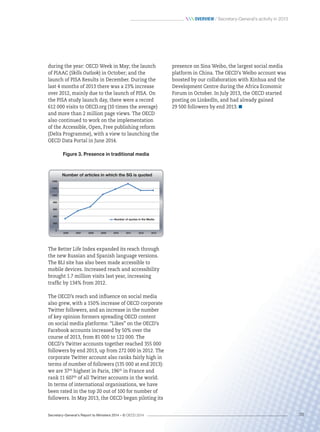
2014
Secretary-General’s
Report to Ministers
2014
ThisworkispublishedontheresponsibilityoftheSecretary-GeneraloftheOECD.Theopinionsexpressed
and arguments employed herein do not necessarily reflect the official views of the Organisation or of the
governments of its member countries.
This document and any map included herein are without prejudice to the status of or sovereignty over
any territory, to the delimitation of international frontiers and boundaries and to the name of any
territory, city or area.
Photo credits:
All photos are © OECD except:
page 7 © Cabinet Public Relations Office, Government of Japan
page 8 © G20/Australia
page 11 © REUTERS/Lintao Zhang/Pool
page 13 © US Department of Education
page 15 © UN Photo/Mark Garten
page 19 © G20 Summit St Petersburg 2013
page 20 © Pool Moncloa/Acceso libre
page 23 © Trento Festival of Economics Press Office/Giovanni Cavulli
page 29 © OECD/Jõao Neto MEC
page 47 © Ministry of Agriculture, Forestry and Fisheries of Japan
Corrigenda to OECD publications may be found on line at: www.oecd.org/publishing/corrigenda.
© OECD 2014
You can copy, download or print OECD content for your own use, and you can include excerpts from OECD publications, databases and
multimedia products in your own documents, presentations, blogs, websites and teaching materials, provided that suitable
acknowledgement of OECD as source and copyright owner is given.All requests for public or commercial use and translation rights should
be submitted to rights@oecd.org. Requests for permission to photocopy portions of this material for public or commercial use shall be
addressed directly to the Copyright Clearance Center (CCC) at info@copyright.com or the Centre français d’exploitation du droit de copie (CFC)
at contact@cfcopies.com.
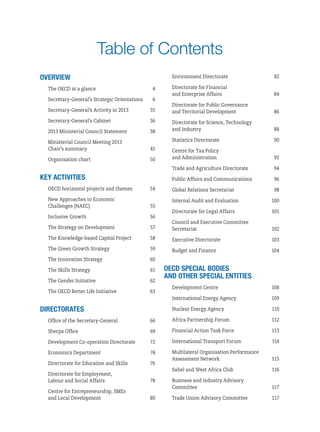
Table of Contents
Overview
The OECD at a glance	 4
Secretary‑General’s Strategic Orientations	 6
Secretary‑General’s Activity in 2013	 31
Secretary-General’s Cabinet	 36
2013 Ministerial Council Statement	 38
Ministerial Council Meeting 2013
Chair’s summary	 41
Organisation chart	 50
Key activities
OECD horizontal projects and themes	 54
New Approaches to Economic
Challenges (NAEC)	 55
Inclusive Growth	 56
The Strategy on Development	 57
The Knowledge-based Capital Project	 58
The Green Growth Strategy	 59
The Innovation Strategy	 60
The Skills Strategy	 61
The Gender Initiative	 62
The OECD Better Life Initiative	 63
Directorates
Office of the Secretary-General	 66
Sherpa Office	 69
Development Co-operation Directorate	 72
Economics Department	 74
Directorate for Education and Skills	 76
Directorate for Employment,
Labour and Social Affairs	 78
Centre for Entrepreneurship, SMEs
and Local Development	 80
Environment Directorate	 82
Directorate for Financial
and Enterprise Affairs	 84
Directorate for Public Governance
and Territorial Development	 86
Directorate for Science, Technology
and Industry	 88
Statistics Directorate	 90
Centre for Tax Policy
and Administration	 92
Trade and Agriculture Directorate	 94
Public Affairs and Communications	 96
Global Relations Secretariat	 98
Internal Audit and Evaluation	 100
Directorate for Legal Affairs	 101
Council and Executive Committee
Secretariat	102
Executive Directorate	 103
Budget and Finance	 104
oecd special bodies
and other special entities
Development Centre	 108
International Energy Agency	 109
Nuclear Energy Agency	 110
Africa Partnership Forum	 112
Financial Action Task Force	 113
International Transport Forum	 114
Multilateral Organisation Performance
Assessment Network	 115
Sahel and West Africa Club	 116
Business and Industry Advisory
Committee	117
Trade Union Advisory Committee	 117
Secretary-General’s Report to Ministers 2014 – © OECD 20144
 oecd / Secretary-General’s Report to Ministers 2014
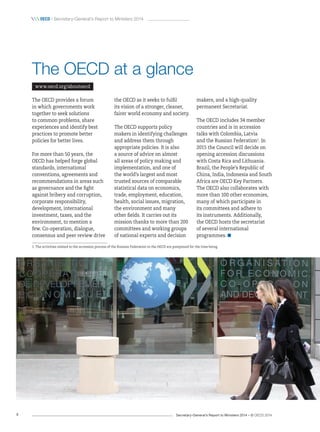
The OECD at a glance
www.oecd.org/aboutoecd
The OECD provides a forum
in which governments work
together to seek solutions
to common problems, share
experiences and identify best
practices to promote better
policies for better lives.
For more than 50 years, the
OECD has helped forge global
standards, international
conventions, agreements and
recommendations in areas such
as governance and the fight
against bribery and corruption,
corporate responsibility,
development, international
investment, taxes, and the
environment, to mention a
few. Co-operation, dialogue,
consensus and peer review drive
the OECD as it seeks to fulfil
its vision of a stronger, cleaner,
fairer world economy and society.
The OECD supports policy
makers in identifying challenges
and address them through
appropriate policies. It is also
a source of advice on almost
all areas of policy making and
implementation, and one of
the world’s largest and most
trusted sources of comparable
statistical data on economics,
trade, employment, education,
health, social issues, migration,
the environment and many
other fields. It carries out its
mission thanks to more than 200
committees and working groups
of national experts and decision
makers, and a high-quality
permanent Secretariat.
The OECD includes 34 member
countries and is in accession
talks with Colombia, Latvia
and the Russian Federation1
. In
2015 the Council will decide on
opening accession discussions
with Costa Rica and Lithuania.
Brazil, the People’s Republic of
China, India, Indonesia and South
Africa are OECD Key Partners.
The OECD also collaborates with
more than 100 other economies,
many of which participate in
its committees and adhere to
its instruments. Additionally,
the OECD hosts the secretariat
of several international
programmes. 
1. The activities related to the accession process of the Russian Federation to the OECD are postponed for the time being.
Secretary-General’s Report to Ministers 2014 – © OECD 2014 5
 Overview / The OECD at a glance
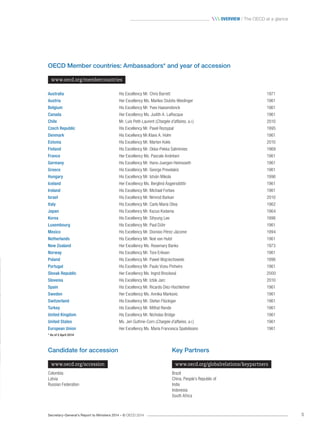
OECD Member countries: Ambassadors* and year of accession
www.oecd.org/membercountries
Candidate for accession
www.oecd.org/accession
Colombia
Latvia
Russian Federation
Key Partners
www.oecd.org/globalrelations/keypartners
Brazil
China, People’s Republic of
India
Indonesia
South Africa
Australia His Excellency Mr. Chris Barrett 1971
Austria Her Excellency Ms. Marlies Stubits-Weidinger 1961
Belgium His Excellency Mr. Yves Haesendonck 1961
Canada Her Excellency Ms. Judith A. LaRocque 1961
Chile Mr. Luis Petit-Laurent (Chargée d’affaires, a.i.) 2010
Czech Republic His Excellency Mr. Pavel Rozsypal 1995
Denmark His Excellency Mr.Klavs A. Holm 1961
Estonia His Excellency Mr. Marten Kokk 2010
Finland His Excellency Mr. Okka-Pekka Salmimies 1969
France Her Excellency Ms. Pascale Andréani 1961
Germany His Excellency Mr. Hans-Juergen Heimsoeth 1961
Greece His Excellency Mr. George Prevelakis 1961
Hungary His Excellency Mr. István Mikola 1996
Iceland Her Excellency Ms. Berglind Ásgeirsdóttir 1961
Ireland His Excellency Mr. Michael Forbes 1961
Israel His Excellency Mr. Nimrod Barkan 2010
Italy His Excellency Mr. Carlo Maria Oliva 1962
Japan His Excellency Mr. Kazuo Kodama 1964
Korea His Excellency Mr. Sihyung Lee 1996
Luxembourg His Excellency Mr. Paul Dühr 1961
Mexico His Excellency Mr. Dionisio Pérez-Jácome 1994
Netherlands His Excellency Mr. Noé van Hulst 1961
New Zealand Her Excellency Ms. Rosemary Banks 1973
Norway His Excellency Mr. Tore Eriksen 1961
Poland His Excellency Mr. Pawel Wojciechowski 1996
Portugal His Excellency Mr. Paulo Vizeu Pinheiro 1961
Slovak Republic Her Excellency Ms. Ingrid Brocková 2000
Slovenia His Excellency Mr. Iztok Jarc 2010
Spain His Excellency Mr. Ricardo Diez-Hochleitner 1961
Sweden Her Excellency Ms. Annika Markovic 1961
Switzerland His Excellency Mr. Stefan Flückiger 1961
Turkey His Excellency Mr. Mithat Rende 1961
United Kingdom His Excellency Mr. Nicholas Bridge 1961
United States Ms. Jeri Guthrie-Corn (Chargée d’affaires, a.i.) 1961
European Union Her Excellency Ms. Maria Francesca Spatolisano 1961
* As of 2 April 2014
Secretary-General’s Report to Ministers 2014 – © OECD 20146
 oecd / Secretary-General’s Report to Ministers 2014
and help rebuild public trust. In
this regard, the OECD’s approach
to “go structural, go social, go
green, go institutional, and go
national” remains as pertinent as
ever.
Growth and Jobs
NAEC is already delivering
a multi-dimensional policy
analysis framework that is
expected to permeate across
the Organisation. We need to
build on this effort and create
and preserve a “NAEC state of
mind”, to continuously upgrade
our capabilities, benefit from the
insight of Members and experts,
and promote further horizontality
in how we approach policy
analysis and how we target policy
recommendations.
Going forward, the focus of
our work will be on promoting
more inclusive growth, fostering
economic activity that aims to
improve both people’s material
living conditions and their quality
of life, while at the same time
considering the distribution
of well-being outcomes.
speed, leaving the recovery weak,
uneven and fragile. Despite some
recent signs of improvement
in trade and investment, credit
growth and activity in emerging
markets have yet to regain their
pre-crisis dynamism.
This challenge is compounded by
policy makers’ limited room for
manoeuvre. Expansionary fiscal
policy has been accompanied
by a surge in public debt in
OECD economies, while highly
supportive monetary policy is
showing diminishing marginal
returns and should be gradually
normalised. For leaders in
advanced and emerging
economies alike, productivity-
enhancing structural reforms
remain the best avenue for
pursuing robust long-term growth.
But stronger growth alone is
not enough! We need growth
that is balanced, inclusive and
green, built on resilient national
institutions and effective
international co-operation.
Structural reforms must aim to
increase productivity, but also to
reduce inequality, improve well-
being, protect the environment
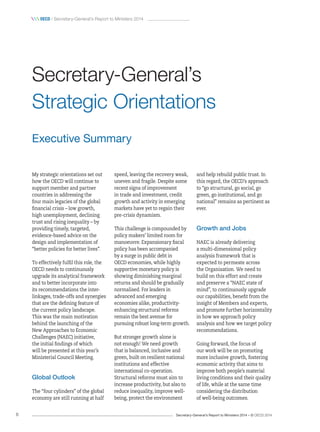
Executive Summary
My strategic orientations set out
how the OECD will continue to
support member and partner
countries in addressing the
four main legacies of the global
financial crisis – low growth,
high unemployment, declining
trust and rising inequality – by
providing timely, targeted,
evidence-based advice on the
design and implementation of
“better policies for better lives”.
To effectively fulfil this role, the
OECD needs to continuously
upgrade its analytical framework
and to better incorporate into
its recommendations the inter-
linkages, trade-offs and synergies
that are the defining feature of
the current policy landscape.
This was the main motivation
behind the launching of the
New Approaches to Economic
Challenges (NAEC) initiative,
the initial findings of which
will be presented at this year’s
Ministerial Council Meeting.
Global Outlook
The “four cylinders” of the global
economy are still running at half
Secretary‑General’s
Strategic Orientations
Secretary-General’s Report to Ministers 2014 – © OECD 2014 7
 Overview / Strategic Orientations
Again, building on the results
of NAEC, we are developing
a comprehensive inclusive
growth initiative that will result
in an enhanced analytical
framework and actionable policy
recommendations.
We should explore policies that
generate more and better quality
jobs and address the needs of
the most vulnerable members
of society. Efforts should centre
on training, skills, labour and
product market reforms, as well
as on complementary policies
that favour inclusiveness and
promote a competitive business
environment. These should
take into account the impact of
long-term demographic changes,
notably in health, pensions and
fiscal policies.
We will also continue to
promote labour market
activation strategies to reduce
unemployment, especially among
young people, through our Action
Plan for Youth. Our work on
resilience will also focus on the
risk of poverty and inequality in
old age and the challenges faced
by ageing societies.
The search for new sources of
growth is essential and we will
build on the second phase of the
Knowledge-Based Capital (KBC)
project to intensify our work
around innovation, science and
technology; promote a better
understanding of the implications
and challenges of the digital
economy; deepen our work on
entrepreneurship, employment
and productivity dynamics; and
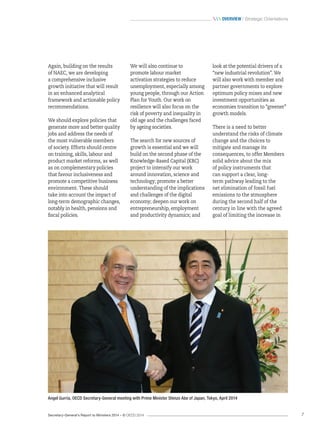
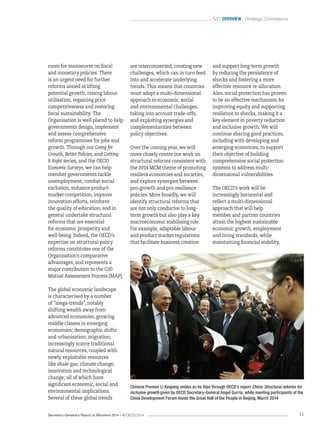
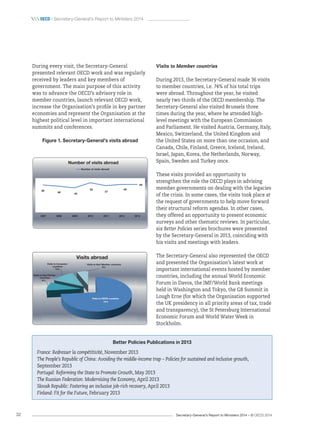
Angel Gurría, OECD Secretary-General meeting with Prime Minister Shinzo Abe of Japan, Tokyo, April 2014
look at the potential drivers of a
“new industrial revolution”. We
will also work with member and
partner governments to explore
optimum policy mixes and new
investment opportunities as
economies transition to “greener”
growth models.
There is a need to better
understand the risks of climate
change and the choices to
mitigate and manage its
consequences, to offer Members
solid advice about the mix
of policy instruments that
can support a clear, long-
term pathway leading to the
net elimination of fossil fuel
emissions to the atmosphere
during the second half of the
century in line with the agreed
goal of limiting the increase in
Secretary-General’s Report to Ministers 2014 – © OECD 20148
 oecd / Secretary-General’s Report to Ministers 2014
trust; improve the effectiveness
of policy formulation and
implementation in areas where
trust is particularly relevant
(e.g. budgeting); and help
governments strengthen the
inclusivity, transparency and
credibility of their policy-making
processes.
We plan to focus our tax work
on the distributional impact
of taxation: to complete the
Base Erosion and Profit Shifting
(BEPS) Action Plan; to deliver
the Automatic Exchange of
Information (AEOI) framework;
to develop effective beneficial
ownership rules to help Members
combat tax evasion, tax crimes
and other illegal activities; and
to explore the links between
tax, trade and investment
agreements. Through our Tax
and Development Programme,
we will continue to work with
developing countries to enhance
domestic resource mobilisation,
benefitting from the OECD’s
work in areas including transfer
the average global temperature
to 2°C. This will include exploring
complementary measures
to support the transition
towards low-carbon economies,
incentivising the necessary
technological change, and
addressing the distributional
consequences of this economic
transformation. These efforts
will support discussions leading
to the UN Climate Summit (New
York); and the COP 20 (Lima)
and COP 21 (Paris) climate
conferences.
Trust and Tax Policy
We will support governments’
efforts to build more effective,
transparent and open institutions
to help restore public trust.
Starting with delivery on our
commitments with respect to
the Anti-bribery Convention,
we will launch a comprehensive
effort to promote integrity and
anti-corruption measures;
collect better data on public
pricing, combatting tax crimes
and improving the global
transparency of tax information.
Trade, Investment,
Development
and International
Co‑operation
We will continue to support
the strengthening of the
multilateral trade system and
the international investment
regime through our work on
global value chains (GVCs), and
by developing and expanding our
Services Trade Restrictiveness
Index (STRI) and Trade in Value
Added (TiVA) databases, and
exploring the relationships
between value added, investment,
development, innovation and jobs.
We will promote sustainable
long-term investment,
developing together with the G20
recommendations on incentives,
for long-term investment
financing from both governments
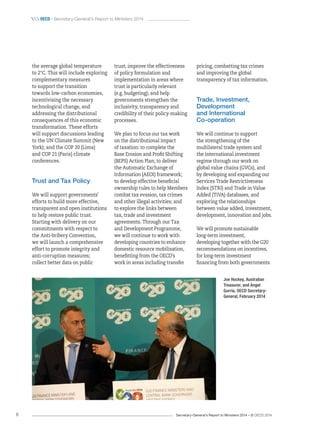
Joe Hockey, Australian
Treasurer, and Angel
Gurría, OECD Secretary-
General, February 2014
Secretary-General’s Report to Ministers 2014 – © OECD 2014 9
 Overview / Strategic Orientations
and private sources; explore how
to ensure competitive neutrality
whenever state-owned enterprises
are involved; and promote
Responsible Business Conduct
(RBC) and better corporate
governance. We will also develop
new statistics for capturing
foreign direct investment (FDI),
promote policy frameworks for
green investment, and expand our
work on financial education and
financial consumer protection.
We will continue to support
and shape the international
development agenda, including
efforts to support the post‑2015
global development framework.
We will mainstream development
across all our work; promote
greater policy coherence for
development and inclusive
knowledge sharing; enhance
our contribution to the global
development architecture,
including through Multi-
dimensional Country Reviews
and thematic Policy Dialogue
Networks (e.g. Natural Resources);
and work to promote better
quality aid and development
finance.
We will further strengthen our
role in global policy making as
an international standard setter
and by leveraging our work
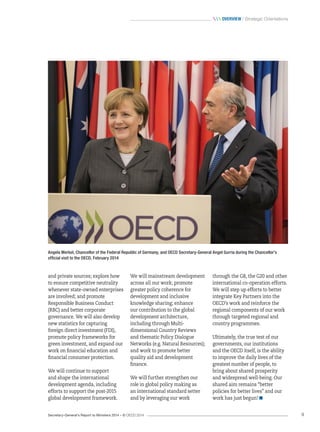
Angela Merkel, Chancellor of the Federal Republic of Germany, and OECD Secretary-General Angel Gurría during the Chancellor’s
official visit to the OECD, February 2014
through the G8, the G20 and other
international co-operation efforts.
We will step up efforts to better
integrate Key Partners into the
OECD’s work and reinforce the
regional components of our work
through targeted regional and
country programmes.
Ultimately, the true test of our
governments, our institutions
and the OECD itself, is the ability
to improve the daily lives of the
greatest number of people, to
bring about shared prosperity
and widespread well-being. Our
shared aim remains “better
policies for better lives” and our
work has just begun! 
Secretary-General’s Report to Ministers 2014 – © OECD 201410
 oecd / Secretary-General’s Report to Ministers 2014
This note sets out my Strategic Orientations for the Organisation for Economic Co‑operation and
Development. Reflecting the main challenges faced by member and key partner countries, these
priorities build on the outcomes of the 2013 Ministerial Council Meeting (MCM), and draw on my
discussions with leaders, senior government officials, ambassadors, and representatives from the
private sector and civil society.
Consistent with the OECD’s
goal to promote “better policies
for better lives”, my Strategic
Orientations are organised firstly
around the policy responses that
can help governments address
the legacies of the global crisis
– high unemployment, rising
inequality, declining trust and low
growth – and, secondly, on the
OECD initiatives and projects that
can help promote stronger, more
balanced, more inclusive and
greener growth; support greater
international co-operation;
strengthen the multilateral
trading system and roll back
protectionism; confront global
challenges ranging from climate
change to migration issues; and
foster development.
Building on our “Go structural,
social, institutional, green, and
national” approach to policy
analysis, and drawing on the
lessons of the New Approaches
to Economic Challenges
(NAEC) initiative, the OECD
will continue to upgrade its
analytical framework to provide
policy makers with more timely,
targeted, and impactful policy
advice that better captures the
interconnectedness, heterogeneity
and complexity of policy
challenges, and also focuses on
implementation issues.
Rethinking Policy Solutions
Around Stronger, More
Resilient, and More
Inclusive Growth
In the aftermath of the worst
financial and economic crisis
in living memory, governments
must address their enduring
legacies, while trying to kick-start
sustainable economic growth
amidst an increasingly constrained
policy space marked by budgetary
pressures, growing social
demands, low levels of public
trust, and diminished multilateral
co-operation once the global
economic emergency has passed.
The Global Outlook and
Policy Challenges
The crisis is estimated to have
reduced aggregate OECD-wide
potential output by 3%. Global
demand remains relatively weak
while key drivers of economic
activity have yet to recover
their pre-crisis levels: credit
growth remains subdued as a
result of deep and widespread
deleveraging and investment
continues to grow below trend.
This in turn has a knock-on
effect on trade, which shows a
muted trend, despite some recent
improvement. Slower factor
accumulation, weaker commodity
prices and subdued demand from
developed countries have resulted
in a general slowdown in growth
in many emerging markets.
The OECD’s “go structural”
approach is particularly
relevant at this time, as the
crisis and ensuing recession
have limited governments’
Secretary‑General’s
Strategic Orientations
Main Section
Secretary-General’s Report to Ministers 2014 – © OECD 2014 11
 Overview / Strategic Orientations
are interconnected, creating new
challenges, which can in turn feed
into and accelerate underlying
trends. This means that countries
must adopt a multi-dimensional
approach to economic, social
and environmental challenges,
taking into account trade-offs,
and exploiting synergies and
complementarities between
policy objectives.
Over the coming year, we will
more closely centre our work on
structural reforms consistent with
the 2014 MCM theme of promoting
resilient economies and societies,
and explore synergies between
pro-growth and pro-resilience
policies. More broadly, we will
identify structural reforms that
are not only conducive to long-
term growth but also play a key
macroeconomic stabilising role.
For example, adaptable labour
and product market regulations
that facilitate business creation
and support long-term growth
by reducing the persistence of
shocks and fostering a more
effective resource re-allocation.
Also, social protection has proven
to be an effective mechanism for
improving equity and supporting
resilience to shocks, making it a
key element in poverty reduction
and inclusive growth. We will
continue sharing good practices,
including with developing and
emerging economies, to support
their objective of building
comprehensive social protection
systems to address multi-
dimensional vulnerabilities.
The OECD’s work will be
increasingly horizontal and
reflect a multi-dimensional
approach that will help
member and partner countries
attain the highest sustainable
economic growth, employment
and living standards, while
maintaining financial stability,
room for manoeuvre on fiscal
and monetary policies. There
is an urgent need for further
reforms aimed at lifting
potential growth, raising labour
utilisation, regaining price
competitiveness and restoring
fiscal sustainability. The
Organisation is well placed to help
governments design, implement
and assess comprehensive
reform programmes for jobs and
growth. Through our Going for
Growth, Better Policies, and Getting
It Right series, and the OECD
Economic Surveys, we can help
member governments tackle
unemployment, combat social
exclusion, enhance product-
market competition, improve
innovation efforts, reinforce
the quality of education, and in
general undertake structural
reforms that are essential
for economic prosperity and
well-being. Indeed, the OECD’s
expertise on structural policy
reforms constitutes one of the
Organisation’s comparative
advantages, and represents a
major contribution to the G20
Mutual Assessment Process (MAP).
The global economic landscape
is characterised by a number
of “mega-trends”, notably
shifting wealth away from
advanced economies, growing
middle classes in emerging
economies; demographic shifts
and urbanisation; migration;
increasingly scarce traditional
natural resources, coupled with
newly exploitable resources
like shale gas; climate change;
innovation and technological
change; all of which have
significant economic, social and
environmental implications.
Several of these global trends
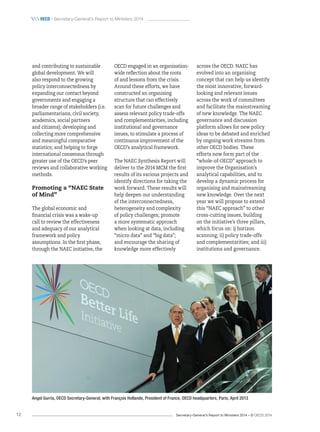
Chinese Premier Li Keqiang smiles as he flips through OECD’s report China: Structural reforms for
inclusive growth given by OECD Secretary-General Angel Gurría, while meeting participants of the
China Development Forum inside the Great Hall of the People in Beijing, March 2014
Secretary-General’s Report to Ministers 2014 – © OECD 201412
 oecd / Secretary-General’s Report to Ministers 2014
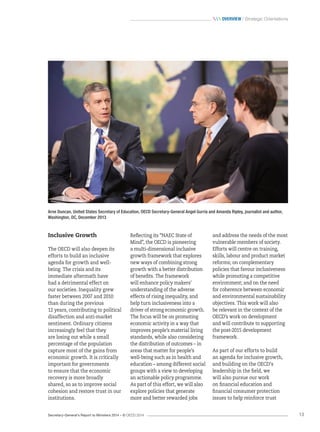
Angel Gurría, OECD Secretary-General, with François Hollande, President of France, OECD headquarters, Paris, April 2013
and contributing to sustainable
global development. We will
also respond to the growing
policy interconnectedness by
expanding our contact beyond
governments and engaging a
broader range of stakeholders (i.e.
parliamentarians, civil society,
academics, social partners
and citizens); developing and
collecting more comprehensive
and meaningful comparative
statistics; and helping to forge
international consensus through
greater use of the OECD’s peer
reviews and collaborative working
methods.
Promoting a “NAEC State
of Mind”
The global economic and
financial crisis was a wake-up
call to review the effectiveness
and adequacy of our analytical
framework and policy
assumptions. In the first phase,
through the NAEC initiative, the
OECD engaged in an organisation-
wide reflection about the roots
of and lessons from the crisis.
Around these efforts, we have
constructed an organising
structure that can effectively
scan for future challenges and
assess relevant policy trade-offs
and complementarities, including
institutional and governance
issues, to stimulate a process of
continuous improvement of the
OECD’s analytical framework.
The NAEC Synthesis Report will
deliver to the 2014 MCM the first
results of its various projects and
identify directions for taking the
work forward. These results will
help deepen our understanding
of the interconnectedness,
heterogeneity and complexity
of policy challenges; promote
a more systematic approach
when looking at data, including
“micro data” and “big data”;
and encourage the sharing of
knowledge more effectively
across the OECD. NAEC has
evolved into an organising
concept that can help us identify
the most innovative, forward-
looking and relevant issues
across the work of committees
and facilitate the mainstreaming
of new knowledge. The NAEC
governance and discussion
platform allows for new policy
ideas to be debated and enriched
by ongoing work streams from
other OECD bodies. These
efforts now form part of the
“whole-of-OECD” approach to
improve the Organisation’s
analytical capabilities, and to
develop a dynamic process for
organising and mainstreaming
new knowledge. Over the next
year we will propose to extend
this “NAEC approach” to other
cross-cutting issues, building
on the initiative’s three pillars,
which focus on: i) horizon
scanning; ii) policy trade-offs
and complementarities; and iii)
institutions and governance.
Secretary-General’s Report to Ministers 2014 – © OECD 2014 13
 Overview / Strategic Orientations
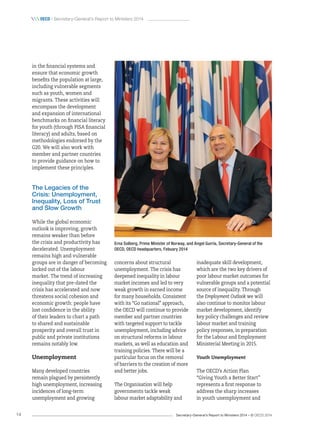
Arne Duncan, United States Secretary of Education, OECD Secretary-General Angel Gurría and Amanda Ripley, journalist and author,
Washington, DC, December 2013
Inclusive Growth
The OECD will also deepen its
efforts to build an inclusive
agenda for growth and well-
being. The crisis and its
immediate aftermath have
had a detrimental effect on
our societies. Inequality grew
faster between 2007 and 2010
than during the previous
12 years, contributing to political
disaffection and anti-market
sentiment. Ordinary citizens
increasingly feel that they
are losing out while a small
percentage of the population
capture most of the gains from
economic growth. It is critically
important for governments
to ensure that the economic
recovery is more broadly
shared, so as to improve social
cohesion and restore trust in our
institutions.
Reflecting its “NAEC State of
Mind”, the OECD is pioneering
a multi-dimensional inclusive
growth framework that explores
new ways of combining strong
growth with a better distribution
of benefits. The framework
will enhance policy makers’
understanding of the adverse
effects of rising inequality, and
help turn inclusiveness into a
driver of strong economic growth.
The focus will be on promoting
economic activity in a way that
improves people’s material living
standards, while also considering
the distribution of outcomes – in
areas that matter for people’s
well-being such as in health and
education – among different social
groups with a view to developing
an actionable policy programme.
As part of this effort, we will also
explore policies that generate
more and better rewarded jobs
and address the needs of the most
vulnerable members of society.
Efforts will centre on training,
skills, labour and product market
reforms; on complementary
policies that favour inclusiveness
while promoting a competitive
environment; and on the need
for coherence between economic
and environmental sustainability
objectives. This work will also
be relevant in the context of the
OECD’s work on development
and will contribute to supporting
the post-2015 development
framework.
As part of our efforts to build
an agenda for inclusive growth,
and building on the OECD‘s
leadership in the field, we
will also pursue our work
on financial education and
financial consumer protection
issues to help reinforce trust
Secretary-General’s Report to Ministers 2014 – © OECD 201414
 oecd / Secretary-General’s Report to Ministers 2014
in the financial systems and
ensure that economic growth
benefits the population at large,
including vulnerable segments
such as youth, women and
migrants. These activities will
encompass the development
and expansion of international
benchmarks on financial literacy
for youth (through PISA financial
literacy) and adults, based on
methodologies endorsed by the
G20. We will also work with
member and partner countries
to provide guidance on how to
implement these principles.
The Legacies of the
Crisis: Unemployment,
Inequality, Loss of Trust
and Slow Growth
While the global economic
outlook is improving, growth
remains weaker than before
the crisis and productivity has
decelerated. Unemployment
remains high and vulnerable
groups are in danger of becoming
locked out of the labour
market. The trend of increasing
inequality that pre-dated the
crisis has accelerated and now
threatens social cohesion and
economic growth: people have
lost confidence in the ability
of their leaders to chart a path
to shared and sustainable
prosperity and overall trust in
public and private institutions
remains notably low.
Unemployment
Many developed countries
remain plagued by persistently
high unemployment, increasing
incidences of long-term
unemployment and growing
concerns about structural
unemployment. The crisis has
deepened inequality in labour
market incomes and led to very
weak growth in earned income
for many households. Consistent
with its “Go national” approach,
the OECD will continue to provide
member and partner countries
with targeted support to tackle
unemployment, including advice
on structural reforms in labour
markets, as well as education and
training policies. There will be a
particular focus on the removal
of barriers to the creation of more
and better jobs.
The Organisation will help
governments tackle weak
labour market adaptability and
inadequate skill development,
which are the two key drivers of
poor labour market outcomes for
vulnerable groups and a potential
source of inequality. Through
the Employment Outlook we will
also continue to monitor labour
market development, identify
key policy challenges and review
labour market and training
policy responses, in preparation
for the Labour and Employment
Ministerial Meeting in 2015.
Youth Unemployment
The OECD’s Action Plan
“Giving Youth a Better Start”
represents a first response to
address the sharp increases
in youth unemployment and
Erna Solberg, Prime Minister of Norway, and Angel Gurría, Secretary‑General of the
OECD, OECD headquarters, Febuary 2014
Secretary-General’s Report to Ministers 2014 – © OECD 2014 15
 Overview / Strategic Orientations
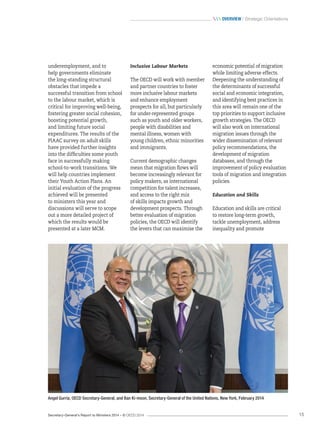
Angel Gurría, OECD Secretary-General, and Ban Ki-moon, Secretary-General of the United Nations, New York, February 2014
underemployment, and to
help governments eliminate
the long‑standing structural
obstacles that impede a
successful transition from school
to the labour market, which is
critical for improving well-being,
fostering greater social cohesion,
boosting potential growth,
and limiting future social
expenditures. The results of the
PIAAC survey on adult skills
have provided further insights
into the difficulties some youth
face in successfully making
school-to-work transitions. We
will help countries implement
their Youth Action Plans. An
initial evaluation of the progress
achieved will be presented
to ministers this year and
discussions will serve to scope
out a more detailed project of
which the results would be
presented at a later MCM.
Inclusive Labour Markets
The OECD will work with member
and partner countries to foster
more inclusive labour markets
and enhance employment
prospects for all, but particularly
for under-represented groups
such as youth and older workers,
people with disabilities and
mental illness, women with
young children, ethnic minorities
and immigrants.
Current demographic changes
mean that migration flows will
become increasingly relevant for
policy makers, as international
competition for talent increases,
and access to the right mix
of skills impacts growth and
development prospects. Through
better evaluation of migration
policies, the OECD will identify
the levers that can maximise the
economic potential of migration
while limiting adverse effects.
Deepening the understanding of
the determinants of successful
social and economic integration,
and identifying best practices in
this area will remain one of the
top priorities to support inclusive
growth strategies. The OECD
will also work on international
migration issues through the
wider dissemination of relevant
policy recommendations, the
development of migration
databases, and through the
improvement of policy evaluation
tools of migration and integration
policies.
Education and Skills
Education and skills are critical
to restore long-term growth,
tackle unemployment, address
inequality and promote
Secretary-General’s Report to Ministers 2014 – © OECD 201416
 oecd / Secretary-General’s Report to Ministers 2014
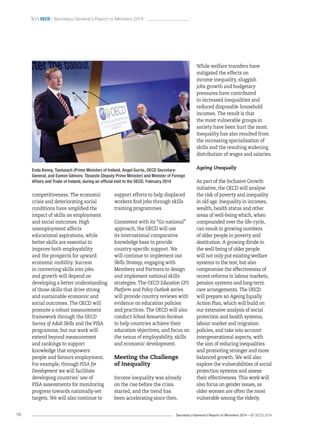
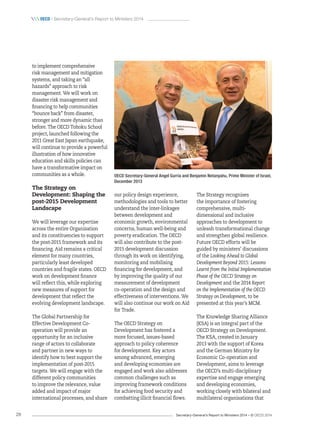
Enda Kenny, Taoiseach (Prime Minister) of Ireland, Angel Gurría, OECD Secretary-
General, and Eamon Gilmore, Tánaiste (Deputy Prime Minister) and Minister of Foreign
Affairs and Trade of Ireland, during an official visit to the OECD, February 2014
competitiveness. The economic
crisis and deteriorating social
conditions have amplified the
impact of skills on employment
and social outcomes. High
unemployment affects
educational aspirations, while
better skills are essential to
improve both employability
and the prospects for upward
economic mobility. Success
in converting skills into jobs
and growth will depend on
developing a better understanding
of those skills that drive strong
and sustainable economic and
social outcomes. The OECD will
promote a robust measurement
framework through the OECD
Survey of Adult Skills and the PISA
programme, but our work will
extend beyond measurement
and rankings to support
knowledge that empowers
people and favours employment.
For example, through PISA for
Development we will facilitate
developing countries’ use of
PISA assessments for monitoring
progress towards nationally-set
targets. We will also continue to
support efforts to help displaced
workers find jobs through skills
training programmes.
Consistent with its “Go national”
approach, the OECD will use
its international comparative
knowledge base to provide
country-specific support. We
will continue to implement our
Skills Strategy, engaging with
Members and Partners to design
and implement national skills
strategies. The OECD Education GPS
Platform and Policy Outlook series
will provide country reviews with
evidence on education policies
and practices. The OECD will also
conduct School Resources Reviews
to help countries achieve their
education objectives, and focus on
the nexus of employability, skills
and economic development.
Meeting the Challenge
of Inequality
Income inequality was already
on the rise before the crisis
started, and the trend has
been accelerating since then.
While welfare transfers have
mitigated the effects on
income inequality, sluggish
jobs growth and budgetary
pressures have contributed
to increased inequalities and
reduced disposable household
incomes. The result is that
the most vulnerable groups in
society have been hurt the most.
Inequality has also resulted from
the increasing specialisation of
skills and the resulting widening
distribution of wages and salaries.
Ageing Unequally
As part of the Inclusive Growth
initiative, the OECD will analyse
the risk of poverty and inequality
in old age. Inequality in incomes,
wealth, health status and other
areas of well-being which, when
compounded over the life-cycle,
can result in growing numbers
of older people in poverty and
destitution. A growing divide in
the well-being of older people
will not only put existing welfare
systems to the test, but also
compromise the effectiveness of
recent reforms in labour markets,
pension systems and long-term
care arrangements. The OECD
will prepare an Ageing Equally
Action Plan, which will build on
our extensive analysis of social
protection and health systems,
labour market and migration
policies, and take into account
intergenerational aspects, with
the aim of reducing inequalities
and promoting stronger and more
balanced growth. We will also
explore the vulnerabilities of social
protection systems and assess
their effectiveness. This work will
also focus on gender issues, as
older women are often the most
vulnerable among the elderly.
Secretary-General’s Report to Ministers 2014 – © OECD 2014 17
 Overview / Strategic Orientations
The Well-Being Agenda
The OECD has been working to
identify ways to measure well-
being, moving beyond GDP and
exploring the areas that matter
most for people’s lives. As part
of the Organisation’s mission
to promote better policies for
better lives, we launched the
OECD Better Life Initiative. This
well-being framework resulted in
the report How’s Life?, featuring
11 dimensions of human well-
being. The framework is also used
in the Multi-dimensional Country
Reviews (MDCRs) to inform the
analysis of economic and social
development in emerging and
developing economies. This
analysis has shown that a given
level of economic development
can be consistent with widely
differing levels of well-being, and
hence that policy priorities need
to consider issues beyond pure
economic growth. Work is also
underway on the alignment of
the well-being framework with
the post-2015 and Sustainable
Development Goals agendas.
In addition, the OECD actively
promotes the interactive web
application, the Better Life Index,
which builds on the framework to
facilitate a dialogue with citizens
on what they consider to be the
most important determinants of
well‑being.
In promoting inclusive growth
and well-being, we will look for
policies that address all types of
discrimination, whether based on
gender, age, social class, disability
and/or sexual orientation.
Reducing Inequality through
High-performing Health Systems
Governments face a challenge
in maintaining the best possible
access to quality health care,
while at the same time reducing
public spending despite
continued growth in demand.
In OECD countries, the scale of
the challenge becomes more
apparent as socio-economic
inequalities, among other factors,
complicate policy design and
flaws in co-ordination result in
poor quality and excessively
expensive care. The OECD will
support governments’ efforts
to move beyond a simple cost-
cutting agenda to a more strategic
understanding of how to get the
best out of new technologies and
improve productivity and quality
of care. This work will be a major
input into the Health Ministerial
Meeting to be held in 2016.
Rebuilding Public Trust,
Fighting Corruption, and
Ensuring Government
Transparency
For many years, maintaining
trust in government and
institutions has been a neglected
component of public policy
making. People have been losing
faith in governments’ ability to
address what matters to them,
resulting in overall low levels
of trust in institutions. The
crisis and the ensuing recession
have accelerated this trend.
Transparency, responsibility and
accountability are cornerstones
of public trust and a healthy
business environment and
responsible business conduct
are good for the economy and
for society. Public trust has also
been eroded by the absence of
adequate and effective regulation
to prevent money and influence
from undermining the policy-
making process. As identified
by ministers during the 2013
MCM, governments need better
data on the level of public trust
to support decision making and
improve policy formulation and
implementation in areas in which
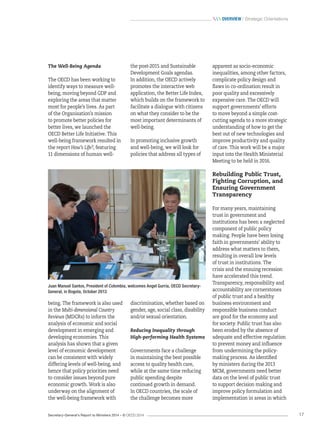
Juan Manuel Santos, President of Colombia, welcomes Angel Gurría, OECD Secretary-
General, in Bogota, October 2013
Secretary-General’s Report to Ministers 2014 – © OECD 201418
 oecd / Secretary-General’s Report to Ministers 2014
trust is particularly relevant
to policy effectiveness (e.g.
regulations, tax, and the budget).
Consistent with its “Go
institutional” approach, the
OECD will focus on improving
measurements and identifying
ways to restore trust in our social
and governance institutions. This
will involve identifying innovative
policies and instruments to
reinforce the relationship between
citizens and their government
through greater openness and
transparency. The OECD will
focus its work on strengthening
the measurement and empirical
analysis of both trust and public
service quality and developing
a comprehensive approach
to address the risk of undue
influence by powerful groups.
We will also disseminate the
results from the Observatory on
Public Sector Innovation, identify
good practices that better align
government objectives with
resources and offer in-depth
analysis of governments’ medium-
term expenditure frameworks. We
will continue to support the work
on open government to promote
transparency, increase citizen
participation in public affairs,
fight corruption and harness
new technologies to strengthen
governance.
Corruption, and the perception
of corruption, erodes trust in
governments, businesses and
markets. Beginning with delivery
on our existing commitments
with respect to the Anti-bribery
Convention, the OECD will launch
a more comprehensive effort
to promote integrity and anti-
corruption measures, including
in support of the G20 agenda.
Among other initiatives, we
plan to develop a compendium
of good practices on public
procurement and work to close
gaps in high-risk sectors (like
natural resources) and to organise
major events on issues like
conflict of interest, lobbying and
political finance. Building on the
OECD Declaration on Propriety,
Integrity and Transparency in the
Conduct of International Business
and Finance we will work on
areas such as criminalising
bribery, business integrity, public
procurement, and whistle-
blower protection. Through
its CleanGovBiz initiative the
OECD will continue to identify
potential areas for co-operation
and collective action with
other international institutions
and stakeholders engaged in
anticorruption and integrity
efforts, upgrade its Integrity Scan
toolkit, and undertake country
reviews.
As part of the OECD Trust
Strategy, the OECD will
support member countries in
strengthening the rule of law
and good governance, focussing
on the contribution of justice
institutions to public policy
performance and quality public
service delivery. We will explore
with Members the possible
creation of an OECD network of
judicial institutions, to address,
among others, the improvement
of their functioning, the quality
of access to justice, and their
role in contract enforcement
and dispute settlement
mechanisms. In reaching out
to judicial institutions, we will
capitalise on the Organisation’s
convening power, expertise in
data collection and the multi-
disciplinary nature of our advice.
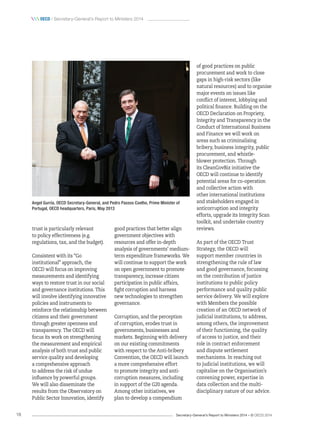
Angel Gurría, OECD Secretary-General, and Pedro Passos Coelho, Prime Minister of
Portugal, OECD headquarters, Paris, May 2013
Secretary-General’s Report to Ministers 2014 – © OECD 2014 19
 Overview / Strategic Orientations
Strengthening the integrity,
inclusiveness, transparency and
credibility of the policy-making
process must be a priority for
governments seeking to build
citizens’ trust. Elections must
be – and must be seen to be – fair
and fully transparent, with no
perception of “democracy for the
highest bidder”. The OECD will
launch a global policy dialogue on
the key drivers of open, informed
and fair policy making, covering
issues related to: a) political
finance; b) trust; c) lobbying;
d) the revolving door; e) openness
and inclusion; f) illicit financial
flows and political finance; g) local
governance and political finance;
h) politics and public service.
These efforts will form part of,
and will complement, the OECD
Trust Strategy.
Tax Policy
The perception that multinational
companies do not pay their fair
share of tax in any jurisdiction
undermines the legitimacy of our
tax systems, further complicating
the political economy of fiscal
consolidation. It also undermines
the efforts of developing countries
to mobilise domestic resources
for development and reduce their
dependency on aid. To tackle
this phenomenon, the OECD has
mobilised political momentum
at global level to restore integrity
to the international tax system
through its Base Erosion and
Profit Shifting (BEPS) initiative.
We will continue working with
member and partner countries
to successfully deliver the BEPS
Action Plan.
The 2013 MCM called on all
jurisdictions to move towards
the Automatic Exchange of
Information (AEOI). The OECD
has developed a standard,
consisting of a Model Competent
Authority Agreement (CAA)and
a Common Reporting and Due
Diligence Standard (CRS) for the
automatic exchange of financial
account information, and will
begin working on the technical
modalities for its application
and operation to enable all
jurisdictions, including developing
countries, to meet this objective.
Going forward, we will continue to
produce tax statistics and cross-
country analysis and offer sound
tax policy advice to member
and partner countries, including
on the economic impact of VAT
policies, and build on the AEOI
progress to support international
co-operation efforts in fighting tax
crimes and financial wrongdoings
and analyse beneficial ownership
issues.
Regulatory Policy
Regulatory reform is a key pillar
of the OECD’s work to improve
governance and the functioning
of markets. Consistent with its
“go institutional, go structural”
approach, the OECD will lead the
way in scrutinising policies that
impose unnecessary burdens
– fiscal or administrative – and
hinder economic growth or
create additional budgetary
pressures. We will develop tools
for governments to identify
value for money policies that are
supportive of economic growth,
contribute to social priorities and
protect the environment. New
work will be aimed at identifying
best practices in ex-ante policy
evaluation and focus on cost-
benefit analysis.
The Organisation will also work
closely with governments to
improve regulatory frameworks,
to push for reform in challenging
policy environments, and to
better assess the benefits of
reform. We will support a
dynamic market analysis of the
impacts of regulatory policies
and promote a multi-disciplinary
approach that considers the
political economy aspects of
future reforms.
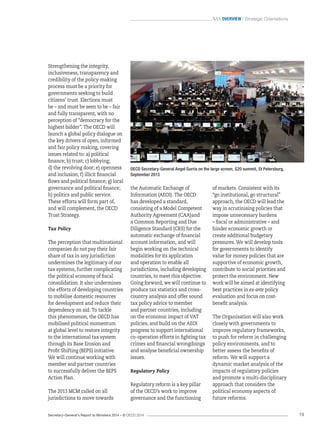
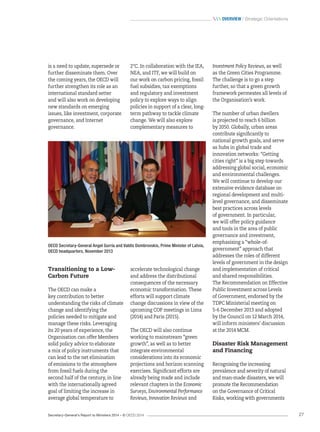
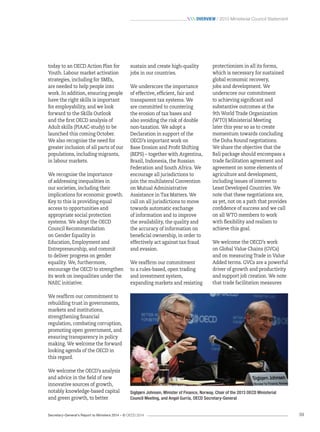
OECD Secretary-General Angel Gurría on the large screen, G20 summit, St Petersburg,
September 2013
Secretary-General’s Report to Ministers 2014 – © OECD 201420
 oecd / Secretary-General’s Report to Ministers 2014
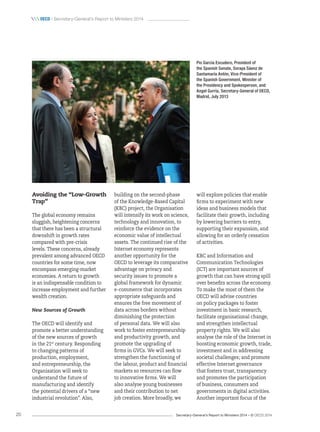
Pio García Escudero, President of
the Spanish Senate, Soraya Sáenz de
Santamaría Antón, Vice-President of
the Spanish Government, Minister of
the Presidency and Spokesperson, and
Angel Gurría, Secretary-General of OECD,
Madrid, July 2013
Avoiding the “Low-Growth
Trap”
The global economy remains
sluggish, heightening concerns
that there has been a structural
downshift in growth rates
compared with pre-crisis
levels. These concerns, already
prevalent among advanced OECD
countries for some time, now
encompass emerging-market
economies. A return to growth
is an indispensable condition to
increase employment and further
wealth creation.
New Sources of Growth
The OECD will identify and
promote a better understanding
of the new sources of growth
in the 21st
century. Responding
to changing patterns of
production, employment,
and entrepreneurship, the
Organisation will seek to
understand the future of
manufacturing and identify
the potential drivers of a “new
industrial revolution”. Also,
will explore policies that enable
firms to experiment with new
ideas and business models that
facilitate their growth, including
by lowering barriers to entry,
supporting their expansion, and
allowing for an orderly cessation
of activities.
KBC and Information and
Communication Technologies
(ICT) are important sources of
growth that can have strong spill
over benefits across the economy.
To make the most of them the
OECD will advise countries
on policy packages to foster
investment in basic research,
facilitate organisational change,
and strengthen intellectual
property rights. We will also
analyse the role of the Internet in
boosting economic growth, trade,
investment and in addressing
societal challenges; and promote
effective Internet governance
that fosters trust, transparency
and promotes the participation
of business, consumers and
governments in digital activities.
Another important focus of the
building on the second-phase
of the Knowledge-Based Capital
(KBC) project, the Organisation
will intensify its work on science,
technology and innovation, to
reinforce the evidence on the
economic value of intellectual
assets. The continued rise of the
Internet economy represents
another opportunity for the
OECD to leverage its comparative
advantage on privacy and
security issues to promote a
global framework for dynamic
e-commerce that incorporates
appropriate safeguards and
ensures the free movement of
data across borders without
diminishing the protection
of personal data. We will also
work to foster entrepreneurship
and productivity growth, and
promote the upgrading of
firms in GVCs. We will seek to
strengthen the functioning of
the labour, product and financial
markets so resources can flow
to innovative firms. We will
also analyse young businesses
and their contribution to net
job creation. More broadly, we
Secretary-General’s Report to Ministers 2014 – © OECD 2014 21
 Overview / Strategic Orientations
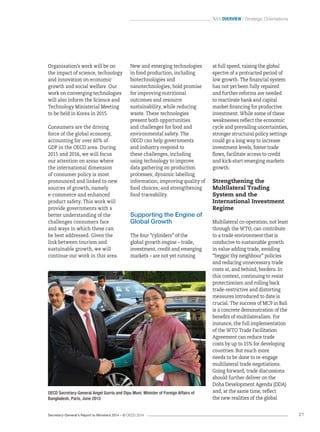
OECD Secretary-General Angel Gurría and Dipu Moni, Minister of Foreign Affairs of
Bangladesh, Paris, June 2013
Organisation’s work will be on
the impact of science, technology
and innovation on economic
growth and social welfare. Our
work on converging technologies
will also inform the Science and
Technology Ministerial Meeting
to be held in Korea in 2015.
Consumers are the driving
force of the global economy,
accounting for over 60% of
GDP in the OECD area. During
2015 and 2016, we will focus
our attention on areas where
the international dimension
of consumer policy is most
pronounced and linked to new
sources of growth, namely
e-commerce and enhanced
product safety. This work will
provide governments with a
better understanding of the
challenges consumers face
and ways in which these can
be best addressed. Given the
link between tourism and
sustainable growth, we will
continue our work in this area.
New and emerging technologies
in food production, including
biotechnologies and
nanotechnologies, hold promise
for improving nutritional
outcomes and resource
sustainability, while reducing
waste. These technologies
present both opportunities
and challenges for food and
environmental safety. The
OECD can help governments
and industry respond to
these challenges, including
using technology to improve
data gathering on production
processes; dynamic labelling
information; improving quality of
food choices; and strengthening
food traceability.
Supporting the Engine of
Global Growth
The four “cylinders” of the
global growth engine – trade,
investment, credit and emerging
markets – are not yet running
at full speed, raising the global
spectre of a protracted period of
low growth. The financial system
has not yet been fully repaired
and further reforms are needed
to reactivate bank and capital
market financing for productive
investment. While some of these
weaknesses reflect the economic
cycle and prevailing uncertainties,
stronger structural policy settings
could go a long way to increase
investment levels, foster trade
flows, facilitate access to credit
and kick-start emerging markets
growth.
Strengthening the
Multilateral Trading
System and the
International Investment
Regime
Multilateral co-operation, not least
through the WTO, can contribute
to a trade environment that is
conducive to sustainable growth
in value adding trade, avoiding
“beggar thy neighbour” policies
and reducing unnecessary trade
costs at, and behind, borders. In
this context, continuing to resist
protectionism and rolling back
trade-restrictive and distorting
measures introduced to date is
crucial. The success of MC9 in Bali
is a concrete demonstration of the
benefits of multilateralism. For
instance, the full implementation
of the WTO Trade Facilitation
Agreement can reduce trade
costs by up to 15% for developing
countries. But much more
needs to be done to re-engage
multilateral trade negotiations.
Going forward, trade discussions
should further deliver on the
Doha Development Agenda (DDA)
and, at the same time, reflect
the new realities of the global
Secretary-General’s Report to Ministers 2014 – © OECD 201422
 oecd / Secretary-General’s Report to Ministers 2014
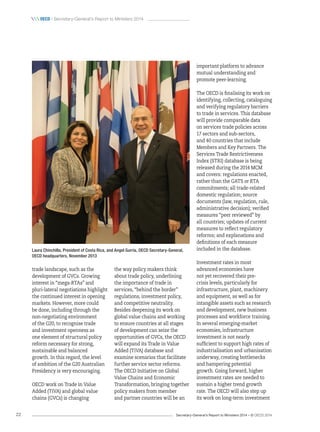
Laura Chinchilla, President of Costa Rica, and Angel Gurría, OECD Secretary‑General,
OECD headquarters, November 2013
trade landscape, such as the
development of GVCs. Growing
interest in “mega-RTAs” and
pluri-lateral negotiations highlight
the continued interest in opening
markets. However, more could
be done, including through the
non-negotiating environment
of the G20, to recognise trade
and investment openness as
one element of structural policy
reform necessary for strong,
sustainable and balanced
growth. In this regard, the level
of ambition of the G20 Australian
Presidency is very encouraging.
OECD work on Trade in Value
Added (TiVA) and global value
chains (GVCs) is changing
the way policy makers think
about trade policy, underlining
the importance of trade in
services, “behind the border”
regulations, investment policy,
and competitive neutrality.
Besides deepening its work on
global value chains and working
to ensure countries at all stages
of development can seize the
opportunities of GVCs, the OECD
will expand its Trade in Value
Added (TiVA) database and
examine scenarios that facilitate
further service sector reforms.
The OECD Initiative on Global
Value Chains and Economic
Transformation, bringing together
policy makers from member
and partner countries will be an
important platform to advance
mutual understanding and
promote peer-learning.
The OECD is finalising its work on
identifying, collecting, cataloguing
and verifying regulatory barriers
to trade in services. This database
will provide comparable data
on services trade policies across
17 sectors and sub-sectors,
and 40 countries that include
Members and Key Partners. The
Services Trade Restrictiveness
Index (STRI) database is being
released during the 2014 MCM
and covers: regulations enacted,
rather than the GATS or RTA
commitments; all trade-related
domestic regulation; source
documents (law, regulation, rule,
administrative decision); verified
measures “peer reviewed” by
all countries; updates of current
measures to reflect regulatory
reforms; and explanations and
definitions of each measure
included in the database.
Investment rates in most
advanced economies have
not yet recovered their pre-
crisis levels, particularly for
infrastructure, plant, machinery
and equipment, as well as for
intangible assets such as research
and development, new business
processes and workforce training.
In several emerging-market
economies, infrastructure
investment is not nearly
sufficient to support high rates of
industrialisation and urbanisation
underway, creating bottlenecks
and hampering potential
growth. Going forward, higher
investment rates are needed to
sustain a higher trend growth
rate. The OECD will also step up
its work on long-term investment
Secretary-General’s Report to Ministers 2014 – © OECD 2014 23
 Overview / Strategic Orientations
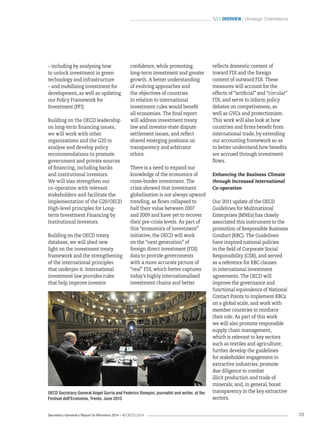
OECD Secretary-General Angel Gurría and Federico Rampini, journalist and writer, at the
Festival dell’Economia, Trento, June 2013
– including by analysing how
to unlock investment in green
technology and infrastructure
– and mobilising investment for
development, as well as updating
our Policy Framework for
Investment (PFI).
Building on the OECD leadership
on long-term financing issues,
we will work with other
organisations and the G20 to
analyse and develop policy
recommendations to promote
government and private sources
of financing, including banks
and institutional investors.
We will also strengthen our
co-operation with relevant
stakeholders and facilitate the
implementation of the G20/OECD
High-level principles for Long-
term Investment Financing by
Institutional Investors.
Building on the OECD treaty
database, we will shed new
light on the investment treaty
framework and the strengthening
of the international principles
that underpin it. International
investment law provides rules
that help improve investor
confidence, while promoting
long-term investment and greater
growth. A better understanding
of evolving approaches and
the objectives of countries
in relation to international
investment rules would benefit
all economies. The final report
will address investment treaty
law and investor-state dispute
settlement issues, and reflect
shared emerging positions on
transparency and arbitrator
ethics.
There is a need to expand our
knowledge of the economics of
cross-border investment. The
crisis showed that investment
globalisation is not always upward
trending, as flows collapsed to
half their value between 2007
and 2009 and have yet to recover
their pre-crisis levels. As part of
this “economics of investment”
initiative, the OECD will work
on the “next generation” of
foreign direct investment (FDI)
data to provide governments
with a more accurate picture of
“real” FDI, which better captures
today’s highly internationalised
investment chains and better
reflects domestic content of
inward FDI and the foreign
content of outward FDI. These
measures will account for the
effects of “artificial” and “circular”
FDI, and serve to inform policy
debates on competiveness, as
well as GVCs and protectionism.
This work will also look at how
countries and firms benefit from
international trade, by extending
our accounting framework so as
to better understand how benefits
are accrued through investment
flows.
Enhancing the Business Climate
through Increased International
Co-operation
Our 2011 update of the OECD
Guidelines for Multinational
Enterprises (MNEs) has closely
associated this instrument to the
promotion of Responsible Business
Conduct (RBC). The Guidelines
have inspired national policies
in the field of Corporate Social
Responsibility (CSR), and served
as a reference for RBC clauses
in international investment
agreements. The OECD will
improve the governance and
functional equivalence of National
Contact Points to implement RBCs
on a global scale, and work with
member countries to reinforce
their role. As part of this work
we will also promote responsible
supply chain management,
which is relevant to key sectors
such as textiles and agriculture;
further develop the guidelines
for stakeholder engagement in
extractive industries; promote
due diligence to combat
illicit production and trade of
minerals; and, in general, boost
transparency in the key extractive
sectors.
Secretary-General’s Report to Ministers 2014 – © OECD 201424
 oecd / Secretary-General’s Report to Ministers 2014
Responsible business conduct
is an essential part of an open
international investment
climate and the Guidelines
offer the most comprehensive
set of government-backed
recommendations in existence
today. In co-operation with
Members, we will continue to
encourage positive contributions
by MNEs to sustainable
development and promote respect
for high standards of business
conduct, and discourage conducts
that neglect these principles and
standards in an attempt to gain
undue competitive advantage,
particularly in countries where
the regulatory, legal, and
institutional frameworks are
underdeveloped or fragile.
Currently, state-owned
enterprises (SOEs) and other
companies with significant
government investment account
for more than 14% of the world’s
2 000 largest enterprises. SOEs are
increasingly active in the global
marketplace, through trade,
investment and competition
in third markets. In order to
ensure a level playing field
between privately and publicly
owned businesses, the OECD
will continue examining the
changing role of SOEs, identifying
key challenges and options for
policy makers. A report will
be presented at the 2014 MCM
presenting further evidence on
trade, investment and competitive
neutrality practices.
To ensure their continuing high
quality, relevance and usefulness,
we will conduct an in-depth
review of the OECD Principles of
Corporate Governance taking into
account recent developments in
the corporate sector and capital
markets. The reviewed Principles
will provide policy makers,
regulators and other rule-making
bodies with a sound benchmark
for establishing an effective
corporate governance framework.
The review is expected to last one
year.
Increased international
co-operation in enforcing
competition law can promote
economic growth. Presently,
competition agencies assess
cross-border cases only for their
effects on the domestic market.
Businesses considering a global
merger must file in multiple
jurisdictions, sometimes in as
many as 60 places, and there are
no mechanisms for governments
or competition agencies to
resolve differences in approach
or reach common solutions. In
2014 the OECD will deliver a
major piece of empirical analysis
on the problems caused by this
fragmented approach, with
future work aimed at scoping out
possible institutional or treaty-
based solutions.
Reinforcing the Financial
Sector; Improving Credit
Availability
The OECD is revisiting the
relationships between finance,
growth and inequality, and
analysing their implications for
economic policy, while focusing
on the role of finance for the
economic stability of individual
households and firms. Deeper
financial markets, financial
innovation and cross-border
financial integration have
traditionally been associated with
greater efficiency and stronger
economic growth. However, the
global financial crisis has shown
that these phenomena can also
give rise to greater volatility in
economic output and, due to
the inter-linkages with the real
economy, serve as a propagation
mechanism for financial
vulnerabilities. The OECD is
currently analysing issues relating
to access to finance for SMEs –
particularly young firms – given
the role they play as generators
of employment and income. The
Organisation is also conducting
work in relation to banking sector
reform and analysing leverage
and capital adequacy ratios to
identify more comprehensive
measures of bank vulnerability.
Kick-Starting Emerging
Market Growth
Emerging markets (EMs) enjoyed
a decade of strong growth prior
to the crisis, on the back of
intensive factor accumulation,
strong commodity prices and
relatively loose monetary policy
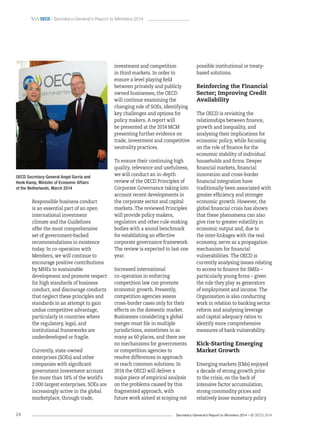
OECD Secretary-General Angel Gurría and
Henk Kamp, Minister of Economic Affairs
of the Netherlands, March 2014
Secretary-General’s Report to Ministers 2014 – © OECD 2014 25
 Overview / Strategic Orientations
in developed economies. Further
accommodative monetary
policy in the aftermath of
the crisis ensured that EMs
remained important drivers of
global growth. However, trends
underpinning strong EM growth
have slowed, stopped or reversed,
while the normalisation of
monetary policy poses further
challenges. Productivity growth
has slowed and EMs are now
faced with an urgent need to
adopt structural reforms. The
OECD is well positioned to support
Key and other relevant Partners in
the design and implementation of
reform programmes to enhance
the resilience of their economies.
Accession and Key Partner
Countries: the Role of Regional
and Country Programmes
Consistent with the OECD
50th
 Anniversary Vision
Statement, we will continue to
integrate key partner countries
(Brazil, China, India, Indonesia
and South Africa) into the
OECD’s work and enhance
our co-operation with other
relevant Partner economies. In
particular, we will strengthen our
engagement with China, pursuing
the strategic relationship we have
developed at different levels in the
government and with key Chinese
institutions. We will also reinforce
the regional component of our
work, particularly with Southeast
Asia and the MENA region,
and strengthen our initiatives
with Africa, Eurasia and Latin
America. During 2014 we expect
to roll out Country Programmes
with Kazakhstan, Morocco, Peru
and Thailand, to share OECD’s
standards and best practices and
support their reform efforts. The
accession processes of Colombia
and Latvia will each proceed at
their own pace; the activities
related to the Russian Federation
accession process are postponed
for the time being.
At the 2014 MCM we will formally
launch the OECD Southeast Asia
Regional Programme, to bring
participating countries closer to
OECD standards and practices
and facilitate their access to OECD
expertise, while promoting their
adherence to its instruments.
Following the high-level regional
event on 25-26 March 2014 in
Bali, Indonesia, we plan to select
co-chairs and define the work
programmes of the six Regional
Policy Networks that will be
created under the Programme.
These efforts will be underpinned
by the OECD Economic Outlook for
Southeast Asia, jointly produced
with the ASEAN Secretariat,
and the associated platform
for regional macroeconomic
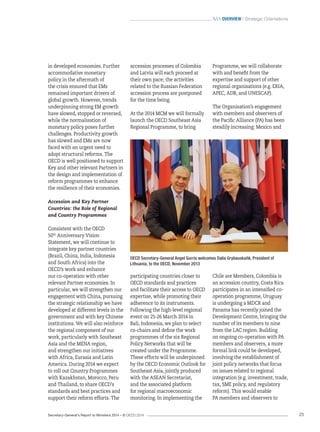
monitoring. In implementing the
Programme, we will collaborate
with and benefit from the
expertise and support of other
regional organisations (e.g. ERIA,
APEC, ADB, and UNESCAP).
The Organisation’s engagement
with members and observers of
the Pacific Alliance (PA) has been
steadily increasing: Mexico and
Chile are Members, Colombia is
an accession country, Costa Rica
participates in an intensified co-
operation programme, Uruguay
is undergoing a MDCR and
Panama has recently joined the
Development Centre, bringing the
number of its members to nine
from the LAC region. Building
on ongoing co-operation with PA
members and observers, a more
formal link could be developed,
involving the establishment of
joint policy networks that focus
on issues related to regional
integration (e.g. investment, trade,
tax, SME policy, and regulatory
reform). This would enable
PA members and observers to
OECD Secretary-General Angel Gurría welcomes Dalia Grybauskaitė, President of
Lithuania, to the OECD, November 2013
Secretary-General’s Report to Ministers 2014 – © OECD 201426
 oecd / Secretary-General’s Report to Ministers 2014
become more closely aligned with
OECD standards and strengthen
the impact of the Organisation in
the LAC region. The OECD-LAC
initiative, and the analytical work
and policy dialogue underpinning
the Latin American Economic
Outlook, could support and
complement these efforts.
The OECD has been working with
the Middle East and North Africa
(MENA) region since 2005, through
the MENA-OECD Initiative,
the SIGMA programme and,
more recently, the G8 Deauville
Partnership. Going forward,
the MENA-OECD programme
could co-operate more closely
with the countries from the
Gulf Co-operation Council (GCC)
through a sub-regional initiative,
encourage longer-term trade
and investment flows, and
help to generate sustainable
private sector-led growth. We
will continue to engage MENA
countries through initiatives,
like the Governance Programme
Training Centre of Caserta, aimed
at building capacity, improving
the efficiency and effectiveness
of public institutions, to promote
investment and good governance
in the region.
The OECD has longstanding
relations with Sub-Saharan
Africa through the work of
the Development Centre
and initiatives such as the
New Partnership for Africa’s
Development (NEPAD) and the
Sahel and West Africa Club
(SWAC). The time is ripe to take
this collaboration forward and
encourage Sub-Saharan countries
to move closer to OECD standards,
inter alia, by exploring the possible
creation of a regional programme
in co-operation with sub-regional
groups, including the Southern
African Development Community
(SADC) and the Economic
Community of West African
States (ECOWAS).
Following the request received
from and the latest exchanges
with Ukrainian authorities, the
OECD will strengthen its co-
operation with Ukraine to help the
government address the country’s
pressing policy challenges,
including on longstanding co-
operation issues like governance,
investment, competitiveness
and business environment.
Building on the existing Action
Plan for 2013-16, we will support
authorities’ efforts to work
closer with committees and
to enact the necessary policy
reforms. Membership in the
OECD Development Centre could
also be explored, given Ukraine’s
expressed interest.
Enhancing the Global
Dimension of the OECD’s
Work
In an increasingly
interconnected global economy
it is important to continue
strengthening international
policy co-ordination. Since
the Heiligendamm Summit in
2007, the OECD has been at the
forefront in providing analytical
support and policy advice to the
G8. As the crisis unfolded, and
as policy makers deal with its
aftermath, the OECD has become
an indispensable partner of the
G20, participating at all levels
in the Group. Over the past five
years, the OECD has deepened its
analytical contributions to the G8
and G20, working closely with the
troika presidencies to help shape
their respective agendas, and
providing evidence-based policy
analysis to support their work.
The result has been increased
visibility of OECD work and a
greater impact on the debates
and policy making of both
groups.
The OECD’s Role as
a Global Standard Setter
A critical element of the OECD’s
mission is to promote and
disseminate norms, standards
and best practices. We plan to
conduct a broad review of our
guidelines, instruments and
codes to determine where there
Daniel Kablan Duncan, Prime Minister of Côte d’Ivoire, at the OECD Africa Forum,
October 2013
Secretary-General’s Report to Ministers 2014 – © OECD 2014 27
 Overview / Strategic Orientations
is a need to update, supersede or
further disseminate them. Over
the coming years, the OECD will
further strengthen its role as an
international standard setter
and will also work on developing
new standards on emerging
issues, like investment, corporate
governance, and Internet
governance.
Transitioning to a Low-
Carbon Future
The OECD can make a
key contribution to better
understanding the risks of climate
change and identifying the
policies needed to mitigate and
manage these risks. Leveraging
its 20 years of experience, the
Organisation can offer Members
solid policy advice to elaborate
a mix of policy instruments that
can lead to the net elimination
of emissions to the atmosphere
from fossil fuels during the
second half of the century, in line
with the internationally agreed
goal of limiting the increase in
average global temperature to
2°C. In collaboration with the IEA,
NEA, and ITF, we will build on
our work on carbon pricing, fossil
fuel subsidies, tax exemptions
and regulatory and investment
policy to explore ways to align
policies in support of a clear, long-
term pathway to tackle climate
change. We will also explore
complementary measures to
accelerate technological change
and address the distributional
consequences of the necessary
economic transformation. These
efforts will support climate
change discussions in view of the
upcoming COP meetings in Lima
(2014) and Paris (2015).
The OECD will also continue
working to mainstream “green
growth”, as well as to better
integrate environmental
considerations into its economic
projections and horizon scanning
exercises. Significant efforts are
already being made and include
relevant chapters in the Economic
Surveys, Environmental Performance
Reviews, Innovation Reviews and
Investment Policy Reviews, as well
as the Green Cities Programme.
The challenge is to go a step
further, so that a green growth
framework permeates all levels of
the Organisation’s work.
The number of urban dwellers
is projected to reach 6 billion
by 2050. Globally, urban areas
contribute significantly to
national growth goals, and serve
as hubs in global trade and
innovation networks: “Getting
cities right” is a big step towards
addressing global social, economic
and environmental challenges.
We will continue to develop our
extensive evidence database on
regional development and multi-
level governance, and disseminate
best practices across levels
of government. In particular,
we will offer policy guidance
and tools in the area of public
governance and investment,
emphasising a “whole-of-
government” approach that
addresses the roles of different
levels of government in the design
and implementation of critical
and shared responsibilities.
The Recommendation on Effective
Public Investment across Levels
of Government, endorsed by the
TDPC Ministerial meeting on
5-6 December 2013 and adopted
by the Council on 12 March 2014,
will inform ministers’ discussion
at the 2014 MCM.
Disaster Risk Management
and Financing
Recognising the increasing
prevalence and severity of natural
and man-made disasters, we will
promote the Recommendation
on the Governance of Critical
Risks, working with governments
OECD Secretary-General Angel Gurría and Valdis Dombrovskis, Prime Minister of Latvia,
OECD headquarters, November 2013
Secretary-General’s Report to Ministers 2014 – © OECD 201428
 oecd / Secretary-General’s Report to Ministers 2014
The Strategy recognises
the importance of fostering
comprehensive, multi-
dimensional and inclusive
approaches to development to
unleash transformational change
and strengthen global resilience.
Future OECD efforts will be
guided by ministers’ discussions
of the Looking Ahead to Global
Development Beyond 2015: Lessons
Learnt from the Initial Implementation
Phase of the OECD Strategy on
Development and the 2014 Report
on the Implementation of the OECD
Strategy on Development, to be
presented at this year’s MCM.
The Knowledge Sharing Alliance
(KSA) is an integral part of the
OECD Strategy on Development.
The KSA, created in January
2013 with the support of Korea
and the German Ministry for
Economic Co-operation and
Development, aims to leverage
the OECD’s multi-disciplinary
expertise and engage emerging
and developing economies,
working closely with bilateral and
multilateral organisations that
our policy design experience,
methodologies and tools to better
understand the inter-linkages
between development and
economic growth, environmental
concerns, human well-being and
poverty eradication. The OECD
will also contribute to the post-
2015 development discussion
through its work on identifying,
monitoring and mobilising
financing for development, and
by improving the quality of our
measurement of development
co-operation and the design and
effectiveness of interventions. We
will also continue our work on Aid
for Trade.
The OECD Strategy on
Development has fostered a
more focused, issues-based
approach to policy coherence
for development. Key actors
among advanced, emerging
and developing economies are
engaged and work also addresses
common challenges such as
improving framework conditions
for achieving food security and
combatting illicit financial flows.
to implement comprehensive
risk management and mitigation
systems, and taking an “all
hazards” approach to risk
management. We will work on
disaster risk management and
financing to help communities
“bounce back” from disaster,
stronger and more dynamic than
before. The OECD Tohoku School
project, launched following the
2011 Great East Japan earthquake,
will continue to provide a powerful
illustration of how innovative
education and skills policies can
have a transformative impact on
communities as a whole.
The Strategy on
Development: Shaping the
post-2015 Development
Landscape
We will leverage our expertise
across the entire Organisation
and its constituencies to support
the post-2015 framework and its
financing. Aid remains a critical
element for many countries,
particularly least developed
countries and fragile states. OECD
work on development finance
will reflect this, while exploring
new measures of support for
development that reflect the
evolving development landscape.
The Global Partnership for
Effective Development Co-
operation will provide an
opportunity for an inclusive
range of actors to collaborate
and partner in new ways to
identify how to best support the
implementation of post-2015
targets. We will engage with the
different policy communities
to improve the relevance, value
added and impact of major
international processes, and share
OECD Secretary-General Angel Gurría and Benjamin Netanyahu, Prime Minister of Israel,
December 2013
Secretary-General’s Report to Ministers 2014 – © OECD 2014 29
 Overview / Strategic Orientations
Therefore, we will look to raise
the visibility and better connect
efforts around three initiatives:
a) the transition to a low carbon
economy; b) promoting long-term
investments; c) ageing unequally.
The OECD will also continue
to work on other cross-cutting
issues (e.g. innovation, green
growth, skills), capitalising on
its ability to address inter-linked
policy challenges. Horizontality
will gradually become the norm
in delivering our programme of
work.
Expanding the OECD’s
Strategic Foresight
We will reinforce the
Organisation’s forecasting and
strategic foresight capacity,
developing an “horizon‑scanning
network” to offer Members and
Partners a better understanding
of potential threats and
opportunities. This work will
also capitalise on the OECD
Perspectives on Global Development,
which pioneered the analysis
of shifting wealth and the
working collectively across the
Organisation.
Horizontality in the
Programme of Work
Analysing issues in a “horizontal”
and cross-cutting way is
increasingly the approach
followed by the OECD, driven by
the need to address the increasing
complexity, multi-dimensionality
and interconnectedness of
the policy challenges faced by
Members and Partners. This
approach also draws on the
expertise of directorates, as
well as on the accumulated
experience of the Organisation
and of member and partner
countries, across a wide spectrum
of policy areas. The OECD has
been working for some time on
policies related to climate change,
long-term investment, new
sources of growth, inequality and
demographic shifts. I believe the
time is right to raise the profile
of this work and emphasise
collaboration among different
parts of the Organisation.
have implementation capacities
on the ground.
The OECD will continue to
enhance inclusive knowledge
sharing and an effective
engagement with developing
countries, capitalising on its
Multi-Dimensional Country
Reviews and Policy Dialogue
networks. In this respect, the
Initiative on Global Value Chains
and Economic Transformation
and the Policy Dialogue on
Natural Resource-based
Development will continue to
play a crucial role in promoting
exchange of good practices and
peer learning among countries at
different levels of development.
Delivering the OECD’s
Corporate Products
Efficiently and Effectively
Cognisant of Members’ prevailing
challenging budgetary situation,
the OECD has launched a
corporate effort to continue
delivering high quality outputs,
while doing more with the
resources provided and working
smarter to provide even better
value for money for Members.
The Value for Money (V4M)
project involves a comprehensive
stock-taking of costs and
processes, aiming to improve
production processes and
efficiencies. It will encourage
innovative ideas and promote the
sharing of good practices linked
to efficiency gains and embed
a culture of cost consciousness
within the Organisation. Linked
to this, we will continue to
develop new and improved
ways to share information and
create knowledge and facilitate
Aloizio Mercadante, Minister of Education, Brazil, and Angel Gurría, Secretary-General of
the OECD, October 2013
Secretary-General’s Report to Ministers 2014 – © OECD 201430
 oecd / Secretary-General’s Report to Ministers 2014
to become increasingly targeted
along both thematic and national
lines.
In deploying its communications
strategy the OECD will aim
for: global reach, reflecting
the growing diversity of its
membership and increasing
interaction with partner
countries; competitive, unbiased
and authoritative analysis and
data; technological savoir faire,
offering increasingly efficient and
effective ways to engage with all
the OECD’s audiences; openness
and accessibility, offering publicly
available analytical content free of
charge; coherence and efficiency,
ensuring the maximum possible
impact in the dissemination of its
content.
In pursuing these objectives
we will build on our collective
expertise and working methods,
while improving the relevance,
effectiveness and efficiencies
of our committees’ work. We
will also continue to support
Members’ efforts to reach a
successful conclusion of the
OECD’s governance review.
My Strategic Orientations aim
to support member and partner
governments’ ability to improve
the daily lives of the greatest
number of people, and to bring
about shared prosperity and well-
being, consistent with our goal
of promoting “better policies for
better lives”. Our work has just
begun! 
ways to present our work in a
more targeted and timely way.
In tandem, we will explore how
to bring together our collective
knowledge through a virtual
“OECD Institute” portal.
The OECD relies on the
dissemination of its work to
ensure that its analysis and
findings have a broad impact on
policy makers, policy shapers,
and society at large, making its
communication strategy a critical
element to maximise its capacity
to influence the public debate
and shape policy challenges.
Our communication work will
rely on careful planning, while
at the same time preparing for
the unforeseen. Over the coming
years a number of major events
will contribute to shaping the
headlines. In some cases, these
events will offer opportunities for
the OECD to capitalise on media
attention; in others, they will
require redoubling our efforts
to ensure the coverage and
visibility of the Organisation’s
outputs. Among the events that
the OECD will take into account
for its communication planning
will be the elections in 11 OECD
and key partner countries (and
the European Parliament); the
G20 presidencies of Australia and
Turkey; China chairing APEC;
Myanmar chairing ASEAN; the UN
SG Leaders’ Summit on Climate
Change; the World Economic
Forum in Davos; and the Forum
of the Americas; as well as a
host of other events that will
attract global media attention.
The OECD’s Global Parliamentary
Network will continue to be a core
pillar of the OECD’s dissemination
work. This will be further
strengthened in the coming years,
interactions between the OECD,
emerging and developing
economies. We will also review
our forecasting processes to
develop our capacities for
scenario analysis and provide
real-time crisis management
and advice. As part of these
efforts, the OECD could establish
a surveillance mechanism to
analyse the vulnerabilities and
resilience of economies against
shocks, including by developing
early warning indicators,
in co-ordination with other
international efforts and building
on the OECD’s country review
process. The Organisation could
also explore relaunching the
International Futures Programme
(IFP) with a view to promoting
a better understanding of large
system changes, transformation,
and transition management,
through multi-stakeholder
dialogues that help us scale up
our knowledge and capacities.
Leveraging the OECD’s
Leaders Programme
and Sharpening
Communications
We will continue to develop
high impact platforms for
delivering timely, targeted
policy advice to the highest-level
officials, the Leaders Programme
and Better Policies series will be
instrumental in this regard.
Through the Leaders Programme,
we will consolidate the OECD
as the nexus where leaders
can obtain real-time, targeted
and comprehensive policy
analysis and offer a place to
convey important messages to
the international community.
We will also expand our Better
Policies Series to develop new
Secretary-General’s Report to Ministers 2014 – © OECD 2014 31
 Overview / Secretary-General’s activity in 2013
– the Secretariat and delegations – have also
benefitted from these visits through a programme
of public lectures, addresses to members of the
OECD Council and interactive policy seminars.
The Organisation’s media presence and coverage
has also remained consistently high following
the peak reached during the 50th
Anniversary in
2011, which was an exceptional year in terms
of visibility. In 2013, the Secretary-General was
quoted in over 1 100 articles and author of 19, up
sharply from only 6 articles authored in 2012. He
launched 40 outlooks and flagship publications
(up from 29 in 2012) and gave 259 speeches (up
from 220 in 2012) and marking a steady year-on-
year increase from only 84 in 2007.
The Organisation’s visibility took a number of
significant steps forward again in 2013. Total
dissemination of OECD content increased by
more than 38% to 16.6 million instances across
all publishing platforms (iLibrary, Google books,
etc.). Visits to the OECD website reached 16.4
million for all of 2013, the final four months of
the year registering a 23% increase in traffic
compared to the same period in 2012. The
Organisation’s presence in social media channels
also increased considerably through Twitter,
YouTube and Facebook, as well as Sina Weibo, the
largest social media platform in China.
Activity abroad
Of the Secretary-General’s 49 visits abroad, the
same as in 2012, 36 were to OECD countries, 4 to
key partner countries, 6 to accession countries
(5 of which were to the Russian Federation,
mostly related to Russia’s presidency of the
G20) and 3 to other non-member countries. This
means that the Secretary-General made an
average of almost one trip every week.
Overview
During 2013 the OECD Secretary-General
continued his very intense programme of
stakeholder engagement, both in Paris and
abroad, in order to advance the relevance and
visibility of the Organisation. The principal focus
of the Secretary-General in 2013 was on providing
timely and targeted policy advice and support
to member and partner countries in their efforts
to confront the enduring social and economic
legacies of the global financial crisis and ensuing
recession.
The Secretary-General carried out 49 trips abroad
in 2013 to promote the work of the Organisation.
This included his participation in the main
international summits that took place throughout
the year, particularly the G20, where the OECD
contributed very actively. In the course of 2013,
the Secretary-General held 40 meetings with
heads of state and government, 16 meetings
with Heads of international organisations and
238 meetings with ministers, not to mention
his numerous informal interactions with
leaders by phone and in the margins of the
international fora he attended. He also met
with top representatives from other branches of
government, the business community, unions
and civil society, totalling close to 1 000 bilateral
meetings over the course of the year.
While carrying out his regular management
and strategic duties, activities undertaken by
the Secretary-General in Paris during 2013 also
increased, both quantitatively and qualitatively.
The Leaders Programme has continued
its development, with 14 heads of state or
government visiting in 2013, firmly establishing
the OECD as a “go-to-place” for them while in
France. In addition to the Secretary-General’s
bilateral engagement, the wider OECD community
Secretary‑General’s
Activity in 2013
Secretary-General’s Report to Ministers 2014 – © OECD 201432
 OecD / Secretary-General’s Report to Ministers 2014
Visits to Member countries
During 2013, the Secretary-General made 36 visits
to member countries, i.e. 74% of his total trips
were abroad. Throughout the year, he visited
nearly two thirds of the OECD membership. The
Secretary-General also visited Brussels three
times during the year, where he attended high-
level meetings with the European Commission
and Parliament. He visited Austria, Germany, Italy,
Mexico, Switzerland, the United Kingdom and
the United States on more than one occasion, and
Canada, Chile, Finland, Greece, Iceland, Ireland,
Israel, Japan, Korea, the Netherlands, Norway,
Spain, Sweden and Turkey once.
These visits provided an opportunity to
strengthen the role the OECD plays in advising
member governments on dealing with the legacies
of the crisis. In some cases, the visits took place at
the request of governments to help move forward
their structural reform agendas. In other cases,
they offered an opportunity to present economic
surveys and other thematic reviews. In particular,
six Better Policies series brochures were presented
by the Secretary-General in 2013, coinciding with
his visits and meetings with leaders.
The Secretary-General also represented the OECD
and presented the Organisation’s latest work at
important international events hosted by member
countries, including the annual World Economic
Forum in Davos, the IMF/World Bank meetings
held in Washington and Tokyo, the G8 Summit in
Lough Erne (for which the Organisation supported
the UK presidency in all priority areas of tax, trade
and transparency), the St Petersburg International
Economic Forum and World Water Week in
Stockholm.
During every visit, the Secretary-General
presented relevant OECD work and was regularly
received by leaders and key members of
government. The main purpose of this activity
was to advance the OECD’s advisory role in
member countries, launch relevant OECD work,
increase the Organisation’s profile in key partner
economies and represent the Organisation at the
highest political level in important international
summits and conferences.
Figure 1. Secretary-General’s visits abroad
48
46
43
52
47
49
49
2007 2008 2009 2010 2011 2012 2013
Number of visits abroad
Visits to OECD countries
74%
Visits to Key Partner
countries
8%
Visits to Accession
countries
12%
Visits abroad
Visits to Non Member countries
6%
Better Policies Publications in 2013
France: Redresser la compétitivité, November 2013
The People’s Republic of China: Avoiding the middle-income trap – Policies for sustained and inclusive growth,
September 2013
Portugal: Reforming the State to Promote Growth, May 2013
The Russian Federation: Modernising the Economy, April 2013
Slovak Republic: Fostering an inclusive job-rich recovery, April 2013
Finland: Fit for the Future, February 2013
Secretary-General’s Report to Ministers 2014 – © OECD 2014 33
 Overview / Secretary-General’s activity in 2013
Republic of China (twice) and South Africa. To
support the Secretary-General’s activities, the
Deputy Secretaries-General also visited Russia
and the key partner countries on a number of
occasions. During his visits, the Secretary-General
presented specific work carried out by the OECD
on these economies, including economic surveys,
regulatory reviews and Better Policies brochures.
As well as his annual participation at the China
Development Forum from 22-26 March, the
Secretary-General returned to China from 4-6 June
to launch the OECD-FAO Outlook for 2013. He also
visited Colombia, Costa Rica, Lithuania and
Panama.
Activity in Paris
Figure 2. Secretary-General’s bilateral meetings
Leaders
4%
Ministers
25%
Senior Officials
28%
Ambassadors
17%
Parliamentarians
2%
Heads of IOs
2%
NGO
1%
Academics
3%
Business & Unions
2%
Other
16%
Total meetings in 2013
(Missions & Headquarters)
Leaders
2%
Ministers
14%
Senior Officials
31%
Ambassadors
23%
Parliamentarians
2%
Heads of IOs
2%
NGO
1%
Academics
3%
Business & Unions
1%
Other
21%
Meetings at OECD Headquarters in 2013
During his visits, the Secretary-General met with
key ministers of all countries, as well as with
leaders, including: Austrian Chancellor, Werner
Faymann; Chilean President, Sebastián Piñera;
Finnish Prime Minister, Jyrki Katainen; Greek
Prime Minister, Antónis Samarás; Icelandic Prime
Minister, Sigmundur Davíð Gunnlaugsson; Irish
Taoiseach, Enda Kenny; Israeli Prime Minister,
Benjamin Netanyahu; Italian Prime Minister,
Enrico Letta; Japanese Prime Minister, Shinzo
Abe; Korean President, Lee Myung-Bak; Mexican
President, Enrique Peña Nieto; Turkish Prime
Minister, Recep Tayyip Erdo an; Chinese Premier,
Li Keqiang; Colombian President, Juan Manuel
Santos; Costa Rican President, Laura Chinchilla
Miranda; Lithuanian Prime Minister, Algirdas
Butkevi ius; Panamanian President, Ricardo
Martinelli; and Russian President, Vladimir Putin.
The Secretary-General met regularly with
members of parliament in the countries he visited,
and attended the Parliamentary Assembly annual
debate of the Council of Europe’s in Strasbourg.
He also met with representatives from the private
sector, trade unions and civil society during his
trips abroad. Most of his visits featured public
events in which the Secretary-General had an
opportunity to address broader audiences and
share the OECD’s main messages with the general
public. During 2013, the Secretary-General was
also awarded the Gwangwha Medal for Diplomatic
Service by Korea and the Medalla Rectoral by the
University of Chile
Visits to Accession and Partner countries
The country the Secretary-General visited the
most was the Russian Federation, given the
Russian Presidency of the G20. In 2013, the OECD
strengthened its ties with the G20 further, having
participated actively in concrete deliverables and
preparatory activities organised by the Presidency.
The Secretary-General was invited to participate
in all high-level G20 meetings, including the four
meetings of finance ministers and Central Bank
Governors, a joint G20 meeting of the Finance and
labour ministers, the B20 Summit, and the G20 St
Petersburg Summit held on 5-6 September 2013.
During 2013, the Secretary-General also made
4 trips to key partner countries: Brazil, People’s
Secretary-General’s Report to Ministers 2014 – © OECD 201434
 oecd / Secretary-General’s Report to Ministers 2014
* This number includes an estimate of the traffic on OECD.org for the
period of January to May 2013.
Leaders and high-level visitors to the OECD
During 2013, the Secretary-General continued
to consolidate the OECD’s position as the “go-to
place” for leaders and relevant stakeholders while
in Paris 14 leaders visiting in 2013. These visits
now span the full year, not only during OECD
Week, which in 2013 featured both the Prime
Minister, Jens Stoltenberg and Crown Prince
Haakon of Norway, the MCM Chair, as well as 5
deputy prime ministers and 65 ministers, deputy
ministers, and state secretaries from OECD
member and partner countries. Other leaders
welcomed to the OECD in 2013 included French
President, François Hollande; Icelandic President,
Ólafur Ragnar Grímsson; Israeli President, Shimon
Peres; Slovakian Prime Minister, Robert Fico;
Portuguese Prime Minister, Pedro Passos Coelho;
Andorran Prime Minister, Antoni Martí; Costa
Rican President, Laura Chinchilla; Ivoirian Prime
Minister, Daniel Kablan Duncan; Kazakhstani
Prime Minister, Serik Akmetov; Latvian Prime
Minister, Valdis Dombrovskis; Lithuanian Prime
Minister, Dalia Grybauskaitė; and Russian First
Deputy Prime Minister Igor Shuvalov.
Regular meetings at the OECD
A great part of the Secretary-General’s activities
during 2013 was devoted to the regular exercise
of his management and strategic direction duties
within the Secretariat, as well as his chairing
of the OECD Council and interaction with
delegations. During the course of the year, the
Secretary-General held 168 bilateral meetings
with OECD ambassadors. He chaired 18 sessions
of the OECD Council, 4 meetings of OECD heads
of delegation, 5 meetings of the MCM Bureau
and 10 meetings with ambassadors and chairs
of standing committees. The Secretary-General
also delivered keynote remarks and participated
in the most important events hosted at the OECD,
including various conferences, global fora and
high-level committee meetings.
Communication and visibility
The OECD continued to expand its traditional
and social media presence during 2013, with the
timing and nature of press events and publication
launches frequently timed to complement major
international events, capitalising on the worldwide
media attention. Launching the Interim Economic
Assessment just ahead of the G20 Leaders’ Summit,
for instance, resulted in a 44% rise in coverage
compared with the previous autumn assessment.
The Secretary-General was at the forefront of
these enhanced outreach efforts. During 2013,
the Secretary-General delivered 259 speeches,
authored 19 articles or op-eds, and presented
40 OECD outlooks and flagship publications.
The Secretary-General was quoted in over
1 100 articles and gave 129 in-depth interviews
throughout the course of the year. He gave 48
interviews for the audio-visual media (radio, TV,
satellite feeds, webcasts, live coverage) from the
OECD studios and 81 interviews with national
media while on mission, of which 45 were audio-
visual and 36 with newspapers or news agencies.
He also did a large number of ad hoc interviews.
The Organisation published a total of 517 titles
during 2013, 377 of which were reports, and 138
statistical compilations. The number of press
releases increased to 245, compared with 226 in
2012. Around 50 press conferences were organised
in Paris and abroad, mainly designed to launch
OECD publications and reports. Overall, media
coverage for selected flagship publication launches
grew on average 81% compared with 2012, the
Migration Outlook and Health at a Glance registering
particularly marked increases. Besides such
flagship publications, the Secretary-General also
presented the economic surveys of many member
countries in their respective capitals, including
Austria, Chile, Greece, Ireland, Israel, Italy, Japan,
Switzerland and the UK, as well as in Key Partners
Brazil and China.
Dissemination of OECD content continued to
grow in 2013, with 16.6 million users accessing
OECD content through all publishing platforms
compared to 12 million in 2012. The number of
institutions accessing the OECD iLibrary now
exceeds 6 000 from 139 countries. OECD.org
received 16.4 million visits* and 51 million page
views in 2013. There were 3 significant peaks
Secretary-General’s Report to Ministers 2014 – © OECD 2014 35
 Overview / Secretary-General’s activity in 2013
presence on Sina Weibo, the largest social media
platform in China. The OECD’s Weibo account was
boosted by our collaboration with Xinhua and the
Development Centre during the Africa Economic
Forum in October. In July 2013, the OECD started
posting on LinkedIn, and had already gained
29 500 followers by end 2013. 
during the year: OECD Week in May; the launch
of PIAAC (Skills Outlook) in October; and the
launch of PISA Results in December. During the
last 4 months of 2013 there was a 23% increase
over 2012, mainly due to the launch of PISA. On
the PISA study launch day, there were a record
612 000 visits to OECD.org (10 times the average)
and more than 2 million page views. The OECD
also continued to work on the implementation
of the Accessible, Open, Free publishing reform
(Delta Programme), with a view to launching the
OECD Data Portal in June 2014.
Figure 3. Presence in traditional media
0
200
400
600
800
1000
1200
1400
2006 2007 2008 2009 2010 2011 2012 2013
Number of articles in which the SG is quoted
Number of quotes in the Media
The Better Life Index expanded its reach through
the new Russian and Spanish language versions.
The BLI site has also been made accessible to
mobile devices. Increased reach and accessibility
brought 1.7 million visits last year, increasing
traffic by 134% from 2012.
The OECD’s reach and influence on social media
also grew, with a 150% increase of OECD corporate
Twitter followers, and an increase in the number
of key opinion formers spreading OECD content
on social media platforms: “Likes” on the OECD’s
Facebook accounts increased by 50% over the
course of 2013, from 81 000 to 122 000. The
OECD’s Twitter accounts together reached 355 000
followers by end 2013, up from 272 000 in 2012. The
corporate Twitter account also ranks fairly high in
terms of number of followers (135 000 at end 2013):
we are 37th
highest in Paris, 196th
in France and
rank 11 607th
of all Twitter accounts in the world.
In terms of international organisations, we have
been rated in the top 20 out of 100 for number of
followers. In May 2013, the OECD began piloting its
Secretary-General’s Report to Ministers 2014 – © OECD 201436
 OecD / Secretary-General’s Report to Ministers 2014
Secretary-General’s
Cabinet
OECD Secretary-General
since June 2006,
Angel Gurría has reinforced
the OECD’s mission of
promoting “better policies
for better lives”. He is
fostering an open and
inclusive Organisation,
which is responsive to
Members’ and Partners’
needs in the current difficult
context. He has opened
the door to new members
and deepened links with
emerging economies.
Secretary-General Gurría
has strengthened the role
and impact of the OECD
as a supporter of best
practices and policy reform.
He has launched major
high-profile initiatives to
promote higher productivity
and inclusiveness such
as the OECD strategies on
Innovation, Green Growth,
Gender, Development, Skills
and Water. Most recently,
Mr. Gurría has launched
the New Approaches to
Economic Challenges
initiative, with the aim
of catalysing a process of
continuous improvement
of OECD analytical
frameworks and policy
advice.
Deputy Secretary-General
Yves Leterme, formerly
Prime Minister of
Belgium, was appointed
in December 2011. He
is in charge of Health,
Social and Welfare Policy,
Education, Governance
and Entrepreneurship,
and Gender Equality,
including gender
mainstreaming in the
Organisation. He oversees
a number of horizontal
projects, including Ageing
Unequally or Youth
Unemployment. He is also
active in strengthening the
relationships with other
International Organisations,
parliamentarians and civil
society (BIAC/TUAC), and
works to foster stronger
links with the European
Union. He also co-ordinates,
together with the Office
of the Secretary-General,
the preparations of the
annual Council meeting at
ministerial level.
Deputy Secretary-General
Rintaro Tamaki, formerly
Vice-Minister of Finance for
International Affairs at the
Ministry of Finance in Japan,
was appointed in August
2011. His portfolio includes
Environment, Green
Growth, Development,
Financial Affairs and Taxes
and the OECD horizontal
Strategy on Development.
Since March 2014, he also
oversees the Trade and
Agriculture Directorate and
macroeconomic issues,
serving as Acting Chief
Economist and G20 Finance
Deputy.
Secretary-General’s Report to Ministers 2014 – © OECD 2014 37
 Overview / Secretary-General’s cabinet
Mr. Pier Carlo Padoan
was Deputy Secretary-
General from June 2007 to
February 2014, when he
left the Organisation to
become Finance Minister
of Italy. Since December
2009 he also acted as Chief
Economist. Mr. Padoan was
the G20 Finance Deputy
for the OECD and led the
strategic response to the
financial and economic
crisis, as well as the Green
Growth and Innovation
Strategies. He also oversaw
Statistics, Trade and
Agriculture.
Deputy Secretary-General,
Ambassador William
Danvers, former Deputy
Chief of Staff for the
Secretary of State in the
United States, took up his
duties in September 2013.
In addition to the OECD’s
regional initiatives in
Southeast Asia, the MENA
region, Latin America
and Africa, he oversees
the accession processes
of candidate countries.
He also further develops
OECD work on investment,
competition and the fight
against corruption, as well
as on innovation, science
and technology, corporate
affairs and private sector
development.
Gabriela Ramos is Chief
of Staff of the OECD and
OECD Sherpa. Since 2006,
Mrs. Ramos has been
advising and supporting the
Secretary General’s strategic
agenda. She co-ordinates
the contributions of
the Organisation to
international governance
bodies such as the G20
and G8 and, along with
DSG Leterme, she oversees
the preparations of the
Ministerial Council Meeting.
Since 2012 she supervises
the New Approaches to
Economic Challenges
initiative.
Secretary-General’s Report to Ministers 2014 – © OECD 201438
 oecd / Secretary-General’s Report to Ministers 2014
policy proposals, to be presented
at our next meeting in 2014.
We welcome the role of the
Secretary-General in proposing
new initiatives, including in his
Strategic Orientations for OECD
for 2013 and beyond.
Unemployment is the biggest
challenge in many of our
countries. We underline the
importance of social dialogue
and strengthening the social
policy response to the crisis.
As the crisis has hit youth
particularly hard, we commit
On the occasion of the 2013 OECD
Ministerial Council Meeting
(MCM), we1
have assembled under
the Chairmanship of Norway
and the Vice-Chairmanship of
Australia and Estonia.
Over five years into the most
severe economic crisis of
our lifetimes, the recovery
continues to face a number
of challenges in our countries
and the social consequences
are grave. Our common goal
remains to achieve sustainable
and inclusive economic growth
acknowledging the need for
structural reforms and taking
into account social aspects in our
countries, notably the urgency to
reduce unemployment, address
inequalities and rebuild trust. We
will act together, and with the
assistance of the OECD, to put
our economies on the path to a
strong, sustainable and balanced
recovery. We welcome the initial
steps taken in developing the
New Approaches to Economic
Challenges initiative (NAEC),
and look forward to substantive
progress, including targeted
2013 Ministerial Council
Statement
1. Ministers and Representatives of Australia, Austria, Belgium, Canada, Chile, the Czech Republic, Denmark, Estonia, Finland, France, Germany,
Greece, Hungary, Iceland, Ireland, Israel, Italy, Japan, Korea, Luxembourg, Mexico, the Netherlands, New Zealand, Norway, Poland, Portugal, the Russian
Federation, the Slovak Republic, Slovenia, Spain, Sweden, Switzerland, Turkey, the United Kingdom, the United States and the European Union.
Family photo of the OECD Ministerial Council Meeting 2013
Secretary-General’s Report to Ministers 2014 – © OECD 2014 39
 Overview / 2013 Ministerial Council Statement
sustain and create high-quality
jobs in our countries.
We underscore the importance
of effective, efficient, fair and
transparent tax systems. We
are committed to countering
the erosion of tax bases and
also avoiding the risk of double
non-taxation. We adopt a
Declaration in support of the
OECD’s important work on
Base Erosion and Profit Shifting
(BEPS) – together with Argentina,
Brazil, Indonesia, the Russian
Federation and South Africa. We
encourage all jurisdictions to
join the multilateral Convention
on Mutual Administrative
Assistance in Tax Matters. We
call on all jurisdictions to move
towards automatic exchange
of information and to improve
the availability, the quality and
the accuracy of information on
beneficial ownership, in order to
effectively act against tax fraud
and evasion.
We reaffirm our commitment
to a rules-based, open trading
and investment system,
expanding markets and resisting
today to an OECD Action Plan for
Youth. Labour market activation
strategies, including for SMEs,
are needed to help people into
work. In addition, ensuring people
have the right skills is important
for employability, and we look
forward to the Skills Outlook
and the first OECD analysis of
Adult skills (PIAAC-study) to be
launched this coming October.
We also recognise the need for
greater inclusion of all parts of our
populations, including migrants,
in labour markets.
We recognise the importance
of addressing inequalities in
our societies, including their
implications for economic growth.
Key to this is providing equal
access to opportunities and
appropriate social protection
systems. We adopt the OECD
Council Recommendation
on Gender Equality in
Education, Employment and
Entrepreneurship, and commit
to deliver progress on gender
equality. We, furthermore,
encourage the OECD to strengthen
its work on inequalities under the
NAEC initiative.
We reaffirm our commitment to
rebuilding trust in governments,
markets and institutions,
strengthening financial
regulation, combating corruption,
promoting open government, and
ensuring transparency in policy
making. We welcome the forward
looking agenda of the OECD in
this regard.
We welcome the OECD’s analysis
and advice in the field of new
innovative sources of growth,
notably knowledge-based capital
and green growth, to better
protectionism in all its forms,
which is necessary for sustained
global economic recovery,
jobs and development. We
underscore our commitment
to achieving significant and
substantive outcomes at the
9th World Trade Organization
(WTO) Ministerial Meeting
later this year so as to create
momentum towards concluding
the Doha Round negotiations.
We share the objective that the
Bali package should encompass a
trade facilitation agreement and
agreement on some elements of
agriculture and development,
including issues of interest to
Least Developed Countries. We
note that these negotiations are,
as yet, not on a path that provides
confidence of success and we call
on all WTO members to work
with flexibility and realism to
achieve this goal.
We welcome the OECD’s work
on Global Value Chains (GVCs)
and on measuring Trade in Value
Added terms. GVCs are a powerful
driver of growth and productivity
and support job creation. We note
that trade facilitation measures
Sigbjørn Johnsen, Minister of Finance, Norway, Chair of the 2013 OECD Ministerial
Council Meeting, and Angel Gurría, OECD Secretary-General
Secretary-General’s Report to Ministers 2014 – © OECD 201440
 oecd / Secretary-General’s Report to Ministers 2014
conditions and process set out in
its Accession Roadmap.
We welcome the interest
expressed by a number of
countries to accede to the OECD;
this shows the continuing
relevance and impact of the
Organisation’s work and its
importance as a global and
flexible policy network. We
welcome the important decision
set out in the Council Resolution
on Strengthening the OECD’s
Global Reach to open accession
discussions with Colombia
and Latvia. We will review the
situation in due course, with a
view to taking a decision to open
accession discussions with Costa
Rica and Lithuania in 2015, and
in the intervening period, we will
work closely with these countries
to prepare for their future
accession processes. We invite the
Secretary-General to inform other
countries whose applications were
reviewed by the Council that their
applications for accession shall be
further considered individually.
We call upon the Council to carry
out a review of the governance
of the Organisation to meet
the challenges of an enlarged
OECD with a more global and
diverse membership, as set out
in the Council Resolution on
Strengthening the OECD’s Global
Reach.
Given the challenging budgetary
situation for Members, we
particularly welcome the
Secretary-General’s commitment
to providing value-for-money for
Members and maximising impact,
while delivering efficiencies, and
his commitment to open, free and
accessible data.
of coherence for development
as a global challenge. We look
forward to the upcoming analyses
on illicit financial flows and food
security as important areas under
the strategy in the coming year,
and the substantive report on the
implementation of the strategy to
the 2014 MCM.
We will continue to deepen our
relations with our Key Partners
(Brazil, China, India, Indonesia
and South Africa), and welcome
the Framework Agreement
signed with Indonesia. We launch
the new regional programme
for Southeast Asia and ask the
Secretary-General to report back
on progress at our next meeting.
We welcome the role the OECD is
playing at the global and regional
level, including in the context of
the G8 and the G20.
We reiterate our desire to see the
Russian Federation complete its
accession in line with the terms,
would better allow both developed
and developing countries
to take advantage of GVCs.
Services are key to the efficient
operation of GVCs, giving services
liberalisation greater importance.
We look forward to the results of
the OECD’s work on services trade
restrictiveness, to be presented
at the 2014 MCM. We call on the
OECD to do further analysis of the
relationship between GVCs and
jobs and income as well as how to
make GVCs accessible to all.
We welcome the progress
that has taken place since we
endorsed the Development
Strategy in strengthening and
mainstreaming development
aspects into the work of the
Organisation. We welcome the
OECD’s efforts to ensure, through
its multidisciplinary work, that
broader policies contribute
to equitable and sustainable
economic development in the
world, recognising the importance
Angel Gurría, OECD Secretary-General, Johann N. Schneider-Amman, Head of the Federal
Department of Economic Affairs, Education and Research, Switzerland, and Philipp
Rösler, Federal Minister of Economics and Technology, Vice-Chancellor of Germany
Secretary-General’s Report to Ministers 2014 – © OECD 2014 41
 Overview / Ministerial Council Meeting 2013: Chair’s summary
to continue to pursue and
strengthen work on structural
reforms, activation policies
and targeted support for the
most vulnerable in the labour
market. They agreed that such
a strategy would not only need
to focus on job creation, but also
job quality. In order to avoid the
risk of a lost generation, they
committed to an Action Plan,
“Giving Youth a Better Start”,
It’s All About People:
Jobs, Equality and Trust
Ministers welcomed
OECD analysis and policy
recommendations in relation
to Jobs, Equality and Trust and
highlighted the important role
of social partners and dialogue
in tackling the social aspects of
the crisis. To boost employment,
they called for the Organisation
Ministers from OECD countries,
joined by Ministers and
representatives from the Russian
Federation and from Brazil, the
People’s Republic of China, India,
Indonesia and South Africa,
met under the Chairmanship
of Norway and the Vice-
Chairmanship of Australia and
Estonia on 29-30 May 2013 under
the title “It’s All About People:
Jobs, Equality and Trust”.
Ministers highlighted the still
challenging global economic
environment. They stressed
the urgent need to address the
social impact of the crisis and
to put people at the centre of
their policy efforts. Although
conditions vary across countries,
many face important challenges,
such as the urgent need to restore
growth and competitiveness,
to reduce unemployment, in
particular among the youth and
long-term unemployed, to rebuild
confidence, to address inequalities
and to boost job quality. They
also underlined the importance
of addressing a number of global
challenges, including the further
deepening of globalisation,
poverty, rapid population ageing,
migration, climate change,
growing natural resource scarcity
and a global economy based on
knowledge and skills.
Ministerial Council Meeting 2013
Chair’s summary
Angel Gurría, OECD Secretary-General, and Jens Stoltenberg, Prime Minister of Norway
Secretary-General’s Report to Ministers 2014 – © OECD 201442
 oecd / Secretary-General’s Report to Ministers 2014
context, Ministers committed to
the policy recommendations on
the Social Policy Responses to the
Crisis and asked for more work
on designing policy approaches
to address both immediate
social and fiscal concerns in the
context of longer-term structural
challenges. Ministers underlined
the importance of promoting
equal opportunities for all. They
discussed the importance of
promoting gender equality and
adopted the Recommendation of
the Council on Gender Equality
in Education, Employment and
Entrepreneurship.1
They agreed to
monitor and benchmark progress
with respect to implementation of
the Recommendation and report
back as foreseen.
the launch of the next round of
the Programme for International
Student Assessment (PISA).
Ministers called on the OECD to
continue to pursue its analysis on
inequality to promote inclusive
growth. They emphasised the
urgent need to tackle growing
income and social inequalities.
Ministers asked the OECD to
strengthen its efforts to look
at the interactions between
macroeconomic, labour market
and social policies. This would
support the development of
policies to promote the creation
of productive and rewarding
jobs and adequate protection
for low-income families and
other vulnerable people. In this
which includes concrete policy
recommendations to strengthen
education and Vocational
Education and Training systems,
ensure a better transition
to work, introduce targeted
support for the most vulnerable
youths and facilitate access to
training and employment. They
called on the OECD to report
back on progress to the MCM
2014. They also emphasised
the important role of skills and
called on the OECD to build on
the Skills Strategy through the
ongoing development of skills
strategies at the national and
local levels, the Skills Outlook
(including the Programme for
the International Assessment of
Adult Competencies, PIAAC) and
His Royal Highness Crown Prince Haakon of Norway and Angel Gurría, OECD Secretary-General, at the 2013 OECD Forum
1. The Russian Federation and Latvia also adhered.
Secretary-General’s Report to Ministers 2014 – © OECD 2014 43
 Overview / Ministerial Council Meeting 2013: Chair’s summary
also welcomed a number of OECD
and non-OECD countries signing
or depositing their instruments
of ratification to the Convention
on Mutual Administrative
Assistance in Tax Matters and
encouraged those countries that
had signed the Convention to
move quickly to ratify it. Ministers
called on all jurisdictions to move
towards automatic exchange
of information and to improve
the availability, the quality and
the accuracy of information on
beneficial ownership, in order to
effectively act against tax fraud
and evasion.
The Secretary-General’s
Strategic Orientations
and New Approaches to
Economic Challenges
Ministers welcomed the
Secretary-General’s Strategic
Orientations and progress
made on the New Approaches
to Economic Challenges (NAEC)
initiative. They highlighted the
important role the Secretary-
efforts to combat corruption and
foreign bribery.
Ministers highlighted the
importance of restoring fairness
and confidence in tax systems,
including by acting against tax
fraud and evasion. Ministers
welcomed recent work on Base
Erosion and Profit Shifting (BEPS)
and adopted a Declaration on
BEPS, along with the Russian
Federation, as well as Brazil,
Indonesia, South Africa and
Argentina, that calls on the OECD
to develop a comprehensive
Action Plan to revise the
international tax rules to prevent
companies from artificially
shifting profits to locations
where they are subject to more
favourable tax treatment. Working
with the G20, the OECD will
develop a comprehensive Action
Plan to provide countries with the
information, the analysis, the best
practices, recommendations and
international instruments needed
to adapt their tax systems to
the business practices of the 21st
century. In this context, Ministers
As governments seek to restore
long-term growth potential and
to address the social impact
of the crisis, they also face a
significant challenge to restore
the trust of citizens and markets
in the ability of governments to
address current challenges and
implement reforms that will
deliver fair and resilient growth.
Ministers discussed the urgent
need to build more effective,
transparent and open institutions
to regain the trust of citizens.
They welcomed the agenda on
“Trust in Government: Evidence,
Policies and Decision Making” and
called on the OECD to strengthen
its efforts in this area, building on
existing OECD work on integrity
and governance. Ministers
underlined that a “smart” state,
open government, transparency
and cohesive societies are all
important aspects. Ministers also
highlighted the importance of
work to build confidence and trust
in the private sector, including in
the areas of corporate governance,
long-term investment, SME
finance, consumer policy, and
Angel Gurría, OECD
Secretary‑General, and
Yoonsun Cho, Minister of
Gender Equality and Family,
Korea
Secretary-General’s Report to Ministers 2014 – © OECD 201444
 oecd / Secretary-General’s Report to Ministers 2014
draw lessons from the crisis and
update its analytical frameworks
to help policy makers confront
the new economic realities and
the long-term challenges ahead.
They also highlighted the need
for NAEC to promote a broader
notion of growth – one that
does not neglect the need to
resume growth but at the same
time considers other important
outcomes such as well‑being,
inclusiveness, and environmental
sustainability. Ministers
highlighted the importance of
dealing with competing policy
objectives and trade-offs and of
exploiting policy synergies. They
also stressed the importance
of institutions and governance
and the policy challenges posed
by long-term global trends.
They called for the process to
be open, inclusive and focused.
As outlined in the governance
framework, the Economic Policy
Committee has a central role in
this undertaking but, considering
its multi-disciplinarity, its success
crucially depends on the strong
ownership and participation of
other committees, which is the
case today. They looked forward
to substantive progress, including
targeted policy proposals to be
presented at the next Ministerial
Meeting in 2014.
Trade: Making Global
Value Chains Accessible
to All
Ministers reaffirmed their
commitment to a transparent,
rules-based multilateral trading
system. They reaffirmed their
commitment to expanding
markets, and to resisting trade
and investment protectionism
Strategy and the Innovation
Strategy. Ministers called on
the Secretary-General to help
countries build more effective
and transparent institutions to
rebuild confidence and trust in
government, including through a
focus on making reform happen
and continued work on anti-
corruption. They applauded the
progress made by the OECD to
become a “more effective and
inclusive global policy network”,
highlighting, in particular, the
OECD’s strong track record in
providing support to the G20.
Ministers welcomed the Interim
Report on the New Approaches
to Economic Challenges (NAEC)
initiative and congratulated the
Secretary-General on the progress
made. Ministers noted that NAEC
is a very timely and important
initiative and an important
opportunity for the OECD to
General is playing in increasing
the impact of the OECD and
promoting inclusiveness and
implementation. They called
on him to further harness the
multidimensional nature of the
organisation to better support
members and Key Partners.
Ministers emphasised the central
role of the OECD in providing
tailored policy analysis and
advice, in particular in the area
of structural reforms. They
highlighted the importance
of analysis on new innovative
sources of growth, such as green
growth, knowledge-based capital
and global value chains, and new
ways of addressing tax issues,
including through the initiative
on Base Erosion and Profit Shifting
(BEPS). Furthermore, they called
on the Organisation to strengthen
its horizontal projects, including
the Skills Strategy, Development
Strategy, Green Growth
Karl Viktor Erjavec, Minister of Foreign Affairs of Slovenia, and Angel Gurría,
OECD Secretary-General
Secretary-General’s Report to Ministers 2014 – © OECD 2014 45
 Overview / Ministerial Council Meeting 2013: Chair’s summary
Ministers underlined the
importance of efficient services
sectors and the further
liberalisation of trade in services
as exemplified by the GVC work,
and reiterated their keen interest
in the results of the OECD’s work
on services trade restrictiveness
(STRI), to be presented at the
2014 MCM. Furthermore, they
emphasised the role of the OECD
in promoting an open global trade
regime.
Ministers underscored their
commitment to significant and
substantive outcomes at the
WTO Ministerial Meeting in
Bali in December 2013. They
shared the objective that the Bali
package should encompass a
trade facilitation agreement and
agreement on some elements of
agriculture and development,
including issues of interest to
Least Developed Countries. They
expressed concern that these
negotiations are, as yet, not on a
path that provides confidence of
success. They called on all WTO
members to work with flexibility
and realism to achieve this goal.
Ministers also discussed the
relationship between regional
trade agreements and the
multilateral trading system,
and highlighted the need to
prepare for multilateralism while
negotiating regional agreements.
Ministers stressed the importance
of promoting responsible business
conduct, including through the
effective implementation of the
OECD Guidelines for Multinational
Enterprises. Ministers agreed
that the OECD is well placed to
promote responsible business
conduct and called on the
organisation to use the first Global
countries to take advantage of
GVCs. In this context, they also
underlined the role of a more open
and transparent environment for
trade and investment as part of
effective structural and regulatory
reforms for strong, balanced and
sustainable growth. Ministers
highlighted the considerable
benefits resulting from trade
facilitation and strongly endorsed
the OECD’s work in this area,
which also highlights the
practical actions that countries,
both developed and developing,
can take to realise available
benefits. Ministers highlighted
the importance of Aid for Trade
in this area to help countries
to undertake relevant reforms
regarding trade facilitation and
to better integrate global value
chains.
in all its forms, including
through standstill and roll back
commitments so as to achieve
global economic recovery, jobs
and development. Ministers
welcomed the new OECD report
on “Interconnected Economies:
Benefiting from Global Value
Chains (GVCs)”, and expressed
strong support for ongoing
OECD work measuring Trade
in Value Added Terms (TiVA).
They underscored the policy
implications from this work
and highlighted the importance
of further liberalisation of
trade in goods and services,
the implementation of trade
facilitation measures, the
promotion of investment, and
the convergence of regulatory
standards which will better allow
both developed and developing
Maria Fekter, Minister of Finance, Austria, and Angel Gurría, OECD Secretary-General
Secretary-General’s Report to Ministers 2014 – © OECD 201446
 oecd / Secretary-General’s Report to Ministers 2014
Ministers reiterated the
importance of making the OECD
a more effective and inclusive
global policy network, as outlined
in the OECD 50th
Anniversary
Vision Statement, by further
expanding its global reach,
policy impact and relevance.
They welcomed the increased
engagement and dialogue with
Key Partners (Brazil, China,
India, Indonesia and South
Africa) in OECD policy work
and committees, including the
Programme for International
Student Assessment (PISA),
the Policy Framework for
Investment (PFI) and other
OECD instruments, as well as
horizontal OECD projects such
as the Green Growth Strategy.
They called on the Organisation
to make co-operation more
systematic and institutionalised,
including through more formal
arrangements. In this regard
they welcomed the Framework
Agreement with Indonesia and
encouraged other Key Partners
financial flows and stressed its
relevance for all countries to
promote sustainable and inclusive
growth. They encouraged efforts
to provide targeted policy advice,
including through the multi-
dimensional country reviews and
welcomed the new Knowledge
Sharing Alliance and other
innovative instruments for policy
dialogue in a spirit of equality and
mutual benefits. This includes
work on global value chains
and natural resource-based
economies. Ministers called on
the OECD to continue contributing
to international efforts such as
the Busan Global Partnership
for Effective Development
Co‑operation, the post-2015
development framework, and
the G20. Ministers asked the
OECD Secretariat to develop
robust indicators and further
strengthen its monitoring and
evaluation efforts and to present
a substantive report on the
implementation of the strategy at
the next MCM in 2014.
Forum on Responsible Business
Conduct in June 2013 to discuss
these issues further.
OECD Partners and
Strategy on Development
Ministers welcomed progress
made on the implementation
of the OECD Strategy on
Development and appreciated
the efforts to strengthen
co‑operation with developing
countries by capitalising on the
OECD’s wide-ranging policy
expertise. They acknowledged
progress on mainstreaming
development in core work such
as trade and investment, green
growth, education and tax policy,
among others, and stressed the
importance of further addressing
jobs, equality and trust in
partner countries. Ministers also
welcomed the new impetus for
policy coherence for development,
particularly on major challenges
such as food security and illicit
Angel Gurría, OECD Secretary-General,
and Eamon Gilmore, Tánaiste (Deputy
Prime Minister) and Minister for Foreign
Affairs and Trade, Ireland
Secretary-General’s Report to Ministers 2014 – © OECD 2014 47
 Overview / Ministerial Council Meeting 2013: Chair’s summary
Latin America, the MENA region,
Sub-Saharan Africa, Eurasia and
Central and Eastern Europe.
Ministers reiterated their
willingness for the Russian
Federation to become a member
of the OECD. They welcomed
their increased engagement with
the OECD and called for them to
further their efforts to close the
still substantial gaps between
OECD standards and Russia’s
laws, policies and practices. In
this context, Ministers stressed
the importance of maintaining all
OECD standards and values.
Ministers welcomed the
decision to embark on a new
round of accessions as set out
in the Council Resolution on
Strengthening the OECD’s Global
Reach. They welcomed this
carefully crafted Resolution
in this important region. They
asked the Secretary-General
to report back on progress at
the MCM in 2014. They also
encouraged the Secretariat to
strengthen other OECD regional
initiatives, including those with
to follow the same structured
approach. Furthermore, Ministers
expressed appreciation for the
increased engagement of a larger
number of countries in OECD
Forums and OECD instruments
such as the BEPS Declaration
and the Global Forum on
Transparency and Information
Exchange for Tax Purposes. They
welcomed the Framework for
the Establishment of Country
Programmes and encouraged a
dialogue with partner countries to
frame priorities based on mutual
interests.
Ministers launched a new
regional programme for
Southeast Asia, which is a region
of strategic interest and priority,
as outlined in the 2007 MCM
Resolution. They welcomed
that this programme will offer
a renewed and targeted OECD
effort to work with countries
and regional organisations in
this region, to exchange policy
perspectives and develop
common understandings of
joint policy challenges as well
as promoting OECD standards Luc Frieden, Minister of Finance, Luxembourg, and Angel Gurría, OECD Secretary-General
Angel Gurría, Secretary-General of the OECD, and Yannis Stournaras, Minister of Finance
of Greece, May 2013
Secretary-General’s Report to Ministers 2014 – © OECD 201448
 oecd / Secretary-General’s Report to Ministers 2014
open its standards to non-
member countries, including
through their participation
in OECD bodies, and consider
the views and experiences of
emerging economies in their
development.
Ministers welcomed the OECD’s
contribution at the regional and
global level, including in the
context of the G8, the Deauville
Partnership and the G20, which
covers a range of issues including
tax, trade, transparency, anti-
corruption, investment and
development. They underscored
that this constitutes an important
part of the work of the OECD as
it leverages OECD analysis and
advice to the mutual benefit of
Members and Partners and to
support international policy
co‑ordination. They commended
the Secretary-General for his
tireless and effective efforts
in ensuring the relevance of
OECD work in these and other
international fora. Ministers
also encouraged the OECD to
continue to contribute to other
international processes, such as
the UNFCCC negotiations, and
asked for an update on the OECD’s
work on climate finance and
investment at the 2014 MCM.
Ministers looked forward to
Japan’s Chairmanship of the
Ministerial Council Meeting on
6 and 7 May 2014 on the occasion
of its 50th
Anniversary as a
member of the OECD. 
More information about the
OECD’s Ministerial Council
Meeting 2013 is available at:
www.oecd.org/mcm
have their say. At the same time,
Ministers called on the OECD to
begin a governance review and
report on progress at the next
MCM in 2014.
Ministers reaffirmed the OECD’s
role as a global standard-setter.
They called on the Organisation
to proactively update and upgrade
its existing standards and respond
to any gaps in global standard
setting where appropriate. They
highlighted the need to further
inviting Colombia and Latvia
to begin accession discussions
this year, and agreed to review
the situation in due course, with
a view to taking decisions to
open accession discussions with
Costa Rica and Lithuania in 2015.
They also agreed that the other
applications reviewed shall be
further considered individually.
Ministers called for the OECD
to now work on roadmaps to
advance this process and recalled
that all relevant committees will
Angel Gurría, OECD Secretary-General, and Ildefonso Guajardo, Minister of Economy, Mexico,
during the Minister’s official visit to the OECD, November 2013
Secretary-General’s Report to Ministers 2014 – © OECD 201450
 OECD / Secretary-General’s Report to Ministers 2014
* Mr. Magwood will take up his duties on 1st
September 2014.
Organisation chart
www.oecd.org/organisationchart
Development Centre
Mario Pezzini
Director
SECRETARY-GENERAL
Angel Gurría
Nuclear Energy
Agency
William Magwood*
Director‑General
International Energy
Agency
Maria van der Hoeven
Executive Director
DEPUTY SECRETARIES-GENERAL
Economic Affairs  Strategic Issues
William Danvers
Global Relations
Rintaro Tamaki
Policy Coherence
Yves Leterme
Social Policy and Governance
OFFICE OF THE SECRETARY-GENERAL
Gabriela Ramos, OECD Chief of Staff and
OECD Sherpa, NAEC
Global Relations Secretariat
Marcos Bonturi, Director
Directorate for Legal Affairs
Nicola Bonucci, Director
Accession Co-ordinator
Public Affairs and Communications
Anthony Gooch, Director
Internal Audit and Evaluation
Lucy Elliott, Director
Council and Executive Committee Secretariat
Patrick van Haute, Director
GENERAL SECRETARIAT
SPECIAL BODIES
Secretary-General’s Report to Ministers 2014 – © OECD 2014 51
 Overview / Organisation chart
Financial Action Task
Force
Rick McDonell
Executive Secretary
Africa Partnership
Forum
David Batt
Director
Economics
Department
Rintaro Tamaki
Acting Chief
Economist
Development Co‑
operation Directorate
Jon Lomoy
Director
Directorate for
Employment, Labour
and Social Affairs
Stefano Scarpetta
Director
Directorate
for Education
and Skills
Andreas Schleicher
Acting Director
Centre for
Entrepreneurship,
SMEs and Local
Development
Sergio Arzeni
Director
Environment
Directorate
Simon Upton
Director
Directorate for
Financial and
Enterprise Affairs
Carolyn Ervin
Director
Executive Directorate
Anthony Rottier
Director
Directorate for
Public Governance
and Territorial
Development
Rolf Alter
Director
Statistics Directorate
Martine Durand
Director
Trade and
Agriculture
Directorate
Ken Ash
Director
Directorate for
Science, Technology
and Industry
Andrew Wyckoff
Director
Centre for Tax Policy
and Administration
Pascal Saint-Amans
Director
Multilateral
Organisation
Performance
Assessment Network
Björn Gillsäter
Head of Secretariat
Sahel and West
Africa Club
Laurent Bossard
Director
International
Transport Forum
José Viegas
Secretary-General
May 2014
DIRECTORATES
SPECIAL ENTITIES
KEY ACTIVITIES
Secretary-General’s Report to Ministers 2014 – © OECD 201454
 oecd / Secretary-General’s Report to Ministers 2014
Co‑operation across different policy areas is increasingly a defining feature of the
OECD’s work, with Directorates and Committees regularly exploring possible linkages
to strengthen planned deliverables and to reinforce expected outcomes. The Secretary-
General has consistently encouraged this trend and sought to strengthen collaboration
to produce analysis and policy recommendations that offer a “whole-of-OCDE” approach.
Member countries have welcomed this new emphasis on “horizontality”, recognizing
the contributions that the multidisciplinary nature of the OECD can bring to help them
address the policy challenges they face.
Even as “horizontality” becomes a staple feature of the OECD’s work, our expectation is
that the number of horizontal projects active at any time will remain stable – between
two and four during any given year – reflecting ongoing prioritization efforts across the
Organisation. At the same time, we will continue to work on previously mainstreamed
horizontal projects and other cross-cutting initiatives, with outputs being delivered across
the entire Programme of Work.
“Go horizontal” – OECD projects
and themes to better respond to
interconnected policy challenges
Secretary-General’s Report to Ministers 2014 – © OECD 2014 55
 Key activities / Horizontal Projects
NAEC Unit
E-mail: naec@oecd.org
The New Approaches to Economic Challenges (NAEC) initiative was launched at the 2012 Ministerial Council Meeting
as an Organisation-wide reflection process to draw lessons from the crisis, with the aim of catalysing a process of
continuous improvement of OECD analytical frameworks and policy advice.
The ultimate objective of NAEC is to develop a strategic agenda for inclusive and sustainable growth. To do so,
NAEC has first reflected on the lessons from the crisis, identifying areas where our analytical frameworks need to
be adjusted and examining the potential for mainstreaming new economic tools and approaches. Second, NAEC
recognises the importance of economic growth as a means, rather than as an end, of policy making, by focusing on
well‑being. Third, NAEC aims to improve our understanding of the complex and interconnected nature of the global
economy and find better ways to deal with policy trade-offs and synergies. Fourth, NAEC supports governments in
identifying, prioritising and combining reforms to support sustainable, green and inclusive growth. This involves
upgrading regulatory and institutional capacities, as well as rebuilding trust in governments.
The co-ordination of the initiative is ensured by the NAEC Co-ordinator in the Office of the Secretary-General (OSG),
under the supervision of the Chief of Staff, but the work engages all areas and committees in the house. The NAEC
Group comprises representatives from OECD member and partner countries, policy committees, as well as the
Business and Industry Advisory Committee (BIAC) and Trade Union Advisory Committee (TUAC), and is chaired
by the OECD Secretary-General.
A NAEC Seminar Series discusses progress and results in NAEC projects as well as new innovative research that can
provide inspiration for developing new approaches. A new public website informs the public and NAEC stakeholders
about progress and deliveries from the NAEC projects. An interim synthesis report highlighting emerging policy
recommendations from NAEC projects and providing guidance for OECD work going forward will be discussed at
the 2014 MCM. 
For more information, see: www.oecd.org/naec
New Approaches to Economic
Challenges (NAEC)
Key publications
•	 NAEC framework paper and NAEC mandate, May 2012
•	 Background note for the first meeting of the NAEC
Group on 24 October 2012
•	 Interim Report to Ministers, May 2013
•	 MCM 2014 Synthesis, May 2014
Key events
•	 First meeting of the NAEC Group, Paris,
24 October 2012
•	 Second meeting of the NAEC Group, Paris,
11 February 2013
•	 Third meeting of the NAEC Group, Paris,
5 December 2013
•	 Fourth meeting of the NAEC Group, Paris,
7 February 2014
Secretary-General’s Report to Ministers 2014 – © OECD 201456
 oecd / Secretary-General’s Report to Ministers 2014
Inclusive Growth
The OECD Inclusive Growth (IG) Initiative was launched in 2012 and builds on the OECD’s work on well-being,
income distribution and pro-growth structural reforms.
As part of NAEC, the IG Initiative is about better understanding the distributional consequences of structural
policies, as well as identifying synergies and trade-offs among policy actions that can promote growth and ensure
a better distribution of its benefits among social groups. IG is also about dealing with the multi-dimensional nature
of growth so that the effects of policies can be gauged, not only in terms of greater material prosperity but also in
terms of outcomes for the various aspects of life that matter for people’s well-being, such as health and jobs. In
other words, the IG Initiative is three-pronged: it is multi-dimensional, focused on distributional consequences of
pro-growth policies, and policy-actionable.
The Initiative is being led by the Office of the Secretary-General, but the work engages the full range of OECD
directorates and bodies, the Business and Industry Advisory Committee (BIAC), the Trade Union Advisory Committee
(TUAC), as well as an informal Advisory Group of leading international experts.
Over the last year, international conferences and regional/national consultations took place in Paris and New York,
in co‑operation with the Ford Foundation; in Chile, in co-operation with the United Nations Economic Commission
for Latin America and the Caribbean (ECLAC); and in China, in co‑operation with the National Development and
Reform Commission (NDRC). A meeting of the informal Advisory Group was held in Paris, and various technical
seminars, including as part of the NAEC seminar series, were organised.
In order to provide information to the public, the Inclusive Growth website informs interested parties about the
Initiative’s progress and the concrete achievements it has delivered thus far. See www.oecd.org/inclusive-growth. 
Key publications
•	 All on Board: Making Inclusive Growth Happen, May 2014
•	 The OECD Framework for Inclusive Growth, May 2014
•	 Session, opinion and summary notes for Inclusive Growth consultations (April 2013, November 2013, December
2013, February 2014, March 2014), available online: www.oecd.org/inclusive-growth
Key events
•	 First OECD/Ford Foundation Workshop on Inclusive Growth, Paris, 3 April 2013
•	 OECD/ECLAC Regional Consultation on Inclusive Growth in Latin America and the Caribbean, Santiago, 	
14‑15 November 2013
•	 First Meeting of the Informal OECD Advisory Group, Paris, 13 December 2013
•	 Second OECD/Ford Foundation Workshop on Inclusive Growth: “Changing the Conversation on Growth: Going
Inclusive”, New York, 27 February 2014
•	 OECD/NDRC Seminar: “Urbanisation and Inclusive Growth in China”, Beijing, 24 March 2014
Secretary-General’s Report to Ministers 2014 – © OECD 2014 57
 Key activities / Horizontal Projects
The Strategy on Development
Development has always been at the core of the OECD mission. In 2012 ministers endorsed the OECD Strategy on
Development, mandating an even more comprehensive approach to development. The Strategy is evolutionary
in nature and recognises the need for the Organisation’s work on development to be more responsive to global
realities. It aims to support Members and Partners in identifying effective solutions and creating the conditions
and capacities for sustainable and inclusive growth and development.
The first two years of the Strategy’s implementation have laid the foundation for a more collaborative approach
across the Organisation. It has focused on: executing the initial projects and deepening work on the cross-cutting
areas as set out in the annex to the Strategy; fostering coherence for development and more inclusive knowledge
sharing; and enhancing the OECD’s contributions to global processes and partnerships.
In line with the Strategy, policy dialogue and knowledge-sharing activities with countries at different levels of
development have been strengthened to promote more effective engagement. Innovative initiatives such as the
Multi-dimensional Country Reviews (MDCRs), the Policy Dialogue networks on global value chains and development
and on natural resource-based development, and the Knowledge Sharing Alliance, have been launched. They will
support OECD’s efforts to deepen understanding of major global trends, support partner country reform efforts
and contribute to adapting OECD’s analytical frameworks and tools.
The Strategy promotes a broader approach to policy coherence for development (PCD). Applying a “PCD lens” to
work on global food security, illicit financial flows and green growth shows that greater coherence at different levels
(local, national, regional, global) is critical for dealing with systemic conditions that constrain development. It also
shows the importance of involving a wide range of stakeholders (governments, private sector, CSOs) to identify
synergies across economic, environmental and social policy areas to create conditions conducive to development.
With regard to global processes, the Organisation is contributing to the UN-led deliberations on a post-2015
development agenda by leveraging its multidisciplinary expertise. As the traditional guardian of statistics on
Official Development Assistance (ODA), the OECD is also contributing to the post-2015 process through its work
on modernising the definitions and measurement of external development finance.
Together with the UNDP, the OECD is supporting the post-Busan Global Partnership for Effective Development Co-
operation. The Global Partnership offers a new model that can contribute to the implementation of the post-2015
framework.
As the OECD moves to the next phase in the implementation of the Strategy, the new monitoring framework will
assess to what extent the Strategy’s approach to development is being mainstreamed and helps to engage OECD
committees and directorates to identify knowledge gaps and new development-relevant areas, such as BEPS and
the data revolution.
The Strategy on Development is overseen by DSG Tamaki.
For more information, see: www.oecd.org/development/oecd-strategy-on-development.htm
Secretary-General’s Report to Ministers 2014 – © OECD 201458
 oecd / Secretary-General’s Report to Ministers 2014
The Knowledge-based Capital Project
Today, ageing populations, the lengthy global economic crisis, weak labour markets and burgeoning public debt
have added urgency to the search for growth. Phase 1 of this horizontal project culminated in the publication titled
Supporting Investment in Knowledge Capital, Growth and Innovation. It explored the fact that many innovating firms
do not invest in research and development alone, but in a wider range of intangible assets, or “knowledge-based
capital” (KBC). KBC includes assets like data, software, designs, organisational processes and firm-specific skills.
Phase 1 also provided evidence of KBC’s value as a source of growth. In some countries, business investment in
KBC now exceeds investment in physical capital. Growth accounting studies show that business investment in
KBC can contribute 20-34% of average labour productivity growth. And during the global crisis, investment in KBC
has been resilient.
Furthermore, Phase 1 identified many policy challenges that could be examined in future work. Phase 2, now in
progress, focuses on three forms of KBC that are not thoroughly understood, that offer the greatest potential for
generating growth and might need improved policies.
Intellectual Property: IP rights are increasingly important for growth. They preserve incentives to invest in KBC
and to disclose innovation-related information. IP also enables markets to fund innovation. Its economic impact
has expanded from a few main sectors to economy-wide prominence. However, not all facets of IP frameworks
may be suited to this more pervasive role and some regimes may not have kept pace with technological change
and globalisation. Current work will provide new insights on IP’s role in economic performance while addressing
the implications for IP systems of greater connectivity, globalisation, and the digitisation of creative works.
Data and data analytics: A convergence of technological, social and economic trends is generating huge streams
of data, or “big data”. Creating value from big data is at the leading edge of business innovation. Companies that
base key decisions on data and analytics outperform other firms. Governments can capitalise by implementing
sound data governance frameworks, promoting better access to data, encouraging investments in information
and communication infrastructures, and improving data-related skills for new jobs in the data-driven economy.
Economic competencies, such as organisational capital and managerial capabilities, have been somewhat
overlooked in policy discussions. This work examines the role of economic competencies in enhancing growth,
productivity and job creation. It also studies organisational and process changes and their complementarity with
other productivity-enhancing factors, e.g. investments in information and communications technology. The work
focuses on non-technological innovations, including in previously neglected sectors such as services and low-
technology manufacturing.
Phase 2 of the Knowledge-based Capital project is co-ordinated by the Directorate for Science, Technology and
Industry and overseen by DSG Danvers.
For information, see: www.oecd.org/sti/ind/newsourcesofgrowthknowledge-basedcapital.htm
Secretary-General’s Report to Ministers 2014 – © OECD 2014 59
 Key activities / Horizontal Themes
The Green Growth Strategy
The Green Growth Strategy is driven by the premise – mandated by the June 2009 Ministerial Council Meeting – that
“green” and “growth” must go hand-in-hand. It aims to support governments’ efforts to foster economic growth
and development while ensuring that natural assets continue to provide the resources and environmental services
on which our well-being relies. To combat climate change, help prevent costly environmental degradation and
better manage natural resources, governments must catalyse investment and innovation in clean technologies and
infrastructure. Such measures will help underpin sustained growth and give rise to new economic opportunities.
Effective green growth strategies require an economy-wide transition, and the OECD Green Growth Strategy aims
to help governments identify policies to achieve the most efficient shift to a greener growth path across all relevant
work areas reflected in the OECD work programme. The OECD has made good progress in mainstreaming green
growth into its work, including its routine country policy surveillance exercises: Economic Surveys, Environmental
Performance Reviews, Innovation Reviews and Investment Policy Reviews. The Organisation has extended its analysis to
address the particular challenges and opportunities faced by developing countries. Conscious efforts are being made
to ensure that key committees are working together so that recommendations on investment and finance, taxation,
reform of fossil fuel support measures, trade and, across key sectors such as energy, transport, agriculture and
water, deliver a consistent green growth message. Examples of work to be undertaken in the year ahead include:
•	 Analysis of the distributional impacts of green growth policies, including labour and skills impacts.
•	 Work on the relationship between environmental policies and economic outcomes.
•	 Work on energy system transformation and policy and regulatory incentives needed to reinforce carbon pricing.
•	 Work on optimising green value chains through good practices in designing incentives for green investment.
•	 Green growth and agriculture work including the role of advisory services as a driver behind innovation processes.
Work also continues on the development of green growth indicators, including at the sectoral level, to help
governments monitor progress in the transition. An update to the 2011 publication Towards Green Growth: Monitoring
Progress – OECD Indicators was released in the second quarter of 2014.
A green growth synthesis report, building on the 2011 strategy publications Towards Green Growth and Tools for
Delivering Green Growth, as well as on the 2013 OECD green growth synthesis paper titled “What have we learned from
attempts to introduce green-growth policies?” will be released in 2015. The report will provide an assessment of
four years of green growth policy implementation and how governments are tracking in their efforts to implement
green growth.
The Green Growth Strategy is co-ordinated by the Green Growth Unit and overseen by DSG Tamaki.
For more information see: www.oecd.org/greengrowth
Secretary-General’s Report to Ministers 2014 – © OECD 201460
 oecd / Secretary-General’s Report to Ministers 2014
The Innovation Strategy
Investing in new sources of growth and strengthening innovation performance continues to be of key importance
on the road out of the crisis. It is a way to achieve stronger growth, improve international competitiveness, and
can help address a range of social and environmental challenges. However, in the current context of budgetary
restraint, the design of policies for innovation is crucial. It remains important to invest in research, skills, knowledge
infrastructure and policies that help strengthen innovation capabilities, but such policies should be well designed
and meet their goals as efficiently as possible. At the same time, making the structural reforms – in product, labour
and financial markets – that can help unleash innovation and entrepreneurship is more important than ever.
Following the release of the OECD Innovation Strategy in 2010, innovation has become an integral part of a range of
OECD strategies and horizontal projects. Green growth relies to no small extent on specific policies and incentives
to unlock green innovation and development requires a strong focus on innovation, but tailored to the specific
needs of developing economies. Work has also been undertaken to tailor the recommendations of the Innovation
Strategy to specific national contexts, through Innovation Policy Reviews for both OECD (e.g. the Netherlands and
Sweden) and non-OECD countries (e.g. Colombia, Croatia and Viet Nam). And work continues to further deepen
the understanding of innovation. For example, recent work shows that investments in knowledge-based assets,
including software, design, data, RD and organisational capital are now larger than investment in tangible capital
in several OECD countries, requiring policy adjustment in many areas.
Next steps and the way forward: work will continue to better measure and evaluate the impacts of investment in
innovation, including RD tax credits, which is the most expensive instrument supporting innovation in many
OECD countries. Further national reviews of innovation policy will also be undertaken, e.g. for France, Luxembourg,
Malaysia and Costa Rica. Work will be deepened on policies for knowledge-based capital, including in the area
of big data and intellectual property rights. And in the context of the OECD’s NAEC project, analysis is being
undertaken of the future prospects for innovation, with the aim to better understand the determinants of long-
term productivity growth. Improving the measurement of innovation also remains an important focus of the work,
to enable better monitoring, evaluation and benchmarking. Finally, the Innovation Strategy is being revisited, to
update and sharpen its recommendations and analysis on the basis of work conducted since 2010 and ensure that
innovation contributes to inclusive growth.
The work on Innovation is co-ordinated by the Directorate for Science, Technology and Industry and overseen by
DSG Danvers.
For more information, see: www.oecd.org/site/innovationstrategy
Secretary-General’s Report to Ministers 2014 – © OECD 2014 61
 Key activities / Horizontal Themes
The Skills Strategy
The OECD Skills Strategy, endorsed by Ministers at the 2012 Ministerial Council Meeting (MCM), provides a strategic
approach to skills policies to promote better skills, better jobs and better lives. It aims to strengthen skills systems
through the coherent development, activation and effective use of skills to promote economic prosperity and social
cohesion, reflecting a strong focus on “lifetime employability”.
Spending on education and skills is an investment in the future: developing the skills of young people and adults
and preparing them for lifelong learning must be a priority, particularly in a world where knowledge assets are
critical and when young people struggle to gain a foothold in the labour market if they lack work-relevant skills.
But developing skills is not enough: labour market and social policies and practices that discourage people from
supplying their skills to the labour market or prevent their effective utilisation need to be changed. The OECD Skills
Strategy takes a whole-of-government, cross-sectoral approach to skills, and engages all stakeholders, including
employers and trade unions, in order to achieve better economic and social outcomes.
The OECD Skills Strategy is now “going national”, working with individual countries on developing more effective
skills strategies, using an innovative, collaborative approach carefully tailored to address the context, needs and
priorities of the country and designed to foster a whole-of-government approach, engaging relevant stakeholders
and addressing skills issues at national and local levels. This new approach involves using OECD, comparative
evidence, tools and techniques to identify strengths and challenges for the country’s skills system; exploring
policy options; and developing an action plan for implementing better policies that reflect collective ownership
and engagement across all stakeholders.
The OECD will also carry out a comparative assessment of how countries are anticipating and responding to
changing skill needs. This will be followed by individual country reviews to identify good practice and seek further
improvements by anticipating changing skill needs and developing information systems that will allow individuals,
employers, trade unions as well as education and training institutions to better respond to these needs. The OECD
Skills Strategy will also serve as a cornerstone for the assistance and advice that the OECD will be providing to
countries to implement the OECD Action Plan for Youth.
In October 2013, the OECD launched the first edition of the OECD Skills Outlook which presented the first results
of the Survey of Adult Skills (PIAAC). In 2014, the OECD Skills Outlook will address youth, skills and employability,
using the Skills Strategy framework to provide a horizontal OECD perspective on skills development, activation
and effective use to improve outcomes for youth.
The Skills Strategy is co-ordinated by the Directorate for Education and Skills, together with the Directorate for
Employment, Labour and Social Affairs and in close collaboration with LEED, the Development Centre, the Centre
for Tax Policy and Administration and other directorates as relevant. The Strategy is overseen by DSG Leterme.
For more information, see: skills.oecd.org/ and www.oecd.org/edu/oecdskillsstrategy.htm
Secretary-General’s Report to Ministers 2014 – © OECD 201462
 oecd / Secretary-General’s Report to Ministers 2014
The Gender Initiative
The OECD’s Gender Initiative aims to strengthen gender equality in education, employment and entrepreneurship
(the “three Es”): three key dimensions of economic and social opportunities. Gender equality is about fairness and
equity, as well as economic empowerment and it includes many political, educational, socio-economic and cultural
dimensions which need to be addressed together in order to tackle gender gaps. The Gender Initiative follows a
horizontal, whole-of-government approach, involving nine directorates and their respective committees, working
parties and governing boards.
The Gender Initiative is helping shape national debates, as evidenced by requests for OECD input to policy
discussions both at the national level and in international decision-making bodies, such as, for example, the
European Commission and the G20. The Recommendation of the OECD Council on Gender Equality in Education,
Employment and Entrepreneurship – adopted by all Members and several non-members – is a powerful instrument
to promote policy change as it outlines a set of policy tools designed to achieve greater gender equality in countries,
such as providing equal access to education, promoting family-friendly policies and working conditions, fostering
the participation of fathers in unpaid work, working towards a better gender balance in leadership positions,
lowering barriers to female entrepreneurship, and also ensuring equality before the law and full respect of social
and political rights.
Different tools are being used to monitor progress in gender equality: the OECD Gender Data Portal, updated for
International Women’s Day 2014 with indicators on gender gaps in education, employment and entrepreneurship;
special chapters in OECD Economic Surveys (e.g. Switzerland 2013); a data chapter on women entrepreneurs in a
forthcoming issue of the Missing Entrepreneurs series; a forthcoming PISA thematic analysis of gender disparities
in education; and the OECD Social Institutions and Gender Index (SIGI), with a new release scheduled for the third
quarter of 2014.
The OECD is also involved in improving the integration of gender issues into the regular production of statistics
through its participation in the Evidence and Data for Gender Equality (EDGE) initiative, in co-operation with UN
Women and other agencies. The OECD Global Forum on Women’s Leadership in Public Life, 2-4 April 2014, and
the forthcoming report titled Women in Government and Public Policies: Closing Gender Divides, will explore concrete
actions on how to close gender gaps in public life. Moreover, the DAC Network on Gender Equality (GENDERNET)
is continuing its efforts to put women “front and centre” of the post-2015 framework; the publication Women in
Business 2014: Tools to Improve MENA Women Entrepreneurs’ Access to Services and Financing is scheduled for release at
the OECD-MENA Women’s Business Forum, 6 June 2014; the OECD/International Network on Financial Education
continues to develop data on gender specificities in financial literacy; and the release of the PISA financial literacy
results is scheduled for this year.
The Gender Initiative is co-ordinated by the Directorate for Employment, Labour and Social Affairs and overseen
by DSG Leterme.
For more information, see: www.oecd.org/gender
Secretary-General’s Report to Ministers 2014 – © OECD 2014 63
 Key activities / Horizontal Themes
The OECD Better Life Initiative
For many decades, gross domestic product (GDP) has been the main indicator used by national and international
institutions to define and measure progress. But this focus on economic growth fails to capture many factors which
affect people’s lives. Over the last decade, a number of countries and institutions have set out to identify alternative
ways to measure the progress of societies. Launched in 2011 and part of international efforts to go beyond GDP, the
OECD Better Life Initiative introduces an OECD framework to analyse well-being and societal progress.
The How’s Life? report brings together for the first time international comparable measures of well-being based on
people’s material conditions and quality of life in eleven dimensions: income and wealth, jobs and earnings, housing
conditions, health status, work and life balance, education and skills, social connections, civic engagement and
governance, environmental quality, personal security and subjective well-being. The second edition of How’s Life?,
released in November 2013, describes how the global economic crisis has had a profound impact on people’s
well‑being, reaching far beyond the loss of jobs and income and affecting citizens’ life satisfaction and trust in
their governments.
The OECD Better Life Index is an interactive online platform that invites the public to visualise well-being outcomes
in OECD countries and beyond according to criteria that are most important to them. Since its launch, the Better
Life Index has attracted over 3.6 million users from over 180 countries and has had over eight million page views.
In 2013, enhancements to the site focused on empowering the public in their own language and improving the
accessibility of the site. New language versions in German, Russian and Spanish generated more visits than the
two previous years combined and improved engagement with users by over 140%, increasing the number of user-
created indexes shared with the OECD from 24 000 to over 58 000. The Spanish language version alone received
over 270 000 pageviews in its first seven months.
The OECD is now working to link the measurement of well-being to policy making. This is notably done in the
context of the OECD Inclusive Growth Initiative that looks at the policy drivers of selected well-being dimensions.
The link between policy and well-being has also been explored in the context of two Economic Surveys (Austria
and the United States) and in the Multi-dimensional Country Reviews for Myanmar, Philippines and Uruguay.
The work on measuring well-being is led by the Statistics Directorate.
For more information, see: www.oecd.org/statistics/betterlifeinitiativemeasuringwell-beingandprogress.htm
The OECD Better Life Index is co-ordinated by the Directorate for Public Affairs and Communication. For more
information, see: www.oecdbetterlifeindex.org
DIRECTORATES
Secretary-General’s Report to Ministers 2014 – © OECD 201466
 OecD / Secretary-General’s Report to Ministers 2014
The Office of the Secretary-General (OSG) supports the Secretary-General
in delivering his strategic vision for the Organisation. Led by the Chief
of Staff and G20 Sherpa, as well as the Deputy Chief of Staff, OSG works
to increase the relevance, visibility and impact of the Organisation. OSG
ensures that the OECD remains at the cutting edge of policy analysis and
delivers timely and targeted policy advice. It does so by supervising and
advancing all strategic objectives, together with the Deputy Secretaries-
General, and co-ordinating and creating synergies in the work carried
out by the Organisation.
In order to be at the forefront of policy developments and to support
reform processes in member and partner countries, the Office of the
Secretary-General launched and currently oversees the New Approaches
to Economic Challenges (NAEC) and Inclusive Growth initiatives, and
houses the G20/G8 Sherpa unit. OSG and the Deputy Secretaries-General
also promote and oversee horizontal projects such as Skills, Innovation,
Green Growth, Gender and Development. By closely supervising the work
in the Global Relations Secretariat and the Legal Directorate, OSG is at the
Office of the Secretary-General
www.oecd.org/secretarygeneral
Office of the Secretary-General
E-mail: secretary.general@oecd.org
“Our Organisation has made
a remarkable effort to help
both advanced and emerging
economies recover, and this
effort is starting to bear fruit.
During the past year, we took
important steps to become
more inclusive and more global,
and we consolidated our role in
the G20 and put the OECD back
in the G8 agenda.
”
Angel Gurría,
OECD Secretary‑General
Secretary-General’s Report to Ministers 2014 – © OECD 2014 67
 Key activities / Directorates
forefront of the Organisation’s outreach strategy, leading and monitoring accession processes as well as
co-operation with Key Partners and non-member countries. OSG also works closely with the Council and
Executive Committee Secretariat to prepare Council meetings, liaises with Internal Audit and Evaluation
to ensure that the Organisation maintains its strategy, and also houses the new strategic foresight unit.
With the support of OSG, the Organisation made great strides in 2013 to increase its impact on national
and international agendas. In particular, OSG was at the centre of efforts to produce the Better Policies
series, which are timely policy analyses to support reform agendas in member and partner countries,
and organised numerous visits and events at OECD headquarters at the highest political level. This
required strengthening the protocol office in order to develop the Leaders Programme, with 14 heads of
state or government visiting in 2013, firmly establishing the OECD as the “go-to place” for them while in
France. Leaders welcomed to the OECD in 2013 included: President of Iceland, Ólafur Ragnar Grímsson
(27 February); President of Israel, Shimon Peres (8 March); Prime Minister of the Slovak Republic, Robert
Fico (11 April); President of France, François Hollande (17 April); First Deputy Prime Minister of the Russian
Federation, Igor Shuvalov (25 April); Prime Minister of Portugal, Pedro Passos Coelho (29 April); His Royal
Highness Crown Prince Haakon of Norway (28 May); Prime Minister of Norway, Jens Stoltenberg (29 May);
Prime Minister of Kazakhstan, Serik Akmetov (20 September); Prime Minister of Côte d’Ivoire, Daniel
Kablan Duncan (7 October); Head of Government of Andorra, Antoni Martí (4 November); President of
Costa Rica, Laura Chinchilla (5 November); Prime Minister of Latvia, Valdis Dombrovskis (12 November);
and President of Lithuania, Dalia Grybauskaitė (12 November).
OSG also co‑ordinates, in close co‑operation with DSG Leterme, the substantive and organisational
preparations for the annual OECD Week and Ministerial Council Meeting to move forward the strategic work
of the OECD. In its 2013 edition, the OECD Week was attended by more than 160 high-level representatives
of member and partner countries, including the Prime Minister of Norway, 5 deputy prime ministers and
65 ministers. The OECD Forum, opened by His Royal Highness Crown Prince Haakon of Norway, gathered
together over 1 500 senior representatives from international organisations, the business community,
trade unions and civil society.
OSG had a very intense agenda supporting the Secretary-General’s activities in 2013, helping him organise
his 49 missions abroad and 967 meetings. This involved the preparation of more than 1 900 briefing notes
and 259 speeches, as well as processing more than 500 e-mails per day. The principal focus of this work
was to provide policy advice and support to member and partner countries in their efforts to tackle the
economic crisis and its social effects. The Deputy Secretaries-General also had a very intensive agenda
in 2013, with 180 visits to member and partner countries. They also supported the Secretary-General in
overseeing the work of directorates and specific subject areas so as to ensure the highest profile for the
OECD, as well as advancing the external relations of the Organisation.
Under the Coffees of the Secretary-General series, OSG also organised regular exchanges with leading
thinkers, in order to make sure that the Organisation is always linked to major new developments in the
academic world.
Secretary-General’s Report to Ministers 2014 – © OECD 201468
 oecd / Secretary-General’s Report to Ministers 2014
Looking ahead, OSG will seek to strengthen the OECD’s role as a hub for member and partner countries:
first, by building on the Better Policies series to ensure the timeliness and further tailoring of our policy
advice to the specific needs of countries; second, by looking at ways to upgrade the support we provide
to government officials on implementing reforms through policy seminars and workshops; and third, by
building on our experience of organising high-level visits to further develop the Leaders Programme. 
Key publications
Better Policies series:
•	 Finland: Fit for the Future, February 2013
•	 Slovakia: Fostering Inclusive Growth and a Job-Rich Recovery, April 2013
•	 The Russian Federation: Modernising the Economy, April 2013
•	 Portugal: Reforming the State to Promote Growth, May 2013
•	 The People’s Republic of China: Avoiding the middle-income trap – Policies for sustained and inclusive growth,
September 2013
•	 France: Redresser la compétitivité, November 2013
Secretary-General’s Report to Ministers 2014 – © OECD 2014 69
 Key activities / Directorates
In 2013-2014, the G20 is facing the persistence of the legacies left by
the crisis: low and uneven economic growth, high unemployment, an
increase in income inequality and global imbalances. The priorities
selected by the G20 Presidencies in 2013 and 2014 reflected the will
of this group to address such challenges, with a forward-looking and
comprehensive structural reform agenda.
It is in this context that the OECD has furthered its collaboration
with the G20, actively supporting both the Russian presidency in
2013 and the current Australian presidency towards the Brisbane
Summit in November 2014. This co‑operation with the G20, the G8
and other governance fora like APEC and the G8 Deauville Partnership
is co‑ordinated by the Sherpa Office, which provides support to the
Secretary-General, the Chief of Staff and Sherpa, and the Deputy
Secretaries-General for their participation in such fora.
Improving the growth dynamics in G20 countries has been at the
forefront of both the Russian and the Australian presidencies’ agendas.
The OECD has made an active contribution to the related discussions
on many fronts, confirming itself as a natural partner of the G20 and
its members – advanced and emerging market economies alike.
Mirroring the “Growth and Jobs” leitmotiv, G20 Leaders committed to the
St Petersburg Action Plan – setting out measures and country-specific
reform commitments to boost growth and job creation. The OECD
supported this by contributing concrete policy recommendations and
measures to enable countries to advance the structural reform agenda.
Analysing the key role that trade can play as an engine of growth
has been a priority for the G20 presidencies in 2013 and 2014, an area
of work that has critically benefitted from the OECD’s pioneer work
to establish a discussion on trade within the G20 with an original
perspective, angle and approach. We provide the Group with evidence
on how trade patterns have evolved, resulting in global value chains
(GVCs) which link developing, emerging and advanced economies
together in complex multi-layered production processes1
.
www.oecd.org/g20
1. The OECD delivered to leaders in St Petersburg a joint OECD-WTO-UNCTAD Report on Implications
of Global Value Chains for Trade, Investment, Development and Jobs which changed the understanding of
global trade, investment and production patterns.
Sherpa Office
E-mail: sgeshpa@oecd.org
“In a challenging and complex
economic environment, with
difficult legacies from the
crisis, international economic
cooperation is more important
than ever. The G20 faces today
the unique opportunity of
forging a consensus strong
enough to engineer strong,
sustainable, balanced and
inclusive growth. The OECD will
support the G20 every step of
the way.
”
Gabriela Ramos,
OECD Chief of Staff and Sherpa
to the G20
Sherpa Office
Secretary-General’s Report to Ministers 2014 – © OECD 201470
 oecd / Secretary-General’s Report to Ministers 2014
Long-term investment has also been recognised by the G20 Russian and Australian presidencies as a key element
for a sustainable recovery. Toward this end, we developed in 2013 the first G20/OECD High-level Principles of Long-
term Investment Financing (LTI) which will now be implemented, and in 2014 our analysis focuses on effective
instruments to stimulate long-term investment finance – notably for infrastructure development.
Under the “resilience for our economies” umbrella, and recognising that tax revenue is vital for public action, the
OECD provided critical support to what can be defined as a quantum leap achieved in the fight against tax evasion
and erosion. In 2013, we developed and delivered the G20/OECD Action Plan against Base Erosion and Profit Shifting
(BEPS), endorsed by the leaders in St Petersburg and we are now monitoring and reporting on the implementation
of this roadmap. Furthermore, the OECD has delivered to the G20 finance ministers and Central Bank governors in
February 2014 a new single and common Standard for Automatic Exchange of Information (AEoI) and is working on
a roadmap for developing countries to benefit from international transparency and mobilise domestic resources,
building also on the OECD Tax Inspectors without Borders initiative.
Furthermore, the OECD contributed in 2013 to the G20 work on financial regulation, with a joint Publication by
the G20 Russia’s Presidency and OECD on national strategies for financial education; and to the G20 work on
anticorruption, which led leaders in St Petersburg to encourage G20 members to engage with the OECD Working
Group on Bribery and adhere to the OECD Anti-Bribery Convention. Under the Australian presidency, the OECD is
deepening work on the link between anti-corruption and economic growth. In 2014, the OECD continues to actively
support the Australian presidency’s priorities, in particular in the design of the Brisbane Action Plan and of the
comprehensive national growth strategies. After assessing structural policy gaps in G20 countries and reform
priorities to achieve a 2% increase in GDP over the baseline, we are continuing to document the impact on growth
of reforms in different policy areas: trade (GVCs), employment (particularly women’s economic empowerment),
investment, competition, energy and taxation.
Furthermore, in 2014, the co‑operation between the OECD and the Chinese APEC presidency has significantly
intensified. We participated in the APEC Finance Deputies’ meeting in February and we are actively supporting
the 2014 China APEC presidency with inputs on a wide range of policy areas, notably infrastructure investment
and financing, fiscal reforms and taxation policies as well as disaster risk management.
Under the UK G8 presidency in 2013, we contributed to the agenda on tax, trade and transparency put forward
by the Group.
The G8 also relies particularly on the OECD’s expertise and know-how in the MENA region. As an Implementation
Support Agency, the OECD is active in the Deauville Partnership Transition Fund to support countries’ efforts
to promote growth, jobs, investment and governance. Following the adoption by the Transition Fund Steering
Committee in 2013 of six project proposals supported by the OECD, the Organisation is now involved in concrete
policy reforms for youth employment, taxation, PPP, investment in Tunisia, SME promotion in Libya and improved
governance in Yemen. 
Secretary-General’s Report to Ministers 2014 – © OECD 2014 71
 Key activities / Directorates
Key publications
2014
•	 OECD Secretary-General Report to G20 Finance Ministers and Central Bank Governors, February 2014
•	 Macroeconomic and Reform Priorities Report (OECD, WB, IMF), February 2014
•	 Government and Market-based Instruments and Incentives to Stimulate Long-term Investment Finance in Infrastructure
(OECD), March 2014
•	 The Opportunities and Challenges of Global Value Chains (OECD, WTO, UNCTAD, WBG), March 2014
2013
•	 G20/OECD Action Plan on Base Erosion and Profit Shifting (OECD), September 2013
•	 OECD Secretary-General Report to the G20 Leaders (OECD), September 2013
•	 Implications of Global Value Chains For Trade, Investment, Development and Jobs (OECD, WTO, UNCTAD),
September 2013
•	 High-Level Principles of Long-Term Investment Financing by Institutional Investors (G20, OECD), September 2013
•	 Policy Guidance for Investment in Clean Energy Infrastructure: Expanding Access to Clean Energy for Growth and
Development (OECD, WB), October 2013
•	 Addressing Employment, Labour Market and Social Protection Challenges in G20 Countries: Key Measures Since
2010 (ILO and OECD), July 2013
•	 Activation Strategies for Stronger and More Inclusive Labour Markets in G20 Countries: Key Policy Challenges and
Good practices (OECD), July 2013
•	 Local Currency Bond Markets: A Diagnostic Framework (IMF, WB, EBRD, OECD, in consultation with regional
development banks), July 2013
•	 Indicators of skills for employment and productivity (OECD, World Bank), October 2013
•	 National Strategies for Financial Education (G20 Russia Presidency, OECD), September 2013
•	 OECD/INFE Policy Guidance on Addressing Women’s Needs for Financial Education and Awareness, September 2013
•	 G20 Guiding Principles on Enforcement of Bribery Offences, September 2013
•	 G20 Guiding Principles on Solicitation, September 2013
•	 G20 High-level Principles on Mutual Legal Assistance, September 2013
•	 Issues Paper on Anti-Corruption and Economic Growth, September 2013
Key events
2014
•	 G20 Event on Quality of Apprenticeships, Paris, 7-8 April 2014
•	 OECD-G20 Presidency Stocktaking Seminar on Global Value Chains, Paris, May 2014
•	 Joint G20-APEC Meeting of the Investment and Infrastructure Task Force, Singapore, June 2014
2013
•	 High-level Anti-Corruption Conference for G20 Governments and Business, Paris, April 2013
•	 OECD-G20 Presidency Stocktaking Seminar on Global Value Chains, Paris, May 2013
•	 G20 Russia, OECD, World Bank Seminar: “Empower Consumers of Financial Products and Services through
Improving Financial Literacy/Capability and Effective Consumer Protection”, Moscow, 13-14 June 2013
•	 G20 Anti-corruption working group meetings, Paris, October 2013
Secretary-General’s Report to Ministers 2014 – © OECD 201472
 OecD / Secretary-General’s Report to Ministers 2014
Today, most developing countries have access to a wide range of flows
to finance their growth and progress. The Development Assistance
Committee’s Expert Reference Group on External Financing for
Development is helping to ensure OECD statistics capture the flow of the
widest possible range of resources, while providing new insights and
pioneering research.
The Global Partnership for Effective Development Co-operation will hold
its first high-level meeting in Mexico from 15 to 16 April 2014. This meeting
will focus on revising progress since the Global Partnership was created
in Busan, Korea in 2011. Making Development Co-operation More Effective:
Progress Report 2014 will be released just prior to the Ministerial and will
serve as an important reference for discussions.
The problems of base erosion and profit shifting and illicit financial flows
from developing countries have received significant attention in recent
months, including from the G20 and G8. Published in 2013, Measuring
OECD Responses to Illicit Financial Flows from Developing Countries is the first
report to analyse diverse policy areas to measure how well OECD countries
address this issue.
Over the past year, the OECD has published a series of OECD and Post-
2015 Reflections on the areas where the Organisation aims to contribute
expertise and experience to the post-2015 debate. The Development
Co-operation Report 2013: Ending Poverty explored what needs to be done
to ensure the post-2015 framework prioritises rapid and sustainable
progress in the global fight to end poverty. In 2014, this publication will
focus on how to mobilise the necessary financial resources for a post-2015
development framework.
The Development Co-operation Directorate (DCD) supports the
Development Assistance Committee (DAC) in developing better policies
for better lives by tracking development finance, making sure it is invested
effectively and promoting good policy. Through inclusive partnerships
for development, it provides an open forum to share good practice and
build knowledge.
Jon Lomoy
Director
E-mail: dac.contact@oecd.org
“As we move towards 2015,
we need to prioritise innovative
means of measuring and
promoting development finance.
We will continue to work with
our members and with other
key stakeholders to ensure
that a robust measurement
system for development finance
is in place by 2015. This will
enable the OECD Development
Assistance Committee to
continue to contribute to global
development as a key source of
reliable and transparent data on
development financing.
”
Development Co-operation
Directorate
www.oecd.org/dac
Secretary-General’s Report to Ministers 2014 – © OECD 2014 73
 Key activities / Directorates
Areas of focus
•	 Aid architecture and financing: www.oecd.org/dac/scalingup
•	 Aid effectiveness: www.oecd.org/dac/effectiveness
•	 Aid for trade: www.oecd.org/dac/aft
•	 Aid statistics: www.oecd.org/dac/stats
•	 Conflict and fragility: www.oecd.org/dac/incaf
•	 Engagement: www.oecd.org/dac/opendoors
•	 Environment and development: www.oecd.org/dac/environment
•	 Evaluation of development programmes: www.oecd.org/dac/evaluation
•	 Gender equality and development: www.oecd.org/dac/gender
•	 Governance and development: www.oecd.org/dac/governance
•	 Peer reviews of DAC members: www.oecd.org/dac/peer-reviews
•	 Statistics for development: www.paris21.org
Key publications
•	 Aid for Trade at a Glance: Connecting to Value Chains
•	 Aid for Trade in Action
•	 Development Co-operation Report 2013: Ending Poverty
•	 Evaluating Development Activities: 12 Lessons from the OECD-DAC
•	 Fragile States 2014: Domestic Revenue Mobilisation in Fragile States
•	 Gender and Statebuilding in Fragile and Conflict-affected States
•	 Making Development Co-operation More Effective: Progress Report 2014
•	 Measuring OECD Responses to Illicit Financial Flows from Developing Countries
Key events
•	 Policy Dialogue on Triangular Co-operation, Lisbon, 16-17 May 2013
•	 Fourth Global Review of Aid for Trade, Geneva, 8-10 July 2013
•	 A Global Forum: Using Country Systems to Manage Climate Change Finance, Incheon, 2-3 December 2013
•	 Can We Really End Poverty?, debate organised with Intelligence Squared for the launch of the Development
Co-operation Report 2013, London, 5 December 2013
•	 DAC Senior Level Meeting, Paris, 3-4 March 2014
•	 First High-Level Meeting of the Global Partnership for Effective Development Co-operation, Mexico City,	
15-16 April 2014
•	 Accession of new Development Assistance Committee members in 2013: Czech Republic (14 May), Iceland
(14 March), Poland (22 October), Slovak Republic (17 September), Slovenia (3 December)
Secretary-General’s Report to Ministers 2014 – © OECD 201474
 OecD / Secretary-General’s Report to Ministers 2014
Given the challenge to achieve stronger, more sustainable and inclusive
growth, the Economics Department (ECO) continues to focus its policy
advice on promoting structural reforms aimed at boosting long-term
growth and well-being. In the context of the New Approaches to Economic
Challenges (NAEC) and prioritising Inclusive Growth, ECO has undertaken
new work on how to improve forecasting, increase the resilience of
economies to shocks, and understand the complementarities and trade-
offs between the range of policy objectives and contributors to well-being.
Over the past 12 months, ECO has published 21 country surveys, including
its first economic assessment of Colombia. ECO work is playing a significant
role in the development of G20 growth strategies and assessment of
structural policy commitment. The Policy Papers series, begun in 2012,
saw five new releases with studies on knowledge-based capital, judicial
performance, public spending on health, as well as two NAEC studies
titled A post-mortem of OECD projections, and Choosing fiscal consolidation
instruments compatible with growth and equity. The Economics Department
published 96 working papers in 2013, a new record.
The Economics Department carries out multilateral, country-specific and
structural policy surveillance of OECD member countries as well as the
Accession and Key Partner countries.
Rintaro Tamaki
Deputy Secretary-General and acting
Chief Economist
E-mail: eco.contact@oecd.org
“The global economy is
recovering at a moderate and
uneven pace with significant
risks remaining. Exiting
from post‑crisis monetary
policy measures represents
a significant challenge, while
slower underlying growth
trends in advanced and
emerging economies call for
ambitious structural reforms.
The Economics Department
can support governments by
providing policy advice backed
by sound economic analysis.
”
Economics Department
www.oecd.org/eco
Secretary-General’s Report to Ministers 2014 – © OECD 2014 75
 Key activities / Directorates
Areas of focus
•	 Country economic surveys: www.oecd.org/economy/surveys/
•	 Cross-country structural policy analysis and advice: www.oecd.org/eco/goingforgrowth.htm
•	 Economics Department policy notes: www.oecd.org/eco/monetary/policy-notes.htm
•	 Economics Department policy papers: www.oecd-ilibrary.org/economics/oecd-economic-policy-papers_2226583x
•	 Economics Department working papers: http://www.oecd.org/eco/economicsdepartmentworkingpapers.htm
•	 Economic outlook: www.oecd.org/eco/economicoutlook.htm
•	 Monetary and financial issues: www.oecd.org/eco/monetary/
•	 Public finance: www.oecd.org/eco/public-finance/
Key publications
•	 Economic Policy Reforms 2014: Going for Growth
•	 OECD Economic Outlook
•	 OECD Economic Outlook Interim Reports, September 2013 and March 2014
•	 OECD Economic Surveys (member countries and selected non-member countries)
•	 Fiscal Federalism 2014: Making decentralisation work
•	 OECD Journal: Economic Studies
Key events
•	 EDRC Seminar on Income Inequality, Paris, 14 June 2013
•	 Launch of OECD Forecasts during and after the financial crisis: a post-mortem, London, 6 February 2014
•	 Launch of Going for Growth 2014 and updated PMR indicators, Sydney, 21 February 2014
•	 Launch of Interim Economic Outlook for major world economies, Paris, 12 March 2014
•	 Launch of Economic Outlook, Paris, 6 May 2014
Secretary-General’s Report to Ministers 2014 – © OECD 201476
 OecD / Secretary-General’s Report to Ministers 2014
Following delivery of the “OECD Skills Strategy” to the Meeting of
Council at Ministerial level in 2012, the Directorate for Education and
Skills continues to support country efforts to promote social progress
and sustainable economic growth by improving educational outcomes,
fostering human capital and boosting employment.
To help countries get a clearer picture of their workforce’s skills and see
how they compare to other countries, the OECD completed the most
comprehensive international survey of adult skills ever conducted. This
involved testing more than 5 000 people aged 16 to 65 in each of the 26
countries taking part. The first results of the OECD Survey of Adult Skills
were published in October 2013 in the inaugural OECD Skills Outlook. The
2014 Skills Outlook, to be launched in December 2014, will focus on skills
and employability for youth. The Directorate for Education and Skills will
continue to aid countries in designing and implementing state-of-the-art
national and local skills strategies. In Austria, Korea and Norway the
development of these national skills strategies is well underway; other
countries are in the process of preparing the ground for this work.
The Programme for International Student Assessment (PISA) shows
countries where they stand – in relation to other countries and individually
– in how effectively they educate their children. The results of the 2012
survey were published in December 2013. PISA 2012 focused on the
mathematics skills of 15-year-olds as well as assessed their skills in
reading and science; two further volumes focusing on problem solving
and financial literacy will be released in 2014.
The Directorate for Education and Skills leads the Organisation’s work to
help member and non-member countries achieve high-quality learning
outcomes for all, design better skills policies, and turn them into jobs
and growth. In doing so, we underline that skills need to be acquired and
updated all along the life cycle. The Education Policy Committee provides
strategic guidance and oversight of OECD work on education and skills.
Andreas Schleicher
Acting Director and Special Advisor
on Education Policy to the Secretary-
General
E-mail: edu.contact@oecd.org
“The well‑being of individuals
and nations depends on nothing
more than on what people
know and what they can do
with what they know. Investing
in high‑quality education is the
gateway to better skills, better
jobs and better lives. Poor skills
severely limit people’s access to
better paid and more rewarding
jobs. It works the same way for
nations.
”
Directorate for Education and Skills
www.oecd.org/edu
Secretary-General’s Report to Ministers 2014 – © OECD 2014 77
 Key activities / Directorates
Areas of focus
•	 Centre for Educational Research and Innovation (CERI): www.oecd.org/edu/ceri
•	 Education GPS (interactive data visualisation website): http://gpseducation.oecd.org/
•	 Education at Glance: OECD indicators: www.oecd.org/edu/eag.htm
•	 Educationtoday blog: oecdeducationtoday.blogspot.com
•	 Survey of Adult Skills (PIAAC): www.oecd.org/site/piaac
•	 OECD Skills Strategy: skills.oecd.org/
•	 Programme for International Student Assessment (PISA): www.pisa.oecd.org
•	 Programme on Institutional Management in Higher Education (IMHE): www.oecd.org/edu/imhe
•	 Teaching and Learning International Survey (TALIS): www.oecd.org/edu/school/talis
Key publications
•	 Art for Art’s Sake? The Impact of Arts Education
•	 Education at a Glance 2013: OECD Indicators
•	 Innovative Learning Environments
•	 Leadership for 21st
Century Learning
•	 PISA 2012 Results: Six volumes
- What Students Know and Can Do: Student Performance in Mathematics, Reading and Science (Volume I)
- Excellence through Equity: Giving Every Student the Chance to Succeed (Volume II)
- Ready to Learn: Students’ Engagement, Drive and Self-Beliefs (Volume III)
- What Makes Schools Successful? Resources, Policies and Practices (Volume IV)
- PISA 2012 assessment of problem solving (Volume V)
- Students and Money: Financial Literacy Skills for the 21st
Century (Volume VI)
•	 OECD Skills Outlook 2013: First Results from the Survey of Adult Skills
Key events
•	 International launch of the OECD Skills Outlook 2013 (including results from the OECD Survey of Adult
Skills-PIAAC), Brussels, 8 October 2013
•	 International Launch of the 2012 Programme for International Student Assessment (PISA) survey, Brussels,
3 December 2013
•	 High-Level Policy Forum “Skills for Social Progress”, São Paulo, 24-25 March 2014
•	 The Fourth International Summit on the Teaching Profession 2014, Wellington, 28-29 March 2014
•	 TALIS 2013 results launch, Tokyo, 25 June 2014
•	 Education at a Glance launch, Brussels, 9 September 2014
•	 Education Policy Outlook launch, November 2014
•	 International launch of the 2014 Skills Outlook, focusing on skills and employability for youth, December 2014
Secretary-General’s Report to Ministers 2014 – © OECD 201478
 OecD / Secretary-General’s Report to Ministers 2014
The 2013 Employment Outlook analysed the role that adequate income
support and effective activation policies play in supporting unemployed
people while promoting their quick return to work. We have been working
with a number of countries to implement the OECD Action Plan for Youth
and provided advice to the G20 on activation strategies. The need for
such policies was given extra impetus by the new OECD inequality data,
showing that inequality has increased by more over the three years
to 2010 than in the previous twelve. Society at a Glance 2014 provides a
compelling account of social challenges that have emerged since the onset
of the global financial and economic crisis. The 2013 International Migration
Outlook tackled the fiscal impact of migration and gathered new evidence
on ethnic discrimination and possible policy responses. The OECD will
continue to support countries dealing with the strains produced by the
crisis, particularly the persistently high levels of unemployment of youth
and other disadvantaged groups, to promote equality of opportunity and
job quality.
Many countries are benefiting from targeted advice on how to reform their
health systems, particularly via the OECD’s Reviews of Health Care Quality:
Raising Standards and a new report on which countries are doing well at
tackling cancer. Health at a Glance 2013 presented the latest comparable
trends on health and health systems in OECD countries, highlighting
how health spending growth has slowed across OECD countries as
governments cut budgets in the crisis. A further shift in the focus of
health systems towards prevention will be boosted by the publication of
a major report on how to tackle harmful use of alcohol.
The OECD Directorate for Employment, Labour and Social Affairs (ELS)
leads the Organisation’s work on employment, social policies, international
migration and health. It oversees work on the interrelated policy areas
that help countries boost employment and improve social welfare and
health outcomes in a context of population ageing, globalisation and rapid
technological change.
Stefano Scarpetta
Director
E-mail: els.contact@oecd.org
“One of today’s most difficult
challenges is finding the right
balance between providing
much‑needed income support
to the families that have been
hit hardest by the crisis and
maintaining a strong activation
stance to encourage and help
the unemployed find jobs. Policy
makers need to push ahead
with a comprehensive approach
to employment‑friendly social
policies in order to promote a
stronger and more inclusive
recovery. They can then prevent
the social wounds of the crisis
from compromising future
improvements in economic
growth and well‑being.
”
Directorate for Employment,
Labour and Social Affairs
www.oecd.org/els
Secretary-General’s Report to Ministers 2014 – © OECD 2014 79
 Key activities / Directorates
Areas of focus
•	 Employment policies and data: www.oecd.org/els/emp
•	 Families and children: www.oecd.org/els/family
•	 Health policies and data: www.oecd.org/els/health-systems
•	 International migration policies and data: www.oecd.org/els/mig
•	 Pension systems: www.oecd.org/els/public-pensions
•	 Social policies and data: www.oecd.org/els/soc ; https://twitter.com/OECD_Social
Key publications
•	 Ageing and Employment Policies: France, Netherlands, Norway
•	 Cancer Care: Assuring Quality to Improve Survival
•	 OECD Employment Outlook 2014
•	 Health at a Glance 2013
•	 OECD International Migration Outlook 2013
•	 Making Mental Health Count 2014
•	 Mental Health and Work: Switzerland, United Kingdom
•	 Pensions at a Glance 2013
•	 Recruiting Immigrants: Austria, New Zealand, Norway
•	 OECD Reviews of Health Care Quality: Czech Republic, Denmark, Norway, Sweden, Turkey
•	 Society at a Glance 2014
Key events
•	 OECD-IZA Employment seminar, Paris, 4-5 July 2013
•	 G8 Summit on Dementia, London, 11 December 2013
•	 OECD-EU Dialogue on International Migration and Mobility, Brussels, 24-25 February 2014
•	 G20-EC-OECD Conference on Quality Apprenticeships for Giving Youth a Better Start in the Labour Market,
Paris, 9 April 2014
•	 High-level Policy Forum on International Migration, Paris, 9-10 December 2014
Secretary-General’s Report to Ministers 2014 – © OECD 201480
 OecD / Secretary-General’s Report to Ministers 2014
The Centre for Entrepreneurship, SMEs and Local Development (CFE) helps
countries design and implement effective policies for local economic and
employment development, SMEs and entrepreneurship, and tourism. It
produces peer reviews at both the national and local levels and contributes
to OECD initiatives on New Approaches to Economic Challenges, Inclusive
Growth and Skills. The CFE also draws on the expertise of its extensive
network of international experts and carries out regular consultations
with civil society.
In 2014, the CFE will continue to expand its Scoreboard on SME and
entrepreneurship financing. It will carry out work on alternative financing
instruments for SMEs and on skills for innovation in SMEs, as well
as examine how the unemployed, people with disabilities and ethnic
minority groups are seizing opportunities for entrepreneurship.
In the year ahead, the CFE will gather a set of indicators on countries’
capacities to contribute to the creation of more and better jobs by
effectively implementing active labour market programmes and
innovative entrepreneurship policies locally. It will devise cross-cutting
strategies for youth employment, as well as area-based strategies to tackle
exclusion from the labour market at a time of limited resources, and
will examine ways to foster the development of green skills to support
the transition to a low-carbon economy. Work will also focus on helping
communities deliver effective local development and build their capacities
through peer learning and exchange forums, notably at the LEED Trento
Centre for Local Development.
Other work will focus on reviewing effective tourism policies for growth,
with particular attention paid to those policies and practices supporting
greener, stronger and more inclusive growth. The CFE will also work with
governments and industry to support quality jobs in tourism, examine
the economic impacts of tourism at sub-national level, and review policies
and practices in relation to both tourism taxation and tourism and the
creative economy.
Sergio Arzeni
Director
E-mail: cfe.contact@oecd.org
“The global economy needs to
be set on firmer ground. Small
businesses and entrepreneurs
must be enabled to play their
part in growth, employment
and social inclusion. To do
this, they need the right skills
and the finances to implement
their business strategies.
An integrated approach to
employment, entrepreneurship,
skills and economic
development needs to be taken
to develop effective job creation
strategies.
”
Centre for Entrepreneurship, SMEs
and Local Development
www.oecd.org/cfe
Secretary-General’s Report to Ministers 2014 – © OECD 2014 81
 Key activities / Directorates
Areas of focus
•	 Local economic and employment development (LEED): www.oecd.org/cfe/leed
•	 SMEs and entrepreneurship: www.oecd.org/cfe/sme
•	 Tourism: www.oecd.org/cfe/tourism
Key publications
•	 Employment and Skills Strategies: OECD Reviews on Local Job Creation: Australia, Belgium (Flanders), Canada,
Czech Republic, France, Ireland, Northern Ireland, Korea, Sweden, Israel, the United Kingdom (England),
and the United States
•	 Enhancing Financial Accessibility for SMEs: Lessons from Recent Crises, joint publication with the Asian Development
Bank
•	 Financing SMEs and Entrepreneurs 2014: An OECD Scoreboard
•	 Job Creation and Local Economic Development 2014
•	 The Missing Entrepreneurs: Policies for Inclusive Entrepreneurship in Europe
•	 OECD Studies on SMEs and Entrepreneurship: Key issues and Policies: Italy, Russia
•	 OECD Tourism Trends and Policies 2014
•	 Tourism and the Creative Economy
Key events
•	 Second OECD-Asian Development Bank Workshop on Enhancing Financial Accessibility for SMEs, Paris,
21 October 2013
•	 2nd
Green Skills Forum: Green Skills and Innovation for Inclusive Growth, Paris, 14 February 2014
•	 10th
Annual Meeting of the OECD-LEED Forum on Partnerships and Local Development, Stockholm, 	
23-25 April 2014
•	 12th
Global Forum on Tourism Statistics, Prague, 15-16 May 2014
•	 Second OECD-European Commission Seminar on Inclusive Entrepreneurship: Developing Inclusive
Entrepreneurship Strategies, Brussels, 27-28 June 2014
Secretary-General’s Report to Ministers 2014 – © OECD 201482
 OecD / Secretary-General’s Report to Ministers 2014
The OECD contributed to water policy debates with the release in
September 2013 of two reports: Water Security for Better Lives, which set out
a pioneering risk-based approach to water security, and Water and Climate
Change Adaptation: Policies to Navigate Uncharted Waters, which reviewed
countries’ initiatives to adapt water management to climate change.
Secretary-General Angel Gurría called on countries to make carbon pricing
the cornerstone of climate policies in his lecture at the London School
of Economics in October 2013. The flagship report Effective Carbon Prices
highlighted that many countries are using relatively costly policies such
as feed-in tariffs and subsidies, while carbon taxes and emissions trading
are cheaper ways of reducing CO2
emissions. These findings, plus those
from OECD work on mobilising public and private finance to tackle climate
change, were highlighted at the OECD side-event during the COP19 UN
Climate Change Conference in Warsaw in December 2013.
A forthcoming OECD report on the Economic Costs of the Health Impacts of
Road Transport will be highlighted at the World Cities Summit in Singapore
in June 2014 and OECD Environmental Performance Reviews of Colombia,
Sweden, Iceland, Spain and Poland are being released or prepared during
2014.
The Environment Directorate helps countries to design and implement
efficient and effective policies to address environmental problems and
sustainably manage natural resources. It examines the linkages between
the environment and economic, sectoral or social concerns in areas such
as climate change; biodiversity; water; waste; environmental taxes; safety
of chemicals, nanomaterials and genetically modified crops; agriculture;
transport; trade; investment; and development.
Simon Upton
Director
E-mail: env.contact@oecd.org
“The OECD has a tradition of
projecting the future impacts
of economic growth on the
environment. But what impacts
could environmental damage
have on the economy? We are
now refining our modelling
capability under a new project
called CIRCLE to examine
how environmental pressures
change and how possible
natural resource constraints
might dampen long‑term
prospects for economic growth.
This project is both challenging
and groundbreaking, and could
lead to new ways of making
future economic growth
projections at the OECD.
”
Environment Directorate
www.oecd.org/environment
Secretary-General’s Report to Ministers 2014 – © OECD 2014 83
 Key activities / Directorates
Areas of focus
•	 Biodiversity: www.oecd.org/env/biodiversity
•	 Climate change: www.oecd.org/env/cc
•	 Environmental policy and technical innovation: www.oecd.org/env/consumption-innovation/innovation.htm
•	 Environmental country reviews: www.oecd.org/env/countryreviews
•	 Environmental data and indicators: www.oecd.org/env/indicators
•	 Environmental indicators, modelling and outlooks: www.oecd.org/environment/indicators-modelling-outlooks
•	 Environmental policies tools and evaluation: www.oecd.org/environment/tools-evaluation
•	 Household consumption: www.oecd.org/env/consumption-innovation/households.htm
•	 Green growth: www.oecd.org/greengrowth
•	 Resource productivity and waste: www.oecd.org/env/waste
•	 Safety of chemicals, pesticides, biotechnology and nanomaterials: www.oecd.org/ehs
•	 Water: www.oecd.org/water
Key publications
•	 Biodiversity Offsets
•	 Climate Finance and Institutional Investors: Where to from Here?
•	 Economic Costs of the Health Impacts of Road Transport
•	 Effective Carbon Prices
•	 Environment at a Glance 2013: OECD Indicators
•	 OECD Environmental Performance Reviews: Austria 2013, South Africa 2013, Colombia 2014
•	 Greening Household Behaviour: Overview from the 2011 Survey
•	 Scaling Up Finance Mechanisms for Biodiversity
•	 Taxation of Company Cars and Commuting Expenses
•	 Water and Climate Change Adaptation: Policies to Navigate Uncharted Waters
•	 Water Security: Managing Risks, Improving Resilience
Key events
•	 “The Climate Challenge: Achieving zero emissions”, OECD Secretary-General’s lecture, London School of
Economics, 9 October 2013
•	 Workshop on Biodiversity Offsets and Bio-banking, Paris, 6-7 November 2013
•	 Green Growth and Sustainable Development Forum, Paris, 5-6 December 2013
•	 Global Forum on Extended Producer Responsibility in Sustainable Materials Management, Tokyo, 	
17-19 June 2014
•	 OECD Green Investment Financing Forum, Paris, 26-27 June 2014
Secretary-General’s Report to Ministers 2014 – © OECD 201484
 OecD / Secretary-General’s Report to Ministers 2014
The Directorate for Financial and Enterprise Affairs (DAF) helps
governments improve domestic and global policies that affect business
and markets. It works in the fields of anti-corruption, corporate
governance, competition law and policy, debt management, investment,
financial markets, insurance and private pensions.
Through OECD instruments such as the Declaration on Investment
and the Corporate Governance Principles, as well as the Anti-Bribery
Convention which celebrated its 15th anniversary, DAF helps create a level
and predictable playing field for business. DAF engages actively Brazil,
China, India, Indonesia and South Africa as well as partner regions such
as Southeast Asia on a range of policy areas including debt management,
investment, corporate governance and financial education. Costa Rica
and Jordan joined 44 other adherents to the Investment Declaration and
its Guidelines for MNEs. The Global Forum on Competition, which brings
together close to 100 competition authorities from around the world,
focused on competition and poverty reduction.
DAF is leading work on financial sector reform and competitive neutrality,
including through contributions to the initiative “New Approaches to
Economic Challenges” (NAEC), an Organisation-wide reflection to drive
forward the continuous improvement of the OECD’s analytical frameworks
and policy advice. DAF contributes to the OECD’s Development Strategy,
notably with projects such as the Policy Framework for Investment
(PFI). The PFI was used to review several countries in 2013: Malaysia,
Mozambique, Myanmar, Nigeria and Tanzania.
Work on long-term investment continues to build on the endorsement
of the High-Level Principles of Long-Term Investment Financing by Institutional
Investors at the G20 Summit in St Petersburg in September 2013. The OECD,
together with the Russian presidency, also delivered a joint G20-OECD
report on Advancing National Strategies for Financial Education. G20 economies
are firmly committed to open trade and investment and to resisting
protectionism. Mandated by the G20 since 2009, the OECD, together with
UNCTAD, has been monitoring G20 investment policy developments and
reporting the results publicly at six-monthly intervals.
Carolyn Ervin
Director
E-mail: daf.contact@oecd.org
“The OECD works hard to
help governments in their
search for the best policies to
foster business integrity and
ensure support of society and
development.
”
Directorate for Financial
and Enterprise Affairs
www.oecd.org/daf
Secretary-General’s Report to Ministers 2014 – © OECD 2014 85
 Key activities / Directorates
Areas of focus
•	 OECD Anti-Bribery Convention: www.oecd.org/daf/nocorruption
•	 Competition: www.oecd.org/daf/competition
•	 Due diligence guidance in the mining and minerals sector: www.oecd.org/daf/investment/mining
•	 Financial consumer protection: www.oecd.org/finance/financialconsumerprotection.htm
•	 Financial education: www.oecd.org/daf/fin/financial-education
•	 Financial markets, insurance and pensions: www.oecd.org/daf/fin
•	 Foreign direct investment statistics: www.oecd.org/investment/statistics.htm
•	 OECD Guidelines for Multinational Enterprises: http://mneguidelines.oecd.org/
•	 Institutional investors and long-term investment: www.oecd.org/finance/lti
•	 The Policy Framework for Investment: www.oecd.org/investment/pfi.htm
•	 OECD Principles of Corporate Governance: www.oecd.org/daf/ca/oecdprinciplesofcorporategovernance.htm
•	 Public debt management: www.oecd.org/daf/publicdebtmanagement
•	 Sovereign debt and financial stability: www.oecd.org/finance/sovereigndebt
•	 State-owned enterprises in the marketplace: www.oecd.org/daf/ca/soemarket.htm
Key publications
•	 Annual Report on the Guidelines for Multinational Enterprises 2013
•	 Boards of Directors of State-Owned Enterprises: An Overview of National Practices
•	 OECD Competition Assessment Reviews: Greece
•	 Financial Education for Youth: The Role of Schools
•	 OECD Investment Policy Reviews: Jordan, Myanmar, Nigeria
•	 OECD Sovereign Borrowing Outlook 2014
•	 Specialised Anti-Corruption Institutions: Review of Models (2nd
Edition)
•	 State-Owned Enterprises in the Middle East and North Africa
•	 Women and Financial Education: Evidence, Policy Responses and Guidance
Key events
•	 Latin American Competition Forum, Lima, 3-4 September 2013
•	 Roundtable on the Impact of the OECD Anti-Bribery Convention 15 Years On, Paris, 11 December 2013
•	 OECD-Asian Roundtable on Corporate Governance, Mumbai, 11-12 February 2014
•	 High-level Global Symposium on Financial Education: Promoting Long-term Savings and Investments,
Seoul, 26-27 February 2014
•	 Launch of the Myanmar Investment Policy Review, Myanmar, 1 March 2014
•	 OECD-ADBI 14th
Tokyo Roundtable on Capital Market Reform in Asia, Tokyo, 13-14 March 2014
•	 Global Forum on Responsible Business Conduct, Paris, 26-27 June 2014
Secretary-General’s Report to Ministers 2014 – © OECD 201486
 OecD / Secretary-General’s Report to Ministers 2014
Governments need to demonstrate strong leadership, a clear vision and
effective implementation capacity in order to rebuild public trust after
the crisis. The OECD is strengthening its efforts to improve data on trust
in government and offer concrete guidance to improve the quality of
policy formulation and implementation, particularly in areas in which
trust is critical for successful policy implementation, such as regulation,
tax, public budgeting and justice.
For many member countries, returning to fiscal health remains a priority,
to be balanced by efficient public investment and quality regulation to
promote economic growth and create jobs. To help governments make
evidence-based decisions, the OECD published Government at a Glance
2013 and Regions at a Glance 2013, which together provide over 100 policy
indicators. Regions at a Glance was launched at a highly successful OECD
Ministerial Meeting held in Marseille in December 2013, titled “Regions
and Cities: Where Policies and People Meet”, which addressed issues of
investment, urban policy and rural-urban linkages.
The OECD is expanding its range of good practice guidelines, with new
principles covering independent fiscal institutions, co-ordination of
investment across levels of government and governance of risk. The OECD
has also established new fora for policy dialogue to encompass evolving
demands from member countries, notably with the establishment of the
Network of Economic Regulators and the Water Governance Network,
and supports other international efforts such as the Open Government
Partnership. The OECD Observatory on Public Sector Innovation, a new
interactive tool for exchange of good practice, has also been launched.
Public governance and territorial development continue to be important
concerns for many non-member countries, with activities in the Middle
East and North Africa (MENA), Southeast Asia, Latin America and, through
the SIGMA programme, in the European “neighbourhood” states.
Rolf Alter
Director
E-mail: gov.contact@oecd.org
“Governments are there to
establish sound economic,
social and political frameworks
for citizens and business. After
years of policies driven by the
crisis, governments need to
restore trust and demonstrate
their capabilities as stewards
of the public interest. It is a
huge task to repair the social
contract. The policy‑making
processes must become more
open, inclusive and fair, and the
delivery of public services must
be efficient and innovative.
”
Directorate for Public Governance
and Territorial Development
www.oecd.org/gov
Secretary-General’s Report to Ministers 2014 – © OECD 2014 87
 Key activities / Directorates
Areas of focus
•	 Budgeting and public expenditures: www.oecd.org/gov/budget
•	 Fighting corruption in the public sector: www.oecd.org/gov/ethics
•	 Government at a Glance: www.oecd.org/gov/govataglance.htm
•	 Public employment and management: www.oecd.org/gov/hrm
•	 Public governance reform in the Middle East and North Africa: www.oecd.org/mena/governance
•	 Public sector innovation and e-Government: www.oecd.org/gov/egov
•	 Regional statistics and indicators: www.oecd.org/gov/regional/statisticsindicators
•	 Regional, urban and rural development: www.oecd.org/gov/regional
•	 Regulatory policy: www.oecd.org/gov/regref
•	 Risk management: www.oecd.org/gov/risk
•	 SIGMA (Support for Improvement in Governance and Management): www.oecd.org/gov/sigma
•	 Trust in Government: www.oecd.org/gov/trust-in-government.htm
Key publications
•	 Government at a Glance
•	 How’s Life in Your Region
•	 OECD Integrity Review of Italy
•	 Government at a Glance 2014: Latin America and the Caribbean
•	 Public Sector Compensation in Times of Austerity
•	 Regional Outlook 2014
•	 Regions at a Glance 2013
•	 OECD Review of Regulatory Reform: Colombia 2013
•	 Transparency and Integrity in Decision Making: Levelling the Playing Field
•	 Women in Government and Public Policies: Trends in OECD Countries
Key events
•	 Annual Meeting of OECD Senior Budget Officials, Paris, 3-4 June 2013
•	 Meeting of the Network of Senior Officials from Centres of Government, Santiago, Chile, 23-25 October 2013
•	 OECD Roundtable of Mayors and Ministers, Marseille, 4-5 December 2013
•	 Ministerial Meeting of the Territorial Development Policy Committee, Marseille, 5-6 December 2013
•	 High-level Risk Forum, Paris, 11 December 2013
•	 OECD Global Forum on Women’s Leadership in Public Life, Paris, 2-4 April 2014
•	 Public Sector Innovation Conference, Paris, September 2014
Secretary-General’s Report to Ministers 2014 – © OECD 201488
 OecD / Secretary-General’s Report to Ministers 2014
In 2013, the Directorate for Science, Technology and Industry (STI)
continued its work to develop innovative, cross-country indicators to
help governments design better policies and monitor progress in science,
technology, innovation and industrial performance. This work culminated
in the publication of the Science, Technology and Industry Scoreboard 2013
and three companion policy notes on jobs, RD tax incentives and brain
circulation. We also refined and expanded our statistical work to measure
trade in value added terms (TiVA). Together, this work highlights the
importance of supporting young, dynamic firms as well as global value
chains to promote job creation, and identifies the costs and benefits of
RD tax incentives as a tool to boost innovative capacity.
Innovation is a powerful engine for inclusive development and for
addressing social and global challenges. We have several streams of
work that aim to help countries harness the benefits of innovation,
including our OECD Reviews of Innovation Policy. These reviews provide a
comprehensive assessment of a country’s innovation system as well as
concrete recommendations. In 2013, we reviewed Colombia, Southeast
Asia and Sweden, and in 2014 we will review France, the Netherlands,
Croatia and Vietnam. We also recently developed a framework to assess
a country’s national intellectual property system to support emerging
countries’ innovation and development objectives. Future work aims to
provide evidence on the impacts of innovation on inclusive development.
Knowledge-based capital drives competitiveness and unleashes new
sources of growth. In 2013, we delivered a broad-based analysis of
knowledge-based capital, its role in generating growth and how policies
needed to adapt to support it. In 2014, we are focusing on specific forms
of knowledge-based capital, including data and analytics. For example,
linking clinical, biological and other data (“Big Data”) with the massive
amounts of health system transactional data can create a tremendous
new resource for accelerating innovation and for better prevention and
care for people with age-related diseases.
The Directorate for Science, Technology and Industry (STI) develops
evidence-based policy advice on the contribution of science, technology
and industry to well-being and economic growth.
Andrew Wyckoff
Director
E-mail: sti.contact@oecd.org
“Science, technology and
innovation play a major role in
addressing global challenges
like climate change, sustainable
development, ageing societies
and inequality. Providing
tailored, country‑specific policy
advice and developing sound
metrics to help governments
design more effective and
efficient policies continue to be
our key priority.
”
Directorate for Science, Technology
and Industry
www.oecd.org/sti
Secretary-General’s Report to Ministers 2014 – © OECD 2014 89
 Key activities / Directorates
Areas of focus
•	 Biotechnology: www.oecd.org/sti/biotech
•	 Broadband and telecom: www.oecd.org/sti/broadband
•	 Consumer policy: www.oecd.org/sti/consumer
•	 Global Value Chains (GVCs): www.oecd.org/sti/ind/global-value-chains.htm
•	 Industry and globalisation: www.oecd.org/sti/ind
•	 Innovation: www.oecd.org/sti/inno
•	 Internet economy: www.oecd.org/sti/ieconomy
•	 Science and technology: www.oecd.org/sti/sci-tech
•	 Trade in Value Added (TiVA): www.oecd.org/trade/valueadded
Key publications
•	 Emerging Policy Issues in Synthetic Biology
•	 Main Science and Technology Indicators
•	 Promoting Research Excellence: New Approaches to Funding
•	 OECD Reviews of Innovation Policy: Colombia, Croatia, France and the Netherlands
•	 OECD Science, Technology and Industry Scoreboard 2013
•	 Space Technologies and Food Security
•	 Supporting Investment in Knowledge Capital, Growth and Innovation
•	 Tyres and Nanotechnology: Greening Industry and Transport
Key events
•	 Launch of Supporting Investment in Knowledge Capital, Growth and Innovation at the 2013 Innovation Summit,
Brussels, 10 October 2013
•	 Global Forum on the Knowledge Economy: The Future of Science and Innovation, Istanbul, 22-23 October
2013
•	 Patent Statistics for Decision Makers, Rio de Janeiro, 11-13 November 2013
Secretary-General’s Report to Ministers 2014 – © OECD 201490
 OecD / Secretary-General’s Report to Ministers 2014
The year 2013 marked the release of the second edition of the Statistics
Directorate’s (STD) How’s Life? report that provides a comprehensive
picture of well-being in OECD countries and other major economies. The
report covered an assessment on well-being during the crisis, gender
differences in well-being, well-being at the workplace and sustaining
well-being over time. The data underlying the report also formed the input
for the updated Better Life Index, a co-operative venture with the OECD’s
Public Affairs and Communications Directorate.
STD, the Directorate for Science, Technology and Industry (STI), and the
Trade and Agriculture Directorate (TAD), in collaboration with the World
Trade Organization, expanded and updated their work on Trade in Value-
Added with a view to mainstreaming the production of these indicators
within the international statistics system and to promoting the use of
these indicators in analysis.
The year 2013 also saw another edition of Entrepreneurship at a Glance,
which provides timely data on enterprise creation, and structural
indicators on enterprise population, along with socio-economic profiles
of entrepreneurs.
National Accounts at a Glance 2014 contains new sections with indicators
on households’ economic conditions and vulnerability. Cross-country
information is presented, along with the conceptual underpinning and
the comparability of each of the indicators.
In co-operation with the Environment Directorate, STD has followed up on
the Green Growth Indicators report delivered to the 2011 Ministerial Council
Meeting as part of the OECD Green Growth Strategy. Work has focused on
the development of headline indicators and the implementation of the new
International Standard for Environmental Economic Accounting (SEEA).
The OECD Statistics Directorate collects and analyses economic and social
statistics from member and partner countries. We aim at disseminating
data that is as comparable internationally as possible. Major activities
reside in the areas of national accounts, prices, purchasing power parities,
trade, business, labour, and well-being statistics. We are responsible for
the co-ordination of all OECD statistical activities and the development
of the OECD statistical information system.
Martine Durand
Director and Chief Statistician
E-mail: stat.contact@oecd.org
“Measuring better lives has
become even more important
as many of our economies have
been stricken by the global
financial crisis. The crisis has
had large implications for
the economic well‑being of
households, as measured by
higher unemployment and
financial insecurity. Subjective
well‑being has also deteriorated
and citizens have lost trust in
governments and institutions.
The fall‑out from the crisis on
other non‑economic aspects of
well‑being, such as health and
education, may only materialise
later or affect specific groups of
the population. This underscores
the need for ongoing work
towards timely and granular
data on well‑being.
”
Statistics Directorate
www.oecd.org/std
Secretary-General’s Report to Ministers 2014 – © OECD 2014 91
 Key activities / Directorates
Areas of focus
•	 OECD Better Life Initiative: www.oecd.org/betterlifeinitiative
•	 Composite leading indicators and business tendency surveys: www.oecd.org/std/leading-indicators
•	 Entrepreneurship indicators and business statistics: www.oecd.org/std/business-stats
•	 Financial statistics: www.oecd.org/std/fin-stats
•	 Gender equality: www.oecd.org/gender
•	 Green growth strategy: www.oecd.org/greengrowth
•	 International trade and balance of payments: www.oecd.org/std/its
•	 Labour statistics: www.oecd.org/std/labour-stats
•	 Measuring well-being and progress: www.oecd.org/measuringprogress
•	 Measuring Trade in Value Added: www.oecd.org/trade/valueadded
•	 National accounts: www.oecd.org/std/na
•	 Prices and purchasing power parities: www.oecd.org/std/prices-ppp
•	 Productivity statistics: www.oecd.org/std/productivity-stats
Key publications
•	 OECD Compendium of Productivity Indicators 2013
•	 Entrepreneurship at a Glance 2014
•	 OECD Factbook 2014: Economic, Environmental and Social Statistics
•	 How’s Life? 2013: Measuring Well-being
•	 National Accounts at a Glance 2014
Key events
•	 2nd
International Conference on Governance, Crime and Justice Statistics, Mexico City, 17-20 June 2014
•	 Conference on Measuring and Assessing Job Quality, Brussels, October 2014
Secretary-General’s Report to Ministers 2014 – © OECD 201492
 OecD / Secretary-General’s Report to Ministers 2014
The Centre for Tax Policy and Administration (CTPA) is the hub for the
OECD’s tax work. The Centre provides technical expertise and support
to the Committee on Fiscal Affairs. Its work covers international and
domestic tax issues, direct and indirect taxes, tax policy and tax
administration. CTPA’s work is developed with strong input from OECD
countries and non-member economies and receives valuable input from
business representatives and civil society.
Eliminating double taxation to facilitate cross-border investment and
enhancing tax co-operation among tax administrations remain the core
missions of CTPA. We have made major advances this year in moving
all countries towards better exchange of information and more effective
transparency. The Global Forum on Transparency and Exchange of
Information has published compliance ratings for 50 countries and
jurisdictions on these issues and has launched work on beneficial
ownership. We are taking the fight against tax evasion further through
automatic exchange of information. We have developed a single common
standard for such exchanges and the Global Forum will monitor its
implementation. The multilateral Convention on Mutual Administrative
Assistance in Tax Matters provides the ideal legal framework for such
exchanges and over 75 countries and jurisdictions have joined this
Convention so far.
We are also closing legal loopholes that facilitate double non-taxation
through the joint OECD-G20 project to address BEPS-base erosion and profit
shifting. The OECD and all G20 countries are working on an equal footing
to design measures to implement the 15-point Action Plan agreed last year
and endorsed by G20 Leaders at the St Petersburg Summit. CTPA has also
strengthened its environmental tax policy analysis, including by having
measured for the first time the effective tax rates of energy use. Finally,
we have strengthened our work on tax and development, which includes
providing support on transfer pricing, fighting illicit flows, assessing tax
incentives and launching the initiative “Tax Inspectors without Borders”.
Pascal Saint-Amans
Director
E-mail: ctp.contact@oecd.org
“Taxation is at the core
of countries’ sovereignty,
yet without international,
consensus‑driven action we
risk countries taking unilateral
actions to protect their tax
bases which could easily lead
to tax chaos for business and
governments alike. That is
why the OECD is working with
countries around the world to
bring the international tax rules
into the 21st century.
”
Centre for Tax Policy
and Administration
www.oecd.org/tax
Secretary-General’s Report to Ministers 2014 – © OECD 2014 93
 Key activities / Directorates
Areas of focus
•	 Base Erosion and Profit Shifting: www.oecd.org/tax/beps.htm
•	 Consumption tax: www.oecd.org/tax/consumption/
•	 Exchange of information: www.oecd.org/tax/exchange-of-tax-information/
•	 Forum on Tax Administration: www.oecd.org/tax/administration
•	 Global Forum on Tax Transparency and Exchange of Information for Tax Purposes:
www.oecd.org/tax/transparency/
•	 Global relations in taxation: www.oecd.org/tax/tax-global/
•	 Tax and crime: www.oecd.org/ctp/crime/
•	 Tax and Development: www.oecd.org/tax/tax-global/taxanddevelopment.htm
•	 OECD Tax Database: www.oecd.org/tax/tax-policy/tax-database.htm
•	 Tax policy analysis: www.oecd.org/tax/tax-policy/
•	 Tax treaties: www.oecd.org/tax/treaties/
•	 Transfer pricing: www.oecd.org/tax/transfer-pricing/
Key publications
•	 Action Plan on Base Erosion and Profit Shifting
•	 Bribery and Corruption Awareness Handbook for Tax Examiners and Tax Auditors
•	 Evading the Net: Tax Crime in the Fisheries Sector
•	 Fiscal Federalism 2014: Making Decentralisation Work
•	 Global Forum on Transparency and Exchange of Information for Tax Purposes: Peer Reviews
•	 Improving Value Added Tax Policy: Distributional Impacts and Effectiveness
•	 Revenue Statistics 2013
•	 Revenue Statistics in Latin America 2014
•	 Standard for Automatic Exchange of Financial Account Information: Common Reporting Standard
•	 Taxing Wages 2014
Key events
•	 3rd
Meeting of the Latin American and Caribbean (LAC) Tax Policy Forum, Montevideo, 4-5 July 2013
•	 Global Forum on Tax Treaties, Paris, 26-27 September 2013
•	 3rd
Annual Forum on Tax and Crime, Istanbul, 7-8 November 2013
•	 Global Forum on Transparency and Exchange of Information for Tax Purposes, Jakarta, 21-22 November 2013
•	 International Tax Dialogue Global Conference: Tax and Intergovernmental Relations, Marrakesh,
3-5 December 2013
•	 3rd
Annual Meeting of the Global Forum on Transfer Pricing, Paris, 26-27 March 2014
•	 2nd
Meeting of the Global Forum on VAT, Tokyo, 17-18 April 2014
Secretary-General’s Report to Ministers 2014 – © OECD 201494
 OecD / Secretary-General’s Report to Ministers 2014
The OECD trade facilitation indicators, encompassing 133 countries,
by highlighting the large benefits and low costs of improving border
procedures, contributed to the World Trade Organization (WTO)
agreement in Bali. The OECD is releasing a services regulatory database
and services trade restrictiveness indices for 40 countries and 17 major
services sectors, providing countries with a unique tool to identify areas
of regulatory strengths, weaknesses and opportunities for improvement
of their service sector performance.
Building on earlier Trade in Value Added-Global Value Chains (TiVA-GVC)
data and trade policy analysis, efforts in 2014 focus on how developing
countries and small and medium-size enterprises can better integrate into,
and benefit from, GVCs. Work to clarify the likely impacts of new forms
of “murky protectionism”, including issues such as “forced localisation”,
are being strengthened. The OECD is also harvesting results from an
extensive review of provisions in regional trade agreements to identify
good practices that are conducive to multilateralisation.
The OECD provides ongoing information, analysis and advice to help
governments improve the domestic and international performance of
their farm and food policies. The OECD Agricultural Policy Monitoring and
Evaluation Report 2013 provides an assessment of agriculture support
across OECD countries and key emerging economies. The OECD-FAO
medium-term Agricultural Outlook 2013-2022 provides an assessment of
likely commodity market developments, including a special feature on the
role of China. The OECD provides policy advice to the global Agricultural
Market Information System (AMIS), established at the request of the G20
to help mitigate excessive price volatility. A wide range of fisheries and
aquaculture policy issues are addressed and the first OECD Handbook for
Fisheries Managers is now available.
The Trade and Agriculture Directorate (TAD) provides support to
governments to design and implement trade, agriculture and fisheries
policies that contribute to sustainable growth and job creation. TAD
also manages programmes covering officially supported export credits,
agricultural product standards that facilitate trade, and co-operative
research for sustainable agricultural systems.
Ken Ash
Director
E-mail: tad.contact@oecd.org
“The WTO Agreement on
Trade Facilitation reached
at the 9th WTO Ministerial
Conference in Bali will reduce
costs for traders and speed
border crossings worldwide.
At the OECD we are supporting
multilateral co‑operation
efforts at the WTO, in the
G20 and elsewhere, with
continued policy advice in the
areas of TiVA‑GVCs, services
trade, trade facilitation and
agricultural reform.
”
Trade and Agriculture Directorate
www.oecd.org/tad
Secretary-General’s Report to Ministers 2014 – © OECD 2014 95
 Key activities / Directorates
Areas of focus
•	 Agricultural policies: www.oecd.org/agriculture/policies
•	 Agricultural trade: www.oecd.org/agriculture/trade
•	 Environment and trade: www.oecd.org/trade/env
•	 Export credits: www.oecd.org/trade/xcred
•	 Fisheries: www.oecd.org/fisheries
•	 Trade and development: www.oecd.org/trade/dev
•	 Trade facilitation: www.oecd.org/trade/facilitation
•	 Services trade: www.oecd.org/trade/services
•	 Standards for seeds, tractors, forest, fruit and vegetables: www.oecd.org/agriculture/code
•	 Sustainable agriculture: www.oecd.org/agriculture/env
Key publications
•	 Agricultural Innovation Systems: A Framework for Analysing the Role of the Government
•	 OECD-FAO Agricultural Outlook 2013-2022
•	 Agricultural Policies: Monitoring and Evaluation 2013: OECD Countries and Emerging Economies
•	 Global Food Security: Challenges for the Food and Agricultural System
•	 The OECD Handbook for Fisheries Managers: Principles and Practice for Policy Design
•	 Policy Instruments to Support Green Growth in Agriculture
•	 “Approaches to Protection of Undisclosed Information (Trade Secrets): Background Paper”, OECD Trade
Policy Papers, No. 162
•	 “Climate Change, Water and Agriculture: Towards Resilient Agricultural and Water Systems: The Costs
and Challenges of Implementing Trade Facilitation Measures”, OECD Trade Policy Papers, No. 157
•	 “Trade Policy Implications of Global Value Chains: Case Studies”, OECD Trade Policy Papers, No. 161
Key events
•	 Global Forum on Agriculture: “Shared Approaches to Measuring the Policy Environment”, Paris, 	
16 December 2013
•	 Global Forum on Trade: “Reconciling Regionalism and Multilateralism in a Post-Bali World”, Paris, 	
11-12 February 2014
•	 International Business Dialogue, Paris, 14 April 2014
•	 G20-OECD GVC-TiVA Stocktaking Seminar, Paris, 6 May 2014
Secretary-General’s Report to Ministers 2014 – © OECD 201496
 OecD / Secretary-General’s Report to Ministers 2014
Policy making is no longer the sole preserve of government, but involves a
rangeofstakeholders.Thesearetoday’s“policyshapers”andtheOECDmust
engage with them for relevance and influence. Thanks to PAC’s constant
dialogue, consultation and outreach, the OECD is forging close relations
with parliamentarians, business, labour, non-governmental organisations,
the media, opinion formers, think-tanks, academics, and the interested
public. PAC ensures that the OECD remains at the heart of this evolving
network where policies are conceived, shaped and implemented. This
holistic approach enabled the OECD to advance its global policy agenda
in 2013, on Tax Base Erosion and Profit Shifting (BEPS), for example, while
drawing attention to inequality and migration, and the policy implications
of global value chains.
PAC’s holistic approach to news generation, incorporating traditional and
socialmedia,video,webanddatavisualisation,continuedtopayoff.Overall
media coverage, measured by the number of articles published, rose to new
heights: up 374% for Health at a Glance, up 284% for Migration Outlook and up
122% for PISA, to name but a few. Data visualisation bolstered coverage,
generating some 100 000 page views for the OECD Economic Outlook alone.
Our new embeddable data “vizlets” garnered over 2 million page views in
just nine months. The OECD Better Life Index (BLI), which measures well-
being, reached 3.4 million users worldwide, with German, Russian and
Spanish now available.
PAC furthered the OECD’s reputation for openness by building new
audiences and partnerships, and hosting public debates. The 2013 OECD
Forum entitled “Jobs, Equality, Trust” gathered nearly 2 000 participants;
interaction with business, labour and civil society stakeholders was
deepened, and the OECD Parliamentary Network expanded.
PAC’sonlinedisseminationchannelsthrived.TheOECD.orgwebsitereceived
over 16 million visits and over 50 million page views. Total dissemination
of OECD content grew by over 30% (over 16 million downloads, online
readings and print copies), and visits to OECD iLibrary surged by 70% to
nearly 9 million. Social media channels across the Organisation also surged:
at end-2013 all OECD Twitter accounts had 355 330 followers, up 116% on
2012. The OECD Observer and OECD Yearbook enjoyed front-row visibility
at major events, including the G20 summit in September, while the OECD
Insights blog continued to win new audiences.
To drive influence and relevance, OECD’s information must be “Open,
Accessible and Free” and this goal is on track to be met by mid-2015.
Anthony Gooch
Director
E-mail: pac.contact@oecd.org
“PAC works at the interface
between policy makers and
policy shapers in OECD member
and partner countries. It
reinforces the Organisation’s
influence in public policy
discussions, while bringing its
work closer to citizens.
”
Public Affairs and Communications
www.oecd.org
Secretary-General’s Report to Ministers 2014 – © OECD 2014 97
 Key activities / Directorates
Areas of focus
•	 Centres abroad: www.oecd.org/centres
•	 Civil society: www.oecd.org/civilsociety
•	 i-Library, dissemination and knowledge: www.oecd-ilibrary.org
•	 Images and videos: www.flickr.com/OECD; www.youtube.com/OECD
•	 Internet site: www.oecd.org
•	 Media relations: www.oecd.org/media
•	 OECD Forum: www.oecdforum.org
•	 Parliamentary relations: www.oecd.org/parliamentarians
•	 Publishing activities: www.oecd.org/publishing
•	 Social media: www.facebook.com/TheOECD; www.twitter.com/OECD;	
Berlin Centre: www.facebook.com/OECDStatistik and www.twitter.com/OECDStatistik; 	
Mexico Centre: www.twitter.com/ocdeenespanol; Tokyo Centre: www.facebook.com/OECD.Tokyo and	
www.twitter.com/OECDTokyo; Washington Centre: www.facebook.com/OECDWashington; 	
www.twitter.com/OECD_Washington
•	 Better Life Index: www.oecdbetterlifeindex.org
Key publications
•	 OECD Observer, quarterly: www.oecdobserver.org
•	 OECD Policy briefs
•	 OECD Yearbook 2014: www.oecd.org/yearbook
•	 OECD Insights publication series: www.oecd.org/insights
•	 Blogs: OECD Insights http://oecdinsights.org and BLI: www.oecdbetterlifeindex.org/blog/
•	 OECD Factbook
•	 Secretary-General’s Report to Ministers 2014
•	 OECD Civil Society Newsletter
Key events
•	 OECD Forum 2013: “Jobs, equality, and trust”, Paris, 28-29 May 2013
•	 Journées européennes du patrimoine, 14-15 September 2013
•	 OECD Parliamentary Days, Paris, 5-7 February 2014
•	 OECD Forum 2014: “Resilient economies for inclusive societies”, Paris, 5-6 May 2014
•	 OECD Forum Speakers Series
Secretary-General’s Report to Ministers 2014 – © OECD 201498
 OecD / Secretary-General’s Report to Ministers 2014
The Global Relations Secretariat (GRS) advises the Secretary-General
on the Organisation’s strategic directions in relation to its partners. It
facilitates the engagement of different OECD policy communities with
Partner countries and assists in the design of their work programmes.
The OECD’s Global Relations Strategy seeks to make the Organisation an
effective and inclusive global policy network through engagement with
Key Partners – Brazil, China, India, Indonesia and South Africa – and other
dynamic and systemically important countries and regions.
Regional programmes enable Partners to tap into OECD expertise and
build capacity in response to national policy priorities, and they help the
OECD strengthen relationships with a broader range of partner countries
and regional organisations. Recognising the importance of one of the
world’s most dynamic regions, the OECD is establishing a comprehensive
Southeast Asia Regional Programme alongside existing programmes on
the Middle East and North Africa, Eurasia and South East Europe as well
as work streams on Africa and Latin America. Country programmes are
being proposed to allow selected Partner countries to participate in OECD
activities, join OECD legal instruments and access relevant OECD expertise
in a more systematic and formalised manner.
Marcos Bonturi
Director
E-mail: grs.contact@oecd.org
“The OECD facilitates the
sharing of expertise with and
between countries at different
stages of development, so that
they can develop a common
understanding of joint
challenges and implement
best policy solutions. The
participation of partner
countries in OECD work is very
welcome, as it helps bring new
perspectives, increasing the
relevance of policy debates.
”
Global Relations Secretariat
www.oecd.org/globalrelations
Secretary-General’s Report to Ministers 2014 – © OECD 2014 99
 Key activities / Directorates
Areas of focus
•	 OECD global relations, Key Partners, regional programmes and global forums: www.oecd.org/globalrelations
•	 Africa: www.oecd.org/africa
•	 Brazil: www.oecd.org/brazil
•	 China (People’s Republic of): www.oecd.org/china
•	 Eurasia: www.oecd.org/globalrelations/eurasia.htm
•	 India: www.oecd.org/india
•	 Indonesia: www.oecd.org/indonesia
•	 Latin America: www.oecd.org/latinamerica
•	 Middle East and North Africa: www.oecd.org/mena
•	 South Africa: www.oecd.org/southafrica
•	 Southeast Asia: www.oecd.org/globalrelations/seaprogramme.htm
•	 South East Europe: www.oecd.org/investmentcompact
Key publications
•	 Competitiveness and Private Sector Development: Central Asia 2011 Competitiveness Outlook
•	 New Entrepreneurs and High Performance Enterprises in the Middle East and North Africa
•	 SME Policy Index: Western Balkans and Turkey 2012: Progress in the Implementation of the Small Business Act for Europe
•	 Women in Business: Policies to Support Women’s Entrepreneurship Development in the MENA Region
OECD brochures:
•	 Active with Africa, Special focus on South Africa
•	 Active with Brazil, Better Policies for Better Lives (also available in Portuguese)
•	 Active with the People’s Republic of China, Better Policies for Better Lives (also available in Chinese)
•	 Active with India, Better Policies for Better Lives
•	 Active with Latin America and the Caribbean, Better Policies for Better Lives (also available in Spanish)
•	 Active with the Middle East and North Africa (also available in Arabic)
•	 Active with Southeast Asia, Special Focus on Indonesia (also available in Indonesian)
•	 OECD Eurasia Competitiveness Programme: Making Reforms Happen in a Dynamic Region
•	 OECD Investment Compact for South East Europe: Fostering Investment, Competitiveness and Private Sector
Development
•	 MENA-OECD Investment Programme: Fostering Investment, Growth and Employment in the Middle East and North
Africa
•	 MENA-OECD Investment Programme: Promoting Women’s Economic Opportunity in the Middle East and North Africa
Secretary-General’s Report to Ministers 2014 – © OECD 2014100
 OECD / Secretary-General’s Report to Ministers 2014
The year 2013 was the second year of the second In-depth Evaluation
cycle which has focused strongly on strengthening committees’ relevance
and effectiveness, building on the improvements adopted by committees
as a result of the first evaluation cycle. In-depth Evaluation covered 14
committees and one Part II programme in 2013, including the evaluation
and monitoring of the implementation of recommendations. In 2013, the
In-depth Evaluation process identified and documented eight committee
good practices with the aim of contributing towards replicating success
and promoting learning.
Key internal audits in 2013 included in-depth work on IT security of the
International Energy Agency, the Nuclear Energy Agency, the International
Transport Forum, and associated implications on IT security of the OECD
itself; assessment of the accuracy and transparency of financial reporting
to the Budget Committee on voluntary contributions cost recovery and
Part II overheads; and a review of the annual Managers’ Assertions which
contribute to the Secretary-General’s Report of Management.
Evaluation and Internal Audit also contributed to management’s
continuous improvement of systems and processes through advisory
services on priorities such as risk management, value for money, and the
monitoring framework for the OECD Strategy on Development.
Internal audits provide independent assurance to the Secretary-General
regarding governance, risk management and control within OECD
Directorates and corporate services. Evaluations provide systematic,
arm’s length assessments of the relevance, effectiveness and efficiency
of OECD’s substantive committees inter alia to inform Council decisions
on mandate appropriateness and renewal. 
Internal Audit and Evaluation
www.oecd.org/about/internal-audit-evaluation.htm
Lucy Elliott
Director
E-mail: evia@oecd.org
“Internal Audit and In-depth
Evaluation play a key role
in supporting the OECD’s
mission through their forward-
looking recommendations and
identification of good practices,
which contribute to reinforcing
the governance, accountability
and performance of the
Organisation.
”
Secretary-General’s Report to Ministers 2014 – © OECD 2014 101
 Key activities / Directorates
The Directorate for Legal Affairs has worked intensively on the preparatory
phases leading to the opening of accession discussions with Colombia
and Latvia and on the new and improved Accession Roadmaps for these
countries. Discussions with the Russian Federation have also required
active and intense co-ordination efforts with a range of actors within
the Organisation and with the Russian authorities. The three ongoing
accession procedures will continue to mobilise the Directorate’s staff
throughout 2014.
The Directorate has been closely involved in work on tax matters,
providing legal expertise on the possible instruments for the Base
Erosion and Profit Shifting (BEPS) project and supporting work on the
Global Forum on Transparency and Exchange of Information in Tax
Matters and the Convention on Mutual Administrative Assistance in Tax
Matters. It has contributed to the development and revision of several
legal instruments including on the safety testing and assessment of
nanomaterials, principles for independent fiscal institutions, transfer
pricing and protection of privacy.
The Directorate has played a central role in the review of the Organisation’s
governance arrangements, particularly as regards decision making, and
will continue to provide support in 2014. It has also advised on engagement
with non-members, contributing to the implementation of the 2012
Resolution on Partnerships governing participation in OECD bodies.
Finally, it has pursued its efforts to protect intergovernmental organisation
(IGO) names/acronyms in the new generic top-level domains initiative
(gTLDs) and supported many institutional projects, including those
concerned with changes to employment conditions, the financing of
medical coverage and making OECD data open, accessible and free.
The Directorate for Legal Affairs advises on all legal, institutional
and procedural aspects of the Organisation’s activities and supports
substantive directorates in the development of their outputs. It represents
the Organisation in legal proceedings and provides support on contracts,
co-operation and financing agreements, intellectual property as well as
financial and human resources reforms.
Nicola Bonucci
Director
E-mail: legal@oecd.org
“The accession process
constitutes a 360‑degree review
of candidates’ policies in a wide
range of areas. Committees
evaluate their position on all
OECD legal instruments and
the coherence of their policies
with those of members. The
accession process serves as an
important catalyst for reform in
candidate countries, drawing
on OECD standards and the
experiences of its members.
”
Directorate for Legal Affairs
www.oecd.org/legal
Secretary-General’s Report to Ministers 2014 – © OECD 2014102
 OecD / Secretary-General’s Report to Ministers 2014
The Council Secretariat serves the Council and the Executive Committee,
the Heads of Delegation meetings, the Global Strategy Group and the
Ministerial Council Meeting (MCM). Since the launch of a governance
review in 2013, the Council Secretariat’s scope of work has been extended
to also serve the bodies established to conduct this work, the Council
Working Group on Governance (WGG) and its two sub-groups on decision
making and working methods.
The Council Secretariat advises the Secretary-General on the general
policy of the Organisation, provides advice and assistance on institutional,
policy and procedural aspects of the Council’s activities and serves as a
liaison among standing committees as well as between the Secretariat and
member delegations in the management of the Council’s work programme.
The Council Secretariat’s dialogue with the directorates facilitates their
engagement with members.
Within the available resources and while serving new bodies, the Council
Secretariat is continuing to upgrade its service to Council, its chair and
the Executive Committee, moving higher on the value chain by collecting
timely information from different networks, with a view to ensuring better
co-ordination, earlier identification and resolution of possible issues, as
well as easier programming. In 2014, efforts will also continue to better
structure processes within the Secretariat to better support institutional
relations. With this in mind, the Council Secretariat is launching across
the Organisation a new platform – eCouncil – which will serve to enhance
co-ordination, and streamline document and meeting preparations.
Patrick van Haute
Director
“The Council Secretariat will
continue to serve as one of the
interfaces between members
and the Secretariat, to prepare
the decisions that will shape
the future of the OECD. In
a time of difficult economic
situations with members, the
OECD potential value added is
higher than ever. We dedicate
our work and skills to the
successful implementation of
our recommendations, for the
benefit of our fellow citizens.
”
Council and Executive Committee
Secretariat
www.oecd.org
Secretary-General’s Report to Ministers 2014 – © OECD 2014 103
 Key activities / Directorates
In 2013, EXD organised and led the Value for Money Project, a
comprehensive look at processes and management policies, to further
strengthen the value for money that the OECD provides its members
and to make existing measures more visible and well understood. We
pursued our efforts to build an infrastructure that facilitates knowledge
creation and information management, essential for a knowledge-based
organisation. Mechanisms put in place, or developed, ensure that the OECD
is in a position to address its three major long-term financial challenges:
pensions, post-employment healthcare liabilities and investment
renewal. EXD co-ordinated the major surveys that provide members the
opportunity to assess the quality and impact of OECD outputs and indicate
what priorities they wish to see in the coming biennium (2014-2015).
In 2014, several major projects, co-ordinated by EXD, will be undertaken or
concluded. The Value for Money (V4M) report will be presented; the office
space moves will take place and a longer-term strategy developed; the
OECD’s Programme of Work and Budget for 2015-2016 will be discussed. We
will continue to improve the Organisation’s environmental performance
and pursue efforts to attract and retain the best possible talent. Finally,
there will be a major review of the internal structures of corporate services
themselves, aimed at setting up a sound basis for the OECD of the future.
The Executive Directorate (EXD) advises the Secretary-General on strategic
management policies and directions. It contributes to the delivery of OECD
outputs identified in the Programme of Work and Budget by providing
the policies and operational means needed to get the most from OECD’s
human and financial resources, as well as wide range of services, covering
information and communication technologies, conference, language,
security and operations. These aim to ensure that OECD delegates,
visitors and Secretariat officials have the means to carry out their tasks
as efficiently and as effectively as possible.
Anthony Rottier
Director
E-mail: accountexdinfo@oecd.org
“Corporate services underpin
the Organisation’s ability to
deliver its outputs and plan
for the future. In 2013, we
launched several important
initiatives, including one to
strengthen the efficiency and
effectiveness with which we
manage our resources and
another to raise staff awareness
of the importance of providing
excellent value for money.
We aim to ensure that the
OECD remains a leader among
international organisations in
good management practices
and standards.
”
Executive Directorate
www.oecd.org
Secretary-General’s Report to Ministers 2014 – © OECD 2014104
 oecd / Secretary-General’s Report to Ministers 2014
Members’ assessed
contributions, 2014
All member countries contribute
to the outputs funded by “Part I”
of the budget, which accounts for
54% of the overall budget of the
Organisation. “Part II” outputs, of
interest to a more limited number
of members or relating to special
policy sectors not covered by
Part I, account for a further 26%.
Other budgets, including pensions
and special budgets, account for
the rest. Contributions to Part I
are based on both a proportion
that is shared equally and a
scale reflecting the relative size
of member economies (based
on national income). Part II
programmes are funded by a
scale or other arrangement agreed
among participating countries. 
2014 is EUR 357 million, increased
approximately by a third
from voluntary contributions,
extrabudgetary resources that are
planned but variable, provided
mainly by governmental bodies
and institutions.
The OECD’s financial statements
are prepared in accordance
with International Public Sector
Accounting Standards (IPSAS)
and are audited by external
auditors selected from among
OECD member country audit
institutions. The Organisation’s
financial statements are available
on the OECD website.
The Organisation applies
results-based management to its
planning, budgeting and financial
management, identifying the
policy impacts its members are
seeking; deploying resources
flexibly to achieve these outcomes
through the evolving work
programme; and evaluating
performance after the fact.
The OECD budget and the
content of its work programme
are established every two
years by the OECD’s governing
body, the Council, based on
recommendations from the
Secretary-General. The budget for
Budget and Finance
www.oecd.org/budget
financeservice@oecd.org
OECD SPECIAL BODIES
AND OTHER
SPECIAL ENTITIES
Secretary-General’s Report to Ministers 2014 – © OECD 2014108
 OecD / Secretary-General’s Report to Ministers 2014
The OECD Development Centre was established in 1962 as an independent
platform for knowledge-sharing and policy dialogue between OECD member
countries and developing economies, allowing these countries to interact on
an equal footing. As of July 2013, the Development Centre counts 42 members:
24 OECD and 18 non-OECD countries. It conducts policy-oriented analysis
to provide information on emerging systemic issues impacting on global
development. Through a multidisciplinary approach, the Centre also looks at
the specific challenges faced by emerging and developing economies, with a
view to supporting governments frame innovative policy responses.
The Centre’s work includes three annual Regional Economic Outlooks (on
Africa, Latin America and the Caribbean, as well as Southeast Asia, China
and India), an annual global report (Perspectives on Global Development),
multidimensional Country Reviews and thematic Policy Dialogue Networks. In
addition, it carries out cross-cutting analysis and major projects in areas such
as social cohesion, gender, migration, youth inclusion, competitiveness, global
value chains, natural resources, fiscal issues and “middle-classes”. The Centre
also played a key role in the design of the OECD Strategy on Development, and
now plays a key role in its implementation as well.
The OECD Development Centre is a unique platform for knowledge sharing
and evidence-based policy dialogue within the OECD and the international
community, where the governments of member countries and developing and
emerging economies interact on an equal footing. The Centre fosters debate and
discussion to support countries in their search for innovative policy solutions
to emerging global issues and development challenges. It also works with
research institutions, foundations, enterprises and think tanks.
For more information see: www.oecd.org/dev
Development Centre
Mario Pezzini
Director
Secretary-General’s Report to Ministers 2014 – © OECD 2014 109
 OecD special bODies anD Other special entities / Special bodies
The International Energy Agency (IEA), an autonomous organisation within
the framework of the OECD, works to ensure reliable, affordable and clean
energy for its 28 member countries and beyond. While oil security and
collective response to major supply disruptions continues to be a key aspect
of its work, the IEA has evolved since its founding in 1974. It is at the heart
of global dialogue on energy, providing authoritative statistics, analysis and
policy recommendations.
IEA work revolves around the “4 Es” of energy security, environmental
sustainability, economic development and engagement worldwide. Activities
in market analysis, emergency response preparation, international outreach
and energy statistics management supported these goals in 2013. The IEA’s
Medium-Term Market Report series examines each fuel market individually,
including energy efficiency, with a five-year outlook. The World Energy Outlook
continues to serve as the world’s foremost annual report on the energy sector,
providing scenarios looking to 2035. The 2013 edition provided a special focus
on oil and on Brazil’s energy sector. Energy Technology Perspectives is a series on
clean energy technology development, with an outlook to 2050. Now annual,
an overhauled edition will be released in 2014.
External partnerships were strengthened, particularly in the context of the
biennial Ministerial Meeting in November, when six Key Partner countries
agreed to move forward with a new multilateral “association” approach.
Members also agreed to the landmark Statement on Climate Change to
encourage action in the run-up to crucial climate negotiations in Paris in 2015.
IEA work is supported by extensive data collection and management (including
support to the Joint Organisations Data Initiative) and a Communications
Strategy to maximise the impact of IEA work. Both were important contributors
to record 2013 publications revenues.
For more information see: www.iea.org
Maria van der Hoeven
Executive Director
International Energy Agency
Secretary-General’s Report to Ministers 2014 – © OECD 2014110
 OecD / Secretary-General’s Report to Ministers 2014
The Nuclear Energy Agency (NEA) is a specialised agency within the OECD.
Its 31 member countries account for 90% of global nuclear energy generating
capacity. Through international co-operation, the NEA helps its member
countries maintain and further develop the scientific, technological and legal
bases required for a safe, environmentally friendly and economical use of
nuclear energy for peaceful purposes. It provides input to government decisions
on nuclear energy policy and to broader OECD policy analyses in areas such
as energy, green growth and climate change.
NEA activities are carried out in the areas of nuclear safety and regulation,
radioactive waste management, radiological protection, nuclear science and
data, nuclear development and the fuel cycle, and legal affairs. In addition, the
NEA acts as the technical secretariat of two important international initiatives:
the Multinational Design Evaluation Programme, which aims to enhance co-
operation among regulators on safety design reviews of new reactors, and the
Generation IV International Forum, which is co-ordinating members’ RD
efforts for the next generation of nuclear energy systems.
In September 2013, the NEA published The Fukushima Daiichi Nuclear Power Plant
Accident: OECD/NEA Nuclear Safety Response and Lessons Learnt. The report outlines
international efforts to strengthen nuclear regulation, safety, research and
radiological protection in the post-Fukushima context. It also describes work on
new reactors and legal frameworks, and highlights key messages and lessons
learnt, notably as related to assurance of safety, shared responsibilities, human
and organisational factors, defence-in-depth (DiD), stakeholder engagement,
crisis communication and emergency preparedness. International joint projects
are being carried out under NEA auspices on related nuclear safety and plant
decommissioning issues.
The NEA continued its expansion and outreach in 2013. It pursued in particular
the integration of the Russian Federation as its newest member. It also
expanded its areas of co-operation with India and signed a Joint Declaration
on Co-operation in the Field of Peaceful Uses of Nuclear Energy with the China
Atomic Energy Authority.
For more information see: www.oecd-nea.fr
Nuclear Energy Agency
William Magwood*
Director-General
* Mr. Magwood will take up his duties on 1st
September 2014.
Special Entities
Secretary-General’s Report to Ministers 2014 – © OECD 2014112
 OecD / Secretary-General’s Report to Ministers 2014
The Africa Partnership Forum (APF) is a senior political forum that discusses
key policy priorities and tracks progress against commitments related to
Africa’s development. Its members include all African members of the New
Partnership for Africa’s Development (NEPAD) plus key African institutions and
major development partners. The APF was established in 2003 following the G8
summit in Evian, as a way of extending existing dialogue between G8 countries
and NEPAD to include Africa’s major bilateral and multilateral development
partners. In 2005, APF members agreed to establish an OECD-hosted support
unit to backstop ongoing monitoring and analytical work.
The APF met twice in 2013: in April (in London) to discuss transparency, in
the run-up to the G8 summit, and in November (in Dakar) to discuss the post-
2015 Development Agenda. An independent evaluation of the Forum was also
undertaken in 2013 and a number of changes to its future operation are now
being considered.
With the United Nations Economic Commission for Africa (UNECA), the
Support Unit prepared the 2013 Mutual Review of Development Effectiveness in
Africa report, which reviewed the delivery of African and development partner
commitments, results achieved and future priorities. The report was launched
and presented by UNECA’s Executive Secretary, Dr. Carlos Lopes, in Addis Ababa
at UNECA headquarters in November 2013.
For more information see: www.africapartnershipforum.org
Africa Partnership Forum
David Batt
Director
Secretary-General’s Report to Ministers 2014 – © OECD 2014 113
 OecD special bODies anD Other special entities / Special entities
The Financial Action Task Force (FATF) is an independent intergovernmental
body that is the global standard setter in the fight against money laundering,
the financing of terrorism and the proliferation of weapons of mass destruction.
TheFATFRecommendationsfocusonmoneylaunderingandterroristfinancing,
but are also powerful tools to combat corruption. In October 2013, the FATF
issued best practices on the Use of the FATF Recommendations to Combat Corruption.
As highlighted in the G20 Leaders’ Declaration from the September 2013 St
Petersburg Summit, leveraging anti-money laundering and countering terrorist
financing (AML/CFT) measures to fight corruption will remain a significant
area of growing co-operation between the G20 anti-corruption experts and the
FATF. Key papers issued by the FATF include guidance on the implementation
of strengthened AML/CFT measures for business relations with politically
exposed persons. The FATF is also developing guidance on issues such as the
effective implementation of beneficial ownership requirements in consultation
with data protection experts and AML/CFT experts.
In October 2013, the FATF adopted new procedures to assess compliance
with the FATF Recommendations. Future mutual evaluations will determine
whether a country has met all the technical requirements of the FATF
Recommendations as well as how effectively the country’s AML/CFT measures
reach their objective: protecting the financial system from abuse.
The FATF has continued to identify new threats to the financial system.
Public documents identifying high-risk and non-cooperative jurisdictions are
updated after every plenary meeting. The FATF also approved and published
a number of typologies studies that analyse money laundering and terrorist
financing vulnerabilities of certain sectors, such as the legal profession and
the diamond trade.
For more information see: www.fatf-gafi.org
Rick McDonell
Head of Division
Financial Action Task Force
Secretary-General’s Report to Ministers 2014 – © OECD 2014114
 OecD / Secretary-General’s Report to Ministers 2014
The International Transport Forum (ITF) at the OECD is an intergovernmental
organisation with 54 member countries. ITF works to ensure transport’s
contribution to economic growth, environmental protection and social
inclusion. It acts as a think tank for policy makers, providing evidence-based
insights on transport policy issues, underpinned by economic research,
statistics collection and policy analysis.
In May 2013 the ITF’s Annual Summit of Transport Ministers on “Funding
Transport” brought together 1 000 delegates from 79 countries in Leipzig,
Germany. In a joint declaration, ministers agreed to pursue policies towards
sound and sustainable funding of transport. The 2014 summit (21-23 May) is
titled “Transport for a Changing World”.
The ITF entered a new era in 2013 with the creation of a Corporate Partnership
Board (CPB), ITF’s mechanism for incorporating private-sector knowledge in
policy analysis. With 12 founding members, the CPB is slated to grow to 50
members by 2016. The ITF continued its Road Safety work, with Argentina
becoming the first Latin American country to join the ITF’s International Traffic
Safety and Analysis Group (IRTAD).
The ITF Transport Outlook 2013 and a research report on Cycling, Health and Safety
were published to some acclaim. At the invitation of the Indian and Chilean
governments, the ITF held its first-ever roundtables in Latin America and
India, focusing on investment in high speed rail and sea ports respectively. A
new ITF Working Group on Assessment of Policies for Long-Term Transition
to Sustainable Transport was created.
The 60th
Anniversary of ITF’s precursor, the European Conference of Ministers
of Transport (ECMT), was marked with the launch of a free online archive of
ECMT publications.
For more information see: www.internationaltransportforum.org
International Transport Forum
José viegas
Secretary-General
Secretary-General’s Report to Ministers 2014 – © OECD 2014 115
 OecD special bODies anD Other special entities / Special entities
The Multilateral Organisation Performance Assessment Network (MOPAN)
is an independent network with 17 member countries. MOPAN assesses
the effectiveness of multilateral organisations and aims to strengthen the
Organisations’ contributions to results. Since 2013, MOPAN’s Secretariat has
been hosted by the OECD.
In 2014, MOPAN is assessing UN Women, the UN Refugee Agency (UNHCR),
the Food and Agriculture Organization of the United Nations (FAO) and the
United Nations Population Fund (UNFPA). In 2013, the Network assessed the
Asian Development Bank, the International Fund for Agricultural Development
(IFAD), the World Health Organization (WHO) and the World Food Programme
(WFP).
Italsocommissionedanexternalevaluation,whichprovidedrecommendations
for its future work, and undertook a mapping of its members’ needs and
expectations of MOPAN for the future. Based on these exercises, MOPAN is
reviewing its assessment methodology with the aim of implementing a revised
approach starting 2015.
To obtain the 2013 reports and for more information on MOPAN, see:
www.mopanonline.org
Björn-Gillsäter
Director
Multilateral Organisation Performance
Assessment Network
Secretary-General’s Report to Ministers 2014 – © OECD 2014116
 OecD / Secretary-General’s Report to Ministers 2014
The Sahel and West Africa Club (SWAC) is a group of West African regional
organisations and OECD countries that work together towards the development
and integration of the West African region. Founded in 1976, it is the first
official partnership between the OECD and Africa. The SWAC is a think-and-
do-tank that undertakes independent and forward-looking analysis and devises
guidelines and regional policy tools. As a member of the OECD Development
Cluster, the SWAC Secretariat contributes to the work of the Organisation and
ensures that West African concerns and initiatives are taken into account in
global debates.
The SWAC acts as a secretariat and an international platform for regional food
security and resilience networks. In 2013, these efforts led to the positioning
of the Food Crisis Prevention Network (RPCA) as a regional reference for
concerted action by stakeholders in the field of food and nutritional security,
and the launch of the Global Alliance for Resilience – Sahel and West Africa
(AGIR), in collaboration with West African regional organisations (ECOWAS,
UEMOA and CILSS) and the international community.
The SWAC Secretariat also carried out analysis within its West Africa Futures
(WAF) programme on the future of the Saharo-Sahelian areas, responding
to a need for multidisciplinary knowledge on trends and prospects of the
Sahel to frame the debate of the area’s stabilisation. The preliminary results
of the work were discussed at the SWAC Forum, during the 2013 Sahel and
West Africa Week held from 25 to 29 November in Abidjan, Côte d’Ivoire. The
Forum highlighted the need for solutions that are shared by all concerned
African sub-regions and based on the articulation of security and development
perspectives.
Finally, the SWAC Secretariat monitors and reports on regional trends and
news through the West Africa Gateway and its weekly News Brief.
For more information see: www.oecd.org/swac, www.westafricagateway.org
and www.food-security.net
Sahel and West Africa Club
Laurent Bossard
Director
Secretary-General’s Report to Ministers 2014 – © OECD 2014 117
 OECD Special bodies and other special entities / Special entities
Business and Industry Advisory
Committee
Founded in 1962, the Business and Industry Advisory Committee to the OECD (BIAC) is officially recognised
by the OECD Council as the representative body of the OECD private sector. BIAC brings an independent and
multidisciplinary business perspective to the OECD’s work. Through its global membership, it engages with business
representatives from 53 national business organisations in OECD member countries and major economies and 34
sectoral associations. BIAC’s members work in 38 different policy groups in order to cover and provide advice on
the full spectrum of OECD-led policies.
Using business expertise from all continents, BIAC advocates industry positions to the OECD and its member
governments with the aim of ensuring that the Organisation’s policy instruments effectively enable private sector-
led growth and prosperity. BIAC’s priority is to work with the OECD to foster job creation and global economic
growth. Over the past year, BIAC has urged governments to effectively enhance new tax policies, employability,
green growth, innovation, and open trade and investment. Reflecting the private sector’s international environment,
BIAC continues to advance co-operation and co-ordination with business communities in non-OECD countries,
thereby promoting their engagement in the OECD. 
For more information see: www.biac.org
Trade Union Advisory Committee
The Trade Union Advisory Committee to the OECD (TUAC) is the interface of the Organisation with organised
labour. TUAC has 59 affiliated trade union centres in OECD countries, representing more than 66 million workers
with associate members in Brazil, Indonesia, the Russian Federation and South Africa. TUAC has focused on
promoting inclusive, job-rich growth and measures to ensure a sustainable recovery from the crisis, including
stronger regulation of the financial sector.
TUAC calls for a paradigm shift in the underlying economic model so as to deliver a stronger global economy that
reduces income inequality and promotes social well-being. It is therefore actively engaged in the NAEC process. It
encourages a re-focussing of policies and indicators that better support the real-economy and social needs. It also
closely monitors the follow-up on the G20 BEPS Action Plan. TUAC, in co-operation with the International Trade
Union Confederation (ITUC), has co-ordinated trade union input to the G20 and G8 summits through the L20,
and took part in the G20 Sherpa and Employment Task Force meetings. It co-organises the L20 Summits and co-
ordinated the social partner consultations with labour ministers in July 2013 and with leaders in September 2013.
TUAC and its Global Union partners have also contributed to updating the OECD Guidelines for Multinational
Enterprises, and TUAC has launched a web database of trade union cases submitted under the Guidelines since
2000 (see www.tuacoecdmneguidelines.org/Home.asp).
The TUAC officers are: President: Richard Trumka, President, AFL-CIO, United States; Vice Presidents: Marc
Leemans, President, CSC, Belgium; Marie-Louise Knuppert, National Secretary, LO-Denmark, Denmark; Nobuaki
Koga, President, RENGO, Japan; General Secretary: John Evans. 
For more information see: www.tuac.org, www.tuacoecdmneguidelines.org/Home.asp, www.labour20.org,	
Twitter: @TUACOECD
Organisation for Economic Co‑operation
and Development
The OECD is a unique forum where governments work together to address the economic,
social and environmental challenges of globalisation. The OECD is also at the forefront of efforts
to understand and to help governments respond to new developments and concerns, such as
corporate governance, the information economy and the challenges of an ageing population.
The Organisation provides a setting where governments can compare policy experiences, seek
answers to common problems, identify good practice and work to co‑ordinate domestic and
international policies.
The OECD member countries are: Australia, Austria, Belgium, Canada, Chile, the Czech Republic,
Denmark, Estonia, Finland, France, Germany, Greece, Hungary, Iceland, Ireland, Israel, Italy, Japan,
Korea, Luxembourg, Mexico, the Netherlands, New Zealand, Norway, Poland, Portugal, the Slovak
Republic, Slovenia, Spain, Sweden, Switzerland, Turkey, the United Kingdom and the United States.
The European Union takes part in the work of the OECD.
OECD Publishing disseminates widely the results of the Organisation’s statistics gathering
and research on economic, social and environmental issues, as well as the conventions,
guidelines and standards agreed by its members.
OECD PUBLISHING, 2, rue André-Pascal, 75775 PARIS CEDEX 16
(01 2014 04 1 P) 2014
OECD Paris
2, rue André-Pascal, 75775 Paris Cedex 16
Tel.: 33 (0) 1 45 24 81 67
Fax: 33 (0) 1 45 24 99 30
E-mail: sales@oecd.org
Online Ordering: www.oecd.org/bookshop
OECD Berlin Centre
Schumannstrasse 10, D-10117 Berlin
Tel.: 49 30 288 8353
Fax: 49 30 288 83545
E-mail: berlin.centre@oecd.org
Internet: www.oecd.org/berlin
OECD Mexico Centre
Av. Presidente Mazaryk 526
Piso 1, Col. Polanco, México, D.F. 11560
Tel.: 52 55 91 38 62 30
Fax: 52 55 91 38 70 96
E-mail: mexico.contact@oecd.org
Internet: www.oecd.org/centrodemexico
OECD Tokyo Centre
3rd Floor, Nippon Press Center Building
2-2-1 Uchisaiwaicho
Chiyoda-ku, Tokyo 100-0011
Tel.: 81 3 5532 0021
Fax: 81 3 5532 0035
E-mail: tokyo.contact@oecd.org
Internet: www.oecdtokyo.org
OECD Washington Center
2001 L Street, NW, Suite 650, Washington DC 20036-4922
Tel.: 1 202 785 6323
Fax: 1 202 315 2508
E-mail: washington.contact@oecd.org
Internet: www.oecd.org/washington
OECD WORLDWIDE
www.oecd.org

SG OECD Annual Report to Ministers 2014

  • 1.
  • 2.
  • 3.
    ThisworkispublishedontheresponsibilityoftheSecretary-GeneraloftheOECD.Theopinionsexpressed and arguments employedherein do not necessarily reflect the official views of the Organisation or of the governments of its member countries. This document and any map included herein are without prejudice to the status of or sovereignty over any territory, to the delimitation of international frontiers and boundaries and to the name of any territory, city or area. Photo credits: All photos are © OECD except: page 7 © Cabinet Public Relations Office, Government of Japan page 8 © G20/Australia page 11 © REUTERS/Lintao Zhang/Pool page 13 © US Department of Education page 15 © UN Photo/Mark Garten page 19 © G20 Summit St Petersburg 2013 page 20 © Pool Moncloa/Acceso libre page 23 © Trento Festival of Economics Press Office/Giovanni Cavulli page 29 © OECD/Jõao Neto MEC page 47 © Ministry of Agriculture, Forestry and Fisheries of Japan Corrigenda to OECD publications may be found on line at: www.oecd.org/publishing/corrigenda. © OECD 2014 You can copy, download or print OECD content for your own use, and you can include excerpts from OECD publications, databases and multimedia products in your own documents, presentations, blogs, websites and teaching materials, provided that suitable acknowledgement of OECD as source and copyright owner is given.All requests for public or commercial use and translation rights should be submitted to rights@oecd.org. Requests for permission to photocopy portions of this material for public or commercial use shall be addressed directly to the Copyright Clearance Center (CCC) at info@copyright.com or the Centre français d’exploitation du droit de copie (CFC) at contact@cfcopies.com.
  • 4.
    Table of Contents Overview TheOECD at a glance 4 Secretary‑General’s Strategic Orientations 6 Secretary‑General’s Activity in 2013 31 Secretary-General’s Cabinet 36 2013 Ministerial Council Statement 38 Ministerial Council Meeting 2013 Chair’s summary 41 Organisation chart 50 Key activities OECD horizontal projects and themes 54 New Approaches to Economic Challenges (NAEC) 55 Inclusive Growth 56 The Strategy on Development 57 The Knowledge-based Capital Project 58 The Green Growth Strategy 59 The Innovation Strategy 60 The Skills Strategy 61 The Gender Initiative 62 The OECD Better Life Initiative 63 Directorates Office of the Secretary-General 66 Sherpa Office 69 Development Co-operation Directorate 72 Economics Department 74 Directorate for Education and Skills 76 Directorate for Employment, Labour and Social Affairs 78 Centre for Entrepreneurship, SMEs and Local Development 80 Environment Directorate 82 Directorate for Financial and Enterprise Affairs 84 Directorate for Public Governance and Territorial Development 86 Directorate for Science, Technology and Industry 88 Statistics Directorate 90 Centre for Tax Policy and Administration 92 Trade and Agriculture Directorate 94 Public Affairs and Communications 96 Global Relations Secretariat 98 Internal Audit and Evaluation 100 Directorate for Legal Affairs 101 Council and Executive Committee Secretariat 102 Executive Directorate 103 Budget and Finance 104 oecd special bodies and other special entities Development Centre 108 International Energy Agency 109 Nuclear Energy Agency 110 Africa Partnership Forum 112 Financial Action Task Force 113 International Transport Forum 114 Multilateral Organisation Performance Assessment Network 115 Sahel and West Africa Club 116 Business and Industry Advisory Committee 117 Trade Union Advisory Committee 117
  • 5.
    Secretary-General’s Report toMinisters 2014 – © OECD 20144 oecd / Secretary-General’s Report to Ministers 2014 The OECD at a glance www.oecd.org/aboutoecd The OECD provides a forum in which governments work together to seek solutions to common problems, share experiences and identify best practices to promote better policies for better lives. For more than 50 years, the OECD has helped forge global standards, international conventions, agreements and recommendations in areas such as governance and the fight against bribery and corruption, corporate responsibility, development, international investment, taxes, and the environment, to mention a few. Co-operation, dialogue, consensus and peer review drive the OECD as it seeks to fulfil its vision of a stronger, cleaner, fairer world economy and society. The OECD supports policy makers in identifying challenges and address them through appropriate policies. It is also a source of advice on almost all areas of policy making and implementation, and one of the world’s largest and most trusted sources of comparable statistical data on economics, trade, employment, education, health, social issues, migration, the environment and many other fields. It carries out its mission thanks to more than 200 committees and working groups of national experts and decision makers, and a high-quality permanent Secretariat. The OECD includes 34 member countries and is in accession talks with Colombia, Latvia and the Russian Federation1 . In 2015 the Council will decide on opening accession discussions with Costa Rica and Lithuania. Brazil, the People’s Republic of China, India, Indonesia and South Africa are OECD Key Partners. The OECD also collaborates with more than 100 other economies, many of which participate in its committees and adhere to its instruments. Additionally, the OECD hosts the secretariat of several international programmes.  1. The activities related to the accession process of the Russian Federation to the OECD are postponed for the time being.
  • 6.
    Secretary-General’s Report toMinisters 2014 – © OECD 2014 5 Overview / The OECD at a glance OECD Member countries: Ambassadors* and year of accession www.oecd.org/membercountries Candidate for accession www.oecd.org/accession Colombia Latvia Russian Federation Key Partners www.oecd.org/globalrelations/keypartners Brazil China, People’s Republic of India Indonesia South Africa Australia His Excellency Mr. Chris Barrett 1971 Austria Her Excellency Ms. Marlies Stubits-Weidinger 1961 Belgium His Excellency Mr. Yves Haesendonck 1961 Canada Her Excellency Ms. Judith A. LaRocque 1961 Chile Mr. Luis Petit-Laurent (Chargée d’affaires, a.i.) 2010 Czech Republic His Excellency Mr. Pavel Rozsypal 1995 Denmark His Excellency Mr.Klavs A. Holm 1961 Estonia His Excellency Mr. Marten Kokk 2010 Finland His Excellency Mr. Okka-Pekka Salmimies 1969 France Her Excellency Ms. Pascale Andréani 1961 Germany His Excellency Mr. Hans-Juergen Heimsoeth 1961 Greece His Excellency Mr. George Prevelakis 1961 Hungary His Excellency Mr. István Mikola 1996 Iceland Her Excellency Ms. Berglind Ásgeirsdóttir 1961 Ireland His Excellency Mr. Michael Forbes 1961 Israel His Excellency Mr. Nimrod Barkan 2010 Italy His Excellency Mr. Carlo Maria Oliva 1962 Japan His Excellency Mr. Kazuo Kodama 1964 Korea His Excellency Mr. Sihyung Lee 1996 Luxembourg His Excellency Mr. Paul Dühr 1961 Mexico His Excellency Mr. Dionisio Pérez-Jácome 1994 Netherlands His Excellency Mr. Noé van Hulst 1961 New Zealand Her Excellency Ms. Rosemary Banks 1973 Norway His Excellency Mr. Tore Eriksen 1961 Poland His Excellency Mr. Pawel Wojciechowski 1996 Portugal His Excellency Mr. Paulo Vizeu Pinheiro 1961 Slovak Republic Her Excellency Ms. Ingrid Brocková 2000 Slovenia His Excellency Mr. Iztok Jarc 2010 Spain His Excellency Mr. Ricardo Diez-Hochleitner 1961 Sweden Her Excellency Ms. Annika Markovic 1961 Switzerland His Excellency Mr. Stefan Flückiger 1961 Turkey His Excellency Mr. Mithat Rende 1961 United Kingdom His Excellency Mr. Nicholas Bridge 1961 United States Ms. Jeri Guthrie-Corn (Chargée d’affaires, a.i.) 1961 European Union Her Excellency Ms. Maria Francesca Spatolisano 1961 * As of 2 April 2014
  • 7.
    Secretary-General’s Report toMinisters 2014 – © OECD 20146 oecd / Secretary-General’s Report to Ministers 2014 and help rebuild public trust. In this regard, the OECD’s approach to “go structural, go social, go green, go institutional, and go national” remains as pertinent as ever. Growth and Jobs NAEC is already delivering a multi-dimensional policy analysis framework that is expected to permeate across the Organisation. We need to build on this effort and create and preserve a “NAEC state of mind”, to continuously upgrade our capabilities, benefit from the insight of Members and experts, and promote further horizontality in how we approach policy analysis and how we target policy recommendations. Going forward, the focus of our work will be on promoting more inclusive growth, fostering economic activity that aims to improve both people’s material living conditions and their quality of life, while at the same time considering the distribution of well-being outcomes. speed, leaving the recovery weak, uneven and fragile. Despite some recent signs of improvement in trade and investment, credit growth and activity in emerging markets have yet to regain their pre-crisis dynamism. This challenge is compounded by policy makers’ limited room for manoeuvre. Expansionary fiscal policy has been accompanied by a surge in public debt in OECD economies, while highly supportive monetary policy is showing diminishing marginal returns and should be gradually normalised. For leaders in advanced and emerging economies alike, productivity- enhancing structural reforms remain the best avenue for pursuing robust long-term growth. But stronger growth alone is not enough! We need growth that is balanced, inclusive and green, built on resilient national institutions and effective international co-operation. Structural reforms must aim to increase productivity, but also to reduce inequality, improve well- being, protect the environment Executive Summary My strategic orientations set out how the OECD will continue to support member and partner countries in addressing the four main legacies of the global financial crisis – low growth, high unemployment, declining trust and rising inequality – by providing timely, targeted, evidence-based advice on the design and implementation of “better policies for better lives”. To effectively fulfil this role, the OECD needs to continuously upgrade its analytical framework and to better incorporate into its recommendations the inter- linkages, trade-offs and synergies that are the defining feature of the current policy landscape. This was the main motivation behind the launching of the New Approaches to Economic Challenges (NAEC) initiative, the initial findings of which will be presented at this year’s Ministerial Council Meeting. Global Outlook The “four cylinders” of the global economy are still running at half Secretary‑General’s Strategic Orientations
  • 8.
    Secretary-General’s Report toMinisters 2014 – © OECD 2014 7 Overview / Strategic Orientations Again, building on the results of NAEC, we are developing a comprehensive inclusive growth initiative that will result in an enhanced analytical framework and actionable policy recommendations. We should explore policies that generate more and better quality jobs and address the needs of the most vulnerable members of society. Efforts should centre on training, skills, labour and product market reforms, as well as on complementary policies that favour inclusiveness and promote a competitive business environment. These should take into account the impact of long-term demographic changes, notably in health, pensions and fiscal policies. We will also continue to promote labour market activation strategies to reduce unemployment, especially among young people, through our Action Plan for Youth. Our work on resilience will also focus on the risk of poverty and inequality in old age and the challenges faced by ageing societies. The search for new sources of growth is essential and we will build on the second phase of the Knowledge-Based Capital (KBC) project to intensify our work around innovation, science and technology; promote a better understanding of the implications and challenges of the digital economy; deepen our work on entrepreneurship, employment and productivity dynamics; and Angel Gurría, OECD Secretary-General meeting with Prime Minister Shinzo Abe of Japan, Tokyo, April 2014 look at the potential drivers of a “new industrial revolution”. We will also work with member and partner governments to explore optimum policy mixes and new investment opportunities as economies transition to “greener” growth models. There is a need to better understand the risks of climate change and the choices to mitigate and manage its consequences, to offer Members solid advice about the mix of policy instruments that can support a clear, long- term pathway leading to the net elimination of fossil fuel emissions to the atmosphere during the second half of the century in line with the agreed goal of limiting the increase in
  • 9.
    Secretary-General’s Report toMinisters 2014 – © OECD 20148 oecd / Secretary-General’s Report to Ministers 2014 trust; improve the effectiveness of policy formulation and implementation in areas where trust is particularly relevant (e.g. budgeting); and help governments strengthen the inclusivity, transparency and credibility of their policy-making processes. We plan to focus our tax work on the distributional impact of taxation: to complete the Base Erosion and Profit Shifting (BEPS) Action Plan; to deliver the Automatic Exchange of Information (AEOI) framework; to develop effective beneficial ownership rules to help Members combat tax evasion, tax crimes and other illegal activities; and to explore the links between tax, trade and investment agreements. Through our Tax and Development Programme, we will continue to work with developing countries to enhance domestic resource mobilisation, benefitting from the OECD’s work in areas including transfer the average global temperature to 2°C. This will include exploring complementary measures to support the transition towards low-carbon economies, incentivising the necessary technological change, and addressing the distributional consequences of this economic transformation. These efforts will support discussions leading to the UN Climate Summit (New York); and the COP 20 (Lima) and COP 21 (Paris) climate conferences. Trust and Tax Policy We will support governments’ efforts to build more effective, transparent and open institutions to help restore public trust. Starting with delivery on our commitments with respect to the Anti-bribery Convention, we will launch a comprehensive effort to promote integrity and anti-corruption measures; collect better data on public pricing, combatting tax crimes and improving the global transparency of tax information. Trade, Investment, Development and International Co‑operation We will continue to support the strengthening of the multilateral trade system and the international investment regime through our work on global value chains (GVCs), and by developing and expanding our Services Trade Restrictiveness Index (STRI) and Trade in Value Added (TiVA) databases, and exploring the relationships between value added, investment, development, innovation and jobs. We will promote sustainable long-term investment, developing together with the G20 recommendations on incentives, for long-term investment financing from both governments Joe Hockey, Australian Treasurer, and Angel Gurría, OECD Secretary- General, February 2014
  • 10.
    Secretary-General’s Report toMinisters 2014 – © OECD 2014 9 Overview / Strategic Orientations and private sources; explore how to ensure competitive neutrality whenever state-owned enterprises are involved; and promote Responsible Business Conduct (RBC) and better corporate governance. We will also develop new statistics for capturing foreign direct investment (FDI), promote policy frameworks for green investment, and expand our work on financial education and financial consumer protection. We will continue to support and shape the international development agenda, including efforts to support the post‑2015 global development framework. We will mainstream development across all our work; promote greater policy coherence for development and inclusive knowledge sharing; enhance our contribution to the global development architecture, including through Multi- dimensional Country Reviews and thematic Policy Dialogue Networks (e.g. Natural Resources); and work to promote better quality aid and development finance. We will further strengthen our role in global policy making as an international standard setter and by leveraging our work Angela Merkel, Chancellor of the Federal Republic of Germany, and OECD Secretary-General Angel Gurría during the Chancellor’s official visit to the OECD, February 2014 through the G8, the G20 and other international co-operation efforts. We will step up efforts to better integrate Key Partners into the OECD’s work and reinforce the regional components of our work through targeted regional and country programmes. Ultimately, the true test of our governments, our institutions and the OECD itself, is the ability to improve the daily lives of the greatest number of people, to bring about shared prosperity and widespread well-being. Our shared aim remains “better policies for better lives” and our work has just begun! 
  • 11.
    Secretary-General’s Report toMinisters 2014 – © OECD 201410 oecd / Secretary-General’s Report to Ministers 2014 This note sets out my Strategic Orientations for the Organisation for Economic Co‑operation and Development. Reflecting the main challenges faced by member and key partner countries, these priorities build on the outcomes of the 2013 Ministerial Council Meeting (MCM), and draw on my discussions with leaders, senior government officials, ambassadors, and representatives from the private sector and civil society. Consistent with the OECD’s goal to promote “better policies for better lives”, my Strategic Orientations are organised firstly around the policy responses that can help governments address the legacies of the global crisis – high unemployment, rising inequality, declining trust and low growth – and, secondly, on the OECD initiatives and projects that can help promote stronger, more balanced, more inclusive and greener growth; support greater international co-operation; strengthen the multilateral trading system and roll back protectionism; confront global challenges ranging from climate change to migration issues; and foster development. Building on our “Go structural, social, institutional, green, and national” approach to policy analysis, and drawing on the lessons of the New Approaches to Economic Challenges (NAEC) initiative, the OECD will continue to upgrade its analytical framework to provide policy makers with more timely, targeted, and impactful policy advice that better captures the interconnectedness, heterogeneity and complexity of policy challenges, and also focuses on implementation issues. Rethinking Policy Solutions Around Stronger, More Resilient, and More Inclusive Growth In the aftermath of the worst financial and economic crisis in living memory, governments must address their enduring legacies, while trying to kick-start sustainable economic growth amidst an increasingly constrained policy space marked by budgetary pressures, growing social demands, low levels of public trust, and diminished multilateral co-operation once the global economic emergency has passed. The Global Outlook and Policy Challenges The crisis is estimated to have reduced aggregate OECD-wide potential output by 3%. Global demand remains relatively weak while key drivers of economic activity have yet to recover their pre-crisis levels: credit growth remains subdued as a result of deep and widespread deleveraging and investment continues to grow below trend. This in turn has a knock-on effect on trade, which shows a muted trend, despite some recent improvement. Slower factor accumulation, weaker commodity prices and subdued demand from developed countries have resulted in a general slowdown in growth in many emerging markets. The OECD’s “go structural” approach is particularly relevant at this time, as the crisis and ensuing recession have limited governments’ Secretary‑General’s Strategic Orientations Main Section
  • 12.
    Secretary-General’s Report toMinisters 2014 – © OECD 2014 11 Overview / Strategic Orientations are interconnected, creating new challenges, which can in turn feed into and accelerate underlying trends. This means that countries must adopt a multi-dimensional approach to economic, social and environmental challenges, taking into account trade-offs, and exploiting synergies and complementarities between policy objectives. Over the coming year, we will more closely centre our work on structural reforms consistent with the 2014 MCM theme of promoting resilient economies and societies, and explore synergies between pro-growth and pro-resilience policies. More broadly, we will identify structural reforms that are not only conducive to long- term growth but also play a key macroeconomic stabilising role. For example, adaptable labour and product market regulations that facilitate business creation and support long-term growth by reducing the persistence of shocks and fostering a more effective resource re-allocation. Also, social protection has proven to be an effective mechanism for improving equity and supporting resilience to shocks, making it a key element in poverty reduction and inclusive growth. We will continue sharing good practices, including with developing and emerging economies, to support their objective of building comprehensive social protection systems to address multi- dimensional vulnerabilities. The OECD’s work will be increasingly horizontal and reflect a multi-dimensional approach that will help member and partner countries attain the highest sustainable economic growth, employment and living standards, while maintaining financial stability, room for manoeuvre on fiscal and monetary policies. There is an urgent need for further reforms aimed at lifting potential growth, raising labour utilisation, regaining price competitiveness and restoring fiscal sustainability. The Organisation is well placed to help governments design, implement and assess comprehensive reform programmes for jobs and growth. Through our Going for Growth, Better Policies, and Getting It Right series, and the OECD Economic Surveys, we can help member governments tackle unemployment, combat social exclusion, enhance product- market competition, improve innovation efforts, reinforce the quality of education, and in general undertake structural reforms that are essential for economic prosperity and well-being. Indeed, the OECD’s expertise on structural policy reforms constitutes one of the Organisation’s comparative advantages, and represents a major contribution to the G20 Mutual Assessment Process (MAP). The global economic landscape is characterised by a number of “mega-trends”, notably shifting wealth away from advanced economies, growing middle classes in emerging economies; demographic shifts and urbanisation; migration; increasingly scarce traditional natural resources, coupled with newly exploitable resources like shale gas; climate change; innovation and technological change; all of which have significant economic, social and environmental implications. Several of these global trends Chinese Premier Li Keqiang smiles as he flips through OECD’s report China: Structural reforms for inclusive growth given by OECD Secretary-General Angel Gurría, while meeting participants of the China Development Forum inside the Great Hall of the People in Beijing, March 2014
  • 13.
    Secretary-General’s Report toMinisters 2014 – © OECD 201412 oecd / Secretary-General’s Report to Ministers 2014 Angel Gurría, OECD Secretary-General, with François Hollande, President of France, OECD headquarters, Paris, April 2013 and contributing to sustainable global development. We will also respond to the growing policy interconnectedness by expanding our contact beyond governments and engaging a broader range of stakeholders (i.e. parliamentarians, civil society, academics, social partners and citizens); developing and collecting more comprehensive and meaningful comparative statistics; and helping to forge international consensus through greater use of the OECD’s peer reviews and collaborative working methods. Promoting a “NAEC State of Mind” The global economic and financial crisis was a wake-up call to review the effectiveness and adequacy of our analytical framework and policy assumptions. In the first phase, through the NAEC initiative, the OECD engaged in an organisation- wide reflection about the roots of and lessons from the crisis. Around these efforts, we have constructed an organising structure that can effectively scan for future challenges and assess relevant policy trade-offs and complementarities, including institutional and governance issues, to stimulate a process of continuous improvement of the OECD’s analytical framework. The NAEC Synthesis Report will deliver to the 2014 MCM the first results of its various projects and identify directions for taking the work forward. These results will help deepen our understanding of the interconnectedness, heterogeneity and complexity of policy challenges; promote a more systematic approach when looking at data, including “micro data” and “big data”; and encourage the sharing of knowledge more effectively across the OECD. NAEC has evolved into an organising concept that can help us identify the most innovative, forward- looking and relevant issues across the work of committees and facilitate the mainstreaming of new knowledge. The NAEC governance and discussion platform allows for new policy ideas to be debated and enriched by ongoing work streams from other OECD bodies. These efforts now form part of the “whole-of-OECD” approach to improve the Organisation’s analytical capabilities, and to develop a dynamic process for organising and mainstreaming new knowledge. Over the next year we will propose to extend this “NAEC approach” to other cross-cutting issues, building on the initiative’s three pillars, which focus on: i) horizon scanning; ii) policy trade-offs and complementarities; and iii) institutions and governance.
  • 14.
    Secretary-General’s Report toMinisters 2014 – © OECD 2014 13 Overview / Strategic Orientations Arne Duncan, United States Secretary of Education, OECD Secretary-General Angel Gurría and Amanda Ripley, journalist and author, Washington, DC, December 2013 Inclusive Growth The OECD will also deepen its efforts to build an inclusive agenda for growth and well- being. The crisis and its immediate aftermath have had a detrimental effect on our societies. Inequality grew faster between 2007 and 2010 than during the previous 12 years, contributing to political disaffection and anti-market sentiment. Ordinary citizens increasingly feel that they are losing out while a small percentage of the population capture most of the gains from economic growth. It is critically important for governments to ensure that the economic recovery is more broadly shared, so as to improve social cohesion and restore trust in our institutions. Reflecting its “NAEC State of Mind”, the OECD is pioneering a multi-dimensional inclusive growth framework that explores new ways of combining strong growth with a better distribution of benefits. The framework will enhance policy makers’ understanding of the adverse effects of rising inequality, and help turn inclusiveness into a driver of strong economic growth. The focus will be on promoting economic activity in a way that improves people’s material living standards, while also considering the distribution of outcomes – in areas that matter for people’s well-being such as in health and education – among different social groups with a view to developing an actionable policy programme. As part of this effort, we will also explore policies that generate more and better rewarded jobs and address the needs of the most vulnerable members of society. Efforts will centre on training, skills, labour and product market reforms; on complementary policies that favour inclusiveness while promoting a competitive environment; and on the need for coherence between economic and environmental sustainability objectives. This work will also be relevant in the context of the OECD’s work on development and will contribute to supporting the post-2015 development framework. As part of our efforts to build an agenda for inclusive growth, and building on the OECD‘s leadership in the field, we will also pursue our work on financial education and financial consumer protection issues to help reinforce trust
  • 15.
    Secretary-General’s Report toMinisters 2014 – © OECD 201414 oecd / Secretary-General’s Report to Ministers 2014 in the financial systems and ensure that economic growth benefits the population at large, including vulnerable segments such as youth, women and migrants. These activities will encompass the development and expansion of international benchmarks on financial literacy for youth (through PISA financial literacy) and adults, based on methodologies endorsed by the G20. We will also work with member and partner countries to provide guidance on how to implement these principles. The Legacies of the Crisis: Unemployment, Inequality, Loss of Trust and Slow Growth While the global economic outlook is improving, growth remains weaker than before the crisis and productivity has decelerated. Unemployment remains high and vulnerable groups are in danger of becoming locked out of the labour market. The trend of increasing inequality that pre-dated the crisis has accelerated and now threatens social cohesion and economic growth: people have lost confidence in the ability of their leaders to chart a path to shared and sustainable prosperity and overall trust in public and private institutions remains notably low. Unemployment Many developed countries remain plagued by persistently high unemployment, increasing incidences of long-term unemployment and growing concerns about structural unemployment. The crisis has deepened inequality in labour market incomes and led to very weak growth in earned income for many households. Consistent with its “Go national” approach, the OECD will continue to provide member and partner countries with targeted support to tackle unemployment, including advice on structural reforms in labour markets, as well as education and training policies. There will be a particular focus on the removal of barriers to the creation of more and better jobs. The Organisation will help governments tackle weak labour market adaptability and inadequate skill development, which are the two key drivers of poor labour market outcomes for vulnerable groups and a potential source of inequality. Through the Employment Outlook we will also continue to monitor labour market development, identify key policy challenges and review labour market and training policy responses, in preparation for the Labour and Employment Ministerial Meeting in 2015. Youth Unemployment The OECD’s Action Plan “Giving Youth a Better Start” represents a first response to address the sharp increases in youth unemployment and Erna Solberg, Prime Minister of Norway, and Angel Gurría, Secretary‑General of the OECD, OECD headquarters, Febuary 2014
  • 16.
    Secretary-General’s Report toMinisters 2014 – © OECD 2014 15 Overview / Strategic Orientations Angel Gurría, OECD Secretary-General, and Ban Ki-moon, Secretary-General of the United Nations, New York, February 2014 underemployment, and to help governments eliminate the long‑standing structural obstacles that impede a successful transition from school to the labour market, which is critical for improving well-being, fostering greater social cohesion, boosting potential growth, and limiting future social expenditures. The results of the PIAAC survey on adult skills have provided further insights into the difficulties some youth face in successfully making school-to-work transitions. We will help countries implement their Youth Action Plans. An initial evaluation of the progress achieved will be presented to ministers this year and discussions will serve to scope out a more detailed project of which the results would be presented at a later MCM. Inclusive Labour Markets The OECD will work with member and partner countries to foster more inclusive labour markets and enhance employment prospects for all, but particularly for under-represented groups such as youth and older workers, people with disabilities and mental illness, women with young children, ethnic minorities and immigrants. Current demographic changes mean that migration flows will become increasingly relevant for policy makers, as international competition for talent increases, and access to the right mix of skills impacts growth and development prospects. Through better evaluation of migration policies, the OECD will identify the levers that can maximise the economic potential of migration while limiting adverse effects. Deepening the understanding of the determinants of successful social and economic integration, and identifying best practices in this area will remain one of the top priorities to support inclusive growth strategies. The OECD will also work on international migration issues through the wider dissemination of relevant policy recommendations, the development of migration databases, and through the improvement of policy evaluation tools of migration and integration policies. Education and Skills Education and skills are critical to restore long-term growth, tackle unemployment, address inequality and promote
  • 17.
    Secretary-General’s Report toMinisters 2014 – © OECD 201416 oecd / Secretary-General’s Report to Ministers 2014 Enda Kenny, Taoiseach (Prime Minister) of Ireland, Angel Gurría, OECD Secretary- General, and Eamon Gilmore, Tánaiste (Deputy Prime Minister) and Minister of Foreign Affairs and Trade of Ireland, during an official visit to the OECD, February 2014 competitiveness. The economic crisis and deteriorating social conditions have amplified the impact of skills on employment and social outcomes. High unemployment affects educational aspirations, while better skills are essential to improve both employability and the prospects for upward economic mobility. Success in converting skills into jobs and growth will depend on developing a better understanding of those skills that drive strong and sustainable economic and social outcomes. The OECD will promote a robust measurement framework through the OECD Survey of Adult Skills and the PISA programme, but our work will extend beyond measurement and rankings to support knowledge that empowers people and favours employment. For example, through PISA for Development we will facilitate developing countries’ use of PISA assessments for monitoring progress towards nationally-set targets. We will also continue to support efforts to help displaced workers find jobs through skills training programmes. Consistent with its “Go national” approach, the OECD will use its international comparative knowledge base to provide country-specific support. We will continue to implement our Skills Strategy, engaging with Members and Partners to design and implement national skills strategies. The OECD Education GPS Platform and Policy Outlook series will provide country reviews with evidence on education policies and practices. The OECD will also conduct School Resources Reviews to help countries achieve their education objectives, and focus on the nexus of employability, skills and economic development. Meeting the Challenge of Inequality Income inequality was already on the rise before the crisis started, and the trend has been accelerating since then. While welfare transfers have mitigated the effects on income inequality, sluggish jobs growth and budgetary pressures have contributed to increased inequalities and reduced disposable household incomes. The result is that the most vulnerable groups in society have been hurt the most. Inequality has also resulted from the increasing specialisation of skills and the resulting widening distribution of wages and salaries. Ageing Unequally As part of the Inclusive Growth initiative, the OECD will analyse the risk of poverty and inequality in old age. Inequality in incomes, wealth, health status and other areas of well-being which, when compounded over the life-cycle, can result in growing numbers of older people in poverty and destitution. A growing divide in the well-being of older people will not only put existing welfare systems to the test, but also compromise the effectiveness of recent reforms in labour markets, pension systems and long-term care arrangements. The OECD will prepare an Ageing Equally Action Plan, which will build on our extensive analysis of social protection and health systems, labour market and migration policies, and take into account intergenerational aspects, with the aim of reducing inequalities and promoting stronger and more balanced growth. We will also explore the vulnerabilities of social protection systems and assess their effectiveness. This work will also focus on gender issues, as older women are often the most vulnerable among the elderly.
  • 18.
    Secretary-General’s Report toMinisters 2014 – © OECD 2014 17 Overview / Strategic Orientations The Well-Being Agenda The OECD has been working to identify ways to measure well- being, moving beyond GDP and exploring the areas that matter most for people’s lives. As part of the Organisation’s mission to promote better policies for better lives, we launched the OECD Better Life Initiative. This well-being framework resulted in the report How’s Life?, featuring 11 dimensions of human well- being. The framework is also used in the Multi-dimensional Country Reviews (MDCRs) to inform the analysis of economic and social development in emerging and developing economies. This analysis has shown that a given level of economic development can be consistent with widely differing levels of well-being, and hence that policy priorities need to consider issues beyond pure economic growth. Work is also underway on the alignment of the well-being framework with the post-2015 and Sustainable Development Goals agendas. In addition, the OECD actively promotes the interactive web application, the Better Life Index, which builds on the framework to facilitate a dialogue with citizens on what they consider to be the most important determinants of well‑being. In promoting inclusive growth and well-being, we will look for policies that address all types of discrimination, whether based on gender, age, social class, disability and/or sexual orientation. Reducing Inequality through High-performing Health Systems Governments face a challenge in maintaining the best possible access to quality health care, while at the same time reducing public spending despite continued growth in demand. In OECD countries, the scale of the challenge becomes more apparent as socio-economic inequalities, among other factors, complicate policy design and flaws in co-ordination result in poor quality and excessively expensive care. The OECD will support governments’ efforts to move beyond a simple cost- cutting agenda to a more strategic understanding of how to get the best out of new technologies and improve productivity and quality of care. This work will be a major input into the Health Ministerial Meeting to be held in 2016. Rebuilding Public Trust, Fighting Corruption, and Ensuring Government Transparency For many years, maintaining trust in government and institutions has been a neglected component of public policy making. People have been losing faith in governments’ ability to address what matters to them, resulting in overall low levels of trust in institutions. The crisis and the ensuing recession have accelerated this trend. Transparency, responsibility and accountability are cornerstones of public trust and a healthy business environment and responsible business conduct are good for the economy and for society. Public trust has also been eroded by the absence of adequate and effective regulation to prevent money and influence from undermining the policy- making process. As identified by ministers during the 2013 MCM, governments need better data on the level of public trust to support decision making and improve policy formulation and implementation in areas in which Juan Manuel Santos, President of Colombia, welcomes Angel Gurría, OECD Secretary- General, in Bogota, October 2013
  • 19.
    Secretary-General’s Report toMinisters 2014 – © OECD 201418 oecd / Secretary-General’s Report to Ministers 2014 trust is particularly relevant to policy effectiveness (e.g. regulations, tax, and the budget). Consistent with its “Go institutional” approach, the OECD will focus on improving measurements and identifying ways to restore trust in our social and governance institutions. This will involve identifying innovative policies and instruments to reinforce the relationship between citizens and their government through greater openness and transparency. The OECD will focus its work on strengthening the measurement and empirical analysis of both trust and public service quality and developing a comprehensive approach to address the risk of undue influence by powerful groups. We will also disseminate the results from the Observatory on Public Sector Innovation, identify good practices that better align government objectives with resources and offer in-depth analysis of governments’ medium- term expenditure frameworks. We will continue to support the work on open government to promote transparency, increase citizen participation in public affairs, fight corruption and harness new technologies to strengthen governance. Corruption, and the perception of corruption, erodes trust in governments, businesses and markets. Beginning with delivery on our existing commitments with respect to the Anti-bribery Convention, the OECD will launch a more comprehensive effort to promote integrity and anti- corruption measures, including in support of the G20 agenda. Among other initiatives, we plan to develop a compendium of good practices on public procurement and work to close gaps in high-risk sectors (like natural resources) and to organise major events on issues like conflict of interest, lobbying and political finance. Building on the OECD Declaration on Propriety, Integrity and Transparency in the Conduct of International Business and Finance we will work on areas such as criminalising bribery, business integrity, public procurement, and whistle- blower protection. Through its CleanGovBiz initiative the OECD will continue to identify potential areas for co-operation and collective action with other international institutions and stakeholders engaged in anticorruption and integrity efforts, upgrade its Integrity Scan toolkit, and undertake country reviews. As part of the OECD Trust Strategy, the OECD will support member countries in strengthening the rule of law and good governance, focussing on the contribution of justice institutions to public policy performance and quality public service delivery. We will explore with Members the possible creation of an OECD network of judicial institutions, to address, among others, the improvement of their functioning, the quality of access to justice, and their role in contract enforcement and dispute settlement mechanisms. In reaching out to judicial institutions, we will capitalise on the Organisation’s convening power, expertise in data collection and the multi- disciplinary nature of our advice. Angel Gurría, OECD Secretary-General, and Pedro Passos Coelho, Prime Minister of Portugal, OECD headquarters, Paris, May 2013
  • 20.
    Secretary-General’s Report toMinisters 2014 – © OECD 2014 19 Overview / Strategic Orientations Strengthening the integrity, inclusiveness, transparency and credibility of the policy-making process must be a priority for governments seeking to build citizens’ trust. Elections must be – and must be seen to be – fair and fully transparent, with no perception of “democracy for the highest bidder”. The OECD will launch a global policy dialogue on the key drivers of open, informed and fair policy making, covering issues related to: a) political finance; b) trust; c) lobbying; d) the revolving door; e) openness and inclusion; f) illicit financial flows and political finance; g) local governance and political finance; h) politics and public service. These efforts will form part of, and will complement, the OECD Trust Strategy. Tax Policy The perception that multinational companies do not pay their fair share of tax in any jurisdiction undermines the legitimacy of our tax systems, further complicating the political economy of fiscal consolidation. It also undermines the efforts of developing countries to mobilise domestic resources for development and reduce their dependency on aid. To tackle this phenomenon, the OECD has mobilised political momentum at global level to restore integrity to the international tax system through its Base Erosion and Profit Shifting (BEPS) initiative. We will continue working with member and partner countries to successfully deliver the BEPS Action Plan. The 2013 MCM called on all jurisdictions to move towards the Automatic Exchange of Information (AEOI). The OECD has developed a standard, consisting of a Model Competent Authority Agreement (CAA)and a Common Reporting and Due Diligence Standard (CRS) for the automatic exchange of financial account information, and will begin working on the technical modalities for its application and operation to enable all jurisdictions, including developing countries, to meet this objective. Going forward, we will continue to produce tax statistics and cross- country analysis and offer sound tax policy advice to member and partner countries, including on the economic impact of VAT policies, and build on the AEOI progress to support international co-operation efforts in fighting tax crimes and financial wrongdoings and analyse beneficial ownership issues. Regulatory Policy Regulatory reform is a key pillar of the OECD’s work to improve governance and the functioning of markets. Consistent with its “go institutional, go structural” approach, the OECD will lead the way in scrutinising policies that impose unnecessary burdens – fiscal or administrative – and hinder economic growth or create additional budgetary pressures. We will develop tools for governments to identify value for money policies that are supportive of economic growth, contribute to social priorities and protect the environment. New work will be aimed at identifying best practices in ex-ante policy evaluation and focus on cost- benefit analysis. The Organisation will also work closely with governments to improve regulatory frameworks, to push for reform in challenging policy environments, and to better assess the benefits of reform. We will support a dynamic market analysis of the impacts of regulatory policies and promote a multi-disciplinary approach that considers the political economy aspects of future reforms. OECD Secretary-General Angel Gurría on the large screen, G20 summit, St Petersburg, September 2013
  • 21.
    Secretary-General’s Report toMinisters 2014 – © OECD 201420 oecd / Secretary-General’s Report to Ministers 2014 Pio García Escudero, President of the Spanish Senate, Soraya Sáenz de Santamaría Antón, Vice-President of the Spanish Government, Minister of the Presidency and Spokesperson, and Angel Gurría, Secretary-General of OECD, Madrid, July 2013 Avoiding the “Low-Growth Trap” The global economy remains sluggish, heightening concerns that there has been a structural downshift in growth rates compared with pre-crisis levels. These concerns, already prevalent among advanced OECD countries for some time, now encompass emerging-market economies. A return to growth is an indispensable condition to increase employment and further wealth creation. New Sources of Growth The OECD will identify and promote a better understanding of the new sources of growth in the 21st century. Responding to changing patterns of production, employment, and entrepreneurship, the Organisation will seek to understand the future of manufacturing and identify the potential drivers of a “new industrial revolution”. Also, will explore policies that enable firms to experiment with new ideas and business models that facilitate their growth, including by lowering barriers to entry, supporting their expansion, and allowing for an orderly cessation of activities. KBC and Information and Communication Technologies (ICT) are important sources of growth that can have strong spill over benefits across the economy. To make the most of them the OECD will advise countries on policy packages to foster investment in basic research, facilitate organisational change, and strengthen intellectual property rights. We will also analyse the role of the Internet in boosting economic growth, trade, investment and in addressing societal challenges; and promote effective Internet governance that fosters trust, transparency and promotes the participation of business, consumers and governments in digital activities. Another important focus of the building on the second-phase of the Knowledge-Based Capital (KBC) project, the Organisation will intensify its work on science, technology and innovation, to reinforce the evidence on the economic value of intellectual assets. The continued rise of the Internet economy represents another opportunity for the OECD to leverage its comparative advantage on privacy and security issues to promote a global framework for dynamic e-commerce that incorporates appropriate safeguards and ensures the free movement of data across borders without diminishing the protection of personal data. We will also work to foster entrepreneurship and productivity growth, and promote the upgrading of firms in GVCs. We will seek to strengthen the functioning of the labour, product and financial markets so resources can flow to innovative firms. We will also analyse young businesses and their contribution to net job creation. More broadly, we
  • 22.
    Secretary-General’s Report toMinisters 2014 – © OECD 2014 21 Overview / Strategic Orientations OECD Secretary-General Angel Gurría and Dipu Moni, Minister of Foreign Affairs of Bangladesh, Paris, June 2013 Organisation’s work will be on the impact of science, technology and innovation on economic growth and social welfare. Our work on converging technologies will also inform the Science and Technology Ministerial Meeting to be held in Korea in 2015. Consumers are the driving force of the global economy, accounting for over 60% of GDP in the OECD area. During 2015 and 2016, we will focus our attention on areas where the international dimension of consumer policy is most pronounced and linked to new sources of growth, namely e-commerce and enhanced product safety. This work will provide governments with a better understanding of the challenges consumers face and ways in which these can be best addressed. Given the link between tourism and sustainable growth, we will continue our work in this area. New and emerging technologies in food production, including biotechnologies and nanotechnologies, hold promise for improving nutritional outcomes and resource sustainability, while reducing waste. These technologies present both opportunities and challenges for food and environmental safety. The OECD can help governments and industry respond to these challenges, including using technology to improve data gathering on production processes; dynamic labelling information; improving quality of food choices; and strengthening food traceability. Supporting the Engine of Global Growth The four “cylinders” of the global growth engine – trade, investment, credit and emerging markets – are not yet running at full speed, raising the global spectre of a protracted period of low growth. The financial system has not yet been fully repaired and further reforms are needed to reactivate bank and capital market financing for productive investment. While some of these weaknesses reflect the economic cycle and prevailing uncertainties, stronger structural policy settings could go a long way to increase investment levels, foster trade flows, facilitate access to credit and kick-start emerging markets growth. Strengthening the Multilateral Trading System and the International Investment Regime Multilateral co-operation, not least through the WTO, can contribute to a trade environment that is conducive to sustainable growth in value adding trade, avoiding “beggar thy neighbour” policies and reducing unnecessary trade costs at, and behind, borders. In this context, continuing to resist protectionism and rolling back trade-restrictive and distorting measures introduced to date is crucial. The success of MC9 in Bali is a concrete demonstration of the benefits of multilateralism. For instance, the full implementation of the WTO Trade Facilitation Agreement can reduce trade costs by up to 15% for developing countries. But much more needs to be done to re-engage multilateral trade negotiations. Going forward, trade discussions should further deliver on the Doha Development Agenda (DDA) and, at the same time, reflect the new realities of the global
  • 23.
    Secretary-General’s Report toMinisters 2014 – © OECD 201422 oecd / Secretary-General’s Report to Ministers 2014 Laura Chinchilla, President of Costa Rica, and Angel Gurría, OECD Secretary‑General, OECD headquarters, November 2013 trade landscape, such as the development of GVCs. Growing interest in “mega-RTAs” and pluri-lateral negotiations highlight the continued interest in opening markets. However, more could be done, including through the non-negotiating environment of the G20, to recognise trade and investment openness as one element of structural policy reform necessary for strong, sustainable and balanced growth. In this regard, the level of ambition of the G20 Australian Presidency is very encouraging. OECD work on Trade in Value Added (TiVA) and global value chains (GVCs) is changing the way policy makers think about trade policy, underlining the importance of trade in services, “behind the border” regulations, investment policy, and competitive neutrality. Besides deepening its work on global value chains and working to ensure countries at all stages of development can seize the opportunities of GVCs, the OECD will expand its Trade in Value Added (TiVA) database and examine scenarios that facilitate further service sector reforms. The OECD Initiative on Global Value Chains and Economic Transformation, bringing together policy makers from member and partner countries will be an important platform to advance mutual understanding and promote peer-learning. The OECD is finalising its work on identifying, collecting, cataloguing and verifying regulatory barriers to trade in services. This database will provide comparable data on services trade policies across 17 sectors and sub-sectors, and 40 countries that include Members and Key Partners. The Services Trade Restrictiveness Index (STRI) database is being released during the 2014 MCM and covers: regulations enacted, rather than the GATS or RTA commitments; all trade-related domestic regulation; source documents (law, regulation, rule, administrative decision); verified measures “peer reviewed” by all countries; updates of current measures to reflect regulatory reforms; and explanations and definitions of each measure included in the database. Investment rates in most advanced economies have not yet recovered their pre- crisis levels, particularly for infrastructure, plant, machinery and equipment, as well as for intangible assets such as research and development, new business processes and workforce training. In several emerging-market economies, infrastructure investment is not nearly sufficient to support high rates of industrialisation and urbanisation underway, creating bottlenecks and hampering potential growth. Going forward, higher investment rates are needed to sustain a higher trend growth rate. The OECD will also step up its work on long-term investment
  • 24.
    Secretary-General’s Report toMinisters 2014 – © OECD 2014 23 Overview / Strategic Orientations OECD Secretary-General Angel Gurría and Federico Rampini, journalist and writer, at the Festival dell’Economia, Trento, June 2013 – including by analysing how to unlock investment in green technology and infrastructure – and mobilising investment for development, as well as updating our Policy Framework for Investment (PFI). Building on the OECD leadership on long-term financing issues, we will work with other organisations and the G20 to analyse and develop policy recommendations to promote government and private sources of financing, including banks and institutional investors. We will also strengthen our co-operation with relevant stakeholders and facilitate the implementation of the G20/OECD High-level principles for Long- term Investment Financing by Institutional Investors. Building on the OECD treaty database, we will shed new light on the investment treaty framework and the strengthening of the international principles that underpin it. International investment law provides rules that help improve investor confidence, while promoting long-term investment and greater growth. A better understanding of evolving approaches and the objectives of countries in relation to international investment rules would benefit all economies. The final report will address investment treaty law and investor-state dispute settlement issues, and reflect shared emerging positions on transparency and arbitrator ethics. There is a need to expand our knowledge of the economics of cross-border investment. The crisis showed that investment globalisation is not always upward trending, as flows collapsed to half their value between 2007 and 2009 and have yet to recover their pre-crisis levels. As part of this “economics of investment” initiative, the OECD will work on the “next generation” of foreign direct investment (FDI) data to provide governments with a more accurate picture of “real” FDI, which better captures today’s highly internationalised investment chains and better reflects domestic content of inward FDI and the foreign content of outward FDI. These measures will account for the effects of “artificial” and “circular” FDI, and serve to inform policy debates on competiveness, as well as GVCs and protectionism. This work will also look at how countries and firms benefit from international trade, by extending our accounting framework so as to better understand how benefits are accrued through investment flows. Enhancing the Business Climate through Increased International Co-operation Our 2011 update of the OECD Guidelines for Multinational Enterprises (MNEs) has closely associated this instrument to the promotion of Responsible Business Conduct (RBC). The Guidelines have inspired national policies in the field of Corporate Social Responsibility (CSR), and served as a reference for RBC clauses in international investment agreements. The OECD will improve the governance and functional equivalence of National Contact Points to implement RBCs on a global scale, and work with member countries to reinforce their role. As part of this work we will also promote responsible supply chain management, which is relevant to key sectors such as textiles and agriculture; further develop the guidelines for stakeholder engagement in extractive industries; promote due diligence to combat illicit production and trade of minerals; and, in general, boost transparency in the key extractive sectors.
  • 25.
    Secretary-General’s Report toMinisters 2014 – © OECD 201424 oecd / Secretary-General’s Report to Ministers 2014 Responsible business conduct is an essential part of an open international investment climate and the Guidelines offer the most comprehensive set of government-backed recommendations in existence today. In co-operation with Members, we will continue to encourage positive contributions by MNEs to sustainable development and promote respect for high standards of business conduct, and discourage conducts that neglect these principles and standards in an attempt to gain undue competitive advantage, particularly in countries where the regulatory, legal, and institutional frameworks are underdeveloped or fragile. Currently, state-owned enterprises (SOEs) and other companies with significant government investment account for more than 14% of the world’s 2 000 largest enterprises. SOEs are increasingly active in the global marketplace, through trade, investment and competition in third markets. In order to ensure a level playing field between privately and publicly owned businesses, the OECD will continue examining the changing role of SOEs, identifying key challenges and options for policy makers. A report will be presented at the 2014 MCM presenting further evidence on trade, investment and competitive neutrality practices. To ensure their continuing high quality, relevance and usefulness, we will conduct an in-depth review of the OECD Principles of Corporate Governance taking into account recent developments in the corporate sector and capital markets. The reviewed Principles will provide policy makers, regulators and other rule-making bodies with a sound benchmark for establishing an effective corporate governance framework. The review is expected to last one year. Increased international co-operation in enforcing competition law can promote economic growth. Presently, competition agencies assess cross-border cases only for their effects on the domestic market. Businesses considering a global merger must file in multiple jurisdictions, sometimes in as many as 60 places, and there are no mechanisms for governments or competition agencies to resolve differences in approach or reach common solutions. In 2014 the OECD will deliver a major piece of empirical analysis on the problems caused by this fragmented approach, with future work aimed at scoping out possible institutional or treaty- based solutions. Reinforcing the Financial Sector; Improving Credit Availability The OECD is revisiting the relationships between finance, growth and inequality, and analysing their implications for economic policy, while focusing on the role of finance for the economic stability of individual households and firms. Deeper financial markets, financial innovation and cross-border financial integration have traditionally been associated with greater efficiency and stronger economic growth. However, the global financial crisis has shown that these phenomena can also give rise to greater volatility in economic output and, due to the inter-linkages with the real economy, serve as a propagation mechanism for financial vulnerabilities. The OECD is currently analysing issues relating to access to finance for SMEs – particularly young firms – given the role they play as generators of employment and income. The Organisation is also conducting work in relation to banking sector reform and analysing leverage and capital adequacy ratios to identify more comprehensive measures of bank vulnerability. Kick-Starting Emerging Market Growth Emerging markets (EMs) enjoyed a decade of strong growth prior to the crisis, on the back of intensive factor accumulation, strong commodity prices and relatively loose monetary policy OECD Secretary-General Angel Gurría and Henk Kamp, Minister of Economic Affairs of the Netherlands, March 2014
  • 26.
    Secretary-General’s Report toMinisters 2014 – © OECD 2014 25 Overview / Strategic Orientations in developed economies. Further accommodative monetary policy in the aftermath of the crisis ensured that EMs remained important drivers of global growth. However, trends underpinning strong EM growth have slowed, stopped or reversed, while the normalisation of monetary policy poses further challenges. Productivity growth has slowed and EMs are now faced with an urgent need to adopt structural reforms. The OECD is well positioned to support Key and other relevant Partners in the design and implementation of reform programmes to enhance the resilience of their economies. Accession and Key Partner Countries: the Role of Regional and Country Programmes Consistent with the OECD 50th  Anniversary Vision Statement, we will continue to integrate key partner countries (Brazil, China, India, Indonesia and South Africa) into the OECD’s work and enhance our co-operation with other relevant Partner economies. In particular, we will strengthen our engagement with China, pursuing the strategic relationship we have developed at different levels in the government and with key Chinese institutions. We will also reinforce the regional component of our work, particularly with Southeast Asia and the MENA region, and strengthen our initiatives with Africa, Eurasia and Latin America. During 2014 we expect to roll out Country Programmes with Kazakhstan, Morocco, Peru and Thailand, to share OECD’s standards and best practices and support their reform efforts. The accession processes of Colombia and Latvia will each proceed at their own pace; the activities related to the Russian Federation accession process are postponed for the time being. At the 2014 MCM we will formally launch the OECD Southeast Asia Regional Programme, to bring participating countries closer to OECD standards and practices and facilitate their access to OECD expertise, while promoting their adherence to its instruments. Following the high-level regional event on 25-26 March 2014 in Bali, Indonesia, we plan to select co-chairs and define the work programmes of the six Regional Policy Networks that will be created under the Programme. These efforts will be underpinned by the OECD Economic Outlook for Southeast Asia, jointly produced with the ASEAN Secretariat, and the associated platform for regional macroeconomic monitoring. In implementing the Programme, we will collaborate with and benefit from the expertise and support of other regional organisations (e.g. ERIA, APEC, ADB, and UNESCAP). The Organisation’s engagement with members and observers of the Pacific Alliance (PA) has been steadily increasing: Mexico and Chile are Members, Colombia is an accession country, Costa Rica participates in an intensified co- operation programme, Uruguay is undergoing a MDCR and Panama has recently joined the Development Centre, bringing the number of its members to nine from the LAC region. Building on ongoing co-operation with PA members and observers, a more formal link could be developed, involving the establishment of joint policy networks that focus on issues related to regional integration (e.g. investment, trade, tax, SME policy, and regulatory reform). This would enable PA members and observers to OECD Secretary-General Angel Gurría welcomes Dalia Grybauskaitė, President of Lithuania, to the OECD, November 2013
  • 27.
    Secretary-General’s Report toMinisters 2014 – © OECD 201426 oecd / Secretary-General’s Report to Ministers 2014 become more closely aligned with OECD standards and strengthen the impact of the Organisation in the LAC region. The OECD-LAC initiative, and the analytical work and policy dialogue underpinning the Latin American Economic Outlook, could support and complement these efforts. The OECD has been working with the Middle East and North Africa (MENA) region since 2005, through the MENA-OECD Initiative, the SIGMA programme and, more recently, the G8 Deauville Partnership. Going forward, the MENA-OECD programme could co-operate more closely with the countries from the Gulf Co-operation Council (GCC) through a sub-regional initiative, encourage longer-term trade and investment flows, and help to generate sustainable private sector-led growth. We will continue to engage MENA countries through initiatives, like the Governance Programme Training Centre of Caserta, aimed at building capacity, improving the efficiency and effectiveness of public institutions, to promote investment and good governance in the region. The OECD has longstanding relations with Sub-Saharan Africa through the work of the Development Centre and initiatives such as the New Partnership for Africa’s Development (NEPAD) and the Sahel and West Africa Club (SWAC). The time is ripe to take this collaboration forward and encourage Sub-Saharan countries to move closer to OECD standards, inter alia, by exploring the possible creation of a regional programme in co-operation with sub-regional groups, including the Southern African Development Community (SADC) and the Economic Community of West African States (ECOWAS). Following the request received from and the latest exchanges with Ukrainian authorities, the OECD will strengthen its co- operation with Ukraine to help the government address the country’s pressing policy challenges, including on longstanding co- operation issues like governance, investment, competitiveness and business environment. Building on the existing Action Plan for 2013-16, we will support authorities’ efforts to work closer with committees and to enact the necessary policy reforms. Membership in the OECD Development Centre could also be explored, given Ukraine’s expressed interest. Enhancing the Global Dimension of the OECD’s Work In an increasingly interconnected global economy it is important to continue strengthening international policy co-ordination. Since the Heiligendamm Summit in 2007, the OECD has been at the forefront in providing analytical support and policy advice to the G8. As the crisis unfolded, and as policy makers deal with its aftermath, the OECD has become an indispensable partner of the G20, participating at all levels in the Group. Over the past five years, the OECD has deepened its analytical contributions to the G8 and G20, working closely with the troika presidencies to help shape their respective agendas, and providing evidence-based policy analysis to support their work. The result has been increased visibility of OECD work and a greater impact on the debates and policy making of both groups. The OECD’s Role as a Global Standard Setter A critical element of the OECD’s mission is to promote and disseminate norms, standards and best practices. We plan to conduct a broad review of our guidelines, instruments and codes to determine where there Daniel Kablan Duncan, Prime Minister of Côte d’Ivoire, at the OECD Africa Forum, October 2013
  • 28.
    Secretary-General’s Report toMinisters 2014 – © OECD 2014 27 Overview / Strategic Orientations is a need to update, supersede or further disseminate them. Over the coming years, the OECD will further strengthen its role as an international standard setter and will also work on developing new standards on emerging issues, like investment, corporate governance, and Internet governance. Transitioning to a Low- Carbon Future The OECD can make a key contribution to better understanding the risks of climate change and identifying the policies needed to mitigate and manage these risks. Leveraging its 20 years of experience, the Organisation can offer Members solid policy advice to elaborate a mix of policy instruments that can lead to the net elimination of emissions to the atmosphere from fossil fuels during the second half of the century, in line with the internationally agreed goal of limiting the increase in average global temperature to 2°C. In collaboration with the IEA, NEA, and ITF, we will build on our work on carbon pricing, fossil fuel subsidies, tax exemptions and regulatory and investment policy to explore ways to align policies in support of a clear, long- term pathway to tackle climate change. We will also explore complementary measures to accelerate technological change and address the distributional consequences of the necessary economic transformation. These efforts will support climate change discussions in view of the upcoming COP meetings in Lima (2014) and Paris (2015). The OECD will also continue working to mainstream “green growth”, as well as to better integrate environmental considerations into its economic projections and horizon scanning exercises. Significant efforts are already being made and include relevant chapters in the Economic Surveys, Environmental Performance Reviews, Innovation Reviews and Investment Policy Reviews, as well as the Green Cities Programme. The challenge is to go a step further, so that a green growth framework permeates all levels of the Organisation’s work. The number of urban dwellers is projected to reach 6 billion by 2050. Globally, urban areas contribute significantly to national growth goals, and serve as hubs in global trade and innovation networks: “Getting cities right” is a big step towards addressing global social, economic and environmental challenges. We will continue to develop our extensive evidence database on regional development and multi- level governance, and disseminate best practices across levels of government. In particular, we will offer policy guidance and tools in the area of public governance and investment, emphasising a “whole-of- government” approach that addresses the roles of different levels of government in the design and implementation of critical and shared responsibilities. The Recommendation on Effective Public Investment across Levels of Government, endorsed by the TDPC Ministerial meeting on 5-6 December 2013 and adopted by the Council on 12 March 2014, will inform ministers’ discussion at the 2014 MCM. Disaster Risk Management and Financing Recognising the increasing prevalence and severity of natural and man-made disasters, we will promote the Recommendation on the Governance of Critical Risks, working with governments OECD Secretary-General Angel Gurría and Valdis Dombrovskis, Prime Minister of Latvia, OECD headquarters, November 2013
  • 29.
    Secretary-General’s Report toMinisters 2014 – © OECD 201428 oecd / Secretary-General’s Report to Ministers 2014 The Strategy recognises the importance of fostering comprehensive, multi- dimensional and inclusive approaches to development to unleash transformational change and strengthen global resilience. Future OECD efforts will be guided by ministers’ discussions of the Looking Ahead to Global Development Beyond 2015: Lessons Learnt from the Initial Implementation Phase of the OECD Strategy on Development and the 2014 Report on the Implementation of the OECD Strategy on Development, to be presented at this year’s MCM. The Knowledge Sharing Alliance (KSA) is an integral part of the OECD Strategy on Development. The KSA, created in January 2013 with the support of Korea and the German Ministry for Economic Co-operation and Development, aims to leverage the OECD’s multi-disciplinary expertise and engage emerging and developing economies, working closely with bilateral and multilateral organisations that our policy design experience, methodologies and tools to better understand the inter-linkages between development and economic growth, environmental concerns, human well-being and poverty eradication. The OECD will also contribute to the post- 2015 development discussion through its work on identifying, monitoring and mobilising financing for development, and by improving the quality of our measurement of development co-operation and the design and effectiveness of interventions. We will also continue our work on Aid for Trade. The OECD Strategy on Development has fostered a more focused, issues-based approach to policy coherence for development. Key actors among advanced, emerging and developing economies are engaged and work also addresses common challenges such as improving framework conditions for achieving food security and combatting illicit financial flows. to implement comprehensive risk management and mitigation systems, and taking an “all hazards” approach to risk management. We will work on disaster risk management and financing to help communities “bounce back” from disaster, stronger and more dynamic than before. The OECD Tohoku School project, launched following the 2011 Great East Japan earthquake, will continue to provide a powerful illustration of how innovative education and skills policies can have a transformative impact on communities as a whole. The Strategy on Development: Shaping the post-2015 Development Landscape We will leverage our expertise across the entire Organisation and its constituencies to support the post-2015 framework and its financing. Aid remains a critical element for many countries, particularly least developed countries and fragile states. OECD work on development finance will reflect this, while exploring new measures of support for development that reflect the evolving development landscape. The Global Partnership for Effective Development Co- operation will provide an opportunity for an inclusive range of actors to collaborate and partner in new ways to identify how to best support the implementation of post-2015 targets. We will engage with the different policy communities to improve the relevance, value added and impact of major international processes, and share OECD Secretary-General Angel Gurría and Benjamin Netanyahu, Prime Minister of Israel, December 2013
  • 30.
    Secretary-General’s Report toMinisters 2014 – © OECD 2014 29 Overview / Strategic Orientations Therefore, we will look to raise the visibility and better connect efforts around three initiatives: a) the transition to a low carbon economy; b) promoting long-term investments; c) ageing unequally. The OECD will also continue to work on other cross-cutting issues (e.g. innovation, green growth, skills), capitalising on its ability to address inter-linked policy challenges. Horizontality will gradually become the norm in delivering our programme of work. Expanding the OECD’s Strategic Foresight We will reinforce the Organisation’s forecasting and strategic foresight capacity, developing an “horizon‑scanning network” to offer Members and Partners a better understanding of potential threats and opportunities. This work will also capitalise on the OECD Perspectives on Global Development, which pioneered the analysis of shifting wealth and the working collectively across the Organisation. Horizontality in the Programme of Work Analysing issues in a “horizontal” and cross-cutting way is increasingly the approach followed by the OECD, driven by the need to address the increasing complexity, multi-dimensionality and interconnectedness of the policy challenges faced by Members and Partners. This approach also draws on the expertise of directorates, as well as on the accumulated experience of the Organisation and of member and partner countries, across a wide spectrum of policy areas. The OECD has been working for some time on policies related to climate change, long-term investment, new sources of growth, inequality and demographic shifts. I believe the time is right to raise the profile of this work and emphasise collaboration among different parts of the Organisation. have implementation capacities on the ground. The OECD will continue to enhance inclusive knowledge sharing and an effective engagement with developing countries, capitalising on its Multi-Dimensional Country Reviews and Policy Dialogue networks. In this respect, the Initiative on Global Value Chains and Economic Transformation and the Policy Dialogue on Natural Resource-based Development will continue to play a crucial role in promoting exchange of good practices and peer learning among countries at different levels of development. Delivering the OECD’s Corporate Products Efficiently and Effectively Cognisant of Members’ prevailing challenging budgetary situation, the OECD has launched a corporate effort to continue delivering high quality outputs, while doing more with the resources provided and working smarter to provide even better value for money for Members. The Value for Money (V4M) project involves a comprehensive stock-taking of costs and processes, aiming to improve production processes and efficiencies. It will encourage innovative ideas and promote the sharing of good practices linked to efficiency gains and embed a culture of cost consciousness within the Organisation. Linked to this, we will continue to develop new and improved ways to share information and create knowledge and facilitate Aloizio Mercadante, Minister of Education, Brazil, and Angel Gurría, Secretary-General of the OECD, October 2013
  • 31.
    Secretary-General’s Report toMinisters 2014 – © OECD 201430 oecd / Secretary-General’s Report to Ministers 2014 to become increasingly targeted along both thematic and national lines. In deploying its communications strategy the OECD will aim for: global reach, reflecting the growing diversity of its membership and increasing interaction with partner countries; competitive, unbiased and authoritative analysis and data; technological savoir faire, offering increasingly efficient and effective ways to engage with all the OECD’s audiences; openness and accessibility, offering publicly available analytical content free of charge; coherence and efficiency, ensuring the maximum possible impact in the dissemination of its content. In pursuing these objectives we will build on our collective expertise and working methods, while improving the relevance, effectiveness and efficiencies of our committees’ work. We will also continue to support Members’ efforts to reach a successful conclusion of the OECD’s governance review. My Strategic Orientations aim to support member and partner governments’ ability to improve the daily lives of the greatest number of people, and to bring about shared prosperity and well- being, consistent with our goal of promoting “better policies for better lives”. Our work has just begun!  ways to present our work in a more targeted and timely way. In tandem, we will explore how to bring together our collective knowledge through a virtual “OECD Institute” portal. The OECD relies on the dissemination of its work to ensure that its analysis and findings have a broad impact on policy makers, policy shapers, and society at large, making its communication strategy a critical element to maximise its capacity to influence the public debate and shape policy challenges. Our communication work will rely on careful planning, while at the same time preparing for the unforeseen. Over the coming years a number of major events will contribute to shaping the headlines. In some cases, these events will offer opportunities for the OECD to capitalise on media attention; in others, they will require redoubling our efforts to ensure the coverage and visibility of the Organisation’s outputs. Among the events that the OECD will take into account for its communication planning will be the elections in 11 OECD and key partner countries (and the European Parliament); the G20 presidencies of Australia and Turkey; China chairing APEC; Myanmar chairing ASEAN; the UN SG Leaders’ Summit on Climate Change; the World Economic Forum in Davos; and the Forum of the Americas; as well as a host of other events that will attract global media attention. The OECD’s Global Parliamentary Network will continue to be a core pillar of the OECD’s dissemination work. This will be further strengthened in the coming years, interactions between the OECD, emerging and developing economies. We will also review our forecasting processes to develop our capacities for scenario analysis and provide real-time crisis management and advice. As part of these efforts, the OECD could establish a surveillance mechanism to analyse the vulnerabilities and resilience of economies against shocks, including by developing early warning indicators, in co-ordination with other international efforts and building on the OECD’s country review process. The Organisation could also explore relaunching the International Futures Programme (IFP) with a view to promoting a better understanding of large system changes, transformation, and transition management, through multi-stakeholder dialogues that help us scale up our knowledge and capacities. Leveraging the OECD’s Leaders Programme and Sharpening Communications We will continue to develop high impact platforms for delivering timely, targeted policy advice to the highest-level officials, the Leaders Programme and Better Policies series will be instrumental in this regard. Through the Leaders Programme, we will consolidate the OECD as the nexus where leaders can obtain real-time, targeted and comprehensive policy analysis and offer a place to convey important messages to the international community. We will also expand our Better Policies Series to develop new
  • 32.
    Secretary-General’s Report toMinisters 2014 – © OECD 2014 31 Overview / Secretary-General’s activity in 2013 – the Secretariat and delegations – have also benefitted from these visits through a programme of public lectures, addresses to members of the OECD Council and interactive policy seminars. The Organisation’s media presence and coverage has also remained consistently high following the peak reached during the 50th Anniversary in 2011, which was an exceptional year in terms of visibility. In 2013, the Secretary-General was quoted in over 1 100 articles and author of 19, up sharply from only 6 articles authored in 2012. He launched 40 outlooks and flagship publications (up from 29 in 2012) and gave 259 speeches (up from 220 in 2012) and marking a steady year-on- year increase from only 84 in 2007. The Organisation’s visibility took a number of significant steps forward again in 2013. Total dissemination of OECD content increased by more than 38% to 16.6 million instances across all publishing platforms (iLibrary, Google books, etc.). Visits to the OECD website reached 16.4 million for all of 2013, the final four months of the year registering a 23% increase in traffic compared to the same period in 2012. The Organisation’s presence in social media channels also increased considerably through Twitter, YouTube and Facebook, as well as Sina Weibo, the largest social media platform in China. Activity abroad Of the Secretary-General’s 49 visits abroad, the same as in 2012, 36 were to OECD countries, 4 to key partner countries, 6 to accession countries (5 of which were to the Russian Federation, mostly related to Russia’s presidency of the G20) and 3 to other non-member countries. This means that the Secretary-General made an average of almost one trip every week. Overview During 2013 the OECD Secretary-General continued his very intense programme of stakeholder engagement, both in Paris and abroad, in order to advance the relevance and visibility of the Organisation. The principal focus of the Secretary-General in 2013 was on providing timely and targeted policy advice and support to member and partner countries in their efforts to confront the enduring social and economic legacies of the global financial crisis and ensuing recession. The Secretary-General carried out 49 trips abroad in 2013 to promote the work of the Organisation. This included his participation in the main international summits that took place throughout the year, particularly the G20, where the OECD contributed very actively. In the course of 2013, the Secretary-General held 40 meetings with heads of state and government, 16 meetings with Heads of international organisations and 238 meetings with ministers, not to mention his numerous informal interactions with leaders by phone and in the margins of the international fora he attended. He also met with top representatives from other branches of government, the business community, unions and civil society, totalling close to 1 000 bilateral meetings over the course of the year. While carrying out his regular management and strategic duties, activities undertaken by the Secretary-General in Paris during 2013 also increased, both quantitatively and qualitatively. The Leaders Programme has continued its development, with 14 heads of state or government visiting in 2013, firmly establishing the OECD as a “go-to-place” for them while in France. In addition to the Secretary-General’s bilateral engagement, the wider OECD community Secretary‑General’s Activity in 2013
  • 33.
    Secretary-General’s Report toMinisters 2014 – © OECD 201432 OecD / Secretary-General’s Report to Ministers 2014 Visits to Member countries During 2013, the Secretary-General made 36 visits to member countries, i.e. 74% of his total trips were abroad. Throughout the year, he visited nearly two thirds of the OECD membership. The Secretary-General also visited Brussels three times during the year, where he attended high- level meetings with the European Commission and Parliament. He visited Austria, Germany, Italy, Mexico, Switzerland, the United Kingdom and the United States on more than one occasion, and Canada, Chile, Finland, Greece, Iceland, Ireland, Israel, Japan, Korea, the Netherlands, Norway, Spain, Sweden and Turkey once. These visits provided an opportunity to strengthen the role the OECD plays in advising member governments on dealing with the legacies of the crisis. In some cases, the visits took place at the request of governments to help move forward their structural reform agendas. In other cases, they offered an opportunity to present economic surveys and other thematic reviews. In particular, six Better Policies series brochures were presented by the Secretary-General in 2013, coinciding with his visits and meetings with leaders. The Secretary-General also represented the OECD and presented the Organisation’s latest work at important international events hosted by member countries, including the annual World Economic Forum in Davos, the IMF/World Bank meetings held in Washington and Tokyo, the G8 Summit in Lough Erne (for which the Organisation supported the UK presidency in all priority areas of tax, trade and transparency), the St Petersburg International Economic Forum and World Water Week in Stockholm. During every visit, the Secretary-General presented relevant OECD work and was regularly received by leaders and key members of government. The main purpose of this activity was to advance the OECD’s advisory role in member countries, launch relevant OECD work, increase the Organisation’s profile in key partner economies and represent the Organisation at the highest political level in important international summits and conferences. Figure 1. Secretary-General’s visits abroad 48 46 43 52 47 49 49 2007 2008 2009 2010 2011 2012 2013 Number of visits abroad Number of visits abroad Visits to OECD countries 74% Visits to Key Partner countries 8% Visits to Accession countries 12% Visits abroad Visits to Non Member countries 6% Better Policies Publications in 2013 France: Redresser la compétitivité, November 2013 The People’s Republic of China: Avoiding the middle-income trap – Policies for sustained and inclusive growth, September 2013 Portugal: Reforming the State to Promote Growth, May 2013 The Russian Federation: Modernising the Economy, April 2013 Slovak Republic: Fostering an inclusive job-rich recovery, April 2013 Finland: Fit for the Future, February 2013
  • 34.
    Secretary-General’s Report toMinisters 2014 – © OECD 2014 33 Overview / Secretary-General’s activity in 2013 Republic of China (twice) and South Africa. To support the Secretary-General’s activities, the Deputy Secretaries-General also visited Russia and the key partner countries on a number of occasions. During his visits, the Secretary-General presented specific work carried out by the OECD on these economies, including economic surveys, regulatory reviews and Better Policies brochures. As well as his annual participation at the China Development Forum from 22-26 March, the Secretary-General returned to China from 4-6 June to launch the OECD-FAO Outlook for 2013. He also visited Colombia, Costa Rica, Lithuania and Panama. Activity in Paris Figure 2. Secretary-General’s bilateral meetings Leaders 4% Ministers 25% Senior Officials 28% Ambassadors 17% Parliamentarians 2% Heads of IOs 2% NGO 1% Academics 3% Business & Unions 2% Other 16% Total meetings in 2013 (Missions & Headquarters) Leaders 2% Ministers 14% Senior Officials 31% Ambassadors 23% Parliamentarians 2% Heads of IOs 2% NGO 1% Academics 3% Business & Unions 1% Other 21% Meetings at OECD Headquarters in 2013 During his visits, the Secretary-General met with key ministers of all countries, as well as with leaders, including: Austrian Chancellor, Werner Faymann; Chilean President, Sebastián Piñera; Finnish Prime Minister, Jyrki Katainen; Greek Prime Minister, Antónis Samarás; Icelandic Prime Minister, Sigmundur Davíð Gunnlaugsson; Irish Taoiseach, Enda Kenny; Israeli Prime Minister, Benjamin Netanyahu; Italian Prime Minister, Enrico Letta; Japanese Prime Minister, Shinzo Abe; Korean President, Lee Myung-Bak; Mexican President, Enrique Peña Nieto; Turkish Prime Minister, Recep Tayyip Erdo an; Chinese Premier, Li Keqiang; Colombian President, Juan Manuel Santos; Costa Rican President, Laura Chinchilla Miranda; Lithuanian Prime Minister, Algirdas Butkevi ius; Panamanian President, Ricardo Martinelli; and Russian President, Vladimir Putin. The Secretary-General met regularly with members of parliament in the countries he visited, and attended the Parliamentary Assembly annual debate of the Council of Europe’s in Strasbourg. He also met with representatives from the private sector, trade unions and civil society during his trips abroad. Most of his visits featured public events in which the Secretary-General had an opportunity to address broader audiences and share the OECD’s main messages with the general public. During 2013, the Secretary-General was also awarded the Gwangwha Medal for Diplomatic Service by Korea and the Medalla Rectoral by the University of Chile Visits to Accession and Partner countries The country the Secretary-General visited the most was the Russian Federation, given the Russian Presidency of the G20. In 2013, the OECD strengthened its ties with the G20 further, having participated actively in concrete deliverables and preparatory activities organised by the Presidency. The Secretary-General was invited to participate in all high-level G20 meetings, including the four meetings of finance ministers and Central Bank Governors, a joint G20 meeting of the Finance and labour ministers, the B20 Summit, and the G20 St Petersburg Summit held on 5-6 September 2013. During 2013, the Secretary-General also made 4 trips to key partner countries: Brazil, People’s
  • 35.
    Secretary-General’s Report toMinisters 2014 – © OECD 201434 oecd / Secretary-General’s Report to Ministers 2014 * This number includes an estimate of the traffic on OECD.org for the period of January to May 2013. Leaders and high-level visitors to the OECD During 2013, the Secretary-General continued to consolidate the OECD’s position as the “go-to place” for leaders and relevant stakeholders while in Paris 14 leaders visiting in 2013. These visits now span the full year, not only during OECD Week, which in 2013 featured both the Prime Minister, Jens Stoltenberg and Crown Prince Haakon of Norway, the MCM Chair, as well as 5 deputy prime ministers and 65 ministers, deputy ministers, and state secretaries from OECD member and partner countries. Other leaders welcomed to the OECD in 2013 included French President, François Hollande; Icelandic President, Ólafur Ragnar Grímsson; Israeli President, Shimon Peres; Slovakian Prime Minister, Robert Fico; Portuguese Prime Minister, Pedro Passos Coelho; Andorran Prime Minister, Antoni Martí; Costa Rican President, Laura Chinchilla; Ivoirian Prime Minister, Daniel Kablan Duncan; Kazakhstani Prime Minister, Serik Akmetov; Latvian Prime Minister, Valdis Dombrovskis; Lithuanian Prime Minister, Dalia Grybauskaitė; and Russian First Deputy Prime Minister Igor Shuvalov. Regular meetings at the OECD A great part of the Secretary-General’s activities during 2013 was devoted to the regular exercise of his management and strategic direction duties within the Secretariat, as well as his chairing of the OECD Council and interaction with delegations. During the course of the year, the Secretary-General held 168 bilateral meetings with OECD ambassadors. He chaired 18 sessions of the OECD Council, 4 meetings of OECD heads of delegation, 5 meetings of the MCM Bureau and 10 meetings with ambassadors and chairs of standing committees. The Secretary-General also delivered keynote remarks and participated in the most important events hosted at the OECD, including various conferences, global fora and high-level committee meetings. Communication and visibility The OECD continued to expand its traditional and social media presence during 2013, with the timing and nature of press events and publication launches frequently timed to complement major international events, capitalising on the worldwide media attention. Launching the Interim Economic Assessment just ahead of the G20 Leaders’ Summit, for instance, resulted in a 44% rise in coverage compared with the previous autumn assessment. The Secretary-General was at the forefront of these enhanced outreach efforts. During 2013, the Secretary-General delivered 259 speeches, authored 19 articles or op-eds, and presented 40 OECD outlooks and flagship publications. The Secretary-General was quoted in over 1 100 articles and gave 129 in-depth interviews throughout the course of the year. He gave 48 interviews for the audio-visual media (radio, TV, satellite feeds, webcasts, live coverage) from the OECD studios and 81 interviews with national media while on mission, of which 45 were audio- visual and 36 with newspapers or news agencies. He also did a large number of ad hoc interviews. The Organisation published a total of 517 titles during 2013, 377 of which were reports, and 138 statistical compilations. The number of press releases increased to 245, compared with 226 in 2012. Around 50 press conferences were organised in Paris and abroad, mainly designed to launch OECD publications and reports. Overall, media coverage for selected flagship publication launches grew on average 81% compared with 2012, the Migration Outlook and Health at a Glance registering particularly marked increases. Besides such flagship publications, the Secretary-General also presented the economic surveys of many member countries in their respective capitals, including Austria, Chile, Greece, Ireland, Israel, Italy, Japan, Switzerland and the UK, as well as in Key Partners Brazil and China. Dissemination of OECD content continued to grow in 2013, with 16.6 million users accessing OECD content through all publishing platforms compared to 12 million in 2012. The number of institutions accessing the OECD iLibrary now exceeds 6 000 from 139 countries. OECD.org received 16.4 million visits* and 51 million page views in 2013. There were 3 significant peaks
  • 36.
    Secretary-General’s Report toMinisters 2014 – © OECD 2014 35 Overview / Secretary-General’s activity in 2013 presence on Sina Weibo, the largest social media platform in China. The OECD’s Weibo account was boosted by our collaboration with Xinhua and the Development Centre during the Africa Economic Forum in October. In July 2013, the OECD started posting on LinkedIn, and had already gained 29 500 followers by end 2013.  during the year: OECD Week in May; the launch of PIAAC (Skills Outlook) in October; and the launch of PISA Results in December. During the last 4 months of 2013 there was a 23% increase over 2012, mainly due to the launch of PISA. On the PISA study launch day, there were a record 612 000 visits to OECD.org (10 times the average) and more than 2 million page views. The OECD also continued to work on the implementation of the Accessible, Open, Free publishing reform (Delta Programme), with a view to launching the OECD Data Portal in June 2014. Figure 3. Presence in traditional media 0 200 400 600 800 1000 1200 1400 2006 2007 2008 2009 2010 2011 2012 2013 Number of articles in which the SG is quoted Number of quotes in the Media The Better Life Index expanded its reach through the new Russian and Spanish language versions. The BLI site has also been made accessible to mobile devices. Increased reach and accessibility brought 1.7 million visits last year, increasing traffic by 134% from 2012. The OECD’s reach and influence on social media also grew, with a 150% increase of OECD corporate Twitter followers, and an increase in the number of key opinion formers spreading OECD content on social media platforms: “Likes” on the OECD’s Facebook accounts increased by 50% over the course of 2013, from 81 000 to 122 000. The OECD’s Twitter accounts together reached 355 000 followers by end 2013, up from 272 000 in 2012. The corporate Twitter account also ranks fairly high in terms of number of followers (135 000 at end 2013): we are 37th highest in Paris, 196th in France and rank 11 607th of all Twitter accounts in the world. In terms of international organisations, we have been rated in the top 20 out of 100 for number of followers. In May 2013, the OECD began piloting its
  • 37.
    Secretary-General’s Report toMinisters 2014 – © OECD 201436 OecD / Secretary-General’s Report to Ministers 2014 Secretary-General’s Cabinet OECD Secretary-General since June 2006, Angel Gurría has reinforced the OECD’s mission of promoting “better policies for better lives”. He is fostering an open and inclusive Organisation, which is responsive to Members’ and Partners’ needs in the current difficult context. He has opened the door to new members and deepened links with emerging economies. Secretary-General Gurría has strengthened the role and impact of the OECD as a supporter of best practices and policy reform. He has launched major high-profile initiatives to promote higher productivity and inclusiveness such as the OECD strategies on Innovation, Green Growth, Gender, Development, Skills and Water. Most recently, Mr. Gurría has launched the New Approaches to Economic Challenges initiative, with the aim of catalysing a process of continuous improvement of OECD analytical frameworks and policy advice. Deputy Secretary-General Yves Leterme, formerly Prime Minister of Belgium, was appointed in December 2011. He is in charge of Health, Social and Welfare Policy, Education, Governance and Entrepreneurship, and Gender Equality, including gender mainstreaming in the Organisation. He oversees a number of horizontal projects, including Ageing Unequally or Youth Unemployment. He is also active in strengthening the relationships with other International Organisations, parliamentarians and civil society (BIAC/TUAC), and works to foster stronger links with the European Union. He also co-ordinates, together with the Office of the Secretary-General, the preparations of the annual Council meeting at ministerial level. Deputy Secretary-General Rintaro Tamaki, formerly Vice-Minister of Finance for International Affairs at the Ministry of Finance in Japan, was appointed in August 2011. His portfolio includes Environment, Green Growth, Development, Financial Affairs and Taxes and the OECD horizontal Strategy on Development. Since March 2014, he also oversees the Trade and Agriculture Directorate and macroeconomic issues, serving as Acting Chief Economist and G20 Finance Deputy.
  • 38.
    Secretary-General’s Report toMinisters 2014 – © OECD 2014 37 Overview / Secretary-General’s cabinet Mr. Pier Carlo Padoan was Deputy Secretary- General from June 2007 to February 2014, when he left the Organisation to become Finance Minister of Italy. Since December 2009 he also acted as Chief Economist. Mr. Padoan was the G20 Finance Deputy for the OECD and led the strategic response to the financial and economic crisis, as well as the Green Growth and Innovation Strategies. He also oversaw Statistics, Trade and Agriculture. Deputy Secretary-General, Ambassador William Danvers, former Deputy Chief of Staff for the Secretary of State in the United States, took up his duties in September 2013. In addition to the OECD’s regional initiatives in Southeast Asia, the MENA region, Latin America and Africa, he oversees the accession processes of candidate countries. He also further develops OECD work on investment, competition and the fight against corruption, as well as on innovation, science and technology, corporate affairs and private sector development. Gabriela Ramos is Chief of Staff of the OECD and OECD Sherpa. Since 2006, Mrs. Ramos has been advising and supporting the Secretary General’s strategic agenda. She co-ordinates the contributions of the Organisation to international governance bodies such as the G20 and G8 and, along with DSG Leterme, she oversees the preparations of the Ministerial Council Meeting. Since 2012 she supervises the New Approaches to Economic Challenges initiative.
  • 39.
    Secretary-General’s Report toMinisters 2014 – © OECD 201438 oecd / Secretary-General’s Report to Ministers 2014 policy proposals, to be presented at our next meeting in 2014. We welcome the role of the Secretary-General in proposing new initiatives, including in his Strategic Orientations for OECD for 2013 and beyond. Unemployment is the biggest challenge in many of our countries. We underline the importance of social dialogue and strengthening the social policy response to the crisis. As the crisis has hit youth particularly hard, we commit On the occasion of the 2013 OECD Ministerial Council Meeting (MCM), we1 have assembled under the Chairmanship of Norway and the Vice-Chairmanship of Australia and Estonia. Over five years into the most severe economic crisis of our lifetimes, the recovery continues to face a number of challenges in our countries and the social consequences are grave. Our common goal remains to achieve sustainable and inclusive economic growth acknowledging the need for structural reforms and taking into account social aspects in our countries, notably the urgency to reduce unemployment, address inequalities and rebuild trust. We will act together, and with the assistance of the OECD, to put our economies on the path to a strong, sustainable and balanced recovery. We welcome the initial steps taken in developing the New Approaches to Economic Challenges initiative (NAEC), and look forward to substantive progress, including targeted 2013 Ministerial Council Statement 1. Ministers and Representatives of Australia, Austria, Belgium, Canada, Chile, the Czech Republic, Denmark, Estonia, Finland, France, Germany, Greece, Hungary, Iceland, Ireland, Israel, Italy, Japan, Korea, Luxembourg, Mexico, the Netherlands, New Zealand, Norway, Poland, Portugal, the Russian Federation, the Slovak Republic, Slovenia, Spain, Sweden, Switzerland, Turkey, the United Kingdom, the United States and the European Union. Family photo of the OECD Ministerial Council Meeting 2013
  • 40.
    Secretary-General’s Report toMinisters 2014 – © OECD 2014 39 Overview / 2013 Ministerial Council Statement sustain and create high-quality jobs in our countries. We underscore the importance of effective, efficient, fair and transparent tax systems. We are committed to countering the erosion of tax bases and also avoiding the risk of double non-taxation. We adopt a Declaration in support of the OECD’s important work on Base Erosion and Profit Shifting (BEPS) – together with Argentina, Brazil, Indonesia, the Russian Federation and South Africa. We encourage all jurisdictions to join the multilateral Convention on Mutual Administrative Assistance in Tax Matters. We call on all jurisdictions to move towards automatic exchange of information and to improve the availability, the quality and the accuracy of information on beneficial ownership, in order to effectively act against tax fraud and evasion. We reaffirm our commitment to a rules-based, open trading and investment system, expanding markets and resisting today to an OECD Action Plan for Youth. Labour market activation strategies, including for SMEs, are needed to help people into work. In addition, ensuring people have the right skills is important for employability, and we look forward to the Skills Outlook and the first OECD analysis of Adult skills (PIAAC-study) to be launched this coming October. We also recognise the need for greater inclusion of all parts of our populations, including migrants, in labour markets. We recognise the importance of addressing inequalities in our societies, including their implications for economic growth. Key to this is providing equal access to opportunities and appropriate social protection systems. We adopt the OECD Council Recommendation on Gender Equality in Education, Employment and Entrepreneurship, and commit to deliver progress on gender equality. We, furthermore, encourage the OECD to strengthen its work on inequalities under the NAEC initiative. We reaffirm our commitment to rebuilding trust in governments, markets and institutions, strengthening financial regulation, combating corruption, promoting open government, and ensuring transparency in policy making. We welcome the forward looking agenda of the OECD in this regard. We welcome the OECD’s analysis and advice in the field of new innovative sources of growth, notably knowledge-based capital and green growth, to better protectionism in all its forms, which is necessary for sustained global economic recovery, jobs and development. We underscore our commitment to achieving significant and substantive outcomes at the 9th World Trade Organization (WTO) Ministerial Meeting later this year so as to create momentum towards concluding the Doha Round negotiations. We share the objective that the Bali package should encompass a trade facilitation agreement and agreement on some elements of agriculture and development, including issues of interest to Least Developed Countries. We note that these negotiations are, as yet, not on a path that provides confidence of success and we call on all WTO members to work with flexibility and realism to achieve this goal. We welcome the OECD’s work on Global Value Chains (GVCs) and on measuring Trade in Value Added terms. GVCs are a powerful driver of growth and productivity and support job creation. We note that trade facilitation measures Sigbjørn Johnsen, Minister of Finance, Norway, Chair of the 2013 OECD Ministerial Council Meeting, and Angel Gurría, OECD Secretary-General
  • 41.
    Secretary-General’s Report toMinisters 2014 – © OECD 201440 oecd / Secretary-General’s Report to Ministers 2014 conditions and process set out in its Accession Roadmap. We welcome the interest expressed by a number of countries to accede to the OECD; this shows the continuing relevance and impact of the Organisation’s work and its importance as a global and flexible policy network. We welcome the important decision set out in the Council Resolution on Strengthening the OECD’s Global Reach to open accession discussions with Colombia and Latvia. We will review the situation in due course, with a view to taking a decision to open accession discussions with Costa Rica and Lithuania in 2015, and in the intervening period, we will work closely with these countries to prepare for their future accession processes. We invite the Secretary-General to inform other countries whose applications were reviewed by the Council that their applications for accession shall be further considered individually. We call upon the Council to carry out a review of the governance of the Organisation to meet the challenges of an enlarged OECD with a more global and diverse membership, as set out in the Council Resolution on Strengthening the OECD’s Global Reach. Given the challenging budgetary situation for Members, we particularly welcome the Secretary-General’s commitment to providing value-for-money for Members and maximising impact, while delivering efficiencies, and his commitment to open, free and accessible data. of coherence for development as a global challenge. We look forward to the upcoming analyses on illicit financial flows and food security as important areas under the strategy in the coming year, and the substantive report on the implementation of the strategy to the 2014 MCM. We will continue to deepen our relations with our Key Partners (Brazil, China, India, Indonesia and South Africa), and welcome the Framework Agreement signed with Indonesia. We launch the new regional programme for Southeast Asia and ask the Secretary-General to report back on progress at our next meeting. We welcome the role the OECD is playing at the global and regional level, including in the context of the G8 and the G20. We reiterate our desire to see the Russian Federation complete its accession in line with the terms, would better allow both developed and developing countries to take advantage of GVCs. Services are key to the efficient operation of GVCs, giving services liberalisation greater importance. We look forward to the results of the OECD’s work on services trade restrictiveness, to be presented at the 2014 MCM. We call on the OECD to do further analysis of the relationship between GVCs and jobs and income as well as how to make GVCs accessible to all. We welcome the progress that has taken place since we endorsed the Development Strategy in strengthening and mainstreaming development aspects into the work of the Organisation. We welcome the OECD’s efforts to ensure, through its multidisciplinary work, that broader policies contribute to equitable and sustainable economic development in the world, recognising the importance Angel Gurría, OECD Secretary-General, Johann N. Schneider-Amman, Head of the Federal Department of Economic Affairs, Education and Research, Switzerland, and Philipp Rösler, Federal Minister of Economics and Technology, Vice-Chancellor of Germany
  • 42.
    Secretary-General’s Report toMinisters 2014 – © OECD 2014 41 Overview / Ministerial Council Meeting 2013: Chair’s summary to continue to pursue and strengthen work on structural reforms, activation policies and targeted support for the most vulnerable in the labour market. They agreed that such a strategy would not only need to focus on job creation, but also job quality. In order to avoid the risk of a lost generation, they committed to an Action Plan, “Giving Youth a Better Start”, It’s All About People: Jobs, Equality and Trust Ministers welcomed OECD analysis and policy recommendations in relation to Jobs, Equality and Trust and highlighted the important role of social partners and dialogue in tackling the social aspects of the crisis. To boost employment, they called for the Organisation Ministers from OECD countries, joined by Ministers and representatives from the Russian Federation and from Brazil, the People’s Republic of China, India, Indonesia and South Africa, met under the Chairmanship of Norway and the Vice- Chairmanship of Australia and Estonia on 29-30 May 2013 under the title “It’s All About People: Jobs, Equality and Trust”. Ministers highlighted the still challenging global economic environment. They stressed the urgent need to address the social impact of the crisis and to put people at the centre of their policy efforts. Although conditions vary across countries, many face important challenges, such as the urgent need to restore growth and competitiveness, to reduce unemployment, in particular among the youth and long-term unemployed, to rebuild confidence, to address inequalities and to boost job quality. They also underlined the importance of addressing a number of global challenges, including the further deepening of globalisation, poverty, rapid population ageing, migration, climate change, growing natural resource scarcity and a global economy based on knowledge and skills. Ministerial Council Meeting 2013 Chair’s summary Angel Gurría, OECD Secretary-General, and Jens Stoltenberg, Prime Minister of Norway
  • 43.
    Secretary-General’s Report toMinisters 2014 – © OECD 201442 oecd / Secretary-General’s Report to Ministers 2014 context, Ministers committed to the policy recommendations on the Social Policy Responses to the Crisis and asked for more work on designing policy approaches to address both immediate social and fiscal concerns in the context of longer-term structural challenges. Ministers underlined the importance of promoting equal opportunities for all. They discussed the importance of promoting gender equality and adopted the Recommendation of the Council on Gender Equality in Education, Employment and Entrepreneurship.1 They agreed to monitor and benchmark progress with respect to implementation of the Recommendation and report back as foreseen. the launch of the next round of the Programme for International Student Assessment (PISA). Ministers called on the OECD to continue to pursue its analysis on inequality to promote inclusive growth. They emphasised the urgent need to tackle growing income and social inequalities. Ministers asked the OECD to strengthen its efforts to look at the interactions between macroeconomic, labour market and social policies. This would support the development of policies to promote the creation of productive and rewarding jobs and adequate protection for low-income families and other vulnerable people. In this which includes concrete policy recommendations to strengthen education and Vocational Education and Training systems, ensure a better transition to work, introduce targeted support for the most vulnerable youths and facilitate access to training and employment. They called on the OECD to report back on progress to the MCM 2014. They also emphasised the important role of skills and called on the OECD to build on the Skills Strategy through the ongoing development of skills strategies at the national and local levels, the Skills Outlook (including the Programme for the International Assessment of Adult Competencies, PIAAC) and His Royal Highness Crown Prince Haakon of Norway and Angel Gurría, OECD Secretary-General, at the 2013 OECD Forum 1. The Russian Federation and Latvia also adhered.
  • 44.
    Secretary-General’s Report toMinisters 2014 – © OECD 2014 43 Overview / Ministerial Council Meeting 2013: Chair’s summary also welcomed a number of OECD and non-OECD countries signing or depositing their instruments of ratification to the Convention on Mutual Administrative Assistance in Tax Matters and encouraged those countries that had signed the Convention to move quickly to ratify it. Ministers called on all jurisdictions to move towards automatic exchange of information and to improve the availability, the quality and the accuracy of information on beneficial ownership, in order to effectively act against tax fraud and evasion. The Secretary-General’s Strategic Orientations and New Approaches to Economic Challenges Ministers welcomed the Secretary-General’s Strategic Orientations and progress made on the New Approaches to Economic Challenges (NAEC) initiative. They highlighted the important role the Secretary- efforts to combat corruption and foreign bribery. Ministers highlighted the importance of restoring fairness and confidence in tax systems, including by acting against tax fraud and evasion. Ministers welcomed recent work on Base Erosion and Profit Shifting (BEPS) and adopted a Declaration on BEPS, along with the Russian Federation, as well as Brazil, Indonesia, South Africa and Argentina, that calls on the OECD to develop a comprehensive Action Plan to revise the international tax rules to prevent companies from artificially shifting profits to locations where they are subject to more favourable tax treatment. Working with the G20, the OECD will develop a comprehensive Action Plan to provide countries with the information, the analysis, the best practices, recommendations and international instruments needed to adapt their tax systems to the business practices of the 21st century. In this context, Ministers As governments seek to restore long-term growth potential and to address the social impact of the crisis, they also face a significant challenge to restore the trust of citizens and markets in the ability of governments to address current challenges and implement reforms that will deliver fair and resilient growth. Ministers discussed the urgent need to build more effective, transparent and open institutions to regain the trust of citizens. They welcomed the agenda on “Trust in Government: Evidence, Policies and Decision Making” and called on the OECD to strengthen its efforts in this area, building on existing OECD work on integrity and governance. Ministers underlined that a “smart” state, open government, transparency and cohesive societies are all important aspects. Ministers also highlighted the importance of work to build confidence and trust in the private sector, including in the areas of corporate governance, long-term investment, SME finance, consumer policy, and Angel Gurría, OECD Secretary‑General, and Yoonsun Cho, Minister of Gender Equality and Family, Korea
  • 45.
    Secretary-General’s Report toMinisters 2014 – © OECD 201444 oecd / Secretary-General’s Report to Ministers 2014 draw lessons from the crisis and update its analytical frameworks to help policy makers confront the new economic realities and the long-term challenges ahead. They also highlighted the need for NAEC to promote a broader notion of growth – one that does not neglect the need to resume growth but at the same time considers other important outcomes such as well‑being, inclusiveness, and environmental sustainability. Ministers highlighted the importance of dealing with competing policy objectives and trade-offs and of exploiting policy synergies. They also stressed the importance of institutions and governance and the policy challenges posed by long-term global trends. They called for the process to be open, inclusive and focused. As outlined in the governance framework, the Economic Policy Committee has a central role in this undertaking but, considering its multi-disciplinarity, its success crucially depends on the strong ownership and participation of other committees, which is the case today. They looked forward to substantive progress, including targeted policy proposals to be presented at the next Ministerial Meeting in 2014. Trade: Making Global Value Chains Accessible to All Ministers reaffirmed their commitment to a transparent, rules-based multilateral trading system. They reaffirmed their commitment to expanding markets, and to resisting trade and investment protectionism Strategy and the Innovation Strategy. Ministers called on the Secretary-General to help countries build more effective and transparent institutions to rebuild confidence and trust in government, including through a focus on making reform happen and continued work on anti- corruption. They applauded the progress made by the OECD to become a “more effective and inclusive global policy network”, highlighting, in particular, the OECD’s strong track record in providing support to the G20. Ministers welcomed the Interim Report on the New Approaches to Economic Challenges (NAEC) initiative and congratulated the Secretary-General on the progress made. Ministers noted that NAEC is a very timely and important initiative and an important opportunity for the OECD to General is playing in increasing the impact of the OECD and promoting inclusiveness and implementation. They called on him to further harness the multidimensional nature of the organisation to better support members and Key Partners. Ministers emphasised the central role of the OECD in providing tailored policy analysis and advice, in particular in the area of structural reforms. They highlighted the importance of analysis on new innovative sources of growth, such as green growth, knowledge-based capital and global value chains, and new ways of addressing tax issues, including through the initiative on Base Erosion and Profit Shifting (BEPS). Furthermore, they called on the Organisation to strengthen its horizontal projects, including the Skills Strategy, Development Strategy, Green Growth Karl Viktor Erjavec, Minister of Foreign Affairs of Slovenia, and Angel Gurría, OECD Secretary-General
  • 46.
    Secretary-General’s Report toMinisters 2014 – © OECD 2014 45 Overview / Ministerial Council Meeting 2013: Chair’s summary Ministers underlined the importance of efficient services sectors and the further liberalisation of trade in services as exemplified by the GVC work, and reiterated their keen interest in the results of the OECD’s work on services trade restrictiveness (STRI), to be presented at the 2014 MCM. Furthermore, they emphasised the role of the OECD in promoting an open global trade regime. Ministers underscored their commitment to significant and substantive outcomes at the WTO Ministerial Meeting in Bali in December 2013. They shared the objective that the Bali package should encompass a trade facilitation agreement and agreement on some elements of agriculture and development, including issues of interest to Least Developed Countries. They expressed concern that these negotiations are, as yet, not on a path that provides confidence of success. They called on all WTO members to work with flexibility and realism to achieve this goal. Ministers also discussed the relationship between regional trade agreements and the multilateral trading system, and highlighted the need to prepare for multilateralism while negotiating regional agreements. Ministers stressed the importance of promoting responsible business conduct, including through the effective implementation of the OECD Guidelines for Multinational Enterprises. Ministers agreed that the OECD is well placed to promote responsible business conduct and called on the organisation to use the first Global countries to take advantage of GVCs. In this context, they also underlined the role of a more open and transparent environment for trade and investment as part of effective structural and regulatory reforms for strong, balanced and sustainable growth. Ministers highlighted the considerable benefits resulting from trade facilitation and strongly endorsed the OECD’s work in this area, which also highlights the practical actions that countries, both developed and developing, can take to realise available benefits. Ministers highlighted the importance of Aid for Trade in this area to help countries to undertake relevant reforms regarding trade facilitation and to better integrate global value chains. in all its forms, including through standstill and roll back commitments so as to achieve global economic recovery, jobs and development. Ministers welcomed the new OECD report on “Interconnected Economies: Benefiting from Global Value Chains (GVCs)”, and expressed strong support for ongoing OECD work measuring Trade in Value Added Terms (TiVA). They underscored the policy implications from this work and highlighted the importance of further liberalisation of trade in goods and services, the implementation of trade facilitation measures, the promotion of investment, and the convergence of regulatory standards which will better allow both developed and developing Maria Fekter, Minister of Finance, Austria, and Angel Gurría, OECD Secretary-General
  • 47.
    Secretary-General’s Report toMinisters 2014 – © OECD 201446 oecd / Secretary-General’s Report to Ministers 2014 Ministers reiterated the importance of making the OECD a more effective and inclusive global policy network, as outlined in the OECD 50th Anniversary Vision Statement, by further expanding its global reach, policy impact and relevance. They welcomed the increased engagement and dialogue with Key Partners (Brazil, China, India, Indonesia and South Africa) in OECD policy work and committees, including the Programme for International Student Assessment (PISA), the Policy Framework for Investment (PFI) and other OECD instruments, as well as horizontal OECD projects such as the Green Growth Strategy. They called on the Organisation to make co-operation more systematic and institutionalised, including through more formal arrangements. In this regard they welcomed the Framework Agreement with Indonesia and encouraged other Key Partners financial flows and stressed its relevance for all countries to promote sustainable and inclusive growth. They encouraged efforts to provide targeted policy advice, including through the multi- dimensional country reviews and welcomed the new Knowledge Sharing Alliance and other innovative instruments for policy dialogue in a spirit of equality and mutual benefits. This includes work on global value chains and natural resource-based economies. Ministers called on the OECD to continue contributing to international efforts such as the Busan Global Partnership for Effective Development Co‑operation, the post-2015 development framework, and the G20. Ministers asked the OECD Secretariat to develop robust indicators and further strengthen its monitoring and evaluation efforts and to present a substantive report on the implementation of the strategy at the next MCM in 2014. Forum on Responsible Business Conduct in June 2013 to discuss these issues further. OECD Partners and Strategy on Development Ministers welcomed progress made on the implementation of the OECD Strategy on Development and appreciated the efforts to strengthen co‑operation with developing countries by capitalising on the OECD’s wide-ranging policy expertise. They acknowledged progress on mainstreaming development in core work such as trade and investment, green growth, education and tax policy, among others, and stressed the importance of further addressing jobs, equality and trust in partner countries. Ministers also welcomed the new impetus for policy coherence for development, particularly on major challenges such as food security and illicit Angel Gurría, OECD Secretary-General, and Eamon Gilmore, Tánaiste (Deputy Prime Minister) and Minister for Foreign Affairs and Trade, Ireland
  • 48.
    Secretary-General’s Report toMinisters 2014 – © OECD 2014 47 Overview / Ministerial Council Meeting 2013: Chair’s summary Latin America, the MENA region, Sub-Saharan Africa, Eurasia and Central and Eastern Europe. Ministers reiterated their willingness for the Russian Federation to become a member of the OECD. They welcomed their increased engagement with the OECD and called for them to further their efforts to close the still substantial gaps between OECD standards and Russia’s laws, policies and practices. In this context, Ministers stressed the importance of maintaining all OECD standards and values. Ministers welcomed the decision to embark on a new round of accessions as set out in the Council Resolution on Strengthening the OECD’s Global Reach. They welcomed this carefully crafted Resolution in this important region. They asked the Secretary-General to report back on progress at the MCM in 2014. They also encouraged the Secretariat to strengthen other OECD regional initiatives, including those with to follow the same structured approach. Furthermore, Ministers expressed appreciation for the increased engagement of a larger number of countries in OECD Forums and OECD instruments such as the BEPS Declaration and the Global Forum on Transparency and Information Exchange for Tax Purposes. They welcomed the Framework for the Establishment of Country Programmes and encouraged a dialogue with partner countries to frame priorities based on mutual interests. Ministers launched a new regional programme for Southeast Asia, which is a region of strategic interest and priority, as outlined in the 2007 MCM Resolution. They welcomed that this programme will offer a renewed and targeted OECD effort to work with countries and regional organisations in this region, to exchange policy perspectives and develop common understandings of joint policy challenges as well as promoting OECD standards Luc Frieden, Minister of Finance, Luxembourg, and Angel Gurría, OECD Secretary-General Angel Gurría, Secretary-General of the OECD, and Yannis Stournaras, Minister of Finance of Greece, May 2013
  • 49.
    Secretary-General’s Report toMinisters 2014 – © OECD 201448 oecd / Secretary-General’s Report to Ministers 2014 open its standards to non- member countries, including through their participation in OECD bodies, and consider the views and experiences of emerging economies in their development. Ministers welcomed the OECD’s contribution at the regional and global level, including in the context of the G8, the Deauville Partnership and the G20, which covers a range of issues including tax, trade, transparency, anti- corruption, investment and development. They underscored that this constitutes an important part of the work of the OECD as it leverages OECD analysis and advice to the mutual benefit of Members and Partners and to support international policy co‑ordination. They commended the Secretary-General for his tireless and effective efforts in ensuring the relevance of OECD work in these and other international fora. Ministers also encouraged the OECD to continue to contribute to other international processes, such as the UNFCCC negotiations, and asked for an update on the OECD’s work on climate finance and investment at the 2014 MCM. Ministers looked forward to Japan’s Chairmanship of the Ministerial Council Meeting on 6 and 7 May 2014 on the occasion of its 50th Anniversary as a member of the OECD.  More information about the OECD’s Ministerial Council Meeting 2013 is available at: www.oecd.org/mcm have their say. At the same time, Ministers called on the OECD to begin a governance review and report on progress at the next MCM in 2014. Ministers reaffirmed the OECD’s role as a global standard-setter. They called on the Organisation to proactively update and upgrade its existing standards and respond to any gaps in global standard setting where appropriate. They highlighted the need to further inviting Colombia and Latvia to begin accession discussions this year, and agreed to review the situation in due course, with a view to taking decisions to open accession discussions with Costa Rica and Lithuania in 2015. They also agreed that the other applications reviewed shall be further considered individually. Ministers called for the OECD to now work on roadmaps to advance this process and recalled that all relevant committees will Angel Gurría, OECD Secretary-General, and Ildefonso Guajardo, Minister of Economy, Mexico, during the Minister’s official visit to the OECD, November 2013
  • 51.
    Secretary-General’s Report toMinisters 2014 – © OECD 201450 OECD / Secretary-General’s Report to Ministers 2014 * Mr. Magwood will take up his duties on 1st September 2014. Organisation chart www.oecd.org/organisationchart Development Centre Mario Pezzini Director SECRETARY-GENERAL Angel Gurría Nuclear Energy Agency William Magwood* Director‑General International Energy Agency Maria van der Hoeven Executive Director DEPUTY SECRETARIES-GENERAL Economic Affairs Strategic Issues William Danvers Global Relations Rintaro Tamaki Policy Coherence Yves Leterme Social Policy and Governance OFFICE OF THE SECRETARY-GENERAL Gabriela Ramos, OECD Chief of Staff and OECD Sherpa, NAEC Global Relations Secretariat Marcos Bonturi, Director Directorate for Legal Affairs Nicola Bonucci, Director Accession Co-ordinator Public Affairs and Communications Anthony Gooch, Director Internal Audit and Evaluation Lucy Elliott, Director Council and Executive Committee Secretariat Patrick van Haute, Director GENERAL SECRETARIAT SPECIAL BODIES
  • 52.
    Secretary-General’s Report toMinisters 2014 – © OECD 2014 51 Overview / Organisation chart Financial Action Task Force Rick McDonell Executive Secretary Africa Partnership Forum David Batt Director Economics Department Rintaro Tamaki Acting Chief Economist Development Co‑ operation Directorate Jon Lomoy Director Directorate for Employment, Labour and Social Affairs Stefano Scarpetta Director Directorate for Education and Skills Andreas Schleicher Acting Director Centre for Entrepreneurship, SMEs and Local Development Sergio Arzeni Director Environment Directorate Simon Upton Director Directorate for Financial and Enterprise Affairs Carolyn Ervin Director Executive Directorate Anthony Rottier Director Directorate for Public Governance and Territorial Development Rolf Alter Director Statistics Directorate Martine Durand Director Trade and Agriculture Directorate Ken Ash Director Directorate for Science, Technology and Industry Andrew Wyckoff Director Centre for Tax Policy and Administration Pascal Saint-Amans Director Multilateral Organisation Performance Assessment Network Björn Gillsäter Head of Secretariat Sahel and West Africa Club Laurent Bossard Director International Transport Forum José Viegas Secretary-General May 2014 DIRECTORATES SPECIAL ENTITIES
  • 54.
  • 55.
    Secretary-General’s Report toMinisters 2014 – © OECD 201454 oecd / Secretary-General’s Report to Ministers 2014 Co‑operation across different policy areas is increasingly a defining feature of the OECD’s work, with Directorates and Committees regularly exploring possible linkages to strengthen planned deliverables and to reinforce expected outcomes. The Secretary- General has consistently encouraged this trend and sought to strengthen collaboration to produce analysis and policy recommendations that offer a “whole-of-OCDE” approach. Member countries have welcomed this new emphasis on “horizontality”, recognizing the contributions that the multidisciplinary nature of the OECD can bring to help them address the policy challenges they face. Even as “horizontality” becomes a staple feature of the OECD’s work, our expectation is that the number of horizontal projects active at any time will remain stable – between two and four during any given year – reflecting ongoing prioritization efforts across the Organisation. At the same time, we will continue to work on previously mainstreamed horizontal projects and other cross-cutting initiatives, with outputs being delivered across the entire Programme of Work. “Go horizontal” – OECD projects and themes to better respond to interconnected policy challenges
  • 56.
    Secretary-General’s Report toMinisters 2014 – © OECD 2014 55 Key activities / Horizontal Projects NAEC Unit E-mail: naec@oecd.org The New Approaches to Economic Challenges (NAEC) initiative was launched at the 2012 Ministerial Council Meeting as an Organisation-wide reflection process to draw lessons from the crisis, with the aim of catalysing a process of continuous improvement of OECD analytical frameworks and policy advice. The ultimate objective of NAEC is to develop a strategic agenda for inclusive and sustainable growth. To do so, NAEC has first reflected on the lessons from the crisis, identifying areas where our analytical frameworks need to be adjusted and examining the potential for mainstreaming new economic tools and approaches. Second, NAEC recognises the importance of economic growth as a means, rather than as an end, of policy making, by focusing on well‑being. Third, NAEC aims to improve our understanding of the complex and interconnected nature of the global economy and find better ways to deal with policy trade-offs and synergies. Fourth, NAEC supports governments in identifying, prioritising and combining reforms to support sustainable, green and inclusive growth. This involves upgrading regulatory and institutional capacities, as well as rebuilding trust in governments. The co-ordination of the initiative is ensured by the NAEC Co-ordinator in the Office of the Secretary-General (OSG), under the supervision of the Chief of Staff, but the work engages all areas and committees in the house. The NAEC Group comprises representatives from OECD member and partner countries, policy committees, as well as the Business and Industry Advisory Committee (BIAC) and Trade Union Advisory Committee (TUAC), and is chaired by the OECD Secretary-General. A NAEC Seminar Series discusses progress and results in NAEC projects as well as new innovative research that can provide inspiration for developing new approaches. A new public website informs the public and NAEC stakeholders about progress and deliveries from the NAEC projects. An interim synthesis report highlighting emerging policy recommendations from NAEC projects and providing guidance for OECD work going forward will be discussed at the 2014 MCM.  For more information, see: www.oecd.org/naec New Approaches to Economic Challenges (NAEC) Key publications • NAEC framework paper and NAEC mandate, May 2012 • Background note for the first meeting of the NAEC Group on 24 October 2012 • Interim Report to Ministers, May 2013 • MCM 2014 Synthesis, May 2014 Key events • First meeting of the NAEC Group, Paris, 24 October 2012 • Second meeting of the NAEC Group, Paris, 11 February 2013 • Third meeting of the NAEC Group, Paris, 5 December 2013 • Fourth meeting of the NAEC Group, Paris, 7 February 2014
  • 57.
    Secretary-General’s Report toMinisters 2014 – © OECD 201456 oecd / Secretary-General’s Report to Ministers 2014 Inclusive Growth The OECD Inclusive Growth (IG) Initiative was launched in 2012 and builds on the OECD’s work on well-being, income distribution and pro-growth structural reforms. As part of NAEC, the IG Initiative is about better understanding the distributional consequences of structural policies, as well as identifying synergies and trade-offs among policy actions that can promote growth and ensure a better distribution of its benefits among social groups. IG is also about dealing with the multi-dimensional nature of growth so that the effects of policies can be gauged, not only in terms of greater material prosperity but also in terms of outcomes for the various aspects of life that matter for people’s well-being, such as health and jobs. In other words, the IG Initiative is three-pronged: it is multi-dimensional, focused on distributional consequences of pro-growth policies, and policy-actionable. The Initiative is being led by the Office of the Secretary-General, but the work engages the full range of OECD directorates and bodies, the Business and Industry Advisory Committee (BIAC), the Trade Union Advisory Committee (TUAC), as well as an informal Advisory Group of leading international experts. Over the last year, international conferences and regional/national consultations took place in Paris and New York, in co‑operation with the Ford Foundation; in Chile, in co-operation with the United Nations Economic Commission for Latin America and the Caribbean (ECLAC); and in China, in co‑operation with the National Development and Reform Commission (NDRC). A meeting of the informal Advisory Group was held in Paris, and various technical seminars, including as part of the NAEC seminar series, were organised. In order to provide information to the public, the Inclusive Growth website informs interested parties about the Initiative’s progress and the concrete achievements it has delivered thus far. See www.oecd.org/inclusive-growth.  Key publications • All on Board: Making Inclusive Growth Happen, May 2014 • The OECD Framework for Inclusive Growth, May 2014 • Session, opinion and summary notes for Inclusive Growth consultations (April 2013, November 2013, December 2013, February 2014, March 2014), available online: www.oecd.org/inclusive-growth Key events • First OECD/Ford Foundation Workshop on Inclusive Growth, Paris, 3 April 2013 • OECD/ECLAC Regional Consultation on Inclusive Growth in Latin America and the Caribbean, Santiago, 14‑15 November 2013 • First Meeting of the Informal OECD Advisory Group, Paris, 13 December 2013 • Second OECD/Ford Foundation Workshop on Inclusive Growth: “Changing the Conversation on Growth: Going Inclusive”, New York, 27 February 2014 • OECD/NDRC Seminar: “Urbanisation and Inclusive Growth in China”, Beijing, 24 March 2014
  • 58.
    Secretary-General’s Report toMinisters 2014 – © OECD 2014 57 Key activities / Horizontal Projects The Strategy on Development Development has always been at the core of the OECD mission. In 2012 ministers endorsed the OECD Strategy on Development, mandating an even more comprehensive approach to development. The Strategy is evolutionary in nature and recognises the need for the Organisation’s work on development to be more responsive to global realities. It aims to support Members and Partners in identifying effective solutions and creating the conditions and capacities for sustainable and inclusive growth and development. The first two years of the Strategy’s implementation have laid the foundation for a more collaborative approach across the Organisation. It has focused on: executing the initial projects and deepening work on the cross-cutting areas as set out in the annex to the Strategy; fostering coherence for development and more inclusive knowledge sharing; and enhancing the OECD’s contributions to global processes and partnerships. In line with the Strategy, policy dialogue and knowledge-sharing activities with countries at different levels of development have been strengthened to promote more effective engagement. Innovative initiatives such as the Multi-dimensional Country Reviews (MDCRs), the Policy Dialogue networks on global value chains and development and on natural resource-based development, and the Knowledge Sharing Alliance, have been launched. They will support OECD’s efforts to deepen understanding of major global trends, support partner country reform efforts and contribute to adapting OECD’s analytical frameworks and tools. The Strategy promotes a broader approach to policy coherence for development (PCD). Applying a “PCD lens” to work on global food security, illicit financial flows and green growth shows that greater coherence at different levels (local, national, regional, global) is critical for dealing with systemic conditions that constrain development. It also shows the importance of involving a wide range of stakeholders (governments, private sector, CSOs) to identify synergies across economic, environmental and social policy areas to create conditions conducive to development. With regard to global processes, the Organisation is contributing to the UN-led deliberations on a post-2015 development agenda by leveraging its multidisciplinary expertise. As the traditional guardian of statistics on Official Development Assistance (ODA), the OECD is also contributing to the post-2015 process through its work on modernising the definitions and measurement of external development finance. Together with the UNDP, the OECD is supporting the post-Busan Global Partnership for Effective Development Co- operation. The Global Partnership offers a new model that can contribute to the implementation of the post-2015 framework. As the OECD moves to the next phase in the implementation of the Strategy, the new monitoring framework will assess to what extent the Strategy’s approach to development is being mainstreamed and helps to engage OECD committees and directorates to identify knowledge gaps and new development-relevant areas, such as BEPS and the data revolution. The Strategy on Development is overseen by DSG Tamaki. For more information, see: www.oecd.org/development/oecd-strategy-on-development.htm
  • 59.
    Secretary-General’s Report toMinisters 2014 – © OECD 201458 oecd / Secretary-General’s Report to Ministers 2014 The Knowledge-based Capital Project Today, ageing populations, the lengthy global economic crisis, weak labour markets and burgeoning public debt have added urgency to the search for growth. Phase 1 of this horizontal project culminated in the publication titled Supporting Investment in Knowledge Capital, Growth and Innovation. It explored the fact that many innovating firms do not invest in research and development alone, but in a wider range of intangible assets, or “knowledge-based capital” (KBC). KBC includes assets like data, software, designs, organisational processes and firm-specific skills. Phase 1 also provided evidence of KBC’s value as a source of growth. In some countries, business investment in KBC now exceeds investment in physical capital. Growth accounting studies show that business investment in KBC can contribute 20-34% of average labour productivity growth. And during the global crisis, investment in KBC has been resilient. Furthermore, Phase 1 identified many policy challenges that could be examined in future work. Phase 2, now in progress, focuses on three forms of KBC that are not thoroughly understood, that offer the greatest potential for generating growth and might need improved policies. Intellectual Property: IP rights are increasingly important for growth. They preserve incentives to invest in KBC and to disclose innovation-related information. IP also enables markets to fund innovation. Its economic impact has expanded from a few main sectors to economy-wide prominence. However, not all facets of IP frameworks may be suited to this more pervasive role and some regimes may not have kept pace with technological change and globalisation. Current work will provide new insights on IP’s role in economic performance while addressing the implications for IP systems of greater connectivity, globalisation, and the digitisation of creative works. Data and data analytics: A convergence of technological, social and economic trends is generating huge streams of data, or “big data”. Creating value from big data is at the leading edge of business innovation. Companies that base key decisions on data and analytics outperform other firms. Governments can capitalise by implementing sound data governance frameworks, promoting better access to data, encouraging investments in information and communication infrastructures, and improving data-related skills for new jobs in the data-driven economy. Economic competencies, such as organisational capital and managerial capabilities, have been somewhat overlooked in policy discussions. This work examines the role of economic competencies in enhancing growth, productivity and job creation. It also studies organisational and process changes and their complementarity with other productivity-enhancing factors, e.g. investments in information and communications technology. The work focuses on non-technological innovations, including in previously neglected sectors such as services and low- technology manufacturing. Phase 2 of the Knowledge-based Capital project is co-ordinated by the Directorate for Science, Technology and Industry and overseen by DSG Danvers. For information, see: www.oecd.org/sti/ind/newsourcesofgrowthknowledge-basedcapital.htm
  • 60.
    Secretary-General’s Report toMinisters 2014 – © OECD 2014 59 Key activities / Horizontal Themes The Green Growth Strategy The Green Growth Strategy is driven by the premise – mandated by the June 2009 Ministerial Council Meeting – that “green” and “growth” must go hand-in-hand. It aims to support governments’ efforts to foster economic growth and development while ensuring that natural assets continue to provide the resources and environmental services on which our well-being relies. To combat climate change, help prevent costly environmental degradation and better manage natural resources, governments must catalyse investment and innovation in clean technologies and infrastructure. Such measures will help underpin sustained growth and give rise to new economic opportunities. Effective green growth strategies require an economy-wide transition, and the OECD Green Growth Strategy aims to help governments identify policies to achieve the most efficient shift to a greener growth path across all relevant work areas reflected in the OECD work programme. The OECD has made good progress in mainstreaming green growth into its work, including its routine country policy surveillance exercises: Economic Surveys, Environmental Performance Reviews, Innovation Reviews and Investment Policy Reviews. The Organisation has extended its analysis to address the particular challenges and opportunities faced by developing countries. Conscious efforts are being made to ensure that key committees are working together so that recommendations on investment and finance, taxation, reform of fossil fuel support measures, trade and, across key sectors such as energy, transport, agriculture and water, deliver a consistent green growth message. Examples of work to be undertaken in the year ahead include: • Analysis of the distributional impacts of green growth policies, including labour and skills impacts. • Work on the relationship between environmental policies and economic outcomes. • Work on energy system transformation and policy and regulatory incentives needed to reinforce carbon pricing. • Work on optimising green value chains through good practices in designing incentives for green investment. • Green growth and agriculture work including the role of advisory services as a driver behind innovation processes. Work also continues on the development of green growth indicators, including at the sectoral level, to help governments monitor progress in the transition. An update to the 2011 publication Towards Green Growth: Monitoring Progress – OECD Indicators was released in the second quarter of 2014. A green growth synthesis report, building on the 2011 strategy publications Towards Green Growth and Tools for Delivering Green Growth, as well as on the 2013 OECD green growth synthesis paper titled “What have we learned from attempts to introduce green-growth policies?” will be released in 2015. The report will provide an assessment of four years of green growth policy implementation and how governments are tracking in their efforts to implement green growth. The Green Growth Strategy is co-ordinated by the Green Growth Unit and overseen by DSG Tamaki. For more information see: www.oecd.org/greengrowth
  • 61.
    Secretary-General’s Report toMinisters 2014 – © OECD 201460 oecd / Secretary-General’s Report to Ministers 2014 The Innovation Strategy Investing in new sources of growth and strengthening innovation performance continues to be of key importance on the road out of the crisis. It is a way to achieve stronger growth, improve international competitiveness, and can help address a range of social and environmental challenges. However, in the current context of budgetary restraint, the design of policies for innovation is crucial. It remains important to invest in research, skills, knowledge infrastructure and policies that help strengthen innovation capabilities, but such policies should be well designed and meet their goals as efficiently as possible. At the same time, making the structural reforms – in product, labour and financial markets – that can help unleash innovation and entrepreneurship is more important than ever. Following the release of the OECD Innovation Strategy in 2010, innovation has become an integral part of a range of OECD strategies and horizontal projects. Green growth relies to no small extent on specific policies and incentives to unlock green innovation and development requires a strong focus on innovation, but tailored to the specific needs of developing economies. Work has also been undertaken to tailor the recommendations of the Innovation Strategy to specific national contexts, through Innovation Policy Reviews for both OECD (e.g. the Netherlands and Sweden) and non-OECD countries (e.g. Colombia, Croatia and Viet Nam). And work continues to further deepen the understanding of innovation. For example, recent work shows that investments in knowledge-based assets, including software, design, data, RD and organisational capital are now larger than investment in tangible capital in several OECD countries, requiring policy adjustment in many areas. Next steps and the way forward: work will continue to better measure and evaluate the impacts of investment in innovation, including RD tax credits, which is the most expensive instrument supporting innovation in many OECD countries. Further national reviews of innovation policy will also be undertaken, e.g. for France, Luxembourg, Malaysia and Costa Rica. Work will be deepened on policies for knowledge-based capital, including in the area of big data and intellectual property rights. And in the context of the OECD’s NAEC project, analysis is being undertaken of the future prospects for innovation, with the aim to better understand the determinants of long- term productivity growth. Improving the measurement of innovation also remains an important focus of the work, to enable better monitoring, evaluation and benchmarking. Finally, the Innovation Strategy is being revisited, to update and sharpen its recommendations and analysis on the basis of work conducted since 2010 and ensure that innovation contributes to inclusive growth. The work on Innovation is co-ordinated by the Directorate for Science, Technology and Industry and overseen by DSG Danvers. For more information, see: www.oecd.org/site/innovationstrategy
  • 62.
    Secretary-General’s Report toMinisters 2014 – © OECD 2014 61 Key activities / Horizontal Themes The Skills Strategy The OECD Skills Strategy, endorsed by Ministers at the 2012 Ministerial Council Meeting (MCM), provides a strategic approach to skills policies to promote better skills, better jobs and better lives. It aims to strengthen skills systems through the coherent development, activation and effective use of skills to promote economic prosperity and social cohesion, reflecting a strong focus on “lifetime employability”. Spending on education and skills is an investment in the future: developing the skills of young people and adults and preparing them for lifelong learning must be a priority, particularly in a world where knowledge assets are critical and when young people struggle to gain a foothold in the labour market if they lack work-relevant skills. But developing skills is not enough: labour market and social policies and practices that discourage people from supplying their skills to the labour market or prevent their effective utilisation need to be changed. The OECD Skills Strategy takes a whole-of-government, cross-sectoral approach to skills, and engages all stakeholders, including employers and trade unions, in order to achieve better economic and social outcomes. The OECD Skills Strategy is now “going national”, working with individual countries on developing more effective skills strategies, using an innovative, collaborative approach carefully tailored to address the context, needs and priorities of the country and designed to foster a whole-of-government approach, engaging relevant stakeholders and addressing skills issues at national and local levels. This new approach involves using OECD, comparative evidence, tools and techniques to identify strengths and challenges for the country’s skills system; exploring policy options; and developing an action plan for implementing better policies that reflect collective ownership and engagement across all stakeholders. The OECD will also carry out a comparative assessment of how countries are anticipating and responding to changing skill needs. This will be followed by individual country reviews to identify good practice and seek further improvements by anticipating changing skill needs and developing information systems that will allow individuals, employers, trade unions as well as education and training institutions to better respond to these needs. The OECD Skills Strategy will also serve as a cornerstone for the assistance and advice that the OECD will be providing to countries to implement the OECD Action Plan for Youth. In October 2013, the OECD launched the first edition of the OECD Skills Outlook which presented the first results of the Survey of Adult Skills (PIAAC). In 2014, the OECD Skills Outlook will address youth, skills and employability, using the Skills Strategy framework to provide a horizontal OECD perspective on skills development, activation and effective use to improve outcomes for youth. The Skills Strategy is co-ordinated by the Directorate for Education and Skills, together with the Directorate for Employment, Labour and Social Affairs and in close collaboration with LEED, the Development Centre, the Centre for Tax Policy and Administration and other directorates as relevant. The Strategy is overseen by DSG Leterme. For more information, see: skills.oecd.org/ and www.oecd.org/edu/oecdskillsstrategy.htm
  • 63.
    Secretary-General’s Report toMinisters 2014 – © OECD 201462 oecd / Secretary-General’s Report to Ministers 2014 The Gender Initiative The OECD’s Gender Initiative aims to strengthen gender equality in education, employment and entrepreneurship (the “three Es”): three key dimensions of economic and social opportunities. Gender equality is about fairness and equity, as well as economic empowerment and it includes many political, educational, socio-economic and cultural dimensions which need to be addressed together in order to tackle gender gaps. The Gender Initiative follows a horizontal, whole-of-government approach, involving nine directorates and their respective committees, working parties and governing boards. The Gender Initiative is helping shape national debates, as evidenced by requests for OECD input to policy discussions both at the national level and in international decision-making bodies, such as, for example, the European Commission and the G20. The Recommendation of the OECD Council on Gender Equality in Education, Employment and Entrepreneurship – adopted by all Members and several non-members – is a powerful instrument to promote policy change as it outlines a set of policy tools designed to achieve greater gender equality in countries, such as providing equal access to education, promoting family-friendly policies and working conditions, fostering the participation of fathers in unpaid work, working towards a better gender balance in leadership positions, lowering barriers to female entrepreneurship, and also ensuring equality before the law and full respect of social and political rights. Different tools are being used to monitor progress in gender equality: the OECD Gender Data Portal, updated for International Women’s Day 2014 with indicators on gender gaps in education, employment and entrepreneurship; special chapters in OECD Economic Surveys (e.g. Switzerland 2013); a data chapter on women entrepreneurs in a forthcoming issue of the Missing Entrepreneurs series; a forthcoming PISA thematic analysis of gender disparities in education; and the OECD Social Institutions and Gender Index (SIGI), with a new release scheduled for the third quarter of 2014. The OECD is also involved in improving the integration of gender issues into the regular production of statistics through its participation in the Evidence and Data for Gender Equality (EDGE) initiative, in co-operation with UN Women and other agencies. The OECD Global Forum on Women’s Leadership in Public Life, 2-4 April 2014, and the forthcoming report titled Women in Government and Public Policies: Closing Gender Divides, will explore concrete actions on how to close gender gaps in public life. Moreover, the DAC Network on Gender Equality (GENDERNET) is continuing its efforts to put women “front and centre” of the post-2015 framework; the publication Women in Business 2014: Tools to Improve MENA Women Entrepreneurs’ Access to Services and Financing is scheduled for release at the OECD-MENA Women’s Business Forum, 6 June 2014; the OECD/International Network on Financial Education continues to develop data on gender specificities in financial literacy; and the release of the PISA financial literacy results is scheduled for this year. The Gender Initiative is co-ordinated by the Directorate for Employment, Labour and Social Affairs and overseen by DSG Leterme. For more information, see: www.oecd.org/gender
  • 64.
    Secretary-General’s Report toMinisters 2014 – © OECD 2014 63 Key activities / Horizontal Themes The OECD Better Life Initiative For many decades, gross domestic product (GDP) has been the main indicator used by national and international institutions to define and measure progress. But this focus on economic growth fails to capture many factors which affect people’s lives. Over the last decade, a number of countries and institutions have set out to identify alternative ways to measure the progress of societies. Launched in 2011 and part of international efforts to go beyond GDP, the OECD Better Life Initiative introduces an OECD framework to analyse well-being and societal progress. The How’s Life? report brings together for the first time international comparable measures of well-being based on people’s material conditions and quality of life in eleven dimensions: income and wealth, jobs and earnings, housing conditions, health status, work and life balance, education and skills, social connections, civic engagement and governance, environmental quality, personal security and subjective well-being. The second edition of How’s Life?, released in November 2013, describes how the global economic crisis has had a profound impact on people’s well‑being, reaching far beyond the loss of jobs and income and affecting citizens’ life satisfaction and trust in their governments. The OECD Better Life Index is an interactive online platform that invites the public to visualise well-being outcomes in OECD countries and beyond according to criteria that are most important to them. Since its launch, the Better Life Index has attracted over 3.6 million users from over 180 countries and has had over eight million page views. In 2013, enhancements to the site focused on empowering the public in their own language and improving the accessibility of the site. New language versions in German, Russian and Spanish generated more visits than the two previous years combined and improved engagement with users by over 140%, increasing the number of user- created indexes shared with the OECD from 24 000 to over 58 000. The Spanish language version alone received over 270 000 pageviews in its first seven months. The OECD is now working to link the measurement of well-being to policy making. This is notably done in the context of the OECD Inclusive Growth Initiative that looks at the policy drivers of selected well-being dimensions. The link between policy and well-being has also been explored in the context of two Economic Surveys (Austria and the United States) and in the Multi-dimensional Country Reviews for Myanmar, Philippines and Uruguay. The work on measuring well-being is led by the Statistics Directorate. For more information, see: www.oecd.org/statistics/betterlifeinitiativemeasuringwell-beingandprogress.htm The OECD Better Life Index is co-ordinated by the Directorate for Public Affairs and Communication. For more information, see: www.oecdbetterlifeindex.org
  • 66.
  • 67.
    Secretary-General’s Report toMinisters 2014 – © OECD 201466 OecD / Secretary-General’s Report to Ministers 2014 The Office of the Secretary-General (OSG) supports the Secretary-General in delivering his strategic vision for the Organisation. Led by the Chief of Staff and G20 Sherpa, as well as the Deputy Chief of Staff, OSG works to increase the relevance, visibility and impact of the Organisation. OSG ensures that the OECD remains at the cutting edge of policy analysis and delivers timely and targeted policy advice. It does so by supervising and advancing all strategic objectives, together with the Deputy Secretaries- General, and co-ordinating and creating synergies in the work carried out by the Organisation. In order to be at the forefront of policy developments and to support reform processes in member and partner countries, the Office of the Secretary-General launched and currently oversees the New Approaches to Economic Challenges (NAEC) and Inclusive Growth initiatives, and houses the G20/G8 Sherpa unit. OSG and the Deputy Secretaries-General also promote and oversee horizontal projects such as Skills, Innovation, Green Growth, Gender and Development. By closely supervising the work in the Global Relations Secretariat and the Legal Directorate, OSG is at the Office of the Secretary-General www.oecd.org/secretarygeneral Office of the Secretary-General E-mail: secretary.general@oecd.org “Our Organisation has made a remarkable effort to help both advanced and emerging economies recover, and this effort is starting to bear fruit. During the past year, we took important steps to become more inclusive and more global, and we consolidated our role in the G20 and put the OECD back in the G8 agenda. ” Angel Gurría, OECD Secretary‑General
  • 68.
    Secretary-General’s Report toMinisters 2014 – © OECD 2014 67 Key activities / Directorates forefront of the Organisation’s outreach strategy, leading and monitoring accession processes as well as co-operation with Key Partners and non-member countries. OSG also works closely with the Council and Executive Committee Secretariat to prepare Council meetings, liaises with Internal Audit and Evaluation to ensure that the Organisation maintains its strategy, and also houses the new strategic foresight unit. With the support of OSG, the Organisation made great strides in 2013 to increase its impact on national and international agendas. In particular, OSG was at the centre of efforts to produce the Better Policies series, which are timely policy analyses to support reform agendas in member and partner countries, and organised numerous visits and events at OECD headquarters at the highest political level. This required strengthening the protocol office in order to develop the Leaders Programme, with 14 heads of state or government visiting in 2013, firmly establishing the OECD as the “go-to place” for them while in France. Leaders welcomed to the OECD in 2013 included: President of Iceland, Ólafur Ragnar Grímsson (27 February); President of Israel, Shimon Peres (8 March); Prime Minister of the Slovak Republic, Robert Fico (11 April); President of France, François Hollande (17 April); First Deputy Prime Minister of the Russian Federation, Igor Shuvalov (25 April); Prime Minister of Portugal, Pedro Passos Coelho (29 April); His Royal Highness Crown Prince Haakon of Norway (28 May); Prime Minister of Norway, Jens Stoltenberg (29 May); Prime Minister of Kazakhstan, Serik Akmetov (20 September); Prime Minister of Côte d’Ivoire, Daniel Kablan Duncan (7 October); Head of Government of Andorra, Antoni Martí (4 November); President of Costa Rica, Laura Chinchilla (5 November); Prime Minister of Latvia, Valdis Dombrovskis (12 November); and President of Lithuania, Dalia Grybauskaitė (12 November). OSG also co‑ordinates, in close co‑operation with DSG Leterme, the substantive and organisational preparations for the annual OECD Week and Ministerial Council Meeting to move forward the strategic work of the OECD. In its 2013 edition, the OECD Week was attended by more than 160 high-level representatives of member and partner countries, including the Prime Minister of Norway, 5 deputy prime ministers and 65 ministers. The OECD Forum, opened by His Royal Highness Crown Prince Haakon of Norway, gathered together over 1 500 senior representatives from international organisations, the business community, trade unions and civil society. OSG had a very intense agenda supporting the Secretary-General’s activities in 2013, helping him organise his 49 missions abroad and 967 meetings. This involved the preparation of more than 1 900 briefing notes and 259 speeches, as well as processing more than 500 e-mails per day. The principal focus of this work was to provide policy advice and support to member and partner countries in their efforts to tackle the economic crisis and its social effects. The Deputy Secretaries-General also had a very intensive agenda in 2013, with 180 visits to member and partner countries. They also supported the Secretary-General in overseeing the work of directorates and specific subject areas so as to ensure the highest profile for the OECD, as well as advancing the external relations of the Organisation. Under the Coffees of the Secretary-General series, OSG also organised regular exchanges with leading thinkers, in order to make sure that the Organisation is always linked to major new developments in the academic world.
  • 69.
    Secretary-General’s Report toMinisters 2014 – © OECD 201468 oecd / Secretary-General’s Report to Ministers 2014 Looking ahead, OSG will seek to strengthen the OECD’s role as a hub for member and partner countries: first, by building on the Better Policies series to ensure the timeliness and further tailoring of our policy advice to the specific needs of countries; second, by looking at ways to upgrade the support we provide to government officials on implementing reforms through policy seminars and workshops; and third, by building on our experience of organising high-level visits to further develop the Leaders Programme.  Key publications Better Policies series: • Finland: Fit for the Future, February 2013 • Slovakia: Fostering Inclusive Growth and a Job-Rich Recovery, April 2013 • The Russian Federation: Modernising the Economy, April 2013 • Portugal: Reforming the State to Promote Growth, May 2013 • The People’s Republic of China: Avoiding the middle-income trap – Policies for sustained and inclusive growth, September 2013 • France: Redresser la compétitivité, November 2013
  • 70.
    Secretary-General’s Report toMinisters 2014 – © OECD 2014 69 Key activities / Directorates In 2013-2014, the G20 is facing the persistence of the legacies left by the crisis: low and uneven economic growth, high unemployment, an increase in income inequality and global imbalances. The priorities selected by the G20 Presidencies in 2013 and 2014 reflected the will of this group to address such challenges, with a forward-looking and comprehensive structural reform agenda. It is in this context that the OECD has furthered its collaboration with the G20, actively supporting both the Russian presidency in 2013 and the current Australian presidency towards the Brisbane Summit in November 2014. This co‑operation with the G20, the G8 and other governance fora like APEC and the G8 Deauville Partnership is co‑ordinated by the Sherpa Office, which provides support to the Secretary-General, the Chief of Staff and Sherpa, and the Deputy Secretaries-General for their participation in such fora. Improving the growth dynamics in G20 countries has been at the forefront of both the Russian and the Australian presidencies’ agendas. The OECD has made an active contribution to the related discussions on many fronts, confirming itself as a natural partner of the G20 and its members – advanced and emerging market economies alike. Mirroring the “Growth and Jobs” leitmotiv, G20 Leaders committed to the St Petersburg Action Plan – setting out measures and country-specific reform commitments to boost growth and job creation. The OECD supported this by contributing concrete policy recommendations and measures to enable countries to advance the structural reform agenda. Analysing the key role that trade can play as an engine of growth has been a priority for the G20 presidencies in 2013 and 2014, an area of work that has critically benefitted from the OECD’s pioneer work to establish a discussion on trade within the G20 with an original perspective, angle and approach. We provide the Group with evidence on how trade patterns have evolved, resulting in global value chains (GVCs) which link developing, emerging and advanced economies together in complex multi-layered production processes1 . www.oecd.org/g20 1. The OECD delivered to leaders in St Petersburg a joint OECD-WTO-UNCTAD Report on Implications of Global Value Chains for Trade, Investment, Development and Jobs which changed the understanding of global trade, investment and production patterns. Sherpa Office E-mail: sgeshpa@oecd.org “In a challenging and complex economic environment, with difficult legacies from the crisis, international economic cooperation is more important than ever. The G20 faces today the unique opportunity of forging a consensus strong enough to engineer strong, sustainable, balanced and inclusive growth. The OECD will support the G20 every step of the way. ” Gabriela Ramos, OECD Chief of Staff and Sherpa to the G20 Sherpa Office
  • 71.
    Secretary-General’s Report toMinisters 2014 – © OECD 201470 oecd / Secretary-General’s Report to Ministers 2014 Long-term investment has also been recognised by the G20 Russian and Australian presidencies as a key element for a sustainable recovery. Toward this end, we developed in 2013 the first G20/OECD High-level Principles of Long- term Investment Financing (LTI) which will now be implemented, and in 2014 our analysis focuses on effective instruments to stimulate long-term investment finance – notably for infrastructure development. Under the “resilience for our economies” umbrella, and recognising that tax revenue is vital for public action, the OECD provided critical support to what can be defined as a quantum leap achieved in the fight against tax evasion and erosion. In 2013, we developed and delivered the G20/OECD Action Plan against Base Erosion and Profit Shifting (BEPS), endorsed by the leaders in St Petersburg and we are now monitoring and reporting on the implementation of this roadmap. Furthermore, the OECD has delivered to the G20 finance ministers and Central Bank governors in February 2014 a new single and common Standard for Automatic Exchange of Information (AEoI) and is working on a roadmap for developing countries to benefit from international transparency and mobilise domestic resources, building also on the OECD Tax Inspectors without Borders initiative. Furthermore, the OECD contributed in 2013 to the G20 work on financial regulation, with a joint Publication by the G20 Russia’s Presidency and OECD on national strategies for financial education; and to the G20 work on anticorruption, which led leaders in St Petersburg to encourage G20 members to engage with the OECD Working Group on Bribery and adhere to the OECD Anti-Bribery Convention. Under the Australian presidency, the OECD is deepening work on the link between anti-corruption and economic growth. In 2014, the OECD continues to actively support the Australian presidency’s priorities, in particular in the design of the Brisbane Action Plan and of the comprehensive national growth strategies. After assessing structural policy gaps in G20 countries and reform priorities to achieve a 2% increase in GDP over the baseline, we are continuing to document the impact on growth of reforms in different policy areas: trade (GVCs), employment (particularly women’s economic empowerment), investment, competition, energy and taxation. Furthermore, in 2014, the co‑operation between the OECD and the Chinese APEC presidency has significantly intensified. We participated in the APEC Finance Deputies’ meeting in February and we are actively supporting the 2014 China APEC presidency with inputs on a wide range of policy areas, notably infrastructure investment and financing, fiscal reforms and taxation policies as well as disaster risk management. Under the UK G8 presidency in 2013, we contributed to the agenda on tax, trade and transparency put forward by the Group. The G8 also relies particularly on the OECD’s expertise and know-how in the MENA region. As an Implementation Support Agency, the OECD is active in the Deauville Partnership Transition Fund to support countries’ efforts to promote growth, jobs, investment and governance. Following the adoption by the Transition Fund Steering Committee in 2013 of six project proposals supported by the OECD, the Organisation is now involved in concrete policy reforms for youth employment, taxation, PPP, investment in Tunisia, SME promotion in Libya and improved governance in Yemen. 
  • 72.
    Secretary-General’s Report toMinisters 2014 – © OECD 2014 71 Key activities / Directorates Key publications 2014 • OECD Secretary-General Report to G20 Finance Ministers and Central Bank Governors, February 2014 • Macroeconomic and Reform Priorities Report (OECD, WB, IMF), February 2014 • Government and Market-based Instruments and Incentives to Stimulate Long-term Investment Finance in Infrastructure (OECD), March 2014 • The Opportunities and Challenges of Global Value Chains (OECD, WTO, UNCTAD, WBG), March 2014 2013 • G20/OECD Action Plan on Base Erosion and Profit Shifting (OECD), September 2013 • OECD Secretary-General Report to the G20 Leaders (OECD), September 2013 • Implications of Global Value Chains For Trade, Investment, Development and Jobs (OECD, WTO, UNCTAD), September 2013 • High-Level Principles of Long-Term Investment Financing by Institutional Investors (G20, OECD), September 2013 • Policy Guidance for Investment in Clean Energy Infrastructure: Expanding Access to Clean Energy for Growth and Development (OECD, WB), October 2013 • Addressing Employment, Labour Market and Social Protection Challenges in G20 Countries: Key Measures Since 2010 (ILO and OECD), July 2013 • Activation Strategies for Stronger and More Inclusive Labour Markets in G20 Countries: Key Policy Challenges and Good practices (OECD), July 2013 • Local Currency Bond Markets: A Diagnostic Framework (IMF, WB, EBRD, OECD, in consultation with regional development banks), July 2013 • Indicators of skills for employment and productivity (OECD, World Bank), October 2013 • National Strategies for Financial Education (G20 Russia Presidency, OECD), September 2013 • OECD/INFE Policy Guidance on Addressing Women’s Needs for Financial Education and Awareness, September 2013 • G20 Guiding Principles on Enforcement of Bribery Offences, September 2013 • G20 Guiding Principles on Solicitation, September 2013 • G20 High-level Principles on Mutual Legal Assistance, September 2013 • Issues Paper on Anti-Corruption and Economic Growth, September 2013 Key events 2014 • G20 Event on Quality of Apprenticeships, Paris, 7-8 April 2014 • OECD-G20 Presidency Stocktaking Seminar on Global Value Chains, Paris, May 2014 • Joint G20-APEC Meeting of the Investment and Infrastructure Task Force, Singapore, June 2014 2013 • High-level Anti-Corruption Conference for G20 Governments and Business, Paris, April 2013 • OECD-G20 Presidency Stocktaking Seminar on Global Value Chains, Paris, May 2013 • G20 Russia, OECD, World Bank Seminar: “Empower Consumers of Financial Products and Services through Improving Financial Literacy/Capability and Effective Consumer Protection”, Moscow, 13-14 June 2013 • G20 Anti-corruption working group meetings, Paris, October 2013
  • 73.
    Secretary-General’s Report toMinisters 2014 – © OECD 201472 OecD / Secretary-General’s Report to Ministers 2014 Today, most developing countries have access to a wide range of flows to finance their growth and progress. The Development Assistance Committee’s Expert Reference Group on External Financing for Development is helping to ensure OECD statistics capture the flow of the widest possible range of resources, while providing new insights and pioneering research. The Global Partnership for Effective Development Co-operation will hold its first high-level meeting in Mexico from 15 to 16 April 2014. This meeting will focus on revising progress since the Global Partnership was created in Busan, Korea in 2011. Making Development Co-operation More Effective: Progress Report 2014 will be released just prior to the Ministerial and will serve as an important reference for discussions. The problems of base erosion and profit shifting and illicit financial flows from developing countries have received significant attention in recent months, including from the G20 and G8. Published in 2013, Measuring OECD Responses to Illicit Financial Flows from Developing Countries is the first report to analyse diverse policy areas to measure how well OECD countries address this issue. Over the past year, the OECD has published a series of OECD and Post- 2015 Reflections on the areas where the Organisation aims to contribute expertise and experience to the post-2015 debate. The Development Co-operation Report 2013: Ending Poverty explored what needs to be done to ensure the post-2015 framework prioritises rapid and sustainable progress in the global fight to end poverty. In 2014, this publication will focus on how to mobilise the necessary financial resources for a post-2015 development framework. The Development Co-operation Directorate (DCD) supports the Development Assistance Committee (DAC) in developing better policies for better lives by tracking development finance, making sure it is invested effectively and promoting good policy. Through inclusive partnerships for development, it provides an open forum to share good practice and build knowledge. Jon Lomoy Director E-mail: dac.contact@oecd.org “As we move towards 2015, we need to prioritise innovative means of measuring and promoting development finance. We will continue to work with our members and with other key stakeholders to ensure that a robust measurement system for development finance is in place by 2015. This will enable the OECD Development Assistance Committee to continue to contribute to global development as a key source of reliable and transparent data on development financing. ” Development Co-operation Directorate www.oecd.org/dac
  • 74.
    Secretary-General’s Report toMinisters 2014 – © OECD 2014 73 Key activities / Directorates Areas of focus • Aid architecture and financing: www.oecd.org/dac/scalingup • Aid effectiveness: www.oecd.org/dac/effectiveness • Aid for trade: www.oecd.org/dac/aft • Aid statistics: www.oecd.org/dac/stats • Conflict and fragility: www.oecd.org/dac/incaf • Engagement: www.oecd.org/dac/opendoors • Environment and development: www.oecd.org/dac/environment • Evaluation of development programmes: www.oecd.org/dac/evaluation • Gender equality and development: www.oecd.org/dac/gender • Governance and development: www.oecd.org/dac/governance • Peer reviews of DAC members: www.oecd.org/dac/peer-reviews • Statistics for development: www.paris21.org Key publications • Aid for Trade at a Glance: Connecting to Value Chains • Aid for Trade in Action • Development Co-operation Report 2013: Ending Poverty • Evaluating Development Activities: 12 Lessons from the OECD-DAC • Fragile States 2014: Domestic Revenue Mobilisation in Fragile States • Gender and Statebuilding in Fragile and Conflict-affected States • Making Development Co-operation More Effective: Progress Report 2014 • Measuring OECD Responses to Illicit Financial Flows from Developing Countries Key events • Policy Dialogue on Triangular Co-operation, Lisbon, 16-17 May 2013 • Fourth Global Review of Aid for Trade, Geneva, 8-10 July 2013 • A Global Forum: Using Country Systems to Manage Climate Change Finance, Incheon, 2-3 December 2013 • Can We Really End Poverty?, debate organised with Intelligence Squared for the launch of the Development Co-operation Report 2013, London, 5 December 2013 • DAC Senior Level Meeting, Paris, 3-4 March 2014 • First High-Level Meeting of the Global Partnership for Effective Development Co-operation, Mexico City, 15-16 April 2014 • Accession of new Development Assistance Committee members in 2013: Czech Republic (14 May), Iceland (14 March), Poland (22 October), Slovak Republic (17 September), Slovenia (3 December)
  • 75.
    Secretary-General’s Report toMinisters 2014 – © OECD 201474 OecD / Secretary-General’s Report to Ministers 2014 Given the challenge to achieve stronger, more sustainable and inclusive growth, the Economics Department (ECO) continues to focus its policy advice on promoting structural reforms aimed at boosting long-term growth and well-being. In the context of the New Approaches to Economic Challenges (NAEC) and prioritising Inclusive Growth, ECO has undertaken new work on how to improve forecasting, increase the resilience of economies to shocks, and understand the complementarities and trade- offs between the range of policy objectives and contributors to well-being. Over the past 12 months, ECO has published 21 country surveys, including its first economic assessment of Colombia. ECO work is playing a significant role in the development of G20 growth strategies and assessment of structural policy commitment. The Policy Papers series, begun in 2012, saw five new releases with studies on knowledge-based capital, judicial performance, public spending on health, as well as two NAEC studies titled A post-mortem of OECD projections, and Choosing fiscal consolidation instruments compatible with growth and equity. The Economics Department published 96 working papers in 2013, a new record. The Economics Department carries out multilateral, country-specific and structural policy surveillance of OECD member countries as well as the Accession and Key Partner countries. Rintaro Tamaki Deputy Secretary-General and acting Chief Economist E-mail: eco.contact@oecd.org “The global economy is recovering at a moderate and uneven pace with significant risks remaining. Exiting from post‑crisis monetary policy measures represents a significant challenge, while slower underlying growth trends in advanced and emerging economies call for ambitious structural reforms. The Economics Department can support governments by providing policy advice backed by sound economic analysis. ” Economics Department www.oecd.org/eco
  • 76.
    Secretary-General’s Report toMinisters 2014 – © OECD 2014 75 Key activities / Directorates Areas of focus • Country economic surveys: www.oecd.org/economy/surveys/ • Cross-country structural policy analysis and advice: www.oecd.org/eco/goingforgrowth.htm • Economics Department policy notes: www.oecd.org/eco/monetary/policy-notes.htm • Economics Department policy papers: www.oecd-ilibrary.org/economics/oecd-economic-policy-papers_2226583x • Economics Department working papers: http://www.oecd.org/eco/economicsdepartmentworkingpapers.htm • Economic outlook: www.oecd.org/eco/economicoutlook.htm • Monetary and financial issues: www.oecd.org/eco/monetary/ • Public finance: www.oecd.org/eco/public-finance/ Key publications • Economic Policy Reforms 2014: Going for Growth • OECD Economic Outlook • OECD Economic Outlook Interim Reports, September 2013 and March 2014 • OECD Economic Surveys (member countries and selected non-member countries) • Fiscal Federalism 2014: Making decentralisation work • OECD Journal: Economic Studies Key events • EDRC Seminar on Income Inequality, Paris, 14 June 2013 • Launch of OECD Forecasts during and after the financial crisis: a post-mortem, London, 6 February 2014 • Launch of Going for Growth 2014 and updated PMR indicators, Sydney, 21 February 2014 • Launch of Interim Economic Outlook for major world economies, Paris, 12 March 2014 • Launch of Economic Outlook, Paris, 6 May 2014
  • 77.
    Secretary-General’s Report toMinisters 2014 – © OECD 201476 OecD / Secretary-General’s Report to Ministers 2014 Following delivery of the “OECD Skills Strategy” to the Meeting of Council at Ministerial level in 2012, the Directorate for Education and Skills continues to support country efforts to promote social progress and sustainable economic growth by improving educational outcomes, fostering human capital and boosting employment. To help countries get a clearer picture of their workforce’s skills and see how they compare to other countries, the OECD completed the most comprehensive international survey of adult skills ever conducted. This involved testing more than 5 000 people aged 16 to 65 in each of the 26 countries taking part. The first results of the OECD Survey of Adult Skills were published in October 2013 in the inaugural OECD Skills Outlook. The 2014 Skills Outlook, to be launched in December 2014, will focus on skills and employability for youth. The Directorate for Education and Skills will continue to aid countries in designing and implementing state-of-the-art national and local skills strategies. In Austria, Korea and Norway the development of these national skills strategies is well underway; other countries are in the process of preparing the ground for this work. The Programme for International Student Assessment (PISA) shows countries where they stand – in relation to other countries and individually – in how effectively they educate their children. The results of the 2012 survey were published in December 2013. PISA 2012 focused on the mathematics skills of 15-year-olds as well as assessed their skills in reading and science; two further volumes focusing on problem solving and financial literacy will be released in 2014. The Directorate for Education and Skills leads the Organisation’s work to help member and non-member countries achieve high-quality learning outcomes for all, design better skills policies, and turn them into jobs and growth. In doing so, we underline that skills need to be acquired and updated all along the life cycle. The Education Policy Committee provides strategic guidance and oversight of OECD work on education and skills. Andreas Schleicher Acting Director and Special Advisor on Education Policy to the Secretary- General E-mail: edu.contact@oecd.org “The well‑being of individuals and nations depends on nothing more than on what people know and what they can do with what they know. Investing in high‑quality education is the gateway to better skills, better jobs and better lives. Poor skills severely limit people’s access to better paid and more rewarding jobs. It works the same way for nations. ” Directorate for Education and Skills www.oecd.org/edu
  • 78.
    Secretary-General’s Report toMinisters 2014 – © OECD 2014 77 Key activities / Directorates Areas of focus • Centre for Educational Research and Innovation (CERI): www.oecd.org/edu/ceri • Education GPS (interactive data visualisation website): http://gpseducation.oecd.org/ • Education at Glance: OECD indicators: www.oecd.org/edu/eag.htm • Educationtoday blog: oecdeducationtoday.blogspot.com • Survey of Adult Skills (PIAAC): www.oecd.org/site/piaac • OECD Skills Strategy: skills.oecd.org/ • Programme for International Student Assessment (PISA): www.pisa.oecd.org • Programme on Institutional Management in Higher Education (IMHE): www.oecd.org/edu/imhe • Teaching and Learning International Survey (TALIS): www.oecd.org/edu/school/talis Key publications • Art for Art’s Sake? The Impact of Arts Education • Education at a Glance 2013: OECD Indicators • Innovative Learning Environments • Leadership for 21st Century Learning • PISA 2012 Results: Six volumes - What Students Know and Can Do: Student Performance in Mathematics, Reading and Science (Volume I) - Excellence through Equity: Giving Every Student the Chance to Succeed (Volume II) - Ready to Learn: Students’ Engagement, Drive and Self-Beliefs (Volume III) - What Makes Schools Successful? Resources, Policies and Practices (Volume IV) - PISA 2012 assessment of problem solving (Volume V) - Students and Money: Financial Literacy Skills for the 21st Century (Volume VI) • OECD Skills Outlook 2013: First Results from the Survey of Adult Skills Key events • International launch of the OECD Skills Outlook 2013 (including results from the OECD Survey of Adult Skills-PIAAC), Brussels, 8 October 2013 • International Launch of the 2012 Programme for International Student Assessment (PISA) survey, Brussels, 3 December 2013 • High-Level Policy Forum “Skills for Social Progress”, São Paulo, 24-25 March 2014 • The Fourth International Summit on the Teaching Profession 2014, Wellington, 28-29 March 2014 • TALIS 2013 results launch, Tokyo, 25 June 2014 • Education at a Glance launch, Brussels, 9 September 2014 • Education Policy Outlook launch, November 2014 • International launch of the 2014 Skills Outlook, focusing on skills and employability for youth, December 2014
  • 79.
    Secretary-General’s Report toMinisters 2014 – © OECD 201478 OecD / Secretary-General’s Report to Ministers 2014 The 2013 Employment Outlook analysed the role that adequate income support and effective activation policies play in supporting unemployed people while promoting their quick return to work. We have been working with a number of countries to implement the OECD Action Plan for Youth and provided advice to the G20 on activation strategies. The need for such policies was given extra impetus by the new OECD inequality data, showing that inequality has increased by more over the three years to 2010 than in the previous twelve. Society at a Glance 2014 provides a compelling account of social challenges that have emerged since the onset of the global financial and economic crisis. The 2013 International Migration Outlook tackled the fiscal impact of migration and gathered new evidence on ethnic discrimination and possible policy responses. The OECD will continue to support countries dealing with the strains produced by the crisis, particularly the persistently high levels of unemployment of youth and other disadvantaged groups, to promote equality of opportunity and job quality. Many countries are benefiting from targeted advice on how to reform their health systems, particularly via the OECD’s Reviews of Health Care Quality: Raising Standards and a new report on which countries are doing well at tackling cancer. Health at a Glance 2013 presented the latest comparable trends on health and health systems in OECD countries, highlighting how health spending growth has slowed across OECD countries as governments cut budgets in the crisis. A further shift in the focus of health systems towards prevention will be boosted by the publication of a major report on how to tackle harmful use of alcohol. The OECD Directorate for Employment, Labour and Social Affairs (ELS) leads the Organisation’s work on employment, social policies, international migration and health. It oversees work on the interrelated policy areas that help countries boost employment and improve social welfare and health outcomes in a context of population ageing, globalisation and rapid technological change. Stefano Scarpetta Director E-mail: els.contact@oecd.org “One of today’s most difficult challenges is finding the right balance between providing much‑needed income support to the families that have been hit hardest by the crisis and maintaining a strong activation stance to encourage and help the unemployed find jobs. Policy makers need to push ahead with a comprehensive approach to employment‑friendly social policies in order to promote a stronger and more inclusive recovery. They can then prevent the social wounds of the crisis from compromising future improvements in economic growth and well‑being. ” Directorate for Employment, Labour and Social Affairs www.oecd.org/els
  • 80.
    Secretary-General’s Report toMinisters 2014 – © OECD 2014 79 Key activities / Directorates Areas of focus • Employment policies and data: www.oecd.org/els/emp • Families and children: www.oecd.org/els/family • Health policies and data: www.oecd.org/els/health-systems • International migration policies and data: www.oecd.org/els/mig • Pension systems: www.oecd.org/els/public-pensions • Social policies and data: www.oecd.org/els/soc ; https://twitter.com/OECD_Social Key publications • Ageing and Employment Policies: France, Netherlands, Norway • Cancer Care: Assuring Quality to Improve Survival • OECD Employment Outlook 2014 • Health at a Glance 2013 • OECD International Migration Outlook 2013 • Making Mental Health Count 2014 • Mental Health and Work: Switzerland, United Kingdom • Pensions at a Glance 2013 • Recruiting Immigrants: Austria, New Zealand, Norway • OECD Reviews of Health Care Quality: Czech Republic, Denmark, Norway, Sweden, Turkey • Society at a Glance 2014 Key events • OECD-IZA Employment seminar, Paris, 4-5 July 2013 • G8 Summit on Dementia, London, 11 December 2013 • OECD-EU Dialogue on International Migration and Mobility, Brussels, 24-25 February 2014 • G20-EC-OECD Conference on Quality Apprenticeships for Giving Youth a Better Start in the Labour Market, Paris, 9 April 2014 • High-level Policy Forum on International Migration, Paris, 9-10 December 2014
  • 81.
    Secretary-General’s Report toMinisters 2014 – © OECD 201480 OecD / Secretary-General’s Report to Ministers 2014 The Centre for Entrepreneurship, SMEs and Local Development (CFE) helps countries design and implement effective policies for local economic and employment development, SMEs and entrepreneurship, and tourism. It produces peer reviews at both the national and local levels and contributes to OECD initiatives on New Approaches to Economic Challenges, Inclusive Growth and Skills. The CFE also draws on the expertise of its extensive network of international experts and carries out regular consultations with civil society. In 2014, the CFE will continue to expand its Scoreboard on SME and entrepreneurship financing. It will carry out work on alternative financing instruments for SMEs and on skills for innovation in SMEs, as well as examine how the unemployed, people with disabilities and ethnic minority groups are seizing opportunities for entrepreneurship. In the year ahead, the CFE will gather a set of indicators on countries’ capacities to contribute to the creation of more and better jobs by effectively implementing active labour market programmes and innovative entrepreneurship policies locally. It will devise cross-cutting strategies for youth employment, as well as area-based strategies to tackle exclusion from the labour market at a time of limited resources, and will examine ways to foster the development of green skills to support the transition to a low-carbon economy. Work will also focus on helping communities deliver effective local development and build their capacities through peer learning and exchange forums, notably at the LEED Trento Centre for Local Development. Other work will focus on reviewing effective tourism policies for growth, with particular attention paid to those policies and practices supporting greener, stronger and more inclusive growth. The CFE will also work with governments and industry to support quality jobs in tourism, examine the economic impacts of tourism at sub-national level, and review policies and practices in relation to both tourism taxation and tourism and the creative economy. Sergio Arzeni Director E-mail: cfe.contact@oecd.org “The global economy needs to be set on firmer ground. Small businesses and entrepreneurs must be enabled to play their part in growth, employment and social inclusion. To do this, they need the right skills and the finances to implement their business strategies. An integrated approach to employment, entrepreneurship, skills and economic development needs to be taken to develop effective job creation strategies. ” Centre for Entrepreneurship, SMEs and Local Development www.oecd.org/cfe
  • 82.
    Secretary-General’s Report toMinisters 2014 – © OECD 2014 81 Key activities / Directorates Areas of focus • Local economic and employment development (LEED): www.oecd.org/cfe/leed • SMEs and entrepreneurship: www.oecd.org/cfe/sme • Tourism: www.oecd.org/cfe/tourism Key publications • Employment and Skills Strategies: OECD Reviews on Local Job Creation: Australia, Belgium (Flanders), Canada, Czech Republic, France, Ireland, Northern Ireland, Korea, Sweden, Israel, the United Kingdom (England), and the United States • Enhancing Financial Accessibility for SMEs: Lessons from Recent Crises, joint publication with the Asian Development Bank • Financing SMEs and Entrepreneurs 2014: An OECD Scoreboard • Job Creation and Local Economic Development 2014 • The Missing Entrepreneurs: Policies for Inclusive Entrepreneurship in Europe • OECD Studies on SMEs and Entrepreneurship: Key issues and Policies: Italy, Russia • OECD Tourism Trends and Policies 2014 • Tourism and the Creative Economy Key events • Second OECD-Asian Development Bank Workshop on Enhancing Financial Accessibility for SMEs, Paris, 21 October 2013 • 2nd Green Skills Forum: Green Skills and Innovation for Inclusive Growth, Paris, 14 February 2014 • 10th Annual Meeting of the OECD-LEED Forum on Partnerships and Local Development, Stockholm, 23-25 April 2014 • 12th Global Forum on Tourism Statistics, Prague, 15-16 May 2014 • Second OECD-European Commission Seminar on Inclusive Entrepreneurship: Developing Inclusive Entrepreneurship Strategies, Brussels, 27-28 June 2014
  • 83.
    Secretary-General’s Report toMinisters 2014 – © OECD 201482 OecD / Secretary-General’s Report to Ministers 2014 The OECD contributed to water policy debates with the release in September 2013 of two reports: Water Security for Better Lives, which set out a pioneering risk-based approach to water security, and Water and Climate Change Adaptation: Policies to Navigate Uncharted Waters, which reviewed countries’ initiatives to adapt water management to climate change. Secretary-General Angel Gurría called on countries to make carbon pricing the cornerstone of climate policies in his lecture at the London School of Economics in October 2013. The flagship report Effective Carbon Prices highlighted that many countries are using relatively costly policies such as feed-in tariffs and subsidies, while carbon taxes and emissions trading are cheaper ways of reducing CO2 emissions. These findings, plus those from OECD work on mobilising public and private finance to tackle climate change, were highlighted at the OECD side-event during the COP19 UN Climate Change Conference in Warsaw in December 2013. A forthcoming OECD report on the Economic Costs of the Health Impacts of Road Transport will be highlighted at the World Cities Summit in Singapore in June 2014 and OECD Environmental Performance Reviews of Colombia, Sweden, Iceland, Spain and Poland are being released or prepared during 2014. The Environment Directorate helps countries to design and implement efficient and effective policies to address environmental problems and sustainably manage natural resources. It examines the linkages between the environment and economic, sectoral or social concerns in areas such as climate change; biodiversity; water; waste; environmental taxes; safety of chemicals, nanomaterials and genetically modified crops; agriculture; transport; trade; investment; and development. Simon Upton Director E-mail: env.contact@oecd.org “The OECD has a tradition of projecting the future impacts of economic growth on the environment. But what impacts could environmental damage have on the economy? We are now refining our modelling capability under a new project called CIRCLE to examine how environmental pressures change and how possible natural resource constraints might dampen long‑term prospects for economic growth. This project is both challenging and groundbreaking, and could lead to new ways of making future economic growth projections at the OECD. ” Environment Directorate www.oecd.org/environment
  • 84.
    Secretary-General’s Report toMinisters 2014 – © OECD 2014 83 Key activities / Directorates Areas of focus • Biodiversity: www.oecd.org/env/biodiversity • Climate change: www.oecd.org/env/cc • Environmental policy and technical innovation: www.oecd.org/env/consumption-innovation/innovation.htm • Environmental country reviews: www.oecd.org/env/countryreviews • Environmental data and indicators: www.oecd.org/env/indicators • Environmental indicators, modelling and outlooks: www.oecd.org/environment/indicators-modelling-outlooks • Environmental policies tools and evaluation: www.oecd.org/environment/tools-evaluation • Household consumption: www.oecd.org/env/consumption-innovation/households.htm • Green growth: www.oecd.org/greengrowth • Resource productivity and waste: www.oecd.org/env/waste • Safety of chemicals, pesticides, biotechnology and nanomaterials: www.oecd.org/ehs • Water: www.oecd.org/water Key publications • Biodiversity Offsets • Climate Finance and Institutional Investors: Where to from Here? • Economic Costs of the Health Impacts of Road Transport • Effective Carbon Prices • Environment at a Glance 2013: OECD Indicators • OECD Environmental Performance Reviews: Austria 2013, South Africa 2013, Colombia 2014 • Greening Household Behaviour: Overview from the 2011 Survey • Scaling Up Finance Mechanisms for Biodiversity • Taxation of Company Cars and Commuting Expenses • Water and Climate Change Adaptation: Policies to Navigate Uncharted Waters • Water Security: Managing Risks, Improving Resilience Key events • “The Climate Challenge: Achieving zero emissions”, OECD Secretary-General’s lecture, London School of Economics, 9 October 2013 • Workshop on Biodiversity Offsets and Bio-banking, Paris, 6-7 November 2013 • Green Growth and Sustainable Development Forum, Paris, 5-6 December 2013 • Global Forum on Extended Producer Responsibility in Sustainable Materials Management, Tokyo, 17-19 June 2014 • OECD Green Investment Financing Forum, Paris, 26-27 June 2014
  • 85.
    Secretary-General’s Report toMinisters 2014 – © OECD 201484 OecD / Secretary-General’s Report to Ministers 2014 The Directorate for Financial and Enterprise Affairs (DAF) helps governments improve domestic and global policies that affect business and markets. It works in the fields of anti-corruption, corporate governance, competition law and policy, debt management, investment, financial markets, insurance and private pensions. Through OECD instruments such as the Declaration on Investment and the Corporate Governance Principles, as well as the Anti-Bribery Convention which celebrated its 15th anniversary, DAF helps create a level and predictable playing field for business. DAF engages actively Brazil, China, India, Indonesia and South Africa as well as partner regions such as Southeast Asia on a range of policy areas including debt management, investment, corporate governance and financial education. Costa Rica and Jordan joined 44 other adherents to the Investment Declaration and its Guidelines for MNEs. The Global Forum on Competition, which brings together close to 100 competition authorities from around the world, focused on competition and poverty reduction. DAF is leading work on financial sector reform and competitive neutrality, including through contributions to the initiative “New Approaches to Economic Challenges” (NAEC), an Organisation-wide reflection to drive forward the continuous improvement of the OECD’s analytical frameworks and policy advice. DAF contributes to the OECD’s Development Strategy, notably with projects such as the Policy Framework for Investment (PFI). The PFI was used to review several countries in 2013: Malaysia, Mozambique, Myanmar, Nigeria and Tanzania. Work on long-term investment continues to build on the endorsement of the High-Level Principles of Long-Term Investment Financing by Institutional Investors at the G20 Summit in St Petersburg in September 2013. The OECD, together with the Russian presidency, also delivered a joint G20-OECD report on Advancing National Strategies for Financial Education. G20 economies are firmly committed to open trade and investment and to resisting protectionism. Mandated by the G20 since 2009, the OECD, together with UNCTAD, has been monitoring G20 investment policy developments and reporting the results publicly at six-monthly intervals. Carolyn Ervin Director E-mail: daf.contact@oecd.org “The OECD works hard to help governments in their search for the best policies to foster business integrity and ensure support of society and development. ” Directorate for Financial and Enterprise Affairs www.oecd.org/daf
  • 86.
    Secretary-General’s Report toMinisters 2014 – © OECD 2014 85 Key activities / Directorates Areas of focus • OECD Anti-Bribery Convention: www.oecd.org/daf/nocorruption • Competition: www.oecd.org/daf/competition • Due diligence guidance in the mining and minerals sector: www.oecd.org/daf/investment/mining • Financial consumer protection: www.oecd.org/finance/financialconsumerprotection.htm • Financial education: www.oecd.org/daf/fin/financial-education • Financial markets, insurance and pensions: www.oecd.org/daf/fin • Foreign direct investment statistics: www.oecd.org/investment/statistics.htm • OECD Guidelines for Multinational Enterprises: http://mneguidelines.oecd.org/ • Institutional investors and long-term investment: www.oecd.org/finance/lti • The Policy Framework for Investment: www.oecd.org/investment/pfi.htm • OECD Principles of Corporate Governance: www.oecd.org/daf/ca/oecdprinciplesofcorporategovernance.htm • Public debt management: www.oecd.org/daf/publicdebtmanagement • Sovereign debt and financial stability: www.oecd.org/finance/sovereigndebt • State-owned enterprises in the marketplace: www.oecd.org/daf/ca/soemarket.htm Key publications • Annual Report on the Guidelines for Multinational Enterprises 2013 • Boards of Directors of State-Owned Enterprises: An Overview of National Practices • OECD Competition Assessment Reviews: Greece • Financial Education for Youth: The Role of Schools • OECD Investment Policy Reviews: Jordan, Myanmar, Nigeria • OECD Sovereign Borrowing Outlook 2014 • Specialised Anti-Corruption Institutions: Review of Models (2nd Edition) • State-Owned Enterprises in the Middle East and North Africa • Women and Financial Education: Evidence, Policy Responses and Guidance Key events • Latin American Competition Forum, Lima, 3-4 September 2013 • Roundtable on the Impact of the OECD Anti-Bribery Convention 15 Years On, Paris, 11 December 2013 • OECD-Asian Roundtable on Corporate Governance, Mumbai, 11-12 February 2014 • High-level Global Symposium on Financial Education: Promoting Long-term Savings and Investments, Seoul, 26-27 February 2014 • Launch of the Myanmar Investment Policy Review, Myanmar, 1 March 2014 • OECD-ADBI 14th Tokyo Roundtable on Capital Market Reform in Asia, Tokyo, 13-14 March 2014 • Global Forum on Responsible Business Conduct, Paris, 26-27 June 2014
  • 87.
    Secretary-General’s Report toMinisters 2014 – © OECD 201486 OecD / Secretary-General’s Report to Ministers 2014 Governments need to demonstrate strong leadership, a clear vision and effective implementation capacity in order to rebuild public trust after the crisis. The OECD is strengthening its efforts to improve data on trust in government and offer concrete guidance to improve the quality of policy formulation and implementation, particularly in areas in which trust is critical for successful policy implementation, such as regulation, tax, public budgeting and justice. For many member countries, returning to fiscal health remains a priority, to be balanced by efficient public investment and quality regulation to promote economic growth and create jobs. To help governments make evidence-based decisions, the OECD published Government at a Glance 2013 and Regions at a Glance 2013, which together provide over 100 policy indicators. Regions at a Glance was launched at a highly successful OECD Ministerial Meeting held in Marseille in December 2013, titled “Regions and Cities: Where Policies and People Meet”, which addressed issues of investment, urban policy and rural-urban linkages. The OECD is expanding its range of good practice guidelines, with new principles covering independent fiscal institutions, co-ordination of investment across levels of government and governance of risk. The OECD has also established new fora for policy dialogue to encompass evolving demands from member countries, notably with the establishment of the Network of Economic Regulators and the Water Governance Network, and supports other international efforts such as the Open Government Partnership. The OECD Observatory on Public Sector Innovation, a new interactive tool for exchange of good practice, has also been launched. Public governance and territorial development continue to be important concerns for many non-member countries, with activities in the Middle East and North Africa (MENA), Southeast Asia, Latin America and, through the SIGMA programme, in the European “neighbourhood” states. Rolf Alter Director E-mail: gov.contact@oecd.org “Governments are there to establish sound economic, social and political frameworks for citizens and business. After years of policies driven by the crisis, governments need to restore trust and demonstrate their capabilities as stewards of the public interest. It is a huge task to repair the social contract. The policy‑making processes must become more open, inclusive and fair, and the delivery of public services must be efficient and innovative. ” Directorate for Public Governance and Territorial Development www.oecd.org/gov
  • 88.
    Secretary-General’s Report toMinisters 2014 – © OECD 2014 87 Key activities / Directorates Areas of focus • Budgeting and public expenditures: www.oecd.org/gov/budget • Fighting corruption in the public sector: www.oecd.org/gov/ethics • Government at a Glance: www.oecd.org/gov/govataglance.htm • Public employment and management: www.oecd.org/gov/hrm • Public governance reform in the Middle East and North Africa: www.oecd.org/mena/governance • Public sector innovation and e-Government: www.oecd.org/gov/egov • Regional statistics and indicators: www.oecd.org/gov/regional/statisticsindicators • Regional, urban and rural development: www.oecd.org/gov/regional • Regulatory policy: www.oecd.org/gov/regref • Risk management: www.oecd.org/gov/risk • SIGMA (Support for Improvement in Governance and Management): www.oecd.org/gov/sigma • Trust in Government: www.oecd.org/gov/trust-in-government.htm Key publications • Government at a Glance • How’s Life in Your Region • OECD Integrity Review of Italy • Government at a Glance 2014: Latin America and the Caribbean • Public Sector Compensation in Times of Austerity • Regional Outlook 2014 • Regions at a Glance 2013 • OECD Review of Regulatory Reform: Colombia 2013 • Transparency and Integrity in Decision Making: Levelling the Playing Field • Women in Government and Public Policies: Trends in OECD Countries Key events • Annual Meeting of OECD Senior Budget Officials, Paris, 3-4 June 2013 • Meeting of the Network of Senior Officials from Centres of Government, Santiago, Chile, 23-25 October 2013 • OECD Roundtable of Mayors and Ministers, Marseille, 4-5 December 2013 • Ministerial Meeting of the Territorial Development Policy Committee, Marseille, 5-6 December 2013 • High-level Risk Forum, Paris, 11 December 2013 • OECD Global Forum on Women’s Leadership in Public Life, Paris, 2-4 April 2014 • Public Sector Innovation Conference, Paris, September 2014
  • 89.
    Secretary-General’s Report toMinisters 2014 – © OECD 201488 OecD / Secretary-General’s Report to Ministers 2014 In 2013, the Directorate for Science, Technology and Industry (STI) continued its work to develop innovative, cross-country indicators to help governments design better policies and monitor progress in science, technology, innovation and industrial performance. This work culminated in the publication of the Science, Technology and Industry Scoreboard 2013 and three companion policy notes on jobs, RD tax incentives and brain circulation. We also refined and expanded our statistical work to measure trade in value added terms (TiVA). Together, this work highlights the importance of supporting young, dynamic firms as well as global value chains to promote job creation, and identifies the costs and benefits of RD tax incentives as a tool to boost innovative capacity. Innovation is a powerful engine for inclusive development and for addressing social and global challenges. We have several streams of work that aim to help countries harness the benefits of innovation, including our OECD Reviews of Innovation Policy. These reviews provide a comprehensive assessment of a country’s innovation system as well as concrete recommendations. In 2013, we reviewed Colombia, Southeast Asia and Sweden, and in 2014 we will review France, the Netherlands, Croatia and Vietnam. We also recently developed a framework to assess a country’s national intellectual property system to support emerging countries’ innovation and development objectives. Future work aims to provide evidence on the impacts of innovation on inclusive development. Knowledge-based capital drives competitiveness and unleashes new sources of growth. In 2013, we delivered a broad-based analysis of knowledge-based capital, its role in generating growth and how policies needed to adapt to support it. In 2014, we are focusing on specific forms of knowledge-based capital, including data and analytics. For example, linking clinical, biological and other data (“Big Data”) with the massive amounts of health system transactional data can create a tremendous new resource for accelerating innovation and for better prevention and care for people with age-related diseases. The Directorate for Science, Technology and Industry (STI) develops evidence-based policy advice on the contribution of science, technology and industry to well-being and economic growth. Andrew Wyckoff Director E-mail: sti.contact@oecd.org “Science, technology and innovation play a major role in addressing global challenges like climate change, sustainable development, ageing societies and inequality. Providing tailored, country‑specific policy advice and developing sound metrics to help governments design more effective and efficient policies continue to be our key priority. ” Directorate for Science, Technology and Industry www.oecd.org/sti
  • 90.
    Secretary-General’s Report toMinisters 2014 – © OECD 2014 89 Key activities / Directorates Areas of focus • Biotechnology: www.oecd.org/sti/biotech • Broadband and telecom: www.oecd.org/sti/broadband • Consumer policy: www.oecd.org/sti/consumer • Global Value Chains (GVCs): www.oecd.org/sti/ind/global-value-chains.htm • Industry and globalisation: www.oecd.org/sti/ind • Innovation: www.oecd.org/sti/inno • Internet economy: www.oecd.org/sti/ieconomy • Science and technology: www.oecd.org/sti/sci-tech • Trade in Value Added (TiVA): www.oecd.org/trade/valueadded Key publications • Emerging Policy Issues in Synthetic Biology • Main Science and Technology Indicators • Promoting Research Excellence: New Approaches to Funding • OECD Reviews of Innovation Policy: Colombia, Croatia, France and the Netherlands • OECD Science, Technology and Industry Scoreboard 2013 • Space Technologies and Food Security • Supporting Investment in Knowledge Capital, Growth and Innovation • Tyres and Nanotechnology: Greening Industry and Transport Key events • Launch of Supporting Investment in Knowledge Capital, Growth and Innovation at the 2013 Innovation Summit, Brussels, 10 October 2013 • Global Forum on the Knowledge Economy: The Future of Science and Innovation, Istanbul, 22-23 October 2013 • Patent Statistics for Decision Makers, Rio de Janeiro, 11-13 November 2013
  • 91.
    Secretary-General’s Report toMinisters 2014 – © OECD 201490 OecD / Secretary-General’s Report to Ministers 2014 The year 2013 marked the release of the second edition of the Statistics Directorate’s (STD) How’s Life? report that provides a comprehensive picture of well-being in OECD countries and other major economies. The report covered an assessment on well-being during the crisis, gender differences in well-being, well-being at the workplace and sustaining well-being over time. The data underlying the report also formed the input for the updated Better Life Index, a co-operative venture with the OECD’s Public Affairs and Communications Directorate. STD, the Directorate for Science, Technology and Industry (STI), and the Trade and Agriculture Directorate (TAD), in collaboration with the World Trade Organization, expanded and updated their work on Trade in Value- Added with a view to mainstreaming the production of these indicators within the international statistics system and to promoting the use of these indicators in analysis. The year 2013 also saw another edition of Entrepreneurship at a Glance, which provides timely data on enterprise creation, and structural indicators on enterprise population, along with socio-economic profiles of entrepreneurs. National Accounts at a Glance 2014 contains new sections with indicators on households’ economic conditions and vulnerability. Cross-country information is presented, along with the conceptual underpinning and the comparability of each of the indicators. In co-operation with the Environment Directorate, STD has followed up on the Green Growth Indicators report delivered to the 2011 Ministerial Council Meeting as part of the OECD Green Growth Strategy. Work has focused on the development of headline indicators and the implementation of the new International Standard for Environmental Economic Accounting (SEEA). The OECD Statistics Directorate collects and analyses economic and social statistics from member and partner countries. We aim at disseminating data that is as comparable internationally as possible. Major activities reside in the areas of national accounts, prices, purchasing power parities, trade, business, labour, and well-being statistics. We are responsible for the co-ordination of all OECD statistical activities and the development of the OECD statistical information system. Martine Durand Director and Chief Statistician E-mail: stat.contact@oecd.org “Measuring better lives has become even more important as many of our economies have been stricken by the global financial crisis. The crisis has had large implications for the economic well‑being of households, as measured by higher unemployment and financial insecurity. Subjective well‑being has also deteriorated and citizens have lost trust in governments and institutions. The fall‑out from the crisis on other non‑economic aspects of well‑being, such as health and education, may only materialise later or affect specific groups of the population. This underscores the need for ongoing work towards timely and granular data on well‑being. ” Statistics Directorate www.oecd.org/std
  • 92.
    Secretary-General’s Report toMinisters 2014 – © OECD 2014 91 Key activities / Directorates Areas of focus • OECD Better Life Initiative: www.oecd.org/betterlifeinitiative • Composite leading indicators and business tendency surveys: www.oecd.org/std/leading-indicators • Entrepreneurship indicators and business statistics: www.oecd.org/std/business-stats • Financial statistics: www.oecd.org/std/fin-stats • Gender equality: www.oecd.org/gender • Green growth strategy: www.oecd.org/greengrowth • International trade and balance of payments: www.oecd.org/std/its • Labour statistics: www.oecd.org/std/labour-stats • Measuring well-being and progress: www.oecd.org/measuringprogress • Measuring Trade in Value Added: www.oecd.org/trade/valueadded • National accounts: www.oecd.org/std/na • Prices and purchasing power parities: www.oecd.org/std/prices-ppp • Productivity statistics: www.oecd.org/std/productivity-stats Key publications • OECD Compendium of Productivity Indicators 2013 • Entrepreneurship at a Glance 2014 • OECD Factbook 2014: Economic, Environmental and Social Statistics • How’s Life? 2013: Measuring Well-being • National Accounts at a Glance 2014 Key events • 2nd International Conference on Governance, Crime and Justice Statistics, Mexico City, 17-20 June 2014 • Conference on Measuring and Assessing Job Quality, Brussels, October 2014
  • 93.
    Secretary-General’s Report toMinisters 2014 – © OECD 201492 OecD / Secretary-General’s Report to Ministers 2014 The Centre for Tax Policy and Administration (CTPA) is the hub for the OECD’s tax work. The Centre provides technical expertise and support to the Committee on Fiscal Affairs. Its work covers international and domestic tax issues, direct and indirect taxes, tax policy and tax administration. CTPA’s work is developed with strong input from OECD countries and non-member economies and receives valuable input from business representatives and civil society. Eliminating double taxation to facilitate cross-border investment and enhancing tax co-operation among tax administrations remain the core missions of CTPA. We have made major advances this year in moving all countries towards better exchange of information and more effective transparency. The Global Forum on Transparency and Exchange of Information has published compliance ratings for 50 countries and jurisdictions on these issues and has launched work on beneficial ownership. We are taking the fight against tax evasion further through automatic exchange of information. We have developed a single common standard for such exchanges and the Global Forum will monitor its implementation. The multilateral Convention on Mutual Administrative Assistance in Tax Matters provides the ideal legal framework for such exchanges and over 75 countries and jurisdictions have joined this Convention so far. We are also closing legal loopholes that facilitate double non-taxation through the joint OECD-G20 project to address BEPS-base erosion and profit shifting. The OECD and all G20 countries are working on an equal footing to design measures to implement the 15-point Action Plan agreed last year and endorsed by G20 Leaders at the St Petersburg Summit. CTPA has also strengthened its environmental tax policy analysis, including by having measured for the first time the effective tax rates of energy use. Finally, we have strengthened our work on tax and development, which includes providing support on transfer pricing, fighting illicit flows, assessing tax incentives and launching the initiative “Tax Inspectors without Borders”. Pascal Saint-Amans Director E-mail: ctp.contact@oecd.org “Taxation is at the core of countries’ sovereignty, yet without international, consensus‑driven action we risk countries taking unilateral actions to protect their tax bases which could easily lead to tax chaos for business and governments alike. That is why the OECD is working with countries around the world to bring the international tax rules into the 21st century. ” Centre for Tax Policy and Administration www.oecd.org/tax
  • 94.
    Secretary-General’s Report toMinisters 2014 – © OECD 2014 93 Key activities / Directorates Areas of focus • Base Erosion and Profit Shifting: www.oecd.org/tax/beps.htm • Consumption tax: www.oecd.org/tax/consumption/ • Exchange of information: www.oecd.org/tax/exchange-of-tax-information/ • Forum on Tax Administration: www.oecd.org/tax/administration • Global Forum on Tax Transparency and Exchange of Information for Tax Purposes: www.oecd.org/tax/transparency/ • Global relations in taxation: www.oecd.org/tax/tax-global/ • Tax and crime: www.oecd.org/ctp/crime/ • Tax and Development: www.oecd.org/tax/tax-global/taxanddevelopment.htm • OECD Tax Database: www.oecd.org/tax/tax-policy/tax-database.htm • Tax policy analysis: www.oecd.org/tax/tax-policy/ • Tax treaties: www.oecd.org/tax/treaties/ • Transfer pricing: www.oecd.org/tax/transfer-pricing/ Key publications • Action Plan on Base Erosion and Profit Shifting • Bribery and Corruption Awareness Handbook for Tax Examiners and Tax Auditors • Evading the Net: Tax Crime in the Fisheries Sector • Fiscal Federalism 2014: Making Decentralisation Work • Global Forum on Transparency and Exchange of Information for Tax Purposes: Peer Reviews • Improving Value Added Tax Policy: Distributional Impacts and Effectiveness • Revenue Statistics 2013 • Revenue Statistics in Latin America 2014 • Standard for Automatic Exchange of Financial Account Information: Common Reporting Standard • Taxing Wages 2014 Key events • 3rd Meeting of the Latin American and Caribbean (LAC) Tax Policy Forum, Montevideo, 4-5 July 2013 • Global Forum on Tax Treaties, Paris, 26-27 September 2013 • 3rd Annual Forum on Tax and Crime, Istanbul, 7-8 November 2013 • Global Forum on Transparency and Exchange of Information for Tax Purposes, Jakarta, 21-22 November 2013 • International Tax Dialogue Global Conference: Tax and Intergovernmental Relations, Marrakesh, 3-5 December 2013 • 3rd Annual Meeting of the Global Forum on Transfer Pricing, Paris, 26-27 March 2014 • 2nd Meeting of the Global Forum on VAT, Tokyo, 17-18 April 2014
  • 95.
    Secretary-General’s Report toMinisters 2014 – © OECD 201494 OecD / Secretary-General’s Report to Ministers 2014 The OECD trade facilitation indicators, encompassing 133 countries, by highlighting the large benefits and low costs of improving border procedures, contributed to the World Trade Organization (WTO) agreement in Bali. The OECD is releasing a services regulatory database and services trade restrictiveness indices for 40 countries and 17 major services sectors, providing countries with a unique tool to identify areas of regulatory strengths, weaknesses and opportunities for improvement of their service sector performance. Building on earlier Trade in Value Added-Global Value Chains (TiVA-GVC) data and trade policy analysis, efforts in 2014 focus on how developing countries and small and medium-size enterprises can better integrate into, and benefit from, GVCs. Work to clarify the likely impacts of new forms of “murky protectionism”, including issues such as “forced localisation”, are being strengthened. The OECD is also harvesting results from an extensive review of provisions in regional trade agreements to identify good practices that are conducive to multilateralisation. The OECD provides ongoing information, analysis and advice to help governments improve the domestic and international performance of their farm and food policies. The OECD Agricultural Policy Monitoring and Evaluation Report 2013 provides an assessment of agriculture support across OECD countries and key emerging economies. The OECD-FAO medium-term Agricultural Outlook 2013-2022 provides an assessment of likely commodity market developments, including a special feature on the role of China. The OECD provides policy advice to the global Agricultural Market Information System (AMIS), established at the request of the G20 to help mitigate excessive price volatility. A wide range of fisheries and aquaculture policy issues are addressed and the first OECD Handbook for Fisheries Managers is now available. The Trade and Agriculture Directorate (TAD) provides support to governments to design and implement trade, agriculture and fisheries policies that contribute to sustainable growth and job creation. TAD also manages programmes covering officially supported export credits, agricultural product standards that facilitate trade, and co-operative research for sustainable agricultural systems. Ken Ash Director E-mail: tad.contact@oecd.org “The WTO Agreement on Trade Facilitation reached at the 9th WTO Ministerial Conference in Bali will reduce costs for traders and speed border crossings worldwide. At the OECD we are supporting multilateral co‑operation efforts at the WTO, in the G20 and elsewhere, with continued policy advice in the areas of TiVA‑GVCs, services trade, trade facilitation and agricultural reform. ” Trade and Agriculture Directorate www.oecd.org/tad
  • 96.
    Secretary-General’s Report toMinisters 2014 – © OECD 2014 95 Key activities / Directorates Areas of focus • Agricultural policies: www.oecd.org/agriculture/policies • Agricultural trade: www.oecd.org/agriculture/trade • Environment and trade: www.oecd.org/trade/env • Export credits: www.oecd.org/trade/xcred • Fisheries: www.oecd.org/fisheries • Trade and development: www.oecd.org/trade/dev • Trade facilitation: www.oecd.org/trade/facilitation • Services trade: www.oecd.org/trade/services • Standards for seeds, tractors, forest, fruit and vegetables: www.oecd.org/agriculture/code • Sustainable agriculture: www.oecd.org/agriculture/env Key publications • Agricultural Innovation Systems: A Framework for Analysing the Role of the Government • OECD-FAO Agricultural Outlook 2013-2022 • Agricultural Policies: Monitoring and Evaluation 2013: OECD Countries and Emerging Economies • Global Food Security: Challenges for the Food and Agricultural System • The OECD Handbook for Fisheries Managers: Principles and Practice for Policy Design • Policy Instruments to Support Green Growth in Agriculture • “Approaches to Protection of Undisclosed Information (Trade Secrets): Background Paper”, OECD Trade Policy Papers, No. 162 • “Climate Change, Water and Agriculture: Towards Resilient Agricultural and Water Systems: The Costs and Challenges of Implementing Trade Facilitation Measures”, OECD Trade Policy Papers, No. 157 • “Trade Policy Implications of Global Value Chains: Case Studies”, OECD Trade Policy Papers, No. 161 Key events • Global Forum on Agriculture: “Shared Approaches to Measuring the Policy Environment”, Paris, 16 December 2013 • Global Forum on Trade: “Reconciling Regionalism and Multilateralism in a Post-Bali World”, Paris, 11-12 February 2014 • International Business Dialogue, Paris, 14 April 2014 • G20-OECD GVC-TiVA Stocktaking Seminar, Paris, 6 May 2014
  • 97.
    Secretary-General’s Report toMinisters 2014 – © OECD 201496 OecD / Secretary-General’s Report to Ministers 2014 Policy making is no longer the sole preserve of government, but involves a rangeofstakeholders.Thesearetoday’s“policyshapers”andtheOECDmust engage with them for relevance and influence. Thanks to PAC’s constant dialogue, consultation and outreach, the OECD is forging close relations with parliamentarians, business, labour, non-governmental organisations, the media, opinion formers, think-tanks, academics, and the interested public. PAC ensures that the OECD remains at the heart of this evolving network where policies are conceived, shaped and implemented. This holistic approach enabled the OECD to advance its global policy agenda in 2013, on Tax Base Erosion and Profit Shifting (BEPS), for example, while drawing attention to inequality and migration, and the policy implications of global value chains. PAC’s holistic approach to news generation, incorporating traditional and socialmedia,video,webanddatavisualisation,continuedtopayoff.Overall media coverage, measured by the number of articles published, rose to new heights: up 374% for Health at a Glance, up 284% for Migration Outlook and up 122% for PISA, to name but a few. Data visualisation bolstered coverage, generating some 100 000 page views for the OECD Economic Outlook alone. Our new embeddable data “vizlets” garnered over 2 million page views in just nine months. The OECD Better Life Index (BLI), which measures well- being, reached 3.4 million users worldwide, with German, Russian and Spanish now available. PAC furthered the OECD’s reputation for openness by building new audiences and partnerships, and hosting public debates. The 2013 OECD Forum entitled “Jobs, Equality, Trust” gathered nearly 2 000 participants; interaction with business, labour and civil society stakeholders was deepened, and the OECD Parliamentary Network expanded. PAC’sonlinedisseminationchannelsthrived.TheOECD.orgwebsitereceived over 16 million visits and over 50 million page views. Total dissemination of OECD content grew by over 30% (over 16 million downloads, online readings and print copies), and visits to OECD iLibrary surged by 70% to nearly 9 million. Social media channels across the Organisation also surged: at end-2013 all OECD Twitter accounts had 355 330 followers, up 116% on 2012. The OECD Observer and OECD Yearbook enjoyed front-row visibility at major events, including the G20 summit in September, while the OECD Insights blog continued to win new audiences. To drive influence and relevance, OECD’s information must be “Open, Accessible and Free” and this goal is on track to be met by mid-2015. Anthony Gooch Director E-mail: pac.contact@oecd.org “PAC works at the interface between policy makers and policy shapers in OECD member and partner countries. It reinforces the Organisation’s influence in public policy discussions, while bringing its work closer to citizens. ” Public Affairs and Communications www.oecd.org
  • 98.
    Secretary-General’s Report toMinisters 2014 – © OECD 2014 97 Key activities / Directorates Areas of focus • Centres abroad: www.oecd.org/centres • Civil society: www.oecd.org/civilsociety • i-Library, dissemination and knowledge: www.oecd-ilibrary.org • Images and videos: www.flickr.com/OECD; www.youtube.com/OECD • Internet site: www.oecd.org • Media relations: www.oecd.org/media • OECD Forum: www.oecdforum.org • Parliamentary relations: www.oecd.org/parliamentarians • Publishing activities: www.oecd.org/publishing • Social media: www.facebook.com/TheOECD; www.twitter.com/OECD; Berlin Centre: www.facebook.com/OECDStatistik and www.twitter.com/OECDStatistik; Mexico Centre: www.twitter.com/ocdeenespanol; Tokyo Centre: www.facebook.com/OECD.Tokyo and www.twitter.com/OECDTokyo; Washington Centre: www.facebook.com/OECDWashington; www.twitter.com/OECD_Washington • Better Life Index: www.oecdbetterlifeindex.org Key publications • OECD Observer, quarterly: www.oecdobserver.org • OECD Policy briefs • OECD Yearbook 2014: www.oecd.org/yearbook • OECD Insights publication series: www.oecd.org/insights • Blogs: OECD Insights http://oecdinsights.org and BLI: www.oecdbetterlifeindex.org/blog/ • OECD Factbook • Secretary-General’s Report to Ministers 2014 • OECD Civil Society Newsletter Key events • OECD Forum 2013: “Jobs, equality, and trust”, Paris, 28-29 May 2013 • Journées européennes du patrimoine, 14-15 September 2013 • OECD Parliamentary Days, Paris, 5-7 February 2014 • OECD Forum 2014: “Resilient economies for inclusive societies”, Paris, 5-6 May 2014 • OECD Forum Speakers Series
  • 99.
    Secretary-General’s Report toMinisters 2014 – © OECD 201498 OecD / Secretary-General’s Report to Ministers 2014 The Global Relations Secretariat (GRS) advises the Secretary-General on the Organisation’s strategic directions in relation to its partners. It facilitates the engagement of different OECD policy communities with Partner countries and assists in the design of their work programmes. The OECD’s Global Relations Strategy seeks to make the Organisation an effective and inclusive global policy network through engagement with Key Partners – Brazil, China, India, Indonesia and South Africa – and other dynamic and systemically important countries and regions. Regional programmes enable Partners to tap into OECD expertise and build capacity in response to national policy priorities, and they help the OECD strengthen relationships with a broader range of partner countries and regional organisations. Recognising the importance of one of the world’s most dynamic regions, the OECD is establishing a comprehensive Southeast Asia Regional Programme alongside existing programmes on the Middle East and North Africa, Eurasia and South East Europe as well as work streams on Africa and Latin America. Country programmes are being proposed to allow selected Partner countries to participate in OECD activities, join OECD legal instruments and access relevant OECD expertise in a more systematic and formalised manner. Marcos Bonturi Director E-mail: grs.contact@oecd.org “The OECD facilitates the sharing of expertise with and between countries at different stages of development, so that they can develop a common understanding of joint challenges and implement best policy solutions. The participation of partner countries in OECD work is very welcome, as it helps bring new perspectives, increasing the relevance of policy debates. ” Global Relations Secretariat www.oecd.org/globalrelations
  • 100.
    Secretary-General’s Report toMinisters 2014 – © OECD 2014 99 Key activities / Directorates Areas of focus • OECD global relations, Key Partners, regional programmes and global forums: www.oecd.org/globalrelations • Africa: www.oecd.org/africa • Brazil: www.oecd.org/brazil • China (People’s Republic of): www.oecd.org/china • Eurasia: www.oecd.org/globalrelations/eurasia.htm • India: www.oecd.org/india • Indonesia: www.oecd.org/indonesia • Latin America: www.oecd.org/latinamerica • Middle East and North Africa: www.oecd.org/mena • South Africa: www.oecd.org/southafrica • Southeast Asia: www.oecd.org/globalrelations/seaprogramme.htm • South East Europe: www.oecd.org/investmentcompact Key publications • Competitiveness and Private Sector Development: Central Asia 2011 Competitiveness Outlook • New Entrepreneurs and High Performance Enterprises in the Middle East and North Africa • SME Policy Index: Western Balkans and Turkey 2012: Progress in the Implementation of the Small Business Act for Europe • Women in Business: Policies to Support Women’s Entrepreneurship Development in the MENA Region OECD brochures: • Active with Africa, Special focus on South Africa • Active with Brazil, Better Policies for Better Lives (also available in Portuguese) • Active with the People’s Republic of China, Better Policies for Better Lives (also available in Chinese) • Active with India, Better Policies for Better Lives • Active with Latin America and the Caribbean, Better Policies for Better Lives (also available in Spanish) • Active with the Middle East and North Africa (also available in Arabic) • Active with Southeast Asia, Special Focus on Indonesia (also available in Indonesian) • OECD Eurasia Competitiveness Programme: Making Reforms Happen in a Dynamic Region • OECD Investment Compact for South East Europe: Fostering Investment, Competitiveness and Private Sector Development • MENA-OECD Investment Programme: Fostering Investment, Growth and Employment in the Middle East and North Africa • MENA-OECD Investment Programme: Promoting Women’s Economic Opportunity in the Middle East and North Africa
  • 101.
    Secretary-General’s Report toMinisters 2014 – © OECD 2014100 OECD / Secretary-General’s Report to Ministers 2014 The year 2013 was the second year of the second In-depth Evaluation cycle which has focused strongly on strengthening committees’ relevance and effectiveness, building on the improvements adopted by committees as a result of the first evaluation cycle. In-depth Evaluation covered 14 committees and one Part II programme in 2013, including the evaluation and monitoring of the implementation of recommendations. In 2013, the In-depth Evaluation process identified and documented eight committee good practices with the aim of contributing towards replicating success and promoting learning. Key internal audits in 2013 included in-depth work on IT security of the International Energy Agency, the Nuclear Energy Agency, the International Transport Forum, and associated implications on IT security of the OECD itself; assessment of the accuracy and transparency of financial reporting to the Budget Committee on voluntary contributions cost recovery and Part II overheads; and a review of the annual Managers’ Assertions which contribute to the Secretary-General’s Report of Management. Evaluation and Internal Audit also contributed to management’s continuous improvement of systems and processes through advisory services on priorities such as risk management, value for money, and the monitoring framework for the OECD Strategy on Development. Internal audits provide independent assurance to the Secretary-General regarding governance, risk management and control within OECD Directorates and corporate services. Evaluations provide systematic, arm’s length assessments of the relevance, effectiveness and efficiency of OECD’s substantive committees inter alia to inform Council decisions on mandate appropriateness and renewal.  Internal Audit and Evaluation www.oecd.org/about/internal-audit-evaluation.htm Lucy Elliott Director E-mail: evia@oecd.org “Internal Audit and In-depth Evaluation play a key role in supporting the OECD’s mission through their forward- looking recommendations and identification of good practices, which contribute to reinforcing the governance, accountability and performance of the Organisation. ”
  • 102.
    Secretary-General’s Report toMinisters 2014 – © OECD 2014 101 Key activities / Directorates The Directorate for Legal Affairs has worked intensively on the preparatory phases leading to the opening of accession discussions with Colombia and Latvia and on the new and improved Accession Roadmaps for these countries. Discussions with the Russian Federation have also required active and intense co-ordination efforts with a range of actors within the Organisation and with the Russian authorities. The three ongoing accession procedures will continue to mobilise the Directorate’s staff throughout 2014. The Directorate has been closely involved in work on tax matters, providing legal expertise on the possible instruments for the Base Erosion and Profit Shifting (BEPS) project and supporting work on the Global Forum on Transparency and Exchange of Information in Tax Matters and the Convention on Mutual Administrative Assistance in Tax Matters. It has contributed to the development and revision of several legal instruments including on the safety testing and assessment of nanomaterials, principles for independent fiscal institutions, transfer pricing and protection of privacy. The Directorate has played a central role in the review of the Organisation’s governance arrangements, particularly as regards decision making, and will continue to provide support in 2014. It has also advised on engagement with non-members, contributing to the implementation of the 2012 Resolution on Partnerships governing participation in OECD bodies. Finally, it has pursued its efforts to protect intergovernmental organisation (IGO) names/acronyms in the new generic top-level domains initiative (gTLDs) and supported many institutional projects, including those concerned with changes to employment conditions, the financing of medical coverage and making OECD data open, accessible and free. The Directorate for Legal Affairs advises on all legal, institutional and procedural aspects of the Organisation’s activities and supports substantive directorates in the development of their outputs. It represents the Organisation in legal proceedings and provides support on contracts, co-operation and financing agreements, intellectual property as well as financial and human resources reforms. Nicola Bonucci Director E-mail: legal@oecd.org “The accession process constitutes a 360‑degree review of candidates’ policies in a wide range of areas. Committees evaluate their position on all OECD legal instruments and the coherence of their policies with those of members. The accession process serves as an important catalyst for reform in candidate countries, drawing on OECD standards and the experiences of its members. ” Directorate for Legal Affairs www.oecd.org/legal
  • 103.
    Secretary-General’s Report toMinisters 2014 – © OECD 2014102 OecD / Secretary-General’s Report to Ministers 2014 The Council Secretariat serves the Council and the Executive Committee, the Heads of Delegation meetings, the Global Strategy Group and the Ministerial Council Meeting (MCM). Since the launch of a governance review in 2013, the Council Secretariat’s scope of work has been extended to also serve the bodies established to conduct this work, the Council Working Group on Governance (WGG) and its two sub-groups on decision making and working methods. The Council Secretariat advises the Secretary-General on the general policy of the Organisation, provides advice and assistance on institutional, policy and procedural aspects of the Council’s activities and serves as a liaison among standing committees as well as between the Secretariat and member delegations in the management of the Council’s work programme. The Council Secretariat’s dialogue with the directorates facilitates their engagement with members. Within the available resources and while serving new bodies, the Council Secretariat is continuing to upgrade its service to Council, its chair and the Executive Committee, moving higher on the value chain by collecting timely information from different networks, with a view to ensuring better co-ordination, earlier identification and resolution of possible issues, as well as easier programming. In 2014, efforts will also continue to better structure processes within the Secretariat to better support institutional relations. With this in mind, the Council Secretariat is launching across the Organisation a new platform – eCouncil – which will serve to enhance co-ordination, and streamline document and meeting preparations. Patrick van Haute Director “The Council Secretariat will continue to serve as one of the interfaces between members and the Secretariat, to prepare the decisions that will shape the future of the OECD. In a time of difficult economic situations with members, the OECD potential value added is higher than ever. We dedicate our work and skills to the successful implementation of our recommendations, for the benefit of our fellow citizens. ” Council and Executive Committee Secretariat www.oecd.org
  • 104.
    Secretary-General’s Report toMinisters 2014 – © OECD 2014 103 Key activities / Directorates In 2013, EXD organised and led the Value for Money Project, a comprehensive look at processes and management policies, to further strengthen the value for money that the OECD provides its members and to make existing measures more visible and well understood. We pursued our efforts to build an infrastructure that facilitates knowledge creation and information management, essential for a knowledge-based organisation. Mechanisms put in place, or developed, ensure that the OECD is in a position to address its three major long-term financial challenges: pensions, post-employment healthcare liabilities and investment renewal. EXD co-ordinated the major surveys that provide members the opportunity to assess the quality and impact of OECD outputs and indicate what priorities they wish to see in the coming biennium (2014-2015). In 2014, several major projects, co-ordinated by EXD, will be undertaken or concluded. The Value for Money (V4M) report will be presented; the office space moves will take place and a longer-term strategy developed; the OECD’s Programme of Work and Budget for 2015-2016 will be discussed. We will continue to improve the Organisation’s environmental performance and pursue efforts to attract and retain the best possible talent. Finally, there will be a major review of the internal structures of corporate services themselves, aimed at setting up a sound basis for the OECD of the future. The Executive Directorate (EXD) advises the Secretary-General on strategic management policies and directions. It contributes to the delivery of OECD outputs identified in the Programme of Work and Budget by providing the policies and operational means needed to get the most from OECD’s human and financial resources, as well as wide range of services, covering information and communication technologies, conference, language, security and operations. These aim to ensure that OECD delegates, visitors and Secretariat officials have the means to carry out their tasks as efficiently and as effectively as possible. Anthony Rottier Director E-mail: accountexdinfo@oecd.org “Corporate services underpin the Organisation’s ability to deliver its outputs and plan for the future. In 2013, we launched several important initiatives, including one to strengthen the efficiency and effectiveness with which we manage our resources and another to raise staff awareness of the importance of providing excellent value for money. We aim to ensure that the OECD remains a leader among international organisations in good management practices and standards. ” Executive Directorate www.oecd.org
  • 105.
    Secretary-General’s Report toMinisters 2014 – © OECD 2014104 oecd / Secretary-General’s Report to Ministers 2014 Members’ assessed contributions, 2014 All member countries contribute to the outputs funded by “Part I” of the budget, which accounts for 54% of the overall budget of the Organisation. “Part II” outputs, of interest to a more limited number of members or relating to special policy sectors not covered by Part I, account for a further 26%. Other budgets, including pensions and special budgets, account for the rest. Contributions to Part I are based on both a proportion that is shared equally and a scale reflecting the relative size of member economies (based on national income). Part II programmes are funded by a scale or other arrangement agreed among participating countries.  2014 is EUR 357 million, increased approximately by a third from voluntary contributions, extrabudgetary resources that are planned but variable, provided mainly by governmental bodies and institutions. The OECD’s financial statements are prepared in accordance with International Public Sector Accounting Standards (IPSAS) and are audited by external auditors selected from among OECD member country audit institutions. The Organisation’s financial statements are available on the OECD website. The Organisation applies results-based management to its planning, budgeting and financial management, identifying the policy impacts its members are seeking; deploying resources flexibly to achieve these outcomes through the evolving work programme; and evaluating performance after the fact. The OECD budget and the content of its work programme are established every two years by the OECD’s governing body, the Council, based on recommendations from the Secretary-General. The budget for Budget and Finance www.oecd.org/budget financeservice@oecd.org
  • 108.
    OECD SPECIAL BODIES ANDOTHER SPECIAL ENTITIES
  • 109.
    Secretary-General’s Report toMinisters 2014 – © OECD 2014108 OecD / Secretary-General’s Report to Ministers 2014 The OECD Development Centre was established in 1962 as an independent platform for knowledge-sharing and policy dialogue between OECD member countries and developing economies, allowing these countries to interact on an equal footing. As of July 2013, the Development Centre counts 42 members: 24 OECD and 18 non-OECD countries. It conducts policy-oriented analysis to provide information on emerging systemic issues impacting on global development. Through a multidisciplinary approach, the Centre also looks at the specific challenges faced by emerging and developing economies, with a view to supporting governments frame innovative policy responses. The Centre’s work includes three annual Regional Economic Outlooks (on Africa, Latin America and the Caribbean, as well as Southeast Asia, China and India), an annual global report (Perspectives on Global Development), multidimensional Country Reviews and thematic Policy Dialogue Networks. In addition, it carries out cross-cutting analysis and major projects in areas such as social cohesion, gender, migration, youth inclusion, competitiveness, global value chains, natural resources, fiscal issues and “middle-classes”. The Centre also played a key role in the design of the OECD Strategy on Development, and now plays a key role in its implementation as well. The OECD Development Centre is a unique platform for knowledge sharing and evidence-based policy dialogue within the OECD and the international community, where the governments of member countries and developing and emerging economies interact on an equal footing. The Centre fosters debate and discussion to support countries in their search for innovative policy solutions to emerging global issues and development challenges. It also works with research institutions, foundations, enterprises and think tanks. For more information see: www.oecd.org/dev Development Centre Mario Pezzini Director
  • 110.
    Secretary-General’s Report toMinisters 2014 – © OECD 2014 109 OecD special bODies anD Other special entities / Special bodies The International Energy Agency (IEA), an autonomous organisation within the framework of the OECD, works to ensure reliable, affordable and clean energy for its 28 member countries and beyond. While oil security and collective response to major supply disruptions continues to be a key aspect of its work, the IEA has evolved since its founding in 1974. It is at the heart of global dialogue on energy, providing authoritative statistics, analysis and policy recommendations. IEA work revolves around the “4 Es” of energy security, environmental sustainability, economic development and engagement worldwide. Activities in market analysis, emergency response preparation, international outreach and energy statistics management supported these goals in 2013. The IEA’s Medium-Term Market Report series examines each fuel market individually, including energy efficiency, with a five-year outlook. The World Energy Outlook continues to serve as the world’s foremost annual report on the energy sector, providing scenarios looking to 2035. The 2013 edition provided a special focus on oil and on Brazil’s energy sector. Energy Technology Perspectives is a series on clean energy technology development, with an outlook to 2050. Now annual, an overhauled edition will be released in 2014. External partnerships were strengthened, particularly in the context of the biennial Ministerial Meeting in November, when six Key Partner countries agreed to move forward with a new multilateral “association” approach. Members also agreed to the landmark Statement on Climate Change to encourage action in the run-up to crucial climate negotiations in Paris in 2015. IEA work is supported by extensive data collection and management (including support to the Joint Organisations Data Initiative) and a Communications Strategy to maximise the impact of IEA work. Both were important contributors to record 2013 publications revenues. For more information see: www.iea.org Maria van der Hoeven Executive Director International Energy Agency
  • 111.
    Secretary-General’s Report toMinisters 2014 – © OECD 2014110 OecD / Secretary-General’s Report to Ministers 2014 The Nuclear Energy Agency (NEA) is a specialised agency within the OECD. Its 31 member countries account for 90% of global nuclear energy generating capacity. Through international co-operation, the NEA helps its member countries maintain and further develop the scientific, technological and legal bases required for a safe, environmentally friendly and economical use of nuclear energy for peaceful purposes. It provides input to government decisions on nuclear energy policy and to broader OECD policy analyses in areas such as energy, green growth and climate change. NEA activities are carried out in the areas of nuclear safety and regulation, radioactive waste management, radiological protection, nuclear science and data, nuclear development and the fuel cycle, and legal affairs. In addition, the NEA acts as the technical secretariat of two important international initiatives: the Multinational Design Evaluation Programme, which aims to enhance co- operation among regulators on safety design reviews of new reactors, and the Generation IV International Forum, which is co-ordinating members’ RD efforts for the next generation of nuclear energy systems. In September 2013, the NEA published The Fukushima Daiichi Nuclear Power Plant Accident: OECD/NEA Nuclear Safety Response and Lessons Learnt. The report outlines international efforts to strengthen nuclear regulation, safety, research and radiological protection in the post-Fukushima context. It also describes work on new reactors and legal frameworks, and highlights key messages and lessons learnt, notably as related to assurance of safety, shared responsibilities, human and organisational factors, defence-in-depth (DiD), stakeholder engagement, crisis communication and emergency preparedness. International joint projects are being carried out under NEA auspices on related nuclear safety and plant decommissioning issues. The NEA continued its expansion and outreach in 2013. It pursued in particular the integration of the Russian Federation as its newest member. It also expanded its areas of co-operation with India and signed a Joint Declaration on Co-operation in the Field of Peaceful Uses of Nuclear Energy with the China Atomic Energy Authority. For more information see: www.oecd-nea.fr Nuclear Energy Agency William Magwood* Director-General * Mr. Magwood will take up his duties on 1st September 2014.
  • 112.
  • 113.
    Secretary-General’s Report toMinisters 2014 – © OECD 2014112 OecD / Secretary-General’s Report to Ministers 2014 The Africa Partnership Forum (APF) is a senior political forum that discusses key policy priorities and tracks progress against commitments related to Africa’s development. Its members include all African members of the New Partnership for Africa’s Development (NEPAD) plus key African institutions and major development partners. The APF was established in 2003 following the G8 summit in Evian, as a way of extending existing dialogue between G8 countries and NEPAD to include Africa’s major bilateral and multilateral development partners. In 2005, APF members agreed to establish an OECD-hosted support unit to backstop ongoing monitoring and analytical work. The APF met twice in 2013: in April (in London) to discuss transparency, in the run-up to the G8 summit, and in November (in Dakar) to discuss the post- 2015 Development Agenda. An independent evaluation of the Forum was also undertaken in 2013 and a number of changes to its future operation are now being considered. With the United Nations Economic Commission for Africa (UNECA), the Support Unit prepared the 2013 Mutual Review of Development Effectiveness in Africa report, which reviewed the delivery of African and development partner commitments, results achieved and future priorities. The report was launched and presented by UNECA’s Executive Secretary, Dr. Carlos Lopes, in Addis Ababa at UNECA headquarters in November 2013. For more information see: www.africapartnershipforum.org Africa Partnership Forum David Batt Director
  • 114.
    Secretary-General’s Report toMinisters 2014 – © OECD 2014 113 OecD special bODies anD Other special entities / Special entities The Financial Action Task Force (FATF) is an independent intergovernmental body that is the global standard setter in the fight against money laundering, the financing of terrorism and the proliferation of weapons of mass destruction. TheFATFRecommendationsfocusonmoneylaunderingandterroristfinancing, but are also powerful tools to combat corruption. In October 2013, the FATF issued best practices on the Use of the FATF Recommendations to Combat Corruption. As highlighted in the G20 Leaders’ Declaration from the September 2013 St Petersburg Summit, leveraging anti-money laundering and countering terrorist financing (AML/CFT) measures to fight corruption will remain a significant area of growing co-operation between the G20 anti-corruption experts and the FATF. Key papers issued by the FATF include guidance on the implementation of strengthened AML/CFT measures for business relations with politically exposed persons. The FATF is also developing guidance on issues such as the effective implementation of beneficial ownership requirements in consultation with data protection experts and AML/CFT experts. In October 2013, the FATF adopted new procedures to assess compliance with the FATF Recommendations. Future mutual evaluations will determine whether a country has met all the technical requirements of the FATF Recommendations as well as how effectively the country’s AML/CFT measures reach their objective: protecting the financial system from abuse. The FATF has continued to identify new threats to the financial system. Public documents identifying high-risk and non-cooperative jurisdictions are updated after every plenary meeting. The FATF also approved and published a number of typologies studies that analyse money laundering and terrorist financing vulnerabilities of certain sectors, such as the legal profession and the diamond trade. For more information see: www.fatf-gafi.org Rick McDonell Head of Division Financial Action Task Force
  • 115.
    Secretary-General’s Report toMinisters 2014 – © OECD 2014114 OecD / Secretary-General’s Report to Ministers 2014 The International Transport Forum (ITF) at the OECD is an intergovernmental organisation with 54 member countries. ITF works to ensure transport’s contribution to economic growth, environmental protection and social inclusion. It acts as a think tank for policy makers, providing evidence-based insights on transport policy issues, underpinned by economic research, statistics collection and policy analysis. In May 2013 the ITF’s Annual Summit of Transport Ministers on “Funding Transport” brought together 1 000 delegates from 79 countries in Leipzig, Germany. In a joint declaration, ministers agreed to pursue policies towards sound and sustainable funding of transport. The 2014 summit (21-23 May) is titled “Transport for a Changing World”. The ITF entered a new era in 2013 with the creation of a Corporate Partnership Board (CPB), ITF’s mechanism for incorporating private-sector knowledge in policy analysis. With 12 founding members, the CPB is slated to grow to 50 members by 2016. The ITF continued its Road Safety work, with Argentina becoming the first Latin American country to join the ITF’s International Traffic Safety and Analysis Group (IRTAD). The ITF Transport Outlook 2013 and a research report on Cycling, Health and Safety were published to some acclaim. At the invitation of the Indian and Chilean governments, the ITF held its first-ever roundtables in Latin America and India, focusing on investment in high speed rail and sea ports respectively. A new ITF Working Group on Assessment of Policies for Long-Term Transition to Sustainable Transport was created. The 60th Anniversary of ITF’s precursor, the European Conference of Ministers of Transport (ECMT), was marked with the launch of a free online archive of ECMT publications. For more information see: www.internationaltransportforum.org International Transport Forum José viegas Secretary-General
  • 116.
    Secretary-General’s Report toMinisters 2014 – © OECD 2014 115 OecD special bODies anD Other special entities / Special entities The Multilateral Organisation Performance Assessment Network (MOPAN) is an independent network with 17 member countries. MOPAN assesses the effectiveness of multilateral organisations and aims to strengthen the Organisations’ contributions to results. Since 2013, MOPAN’s Secretariat has been hosted by the OECD. In 2014, MOPAN is assessing UN Women, the UN Refugee Agency (UNHCR), the Food and Agriculture Organization of the United Nations (FAO) and the United Nations Population Fund (UNFPA). In 2013, the Network assessed the Asian Development Bank, the International Fund for Agricultural Development (IFAD), the World Health Organization (WHO) and the World Food Programme (WFP). Italsocommissionedanexternalevaluation,whichprovidedrecommendations for its future work, and undertook a mapping of its members’ needs and expectations of MOPAN for the future. Based on these exercises, MOPAN is reviewing its assessment methodology with the aim of implementing a revised approach starting 2015. To obtain the 2013 reports and for more information on MOPAN, see: www.mopanonline.org Björn-Gillsäter Director Multilateral Organisation Performance Assessment Network
  • 117.
    Secretary-General’s Report toMinisters 2014 – © OECD 2014116 OecD / Secretary-General’s Report to Ministers 2014 The Sahel and West Africa Club (SWAC) is a group of West African regional organisations and OECD countries that work together towards the development and integration of the West African region. Founded in 1976, it is the first official partnership between the OECD and Africa. The SWAC is a think-and- do-tank that undertakes independent and forward-looking analysis and devises guidelines and regional policy tools. As a member of the OECD Development Cluster, the SWAC Secretariat contributes to the work of the Organisation and ensures that West African concerns and initiatives are taken into account in global debates. The SWAC acts as a secretariat and an international platform for regional food security and resilience networks. In 2013, these efforts led to the positioning of the Food Crisis Prevention Network (RPCA) as a regional reference for concerted action by stakeholders in the field of food and nutritional security, and the launch of the Global Alliance for Resilience – Sahel and West Africa (AGIR), in collaboration with West African regional organisations (ECOWAS, UEMOA and CILSS) and the international community. The SWAC Secretariat also carried out analysis within its West Africa Futures (WAF) programme on the future of the Saharo-Sahelian areas, responding to a need for multidisciplinary knowledge on trends and prospects of the Sahel to frame the debate of the area’s stabilisation. The preliminary results of the work were discussed at the SWAC Forum, during the 2013 Sahel and West Africa Week held from 25 to 29 November in Abidjan, Côte d’Ivoire. The Forum highlighted the need for solutions that are shared by all concerned African sub-regions and based on the articulation of security and development perspectives. Finally, the SWAC Secretariat monitors and reports on regional trends and news through the West Africa Gateway and its weekly News Brief. For more information see: www.oecd.org/swac, www.westafricagateway.org and www.food-security.net Sahel and West Africa Club Laurent Bossard Director
  • 118.
    Secretary-General’s Report toMinisters 2014 – © OECD 2014 117 OECD Special bodies and other special entities / Special entities Business and Industry Advisory Committee Founded in 1962, the Business and Industry Advisory Committee to the OECD (BIAC) is officially recognised by the OECD Council as the representative body of the OECD private sector. BIAC brings an independent and multidisciplinary business perspective to the OECD’s work. Through its global membership, it engages with business representatives from 53 national business organisations in OECD member countries and major economies and 34 sectoral associations. BIAC’s members work in 38 different policy groups in order to cover and provide advice on the full spectrum of OECD-led policies. Using business expertise from all continents, BIAC advocates industry positions to the OECD and its member governments with the aim of ensuring that the Organisation’s policy instruments effectively enable private sector- led growth and prosperity. BIAC’s priority is to work with the OECD to foster job creation and global economic growth. Over the past year, BIAC has urged governments to effectively enhance new tax policies, employability, green growth, innovation, and open trade and investment. Reflecting the private sector’s international environment, BIAC continues to advance co-operation and co-ordination with business communities in non-OECD countries, thereby promoting their engagement in the OECD.  For more information see: www.biac.org Trade Union Advisory Committee The Trade Union Advisory Committee to the OECD (TUAC) is the interface of the Organisation with organised labour. TUAC has 59 affiliated trade union centres in OECD countries, representing more than 66 million workers with associate members in Brazil, Indonesia, the Russian Federation and South Africa. TUAC has focused on promoting inclusive, job-rich growth and measures to ensure a sustainable recovery from the crisis, including stronger regulation of the financial sector. TUAC calls for a paradigm shift in the underlying economic model so as to deliver a stronger global economy that reduces income inequality and promotes social well-being. It is therefore actively engaged in the NAEC process. It encourages a re-focussing of policies and indicators that better support the real-economy and social needs. It also closely monitors the follow-up on the G20 BEPS Action Plan. TUAC, in co-operation with the International Trade Union Confederation (ITUC), has co-ordinated trade union input to the G20 and G8 summits through the L20, and took part in the G20 Sherpa and Employment Task Force meetings. It co-organises the L20 Summits and co- ordinated the social partner consultations with labour ministers in July 2013 and with leaders in September 2013. TUAC and its Global Union partners have also contributed to updating the OECD Guidelines for Multinational Enterprises, and TUAC has launched a web database of trade union cases submitted under the Guidelines since 2000 (see www.tuacoecdmneguidelines.org/Home.asp). The TUAC officers are: President: Richard Trumka, President, AFL-CIO, United States; Vice Presidents: Marc Leemans, President, CSC, Belgium; Marie-Louise Knuppert, National Secretary, LO-Denmark, Denmark; Nobuaki Koga, President, RENGO, Japan; General Secretary: John Evans.  For more information see: www.tuac.org, www.tuacoecdmneguidelines.org/Home.asp, www.labour20.org, Twitter: @TUACOECD
  • 119.
    Organisation for EconomicCo‑operation and Development The OECD is a unique forum where governments work together to address the economic, social and environmental challenges of globalisation. The OECD is also at the forefront of efforts to understand and to help governments respond to new developments and concerns, such as corporate governance, the information economy and the challenges of an ageing population. The Organisation provides a setting where governments can compare policy experiences, seek answers to common problems, identify good practice and work to co‑ordinate domestic and international policies. The OECD member countries are: Australia, Austria, Belgium, Canada, Chile, the Czech Republic, Denmark, Estonia, Finland, France, Germany, Greece, Hungary, Iceland, Ireland, Israel, Italy, Japan, Korea, Luxembourg, Mexico, the Netherlands, New Zealand, Norway, Poland, Portugal, the Slovak Republic, Slovenia, Spain, Sweden, Switzerland, Turkey, the United Kingdom and the United States. The European Union takes part in the work of the OECD. OECD Publishing disseminates widely the results of the Organisation’s statistics gathering and research on economic, social and environmental issues, as well as the conventions, guidelines and standards agreed by its members. OECD PUBLISHING, 2, rue André-Pascal, 75775 PARIS CEDEX 16 (01 2014 04 1 P) 2014
  • 120.
    OECD Paris 2, rueAndré-Pascal, 75775 Paris Cedex 16 Tel.: 33 (0) 1 45 24 81 67 Fax: 33 (0) 1 45 24 99 30 E-mail: sales@oecd.org Online Ordering: www.oecd.org/bookshop OECD Berlin Centre Schumannstrasse 10, D-10117 Berlin Tel.: 49 30 288 8353 Fax: 49 30 288 83545 E-mail: berlin.centre@oecd.org Internet: www.oecd.org/berlin OECD Mexico Centre Av. Presidente Mazaryk 526 Piso 1, Col. Polanco, México, D.F. 11560 Tel.: 52 55 91 38 62 30 Fax: 52 55 91 38 70 96 E-mail: mexico.contact@oecd.org Internet: www.oecd.org/centrodemexico OECD Tokyo Centre 3rd Floor, Nippon Press Center Building 2-2-1 Uchisaiwaicho Chiyoda-ku, Tokyo 100-0011 Tel.: 81 3 5532 0021 Fax: 81 3 5532 0035 E-mail: tokyo.contact@oecd.org Internet: www.oecdtokyo.org OECD Washington Center 2001 L Street, NW, Suite 650, Washington DC 20036-4922 Tel.: 1 202 785 6323 Fax: 1 202 315 2508 E-mail: washington.contact@oecd.org Internet: www.oecd.org/washington OECD WORLDWIDE www.oecd.org