



Developing a Road Map 
for Engaging Diasporas 
in Development 
A HANDBOOK FOR POLICYMAKERS AND 
PRACTITIONERS IN HOME AND HOST COUNTRIES
The opinions expressed in the report are those of the authors and do not necessarily 
reflect the views of the International Organization for Migration (IOM). The designations 
employed and the presentation of material throughout the report do not imply the 
expression of any opinion whatsoever on the part of IOM concerning the legal status 
of any country, territory, city or area, or of its authorities, or concerning its frontiers or 
boundaries. 
IOM is committed to the principle that humane and orderly migration benefits migrants 
and society. As an intergovernmental organization, IOM acts with its partners in the 
international community to: assist in meeting the operational challenges of migration; 
advance understanding of migration issues; encourage social and economic development 
through migration; and uphold the human dignity and well-being of migrants. 
The Migration Policy Institute (MPI) is guided by the philosophy that international 
migration needs active and intelligent management. When such policies are in place 
and are responsibly administered, they bring benefits to immigrants and their families, 
communities of origin and destination, and sending and receiving countries. 
Publisher: International Organization for Migration 
17 route des Morillons 
1211 Geneva 19 
Switzerland 
Tel.: +41.22.717 91 11 
Fax: +41.22.798 61 50 
E-mail: hq@iom.int 
Internet: www.iom.int 
Migration Policy Institute 
1400 16th Street NW, Suite 300 
Washington, DC 20036 
United States 
Tel.: +1.202.266 1940 
Internet: www.migrationpolicy.org/store 
ISBN 978-92-9068-628-6 
© 2012 International Organization for Migration (IOM) 
© 2012 Migration Policy Institute (MPI) 
All rights reserved. No part of this publication may be reproduced, stored in a 
retrieval system, or transmitted in any form or by any means, electronic, mechanical, 
photocopying, recording, or otherwise without the prior written permission of the 
publisher. 
01_12
Developing a Road Map 
for Engaging Diasporas 
in Development 
A HANDBOOK FOR POLICYMAKERS AND 
PRACTITIONERS IN HOME AND HOST COUNTRIES 
Dovelyn Rannveig Agunias and Kathleen Newland
Developing a Road Map for Engaging Diasporas in Development 
A Handbook for Policymakers and Practitioners in Home and Host Countries 
3 
FOREWORD 
Foreword 
Since the first meeting of the Global Forum on Migration and 
Development (GFMD) in 2007, participating states and civil society 
organizations have given their attention to the ways that diasporas 
– communities of emigrants and their descendants – contribute to 
development in their countries of origin or ancestry. The multiple roles 
of diasporas draw increasing recognition: as senders of remittances, 
of course, but also as investors, philanthropists, innovators, and first 
movers in the growth of important sectors such as tourism and in the 
development of human capital. The power and potential of diasporas are 
clear, but many governments perceive that they could accomplish much 
more by establishing close and productive partnerships with diaspora 
communities. This applies as much to the governments of the countries in 
which diasporas have settled as to the governments of countries of origin. 
Both of our institutions, the International Organization for Migration 
and the Migration Policy Institute, have studied diaspora engagement for 
the better part of a decade, in an effort to understand its complexities 
and its practical implications for social and economic development – and 
to help governments make the most of it. Like many other topics on the 
agenda of the GFMD, the subject of diaspora engagement has gained 
momentum as it has been addressed repeatedly in GFMD roundtables. By 
taking up the topic repeatedly, the GFMD has helped to create voluntary 
communities of interest among states, clarify concepts, and share 
examples of successful policies and programs. This handbook is one of 
the first concrete products of the GFMD’s Platform for Partnerships, and 
demonstrates one form that joint activities of states can take within the 
GFMD framework. 
We are confident that this handbook will give further impetus to 
governments’ engagement with their diaspora populations, and vice 
versa. It conveys a remarkable amount of information about what actions 
governments have tried and which of these have succeeded or failed – 
and why. It describes the wide range of institutions that governments 
have established to work with diasporas. And it provides governments 
with a strategic road map that can help them establish a clear sense of 
direction in building a constructive relationship with diasporas.
Developing a Road Map for Engaging Diasporas in Development 
A Handbook for Policymakers and Practitioners in Home and Host Countries 
4 
FOREWORD 
The handbook is meant to be not just read but used. Much of 
the information in it was provided by practitioners, and they will be the 
ultimate judges of its usefulness. We hope this unique compilation of 
policy, programmatic, and institutional responses across an impressive 
number of governments will prove a resource to which practitioners 
return again and again. 
Demetrios G. Papademetriou William Lacy Swing 
President Director-General 
Migration Policy Institute International Organization for Migration
Developing a Road Map for Engaging Diasporas in Development 
A Handbook for Policymakers and Practitioners in Home and Host Countries 
5 
ACKNOWLEDGEMENTS 
Acknowledgements 
This handbook was made possible with the generous support of the 
governments of the Netherlands and Switzerland, through the facilitation 
of the Global Forum on Migration and Development (GFMD) Platform for 
Partnerships. 
Frank Laczko, Head of the Migration Research Divison, IOM 
Geneva, developed the proposal for the diaspora handbook and together 
with Kathleen Newland, Director of the Migration Policy Institute’s 
Migrants, Migration, and Development Program, jointly managed the 
project through all the stages of its development. The Swiss Development 
Cooperation Agency, through the leadership of Beata Godenzi and Thomas 
Ruegg, and the Dutch Ministry of Foreign Affairs, through the leadership 
of Sander Werrie and Rene Spitz, provided financial support and expert 
advice for this project. 
The authors also gratefully acknowledge the thoughtful comments 
of Chukwu-emeka Chikezie, Dina Ionesco, Federico Soda, JL Sandee, Lukas 
Gehrke, Reisle Markus, Sarah Tishler, Susane Melde, Tamara Keating, and 
Valeska Onken; the editorial contributions of Michelle Mittelstadt and 
Fayre Makeig; the design work of Anna Lyn Constantino and the overall 
publication coordination of IOM Publications Unit; and the invaluable 
research assistance of Genevieve Gruss, Hiroyuki Tanaka, Mariam Traore, 
Orlando Salazaar-Ruiz, Jed Dayang, Serena Yi-Ying Lin, Aaron Terrazas, 
Julia Schad, and Lourdes Javinez. They also thank Estrella Lajom, Head 
of the GFMD Support Unit, for making this project a GFMD Platform for 
Partnerships initiative and promoting the project in the GFMD context. 
They give special thanks to the governments of Albania, Armenia, 
Australia, Azerbaijan, Bahrain, Belgium, Benin, Bhutan, Bosnia and 
Herzegovina, Bulgaria, Burkina Faso, Burundi, Canada, Chile, Colombia, 
Comoros, Croatia, Cyprus, Czech Republic, Ecuador, El Salvador, Eritrea, 
Estonia, Ethiopia, France, Germany, Ghana, Guatemala, Guyana, Hungary, 
India, Iraq, Ireland, Israel, Kenya, Lesotho, Lithuania, the former Yugoslav 
Republic of Macedonia, Madagascar, Malawi, Malta, Mexico, Netherlands, 
New Zealand, Nicaragua, Nigeria, Paraguay, Philippines, Poland, Portugal, 
Qatar, Romania, the Russian Federation, Seychelles, Slovak Republic,
Developing a Road Map for Engaging Diasporas in Development 
A Handbook for Policymakers and Practitioners in Home and Host Countries 
6 
ACKNOWLEDGEMENTS 
Slovenia, Spain, Switzerland, the United Republic of Tanzania, United 
Kingdom of Great Britain and Northern Ireland, Uruguay, and the United 
States America for answering the questionnaires and sharing information. 
They are also extremely grateful to Sofia Banuelos, Regina Barbosa, 
Rebeccah Bardach, Erick Benitez, Felix Birihanyuma, Ann Castillo, Ton 
de Waal, Javier Diaz de Leon, Christophe Franzetti, Alfred Fritschi, Vicky 
Garchitorena, Grazia Goya, Manuel Handal, Jose Hernandez, Lorena 
Herrera, Cindy Horst, Christos Karaolis, Soifoni Abdoul Karim, Attila Kocsis, 
Awil Mohamoud, Ousman Nacambo, Imelda Nicolas, Edwin Paraison, 
Nicole Paterno, Veronica Pedroza, Alessia Pozzi, Yvon Resplandy, Cécile 
Riallant, Hanna Simon, Geza Strammer, Aisa Telalovic, Cesar Vallejo, 
Nissanka Wijeratne, and Tesfaye Wolde for providing their time, expertise, 
and important referrals. 
Finally, they thank the IOM country missions and offices for their 
assistance in disseminating the questionnaires to GFMD participant states.
Developing a Road Map for Engaging Diasporas in Development 
A Handbook for Policymakers and Practitioners in Home and Host Countries 
7 
CONTENTS 
Contents 
Foreword.................................................................................... 3 
Acknowledgements.................................................................... 5 
Executive Summary.................................................................... 9 
Introduction............................................................................. 13 
1. Why Create a Handbook on Diaspora Engagement?............ 14 
2. How to Use this Handbook................................................... 15 
3. Research Methodology......................................................... 18 
Part 1: Developing A Road Map for Effective 
and Sustainable Engagement.........................................................21 
Chapter 1: The Elements of a Road Map for 
Diaspora Engagement............................................................... 25 
1. Identify Goals and Capacities................................................ 25 
2. Know Your Diaspora.............................................................. 27 
3. Build Trust............................................................................. 29 
4. Mobilize the Diaspora for Development............................... 32 
Chapter 2: Building Capacity for Effective Implementation........ 37 
1. Challenges to Building Capacity............................................ 37 
2. Building Capacity: Some Ways Forward................................ 41 
Chapter 3: Monitoring Progress and Measuring Impact ............ 55 
1. Why Monitor and Evaluate?................................................. 55 
2. The M&E Gap........................................................................ 57 
3. Closing the M&E Gap: Some Ways Forward......................... 59 
Part 2: Building Institutions and Reducing Barriers........................67 
Chapter 4: Building Diaspora Institutions: Carving a 
Niche in the Inner Workings of Government............................. 71 
1. Types of Diaspora Institutions............................................... 72 
2. Challenges and Lessons Learned........................................... 90 
Chapter 5: Reducing Barriers..................................................... 95 
1. Six Actions to Facilitate Diaspora Engagement ..................... 96 
2. Challenges and Lessons Learned......................................... 104
Developing a Road Map for Engaging Diasporas in Development 
A Handbook for Policymakers and Practitioners in Home and Host Countries 
8 
CONTENTS 
Part 3: Creating Bridges: Six Focus Areas for 
Diaspora Engagement..................................................................109 
Chapter 6: Remittances: Making Private Money 
Work for the Common Good................................................... 113 
1. Program and Policy Options................................................ 114 
2. Challenges and Lessons Learned......................................... 126 
Chapter 7: Direct Investment: Finding and Attracting 
Investors in the Diaspora........................................................ 131 
1. Policy and Program Options................................................ 132 
2. Challenges and Lessons Learned......................................... 152 
Chapter 8: From “Return of Talent” to “Brain Circulation” 
to “Virtual Return”: Evolving Ideas on the 
Transfer of Human Capital...................................................... 159 
1. Programs and Policy Trends................................................ 160 
2. Challenges and Lessons Learned......................................... 177 
Chapter 9: Philanthropic Contributions................................... 187 
1. Policy and Program Options................................................ 188 
2. Challenges and Lessons Learned ........................................ 200 
Chapter 10: Capital Market Investments................................. 205 
1. Policy and Program Options................................................ 206 
2. Challenges and Lessons Learned......................................... 212 
Chapter 11: Diaspora Tourism................................................. 215 
1. Policy and Program Options................................................ 216 
2. Challenges for Diaspora Tourism......................................... 221 
Bibliography........................................................................... 225 
About the Authors.................................................................. 253
Developing a Road Map for Engaging Diasporas in Development 
A Handbook for Policymakers and Practitioners in Home and Host Countries 
9 
EXECUTIVE SUMMARY 
Executive Summary 
Governments of countries of migrant origin and migrant destination 
recognize the value that diaspora populations may bring to development 
efforts in their countries of origin. The Global Forum on Migration and 
Development has, since its first meeting in 2007, looked for ways to highlight 
the kinds of policies and programs that can magnify the resources, both 
human and financial, that emigrants and their descendants contribute to 
development. This handbook continues that effort on the basis of earlier 
investigations by the collaborating institutions, the academic and policy 
literature, consultations and in-depth interviews with government officials 
and nongovernmental actors, and an original two-part survey that was 
designed and administered specifically for this exercise and was answered 
by 62 national governments. 
The handbook is divided into three major parts. Each part gives 
concrete examples of policies and programs that have been effective, and 
pulls out both useful lessons and common challenges associated with the 
topics at hand. 
Part One, in three chapters, outlines a strategy for diaspora 
engagement, beginning with an adaptable “road map” that lays out four 
major strategic elements: identifying the goals of diaspora engagement, 
mapping the location and characteristics of the diaspora, building trust 
between diasporas and government institutions, and mobilizing the 
diaspora to act as partners in the development of the country of origin. 
Chapter 2 focuses on capacity building, an essential component 
in every element of engagement strategy. The ability to design policies 
and implement programs effectively is fundamental to successful 
diaspora relations. For most governments, the two major problems in 
capacity building are inadequate funding and lack of technical know-how. 
Overcoming these challenges calls for innovation, whether expressed 
through the creation of new structures or the use of existing structures 
for new purposes relating to the diaspora. Creative partnerships between 
governments and the private sector, civil society organizations, other 
governments, and international organizations can also be effective in 
augmenting the capacity of government institutions. Good communication
Developing a Road Map for Engaging Diasporas in Development 
A Handbook for Policymakers and Practitioners in Home and Host Countries 
10 
EXECUTIVE SUMMARY 
with the diaspora, through such means as regular consultations or formal 
diaspora councils, also contributes to building the knowledge and technical 
skills of government institutions. 
Chapter 3 highlights the importance of rigorous monitoring and 
evaluation of policies and programs. Resources are often concentrated 
at the front end of programs, while neglecting the feedback loops that 
allow governments to understand whether resources are being used as 
directed and programs are working as intended. Evaluations are essential 
to determine whether adjustments are needed to keep policies on track. 
Baseline data should be collected at the start of a project to make before-and- 
after comparisons possible. State-of-the-art evaluations are costly; 
aid donors can help a partner government to build a culture of evaluation, 
and to select an appropriate mix of qualitative and quantitative measures 
of effectiveness. 
Part Two of the handbook looks at the legal and institutional 
frameworks that governments have established to facilitate diaspora 
engagement. Chapter 4 describes and assesses the institutions that 
governments use to interact with diaspora populations. The survey 
administered to gather information for the handbook identified more 
than 400 governmental institutions in 56 countries that directly engage 
diasporas through their programs; 77 of them were created specifically 
to deal with diasporas on a formal basis. These institutions exist at 
various levels of government, from independent ministries to suboffices 
within other departments. Many are associated with other government 
portfolios, such as foreign relations, regional integration, trade, or labor. 
Over one-third of those surveyed have been established since 2005. Their 
purposes and effectiveness also vary widely. 
Chapter 5 examines the legislative and regulatory frameworks 
through which diasporas interact with their countries of origin. Six 
mechanisms that encourage diaspora engagement are presented: 
Flexible laws governing citizenship, residency, and visa access; political 
rights; property rights, tax incentives for investment; portable pension, 
insurance, and health care benefits; and formal recognition of diasporas 
as part of the nation and integral to national development. 
The six chapters of Part Three each examine a key programmatic 
area in which diasporas have played positive roles in development of 
the country of origin: remittances, direct investment, human capital 
transfer, philanthropy, capital market investment, and tourism. These 
chapters identify “menus” of policy options and extract lessons from the
Developing a Road Map for Engaging Diasporas in Development 
A Handbook for Policymakers and Practitioners in Home and Host Countries 
11 
EXECUTIVE SUMMARY 
experiences governments identified as relevant in their survey responses. 
The chapters also spotlight the challenges that policymakers have faced 
and continue to face as thinking and practice in these six areas continue 
to evolve. 
Chapter 6 points to two trends in remittance policy: a focus on 
strengthening the financial infrastructure that supports remittance 
transfer, and a renewed and more sophisticated emphasis on increasing 
the productivity of remittance flows through mechanisms such as 
securitization and links between remittances and related financial 
products. Transparency and competition in remittance markets have 
helped to bring down transfer costs in many corridors, but others remain 
expensive and offer limited options. 
Direct investment by diaspora entrepreneurs and venture capitalists 
in their countries of origin strengthens prospects for economic growth by 
fostering the formation and growth of businesses, supporting innovation 
and developing new sectors of the economy. Chapter 7 points to the 
importance of access to information, networks, training, financial capital, 
and public infrastructure as issues of public policy. If supported by policies 
that create an atmosphere conducive to entrepreneurship, collaboration 
between diaspora investors and local business owners can provide a 
powerful stimulus to development. 
Chapter 8 explores new policy directions relating to the transfer of 
human capital through diaspora connections. Members of the diaspora 
can help to fill gaps in expertise and skills that handicap developing 
countries in the knowledge economy. In recent years, governments and 
international organizations have turned away from “return of talent” 
programs premised on permanent return of diaspora members and 
toward policies to encourage circulation of highly skilled people between 
their countries of origin and destinations. Maintaining connections 
across borders through informal networks or organized programs allows 
countries of origin to expand their access to scientific and technical skills 
that might otherwise be lost to them through emigration. A delicate 
balance of incentives is required, however, to ensure that local talent 
gains from exposure to diaspora networks rather than feeling displaced 
by them. 
The role of private philanthropy in development is expanding, and 
diasporas are sources of social investment ranging from major contributions 
by wealthy individuals to the collective donations of middle-income and 
even relatively poor migrants. Chapter 9 points out that governments
Developing a Road Map for Engaging Diasporas in Development 
A Handbook for Policymakers and Practitioners in Home and Host Countries 
12 
EXECUTIVE SUMMARY 
have taken three broad approaches to encouraging philanthropic 
contributions from the diaspora: courting individual philanthropists, 
engaging philanthropic institutions established by diasporas, and 
encouraging donors to pool their funds through intermediary platforms. 
Several governments, both in countries of origin and countries of 
destination, have established programs that match diaspora donations 
with government funds. 
Chapter 10 turns to a relatively neglected dimension of financial 
flows from diasporas to countries of origin through capital market 
investments — bank deposits, stocks and bonds, loans, asset-backed 
securities, and derivatives. Diaspora investors may have valuable 
resources of cultural and linguistic knowledge, local networks, long time 
horizons, and different risk perceptions in comparison to other foreign 
investors. This chapter examines four particular vehicles that governments 
use to mobilize the wealth of diasporas: special deposit accounts for 
nonresidents, transnational loans, government-issued “diaspora bonds,” 
and securitization of future remittance flows. 
Chapter 11 examines the role of diasporas in one of the main sources 
of job creation and foreign exchange earnings in developing countries: 
tourism. Diasporas can play a unique and important role in opening 
international markets for new tourism destinations. Some governments 
encourage tourism by promoting return visits from diaspora members. 
Variations on this theme include promotion of medical tourism, business 
tourism, and heritage (or “roots”) tourism.
Developing a Road Map for Engaging Diasporas in Development 
A Handbook for Policymakers and Practitioners in Home and Host Countries 
13 
INTRODUCTION 
Introduction 
Diasporas’ engagement with their countries of origin is not new. 
Long before the international community took notice, emigrants and their 
descendants have taken part in development efforts at home, working 
with both the public and the private sphere. Now, more than ever before, 
governments at both ends of the migration cycle recognize the value of 
these spontaneous engagements and are seeking ways to cooperate with 
them. Countries of origin wish to attract diasporas’ talents and resources, 
while countries of destination hope to increase the effectiveness of their 
development assistance and immigration and integration policies. Indeed, 
policymakers and practitioners in both origin and destination countries 
share a common goal: to strengthen diasporas’ role in development. This, 
in turn, creates a perfect window of opportunity for engagement. 
Diasporas have the potential to make many contributions. Most 
commonly recognized among these are the remittances they send back to 
their homelands — more than $400 billion in 2010 (of which an estimated 
$325 billion went to developing countries),1 more than double the total 
official development assistance (ODA). Diasporas are also major direct 
investors in critical and emerging industries, known patrons of nascent 
tourism industries, and generous philanthropists. Preliminary estimates 
from the World Bank suggest that annual savings of diasporas from 
developing countries could be around $400 billion.2 And terms such as 
brain gain, brain bank, brain trust, and brain circulation3 have entered 
economists’ lexicon, highlighting the value of diasporas’ transferrable 
skills, knowledge, and networks, which are integral to the development of 
a modern, knowledge-based economy. 
The first four meetings of the Global Forum on Migration and 
Development (GFMD) recognized these contributions. The pivotal 
question now facing many policymakers is not so much if diasporas can 
benefit their countries of origin but how they do so and what kinds of 
government policies and programs can foster these relationships.
Developing a Road Map for Engaging Diasporas in Development 
A Handbook for Policymakers and Practitioners in Home and Host Countries 
14 
INTRODUCTION 
1 Why Create a Handbook on Diaspora 
Engagement? 
The widespread recognition of diasporas’ role in development has 
led to an increase in policies and programs attempting to leverage the 
goodwill and resources of emigrants and their descendants. But it has 
been difficult to track the challenges and the successes that emerged 
from these experiences. Most discussions have been theoretical or simply 
descriptive and have not evaluated whether policies and programs have 
achieved their purposes. As a result, they have not offered policymakers 
and practitioners lessons and good practices to guide new initiatives. This 
handbook is a reference guide, providing a synthesis and analysis of the 
results of governments’ efforts to engage their diasporas. 
This handbook is designed to fill gaps in the current discourse on 
diasporas’ role in development by providing the following: 
ÂÂA user-friendly, accessible, and practical guide on the state of the 
art in governmental diaspora initiatives. Far from being exhaustive, 
the handbook presents a carefully selected menu of viable policy 
and program options based on actual experiences from around 
the world. It aims to highlight good practices, challenges, lessons 
learned, and promising cases that can be refined and adapted to 
suit local contexts. The handbook focuses more specifically on 
policies and programs initiated by and with governments: 
■■At various levels (regional, national, and local) 
■■In both origin and destination countries 
■■In partnership with other governments and stakeholders. 
ÂÂA road map toward strategic and sustainable engagement. Beyond 
a discussion of actual policies and programs, the handbook also 
offers a strategic plan of action for those who are interested in 
engaging diasporas more fully. Diaspora engagement is best 
approached as a process rather than as one, or even a series, of 
one-time actions. The road map is designed to help policymakers 
and practitioners fit the many elements of diaspora policy into a 
coherent strategy. It outlines the critical steps governments may 
take with their partners as they design, implement, and improve 
strategic and sustainable diaspora policies and programs.
Developing a Road Map for Engaging Diasporas in Development 
A Handbook for Policymakers and Practitioners in Home and Host Countries 
15 
INTRODUCTION 
In short, this handbook is both a source of information and a 
practical guide for governments thinking of introducing or improving their 
diaspora-focused policies, programs, and/or institutions. 
Box 1. Defining “Diaspora” 
There is no widely accepted definition of “diaspora,” and in fact the term is used to signify 
many different phenomena. In its classical usage, “diaspora” is historically specific to 
the forcible expulsion of the Jewish people from Babylon, and as such it carries a tragic 
connotation associated with an enduring sense of loss and a longing to return to an ancestral 
homeland. Thus, the Merriam-Webster dictionary defines “diaspora” narrowly as “the 
settling of scattered colonies of Jews outside Palestine after the Babylonian exile.” 
In contemporary social science, the term is often used much more broadly. Oxford scholar 
Robin Cohen, in his Global Diasporas: An Introduction, identifies four types of diasporas, 
which he labels victim (“scattering of people away from an ancestral or established homeland 
after a decisive event”), labor (“movement or migration from a homeland in search of 
work”), imperial (“migration from a homeland to further expansionist ambitions”), and 
trade (“migration from a homeland in pursuit of trade and development”).4 Other scholars 
identify belonging to a diaspora as a state of mind; Jennifer Brinkerhoff, defines it as: “The 
psychological belonging to a collective culture, hostland or homeland.”5 
The use of the term in policy discussions usually leaves behind the historical roots of the term 
in favor of an empirical description, as in the definition offered by Gabriel Scheffer: “Modern 
diasporas are ethnic minority groups of migrant origin residing and acting in host countries 
but maintaining strong sentimental and material links with their countries of origin — their 
homelands.”6 
At a minimum, “diaspora” implies a distinct identity relating to a community of origin. It is 
increasingly common to use the term to refer to migrants who have left their countries only 
recently and perhaps temporarily as well as to refer to settled communities. 
The term “diaspora” in this handbook is equally broad. It refers to emigrants and their 
descendants who live outside the country of their birth or ancestry, either on a temporary or 
permanent basis, yet still maintain affective and material ties to their countries of origin. The 
common thread among these recent arrivals and members of long-established communities 
is that they identify with their country of origin or ancestry and are willing to maintain ties to 
it. These ties are, potentially, beneficial to development. 
2 How to Use this Handbook 
The handbook is divided into three major parts: 
Part One (Developing a Road Map for Effective and Sustainable 
Engagement) presents a strategic action plan for governments that want 
to engage their diasporas more fully. Engaging diasporas is as much a 
process as an outcome. How policies, programs, and institutions are 
chosen and created and how goals are achieved are critical indicators of 
success. A road map outlines the critical elements governments should
Developing a Road Map for Engaging Diasporas in Development 
A Handbook for Policymakers and Practitioners in Home and Host Countries 
16 
INTRODUCTION 
consider as they design and implement diaspora-focused policies and 
programs. 
ÂÂChapter 1 (“The Elements of a Road Map for Diaspora Engagement”) 
highlights the importance of taking a strategic approach to the 
creation of diaspora institutions, policies, and programs. Many of 
the challenges highlighted in other chapters could have been muted 
or avoided if policymakers and practitioners had first identified the 
goals and capacities of governments and other potential partners; 
understood diasporas’ needs, desires, and potential; built trust 
between diasporas and the state; and worked carefully to mobilize 
diasporas to work toward mutually accepted goals. 
ÂÂChapter 2 (“Building Capacity for Effective Implementation”) 
spotlights the value of a sustained focus on capacity building. 
This chapter emphasizes that diaspora institutions, policies, and 
programs are in many ways no different from other development 
initiatives: they thrive only if there is adequate funding, 
appropriate technical know-how, and meaningful partnerships. In 
building capacity, the focus should be not only on the governments 
and other actors that run diaspora institutions and implement 
diaspora-focused initiatives but also on members of the diaspora 
themselves and the organizations that represent them. 
ÂÂChapter 3 (“Monitoring Progress and Measuring Impact”) recognizes 
monitoring, evaluation, and adjustment as prerequisites to more 
effective engagement with diasporas. Many of the initiatives 
highlighted in Parts 2 and 3 have neglected the feedback loop: 
the close monitoring of initiatives and their impact and the use of 
these findings for further improvement. This chapter emphasizes 
the need to overcome the “fear factor” in monitoring and 
evaluation, not only among managers of programs and recipients 
of funding but among donors themselves. It also identifies a range 
of monitoring and evaluation tools that governments and their 
partners have used, from the simple and inexpensive to the most 
elaborate and sophisticated. 
Part Two (Building Institutions and Reducing Barriers) discusses 
the institutional and legal framework for diaspora engagement. It is 
divided into two chapters: 
ÂÂChapter 4 (“Building Diaspora Institutions: Carving a Niche in the 
Inner Workings of Government”) reviews 77 offices, bodies, and
Developing a Road Map for Engaging Diasporas in Development 
A Handbook for Policymakers and Practitioners in Home and Host Countries 
17 
INTRODUCTION 
posts that governments in 56 countries created specifically to 
formalize their engagement with diasporas. The chapter is divided 
into six sections corresponding to the diaspora institution’s 
place within the government’s organizational structure: ministry, 
subministry, national, local, consular, or quasi-government. 
ÂÂChapter 5 (“Reducing Barriers: Six Actions to Facilitate Diaspora 
Engagement”) highlights legislation and regulations that 
encourage diaspora members to engage spontaneously with 
their countries of origin, with little or no additional support from 
governments. This chapter identifies the value in reducing barriers 
to engagement mainly by eliminating regulatory and legislative 
provisions that restrict or discourage mobility between home and 
host countries and inhibit diasporas’ participation in the polity, 
society, and economy of their countries of origin. 
Part Three (Creating Bridges: Six Areas of Focus for Diaspora 
Engagement) identifies six program areas in which diasporas have played 
a central, positive role: remittances, direct investments, human capital 
transfers, philanthropic contributions, capital market investments, 
and tourism. Chapters 6–11 aim to identify the latest thinking on each 
programmatic area by highlighting how various programs have evolved in 
recent years, the challenges policymakers and practitioners have faced, 
and the lessons that can be drawn from their experiences. 
A companion web page hosted by the GFMD Platform for 
Partnerships (PfP) website is available. The site provides a soft copy of the 
handbook for download and online reading, has active links to resources 
available on the Internet, and will be updated as further information 
becomes available (www.gfmd.org/diasporahandbook). 
In keeping this diaspora handbook true to its purpose, it is written 
and formatted so that readers can choose to visit only those sections that 
interest them. Each chapter stands alone, which means that there is some 
repetition among chapters. Policymakers and practitioners pressed for 
time should find it easy to locate the key findings of the handbook in their 
areas of greatest interest.
Developing a Road Map for Engaging Diasporas in Development 
A Handbook for Policymakers and Practitioners in Home and Host Countries 
18 
INTRODUCTION 
3 Research Methodology 
To identify the approaches of promising programs and to extract 
lessons from them, this handbook draws heavily from information 
collected directly from policymakers and practitioners. It was prepared 
within the framework of PfP, a GFMD-sponsored tool to facilitate 
knowledge sharing in the migration and development field. Through PfP, 
states participating in GFMD were invited to share their own experiences, 
needs, and priorities in engaging diasporas for development in four ways: 
ÂÂSurvey. The Migration Policy Institute (MPI) and the International 
Organization for Migration (IOM) administered a two-part survey 
between December 2010 and May 2011 among all states that 
participated in GFMD. GFMD national contact points received the 
first questionnaire, which built on IOM’s 2005 survey on diaspora 
engagement policies and the 2009 Inventory of Institutional 
Capacities and Practices compiled by IOM and the International 
Center for Migration Policy Development (ICMPD). Sixty-two 
countries answered the first questionnaire, which identified 
more than 400 institutions at various levels of government and 
civil society that actively engage the diaspora. IOM and MPI 
distributed a second and more detailed questionnaire directly to 
the government institutions identified by GFMD focal points, of 
which institutions in 30 countries responded. The findings of both 
surveys provided many of the examples, insights, and conclusions 
found in this handbook. 
ÂÂIn-depth interviews. Between February and July 2011, IOM and 
MPI also conducted in-depth interviews with officials from 35 
government institutions and civil society organizations (CSOs) 
that directly manage diaspora engagement programs. The lengthy 
interviews — conducted in English, French, and Spanish — 
highlighted some of the issues and challenges policymakers and 
practitioners face on the ground. 
ÂÂConsultations. IOM and MPI also convened a consultative 
workshop in July 2011. The workshop, held in Brussels, was jointly 
organized with the United Nations (UN) Joint Migration and 
Development Initiative (JMDI), which at that time was developing 
a complementary handbook focusing mainly on civil society 
initiatives. The final draft of the IOM/MPI handbook was distributed 
to participating governments in advance of the Concluding Debate
Developing a Road Map for Engaging Diasporas in Development 
A Handbook for Policymakers and Practitioners in Home and Host Countries 
19 
INTRODUCTION 
of the 2011 GFMD and was discussed at the PfP session of the 
GFMD meeting in December. 
ÂÂReview of literature and policy and program documents. The 
handbook also benefited from a review of expert literature and 
policy and project documents shared by governments and other 
actors. This review included evaluations and impact assessments 
of programs and policies, where available. 
The handbook builds on previous work on diaspora engagement 
carried out by MPI and IOM. The relevant MPI materials include a 
background paper commissioned by the government of the Netherlands 
for Roundtable 1.2 at the 2009 GFMD in Athens, a book exploring 
governmental institutions that work with diasporas,7 and a book on 
modes of diaspora engagement.8 IOM has produced a number of 
publications, including an extensive report outlining results of a 2005 
survey on diaspora engagement policies among IOM member states,9 as 
well as numerous internal and external evaluations of its various projects 
involving diasporas.10 These works have contributed substantially to the 
framework and content of this handbook.
DEVELOPING A 
ROAD MAP FOR 
EFFECTIVE AND 
SUSTAINABLE 
ENGAGEMENT 
PART1
Developing a Road Map for Engaging Diasporas in Development 
A Handbook for Policymakers and Practitioners in Home and Host Countries 
23 
EFFECTIVE AND SUSTAINABLE ENGAGEMENT 
PART 1: DEVELOPING A ROAD MAP FOR 
Diaspora engagement is a process that requires sustained attention 
across a broad front. It also requires a strategy. Part One of 
this handbook offers a “road map” that lays out some of the 
building blocks of diaspora engagement strategy. It recognizes that every 
diaspora’s relationship with countries of origin or ancestry and countries 
of destination or settlement is unique, but makes the case that certain 
fundamental elements are necessary components of almost all successful 
strategies of engagement. 
A government’s strategy for diaspora engagement needs to include 
the following elements: identifying goals, mapping diaspora geography and 
skills, creating a relationship of trust between diasporas and governments 
of both origin and destination countries, and, ultimately, mobilizing 
diasporas to contribute to sustainable development. The “destination” 
is arrived at when the diaspora is established as a true partner in the 
development of its country of origin. Throughout its implementation, a 
diaspora engagement strategy must devote attention to strengthening 
the capacity of both government institutions and diaspora communities 
to work with one another and with other stakeholders. 
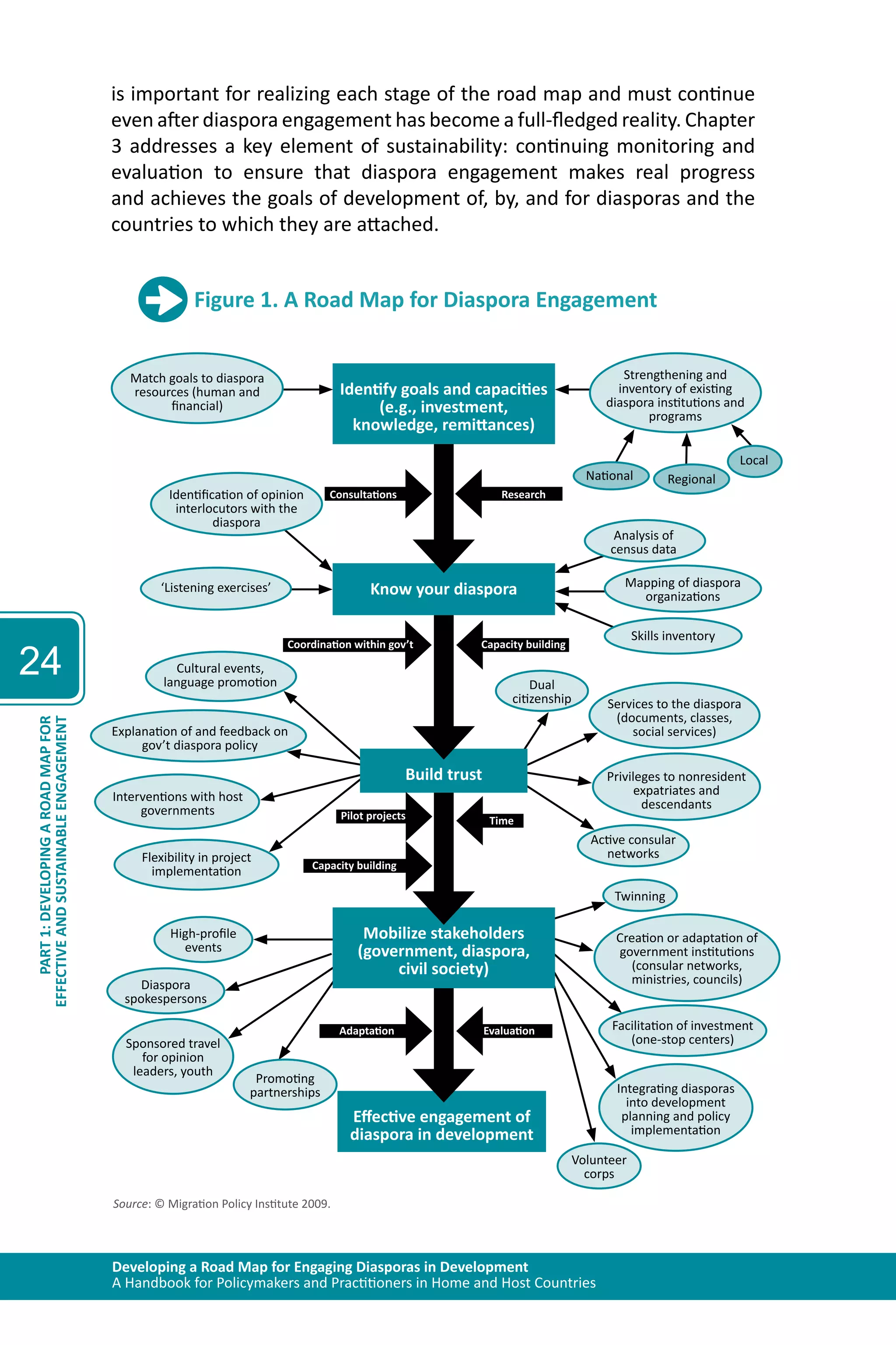
Figure 1 summarizes the road map in graphic form. It was developed 
by the Migration Policy Institute (MPI) at the request of the government of 
the Netherlands for Roundtable 1.2 of the third Global Forum on Migration 
and Development (GFMD), held in Athens in 2009, and benefited from 
input from its participants as well as other stakeholders who took part in 
prior consultations. The discussion of the road map at GFMD generated 
the concept of a handbook on diaspora engagement. 
The central boxes in Figure 1 represent the major elements of 
the strategy. Although they are presented as a series of stages, in fact 
these elements will proceed concurrently, loop back upon one another, 
and leap-frog over any orderly progression from one stage to the next. 
Above all, there must be constant feedback among the processes. The 
arrows show the processes necessary to get from one stage to the next 
(remembering that no stage is ever complete but must always remain in a 
state of dynamic interaction with the others). The balloons to the side are 
representative of the kind of actions associated with each element of the 
strategy; they are neither exhaustive nor compulsory. Not all actions will 
be relevant for all governments, as some are specific to countries of origin 
and others to countries of destination. 
Chapter 1 of this handbook breaks down the road map into its 
component elements and discusses each of them in greater detail. 
Chapter 2 focuses on the encompassing issue of capacity building, which
is important for realizing each stage of the road map and must continue 
even after diaspora engagement has become a full-fledged reality. Chapter 
3 addresses a key element of sustainability: continuing monitoring and 
evaluation to ensure that diaspora engagement makes real progress 
and achieves the goals of development of, by, and for diasporas and the 
countries to which they are attached. 
Figure 1. A Road Map for Diaspora Engagement 
Identify goals and capacities 
(e.g., investment, 
knowledge, remittances) 
Research 
Know your diaspora 
Capacity building 
Build trust 
Time 
Mobilize stakeholders 
(government, diaspora, 
civil society) 
Explanation of and feedback on 
gov’t diaspora policy 
Strengthening and 
inventory of existing 
diaspora institutions and 
National Regional 
Developing a Road Map for Engaging Diasporas in Development 
A Handbook for Policymakers and Practitioners in Home and Host Countries 
24 
EFFECTIVE AND SUSTAINABLE ENGAGEMENT 
PART 1: DEVELOPING A ROAD MAP FOR 
Effective engagement of 
diaspora in development 
Match goals to diaspora 
resources (human and 
financial) 
Identification of opinion 
interlocutors with the 
diaspora 
Analysis of 
census data 
‘Listening exercises’ 
Cultural events, 
language promotion 
Interventions with host 
governments 
Flexibility in project 
implementation 
High-profile 
events 
Diaspora 
spokespersons 
Promoting 
partnerships 
Sponsored travel 
for opinion 
leaders, youth 
Skills inventory 
Dual 
citizenship 
Mapping of diaspora 
organizations 
Services to the diaspora 
(documents, classes, 
social services) 
Privileges to nonresident 
expatriates and 
descendants 
Creation or adaptation of 
government institutions 
(consular networks, 
ministries, councils) 
Facilitation of investment 
(one-stop centers) 
Integrating diasporas 
into development 
planning and policy 
implementation 
Local 
programs 
Consultations 
Coordination within gov’t 
Pilot projects 
Capacity building 
Adaptation Evaluation 
Active consular 
networks 
Twinning 
Volunteer 
corps 
Source: © Migration Policy Institute 2009.
Strengthening and 
inventory of existing 
diaspora institutions and 
programs 
Developing a Road Map for Engaging Diasporas in Development 
A Handbook for Policymakers and Practitioners in Home and Host Countries 
25 
MAP FOR DIASPORA ENGAGEMENT 
CHAPTER 1: THE ELEMENTS OF A ROAD 
Chapter 1: The Elements of a Road Map for 
Diaspora Engagement 
No road map can be a “one-size-fits-all” model for governments 
working to engage their diasporas more effectively. Each diaspora has a 
unique set of needs and capabilities based on its historical experience 
and the present realities of its countries of origin and destination — and 
government approaches must reflect these complexities. Nonetheless, 
a strategy for diaspora engagement will almost always include certain 
fundamental elements, which are reviewed in this chapter. 
Many of the process and action elements related to the four stages 
of the road map are relevant to governments of both origin and destination 
countries. Most of them are suitable for bilateral or multilateral partnerships 
and some, such as twinning arrangements, require partnership. 
1 Identify Goals and Capacities 
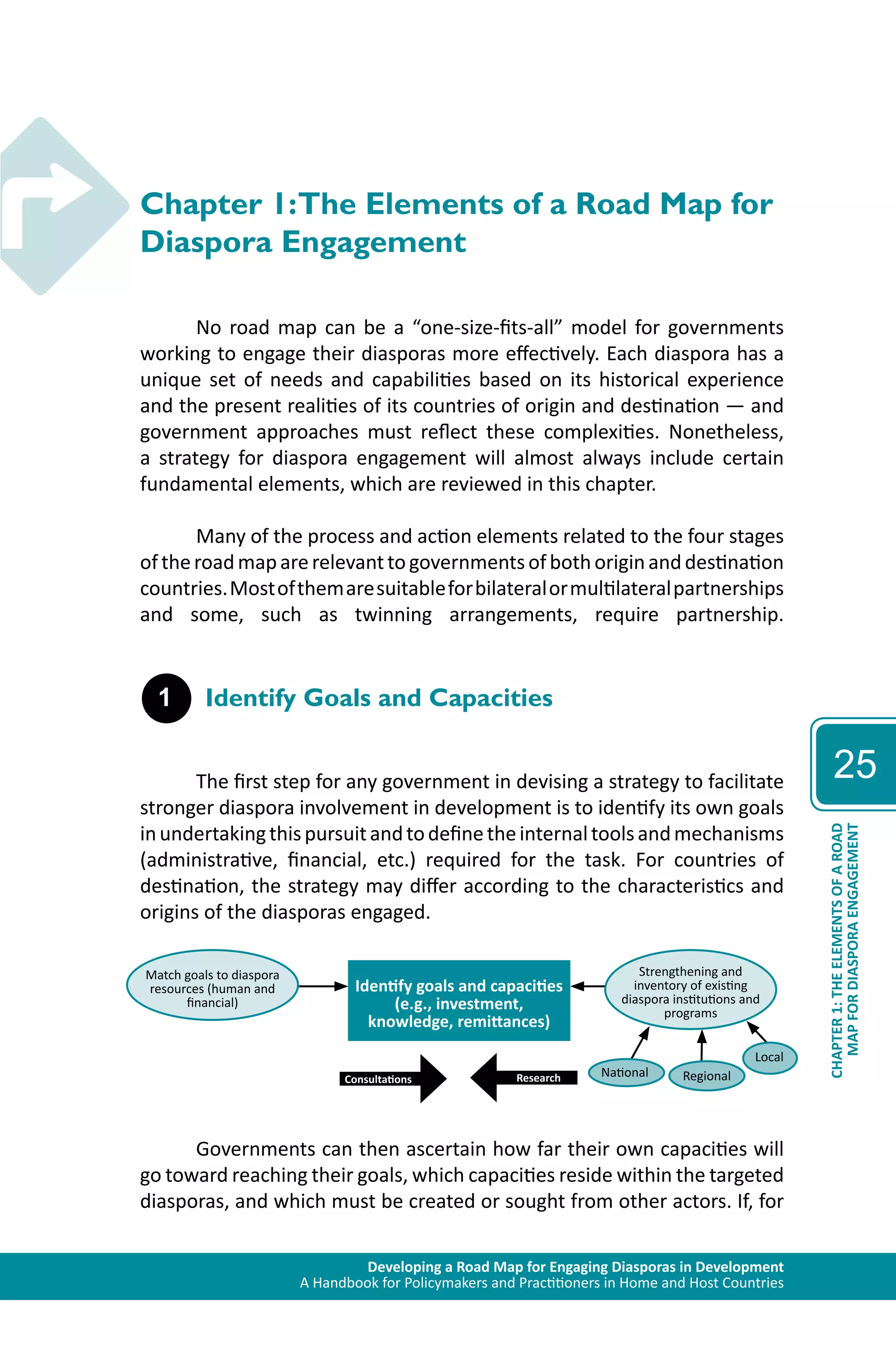
The first step for any government in devising a strategy to facilitate 
stronger diaspora involvement in development is to identify its own goals 
in undertaking this pursuit and to define the internal tools and mechanisms 
(administrative, financial, etc.) required for the task. For countries of 
destination, the strategy may differ according to the characteristics and 
origins of the diasporas engaged. 
Local 
Identify goals and capacities 
(e.g., investment, 
knowledge, remittances) 
Match goals to diaspora 
resources (human and 
financial) 
National Regional 
Consultations Research 
Governments can then ascertain how far their own capacities will 
go toward reaching their goals, which capacities reside within the targeted 
diasporas, and which must be created or sought from other actors. If, for
Developing a Road Map for Engaging Diasporas in Development 
A Handbook for Policymakers and Practitioners in Home and Host Countries 
26 
MAP FOR DIASPORA ENGAGEMENT 
CHAPTER 1: THE ELEMENTS OF A ROAD 
example, a country of origin’s goal is to reduce poverty or support the 
national balance of payments, its diaspora policy (in terms of both content 
and instruments) will likely focus on remittances, business investments, 
and, perhaps, capital markets. If, however, its goal is to improve the 
country’s competitiveness in economic terms, its diaspora policy is more 
likely to emphasize the knowledge and skills that members of the diaspora 
can channel to their countries of origin. The country of origin may, for 
example, facilitate diaspora members’ personal efforts to transfer skills to 
the homeland, or work to connect home-country institutions of learning 
and enterprise to advanced institutions in countries of destination in 
which diaspora members have ties. 
The government of the Philippines, for example, pursues a strategy of 
large-scale contract labor deployment overseas to reduce unemployment 
and maintain a stream of remittance income. India and China, by contrast, 
have in recent years given priority to encouraging diaspora entrepreneurs 
and highly skilled professionals to develop activities in their countries of 
origin. 
Beyond domestic policy considerations, goals may also be 
identified as a result of dialogue between the governments of countries 
of origin and destination. For a country of origin, partnership with a 
country of destination could facilitate the involvement of the diaspora 
in spreading information in diaspora communities about opportunities 
and programs that enable greater mobility for diaspora members, or 
provide financial support for joint projects involving the diaspora. For a 
country of destination that has decided to work with a specific diaspora, 
it is important to ascertain that the corresponding country of origin is 
willing to involve its diaspora in development activities, and that the goals 
defined by the destination country are consistent with the development 
priorities of the country of origin. 
The goals of diaspora engagement cannot be set in a vacuum. They 
should be seen as an integral part of development planning, not as a side-line 
or add-on. Diasporas can bring important financial, intellectual, and 
social capital to the development process, but they cannot substitute for 
the cultivation of domestic resources — although they can contribute 
to this cultivation. Similarly, diaspora efforts cannot succeed when the 
basic elements of good governance are not integrated into development 
planning. The past success of governments such as the Republic of Korea 
and Taiwan Province of China in bringing diaspora talent and treasure 
to the table were in large part possible because both governments had 
sound development strategies in place to invest in education, promote 
science and technology, build infrastructure, and foster entrepreneurship.
Mapping of diaspora 
organizations 
Developing a Road Map for Engaging Diasporas in Development 
A Handbook for Policymakers and Practitioners in Home and Host Countries 
27 
MAP FOR DIASPORA ENGAGEMENT 
CHAPTER 1: THE ELEMENTS OF A ROAD 
Governments are also more likely to succeed in setting realistic but 
ambitious goals for diaspora engagement if they consult with diaspora 
members when setting these goals. Mexico, for example, has established 
the Consultative Council of the Institute for Mexicans Abroad (CCIME), 
composed mostly of leaders elected by diaspora communities. The 
council makes recommendations to the government about its diaspora 
policies, and engages in wide-ranging discussions about Institute for 
Mexicans Abroad (known by its Spanish acronym IME, for Instituto de 
los Mexicanos en el Exterior) programs. Meanwhile, the government of 
Switzerland has supported a “structured dialogue” between Kosovars 
resident in Switzerland and their municipalities of origin in UNSC resolution 
1244-administered Kosovo, which has yielded ideas about the topics of 
greatest interest to the diaspora that are also relevant for development.11 
2 Know Your Diaspora 
With reasonably clear goals articulated, the second crucial step 
for a government is to know the diaspora that it hopes to engage. This 
involves serious, comprehensive data collection (through a migrant/ 
diaspora census, for example); mapping the location of the diaspora; 
compiling inventories of diaspora skills and experience; and engaging a 
wide range of diaspora members in listening exercises to understand what 
the diaspora has to offer, what it is willing to offer, and what it expects 
from the government in turn. It is crucial to acknowledge the diversity of 
diaspora agendas, interests, and strategies. Through the establishment of 
a continuous dialogue with diasporas, government policies should try to 
reconcile — or at least understand — differing and often diverging views. 
Successful government interventions are the result of years of continuous, 
open engagement. 
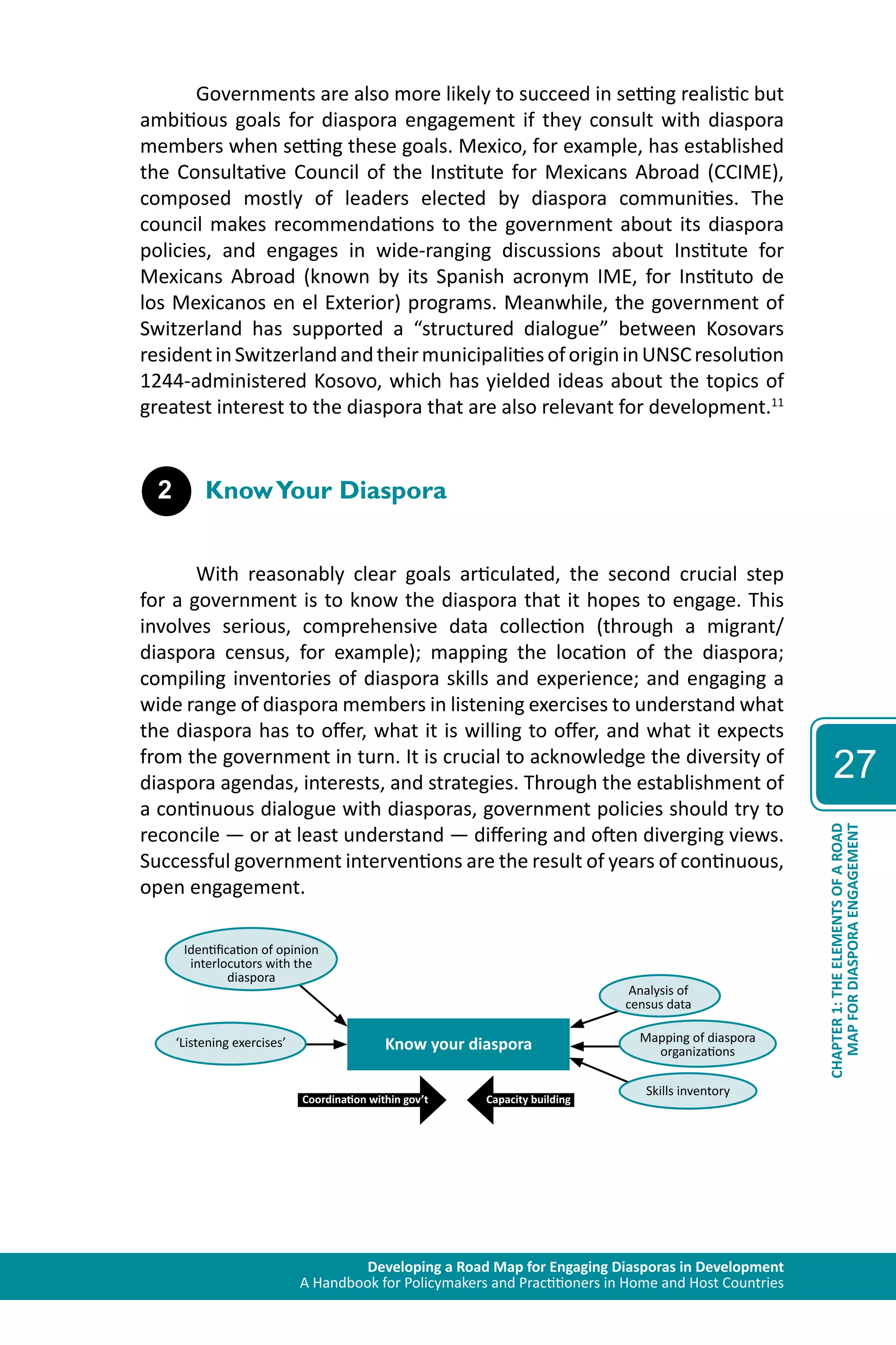
Know your diaspora 
Identification of opinion 
interlocutors with the 
diaspora 
Analysis of 
census data 
‘Listening exercises’ 
Skills inventory 
Coordination within gov’t Capacity building
Developing a Road Map for Engaging Diasporas in Development 
A Handbook for Policymakers and Practitioners in Home and Host Countries 
28 
MAP FOR DIASPORA ENGAGEMENT 
CHAPTER 1: THE ELEMENTS OF A ROAD 
The Indian government, for example, tasked a High-Level Committee 
on the Indian Diaspora to analyze the location, situation, and potential 
development role of the estimated 20 million nonresident Indians (NRIs) 
and persons of Indian origin (PIOs). The information resulting from this 
two-year exercise led to a new direction in diaspora policy, including the 
creation of a Ministry of Overseas Indian Affairs (MOIA) in 2004. 
For countries of destination, a “know-your-diaspora” exercise will 
involve the collection of data in national censuses and surveys to reveal 
the birthplace and ancestry of residents in the aggregate, while protecting 
the identity of subgroups and individuals. With this aggregate information, 
countries of destination can judge where best to invest their efforts to 
create partnerships with countries of origin. More detailed information 
about diaspora populations can be gathered by both origin and 
destination countries through cooperation with diaspora organizations 
such as professional associations, hometown clubs, and alumni 
associations. Embassies and consular offices can also play an important 
role in gathering information about diaspora capacities and interests. The 
government of Ghana, for example, is among those directing resources to 
the management of migration data — and to creating profiles of diaspora 
members in particular. 
The lack of reliable data on diasporas is frequently identified by 
governments as an obstacle to developing effective diaspora policies 
and programs. Census data do not usually capture out-migration very 
well, as they offer only a snapshot of people residing in a country at the 
time of the census. So governments must rely on destination countries 
to collect data on the place of birth and ancestry of residents. Several 
destination countries have conducted special studies of their resident 
diaspora populations, such as the German Agency for Development’s (GIZ, 
the German abbreviation for Deutsche Gesellschaft für Internationale 
Zusammenarbeit)12 ten-country series on diasporas resident in Germany.13 
Consular estimates are often based on analysis of destination-country data 
and surveys, but are of variable quality and, often, are limited in scope; 
conducting large-scale, detailed surveys is also expensive. Colombia, for 
example, conducted a pilot exercise in London to map the characteristics 
of Colombians living there, but has so far been unable to extend this 
exercise to other locations where its diaspora is concentrated.14 
The numbers, distribution, skills, prosperity, and level of integration 
of diaspora groups, along with their history, will define the universe of 
possibilities for diaspora partnerships. The institutional framework of a 
country of origin’s diaspora policy will be quite different, for example, if
Capacity building 
Developing a Road Map for Engaging Diasporas in Development 
Explanation of and feedback on 
A Handbook for Policymakers and Practitioners in Home and Host Countries 
29 
MAP FOR DIASPORA ENGAGEMENT 
CHAPTER 1: THE ELEMENTS OF A ROAD 
it has a large diaspora concentrated in one or a few countries (Mexico) 
versus a small and highly dispersed diaspora (Ghana). Similarly, a country 
of destination’s policy will differ depending on its historical relationships 
with its diasporas’ countries of origin, on how successfully its diaspora 
communities are integrated into the destination-country’s society, and of 
course on its foreign policy priorities. The US government, for example, has 
encouraged the formation of several diaspora foundations to encourage 
unified action on the part of diverse immigrant communities: these 
include the American Irish Foundation (now merged into The Ireland 
Funds), American India Foundation, US-Mexico Foundation, and American 
Pakistan Foundation. Such bodies help articulate the goals of diaspora 
communities both to the governments of their countries of origin and to 
the governments of the countries where they have settled. 
3 Build Trust 
The long-term project of building partnerships between 
governments and diasporas is much more likely to succeed if it has a 
strong foundation of good communication and mutual trust. Partnership 
is a two-way street. Too often, diasporas have felt that country-of-origin 
governments see them simply as cash cows, while some country-of-destination 
governments see diaspora groups demanding support on the 
basis of weak capabilities to deliver on mutual objectives. All parties must 
feel that they are deriving value from the relationship. Building trust is 
therefore a necessary third element of the diaspora engagement strategy. 
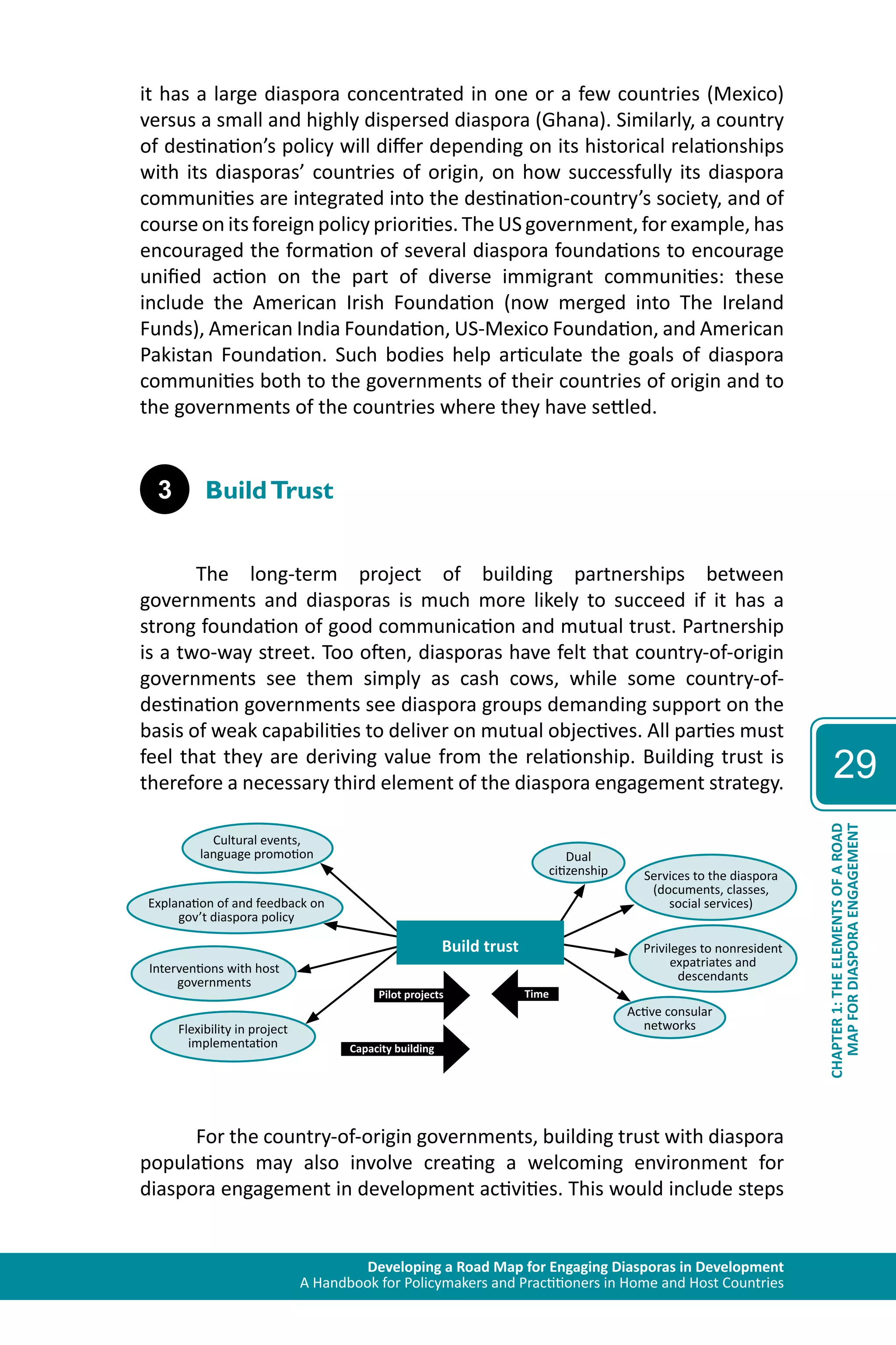
Build trust 
Cultural events, 
language promotion 
gov’t diaspora policy 
Interventions with host 
governments 
Flexibility in project 
implementation 
Dual 
citizenship Services to the diaspora 
(documents, classes, 
social services) 
Privileges to nonresident 
expatriates and 
descendants 
Pilot projects Time 
Active consular 
networks 
For the country-of-origin governments, building trust with diaspora 
populations may also involve creating a welcoming environment for 
diaspora engagement in development activities. This would include steps
Developing a Road Map for Engaging Diasporas in Development 
A Handbook for Policymakers and Practitioners in Home and Host Countries 
30 
MAP FOR DIASPORA ENGAGEMENT 
CHAPTER 1: THE ELEMENTS OF A ROAD 
to improve the domestic business climate, such as greater transparency in 
regulations and licensing requirements and more consistent application of 
property law. Other elements of good governance and rule of law are also 
important in attracting diaspora engagement. Countries of destination, 
collectively or individually, can support such efforts. The European 
Commission (EC), for example, has funded projects in a number of 
migrant-origin countries to help their governments develop sound legal, 
regulatory, and/or institutional frameworks that promise to encourage 
increased diaspora investment. 
Few governments have taken the task of gaining the trust of 
a diaspora as seriously as the government of Mexico. From the late 
1990s, the government has invested in communication with and service 
to its diaspora.15 The creation of IME in the Ministry of Foreign Affairs 
in 2002 brought coherence to these efforts through a dense network 
of over 56 consular offices in North America. IME works with organized 
diaspora groups on the well-known Tres por Uno (3x1) program, through 
which three levels of government match the contributions of migrant 
organizations to infrastructure projects in their communities of origin. 
Thousands of projects have been financed — 1,613 in 2007 alone, in 
443 municipalities.16 A key trust-building element of Mexico’s diaspora 
engagement strategy is CCIME, the consultative council mentioned above. 
The council freely criticizes and disagrees with government positions 
when it feels called upon to do so, which — paradoxically perhaps — 
consolidates the confidence of both parties that disagreement does not 
mean alienation. 
As Mexico’s example shows, the establishment of joint diaspora-government 
decisionmaking is extremely important to building trust. At 
the institutional level, Israel and its diaspora have taken this process a 
step further through the development of an increasingly autonomous, 
quasi-governmental Jewish Agency for Israel. Its institutions and programs 
are governed jointly by government and diaspora representatives. At a 
more local level, Israel’s Partnership 2000 is a prime example of building 
trust through twinning between Israeli municipalities and Jewish diaspora 
communities around the world. Such programs ideally have organizational 
structures that feature representation from both sides, whether on 
governing boards or professional committees consulting on program 
development and implementation. This allows for the voice and influence 
of both diasporas and government representatives in key efforts such as 
identifying needs, setting priorities, and allocating resources.
Developing a Road Map for Engaging Diasporas in Development 
A Handbook for Policymakers and Practitioners in Home and Host Countries 
31 
MAP FOR DIASPORA ENGAGEMENT 
CHAPTER 1: THE ELEMENTS OF A ROAD 
Partnerships of trust with diasporas can be built on many different 
kinds of programs. In addition to the kinds of services provided by IME, 
which include facilitating access to health care and education, many 
governments offer privileges to nonresident citizens (and, in some 
cases, their descendants) such as duty-free imports of goods, tax-free 
repatriation of foreign-currency income, and the ability to buy assets 
or hold jobs normally reserved for resident citizens. Successful diaspora 
initiatives, as identified by the EC-United Nations (UN) Joint Migration 
and Development Initiative (JMDI), confirm the positive link between 
privileges for diasporas (such as a special fiscal regime, or streamlined 
processes to set up businesses) and the impact of their engagement.17 
Many governments sponsor cultural events in countries that have 
a diaspora presence; some, including China, also promote learning the 
“mother tongue” by subsidizing lessons and providing teachers. Political 
rights are often a high priority for diasporas; governments can both 
demonstrate and earn trust by facilitating overseas voting and other 
forms of political participation for expatriates. Ghana, for example, passed 
a law permitting dual citizenship in 2000 and one giving voting rights to 
Ghanaians abroad in 2006. Such actions are designed to instill a sense of 
belonging to and engagement with the country of origin. 
For the governments of destination countries, building trust with 
engaged diaspora populations involves acknowledging that their dual 
sense of belonging and their commitment to their homelands is compatible 
with thorough integration in the adopted country. Dual citizenship is one 
signal that a government can send that it trusts people who have multiple 
commitments to meet all the obligations of full citizenship. 
Destination-country governments can take the message of trust 
to a deeper level, and one more specific to development, by accepting 
that diasporas have expertise that may be an important input for the 
development policies of their countries of origin. The country offices of 
the United Kingdom’s Department for International Development (DFID) 
are encouraged to consult diaspora groups in formulating DFID country 
assistance plans, for example. Furthermore, the United Kingdom supports 
a Senior Executive Service drawn from diaspora members to fill senior 
positions in governments of postconflict countries.
Developing a Road Map for Engaging Diasporas in Development 
A Handbook for Policymakers and Practitioners in Home and Host Countries 
32 
MAP FOR DIASPORA ENGAGEMENT 
CHAPTER 1: THE ELEMENTS OF A ROAD 
4 Mobilize the Diaspora for Development 
With trust established between governments and diasporas, 
the characteristics of diasporas well understood, and the objectives of 
diaspora engagement clearly articulated, partnerships for development 
involving diasporas can be more successfully mobilized. This may require 
the creation of new government institutions or the revitalization of 
existing ones.18 Senegal was one of the first countries to pioneer this kind 
of arrangement, in 1993, with a landmark initiative that overhauled the 
Ministry of Foreign Affairs to include oversight for Senegalese abroad. 
As we will see in Chapter 4, ever-increasing numbers of migrant-origin 
countries are creating ministries dedicated to diaspora issues, such as 
India’s MOIA, Mali’s Ministry of Malians Abroad and African Integration, 
Armenia’s Ministry of the Diaspora, and Haiti’s Ministry of Haitians Living 
Abroad. Still more have offices at the subministerial level or special 
institutions elsewhere in government. Delegates at the 2007 Global 
Forum on Migration and Development (GFMD) diaspora roundtable 
(Roundtable 1.2) repeatedly made the point that countries of origin need 
an institutional framework at the national level to communicate with their 
diasporas, coordinate policies, and provide support for and follow-up on 
engagement. 
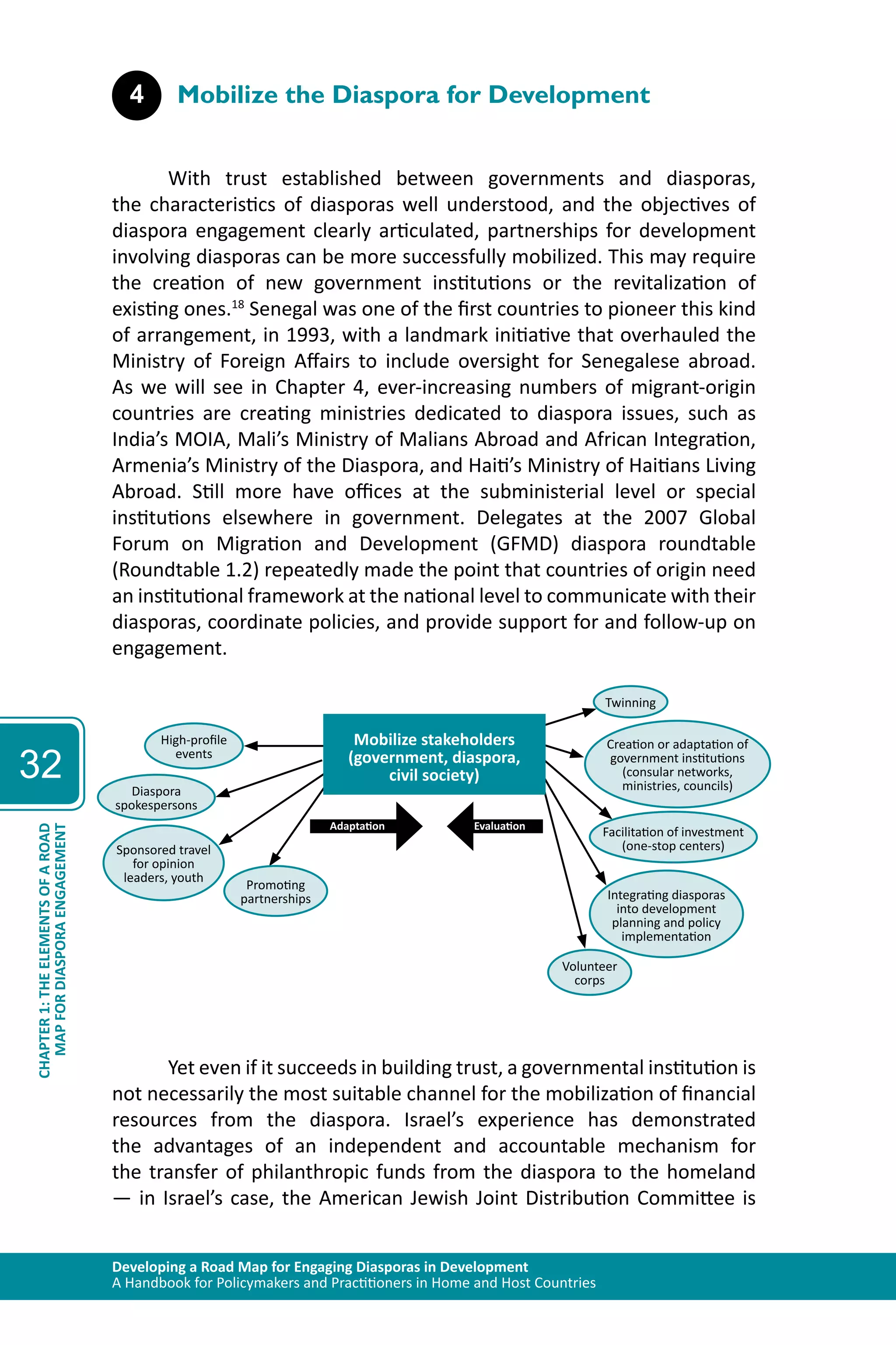
Mobilize stakeholders 
(government, diaspora, 
civil society) 
High-profile 
events 
Diaspora 
spokespersons 
Promoting 
partnerships 
Sponsored travel 
for opinion 
leaders, youth 
Creation or adaptation of 
government institutions 
(consular networks, 
ministries, councils) 
Facilitation of investment 
(one-stop centers) 
Integrating diasporas 
into development 
planning and policy 
implementation 
Adaptation Evaluation 
Twinning 
Volunteer 
corps 
Yet even if it succeeds in building trust, a governmental institution is 
not necessarily the most suitable channel for the mobilization of financial 
resources from the diaspora. Israel’s experience has demonstrated 
the advantages of an independent and accountable mechanism for 
the transfer of philanthropic funds from the diaspora to the homeland 
— in Israel’s case, the American Jewish Joint Distribution Committee is
Developing a Road Map for Engaging Diasporas in Development 
A Handbook for Policymakers and Practitioners in Home and Host Countries 
33 
MAP FOR DIASPORA ENGAGEMENT 
CHAPTER 1: THE ELEMENTS OF A ROAD 
governed solely by diaspora members. Diaspora Jews and overseas Israelis 
raise well over $1 billion in philanthropic contributions every year,19 which 
suggests that formal institutions for diaspora engagement can usefully be 
augmented by initiatives from civil society. It is also worth noting that in a 
framework of origin-destination country cooperation, a nongovernmental 
mechanism for the transfer of funds might enjoy tax benefits or incentives 
in some host countries. 
Strategies for diaspora mobilization may include high-profile 
events, such as India’s annual Pravasi Bharatiya Divas (“nonresident Indian 
day”), the first of which brought together more than 2,000 high-profile 
Indian diaspora members for a conference attended by most of India’s 
senior politicians, alongside Nobel Prize winners of Indian nationality 
or descent. Jamaica, too, holds an annual celebratory gathering of 
expatriates and descendants of emigrants. In connection with these 
events or independent of them, several countries recognize diaspora 
members who have made special contributions to their countries of origin, 
fostered better understanding between origin and destination countries, 
or demonstrated outstanding merit in their professional lives. Among the 
many awards given to diaspora members are the Presidential Awards for 
Filipino Individuals and Organizations Overseas, India’s Pravasi Bharatiya 
Samman, the World Class New Zealand Awards, and the Governor- 
General’s Jamaican Diaspora Award for Excellence. 
Governments of origin countries also may appoint well-known 
members of the diaspora as spokespersons on diaspora issues, sponsor 
travel to the country of origin for opinion leaders and youth, or establish 
diaspora volunteer programs. One striking example of this kind of 
interface is the Taglit-Birthright Israel program, initiated in 2001, which 
provides free educational trips to Israel for young diaspora adults aged 18 
to 26. Since its inception, over 260,000 diaspora youth from 52 countries 
have participated in the program.20 Origin-country governments may 
also establish centers or programs to facilitate financial flows from the 
diaspora, such as India’s “one-stop shop” for diaspora investors. 
Country-of-destination governments, acting alone or in regional 
organizations, may partner with country-of-origin governments in 
development initiatives, particularly those that would benefit from 
technical assistance or financial support. In 2003-05 the European 
Commission supported the Return of Qualified Afghans (RQA) program 
for Afghan nationals living in EU member states. In cooperation with the 
government of Afghanistan, and employing the International Organization 
for Migration (IOM) as implementing partner, the program identified
Developing a Road Map for Engaging Diasporas in Development 
A Handbook for Policymakers and Practitioners in Home and Host Countries 
34 
MAP FOR DIASPORA ENGAGEMENT 
CHAPTER 1: THE ELEMENTS OF A ROAD 
Afghans with relevant qualifications and experience and assisted their 
return to Afghanistan for assignments of 6–12 months in both the public 
and private sectors. The program was small and relatively high-cost, but 
an evaluation found that the participating Afghans provided needed skills 
that were appropriately used.21 The Netherlands is implementing a similar 
program (Temporary Return of Qualified Nationals, TRQN) in Afghanistan, 
Georgia, Ethiopia, Bosnia and Herzegovina, Sudan, and Sierra Leone. It 
also cooperates with the IOM Migration for Development in Africa (MIDA) 
program in Ghana to support the temporary return of diaspora medical 
doctors to Ghana. 
The Canadian International Development Agency (CIDA) uses a 
number of techniques to mobilize diaspora groups for development in their 
countries of origin. It directly funds development projects executed by 
diaspora groups with experience in implementing development projects, 
such as the Association of Haitian-Canadian Engineers and Scientists. For 
diaspora groups without such experience, CIDA has created tripartite 
partnerships among diaspora organizations, Canadian development 
nongovernmental organizations (NGOs), and NGOs in the countries of 
origin. (Such partnerships have the added advantage of avoiding the 
impression that a government’s diaspora policy is supporting an organized 
political opposition in exile.) Linking diaspora organizations with Canadian 
NGOs with solid experience in developing countries has enabled diaspora 
organizations to gain the knowledge and expertise needed to seek donor 
funds and to work independently. Many Haitian diaspora organizations, 
after working with Canadian civil society organizations (CSOs) for several 
years, now approach CIDA for separate funding to execute development 
projects in Haiti on their own. 
Several governments that are donors of official development 
assistance (ODA, commonly known as foreign assistance) have found 
it useful to create and/or support platforms to facilitate diaspora 
involvement in development, such as Diasporas for Development in the 
Netherlands, the Regroupement des Organismes Canado-Haїtiens pour 
le Développement in Canada, and Connections for Development in the 
United Kingdom. Such institutions encourage the systematic sharing of 
ideas and information while also serving as vehicles for capacity building. 
In some cases, they may also evolve into operational partners for national 
development agencies. 
In working with diaspora partners, a number of donor governments 
and consortia have found that the most successful projects and programs 
are those that build on existing diaspora initiatives rather than those
Developing a Road Map for Engaging Diasporas in Development 
A Handbook for Policymakers and Practitioners in Home and Host Countries 
35 
MAP FOR DIASPORA ENGAGEMENT 
CHAPTER 1: THE ELEMENTS OF A ROAD 
started anew at the initiative of governments. The EC-UN JMDI observes 
that “policies too strongly driven by governments can act as a deterrent 
for diaspora engagement.”22 
Government partners in diaspora engagement, whether of 
destination or origin countries, are by no means confined to the national 
level. Of particular importance is establishing links between diasporas 
and local levels of government, given that diasporas’ contributions tend 
to be geared toward their places of origin. State/provincial or municipal 
governments may establish partnerships with diaspora populations to 
assist in development of the countries of origin. 
What is novel, however, is local governments’ interest in twinning 
with municipalities that are large and/or recent sources of newcomers 
to their communities. Dutch municipalities have established relations 
with local governments in source countries such as Turkey, Suriname, 
and Morocco. At present, there are some 39 diaspora-focused municipal 
twinning initiatives in the Netherlands, and their number is increasing.23 
City-to-city partnership projects often focus on strengthening local 
governance. For instance, the Dutch municipality of Zeist advises its 
partner municipality in Berkane, Morocco, on how to improve waste 
management.
Developing a Road Map for Engaging Diasporas in Development 
A Handbook for Policymakers and Practitioners in Home and Host Countries 
37 
CHAPTER 2: BUILDING CAPACITY 
FOR EFFECTIVE IMPLEMENTATION 
Chapter 2: Building Capacity for Effective 
Implementation 
Translating promise into reality is more easily said than done. While 
many governments acknowledge the importance of diaspora engagement 
in development, many still lack the capacity to design effective policies 
and implement them on a meaningful scale. This explains the gap 
between schemes that look good on paper and truly effective policies and 
programs that actually make a difference. Indeed, effective engagement 
almost always requires a concerted effort toward capacity building. 
For many countries, the main challenges to effective engagement 
seem to center on two issues relating to capacity: how best to obtain 
adequate funding and how to improve technical know-how. Governments 
serious about engaging diasporas have to commit to funding their efforts 
as fully as possible (and seeking funds from elsewhere to fill in remaining 
gaps) and to obtaining the operational knowledge and skills needed to 
pursue goals effectively. 
1 Challenges to Building Capacity 
A. Amassing Adequate Funding 
Analyst Michael Fullilove has noted that most diaspora institutions 
are underfunded.24 A closer look at the budgets of the Philippines, Mexico, 
India, and Mali — four origin countries that have actively engaged their 
diasporas in recent years — seems to support this observation. Institutions 
in charge of the diaspora portfolio in these countries have received a 
relatively small allocation from the national government. 
The responsibility for protecting and engaging the Philippines’ huge 
diaspora largely rests on three government agencies: the Departments 
of Labor and Employment and Foreign Affairs, and the Commission on 
Filipinos Overseas (CFO). In 2009 the three bodies spent a total of 19.7 
billion pesos ($437 million), or 1.7 percent of total government expenses 
that year.25 CFO, which is the key agency in charge of engaging permanent
Developing a Road Map for Engaging Diasporas in Development 
A Handbook for Policymakers and Practitioners in Home and Host Countries 
38 
CHAPTER 2: BUILDING CAPACITY 
FOR EFFECTIVE IMPLEMENTATION 
emigrants, received the smallest allocation among the three, at only 45 
million pesos ($1 million), or 0.004 percent of the national budget.26 
Mexico’s spending on its Ministry of Foreign Affairs, as a portion of 
the total executive-branch budget, is also quite low, at only 1 percent or 
5.3 billion pesos ($397 million) in 2009.27 From this amount, approximately 
6 percent ($24 million) was spent on services to Mexicans abroad. This 
money funded the Institute for Mexicans Abroad (IME), the key agency 
driving Mexico’s diaspora agenda, consular activities, and other related 
programs. At approximately $2.8 million, IME’s budget for 2009 was the 
smallest portion of the ministry’s total budget for services to Mexicans 
abroad.28 
India and Mali both created separate ministries whose explicit 
purpose is to address the needs of diaspora populations. India’s Ministry 
of Overseas Indian Affairs (MOIA) received 80 crores ($17 million) in the 
2009–10 budget, or 0.02 percent of the overall central government budget 
(416,000 crores or $90 billion) during the same period.29 The Ministry of 
External Affairs, which is responsible for maintaining consular presence 
abroad, among other things, received an appropriation that was six times 
more than that of MOIA (579 crores or $125 million), but still a very small 
proportion relative to other government departments. Combined, the 
two ministries comprised 0.16 percent of the total Central Plan outlay.30 
Similarly, in 2009, the Ministry for Malians Abroad and African 
Integration had a total budget of about 1.8 billion CFA francs ($3.9 
million).31 Government funding for services to Malians abroad provided 
through consulates is budgeted through the Ministry of Foreign Affairs and 
International Cooperation, which received 22.7 billion CFA francs ($49.3 
million). Both ministries made up 7 percent of the central government 
budget of 723.9 billion CFA francs ($1.6 billion).32 
The amount of money governments should allocate to diaspora 
institutions is highly debatable. In general, analysts use overall budget 
allocations to assess a country’s spending priorities and values; 
examining, for example, how much is spent on defense versus health care 
or education. Determining the appropriate level of spending is difficult 
when the target audience and main beneficiaries have higher incomes 
than their compatriots at home and in some cases are not even citizens. 
In the absence of reliable data or standards, one reasonable 
measure of spending might be to compare the budget allocation with the 
percentage of a country’s population that lives abroad. With that in mind,
Developing a Road Map for Engaging Diasporas in Development 
A Handbook for Policymakers and Practitioners in Home and Host Countries 
39 
CHAPTER 2: BUILDING CAPACITY 
FOR EFFECTIVE IMPLEMENTATION 
Mexico, the Philippines, and Mali, which both have nearly 10 percent 
of their respective populations abroad, could arguably increase their 
budget allocation on their diaspora efforts.33 Another suggested yardstick 
pertains to remittances sent as a percentage of gross domestic product 
(GDP). Using this measure, the Philippines, where remittances make up 
13 percent of GDP, should be spending a significantly higher proportion 
of its budget on diaspora efforts than Mexico, Mali, and India, where 
remittances are around 3 percent of GDP.34 
However, developing countries with very limited and dwindling 
financial resources face real spending and allocation constraints. As the 
case of the Philippines shows, the public works and highways and education 
departments, respectively, claimed 11 and 5 percent of the 2009 budget.35 
The largest budget allocation, at about 252 billion pesos ($6 billion) or 22 
percent of the budget, went to paying interest on the national debt — a 
problem that plagues many heavily indebted countries.36 
Indeed, for many governments, one of the most pressing challenges 
to diaspora engagement is how to initiate programs that do not drain the 
already limited public coffers while bringing in critical financial resources. 
B. Acquiring Technical Know-How 
Budgets alone are imperfect measures of state capacity. Spending 
more money does not necessarily ensure a higher-quality outcome. For 
many countries, technical know-how — the operational knowledge and 
skills needed to pursue goals effectively — presents a larger hurdle than 
money. 
Successful diaspora engagement requires designing smart ways 
of delivering services and programs to a dispersed and heterogeneous 
population. A good case in point is the largest migrant welfare fund 
operated by a sending-country government. Faced with the problems 
attendant with a rapidly expanding temporary worker population 
abroad, the Philippine government established the Overseas Workers 
Welfare Administration (OWWA) in 1981 to protect Filipino migrant 
workers and provide various services, from repatriation to new-business 
loans. In 2005, despite amassing huge reserves, OWWA spent only 0.03 
percent of its fund balance on services, in most cases meeting only the 
minimum requirements mandated by law.37 OWWA’s limited experience 
in administering programs partially explains its conservative spending. For 
instance, it has tried to provide livelihood loans for many years but has
Developing a Road Map for Engaging Diasporas in Development 
A Handbook for Policymakers and Practitioners in Home and Host Countries 
40 
CHAPTER 2: BUILDING CAPACITY 
FOR EFFECTIVE IMPLEMENTATION 
always had poor repayment rates. Aware of its service-delivery problems, 
OWWA opted to safeguard its funds by placing them in development 
banks.38 
Even more than lack of money, in some cases lack of knowledge 
constrains the efforts of destination-country governments. In the 
Netherlands, for example, a 2009 study of twinning projects found that 
medium-sized municipalities such as Arnhem, Meppel, and Haarlem, 
which host a relatively small number of migrant groups, had successfully 
involved migrant organizations in twining programs.39 On the other hand, 
large municipalities such as Amsterdam, with a huge migrant population, 
had learned that involvement with one migrant group over another 
can create tension among groups and between the state and migrants. 
Migrant populations abroad are often divided and politicized, which can 
make involvement with them difficult. Indeed, some Dutch municipalities 
have chosen to disengage with diaspora groups altogether to avoid dealing 
with diaspora politics.40 
The difficulties of acquiring the operational knowledge and skills 
to engage diasporas effectively can be attributed to many factors. 
Long-standing programs, such as OWWA in the Philippines, seem to 
have been subject to very little monitoring and evaluation. For many 
engagement efforts, however, the key problem stems from a lack of 
sustained commitment within governments. Critically important technical 
know-how is acquired typically through years of trial and error. Many 
government initiatives on diasporas, however, tend to be short-lived and 
depend on the support of the central government, which can vary across 
administrations. For instance, the main government institution in charge 
of Moroccans abroad has been alternately promoted and demoted as it 
has gained and lost support within the government. Started as a ministry 
in 1993, it was downgraded to an office under the Ministry of Foreign 
Affairs in 1995.41 In 2007 it was promoted to its current position — an 
institution headed by a minister-delegate (undersecretary) directly under 
the prime minister’s office.42 
Similarly, in Yemen, various diaspora institutions have been 
created and taken down since the first office, the Department of 
Immigration and Expatriates, was set up in 1962. Recent incarnations 
include the Ministry of Expatriates Affairs in 1990, the Expatriates 
Affairs Council in 1996, the Ministry of Expatriates Affairs in 1997, 
and the Ministry of Foreign Affairs and Emigrants in 2005; in 2007 
the diaspora institution was promoted back to being the Ministry 
of Expatriates Affairs.43 This lack of continuity makes institutional 
learning — a factor critical to building expertise — more difficult.
Developing a Road Map for Engaging Diasporas in Development 
A Handbook for Policymakers and Practitioners in Home and Host Countries 
41 
CHAPTER 2: BUILDING CAPACITY 
FOR EFFECTIVE IMPLEMENTATION 
2 Building Capacity: Some Ways Forward 
To confront financial and technical constraints head-on, governments 
must learn how to successfully build expertise while sharing costs, both 
financial and otherwise. Effectively loosening resource constraints 
requires adopting both conventional and pioneering approaches. In order 
to build capacity, governments have many options, five of which are 
outlined below. 
A. Create Innovative and Cost-Effective Institutions and 
Programs 
Squarely addressing resource constraints requires, first and 
foremost, innovative thinking. Some governments, for instance, have 
taken an atypical route by creating innovative institutions and programs 
that utilize private resources to pursue decidedly public goals. 
1. Innovative Institutions 
Some governments do not want to be seen — for whatever reason 
— as spending too much on their diasporas or intervening in the affairs 
of destination countries. Others are looking for efficient and feasible 
approaches that would maximize engagement activities with minimum 
investment. The solution for some governments is to create quasi-governmental 
institutions that deliberately blur the distinction between 
nongovernmental and governmental bodies. 
Foundations. Some governments, such as those of the Republic 
of Korea and Morocco, have created foundations to indirectly manage 
their diaspora activities. In 1997 the government of the Republic of 
Korea established the Overseas Koreans Foundation (OKF), a nonprofit 
organization affiliated with the Ministry of Foreign Affairs and Trade. The 
foundation had a clear development mandate from the outset: to “utilize 
the capabilities of overseas Koreans for national development in line with 
its globalization policy.” 
According to the foundation’s website, the Korean government 
recognized the need to establish a government organization for overseas 
Koreans; however, “this idea came into conflict with the government’s 
policy of keeping the government small, and there was fear that it would
Developing a Road Map for Engaging Diasporas in Development 
A Handbook for Policymakers and Practitioners in Home and Host Countries 
42 
CHAPTER 2: BUILDING CAPACITY 
FOR EFFECTIVE IMPLEMENTATION 
cause some friction with the governments of the nations where the 
overseas Koreans were residing.”44 
Similarly, in 1990, Morocco created the Hassan II Foundation for 
Moroccans Residing Abroad (FHII). Established by royal decree, FHII is 
officially described as a “nonprofit institution with a social vocation, 
endowed with a moral personality and financial autonomy.” FHII is a private 
organization that has an especially close relationship with the Moroccan 
government. It is not a government institution, although the government 
sets its mandate. Interestingly, at one point in time, the minister in charge 
of Moroccans abroad also ran the foundation. Currently, FHII’s president 
is Princess Lalla Meryem.45 
Welfare Funds. Other countries have chosen to create a government-managed 
welfare fund financed by migrants or their employers and/or 
recruiters. These funds, which can be found in Bangladesh, Pakistan, the 
Philippines, Sri Lanka, and Thailand, among others, provide a range of 
services to migrants including predeparture orientation seminars, loans, 
emergency repatriation, life and medical insurance, and reintegration 
assistance. The setup offers a potentially efficient and feasible solution 
for origin governments to share the cost of protecting their temporary 
migrants while abroad. 
The Philippines manages one of the largest welfare funds in 
the developing world, pooled from the mandatory $25 membership 
contributions of foreign employers and migrant workers. Entirely self-funded 
and receiving no budget allocation from the national government, 
the welfare fund has brought in more money than it has spent. This 
surplus is added to the fund’s equity. As a result, the fund grew more 
than fourfold in 13 years, from 2.2 billion pesos ($47 million) in 1995 to 
nearly 12 billion pesos ($266 million) in 2008.46 To place the magnitude of 
this amount in the Philippine context, the welfare fund’s total assets were 
nearly twice the budget of its mother agency, the Department of Labor 
and Employment, and almost three times the budget of the Office of the 
President during the same period.47 
Diaspora Councils. Creating diaspora councils, usually a mix of 
community leaders and government officials, can also be an excellent 
source of funding and technical know-how. Councils typically advise 
the government on diaspora-related matters with very minimal cost to 
the government. One of the earliest examples is Mali’s High Council of 
Malians Abroad, which serves as the official representative of the Malian 
diaspora, both in Mali and in diaspora members’ countries of residence.
Developing a Road Map for Engaging Diasporas in Development 
A Handbook for Policymakers and Practitioners in Home and Host Countries 
43 
CHAPTER 2: BUILDING CAPACITY 
FOR EFFECTIVE IMPLEMENTATION 
Local councils are elected in various countries where Malian expatriates 
are concentrated. These national councils then elect representatives to 
the High Council.48 As already mentioned, Mexico’s Institute of Mexicans 
Abroad (IME) was established in 2003. The 2006-08 Consultative Council 
of the Institute of Mexicans Abroad (CCIME) had 100 of its members 
elected or appointed by the Mexican communities in the United States 
and Canada that were large enough to be served by a Mexican consulate; 
15 members were appointed based on merit and achievement.49 
Diaspora councils are particularly significant since they bring 
invaluable resources to the table: contacts, funding, and ideas to 
implement programs. They are also excellent sources of feedback from, 
and information about, the diaspora — feedback that IME can use to 
justify requests for more funding, among other outcomes. For instance, 
in Mexico, due in large measure to the pressure exercised by CCIME 
members, funds collected as passport and consular ID fees now remain 
within the Ministry of Foreign Affairs to finance the activities of the 
consular network.50 
2. Creative Programs 
Beyond setting up innovative institutions, governments can also 
choose to create programs and projects that directly address financial and 
technical constraints in novel ways. Although some diaspora programs 
are funded via the traditional budget line, many more are funded by 
other means. For instance, Colombia Nos Une, a program of the Bureau 
of Consular Affairs and Colombian Communities Abroad in the Ministry 
of Foreign Affairs, is funded with a traditional budget line like any other 
government ministry. However, the program also works with what the 
Colombian government describes as “investment projects,” which provide 
an additional budget line for specific projects. As of this writing, Colombia 
Nos Une had two such projects, which provide a total of $2.5 million in 
general program support.51 
Matching Funds. Among the best-known diaspora programs are 
matching funds — schemes wherein different levels of government 
allocate a dollar or more for every dollar that migrant organizations invest 
in their communities. The most frequently cited examples come from 
Mexico (where matching programs were pioneered and popularized), 
among which, the state of Zacatecas’s Tres Por Uno or 3x1 program is the 
most celebrated (see Box 1).
Developing a Road Map for Engaging Diasporas in Development 
A Handbook for Policymakers and Practitioners in Home and Host Countries 
44 
CHAPTER 2: BUILDING CAPACITY 
FOR EFFECTIVE IMPLEMENTATION 
Box 1: Tres por Uno (3x1) Program: An Innovation 
Considered by many observers as a best practice, the 3x1 program has been replicated 
across Mexico, throughout Latin America, and around the world. Although much has been 
written about its now-popular approach to diaspora engagement, few have focused on the 
program’s ground-breaking nature. For instance, when the project started in the Mexican 
state of Zacatecas in the 1980s, the inherent lack of trust between the state and the diaspora 
was striking. Thus, the Zacatecas government’s motivation was not only to draw migrants’ 
resources into community projects at home, but also to generate a relationship of trust 
between the state government and the migrants. The program was designed to squarely 
address both goals at once. Genero Borrego, the Zacatecas governor at the start of the 
program, was quoted as saying: “The risk that [the migrants] were running by putting a dollar 
into a public project, well, I was running that same risk. I wanted them to know that we were 
in it together.” 
Source: Natasha Iskander, “Social Learning as a Productive Project” in Development Dimension: Migration, Remittances and 
Development (Geneva: Organization for Economic Cooperation and Development Publishing, 2005). 
Other governments who look to the 3x1 program as a model 
would do well to replicate the innovative spirit that made the program a 
success. The key challenge is not just a matter of taking a model to scale or 
adapting it to another country or region. Rather, it is about cherry-picking 
specific elements of a program’s design and reconfiguring them in light of 
particular socioeconomic and political contexts. 
For instance, the US Agency for International Development (USAID) 
recently awarded 14 diaspora-driven businesses in seven African countries 
matching grants ranging from $50,000 to $100,000. The awardees were 
chosen through a highly competitive process — a diaspora contest aimed 
at identifying the most viable and sustainable start-ups and established 
enterprises. USAID collaborated with Western Union, a private remittance 
company, to jointly finance the grant.52 
Another variation of the 3x1 model is the funders’ collaborative 
of the US-based organization Hispanics in Philanthropy (HIP). This fund, 
considered one of the most successful programs of HIP, has raised more 
than $39 million in donations to channel to Hispanic communities as it 
tries to link large philanthropic organizations with small-scale, community-based 
donors.53 These local donors join together and pool funds toward a 
certain goal, to be complemented by matching grants from large national 
donors, until HIP’s matching funds are large enough to allow HIP to initiate 
calls for project proposals. HIP works closely with the private sector: the 
Standard Bank Foundation in Argentina, the Falcondo Foundation and 
a network of individual donors in the Dominican Republic, the Western 
Union Foundation, and the Mexican Entrepreneur Foundation among 
them.54
Developing a Road Map for Engaging Diasporas in Development 
A Handbook for Policymakers and Practitioners in Home and Host Countries 
45 
CHAPTER 2: BUILDING CAPACITY 
FOR EFFECTIVE IMPLEMENTATION 
Combining Topics. Governments may also augment their capacity 
to implement diaspora projects by linking them with other projects. 
Germany, for instance, does not have a specific budget for migration 
and development projects within the German Agency for International 
Cooperation (GIZ). However, this limitation does not preclude the agency 
from engaging diasporas, mainly by linking diaspora-related projects to 
other topics such as climate change and security.55 
B. Capitalize on Existing Government Structures and Projects 
Another way to augment capacity is for governments to work 
within existing structures and projects. Reinventing the wheel, although 
necessary in some situations, may be a waste of resources in others. This 
is especially true for governments with limited resources at the outset. As 
Imelda Nicolas of CFO notes, “we are not reinventing the wheel, we are 
not coming up of with new projects, we are just identifying projects and 
programs that are already in place that overseas Filipinos can be involved 
in . . . So CFO is like a coordinator, giving directions and referrals on where 
to go if they need.”56 
Governments may also choose to capitalize on existing consular 
networks and link with other government offices, both at the national and 
local level. 
1. Consular Networks 
Consulates remain the most important interlocutors for diaspora 
populations. A 2004 survey of International Organization for Migration 
(IOM) member governments revealed that 76 percent had consular 
services interacting with citizens abroad.57 Consulates are in a unique 
position to gauge diaspora needs and partner with other actors in the 
private and public realm. They can play a key role both for countries with 
well-established diaspora policies, where consulates are given special 
recognition and resources, as well as those with frail policies, where 
consulates seem the sole link to diaspora populations. 
More than ever, governments are instructing their consulates to 
interact with emigrants more systematically. A review of the embassy 
and consular websites of 30 origin countries with active diaspora policies 
suggests an extensive consular presence in the top destinations of their 
respective diasporas. The services offered at consulates vary, ranging from 
language instruction to notary services, from issuing identity cards to
Developing a Road Map for Engaging Diasporas in Development 
A Handbook for Policymakers and Practitioners in Home and Host Countries 
46 
CHAPTER 2: BUILDING CAPACITY 
FOR EFFECTIVE IMPLEMENTATION 
organizing discounted tour packages to the homeland, both for business 
and leisure. Many consulates provide information on developments at 
home, particularly in the business sphere, as well as programs on culture, 
education, and economic development.58 
Many governments have expanded their diplomatic presence to 
places with large diaspora populations. For instance, although Mexico 
has maintained an extensive consular network in the United States since 
the 1800s, the government beginning in 2000 established new consulates 
in various US cities,59 and as of mid-2009 has 50 consulates throughout 
the United States.60 Similarly, the Philippines has opened four diplomatic 
posts since 2008 to reflect the increasing presence of Filipinos in Ireland, 
the Syrian Arab Republic, and China.61 Currently, it maintains 88 offices in 
65 countries.62 
The composition of diplomatic staff has also evolved to 
accommodate diaspora needs and interests. Each Ethiopian embassy 
now has a diplomat assigned to handle expatriate issues.63 About 70 to 
75 IME representatives in Mexican consulates in the United States are in 
charge of implementing IME programs and projects.64 Likewise, given the 
government’s focus on protecting Filipino workers abroad, many of the 
Philippines’ consular offices have welfare and labor attachés to attend to 
distressed and abused workers. 
2. Other Government Structures 
Governments may also augment their capacity to engage diasporas 
by capitalizing on the resources already existing in various government 
agencies. Diaspora engagement covers many traditional areas, from 
finance and trade to arts and culture. Governmental capacity already 
exists in these areas; instead of creating new institutions to launch the 
diaspora effort, governments may choose to adopt a more decentralized 
approach. They may create intergovernmental committees or choose 
to support diaspora initiatives at the local government level in order to 
create synergy among different parts of the government. 
For example, Chile created the Interministerial Committee for 
Chilean Communities Abroad to formulate public policies on the diaspora. 
The committee is composed of 12 public institutions that in some way 
or another are responsible for addressing the needs and demands of 
the nearly 1 million Chileans residing abroad. The institutions include, 
for instance, the Directorate for Civil Registration and Identity, which 
issues ID cards and passports and registers marriages and births, and the
Developing a Road Map for Engaging Diasporas in Development 
A Handbook for Policymakers and Practitioners in Home and Host Countries 
47 
CHAPTER 2: BUILDING CAPACITY 
FOR EFFECTIVE IMPLEMENTATION 
National Health Fund, which provides publicly funded national health care 
coverage.65 
Local government units are also perfectly positioned to design 
diaspora programs in tune with home-country community needs and 
opportunities. With proper coordination, they can complement the 
activities of the central government and share the cost of engagement. 
China, for instance, has created one of the most expansive networks of 
local diaspora offices. The competition for talent among local governments 
in China is so stiff that cities reportedly send delegations overseas to seek 
diaspora talent without notifying officials at Chinese consulates.66 The 
Chinese central government has chosen to provide the overall policy 
direction on diaspora engagement while giving relative independence 
to local offices so that they can adopt innovative methods suiting local 
needs.67 Concerted engagement at the local level can be also be found in 
some states in India, in particular Kerala and Gujarat, and in 29 of the 32 
Mexican states.68 
C. Tap into the Available Pool of Resources Afforded by the 
Private Sector, Civil Society, and International Community 
Problems with funding and technical know-how are among the 
reasons governments need to establish meaningful partnerships with 
external actors. They can expand their capacities by systematically tapping 
into the financial and technical resources made available by the private 
sector, other governments, and international organizations. 
1. Private-Public Initiatives 
Private-public partnerships augment tight government budgets by 
leveraging community contacts and resources. The quasi-governmental 
institutions described in Chapter 4 are good examples in this respect 
because they use private resources to pursue decidedly public goals. In the 
Philippines, for instance, CFO formed a Business Advisory Circle composed 
of government agencies, nongovernmental organizations (NGOs), and 
private entities that can give advice and guidance to Filipinos abroad 
who are interested in investing in the Philippines.69 Likewise, Colombian 
consulates abroad work closely with about 800 migrant associations 
dubbed by the government as “multipliers” since they effectively relay 
information on consular activities to members of their communities as 
well as revert back with the needs of those communities.70 As Box 2 shows, 
Mexico has been especially proactive in sharing the costs of engagement.
Developing a Road Map for Engaging Diasporas in Development 
A Handbook for Policymakers and Practitioners in Home and Host Countries 
48 
CHAPTER 2: BUILDING CAPACITY 
FOR EFFECTIVE IMPLEMENTATION 
Box 2: Sharing the Costs of Engagement: The Mexican 
Experience 
Mexico has forcefully pursued partnerships with various organizations in the United States 
to meet its goals on diaspora engagement. One project maintains on-site education centers 
that teach English to Hispanic adults. These centers are hosted by sponsoring organizations 
that provide the classroom and teachers. The National Institute for Adult Education (Instituto 
Nacional Para la Educación de los Adultos, INEA) and the National Council for Workforce 
Education (Consejo Nacional de Educación para la Vida y el Trabajo, CONEVyT) provide the 
core curriculum, while the Mexican government acts in a coordinating role. The success 
of other Mexican programs in areas including health promotion, financial education, and 
remittances, depends largely on their partner organizations’ resources and technical ability. 
Another project is Ventanillas de Salud, which provides basic health care information to 
Mexican migrants in the United States and makes referrals to US hospitals, health centers, 
and government programs where patients can get care without fear of being turned over to 
immigration authorities. Javier Diaz de Leon, of the Institute for Mexicans Abroad, notes in 
an interview for this handbook that the project “is not as expensive as it might be expected 
because the government works with consulates and local organizations. Each ventanilla is 
an agreement between a Mexican consulate and a local organization. So there are costs 
associated with this, but most of the services are provided by these organizations.” 
Many of IME’s programs work on sponsorship schemes. One section within IME works on 
identifying and promoting sponsorship opportunities. As Diaz de Leon highlights, “there 
are a lot of people and companies who want to promote themselves towards the Mexican 
diaspora, they are very interested in appearing with IME in some of our programs . . . We rely 
a lot on an aggressive strategy to find funds from various sources.” 
Sources: Laureen Laglagaron, Protection through Integration: The Mexican Government’s Efforts to Aid Migrants in the United 
States (Washington, DC: Migration Policy Institute, 2010), www.migrationpolicy.org/pubs/IME-Jan2010.pdf; Interview of 
Javier Diaz de Leon, Director, Institute for Mexicans Abroad, government of Mexico, phone interview by author, May 4, 2011; 
see website for more information, www.ime.gob.mx/index.php?option=com_content&view=article&id=51&Itemid=383&la 
ng=es. 
2. Partnerships among Governments 
Government partnerships across nations can also make a difference 
by sharing the financial costs of engagement. While many destination 
countries support their own diasporas abroad as in the case of Australia’s 
fellowship initiatives for expatriates, funded by the National Health and 
Medical Research Council others have initiated programs supporting the 
homeland-development activities of immigrant communities within their 
borders. For example, the United Kingdom’s development agency, the 
Department for International Development (DFID), initiated a £3 million 
($4.7 million) program in March 2008 with Voluntary Service Overseas 
(VSO), a UK-based international development charity, to support and help 
people from diaspora communities work as volunteers in their countries 
of origin.71 
Indeed, the “codevelopment” policy that was introduced in France 
in the early 1990s is now back in vogue. The concept made its debut as
Developing a Road Map for Engaging Diasporas in Development 
A Handbook for Policymakers and Practitioners in Home and Host Countries 
49 
CHAPTER 2: BUILDING CAPACITY 
FOR EFFECTIVE IMPLEMENTATION 
a theoretical framework for leveraging the resources of African migrant 
organizations in France to promote development in Africa. The concept 
of codevelopment portrays migration as benefiting both countries of 
origin and countries of destination (although some applications of it 
have been criticized as placing too much emphasis on migration control). 
The approach emphasizes developing local economies and promoting 
partnerships among enterprises, local authorities, training institutions, 
and associations.72 Countries such as Italy, Spain, and France have seen 
an increase in public policy plans and funding schemes to support 
codevelopment projects.73 Some developing countries have explored this 
shared interest with destination governments and identified projects of 
mutual interest. 
As the survey conducted to inform this handbook shows, the 
majority of diaspora institutions in destination countries are development 
agencies. 
For instance, in December 2000, Mali and France signed a 
codevelopment agreement. From 2003 to 2005, 250 return-and-reintegration 
programs, 22 local development projects, and ten projects 
for youth of immigrant ancestry (in France) were completed. Of the €3.5 
million ($4.8 million)74 raised to finance the projects, about 70 percent 
(€2.5 million or $3.4 million) came from the French government.75 
As previously noted, the past decade has seen a number of Dutch 
municipalities establish relations with local governments in immigrant-sending 
countries such as Turkey, Suriname, and Morocco. Twinning 
with these so-called “diaspora countries” is relatively new, with most 
ties established only after 1999. At present, there are some 39 diaspora-focused 
municipal twinning initiatives in the Netherlands, and their 
number is increasing.76 
Box 3: Doing Development Work At Home: Challenges 
Facing Development Agencies in Destination Countries 
Among destination countries, development agencies are emerging as the key government 
actors tasked with engaging diasporas. As Regina Barbosa of Germany’s Deutsche 
Gesellschaft für Internationale Zusammenarbeit (GIZ) explains, generally “the goal is to 
see how migrants can be partners of development cooperation.” GIZ in particular wants to 
“encourage links between integration and development by promoting the engagement of 
migrant organizations and linking these activities at the municipality levels.” 
Realizing the potential of migrants as development partners is not without its challenges. 
One is the reluctance of some in the development industry to work on diaspora-related 
projects. In Germany, for instance, a member of GIZ stated that maintaining an “open
Developing a Road Map for Engaging Diasporas in Development 
A Handbook for Policymakers and Practitioners in Home and Host Countries 
50 
CHAPTER 2: BUILDING CAPACITY 
FOR EFFECTIVE IMPLEMENTATION 
dialogue between development cooperation, banks, and migrant organizations” and the 
“development of a concrete product (information brochure)” were two of the most difficult 
initiatives implemented because of the “reluctance amongst project coordinators to 
tackle a new topic which seems to have more relationship with national problems than to 
development cooperation.”77 
Another problem relates to how agencies are organized. Alfred Fritschi of the Swiss 
Agency for Development and Cooperation (SDC) explains that in Switzerland, for example, 
“integrating the diaspora perspective means opening a new front of contacts and dialogues 
with organizations.” He states: 
“Up until now we were organized in a way that our main dialogue is between our 
representatives in the country and the local leaders. We are not prepared to have an open 
front of work in Switzerland addressing institutions here, the very important issue of dialogue 
opens up many doors and we are not organized and prepared enough for this . . . We are 
not able to respond to dozens of small initiatives from the diaspora coming directly to our 
administration.” 
Another related issue is how programs are funded. Fritschi explains that SDC cannot be 
financially active within Switzerland because it is mandated by law to focus on supporting 
activities in countries where it has programs. For Fritschi, “there is the need for a strong 
interministerial common approach if you want to deal with the diaspora, because the 
diaspora has a lot of different interests which are in the field of different administrative 
bodies.” 
Source: Barbosa interview, April 2011; Interview of Alfred Fritschi, Co-head, Division of Western Balkans, Swiss Agency for 
Development and Cooperation, phone interview by author, May 10, 2011. 
3. Partnerships with the International Community 
The international community is an important source of both funding 
and technical know-how. A number of origin governments have explored 
resources available from international finance institutions. For example, 
the Social Development Investment Fund El Salvador (FIDSL) funded its 
Subasta de Fondos Program through a $20 million low-interest loan from 
the World Bank. Under this program, municipalities offered to shoulder 
a proportion of the funds for a specific project. For example, if the 
World Bank wanted to fund electrification projects, municipalities would 
present their proposals and offer to finance a certain amount toward the 
completion of the projects. In an auction-like arrangement, municipalities 
that offered the most would get a loan for the rest of project. Diasporas 
were involved because municipalities asked hometown associations 
(HTAs) to contribute to the municipality’s share of the cost. Also, in many 
cases diaspora members had projects that they wanted to put forth and 
so engaged with municipalities to put these projects in line for funding 
through the auction. 
Governments have also partnered with international organizations 
such as IOM and the United Nations (UN) to initiate permanent return of
Developing a Road Map for Engaging Diasporas in Development 
A Handbook for Policymakers and Practitioners in Home and Host Countries 
51 
CHAPTER 2: BUILDING CAPACITY 
FOR EFFECTIVE IMPLEMENTATION 
highly skilled and well-financed members of their diasporas. As discussed 
at length in Chapter 8 of this handbook, IOM, for example, has been 
implementing return-of-talent programs in Africa,78 Latin America,79 and, 
more recently, in Afghanistan. Between 1983 and 1999, it reported success 
in relocating about 2,000 expatriates to 11 African countries.80 
Recent years have seen international organizations focus less on 
the return and resettlement of emigrants and more on the transfer of 
skills and financial resources, regardless of return. A foremost example of 
such a project is IOM’s Migration for Development in Africa (MIDA), which 
aims to mobilize the skills and financial resources of African diasporas to 
support development projects at home. Described as a capacity-building 
program, the project focuses on facilitating temporary movement and 
does not entail the systematic return of migrants. 
D. Build the Capacity of Diaspora Groups 
Many diaspora groups are small and underfunded, with entirely 
volunteer staff, donated office space (if any), and a minimal operating 
budget. Because most members of these groups hold regular jobs, they 
may have difficulty finding the time to organize the affairs of the group. 
As Cindy Horst and her colleagues have noted, “this can have serious 
implications for what such organizations can achieve, as it means the 
amount of time and resources they have available may be particularly 
limited.”81 
To address this problem, some governments, especially in 
destination countries, have chosen to help diaspora groups build capacity. 
Some governments have provided technical assistance and training 
for diaspora groups in financial management, fund raising, project 
management, reporting requirements, and other areas. Some government 
agencies provided the training directly themselves or indirectly through a 
contractor. 
The Dutch government, for example, held training courses to 
strengthen the capacities of diaspora organizations in the Netherlands. 
These covered basic skills in areas such as how to set up an organization, 
what kind of structure to select, and how to write a good project proposal; 
how to identify potential donors; and the working of government 
structures. The Ministry of Foreign Affairs did not provide the training 
directly but hired another organization to do so. About 30 or 40 people 
representing various diaspora organizations were trained at a cost of 
€100,000.
Developing a Road Map for Engaging Diasporas in Development 
A Handbook for Policymakers and Practitioners in Home and Host Countries 
52 
CHAPTER 2: BUILDING CAPACITY 
FOR EFFECTIVE IMPLEMENTATION 
Ultimately, the goal of such training programs is to build up a 
platform or umbrella organization that represents other organizations. As 
Sander Werrie of the Ministry of Foreign Affairs (MFA) explains, “if the 
diaspora organizations could group together and come up with a general 
agenda, it would be easier for the MFA to interact with them.” Werrie 
notes that most organizations lack the capacity to organize as such.82 
Other destination countries, such as Norway and Finland, have 
provided similar training sessions. 
E. Learn from Others 
Learning from the experiences of others is another route to 
building technical know-how. In the planning and design of a diaspora 
policy, governments need not start from scratch. Although many diaspora 
initiatives are new, others have a long record. A number of countries, such 
as Israel, Taiwan Province of China, Italy, and Greece, have experience that 
offers critical lessons for today’s policymakers. 
The Indian government, for instance, tasked a high-level committee 
with recommending a broad but flexible policy framework and country-specific 
plans to engage the estimated 20 million members of the Indian 
diaspora. For two years, the five-person committee — composed of two 
current members of the Indian parliament, two retired career diplomats, 
and an NGO leader — was tasked with studying, among other topics, 
various governments’ diaspora efforts in order to extract relevant lessons 
for India. In 2004 the committee produced an impressive, publicly available 
600-page report that includes 22 country and regional profiles.83 More 
recently, the Ministry of Overseas Indian Affairs has signed memorandums 
of understanding (MOUs) with a number of think tanks and international 
organizations both in India and abroad to support research in its areas of 
focus.84 
Other countries have taken a similar route, but on a much smaller 
scale. The Emigrant Support Programme of Ireland’s Department of 
Foreign Affairs, for instance, has asked the Worldwide Ireland Funds, an 
international charitable network, to outline best practices in diaspora 
engagement to identify viable strategies and models for Ireland.85 
Likewise, the governments of El Salvador, the Republic of Moldova, and 
Serbia have invited the Center for International Migration and Integration, 
an organization founded by the American Jewish Joint Distribution 
Committee, to conduct a course on diaspora-homeland partnerships. The 
course drew upon practical models from the experiences of Israel as well
Developing a Road Map for Engaging Diasporas in Development 
A Handbook for Policymakers and Practitioners in Home and Host Countries 
53 
CHAPTER 2: BUILDING CAPACITY 
FOR EFFECTIVE IMPLEMENTATION 
as other countries. The Salvadoran government sent its top diplomat in 
charge of diaspora affairs to visit the Israeli Ministry of Foreign Affairs to 
identify practices relevant to the Salvadoran diaspora.86
Developing a Road Map for Engaging Diasporas in Development 
A Handbook for Policymakers and Practitioners in Home and Host Countries 
CHAPTER 3: MONITORING PROGRESS AND MEASURING IMPACT 
55 
Chapter 3: Monitoring Progress and 
Measuring Impact 
Ongoing monitoring, evaluation, and frequent adjustments should 
be the foundation of any program of diaspora engagement. Many of the 
programs highlighted in this handbook appear to have put tremendous 
resources at the front end while neglecting the feedback loop. Even if 
a government effectively facilitates emigrants’ return or has built up an 
active network of diaspora members it is crucial to monitor such programs’ 
implementation, measure their impact, and use these findings to further 
improve diaspora programs and generate more buy-in, especially from 
skeptical actors within and outside the government. 
Box 1: Monitoring and Evaluation: Important 
Definitions 
Monitoring - a continuous process that tracks what is happening within a program and uses 
the data collected to inform program implementation. 
Evaluations - periodic, objective assessments of a planned, ongoing, or completed project, 
program, or policy. 
Impact Evaluations - seek to answer cause-and-effect questions and the changes in outcome 
that are directly attributable to a program or project. 
1 Why Monitor and Evaluate? 
A renewed focus on monitoring and evaluation (M&E) is important 
for various reasons, three of which are worth highlighting. 
A. Allowing for Program and Policy Adaptation 
Setting a robust and meaningful M&E policy allows for frequent 
adjustments to programs and policy adaptation. For example, the Tres 
por Uno (3x1) program in Zacatecas, Mexico has changed and improved 
through the years, from 1x1 in the 1980s to 3x1 more than a decade later.
Developing a Road Map for Engaging Diasporas in Development 
A Handbook for Policymakers and Practitioners in Home and Host Countries 
CHAPTER 3: MONITORING PROGRESS AND MEASURING IMPACT 
56 
The Zacatecas case is unusual in that the lessons earned through experience 
have been continually incorporated into the program. As Natasha Iskander 
points out, changes in the 3x1 program have affected “everything from 
project selection criteria to budgeting procedures to auditing mechanisms, 
as well as procedural and institutional arrangements. Both the state and 
diaspora organizations have not only devoted increasing organizational 
and human resources to managing projects and engaging in transnational 
negotiations but also to actively exploring different political and economic 
visions for Zacatecan communities on both sides of the border.”87 
The same can be said of the International Organization for 
Migration’s Migration for Development in Africa (MIDA) program. Periodic 
reassessments are required for any program, and particularly for multiyear 
or complex projects consisting of several distinct but interrelated units. 
For example, some MIDA projects are simultaneously implemented in two 
or more neighboring countries, both of which contribute to combined 
program efforts. In multiphase projects, monitoring allows adjustments 
to be made in light of the experiences gained and lessons learned during 
previous phases.88 One such example is the MIDA Great Lakes project, 
which was appropriately adjusted after an assessment of the first, 
12-month phase. Similarly, an assessment of a MIDA women’s project in 
Guinea “led to the important observation that the diaspora mobilization 
strategy tailored to the needs of other African countries was not applicable 
to the Guinean diaspora due to the particular level of development of the 
country, among other factors.”89 
As IOM has observed, “Timely monitoring, in particular, can reveal 
unforeseen obstacles or unexpected opportunities which call for a 
rethinking of the project’s underlying assumptions and strategies.”90 
B. Avoiding Capture by Vested Interests 
M&E is also critical to avoid capture by vested interests and to 
shore up a program’s credibility. As Armando Rodriguez notes, in the 
case of the 3x1 program not all players subscribed to the “working for 
the common good” principle. Political or personal agendas were muted 
by working with the binational “Eyes-and-Ears Watchdog” team.91 In the 
case of the hometown association (HTA) projects in Zacatecas, the team 
included organizations such as the Rockefeller Foundation, Oxfam Novib, 
and Rostros y Voces Foundation. 
In Croatia the government opted to outsource the evaluation of 
the Unity through Knowledge Fund (UKF), a program providing grants to
Developing a Road Map for Engaging Diasporas in Development 
A Handbook for Policymakers and Practitioners in Home and Host Countries 
CHAPTER 3: MONITORING PROGRESS AND MEASURING IMPACT 
57 
research partnerships between diaspora members and local scientists. As 
Alessia Pozzi, the program’s manager, highlights in an interview for this 
handbook: “We are completely aware that Croatia is a small community 
. . . so if we do the evaluation here in Croatia, there are certain issues 
that might arise like conflict of interest which is negative. So to have a fair 
evaluation, we need to send it to those who have no interest in selecting 
or rejecting the project.”92 At about €150 per project, Rossi finds the 
costs of hiring independent experts to evaluate the program and projects 
reasonable. She explains: “We have 400 independent experts working on 
our project and in total the operational cost of the salaries for those who 
do the evaluation is only 9.8 percent. So it is not so much. It’s just around 
10 percent of the total cost.” 
C. Soliciting Buy-In from Other Stakeholders 
Highlighting success helps maintain a project’s momentum and 
attract more buy-in. Impact evaluations are especially important because 
they provide statistics that can be used as evidence of a policy’s efficacy and 
increase funders’ confidence. Even though evaluations may be expensive, 
evidence of a project’s success is money well spent. Evaluations can also 
make programs more efficient, and can save money when programs found 
to be ineffective are shut down.93 
2 The M&E Gap 
Some governments do monitor their programs regularly. Colombia, 
for instance, maintains oversight over all its diaspora programs through 
a planning office. An external government agency, the National Planning 
Bureau, also monitors diaspora projects and programs and all the 
resources used.94 
Very few, however, actually evaluate the impact of their programs. 
The General Directorate for Spanish Citizens Abroad provides “justification 
for all expenses and undergoes extensive auditing.” But it does not conduct 
external evaluations of programs. As Jose Hernandez of the directorate 
explains: “The main indicator for us that a program is working is the 
amount of applications we receive and the amount of beneficiaries we 
have. For example, our program to promote tourism for the elderly has 
received 4,000 applications this year compared with 2,500 applications 
two years ago.”95
Developing a Road Map for Engaging Diasporas in Development 
A Handbook for Policymakers and Practitioners in Home and Host Countries 
CHAPTER 3: MONITORING PROGRESS AND MEASURING IMPACT 
58 
Indeed, an IOM review of 130 websites of development agencies 
and of the labor, foreign affairs, interior, and immigration ministries in 
68 countries found that only 70 formal evaluations of migration policies, 
projects, and programs were available (excluding situation reviews, 
donor reports, ex ante reports, and all IOM evaluations). Almost a third 
(28 percent) of the evaluated programs dealt with labor migration 
management. Rigorous impact evaluations are extremely rare; the 
exploratory review found only six evaluations with an experimental 
design.96 
The record of international organizations also shows tremendous 
room for improvement. In the past five years, for instance, IOM 
evaluated 67 projects, of which 14 percent were evaluations of diaspora 
engagement projects. The first-ever evaluation published by IOM was of 
the implementation of the Return of Qualified Nationals (RQN) program 
in Kenya in 1986. With seven reports completed, the most monitored and 
evaluated program was the Return of Qualified African Nationals program. 
As Laura Chapell and Frank Laczko observe, “everyone agrees 
that monitoring is important, but little is actually being done.” As Box 2 
outlines, barriers include a “lack of an ‘evaluation culture’: a ‘fear factor’ 
fuelled primarily by concerns over cost, and the lack of priority among 
donors.”97 
Box 2: Possible Reasons for the Lack of an “Evaluation 
Culture” 
• Decisionmakers and project managers may be unwilling to confront the “bad news” that 
a particular program or project is not having the desired outcome. 
• Impact evaluations may be considered a costly investment, requiring substantial 
financial resources and significant time commitments. 
• A rigorous evaluation could take three or four years to conduct, whereas many 
governments want information immediately. 
• Impact evaluations, especially the more rigorous ones, require a level of technical 
expertise that isn’t found in-house in every government. 
• Investment in evaluation has not kept pace with the rapid growth of migration programs 
and projects over the past decade. 
• Political will is often lacking as migration is a very contentious and, often, politicized 
issue. 
• Migration data needed for evaluating outcomes is often flawed or missing. 
• Migration interventions are not traditionally seen as tools to promote development and 
hence not evaluated from that perspective. 
Source: Frank Laczko, “Migration, Development and Evaluation: Where We Stand Today and Why” (PowerPoint presented 
at Managing Migration for Development: Policymaking, Assessment and Evaluation, Marseille, France, June 13-15, 2011).
Developing a Road Map for Engaging Diasporas in Development 
A Handbook for Policymakers and Practitioners in Home and Host Countries 
CHAPTER 3: MONITORING PROGRESS AND MEASURING IMPACT 
59 
3 Closing the M&E Gap: Some Ways 
Forward 
A. Be Realistic and Select Methodologies and Data Appropriate 
for the Context and Budget 
Although tremendously useful, integrating M&E into program 
management is not free. Governments must be realistic and should 
identify suitable evaluation methods based on the local context and 
financial constraints. As Chapell and Laczko note,“the aim of an impact 
evaluation must always be to get the most accurate possible information 
on the effectiveness of a policy. This means being both ambitious and 
realistic in defining what the best possible information might be (and 
how it might be uncovered) in each case. The issues to be assessed, the 
finances available, the skills that can be accessed, the required timelines, 
and the political context in which the evaluation is taking place will all help 
decide which approach is most suitable.”98 
Baseline Data. Ideally, an M&E system will be based on baseline 
data collected at the start of the program or project. This requires more 
financial resources and time but helps quantify impact and therefore 
increases the quality and usefulness of the evaluation. 
Counterfactual. Another approach to evaluation is to examine a 
counterfactual — an analysis of the cost to the country of not having a 
diaspora engagement program. An evaluation may look at the other ways 
in which the diaspora might have returned to the country in order to 
ascertain whether the program only subsidized return that would have 
occurred anyway, even without government intervention. Box 3 highlights 
one such approach, which looks at the effect of different savings schemes 
for migrants in El Salvador. Considered the Rolls Royce in the evaluation 
toolkit, a randomized control trial can provide tremendous insights into 
program development, although at a cost.
Developing a Road Map for Engaging Diasporas in Development 
A Handbook for Policymakers and Practitioners in Home and Host Countries 
CHAPTER 3: MONITORING PROGRESS AND MEASURING IMPACT 
60 
Box 3: Understanding Savings Propensity among El 
Salvadoran Migrants in Washington: A Randomized 
Control Trial 
In partnership with a Salvadoran bank, a group of researchers from Harvard Business School, 
Francisco Marroquin University, University of Chile, and University of Michigan offered US-based 
migrants from El Salvador bank accounts in their home country into which they could 
send remittances. Their goal was to investigate whether increasing migrants’ control over the 
use of remittances would also increase their propensity to save. 
Migrants in the study were randomly assigned to four groups that provided varying levels of 
monitoring and control over savings in El Salvador. 
• Treatment 0: The control group, which received no offer of any new financial products. 
• Treatment 1: Migrants were offered the opportunity to open an account in El Salvador in 
the name of the remittance recipient. 
• Treatment 2: Migrants were offered the opportunity to open an account to be held 
jointly by the migrant and the recipient. 
• Treatment 3: Migrants were offered, in addition to the joint account offered in Treatment 2, 
the option to open an account in the migrant’s name only. 
The third option (Treatment 3) offered the migrant the greatest degree of monitoring and 
control over remittances sent to El Salvador. Data on financial transactions at the partner bank 
came from the bank’s administrative records. Baseline and follow-up surveys administered to 
both migrants in the United States and their remittance-receiving households in El Salvador 
provided data on other outcomes. 
The research concluded that migrants’ desire for monitoring and control over remittance 
uses is “quantitatively large and has an important influence on financial decision-making by 
migrants.” This is especially true over the extent to which remittances are saved in formal 
savings accounts. Migrants assigned to the treatment condition (Treatment 3) that offered 
the greatest degree of monitoring and control were much more likely to open savings 
accounts, and accumulate more savings in El Salvador. 
Source: Dean Yang, Nava Ashraf, Claudia Martínez, and Diego Aycinena Francisco, “Remittances and the Problem of Control: 
A Field Experiment Among Migrants from El Salvador” (working paper, September 2011), http://www-personal.umich. 
edu/~deanyang/papers/aamy_remittancecontrol.pdf. 
Although an M&E system would ideally include gathering baseline 
data or establishing a counterfactual, governments may choose to adopt 
simpler and less expensive systems that do not require specialists or grand 
calculations, but still provide critical measures of success that can inform 
program implementation. 
Combination of Quantitative and Qualitative Tools. Most 
evaluations use a combination of tools to collect information and feedback 
from a wide range of sources and actors associated with a given program. 
Basic methods of evaluation include direct observation, interviews, focus 
group discussions, questionnaires, and surveys. The experience of IOM 
with MIDA strongly suggests that mixed methods that employ “both 
qualitative and quantitative tools can be used to compensate for technical 
gaps due to the high costs required for some methods.”99 As Box 4 shows, in
Developing a Road Map for Engaging Diasporas in Development 
A Handbook for Policymakers and Practitioners in Home and Host Countries 
CHAPTER 3: MONITORING PROGRESS AND MEASURING IMPACT 
61 
the case of MIDA Great Lakes, a number of methods were used, including 
a desk review, field visits, a survey, and focus group discussions. A further 
insight gained from the MIDA programs implemented to date is the 
importance of tracking systems to ensure the effective measurement of 
a project over time and an assessment of its longer-term sustainability.100 
Box 4: MIDA Grand Lakes, Phase III 
MIDA Grand Lakes Phase III (Africa Great Lakes Region) used the following desired outcomes/ 
impacts and indicators: 
Description of desired 
outcomes/impacts 
Description of indicators 
Economic, social, and cultural 
stability and human development 
favored through intervention of 
diaspora 
• Number of thematic groups created by the 
diaspora 
• Number of support projects comprising 
several experts 
Diaspora members contribute to 
education sector 
• Number of assistants trained 
• Shortening of university cycle 
• Improvement of pedagogical equipment 
and other resources 
Diaspora members contribute to 
health sector 
• Number of new techniques used in 
the absence of an expert thanks to the 
provision of equipment 
• Improved effectiveness of services (number 
of patients treated, number of difficult 
cases tended to) 
Diaspora members contribute to 
rural development 
• Implementation of strategic plans and 
reforms 
• Implementation of propsed work 
An initial desk review analyzed the information from experts in the field. At the same time, 
interviews with experts in Brussels who went on missions under MIDA III were conducted. 
Field missions followed up with the three partner countries in order to meet with national 
authorities, beneficiary institutions, direct beneficiaries, experts, and other stakeholders. A 
survey of the physical transfers of remittances was conducted. To finalize the visits, focus 
groups were conducted with expert members of the Congolese, Rwandan, and Burundian 
diasporas. 
Source: Ann Pawliczko, “Inventory of Impact Assessment of International Migration: Projects/Programmes Carried Out by 
GMG Agencies, United Nations Population Fund” (paper presented at Managing Migration for Development: Policymaking, 
Assessment and Evaluation, Marseille, France, June 13-15, 2011). 
B. Explore Ways of Sharing the Costs of Evaluation with Other 
Stakeholders 
The initial costs of conducting an impact study may be considered 
too expensive for some countries and smaller programs. For Chapell and 
Laczko, however, there are ways to reduce costs primarily by cost sharing. 
They write:
Developing a Road Map for Engaging Diasporas in Development 
A Handbook for Policymakers and Practitioners in Home and Host Countries 
CHAPTER 3: MONITORING PROGRESS AND MEASURING IMPACT 
62 
Governments can together identify a few key policies and 
programs of mutual interest for a “thematic evaluation.” Within 
a couple of years there would be a body of evidence available 
on how key policies and programs might best be designed. Such 
evidence would be an invaluable resource for policymakers 
globally. This approach would also encourage countries of 
origin, transit, and destination to work together to conduct joint 
evaluations to ensure that mobility enhances migration and 
development outcomes.101 
Chapell and Laczko cite a recent report by the Center for Global 
Development asserting governments’ inability to conduct evaluations 
in all areas of policy on their own. An efficient and cost-effective way to 
address this constraint is for governments to collectively recognize the 
most important policy questions and to initiate studies around those 
questions.102 
C. Donors Can Play an Active Role in Building a “Culture of 
Evaluation” 
Donors have an important role to play in pushing for the evaluation 
of programs and projects. For example, the Inter-American Development 
Bank (IDB) commissioned an external evaluation of remittance-related 
projects in 2009. At that time, 45 projects had been approved, totaling 
more than $45 million in technical assistance and approximately $22 
million in loans and equity investments. The review, which took place 
between May and September 2009, focused primarily on the portfolio of 
remittance projects undertaken by the Multilateral Investment Fund (MIF) 
from 2001 to 2009, and second, on MIF’s research and dissemination 
activities during that same period.103 The outcome is a 256-page document 
that includes an assessment of the models used and a summary of each 
individual project’s successes, challenges, and lessons learned. The review 
also offers recommendations, both from a design and an operational 
perspective, on how the MIF and other practitioners can improve the 
impact, reach, and sustainability of remittance programs.104 
Among donor countries, the Netherlands is planning to do an 
assessment of the diaspora programs it has funded over six years in 
order to understand their impact on a number of policy areas of key 
importance to the government. As Sander Werrie explained in an 
interview for this handbook, the Netherlands is “interested in knowing 
whether the activities MFA [the Ministry of Foreign Affairs] is financing 
do actually contribute to the real-life policy priorities formulated in our
Developing a Road Map for Engaging Diasporas in Development 
A Handbook for Policymakers and Practitioners in Home and Host Countries 
CHAPTER 3: MONITORING PROGRESS AND MEASURING IMPACT 
63 
policy memorandum. The assessment is not so much about the six policy 
priorities itself and whether the priorities are well chosen but more about 
the activities we are financing and whether they contribute to realizing 
the policy priorities.” The Netherlands will select one or two independent 
organizations or institutions to perform the assessment.105 
Werrie hopes that the results of the overall assessment will 
contribute to the Ministry of Foreign Affairs’ position on whether or not 
it should continue financing temporary return programs, among others. 
Werrie explains, “If the assessment shows that the programs do not have 
a meaningful impact on the longer term then we might have to decide 
that we will not finance temporary return programs anymore. The same 
goes for the other activities we are financing.”106 
D. Metrics Are Important: Who Are the Question-Makers? 
In assessing the progress and benefits of engaging diasporas in 
development activities, it is also important to set realistic expectations and 
time frames. Metrics are important, but they should not simply borrow 
from conventional official development assistance (ODA) frameworks.107 
For instance, the biggest challenge facing many programs is how to 
maximize their impact on development. Programs work best if they have 
direct relevance to the origin country’s national development plan. With 
this standard in mind, even the much-lauded 3x1 program falls short in 
the eyes of many observers, including the Mexican government itself. 
Critics say that the program diverts government development 
resources to communities that are not the neediest, since they are already 
receiving remittances and charitable contributions from migrant HTAs. 
Migrants contributing to the program and their communities back home, 
which are the main beneficiaries, may have a different assessment of 
the program’s success, as Box 5 highlights. The 3x1 program may be best 
understood as a solidarity program rather than a development program 
and should be assessed under those terms.
Developing a Road Map for Engaging Diasporas in Development 
A Handbook for Policymakers and Practitioners in Home and Host Countries 
CHAPTER 3: MONITORING PROGRESS AND MEASURING IMPACT 
64 
Box 5: Mexico’s 3x1 Program: A Best Practice by 
Whose Measures? 
An assessment conducted by Mexico’s National Council for the Evaluation of Social 
Development Policy called into question the impact of the 3x1 program on development. It 
found that the program has “performed poorly in terms of design and impact, and its funds 
have not increased in real terms in the last 3 years.” More specifically, the assessment noted 
that the “program mainly promotes investment in non productive projects, such as sport 
courts, churches, plazas and similar infrastructure.”108 
Allowing migrant organizations to select the projects seemed to have complicated efforts to 
maximize the funds’ antipoverty impacts. As the federal representative for the matching fund 
program in Morelia notes in an interview with Xochitl Bada: 
“One of the problems that we face in channeling resources to these [poorest] municipalities 
is that, for instance, these communities don’t have potable water but migrants say that they 
want to fix the village square or they want to fix the church. They have problems of sewage 
but the migrants want to build a rodeo ring. We try to encourage them to fund projects that 
focus on immediate and basic needs but we can’t obligate them. . . . We let the [state-level] 
validation committee choose the projects with the highest merits to support with public 
funds.” 
Newland and her colleagues argue, however, that the 3x1 program is perhaps best understood 
as a solidarity program rather than a development program. The choice of projects follows the 
logic of collaboration and interconnection between diaspora and “hometown” communities 
rather than an economic logic and therefore should be assessed under those terms. As 
Chapters 1 and 2 note, the process of building capacity among diasporas — and building 
trust between diaspora groups and governments — is a long-term proposition that requires 
flexibility in its implementation and an evaluation system that accounts for intangible 
outcomes, such as increased solidarity and trust between the diaspora and the state. 
Source: Xochitl Bada interview with a Social Development Ministry official in Morelia, May 2005, quoted in Jonathan Fox and 
Xochitl Bada, “Migrant Organization and Hometown Impacts in Rural Mexico” (UC Santa Cruz: Center for Global, International 
and Regional Studies, 2008). Retrieved from: http://escholarship.org/uc/item/7jc3t42v. 
E. Share Existing Evaluations with Others to Create a Learning 
Community 
Ultimately, governments should also invest in documenting a 
project’s interventions, changes, and impacts and making them available 
to the public, preferably in an easily accessible format geared in particular 
to diaspora communities and other potential partners. Information on 
existing evaluations tends to be scattered, with many evaluation studies 
available only in local languages or not published. Better sharing of existing 
evaluations could enhance the knowledge base. This can be done by 
creating a useful website so that stakeholders can see the results, discuss 
a given diaspora program’s challenges, and explore and offer potential 
solutions.109 
For instance, the Unity through Knowledge Fund website (www.ukf. 
hr/) provides descriptions of all projects and a complete breakdown of 
the funding and results of the evaluations. The Croatian government puts
Developing a Road Map for Engaging Diasporas in Development 
A Handbook for Policymakers and Practitioners in Home and Host Countries 
CHAPTER 3: MONITORING PROGRESS AND MEASURING IMPACT 
65 
in €5,000 per year to maintain the website, which is also used for project 
application. As Alessia Pozzi explains, “If you work with the diaspora you 
cannot expect them to send you the papers, etc. So basically the whole 
project application and the evaluation process are done through the 
website. It is also important for the statistics part to be shown for them 
[potential funders] to see that you have transparency in a way that they 
know where we invest the money, etc.”110
BUILDING 
INSTITUTIONS 
AND REDUCING 
BARRIERS 
PART2
Governments in both origin and destination countries have 
introduced a dizzying array of initiatives to engage diasporas in 
development. Some are innovative, and many show promise. 
Some have been around for decades, while many have been introduced 
only recently. 
Ideas on the best ways to involve diasporas meaningfully and 
effectively have also diversified through time. From “return-of-talent” 
programs to remittance-backed financial products to diaspora bonds, the 
international community offers many ways of engaging diaspora members 
as critical partners in development. 
But workable options, although many, are not without limit. A 
variety of factors constrain policymakers’ and practitioners’ actual choices. 
Development goals, institutional capacities, and diaspora needs, wants, 
and potential can narrow the list of truly viable options. 
This part of the handbook discusses the two main mechanisms 
governments have used to connect with diasporas. Some have created a 
legislative or regulatory framework conducive to diaspora engagement. 
More recently, an increasing number of countries have started building 
diaspora-centered institutions at home and abroad to facilitate their 
engagement. 
The next two chapters discuss each mechanism, highlighting 
key policy and programmatic trends as well as the main challenges 
practitioners face on the ground and the lessons their experiences offer. 
Initiatives described in this section illustrate not only viable approaches 
worthy of replication but also common pitfalls. These experiences present 
critical lessons for policymakers and practitioners as they think more 
strategically about diasporas and the roles they can play. 
Developing a Road Map for Engaging Diasporas in Development 
A Handbook for Policymakers and Practitioners in Home and Host Countries 
PART 2: BUILDING INSTITUTIONS AND REDUCING BARRIERS 
69
Developing a Road Map for Engaging Diasporas in Development 
A Handbook for Policymakers and Practitioners in Home and Host Countries 
CHAPTER 4: BUILDING DIASPORA INSTITUTIONS: 
CARVING A NICHE IN THE INNER WORKINGS OF GOVERNMENT 
71 
Chapter 4: Building Diaspora Institutions: 
Carving a Niche in the Inner Workings of 
Government 
An increasing number of countries have established institutions 
to facilitate ties with their diasporas more systematically. The number of 
countries with diaspora institutions has increased, especially in the past 
ten years, and spans multiple continents. From Armenia to Haiti, this 
chapter reviews the objectives and activities of 77 diaspora-engaging 
institutions in 56 countries.111 
Although far from exhaustive, the analysis shows the various ways 
governments choose to institutionalize their relations with diasporas. The 
institutions they have created occupy different levels of government and 
exhibit diverse priorities and degrees of organization. For instance, some 
are concerned only with their citizens abroad while others specifically 
target permanent residents, naturalized citizens, and second and later 
generations. Countries such as Mexico, China, and the Philippines 
have multiple institutions and represent diasporas at various levels of 
government. 
The real reach and effectiveness of these diaspora-centered 
institutions are hard to pinpoint, as is their impact on development efforts 
at home. Evaluations rarely exist; those that do are typically not available 
for public consumption. The limited discussions in both academic and 
policy literature usually employ a descriptive, nonevaluative tone. Nearly 
a third of the institutions reviewed here are also fairly new, having been 
established since 2005. 
Even at this nascent stage, however, we can extract some insights 
that may be useful for origin governments as they think about, design, 
and/or manage diaspora institutions. No matter what kind of diaspora 
populations they have — highly educated or not, concentrated in a few 
countries or spread all over the world — experiences of countries in this 
review point to the importance of preparation and planning, of valuing 
the process as much as the outcome, of investing in capacity building, and 
of linking institutions to national development priorities.
Developing a Road Map for Engaging Diasporas in Development 
A Handbook for Policymakers and Practitioners in Home and Host Countries 
CHAPTER 4: BUILDING DIASPORA INSTITUTIONS: 
CARVING A NICHE IN THE INNER WORKINGS OF GOVERNMENT 
72 
1 Types of Diaspora Institutions 
National bodies established to address diaspora issues are found in 
both destination countries as well as countries of origin. A survey of states 
participating in the Global Forum on Migration and Development (GFMD), 
conducted for this handbook, identifies more than 400 institutions in 56 
countries that are directly engaging diasporas through various programs 
and policies. Of these institutions, 77 were created specifically to engage 
diasporas on a formal basis. 
These diaspora institutions are of roughly six types, depending 
on whether they function at a ministry, subministry, national, or local 
level; are part of a consular network; or are a quasi-governmental 
institution. Understanding the differences between these types is useful: 
an institution’s position within the government hierarchy in many ways 
affects its influence within and outside the government, as well as its 
mandate and effectiveness. 
A. Ministry-Level Institutions 
Since 2001 an increasing number of developing countries have 
established ministries whose explicit purpose is to address the needs 
of diaspora populations. Twenty-six of the countries examined have a 
separate diaspora ministry (see Table 1). Twelve of these ministries are 
dedicated solely to diasporas.
Developing a Road Map for Engaging Diasporas in Development 
A Handbook for Policymakers and Practitioners in Home and Host Countries 
CHAPTER 4: BUILDING DIASPORA INSTITUTIONS: 
CARVING A NICHE IN THE INNER WORKINGS OF GOVERNMENT 
73 
Table 1: Countries with Ministry-Level Diaspora 
Institutions 
Country Institution 
Stock of 
emigrants, 
2010 
Stock of 
emigrants 
as % of total 
population 2010 
Top 
destination, 
2010 
Armenia* Ministry of Diaspora 870,200 28.2 
Russian 
Federation 
Algeria 
Ministry of National Solidarity, 
Family and the National 
Community Abroad 
1,211,100 3.4 France 
Azerbaijan* 
State Committee on Affairs of 
the Diaspora 
1,432,600 16 
Russian 
Federation 
Bangladesh* 
Ministry of Expatriates’ Welfare 
and Overseas Employment 
5,380,200 3.3 India 
Benin 
Ministry for Foreign Affairs, 
African Integration, the 
Francophone Community, and 
Beninese Abroad 
513,600 5.8 Nigeria 
Comoros 
Ministry of External Relations 
and Cooperation of the Diaspora 
38,600 5.6 France 
Dominica 
Ministry of Trade, Industry, 
Consumer, Diaspora Affairs 
69,300 104.1%** United States 
Georgia* 
State Ministry for Diaspora 
Issues 
1,057,700 25.1 
Russian 
Federation 
Haiti* 
Ministry of Haitians Living 
Abroad 
1,009,400 9.9 United States 
India* 
Ministry of Overseas Indian 
Affairs 
11,357,500 0.9 
United Arab 
Emirates 
Indonesia 
Ministry of Manpower and 
Transmigration 
2,502,300 1.1 Malaysia 
Iraq 
Ministry of Migration and 
Displaced 
1,545,800 4.9 
Islamic 
Republic of 
Iran 
Israel 
Ministry of Information and 
Diaspora 
1,019,900 14 
West Bank 
and Gaza 
Lebanon 
Ministry of Foreign Affairs and 
Emigrants 
664,100 15.6 United States 
Former 
Yugoslav 
Republic of 
Macedonia* 
Agency for Emigration 447,100 21.9 Italy 
Mali 
Ministry of Malians Abroad and 
African Integration 
1,012,700 7.6 Côte d’Ivoire 
Morocco* 
Ministry Charged with the 
Moroccan Community Residing 
Abroad 
3,106,600 9.3 France 
Niger 
Ministry of African Integration 
and Nigerians Abroad 
386,900 2.4 Nigeria
Developing a Road Map for Engaging Diasporas in Development 
A Handbook for Policymakers and Practitioners in Home and Host Countries 
CHAPTER 4: BUILDING DIASPORA INSTITUTIONS: 
CARVING A NICHE IN THE INNER WORKINGS OF GOVERNMENT 
74 
Pakistan* Ministry of Overseas Pakistanis 4,677,000 2.5 India 
Senegal* Ministry of Senegalese Abroad 632,200 4.9 Gambia 
Serbia Ministry of Religion and Diaspora 196,000 2 Austria 
Slovenia* 
Government’s Office for 
Slovenians Abroad 
132,000 6.5 Germany 
Somalia 
Ministry for Diaspora and 
Community Affairs 
812,700 8.7 Ethiopia 
Sri Lanka* 
Ministry of Foreign Employment 
Promotion and Welfare 
1,847,500 9.1 Saudi Arabia 
Syrian Arab 
Republic 
Ministry of Foreign Affairs and 
Expatriates 
944,600 4.2 Jordan 
Tunisia 
Ministry of Social Affairs, 
Solidarity, and Tunisians Abroad 
651,600 6.3 France 
*Ministry dedicated to diaspora. ** According to the World Bank, the stock of emigrants as percentage of population is 
defined as the ratio of emigrants of a country to the population—not the sum of population and migrants. Because of this 
definition, this ratio may exceed 100 percent in certain cases. 
Sources: MPI-IOM Questionnaire, Part I, 2011 for Armenia, Azerbaijan, Benin, Comoros, India, Iraq, Israel, the former 
Yugoslav Republic of Macedonia, and Slovenia; with author research for the remaining countries; for data on emigrants and 
their destinations, see World Bank, Migration and Remittances Factbook 2011 (Washington, DC: World Bank, 2011). 
By establishing a separate, ministry-level diaspora institution, 
a government recognizes that traditional ministries such as labor 
and foreign affairs cannot manage the expatriate portfolio in all its 
dimensions. This review suggests that unlike other diaspora institutions 
occupying lower positions in the hierarchy, diaspora ministries generally 
enjoy more consistent budgetary allocation, more support from the top 
of government, and, interestingly, a more explicit development-oriented 
mandate. Their existence also signifies that the government accords 
diaspora engagement the highest political importance (which may mark 
a shift in policy priority, as some of these ministries started out as smaller 
offices within other ministries). 
An early example of a diaspora ministry established in the developing 
world is the Ministry of Haitians Living Abroad.112 Created in 1995, the 
ministry aims to encourage the participation of diaspora communities 
in technical and professional activities that advance Haiti’s development 
efforts. The ministry informs the diaspora of local realities and changes in 
Haiti and encourages its members to return to and invest in the country. 
A more recent example is India’s Ministry for Overseas Indian 
Affairs (MOIA). Established in 2004 to address the lack of government 
policy coordination on migration, the ministry has programs that reach 
out to the Indian diaspora, in particular to youth. One program, Know 
India, is a three-week internship to promote social, economic, and cultural 
awareness of India among the second and subsequent generations of
Developing a Road Map for Engaging Diasporas in Development 
A Handbook for Policymakers and Practitioners in Home and Host Countries 
CHAPTER 4: BUILDING DIASPORA INSTITUTIONS: 
CARVING A NICHE IN THE INNER WORKINGS OF GOVERNMENT 
75 
emigrants. Another initiative, the Scholarship Program for Diaspora 
Children, is designed to assist emigrants in enrolling their children in 
Indian institutions of higher education. Other activities range from hosting 
an annual diaspora conference to facilitating diaspora investments.113 
Similar institutions can be found in Serbia (Ministry of Religion 
and Diaspora)114 and Armenia (Ministry of Diaspora).115 Like India, 
these countries have large, generally highly educated, and/or well-financed 
diaspora populations abroad (either in absolute terms or as a 
percentage of the population). As might be expected, the ministries 
focus on developing stronger economic links with the diaspora, mainly by 
encouraging the transfer of financial and/or human capital. For instance, 
the Serbian minister highlighted the return of young experts and the 
prevention of further brain drain as the ministry’s most pressing task.116 To 
this end, the ministry created an economic council that included experts 
from both the homeland and the diaspora. It also has plans to establish 
a virtual business network that would publish information on relevant 
organizations, individuals, and investment opportunities.117 
Bangladesh’s Ministry for Expatriates’ Welfare and Overseas 
Employment and Sri Lanka’s Ministry of Foreign Employment, Promotion, 
and Welfare are unusual because, unlike many of their counterparts, 
they focus mainly on ensuring the welfare of their expatriate workers 
and on increasing their ability to find suitable employment abroad. 
Both ministries attend to complaints from migrant workers, provide 
international job placement services, and conduct training programs.118 
The Bangladeshi ministry also operates a Wage Earners’ Welfare Fund 
financed by membership fees from migrant workers, interest earned from 
the deposits of recruiting agencies’ licenses, and personal and institutional 
contributions. The fund covers the cost of providing financial, legal, and 
other assistance mainly to distressed migrant workers.119 
Hybrid Ministries 
Some countries opt for more innovative institutional structures at 
the ministry level. Instead of creating a separate diaspora ministry, they 
combine diaspora affairs with other areas of focus, such as labor, tourism, 
or foreign affairs, to form a hybrid ministry. For instance, in 2000, both 
Mali (Ministry of Malians Abroad and African Integration) and Lebanon 
(Ministry of Foreign Affairs and Emigrants) created hybrid ministries.120
Developing a Road Map for Engaging Diasporas in Development 
A Handbook for Policymakers and Practitioners in Home and Host Countries 
CHAPTER 4: BUILDING DIASPORA INSTITUTIONS: 
CARVING A NICHE IN THE INNER WORKINGS OF GOVERNMENT 
76 
Mali’s ministry aims to protect temporary and permanent emigrants 
while they are abroad and to facilitate their return and reintegration into 
Malian society. It encourages the transfer of critical skills by participating 
in the United Nations’ Transfer of Knowledge through Expatriate Nationals 
(TOKTEN) program, which facilitates the temporary return of expatriates 
wishing to work in the areas of health, education, agriculture, and the 
private sector.121 
In 2009 Benin created the Ministry for Foreign Affairs, African 
Integration, the Francophone Community, and Beninese Abroad to 
manage its relations with the diaspora. The ministry’s objectives, among 
others, are to provide humanitarian assistance to Beninese abroad 
in the case of mass deportations or expulsions, to inform the diaspora 
about government policies, and to propose measures that facilitate the 
diaspora’s contribution to Benin’s development.122 
Similar hybrid setups can also be found in Tunisia (Ministry of Social 
Affairs and Solidarity and Tunisians Abroad), Somalia (Ministry for Diaspora 
and Community Affairs), and Dominica (Ministry of Trade, Industry, 
Consumer, and Diaspora Affairs). Typically, these hybrid ministries contain 
agencies dedicated solely to diasporas, such as Benin’s Directorate for 
Relations with Beninese Abroad, Tunisia’s Office for Tunisians Abroad, and 
Lebanon’s Department for Diaspora Affairs. 
Creating a hybrid ministry can be a cost-effective approach because 
it elevates the government’s diaspora portfolio while avoiding the 
larger administrative and legislative expense normally associated with 
establishing a new and separate institution. Moreover, a hybrid ministry is 
positioned to make policies that coherently address the interests of both 
the government and the diaspora across the areas of focus (for example, 
trade and consumer affairs) over which the hybrid ministry presides. 
Ideally, the approach can minimize turf wars that may arise when two or 
three ministries deal with the diaspora population in different ways. 
B. Institutions at the Subministry Level 
Other countries have institutionalized diaspora engagement at the 
subministry level by creating special offices, typically under the ministry of 
labor and/or foreign affairs. Twenty-one such institutions were identified 
in 17 countries. 
The Philippines was one of the first countries to create such 
institutions. Faced with increasing problems brought about by a rapidly
Developing a Road Map for Engaging Diasporas in Development 
A Handbook for Policymakers and Practitioners in Home and Host Countries 
CHAPTER 4: BUILDING DIASPORA INSTITUTIONS: 
CARVING A NICHE IN THE INNER WORKINGS OF GOVERNMENT 
77 
expanding temporary worker population abroad, the government 
established the Overseas Workers Welfare Administration (OWWA) in 
1981 as an agency under the Department of Labor and Employment. 
Tasked with protecting Filipino migrant workers, OWWA provides them 
with various services, from repatriation to business loans.123 Another 
office, the Philippine Overseas Employment Administration (POEA), was 
created a year later. POEA has the sole authority to regulate temporary 
overseas employment, including recruitment agencies.124 Another body, 
the Office of the Undersecretary for Migrant Workers’ Affairs, was created 
in 1995, this time under the Department of Foreign Affairs. Like OWWA, 
the office focuses on migrant protection, mainly through providing legal 
advice and judicial support to distressed workers.125 It was created as a 
response to increasing reports of maltreatment, illegal recruitment, and 
even deaths of temporary workers. 
As with ministry-level institutions, a number of countries have set 
up diaspora offices since 2001. A review of the missions and activities of 
17 countries with diaspora offices at the subministry level (see Table 2) 
suggests that, like the Philippines, a number focus on protection. 
Table 2: Countries with Subministry-Level Diaspora 
Institutions 
Country Institution(s) 
Stock of 
emigrants, 
2010 
Stock of 
emigrants 
as % of total 
population, 2010 
Top 
destination, 
2010 
Albania 
Ministry of Foreign Affairs, 
Diaspora Department 
1,438,300 45.4 Greece 
Brazil 
Ministry of Foreign Affairs, 
Undersecretary General for 
Brazilian Communities Abroad 
1,367,100 0.7 
United 
States 
Bosnia and 
Herzegovina 
Ministry of Human Rights and 
Refugees, Department of Diaspora 
1,461,000 38.9 Croatia 
Burundi 
Ministry of Foreign Affairs, 
Directorate of Diaspora 
356,000 4.2 
United 
Republic of 
Tanzania 
Chile 
Ministry of Foreign Affairs, 
General Office for Consular and 
Immigration Services; Office for 
Chileans Abroad. 
Ministry of the Interior and 
Public Security, Department of 
Immigration and Migration 
633,600 3.7 Argentina 
Egypt 
Ministry of Manpower and 
Emigration, Emigration Sector 
3,739,100 4.4 Saudi Arabia 
El Salvador 
Ministry of Foreign Affairs, Vice 
Ministry for Salvadorans Abroad 
1,269,100 20.5 
United 
States
Developing a Road Map for Engaging Diasporas in Development 
A Handbook for Policymakers and Practitioners in Home and Host Countries 
CHAPTER 4: BUILDING DIASPORA INSTITUTIONS: 
CARVING A NICHE IN THE INNER WORKINGS OF GOVERNMENT 
78 
Ethiopia 
Ministry of Foreign Affairs, 
Diaspora Affairs Directorate 
General; 
Ministry of Capacity Building, 
Diaspora Coordinating Office 
620,100 0.7 Sudan 
Eritrea 
Ministry of Foreign Affairs, 
Department of Eritreans Abroad 
941,200 18 Sudan 
Germany 
German Technical Cooperation, 
Sector Project on Migration and 
Development 
3,540,600 4.3 
United 
States 
Ghana 
Ministry of Interior, National 
Migration Unit 
824,900 3.4 Nigeria 
Mexico 
Secretariat of Foreign Affairs, Sub 
secretariat for North America; 
Institute for Mexicans Abroad 
11, 859,200 10.7 
United 
States 
Netherlands 
Ministry of Foreign Affairs, 
International Migration and 
Development Division 
993,400 6 Germany 
Peru 
Ministry of Foreign Affairs, 
Undersecretary for Peruvians 
Abroad 
1,090,800 3.7 
United 
States 
Philippines 
Department of Labor, Overseas 
Workers Welfare Administration; 
Department of Labor, Philippine 
Overseas Employment 
Administration; 
Department of Foreign Affairs, 
Office of the Undersecretary for 
Migrant Workers’ Affairs 
4,275,200 4.6 
United 
States 
Romania 
Ministry of Foreign Affairs, 
Department for Relations with the 
Romanians Abroad 
2,769,400 13.1 Italy 
Uruguay 
Ministry of Foreign Affairs, 
Directorate General for Consular 
Affairs and Expatriate Ties 
353,400 10.5 Argentina 
Sources: IOM-MPI Questionnaire, Part I, 2011, except for Brazil, Egypt, and Peru; author research for those countries; for data 
on emigrants and their destinations, see World Bank, Migration and Remittances Factbook 2011 (Washington, DC: World 
Bank, 2011). 
Although migrant protection remains an important facet of 
their work, other offices at the subministry level have diversified 
their portfolios by adopting initiatives that facilitate their diasporas’ 
integration into host-country societies and participation in development 
activities at home. A good example is Mexico’s Institute for Mexicans 
Abroad (IME), a decentralized body of the Ministry of Foreign Affairs 
that aims to elevate the standard of living of Mexican communities by 
promoting their integration in the destination country. Created in 2003, 
IME formalized a long-standing Mexican government policy to gain the 
trust and support of an increasingly influential expatriate population 
who live mainly in Mexico’s most important neighbor, the United States.
Developing a Road Map for Engaging Diasporas in Development 
A Handbook for Policymakers and Practitioners in Home and Host Countries 
CHAPTER 4: BUILDING DIASPORA INSTITUTIONS: 
CARVING A NICHE IN THE INNER WORKINGS OF GOVERNMENT 
79 
IME provides an array of services centered on health, education, 
and financial services. In addition, along with the Ministry of Foreign 
Affairs, IME has created the Practical Guide for the Mexican Traveler (Guía 
Práctica para el Viajero Mexicano), which touches on issues of migration 
as well as casual travel.126 IME’s website also provides information about 
remittances to Mexico, an overview of the government’s Tres por Uno 
(3x1) investment matching program (in which municipal, state, and 
national governments together give $3 for every $1 a migrant invests in a 
public-improvement project at home), and consular support, among other 
issues.127 In the long term, the Mexican government hopes to “create a 
strong relationship with the communities” to pursue joint objectives in 
both Mexico and the United States.128 
Chile’s Office for Chileans Abroad, on the other hand, has a more 
explicit development mandate. Established in 2001 as part of the Ministry 
of Foreign Affairs’ General Office for Consular and Immigration Services, 
its main purpose is not only to attend to the “demands and needs of 
communities of Chilean residents abroad” but also to “encourage their 
participation in national development.”129 Ethiopia has a similar agency. 
Established in 2002 under the Ministry of Foreign Affairs, one of the four 
main objectives of the Ethiopian Expatriate Affairs’ office is encouraging 
“the active involvement of the Ethiopians in Diaspora in socioeconomic 
activities of the country.”130 
The activities and general orientation of subministry diaspora 
institutions seem to follow the mandate and priorities of their mother 
agency, which may or may not include a focus on development at home. 
Interestingly, this review found no diaspora institution directly under a 
government body or ministry that is mainly responsible for development 
planning. 
C. Other Government Institutions at the National Level 
Some diaspora institutions fall short of full ministry standing but 
still report directly to the highest executive body. These institutions enjoy 
a fairly influential position within the government. Seventeen countries in 
this review had such institutions (see Table 3). For instance, the Philippines’ 
Commission on Filipinos Overseas (CFO) is directly under the Office of the 
President. Established in 1980 as part of an overall government strategy 
that included OWWA and POEA, the commission has a dual role of 
promoting both economic and cultural ties between the Philippines and 
its diaspora. Unlike OWWA and POEA, however, CFO focuses mainly on 
Filipinos who have either established permanent residence or acquired 
citizenship in the destination country.
Developing a Road Map for Engaging Diasporas in Development 
A Handbook for Policymakers and Practitioners in Home and Host Countries 
CHAPTER 4: BUILDING DIASPORA INSTITUTIONS: 
CARVING A NICHE IN THE INNER WORKINGS OF GOVERNMENT 
80 
Table 3: Countries with Other Types of Diaspora 
Institutions at the National Level 
Country Institutions 
Stock of 
emigrants, 
2010 
Stock of 
emigrants 
as % of total 
population, 2010 
Top 
destination, 
2010 
Bulgaria 
State Agency for Bulgarians 
Abroad 
1,200,600 16 Turkey 
Chile 
Interministerial Committee for 
Chilean Communities Abroad 
633,600 3.7 Argentina 
China 
State Council, Overseas Chinese 
Affairs Office of the State 
Council; Overseas Chinese Affairs 
Committee 
8,343,600 0.60 United States 
Egypt Higher Committee on Migration 3,739,100 4.4 Saudi Arabia 
Guatemala 
National Council for Migrants 
from Guatemala 
871,900 6.1 United States 
Hungary 
The Secretariat of Hungarians 
Living Abroad 
462,700 4.6 Germany 
Mali 
Consultation Framework on 
Migration 
1,012,700 7.6 Côte d’Ivoire 
Mexico 
National Council on Mexican 
Communities Abroad 
11, 859,200 10.7 United States 
Morocco Interdepartmental Committees 3,106,600 9.3 France 
Niger Committee in Charge of Migration 386,900 2.4 Nigeria 
Nigeria 
Technical Working Group and 
Interministerial Committee on 
Migration 
1,000,000 0.6 United Stated 
Philippines 
Office of the President, 
Commission on Filipinos Overseas; 
Committee on Overseas Workers 
Affairs 
4,275,200 4.6 United States 
Poland 
Interministerial Team on 
Migration Questions 
3,102,600 8.2 Germany 
Portugal 
Council of Ministers, High 
Commission for Immigration and 
Intercultural Dialogue 
2,230,000 20.8 France 
Sierra 
Leone 
Office of the President, Office of 
the Diaspora 
267,000 4.6 Guinea 
Slovakia 
Government Office of the Slovak 
Republic, Office for the Slovaks 
Living Abroad 
520,100 9.6 
Czech 
Republic 
Switzerland Federal Office for Migration 407,800 5.4 Spain 
Sources: MPI-IOM Questionnaire, Part I, 2011, for all countries except China, Egypt, Mali, Morocco, Niger, and Sierra Leone; 
author research for those countries; for data on emigrants and their destinations, see World Bank, Migration and Remittances 
Factbook 2011 (Washington, DC: World Bank, 2011). 
Similarly, Sierra Leone’s Office of the Diaspora is directly under the 
Office of the President. It encourages the return of professionals and other 
experts from the diaspora in order to fill critical human resources gaps
Developing a Road Map for Engaging Diasporas in Development 
A Handbook for Policymakers and Practitioners in Home and Host Countries 
CHAPTER 4: BUILDING DIASPORA INSTITUTIONS: 
CARVING A NICHE IN THE INNER WORKINGS OF GOVERNMENT 
81 
within the country’s government. Specifically, the office provides a list 
of jobs in government departments, a list of educational institutions and 
professional associations in Sierra Leone, contact details of government 
officials, and information on dual citizenship and other acts.131 
China’s Overseas Chinese Affairs Office (SCOCAO) is uniquely 
positioned within the Chinese central government. SCOCAO is an 
administrative office under the State Council, the country’s highest 
executive body (which includes the premier and ministers, among others). 
A SCOCAO staff of 120 supports the premier and assists in a wide range of 
activities. These include establishing databases of information categorized 
by city, county, and province (so that overseas Chinese can find their 
ancestral roots, homes, and properties), and operating two universities 
catering mainly to the Chinese diaspora.132 
Other governments have created intergovernmental and 
parliamentary committees to coordinate actions on both the executive 
and legislative fronts. Created in 2002, the National Council on Mexican 
Communities Abroad includes the secretaries of various ministries, 
including the interior; foreign affairs; finance and public credit; agriculture, 
livestock, and rural development, fisheries and nutrition; public education; 
environment and natural resources; health; tourism; and labor and social 
welfare.133 
In Chile, the Interministerial Committee for Chilean Communities 
Abroad formulates public policies on the diaspora and is composed of 12 
public institutions that in some way or other are responsible for addressing 
the needs and demands of the nearly 1 million Chileans residing abroad. 
Committee members include the Directorate for Civil Registration and 
Identity, which issues ID cards and passports and registers marriages and 
births; the National Health Fund, which provides publicly funded national 
health care coverage; the Ministry of the Interior via its Committee for 
Human Rights, which is responsible for exiles who were political prisoners 
or were tortured during the 1973-89 dictatorship; and the National 
Women’s Service, which protects women abroad and helps them to 
realize their gender rights as outlined by international agreements.134 
Some governments have also established special committees within 
their legislative branches. For instance, Poland formed the Polish Diaspora 
Commission in the lower house of its parliament to engage on policy 
matters pertaining to the diaspora.135 China (Overseas Chinese Affairs 
Committee) and the Philippines (Committee on Overseas Workers Affairs) 
have similar committees within their legislative bodies. Experience from 
these three countries suggests that such committees ease the passage of
Developing a Road Map for Engaging Diasporas in Development 
A Handbook for Policymakers and Practitioners in Home and Host Countries 
CHAPTER 4: BUILDING DIASPORA INSTITUTIONS: 
CARVING A NICHE IN THE INNER WORKINGS OF GOVERNMENT 
82 
critical legislation that supports diaspora interests and, in turn, enhances 
their contribution to development. 
D. Institutions at the Local Level 
Diaspora engagement does not stop at the national or federal level. 
Studies have shown that diasporas are often inclined to engage at the 
local level, usually in their place of origin, where they are familiar with the 
context and, in many cases, still have family ties.136 Thus, it is not surprising 
that special offices for diasporas have sprung up locally. Five countries in 
this review have created institutions at the local level (see Table 4). 
Table 4: Countries with Diaspora Institutions at the 
Local Level 
Country Institutions 
Stock of 
emigrants, 
2010 
Stock of emigrants 
as % of total 
population, 2010 
Top 
destination, 
2010 
El Salvador 
National Secretariat for Migrants 
(various states) 
1,269,100 20.5 
United 
States 
India 
Government of Kerala, 
Department of Non-Resident 
Keralites’ Affairs; Government 
of Gujarat, Non-Resident Indian 
Division 
11,357,500 0.9 
United Arab 
Emirates 
China 
The Overseas Chinese Affairs 
Office (SOCAO) of Shanghai 
Municipal People’s Government 
8,343,600 0.60 
United 
States 
Somalia 
Office for Development and 
Partnership with the Puntland 
Diaspora Community. 
812,700 8.7 Ethiopia 
Mexico 
National Coordination for State-level 
Migrant Affairs Offices 
(various states) 
11, 859,200 10.7 
United 
States 
Sources: El Salvador data from IOM-MPI Questionnaire, Part I, 2011; author research for remaining countries; for data on 
emigrants and their destinations, World Bank, Migration and Remittances Factbook 2011 (Washington, DC: World Bank, 
2011). 
China has one of the most expansive networks of local diaspora 
offices. SCOCAO, described earlier, is replicated in 30 provinces as well as 
in some cities and townships across China. Although local diaspora offices 
get their overall policy direction from the central government office, they 
function with relative independence and are allowed to adopt innovative 
methods to attract diaspora investments. For example, since 2004, the 
Economic and Technology Division of the Shanghai government’s Overseas 
Chinese Office has strengthened alumni associations in the United States 
for all of its universities. The goal is to let Chinese graduates living in
Developing a Road Map for Engaging Diasporas in Development 
A Handbook for Policymakers and Practitioners in Home and Host Countries 
CHAPTER 4: BUILDING DIASPORA INSTITUTIONS: 
CARVING A NICHE IN THE INNER WORKINGS OF GOVERNMENT 
83 
the United States know about business and research opportunities in 
Shanghai.137 To coordinate its implementation of national diaspora policies, 
the central government annually convenes local diaspora offices.138 
Some states in India have diaspora offices, the most active of which 
can be found in Kerala and Gujarat. The Kerala government created the 
Department of Non-Resident Keralites’ Affairs (NORKA) in 1996, primarily 
to protect its migrant workers from abuse and exploitation. NORKA 
addresses complaints against illegal recruitment agencies, provides 
assistance to stranded Keralites, and facilitates the repatriation of bodies. 
It also runs an insurance program for unemployed returnees, unskilled 
laborers, and domestic workers.139 
In Gujarat, the local government created a Non-Resident Indian 
(NRI) Division within its administration department. A review of its 
objectives suggests a stronger focus on development. Using a database 
that identifies migrants’ technical and professional skills, the NRI Division 
seeks to strengthen ties with Gujaratis abroad. For a $5 fee, the office also 
issues a “Gujarat card” to Gujaratis living in other Indian states and outside 
India. Cardholders receive special treatment at Gujarat government offices 
and substantial discounts at local hotels and shops.140 
Similarly, in Mexico, 29 of the 32 states and the Federal District 
have established state-level offices or ministries that address migrant or 
expatriate affairs and have a national coordinating secretariat.141 The local 
offices aim to strengthen cooperation on migrant protection both within 
Mexico and abroad. For instance, the coordinating secretariat has issued 
pronouncements to review proposals of Mexico’s bilateral agreements 
that affect migrant welfare and to create an office in the United States 
that will strengthen Mexican-American grassroots organizations. 
Local-level diaspora institutions are perfectly positioned to design 
programs in tune with home-country community needs and opportunities. 
With proper coordination, they can complement the activities of higher-level 
institutions and even share the cost of engagement. Diaspora 
members can also more easily monitor their contributions and investments 
at the local level and more effectively hold their officials accountable, thus 
increasing the likelihood of successful programs. 
E. Consular Networks 
For some governments, full diaspora engagement requires creating 
and developing institutions that function not only at home but also abroad.
Developing a Road Map for Engaging Diasporas in Development 
A Handbook for Policymakers and Practitioners in Home and Host Countries 
CHAPTER 4: BUILDING DIASPORA INSTITUTIONS: 
CARVING A NICHE IN THE INNER WORKINGS OF GOVERNMENT 
84 
This approach requires capitalizing on existing structures in consulates, 
which remain the most important interlocutors for diaspora populations. 
A 2005 survey of IOM member governments revealed that 76 
percent of them had consular services interacting with citizens abroad.142 
A review of the embassy and consulate websites of countries in this study 
suggests that many nations have an active consular presence in the top 
destinations of their respective diasporas. More than ever, governments 
are instructing their consulates to interact with emigrants systematically, 
to provide help in destination countries, and to ensure that migrants 
maintain their links to the homeland. 
1. Providing Help in Destination Countries 
The 1964 Vienna Convention on Consular Affairs outlines the 
specific functions of consulates, foremost of which is to protect the 
interest of the state and its nationals abroad. One of the primary roles 
of consulates is to assist distressed nationals and protect their rights in 
receiving states. For example, the network of 50 Mexican consulates in 
the United States focuses on assisting and advising Mexicans on US laws 
and their legal rights in the United States. A particular concern includes 
Mexicans facing capital punishment. Consulates offer legal assistance to 
nationals in detention, provide safe repatriation, locate missing persons, 
assist hospitalized persons, and protect minors. 
Recently, consulates have been providing services to the diaspora 
that may not have been contemplated in the drafting of the 1964 Vienna 
Convention. These new and expanded consular services and programs 
include those that help migrants better integrate or live in destination 
countries, whether through education and skills training, health assistance, 
the provision of ID cards, community-building events, or counseling for 
families experiencing domestic problems. 
Of consulates that provide their nationals with education and skill 
training, Mexico’s promote adult and children’s education programs, 
many of which focus on English language skills. Other programs focus, 
for example, on leadership training, financial literacy, and money 
management skills. Mexican consulates also distribute Spanish-language 
books to various libraries in the United States where there are large 
concentrations of Mexican immigrants. Meanwhile, the Ecuadorean 
consulate in Milan provides leadership and skill training and facilitates 
Italian language programs for its nationals to promote their social and 
economic integration in Italy.
Developing a Road Map for Engaging Diasporas in Development 
A Handbook for Policymakers and Practitioners in Home and Host Countries 
CHAPTER 4: BUILDING DIASPORA INSTITUTIONS: 
CARVING A NICHE IN THE INNER WORKINGS OF GOVERNMENT 
85 
Some consulates provide health assistance to their nationals. For 
example, the Mexican consulate in New York has a Ventanilla de Salud, 
or health kiosk, that provides Mexican immigrants with basic medical 
advice, vaccinations, and referrals to medical facilities. Mexico started an 
annual Binational Health Week in the United States to promote access 
to quality health care for underserved immigrants by highlighting health 
and education activities such as workshops, insurance and hospital 
referrals, vaccinations, and a policy forum for medical practitioners. The 
consulates of Guatemala, El Salvador, Honduras, Colombia, Ecuador, 
and Peru participate in the health program as well. Paraguay has an 
emergency hotline for citizens who are distressed, including those who 
are hospitalized. Almost all countries provide medical visitations and 
guidance to their nationals. 
Consular identification cards for use in destination countries have 
become increasingly popular in recent years. For example, Guatemalan 
consulates issue a consular identification card alongside passports. 
Mexican consulates also issue consular IDs, called matriculas consular, 
which are accepted as an official, government-issued form of identification 
and can be used to open bank accounts and support other transactions 
for which a secure form of personal identification is required. 
Some consulates help connect migrant communities through 
cultural events and community gatherings. For example, Paraguayan 
embassies have hosted organized cultural events — such as the celebration 
of Paraguay’s bicentennial — for the Paraguayan diaspora in Buenos Aires 
and hosted orchestra performances in Madrid. Mexican consulates engage 
with various hometown associations (HTAs) in Mexico to host cultural 
events and conferences in the United States, thus helping sometimes 
disparate Mexican immigrant groups to interact and strengthen their 
cooperation. 
A number of consulates have established community houses. For 
example, Ecuador’s embassy — through its Ecuador Houses in London, 
Madrid, Caracas, and Santiago — provides care and protection for its 
emigrants, as well as information on community resources. In Madrid, the 
Ecuador House hosts several kinds of community gatherings and provides 
information on employment opportunities and student services. Likewise, 
the Israeli consulates in Los Angeles and New York and Israel’s embassy in 
Paris promote Jewish community interaction by hosting cultural activities 
in Israel Houses. Nowadays, such activities may be in-person or virtual. 
For example, the Israel House in Los Angeles created an online networking 
site known as Citizen Ambassador, which is now connected to Facebook.
Developing a Road Map for Engaging Diasporas in Development 
A Handbook for Policymakers and Practitioners in Home and Host Countries 
CHAPTER 4: BUILDING DIASPORA INSTITUTIONS: 
CARVING A NICHE IN THE INNER WORKINGS OF GOVERNMENT 
86 
Many consulates assist migrants in difficult situations. The Embassy 
of the Dominican Republic in the United States provides counseling and 
information about deportations to prisoners and their relatives.143 In 
the United Arab Emirates (UAE), the Indian Embassy offers a hotline for 
“women and housemaids in distress” while the Philippines’ consulate there 
maintains a safe house for migrants who escape abusive employers.144 
Some consulates also assist in migrant disputes, including domestic 
ones. For example, the Philippines’ consulate in Seoul mediates personal 
disputes between Filipinos, and assists the resolution of marital problems 
of, for example, Filipino female spouses and their Korean husbands. In 
some cases, the Philippines’ consulate provides a safe house for battered 
wives and assists them in returning to the Philippines if they wish to do so. 
Many consulates also maintain emergency hotlines that can be accessed 
24 hours a day. 
2. Links to the Homeland 
An important function of consulates, as outlined in the 1964 
Vienna Convention, is to promote business, economic, cultural, and 
scientific relations between the sending state and the receiving state 
through friendly relations. For most consulates in this review, however, 
activities focus on linking emigrants — and their descendants — to the 
homeland. They do so by providing information on developments at home 
and by implementing programs on culture, education, and economic 
development. Consular activities, for example, facilitate sponsorship of 
cultural shows, language training, and overseas voting. 
The Philippine, Chinese, and Sierra Leonean embassies in the United 
States post news updates from home on their websites. The Bangladeshi 
High Commission in India supports and/or conducts book fairs, cultural 
festivals, and celebrations of Independence Day and International Mother 
Language Day — a United Nations Educational, Scientific, and Cultural 
Organization (UNESCO) event that has been held in Bangladesh (and 
East Bengal as it was known before independence in 1972) since the 
early 1950s.145 The Embassy of the Dominican Republic in the United 
States hosts cultural events for children of Dominican heritage, while the 
Moroccan embassy in France promotes language classes. 
Aside from cultural events, a number of consulates encourage 
members of their diasporas to study at home. The Pakistani embassy
Developing a Road Map for Engaging Diasporas in Development 
A Handbook for Policymakers and Practitioners in Home and Host Countries 
CHAPTER 4: BUILDING DIASPORA INSTITUTIONS: 
CARVING A NICHE IN THE INNER WORKINGS OF GOVERNMENT 
87 
in the United States provides links to internships, medical colleges, and 
other universities in Pakistan.146 The Moroccan embassy in France offers 
an extensive online list of special programs and/or universities where 
Moroccan nationals may study in Morocco.147 
Although almost all embassies provide information on business 
and investment opportunities, most do not specifically target members of 
the diaspora. However, governments are increasingly using their consular 
networks to sell diaspora bonds, designed to tap into diaspora assets. 
Israel and India have raised billions of dollars through their diaspora bond 
initiatives.148 The Ethiopian embassy in the United States promoted the 
country’s first diaspora bond, the Ethiopian Electric Power Corporation 
(EEPCO) Millennium Bond.149 
Some governments have expanded their diplomatic presence in 
places with large diaspora populations. Although Mexico has maintained 
an extensive consular network in the United States since the 1800s, the 
government has established new consulates since 2000 to make sure 
it could reach the growing number of Mexican citizens in Boise, Idaho; 
Indianapolis, Indiana; St. Paul, Minnesota; Kansas City, Missouri; Omaha, 
Nebraska; and Raleigh, North Carolina.150 As of mid-2009, Mexico had 
50 consulates throughout the United States.151 Similarly, the Philippines 
has opened four diplomatic posts since 2008 to reflect the increasing 
presence of Filipinos in Ireland, the Syrian Arab Republic, and China.152 
The Philippines government maintains 88 offices in 65 countries and plans 
to open additional posts in Finland, Portugal, and Poland.153 
The composition of diplomatic staff has evolved to accommodate 
diaspora needs and interests. For instance, each Ethiopian embassy has 
a diplomat assigned to handle expatriate issues.154 About 70 to 75 IME 
representatives in Mexican consulates in the United States are in charge 
of implementing IME programs and projects.155 Likewise, given the 
Philippines’ focus on protecting Filipino workers abroad, many consular 
offices of the Philippines have welfare and labor attachés to attend to 
distressed and abused workers. 
F. Quasi-Governmental Institutions 
Some governments have adopted more unconventional ways to 
institutionalize their engagement with diasporas. By establishing and/or 
maintaining foundations and diaspora councils, a number of developing 
countries have essentially created quasi-governmental diaspora institutions 
that blur the usual distinction between official and nongovernmental
Developing a Road Map for Engaging Diasporas in Development 
A Handbook for Policymakers and Practitioners in Home and Host Countries 
CHAPTER 4: BUILDING DIASPORA INSTITUTIONS: 
CARVING A NICHE IN THE INNER WORKINGS OF GOVERNMENT 
88 
bodies. Such institutions are especially useful to origin governments that 
do not want to be seen — for whatever reason — as intervening too much 
in the affairs of host countries. Eight countries in this review support quasi-governmental 
diaspora institutions (see Table 5). 
Table 5: Countries with Quasi-Governmental Diaspora 
Institutions 
Country Institution Stock of 
emigrants, 2010 
Stock of 
emigrants as % of 
total population, 
2010 
Top 
destination, 
2010 
Dominican 
Republic 
National 
Presidential Council 
for Dominican 
Communities Abroad 
1,035,800 10.1 United States 
Israel 
Jewish Agency for 
Israel 
American Jewish 
Joint Distribution 
Committee 
1,019,900 14 
West Bank and 
Gaza 
Morocco 
Hassan II Foundation 
for Moroccans 
Resident Abroad 
Council on 
the Moroccan 
Community Abroad 
3,106,600 9.3 France 
Mali 
High Council of 
Malians Abroad 
1,012,700 7.6 Côte d’Ivoire 
Malta 
Malta’s Emigrants’ 
Commission 
107,500 26.2 Australia 
Mexico 
Consultative Council 
of the Institute for 
Mexicans Abroad 
11, 859,200 10.7 United States 
Peru Advisory Council 1,090,800 3.7 United States 
Republic of 
Overseas Koreans 
2,078,700 4.3 United States 
Korea 
Foundation 
Sources: MPI-IOM Questionnaire, Part I, 2011 for all countries except Dominican Republic, Morocco, Mali, Peru, and Republic 
of Korea ; author research for those countries; for data on emigrants and their destinations, see World Bank, Migration and 
Remittances Factbook 2011 (Washington, DC: World Bank, 2011). 
1. Foundations 
In 1990 Morocco created the Hassan II Foundation for Moroccans 
Residing Abroad (FHII). Established by royal decree, FHII is officially 
described as a “nonprofit institution with a social vocation, endowed 
with a moral personality and financial autonomy.” It is a private — not
Developing a Road Map for Engaging Diasporas in Development 
A Handbook for Policymakers and Practitioners in Home and Host Countries 
CHAPTER 4: BUILDING DIASPORA INSTITUTIONS: 
CARVING A NICHE IN THE INNER WORKINGS OF GOVERNMENT 
89 
a government — institution, and has an especially close relationship 
with the Moroccan government which sets its mandate. Interestingly, 
at one point in time, the minister in charge of Moroccans abroad also 
ran the foundation; its current president is Princess Lalla Meryem. In an 
analysis of FHII, the international relations expert Laurie Brand mentions 
an interview with the then director-general of FHII, Abderrahman Zahi, in 
which he said (in Brand’s paraphrase) that “a foundation was preferable to 
a ministry because if it intervened on behalf of immigrants, it would not 
provoke the same sensibilities, but that as more than [an] association or 
an NGO [nongovernmental organization], it has a stronger voice with host 
governments.”156 
FHII works in six areas: education, cultural exchange, sports, 
and youth; legal assistance; social assistance; economic development; 
cooperation and partnership; and communication. In collaboration with 
IOM, the foundation created the Observatory of the Moroccan Community 
Residing Abroad (OCMRE) — a network of experts, researchers, academics, 
and FHII partners. OCMRE’s main objective is to monitor and analyze 
the living conditions of Moroccans abroad through data collection and 
maintenance of an information system. 
2. Advisory Councils 
Another type of quasi-governmental diaspora institution is the 
advisory council. Such councils, usually a mix of community leaders and 
government officials, advise the government on diaspora-related matters. 
One example is Mali’s High Council of Malians Abroad, which serves as the 
official representative of the diaspora both in Mali and in the countries of 
residence. The council aims to promote solidarity between the diaspora 
and Mali, assist consular officials in the protection of Malians abroad, 
identify potential diaspora investors, and promote a positive image of 
Mali. Local councils, elected in countries where Malian expatriates are 
concentrated, elect representatives to the High Council.157 
Mexico’s IME collaborates with an advisory and consultative 
body, the Consultative Council of IME (CCIME). Created in 2003, CCIME 
is composed of Mexican, Mexican American, and Mexican Canadian 
community leaders; directors of Latino organizations; and special 
advisers and representatives of Mexican state governments. The 2006- 
08 CCIME had 100 of its members elected or appointed by the Mexican 
communities that each of the consulates in the United States and 
Canada serve; 15 members were appointed based on merit and career.158
Developing a Road Map for Engaging Diasporas in Development 
A Handbook for Policymakers and Practitioners in Home and Host Countries 
CHAPTER 4: BUILDING DIASPORA INSTITUTIONS: 
CARVING A NICHE IN THE INNER WORKINGS OF GOVERNMENT 
90 
More recently, in 2006 the Dominican Republic created the National 
Presidential Council for Dominican Communities Abroad. This council 
primarily aims to integrate the diaspora into the Dominican Republic’s 
national development efforts. The council makes recommendations to the 
Dominican government and supports the implementation of programs, 
plans, and projects.159 
Government-financed councils are particularly significant since 
they can be an excellent conduit of information and feedback between 
governments and diasporas. Like local-level institutions, they are ideal 
and — in some cases — necessary complements to government bodies 
at both the national and local levels. That said, who sits on these councils, 
and more importantly, how they were chosen, are crucial factors in 
determining whether or not they can fulfill their potential. If a diaspora 
sees its council members as unrepresentative or irrelevant, the councils 
will at best be ignored and at worst maligned. 
2 Challenges and Lessons Learned 
In many developing countries, creating effective and viable 
government institutions that address the needs of local (and diaspora) 
populations continues to present a major challenge. Their main problem, 
not surprisingly, is insufficient resources — financial, technical, and 
political — which often results in institutions rich in ambition but poorly 
able to implement their vision. 
Diaspora institutions are in many ways no different from other 
institutions in developing countries — a fact that is not surprising, 
given that they were created from the same mold. It is difficult to fully 
assess the effectiveness of diaspora institutions, not to mention their 
impact on development efforts at home. As outlined earlier, there 
are few existing evaluations, if any, and only limited discussions in the 
academic and policy literature. Moreover, of the 77 institutions included 
in this review, an overwhelming majority were established fairly recently, 
making assessments of their effectiveness and impact over time difficult. 
Yet the experiences of the 56 countries reviewed allow us to make four 
recommendations that may be useful to governments: do your homework, 
value the process as much as the outcome, invest in state capacity, and 
link diaspora institutions to national development priorities (if suited to 
the local context).
Developing a Road Map for Engaging Diasporas in Development 
A Handbook for Policymakers and Practitioners in Home and Host Countries 
CHAPTER 4: BUILDING DIASPORA INSTITUTIONS: 
CARVING A NICHE IN THE INNER WORKINGS OF GOVERNMENT 
91 
A. Do Your Homework 
ÂÂSuccessfully creating formal government institutions requires 
serious preparatory work aimed at understanding diasporas’ 
needs, wants, and potential; appraising the current government 
approach to diaspora engagement; and learning from the 
experiences of other countries. Diaspora institutions have to 
design and adopt practices that address the unique characteristics 
of their respective diasporas. For instance, some countries have to 
deal with large unauthorized populations (e.g., Mexico, Morocco), 
scattered and highly mobile diasporas (e.g., the Philippines), or 
persistent intergroup rivalry along political, ethnic, and/or religious 
lines (e.g., Bangladesh, Haiti). 
ÂÂIt is crucial to ensure that institutions adopt policies based on 
skills, capacities, and intentions that complement one another. 
The Indian government, for instance, tasked a high-level committee 
with recommending a broad but flexible policy framework and 
country-specific plans to engage the estimated 20 million NRIs 
and persons of Indian origin (PIOs); the latter include emigrants’ 
descendants up to the fourth generation. For two years, the five-person 
committee — composed of two current members of the 
Indian parliament, two retired career diplomats, and an NGO leader 
— undertook a mapping exercise focused not only on identifying 
the size and locations of the diaspora but also its members’ skills, 
capacity, and willingness to engage. To extract relevant lessons 
from other countries, the committee studied other diasporas and 
government efforts to connect with them. It also evaluated existing 
Indian government institutions and their effectiveness in dealing 
with diasporas. In 2004, the committee produced an impressive, 
publicly available 600-page report that included 22 country and 
regional profiles, a discussion of issues important to the diaspora, 
and policy recommendations on topics ranging from the issuance 
of NRI/PIO identification cards to a new government structure for 
diaspora engagement.160 The committee’s work proved critical to 
the creation of MOIA in 2004. 
B. Value the Process as Much as the Outcome 
ÂÂHow institutions are created and how their activities are chosen 
are critical indicators of success. During the planning phase it is 
important to delineate clearly the division of responsibilities inside 
and across government agencies and to establish sufficient buy-
Developing a Road Map for Engaging Diasporas in Development 
A Handbook for Policymakers and Practitioners in Home and Host Countries 
CHAPTER 4: BUILDING DIASPORA INSTITUTIONS: 
CARVING A NICHE IN THE INNER WORKINGS OF GOVERNMENT 
92 
in from key actors. If an institution does not have legitimacy, it 
will become susceptible to political manipulation. For instance, in 
2000, the Mexican government nominated an “expatriates’ czar,” 
a ministerial-level post attached to the president’s office. In a case 
study of Mexico, analysts Agustin Escobar Latapi and Eric Janssen 
argued that despite his “charisma,” the new minister “clashed with 
the ministries that had traditionally dealt with expatriates (Ministry 
of the Interior and Ministry of Foreign Affairs) who successfully 
lobbied to oust him.” His removal eventually led to what Latapi 
and Janssen described as the more “careful” creation of IME.161 
ÂÂCareful planning and communication are particularly important 
because some diasporas have little trust in their origin-country 
governments. This is especially true of diasporas that originated in 
a refugee flow or voluntary exit following a regime change opposed 
by groups who then fled into exile — such as Cuba, Viet Nam (until 
recently), and the Islamic Republic of Iran. Among diasporas that 
emigrated for mainly economic reasons, a perception of pervasive 
corruption and ineffective governance at home can also impede 
a government’s ability to build trust. The Indian diaspora is an 
example of a long-standing and economically driven diaspora 
whose trust had to be regained before the institutionalization 
process could succeed. 
ÂÂDiaspora-engaging institutions should invite diaspora 
involvement in setting their agendas. Experience shows that 
programs are more likely to succeed if diasporas are involved, 
either directly or indirectly, in planning them. Consulting the 
diaspora also generates trust and ownership. Governments should 
take care, however, to avoid creating a privileged “insider” group 
of diaspora partners. To avoid this, the majority of members 
of CCIME — which has played an important role in shaping the 
Mexican government’s diaspora agenda — are chosen through an 
election conducted every three years in Mexican consulates in the 
United States and Canada. Moreover, council members can only 
serve one term to avoid becoming tools for special interests and 
to encourage the participation of more individuals. 
ÂÂOperational transparency and effective monitoring also build 
trust and legitimacy. Transparency in managing funds is especially 
critical. Diaspora institutions should routinely release information 
about their financial standing, the services they have offered in a 
given period, and the outcomes of their operations. Operational
Developing a Road Map for Engaging Diasporas in Development 
A Handbook for Policymakers and Practitioners in Home and Host Countries 
CHAPTER 4: BUILDING DIASPORA INSTITUTIONS: 
CARVING A NICHE IN THE INNER WORKINGS OF GOVERNMENT 
93 
transparency is even more critical in instances where institutions 
are suspected or accused of corruption and mismanaging funds. 
C. Invest in Capacity Building 
ÂÂAn institution’s agenda is only as good as the institutions 
implementing it. Building institutional capacity, especially for 
institutions with expansive and multiple roles, must be a priority. 
Providing adequate funding, improving technical know-how, 
and creating partnerships are three elements critical to capacity 
building. 
ÂÂDiaspora institutions must learn how to effectively share the 
cost of diaspora engagement by aggressively tapping into the 
available pool of resources from the private sector and civil 
society. In particular, developing countries with very limited and 
dwindling financial resources face real spending and allocation 
constraints, especially when the needs of citizens at home, such as 
education and social welfare, are as acute as the needs of migrants 
abroad. 
ÂÂConfronting financial constraints head-on also means that 
governments need to reevaluate what types of institutions are 
most cost-effective. For many countries of origin with limited state 
capacity, working with existing structures rather than creating a 
new institution may be the most realistic approach — and perhaps 
the most successful. 
ÂÂPrivate-public initiatives could augment the tight budgets 
(exacerbated by the global economic crisis) faced by many 
countries of origin. The quasi-governmental institutions described 
in this chapter are good examples of such initiatives, since they use 
private resources to pursue decidedly public goals. Public-private 
initiatives also underscore the extent to which migrant-destination 
countries can make a difference by sharing the financial costs of 
engagement.
Developing a Road Map for Engaging Diasporas in Development 
A Handbook for Policymakers and Practitioners in Home and Host Countries 
CHAPTER 4: BUILDING DIASPORA INSTITUTIONS: 
CARVING A NICHE IN THE INNER WORKINGS OF GOVERNMENT 
94 
D. Link Diaspora Institutions to National Development 
Priorities (If Suited to the Local Context) 
ÂÂMost home governments have not integrated their development 
priorities with their diaspora institutions. In an ideal world, 
well-funded, capable, and legitimate institutions of diaspora 
engagement would engage in activities directly relevant to the 
origin country’s national development plans; many already 
have such plans, often devised with the support of multilateral 
organizations. Diaspora organizer Awil Mohamoud laments that 
“many African governments have not yet developed national 
strategies and policy instruments specifically intended to involve 
the diaspora in the development efforts of their respective 
countries.”162 
The gap between programs and development planning exists 
despite the fact that many diaspora institutions were created with 
a development mandate. Programs within diaspora institutions, 
such as those that protect migrant workers or support the 
integration of citizens abroad, do not often directly complement 
short-, medium-, and (especially) long-term development 
goals such as the strengthening of critical industries that can 
generate jobs and lift people out of poverty. (Exceptions to this 
generalization can be found among East Asia’s “developmental 
states,” such as China, the Republic of Korea, and Taiwan Province 
of China.) 
ÂÂIn cases where the current priorities and capacities of a 
diaspora do not coincide with national development plans, 
governments should consider giving priority to integration 
and/or protection services in the destination country. The gap 
between diaspora institutions and development policy should 
concern governments. But governments should not overlook the 
strong, if not immediate, development impact of delivering social 
protection and/or promoting integration in the host country. For 
some nations — Bangladesh, Peru, and the Philippines among 
them — protection seems to be the only priority, while Mexico 
has centered on integration at the destination. Since such actions 
address diaspora needs, they foster trust between migrants and 
their home-country governments, and thus position the diaspora 
to play a key development role in the future.
Developing a Road Map for Engaging Diasporas in Development 
A Handbook for Policymakers and Practitioners in Home and Host Countries 
95 
CHAPTER 5: REDUCING BARRIERS 
Chapter 5: Reducing Barriers 
Creating a conducive atmosphere is a critical first step toward 
diaspora engagement. As already noted, members of diasporas were 
instrumental in bringing development closer to home long before the 
introduction of formal “diaspora and development” programs. These 
connections occur spontaneously and are driven by a wide range of 
motivations, from the purely altruistic to the profit oriented, but they 
share one thing in common: they happen with little or no government 
intervention and even in the face of government resistance. 
One option for policymakers, then, is to encourage spontaneous 
engagement. But how is this done? Policymakers’ best bet is to put in 
place a legislative and regulatory framework that promotes diaspora 
involvement. Such a framework should create a web of privileges and 
obligations designed for a highly mobile population with multiple affinities. 
This chapter focuses on six sets of laws and regulations that 
governments have adopted to meet this goal. Many have been introduced 
since the year 2000. All aim to eliminate regulatory and legislative 
provisions that either restrict or discourage members of diasporas from 
traveling between home and host countries or from fully participating in 
their origin countries’ polity, society, and economy. 
Creating a conducive framework is generally not tied to a specific 
development goal. It may, nonetheless, have a significant developmental 
impact, in part by gaining diaspora members’ trust and therefore 
encouraging their contributions to development.
Developing a Road Map for Engaging Diasporas in Development 
A Handbook for Policymakers and Practitioners in Home and Host Countries 
96 
CHAPTER 5: REDUCING BARRIERS 
A Menu of Viable Options: A Checklist 
1. Flexible citizenship laws and residency and visa requirements 
• Allow for dual or multiple citizenship 
• Flexible residence and visa requirements 
2. Grant political rights 
• Allow overseas voting 
• Allow diasporas to run for public office while maintaining residence abroad 
• Reserve congressional seats for diaspora representatives 
3. Special property rights 
• Allow diasporas to purchase land and other properties that are off-limits to 
foreigners 
4. Tax incentives 
• Exempt customs duties and fees on the importation of household goods of 
returnees 
• Reduce income tax rates for returning citizens who have worked abroad for a 
certain number of years 
• Exempt diaspora investments such as providing lower tariffs on imported raw 
materials and equipment 
• Offer tax deductions on charitable contributions 
5. Portable benefits 
• Offer portable benefits, particularly relating to pensions and medical and life 
insurance 
• Conclude social security agreements bilaterally or as part of regional agreements 
6. General laws recognizing the diaspora 
• Introduce legislation that officially recognizes members of the diaspora or 
emigration in general as integral part of the national development plan. 
Lessons Learned and Challenges 
1. Elicit local buy-in, first and foremost 
2. Identify loopholes and gaps in coverage, since the devil is often in the details. 
3. Outreach and information dissemination is key 
4. Monitor the implementation of the laws and regulations to correctly identify challenging 
areas. 
1 Six Actions to Facilitate Diaspora Engagement 
A. Flexible Citizenship Laws and Residency and Visa 
Requirements 
Many countries have passed some form of flexible citizenship law, 
enabling emigrants and their descendants to acquire dual or multiple 
citizenships. The number of countries allowing most of their citizens to 
hold dual citizenship has more than doubled in the past 20 years. For 
example, ten countries in Latin America — Brazil, Colombia, Costa Rica, 
the Dominican Republic, Ecuador, El Salvador, Mexico, Panama, Peru, and 
Uruguay — have such provisions.
Developing a Road Map for Engaging Diasporas in Development 
A Handbook for Policymakers and Practitioners in Home and Host Countries 
97 
CHAPTER 5: REDUCING BARRIERS 
Even destination countries that were previously quite strict about 
exclusive nationality, such as the United States and Germany, are starting 
to show some leniency, mainly in extending naturalization privileges to 
diasporas within their borders. For instance, Germany adopted a new 
nationality law in 2001 that opened up German citizenship to its minority 
populations, by introducing a modified version of birthright citizenship. 
The United States gives low priority to enforcing the formal requirement 
of renunciation of prior citizenship upon naturalization. 
Interestingly, some developing countries recognize dual membership 
selectively. Guatemala has dual-citizenship agreements with other Central 
American countries, and several Latin American countries have them with 
Spain. Similarly, India approves dual citizenship to nonresident Indians 
living in wealthy, industrialized countries but denies it to Indians working 
in poorer or less developed countries. 
Several countries — including China, the Islamic Republic of Iran, 
and Greece — have no provision for expatriation; thus, persons born in 
China are still considered Chinese citizens if they take another nationality, 
regardless of whether they desire or claim dual citizenship. 
In the Syrian Arab Republic, dual citizenship is not accepted under 
the Syrian Nationality Act, but it is a recognized and practiced institution.163 
A few other countries are expanding their dual-citizenship 
provisions. The Ministry for Haitians Abroad, a ministry-level institution 
created to engage members of the Haitian diaspora, successfully lobbied 
Haiti’s legislature to approve in March 2011 a constitutional amendment 
allowing dual nationality, although it had yet to be implemented at this 
writing.164 
In Bosnia and Herzegovina, the Constitution and the Law on 
Citizenship both have provisions allowing dual citizenship as long as the 
host country has signed a bilateral agreement. The government has until 
January 2013 to secure a deal with key destination countries. However, 
this deadline may be pushed back, or the limitation may be deleted, 
depending on the results of an ongoing analysis commissioned by the 
government.165 
Residence and visa arrangements to facilitate diasporas’ access to 
their home countries have also been adopted. For example, the Philippines’ 
balikbayan program grants former citizens and their immediate families 
visa-free entry and stay for a period of one year.166 And an increasing 
number of countries are issuing special registration and identification
Developing a Road Map for Engaging Diasporas in Development 
A Handbook for Policymakers and Practitioners in Home and Host Countries 
98 
CHAPTER 5: REDUCING BARRIERS 
cards that allow members of the diaspora who are not citizens to enjoy 
privileges similar to those of citizens. As Box 1 shows, these registration 
cards not only provide proof of identity and facilitate data collection but 
also reinforce the value of consular services while abroad. 
Box 1: Quasi-Citizenship via Registration 
A number of origin countries offer special registration and identification cards that offer 
diaspora members benefits and privileges that are typically reserved for citizens. Kingsley 
Aikins and Nicola White highlighted efforts in India, Poland, Pakistan, Ethiopia, and Ireland. 
In 2005 India introduced the Overseas Citizenship of India (OCI) program, targeted to foreign 
nationals who have held or been eligible for Indian citizenship in the past (except for citizens 
of Pakistan or Bangladesh) and their children or grandchildren. Although OCI holders do not 
receive an Indian passport and have no voting rights, they enjoy various benefits such as 
multiple-entry, multipurpose, lifelong visas to visit India. The program distributed 168,000 
OCI visas in the first three years and over 575,000 since. 
Poland offers the “Poles card” (Karta Polska) to individuals abroad with at least a “passive 
understanding” of the Polish language and documented proof of Polish roots or “a connection 
with Polish culture.” The Karta Polska is distributed at consulates and allows holders to 
work in Poland without applying for a work permit; set up a company on the same basis as 
citizens of Poland; study, undertake a doctorate, or participate in other forms of education; 
and participate in research and development work. Interestingly, the holder also retains the 
right to various types of benefits from access to scholarships and health care services to stiff 
discounts on public transportation and free admission to state museums. 
Likewise, Pakistan’s National Database and Registration Authority issues the Pakistan 
Overseas Card (POC)to its diaspora members. POC holders are allowed visa-free entry into 
Pakistan, can stay indefinitely in the country, and are exempted from foreigner registration 
requirements. They can also purchase and sell property, open and operate bank accounts, 
and need not apply for a Computerized National Identity Card (CNIC). The National Identity 
Card for Overseas Pakistanis (NICOP), on the other hand, is issued to Pakistani workers, 
emigrants, citizens, or Pakistanis holding dual nationality. All nonresident Pakistani nationals 
who have lived abroad for more than six months are required to get a NICOP. Holders of 
NICOPs are entitled to visa-free entry into Pakistan, protection of the government of Pakistan 
in any foreign country or state, and membership in the Overseas Pakistanis Foundation (OPF). 
In 2002, in Ethiopia, the government issued a proclamation allowing for “foreign nationals 
of Ethiopian origin” to procure special identity cards that entitle them to various rights 
and privileges that other foreigners do not. These include visa-free entry, residence and 
employment rights, the right to own immovable property in Ethiopia, and the right to 
access public services. Under the proclamation a foreign national of Ethiopian origin is 
defined broadly as follows: “a foreign national, other than a person who forfeited Ethiopian 
nationality and acquired Eritrean nationality, who had been an Ethiopian national before 
acquiring a foreign nationality; or at least one of whose parents, grandparents, or great-grandparents 
was an Ethiopian national.” 
More recently, the Irish government announced plans in 2010 to register 70 million people 
of Irish descent around the world who do not qualify for citizenship. A Certificate of Irish 
Heritage will be issued by a third-party business working with the Irish government. The card 
may allow discounts on many services in Ireland, including airfare, hotel accommodation, and 
a range of other tourism-related amenities although details of how it will be administered 
is still unclear. 
Source: Kingsley Aikins and Nicola White, Global Diaspora Strategies Toolkit, (Dublin:Diaspora Matters, 2011).
Developing a Road Map for Engaging Diasporas in Development 
A Handbook for Policymakers and Practitioners in Home and Host Countries 
99 
CHAPTER 5: REDUCING BARRIERS 
Governments of destination countries have also taken steps to 
liberalize some residency requirements. In the United States, the Return 
of Talent Act of 2003, sponsored by then-senator Joseph Biden, allowed 
legal migrant residents coming from countries engaged in postconflict 
reconstruction to return temporarily without breaking the five-year 
residency requirement needed to apply for US citizenship.167 
Policies that make it easy for members of the diaspora to travel 
between their country of origin and country of settlement can positively 
influence the decision to engage in the homeland. Offering multiple 
reentry permits and long-term visas to transnational entrepreneurs 
encourages them to actively supervise their investments. Likewise, the 
International Organization for Migration (IOM), which has extensive 
experience with programs facilitating permanent and temporary return 
among the highly skilled, has found in many settings that migrants opt 
to take only short-term assignments overseas for fear of losing residence 
rights in their country of settlement. IOM finds that return programs, 
even those involving temporary stays, chiefly attract migrants who have 
acquired citizenship in the host country.168 
As Cindy Horst and her colleagues observe, especially among 
diasporas arising from postconflict situations, “While temporary return 
for professional purposes is often an interesting option for those who have 
obtained citizenship and are interested in finding ways of contributing to 
their country of origin, this is not necessarily the case for those without 
legal security in the country of settlement.”169 
B. Political Rights 
Many countries grant political rights to citizens while they are 
overseas, the foremost of which is the right to vote. A 2007 review by 
the International Institute for Democracy and Electoral Assistance (IDEA) 
identified 115 states and territories with legal provisions for overseas 
voting. As Table 1 shows, external voting provisions are most common in 
Europe but are also found in every region of the globe.
Developing a Road Map for Engaging Diasporas in Development 
A Handbook for Policymakers and Practitioners in Home and Host Countries 
100 
CHAPTER 5: REDUCING BARRIERS 
Table 1: Countries with External Voting Provisions, by 
Region 
Region Country/Territory 
Africa (28) 
Algeria, Angola, Benin, Botswana, Cape Verde, Central African Republic, 
Chad, Côte d’Ivoire, Djibouti, Equatorial Guinea, Gabon, Ghana, Guinea, 
Guinea-Bissau, Lesotho, Mali, Mauritius, Mozambique, Namibia, Niger, 
Rwanda, Sao Tome and Principe, Senegal, South Africa, Sudan, Togo, 
Tunisia, Zimbabwe 
Americas (16) 
Argentina, Bolivia (Plurinational State of), Brazil, Canada, Colombia, 
Dominican Republic, Ecuador, Falkland Islands, Guyana, Honduras, 
Mexico, Nicaragua, Panama, Peru, United States, Venezuela (Bolivarian 
Republic of) 
Asia (20) 
Afghanistan, Bangladesh, India, Indonesia, Iran (Islamic Republic of), Iraq, 
Israel, Japan, Kazakhstan, Kyrgyzstan, Lao People’s Democratic Republic , 
Malaysia, Oman, Philippines, Singapore, Syrian Arab Republic, Tajikistan, 
Thailand, Uzbekistan, Yemen 
Western, Central and 
Eastern Europe (41) 
Austria, Azerbaijan, Belarus, Belgium, Bosnia and Herzegovina, Bulgaria, 
Croatia, Czech Republic, Denmark, Estonia, Finland, France, Georgia, 
Germany, Gibraltar, Greece, Guernsey, Hungary, Iceland, Ireland, Italy, 
Jersey, Latvia, Liechtenstein, Lithuania, Luxembourg, Isle of Man, Republic 
of Moldova, Netherlands, Norway, Poland, Portugal, Romania, Russian 
Federation, Slovenia, Spain, Sweden, Switzerland, Turkey, Ukraine, United 
Kingdom 
Pacific (10) 
Australia, Cook Islands, Fiji, Marshall Islands, Micronesia (Federated States 
of), Nauru, New Zealand, Palau, Pitcairn Islands, Vanuatu 
Total 115 
Source: International IDEA, Voting from Abroad: The International IDEA Handbook (Stockholm: Trydells Tryckeri, 2006). 
Since the IDEA review, a few more countries have adopted overseas 
voting rights, including Eritrea, Burundi, and Burkina Faso,170 as well 
as Lebanon and Morocco.171 Uruguay may soon join this list since this 
provision was being reviewed by its parliament at the time of writing.172 
In some countries, such as the Dominican Republic, expatriates can 
run for office even if their primary residence is abroad. Some countries 
go so far as to reserve congressional seats to represent the diaspora. 
Colombia, for example, allows the expatriate community to elect 
representatives to the Colombian legislature. International IDEA reports 
ten more countries with diaspora representatives in their legislatures: 
Algeria, Angola, Cape Verde, Croatia, Ecuador, France, Italy, Mozambique, 
Panama, and Portugal. 
C. Special Property Rights 
According special property rights is another increasingly popular 
means to fully engage diasporas, especially in post-Communist countries 
where the right to private property was not recognized in the Communist
Developing a Road Map for Engaging Diasporas in Development 
A Handbook for Policymakers and Practitioners in Home and Host Countries 
101 
CHAPTER 5: REDUCING BARRIERS 
era and restitution of expropriated property has subsequently been 
undertaken. Many countries place limits on foreign nationals’ ownership 
of real estate and property. In Mexico, for instance, foreigners cannot 
directly purchase homes in certain areas — mainly coastal and indigenous 
zones of the country. Foreigners are also not allowed to purchase land in 
the Philippines, but they can purchase condominium units. In India and 
China, resident foreigners can purchase homes but have to get permission 
from government authorities.173 
These limitations on foreign property ownership curtail the options 
that are available to members of the diaspora who have surrendered their 
citizenship and to their descendants. In some countries, however, special 
laws have been adopted to give privileges to naturalized former citizens 
and those in the second and sometimes third generations. In India, for 
instance, anyone who has ever held an Indian passport or whose father 
or grandfather was a citizen of India can acquire unlimited residential and 
commercial land. Individuals born in the Philippines and/or to a parent 
who was still a citizen at the time of his/her birth can purchase either 
residential or commercial land in the Philippines up to a total of 500 
square meters or agricultural land of up to 1,000 square meters.174 Eritrea 
similarly offers access to land and housing for expatriates.175 
D. Tax Incentives 
An increasing number of governments have introduced a tax 
exemption on diasporas’ belongings imported from abroad, particularly 
for those who want to return on a permanent basis. For instance, Mali 
provides exemption of customs duties and fees on the import of household 
goods for all Malian migrants who return permanently to Mali, including 
students who return after their studies abroad.176 Mexico, Colombia, 
Burundi, Ecuador, Guatemala, Comoros, the Philippines, and Uruguay also 
offer similar benefits, not only for household goods but also for cars.177 
A few governments are offering reduced income tax rates for 
returning citizens who have worked abroad for a certain number of years. 
For instance, Malaysia’s Talent Corporation hopes to “attract and retain 
the necessary skilled human capital” through its Returning Expert Program 
(REP). On top of tax exemptions for household and car imports, REP also 
guarantees a flat tax rate of 15 percent on employment income for five 
years. Returnees, however, have to work within sectors that government 
planners consider as national key economic areas (NKEAs).178
Developing a Road Map for Engaging Diasporas in Development 
A Handbook for Policymakers and Practitioners in Home and Host Countries 
102 
CHAPTER 5: REDUCING BARRIERS 
Some countries have introduced tax exemptions on investments. 
Lowering tariffs on raw materials and equipment imported into the 
country of origin can help diaspora entrepreneurs begin transnational 
businesses. The Malian Investment Code, for instance, offers a number of 
initiatives to encourage investments from foreigners and Malians residing 
abroad, such as exemption of duties and taxes on the import of equipment 
and construction material needed for investment projects, exemption of 
company tax and corporate tax, and license and fiscal advantages during 
implementation of investment projects.179 
Similarly, foreign investors and Senegalese nationals residing abroad 
who would like to engage in corporate activity in Senegal enjoy fiscal 
advantages in the project setup period (three years) and the exploratory 
phase of an enterprise or project (up to a maximum of five to eight 
years) and get discounts on or exemptions from certain state taxes. Law 
No. 2008-47 includes fiscal incentives relating to the creation of mutual 
savings and microcredit, which can be of particular interest to Senegalese 
nationals living abroad.180 
Other countries that have introduced some form of tax exemptions 
on investments include Ethiopia, Colombia, Burundi, Ecuador, and 
Burkina Faso.181 A review by the International Center for Migration Policy 
Development (ICMPD) and IOM also identified special provisions in 
Morocco and Niger.182 In the survey conducted for this handbook, Bosnia 
and Herzegovina reported that it has requested tax exemptions for the 
diaspora through its newly adopted development strategy, while the 
government of Switzerland may adopt similar provisions in the future.183 
Some countries also offer tax deductions for charitable contributions 
to encourage philanthropy. These include Mexico, the United States, 
Ethiopia, Seychelles, and Burundi.184 The United States, where charitable 
contributions have been tax deductible since 1917, has been particularly 
successful in promoting philanthropy using its tax policy, especially in 
the wake of natural disasters. For example, the US Congress approved 
legislation that gave special tax treatment for charitable contributions to 
relief-and-recovery efforts in Haiti after the 2010 earthquake by extending 
the deadline for contributions that could be claimed as tax deductions in 
the year of the crisis. 
There is a clear consensus that public policy must tread lightly in 
promoting specific private causes but rather should establish conditions 
that encourage philanthropy in general. A Migration Policy Institute 
(MPI) analysis of programs to encourage philanthropy among the 
diaspora highlighted tax breaks as “perhaps the most effective policy tool 
available.”185
Developing a Road Map for Engaging Diasporas in Development 
A Handbook for Policymakers and Practitioners in Home and Host Countries 
103 
CHAPTER 5: REDUCING BARRIERS 
E. Portable Benefits 
Recently, countries have also offered portable benefits to their 
diasporas, particularly those relating to pensions and medical and life 
insurance. The majority of migrants face obstacles in carrying their 
pension and health care benefits with them when they move, since 
bilateral or multilateral social security agreements cover only 20 to 25 
percent of international migrants.186 The lack of portability is believed 
to discourage more engagement with countries of origin, primarily by 
inhibiting temporary and, especially, permanent return. (This is especially 
important for migrants contemplating retirement). IOM has also found 
that the loss of social and health entitlements discourages migrants from 
participating in programs facilitating return. 
A few countries have successfully managed to protect their 
migrants by negotiating bilateral social security agreements. For example, 
the majority of migrants from Morocco (89 percent), Algeria (87 percent), 
and Turkey (68 percent) work in destination countries that offer them full 
portability of benefits.187 
Bosnia and Herzegovina has concluded bilateral agreements with 
host countries on social security, pensions, and health care benefits. In 
particular, the Department for Diaspora works with other government 
institutions directly in charge of pension and health care benefits, primarily 
by collecting and sharing information on how to access these rights.188 
In Morocco the Mutuelle des Marocains à L’Etranger (MUMADE), 
created in 2009, “provides a legal framework that ensures medical 
coverage of Moroccans abroad who have returned temporarily and/or 
permanently to Morocco from a country of destination with which no 
bilateral agreement exists.”189 Mexico’s Health Department also offers 
health insurance through the Seguro de Salud para la familia en Mexico 
program.190 
Similarly, in Burkina Faso, the social security fund has set up 
measures to facilitate the collection of overseas nationals’ retirement 
money in Burkina Faso. Agreements have been signed with several 
countries including France and Côte d’Ivoire; negotiations with Italy are 
ongoing.191 Other countries with provisions for social security portability 
include the United States, Spain, Burundi, Estonia, Ecuador, Portugal, 
Comoros, Uruguay, and Seychelles.192
Developing a Road Map for Engaging Diasporas in Development 
A Handbook for Policymakers and Practitioners in Home and Host Countries 
104 
CHAPTER 5: REDUCING BARRIERS 
In addition, there are also regional agreements such as among 
members of the Caribbean Community (CARICOM) and Mercado Común 
del Sur (MERCOSUR), which have made efforts to grant nondiscriminatory 
access to social services and make benefits portable for intraregional 
migrants. CARICOM has almost 3.4 million migrants, of whom 12 percent 
move under arrangements that guarantee complete portability. 
F. General Laws 
Some governments have officially recognized their diasporas — 
and, in some cases, migration in general — as an integral part of their 
national development plans. For instance, Mali’s National Population 
Policy (Politique Nationale de Population) of 1991, revised in 2004, 
discusses the importance of integrating international migration into 
the national development strategy.193 Likewise, the Rural Development 
Strategy of Niger (Stratégie de développement rural au Niger) elaborates 
on the important role migrants’ financial resources can play in local 
development. Migrants are also recognized in Niger’s Action Plan of 
the Rural Development Strategy and the Accelerated Development and 
Poverty Reduction Strategy for 2008 to 2010.194 
This official recognition is an important step since it unequivocally 
shows to the diaspora that they are regarded as critical actors in the 
development of their country of origin. Indeed, for the government 
of Uruguay, Migration Law 18.250, a law that officially recognizes the 
“inalienable right of migrants and their families” is a “successful initiative” 
since “it shows to the diaspora the importance of the migration issue for 
the government.”195 
2 Challenges and Lessons Learned 
Enacting rules and regulations that are conducive to diaspora 
engagement is a critical first step but far from the only one. There is often 
a disconnect between what government planners envision on paper and 
what is implemented on the ground. To maximize the effectiveness of 
these rules and regulations, governments should consider the following 
lessons of experience.
Developing a Road Map for Engaging Diasporas in Development 
A Handbook for Policymakers and Practitioners in Home and Host Countries 
105 
CHAPTER 5: REDUCING BARRIERS 
A. Elicit Local Buy-In, First and Foremost 
Although clearly beneficial to members of diasporas, special 
privileges of the types described in this chapter may be perceived as 
unfair to local populations. Local buy-in is important for the political 
sustainability of programs. For instance, if overseas voting turnout is 
low in countries that have reserved seats in the legislature for external 
electoral districts, fewer votes will determine the outcome of the election 
for a parliamentary seat compared to internal constituencies. In other 
words, overseas voting may give external votes more weight.196 
Local buy-in is also important because implementing diaspora 
privileges costs taxpayers money, either in forgone income or additional 
expenses for implementing programs. Eritrea, for instance, has eliminated 
tax exemptions for overseas investors, which were meant to encourage 
the import of various materials.197 Similarly, Botswana is considering 
abolishing its external voting provisions as a result of the low turnout rates 
among external voters and high costs associated with the arrangements. 
Indeed, budgetary limitations constrain available options. As 
International IDEA highlights in its analysis of implementing overseas 
voting, advances in technology have allowed for incorporating tens or 
hundreds of thousands of potential voters, but “it is clear that the design 
and operation of such a mechanism would be very costly and even beyond 
the means of many of the emerging or restored democracies.”198 
B. Identify Loopholes and Gaps in Coverage: Often, the Devil Is 
in the Details 
It is also important to ensure that the regulations and protocols 
put in place to implement a law do not have loopholes and gaps that 
exclude intended beneficiaries. For instance, International IDEA finds that 
countries’ success on implementing external voting can vary greatly and 
depends on various factors such as who is eligible to participate, how 
eligible electors can register, and what arrangements are made for votes 
to be cast.199 As Table 2 shows, some countries require citizens to vote in 
person, which may disadvantage some groups, especially the poor who 
cannot afford transport, the undocumented who cannot easily move 
around, and those who live far from embassies or consulates.
Developing a Road Map for Engaging Diasporas in Development 
A Handbook for Policymakers and Practitioners in Home and Host Countries 
106 
CHAPTER 5: REDUCING BARRIERS 
Table 2: External Voting Procedures, By Country 
Procedures Number 
of Cases Country/Territory 
Personal voting only 54 
Afghanistan, Angola, Argentina, Azerbaijan, Belarus, Botswana, 
Brazil, Bulgaria, Cape Verde, Central African Republic, 
Colombia, Côte d’Ivoire, Croatia, Czech Republic, Djibouti, 
Dominican Republic, Ecuador, Equatorial Guinea, Finland, 
Georgia, Ghana, Guinea-Bissau, Guyana, Honduras, Hungary, 
Iceland, Iran (Islamic Republic of), Iraq, Israel, Kazakhstan, 
Kyrgyzstan, Lao People’s Democratic Republic , Republic of 
Moldova, Mozambique, Namibia, Niger, Peru, Pitcairn Islands, 
Poland, Romania, Russian Federation, Rwanda, Sao Tome 
and Principe, Senegal, Singapore, South Africa, Sudan, Syrian 
Arab Republic, Tunisia, Turkey, Ukraine, Uzbekistan, Venezuela 
(Bolivarian Republic of), Yemen 
Postal voting only 25 
Austria, Bangladesh, Bosnia and Herzegovina, Canada, 
Denmark, Falkland Islands, Fiji, Germany, Gibraltar, Guernsey, 
Ireland, Italy, Jersey, Lesotho, Liechtenstein, Luxembourg, 
Malaysia, Isle of Man, Marshall Islands, Mexico, Norway, 
Panama, Switzerland, Tajikistan, Zimbabwe 
Proxy voting only 4 Mauritius, Nauru, Togo, Vanuatu 
Mixed procedures 27 
Algeria, Australia, Belgium, Benin, Chad, Cook Islands, Estonia, 
France, Gabon, Guinea, India, Indonesia, Japan, Latvia, 
Lithuania, Mali, Micronesia (Federated States of), Netherlands, 
New Zealand, Palau, Philippines, Portugal, Slovenia, Spain, 
Sweden, Thailand, United Kingdom 
Not yet implemented 
or not available 
4 Bolivia (Plurinational State of), Greece, Nicaragua, Oman 
Total 114 
Note: The United States is not included in this table since the procedures for external voting vary by state. 
Source: International IDEA, Voting from Abroad: The International IDEA Handbook (Stockholm: Trydells Tryckeri, 2006). 
C. Focus on Outreach and Information Dissemination 
Making benefits available is only half the battle; making members 
aware that such benefits exist is an even bigger challenge. In offering 
special privileges, governments need to show that there is demand for 
them. Otherwise, it is very difficult to make the case for special provisions. 
For instance, in the Philippines, Secretary Mely Nicolas of the 
Commission on Filipinos Overseas (CFO) highlights the difficulty of 
implementing provisions for dual or multiple citizenship, simply due 
to what she sees as “lack of correct information among the Filipino 
communities abroad.”200 Providing adequate and correct information is 
especially difficult for countries, such as the Philippines, with huge and 
dispersed diasporas. Similarly, according to the government of Uruguay, 
implementing overseas voting was difficult “because the population did 
not have enough information about the elections” in the first place.201
Developing a Road Map for Engaging Diasporas in Development 
A Handbook for Policymakers and Practitioners in Home and Host Countries 
107 
CHAPTER 5: REDUCING BARRIERS 
D. Monitor the Implementation of Laws and Regulations to 
Identify and Address Challenging Areas 
It is also important for governments to avoid paper schemes and 
ensure that the implementation of laws and regulations are closely 
monitored. For example, in countries with external voting provisions, 
rates of registration and turnout rates abroad are almost always lower 
compared to within the home country. This is true even in countries 
like Brazil, where voting is compulsory for citizens who are temporarily 
or permanently abroad and yet only about 5 percent of eligible external 
voters participate. The same can be said in the case of Mexico. Despite the 
large number of Mexicans living in the United States, the registration rate 
was unexpectedly low.202 
What may be interpreted as diasporas’ lack of interest in participating 
in the political process may be, in fact, due to administrative, financial, 
or institutional constraints. Lower participation rates may be attributed, 
for instance, to the limited number and inaccessibility of polling stations. 
Documentation requirements and restrictions or preconditions may 
also make participation difficult or cumbersome to overseas voters. For 
instance, in the Philippines, regulations require external voters to state 
intention to to return to the Philippines within a specified timeframe.203 
Some governments have chosen to closely monitor the 
implementation of the rules and regulations put in place. Uruguay, for 
instance, created a Migration Board to monitor the progress of the law 
regulating 18.250.204 Mexico has worked with IDEA, an intergovernmental 
organization that supports sustainable democracy worldwide, not only to 
understand and better analyze Mexico’s experience with overseas voting 
but also to compare it with other countries.205
CREATING BRIDGES: 
SIX FOCUS AREAS 
FOR DIASPORA 
ENGAGEMENT 
PART3
Diasporas have played an important and positive role in six key 
areas: remittances, direct investments, human capital transfers, 
philanthropic contributions, capital market investments, and 
Developing a Road Map for Engaging Diasporas in Development 
A Handbook for Policymakers and Practitioners in Home and Host Countries 
tourism. 
Part Three of the handbook aims to identify the latest thinking 
on each programmatic area by highlighting how various programs have 
evolved in recent years, the challenges policymakers and practitioners 
have faced, and the lessons that can be drawn from their experiences. 
111 
SIX FOCUS AREAS FOR DIASPORA ENGAGMENT 
PART 3: CREATING BRIDGES:
Developing a Road Map for Engaging Diasporas in Development 
A Handbook for Policymakers and Practitioners in Home and Host Countries 
113 
CHAPTER 6: REMITTANCES: MAKING PRIVATE 
MONEY WORK FOR THE COMMON GOOD 
Chapter 6: Remittances: 
Making Private Money Work for the 
Common Good 
Remittances are among the most tangible links between migration 
and development. According to World Bank estimates, officially recorded 
remittances flows in 2010 totaled over $440 billion worldwide.206 As in the 
past, developing countries received the lion’s share of global remittances 
($325 billion). In 24 countries, remittances were equal to more than 10 
percent of the gross domestic product (GDP) in 2009; in nine countries 
they were equal to more than 20 percent of GDP.207 
Remittances have also been critical sources of foreign exchange 
for national balance of payments accounts and have been found to 
promote macroeconomic stability. Various studies have also shown that 
remittances facilitate human capital formation, mainly by improving access 
to education and health. They also lead to an increase in investments and 
the reduction of poverty, particularly within recipient households. 
Previously confined to the everyday conversations of migrants and 
their families, remittances are now on the minds and agendas of many 
governments, members of civil society, the international community at 
large, and the private sector. 
Remittances: A Menu of Viable Options 
1. Strengthen remittance infrastructure 
• Inform the diaspora about existing remittance transfer mechanisms 
• Create more efficient channels of remittance transfer 
• Strengthen the financial institutions that migrants already use 
2. Provide opportunities for more productive investment of remittances 
• Cross-sell complementary financial services such as remittance-backed mortgages 
• Securitize remittance flows
Developing a Road Map for Engaging Diasporas in Development 
A Handbook for Policymakers and Practitioners in Home and Host Countries 
114 
CHAPTER 6: REMITTANCES: MAKING PRIVATE 
MONEY WORK FOR THE COMMON GOOD 
Lessons Learned and Challenges 
1. In times of financial crisis, some remittance-linked products and programs may be adversely 
affected 
2. Regulatory issues are critical to the success of remittance activities 
3. Savings-based products are an important supplement to remittance-based financial 
products 
4. Effective promotion and outreach are key 
5. Creating alliances with institutions that add value to a project increases chances of success 
6. It is important to innovate and create new institutions and products that cater to migrants’ 
needs 
1 Program and Policy Options 
In reviewing initiatives associated with remittances, it is clear that 
fewer governments are choosing the policy path of control. Countries 
such as Brazil, for instance, once controlled remittance flows through rules 
governing foreign exchange. All international transfers had to go through 
the central bank. Likewise, in Viet Nam, the state used to control all foreign 
exchange trade and require temporary migrants to invest 30 percent 
of their earnings into a government fund. Such restrictions encouraged 
the use of informal channels for money transfers, which meant that 
remittances were not easily counted as part of the gross domestic product 
and did not bolster the country’s foreign exchange position. Today, an 
increasing number of governments realize the advantages of more liberal 
remittance regimes. 
Now, instead of taxing remittances, some governments have made a 
180-degree turn and instituted tax breaks. For instance, in Egypt, migrants 
remitting through banks receive tax breaks for up to ten years from the 
time of the first formal transfer. Likewise, Colombia has reformed its tax 
laws to encourage expatriates to send a larger portion of their earnings to 
relatives in Colombia. 
Indeed, the focus has shifted away from control to easing obstacles 
and providing incentives, especially financial and monetary incentives, 
typically with the support of civil society and the private sector. 
Generally, two broad policy trends can be noted: (1) an increasing 
interest on strengthening the infrastructure supporting remittances, and 
(2) a renewed focus on using remittances more productively by cross-selling 
products linked to remittances and securitizing remittance flows.
Developing a Road Map for Engaging Diasporas in Development 
A Handbook for Policymakers and Practitioners in Home and Host Countries 
115 
CHAPTER 6: REMITTANCES: MAKING PRIVATE 
MONEY WORK FOR THE COMMON GOOD 
A. Strengthening Remittance Infrastructure 
The weaknesses of the infrastructure supporting remittances have 
been widely discussed and acknowledged by scholars and practitioners 
alike. The transaction costs of transferring remittances remain high in 
many corridors, and the challenges faced in distribution (particularly 
the so-called “last mile” problem) have yet to be seriously addressed, 
especially in remote areas. A transition from informal to formal systems is 
desirable for both development and security reasons. Many programs and 
policy prescriptions currently on the table are designed to address these 
deficiencies. 
1. Inform the Diaspora about Existing Remittance Transfer 
Mechanisms 
Many governments recognize that competition can lower costs and 
make transfers more rapid and reliable. For example, the cost of sending 
money has been more than halved since 1999 in the US-Mexico remittance 
corridor, which has many highly competitive money transfer companies 
and banks providing remittance services. One of the easiest ways to lower 
transaction costs is to encourage the entry of new legitimate operators in 
a given corridor, and to inform diaspora members about their ability to 
choose among existing remittance-transfer mechanisms. This facilitates 
increased competition among banks and money transfer organizations, 
thereby lowering costs and improving efficiency. 
Competition may also help increase transparency. With the aim 
of increasing diaspora members’ trust in formal channels, governments 
would do well to support the process. 
There are various ways to increase transparency, one of the most 
important of which is to make information on transfer fees publicly 
available. 
Launch a Score Card. The Inter-American Development Bank 
(IDB), for instance, in 2006 launched a remittance scorecard that ranks 
money transfer operators and banks according to a set of predetermined 
criteria.208 A number of governments have since built on this approach by 
maintaining and supporting websites that compare the transaction costs 
charged by various remittance service providers.
Developing a Road Map for Engaging Diasporas in Development 
A Handbook for Policymakers and Practitioners in Home and Host Countries 
116 
CHAPTER 6: REMITTANCES: MAKING PRIVATE 
MONEY WORK FOR THE COMMON GOOD 
Compare Transfer Fees. Mexico’s Remesamex allows remittance 
senders to compare the fees of a wide range of transfer companies. The 
website, created by the National Commission for the Protection and 
Defense of Users of Financial Services (CONDUSEF), provides information 
on fees based on the amount of money, the origin, and the destination of 
the transfer.209 
Other governments have worked with partners in civil society 
and the private sector. For instance, the Netherlands Ministry of Foreign 
Affairs has supported the creation of Geld Naar Huis, a website comparing 
remittance services offered by banks and money transfer organizations, 
including the costs charged for various destinations. The website is 
maintained by IntEnt, a nongovernmental organization (NGO).210 
Deutsche Gesellschaft für Internationale Zusammenarbeit (GIZ), a 
federal enterprise of the German government, launched a similar website, 
called Geld TransFAIR, in 2007. The site was established by way of a public-private 
partnership between GIZ and the Frankfurt School for Finance 
and Management, a private consulting firm, which provided information 
about legal transfer channels from Germany to 33 countries. In 2010 the 
Frankfurt School took over full operation of the website.211 
Although potentially useful to increasing transparency of remittance 
transactions, maintaining such websites can be difficult. As Box 1 shows, 
websites are useful only if migrants actually use them. 
Box 1: The Limits of Information: Lessons from 
the Netherland’s Geld Naar Huis and German 
International Cooperation’s (GIZ’s) Geld TransFAIR 
If you build it, they will come. Government websites, however, often go unnoticed. The 
governments of Germany and the Netherlands both supported the creation of websites 
to provide consumer information on remittances and thus to boost competition between 
financial institutions and increase transparency. Both countries have faced challenges in 
informing migrants about the websites’ existence and in encouraging them to use the sites 
regularly. 
In an interview for this handbook, Sander Werrie, of the Netherlands Ministry of Foreign 
Affairs, explained: “We don’t have the capacity to let people know that they can compare the 
costs. I think that is why there are too few people using the website. There has to be more of 
a campaign to improve visibility.” Indeed, the ministry has requested IntEnt, the NGO tasked 
with maintaining the site, to allocate 50 percent of its €100,000 annual budget to a publicity 
campaign. 
In the case of Germany, the problem is deeper than lack of awareness among migrants. 
As Regina Barbosa of GIZ, explained: “There have not been many changes in the costs of
Developing a Road Map for Engaging Diasporas in Development 
A Handbook for Policymakers and Practitioners in Home and Host Countries 
117 
CHAPTER 6: REMITTANCES: MAKING PRIVATE 
MONEY WORK FOR THE COMMON GOOD 
transferring money, so the website is not very dynamic because the financial sector is not very 
dynamic when it comes to costs and the various possibilities for transferring remittances.” 
The lack of information on services offered by various providers may have contributed to 
keeping remittance costs high since migrants may not be aware of cheaper alternatives, but 
it is not the only reason. Filling the information gap alone would have limited impact on 
transaction costs as long as service providers do not compete for customers by lowering their 
charges for remittance transfer. 
Sources: Interview by the author with Sander Werrie, May 3, 2011; and by Julia Schad with Regina Barboza, April 28, 2011. 
2. Create More Efficient Channels of Sending Remittances 
One way to reduce transaction costs is to create more efficient 
remittance channels. Some governments have collaborated to create 
such channels themselves, while others have chosen to partner with 
nonstate actors such as registered banks, savings and credit cooperatives, 
microfinance institutions, and post offices. 
Among multigovernment partnerships, an interesting initiative is 
Directo a México (see Box 2), which allows remitters to send money from 
a bank account in the United States to any bank account in Mexico. The 
service, which is a joint initiative of the US Federal Reserve and Banco 
de México, offers a safer, cheaper, and more efficient remittance channel 
than traditional money transfer operators. 
Box 2: Directo a México 
In 2001 Banco de México and the US Federal Reserve agreed to study the possibility of linking 
payment systems across their border to create an efficient interbank mechanism. By October 
2003, the two government institutions had established such a framework, focused initially on 
pension payments to recipients in Mexico. By February 2004, this service had been extended 
to commercial payments sent from any US financial institution enrolled in Directo a México 
to any individual with a bank account in Mexico. 
The consumer sending the money pays all fees, and there are no deductions or fees for the 
beneficiary in Mexico. The payment is initiated in US dollars and converted into Mexican 
pesos using a highly competitive foreign exchange rate based on the FIX, the interbank 
reference foreign exchange rate, determined and published by the Banco de México, minus 
0.21 percent. Consumers using Directo a México pay one of the lowest fees on the market, at 
less than $5 per transaction regardless of amount remitted. Since the central banks in both 
countries process the payments, remittances arrive safely and on time. 
Source: Directo a México, “About Directo a México,” www.directoamexico.com/en/quees.html.
Developing a Road Map for Engaging Diasporas in Development 
A Handbook for Policymakers and Practitioners in Home and Host Countries 
118 
CHAPTER 6: REMITTANCES: MAKING PRIVATE 
MONEY WORK FOR THE COMMON GOOD 
Governments may also choose to link their postal networks with 
those of other countries. Chile, Spain, Uruguay, the United Republic of 
Tanzania, and Uganda have taken such an approach to ensuring more 
efficient and secure transfers (see Box 3). 
Box 3: Post Offices as Remittance Providers 
Individuals in Chile and Spain are now able to use the postal network to send and receive 
money to and from abroad. The service is currently offered in 110 post offices in Chile, 2,300 
in Spain, and 60 in Uruguay. The service is fast and secure; money transfers can be executed 
and delivered in 15 minutes. The service relies on the International Financial System (IFS) 
application developed by the Universal Postal Union’s (UPU’s) Postal Technology Centre. To 
help postal operators move toward providing money transfer services by electronic means, 
UPU has been making its electronic network more secure and reliable. In 2005 it started a 
centralized clearing system, while concentrating additional efforts on key migration corridors. 
Using its IFS application, it has opened 150 corridors connecting 36 countries. Some 60 other 
countries are currently testing the application and may join the UPU’s international financial 
network. 
The United Republic of Tanzania and Uganda recently launched a pilot project facilitating 
remittances between the two countries. The project, organized by the International 
Organization for Migration (IOM) in partnership with UPU and the Pan African Postal Union 
(PAPU), assesses the flow of remittances between the two countries, with a focus on 
electronic postal money transfers, and trains postal staff, stressing the benefits of remittances 
to national development. 
Source: H. Bohela Lunogelo, Pilot Study on Supporting an Affordable Electronic Tanzania and Uganda (Geneva: IOM, 2009), 
www.migration4development.org/sites/m4d.emakina-eu.net/files/Final_IOM-UPU_Assessment_on_Remittances_btw_UG-TZ. 
pdf. 
3. Bank the Unbanked 
In most developing countries today, financial systems serve a very 
small proportion of the population — the social and economic elite. A 
number of governments aim to increase the participation of financial 
institutions in remittance markets in an effort to attract more remittance 
senders and recipients as clients. 
Ultimately, having access to the formal financial system confers a 
variety of benefits to senders and recipients: lower transfer costs, greater 
security of transfers, the possibility of building assets through savings, and 
the leveraging of larger amounts of remittance funds via credit. The goal is 
to move from the current “cash-to-cash” system to the electronic transfer 
system of account to account. To this end, the focus has been on how 
to remove the obstacles that are keeping migrants from opening bank 
accounts.
Developing a Road Map for Engaging Diasporas in Development 
A Handbook for Policymakers and Practitioners in Home and Host Countries 
119 
CHAPTER 6: REMITTANCES: MAKING PRIVATE 
MONEY WORK FOR THE COMMON GOOD 
Offer Consular Identity Cards. Some governments issue identity 
cards to migrants so that they can open bank accounts. Stringent 
identification requirements prevent many migrants from opening bank 
accounts. Some governments have issued identity cards to their nationals 
living abroad, regardless of immigration status. As Box 4 highlights, issuing 
consular identity cards presents a simple solution to encourage banking, 
especially among the unauthorized. 
Box 4: Consular Identity Cards: A Simple Solution to a 
Big Problem 
Unauthorized migrants generally have difficulty accessing many financial services in their 
destination countries since they don’t necessarily have the documentation that banks 
require. Some origin governments have issued consular identity cards for their citizens 
abroad. Most financial institutions in the United States accept consular cards as a valid form 
of identification. Such cards may serve to encourage migrants (regardless of immigration 
status) to open bank accounts. 
• Countries that issue consular cards include: Argentina (matrícula consular 
Argentina) 
• Brazil (matrícula de cidadão Brasileiro) 
• Colombia (tarjeta de registro consular) 
• Dominican Republic (localizador archive) 
• Ecuador (consular ID) 
• Guatemala (tarjeta de identificación consular) 
• Guinea (consular ID) 
• Mali (carte d’identité consulaire) 
• Mexico (matrícula consular) 
• Nigeria (citizen’s certificate) 
• Pakistan (National Identification Card for Overseas Pakistanis) 
• Peru (tarjeta consular) 
• Senegal (carte consulaire) 
It is important to note, however, that cooperation with the destination government is critical. 
It was only after the US Department of Treasury announced in 2002 that consular cards were 
valid government-issued identification that these cards were accepted at US banks and 
government offices. 
Offer Financial Literacy Training. Some governments consider 
financial literacy a critical factor encouraging migrants to use banks and 
other formal financial institutions. They hold financial literacy campaigns to 
promote sending remittances through formal channels and to encourage 
migrant workers to use the many other services that banks offer. 
In Burkina Faso, the High Council of Burkinabés Abroad, a 
government institution created to engage the diaspora, works with 
diplomatic missions abroad to conduct information campaigns, not only 
on remittances but also on the rights and duties of the diaspora in their 
host countries. With an annual budget of 40 million francs (US$82,000),212
Developing a Road Map for Engaging Diasporas in Development 
A Handbook for Policymakers and Practitioners in Home and Host Countries 
120 
CHAPTER 6: REMITTANCES: MAKING PRIVATE 
MONEY WORK FOR THE COMMON GOOD 
the High Council regularly sends a team of about eight individuals to 
conduct these information meetings, especially in missions where there 
is a large population of nationals of Burkina Faso, such as Senegal and 
Togo.213 The campaign typically lasts for ten days and is conducted with 
the support of local banks. Similar initiatives can found in the Philippines, 
Mexico, and Nicaragua (see Box 5). 
Box 5: Teaching Financial Literacy 
In 2008 the Philippines’ embassy in the Republic of Korea initiated a financial literacy campaign 
to maximize the potential benefit of diaspora remittances to national development. Working 
with Filipino community groups in Seoul, the embassy conducted more than a dozen seminars 
involving 400 participants in a one-year span. Assessments of the seminars’ effectiveness 
suggest that participants’ financial literacy and money management skills improved. 
Likewise, in 2010, the Institute for Mexicans Abroad (IME), a government institution catering 
mainly to overseas Mexicans, reported that 69 percent of Mexico’s consulates in the United 
States had an annual program to provide financial education to Mexican migrants; in 
addition financial information was displayed in all the consulates’ waiting areas. IME has also 
partnered with IDB, a multilateral lending institution, to provide financial education to both 
migrants and their families living in Mexico. 
It is important to offer financial training to households that receive remittances. IOM, for 
instance, has partnered with Grupo Promerica (BANPRO), a Nicaraguan bank, to provide 
financial education to remittance-receiving families. Since the project began in October 2010, 
more than 3,000 family members with relatives working in the United States, Costa Rica, 
and Spain have received training in financial literacy, including creating a budget, increasing 
savings, and using the financial products available to migrants and their families. 
Sources: Interview of Jed Dayang, Philippines Foreign Service Officer, interview by author, May 23, 2011; Javier de Leon, 
answer to Questionnaire, Part II, and de Leon interview; Joan Hall, Ten Years of Innovation in Remittances: Lessons Learned 
and Models for the Future (Washington: Inter-American Development Bank, 2010), http://idbdocs.iadb.org/wsdocs/ 
getdocument.aspx?docnum=35163520. 
Make Banks Migrant Friendly. Another method of improving 
remittance channels is to help banks become more accessible to migrants. 
For instance, GIZ, Germany’s national development agency, conducted a 
survey among the Serbian population in Germany and found that many 
Serbs do not send remittances through formal channels. Many cited fears 
of losing money sent through banks. The survey also revealed that many 
Serbian migrants lacked information on ways to remit through Serbian 
banks.214 
To address the problem, GIZ organized a conference in 2009 that 
brought together Serbian banks and several Serbian migrant organizations 
from Germany to discuss reasons behind migrants’ reluctance to use formal 
remittance channels. The conference effectively facilitated information 
sharing between the two groups. After the conference, GIZ created an 
information brochure on how the Serbian financial system works.
Developing a Road Map for Engaging Diasporas in Development 
A Handbook for Policymakers and Practitioners in Home and Host Countries 
121 
CHAPTER 6: REMITTANCES: MAKING PRIVATE 
MONEY WORK FOR THE COMMON GOOD 
4. Strengthen the Financial Institutions that Migrants Already Use 
Governments also increasingly recognize the enormous challenges 
at the distribution stage, or the so-called “last mile” of remittance 
transactions. Establishing operations in remote areas involves additional 
costs that many banks and money transfer companies are not prepared to 
bear. As a result, people in many rural areas face higher transaction costs 
and more limited access than their counterparts in cities. 
A critical factor in servicing the last mile is to strengthen the financial 
institutions that migrants already use, such as post offices, rather than 
encourage them to use financial institutions that for various reasons — 
geographic, cultural, or otherwise — they prefer not to use. 
5. Strengthen Rural Savings Banks 
In 2002 Mexico created the Banco del Ahorro Nacional y Servicios 
Financieros (National Savings and Financial Services Bank, BANSEFI), a 
second-tier national credit corporation and development bank that aims 
to help rural savings banks adapt to the provisions of new laws and trains 
personnel at Mexico’s banking regulatory agency, Comision Nacional 
Bancaria y de Valores (CNBV), to supervise them. As Box 6 shows, an 
external evaluation highlights BANSEFI’s success in improving regulatory 
compliance on the part of rural savings banks, and thus encouraging the 
formal transfer of remittances. 
Box 6: Strengthening Mexico’s Rural Banks 
BANSEFI’s task is monumental: modernize the information systems of the 600 BANSEFI 
branches and 400 other bank branches that belong to regulated banks, develop new savings 
products within BANSEFI for remittance recipients, and create infrastructure for receiving 
and channeling remittances sent by Mexicans residing abroad. 
• An external evaluation done within 36 months of the project’s implementation showed 
that the initiative had achieved the following: Upgraded the technology of 938 savings 
banks and 493 branches of BANSEFI 
• Established a new remittance-transfer network that helped increase the number of 
monthly remittance transfers serviced by the network to approximately 70,000 (nearly a 
50 percent increase over two years) 
• Expanded the geographic coverage of the service, with more than 1,000 branches of the 
125 savings banks participating in the remittance-transfer network 
• Developed new products such as savings instruments, debit cards, credit cards, and 
housing savings accounts that attract remittance recipients as clients. 
Rural inhabitants in the areas reached by BANSEFI’s 1,431 branches and/or the rural savings 
banks now have access to better remittance-transfer services. In the first half of 2007 alone, 
620,451 transfers totaling 2.586 billion Mexican pesos (nearly $240 million) were made. 
Source: Hall, Ten Years of Innovation in Remittances.
Developing a Road Map for Engaging Diasporas in Development 
A Handbook for Policymakers and Practitioners in Home and Host Countries 
122 
CHAPTER 6: REMITTANCES: MAKING PRIVATE 
MONEY WORK FOR THE COMMON GOOD 
6. Strengthen Cooperatives 
Ecuador has taken a similar route by assisting cooperatives. The 
Central Bank of Ecuador (BCE) implemented the Alternative Remittance 
Distribution Channel for Small Ecuadorean Financial Intermediaries 
project in 2007. At that time, rural cooperatives could not access electronic 
transfer management systems. The project aims to address this gap by 
connecting them into a high-technology interbank payment system called 
the Sistema Nacional de Pagos (National Payment System, SNP). Access 
to the SNP will reduce costs and transfer times increase the use of formal 
channels in rural areas. (see Box 7). 
Box 7: Linking Cooperatives to the Remittance Market 
Most cooperatives in Ecuador do not receive customers’ remittances directly from an SNP 
since they are not regulated and do not maintain current accounts with the central bank. 
The project created a mechanism to bring these unregulated cooperatives into SNP via a 
regulated cooperative acting as a “network hub.” 
Although the project is still in its early phases, and final outcomes are not available, 
intermediate result so far has been significant. Thirteen unregulated cooperatives have been 
incorporated into the SNP. Another 49 unregulated cooperatives have applied to become 
participants. BCE is taking a more aggressive approach in marketing its services to the 
cooperative sector, and this is showing results, according to an independent review of the 
project. 
Source: Hall, Ten Years of Innovation in Remittances. 
B. Provide Opportunities for More Productive Investment of 
Remittances 
Although remittances are private money, governments can 
encourage the development of investment vehicles and financial services 
that allow migrants to invest remittances more productively and thus to 
leverage their income stream from abroad to achieve greater financial 
security. 
1. Cross-Selling Complementary Financial Services to Remittance 
Receivers 
There has been an emerging interest in cross-selling complementary 
financial services and products along with remittance services. The idea 
is to design financial products that serve the needs of migrants and their 
families while directing them to more productive uses. Germany, for
Developing a Road Map for Engaging Diasporas in Development 
A Handbook for Policymakers and Practitioners in Home and Host Countries 
123 
CHAPTER 6: REMITTANCES: MAKING PRIVATE 
MONEY WORK FOR THE COMMON GOOD 
instance, supported a study in Uzbekistan that analyzed the demand for 
special financial products and assisted private banks in developing such 
products. The US Agency for International Development (USAID) supports 
remittance-backed housing and business loans.215 
2. Offer Remittance-Backed Mortgages 
The introduction of home loan products that use migrant 
remittances as collateral or to establish credit has been among the 
most promising innovations in recent years. The idea is to develop legal 
and financial procedures that permit migrants to purchase a house for 
themselves or their families without having to return to their country 
of origin. The remittances are used to pay off the loan, while the house 
serves as loan collateral. 
Governments encourage transnational alliances between financial 
institutions in countries of origin and a variety of actors in the countries 
to which migrants immigrate, primarily through subsidized lending. For 
decades, developing countries have subsidized loans in order to expand 
access to mortgage lending for low-income households. Governments in 
Mexico, the Philippines, Colombia, and Burkina Faso continue this policy 
by subsidizing mortgage programs for their migrants. All four countries 
have special procedures to adapt to the unique requirements and needs 
of their migrant populations. As Box 8 shows, Colombia and Burkina Faso 
built programs from scratch while Mexico and the Philippines expanded 
on existing programs for local populations. 
Box 8: Remittance-Backed Mortgages: Four Models 
Colombia Nos Une offers a housing program for emigrants who are interested in buying 
a home in Colombia but require financing. The initiative runs the program Mi Casa con 
Remesas (“My House with Remittances”) together with the National Bank of Colombia and 
IDB. Cesar Vallejo, adviser at Colombia Nos Une, said he considers the program a success. 
10.000 logements. The Ministry of Housing and Urban Development in Burkina Faso began 
the project 10.000 Logements (“10,000 Homes”) in 2006 as a housing program fully funded 
by the state with the goal of providing people decent housing at reduced cost. The program 
is said to be popular among overseas nationals of Burkina Faso who express a strong desire to 
benefit from public housing. The project, however, is said to have completed only 25 percent 
of its objectives to date. 
The Pag-IBIG Overseas Program is a voluntary savings program that aims to provide 
Filipinos abroad the opportunity to save and obtain a housing loan of up to 2 million pesos 
($50,000).216 The loan is financed using reserves of Pag-IBIG, the largest government pension 
fund. To be eligible for a home loan, applicants must be active contributors to the fund for 
two years. Loan entitlement is dependent on the amount of monthly contributions to the 
fund. The monthly savings contribution can be as little as $5 to obtain a 500,000 peso loan or
Developing a Road Map for Engaging Diasporas in Development 
A Handbook for Policymakers and Practitioners in Home and Host Countries 
124 
CHAPTER 6: REMITTANCES: MAKING PRIVATE 
MONEY WORK FOR THE COMMON GOOD 
as high as $20 to obtain the maximum loan of 2 million pesos. The fund also offers a lump-sum 
option, whereby new members can obtain the loan immediately by paying the total of 
a two-year contribution. 
The program can be used by all Filipinos abroad, including those naturalized in other 
countries and those eligible to apply for dual citizenship. In addition, there is a focus on small 
and low-income borrowers, given that the program offers preferential repayment terms and 
interest rates for smaller loans. For instance, a home loan of 300,000 pesos or less will incur 
a 6 percent annual interest rate and is payable in 30 years — about half the interest rate and 
10 years longer than the terms commonly offered by private-sector lenders. 
Sociedad Hipotecara Federal (SHF), a government financial institution with the mandate 
to foster the development of primary and secondary mortgage markets, runs Mexico’s 
mortgage program. Unlike the Philippines’ Pag-IBIG, SHF is a wholesale mortgage bank and 
guarantor; it does not directly lend to the public but rather provides long-term funding to 
financial intermediaries and hedges the inherent interest-rate risk. 
The program hopes to tap into demand unmet by US- and Canada-based financial institutions, 
which are reluctant to take Mexican real estate as collateral, or by Mexican lenders that 
do not have a system to offer services in the United States and Canada. The loan program 
is a private-public partnership between SHF, IDB (a regional lending institution), BANSEFI, 
IME, and four SOFOLES or private financial intermediaries — Su Casita, Hipotecaria Nacional, 
Crédito Inmobiliario-Terras, and Hipotecario Crédito y Casa. 
Under the partnership, SHF assumes the “full faith and credit” of the federal government 
on risks taken through 2013. In other words, SHF offers unconditional commitment to pay 
interest and principal on debt in case of default, while IDB shoulders part of the financing 
needed and provides critical technical support. The intermediaries operate like any other 
mortgage lender. The loan application is started and processed in the United States, funded 
in pesos, and serviced in Mexico. Once approved, a remittance provider’s relatives can start 
looking for a house in Mexico. When a house is found, the intermediary sends an appraiser to 
the location to verify the price before lending money to the applicant. The Mexican immigrant 
can then pay off the mortgage — in US dollars — at the intermediaries’ US branches. As of 
2009, 2,000 loans have been disbursed to remittance-receiving households (an increase of 
approximately 80 percent from baseline data); 7,000 migrants have received information and 
training on financial concepts related to mortgages; and more than 10,000 brochures have 
been distributed. 
Sources: Vallejo interview, May 2011; Ousman Nacambo interview, May 2011; Pag-IBIG Fund, “Pag-IBIG International 
Operations,” www.pagibigfund.gov.ph/pop/; Hall, Ten Years of Innovation in Remittances. 
3. Securitize Future Remittance Flows 
A number of countries have also resorted to the securitization 
of future remittance flows in order to raise external financing. Many 
developing countries do not have a wide range of external financing 
sources and rely solely on official development assistance (ODA) and 
foreign direct investment (FDI) to finance public investment. However, both 
ODA and FDI have declined as a share of GDP over the past few decades. 
Securitization is an alternative method to finance public investment since 
workers’ remittances represent a future-flow receivable that financial 
institutions can collateralize to access additional capital.
Developing a Road Map for Engaging Diasporas in Development 
A Handbook for Policymakers and Practitioners in Home and Host Countries 
125 
CHAPTER 6: REMITTANCES: MAKING PRIVATE 
MONEY WORK FOR THE COMMON GOOD 
Ngozi Okonjo-Iweala and Dilip Ratha of the World Bank put it 
succinctly: 
When a migrant transfers foreign currency to a relative’s 
creditworthy bank in his home country, the bank pays out the 
remittance from its holding of local currency. That transaction 
creates a foreign currency asset equivalent to the size of the 
remittance, which can be used as collateral for borrowing 
cheaply and over the long term in overseas capital markets. 
Such borrowing has no effect on the flow of money from 
migrants to their beneficiaries. Yet development banks, national 
banks in developing countries and donor agencies can partner 
to harness enough remittances and create enough collateral to 
raise significant sums of money to invest in agriculture, roads, 
housing and other vital projects.217 
In other words, securitization enables banks in developing countries 
to raise hard currency by selling bonds. The largely predictable and 
sustainable flows of remittances to developing countries make remittances 
relatively reliable as collateral for securitization and attractive for investors. 
Typically, future remittance securitizations are rated investment grade 
BBB- or higher as future flows are heavily overcollateralized.218 According 
to Standard and Poor’s, only a slowdown of remittances of greater than 
95 percent would lead to a default on remittance securitizations, which 
makes securitization an ideal vehicle for raising funds even in times of 
recession (see Box 9). 
Many countries could potentially issue bonds backed by future 
remittances, with amounts ranging from 10 to 20 percent of their annual 
remittance flows, depending on the level of overcollateralization required 
to implement these transactions. 
A number of developing countries have securitized future 
remittances and other future receivables.219 Since 2000 they have raised 
in excess of $15 billion in international financing with an average maturity 
of five to 15 years.220 These countries include, but are not limited to 
Brazil, Egypt, El Salvador, Guatemala, Jamaica, Kazakhstan, Lebanon, 
Mexico, Peru, and Turkey. Other countries, such as Nepal, are considering 
securitizing remittances.221
Developing a Road Map for Engaging Diasporas in Development 
A Handbook for Policymakers and Practitioners in Home and Host Countries 
126 
CHAPTER 6: REMITTANCES: MAKING PRIVATE 
MONEY WORK FOR THE COMMON GOOD 
Box 9: Securitization of Remittances in a Time of 
Global Recession 
After the financial crisis of 2008, remittances were more stable than ODA and FDI flows. 
According to the African Development Bank (AfDB), the flow of ODA and FDI were five and 
three times more variable than remittances between 1995 and 2009. Net remittance inflows 
to Africa in 2010 amounted to $37 billion. The financial crisis caused a decline in ODA flows to 
African countries by almost 50 percent in 2009, but remittance flows were relatively constant. 
Due to the reasons behind the 2008 financial crisis, many may be averse to securitization. 
However, securitization per se was not the main cause of the financial crisis, but rather the 
excessive overvaluation of existing assets (mortgage-backed securities), not future-backed 
receivables. In fact, unlike the securitization of existing assets, the securitization of future 
receivables held up during the financial crisis.222 Given that the securitization of future 
remittance flows requires overcollateralization, the risk is very low.223 
Moreover, one of the strengths of securitizing future-flow receivables such as remittances 
is that institutions are able to withstand liquidity crises. Any negative public reaction to 
securitization after the 2008 financial crisis should therefore be seen as short-lived. 
In the aftermath of the 2008 financial crisis, the International Finance Corporation (IFC) 
provided assistance in helping a credit union in El Salvador securitize future remittance flows 
to help provide microloans to micro, small, and medium-sized enterprises (MSMEs). The US 
Department of State also launched the BRIDGE program with El Salvador and Honduras to 
help their governments securitize future remittance flows to raise lower-cost and longer-term 
financing for infrastructure, public works, and other commercial development projects. 
Sources: International Finance Corporation (IFC), “FDC Remittance: Summary of Proposed Investment,” www.ifc.org/ifcext/ 
spiwebsite1.nsf/0/1DDDBD894DD604EB852576BA000E330D; IFC,, “IFC’s First Remittance-secured Financing Enables Credit 
for El Salvador’s Microenterprises, Lower-Income People,” June 16, 2010, http://www.syminvest.com/news/ifc’s-first-remittancesecured- 
financing-enables-credit-for-el-salvador’s-microenterprises-lowerincome-people/2010/6/16/2410; US 
Department of State, “U.S. BRIDGE Initiative Commitments with El Salvador, Honduras,” (media note, September 22, 2010), 
www.state.gov/r/pa/prs/ps/2010/09/147549.htm. 
2 Challenges and Lessons Learned 
Leveraging remittances for development is an important but 
difficult goal to achieve. Despite improvements in facilitating remittance 
transactions and strengthening diasporas’ links to development, a number 
of challenges remain. 
A. In Times of Financial Crisis, Remittance-Linked Products 
and Programs Can Be Adversely Affected 
Experience in Latin America suggests that transnational loan 
products linked to remittances can be affected by crisis. During the 2008 
crisis, for instance, many Mexican migrants in the United States lost their 
jobs and reduced their remittances to Mexico. An assessment by the Inter- 
American Development Bank (IDB) found that this led to an increase in 
raised the risk level of the SOFOLES’s portfolio of transnational mortgage
Developing a Road Map for Engaging Diasporas in Development 
A Handbook for Policymakers and Practitioners in Home and Host Countries 
127 
CHAPTER 6: REMITTANCES: MAKING PRIVATE 
MONEY WORK FOR THE COMMON GOOD 
products during the 2008 crisis, as migrants lost jobs and their remittances 
were reduced. The four SOFOLES continued to disburse transnational 
loans at a slower rate than projected. In a global economic downturn, 
mortgage-financing companies tend to wait out the crisis since mortgage 
loans, relative to other types of loans, entail more risks due to the higher 
amounts and longer lending periods.224 
As the IDB highlights in its review of SHF’s experience, it is important 
to:225 
■■Investigate the possibility of using guarantee funds to 
encourage continued lending in times of crisis. 
■■Develop remittance-backed products that can withstand a 
financial crisis, such as housing microfinance (i.e., housing 
improvement) models and projects and the securitization 
of remittance flows, since these lower the risk for both the 
lending institutions and the borrowing institutions. 
B. Regulatory Issues Are Critical to the Success of Remittance 
Activities 
Regulatory issues are especially important if the executing agency 
expects to work in foreign countries and navigate their various regulatory 
environments. IDB’s experience in the Americas suggests strongly that a 
“regulatory environment can constrain or facilitate transnational mortgage 
products.” Such environments differ significantly across countries, and 
special attention has to be given to state- and local-level regulations.226 
For instance, in some destination countries the marketing of 
remittance-backed mortgages and loans is made difficult — and, in some 
cases, impossible — by laws and regulations that prohibit the selling of 
savings products and properties abroad. In the United States, consumer 
protection laws prohibit foreign-based lenders from offering savings 
products to US residents. At the same time, proof of savings is critical 
to establish credit for low-income migrants.227 Regulations regarding the 
selling of property abroad also vary by state. For instance, in Washington, 
DC, Maryland, and Virginia, a mortgage-broker license is the only 
requirement to sell properties abroad, while in California the regulations 
are less straightforward. Thus, Su Casita, one of SHF’s intermediaries in the 
United States, is headquartered in Ohio even though its biggest market is 
in California.228
Developing a Road Map for Engaging Diasporas in Development 
A Handbook for Policymakers and Practitioners in Home and Host Countries 
128 
CHAPTER 6: REMITTANCES: MAKING PRIVATE 
MONEY WORK FOR THE COMMON GOOD 
According to the IDB, it is important to ensure that:229 
■■Project design adequately reflects regulatory environments. 
■■Regulatory frameworks for remittances, for nonbank financial 
institutions, and for other areas that might influence a future 
project (such as mobile banking) are sufficiently analyzed 
before designing project activities. 
■■Project strategies do not depend on the regulatory environment 
remaining constant over the course of a project, since this is 
beyond control. 
C. Savings-Based Products Are an Important Supplement to 
Remittance-Based Financial Products 
Migrants need to save money in order to make a down payment 
which ensures that migrant mortgage-holders have a high stake in 
continuing to make mortgage payments even in the face of an economic 
downturn. Successful programs, such as the Philippines’ Pag-IBIG Overseas 
Program (see Box 8), have incorporated a strong savings component into 
their mortgage programs. This allows migrants access to financial products 
that they would otherwise not have. 
D. Effective Promotion and Outreach Are Key 
The effective promotion of financial products is a difficult but 
extremely important component of the effort to magnify the development 
benefits of remittances. In the United States, for instance, IDB’s experiences 
suggest that various factors can undermine efforts to promote mortgage 
products including but not limited to the following:230 
■■large size of the country; 
■■overabundance of marketing commercials; 
■■number of marketed brands; 
■■characteristics of the target group (i.e. level of dispersion, 
legal status, geographic stability, and level of trust of financial 
institutions and authorities). 
The lack of legal status among the target group can be a particularly 
challenging impediment, since irregular migrants are less trustful of 
marketing initiatives and are unlikely to provide information. To address 
this problem, Mexico generally involves various government agencies 
when promoting transnational mortgage-finance products and providers 
among Mexicans in the United States.231
Developing a Road Map for Engaging Diasporas in Development 
A Handbook for Policymakers and Practitioners in Home and Host Countries 
129 
CHAPTER 6: REMITTANCES: MAKING PRIVATE 
MONEY WORK FOR THE COMMON GOOD 
IDB’s experiences in the Americas also point to the value in ensuring 
that:232 
■■Project activities include the building of alliances with groups 
that can help lower marketing costs (such as hometown 
associations [HTAs], church groups, migrant radio stations, and 
NGOs working with migrants). 
■■Projects contain an activity for branding both a product and an 
institution. 
■■Publicly available databases are created and maintained to 
provide information on the location and profile of migrant 
populations. 
■■Sufficient time in the project timeline is allocated to marketing. 
E. Creating Alliances with Institutions that Add Value to a 
Project Increases Success 
From providing financial support to helping to reach new markets, 
creating alliances can bring various benefits. In Mexico, for instance, IME’s 
participation in the promotion transnational mortgage products, such as 
those offered by SHF, contributed to the success of the products. Indeed, 
IDB finds that an alliance among a wide range of partners, from builders 
and mortgage brokers to NGOs and migrant associations, is crucial in 
developing housing markets. BANSEFI’s and its network of rural savings 
banks have is years of experience working in rural areas.233 The ability 
of partner agencies to leverage funds is also crucial. Mexico’s SHF and 
Philippines’ Pag-IBIG have their own funds and can provide counterpart 
funding. 
F. Innovate and Create New Institutions and Products that 
Cater to Migrants’ Needs 
Effectively encouraging migrants to use formal banks may require 
adoption of innovative means to identify migrants, such as via the issuance 
of consular ID cards. Indeed, US financial institutions’ acceptance of the 
Mexican matrícula consular encouraged Mexican migrants to establish 
bank accounts there. 
One other approach is to create innovative institutions that squarely 
address migrants’ mistrust of banks. As IDB highlights, the SOFOL, a 
Mexican for-profit structure for credit facilities that is not a bank, is an 
entirely new financial entity to disperse loans.234
Developing a Road Map for Engaging Diasporas in Development 
A Handbook for Policymakers and Practitioners in Home and Host Countries 
131 
ATTRACTING INVESTORS IN THE DIASPORA 
CHAPTER 7: DIRECT INVESTMENT: FINDING AND 
Chapter 7: Direct Investment: Finding and 
Attracting Investors in the Diaspora 
Remittance flows unquestionably serve as an important lifeline for 
millions of families in developing countries and thus have been the focus 
of many policy discussions and interventions. However, remittances are 
largely used for short-term, daily consumption rather than productive 
investments that can fuel sustainable economic growth. Given the 
important size of financial flows originating from diaspora populations, 
governments are becoming increasingly interested in how to channel 
such flows to foster entrepreneurship, support innovation, and develop 
priority sectors of the economy. 
One of the biggest obstacles to achieving sustainable growth 
in developing countries is a lack of investment. According to Richard 
Cambridge, manager of the African Diaspora Program at the World Bank, 
Africa requires $96 billion in investments annually if it is to grow its 
economy by 5 percent a year.235 In addition to China’s $20 billion annual 
investment in Africa, the World Bank provides $8 billion yearly, but the 
total still falls short of the necessary amount for sustainable growth. Much 
of the remainder could potentially originate from diasporas, with a small 
portion stemming from traditional investors. 
Diaspora Investments: A Menu of Viable Options 
1. Provide access to information 
• Share information on how to invest or obtain business loans 
• Create a one-stop shop for investment information 
2. Provide access to networks 
• Organize business events for diaspora members 
• Match local entrepreneurs, business owners, and government leaders with their 
diaspora counterparts 
• Create exclusive international networks of top business leaders 
3. Provide access to business training programs 
• Supply training directly 
• Support training programs provided by the private sector and international 
organizations 
4. Provide entrepreneurs access to funds 
• Set up matching funds 
• Provide loans 
5. Channel private funds to finance private businesses or public infrastructure.
Developing a Road Map for Engaging Diasporas in Development 
A Handbook for Policymakers and Practitioners in Home and Host Countries 
132 
ATTRACTING INVESTORS IN THE DIASPORA 
CHAPTER 7: DIRECT INVESTMENT: FINDING AND 
Lessons Learned and Key Challenges 
1. Obtain commitments from institutions and individuals 
2. Ensure coordination across partners 
3. Plan for unexpected situations 
4. Work with experienced partners 
5. Take appropriate actions when there are conflicts of interest 
6. Assess and monitor projects 
7. Look for innovative solutions to old problems. 
1 Policy and Program Options 
Realizing the significant impact that diaspora direct investment 
could have on development is an important first step. However, 
governments, multilateral organizations, and private actors must then 
offer the necessary frameworks, programs, and opportunities to maximize 
its potential. There is no magic formula for maximizing the development 
impact of diasporas’ direct investment in developing countries. 
Governments have taken different approaches to attract various forms of 
investment from their diasporas. This chapter outlines five major areas 
—access to information, access to networks, access to training, access to 
funds, and investment in public infrastructure — in which governments 
and other organizations have engaged diaspora populations to contribute 
to sustainable development. 
A. Provide Access to Information 
International investors are normally averse to investing in risky 
environments. Diaspora members, however, typically have a somewhat 
different risk profile when it comes to investing in their countries of origin. 
They may simply have better access to information, or be less sensitive 
to exchange-rate risks because they have financial obligations that can 
be satisfied in local currency. Much perceived risk, however, arises from 
a lack of transparency about local business opportunities. This can be 
a significant obstacle to investment by even the most intrepid diaspora 
investor.
Developing a Road Map for Engaging Diasporas in Development 
A Handbook for Policymakers and Practitioners in Home and Host Countries 
133 
ATTRACTING INVESTORS IN THE DIASPORA 
CHAPTER 7: DIRECT INVESTMENT: FINDING AND 
1. Provide Information on How to Invest or Obtain Business Loans 
Many governments, banks, and other organizations now expressly 
offer members of the diaspora privileged information on investment 
procedures and requirements in their countries of origin, including 
information on how to obtain business loans. Bangkok Bank, the largest 
commercial bank in Thailand, for example, offers counseling services 
for those interested in local investment opportunities.236 Bosnia and 
Herzegovina’s Department for Diaspora maintains an enquiry portal for 
local investment opportunities.237 
2. Create a One-Stop Shop for Investment Information 
Some governments maintain websites that serve as a one-stop 
shop for learning about investment opportunities, requirements, and 
procedures as well as about starting businesses in their countries. Box 1 
highlights Ethiopia’s approach. 
Box 1: Investing In Ethiopia 
In November 2010 the government of Ethiopia launched the website of the Ethiopian 
Investment Agency (EIA), a government agency established in 1992 to promote private 
investment and foreign direct investment (FDI) in particular. An investment board, chaired by 
the Minister of Industry, supervises EIA’s activities. The agency’s services include promoting 
the country’s investment opportunities and conditions to investors; issuing investment 
permits, work permits, trade registration certificates, and business licenses; negotiating and 
signing bilateral investment promotion and protection treaties with other countries; advising 
the government on policy measures needed to create an attractive investment climate for 
investors; assisting investors in the acquisition of land and utilities; and providing investors 
with pre- and postapproval services. Its website serves as a one-stop shop for investment 
in Ethiopia. It offers information on, among other things, areas available for investment by 
Ethiopian nationals, domestic investors, and foreign investors, as well as capital requirements, 
income tax exemptions, and information on tariff and customs. 
Sources: Ministry of Foreign Affairs, “Basic Information for Ethiopian in the Diaspora,” September 2011, www.mfa.gov.et/ 
docs/Basic%20Information%20For%20Diaspora.pdf; Ethiopian Investment Agency (EIA), “About EIA,” www.ethioinvest.org/ 
about_us.php. 
B. Provide Access to Networks 
In an effort to channel the skills, strengths, and experiences of 
diaspora members toward development, governments and private 
organizations have established diaspora network organizations. Network 
organizations range in nature from informal to structured.
Developing a Road Map for Engaging Diasporas in Development 
A Handbook for Policymakers and Practitioners in Home and Host Countries 
134 
ATTRACTING INVESTORS IN THE DIASPORA 
CHAPTER 7: DIRECT INVESTMENT: FINDING AND 
Network organizations offer a variety of ways in which diaspora 
members can contribute to development in their countries of origin. 
Their activities include, but are not limited to, business networking 
events, educational exchange trips, cross-border partnership programs in 
priority economic sectors, seminars, and mentorship programs. Below are 
a number of examples of how such organizations can engage diasporas in 
development. 
1. Organize Business Events for Diaspora Members 
A number of network organizations offer educational trips and 
convene business events for their members. Some organizations are 
headquartered in destination countries, often in metropolises where 
members of the diaspora work and reside, while others are stationed in 
countries of origin. Networks can take many shapes and forms: some are 
simply online virtual communities of members worldwide, some consist 
only of diaspora entrepreneurs, some focus on spurring development in 
specific geographic regions within developing countries, and some operate 
through local chapters. Others are composed mainly of government 
officials and representatives of diaspora umbrella organizations. While 
some network organizations require membership fees, others offer their 
services for free. 
Such organizations tend to receive some form of financial or in-kind 
support, from the government of the country of origin (and occasionally 
a destination-country government), although not all of them receive such 
support when they are first established. The business events they organize 
typically focus on strategic or priority sectors set out by the country of 
origin, often in consultation with business experts. In addition to business 
events, some organizations also facilitate job opportunities through job 
search portals on their websites. Boxes 2 and 3 highlight experiences in 
Australia and Morocco, respectively.
Developing a Road Map for Engaging Diasporas in Development 
A Handbook for Policymakers and Practitioners in Home and Host Countries 
135 
ATTRACTING INVESTORS IN THE DIASPORA 
CHAPTER 7: DIRECT INVESTMENT: FINDING AND 
Box 2: Advance: Connecting Australians in 80 
Countries 
Established in May 2002 by a group of Australian professionals, Advance is a nonprofit 
global network of over 20,000 Australians living in 80 countries and working as scientists, 
researchers, artists, musicians, government officers, entrepreneurs, and employees of 
Fortune 500 companies and small business owners. Headquartered in New York — with 
offices in London, Hong Kong, China, and San Francisco, and local chapters in Boston, Chicago, 
Hong Kong, China, London, Los Angeles, New York, Paris, San Francisco, Shanghai, Toronto, 
and Washington, DC — it leverages the strong relationships of Australian diaspora members 
with business, government, and academia. 
Advance receives government support from the Australian Department of Foreign Affairs and 
Trade, Australian state governments, and global corporate partners and donors. Membership 
is free, and members have access to events organized by Advance that promote Australian 
business, talent, and innovation via live events, video conferences, online programs, 
webinars, and podcasts. The organization: 
• Connects Australian professionals living overseas in eight key industries: academic 
and research; the arts; financial services; life sciences; media, communications, and 
technology; professional services; public and charitable enterprises; and the green 
network. 
• Offers a web portal with job opportunities, repatriation information, and seminars for 
members of the Australian diaspora who wish to return to Australia or migrate to other 
countries. 
• Offers job listings online submitted by its partners through its Talent Mobility Partners 
program. 
Most recently, Advance hosted the Advance Emerging Leaders Summit in New Delhi, 
India, that brought together Advance network members and emerging leaders to 
strengthen relationships between Australia and India, explore redesigning Indian and 
Australian entrepreneurial ecosystems, meet the region’s future energy needs and the 
challenges of urbanization, and fulfill demands for high-quality international education. 
Sources: Advance, “What is Advance?” www.advance.org/en/cms/?16; Advance, “Talent Mobility Partners,” www.advance. 
org/en/cms/?28. 
Box 3: Creating Networks among Moroccan Diaspora 
The German aid agency GIZ, with a €1.6 million grant from the European Union (EU) and the 
German Federal Ministry for Economic Cooperation and Development, supported Morocco 
in creating a favorable business environment by harnessing the skills and knowledge of the 
Moroccan diaspora. The program, Migrations and Développement Economique dans la 
région de l’Oriental (MIDEO), lasted from June 2008 to June 2011 and involved chambers 
of commerce, regional investment centers, private service providers, and the Hassan II 
Foundation, as well as other partner institutions such as the Agency for the Development of 
the Oriental region, diplomatic representations of Morocco in Europe, diaspora organizations 
in Europe, and other donors. 
Among its accomplishments: 
• MIDEO successfully established an association of former members of the Moroccan 
diaspora who are entrepreneurs in the region. 
• Started a process for establishing a federation of female business owners in Al Hoceima 
province.
Developing a Road Map for Engaging Diasporas in Development 
A Handbook for Policymakers and Practitioners in Home and Host Countries 
136 
ATTRACTING INVESTORS IN THE DIASPORA 
CHAPTER 7: DIRECT INVESTMENT: FINDING AND 
• Promoted the region as destination for ecotourism by organizing the visit of ten German 
travel agencies with ties to Morocco. In November 2010 it established the International 
Network of Moroccan Skills and Entrepreneurs in Nador (Réseau International des 
Compétences et d’Entrepreneurs Marocains à Nador, RICEM Nador) to encourage and 
attract foreign investment to help the growth of small and medium enterprises (SMEs) 
in the province of Nador. Its 30 members are former members of the Moroccan diaspora 
who had studied in Belgium, Spain, Germany, Great Britain, and the Netherlands. RICEM 
Nador has developed additional partnerships to encourage economic development in 
Morocco by capitalizing on professional and financial networks. 
Sources: MIDEO, “Achievements,” www.migration4development.org/content/mideo-%E2%80%93-migration-et-d% 
C3%A9veloppement-economique-r%C3%A9gion-l%E2%80%99oriental; MIDEO, “MIDEO,” www.mideo.ma/index. 
php?option=com_content&view=article&id=50%3Amideo&catid=16%3Aintroduction&Itemid=48&lang=en; MIDEO, “Asso-ciation 
of Former Diaspora Members Founded,” www.mideo.ma/images/stories/RICEM_Nador_-EN.pdf; MIDEO, “Conven-tion 
entre l’association ‘Transferts & Compétences” sises à Paris/France (T&C) et le ‘Réseau International des Compétences 
et Entrepreneur Marocains’ Nador (RICEM),” April 9, 2011, www.mideo.ma/images/stories/Contrat_RICEM_-_TC.pdf. 
2. Match Local Entrepreneurs, Business Owners, and Government 
Leaders with their Diaspora Counterparts 
Another type of diaspora network organization is one that matches 
local entrepreneurs or business owners with those in the diaspora. 
Some networks rely on seasoned diaspora experts and business leaders 
to offer advice to local entrepreneurs on how to start a business and 
how to penetrate the global market, and may introduce them to third 
parties through their own networks. Others provide services to help 
entrepreneurs connect with leaders in government and business in their 
home countries. The overarching goal of such organizations or initiatives 
is to increase the flows of international trade and foreign investment to 
the countries of origin as well as foster local entrepreneurship and create 
long-term, strategic alliances with diaspora-connected entities. Box 4 
highlights initiatives in Lebanon and the Philippines. 
Box 4: Matching Investors at Home and Abroad 
The Lebanese Business Network is a nonprofit organization established jointly by the 
Georges N. Frem Foundation and InfoPro, a publishing and market research company, to 
identify and create links between Lebanese entrepreneurs, expatriates, and international 
businesses through an online marketplace and business-matching database. The network 
also has a number of resource partners including IDAL, a public investment promotion 
agency, the Federation of Lebanese Chambers of Commerce, the Association of Lebanese 
Industrialists, and the Subcontracting and Partnership Exchange-Lebanon. Its services are 
free and involve business referrals, increased access to international markets, and knowledge 
transfer. The goal is to introduce Lebanese entrepreneurs to international businesses so as 
to create strategic alliances, joint ventures, and other partnerships; facilitate international 
trade; and increase FDI in Lebanon. However, anyone interested in doing business in Lebanon 
can have access to the network. 
The Business Advisory Circle (BAC) is a network of individuals and organizations that help 
prospective overseas Filipino entrepreneurs set up business partnerships in the Philippines.
Developing a Road Map for Engaging Diasporas in Development 
A Handbook for Policymakers and Practitioners in Home and Host Countries 
137 
ATTRACTING INVESTORS IN THE DIASPORA 
CHAPTER 7: DIRECT INVESTMENT: FINDING AND 
BAC has a technical working group comprised of business advisers of many government 
agencies and nongovernmental organization s (NGOs) including Go Negosyo, the Philippine 
Chamber of Commerce and Industry (PCCI), the Department of Trade and Industry (DTI), the 
Philippine Franchising Association (PFA), the Women’s Business Council of the Philippines 
(WBCP), and the European and American Chambers of Commerce in the Philippines. These 
partners offer advice and support to businesses. The Commission on Filipinos Overseas (CFO) 
serves as a coordinator between participating organizations and diaspora entrepreneurs and 
businesses, providing the necessary directions and referrals to facilitate communication 
and partnerships between public, private, and civil society entities. BAC seeks to increase 
the design of innovative partnership models, help identify and link business ideas in key 
industries, provide assistance in finding funding partners, and work with policymakers in 
trade and finance agencies to create a favorable business environment for overseas Filipinos. 
Currently, the main goal of the Filipino government is to make overseas Filipinos aware that 
such services are available to them. 
Sources: Lebanon Business Network, “About Us,” http://www.lbn.com.lb/About; Commission on Filipinos Overseas (CFO), 
“Business Advisory Council,” www.cfo.gov.ph/index.php?option=com_content&view=article&id=1352%3Abusiness-advisory-circle- 
bac&catid=142&Itemid=68; CFO, “Diaspora to Development (D2D),” www.cfo.gov.ph/index.php?option=com_content 
&view=article&id=1359:diaspora-to-development&catid=144&Itemid=864; CFO, “Diaspora to Development: Global Summit 
of Filipinos in the Diaspora,” http://d2dglobalsummit.cfo.gov.ph/pdf/business_advisory_circle_workshop.pdf. 
3. Create Exclusive International Networks of Top Business 
Leaders 
A number of diaspora network organizations limit membership to 
top business leaders and influential diaspora members. These individuals 
offer their time to mentorship programs, networking events, and meetings 
with government leaders on how to promote economic development in 
strategic sectors and regions in their respective countries of origin. By 
selecting and bringing together key diaspora members around the world 
who work in important growth sectors, these organizations are able to 
create and deploy a potentially influential resource for development. 
A commonly shared trait among such exclusive organizations is their 
focus on public-private partnerships. Government and business leaders 
come together to create strategic plans for how to engage diasporas in 
development. Such initiatives are found in Scotland, Chile, and Mexico 
(see Boxes 5, 6, and 7, respectively). 
Box 5: GlobalScot 
GlobalScot is Scotland’s diaspora-based framework for promoting economic development. 
In 2001 Scottish Enterprise (Scotland’s main economic enterprise and innovation and 
investment agency, largely funded by the Scottish government) launched GlobalScot as an 
international network of Scottish business leaders and those interested in supporting the 
development of the Scottish economy. 
GlobalScot’s mission is to market Scotland as an attractive place for investors through its 
members, develop new markets overseas, and mentor Scottish businesses at home and 
abroad. Since its creation, GlobalScot has helped generate more than £30 million in gross 
value added to Scotland. GlobalScot encourages its over 600 members (or “Global Scots”), 
all of whom hold senior positions within their respective organizations, to serve on one 
another’s boards and to educate others about business opportunities in Scotland and job 
opportunities for Scots in global firms — and encourage them to take part. GlobalScot 
membership is by invitation only and confers notable prestige on the select few.
Developing a Road Map for Engaging Diasporas in Development 
A Handbook for Policymakers and Practitioners in Home and Host Countries 
138 
ATTRACTING INVESTORS IN THE DIASPORA 
CHAPTER 7: DIRECT INVESTMENT: FINDING AND 
GlobalScot offers its services free of charge. In partnership with Scottish Development 
International (SDI), the Scottish government, and other agencies, Global Scot helps 
entrepreneurs identify business opportunities abroad and offers advice on how to enter 
markets, negotiate and broker business deals, leverage finance, establish contacts, make 
strategic business plans, and expand business networks. Every year, the network holds at 
least 60 networking events. In 2009 it held “Scotland’s Global Opportunity — Great Minds & 
Innovation,” its biggest event to date; 106 Global Scots and 233 representatives from Scottish 
organizations attended, resulting in 150 one-to-one connections. Reportedly, 70 percent 
of GlobalScot attendees and 60 percent of Scottish company representatives attending 
identified new business leads. The first GlobalScot Connect event held in the United States, 
in November 2010, offered more than 60 US-based Global Scots the opportunity to meet 
with Scotland’s promising growth companies. Global Scots have served as mentors to 
Scottish students and are invited to speak at schools and universities, offering guidance on 
developing skills that are in demand and providing internship placements and employment 
opportunities. 
Sources: GlobalScot, “GlobalScot: Building International Business Networks for Scotland,” (brochure, Scottish Enterprise, 
2011), www.globalscot.com/web/FILES/GlobalScot_Brochure_Web.pdf; GlobalScot, “Getting involved with GlobalScot,” 
www.globalscot.com/BecomingaGlobalScot/getting-involved.aspx; GlobalScot, “GlobalScot — Building a Global Network,” 
www.globalscot.com/AboutGlobalScot/BuildingAGlobalNetwork.aspx. 
Box 6: ChileGlobal 
ChileGlobal — the Talent Network for Innovation — promotes and facilitates the development 
of key economic clusters in Chile by reinforcing their links with Chileans (and some non- 
Chileans) residing abroad who are working to introduce innovative technologies to Chile. 
Its mission is to support the development of innovation, highly qualified human capital, 
and business creation in Chile through the transfer of knowledge, skills, ideas, contacts, and 
technology through members of the diaspora, and to help the country play an important 
role in the knowledge economy. Members of the network contribute their time, experience, 
contacts, knowledge, and skills to help globalize Chilean companies. 
Through its network of about 400 registered influential Chileans living in the United States, 
Canada, Mexico, Brazil, Argentina, Australia, China, Spain, Sweden, and England, ChileGlobal 
designs and finances business projects that introduce innovations in both the production and 
services sectors, boost human capital to augment productivity, and promote technology and 
knowledge transfers to and from Chile. 
This highly exclusive network was founded in 2005 by Fundación Chile, a small public-private 
foundation that helps entrepreneurs launch technically innovative agribusinesses in Chile. A 
Technical Secretariat runs its day-to-day operations and helps facilitate connections between 
its members with counterparts working in academia and the private and public sectors in 
Chile. Until 2009 ChileGlobal was located within Fundación Chile and its activities were 
supported by Chilean public funds. In 2010 the organization became part of the Fundación 
Imagen de Chile, a public-private institution with a mandate to promote Chile’s image abroad. 
Given its own limited resources, ChileGlobal relies on connecting existing resources. 
For example, it relies on partners such as ProChile (the Export Promotion Agency of the 
Ministry of Foreign Relations) and the Chilean Economic Development Agency (CORFO) to 
help identify potential members and support member activities, seminars, and workshops. 
ChileGlobal has three focus areas: human capital development, support of public policies on 
innovation, and business development. To date, it has helped create 76 companies with more 
than 50 domestic and international partners (including private corporations, universities, and 
institutes of technology), and currently owns a share in 23 of them. 
Source: Molly Pollack, “ChileGlobal — Talent Network for Innovation,” Diaspora Matters, May 12, 2011, http://diasporamatters. 
com/chileglobal-%E2%80%93-talent-network-for-innovation/2011/.
Developing a Road Map for Engaging Diasporas in Development 
A Handbook for Policymakers and Practitioners in Home and Host Countries 
139 
ATTRACTING INVESTORS IN THE DIASPORA 
CHAPTER 7: DIRECT INVESTMENT: FINDING AND 
Box 7: Red de Talentos Mexicanos 
Red de Talentos Mexicanos, or the Mexican Talent Network, was founded in 2005 by the 
Secretariat of Foreign Relations in partnership with the Institute of Mexicans Abroad (IME) 
and the National Council on Science and Technology (CONACYT) and with the financial 
support of the US-Mexico Foundation for Science (FUMEC), which now serves as its Technical 
Secretariat. Today, the Ministry of the Economy also supports it. While it is an independent 
network, it has strong ties to the Mexican government and nongovernment institutions. 
Red de Talentos attempts to leverage the resources of its highly qualified diaspora members 
to help Mexico develop a knowledge-driven economy. The network members are organized 
in regional or local chapters, which independently define areas of interest. The Silicon Valley 
chapter, for example, focuses on information technology (IT) while Houston specializes in 
biotechnology, health, and energy. The entire network meets at annual conferences to define 
key strategic goals and afford members the opportunity to network and share experiences 
within their respective chapters. The network promotes ties between Mexico and its highly 
qualified professionals living abroad by supporting high-value-added projects in 39 areas of 
business development and education. It currently has 11 projects of strategic importance to 
Mexico. 
Source: IME and United States-Mexico Foundation for Science (FUMEC), Mexican Talent Network: The Institutional Perspective 
of Mexico (Mexico City: IME and FUMEC, n.d.), www.redtalentos.gob.mx/images/docsrt/rtmingles.pdf. 
4. Challenges in Creating and Keeping Diaspora Business 
Networks 
While diaspora networks can be a useful resource for both 
governments and diaspora members looking to strategically develop 
economic sectors, start a business, seek investments, or simply build an 
influential network, leaders of diaspora organizations have met challenges 
in achieving their intended objectives. 
When trying to set up a diaspora network, organizers tend 
to consider all members of the diaspora as equal. However, some 
organizations have found that cooperation with less educated members 
of the diaspora may require different forms of engagement than those 
that work well with highly educated members. This perhaps suggests that 
membership schemes should be selective and more strategic. 
Members of the diaspora who work in developed countries and who 
are interested in starting businesses in their countries of origin are less 
inclined to return permanently but rather prefer to run their enterprises 
from a distance.239 This raises the question of whether permanent physical 
presence in the country is of utmost importance or whether members of 
the diaspora can be effective from afar or as regular visitors. Many highly 
skilled individuals hold dual nationality or permanent residence in two or 
more countries and can circulate between them with ease.
Developing a Road Map for Engaging Diasporas in Development 
A Handbook for Policymakers and Practitioners in Home and Host Countries 
140 
ATTRACTING INVESTORS IN THE DIASPORA 
CHAPTER 7: DIRECT INVESTMENT: FINDING AND 
According to Molly Pollack, director of ChileGlobal, lessons learned 
include:240 
ÂÂSustaining network organizations over the long term is a challenge; 
ÂÂPolitical support at home is needed to respond quickly to shifting 
diaspora interests; 
ÂÂDiaspora networks should focus on the quality, not quantity, of 
their members to achieve high impact; 
ÂÂDeveloping partnerships with public and private bodies that 
promote innovation is key. 
The level of commitment, areas of interest, and availability of 
diaspora members to engage with network organizations often fluctuate. 
Network organizations must take into account such potential changes and 
plan accordingly. 
C. Provide Access to Business Training Programs 
Some governments and multilateral organizations directly provide 
training to potential entrepreneurs who wish to start businesses in their 
countries of origin or destination. The goals of such training programs and 
services include facilitating diaspora contributions to sustainable economic 
development through business and job creation, increasing the standard 
of living among diaspora communities, and educating the diaspora on 
how to write business plans and start businesses. Some training services 
simply provide fact sheets about various aspects of starting a business 
while others hands offer hands-on training and customized courses for 
potential entrepreneurs. Some private organizations —often with the 
financial support of governments or multilateral institutions — offer 
similar training programs. 
1. Provide Training Directly 
Several governments — including those of Colombia, Portugal, 
Israel, and Brazil (see Boxes 8, 9, 10, 11) — provide programs that train 
diaspora members directly.
Developing a Road Map for Engaging Diasporas in Development 
A Handbook for Policymakers and Practitioners in Home and Host Countries 
141 
ATTRACTING INVESTORS IN THE DIASPORA 
CHAPTER 7: DIRECT INVESTMENT: FINDING AND 
Box 8: ProMicro 
ProMicro was established in April 2010 as a pilot project by the Colombian consulate in 
New York with the support of Colombia Nos Une, a development program of the Colombian 
Ministry of External Relations, to offer support to small businesses run by Colombians living 
in New York and New Jersey. The program has three main components: 
• Offer work-related education via the National Service for Training (SENA), an online 
education website 
• Provide technical assistance and free legal consultations for starting and growing 
businesses in the United States 
• Provide microcredit for microenterprises. 
ProMicro helps Colombians create successful business plans through a network of over 25 
private and public partner organizations that provide training, technical assistance, and 
capital to small businesses in the United States. To date, the organization has provided 
services to 650 members and offered workshops in Queens, Manhattan, and Harlem in New 
York City; and in nearby Hackensack and Elizabeth, New Jersey. It is looking to expand its 
services to Colombians living in other regions of the United States. 
Source: Consulado General Central de Colombia en New York, “Que Es ProMicro?” www.consuladodecolombiany.com/index. 
php?option=com_content&view=article&id=85&Itemid=97. 
Box 9: Promoção do Empreendedorismo Imigrante (PEI) 
The Immigrant Entrepreneurship Promotion (Promoção do Empreendedorismo Imigrante, 
PEI) program was set up by the High Commission for Immigration and Intercultural Dialogue 
(Alto Comissariado para a Imigração e Diálogo Intercultural, ACIDI IP) in Portugal to help 
immigrants in Portugal to start their own businesses by connecting them with executives and 
entrepreneurs who can offer advice. Established in 2009 with European Union (EU) funding 
involving six countries (Portugal, Spain, Italy, Switzerland, Greece, and the Netherlands) to 
address financial management of immigrant households and immigrant entrepreneurs, the 
program is in its third phase, which will last from 2011 to 2012. 
The purpose of the program is to help immigrants acquire the entrepreneurial skills needed to 
create sustainable businesses and to connect potential entrepreneurs with entrepreneurship 
support programs. The main components of the program include: 
• Creating a team of trainers and agents of intercultural mediation for entrepreneurship 
• Mobilizing and building the capacity of institutions to promote entrepreneurship 
• Educating and training potential entrepreneurs 
• Liaising with institutional partners and mobilizing other relevant actors. 
PEI also runs a business Ideas Competition open to participants from non-EU countries who 
complete its course on business creation. The best three ideas presented at the Business Ideas 
Competition win €5,000, €3,000, and €1,000 in prize money to implement the business idea. 
The competition is implemented by the ten National Centers for Assistance to Immigrants in 
Lisbon and Porto, along with other organizations including training bodies and the National 
Association for the Right to Credit. 
Sources: Alto Comissariado para a Imigração e Diálogo Intercultural, “Promoção do Empreendedorismo Imigrante,” www. 
acidi.gov.pt/es-imigrante/informacao/promocao-do-empreendedorismo-imigrante.
Developing a Road Map for Engaging Diasporas in Development 
A Handbook for Policymakers and Practitioners in Home and Host Countries 
142 
ATTRACTING INVESTORS IN THE DIASPORA 
CHAPTER 7: DIRECT INVESTMENT: FINDING AND 
Box 10: Israeli Ministry of Immigrant Absorption 
The Israeli Ministry of Immigrant Absorption offers programs and services to assist former 
residents of Israel who wish to start or transfer a business in Israel. The Ministry’s Business 
Entrepreneurship Department provides business counseling services, training and guidance 
for entrepreneurs, business feasibility checks, preparation of business plans, business 
mentoring and guidance, tax counseling, and financial assistance for business investments 
through its 12 business counseling centers. 
Source: Ministry of Immigrant Absorption, “Business and Tax Concessions,” www.moia.gov.il. 
Box 11: CAIXA Econômica Federal (CAIXA) 
CAIXA is a government-run bank that acts as the main agent of Brazil’s social policies. 
Established in 1861, CAIXA became a state-owned financial institution in 1969 and was 
attached to the Ministry of Finance and headquartered in Brasilia. It operates through 17,000 
service points nationwide, serving 170 million Brazilians. 
CAIXA and its partner, the Brazilian Support Service for Micro and Small Businesses (Serviço 
Brasileiro de Apoio à Micro e Pequena Empresa, SEBRAE), have been working to ensure that 
Brazilian migrants in the United States with entrepreneurial capacity receive business training 
through SEBRAE’s online training system so that when they return to Brazil with businesses 
ideas, they will be able to tap into their savings. SEBRAE is also taking steps to ensure that 
remittance recipients in Brazil receive training to start and strengthen businesses. 
CAIXA offers support to migrants and their relatives with financial services tailored to their 
needs. To date, the program has established a partnership with a US bank, conducted needs 
assessments for migrants and their families living in Massachusetts, and developed six 
remittance-linked financial products tailored to the target population. 
Source: Hall, Ten Years of Innovation in Remittances. 
2. Support Training Programs Provided by the Private Sector and 
International Organizations 
Instead of providing training directly, some governments opt to 
support training initiatives in the nongovernmental sector, such as IntEnt 
in the Netherlands and Afford in the United Kingdom. Some governments 
have also worked in partnership with international organizations such as 
the International Organization for Migration (IOM) through its Migration 
for Development in Africa (MIDA) program (see Boxes 12 and 13).
Developing a Road Map for Engaging Diasporas in Development 
A Handbook for Policymakers and Practitioners in Home and Host Countries 
143 
ATTRACTING INVESTORS IN THE DIASPORA 
CHAPTER 7: DIRECT INVESTMENT: FINDING AND 
Box 12: IntEnt and AFFORD: Inventing Investors in the 
Diaspora 
IntEnt. Based in the Netherlands, this organization was created in 1996 by Social-Economical 
Entrepreneurship in the Netherlands (SEON), FACET BV, and Triodos Bank, at the request 
of the former Dutch Minister of International Development, J. P. Pronk. Its purpose is to 
stimulate the kind of entrepreneurship among immigrants that will have a sustainable impact 
on development in their home countries. The organization offers fee-based support to 
diaspora entrepreneurs seeking assistance in developing business plans for implementation 
in Morocco, Turkey, Suriname, Ghana, Ethiopia, Curaçao, and Afghanistan. Its services include 
providing information about entrepreneurship, orientation sessions and training courses, 
counseling, advisory services, market information, referral and mediation, assistance during 
and after starting a business in the program countries, networking, management training, 
online services, and supplementary financing. 
Between 1996 and the end of 2009, IntEnt helped launch 350 businesses, including 50 new 
businesses in 2009 alone. In 2009 the organization began to offer its services to immigrants 
residing outside of the Netherlands who wished to start businesses in developing countries, 
and opened IntEnt-type sister organizations in Suriname, Morocco, and Ghana. That same 
year, it received 1,305 information requests from within the Netherlands, conducted 654 
intake interviews, enrolled 210 participants in the support course program and 195 in 
the in-country market exploratory program, and helped start 46 businesses. An extra 40 
participants from abroad enrolled in the support course program, of whom ten participated 
in the in-country market exploratory program and six started businesses. Together, these 
businesses created sustainable investment worth more than €14.5 million and almost 990 
jobs. The average IntEnt entrepreneur invested €62,000. 
The African Foundation for Development (AFFORD). AFFORD was founded in 1994 by 
Africans living in the United Kingdom to help the African diaspora there create wealth and 
jobs in Africa. Its main program, Supporting Entrepreneurs and Enterprise Development in 
Africa (SEEDA), uses the skills, knowledge, and wealth of the African diaspora to support 
SMEs in Africa. Its efforts thus far have focused on entrepreneurship in Ghana and Sierra 
Leone. With the support of the UK Voluntary Services Overseas (VSO) Diaspora Volunteering 
Initiative, SEEDA has organized five missions to Africa. As of July 2009, 70 diaspora members 
had contributed advisory services worth £200,000, to help 800 businesses in Sierra Leone 
and Ghana with business planning, marketing, bookkeeping, and access to financial services. 
SEEDA has also contributed to the creation of two new business development centers in 
Sierra Leone that provide business advice and advocate for a better business environment in 
the country. To date, it has invested about USD$400,000 in 800 companies. 
Sources: IntEnt, “Services,” www.intent.eu/wat-doet-intent.aspx?lang=en; IntEnt, “English Summary,” www.intent.eu/ 
indexuk.htm; IntEnt, Annual Report 2009, www.intent.eu/library/File/IntEnt_annualreport_2010.pdf; Kathleen Newland and 
Hiroyuki Tanaka, Mobilizing Diaspora Entrepreneurship for Development (Washington, DC: Migration Policy Institute, 2010), 
www.migrationpolicy.org/pubs/diasporas-entrepreneurship.pdf.
Developing a Road Map for Engaging Diasporas in Development 
A Handbook for Policymakers and Practitioners in Home and Host Countries 
144 
ATTRACTING INVESTORS IN THE DIASPORA 
CHAPTER 7: DIRECT INVESTMENT: FINDING AND 
Box 13: IOM’s Migration for Development in Africa 
(MIDA) 
MIDA is a capacity-building program implemented by IOM. Two MIDA initiatives — Diaspora 
for Development of Cape Verde (DIAS DE Cabo Verde) and the Guinea Project — have focused 
on training members of the diaspora to acquire entrepreneurial skills necessary to establish 
their own businesses. 
Diaspora for Development of Cape Verde (DIAS DE Cabo Verde). This project, which 
lasted from 2008 to December 2009, was cofinanced by the European Commission and the 
Portuguese government and jointly implemented by the Instituto das Comunidades de Cabo 
Verde (IC) and IOM. DIAS DE Cabo Verde encouraged Cape Verdeans residing in Portugal, 
Italy, and the Netherlands to contribute to the development of key sectors of the Cape 
Verdean economy and improve its investment climate by transferring their knowledge and 
skills to professionals in Cape Verde as well as developing entrepreneurial projects with local 
partners. The project also promoted the active participation of Cape Verdean public agencies 
through counseling of diaspora members in the areas of business creation and investment 
opportunities. Cape Verdean diaspora professionals executed 29 training missions, 19 of 
which were conducted by those from Portugal, eight from the Netherlands, and two from 
Italy. In addition, Cape Verdean entrepreneurs carried out nine network missions, three of 
which originated in the Netherlands, to explore investment opportunities in Cape Verde. 
During these networking missions, 33 Cape Verdeans living in Portugal, Italy, and the 
Netherlands and their business partners received advice on investment opportunities in 
strategic sectors and on SME creation and management under the support of the Agency for 
Entrepreneurial Development and Innovation (Agência para o Desenvolvimento Empresarial 
e Inovação, ADEI). 
MIDA Women Guinea Project. This project encouraged the creation of microenterprises by 
poor rural women. Members of the Guinean diaspora living in West African countries such as 
Senegal provided an eight-day training course in creating and managing microenterprises to 
60 Guinean women. A partnership was formed with the microfinance institution Rural Credit 
of Guinea (RCG), in the course of which RCG was able to ensure small lines of credit ranging 
from 300,000 to 650,000 Guinean francs (approximately $155 to $332) on more favorable 
terms than other microcredit institutions. In November 2003, RCG gave 56 microcredit 
loans to the trainees to create or expand microenterprises, and a year later had received 55 
reimbursements. IOM covered all expenses related to the microcredit grants, including fees for 
membership, filing, and participation in the solidarity fund and security funds. Three Guinean 
diaspora trainers and RCG trainers provided support and advice to project participants. In due 
course these enterprises offered employment and the opportunity to acquire new skills or 
crafts for the beneficiaries and local population. Research associated with the project revealed 
that the methods used in Europe and North America to set up small businesses were less 
applicable to rural project locations in Guinea; this insight resulted in reliance on diaspora 
members in neighboring countries instead of those residing in the North. 
Sources: IOM, “Diaspora for Development of Cape Verde,”; Ndioro Ndiaye, Susanne Melde, and Rougui Ndiaye-Coïc, 
“The Migration for Development in Africa Experience and Beyond,” in Diaspora for Development in Africa, eds. Sonia 
Plaza and Dilip Ratha (Washington, DC: World Bank, 2011), http://siteresources.worldbank.org/EXTDECPROSPECTS/ 
Resources/476882-1157133580628/DfD_FullReport.pdf; IOM, Development of Micro-Enterprises for Guinean Women 
(Geneva: IOM, 2004), www.iom.int/jahia/webdav/site/myjahiasite/shared/shared/mainsite/projects/documents/mida.pdf. 
D. Provide Entrepreneurs Access to Funds 
A number of governments and international and private 
organizations provide initial startup funding or subsequent capital infusion 
in the form of competitive grants, matching funds, or loans at favorable 
rates to help entrepreneurs launch their businesses. Funds are rarely 
distributed for free and often have ceilings or require matching funds.
Developing a Road Map for Engaging Diasporas in Development 
A Handbook for Policymakers and Practitioners in Home and Host Countries 
145 
ATTRACTING INVESTORS IN THE DIASPORA 
CHAPTER 7: DIRECT INVESTMENT: FINDING AND 
Horst and her colleagues find in their review of diaspora initiatives 
in post-conflict situations, that although “most mainstream funding 
schemes require entrepreneurs to raise some of their funding themselves,” 
counterpart requirements for diaspora projects are generally much higher. 
Horts and her colleagues highlight the case of a pilot project in Pakistan, 
which required diaspora members to put up 50 percent in matching funds. 
Contributions, however, may be provided in other forms than cash such as 
in a GIZ pilot project, which allows diaspora members to cover as much as 
40 percent of that counterpart requirement with voluntary work.241 
Governments also offer avenues through which members of 
the diaspora can access loans through local banks. Colombia Nos Une, 
for example, has partnered with the Colombian Foreign Trade Bank 
(BANCOLDEX) to offer lines of credit to diaspora entrepreneurs looking 
to start their own businesses. In addition, Colombia Nos Une offers 
nonfinancial support to entrepreneurs such as working with local 
universities to train individuals on business management. 
Box 14: Targeting the “Opportunity Entrepreneur” 
The role of diaspora entrepreneurship in development goes beyond remittances sent home. 
It has the potential to extend along the whole spectrum of human development as it fosters 
business development, job creation, and innovation; creates economic, political, and social 
capital through global networks; mobilizes social capital through cultural and linguistic 
competence; and positively correlates with economic growth. 
According to MPI, there are two types of entrepreneurs: 
• The necessity entrepreneur who opens a business for survival (such as a stall in 
the open market), is self-employed by default, and concentrates in petty trade 
or personal services. He/she doesn’t create many jobs and in many cases barely 
makes enough to feed the family. 
• The opportunity entrepreneur who is filling a gap in the economy and introducing 
new forms of production. He/she contributes substantially to economic growth 
and often creates jobs outside the immediate family. 
Source: Newland and Tanaka, Mobilizing Diaspora Entrepreneurship for Development. 
1. Provide Matching Funds 
IntEnt. IntEnt facilitates the creation of new businesses by 
entrepreneurial and enterprising migrants and primarily offers services 
to migrants who wish to set up businesses in their countries of origin.242 
In addition to offering training courses, advisory services, and market 
information, IntEnt also offers funding for certain projects from its Friends 
and Family Fund (FFF), set up in 2009. IntEnt received financing from an
Developing a Road Map for Engaging Diasporas in Development 
A Handbook for Policymakers and Practitioners in Home and Host Countries 
146 
ATTRACTING INVESTORS IN THE DIASPORA 
CHAPTER 7: DIRECT INVESTMENT: FINDING AND 
EU program (a joint Hivos-IntEnt project within the Aeneas program) to 
set up the FFF to help private-sector development in developing countries. 
IntEnt can invest up to €50,000 in an enterprise if: 
ÂÂFriends and family of the entrepreneur provide a guarantee for 
half of the investment to the fund; 
ÂÂThe entrepreneur’s financial plan is approved; 
ÂÂThe entrepreneur accepts guidance during the first year after 
start-up of his/her business. 
Such services help entrepreneurs to overcome credit limitations 
and high interest rates at local banks; time-consuming and complicated 
bureaucracy; unfamiliarity with local procedures and market conditions; 
unstable political, economic, and security environments; and cultural 
differences. 
African Diaspora Marketplace (ADM). ADM was a pilot project in 
the form of a business competition held in 2009 and sponsored by the 
US Agency for International Development (USAID) in partnership with 
Western Union, the world’s largest remittance services provider.243 During 
the competition, US-based members of the African diaspora — either US 
citizens or legal permanent residents — presented 733 business plans for 
SMEs that would contribute to economic development in sub-Saharan 
Africa. Applicants were required to have a partner organization in Africa 
to help them execute their projects, and to own at least 25 percent of the 
proposed company. The goal of ADM was to spur job creation, generate 
income, and produce goods and services by offering matching grants to 
African diaspora members living in the United States. 
Judges were drawn from USAID, Western Union, businesses, 
NGOs, and diaspora, development, and academic groups. They evaluated 
applications based on the quality of the business idea as well as its 
proposed management plan, sustainability, results orientation, and ability 
to capitalize on diaspora resources. In January 2010 ADM announced 14 
winners who were awarded matching grants of $50,000 to $100,000 to 
help fund businesses in seven countries.244 (Winners were required to 
match these grants through financial or in-kind contributions.) 
The initiatives included a business aimed at increasing production 
of school, hospital, and agricultural supplies in Ethiopia and a franchise 
business that would offer health care to populations living in rural areas 
in Ghana. Some of the companies that were selected included TAF 
Biotechnology (Ethiopia), Aceritas Goat Farm (Ghana), Uganda Solar 
Ovens (Uganda), Earthwise Ferries (Uganda), Sproxil, Inc. (Nigeria), and
Developing a Road Map for Engaging Diasporas in Development 
A Handbook for Policymakers and Practitioners in Home and Host Countries 
147 
ATTRACTING INVESTORS IN THE DIASPORA 
CHAPTER 7: DIRECT INVESTMENT: FINDING AND 
Global Technology and Investment PLC (Ethiopia). Upon receipt of the 
grant, winners were allowed 18 months to fully execute their business 
plans, and to date all are still operational.245 
In November 2011 USAID and Western Union launched the second 
ADM, giving entrepreneurs another chance to compete for funding. Taking 
into consideration lessons learned from the first competition, the second 
competition will focus grants on high-impact sectors in Africa, including 
agribusinesses, renewable energy, and information and communication 
technology (ICT). Western Union and USAID also intend to invite small 
business investment funds and technical assistance mentors to participate 
in the effort to engage with diaspora entrepreneurs.246 
Development Marketplace for African Diasporas in Europe 
(D-MADE). D-MADE was a 2007 World Bank initiative that awarded cash 
prizes and technical assistance to innovative entrepreneurial African 
diaspora groups for projects implemented in sub-Saharan Africa.247 
The program received financial support from the Belgian Development 
Cooperation, the Dutch Ministry of Foreign Affairs, the German Federal 
Ministry for Economic Cooperation and Development (BMZ), and the 
French Development Agency. In 2008 the competition produced 16 
awardees who each received a €40,000 grant to implement their ideas in 
11 African countries (Mali, Côte d’Ivoire, Benin, Burkina Faso, Cameroon, 
the Democratic Republic of the Congo, Ethiopia, Madagascar, Malawi, 
Sierra Leone, and Togo).248 These innovative businesses, based in Europe, 
all involved local counterparts in Africa. Winners were expected to make 
financial contributions of 5 to 25 percent of the D-MADE award. (The 
Award Team could waive the contribution requirement under exceptional 
circumstances.)249 In addition to grants, winners also received customized 
technical assistance for their respective businesses and monitoring of 
their activities for one year. 
El Cucayo. El Cucayo is a competitive matching fund program 
run by Ecuador’s government that supports enterprising Ecuadorean 
migrants who wish to start a business or expand an existing one and 
make it financially profitable. The program, operated by the National 
Secretariat for Migration (Secretaría Nacional del Migrante, SENAMI), 
offers information and technical advice, training and coaching, provision 
of seed capital, and referrals to public banking institutions for accessing 
lines of credit. Applicants must possess Ecuadorean citizenship, have lived 
abroad for at least a year, not have spent more than 60 days in Ecuador 
during the last year abroad, have returned to Ecuador since 2007, and not 
have any legal issues that would impede eligibility for the program.
Developing a Road Map for Engaging Diasporas in Development 
A Handbook for Policymakers and Practitioners in Home and Host Countries 
148 
ATTRACTING INVESTORS IN THE DIASPORA 
CHAPTER 7: DIRECT INVESTMENT: FINDING AND 
Applicants have several financing options, which are largely 
divided into a 50-50 arrangement (where both the applicant and SENAMI 
contribute 50 percent to the project) or a 25-75 percent arrangement 
(where the individual covers 75 percent of the project and SENAMI 25 
percent). For 50-50 percent arrangements, individuals can apply for up to 
$50,000 for community business projects (those that involve at least two 
migrants and a community organization) or up to $2,500 for individual/ 
family business projects. Under the 25-75 percent arrangement, individuals 
can apply for up to $15,000 for individual or family business projects or up 
to $50,000 for associative business projects (those involving at least five 
individuals, at least two of whom are migrants).250 
Considered a success, the program between 2008 and 2010 
funded 502 productive enterprises, created 2,051 jobs in Ecuador, provided 
technical assistance for the preparation of 642 business projects, and 
trained 4,329 people in productive social investment. 
2. Provide Loans 
Ministry of Immigrant Absorption (Israel). The ministry offers 
programs and services to assist former residents of Israel who wish to 
start a business in Israel or transfer one to the country. Two types of loans 
are available for opening businesses: the State-Guaranteed Small Business 
Assistance Fund (of the Ministry of Trade, Industry, and Labor) and the 
Fund for the Self-Employed Immigrant (of the Ministry of Immigrant 
Absorption).251 An individual can only apply for a loan from the Fund for 
the Self-Employed Immigrant252 one time. The loan approval process is as 
follows:253 
ÂÂThe business counselor transfers the business plan and his 
recommendations to the fund committee; 
ÂÂThe committee examines the business and determines the amount 
of the loan; 
ÂÂThe committee determines the guarantees and securities required 
from the entrepreneur; 
ÂÂThe committee refers the entrepreneur to a partner bank of the 
Ministry of Immigrant Absorption to realize the loan. 
Returning citizens as well as immigrants (most of whom are seen 
as members of the Jewish diaspora) and, under some circumstances, 
children of immigrants, are eligible for these loans.
Developing a Road Map for Engaging Diasporas in Development 
A Handbook for Policymakers and Practitioners in Home and Host Countries 
149 
ATTRACTING INVESTORS IN THE DIASPORA 
CHAPTER 7: DIRECT INVESTMENT: FINDING AND 
E. Channel Private Funds to Finance Private Businesses or 
Public Infrastructure 
A number of private and public-private initiatives channel private 
funds into developing both private businesses and public infrastructure 
projects. Such programs range from those that offer opportunities to 
invest in selected businesses in developing countries to those in which 
governments and private corporations match incoming remittance flows 
with government and private funds to finance public infrastructure projects 
such as building roads, power plants, and schools. Unlike programs that 
offer diaspora entrepreneurs direct access to grants, loans, or business 
training for their own entrepreneurial activities, these targeted investment 
approaches leverage the financial capital of members of the diaspora 
by channeling it into the businesses and infrastructure development in 
countries of diaspora origin. 
In recent years, however, public-private partnership programs 
— such as Inter-American Development Bank (IDB) efforts to pool 
investments from hometown associations (HTAs) and the Mexican Tres 
por Uno (3x1) program, which channel pooled investments into public 
infrastructure projects — have been criticized for not focusing enough on 
creating businesses and jobs but rather investing in things for which the 
government should take responsibility. Governments are now realizing 
the need to shift their focus to creating SMEs and jobs. Boxes 15 and 16 
highlight examples of programs that are attempting to meet this need. 
Box 15: Homestrings: Diaspora Investment Platform 
Homestrings is an investment platform for diaspora and other investors around the 
world. Established in 2011 by US investor Eric-Vincent Guichard (who grew up in Guinea), 
Homestrings researches and assembles investment opportunities, all of which have at 
least a 66 percent chance of producing positive investment returns for the diaspora. It 
offers investors opportunities to invest a minimum of £5,000 in funds, projects, and public/ 
private partnerships. Its collaborators include financial institutions and private equity funds 
(including Actis, the Small Enterprise Assistance Funds [SEAF], the Summit Development 
Group, Ecobank, Insparo Asset Management, and TLG Capital) that manage investment 
portfolios in developing and emerging markets. Homestrings does not allow individuals who 
have a net worth of under $1 million or those who have not had an annual income of at 
least $200,000 individually or $300,000 with a spouse for the preceding two years to invest 
through its platform. 
Sources: Renee Horne, “Investor vs. Entrepreneur — Who Makes the Most Impact? The Case of the Africa Diaspora,” World 
Entrepreneur Society, June 28, 2011; Homestrings, “Preferences,” https://www.homestrings.com/Login?ReturnUrl=%2fMe 
mber%2fPreferences; AllAfrica.com, “Online Product to Help Diaspora Invest at Home,” July 27, 2011, http://allafrica.com/ 
stories/201107280606.html.
Developing a Road Map for Engaging Diasporas in Development 
A Handbook for Policymakers and Practitioners in Home and Host Countries 
150 
ATTRACTING INVESTORS IN THE DIASPORA 
CHAPTER 7: DIRECT INVESTMENT: FINDING AND 
Box 16: The Liberian Diaspora Fund 
The Khana Group and the Liberian Professional Network (LPN) established the Liberian 
Diaspora Fund to channel remittances from the diaspora toward investments in SMEs in 
Liberia to help fight poverty and create jobs in a sustainable manner. The Liberian Diaspora 
Social Investment Fund is owned and managed by Liberians and allows members of the 
diaspora to invest in designated businesses and sectors of the economy. The sectors in which 
it invests include: agribusiness, fisheries, natural resources, technology, infrastructure, and 
health care. Its performance measures are poverty reduction and job creation. To create 
a shared-risk arrangement, 75 percent of the fund originates from the diaspora, while the 
remaining 25 percent investment comes from multilateral organizations, the US Overseas 
Private Investment corporation (OPIC), the World Bank, USAID, and other sources. In addition 
to providing investment to entrepreneurs, the fund also offers training in critical business 
skills, accounting, and marketing to entrepreneurs and mentorship by pairing entrepreneurs 
with experts. 
Source: Liberian Diaspora Fund, “Overview,” http://liberiandiasporafund.org/about_us.htm; Liberian Professional Network 
Strategic Plan 2011 & Beyond, www.liberianprofessionalnetwork.org/files/LPN_Strategic_Plan_2011_Beyond.pdf. 
3x1 para Migrantes. Established in 1999 as a new iteration of 
its predecessor — the Dos por Uno (2x1) program involving the state 
government of Zacatecas and the Mexican federal government — the 
Mexican Tres por Uno (3x1) program has made a real difference in 
empowering migrants and promoting local community development. 
Every dollar contributed by a diaspora member through a dedicated 
Mexican HTA abroad is matched by a dollar each from the municipal, 
state, and federal governments. As of December 31, 2010, the 3x1 
program operated in 28 of the 31 states of Mexico,254 and had approved 
2,488 projects including 874 urbanization and paving projects; 571 
potable water, drainage, and electricity projects; 359 education, health, 
and sports projects; 332 productive projects; and 56 rural road projects.255 
In 2010 total financing from migrant associations and local, state, and 
federal governments reached over 1,192.8 million pesos (approximately 
$100 million). 
To focus on social infrastructure projects, the federal government’s 
Social Development Secretariat (Secretaría de Desarrollo Social, SEDESOL) 
has a financial limit of 800,000 pesos per infrastructure, equipment, or 
community service project (25 percent of total project costs), and a 300,000 
peso limit for productive (job- and tax-creating) projects (50 percent of total 
project costs). For projects concerning the former group, the government 
can, after obtaining approval from the Committee on Validation and 
Attention toward Migrants (COVAM), increase the limit depending on 
the size and social impact of the project. In general, projects are divided 
into six main categories: education, health, and sports; potable water, 
drainage, and electricity; roads and highways; culture and recreation; 
urban improvement; and productive community projects.
Developing a Road Map for Engaging Diasporas in Development 
A Handbook for Policymakers and Practitioners in Home and Host Countries 
151 
ATTRACTING INVESTORS IN THE DIASPORA 
CHAPTER 7: DIRECT INVESTMENT: FINDING AND 
Box 17: Cuatro-Por-Uno: Making Public-Private 
Partnerships Work 
Hoping to build on the success of the 3x1 program, in 2005 money-transfer giant Western 
Union announced the 4x1 program — a mechanism through which Western Union (the 
first private-sector participant in the program) provides the third layer of matching funds in 

addition to local, state, and federal governments in Mexico. Its initial program was launched in 
the state of Zacatecas in 2005, where it donated funds for eight projects. It pledged matching 
funds of $1.25 million, with $250,000 earmarked for each participating Mexican state. The 
types of job-creating projects that qualify for funds include agricultural infrastructure, natural 
resources conservation efforts, and community-based economic development projects such 
as structural improvements or technical upgrades to existing small businesses, educational 
facilities, and health care centers. However, HTAs must apply to Western Union for matching 
funds for development projects in Mexico. In 2008 Western Union funded an additional 21 
projects in Zacatecas, Veracruz, Guanajuato, Michoacan, and Guerrero. 
Some have voiced criticism that the transaction costs charged by money transfer organizations 
such as Western Union are too high. Giving back to the communities from which they draw 
their profits through programs such as the 4x1 program sends a positive message to Mexican 
immigrants in the United States and their relatives in Mexico. 
Sources: SEDESOL, Subsecretaria de Desarrollo Social y Humano, Dirección General de Seguimiento, Cuarto: Informe 
Trimestral 2010 H. Cámara de Diputados: Programas de Subsidios del Ramo Administrativo 20 (Mexico City: SEDESOL, 2011), 
www.sedesol.gob.mx/work/models/SEDESOL/Resource/1558/1/images/Cuarto_Informe_Trimestral_2010_Anexos.pdf; 
Western Union, “Western Union Expands Initiative to Promote Community, Economic Development in Mexico; Mexican State 
of Michoacan the Second State to Benefit from 4x1 Program,” (press release, June 23, 2006), http://ir.westernunion.com/ 
phoenix.zhtml?c=203395&p=irol-newsArticle_Print&ID=1429994&highlight=. 
GIZ Pilot Project. In 2007 the German International Development 
Agency (GIZ), on behalf of the German Federal Ministry for Economic 
Cooperation and Development (BMZ), created a three-year pilot project 
to engage diaspora organizations in Germany in the joint implementation 
of social infrastructure programs that contribute to development in their 
countries of origin. The project offered cofinancing of investments.256 The 
pilot’s goals were to identify preconditions for successful cooperation 
with diaspora communities and provide criteria for the practical design 
of a cooperation arrangement with these communities for nonprofit 
activities.257 
Among the joint GIZ-diaspora organization partnership projects 
implemented are: 
ÂÂThe Afghan Bedmoschk Solar Center, which created solar and wind 
plants to provide energy and light to 12 extended households in 
Afghanistan. Two men from the village received vocational training 
on how to maintain the energy stations.258 
ÂÂAfghanisch-Deutscher-Ärzteverein (ADAV) e.V., a migrant 
organization in Germany that, with the support of GIZ, has been 
training Afghan physicians through the transfer of skills. ADAV 
organized an advanced diagnostic sonography course for physicians,
Developing a Road Map for Engaging Diasporas in Development 
A Handbook for Policymakers and Practitioners in Home and Host Countries 
152 
ATTRACTING INVESTORS IN THE DIASPORA 
CHAPTER 7: DIRECT INVESTMENT: FINDING AND 
including five women, from the southern and southwestern 
provinces of Afghanistan. The course allowed participants to offer 
patients diagnostic sonography in their respective localities. ADAV 
plans to continue offering such courses. 
ÂÂKasser e.V., an immigrant organization in Hamburg that, in 
partnership with an Afghan engineering firm and a local 
construction company, helped build a girls’ school in the town 
of Herat, Afghanistan. The local school authority administers the 
school and is responsible for all expenses and salaries. Operational 
since 2008, the school has ten classrooms, a faculty room, 
and a library serving more than 200 girls from disadvantaged 
families. Kasser e.V. is equipping the library and offering teaching 
materials.259 
2 Challenges and Lessons Learned 
Governments, multilateral institutions, private corporations, state-owned 
and commercial banks, nonprofit organizations, and diaspora 
institutions, each with their comparative advantages and areas of 
expertise, play an important role in leveraging diaspora contributions to 
development. This chapter discussed five ways in which governments and 
other organizations have engaged diasporas in development: by providing 
access to information, access to networks, access to training, access to 
funds, and by directing investment to public infrastructure. 
While the highlighted initiatives have all made valuable contributions 
to engaging diasporas in development, they have also faced their fair 
share of challenges. This section lays out a few of the key challenges and 
lessons learned from their experiences. 
A. Obtain Commitments from Institutions and Individuals 
ÂÂFind partners whose social mission is to help disadvantaged 
or inexperienced individuals. Many organizations, particularly 
private for-profit corporations (including commercial banks), 
can be reluctant to participate in development-related projects 
involving the diaspora. Banks, for example, might consider low-income 
individuals with little business background or financial 
capital as a risk not worth taking and thus refuse to offer them 
loans and other banking services. However, as IDB finds in the 
case of Brazil’s CAIXA , some banks and organizations have a social
Developing a Road Map for Engaging Diasporas in Development 
A Handbook for Policymakers and Practitioners in Home and Host Countries 
153 
ATTRACTING INVESTORS IN THE DIASPORA 
CHAPTER 7: DIRECT INVESTMENT: FINDING AND 
mission of working with the “base of the pyramid” and believe 
in training migrants to be future business leaders. Without buy-in 
from institutions, projects that aim to help members of the 
diaspora start businesses or invest in development could prove 
unsustainable.260 
ÂÂBuild strong institutions with a long-term perspective. According 
to Molly Pollack, director of ChileGlobal, some of the key lessons 
learned in building a diaspora network organization include: (1) 
the need to think long-term about how to sustain a network 
organization; (2) the need to obtain political support at home to 
be able to respond quickly to shifting diaspora interests; and (3) 
the relative advantages of having a select membership rather than 
open membership for achieving high impact.261 Competitions for 
business grants hosted by the World Bank and other organizations 
have been successful in producing a number of promising 
businesses run by members of the diaspora that can contribute 
to sustainable development in their countries of origin. However, 
these competitions tend to have high overhead costs, and seem 
to be limited in their reach; those who do not win funding must 
look for opportunities elsewhere. Governments and international 
organizations should first determine whether such funding 
schemes effectively create sustainable businesses that contribute 
to development at a reasonable cost and, if so, determine how 
best to sustain such programs. 
B. Ensure Coordination among Partners 
ÂÂCreate a one-stop shop for diaspora entrepreneurs. Many 
organizations offer information or services about investment 
opportunities, entrepreneurship, and business partnerships. 
However, they tend to act in an individual capacity, lacking overall 
policy coherence, vision, or strategy. Governments, through 
their respective diaspora affairs departments, could establish a 
one-stop web portal that provides the information the diaspora 
needs to know about business start-up, investment opportunities, 
available business consultations, average remittances fees, taxes, 
permits, capital requirements, loans, and the like. Other useful 
information could include links to diaspora network organizations, 
training institutes, banks, or international organizations with which 
governments have partnerships.
Developing a Road Map for Engaging Diasporas in Development 
A Handbook for Policymakers and Practitioners in Home and Host Countries 
154 
ATTRACTING INVESTORS IN THE DIASPORA 
CHAPTER 7: DIRECT INVESTMENT: FINDING AND 
ÂÂDefine the government strategy and policy framework for 
engaging the diaspora. Such a policy, for example, might clarify 
whether it is promoting and supporting entrepreneurship among 
members of the diaspora abroad or trying to attract investments 
and current or future entrepreneurs to their countries of origin. 
One way of ensuring that potential businesses will meet the 
priorities and objectives of national development is to define 
key industry sectors in which to promote diaspora investment. 
Setting such parameters can help governments communicate 
their economic priorities to members of the diaspora, and thus 
stimulate entrepreneurial activity in the areas where it is needed 
most. 
ÂÂDefine partners’ tasks before and while implementing projects. 
When implementing projects that involve multiple institutions, 
coordination across partners is paramount. The alternative is 
duplication of efforts, wasted resources, and slow or even failed 
implementation of programs. All parties involved in an initiative 
should clearly outline and understand their individual roles and 
expectations during both the planning and project implementation 
phases. 
ÂÂMobilize relevant resources from both the public and private 
sectors. Governments in countries of origin and destination, 
multilateral agencies, diaspora communities, private businesses, 
and a wide range of civil society organizations all have resources 
to contribute to development efforts. An emphasis on building 
partnerships among the many stakeholders is good practice for 
development generally, and diaspora engagement in particular. 
C. Plan for Unexpected Situations 
ÂÂPlan for unfavorable circumstances. Unexpected external factors, 
such as a financial crisis or a natural disaster, can influence the 
scale and effectiveness of any project. When CAIXA was looking for 
partners in US banking institutions, it faced difficulty in getting buy-in 
from US banks impacted by the global financial crisis; after many 
failed efforts it finally succeeded in establishing a partnership with 
a US bank, but its intended timetable was disrupted. 
ÂÂThink strategically about what segments of the diaspora 
population to engage first, and how. Quality may be more 
important than quantity when trying to create an influential
Developing a Road Map for Engaging Diasporas in Development 
A Handbook for Policymakers and Practitioners in Home and Host Countries 
155 
ATTRACTING INVESTORS IN THE DIASPORA 
CHAPTER 7: DIRECT INVESTMENT: FINDING AND 
network able to gain the ear of a policymaker and inform policy 
decisions. On the other hand, political credibility and broad 
commitment may require a grassroots mobilization effort among 
diaspora members. 
D. Work with Experienced Partners 
ÂÂKnow your partners well. One of the key lessons that GIZ learned 
while carrying out its projects with various diaspora organizations 
was that government agencies and other institutions that 
offer support to such groups should know their partners well 
prior to establishing any cooperation agreement. For example, 
governments should first understand the skills and capacities 
of diaspora organizations, and establish whether members 
have enough time and organizational resources for effective 
engagement. They would do well to grasp underlying political 
relationships and diasporas’ level of communication with origin-country 
governments and local actors in the private and nonprofit 
sectors. They must assess claims of various diaspora organizations 
to represent the broader diaspora community and make difficult 
trade-offs between inclusiveness and manageability of interaction 
with diasporas. In addition, destination-country governments 
should also find and engage appropriate public-sector partners in 
countries of origin and agree on mutual objectives. Importantly, 
governments and other institutions that offer support should 
ensure that diaspora organizations have a sense of ownership of 
any projects that are implemented. 
ÂÂWork with partners that have a proven track record and good 
knowledge of the local business environment. While many 
organizations may wish to play a part in projects aimed at leveraging 
diaspora resources and energies, not all of them are in a position 
to offer high-quality, beneficial support. Institutions chosen for 
projects under competitive funding schemes, for example, should 
have a proven track record in providing services such as quality 
business counseling, training, or organizing and sustaining diaspora 
networks. At the same time, however, governments should find 
ways to build the capacity of less experienced organizations so 
that they can become capable partners. 
ÂÂWork with partners that understand the specific needs of local 
and diaspora communities. While many organizations may be 
willing and able to offer generic business training or conduct skill-
Developing a Road Map for Engaging Diasporas in Development 
A Handbook for Policymakers and Practitioners in Home and Host Countries 
156 
ATTRACTING INVESTORS IN THE DIASPORA 
CHAPTER 7: DIRECT INVESTMENT: FINDING AND 
transfer projects, not all of them may understand local needs. 
For example, the MIDA Women Guinea Project invited diaspora 
members from West African countries instead of those living in 
Europe and North America to train local women on how to start 
SMEs, which allowed for the transfer of more relevant information. 
Finding the right partners can make the difference between 
success and failure in creating sustainable businesses. Multilateral 
institutions, for example, can use their relationships with local 
organizations to help facilitate access to credit for local banks that 
offer microloans to small and medium-sized enterprises. 
ÂÂOutsource tasks to optimize costs and efficiency. It is unrealistic 
for a single organization to provide comprehensive resources and 
services to members of the diaspora. Offering targeted, high-quality 
services often requires governments and other large institutions 
to find appropriate partners that can do a better job of offering 
programs tailored to meet the needs of particular partners. This 
makes sense both from a practical and financial point of view. 
E. Take Appropriate Actions When Conflicts of Interest Exist 
ÂÂMake informed decisions where there are conflicts of interest. 
Donors should make informed decisions about whether to 
provide support for projects that involve conflicts of interest. 
For example, for-profit financial institutions have a vested 
interest in providing business and financial literacy training; 
unrepresentative diaspora organizations may try to capture 
the benefits of a project for a narrow group. In such cases, 
governments can rely on due diligence information-gathering 
and negotiation with partner organizations to make the best 
judgments they can about a fair disposition of resources. 
F. Assess and Monitor Projects 
ÂÂPublic and private organizations should closely monitor 
outcomes. Organizations that offer competitive grants or loans 
to service providers should continually assess and evaluate their 
programs. Service providers also have an incentive to closely 
monitor results and use a variety of indicators to measure 
the impact of programs: effective services lead to sustainable 
businesses, and, in some cases, to funding from government 
institutions. Private and public institutions providing business and 
entrepreneurship training should also consistently monitor and
Developing a Road Map for Engaging Diasporas in Development 
A Handbook for Policymakers and Practitioners in Home and Host Countries 
157 
ATTRACTING INVESTORS IN THE DIASPORA 
CHAPTER 7: DIRECT INVESTMENT: FINDING AND 
evaluate outcomes to learn how to strengthen their programs and 
improve services. Some useful indicators to evaluate outcomes 
include: data on the nationality, gender, age, and educational 
background of those benefiting from projects or programs; the 
number of businesses created as a result of the program; the 
longevity of businesses created or strengthened, the number of 
new businesses that received financing; the number of business 
clubs or networks created; and the number of advisers and trainers 
active locally. 
ÂÂAdjust services according to evaluations. Monitoring and 
evaluation can provide important insight on the types of courses 
(online, in-person, workshops, technical assistance, skill transfers 
through professional exchanges or reintegration schemes, etc.) 
that are most effective in supporting aspiring entrepreneurs to 
realize their business goals. Programs that have had minimal impact 
on creating sustainable businesses could be reconsidered while 
those that have produced positive results could be reinforced. 
Institutions that offer services in more than one country should 
ensure that local partner institutions meet their standards and 
offer the same content and level of service as they do. 
G. Look for Innovative Solutions to Old Problems 
ÂÂUse innovative financial instruments to fuel sustainable 
development. In addition to providing business training 
and investment opportunities to members of the diaspora, 
governments, multilateral institutions, and private entities should 
think creatively about how to further leverage the resources that 
diasporas have to offer. A variety of innovative funding mechanisms 
can channel investment to basic public infrastructure projects and 
social services. These include diaspora bonds, securitization of 
future remittance flows, public grants, and public-private matching 
fund programs. 
ÂÂAdopt a whole-of-government approach to engage diaspora 
resources. Dedicated cofinancing development programs have 
a proven track record of directing resources toward public 
infrastructure projects and social services. One strength is that 
these programs adopt a whole-of-government approach involving 
multiple ministries and levels of government to inform migration 
and development policies and identify synergies. However, one 
challenge they have yet to overcome is how to encourage more
Developing a Road Map for Engaging Diasporas in Development 
A Handbook for Policymakers and Practitioners in Home and Host Countries 
158 
ATTRACTING INVESTORS IN THE DIASPORA 
CHAPTER 7: DIRECT INVESTMENT: FINDING AND 
investment in productive areas, such as the creation of small 
and medium-sized enterprises that can stimulate job growth. 
Meanwhile, some criticize programs that use remittances to invest 
in public infrastructure because they see provision of infrastructure 
as a government responsibility. In response, some policymakers 
are shifting their focus to the use of remittances and matching 
funds toward job creation and entrepreneurship. 
ÂÂInformation technology (IT) is a key factor of success, and projects 
that built capacity in this area are more likely to be successful. 
Securing the appropriate hardware and software is essential for 
businesses to be able to track client preferences; secure real-time 
information about market prices; analyze the risk factors of 
loans; communicate between branches, across borders, and up 
and down the value chain; demonstrate products to potential 
clients tracking loan application processes; accept payments on 
loans; allow clients to access information about their accounts, 
and perform countless other business processes. This is an area 
where experienced consultants add great value, given how quickly 
information technology evolves. 
ÂÂIn choosing businesses to support, knowledge of the local 
context is important, not just a business plan. In the EU Return 
of Qualified Afghans (RQA) program, IOM indicated that beyond 
an assessment of the merits of the applicants’ business plan, 
IOM sought out applicants who presented themselves as adept 
in anticipating and solving problems that they might encounter 
in Afghanistan. Most beneficiaries selected for grants were well-prepared 
and resourceful. But in one instance, a grant recipient 
apparently assumed that reliable city electricity would be available 
by the time his computer courses commenced, and budgeted 
nothing for a stable generator; his business failed. But examples 
like this, where EU-RQA grant recipients were clearly unaware of 
existing market conditions, were rare.262 Based on the low rate 
of business closures per business surveyed (2 out of 8), IOM’s 
strategy of choosing candidates with good qualifications to run a 
business was a success.
Developing a Road Map for Engaging Diasporas in Development 
A Handbook for Policymakers and Practitioners in Home and Host Countries 
159 
“VIRTUAL RETURN”: EVOLVING IDEAS ON THE TRANSFER OF HUMAN CAPITAL 
CHAPTER 8: FROM “RETURN OF TALENT” TO “BRAIN CIRCULATION” TO 
Chapter 8: From “Return of Talent” to 
“Brain Circulation” to “Virtual Return”: 
Evolving Ideas on the Transfer of Human 
Capital 
In today’s world, a country’s competitiveness in the global economy, 
its productivity, and economic growth depend on a workforce whose skills 
and knowledge are constantly upgraded. But many countries do not have 
educational systems capable of meeting this challenge and many others 
see their most highly skilled workers emigrate to modern innovation hubs 
where practitioners, engineers, scientists, and inventors come together 
and work both collaboratively and competitively. Indeed, many countries 
are isolated not only from global flows of trade and capital but from the 
knowledge and technology that make these possible. 
Recently, however, concepts such as “brain gain,” “brain bank,” 
“brain trust,” and “brain circulation”263 have gained currency, signaling a 
growing interest in finding ways to use the skills and experience of the 
diaspora to fill knowledge and skills gaps in their countries of origin. 
Backed by forward-thinking policies, these concepts are helping to attract 
skilled emigrants and their descendants to endeavors in their countries of 
origin — where they deploy their professional skills as teachers, mentors, 
research directors, or simply practitioners who perform services in return 
visits. 
Transferring Human Capital: A Menu of Viable Options 
1. Engage diasporas as practitioners to fill resource and knowledge gaps 
• Ask diasporas to volunteer their time and expertise 
• Offer material and nonmaterial incentives in exchange for services 
• Administer “return” programs in partnership with private actors 
2. Engage diasporas as partners 
• Support collaborative research between diasporas and local actors 
• Connect communities across national borders through twinning arrangements 
3. Engage diasporas as members and leaders of scientific and technical networks.
Developing a Road Map for Engaging Diasporas in Development 
A Handbook for Policymakers and Practitioners in Home and Host Countries 
160 
“VIRTUAL RETURN”: EVOLVING IDEAS ON THE TRANSFER OF HUMAN CAPITAL 
CHAPTER 8: FROM “RETURN OF TALENT” TO “BRAIN CIRCULATION” TO 
Lessons Learned and Key Challenges 
1. Adopt a demand-driven approach 
2. Map the pool of potential participants at the outset 
3. Offer adequate incentives to attract the targeted diaspora population 
4. Prepare for the fact that diasporas may not always be fully aware of or up to date with 
the prevailing local context in their countries of origin 
5. Create special bodies or posts to facilitate implementation 
6. Invest in an appropriate timeframe 
7. Ensure meaningful participation of key stakeholders 
8. Invest in an effective, multiprong outreach strategy 
9. Monitor the implementation of projects 
10. Engage the private sector 
11. Ensure efficient infrastructure at destination to make innovative programs effective. 
1 Programs and Policy Trends 
Ideas on the best means to transfer human capital have evolved 
through time. They generally fall into three broad categories. Governments 
have engaged members of diasporas as: 
ÂÂPractitioners who fill critical resource and knowledge gaps directly 
via permanent, temporary, or even virtual return of migrants. 
ÂÂPartners who support local individuals in a long-term exchange of 
resources and knowledge. 
ÂÂMembers of scientific, technical, and business networks with 
whom potential research, business, and investment opportunities 
in the origin country can be developed. 
A. Engage Diasporas as Practitioners 
Many of the earliest programs to engage diasporas attracted 
members back to their countries of origin as practitioners who would 
directly fill critical resource and knowledge gaps via permanent, temporary, 
and even “virtual” return. 
1. Ask Diasporas to Volunteer their Time and Expertise 
Some programs appeal to the altruism of the diaspora and provide 
few, if any, incentives. Dominica, for instance, asked members of its
Developing a Road Map for Engaging Diasporas in Development 
A Handbook for Policymakers and Practitioners in Home and Host Countries 
161 
“VIRTUAL RETURN”: EVOLVING IDEAS ON THE TRANSFER OF HUMAN CAPITAL 
CHAPTER 8: FROM “RETURN OF TALENT” TO “BRAIN CIRCULATION” TO 
diaspora to help set up Dominica State College, a tertiary education 
institution. US-based Dominicans who held management positions at US 
universities were tapped to develop the university’s curriculum, build its 
structure, and orchestrate its launch.264 All offered their services free of 
charge. 
Similarly, in 2007, the Canadian University Service Overseas and 
Voluntary Service Overseas Canada (CUSO-VSO) started a volunteer 
program to engage the Guyanese diaspora in Canada. The program is 
designed to build on the work of the Canada-Guyana Teacher Education 
Project (CGTEP), an association of retired teachers of Guyanese origin.265 
Since the 1980s, CGTEP has been organizing teachers of Guyanese origin 
residing in Canada for summer volunteer work in rural areas of Guyana to 
train teachers and expand educational opportunities. 
Eritrea encourages diaspora members to come back and provide 
medical services ranging from developing medical schools to providing 
treatment and conducting surgery. According to Hanna Simon of the 
Department of Eritreans Abroad, returnees typically have already worked 
for several years in Eritrea. They return, usually in groups in the case of 
doctors, and stay for several years. Eritrea works closely with the Eritrean 
Mission in Germany and, with the help of diaspora associations in the 
United States and Cuba, recently opened a medical school.266 
2. Offer Material and Nonmaterial Incentives in Exchange for 
Services 
While countries of origin can harness the power of volunteers, 
most “return-of-talent” initiatives, however, include both material 
and nonmaterial incentives. Governments typically identify successful 
individuals and then try to persuade them to return to conduct research 
or establish their own firms by offering to cover their moving costs, top 
up their salary, subsidize their mortgage if they purchase a new house, 
provide start-up funds or subsequent capital infusions for their businesses, 
and the like.267 The approach is not new. The Taiwan Province of China 
pioneered this approach as early as the 1960s (see Box 1).
Developing a Road Map for Engaging Diasporas in Development 
A Handbook for Policymakers and Practitioners in Home and Host Countries 
162 
“VIRTUAL RETURN”: EVOLVING IDEAS ON THE TRANSFER OF HUMAN CAPITAL 
CHAPTER 8: FROM “RETURN OF TALENT” TO “BRAIN CIRCULATION” TO 
Box 1: Engaging the Taiwanese Diaspora 
Since 1960, Taiwan Province of China has recruited scholars in the diaspora by providing them 
various incentives such as a travel subsidy (which can cover airfare and related allowances 
to returning scholars and their dependents) and job placement assistance. Such incentives 
are offered through its National Youth Commission (NYC), a cabinet-level government office. 
The efforts intensified over time, and by the 1980s the authorities were offering significant 
incentives to persuade experienced diaspora members to start second careers in Taiwan 
Province of China. These included salaries on par with those abroad, subsidies for housing 
and children’s education, and a working environment with state-of-the-art facilities, 
instruments, and equipment. 
In 1980 the Taiwanese authorities also opened the Hsinchu Science-Based Industrial Park, 
whose goal was to replicate the dense concentration of creative expertise found in California’s 
Silicon Valley, where many experts of Taiwanese origin work. The authorities provided a 
planned infrastructure for companies, including incentives such as subsidized Western-style 
housing, schools, and commercial services. More important, Taiwan Province of China 
offered venture capital funding to innovative diaspora-owned businesses. The complex has 
been extremely successful. An attractive destination for both foreign and diaspora-owned 
high-tech companies, by 2000, Hsinchu employed 102,000 people and generated $28 
billion in sales. US-based Taiwanese owned 113 of the park’s 289 companies that year; 70 
maintained companies in Silicon Valley as well. Returnees were highly educated, with nearly 
500 of them holding PhDs. 
Sources: Kevin O’Neil, “Brain Drain and Gain: The Case of Taiwan,” Migration Information Source, September 2003, 
www.migrationinformation.org/Feature/display.cfm?ID=155; AnnaLee Saxenian, The New Argonauts (Cambridge: Harvard 
University Press, 2006); AnnaLee and Jinn-Yuh Hsu, “The Silicon Valley- Hsinchu Connection: Technical Communities and 
Industrial Upgrading,” Industrial and Corporate Change, 10 (4); Shirley L. Chang, “Causes of Brain Drain and Solutions: The 
Taiwan Experience,” Studies in Comparative International Development, 27 (1): 27-43. 
Others followed suit. In China, a service center for returnees was 
set up in 1989, providing allocations for housing, duty-free purchases 
of computers and automobiles, and offers of return airfare for self-financed 
students.268 Since the 1990s a number of science parks, special 
development zones, and high-tech complexes have been established in 
China’s capital city, Beijing, as well as in most Chinese provincial cities. 
Between 1994 and 1998, Jamaica implemented the Return of Talent 
Programme, which offers an array of generous financial incentives to lure 
returnees. These include a one-time reentry subsidy, a monthly salary 
subsidy, one-way airfare for the candidate and his or her immediate family, 
up to 50 percent of the cost of shipping of household goods, two years of 
medical and accident insurance, and even provision of the instruments 
and literature needed for the candidate’s work.269 
Likewise, in Uruguay, the Sectoral Commission of Scientific Research 
(CSIC) was founded in 1990 at the University of the Republic. Specific 
initiatives included a program for hiring scientists that gave preference to 
returnees, as well as an economic support program to facilitate returnees’ 
adjustment to the university environment.270
Developing a Road Map for Engaging Diasporas in Development 
A Handbook for Policymakers and Practitioners in Home and Host Countries 
163 
“VIRTUAL RETURN”: EVOLVING IDEAS ON THE TRANSFER OF HUMAN CAPITAL 
CHAPTER 8: FROM “RETURN OF TALENT” TO “BRAIN CIRCULATION” TO 
Following the end of dictatorship in Argentina in 1983, the 
government spearheaded measures to encourage the return of exiles and 
build links with expatriates who could help in the country’s development 
efforts. In addition to this general policy, the National Council of Scientific 
and Technological Research (CONICET) implemented specific return-related 
efforts for the diaspora such as subsidizing airfare as well as the 
moving and setup costs of returnees and their immediate families.271 
Other origin countries, such as Croatia and Thailand, have also 
recognized the importance of offering attractive benefits to lure back 
their diasporas. According to Alessia Pozzi, although Croatia has what she 
considered a “good scientific community,” it is not on par with those in 
Germany and other developed countries in Europe.272 Croatia is therefore 
offering attractive financial instruments to encourage local research 
institutions to upgrade their facilities. Likewise, the Thai government is 
aware that its current incentive package under the Reverse Brain Drain 
program is not competitive enough for many prospective participants. 
According to Noppawan Tanpipat, the government is working to improve 
the program in order to recruit the talent the country needs.273 
3. Find the Best Mix of Incentives 
How do countries come up with the best mix of incentives — that 
is, a package that can attract the targeted diaspora without incurring 
the resentment of local actors? As the International Organization for 
Migration (IOM) inspector general put it in the context of the Migration 
for Development in Africa (MIDA) program, “migrants are to a certain 
extent already privileged and ... should not be the beneficiaries, but rather 
the investors.”274 Most practitioners now believe that paying diaspora 
members three to four times as much as locals is unfair.275 From the very 
beginning of the MIDA Great Lakes program (2009–12), for instance, 
experts have undertaken assignments on a voluntary basis and receive a 
subsistence allowance to cover their daily expenses.276 
As Box 2 shows, it is important to devise an incentive package that 
is appropriate to the local situation. What works in one place will not work 
in another. In some locations, members of the diaspora may be “viewed as 
having fled from a difficult regime or hard economic conditions to live an 
easy life.” Thus, as University of Sussex migration expert Ronald Skeldon 
puts it, those who stayed behind may not necessarily welcome them back 
“with open arms.”
Developing a Road Map for Engaging Diasporas in Development 
A Handbook for Policymakers and Practitioners in Home and Host Countries 
164 
“VIRTUAL RETURN”: EVOLVING IDEAS ON THE TRANSFER OF HUMAN CAPITAL 
CHAPTER 8: FROM “RETURN OF TALENT” TO “BRAIN CIRCULATION” TO 
Box 2: When Are Incentives Appropriate? 
When China started courting its diasporas in the early part of the 1990s, observers noted that 
the country created a great deal of bad blood between returnees, called the “returning sea 
turtles faction,” and those who never left, or the “land turtles faction.” In 2006 David Zweig 
wrote, “The decision of units to favor ‘outsiders’ who have studied overseas over long-term 
members of their unit who have not been abroad has been criticized as ‘giving up a son to 
get a son-in-law’. 
Luo Keren, Fei Guo, and Huang Ping also noted this problem in China, arguing that the special 
treatment returnees enjoyed, while a useful way to entice them back home, also created 
tensions between returnees and their local counterparts. 
In-depth interviews conducted by Dovelyn Agunias with scholars in China suggest, however, 
that locals have changed their view of returnees of late. 
Henry Wang, president of the largest government-sponsored Chinese returnee organization, 
and Biao Xiang and Hongxing Cai, both academic researchers, have found that tensions eased 
for various reasons. For one, the quality of returnees has improved in recent years. Local 
researchers see the diaspora members less as competitors and more as partners who can 
bring financial resources and knowledge to the table. The distinction between land and sea 
turtles is also beginning to blur as local talent can now leave China more easily to attend 
international conferences, seminars, and short-term exchange programs. Finally, more 
returnees are deciding to stay in China, especially in the business sector. As can be expected, 
these new arrivals are more receptive to diasporas than those who never left. 
The aggressive and competitive packages discussed in length later (See Box 4) that the 
Chinese government currently provides must therefore be seen in the context of a rapidly 
changing China. Other countries may choose to take a different route. Croatia, for instance, 
found that tensions between local and diaspora scientists are limited if parallel programs 
exist that help local scientists compete for national and international funding. Interestingly, 
an increasing number of local Croatian scientists are finding that collaborating with well-respected 
diaspora members has increased their chances of getting additional funding, 
especially from private sources. 
Further, governments must ensure, at the very least, that returnees are qualified for their 
jobs and do not displace local workers or existing businesses. 
Sources: Interviews of Henry Wang, Biao Xiang, and Hongxing Cai by Dovelyn Agunias, cited in Agunias, “Engaging the 
Mauritian Diaspora: Lessons from the International Community” in Skills and Technology Absorption in Mauritius, ed., 
Giuseppi Iarossi (Washington, DC: The World Bank, forthcoming); Luo Keren, Fei Guo, and Huang Ping, “China: Government 
Policies and Emerging Trends of Reversal of the Brain Drain” in Return Migration in the Asia Pacific, eds. Robyn Iredale, Fei 
Guo, and Santi Rozario (Cheltenham, UK and Northampton, MA : Edward Elgar Publishing, 2003). 
Governments must be ready to tap into the financial and technical 
resources of the private sector, other governments, and international 
organizations to effectively and aggressively share the cost of engagement. 
For instance, MIDA Great Lakes found that collaboration between 
universities in host and home countries minimizes returnees’ integration 
problems.
Developing a Road Map for Engaging Diasporas in Development 
A Handbook for Policymakers and Practitioners in Home and Host Countries 
165 
“VIRTUAL RETURN”: EVOLVING IDEAS ON THE TRANSFER OF HUMAN CAPITAL 
CHAPTER 8: FROM “RETURN OF TALENT” TO “BRAIN CIRCULATION” TO 
4. Administer “Return” Programs in Partnership with Private 
Actors 
Instead of starting from scratch, some governments have chosen to 
partner with international organizations and build on existing programs 
with proven capacity for human capital transfer. 
Initially, governments sought to foster the permanent return of the 
diaspora. But in recent years they have reevaluated this approach. Instead 
of focusing on the resettlement of migrants in their countries of origin 
as a measure of success, governments now recognize that diasporas 
can directly fill human resource and knowledge gaps when they return 
temporarily or even virtually. Three such projects administered by IOM 
are described below. 
Return of Qualified Afghans (RQA). Following the ouster of the 
Taliban government in 2001, the Afghan Islamic Transitional Administration 
(later the Administration of the Islamic Republic of Afghanistan) paved 
the way for Afghans abroad to return to their homeland. IOM, in 
cooperation with the new government, helped facilitate the return of 
educated and highly skilled Afghans from around the world. The goal was 
to identify Afghan nationals living abroad with relevant qualifications and 
backgrounds and facilitate their employment in different sectors of the 
Afghan economy.277 
With cofunding from the European Commission (EC), the Return of 
Qualified Afghans from the European Union (EU) Countries Program (EU-RQA) 
began in March 2003 and lasted for 28 months. Eligible participants 
had to be residents of a European member state and meet predetermined 
educational and professional criteria. Although participants were allowed 
to stay in Afghanistan permanently, RQA was designed primarily to 
facilitate a voluntary, temporary return lasting between six months and 
a year. 
The EU-RQA program offered an assistance package to cover 
participants’ expenses and basic needs and to attract a strong pool of 
talent. Participants employed in both the public and private sectors 
received a round-trip ticket from their EU host country to Afghanistan, a 
one-time settlement allowance of €600 (or equivalent in dollars), and a 
monthly salary of €300. Women received an additional €50 per month as 
an extra inducement.
Developing a Road Map for Engaging Diasporas in Development 
A Handbook for Policymakers and Practitioners in Home and Host Countries 
166 
“VIRTUAL RETURN”: EVOLVING IDEAS ON THE TRANSFER OF HUMAN CAPITAL 
CHAPTER 8: FROM “RETURN OF TALENT” TO “BRAIN CIRCULATION” TO 
Participants establishing their own businesses received a plane 
ticket, settlement allowance, and up to €5,000 toward the purchase of 
equipment or supplies.278 IOM’s role was to facilitate the process with the 
help of both Afghan and European governments. 
An external evaluation commissioned at program’s end reported 
promising results. Field evaluation revealed that almost all participants 
were given important positions due to their high qualifications. Many 
headed departments, some supervised technical processes, and others 
were assigned critical managerial and administrative duties such as 
procurement or accounting. Beneficiaries employed in private firms were 
usually exposed to many aspects of the company rather than a single 
department or suboffice.279 
Most participants were well matched to their position and 
possessed the needed skills, which were typically acquired at previous 
jobs. They introduced new skills, techniques, methods, and technologies 
to the workplace and were observed to have “brought professionalism 
and exactitude” to tasks such as accounting and recordkeeping.280 
Migration for Development in Africa (MIDA). Similar to RQA, 
the MIDA program aims to mobilize the skills and financial resources of 
African diasporas to support development projects at home. Described 
as a capacity-building program, MIDA is focused on facilitating temporary 
movement and does not entail the permanent return of migrants.281 
MIDA supports the short-term, longer-term, or virtual return of 
expatriate skills to key sectors. The project has more developmental 
potential built into its design than earlier iterations of the return of 
qualified nationals (RQN) programs. In the Democratic Republic of the 
Congo, Rwanda, and Burundi, for instance, MIDA is being incorporated 
into the national Poverty Reduction Strategy Papers (PRSPs) or their 
equivalent.282 
Although MIDA has a generic strategy, IOM designs specific MIDA 
projects according to the country, region, and/or sector of activity. In each 
country, a multisectoral MIDA steering committee is set up with the aim of 
fostering greater coordination and policy coherence within governments. 
The networks of participants strengthen interactions between origin and 
destination countries, which in turn stimulate additional return visits as 
well as development projects involving the diaspora and/or the productive 
use of remittances.283
Developing a Road Map for Engaging Diasporas in Development 
A Handbook for Policymakers and Practitioners in Home and Host Countries 
167 
“VIRTUAL RETURN”: EVOLVING IDEAS ON THE TRANSFER OF HUMAN CAPITAL 
CHAPTER 8: FROM “RETURN OF TALENT” TO “BRAIN CIRCULATION” TO 
MIDA operates in 11 African countries — Benin, Burundi, the 
Democratic Republic of the Congo, Ethiopia, Ghana, Guinea, Kenya, 
Rwanda, Senegal, United Republic of Tanzania, and Uganda. Evaluations 
of three of these projects revealed cautiously optimistic results. 
ÂÂThe MIDA Great Lakes Program, funded by the Belgian 
Development Cooperation, supports capacity building in health 
care, education, and rural development by finding experts from 
the Great Lakes diaspora in Europe to fill skills shortages in these 
countries. The program in its various phases has supported local 
partner institutions; distance learning using new information 
technologies (such as an e-learning course in medicine at the 
University of Lubumbashi); safe, effective, and low-cost remittance 
channels; and investments in the region. In less than three years, 
more than 250 Congolese, Rwandan, and Burundian expatriates 
have taken part in this program.284 Currently in Phase 4, the 
program has adopted a multi-annual project approach based on 
a call for proposals for capacity-building projects developed with 
the help of diaspora experts; these are implemented on the basis 
of their expert missions – in the fields of health, education, and 
rural development. Twenty-four such multiannual projects were 
ongoing at this writing in the three participating countries.285 
ÂÂThe MIDA Ghana Health Project targets migrants from Europe 
(mainly the United Kingdom and Netherlands) to strengthen 
hospitals and other public and private health sector institutions. 
Often presented as a concrete example of migration and 
development implementation in ministerial and EU discussions 
and policy documents, MIDA Ghana facilitates the temporary 
return of health professionals from the diaspora. An evaluation 
of the program suggests that, though small, the project has 
broadened collaboration among individuals and institutions in 
Ghana and migrants’ destination countries. Unlike other MIDA 
programs, MIDA Ghana also facilitates short-term training in 
Europe of Ghana-based health professionals.286 
ÂÂMIDA Italy was a pilot project supported by the Italian Ministry of 
Foreign Affairs. Implemented between 2003 and 2004, the project 
tested the level of interest among sub-Saharan African immigrants 
to engage in socioeconomic development in their countries of 
origin. Ethiopia and Ghana were selected for the implementation of 
its pilot activities. MIDA Italy registered 200 migrant associations, 
created a website for and a national database of Ethiopian
Developing a Road Map for Engaging Diasporas in Development 
A Handbook for Policymakers and Practitioners in Home and Host Countries 
168 
“VIRTUAL RETURN”: EVOLVING IDEAS ON THE TRANSFER OF HUMAN CAPITAL 
CHAPTER 8: FROM “RETURN OF TALENT” TO “BRAIN CIRCULATION” TO 
migrants interested in participating in development activities, 
and assessed more than 150 small and medium enterprise (SME) 
project proposals from African migrant organizations.287 
Temporary Return of Qualified Nationals (TRQN) — Netherlands. 
IOM provides qualified migrants in the Netherlands the opportunity to 
help with the reconstruction of their countries of origin. This involves the 
temporary outsourcing of migrants to their country of origin to execute 
work for which there is no local expertise. In the framework of this 
project, temporary placements have been realized in Afghanistan, Bosnia 
and Herzegovina, Ethiopia, Georgia, Sierra Leone, and Sudan. 
Migrants in the Netherlands who want to help with the 
reconstruction of their countries of origin can sign up with IOM for a paid 
temporary placement varying from a few weeks to three months. Host 
institutions with job openings in the countries concerned can also sign 
up with IOM, which will help them find qualified candidates. Besides 
facilitating the physical return of workers to their country of origin, IOM 
also arranges virtual return assignments, in which participants work via 
Internet or videoconferencing. As of this writing, TRQN has facilitated 
around 300 temporary return assignments to six countries.288 
Box 3: IOM: 50 Years of the Return of Talent Program 
IOM has been implementing return-of-talent programs in Latin America for nearly 50 years, 
and in Africa and Asia for nearly 30. 
In the 1960s, Latin American governments realized that significant numbers of their 
professionals and skilled workers were migrating to developed countries and felt the need 
to attract qualified migrants to return and help to respond to the prevailing development 
challenges. In 1964, IOM, then called the Intergovernmental Committee for European Migration 
(ICEM), launched the Selective Migration Programme (SELMIG), which involved the movement 
of professionals, technicians, and migrant workers of European nationality to Latin America. 
IOM continued facilitating the return of migrants to Latin America into the 1970s with the 
RQN program. The absence of language barriers and the very low integration and cultural 
adaptation efforts needed made expatriate experts a superior alternative, given the high 
cost of settling experts of European origin in Latin America. In other words, the permanent 
return of expatriate experts was seen as a more effective approach to countering brain drain, 
compared to shorter deployment of foreign experts. 
The return-of-talent approach was expanded in the 1980s to include Africa and Asia and has 
continued to the present day. Programs identify suitable candidates for predetermined key 
posts in the public and private sectors in the country of origin, whose profiles then have to 
be screened and accepted by their employers. The professions involved are wide-ranging 
and include medicine, engineering, sciences, education, economics, and computer science. 
Source: International Organization for Migration (IOM), The MIDA Experience and Beyond.
Developing a Road Map for Engaging Diasporas in Development 
A Handbook for Policymakers and Practitioners in Home and Host Countries 
169 
“VIRTUAL RETURN”: EVOLVING IDEAS ON THE TRANSFER OF HUMAN CAPITAL 
CHAPTER 8: FROM “RETURN OF TALENT” TO “BRAIN CIRCULATION” TO 
The United Nations Development Programme (UNDP) Transfer 
of Knowledge through Expatriate Nationals (TOKTEN). This program 
facilitates short-term volunteer consultancies, typically ranging from 
three weeks to six months. Launched in 1977 in Turkey with a focus on 
scientists, technology experts, and managers of Turkish origin residing 
abroad, TOKTEN has since expanded to at least 50 other developing 
countries.289 TOKTEN allows professionals with at least a master’s degree 
or equivalent and a significant amount of professional work experience to 
return to their countries for a short period of time to impart skills acquired 
while abroad. Typically, TOKTEN consultants engage in tasks international 
consultants might otherwise perform. In lieu of professional fees, TOKTEN 
consultants collect daily allowances, are reimbursed for travel expenses, 
and receive medical insurance. 
TOKTEN is especially active in the West Bank and Gaza. Since 1994 
the program has placed more than 400 Palestinian expatriate professionals 
in senior advisory and planning positions in leading Palestinian institutions, 
including key Palestinian Authority ministries, nongovernmental 
organizations (NGOs), and private-sector institutions. Moreover, about 18 
percent of TOKTEN consultants have decided to return to the Occupied 
Palestinian Territory permanently. 
As Migration Policy Institute (MPI) analyst Aaron Terrazas notes 
in a review of TOKTEN, it is “arguably the oldest formal program aimed 
at facilitating diaspora volunteerism” and initially had four principal 
objectives:290 
ÂÂTo lower the cost of technical advice; 
ÂÂTo allow developing countries to gain access to consultants with 
desirable linguistic or cultural competencies; 
ÂÂTo seed potential return of skilled expatriates or their long-term 
engagement with their country of origin; 
ÂÂTo depoliticize development-oriented volunteer work, as the aegis 
of UNDP allows political autonomy. 
UNDP offices in participating countries administer the program 
with support from the United Nations Volunteers (UNV) program and the 
governments of participating countries, as well as third-party donors and, 
in some cases, the private sector. 
Returning Experts Programme. The Centre for International 
Migration and Development (CIM), a joint operation of Gesellschaft für 
Internationale Zusammenarbeit (GIZ) and the International Placement
Developing a Road Map for Engaging Diasporas in Development 
A Handbook for Policymakers and Practitioners in Home and Host Countries 
170 
“VIRTUAL RETURN”: EVOLVING IDEAS ON THE TRANSFER OF HUMAN CAPITAL 
CHAPTER 8: FROM “RETURN OF TALENT” TO “BRAIN CIRCULATION” TO 
Services (ZAV) of the German Federal Employment Agency (BA), is the 
human resources placement organization for the German Agency for 
Development Cooperation. CIM began the Integrated Experts Programme 
more than 25 years ago, linking partner-country organizations that 
needed qualified employees with highly qualified experts from Germany 
and other EU countries. 
CIM has evolved to recognize the diaspora as a valuable resource. 
Its Returning Experts Programme supports individuals from developing, 
emergent, and transition countries who live and work in Germany or 
have completed their education or training there to return to their home 
country to use their skills and knowledge. CIM provides advisory and 
placement services as well as financial support for positions important to 
development policy. 
The Returning Experts Programme enables diaspora experts to 
be as effective as possible by applying their knowledge, experiences, 
and contacts in the right places. Its goals are to promote international 
migration as a positive factor in development and to encourage the 
transfer of knowledge through the professional integration of returning 
experts. It also aims to establish returning experts as bridge-builders for 
international economic and development cooperation.291 
Since 2004 the Returning Experts Programme has assisted more 
than 10,000 persons with career planning, return to their home countries, 
and the search for appropriate positions there. Financial support can be 
offered to experts returning to the following countries in partnership 
with CIM: Afghanistan, Bolivia (Plurinational State of), Brazil, Cameroon, 
Chile, China, Colombia, Egypt, Ethiopia, Georgia, Ghana, India, Indonesia, 
Jordan, Mongolia, Morocco, Pakistan, Peru, Syrian Arab Republic, Tunisia, 
Turkey, and Viet Nam, as well as the Occupied Palestinian Territory.292 
B. Engaging Diasporas as Partners 
More recent initiatives acknowledge that members of diasporas 
are helpful not only as practitioners who can fill human resource and 
knowledge gaps in their home countries but as sources of knowledge, 
influence, and job prospects regardless of whether they actually return. 
Some countries have chosen to build partnerships between actors at home 
and the diaspora by initiating a new wave of programs that go beyond the 
return-of-talent model and aim to establish a more sustainable two-way 
exchange of resources and knowledge.
Developing a Road Map for Engaging Diasporas in Development 
A Handbook for Policymakers and Practitioners in Home and Host Countries 
171 
“VIRTUAL RETURN”: EVOLVING IDEAS ON THE TRANSFER OF HUMAN CAPITAL 
CHAPTER 8: FROM “RETURN OF TALENT” TO “BRAIN CIRCULATION” TO 
1. Collaborative Research between Diasporas and Local Actors 
Partnership projects typically target individuals and involve 
collaborative research. 
Program of Introducing Discipline-Based Talent to Universities. 
One of China’s recent initiatives, more commonly known as the 111 
Project, allows for top scholars in the diaspora to team up with domestic 
researchers working in one of the 126 innovation bases located throughout 
China (see Box 4).293 
Box 4: The 111 Project: Attracting the Best and the 
Brightest 
In an effort to attract the best and brightest among its diaspora, the Chinese government 
has stepped up funding of its ambitious diaspora programs. For the 111 Project, for instance, 
China allocated RMB 600 million ($88 million) or about RMB 1.8 million ($265,000) to each 
designated “innovation base” every year for five years. This grant could only be used to 
directly finance the innovation bases’ recruitment-related efforts, such as the payment of 
stipends to diaspora scholars during their short-term stay in China, airfare costs, and other 
benefits. On top of the 111 Project funding, innovation bases get additional support from 
the federal government to finance actual collaborative activities and provide for and upgrade 
facilities and equipment as needed. 
This substantial and long-term funding allows each innovation base to recruit from the 
diaspora’s cream of the crop, including Nobel Prize winners and other well-known and highly 
respected scientists and academics working in top universities and companies worldwide. 
Hongxing Cai, a Chinese scholar based in Australia, who is currently studying the 111 Project, 
found that at the beginning of the program, many innovation bases “didn’t know how to 
use the money.” As Cai noted in an interview, for many innovation bases, the funding was so 
generous that it felt like it “came from the heavens” and was “simply out of their imagination.” 
Source: Interview of Hongxing Cai by Dovelyn Agunias, cited in Agunias, “Engaging the Mauritian Diaspora: Lessons from the 
International Community.” 
Unity through Knowledge Fund (UKF). Another recent project 
focusing on strengthening collaborative research is Croatia’s Unity through 
Knowledge Fund (UKF). Established in 2007 by the Croatian Ministry 
of Science, Education and Sports (MSES), and with substantial funding 
from the World Bank, UKF provides grants of up to €200,000 to projects 
involving individuals in the scientific and professional communities in 
Croatia and abroad.294 
Thailand’s Reverse Brain Drain Project. This project was established 
within the National Science and Technology Development Agency 
(NSTDA) in 1997 with the goal of using the intelligence and connections
Developing a Road Map for Engaging Diasporas in Development 
A Handbook for Policymakers and Practitioners in Home and Host Countries 
172 
“VIRTUAL RETURN”: EVOLVING IDEAS ON THE TRANSFER OF HUMAN CAPITAL 
CHAPTER 8: FROM “RETURN OF TALENT” TO “BRAIN CIRCULATION” TO 
of Thai professionals living overseas to help in Thailand’s development, 
particularly in the science and technology sectors. 
Within this project, the Reverse Brain Drain Network has the 
objective of disseminating and exchanging information about Thailand’s 
needs to NSTDA’s alliance and networks both inside and outside Thailand. 
A Special Projects Program allows a diaspora member to team up with 
a Thai counterpart, propose a joint project, and receive funding. The 
project has to: (1) be pioneering and innovative; (2) have the potential to 
help Thailand improve its competitiveness; (3) lead to usable outcome or 
products; and (4) use the knowledge and expertise of Thai professionals 
overseas and their professional colleagues. 
The Reverse Brain Drain Project also supports short-term visits 
of overseas Thai professionals to conduct lectures and workshops in 
Thailand on topics of special interest. The Thai counterparts (universities 
and government agencies) who have connections with overseas Thai 
professionals and want to organize the workshops can also send a request 
for partial funding. 
2. Connect Communities across National Borders through 
Twinning Arrangements 
Communities can also be connected via organized contacts 
between municipalities across national borders, a practice called 
municipal twinning. Communities benefit, ideally in equal terms, from the 
partnership, which is based on common or complementary interests and 
goals. Local governments in origin and destination countries assume the 
leading roles. 
Far from being new, municipal twinning has been around since 
World War II and can be found in many municipalities, especially within 
Western Europe. What is novel is the interest on the part of communities 
with substantial immigrant populations in twinning with municipalities 
that are large and/or recent sources of immigrants. 
Municipal Twinning in the Netherlands. Recent years have 
seen a number of Dutch municipalities establishing relations with local 
governments in countries such as Turkey, Suriname, and Morocco, all 
of which are major sources of migrants to the Netherlands. Twinning 
with these so-called diaspora countries is relatively new, with most ties 
established only after 1999. At present, there are 39 diaspora-focused
Developing a Road Map for Engaging Diasporas in Development 
A Handbook for Policymakers and Practitioners in Home and Host Countries 
173 
“VIRTUAL RETURN”: EVOLVING IDEAS ON THE TRANSFER OF HUMAN CAPITAL 
CHAPTER 8: FROM “RETURN OF TALENT” TO “BRAIN CIRCULATION” TO 
municipal twinning initiatives in the Netherlands, and more are in the 
works.295 
Central to most city-to-city partnerships are projects focusing 
on strengthening local governance, especially with regard to waste 
management and education. An analysis by Edith van Ewijk and Isa 
Baud found that 11 of the 39 ties in the Netherlands focus on waste 
management.296 For instance, the municipality of Zeist advises its 
partner municipality in Berkane, Morocco, on how to improve waste 
management. Interestingly, many municipalities work through public-private 
partnerships involving private companies. 
To stimulate economic development, a number of municipalities 
link their chambers of commerce and/or specific industries to those of 
another city. For instance, Rotterdam established economic partnerships 
with Nador, Morocco, and Istanbul, Turkey, and tapped into the Rotterdam 
Development Corporation (Ontwikkelingsbedrijf Rotterdam) and the 
chamber of commerce to support economic development in both partner 
municipalities.297 
In an evaluation of these initiatives, van Ewijk and Baud identified 
four main types of projects: those that: (1) strengthen local governance 
in such fields as service delivery, public administration, and citizen 
participation; (2) stimulate economic development; (3) promote 
transnational linkages and mobility; and (4) promote the integration of 
migrants in Dutch society.298 
Van Ewijk and Baud’s study found that involving migrants as 
policy officers can positively influence cooperation because they provide 
local knowledge and context and facilitate communication — critical 
contributions given that most of the exchanges include both tacit 
knowledge as well as contextual or embedded knowledge. The authors 
observed that migrants generally have “a strong commitment to contribute 
to development in their country of origin.”299 
Partnership Together. A similar initiative is Partnership Together 
(P2G) (formally Partnership 2000, P2K), a program run by the Jewish 
Agency for Israel that twins diaspora Jewish communities abroad with 27 
regions throughout Israel.300 
The platform connects some 550 communities around the world 
in 45 partnerships and has an annual budget of $25 million. More than 
300,000 participants from Israel and the overseas communities take part
Developing a Road Map for Engaging Diasporas in Development 
A Handbook for Policymakers and Practitioners in Home and Host Countries 
174 
“VIRTUAL RETURN”: EVOLVING IDEAS ON THE TRANSFER OF HUMAN CAPITAL 
CHAPTER 8: FROM “RETURN OF TALENT” TO “BRAIN CIRCULATION” TO 
in roughly 500 programs each year. Described as a local endeavor with 
national impact, the platform aims to share ideas, strengths, challenges, 
and models of success and empower both communities to generate 
change. Through a joint committee process between the partnered 
communities, more than 10,000 volunteers each year work together to 
examine issues and responses and to determine projects and budgets. 
The individual partnership regions focus their efforts mainly on education 
and economic development.301 
C. Diasporas as Members of Scientific and Technical Networks 
Some countries support the creation of scientific, technical, and 
business networks composed of local experts and the diaspora. A number 
of countries rely on virtual connections through web-based media. Eritrea, 
for instance, has been engaging the diaspora through its various websites, 
while Germany maintains an alumni portal. Virtual exchanges with skilled 
diasporas are also supported by the Philippines, Uruguay (via its consular 
posts), Bulgaria, Colombia, Burundi, Estonia, Hungary, Switzerland, and 
Ecuador.302 Still other countries combine Internet-based networks with 
opportunities for face-to-face encounters. 
Ideally, these networks offer opportunities for leading diaspora 
and local experts, engineers, academics, government officials, and other 
professionals to meet one another and discuss research, business, and 
investment opportunities in their homeland. 
Colombia’s Red Caldas. One of the pioneers of this approach was 
Colombia’s Red Caldas, which was established in 1991 by the Colombian 
Institute for the Development of Science and Technology (better known 
by its Spanish abbreviation, Colciencias), a government body. As Kristof 
Tamas notes in his review of diaspora networks, Red Caldas was “one 
of the first initiatives to link the members of a scientific diaspora with 
scientific and technological projects in their country of origin.” During its 
lifetime, the network had many accomplishments, including the set-up 
and implementation of public policies and the development of human 
resources in science and technology. Its conferences, scholarships, and 
projects helped to mobilize researchers and fostered communication 
among them, and even encouraged researchers to return to Colombia. 
Tamas further notes that many members of Red Caldas were involved in 
economic and cultural development activities that benefited Colombia.303 
Having dual scientific leaders in collaborative research projects 
— in Colombia and in partner countries — was key to the program’s
Developing a Road Map for Engaging Diasporas in Development 
A Handbook for Policymakers and Practitioners in Home and Host Countries 
175 
“VIRTUAL RETURN”: EVOLVING IDEAS ON THE TRANSFER OF HUMAN CAPITAL 
CHAPTER 8: FROM “RETURN OF TALENT” TO “BRAIN CIRCULATION” TO 
success. These leaders were instrumental in capacity building, enabling 
the exchange of researchers, and training graduate students. They could 
also link research outcomes to development needs, although industrial 
development and production were not generally within the mandate of 
the network.304 
After gaining momentum in its first few years, however, the program 
lost steam in the 1990s and ceased operations by 2000. As Box 5 below 
highlights, keeping networks active maybe more difficult than creating 
them in the first place. 
Box 5: The Challenges in Keeping Networks 
Many members abandoned Red Caldas for more specialized research networks. This is a 
common problem among diaspora networks: they are often too heterogeneous. Scientists 
and technology developers are often too caught up with their own institution’s or employers’ 
work schedules to have extra time to network with partners in distant countries.305 Therefore, 
organizers must work to keep these networks professionally relevant to their members and 
offer rewards for continued involvement. 
South Africa, like Colombia, has attempted to establish its own diaspora networks and failed. 
South Africa tried twice: first in 1998 through the South African Network of Skills Abroad 
(SANSA) and again in 2003 through the South African Diaspora Network (SADN). Both 
networks atrophied due to lack of funding and sustained interest among members. 
SANSA aimed to connect expatriates with local experts and projects. It was maintained by the 
National Research Foundation, the government’s national agency responsible for promoting 
and supporting basic and applied research as well as innovation. The network was built on 
a database containing information on the location, qualifications, and other characteristics 
of highly qualified South Africans living abroad. Participants took part in the network by 
receiving South African graduate students in laboratories or training programs, participating 
in training or research with South African counterparts, facilitating business contacts, or 
initiating research and commercial projects. There were other initiatives focused on specific 
sectors such as health and law, as well as databases of diaspora members maintained by 
particular countries, including Nigeria, Benin, and Burkina Faso, as well as South Africa.306 
SADN linked approximately 40 well-established business leaders living in the greater London 
area with South Africa–based business people looking for assistance, guidance, and support 
in expanding their businesses to the overseas market. The members of the diaspora who 
participated in the network were connected with the South African Business Club in London 
and the University of Cape Town’s Graduate School of Business. 
Sources: Kristof Tamas, Diaspora Relations and Return, Unpublished Manuscript submitted to International Organization for 
Migration, 2007; Dovelyn Rannveig Agunias, Remittances and Development: Trends, Impacts, and Policy Options: A Review of 
the Literature (Washington, DC: MPI, 2006). 
RedEsColombia. Most recently, the Ministry of Foreign Affairs 
of Colombia with support from IOM, created another networking 
platform called RedEsColomba. The goal of the website is to increase 
interactions among members of the diaspora and encourage new ideas 
for development. Increasing social capital, RedEsColombia argues, will
Developing a Road Map for Engaging Diasporas in Development 
A Handbook for Policymakers and Practitioners in Home and Host Countries 
176 
“VIRTUAL RETURN”: EVOLVING IDEAS ON THE TRANSFER OF HUMAN CAPITAL 
CHAPTER 8: FROM “RETURN OF TALENT” TO “BRAIN CIRCULATION” TO 
lead to greater development. The Colombian government considers the 
website to be one of its most successful initiatives to date.307 
The website can be navigated by thematic areas: the Knowledge 
Network promotes networks between scholars (scientists and researchers, 
students, and teachers) and academic institutions (universities, research 
institutes); the Trade Network builds contacts and facilitates knowledge 
exchange for the benefit of Colombians engaged in commercial 
endeavors; the Cultural Network opens channels of communication, 
exchange, socialization, and cooperation among artists and others active 
in Colombian cultural activities; and the Community Network creates new 
venues for the inclusion and civic participation of vulnerable social groups 
and associations of Colombians inside and outside the country. 
“Who Is Who in BiH” Diaspora Project. The Department for 
Diaspora of Bosnia and Herzegovina’s Ministry for Human Rights and 
Refugees started this directory project in 2006 with the aim of establishing 
contact with professionally successful members of the diaspora. The first 
edition was published in 2009 and contained entire biographies of 142 
PhD holders and researchers of Bosnian origin. The second edition of 
Who Is Who in BiH Diaspora: PhD Holders and Researchers was published 
in 2010 and contained information on 242 diaspora members. These 
publications fostered cooperation between the local academic and 
professional community in Bosnia and Herzegovina and those members 
of the diaspora highlighted in the publication. 
The Department for Diaspora received positive feedback from 
diaspora members who participated in the project and sent their 
information. Because the staff of the Diaspora Department reached out 
to the diaspora members online and as part of their regular duties, the 
project cost only about €2,500, the price of printing the publications. 
Compilation of the database is ongoing.308 
The Philippines Brain Gain Network (BGN). This network of talented 
professionals and organizations in the Philippines and abroad focuses on 
increasing the competitiveness of the Philippine economy. Funded by 
Narra Venture Capital, the private organization encourages cooperation 
between highly skilled expatriate Filipino professionals and students and 
Philippine-based professionals, students, and corporations. 
BGN currently holds information on 2,240 members in its database, 
most of whom are based in the United States and Singapore. Members 
can access profiles of people in the database and use the search engine to
Developing a Road Map for Engaging Diasporas in Development 
A Handbook for Policymakers and Practitioners in Home and Host Countries 
177 
“VIRTUAL RETURN”: EVOLVING IDEAS ON THE TRANSFER OF HUMAN CAPITAL 
CHAPTER 8: FROM “RETURN OF TALENT” TO “BRAIN CIRCULATION” TO 
look for a professional within a specific skill set, educational background, 
or industry.309 
The goal of the project is to provide a convenient platform for the 
diaspora to network and start new companies in the Philippines, provide 
consultancy services for Filipino organizations, or form foreign-based 
companies to do business in the Philippines. BGN also partners with 
headhunter organizations to help members of the diaspora find jobs in 
business, academic, governmental, and nongovernmental organizations 
in the Philippines; potential employers are given access to the database 
as well. 
2 Challenges and Lessons Learned 
A. Adopt a Demand-Driven Approach 
Many programs start with an unclear understanding of what the 
beneficiary country needs. This lack of clarity creates problems and greatly 
undermines the programs’ impact and, ultimately, their sustainability. For 
instance, evaluators of the discontinued RQN program in Africa reported 
a “lack of in-depth analysis of the special characteristics and needs of the 
country to match programme objectives with those of national objectives, 
and assessment of priority sectors and specific requirements of human 
resources.”310 This was confirmed by an evaluation of the third phase of 
the RQN program in Africa commissioned by the European Union, which 
revealed that the program was not sufficiently linked to sectors prioritized 
in origin countries’ development plans, was too resource-intensive 
compared to the low number of actual returns (that is, the cost per 
returnee was too high), lacked country ownership and cooperation with 
other agencies and donors,311 and did not achieve long-term retention 
levels. In addition, the program was largely driven by the skills that 
diaspora participants had to offer rather than the skills the participating 
countries needed, which made it difficult to ascertain whether these 
African qualified nationals would have returned in any case.312 
Implementation of programs can be delayed when participants do 
not have clear roles when they begin their jobs in government institutions. 
In the case of EU-RQA, the Afghan return program, evaluators noted 
that “institutions were unprepared to received or utilize an EU-RQA as 
an employee.” Although all government agencies had to develop job 
descriptions, evaluators found the “job descriptions were ignored, not 
respected or lost by the employer or employee.”313 Similarly, in the case of
Developing a Road Map for Engaging Diasporas in Development 
A Handbook for Policymakers and Practitioners in Home and Host Countries 
178 
“VIRTUAL RETURN”: EVOLVING IDEAS ON THE TRANSFER OF HUMAN CAPITAL 
CHAPTER 8: FROM “RETURN OF TALENT” TO “BRAIN CIRCULATION” TO 
the TRQN program sponsored by the Netherlands, there is a concern that 
too few institutions or organizations in Ethiopia have been selected to 
receive participants, which decreases the “chances that the right people 
are placed in the right spot.”314 
An unclear understanding of the specific needs at home makes 
programs more vulnerable to abuse by dishonest and corrupt actors. For 
instance, there are cases where diaspora members who are primarily 
looking to minimize their vacation costs have arranged to take part in 
a diaspora program. As the evaluator of TOKTEN–Sri Lanka noted in his 
report, for example: 
The demand for the consultancy is generated by the consultant 
himself while the receiving organization merely accommodates 
his visit. In essence the consultant creates the consultancy and 
the expressed demand for it, identifying himself and often 
developing his own TOR (terms of reference) in collusion with 
his “contact” in the receiving agency.315 
Similarly, in IOM’s RQA, evaluators highlighted that in some cases, 
“a beneficiary in Europe would register for the program” knowing that 
the “acquaintance working in the ministry” would conduct the hiring. The 
converse can also happen, where a “functionary at the ministry would 
hear about the program, advise his relative in the EU to register with 
the program, and then request that IOM sponsor his friend or relative to 
work at the same ministry.”316 It can be argued that this kind of informal 
matching between individuals in the local economy and the diaspora is 
a cost-effective way to bring in the needed skills in the shortest amount 
of time possible, but programs must guard against manipulation by 
unscrupulous actors. 
A clear focus on the origin country’s demand is necessary for 
attracting the right partners in the diaspora. Commenting on Mexico’s 
experience with creating its diaspora talent network, Carlos González 
Gutiérrez, former director of the Institute for Mexicans Abroad (IME), 
found, for instance, that it can be challenging for members of the talent 
network to identify specific areas for collaboration. According to Gutiérrez, 
the country of origin should actively “define and generate ideas, take 
initiative and originate the transaction with the diaspora, not the other 
way around. It is up for the country of origin to say ‘yes, this is good’ or 
‘yes, this is great, but unfortunately we can’t work on that right now’.”317
Developing a Road Map for Engaging Diasporas in Development 
A Handbook for Policymakers and Practitioners in Home and Host Countries 
179 
“VIRTUAL RETURN”: EVOLVING IDEAS ON THE TRANSFER OF HUMAN CAPITAL 
CHAPTER 8: FROM “RETURN OF TALENT” TO “BRAIN CIRCULATION” TO 
B. Map the Pool of Potential Participants at the Outset 
Mapping networks, interests, expectations, and available resources 
among expatriate communities is an important first step in developing 
viable projects. Through sending out surveys and questionnaires and 
creating databases — all of which can be done online — it is possible 
to obtain detailed community profiles covering skills, qualifications, 
experience, social and demographic information, employment patterns, 
location, and length of stay in the host country. Such data can then be 
analyzed and matched against identified needs.318 
During the MIDA Italy project, conducted between 2006 and 2007, 
the Centro Studi di Politica Internazionale (CeSPI, an Italian research 
institute) set out to ascertain the tools best suited to identify the skills, 
expertise, and resources present among the African diaspora community in 
Italy, and determined that focus group discussions and thematic interviews 
would be most effective.319 The focus groups, in particular, allowed the 
researchers to take stock of the migrants’ points of view, priorities, and 
expectations. As part of the second phase of the TRQN project, a similar 
mapping exercise was conducted for migrant groups in the Netherlands 
originating from Afghanistan, Bosnia and Herzegovina, Georgia, Ethiopia, 
Sierra Leone, and Sudan. In some projects, mapping exercises have been 
conducted as part of a project, rather than as preparation for a project. 
It is during the resource-mapping stage that the suitability of 
potential target groups can be assessed. For instance, a survey of African 
expatriates residing in Italy, conducted in 2005, established that Nigerians 
constituted one of the largest African diaspora groups.320 Despite this 
large presence, the preliminary analysis conducted between 2006 and 
2007 revealed that most of them seemed to be victims of trafficking 
and, hence, it was appropriate to give priority to protection and support 
activities rather than migration and development initiatives.321 This was an 
important outcome of the pre-assessment phase and allowed migration 
and development activities to focus on the Ghanaian and Senegalese 
communities. Both quantitatively and qualitatively, these two groups 
offered the necessary presence, as well as organizational, financial, 
and entrepreneurial resources and skills. Moreover, their numerous 
associations provided sociocultural support and, in particular, fostered 
transnational links with the host community at both the local and national 
levels.322
Developing a Road Map for Engaging Diasporas in Development 
A Handbook for Policymakers and Practitioners in Home and Host Countries 
180 
“VIRTUAL RETURN”: EVOLVING IDEAS ON THE TRANSFER OF HUMAN CAPITAL 
CHAPTER 8: FROM “RETURN OF TALENT” TO “BRAIN CIRCULATION” TO 
C. Offer Adequate Incentives to Attract the Targeted Diaspora 
Population 
Programs that offer what the diaspora perceives as inadequate 
incentives may be unable to attract the skills and resources necessary 
to operate effectively. In Jamaica, for instance, the relatively low level 
of remuneration offered within the public sector made it difficult for 
employers to attract and retain competent and qualified personnel 
in high-level positions.323 Indeed, the experience gained during the 
implementation of RQNs in many countries in Africa confirms that without 
adequate incentives, well-established diaspora members, especially 
those with children born in the destination country, are less like to return 
permanently or even temporarily to contribute to the development of 
their country of origin.324 
Programs also must attend to other personal needs, such as 
housing, schooling for children, transportation, and health insurance. 
One of the biggest problems diaspora members face, regardless of the 
duration of return, is finding affordable and appropriate accommodation. 
An evaluation of the EU-RQA program concluded that although the 
“salary offered as part of the assistance package was not a deciding factor 
or obstacle to participation in the program, the availability of affordable 
housing was a substantial problem for beneficiaries.”325 Diaspora members 
contemplating a longer-term stay in Afghanistan were also concerned 
about problems of access to high-quality schools for their children.326 Aside 
from rent, other expenses included transportation, communication (such 
as mobile phone credit to call home), and food. The EU-RQA participants 
felt that the cost of housing made living on a €300 monthly stipend 
very precarious. Suggestions were made that the program incorporate 
a housing subsidy or that IOM help arrange for cheap housing through 
bulk deals with local agents.327 Health care is another issue, especially in 
postconflict destinations. In the EU-RQA program, evaluators found that 
“because death or illness in Afghanistan could leave the family in Europe 
without a primary earner, some participants thought that the lack of basic 
insurance for program participants constituted unreasonable risk for 
some potential candidates.”328 
Additional benefits that improve the workplace, such as updated 
and adequate facilities and equipment, are also critical to successful 
implementation of diaspora programs. Capital infrastructure (such 
as advanced science and engineering colleges and state-of-the-art 
research labs) that promotes professional growth and offers a dynamic 
and transformative environment is an important factor in the decision
Developing a Road Map for Engaging Diasporas in Development 
A Handbook for Policymakers and Practitioners in Home and Host Countries 
181 
“VIRTUAL RETURN”: EVOLVING IDEAS ON THE TRANSFER OF HUMAN CAPITAL 
CHAPTER 8: FROM “RETURN OF TALENT” TO “BRAIN CIRCULATION” TO 
to engage back home. For example, the general lack of resources at 
many host institutions and organizations hampered the effectiveness of 
TOKTEN volunteers. In Rwanda, in particular, evaluators noted that “many 
complained of lack of computer facilities and Internet access,” which made 
it difficult for the diaspora to do their work.329 Program managers typically 
find that diaspora members, having lived and worked in countries where 
resources and facilities are more abundant, may find it hard to adjust to 
an antiquated working environment in time to accomplish the program’s 
goals. Indeed, many diaspora members who felt they were not very 
effective in transferring knowledge, technology, and experience to others 
blame the inadequate or inappropriate tools, equipment, and research 
facilities that they encountered during their stint in the country of origin. 
Frustrations over the workplace have also kept many participants from 
taking part in the program again or from encouraging colleagues to join 
future programs.330 
For Tamara Keating,331 Head of Unit at IOM, it is critical to have a 
thorough needs assessment and description of the necessary equipment 
for each mission. IOM´s MIDA Great Lakes program has tried to overcome 
this problem by opting for a project approach with structured systematic 
implementation planning, including delivery of equipment as part of the 
overall knowledge transfer. However, similar problems can still arise when 
equipment is not ordered and/or delivered in time. 
D. Educate Diasporas about the Local Context in their 
Country of Origin 
Despite the cultural and linguistic affinities of experts from the 
diaspora and migrant communities, it is important to note that many 
emigrants may have lost track of the current local context. The longer 
migrants have been out of the country, the more difficult it will be for 
them to readjust to the local context. This is especially true when the level 
of development in the country of origin varies greatly from that in the 
country of residence. 
Lack of infrastructure, different working and living conditions, and 
levels of (in)security can also influence the success of short-term returns 
of qualified nationals.332 For these reasons, the MIDA Ghana Health Project 
follows the good practice of offering preparatory courses and orientation 
sessions to participants. Furthermore, diaspora professionals can assist by 
informing other diaspora members of the prevailing situation.333
Developing a Road Map for Engaging Diasporas in Development 
A Handbook for Policymakers and Practitioners in Home and Host Countries 
182 
“VIRTUAL RETURN”: EVOLVING IDEAS ON THE TRANSFER OF HUMAN CAPITAL 
CHAPTER 8: FROM “RETURN OF TALENT” TO “BRAIN CIRCULATION” TO 
E. Create Special Bodies or Posts to Facilitate Implementation 
Apart from their symbolic value, special bodies and posts have 
practical value in day-to-day operations of diaspora projects. The RQN 
program in Jamaica, for example, had a steering committee to “insure 
the smooth running of the program, mainly with regard to the selection 
and recruitment criteria of the candidates and the level of reintegration 
support.” The committee was also advised on operational problems 
encountered in project execution so it could lend support in resolving 
them.334 Ethiopia has a support group consisting mostly of representatives 
of government ministries and other establishments at the federal level.335 
Mexico’s talent network has designated a National Point of Contact to 
serve as a liaison with some sectors.336 To further appeal to participants, 
programs may also consider hiring local staff who speak the language 
of the target population. In the case of EU-RQA, the program hired an 
employee of Afghan origin who, an evaluation later found, made it easier 
for candidates to understand the program and application process.337 
Coordinators or focal points working in target institutions in the 
beneficiary countries and nationals engaged in project management can 
also help to strengthen country ownership. Without a focal point in the 
beneficiary institution, there is an increased risk that the activities are 
not carried out and supported, as well as a lack of potential for buy-in 
and ownership of the results. In its fifth phase, IOM´s MIDA Great Lakes 
program asked all applicants to identify focal points in the beneficiary 
institutions for the duration of each project.338 Although potentially critical, 
however, policymakers need to make sure that they are situated in a way 
that solves problems and does not exacerbate them. For instance, MIDA’s 
Ghana Health Project formed a task force consisting of representatives 
from government agencies, professional organizations, and the Dutch 
embassy to provide direction. Evaluators, however, found that “the task 
force is ‘stretched thin and overbooked,’ [which] added additional strain 
on human resources and created unnecessary bureaucracy and time, as 
demonstrated by [the] difficulty in convening meetings.”339 As Keating 
notes, “The challenge is to keep these focal points motivated from 
a distance, and to ensure a smooth handover when they leave to new 
positions, as is often the case.”340 
F. Establish an Appropriate Time Frame for Investment 
Perhaps the greatest challenge in program implementation is 
the brevity of most assignments and, indeed, of programs themselves. 
Many government initiatives on diasporas tend to be short-lived and are
Developing a Road Map for Engaging Diasporas in Development 
A Handbook for Policymakers and Practitioners in Home and Host Countries 
183 
“VIRTUAL RETURN”: EVOLVING IDEAS ON THE TRANSFER OF HUMAN CAPITAL 
CHAPTER 8: FROM “RETURN OF TALENT” TO “BRAIN CIRCULATION” TO 
dependent on support from the central government, which can vary from 
one regime to another, and from donors. Since the technical know-how 
that is critical for handling programs is typically acquired through years of 
trial and error, it is important for governments to provide adequate time 
for their diaspora programs to develop. Most of the programs highlighted 
in this handbook run on two-year cycles, which program managers found 
to be exceedingly short. Given the average duration of stay for short-term 
engagement — less than two months — and the variety of tasks that 
volunteers were assigned in most cases, little time was left to develop 
professional bonds with and transfer more knowledge and skills to their 
counterparts in host institutions. Indeed, a survey of China’s 111 Project 
found that 70 percent of domestic scholars needed more time to work 
with diaspora scholars.341 Evaluators of programs in Ghana, Afghanistan, 
and Rwanda expressed similar concerns. For the EU-RQA program, in 
particular, “former beneficiaries and their supervisors and colleagues 
think that 6–12 months is an insufficient period to effect meaningful 
changes on the efficiency of a company or institutional department.”342 
The duration of assignments should depend on a thorough analysis 
of activities involved in each assignment. It is clear that some activities, 
especially those that involve a great deal of practical expertise, would 
require more time than others. Special terms for some longer assignments 
(three to six months), depending on the nature of activities to be 
undertaken, should be considered. Repeated return visits and follow-up 
virtual contacts are other viable options. 
G. Ensure Meaningful Participation of Key Stakeholders 
Diaspora initiatives almost always benefit from the solid commitment 
of all actors. This was not the case in the pilot phase of the MIDA Italy 
project; despite its success in meeting many of its goals, it was clear the 
IOM and the Italian government did most of the work.343 As IOM noted in 
its evaluation of the program: “There was no concrete commitment from 
the Governments or private sectors of the countries of origin to support 
pilot project implementation and play a pivotal role in integrating MIDA 
Italy into national policies for using the diasporas’ skills and resources. 
Ownership of MIDA Italy did not rest with the African countries, as also 
recommended, but with the Italian Government.”344 
Ownership is critical because, without it, the sustainability of a 
program is threatened. The website created by IOM to raise interest among 
the Ethiopian diaspora to invest in its country of origin was not made with 
the active cooperation of the Ethiopian government. Its sustainability,
Developing a Road Map for Engaging Diasporas in Development 
A Handbook for Policymakers and Practitioners in Home and Host Countries 
184 
“VIRTUAL RETURN”: EVOLVING IDEAS ON THE TRANSFER OF HUMAN CAPITAL 
CHAPTER 8: FROM “RETURN OF TALENT” TO “BRAIN CIRCULATION” TO 
therefore, was not guaranteed.345 The MIDA Great Lakes program suffered 
from a similar lack of ownership. The three countries selected — Rwanda, 
Burundi, and the Democratic Republic of the Congo — provided far less 
support than the diasporas’ countries of residence (in this case Belgium 
and Italy) and the donors.346 
The active engagement of governments is an essential condition 
of the success of diaspora programs. One of the most valuable lessons 
learned from past and present MIDA projects is that cooperation among 
all relevant stakeholders is of the utmost importance. Close collaboration 
among the respective ministries and other actors in the targeted sector(s) 
has proven to be of enormous benefit. For example, the MIDA Ghana 
Health Project could not have been realized without the help of partners 
in the Netherlands, the United Kingdom, and Germany, on the one hand, 
and Ghanaian experts on the other. In the MIDA Great Lakes Program, 
IOM has a memorandum of understanding with relevant ministries in all 
three partner governments, on the basis of which the governments make 
ministerial officials available on a full-time basis. These officials are not 
IOM staff but work in the ministries.347 
The failure of talent networks such as Red Caldas, SANSA, and 
SADN has been attributed to overcentralization of the networks. The 
governments’ overarching control of the network activities seems to have 
alienated some members and raised suspicions among others. 
H. Invest in an Effective, Multipronged Outreach Strategy 
Websites and word of mouth are two of the most effective tools 
for advertising projects. In the EU-RQA program, Internet searches as well 
as informal social networks and community organizations were the most 
commonly cited sources of information about the Afghan return program. 
Many community leaders were directly contacted by IOM and took it 
upon themselves to tell colleagues and relatives about the program.348 
It is important to go beyond traditional migrant organizations to 
reach young people and, in some cases, women. In the EU-RQA program, 
for instance, younger beneficiaries often stated that the Afghan community 
organizations were divisive, as some were allied with certain political 
beliefs and factions. Afghans under the age of 40 living in Europe also had 
less contact with community organizations than their elders. Attracting 
the younger generation and women to diaspora programs is critical to 
their success.349 Targeted publicity can help to reach the widest possible 
audience and achieve the important objective of attaining a higher level 
of female registration.350
Developing a Road Map for Engaging Diasporas in Development 
A Handbook for Policymakers and Practitioners in Home and Host Countries 
185 
“VIRTUAL RETURN”: EVOLVING IDEAS ON THE TRANSFER OF HUMAN CAPITAL 
CHAPTER 8: FROM “RETURN OF TALENT” TO “BRAIN CIRCULATION” TO 
Outreach and promotional campaigns should be conducted in both 
origin and destination countries. This was a significant lesson learned 
during Phase I of the MIDA Great Lakes program, which started in 2001. 
Some diaspora experts encountered mistrust and even jealousy on the 
part of local staff during Phase I. However, during the second phase, 
which started three years later, the general knowledge about and public 
perception of the program was better, and therefore the acceptance of the 
diaspora members was generally much higher — an important condition 
for effective capacity building.351 
I. Monitor the Implementation of Projects 
Checks should be installed to make sure that grants are used as 
intended. In the EU-RQA program, evaluators found that IOM was 
“particularly vigilant about monitoring the self-employed business projects 
and making sure that the grant money was used to buy tangible assets.” 
The €5,000 grant was disbursed in kind and participants made purchase 
requests for equipment and supplies, which were then purchased by 
IOM.352 
Rules must be strictly respected and enforced to avoid suspicion 
of corruption. In some of IOM’s return programs, although rules and 
procedures were observed most of the time, exceptions were made and 
extra support was given to some employers. These few cases, unfortunately, 
“lowered many beneficiaries’ opinions of the program, as beneficiaries 
sometimes felt that others received special treatment at their expense.” 
To placate would-be critics, administrators should publish procedures and 
clarify the motivations for such exceptions and extra support.353 
J. Engage the Private Sector 
The private sector has an important role in diaspora programs 
since it is usually the actor with the greatest capacity to absorb the skills 
that diaspora members offer. In the EU-RQA program, evaluators found 
that “private sector companies were much more prepared and adept 
than their public sector counterparts. Beneficiaries [that is, the diaspora 
participants] in private companies very rarely stated that their employers 
were unprepared for their arrivals or that they felt that their skills were not 
utilized.”354 An analysis of interviews with colleagues and supervisors of 
diaspora participants who worked in the private sector reveals that most 
EU-RQA beneficiaries were well matched to their positions and possessed 
the necessary skills, which they had learned in similar positions in the 
past. In the technical fields, beneficiaries were credited with introducing
Developing a Road Map for Engaging Diasporas in Development 
A Handbook for Policymakers and Practitioners in Home and Host Countries 
186 
“VIRTUAL RETURN”: EVOLVING IDEAS ON THE TRANSFER OF HUMAN CAPITAL 
CHAPTER 8: FROM “RETURN OF TALENT” TO “BRAIN CIRCULATION” TO 
new techniques, methods, and technologies. Among management 
and administrative professions, participants were usually said to have 
brought professionalism and exactitude to tasks such as accounting and 
recordkeeping.355 
Salaries in the private sector also tend to be higher than in the 
public sector, which led to less discontent among returnees, as in the case 
of the EU-RQA program.356 
K. Ensure Efficient Infrastructure in Destination Countries to 
Support the Effectiveness of Innovative Programs 
By using new communications technology for the virtual transfer 
of expertise and skills, highly skilled expatriates can share their expertise 
with colleagues in their country of origin without having to be physically 
present. One constraint, however, is the quality of available equipment. 
Experience has shown that some host institutions — for instance, hospitals 
in the MIDA Ghana project or in the TRQN projects of the Netherlands — 
do not have appropriate electronic communication facilities. In the case of 
Sudan, even Skype was difficult to use.357
Developing a Road Map for Engaging Diasporas in Development 
A Handbook for Policymakers and Practitioners in Home and Host Countries 
187 
CHAPTER 9: PHILANTHROPIC CONTRIBUTIONS 
Chapter 9: Philanthropic Contributions 
Private philanthropy plays an increasingly important role in 
development efforts. In 2005 approximately 2.2 percent of all giving from 
US philanthropic foundations, or roughly $800 million, went to recipients 
in developing countries.358 It is harder to measure the size of the smaller 
and often less organized donations of the millions of private individuals 
who send money back to their countries of origin for altruistic purposes, 
not directly benefiting their own families and friends, not for commercial 
gain, and not primarily intended to achieve political power. The growth 
of transnational communities interacting across borders and the vast 
sums of money that flow from diaspora communities to their countries of 
origin have produced a growing interest in the development potential of 
diaspora philanthropy. 
Diaspora philanthropy refers to the private donations of diaspora 
populations to a wide range of causes in their countries of origin. Their 
motivations, objectives, capacities, and impacts vary. Individual donors 
include industrial magnates, entrepreneurs, celebrities, and international 
sports stars as well as a growing body of middle-income and even 
relatively poor non-elite philanthropists who combine their contributions 
into powerful streams of social investment. Some diaspora philanthropists 
have the necessary knowledge and connections to select their causes 
and give independently. Others choose to donate via intermediaries, 
either for convenience or to achieve greater impact than their individual 
donations might achieve. Intermediaries include such organizations as 
hometown and community-based associations, faith-based organizations, 
professional networks, diaspora foundations, and Internet-based 
philanthropic platforms.359 
The public and private sectors, nongovernmental organizations 
(NGOs), and diasporas all bring unique strengths to the development 
process. Coordination among these actors can lead to successful and 
sustainable development efforts. However, each type of actor also 
has its weaknesses. Official development agencies, for example, must 
often deal with bureaucracy and are subject to political whims and 
budget cuts. The private sector, and private enterprise in particular, 
can leverage large amounts of private funds but are most concerned
188 
with their responsibilities to bring profit to shareholders and investors. 
Private voluntary organizations, which are also able to raise funds from 
a variety of sources, face barriers to coordination and collective action. 
Private philanthropists, even the wealthiest, have limited resources they 
can (or are willing to) commit to development. Given such circumstances, 
official international development agencies find it attractive to coordinate 
their efforts with those of private donors and migrants. The development 
of a strong for-profit sector makes aid agencies’ interventions more 
productive and sustainable in the long term. However, in the short to 
medium term, private philanthropic institutions often undertake high-risk 
policy innovation and demonstration projects that are neither attractive 
to business nor feasible for government agencies. 
1 Policy and Program Options 
While in the past philanthropic undertakings were typically 
associated with wealthy industrialists, many middle-income and 
even relatively poor individuals now make meaningful donations to 
philanthropic causes. Today’s philanthropists — spanning a wide range 
of actors — are increasingly focused on strategic giving to bring about 
social change and influence policy rather than simply to provide stopgap 
measures to plug chronic problems. 
Developing a Road Map for Engaging Diasporas in Development 
A Handbook for Policymakers and Practitioners in Home and Host Countries CHAPTER 9: PHILANTHROPIC CONTRIBUTIONS 
Governments have taken three broad approaches to leveraging 
philanthropic contributions among the diaspora: engaging individuals, 
engaging organizations, and pooling funds via donor aggregators. 
A. Engaging Individuals 
Today, a generation of globally aware entrepreneurs and 
industrialists engage in a variety of efforts to influence policy on issues such 
as health care, education, democracy, press freedom, poverty reduction, 
and economic competitiveness. Many, because of their successes, have 
come to question the status quo and are inclined to donate their wealth 
for causes that they support. Billionaire philanthropists Bill Gates and 
Warren Buffett have recruited 69 wealthy American individuals and 
families, at least four of whom are immigrants and three of whom are 
second-generation immigrants, to commit to donating the majority of 
their wealth to charitable causes.360 However, relatively poor and middle-income 
individuals also make important contributions to charities to 
effect change in their communities. Research highlighted in The Economist
Developing a Road Map for Engaging Diasporas in Development 
A Handbook for Policymakers and Practitioners in Home and Host Countries 
189 
CHAPTER 9: PHILANTHROPIC CONTRIBUTIONS 
suggests that the poor are more likely to make charitable donations than 
the wealthy; and those born into poverty but who have achieved financial 
wealth are also more likely to donate.361 
Individual donors have more flexibility in setting priorities and 
rapidly identifying issues or opportunities than group donors, which 
typically have to negotiate their giving in advance. Individual diaspora 
donors include those who are able to make small donations to specific 
causes in their communities of origin as well as financially successful 
migrants who have the means to donate larger sums. 
A number of very successful diaspora philanthropists have made 
important contributions to their countries of origin, some to promote 
political or socioeconomic change. Andrew Carnegie, born into a poor 
weaver’s family in Scotland in 1835, made a lasting impact during his 
lifetime in Scotland and the wider world by establishing a number 
of educational institutions, foundations, and organizations that play 
important roles in the world today. His first donations established a 
public swimming pool and library in his home town of Dumferline; so-called 
Carnegie libraries soon were found throughout the English-speaking 
world. He went on to support the establishment of universities, 
international organizations (including the League of Nations and 
Organization of American States), social welfare institutions and peace-building 
organizations during his lifetime, and to leave a private foundation 
legacy that continues his philanthropic tradition today. George Soros, a 
Hungarian-born US financier, established the Open Society Institute (now 
the Open Society Foundations) to promote democracy in the developing 
world and the former Soviet bloc. Mo Ibrahim, the Sudanese-born British 
telecommunications magnate, established the Mo Ibrahim Foundation, 
which sponsors an annual $5million prize to promote good governance 
throughout Africa. 
Others focus on humanitarian and community relief efforts. 
Popular entertainers and professional athletes in the Haitian-American 
community raised funds for relief and recovery efforts in the aftermath of 
the devastating earthquake that struck Haiti in January 2010. Others direct 
their energies toward community development initiatives. International 
pop star Shakira Isabel Mebarak Ripoll established the US-based Barefoot 
Foundation (Fundación Pies Descalzos) to promote expanded access to 
childhood education in her native Colombia. A group of Nigerian-origin 
National Football League (NFL) athletes in the United States established 
a nonprofit group, Athletes in Diaspora Community Interventions (ADCI), 
to promote the establishment of an athletics-based youth development
190 
program in Nigeria. Brazilian-born international soccer star Ronaldo de 
Assis Moreira (better known as Ronaldhino) established the Ronaldhino 
Institute in his hometown of Porto Alegre, Brazil, as a youth development 
organization. 
Diosdado (Dado) Banatao, a Filipino entrepreneur and electrical 
engineer, established three high-tech companies that made him a 
multimillionaire. He has made philanthropic contributions through 
the Banatao Family Filipino American Education Fund, which assists 
Northern Californian high school students of Filipino heritage pursue a 
college education in science and engineering. Banatao, who stresses 
the importance of education, particularly in the fields of science and 
engineering, as the foundation of technological development and 
economic growth, returned to his hometown of Iguig in Cagayan province 
in the 1990s and built a computer center equipped with modern computers 
at the public school he attended as a child.362 During 2011, as chair of 
the Philippine Development Foundation (PhilDev), he worked in concert 
with other Filipino Americans and the government of the Philippines to 
promote science and technology education, starting at the elementary 
school level, across the Philippines. 
B. Engaging Organizations 
Aside from individual contributions, organizations have also 
played important roles in developing countries and regions. Given a 
lack of resources, time, or expertise, many diaspora members rely on 
philanthropic intermediaries to channel their donations to specific 
community projects in their countries of origin. 
CONTRIBUTIONS 
PHILANTHROPIC 1. Diaspora-Focused Foundations 
9: CHAPTER Developing a Road Map for Engaging Diasporas in Development 
A Handbook for Policymakers and Practitioners in Home and Host Countries In the United States, for example, US-registered nonprofit groups 
are able to raise tax-deductible funds to channel to diasporas’ homelands. 
Examples of such groups include the American Indian Foundation (AIF), 
Brazil Foundation, Give2Asia, PhilDev, and the Rafik Hariri Foundation. 
The American Indian Foundation (AIF). Established to support relief 
efforts in India following the Gujarat earthquake in 2001, AIF has served 
over 1.5 million people by implementing programs through over 115 
Indian NGOs. It has held annual fundraisers in New York, San Francisco, 
Los Angeles, Boston, Chicago, Dallas, Washington, DC, and Seattle.363
Developing a Road Map for Engaging Diasporas in Development 
A Handbook for Policymakers and Practitioners in Home and Host Countries 
191 
CHAPTER 9: PHILANTHROPIC CONTRIBUTIONS 
The Brazil Foundation. Established in 2000, the foundation 
allows donors to choose and recommend a specific Brazilian nonprofit 
organization or project in the fields of education, public health, human 
rights, citizenship, and culture in which they would like to invest. After 
screening the organization, the Brazil Foundation disperses funds and 
offers donors project monitoring and evaluation services.364 
Give2Asia. Founded in 2001, Give2Asia has experience and a 
presence in over 20 countries and helps small and large companies as well 
as foundations with their work. Give2Asia has made investments with the 
Skoll Foundation, the Omidyar Group, the Asia Foundation, the Caterpillar 
Foundation, and Johnson & Johnson among others. Its work has produced 
more than $177 million as of 2011.365 
The Philippine Development Foundation (PhilDev). Formerly 
known as the Ayala Foundation USA (AF-USA) when it was set up in 
2000, PhilDev was established in 2009 to strengthen and encourage 
philanthropy among Filipino Americans and to connect them to well-run 
nonprofit organizations in the Philippines that work on finding 
strategic solutions to poverty. Its main focus is to build an ecosystem 
of science- and technology-based entrepreneurship and innovation for 
social and economic development in the Philippines. The foundation 
uses tax-deductible donations to fund its activities with an eye toward 
accomplishing the following goals:366 
ÂÂStrengthening education and training programs for youth in 
science and engineering; 
ÂÂProducing a higher number of qualified science and engineering 
experts and practitioners among the Filipino population; 
ÂÂFostering innovation by directing science and technology research 
toward the development of viable products and businesses that 
can compete in global markets; 
ÂÂSupporting training and networking programs to encourage more 
entrepreneurship and company and job creation; 
ÂÂHelping build legal, financial, and support infrastructure conducive 
to entrepreneurship in the Philippines; 
ÂÂSupporting the credible measurement of global competitive 
indices; 
ÂÂEstablishing a global network of relationships that will create and 
sustain innovation and entrepreneurship in the Philippines. 
In 2005 it established a program called the Gearing up Internet 
Literacy and Access for Students (GILAS) to provide Internet access to more
192 
than 6,000 public high schools in the Philippines. The project has provided 
Internet access to more than 3,000 public high schools (44 percent of 
the country’s total) as of 2010.367 Since its inception as AF-USA in 2000, 
PhilDev has raised more than $10 million, supported over 200 projects in 
five focus areas (agriculture, health, information technology, energy, and 
infrastructure), and entered into partnerships with 161 organizations.368 
Hariri Foundation-USA. In 1985 Rafik Hariri, former Lebanese 
prime minister and businessman, established the Hariri Foundation with 
the mission of providing education opportunities for Lebanese youth. 
The foundation offers loans as well as scholarship opportunities for 
Lebanese students studying in the United States. Interest-free loans that 
are repaid by former loan recipients are recycled to fund the education 
of other students. Among its programs are the Boston University–Hariri 
Foundation Scholarship Program, which covers two years of full tuition 
for graduate study in master’s degree programs; scholarships for the 
Research Science Institute, a six-week long summer program held jointly 
by the Massachusetts Institute of Technology and Center for Excellence 
in Education, where 80 of the world’s most accomplished high school 
students gather to conduct scientific research; and the Gebran G. Tueni 
Human Rights Fellowship Program at the Carr Center for Human Rights 
Policy at the Kennedy School of Government at Harvard University.369 
2. Joint Grant Programs 
Developing a Road Map for Engaging Diasporas in Development 
A Handbook for Policymakers and Practitioners in Home and Host Countries CHAPTER 9: PHILANTHROPIC CONTRIBUTIONS 
A number of governments, private corporations, and migrant 
associations have established their own or joint grant programs to help 
funnel wealth toward development projects in countries and communities 
of diaspora origin. The US government, for example, offers grants to 
private philanthropic organizations to fund development projects in 
developing countries, but such programs are nascent and data on them 
are scarce or nonexistent. 
Some grant programs are based on a sectoral approach. The Institute 
for Mexicans Abroad (IME), for example, operates a grant program for 
adult education called BECAS. Since 2005 IME has offered grants of up to 
$15,000 annually to organizations offering adult education for Mexican 
migrants. In an effort to promote access to higher education among 
Mexican immigrants in the United States, IME grants (IME Becas) are 
awarded to organizations offering English language classes and workforce 
training to Mexican migrants, as well as to educational institutions 
that offer scholarships to individual migrants.370 IME’s grant program is
Developing a Road Map for Engaging Diasporas in Development 
A Handbook for Policymakers and Practitioners in Home and Host Countries 
193 
CHAPTER 9: PHILANTHROPIC CONTRIBUTIONS 
administered through the University of California’s Office of the President. 
As a subgrantor, this office receives approximately $685,000 from the 
Mexican government and determines the recipient and size of each 
IME grant. Between 2005 and 2007, IME provided 210 grants, helping 
approximately 14,482 students and teachers. Beneficiaries help Mexican 
and non-Mexican migrants alike, but must be nonprofit organizations to 
qualify for the grant.371 
3. Providing Matching Funds 
The best-known programs involving diaspora philanthropy are 
matching fund schemes in which the collective contributions sent by 
migrant organizations abroad are matched by public or private funds. 
Various levels of government might, for example, allocate a dollar or more 
for every dollar that migrant organizations invest in their communities. A 
hometown association (HTA), which centers on a common place of origin 
in the home country, is the best-known vehicle for this kind of contribution. 
Tres-por-Uno para Migrantes (3x1) Program. Perhaps the most 
frequently cited example of a matching fund scheme is the Mexican 
Tres por Uno (3x1) program. Established in 1999 as an evolution from 
its predecessor — the Dos por Uno (2x1) program, involving the state 
government of Zacatecas and the Mexican federal government — the 
3x1 program has made a real difference in empowering migrants and 
promoting local community development. Every dollar of remittance 
money sent by a diaspora member through a dedicated Mexican HTA 
abroad is matched by a dollar from the municipal, state, and federal 
government in Mexico. 
From 1992 to 2001, the 3x1 program carried out 400 projects, 
in which migrants invested $5 million (out of a total investment of $15 
million). In 2003 alone the federal government invested $10 million in 898 
projects, out of a total investment of $40 million.372 As of December 31, 
2010, the 3x1 program operated in 28 of the 31 states of Mexico373 and had 
approved 2,488 projects including 874 urbanization and paving projects; 
571 potable water, drainage, and electricity projects; 359 education, 
health, and sports projects; 332 productive projects; and 56 rural road 
projects.374 In 2010 the government’s allocation to beneficiaries under 
the 3x1 program amounted to over 550 million pesos (approximately 39 
million US dollars).375 To focus on social infrastructure projects, the federal 
government (Social Development Secretariat, SEDESOL) has a financial 
limit of 800,000 pesos for infrastructure, equipment, or community service
194 
projects (25 percent of the total project costs), and a 300,000 pesos limit for 
productive (job- and tax-creating) projects (50 percent of the total project 
costs). For projects concerning the former group, the government can, 
after obtaining approval from the Committee on Validation and Attention 
toward Migrants (COVAM), increase the limit depending on magnitude 
and social impact. Given the high impact on social infrastructure, the 
annual budget allocated in 2010 for the 3x1 program was more than 
five times as large as the budget in 2003.376 In 2010 total financing from 
migrant associations and local, state, and federal governments reached 
over 1,192.8 million pesos (approximately $100 million). 
In general, projects are divided into six main categories: 
■■education, health, and sports 
■■potable water, drainage, and electricity 
■■roads and highways 
■■culture and recreation 
■■urban improvement 
■■productive community projects. 
Table 1: Mexico’s 3x1 Program: Number of 
Participating Entities and Funds Allocated, by Actor, 
2002–07 
Concept 2002 2003 2004 2005 2006 2007 
Developing a Road Map for Engaging Diasporas in Development 
A Handbook for Policymakers and Practitioners in Home and Host Countries CHAPTER 9: PHILANTHROPIC CONTRIBUTIONS 
Participating states 20 18 23 26 26 27 
Projects 942 899 1,436 1,691 1,274 1,613 
Supported municipalities 247 257 383 425 417 443 
Participating migrant 
20 200 527 815 723 857 
groups 
States of residence in 
United States 
8 17 31 35 34 37 
Budget (in millions of Mexican pesos) 
Federal/allocated to 
projects 
113.7 99.9 175.9 232.1 192.0 257.7 
State, municipal and 
migrants 
266.5 277.7 461.8 619.7 556.9 690.8 
Source: Secretaría de Desarrollo Social (SEDESOL): Programa 3x1 para Migrantes, 2008.
Developing a Road Map for Engaging Diasporas in Development 
A Handbook for Policymakers and Practitioners in Home and Host Countries 
195 
CHAPTER 9: PHILANTHROPIC CONTRIBUTIONS 
Table 2: The 3x1 Program: Number of Projects 
Supported between 2002 and 2007 
Budget 
(millions of pesos) 2002 2003 2004 2005 2006 2007 Total 
Potable water, 
drainage, electricity 
226 274 547 440 236 376 2,099 
Roads and highways 67 57 83 100 58 77 442 
Health, education, 
190 113 114 151 122 186 876 
and sports 
Urbanization and 
paving 
276 282 477 591 452 623 2,701 
3x1 scholarships 0 0 0 15 25 66 106 
Community centers 127 143 160 298 317 220 1,265 
Productive projects 40 22 53 77 45 50 287 
Other 16 8 2 19 19 15 79 
Total 942 899 1,436 1,691 1,274 1,613 7,855 
Source: Secretaría de Desarrollo Social, Programa 3x1 para Migrantes, 2008. 
Table 3: 3x1 Program: Government Budget 
Allocations, 2003–10 
Budget (in millions of pesos) 
Year 
Original Modified Spent 
2003 110.00 100.00 99.64 
2004 220.00 191.32 187.69 
2005 160.00 237.06 233.47 
2006 119.50 197.35 191.92 
2007 220.00 255.26 244.85 
2008 503.47 493.92 491.80 
2009 562.38 524.10 518.12 
2010 557.50 553.70 546.30 
Source: Secretaría de Desarrollo Social, Programa 3x1 para Migrantes, 2008. 
Social Investment Fund for Local Development. The Salvadoran 
government established the Social Investment Fund for Local Development 
(Fondo de Iversión Social para el Desarrollo Local, FIDSL) in 1990 to funnel 
diaspora remittances toward development projects. At the time, the 
government launched the program as a temporary institution to direct 
social investment and reconstruction efforts in the postwar period. In 
1996 FIDSL became a permanent institution focusing on the fight against 
poverty and on investment in human capital and social infrastructure.
196 
A matching grant program under FIDSL, called United for 
Solidarity (Unidos por la Solidaridad), encourages local governments, 
NGOs, Salvadoran organizations, and HTAs abroad to jointly support 
development in three major areas: basic social infrastructure, business 
investments and public-private partnerships, and the Programa de 
Apoyo Temporal al Ingreso (PATI).377 The program helps finance and 
build schools, roads, bridges, communal recreation facilities, and health 
centers in El Salvador. Its model is based on Mexico’s 3x1 program. Public-private 
partnerships involve projects such as building hotels and other 
businesses in municipalities through diaspora contributions and FISDL in-kind 
support such as facilitation and coordination of projects. Finally, the 
Salvadoran government, with financing in part from USAID, also supports 
PATI, a program in which young people are remunerated for carrying out 
community-service projects. Through this program, the government helps 
young entrepreneurs set up small businesses, showcases them online, and 
attract Salvadoran diaspora associations to invest in them. The program 
benefits over 25,000 young Salvadorans, but is looking for further funding 
to expand its capacity and reach. By July 2007 the United for Solidarity 
program had held 14 grant competitions and channeled over $11 million 
to 45 projects in 27 municipalities throughout El Salvador. Sixty percent 
of these funds originated from FIDSL, while 19 percent or roughly $2.13 
million came from HTAs and 20 percent from municipal governments. 
Between 2009 and 2011, the program spent $11 million assisting 
11 municipalities and 16,000 individuals most affected after Hurricane 
Ida struck in November 2009. In addition, the World Bank and other 
international organizations and national governments provided a two-year 
Developing a Road Map for Engaging Diasporas in Development 
A Handbook for Policymakers and Practitioners in Home and Host Countries CHAPTER 9: PHILANTHROPIC CONTRIBUTIONS 
budget of $37.7 million to support local and institutional capacity 
building.378 The bulk of activities center around offering men and women 
aged 16 to 25 from urban slums the opportunity to engage in community 
service and job training through the Salvadoran Vocational Training 
Institute. Participants receive $100 a month for a six-month period. The 
program, first piloted in 11 municipalities hit by Hurricane Ida, benefited 
3,829 participants there, as well as another 9,404 participants in an 
additional 25 poor municipalities.379 
In addition to this program, FISDL administers another successful 
program, financed by a $20 million loan from the World Bank, in which 
municipalities ask diaspora HTAs to donate to a fund and in addition 
receive a certain percentage of funds for a development project. 
The GIZ Pilot Project. In 2007 the German International 
Assistance (GTZ) agency (later renamed GIZ, or Deutsche Gesellschaft
Developing a Road Map for Engaging Diasporas in Development 
A Handbook for Policymakers and Practitioners in Home and Host Countries 
197 
CHAPTER 9: PHILANTHROPIC CONTRIBUTIONS 
für Internationale Zusammenarbeit), on behalf of the German Federal 
Ministry for Economic Cooperation and Development (BMZ), created a 
three-year pilot project on engaging diaspora organizations in Germany 
to jointly implement programs that contribute to development in their 
countries of origin and offer cofinancing of investments for these social 
infrastructure projects.380 The goals of the project were to identify 
preconditions for successful cooperation with diaspora communities and 
to provide criteria for the practical design of a cooperation arrangement 
with diaspora communities for their nonprofit activities.381 
In addition to the initiatives supported by GIZ (explained in Box 3 of 
Chapter 7 on direct investments), GIZ also supported the German-Moroccan 
Competencies Network (Deutsch-Marrokanisches Kompetenznetzwerk, 
DMK). DMK, a nonprofit organization headquartered in Munich, brings 
together an interdisciplinary network of 460 high-skilled Moroccan 
experts and German residents of Moroccan descent (born or residing long 
term in Germany) to promote the transfer of technology and knowledge 
from Germany to Morocco, support investments in Morocco, and help the 
integration of Moroccan immigrants in Germany. DMK’s projects include, 
among others, improving IT literacy in Moroccan schools; providing 
training in industry at Moroccan universities; promoting scientific 
cooperation (including the donation of medical equipment and training) 
between the University of Cady Ayyad Marrakech and the University 
Hospital of Ibn Tofail; offering dual master’s degrees in computer science 
between the Technical University of Munich and Al Akhawayn University 
in Ifrane, Morocco; offering a mentorship program for Moroccan students 
at German universities; and supporting Araganarie cooperatives to market 
their products, such as Argan oil, in Germany and other countries.382 
C. Pooling Funds via Donor Aggregators 
Some organizations rely on their extensive philanthropic networks, 
which sometimes transcend national borders, to pool funds together 
to offer grants for a variety of local development projects. One of the 
strengths of such organizations or initiatives is the relatively active 
involvement of local NGOs, diaspora members, and organizations, as well 
as foundations and international organizations such as the Inter-American 
Development Bank (IDB) that have the capacity to offer matching grants. 
Hispanics in Philanthropy (HIP) is a transnational organization, 
established in 1983 and headquartered in San Francisco with offices in 
New York, Florida, Minnesota, North Carolina, and Mexico, comprised 
of over 600 grantmakers representing corporate, public, and private
198 
philanthropies from across the Americas.383 Through its programs, 
HIP aims to strengthen relationships, connections, and collaborative 
efforts among civil society leaders in a variety of countries and increase 
resources for the civil sector in Latin America.384 HIP seeks to increase 
resources for the Latino civil sector by leading a funding collaborative, 
the Funders’ Collaborative for Strong Latino Communities, which has 
raised more than $39 million and has made grants to more than 500 
Latino-led nonprofit organizations across the Americas to date.385 HIP’s 
commitment to supporting philanthropic activities transnationally lies 
in its conviction that members of Latino communities live transnational 
lives, sending remittances back home and helping foster development in 
their home communities. In the mid-1990s HIP established a program for 
staff mentoring and internship exchanges between US and Latin American 
foundations and sponsored research on strengthening links between 
transnational communities. 
HIP’s comparative advantage lies in its ability to aggregate funds 
and knowledge from local and US-based funders. HIP partnered with IDB’s 
Multilateral Investment Fund (MIF) to establish the Promoting Diaspora 
Support for Local Productive Initiatives in Latin America program, a fund 
that supports income-generating local economic development projects 
backed by Latin American diaspora organizations from Argentina, Mexico, 
and the Dominican Republic. In addition to MIF and HIP, local in-country 
funders also pool their resources to provide matching funds. The general 
objective of the project was to improve the economic conditions of 
low-income communities affected by migration in Argentina, Mexico, 
Dominican Republic, El Salvador, Nicaragua, and Guatemala. The program 
has helped support a number of initiatives. Trade for Export Made by 
Argentinians, carried out by the Associación Mutual de Empleo y Gestión 
Solidarios (Mutual GESOL), was aimed to facilitate and raise the volume 
of exported goods produced by over 600 entrepreneurs in Buenos Aires 
by connecting them to relevant members of the Argentina diaspora who 
could help incubate their products. Other examples include the Marzano 
Fammi Olio project that helped 26 small olive producers in Mendoza, 
Argentina, improve their social and economic status and the Centro 
Humanitario para las Obras y el Intercambio Cultural project that helped 
farmers in the mountain regions of Irapuato and Salamanca, Mexico, 
establish better production processes for goat breeding.386 Overall, the 
project offered grants to six entities (two each in Mexico, Dominican 
Republic, and Argentina); raised over $1 million in local counterpart funds; 
helped establish local funder networks including the business community; 
and conducted capacity-building workshops, informational sessions, and 
meetings to share experiences and lessons learned with grantees. 
Developing a Road Map for Engaging Diasporas in Development 
A Handbook for Policymakers and Practitioners in Home and Host Countries CHAPTER 9: PHILANTHROPIC CONTRIBUTIONS
Developing a Road Map for Engaging Diasporas in Development 
A Handbook for Policymakers and Practitioners in Home and Host Countries 
199 
CHAPTER 9: PHILANTHROPIC CONTRIBUTIONS 
National Financiera (Nafin) is a development banking institution 
established by the Mexican government that seeks to promote overall 
development and modernization of the industrial sector through a 
regional approach by providing credit and technical assistance to micro, 
small, and medium businesses in all states in Mexico. The primary sources 
of funding are loans from international development institutions (such as 
the International Bank for Reconstruction and Development (IBRD), IDB, 
and foreign banks) and the placement of securities in international and 
domestic markets. 
Nafin’s Department of Entrepreneurial Services and Government 
Agencies implemented a pilot project in 2002 that channeled remittances 
from Mexican migrants in the United States to productive activities in 
Mexico. Nafin linked with three sets of partners: Mexican state governments 
(Jalisco, Zacatecas, and Hidalgo), the private sector (business advisors and 
potential investors), and Mexican HTAs in the United States.387 
The projects ultimate goal was two-fold: create a civil association 
composed of state representatives, business advisors, and entrepreneurs 
and establish a trust fund that would channel remittances and other 
grants toward productive investments. More specifically, the project 
aimed to help finance 60 new businesses, or expand existing ones. The 
project began in 2002, lasted over four years and met most of its goals. 
Nafin led the creation of:388 
ÂÂThree state-level subcommittees composed of state 
representatives, business advisors, and Nafi state coordinators 
who together identified and vetted feasible project ideas and 
communicated with HTAs about these investment opportunities; 
ÂÂThree state-level trust funds that channeled investments from 
HTAs to 14 businesses (out of 225 proposals received). 
According to the project’s final evaluation, more than $3.5 million 
was raised from migrants for investment, mostly from individual investors; 
56 groups of potential entrepreneurs received technical assistance 
in business skills; and three successful businesses are reportedly still 
operating.389 
Online Donor Aggregators. In recent years, a number of social 
entrepreneurs have created online platforms that allow individuals to 
pool resources and fund development projects as a group. Two of the 
largest and most well-known organizations that fit this category are the 
US-based Kiva and GlobalGiving, but each has a different approach toward
200 
philanthropic giving. Kiva allows individuals to lend money for microloans 
through microfinance institutions (MFIs) in developing countries. 
However, unlike typical loan schemes, loans are interest free — Kiva’s 
lenders or investors do not earn any interest on their loans. GlobalGiving 
allows people to donate directly to a specific project and aggregates their 
contributions. Given the recent establishment of both platforms, their 
impact is still relatively unknown. While the founders of both websites 
did not create their respective platforms for diasporas, they nevertheless 
have the potential to attract diaspora donors. A couple of similar online 
platforms — JustGiving and MyCharityPage — allow individuals to create 
online pages for fundraising for particular charities or causes. Since 2000 
JustGiving has raised over $712 million for 6,300 charities from 6.5 million 
donors. Another organization, Wokai, provides microloans to rural Chinese 
borrowers.390 
Box 1: Turning Philanthropists into Development 
Agents: The Challenges 
Moving beyond palliative charitable contributions to actions that address the sources of 
deprivation, for example, are likely to draw philanthropists into contentious political debates. 
Collective action also presents challenges. For example, when migrant organizations pool the 
donations of many individuals, it is often difficult to identify priorities. 
It can also be difficult for philanthropists to find partners in the home country, as many 
diaspora members mistrust the established social-service institutions in their countries of 
origin. 
CONTRIBUTIONS 
2 Challenges and Lessons Learned 
PHILANTHROPIC 9: CHAPTER Developing a Road Map for Engaging Diasporas in Development 
A Handbook for Policymakers and Practitioners in Home and Host Countries Diaspora philanthropists make invaluable contributions to their 
countries of origin through a variety of means: by providing individual 
financial contributions, setting up intermediary institutions and online 
platforms that pool funds to finance local development projects, fostering 
entrepreneurship and innovation, and creating businesses and jobs. 
Such efforts are rooted in diasporas’ long-term interest in helping their 
countries develop, enter, and lead the knowledge economy. However, 
diaspora philanthropists also face a number of challenges in making their 
contributions as effective as they would wish them to be. 
Some of these challenges, such as issues of accountability, effective 
deployment of resources, agenda setting, structural limits on the impact
Developing a Road Map for Engaging Diasporas in Development 
A Handbook for Policymakers and Practitioners in Home and Host Countries 
201 
CHAPTER 9: PHILANTHROPIC CONTRIBUTIONS 
of private philanthropy, and representation and achieving scale and 
sustainability are common among all philanthropists. In addition to such 
challenges, diaspora philanthropists also face particularly difficult issues 
in setting agendas and identifying priorities, clearly articulating their 
objectives and outcomes, and overcoming a lack of trust in the nonprofit 
sector. 
A. Set a Clear Agenda and Priorities 
Diaspora philanthropists’ objectives may not always align with 
those of their origin-country governments. Moreover, some governments 
may view identity-based diaspora organizations with suspicion or even 
hostility and refuse to support their proposed activities, undermining 
cooperation or the execution of projects. 
Avoid Ambiguous Objectives 
While many foundations or NGOs that fund projects in countries 
of diaspora origin are keen to illustrate the concrete impacts that their 
donations and programs have on communities, such impacts may not be 
sustainable in the long term. Diaspora donors, too, may find it difficult 
to effect change and economic development in the long term if they 
are focused solely on short-term humanitarian actions. HIP has learned, 
for example, that funders in Latin America tend to donate to classically 
charitable purposes, and most designate funds for projects of their own 
interest. A lack of interest in collaborative models that focus on economic 
development has limited the amount of counterpart funding HIP has been 
able to raise. Nafin has also found that pooling funds from migrant HTA 
associations is extremely challenging. Migrants typically use remittances 
for basic needs rather than for business investments. As such, they hold 
different expectations about returns on investment, where to invest, and 
terms of investment, and have difficulties in reaching consensus. Given 
their relative lack of expertise on social investments, migrants are hesitant 
to invest in such causes.391 
B. Address Lack of Trust in the Nonprofit Sector and 
Institutions 
A general lack of trust in the nonprofit sector and charitable 
institutions in countries of diaspora origin may lead migrants to focus 
their contributions on family members and established institutions. While
202 
such contributions may produce effective outcomes, they may not be the 
most optimal social investments for sustainable development outcomes. 
For example, one difficulty faced by El Salvador’s United for Solidarity 
Program is generating enough interest among the Salvadoran diaspora 
to contribute to development projects in El Salvador. Salvadorans have 
had bad experiences in the past and mistrust public institutions due 
to their lack of transparency. To mobilize remittances from diaspora 
groups, public and private philanthropic institutions should increase and 
improve communication with HTAs and educate them on organization, 
entrepreneurship, and investment opportunities in their home countries. 
C. Find the Right Public and Private Partners 
Governments and multilateral institutions must be prudent when 
finding partners within diaspora communities to fund and implement 
development projects. Not all diaspora organizations are able to represent 
the interests of their communities as some have divisive political or 
religious affiliations with political parties, religious sects, clans, or tribes in 
their countries of origin. Other donors should ensure that, while diaspora 
partners play an integral role in philanthropic development efforts, 
they do not cause a backlash within the diaspora community or in the 
countries to which they hope to provide aid. Nafin, for example, has found 
it challenging to find the right partners for development projects. It points 
out that the project should have a broader outreach and coordinates its 
efforts with IME so that migrants interested in investing in any Mexican 
state are able to connect with local partners and financial institutions in 
that state. 
Developing a Road Map for Engaging Diasporas in Development 
A Handbook for Policymakers and Practitioners in Home and Host Countries CHAPTER 9: PHILANTHROPIC CONTRIBUTIONS 
Some organizations have also discovered that in some diaspora 
communities, the younger the migrant, the less he/she identifies with the 
community of origin, and the more stable the migrant, the more likely he/ 
she is to be interested in investing. Understanding the target population 
is an important first step before implementing any philanthropy-based 
development initiative. 
D. Choose Implementing Agencies and Partners with Expertise 
and Experience 
Expertise and experience in carrying out philanthropy-driven 
development projects are key to the success of any initiative. HIP, for 
example, has expertise in capacity building and fundraising, while local 
NGOs to whom it offers funds have experience in executing projects. 
Nafin’s pilot project ran into several obstacles, one of which was that its
Developing a Road Map for Engaging Diasporas in Development 
A Handbook for Policymakers and Practitioners in Home and Host Countries 
203 
CHAPTER 9: PHILANTHROPIC CONTRIBUTIONS 
employees working on the project lacked experience in starting businesses 
or investing. One of the lessons learned from the experience was that 
successful business investments involve more than simply training 
entrepreneurs. Executing agencies must also possess business expertise 
or otherwise form partnerships with institutions that do, such as private 
sector entities or nonprofits that run social enterprises.392 
IDB’s experience in the Americas also suggests that many diaspora 
groups have “traditionally focused their efforts on advocacy, public policy, 
community development, and other social aspects,” and “have limited 
knowledge and experience with microenterprises.” IDB finds that this can 
slow down program implementation. In the implementation of it project 
with HIP, for example, IDB highlights three sets of lessons:393 
ÂÂSome of the most successful diaspora linkages have occurred 
through close family and friendship ties to individuals living 
abroad who can make in-kind donations, such as land donations 
or volunteering their time, to projects. 
ÂÂThe culture and level of engagement with the home country vary 
among diaspora groups with the Mexican diaspora as the most 
organized due to its relatively longer history with social investment 
programs such as the 3x1 program. 
ÂÂGenerally, NGOs in Latin America require more training in business 
management and leadership to be able to support cooperatives or 
community enterprises on a larger scale. 
E. Expect the Unexpected 
The economic and financial crisis that has hit markets around the 
world has also had an impact on social investment. HIP, for example, which 
works on developing local philanthropy in Latin America by conducting 
joint ventures with the diaspora, has found it difficult to implement its 
projects in recent years. Low-income migrants have suffered higher 
unemployment rates in the recession than other groups, and have less left 
over to contribute to collective causes after sending family remittances. 
Many middle-income and even wealthy individuals, including diaspora 
members, have seen their net worth reduced sharply with the declines 
in real estate and financial markets, and may thus reduce their charitable 
giving. But growing inequality has seen a continuing rise in the ranks of the 
extremely wealthy, and their philanthropic contributions may continue to 
increase. The first generation of diaspora billionaires, many of whom are 
deeply involved in philanthropic activities, may fuel a boom in diaspora 
philanthropy when the international economy finally emerges from the 
period of low growth following the Great Recession.
Developing a Road Map for Engaging Diasporas in Development 
A Handbook for Policymakers and Practitioners in Home and Host Countries 
205 
CHAPTER 10: CAPITAL MARKET INVESTMENTS 
Chapter 10: Capital Market Investments 
Financial flows from migrants and their descendants are at the 
heart of the relationship between migration and development. Policy 
attention has focused on the largest and most visible of these flows 
migrants’ remittances and, to a lesser but growing extent, the direct 
investments that diaspora entrepreneurs make in businesses in their 
countries of origin. The third major category of private financial resources 
that originate from diasporas, capital market investments, are much less 
understood and examined. Capital markets are absolutely fundamental 
to development, as they are the institutions that mobilize savings for 
investment, providing the long-term funds that power wealth creation 
(and, in financial crises, wealth destruction). They include markets for 
stocks (equities), bonds, loans, asset-backed securities (as in commodity 
markets), and a complex array of instruments derived from one or more 
of these (derivatives). Collectively, this kind of investment is known as 
indirect, or portfolio, investment. 
Diaspora members have substantial financial assets beyond their 
current income, including savings and retirement accounts, real property, 
and investments in stocks, bonds, and other financial instruments.394 
Governments, banks, and businesses in countries of origin have a strong 
interest in creating financial instruments that can attract these diaspora 
savings into investments that contribute to sustainable development. 
Diaspora investors tend to have different perceptions of risk than 
non-diaspora investors. Given their homeland connections, diaspora 
members may have better information about investment opportunities 
in their countries of origin and are less sensitive to exchange-rate risks 
than other investors, because they have domestic-currency obligations in 
their country of origin such as support payments to family members or 
running costs of domestic businesses, mortgages, or returns to domestic 
share-holders. They also may have a different time horizon. While most 
investors in emerging markets have a fairly short timeframe for profit 
expectations, many diaspora investors are willing to capture return on 
their investments over a longer period. They may even be willing to accept 
lower returns than they might otherwise secure, as a ‘patriotic discount,” 
on investments in the homeland.
206 
It should be noted, however, that it is difficult, if not impossible, 
given available data, to identify mainstream capital market participation 
by diasporas. Investments made by diaspora members in conventional 
investment vehicles open to all investors are indistinguishable from other 
foreign investments. But governments and businesses in some countries 
of origin have created financial instruments especially designed to tap into 
the wealth of diaspora populations. While some are aimed at high-net-worth 
individuals, some are accessible to small-scale savers. Policymakers 
have not yet tapped the potential of devising reliable and investor-friendly 
mechanisms and instruments that allow migrants (and other small-scale 
savers) to invest in capital markets without undue exposure to risk. 
1 Policy and Program Options 
There are a variety of vehicles that governments use to mobilize 
diaspora wealth via capital markets. These include: 
ÂÂSpecial deposit accounts denominated in local and foreign 
currencies; 
ÂÂTransnational loans that allow diasporas to purchase real estate 
and housing in their countries of origin; 
ÂÂDiaspora bonds allowing governments to borrow long-term funds 
from diasporas; 
ÂÂThe securitization of future remittance flows that allow banks 
to leverage remittance receipts for greater borrowing at lower 
interest rates. 
Developing a Road Map for Engaging Diasporas in Development 
A Handbook for Policymakers and Practitioners in Home and Host Countries CHAPTER 10: CAPITAL MARKET INVESTMENTS 
This section discusses three of the above instruments, namely 
special deposit accounts, diaspora bonds, and transnational loans. 
Securitization of remittance flows is discussed in Chapter 6. 
A. Creating a Special Category of Deposit Accounts 
A number of countries, such as Bangladesh, India, and Tunisia, have 
introduced a special category of deposit accounts at commercial banks 
in countries of origin, where members of the diaspora can deposit their 
savings. Holders of such special accounts are given preferential interest 
rates as well as the option of having accounts denominated in a foreign 
currency. In some cases, interest from such accounts is fully or partly tax 
exempt. Economists Christian Dustmann and Josep Mestres estimate
Developing a Road Map for Engaging Diasporas in Development 
A Handbook for Policymakers and Practitioners in Home and Host Countries 
207 
CHAPTER 10: CAPITAL MARKET INVESTMENTS 
that between 1992 and 1994, approximately 48 percent of immigrant 
households in Germany maintained savings in their countries of origin.395 
Allowing diaspora members to set up savings accounts in their 
countries of origin not only allows banks to expand bank capitalization for 
lending and onward investment, but also offers diasporas the opportunity 
to participate in capital markets in their countries of origin. (In many 
countries, holding a bank account in a country is often a prerequisite for 
investing in capital markets.) 
Bank accounts that are denominated in foreign currencies can offer 
some advantages to diasporas. First, in offering such foreign-currency 
denominated bank accounts, banks are the ones that shoulder the risk of 
foreign exchange. If account holders hold currency in local denomination, 
they are the ones who bear foreign currency risks. Foreign currency 
deposit (FCD) accounts have often been used by domestic savers to 
maintain the real value of their savings during times of macroeconomic 
instability. Some banks may also offer two types of FCD accounts: current 
and fixed-term deposit accounts. Current deposit accounts allow account 
holders to withdraw funds whenever they choose, while fixed-term 
deposit accounts, in return for higher rates, impose some time restrictions 
on when account holders can withdraw their principal without paying a 
penalty. 
In recent years, a number of developing and emerging economies 
— including Albania, Ethiopia, India, Kenya, Nigeria, Sri Lanka, and Turkey 
— have liberalized their banking regulations to attract diaspora savers to 
FCD accounts.396 
National Bank of Ethiopia. In 2004 the National Bank of Ethiopia 
created FCD accounts specifically targeting members of the Ethiopian 
diaspora to invest domestically. National Bank of Ethiopia Directive 
No. FXD/31/2006 created a foreign currency account that nonresident 
Ethiopians and nonresident foreign nationals of Ethiopian origin (and 
their respective businesses) could open. These accounts are denominated 
in three currencies — the US dollar, British pound, or euro — but banks 
can also accept deposits in other convertible currencies, including the 
Canadian dollar, Saudi riyal, Japanese yen, Australian dollar, and United 
Arab Emirates (UAE) dirham.397 Those residing abroad can open accounts 
either in person or by post. The minimum amount required to open an FCD 
account is $5,000 or its equivalent in any of the accepted currencies, and 
the maximum deposit amount is $50,000. Among other things, holders of 
FCD accounts can use them as collateral or a guarantee for loans or bids
208 
and to make local payments in Birr. According to the directive, interest 
is not paid to nonresident foreign currency current accounts, but banks 
have the freedom to set their own interest rates for nonresident foreign 
currency fixed accounts. 
Central Bank of the Republic of Turkey. The Central Bank of the 
Republic of Turkey also offers foreign-currency-denominated fixed-term 
deposit accounts and “Super FX” accounts for Turkish passport holders 
residing abroad. FCD fixed-term accounts can be denominated in euros, 
US dollars, British pounds, or Swiss francs; require a minimum deposit of 
the equivalent of $1,000 for at least two years; and pay an annual interest 
rate of 0.25 percent for all currencies. Super FX accounts are available in 
euros and US dollars; require a minimum deposit of €5,000; must be held 
for one, two, or three years; and earn annual interest rates of 1 percent 
for accounts denominated in euros and 0.25 percent for those held in US 
dollars.398 Eligible individuals can open accounts at the bank’s branches 
in Turkey and at partner banks in the Netherlands, the United Kingdom, 
Germany, France, and the United States. 
India’s NRI Deposit Accounts. Nonresident Indians (NRIs) have 
the option of holding their savings in foreign currency or in rupee-denominated 
accounts in India. As of March 2010, NRIs held an estimated 
$14.3 million in foreign-currency-denominated accounts and $33.6 million 
in rupee-denominated accounts.399 The Foreign Currency (Non-Resident) 
Account (Banks) scheme can be denominated in British pounds, US dollars, 
Japanese yen, euros, Canadian dollars, and Australian dollars. The accounts 
are available for fixed terms of not less than one year and not more than 
five years. The accounts can also be used to obtain loans in India and 
abroad, both in domestic and foreign currencies. Loans made in India to 
the account holder must be used for personal purposes or for carrying out 
business activities; direct investment in India on a nonrepatriation basis by 
way of contribution to the capital of Indian companies; and acquisition of 
real estate in India for personal residential use. However, loans cannot be 
used for on-lending, for carrying out agricultural or plantation activities, 
or for investment in real estate businesses. 
INVESTMENTS 
MARKET CAPITAL B. Offering Diaspora Bonds 
10: CHAPTER Developing a Road Map for Engaging Diasporas in Development 
A Handbook for Policymakers and Practitioners in Home and Host Countries In recent years, governments have been increasingly using their 
consular networks to sell diaspora bonds, designed to tap into diaspora 
assets. The issuance of diaspora bonds is a form of innovative financing 
that can help developing countries support infrastructure projects. 
Issuers of diaspora bonds gain access to fixed-term funding, often at
Developing a Road Map for Engaging Diasporas in Development 
A Handbook for Policymakers and Practitioners in Home and Host Countries 
209 
CHAPTER 10: CAPITAL MARKET INVESTMENTS 
discounted interest rates due to a “patriotic discount,” or the difference 
between the market interest rate for government debt and the interest 
rate that diasporas are willing to accept given their attachment to their 
country. However, Israel, India, and other countries learned that this 
“patriotic discount” is often small in reality and sometimes does not 
materialize. The larger advantage of issuing diaspora bonds is that they 
can mobilize relatively small amount of funds from the diaspora into 
substantial resources for development.400 Importantly, the default risk 
normally associated with international sovereign-debt holdings may be 
reduced for diasporas. Diasporas view the country’s ability to pay interest 
and principal in local currency as relatively strong and thus find diaspora 
bonds attractive. 
A number of governments have issued bonds to raise capital among 
their diasporas. Israel has issued diaspora bonds annually since 1951 
through the Development Corporation to raise long-term infrastructure 
investment capital. Egypt reportedly issued bonds to Egyptian workers in 
the Middle East in the late 1970s. India issued diaspora bonds in 1991, 
1998, and 2000 to avoid balance-of-payments crises and to shore up 
international confidence in India’s financial system during times of financial 
sanctions or special needs. Sri Lanka has offered Sri Lanka Development 
Bonds since 2001 to a number of investor categories including nonresident 
Sri Lankans, while Ghana offered Golden Jubilee savings bonds in 2007. 
Finally, Ethiopia issued the Millennium Corporate Bond in 2008 to raise 
capital for the state-owned Ethiopian Electric Power Corporation (EEPCO) 
in an effort to expand its distribution grid.401 
A number of other governments, including a rather desperate 
Greek government, have tried to raise money through the issuance of 
diaspora bonds. In March 2011 Greece announced that it was looking 
to raise $3 billion in a series of quarterly sales, primarily from wealthy 
members of its diaspora population, and began bond sales to investors 
in the United States. Credit rating agencies, including Moody’s, have 
downgraded Greece, giving it a junk rating. Though members of the Greek 
diaspora, which numbers 11 million, may have emotional attachment to 
their homeland, more is required to draw substantive investment. The 
government needs to market its bonds with care and wisdom, enticing 
members of the diaspora with long-term visions of development and 
economic growth. 
Further, the World Bank is advising a number of countries, such as 
Kenya, Nigeria, and the Philippines, on the issuance of diaspora bonds. 
Despite improvements in credit ratings among a number of developing
210 
and emerging economies, governments must still face the challenge of 
convincing members of their diaspora to purchase government bonds. It 
is particularly difficult to get individuals who have fled countries due to 
oppressive governments to invest in their countries of origin. Ethiopia, 
for example, has failed to raise enough money through its issuance of 
diaspora bonds.402 
Golden Jubilee Savings Bonds. In 2007 the Ghanaian government 
issued $50 million worth of five-year “Golden Jubilee” savings bonds, 
available for purchase at approved financial institutions until June 2008, 
to both Ghanaians living in Ghana and abroad. Its objective was to raise 
money for infrastructural development projects in all ten regions of 
the country, raise awareness of the importance of saving, and diversify 
financial instruments on offer to the market. Holders of the accrual 
bonds do not receive the fixed 15 to 15.5 percent interest, compounded 
semiannually, until redemption.403 Unfortunately, according to Strategic 
African Securities Limited (SAS), the lead advisors of the bond, Ghana’s 
efforts, such as Ethiopia’s in 2008, failed to produce substantive results 
as it managed to raise only 20 million of the expected 50 million Ghana 
cedis.404 
State of Israel Bonds. State of Israel bonds are securities issued by 
the Israeli government through the Development Corporation of Israel 
that are marketed to the Israeli diaspora in particular to help build the 
nation’s infrastructure. Sixty years after David Ben-Gurion established 
the program in 1951, State of Israel bonds have raised over $33 billion.405 
Today, Israel considers the issuance of these bonds as a stable source of 
overseas borrowing and an important mechanism for maintaining ties 
with its diaspora. Investors have a number of options including multiple 
maturity and minimum subscription options that sell for as low as $100 
and as high as $100,000. With capital inflow generated through the 
issuance of these bonds, the government has spent over $26 billion for 
transportation, energy, telecommunications, water resources, and other 
essential infrastructure projects.406 
Developing a Road Map for Engaging Diasporas in Development 
A Handbook for Policymakers and Practitioners in Home and Host Countries CHAPTER 10: CAPITAL MARKET INVESTMENTS 
Grand Ethiopian Renaissance Dam Bond. In 2011 Ethiopia 
launched its second diaspora bond, the Renaissance Dam Bond, to fund 
the construction of the Great Renaissance Dam, designed to be Africa’s 
largest hydroelectric power plant. The issuance of its second diaspora 
bond, which looks to raise $4.8 billion, follows on its initial effort to raise 
money for EEPCO through its Millennium Corporate Bond. However, 
the first bond did not reach its financial targets due to risk perceptions 
among investors with respect to EEPCO, the government, and the political
Developing a Road Map for Engaging Diasporas in Development 
A Handbook for Policymakers and Practitioners in Home and Host Countries 
211 
CHAPTER 10: CAPITAL MARKET INVESTMENTS 
environment in Ethiopia. The Renaissance Dam Bond is available in 
minimum denominations of $50 and transferrable to up to three people. 
Buyers are given the option of purchasing bonds with a five-year or a five-to- 
ten-year maturity as well as choosing between bonds with or without 
interest. Bonds issued in the local birr currency are available in five-year 
and over-five-year maturities. Five-year bonds have a 5.5 percent yield 
while over-five-year bonds yield 6 percent interest.407 Moreover, the 
government is covering any remittance fees associated with the purchase 
of these bonds. The bonds are available in foreign currencies as well as in 
the local birr. The Commercial Bank of Ethiopia (through its branches), the 
Ethiopian embassies and consulates, and other representative offices are 
responsible for selling the bonds in foreign currencies. It remains to be 
seen how the diaspora bond fares, but this does not change the fact that it 
is an innovative mechanism for diverting investment toward public social 
service and infrastructure projects.408 
C. Offering Transnational Loans to Diasporas and their Families 
Members of the diaspora residing abroad are able to apply for and 
obtain small transnational loans in their countries of origin from banks or 
microfinance lenders. Financial institutions issue transnational loans for 
business expansion, home improvement, home purchase, and education 
expenses, but have found mortgage lending to be most successful. By 
obtaining transnational loans, migrants living abroad are able to provide 
credit to family members back home. In general, migrants cannot use 
assets that they possess abroad as collateral for transnational loans due 
to differences in bankruptcy laws and enforcement between countries. 
Pag-IBIG Overseas Program. Several public and private entities offer 
transnational loans for a variety of purposes. The Philippine government’s 
Pag-IBIG Overseas Program, for example, allows overseas Filipino workers 
to access short-term loans under the Multi-Purpose Loan Program (to 
help finance members’ immediate medical, educational, or livelihood 
needs; minor home improvements including the purchase of furniture and 
appliances; and other related needs) and the Calamity Loan Program (for 
those in need of financing due a recent calamity). In addition, overseas 
Filipino workers can also access a housing loan under the End-User 
Financing Program or the Magaang Pabahay, Disenteng Buhay Program. 
To be eligible for a housing loan, overseas Filipino workers must be a 
member of the Pag-IBIG and have made remittance contributions to the 
Pag-IBIG Fund for at least 24 months at the time of the loan application.409
212 
Microfinance International Corporation (MFIC). Since 2006 
MFIC, a US-based financial services corporation, has partnered with 
microfinance lenders and remittance transaction operators in El Salvador, 
Guatemala, and the Plurinational State of Bolivia to provide transnational 
mortgage loans to immigrants in the United States and Spain. MFIC links 
remittances to housing microfinance. Partnering with two microfinance 
institutions (MFIs) — Apoyo Integral de S.V. and Sociedad Cooperativa de 
Ahorro y Crédito (AMC) — MFIC launched a pilot program in El Salvador 
in September 2006. Under the program, the MFIs and MFIC shared 
50 percent of all risk and revenues for each transnational loan made 
to unbanked Salvadorans living in the Washington, DC metropolitan 
region for the purpose of home and land purchases, construction or 
home improvement, investment in existing businesses, or educational 
expenses. MFIC conducted loan interviews and credit analyses, verified 
and processed loans, and administered and collected loan payments. 
MFIs, on the other hand, appraised properties, evaluated business plans 
and any co-borrowers, dealt with loan documentation, and disbursed the 
loan. In general, loans ranged from $8,000 to $40,000, had terms of 10 
to 15 years, used property or business assets in El Salvador as collateral, 
and charged interest rates of between 12 to 16 percent. The program 
brokered seven transnational loans with an outstanding loan portfolio of 
$132,000, but received 118 applications —29 of which were denied and 
82 of which were ineligible.410 
In 2010 MFIC secured a strategic partnership with Fedecredito, the 
largest federation of credit associations and workers’ banks in El Salvador, 
to establish a transnational mortgage loan program that would allow 
Salvadorans residing in the United States to finance purchase of a house 
in El Salvador.411 Under the program, clients could apply and repay the 
mortgage loan at Alante Financial, an MFIC-owned financial institution 
targeting immigrants in the United States. 
INVESTMENTS 
MARKET 2 Challenges and Lessons Learned 
CAPITAL 10: CHAPTER Developing a Road Map for Engaging Diasporas in Development 
A Handbook for Policymakers and Practitioners in Home and Host Countries A number of financial instruments, including special deposit 
accounts, diaspora bonds, securitization of future remittances, and 
transnational loans, can help countries tap into the wealth of the diaspora. 
Such approaches enable governments to not only rely on migrants’ 
current income but also on their savings and to focus more on long-term 
investments and capitalization of their markets. With the right mix of 
instruments and appropriate marketing, countries can potentially attract
Developing a Road Map for Engaging Diasporas in Development 
A Handbook for Policymakers and Practitioners in Home and Host Countries 
213 
CHAPTER 10: CAPITAL MARKET INVESTMENTS 
more investment, which fosters the growth of domestic capital markets, 
raises sovereign creditworthiness, and creates a virtuous cycle leading to 
sustainable development. However, governments face a number of key 
challenges in promoting such instruments and making investment work 
for their national development. 
A. Help Improve Transparency and Increase Faith in Local 
Financial Institutions and Businesses 
Special category deposit accounts, diaspora bonds, the securitization 
of future remittances, and transnational loans are among the financial 
instruments whose potential have yet to be fully exploited. Multilateral 
institutions as well as public and private institutions can help developing 
countries improve their banking sector and raise credit ratings. One of the 
fundamental challenges for many countries that lack foreign investment 
is the perception of economic, political, or social risk among the diaspora 
and general investors. While members of the diaspora may have a desire 
to contribute to development in their countries of origin given their home 
bias, inherent political risks can hinder their contributions. Therefore, 
there is a need to address fundamental governance issues in parallel with 
encouraging investment in countries of diaspora origin. 
B. Increase Knowledge and Expertise about Financing Vehicles 
Targeting the Diaspora 
While debt instruments such as diaspora bonds can have a positive 
impact on a country’s development (as Israel has experienced, for example), 
the majority of policymakers and diaspora communities have limited 
awareness about this financial instrument.412 Moreover, governments are 
often deterred by complex regulatory requirements for issuing diaspora 
bonds abroad. For example, if a country wishes to issue diaspora bonds in 
the US retail market, it must register its product with the US Securities and 
Exchange Commission (SEC), whose disclosure requirements are relatively 
rigorous. In addition, governments must pay a relatively high fee to issue 
a diaspora bond in certain markets. In the United States, for example, fees 
can exceed $500,000. Governments should therefore strategically select 
countries whose regulatory requirements are less stringent than the 
United States, whose issuance fees are lower, and where large diaspora 
populations are present.413
214 
C. Promote International Agreements on Regulation and 
Enforcement 
The divergence of national bankruptcy laws can hinder the 
implementation of transnational loan programs and other financing 
vehicles. Governments should strengthen international cooperation to 
facilitate the transnational mobilization of assets, for instance, by agreeing 
on mutual enforcement of bankruptcy laws (which would enable banks to 
accept assets held abroad as collateral for lending) and harmonizing and 
sharing credit scores.414 
D. Move Away from Stopgap Measures and Toward Long-Term 
Capitalization of Markets 
If governments maintain attitudes and policies that favor short-term 
gain over sustainable long-term growth, they are unlikely to attract 
diasporas to invest in their countries. For example, when issuing diaspora 
bonds, governments cannot solely rely on “patriotic discounts” to raise 
sufficient capital to fuel development. Rather, they must assure and 
convince potential diaspora investors that their investments will produce 
positive returns and outcomes over the long term. Other possible options 
to attract investors would be to offer tax advantages for purchasers of 
diaspora bonds.415 
E. Overcome Legal and Technical Issues in Issuing Financing 
Instruments 
While transnational loan schemes can help migrant families 
Developing a Road Map for Engaging Diasporas in Development 
A Handbook for Policymakers and Practitioners in Home and Host Countries CHAPTER 10: CAPITAL MARKET INVESTMENTS 
purchase homes or start businesses in their countries of origin, there are 
a number of challenges that must be addressed. For example, MFIC found 
that the 50-50 percent risk-sharing arrangement between MFIC and MFIs 
was difficult to implement. It also found that if a client were to default on 
his/her loan, MFIC could take no legal action in the United States. Different 
institutions underwriting the policy also produced varying assessments 
on the level of credit risk of loan clients. Many clients also lacked key 
information on the valuation of property or businesses. Further, MFIC also 
faced other legal questions such as whether or not it was appropriate to 
offer a loan to an undocumented immigrant who otherwise qualified for 
one.416
Developing a Road Map for Engaging Diasporas in Development 
A Handbook for Policymakers and Practitioners in Home and Host Countries 
215 
CHAPTER 11: DIASPORA TOURISM 
Chapter 11: Diaspora Tourism 
Global tourism is a dominant economic sector in many developing 
countries. In 2010 international tourist arrivals numbered 940 million and 
tourism receipts generated $919 billion.417 While France remained the 
world’s number-one tourist destination, China became the world’s third-biggest 
tourism spender. In the first four months of 2011, international 
tourist arrivals grew by 4.5 percent despite turmoil in certain regions of 
the world, notably the Middle East and North Africa, which experienced 
7 percent and 11 percent decreases in tourist arrivals respectively. 
Some regions achieved double-digit growth in tourism; South America 
experienced a 17 percent increase, South Asia a 14 percent increase, and 
South-East Asia a 10 percent increase.418 
For many developing countries, tourism serves as a primary 
source of foreign exchange earnings, fuels job creation, and stimulates 
other sectors, such as natural resource conservation, that are important 
for development. In fact, the share of international tourist arrivals in 
emerging and developing countries has risen over the past two decades, 
from 31 percent in 1990 to 47 percent in 2010.419 The average annual 
growth in international tourist arrivals between 2000 and 2010 was 5.6 
percent among emerging economies, a much higher growth rate than the 
annual 1.8 percent among industrialized economies.420 In 1990 emerging 
economies had 139 million tourist arrivals compared to 296 million among 
industrialized economies, but by 2010 the gap had decreased dramatically: 
emerging economies and advanced economies had 442 million and 498 
million tourist arrivals, respectively.421 
Diaspora populations can play a unique and important role in 
opening markets for new tourism destinations as well as markets for 
goods produced in and associated with the cultures of their countries of 
origin. Tourists from the diaspora are more likely than other international 
travelers to have or make connections with the local economy. They may, 
for example, opt to stay in small, locally owned accommodations (or with 
relatives), eat in local restaurants, and shop in locally owned shops rather 
than go to enclave tourist destinations that are isolated from the local 
culture and economy.
216 
1 Policy and Program Options 
Given the unique role that diaspora populations can play in helping 
developing countries expand their tourism sectors, some governments 
and organizations have already begun to encourage and promote tourist 
visits from diaspora communities. The National Union of Eritrean Youth 
and Students, for example, has for the past ten years organized a yearly 
“visit your country” trip to Eritrea to foster long-lasting ties between the 
home country and the diaspora. Many Eritreans abroad have purchased 
homes in Eritrea with a view to retiring in their homeland.422 
At least three major types of tourism attract diaspora visitors: 
medical tourism, business tourism, and above all heritage tourism. 
A. Promoting Medical Tourism 
A number of countries and regions market themselves as 
destinations for medical tourism by offering high-quality medical 
infrastructure, expertise, and services at competitive prices. The 
Philippines, India, Taiwan Province of China, and Cuba, for example, all 
have strong medical tourism campaigns that raise awareness among and 
seek support from diaspora members regarding their medical services. 
As a result, many diaspora members have invested, volunteered, or 
made philanthropic contributions to the medical sectors of their home 
countries. In general, however, it is difficult to grasp the scale of diaspora 
investment and participation in medical tourism, since investments are 
not disaggregated by population. Countries including the Philippines, 
Colombia, and Estonia have also made medical tourism a focus of their 
overall strategy for attracting tourists but could do more to connect to 
their diasporas. 
TOURISM 
B. Promoting Business Tourism 
DIASPORA 11: CHAPTER Developing a Road Map for Engaging Diasporas in Development 
A Handbook for Policymakers and Practitioners in Home and Host Countries When diaspora groups or individuals visit countries for business, 
including for occasions such as corporate retreats, they inevitably utilize 
conference facilities and hotels. Governments, in partnership with private 
companies, market such conference facilities and accommodations to 
business leaders and professional associations through websites. To 
court high net-worth members of the diaspora, governments and local 
companies can work in tandem to actively promote and introduce 
business opportunities to potential investors or entrepreneurs, combining
Developing a Road Map for Engaging Diasporas in Development 
A Handbook for Policymakers and Practitioners in Home and Host Countries 
217 
CHAPTER 11: DIASPORA TOURISM 
information sessions and site visits to local businesses with tourist 
excursions to local attractions. Establishing good relationships with 
potential business partners can serve as a key strategy in attracting long-term 
investments to fuel sustainable growth in the tourism sector. 
C. Promoting Heritage Tourism 
Heritage tourism centers on history, culture, and identity. The term 
is often used to refer to visits to cultural heritage sites, such as those 
designated as World Heritage Sites by the United Nations Economic, Social 
and Cultural Organization (UNESCO). In 2011, 48 percent of all UNESCO 
World Heritage Sites were located across 50 European and North American 
countries, while 9 percent were found in 30 African states, 7 percent in 16 
Arab states, 22 percent in 31 Asia-Pacific states, and 14 percent in 26 Latin 
American and Caribbean states.423 Such sites attract many international 
tourists every year and serve as an important development resource for 
poor countries as they attract international funds for their restoration and 
preservation in addition to regular tourist revenue. 
1. Genealogy Tourism 
Heritage tourism also takes other forms that specifically involve 
diasporas. Genealogy tourism, for example, enables members of the 
diaspora to research their family trees and ancestry in their countries 
of origin. A few public-private initiatives have helped diasporas locate 
documentation on and the graves of their ancestors. “Discover Ireland,” 
organized by the National Tourism Development Authority of Ireland, 
for example, has a “Tracing Your Ancestors” section on its website that 
suggests relevant background information that diaspora members 
can gather to make their next trip to Ireland even more worthwhile.424 
Similarly, Visit Scotland’s AncestralScotland also offers a Research Your 
Roots service through its website and helps diaspora Scots to retrace their 
ancestry.425 
In an effort to boost philanthropy and tourism in India, the Indian 
government offers a program through its Ministry of Overseas Indian 
Affairs (MOIA) that allows persons of Indian origin, particularly those 
who are descendants of slaves or indentured servants in the Caribbean, 
Mauritius, and Fiji, to apply to have their roots traced in the states of Uttar 
Pradesh and Bihar.426 Finally, African diaspora tourism or “Roots” tourism 
is a subset of genealogy tourism targeting African Americans who wish 
to discover more about their ancestry in Africa. UNESCO, for example,
218 
supports the development of the African Diaspora Heritage Trail (ADHT), 
an initiative launched by the government of Bermuda in 2002 to preserve 
and explain the artifacts of slave life and the slave trade.427 
2. Cultural Celebration 
Governments can also attract attention from both within and 
outside their countries when they support and celebrate national 
anniversaries or cultural heritage through annual celebrations or festivals. 
The Scottish government, for example, organized Homecoming 2009, an 
event that attracted 72,000 visitors from outside Scotland to assemble 
in the country to celebrate Scottish culture, heritage, and contributions 
to the world. Of the 72,000 visitors, 23,000 cited the Homecoming event 
as one of their reasons for traveling to Scotland. Total expenditures for 
the event were £53.7 million, and the return on investment was 1:9.8, 
exceeding original expectations of 1:8. 
According to a survey of event organizers, 67 percent highlighted 
new marketing activities as a benefit of the event, while 84 percent 
pointed to being able to target new audiences as a plus.428 While a March 
2010 government review of the event stated that Homecoming 2009 had 
a positive impact on local tourist initiatives, others pointed out that the 
campaign did not generate as much money as organizers had expected, and 
many vendors and service providers went unpaid. From the perspective of 
engaging the Scottish diaspora, the share of diaspora visitors was relatively 
low. Only 8.6 percent of visitors to Homecoming 2009’s funded events 
and 4 percent of all visitors came from overseas, while the remainder 
came from local areas elsewhere in Scotland or elsewhere in the United 
Kingdom.429 Homecoming 2014 has been confirmed and will coincide with 
the Commonwealth Games, Ryder Cup, and the 700th anniversary of the 
Battle of Bannockburn.430 
TOURISM 
3. Religious or Faith Tourism 
DIASPORA 11: CHAPTER Developing a Road Map for Engaging Diasporas in Development 
A Handbook for Policymakers and Practitioners in Home and Host Countries The number of individuals visiting destinations around the world 
for religious or spiritual reasons is on the rise. North Americans alone 
spend over $10 billion annually on religious tourism, traveling as groups or 
individuals for pilgrimage, missionary, volunteer, or fellowship purposes. 
Every year, approximately 2 million Muslims visit Mecca in Saudi Arabia 
for the Hajj, an estimated 70 million Hindus visit the Ganges River each 
year in January and February,431 and many migrants visit the shrines of
Developing a Road Map for Engaging Diasporas in Development 
A Handbook for Policymakers and Practitioners in Home and Host Countries 
219 
CHAPTER 11: DIASPORA TOURISM 
local Sufi saints. Other tours involve visiting birthplaces of major religious 
figures, such as Pope John Paul II’s home country, Poland. 
4. Birthright Programs 
Birthright programs aim to deepen the ties between diaspora 
communities and their ancestral homelands. Most countries with such 
programs tend to have a strong sense of national identity that transcends 
territory, a closely knit transnational community, and a firm commitment 
to perpetuating their identity, especially among second and subsequent 
generations. Exposure programs offer study tours for youth, academic 
exchange programs, and VIP tours for business travelers and government 
officials. Such tourism programs are usually offered under public-private 
partnerships and offer intense emotional engagement with the country 
of origin. 
Taglit-Birthright Israel. Since 1999, Israel has invited hundreds of 
thousands of Jews aged 18 to 26 from all around the world, who have 
neither traveled to Israel on a peer educational trip or study program nor 
lived in Israel past the age of 12, to visit Israel on an all-expenses-paid ten-day 
tour to deepen their political and ethnic attachment to Israel. The cost 
of each individual trip is about $3,000. Taglit-Birthright trips, sponsored 
by the Birthright Israel Foundation, the government of Israel, and Jewish 
communities around the world are organized by 20 accredited organizers 
in North America, Central and South America, Europe, Asia, South Africa, 
India, and Australasia two times a year (one in summer and another 
in winter).432 The program received over 22,000 applications for trips 
organized between November 2011 and March 2012, but due to funding 
limitations accepted only 15,000 participants from over 50 countries, 
11,300 of whom come from North America.433 By 2013 Taglit-Birthright 
Israel aims to increase its capacity to 51,000 participants annually. The 
organization estimates that at the current rate, within a decade one 
out of every two Jewish youth worldwide will have participated in one 
of its trips. In January 2011 the government of Israel pledged a $100 
million contribution over the next three years, contingent on other funds 
raised in North America and worldwide.434 According to a recent study 
by Brandeis University’s Maurice and Marilyn Cohen Center for Modern 
Jewish Studies, participants on the ten-day Israel trips are more confident 
advocates for Israel, more likely to feel connected to Israel, and 51 percent 
more likely to marry a Jewish person than their peers who applied for but 
did not go on a Birthright trip.435
220 
Birthright Armenia. Birthright Armenia, inspired by Taglit-Birthright 
Israel, is a program that offers young diaspora members internships and 
community service placements that last from eight weeks to a year in 
Armenia. Its vision is to make service to and experiences in Armenia an 
essential rite of passage for Armenians living all around the world and to 
educate Armenian diaspora youth about the social, cultural, economic, 
and political issues and needs of Armenia so as to contribute to its 
development. Eligible participants are those who agree to take on at least 
four weeks of volunteer work for a sponsoring organization in Armenia, are 
of Armenian heritage (have at least one grandparent from Armenia), have 
graduated from high school, and are between the ages of 20 and 32. The 
volunteer program promotes leadership, a shared Armenian identity, and 
cultural ambassadorship. Upon completion of their experiences, program 
alumni return to their countries of residence and participate in alumni 
and networking programs, acting as informal advocates of Armenia. 
Volunteers who participate in the program come from all over the world: 
68 percent from the United States, 12 percent from Canada, 11 percent 
from Europe, 5 percent from the Middle East, 3 percent from South 
America, and 1 percent from Australia.436 These volunteers participate in a 
variety of sectors: 44 percent in nongovernmental organizations (NGOs), 
26 percent in government organizations, 16 percent in the private sector, 
and 14 percent in international organizations. The program offers travel 
fellowships to those eligible, makes host family living arrangements, 
organizes unique excursions across the country, and prepares language 
classes and forums. Prior to arrival in Armenia, participants undergo online 
Eastern Armenian language training to achieve a basic level of proficiency 
in the language. 
Lakbay-Aral Program. Translatable into English as “travel study,” 
this two-week cultural immersion program in the Philippines is offered to 
young Filipinos over 15 years of age living overseas. Since the Commission 
on Filipinos Overseas (CFO) established the program in 1983, it has 
enabled Filipino youth overseas to appreciate their Filipino roots through 
lectures on Philippine history and language and guided tours to scenic 
and historical landmarks. Program participants also have opportunities to 
meet and interact with Filipino students, public officials, and members of 
indigenous communities as well as to participate in local festivities. CFO 
has conducted trips over 15 trips and selected a total of 180 participants 
from France, Spain, Switzerland, and the United States. In addition, in 
September 2011 CFO organized a nine-day YouLeaD Experience program 
that involved 100 young Filipino leaders aged 16 to 34 who assembled 
in Manila and Palawan. Selected young leaders also participated in the 
three-day Global Summit of Filipinos in the Diaspora in Manila.437 
Developing a Road Map for Engaging Diasporas in Development 
A Handbook for Policymakers and Practitioners in Home and Host Countries CHAPTER 11: DIASPORA TOURISM
Developing a Road Map for Engaging Diasporas in Development 
A Handbook for Policymakers and Practitioners in Home and Host Countries 
221 
CHAPTER 11: DIASPORA TOURISM 
Nepomak Discover Cyprus Program. In 2004 the government of 
Cyprus, in partnership with the University of Cyprus and the Youth Board 
of Cyprus, developed the Nepomak Discover Cyprus Program (NDCP) in 
response to the demands of young Cypriots who wanted to connect with 
their roots. Every July, roughly 50 successful Cypriot applicants, aged 18 
to 22, from eight participating countries undertake a three-week intensive 
language course at the University of Cyprus’s School of Modern Greek in 
addition to a series of excursions to museums, monasteries, and the Green 
Line that separates Northern Cyprus from the rest of the island. During 
the selection process, priority is given to individuals from disadvantaged 
socioeconomic backgrounds who may have fewer opportunities to visit 
Cyprus and/or are unable to interact with diaspora communities. To date 
over 400 individuals have participated in NDCP. As a voluntary international 
NGO, NDCP relies on the support of its sponsors to fund scholarships that 
cover the cost of excursions, airfare, accommodation, and course fees.438 
2 Challenges for Diaspora Tourism 
The many forms of diaspora tourism provide a wide range of 
opportunities for developing countries to grow their tourism sectors and 
thus contribute to their economic development. However, nations must 
take into consideration a number of important factors that may influence 
the level of diaspora tourism (and tourism in general) in their countries. 
A. Ensure Fundamental Safety and Security 
Diaspora members are as sensitive as any tourists to the threats 
posed by armed conflict, lawlessness, pervasive corruption, and dangerous 
transport infrastructure. Governments should ensure that they are able to 
satisfy basic safety and security standards if they seriously wish to increase 
tourism levels in their nations. 
B. Keep Benefits in the Target Communities/Nations 
While tourism is a fun, educational, and sometimes emotional 
activity for visitors, it is also a lifeline and way of life for many locals. 
To maximize the development potential of tourism, governments and 
other organizations should promote programs and trips that deepen 
connections and relationships between tourists and host populations. 
Diaspora tourists bring unique benefits to the tourism industry as they are
222 
more likely to have the linguistic skills, contacts, and general knowledge 
necessary to actively engage with local people and businesses. 
C. Respect Visiting Diasporas 
Governments and tourist industry leaders should be extremely 
sensitive to any trends of hostility or unwelcoming attitudes toward 
tourists, including those from the diaspora. For all their connections 
and even family members, diaspora members are perceived differently 
from locals; some members of the community may even resent diaspora 
members with whom they feel socioeconomic, ethnic, religious, or 
political differences. Keeping these issues in mind, governments would do 
well to make special efforts to court diaspora tourists, since they are likely 
to be involved with their homelands over the long run. 
D. Address Visa and Mobility Limitations 
Governments should know that limitations on mobility can affect 
the number of tourists in any given year. While revenues from visa fees 
are important, liberating and lifting travel restrictions by implementing 
visa-free travel regimes can encourage individuals to travel to their 
countries,439 consume local products, and use local services. 
E. Cater to Generational Differences 
Government and tourism industry leaders should be attentive to 
the different tastes and interests among tourists of different generations. 
First-generation members of the diaspora who fled their countries as 
refugees due to conflict may be averse to returning to their countries of 
origin. Second- and third-generation diaspora populations, however, may 
be more curious to discover and learn about their roots. In other cases, 
the opposite is true: first-generation diaspora populations maintain close 
contact with their countries of origin, while subsequent generations have 
little interest in their ancestral roots. The key for growing the tourism 
sector is to promote and advertise suitable tourism campaigns directed 
at specific populations. 
TOURISM 
DIASPORA 11: F. Avoid Overreliance on the Tourism Sector 
CHAPTER Developing a Road Map for Engaging Diasporas in Development 
A Handbook for Policymakers and Practitioners in Home and Host Countries Tourism is an essential industry in many developing countries as 
it creates jobs, promotes infrastructure development, and provides vital
Developing a Road Map for Engaging Diasporas in Development 
A Handbook for Policymakers and Practitioners in Home and Host Countries 
223 
CHAPTER 11: DIASPORA TOURISM 
foreign exchange. However, governments should be cautious in relying 
too heavily on the tourism industry for spurring national development. 
Many commercial banks, for example, are reluctant to offer loans to 
countries that do not have other more stable sources of income such as 
heavy industries. When recessions, conflicts, financial crises, or natural 
disasters occur, tourism receipts and tourist visits can drop dramatically. 
Without other forms of steady revenue, governments can find themselves 
in an unsustainable situation.440
Developing a Road Map for Engaging Diasporas in Development 
A Handbook for Policymakers and Practitioners in Home and Host Countries 
225 
BIBLIOGRAPHY 
Bibliography 
Note: All instances in the handbook where the $ is mentioned refers to US 
dollars, unless otherwise indicated. 
1. 2010 estimates of recorded remittances by the World Bank 
(including informal remittances would result in a much higher 
total). See World Bank, Migration and Remittances Factbook 
2011 (Washington, DC: World Bank, Migration and Remittances 
Unit, 2010), http://siteresources.worldbank.org/INTPROSPECTS/ 
Resources/334934-1199807908806/World.pdf. 
2. Dilip Ratha and Sanket Mohapatra, “Preliminary Estimates 
of Diaspora Savings” (Migration and Development Brief 
14, World Bank, February 1, 2011), http://siteresources. 
worldbank.org /TOPICS/Resources/214970-1288877981391/ 
MigrationAndDevelopmentBrief14_DiasporaSavings.pdf. 
3. Devesh Kapur, “Diasporas and Technology Transfer,” Journal of 
Human Development 2, No. 2 (2001): 265. 
4. Robin Cohen, Global Diasporas: An Introduction (Seattle, WA: 
University of Washington Press, 1997). 
5. Jennifer Brinkerhoff, Digital Diasporas: Identity and Transnational 
Engagement (Cambridge: Cambridge University Press, 2009). 
6. Gabriel Sheffer, “A New Field of Study: Modern Diasporas in 
International Politics,” in Gabriel Sheffer, ed. Modern Diasporas in 
International Politics (London and Sydney: Croom Helm, 1986): 1-15. 
7. Dovelyn Rannveig Agunias, ed., Closing the Distance: How 
Governments Strengthen Ties with Their Diasporas (Washington, DC: 
Migration Policy Institute, 2009). 
8. Kathleen Newland, ed., Diasporas: New Partners in Global Develop-ment 
Policy (Washington, DC: Migration Policy Institute, 2010). 
9. Dina Ionescu, “Engaging Diasporas as Development Partners for 
Home and Destination Countries: Challenges for Policymakers” 
(IOM Migration Research Series No. 26, International Organization 
for Migration, 2006), www.iom.int/jahia/webdav/site/myjahiasite/ 
shared/shared/mainsite/published_docs/serial_publications/ 
MRS26.pdf. 
10. For a complete list of IOM internal and external evaluations, see www. 
iom.ch/jahia/Jahia/about-iom/organizational-structure/evaluations.
226 
11. Alfred Fritschi, Swiss Agency for Development and Cooperation, 
answer to Questionnaire, Part II, Migration Policy Institute (MPI) and 
IOM, 2011. On file with authors. 
12. The German Agency for Development in January 2011 changed its 
name to Deutsche Gesellschaft für Internationale Zusammenarbeit 
(GIZ) from the earlier Deutsche Gesellschaft für Technische 
Zusammenarbeit (GTZ). Throughout this volume, the authors use the 
GIZ designation, except where otherwise noted. 
13. Stephen Bethe, German Federal Ministry for Economic Cooperation 
and Development, answer to Questionnaire, Part II, MPI and IOM, 
2011. On file with authors. 
14. Ibid. 
15. See Carlos González Gutiérrez, “The Institute of Mexicans Abroad: 
An Effort to Empower the Diaspora,” in Agunias, ed., Closing the 
Distance: How Governments Strengthen Ties with Their Diasporas. 
16. The 3x1 program is best understood as a solidarity program rather 
than a development program, however, as the choice of projects 
follows the logic of collaboration and demonstration of ties between 
diaspora and “hometown” communities rather than an economic 
logic. Some critics charge that it diverts government development 
resources to communities that are not the neediest, since they are 
already in receipt of remittances and charitable contributions from 
migrant hometown associations (HTAs). 
17. This global and multiannual initiative is funded by the European 
Commission (EC) and implemented by the United Nations Development 
Programme (UNDP) in partnership with IOM, the International 
Labour Organization (ILO), the United Nations Population Fund 
(UNFPA), and the United Nations High Commissioner for Refugees 
(UNHCR). It is engaged in the provision of direct financial support to 
concrete projects in the field of migration and development, and the 
identification and analysis of good practices with a view to drawing 
lessons learned to ultimately feed into policymaking at national and 
international levels. 
18. See Dovelyn Rannveig Agunias, “Institutionalizing Diaspora 
Engagement within Governments,” in Agunias, ed., Closing the 
Distance: How Governments Strengthen Ties with Their Diasporas. 
19. Global Forum on Migration and Development (GFMD), “How to 
make the migration-development nexus work for the achievement 
of the Millennium Development Goals (MDGs)” (background paper, 
Roundtable 1, Athens, November 2009), www.gfmdathens2009.org/ 
fileadmin/material/docs/workp/working_paper_1_2.pdf. 
Developing a Road Map for Engaging Diasporas in Development 
A Handbook for Policymakers and Practitioners in Home and Host Countries BIBLIOGRAPHY 
20. Taglit-Birthright Israel, “FAQs,” http://www.birthrightisrael.com/ 
Pages/Help-Center.aspx.
Developing a Road Map for Engaging Diasporas in Development 
A Handbook for Policymakers and Practitioners in Home and Host Countries 
227 
BIBLIOGRAPHY 
21. Altai Consulting, An Evaluation of the EU-RQA Program for the 
International Organization for Migration and the European 
Commission (Kabul, Afghanistan: IOM, 2006). 
22. EC-UN Joint Migration and Development Initiative (JMDI) contribution 
to the GFMD paper, “Mainstreaming Migration in Development 
Planning — Key Actors, Key Strategies, Key Actions” (background 
paper, session 1.2, Athens, November 2009). 
23. Ben Hoetjes “Trends and Issues in Municipal Twinning from the 
Netherlands,” Habitat International 2009: 157–64. 
24. Michael Fullilove, World Wide Web: Diasporas and the International 
System (Sydney: Lowy Institute for International Policy, 2008), http:// 
lowyinstitute.richmedia-server.com/docs/Fullilove-Diasporas- 
International-System.pdf. 
25. Dovelyn Rannveig Agunias, “The Future of Diaspora Policy” 
(Background Paper WMR 2010, IOM, 2010), http://publications.iom. 
int/bookstore/free/WMR2010_future_diaspora_policy.pdf. 
26. Ibid. Exchange rate used is $1 = 45 Philippine pesos; Republic of the 
Philippines, Republic Act No. 9524 General Appropriations Act Fiscal 
Year 2009. 
27. Exchange rate used is $1 = 13.52 Mexican pesos; total budget of 
the Mexican Ministry of Foreign Affairs (Secretaría de Relaciones 
Exteriores) compared to the sum of all executive-branch agency 
budgets. See Ministry of Finance and Public Credit, “Presupuestos de 
Egresos de la Federación 2009, por Sectores o Ramos Administrativos, 
Análisis Funcional Programático Económico,” January 1, 2009, www. 
apartados.hacienda.gob.mx/presupuesto/temas/pef/2009/index. 
html. 
28. Laureen Laglagaron, Protection through Integration: The Mexican 
Government’s Efforts to Aid Migrants in the United States (Washington, 
DC: Migration Policy Institute, 2010), www.migrationpolicy.org/ 
pubs/IME-Jan2010.pdf. 
29. Exchange rate used is $1 million = 4.6 crores; Central Plan Outlay by 
Ministries/Departments, http://indiabudget.nic.in/ub2009-10(I)/ 
bag/bag4-2.htm. 
30. Ibid. 
31. Ministère de l’Économie et des Finances, Rapport sur la situation 
d’exécution provisoire du budget d’Etat au 31 décembre 2009 
(Bamako, Mali: Ministère de l’Économie et des Finances, December 
2009), http://www.finances.gouv.ml/documentation/doc7.pdf. 
32. Ibid. 
33. World Bank, “Mexico Factsheet,” in Migration and Remit-tances 
Factbook 2008 (Washington, DC: World Bank, 2008), 
http://siteresources.worldbank.org/INTPROSPECTS/Resourc-es/ 
334934-1199807908806/Mexico.pdf; World Bank, “Mali
228 
Factsheet,” in Migration and Remittances Factbook 2008 (Washing-ton, 
DC: World Bank, 2008), http://siteresources.worldbank.org/ 
INTPROSPECTS/Resources/334934-1199807908806/Mali.pdf; Com-mission 
on Filipinos Overseas (CFO), “Stock Estimate of Overseas 
Filipinos as of December 2007,” www.cfo.gov.ph/Stock%202007.pdf. 
34. Both remittance and GDP figures are from 2006. See World 
Bank, “Mexico Factsheet;” World Bank, “Philippines Factsheet,” 
http://siteresources.worldbank.org/INTPROSPECTS/Resourc-es/ 
334934-1199807908806/Philippines.pdf; World Bank, “Mali 
Factsheet;” World Bank, “India Factsheet,” in Migration and Re-mittances 
Factbook 2008 (Washington, DC: World Bank, 2008), 
http://siteresources.worldbank.org/INTPROSPECTS/Resourc-es/ 
334934-1199807908806/India.pdf. 
35. Agunias, “The Future of Diaspora Policy.” 
36. Republic of the Philippines, “Summary of 2009 Appropriations,” 
http://www.dbm.gov.ph/?page_id=677. 
37. Agunias, “The Future of Diaspora Policy.” 
38. For an analysis of the Overseas Workers Welfare Administration 
(OWWA), see Dovelyn Rannveig Agunias and Neil Ruiz, Protecting 
Overseas Workers: Lessons and Cautions from the Philippines 
(Washington, DC: Migration Policy Institute, 2007), www. 
migrationpolicy.org/pubs/MigDevInsight_091807.pdf. 
39. Edith van Ewijk and Isa Baud, “Partnerships between Dutch 
Municipalities and Municipalities in Countries of Migration to 
the Netherlands: Knowledge Exchange and Mutuality,” Habitat 
International Vol. 33, No. 2 (2009): 218–26. 
40. Ibid. 
41. Agunias, “The Future of Diaspora Policy”; Laurie A. Brand, “States 
and Their Expatriates: Explaining the Development of Tunisian 
and Moroccan Emigration-Related Institutions.” (Working Paper 
52, Center for Comparative Immigration Studies, University of 
California, San Diego, May 2002), http://ccis.ucsd.edu/wp-content/ 
uploads/2012/07/wrkg52.pdf. 
42. Agunias, “The Future of Diaspora Policy.” 
43. Agunias, “Institutionalizing Diaspora Engagement.” 
44. Overseas Koreans Foundation, “Founding Background”. 
45. Brand, “States and Their Expatriates.” 
46. OWWA, “Combined Statement in Changes in Equity, for the Year 
Developing a Road Map for Engaging Diasporas in Development 
A Handbook for Policymakers and Practitioners in Home and Host Countries BIBLIOGRAPHY 
Ended December 31, 2008;” Agunias and Ruiz, Protecting Overseas 
Workers. 
47. Republic of the Philippines Republic Act No. 9498, General 
Appropriations Act Fiscal Year 2008, www.dbm.gov.ph/index. 
php?pid=8&xid=28&id=461. 
48. Agunias, “Institutionalizing Diaspora Engagement.”
Developing a Road Map for Engaging Diasporas in Development 
A Handbook for Policymakers and Practitioners in Home and Host Countries 
229 
BIBLIOGRAPHY 
49. Institute for Mexicans Abroad (IME), “CCIME 2006-2008,” www.ime. 
gob.mx/ccime/ccime_06_08.htm. 
50. González Gutiérrez, “The Institute of Mexicans Abroad: An Effort to 
Empower the Diaspora.” 
51. Interview of Cesar Vallejo, Advisor, Colombia Nos Une, government 
of Colombia, phone interview by Orlando Salazaar-Ruiz, May 25, 
2011. On file with authors. 
52. African Diaspora Marketplace, “About ADM,” accessed November 15, 
2011, www.diasporamarketplace.org/about-adm; African Diaspora 
Marketplace, “ADM 2009 Awardees,” www.diasporamarketplace. 
org/awardees. 
53. Hispanics in Philanthropy, “Funders’ Collaborative for Strong Latino 
Partnerships,” www.hiponline.org. 
54. Interview of Grazia Goya, Program Manager, Hispanics in Philanthropy, 
phone interview by Orlando Salazaar-Ruiz, May 26, 2011. On file with 
authors. 
55. Interview of Regina Barbosa, Head of Project, Migration and 
Development, Economic Development and Employment, Deutsche 
Gesellschaft für Internationale Zusammenarbeit (GIZ), government 
of Germany, phone interview by Julia Schad, April 28, 2011. On file 
with authors. 
56. Interview of Imelda Nicolas, Secretary, Commission of Filipinos 
Overseas, Office of the President, government of the Philippines, 
phone interview by author, August 8, 2011. On file with authors. 
57. IOM, Results of the Survey “Engaging Diasporas as Agents of 
Development” (Geneva: IOM, n.d.), www.iom.int/jahia/webdav/ 
site/myjahiasite/shared/shared/mainsite/policy_and_research/ 
research/Diaspora%20questionnaire%20analysis.pdf. 
58. Agunias,“Institutionalizing Diaspora Engagement.” 
59. Randal C. Archibold, “Mexico’s Vital Link to the United States: 
47 Consulates,” New York Times, May 23, 2007, www.nytimes. 
com/2007/05/23/world/americas/23iht-mexico.4.5843057.html; 
Idaho Statesman, “Public Invited to Open House for Idaho’s First 
Mexican Consulate,” February 11, 2009. 
60. Agunias, “Institutionalizing Diaspora Engagement.” 
61. GMA News TV, “DFA Opens Consulate in Macau,” September 16, 
2008; Author interview of Robert Borje, Third Secretary, Philippine 
Embassy in Washington, DC, July 17, 2009. On file with authors. 
62. Republic of the Philippines, Department of Foreign Affairs, “Philippine 
Embassies and Consulates General,” http://dfa.gov.ph/main/index. 
php/about-the-dfa/rp-embassies-consulates-a-rcos/phl-embassies-and- 
consulates-general. 
63. Ministry of Foreign Affairs of Ethiopia, “Achievements,” www.mfa. 
gov.et/.
230 
64. Gustavo Cano and Alexandra Délano, “The Institute of Mexicans 
Abroad: The Day after . . . After 156 Years,” (presentation prepared 
for the 2004 Annual Meeting of the American Political Science 
Association, September 2-5, 2004), http://www.escholarship.org/ 
uc/item/9dd518xt. 
65. Olivia Mora, Director of Communications, Directorate for Chilean 
Communities Abroad, Ministry of Foreign Affairs of Chile, e-mail 
correspondence with Aaron Terrazas of the Migration Policy Institute, 
August 10, 2009. 
66. Dovelyn Rannveig Agunias, From Zero-Sum to a Win-Win Scenario: 
Literature Review on Circular Migration (Washington, DC: 
Migration Policy Institute, 2006), www.migrationpolicy.org/pubs/ 
CircularMigrationLitReview_9.06_DAgunias.pdf. 
67. Agunias, “Institutionalizing Diaspora Engagement.” 
68. Mexican states include Aguascalientes, Michoacán, Baja California, 
Morelos, Campeche, Nayarit Chiapas, Nuevo León, Chihuahua, 
Oaxaca, Coahuila, Puebla, Colima, Queretaro, Distrito Federal, San 
Luis Potosí, Durango, Sonora, Estado de México, Tabasco, Guerrero, 
Tamaulipas, Guanajuato, Tlaxcala, Hidalgo, Veracruz, Jalisco, Yucatán, 
and Zacatecas. 
69. Imelda Nicolas, Commission on Filipinos Overseas, answer to 
Questionnaire, Part II, MPI and IOM, 2011. On file with authors. 
70. Vallejo interview, May 2011. 
71. Exchange rate used is £1= $1.56012; Voluntary Service Overseas, 
“Diaspora Volunteering,” http://www.vso.org.uk/about/working-in-partnership/ 
diaspora-volunteering. 
72. Dovelyn Rannveig Agunias, “Transnational Cooperation for 
Development: Lessons from Good Practices in the International 
Community,” in Capacity Building of Government Institutions in 
Promoting Development: Training Module (Manila: Scalabrini 
Migration Center and the European Union, August 2009). 
73. Eva Ostergaard-Nielsen, “The Nexus between Local and Transnational 
Citizenship: Policies of Co-development in Spain” (paper presented 
at Diversity, Civic Participation and Sustainability in Europe: SUS.DIV 
and CINEFOGO Joint Seminar, Copenhagen, March 10, 2008). 
74. Exchange rate used €1 = $1.36549. 
75. H.E. Dr. Badara Aliou Macalou, “Creating Partnerships with Diasporas: 
The Malian Experience” in Agunias, ed., Closing the Distance: How 
Governments Strengthen Ties with Their Diasporas. 
Developing a Road Map for Engaging Diasporas in Development 
A Handbook for Policymakers and Practitioners in Home and Host Countries BIBLIOGRAPHY 
76. Hoetjes, “Trends and Issues in Municipal Twinning from the 
Netherlands.” 
77. Barbosa interview, April 2011; Bethe, answer to Questionnaire, Part 
II.
Developing a Road Map for Engaging Diasporas in Development 
A Handbook for Policymakers and Practitioners in Home and Host Countries 
231 
BIBLIOGRAPHY 
78. Piyasiri Wickramasekara, “Policy Responses to Skilled Migration: 
Retention, Return and Circulation” (Perspectives on Migration Paper 
5, International Labour Organization, Geneva, 2002), 11-2. 
79. Ibid. 
80. Mohamed A. El-Khawas, “Brain Drain: Putting Africa between a Rock 
and a Hard Place,” Mediterranean Quarterly 15, No. 4 (2004): 48. 
81. Cindy Horst, Rojan Ezzati, Matteo Guglielmo, Petra Mezzetti, Päivi 
Pirkkalainen, Valeria Saggiomo, Giulia Sinatti, and Andrea Warnecke, 
Participation of Diasporas in Peacebuilding and Development: 
A Handbook for Practitioners and Policymakers (Oslo: Peace 
Research Institute Oslo, 2010), http://prio.no/Publications/ 
Publication/?x=4685. 
82. Interview of Sander Werrie, International Migration and Development 
Division, Netherlands Ministry of Foreign Affairs, phone interview by 
author, May 3, 2011. On file with authors. 
83. Indian Ministry of External Affairs, Non-Resident Indians and Persons 
of Indian Origin Division, Report of the High-Level Committee on the 
Indian Diaspora, Other Diasporas (New Delhi: Ministry of External 
Affairs, 2004). 
84. Among the MOU signers with the Indian government are IOM and 
MPI. 
85. Kingsley Aikins, Anita Sands, and Nicola White, A Comparative 
Review of International Diaspora Strategies: The Global Irish Making 
a Difference Together (Dublin: The Ireland Funds, 2009), www. 
irelandfunds.org/pdf/globalIrish.pdf. 
86. Center for International Migration and Integration (CIMI), “Diaspora- 
Homeland Partnerships for Development,” www.cimiglobal. 
org/?catid=%7b19BAD080-8ABA-42EC-A325-E5EB0F91A98D%7d. 
87. Natasha Iskander, “Social Learning as a Productive Project,” in 
Development Dimension: Migration, Remittances and Development 
(Geneva: Organization for Economic Cooperation and Development 
Publishing, 2005). 
88. International Organization for Migration (IOM), The MIDA Experience 
and Beyond (Geneva: IOM, 2009): 80. 
89. Ibid. 
90. Ibid. 
91. Armando Rodriguez, “The Three-for-One (3x1) Program: Migrant 
HTA’s Leveraging Collective Remittances and Governmental 
Resources.” PowerPoint presentation at the EC-EU Knowledge Fair, 
December 1-4, 2008, Brussels. 
92. Interview of Alessia Pozzi, Program Manager, Unity through 
Knowledge Fund, phone interview by author, August 4, 2011. On file 
with authors.
232 
93. Laura Chappell and Frank Laczko, “What Are We Really Achieving? 
Building an Evaluation Culture in Migration and Development”, 
Migration Information Source, June 2011, (Washington, DC: 
Migration Policy Institute, 2011), www.migrationinformation.org/ 
Feature/display.cfm?ID=842. 
94. Interview of Cesar Vallejo, Colombia Nos Une, May 25, 2011. 
95. Interview of Jose Hernandez, Deputy Director, General Directorate 
for Spanish Citizens Abroad, government of Spain, phone interview 
by Orlando Salazaar-Ruiz, April 27, 2011. On file with authors. 
96. Laura Chappell, Orlando Salazaar-Ruiz, and Frank Laczko, “How 
to Evaluate Migration and Development Projects, Programmes 
and Policies: Lessons from Current Approaches,” Migration Policy 
Practice Vol. 1, No.1, http://publications.iom.int/bookstore/free/ 
MigrationPolicyPracticeJournal_11311.pdf. 
97. Chappell and Laczko, “What Are We Really Achieving?” 
98. Ibid. 
99. IOM, The MIDA Experience and Beyond, 81. 
100. Ibid, 82. 
101. Chappell and Laczko, “What Are We Really Achieving?”. 
102. Center for Global Development, The Evaluation Gap Working 
Group, When Will We Ever Learn? Improving Lives Through Impact 
Evaluation (Washington, DC: Center for Global Development, 2006), 
www.cgdev.org/content/publications/detail/7973. 
103. Joan Hall, Ten Years of Innovation in Remittances: Lessons Learned 
and Models for the Future (Washington: Inter-American Development 
Bank, 2010), http://idbdocs.iadb.org/wsdocs/getdocument. 
aspx?docnum=35163520. 
104. Ibid. 
105. Werrie interview, May 2011. 
106. Ibid. 
107. Newland, Diasporas: New Partners in Global Development Policy. 
108. Liliana Gonzales, “Migration Policy in Mexico: Evaluation Efforts,” 
(PowerPoint presentation at Managing Migration for Development: 
Policymaking, Assessment and Evaluation, Marseille, June 13-15, 
2011). 
109. Solon Ardittis and Frank Laczko, eds., Assessing the Costs and Impacts 
of Migration Policy: An International Comparison (Geneva: Eurasylum 
and IOM, 2008). 
Developing a Road Map for Engaging Diasporas in Development 
A Handbook for Policymakers and Practitioners in Home and Host Countries BIBLIOGRAPHY 
110. Pozzi interview, August 2011. 
111. The 56 countries are Albania, Algeria, Armenia, Azerbaijan, 
Bangladesh, Benin, Bosnia and Herzegovina, Brazil, Bulgaria, Burundi, 
Chile, China, Comoros, Dominica, Dominican Republic, Egypt, El 
Salvador, Eritrea, Ethiopia, Georgia, Germany, Ghana, Guatemala, 
Haiti, Hungary, India, Indonesia, Iraq, Israel, Lebanon, former Yugoslav
Developing a Road Map for Engaging Diasporas in Development 
A Handbook for Policymakers and Practitioners in Home and Host Countries 
233 
BIBLIOGRAPHY 
Republic of Macedonia, Mali, Malta, Mexico, Morocco, Netherlands, 
Niger, Nigeria, Pakistan, Peru, Philippines, Poland, Portugal, Romania, 
Senegal, Serbia, Sierra Leone, Slovakia, Slovenia, Somalia, Republic 
of Korea, Sri Lanka, Switzerland, Syrian Arab Republic, Tunisia, and 
Uruguay. 
112. Ministry of Haitians Living Abroad, “Bienvenue sur le site du MHAVE!” 
http://mhave.gouv.ht/. 
113. Ministry of Overseas Indian Affairs (MOIA), Annual Report 2007–08 
(New Delhi: MOIA, 2008), http://moia.gov.in/writereaddata/pdf/ 
Annual_Report_2007-08.pdf. 
114. Government of the Republic of Serbia, “Ministry for Diaspora”. 
115. Armenia Now, “Dealing with Diaspora: Armenia to Set Up New 
Ministry for Compatriots Abroad,” June 20, 2008. 
116. B92 News, “Diaspora Ministry to Launch “Brain Gain” Project,” 
September 2, 2008, www.b92.net//eng/news/society-article. 
php?yyyy=2008&mm=09&dd=02&nav_id=53177. 
117. Agunias, “Institutionalizing Diaspora Engagement.” 
118. Government of the People’s Republic of Bangladesh, Ministry 
of Expatriates’ Welfare and Overseas Employment (MEWOE), 
“Introduction,” www.probashi.gov.bd/introduction; Interview of 
Nissanka N. Wijeratne, Secretary, Ministry of Foreign Employment 
Promotion and Welfare, government of Sri Lanka, phone interview 
by author, August 29, 2011. On file with authors. 
119. South Asia Migration Research Network, “Bangladesh: Wage Earners’ 
Welfare Fund,” www.samren.net/Govt_Programmes/bangladesh/ 
B1.htm. 
120. Republic of Benin, Ministry for Institutional Relations, Civil Society, 
and Beninois Abroad, National Agency for Beninois Abroad, 
“Presentation”; Ministry of Malians Abroad and African Integration, 
“La Délégation Générale des Maliens de l’Extérieur,” www.maliens-exterieur. 
gouv.ml; Republic of Lebanon, Ministry of Foreign Affairs 
and Emigrants, “General Directorate of Emigrants,” http://emigrants. 
gov.lb/eng/. 
121. Agunias, “Institutionalizing Diaspora Engagement.” 
122. Republic of Benin, Ministry for Institutional Relations, Civil Society, 
and Beninois Abroad, National Agency for Beninois Abroad, “Mot de 
Bienvenue”. 
123. For an analysis of OWWA, see Agunias and Ruiz, Protecting Overseas 
Workers: Lessons and Cautions from the Philippines. 
124. For an analysis of the Philippine Overseas Employment Administration 
(POEA), see Dovelyn Rannveig Agunias, Managing Temporary 
Migration: Lessons from the Philippine Model (Washington, DC: 
Migration Policy Institute, 2008), www.migrationpolicy.org/pubs/ 
Insight_POEA_Oct07.pdf.
234 
125. Philippine Department of Foreign Affairs, “Office of the Undersecretary 
for Migrant Workers’ Affairs,” www.dfa.gov.ph. 
126. Mexican Ministry of Foreign Affairs, “Guía Práctica para el Viajero 
Mexicano,” http://guiadelviajero.sre.gob.mx/. 
127. Mexican Ministry of Foreign Affairs, Institute for Mexicans Abroad, 
“Qué es el IME?” www.ime.gob.mx/index.php?option=com_conten 
t&view=article&id=1&Itemid=353&lang=es. 
128. Cano and Délano, “The Institute of Mexicans Abroad: The Day After 
. . . After 156 Years.” 
129. Government of Chile, Ministry of Government, Office of Chileans 
Abroad, “Chilenos en el Exterior,” www.gobiernodechile.cl/chilenos_ 
exterior/index.asp. 
130. Ethiopian Ministry of Foreign Affairs, General Directorate Responsible 
for Ethiopian Expatriate Affairs, “About Us,” www.mfa.gov.et. 
131. Government of Sierra Leone, Office of the Diaspora, “About Us,” 
www.diasporaaffairs.gov.sl/index.php?option=com_content&view= 
article&id=12&Itemid=2. 
132. Indian Ministry of External Affairs, Non-Resident Indians and Per-sons 
of Indian Origin Division, Report of the High-Level Committee 
on the Indian Diaspora, Other Diasporas, 313; the Central People’s 
Government of the People’s Republic of China, “The State Council”; 
the Central People’s Government of the People’s Republic of China, 
“Administrative Offices under the State Council”. 
133. Institute for Mexicans Abroad (IME), “¿Qué es el Consejo Nacional?” 
www.ime.gob.mx/. 
134. Olivia Mora, Director of Communications, Directorate for Chilean 
Communities Abroad, Ministry of Foreign Affairs of Chile, e-mail 
correspondence with Aaron Terrazas of the Migration Policy Institute, 
August 10, 2009. On file with authors. 
135. Indian Ministry of External Affairs, Report of the High-Level Committee 
on the Indian Diaspora, 352. 
136. See for example Rodolfo O. de la Garza and Briant Lindsay Lowell, 
eds., Sending Money Home: Hispanic Remittances and Community 
Development (Lanham, MD: Rowman and Littlefield, 2002). 
137. David Zweig and Chung Siu Fung, “Redefining the Brain Drain: 
China’s ‘Diaspora Option” (working Paper no. 1, Center on 
China’s Transnational Relations, Hong Kong University of Science 
and Technology), www.cctr.ust.hk/materials/working_papers/ 
WorkingPaper1.pdf. 
Developing a Road Map for Engaging Diasporas in Development 
A Handbook for Policymakers and Practitioners in Home and Host Countries BIBLIOGRAPHY 
138. Indian Ministry of External Affairs, Report of the High-Level Committee 
on the Indian Diaspora, 314. 
139. Non-Resident Keralites’ Affairs Department, “Schemes,” www.norka. 
gov.in/index.php?option=com_content&view=category&id=40&Ite 
mid=29.
Developing a Road Map for Engaging Diasporas in Development 
A Handbook for Policymakers and Practitioners in Home and Host Countries 
235 
BIBLIOGRAPHY 
140. Government of Gujarat, NRI Division, “Activities,” www.nri.gujarat. 
gov.in/activities-nri-division-1.htm. 
141. Government of Mexico, Coordinación Nacional de Oficinas Estatales 
de Atención a Migrantes (National Coordination for State-level 
Offices for Migrant Affairs), “Quiénes Somos?” www.conofam.org. 
mx/. States include Aguascalientes, Michoacán, Baja California , 
Morelos, Campeche, Nayarit Chiapas, Nuevo León, Chihuahua, 
Oaxaca, Coahuila, Puebla, Colima, Queretaro, Distrito Federal, San 
Luis Potosí, Durango, Sonora, Estado de México, Tabasco, Guerrero, 
Tamaulipas, Guanajuato, Tlaxcala, Hidalgo, Veracruz, Jalisco, Yucatán, 
and Zacatecas. 
142. IOM, Results of the Survey “Engaging Diasporas as Agents of 
Development” (Geneva: IOM, n.d.), www.iom.int/jahia/webdav/ 
site/myjahiasite/shared/shared/mainsite/policy_and_research/ 
research/Diaspora%20questionnaire%20analysis.pdf. 
143. Embassy of the Dominican Republic in the United States, “Other 
Consular Services,” www.domrep.org/other_c.html. 
144. Embassy of India Abu Dhabi, “Home,” www.indembassyuae.org; 
Benito Valeriano, Philippine Consul-General, Dubai, United Arab 
Emirates, interview by author, June 23, 2009. 
145. Bangladesh High Commission in India, “Events in the High 
Commission,” www.bhcdelhi.org. 
146. Pakistan Embassy in the United States, “Education,” www. 
embassyofpakistanusa.org/Education_1.php. 
147. Embassy of Morocco in France, “Etudier en France,” http://www. 
amb-maroc.fr/. 
148. Suhas L. Ketkar and Dilip Ratha, “Development Finance via 
Diaspora Bonds: Track Record and Potential” (paper presented 
at Migration and Development Conference, World Bank, May 
23, 2007), http://siteresources.worldbank.org/INTPROSPECTS/ 
Resources/334934-1100792545130/Diasporabonds.pdf. 
149. Embassy of Ethiopia in the United States, “EEPCO Millennium Bond,” 
www.ethiopianembassy.org/PDF/MillenniumBond.pdf. 
150. Archibold, “Mexico’s Vital Link to the United States: 47 Consulates”; 
Idaho Statesman, “Public Invited to Open House for Idaho’s First 
Mexican Consulate.” 
151. Secretaría de Relaciones Exteriores, “Consulados de México 
en el Exterior,” www.sre.gob.mx/index.php/representaciones/ 
consulados-de-mexico-en-el-exterior. 
152. GMA News TV, “DFA Opens Consulate in Macau,” September 16, 
2008; Borje interview, July 17, 2009. 
153. Republic of the Philippines, Department of Foreign Affairs, “Philippine 
Embassies and Consulates General,” http://dfa.gov.ph/main/index. 
php/about-the-dfa/rp-embassies-consulates-a-rcos/phl-embassies-and- 
consulates-general.
236 
154. Ministry of Foreign Affairs of Ethiopia, “Achievements,” www.mfa. 
gov.et. 
155. Cano and Délano, “The Institute of Mexicans Abroad,” 26. 
156. Laurie A. Brand, “States and Their Expatriates: Explaining the 
Development of Tunisian and Moroccan Emigration-Related 
Institutions” (working Paper 52, Center for Comparative Immigration 
Studies, University of California, San Diego, May 2002): 14−5, http:// 
ccis.ucsd.edu/wp-content/uploads/2012/07/wrkg52.pdf. 
157. Ministry of Malians Abroad and African Integration, “Haut Conseil 
des Maliens de l’Extérieur (HCME),” www.maliens-exterieur.gouv.ml. 
158. IME, “CCIME 2006-2008,” www.ime.gob.mx/ccime/ccime_06_08. 
htm. 
159. National Presidential Council for Dominican Communities Abroad, 
“Objetivos,” www.condex.gob.do/condex. 
160. Indian Ministry of External Affairs, Report of the High-Level Committee 
on the Indian Diaspora. 
161. Agustín Escobar Latapí and Eric Janssen, “Migration, the Diaspora and 
Development: The Case of Mexico” (discussion paper DP/167/2006, 
Decent Work Research Programme, International Institute for Labour 
Studies, Geneva, 2006), 19, www.ilo.org/public/english/bureau/inst/ 
publications/discussion/dp16706.pdf. 
162. A. A. Mohamoud, The Contribution of African Diaspora to Policy 
Dialogue (Amsterdam: African Diaspora Policy Center, 2007): 40, 
www.diaspora-centre.org/DOCS/Migration_Developm.pdf. 
163. International Centre for Migration Policy Development (ICMPD) and 
IOM, Inventory of Institutional Capacities and Practices (Geneva: 
ICMPD and IOM, 2010), http://publications.iom.int/bookstore/index. 
php?main_page=product_info&cPath=41_7&products_id=582. 
164. Interview of Edwin Paraison, Ministry for Haitians Living Abroad, 
phone interview by Aaron Terrazas, August 19, 2011. On file with 
authors. 
165. Aisa Telalovic, Senior Expert Associate, Department for Diaspora, 
Ministry for Human Rights and Refugees, Bosnia and Herzogovina, 
answer to Questionnaire, Part II, MPI and IOM, 2011. 
166. Nicolas, Answer to Questionnaire, Part II. 
167. Dovelyn Rannveig Agunias, “Engaging Diasporas for Development” 
(discussion paper, Migration Policy Institute, Washington, DC, 2008). 
168. IOM, The MIDA Experience and Beyond. 
169. Horst, Ezzati, Guglielmo, Mezzetti, Pirkkalainen, Saggiomo, Sinatti, 
Developing a Road Map for Engaging Diasporas in Development 
A Handbook for Policymakers and Practitioners in Home and Host Countries BIBLIOGRAPHY 
and Warnecke, Participation of Diasporas in Peacebuilding and 
Development. 
170. Felix Birihanyuma, Diaspora Directorate, Burundi, answer to 
Questionnaire, Part II, MPI and IOM, 2011; Hanna Simon, Department 
of Eritreans Abroad, answer to Questionnaire, Part II, MPI and IOM, 
2011.
Developing a Road Map for Engaging Diasporas in Development 
A Handbook for Policymakers and Practitioners in Home and Host Countries 
237 
BIBLIOGRAPHY 
171. ICMPD and IOM, Inventory of Institutional Capacities and Practices. 
172. Maria Machado, Consulate of Uruguay, answer to Questionnaire, 
Part II, MPI and IOM, 2011. 
173. Global Property Guide, “Country Profiles,” www.globalpropertyguide. 
com/. 
174. Agunias, “Institutionalizing Diaspora Engagement.” 
175. Simon, Answer to Questionnaire, Part II. 
176. ICMPD and IOM, Inventory of Institutional Capacities and Practices. 
177. Javier de Leon, Mexico’s Institute for Mexicans Abroad, answer to 
Questionnaire, Part II, MPI and IOM 2011; Cesar Vallejo, Colombia 
Nos Une, answer to Questionnaire, Part II, MPI and IOM 2011; 
Birihanyuma, answer to Questionnaire, Part II; Lorena Herrera, 
National Secretariat for Migrants, Ecuador, answer to Questionnaire, 
Part II, MPI and IOM 2011; Sylvia Wohlers De Meie, Guatemalan 
Ministry of Foreign Affairs, answer to Questionnaire, Part II, MPI 
and IOM 2011; Soifoni Abdoul Karim, Comoros’ Ministry of External 
Relations and Cooperation of the Diaspora, answer to Questionnaire, 
Part II, MPI and IOM 2011; Imelda Nicolas, Philippines’ Commission 
on Filipinos Overseas, answer to Questionnaire, Part II, MPI and 
IOM 2011; Machado, answer to Questionnaire, Part II, MPI and IOM, 
2011. 
178. See Talent Corp Malaysia website, www.talentcorp.com.my/. 
179. ICMPD and IOM, Inventory of Institutional Capacities and Practices. 
180. Ibid. 
181. Tesfaye Wolde, Ethiopia’s Diaspora Engagement Affairs Directorate- 
General, answer to Questionnaire, Part II, MPI and IOM 2011; Vallejo, 
answer to Questionnaire Part II, MPI and IOM 2011; Birihanyuma, 
answer to Questionnaire, Part II, MPI and IOM 2011; Herrera, answer 
to Questionnaire Part II, MPI and IOM 2011; and Ousman Nacambo, 
Council of Burkinabés Abroad, answer to Questionnaire, Part II, MPI 
and IOM 2011. 
182. ICMPD and IOM, Inventory of Institutional Capacities and Practices. 
183. Telalovic and Fritschi answers to Questionnaire, Part II, MPI and IOM, 
2011. 
184. De Leon, answer to Questionnaire, Part II; Yvon Resplandy, United 
States Agency for International Development, answer to Questionnaire 
Part II, MPI and IOM, 2011;, Wolde, answer to Questionnaire, Part II; 
Ronald Tave, Immigration and Civil Status Department, government 
of Seychelles, answer to Questionnaire Part II, MPI and IOM, 2011and 
Birihanyuma, answer to Questionnaire, Part II. 
185. Newland, Diasporas: New Partners in Global Development Policy. 
186. Johanna Avato, Johannes Koettl, and Rachel Sabates-Wheeler, 
“Definitions, Good Practices, and Global Estimates on the Status
238 
of Social Protection for International Migrants” (Social Protection 
Discussion Paper No. 0909, the World Bank, Washington, May 2009). 
187. Ibid. 
188. Interview of Aisa Telalovic, Department for Diaspora, Ministry 
for Human Rights and Refugees, Bosnia and Herzegovina, phone 
interview by author, April 26, 2011. On file with authors. 
189. ICMPD and IOM, Inventory of Institutional Capacities and Practices. 
190. De Leon, answer to Questionnaire, Part II, MPI and IOM, 2011. 
191. Interview of Ousman Nacambo, Permanent Secretary, Council of 
Burkinabés Abroad, phone interview by Mariam Traore, May 30, 
2011. On file with authors. 
192. Resplandy, answer to Questionnaire Part II; Jose Hernandez, General 
Directorate for Spanish Citizens Abroad, answer to Questionnaire Part 
II; Birihanyuma, answer to Questionnaire, Part II; Aho Rebas, Estonian 
Ministry for Education and Research, answer to Questionnaire Part 
II; Herrera, anser to Questionnaire, Part II, MPI and IOM 2011; High 
Commission for Immigration and Intercultural Dialogue, answer 
to Questionnaire Part II, MPI and IOM, 2011; Karim, answer to 
Questionnaire, Part II; Machado, answer to Questionnare Part II; and 
Tave, answer to Questionnare Part II. 
193. ICMPD and IOM, Inventory of Institutional Capacities and Practices. 
194. Ibid. 
195. Machado, answer to Questionnare Part II. 
196. International IDEA, Voting from Abroad: The International IDEA 
Handbook (Stockholm: Trydells Tryckeri, 2006). 
197. Simon, answer to Questionnaire Part II. 
198. International IDEA, Voting from Abroad: The International IDEA 
Handbook. 
199. International IDEA , A Preview of the Forthcoming International IDEA 
Handbook on External Voting (Stockholm: Trydells Tryckeri, 2006). 
200. Nicolas interview, August 8, 2011. 
201. Machado, answer to Questionnare Part II. 
202. International IDEA, Voting from Abroad: The International IDEA 
Handbook. 
203. Ibid. 
204. Machado, answer to Questionnare Part II. 
205. International IDEA, Voting from Abroad: The International IDEA 
Handbook. 
Developing a Road Map for Engaging Diasporas in Development 
A Handbook for Policymakers and Practitioners in Home and Host Countries BIBLIOGRAPHY 
206. Sanket Mohapatra, Dilip Ratha, and Ani Silwal, “Outlook for Remittance 
Flows 2011-13” (Migration and Development Brief 16, World Bank 
Migration and Remittances Unit, 2011), http://siteresources.world-bank. 
org/EXTDECPROSPECTS/Resources/476882-1157133580628/ 
MigrationandDevelopmentBrief16.pdf.
Developing a Road Map for Engaging Diasporas in Development 
A Handbook for Policymakers and Practitioners in Home and Host Countries 
239 
BIBLIOGRAPHY 
207. Migration Policy Institute (MPI), “Global Remittances Guide” (based 
on information provided by the World Bank Development Prospects 
Group), www.migrationinformation.org/datahub/remittances.cfm. 
208. Inter-American Development Bank (IDB), “Sending Money Home: A 
Scorecard For the Remittance Industry” (mimeo, Washington, DC, 
May 12, 2006), www.iadb.org/news/docs/BoletinRemesas_e.pdf. 
209. Remesamex, “Calculadora de Envios de Dinero,” http://portalif. 
condusef.gob.mx:8060/Remesamex/home.jsp; Javier de Leon, 
Mexico’s Institute for Mexicans Abroad, answer to Questionnaire, 
Part II, MPI and IOM 2011. 
210. IntEnt, “Geld overmaken naar het buitenland,” www.geldnaarhuis.nl/; 
Sander Werrie, International Migration and Development Division, 
Netherlands Ministry of Foreign Affairs, answer to Questionnaire 
Part II, MPI and IOM, 2011. 
211. GeldtransFair.de, “Über GeldtransFAIR.de,” www.geldtransfair.de/. 
212. Exchange rate used: 1 franc = 0.00205026 US dollar. 
213. Interview of Ousman Nacambo by Mariam Traore, May 30, 2011. 
214. Karolina Novinscak, “Demand for Financial Services from Banks in 
Serbia among Serbian Migrants in Germany” (discussion paper, 
Deutsche Gesellschaft für Technische Zusammenarbeit (GTZ), 2009), 
http://www.giz.de/Themen/en/dokumente/en-demand-financial-services- 
from-serbian-migrants-2009.pdf. 
215. Yvon Resplandy, Senior Diaspora/Remittances Advisor, US Agency for 
International Development (USAID), answer to Questionnaire Part II, 
MPI and IOM, 2011. 
216. Exchange rate: 1 US dollar = 40 Philippine pesos. 
217. Ngozi Okonjo-Iweala and Dilip Ratha, “Homeward Bound,” The 
New York Times, March 11, 2011, www.nytimes.com/2011/03/12/ 
opinion/12ratha.html?_r=1. 
218. Overcollaterization is a form of internal credit enhancement in which 
the total value of the reference portfolio assets (such as bonds, 
loans, or remittances) is greater than the total value of the securities 
issued to investors. A 2 percent collateralization would mean that 2 
percent of the credit-sensitive assets must default before even the 
equity (lowest tranche) level of the securities is breached, which is 
protection in addition to the subordination of securities. 
219. For examples of a variety of securitizations transactions, see 
International Financial Corporation (IFC), “Structured and Securitized 
Products: A Pioneer in Structured Transactions,” www.ifc.org/ifcext/ 
treasury.nsf/AttachmentsByTitle/SF_A+pioneer+in+structured+trans 
actions/$FILE/Pioneer.pdf. 
220. Dilip Ratha and Suhas Ketkar, “New Paths to Funding: When Financing 
is Scarce, Developing Countries May Try Innovative Approaches to 
Raise Capital,” Finance and Development, June 2009; Dilip Ratha
240 
and Sanket Mohapatra, “Increasing the Macroeconomic Impact of 
Remittances on Development” (note prepared for the G8 Outreach 
Event on Remittances, Berlin, November 28-30, 2007), www. 
dilipratha.com/index_files/G8Berlin.pdf. 
221. Government of Nepal Ministry of Finance and the Asian Development 
Bank, Final Report: Channeling Remittance through Diaspora Bonds: 
Opportunities for Development Financing (New Delhi: Infrastructure 
Professionals Enterprise [P] Ltd., 2010), www.mof.gov.np/economic_ 
policy/pdf_2/Diaspora_Bonds.pdf. 
222. Ratha and Ketkar, “New Paths to Funding.” 
223. Ibid. 
224. Hall, Ten Years of Innovation in Remittances: Lessons Learned and 
Models for the Future. 
225. Ibid. 
226. Ibid. 
227. Juan Bucheanu, Senior Financial Sector Specialist, World Bank, 
interview with MPI, Washington, DC, January 24, 2008; Javier 
Gavito, Managing Director, Sociedad Hipotecaria Federal, telephonic 
interview with MPI, January 14, 2008. 
228. Notes of author while attending the CGAP Working Group on Housing 
Finance and Remittances meeting at IDB, February 14, 2008. 
229. Hall, Ten Years of Innovation in Remittances: Lessons Learned and 
Models for the Future. 
230. Ibid. 
231. Ibid. 
232. Ibid. 
233. Ibid. 
234. Ibid. 
235. Richard Cambridge, “Diaspora Investments in Developing Countries” 
(presentation at Fostering Diaspora Investment in Developing 
Countries USAID Mini Series on Diasporas, Washington DC, August 
18, 2011). 
236. Bangkok Bank, “Supporting Your Business,” www.bangkokbank.com/ 
Bangkok%20Bank/Business%20Banking/SMEs/Pages/default.aspx. 
237. Aisa Telalovic, Bosnia and Herzogovina Department for Diaspora, 
answer to Questionnaire, Part II, MPI and IOM, 2011. 
238. MIDEO, “Migration et Développement Economique dans la Région 
l’Oriental.” 
Developing a Road Map for Engaging Diasporas in Development 
A Handbook for Policymakers and Practitioners in Home and Host Countries BIBLIOGRAPHY 
239. Ibid. 
240. Pollack, “ChileGlobal — Talent Network for Innovation.” 
241. Horst, Ezzati, Guglielmo, Mezzetti, Pirkkalainen, Saggiomo, Sinatti, 
and Warnecke, Participation of Diasporas in Peacebuilding and 
Development. 
242. IntEnt, “IntEnt, a bridging programme for SME’s”.
Developing a Road Map for Engaging Diasporas in Development 
A Handbook for Policymakers and Practitioners in Home and Host Countries 
241 
BIBLIOGRAPHY 
243. Another similar competition-based funding opportunity was the US 
Agency for International Development (USAID)-sponsored Haitian 
Diaspora Investment Challenge Facility in 2008 that offered grants of 
up to $100,000 to members of the Haitian diaspora for sustainable 
business activities in Haiti. For more information, see USAID, “USAID 
Sponsored Haitian Diaspora Investment Challenge Facility,” (fact 
sheet, September 26, 2008). 
244. For a list of winners and their respective business concepts, see 
USAID, “About ADM,” www.diasporamarketplace.org/about-adm. 
245. Newland and Tanaka, Mobilizing Diaspora Entrepreneurship for 
Development; IntEnt, Annual Report 2009. 
246. USAID, “USAID and Western Union to Launch Second African Diaspora 
Marketplace,” (press release, May 17, 2011). 
247. Development Marketplace for African Diasporas in Europe (D-MADE), 
“Promoting Development Investment Projects and Innovative 
Entrepreneurial Activities in Africa”. 
248. D-MADE, “Bank and Development Partners Support Europe-based 
African Diaspora Business Ventures,” (press release, June 24, 2008). 
249. D-MADE, “Frequently Asked Questions about D-MADE”. 
250. El Cucayo, “Fondo Concursable ‘El Cucayo’: Convocatoria 2011”. 
251. Ministry of Immigrant Absorption, “Business and Tax Concessions”. 
252. The maximum loan amount for the State-Guaranteed Small Business 
Assistance Fund is NIS 500,000 (US$ 134,000) and for the Fund for 
the Self-Employed Immigrant is NIS 100,000 (US$268,000). Exchange 
rate used: 1 NIS= 0.267183 USD. 
253. Ministry of Immigrant Absorption, “Fund for the Self-Employed Im-migrant”. 
254. Secretaría de Desarrollo Social, Subsecretaria de Desarrollo Social 
y Humano, Dirección General de Seguimiento, Cuarto: Informe 
Trimestral 2010 H. Cámara de Diputados: Programas de Subsidios del 
Ramo Administrativo 20 Desarrollo Social, January 2011. 
255. Ibid. 
256. Deutsche Gesellschaft für Technische Zusammenarbeit (GTZ; later 
renamed GIZ), The Ghanaian Diaspora in Germany: Its Contribution 
to Development in Ghana (Bonn, Germany: GTZ, 2009), http://www. 
giz.de/Themen/en/dokumente/en-ghanaian-diaspora-2009.pdf. 
257. GTZ, Cooperating with Diaspora Communities: Guidelines for 
Practice (Bonn, Germany: GTZ, 2010), http://www.giz.de/Themen/ 
de/dokumente/giz2011-en-leitfaden-diasporagemeinschaften.pdf. 
258. GTZ, Shedding a Little Light (Bonn, Germany: GTZ, 2010), http:// 
www.giz.de/Themen/en/dokumente/gtz2010-en-diaspora.pdf. 
259. GTZ, Girls with An Education (Bonn, Germany: GTZ, 2010). 
260. Hall, Ten Years of Innovation in Remittances: Lessons Learned and 
Models for the Future.
242 
261. Pollack, “ChileGlobal — Talent Network for Innovation.” 
262. Altai Consulting, An Evaluation of the EU-RQA Program for 
International Organization for Migration and the European 
Commission, 33. 
263. Devesh Kapur, “Diasporas and Technology Transfer,” Journal of 
Human Development 2, No. 2 (2001): 265. 
264. Newland and Tanaka, Mobilizing Diaspora Entrepreneurship for 
Development. 
265. Canadian University Service Overseas and Voluntary Service Overseas 
Canada (CUSO-VSO), “Diaspora Volunteering”. 
266. Interview of Hanna Simon, Director General, Department of Eritreans 
Abroad, interview by Mariam Traore on April 28, 2011. 
267. Dovelyn Rannveig Agunias, “Engaging Diasporas for Development;” 
Robert Wade, “A New-Old Approach to Industrial-cum-Immigration 
Policy” (Institute for Development Studies Working Paper no. 13, 
2001): 15-6. 
268. Luo Keren, Fei Guo, and Huang Ping, “China: Government Policies and 
Emerging Trends of Reversal of the Brain Drain,” in Return Migration 
in the Asia Pacific, eds. Robyn Iredale, Fei Guo, and Santi Rozario 
(Cheltenham, UK and Northampton, MA: Edward Elgar Publishing, 
2003). 
269. Elizabeth Thomas‐Hope, Return Migration to Jamaica and its 
Development Potential, International Migration 37, No. 1 (1999): 
199. 
270. Adela Pellegrino, Skilled Labour Migration from Developing Countries: 
Study on Argentina and Uruguay.” 
271. Ibid. 
272. Pozzi interview, August 2011. 
273. Interview of Noppawan Tanpipat, Director, Reverse Brain Drain, 
by Dovelyn Agunias, cited in Dovelyn Agunias, “Engaging the 
Mauritian Diaspora: Lessons from the International Community,” in 
Skills and Technology Absorption in Mauritius, ed., Giuseppi Iarossi 
(Washington, DC: The World Bank, forthcoming). 
274. IOM Office of the Inspector General, Evaluation of the MIDA Italy 
Project (Geneva: IOM, 2005). 
275. Interview of Frantz S. Celestin, Project Officer, IOM, by Dovelyn 
Agunias, cited in Agunias, “Engaging the Mauritian Diaspora: Lessons 
from the International Community.” 
Developing a Road Map for Engaging Diasporas in Development 
A Handbook for Policymakers and Practitioners in Home and Host Countries BIBLIOGRAPHY 
276. IOM, The MIDA Experience and Beyond; Tamara Keating, Head of 
Unit, IOM, email correspondence with author, October 25, 2011. On 
file with author. 
277. Altai Consulting, An Evaluation of the EU-RQA Program. 
278. Ibid.
Developing a Road Map for Engaging Diasporas in Development 
A Handbook for Policymakers and Practitioners in Home and Host Countries 
243 
BIBLIOGRAPHY 
279. Ibid. 
280. Ibid. 
281. IOM Office of the Inspector General, Evaluation of the MIDA Italy 
Project. 
282. IOM, The MIDA Experience and Beyond. 
283. Ibid. 
284. Ibid. 
285. Tamara Keating, IOM, email correspondence with author, October 
2011. 
286. L. Long and K. Mensah, MIDA Ghana Health Project Evaluation: 
London, Netherlands and Accra (Accra: IOM, 2007). 
287. IOM, The MIDA Experience and Beyond. 
288. Interview of Sander Werrie, Netherlands Ministry of Foreign Affairs, 
May 2011. 
289. M.K.D. Rao, “Gauging success of a project: a case study of the TOKTEN-India 
Umbrella Project,” Research Evaluation 15 (3), 175-86; Aaron 
Terrazas, Connected through Service: Diaspora Volunteers and Global 
Development (Washington, DC: MPI, 2010), www.migrationpolicy. 
org/pubs/diasporas-volunteers.pdf. 
290. Terrazas, Connected through Service. 
291. German Federal Ministry for Economic Cooperation and Development, 
“Returning Experts Programme,” www.zav-reintegration.de/default. 
asp?lng_main=en. 
292. Centre for International Migration and Development, “It’s People 
that Make a Difference,” (flyer, January 2011), www.cimonline.de/ 
documents/CIM-Flyer-prf-en.pdf. 
293. Hongxing Cai, “The Chinese Knowledge DIaspora in the Development 
of Chinese Research Universities,” (PowerPoint presentation at the 
International Conference on Diaspora for Development, July 13-14, 
2009, Washington, DC). 
294. Pozzi interview, August 2011. 
295. Hoetjes, “Trends and Issues in Municipal Twinning from the 
Netherlands.” 
296. Edith van Ewijk and Isa Baud, “Partnerships between Dutch 
Municipalities and Municipalities in Countries of Migration to 
the Netherlands: Knowledge Exchange and Mutuality,” Habitat 
International, Volume 33 (2): 218-26. 
297. Ibid. 
298. Ibid. 
299. Ibid. 
300. Interview of Rebeccah Bardach by Dovelyn Agunias, cited in Agunias, 
“Engaging the Mauritian Diaspora: Lessons from the International 
Community.” 
301. The Jewish Agency, “About Us,” www.jewishagency.org/ 
JewishAgency/English/About.
244 
302. Nicolas, Commission of Filipinos Overseas, answer to Questionnaire, 
Part II; Machado, Consulate of Uruguay, answer to Questionnaire, 
Part II; Lyubomir Dryanovsky, Bulgarian National Employment Agency, 
answer to Questionnaire, Part II, MPI and IOM, 2011; Vallejo, Colombia 
Nos Unes, answer to Questionnaire, Part II; Birihanyuma, Burundi 
diaspora directorate, answer to Questionnaire; Rebas, Estonian 
Ministry for Education and Research, answer to Questionnaire Part 
II; Attila Kocsis, State Secretary for Hungarian Communities Abroad 
answer to Questionnaire, Part II, MPI and IOM 2011; Fritschi, Swiss 
Agency for Development and Cooperation, answer to Questionnaire, 
Part II; Hererra, National Secretariat for Migrants, Ecuador, answer to 
Questionnaire, Part II. 
303. Kristof Tamas, Diaspora Relations and Return, Unpublished 
Manuscript submitted to International Organization for Migration, 
2007. See also Gabriela Tejada Guerrero and Jean Claude Bolay, 
“Enhancing Development through Knowledge Circulation: A Different 
View of the Migration of Highly Skilled Mexicans,” Global Migration 
Perspectives No. 51, Global Commission on International Migration, 
November 2005; Jean-Baptiste Meyer and Mercy Brown, “Scientific 
Diasporas: A New Approach to the Brain Drain” (paper prepared for 
the World Conference on Science, UNESCO-ICSU, Budapest, Hungary, 
June 26-July 1, 1999). 
304. F. Chaparro, H. Jaramillo, and V. Quintero, “Role of Diaspora in 
Facilitating Participation in Global Knowledge Networks: Lessons 
of Red Caldas in Colombia” (report prepared for the Knowledge 
for Development Program of the World Bank, Bogotá, Colombia, 
December 2004). 
305. Kristian Thorn and Lauritz B. Holm-Nielsen, “International Mobility of 
Researchers and Scientists: Policy Options for Turning a Drain into a 
Gain” (UNU-WIDER Research Paper No. 2006/83, Helsinki, Finland), 
http://www.wider.unu.edu/publications/working-papers/research-papers/ 
2006/en_GB/rp2006-83/; Chaparro, Jaramillo, and Quintero, 
“Role of Diaspora in Facilitating Participation in Global Knowledge 
Networks: Lessons of Red Caldas in Colombia.” 
306. Dovelyn Rannveig Agunias, Remittances and Development: 
Trends, Impacts, and Policy Options: A Review of the Literature 
(Washington, DC: MPI, 2006), www.migrationpolicy.org/pubs/mig_ 
dev_lit_review_091406.pdf. 
Developing a Road Map for Engaging Diasporas in Development 
A Handbook for Policymakers and Practitioners in Home and Host Countries BIBLIOGRAPHY 
307. Vallejo, answer to Questionnaire, Part II. 
308. Telalovic interview, April 2011. 
309. Interview of Nicole Paterno, Brain Gain Network, phone interview by 
author on August 5, 2011. On file with authors. 
310. B & M Development Consultants, Terminal Evaluation of Return of 
Qualified African Nationals (RQAN) (evaluation report submitted to
Developing a Road Map for Engaging Diasporas in Development 
A Handbook for Policymakers and Practitioners in Home and Host Countries 
245 
BIBLIOGRAPHY 
the Ministry of Economic Development and Cooperation and IOM, 
Addis Ababa, 2000). 
311. TRANSTEC, Final External Evaluation of the Return of Qualified African 
Nationals, Phase 3, submitted to the European Commission in 2000, 
cited in IOM, The MIDA Experience and Beyond. 
312. Ibid. 
313. Altai Consulting, An Evaluation of the EU-RQA Program. 
314. Interview of Sander Werrie, Netherlands Ministry of Foreign Affairs, 
May 2011. 
315. R. D. Wanigaratne, An Evaluation of Transfer of Technology through 
Expatriate National (TOKTEN) Program (Colombo, Sri Lanka: United 
Nations Development Programme, 2006), http://erc.undp.org/ 
evaluationadmin/downloaddocument.html?docid=1863. 
316. Altai Consulting, An Evaluation of the EU-RQA Program. 
317. Interview of Carlos González Gutiérrez by Dovelyn Agunias, cited 
in Agunias, “Engaging the Mauritian Diaspora: Lessons from the 
International Community.” 
318. IOM, The MIDA Experience and Beyond. 
319. Sebastiano Ceschi and Andrea Stocchiero, “Partnership Initiatives for 
Co-development: Ghanaian and Senegalese immigrants and CeSPI-IOM 
research-action” (strategy paper for Ghana-Senegal MIDA 
Project, IOM and Centro Studi di Politica Internazionale, 2006), www. 
cespi.it/Prog%20MIDA/strategy%20paper%20English.pdf. 
320. Ibid. 
321. Ibid. 
322. Ibid. 
323. IOM, Final Report and Evaluation of the “Return and Reintegration of 
Qualified Jamaican Nationals, Phase II” Project (Washington : IOM, 
2000). 
324. IOM, Office of the Inspector General, Evaluation of the Migration for 
Development in Africa (MIDA) Initiative as an Illustration of IOM’s 
Approach to Making Migration Work for Development (Geneva: 
IOM, 2007). 
325. Altai Consulting, An Evaluation of the EU-RQA Program. 
326. Ibid. 
327. Ibid. 
328. Ibid. 
329. Katim S. Touray, Final Evaluation of the Support Project to the 
Implementation of the Rwanda TOKTEN Volunteer Program (Kigali, 
Rwanda: United Nations Development Programme, 2008), http://erc. 
undp.org/evaluationadmin/downloaddocument.html?docid=1814. 
330. IOM, Final Report and Evaluation of the “Return and Reintegration of 
Qualified Jamaican Nationals, Phase II” Project; Celestin interview, 
cited in Agunias, “Engaging the Mauritian Diaspora: Lessons from the
246 
International Community;” IOM, Division of Programme Evaluation, 
Final Internal Evaluation of the Project “Retorno y Reintegracion de 
Personal Calificado para Promover la Reconstruccion Economica y el 
Desarollo de Nicaragua (Managua, Nicaragua: IOM, 1995). 
331. Keating, email correspondence with author, October 2011. 
332. IOM, The MIDA Experience and Beyond. 
333. Ibid. 
334. IOM, Final Report and Evaluation of the “Return and Reintegration of 
Qualified Jamaican Nationals, Phase II” Project. 
335. B & M Development Consultants, Terminal Evaluation of Return of 
Qualified African Nationals (RQAN). 
336. Interview of Ana Carillo by Dovelyn Agunias, cited in Agunias, 
“Engaging the Mauritian Diaspora: Lessons from the International 
Community.” 
337. Altai Consulting, An Evaluation of the EU-RQA Program. 
338. Keating, email correspondence with author, October 2011. 
339. Long and Mensah, MIDA Ghana Health Project Evaluation: London, 
Netherlands and Accra. 
340. Keating, email correspondence with author, October 2011. 
341. Cai, “The Chinese Knowledge Diaspora in the Development of 
Chinese Research Universities.” 
342. Long and Mensah, MIDA Ghana Health Project Evaluation: London, 
Netherlands and Accra; Altai Consulting, An Evaluation of the EU-RQA 
Program; Touray, Final Evaluation of the Support Project to the 
Implementation of the Rwanda TOKTEN Volunteer Program. 
343. IOM, Office of the Inspector General, Evaluation of the MIDA Italy 
Project. 
344. Ibid. 
345. Ibid. 
346. Ibid. 
347. Keating, email correspondence with author, October 2011. 
348. Altai Consulting, An Evaluation of the EU-RQA Program. 
349. Ibid. 
350. IOM, The MIDA Experience and Beyond. 
351. Ibid; Keating, email correspondence with author, October 2011. 
352. Altai Consulting, An Evaluation of the EU-RQA Program. 
353. Ibid., 25. 
354. Ibid. 
355. Ibid. 
356. Ibid. 
357. IOM, The MIDA Experience and Beyond. 
358. Olga Sulla, “Philanthropic Foundations and their Role in International 
Developing a Road Map for Engaging Diasporas in Development 
A Handbook for Policymakers and Practitioners in Home and Host Countries BIBLIOGRAPHY 
Development Assistance” (World Bank International Finance Briefing 
Note No. 3, February 27, 2007), http://siteresources.worldbank.org/ 
INTRAD/Resources/BackgrounderFoundations).pdf.
Developing a Road Map for Engaging Diasporas in Development 
A Handbook for Policymakers and Practitioners in Home and Host Countries 
247 
BIBLIOGRAPHY 
359. Kathleen Newland, Aaron Terrazas, and Roberto Munster, Diaspora 
Philanthropy: Private Giving and Public Policy (Washington, DC: MPI, 
2010), www.migrationpolicy.org/pubs/diasporas-philanthropy.pdf. 
360. The Giving Pledge, http://givingpledge.org/. 
361. Paul K. Piff, Michael W. Kraus, Stéphane Côté, Bonnie Hayden Cheng, 
and Dacher Keltner, “Having Less, Giving More: The Influence of 
Social Class on Prosocial Behavior,” Journal of Personality and Social 
Psychology 99, no. 2 (August 2010) cited in The Economist, “The Rich 
are Different from You and Me,” July 29, 2010. 
362. “Dado Banatao Success Story,” www.millionaireacts.com/1258/ 
dado-banatao-success-story.html. 
363. Diaspora Matters, “Examples of Global Diaspora Philanthropy 
Organizations”. 
364. Brazil Foundation, “Overview,” www.brazilfoundation.org/english/ 
about-us/overview.php. 
365. Give2Asia, “Our History,” http://give2asia.org/history. 
366. PhilDev, “About Us”. 
367. PhilDev, “GILAS Celebrates 3,000 Schools Connection!” (press 
release, December 13, 2010). 
368. Philippine Development Foundation, Annual Report 2010. 
369. Hariri Foundation, “Education,” www.hfusa.org/?page_id=21. 
370. Institute of Mexicans Abroad (IME), “El Programa IME Becas,” 
(Mexicans en el Exterior newsletter, June 2008), www.ime.gob.mx/ 
noticias/boletines_tematicos/ime_becas.pdf. 
371. Laglagaron, Protection through Integration: The Mexican 
Government’s Efforts to Aid Migrants in the United States. 
372. Mina Mashayekhi, “Contribution of Migrants to Development: Trade, 
Investment and Development Linkages,” (PowerPoint presentation 
made at UNCTAD Ad-Hoc Expert Meeting on Contribution of Migrants 
to Development: Trade, Investment and Development held in Geneva, 
July 29, 2009), www.unctad.org/en/docs/emditctncd_01_en.pdf. 
373. Secretaría de Desarrollo Social (SEDESOL), Subsecretaria de Desarrollo 
Social y Humano, Dirección General de Seguimiento, Cuarto: Informe 
Trimestral 2010 H. Cámara de Diputados: Programas de Subsidios del 
Ramo Administrativo 20 Desarrollo Social, January 2011. 
374. Ibid. 
375. Ibid. 
376. Consejo Nacional de Evaluación de la Política de Desarrollo Social, 
“Informe de la evaluación específica de desempeño: Programa 3 
x 1 para Migrantes”; SEDESOL, Subsecretaria de Desarrollo Social 
y Humano, Dirección General de Seguimiento, Cuarto: Informe 
Trimestral 2010 H. Cámara.
248 
377. Fondo de Inversión Social para el Desarrollo Local (FISDL), “Programa 
de Apoyo Temporal al Ingreso, PATI,” September 21, 2010, www.fisdl. 
gob.sv/temas/programa-de-apoyo-temporal-al-ingreso-pati.html; 
Sarah Gammage, “El Salvador, Despite End to Civil War, Emigration 
Continues,” Migration Information Source, July 2007, www. 
migrationinformation.org/Profiles/display.cfm?ID=636. 
378. International Labour Organization (ILO), Pacto Mundial para el 
Empleo Estudio nacional (El Salvador) (Geneva: ILO, 2011) www.ilo. 
org/wcmsp5/groups/public/---dgreports/---integration/documents/ 
publication/wcms_152198.pdf. 
379. Ibid; FISDL, Memoría de Labores 2010 (San Salvador, El Salvador: FISDL, 
2010), www.fisdl.gob.sv/especiales/memorias_de_labores/2010/. 
380. GTZ, The Ghanaian Diaspora in Germany: Its Contribution to 
Development in Ghana, 2009, http://www.giz.de/Themen/en/ 
dokumente/en-ghanaian-diaspora-2009.pdf. 
381. Ibid. 
382. Deutsch-Marrokanisches Kompetenznetzwerk (DMK), “Platform 
for Technology Transfer and Capacity Building,” (Powerpoint 
presentation, delivered in Brussels on February 25-26, 2010). 
383. Armando Guadarrama, Develop Your World: Case Studies (New York: 
Hispanics in Philanthropy, 2011), http://www.hiponline.org/storage/ 
documents/transnational_diaspora_casestudies_en.pdf. 
384. Hispanics in Philanthropy (HIP), “Transnational,” www.hiponline.org. 
385. HIP, “About the Program,” http://hiponline.org. 
386. For a more detailed explanations of these and other projects 
supported by the Promoting Diaspora Support for Local Productive 
Initiatives in Latin America program, see Guadarrama, Develop 
Your World; David Myhre, Opportunities and Challenges Facing 
Diaspora-Inclusive Productive Initiatives in Latin America: A Report 
for the Multilateral Investment Fund Inter-American Development 
Bank (San Francisco: HIP, 2011), http://www.hiponline.org/storage/ 
documents/Myhre_HIP_Report_June2011.pdf. 
387. Hall, Ten Years of Innovation in Remittances: Lessons Learned and 
Models for the Future. 
388. Ibid. 
389. Ibid. 
390. Newland, Terrazas, and Munster, Diaspora Philanthropy. 
391. Hall, Ten Years of Innovation in Remittances: Lessons Learned and 
BIBLIOGRAPHY 
Models for the Future. 
Developing a Road Map for Engaging Diasporas in Development 
A Handbook for Policymakers and Practitioners in Home and Host Countries 392. Ibid. 
393. Ibid. 
394. Aaron Terrazas, Diaspora Investment in Developing and Emerging 
Country Capital Markets: Patterns and Prospects (Washington, DC: 
MPI, 2010), www.migrationpolicy.org/pubs/diasporas-markets.pdf.
Developing a Road Map for Engaging Diasporas in Development 
A Handbook for Policymakers and Practitioners in Home and Host Countries 
249 
BIBLIOGRAPHY 
395. Christian Dustmann and Josep Mestres, “Savings, Asset Holdings, 
and Temporary Migration” (discussion Paper No.05/10, Centre for 
Research and Analysis of Migration, 2010), www.cream-migration. 
org/publ_uploads/CDP_05_10.pdf. 
396. Terrazas, Diaspora Investment in Developing and Emerging Country 
Capital Markets. 
397. National Bank of Ethiopia, “Directive No. FXD/31/2006 Amendment 
to Directive No. FXD/25/2004 Establishment and Operation of 
Foreign Currency Account for Non-Resident Ethiopians and Non- 
Resident Ethiopian Origin,” www.mfa.gov.et. 
398. Central Bank of the Republic of Turkey, “Information on the Foreign 
Currency Deposit Accounts with Credit Letter and Super FX Accounts 
Opened with Our Bank,” www.tcmb.gov.tr/iscidvz/iscidozengyeni.htm. 
399. Terrazas, Diaspora Investment in Emerging and Developing Country 
Capital Markets. 
400. Ibid. 
401. J.S. Birks and C.A. Sinclair, “Human Capital on the Nile: Development and 
Migration in the Arab Republic of Egypt and the Democratic Republic 
of the Sudan” (ILO World Employment Program, Working Paper 2–26/ 
WP 27, May 1978); Ghana Ministry of Finance and Economic Planning, 
“Golden Jubilee Savings Bond,” www.mofep.gov.gh/gj_bond.htm; 
Suhas L. Ketkar and Dilip Ratha, “Diaspora Bonds: Tapping the 
Diaspora During Difficult Times,” Journal of International Commerce, 
Economics, and Policy, Vol. 1, No. 2 (2010) 251-63, http://siteresources. 
worldbank.org/TOPICS/Resources/214970-1288877981391/Ketkar- 
Ratha.pdf; Suhas Ketkar and Dilip Ratha, Development Finance via 
Diaspora Bonds: Track Record and Potential (paper presented at 
the Migration and Development Conference at the World Bank, 
Washington, DC, May 23, 2007), http://siteresources.worldbank.org/ 
INTPROSPECTS/Resources/334934-1100792545130/Diasporabonds. 
pdf; Ministry of Foreign Affairs, Diaspora Engagement Affairs General 
Directorate, Basic Information for Ethiopian in the Diaspora (Addis 
Ababa, Ethiopia: Ministry of Foreign Affairs, 2011), www.mfa.gov.et; 
Terrazas, Diaspora Investment in Developing and Emerging Country 
Capital Markets. 
402. The Economist, “Milking Migrants: How Poor Countries Can Tap 
Emigrants’ Savings,” The Economist, August 20, 2011, www. 
economist.com/node/21526324. 
403. Ghanaian Ministry of Finance and Economic Planning, “Golden 
Jubilee Savings Bond (Summary).” 
404. Ghana News Agency, “Jubilee Bond offer fails to meet target,” 
September 14, 2011, http://business.myjoyonline.com/pages/ 
news/200808/19417.php.
250 
405. Development Corporation for Israel, “Building a Modern Nation”. 
406. Diaspora Matters, “What Countries Have Done This Well?” May 16, 
2011. 
407. Daily Ethiopia, “Forex Bonds Floated for Diaspora,” August 18, 2011, 
www.dailyethiopia.com/index.php?aid=1012. 
408. Sonia Plaza, “Ethiopia’s New Diaspora Bond: Will It Be Successful This 
Time?” World Bank People Move blog, August 23, 2011, http://blogs. 
worldbank.org/peoplemove/node/1387. 
409. Home Development Mutual Fund, “Who Should Register with the 
Pag-IBIG Fund as Members?”. 
410. Romi Bhatia, “Linking Remittances to Housing Microfinance,” 
(PowerPoint presentation delivered in Washington, DC, in February 
2008). 
411. Microfinance International Corporation (MFIC), “MFIC Enters in 
Strategic Relationship with Fedecredito to Jointly Serve Salvadoran 
Transnational Families,” April 19, 2010, www.mfi-corp.com/index. 
php/en/fedecredito-2010.html. 
412. Diaspora Matters, “Key factors for success”. 
413. Suhas Ketkar and Dilip Ratha, eds. 2009. Innovative Finance for 
Development (Washington DC: World Bank, 2009). 
414. Aaron Terrazas, Diaspora Investment in Developing and Emerging 
Country Capital Markets: Patterns and Prospects (Washington DC: 
Migration Policy Institute, 2010). 
415. Dilip Ratha, “Diaspora bonds for development financing during a 
crisis,” The World Bank, October 25, 2010, http://blogs.worldbank. 
org/peoplemove/node/1303. 
416. Bhatia, “Linking Remittances to Housing Microfinance.” 
417. World Tourism Organization (UNWTO), “UNWTO Presents Overview 
of International Tourism in 2010,” June 2011, http://media.unwto. 
org/en/news/2011-06-29/unwto-presents-overview-international-tourism- 
2010. 
418. UNWTO, “International Tourism Maintains Momentum Despite 
Challenges” (press release, June 30, 2011), http://media.unwto. 
org/en/press-release/2011-06-30/international-tourism-maintains-momentum- 
despite-challenges. 
419. UNWTO, UNWTO Tourism Highlights 2011 Edition (Madrid: 
UNWTO, 2011), http://mkt.unwto.org/sites/all/files/docpdf/ 
unwtohighlights11enhr_1.pdf. 
Developing a Road Map for Engaging Diasporas in Development 
A Handbook for Policymakers and Practitioners in Home and Host Countries BIBLIOGRAPHY 
420. Ibid. 
421. Ibid. 
422. Interview of Hanna Simon, Department of Eritreans Abroad, April 
2011. 
423. United Nations Educational, Scientific, and Cultural Organization 
(UNESCO), “Tables: Number of World Heritage Properties by region,” 
http://whc.unesco.org/en/list/stat#s1.
Developing a Road Map for Engaging Diasporas in Development 
A Handbook for Policymakers and Practitioners in Home and Host Countries 
251 
BIBLIOGRAPHY 
424. Discover Ireland, “Tracing Your Ancestry: Go back to your roots with 
an exceptional voyage of self-discovery,” www.discoverireland.com/ 
us/ireland-things-to-see-and-do/culture-and-sights/trace-your-ancestry/. 
425. Ancestral Scotland, “Research Your Roots,” www.ancestralscotland. 
com/research-your-roots/. 
426. The Ministry of Overseas Indian Affairs, “Tracing the Roots,” 
http://moia.gov.in; Bihar Foundation “Trace Your Roots,” http:// 
biharfoundation.in; Jayanth Jacob, “With Bihar & UP, MOIA sets 
out to trace PIO roots,” The Indian Express, April 2006, www. 
overseasindian.in. 
427. UNESCO, “Cultural Tourism and the African Diaspora Heritage Trail,” 
http://portal.unesco.org/en/ev.php-URL_ID=43075&URL_DO=DO_ 
TOPIC&URL_SECTION=201.html; UNESCO, “African Diaspora Heritage 
Trail Conference 2006: Linking our Futures,” http://portal.unesco. 
org/culture/en/ev.php-URL_ID=31848&URL_DO=DO_TOPIC&URL_ 
SECTION=201.html. 
428. Economic and Social Development, Homecoming Scotland 2009 
Economic Impact: Report for Homecoming Scotland (Glasgow, 
Scotland:Ekos Ltd., 2010), www.homecomingscotland2009.com/ 
Repository/review/Homecoming_Scotland_2009_-_Economic_ 
Impact.pdf. 
429. Economic and Social Development, Homecoming Scotland 2009 
Economic Impact: Report for Homecoming Scotland, March 2010, 
http://www.homecomingscotland2009.com/Repository/review/ 
Homecoming_Scotland_2009_-_Economic_Impact.pdf. 
430. The Scottish Government. “Second Homecoming in 2014,” 
May 25, 2010, http://www.scotland.gov.uk/News/Releas-es/ 
2010/05/25113855. 
431. Kathleen Newland and Carylanna Taylor, Heritage Tourism and 
Nostalgia Trade: A Diaspora Niche in the Development Landscape 
(Washington, DC: MPI, 2010), www.migrationpolicy.org/pubs/ 
diasporas-tradetourism.pdf; Mary Jordan, “Seeking Answers 
With Field Trips in Faith,” The Washington Post, June 25, 2007, 
www.washingtonpost.com/wp-dyn/content/article/2007/06/24/ 
AR2007062401422.html. 
432. Taglit-Birthright Israel, “About Us,” www.birthrightisrael.com/site/ 
PageServer?pagename=about_main. 
433. Taglit-Birthright Israel, “Over 22,000 Register for Taglit-Birthright 
Israel Trips This Winter” (press release, September 25, 2011), www. 
birthrightisrael.com. 
434. Ibid. 
435. Leonard Saxe, Theodore Sasson, Shahar Hecht, Benjamin Phillips, 
Michelle Shain, Graham Wright, and Charles Kadushin, Jewish
252 
Futures Project: The Impact of Taglit-Birthright Israel: 2010 Update 
(Waltham, MA: Maurice and Marilyn Cohen Center for Modern 
Jewish Studies, Brandeis University, 2011), www.brandeis.edu/cmjs/ 
pdfs/jewish%20futures/Jewish.Futures.02.08.11.pdf. 
436. Birthright Armenia, “Statistics,” www.birthrightarmenia.org/pages. 
php?al=statistics. 
437. CFO, “Lakbay-Aral Program,” www.cfo.gov.ph/index.php?option=com_ 
content&view=article&id=1332&Itemid=896. 
438. Nepomak, “NDCP: Basic Info,” www.nepomak.org; Christos Karaolis, 
“NEPOMAK Diaspora engagement model,” May 12, 2011. 
439. US Government Accountability Office, Visa Waiver Program: DHS 
Has Implemented the Electronic System for Travel Authorization, but 
Further Steps Needed to Address Potential Program Risks GAO-11- 
335, http://www.gao.gov/new.items/d11335.pdf. 
440. Inter-Parliamentary Union, Tourism and the Imperatives of 
Sustainable Development: Statement of the Committee for 
Sustainable Development endorsed by the Inter-Parliamentary 
Council at its 164th session (Brussels, 16 April 1999), http://www. 
ipu.org/cnl-e/164-trsm.htm; John Lyman, “Second EU/IMF Economic 
Bailout Likely for Athens,” Journal of Foreign Relations, June 7, 2011; 
Corthwright Marshall “The Challenges facing the Tourism Industry in 
Antigua and Barbuda” (PowerPoint presentation made by Director 
General of Tourism of Antigua, Ministry of Tourism & Civil Aviation). 
Developing a Road Map for Engaging Diasporas in Development 
A Handbook for Policymakers and Practitioners in Home and Host Countries BIBLIOGRAPHY
Developing a Road Map for Engaging Diasporas in Development 
A Handbook for Policymakers and Practitioners in Home and Host Countries 
ABOUT THE AUTHORS 
253 
About the Authors 
Dovelyn Rannveig Agunias is a Policy Analyst at the Migration Policy 
Institute (MPI) and a Regional Research Officer at the International 
Organization for Migration (IOM) based in Bangkok, focusing on Asia- 
Pacific policy. Her areas of expertise include temporary and circular 
migration, particularly between Asia and the Middle East; diaspora policy; 
and the migration-development nexus. 
Her most recent publications include Running in Circles: Progress and 
Challenges in Regulating Recruitment of Filipino and Sri Lankan Labor 
Migrants to Jordan, Labor Migration from the Colombo Process Countries 
(co-author), Migration’s Middlemen: Regulating Recruitment Agencies 
in the Philippines-UAE Corridor, Closing the Distance: How Governments 
Strengthen Ties with their Diasporas, and Guiding the Invisible Hand: 
Making Migration Intermediaries Work for Development. 
Before joining MPI and IOM, Ms. Agunias was an Edward Weintal Scholar 
at the Institute for the Study of Diplomacy in Washington, DC and a factory 
worker and part-time domestic worker in Reykjavik, Iceland. 
She holds a master’s degree in foreign service with honors from Georgetown 
University, where she concentrated in international development, and a 
bachelor’s degree in political science, cum laude, from the University of 
the Philippines.
Developing a Road Map for Engaging Diasporas in Development 
A Handbook for Policymakers and Practitioners in Home and Host Countries ABOUT THE AUTHORS 
254 
Kathleen Newland is Co-Founder of the Migration Policy Institute 
and directs MPI’s programs on Migrants, Migration, and Development 
and Comprehensive Protection for Refugees. Her work focuses on 
the relationship between migration and development, governance of 
international migration, and refugee protection. 
Previously, at the Carnegie Endowment for International Peace, she was 
a Senior Associate and then Co-Director of the International Migration 
Policy Program (1994-2001). She sits on the Board of the International 
Rescue Committee, and is a Chair Emerita of the Women’s Commission for 
Refugee Women and Children. She is also on the Boards of the Foundation 
“The Hague Process on Migrants and Refugees” and of Kids in Need of 
Defense (KIND). 
Prior to joining the Migration Program at the Carnegie Endowment in 
1994, Ms. Newland worked as an independent consultant for such clients 
as the UN High Commissioner for Refugees, the World Bank, and the office 
of the United Nations Secretary-General. From 1988-92, Ms. Newland 
was on the faculty of the London School of Economics. During that time, 
she also co-founded (with Lord David Owen) and directed Humanitas, 
an educational trust dedicated to increasing awareness of international 
humanitarian issues. From 1982-88, she worked at the United Nations 
University in Tokyo. She began her career at Worldwatch Institute in 1974. 
Ms. Newland is a graduate of Harvard University and the Woodrow Wilson 
School at Princeton University. She did additional graduate work at the 
London School of Economics. 
For more MPI research on diaspora engagement, visit 
www.migrationpolicy.org/research/migration_development.php.
International Organization for Migration 
17 route des Morillons 
CH-1211 Geneva 19, Switzerland 
Tel.: +41.22.717 91 11 • Fax: +41.22.798 61 50 
E-mail: hq@iom.int • Internet: www.iom.int 
Migration Policy Institute 
1400 16th Street NW, Suite 300 
Washington, DC 20036, United States 
Tel.: +1.202.266 1940 • Internet: www.migrationpolicy.org/store USD 30.00

Developing a road map for engaging diaspora in development

  • 1.
    Developing a RoadMap for Engaging Diasporas in Development A HANDBOOK FOR POLICYMAKERS AND PRACTITIONERS IN HOME AND HOST COUNTRIES
  • 2.
    The opinions expressedin the report are those of the authors and do not necessarily reflect the views of the International Organization for Migration (IOM). The designations employed and the presentation of material throughout the report do not imply the expression of any opinion whatsoever on the part of IOM concerning the legal status of any country, territory, city or area, or of its authorities, or concerning its frontiers or boundaries. IOM is committed to the principle that humane and orderly migration benefits migrants and society. As an intergovernmental organization, IOM acts with its partners in the international community to: assist in meeting the operational challenges of migration; advance understanding of migration issues; encourage social and economic development through migration; and uphold the human dignity and well-being of migrants. The Migration Policy Institute (MPI) is guided by the philosophy that international migration needs active and intelligent management. When such policies are in place and are responsibly administered, they bring benefits to immigrants and their families, communities of origin and destination, and sending and receiving countries. Publisher: International Organization for Migration 17 route des Morillons 1211 Geneva 19 Switzerland Tel.: +41.22.717 91 11 Fax: +41.22.798 61 50 E-mail: hq@iom.int Internet: www.iom.int Migration Policy Institute 1400 16th Street NW, Suite 300 Washington, DC 20036 United States Tel.: +1.202.266 1940 Internet: www.migrationpolicy.org/store ISBN 978-92-9068-628-6 © 2012 International Organization for Migration (IOM) © 2012 Migration Policy Institute (MPI) All rights reserved. No part of this publication may be reproduced, stored in a retrieval system, or transmitted in any form or by any means, electronic, mechanical, photocopying, recording, or otherwise without the prior written permission of the publisher. 01_12
  • 3.
    Developing a RoadMap for Engaging Diasporas in Development A HANDBOOK FOR POLICYMAKERS AND PRACTITIONERS IN HOME AND HOST COUNTRIES Dovelyn Rannveig Agunias and Kathleen Newland
  • 5.
    Developing a RoadMap for Engaging Diasporas in Development A Handbook for Policymakers and Practitioners in Home and Host Countries 3 FOREWORD Foreword Since the first meeting of the Global Forum on Migration and Development (GFMD) in 2007, participating states and civil society organizations have given their attention to the ways that diasporas – communities of emigrants and their descendants – contribute to development in their countries of origin or ancestry. The multiple roles of diasporas draw increasing recognition: as senders of remittances, of course, but also as investors, philanthropists, innovators, and first movers in the growth of important sectors such as tourism and in the development of human capital. The power and potential of diasporas are clear, but many governments perceive that they could accomplish much more by establishing close and productive partnerships with diaspora communities. This applies as much to the governments of the countries in which diasporas have settled as to the governments of countries of origin. Both of our institutions, the International Organization for Migration and the Migration Policy Institute, have studied diaspora engagement for the better part of a decade, in an effort to understand its complexities and its practical implications for social and economic development – and to help governments make the most of it. Like many other topics on the agenda of the GFMD, the subject of diaspora engagement has gained momentum as it has been addressed repeatedly in GFMD roundtables. By taking up the topic repeatedly, the GFMD has helped to create voluntary communities of interest among states, clarify concepts, and share examples of successful policies and programs. This handbook is one of the first concrete products of the GFMD’s Platform for Partnerships, and demonstrates one form that joint activities of states can take within the GFMD framework. We are confident that this handbook will give further impetus to governments’ engagement with their diaspora populations, and vice versa. It conveys a remarkable amount of information about what actions governments have tried and which of these have succeeded or failed – and why. It describes the wide range of institutions that governments have established to work with diasporas. And it provides governments with a strategic road map that can help them establish a clear sense of direction in building a constructive relationship with diasporas.
  • 6.
    Developing a RoadMap for Engaging Diasporas in Development A Handbook for Policymakers and Practitioners in Home and Host Countries 4 FOREWORD The handbook is meant to be not just read but used. Much of the information in it was provided by practitioners, and they will be the ultimate judges of its usefulness. We hope this unique compilation of policy, programmatic, and institutional responses across an impressive number of governments will prove a resource to which practitioners return again and again. Demetrios G. Papademetriou William Lacy Swing President Director-General Migration Policy Institute International Organization for Migration
  • 7.
    Developing a RoadMap for Engaging Diasporas in Development A Handbook for Policymakers and Practitioners in Home and Host Countries 5 ACKNOWLEDGEMENTS Acknowledgements This handbook was made possible with the generous support of the governments of the Netherlands and Switzerland, through the facilitation of the Global Forum on Migration and Development (GFMD) Platform for Partnerships. Frank Laczko, Head of the Migration Research Divison, IOM Geneva, developed the proposal for the diaspora handbook and together with Kathleen Newland, Director of the Migration Policy Institute’s Migrants, Migration, and Development Program, jointly managed the project through all the stages of its development. The Swiss Development Cooperation Agency, through the leadership of Beata Godenzi and Thomas Ruegg, and the Dutch Ministry of Foreign Affairs, through the leadership of Sander Werrie and Rene Spitz, provided financial support and expert advice for this project. The authors also gratefully acknowledge the thoughtful comments of Chukwu-emeka Chikezie, Dina Ionesco, Federico Soda, JL Sandee, Lukas Gehrke, Reisle Markus, Sarah Tishler, Susane Melde, Tamara Keating, and Valeska Onken; the editorial contributions of Michelle Mittelstadt and Fayre Makeig; the design work of Anna Lyn Constantino and the overall publication coordination of IOM Publications Unit; and the invaluable research assistance of Genevieve Gruss, Hiroyuki Tanaka, Mariam Traore, Orlando Salazaar-Ruiz, Jed Dayang, Serena Yi-Ying Lin, Aaron Terrazas, Julia Schad, and Lourdes Javinez. They also thank Estrella Lajom, Head of the GFMD Support Unit, for making this project a GFMD Platform for Partnerships initiative and promoting the project in the GFMD context. They give special thanks to the governments of Albania, Armenia, Australia, Azerbaijan, Bahrain, Belgium, Benin, Bhutan, Bosnia and Herzegovina, Bulgaria, Burkina Faso, Burundi, Canada, Chile, Colombia, Comoros, Croatia, Cyprus, Czech Republic, Ecuador, El Salvador, Eritrea, Estonia, Ethiopia, France, Germany, Ghana, Guatemala, Guyana, Hungary, India, Iraq, Ireland, Israel, Kenya, Lesotho, Lithuania, the former Yugoslav Republic of Macedonia, Madagascar, Malawi, Malta, Mexico, Netherlands, New Zealand, Nicaragua, Nigeria, Paraguay, Philippines, Poland, Portugal, Qatar, Romania, the Russian Federation, Seychelles, Slovak Republic,
  • 8.
    Developing a RoadMap for Engaging Diasporas in Development A Handbook for Policymakers and Practitioners in Home and Host Countries 6 ACKNOWLEDGEMENTS Slovenia, Spain, Switzerland, the United Republic of Tanzania, United Kingdom of Great Britain and Northern Ireland, Uruguay, and the United States America for answering the questionnaires and sharing information. They are also extremely grateful to Sofia Banuelos, Regina Barbosa, Rebeccah Bardach, Erick Benitez, Felix Birihanyuma, Ann Castillo, Ton de Waal, Javier Diaz de Leon, Christophe Franzetti, Alfred Fritschi, Vicky Garchitorena, Grazia Goya, Manuel Handal, Jose Hernandez, Lorena Herrera, Cindy Horst, Christos Karaolis, Soifoni Abdoul Karim, Attila Kocsis, Awil Mohamoud, Ousman Nacambo, Imelda Nicolas, Edwin Paraison, Nicole Paterno, Veronica Pedroza, Alessia Pozzi, Yvon Resplandy, Cécile Riallant, Hanna Simon, Geza Strammer, Aisa Telalovic, Cesar Vallejo, Nissanka Wijeratne, and Tesfaye Wolde for providing their time, expertise, and important referrals. Finally, they thank the IOM country missions and offices for their assistance in disseminating the questionnaires to GFMD participant states.
  • 9.
    Developing a RoadMap for Engaging Diasporas in Development A Handbook for Policymakers and Practitioners in Home and Host Countries 7 CONTENTS Contents Foreword.................................................................................... 3 Acknowledgements.................................................................... 5 Executive Summary.................................................................... 9 Introduction............................................................................. 13 1. Why Create a Handbook on Diaspora Engagement?............ 14 2. How to Use this Handbook................................................... 15 3. Research Methodology......................................................... 18 Part 1: Developing A Road Map for Effective and Sustainable Engagement.........................................................21 Chapter 1: The Elements of a Road Map for Diaspora Engagement............................................................... 25 1. Identify Goals and Capacities................................................ 25 2. Know Your Diaspora.............................................................. 27 3. Build Trust............................................................................. 29 4. Mobilize the Diaspora for Development............................... 32 Chapter 2: Building Capacity for Effective Implementation........ 37 1. Challenges to Building Capacity............................................ 37 2. Building Capacity: Some Ways Forward................................ 41 Chapter 3: Monitoring Progress and Measuring Impact ............ 55 1. Why Monitor and Evaluate?................................................. 55 2. The M&E Gap........................................................................ 57 3. Closing the M&E Gap: Some Ways Forward......................... 59 Part 2: Building Institutions and Reducing Barriers........................67 Chapter 4: Building Diaspora Institutions: Carving a Niche in the Inner Workings of Government............................. 71 1. Types of Diaspora Institutions............................................... 72 2. Challenges and Lessons Learned........................................... 90 Chapter 5: Reducing Barriers..................................................... 95 1. Six Actions to Facilitate Diaspora Engagement ..................... 96 2. Challenges and Lessons Learned......................................... 104
  • 10.
    Developing a RoadMap for Engaging Diasporas in Development A Handbook for Policymakers and Practitioners in Home and Host Countries 8 CONTENTS Part 3: Creating Bridges: Six Focus Areas for Diaspora Engagement..................................................................109 Chapter 6: Remittances: Making Private Money Work for the Common Good................................................... 113 1. Program and Policy Options................................................ 114 2. Challenges and Lessons Learned......................................... 126 Chapter 7: Direct Investment: Finding and Attracting Investors in the Diaspora........................................................ 131 1. Policy and Program Options................................................ 132 2. Challenges and Lessons Learned......................................... 152 Chapter 8: From “Return of Talent” to “Brain Circulation” to “Virtual Return”: Evolving Ideas on the Transfer of Human Capital...................................................... 159 1. Programs and Policy Trends................................................ 160 2. Challenges and Lessons Learned......................................... 177 Chapter 9: Philanthropic Contributions................................... 187 1. Policy and Program Options................................................ 188 2. Challenges and Lessons Learned ........................................ 200 Chapter 10: Capital Market Investments................................. 205 1. Policy and Program Options................................................ 206 2. Challenges and Lessons Learned......................................... 212 Chapter 11: Diaspora Tourism................................................. 215 1. Policy and Program Options................................................ 216 2. Challenges for Diaspora Tourism......................................... 221 Bibliography........................................................................... 225 About the Authors.................................................................. 253
  • 11.
    Developing a RoadMap for Engaging Diasporas in Development A Handbook for Policymakers and Practitioners in Home and Host Countries 9 EXECUTIVE SUMMARY Executive Summary Governments of countries of migrant origin and migrant destination recognize the value that diaspora populations may bring to development efforts in their countries of origin. The Global Forum on Migration and Development has, since its first meeting in 2007, looked for ways to highlight the kinds of policies and programs that can magnify the resources, both human and financial, that emigrants and their descendants contribute to development. This handbook continues that effort on the basis of earlier investigations by the collaborating institutions, the academic and policy literature, consultations and in-depth interviews with government officials and nongovernmental actors, and an original two-part survey that was designed and administered specifically for this exercise and was answered by 62 national governments. The handbook is divided into three major parts. Each part gives concrete examples of policies and programs that have been effective, and pulls out both useful lessons and common challenges associated with the topics at hand. Part One, in three chapters, outlines a strategy for diaspora engagement, beginning with an adaptable “road map” that lays out four major strategic elements: identifying the goals of diaspora engagement, mapping the location and characteristics of the diaspora, building trust between diasporas and government institutions, and mobilizing the diaspora to act as partners in the development of the country of origin. Chapter 2 focuses on capacity building, an essential component in every element of engagement strategy. The ability to design policies and implement programs effectively is fundamental to successful diaspora relations. For most governments, the two major problems in capacity building are inadequate funding and lack of technical know-how. Overcoming these challenges calls for innovation, whether expressed through the creation of new structures or the use of existing structures for new purposes relating to the diaspora. Creative partnerships between governments and the private sector, civil society organizations, other governments, and international organizations can also be effective in augmenting the capacity of government institutions. Good communication
  • 12.
    Developing a RoadMap for Engaging Diasporas in Development A Handbook for Policymakers and Practitioners in Home and Host Countries 10 EXECUTIVE SUMMARY with the diaspora, through such means as regular consultations or formal diaspora councils, also contributes to building the knowledge and technical skills of government institutions. Chapter 3 highlights the importance of rigorous monitoring and evaluation of policies and programs. Resources are often concentrated at the front end of programs, while neglecting the feedback loops that allow governments to understand whether resources are being used as directed and programs are working as intended. Evaluations are essential to determine whether adjustments are needed to keep policies on track. Baseline data should be collected at the start of a project to make before-and- after comparisons possible. State-of-the-art evaluations are costly; aid donors can help a partner government to build a culture of evaluation, and to select an appropriate mix of qualitative and quantitative measures of effectiveness. Part Two of the handbook looks at the legal and institutional frameworks that governments have established to facilitate diaspora engagement. Chapter 4 describes and assesses the institutions that governments use to interact with diaspora populations. The survey administered to gather information for the handbook identified more than 400 governmental institutions in 56 countries that directly engage diasporas through their programs; 77 of them were created specifically to deal with diasporas on a formal basis. These institutions exist at various levels of government, from independent ministries to suboffices within other departments. Many are associated with other government portfolios, such as foreign relations, regional integration, trade, or labor. Over one-third of those surveyed have been established since 2005. Their purposes and effectiveness also vary widely. Chapter 5 examines the legislative and regulatory frameworks through which diasporas interact with their countries of origin. Six mechanisms that encourage diaspora engagement are presented: Flexible laws governing citizenship, residency, and visa access; political rights; property rights, tax incentives for investment; portable pension, insurance, and health care benefits; and formal recognition of diasporas as part of the nation and integral to national development. The six chapters of Part Three each examine a key programmatic area in which diasporas have played positive roles in development of the country of origin: remittances, direct investment, human capital transfer, philanthropy, capital market investment, and tourism. These chapters identify “menus” of policy options and extract lessons from the
  • 13.
    Developing a RoadMap for Engaging Diasporas in Development A Handbook for Policymakers and Practitioners in Home and Host Countries 11 EXECUTIVE SUMMARY experiences governments identified as relevant in their survey responses. The chapters also spotlight the challenges that policymakers have faced and continue to face as thinking and practice in these six areas continue to evolve. Chapter 6 points to two trends in remittance policy: a focus on strengthening the financial infrastructure that supports remittance transfer, and a renewed and more sophisticated emphasis on increasing the productivity of remittance flows through mechanisms such as securitization and links between remittances and related financial products. Transparency and competition in remittance markets have helped to bring down transfer costs in many corridors, but others remain expensive and offer limited options. Direct investment by diaspora entrepreneurs and venture capitalists in their countries of origin strengthens prospects for economic growth by fostering the formation and growth of businesses, supporting innovation and developing new sectors of the economy. Chapter 7 points to the importance of access to information, networks, training, financial capital, and public infrastructure as issues of public policy. If supported by policies that create an atmosphere conducive to entrepreneurship, collaboration between diaspora investors and local business owners can provide a powerful stimulus to development. Chapter 8 explores new policy directions relating to the transfer of human capital through diaspora connections. Members of the diaspora can help to fill gaps in expertise and skills that handicap developing countries in the knowledge economy. In recent years, governments and international organizations have turned away from “return of talent” programs premised on permanent return of diaspora members and toward policies to encourage circulation of highly skilled people between their countries of origin and destinations. Maintaining connections across borders through informal networks or organized programs allows countries of origin to expand their access to scientific and technical skills that might otherwise be lost to them through emigration. A delicate balance of incentives is required, however, to ensure that local talent gains from exposure to diaspora networks rather than feeling displaced by them. The role of private philanthropy in development is expanding, and diasporas are sources of social investment ranging from major contributions by wealthy individuals to the collective donations of middle-income and even relatively poor migrants. Chapter 9 points out that governments
  • 14.
    Developing a RoadMap for Engaging Diasporas in Development A Handbook for Policymakers and Practitioners in Home and Host Countries 12 EXECUTIVE SUMMARY have taken three broad approaches to encouraging philanthropic contributions from the diaspora: courting individual philanthropists, engaging philanthropic institutions established by diasporas, and encouraging donors to pool their funds through intermediary platforms. Several governments, both in countries of origin and countries of destination, have established programs that match diaspora donations with government funds. Chapter 10 turns to a relatively neglected dimension of financial flows from diasporas to countries of origin through capital market investments — bank deposits, stocks and bonds, loans, asset-backed securities, and derivatives. Diaspora investors may have valuable resources of cultural and linguistic knowledge, local networks, long time horizons, and different risk perceptions in comparison to other foreign investors. This chapter examines four particular vehicles that governments use to mobilize the wealth of diasporas: special deposit accounts for nonresidents, transnational loans, government-issued “diaspora bonds,” and securitization of future remittance flows. Chapter 11 examines the role of diasporas in one of the main sources of job creation and foreign exchange earnings in developing countries: tourism. Diasporas can play a unique and important role in opening international markets for new tourism destinations. Some governments encourage tourism by promoting return visits from diaspora members. Variations on this theme include promotion of medical tourism, business tourism, and heritage (or “roots”) tourism.
  • 15.
    Developing a RoadMap for Engaging Diasporas in Development A Handbook for Policymakers and Practitioners in Home and Host Countries 13 INTRODUCTION Introduction Diasporas’ engagement with their countries of origin is not new. Long before the international community took notice, emigrants and their descendants have taken part in development efforts at home, working with both the public and the private sphere. Now, more than ever before, governments at both ends of the migration cycle recognize the value of these spontaneous engagements and are seeking ways to cooperate with them. Countries of origin wish to attract diasporas’ talents and resources, while countries of destination hope to increase the effectiveness of their development assistance and immigration and integration policies. Indeed, policymakers and practitioners in both origin and destination countries share a common goal: to strengthen diasporas’ role in development. This, in turn, creates a perfect window of opportunity for engagement. Diasporas have the potential to make many contributions. Most commonly recognized among these are the remittances they send back to their homelands — more than $400 billion in 2010 (of which an estimated $325 billion went to developing countries),1 more than double the total official development assistance (ODA). Diasporas are also major direct investors in critical and emerging industries, known patrons of nascent tourism industries, and generous philanthropists. Preliminary estimates from the World Bank suggest that annual savings of diasporas from developing countries could be around $400 billion.2 And terms such as brain gain, brain bank, brain trust, and brain circulation3 have entered economists’ lexicon, highlighting the value of diasporas’ transferrable skills, knowledge, and networks, which are integral to the development of a modern, knowledge-based economy. The first four meetings of the Global Forum on Migration and Development (GFMD) recognized these contributions. The pivotal question now facing many policymakers is not so much if diasporas can benefit their countries of origin but how they do so and what kinds of government policies and programs can foster these relationships.
  • 16.
    Developing a RoadMap for Engaging Diasporas in Development A Handbook for Policymakers and Practitioners in Home and Host Countries 14 INTRODUCTION 1 Why Create a Handbook on Diaspora Engagement? The widespread recognition of diasporas’ role in development has led to an increase in policies and programs attempting to leverage the goodwill and resources of emigrants and their descendants. But it has been difficult to track the challenges and the successes that emerged from these experiences. Most discussions have been theoretical or simply descriptive and have not evaluated whether policies and programs have achieved their purposes. As a result, they have not offered policymakers and practitioners lessons and good practices to guide new initiatives. This handbook is a reference guide, providing a synthesis and analysis of the results of governments’ efforts to engage their diasporas. This handbook is designed to fill gaps in the current discourse on diasporas’ role in development by providing the following: ÂÂA user-friendly, accessible, and practical guide on the state of the art in governmental diaspora initiatives. Far from being exhaustive, the handbook presents a carefully selected menu of viable policy and program options based on actual experiences from around the world. It aims to highlight good practices, challenges, lessons learned, and promising cases that can be refined and adapted to suit local contexts. The handbook focuses more specifically on policies and programs initiated by and with governments: ■■At various levels (regional, national, and local) ■■In both origin and destination countries ■■In partnership with other governments and stakeholders. ÂÂA road map toward strategic and sustainable engagement. Beyond a discussion of actual policies and programs, the handbook also offers a strategic plan of action for those who are interested in engaging diasporas more fully. Diaspora engagement is best approached as a process rather than as one, or even a series, of one-time actions. The road map is designed to help policymakers and practitioners fit the many elements of diaspora policy into a coherent strategy. It outlines the critical steps governments may take with their partners as they design, implement, and improve strategic and sustainable diaspora policies and programs.
  • 17.
    Developing a RoadMap for Engaging Diasporas in Development A Handbook for Policymakers and Practitioners in Home and Host Countries 15 INTRODUCTION In short, this handbook is both a source of information and a practical guide for governments thinking of introducing or improving their diaspora-focused policies, programs, and/or institutions. Box 1. Defining “Diaspora” There is no widely accepted definition of “diaspora,” and in fact the term is used to signify many different phenomena. In its classical usage, “diaspora” is historically specific to the forcible expulsion of the Jewish people from Babylon, and as such it carries a tragic connotation associated with an enduring sense of loss and a longing to return to an ancestral homeland. Thus, the Merriam-Webster dictionary defines “diaspora” narrowly as “the settling of scattered colonies of Jews outside Palestine after the Babylonian exile.” In contemporary social science, the term is often used much more broadly. Oxford scholar Robin Cohen, in his Global Diasporas: An Introduction, identifies four types of diasporas, which he labels victim (“scattering of people away from an ancestral or established homeland after a decisive event”), labor (“movement or migration from a homeland in search of work”), imperial (“migration from a homeland to further expansionist ambitions”), and trade (“migration from a homeland in pursuit of trade and development”).4 Other scholars identify belonging to a diaspora as a state of mind; Jennifer Brinkerhoff, defines it as: “The psychological belonging to a collective culture, hostland or homeland.”5 The use of the term in policy discussions usually leaves behind the historical roots of the term in favor of an empirical description, as in the definition offered by Gabriel Scheffer: “Modern diasporas are ethnic minority groups of migrant origin residing and acting in host countries but maintaining strong sentimental and material links with their countries of origin — their homelands.”6 At a minimum, “diaspora” implies a distinct identity relating to a community of origin. It is increasingly common to use the term to refer to migrants who have left their countries only recently and perhaps temporarily as well as to refer to settled communities. The term “diaspora” in this handbook is equally broad. It refers to emigrants and their descendants who live outside the country of their birth or ancestry, either on a temporary or permanent basis, yet still maintain affective and material ties to their countries of origin. The common thread among these recent arrivals and members of long-established communities is that they identify with their country of origin or ancestry and are willing to maintain ties to it. These ties are, potentially, beneficial to development. 2 How to Use this Handbook The handbook is divided into three major parts: Part One (Developing a Road Map for Effective and Sustainable Engagement) presents a strategic action plan for governments that want to engage their diasporas more fully. Engaging diasporas is as much a process as an outcome. How policies, programs, and institutions are chosen and created and how goals are achieved are critical indicators of success. A road map outlines the critical elements governments should
  • 18.
    Developing a RoadMap for Engaging Diasporas in Development A Handbook for Policymakers and Practitioners in Home and Host Countries 16 INTRODUCTION consider as they design and implement diaspora-focused policies and programs. ÂÂChapter 1 (“The Elements of a Road Map for Diaspora Engagement”) highlights the importance of taking a strategic approach to the creation of diaspora institutions, policies, and programs. Many of the challenges highlighted in other chapters could have been muted or avoided if policymakers and practitioners had first identified the goals and capacities of governments and other potential partners; understood diasporas’ needs, desires, and potential; built trust between diasporas and the state; and worked carefully to mobilize diasporas to work toward mutually accepted goals. ÂÂChapter 2 (“Building Capacity for Effective Implementation”) spotlights the value of a sustained focus on capacity building. This chapter emphasizes that diaspora institutions, policies, and programs are in many ways no different from other development initiatives: they thrive only if there is adequate funding, appropriate technical know-how, and meaningful partnerships. In building capacity, the focus should be not only on the governments and other actors that run diaspora institutions and implement diaspora-focused initiatives but also on members of the diaspora themselves and the organizations that represent them. ÂÂChapter 3 (“Monitoring Progress and Measuring Impact”) recognizes monitoring, evaluation, and adjustment as prerequisites to more effective engagement with diasporas. Many of the initiatives highlighted in Parts 2 and 3 have neglected the feedback loop: the close monitoring of initiatives and their impact and the use of these findings for further improvement. This chapter emphasizes the need to overcome the “fear factor” in monitoring and evaluation, not only among managers of programs and recipients of funding but among donors themselves. It also identifies a range of monitoring and evaluation tools that governments and their partners have used, from the simple and inexpensive to the most elaborate and sophisticated. Part Two (Building Institutions and Reducing Barriers) discusses the institutional and legal framework for diaspora engagement. It is divided into two chapters: ÂÂChapter 4 (“Building Diaspora Institutions: Carving a Niche in the Inner Workings of Government”) reviews 77 offices, bodies, and
  • 19.
    Developing a RoadMap for Engaging Diasporas in Development A Handbook for Policymakers and Practitioners in Home and Host Countries 17 INTRODUCTION posts that governments in 56 countries created specifically to formalize their engagement with diasporas. The chapter is divided into six sections corresponding to the diaspora institution’s place within the government’s organizational structure: ministry, subministry, national, local, consular, or quasi-government. ÂÂChapter 5 (“Reducing Barriers: Six Actions to Facilitate Diaspora Engagement”) highlights legislation and regulations that encourage diaspora members to engage spontaneously with their countries of origin, with little or no additional support from governments. This chapter identifies the value in reducing barriers to engagement mainly by eliminating regulatory and legislative provisions that restrict or discourage mobility between home and host countries and inhibit diasporas’ participation in the polity, society, and economy of their countries of origin. Part Three (Creating Bridges: Six Areas of Focus for Diaspora Engagement) identifies six program areas in which diasporas have played a central, positive role: remittances, direct investments, human capital transfers, philanthropic contributions, capital market investments, and tourism. Chapters 6–11 aim to identify the latest thinking on each programmatic area by highlighting how various programs have evolved in recent years, the challenges policymakers and practitioners have faced, and the lessons that can be drawn from their experiences. A companion web page hosted by the GFMD Platform for Partnerships (PfP) website is available. The site provides a soft copy of the handbook for download and online reading, has active links to resources available on the Internet, and will be updated as further information becomes available (www.gfmd.org/diasporahandbook). In keeping this diaspora handbook true to its purpose, it is written and formatted so that readers can choose to visit only those sections that interest them. Each chapter stands alone, which means that there is some repetition among chapters. Policymakers and practitioners pressed for time should find it easy to locate the key findings of the handbook in their areas of greatest interest.
  • 20.
    Developing a RoadMap for Engaging Diasporas in Development A Handbook for Policymakers and Practitioners in Home and Host Countries 18 INTRODUCTION 3 Research Methodology To identify the approaches of promising programs and to extract lessons from them, this handbook draws heavily from information collected directly from policymakers and practitioners. It was prepared within the framework of PfP, a GFMD-sponsored tool to facilitate knowledge sharing in the migration and development field. Through PfP, states participating in GFMD were invited to share their own experiences, needs, and priorities in engaging diasporas for development in four ways: ÂÂSurvey. The Migration Policy Institute (MPI) and the International Organization for Migration (IOM) administered a two-part survey between December 2010 and May 2011 among all states that participated in GFMD. GFMD national contact points received the first questionnaire, which built on IOM’s 2005 survey on diaspora engagement policies and the 2009 Inventory of Institutional Capacities and Practices compiled by IOM and the International Center for Migration Policy Development (ICMPD). Sixty-two countries answered the first questionnaire, which identified more than 400 institutions at various levels of government and civil society that actively engage the diaspora. IOM and MPI distributed a second and more detailed questionnaire directly to the government institutions identified by GFMD focal points, of which institutions in 30 countries responded. The findings of both surveys provided many of the examples, insights, and conclusions found in this handbook. ÂÂIn-depth interviews. Between February and July 2011, IOM and MPI also conducted in-depth interviews with officials from 35 government institutions and civil society organizations (CSOs) that directly manage diaspora engagement programs. The lengthy interviews — conducted in English, French, and Spanish — highlighted some of the issues and challenges policymakers and practitioners face on the ground. ÂÂConsultations. IOM and MPI also convened a consultative workshop in July 2011. The workshop, held in Brussels, was jointly organized with the United Nations (UN) Joint Migration and Development Initiative (JMDI), which at that time was developing a complementary handbook focusing mainly on civil society initiatives. The final draft of the IOM/MPI handbook was distributed to participating governments in advance of the Concluding Debate
  • 21.
    Developing a RoadMap for Engaging Diasporas in Development A Handbook for Policymakers and Practitioners in Home and Host Countries 19 INTRODUCTION of the 2011 GFMD and was discussed at the PfP session of the GFMD meeting in December. ÂÂReview of literature and policy and program documents. The handbook also benefited from a review of expert literature and policy and project documents shared by governments and other actors. This review included evaluations and impact assessments of programs and policies, where available. The handbook builds on previous work on diaspora engagement carried out by MPI and IOM. The relevant MPI materials include a background paper commissioned by the government of the Netherlands for Roundtable 1.2 at the 2009 GFMD in Athens, a book exploring governmental institutions that work with diasporas,7 and a book on modes of diaspora engagement.8 IOM has produced a number of publications, including an extensive report outlining results of a 2005 survey on diaspora engagement policies among IOM member states,9 as well as numerous internal and external evaluations of its various projects involving diasporas.10 These works have contributed substantially to the framework and content of this handbook.
  • 23.
    DEVELOPING A ROADMAP FOR EFFECTIVE AND SUSTAINABLE ENGAGEMENT PART1
  • 25.
    Developing a RoadMap for Engaging Diasporas in Development A Handbook for Policymakers and Practitioners in Home and Host Countries 23 EFFECTIVE AND SUSTAINABLE ENGAGEMENT PART 1: DEVELOPING A ROAD MAP FOR Diaspora engagement is a process that requires sustained attention across a broad front. It also requires a strategy. Part One of this handbook offers a “road map” that lays out some of the building blocks of diaspora engagement strategy. It recognizes that every diaspora’s relationship with countries of origin or ancestry and countries of destination or settlement is unique, but makes the case that certain fundamental elements are necessary components of almost all successful strategies of engagement. A government’s strategy for diaspora engagement needs to include the following elements: identifying goals, mapping diaspora geography and skills, creating a relationship of trust between diasporas and governments of both origin and destination countries, and, ultimately, mobilizing diasporas to contribute to sustainable development. The “destination” is arrived at when the diaspora is established as a true partner in the development of its country of origin. Throughout its implementation, a diaspora engagement strategy must devote attention to strengthening the capacity of both government institutions and diaspora communities to work with one another and with other stakeholders. Figure 1 summarizes the road map in graphic form. It was developed by the Migration Policy Institute (MPI) at the request of the government of the Netherlands for Roundtable 1.2 of the third Global Forum on Migration and Development (GFMD), held in Athens in 2009, and benefited from input from its participants as well as other stakeholders who took part in prior consultations. The discussion of the road map at GFMD generated the concept of a handbook on diaspora engagement. The central boxes in Figure 1 represent the major elements of the strategy. Although they are presented as a series of stages, in fact these elements will proceed concurrently, loop back upon one another, and leap-frog over any orderly progression from one stage to the next. Above all, there must be constant feedback among the processes. The arrows show the processes necessary to get from one stage to the next (remembering that no stage is ever complete but must always remain in a state of dynamic interaction with the others). The balloons to the side are representative of the kind of actions associated with each element of the strategy; they are neither exhaustive nor compulsory. Not all actions will be relevant for all governments, as some are specific to countries of origin and others to countries of destination. Chapter 1 of this handbook breaks down the road map into its component elements and discusses each of them in greater detail. Chapter 2 focuses on the encompassing issue of capacity building, which
  • 26.
    is important forrealizing each stage of the road map and must continue even after diaspora engagement has become a full-fledged reality. Chapter 3 addresses a key element of sustainability: continuing monitoring and evaluation to ensure that diaspora engagement makes real progress and achieves the goals of development of, by, and for diasporas and the countries to which they are attached. Figure 1. A Road Map for Diaspora Engagement Identify goals and capacities (e.g., investment, knowledge, remittances) Research Know your diaspora Capacity building Build trust Time Mobilize stakeholders (government, diaspora, civil society) Explanation of and feedback on gov’t diaspora policy Strengthening and inventory of existing diaspora institutions and National Regional Developing a Road Map for Engaging Diasporas in Development A Handbook for Policymakers and Practitioners in Home and Host Countries 24 EFFECTIVE AND SUSTAINABLE ENGAGEMENT PART 1: DEVELOPING A ROAD MAP FOR Effective engagement of diaspora in development Match goals to diaspora resources (human and financial) Identification of opinion interlocutors with the diaspora Analysis of census data ‘Listening exercises’ Cultural events, language promotion Interventions with host governments Flexibility in project implementation High-profile events Diaspora spokespersons Promoting partnerships Sponsored travel for opinion leaders, youth Skills inventory Dual citizenship Mapping of diaspora organizations Services to the diaspora (documents, classes, social services) Privileges to nonresident expatriates and descendants Creation or adaptation of government institutions (consular networks, ministries, councils) Facilitation of investment (one-stop centers) Integrating diasporas into development planning and policy implementation Local programs Consultations Coordination within gov’t Pilot projects Capacity building Adaptation Evaluation Active consular networks Twinning Volunteer corps Source: © Migration Policy Institute 2009.
  • 27.
    Strengthening and inventoryof existing diaspora institutions and programs Developing a Road Map for Engaging Diasporas in Development A Handbook for Policymakers and Practitioners in Home and Host Countries 25 MAP FOR DIASPORA ENGAGEMENT CHAPTER 1: THE ELEMENTS OF A ROAD Chapter 1: The Elements of a Road Map for Diaspora Engagement No road map can be a “one-size-fits-all” model for governments working to engage their diasporas more effectively. Each diaspora has a unique set of needs and capabilities based on its historical experience and the present realities of its countries of origin and destination — and government approaches must reflect these complexities. Nonetheless, a strategy for diaspora engagement will almost always include certain fundamental elements, which are reviewed in this chapter. Many of the process and action elements related to the four stages of the road map are relevant to governments of both origin and destination countries. Most of them are suitable for bilateral or multilateral partnerships and some, such as twinning arrangements, require partnership. 1 Identify Goals and Capacities The first step for any government in devising a strategy to facilitate stronger diaspora involvement in development is to identify its own goals in undertaking this pursuit and to define the internal tools and mechanisms (administrative, financial, etc.) required for the task. For countries of destination, the strategy may differ according to the characteristics and origins of the diasporas engaged. Local Identify goals and capacities (e.g., investment, knowledge, remittances) Match goals to diaspora resources (human and financial) National Regional Consultations Research Governments can then ascertain how far their own capacities will go toward reaching their goals, which capacities reside within the targeted diasporas, and which must be created or sought from other actors. If, for
  • 28.
    Developing a RoadMap for Engaging Diasporas in Development A Handbook for Policymakers and Practitioners in Home and Host Countries 26 MAP FOR DIASPORA ENGAGEMENT CHAPTER 1: THE ELEMENTS OF A ROAD example, a country of origin’s goal is to reduce poverty or support the national balance of payments, its diaspora policy (in terms of both content and instruments) will likely focus on remittances, business investments, and, perhaps, capital markets. If, however, its goal is to improve the country’s competitiveness in economic terms, its diaspora policy is more likely to emphasize the knowledge and skills that members of the diaspora can channel to their countries of origin. The country of origin may, for example, facilitate diaspora members’ personal efforts to transfer skills to the homeland, or work to connect home-country institutions of learning and enterprise to advanced institutions in countries of destination in which diaspora members have ties. The government of the Philippines, for example, pursues a strategy of large-scale contract labor deployment overseas to reduce unemployment and maintain a stream of remittance income. India and China, by contrast, have in recent years given priority to encouraging diaspora entrepreneurs and highly skilled professionals to develop activities in their countries of origin. Beyond domestic policy considerations, goals may also be identified as a result of dialogue between the governments of countries of origin and destination. For a country of origin, partnership with a country of destination could facilitate the involvement of the diaspora in spreading information in diaspora communities about opportunities and programs that enable greater mobility for diaspora members, or provide financial support for joint projects involving the diaspora. For a country of destination that has decided to work with a specific diaspora, it is important to ascertain that the corresponding country of origin is willing to involve its diaspora in development activities, and that the goals defined by the destination country are consistent with the development priorities of the country of origin. The goals of diaspora engagement cannot be set in a vacuum. They should be seen as an integral part of development planning, not as a side-line or add-on. Diasporas can bring important financial, intellectual, and social capital to the development process, but they cannot substitute for the cultivation of domestic resources — although they can contribute to this cultivation. Similarly, diaspora efforts cannot succeed when the basic elements of good governance are not integrated into development planning. The past success of governments such as the Republic of Korea and Taiwan Province of China in bringing diaspora talent and treasure to the table were in large part possible because both governments had sound development strategies in place to invest in education, promote science and technology, build infrastructure, and foster entrepreneurship.
  • 29.
    Mapping of diaspora organizations Developing a Road Map for Engaging Diasporas in Development A Handbook for Policymakers and Practitioners in Home and Host Countries 27 MAP FOR DIASPORA ENGAGEMENT CHAPTER 1: THE ELEMENTS OF A ROAD Governments are also more likely to succeed in setting realistic but ambitious goals for diaspora engagement if they consult with diaspora members when setting these goals. Mexico, for example, has established the Consultative Council of the Institute for Mexicans Abroad (CCIME), composed mostly of leaders elected by diaspora communities. The council makes recommendations to the government about its diaspora policies, and engages in wide-ranging discussions about Institute for Mexicans Abroad (known by its Spanish acronym IME, for Instituto de los Mexicanos en el Exterior) programs. Meanwhile, the government of Switzerland has supported a “structured dialogue” between Kosovars resident in Switzerland and their municipalities of origin in UNSC resolution 1244-administered Kosovo, which has yielded ideas about the topics of greatest interest to the diaspora that are also relevant for development.11 2 Know Your Diaspora With reasonably clear goals articulated, the second crucial step for a government is to know the diaspora that it hopes to engage. This involves serious, comprehensive data collection (through a migrant/ diaspora census, for example); mapping the location of the diaspora; compiling inventories of diaspora skills and experience; and engaging a wide range of diaspora members in listening exercises to understand what the diaspora has to offer, what it is willing to offer, and what it expects from the government in turn. It is crucial to acknowledge the diversity of diaspora agendas, interests, and strategies. Through the establishment of a continuous dialogue with diasporas, government policies should try to reconcile — or at least understand — differing and often diverging views. Successful government interventions are the result of years of continuous, open engagement. Know your diaspora Identification of opinion interlocutors with the diaspora Analysis of census data ‘Listening exercises’ Skills inventory Coordination within gov’t Capacity building
  • 30.
    Developing a RoadMap for Engaging Diasporas in Development A Handbook for Policymakers and Practitioners in Home and Host Countries 28 MAP FOR DIASPORA ENGAGEMENT CHAPTER 1: THE ELEMENTS OF A ROAD The Indian government, for example, tasked a High-Level Committee on the Indian Diaspora to analyze the location, situation, and potential development role of the estimated 20 million nonresident Indians (NRIs) and persons of Indian origin (PIOs). The information resulting from this two-year exercise led to a new direction in diaspora policy, including the creation of a Ministry of Overseas Indian Affairs (MOIA) in 2004. For countries of destination, a “know-your-diaspora” exercise will involve the collection of data in national censuses and surveys to reveal the birthplace and ancestry of residents in the aggregate, while protecting the identity of subgroups and individuals. With this aggregate information, countries of destination can judge where best to invest their efforts to create partnerships with countries of origin. More detailed information about diaspora populations can be gathered by both origin and destination countries through cooperation with diaspora organizations such as professional associations, hometown clubs, and alumni associations. Embassies and consular offices can also play an important role in gathering information about diaspora capacities and interests. The government of Ghana, for example, is among those directing resources to the management of migration data — and to creating profiles of diaspora members in particular. The lack of reliable data on diasporas is frequently identified by governments as an obstacle to developing effective diaspora policies and programs. Census data do not usually capture out-migration very well, as they offer only a snapshot of people residing in a country at the time of the census. So governments must rely on destination countries to collect data on the place of birth and ancestry of residents. Several destination countries have conducted special studies of their resident diaspora populations, such as the German Agency for Development’s (GIZ, the German abbreviation for Deutsche Gesellschaft für Internationale Zusammenarbeit)12 ten-country series on diasporas resident in Germany.13 Consular estimates are often based on analysis of destination-country data and surveys, but are of variable quality and, often, are limited in scope; conducting large-scale, detailed surveys is also expensive. Colombia, for example, conducted a pilot exercise in London to map the characteristics of Colombians living there, but has so far been unable to extend this exercise to other locations where its diaspora is concentrated.14 The numbers, distribution, skills, prosperity, and level of integration of diaspora groups, along with their history, will define the universe of possibilities for diaspora partnerships. The institutional framework of a country of origin’s diaspora policy will be quite different, for example, if
  • 31.
    Capacity building Developinga Road Map for Engaging Diasporas in Development Explanation of and feedback on A Handbook for Policymakers and Practitioners in Home and Host Countries 29 MAP FOR DIASPORA ENGAGEMENT CHAPTER 1: THE ELEMENTS OF A ROAD it has a large diaspora concentrated in one or a few countries (Mexico) versus a small and highly dispersed diaspora (Ghana). Similarly, a country of destination’s policy will differ depending on its historical relationships with its diasporas’ countries of origin, on how successfully its diaspora communities are integrated into the destination-country’s society, and of course on its foreign policy priorities. The US government, for example, has encouraged the formation of several diaspora foundations to encourage unified action on the part of diverse immigrant communities: these include the American Irish Foundation (now merged into The Ireland Funds), American India Foundation, US-Mexico Foundation, and American Pakistan Foundation. Such bodies help articulate the goals of diaspora communities both to the governments of their countries of origin and to the governments of the countries where they have settled. 3 Build Trust The long-term project of building partnerships between governments and diasporas is much more likely to succeed if it has a strong foundation of good communication and mutual trust. Partnership is a two-way street. Too often, diasporas have felt that country-of-origin governments see them simply as cash cows, while some country-of-destination governments see diaspora groups demanding support on the basis of weak capabilities to deliver on mutual objectives. All parties must feel that they are deriving value from the relationship. Building trust is therefore a necessary third element of the diaspora engagement strategy. Build trust Cultural events, language promotion gov’t diaspora policy Interventions with host governments Flexibility in project implementation Dual citizenship Services to the diaspora (documents, classes, social services) Privileges to nonresident expatriates and descendants Pilot projects Time Active consular networks For the country-of-origin governments, building trust with diaspora populations may also involve creating a welcoming environment for diaspora engagement in development activities. This would include steps
  • 32.
    Developing a RoadMap for Engaging Diasporas in Development A Handbook for Policymakers and Practitioners in Home and Host Countries 30 MAP FOR DIASPORA ENGAGEMENT CHAPTER 1: THE ELEMENTS OF A ROAD to improve the domestic business climate, such as greater transparency in regulations and licensing requirements and more consistent application of property law. Other elements of good governance and rule of law are also important in attracting diaspora engagement. Countries of destination, collectively or individually, can support such efforts. The European Commission (EC), for example, has funded projects in a number of migrant-origin countries to help their governments develop sound legal, regulatory, and/or institutional frameworks that promise to encourage increased diaspora investment. Few governments have taken the task of gaining the trust of a diaspora as seriously as the government of Mexico. From the late 1990s, the government has invested in communication with and service to its diaspora.15 The creation of IME in the Ministry of Foreign Affairs in 2002 brought coherence to these efforts through a dense network of over 56 consular offices in North America. IME works with organized diaspora groups on the well-known Tres por Uno (3x1) program, through which three levels of government match the contributions of migrant organizations to infrastructure projects in their communities of origin. Thousands of projects have been financed — 1,613 in 2007 alone, in 443 municipalities.16 A key trust-building element of Mexico’s diaspora engagement strategy is CCIME, the consultative council mentioned above. The council freely criticizes and disagrees with government positions when it feels called upon to do so, which — paradoxically perhaps — consolidates the confidence of both parties that disagreement does not mean alienation. As Mexico’s example shows, the establishment of joint diaspora-government decisionmaking is extremely important to building trust. At the institutional level, Israel and its diaspora have taken this process a step further through the development of an increasingly autonomous, quasi-governmental Jewish Agency for Israel. Its institutions and programs are governed jointly by government and diaspora representatives. At a more local level, Israel’s Partnership 2000 is a prime example of building trust through twinning between Israeli municipalities and Jewish diaspora communities around the world. Such programs ideally have organizational structures that feature representation from both sides, whether on governing boards or professional committees consulting on program development and implementation. This allows for the voice and influence of both diasporas and government representatives in key efforts such as identifying needs, setting priorities, and allocating resources.
  • 33.
    Developing a RoadMap for Engaging Diasporas in Development A Handbook for Policymakers and Practitioners in Home and Host Countries 31 MAP FOR DIASPORA ENGAGEMENT CHAPTER 1: THE ELEMENTS OF A ROAD Partnerships of trust with diasporas can be built on many different kinds of programs. In addition to the kinds of services provided by IME, which include facilitating access to health care and education, many governments offer privileges to nonresident citizens (and, in some cases, their descendants) such as duty-free imports of goods, tax-free repatriation of foreign-currency income, and the ability to buy assets or hold jobs normally reserved for resident citizens. Successful diaspora initiatives, as identified by the EC-United Nations (UN) Joint Migration and Development Initiative (JMDI), confirm the positive link between privileges for diasporas (such as a special fiscal regime, or streamlined processes to set up businesses) and the impact of their engagement.17 Many governments sponsor cultural events in countries that have a diaspora presence; some, including China, also promote learning the “mother tongue” by subsidizing lessons and providing teachers. Political rights are often a high priority for diasporas; governments can both demonstrate and earn trust by facilitating overseas voting and other forms of political participation for expatriates. Ghana, for example, passed a law permitting dual citizenship in 2000 and one giving voting rights to Ghanaians abroad in 2006. Such actions are designed to instill a sense of belonging to and engagement with the country of origin. For the governments of destination countries, building trust with engaged diaspora populations involves acknowledging that their dual sense of belonging and their commitment to their homelands is compatible with thorough integration in the adopted country. Dual citizenship is one signal that a government can send that it trusts people who have multiple commitments to meet all the obligations of full citizenship. Destination-country governments can take the message of trust to a deeper level, and one more specific to development, by accepting that diasporas have expertise that may be an important input for the development policies of their countries of origin. The country offices of the United Kingdom’s Department for International Development (DFID) are encouraged to consult diaspora groups in formulating DFID country assistance plans, for example. Furthermore, the United Kingdom supports a Senior Executive Service drawn from diaspora members to fill senior positions in governments of postconflict countries.
  • 34.
    Developing a RoadMap for Engaging Diasporas in Development A Handbook for Policymakers and Practitioners in Home and Host Countries 32 MAP FOR DIASPORA ENGAGEMENT CHAPTER 1: THE ELEMENTS OF A ROAD 4 Mobilize the Diaspora for Development With trust established between governments and diasporas, the characteristics of diasporas well understood, and the objectives of diaspora engagement clearly articulated, partnerships for development involving diasporas can be more successfully mobilized. This may require the creation of new government institutions or the revitalization of existing ones.18 Senegal was one of the first countries to pioneer this kind of arrangement, in 1993, with a landmark initiative that overhauled the Ministry of Foreign Affairs to include oversight for Senegalese abroad. As we will see in Chapter 4, ever-increasing numbers of migrant-origin countries are creating ministries dedicated to diaspora issues, such as India’s MOIA, Mali’s Ministry of Malians Abroad and African Integration, Armenia’s Ministry of the Diaspora, and Haiti’s Ministry of Haitians Living Abroad. Still more have offices at the subministerial level or special institutions elsewhere in government. Delegates at the 2007 Global Forum on Migration and Development (GFMD) diaspora roundtable (Roundtable 1.2) repeatedly made the point that countries of origin need an institutional framework at the national level to communicate with their diasporas, coordinate policies, and provide support for and follow-up on engagement. Mobilize stakeholders (government, diaspora, civil society) High-profile events Diaspora spokespersons Promoting partnerships Sponsored travel for opinion leaders, youth Creation or adaptation of government institutions (consular networks, ministries, councils) Facilitation of investment (one-stop centers) Integrating diasporas into development planning and policy implementation Adaptation Evaluation Twinning Volunteer corps Yet even if it succeeds in building trust, a governmental institution is not necessarily the most suitable channel for the mobilization of financial resources from the diaspora. Israel’s experience has demonstrated the advantages of an independent and accountable mechanism for the transfer of philanthropic funds from the diaspora to the homeland — in Israel’s case, the American Jewish Joint Distribution Committee is
  • 35.
    Developing a RoadMap for Engaging Diasporas in Development A Handbook for Policymakers and Practitioners in Home and Host Countries 33 MAP FOR DIASPORA ENGAGEMENT CHAPTER 1: THE ELEMENTS OF A ROAD governed solely by diaspora members. Diaspora Jews and overseas Israelis raise well over $1 billion in philanthropic contributions every year,19 which suggests that formal institutions for diaspora engagement can usefully be augmented by initiatives from civil society. It is also worth noting that in a framework of origin-destination country cooperation, a nongovernmental mechanism for the transfer of funds might enjoy tax benefits or incentives in some host countries. Strategies for diaspora mobilization may include high-profile events, such as India’s annual Pravasi Bharatiya Divas (“nonresident Indian day”), the first of which brought together more than 2,000 high-profile Indian diaspora members for a conference attended by most of India’s senior politicians, alongside Nobel Prize winners of Indian nationality or descent. Jamaica, too, holds an annual celebratory gathering of expatriates and descendants of emigrants. In connection with these events or independent of them, several countries recognize diaspora members who have made special contributions to their countries of origin, fostered better understanding between origin and destination countries, or demonstrated outstanding merit in their professional lives. Among the many awards given to diaspora members are the Presidential Awards for Filipino Individuals and Organizations Overseas, India’s Pravasi Bharatiya Samman, the World Class New Zealand Awards, and the Governor- General’s Jamaican Diaspora Award for Excellence. Governments of origin countries also may appoint well-known members of the diaspora as spokespersons on diaspora issues, sponsor travel to the country of origin for opinion leaders and youth, or establish diaspora volunteer programs. One striking example of this kind of interface is the Taglit-Birthright Israel program, initiated in 2001, which provides free educational trips to Israel for young diaspora adults aged 18 to 26. Since its inception, over 260,000 diaspora youth from 52 countries have participated in the program.20 Origin-country governments may also establish centers or programs to facilitate financial flows from the diaspora, such as India’s “one-stop shop” for diaspora investors. Country-of-destination governments, acting alone or in regional organizations, may partner with country-of-origin governments in development initiatives, particularly those that would benefit from technical assistance or financial support. In 2003-05 the European Commission supported the Return of Qualified Afghans (RQA) program for Afghan nationals living in EU member states. In cooperation with the government of Afghanistan, and employing the International Organization for Migration (IOM) as implementing partner, the program identified
  • 36.
    Developing a RoadMap for Engaging Diasporas in Development A Handbook for Policymakers and Practitioners in Home and Host Countries 34 MAP FOR DIASPORA ENGAGEMENT CHAPTER 1: THE ELEMENTS OF A ROAD Afghans with relevant qualifications and experience and assisted their return to Afghanistan for assignments of 6–12 months in both the public and private sectors. The program was small and relatively high-cost, but an evaluation found that the participating Afghans provided needed skills that were appropriately used.21 The Netherlands is implementing a similar program (Temporary Return of Qualified Nationals, TRQN) in Afghanistan, Georgia, Ethiopia, Bosnia and Herzegovina, Sudan, and Sierra Leone. It also cooperates with the IOM Migration for Development in Africa (MIDA) program in Ghana to support the temporary return of diaspora medical doctors to Ghana. The Canadian International Development Agency (CIDA) uses a number of techniques to mobilize diaspora groups for development in their countries of origin. It directly funds development projects executed by diaspora groups with experience in implementing development projects, such as the Association of Haitian-Canadian Engineers and Scientists. For diaspora groups without such experience, CIDA has created tripartite partnerships among diaspora organizations, Canadian development nongovernmental organizations (NGOs), and NGOs in the countries of origin. (Such partnerships have the added advantage of avoiding the impression that a government’s diaspora policy is supporting an organized political opposition in exile.) Linking diaspora organizations with Canadian NGOs with solid experience in developing countries has enabled diaspora organizations to gain the knowledge and expertise needed to seek donor funds and to work independently. Many Haitian diaspora organizations, after working with Canadian civil society organizations (CSOs) for several years, now approach CIDA for separate funding to execute development projects in Haiti on their own. Several governments that are donors of official development assistance (ODA, commonly known as foreign assistance) have found it useful to create and/or support platforms to facilitate diaspora involvement in development, such as Diasporas for Development in the Netherlands, the Regroupement des Organismes Canado-Haїtiens pour le Développement in Canada, and Connections for Development in the United Kingdom. Such institutions encourage the systematic sharing of ideas and information while also serving as vehicles for capacity building. In some cases, they may also evolve into operational partners for national development agencies. In working with diaspora partners, a number of donor governments and consortia have found that the most successful projects and programs are those that build on existing diaspora initiatives rather than those
  • 37.
    Developing a RoadMap for Engaging Diasporas in Development A Handbook for Policymakers and Practitioners in Home and Host Countries 35 MAP FOR DIASPORA ENGAGEMENT CHAPTER 1: THE ELEMENTS OF A ROAD started anew at the initiative of governments. The EC-UN JMDI observes that “policies too strongly driven by governments can act as a deterrent for diaspora engagement.”22 Government partners in diaspora engagement, whether of destination or origin countries, are by no means confined to the national level. Of particular importance is establishing links between diasporas and local levels of government, given that diasporas’ contributions tend to be geared toward their places of origin. State/provincial or municipal governments may establish partnerships with diaspora populations to assist in development of the countries of origin. What is novel, however, is local governments’ interest in twinning with municipalities that are large and/or recent sources of newcomers to their communities. Dutch municipalities have established relations with local governments in source countries such as Turkey, Suriname, and Morocco. At present, there are some 39 diaspora-focused municipal twinning initiatives in the Netherlands, and their number is increasing.23 City-to-city partnership projects often focus on strengthening local governance. For instance, the Dutch municipality of Zeist advises its partner municipality in Berkane, Morocco, on how to improve waste management.
  • 39.
    Developing a RoadMap for Engaging Diasporas in Development A Handbook for Policymakers and Practitioners in Home and Host Countries 37 CHAPTER 2: BUILDING CAPACITY FOR EFFECTIVE IMPLEMENTATION Chapter 2: Building Capacity for Effective Implementation Translating promise into reality is more easily said than done. While many governments acknowledge the importance of diaspora engagement in development, many still lack the capacity to design effective policies and implement them on a meaningful scale. This explains the gap between schemes that look good on paper and truly effective policies and programs that actually make a difference. Indeed, effective engagement almost always requires a concerted effort toward capacity building. For many countries, the main challenges to effective engagement seem to center on two issues relating to capacity: how best to obtain adequate funding and how to improve technical know-how. Governments serious about engaging diasporas have to commit to funding their efforts as fully as possible (and seeking funds from elsewhere to fill in remaining gaps) and to obtaining the operational knowledge and skills needed to pursue goals effectively. 1 Challenges to Building Capacity A. Amassing Adequate Funding Analyst Michael Fullilove has noted that most diaspora institutions are underfunded.24 A closer look at the budgets of the Philippines, Mexico, India, and Mali — four origin countries that have actively engaged their diasporas in recent years — seems to support this observation. Institutions in charge of the diaspora portfolio in these countries have received a relatively small allocation from the national government. The responsibility for protecting and engaging the Philippines’ huge diaspora largely rests on three government agencies: the Departments of Labor and Employment and Foreign Affairs, and the Commission on Filipinos Overseas (CFO). In 2009 the three bodies spent a total of 19.7 billion pesos ($437 million), or 1.7 percent of total government expenses that year.25 CFO, which is the key agency in charge of engaging permanent
  • 40.
    Developing a RoadMap for Engaging Diasporas in Development A Handbook for Policymakers and Practitioners in Home and Host Countries 38 CHAPTER 2: BUILDING CAPACITY FOR EFFECTIVE IMPLEMENTATION emigrants, received the smallest allocation among the three, at only 45 million pesos ($1 million), or 0.004 percent of the national budget.26 Mexico’s spending on its Ministry of Foreign Affairs, as a portion of the total executive-branch budget, is also quite low, at only 1 percent or 5.3 billion pesos ($397 million) in 2009.27 From this amount, approximately 6 percent ($24 million) was spent on services to Mexicans abroad. This money funded the Institute for Mexicans Abroad (IME), the key agency driving Mexico’s diaspora agenda, consular activities, and other related programs. At approximately $2.8 million, IME’s budget for 2009 was the smallest portion of the ministry’s total budget for services to Mexicans abroad.28 India and Mali both created separate ministries whose explicit purpose is to address the needs of diaspora populations. India’s Ministry of Overseas Indian Affairs (MOIA) received 80 crores ($17 million) in the 2009–10 budget, or 0.02 percent of the overall central government budget (416,000 crores or $90 billion) during the same period.29 The Ministry of External Affairs, which is responsible for maintaining consular presence abroad, among other things, received an appropriation that was six times more than that of MOIA (579 crores or $125 million), but still a very small proportion relative to other government departments. Combined, the two ministries comprised 0.16 percent of the total Central Plan outlay.30 Similarly, in 2009, the Ministry for Malians Abroad and African Integration had a total budget of about 1.8 billion CFA francs ($3.9 million).31 Government funding for services to Malians abroad provided through consulates is budgeted through the Ministry of Foreign Affairs and International Cooperation, which received 22.7 billion CFA francs ($49.3 million). Both ministries made up 7 percent of the central government budget of 723.9 billion CFA francs ($1.6 billion).32 The amount of money governments should allocate to diaspora institutions is highly debatable. In general, analysts use overall budget allocations to assess a country’s spending priorities and values; examining, for example, how much is spent on defense versus health care or education. Determining the appropriate level of spending is difficult when the target audience and main beneficiaries have higher incomes than their compatriots at home and in some cases are not even citizens. In the absence of reliable data or standards, one reasonable measure of spending might be to compare the budget allocation with the percentage of a country’s population that lives abroad. With that in mind,
  • 41.
    Developing a RoadMap for Engaging Diasporas in Development A Handbook for Policymakers and Practitioners in Home and Host Countries 39 CHAPTER 2: BUILDING CAPACITY FOR EFFECTIVE IMPLEMENTATION Mexico, the Philippines, and Mali, which both have nearly 10 percent of their respective populations abroad, could arguably increase their budget allocation on their diaspora efforts.33 Another suggested yardstick pertains to remittances sent as a percentage of gross domestic product (GDP). Using this measure, the Philippines, where remittances make up 13 percent of GDP, should be spending a significantly higher proportion of its budget on diaspora efforts than Mexico, Mali, and India, where remittances are around 3 percent of GDP.34 However, developing countries with very limited and dwindling financial resources face real spending and allocation constraints. As the case of the Philippines shows, the public works and highways and education departments, respectively, claimed 11 and 5 percent of the 2009 budget.35 The largest budget allocation, at about 252 billion pesos ($6 billion) or 22 percent of the budget, went to paying interest on the national debt — a problem that plagues many heavily indebted countries.36 Indeed, for many governments, one of the most pressing challenges to diaspora engagement is how to initiate programs that do not drain the already limited public coffers while bringing in critical financial resources. B. Acquiring Technical Know-How Budgets alone are imperfect measures of state capacity. Spending more money does not necessarily ensure a higher-quality outcome. For many countries, technical know-how — the operational knowledge and skills needed to pursue goals effectively — presents a larger hurdle than money. Successful diaspora engagement requires designing smart ways of delivering services and programs to a dispersed and heterogeneous population. A good case in point is the largest migrant welfare fund operated by a sending-country government. Faced with the problems attendant with a rapidly expanding temporary worker population abroad, the Philippine government established the Overseas Workers Welfare Administration (OWWA) in 1981 to protect Filipino migrant workers and provide various services, from repatriation to new-business loans. In 2005, despite amassing huge reserves, OWWA spent only 0.03 percent of its fund balance on services, in most cases meeting only the minimum requirements mandated by law.37 OWWA’s limited experience in administering programs partially explains its conservative spending. For instance, it has tried to provide livelihood loans for many years but has
  • 42.
    Developing a RoadMap for Engaging Diasporas in Development A Handbook for Policymakers and Practitioners in Home and Host Countries 40 CHAPTER 2: BUILDING CAPACITY FOR EFFECTIVE IMPLEMENTATION always had poor repayment rates. Aware of its service-delivery problems, OWWA opted to safeguard its funds by placing them in development banks.38 Even more than lack of money, in some cases lack of knowledge constrains the efforts of destination-country governments. In the Netherlands, for example, a 2009 study of twinning projects found that medium-sized municipalities such as Arnhem, Meppel, and Haarlem, which host a relatively small number of migrant groups, had successfully involved migrant organizations in twining programs.39 On the other hand, large municipalities such as Amsterdam, with a huge migrant population, had learned that involvement with one migrant group over another can create tension among groups and between the state and migrants. Migrant populations abroad are often divided and politicized, which can make involvement with them difficult. Indeed, some Dutch municipalities have chosen to disengage with diaspora groups altogether to avoid dealing with diaspora politics.40 The difficulties of acquiring the operational knowledge and skills to engage diasporas effectively can be attributed to many factors. Long-standing programs, such as OWWA in the Philippines, seem to have been subject to very little monitoring and evaluation. For many engagement efforts, however, the key problem stems from a lack of sustained commitment within governments. Critically important technical know-how is acquired typically through years of trial and error. Many government initiatives on diasporas, however, tend to be short-lived and depend on the support of the central government, which can vary across administrations. For instance, the main government institution in charge of Moroccans abroad has been alternately promoted and demoted as it has gained and lost support within the government. Started as a ministry in 1993, it was downgraded to an office under the Ministry of Foreign Affairs in 1995.41 In 2007 it was promoted to its current position — an institution headed by a minister-delegate (undersecretary) directly under the prime minister’s office.42 Similarly, in Yemen, various diaspora institutions have been created and taken down since the first office, the Department of Immigration and Expatriates, was set up in 1962. Recent incarnations include the Ministry of Expatriates Affairs in 1990, the Expatriates Affairs Council in 1996, the Ministry of Expatriates Affairs in 1997, and the Ministry of Foreign Affairs and Emigrants in 2005; in 2007 the diaspora institution was promoted back to being the Ministry of Expatriates Affairs.43 This lack of continuity makes institutional learning — a factor critical to building expertise — more difficult.
  • 43.
    Developing a RoadMap for Engaging Diasporas in Development A Handbook for Policymakers and Practitioners in Home and Host Countries 41 CHAPTER 2: BUILDING CAPACITY FOR EFFECTIVE IMPLEMENTATION 2 Building Capacity: Some Ways Forward To confront financial and technical constraints head-on, governments must learn how to successfully build expertise while sharing costs, both financial and otherwise. Effectively loosening resource constraints requires adopting both conventional and pioneering approaches. In order to build capacity, governments have many options, five of which are outlined below. A. Create Innovative and Cost-Effective Institutions and Programs Squarely addressing resource constraints requires, first and foremost, innovative thinking. Some governments, for instance, have taken an atypical route by creating innovative institutions and programs that utilize private resources to pursue decidedly public goals. 1. Innovative Institutions Some governments do not want to be seen — for whatever reason — as spending too much on their diasporas or intervening in the affairs of destination countries. Others are looking for efficient and feasible approaches that would maximize engagement activities with minimum investment. The solution for some governments is to create quasi-governmental institutions that deliberately blur the distinction between nongovernmental and governmental bodies. Foundations. Some governments, such as those of the Republic of Korea and Morocco, have created foundations to indirectly manage their diaspora activities. In 1997 the government of the Republic of Korea established the Overseas Koreans Foundation (OKF), a nonprofit organization affiliated with the Ministry of Foreign Affairs and Trade. The foundation had a clear development mandate from the outset: to “utilize the capabilities of overseas Koreans for national development in line with its globalization policy.” According to the foundation’s website, the Korean government recognized the need to establish a government organization for overseas Koreans; however, “this idea came into conflict with the government’s policy of keeping the government small, and there was fear that it would
  • 44.
    Developing a RoadMap for Engaging Diasporas in Development A Handbook for Policymakers and Practitioners in Home and Host Countries 42 CHAPTER 2: BUILDING CAPACITY FOR EFFECTIVE IMPLEMENTATION cause some friction with the governments of the nations where the overseas Koreans were residing.”44 Similarly, in 1990, Morocco created the Hassan II Foundation for Moroccans Residing Abroad (FHII). Established by royal decree, FHII is officially described as a “nonprofit institution with a social vocation, endowed with a moral personality and financial autonomy.” FHII is a private organization that has an especially close relationship with the Moroccan government. It is not a government institution, although the government sets its mandate. Interestingly, at one point in time, the minister in charge of Moroccans abroad also ran the foundation. Currently, FHII’s president is Princess Lalla Meryem.45 Welfare Funds. Other countries have chosen to create a government-managed welfare fund financed by migrants or their employers and/or recruiters. These funds, which can be found in Bangladesh, Pakistan, the Philippines, Sri Lanka, and Thailand, among others, provide a range of services to migrants including predeparture orientation seminars, loans, emergency repatriation, life and medical insurance, and reintegration assistance. The setup offers a potentially efficient and feasible solution for origin governments to share the cost of protecting their temporary migrants while abroad. The Philippines manages one of the largest welfare funds in the developing world, pooled from the mandatory $25 membership contributions of foreign employers and migrant workers. Entirely self-funded and receiving no budget allocation from the national government, the welfare fund has brought in more money than it has spent. This surplus is added to the fund’s equity. As a result, the fund grew more than fourfold in 13 years, from 2.2 billion pesos ($47 million) in 1995 to nearly 12 billion pesos ($266 million) in 2008.46 To place the magnitude of this amount in the Philippine context, the welfare fund’s total assets were nearly twice the budget of its mother agency, the Department of Labor and Employment, and almost three times the budget of the Office of the President during the same period.47 Diaspora Councils. Creating diaspora councils, usually a mix of community leaders and government officials, can also be an excellent source of funding and technical know-how. Councils typically advise the government on diaspora-related matters with very minimal cost to the government. One of the earliest examples is Mali’s High Council of Malians Abroad, which serves as the official representative of the Malian diaspora, both in Mali and in diaspora members’ countries of residence.
  • 45.
    Developing a RoadMap for Engaging Diasporas in Development A Handbook for Policymakers and Practitioners in Home and Host Countries 43 CHAPTER 2: BUILDING CAPACITY FOR EFFECTIVE IMPLEMENTATION Local councils are elected in various countries where Malian expatriates are concentrated. These national councils then elect representatives to the High Council.48 As already mentioned, Mexico’s Institute of Mexicans Abroad (IME) was established in 2003. The 2006-08 Consultative Council of the Institute of Mexicans Abroad (CCIME) had 100 of its members elected or appointed by the Mexican communities in the United States and Canada that were large enough to be served by a Mexican consulate; 15 members were appointed based on merit and achievement.49 Diaspora councils are particularly significant since they bring invaluable resources to the table: contacts, funding, and ideas to implement programs. They are also excellent sources of feedback from, and information about, the diaspora — feedback that IME can use to justify requests for more funding, among other outcomes. For instance, in Mexico, due in large measure to the pressure exercised by CCIME members, funds collected as passport and consular ID fees now remain within the Ministry of Foreign Affairs to finance the activities of the consular network.50 2. Creative Programs Beyond setting up innovative institutions, governments can also choose to create programs and projects that directly address financial and technical constraints in novel ways. Although some diaspora programs are funded via the traditional budget line, many more are funded by other means. For instance, Colombia Nos Une, a program of the Bureau of Consular Affairs and Colombian Communities Abroad in the Ministry of Foreign Affairs, is funded with a traditional budget line like any other government ministry. However, the program also works with what the Colombian government describes as “investment projects,” which provide an additional budget line for specific projects. As of this writing, Colombia Nos Une had two such projects, which provide a total of $2.5 million in general program support.51 Matching Funds. Among the best-known diaspora programs are matching funds — schemes wherein different levels of government allocate a dollar or more for every dollar that migrant organizations invest in their communities. The most frequently cited examples come from Mexico (where matching programs were pioneered and popularized), among which, the state of Zacatecas’s Tres Por Uno or 3x1 program is the most celebrated (see Box 1).
  • 46.
    Developing a RoadMap for Engaging Diasporas in Development A Handbook for Policymakers and Practitioners in Home and Host Countries 44 CHAPTER 2: BUILDING CAPACITY FOR EFFECTIVE IMPLEMENTATION Box 1: Tres por Uno (3x1) Program: An Innovation Considered by many observers as a best practice, the 3x1 program has been replicated across Mexico, throughout Latin America, and around the world. Although much has been written about its now-popular approach to diaspora engagement, few have focused on the program’s ground-breaking nature. For instance, when the project started in the Mexican state of Zacatecas in the 1980s, the inherent lack of trust between the state and the diaspora was striking. Thus, the Zacatecas government’s motivation was not only to draw migrants’ resources into community projects at home, but also to generate a relationship of trust between the state government and the migrants. The program was designed to squarely address both goals at once. Genero Borrego, the Zacatecas governor at the start of the program, was quoted as saying: “The risk that [the migrants] were running by putting a dollar into a public project, well, I was running that same risk. I wanted them to know that we were in it together.” Source: Natasha Iskander, “Social Learning as a Productive Project” in Development Dimension: Migration, Remittances and Development (Geneva: Organization for Economic Cooperation and Development Publishing, 2005). Other governments who look to the 3x1 program as a model would do well to replicate the innovative spirit that made the program a success. The key challenge is not just a matter of taking a model to scale or adapting it to another country or region. Rather, it is about cherry-picking specific elements of a program’s design and reconfiguring them in light of particular socioeconomic and political contexts. For instance, the US Agency for International Development (USAID) recently awarded 14 diaspora-driven businesses in seven African countries matching grants ranging from $50,000 to $100,000. The awardees were chosen through a highly competitive process — a diaspora contest aimed at identifying the most viable and sustainable start-ups and established enterprises. USAID collaborated with Western Union, a private remittance company, to jointly finance the grant.52 Another variation of the 3x1 model is the funders’ collaborative of the US-based organization Hispanics in Philanthropy (HIP). This fund, considered one of the most successful programs of HIP, has raised more than $39 million in donations to channel to Hispanic communities as it tries to link large philanthropic organizations with small-scale, community-based donors.53 These local donors join together and pool funds toward a certain goal, to be complemented by matching grants from large national donors, until HIP’s matching funds are large enough to allow HIP to initiate calls for project proposals. HIP works closely with the private sector: the Standard Bank Foundation in Argentina, the Falcondo Foundation and a network of individual donors in the Dominican Republic, the Western Union Foundation, and the Mexican Entrepreneur Foundation among them.54
  • 47.
    Developing a RoadMap for Engaging Diasporas in Development A Handbook for Policymakers and Practitioners in Home and Host Countries 45 CHAPTER 2: BUILDING CAPACITY FOR EFFECTIVE IMPLEMENTATION Combining Topics. Governments may also augment their capacity to implement diaspora projects by linking them with other projects. Germany, for instance, does not have a specific budget for migration and development projects within the German Agency for International Cooperation (GIZ). However, this limitation does not preclude the agency from engaging diasporas, mainly by linking diaspora-related projects to other topics such as climate change and security.55 B. Capitalize on Existing Government Structures and Projects Another way to augment capacity is for governments to work within existing structures and projects. Reinventing the wheel, although necessary in some situations, may be a waste of resources in others. This is especially true for governments with limited resources at the outset. As Imelda Nicolas of CFO notes, “we are not reinventing the wheel, we are not coming up of with new projects, we are just identifying projects and programs that are already in place that overseas Filipinos can be involved in . . . So CFO is like a coordinator, giving directions and referrals on where to go if they need.”56 Governments may also choose to capitalize on existing consular networks and link with other government offices, both at the national and local level. 1. Consular Networks Consulates remain the most important interlocutors for diaspora populations. A 2004 survey of International Organization for Migration (IOM) member governments revealed that 76 percent had consular services interacting with citizens abroad.57 Consulates are in a unique position to gauge diaspora needs and partner with other actors in the private and public realm. They can play a key role both for countries with well-established diaspora policies, where consulates are given special recognition and resources, as well as those with frail policies, where consulates seem the sole link to diaspora populations. More than ever, governments are instructing their consulates to interact with emigrants more systematically. A review of the embassy and consular websites of 30 origin countries with active diaspora policies suggests an extensive consular presence in the top destinations of their respective diasporas. The services offered at consulates vary, ranging from language instruction to notary services, from issuing identity cards to
  • 48.
    Developing a RoadMap for Engaging Diasporas in Development A Handbook for Policymakers and Practitioners in Home and Host Countries 46 CHAPTER 2: BUILDING CAPACITY FOR EFFECTIVE IMPLEMENTATION organizing discounted tour packages to the homeland, both for business and leisure. Many consulates provide information on developments at home, particularly in the business sphere, as well as programs on culture, education, and economic development.58 Many governments have expanded their diplomatic presence to places with large diaspora populations. For instance, although Mexico has maintained an extensive consular network in the United States since the 1800s, the government beginning in 2000 established new consulates in various US cities,59 and as of mid-2009 has 50 consulates throughout the United States.60 Similarly, the Philippines has opened four diplomatic posts since 2008 to reflect the increasing presence of Filipinos in Ireland, the Syrian Arab Republic, and China.61 Currently, it maintains 88 offices in 65 countries.62 The composition of diplomatic staff has also evolved to accommodate diaspora needs and interests. Each Ethiopian embassy now has a diplomat assigned to handle expatriate issues.63 About 70 to 75 IME representatives in Mexican consulates in the United States are in charge of implementing IME programs and projects.64 Likewise, given the government’s focus on protecting Filipino workers abroad, many of the Philippines’ consular offices have welfare and labor attachés to attend to distressed and abused workers. 2. Other Government Structures Governments may also augment their capacity to engage diasporas by capitalizing on the resources already existing in various government agencies. Diaspora engagement covers many traditional areas, from finance and trade to arts and culture. Governmental capacity already exists in these areas; instead of creating new institutions to launch the diaspora effort, governments may choose to adopt a more decentralized approach. They may create intergovernmental committees or choose to support diaspora initiatives at the local government level in order to create synergy among different parts of the government. For example, Chile created the Interministerial Committee for Chilean Communities Abroad to formulate public policies on the diaspora. The committee is composed of 12 public institutions that in some way or another are responsible for addressing the needs and demands of the nearly 1 million Chileans residing abroad. The institutions include, for instance, the Directorate for Civil Registration and Identity, which issues ID cards and passports and registers marriages and births, and the
  • 49.
    Developing a RoadMap for Engaging Diasporas in Development A Handbook for Policymakers and Practitioners in Home and Host Countries 47 CHAPTER 2: BUILDING CAPACITY FOR EFFECTIVE IMPLEMENTATION National Health Fund, which provides publicly funded national health care coverage.65 Local government units are also perfectly positioned to design diaspora programs in tune with home-country community needs and opportunities. With proper coordination, they can complement the activities of the central government and share the cost of engagement. China, for instance, has created one of the most expansive networks of local diaspora offices. The competition for talent among local governments in China is so stiff that cities reportedly send delegations overseas to seek diaspora talent without notifying officials at Chinese consulates.66 The Chinese central government has chosen to provide the overall policy direction on diaspora engagement while giving relative independence to local offices so that they can adopt innovative methods suiting local needs.67 Concerted engagement at the local level can be also be found in some states in India, in particular Kerala and Gujarat, and in 29 of the 32 Mexican states.68 C. Tap into the Available Pool of Resources Afforded by the Private Sector, Civil Society, and International Community Problems with funding and technical know-how are among the reasons governments need to establish meaningful partnerships with external actors. They can expand their capacities by systematically tapping into the financial and technical resources made available by the private sector, other governments, and international organizations. 1. Private-Public Initiatives Private-public partnerships augment tight government budgets by leveraging community contacts and resources. The quasi-governmental institutions described in Chapter 4 are good examples in this respect because they use private resources to pursue decidedly public goals. In the Philippines, for instance, CFO formed a Business Advisory Circle composed of government agencies, nongovernmental organizations (NGOs), and private entities that can give advice and guidance to Filipinos abroad who are interested in investing in the Philippines.69 Likewise, Colombian consulates abroad work closely with about 800 migrant associations dubbed by the government as “multipliers” since they effectively relay information on consular activities to members of their communities as well as revert back with the needs of those communities.70 As Box 2 shows, Mexico has been especially proactive in sharing the costs of engagement.
  • 50.
    Developing a RoadMap for Engaging Diasporas in Development A Handbook for Policymakers and Practitioners in Home and Host Countries 48 CHAPTER 2: BUILDING CAPACITY FOR EFFECTIVE IMPLEMENTATION Box 2: Sharing the Costs of Engagement: The Mexican Experience Mexico has forcefully pursued partnerships with various organizations in the United States to meet its goals on diaspora engagement. One project maintains on-site education centers that teach English to Hispanic adults. These centers are hosted by sponsoring organizations that provide the classroom and teachers. The National Institute for Adult Education (Instituto Nacional Para la Educación de los Adultos, INEA) and the National Council for Workforce Education (Consejo Nacional de Educación para la Vida y el Trabajo, CONEVyT) provide the core curriculum, while the Mexican government acts in a coordinating role. The success of other Mexican programs in areas including health promotion, financial education, and remittances, depends largely on their partner organizations’ resources and technical ability. Another project is Ventanillas de Salud, which provides basic health care information to Mexican migrants in the United States and makes referrals to US hospitals, health centers, and government programs where patients can get care without fear of being turned over to immigration authorities. Javier Diaz de Leon, of the Institute for Mexicans Abroad, notes in an interview for this handbook that the project “is not as expensive as it might be expected because the government works with consulates and local organizations. Each ventanilla is an agreement between a Mexican consulate and a local organization. So there are costs associated with this, but most of the services are provided by these organizations.” Many of IME’s programs work on sponsorship schemes. One section within IME works on identifying and promoting sponsorship opportunities. As Diaz de Leon highlights, “there are a lot of people and companies who want to promote themselves towards the Mexican diaspora, they are very interested in appearing with IME in some of our programs . . . We rely a lot on an aggressive strategy to find funds from various sources.” Sources: Laureen Laglagaron, Protection through Integration: The Mexican Government’s Efforts to Aid Migrants in the United States (Washington, DC: Migration Policy Institute, 2010), www.migrationpolicy.org/pubs/IME-Jan2010.pdf; Interview of Javier Diaz de Leon, Director, Institute for Mexicans Abroad, government of Mexico, phone interview by author, May 4, 2011; see website for more information, www.ime.gob.mx/index.php?option=com_content&view=article&id=51&Itemid=383&la ng=es. 2. Partnerships among Governments Government partnerships across nations can also make a difference by sharing the financial costs of engagement. While many destination countries support their own diasporas abroad as in the case of Australia’s fellowship initiatives for expatriates, funded by the National Health and Medical Research Council others have initiated programs supporting the homeland-development activities of immigrant communities within their borders. For example, the United Kingdom’s development agency, the Department for International Development (DFID), initiated a £3 million ($4.7 million) program in March 2008 with Voluntary Service Overseas (VSO), a UK-based international development charity, to support and help people from diaspora communities work as volunteers in their countries of origin.71 Indeed, the “codevelopment” policy that was introduced in France in the early 1990s is now back in vogue. The concept made its debut as
  • 51.
    Developing a RoadMap for Engaging Diasporas in Development A Handbook for Policymakers and Practitioners in Home and Host Countries 49 CHAPTER 2: BUILDING CAPACITY FOR EFFECTIVE IMPLEMENTATION a theoretical framework for leveraging the resources of African migrant organizations in France to promote development in Africa. The concept of codevelopment portrays migration as benefiting both countries of origin and countries of destination (although some applications of it have been criticized as placing too much emphasis on migration control). The approach emphasizes developing local economies and promoting partnerships among enterprises, local authorities, training institutions, and associations.72 Countries such as Italy, Spain, and France have seen an increase in public policy plans and funding schemes to support codevelopment projects.73 Some developing countries have explored this shared interest with destination governments and identified projects of mutual interest. As the survey conducted to inform this handbook shows, the majority of diaspora institutions in destination countries are development agencies. For instance, in December 2000, Mali and France signed a codevelopment agreement. From 2003 to 2005, 250 return-and-reintegration programs, 22 local development projects, and ten projects for youth of immigrant ancestry (in France) were completed. Of the €3.5 million ($4.8 million)74 raised to finance the projects, about 70 percent (€2.5 million or $3.4 million) came from the French government.75 As previously noted, the past decade has seen a number of Dutch municipalities establish relations with local governments in immigrant-sending countries such as Turkey, Suriname, and Morocco. Twinning with these so-called “diaspora countries” is relatively new, with most ties established only after 1999. At present, there are some 39 diaspora-focused municipal twinning initiatives in the Netherlands, and their number is increasing.76 Box 3: Doing Development Work At Home: Challenges Facing Development Agencies in Destination Countries Among destination countries, development agencies are emerging as the key government actors tasked with engaging diasporas. As Regina Barbosa of Germany’s Deutsche Gesellschaft für Internationale Zusammenarbeit (GIZ) explains, generally “the goal is to see how migrants can be partners of development cooperation.” GIZ in particular wants to “encourage links between integration and development by promoting the engagement of migrant organizations and linking these activities at the municipality levels.” Realizing the potential of migrants as development partners is not without its challenges. One is the reluctance of some in the development industry to work on diaspora-related projects. In Germany, for instance, a member of GIZ stated that maintaining an “open
  • 52.
    Developing a RoadMap for Engaging Diasporas in Development A Handbook for Policymakers and Practitioners in Home and Host Countries 50 CHAPTER 2: BUILDING CAPACITY FOR EFFECTIVE IMPLEMENTATION dialogue between development cooperation, banks, and migrant organizations” and the “development of a concrete product (information brochure)” were two of the most difficult initiatives implemented because of the “reluctance amongst project coordinators to tackle a new topic which seems to have more relationship with national problems than to development cooperation.”77 Another problem relates to how agencies are organized. Alfred Fritschi of the Swiss Agency for Development and Cooperation (SDC) explains that in Switzerland, for example, “integrating the diaspora perspective means opening a new front of contacts and dialogues with organizations.” He states: “Up until now we were organized in a way that our main dialogue is between our representatives in the country and the local leaders. We are not prepared to have an open front of work in Switzerland addressing institutions here, the very important issue of dialogue opens up many doors and we are not organized and prepared enough for this . . . We are not able to respond to dozens of small initiatives from the diaspora coming directly to our administration.” Another related issue is how programs are funded. Fritschi explains that SDC cannot be financially active within Switzerland because it is mandated by law to focus on supporting activities in countries where it has programs. For Fritschi, “there is the need for a strong interministerial common approach if you want to deal with the diaspora, because the diaspora has a lot of different interests which are in the field of different administrative bodies.” Source: Barbosa interview, April 2011; Interview of Alfred Fritschi, Co-head, Division of Western Balkans, Swiss Agency for Development and Cooperation, phone interview by author, May 10, 2011. 3. Partnerships with the International Community The international community is an important source of both funding and technical know-how. A number of origin governments have explored resources available from international finance institutions. For example, the Social Development Investment Fund El Salvador (FIDSL) funded its Subasta de Fondos Program through a $20 million low-interest loan from the World Bank. Under this program, municipalities offered to shoulder a proportion of the funds for a specific project. For example, if the World Bank wanted to fund electrification projects, municipalities would present their proposals and offer to finance a certain amount toward the completion of the projects. In an auction-like arrangement, municipalities that offered the most would get a loan for the rest of project. Diasporas were involved because municipalities asked hometown associations (HTAs) to contribute to the municipality’s share of the cost. Also, in many cases diaspora members had projects that they wanted to put forth and so engaged with municipalities to put these projects in line for funding through the auction. Governments have also partnered with international organizations such as IOM and the United Nations (UN) to initiate permanent return of
  • 53.
    Developing a RoadMap for Engaging Diasporas in Development A Handbook for Policymakers and Practitioners in Home and Host Countries 51 CHAPTER 2: BUILDING CAPACITY FOR EFFECTIVE IMPLEMENTATION highly skilled and well-financed members of their diasporas. As discussed at length in Chapter 8 of this handbook, IOM, for example, has been implementing return-of-talent programs in Africa,78 Latin America,79 and, more recently, in Afghanistan. Between 1983 and 1999, it reported success in relocating about 2,000 expatriates to 11 African countries.80 Recent years have seen international organizations focus less on the return and resettlement of emigrants and more on the transfer of skills and financial resources, regardless of return. A foremost example of such a project is IOM’s Migration for Development in Africa (MIDA), which aims to mobilize the skills and financial resources of African diasporas to support development projects at home. Described as a capacity-building program, the project focuses on facilitating temporary movement and does not entail the systematic return of migrants. D. Build the Capacity of Diaspora Groups Many diaspora groups are small and underfunded, with entirely volunteer staff, donated office space (if any), and a minimal operating budget. Because most members of these groups hold regular jobs, they may have difficulty finding the time to organize the affairs of the group. As Cindy Horst and her colleagues have noted, “this can have serious implications for what such organizations can achieve, as it means the amount of time and resources they have available may be particularly limited.”81 To address this problem, some governments, especially in destination countries, have chosen to help diaspora groups build capacity. Some governments have provided technical assistance and training for diaspora groups in financial management, fund raising, project management, reporting requirements, and other areas. Some government agencies provided the training directly themselves or indirectly through a contractor. The Dutch government, for example, held training courses to strengthen the capacities of diaspora organizations in the Netherlands. These covered basic skills in areas such as how to set up an organization, what kind of structure to select, and how to write a good project proposal; how to identify potential donors; and the working of government structures. The Ministry of Foreign Affairs did not provide the training directly but hired another organization to do so. About 30 or 40 people representing various diaspora organizations were trained at a cost of €100,000.
  • 54.
    Developing a RoadMap for Engaging Diasporas in Development A Handbook for Policymakers and Practitioners in Home and Host Countries 52 CHAPTER 2: BUILDING CAPACITY FOR EFFECTIVE IMPLEMENTATION Ultimately, the goal of such training programs is to build up a platform or umbrella organization that represents other organizations. As Sander Werrie of the Ministry of Foreign Affairs (MFA) explains, “if the diaspora organizations could group together and come up with a general agenda, it would be easier for the MFA to interact with them.” Werrie notes that most organizations lack the capacity to organize as such.82 Other destination countries, such as Norway and Finland, have provided similar training sessions. E. Learn from Others Learning from the experiences of others is another route to building technical know-how. In the planning and design of a diaspora policy, governments need not start from scratch. Although many diaspora initiatives are new, others have a long record. A number of countries, such as Israel, Taiwan Province of China, Italy, and Greece, have experience that offers critical lessons for today’s policymakers. The Indian government, for instance, tasked a high-level committee with recommending a broad but flexible policy framework and country-specific plans to engage the estimated 20 million members of the Indian diaspora. For two years, the five-person committee — composed of two current members of the Indian parliament, two retired career diplomats, and an NGO leader — was tasked with studying, among other topics, various governments’ diaspora efforts in order to extract relevant lessons for India. In 2004 the committee produced an impressive, publicly available 600-page report that includes 22 country and regional profiles.83 More recently, the Ministry of Overseas Indian Affairs has signed memorandums of understanding (MOUs) with a number of think tanks and international organizations both in India and abroad to support research in its areas of focus.84 Other countries have taken a similar route, but on a much smaller scale. The Emigrant Support Programme of Ireland’s Department of Foreign Affairs, for instance, has asked the Worldwide Ireland Funds, an international charitable network, to outline best practices in diaspora engagement to identify viable strategies and models for Ireland.85 Likewise, the governments of El Salvador, the Republic of Moldova, and Serbia have invited the Center for International Migration and Integration, an organization founded by the American Jewish Joint Distribution Committee, to conduct a course on diaspora-homeland partnerships. The course drew upon practical models from the experiences of Israel as well
  • 55.
    Developing a RoadMap for Engaging Diasporas in Development A Handbook for Policymakers and Practitioners in Home and Host Countries 53 CHAPTER 2: BUILDING CAPACITY FOR EFFECTIVE IMPLEMENTATION as other countries. The Salvadoran government sent its top diplomat in charge of diaspora affairs to visit the Israeli Ministry of Foreign Affairs to identify practices relevant to the Salvadoran diaspora.86
  • 57.
    Developing a RoadMap for Engaging Diasporas in Development A Handbook for Policymakers and Practitioners in Home and Host Countries CHAPTER 3: MONITORING PROGRESS AND MEASURING IMPACT 55 Chapter 3: Monitoring Progress and Measuring Impact Ongoing monitoring, evaluation, and frequent adjustments should be the foundation of any program of diaspora engagement. Many of the programs highlighted in this handbook appear to have put tremendous resources at the front end while neglecting the feedback loop. Even if a government effectively facilitates emigrants’ return or has built up an active network of diaspora members it is crucial to monitor such programs’ implementation, measure their impact, and use these findings to further improve diaspora programs and generate more buy-in, especially from skeptical actors within and outside the government. Box 1: Monitoring and Evaluation: Important Definitions Monitoring - a continuous process that tracks what is happening within a program and uses the data collected to inform program implementation. Evaluations - periodic, objective assessments of a planned, ongoing, or completed project, program, or policy. Impact Evaluations - seek to answer cause-and-effect questions and the changes in outcome that are directly attributable to a program or project. 1 Why Monitor and Evaluate? A renewed focus on monitoring and evaluation (M&E) is important for various reasons, three of which are worth highlighting. A. Allowing for Program and Policy Adaptation Setting a robust and meaningful M&E policy allows for frequent adjustments to programs and policy adaptation. For example, the Tres por Uno (3x1) program in Zacatecas, Mexico has changed and improved through the years, from 1x1 in the 1980s to 3x1 more than a decade later.
  • 58.
    Developing a RoadMap for Engaging Diasporas in Development A Handbook for Policymakers and Practitioners in Home and Host Countries CHAPTER 3: MONITORING PROGRESS AND MEASURING IMPACT 56 The Zacatecas case is unusual in that the lessons earned through experience have been continually incorporated into the program. As Natasha Iskander points out, changes in the 3x1 program have affected “everything from project selection criteria to budgeting procedures to auditing mechanisms, as well as procedural and institutional arrangements. Both the state and diaspora organizations have not only devoted increasing organizational and human resources to managing projects and engaging in transnational negotiations but also to actively exploring different political and economic visions for Zacatecan communities on both sides of the border.”87 The same can be said of the International Organization for Migration’s Migration for Development in Africa (MIDA) program. Periodic reassessments are required for any program, and particularly for multiyear or complex projects consisting of several distinct but interrelated units. For example, some MIDA projects are simultaneously implemented in two or more neighboring countries, both of which contribute to combined program efforts. In multiphase projects, monitoring allows adjustments to be made in light of the experiences gained and lessons learned during previous phases.88 One such example is the MIDA Great Lakes project, which was appropriately adjusted after an assessment of the first, 12-month phase. Similarly, an assessment of a MIDA women’s project in Guinea “led to the important observation that the diaspora mobilization strategy tailored to the needs of other African countries was not applicable to the Guinean diaspora due to the particular level of development of the country, among other factors.”89 As IOM has observed, “Timely monitoring, in particular, can reveal unforeseen obstacles or unexpected opportunities which call for a rethinking of the project’s underlying assumptions and strategies.”90 B. Avoiding Capture by Vested Interests M&E is also critical to avoid capture by vested interests and to shore up a program’s credibility. As Armando Rodriguez notes, in the case of the 3x1 program not all players subscribed to the “working for the common good” principle. Political or personal agendas were muted by working with the binational “Eyes-and-Ears Watchdog” team.91 In the case of the hometown association (HTA) projects in Zacatecas, the team included organizations such as the Rockefeller Foundation, Oxfam Novib, and Rostros y Voces Foundation. In Croatia the government opted to outsource the evaluation of the Unity through Knowledge Fund (UKF), a program providing grants to
  • 59.
    Developing a RoadMap for Engaging Diasporas in Development A Handbook for Policymakers and Practitioners in Home and Host Countries CHAPTER 3: MONITORING PROGRESS AND MEASURING IMPACT 57 research partnerships between diaspora members and local scientists. As Alessia Pozzi, the program’s manager, highlights in an interview for this handbook: “We are completely aware that Croatia is a small community . . . so if we do the evaluation here in Croatia, there are certain issues that might arise like conflict of interest which is negative. So to have a fair evaluation, we need to send it to those who have no interest in selecting or rejecting the project.”92 At about €150 per project, Rossi finds the costs of hiring independent experts to evaluate the program and projects reasonable. She explains: “We have 400 independent experts working on our project and in total the operational cost of the salaries for those who do the evaluation is only 9.8 percent. So it is not so much. It’s just around 10 percent of the total cost.” C. Soliciting Buy-In from Other Stakeholders Highlighting success helps maintain a project’s momentum and attract more buy-in. Impact evaluations are especially important because they provide statistics that can be used as evidence of a policy’s efficacy and increase funders’ confidence. Even though evaluations may be expensive, evidence of a project’s success is money well spent. Evaluations can also make programs more efficient, and can save money when programs found to be ineffective are shut down.93 2 The M&E Gap Some governments do monitor their programs regularly. Colombia, for instance, maintains oversight over all its diaspora programs through a planning office. An external government agency, the National Planning Bureau, also monitors diaspora projects and programs and all the resources used.94 Very few, however, actually evaluate the impact of their programs. The General Directorate for Spanish Citizens Abroad provides “justification for all expenses and undergoes extensive auditing.” But it does not conduct external evaluations of programs. As Jose Hernandez of the directorate explains: “The main indicator for us that a program is working is the amount of applications we receive and the amount of beneficiaries we have. For example, our program to promote tourism for the elderly has received 4,000 applications this year compared with 2,500 applications two years ago.”95
  • 60.
    Developing a RoadMap for Engaging Diasporas in Development A Handbook for Policymakers and Practitioners in Home and Host Countries CHAPTER 3: MONITORING PROGRESS AND MEASURING IMPACT 58 Indeed, an IOM review of 130 websites of development agencies and of the labor, foreign affairs, interior, and immigration ministries in 68 countries found that only 70 formal evaluations of migration policies, projects, and programs were available (excluding situation reviews, donor reports, ex ante reports, and all IOM evaluations). Almost a third (28 percent) of the evaluated programs dealt with labor migration management. Rigorous impact evaluations are extremely rare; the exploratory review found only six evaluations with an experimental design.96 The record of international organizations also shows tremendous room for improvement. In the past five years, for instance, IOM evaluated 67 projects, of which 14 percent were evaluations of diaspora engagement projects. The first-ever evaluation published by IOM was of the implementation of the Return of Qualified Nationals (RQN) program in Kenya in 1986. With seven reports completed, the most monitored and evaluated program was the Return of Qualified African Nationals program. As Laura Chapell and Frank Laczko observe, “everyone agrees that monitoring is important, but little is actually being done.” As Box 2 outlines, barriers include a “lack of an ‘evaluation culture’: a ‘fear factor’ fuelled primarily by concerns over cost, and the lack of priority among donors.”97 Box 2: Possible Reasons for the Lack of an “Evaluation Culture” • Decisionmakers and project managers may be unwilling to confront the “bad news” that a particular program or project is not having the desired outcome. • Impact evaluations may be considered a costly investment, requiring substantial financial resources and significant time commitments. • A rigorous evaluation could take three or four years to conduct, whereas many governments want information immediately. • Impact evaluations, especially the more rigorous ones, require a level of technical expertise that isn’t found in-house in every government. • Investment in evaluation has not kept pace with the rapid growth of migration programs and projects over the past decade. • Political will is often lacking as migration is a very contentious and, often, politicized issue. • Migration data needed for evaluating outcomes is often flawed or missing. • Migration interventions are not traditionally seen as tools to promote development and hence not evaluated from that perspective. Source: Frank Laczko, “Migration, Development and Evaluation: Where We Stand Today and Why” (PowerPoint presented at Managing Migration for Development: Policymaking, Assessment and Evaluation, Marseille, France, June 13-15, 2011).
  • 61.
    Developing a RoadMap for Engaging Diasporas in Development A Handbook for Policymakers and Practitioners in Home and Host Countries CHAPTER 3: MONITORING PROGRESS AND MEASURING IMPACT 59 3 Closing the M&E Gap: Some Ways Forward A. Be Realistic and Select Methodologies and Data Appropriate for the Context and Budget Although tremendously useful, integrating M&E into program management is not free. Governments must be realistic and should identify suitable evaluation methods based on the local context and financial constraints. As Chapell and Laczko note,“the aim of an impact evaluation must always be to get the most accurate possible information on the effectiveness of a policy. This means being both ambitious and realistic in defining what the best possible information might be (and how it might be uncovered) in each case. The issues to be assessed, the finances available, the skills that can be accessed, the required timelines, and the political context in which the evaluation is taking place will all help decide which approach is most suitable.”98 Baseline Data. Ideally, an M&E system will be based on baseline data collected at the start of the program or project. This requires more financial resources and time but helps quantify impact and therefore increases the quality and usefulness of the evaluation. Counterfactual. Another approach to evaluation is to examine a counterfactual — an analysis of the cost to the country of not having a diaspora engagement program. An evaluation may look at the other ways in which the diaspora might have returned to the country in order to ascertain whether the program only subsidized return that would have occurred anyway, even without government intervention. Box 3 highlights one such approach, which looks at the effect of different savings schemes for migrants in El Salvador. Considered the Rolls Royce in the evaluation toolkit, a randomized control trial can provide tremendous insights into program development, although at a cost.
  • 62.
    Developing a RoadMap for Engaging Diasporas in Development A Handbook for Policymakers and Practitioners in Home and Host Countries CHAPTER 3: MONITORING PROGRESS AND MEASURING IMPACT 60 Box 3: Understanding Savings Propensity among El Salvadoran Migrants in Washington: A Randomized Control Trial In partnership with a Salvadoran bank, a group of researchers from Harvard Business School, Francisco Marroquin University, University of Chile, and University of Michigan offered US-based migrants from El Salvador bank accounts in their home country into which they could send remittances. Their goal was to investigate whether increasing migrants’ control over the use of remittances would also increase their propensity to save. Migrants in the study were randomly assigned to four groups that provided varying levels of monitoring and control over savings in El Salvador. • Treatment 0: The control group, which received no offer of any new financial products. • Treatment 1: Migrants were offered the opportunity to open an account in El Salvador in the name of the remittance recipient. • Treatment 2: Migrants were offered the opportunity to open an account to be held jointly by the migrant and the recipient. • Treatment 3: Migrants were offered, in addition to the joint account offered in Treatment 2, the option to open an account in the migrant’s name only. The third option (Treatment 3) offered the migrant the greatest degree of monitoring and control over remittances sent to El Salvador. Data on financial transactions at the partner bank came from the bank’s administrative records. Baseline and follow-up surveys administered to both migrants in the United States and their remittance-receiving households in El Salvador provided data on other outcomes. The research concluded that migrants’ desire for monitoring and control over remittance uses is “quantitatively large and has an important influence on financial decision-making by migrants.” This is especially true over the extent to which remittances are saved in formal savings accounts. Migrants assigned to the treatment condition (Treatment 3) that offered the greatest degree of monitoring and control were much more likely to open savings accounts, and accumulate more savings in El Salvador. Source: Dean Yang, Nava Ashraf, Claudia Martínez, and Diego Aycinena Francisco, “Remittances and the Problem of Control: A Field Experiment Among Migrants from El Salvador” (working paper, September 2011), http://www-personal.umich. edu/~deanyang/papers/aamy_remittancecontrol.pdf. Although an M&E system would ideally include gathering baseline data or establishing a counterfactual, governments may choose to adopt simpler and less expensive systems that do not require specialists or grand calculations, but still provide critical measures of success that can inform program implementation. Combination of Quantitative and Qualitative Tools. Most evaluations use a combination of tools to collect information and feedback from a wide range of sources and actors associated with a given program. Basic methods of evaluation include direct observation, interviews, focus group discussions, questionnaires, and surveys. The experience of IOM with MIDA strongly suggests that mixed methods that employ “both qualitative and quantitative tools can be used to compensate for technical gaps due to the high costs required for some methods.”99 As Box 4 shows, in
  • 63.
    Developing a RoadMap for Engaging Diasporas in Development A Handbook for Policymakers and Practitioners in Home and Host Countries CHAPTER 3: MONITORING PROGRESS AND MEASURING IMPACT 61 the case of MIDA Great Lakes, a number of methods were used, including a desk review, field visits, a survey, and focus group discussions. A further insight gained from the MIDA programs implemented to date is the importance of tracking systems to ensure the effective measurement of a project over time and an assessment of its longer-term sustainability.100 Box 4: MIDA Grand Lakes, Phase III MIDA Grand Lakes Phase III (Africa Great Lakes Region) used the following desired outcomes/ impacts and indicators: Description of desired outcomes/impacts Description of indicators Economic, social, and cultural stability and human development favored through intervention of diaspora • Number of thematic groups created by the diaspora • Number of support projects comprising several experts Diaspora members contribute to education sector • Number of assistants trained • Shortening of university cycle • Improvement of pedagogical equipment and other resources Diaspora members contribute to health sector • Number of new techniques used in the absence of an expert thanks to the provision of equipment • Improved effectiveness of services (number of patients treated, number of difficult cases tended to) Diaspora members contribute to rural development • Implementation of strategic plans and reforms • Implementation of propsed work An initial desk review analyzed the information from experts in the field. At the same time, interviews with experts in Brussels who went on missions under MIDA III were conducted. Field missions followed up with the three partner countries in order to meet with national authorities, beneficiary institutions, direct beneficiaries, experts, and other stakeholders. A survey of the physical transfers of remittances was conducted. To finalize the visits, focus groups were conducted with expert members of the Congolese, Rwandan, and Burundian diasporas. Source: Ann Pawliczko, “Inventory of Impact Assessment of International Migration: Projects/Programmes Carried Out by GMG Agencies, United Nations Population Fund” (paper presented at Managing Migration for Development: Policymaking, Assessment and Evaluation, Marseille, France, June 13-15, 2011). B. Explore Ways of Sharing the Costs of Evaluation with Other Stakeholders The initial costs of conducting an impact study may be considered too expensive for some countries and smaller programs. For Chapell and Laczko, however, there are ways to reduce costs primarily by cost sharing. They write:
  • 64.
    Developing a RoadMap for Engaging Diasporas in Development A Handbook for Policymakers and Practitioners in Home and Host Countries CHAPTER 3: MONITORING PROGRESS AND MEASURING IMPACT 62 Governments can together identify a few key policies and programs of mutual interest for a “thematic evaluation.” Within a couple of years there would be a body of evidence available on how key policies and programs might best be designed. Such evidence would be an invaluable resource for policymakers globally. This approach would also encourage countries of origin, transit, and destination to work together to conduct joint evaluations to ensure that mobility enhances migration and development outcomes.101 Chapell and Laczko cite a recent report by the Center for Global Development asserting governments’ inability to conduct evaluations in all areas of policy on their own. An efficient and cost-effective way to address this constraint is for governments to collectively recognize the most important policy questions and to initiate studies around those questions.102 C. Donors Can Play an Active Role in Building a “Culture of Evaluation” Donors have an important role to play in pushing for the evaluation of programs and projects. For example, the Inter-American Development Bank (IDB) commissioned an external evaluation of remittance-related projects in 2009. At that time, 45 projects had been approved, totaling more than $45 million in technical assistance and approximately $22 million in loans and equity investments. The review, which took place between May and September 2009, focused primarily on the portfolio of remittance projects undertaken by the Multilateral Investment Fund (MIF) from 2001 to 2009, and second, on MIF’s research and dissemination activities during that same period.103 The outcome is a 256-page document that includes an assessment of the models used and a summary of each individual project’s successes, challenges, and lessons learned. The review also offers recommendations, both from a design and an operational perspective, on how the MIF and other practitioners can improve the impact, reach, and sustainability of remittance programs.104 Among donor countries, the Netherlands is planning to do an assessment of the diaspora programs it has funded over six years in order to understand their impact on a number of policy areas of key importance to the government. As Sander Werrie explained in an interview for this handbook, the Netherlands is “interested in knowing whether the activities MFA [the Ministry of Foreign Affairs] is financing do actually contribute to the real-life policy priorities formulated in our
  • 65.
    Developing a RoadMap for Engaging Diasporas in Development A Handbook for Policymakers and Practitioners in Home and Host Countries CHAPTER 3: MONITORING PROGRESS AND MEASURING IMPACT 63 policy memorandum. The assessment is not so much about the six policy priorities itself and whether the priorities are well chosen but more about the activities we are financing and whether they contribute to realizing the policy priorities.” The Netherlands will select one or two independent organizations or institutions to perform the assessment.105 Werrie hopes that the results of the overall assessment will contribute to the Ministry of Foreign Affairs’ position on whether or not it should continue financing temporary return programs, among others. Werrie explains, “If the assessment shows that the programs do not have a meaningful impact on the longer term then we might have to decide that we will not finance temporary return programs anymore. The same goes for the other activities we are financing.”106 D. Metrics Are Important: Who Are the Question-Makers? In assessing the progress and benefits of engaging diasporas in development activities, it is also important to set realistic expectations and time frames. Metrics are important, but they should not simply borrow from conventional official development assistance (ODA) frameworks.107 For instance, the biggest challenge facing many programs is how to maximize their impact on development. Programs work best if they have direct relevance to the origin country’s national development plan. With this standard in mind, even the much-lauded 3x1 program falls short in the eyes of many observers, including the Mexican government itself. Critics say that the program diverts government development resources to communities that are not the neediest, since they are already receiving remittances and charitable contributions from migrant HTAs. Migrants contributing to the program and their communities back home, which are the main beneficiaries, may have a different assessment of the program’s success, as Box 5 highlights. The 3x1 program may be best understood as a solidarity program rather than a development program and should be assessed under those terms.
  • 66.
    Developing a RoadMap for Engaging Diasporas in Development A Handbook for Policymakers and Practitioners in Home and Host Countries CHAPTER 3: MONITORING PROGRESS AND MEASURING IMPACT 64 Box 5: Mexico’s 3x1 Program: A Best Practice by Whose Measures? An assessment conducted by Mexico’s National Council for the Evaluation of Social Development Policy called into question the impact of the 3x1 program on development. It found that the program has “performed poorly in terms of design and impact, and its funds have not increased in real terms in the last 3 years.” More specifically, the assessment noted that the “program mainly promotes investment in non productive projects, such as sport courts, churches, plazas and similar infrastructure.”108 Allowing migrant organizations to select the projects seemed to have complicated efforts to maximize the funds’ antipoverty impacts. As the federal representative for the matching fund program in Morelia notes in an interview with Xochitl Bada: “One of the problems that we face in channeling resources to these [poorest] municipalities is that, for instance, these communities don’t have potable water but migrants say that they want to fix the village square or they want to fix the church. They have problems of sewage but the migrants want to build a rodeo ring. We try to encourage them to fund projects that focus on immediate and basic needs but we can’t obligate them. . . . We let the [state-level] validation committee choose the projects with the highest merits to support with public funds.” Newland and her colleagues argue, however, that the 3x1 program is perhaps best understood as a solidarity program rather than a development program. The choice of projects follows the logic of collaboration and interconnection between diaspora and “hometown” communities rather than an economic logic and therefore should be assessed under those terms. As Chapters 1 and 2 note, the process of building capacity among diasporas — and building trust between diaspora groups and governments — is a long-term proposition that requires flexibility in its implementation and an evaluation system that accounts for intangible outcomes, such as increased solidarity and trust between the diaspora and the state. Source: Xochitl Bada interview with a Social Development Ministry official in Morelia, May 2005, quoted in Jonathan Fox and Xochitl Bada, “Migrant Organization and Hometown Impacts in Rural Mexico” (UC Santa Cruz: Center for Global, International and Regional Studies, 2008). Retrieved from: http://escholarship.org/uc/item/7jc3t42v. E. Share Existing Evaluations with Others to Create a Learning Community Ultimately, governments should also invest in documenting a project’s interventions, changes, and impacts and making them available to the public, preferably in an easily accessible format geared in particular to diaspora communities and other potential partners. Information on existing evaluations tends to be scattered, with many evaluation studies available only in local languages or not published. Better sharing of existing evaluations could enhance the knowledge base. This can be done by creating a useful website so that stakeholders can see the results, discuss a given diaspora program’s challenges, and explore and offer potential solutions.109 For instance, the Unity through Knowledge Fund website (www.ukf. hr/) provides descriptions of all projects and a complete breakdown of the funding and results of the evaluations. The Croatian government puts
  • 67.
    Developing a RoadMap for Engaging Diasporas in Development A Handbook for Policymakers and Practitioners in Home and Host Countries CHAPTER 3: MONITORING PROGRESS AND MEASURING IMPACT 65 in €5,000 per year to maintain the website, which is also used for project application. As Alessia Pozzi explains, “If you work with the diaspora you cannot expect them to send you the papers, etc. So basically the whole project application and the evaluation process are done through the website. It is also important for the statistics part to be shown for them [potential funders] to see that you have transparency in a way that they know where we invest the money, etc.”110
  • 69.
    BUILDING INSTITUTIONS ANDREDUCING BARRIERS PART2
  • 71.
    Governments in bothorigin and destination countries have introduced a dizzying array of initiatives to engage diasporas in development. Some are innovative, and many show promise. Some have been around for decades, while many have been introduced only recently. Ideas on the best ways to involve diasporas meaningfully and effectively have also diversified through time. From “return-of-talent” programs to remittance-backed financial products to diaspora bonds, the international community offers many ways of engaging diaspora members as critical partners in development. But workable options, although many, are not without limit. A variety of factors constrain policymakers’ and practitioners’ actual choices. Development goals, institutional capacities, and diaspora needs, wants, and potential can narrow the list of truly viable options. This part of the handbook discusses the two main mechanisms governments have used to connect with diasporas. Some have created a legislative or regulatory framework conducive to diaspora engagement. More recently, an increasing number of countries have started building diaspora-centered institutions at home and abroad to facilitate their engagement. The next two chapters discuss each mechanism, highlighting key policy and programmatic trends as well as the main challenges practitioners face on the ground and the lessons their experiences offer. Initiatives described in this section illustrate not only viable approaches worthy of replication but also common pitfalls. These experiences present critical lessons for policymakers and practitioners as they think more strategically about diasporas and the roles they can play. Developing a Road Map for Engaging Diasporas in Development A Handbook for Policymakers and Practitioners in Home and Host Countries PART 2: BUILDING INSTITUTIONS AND REDUCING BARRIERS 69
  • 73.
    Developing a RoadMap for Engaging Diasporas in Development A Handbook for Policymakers and Practitioners in Home and Host Countries CHAPTER 4: BUILDING DIASPORA INSTITUTIONS: CARVING A NICHE IN THE INNER WORKINGS OF GOVERNMENT 71 Chapter 4: Building Diaspora Institutions: Carving a Niche in the Inner Workings of Government An increasing number of countries have established institutions to facilitate ties with their diasporas more systematically. The number of countries with diaspora institutions has increased, especially in the past ten years, and spans multiple continents. From Armenia to Haiti, this chapter reviews the objectives and activities of 77 diaspora-engaging institutions in 56 countries.111 Although far from exhaustive, the analysis shows the various ways governments choose to institutionalize their relations with diasporas. The institutions they have created occupy different levels of government and exhibit diverse priorities and degrees of organization. For instance, some are concerned only with their citizens abroad while others specifically target permanent residents, naturalized citizens, and second and later generations. Countries such as Mexico, China, and the Philippines have multiple institutions and represent diasporas at various levels of government. The real reach and effectiveness of these diaspora-centered institutions are hard to pinpoint, as is their impact on development efforts at home. Evaluations rarely exist; those that do are typically not available for public consumption. The limited discussions in both academic and policy literature usually employ a descriptive, nonevaluative tone. Nearly a third of the institutions reviewed here are also fairly new, having been established since 2005. Even at this nascent stage, however, we can extract some insights that may be useful for origin governments as they think about, design, and/or manage diaspora institutions. No matter what kind of diaspora populations they have — highly educated or not, concentrated in a few countries or spread all over the world — experiences of countries in this review point to the importance of preparation and planning, of valuing the process as much as the outcome, of investing in capacity building, and of linking institutions to national development priorities.
  • 74.
    Developing a RoadMap for Engaging Diasporas in Development A Handbook for Policymakers and Practitioners in Home and Host Countries CHAPTER 4: BUILDING DIASPORA INSTITUTIONS: CARVING A NICHE IN THE INNER WORKINGS OF GOVERNMENT 72 1 Types of Diaspora Institutions National bodies established to address diaspora issues are found in both destination countries as well as countries of origin. A survey of states participating in the Global Forum on Migration and Development (GFMD), conducted for this handbook, identifies more than 400 institutions in 56 countries that are directly engaging diasporas through various programs and policies. Of these institutions, 77 were created specifically to engage diasporas on a formal basis. These diaspora institutions are of roughly six types, depending on whether they function at a ministry, subministry, national, or local level; are part of a consular network; or are a quasi-governmental institution. Understanding the differences between these types is useful: an institution’s position within the government hierarchy in many ways affects its influence within and outside the government, as well as its mandate and effectiveness. A. Ministry-Level Institutions Since 2001 an increasing number of developing countries have established ministries whose explicit purpose is to address the needs of diaspora populations. Twenty-six of the countries examined have a separate diaspora ministry (see Table 1). Twelve of these ministries are dedicated solely to diasporas.
  • 75.
    Developing a RoadMap for Engaging Diasporas in Development A Handbook for Policymakers and Practitioners in Home and Host Countries CHAPTER 4: BUILDING DIASPORA INSTITUTIONS: CARVING A NICHE IN THE INNER WORKINGS OF GOVERNMENT 73 Table 1: Countries with Ministry-Level Diaspora Institutions Country Institution Stock of emigrants, 2010 Stock of emigrants as % of total population 2010 Top destination, 2010 Armenia* Ministry of Diaspora 870,200 28.2 Russian Federation Algeria Ministry of National Solidarity, Family and the National Community Abroad 1,211,100 3.4 France Azerbaijan* State Committee on Affairs of the Diaspora 1,432,600 16 Russian Federation Bangladesh* Ministry of Expatriates’ Welfare and Overseas Employment 5,380,200 3.3 India Benin Ministry for Foreign Affairs, African Integration, the Francophone Community, and Beninese Abroad 513,600 5.8 Nigeria Comoros Ministry of External Relations and Cooperation of the Diaspora 38,600 5.6 France Dominica Ministry of Trade, Industry, Consumer, Diaspora Affairs 69,300 104.1%** United States Georgia* State Ministry for Diaspora Issues 1,057,700 25.1 Russian Federation Haiti* Ministry of Haitians Living Abroad 1,009,400 9.9 United States India* Ministry of Overseas Indian Affairs 11,357,500 0.9 United Arab Emirates Indonesia Ministry of Manpower and Transmigration 2,502,300 1.1 Malaysia Iraq Ministry of Migration and Displaced 1,545,800 4.9 Islamic Republic of Iran Israel Ministry of Information and Diaspora 1,019,900 14 West Bank and Gaza Lebanon Ministry of Foreign Affairs and Emigrants 664,100 15.6 United States Former Yugoslav Republic of Macedonia* Agency for Emigration 447,100 21.9 Italy Mali Ministry of Malians Abroad and African Integration 1,012,700 7.6 Côte d’Ivoire Morocco* Ministry Charged with the Moroccan Community Residing Abroad 3,106,600 9.3 France Niger Ministry of African Integration and Nigerians Abroad 386,900 2.4 Nigeria
  • 76.
    Developing a RoadMap for Engaging Diasporas in Development A Handbook for Policymakers and Practitioners in Home and Host Countries CHAPTER 4: BUILDING DIASPORA INSTITUTIONS: CARVING A NICHE IN THE INNER WORKINGS OF GOVERNMENT 74 Pakistan* Ministry of Overseas Pakistanis 4,677,000 2.5 India Senegal* Ministry of Senegalese Abroad 632,200 4.9 Gambia Serbia Ministry of Religion and Diaspora 196,000 2 Austria Slovenia* Government’s Office for Slovenians Abroad 132,000 6.5 Germany Somalia Ministry for Diaspora and Community Affairs 812,700 8.7 Ethiopia Sri Lanka* Ministry of Foreign Employment Promotion and Welfare 1,847,500 9.1 Saudi Arabia Syrian Arab Republic Ministry of Foreign Affairs and Expatriates 944,600 4.2 Jordan Tunisia Ministry of Social Affairs, Solidarity, and Tunisians Abroad 651,600 6.3 France *Ministry dedicated to diaspora. ** According to the World Bank, the stock of emigrants as percentage of population is defined as the ratio of emigrants of a country to the population—not the sum of population and migrants. Because of this definition, this ratio may exceed 100 percent in certain cases. Sources: MPI-IOM Questionnaire, Part I, 2011 for Armenia, Azerbaijan, Benin, Comoros, India, Iraq, Israel, the former Yugoslav Republic of Macedonia, and Slovenia; with author research for the remaining countries; for data on emigrants and their destinations, see World Bank, Migration and Remittances Factbook 2011 (Washington, DC: World Bank, 2011). By establishing a separate, ministry-level diaspora institution, a government recognizes that traditional ministries such as labor and foreign affairs cannot manage the expatriate portfolio in all its dimensions. This review suggests that unlike other diaspora institutions occupying lower positions in the hierarchy, diaspora ministries generally enjoy more consistent budgetary allocation, more support from the top of government, and, interestingly, a more explicit development-oriented mandate. Their existence also signifies that the government accords diaspora engagement the highest political importance (which may mark a shift in policy priority, as some of these ministries started out as smaller offices within other ministries). An early example of a diaspora ministry established in the developing world is the Ministry of Haitians Living Abroad.112 Created in 1995, the ministry aims to encourage the participation of diaspora communities in technical and professional activities that advance Haiti’s development efforts. The ministry informs the diaspora of local realities and changes in Haiti and encourages its members to return to and invest in the country. A more recent example is India’s Ministry for Overseas Indian Affairs (MOIA). Established in 2004 to address the lack of government policy coordination on migration, the ministry has programs that reach out to the Indian diaspora, in particular to youth. One program, Know India, is a three-week internship to promote social, economic, and cultural awareness of India among the second and subsequent generations of
  • 77.
    Developing a RoadMap for Engaging Diasporas in Development A Handbook for Policymakers and Practitioners in Home and Host Countries CHAPTER 4: BUILDING DIASPORA INSTITUTIONS: CARVING A NICHE IN THE INNER WORKINGS OF GOVERNMENT 75 emigrants. Another initiative, the Scholarship Program for Diaspora Children, is designed to assist emigrants in enrolling their children in Indian institutions of higher education. Other activities range from hosting an annual diaspora conference to facilitating diaspora investments.113 Similar institutions can be found in Serbia (Ministry of Religion and Diaspora)114 and Armenia (Ministry of Diaspora).115 Like India, these countries have large, generally highly educated, and/or well-financed diaspora populations abroad (either in absolute terms or as a percentage of the population). As might be expected, the ministries focus on developing stronger economic links with the diaspora, mainly by encouraging the transfer of financial and/or human capital. For instance, the Serbian minister highlighted the return of young experts and the prevention of further brain drain as the ministry’s most pressing task.116 To this end, the ministry created an economic council that included experts from both the homeland and the diaspora. It also has plans to establish a virtual business network that would publish information on relevant organizations, individuals, and investment opportunities.117 Bangladesh’s Ministry for Expatriates’ Welfare and Overseas Employment and Sri Lanka’s Ministry of Foreign Employment, Promotion, and Welfare are unusual because, unlike many of their counterparts, they focus mainly on ensuring the welfare of their expatriate workers and on increasing their ability to find suitable employment abroad. Both ministries attend to complaints from migrant workers, provide international job placement services, and conduct training programs.118 The Bangladeshi ministry also operates a Wage Earners’ Welfare Fund financed by membership fees from migrant workers, interest earned from the deposits of recruiting agencies’ licenses, and personal and institutional contributions. The fund covers the cost of providing financial, legal, and other assistance mainly to distressed migrant workers.119 Hybrid Ministries Some countries opt for more innovative institutional structures at the ministry level. Instead of creating a separate diaspora ministry, they combine diaspora affairs with other areas of focus, such as labor, tourism, or foreign affairs, to form a hybrid ministry. For instance, in 2000, both Mali (Ministry of Malians Abroad and African Integration) and Lebanon (Ministry of Foreign Affairs and Emigrants) created hybrid ministries.120
  • 78.
    Developing a RoadMap for Engaging Diasporas in Development A Handbook for Policymakers and Practitioners in Home and Host Countries CHAPTER 4: BUILDING DIASPORA INSTITUTIONS: CARVING A NICHE IN THE INNER WORKINGS OF GOVERNMENT 76 Mali’s ministry aims to protect temporary and permanent emigrants while they are abroad and to facilitate their return and reintegration into Malian society. It encourages the transfer of critical skills by participating in the United Nations’ Transfer of Knowledge through Expatriate Nationals (TOKTEN) program, which facilitates the temporary return of expatriates wishing to work in the areas of health, education, agriculture, and the private sector.121 In 2009 Benin created the Ministry for Foreign Affairs, African Integration, the Francophone Community, and Beninese Abroad to manage its relations with the diaspora. The ministry’s objectives, among others, are to provide humanitarian assistance to Beninese abroad in the case of mass deportations or expulsions, to inform the diaspora about government policies, and to propose measures that facilitate the diaspora’s contribution to Benin’s development.122 Similar hybrid setups can also be found in Tunisia (Ministry of Social Affairs and Solidarity and Tunisians Abroad), Somalia (Ministry for Diaspora and Community Affairs), and Dominica (Ministry of Trade, Industry, Consumer, and Diaspora Affairs). Typically, these hybrid ministries contain agencies dedicated solely to diasporas, such as Benin’s Directorate for Relations with Beninese Abroad, Tunisia’s Office for Tunisians Abroad, and Lebanon’s Department for Diaspora Affairs. Creating a hybrid ministry can be a cost-effective approach because it elevates the government’s diaspora portfolio while avoiding the larger administrative and legislative expense normally associated with establishing a new and separate institution. Moreover, a hybrid ministry is positioned to make policies that coherently address the interests of both the government and the diaspora across the areas of focus (for example, trade and consumer affairs) over which the hybrid ministry presides. Ideally, the approach can minimize turf wars that may arise when two or three ministries deal with the diaspora population in different ways. B. Institutions at the Subministry Level Other countries have institutionalized diaspora engagement at the subministry level by creating special offices, typically under the ministry of labor and/or foreign affairs. Twenty-one such institutions were identified in 17 countries. The Philippines was one of the first countries to create such institutions. Faced with increasing problems brought about by a rapidly
  • 79.
    Developing a RoadMap for Engaging Diasporas in Development A Handbook for Policymakers and Practitioners in Home and Host Countries CHAPTER 4: BUILDING DIASPORA INSTITUTIONS: CARVING A NICHE IN THE INNER WORKINGS OF GOVERNMENT 77 expanding temporary worker population abroad, the government established the Overseas Workers Welfare Administration (OWWA) in 1981 as an agency under the Department of Labor and Employment. Tasked with protecting Filipino migrant workers, OWWA provides them with various services, from repatriation to business loans.123 Another office, the Philippine Overseas Employment Administration (POEA), was created a year later. POEA has the sole authority to regulate temporary overseas employment, including recruitment agencies.124 Another body, the Office of the Undersecretary for Migrant Workers’ Affairs, was created in 1995, this time under the Department of Foreign Affairs. Like OWWA, the office focuses on migrant protection, mainly through providing legal advice and judicial support to distressed workers.125 It was created as a response to increasing reports of maltreatment, illegal recruitment, and even deaths of temporary workers. As with ministry-level institutions, a number of countries have set up diaspora offices since 2001. A review of the missions and activities of 17 countries with diaspora offices at the subministry level (see Table 2) suggests that, like the Philippines, a number focus on protection. Table 2: Countries with Subministry-Level Diaspora Institutions Country Institution(s) Stock of emigrants, 2010 Stock of emigrants as % of total population, 2010 Top destination, 2010 Albania Ministry of Foreign Affairs, Diaspora Department 1,438,300 45.4 Greece Brazil Ministry of Foreign Affairs, Undersecretary General for Brazilian Communities Abroad 1,367,100 0.7 United States Bosnia and Herzegovina Ministry of Human Rights and Refugees, Department of Diaspora 1,461,000 38.9 Croatia Burundi Ministry of Foreign Affairs, Directorate of Diaspora 356,000 4.2 United Republic of Tanzania Chile Ministry of Foreign Affairs, General Office for Consular and Immigration Services; Office for Chileans Abroad. Ministry of the Interior and Public Security, Department of Immigration and Migration 633,600 3.7 Argentina Egypt Ministry of Manpower and Emigration, Emigration Sector 3,739,100 4.4 Saudi Arabia El Salvador Ministry of Foreign Affairs, Vice Ministry for Salvadorans Abroad 1,269,100 20.5 United States
  • 80.
    Developing a RoadMap for Engaging Diasporas in Development A Handbook for Policymakers and Practitioners in Home and Host Countries CHAPTER 4: BUILDING DIASPORA INSTITUTIONS: CARVING A NICHE IN THE INNER WORKINGS OF GOVERNMENT 78 Ethiopia Ministry of Foreign Affairs, Diaspora Affairs Directorate General; Ministry of Capacity Building, Diaspora Coordinating Office 620,100 0.7 Sudan Eritrea Ministry of Foreign Affairs, Department of Eritreans Abroad 941,200 18 Sudan Germany German Technical Cooperation, Sector Project on Migration and Development 3,540,600 4.3 United States Ghana Ministry of Interior, National Migration Unit 824,900 3.4 Nigeria Mexico Secretariat of Foreign Affairs, Sub secretariat for North America; Institute for Mexicans Abroad 11, 859,200 10.7 United States Netherlands Ministry of Foreign Affairs, International Migration and Development Division 993,400 6 Germany Peru Ministry of Foreign Affairs, Undersecretary for Peruvians Abroad 1,090,800 3.7 United States Philippines Department of Labor, Overseas Workers Welfare Administration; Department of Labor, Philippine Overseas Employment Administration; Department of Foreign Affairs, Office of the Undersecretary for Migrant Workers’ Affairs 4,275,200 4.6 United States Romania Ministry of Foreign Affairs, Department for Relations with the Romanians Abroad 2,769,400 13.1 Italy Uruguay Ministry of Foreign Affairs, Directorate General for Consular Affairs and Expatriate Ties 353,400 10.5 Argentina Sources: IOM-MPI Questionnaire, Part I, 2011, except for Brazil, Egypt, and Peru; author research for those countries; for data on emigrants and their destinations, see World Bank, Migration and Remittances Factbook 2011 (Washington, DC: World Bank, 2011). Although migrant protection remains an important facet of their work, other offices at the subministry level have diversified their portfolios by adopting initiatives that facilitate their diasporas’ integration into host-country societies and participation in development activities at home. A good example is Mexico’s Institute for Mexicans Abroad (IME), a decentralized body of the Ministry of Foreign Affairs that aims to elevate the standard of living of Mexican communities by promoting their integration in the destination country. Created in 2003, IME formalized a long-standing Mexican government policy to gain the trust and support of an increasingly influential expatriate population who live mainly in Mexico’s most important neighbor, the United States.
  • 81.
    Developing a RoadMap for Engaging Diasporas in Development A Handbook for Policymakers and Practitioners in Home and Host Countries CHAPTER 4: BUILDING DIASPORA INSTITUTIONS: CARVING A NICHE IN THE INNER WORKINGS OF GOVERNMENT 79 IME provides an array of services centered on health, education, and financial services. In addition, along with the Ministry of Foreign Affairs, IME has created the Practical Guide for the Mexican Traveler (Guía Práctica para el Viajero Mexicano), which touches on issues of migration as well as casual travel.126 IME’s website also provides information about remittances to Mexico, an overview of the government’s Tres por Uno (3x1) investment matching program (in which municipal, state, and national governments together give $3 for every $1 a migrant invests in a public-improvement project at home), and consular support, among other issues.127 In the long term, the Mexican government hopes to “create a strong relationship with the communities” to pursue joint objectives in both Mexico and the United States.128 Chile’s Office for Chileans Abroad, on the other hand, has a more explicit development mandate. Established in 2001 as part of the Ministry of Foreign Affairs’ General Office for Consular and Immigration Services, its main purpose is not only to attend to the “demands and needs of communities of Chilean residents abroad” but also to “encourage their participation in national development.”129 Ethiopia has a similar agency. Established in 2002 under the Ministry of Foreign Affairs, one of the four main objectives of the Ethiopian Expatriate Affairs’ office is encouraging “the active involvement of the Ethiopians in Diaspora in socioeconomic activities of the country.”130 The activities and general orientation of subministry diaspora institutions seem to follow the mandate and priorities of their mother agency, which may or may not include a focus on development at home. Interestingly, this review found no diaspora institution directly under a government body or ministry that is mainly responsible for development planning. C. Other Government Institutions at the National Level Some diaspora institutions fall short of full ministry standing but still report directly to the highest executive body. These institutions enjoy a fairly influential position within the government. Seventeen countries in this review had such institutions (see Table 3). For instance, the Philippines’ Commission on Filipinos Overseas (CFO) is directly under the Office of the President. Established in 1980 as part of an overall government strategy that included OWWA and POEA, the commission has a dual role of promoting both economic and cultural ties between the Philippines and its diaspora. Unlike OWWA and POEA, however, CFO focuses mainly on Filipinos who have either established permanent residence or acquired citizenship in the destination country.
  • 82.
    Developing a RoadMap for Engaging Diasporas in Development A Handbook for Policymakers and Practitioners in Home and Host Countries CHAPTER 4: BUILDING DIASPORA INSTITUTIONS: CARVING A NICHE IN THE INNER WORKINGS OF GOVERNMENT 80 Table 3: Countries with Other Types of Diaspora Institutions at the National Level Country Institutions Stock of emigrants, 2010 Stock of emigrants as % of total population, 2010 Top destination, 2010 Bulgaria State Agency for Bulgarians Abroad 1,200,600 16 Turkey Chile Interministerial Committee for Chilean Communities Abroad 633,600 3.7 Argentina China State Council, Overseas Chinese Affairs Office of the State Council; Overseas Chinese Affairs Committee 8,343,600 0.60 United States Egypt Higher Committee on Migration 3,739,100 4.4 Saudi Arabia Guatemala National Council for Migrants from Guatemala 871,900 6.1 United States Hungary The Secretariat of Hungarians Living Abroad 462,700 4.6 Germany Mali Consultation Framework on Migration 1,012,700 7.6 Côte d’Ivoire Mexico National Council on Mexican Communities Abroad 11, 859,200 10.7 United States Morocco Interdepartmental Committees 3,106,600 9.3 France Niger Committee in Charge of Migration 386,900 2.4 Nigeria Nigeria Technical Working Group and Interministerial Committee on Migration 1,000,000 0.6 United Stated Philippines Office of the President, Commission on Filipinos Overseas; Committee on Overseas Workers Affairs 4,275,200 4.6 United States Poland Interministerial Team on Migration Questions 3,102,600 8.2 Germany Portugal Council of Ministers, High Commission for Immigration and Intercultural Dialogue 2,230,000 20.8 France Sierra Leone Office of the President, Office of the Diaspora 267,000 4.6 Guinea Slovakia Government Office of the Slovak Republic, Office for the Slovaks Living Abroad 520,100 9.6 Czech Republic Switzerland Federal Office for Migration 407,800 5.4 Spain Sources: MPI-IOM Questionnaire, Part I, 2011, for all countries except China, Egypt, Mali, Morocco, Niger, and Sierra Leone; author research for those countries; for data on emigrants and their destinations, see World Bank, Migration and Remittances Factbook 2011 (Washington, DC: World Bank, 2011). Similarly, Sierra Leone’s Office of the Diaspora is directly under the Office of the President. It encourages the return of professionals and other experts from the diaspora in order to fill critical human resources gaps
  • 83.
    Developing a RoadMap for Engaging Diasporas in Development A Handbook for Policymakers and Practitioners in Home and Host Countries CHAPTER 4: BUILDING DIASPORA INSTITUTIONS: CARVING A NICHE IN THE INNER WORKINGS OF GOVERNMENT 81 within the country’s government. Specifically, the office provides a list of jobs in government departments, a list of educational institutions and professional associations in Sierra Leone, contact details of government officials, and information on dual citizenship and other acts.131 China’s Overseas Chinese Affairs Office (SCOCAO) is uniquely positioned within the Chinese central government. SCOCAO is an administrative office under the State Council, the country’s highest executive body (which includes the premier and ministers, among others). A SCOCAO staff of 120 supports the premier and assists in a wide range of activities. These include establishing databases of information categorized by city, county, and province (so that overseas Chinese can find their ancestral roots, homes, and properties), and operating two universities catering mainly to the Chinese diaspora.132 Other governments have created intergovernmental and parliamentary committees to coordinate actions on both the executive and legislative fronts. Created in 2002, the National Council on Mexican Communities Abroad includes the secretaries of various ministries, including the interior; foreign affairs; finance and public credit; agriculture, livestock, and rural development, fisheries and nutrition; public education; environment and natural resources; health; tourism; and labor and social welfare.133 In Chile, the Interministerial Committee for Chilean Communities Abroad formulates public policies on the diaspora and is composed of 12 public institutions that in some way or other are responsible for addressing the needs and demands of the nearly 1 million Chileans residing abroad. Committee members include the Directorate for Civil Registration and Identity, which issues ID cards and passports and registers marriages and births; the National Health Fund, which provides publicly funded national health care coverage; the Ministry of the Interior via its Committee for Human Rights, which is responsible for exiles who were political prisoners or were tortured during the 1973-89 dictatorship; and the National Women’s Service, which protects women abroad and helps them to realize their gender rights as outlined by international agreements.134 Some governments have also established special committees within their legislative branches. For instance, Poland formed the Polish Diaspora Commission in the lower house of its parliament to engage on policy matters pertaining to the diaspora.135 China (Overseas Chinese Affairs Committee) and the Philippines (Committee on Overseas Workers Affairs) have similar committees within their legislative bodies. Experience from these three countries suggests that such committees ease the passage of
  • 84.
    Developing a RoadMap for Engaging Diasporas in Development A Handbook for Policymakers and Practitioners in Home and Host Countries CHAPTER 4: BUILDING DIASPORA INSTITUTIONS: CARVING A NICHE IN THE INNER WORKINGS OF GOVERNMENT 82 critical legislation that supports diaspora interests and, in turn, enhances their contribution to development. D. Institutions at the Local Level Diaspora engagement does not stop at the national or federal level. Studies have shown that diasporas are often inclined to engage at the local level, usually in their place of origin, where they are familiar with the context and, in many cases, still have family ties.136 Thus, it is not surprising that special offices for diasporas have sprung up locally. Five countries in this review have created institutions at the local level (see Table 4). Table 4: Countries with Diaspora Institutions at the Local Level Country Institutions Stock of emigrants, 2010 Stock of emigrants as % of total population, 2010 Top destination, 2010 El Salvador National Secretariat for Migrants (various states) 1,269,100 20.5 United States India Government of Kerala, Department of Non-Resident Keralites’ Affairs; Government of Gujarat, Non-Resident Indian Division 11,357,500 0.9 United Arab Emirates China The Overseas Chinese Affairs Office (SOCAO) of Shanghai Municipal People’s Government 8,343,600 0.60 United States Somalia Office for Development and Partnership with the Puntland Diaspora Community. 812,700 8.7 Ethiopia Mexico National Coordination for State-level Migrant Affairs Offices (various states) 11, 859,200 10.7 United States Sources: El Salvador data from IOM-MPI Questionnaire, Part I, 2011; author research for remaining countries; for data on emigrants and their destinations, World Bank, Migration and Remittances Factbook 2011 (Washington, DC: World Bank, 2011). China has one of the most expansive networks of local diaspora offices. SCOCAO, described earlier, is replicated in 30 provinces as well as in some cities and townships across China. Although local diaspora offices get their overall policy direction from the central government office, they function with relative independence and are allowed to adopt innovative methods to attract diaspora investments. For example, since 2004, the Economic and Technology Division of the Shanghai government’s Overseas Chinese Office has strengthened alumni associations in the United States for all of its universities. The goal is to let Chinese graduates living in
  • 85.
    Developing a RoadMap for Engaging Diasporas in Development A Handbook for Policymakers and Practitioners in Home and Host Countries CHAPTER 4: BUILDING DIASPORA INSTITUTIONS: CARVING A NICHE IN THE INNER WORKINGS OF GOVERNMENT 83 the United States know about business and research opportunities in Shanghai.137 To coordinate its implementation of national diaspora policies, the central government annually convenes local diaspora offices.138 Some states in India have diaspora offices, the most active of which can be found in Kerala and Gujarat. The Kerala government created the Department of Non-Resident Keralites’ Affairs (NORKA) in 1996, primarily to protect its migrant workers from abuse and exploitation. NORKA addresses complaints against illegal recruitment agencies, provides assistance to stranded Keralites, and facilitates the repatriation of bodies. It also runs an insurance program for unemployed returnees, unskilled laborers, and domestic workers.139 In Gujarat, the local government created a Non-Resident Indian (NRI) Division within its administration department. A review of its objectives suggests a stronger focus on development. Using a database that identifies migrants’ technical and professional skills, the NRI Division seeks to strengthen ties with Gujaratis abroad. For a $5 fee, the office also issues a “Gujarat card” to Gujaratis living in other Indian states and outside India. Cardholders receive special treatment at Gujarat government offices and substantial discounts at local hotels and shops.140 Similarly, in Mexico, 29 of the 32 states and the Federal District have established state-level offices or ministries that address migrant or expatriate affairs and have a national coordinating secretariat.141 The local offices aim to strengthen cooperation on migrant protection both within Mexico and abroad. For instance, the coordinating secretariat has issued pronouncements to review proposals of Mexico’s bilateral agreements that affect migrant welfare and to create an office in the United States that will strengthen Mexican-American grassroots organizations. Local-level diaspora institutions are perfectly positioned to design programs in tune with home-country community needs and opportunities. With proper coordination, they can complement the activities of higher-level institutions and even share the cost of engagement. Diaspora members can also more easily monitor their contributions and investments at the local level and more effectively hold their officials accountable, thus increasing the likelihood of successful programs. E. Consular Networks For some governments, full diaspora engagement requires creating and developing institutions that function not only at home but also abroad.
  • 86.
    Developing a RoadMap for Engaging Diasporas in Development A Handbook for Policymakers and Practitioners in Home and Host Countries CHAPTER 4: BUILDING DIASPORA INSTITUTIONS: CARVING A NICHE IN THE INNER WORKINGS OF GOVERNMENT 84 This approach requires capitalizing on existing structures in consulates, which remain the most important interlocutors for diaspora populations. A 2005 survey of IOM member governments revealed that 76 percent of them had consular services interacting with citizens abroad.142 A review of the embassy and consulate websites of countries in this study suggests that many nations have an active consular presence in the top destinations of their respective diasporas. More than ever, governments are instructing their consulates to interact with emigrants systematically, to provide help in destination countries, and to ensure that migrants maintain their links to the homeland. 1. Providing Help in Destination Countries The 1964 Vienna Convention on Consular Affairs outlines the specific functions of consulates, foremost of which is to protect the interest of the state and its nationals abroad. One of the primary roles of consulates is to assist distressed nationals and protect their rights in receiving states. For example, the network of 50 Mexican consulates in the United States focuses on assisting and advising Mexicans on US laws and their legal rights in the United States. A particular concern includes Mexicans facing capital punishment. Consulates offer legal assistance to nationals in detention, provide safe repatriation, locate missing persons, assist hospitalized persons, and protect minors. Recently, consulates have been providing services to the diaspora that may not have been contemplated in the drafting of the 1964 Vienna Convention. These new and expanded consular services and programs include those that help migrants better integrate or live in destination countries, whether through education and skills training, health assistance, the provision of ID cards, community-building events, or counseling for families experiencing domestic problems. Of consulates that provide their nationals with education and skill training, Mexico’s promote adult and children’s education programs, many of which focus on English language skills. Other programs focus, for example, on leadership training, financial literacy, and money management skills. Mexican consulates also distribute Spanish-language books to various libraries in the United States where there are large concentrations of Mexican immigrants. Meanwhile, the Ecuadorean consulate in Milan provides leadership and skill training and facilitates Italian language programs for its nationals to promote their social and economic integration in Italy.
  • 87.
    Developing a RoadMap for Engaging Diasporas in Development A Handbook for Policymakers and Practitioners in Home and Host Countries CHAPTER 4: BUILDING DIASPORA INSTITUTIONS: CARVING A NICHE IN THE INNER WORKINGS OF GOVERNMENT 85 Some consulates provide health assistance to their nationals. For example, the Mexican consulate in New York has a Ventanilla de Salud, or health kiosk, that provides Mexican immigrants with basic medical advice, vaccinations, and referrals to medical facilities. Mexico started an annual Binational Health Week in the United States to promote access to quality health care for underserved immigrants by highlighting health and education activities such as workshops, insurance and hospital referrals, vaccinations, and a policy forum for medical practitioners. The consulates of Guatemala, El Salvador, Honduras, Colombia, Ecuador, and Peru participate in the health program as well. Paraguay has an emergency hotline for citizens who are distressed, including those who are hospitalized. Almost all countries provide medical visitations and guidance to their nationals. Consular identification cards for use in destination countries have become increasingly popular in recent years. For example, Guatemalan consulates issue a consular identification card alongside passports. Mexican consulates also issue consular IDs, called matriculas consular, which are accepted as an official, government-issued form of identification and can be used to open bank accounts and support other transactions for which a secure form of personal identification is required. Some consulates help connect migrant communities through cultural events and community gatherings. For example, Paraguayan embassies have hosted organized cultural events — such as the celebration of Paraguay’s bicentennial — for the Paraguayan diaspora in Buenos Aires and hosted orchestra performances in Madrid. Mexican consulates engage with various hometown associations (HTAs) in Mexico to host cultural events and conferences in the United States, thus helping sometimes disparate Mexican immigrant groups to interact and strengthen their cooperation. A number of consulates have established community houses. For example, Ecuador’s embassy — through its Ecuador Houses in London, Madrid, Caracas, and Santiago — provides care and protection for its emigrants, as well as information on community resources. In Madrid, the Ecuador House hosts several kinds of community gatherings and provides information on employment opportunities and student services. Likewise, the Israeli consulates in Los Angeles and New York and Israel’s embassy in Paris promote Jewish community interaction by hosting cultural activities in Israel Houses. Nowadays, such activities may be in-person or virtual. For example, the Israel House in Los Angeles created an online networking site known as Citizen Ambassador, which is now connected to Facebook.
  • 88.
    Developing a RoadMap for Engaging Diasporas in Development A Handbook for Policymakers and Practitioners in Home and Host Countries CHAPTER 4: BUILDING DIASPORA INSTITUTIONS: CARVING A NICHE IN THE INNER WORKINGS OF GOVERNMENT 86 Many consulates assist migrants in difficult situations. The Embassy of the Dominican Republic in the United States provides counseling and information about deportations to prisoners and their relatives.143 In the United Arab Emirates (UAE), the Indian Embassy offers a hotline for “women and housemaids in distress” while the Philippines’ consulate there maintains a safe house for migrants who escape abusive employers.144 Some consulates also assist in migrant disputes, including domestic ones. For example, the Philippines’ consulate in Seoul mediates personal disputes between Filipinos, and assists the resolution of marital problems of, for example, Filipino female spouses and their Korean husbands. In some cases, the Philippines’ consulate provides a safe house for battered wives and assists them in returning to the Philippines if they wish to do so. Many consulates also maintain emergency hotlines that can be accessed 24 hours a day. 2. Links to the Homeland An important function of consulates, as outlined in the 1964 Vienna Convention, is to promote business, economic, cultural, and scientific relations between the sending state and the receiving state through friendly relations. For most consulates in this review, however, activities focus on linking emigrants — and their descendants — to the homeland. They do so by providing information on developments at home and by implementing programs on culture, education, and economic development. Consular activities, for example, facilitate sponsorship of cultural shows, language training, and overseas voting. The Philippine, Chinese, and Sierra Leonean embassies in the United States post news updates from home on their websites. The Bangladeshi High Commission in India supports and/or conducts book fairs, cultural festivals, and celebrations of Independence Day and International Mother Language Day — a United Nations Educational, Scientific, and Cultural Organization (UNESCO) event that has been held in Bangladesh (and East Bengal as it was known before independence in 1972) since the early 1950s.145 The Embassy of the Dominican Republic in the United States hosts cultural events for children of Dominican heritage, while the Moroccan embassy in France promotes language classes. Aside from cultural events, a number of consulates encourage members of their diasporas to study at home. The Pakistani embassy
  • 89.
    Developing a RoadMap for Engaging Diasporas in Development A Handbook for Policymakers and Practitioners in Home and Host Countries CHAPTER 4: BUILDING DIASPORA INSTITUTIONS: CARVING A NICHE IN THE INNER WORKINGS OF GOVERNMENT 87 in the United States provides links to internships, medical colleges, and other universities in Pakistan.146 The Moroccan embassy in France offers an extensive online list of special programs and/or universities where Moroccan nationals may study in Morocco.147 Although almost all embassies provide information on business and investment opportunities, most do not specifically target members of the diaspora. However, governments are increasingly using their consular networks to sell diaspora bonds, designed to tap into diaspora assets. Israel and India have raised billions of dollars through their diaspora bond initiatives.148 The Ethiopian embassy in the United States promoted the country’s first diaspora bond, the Ethiopian Electric Power Corporation (EEPCO) Millennium Bond.149 Some governments have expanded their diplomatic presence in places with large diaspora populations. Although Mexico has maintained an extensive consular network in the United States since the 1800s, the government has established new consulates since 2000 to make sure it could reach the growing number of Mexican citizens in Boise, Idaho; Indianapolis, Indiana; St. Paul, Minnesota; Kansas City, Missouri; Omaha, Nebraska; and Raleigh, North Carolina.150 As of mid-2009, Mexico had 50 consulates throughout the United States.151 Similarly, the Philippines has opened four diplomatic posts since 2008 to reflect the increasing presence of Filipinos in Ireland, the Syrian Arab Republic, and China.152 The Philippines government maintains 88 offices in 65 countries and plans to open additional posts in Finland, Portugal, and Poland.153 The composition of diplomatic staff has evolved to accommodate diaspora needs and interests. For instance, each Ethiopian embassy has a diplomat assigned to handle expatriate issues.154 About 70 to 75 IME representatives in Mexican consulates in the United States are in charge of implementing IME programs and projects.155 Likewise, given the Philippines’ focus on protecting Filipino workers abroad, many consular offices of the Philippines have welfare and labor attachés to attend to distressed and abused workers. F. Quasi-Governmental Institutions Some governments have adopted more unconventional ways to institutionalize their engagement with diasporas. By establishing and/or maintaining foundations and diaspora councils, a number of developing countries have essentially created quasi-governmental diaspora institutions that blur the usual distinction between official and nongovernmental
  • 90.
    Developing a RoadMap for Engaging Diasporas in Development A Handbook for Policymakers and Practitioners in Home and Host Countries CHAPTER 4: BUILDING DIASPORA INSTITUTIONS: CARVING A NICHE IN THE INNER WORKINGS OF GOVERNMENT 88 bodies. Such institutions are especially useful to origin governments that do not want to be seen — for whatever reason — as intervening too much in the affairs of host countries. Eight countries in this review support quasi-governmental diaspora institutions (see Table 5). Table 5: Countries with Quasi-Governmental Diaspora Institutions Country Institution Stock of emigrants, 2010 Stock of emigrants as % of total population, 2010 Top destination, 2010 Dominican Republic National Presidential Council for Dominican Communities Abroad 1,035,800 10.1 United States Israel Jewish Agency for Israel American Jewish Joint Distribution Committee 1,019,900 14 West Bank and Gaza Morocco Hassan II Foundation for Moroccans Resident Abroad Council on the Moroccan Community Abroad 3,106,600 9.3 France Mali High Council of Malians Abroad 1,012,700 7.6 Côte d’Ivoire Malta Malta’s Emigrants’ Commission 107,500 26.2 Australia Mexico Consultative Council of the Institute for Mexicans Abroad 11, 859,200 10.7 United States Peru Advisory Council 1,090,800 3.7 United States Republic of Overseas Koreans 2,078,700 4.3 United States Korea Foundation Sources: MPI-IOM Questionnaire, Part I, 2011 for all countries except Dominican Republic, Morocco, Mali, Peru, and Republic of Korea ; author research for those countries; for data on emigrants and their destinations, see World Bank, Migration and Remittances Factbook 2011 (Washington, DC: World Bank, 2011). 1. Foundations In 1990 Morocco created the Hassan II Foundation for Moroccans Residing Abroad (FHII). Established by royal decree, FHII is officially described as a “nonprofit institution with a social vocation, endowed with a moral personality and financial autonomy.” It is a private — not
  • 91.
    Developing a RoadMap for Engaging Diasporas in Development A Handbook for Policymakers and Practitioners in Home and Host Countries CHAPTER 4: BUILDING DIASPORA INSTITUTIONS: CARVING A NICHE IN THE INNER WORKINGS OF GOVERNMENT 89 a government — institution, and has an especially close relationship with the Moroccan government which sets its mandate. Interestingly, at one point in time, the minister in charge of Moroccans abroad also ran the foundation; its current president is Princess Lalla Meryem. In an analysis of FHII, the international relations expert Laurie Brand mentions an interview with the then director-general of FHII, Abderrahman Zahi, in which he said (in Brand’s paraphrase) that “a foundation was preferable to a ministry because if it intervened on behalf of immigrants, it would not provoke the same sensibilities, but that as more than [an] association or an NGO [nongovernmental organization], it has a stronger voice with host governments.”156 FHII works in six areas: education, cultural exchange, sports, and youth; legal assistance; social assistance; economic development; cooperation and partnership; and communication. In collaboration with IOM, the foundation created the Observatory of the Moroccan Community Residing Abroad (OCMRE) — a network of experts, researchers, academics, and FHII partners. OCMRE’s main objective is to monitor and analyze the living conditions of Moroccans abroad through data collection and maintenance of an information system. 2. Advisory Councils Another type of quasi-governmental diaspora institution is the advisory council. Such councils, usually a mix of community leaders and government officials, advise the government on diaspora-related matters. One example is Mali’s High Council of Malians Abroad, which serves as the official representative of the diaspora both in Mali and in the countries of residence. The council aims to promote solidarity between the diaspora and Mali, assist consular officials in the protection of Malians abroad, identify potential diaspora investors, and promote a positive image of Mali. Local councils, elected in countries where Malian expatriates are concentrated, elect representatives to the High Council.157 Mexico’s IME collaborates with an advisory and consultative body, the Consultative Council of IME (CCIME). Created in 2003, CCIME is composed of Mexican, Mexican American, and Mexican Canadian community leaders; directors of Latino organizations; and special advisers and representatives of Mexican state governments. The 2006- 08 CCIME had 100 of its members elected or appointed by the Mexican communities that each of the consulates in the United States and Canada serve; 15 members were appointed based on merit and career.158
  • 92.
    Developing a RoadMap for Engaging Diasporas in Development A Handbook for Policymakers and Practitioners in Home and Host Countries CHAPTER 4: BUILDING DIASPORA INSTITUTIONS: CARVING A NICHE IN THE INNER WORKINGS OF GOVERNMENT 90 More recently, in 2006 the Dominican Republic created the National Presidential Council for Dominican Communities Abroad. This council primarily aims to integrate the diaspora into the Dominican Republic’s national development efforts. The council makes recommendations to the Dominican government and supports the implementation of programs, plans, and projects.159 Government-financed councils are particularly significant since they can be an excellent conduit of information and feedback between governments and diasporas. Like local-level institutions, they are ideal and — in some cases — necessary complements to government bodies at both the national and local levels. That said, who sits on these councils, and more importantly, how they were chosen, are crucial factors in determining whether or not they can fulfill their potential. If a diaspora sees its council members as unrepresentative or irrelevant, the councils will at best be ignored and at worst maligned. 2 Challenges and Lessons Learned In many developing countries, creating effective and viable government institutions that address the needs of local (and diaspora) populations continues to present a major challenge. Their main problem, not surprisingly, is insufficient resources — financial, technical, and political — which often results in institutions rich in ambition but poorly able to implement their vision. Diaspora institutions are in many ways no different from other institutions in developing countries — a fact that is not surprising, given that they were created from the same mold. It is difficult to fully assess the effectiveness of diaspora institutions, not to mention their impact on development efforts at home. As outlined earlier, there are few existing evaluations, if any, and only limited discussions in the academic and policy literature. Moreover, of the 77 institutions included in this review, an overwhelming majority were established fairly recently, making assessments of their effectiveness and impact over time difficult. Yet the experiences of the 56 countries reviewed allow us to make four recommendations that may be useful to governments: do your homework, value the process as much as the outcome, invest in state capacity, and link diaspora institutions to national development priorities (if suited to the local context).
  • 93.
    Developing a RoadMap for Engaging Diasporas in Development A Handbook for Policymakers and Practitioners in Home and Host Countries CHAPTER 4: BUILDING DIASPORA INSTITUTIONS: CARVING A NICHE IN THE INNER WORKINGS OF GOVERNMENT 91 A. Do Your Homework ÂÂSuccessfully creating formal government institutions requires serious preparatory work aimed at understanding diasporas’ needs, wants, and potential; appraising the current government approach to diaspora engagement; and learning from the experiences of other countries. Diaspora institutions have to design and adopt practices that address the unique characteristics of their respective diasporas. For instance, some countries have to deal with large unauthorized populations (e.g., Mexico, Morocco), scattered and highly mobile diasporas (e.g., the Philippines), or persistent intergroup rivalry along political, ethnic, and/or religious lines (e.g., Bangladesh, Haiti). ÂÂIt is crucial to ensure that institutions adopt policies based on skills, capacities, and intentions that complement one another. The Indian government, for instance, tasked a high-level committee with recommending a broad but flexible policy framework and country-specific plans to engage the estimated 20 million NRIs and persons of Indian origin (PIOs); the latter include emigrants’ descendants up to the fourth generation. For two years, the five-person committee — composed of two current members of the Indian parliament, two retired career diplomats, and an NGO leader — undertook a mapping exercise focused not only on identifying the size and locations of the diaspora but also its members’ skills, capacity, and willingness to engage. To extract relevant lessons from other countries, the committee studied other diasporas and government efforts to connect with them. It also evaluated existing Indian government institutions and their effectiveness in dealing with diasporas. In 2004, the committee produced an impressive, publicly available 600-page report that included 22 country and regional profiles, a discussion of issues important to the diaspora, and policy recommendations on topics ranging from the issuance of NRI/PIO identification cards to a new government structure for diaspora engagement.160 The committee’s work proved critical to the creation of MOIA in 2004. B. Value the Process as Much as the Outcome ÂÂHow institutions are created and how their activities are chosen are critical indicators of success. During the planning phase it is important to delineate clearly the division of responsibilities inside and across government agencies and to establish sufficient buy-
  • 94.
    Developing a RoadMap for Engaging Diasporas in Development A Handbook for Policymakers and Practitioners in Home and Host Countries CHAPTER 4: BUILDING DIASPORA INSTITUTIONS: CARVING A NICHE IN THE INNER WORKINGS OF GOVERNMENT 92 in from key actors. If an institution does not have legitimacy, it will become susceptible to political manipulation. For instance, in 2000, the Mexican government nominated an “expatriates’ czar,” a ministerial-level post attached to the president’s office. In a case study of Mexico, analysts Agustin Escobar Latapi and Eric Janssen argued that despite his “charisma,” the new minister “clashed with the ministries that had traditionally dealt with expatriates (Ministry of the Interior and Ministry of Foreign Affairs) who successfully lobbied to oust him.” His removal eventually led to what Latapi and Janssen described as the more “careful” creation of IME.161 ÂÂCareful planning and communication are particularly important because some diasporas have little trust in their origin-country governments. This is especially true of diasporas that originated in a refugee flow or voluntary exit following a regime change opposed by groups who then fled into exile — such as Cuba, Viet Nam (until recently), and the Islamic Republic of Iran. Among diasporas that emigrated for mainly economic reasons, a perception of pervasive corruption and ineffective governance at home can also impede a government’s ability to build trust. The Indian diaspora is an example of a long-standing and economically driven diaspora whose trust had to be regained before the institutionalization process could succeed. ÂÂDiaspora-engaging institutions should invite diaspora involvement in setting their agendas. Experience shows that programs are more likely to succeed if diasporas are involved, either directly or indirectly, in planning them. Consulting the diaspora also generates trust and ownership. Governments should take care, however, to avoid creating a privileged “insider” group of diaspora partners. To avoid this, the majority of members of CCIME — which has played an important role in shaping the Mexican government’s diaspora agenda — are chosen through an election conducted every three years in Mexican consulates in the United States and Canada. Moreover, council members can only serve one term to avoid becoming tools for special interests and to encourage the participation of more individuals. ÂÂOperational transparency and effective monitoring also build trust and legitimacy. Transparency in managing funds is especially critical. Diaspora institutions should routinely release information about their financial standing, the services they have offered in a given period, and the outcomes of their operations. Operational
  • 95.
    Developing a RoadMap for Engaging Diasporas in Development A Handbook for Policymakers and Practitioners in Home and Host Countries CHAPTER 4: BUILDING DIASPORA INSTITUTIONS: CARVING A NICHE IN THE INNER WORKINGS OF GOVERNMENT 93 transparency is even more critical in instances where institutions are suspected or accused of corruption and mismanaging funds. C. Invest in Capacity Building ÂÂAn institution’s agenda is only as good as the institutions implementing it. Building institutional capacity, especially for institutions with expansive and multiple roles, must be a priority. Providing adequate funding, improving technical know-how, and creating partnerships are three elements critical to capacity building. ÂÂDiaspora institutions must learn how to effectively share the cost of diaspora engagement by aggressively tapping into the available pool of resources from the private sector and civil society. In particular, developing countries with very limited and dwindling financial resources face real spending and allocation constraints, especially when the needs of citizens at home, such as education and social welfare, are as acute as the needs of migrants abroad. ÂÂConfronting financial constraints head-on also means that governments need to reevaluate what types of institutions are most cost-effective. For many countries of origin with limited state capacity, working with existing structures rather than creating a new institution may be the most realistic approach — and perhaps the most successful. ÂÂPrivate-public initiatives could augment the tight budgets (exacerbated by the global economic crisis) faced by many countries of origin. The quasi-governmental institutions described in this chapter are good examples of such initiatives, since they use private resources to pursue decidedly public goals. Public-private initiatives also underscore the extent to which migrant-destination countries can make a difference by sharing the financial costs of engagement.
  • 96.
    Developing a RoadMap for Engaging Diasporas in Development A Handbook for Policymakers and Practitioners in Home and Host Countries CHAPTER 4: BUILDING DIASPORA INSTITUTIONS: CARVING A NICHE IN THE INNER WORKINGS OF GOVERNMENT 94 D. Link Diaspora Institutions to National Development Priorities (If Suited to the Local Context) ÂÂMost home governments have not integrated their development priorities with their diaspora institutions. In an ideal world, well-funded, capable, and legitimate institutions of diaspora engagement would engage in activities directly relevant to the origin country’s national development plans; many already have such plans, often devised with the support of multilateral organizations. Diaspora organizer Awil Mohamoud laments that “many African governments have not yet developed national strategies and policy instruments specifically intended to involve the diaspora in the development efforts of their respective countries.”162 The gap between programs and development planning exists despite the fact that many diaspora institutions were created with a development mandate. Programs within diaspora institutions, such as those that protect migrant workers or support the integration of citizens abroad, do not often directly complement short-, medium-, and (especially) long-term development goals such as the strengthening of critical industries that can generate jobs and lift people out of poverty. (Exceptions to this generalization can be found among East Asia’s “developmental states,” such as China, the Republic of Korea, and Taiwan Province of China.) ÂÂIn cases where the current priorities and capacities of a diaspora do not coincide with national development plans, governments should consider giving priority to integration and/or protection services in the destination country. The gap between diaspora institutions and development policy should concern governments. But governments should not overlook the strong, if not immediate, development impact of delivering social protection and/or promoting integration in the host country. For some nations — Bangladesh, Peru, and the Philippines among them — protection seems to be the only priority, while Mexico has centered on integration at the destination. Since such actions address diaspora needs, they foster trust between migrants and their home-country governments, and thus position the diaspora to play a key development role in the future.
  • 97.
    Developing a RoadMap for Engaging Diasporas in Development A Handbook for Policymakers and Practitioners in Home and Host Countries 95 CHAPTER 5: REDUCING BARRIERS Chapter 5: Reducing Barriers Creating a conducive atmosphere is a critical first step toward diaspora engagement. As already noted, members of diasporas were instrumental in bringing development closer to home long before the introduction of formal “diaspora and development” programs. These connections occur spontaneously and are driven by a wide range of motivations, from the purely altruistic to the profit oriented, but they share one thing in common: they happen with little or no government intervention and even in the face of government resistance. One option for policymakers, then, is to encourage spontaneous engagement. But how is this done? Policymakers’ best bet is to put in place a legislative and regulatory framework that promotes diaspora involvement. Such a framework should create a web of privileges and obligations designed for a highly mobile population with multiple affinities. This chapter focuses on six sets of laws and regulations that governments have adopted to meet this goal. Many have been introduced since the year 2000. All aim to eliminate regulatory and legislative provisions that either restrict or discourage members of diasporas from traveling between home and host countries or from fully participating in their origin countries’ polity, society, and economy. Creating a conducive framework is generally not tied to a specific development goal. It may, nonetheless, have a significant developmental impact, in part by gaining diaspora members’ trust and therefore encouraging their contributions to development.
  • 98.
    Developing a RoadMap for Engaging Diasporas in Development A Handbook for Policymakers and Practitioners in Home and Host Countries 96 CHAPTER 5: REDUCING BARRIERS A Menu of Viable Options: A Checklist 1. Flexible citizenship laws and residency and visa requirements • Allow for dual or multiple citizenship • Flexible residence and visa requirements 2. Grant political rights • Allow overseas voting • Allow diasporas to run for public office while maintaining residence abroad • Reserve congressional seats for diaspora representatives 3. Special property rights • Allow diasporas to purchase land and other properties that are off-limits to foreigners 4. Tax incentives • Exempt customs duties and fees on the importation of household goods of returnees • Reduce income tax rates for returning citizens who have worked abroad for a certain number of years • Exempt diaspora investments such as providing lower tariffs on imported raw materials and equipment • Offer tax deductions on charitable contributions 5. Portable benefits • Offer portable benefits, particularly relating to pensions and medical and life insurance • Conclude social security agreements bilaterally or as part of regional agreements 6. General laws recognizing the diaspora • Introduce legislation that officially recognizes members of the diaspora or emigration in general as integral part of the national development plan. Lessons Learned and Challenges 1. Elicit local buy-in, first and foremost 2. Identify loopholes and gaps in coverage, since the devil is often in the details. 3. Outreach and information dissemination is key 4. Monitor the implementation of the laws and regulations to correctly identify challenging areas. 1 Six Actions to Facilitate Diaspora Engagement A. Flexible Citizenship Laws and Residency and Visa Requirements Many countries have passed some form of flexible citizenship law, enabling emigrants and their descendants to acquire dual or multiple citizenships. The number of countries allowing most of their citizens to hold dual citizenship has more than doubled in the past 20 years. For example, ten countries in Latin America — Brazil, Colombia, Costa Rica, the Dominican Republic, Ecuador, El Salvador, Mexico, Panama, Peru, and Uruguay — have such provisions.
  • 99.
    Developing a RoadMap for Engaging Diasporas in Development A Handbook for Policymakers and Practitioners in Home and Host Countries 97 CHAPTER 5: REDUCING BARRIERS Even destination countries that were previously quite strict about exclusive nationality, such as the United States and Germany, are starting to show some leniency, mainly in extending naturalization privileges to diasporas within their borders. For instance, Germany adopted a new nationality law in 2001 that opened up German citizenship to its minority populations, by introducing a modified version of birthright citizenship. The United States gives low priority to enforcing the formal requirement of renunciation of prior citizenship upon naturalization. Interestingly, some developing countries recognize dual membership selectively. Guatemala has dual-citizenship agreements with other Central American countries, and several Latin American countries have them with Spain. Similarly, India approves dual citizenship to nonresident Indians living in wealthy, industrialized countries but denies it to Indians working in poorer or less developed countries. Several countries — including China, the Islamic Republic of Iran, and Greece — have no provision for expatriation; thus, persons born in China are still considered Chinese citizens if they take another nationality, regardless of whether they desire or claim dual citizenship. In the Syrian Arab Republic, dual citizenship is not accepted under the Syrian Nationality Act, but it is a recognized and practiced institution.163 A few other countries are expanding their dual-citizenship provisions. The Ministry for Haitians Abroad, a ministry-level institution created to engage members of the Haitian diaspora, successfully lobbied Haiti’s legislature to approve in March 2011 a constitutional amendment allowing dual nationality, although it had yet to be implemented at this writing.164 In Bosnia and Herzegovina, the Constitution and the Law on Citizenship both have provisions allowing dual citizenship as long as the host country has signed a bilateral agreement. The government has until January 2013 to secure a deal with key destination countries. However, this deadline may be pushed back, or the limitation may be deleted, depending on the results of an ongoing analysis commissioned by the government.165 Residence and visa arrangements to facilitate diasporas’ access to their home countries have also been adopted. For example, the Philippines’ balikbayan program grants former citizens and their immediate families visa-free entry and stay for a period of one year.166 And an increasing number of countries are issuing special registration and identification
  • 100.
    Developing a RoadMap for Engaging Diasporas in Development A Handbook for Policymakers and Practitioners in Home and Host Countries 98 CHAPTER 5: REDUCING BARRIERS cards that allow members of the diaspora who are not citizens to enjoy privileges similar to those of citizens. As Box 1 shows, these registration cards not only provide proof of identity and facilitate data collection but also reinforce the value of consular services while abroad. Box 1: Quasi-Citizenship via Registration A number of origin countries offer special registration and identification cards that offer diaspora members benefits and privileges that are typically reserved for citizens. Kingsley Aikins and Nicola White highlighted efforts in India, Poland, Pakistan, Ethiopia, and Ireland. In 2005 India introduced the Overseas Citizenship of India (OCI) program, targeted to foreign nationals who have held or been eligible for Indian citizenship in the past (except for citizens of Pakistan or Bangladesh) and their children or grandchildren. Although OCI holders do not receive an Indian passport and have no voting rights, they enjoy various benefits such as multiple-entry, multipurpose, lifelong visas to visit India. The program distributed 168,000 OCI visas in the first three years and over 575,000 since. Poland offers the “Poles card” (Karta Polska) to individuals abroad with at least a “passive understanding” of the Polish language and documented proof of Polish roots or “a connection with Polish culture.” The Karta Polska is distributed at consulates and allows holders to work in Poland without applying for a work permit; set up a company on the same basis as citizens of Poland; study, undertake a doctorate, or participate in other forms of education; and participate in research and development work. Interestingly, the holder also retains the right to various types of benefits from access to scholarships and health care services to stiff discounts on public transportation and free admission to state museums. Likewise, Pakistan’s National Database and Registration Authority issues the Pakistan Overseas Card (POC)to its diaspora members. POC holders are allowed visa-free entry into Pakistan, can stay indefinitely in the country, and are exempted from foreigner registration requirements. They can also purchase and sell property, open and operate bank accounts, and need not apply for a Computerized National Identity Card (CNIC). The National Identity Card for Overseas Pakistanis (NICOP), on the other hand, is issued to Pakistani workers, emigrants, citizens, or Pakistanis holding dual nationality. All nonresident Pakistani nationals who have lived abroad for more than six months are required to get a NICOP. Holders of NICOPs are entitled to visa-free entry into Pakistan, protection of the government of Pakistan in any foreign country or state, and membership in the Overseas Pakistanis Foundation (OPF). In 2002, in Ethiopia, the government issued a proclamation allowing for “foreign nationals of Ethiopian origin” to procure special identity cards that entitle them to various rights and privileges that other foreigners do not. These include visa-free entry, residence and employment rights, the right to own immovable property in Ethiopia, and the right to access public services. Under the proclamation a foreign national of Ethiopian origin is defined broadly as follows: “a foreign national, other than a person who forfeited Ethiopian nationality and acquired Eritrean nationality, who had been an Ethiopian national before acquiring a foreign nationality; or at least one of whose parents, grandparents, or great-grandparents was an Ethiopian national.” More recently, the Irish government announced plans in 2010 to register 70 million people of Irish descent around the world who do not qualify for citizenship. A Certificate of Irish Heritage will be issued by a third-party business working with the Irish government. The card may allow discounts on many services in Ireland, including airfare, hotel accommodation, and a range of other tourism-related amenities although details of how it will be administered is still unclear. Source: Kingsley Aikins and Nicola White, Global Diaspora Strategies Toolkit, (Dublin:Diaspora Matters, 2011).
  • 101.
    Developing a RoadMap for Engaging Diasporas in Development A Handbook for Policymakers and Practitioners in Home and Host Countries 99 CHAPTER 5: REDUCING BARRIERS Governments of destination countries have also taken steps to liberalize some residency requirements. In the United States, the Return of Talent Act of 2003, sponsored by then-senator Joseph Biden, allowed legal migrant residents coming from countries engaged in postconflict reconstruction to return temporarily without breaking the five-year residency requirement needed to apply for US citizenship.167 Policies that make it easy for members of the diaspora to travel between their country of origin and country of settlement can positively influence the decision to engage in the homeland. Offering multiple reentry permits and long-term visas to transnational entrepreneurs encourages them to actively supervise their investments. Likewise, the International Organization for Migration (IOM), which has extensive experience with programs facilitating permanent and temporary return among the highly skilled, has found in many settings that migrants opt to take only short-term assignments overseas for fear of losing residence rights in their country of settlement. IOM finds that return programs, even those involving temporary stays, chiefly attract migrants who have acquired citizenship in the host country.168 As Cindy Horst and her colleagues observe, especially among diasporas arising from postconflict situations, “While temporary return for professional purposes is often an interesting option for those who have obtained citizenship and are interested in finding ways of contributing to their country of origin, this is not necessarily the case for those without legal security in the country of settlement.”169 B. Political Rights Many countries grant political rights to citizens while they are overseas, the foremost of which is the right to vote. A 2007 review by the International Institute for Democracy and Electoral Assistance (IDEA) identified 115 states and territories with legal provisions for overseas voting. As Table 1 shows, external voting provisions are most common in Europe but are also found in every region of the globe.
  • 102.
    Developing a RoadMap for Engaging Diasporas in Development A Handbook for Policymakers and Practitioners in Home and Host Countries 100 CHAPTER 5: REDUCING BARRIERS Table 1: Countries with External Voting Provisions, by Region Region Country/Territory Africa (28) Algeria, Angola, Benin, Botswana, Cape Verde, Central African Republic, Chad, Côte d’Ivoire, Djibouti, Equatorial Guinea, Gabon, Ghana, Guinea, Guinea-Bissau, Lesotho, Mali, Mauritius, Mozambique, Namibia, Niger, Rwanda, Sao Tome and Principe, Senegal, South Africa, Sudan, Togo, Tunisia, Zimbabwe Americas (16) Argentina, Bolivia (Plurinational State of), Brazil, Canada, Colombia, Dominican Republic, Ecuador, Falkland Islands, Guyana, Honduras, Mexico, Nicaragua, Panama, Peru, United States, Venezuela (Bolivarian Republic of) Asia (20) Afghanistan, Bangladesh, India, Indonesia, Iran (Islamic Republic of), Iraq, Israel, Japan, Kazakhstan, Kyrgyzstan, Lao People’s Democratic Republic , Malaysia, Oman, Philippines, Singapore, Syrian Arab Republic, Tajikistan, Thailand, Uzbekistan, Yemen Western, Central and Eastern Europe (41) Austria, Azerbaijan, Belarus, Belgium, Bosnia and Herzegovina, Bulgaria, Croatia, Czech Republic, Denmark, Estonia, Finland, France, Georgia, Germany, Gibraltar, Greece, Guernsey, Hungary, Iceland, Ireland, Italy, Jersey, Latvia, Liechtenstein, Lithuania, Luxembourg, Isle of Man, Republic of Moldova, Netherlands, Norway, Poland, Portugal, Romania, Russian Federation, Slovenia, Spain, Sweden, Switzerland, Turkey, Ukraine, United Kingdom Pacific (10) Australia, Cook Islands, Fiji, Marshall Islands, Micronesia (Federated States of), Nauru, New Zealand, Palau, Pitcairn Islands, Vanuatu Total 115 Source: International IDEA, Voting from Abroad: The International IDEA Handbook (Stockholm: Trydells Tryckeri, 2006). Since the IDEA review, a few more countries have adopted overseas voting rights, including Eritrea, Burundi, and Burkina Faso,170 as well as Lebanon and Morocco.171 Uruguay may soon join this list since this provision was being reviewed by its parliament at the time of writing.172 In some countries, such as the Dominican Republic, expatriates can run for office even if their primary residence is abroad. Some countries go so far as to reserve congressional seats to represent the diaspora. Colombia, for example, allows the expatriate community to elect representatives to the Colombian legislature. International IDEA reports ten more countries with diaspora representatives in their legislatures: Algeria, Angola, Cape Verde, Croatia, Ecuador, France, Italy, Mozambique, Panama, and Portugal. C. Special Property Rights According special property rights is another increasingly popular means to fully engage diasporas, especially in post-Communist countries where the right to private property was not recognized in the Communist
  • 103.
    Developing a RoadMap for Engaging Diasporas in Development A Handbook for Policymakers and Practitioners in Home and Host Countries 101 CHAPTER 5: REDUCING BARRIERS era and restitution of expropriated property has subsequently been undertaken. Many countries place limits on foreign nationals’ ownership of real estate and property. In Mexico, for instance, foreigners cannot directly purchase homes in certain areas — mainly coastal and indigenous zones of the country. Foreigners are also not allowed to purchase land in the Philippines, but they can purchase condominium units. In India and China, resident foreigners can purchase homes but have to get permission from government authorities.173 These limitations on foreign property ownership curtail the options that are available to members of the diaspora who have surrendered their citizenship and to their descendants. In some countries, however, special laws have been adopted to give privileges to naturalized former citizens and those in the second and sometimes third generations. In India, for instance, anyone who has ever held an Indian passport or whose father or grandfather was a citizen of India can acquire unlimited residential and commercial land. Individuals born in the Philippines and/or to a parent who was still a citizen at the time of his/her birth can purchase either residential or commercial land in the Philippines up to a total of 500 square meters or agricultural land of up to 1,000 square meters.174 Eritrea similarly offers access to land and housing for expatriates.175 D. Tax Incentives An increasing number of governments have introduced a tax exemption on diasporas’ belongings imported from abroad, particularly for those who want to return on a permanent basis. For instance, Mali provides exemption of customs duties and fees on the import of household goods for all Malian migrants who return permanently to Mali, including students who return after their studies abroad.176 Mexico, Colombia, Burundi, Ecuador, Guatemala, Comoros, the Philippines, and Uruguay also offer similar benefits, not only for household goods but also for cars.177 A few governments are offering reduced income tax rates for returning citizens who have worked abroad for a certain number of years. For instance, Malaysia’s Talent Corporation hopes to “attract and retain the necessary skilled human capital” through its Returning Expert Program (REP). On top of tax exemptions for household and car imports, REP also guarantees a flat tax rate of 15 percent on employment income for five years. Returnees, however, have to work within sectors that government planners consider as national key economic areas (NKEAs).178
  • 104.
    Developing a RoadMap for Engaging Diasporas in Development A Handbook for Policymakers and Practitioners in Home and Host Countries 102 CHAPTER 5: REDUCING BARRIERS Some countries have introduced tax exemptions on investments. Lowering tariffs on raw materials and equipment imported into the country of origin can help diaspora entrepreneurs begin transnational businesses. The Malian Investment Code, for instance, offers a number of initiatives to encourage investments from foreigners and Malians residing abroad, such as exemption of duties and taxes on the import of equipment and construction material needed for investment projects, exemption of company tax and corporate tax, and license and fiscal advantages during implementation of investment projects.179 Similarly, foreign investors and Senegalese nationals residing abroad who would like to engage in corporate activity in Senegal enjoy fiscal advantages in the project setup period (three years) and the exploratory phase of an enterprise or project (up to a maximum of five to eight years) and get discounts on or exemptions from certain state taxes. Law No. 2008-47 includes fiscal incentives relating to the creation of mutual savings and microcredit, which can be of particular interest to Senegalese nationals living abroad.180 Other countries that have introduced some form of tax exemptions on investments include Ethiopia, Colombia, Burundi, Ecuador, and Burkina Faso.181 A review by the International Center for Migration Policy Development (ICMPD) and IOM also identified special provisions in Morocco and Niger.182 In the survey conducted for this handbook, Bosnia and Herzegovina reported that it has requested tax exemptions for the diaspora through its newly adopted development strategy, while the government of Switzerland may adopt similar provisions in the future.183 Some countries also offer tax deductions for charitable contributions to encourage philanthropy. These include Mexico, the United States, Ethiopia, Seychelles, and Burundi.184 The United States, where charitable contributions have been tax deductible since 1917, has been particularly successful in promoting philanthropy using its tax policy, especially in the wake of natural disasters. For example, the US Congress approved legislation that gave special tax treatment for charitable contributions to relief-and-recovery efforts in Haiti after the 2010 earthquake by extending the deadline for contributions that could be claimed as tax deductions in the year of the crisis. There is a clear consensus that public policy must tread lightly in promoting specific private causes but rather should establish conditions that encourage philanthropy in general. A Migration Policy Institute (MPI) analysis of programs to encourage philanthropy among the diaspora highlighted tax breaks as “perhaps the most effective policy tool available.”185
  • 105.
    Developing a RoadMap for Engaging Diasporas in Development A Handbook for Policymakers and Practitioners in Home and Host Countries 103 CHAPTER 5: REDUCING BARRIERS E. Portable Benefits Recently, countries have also offered portable benefits to their diasporas, particularly those relating to pensions and medical and life insurance. The majority of migrants face obstacles in carrying their pension and health care benefits with them when they move, since bilateral or multilateral social security agreements cover only 20 to 25 percent of international migrants.186 The lack of portability is believed to discourage more engagement with countries of origin, primarily by inhibiting temporary and, especially, permanent return. (This is especially important for migrants contemplating retirement). IOM has also found that the loss of social and health entitlements discourages migrants from participating in programs facilitating return. A few countries have successfully managed to protect their migrants by negotiating bilateral social security agreements. For example, the majority of migrants from Morocco (89 percent), Algeria (87 percent), and Turkey (68 percent) work in destination countries that offer them full portability of benefits.187 Bosnia and Herzegovina has concluded bilateral agreements with host countries on social security, pensions, and health care benefits. In particular, the Department for Diaspora works with other government institutions directly in charge of pension and health care benefits, primarily by collecting and sharing information on how to access these rights.188 In Morocco the Mutuelle des Marocains à L’Etranger (MUMADE), created in 2009, “provides a legal framework that ensures medical coverage of Moroccans abroad who have returned temporarily and/or permanently to Morocco from a country of destination with which no bilateral agreement exists.”189 Mexico’s Health Department also offers health insurance through the Seguro de Salud para la familia en Mexico program.190 Similarly, in Burkina Faso, the social security fund has set up measures to facilitate the collection of overseas nationals’ retirement money in Burkina Faso. Agreements have been signed with several countries including France and Côte d’Ivoire; negotiations with Italy are ongoing.191 Other countries with provisions for social security portability include the United States, Spain, Burundi, Estonia, Ecuador, Portugal, Comoros, Uruguay, and Seychelles.192
  • 106.
    Developing a RoadMap for Engaging Diasporas in Development A Handbook for Policymakers and Practitioners in Home and Host Countries 104 CHAPTER 5: REDUCING BARRIERS In addition, there are also regional agreements such as among members of the Caribbean Community (CARICOM) and Mercado Común del Sur (MERCOSUR), which have made efforts to grant nondiscriminatory access to social services and make benefits portable for intraregional migrants. CARICOM has almost 3.4 million migrants, of whom 12 percent move under arrangements that guarantee complete portability. F. General Laws Some governments have officially recognized their diasporas — and, in some cases, migration in general — as an integral part of their national development plans. For instance, Mali’s National Population Policy (Politique Nationale de Population) of 1991, revised in 2004, discusses the importance of integrating international migration into the national development strategy.193 Likewise, the Rural Development Strategy of Niger (Stratégie de développement rural au Niger) elaborates on the important role migrants’ financial resources can play in local development. Migrants are also recognized in Niger’s Action Plan of the Rural Development Strategy and the Accelerated Development and Poverty Reduction Strategy for 2008 to 2010.194 This official recognition is an important step since it unequivocally shows to the diaspora that they are regarded as critical actors in the development of their country of origin. Indeed, for the government of Uruguay, Migration Law 18.250, a law that officially recognizes the “inalienable right of migrants and their families” is a “successful initiative” since “it shows to the diaspora the importance of the migration issue for the government.”195 2 Challenges and Lessons Learned Enacting rules and regulations that are conducive to diaspora engagement is a critical first step but far from the only one. There is often a disconnect between what government planners envision on paper and what is implemented on the ground. To maximize the effectiveness of these rules and regulations, governments should consider the following lessons of experience.
  • 107.
    Developing a RoadMap for Engaging Diasporas in Development A Handbook for Policymakers and Practitioners in Home and Host Countries 105 CHAPTER 5: REDUCING BARRIERS A. Elicit Local Buy-In, First and Foremost Although clearly beneficial to members of diasporas, special privileges of the types described in this chapter may be perceived as unfair to local populations. Local buy-in is important for the political sustainability of programs. For instance, if overseas voting turnout is low in countries that have reserved seats in the legislature for external electoral districts, fewer votes will determine the outcome of the election for a parliamentary seat compared to internal constituencies. In other words, overseas voting may give external votes more weight.196 Local buy-in is also important because implementing diaspora privileges costs taxpayers money, either in forgone income or additional expenses for implementing programs. Eritrea, for instance, has eliminated tax exemptions for overseas investors, which were meant to encourage the import of various materials.197 Similarly, Botswana is considering abolishing its external voting provisions as a result of the low turnout rates among external voters and high costs associated with the arrangements. Indeed, budgetary limitations constrain available options. As International IDEA highlights in its analysis of implementing overseas voting, advances in technology have allowed for incorporating tens or hundreds of thousands of potential voters, but “it is clear that the design and operation of such a mechanism would be very costly and even beyond the means of many of the emerging or restored democracies.”198 B. Identify Loopholes and Gaps in Coverage: Often, the Devil Is in the Details It is also important to ensure that the regulations and protocols put in place to implement a law do not have loopholes and gaps that exclude intended beneficiaries. For instance, International IDEA finds that countries’ success on implementing external voting can vary greatly and depends on various factors such as who is eligible to participate, how eligible electors can register, and what arrangements are made for votes to be cast.199 As Table 2 shows, some countries require citizens to vote in person, which may disadvantage some groups, especially the poor who cannot afford transport, the undocumented who cannot easily move around, and those who live far from embassies or consulates.
  • 108.
    Developing a RoadMap for Engaging Diasporas in Development A Handbook for Policymakers and Practitioners in Home and Host Countries 106 CHAPTER 5: REDUCING BARRIERS Table 2: External Voting Procedures, By Country Procedures Number of Cases Country/Territory Personal voting only 54 Afghanistan, Angola, Argentina, Azerbaijan, Belarus, Botswana, Brazil, Bulgaria, Cape Verde, Central African Republic, Colombia, Côte d’Ivoire, Croatia, Czech Republic, Djibouti, Dominican Republic, Ecuador, Equatorial Guinea, Finland, Georgia, Ghana, Guinea-Bissau, Guyana, Honduras, Hungary, Iceland, Iran (Islamic Republic of), Iraq, Israel, Kazakhstan, Kyrgyzstan, Lao People’s Democratic Republic , Republic of Moldova, Mozambique, Namibia, Niger, Peru, Pitcairn Islands, Poland, Romania, Russian Federation, Rwanda, Sao Tome and Principe, Senegal, Singapore, South Africa, Sudan, Syrian Arab Republic, Tunisia, Turkey, Ukraine, Uzbekistan, Venezuela (Bolivarian Republic of), Yemen Postal voting only 25 Austria, Bangladesh, Bosnia and Herzegovina, Canada, Denmark, Falkland Islands, Fiji, Germany, Gibraltar, Guernsey, Ireland, Italy, Jersey, Lesotho, Liechtenstein, Luxembourg, Malaysia, Isle of Man, Marshall Islands, Mexico, Norway, Panama, Switzerland, Tajikistan, Zimbabwe Proxy voting only 4 Mauritius, Nauru, Togo, Vanuatu Mixed procedures 27 Algeria, Australia, Belgium, Benin, Chad, Cook Islands, Estonia, France, Gabon, Guinea, India, Indonesia, Japan, Latvia, Lithuania, Mali, Micronesia (Federated States of), Netherlands, New Zealand, Palau, Philippines, Portugal, Slovenia, Spain, Sweden, Thailand, United Kingdom Not yet implemented or not available 4 Bolivia (Plurinational State of), Greece, Nicaragua, Oman Total 114 Note: The United States is not included in this table since the procedures for external voting vary by state. Source: International IDEA, Voting from Abroad: The International IDEA Handbook (Stockholm: Trydells Tryckeri, 2006). C. Focus on Outreach and Information Dissemination Making benefits available is only half the battle; making members aware that such benefits exist is an even bigger challenge. In offering special privileges, governments need to show that there is demand for them. Otherwise, it is very difficult to make the case for special provisions. For instance, in the Philippines, Secretary Mely Nicolas of the Commission on Filipinos Overseas (CFO) highlights the difficulty of implementing provisions for dual or multiple citizenship, simply due to what she sees as “lack of correct information among the Filipino communities abroad.”200 Providing adequate and correct information is especially difficult for countries, such as the Philippines, with huge and dispersed diasporas. Similarly, according to the government of Uruguay, implementing overseas voting was difficult “because the population did not have enough information about the elections” in the first place.201
  • 109.
    Developing a RoadMap for Engaging Diasporas in Development A Handbook for Policymakers and Practitioners in Home and Host Countries 107 CHAPTER 5: REDUCING BARRIERS D. Monitor the Implementation of Laws and Regulations to Identify and Address Challenging Areas It is also important for governments to avoid paper schemes and ensure that the implementation of laws and regulations are closely monitored. For example, in countries with external voting provisions, rates of registration and turnout rates abroad are almost always lower compared to within the home country. This is true even in countries like Brazil, where voting is compulsory for citizens who are temporarily or permanently abroad and yet only about 5 percent of eligible external voters participate. The same can be said in the case of Mexico. Despite the large number of Mexicans living in the United States, the registration rate was unexpectedly low.202 What may be interpreted as diasporas’ lack of interest in participating in the political process may be, in fact, due to administrative, financial, or institutional constraints. Lower participation rates may be attributed, for instance, to the limited number and inaccessibility of polling stations. Documentation requirements and restrictions or preconditions may also make participation difficult or cumbersome to overseas voters. For instance, in the Philippines, regulations require external voters to state intention to to return to the Philippines within a specified timeframe.203 Some governments have chosen to closely monitor the implementation of the rules and regulations put in place. Uruguay, for instance, created a Migration Board to monitor the progress of the law regulating 18.250.204 Mexico has worked with IDEA, an intergovernmental organization that supports sustainable democracy worldwide, not only to understand and better analyze Mexico’s experience with overseas voting but also to compare it with other countries.205
  • 111.
    CREATING BRIDGES: SIXFOCUS AREAS FOR DIASPORA ENGAGEMENT PART3
  • 113.
    Diasporas have playedan important and positive role in six key areas: remittances, direct investments, human capital transfers, philanthropic contributions, capital market investments, and Developing a Road Map for Engaging Diasporas in Development A Handbook for Policymakers and Practitioners in Home and Host Countries tourism. Part Three of the handbook aims to identify the latest thinking on each programmatic area by highlighting how various programs have evolved in recent years, the challenges policymakers and practitioners have faced, and the lessons that can be drawn from their experiences. 111 SIX FOCUS AREAS FOR DIASPORA ENGAGMENT PART 3: CREATING BRIDGES:
  • 115.
    Developing a RoadMap for Engaging Diasporas in Development A Handbook for Policymakers and Practitioners in Home and Host Countries 113 CHAPTER 6: REMITTANCES: MAKING PRIVATE MONEY WORK FOR THE COMMON GOOD Chapter 6: Remittances: Making Private Money Work for the Common Good Remittances are among the most tangible links between migration and development. According to World Bank estimates, officially recorded remittances flows in 2010 totaled over $440 billion worldwide.206 As in the past, developing countries received the lion’s share of global remittances ($325 billion). In 24 countries, remittances were equal to more than 10 percent of the gross domestic product (GDP) in 2009; in nine countries they were equal to more than 20 percent of GDP.207 Remittances have also been critical sources of foreign exchange for national balance of payments accounts and have been found to promote macroeconomic stability. Various studies have also shown that remittances facilitate human capital formation, mainly by improving access to education and health. They also lead to an increase in investments and the reduction of poverty, particularly within recipient households. Previously confined to the everyday conversations of migrants and their families, remittances are now on the minds and agendas of many governments, members of civil society, the international community at large, and the private sector. Remittances: A Menu of Viable Options 1. Strengthen remittance infrastructure • Inform the diaspora about existing remittance transfer mechanisms • Create more efficient channels of remittance transfer • Strengthen the financial institutions that migrants already use 2. Provide opportunities for more productive investment of remittances • Cross-sell complementary financial services such as remittance-backed mortgages • Securitize remittance flows
  • 116.
    Developing a RoadMap for Engaging Diasporas in Development A Handbook for Policymakers and Practitioners in Home and Host Countries 114 CHAPTER 6: REMITTANCES: MAKING PRIVATE MONEY WORK FOR THE COMMON GOOD Lessons Learned and Challenges 1. In times of financial crisis, some remittance-linked products and programs may be adversely affected 2. Regulatory issues are critical to the success of remittance activities 3. Savings-based products are an important supplement to remittance-based financial products 4. Effective promotion and outreach are key 5. Creating alliances with institutions that add value to a project increases chances of success 6. It is important to innovate and create new institutions and products that cater to migrants’ needs 1 Program and Policy Options In reviewing initiatives associated with remittances, it is clear that fewer governments are choosing the policy path of control. Countries such as Brazil, for instance, once controlled remittance flows through rules governing foreign exchange. All international transfers had to go through the central bank. Likewise, in Viet Nam, the state used to control all foreign exchange trade and require temporary migrants to invest 30 percent of their earnings into a government fund. Such restrictions encouraged the use of informal channels for money transfers, which meant that remittances were not easily counted as part of the gross domestic product and did not bolster the country’s foreign exchange position. Today, an increasing number of governments realize the advantages of more liberal remittance regimes. Now, instead of taxing remittances, some governments have made a 180-degree turn and instituted tax breaks. For instance, in Egypt, migrants remitting through banks receive tax breaks for up to ten years from the time of the first formal transfer. Likewise, Colombia has reformed its tax laws to encourage expatriates to send a larger portion of their earnings to relatives in Colombia. Indeed, the focus has shifted away from control to easing obstacles and providing incentives, especially financial and monetary incentives, typically with the support of civil society and the private sector. Generally, two broad policy trends can be noted: (1) an increasing interest on strengthening the infrastructure supporting remittances, and (2) a renewed focus on using remittances more productively by cross-selling products linked to remittances and securitizing remittance flows.
  • 117.
    Developing a RoadMap for Engaging Diasporas in Development A Handbook for Policymakers and Practitioners in Home and Host Countries 115 CHAPTER 6: REMITTANCES: MAKING PRIVATE MONEY WORK FOR THE COMMON GOOD A. Strengthening Remittance Infrastructure The weaknesses of the infrastructure supporting remittances have been widely discussed and acknowledged by scholars and practitioners alike. The transaction costs of transferring remittances remain high in many corridors, and the challenges faced in distribution (particularly the so-called “last mile” problem) have yet to be seriously addressed, especially in remote areas. A transition from informal to formal systems is desirable for both development and security reasons. Many programs and policy prescriptions currently on the table are designed to address these deficiencies. 1. Inform the Diaspora about Existing Remittance Transfer Mechanisms Many governments recognize that competition can lower costs and make transfers more rapid and reliable. For example, the cost of sending money has been more than halved since 1999 in the US-Mexico remittance corridor, which has many highly competitive money transfer companies and banks providing remittance services. One of the easiest ways to lower transaction costs is to encourage the entry of new legitimate operators in a given corridor, and to inform diaspora members about their ability to choose among existing remittance-transfer mechanisms. This facilitates increased competition among banks and money transfer organizations, thereby lowering costs and improving efficiency. Competition may also help increase transparency. With the aim of increasing diaspora members’ trust in formal channels, governments would do well to support the process. There are various ways to increase transparency, one of the most important of which is to make information on transfer fees publicly available. Launch a Score Card. The Inter-American Development Bank (IDB), for instance, in 2006 launched a remittance scorecard that ranks money transfer operators and banks according to a set of predetermined criteria.208 A number of governments have since built on this approach by maintaining and supporting websites that compare the transaction costs charged by various remittance service providers.
  • 118.
    Developing a RoadMap for Engaging Diasporas in Development A Handbook for Policymakers and Practitioners in Home and Host Countries 116 CHAPTER 6: REMITTANCES: MAKING PRIVATE MONEY WORK FOR THE COMMON GOOD Compare Transfer Fees. Mexico’s Remesamex allows remittance senders to compare the fees of a wide range of transfer companies. The website, created by the National Commission for the Protection and Defense of Users of Financial Services (CONDUSEF), provides information on fees based on the amount of money, the origin, and the destination of the transfer.209 Other governments have worked with partners in civil society and the private sector. For instance, the Netherlands Ministry of Foreign Affairs has supported the creation of Geld Naar Huis, a website comparing remittance services offered by banks and money transfer organizations, including the costs charged for various destinations. The website is maintained by IntEnt, a nongovernmental organization (NGO).210 Deutsche Gesellschaft für Internationale Zusammenarbeit (GIZ), a federal enterprise of the German government, launched a similar website, called Geld TransFAIR, in 2007. The site was established by way of a public-private partnership between GIZ and the Frankfurt School for Finance and Management, a private consulting firm, which provided information about legal transfer channels from Germany to 33 countries. In 2010 the Frankfurt School took over full operation of the website.211 Although potentially useful to increasing transparency of remittance transactions, maintaining such websites can be difficult. As Box 1 shows, websites are useful only if migrants actually use them. Box 1: The Limits of Information: Lessons from the Netherland’s Geld Naar Huis and German International Cooperation’s (GIZ’s) Geld TransFAIR If you build it, they will come. Government websites, however, often go unnoticed. The governments of Germany and the Netherlands both supported the creation of websites to provide consumer information on remittances and thus to boost competition between financial institutions and increase transparency. Both countries have faced challenges in informing migrants about the websites’ existence and in encouraging them to use the sites regularly. In an interview for this handbook, Sander Werrie, of the Netherlands Ministry of Foreign Affairs, explained: “We don’t have the capacity to let people know that they can compare the costs. I think that is why there are too few people using the website. There has to be more of a campaign to improve visibility.” Indeed, the ministry has requested IntEnt, the NGO tasked with maintaining the site, to allocate 50 percent of its €100,000 annual budget to a publicity campaign. In the case of Germany, the problem is deeper than lack of awareness among migrants. As Regina Barbosa of GIZ, explained: “There have not been many changes in the costs of
  • 119.
    Developing a RoadMap for Engaging Diasporas in Development A Handbook for Policymakers and Practitioners in Home and Host Countries 117 CHAPTER 6: REMITTANCES: MAKING PRIVATE MONEY WORK FOR THE COMMON GOOD transferring money, so the website is not very dynamic because the financial sector is not very dynamic when it comes to costs and the various possibilities for transferring remittances.” The lack of information on services offered by various providers may have contributed to keeping remittance costs high since migrants may not be aware of cheaper alternatives, but it is not the only reason. Filling the information gap alone would have limited impact on transaction costs as long as service providers do not compete for customers by lowering their charges for remittance transfer. Sources: Interview by the author with Sander Werrie, May 3, 2011; and by Julia Schad with Regina Barboza, April 28, 2011. 2. Create More Efficient Channels of Sending Remittances One way to reduce transaction costs is to create more efficient remittance channels. Some governments have collaborated to create such channels themselves, while others have chosen to partner with nonstate actors such as registered banks, savings and credit cooperatives, microfinance institutions, and post offices. Among multigovernment partnerships, an interesting initiative is Directo a México (see Box 2), which allows remitters to send money from a bank account in the United States to any bank account in Mexico. The service, which is a joint initiative of the US Federal Reserve and Banco de México, offers a safer, cheaper, and more efficient remittance channel than traditional money transfer operators. Box 2: Directo a México In 2001 Banco de México and the US Federal Reserve agreed to study the possibility of linking payment systems across their border to create an efficient interbank mechanism. By October 2003, the two government institutions had established such a framework, focused initially on pension payments to recipients in Mexico. By February 2004, this service had been extended to commercial payments sent from any US financial institution enrolled in Directo a México to any individual with a bank account in Mexico. The consumer sending the money pays all fees, and there are no deductions or fees for the beneficiary in Mexico. The payment is initiated in US dollars and converted into Mexican pesos using a highly competitive foreign exchange rate based on the FIX, the interbank reference foreign exchange rate, determined and published by the Banco de México, minus 0.21 percent. Consumers using Directo a México pay one of the lowest fees on the market, at less than $5 per transaction regardless of amount remitted. Since the central banks in both countries process the payments, remittances arrive safely and on time. Source: Directo a México, “About Directo a México,” www.directoamexico.com/en/quees.html.
  • 120.
    Developing a RoadMap for Engaging Diasporas in Development A Handbook for Policymakers and Practitioners in Home and Host Countries 118 CHAPTER 6: REMITTANCES: MAKING PRIVATE MONEY WORK FOR THE COMMON GOOD Governments may also choose to link their postal networks with those of other countries. Chile, Spain, Uruguay, the United Republic of Tanzania, and Uganda have taken such an approach to ensuring more efficient and secure transfers (see Box 3). Box 3: Post Offices as Remittance Providers Individuals in Chile and Spain are now able to use the postal network to send and receive money to and from abroad. The service is currently offered in 110 post offices in Chile, 2,300 in Spain, and 60 in Uruguay. The service is fast and secure; money transfers can be executed and delivered in 15 minutes. The service relies on the International Financial System (IFS) application developed by the Universal Postal Union’s (UPU’s) Postal Technology Centre. To help postal operators move toward providing money transfer services by electronic means, UPU has been making its electronic network more secure and reliable. In 2005 it started a centralized clearing system, while concentrating additional efforts on key migration corridors. Using its IFS application, it has opened 150 corridors connecting 36 countries. Some 60 other countries are currently testing the application and may join the UPU’s international financial network. The United Republic of Tanzania and Uganda recently launched a pilot project facilitating remittances between the two countries. The project, organized by the International Organization for Migration (IOM) in partnership with UPU and the Pan African Postal Union (PAPU), assesses the flow of remittances between the two countries, with a focus on electronic postal money transfers, and trains postal staff, stressing the benefits of remittances to national development. Source: H. Bohela Lunogelo, Pilot Study on Supporting an Affordable Electronic Tanzania and Uganda (Geneva: IOM, 2009), www.migration4development.org/sites/m4d.emakina-eu.net/files/Final_IOM-UPU_Assessment_on_Remittances_btw_UG-TZ. pdf. 3. Bank the Unbanked In most developing countries today, financial systems serve a very small proportion of the population — the social and economic elite. A number of governments aim to increase the participation of financial institutions in remittance markets in an effort to attract more remittance senders and recipients as clients. Ultimately, having access to the formal financial system confers a variety of benefits to senders and recipients: lower transfer costs, greater security of transfers, the possibility of building assets through savings, and the leveraging of larger amounts of remittance funds via credit. The goal is to move from the current “cash-to-cash” system to the electronic transfer system of account to account. To this end, the focus has been on how to remove the obstacles that are keeping migrants from opening bank accounts.
  • 121.
    Developing a RoadMap for Engaging Diasporas in Development A Handbook for Policymakers and Practitioners in Home and Host Countries 119 CHAPTER 6: REMITTANCES: MAKING PRIVATE MONEY WORK FOR THE COMMON GOOD Offer Consular Identity Cards. Some governments issue identity cards to migrants so that they can open bank accounts. Stringent identification requirements prevent many migrants from opening bank accounts. Some governments have issued identity cards to their nationals living abroad, regardless of immigration status. As Box 4 highlights, issuing consular identity cards presents a simple solution to encourage banking, especially among the unauthorized. Box 4: Consular Identity Cards: A Simple Solution to a Big Problem Unauthorized migrants generally have difficulty accessing many financial services in their destination countries since they don’t necessarily have the documentation that banks require. Some origin governments have issued consular identity cards for their citizens abroad. Most financial institutions in the United States accept consular cards as a valid form of identification. Such cards may serve to encourage migrants (regardless of immigration status) to open bank accounts. • Countries that issue consular cards include: Argentina (matrícula consular Argentina) • Brazil (matrícula de cidadão Brasileiro) • Colombia (tarjeta de registro consular) • Dominican Republic (localizador archive) • Ecuador (consular ID) • Guatemala (tarjeta de identificación consular) • Guinea (consular ID) • Mali (carte d’identité consulaire) • Mexico (matrícula consular) • Nigeria (citizen’s certificate) • Pakistan (National Identification Card for Overseas Pakistanis) • Peru (tarjeta consular) • Senegal (carte consulaire) It is important to note, however, that cooperation with the destination government is critical. It was only after the US Department of Treasury announced in 2002 that consular cards were valid government-issued identification that these cards were accepted at US banks and government offices. Offer Financial Literacy Training. Some governments consider financial literacy a critical factor encouraging migrants to use banks and other formal financial institutions. They hold financial literacy campaigns to promote sending remittances through formal channels and to encourage migrant workers to use the many other services that banks offer. In Burkina Faso, the High Council of Burkinabés Abroad, a government institution created to engage the diaspora, works with diplomatic missions abroad to conduct information campaigns, not only on remittances but also on the rights and duties of the diaspora in their host countries. With an annual budget of 40 million francs (US$82,000),212
  • 122.
    Developing a RoadMap for Engaging Diasporas in Development A Handbook for Policymakers and Practitioners in Home and Host Countries 120 CHAPTER 6: REMITTANCES: MAKING PRIVATE MONEY WORK FOR THE COMMON GOOD the High Council regularly sends a team of about eight individuals to conduct these information meetings, especially in missions where there is a large population of nationals of Burkina Faso, such as Senegal and Togo.213 The campaign typically lasts for ten days and is conducted with the support of local banks. Similar initiatives can found in the Philippines, Mexico, and Nicaragua (see Box 5). Box 5: Teaching Financial Literacy In 2008 the Philippines’ embassy in the Republic of Korea initiated a financial literacy campaign to maximize the potential benefit of diaspora remittances to national development. Working with Filipino community groups in Seoul, the embassy conducted more than a dozen seminars involving 400 participants in a one-year span. Assessments of the seminars’ effectiveness suggest that participants’ financial literacy and money management skills improved. Likewise, in 2010, the Institute for Mexicans Abroad (IME), a government institution catering mainly to overseas Mexicans, reported that 69 percent of Mexico’s consulates in the United States had an annual program to provide financial education to Mexican migrants; in addition financial information was displayed in all the consulates’ waiting areas. IME has also partnered with IDB, a multilateral lending institution, to provide financial education to both migrants and their families living in Mexico. It is important to offer financial training to households that receive remittances. IOM, for instance, has partnered with Grupo Promerica (BANPRO), a Nicaraguan bank, to provide financial education to remittance-receiving families. Since the project began in October 2010, more than 3,000 family members with relatives working in the United States, Costa Rica, and Spain have received training in financial literacy, including creating a budget, increasing savings, and using the financial products available to migrants and their families. Sources: Interview of Jed Dayang, Philippines Foreign Service Officer, interview by author, May 23, 2011; Javier de Leon, answer to Questionnaire, Part II, and de Leon interview; Joan Hall, Ten Years of Innovation in Remittances: Lessons Learned and Models for the Future (Washington: Inter-American Development Bank, 2010), http://idbdocs.iadb.org/wsdocs/ getdocument.aspx?docnum=35163520. Make Banks Migrant Friendly. Another method of improving remittance channels is to help banks become more accessible to migrants. For instance, GIZ, Germany’s national development agency, conducted a survey among the Serbian population in Germany and found that many Serbs do not send remittances through formal channels. Many cited fears of losing money sent through banks. The survey also revealed that many Serbian migrants lacked information on ways to remit through Serbian banks.214 To address the problem, GIZ organized a conference in 2009 that brought together Serbian banks and several Serbian migrant organizations from Germany to discuss reasons behind migrants’ reluctance to use formal remittance channels. The conference effectively facilitated information sharing between the two groups. After the conference, GIZ created an information brochure on how the Serbian financial system works.
  • 123.
    Developing a RoadMap for Engaging Diasporas in Development A Handbook for Policymakers and Practitioners in Home and Host Countries 121 CHAPTER 6: REMITTANCES: MAKING PRIVATE MONEY WORK FOR THE COMMON GOOD 4. Strengthen the Financial Institutions that Migrants Already Use Governments also increasingly recognize the enormous challenges at the distribution stage, or the so-called “last mile” of remittance transactions. Establishing operations in remote areas involves additional costs that many banks and money transfer companies are not prepared to bear. As a result, people in many rural areas face higher transaction costs and more limited access than their counterparts in cities. A critical factor in servicing the last mile is to strengthen the financial institutions that migrants already use, such as post offices, rather than encourage them to use financial institutions that for various reasons — geographic, cultural, or otherwise — they prefer not to use. 5. Strengthen Rural Savings Banks In 2002 Mexico created the Banco del Ahorro Nacional y Servicios Financieros (National Savings and Financial Services Bank, BANSEFI), a second-tier national credit corporation and development bank that aims to help rural savings banks adapt to the provisions of new laws and trains personnel at Mexico’s banking regulatory agency, Comision Nacional Bancaria y de Valores (CNBV), to supervise them. As Box 6 shows, an external evaluation highlights BANSEFI’s success in improving regulatory compliance on the part of rural savings banks, and thus encouraging the formal transfer of remittances. Box 6: Strengthening Mexico’s Rural Banks BANSEFI’s task is monumental: modernize the information systems of the 600 BANSEFI branches and 400 other bank branches that belong to regulated banks, develop new savings products within BANSEFI for remittance recipients, and create infrastructure for receiving and channeling remittances sent by Mexicans residing abroad. • An external evaluation done within 36 months of the project’s implementation showed that the initiative had achieved the following: Upgraded the technology of 938 savings banks and 493 branches of BANSEFI • Established a new remittance-transfer network that helped increase the number of monthly remittance transfers serviced by the network to approximately 70,000 (nearly a 50 percent increase over two years) • Expanded the geographic coverage of the service, with more than 1,000 branches of the 125 savings banks participating in the remittance-transfer network • Developed new products such as savings instruments, debit cards, credit cards, and housing savings accounts that attract remittance recipients as clients. Rural inhabitants in the areas reached by BANSEFI’s 1,431 branches and/or the rural savings banks now have access to better remittance-transfer services. In the first half of 2007 alone, 620,451 transfers totaling 2.586 billion Mexican pesos (nearly $240 million) were made. Source: Hall, Ten Years of Innovation in Remittances.
  • 124.
    Developing a RoadMap for Engaging Diasporas in Development A Handbook for Policymakers and Practitioners in Home and Host Countries 122 CHAPTER 6: REMITTANCES: MAKING PRIVATE MONEY WORK FOR THE COMMON GOOD 6. Strengthen Cooperatives Ecuador has taken a similar route by assisting cooperatives. The Central Bank of Ecuador (BCE) implemented the Alternative Remittance Distribution Channel for Small Ecuadorean Financial Intermediaries project in 2007. At that time, rural cooperatives could not access electronic transfer management systems. The project aims to address this gap by connecting them into a high-technology interbank payment system called the Sistema Nacional de Pagos (National Payment System, SNP). Access to the SNP will reduce costs and transfer times increase the use of formal channels in rural areas. (see Box 7). Box 7: Linking Cooperatives to the Remittance Market Most cooperatives in Ecuador do not receive customers’ remittances directly from an SNP since they are not regulated and do not maintain current accounts with the central bank. The project created a mechanism to bring these unregulated cooperatives into SNP via a regulated cooperative acting as a “network hub.” Although the project is still in its early phases, and final outcomes are not available, intermediate result so far has been significant. Thirteen unregulated cooperatives have been incorporated into the SNP. Another 49 unregulated cooperatives have applied to become participants. BCE is taking a more aggressive approach in marketing its services to the cooperative sector, and this is showing results, according to an independent review of the project. Source: Hall, Ten Years of Innovation in Remittances. B. Provide Opportunities for More Productive Investment of Remittances Although remittances are private money, governments can encourage the development of investment vehicles and financial services that allow migrants to invest remittances more productively and thus to leverage their income stream from abroad to achieve greater financial security. 1. Cross-Selling Complementary Financial Services to Remittance Receivers There has been an emerging interest in cross-selling complementary financial services and products along with remittance services. The idea is to design financial products that serve the needs of migrants and their families while directing them to more productive uses. Germany, for
  • 125.
    Developing a RoadMap for Engaging Diasporas in Development A Handbook for Policymakers and Practitioners in Home and Host Countries 123 CHAPTER 6: REMITTANCES: MAKING PRIVATE MONEY WORK FOR THE COMMON GOOD instance, supported a study in Uzbekistan that analyzed the demand for special financial products and assisted private banks in developing such products. The US Agency for International Development (USAID) supports remittance-backed housing and business loans.215 2. Offer Remittance-Backed Mortgages The introduction of home loan products that use migrant remittances as collateral or to establish credit has been among the most promising innovations in recent years. The idea is to develop legal and financial procedures that permit migrants to purchase a house for themselves or their families without having to return to their country of origin. The remittances are used to pay off the loan, while the house serves as loan collateral. Governments encourage transnational alliances between financial institutions in countries of origin and a variety of actors in the countries to which migrants immigrate, primarily through subsidized lending. For decades, developing countries have subsidized loans in order to expand access to mortgage lending for low-income households. Governments in Mexico, the Philippines, Colombia, and Burkina Faso continue this policy by subsidizing mortgage programs for their migrants. All four countries have special procedures to adapt to the unique requirements and needs of their migrant populations. As Box 8 shows, Colombia and Burkina Faso built programs from scratch while Mexico and the Philippines expanded on existing programs for local populations. Box 8: Remittance-Backed Mortgages: Four Models Colombia Nos Une offers a housing program for emigrants who are interested in buying a home in Colombia but require financing. The initiative runs the program Mi Casa con Remesas (“My House with Remittances”) together with the National Bank of Colombia and IDB. Cesar Vallejo, adviser at Colombia Nos Une, said he considers the program a success. 10.000 logements. The Ministry of Housing and Urban Development in Burkina Faso began the project 10.000 Logements (“10,000 Homes”) in 2006 as a housing program fully funded by the state with the goal of providing people decent housing at reduced cost. The program is said to be popular among overseas nationals of Burkina Faso who express a strong desire to benefit from public housing. The project, however, is said to have completed only 25 percent of its objectives to date. The Pag-IBIG Overseas Program is a voluntary savings program that aims to provide Filipinos abroad the opportunity to save and obtain a housing loan of up to 2 million pesos ($50,000).216 The loan is financed using reserves of Pag-IBIG, the largest government pension fund. To be eligible for a home loan, applicants must be active contributors to the fund for two years. Loan entitlement is dependent on the amount of monthly contributions to the fund. The monthly savings contribution can be as little as $5 to obtain a 500,000 peso loan or
  • 126.
    Developing a RoadMap for Engaging Diasporas in Development A Handbook for Policymakers and Practitioners in Home and Host Countries 124 CHAPTER 6: REMITTANCES: MAKING PRIVATE MONEY WORK FOR THE COMMON GOOD as high as $20 to obtain the maximum loan of 2 million pesos. The fund also offers a lump-sum option, whereby new members can obtain the loan immediately by paying the total of a two-year contribution. The program can be used by all Filipinos abroad, including those naturalized in other countries and those eligible to apply for dual citizenship. In addition, there is a focus on small and low-income borrowers, given that the program offers preferential repayment terms and interest rates for smaller loans. For instance, a home loan of 300,000 pesos or less will incur a 6 percent annual interest rate and is payable in 30 years — about half the interest rate and 10 years longer than the terms commonly offered by private-sector lenders. Sociedad Hipotecara Federal (SHF), a government financial institution with the mandate to foster the development of primary and secondary mortgage markets, runs Mexico’s mortgage program. Unlike the Philippines’ Pag-IBIG, SHF is a wholesale mortgage bank and guarantor; it does not directly lend to the public but rather provides long-term funding to financial intermediaries and hedges the inherent interest-rate risk. The program hopes to tap into demand unmet by US- and Canada-based financial institutions, which are reluctant to take Mexican real estate as collateral, or by Mexican lenders that do not have a system to offer services in the United States and Canada. The loan program is a private-public partnership between SHF, IDB (a regional lending institution), BANSEFI, IME, and four SOFOLES or private financial intermediaries — Su Casita, Hipotecaria Nacional, Crédito Inmobiliario-Terras, and Hipotecario Crédito y Casa. Under the partnership, SHF assumes the “full faith and credit” of the federal government on risks taken through 2013. In other words, SHF offers unconditional commitment to pay interest and principal on debt in case of default, while IDB shoulders part of the financing needed and provides critical technical support. The intermediaries operate like any other mortgage lender. The loan application is started and processed in the United States, funded in pesos, and serviced in Mexico. Once approved, a remittance provider’s relatives can start looking for a house in Mexico. When a house is found, the intermediary sends an appraiser to the location to verify the price before lending money to the applicant. The Mexican immigrant can then pay off the mortgage — in US dollars — at the intermediaries’ US branches. As of 2009, 2,000 loans have been disbursed to remittance-receiving households (an increase of approximately 80 percent from baseline data); 7,000 migrants have received information and training on financial concepts related to mortgages; and more than 10,000 brochures have been distributed. Sources: Vallejo interview, May 2011; Ousman Nacambo interview, May 2011; Pag-IBIG Fund, “Pag-IBIG International Operations,” www.pagibigfund.gov.ph/pop/; Hall, Ten Years of Innovation in Remittances. 3. Securitize Future Remittance Flows A number of countries have also resorted to the securitization of future remittance flows in order to raise external financing. Many developing countries do not have a wide range of external financing sources and rely solely on official development assistance (ODA) and foreign direct investment (FDI) to finance public investment. However, both ODA and FDI have declined as a share of GDP over the past few decades. Securitization is an alternative method to finance public investment since workers’ remittances represent a future-flow receivable that financial institutions can collateralize to access additional capital.
  • 127.
    Developing a RoadMap for Engaging Diasporas in Development A Handbook for Policymakers and Practitioners in Home and Host Countries 125 CHAPTER 6: REMITTANCES: MAKING PRIVATE MONEY WORK FOR THE COMMON GOOD Ngozi Okonjo-Iweala and Dilip Ratha of the World Bank put it succinctly: When a migrant transfers foreign currency to a relative’s creditworthy bank in his home country, the bank pays out the remittance from its holding of local currency. That transaction creates a foreign currency asset equivalent to the size of the remittance, which can be used as collateral for borrowing cheaply and over the long term in overseas capital markets. Such borrowing has no effect on the flow of money from migrants to their beneficiaries. Yet development banks, national banks in developing countries and donor agencies can partner to harness enough remittances and create enough collateral to raise significant sums of money to invest in agriculture, roads, housing and other vital projects.217 In other words, securitization enables banks in developing countries to raise hard currency by selling bonds. The largely predictable and sustainable flows of remittances to developing countries make remittances relatively reliable as collateral for securitization and attractive for investors. Typically, future remittance securitizations are rated investment grade BBB- or higher as future flows are heavily overcollateralized.218 According to Standard and Poor’s, only a slowdown of remittances of greater than 95 percent would lead to a default on remittance securitizations, which makes securitization an ideal vehicle for raising funds even in times of recession (see Box 9). Many countries could potentially issue bonds backed by future remittances, with amounts ranging from 10 to 20 percent of their annual remittance flows, depending on the level of overcollateralization required to implement these transactions. A number of developing countries have securitized future remittances and other future receivables.219 Since 2000 they have raised in excess of $15 billion in international financing with an average maturity of five to 15 years.220 These countries include, but are not limited to Brazil, Egypt, El Salvador, Guatemala, Jamaica, Kazakhstan, Lebanon, Mexico, Peru, and Turkey. Other countries, such as Nepal, are considering securitizing remittances.221
  • 128.
    Developing a RoadMap for Engaging Diasporas in Development A Handbook for Policymakers and Practitioners in Home and Host Countries 126 CHAPTER 6: REMITTANCES: MAKING PRIVATE MONEY WORK FOR THE COMMON GOOD Box 9: Securitization of Remittances in a Time of Global Recession After the financial crisis of 2008, remittances were more stable than ODA and FDI flows. According to the African Development Bank (AfDB), the flow of ODA and FDI were five and three times more variable than remittances between 1995 and 2009. Net remittance inflows to Africa in 2010 amounted to $37 billion. The financial crisis caused a decline in ODA flows to African countries by almost 50 percent in 2009, but remittance flows were relatively constant. Due to the reasons behind the 2008 financial crisis, many may be averse to securitization. However, securitization per se was not the main cause of the financial crisis, but rather the excessive overvaluation of existing assets (mortgage-backed securities), not future-backed receivables. In fact, unlike the securitization of existing assets, the securitization of future receivables held up during the financial crisis.222 Given that the securitization of future remittance flows requires overcollateralization, the risk is very low.223 Moreover, one of the strengths of securitizing future-flow receivables such as remittances is that institutions are able to withstand liquidity crises. Any negative public reaction to securitization after the 2008 financial crisis should therefore be seen as short-lived. In the aftermath of the 2008 financial crisis, the International Finance Corporation (IFC) provided assistance in helping a credit union in El Salvador securitize future remittance flows to help provide microloans to micro, small, and medium-sized enterprises (MSMEs). The US Department of State also launched the BRIDGE program with El Salvador and Honduras to help their governments securitize future remittance flows to raise lower-cost and longer-term financing for infrastructure, public works, and other commercial development projects. Sources: International Finance Corporation (IFC), “FDC Remittance: Summary of Proposed Investment,” www.ifc.org/ifcext/ spiwebsite1.nsf/0/1DDDBD894DD604EB852576BA000E330D; IFC,, “IFC’s First Remittance-secured Financing Enables Credit for El Salvador’s Microenterprises, Lower-Income People,” June 16, 2010, http://www.syminvest.com/news/ifc’s-first-remittancesecured- financing-enables-credit-for-el-salvador’s-microenterprises-lowerincome-people/2010/6/16/2410; US Department of State, “U.S. BRIDGE Initiative Commitments with El Salvador, Honduras,” (media note, September 22, 2010), www.state.gov/r/pa/prs/ps/2010/09/147549.htm. 2 Challenges and Lessons Learned Leveraging remittances for development is an important but difficult goal to achieve. Despite improvements in facilitating remittance transactions and strengthening diasporas’ links to development, a number of challenges remain. A. In Times of Financial Crisis, Remittance-Linked Products and Programs Can Be Adversely Affected Experience in Latin America suggests that transnational loan products linked to remittances can be affected by crisis. During the 2008 crisis, for instance, many Mexican migrants in the United States lost their jobs and reduced their remittances to Mexico. An assessment by the Inter- American Development Bank (IDB) found that this led to an increase in raised the risk level of the SOFOLES’s portfolio of transnational mortgage
  • 129.
    Developing a RoadMap for Engaging Diasporas in Development A Handbook for Policymakers and Practitioners in Home and Host Countries 127 CHAPTER 6: REMITTANCES: MAKING PRIVATE MONEY WORK FOR THE COMMON GOOD products during the 2008 crisis, as migrants lost jobs and their remittances were reduced. The four SOFOLES continued to disburse transnational loans at a slower rate than projected. In a global economic downturn, mortgage-financing companies tend to wait out the crisis since mortgage loans, relative to other types of loans, entail more risks due to the higher amounts and longer lending periods.224 As the IDB highlights in its review of SHF’s experience, it is important to:225 ■■Investigate the possibility of using guarantee funds to encourage continued lending in times of crisis. ■■Develop remittance-backed products that can withstand a financial crisis, such as housing microfinance (i.e., housing improvement) models and projects and the securitization of remittance flows, since these lower the risk for both the lending institutions and the borrowing institutions. B. Regulatory Issues Are Critical to the Success of Remittance Activities Regulatory issues are especially important if the executing agency expects to work in foreign countries and navigate their various regulatory environments. IDB’s experience in the Americas suggests strongly that a “regulatory environment can constrain or facilitate transnational mortgage products.” Such environments differ significantly across countries, and special attention has to be given to state- and local-level regulations.226 For instance, in some destination countries the marketing of remittance-backed mortgages and loans is made difficult — and, in some cases, impossible — by laws and regulations that prohibit the selling of savings products and properties abroad. In the United States, consumer protection laws prohibit foreign-based lenders from offering savings products to US residents. At the same time, proof of savings is critical to establish credit for low-income migrants.227 Regulations regarding the selling of property abroad also vary by state. For instance, in Washington, DC, Maryland, and Virginia, a mortgage-broker license is the only requirement to sell properties abroad, while in California the regulations are less straightforward. Thus, Su Casita, one of SHF’s intermediaries in the United States, is headquartered in Ohio even though its biggest market is in California.228
  • 130.
    Developing a RoadMap for Engaging Diasporas in Development A Handbook for Policymakers and Practitioners in Home and Host Countries 128 CHAPTER 6: REMITTANCES: MAKING PRIVATE MONEY WORK FOR THE COMMON GOOD According to the IDB, it is important to ensure that:229 ■■Project design adequately reflects regulatory environments. ■■Regulatory frameworks for remittances, for nonbank financial institutions, and for other areas that might influence a future project (such as mobile banking) are sufficiently analyzed before designing project activities. ■■Project strategies do not depend on the regulatory environment remaining constant over the course of a project, since this is beyond control. C. Savings-Based Products Are an Important Supplement to Remittance-Based Financial Products Migrants need to save money in order to make a down payment which ensures that migrant mortgage-holders have a high stake in continuing to make mortgage payments even in the face of an economic downturn. Successful programs, such as the Philippines’ Pag-IBIG Overseas Program (see Box 8), have incorporated a strong savings component into their mortgage programs. This allows migrants access to financial products that they would otherwise not have. D. Effective Promotion and Outreach Are Key The effective promotion of financial products is a difficult but extremely important component of the effort to magnify the development benefits of remittances. In the United States, for instance, IDB’s experiences suggest that various factors can undermine efforts to promote mortgage products including but not limited to the following:230 ■■large size of the country; ■■overabundance of marketing commercials; ■■number of marketed brands; ■■characteristics of the target group (i.e. level of dispersion, legal status, geographic stability, and level of trust of financial institutions and authorities). The lack of legal status among the target group can be a particularly challenging impediment, since irregular migrants are less trustful of marketing initiatives and are unlikely to provide information. To address this problem, Mexico generally involves various government agencies when promoting transnational mortgage-finance products and providers among Mexicans in the United States.231
  • 131.
    Developing a RoadMap for Engaging Diasporas in Development A Handbook for Policymakers and Practitioners in Home and Host Countries 129 CHAPTER 6: REMITTANCES: MAKING PRIVATE MONEY WORK FOR THE COMMON GOOD IDB’s experiences in the Americas also point to the value in ensuring that:232 ■■Project activities include the building of alliances with groups that can help lower marketing costs (such as hometown associations [HTAs], church groups, migrant radio stations, and NGOs working with migrants). ■■Projects contain an activity for branding both a product and an institution. ■■Publicly available databases are created and maintained to provide information on the location and profile of migrant populations. ■■Sufficient time in the project timeline is allocated to marketing. E. Creating Alliances with Institutions that Add Value to a Project Increases Success From providing financial support to helping to reach new markets, creating alliances can bring various benefits. In Mexico, for instance, IME’s participation in the promotion transnational mortgage products, such as those offered by SHF, contributed to the success of the products. Indeed, IDB finds that an alliance among a wide range of partners, from builders and mortgage brokers to NGOs and migrant associations, is crucial in developing housing markets. BANSEFI’s and its network of rural savings banks have is years of experience working in rural areas.233 The ability of partner agencies to leverage funds is also crucial. Mexico’s SHF and Philippines’ Pag-IBIG have their own funds and can provide counterpart funding. F. Innovate and Create New Institutions and Products that Cater to Migrants’ Needs Effectively encouraging migrants to use formal banks may require adoption of innovative means to identify migrants, such as via the issuance of consular ID cards. Indeed, US financial institutions’ acceptance of the Mexican matrícula consular encouraged Mexican migrants to establish bank accounts there. One other approach is to create innovative institutions that squarely address migrants’ mistrust of banks. As IDB highlights, the SOFOL, a Mexican for-profit structure for credit facilities that is not a bank, is an entirely new financial entity to disperse loans.234
  • 133.
    Developing a RoadMap for Engaging Diasporas in Development A Handbook for Policymakers and Practitioners in Home and Host Countries 131 ATTRACTING INVESTORS IN THE DIASPORA CHAPTER 7: DIRECT INVESTMENT: FINDING AND Chapter 7: Direct Investment: Finding and Attracting Investors in the Diaspora Remittance flows unquestionably serve as an important lifeline for millions of families in developing countries and thus have been the focus of many policy discussions and interventions. However, remittances are largely used for short-term, daily consumption rather than productive investments that can fuel sustainable economic growth. Given the important size of financial flows originating from diaspora populations, governments are becoming increasingly interested in how to channel such flows to foster entrepreneurship, support innovation, and develop priority sectors of the economy. One of the biggest obstacles to achieving sustainable growth in developing countries is a lack of investment. According to Richard Cambridge, manager of the African Diaspora Program at the World Bank, Africa requires $96 billion in investments annually if it is to grow its economy by 5 percent a year.235 In addition to China’s $20 billion annual investment in Africa, the World Bank provides $8 billion yearly, but the total still falls short of the necessary amount for sustainable growth. Much of the remainder could potentially originate from diasporas, with a small portion stemming from traditional investors. Diaspora Investments: A Menu of Viable Options 1. Provide access to information • Share information on how to invest or obtain business loans • Create a one-stop shop for investment information 2. Provide access to networks • Organize business events for diaspora members • Match local entrepreneurs, business owners, and government leaders with their diaspora counterparts • Create exclusive international networks of top business leaders 3. Provide access to business training programs • Supply training directly • Support training programs provided by the private sector and international organizations 4. Provide entrepreneurs access to funds • Set up matching funds • Provide loans 5. Channel private funds to finance private businesses or public infrastructure.
  • 134.
    Developing a RoadMap for Engaging Diasporas in Development A Handbook for Policymakers and Practitioners in Home and Host Countries 132 ATTRACTING INVESTORS IN THE DIASPORA CHAPTER 7: DIRECT INVESTMENT: FINDING AND Lessons Learned and Key Challenges 1. Obtain commitments from institutions and individuals 2. Ensure coordination across partners 3. Plan for unexpected situations 4. Work with experienced partners 5. Take appropriate actions when there are conflicts of interest 6. Assess and monitor projects 7. Look for innovative solutions to old problems. 1 Policy and Program Options Realizing the significant impact that diaspora direct investment could have on development is an important first step. However, governments, multilateral organizations, and private actors must then offer the necessary frameworks, programs, and opportunities to maximize its potential. There is no magic formula for maximizing the development impact of diasporas’ direct investment in developing countries. Governments have taken different approaches to attract various forms of investment from their diasporas. This chapter outlines five major areas —access to information, access to networks, access to training, access to funds, and investment in public infrastructure — in which governments and other organizations have engaged diaspora populations to contribute to sustainable development. A. Provide Access to Information International investors are normally averse to investing in risky environments. Diaspora members, however, typically have a somewhat different risk profile when it comes to investing in their countries of origin. They may simply have better access to information, or be less sensitive to exchange-rate risks because they have financial obligations that can be satisfied in local currency. Much perceived risk, however, arises from a lack of transparency about local business opportunities. This can be a significant obstacle to investment by even the most intrepid diaspora investor.
  • 135.
    Developing a RoadMap for Engaging Diasporas in Development A Handbook for Policymakers and Practitioners in Home and Host Countries 133 ATTRACTING INVESTORS IN THE DIASPORA CHAPTER 7: DIRECT INVESTMENT: FINDING AND 1. Provide Information on How to Invest or Obtain Business Loans Many governments, banks, and other organizations now expressly offer members of the diaspora privileged information on investment procedures and requirements in their countries of origin, including information on how to obtain business loans. Bangkok Bank, the largest commercial bank in Thailand, for example, offers counseling services for those interested in local investment opportunities.236 Bosnia and Herzegovina’s Department for Diaspora maintains an enquiry portal for local investment opportunities.237 2. Create a One-Stop Shop for Investment Information Some governments maintain websites that serve as a one-stop shop for learning about investment opportunities, requirements, and procedures as well as about starting businesses in their countries. Box 1 highlights Ethiopia’s approach. Box 1: Investing In Ethiopia In November 2010 the government of Ethiopia launched the website of the Ethiopian Investment Agency (EIA), a government agency established in 1992 to promote private investment and foreign direct investment (FDI) in particular. An investment board, chaired by the Minister of Industry, supervises EIA’s activities. The agency’s services include promoting the country’s investment opportunities and conditions to investors; issuing investment permits, work permits, trade registration certificates, and business licenses; negotiating and signing bilateral investment promotion and protection treaties with other countries; advising the government on policy measures needed to create an attractive investment climate for investors; assisting investors in the acquisition of land and utilities; and providing investors with pre- and postapproval services. Its website serves as a one-stop shop for investment in Ethiopia. It offers information on, among other things, areas available for investment by Ethiopian nationals, domestic investors, and foreign investors, as well as capital requirements, income tax exemptions, and information on tariff and customs. Sources: Ministry of Foreign Affairs, “Basic Information for Ethiopian in the Diaspora,” September 2011, www.mfa.gov.et/ docs/Basic%20Information%20For%20Diaspora.pdf; Ethiopian Investment Agency (EIA), “About EIA,” www.ethioinvest.org/ about_us.php. B. Provide Access to Networks In an effort to channel the skills, strengths, and experiences of diaspora members toward development, governments and private organizations have established diaspora network organizations. Network organizations range in nature from informal to structured.
  • 136.
    Developing a RoadMap for Engaging Diasporas in Development A Handbook for Policymakers and Practitioners in Home and Host Countries 134 ATTRACTING INVESTORS IN THE DIASPORA CHAPTER 7: DIRECT INVESTMENT: FINDING AND Network organizations offer a variety of ways in which diaspora members can contribute to development in their countries of origin. Their activities include, but are not limited to, business networking events, educational exchange trips, cross-border partnership programs in priority economic sectors, seminars, and mentorship programs. Below are a number of examples of how such organizations can engage diasporas in development. 1. Organize Business Events for Diaspora Members A number of network organizations offer educational trips and convene business events for their members. Some organizations are headquartered in destination countries, often in metropolises where members of the diaspora work and reside, while others are stationed in countries of origin. Networks can take many shapes and forms: some are simply online virtual communities of members worldwide, some consist only of diaspora entrepreneurs, some focus on spurring development in specific geographic regions within developing countries, and some operate through local chapters. Others are composed mainly of government officials and representatives of diaspora umbrella organizations. While some network organizations require membership fees, others offer their services for free. Such organizations tend to receive some form of financial or in-kind support, from the government of the country of origin (and occasionally a destination-country government), although not all of them receive such support when they are first established. The business events they organize typically focus on strategic or priority sectors set out by the country of origin, often in consultation with business experts. In addition to business events, some organizations also facilitate job opportunities through job search portals on their websites. Boxes 2 and 3 highlight experiences in Australia and Morocco, respectively.
  • 137.
    Developing a RoadMap for Engaging Diasporas in Development A Handbook for Policymakers and Practitioners in Home and Host Countries 135 ATTRACTING INVESTORS IN THE DIASPORA CHAPTER 7: DIRECT INVESTMENT: FINDING AND Box 2: Advance: Connecting Australians in 80 Countries Established in May 2002 by a group of Australian professionals, Advance is a nonprofit global network of over 20,000 Australians living in 80 countries and working as scientists, researchers, artists, musicians, government officers, entrepreneurs, and employees of Fortune 500 companies and small business owners. Headquartered in New York — with offices in London, Hong Kong, China, and San Francisco, and local chapters in Boston, Chicago, Hong Kong, China, London, Los Angeles, New York, Paris, San Francisco, Shanghai, Toronto, and Washington, DC — it leverages the strong relationships of Australian diaspora members with business, government, and academia. Advance receives government support from the Australian Department of Foreign Affairs and Trade, Australian state governments, and global corporate partners and donors. Membership is free, and members have access to events organized by Advance that promote Australian business, talent, and innovation via live events, video conferences, online programs, webinars, and podcasts. The organization: • Connects Australian professionals living overseas in eight key industries: academic and research; the arts; financial services; life sciences; media, communications, and technology; professional services; public and charitable enterprises; and the green network. • Offers a web portal with job opportunities, repatriation information, and seminars for members of the Australian diaspora who wish to return to Australia or migrate to other countries. • Offers job listings online submitted by its partners through its Talent Mobility Partners program. Most recently, Advance hosted the Advance Emerging Leaders Summit in New Delhi, India, that brought together Advance network members and emerging leaders to strengthen relationships between Australia and India, explore redesigning Indian and Australian entrepreneurial ecosystems, meet the region’s future energy needs and the challenges of urbanization, and fulfill demands for high-quality international education. Sources: Advance, “What is Advance?” www.advance.org/en/cms/?16; Advance, “Talent Mobility Partners,” www.advance. org/en/cms/?28. Box 3: Creating Networks among Moroccan Diaspora The German aid agency GIZ, with a €1.6 million grant from the European Union (EU) and the German Federal Ministry for Economic Cooperation and Development, supported Morocco in creating a favorable business environment by harnessing the skills and knowledge of the Moroccan diaspora. The program, Migrations and Développement Economique dans la région de l’Oriental (MIDEO), lasted from June 2008 to June 2011 and involved chambers of commerce, regional investment centers, private service providers, and the Hassan II Foundation, as well as other partner institutions such as the Agency for the Development of the Oriental region, diplomatic representations of Morocco in Europe, diaspora organizations in Europe, and other donors. Among its accomplishments: • MIDEO successfully established an association of former members of the Moroccan diaspora who are entrepreneurs in the region. • Started a process for establishing a federation of female business owners in Al Hoceima province.
  • 138.
    Developing a RoadMap for Engaging Diasporas in Development A Handbook for Policymakers and Practitioners in Home and Host Countries 136 ATTRACTING INVESTORS IN THE DIASPORA CHAPTER 7: DIRECT INVESTMENT: FINDING AND • Promoted the region as destination for ecotourism by organizing the visit of ten German travel agencies with ties to Morocco. In November 2010 it established the International Network of Moroccan Skills and Entrepreneurs in Nador (Réseau International des Compétences et d’Entrepreneurs Marocains à Nador, RICEM Nador) to encourage and attract foreign investment to help the growth of small and medium enterprises (SMEs) in the province of Nador. Its 30 members are former members of the Moroccan diaspora who had studied in Belgium, Spain, Germany, Great Britain, and the Netherlands. RICEM Nador has developed additional partnerships to encourage economic development in Morocco by capitalizing on professional and financial networks. Sources: MIDEO, “Achievements,” www.migration4development.org/content/mideo-%E2%80%93-migration-et-d% C3%A9veloppement-economique-r%C3%A9gion-l%E2%80%99oriental; MIDEO, “MIDEO,” www.mideo.ma/index. php?option=com_content&view=article&id=50%3Amideo&catid=16%3Aintroduction&Itemid=48&lang=en; MIDEO, “Asso-ciation of Former Diaspora Members Founded,” www.mideo.ma/images/stories/RICEM_Nador_-EN.pdf; MIDEO, “Conven-tion entre l’association ‘Transferts & Compétences” sises à Paris/France (T&C) et le ‘Réseau International des Compétences et Entrepreneur Marocains’ Nador (RICEM),” April 9, 2011, www.mideo.ma/images/stories/Contrat_RICEM_-_TC.pdf. 2. Match Local Entrepreneurs, Business Owners, and Government Leaders with their Diaspora Counterparts Another type of diaspora network organization is one that matches local entrepreneurs or business owners with those in the diaspora. Some networks rely on seasoned diaspora experts and business leaders to offer advice to local entrepreneurs on how to start a business and how to penetrate the global market, and may introduce them to third parties through their own networks. Others provide services to help entrepreneurs connect with leaders in government and business in their home countries. The overarching goal of such organizations or initiatives is to increase the flows of international trade and foreign investment to the countries of origin as well as foster local entrepreneurship and create long-term, strategic alliances with diaspora-connected entities. Box 4 highlights initiatives in Lebanon and the Philippines. Box 4: Matching Investors at Home and Abroad The Lebanese Business Network is a nonprofit organization established jointly by the Georges N. Frem Foundation and InfoPro, a publishing and market research company, to identify and create links between Lebanese entrepreneurs, expatriates, and international businesses through an online marketplace and business-matching database. The network also has a number of resource partners including IDAL, a public investment promotion agency, the Federation of Lebanese Chambers of Commerce, the Association of Lebanese Industrialists, and the Subcontracting and Partnership Exchange-Lebanon. Its services are free and involve business referrals, increased access to international markets, and knowledge transfer. The goal is to introduce Lebanese entrepreneurs to international businesses so as to create strategic alliances, joint ventures, and other partnerships; facilitate international trade; and increase FDI in Lebanon. However, anyone interested in doing business in Lebanon can have access to the network. The Business Advisory Circle (BAC) is a network of individuals and organizations that help prospective overseas Filipino entrepreneurs set up business partnerships in the Philippines.
  • 139.
    Developing a RoadMap for Engaging Diasporas in Development A Handbook for Policymakers and Practitioners in Home and Host Countries 137 ATTRACTING INVESTORS IN THE DIASPORA CHAPTER 7: DIRECT INVESTMENT: FINDING AND BAC has a technical working group comprised of business advisers of many government agencies and nongovernmental organization s (NGOs) including Go Negosyo, the Philippine Chamber of Commerce and Industry (PCCI), the Department of Trade and Industry (DTI), the Philippine Franchising Association (PFA), the Women’s Business Council of the Philippines (WBCP), and the European and American Chambers of Commerce in the Philippines. These partners offer advice and support to businesses. The Commission on Filipinos Overseas (CFO) serves as a coordinator between participating organizations and diaspora entrepreneurs and businesses, providing the necessary directions and referrals to facilitate communication and partnerships between public, private, and civil society entities. BAC seeks to increase the design of innovative partnership models, help identify and link business ideas in key industries, provide assistance in finding funding partners, and work with policymakers in trade and finance agencies to create a favorable business environment for overseas Filipinos. Currently, the main goal of the Filipino government is to make overseas Filipinos aware that such services are available to them. Sources: Lebanon Business Network, “About Us,” http://www.lbn.com.lb/About; Commission on Filipinos Overseas (CFO), “Business Advisory Council,” www.cfo.gov.ph/index.php?option=com_content&view=article&id=1352%3Abusiness-advisory-circle- bac&catid=142&Itemid=68; CFO, “Diaspora to Development (D2D),” www.cfo.gov.ph/index.php?option=com_content &view=article&id=1359:diaspora-to-development&catid=144&Itemid=864; CFO, “Diaspora to Development: Global Summit of Filipinos in the Diaspora,” http://d2dglobalsummit.cfo.gov.ph/pdf/business_advisory_circle_workshop.pdf. 3. Create Exclusive International Networks of Top Business Leaders A number of diaspora network organizations limit membership to top business leaders and influential diaspora members. These individuals offer their time to mentorship programs, networking events, and meetings with government leaders on how to promote economic development in strategic sectors and regions in their respective countries of origin. By selecting and bringing together key diaspora members around the world who work in important growth sectors, these organizations are able to create and deploy a potentially influential resource for development. A commonly shared trait among such exclusive organizations is their focus on public-private partnerships. Government and business leaders come together to create strategic plans for how to engage diasporas in development. Such initiatives are found in Scotland, Chile, and Mexico (see Boxes 5, 6, and 7, respectively). Box 5: GlobalScot GlobalScot is Scotland’s diaspora-based framework for promoting economic development. In 2001 Scottish Enterprise (Scotland’s main economic enterprise and innovation and investment agency, largely funded by the Scottish government) launched GlobalScot as an international network of Scottish business leaders and those interested in supporting the development of the Scottish economy. GlobalScot’s mission is to market Scotland as an attractive place for investors through its members, develop new markets overseas, and mentor Scottish businesses at home and abroad. Since its creation, GlobalScot has helped generate more than £30 million in gross value added to Scotland. GlobalScot encourages its over 600 members (or “Global Scots”), all of whom hold senior positions within their respective organizations, to serve on one another’s boards and to educate others about business opportunities in Scotland and job opportunities for Scots in global firms — and encourage them to take part. GlobalScot membership is by invitation only and confers notable prestige on the select few.
  • 140.
    Developing a RoadMap for Engaging Diasporas in Development A Handbook for Policymakers and Practitioners in Home and Host Countries 138 ATTRACTING INVESTORS IN THE DIASPORA CHAPTER 7: DIRECT INVESTMENT: FINDING AND GlobalScot offers its services free of charge. In partnership with Scottish Development International (SDI), the Scottish government, and other agencies, Global Scot helps entrepreneurs identify business opportunities abroad and offers advice on how to enter markets, negotiate and broker business deals, leverage finance, establish contacts, make strategic business plans, and expand business networks. Every year, the network holds at least 60 networking events. In 2009 it held “Scotland’s Global Opportunity — Great Minds & Innovation,” its biggest event to date; 106 Global Scots and 233 representatives from Scottish organizations attended, resulting in 150 one-to-one connections. Reportedly, 70 percent of GlobalScot attendees and 60 percent of Scottish company representatives attending identified new business leads. The first GlobalScot Connect event held in the United States, in November 2010, offered more than 60 US-based Global Scots the opportunity to meet with Scotland’s promising growth companies. Global Scots have served as mentors to Scottish students and are invited to speak at schools and universities, offering guidance on developing skills that are in demand and providing internship placements and employment opportunities. Sources: GlobalScot, “GlobalScot: Building International Business Networks for Scotland,” (brochure, Scottish Enterprise, 2011), www.globalscot.com/web/FILES/GlobalScot_Brochure_Web.pdf; GlobalScot, “Getting involved with GlobalScot,” www.globalscot.com/BecomingaGlobalScot/getting-involved.aspx; GlobalScot, “GlobalScot — Building a Global Network,” www.globalscot.com/AboutGlobalScot/BuildingAGlobalNetwork.aspx. Box 6: ChileGlobal ChileGlobal — the Talent Network for Innovation — promotes and facilitates the development of key economic clusters in Chile by reinforcing their links with Chileans (and some non- Chileans) residing abroad who are working to introduce innovative technologies to Chile. Its mission is to support the development of innovation, highly qualified human capital, and business creation in Chile through the transfer of knowledge, skills, ideas, contacts, and technology through members of the diaspora, and to help the country play an important role in the knowledge economy. Members of the network contribute their time, experience, contacts, knowledge, and skills to help globalize Chilean companies. Through its network of about 400 registered influential Chileans living in the United States, Canada, Mexico, Brazil, Argentina, Australia, China, Spain, Sweden, and England, ChileGlobal designs and finances business projects that introduce innovations in both the production and services sectors, boost human capital to augment productivity, and promote technology and knowledge transfers to and from Chile. This highly exclusive network was founded in 2005 by Fundación Chile, a small public-private foundation that helps entrepreneurs launch technically innovative agribusinesses in Chile. A Technical Secretariat runs its day-to-day operations and helps facilitate connections between its members with counterparts working in academia and the private and public sectors in Chile. Until 2009 ChileGlobal was located within Fundación Chile and its activities were supported by Chilean public funds. In 2010 the organization became part of the Fundación Imagen de Chile, a public-private institution with a mandate to promote Chile’s image abroad. Given its own limited resources, ChileGlobal relies on connecting existing resources. For example, it relies on partners such as ProChile (the Export Promotion Agency of the Ministry of Foreign Relations) and the Chilean Economic Development Agency (CORFO) to help identify potential members and support member activities, seminars, and workshops. ChileGlobal has three focus areas: human capital development, support of public policies on innovation, and business development. To date, it has helped create 76 companies with more than 50 domestic and international partners (including private corporations, universities, and institutes of technology), and currently owns a share in 23 of them. Source: Molly Pollack, “ChileGlobal — Talent Network for Innovation,” Diaspora Matters, May 12, 2011, http://diasporamatters. com/chileglobal-%E2%80%93-talent-network-for-innovation/2011/.
  • 141.
    Developing a RoadMap for Engaging Diasporas in Development A Handbook for Policymakers and Practitioners in Home and Host Countries 139 ATTRACTING INVESTORS IN THE DIASPORA CHAPTER 7: DIRECT INVESTMENT: FINDING AND Box 7: Red de Talentos Mexicanos Red de Talentos Mexicanos, or the Mexican Talent Network, was founded in 2005 by the Secretariat of Foreign Relations in partnership with the Institute of Mexicans Abroad (IME) and the National Council on Science and Technology (CONACYT) and with the financial support of the US-Mexico Foundation for Science (FUMEC), which now serves as its Technical Secretariat. Today, the Ministry of the Economy also supports it. While it is an independent network, it has strong ties to the Mexican government and nongovernment institutions. Red de Talentos attempts to leverage the resources of its highly qualified diaspora members to help Mexico develop a knowledge-driven economy. The network members are organized in regional or local chapters, which independently define areas of interest. The Silicon Valley chapter, for example, focuses on information technology (IT) while Houston specializes in biotechnology, health, and energy. The entire network meets at annual conferences to define key strategic goals and afford members the opportunity to network and share experiences within their respective chapters. The network promotes ties between Mexico and its highly qualified professionals living abroad by supporting high-value-added projects in 39 areas of business development and education. It currently has 11 projects of strategic importance to Mexico. Source: IME and United States-Mexico Foundation for Science (FUMEC), Mexican Talent Network: The Institutional Perspective of Mexico (Mexico City: IME and FUMEC, n.d.), www.redtalentos.gob.mx/images/docsrt/rtmingles.pdf. 4. Challenges in Creating and Keeping Diaspora Business Networks While diaspora networks can be a useful resource for both governments and diaspora members looking to strategically develop economic sectors, start a business, seek investments, or simply build an influential network, leaders of diaspora organizations have met challenges in achieving their intended objectives. When trying to set up a diaspora network, organizers tend to consider all members of the diaspora as equal. However, some organizations have found that cooperation with less educated members of the diaspora may require different forms of engagement than those that work well with highly educated members. This perhaps suggests that membership schemes should be selective and more strategic. Members of the diaspora who work in developed countries and who are interested in starting businesses in their countries of origin are less inclined to return permanently but rather prefer to run their enterprises from a distance.239 This raises the question of whether permanent physical presence in the country is of utmost importance or whether members of the diaspora can be effective from afar or as regular visitors. Many highly skilled individuals hold dual nationality or permanent residence in two or more countries and can circulate between them with ease.
  • 142.
    Developing a RoadMap for Engaging Diasporas in Development A Handbook for Policymakers and Practitioners in Home and Host Countries 140 ATTRACTING INVESTORS IN THE DIASPORA CHAPTER 7: DIRECT INVESTMENT: FINDING AND According to Molly Pollack, director of ChileGlobal, lessons learned include:240 ÂÂSustaining network organizations over the long term is a challenge; ÂÂPolitical support at home is needed to respond quickly to shifting diaspora interests; ÂÂDiaspora networks should focus on the quality, not quantity, of their members to achieve high impact; ÂÂDeveloping partnerships with public and private bodies that promote innovation is key. The level of commitment, areas of interest, and availability of diaspora members to engage with network organizations often fluctuate. Network organizations must take into account such potential changes and plan accordingly. C. Provide Access to Business Training Programs Some governments and multilateral organizations directly provide training to potential entrepreneurs who wish to start businesses in their countries of origin or destination. The goals of such training programs and services include facilitating diaspora contributions to sustainable economic development through business and job creation, increasing the standard of living among diaspora communities, and educating the diaspora on how to write business plans and start businesses. Some training services simply provide fact sheets about various aspects of starting a business while others hands offer hands-on training and customized courses for potential entrepreneurs. Some private organizations —often with the financial support of governments or multilateral institutions — offer similar training programs. 1. Provide Training Directly Several governments — including those of Colombia, Portugal, Israel, and Brazil (see Boxes 8, 9, 10, 11) — provide programs that train diaspora members directly.
  • 143.
    Developing a RoadMap for Engaging Diasporas in Development A Handbook for Policymakers and Practitioners in Home and Host Countries 141 ATTRACTING INVESTORS IN THE DIASPORA CHAPTER 7: DIRECT INVESTMENT: FINDING AND Box 8: ProMicro ProMicro was established in April 2010 as a pilot project by the Colombian consulate in New York with the support of Colombia Nos Une, a development program of the Colombian Ministry of External Relations, to offer support to small businesses run by Colombians living in New York and New Jersey. The program has three main components: • Offer work-related education via the National Service for Training (SENA), an online education website • Provide technical assistance and free legal consultations for starting and growing businesses in the United States • Provide microcredit for microenterprises. ProMicro helps Colombians create successful business plans through a network of over 25 private and public partner organizations that provide training, technical assistance, and capital to small businesses in the United States. To date, the organization has provided services to 650 members and offered workshops in Queens, Manhattan, and Harlem in New York City; and in nearby Hackensack and Elizabeth, New Jersey. It is looking to expand its services to Colombians living in other regions of the United States. Source: Consulado General Central de Colombia en New York, “Que Es ProMicro?” www.consuladodecolombiany.com/index. php?option=com_content&view=article&id=85&Itemid=97. Box 9: Promoção do Empreendedorismo Imigrante (PEI) The Immigrant Entrepreneurship Promotion (Promoção do Empreendedorismo Imigrante, PEI) program was set up by the High Commission for Immigration and Intercultural Dialogue (Alto Comissariado para a Imigração e Diálogo Intercultural, ACIDI IP) in Portugal to help immigrants in Portugal to start their own businesses by connecting them with executives and entrepreneurs who can offer advice. Established in 2009 with European Union (EU) funding involving six countries (Portugal, Spain, Italy, Switzerland, Greece, and the Netherlands) to address financial management of immigrant households and immigrant entrepreneurs, the program is in its third phase, which will last from 2011 to 2012. The purpose of the program is to help immigrants acquire the entrepreneurial skills needed to create sustainable businesses and to connect potential entrepreneurs with entrepreneurship support programs. The main components of the program include: • Creating a team of trainers and agents of intercultural mediation for entrepreneurship • Mobilizing and building the capacity of institutions to promote entrepreneurship • Educating and training potential entrepreneurs • Liaising with institutional partners and mobilizing other relevant actors. PEI also runs a business Ideas Competition open to participants from non-EU countries who complete its course on business creation. The best three ideas presented at the Business Ideas Competition win €5,000, €3,000, and €1,000 in prize money to implement the business idea. The competition is implemented by the ten National Centers for Assistance to Immigrants in Lisbon and Porto, along with other organizations including training bodies and the National Association for the Right to Credit. Sources: Alto Comissariado para a Imigração e Diálogo Intercultural, “Promoção do Empreendedorismo Imigrante,” www. acidi.gov.pt/es-imigrante/informacao/promocao-do-empreendedorismo-imigrante.
  • 144.
    Developing a RoadMap for Engaging Diasporas in Development A Handbook for Policymakers and Practitioners in Home and Host Countries 142 ATTRACTING INVESTORS IN THE DIASPORA CHAPTER 7: DIRECT INVESTMENT: FINDING AND Box 10: Israeli Ministry of Immigrant Absorption The Israeli Ministry of Immigrant Absorption offers programs and services to assist former residents of Israel who wish to start or transfer a business in Israel. The Ministry’s Business Entrepreneurship Department provides business counseling services, training and guidance for entrepreneurs, business feasibility checks, preparation of business plans, business mentoring and guidance, tax counseling, and financial assistance for business investments through its 12 business counseling centers. Source: Ministry of Immigrant Absorption, “Business and Tax Concessions,” www.moia.gov.il. Box 11: CAIXA Econômica Federal (CAIXA) CAIXA is a government-run bank that acts as the main agent of Brazil’s social policies. Established in 1861, CAIXA became a state-owned financial institution in 1969 and was attached to the Ministry of Finance and headquartered in Brasilia. It operates through 17,000 service points nationwide, serving 170 million Brazilians. CAIXA and its partner, the Brazilian Support Service for Micro and Small Businesses (Serviço Brasileiro de Apoio à Micro e Pequena Empresa, SEBRAE), have been working to ensure that Brazilian migrants in the United States with entrepreneurial capacity receive business training through SEBRAE’s online training system so that when they return to Brazil with businesses ideas, they will be able to tap into their savings. SEBRAE is also taking steps to ensure that remittance recipients in Brazil receive training to start and strengthen businesses. CAIXA offers support to migrants and their relatives with financial services tailored to their needs. To date, the program has established a partnership with a US bank, conducted needs assessments for migrants and their families living in Massachusetts, and developed six remittance-linked financial products tailored to the target population. Source: Hall, Ten Years of Innovation in Remittances. 2. Support Training Programs Provided by the Private Sector and International Organizations Instead of providing training directly, some governments opt to support training initiatives in the nongovernmental sector, such as IntEnt in the Netherlands and Afford in the United Kingdom. Some governments have also worked in partnership with international organizations such as the International Organization for Migration (IOM) through its Migration for Development in Africa (MIDA) program (see Boxes 12 and 13).
  • 145.
    Developing a RoadMap for Engaging Diasporas in Development A Handbook for Policymakers and Practitioners in Home and Host Countries 143 ATTRACTING INVESTORS IN THE DIASPORA CHAPTER 7: DIRECT INVESTMENT: FINDING AND Box 12: IntEnt and AFFORD: Inventing Investors in the Diaspora IntEnt. Based in the Netherlands, this organization was created in 1996 by Social-Economical Entrepreneurship in the Netherlands (SEON), FACET BV, and Triodos Bank, at the request of the former Dutch Minister of International Development, J. P. Pronk. Its purpose is to stimulate the kind of entrepreneurship among immigrants that will have a sustainable impact on development in their home countries. The organization offers fee-based support to diaspora entrepreneurs seeking assistance in developing business plans for implementation in Morocco, Turkey, Suriname, Ghana, Ethiopia, Curaçao, and Afghanistan. Its services include providing information about entrepreneurship, orientation sessions and training courses, counseling, advisory services, market information, referral and mediation, assistance during and after starting a business in the program countries, networking, management training, online services, and supplementary financing. Between 1996 and the end of 2009, IntEnt helped launch 350 businesses, including 50 new businesses in 2009 alone. In 2009 the organization began to offer its services to immigrants residing outside of the Netherlands who wished to start businesses in developing countries, and opened IntEnt-type sister organizations in Suriname, Morocco, and Ghana. That same year, it received 1,305 information requests from within the Netherlands, conducted 654 intake interviews, enrolled 210 participants in the support course program and 195 in the in-country market exploratory program, and helped start 46 businesses. An extra 40 participants from abroad enrolled in the support course program, of whom ten participated in the in-country market exploratory program and six started businesses. Together, these businesses created sustainable investment worth more than €14.5 million and almost 990 jobs. The average IntEnt entrepreneur invested €62,000. The African Foundation for Development (AFFORD). AFFORD was founded in 1994 by Africans living in the United Kingdom to help the African diaspora there create wealth and jobs in Africa. Its main program, Supporting Entrepreneurs and Enterprise Development in Africa (SEEDA), uses the skills, knowledge, and wealth of the African diaspora to support SMEs in Africa. Its efforts thus far have focused on entrepreneurship in Ghana and Sierra Leone. With the support of the UK Voluntary Services Overseas (VSO) Diaspora Volunteering Initiative, SEEDA has organized five missions to Africa. As of July 2009, 70 diaspora members had contributed advisory services worth £200,000, to help 800 businesses in Sierra Leone and Ghana with business planning, marketing, bookkeeping, and access to financial services. SEEDA has also contributed to the creation of two new business development centers in Sierra Leone that provide business advice and advocate for a better business environment in the country. To date, it has invested about USD$400,000 in 800 companies. Sources: IntEnt, “Services,” www.intent.eu/wat-doet-intent.aspx?lang=en; IntEnt, “English Summary,” www.intent.eu/ indexuk.htm; IntEnt, Annual Report 2009, www.intent.eu/library/File/IntEnt_annualreport_2010.pdf; Kathleen Newland and Hiroyuki Tanaka, Mobilizing Diaspora Entrepreneurship for Development (Washington, DC: Migration Policy Institute, 2010), www.migrationpolicy.org/pubs/diasporas-entrepreneurship.pdf.
  • 146.
    Developing a RoadMap for Engaging Diasporas in Development A Handbook for Policymakers and Practitioners in Home and Host Countries 144 ATTRACTING INVESTORS IN THE DIASPORA CHAPTER 7: DIRECT INVESTMENT: FINDING AND Box 13: IOM’s Migration for Development in Africa (MIDA) MIDA is a capacity-building program implemented by IOM. Two MIDA initiatives — Diaspora for Development of Cape Verde (DIAS DE Cabo Verde) and the Guinea Project — have focused on training members of the diaspora to acquire entrepreneurial skills necessary to establish their own businesses. Diaspora for Development of Cape Verde (DIAS DE Cabo Verde). This project, which lasted from 2008 to December 2009, was cofinanced by the European Commission and the Portuguese government and jointly implemented by the Instituto das Comunidades de Cabo Verde (IC) and IOM. DIAS DE Cabo Verde encouraged Cape Verdeans residing in Portugal, Italy, and the Netherlands to contribute to the development of key sectors of the Cape Verdean economy and improve its investment climate by transferring their knowledge and skills to professionals in Cape Verde as well as developing entrepreneurial projects with local partners. The project also promoted the active participation of Cape Verdean public agencies through counseling of diaspora members in the areas of business creation and investment opportunities. Cape Verdean diaspora professionals executed 29 training missions, 19 of which were conducted by those from Portugal, eight from the Netherlands, and two from Italy. In addition, Cape Verdean entrepreneurs carried out nine network missions, three of which originated in the Netherlands, to explore investment opportunities in Cape Verde. During these networking missions, 33 Cape Verdeans living in Portugal, Italy, and the Netherlands and their business partners received advice on investment opportunities in strategic sectors and on SME creation and management under the support of the Agency for Entrepreneurial Development and Innovation (Agência para o Desenvolvimento Empresarial e Inovação, ADEI). MIDA Women Guinea Project. This project encouraged the creation of microenterprises by poor rural women. Members of the Guinean diaspora living in West African countries such as Senegal provided an eight-day training course in creating and managing microenterprises to 60 Guinean women. A partnership was formed with the microfinance institution Rural Credit of Guinea (RCG), in the course of which RCG was able to ensure small lines of credit ranging from 300,000 to 650,000 Guinean francs (approximately $155 to $332) on more favorable terms than other microcredit institutions. In November 2003, RCG gave 56 microcredit loans to the trainees to create or expand microenterprises, and a year later had received 55 reimbursements. IOM covered all expenses related to the microcredit grants, including fees for membership, filing, and participation in the solidarity fund and security funds. Three Guinean diaspora trainers and RCG trainers provided support and advice to project participants. In due course these enterprises offered employment and the opportunity to acquire new skills or crafts for the beneficiaries and local population. Research associated with the project revealed that the methods used in Europe and North America to set up small businesses were less applicable to rural project locations in Guinea; this insight resulted in reliance on diaspora members in neighboring countries instead of those residing in the North. Sources: IOM, “Diaspora for Development of Cape Verde,”; Ndioro Ndiaye, Susanne Melde, and Rougui Ndiaye-Coïc, “The Migration for Development in Africa Experience and Beyond,” in Diaspora for Development in Africa, eds. Sonia Plaza and Dilip Ratha (Washington, DC: World Bank, 2011), http://siteresources.worldbank.org/EXTDECPROSPECTS/ Resources/476882-1157133580628/DfD_FullReport.pdf; IOM, Development of Micro-Enterprises for Guinean Women (Geneva: IOM, 2004), www.iom.int/jahia/webdav/site/myjahiasite/shared/shared/mainsite/projects/documents/mida.pdf. D. Provide Entrepreneurs Access to Funds A number of governments and international and private organizations provide initial startup funding or subsequent capital infusion in the form of competitive grants, matching funds, or loans at favorable rates to help entrepreneurs launch their businesses. Funds are rarely distributed for free and often have ceilings or require matching funds.
  • 147.
    Developing a RoadMap for Engaging Diasporas in Development A Handbook for Policymakers and Practitioners in Home and Host Countries 145 ATTRACTING INVESTORS IN THE DIASPORA CHAPTER 7: DIRECT INVESTMENT: FINDING AND Horst and her colleagues find in their review of diaspora initiatives in post-conflict situations, that although “most mainstream funding schemes require entrepreneurs to raise some of their funding themselves,” counterpart requirements for diaspora projects are generally much higher. Horts and her colleagues highlight the case of a pilot project in Pakistan, which required diaspora members to put up 50 percent in matching funds. Contributions, however, may be provided in other forms than cash such as in a GIZ pilot project, which allows diaspora members to cover as much as 40 percent of that counterpart requirement with voluntary work.241 Governments also offer avenues through which members of the diaspora can access loans through local banks. Colombia Nos Une, for example, has partnered with the Colombian Foreign Trade Bank (BANCOLDEX) to offer lines of credit to diaspora entrepreneurs looking to start their own businesses. In addition, Colombia Nos Une offers nonfinancial support to entrepreneurs such as working with local universities to train individuals on business management. Box 14: Targeting the “Opportunity Entrepreneur” The role of diaspora entrepreneurship in development goes beyond remittances sent home. It has the potential to extend along the whole spectrum of human development as it fosters business development, job creation, and innovation; creates economic, political, and social capital through global networks; mobilizes social capital through cultural and linguistic competence; and positively correlates with economic growth. According to MPI, there are two types of entrepreneurs: • The necessity entrepreneur who opens a business for survival (such as a stall in the open market), is self-employed by default, and concentrates in petty trade or personal services. He/she doesn’t create many jobs and in many cases barely makes enough to feed the family. • The opportunity entrepreneur who is filling a gap in the economy and introducing new forms of production. He/she contributes substantially to economic growth and often creates jobs outside the immediate family. Source: Newland and Tanaka, Mobilizing Diaspora Entrepreneurship for Development. 1. Provide Matching Funds IntEnt. IntEnt facilitates the creation of new businesses by entrepreneurial and enterprising migrants and primarily offers services to migrants who wish to set up businesses in their countries of origin.242 In addition to offering training courses, advisory services, and market information, IntEnt also offers funding for certain projects from its Friends and Family Fund (FFF), set up in 2009. IntEnt received financing from an
  • 148.
    Developing a RoadMap for Engaging Diasporas in Development A Handbook for Policymakers and Practitioners in Home and Host Countries 146 ATTRACTING INVESTORS IN THE DIASPORA CHAPTER 7: DIRECT INVESTMENT: FINDING AND EU program (a joint Hivos-IntEnt project within the Aeneas program) to set up the FFF to help private-sector development in developing countries. IntEnt can invest up to €50,000 in an enterprise if: ÂÂFriends and family of the entrepreneur provide a guarantee for half of the investment to the fund; ÂÂThe entrepreneur’s financial plan is approved; ÂÂThe entrepreneur accepts guidance during the first year after start-up of his/her business. Such services help entrepreneurs to overcome credit limitations and high interest rates at local banks; time-consuming and complicated bureaucracy; unfamiliarity with local procedures and market conditions; unstable political, economic, and security environments; and cultural differences. African Diaspora Marketplace (ADM). ADM was a pilot project in the form of a business competition held in 2009 and sponsored by the US Agency for International Development (USAID) in partnership with Western Union, the world’s largest remittance services provider.243 During the competition, US-based members of the African diaspora — either US citizens or legal permanent residents — presented 733 business plans for SMEs that would contribute to economic development in sub-Saharan Africa. Applicants were required to have a partner organization in Africa to help them execute their projects, and to own at least 25 percent of the proposed company. The goal of ADM was to spur job creation, generate income, and produce goods and services by offering matching grants to African diaspora members living in the United States. Judges were drawn from USAID, Western Union, businesses, NGOs, and diaspora, development, and academic groups. They evaluated applications based on the quality of the business idea as well as its proposed management plan, sustainability, results orientation, and ability to capitalize on diaspora resources. In January 2010 ADM announced 14 winners who were awarded matching grants of $50,000 to $100,000 to help fund businesses in seven countries.244 (Winners were required to match these grants through financial or in-kind contributions.) The initiatives included a business aimed at increasing production of school, hospital, and agricultural supplies in Ethiopia and a franchise business that would offer health care to populations living in rural areas in Ghana. Some of the companies that were selected included TAF Biotechnology (Ethiopia), Aceritas Goat Farm (Ghana), Uganda Solar Ovens (Uganda), Earthwise Ferries (Uganda), Sproxil, Inc. (Nigeria), and
  • 149.
    Developing a RoadMap for Engaging Diasporas in Development A Handbook for Policymakers and Practitioners in Home and Host Countries 147 ATTRACTING INVESTORS IN THE DIASPORA CHAPTER 7: DIRECT INVESTMENT: FINDING AND Global Technology and Investment PLC (Ethiopia). Upon receipt of the grant, winners were allowed 18 months to fully execute their business plans, and to date all are still operational.245 In November 2011 USAID and Western Union launched the second ADM, giving entrepreneurs another chance to compete for funding. Taking into consideration lessons learned from the first competition, the second competition will focus grants on high-impact sectors in Africa, including agribusinesses, renewable energy, and information and communication technology (ICT). Western Union and USAID also intend to invite small business investment funds and technical assistance mentors to participate in the effort to engage with diaspora entrepreneurs.246 Development Marketplace for African Diasporas in Europe (D-MADE). D-MADE was a 2007 World Bank initiative that awarded cash prizes and technical assistance to innovative entrepreneurial African diaspora groups for projects implemented in sub-Saharan Africa.247 The program received financial support from the Belgian Development Cooperation, the Dutch Ministry of Foreign Affairs, the German Federal Ministry for Economic Cooperation and Development (BMZ), and the French Development Agency. In 2008 the competition produced 16 awardees who each received a €40,000 grant to implement their ideas in 11 African countries (Mali, Côte d’Ivoire, Benin, Burkina Faso, Cameroon, the Democratic Republic of the Congo, Ethiopia, Madagascar, Malawi, Sierra Leone, and Togo).248 These innovative businesses, based in Europe, all involved local counterparts in Africa. Winners were expected to make financial contributions of 5 to 25 percent of the D-MADE award. (The Award Team could waive the contribution requirement under exceptional circumstances.)249 In addition to grants, winners also received customized technical assistance for their respective businesses and monitoring of their activities for one year. El Cucayo. El Cucayo is a competitive matching fund program run by Ecuador’s government that supports enterprising Ecuadorean migrants who wish to start a business or expand an existing one and make it financially profitable. The program, operated by the National Secretariat for Migration (Secretaría Nacional del Migrante, SENAMI), offers information and technical advice, training and coaching, provision of seed capital, and referrals to public banking institutions for accessing lines of credit. Applicants must possess Ecuadorean citizenship, have lived abroad for at least a year, not have spent more than 60 days in Ecuador during the last year abroad, have returned to Ecuador since 2007, and not have any legal issues that would impede eligibility for the program.
  • 150.
    Developing a RoadMap for Engaging Diasporas in Development A Handbook for Policymakers and Practitioners in Home and Host Countries 148 ATTRACTING INVESTORS IN THE DIASPORA CHAPTER 7: DIRECT INVESTMENT: FINDING AND Applicants have several financing options, which are largely divided into a 50-50 arrangement (where both the applicant and SENAMI contribute 50 percent to the project) or a 25-75 percent arrangement (where the individual covers 75 percent of the project and SENAMI 25 percent). For 50-50 percent arrangements, individuals can apply for up to $50,000 for community business projects (those that involve at least two migrants and a community organization) or up to $2,500 for individual/ family business projects. Under the 25-75 percent arrangement, individuals can apply for up to $15,000 for individual or family business projects or up to $50,000 for associative business projects (those involving at least five individuals, at least two of whom are migrants).250 Considered a success, the program between 2008 and 2010 funded 502 productive enterprises, created 2,051 jobs in Ecuador, provided technical assistance for the preparation of 642 business projects, and trained 4,329 people in productive social investment. 2. Provide Loans Ministry of Immigrant Absorption (Israel). The ministry offers programs and services to assist former residents of Israel who wish to start a business in Israel or transfer one to the country. Two types of loans are available for opening businesses: the State-Guaranteed Small Business Assistance Fund (of the Ministry of Trade, Industry, and Labor) and the Fund for the Self-Employed Immigrant (of the Ministry of Immigrant Absorption).251 An individual can only apply for a loan from the Fund for the Self-Employed Immigrant252 one time. The loan approval process is as follows:253 ÂÂThe business counselor transfers the business plan and his recommendations to the fund committee; ÂÂThe committee examines the business and determines the amount of the loan; ÂÂThe committee determines the guarantees and securities required from the entrepreneur; ÂÂThe committee refers the entrepreneur to a partner bank of the Ministry of Immigrant Absorption to realize the loan. Returning citizens as well as immigrants (most of whom are seen as members of the Jewish diaspora) and, under some circumstances, children of immigrants, are eligible for these loans.
  • 151.
    Developing a RoadMap for Engaging Diasporas in Development A Handbook for Policymakers and Practitioners in Home and Host Countries 149 ATTRACTING INVESTORS IN THE DIASPORA CHAPTER 7: DIRECT INVESTMENT: FINDING AND E. Channel Private Funds to Finance Private Businesses or Public Infrastructure A number of private and public-private initiatives channel private funds into developing both private businesses and public infrastructure projects. Such programs range from those that offer opportunities to invest in selected businesses in developing countries to those in which governments and private corporations match incoming remittance flows with government and private funds to finance public infrastructure projects such as building roads, power plants, and schools. Unlike programs that offer diaspora entrepreneurs direct access to grants, loans, or business training for their own entrepreneurial activities, these targeted investment approaches leverage the financial capital of members of the diaspora by channeling it into the businesses and infrastructure development in countries of diaspora origin. In recent years, however, public-private partnership programs — such as Inter-American Development Bank (IDB) efforts to pool investments from hometown associations (HTAs) and the Mexican Tres por Uno (3x1) program, which channel pooled investments into public infrastructure projects — have been criticized for not focusing enough on creating businesses and jobs but rather investing in things for which the government should take responsibility. Governments are now realizing the need to shift their focus to creating SMEs and jobs. Boxes 15 and 16 highlight examples of programs that are attempting to meet this need. Box 15: Homestrings: Diaspora Investment Platform Homestrings is an investment platform for diaspora and other investors around the world. Established in 2011 by US investor Eric-Vincent Guichard (who grew up in Guinea), Homestrings researches and assembles investment opportunities, all of which have at least a 66 percent chance of producing positive investment returns for the diaspora. It offers investors opportunities to invest a minimum of £5,000 in funds, projects, and public/ private partnerships. Its collaborators include financial institutions and private equity funds (including Actis, the Small Enterprise Assistance Funds [SEAF], the Summit Development Group, Ecobank, Insparo Asset Management, and TLG Capital) that manage investment portfolios in developing and emerging markets. Homestrings does not allow individuals who have a net worth of under $1 million or those who have not had an annual income of at least $200,000 individually or $300,000 with a spouse for the preceding two years to invest through its platform. Sources: Renee Horne, “Investor vs. Entrepreneur — Who Makes the Most Impact? The Case of the Africa Diaspora,” World Entrepreneur Society, June 28, 2011; Homestrings, “Preferences,” https://www.homestrings.com/Login?ReturnUrl=%2fMe mber%2fPreferences; AllAfrica.com, “Online Product to Help Diaspora Invest at Home,” July 27, 2011, http://allafrica.com/ stories/201107280606.html.
  • 152.
    Developing a RoadMap for Engaging Diasporas in Development A Handbook for Policymakers and Practitioners in Home and Host Countries 150 ATTRACTING INVESTORS IN THE DIASPORA CHAPTER 7: DIRECT INVESTMENT: FINDING AND Box 16: The Liberian Diaspora Fund The Khana Group and the Liberian Professional Network (LPN) established the Liberian Diaspora Fund to channel remittances from the diaspora toward investments in SMEs in Liberia to help fight poverty and create jobs in a sustainable manner. The Liberian Diaspora Social Investment Fund is owned and managed by Liberians and allows members of the diaspora to invest in designated businesses and sectors of the economy. The sectors in which it invests include: agribusiness, fisheries, natural resources, technology, infrastructure, and health care. Its performance measures are poverty reduction and job creation. To create a shared-risk arrangement, 75 percent of the fund originates from the diaspora, while the remaining 25 percent investment comes from multilateral organizations, the US Overseas Private Investment corporation (OPIC), the World Bank, USAID, and other sources. In addition to providing investment to entrepreneurs, the fund also offers training in critical business skills, accounting, and marketing to entrepreneurs and mentorship by pairing entrepreneurs with experts. Source: Liberian Diaspora Fund, “Overview,” http://liberiandiasporafund.org/about_us.htm; Liberian Professional Network Strategic Plan 2011 & Beyond, www.liberianprofessionalnetwork.org/files/LPN_Strategic_Plan_2011_Beyond.pdf. 3x1 para Migrantes. Established in 1999 as a new iteration of its predecessor — the Dos por Uno (2x1) program involving the state government of Zacatecas and the Mexican federal government — the Mexican Tres por Uno (3x1) program has made a real difference in empowering migrants and promoting local community development. Every dollar contributed by a diaspora member through a dedicated Mexican HTA abroad is matched by a dollar each from the municipal, state, and federal governments. As of December 31, 2010, the 3x1 program operated in 28 of the 31 states of Mexico,254 and had approved 2,488 projects including 874 urbanization and paving projects; 571 potable water, drainage, and electricity projects; 359 education, health, and sports projects; 332 productive projects; and 56 rural road projects.255 In 2010 total financing from migrant associations and local, state, and federal governments reached over 1,192.8 million pesos (approximately $100 million). To focus on social infrastructure projects, the federal government’s Social Development Secretariat (Secretaría de Desarrollo Social, SEDESOL) has a financial limit of 800,000 pesos per infrastructure, equipment, or community service project (25 percent of total project costs), and a 300,000 peso limit for productive (job- and tax-creating) projects (50 percent of total project costs). For projects concerning the former group, the government can, after obtaining approval from the Committee on Validation and Attention toward Migrants (COVAM), increase the limit depending on the size and social impact of the project. In general, projects are divided into six main categories: education, health, and sports; potable water, drainage, and electricity; roads and highways; culture and recreation; urban improvement; and productive community projects.
  • 153.
    Developing a RoadMap for Engaging Diasporas in Development A Handbook for Policymakers and Practitioners in Home and Host Countries 151 ATTRACTING INVESTORS IN THE DIASPORA CHAPTER 7: DIRECT INVESTMENT: FINDING AND Box 17: Cuatro-Por-Uno: Making Public-Private Partnerships Work Hoping to build on the success of the 3x1 program, in 2005 money-transfer giant Western Union announced the 4x1 program — a mechanism through which Western Union (the first private-sector participant in the program) provides the third layer of matching funds in addition to local, state, and federal governments in Mexico. Its initial program was launched in the state of Zacatecas in 2005, where it donated funds for eight projects. It pledged matching funds of $1.25 million, with $250,000 earmarked for each participating Mexican state. The types of job-creating projects that qualify for funds include agricultural infrastructure, natural resources conservation efforts, and community-based economic development projects such as structural improvements or technical upgrades to existing small businesses, educational facilities, and health care centers. However, HTAs must apply to Western Union for matching funds for development projects in Mexico. In 2008 Western Union funded an additional 21 projects in Zacatecas, Veracruz, Guanajuato, Michoacan, and Guerrero. Some have voiced criticism that the transaction costs charged by money transfer organizations such as Western Union are too high. Giving back to the communities from which they draw their profits through programs such as the 4x1 program sends a positive message to Mexican immigrants in the United States and their relatives in Mexico. Sources: SEDESOL, Subsecretaria de Desarrollo Social y Humano, Dirección General de Seguimiento, Cuarto: Informe Trimestral 2010 H. Cámara de Diputados: Programas de Subsidios del Ramo Administrativo 20 (Mexico City: SEDESOL, 2011), www.sedesol.gob.mx/work/models/SEDESOL/Resource/1558/1/images/Cuarto_Informe_Trimestral_2010_Anexos.pdf; Western Union, “Western Union Expands Initiative to Promote Community, Economic Development in Mexico; Mexican State of Michoacan the Second State to Benefit from 4x1 Program,” (press release, June 23, 2006), http://ir.westernunion.com/ phoenix.zhtml?c=203395&p=irol-newsArticle_Print&ID=1429994&highlight=. GIZ Pilot Project. In 2007 the German International Development Agency (GIZ), on behalf of the German Federal Ministry for Economic Cooperation and Development (BMZ), created a three-year pilot project to engage diaspora organizations in Germany in the joint implementation of social infrastructure programs that contribute to development in their countries of origin. The project offered cofinancing of investments.256 The pilot’s goals were to identify preconditions for successful cooperation with diaspora communities and provide criteria for the practical design of a cooperation arrangement with these communities for nonprofit activities.257 Among the joint GIZ-diaspora organization partnership projects implemented are: ÂÂThe Afghan Bedmoschk Solar Center, which created solar and wind plants to provide energy and light to 12 extended households in Afghanistan. Two men from the village received vocational training on how to maintain the energy stations.258 ÂÂAfghanisch-Deutscher-Ärzteverein (ADAV) e.V., a migrant organization in Germany that, with the support of GIZ, has been training Afghan physicians through the transfer of skills. ADAV organized an advanced diagnostic sonography course for physicians,
  • 154.
    Developing a RoadMap for Engaging Diasporas in Development A Handbook for Policymakers and Practitioners in Home and Host Countries 152 ATTRACTING INVESTORS IN THE DIASPORA CHAPTER 7: DIRECT INVESTMENT: FINDING AND including five women, from the southern and southwestern provinces of Afghanistan. The course allowed participants to offer patients diagnostic sonography in their respective localities. ADAV plans to continue offering such courses. ÂÂKasser e.V., an immigrant organization in Hamburg that, in partnership with an Afghan engineering firm and a local construction company, helped build a girls’ school in the town of Herat, Afghanistan. The local school authority administers the school and is responsible for all expenses and salaries. Operational since 2008, the school has ten classrooms, a faculty room, and a library serving more than 200 girls from disadvantaged families. Kasser e.V. is equipping the library and offering teaching materials.259 2 Challenges and Lessons Learned Governments, multilateral institutions, private corporations, state-owned and commercial banks, nonprofit organizations, and diaspora institutions, each with their comparative advantages and areas of expertise, play an important role in leveraging diaspora contributions to development. This chapter discussed five ways in which governments and other organizations have engaged diasporas in development: by providing access to information, access to networks, access to training, access to funds, and by directing investment to public infrastructure. While the highlighted initiatives have all made valuable contributions to engaging diasporas in development, they have also faced their fair share of challenges. This section lays out a few of the key challenges and lessons learned from their experiences. A. Obtain Commitments from Institutions and Individuals ÂÂFind partners whose social mission is to help disadvantaged or inexperienced individuals. Many organizations, particularly private for-profit corporations (including commercial banks), can be reluctant to participate in development-related projects involving the diaspora. Banks, for example, might consider low-income individuals with little business background or financial capital as a risk not worth taking and thus refuse to offer them loans and other banking services. However, as IDB finds in the case of Brazil’s CAIXA , some banks and organizations have a social
  • 155.
    Developing a RoadMap for Engaging Diasporas in Development A Handbook for Policymakers and Practitioners in Home and Host Countries 153 ATTRACTING INVESTORS IN THE DIASPORA CHAPTER 7: DIRECT INVESTMENT: FINDING AND mission of working with the “base of the pyramid” and believe in training migrants to be future business leaders. Without buy-in from institutions, projects that aim to help members of the diaspora start businesses or invest in development could prove unsustainable.260 ÂÂBuild strong institutions with a long-term perspective. According to Molly Pollack, director of ChileGlobal, some of the key lessons learned in building a diaspora network organization include: (1) the need to think long-term about how to sustain a network organization; (2) the need to obtain political support at home to be able to respond quickly to shifting diaspora interests; and (3) the relative advantages of having a select membership rather than open membership for achieving high impact.261 Competitions for business grants hosted by the World Bank and other organizations have been successful in producing a number of promising businesses run by members of the diaspora that can contribute to sustainable development in their countries of origin. However, these competitions tend to have high overhead costs, and seem to be limited in their reach; those who do not win funding must look for opportunities elsewhere. Governments and international organizations should first determine whether such funding schemes effectively create sustainable businesses that contribute to development at a reasonable cost and, if so, determine how best to sustain such programs. B. Ensure Coordination among Partners ÂÂCreate a one-stop shop for diaspora entrepreneurs. Many organizations offer information or services about investment opportunities, entrepreneurship, and business partnerships. However, they tend to act in an individual capacity, lacking overall policy coherence, vision, or strategy. Governments, through their respective diaspora affairs departments, could establish a one-stop web portal that provides the information the diaspora needs to know about business start-up, investment opportunities, available business consultations, average remittances fees, taxes, permits, capital requirements, loans, and the like. Other useful information could include links to diaspora network organizations, training institutes, banks, or international organizations with which governments have partnerships.
  • 156.
    Developing a RoadMap for Engaging Diasporas in Development A Handbook for Policymakers and Practitioners in Home and Host Countries 154 ATTRACTING INVESTORS IN THE DIASPORA CHAPTER 7: DIRECT INVESTMENT: FINDING AND ÂÂDefine the government strategy and policy framework for engaging the diaspora. Such a policy, for example, might clarify whether it is promoting and supporting entrepreneurship among members of the diaspora abroad or trying to attract investments and current or future entrepreneurs to their countries of origin. One way of ensuring that potential businesses will meet the priorities and objectives of national development is to define key industry sectors in which to promote diaspora investment. Setting such parameters can help governments communicate their economic priorities to members of the diaspora, and thus stimulate entrepreneurial activity in the areas where it is needed most. ÂÂDefine partners’ tasks before and while implementing projects. When implementing projects that involve multiple institutions, coordination across partners is paramount. The alternative is duplication of efforts, wasted resources, and slow or even failed implementation of programs. All parties involved in an initiative should clearly outline and understand their individual roles and expectations during both the planning and project implementation phases. ÂÂMobilize relevant resources from both the public and private sectors. Governments in countries of origin and destination, multilateral agencies, diaspora communities, private businesses, and a wide range of civil society organizations all have resources to contribute to development efforts. An emphasis on building partnerships among the many stakeholders is good practice for development generally, and diaspora engagement in particular. C. Plan for Unexpected Situations ÂÂPlan for unfavorable circumstances. Unexpected external factors, such as a financial crisis or a natural disaster, can influence the scale and effectiveness of any project. When CAIXA was looking for partners in US banking institutions, it faced difficulty in getting buy-in from US banks impacted by the global financial crisis; after many failed efforts it finally succeeded in establishing a partnership with a US bank, but its intended timetable was disrupted. ÂÂThink strategically about what segments of the diaspora population to engage first, and how. Quality may be more important than quantity when trying to create an influential
  • 157.
    Developing a RoadMap for Engaging Diasporas in Development A Handbook for Policymakers and Practitioners in Home and Host Countries 155 ATTRACTING INVESTORS IN THE DIASPORA CHAPTER 7: DIRECT INVESTMENT: FINDING AND network able to gain the ear of a policymaker and inform policy decisions. On the other hand, political credibility and broad commitment may require a grassroots mobilization effort among diaspora members. D. Work with Experienced Partners ÂÂKnow your partners well. One of the key lessons that GIZ learned while carrying out its projects with various diaspora organizations was that government agencies and other institutions that offer support to such groups should know their partners well prior to establishing any cooperation agreement. For example, governments should first understand the skills and capacities of diaspora organizations, and establish whether members have enough time and organizational resources for effective engagement. They would do well to grasp underlying political relationships and diasporas’ level of communication with origin-country governments and local actors in the private and nonprofit sectors. They must assess claims of various diaspora organizations to represent the broader diaspora community and make difficult trade-offs between inclusiveness and manageability of interaction with diasporas. In addition, destination-country governments should also find and engage appropriate public-sector partners in countries of origin and agree on mutual objectives. Importantly, governments and other institutions that offer support should ensure that diaspora organizations have a sense of ownership of any projects that are implemented. ÂÂWork with partners that have a proven track record and good knowledge of the local business environment. While many organizations may wish to play a part in projects aimed at leveraging diaspora resources and energies, not all of them are in a position to offer high-quality, beneficial support. Institutions chosen for projects under competitive funding schemes, for example, should have a proven track record in providing services such as quality business counseling, training, or organizing and sustaining diaspora networks. At the same time, however, governments should find ways to build the capacity of less experienced organizations so that they can become capable partners. ÂÂWork with partners that understand the specific needs of local and diaspora communities. While many organizations may be willing and able to offer generic business training or conduct skill-
  • 158.
    Developing a RoadMap for Engaging Diasporas in Development A Handbook for Policymakers and Practitioners in Home and Host Countries 156 ATTRACTING INVESTORS IN THE DIASPORA CHAPTER 7: DIRECT INVESTMENT: FINDING AND transfer projects, not all of them may understand local needs. For example, the MIDA Women Guinea Project invited diaspora members from West African countries instead of those living in Europe and North America to train local women on how to start SMEs, which allowed for the transfer of more relevant information. Finding the right partners can make the difference between success and failure in creating sustainable businesses. Multilateral institutions, for example, can use their relationships with local organizations to help facilitate access to credit for local banks that offer microloans to small and medium-sized enterprises. ÂÂOutsource tasks to optimize costs and efficiency. It is unrealistic for a single organization to provide comprehensive resources and services to members of the diaspora. Offering targeted, high-quality services often requires governments and other large institutions to find appropriate partners that can do a better job of offering programs tailored to meet the needs of particular partners. This makes sense both from a practical and financial point of view. E. Take Appropriate Actions When Conflicts of Interest Exist ÂÂMake informed decisions where there are conflicts of interest. Donors should make informed decisions about whether to provide support for projects that involve conflicts of interest. For example, for-profit financial institutions have a vested interest in providing business and financial literacy training; unrepresentative diaspora organizations may try to capture the benefits of a project for a narrow group. In such cases, governments can rely on due diligence information-gathering and negotiation with partner organizations to make the best judgments they can about a fair disposition of resources. F. Assess and Monitor Projects ÂÂPublic and private organizations should closely monitor outcomes. Organizations that offer competitive grants or loans to service providers should continually assess and evaluate their programs. Service providers also have an incentive to closely monitor results and use a variety of indicators to measure the impact of programs: effective services lead to sustainable businesses, and, in some cases, to funding from government institutions. Private and public institutions providing business and entrepreneurship training should also consistently monitor and
  • 159.
    Developing a RoadMap for Engaging Diasporas in Development A Handbook for Policymakers and Practitioners in Home and Host Countries 157 ATTRACTING INVESTORS IN THE DIASPORA CHAPTER 7: DIRECT INVESTMENT: FINDING AND evaluate outcomes to learn how to strengthen their programs and improve services. Some useful indicators to evaluate outcomes include: data on the nationality, gender, age, and educational background of those benefiting from projects or programs; the number of businesses created as a result of the program; the longevity of businesses created or strengthened, the number of new businesses that received financing; the number of business clubs or networks created; and the number of advisers and trainers active locally. ÂÂAdjust services according to evaluations. Monitoring and evaluation can provide important insight on the types of courses (online, in-person, workshops, technical assistance, skill transfers through professional exchanges or reintegration schemes, etc.) that are most effective in supporting aspiring entrepreneurs to realize their business goals. Programs that have had minimal impact on creating sustainable businesses could be reconsidered while those that have produced positive results could be reinforced. Institutions that offer services in more than one country should ensure that local partner institutions meet their standards and offer the same content and level of service as they do. G. Look for Innovative Solutions to Old Problems ÂÂUse innovative financial instruments to fuel sustainable development. In addition to providing business training and investment opportunities to members of the diaspora, governments, multilateral institutions, and private entities should think creatively about how to further leverage the resources that diasporas have to offer. A variety of innovative funding mechanisms can channel investment to basic public infrastructure projects and social services. These include diaspora bonds, securitization of future remittance flows, public grants, and public-private matching fund programs. ÂÂAdopt a whole-of-government approach to engage diaspora resources. Dedicated cofinancing development programs have a proven track record of directing resources toward public infrastructure projects and social services. One strength is that these programs adopt a whole-of-government approach involving multiple ministries and levels of government to inform migration and development policies and identify synergies. However, one challenge they have yet to overcome is how to encourage more
  • 160.
    Developing a RoadMap for Engaging Diasporas in Development A Handbook for Policymakers and Practitioners in Home and Host Countries 158 ATTRACTING INVESTORS IN THE DIASPORA CHAPTER 7: DIRECT INVESTMENT: FINDING AND investment in productive areas, such as the creation of small and medium-sized enterprises that can stimulate job growth. Meanwhile, some criticize programs that use remittances to invest in public infrastructure because they see provision of infrastructure as a government responsibility. In response, some policymakers are shifting their focus to the use of remittances and matching funds toward job creation and entrepreneurship. ÂÂInformation technology (IT) is a key factor of success, and projects that built capacity in this area are more likely to be successful. Securing the appropriate hardware and software is essential for businesses to be able to track client preferences; secure real-time information about market prices; analyze the risk factors of loans; communicate between branches, across borders, and up and down the value chain; demonstrate products to potential clients tracking loan application processes; accept payments on loans; allow clients to access information about their accounts, and perform countless other business processes. This is an area where experienced consultants add great value, given how quickly information technology evolves. ÂÂIn choosing businesses to support, knowledge of the local context is important, not just a business plan. In the EU Return of Qualified Afghans (RQA) program, IOM indicated that beyond an assessment of the merits of the applicants’ business plan, IOM sought out applicants who presented themselves as adept in anticipating and solving problems that they might encounter in Afghanistan. Most beneficiaries selected for grants were well-prepared and resourceful. But in one instance, a grant recipient apparently assumed that reliable city electricity would be available by the time his computer courses commenced, and budgeted nothing for a stable generator; his business failed. But examples like this, where EU-RQA grant recipients were clearly unaware of existing market conditions, were rare.262 Based on the low rate of business closures per business surveyed (2 out of 8), IOM’s strategy of choosing candidates with good qualifications to run a business was a success.
  • 161.
    Developing a RoadMap for Engaging Diasporas in Development A Handbook for Policymakers and Practitioners in Home and Host Countries 159 “VIRTUAL RETURN”: EVOLVING IDEAS ON THE TRANSFER OF HUMAN CAPITAL CHAPTER 8: FROM “RETURN OF TALENT” TO “BRAIN CIRCULATION” TO Chapter 8: From “Return of Talent” to “Brain Circulation” to “Virtual Return”: Evolving Ideas on the Transfer of Human Capital In today’s world, a country’s competitiveness in the global economy, its productivity, and economic growth depend on a workforce whose skills and knowledge are constantly upgraded. But many countries do not have educational systems capable of meeting this challenge and many others see their most highly skilled workers emigrate to modern innovation hubs where practitioners, engineers, scientists, and inventors come together and work both collaboratively and competitively. Indeed, many countries are isolated not only from global flows of trade and capital but from the knowledge and technology that make these possible. Recently, however, concepts such as “brain gain,” “brain bank,” “brain trust,” and “brain circulation”263 have gained currency, signaling a growing interest in finding ways to use the skills and experience of the diaspora to fill knowledge and skills gaps in their countries of origin. Backed by forward-thinking policies, these concepts are helping to attract skilled emigrants and their descendants to endeavors in their countries of origin — where they deploy their professional skills as teachers, mentors, research directors, or simply practitioners who perform services in return visits. Transferring Human Capital: A Menu of Viable Options 1. Engage diasporas as practitioners to fill resource and knowledge gaps • Ask diasporas to volunteer their time and expertise • Offer material and nonmaterial incentives in exchange for services • Administer “return” programs in partnership with private actors 2. Engage diasporas as partners • Support collaborative research between diasporas and local actors • Connect communities across national borders through twinning arrangements 3. Engage diasporas as members and leaders of scientific and technical networks.
  • 162.
    Developing a RoadMap for Engaging Diasporas in Development A Handbook for Policymakers and Practitioners in Home and Host Countries 160 “VIRTUAL RETURN”: EVOLVING IDEAS ON THE TRANSFER OF HUMAN CAPITAL CHAPTER 8: FROM “RETURN OF TALENT” TO “BRAIN CIRCULATION” TO Lessons Learned and Key Challenges 1. Adopt a demand-driven approach 2. Map the pool of potential participants at the outset 3. Offer adequate incentives to attract the targeted diaspora population 4. Prepare for the fact that diasporas may not always be fully aware of or up to date with the prevailing local context in their countries of origin 5. Create special bodies or posts to facilitate implementation 6. Invest in an appropriate timeframe 7. Ensure meaningful participation of key stakeholders 8. Invest in an effective, multiprong outreach strategy 9. Monitor the implementation of projects 10. Engage the private sector 11. Ensure efficient infrastructure at destination to make innovative programs effective. 1 Programs and Policy Trends Ideas on the best means to transfer human capital have evolved through time. They generally fall into three broad categories. Governments have engaged members of diasporas as: ÂÂPractitioners who fill critical resource and knowledge gaps directly via permanent, temporary, or even virtual return of migrants. ÂÂPartners who support local individuals in a long-term exchange of resources and knowledge. ÂÂMembers of scientific, technical, and business networks with whom potential research, business, and investment opportunities in the origin country can be developed. A. Engage Diasporas as Practitioners Many of the earliest programs to engage diasporas attracted members back to their countries of origin as practitioners who would directly fill critical resource and knowledge gaps via permanent, temporary, and even “virtual” return. 1. Ask Diasporas to Volunteer their Time and Expertise Some programs appeal to the altruism of the diaspora and provide few, if any, incentives. Dominica, for instance, asked members of its
  • 163.
    Developing a RoadMap for Engaging Diasporas in Development A Handbook for Policymakers and Practitioners in Home and Host Countries 161 “VIRTUAL RETURN”: EVOLVING IDEAS ON THE TRANSFER OF HUMAN CAPITAL CHAPTER 8: FROM “RETURN OF TALENT” TO “BRAIN CIRCULATION” TO diaspora to help set up Dominica State College, a tertiary education institution. US-based Dominicans who held management positions at US universities were tapped to develop the university’s curriculum, build its structure, and orchestrate its launch.264 All offered their services free of charge. Similarly, in 2007, the Canadian University Service Overseas and Voluntary Service Overseas Canada (CUSO-VSO) started a volunteer program to engage the Guyanese diaspora in Canada. The program is designed to build on the work of the Canada-Guyana Teacher Education Project (CGTEP), an association of retired teachers of Guyanese origin.265 Since the 1980s, CGTEP has been organizing teachers of Guyanese origin residing in Canada for summer volunteer work in rural areas of Guyana to train teachers and expand educational opportunities. Eritrea encourages diaspora members to come back and provide medical services ranging from developing medical schools to providing treatment and conducting surgery. According to Hanna Simon of the Department of Eritreans Abroad, returnees typically have already worked for several years in Eritrea. They return, usually in groups in the case of doctors, and stay for several years. Eritrea works closely with the Eritrean Mission in Germany and, with the help of diaspora associations in the United States and Cuba, recently opened a medical school.266 2. Offer Material and Nonmaterial Incentives in Exchange for Services While countries of origin can harness the power of volunteers, most “return-of-talent” initiatives, however, include both material and nonmaterial incentives. Governments typically identify successful individuals and then try to persuade them to return to conduct research or establish their own firms by offering to cover their moving costs, top up their salary, subsidize their mortgage if they purchase a new house, provide start-up funds or subsequent capital infusions for their businesses, and the like.267 The approach is not new. The Taiwan Province of China pioneered this approach as early as the 1960s (see Box 1).
  • 164.
    Developing a RoadMap for Engaging Diasporas in Development A Handbook for Policymakers and Practitioners in Home and Host Countries 162 “VIRTUAL RETURN”: EVOLVING IDEAS ON THE TRANSFER OF HUMAN CAPITAL CHAPTER 8: FROM “RETURN OF TALENT” TO “BRAIN CIRCULATION” TO Box 1: Engaging the Taiwanese Diaspora Since 1960, Taiwan Province of China has recruited scholars in the diaspora by providing them various incentives such as a travel subsidy (which can cover airfare and related allowances to returning scholars and their dependents) and job placement assistance. Such incentives are offered through its National Youth Commission (NYC), a cabinet-level government office. The efforts intensified over time, and by the 1980s the authorities were offering significant incentives to persuade experienced diaspora members to start second careers in Taiwan Province of China. These included salaries on par with those abroad, subsidies for housing and children’s education, and a working environment with state-of-the-art facilities, instruments, and equipment. In 1980 the Taiwanese authorities also opened the Hsinchu Science-Based Industrial Park, whose goal was to replicate the dense concentration of creative expertise found in California’s Silicon Valley, where many experts of Taiwanese origin work. The authorities provided a planned infrastructure for companies, including incentives such as subsidized Western-style housing, schools, and commercial services. More important, Taiwan Province of China offered venture capital funding to innovative diaspora-owned businesses. The complex has been extremely successful. An attractive destination for both foreign and diaspora-owned high-tech companies, by 2000, Hsinchu employed 102,000 people and generated $28 billion in sales. US-based Taiwanese owned 113 of the park’s 289 companies that year; 70 maintained companies in Silicon Valley as well. Returnees were highly educated, with nearly 500 of them holding PhDs. Sources: Kevin O’Neil, “Brain Drain and Gain: The Case of Taiwan,” Migration Information Source, September 2003, www.migrationinformation.org/Feature/display.cfm?ID=155; AnnaLee Saxenian, The New Argonauts (Cambridge: Harvard University Press, 2006); AnnaLee and Jinn-Yuh Hsu, “The Silicon Valley- Hsinchu Connection: Technical Communities and Industrial Upgrading,” Industrial and Corporate Change, 10 (4); Shirley L. Chang, “Causes of Brain Drain and Solutions: The Taiwan Experience,” Studies in Comparative International Development, 27 (1): 27-43. Others followed suit. In China, a service center for returnees was set up in 1989, providing allocations for housing, duty-free purchases of computers and automobiles, and offers of return airfare for self-financed students.268 Since the 1990s a number of science parks, special development zones, and high-tech complexes have been established in China’s capital city, Beijing, as well as in most Chinese provincial cities. Between 1994 and 1998, Jamaica implemented the Return of Talent Programme, which offers an array of generous financial incentives to lure returnees. These include a one-time reentry subsidy, a monthly salary subsidy, one-way airfare for the candidate and his or her immediate family, up to 50 percent of the cost of shipping of household goods, two years of medical and accident insurance, and even provision of the instruments and literature needed for the candidate’s work.269 Likewise, in Uruguay, the Sectoral Commission of Scientific Research (CSIC) was founded in 1990 at the University of the Republic. Specific initiatives included a program for hiring scientists that gave preference to returnees, as well as an economic support program to facilitate returnees’ adjustment to the university environment.270
  • 165.
    Developing a RoadMap for Engaging Diasporas in Development A Handbook for Policymakers and Practitioners in Home and Host Countries 163 “VIRTUAL RETURN”: EVOLVING IDEAS ON THE TRANSFER OF HUMAN CAPITAL CHAPTER 8: FROM “RETURN OF TALENT” TO “BRAIN CIRCULATION” TO Following the end of dictatorship in Argentina in 1983, the government spearheaded measures to encourage the return of exiles and build links with expatriates who could help in the country’s development efforts. In addition to this general policy, the National Council of Scientific and Technological Research (CONICET) implemented specific return-related efforts for the diaspora such as subsidizing airfare as well as the moving and setup costs of returnees and their immediate families.271 Other origin countries, such as Croatia and Thailand, have also recognized the importance of offering attractive benefits to lure back their diasporas. According to Alessia Pozzi, although Croatia has what she considered a “good scientific community,” it is not on par with those in Germany and other developed countries in Europe.272 Croatia is therefore offering attractive financial instruments to encourage local research institutions to upgrade their facilities. Likewise, the Thai government is aware that its current incentive package under the Reverse Brain Drain program is not competitive enough for many prospective participants. According to Noppawan Tanpipat, the government is working to improve the program in order to recruit the talent the country needs.273 3. Find the Best Mix of Incentives How do countries come up with the best mix of incentives — that is, a package that can attract the targeted diaspora without incurring the resentment of local actors? As the International Organization for Migration (IOM) inspector general put it in the context of the Migration for Development in Africa (MIDA) program, “migrants are to a certain extent already privileged and ... should not be the beneficiaries, but rather the investors.”274 Most practitioners now believe that paying diaspora members three to four times as much as locals is unfair.275 From the very beginning of the MIDA Great Lakes program (2009–12), for instance, experts have undertaken assignments on a voluntary basis and receive a subsistence allowance to cover their daily expenses.276 As Box 2 shows, it is important to devise an incentive package that is appropriate to the local situation. What works in one place will not work in another. In some locations, members of the diaspora may be “viewed as having fled from a difficult regime or hard economic conditions to live an easy life.” Thus, as University of Sussex migration expert Ronald Skeldon puts it, those who stayed behind may not necessarily welcome them back “with open arms.”
  • 166.
    Developing a RoadMap for Engaging Diasporas in Development A Handbook for Policymakers and Practitioners in Home and Host Countries 164 “VIRTUAL RETURN”: EVOLVING IDEAS ON THE TRANSFER OF HUMAN CAPITAL CHAPTER 8: FROM “RETURN OF TALENT” TO “BRAIN CIRCULATION” TO Box 2: When Are Incentives Appropriate? When China started courting its diasporas in the early part of the 1990s, observers noted that the country created a great deal of bad blood between returnees, called the “returning sea turtles faction,” and those who never left, or the “land turtles faction.” In 2006 David Zweig wrote, “The decision of units to favor ‘outsiders’ who have studied overseas over long-term members of their unit who have not been abroad has been criticized as ‘giving up a son to get a son-in-law’. Luo Keren, Fei Guo, and Huang Ping also noted this problem in China, arguing that the special treatment returnees enjoyed, while a useful way to entice them back home, also created tensions between returnees and their local counterparts. In-depth interviews conducted by Dovelyn Agunias with scholars in China suggest, however, that locals have changed their view of returnees of late. Henry Wang, president of the largest government-sponsored Chinese returnee organization, and Biao Xiang and Hongxing Cai, both academic researchers, have found that tensions eased for various reasons. For one, the quality of returnees has improved in recent years. Local researchers see the diaspora members less as competitors and more as partners who can bring financial resources and knowledge to the table. The distinction between land and sea turtles is also beginning to blur as local talent can now leave China more easily to attend international conferences, seminars, and short-term exchange programs. Finally, more returnees are deciding to stay in China, especially in the business sector. As can be expected, these new arrivals are more receptive to diasporas than those who never left. The aggressive and competitive packages discussed in length later (See Box 4) that the Chinese government currently provides must therefore be seen in the context of a rapidly changing China. Other countries may choose to take a different route. Croatia, for instance, found that tensions between local and diaspora scientists are limited if parallel programs exist that help local scientists compete for national and international funding. Interestingly, an increasing number of local Croatian scientists are finding that collaborating with well-respected diaspora members has increased their chances of getting additional funding, especially from private sources. Further, governments must ensure, at the very least, that returnees are qualified for their jobs and do not displace local workers or existing businesses. Sources: Interviews of Henry Wang, Biao Xiang, and Hongxing Cai by Dovelyn Agunias, cited in Agunias, “Engaging the Mauritian Diaspora: Lessons from the International Community” in Skills and Technology Absorption in Mauritius, ed., Giuseppi Iarossi (Washington, DC: The World Bank, forthcoming); Luo Keren, Fei Guo, and Huang Ping, “China: Government Policies and Emerging Trends of Reversal of the Brain Drain” in Return Migration in the Asia Pacific, eds. Robyn Iredale, Fei Guo, and Santi Rozario (Cheltenham, UK and Northampton, MA : Edward Elgar Publishing, 2003). Governments must be ready to tap into the financial and technical resources of the private sector, other governments, and international organizations to effectively and aggressively share the cost of engagement. For instance, MIDA Great Lakes found that collaboration between universities in host and home countries minimizes returnees’ integration problems.
  • 167.
    Developing a RoadMap for Engaging Diasporas in Development A Handbook for Policymakers and Practitioners in Home and Host Countries 165 “VIRTUAL RETURN”: EVOLVING IDEAS ON THE TRANSFER OF HUMAN CAPITAL CHAPTER 8: FROM “RETURN OF TALENT” TO “BRAIN CIRCULATION” TO 4. Administer “Return” Programs in Partnership with Private Actors Instead of starting from scratch, some governments have chosen to partner with international organizations and build on existing programs with proven capacity for human capital transfer. Initially, governments sought to foster the permanent return of the diaspora. But in recent years they have reevaluated this approach. Instead of focusing on the resettlement of migrants in their countries of origin as a measure of success, governments now recognize that diasporas can directly fill human resource and knowledge gaps when they return temporarily or even virtually. Three such projects administered by IOM are described below. Return of Qualified Afghans (RQA). Following the ouster of the Taliban government in 2001, the Afghan Islamic Transitional Administration (later the Administration of the Islamic Republic of Afghanistan) paved the way for Afghans abroad to return to their homeland. IOM, in cooperation with the new government, helped facilitate the return of educated and highly skilled Afghans from around the world. The goal was to identify Afghan nationals living abroad with relevant qualifications and backgrounds and facilitate their employment in different sectors of the Afghan economy.277 With cofunding from the European Commission (EC), the Return of Qualified Afghans from the European Union (EU) Countries Program (EU-RQA) began in March 2003 and lasted for 28 months. Eligible participants had to be residents of a European member state and meet predetermined educational and professional criteria. Although participants were allowed to stay in Afghanistan permanently, RQA was designed primarily to facilitate a voluntary, temporary return lasting between six months and a year. The EU-RQA program offered an assistance package to cover participants’ expenses and basic needs and to attract a strong pool of talent. Participants employed in both the public and private sectors received a round-trip ticket from their EU host country to Afghanistan, a one-time settlement allowance of €600 (or equivalent in dollars), and a monthly salary of €300. Women received an additional €50 per month as an extra inducement.
  • 168.
    Developing a RoadMap for Engaging Diasporas in Development A Handbook for Policymakers and Practitioners in Home and Host Countries 166 “VIRTUAL RETURN”: EVOLVING IDEAS ON THE TRANSFER OF HUMAN CAPITAL CHAPTER 8: FROM “RETURN OF TALENT” TO “BRAIN CIRCULATION” TO Participants establishing their own businesses received a plane ticket, settlement allowance, and up to €5,000 toward the purchase of equipment or supplies.278 IOM’s role was to facilitate the process with the help of both Afghan and European governments. An external evaluation commissioned at program’s end reported promising results. Field evaluation revealed that almost all participants were given important positions due to their high qualifications. Many headed departments, some supervised technical processes, and others were assigned critical managerial and administrative duties such as procurement or accounting. Beneficiaries employed in private firms were usually exposed to many aspects of the company rather than a single department or suboffice.279 Most participants were well matched to their position and possessed the needed skills, which were typically acquired at previous jobs. They introduced new skills, techniques, methods, and technologies to the workplace and were observed to have “brought professionalism and exactitude” to tasks such as accounting and recordkeeping.280 Migration for Development in Africa (MIDA). Similar to RQA, the MIDA program aims to mobilize the skills and financial resources of African diasporas to support development projects at home. Described as a capacity-building program, MIDA is focused on facilitating temporary movement and does not entail the permanent return of migrants.281 MIDA supports the short-term, longer-term, or virtual return of expatriate skills to key sectors. The project has more developmental potential built into its design than earlier iterations of the return of qualified nationals (RQN) programs. In the Democratic Republic of the Congo, Rwanda, and Burundi, for instance, MIDA is being incorporated into the national Poverty Reduction Strategy Papers (PRSPs) or their equivalent.282 Although MIDA has a generic strategy, IOM designs specific MIDA projects according to the country, region, and/or sector of activity. In each country, a multisectoral MIDA steering committee is set up with the aim of fostering greater coordination and policy coherence within governments. The networks of participants strengthen interactions between origin and destination countries, which in turn stimulate additional return visits as well as development projects involving the diaspora and/or the productive use of remittances.283
  • 169.
    Developing a RoadMap for Engaging Diasporas in Development A Handbook for Policymakers and Practitioners in Home and Host Countries 167 “VIRTUAL RETURN”: EVOLVING IDEAS ON THE TRANSFER OF HUMAN CAPITAL CHAPTER 8: FROM “RETURN OF TALENT” TO “BRAIN CIRCULATION” TO MIDA operates in 11 African countries — Benin, Burundi, the Democratic Republic of the Congo, Ethiopia, Ghana, Guinea, Kenya, Rwanda, Senegal, United Republic of Tanzania, and Uganda. Evaluations of three of these projects revealed cautiously optimistic results. ÂÂThe MIDA Great Lakes Program, funded by the Belgian Development Cooperation, supports capacity building in health care, education, and rural development by finding experts from the Great Lakes diaspora in Europe to fill skills shortages in these countries. The program in its various phases has supported local partner institutions; distance learning using new information technologies (such as an e-learning course in medicine at the University of Lubumbashi); safe, effective, and low-cost remittance channels; and investments in the region. In less than three years, more than 250 Congolese, Rwandan, and Burundian expatriates have taken part in this program.284 Currently in Phase 4, the program has adopted a multi-annual project approach based on a call for proposals for capacity-building projects developed with the help of diaspora experts; these are implemented on the basis of their expert missions – in the fields of health, education, and rural development. Twenty-four such multiannual projects were ongoing at this writing in the three participating countries.285 ÂÂThe MIDA Ghana Health Project targets migrants from Europe (mainly the United Kingdom and Netherlands) to strengthen hospitals and other public and private health sector institutions. Often presented as a concrete example of migration and development implementation in ministerial and EU discussions and policy documents, MIDA Ghana facilitates the temporary return of health professionals from the diaspora. An evaluation of the program suggests that, though small, the project has broadened collaboration among individuals and institutions in Ghana and migrants’ destination countries. Unlike other MIDA programs, MIDA Ghana also facilitates short-term training in Europe of Ghana-based health professionals.286 ÂÂMIDA Italy was a pilot project supported by the Italian Ministry of Foreign Affairs. Implemented between 2003 and 2004, the project tested the level of interest among sub-Saharan African immigrants to engage in socioeconomic development in their countries of origin. Ethiopia and Ghana were selected for the implementation of its pilot activities. MIDA Italy registered 200 migrant associations, created a website for and a national database of Ethiopian
  • 170.
    Developing a RoadMap for Engaging Diasporas in Development A Handbook for Policymakers and Practitioners in Home and Host Countries 168 “VIRTUAL RETURN”: EVOLVING IDEAS ON THE TRANSFER OF HUMAN CAPITAL CHAPTER 8: FROM “RETURN OF TALENT” TO “BRAIN CIRCULATION” TO migrants interested in participating in development activities, and assessed more than 150 small and medium enterprise (SME) project proposals from African migrant organizations.287 Temporary Return of Qualified Nationals (TRQN) — Netherlands. IOM provides qualified migrants in the Netherlands the opportunity to help with the reconstruction of their countries of origin. This involves the temporary outsourcing of migrants to their country of origin to execute work for which there is no local expertise. In the framework of this project, temporary placements have been realized in Afghanistan, Bosnia and Herzegovina, Ethiopia, Georgia, Sierra Leone, and Sudan. Migrants in the Netherlands who want to help with the reconstruction of their countries of origin can sign up with IOM for a paid temporary placement varying from a few weeks to three months. Host institutions with job openings in the countries concerned can also sign up with IOM, which will help them find qualified candidates. Besides facilitating the physical return of workers to their country of origin, IOM also arranges virtual return assignments, in which participants work via Internet or videoconferencing. As of this writing, TRQN has facilitated around 300 temporary return assignments to six countries.288 Box 3: IOM: 50 Years of the Return of Talent Program IOM has been implementing return-of-talent programs in Latin America for nearly 50 years, and in Africa and Asia for nearly 30. In the 1960s, Latin American governments realized that significant numbers of their professionals and skilled workers were migrating to developed countries and felt the need to attract qualified migrants to return and help to respond to the prevailing development challenges. In 1964, IOM, then called the Intergovernmental Committee for European Migration (ICEM), launched the Selective Migration Programme (SELMIG), which involved the movement of professionals, technicians, and migrant workers of European nationality to Latin America. IOM continued facilitating the return of migrants to Latin America into the 1970s with the RQN program. The absence of language barriers and the very low integration and cultural adaptation efforts needed made expatriate experts a superior alternative, given the high cost of settling experts of European origin in Latin America. In other words, the permanent return of expatriate experts was seen as a more effective approach to countering brain drain, compared to shorter deployment of foreign experts. The return-of-talent approach was expanded in the 1980s to include Africa and Asia and has continued to the present day. Programs identify suitable candidates for predetermined key posts in the public and private sectors in the country of origin, whose profiles then have to be screened and accepted by their employers. The professions involved are wide-ranging and include medicine, engineering, sciences, education, economics, and computer science. Source: International Organization for Migration (IOM), The MIDA Experience and Beyond.
  • 171.
    Developing a RoadMap for Engaging Diasporas in Development A Handbook for Policymakers and Practitioners in Home and Host Countries 169 “VIRTUAL RETURN”: EVOLVING IDEAS ON THE TRANSFER OF HUMAN CAPITAL CHAPTER 8: FROM “RETURN OF TALENT” TO “BRAIN CIRCULATION” TO The United Nations Development Programme (UNDP) Transfer of Knowledge through Expatriate Nationals (TOKTEN). This program facilitates short-term volunteer consultancies, typically ranging from three weeks to six months. Launched in 1977 in Turkey with a focus on scientists, technology experts, and managers of Turkish origin residing abroad, TOKTEN has since expanded to at least 50 other developing countries.289 TOKTEN allows professionals with at least a master’s degree or equivalent and a significant amount of professional work experience to return to their countries for a short period of time to impart skills acquired while abroad. Typically, TOKTEN consultants engage in tasks international consultants might otherwise perform. In lieu of professional fees, TOKTEN consultants collect daily allowances, are reimbursed for travel expenses, and receive medical insurance. TOKTEN is especially active in the West Bank and Gaza. Since 1994 the program has placed more than 400 Palestinian expatriate professionals in senior advisory and planning positions in leading Palestinian institutions, including key Palestinian Authority ministries, nongovernmental organizations (NGOs), and private-sector institutions. Moreover, about 18 percent of TOKTEN consultants have decided to return to the Occupied Palestinian Territory permanently. As Migration Policy Institute (MPI) analyst Aaron Terrazas notes in a review of TOKTEN, it is “arguably the oldest formal program aimed at facilitating diaspora volunteerism” and initially had four principal objectives:290 ÂÂTo lower the cost of technical advice; ÂÂTo allow developing countries to gain access to consultants with desirable linguistic or cultural competencies; ÂÂTo seed potential return of skilled expatriates or their long-term engagement with their country of origin; ÂÂTo depoliticize development-oriented volunteer work, as the aegis of UNDP allows political autonomy. UNDP offices in participating countries administer the program with support from the United Nations Volunteers (UNV) program and the governments of participating countries, as well as third-party donors and, in some cases, the private sector. Returning Experts Programme. The Centre for International Migration and Development (CIM), a joint operation of Gesellschaft für Internationale Zusammenarbeit (GIZ) and the International Placement
  • 172.
    Developing a RoadMap for Engaging Diasporas in Development A Handbook for Policymakers and Practitioners in Home and Host Countries 170 “VIRTUAL RETURN”: EVOLVING IDEAS ON THE TRANSFER OF HUMAN CAPITAL CHAPTER 8: FROM “RETURN OF TALENT” TO “BRAIN CIRCULATION” TO Services (ZAV) of the German Federal Employment Agency (BA), is the human resources placement organization for the German Agency for Development Cooperation. CIM began the Integrated Experts Programme more than 25 years ago, linking partner-country organizations that needed qualified employees with highly qualified experts from Germany and other EU countries. CIM has evolved to recognize the diaspora as a valuable resource. Its Returning Experts Programme supports individuals from developing, emergent, and transition countries who live and work in Germany or have completed their education or training there to return to their home country to use their skills and knowledge. CIM provides advisory and placement services as well as financial support for positions important to development policy. The Returning Experts Programme enables diaspora experts to be as effective as possible by applying their knowledge, experiences, and contacts in the right places. Its goals are to promote international migration as a positive factor in development and to encourage the transfer of knowledge through the professional integration of returning experts. It also aims to establish returning experts as bridge-builders for international economic and development cooperation.291 Since 2004 the Returning Experts Programme has assisted more than 10,000 persons with career planning, return to their home countries, and the search for appropriate positions there. Financial support can be offered to experts returning to the following countries in partnership with CIM: Afghanistan, Bolivia (Plurinational State of), Brazil, Cameroon, Chile, China, Colombia, Egypt, Ethiopia, Georgia, Ghana, India, Indonesia, Jordan, Mongolia, Morocco, Pakistan, Peru, Syrian Arab Republic, Tunisia, Turkey, and Viet Nam, as well as the Occupied Palestinian Territory.292 B. Engaging Diasporas as Partners More recent initiatives acknowledge that members of diasporas are helpful not only as practitioners who can fill human resource and knowledge gaps in their home countries but as sources of knowledge, influence, and job prospects regardless of whether they actually return. Some countries have chosen to build partnerships between actors at home and the diaspora by initiating a new wave of programs that go beyond the return-of-talent model and aim to establish a more sustainable two-way exchange of resources and knowledge.
  • 173.
    Developing a RoadMap for Engaging Diasporas in Development A Handbook for Policymakers and Practitioners in Home and Host Countries 171 “VIRTUAL RETURN”: EVOLVING IDEAS ON THE TRANSFER OF HUMAN CAPITAL CHAPTER 8: FROM “RETURN OF TALENT” TO “BRAIN CIRCULATION” TO 1. Collaborative Research between Diasporas and Local Actors Partnership projects typically target individuals and involve collaborative research. Program of Introducing Discipline-Based Talent to Universities. One of China’s recent initiatives, more commonly known as the 111 Project, allows for top scholars in the diaspora to team up with domestic researchers working in one of the 126 innovation bases located throughout China (see Box 4).293 Box 4: The 111 Project: Attracting the Best and the Brightest In an effort to attract the best and brightest among its diaspora, the Chinese government has stepped up funding of its ambitious diaspora programs. For the 111 Project, for instance, China allocated RMB 600 million ($88 million) or about RMB 1.8 million ($265,000) to each designated “innovation base” every year for five years. This grant could only be used to directly finance the innovation bases’ recruitment-related efforts, such as the payment of stipends to diaspora scholars during their short-term stay in China, airfare costs, and other benefits. On top of the 111 Project funding, innovation bases get additional support from the federal government to finance actual collaborative activities and provide for and upgrade facilities and equipment as needed. This substantial and long-term funding allows each innovation base to recruit from the diaspora’s cream of the crop, including Nobel Prize winners and other well-known and highly respected scientists and academics working in top universities and companies worldwide. Hongxing Cai, a Chinese scholar based in Australia, who is currently studying the 111 Project, found that at the beginning of the program, many innovation bases “didn’t know how to use the money.” As Cai noted in an interview, for many innovation bases, the funding was so generous that it felt like it “came from the heavens” and was “simply out of their imagination.” Source: Interview of Hongxing Cai by Dovelyn Agunias, cited in Agunias, “Engaging the Mauritian Diaspora: Lessons from the International Community.” Unity through Knowledge Fund (UKF). Another recent project focusing on strengthening collaborative research is Croatia’s Unity through Knowledge Fund (UKF). Established in 2007 by the Croatian Ministry of Science, Education and Sports (MSES), and with substantial funding from the World Bank, UKF provides grants of up to €200,000 to projects involving individuals in the scientific and professional communities in Croatia and abroad.294 Thailand’s Reverse Brain Drain Project. This project was established within the National Science and Technology Development Agency (NSTDA) in 1997 with the goal of using the intelligence and connections
  • 174.
    Developing a RoadMap for Engaging Diasporas in Development A Handbook for Policymakers and Practitioners in Home and Host Countries 172 “VIRTUAL RETURN”: EVOLVING IDEAS ON THE TRANSFER OF HUMAN CAPITAL CHAPTER 8: FROM “RETURN OF TALENT” TO “BRAIN CIRCULATION” TO of Thai professionals living overseas to help in Thailand’s development, particularly in the science and technology sectors. Within this project, the Reverse Brain Drain Network has the objective of disseminating and exchanging information about Thailand’s needs to NSTDA’s alliance and networks both inside and outside Thailand. A Special Projects Program allows a diaspora member to team up with a Thai counterpart, propose a joint project, and receive funding. The project has to: (1) be pioneering and innovative; (2) have the potential to help Thailand improve its competitiveness; (3) lead to usable outcome or products; and (4) use the knowledge and expertise of Thai professionals overseas and their professional colleagues. The Reverse Brain Drain Project also supports short-term visits of overseas Thai professionals to conduct lectures and workshops in Thailand on topics of special interest. The Thai counterparts (universities and government agencies) who have connections with overseas Thai professionals and want to organize the workshops can also send a request for partial funding. 2. Connect Communities across National Borders through Twinning Arrangements Communities can also be connected via organized contacts between municipalities across national borders, a practice called municipal twinning. Communities benefit, ideally in equal terms, from the partnership, which is based on common or complementary interests and goals. Local governments in origin and destination countries assume the leading roles. Far from being new, municipal twinning has been around since World War II and can be found in many municipalities, especially within Western Europe. What is novel is the interest on the part of communities with substantial immigrant populations in twinning with municipalities that are large and/or recent sources of immigrants. Municipal Twinning in the Netherlands. Recent years have seen a number of Dutch municipalities establishing relations with local governments in countries such as Turkey, Suriname, and Morocco, all of which are major sources of migrants to the Netherlands. Twinning with these so-called diaspora countries is relatively new, with most ties established only after 1999. At present, there are 39 diaspora-focused
  • 175.
    Developing a RoadMap for Engaging Diasporas in Development A Handbook for Policymakers and Practitioners in Home and Host Countries 173 “VIRTUAL RETURN”: EVOLVING IDEAS ON THE TRANSFER OF HUMAN CAPITAL CHAPTER 8: FROM “RETURN OF TALENT” TO “BRAIN CIRCULATION” TO municipal twinning initiatives in the Netherlands, and more are in the works.295 Central to most city-to-city partnerships are projects focusing on strengthening local governance, especially with regard to waste management and education. An analysis by Edith van Ewijk and Isa Baud found that 11 of the 39 ties in the Netherlands focus on waste management.296 For instance, the municipality of Zeist advises its partner municipality in Berkane, Morocco, on how to improve waste management. Interestingly, many municipalities work through public-private partnerships involving private companies. To stimulate economic development, a number of municipalities link their chambers of commerce and/or specific industries to those of another city. For instance, Rotterdam established economic partnerships with Nador, Morocco, and Istanbul, Turkey, and tapped into the Rotterdam Development Corporation (Ontwikkelingsbedrijf Rotterdam) and the chamber of commerce to support economic development in both partner municipalities.297 In an evaluation of these initiatives, van Ewijk and Baud identified four main types of projects: those that: (1) strengthen local governance in such fields as service delivery, public administration, and citizen participation; (2) stimulate economic development; (3) promote transnational linkages and mobility; and (4) promote the integration of migrants in Dutch society.298 Van Ewijk and Baud’s study found that involving migrants as policy officers can positively influence cooperation because they provide local knowledge and context and facilitate communication — critical contributions given that most of the exchanges include both tacit knowledge as well as contextual or embedded knowledge. The authors observed that migrants generally have “a strong commitment to contribute to development in their country of origin.”299 Partnership Together. A similar initiative is Partnership Together (P2G) (formally Partnership 2000, P2K), a program run by the Jewish Agency for Israel that twins diaspora Jewish communities abroad with 27 regions throughout Israel.300 The platform connects some 550 communities around the world in 45 partnerships and has an annual budget of $25 million. More than 300,000 participants from Israel and the overseas communities take part
  • 176.
    Developing a RoadMap for Engaging Diasporas in Development A Handbook for Policymakers and Practitioners in Home and Host Countries 174 “VIRTUAL RETURN”: EVOLVING IDEAS ON THE TRANSFER OF HUMAN CAPITAL CHAPTER 8: FROM “RETURN OF TALENT” TO “BRAIN CIRCULATION” TO in roughly 500 programs each year. Described as a local endeavor with national impact, the platform aims to share ideas, strengths, challenges, and models of success and empower both communities to generate change. Through a joint committee process between the partnered communities, more than 10,000 volunteers each year work together to examine issues and responses and to determine projects and budgets. The individual partnership regions focus their efforts mainly on education and economic development.301 C. Diasporas as Members of Scientific and Technical Networks Some countries support the creation of scientific, technical, and business networks composed of local experts and the diaspora. A number of countries rely on virtual connections through web-based media. Eritrea, for instance, has been engaging the diaspora through its various websites, while Germany maintains an alumni portal. Virtual exchanges with skilled diasporas are also supported by the Philippines, Uruguay (via its consular posts), Bulgaria, Colombia, Burundi, Estonia, Hungary, Switzerland, and Ecuador.302 Still other countries combine Internet-based networks with opportunities for face-to-face encounters. Ideally, these networks offer opportunities for leading diaspora and local experts, engineers, academics, government officials, and other professionals to meet one another and discuss research, business, and investment opportunities in their homeland. Colombia’s Red Caldas. One of the pioneers of this approach was Colombia’s Red Caldas, which was established in 1991 by the Colombian Institute for the Development of Science and Technology (better known by its Spanish abbreviation, Colciencias), a government body. As Kristof Tamas notes in his review of diaspora networks, Red Caldas was “one of the first initiatives to link the members of a scientific diaspora with scientific and technological projects in their country of origin.” During its lifetime, the network had many accomplishments, including the set-up and implementation of public policies and the development of human resources in science and technology. Its conferences, scholarships, and projects helped to mobilize researchers and fostered communication among them, and even encouraged researchers to return to Colombia. Tamas further notes that many members of Red Caldas were involved in economic and cultural development activities that benefited Colombia.303 Having dual scientific leaders in collaborative research projects — in Colombia and in partner countries — was key to the program’s
  • 177.
    Developing a RoadMap for Engaging Diasporas in Development A Handbook for Policymakers and Practitioners in Home and Host Countries 175 “VIRTUAL RETURN”: EVOLVING IDEAS ON THE TRANSFER OF HUMAN CAPITAL CHAPTER 8: FROM “RETURN OF TALENT” TO “BRAIN CIRCULATION” TO success. These leaders were instrumental in capacity building, enabling the exchange of researchers, and training graduate students. They could also link research outcomes to development needs, although industrial development and production were not generally within the mandate of the network.304 After gaining momentum in its first few years, however, the program lost steam in the 1990s and ceased operations by 2000. As Box 5 below highlights, keeping networks active maybe more difficult than creating them in the first place. Box 5: The Challenges in Keeping Networks Many members abandoned Red Caldas for more specialized research networks. This is a common problem among diaspora networks: they are often too heterogeneous. Scientists and technology developers are often too caught up with their own institution’s or employers’ work schedules to have extra time to network with partners in distant countries.305 Therefore, organizers must work to keep these networks professionally relevant to their members and offer rewards for continued involvement. South Africa, like Colombia, has attempted to establish its own diaspora networks and failed. South Africa tried twice: first in 1998 through the South African Network of Skills Abroad (SANSA) and again in 2003 through the South African Diaspora Network (SADN). Both networks atrophied due to lack of funding and sustained interest among members. SANSA aimed to connect expatriates with local experts and projects. It was maintained by the National Research Foundation, the government’s national agency responsible for promoting and supporting basic and applied research as well as innovation. The network was built on a database containing information on the location, qualifications, and other characteristics of highly qualified South Africans living abroad. Participants took part in the network by receiving South African graduate students in laboratories or training programs, participating in training or research with South African counterparts, facilitating business contacts, or initiating research and commercial projects. There were other initiatives focused on specific sectors such as health and law, as well as databases of diaspora members maintained by particular countries, including Nigeria, Benin, and Burkina Faso, as well as South Africa.306 SADN linked approximately 40 well-established business leaders living in the greater London area with South Africa–based business people looking for assistance, guidance, and support in expanding their businesses to the overseas market. The members of the diaspora who participated in the network were connected with the South African Business Club in London and the University of Cape Town’s Graduate School of Business. Sources: Kristof Tamas, Diaspora Relations and Return, Unpublished Manuscript submitted to International Organization for Migration, 2007; Dovelyn Rannveig Agunias, Remittances and Development: Trends, Impacts, and Policy Options: A Review of the Literature (Washington, DC: MPI, 2006). RedEsColombia. Most recently, the Ministry of Foreign Affairs of Colombia with support from IOM, created another networking platform called RedEsColomba. The goal of the website is to increase interactions among members of the diaspora and encourage new ideas for development. Increasing social capital, RedEsColombia argues, will
  • 178.
    Developing a RoadMap for Engaging Diasporas in Development A Handbook for Policymakers and Practitioners in Home and Host Countries 176 “VIRTUAL RETURN”: EVOLVING IDEAS ON THE TRANSFER OF HUMAN CAPITAL CHAPTER 8: FROM “RETURN OF TALENT” TO “BRAIN CIRCULATION” TO lead to greater development. The Colombian government considers the website to be one of its most successful initiatives to date.307 The website can be navigated by thematic areas: the Knowledge Network promotes networks between scholars (scientists and researchers, students, and teachers) and academic institutions (universities, research institutes); the Trade Network builds contacts and facilitates knowledge exchange for the benefit of Colombians engaged in commercial endeavors; the Cultural Network opens channels of communication, exchange, socialization, and cooperation among artists and others active in Colombian cultural activities; and the Community Network creates new venues for the inclusion and civic participation of vulnerable social groups and associations of Colombians inside and outside the country. “Who Is Who in BiH” Diaspora Project. The Department for Diaspora of Bosnia and Herzegovina’s Ministry for Human Rights and Refugees started this directory project in 2006 with the aim of establishing contact with professionally successful members of the diaspora. The first edition was published in 2009 and contained entire biographies of 142 PhD holders and researchers of Bosnian origin. The second edition of Who Is Who in BiH Diaspora: PhD Holders and Researchers was published in 2010 and contained information on 242 diaspora members. These publications fostered cooperation between the local academic and professional community in Bosnia and Herzegovina and those members of the diaspora highlighted in the publication. The Department for Diaspora received positive feedback from diaspora members who participated in the project and sent their information. Because the staff of the Diaspora Department reached out to the diaspora members online and as part of their regular duties, the project cost only about €2,500, the price of printing the publications. Compilation of the database is ongoing.308 The Philippines Brain Gain Network (BGN). This network of talented professionals and organizations in the Philippines and abroad focuses on increasing the competitiveness of the Philippine economy. Funded by Narra Venture Capital, the private organization encourages cooperation between highly skilled expatriate Filipino professionals and students and Philippine-based professionals, students, and corporations. BGN currently holds information on 2,240 members in its database, most of whom are based in the United States and Singapore. Members can access profiles of people in the database and use the search engine to
  • 179.
    Developing a RoadMap for Engaging Diasporas in Development A Handbook for Policymakers and Practitioners in Home and Host Countries 177 “VIRTUAL RETURN”: EVOLVING IDEAS ON THE TRANSFER OF HUMAN CAPITAL CHAPTER 8: FROM “RETURN OF TALENT” TO “BRAIN CIRCULATION” TO look for a professional within a specific skill set, educational background, or industry.309 The goal of the project is to provide a convenient platform for the diaspora to network and start new companies in the Philippines, provide consultancy services for Filipino organizations, or form foreign-based companies to do business in the Philippines. BGN also partners with headhunter organizations to help members of the diaspora find jobs in business, academic, governmental, and nongovernmental organizations in the Philippines; potential employers are given access to the database as well. 2 Challenges and Lessons Learned A. Adopt a Demand-Driven Approach Many programs start with an unclear understanding of what the beneficiary country needs. This lack of clarity creates problems and greatly undermines the programs’ impact and, ultimately, their sustainability. For instance, evaluators of the discontinued RQN program in Africa reported a “lack of in-depth analysis of the special characteristics and needs of the country to match programme objectives with those of national objectives, and assessment of priority sectors and specific requirements of human resources.”310 This was confirmed by an evaluation of the third phase of the RQN program in Africa commissioned by the European Union, which revealed that the program was not sufficiently linked to sectors prioritized in origin countries’ development plans, was too resource-intensive compared to the low number of actual returns (that is, the cost per returnee was too high), lacked country ownership and cooperation with other agencies and donors,311 and did not achieve long-term retention levels. In addition, the program was largely driven by the skills that diaspora participants had to offer rather than the skills the participating countries needed, which made it difficult to ascertain whether these African qualified nationals would have returned in any case.312 Implementation of programs can be delayed when participants do not have clear roles when they begin their jobs in government institutions. In the case of EU-RQA, the Afghan return program, evaluators noted that “institutions were unprepared to received or utilize an EU-RQA as an employee.” Although all government agencies had to develop job descriptions, evaluators found the “job descriptions were ignored, not respected or lost by the employer or employee.”313 Similarly, in the case of
  • 180.
    Developing a RoadMap for Engaging Diasporas in Development A Handbook for Policymakers and Practitioners in Home and Host Countries 178 “VIRTUAL RETURN”: EVOLVING IDEAS ON THE TRANSFER OF HUMAN CAPITAL CHAPTER 8: FROM “RETURN OF TALENT” TO “BRAIN CIRCULATION” TO the TRQN program sponsored by the Netherlands, there is a concern that too few institutions or organizations in Ethiopia have been selected to receive participants, which decreases the “chances that the right people are placed in the right spot.”314 An unclear understanding of the specific needs at home makes programs more vulnerable to abuse by dishonest and corrupt actors. For instance, there are cases where diaspora members who are primarily looking to minimize their vacation costs have arranged to take part in a diaspora program. As the evaluator of TOKTEN–Sri Lanka noted in his report, for example: The demand for the consultancy is generated by the consultant himself while the receiving organization merely accommodates his visit. In essence the consultant creates the consultancy and the expressed demand for it, identifying himself and often developing his own TOR (terms of reference) in collusion with his “contact” in the receiving agency.315 Similarly, in IOM’s RQA, evaluators highlighted that in some cases, “a beneficiary in Europe would register for the program” knowing that the “acquaintance working in the ministry” would conduct the hiring. The converse can also happen, where a “functionary at the ministry would hear about the program, advise his relative in the EU to register with the program, and then request that IOM sponsor his friend or relative to work at the same ministry.”316 It can be argued that this kind of informal matching between individuals in the local economy and the diaspora is a cost-effective way to bring in the needed skills in the shortest amount of time possible, but programs must guard against manipulation by unscrupulous actors. A clear focus on the origin country’s demand is necessary for attracting the right partners in the diaspora. Commenting on Mexico’s experience with creating its diaspora talent network, Carlos González Gutiérrez, former director of the Institute for Mexicans Abroad (IME), found, for instance, that it can be challenging for members of the talent network to identify specific areas for collaboration. According to Gutiérrez, the country of origin should actively “define and generate ideas, take initiative and originate the transaction with the diaspora, not the other way around. It is up for the country of origin to say ‘yes, this is good’ or ‘yes, this is great, but unfortunately we can’t work on that right now’.”317
  • 181.
    Developing a RoadMap for Engaging Diasporas in Development A Handbook for Policymakers and Practitioners in Home and Host Countries 179 “VIRTUAL RETURN”: EVOLVING IDEAS ON THE TRANSFER OF HUMAN CAPITAL CHAPTER 8: FROM “RETURN OF TALENT” TO “BRAIN CIRCULATION” TO B. Map the Pool of Potential Participants at the Outset Mapping networks, interests, expectations, and available resources among expatriate communities is an important first step in developing viable projects. Through sending out surveys and questionnaires and creating databases — all of which can be done online — it is possible to obtain detailed community profiles covering skills, qualifications, experience, social and demographic information, employment patterns, location, and length of stay in the host country. Such data can then be analyzed and matched against identified needs.318 During the MIDA Italy project, conducted between 2006 and 2007, the Centro Studi di Politica Internazionale (CeSPI, an Italian research institute) set out to ascertain the tools best suited to identify the skills, expertise, and resources present among the African diaspora community in Italy, and determined that focus group discussions and thematic interviews would be most effective.319 The focus groups, in particular, allowed the researchers to take stock of the migrants’ points of view, priorities, and expectations. As part of the second phase of the TRQN project, a similar mapping exercise was conducted for migrant groups in the Netherlands originating from Afghanistan, Bosnia and Herzegovina, Georgia, Ethiopia, Sierra Leone, and Sudan. In some projects, mapping exercises have been conducted as part of a project, rather than as preparation for a project. It is during the resource-mapping stage that the suitability of potential target groups can be assessed. For instance, a survey of African expatriates residing in Italy, conducted in 2005, established that Nigerians constituted one of the largest African diaspora groups.320 Despite this large presence, the preliminary analysis conducted between 2006 and 2007 revealed that most of them seemed to be victims of trafficking and, hence, it was appropriate to give priority to protection and support activities rather than migration and development initiatives.321 This was an important outcome of the pre-assessment phase and allowed migration and development activities to focus on the Ghanaian and Senegalese communities. Both quantitatively and qualitatively, these two groups offered the necessary presence, as well as organizational, financial, and entrepreneurial resources and skills. Moreover, their numerous associations provided sociocultural support and, in particular, fostered transnational links with the host community at both the local and national levels.322
  • 182.
    Developing a RoadMap for Engaging Diasporas in Development A Handbook for Policymakers and Practitioners in Home and Host Countries 180 “VIRTUAL RETURN”: EVOLVING IDEAS ON THE TRANSFER OF HUMAN CAPITAL CHAPTER 8: FROM “RETURN OF TALENT” TO “BRAIN CIRCULATION” TO C. Offer Adequate Incentives to Attract the Targeted Diaspora Population Programs that offer what the diaspora perceives as inadequate incentives may be unable to attract the skills and resources necessary to operate effectively. In Jamaica, for instance, the relatively low level of remuneration offered within the public sector made it difficult for employers to attract and retain competent and qualified personnel in high-level positions.323 Indeed, the experience gained during the implementation of RQNs in many countries in Africa confirms that without adequate incentives, well-established diaspora members, especially those with children born in the destination country, are less like to return permanently or even temporarily to contribute to the development of their country of origin.324 Programs also must attend to other personal needs, such as housing, schooling for children, transportation, and health insurance. One of the biggest problems diaspora members face, regardless of the duration of return, is finding affordable and appropriate accommodation. An evaluation of the EU-RQA program concluded that although the “salary offered as part of the assistance package was not a deciding factor or obstacle to participation in the program, the availability of affordable housing was a substantial problem for beneficiaries.”325 Diaspora members contemplating a longer-term stay in Afghanistan were also concerned about problems of access to high-quality schools for their children.326 Aside from rent, other expenses included transportation, communication (such as mobile phone credit to call home), and food. The EU-RQA participants felt that the cost of housing made living on a €300 monthly stipend very precarious. Suggestions were made that the program incorporate a housing subsidy or that IOM help arrange for cheap housing through bulk deals with local agents.327 Health care is another issue, especially in postconflict destinations. In the EU-RQA program, evaluators found that “because death or illness in Afghanistan could leave the family in Europe without a primary earner, some participants thought that the lack of basic insurance for program participants constituted unreasonable risk for some potential candidates.”328 Additional benefits that improve the workplace, such as updated and adequate facilities and equipment, are also critical to successful implementation of diaspora programs. Capital infrastructure (such as advanced science and engineering colleges and state-of-the-art research labs) that promotes professional growth and offers a dynamic and transformative environment is an important factor in the decision
  • 183.
    Developing a RoadMap for Engaging Diasporas in Development A Handbook for Policymakers and Practitioners in Home and Host Countries 181 “VIRTUAL RETURN”: EVOLVING IDEAS ON THE TRANSFER OF HUMAN CAPITAL CHAPTER 8: FROM “RETURN OF TALENT” TO “BRAIN CIRCULATION” TO to engage back home. For example, the general lack of resources at many host institutions and organizations hampered the effectiveness of TOKTEN volunteers. In Rwanda, in particular, evaluators noted that “many complained of lack of computer facilities and Internet access,” which made it difficult for the diaspora to do their work.329 Program managers typically find that diaspora members, having lived and worked in countries where resources and facilities are more abundant, may find it hard to adjust to an antiquated working environment in time to accomplish the program’s goals. Indeed, many diaspora members who felt they were not very effective in transferring knowledge, technology, and experience to others blame the inadequate or inappropriate tools, equipment, and research facilities that they encountered during their stint in the country of origin. Frustrations over the workplace have also kept many participants from taking part in the program again or from encouraging colleagues to join future programs.330 For Tamara Keating,331 Head of Unit at IOM, it is critical to have a thorough needs assessment and description of the necessary equipment for each mission. IOM´s MIDA Great Lakes program has tried to overcome this problem by opting for a project approach with structured systematic implementation planning, including delivery of equipment as part of the overall knowledge transfer. However, similar problems can still arise when equipment is not ordered and/or delivered in time. D. Educate Diasporas about the Local Context in their Country of Origin Despite the cultural and linguistic affinities of experts from the diaspora and migrant communities, it is important to note that many emigrants may have lost track of the current local context. The longer migrants have been out of the country, the more difficult it will be for them to readjust to the local context. This is especially true when the level of development in the country of origin varies greatly from that in the country of residence. Lack of infrastructure, different working and living conditions, and levels of (in)security can also influence the success of short-term returns of qualified nationals.332 For these reasons, the MIDA Ghana Health Project follows the good practice of offering preparatory courses and orientation sessions to participants. Furthermore, diaspora professionals can assist by informing other diaspora members of the prevailing situation.333
  • 184.
    Developing a RoadMap for Engaging Diasporas in Development A Handbook for Policymakers and Practitioners in Home and Host Countries 182 “VIRTUAL RETURN”: EVOLVING IDEAS ON THE TRANSFER OF HUMAN CAPITAL CHAPTER 8: FROM “RETURN OF TALENT” TO “BRAIN CIRCULATION” TO E. Create Special Bodies or Posts to Facilitate Implementation Apart from their symbolic value, special bodies and posts have practical value in day-to-day operations of diaspora projects. The RQN program in Jamaica, for example, had a steering committee to “insure the smooth running of the program, mainly with regard to the selection and recruitment criteria of the candidates and the level of reintegration support.” The committee was also advised on operational problems encountered in project execution so it could lend support in resolving them.334 Ethiopia has a support group consisting mostly of representatives of government ministries and other establishments at the federal level.335 Mexico’s talent network has designated a National Point of Contact to serve as a liaison with some sectors.336 To further appeal to participants, programs may also consider hiring local staff who speak the language of the target population. In the case of EU-RQA, the program hired an employee of Afghan origin who, an evaluation later found, made it easier for candidates to understand the program and application process.337 Coordinators or focal points working in target institutions in the beneficiary countries and nationals engaged in project management can also help to strengthen country ownership. Without a focal point in the beneficiary institution, there is an increased risk that the activities are not carried out and supported, as well as a lack of potential for buy-in and ownership of the results. In its fifth phase, IOM´s MIDA Great Lakes program asked all applicants to identify focal points in the beneficiary institutions for the duration of each project.338 Although potentially critical, however, policymakers need to make sure that they are situated in a way that solves problems and does not exacerbate them. For instance, MIDA’s Ghana Health Project formed a task force consisting of representatives from government agencies, professional organizations, and the Dutch embassy to provide direction. Evaluators, however, found that “the task force is ‘stretched thin and overbooked,’ [which] added additional strain on human resources and created unnecessary bureaucracy and time, as demonstrated by [the] difficulty in convening meetings.”339 As Keating notes, “The challenge is to keep these focal points motivated from a distance, and to ensure a smooth handover when they leave to new positions, as is often the case.”340 F. Establish an Appropriate Time Frame for Investment Perhaps the greatest challenge in program implementation is the brevity of most assignments and, indeed, of programs themselves. Many government initiatives on diasporas tend to be short-lived and are
  • 185.
    Developing a RoadMap for Engaging Diasporas in Development A Handbook for Policymakers and Practitioners in Home and Host Countries 183 “VIRTUAL RETURN”: EVOLVING IDEAS ON THE TRANSFER OF HUMAN CAPITAL CHAPTER 8: FROM “RETURN OF TALENT” TO “BRAIN CIRCULATION” TO dependent on support from the central government, which can vary from one regime to another, and from donors. Since the technical know-how that is critical for handling programs is typically acquired through years of trial and error, it is important for governments to provide adequate time for their diaspora programs to develop. Most of the programs highlighted in this handbook run on two-year cycles, which program managers found to be exceedingly short. Given the average duration of stay for short-term engagement — less than two months — and the variety of tasks that volunteers were assigned in most cases, little time was left to develop professional bonds with and transfer more knowledge and skills to their counterparts in host institutions. Indeed, a survey of China’s 111 Project found that 70 percent of domestic scholars needed more time to work with diaspora scholars.341 Evaluators of programs in Ghana, Afghanistan, and Rwanda expressed similar concerns. For the EU-RQA program, in particular, “former beneficiaries and their supervisors and colleagues think that 6–12 months is an insufficient period to effect meaningful changes on the efficiency of a company or institutional department.”342 The duration of assignments should depend on a thorough analysis of activities involved in each assignment. It is clear that some activities, especially those that involve a great deal of practical expertise, would require more time than others. Special terms for some longer assignments (three to six months), depending on the nature of activities to be undertaken, should be considered. Repeated return visits and follow-up virtual contacts are other viable options. G. Ensure Meaningful Participation of Key Stakeholders Diaspora initiatives almost always benefit from the solid commitment of all actors. This was not the case in the pilot phase of the MIDA Italy project; despite its success in meeting many of its goals, it was clear the IOM and the Italian government did most of the work.343 As IOM noted in its evaluation of the program: “There was no concrete commitment from the Governments or private sectors of the countries of origin to support pilot project implementation and play a pivotal role in integrating MIDA Italy into national policies for using the diasporas’ skills and resources. Ownership of MIDA Italy did not rest with the African countries, as also recommended, but with the Italian Government.”344 Ownership is critical because, without it, the sustainability of a program is threatened. The website created by IOM to raise interest among the Ethiopian diaspora to invest in its country of origin was not made with the active cooperation of the Ethiopian government. Its sustainability,
  • 186.
    Developing a RoadMap for Engaging Diasporas in Development A Handbook for Policymakers and Practitioners in Home and Host Countries 184 “VIRTUAL RETURN”: EVOLVING IDEAS ON THE TRANSFER OF HUMAN CAPITAL CHAPTER 8: FROM “RETURN OF TALENT” TO “BRAIN CIRCULATION” TO therefore, was not guaranteed.345 The MIDA Great Lakes program suffered from a similar lack of ownership. The three countries selected — Rwanda, Burundi, and the Democratic Republic of the Congo — provided far less support than the diasporas’ countries of residence (in this case Belgium and Italy) and the donors.346 The active engagement of governments is an essential condition of the success of diaspora programs. One of the most valuable lessons learned from past and present MIDA projects is that cooperation among all relevant stakeholders is of the utmost importance. Close collaboration among the respective ministries and other actors in the targeted sector(s) has proven to be of enormous benefit. For example, the MIDA Ghana Health Project could not have been realized without the help of partners in the Netherlands, the United Kingdom, and Germany, on the one hand, and Ghanaian experts on the other. In the MIDA Great Lakes Program, IOM has a memorandum of understanding with relevant ministries in all three partner governments, on the basis of which the governments make ministerial officials available on a full-time basis. These officials are not IOM staff but work in the ministries.347 The failure of talent networks such as Red Caldas, SANSA, and SADN has been attributed to overcentralization of the networks. The governments’ overarching control of the network activities seems to have alienated some members and raised suspicions among others. H. Invest in an Effective, Multipronged Outreach Strategy Websites and word of mouth are two of the most effective tools for advertising projects. In the EU-RQA program, Internet searches as well as informal social networks and community organizations were the most commonly cited sources of information about the Afghan return program. Many community leaders were directly contacted by IOM and took it upon themselves to tell colleagues and relatives about the program.348 It is important to go beyond traditional migrant organizations to reach young people and, in some cases, women. In the EU-RQA program, for instance, younger beneficiaries often stated that the Afghan community organizations were divisive, as some were allied with certain political beliefs and factions. Afghans under the age of 40 living in Europe also had less contact with community organizations than their elders. Attracting the younger generation and women to diaspora programs is critical to their success.349 Targeted publicity can help to reach the widest possible audience and achieve the important objective of attaining a higher level of female registration.350
  • 187.
    Developing a RoadMap for Engaging Diasporas in Development A Handbook for Policymakers and Practitioners in Home and Host Countries 185 “VIRTUAL RETURN”: EVOLVING IDEAS ON THE TRANSFER OF HUMAN CAPITAL CHAPTER 8: FROM “RETURN OF TALENT” TO “BRAIN CIRCULATION” TO Outreach and promotional campaigns should be conducted in both origin and destination countries. This was a significant lesson learned during Phase I of the MIDA Great Lakes program, which started in 2001. Some diaspora experts encountered mistrust and even jealousy on the part of local staff during Phase I. However, during the second phase, which started three years later, the general knowledge about and public perception of the program was better, and therefore the acceptance of the diaspora members was generally much higher — an important condition for effective capacity building.351 I. Monitor the Implementation of Projects Checks should be installed to make sure that grants are used as intended. In the EU-RQA program, evaluators found that IOM was “particularly vigilant about monitoring the self-employed business projects and making sure that the grant money was used to buy tangible assets.” The €5,000 grant was disbursed in kind and participants made purchase requests for equipment and supplies, which were then purchased by IOM.352 Rules must be strictly respected and enforced to avoid suspicion of corruption. In some of IOM’s return programs, although rules and procedures were observed most of the time, exceptions were made and extra support was given to some employers. These few cases, unfortunately, “lowered many beneficiaries’ opinions of the program, as beneficiaries sometimes felt that others received special treatment at their expense.” To placate would-be critics, administrators should publish procedures and clarify the motivations for such exceptions and extra support.353 J. Engage the Private Sector The private sector has an important role in diaspora programs since it is usually the actor with the greatest capacity to absorb the skills that diaspora members offer. In the EU-RQA program, evaluators found that “private sector companies were much more prepared and adept than their public sector counterparts. Beneficiaries [that is, the diaspora participants] in private companies very rarely stated that their employers were unprepared for their arrivals or that they felt that their skills were not utilized.”354 An analysis of interviews with colleagues and supervisors of diaspora participants who worked in the private sector reveals that most EU-RQA beneficiaries were well matched to their positions and possessed the necessary skills, which they had learned in similar positions in the past. In the technical fields, beneficiaries were credited with introducing
  • 188.
    Developing a RoadMap for Engaging Diasporas in Development A Handbook for Policymakers and Practitioners in Home and Host Countries 186 “VIRTUAL RETURN”: EVOLVING IDEAS ON THE TRANSFER OF HUMAN CAPITAL CHAPTER 8: FROM “RETURN OF TALENT” TO “BRAIN CIRCULATION” TO new techniques, methods, and technologies. Among management and administrative professions, participants were usually said to have brought professionalism and exactitude to tasks such as accounting and recordkeeping.355 Salaries in the private sector also tend to be higher than in the public sector, which led to less discontent among returnees, as in the case of the EU-RQA program.356 K. Ensure Efficient Infrastructure in Destination Countries to Support the Effectiveness of Innovative Programs By using new communications technology for the virtual transfer of expertise and skills, highly skilled expatriates can share their expertise with colleagues in their country of origin without having to be physically present. One constraint, however, is the quality of available equipment. Experience has shown that some host institutions — for instance, hospitals in the MIDA Ghana project or in the TRQN projects of the Netherlands — do not have appropriate electronic communication facilities. In the case of Sudan, even Skype was difficult to use.357
  • 189.
    Developing a RoadMap for Engaging Diasporas in Development A Handbook for Policymakers and Practitioners in Home and Host Countries 187 CHAPTER 9: PHILANTHROPIC CONTRIBUTIONS Chapter 9: Philanthropic Contributions Private philanthropy plays an increasingly important role in development efforts. In 2005 approximately 2.2 percent of all giving from US philanthropic foundations, or roughly $800 million, went to recipients in developing countries.358 It is harder to measure the size of the smaller and often less organized donations of the millions of private individuals who send money back to their countries of origin for altruistic purposes, not directly benefiting their own families and friends, not for commercial gain, and not primarily intended to achieve political power. The growth of transnational communities interacting across borders and the vast sums of money that flow from diaspora communities to their countries of origin have produced a growing interest in the development potential of diaspora philanthropy. Diaspora philanthropy refers to the private donations of diaspora populations to a wide range of causes in their countries of origin. Their motivations, objectives, capacities, and impacts vary. Individual donors include industrial magnates, entrepreneurs, celebrities, and international sports stars as well as a growing body of middle-income and even relatively poor non-elite philanthropists who combine their contributions into powerful streams of social investment. Some diaspora philanthropists have the necessary knowledge and connections to select their causes and give independently. Others choose to donate via intermediaries, either for convenience or to achieve greater impact than their individual donations might achieve. Intermediaries include such organizations as hometown and community-based associations, faith-based organizations, professional networks, diaspora foundations, and Internet-based philanthropic platforms.359 The public and private sectors, nongovernmental organizations (NGOs), and diasporas all bring unique strengths to the development process. Coordination among these actors can lead to successful and sustainable development efforts. However, each type of actor also has its weaknesses. Official development agencies, for example, must often deal with bureaucracy and are subject to political whims and budget cuts. The private sector, and private enterprise in particular, can leverage large amounts of private funds but are most concerned
  • 190.
    188 with theirresponsibilities to bring profit to shareholders and investors. Private voluntary organizations, which are also able to raise funds from a variety of sources, face barriers to coordination and collective action. Private philanthropists, even the wealthiest, have limited resources they can (or are willing to) commit to development. Given such circumstances, official international development agencies find it attractive to coordinate their efforts with those of private donors and migrants. The development of a strong for-profit sector makes aid agencies’ interventions more productive and sustainable in the long term. However, in the short to medium term, private philanthropic institutions often undertake high-risk policy innovation and demonstration projects that are neither attractive to business nor feasible for government agencies. 1 Policy and Program Options While in the past philanthropic undertakings were typically associated with wealthy industrialists, many middle-income and even relatively poor individuals now make meaningful donations to philanthropic causes. Today’s philanthropists — spanning a wide range of actors — are increasingly focused on strategic giving to bring about social change and influence policy rather than simply to provide stopgap measures to plug chronic problems. Developing a Road Map for Engaging Diasporas in Development A Handbook for Policymakers and Practitioners in Home and Host Countries CHAPTER 9: PHILANTHROPIC CONTRIBUTIONS Governments have taken three broad approaches to leveraging philanthropic contributions among the diaspora: engaging individuals, engaging organizations, and pooling funds via donor aggregators. A. Engaging Individuals Today, a generation of globally aware entrepreneurs and industrialists engage in a variety of efforts to influence policy on issues such as health care, education, democracy, press freedom, poverty reduction, and economic competitiveness. Many, because of their successes, have come to question the status quo and are inclined to donate their wealth for causes that they support. Billionaire philanthropists Bill Gates and Warren Buffett have recruited 69 wealthy American individuals and families, at least four of whom are immigrants and three of whom are second-generation immigrants, to commit to donating the majority of their wealth to charitable causes.360 However, relatively poor and middle-income individuals also make important contributions to charities to effect change in their communities. Research highlighted in The Economist
  • 191.
    Developing a RoadMap for Engaging Diasporas in Development A Handbook for Policymakers and Practitioners in Home and Host Countries 189 CHAPTER 9: PHILANTHROPIC CONTRIBUTIONS suggests that the poor are more likely to make charitable donations than the wealthy; and those born into poverty but who have achieved financial wealth are also more likely to donate.361 Individual donors have more flexibility in setting priorities and rapidly identifying issues or opportunities than group donors, which typically have to negotiate their giving in advance. Individual diaspora donors include those who are able to make small donations to specific causes in their communities of origin as well as financially successful migrants who have the means to donate larger sums. A number of very successful diaspora philanthropists have made important contributions to their countries of origin, some to promote political or socioeconomic change. Andrew Carnegie, born into a poor weaver’s family in Scotland in 1835, made a lasting impact during his lifetime in Scotland and the wider world by establishing a number of educational institutions, foundations, and organizations that play important roles in the world today. His first donations established a public swimming pool and library in his home town of Dumferline; so-called Carnegie libraries soon were found throughout the English-speaking world. He went on to support the establishment of universities, international organizations (including the League of Nations and Organization of American States), social welfare institutions and peace-building organizations during his lifetime, and to leave a private foundation legacy that continues his philanthropic tradition today. George Soros, a Hungarian-born US financier, established the Open Society Institute (now the Open Society Foundations) to promote democracy in the developing world and the former Soviet bloc. Mo Ibrahim, the Sudanese-born British telecommunications magnate, established the Mo Ibrahim Foundation, which sponsors an annual $5million prize to promote good governance throughout Africa. Others focus on humanitarian and community relief efforts. Popular entertainers and professional athletes in the Haitian-American community raised funds for relief and recovery efforts in the aftermath of the devastating earthquake that struck Haiti in January 2010. Others direct their energies toward community development initiatives. International pop star Shakira Isabel Mebarak Ripoll established the US-based Barefoot Foundation (Fundación Pies Descalzos) to promote expanded access to childhood education in her native Colombia. A group of Nigerian-origin National Football League (NFL) athletes in the United States established a nonprofit group, Athletes in Diaspora Community Interventions (ADCI), to promote the establishment of an athletics-based youth development
  • 192.
    190 program inNigeria. Brazilian-born international soccer star Ronaldo de Assis Moreira (better known as Ronaldhino) established the Ronaldhino Institute in his hometown of Porto Alegre, Brazil, as a youth development organization. Diosdado (Dado) Banatao, a Filipino entrepreneur and electrical engineer, established three high-tech companies that made him a multimillionaire. He has made philanthropic contributions through the Banatao Family Filipino American Education Fund, which assists Northern Californian high school students of Filipino heritage pursue a college education in science and engineering. Banatao, who stresses the importance of education, particularly in the fields of science and engineering, as the foundation of technological development and economic growth, returned to his hometown of Iguig in Cagayan province in the 1990s and built a computer center equipped with modern computers at the public school he attended as a child.362 During 2011, as chair of the Philippine Development Foundation (PhilDev), he worked in concert with other Filipino Americans and the government of the Philippines to promote science and technology education, starting at the elementary school level, across the Philippines. B. Engaging Organizations Aside from individual contributions, organizations have also played important roles in developing countries and regions. Given a lack of resources, time, or expertise, many diaspora members rely on philanthropic intermediaries to channel their donations to specific community projects in their countries of origin. CONTRIBUTIONS PHILANTHROPIC 1. Diaspora-Focused Foundations 9: CHAPTER Developing a Road Map for Engaging Diasporas in Development A Handbook for Policymakers and Practitioners in Home and Host Countries In the United States, for example, US-registered nonprofit groups are able to raise tax-deductible funds to channel to diasporas’ homelands. Examples of such groups include the American Indian Foundation (AIF), Brazil Foundation, Give2Asia, PhilDev, and the Rafik Hariri Foundation. The American Indian Foundation (AIF). Established to support relief efforts in India following the Gujarat earthquake in 2001, AIF has served over 1.5 million people by implementing programs through over 115 Indian NGOs. It has held annual fundraisers in New York, San Francisco, Los Angeles, Boston, Chicago, Dallas, Washington, DC, and Seattle.363
  • 193.
    Developing a RoadMap for Engaging Diasporas in Development A Handbook for Policymakers and Practitioners in Home and Host Countries 191 CHAPTER 9: PHILANTHROPIC CONTRIBUTIONS The Brazil Foundation. Established in 2000, the foundation allows donors to choose and recommend a specific Brazilian nonprofit organization or project in the fields of education, public health, human rights, citizenship, and culture in which they would like to invest. After screening the organization, the Brazil Foundation disperses funds and offers donors project monitoring and evaluation services.364 Give2Asia. Founded in 2001, Give2Asia has experience and a presence in over 20 countries and helps small and large companies as well as foundations with their work. Give2Asia has made investments with the Skoll Foundation, the Omidyar Group, the Asia Foundation, the Caterpillar Foundation, and Johnson & Johnson among others. Its work has produced more than $177 million as of 2011.365 The Philippine Development Foundation (PhilDev). Formerly known as the Ayala Foundation USA (AF-USA) when it was set up in 2000, PhilDev was established in 2009 to strengthen and encourage philanthropy among Filipino Americans and to connect them to well-run nonprofit organizations in the Philippines that work on finding strategic solutions to poverty. Its main focus is to build an ecosystem of science- and technology-based entrepreneurship and innovation for social and economic development in the Philippines. The foundation uses tax-deductible donations to fund its activities with an eye toward accomplishing the following goals:366 ÂÂStrengthening education and training programs for youth in science and engineering; ÂÂProducing a higher number of qualified science and engineering experts and practitioners among the Filipino population; ÂÂFostering innovation by directing science and technology research toward the development of viable products and businesses that can compete in global markets; ÂÂSupporting training and networking programs to encourage more entrepreneurship and company and job creation; ÂÂHelping build legal, financial, and support infrastructure conducive to entrepreneurship in the Philippines; ÂÂSupporting the credible measurement of global competitive indices; ÂÂEstablishing a global network of relationships that will create and sustain innovation and entrepreneurship in the Philippines. In 2005 it established a program called the Gearing up Internet Literacy and Access for Students (GILAS) to provide Internet access to more
  • 194.
    192 than 6,000public high schools in the Philippines. The project has provided Internet access to more than 3,000 public high schools (44 percent of the country’s total) as of 2010.367 Since its inception as AF-USA in 2000, PhilDev has raised more than $10 million, supported over 200 projects in five focus areas (agriculture, health, information technology, energy, and infrastructure), and entered into partnerships with 161 organizations.368 Hariri Foundation-USA. In 1985 Rafik Hariri, former Lebanese prime minister and businessman, established the Hariri Foundation with the mission of providing education opportunities for Lebanese youth. The foundation offers loans as well as scholarship opportunities for Lebanese students studying in the United States. Interest-free loans that are repaid by former loan recipients are recycled to fund the education of other students. Among its programs are the Boston University–Hariri Foundation Scholarship Program, which covers two years of full tuition for graduate study in master’s degree programs; scholarships for the Research Science Institute, a six-week long summer program held jointly by the Massachusetts Institute of Technology and Center for Excellence in Education, where 80 of the world’s most accomplished high school students gather to conduct scientific research; and the Gebran G. Tueni Human Rights Fellowship Program at the Carr Center for Human Rights Policy at the Kennedy School of Government at Harvard University.369 2. Joint Grant Programs Developing a Road Map for Engaging Diasporas in Development A Handbook for Policymakers and Practitioners in Home and Host Countries CHAPTER 9: PHILANTHROPIC CONTRIBUTIONS A number of governments, private corporations, and migrant associations have established their own or joint grant programs to help funnel wealth toward development projects in countries and communities of diaspora origin. The US government, for example, offers grants to private philanthropic organizations to fund development projects in developing countries, but such programs are nascent and data on them are scarce or nonexistent. Some grant programs are based on a sectoral approach. The Institute for Mexicans Abroad (IME), for example, operates a grant program for adult education called BECAS. Since 2005 IME has offered grants of up to $15,000 annually to organizations offering adult education for Mexican migrants. In an effort to promote access to higher education among Mexican immigrants in the United States, IME grants (IME Becas) are awarded to organizations offering English language classes and workforce training to Mexican migrants, as well as to educational institutions that offer scholarships to individual migrants.370 IME’s grant program is
  • 195.
    Developing a RoadMap for Engaging Diasporas in Development A Handbook for Policymakers and Practitioners in Home and Host Countries 193 CHAPTER 9: PHILANTHROPIC CONTRIBUTIONS administered through the University of California’s Office of the President. As a subgrantor, this office receives approximately $685,000 from the Mexican government and determines the recipient and size of each IME grant. Between 2005 and 2007, IME provided 210 grants, helping approximately 14,482 students and teachers. Beneficiaries help Mexican and non-Mexican migrants alike, but must be nonprofit organizations to qualify for the grant.371 3. Providing Matching Funds The best-known programs involving diaspora philanthropy are matching fund schemes in which the collective contributions sent by migrant organizations abroad are matched by public or private funds. Various levels of government might, for example, allocate a dollar or more for every dollar that migrant organizations invest in their communities. A hometown association (HTA), which centers on a common place of origin in the home country, is the best-known vehicle for this kind of contribution. Tres-por-Uno para Migrantes (3x1) Program. Perhaps the most frequently cited example of a matching fund scheme is the Mexican Tres por Uno (3x1) program. Established in 1999 as an evolution from its predecessor — the Dos por Uno (2x1) program, involving the state government of Zacatecas and the Mexican federal government — the 3x1 program has made a real difference in empowering migrants and promoting local community development. Every dollar of remittance money sent by a diaspora member through a dedicated Mexican HTA abroad is matched by a dollar from the municipal, state, and federal government in Mexico. From 1992 to 2001, the 3x1 program carried out 400 projects, in which migrants invested $5 million (out of a total investment of $15 million). In 2003 alone the federal government invested $10 million in 898 projects, out of a total investment of $40 million.372 As of December 31, 2010, the 3x1 program operated in 28 of the 31 states of Mexico373 and had approved 2,488 projects including 874 urbanization and paving projects; 571 potable water, drainage, and electricity projects; 359 education, health, and sports projects; 332 productive projects; and 56 rural road projects.374 In 2010 the government’s allocation to beneficiaries under the 3x1 program amounted to over 550 million pesos (approximately 39 million US dollars).375 To focus on social infrastructure projects, the federal government (Social Development Secretariat, SEDESOL) has a financial limit of 800,000 pesos for infrastructure, equipment, or community service
  • 196.
    194 projects (25percent of the total project costs), and a 300,000 pesos limit for productive (job- and tax-creating) projects (50 percent of the total project costs). For projects concerning the former group, the government can, after obtaining approval from the Committee on Validation and Attention toward Migrants (COVAM), increase the limit depending on magnitude and social impact. Given the high impact on social infrastructure, the annual budget allocated in 2010 for the 3x1 program was more than five times as large as the budget in 2003.376 In 2010 total financing from migrant associations and local, state, and federal governments reached over 1,192.8 million pesos (approximately $100 million). In general, projects are divided into six main categories: ■■education, health, and sports ■■potable water, drainage, and electricity ■■roads and highways ■■culture and recreation ■■urban improvement ■■productive community projects. Table 1: Mexico’s 3x1 Program: Number of Participating Entities and Funds Allocated, by Actor, 2002–07 Concept 2002 2003 2004 2005 2006 2007 Developing a Road Map for Engaging Diasporas in Development A Handbook for Policymakers and Practitioners in Home and Host Countries CHAPTER 9: PHILANTHROPIC CONTRIBUTIONS Participating states 20 18 23 26 26 27 Projects 942 899 1,436 1,691 1,274 1,613 Supported municipalities 247 257 383 425 417 443 Participating migrant 20 200 527 815 723 857 groups States of residence in United States 8 17 31 35 34 37 Budget (in millions of Mexican pesos) Federal/allocated to projects 113.7 99.9 175.9 232.1 192.0 257.7 State, municipal and migrants 266.5 277.7 461.8 619.7 556.9 690.8 Source: Secretaría de Desarrollo Social (SEDESOL): Programa 3x1 para Migrantes, 2008.
  • 197.
    Developing a RoadMap for Engaging Diasporas in Development A Handbook for Policymakers and Practitioners in Home and Host Countries 195 CHAPTER 9: PHILANTHROPIC CONTRIBUTIONS Table 2: The 3x1 Program: Number of Projects Supported between 2002 and 2007 Budget (millions of pesos) 2002 2003 2004 2005 2006 2007 Total Potable water, drainage, electricity 226 274 547 440 236 376 2,099 Roads and highways 67 57 83 100 58 77 442 Health, education, 190 113 114 151 122 186 876 and sports Urbanization and paving 276 282 477 591 452 623 2,701 3x1 scholarships 0 0 0 15 25 66 106 Community centers 127 143 160 298 317 220 1,265 Productive projects 40 22 53 77 45 50 287 Other 16 8 2 19 19 15 79 Total 942 899 1,436 1,691 1,274 1,613 7,855 Source: Secretaría de Desarrollo Social, Programa 3x1 para Migrantes, 2008. Table 3: 3x1 Program: Government Budget Allocations, 2003–10 Budget (in millions of pesos) Year Original Modified Spent 2003 110.00 100.00 99.64 2004 220.00 191.32 187.69 2005 160.00 237.06 233.47 2006 119.50 197.35 191.92 2007 220.00 255.26 244.85 2008 503.47 493.92 491.80 2009 562.38 524.10 518.12 2010 557.50 553.70 546.30 Source: Secretaría de Desarrollo Social, Programa 3x1 para Migrantes, 2008. Social Investment Fund for Local Development. The Salvadoran government established the Social Investment Fund for Local Development (Fondo de Iversión Social para el Desarrollo Local, FIDSL) in 1990 to funnel diaspora remittances toward development projects. At the time, the government launched the program as a temporary institution to direct social investment and reconstruction efforts in the postwar period. In 1996 FIDSL became a permanent institution focusing on the fight against poverty and on investment in human capital and social infrastructure.
  • 198.
    196 A matchinggrant program under FIDSL, called United for Solidarity (Unidos por la Solidaridad), encourages local governments, NGOs, Salvadoran organizations, and HTAs abroad to jointly support development in three major areas: basic social infrastructure, business investments and public-private partnerships, and the Programa de Apoyo Temporal al Ingreso (PATI).377 The program helps finance and build schools, roads, bridges, communal recreation facilities, and health centers in El Salvador. Its model is based on Mexico’s 3x1 program. Public-private partnerships involve projects such as building hotels and other businesses in municipalities through diaspora contributions and FISDL in-kind support such as facilitation and coordination of projects. Finally, the Salvadoran government, with financing in part from USAID, also supports PATI, a program in which young people are remunerated for carrying out community-service projects. Through this program, the government helps young entrepreneurs set up small businesses, showcases them online, and attract Salvadoran diaspora associations to invest in them. The program benefits over 25,000 young Salvadorans, but is looking for further funding to expand its capacity and reach. By July 2007 the United for Solidarity program had held 14 grant competitions and channeled over $11 million to 45 projects in 27 municipalities throughout El Salvador. Sixty percent of these funds originated from FIDSL, while 19 percent or roughly $2.13 million came from HTAs and 20 percent from municipal governments. Between 2009 and 2011, the program spent $11 million assisting 11 municipalities and 16,000 individuals most affected after Hurricane Ida struck in November 2009. In addition, the World Bank and other international organizations and national governments provided a two-year Developing a Road Map for Engaging Diasporas in Development A Handbook for Policymakers and Practitioners in Home and Host Countries CHAPTER 9: PHILANTHROPIC CONTRIBUTIONS budget of $37.7 million to support local and institutional capacity building.378 The bulk of activities center around offering men and women aged 16 to 25 from urban slums the opportunity to engage in community service and job training through the Salvadoran Vocational Training Institute. Participants receive $100 a month for a six-month period. The program, first piloted in 11 municipalities hit by Hurricane Ida, benefited 3,829 participants there, as well as another 9,404 participants in an additional 25 poor municipalities.379 In addition to this program, FISDL administers another successful program, financed by a $20 million loan from the World Bank, in which municipalities ask diaspora HTAs to donate to a fund and in addition receive a certain percentage of funds for a development project. The GIZ Pilot Project. In 2007 the German International Assistance (GTZ) agency (later renamed GIZ, or Deutsche Gesellschaft
  • 199.
    Developing a RoadMap for Engaging Diasporas in Development A Handbook for Policymakers and Practitioners in Home and Host Countries 197 CHAPTER 9: PHILANTHROPIC CONTRIBUTIONS für Internationale Zusammenarbeit), on behalf of the German Federal Ministry for Economic Cooperation and Development (BMZ), created a three-year pilot project on engaging diaspora organizations in Germany to jointly implement programs that contribute to development in their countries of origin and offer cofinancing of investments for these social infrastructure projects.380 The goals of the project were to identify preconditions for successful cooperation with diaspora communities and to provide criteria for the practical design of a cooperation arrangement with diaspora communities for their nonprofit activities.381 In addition to the initiatives supported by GIZ (explained in Box 3 of Chapter 7 on direct investments), GIZ also supported the German-Moroccan Competencies Network (Deutsch-Marrokanisches Kompetenznetzwerk, DMK). DMK, a nonprofit organization headquartered in Munich, brings together an interdisciplinary network of 460 high-skilled Moroccan experts and German residents of Moroccan descent (born or residing long term in Germany) to promote the transfer of technology and knowledge from Germany to Morocco, support investments in Morocco, and help the integration of Moroccan immigrants in Germany. DMK’s projects include, among others, improving IT literacy in Moroccan schools; providing training in industry at Moroccan universities; promoting scientific cooperation (including the donation of medical equipment and training) between the University of Cady Ayyad Marrakech and the University Hospital of Ibn Tofail; offering dual master’s degrees in computer science between the Technical University of Munich and Al Akhawayn University in Ifrane, Morocco; offering a mentorship program for Moroccan students at German universities; and supporting Araganarie cooperatives to market their products, such as Argan oil, in Germany and other countries.382 C. Pooling Funds via Donor Aggregators Some organizations rely on their extensive philanthropic networks, which sometimes transcend national borders, to pool funds together to offer grants for a variety of local development projects. One of the strengths of such organizations or initiatives is the relatively active involvement of local NGOs, diaspora members, and organizations, as well as foundations and international organizations such as the Inter-American Development Bank (IDB) that have the capacity to offer matching grants. Hispanics in Philanthropy (HIP) is a transnational organization, established in 1983 and headquartered in San Francisco with offices in New York, Florida, Minnesota, North Carolina, and Mexico, comprised of over 600 grantmakers representing corporate, public, and private
  • 200.
    198 philanthropies fromacross the Americas.383 Through its programs, HIP aims to strengthen relationships, connections, and collaborative efforts among civil society leaders in a variety of countries and increase resources for the civil sector in Latin America.384 HIP seeks to increase resources for the Latino civil sector by leading a funding collaborative, the Funders’ Collaborative for Strong Latino Communities, which has raised more than $39 million and has made grants to more than 500 Latino-led nonprofit organizations across the Americas to date.385 HIP’s commitment to supporting philanthropic activities transnationally lies in its conviction that members of Latino communities live transnational lives, sending remittances back home and helping foster development in their home communities. In the mid-1990s HIP established a program for staff mentoring and internship exchanges between US and Latin American foundations and sponsored research on strengthening links between transnational communities. HIP’s comparative advantage lies in its ability to aggregate funds and knowledge from local and US-based funders. HIP partnered with IDB’s Multilateral Investment Fund (MIF) to establish the Promoting Diaspora Support for Local Productive Initiatives in Latin America program, a fund that supports income-generating local economic development projects backed by Latin American diaspora organizations from Argentina, Mexico, and the Dominican Republic. In addition to MIF and HIP, local in-country funders also pool their resources to provide matching funds. The general objective of the project was to improve the economic conditions of low-income communities affected by migration in Argentina, Mexico, Dominican Republic, El Salvador, Nicaragua, and Guatemala. The program has helped support a number of initiatives. Trade for Export Made by Argentinians, carried out by the Associación Mutual de Empleo y Gestión Solidarios (Mutual GESOL), was aimed to facilitate and raise the volume of exported goods produced by over 600 entrepreneurs in Buenos Aires by connecting them to relevant members of the Argentina diaspora who could help incubate their products. Other examples include the Marzano Fammi Olio project that helped 26 small olive producers in Mendoza, Argentina, improve their social and economic status and the Centro Humanitario para las Obras y el Intercambio Cultural project that helped farmers in the mountain regions of Irapuato and Salamanca, Mexico, establish better production processes for goat breeding.386 Overall, the project offered grants to six entities (two each in Mexico, Dominican Republic, and Argentina); raised over $1 million in local counterpart funds; helped establish local funder networks including the business community; and conducted capacity-building workshops, informational sessions, and meetings to share experiences and lessons learned with grantees. Developing a Road Map for Engaging Diasporas in Development A Handbook for Policymakers and Practitioners in Home and Host Countries CHAPTER 9: PHILANTHROPIC CONTRIBUTIONS
  • 201.
    Developing a RoadMap for Engaging Diasporas in Development A Handbook for Policymakers and Practitioners in Home and Host Countries 199 CHAPTER 9: PHILANTHROPIC CONTRIBUTIONS National Financiera (Nafin) is a development banking institution established by the Mexican government that seeks to promote overall development and modernization of the industrial sector through a regional approach by providing credit and technical assistance to micro, small, and medium businesses in all states in Mexico. The primary sources of funding are loans from international development institutions (such as the International Bank for Reconstruction and Development (IBRD), IDB, and foreign banks) and the placement of securities in international and domestic markets. Nafin’s Department of Entrepreneurial Services and Government Agencies implemented a pilot project in 2002 that channeled remittances from Mexican migrants in the United States to productive activities in Mexico. Nafin linked with three sets of partners: Mexican state governments (Jalisco, Zacatecas, and Hidalgo), the private sector (business advisors and potential investors), and Mexican HTAs in the United States.387 The projects ultimate goal was two-fold: create a civil association composed of state representatives, business advisors, and entrepreneurs and establish a trust fund that would channel remittances and other grants toward productive investments. More specifically, the project aimed to help finance 60 new businesses, or expand existing ones. The project began in 2002, lasted over four years and met most of its goals. Nafin led the creation of:388 ÂÂThree state-level subcommittees composed of state representatives, business advisors, and Nafi state coordinators who together identified and vetted feasible project ideas and communicated with HTAs about these investment opportunities; ÂÂThree state-level trust funds that channeled investments from HTAs to 14 businesses (out of 225 proposals received). According to the project’s final evaluation, more than $3.5 million was raised from migrants for investment, mostly from individual investors; 56 groups of potential entrepreneurs received technical assistance in business skills; and three successful businesses are reportedly still operating.389 Online Donor Aggregators. In recent years, a number of social entrepreneurs have created online platforms that allow individuals to pool resources and fund development projects as a group. Two of the largest and most well-known organizations that fit this category are the US-based Kiva and GlobalGiving, but each has a different approach toward
  • 202.
    200 philanthropic giving.Kiva allows individuals to lend money for microloans through microfinance institutions (MFIs) in developing countries. However, unlike typical loan schemes, loans are interest free — Kiva’s lenders or investors do not earn any interest on their loans. GlobalGiving allows people to donate directly to a specific project and aggregates their contributions. Given the recent establishment of both platforms, their impact is still relatively unknown. While the founders of both websites did not create their respective platforms for diasporas, they nevertheless have the potential to attract diaspora donors. A couple of similar online platforms — JustGiving and MyCharityPage — allow individuals to create online pages for fundraising for particular charities or causes. Since 2000 JustGiving has raised over $712 million for 6,300 charities from 6.5 million donors. Another organization, Wokai, provides microloans to rural Chinese borrowers.390 Box 1: Turning Philanthropists into Development Agents: The Challenges Moving beyond palliative charitable contributions to actions that address the sources of deprivation, for example, are likely to draw philanthropists into contentious political debates. Collective action also presents challenges. For example, when migrant organizations pool the donations of many individuals, it is often difficult to identify priorities. It can also be difficult for philanthropists to find partners in the home country, as many diaspora members mistrust the established social-service institutions in their countries of origin. CONTRIBUTIONS 2 Challenges and Lessons Learned PHILANTHROPIC 9: CHAPTER Developing a Road Map for Engaging Diasporas in Development A Handbook for Policymakers and Practitioners in Home and Host Countries Diaspora philanthropists make invaluable contributions to their countries of origin through a variety of means: by providing individual financial contributions, setting up intermediary institutions and online platforms that pool funds to finance local development projects, fostering entrepreneurship and innovation, and creating businesses and jobs. Such efforts are rooted in diasporas’ long-term interest in helping their countries develop, enter, and lead the knowledge economy. However, diaspora philanthropists also face a number of challenges in making their contributions as effective as they would wish them to be. Some of these challenges, such as issues of accountability, effective deployment of resources, agenda setting, structural limits on the impact
  • 203.
    Developing a RoadMap for Engaging Diasporas in Development A Handbook for Policymakers and Practitioners in Home and Host Countries 201 CHAPTER 9: PHILANTHROPIC CONTRIBUTIONS of private philanthropy, and representation and achieving scale and sustainability are common among all philanthropists. In addition to such challenges, diaspora philanthropists also face particularly difficult issues in setting agendas and identifying priorities, clearly articulating their objectives and outcomes, and overcoming a lack of trust in the nonprofit sector. A. Set a Clear Agenda and Priorities Diaspora philanthropists’ objectives may not always align with those of their origin-country governments. Moreover, some governments may view identity-based diaspora organizations with suspicion or even hostility and refuse to support their proposed activities, undermining cooperation or the execution of projects. Avoid Ambiguous Objectives While many foundations or NGOs that fund projects in countries of diaspora origin are keen to illustrate the concrete impacts that their donations and programs have on communities, such impacts may not be sustainable in the long term. Diaspora donors, too, may find it difficult to effect change and economic development in the long term if they are focused solely on short-term humanitarian actions. HIP has learned, for example, that funders in Latin America tend to donate to classically charitable purposes, and most designate funds for projects of their own interest. A lack of interest in collaborative models that focus on economic development has limited the amount of counterpart funding HIP has been able to raise. Nafin has also found that pooling funds from migrant HTA associations is extremely challenging. Migrants typically use remittances for basic needs rather than for business investments. As such, they hold different expectations about returns on investment, where to invest, and terms of investment, and have difficulties in reaching consensus. Given their relative lack of expertise on social investments, migrants are hesitant to invest in such causes.391 B. Address Lack of Trust in the Nonprofit Sector and Institutions A general lack of trust in the nonprofit sector and charitable institutions in countries of diaspora origin may lead migrants to focus their contributions on family members and established institutions. While
  • 204.
    202 such contributionsmay produce effective outcomes, they may not be the most optimal social investments for sustainable development outcomes. For example, one difficulty faced by El Salvador’s United for Solidarity Program is generating enough interest among the Salvadoran diaspora to contribute to development projects in El Salvador. Salvadorans have had bad experiences in the past and mistrust public institutions due to their lack of transparency. To mobilize remittances from diaspora groups, public and private philanthropic institutions should increase and improve communication with HTAs and educate them on organization, entrepreneurship, and investment opportunities in their home countries. C. Find the Right Public and Private Partners Governments and multilateral institutions must be prudent when finding partners within diaspora communities to fund and implement development projects. Not all diaspora organizations are able to represent the interests of their communities as some have divisive political or religious affiliations with political parties, religious sects, clans, or tribes in their countries of origin. Other donors should ensure that, while diaspora partners play an integral role in philanthropic development efforts, they do not cause a backlash within the diaspora community or in the countries to which they hope to provide aid. Nafin, for example, has found it challenging to find the right partners for development projects. It points out that the project should have a broader outreach and coordinates its efforts with IME so that migrants interested in investing in any Mexican state are able to connect with local partners and financial institutions in that state. Developing a Road Map for Engaging Diasporas in Development A Handbook for Policymakers and Practitioners in Home and Host Countries CHAPTER 9: PHILANTHROPIC CONTRIBUTIONS Some organizations have also discovered that in some diaspora communities, the younger the migrant, the less he/she identifies with the community of origin, and the more stable the migrant, the more likely he/ she is to be interested in investing. Understanding the target population is an important first step before implementing any philanthropy-based development initiative. D. Choose Implementing Agencies and Partners with Expertise and Experience Expertise and experience in carrying out philanthropy-driven development projects are key to the success of any initiative. HIP, for example, has expertise in capacity building and fundraising, while local NGOs to whom it offers funds have experience in executing projects. Nafin’s pilot project ran into several obstacles, one of which was that its
  • 205.
    Developing a RoadMap for Engaging Diasporas in Development A Handbook for Policymakers and Practitioners in Home and Host Countries 203 CHAPTER 9: PHILANTHROPIC CONTRIBUTIONS employees working on the project lacked experience in starting businesses or investing. One of the lessons learned from the experience was that successful business investments involve more than simply training entrepreneurs. Executing agencies must also possess business expertise or otherwise form partnerships with institutions that do, such as private sector entities or nonprofits that run social enterprises.392 IDB’s experience in the Americas also suggests that many diaspora groups have “traditionally focused their efforts on advocacy, public policy, community development, and other social aspects,” and “have limited knowledge and experience with microenterprises.” IDB finds that this can slow down program implementation. In the implementation of it project with HIP, for example, IDB highlights three sets of lessons:393 ÂÂSome of the most successful diaspora linkages have occurred through close family and friendship ties to individuals living abroad who can make in-kind donations, such as land donations or volunteering their time, to projects. ÂÂThe culture and level of engagement with the home country vary among diaspora groups with the Mexican diaspora as the most organized due to its relatively longer history with social investment programs such as the 3x1 program. ÂÂGenerally, NGOs in Latin America require more training in business management and leadership to be able to support cooperatives or community enterprises on a larger scale. E. Expect the Unexpected The economic and financial crisis that has hit markets around the world has also had an impact on social investment. HIP, for example, which works on developing local philanthropy in Latin America by conducting joint ventures with the diaspora, has found it difficult to implement its projects in recent years. Low-income migrants have suffered higher unemployment rates in the recession than other groups, and have less left over to contribute to collective causes after sending family remittances. Many middle-income and even wealthy individuals, including diaspora members, have seen their net worth reduced sharply with the declines in real estate and financial markets, and may thus reduce their charitable giving. But growing inequality has seen a continuing rise in the ranks of the extremely wealthy, and their philanthropic contributions may continue to increase. The first generation of diaspora billionaires, many of whom are deeply involved in philanthropic activities, may fuel a boom in diaspora philanthropy when the international economy finally emerges from the period of low growth following the Great Recession.
  • 207.
    Developing a RoadMap for Engaging Diasporas in Development A Handbook for Policymakers and Practitioners in Home and Host Countries 205 CHAPTER 10: CAPITAL MARKET INVESTMENTS Chapter 10: Capital Market Investments Financial flows from migrants and their descendants are at the heart of the relationship between migration and development. Policy attention has focused on the largest and most visible of these flows migrants’ remittances and, to a lesser but growing extent, the direct investments that diaspora entrepreneurs make in businesses in their countries of origin. The third major category of private financial resources that originate from diasporas, capital market investments, are much less understood and examined. Capital markets are absolutely fundamental to development, as they are the institutions that mobilize savings for investment, providing the long-term funds that power wealth creation (and, in financial crises, wealth destruction). They include markets for stocks (equities), bonds, loans, asset-backed securities (as in commodity markets), and a complex array of instruments derived from one or more of these (derivatives). Collectively, this kind of investment is known as indirect, or portfolio, investment. Diaspora members have substantial financial assets beyond their current income, including savings and retirement accounts, real property, and investments in stocks, bonds, and other financial instruments.394 Governments, banks, and businesses in countries of origin have a strong interest in creating financial instruments that can attract these diaspora savings into investments that contribute to sustainable development. Diaspora investors tend to have different perceptions of risk than non-diaspora investors. Given their homeland connections, diaspora members may have better information about investment opportunities in their countries of origin and are less sensitive to exchange-rate risks than other investors, because they have domestic-currency obligations in their country of origin such as support payments to family members or running costs of domestic businesses, mortgages, or returns to domestic share-holders. They also may have a different time horizon. While most investors in emerging markets have a fairly short timeframe for profit expectations, many diaspora investors are willing to capture return on their investments over a longer period. They may even be willing to accept lower returns than they might otherwise secure, as a ‘patriotic discount,” on investments in the homeland.
  • 208.
    206 It shouldbe noted, however, that it is difficult, if not impossible, given available data, to identify mainstream capital market participation by diasporas. Investments made by diaspora members in conventional investment vehicles open to all investors are indistinguishable from other foreign investments. But governments and businesses in some countries of origin have created financial instruments especially designed to tap into the wealth of diaspora populations. While some are aimed at high-net-worth individuals, some are accessible to small-scale savers. Policymakers have not yet tapped the potential of devising reliable and investor-friendly mechanisms and instruments that allow migrants (and other small-scale savers) to invest in capital markets without undue exposure to risk. 1 Policy and Program Options There are a variety of vehicles that governments use to mobilize diaspora wealth via capital markets. These include: ÂÂSpecial deposit accounts denominated in local and foreign currencies; ÂÂTransnational loans that allow diasporas to purchase real estate and housing in their countries of origin; ÂÂDiaspora bonds allowing governments to borrow long-term funds from diasporas; ÂÂThe securitization of future remittance flows that allow banks to leverage remittance receipts for greater borrowing at lower interest rates. Developing a Road Map for Engaging Diasporas in Development A Handbook for Policymakers and Practitioners in Home and Host Countries CHAPTER 10: CAPITAL MARKET INVESTMENTS This section discusses three of the above instruments, namely special deposit accounts, diaspora bonds, and transnational loans. Securitization of remittance flows is discussed in Chapter 6. A. Creating a Special Category of Deposit Accounts A number of countries, such as Bangladesh, India, and Tunisia, have introduced a special category of deposit accounts at commercial banks in countries of origin, where members of the diaspora can deposit their savings. Holders of such special accounts are given preferential interest rates as well as the option of having accounts denominated in a foreign currency. In some cases, interest from such accounts is fully or partly tax exempt. Economists Christian Dustmann and Josep Mestres estimate
  • 209.
    Developing a RoadMap for Engaging Diasporas in Development A Handbook for Policymakers and Practitioners in Home and Host Countries 207 CHAPTER 10: CAPITAL MARKET INVESTMENTS that between 1992 and 1994, approximately 48 percent of immigrant households in Germany maintained savings in their countries of origin.395 Allowing diaspora members to set up savings accounts in their countries of origin not only allows banks to expand bank capitalization for lending and onward investment, but also offers diasporas the opportunity to participate in capital markets in their countries of origin. (In many countries, holding a bank account in a country is often a prerequisite for investing in capital markets.) Bank accounts that are denominated in foreign currencies can offer some advantages to diasporas. First, in offering such foreign-currency denominated bank accounts, banks are the ones that shoulder the risk of foreign exchange. If account holders hold currency in local denomination, they are the ones who bear foreign currency risks. Foreign currency deposit (FCD) accounts have often been used by domestic savers to maintain the real value of their savings during times of macroeconomic instability. Some banks may also offer two types of FCD accounts: current and fixed-term deposit accounts. Current deposit accounts allow account holders to withdraw funds whenever they choose, while fixed-term deposit accounts, in return for higher rates, impose some time restrictions on when account holders can withdraw their principal without paying a penalty. In recent years, a number of developing and emerging economies — including Albania, Ethiopia, India, Kenya, Nigeria, Sri Lanka, and Turkey — have liberalized their banking regulations to attract diaspora savers to FCD accounts.396 National Bank of Ethiopia. In 2004 the National Bank of Ethiopia created FCD accounts specifically targeting members of the Ethiopian diaspora to invest domestically. National Bank of Ethiopia Directive No. FXD/31/2006 created a foreign currency account that nonresident Ethiopians and nonresident foreign nationals of Ethiopian origin (and their respective businesses) could open. These accounts are denominated in three currencies — the US dollar, British pound, or euro — but banks can also accept deposits in other convertible currencies, including the Canadian dollar, Saudi riyal, Japanese yen, Australian dollar, and United Arab Emirates (UAE) dirham.397 Those residing abroad can open accounts either in person or by post. The minimum amount required to open an FCD account is $5,000 or its equivalent in any of the accepted currencies, and the maximum deposit amount is $50,000. Among other things, holders of FCD accounts can use them as collateral or a guarantee for loans or bids
  • 210.
    208 and tomake local payments in Birr. According to the directive, interest is not paid to nonresident foreign currency current accounts, but banks have the freedom to set their own interest rates for nonresident foreign currency fixed accounts. Central Bank of the Republic of Turkey. The Central Bank of the Republic of Turkey also offers foreign-currency-denominated fixed-term deposit accounts and “Super FX” accounts for Turkish passport holders residing abroad. FCD fixed-term accounts can be denominated in euros, US dollars, British pounds, or Swiss francs; require a minimum deposit of the equivalent of $1,000 for at least two years; and pay an annual interest rate of 0.25 percent for all currencies. Super FX accounts are available in euros and US dollars; require a minimum deposit of €5,000; must be held for one, two, or three years; and earn annual interest rates of 1 percent for accounts denominated in euros and 0.25 percent for those held in US dollars.398 Eligible individuals can open accounts at the bank’s branches in Turkey and at partner banks in the Netherlands, the United Kingdom, Germany, France, and the United States. India’s NRI Deposit Accounts. Nonresident Indians (NRIs) have the option of holding their savings in foreign currency or in rupee-denominated accounts in India. As of March 2010, NRIs held an estimated $14.3 million in foreign-currency-denominated accounts and $33.6 million in rupee-denominated accounts.399 The Foreign Currency (Non-Resident) Account (Banks) scheme can be denominated in British pounds, US dollars, Japanese yen, euros, Canadian dollars, and Australian dollars. The accounts are available for fixed terms of not less than one year and not more than five years. The accounts can also be used to obtain loans in India and abroad, both in domestic and foreign currencies. Loans made in India to the account holder must be used for personal purposes or for carrying out business activities; direct investment in India on a nonrepatriation basis by way of contribution to the capital of Indian companies; and acquisition of real estate in India for personal residential use. However, loans cannot be used for on-lending, for carrying out agricultural or plantation activities, or for investment in real estate businesses. INVESTMENTS MARKET CAPITAL B. Offering Diaspora Bonds 10: CHAPTER Developing a Road Map for Engaging Diasporas in Development A Handbook for Policymakers and Practitioners in Home and Host Countries In recent years, governments have been increasingly using their consular networks to sell diaspora bonds, designed to tap into diaspora assets. The issuance of diaspora bonds is a form of innovative financing that can help developing countries support infrastructure projects. Issuers of diaspora bonds gain access to fixed-term funding, often at
  • 211.
    Developing a RoadMap for Engaging Diasporas in Development A Handbook for Policymakers and Practitioners in Home and Host Countries 209 CHAPTER 10: CAPITAL MARKET INVESTMENTS discounted interest rates due to a “patriotic discount,” or the difference between the market interest rate for government debt and the interest rate that diasporas are willing to accept given their attachment to their country. However, Israel, India, and other countries learned that this “patriotic discount” is often small in reality and sometimes does not materialize. The larger advantage of issuing diaspora bonds is that they can mobilize relatively small amount of funds from the diaspora into substantial resources for development.400 Importantly, the default risk normally associated with international sovereign-debt holdings may be reduced for diasporas. Diasporas view the country’s ability to pay interest and principal in local currency as relatively strong and thus find diaspora bonds attractive. A number of governments have issued bonds to raise capital among their diasporas. Israel has issued diaspora bonds annually since 1951 through the Development Corporation to raise long-term infrastructure investment capital. Egypt reportedly issued bonds to Egyptian workers in the Middle East in the late 1970s. India issued diaspora bonds in 1991, 1998, and 2000 to avoid balance-of-payments crises and to shore up international confidence in India’s financial system during times of financial sanctions or special needs. Sri Lanka has offered Sri Lanka Development Bonds since 2001 to a number of investor categories including nonresident Sri Lankans, while Ghana offered Golden Jubilee savings bonds in 2007. Finally, Ethiopia issued the Millennium Corporate Bond in 2008 to raise capital for the state-owned Ethiopian Electric Power Corporation (EEPCO) in an effort to expand its distribution grid.401 A number of other governments, including a rather desperate Greek government, have tried to raise money through the issuance of diaspora bonds. In March 2011 Greece announced that it was looking to raise $3 billion in a series of quarterly sales, primarily from wealthy members of its diaspora population, and began bond sales to investors in the United States. Credit rating agencies, including Moody’s, have downgraded Greece, giving it a junk rating. Though members of the Greek diaspora, which numbers 11 million, may have emotional attachment to their homeland, more is required to draw substantive investment. The government needs to market its bonds with care and wisdom, enticing members of the diaspora with long-term visions of development and economic growth. Further, the World Bank is advising a number of countries, such as Kenya, Nigeria, and the Philippines, on the issuance of diaspora bonds. Despite improvements in credit ratings among a number of developing
  • 212.
    210 and emergingeconomies, governments must still face the challenge of convincing members of their diaspora to purchase government bonds. It is particularly difficult to get individuals who have fled countries due to oppressive governments to invest in their countries of origin. Ethiopia, for example, has failed to raise enough money through its issuance of diaspora bonds.402 Golden Jubilee Savings Bonds. In 2007 the Ghanaian government issued $50 million worth of five-year “Golden Jubilee” savings bonds, available for purchase at approved financial institutions until June 2008, to both Ghanaians living in Ghana and abroad. Its objective was to raise money for infrastructural development projects in all ten regions of the country, raise awareness of the importance of saving, and diversify financial instruments on offer to the market. Holders of the accrual bonds do not receive the fixed 15 to 15.5 percent interest, compounded semiannually, until redemption.403 Unfortunately, according to Strategic African Securities Limited (SAS), the lead advisors of the bond, Ghana’s efforts, such as Ethiopia’s in 2008, failed to produce substantive results as it managed to raise only 20 million of the expected 50 million Ghana cedis.404 State of Israel Bonds. State of Israel bonds are securities issued by the Israeli government through the Development Corporation of Israel that are marketed to the Israeli diaspora in particular to help build the nation’s infrastructure. Sixty years after David Ben-Gurion established the program in 1951, State of Israel bonds have raised over $33 billion.405 Today, Israel considers the issuance of these bonds as a stable source of overseas borrowing and an important mechanism for maintaining ties with its diaspora. Investors have a number of options including multiple maturity and minimum subscription options that sell for as low as $100 and as high as $100,000. With capital inflow generated through the issuance of these bonds, the government has spent over $26 billion for transportation, energy, telecommunications, water resources, and other essential infrastructure projects.406 Developing a Road Map for Engaging Diasporas in Development A Handbook for Policymakers and Practitioners in Home and Host Countries CHAPTER 10: CAPITAL MARKET INVESTMENTS Grand Ethiopian Renaissance Dam Bond. In 2011 Ethiopia launched its second diaspora bond, the Renaissance Dam Bond, to fund the construction of the Great Renaissance Dam, designed to be Africa’s largest hydroelectric power plant. The issuance of its second diaspora bond, which looks to raise $4.8 billion, follows on its initial effort to raise money for EEPCO through its Millennium Corporate Bond. However, the first bond did not reach its financial targets due to risk perceptions among investors with respect to EEPCO, the government, and the political
  • 213.
    Developing a RoadMap for Engaging Diasporas in Development A Handbook for Policymakers and Practitioners in Home and Host Countries 211 CHAPTER 10: CAPITAL MARKET INVESTMENTS environment in Ethiopia. The Renaissance Dam Bond is available in minimum denominations of $50 and transferrable to up to three people. Buyers are given the option of purchasing bonds with a five-year or a five-to- ten-year maturity as well as choosing between bonds with or without interest. Bonds issued in the local birr currency are available in five-year and over-five-year maturities. Five-year bonds have a 5.5 percent yield while over-five-year bonds yield 6 percent interest.407 Moreover, the government is covering any remittance fees associated with the purchase of these bonds. The bonds are available in foreign currencies as well as in the local birr. The Commercial Bank of Ethiopia (through its branches), the Ethiopian embassies and consulates, and other representative offices are responsible for selling the bonds in foreign currencies. It remains to be seen how the diaspora bond fares, but this does not change the fact that it is an innovative mechanism for diverting investment toward public social service and infrastructure projects.408 C. Offering Transnational Loans to Diasporas and their Families Members of the diaspora residing abroad are able to apply for and obtain small transnational loans in their countries of origin from banks or microfinance lenders. Financial institutions issue transnational loans for business expansion, home improvement, home purchase, and education expenses, but have found mortgage lending to be most successful. By obtaining transnational loans, migrants living abroad are able to provide credit to family members back home. In general, migrants cannot use assets that they possess abroad as collateral for transnational loans due to differences in bankruptcy laws and enforcement between countries. Pag-IBIG Overseas Program. Several public and private entities offer transnational loans for a variety of purposes. The Philippine government’s Pag-IBIG Overseas Program, for example, allows overseas Filipino workers to access short-term loans under the Multi-Purpose Loan Program (to help finance members’ immediate medical, educational, or livelihood needs; minor home improvements including the purchase of furniture and appliances; and other related needs) and the Calamity Loan Program (for those in need of financing due a recent calamity). In addition, overseas Filipino workers can also access a housing loan under the End-User Financing Program or the Magaang Pabahay, Disenteng Buhay Program. To be eligible for a housing loan, overseas Filipino workers must be a member of the Pag-IBIG and have made remittance contributions to the Pag-IBIG Fund for at least 24 months at the time of the loan application.409
  • 214.
    212 Microfinance InternationalCorporation (MFIC). Since 2006 MFIC, a US-based financial services corporation, has partnered with microfinance lenders and remittance transaction operators in El Salvador, Guatemala, and the Plurinational State of Bolivia to provide transnational mortgage loans to immigrants in the United States and Spain. MFIC links remittances to housing microfinance. Partnering with two microfinance institutions (MFIs) — Apoyo Integral de S.V. and Sociedad Cooperativa de Ahorro y Crédito (AMC) — MFIC launched a pilot program in El Salvador in September 2006. Under the program, the MFIs and MFIC shared 50 percent of all risk and revenues for each transnational loan made to unbanked Salvadorans living in the Washington, DC metropolitan region for the purpose of home and land purchases, construction or home improvement, investment in existing businesses, or educational expenses. MFIC conducted loan interviews and credit analyses, verified and processed loans, and administered and collected loan payments. MFIs, on the other hand, appraised properties, evaluated business plans and any co-borrowers, dealt with loan documentation, and disbursed the loan. In general, loans ranged from $8,000 to $40,000, had terms of 10 to 15 years, used property or business assets in El Salvador as collateral, and charged interest rates of between 12 to 16 percent. The program brokered seven transnational loans with an outstanding loan portfolio of $132,000, but received 118 applications —29 of which were denied and 82 of which were ineligible.410 In 2010 MFIC secured a strategic partnership with Fedecredito, the largest federation of credit associations and workers’ banks in El Salvador, to establish a transnational mortgage loan program that would allow Salvadorans residing in the United States to finance purchase of a house in El Salvador.411 Under the program, clients could apply and repay the mortgage loan at Alante Financial, an MFIC-owned financial institution targeting immigrants in the United States. INVESTMENTS MARKET 2 Challenges and Lessons Learned CAPITAL 10: CHAPTER Developing a Road Map for Engaging Diasporas in Development A Handbook for Policymakers and Practitioners in Home and Host Countries A number of financial instruments, including special deposit accounts, diaspora bonds, securitization of future remittances, and transnational loans, can help countries tap into the wealth of the diaspora. Such approaches enable governments to not only rely on migrants’ current income but also on their savings and to focus more on long-term investments and capitalization of their markets. With the right mix of instruments and appropriate marketing, countries can potentially attract
  • 215.
    Developing a RoadMap for Engaging Diasporas in Development A Handbook for Policymakers and Practitioners in Home and Host Countries 213 CHAPTER 10: CAPITAL MARKET INVESTMENTS more investment, which fosters the growth of domestic capital markets, raises sovereign creditworthiness, and creates a virtuous cycle leading to sustainable development. However, governments face a number of key challenges in promoting such instruments and making investment work for their national development. A. Help Improve Transparency and Increase Faith in Local Financial Institutions and Businesses Special category deposit accounts, diaspora bonds, the securitization of future remittances, and transnational loans are among the financial instruments whose potential have yet to be fully exploited. Multilateral institutions as well as public and private institutions can help developing countries improve their banking sector and raise credit ratings. One of the fundamental challenges for many countries that lack foreign investment is the perception of economic, political, or social risk among the diaspora and general investors. While members of the diaspora may have a desire to contribute to development in their countries of origin given their home bias, inherent political risks can hinder their contributions. Therefore, there is a need to address fundamental governance issues in parallel with encouraging investment in countries of diaspora origin. B. Increase Knowledge and Expertise about Financing Vehicles Targeting the Diaspora While debt instruments such as diaspora bonds can have a positive impact on a country’s development (as Israel has experienced, for example), the majority of policymakers and diaspora communities have limited awareness about this financial instrument.412 Moreover, governments are often deterred by complex regulatory requirements for issuing diaspora bonds abroad. For example, if a country wishes to issue diaspora bonds in the US retail market, it must register its product with the US Securities and Exchange Commission (SEC), whose disclosure requirements are relatively rigorous. In addition, governments must pay a relatively high fee to issue a diaspora bond in certain markets. In the United States, for example, fees can exceed $500,000. Governments should therefore strategically select countries whose regulatory requirements are less stringent than the United States, whose issuance fees are lower, and where large diaspora populations are present.413
  • 216.
    214 C. PromoteInternational Agreements on Regulation and Enforcement The divergence of national bankruptcy laws can hinder the implementation of transnational loan programs and other financing vehicles. Governments should strengthen international cooperation to facilitate the transnational mobilization of assets, for instance, by agreeing on mutual enforcement of bankruptcy laws (which would enable banks to accept assets held abroad as collateral for lending) and harmonizing and sharing credit scores.414 D. Move Away from Stopgap Measures and Toward Long-Term Capitalization of Markets If governments maintain attitudes and policies that favor short-term gain over sustainable long-term growth, they are unlikely to attract diasporas to invest in their countries. For example, when issuing diaspora bonds, governments cannot solely rely on “patriotic discounts” to raise sufficient capital to fuel development. Rather, they must assure and convince potential diaspora investors that their investments will produce positive returns and outcomes over the long term. Other possible options to attract investors would be to offer tax advantages for purchasers of diaspora bonds.415 E. Overcome Legal and Technical Issues in Issuing Financing Instruments While transnational loan schemes can help migrant families Developing a Road Map for Engaging Diasporas in Development A Handbook for Policymakers and Practitioners in Home and Host Countries CHAPTER 10: CAPITAL MARKET INVESTMENTS purchase homes or start businesses in their countries of origin, there are a number of challenges that must be addressed. For example, MFIC found that the 50-50 percent risk-sharing arrangement between MFIC and MFIs was difficult to implement. It also found that if a client were to default on his/her loan, MFIC could take no legal action in the United States. Different institutions underwriting the policy also produced varying assessments on the level of credit risk of loan clients. Many clients also lacked key information on the valuation of property or businesses. Further, MFIC also faced other legal questions such as whether or not it was appropriate to offer a loan to an undocumented immigrant who otherwise qualified for one.416
  • 217.
    Developing a RoadMap for Engaging Diasporas in Development A Handbook for Policymakers and Practitioners in Home and Host Countries 215 CHAPTER 11: DIASPORA TOURISM Chapter 11: Diaspora Tourism Global tourism is a dominant economic sector in many developing countries. In 2010 international tourist arrivals numbered 940 million and tourism receipts generated $919 billion.417 While France remained the world’s number-one tourist destination, China became the world’s third-biggest tourism spender. In the first four months of 2011, international tourist arrivals grew by 4.5 percent despite turmoil in certain regions of the world, notably the Middle East and North Africa, which experienced 7 percent and 11 percent decreases in tourist arrivals respectively. Some regions achieved double-digit growth in tourism; South America experienced a 17 percent increase, South Asia a 14 percent increase, and South-East Asia a 10 percent increase.418 For many developing countries, tourism serves as a primary source of foreign exchange earnings, fuels job creation, and stimulates other sectors, such as natural resource conservation, that are important for development. In fact, the share of international tourist arrivals in emerging and developing countries has risen over the past two decades, from 31 percent in 1990 to 47 percent in 2010.419 The average annual growth in international tourist arrivals between 2000 and 2010 was 5.6 percent among emerging economies, a much higher growth rate than the annual 1.8 percent among industrialized economies.420 In 1990 emerging economies had 139 million tourist arrivals compared to 296 million among industrialized economies, but by 2010 the gap had decreased dramatically: emerging economies and advanced economies had 442 million and 498 million tourist arrivals, respectively.421 Diaspora populations can play a unique and important role in opening markets for new tourism destinations as well as markets for goods produced in and associated with the cultures of their countries of origin. Tourists from the diaspora are more likely than other international travelers to have or make connections with the local economy. They may, for example, opt to stay in small, locally owned accommodations (or with relatives), eat in local restaurants, and shop in locally owned shops rather than go to enclave tourist destinations that are isolated from the local culture and economy.
  • 218.
    216 1 Policyand Program Options Given the unique role that diaspora populations can play in helping developing countries expand their tourism sectors, some governments and organizations have already begun to encourage and promote tourist visits from diaspora communities. The National Union of Eritrean Youth and Students, for example, has for the past ten years organized a yearly “visit your country” trip to Eritrea to foster long-lasting ties between the home country and the diaspora. Many Eritreans abroad have purchased homes in Eritrea with a view to retiring in their homeland.422 At least three major types of tourism attract diaspora visitors: medical tourism, business tourism, and above all heritage tourism. A. Promoting Medical Tourism A number of countries and regions market themselves as destinations for medical tourism by offering high-quality medical infrastructure, expertise, and services at competitive prices. The Philippines, India, Taiwan Province of China, and Cuba, for example, all have strong medical tourism campaigns that raise awareness among and seek support from diaspora members regarding their medical services. As a result, many diaspora members have invested, volunteered, or made philanthropic contributions to the medical sectors of their home countries. In general, however, it is difficult to grasp the scale of diaspora investment and participation in medical tourism, since investments are not disaggregated by population. Countries including the Philippines, Colombia, and Estonia have also made medical tourism a focus of their overall strategy for attracting tourists but could do more to connect to their diasporas. TOURISM B. Promoting Business Tourism DIASPORA 11: CHAPTER Developing a Road Map for Engaging Diasporas in Development A Handbook for Policymakers and Practitioners in Home and Host Countries When diaspora groups or individuals visit countries for business, including for occasions such as corporate retreats, they inevitably utilize conference facilities and hotels. Governments, in partnership with private companies, market such conference facilities and accommodations to business leaders and professional associations through websites. To court high net-worth members of the diaspora, governments and local companies can work in tandem to actively promote and introduce business opportunities to potential investors or entrepreneurs, combining
  • 219.
    Developing a RoadMap for Engaging Diasporas in Development A Handbook for Policymakers and Practitioners in Home and Host Countries 217 CHAPTER 11: DIASPORA TOURISM information sessions and site visits to local businesses with tourist excursions to local attractions. Establishing good relationships with potential business partners can serve as a key strategy in attracting long-term investments to fuel sustainable growth in the tourism sector. C. Promoting Heritage Tourism Heritage tourism centers on history, culture, and identity. The term is often used to refer to visits to cultural heritage sites, such as those designated as World Heritage Sites by the United Nations Economic, Social and Cultural Organization (UNESCO). In 2011, 48 percent of all UNESCO World Heritage Sites were located across 50 European and North American countries, while 9 percent were found in 30 African states, 7 percent in 16 Arab states, 22 percent in 31 Asia-Pacific states, and 14 percent in 26 Latin American and Caribbean states.423 Such sites attract many international tourists every year and serve as an important development resource for poor countries as they attract international funds for their restoration and preservation in addition to regular tourist revenue. 1. Genealogy Tourism Heritage tourism also takes other forms that specifically involve diasporas. Genealogy tourism, for example, enables members of the diaspora to research their family trees and ancestry in their countries of origin. A few public-private initiatives have helped diasporas locate documentation on and the graves of their ancestors. “Discover Ireland,” organized by the National Tourism Development Authority of Ireland, for example, has a “Tracing Your Ancestors” section on its website that suggests relevant background information that diaspora members can gather to make their next trip to Ireland even more worthwhile.424 Similarly, Visit Scotland’s AncestralScotland also offers a Research Your Roots service through its website and helps diaspora Scots to retrace their ancestry.425 In an effort to boost philanthropy and tourism in India, the Indian government offers a program through its Ministry of Overseas Indian Affairs (MOIA) that allows persons of Indian origin, particularly those who are descendants of slaves or indentured servants in the Caribbean, Mauritius, and Fiji, to apply to have their roots traced in the states of Uttar Pradesh and Bihar.426 Finally, African diaspora tourism or “Roots” tourism is a subset of genealogy tourism targeting African Americans who wish to discover more about their ancestry in Africa. UNESCO, for example,
  • 220.
    218 supports thedevelopment of the African Diaspora Heritage Trail (ADHT), an initiative launched by the government of Bermuda in 2002 to preserve and explain the artifacts of slave life and the slave trade.427 2. Cultural Celebration Governments can also attract attention from both within and outside their countries when they support and celebrate national anniversaries or cultural heritage through annual celebrations or festivals. The Scottish government, for example, organized Homecoming 2009, an event that attracted 72,000 visitors from outside Scotland to assemble in the country to celebrate Scottish culture, heritage, and contributions to the world. Of the 72,000 visitors, 23,000 cited the Homecoming event as one of their reasons for traveling to Scotland. Total expenditures for the event were £53.7 million, and the return on investment was 1:9.8, exceeding original expectations of 1:8. According to a survey of event organizers, 67 percent highlighted new marketing activities as a benefit of the event, while 84 percent pointed to being able to target new audiences as a plus.428 While a March 2010 government review of the event stated that Homecoming 2009 had a positive impact on local tourist initiatives, others pointed out that the campaign did not generate as much money as organizers had expected, and many vendors and service providers went unpaid. From the perspective of engaging the Scottish diaspora, the share of diaspora visitors was relatively low. Only 8.6 percent of visitors to Homecoming 2009’s funded events and 4 percent of all visitors came from overseas, while the remainder came from local areas elsewhere in Scotland or elsewhere in the United Kingdom.429 Homecoming 2014 has been confirmed and will coincide with the Commonwealth Games, Ryder Cup, and the 700th anniversary of the Battle of Bannockburn.430 TOURISM 3. Religious or Faith Tourism DIASPORA 11: CHAPTER Developing a Road Map for Engaging Diasporas in Development A Handbook for Policymakers and Practitioners in Home and Host Countries The number of individuals visiting destinations around the world for religious or spiritual reasons is on the rise. North Americans alone spend over $10 billion annually on religious tourism, traveling as groups or individuals for pilgrimage, missionary, volunteer, or fellowship purposes. Every year, approximately 2 million Muslims visit Mecca in Saudi Arabia for the Hajj, an estimated 70 million Hindus visit the Ganges River each year in January and February,431 and many migrants visit the shrines of
  • 221.
    Developing a RoadMap for Engaging Diasporas in Development A Handbook for Policymakers and Practitioners in Home and Host Countries 219 CHAPTER 11: DIASPORA TOURISM local Sufi saints. Other tours involve visiting birthplaces of major religious figures, such as Pope John Paul II’s home country, Poland. 4. Birthright Programs Birthright programs aim to deepen the ties between diaspora communities and their ancestral homelands. Most countries with such programs tend to have a strong sense of national identity that transcends territory, a closely knit transnational community, and a firm commitment to perpetuating their identity, especially among second and subsequent generations. Exposure programs offer study tours for youth, academic exchange programs, and VIP tours for business travelers and government officials. Such tourism programs are usually offered under public-private partnerships and offer intense emotional engagement with the country of origin. Taglit-Birthright Israel. Since 1999, Israel has invited hundreds of thousands of Jews aged 18 to 26 from all around the world, who have neither traveled to Israel on a peer educational trip or study program nor lived in Israel past the age of 12, to visit Israel on an all-expenses-paid ten-day tour to deepen their political and ethnic attachment to Israel. The cost of each individual trip is about $3,000. Taglit-Birthright trips, sponsored by the Birthright Israel Foundation, the government of Israel, and Jewish communities around the world are organized by 20 accredited organizers in North America, Central and South America, Europe, Asia, South Africa, India, and Australasia two times a year (one in summer and another in winter).432 The program received over 22,000 applications for trips organized between November 2011 and March 2012, but due to funding limitations accepted only 15,000 participants from over 50 countries, 11,300 of whom come from North America.433 By 2013 Taglit-Birthright Israel aims to increase its capacity to 51,000 participants annually. The organization estimates that at the current rate, within a decade one out of every two Jewish youth worldwide will have participated in one of its trips. In January 2011 the government of Israel pledged a $100 million contribution over the next three years, contingent on other funds raised in North America and worldwide.434 According to a recent study by Brandeis University’s Maurice and Marilyn Cohen Center for Modern Jewish Studies, participants on the ten-day Israel trips are more confident advocates for Israel, more likely to feel connected to Israel, and 51 percent more likely to marry a Jewish person than their peers who applied for but did not go on a Birthright trip.435
  • 222.
    220 Birthright Armenia.Birthright Armenia, inspired by Taglit-Birthright Israel, is a program that offers young diaspora members internships and community service placements that last from eight weeks to a year in Armenia. Its vision is to make service to and experiences in Armenia an essential rite of passage for Armenians living all around the world and to educate Armenian diaspora youth about the social, cultural, economic, and political issues and needs of Armenia so as to contribute to its development. Eligible participants are those who agree to take on at least four weeks of volunteer work for a sponsoring organization in Armenia, are of Armenian heritage (have at least one grandparent from Armenia), have graduated from high school, and are between the ages of 20 and 32. The volunteer program promotes leadership, a shared Armenian identity, and cultural ambassadorship. Upon completion of their experiences, program alumni return to their countries of residence and participate in alumni and networking programs, acting as informal advocates of Armenia. Volunteers who participate in the program come from all over the world: 68 percent from the United States, 12 percent from Canada, 11 percent from Europe, 5 percent from the Middle East, 3 percent from South America, and 1 percent from Australia.436 These volunteers participate in a variety of sectors: 44 percent in nongovernmental organizations (NGOs), 26 percent in government organizations, 16 percent in the private sector, and 14 percent in international organizations. The program offers travel fellowships to those eligible, makes host family living arrangements, organizes unique excursions across the country, and prepares language classes and forums. Prior to arrival in Armenia, participants undergo online Eastern Armenian language training to achieve a basic level of proficiency in the language. Lakbay-Aral Program. Translatable into English as “travel study,” this two-week cultural immersion program in the Philippines is offered to young Filipinos over 15 years of age living overseas. Since the Commission on Filipinos Overseas (CFO) established the program in 1983, it has enabled Filipino youth overseas to appreciate their Filipino roots through lectures on Philippine history and language and guided tours to scenic and historical landmarks. Program participants also have opportunities to meet and interact with Filipino students, public officials, and members of indigenous communities as well as to participate in local festivities. CFO has conducted trips over 15 trips and selected a total of 180 participants from France, Spain, Switzerland, and the United States. In addition, in September 2011 CFO organized a nine-day YouLeaD Experience program that involved 100 young Filipino leaders aged 16 to 34 who assembled in Manila and Palawan. Selected young leaders also participated in the three-day Global Summit of Filipinos in the Diaspora in Manila.437 Developing a Road Map for Engaging Diasporas in Development A Handbook for Policymakers and Practitioners in Home and Host Countries CHAPTER 11: DIASPORA TOURISM
  • 223.
    Developing a RoadMap for Engaging Diasporas in Development A Handbook for Policymakers and Practitioners in Home and Host Countries 221 CHAPTER 11: DIASPORA TOURISM Nepomak Discover Cyprus Program. In 2004 the government of Cyprus, in partnership with the University of Cyprus and the Youth Board of Cyprus, developed the Nepomak Discover Cyprus Program (NDCP) in response to the demands of young Cypriots who wanted to connect with their roots. Every July, roughly 50 successful Cypriot applicants, aged 18 to 22, from eight participating countries undertake a three-week intensive language course at the University of Cyprus’s School of Modern Greek in addition to a series of excursions to museums, monasteries, and the Green Line that separates Northern Cyprus from the rest of the island. During the selection process, priority is given to individuals from disadvantaged socioeconomic backgrounds who may have fewer opportunities to visit Cyprus and/or are unable to interact with diaspora communities. To date over 400 individuals have participated in NDCP. As a voluntary international NGO, NDCP relies on the support of its sponsors to fund scholarships that cover the cost of excursions, airfare, accommodation, and course fees.438 2 Challenges for Diaspora Tourism The many forms of diaspora tourism provide a wide range of opportunities for developing countries to grow their tourism sectors and thus contribute to their economic development. However, nations must take into consideration a number of important factors that may influence the level of diaspora tourism (and tourism in general) in their countries. A. Ensure Fundamental Safety and Security Diaspora members are as sensitive as any tourists to the threats posed by armed conflict, lawlessness, pervasive corruption, and dangerous transport infrastructure. Governments should ensure that they are able to satisfy basic safety and security standards if they seriously wish to increase tourism levels in their nations. B. Keep Benefits in the Target Communities/Nations While tourism is a fun, educational, and sometimes emotional activity for visitors, it is also a lifeline and way of life for many locals. To maximize the development potential of tourism, governments and other organizations should promote programs and trips that deepen connections and relationships between tourists and host populations. Diaspora tourists bring unique benefits to the tourism industry as they are
  • 224.
    222 more likelyto have the linguistic skills, contacts, and general knowledge necessary to actively engage with local people and businesses. C. Respect Visiting Diasporas Governments and tourist industry leaders should be extremely sensitive to any trends of hostility or unwelcoming attitudes toward tourists, including those from the diaspora. For all their connections and even family members, diaspora members are perceived differently from locals; some members of the community may even resent diaspora members with whom they feel socioeconomic, ethnic, religious, or political differences. Keeping these issues in mind, governments would do well to make special efforts to court diaspora tourists, since they are likely to be involved with their homelands over the long run. D. Address Visa and Mobility Limitations Governments should know that limitations on mobility can affect the number of tourists in any given year. While revenues from visa fees are important, liberating and lifting travel restrictions by implementing visa-free travel regimes can encourage individuals to travel to their countries,439 consume local products, and use local services. E. Cater to Generational Differences Government and tourism industry leaders should be attentive to the different tastes and interests among tourists of different generations. First-generation members of the diaspora who fled their countries as refugees due to conflict may be averse to returning to their countries of origin. Second- and third-generation diaspora populations, however, may be more curious to discover and learn about their roots. In other cases, the opposite is true: first-generation diaspora populations maintain close contact with their countries of origin, while subsequent generations have little interest in their ancestral roots. The key for growing the tourism sector is to promote and advertise suitable tourism campaigns directed at specific populations. TOURISM DIASPORA 11: F. Avoid Overreliance on the Tourism Sector CHAPTER Developing a Road Map for Engaging Diasporas in Development A Handbook for Policymakers and Practitioners in Home and Host Countries Tourism is an essential industry in many developing countries as it creates jobs, promotes infrastructure development, and provides vital
  • 225.
    Developing a RoadMap for Engaging Diasporas in Development A Handbook for Policymakers and Practitioners in Home and Host Countries 223 CHAPTER 11: DIASPORA TOURISM foreign exchange. However, governments should be cautious in relying too heavily on the tourism industry for spurring national development. Many commercial banks, for example, are reluctant to offer loans to countries that do not have other more stable sources of income such as heavy industries. When recessions, conflicts, financial crises, or natural disasters occur, tourism receipts and tourist visits can drop dramatically. Without other forms of steady revenue, governments can find themselves in an unsustainable situation.440
  • 227.
    Developing a RoadMap for Engaging Diasporas in Development A Handbook for Policymakers and Practitioners in Home and Host Countries 225 BIBLIOGRAPHY Bibliography Note: All instances in the handbook where the $ is mentioned refers to US dollars, unless otherwise indicated. 1. 2010 estimates of recorded remittances by the World Bank (including informal remittances would result in a much higher total). See World Bank, Migration and Remittances Factbook 2011 (Washington, DC: World Bank, Migration and Remittances Unit, 2010), http://siteresources.worldbank.org/INTPROSPECTS/ Resources/334934-1199807908806/World.pdf. 2. Dilip Ratha and Sanket Mohapatra, “Preliminary Estimates of Diaspora Savings” (Migration and Development Brief 14, World Bank, February 1, 2011), http://siteresources. worldbank.org /TOPICS/Resources/214970-1288877981391/ MigrationAndDevelopmentBrief14_DiasporaSavings.pdf. 3. Devesh Kapur, “Diasporas and Technology Transfer,” Journal of Human Development 2, No. 2 (2001): 265. 4. Robin Cohen, Global Diasporas: An Introduction (Seattle, WA: University of Washington Press, 1997). 5. Jennifer Brinkerhoff, Digital Diasporas: Identity and Transnational Engagement (Cambridge: Cambridge University Press, 2009). 6. Gabriel Sheffer, “A New Field of Study: Modern Diasporas in International Politics,” in Gabriel Sheffer, ed. Modern Diasporas in International Politics (London and Sydney: Croom Helm, 1986): 1-15. 7. Dovelyn Rannveig Agunias, ed., Closing the Distance: How Governments Strengthen Ties with Their Diasporas (Washington, DC: Migration Policy Institute, 2009). 8. Kathleen Newland, ed., Diasporas: New Partners in Global Develop-ment Policy (Washington, DC: Migration Policy Institute, 2010). 9. Dina Ionescu, “Engaging Diasporas as Development Partners for Home and Destination Countries: Challenges for Policymakers” (IOM Migration Research Series No. 26, International Organization for Migration, 2006), www.iom.int/jahia/webdav/site/myjahiasite/ shared/shared/mainsite/published_docs/serial_publications/ MRS26.pdf. 10. For a complete list of IOM internal and external evaluations, see www. iom.ch/jahia/Jahia/about-iom/organizational-structure/evaluations.
  • 228.
    226 11. AlfredFritschi, Swiss Agency for Development and Cooperation, answer to Questionnaire, Part II, Migration Policy Institute (MPI) and IOM, 2011. On file with authors. 12. The German Agency for Development in January 2011 changed its name to Deutsche Gesellschaft für Internationale Zusammenarbeit (GIZ) from the earlier Deutsche Gesellschaft für Technische Zusammenarbeit (GTZ). Throughout this volume, the authors use the GIZ designation, except where otherwise noted. 13. Stephen Bethe, German Federal Ministry for Economic Cooperation and Development, answer to Questionnaire, Part II, MPI and IOM, 2011. On file with authors. 14. Ibid. 15. See Carlos González Gutiérrez, “The Institute of Mexicans Abroad: An Effort to Empower the Diaspora,” in Agunias, ed., Closing the Distance: How Governments Strengthen Ties with Their Diasporas. 16. The 3x1 program is best understood as a solidarity program rather than a development program, however, as the choice of projects follows the logic of collaboration and demonstration of ties between diaspora and “hometown” communities rather than an economic logic. Some critics charge that it diverts government development resources to communities that are not the neediest, since they are already in receipt of remittances and charitable contributions from migrant hometown associations (HTAs). 17. This global and multiannual initiative is funded by the European Commission (EC) and implemented by the United Nations Development Programme (UNDP) in partnership with IOM, the International Labour Organization (ILO), the United Nations Population Fund (UNFPA), and the United Nations High Commissioner for Refugees (UNHCR). It is engaged in the provision of direct financial support to concrete projects in the field of migration and development, and the identification and analysis of good practices with a view to drawing lessons learned to ultimately feed into policymaking at national and international levels. 18. See Dovelyn Rannveig Agunias, “Institutionalizing Diaspora Engagement within Governments,” in Agunias, ed., Closing the Distance: How Governments Strengthen Ties with Their Diasporas. 19. Global Forum on Migration and Development (GFMD), “How to make the migration-development nexus work for the achievement of the Millennium Development Goals (MDGs)” (background paper, Roundtable 1, Athens, November 2009), www.gfmdathens2009.org/ fileadmin/material/docs/workp/working_paper_1_2.pdf. Developing a Road Map for Engaging Diasporas in Development A Handbook for Policymakers and Practitioners in Home and Host Countries BIBLIOGRAPHY 20. Taglit-Birthright Israel, “FAQs,” http://www.birthrightisrael.com/ Pages/Help-Center.aspx.
  • 229.
    Developing a RoadMap for Engaging Diasporas in Development A Handbook for Policymakers and Practitioners in Home and Host Countries 227 BIBLIOGRAPHY 21. Altai Consulting, An Evaluation of the EU-RQA Program for the International Organization for Migration and the European Commission (Kabul, Afghanistan: IOM, 2006). 22. EC-UN Joint Migration and Development Initiative (JMDI) contribution to the GFMD paper, “Mainstreaming Migration in Development Planning — Key Actors, Key Strategies, Key Actions” (background paper, session 1.2, Athens, November 2009). 23. Ben Hoetjes “Trends and Issues in Municipal Twinning from the Netherlands,” Habitat International 2009: 157–64. 24. Michael Fullilove, World Wide Web: Diasporas and the International System (Sydney: Lowy Institute for International Policy, 2008), http:// lowyinstitute.richmedia-server.com/docs/Fullilove-Diasporas- International-System.pdf. 25. Dovelyn Rannveig Agunias, “The Future of Diaspora Policy” (Background Paper WMR 2010, IOM, 2010), http://publications.iom. int/bookstore/free/WMR2010_future_diaspora_policy.pdf. 26. Ibid. Exchange rate used is $1 = 45 Philippine pesos; Republic of the Philippines, Republic Act No. 9524 General Appropriations Act Fiscal Year 2009. 27. Exchange rate used is $1 = 13.52 Mexican pesos; total budget of the Mexican Ministry of Foreign Affairs (Secretaría de Relaciones Exteriores) compared to the sum of all executive-branch agency budgets. See Ministry of Finance and Public Credit, “Presupuestos de Egresos de la Federación 2009, por Sectores o Ramos Administrativos, Análisis Funcional Programático Económico,” January 1, 2009, www. apartados.hacienda.gob.mx/presupuesto/temas/pef/2009/index. html. 28. Laureen Laglagaron, Protection through Integration: The Mexican Government’s Efforts to Aid Migrants in the United States (Washington, DC: Migration Policy Institute, 2010), www.migrationpolicy.org/ pubs/IME-Jan2010.pdf. 29. Exchange rate used is $1 million = 4.6 crores; Central Plan Outlay by Ministries/Departments, http://indiabudget.nic.in/ub2009-10(I)/ bag/bag4-2.htm. 30. Ibid. 31. Ministère de l’Économie et des Finances, Rapport sur la situation d’exécution provisoire du budget d’Etat au 31 décembre 2009 (Bamako, Mali: Ministère de l’Économie et des Finances, December 2009), http://www.finances.gouv.ml/documentation/doc7.pdf. 32. Ibid. 33. World Bank, “Mexico Factsheet,” in Migration and Remit-tances Factbook 2008 (Washington, DC: World Bank, 2008), http://siteresources.worldbank.org/INTPROSPECTS/Resourc-es/ 334934-1199807908806/Mexico.pdf; World Bank, “Mali
  • 230.
    228 Factsheet,” inMigration and Remittances Factbook 2008 (Washing-ton, DC: World Bank, 2008), http://siteresources.worldbank.org/ INTPROSPECTS/Resources/334934-1199807908806/Mali.pdf; Com-mission on Filipinos Overseas (CFO), “Stock Estimate of Overseas Filipinos as of December 2007,” www.cfo.gov.ph/Stock%202007.pdf. 34. Both remittance and GDP figures are from 2006. See World Bank, “Mexico Factsheet;” World Bank, “Philippines Factsheet,” http://siteresources.worldbank.org/INTPROSPECTS/Resourc-es/ 334934-1199807908806/Philippines.pdf; World Bank, “Mali Factsheet;” World Bank, “India Factsheet,” in Migration and Re-mittances Factbook 2008 (Washington, DC: World Bank, 2008), http://siteresources.worldbank.org/INTPROSPECTS/Resourc-es/ 334934-1199807908806/India.pdf. 35. Agunias, “The Future of Diaspora Policy.” 36. Republic of the Philippines, “Summary of 2009 Appropriations,” http://www.dbm.gov.ph/?page_id=677. 37. Agunias, “The Future of Diaspora Policy.” 38. For an analysis of the Overseas Workers Welfare Administration (OWWA), see Dovelyn Rannveig Agunias and Neil Ruiz, Protecting Overseas Workers: Lessons and Cautions from the Philippines (Washington, DC: Migration Policy Institute, 2007), www. migrationpolicy.org/pubs/MigDevInsight_091807.pdf. 39. Edith van Ewijk and Isa Baud, “Partnerships between Dutch Municipalities and Municipalities in Countries of Migration to the Netherlands: Knowledge Exchange and Mutuality,” Habitat International Vol. 33, No. 2 (2009): 218–26. 40. Ibid. 41. Agunias, “The Future of Diaspora Policy”; Laurie A. Brand, “States and Their Expatriates: Explaining the Development of Tunisian and Moroccan Emigration-Related Institutions.” (Working Paper 52, Center for Comparative Immigration Studies, University of California, San Diego, May 2002), http://ccis.ucsd.edu/wp-content/ uploads/2012/07/wrkg52.pdf. 42. Agunias, “The Future of Diaspora Policy.” 43. Agunias, “Institutionalizing Diaspora Engagement.” 44. Overseas Koreans Foundation, “Founding Background”. 45. Brand, “States and Their Expatriates.” 46. OWWA, “Combined Statement in Changes in Equity, for the Year Developing a Road Map for Engaging Diasporas in Development A Handbook for Policymakers and Practitioners in Home and Host Countries BIBLIOGRAPHY Ended December 31, 2008;” Agunias and Ruiz, Protecting Overseas Workers. 47. Republic of the Philippines Republic Act No. 9498, General Appropriations Act Fiscal Year 2008, www.dbm.gov.ph/index. php?pid=8&xid=28&id=461. 48. Agunias, “Institutionalizing Diaspora Engagement.”
  • 231.
    Developing a RoadMap for Engaging Diasporas in Development A Handbook for Policymakers and Practitioners in Home and Host Countries 229 BIBLIOGRAPHY 49. Institute for Mexicans Abroad (IME), “CCIME 2006-2008,” www.ime. gob.mx/ccime/ccime_06_08.htm. 50. González Gutiérrez, “The Institute of Mexicans Abroad: An Effort to Empower the Diaspora.” 51. Interview of Cesar Vallejo, Advisor, Colombia Nos Une, government of Colombia, phone interview by Orlando Salazaar-Ruiz, May 25, 2011. On file with authors. 52. African Diaspora Marketplace, “About ADM,” accessed November 15, 2011, www.diasporamarketplace.org/about-adm; African Diaspora Marketplace, “ADM 2009 Awardees,” www.diasporamarketplace. org/awardees. 53. Hispanics in Philanthropy, “Funders’ Collaborative for Strong Latino Partnerships,” www.hiponline.org. 54. Interview of Grazia Goya, Program Manager, Hispanics in Philanthropy, phone interview by Orlando Salazaar-Ruiz, May 26, 2011. On file with authors. 55. Interview of Regina Barbosa, Head of Project, Migration and Development, Economic Development and Employment, Deutsche Gesellschaft für Internationale Zusammenarbeit (GIZ), government of Germany, phone interview by Julia Schad, April 28, 2011. On file with authors. 56. Interview of Imelda Nicolas, Secretary, Commission of Filipinos Overseas, Office of the President, government of the Philippines, phone interview by author, August 8, 2011. On file with authors. 57. IOM, Results of the Survey “Engaging Diasporas as Agents of Development” (Geneva: IOM, n.d.), www.iom.int/jahia/webdav/ site/myjahiasite/shared/shared/mainsite/policy_and_research/ research/Diaspora%20questionnaire%20analysis.pdf. 58. Agunias,“Institutionalizing Diaspora Engagement.” 59. Randal C. Archibold, “Mexico’s Vital Link to the United States: 47 Consulates,” New York Times, May 23, 2007, www.nytimes. com/2007/05/23/world/americas/23iht-mexico.4.5843057.html; Idaho Statesman, “Public Invited to Open House for Idaho’s First Mexican Consulate,” February 11, 2009. 60. Agunias, “Institutionalizing Diaspora Engagement.” 61. GMA News TV, “DFA Opens Consulate in Macau,” September 16, 2008; Author interview of Robert Borje, Third Secretary, Philippine Embassy in Washington, DC, July 17, 2009. On file with authors. 62. Republic of the Philippines, Department of Foreign Affairs, “Philippine Embassies and Consulates General,” http://dfa.gov.ph/main/index. php/about-the-dfa/rp-embassies-consulates-a-rcos/phl-embassies-and- consulates-general. 63. Ministry of Foreign Affairs of Ethiopia, “Achievements,” www.mfa. gov.et/.
  • 232.
    230 64. GustavoCano and Alexandra Délano, “The Institute of Mexicans Abroad: The Day after . . . After 156 Years,” (presentation prepared for the 2004 Annual Meeting of the American Political Science Association, September 2-5, 2004), http://www.escholarship.org/ uc/item/9dd518xt. 65. Olivia Mora, Director of Communications, Directorate for Chilean Communities Abroad, Ministry of Foreign Affairs of Chile, e-mail correspondence with Aaron Terrazas of the Migration Policy Institute, August 10, 2009. 66. Dovelyn Rannveig Agunias, From Zero-Sum to a Win-Win Scenario: Literature Review on Circular Migration (Washington, DC: Migration Policy Institute, 2006), www.migrationpolicy.org/pubs/ CircularMigrationLitReview_9.06_DAgunias.pdf. 67. Agunias, “Institutionalizing Diaspora Engagement.” 68. Mexican states include Aguascalientes, Michoacán, Baja California, Morelos, Campeche, Nayarit Chiapas, Nuevo León, Chihuahua, Oaxaca, Coahuila, Puebla, Colima, Queretaro, Distrito Federal, San Luis Potosí, Durango, Sonora, Estado de México, Tabasco, Guerrero, Tamaulipas, Guanajuato, Tlaxcala, Hidalgo, Veracruz, Jalisco, Yucatán, and Zacatecas. 69. Imelda Nicolas, Commission on Filipinos Overseas, answer to Questionnaire, Part II, MPI and IOM, 2011. On file with authors. 70. Vallejo interview, May 2011. 71. Exchange rate used is £1= $1.56012; Voluntary Service Overseas, “Diaspora Volunteering,” http://www.vso.org.uk/about/working-in-partnership/ diaspora-volunteering. 72. Dovelyn Rannveig Agunias, “Transnational Cooperation for Development: Lessons from Good Practices in the International Community,” in Capacity Building of Government Institutions in Promoting Development: Training Module (Manila: Scalabrini Migration Center and the European Union, August 2009). 73. Eva Ostergaard-Nielsen, “The Nexus between Local and Transnational Citizenship: Policies of Co-development in Spain” (paper presented at Diversity, Civic Participation and Sustainability in Europe: SUS.DIV and CINEFOGO Joint Seminar, Copenhagen, March 10, 2008). 74. Exchange rate used €1 = $1.36549. 75. H.E. Dr. Badara Aliou Macalou, “Creating Partnerships with Diasporas: The Malian Experience” in Agunias, ed., Closing the Distance: How Governments Strengthen Ties with Their Diasporas. Developing a Road Map for Engaging Diasporas in Development A Handbook for Policymakers and Practitioners in Home and Host Countries BIBLIOGRAPHY 76. Hoetjes, “Trends and Issues in Municipal Twinning from the Netherlands.” 77. Barbosa interview, April 2011; Bethe, answer to Questionnaire, Part II.
  • 233.
    Developing a RoadMap for Engaging Diasporas in Development A Handbook for Policymakers and Practitioners in Home and Host Countries 231 BIBLIOGRAPHY 78. Piyasiri Wickramasekara, “Policy Responses to Skilled Migration: Retention, Return and Circulation” (Perspectives on Migration Paper 5, International Labour Organization, Geneva, 2002), 11-2. 79. Ibid. 80. Mohamed A. El-Khawas, “Brain Drain: Putting Africa between a Rock and a Hard Place,” Mediterranean Quarterly 15, No. 4 (2004): 48. 81. Cindy Horst, Rojan Ezzati, Matteo Guglielmo, Petra Mezzetti, Päivi Pirkkalainen, Valeria Saggiomo, Giulia Sinatti, and Andrea Warnecke, Participation of Diasporas in Peacebuilding and Development: A Handbook for Practitioners and Policymakers (Oslo: Peace Research Institute Oslo, 2010), http://prio.no/Publications/ Publication/?x=4685. 82. Interview of Sander Werrie, International Migration and Development Division, Netherlands Ministry of Foreign Affairs, phone interview by author, May 3, 2011. On file with authors. 83. Indian Ministry of External Affairs, Non-Resident Indians and Persons of Indian Origin Division, Report of the High-Level Committee on the Indian Diaspora, Other Diasporas (New Delhi: Ministry of External Affairs, 2004). 84. Among the MOU signers with the Indian government are IOM and MPI. 85. Kingsley Aikins, Anita Sands, and Nicola White, A Comparative Review of International Diaspora Strategies: The Global Irish Making a Difference Together (Dublin: The Ireland Funds, 2009), www. irelandfunds.org/pdf/globalIrish.pdf. 86. Center for International Migration and Integration (CIMI), “Diaspora- Homeland Partnerships for Development,” www.cimiglobal. org/?catid=%7b19BAD080-8ABA-42EC-A325-E5EB0F91A98D%7d. 87. Natasha Iskander, “Social Learning as a Productive Project,” in Development Dimension: Migration, Remittances and Development (Geneva: Organization for Economic Cooperation and Development Publishing, 2005). 88. International Organization for Migration (IOM), The MIDA Experience and Beyond (Geneva: IOM, 2009): 80. 89. Ibid. 90. Ibid. 91. Armando Rodriguez, “The Three-for-One (3x1) Program: Migrant HTA’s Leveraging Collective Remittances and Governmental Resources.” PowerPoint presentation at the EC-EU Knowledge Fair, December 1-4, 2008, Brussels. 92. Interview of Alessia Pozzi, Program Manager, Unity through Knowledge Fund, phone interview by author, August 4, 2011. On file with authors.
  • 234.
    232 93. LauraChappell and Frank Laczko, “What Are We Really Achieving? Building an Evaluation Culture in Migration and Development”, Migration Information Source, June 2011, (Washington, DC: Migration Policy Institute, 2011), www.migrationinformation.org/ Feature/display.cfm?ID=842. 94. Interview of Cesar Vallejo, Colombia Nos Une, May 25, 2011. 95. Interview of Jose Hernandez, Deputy Director, General Directorate for Spanish Citizens Abroad, government of Spain, phone interview by Orlando Salazaar-Ruiz, April 27, 2011. On file with authors. 96. Laura Chappell, Orlando Salazaar-Ruiz, and Frank Laczko, “How to Evaluate Migration and Development Projects, Programmes and Policies: Lessons from Current Approaches,” Migration Policy Practice Vol. 1, No.1, http://publications.iom.int/bookstore/free/ MigrationPolicyPracticeJournal_11311.pdf. 97. Chappell and Laczko, “What Are We Really Achieving?” 98. Ibid. 99. IOM, The MIDA Experience and Beyond, 81. 100. Ibid, 82. 101. Chappell and Laczko, “What Are We Really Achieving?”. 102. Center for Global Development, The Evaluation Gap Working Group, When Will We Ever Learn? Improving Lives Through Impact Evaluation (Washington, DC: Center for Global Development, 2006), www.cgdev.org/content/publications/detail/7973. 103. Joan Hall, Ten Years of Innovation in Remittances: Lessons Learned and Models for the Future (Washington: Inter-American Development Bank, 2010), http://idbdocs.iadb.org/wsdocs/getdocument. aspx?docnum=35163520. 104. Ibid. 105. Werrie interview, May 2011. 106. Ibid. 107. Newland, Diasporas: New Partners in Global Development Policy. 108. Liliana Gonzales, “Migration Policy in Mexico: Evaluation Efforts,” (PowerPoint presentation at Managing Migration for Development: Policymaking, Assessment and Evaluation, Marseille, June 13-15, 2011). 109. Solon Ardittis and Frank Laczko, eds., Assessing the Costs and Impacts of Migration Policy: An International Comparison (Geneva: Eurasylum and IOM, 2008). Developing a Road Map for Engaging Diasporas in Development A Handbook for Policymakers and Practitioners in Home and Host Countries BIBLIOGRAPHY 110. Pozzi interview, August 2011. 111. The 56 countries are Albania, Algeria, Armenia, Azerbaijan, Bangladesh, Benin, Bosnia and Herzegovina, Brazil, Bulgaria, Burundi, Chile, China, Comoros, Dominica, Dominican Republic, Egypt, El Salvador, Eritrea, Ethiopia, Georgia, Germany, Ghana, Guatemala, Haiti, Hungary, India, Indonesia, Iraq, Israel, Lebanon, former Yugoslav
  • 235.
    Developing a RoadMap for Engaging Diasporas in Development A Handbook for Policymakers and Practitioners in Home and Host Countries 233 BIBLIOGRAPHY Republic of Macedonia, Mali, Malta, Mexico, Morocco, Netherlands, Niger, Nigeria, Pakistan, Peru, Philippines, Poland, Portugal, Romania, Senegal, Serbia, Sierra Leone, Slovakia, Slovenia, Somalia, Republic of Korea, Sri Lanka, Switzerland, Syrian Arab Republic, Tunisia, and Uruguay. 112. Ministry of Haitians Living Abroad, “Bienvenue sur le site du MHAVE!” http://mhave.gouv.ht/. 113. Ministry of Overseas Indian Affairs (MOIA), Annual Report 2007–08 (New Delhi: MOIA, 2008), http://moia.gov.in/writereaddata/pdf/ Annual_Report_2007-08.pdf. 114. Government of the Republic of Serbia, “Ministry for Diaspora”. 115. Armenia Now, “Dealing with Diaspora: Armenia to Set Up New Ministry for Compatriots Abroad,” June 20, 2008. 116. B92 News, “Diaspora Ministry to Launch “Brain Gain” Project,” September 2, 2008, www.b92.net//eng/news/society-article. php?yyyy=2008&mm=09&dd=02&nav_id=53177. 117. Agunias, “Institutionalizing Diaspora Engagement.” 118. Government of the People’s Republic of Bangladesh, Ministry of Expatriates’ Welfare and Overseas Employment (MEWOE), “Introduction,” www.probashi.gov.bd/introduction; Interview of Nissanka N. Wijeratne, Secretary, Ministry of Foreign Employment Promotion and Welfare, government of Sri Lanka, phone interview by author, August 29, 2011. On file with authors. 119. South Asia Migration Research Network, “Bangladesh: Wage Earners’ Welfare Fund,” www.samren.net/Govt_Programmes/bangladesh/ B1.htm. 120. Republic of Benin, Ministry for Institutional Relations, Civil Society, and Beninois Abroad, National Agency for Beninois Abroad, “Presentation”; Ministry of Malians Abroad and African Integration, “La Délégation Générale des Maliens de l’Extérieur,” www.maliens-exterieur. gouv.ml; Republic of Lebanon, Ministry of Foreign Affairs and Emigrants, “General Directorate of Emigrants,” http://emigrants. gov.lb/eng/. 121. Agunias, “Institutionalizing Diaspora Engagement.” 122. Republic of Benin, Ministry for Institutional Relations, Civil Society, and Beninois Abroad, National Agency for Beninois Abroad, “Mot de Bienvenue”. 123. For an analysis of OWWA, see Agunias and Ruiz, Protecting Overseas Workers: Lessons and Cautions from the Philippines. 124. For an analysis of the Philippine Overseas Employment Administration (POEA), see Dovelyn Rannveig Agunias, Managing Temporary Migration: Lessons from the Philippine Model (Washington, DC: Migration Policy Institute, 2008), www.migrationpolicy.org/pubs/ Insight_POEA_Oct07.pdf.
  • 236.
    234 125. PhilippineDepartment of Foreign Affairs, “Office of the Undersecretary for Migrant Workers’ Affairs,” www.dfa.gov.ph. 126. Mexican Ministry of Foreign Affairs, “Guía Práctica para el Viajero Mexicano,” http://guiadelviajero.sre.gob.mx/. 127. Mexican Ministry of Foreign Affairs, Institute for Mexicans Abroad, “Qué es el IME?” www.ime.gob.mx/index.php?option=com_conten t&view=article&id=1&Itemid=353&lang=es. 128. Cano and Délano, “The Institute of Mexicans Abroad: The Day After . . . After 156 Years.” 129. Government of Chile, Ministry of Government, Office of Chileans Abroad, “Chilenos en el Exterior,” www.gobiernodechile.cl/chilenos_ exterior/index.asp. 130. Ethiopian Ministry of Foreign Affairs, General Directorate Responsible for Ethiopian Expatriate Affairs, “About Us,” www.mfa.gov.et. 131. Government of Sierra Leone, Office of the Diaspora, “About Us,” www.diasporaaffairs.gov.sl/index.php?option=com_content&view= article&id=12&Itemid=2. 132. Indian Ministry of External Affairs, Non-Resident Indians and Per-sons of Indian Origin Division, Report of the High-Level Committee on the Indian Diaspora, Other Diasporas, 313; the Central People’s Government of the People’s Republic of China, “The State Council”; the Central People’s Government of the People’s Republic of China, “Administrative Offices under the State Council”. 133. Institute for Mexicans Abroad (IME), “¿Qué es el Consejo Nacional?” www.ime.gob.mx/. 134. Olivia Mora, Director of Communications, Directorate for Chilean Communities Abroad, Ministry of Foreign Affairs of Chile, e-mail correspondence with Aaron Terrazas of the Migration Policy Institute, August 10, 2009. On file with authors. 135. Indian Ministry of External Affairs, Report of the High-Level Committee on the Indian Diaspora, 352. 136. See for example Rodolfo O. de la Garza and Briant Lindsay Lowell, eds., Sending Money Home: Hispanic Remittances and Community Development (Lanham, MD: Rowman and Littlefield, 2002). 137. David Zweig and Chung Siu Fung, “Redefining the Brain Drain: China’s ‘Diaspora Option” (working Paper no. 1, Center on China’s Transnational Relations, Hong Kong University of Science and Technology), www.cctr.ust.hk/materials/working_papers/ WorkingPaper1.pdf. Developing a Road Map for Engaging Diasporas in Development A Handbook for Policymakers and Practitioners in Home and Host Countries BIBLIOGRAPHY 138. Indian Ministry of External Affairs, Report of the High-Level Committee on the Indian Diaspora, 314. 139. Non-Resident Keralites’ Affairs Department, “Schemes,” www.norka. gov.in/index.php?option=com_content&view=category&id=40&Ite mid=29.
  • 237.
    Developing a RoadMap for Engaging Diasporas in Development A Handbook for Policymakers and Practitioners in Home and Host Countries 235 BIBLIOGRAPHY 140. Government of Gujarat, NRI Division, “Activities,” www.nri.gujarat. gov.in/activities-nri-division-1.htm. 141. Government of Mexico, Coordinación Nacional de Oficinas Estatales de Atención a Migrantes (National Coordination for State-level Offices for Migrant Affairs), “Quiénes Somos?” www.conofam.org. mx/. States include Aguascalientes, Michoacán, Baja California , Morelos, Campeche, Nayarit Chiapas, Nuevo León, Chihuahua, Oaxaca, Coahuila, Puebla, Colima, Queretaro, Distrito Federal, San Luis Potosí, Durango, Sonora, Estado de México, Tabasco, Guerrero, Tamaulipas, Guanajuato, Tlaxcala, Hidalgo, Veracruz, Jalisco, Yucatán, and Zacatecas. 142. IOM, Results of the Survey “Engaging Diasporas as Agents of Development” (Geneva: IOM, n.d.), www.iom.int/jahia/webdav/ site/myjahiasite/shared/shared/mainsite/policy_and_research/ research/Diaspora%20questionnaire%20analysis.pdf. 143. Embassy of the Dominican Republic in the United States, “Other Consular Services,” www.domrep.org/other_c.html. 144. Embassy of India Abu Dhabi, “Home,” www.indembassyuae.org; Benito Valeriano, Philippine Consul-General, Dubai, United Arab Emirates, interview by author, June 23, 2009. 145. Bangladesh High Commission in India, “Events in the High Commission,” www.bhcdelhi.org. 146. Pakistan Embassy in the United States, “Education,” www. embassyofpakistanusa.org/Education_1.php. 147. Embassy of Morocco in France, “Etudier en France,” http://www. amb-maroc.fr/. 148. Suhas L. Ketkar and Dilip Ratha, “Development Finance via Diaspora Bonds: Track Record and Potential” (paper presented at Migration and Development Conference, World Bank, May 23, 2007), http://siteresources.worldbank.org/INTPROSPECTS/ Resources/334934-1100792545130/Diasporabonds.pdf. 149. Embassy of Ethiopia in the United States, “EEPCO Millennium Bond,” www.ethiopianembassy.org/PDF/MillenniumBond.pdf. 150. Archibold, “Mexico’s Vital Link to the United States: 47 Consulates”; Idaho Statesman, “Public Invited to Open House for Idaho’s First Mexican Consulate.” 151. Secretaría de Relaciones Exteriores, “Consulados de México en el Exterior,” www.sre.gob.mx/index.php/representaciones/ consulados-de-mexico-en-el-exterior. 152. GMA News TV, “DFA Opens Consulate in Macau,” September 16, 2008; Borje interview, July 17, 2009. 153. Republic of the Philippines, Department of Foreign Affairs, “Philippine Embassies and Consulates General,” http://dfa.gov.ph/main/index. php/about-the-dfa/rp-embassies-consulates-a-rcos/phl-embassies-and- consulates-general.
  • 238.
    236 154. Ministryof Foreign Affairs of Ethiopia, “Achievements,” www.mfa. gov.et. 155. Cano and Délano, “The Institute of Mexicans Abroad,” 26. 156. Laurie A. Brand, “States and Their Expatriates: Explaining the Development of Tunisian and Moroccan Emigration-Related Institutions” (working Paper 52, Center for Comparative Immigration Studies, University of California, San Diego, May 2002): 14−5, http:// ccis.ucsd.edu/wp-content/uploads/2012/07/wrkg52.pdf. 157. Ministry of Malians Abroad and African Integration, “Haut Conseil des Maliens de l’Extérieur (HCME),” www.maliens-exterieur.gouv.ml. 158. IME, “CCIME 2006-2008,” www.ime.gob.mx/ccime/ccime_06_08. htm. 159. National Presidential Council for Dominican Communities Abroad, “Objetivos,” www.condex.gob.do/condex. 160. Indian Ministry of External Affairs, Report of the High-Level Committee on the Indian Diaspora. 161. Agustín Escobar Latapí and Eric Janssen, “Migration, the Diaspora and Development: The Case of Mexico” (discussion paper DP/167/2006, Decent Work Research Programme, International Institute for Labour Studies, Geneva, 2006), 19, www.ilo.org/public/english/bureau/inst/ publications/discussion/dp16706.pdf. 162. A. A. Mohamoud, The Contribution of African Diaspora to Policy Dialogue (Amsterdam: African Diaspora Policy Center, 2007): 40, www.diaspora-centre.org/DOCS/Migration_Developm.pdf. 163. International Centre for Migration Policy Development (ICMPD) and IOM, Inventory of Institutional Capacities and Practices (Geneva: ICMPD and IOM, 2010), http://publications.iom.int/bookstore/index. php?main_page=product_info&cPath=41_7&products_id=582. 164. Interview of Edwin Paraison, Ministry for Haitians Living Abroad, phone interview by Aaron Terrazas, August 19, 2011. On file with authors. 165. Aisa Telalovic, Senior Expert Associate, Department for Diaspora, Ministry for Human Rights and Refugees, Bosnia and Herzogovina, answer to Questionnaire, Part II, MPI and IOM, 2011. 166. Nicolas, Answer to Questionnaire, Part II. 167. Dovelyn Rannveig Agunias, “Engaging Diasporas for Development” (discussion paper, Migration Policy Institute, Washington, DC, 2008). 168. IOM, The MIDA Experience and Beyond. 169. Horst, Ezzati, Guglielmo, Mezzetti, Pirkkalainen, Saggiomo, Sinatti, Developing a Road Map for Engaging Diasporas in Development A Handbook for Policymakers and Practitioners in Home and Host Countries BIBLIOGRAPHY and Warnecke, Participation of Diasporas in Peacebuilding and Development. 170. Felix Birihanyuma, Diaspora Directorate, Burundi, answer to Questionnaire, Part II, MPI and IOM, 2011; Hanna Simon, Department of Eritreans Abroad, answer to Questionnaire, Part II, MPI and IOM, 2011.
  • 239.
    Developing a RoadMap for Engaging Diasporas in Development A Handbook for Policymakers and Practitioners in Home and Host Countries 237 BIBLIOGRAPHY 171. ICMPD and IOM, Inventory of Institutional Capacities and Practices. 172. Maria Machado, Consulate of Uruguay, answer to Questionnaire, Part II, MPI and IOM, 2011. 173. Global Property Guide, “Country Profiles,” www.globalpropertyguide. com/. 174. Agunias, “Institutionalizing Diaspora Engagement.” 175. Simon, Answer to Questionnaire, Part II. 176. ICMPD and IOM, Inventory of Institutional Capacities and Practices. 177. Javier de Leon, Mexico’s Institute for Mexicans Abroad, answer to Questionnaire, Part II, MPI and IOM 2011; Cesar Vallejo, Colombia Nos Une, answer to Questionnaire, Part II, MPI and IOM 2011; Birihanyuma, answer to Questionnaire, Part II; Lorena Herrera, National Secretariat for Migrants, Ecuador, answer to Questionnaire, Part II, MPI and IOM 2011; Sylvia Wohlers De Meie, Guatemalan Ministry of Foreign Affairs, answer to Questionnaire, Part II, MPI and IOM 2011; Soifoni Abdoul Karim, Comoros’ Ministry of External Relations and Cooperation of the Diaspora, answer to Questionnaire, Part II, MPI and IOM 2011; Imelda Nicolas, Philippines’ Commission on Filipinos Overseas, answer to Questionnaire, Part II, MPI and IOM 2011; Machado, answer to Questionnaire, Part II, MPI and IOM, 2011. 178. See Talent Corp Malaysia website, www.talentcorp.com.my/. 179. ICMPD and IOM, Inventory of Institutional Capacities and Practices. 180. Ibid. 181. Tesfaye Wolde, Ethiopia’s Diaspora Engagement Affairs Directorate- General, answer to Questionnaire, Part II, MPI and IOM 2011; Vallejo, answer to Questionnaire Part II, MPI and IOM 2011; Birihanyuma, answer to Questionnaire, Part II, MPI and IOM 2011; Herrera, answer to Questionnaire Part II, MPI and IOM 2011; and Ousman Nacambo, Council of Burkinabés Abroad, answer to Questionnaire, Part II, MPI and IOM 2011. 182. ICMPD and IOM, Inventory of Institutional Capacities and Practices. 183. Telalovic and Fritschi answers to Questionnaire, Part II, MPI and IOM, 2011. 184. De Leon, answer to Questionnaire, Part II; Yvon Resplandy, United States Agency for International Development, answer to Questionnaire Part II, MPI and IOM, 2011;, Wolde, answer to Questionnaire, Part II; Ronald Tave, Immigration and Civil Status Department, government of Seychelles, answer to Questionnaire Part II, MPI and IOM, 2011and Birihanyuma, answer to Questionnaire, Part II. 185. Newland, Diasporas: New Partners in Global Development Policy. 186. Johanna Avato, Johannes Koettl, and Rachel Sabates-Wheeler, “Definitions, Good Practices, and Global Estimates on the Status
  • 240.
    238 of SocialProtection for International Migrants” (Social Protection Discussion Paper No. 0909, the World Bank, Washington, May 2009). 187. Ibid. 188. Interview of Aisa Telalovic, Department for Diaspora, Ministry for Human Rights and Refugees, Bosnia and Herzegovina, phone interview by author, April 26, 2011. On file with authors. 189. ICMPD and IOM, Inventory of Institutional Capacities and Practices. 190. De Leon, answer to Questionnaire, Part II, MPI and IOM, 2011. 191. Interview of Ousman Nacambo, Permanent Secretary, Council of Burkinabés Abroad, phone interview by Mariam Traore, May 30, 2011. On file with authors. 192. Resplandy, answer to Questionnaire Part II; Jose Hernandez, General Directorate for Spanish Citizens Abroad, answer to Questionnaire Part II; Birihanyuma, answer to Questionnaire, Part II; Aho Rebas, Estonian Ministry for Education and Research, answer to Questionnaire Part II; Herrera, anser to Questionnaire, Part II, MPI and IOM 2011; High Commission for Immigration and Intercultural Dialogue, answer to Questionnaire Part II, MPI and IOM, 2011; Karim, answer to Questionnaire, Part II; Machado, answer to Questionnare Part II; and Tave, answer to Questionnare Part II. 193. ICMPD and IOM, Inventory of Institutional Capacities and Practices. 194. Ibid. 195. Machado, answer to Questionnare Part II. 196. International IDEA, Voting from Abroad: The International IDEA Handbook (Stockholm: Trydells Tryckeri, 2006). 197. Simon, answer to Questionnaire Part II. 198. International IDEA, Voting from Abroad: The International IDEA Handbook. 199. International IDEA , A Preview of the Forthcoming International IDEA Handbook on External Voting (Stockholm: Trydells Tryckeri, 2006). 200. Nicolas interview, August 8, 2011. 201. Machado, answer to Questionnare Part II. 202. International IDEA, Voting from Abroad: The International IDEA Handbook. 203. Ibid. 204. Machado, answer to Questionnare Part II. 205. International IDEA, Voting from Abroad: The International IDEA Handbook. Developing a Road Map for Engaging Diasporas in Development A Handbook for Policymakers and Practitioners in Home and Host Countries BIBLIOGRAPHY 206. Sanket Mohapatra, Dilip Ratha, and Ani Silwal, “Outlook for Remittance Flows 2011-13” (Migration and Development Brief 16, World Bank Migration and Remittances Unit, 2011), http://siteresources.world-bank. org/EXTDECPROSPECTS/Resources/476882-1157133580628/ MigrationandDevelopmentBrief16.pdf.
  • 241.
    Developing a RoadMap for Engaging Diasporas in Development A Handbook for Policymakers and Practitioners in Home and Host Countries 239 BIBLIOGRAPHY 207. Migration Policy Institute (MPI), “Global Remittances Guide” (based on information provided by the World Bank Development Prospects Group), www.migrationinformation.org/datahub/remittances.cfm. 208. Inter-American Development Bank (IDB), “Sending Money Home: A Scorecard For the Remittance Industry” (mimeo, Washington, DC, May 12, 2006), www.iadb.org/news/docs/BoletinRemesas_e.pdf. 209. Remesamex, “Calculadora de Envios de Dinero,” http://portalif. condusef.gob.mx:8060/Remesamex/home.jsp; Javier de Leon, Mexico’s Institute for Mexicans Abroad, answer to Questionnaire, Part II, MPI and IOM 2011. 210. IntEnt, “Geld overmaken naar het buitenland,” www.geldnaarhuis.nl/; Sander Werrie, International Migration and Development Division, Netherlands Ministry of Foreign Affairs, answer to Questionnaire Part II, MPI and IOM, 2011. 211. GeldtransFair.de, “Über GeldtransFAIR.de,” www.geldtransfair.de/. 212. Exchange rate used: 1 franc = 0.00205026 US dollar. 213. Interview of Ousman Nacambo by Mariam Traore, May 30, 2011. 214. Karolina Novinscak, “Demand for Financial Services from Banks in Serbia among Serbian Migrants in Germany” (discussion paper, Deutsche Gesellschaft für Technische Zusammenarbeit (GTZ), 2009), http://www.giz.de/Themen/en/dokumente/en-demand-financial-services- from-serbian-migrants-2009.pdf. 215. Yvon Resplandy, Senior Diaspora/Remittances Advisor, US Agency for International Development (USAID), answer to Questionnaire Part II, MPI and IOM, 2011. 216. Exchange rate: 1 US dollar = 40 Philippine pesos. 217. Ngozi Okonjo-Iweala and Dilip Ratha, “Homeward Bound,” The New York Times, March 11, 2011, www.nytimes.com/2011/03/12/ opinion/12ratha.html?_r=1. 218. Overcollaterization is a form of internal credit enhancement in which the total value of the reference portfolio assets (such as bonds, loans, or remittances) is greater than the total value of the securities issued to investors. A 2 percent collateralization would mean that 2 percent of the credit-sensitive assets must default before even the equity (lowest tranche) level of the securities is breached, which is protection in addition to the subordination of securities. 219. For examples of a variety of securitizations transactions, see International Financial Corporation (IFC), “Structured and Securitized Products: A Pioneer in Structured Transactions,” www.ifc.org/ifcext/ treasury.nsf/AttachmentsByTitle/SF_A+pioneer+in+structured+trans actions/$FILE/Pioneer.pdf. 220. Dilip Ratha and Suhas Ketkar, “New Paths to Funding: When Financing is Scarce, Developing Countries May Try Innovative Approaches to Raise Capital,” Finance and Development, June 2009; Dilip Ratha
  • 242.
    240 and SanketMohapatra, “Increasing the Macroeconomic Impact of Remittances on Development” (note prepared for the G8 Outreach Event on Remittances, Berlin, November 28-30, 2007), www. dilipratha.com/index_files/G8Berlin.pdf. 221. Government of Nepal Ministry of Finance and the Asian Development Bank, Final Report: Channeling Remittance through Diaspora Bonds: Opportunities for Development Financing (New Delhi: Infrastructure Professionals Enterprise [P] Ltd., 2010), www.mof.gov.np/economic_ policy/pdf_2/Diaspora_Bonds.pdf. 222. Ratha and Ketkar, “New Paths to Funding.” 223. Ibid. 224. Hall, Ten Years of Innovation in Remittances: Lessons Learned and Models for the Future. 225. Ibid. 226. Ibid. 227. Juan Bucheanu, Senior Financial Sector Specialist, World Bank, interview with MPI, Washington, DC, January 24, 2008; Javier Gavito, Managing Director, Sociedad Hipotecaria Federal, telephonic interview with MPI, January 14, 2008. 228. Notes of author while attending the CGAP Working Group on Housing Finance and Remittances meeting at IDB, February 14, 2008. 229. Hall, Ten Years of Innovation in Remittances: Lessons Learned and Models for the Future. 230. Ibid. 231. Ibid. 232. Ibid. 233. Ibid. 234. Ibid. 235. Richard Cambridge, “Diaspora Investments in Developing Countries” (presentation at Fostering Diaspora Investment in Developing Countries USAID Mini Series on Diasporas, Washington DC, August 18, 2011). 236. Bangkok Bank, “Supporting Your Business,” www.bangkokbank.com/ Bangkok%20Bank/Business%20Banking/SMEs/Pages/default.aspx. 237. Aisa Telalovic, Bosnia and Herzogovina Department for Diaspora, answer to Questionnaire, Part II, MPI and IOM, 2011. 238. MIDEO, “Migration et Développement Economique dans la Région l’Oriental.” Developing a Road Map for Engaging Diasporas in Development A Handbook for Policymakers and Practitioners in Home and Host Countries BIBLIOGRAPHY 239. Ibid. 240. Pollack, “ChileGlobal — Talent Network for Innovation.” 241. Horst, Ezzati, Guglielmo, Mezzetti, Pirkkalainen, Saggiomo, Sinatti, and Warnecke, Participation of Diasporas in Peacebuilding and Development. 242. IntEnt, “IntEnt, a bridging programme for SME’s”.
  • 243.
    Developing a RoadMap for Engaging Diasporas in Development A Handbook for Policymakers and Practitioners in Home and Host Countries 241 BIBLIOGRAPHY 243. Another similar competition-based funding opportunity was the US Agency for International Development (USAID)-sponsored Haitian Diaspora Investment Challenge Facility in 2008 that offered grants of up to $100,000 to members of the Haitian diaspora for sustainable business activities in Haiti. For more information, see USAID, “USAID Sponsored Haitian Diaspora Investment Challenge Facility,” (fact sheet, September 26, 2008). 244. For a list of winners and their respective business concepts, see USAID, “About ADM,” www.diasporamarketplace.org/about-adm. 245. Newland and Tanaka, Mobilizing Diaspora Entrepreneurship for Development; IntEnt, Annual Report 2009. 246. USAID, “USAID and Western Union to Launch Second African Diaspora Marketplace,” (press release, May 17, 2011). 247. Development Marketplace for African Diasporas in Europe (D-MADE), “Promoting Development Investment Projects and Innovative Entrepreneurial Activities in Africa”. 248. D-MADE, “Bank and Development Partners Support Europe-based African Diaspora Business Ventures,” (press release, June 24, 2008). 249. D-MADE, “Frequently Asked Questions about D-MADE”. 250. El Cucayo, “Fondo Concursable ‘El Cucayo’: Convocatoria 2011”. 251. Ministry of Immigrant Absorption, “Business and Tax Concessions”. 252. The maximum loan amount for the State-Guaranteed Small Business Assistance Fund is NIS 500,000 (US$ 134,000) and for the Fund for the Self-Employed Immigrant is NIS 100,000 (US$268,000). Exchange rate used: 1 NIS= 0.267183 USD. 253. Ministry of Immigrant Absorption, “Fund for the Self-Employed Im-migrant”. 254. Secretaría de Desarrollo Social, Subsecretaria de Desarrollo Social y Humano, Dirección General de Seguimiento, Cuarto: Informe Trimestral 2010 H. Cámara de Diputados: Programas de Subsidios del Ramo Administrativo 20 Desarrollo Social, January 2011. 255. Ibid. 256. Deutsche Gesellschaft für Technische Zusammenarbeit (GTZ; later renamed GIZ), The Ghanaian Diaspora in Germany: Its Contribution to Development in Ghana (Bonn, Germany: GTZ, 2009), http://www. giz.de/Themen/en/dokumente/en-ghanaian-diaspora-2009.pdf. 257. GTZ, Cooperating with Diaspora Communities: Guidelines for Practice (Bonn, Germany: GTZ, 2010), http://www.giz.de/Themen/ de/dokumente/giz2011-en-leitfaden-diasporagemeinschaften.pdf. 258. GTZ, Shedding a Little Light (Bonn, Germany: GTZ, 2010), http:// www.giz.de/Themen/en/dokumente/gtz2010-en-diaspora.pdf. 259. GTZ, Girls with An Education (Bonn, Germany: GTZ, 2010). 260. Hall, Ten Years of Innovation in Remittances: Lessons Learned and Models for the Future.
  • 244.
    242 261. Pollack,“ChileGlobal — Talent Network for Innovation.” 262. Altai Consulting, An Evaluation of the EU-RQA Program for International Organization for Migration and the European Commission, 33. 263. Devesh Kapur, “Diasporas and Technology Transfer,” Journal of Human Development 2, No. 2 (2001): 265. 264. Newland and Tanaka, Mobilizing Diaspora Entrepreneurship for Development. 265. Canadian University Service Overseas and Voluntary Service Overseas Canada (CUSO-VSO), “Diaspora Volunteering”. 266. Interview of Hanna Simon, Director General, Department of Eritreans Abroad, interview by Mariam Traore on April 28, 2011. 267. Dovelyn Rannveig Agunias, “Engaging Diasporas for Development;” Robert Wade, “A New-Old Approach to Industrial-cum-Immigration Policy” (Institute for Development Studies Working Paper no. 13, 2001): 15-6. 268. Luo Keren, Fei Guo, and Huang Ping, “China: Government Policies and Emerging Trends of Reversal of the Brain Drain,” in Return Migration in the Asia Pacific, eds. Robyn Iredale, Fei Guo, and Santi Rozario (Cheltenham, UK and Northampton, MA: Edward Elgar Publishing, 2003). 269. Elizabeth Thomas‐Hope, Return Migration to Jamaica and its Development Potential, International Migration 37, No. 1 (1999): 199. 270. Adela Pellegrino, Skilled Labour Migration from Developing Countries: Study on Argentina and Uruguay.” 271. Ibid. 272. Pozzi interview, August 2011. 273. Interview of Noppawan Tanpipat, Director, Reverse Brain Drain, by Dovelyn Agunias, cited in Dovelyn Agunias, “Engaging the Mauritian Diaspora: Lessons from the International Community,” in Skills and Technology Absorption in Mauritius, ed., Giuseppi Iarossi (Washington, DC: The World Bank, forthcoming). 274. IOM Office of the Inspector General, Evaluation of the MIDA Italy Project (Geneva: IOM, 2005). 275. Interview of Frantz S. Celestin, Project Officer, IOM, by Dovelyn Agunias, cited in Agunias, “Engaging the Mauritian Diaspora: Lessons from the International Community.” Developing a Road Map for Engaging Diasporas in Development A Handbook for Policymakers and Practitioners in Home and Host Countries BIBLIOGRAPHY 276. IOM, The MIDA Experience and Beyond; Tamara Keating, Head of Unit, IOM, email correspondence with author, October 25, 2011. On file with author. 277. Altai Consulting, An Evaluation of the EU-RQA Program. 278. Ibid.
  • 245.
    Developing a RoadMap for Engaging Diasporas in Development A Handbook for Policymakers and Practitioners in Home and Host Countries 243 BIBLIOGRAPHY 279. Ibid. 280. Ibid. 281. IOM Office of the Inspector General, Evaluation of the MIDA Italy Project. 282. IOM, The MIDA Experience and Beyond. 283. Ibid. 284. Ibid. 285. Tamara Keating, IOM, email correspondence with author, October 2011. 286. L. Long and K. Mensah, MIDA Ghana Health Project Evaluation: London, Netherlands and Accra (Accra: IOM, 2007). 287. IOM, The MIDA Experience and Beyond. 288. Interview of Sander Werrie, Netherlands Ministry of Foreign Affairs, May 2011. 289. M.K.D. Rao, “Gauging success of a project: a case study of the TOKTEN-India Umbrella Project,” Research Evaluation 15 (3), 175-86; Aaron Terrazas, Connected through Service: Diaspora Volunteers and Global Development (Washington, DC: MPI, 2010), www.migrationpolicy. org/pubs/diasporas-volunteers.pdf. 290. Terrazas, Connected through Service. 291. German Federal Ministry for Economic Cooperation and Development, “Returning Experts Programme,” www.zav-reintegration.de/default. asp?lng_main=en. 292. Centre for International Migration and Development, “It’s People that Make a Difference,” (flyer, January 2011), www.cimonline.de/ documents/CIM-Flyer-prf-en.pdf. 293. Hongxing Cai, “The Chinese Knowledge DIaspora in the Development of Chinese Research Universities,” (PowerPoint presentation at the International Conference on Diaspora for Development, July 13-14, 2009, Washington, DC). 294. Pozzi interview, August 2011. 295. Hoetjes, “Trends and Issues in Municipal Twinning from the Netherlands.” 296. Edith van Ewijk and Isa Baud, “Partnerships between Dutch Municipalities and Municipalities in Countries of Migration to the Netherlands: Knowledge Exchange and Mutuality,” Habitat International, Volume 33 (2): 218-26. 297. Ibid. 298. Ibid. 299. Ibid. 300. Interview of Rebeccah Bardach by Dovelyn Agunias, cited in Agunias, “Engaging the Mauritian Diaspora: Lessons from the International Community.” 301. The Jewish Agency, “About Us,” www.jewishagency.org/ JewishAgency/English/About.
  • 246.
    244 302. Nicolas,Commission of Filipinos Overseas, answer to Questionnaire, Part II; Machado, Consulate of Uruguay, answer to Questionnaire, Part II; Lyubomir Dryanovsky, Bulgarian National Employment Agency, answer to Questionnaire, Part II, MPI and IOM, 2011; Vallejo, Colombia Nos Unes, answer to Questionnaire, Part II; Birihanyuma, Burundi diaspora directorate, answer to Questionnaire; Rebas, Estonian Ministry for Education and Research, answer to Questionnaire Part II; Attila Kocsis, State Secretary for Hungarian Communities Abroad answer to Questionnaire, Part II, MPI and IOM 2011; Fritschi, Swiss Agency for Development and Cooperation, answer to Questionnaire, Part II; Hererra, National Secretariat for Migrants, Ecuador, answer to Questionnaire, Part II. 303. Kristof Tamas, Diaspora Relations and Return, Unpublished Manuscript submitted to International Organization for Migration, 2007. See also Gabriela Tejada Guerrero and Jean Claude Bolay, “Enhancing Development through Knowledge Circulation: A Different View of the Migration of Highly Skilled Mexicans,” Global Migration Perspectives No. 51, Global Commission on International Migration, November 2005; Jean-Baptiste Meyer and Mercy Brown, “Scientific Diasporas: A New Approach to the Brain Drain” (paper prepared for the World Conference on Science, UNESCO-ICSU, Budapest, Hungary, June 26-July 1, 1999). 304. F. Chaparro, H. Jaramillo, and V. Quintero, “Role of Diaspora in Facilitating Participation in Global Knowledge Networks: Lessons of Red Caldas in Colombia” (report prepared for the Knowledge for Development Program of the World Bank, Bogotá, Colombia, December 2004). 305. Kristian Thorn and Lauritz B. Holm-Nielsen, “International Mobility of Researchers and Scientists: Policy Options for Turning a Drain into a Gain” (UNU-WIDER Research Paper No. 2006/83, Helsinki, Finland), http://www.wider.unu.edu/publications/working-papers/research-papers/ 2006/en_GB/rp2006-83/; Chaparro, Jaramillo, and Quintero, “Role of Diaspora in Facilitating Participation in Global Knowledge Networks: Lessons of Red Caldas in Colombia.” 306. Dovelyn Rannveig Agunias, Remittances and Development: Trends, Impacts, and Policy Options: A Review of the Literature (Washington, DC: MPI, 2006), www.migrationpolicy.org/pubs/mig_ dev_lit_review_091406.pdf. Developing a Road Map for Engaging Diasporas in Development A Handbook for Policymakers and Practitioners in Home and Host Countries BIBLIOGRAPHY 307. Vallejo, answer to Questionnaire, Part II. 308. Telalovic interview, April 2011. 309. Interview of Nicole Paterno, Brain Gain Network, phone interview by author on August 5, 2011. On file with authors. 310. B & M Development Consultants, Terminal Evaluation of Return of Qualified African Nationals (RQAN) (evaluation report submitted to
  • 247.
    Developing a RoadMap for Engaging Diasporas in Development A Handbook for Policymakers and Practitioners in Home and Host Countries 245 BIBLIOGRAPHY the Ministry of Economic Development and Cooperation and IOM, Addis Ababa, 2000). 311. TRANSTEC, Final External Evaluation of the Return of Qualified African Nationals, Phase 3, submitted to the European Commission in 2000, cited in IOM, The MIDA Experience and Beyond. 312. Ibid. 313. Altai Consulting, An Evaluation of the EU-RQA Program. 314. Interview of Sander Werrie, Netherlands Ministry of Foreign Affairs, May 2011. 315. R. D. Wanigaratne, An Evaluation of Transfer of Technology through Expatriate National (TOKTEN) Program (Colombo, Sri Lanka: United Nations Development Programme, 2006), http://erc.undp.org/ evaluationadmin/downloaddocument.html?docid=1863. 316. Altai Consulting, An Evaluation of the EU-RQA Program. 317. Interview of Carlos González Gutiérrez by Dovelyn Agunias, cited in Agunias, “Engaging the Mauritian Diaspora: Lessons from the International Community.” 318. IOM, The MIDA Experience and Beyond. 319. Sebastiano Ceschi and Andrea Stocchiero, “Partnership Initiatives for Co-development: Ghanaian and Senegalese immigrants and CeSPI-IOM research-action” (strategy paper for Ghana-Senegal MIDA Project, IOM and Centro Studi di Politica Internazionale, 2006), www. cespi.it/Prog%20MIDA/strategy%20paper%20English.pdf. 320. Ibid. 321. Ibid. 322. Ibid. 323. IOM, Final Report and Evaluation of the “Return and Reintegration of Qualified Jamaican Nationals, Phase II” Project (Washington : IOM, 2000). 324. IOM, Office of the Inspector General, Evaluation of the Migration for Development in Africa (MIDA) Initiative as an Illustration of IOM’s Approach to Making Migration Work for Development (Geneva: IOM, 2007). 325. Altai Consulting, An Evaluation of the EU-RQA Program. 326. Ibid. 327. Ibid. 328. Ibid. 329. Katim S. Touray, Final Evaluation of the Support Project to the Implementation of the Rwanda TOKTEN Volunteer Program (Kigali, Rwanda: United Nations Development Programme, 2008), http://erc. undp.org/evaluationadmin/downloaddocument.html?docid=1814. 330. IOM, Final Report and Evaluation of the “Return and Reintegration of Qualified Jamaican Nationals, Phase II” Project; Celestin interview, cited in Agunias, “Engaging the Mauritian Diaspora: Lessons from the
  • 248.
    246 International Community;”IOM, Division of Programme Evaluation, Final Internal Evaluation of the Project “Retorno y Reintegracion de Personal Calificado para Promover la Reconstruccion Economica y el Desarollo de Nicaragua (Managua, Nicaragua: IOM, 1995). 331. Keating, email correspondence with author, October 2011. 332. IOM, The MIDA Experience and Beyond. 333. Ibid. 334. IOM, Final Report and Evaluation of the “Return and Reintegration of Qualified Jamaican Nationals, Phase II” Project. 335. B & M Development Consultants, Terminal Evaluation of Return of Qualified African Nationals (RQAN). 336. Interview of Ana Carillo by Dovelyn Agunias, cited in Agunias, “Engaging the Mauritian Diaspora: Lessons from the International Community.” 337. Altai Consulting, An Evaluation of the EU-RQA Program. 338. Keating, email correspondence with author, October 2011. 339. Long and Mensah, MIDA Ghana Health Project Evaluation: London, Netherlands and Accra. 340. Keating, email correspondence with author, October 2011. 341. Cai, “The Chinese Knowledge Diaspora in the Development of Chinese Research Universities.” 342. Long and Mensah, MIDA Ghana Health Project Evaluation: London, Netherlands and Accra; Altai Consulting, An Evaluation of the EU-RQA Program; Touray, Final Evaluation of the Support Project to the Implementation of the Rwanda TOKTEN Volunteer Program. 343. IOM, Office of the Inspector General, Evaluation of the MIDA Italy Project. 344. Ibid. 345. Ibid. 346. Ibid. 347. Keating, email correspondence with author, October 2011. 348. Altai Consulting, An Evaluation of the EU-RQA Program. 349. Ibid. 350. IOM, The MIDA Experience and Beyond. 351. Ibid; Keating, email correspondence with author, October 2011. 352. Altai Consulting, An Evaluation of the EU-RQA Program. 353. Ibid., 25. 354. Ibid. 355. Ibid. 356. Ibid. 357. IOM, The MIDA Experience and Beyond. 358. Olga Sulla, “Philanthropic Foundations and their Role in International Developing a Road Map for Engaging Diasporas in Development A Handbook for Policymakers and Practitioners in Home and Host Countries BIBLIOGRAPHY Development Assistance” (World Bank International Finance Briefing Note No. 3, February 27, 2007), http://siteresources.worldbank.org/ INTRAD/Resources/BackgrounderFoundations).pdf.
  • 249.
    Developing a RoadMap for Engaging Diasporas in Development A Handbook for Policymakers and Practitioners in Home and Host Countries 247 BIBLIOGRAPHY 359. Kathleen Newland, Aaron Terrazas, and Roberto Munster, Diaspora Philanthropy: Private Giving and Public Policy (Washington, DC: MPI, 2010), www.migrationpolicy.org/pubs/diasporas-philanthropy.pdf. 360. The Giving Pledge, http://givingpledge.org/. 361. Paul K. Piff, Michael W. Kraus, Stéphane Côté, Bonnie Hayden Cheng, and Dacher Keltner, “Having Less, Giving More: The Influence of Social Class on Prosocial Behavior,” Journal of Personality and Social Psychology 99, no. 2 (August 2010) cited in The Economist, “The Rich are Different from You and Me,” July 29, 2010. 362. “Dado Banatao Success Story,” www.millionaireacts.com/1258/ dado-banatao-success-story.html. 363. Diaspora Matters, “Examples of Global Diaspora Philanthropy Organizations”. 364. Brazil Foundation, “Overview,” www.brazilfoundation.org/english/ about-us/overview.php. 365. Give2Asia, “Our History,” http://give2asia.org/history. 366. PhilDev, “About Us”. 367. PhilDev, “GILAS Celebrates 3,000 Schools Connection!” (press release, December 13, 2010). 368. Philippine Development Foundation, Annual Report 2010. 369. Hariri Foundation, “Education,” www.hfusa.org/?page_id=21. 370. Institute of Mexicans Abroad (IME), “El Programa IME Becas,” (Mexicans en el Exterior newsletter, June 2008), www.ime.gob.mx/ noticias/boletines_tematicos/ime_becas.pdf. 371. Laglagaron, Protection through Integration: The Mexican Government’s Efforts to Aid Migrants in the United States. 372. Mina Mashayekhi, “Contribution of Migrants to Development: Trade, Investment and Development Linkages,” (PowerPoint presentation made at UNCTAD Ad-Hoc Expert Meeting on Contribution of Migrants to Development: Trade, Investment and Development held in Geneva, July 29, 2009), www.unctad.org/en/docs/emditctncd_01_en.pdf. 373. Secretaría de Desarrollo Social (SEDESOL), Subsecretaria de Desarrollo Social y Humano, Dirección General de Seguimiento, Cuarto: Informe Trimestral 2010 H. Cámara de Diputados: Programas de Subsidios del Ramo Administrativo 20 Desarrollo Social, January 2011. 374. Ibid. 375. Ibid. 376. Consejo Nacional de Evaluación de la Política de Desarrollo Social, “Informe de la evaluación específica de desempeño: Programa 3 x 1 para Migrantes”; SEDESOL, Subsecretaria de Desarrollo Social y Humano, Dirección General de Seguimiento, Cuarto: Informe Trimestral 2010 H. Cámara.
  • 250.
    248 377. Fondode Inversión Social para el Desarrollo Local (FISDL), “Programa de Apoyo Temporal al Ingreso, PATI,” September 21, 2010, www.fisdl. gob.sv/temas/programa-de-apoyo-temporal-al-ingreso-pati.html; Sarah Gammage, “El Salvador, Despite End to Civil War, Emigration Continues,” Migration Information Source, July 2007, www. migrationinformation.org/Profiles/display.cfm?ID=636. 378. International Labour Organization (ILO), Pacto Mundial para el Empleo Estudio nacional (El Salvador) (Geneva: ILO, 2011) www.ilo. org/wcmsp5/groups/public/---dgreports/---integration/documents/ publication/wcms_152198.pdf. 379. Ibid; FISDL, Memoría de Labores 2010 (San Salvador, El Salvador: FISDL, 2010), www.fisdl.gob.sv/especiales/memorias_de_labores/2010/. 380. GTZ, The Ghanaian Diaspora in Germany: Its Contribution to Development in Ghana, 2009, http://www.giz.de/Themen/en/ dokumente/en-ghanaian-diaspora-2009.pdf. 381. Ibid. 382. Deutsch-Marrokanisches Kompetenznetzwerk (DMK), “Platform for Technology Transfer and Capacity Building,” (Powerpoint presentation, delivered in Brussels on February 25-26, 2010). 383. Armando Guadarrama, Develop Your World: Case Studies (New York: Hispanics in Philanthropy, 2011), http://www.hiponline.org/storage/ documents/transnational_diaspora_casestudies_en.pdf. 384. Hispanics in Philanthropy (HIP), “Transnational,” www.hiponline.org. 385. HIP, “About the Program,” http://hiponline.org. 386. For a more detailed explanations of these and other projects supported by the Promoting Diaspora Support for Local Productive Initiatives in Latin America program, see Guadarrama, Develop Your World; David Myhre, Opportunities and Challenges Facing Diaspora-Inclusive Productive Initiatives in Latin America: A Report for the Multilateral Investment Fund Inter-American Development Bank (San Francisco: HIP, 2011), http://www.hiponline.org/storage/ documents/Myhre_HIP_Report_June2011.pdf. 387. Hall, Ten Years of Innovation in Remittances: Lessons Learned and Models for the Future. 388. Ibid. 389. Ibid. 390. Newland, Terrazas, and Munster, Diaspora Philanthropy. 391. Hall, Ten Years of Innovation in Remittances: Lessons Learned and BIBLIOGRAPHY Models for the Future. Developing a Road Map for Engaging Diasporas in Development A Handbook for Policymakers and Practitioners in Home and Host Countries 392. Ibid. 393. Ibid. 394. Aaron Terrazas, Diaspora Investment in Developing and Emerging Country Capital Markets: Patterns and Prospects (Washington, DC: MPI, 2010), www.migrationpolicy.org/pubs/diasporas-markets.pdf.
  • 251.
    Developing a RoadMap for Engaging Diasporas in Development A Handbook for Policymakers and Practitioners in Home and Host Countries 249 BIBLIOGRAPHY 395. Christian Dustmann and Josep Mestres, “Savings, Asset Holdings, and Temporary Migration” (discussion Paper No.05/10, Centre for Research and Analysis of Migration, 2010), www.cream-migration. org/publ_uploads/CDP_05_10.pdf. 396. Terrazas, Diaspora Investment in Developing and Emerging Country Capital Markets. 397. National Bank of Ethiopia, “Directive No. FXD/31/2006 Amendment to Directive No. FXD/25/2004 Establishment and Operation of Foreign Currency Account for Non-Resident Ethiopians and Non- Resident Ethiopian Origin,” www.mfa.gov.et. 398. Central Bank of the Republic of Turkey, “Information on the Foreign Currency Deposit Accounts with Credit Letter and Super FX Accounts Opened with Our Bank,” www.tcmb.gov.tr/iscidvz/iscidozengyeni.htm. 399. Terrazas, Diaspora Investment in Emerging and Developing Country Capital Markets. 400. Ibid. 401. J.S. Birks and C.A. Sinclair, “Human Capital on the Nile: Development and Migration in the Arab Republic of Egypt and the Democratic Republic of the Sudan” (ILO World Employment Program, Working Paper 2–26/ WP 27, May 1978); Ghana Ministry of Finance and Economic Planning, “Golden Jubilee Savings Bond,” www.mofep.gov.gh/gj_bond.htm; Suhas L. Ketkar and Dilip Ratha, “Diaspora Bonds: Tapping the Diaspora During Difficult Times,” Journal of International Commerce, Economics, and Policy, Vol. 1, No. 2 (2010) 251-63, http://siteresources. worldbank.org/TOPICS/Resources/214970-1288877981391/Ketkar- Ratha.pdf; Suhas Ketkar and Dilip Ratha, Development Finance via Diaspora Bonds: Track Record and Potential (paper presented at the Migration and Development Conference at the World Bank, Washington, DC, May 23, 2007), http://siteresources.worldbank.org/ INTPROSPECTS/Resources/334934-1100792545130/Diasporabonds. pdf; Ministry of Foreign Affairs, Diaspora Engagement Affairs General Directorate, Basic Information for Ethiopian in the Diaspora (Addis Ababa, Ethiopia: Ministry of Foreign Affairs, 2011), www.mfa.gov.et; Terrazas, Diaspora Investment in Developing and Emerging Country Capital Markets. 402. The Economist, “Milking Migrants: How Poor Countries Can Tap Emigrants’ Savings,” The Economist, August 20, 2011, www. economist.com/node/21526324. 403. Ghanaian Ministry of Finance and Economic Planning, “Golden Jubilee Savings Bond (Summary).” 404. Ghana News Agency, “Jubilee Bond offer fails to meet target,” September 14, 2011, http://business.myjoyonline.com/pages/ news/200808/19417.php.
  • 252.
    250 405. DevelopmentCorporation for Israel, “Building a Modern Nation”. 406. Diaspora Matters, “What Countries Have Done This Well?” May 16, 2011. 407. Daily Ethiopia, “Forex Bonds Floated for Diaspora,” August 18, 2011, www.dailyethiopia.com/index.php?aid=1012. 408. Sonia Plaza, “Ethiopia’s New Diaspora Bond: Will It Be Successful This Time?” World Bank People Move blog, August 23, 2011, http://blogs. worldbank.org/peoplemove/node/1387. 409. Home Development Mutual Fund, “Who Should Register with the Pag-IBIG Fund as Members?”. 410. Romi Bhatia, “Linking Remittances to Housing Microfinance,” (PowerPoint presentation delivered in Washington, DC, in February 2008). 411. Microfinance International Corporation (MFIC), “MFIC Enters in Strategic Relationship with Fedecredito to Jointly Serve Salvadoran Transnational Families,” April 19, 2010, www.mfi-corp.com/index. php/en/fedecredito-2010.html. 412. Diaspora Matters, “Key factors for success”. 413. Suhas Ketkar and Dilip Ratha, eds. 2009. Innovative Finance for Development (Washington DC: World Bank, 2009). 414. Aaron Terrazas, Diaspora Investment in Developing and Emerging Country Capital Markets: Patterns and Prospects (Washington DC: Migration Policy Institute, 2010). 415. Dilip Ratha, “Diaspora bonds for development financing during a crisis,” The World Bank, October 25, 2010, http://blogs.worldbank. org/peoplemove/node/1303. 416. Bhatia, “Linking Remittances to Housing Microfinance.” 417. World Tourism Organization (UNWTO), “UNWTO Presents Overview of International Tourism in 2010,” June 2011, http://media.unwto. org/en/news/2011-06-29/unwto-presents-overview-international-tourism- 2010. 418. UNWTO, “International Tourism Maintains Momentum Despite Challenges” (press release, June 30, 2011), http://media.unwto. org/en/press-release/2011-06-30/international-tourism-maintains-momentum- despite-challenges. 419. UNWTO, UNWTO Tourism Highlights 2011 Edition (Madrid: UNWTO, 2011), http://mkt.unwto.org/sites/all/files/docpdf/ unwtohighlights11enhr_1.pdf. Developing a Road Map for Engaging Diasporas in Development A Handbook for Policymakers and Practitioners in Home and Host Countries BIBLIOGRAPHY 420. Ibid. 421. Ibid. 422. Interview of Hanna Simon, Department of Eritreans Abroad, April 2011. 423. United Nations Educational, Scientific, and Cultural Organization (UNESCO), “Tables: Number of World Heritage Properties by region,” http://whc.unesco.org/en/list/stat#s1.
  • 253.
    Developing a RoadMap for Engaging Diasporas in Development A Handbook for Policymakers and Practitioners in Home and Host Countries 251 BIBLIOGRAPHY 424. Discover Ireland, “Tracing Your Ancestry: Go back to your roots with an exceptional voyage of self-discovery,” www.discoverireland.com/ us/ireland-things-to-see-and-do/culture-and-sights/trace-your-ancestry/. 425. Ancestral Scotland, “Research Your Roots,” www.ancestralscotland. com/research-your-roots/. 426. The Ministry of Overseas Indian Affairs, “Tracing the Roots,” http://moia.gov.in; Bihar Foundation “Trace Your Roots,” http:// biharfoundation.in; Jayanth Jacob, “With Bihar & UP, MOIA sets out to trace PIO roots,” The Indian Express, April 2006, www. overseasindian.in. 427. UNESCO, “Cultural Tourism and the African Diaspora Heritage Trail,” http://portal.unesco.org/en/ev.php-URL_ID=43075&URL_DO=DO_ TOPIC&URL_SECTION=201.html; UNESCO, “African Diaspora Heritage Trail Conference 2006: Linking our Futures,” http://portal.unesco. org/culture/en/ev.php-URL_ID=31848&URL_DO=DO_TOPIC&URL_ SECTION=201.html. 428. Economic and Social Development, Homecoming Scotland 2009 Economic Impact: Report for Homecoming Scotland (Glasgow, Scotland:Ekos Ltd., 2010), www.homecomingscotland2009.com/ Repository/review/Homecoming_Scotland_2009_-_Economic_ Impact.pdf. 429. Economic and Social Development, Homecoming Scotland 2009 Economic Impact: Report for Homecoming Scotland, March 2010, http://www.homecomingscotland2009.com/Repository/review/ Homecoming_Scotland_2009_-_Economic_Impact.pdf. 430. The Scottish Government. “Second Homecoming in 2014,” May 25, 2010, http://www.scotland.gov.uk/News/Releas-es/ 2010/05/25113855. 431. Kathleen Newland and Carylanna Taylor, Heritage Tourism and Nostalgia Trade: A Diaspora Niche in the Development Landscape (Washington, DC: MPI, 2010), www.migrationpolicy.org/pubs/ diasporas-tradetourism.pdf; Mary Jordan, “Seeking Answers With Field Trips in Faith,” The Washington Post, June 25, 2007, www.washingtonpost.com/wp-dyn/content/article/2007/06/24/ AR2007062401422.html. 432. Taglit-Birthright Israel, “About Us,” www.birthrightisrael.com/site/ PageServer?pagename=about_main. 433. Taglit-Birthright Israel, “Over 22,000 Register for Taglit-Birthright Israel Trips This Winter” (press release, September 25, 2011), www. birthrightisrael.com. 434. Ibid. 435. Leonard Saxe, Theodore Sasson, Shahar Hecht, Benjamin Phillips, Michelle Shain, Graham Wright, and Charles Kadushin, Jewish
  • 254.
    252 Futures Project:The Impact of Taglit-Birthright Israel: 2010 Update (Waltham, MA: Maurice and Marilyn Cohen Center for Modern Jewish Studies, Brandeis University, 2011), www.brandeis.edu/cmjs/ pdfs/jewish%20futures/Jewish.Futures.02.08.11.pdf. 436. Birthright Armenia, “Statistics,” www.birthrightarmenia.org/pages. php?al=statistics. 437. CFO, “Lakbay-Aral Program,” www.cfo.gov.ph/index.php?option=com_ content&view=article&id=1332&Itemid=896. 438. Nepomak, “NDCP: Basic Info,” www.nepomak.org; Christos Karaolis, “NEPOMAK Diaspora engagement model,” May 12, 2011. 439. US Government Accountability Office, Visa Waiver Program: DHS Has Implemented the Electronic System for Travel Authorization, but Further Steps Needed to Address Potential Program Risks GAO-11- 335, http://www.gao.gov/new.items/d11335.pdf. 440. Inter-Parliamentary Union, Tourism and the Imperatives of Sustainable Development: Statement of the Committee for Sustainable Development endorsed by the Inter-Parliamentary Council at its 164th session (Brussels, 16 April 1999), http://www. ipu.org/cnl-e/164-trsm.htm; John Lyman, “Second EU/IMF Economic Bailout Likely for Athens,” Journal of Foreign Relations, June 7, 2011; Corthwright Marshall “The Challenges facing the Tourism Industry in Antigua and Barbuda” (PowerPoint presentation made by Director General of Tourism of Antigua, Ministry of Tourism & Civil Aviation). Developing a Road Map for Engaging Diasporas in Development A Handbook for Policymakers and Practitioners in Home and Host Countries BIBLIOGRAPHY
  • 255.
    Developing a RoadMap for Engaging Diasporas in Development A Handbook for Policymakers and Practitioners in Home and Host Countries ABOUT THE AUTHORS 253 About the Authors Dovelyn Rannveig Agunias is a Policy Analyst at the Migration Policy Institute (MPI) and a Regional Research Officer at the International Organization for Migration (IOM) based in Bangkok, focusing on Asia- Pacific policy. Her areas of expertise include temporary and circular migration, particularly between Asia and the Middle East; diaspora policy; and the migration-development nexus. Her most recent publications include Running in Circles: Progress and Challenges in Regulating Recruitment of Filipino and Sri Lankan Labor Migrants to Jordan, Labor Migration from the Colombo Process Countries (co-author), Migration’s Middlemen: Regulating Recruitment Agencies in the Philippines-UAE Corridor, Closing the Distance: How Governments Strengthen Ties with their Diasporas, and Guiding the Invisible Hand: Making Migration Intermediaries Work for Development. Before joining MPI and IOM, Ms. Agunias was an Edward Weintal Scholar at the Institute for the Study of Diplomacy in Washington, DC and a factory worker and part-time domestic worker in Reykjavik, Iceland. She holds a master’s degree in foreign service with honors from Georgetown University, where she concentrated in international development, and a bachelor’s degree in political science, cum laude, from the University of the Philippines.
  • 256.
    Developing a RoadMap for Engaging Diasporas in Development A Handbook for Policymakers and Practitioners in Home and Host Countries ABOUT THE AUTHORS 254 Kathleen Newland is Co-Founder of the Migration Policy Institute and directs MPI’s programs on Migrants, Migration, and Development and Comprehensive Protection for Refugees. Her work focuses on the relationship between migration and development, governance of international migration, and refugee protection. Previously, at the Carnegie Endowment for International Peace, she was a Senior Associate and then Co-Director of the International Migration Policy Program (1994-2001). She sits on the Board of the International Rescue Committee, and is a Chair Emerita of the Women’s Commission for Refugee Women and Children. She is also on the Boards of the Foundation “The Hague Process on Migrants and Refugees” and of Kids in Need of Defense (KIND). Prior to joining the Migration Program at the Carnegie Endowment in 1994, Ms. Newland worked as an independent consultant for such clients as the UN High Commissioner for Refugees, the World Bank, and the office of the United Nations Secretary-General. From 1988-92, Ms. Newland was on the faculty of the London School of Economics. During that time, she also co-founded (with Lord David Owen) and directed Humanitas, an educational trust dedicated to increasing awareness of international humanitarian issues. From 1982-88, she worked at the United Nations University in Tokyo. She began her career at Worldwatch Institute in 1974. Ms. Newland is a graduate of Harvard University and the Woodrow Wilson School at Princeton University. She did additional graduate work at the London School of Economics. For more MPI research on diaspora engagement, visit www.migrationpolicy.org/research/migration_development.php.
  • 260.
    International Organization forMigration 17 route des Morillons CH-1211 Geneva 19, Switzerland Tel.: +41.22.717 91 11 • Fax: +41.22.798 61 50 E-mail: hq@iom.int • Internet: www.iom.int Migration Policy Institute 1400 16th Street NW, Suite 300 Washington, DC 20036, United States Tel.: +1.202.266 1940 • Internet: www.migrationpolicy.org/store USD 30.00