DRAFT
Study on
Social
Innovation
A paper prepared by the Social Innovation
eXchange (SIX) and the Young Foundation
for the Bureau of European Policy Advisors
1
DRAFT
Acknowledgements
The Social Innovation eXchange (SIX) at the Young Foundation was
commissioned by the Bureau of European Policy Advisors at the
European Commission to undertake this quick overview study of social
innovation in Europe, and to suggest some priorities for action. The
authors included Julie Caulier-Grice, Lauren Kahn, and Geoff Mulgan
(the Young Foundation), and  Louise Pulford and Diogo Vasconcelos
(SIX network). We would also like to acknowledge the contributions of
Rushanara Ali (Associate Director, Young Foundation) and Isobel
Colchester (Intern, Young Foundation).
SIX is deeply grateful to those who advised us throughout - specifically
Peter Ramsden (URBACT, UK) for his contribution to the content of this
report; Ann Mettler (Lisbon Council, Brussels), Marjorie Jouen (Notre
Europe, France) and Stéphane Vincent (La Region 27, France ) for their
thoughtful contributions and feedback; and Peter Droell and Henriette
Van Eij, DG Enterprise, European Commission for their insight and
advice.
We would like to acknowledge the contributions of the SIX network
across Europe, without whom the report would not have been
possible. Specific thanks should go to the following members and
organisations:
-­‐ Bryan Boyer, Helsinki Design Lab
-­‐ Barka Foundation, Poland
-­‐ Centre for Social Innovation, Austria
-­‐ DenokInn, Spain
-­‐ Euclid Network, Europe
-­‐ Kennisland, The Netherlands
-­‐ Mandag Morgen, Denmark
-­‐ Matej Poljansek, Slovenia
-­‐ Rosa Matos, AVINA, Portugal
2
DRAFT
Contents
1. Introduction 


 4
2. What is social innovation? 


 13
3. Grassroots social innovation in Europe 


 33
4. Policies for social innovation in Europe 


 65
5. Barriers to social innovation 


 90
6. Measuring social innovation 


 100
7. Conclusions and recommendations 


 108
3
DRAFT
1. Introduction
The financial and economic crisis makes creativity and innovation in
general and social innovation in particular even more important to
foster sustainable growth, secure jobs and boost competitiveness.
José Manuel Barroso,
BEPA Workshop on ‘Europe and Social Innovation’ 20th January 2009.
This paper sets out the current position, policies, programmes and
future options for promoting social innovation in Europe. Its primary
focus is on innovations in services rather than products or
technologies (though a high proportion of service innovation involves
new technologies). It looks at innovations in all sectors that are
achieving high impact and productivity, particularly in relation to goals
of better health, education, employment or the environment, rather
than focusing exclusively on the public, private or non-profit sectors.
The background is that Europe is in the midst of profound
transformation; it has suffered the worst financial and economic crisis
in decades with unemployment set to rise to double digit figures by
2010. Government responses to the crisis have involved major fiscal
stimulus packages but will also bring in their wake major budgetary
constraints. We believe that the current financial and economic crisis
makes social innovation more important than ever, both as a
component of economic strategies to build Europe’s relative position
in growing fields such as healthcare and environmental services, and
as a vital contribution to achieving greater value for money in public
services.
Just as the Lisbon Strategy for jobs and growth focused on innovation,
entrepreneurship and the knowledge-based economy, the new
strategy for Europe, Europe 2020, must have social innovation at its
centre, as a means of stimulating a more dynamic, inclusive and
sustainable social market economy.
Regarding Europe 2020, the key issue is to move towards themes –
such as ‘energy and climate change’, for example. The theme ‘Growth
and Jobs’ in the Lisbon Strategy made a major difference by providing
focus, EU leadership and better links between policies and
departments within the European Commission. With Europe 2020,
focusing on innovation to address societal challenges could make a
4
DRAFT
major difference. This focus would unleash new sources of growth,
combine growth with wellbeing objectives and increase the links with
Member States. As President Barroso remarked on 11 February 2010 at
discussion about Europe 2020, "The EU needs well functioning
markets where competition and consumer access stimulate
productivity, growth and innovation, and with a strong social
component.” A focus on social innovation in Europe’s new strategy
would also reinvigorate Europe’s leadership building a society – not
just an economy - for the 21st century.
In the past decades, Europe has witnessed dramatic changes as a
result of technological innovation, migration and globalisation. These
changes have delivered substantial improvements to the lives of
Europeans – the widespread use of the internet has transformed the
way we live, work and communicate; globalisation and migration have
helped to provide a myriad of opportunities for Europeans and
contributed to improved living conditions for all. Through the Lisbon
Strategy, the European Union has helped to promote jobs and growth
for Europe.
However, these developments have failed to stem the rising tide of
social and environmental challenges. Climate change, social exclusion,
generational worklessness, material poverty, health and wealth
inequalities and ageing populations continue to pose real and
significant challenges across Europe. New challenges have also
emerged: increased affluence has brought with it problems of obesity
and chronic disease such as diabetes; an ageing population has
dramatically increased demands on health and care services and; in
some cases migration and hyper-diverse communities have put a
strain on community cohesion.
These challenges threaten to swamp public budgets (and in the case of
ageing and chronic disease private budgets too) and hamper Europe’s
competitiveness and economic growth in the long term.
Challenges facing Europe
These social and environmental challenges come under six broad
headings and draw from the Grand Challenges as laid out in the
5
DRAFT
Renewed social agenda: opportunities, access and solidarity in 21st
century Europe and the Political guidelines for the next Commission1:
• Economic growth - restarting economic growth and ensuring
long-term sustainability and competitiveness for the future. In
2009, GDP fell by roughly 4% for both the EU and the Euro zone.
Including figures for 2008, the cumulative output loss amounts
to 5% across the EU, roughly three times more than the average
loss in the previous three recessions. All member states have
been affected, albeit unevenly. The 2009 contraction ranges
from roughly 2% in France to 4.5%-5% in Germany, Italy and the
UK.2
• Fighting unemployment – especially youth unemployment and
generational worklessness. The current unemployment rate
across Europe is 9.8%. Between 2008 and 2009, the highest
increases were registered in Latvia (9.1% to 20.9%) and Lithuania
(4.8% to 13.8% between the second quarters of 2008 and 2009).
The highest unemployment rates are in Latvia (20.9%) and Spain
(19.3%). In October 2009, the youth unemployment rate
(under-25s) was 20.6% in the euro area and 20.7% in the EU27.
In October 2008 it was 16.2% in both zones. Netherlands has
the lowest rate of youth unemployment (7.2%) and Spain (42.9)
and Latvia (33.6%) have the highest. Tackling unemployment
needs to reinforce social cohesion.3
• Climate change – the costs and devastation of climate change
are incredibly difficult to forecast accurately although various
attempts have been made. The Stern Review estimated that
climate change could cost between 5% and 15% of global per-
capita consumption.4 The European Commission’s Directorate
6

1 European Commission (2008) Communication from the Commission to the
European Parliament, the Council, the European Economic and Social Committee and
the Committee of the Regions - Renewed social agenda: opportunities, access and
solidarity in 21st century Europe, Available at: http://eurlex.europa.eu/LexUriServ/
LexUriServ.do?uri=COM:2008:0412:FIN:EN:PDF Accessed on 3 December 2009;
Barroso, J. M. (2009) Political guidelines for the next commission Brussels: The
European Commission, available at: http://ec.europa.eu/commission_barroso/
president/pdf/press_20090903_EN.pdf Accessed on 3 December 2009.
2 European Commission (2009), ‘European Economic Forecast’ European Economy 10
3 Eurostat (2009), Eurostat News Release: Euro Indicator, Available at: http://
epp.eurostat.ec.europa.eu/cache/ITY_PUBLIC/3-01122009-AP/EN/3-01122009-
AP-EN.PDF Accessed on 3 December 2009.
4 Nicholas Stern (2007) The Economics of Climate Change: The Stern Review,
London: HM Treasury. Available at: http://www.hm‐treasury.gov.uk/
stern_review_climate_change.htm Accessed 11 December 2009.
DRAFT
General for the Environment estimated that average annual
damages from 2000 to 2200 would be €18 trillion.5 The German
Institute for Economic Research estimated that annual economic
damages would reach €14 trillion by 2100 – or 6%-8% of global
economic output.6 Climate change will require major changes:
new sources of energy, new infrastructures, working patterns,
methods of production and distribution, new forms of
interaction, behaviours and beliefs.7
• Ageing population – by 2020, 25% of the population will be
over 60. The 80+ population is expected to double before 2050.
This will mean a ratio of 2:1 of workers to retirees. This will lead
to an increase of costs linked to pensions, social security, health
and long term care by 4-8% of GDP by 2025.
• Social exclusion - due to ageing, poverty and/or cultural
diversity. Even during long periods of economic and public
spending growth many of the problems of social exclusion have
not been solved. New solutions need to provide better access to
services (health, care, housing and education) and opportunities
for learning and employment.
• Public Sector Innovation – growing social needs, together with
budgetary constraints, call for radically new and innovative
public service models.
Social innovation is critical to tackling these challenges; in many cases
social innovations are already providing new and robust models. In
other cases, greater social experimentation is needed.8
7

5 Paul Watkiss, Tom Downing, Claire Handley and Ruth Butterfield (2005), The
Impacts and Costs of Climate Change, Brussels, European Commission DG
Environment. Available at: http://ec.europa.eu/environment/climat/pdf/
final_report2.pdf Accessed on 11 December 2009.
6 Kemfert, Claudia (2005). "Global Climate Protection: Immediate Action Will Avert
High Costs." DIW Weekly Report 1(12): 135-141. Available at: http://www.diw.de/
documents/publikationen/73/diw_01.c.43084.de/diw_wr_2005-12.pdf Accessed on
11 December 2009.
7 See also, Nordhaus, W. D. and J. Boyer (2000), Warming the world: Economic
models of global warming, Cambridge, Massachusetts, MIT Press and IPCC (2001)
Climate Change 2001: Impacts, Adaptation, and Vulnerability, Cambridge UK,
Cambridge University Press.
8 Marjorie Jouen (2008), Social Experimentation in Europe: towards a more complete
and effective range of the EU actions for social innovation, Background paper for the
Forum on social experimentation in Europe presented on 21-22 November 2008,
Grenoble.
DRAFT
Revising the Lisbon Strategy – looking forward to Europe 2020
The financial and economic crisis together with these social challenges
forms the backdrop to current discussions about building on the
achievements of the Lisbon Strategy and developing a new strategy for
Europe – Europe 2020.
The Lisbon Strategy played an important role in stimulating economic
growth and creating jobs across Europe. However, the focus on
developing the most competitive knowledge based economy in the
world, with its concomitant focus on innovation through R&D has
proved inadequate to tackling the social and environmental challenges
facing Europe today.
The priority for Europe must be recovery from the crisis and tackling
these pressing social and environmental challenges. As such, the
social agenda should be tied more closely to the economic agenda for
Europe. Europe needs to build a sustainable recovery: solving social
challenges, cutting costs and creating jobs. As President Barroso
explains:
Growth, sustainable public finances, tackling climate change,
social inclusion, a strengthened industrial base and a vibrant
services sector are not alternatives. They reinforce each other.
Europe reduced unemployment from 12% to 7% in the decade to
2008. We now need new sources of growth to replace the jobs
lost in the crisis.
In short: we must avoid a priority to growth to be made at the expense
of sustainability. Europe cannot go back to old sources of non-
innovative growth; instead, the recovery must be used as a way to
align the best aspects of Europe’s social model with a rapidly
transforming economy.
Focusing innovation and R&D policy on Societal Challenges
The Grand Challenges have already assumed a greater importance in
current discussions of future innovation and R&D policy. Researchers,
academics, policy makers and others have already called for the
realignment of innovation and R&D policy around social and
environmental challenges.
The European Research Area Board, chaired by Professor John Wood,
recently outlined its vision for the European Research Area towards
2030. The Board identified six areas in which action must be taken.
One of these priority areas is to focus ERA activities on ‘societal needs
8
DRAFT
to address the ‘Grand Challenges’, such as climate change, energy
supply, water resources, ageing societies, healthcare and sustainable
prosperity for all’.9
This was also the conclusion of the Lund Declaration, which in July
2009 called for the reorientation of European research around the
Grand Challenges. The Declaration calls for ‘a new deal’ among
European institutions and member states, which encourages
collaboration based on trust and transparency. The Lund Declaration
also calls for greater collaboration between the public and private
sector in the identification of and response to social and
environmental challenges.
The Lund Declaration was also endorsed by the European Technology
Platforms (ETPs). The European Technology Platforms Expert Group,
chaired by Horst Soboll of ERTRAC (European Road Transport Research
Advisory Council), recently published a paper on ‘Strengthening the
role of European Technology Platforms in addressing Europe’s Grand
Challenges’.10 In it, the Group endorse the Lund Declaration and
identify some of the steps that the ETPs could take to align their
efforts more closely to the Grand Challenges and develop products
and services for a more sustainable future. They argue:
Research and innovation are essential because technology will
play a major role in responding to the grand or societal
challenges. But while research can help to grasp the nature and
size of the problem, identify possible remedies and develop the
technologies and processes needed to put the remedies to
work, it will only benefit society if its results are transformed
into products and services that reach the market. European
Technology Platforms have untapped potential and could
strengthen their contribution to Europe’s efforts to address the
grand challenges. Their incentive to do so lies not only in the
possible benefits to society of their efforts, but also in the new
business opportunities that societal challenges present.
This call to focus innovation and R&D policy on the Grand Challenges
has also been echoed by the recent Business Panel on Future EU
9

9 European Commission (2009), Preparing Europe for a New Renaissance: A Strategic
View of the European Research Area, Available at: http://ec.europa.eu/research/
erab/pdf/erab-first-annual-report-06102009_en.pdf. Accessed on 3 December
2009.
10 European Technology Platforms (2009), Strengthening the role of European
Technology Platforms in addressing Europe’s Grand Challenges Available at: ftp://
ftp.cordis.europa.eu/pub/technology-platforms/docs/i652-etp09-flyers_en.pdf
Accessed on 3 December 2009.
DRAFT
Innovation Policy, chaired by Diogo Vasconcelos.11 In their final report,
‘Reinvent Europe through Innovation,’ the Panel argues that within
innovation policy, the ‘priority has been investing in knowledge rather
than utilizing it rapidly and powerfully for societal benefit and
development’. They call for EU action around ‘compelling social
challenges, such as chronic disease and other implications of our
ageing society; inter-culturalism and hyper-diversity; climate change;
environmental protection and unemployment’. The Panel proposed
broadening the concept of innovation to include social innovation as
well as business innovation. They also advocate moving from a
knowledge society to an innovation society:
For EU policy, this means going beyond the focus on more R&D
and technology to how an innovative mind-set can trigger
broader systemic changes in society and the economy. For
citizens, this means unleashing the potential of a broad range of
ideas to solve real problems, to find real solutions. People
centred innovation is crucial in our way of thinking about policy,
actions and instruments. It means that public policy can link
people to opportunities, infrastructures, competencies and
incentives. Innovation policy to reinvent a new Europe in the
future will involve many actors. It is not about the government
running or doing things alone.12
Here, the Business Panel on Future EU Innovation Policy allude to a
new kind of research which is multi-disciplinary and involves many
stakeholders across the different sectors, and a new kind of innovation
which is pull-through rather than push-through and is open and
collaborative. This New Nature of Innovation is best explained in the
recent research report of that name for the OECD.
The New Nature of Innovation
This groundbreaking research was carried out by FORA, together with
the Ministry of Economic and Business Affairs in Denmark and the
Ministry of Economic Affairs in Finland. The report involved policy and
business experts across the globe in exploring the changing nature of
innovation within the private sector. The report identifies several
characteristics of the new nature of innovation which differentiate
‘future innovation from the innovation of the industrial era’. The
10

11 European Commission, DG Enterprise & Industry, Special Business Panel (2009)
Reinvent Europe through innovation: From a knowledge society to an innovation
society. Recommendations by a Business Panel on future EU innovation policy.
Available at: http://www.eurosfaire.prd.fr/7pc/doc/
1261563738_business_panel_report_en.pdf. Accessed 3 December 2009.
12 Ibid.
DRAFT
report identifies four drivers which will change the way companies
innovate. These are:
1. Co-creating value with customers and tapping knowledge
about users;
2. Global knowledge sourcing and collaborative networks;
3. Global challenges as a driver of innovation;
4. Public sector challenges as a driver of innovation.
The authors argue that companies constantly search for new business
opportunities and that social and environmental challenges – such as
climate change, the supply of clean water, chronic disease and so on –
constitute a huge new market. They argue that ‘by creating new and
more responsible and sustainable solutions, companies can cultivate
new business opportunities. ‘Corporate social innovation’ may be an
important new business area for private companies and a core driver
of innovation’. Equally, challenges facing the public sector – increasing
demands from citizens for higher quality and more personalized
public services, together with greater budgetary constraints – also
provide an opportunity for the business sector.
However, the authors recognize that private sector involvement in the
public sector is fraught with difficulties. Across all countries, ‘there are
political priorities in terms of economic and social equality but also in
terms of efficiency and individual freedom. This cross pressure
underlines the need for a discussion of how private companies can be
involved in innovating the welfare system without affecting the
delicate political balance between economic and social equality on the
one hand and efficiency and quality for individuals on the other
hand.’13 It also points to the importance of new social business models
– such as social enterprises, co-operatives or socially driven
businesses.
Together, The New Nature of Innovation and the recommendations of
the European Technology Platforms Expert Group, the Business Panel
on Future EU Innovation Policy and the European Research Area Board
make a strong case for focusing innovation and R&D policy on social
and environmental challenges. They also highlight the fact that social
and environmental challenges also represent significant business
opportunities.
Challenges are also opportunities
11

13 Fora et al (2009) The New Nature of Innovation, p.12 Available at: http://
www.newnatureofinnovation.org/full_report.pdf Accessed on 3 December 2009.
DRAFT
In 2006, the Independent Expert Group on R&D and Innovation,
chaired by Esko Aho, published its landmark report, Creating an
Innovative Europe. The group argued that the lack of innovation-
friendly markets in Europe was the main barrier to investment in
research and innovation. The Group recommended the development of
innovation friendly markets in a more targeted way through action on
regulation, standards, public procurement, intellectual property and
nurturing pro-innovation cultures.14 The Group also suggested
focusing action on specific areas – including eHealth, energy and the
environment.
In light of these recommendations, the European Commission has
established the Lead Market Initiative (LMI) which aims to facilitate the
creation and marketing of new innovative products and services in
sectors of strategic importance. These ‘lead markets’ are defined as:
‘markets for innovative products and services with high growth
potential, where EU industry can develop competitive advantage to
lead in international markets and which requires action by the public
authorities to deal with regulatory obstacles.’
The LMI has identified six main areas. These are: eHealth, sustainable
construction, renewable energies, recycling, protective textiles and
bio-based products. These areas were chosen because they were seen
as ‘highly innovative, respond to customers’ needs, have a strong
technological and industrial base in Europe and depend more than
other markets on the creation of favourable framework conditions
through public policy actions.’15 This decision was also based on a
judgement of whether these ‘lead markets’ were of strategic societal
and economic interest.16
Interestingly, these lead markets are in areas which are also seen as
challenging – for example, healthcare, energy and the environment.
This initiative shows that challenges are also opportunities.
Clearly, health, long term care and green products and services are
significant growth sectors. For example, spending on healthcare,
currently between 5% and 13% of GDP for EU countries is set to rise by
12

14 Aho, E (2006) Creating an Innovative Europe: Report of the Independent Expert
Group on R&D and Innovation Appointed Following The Hampton Court Summit,
Available at: http://ec.europa.eu/invest-in-research/pdf/download_en/
aho_report.pdf. Accessed 11 December 2009.
15 Lead Market Initiative, Available at: http://ec.europa.eu/enterprise/policies/
innovation/policy/lead-market-initiative/ Accessed 11 December 2009.
16 Ibid.
DRAFT
approximately 4% by 2050.17 Most of the projected increase in public
spending will be on pensions, healthcare and long term care. In 2006,
20 million Europeans worked in the health and social services sector.18
This is set to rise considerably over the following decades.
Another example is climate change. The Stern Review on the
Economics of Climate Change brought to the fore the costs of inaction
on global warming.19 Stern concluded that the cost of stabilising
greenhouse gas emissions at 500-550ppm would be approximately
1% of global GDP each year, but that ‘if we don’t act, the overall costs
and risks of climate change will be equivalent to losing at least 5% of
global GDP each year, now and forever. If a wider range of risks and
impacts is taken into account, the estimates of damage could rise to
20% of GDP or more.’ Stern later revised his estimate to 2% of GDP to
account for the fact that global warming is occurring at a faster rate
than previously thought.20
However, many forecasters expect that the green economy will bring
with it millions of new jobs.21 Estimates for Europe suggest that 1m
jobs could be created from a 20% cut in present energy
13

17 Communication from the Commission to the European Parliament, the Council, the
European Economic and Social Committee and the Committee of the Regions (2009)
Dealing with the impact of an ageing population in the EU (2009 Ageing Report).
Brussels: The European Commission. Available at: http://eur-lex.europa.eu/
LexUriServ/LexUriServ.do?uri=CELEX:52009DC0180:EN:NOT
Accessed on 11 December 2009. It is also worth mentioning that in the US, the share
of GDP spent on healthcare has more than tripled from 5% to 16% over the past 40
years. The forecasts of the Congressional Budget Office show that health care
spending might grow to as much as 50% of GDP by 2082. The Congressional Budget
Office (CBO) also estimated that Federal spending on Medicare and Medicaid would
rise from 4% of GDP in 2007 to 7% in 2025, 12% in 2050 and 19% in 2082. Europe
lags behind the US in terms of public spending on healthcare, but costs are certain
to rise considerably in Europe over the next few decades.
18 E. Dijkgraaf (ed.) (2009) Investing in the Future of Jobs and Skills: Scenarios,
implications and options in anticipation of future skills and knowledge needs, Sector
Report, Health and Social Services, Brussels; European Monitoring Centre on Change.
Available at: http://www.eurofound.europa.eu/pubdocs/2009/82/en/1/
EF0982EN.pdf Accessed on 11 December 2009.
19N Stern (2007) The Economics of Climate Change: The Stern Review, London: HM
Treasury. Available at: http://www.hm‐treasury.gov.uk/
stern_review_climate_change.htm Accessed 11 December 2009.
20 J Jowit and P Wintour. (2008) ‘Cost of tackling global climate change has doubled,
warns Stern,’ The Guardian, 26 June 2008. Available at: http://www.guardian.co.uk/
environment/2008/jun/26/climatechange.scienceofclimatechange.
Accessed 11 December 2009.
21United Nations Environment Programme (2007) Silver Lining to Climate Change -
Green Jobs. Available at: http://www.unep.org/Documents.Multilingual/Default.asp?
DocumentID=523&ArticleID=5717&l=en. Accessed 11 December 2009.
DRAFT
consumption.22 In the US, a number of the major unions, including
the Apollo Alliance, are campaigning on the issue. The Apollo Alliance,
which is made up of major unions, including the ALF-CIO and SEIU,
UFCW, environmental organisations such as the Sierra Club, and a
number of community organisations, trade associations and business
groups, advocates “Clean Energy, Good Jobs, Freedom from Foreign
Oil”. The Alliance argues that an investment of $300 billion (€212
billion) would add more than 3.3 million jobs to the economy,
stimulate $1.4 trillion in new GDP and produce $284 billion (€200
billion) in net energy cost savings23. Key to this argument is that
renewable energy generation is more labour intensive and therefore
job creating than non-renewable investment.
Social Innovation and EU 2020
Social challenges are real and significant; they threaten to constrain
economic growth across Europe in the decades to come. But, they also
promise to be significant growth sectors, providing jobs for millions of
Europeans.
Europe is now at a cross roads: it needs to focus on restarting
economic growth, whilst tackling the Grand Challenges and laying the
foundations for a sustainable, social market economy. Put simply, job
creation and tackling social challenges must go hand in hand for
sustainable economic growth in Europe.
This is recognised in the new European strategy, EU 2020, which will
replace the Lisbon Strategy in 2010. It recognises the importance of
‘empowering people in inclusive societies’ and ‘creating a competitive,
connected and greener economy’ and ‘creating value by basing growth
on knowledge’.
This is certainly a clear step towards building a smarter, greener
Europe. However, the strategy as it stands is mainly focused on
‘knowledge’ and push through models of innovation, that is,
innovation driven by R&D. This may be at odds with the latest trends
in business and technology where recent moves have sought to open
up innovation processes, either by involving users, using open source
14

22 European Commission (2005) Green paper on energy efficiency – Doing more with
Less, Luxembourg office for official publications of the European Communities, p.45
Available at: http://ec.europa.eu/energy/efficiency/doc/
2005_06_green_paper_book_en.pdf. Accessed 11 December 2009.
23 The Institute for America’s Future & The Center On Wisconsin Strategy (2004) New
Energy for America: The Apollo Jobs Report: For Good Jobs & Energy Independence
Available at http://www.apolloalliance.org/downloads/
jobs_ApolloReport_022404_122748.pdf Accessed 11 December 2009.
DRAFT
methods or crowd sourcing solutions. The view of innovation in the EU
2020 strategy risks being seen as somewhat top down and omits
many of the most exciting developments in the field such as user-
centred innovation and open innovation. In addition, there is no
mention of social innovation and actually very little attention paid to
the social challenges more broadly. The strategy does not tackle
issues such as ageing, care and health. We believe that social
innovation could be a key stimulus for social, smart and green growth.
As such, it should be integrated in to the EU 2020 strategy.
15
DRAFT
2. What is Social Innovation?
In this section we propose a clear definition of social innovation, and
discuss its overlaps with, and distinctions from, other kinds of
innovation. As we show, the term should be used to include some
innovations within business and the market, as well as some within the
public sector and civil society.
There is currently much debate about what social innovation is and
how it should be defined. Some definitions are very specific and
exclude many examples of social innovation (especially those which
come from the market). Others are so broad that they include
examples of projects and organisations which are not particularly
innovative (even though they do deliver benefits to the communities
they serve).
Part of the problem lies in the fact that many use the term to describe
things which are neither ‘social’ nor ‘innovative’. In many cases, terms
such as improvement, reform, modernisation and efficiency saving are
used interchangeably with the term social innovation.
This is because social innovation is an emerging field; it remains ill-
understood and poorly researched in comparison to its counterparts in
business, science and technology. Much of the literature on social
innovation draws from economics (especially around public finance);
management studies (especially in the US); business and technology
innovation (especially with regards to knowledge diffusion and the
process of innovation); and social anthropology, sociology and politics
(especially as relates to social movements and power). In part this is
because social innovation does not have fixed boundaries; it cuts
across all sectors (the public sector, private sector, third sector and
household) and cuts across fields as diverse as energy, health and
housing.
The emerging field of social innovation is rich and varied – from new
models of learning and eldercare to new ways to reduce waste,
empower communities and transition to a low carbon economy – and
there are many organisations and individuals engaged in the
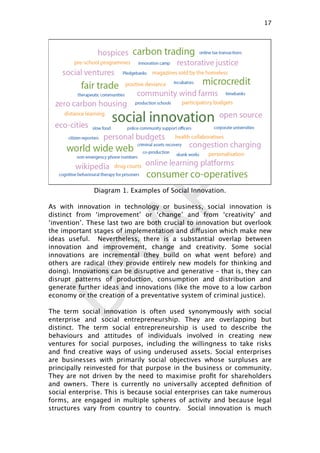
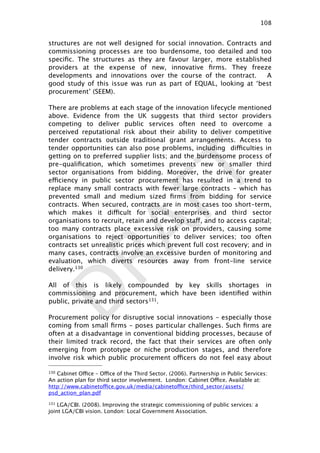
development and use of social innovation across Europe. The diagram
below illustrates some of these social innovations.
16
DRAFTDiagram 1. Examples of Social Innovation.
As with innovation in technology or business, social innovation is
distinct from ‘improvement’ or ‘change’ and from ‘creativity’ and
‘invention’. These last two are both crucial to innovation but overlook
the important stages of implementation and diffusion which make new
ideas useful. Nevertheless, there is a substantial overlap between
innovation and improvement, change and creativity. Some social
innovations are incremental (they build on what went before) and
others are radical (they provide entirely new models for thinking and
doing). Innovations can be disruptive and generative – that is, they can
disrupt patterns of production, consumption and distribution and
generate further ideas and innovations (like the move to a low carbon
economy or the creation of a preventative system of criminal justice).
The term social innovation is often used synonymously with social
enterprise and social entrepreneurship. They are overlapping but
distinct. The term social entrepreneurship is used to describe the
behaviours and attitudes of individuals involved in creating new
ventures for social purposes, including the willingness to take risks
and find creative ways of using underused assets. Social enterprises
are businesses with primarily social objectives whose surpluses are
principally reinvested for that purpose in the business or community.
They are not driven by the need to maximise profit for shareholders
and owners. There is currently no universally accepted definition of
social enterprise. This is because social enterprises can take numerous
forms, are engaged in multiple spheres of activity and because legal
structures vary from country to country. Social innovation is much
17
DRAFT
broader than either social entrepreneurship or social enterprise –
although it will often include one or both of these. Social innovation
describes the processes of invention, diffusion and adoption of new
services or organisational models, whether in the non-profit, public or
private sector. It also describes the outcome – the service or model
being developed.
A recent Stanford Social Innovation Review piece put it like this:
Unlike the terms social entrepreneurship and social
enterprise, social innovation transcends sectors, levels of
analysis, and methods to discover the processes – the
strategies, tactics, and theories of change – that produce
lasting impact. Social innovation may indeed involve finding
and training more social entrepreneurs. And it may entail
supporting the organisations and enterprises they create. But
it will certainly require understanding and fostering the
conditions that produce solutions to social problems.24
Even though, or perhaps because, the field of social innovation is so
new, there are a range of different definitions of social innovation. In
their article for the Stanford Social Innovation Review, Phills,
Deiglmeier and Miller define social innovation as, ‘a novel solution to a
social problem that is more effective, efficient, sustainable, or just
than existing solutions and for which the value created accrues
primarily to society as a whole rather than private individuals. A social
innovation can be a product, production process, or technology (much
like innovation in general), but it can also be a principle, an idea, a
piece of legislation, a social movement, an intervention, or some
combination of them.’25
The UK’s National Endowment for Science, Technology and the Arts
(NESTA), define social innovation in a similar way, but focus more on
the sources and purpose of social innovation. According to Harris and
Albury, Social innovation is innovation that is explicitly for the social
and public good. It is innovation inspired by the desire to meet social
needs which can be neglected by traditional forms of private market
provision and which have often been poorly served or unresolved by
services organised by the state. Social innovation can take place inside
or outside of public services. It can be developed by the public, private
or third sectors, or users and communities – but equally, some
innovation developed by these sectors does not qualify as social
18

24 J. A. Phills Jr., K. Deiglmeier and D. T. Miller, ‘Rediscovering Social Innovation’,
Stanford Social Innovation Review, 2008.
25 Ibid.
DRAFT
innovation because it does not directly address major social
challenges.’
A slightly different definition is offered by the OECD’s LEED
Programme (Local Economic and Employment Development), which
includes a Forum on Social Innovations. This Forum has been carrying
out research on social innovation since 2000. This definition is far
more ‘top down’ than the definitions mentioned above; it focuses on
labour market practices and the delivery of services. As such, it is at
odds with other definitions which provide the scope for ‘bottom-up’
approaches to social innovation and which argue that social innovation
can emanate from sources such as the household, informal networks,
non-profits, social movements and the market. The Forum defines
social innovation as that which concerns:
Conceptual, process or product change, organisational change
and changes in financing, and can deal with new relationships
with stakeholders and territories. ‘Social innovation’ seeks new
answers to social problems by:
• identifying and delivering new services that improve the
quality of life of individuals and communities;
• identifying and implementing new labour market
integration processes, new competencies, new jobs, and
new forms of participation, as diverse elements that each
contribute to improving the position of individuals in the
workforce.
The Forum on Social Innovations goes further, highlighting the
difference between economic innovation and social innovation.
According to the OECD, social innovation as opposed to economic
innovation, ‘is not about introducing new types of production or
exploiting new markets in itself but is about satisfying new needs not
provided by the market (even if markets intervene later) or creating
new, more satisfactory ways of insertion in terms of giving people a
place and a role in production.’
Another key distinction for the Forum on Social Innovations is that
social innovation is concerned with improving the welfare of
individuals and communities, both as consumers and producers. This
is done through employment, consumption or participation, with its
‘expressed purpose’ being to ‘provide solutions for individual and
community problems’.
We see problems with the definitions above, though all have been
useful in helping to define an emerging field. The Stanford definition
19
DRAFT
for example could be very wide. It might be taken to include the
Google search engine (which arguably has created more value for
society than even the value that has accrued to shareholders and
founders). The Harris/Albury definition focuses on motivations, which
are rarely easy to know with any certainty. The OECD definition is in
some respects too narrow, focusing primarily on labour market
changes.
Instead of these we have adopted a simpler and sharper alternative.
Social innovations are innovations that are social both in their
ends and in their means. Specifically, we define social innovations as
new ideas (products, services and models) that simultaneously meet
social needs (more effectively than alternatives) and create new social
relationships or collaborations. In other words they are innovations
that are both good for society and enhance society’s capacity to act.
Sources of Social Innovation
Social innovation used to be considered the sole preserve of the third
sector and non-profit organisations. But these more recent
perspectives emphasise that it takes place in all sectors, and that
particular innovations often move between sectors as they evolve. It
can come from:
- the private market (for example, ethical finance or corporate
social responsibility, or new models of collaborative business);
- the public sector (both in terms of policies and service models.
Examples include Flexicurity in Denmark and elsewhere which
provides flexibility for employers and security for employees
against labour market risks and holistic early years’ provision in
Reggio Emilia, Italy);
- the third sector (for example, Emmaus in Europe or Dialogue
Social Enterprise which tackles issues of disability and
marginalisation in Germany); and
- the household (which plays a critical role in the creation of
social movements such as the Slow Food movement which
started in Italy but has swept across the European continent).
Innovations can also involve more than one sector – one recent
example is the Grameen-Danone partnership. Together, these two
organisations produced and marketed healthy yoghurt as a means of
improving the health and nutrition of children in Bangladesh.
Innovations which begin in one sector can be taken up in others; and
20
DRAFT
often the most exciting innovations occur at the edges or interfaces
between sectors.26
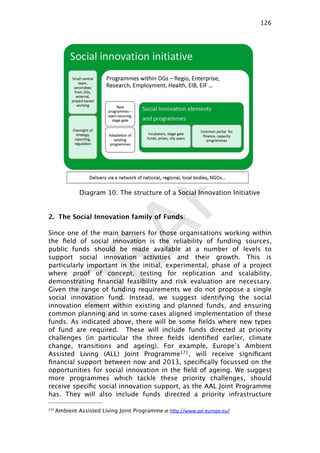
The shaded area in the diagram below represents those parts of the
four sectors which are concerned with social innovation. The diagram
shows that none of the four sectors is wholly concerned with social
innovation.

 
 Diagram 2. Social Innovation across the four
sectors
However, each of these parts of the four sectors are united by their
focus on social goals and by the importance given to ethics, social
inclusion, empowerment and solidarity.
Who does social innovation? Individuals, movements and
organisations
There are many lenses through which to understand social innovation.
For much of the last century it was understood within much broader
frameworks of thinking about social change, industrialisation and
modernity. Small innovations were seen as reflections of big dynamics.
In the contrary approach advocated by Karl Popper and others, social
innovation was the incremental and experimental alternative to the
errors of utopian blueprints and violent revolution (our reflections on
theories of change and their relevance to social innovation are
21

26 See also R. Murray, J. Caulier-Grice & G. Mulgan (2008) How to Innovate: the tools
for social innovation, London: NESTA.
DRAFT
contained in this endnote27). Schumpeterian economics provided a
frame in which a critical role is played by individual entrepreneurs
engaged in risk and innovation.
Today most discussion of social innovation tends to adopt one of
three main lenses for understanding how change happens: individuals,
movements or organisations.
1. Individuals and entrepreneurs
In the first, social change is portrayed as having been driven by a very
small number of heroic, energetic and impatient individuals. History is
told as the story of how they remade the world, persuading and
cajoling the lazy and timid majority into change.
The most important social innovator from the 18th century was
arguably Robert Owen, born in 1771 at the dawn of the industrial
22

27
There have been many attempts to define an overarching theory of social (or
economic) change. These theories were particularly fashionable in the 19th century –
change was explained through elaborate theories focused on the impact of
technology, contradictions, class struggle, or the advance of reason, and there were
also more simplistic theories which ascribed change to visionary individuals or
national will. More recently there have been various attempts to define an
overarching ‘theory of change’ (and in economics to offer a synthetic theory of
growth). However, all theories of this kind are based on a simple error: although
every aspect of social life is connected, there are no good reasons for believing that
a single theory could explain phenomena as diverse as family life, urban
communities, the evolution of workplaces, identity and conflict, crime and violence,
exploitation and cooperation. They are different in nature, have their own logics,
rhythms, and any general theory is likely to be either banal or wrong. Even within
economics, overarching theories of change and growth have not fared well compared
to more modest theories focused on such things as the dynamics of labour markets
or monetary policy. The big social changes that have accompanied industrialisation
have had some common features: urbanisation; changed gender roles; the rise of
mass media; globalisation; political empowerment of previously marginalised groups
and so on. It is also possible to point to some common themes in the stories of
social change: the role of blockages and impediments in galvanising change; the role
of ideas in giving shape to these and turning personal resentments into social forces;
the role of new knowledge in making things possible – from technologies like the car
or genomics, to the knowledge about health that has motivated anti-smoking
campaigns. There are also parallel struggles for resources – political, economic,
cultural – and parallel stories about how new ideas and movements try to attract
others. But these cannot be summarised into a simple model (for example, by
analogy with evolutionary theories) that have any explanatory or predictive power,
despite many attempts. We believe that it is possible to provide more accurate
analyses and descriptions of how new models, programmes and organisations
emerge and spread, how they crystallise, are concentrated in a model and are then
amplified, and our expectation is that new insights will come from gathering
examples, studying the fine-grained detail as much as from abstract theory. Anyone
wanting to achieve social change also needs to have thought through how they think
change happens – and how they can influence major interests and public excitement,
how they can circumvent barriers, and what might be realistic timescales for change.
But we are neither advocating, nor expecting, an overarching theory.
DRAFT
revolution, who is a good example of a Schumpeterian entrepreneur.28
By the turn of the century he had bought four textile factories in New
Lanark and was determined to use them not just to make money, but
to remake the world. Arguing that people were naturally good but
corrupted by harsh conditions, under Owen’s management the cotton
mills and village of New Lanark became a model community. When
Owen arrived at New Lanark, children from as young as five were
working for 13 hours a day in the textile mills. He stopped employing
children under ten and sent young children to newly built nursery and
infant schools, while older children combined work and secondary
school. In addition to schools New Lanark set up a crèche for working
mothers, free medical care, and comprehensive education, including
evening classes. There were concerts, dancing, music-making and
pleasant landscaped areas. His ideas inspired emulators all over the
world, and New Lanark remains a popular tourist attraction. He had an
enormous influence on the new cooperative and mutualist movements
as well as paving the way for modern management theories.
There are countless contemporary examples of similar social
innovators from around the world – leaders of social innovation have
included politicians, bureaucrats, intellectuals, business people as well
as NGO activists. Some are widely celebrated like Muhammad Yunus,
the founder of Grameen, Kenyan Nobel Prize winner Wangari Maathai,
or Saul Alinsky the highly influential evangelist of community
organising in the USA. There are also many less well-known, but
impressive figures, some of whom are described in David Bornstein’s
book on ‘How to Change the World’.29 These accounts include the
stories of Jeroo Billimoria, founder of the India-wide Childline, a 24-
hour helpline and emergency response system for children in
distress30; Vera Cordeiro, founder of Associacao Saude Crianca
Rensacer in Brazil31; Taddy Blecher, founder of the Community and
Individual Development Association (CIDA), City Campus, the first
private higher education institution in South Africa to offer a virtually
23

28 www.robert-owen.com; www.newlanark.org
29 Bornstein, D. (2004) How to change the world: social entrepreneurs and the power
of new ideas, Oxford University Press, Oxford
30 Childline was founded in Bombay in 1996; by 2002 the organisation was working
in thirty cities. A full account is available in Bornstein, D. (2004) op cit.
31 Renascer provides care to poor children after they are discharged from hospital.
By 2002, Renascer had assisted 6,000 children and successor organisations a further
10,000 people. Now, the challenge is to transform Renascer into a reference and
training centre spawning and supporting cells across Brazil. A full account is
available in Bornstein, D. (2004) op cit.
DRAFT
free business degree to students from disadvantaged backgrounds,32
and Karen Tse, founder of International Bridges to Justice.
2. Movements for change
Seen through another lens, however, individuals are the carriers of
ideas rather than originators. Social movement theory has provided a
very different perspective. The most far-reaching movements of
change, such as feminism or environmentalism, involved millions of
people and had dozens of intellectual and organisational leaders,
many of whom had the humility to realise that they were often as
much following, and channelling, changes in public consciousness as
they were directing them. Like individual change-makers, these
movements have their roots in ideas grown from discontent, but their
histories look very different.
Environmentalism, for example, grew from many different sources.
There were precursors in the 19th century, including: movements for
protecting forests and landscapes; scientifically inspired movements to
protect biodiversity; more politicised movements to counter the
pollution of big companies or gain redress for their victims;
movements of direct action like Greenpeace (which itself drew on
much older Quaker traditions); and the various Green Parties around
the world which have always been suspicious of individual leaders.
Environmentalism has spawned a huge range of social innovations,
from urban recycling to community owned wind farms. Today
environmentalism is as much part of big business culture as
companies like BP try to finesse the shift to more renewable energy
sources, as it is of the alternative business culture of organic food,
household composting, municipal government (for example the
hundreds of US Mayors who committed themselves to Kyoto in the
early 2000s), and civil society (through mass campaigns like Friends of
the Earth).  
Feminism too grew out of many different currents.33 In the West it had
its roots in the humanism of the 18th century and the Industrial
24

32 CIDA believes itself to be the only ‘free’, open-access, holistic, higher educational
facility in the world which is operated and managed by its students, from
administration duties to facilities management. Two additional key features are
partnerships with a great number of businesses in the design and delivery of all
programmes - and the requirement of every student to return to their rural schools
and communities, during holidays, to teach what they have learnt. A full account is
available in Bornstein, D. (2004) op cit. See also www.cida.co.za; Lucille Davie writing
on www.joburg.org.za; and Andrea Vinassa writing on www.workinfo.com
33 http://en.wikipedia.org/wiki/History_of_feminism
 
DRAFT
Revolution, and in the French Revolution’s Women’s Republican Club.
It evolved as a movement that was simultaneously intellectual and
cultural (pushed forward by pioneers like Emmeline Pankhurst, Simone
de Beauvoir and Germaine Greer), political (New Zealand was the first
country to give all adult women the vote and along with Scandinavia
has consistently been ahead of the US, Germany, France and the UK)
and economic (helped by women’s growing power in the labour
market). Many of its ideas were crystallised through legislation:
Norway’s ruling Labour Party’s recent proposal that big companies
should be required to have 40% of their boards made up of women is
just one example.
As in the case of environmentalism, thousands of social innovations
grew out of the movement: from clubs and networks to promote
women in particular professions, to integrated childcare centres,
abortion rights, equitable divorce laws, protections against rape and
sexual harassment, maternity leave and skills programmes for
mothers returning to the labour market.
Disability rights is another example of a powerful set of ideas whose
impact is still being felt on building regulation, employment practices
and public policy, as well as on popular culture, where stereotypes that
were once acceptable are shown to be degrading and offensive.34 As
recently as 1979, it was legal for some state governments in the USA
to sterilize disabled people against their will. During the 1980s and
1990s the disability movement became increasingly militant: voluntary
organisations serving disabled people went through fierce battles as
the beneficiaries fought to take control over NGOs that had been
established as paternalistic providers for mute recipients. Thanks to
their battles, legislation conferred new rights and obligations on
employers and planners; and technologists accelerated their efforts to
innovate. The Center for Independent Living, founded in 1972 by
disability activists in Berkeley, California, developed technologies such
as telecaptioners, text telephones, voice-recognition systems, voice
synthesizers and screen readers. In the UK, the ‘direct payments’ and
‘In Control’ programmes gave people with disability direct control
over public budgets and services far beyond any other public services
(see chapter 3).
Growing numbers of movements are taking shape globally – and they
are increasingly cooperating across borders. Impressive grassroots
movements that have done this include the International Network of
Street Papers (INSP), Streetnet35 (a network of street vendors based in
25

34www.disabilityhistory.org; http://bancroft.berkeley.edu/collections/drilm/;
http://americanhistory.si.edu/disabilityrights/
35	
  Streetnet at http://www.streetnet.org.za/
DRAFT
South Africa), Shack/Slum Dwellers International, GROOTS36 (which
links together grassroots women’s organisations around the world),
WIEGO37 (which campaigns for women in informal employment), and
the Forum Network in Asia for drugs projects.38 All have pioneered
and promoted the spread of radical social innovations.
Interestingly, all of these very different movements have adopted an
ethos suspicious of overly individualistic pictures of change. In their
view, the idea that progress comes from the wisdom of a few
exceptional individuals is an anachronism, a throwback to pre-
democratic times. All of these movements have also emphasised
empowerment – enabling people to solve their own problems rather
than waiting for the state, or heroic leaders, to solve problems for
them. 
3. Innovative organisations
The third lens for understanding innovation is the organisation. Not all
innovations come from new organisations. Many come from existing
organisations learning to renew themselves. The Internet came from
within the US military and the early understanding of climate change
from NASA, just as many of the most advanced ideas about how to
look after children have evolved within existing public and
professional organisations in countries like Denmark. Any successful
organisation needs to be simultaneously focused on existing activities,
emerging ones and more radical possibilities that could be the
mainstream activities of the future.
The wider context: understanding social change
Every successful social innovator or movement has succeeded because
it has planted the seeds of an idea in many minds. In the long run,
ideas are more powerful than individuals or institutions; indeed, as
John Maynard Keynes wrote, ‘the world is ruled by little else’. But
ideas need to take concrete form. Even the great religious prophets
only spawned great religions because they were followed by great
organisers, evangelists and military conquerors who were able to focus
their energies and create great organisations.39 To fully understand
26

36	
  GROOTS at http://www.groots.org/
37	
  WIEGO at http://www.wiego.org/
38 INSP at http://www.sdinet.org/
39 For the comparisons between business and the social sector in making
organisations great see www.jimcollins.com/
DRAFT
social innovation, we therefore need to look at the conditions which
either allow change or inhibit it.40
There is a vast literature on how change happens, but at its heart it
emphasises two simple questions: why (most of the time) do things
stay the same?; and why (some of the time) do things change?41 For
innovators themselves, the barriers to change often look like personal
failings on the part of the powerful: their stupidity, rigidity and lack of
imagination is all that stands between a brilliant new idea and its
execution. But the true barriers to change go much deeper than this.
The first barrier to change is efficiency. People often resist even the
most appealing reforms because in the short-run at least, they
threaten to worsen performance. The reason for this is that within any
social system, different elements have optimised around each other
over time. The details of how businesses operate, how professions are
trained and rewarded, how laws are made, how families organise their
time and several other aspects of daily life have evolved in tandem.
Any new approach, however well designed, may appear quite
inefficient compared to the subtle interdependencies of a real social or
economic system. Even public sectors which by many standards are
highly inefficient, will have built up their own logic – like the military
bases in the old Soviet Union that propped up local economies, or the
vast US prisons built in the 1980s and 1990s that did the same.
The importance of this point was identified by a succession of writers
about change – from Joseph Schumpeter in the 1930s to Donald Schon
in the 1970s. In the 1990s Amitai Etzioni and Clayten Christiansen
recognised the implication that any radical innovators have to hold
their nerve – and hold onto their supporters – through difficult
transition periods when things may appear to be getting worse, rather
than better. Christiansen’s account of the ‘innovators dilemma’ is a
good summary of this issue. Firms - or public organisations with
established ways of doing things - become used to improving their
position by steadily adding new features. But radical new options then
arise which start off less efficient than the older, optimised
alternatives, but which have the potential to transcend them. For the
organisation this presents two dilemmas: first how to cultivate the
27

40 This section draws on very useful work by Timo Hämäläinen (2007), ‘Social
Innovation, Structural Adjustment and Economic Performance' in Timo J. Hämäläinen
and Risto Heiskala (eds) Social Innovations, Institutional Change and Economic
Performance: Making Sense of Structural Adjustment Processes in Industrial Sectors,
Regions and Societies, Edward Elgar Publishing, Cheltenham, UK and Northampton,
MA, USA
41 This chapter also draws in particular on the school of thought promoted by
Christopher Freeman, Carlotta Perez and Luc Soete in a pioneering series of books
and articles on technological, economic and social change in the 1980s and 1990s.
DRAFT
new, potentially higher impact innovation (recognising that it may fail);
and second, how to simultaneously ride both the old and the new
waves – how, in some cases, to compete against yourself.
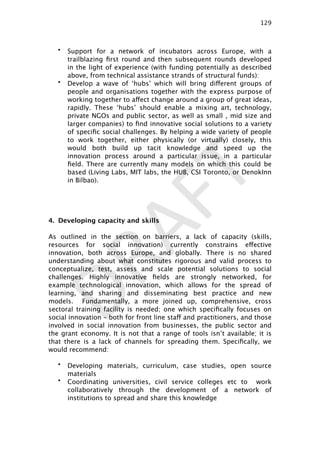
Diagram 3. Understanding social change
The second barrier to change is peoples’ interests. In any successful
social system, many people will have high stakes in stability. The risks
of change will appear great compared to the benefits of continuity.
This applies as much to peasant farmers nervously contemplating new
models of farming, as to managers responding to globalisation or civil
servants contemplating a new deal around performance related pay.
Most will have sunk investments – of time and money – in past
practices that they are loath to discard or cannibalise. In stable
societies, the most acute tensions will have been papered over, or
settled in compromises, prompting fear that change may bring these
to the surface. Simultaneously, the interest groups, which are the
greatest beneficiaries of the status quo, will have learned how to work
the system to their own ends and how to make themselves
indispensable. 42
28

42 This is core to the argument of Mancur Olson, who argued that long periods of
stability would inevitably lead to stagnation, the M. Olson, (1982) Rise and Decline of
Nations. Yale university Press, New Haven, USA
DRAFT
The third barrier is people’s minds. Any social system comes to be
solidified within peoples’ minds in the form of assumptions, values
and norms. The more the system appears to work, giving people
security and prosperity the more its norms will become entrenched as
part of peoples’ very sense of identity.43 Organisations then become
locked into routines and habits that are as much psychological as
practical, and which become embedded in organisational memories.44
The fourth barrier is relationships. The personal relationships
between the movers and shakers in the system create an additional
stabilising factor in the form of social capital and mutual commitment.
Much of the business of government and the social sector rests on
personal relationships that may count for more than formal
organograms. These networks of favours and debts can be key for
getting things to happen within a stable system, but they are likely to
seriously impede any radical change.
These barriers explain why even where there is a healthy appetite for
incremental improvements and changes, it is generally hard to push
through more radical transformations – regardless of evidence or
rationales or passions.
The most famous account of these barriers was provided by Thomas
Kuhn in his work on science which popularised the idea of a
‘paradigm’. Kuhn showed that even in the apparently rational world of
science, better theories do not automatically displace worse ones.
Instead, existing theories have to be clearly failing on a wide range of
issues and ultimately, their adherents have to have died or given up
before the new theory can take over.
So why, despite the power of these barriers, does change still happen?
The simple reason is that in some circumstances each of the four
barriers to change switches.
First, efficiency: sooner or later all systems become less optimal, less
successful at delivering the goods. As their problems accumulate, the
crisis may be felt at many levels: declining profitability for companies;
fiscal crisis or legitimacy crisis for the state; the personal stress felt by
millions as they see their cherished values or norms less validated by
experience. Although people are adept at explaining away
29

43 An interesting recent book which explores some of these dynamics is M.Fairbanks
and S. Lindsay (1997), Plowing the Sea; nurturing the hidden sources of growth in
the developing world, Harvard Business School Press, Boston.
44 R. Nelson and S.Winter;91982) An evolutionary theory of economic change
Belknap Press , USA remains the outstanding account of how firms resist change -
and sometimes enable change to happen.
DRAFT
uncomfortable results and avoiding ‘cognitive dissonance’,45 and
although elites generally try to police taboo ideas, at some point
performance is bound to decline. Then a growing range of interests,
particularly more marginalised ones, lose confidence in the system,
and start to seek alternatives. Critics become more visible: in
particular the young, marginal, ambitious, and angry start to advocate
radical change and to directly challenge their older colleagues who
have been most socialised into the status quo and find it hardest to
imagine how things could be different.46 Artists, writers and poets may
come to the fore during this phase, using stories, images and
metaphors to help people break free from the past, while others may
cling even harder to fixed points in their identity, responding to the
cognitive fluidity of the world around them by ever more ferocious
assertion of their nationality, religion or values. During these periods
mental models start changing. Intellectuals, activists, political
entrepreneurs, trouble makers, or prophets find their voice in
denouncing the present and promoting a different future, with a
characteristic tone that is deliberately unsettling, amplifying
dissonance and tensions. At the same time, the longstanding personal
relationships that held the system in place come under strain as some
sense that change is imminent and others resist.
Patterns of this kind can be found on a micro scale within particular
sectors and they can affect whole societies. During periods of change
those within the system – especially those who have prospered from it
and now sit at the top of business, bureaucratic or political hierarchies
- are likely to be the last to see its deficiencies. Ever more
sophisticated accounts may explain why the status quo can be saved,
or why only modest reform will be enough. Such periods, when old
systems are in crisis, can continue for many years. But sooner or later
they come to an end as the new ideas diffuse, and the innovators
connect to the main sources of power and money. When the conditions
are right, new ideas can quickly move from the margins to the
mainstream, since many people are well-attuned to watching what the
successful do, take their cues from recognised figures of authority,
and only adopt new ideas when they no longer appear risky. In all
cases change is more likely when there are visible, easily identifiable
winners. Conversely, as Machiavelli pointed out, change is harder
30

45 L. Festinger (1957), A theory of cognitive dissonance. Evanston, Row, Peterson and
Company. As Howard Gardner has shown intellectuals are particularly attached to
ideas that give them status, and particularly concerned to avoid cognitive
dissonance.
46 H. Gardner (2004) Changing Minds, Harvard Business School Press, USA.
DRAFT
when the losers are concentrated and certain, and the winners are
diffuse and uncertain of their possible gains.47
When systemic change does happen - for example the rise of welfare
states fifty years ago, the shift to a more knowledge based economy in
the last decades of the 20th century, or the shift to a low carbon
economy in the early 21st century - the opportunities for social
innovation greatly increase. Some ideas can be copied from other
societies that have moved faster – for example how to run web-based
exchange systems, or road charging. But more often the elements of
the new paradigm are not self-evident; they evolve rapidly through
trial and error, and even the elements which appear to be proven
successes need to be adapted to local conditions. Once a system has
made a fundamental shift, new energies are often released. An
emerging paradigm is likely to be rich in positive interdependencies.
New kinds of efficiency are discovered, including more systemic
efficiencies, such as the efficiencies that flow into the economy from
better public health or low carbon technologies. 48 This is one of the
reasons why big changes are often followed by a honeymoon period.
People tire of change and want to give the new model a fair chance.
New elites radiate the confidence that comes from successfully
overcoming enemies and barriers. And societies as a whole immerse
themselves in the business of learning new habits, rules, and ways of
seeing and doing.
The uneasy symbiosis of ‘bees’ and ‘trees’
This story of change emphasises the interaction between the
innovators and the environment they are working in. It emphasises,
too, that new ideas have to secure support if they are to survive. The
support they need may include: the passion and commitment of other
people, the money of patrons or the state and contracts or consumers.
Social change depends, in other words, on alliances between what
could be called the ‘bees’ and the ‘trees’. The bees are the small
organisations, individuals and groups who have the new ideas, and are
mobile, quick and able to cross-pollinate. The trees are the big
organisations – governments, companies or big NGOs – which are poor
at creativity but generally good at implementation, and which have the
resilience, roots and scale to make things happen. Both need each
other, and most social change is an alliance of the two, just as most
31

47 And in both cases change may be so delayed that apparently new ideas risk being
outdated by the time they win acceptance. D. Schon (1973) Beyond the stable state
WW Norton, New York.
48 Economists generally emphasise allocative efficiency. But other kinds of efficiency
can be just as important for long-term growth. M. Dertouzos, R. Lester and R. Solow
(1990) Made in America: Regaining the productive edge.Harper Perennial, New York.
DRAFT
change within organisations depends on alliances between leaders and
groups well down the formal hierarchy.
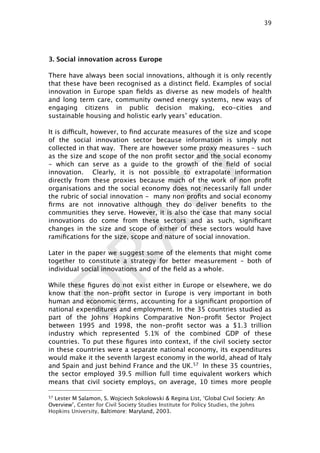
The process of social innovation
Research on social innovation methods in use worldwide has identified
six stages that take an idea from inception to impact. As we illustrate
in the diagram below, the process of social innovation is not linear.
Often, the end use of an innovation will be very different from the one
that was originally envisaged; sometimes action precedes
understanding and sometimes taking action crystallises the idea.
There are feedback loops and leaps between every stage, which make
real innovations more like multiple spirals than straight lines.
Nevertheless this framework provides an important tool for policy
makers to understand where support is needed and what forms it
should take.
Diagram 4. The process of social innovation
Six stages of social innovation:
1. Prompts. This includes all the factors which highlight the need
for and prompt innovation – such as crisis, public spending cuts,
poor performance or new evidence and inspiration. This stage
32
DRAFT
involves diagnosing the problem and framing the question in
such a way that root causes, not just symptoms, will be tackled.
As such, there is an important role here for feedback systems
which help practitioners and front line staff to understand the
needs of users and better tailor their services accordingly. There
are also many organisations which organise the prompts to
themselves – through mapping and research, for example, to
spot new and emerging challenges.
2.Proposals. This is the stage of idea generation. This can involve
formal methods – such as design methods or creativity methods.
Many of the methods help to draw in insights and experiences
from a wide range of sources. Ideas can come from many
sources - citizens, service users, communities, front line staff,
other sectors or other countries. There are many ways of
tapping into these sources (such as idea banks, call for ideas,
competitions and so on) and ways of engaging citizens, users
and others in the design and development of solutions.
3.Prototyping. This is where ideas get tested in practice. This can
be done through pilots and prototypes or more formal methods
such as randomised control trials. One new approach in the UK
are Whole System Demonstration pilots which attempt to test
out interconnected elements rather than the discrete services or
actions usually associated with pilots. These demonstration
pilots are currently focused on integrated health and social care
through telecare, telehealth and other assistive technologies in
Kent, Cornwall and Newham. The driving principles at this stage
are speed, keeping costs low, tangibility and feedback loops
from users and specialists.
4.Sustaining. This is when the idea becomes everyday practice. It
involves identifying income streams to ensure the long term
financial sustainability of the firm, social enterprise or charity
that will carry the innovation forward. In the public sector this
means identifying budgets, teams and other resources such as
legislation. It requires evidence and tactics specific to the public
sector. Sometimes a service can be funded with new finance. At
other times existing services need to be transformed or
replaced. But to move from pilots and prototypes to a securely
established public innovation, it is often advisable to set it up as
a separate venture, with public finance and a service contract
that can prove itself at scale. Indeed this may be crucial if the
new idea is to have the right culture and ethos.
5.Scaling. At this stage there are a range of strategies for growing
33
DRAFT
and spreading an innovation– from organisational growth,
through to licensing and franchising to federations and looser
diffusion. Emulation and inspiration also play a critical role in
spreading an idea or practice. In the public sector,
commissioning and procurement play a crucial role in diffusing
and spreading new services, especially through the growth of
contracting out services. Although often driven by the need to
cut costs, commissioning has also been used as a means to
introduce service innovation in publicly funded provision. Local
government in the UK has used commissioning to experiment
with alternative service models provided by social enterprises
and grant based organisations, often working closely with them
on extending the new practices. Alongside initiation, escalation
and embedding, public procurement plays a role in relation to
consolidation by purchasing services at scale.49
6.Systemic change. This is the ultimate goal of social innovation.
Systemic change is very different from innovation in products or
services, and usually very different from innovation in business.
It usually involves the interaction of many elements: social
movements, business models, laws and regulations, data and
infrastructures, and entirely new ways of thinking and doing. It
usually involves changes to power, replacing old power holders
with new ones. And it often involves all four sectors – business,
government, civil society and the household. Models for thinking
about innovation that only look at one sector miss the crucial
ways in which they interact. For example, innovation around
carbon reduction has been driven by the green movement over
many decades, reinforced by politicians introducing new laws
and regulations; and then amplified by businesses and clean
technology investment funds. It has involved new technologies,
but these have been necessary not sufficient conditions for
change. Often it has been more important to develop new ways
of organising transport, housing or energy, or new ways for
citizens to think about their own responsibilities. Systemic
34

49 The ‘initiation, escalation and consolidation’ model is discussed in: J. Edler et al.
(2005) Innovation and Public Procurement. Review of Issues at Stake, Study for the
European Commission, Final Report, Fraunhofer Institute for Systems and Innovation
Research. Available at: ftp://ftp.cordis.europa.eu/pub/innovation-policy/studies/
full_study.pdf. For more information on procurement and commissioning see:
Stoneman, P., & Diederen, P., (1994) Technology Diffusion and Public Policy, The
Economic Journal, 104 (July), 918-930, Oxford: Blackwell; Georghiou, L. (2007)
Demanding Innovation: Lead Markets, Public Procurement and Innovation,
Provocation 02. London: NESTA; Office of Government Commerce (2004) Capturing
Innovation: nurturing suppliers’ ideas in the public sector. London: Office of
Government Commerce; CBI / QinetiQ,(2006) Innovation and Public Procurement – A
new approach to stimulating innovation, London: CBI; HM Treasury (2007)
Transforming Government Procurement, London: HM Treasury.
DRAFT
change will also mean demonstrating what works on a larger
scale – establishing working prototypes of the new system, for
example the low carbon housing in Hammarby Sjöstad in
Sweden and Vauban in Freiburg.
Alignment of factors for social innovation

Certain conditions need to be put in place for putting innovative
products, services and models into practice sustainably and on a large
scale. Seen through an economic lens the problem of social innovation
is that:
• There is a shortage of sources of capital for research,
development and implementation of social innovations, because
• There are weak property rights for social innovations, and
consequently only weak incentives for investment, and
• There are, at best, imperfect markets for social outcomes, which
again makes it hard to generate finance for innovations.
For innovations to grow in scale they need:
• ‘Pull’ in the form of effective demand, which comes from the
acknowledgement of a need within society, and from the
recognition of that need by organisations (or consumers or
commissioners) with the financial capacity to address it. These
might include employers seeking new types of skills (e.g. better
ability to work in teams, or software programming).
• ‘Push’ in the form of effective supply, which comes from: first,
the generation of innovative ideas (by creative individuals and
teams, potential beneficiaries and users often inspired by anger,
suffering or compassion); second, the development of those
ideas into demonstrably workable forms; and third, their
communication and dissemination.
• Effective strategies that connect ‘pull’ to ‘push’, and find the
right organisational forms to put the innovation into practice.
• Learning and adaptation to ensure that the innovation achieves
social impact and continues to do so as the environment around
it changes.
Many promising innovations have foundered because critical elements
were missing. So, for example, there might be wide recognition of a
need but not on the part of organisations with power and money.
Moreover, these factors all work in distinct ways by comparison with
35
DRAFT
innovation in the private sector. This is especially the case as both
push and pull factors within the public sector will be shaped by
political priorities, budgetary demands and public opinion.50
Diagram 5. Effective supply/effective demand
Many routes to growth
There are also many routes to growth – from organisational growth, to
licensing and franchising to federations and looser diffusion. Some of
these approaches involve scaling. Others involve much more organic
processes of diffusion, with ideas spreading and adapting rather than
growing through a single organisation. The most influential social
ideas have spread not through the growth of an organisation but
through emulation.51
36

50 See also, G. Mulgan (2006) Social Innovation: what it is, why it matters, how it can
be accelerated, London, Basingstoke Press; G. Mulgan (2007) Ready or Not? Taking
Innovation in the Public Sector Seriously, London, NESTA; N. Bacon, N. Faizullah, G.
Mulgan, & S. Woodcraft (2008) Transformers: How local areas innovate to address
changing social needs, London, NESTA.
51 G. Mulgan, R. Ali, R. Halkett and B. Sanders (2007) In and Out of Sync: The
challenge of growing social innovations, London, NESTA.
DRAFT
Growing an innovation depends on effective supply and effective
demand: effective demand refers to the growth of evidence to show
that the innovation really works. Effective demand refers to
willingness to pay. Both are needed – but sometimes the first priority
is to prove effectiveness while in other cases the priority is to create
demand, both by persuading people that there is a need to be met,
and then persuading people or organisations with the ability to pay
that they should do so.
The common model for diffusion is that of an ‘S’ curve: starting slowly
at first, diffusion then accelerates significantly before tailing off as the
last segment of late adopters take up the innovation. In part, this
occurs because of information asymmetries. If the innovation market
functioned perfectly, one would expect marginal social benefit to
equal marginal social costs at any point in the diffusion path. However,
because information in the market is not perfect, the welfare diffusion
path might be suboptimal. Incomplete or sometimes inaccurate
information can slow down the rate of diffusion of social innovation.52
Through regulation and public procurement, governments can
overcome some of the problems associated with information
asymmetries and help accelerate the widespread adoption of social
innovations. However, existing commissioning and procurement
structures are not well designed for social innovation. In most cases,
contracts are too short-term, which makes it difficult for social
enterprises and third sector organisations to recruit, retain and
develop staff, and to access capital; too many contracts place
excessive risk on providers, causing some organisations to reject
opportunities to deliver services; too often contracts set unrealistic
prices which prevent full cost recovery; and in many cases, contracts
involve an excessive burden of monitoring and evaluation, which
diverts resources away from front-line service delivery.53 The
structures as they are favour larger, more established providers at the
expense of new, innovative firms. They also freeze developments and
innovations over the course of the contract. This is a challenge for
social innovation.
Growth and diffusion can also be supported through intermediaries
(organisations such as MindLab in Denmark) which connect ideas,
37

52 P. Stoneman and P. Diederen, (1994) ‘Technology Diffusion and Public Policy’, The
Economic Journal, 104 (July), 918-930. Oxford, Blackwell.
53 Cabinet Office (2006) Partnership in Public Services: An action plan for third sector
involvement, London. Available at: http://www.cabinetoffice.gov.uk/media/
cabinetoffice/third_sector/assets/psd_action_plan.pdf
DRAFT
resources and people, can play a key role in designing, testing and
evaluating projects and advocating their adoption by government.54 It
can also be supported through networks which help to spread learning
and best practice. One example is the sustainable urban development
network URBACT, created as part of the EU’s URBAN I and II
programmes.55 Another is the EU’s Community Initiative Programme
EQUAL, funded by the European Social Fund.56
There is also a role here for incubators, innovation parks and research
centres. For example, MaRS in Toronto, links a university, hospital,
business incubator, alongside a social innovation investment fund. In
Singapore, Biopolis, a two-million square foot research centre brings
together scientific leaders and post-doctoral students and in the
Basque Country, the world’s first experiment in creating a ‘social
silicon valley’ is currently underway. DenokInn, the Basque Centre for
Innovation, Entrepreneurship, and New Business development in Spain
is creating a business park for social enterprises and co-operatives.
The park will include start-ups, regional and governmental
organisations, and charitable foundations. Research and development
needs will be met by the creation of a school for social innovation.
In what follows, we look at a range of social innovations from across
Europe which are already providing solutions to some of Europe’s
most pressing social and environmental challenges. We’ve sought to
include examples from a range of countries and a range of fields. It is
by no means comprehensive; it is very much a snapshot designed to
highlight the richness and variety of the field of social innovation.
38

54 MindLab at http://www.mind-lab.dk/en/
55 URBACT at http://urbact.eu/
56 http://ec.europa.eu/employment_social/equal/index_en.cfm
DRAFT
3. Social innovation across Europe
There have always been social innovations, although it is only recently
that these have been recognised as a distinct field. Examples of social
innovation in Europe span fields as diverse as new models of health
and long term care, community owned energy systems, new ways of
engaging citizens in public decision making, eco-cities and
sustainable housing and holistic early years’ education.
It is difficult, however, to find accurate measures of the size and scope
of the social innovation sector because information is simply not
collected in that way. There are however some proxy measures – such
as the size and scope of the non profit sector and the social economy
- which can serve as a guide to the growth of the field of social
innovation. Clearly, it is not possible to extrapolate information
directly from these proxies because much of the work of non profit
organisations and the social economy does not necessarily fall under
the rubric of social innovation - many non profits and social economy
firms are not innovative although they do deliver benefits to the
communities they serve. However, it is also the case that many social
innovations do come from these sectors and as such, significant
changes in the size and scope of either of these sectors would have
ramifications for the size, scope and nature of social innovation.
Later in the paper we suggest some of the elements that might come
together to constitute a strategy for better measurement – both of
individual social innovations and of the field as a whole.
While these figures do not exist either in Europe or elsewhere, we do
know that the non-profit sector in Europe is very important in both
human and economic terms, accounting for a significant proportion of
national expenditures and employment. In the 35 countries studied as
part of the Johns Hopkins Comparative Non-profit Sector Project
between 1995 and 1998, the non-profit sector was a $1.3 trillion
industry which represented 5.1% of the combined GDP of these
countries. To put these figures into context, if the civil society sector
in these countries were a separate national economy, its expenditures
would make it the seventh largest economy in the world, ahead of Italy
and Spain and just behind France and the UK.57 In these 35 countries,
the sector employed 39.5 million full time equivalent workers which
means that civil society employs, on average, 10 times more people
39

57 Lester M Salamon, S. Wojciech Sokolowski & Regina List, ‘Global Civil Society: An
Overview’, Center for Civil Society Studies Institute for Policy Studies, the Johns
Hopkins University, Baltimore: Maryland, 2003.
DRAFT
than the utilities and textile industries in these countries, five times
more people than the food manufacturing industry and about 20 %
more people than the transportation industry. Data from the Johns
Hopkins study also found astounding growth rates within the non-
profit sector in all European countries where the sector’s share of total
employment could be compared for 1990 and 1995. The study found
growth rates of 20-30% over five years – rates that are well above what
has been observed in the economy as a whole.
The social economy in Europe is a comparable economic force - it
employs over 11 million people, equivalent to about 6% of the working
population of the EU. In the accession member states, 4.2% of the
wage earning population is employed in the social economy. This is a
lower percentage than the average in the older member states (7.0%)
and in countries such as the Netherlands (10.7%), Ireland (10.6%) or
France (8.7%). One of the most rapid growth areas within the social
economy over the last decade has been in the growth of social
enterprises.
Information about the scale and scope of the social enterprise sector
across Europe remains limited. There are difficulties in measuring how
many social enterprises operate within member states. In part, this is
because most countries do not collect information on the number of
social enterprises – instead they collect data on the number of
organisations with particular legal forms – that is, the number of social
co-operatives, associations, social purpose companies and so on. For
example, there were 7,363 social co-operatives in Italy in 2005.58 As a
result, only a small proportion of social enterprise activity is collected
in official statistics.
A few countries have started to collect information about the number
of social enterprises. In Finland, for example, there were 170
registered social enterprises in 2008.59 However, because social
enterprises in Finland are work integration organisations (‘social
firms’) - that is, organisations which focus on integrating highly
excluded groups into the labour market, it is highly likely that these
figures significantly underestimate the true scale of social enterprise
activity in the country. With the EU, the field of social enterprise may
be best developed in the UK. Figures from 2008/9 estimate that there
are 62,000 social enterprises in the UK, with small and medium social
40

58 Barbara Moreschi (ed.) (2005) Le cooperative sociali in Italia, Rome, Istituto
Nazionale di Statistica. Available at: http://www.istat.it/dati/catalogo/
20080807_03/inf_08_04le_cooperative_sociali_italia05.pdf
59 P. Pattiniemi, (2009) Social Enterprise Legislation in Finland. Available at: http://
www.rci.org.pl/download/080728/17.pdf
DRAFT
enterprises contributing £24 billion Gross Value Added to the UK
economy.60
In what follows, we’ve pulled together a range of examples of social
innovation from across Europe’s 27 member states. As this section
will demonstrate, there is no shortage of ideas or even innovations.
We’ve organised the material into sectors – the public sector, the
private sector, the grant economy and the household - because there
are clear and distinct trends in each sector.
41

60 George Leahy and Frank Villeneuve-Smith (2009) State of Social Enterprise Survey
2009, London: Social Enterprise Coalition. Available at: http://
www.socialenterprise.org.uk/data/files/stateofsocialenterprise2009.pdf
DRAFT
Public sector
As we mention earlier, the public sector is often the key source of
social innovation. In practice public services are not monolithic: they
include a great deal of local variation, and many systems for
innovation organised within and around professions (doctor, teachers,
police &c). Despite the fact that there are significant barriers to
innovation (such as departmental silos, audit and accountability
structures and so on) and few enabling conditions (dedicated teams
and budgets), public servants are often motivated to seek out radical
new models. The problem is that the public innovation process
(centred on political manifestos and commitments) is by its nature
centralised and episodic, a problem compounded by the structural
limitations to innovation on the front line of service delivery.61
Some of the most exciting innovations have been attempts to
overcome these barriers – by working across departmental structures,
for example, and rationalising bureaucratic inefficiencies. Another set
of innovations have been around citizen engagement and
personalisation – not only in the co-design of public services, but also
in the decision making process, by devolving power and budgets to
individuals and local communities. Another series of innovations
within the public sector have been around prevention - trying to tackle
the longer term causes of social problems rather than simply dealing
with their effects and symptoms. The spread of digital technologies
and the internet have also had a profound effect on public services
and have prompted a range of innovations.
According to Jocelyne Bourgon, President Emeritus of the Canada
School of Public Service, “public sector practitioners are asked to work
with the tools of the 19th Century to meet the needs of the citizens in
the 21st Century....To access individual and collective knowledge and
to spur innovation, governments need to continue broadening and
deepening their approaches to governing with others and using their
authority to unleash collective talents and power”.62
We’ve organised the following material into 7 main themes:
• Rights and entitlements
• Co-design
42

61 Robin Murray (2009) Danger and Opportunity: Crisis and the new Social Economy,
Provocation 09, London: NESTA.
62 Jocelyne Bourgon, “The Future of Public Administration: Serving Beyond the
Predictable”, article published by Public Money & Management in 2009 (Volume 29,
Number 1) Chartered Institute of Public Finance and Accountancy (CIPFA); Public
Money & Management is available online at: http://journalsonline.tandf.co.uk
DRAFT
• Devolving power and budgets
• Prevention
• ICT as an enabler of social innovation
• Reducing bureaucracy
In each case we have tried to focus on examples where there is some
data on impact and reach. However, solid research on the full
impacts of initiatives in this field tends to be limited, and one of our
recommendations for the future is to ensure much more rigorous and
consistent assessment of social value.
Rights and entitlements – 0-7-90-90, Sweden
Across the world governments are experimenting with guarantees,
charters and other documents outlining the rights and entitlements of
citizens. One of the most successful experiments has been in Sweden,
where a series of national guarantees to timely health treatment have
been introduced.
In 2005, the government introduced care guarantees for all
procedures based on a ‘0-7-90-90’ rule – patients make contact with
the health system (0 days), are entitled to seeing a GP within 7 days,
then a specialist within 90 days and then undergo treatment within 90
days (i.e. there is a maximum wait of 90 days between receiving
treatment and seeing a specialist).
If this guarantee is not met, the patient is entitled to choose care from
another provider (another hospital, for example) and the local council
is responsible for paying the costs (including the costs of travel). This
policy has achieved staggering results: within 7 months, the number
of patients waiting for treatment dropped by half. This guarantee now
serves as a minimum standard for patient care and the basis for
continued improvement in the service.
Co-design – Participle and Southwark Circle, UK
There are a series of design agencies across Europe helping public
agencies and local communities co-design services together. One
example from the UK is Participle, set up in 2007 to apply design
approaches to public sector reform. Participle’s main aims are to
create a system based on capabilities rather than needs, to encourage
openly inclusive services, to move away from a financial focus and
towards a focus on resources, to create distributed networks as
opposed to centralised institutions, and to focus on social networks as
opposed to the individual. Their work is based on four main
principles:
43
DRAFT
• Collaboration – with users, front line staff and other
stakeholders, and partnerships with organisations from the
private, public and third sectors.
• User Led – design processes enable both potential end users
and existing front line staff, among other specialists, to be a
driving force in the design of new services.
• Highly Iterative – ideas are tested rapidly through
prototyping. Prototypes involve early service models
developed in situ, which are then tested and improved in
rapid cycles.
• End Result Focused – by using user-centred design
techniques that source untapped specialists, Participle are
able to design services that people want and will use. Once
ideas have been tested, the focus is on implementation and
rolling out services.
The design process used by Participle is based on the Transformation
Design process developed at RED at the Design Council. The approach
is multidisciplinary – Participle’s team includes designers, social
anthropologists, researchers, policy analysts, economists and others.
It is based on in-depth user research (using ethnographic research
methods such as user-observation, video diaries and group work) and
‘indirect research’ which explores the policy context and the current
state of public service provision; gathering new insights and
developing ideas from those insights; rapidly testing solutions and
getting feedback from users and front line staff to refine the ideas and
make sure they work in practice and; building a business case to make
sure that solutions are affordable, desirable and effective. 63
Participle work across various policy fields, but one of their most
remarkable achievements has been in the area of ageing with the
creation of the Southwark Circle.
In 2007, Participle started working with Southwark Council, Sky and
the Department for Work & Pensions, to design new services to
improve the quality of life and well-being of older people. Rather than
start with the question ‘what can public services do to improve quality
of life and well-being for older people?’ Participle decided to ask
another question - ‘how can a locality mobilise public, private,
voluntary and community resources to help all older people define and
create quality of life and well-being for themselves?’ This kind of
44

63 Colin Burns, Hilary Cottam, Chris Vanstone and Jennie Winhall, Transformation
Design RED PAPER 02. London: Design Council, 2006. Available at: http://
www.designcouncil.info/mt/RED/transformationdesign/
TransformationDesignFinalDraft.pdf
DRAFT
perspective requires a ‘radical change in the way resources are defined
(beyond the formal social care system) and the way services and
systems are configured (away from a near exclusive focus on care and
towards building relationships and participation).’
Working with over 250 older people and family members to generated
insights into their hopes, fears, needs and aspirations, Participle
developed Southwark Circle, a membership organisation that helps
people take care of household tasks, forge social connections and find
new directions in life. Members can ask for help (gardening, picking
up shopping, household repairs etc) from other members or local,
reliable Neighbourhood helpers. These helpers are either volunteers
(the time volunteers give is flexible – anywhere between 1 and ten
hours a week) or specialist technicians and craftsmen (carpenters,
plumbers and electricians).  The cost of membership ranges from £30
to £75 on a quarterly basis, but costs can be offset by helping other
members. Southwark Circle is a model of how future services might
look across Britain.64 There has yet to be any full evaluation of the
benefits of the programme relative to costs.
Devolving power and budgets – participatory budgeting, Germany
Participatory budgeting is a system for involving citizens in deciding
how public funds should be allocated. It can be organised
geographically (by neighbourhood, local authority or municipality) or
thematically (e.g. school, health or housing budgets). By prioritising
the voice of community members in identifying neighbourhood
priorities and in allocating a proportion of local financial resources,
participatory budgeting aims to increase accountability, transparency
and social inclusion in municipal affairs, and build trust between
communities and local government. 
Participatory budgeting began in Porto Alegre, Brazil but has swept
across the globe as an innovative approach to urban politics. One
recent development is the use of online platforms for engaging
citizens in participatory budgeting. This was first piloted by the
municipality of Cologne who introduced participatory budgeting in
2007 as part of a wider agenda for e-participation.
Within the municipality, the office for e-government and online
services, together with the Fraunhofer Institute AIS, developed an
online platform which enabled Cologne’s residents to participate in
planning the 2008 budget by submitting proposals, comments and
ideas and casting votes for or against specific proposals.
45

64Southwark Circle: http://www.southwarkcircle.org.uk/home.htm
DRAFT
Citizens were invited to submit proposals on three main areas:
highways, byways and public spaces; green spaces and; sport. A total
budget of €311m was earmarked for these areas. The platform was
open for four weeks from 22nd October 2007 to 19th November 2007,
during which time, it elicited roughly 5,000 proposals, received 9,184
comments related to proposals and a total of 52, 746 votes. The site
received 120,000 unique visits and a total of 873,476 hits.
These are remarkable participation rates, far exceeding similar
experiments in other parts of Germany.65 This has been attributed to
the high profile it received – it was covered in various media outlets,
was publicly advertised and information leaflets were sent to each
household. In the end, Cologne City Council implemented the best 300
ideas, for which an additional €8.2 million was granted. In total, the
pilot cost €300,000 to set up and run.66
Prevention – the North Karelia Project, Finland
In North Karelia during the 1960s, coronary heart disease (CHD)
mortality rates were the highest in the world, especially amongst
young men. The North Karelia Project, the first major community-
based project for CHD prevention, was introduced in 1972 as a
response to a petition by the local community to get urgent and
effective help to tackle the high mortality rates.
The overall health of the adult population has greatly improved as a
result of the actions of the North Karelia Project - between 1972 and
1995, CHD mortality rates fell by 68%. This dramatic decline in heart
disease mortality has been one of the most rapid in the world, and the
actions of the North Karelia Project have served as a demonstration for
the effectiveness of a well planned, community level intervention in the
area of CHD prevention.
Specific interventions that were used during the project were based
around changing diets, increased exercise and reducing smoking.
Specifically, increased exercise helped reduce blood pressure levels,
the use of vegetable oil products, rather than butter, has contributed
to a 17% reduction of cholesterol levels between 1972 and 1997.
These things were only possible because of systematic involvement of
primary health care bodies and nurses, collaboration with the food
industry. Innovative media and communication activities also played a
46

65 See: http://www.epractice.eu/en/cases/colognepb
66 See: http://s3.amazonaws.com/connected_republic/attachments/15/
Cologne_the_participatory_budget.pdf
DRAFT
big role in demonstrating the programme for national and
international collaborations.  
One of the main factors for the success of the project was that
interventions were targeted at the community level rather than
directed towards particular ‘high risk’ individuals; the problem of
cardiovascular disease was conceptualised as a community issue,
relating to the lifestyle of the region rather than the behaviours of a
subset of individuals. This model has been developed nation-wide
and led to substantial improvements in the national mortality rate of
coronary heart disease. By 2002, the annual CHD mortality rate among
men in all Finland had fallen by roughly 75% from the pre-programme
years (1967-71). Over the same period, lung cancer mortality has also
fallen, by more than 70% in North Karelia, and nearly 60% across
Finland.
The North Karelia Project has contributed to significant health
improvements across Finland and now serves as a model for health
interventions based on general lifestyle changes.
Reducing bureaucracy – Kafka Brigades, Netherlands
The Kafka Brigade is called into action when citizens and public
servants become tangled in a web of dysfunctional rules, regulations
and procedures. Kafka Brigades gather together all involved front line
workers, managers and policymakers around particular cases. The
Kafka Brigade's unique research and intervention methods allow it to
quickly diagnose and remedy the key problems standing in the way of
top quality service. To determine where and why a bureaucracy had
broken down, the Kafka Brigade puts itself in the shoes of the people
whom it serves. As it moves from problem identification to solution,
the Brigade taps into and builds the expertise of the civil servants who
are ultimately responsible for improving and sustaining the public
organisation’s performance.  The Kafka Brigade is executed by the
Dutch think tank, Kennisland.
ICT as an enabler of innovation – Sundhed, Denmark
One of the best examples of ICT as an enabler of innovation is
Sundhed, the Danish eHealth portal. Sundhed was launched in 2001 by
the Association of County Councils in Denmark, the Ministries of the
Interior and Health (now Ministry of Health and Prevention), Greater
Copenhagen Hospital Board, Copenhagen Municipal Authority, and
Frederiksberg Municipal Authority. It is part of the broader National
Strategy for Digitalisation of the Danish Healthcare Service.
47
DRAFT
The portal brings together health information and online health
services in one place, with personalised features for citizens over the
age of 15. Patient services include health related information and
advice, online booking facilities, prescription renewal, ordering
prescriptions online, online consultations with health professionals
and access to personal medical files. For healthcare professionals,
services include online access to the patient appointment calendar,
laboratory data, patient records, waiting list information from
hospitals and so on.
Evaluations of the portal show that roughly one third of users seeking
information and advice on their health through Sundhed are reassured
and choose to delay or not book a visit to their GP. This has led to a
net saving of roughly 900,000 consultations with GPs every year. The
introduction of electronic prescriptions has also led to annual savings
of more than €12 million. This represents a significant saving when
compared to the €5 million cost of running the portal.
In addition, 70-80% of health professionals claim that patient access
to health information and professionals has improved co-
responsibility, self care and resulted in higher levels of patient
satisfaction. In terms of privacy, evaluations show that 91% of users
consider that their personal information is safe as a result of the
security measures used by the portal.
The market
Increasingly, the boundaries between the private sector and the social
sector are becoming blurred. In part this is because of the continued
growth of social industries – such as health, education and care, but it
is also because business leaders are beginning to see the social
innovation as a field for creating new business opportunities, and
engagement in social issues as a source of new ideas, reputation and
recruitment. More broadly, business leaders are becoming aware of
the growing importance of values to their business.
This has led to a series of collaborations between businesses and third
or public sector organisations; developments in the field of corporate
social responsibility; increased private sector provision of public
services in some countries and; the development of new social
business models.
One of the most significant developments has been in the growth of
social enterprises. These are businesses which earn a profit but are
48
DRAFT
focussed on their social goals.67 Definitions of social enterprise vary,
but the main features are, the primacy of the social mission, trading
income and the provision of services (i.e. they do more than campaign,
lobby or advocate).
The term social enterprise covers a wide range of organisations from
co-operatives to public service providers and community/voluntary
associations to ‘work insertion’ organisations and companies limited
by guarantee. Social enterprises also work across a range of social
and environmental fields - in Poland and Finland, for example, social
enterprises are mainly non-profit work insertion organisations; in
France and Sweden, childcare services make up the bulk of social
enterprise activity; in the UK, social enterprises cover education, health
and care – but increasingly also areas such as housing, culture and
sports and; in Italy, co-operatives make up a significant proportion of
social enterprise activity.
In the main, however, social enterprise activity falls into two
categories. The first is social service provision – childcare, eldercare,
care for the disabled and so on. The second is ‘work integration’ or
‘work insertion’ integrating the long term unemployed or
disadvantaged and marginalised groups into the labour market.68 A
study of the WISE sector in Europe carried out by research network
EMES, found that in 12 countries, the sector consisted of 14,209
organisations employing 239,977 people. However, the authors have
reason to believe that many organisations are not included in the
official statistics, and as such, the figures for total employment are in
49

67 For more information on social enterprises and social entrepreneurship see, Alex
Nicholls (ed.)(2006) Social Entrepreneurship: new models of sustainable social
change, Oxford: Oxford University Press; J. Gregory Dees (2001) The Meaning of
Social Entrepreneurship, reformatted and revised, May 30; Jacques Defourny and
Marthe Nyssens (2008) ‘Social Enterprise in Europe: Recent Trends and
Developments’, Social Enterprise Journal, Vol.4, Issue 3 and Jacques Defourny and
Marthe Nyssens (2008) ‘Conceptions of social enterprise in Europe and the United
States: convergences and divergences’, paper presented at the 8th ISTR International
Conference and 2d EMES-ISTR European Conference, Barcelona, July 9-12; Carlo
Borzaga and Jacques Defourny (eds.)(2001) ‘The Emergence of Social Enterprise’,
London and New York, Routledge.
68 J. Defourny, ‘From third sector to social enterprise’ in C. Borzaga & J. Defourny
(eds.) (2001) The Emergence of Social Enterprise, London and New York, Routledge.
DRAFT
all likelihood significantly higher.69 The WISE organisations in
Germany are a good example.70
Social enterprises can also be identified by the types of relationships
they have with their beneficiaries, the way in which they are able to
attract voluntary support or the way in which they are embedded
within their local communities – what we call ‘relational capital’.
Borzaga and Defourny, for example, argue that ‘the key feature of
social enterprises seems to be their ability to strengthen the fiduciary
relationship within and around the organisation, and to mobilise
resources from individuals and from the local community (social
capital). They do so using institutional and organisational mechanisms
that rely, inter alia, on the forceful and broader representation of the
interests of stakeholders, on a participatory and democratic
governance system, and on the use of volunteer labour.’71 As a result
of these relationships, social enterprises are often embedded within
their local communities. Consequently, they are more attuned and
responsive to the needs of beneficiaries. Social enterprises tend to be
relatively small although some have established themselves in the
mainstream.
Access to finance has been identified as a significant barrier to the
growth of the sector – however, a range of innovations have been
developed within the field of finance. Examples include the
development of the ethical finance sector, micro-finance, peer-peer
lending platforms (such as Zopa) and crowd sourcing models for
raising finance (also known as crowdfunding). There are also now a
range of institutions which cater specifically for the needs of social
businesses and social enterprises (banks for charities such as Banca
Prossima in Italy or ethical banks such as Triodos Bank in the
Netherlands).
Within the private sector, there have been a number of trends over the
last decade. These include:
1. Businesses developing social innovations
50

69 Spear, R. & Bidet, E. (2003) ‘The Role of Social Enterprise in European Labour
Markets’, Working Papers Series, no. 03/10, Liège: EMES European Research
Network. Available at http://www.emes.net/fileadmin/emes/PDF_files/ELEXIES/
ELEXIES_WP_03-10_Transversal_ENG.pdf
70 See for example, I. Bode, A Evers and A. Schulz, (2002) ‘Work Integration Social
Enterprises in Germany’, Working Papers Series, no. 02/04 Liège, EMES European
Research Network.
71 A. Bacchiega & C. Borzaga, ‘Social enterprises as incentive structures: an economic
analysis’ in C. Borzaga & J. Defourny (eds.) (2001) The Emergence of Social
Enterprise, London and New York: Routledge.
DRAFT
2. Collaborations across sectors
3. The growth of social enterprise
4. The growth of microfinance
5. The growth of social finance institutions
Businesses developing social innovations - M-PESA, Kenya
M-PESA is a Safaricom service which allows people to transfer money
using their mobile phones. The project was piloted in Kenya and
developed by Vodafone and its Kenya subsidiary, Safaricom. The
service is available to all Safaricom subscribers, regardless of whether
they have a bank account or not. Registration is free and available
from M-PESA agents across Kenya. The M-PESA application is installed
on SIM cards and works on all handsets.
M-PESA has revolutionised money transfer in Kenya and significantly
reduced levels of financial exclusion, by making it easier, safer and
cheaper to send and receive money. Piloted in 2004, Safaricom has
built on the vast network of existing mobile phone services and
kiosks, transforming them into M-PESA agencies where money can be
deposited and collected in cash form. M-PESA can be used within
different services, including money transfer, bill payment, and in the
near future will be accepted as payment on some public transport
services. The system prompts more regular loan repayment as
customers in hard-to-reach areas have easier access to a means of
money transfer. The cashless system also provides security for
customers who would otherwise be forced to store their money at
home and could potentially allow public service employees, such as
transport drivers, to avoid being responsible for cash amounts.
After the success of the pilot, the service was permanently
implemented, and, after entering into partnership with Citibank, will
operate on a worldwide basis. M-PESA money is becoming
increasingly available at ATM’s, which demonstrates its success as a
recognised banking service. M-PESA now has over 7 million Kenyan
subscribers and 11,000 agents countrywide. M-PESA has developed
to an established and widely depended on service in Kenya, with 43%
of customers using the service once a month, and over 90% of users
agreeing that M-PESA is a safe service to use. With 70% of M-PESA
users with at least one bank account as opposed to 40% of non-users,
the organisation has successfully increased the number of people
using banking services, therefore making an important step towards
greater financial inclusion.
Collaborations across sectors – Grameen Danone Foods Ltd
51
DRAFT
Grameen Danone Foods Ltd. was started as a ‘social business
enterprise’72 in 2006 after Muhammad Yunus, the founder of Grameen
Bank (famous for pioneering micro-credit) and Franck Riboud, the
Chief Executive Officer of Danone, decided to begin a business that
would bring low-cost and highly nutritious food to the people of
Bangladesh. Together, Riboud and Yunus decided to produce a
fortified yoghurt to improve the nutrition of poor children in
Bangladesh. They also agreed that the partnership should aim to
improve the living conditions of some of the poorest communities of
Bangladesh by involving those communities in the production,
distribution and sales of the yoghurt.
The first micro-yoghurt factory was opened in Bogra in 2007. The
yoghurt it produces – Shokti Doi – was developed by Danone, with
technical help from GAIN, to ensure that it fulfilled the nutritional
needs of children in Bangladesh. Each 60 g cup of Shokti Doi brings
approximately 12.5% of RDA in Calcium and is fortified with 30% of
RDA in Zinc, Iron, Vitamin A and Iodine. Milk is sourced from a co-
operative of micro-farms, financed by Grameen, in the Bogra district.
Once the yoghurt is produced, it is distributed in two ways – either to
shops which have fridges or cooling boxes or through ‘Grameen
Danone Ladies’ a network of micro-entrepreneurs who are trained and
coached by Grameen Danone staff. There are roughly 500 women
selling Shokti Doi in the Bogra District. These women sell
approximately 50 cups of yoghurt a day each, earning roughly 85-100
Bangladeshi Taka a day, the equivalent of roughly $30 a month.73
Danone provides the expertise in technical areas such as construction,
plant maintenance and yogurt production, while Grameen bring their
understanding of the local environment together with their extensive
networks. The benefits are multiple: the yogurt is highly nutritious,
improving the health and nutrition of children in some of the poorest
areas of Bangladesh; the yoghurt is manufactured from products which
are locally sourced, thereby providing a source of income for local
farms; and Danone Grameen vendors are able to supplement their
household incomes. Danone Grameen plan to build up to 50 plants by
2020.
The growth of social enterprise
Work Insertion - Diakoniewerk Arbeit & Kultur, Germany
52

72 Muhammad Yunus (2008) Creating a World Without Poverty: Social Business and
the Future of Capitalism, Public Affairs.
73 This is based on working 20 days in a calendar month.
DRAFT
Diakoniewerk Arbeit & Kultur gGmbH (or the ‘deacon’s activities for
work and culture’) in Mülheim is a fairly typical example of a German
Work Insertion Social Enterprise (WISE). It was set up in 1985 to run a
small number of employment measures funded by the regional labour
office but has since expanded into a social enterprise which provides
wrap around services for social welfare in the community. Its three
main activities are to get marginalised job seekers back into work; to
buy, restore and sell low-priced second hand recycled products
(including clothes and furniture) to those on low incomes; and to
redistribute recovered unused food in local shops and supermarkets to
those in need and it runs a ‘culture shuttle’, providing elderly people
with subsidised tickets to cultural events for those who would not
otherwise be able to afford the admission fee.74
More recently, with the assistance of the local social service
department, Diakoniewerk has set up a project in which homeless men
are renovating a local building which will house a museum and has
established sub-department for job placement and a social work unit
that cares for the personal needs of the employees who frequently
have addiction or debt difficulties. The centre is also becoming a
community hub in which local residents can meet. 75
Diakoniewerk was originally run with backing from the local protestant
church and two foundations, and a small number of employment
programmes were run by the regional labour office. It is now an
independent non-profit company limited by guarantee employing
approximately 250 people on mainly fixed term contracts and receives
wage subsidies from the local social assistance office.
Service Provision – Mental Health Co-operatives, Greece
As part of the broader reform of mental health services in the late
1990s, the Greek government introduced a new legal form, the limited
liability social co-operative of ‘KoiSPE’ to help rehabilitate those with
long term mental health problems and reintegrate them into the
labour market.
53

74 Diakoniewerk Arbeit & Kultur at http://www.diakoniewerk-muelheim.de/second/
hausrat.html
75 Mike Aiken and Ingo Bode, ‘Non-profit organisations tackling unemployment in
Germany and the UK: Vigorous independent enterprises meeting social needs or the
emergence of ‘entrepreneurial not-for profits with limited social liability’? Working
paper delivered at the Voluntary Sector Studies Network (VSSN) meeting in
Manchester, 2004. Available at: http://technology.open.ac.uk/cru/
NfpGermanyUK04VSSN.pdf
DRAFT
The KoiSPE is a relatively unique organisational form in that it is both
an independent trading enterprise and an official mental health unit,
which means that it has access to national health services staff and
premises. One of the other innovative aspects is that those who work
for a KoiSPE may earn a wage without losing their benefit payments.
KoiSPEs are exempt from corporate taxes, except VAT and fall under
the supervision of the Ministry of Health and the Department for
Mental Health. The law of 1999 also stipulated the make up of any
KoiSPE – at least 35% of the employees must be those with mental
health problems; no more than 45% can be mental health
professionals and; a maximum of 20% can be other individuals and
sponsoring organisations.
Its creation was inspired by the experience of social co-operatives in
Italy. There are some 2,500 ‘type B’ social co-operatives in Italy which
play a key role in integration various marginalised groups into the
labour market – including adults with learning difficulties, people with
physical disabilities and people suffering from mental ill-health.
KoiSPEs carry out a range of activities. These include, honey
production, laundering, catering, baking, cafeteria operation, printing,
carpet weaving, gardening, furniture manufacture, paper recycling and
car washing. The first 9 social co-operatives to be set up employ more
than 150 people with mental health problems and have over 1,500
members. There are plans to set up another 50 social co-operatives
across Greece.76
The largest KoiSPE is on the island of Leros, with 457 members and 54
employees. Previously, the island had been economically dependent on
the island’s mental health institution. When the institution closed
down, the new KoiSPE also acted as an important source of jobs for the
local community. The KoiSPE in Leros produces honey, operates
greenhouses across the island and runs a pastry shop.77 By providing
opportunities for the community as a whole, the KoiSPE has played a
critical role in supporting social exclusion and the reintegration of
those with mental health problems into the community.78
The growth of micro-finance – Kiva, USA
One of the most interesting developments has been in the growth of
54

76 http://ec.europa.eu/employment_social/equal/data/document/etg2-suc6-
synergia.pdf
77 http://www.wikipreneurship.eu/index.php5?title=KoiSPE_ToPSY
78 http://www.leros.gr/en/index.php?categoryid=36
DRAFT
online platforms for peer-to-peer lending and giving. Kiva, the world’s
first peer-to-peer micro-lending site, enables individuals to lend small
sums of money to entrepreneurs on low incomes. It was established in
2005 by Matt Flannery and Jessica Jackley after their evaluation of the
benefits of small loans to social entrepreneurs in East Africa.79
Kiva has a network of 134 existing microfinance institutions acting as
‘field partners’ who approve potential recipients to ensure
authenticity. After a social entrepreneur is approved, the field partner
creates a profile which is posted on the website, becoming available
for scrutiny by potential investors. Repayment is guaranteed as field
partners are responsible for entrepreneurs and for making the
repayment if not made within a set time limit. A continuous cycle of
lending is subsequently created built on success. With a dedication to
transparency, Kiva maximises the instantaneous potential of the
internet, thus preventing complex transactions and obscured effects
and rendering use of money and impact of loan easy to measure.
Further to an established network of microfinance institutions, Kiva
has an extensive network of supporters from Paypal who provide
access to technology and research, to Google who provide support by
means of internet advertising. As a result of its strong network of
supporters and partners, producing clear and productive connections,
Kiva has, since its establishment, raised capital from more than
647,000 lenders (individuals from around the world investing $25 or
more towards a specific project). In November 2009, 239,000 social
entrepreneurs had been supported with around $100 million in
microloans.80
The growth of social finance institutions – Triodos, the
Netherlands
Ethical banks provide a broad range of financial products which seek
to maximise both social and environmental returns on investment.
Unlike mainstream commercial banks, ethical banks only lend to and
invest in organisations that deliver social or environmental benefits.
Ethical banks will limit their exposure to companies which are
responsible for exploitative labour practices, cause harm to people
and planet and so on. Instead, their portfolio of investment funds will
cover a range of more than profit companies that have primarily social
or environmental goals.
55

79Kiva at http://www.kiva.org/
80 http://www.techcrunch.com/2009/11/01/four-years-after-founding-kiva-
hits-100-million-in-microloans/
DRAFT
Established in the Netherlands in 1980, Triodos is the world’s first
ethical bank. In 2009, it won the Financial Times Sustainable Bank of
the Year Award for its pioneering banking model. Triodos offers a
range of banking services for social businesses, charities and groups
along with a variety of savings accounts for individuals. Triodos is a
public bank and ‘its principles and independence are guaranteed
through a special share-holding trust which protects the social and
environmental aims of the bank’. Triodos now has offices in the UK,
Spain, Belgium and the Netherlands as well as an International
Development Investment Unit which is responsible for financing
micro-financing and fair trade in developing countries.81
Triodos upholds partnerships with organisations sharing these
socially-oriented values and is the co-founder and chair of the Global
Alliance for Banking on Values – a network of socially operative banks
using finance to provide sustainable development and services where
social need arises. In its mission to effect maximum transparency, all
savings and investment accounts are available to view on Triodos’
website.
Civil society and the grant economy
Civil society and the grant economy are rich sources of social
innovation – through campaigns, advocacy and service provision, non-
governmental organisations and associations are often the pioneers of
new approaches to tackling social needs.82
Amnesty International, Greenpeace, Medecins Sans Frontières, the Red
Cross, Emmaus, Oxfam and the Bill and Melinda Gates Foundation are
just a few examples of some of the best known civil society
organisations. But there are hundreds of thousands of small scale,
voluntary and community based civil society organisations across the
globe which are dedicated to serving their communities by tackling
issues such as social exclusion, homelessness, addictions, illiteracy
and unemployment.
However, the sector tends to be fragmented and the organisations
which operate within it small in scale. Links and networks between civil
society organisations are often rudimentary or non-existent, and the
sector faces chronic skills shortages in some regions. In addition, a
dependence on grants has continued to hamper the development of
the sector; grants are usually cost based, and do not allow for the
56

81 Triodos at http://www.triodos.co.uk/uk/about_triodos/
82 We describe this as the grant economy because grants play an important part,
even though much of the income received within this sector comes from other
sources, such as contracts with governments and other kinds of trading income.
DRAFT
generation of internal surpluses that can finance growth and most
donors prefer funding projects and programmes rather than core
costs. The lack of reliable and sustainable grant funding has left the
sector vulnerable to outside shocks and has meant that it tends to be
better at coming up with new ideas than taking those ideas to scale
and transforming whole systems.
In response to these challenges, there have been a series of
innovations which have sought to build the capacity of the sector.
There are new kinds of finance which are helping the sector diversify
its income streams and become more resilient in the face of outside
shocks; new packages of support for civil society organisations and
new training programmes for third sector leaders and social
entrepreneurs. One of the most recent trends, which brings each of
these elements together, has been the growth of venture philanthropy.
Given the variety and breadth of the grant economy, all we can do here
is provide a very brief snapshot. In what follows we provide a few
examples of socially innovative civil society organisations and a few of
the innovations to have emerged in the sector over the last decade.
We’ve organised the material in the following way:
1. Tackling social exclusion
2. Tackling addictions
3. Using technology to solve social needs
4. Training and skills
5. Venture philanthropy
Tackling Social Exclusion – Barka Foundation for Mutual Help,
Poland
The Barka (meaning lifeboat) Foundation was established in 1990 to
help the many destitute and homeless people in Poland meet their
housing and employment needs after the collapse of the communism.
Using its philosophy of encouraging mutual self-help, it now provides
homes for 750 persons in a variety of community homes, hostels,
private flats and one-family houses and through its various housing,
education and vocational training programmes has assisted over
50,000 people in the last ten years.
Barka works to assist the socially vulnerable including the long-term
unemployed, homeless persons and those suffering from substance
abuse, as well as migrant workers who come back home to Poland and
find themselves without anywhere to live. There are currently 30 Barka
communities established throughout south-west Poland and 14
57
DRAFT
vocational workshops which provide general education as well as skills
training. Some of the residents spend only a year or so with Barka to
get back on their feet, typically while they are being treated for alcohol
addiction; those who have deeper-seated problems prefer to continue
living and working in the community. Physical and mental health has
improved for those living in Barka Foundation homes, through the
mutual self-help philosophy. The combination of hard work and
human interaction has proved for many individuals to be a miraculous
recovery from addictions and many residents go on to marry, raise
children and lead productive lives. Those who are too old and frail to
work are supported by the communities. All residents are involved
with the decision making in their communities and each community is
economically self-sufficient, through the various activities carried out
by the residents.
Barka also pioneered Centres of Social Integration, which help
disadvantaged people create their own employment by setting up
social co-operatives. Other organisations are now also founding such
centres. The Barka school in Poznań gives training in the legal,
organisational, market research and economic aspects of setting up
social co-operatives. So far, it has established 25 income-generating
enterprises (a further 35 are in the process of being created), as well
as restoring two redundant large state farms and pioneering organic
agriculture. Partnership working with local municipalities and
businesses has created sustainable employment opportunities and the
various activities undertaken by Barka over the last 20 years have had
a major influence in facilitating the emergence of civil society and
social enterprise in post communist Poland. Barka has also played a
key role in bringing four key pieces of national legislation into being
which: support the development of civil society and social enterprise in
Poland; address the problems of social exclusion with the creation of
eight Centres for Social Integration and; provide financial support for
social housing organisations.
Since 2002 Barka has worked with the European Network of Migrants
Integration Programme, helping destitute East European migrant
workers, either to return home or settle into their new society. Barka
are working in London, Dublin and Copenhagen. Currently 500 people
benefit from this programme annually. It is anticipated that this will be
extended to other London boroughs and European capitals by 2011.
Similar models are also planned to be developed in Ukraine (Lvov and
Kijev) and Belarus, where Barka has been working since 1999.
Tackling addictions - Félúton Alapítvány, Hungary
58
DRAFT
Since being established in 1994,   Félúton Alapítvány (The Halfway
Foundation) has helped over 2,138 people recover from alcohol and
gambling addictions in Hungary. Based in Budapest, The Halfway
Foundation is a non profit organisation that helps those suffering from
alcohol addictions, are in need of psychiatric treatment, whilst
simultaneously educating young people about the dangers of
addiction, and influencing the reform of legislation.83
Alcoholism has long been a problem in Hungary and treatment
programmes today are far from adequate. During the communist era,
alcoholism did not officially ‘exist’. As a result, few treatment
programmes and laws have been developed to deal with it. The legacy
explains why today there is a lack of provision within the social and
health care system in Hungary. The situation is critical: 10% of
Hungary’s population have been diagnosed with alcoholism and 2% are
in need of ‘urgent help.’
Addiction is seen by Hungarian society as a moral issue, rather than a
complex health or psychological problem, and those who are addicted
to alcohol have been marginalised from society, and often cannot
access the treatment they need. In comparison, The Halfway
Foundation recognises alcoholism and addiction ad a complex and
emotional disorder which affects the whole family and deals with it
accordingly. Based on the Minnesota Rehabilitation model, which
values education and rehabilitation into society highly, The Halfway
Foundation works with those who are willing to recover providing daily
clinical care assistance and education, as well as teaching family
members about the disease and how to treat their relatives.
The programme has been highly successful and is very innovative in a
Hungarian context – it has transformed traditional perceptions and
treatment of alcoholism in Hungary.
Supporting young people – the Generation Project, Portugal
Projecto Geracão (The Generation Project) works to combat truancy
and school dropout by providing education, training, and employment
paths in Urbanização Casal da Boba, in Amadora in Lisbon.
The community of Urbanização Casal da Boba in the suburbs of Lisbon
was created to re-house families who were previously living in shanty
towns. The 700 houses in Casal da Boba are financially subsidized by
the State. The population is largely people of Cape Verdean decent,
and half of the people are between 10 and 24 years old. The area
59

83 The Halfway Foundation at http://www.feluton.hu/
DRAFT
experiences high levels of poverty, school dropout rates are high and
violence, crime, un-documentation, integration difficulties and social
exclusion are common. The Calouste Gulbenkian Foundation, in
collaboration with the municipality, local schools, churches and other
stakeholders in the community have worked in Casal da Boba since
2006 to make life better for the whole community, especially its
children.
During the 3 year programme, it is estimated that Projecto Geracão
has touched the lives of over 1000 people living in this community,
through a variety of interventions which all aim to maintain the link
between children and young people, and their schools. The
programmes run by the Projecto Geracão range from work and play
provision for the very young, enabling parents to stay in full time
employment (60 pre school children are currently on this programme),
to a number of programmes working with school age children to
encourage them to stay in education.
The ‘If you Keep studying’ project currently involves 120 children
through two occupational activities – martial arts and a youth
orchestra. The martial arts is taught by an Olympic medallist of Cape
Verdean origin and teaches 40 children discipline and respect, as well
as Judo, whilst the youth orchestra (based on the Orquesta Sinfónica
Simón Bolívar in Venezuela) engages 80 children, half of which are
siblings which helps with family stability too. Both activities require
children to attend class in order to participate in these activities. The
Youth Orchestra has proved so successful that 10 such orchestras
have now been established in the Lisbon area over the last 2 years.
The Hairdressing Workshop is another example of an initiative which
Projecto Geracão developed in collaboration with the school. An
alternative curriculum was created, allowing students who achieve the
minimum requirements to train as hairdressers at school. In the two
years it has been running, all of the 22 pupils who took part are in full
time employment. This project has become sustainable through the
support of the municipality, and L’Oreal.
In addition to the projects with schools, 600 facilitators from within
the community have been trained to support the community, and act
as bridges to the outside. Rather than relying on external mediators
from the municipality who often aren’t trusted by the community to
provide support, facilitators supervise the local families by focusing on
the individual empowerment of children and youngsters and by
helping them make their choices.
Using technology to solve social needs – Social Innovation Camp,
Slovakia
60
DRAFT
Social Innovation Camp brings together ideas, people and digital tools
to create web-based social start-ups.84 Inspired by start-up and
technology oriented events such as BarCamp, HackDay and
SeedCamp,85 Social Innovation Camp is designed around three guiding
principles: connecting the relatively disparate worlds of techies,
designers and nonprofits; working in real time on the innovation with
an emphasis on producing tangible outputs and; working within a
culture of innovation by applying the unstructured approach of
‘unconferences’ with prizes for projects which demonstrate the most
potential.
The first SI Camp took place in London in April 2008. Since then, there
have been 2 more camps in London and others in Scotland, New
Zealand, Australia (forthcoming) and most recently, in Bratislava,
Slovakia. SI Camp, Central and Eastern Europe (CEE) aims to jumpstart
a “digital activist” movement across the seven countries in Central and
Eastern Europe - Bulgaria, the Czech Republic, Hungary, Poland,
Romania, Slovakia or Slovenia. Selected ideas included Psychology First
- Aid, which offers non-stop psychology first aid and online
counselling for free for people who can't or don't want to contact
professionals personally in Slovakia; a self- help network for parents
in Hungary; and Help the Elderly, an online platform which would work
across the seven countries of the region, matching people who wish to
help people who are elderly, housebound or isolated by helping with
everyday tasks. The two winning projects were My Doctor, a digital
tools in Bulgaria, to help people in new cities find a new doctor, whilst
simultaneously ranking them according to their personal experience,
and Roadar, which aims to tackle the high number of incidents of
traffic law violations in the Slovakia by enabling pedestrians to report
incidents as they witness them, directly from their mobile phone.
The SI Camp programme has three parts: a call for ideas, a two-and-
a-half day event, and support for projects which emerge from the
event. It begins with an open call for ideas: anyone can submit an idea
or a problem which a web-based tool might be able to help solve -
these are posted publicly online. There is no need for participants to
be technically skilled; they just need to be able to articulate a social
61

84 Social Innovation Camp at http://www.sicamp.org/
85 BarCamp is a participant driven event - participants supply the content, shape the
programme and source the venue. The first rule of BarCamp is ‘no spectators, only
participants’. Hackdays, like BarCamps, focus on early stage web applications, but
they are far more intense; software developers code continuously for 24 hours and
prizes are given for the best hacks. Seedcamps are week long events which connect
entrepreneurs with venture capitalists.
DRAFT
challenge. From these ideas, a team of judges select six to go to the SI
Camp weekend.
Those who have submitted the selected ideas are then invited - along
with software developers, designers, marketing and business experts
as well as those who have knowledge of specific areas of social need -
to a two-and-a-half day weekend event. Participants are set the
challenge of self-organising into teams around selected ideas and
asked to develop a website prototype over the next 2 days. At the end
of the weekend, project teams pitch what they have created to the SI
Camp judges. Prizes are awarded to the two projects which have
shown greatest potential over the weekend. After the event, SI Camp
endeavours to support the projects which emerge with mentoring and
technical advice. Winners receive 10 days of development time with
the web development company, Headshift and roughly 10 hours of
development time with the development agency, the Creative Co-op.
SI camp is about breaking down professional ghettoes and
encouraging truly cross-sectoral collaboration. It does this by
encouraging collaboration between those with the need and those with
the skills to build solutions: thus stimulating demand for social
applications of digital technology and connecting it to supply. In
addition, the entire process is designed to create a ‘safe space’ for
experimentation, creative thinking and risk taking. This is hugely
important for anyone looking to bring ideas across the fragile
threshold between concept and practical reality.
SI camp is a relatively new addition on the social innovation landscape
and it will take time to see how successful it is as an approach for
supporting social entrepreneurs and generating social innovation.
Nonetheless, SI camp has clearly hit a nerve with many around the
world expressing interest and some planning to hold their own over
the next few months.
Training and skills – the School for Social Entrepreneurs, UK
The School for Social Entrepreneurs (SSE) was set up in 1997 by
Michael Young, who had previously set up the Open University, the
Consumers’ Association and roughly 40 other organisations.
The SSE provides long-term tailored support to social entrepreneurs to
help them hone and develop their entrepreneurial and creative skills.
The programme is based on an action learning model in which
participants in small groups (Action Learning Sets) study their own
actions and experiences in order to learn and improve their capacities.
In other words, participants learn by doing, and through reflection
62
DRAFT
with their peers, rather than by following a prescribed curriculum or
set of materials. There are various other programme elements such as
‘show-how’ project visits, expert sessions, witness sessions and
residential breaks. In addition, each social entrepreneur is paired up
with a mentor and personal tutor. The SSE also brings in outside
support to help social entrepreneurs develop their businesses – this
includes legal support, corporate strategic thinking days, and focused
brand development.
The original school is based in London. There are now a further 7
schools in the network - Fife, Aston, East Midlands, Cornwall, Ireland,
Liverpool and Sydney, Australia. To date, over 360 SSE Fellows have
completed programmes across the country.86 These fellows are
engaged in a wide range of activities – from selling fair trade products
to neighbourhood renewal and community safety projects. Whilst
participants are asked to contribute towards the cost of the
programme, most places are subsidised to ensure diversity amongst
participants. Among SSE students, there is an even split between men
and women and a range of educational experiences – from those with
no formal qualifications to those who are professionally or
academically qualified. Students currently range from 19 to 74 years of
age.
A recent evaluation by the New Economics Foundation (NEF) concluded
that the SSE’s learning programme has been highly successful: roughly
85% of all organisations established whilst at the SSE are still in
existence (i.e. they are more than one and a half times more likely to
be in existence after eight years than conventional business); on
average, for every 10 Fellows, 30 jobs and 69 volunteering positions
have been created; over 60% reported an increase in turnover after
completing the SSE programme and; 88% of participants reported a
growth in confidence and skills to lead their organisation.87
The SSE is a social franchise - each school is run by an independent
organisation which is responsible (with support from the centre) for its
own financial sustainability and programme delivery. Each school pays
the SSE a flat annual fee of £10,000 (plus VAT) for the entire franchise
package, and a license agreement is signed with each. The package
includes a Best Practice Guide made up of Quality Standards and
Learning Resources. Each school is provided with a range of supports
which include branding, web and tech support, policy work, media and
63

86 School for Social Entrepreneurs at http://www.sse.org.uk
87 New Economics Foundation, ‘School for Social entrepreneurs: nef evaluation
report’, London, 2006. Available at: http://www.sse.org.uk/_uploads/File/SSE
%20Report%20041206.pdf
DRAFT
PR and internal/external evaluations. While the franchisees are
responsible for fundraising, they get considerable support from the
centre. Funding comes from a range of sources including local,
regional, national government, charitable trusts, philanthropists and
commercial sponsors.
Venture philanthropy – the One Foundation, Ireland
Traditional grant making organisations have for some time been
criticised for failing to help non profits build capacity, grow and
become financially sustainable.88 Venture philanthropy is a response
to this criticism, and seeks to use many of the tools of venture capital
funding to promote start-up, growth and risk-taking social ventures.
Venture philanthropists seek social as well as financial returns on
investment – although in many areas, the majority of venture
philanthropy activity is based on non-returnable grants (i.e. seeks
purely social returns on investment). Over the last decade, venture
philanthropy has played an important role in diversifying capital
markets for social purpose organisations and reaffirming some key
principles for good grant making. In particular venture philanthropy
has filled a gap between traditional grants for non profits and
commercial market rate equity and loans.89
There are six main features of venture philanthropy as it has come to
be practiced. Venture philanthropists:
• have a close relationship with the social entrepreneurs and
organisations they support;
• provide tailored finance to meet the needs of the projects they
support;
• provide non-financial support (such as strategic planning,
marketing and communications, executive coaching, human
resource advice and access to other networks and potential
funders);
• provide medium to long term support, typically between 3 and 5
years, with an objective of helping the organisation to become
financially sustainable by the end of the funding period;
64

88 See for example, Letts, C, Ryan, W, and Grossman, A (1997), Virtuous Capital:
what foundations can learn from venture capital, Harvard Business Review,
Cambridge, MA.
89 Emerson, J, Freundlich, T, and Fruchterman, J, (2007), Nothing Ventured, Nothing
Gained: addressing the critical gaps in risk-taking capital for social enterprise, Skoll
Centre for Social Entrepreneurship Working Paper, Said Business School, University of
Oxford, Oxford: UK
DRAFT
• focus on building the operational capacity and long-term
viability of the organisations in their portfolios, rather than
funding individual projects or programmes and;
• make investments which are performance-based, placing an
emphasis on measureable outcomes, achievement of milestones
and high levels of financial accountability.90
There are more than 100 venture philanthropy organisations around
the world, working with a range of organisations – not solely charities
and not-for-profits. These include social enterprises and social
entrepreneurs, trading charities and socially driven commercial
organisations. Examples from Europe include BonVenture in Germany,
Impetus Trust, CAN-Breakthrough and Venture Partnership Foundation
in the UK, d.o.b. Foundation in the Netherlands, Good Deed
Foundation in Estonia, Invest for Children in Spain, Oltre Venture in
Italy and the One Foundation in Ireland.
The One Foundation, established in 2004, is a venture philanthropy
organisation which aspires to improve the lives of disadvantaged
children in Ireland and Vietnam by tackling issues of poverty and
disadvantage, mental health, and integration of minorities. It provides
a range of financial packages – from €40,000 upwards and the average
grant is €1 million over 3 years.91
In line with the model of venture philanthropy outlined above, the One
Foundation provides hands on support for social purpose
organisations seeking to grow and scale up their operations. Their
portfolio of investments covers four main areas: childcare and families
– to break the cycle of disadvantage by making investments in
organisations dedicated to early intervention and prevention to create
effective family support programmes for national implementation;
youth mental health – to improve wellbeing and resilience by creating
more inclusive and accessible mental health support systems for
young people; inclusion – to make multi-faith education a reality in
Ireland and strengthen immigrant rights in the region and; Social
Entrepreneurship Ireland and Vietnam – to promote social
entrepreneurship in Ireland and Vietnam by funding social initiatives
and organisations acting as a launchpad for potential entrepreneurs.
65

90 Andrew Milner, (eds.) (2009) ‘European Venture Philanthropy Directory
2009/2010’. Brussels: European Venture Philanthropy Association. Available at:
http://www.evpa.eu.com/downloads/EVPA_Directory_2010_web_issue1.pdf
91 Andrew Milner, (eds.) (2009) ‘European Venture Philanthropy Directory
2009/2010’. Brussels: European Venture Philanthropy Association. Available at:
http://www.evpa.eu.com/downloads/EVPA_Directory_2010_web_issue1.pdf
DRAFT
The One Foundation conducts due diligence and business planning
before they award any grants. When an organisation finally secures
investment from the One Foundation, it is usually for 3-5 years.
Investment is performance based, with annual and quarterly targets
set that must be achieved for the following years’ money to be
released. The One Foundation uses these investments to leverage
funding from alternative sources. The One Foundation also provides a
range of non-financial tailored support.
66
DRAFT
The household
The informal household economy – individuals, families, informal
groups, associations and networks - has generally been under-
recognised as a source of social innovations. This is despite the fact
that in areas such as chronic disease, childcare and eldercare, it is
often the primary source of support.
Diagram 6. Housework, paid work and leisure (Minutes per day and
person, latest year available)
The household plays a critical role in developing social innovations –
especially in fields such as the environment, health and care, where it
is often ahead of business or government. Indeed, many innovations
which emanate from the household go on to be taken up by business,
public sector bodies and civil society organisations – often through
campaigns or new social movements.
Over the coming decades, the household is set to play an even greater
role – in part because issues such as ageing are coming to the fore,
but also because of emerging tools and platforms which are giving
householders and their networks of support the means to design and
develop their own innovations.
67
DRAFT
Within the household economy, there are a number of emergent
trends. One is new forms of mutual action between individuals – such
as open source software and web-based social networking around
issues such as the management of chronic disease or childcare.
Another trend is the rise of prosumption – that is, where users are also
producers of services they consume – this is especially the case in
areas such as health and care, education, recycling and energy
management of the home.92 Some of this remains at the level of the
individual household, but there are growing numbers of mutual
interest groups and support structures – such as reading groups,
asthma networks and gardening groups. People are also engaged in
more formal activities through volunteering. Indeed, volunteering, of
both time and money is one of the defining features of this economy.
In recent years, the growth of alternative currencies, time credits and
vouchers have been one attempt at including elements of the
household economy into the mainstream economy by valorising
voluntary labour. In many of these cases, these innovations have been
explicitly generated outside the market and outside the state.
Inevitably, many innovations in this sector remain hidden.
Nevertheless we’ve pulled together some of the most interesting
innovations to have taken place in the household sector over the last
few years. We’ve organised the material as follows:
1. Strengthening civil society
2. Commanding attention
3. Networks for mutual support
4. Mutual support
5. Extending household care
6. Valorising the household
7. ‘Open’ initiatives
8. Changing behaviour
Strengthening civil society – My Society, Estonia
My Estonia is a citizen’s initiative which aims to improve Estonian
society by supporting ’good Estonian Initiatives’. My Estonia develops
initiatives based on values of togetherness, community, and mutuality.
The organisation also provides support for other neighbourhood
initiatives wishing to gather speed.93
68

92 Alvin Toffler(1980) The Third Wave. London: Collins.
93 My Estonia at http://www.minueesti.ee/?lng=en
DRAFT
In 2008 this three-person initiative instigated the successful clean-up
of all of Estonia’s illegally dumped waste, recruiting 50,000 volunteers
to do the job in one day. The organisers used a range of tools –
including online media and networking methods – to raise awareness
of the project and attract volunteers from all walks of life. According
to the organisers, ‘this extraordinary project helped to change the
waste department system as well as public perspectives on the
environment and the possibilities for civic action.’
So, in 2009, the organisers decided to continue their efforts to support
grassroots initiatives by organising a mass brainstorming session.
Let’s Do It 2009: My Estonia” aimed to gather one hundred thousand
citizens from across the country in a mass brainstorming event on 1st
May 2009. On 1st April, a new goal was added: to set up 400 think-
tanks across Estonia for anyone interested to come and share their
ideas, talk about important issues and find solutions to shared
problems. In the end, over 11,000 people attended the 494 think-
tanks all over Estonia, and their ideas were compiled into an ideas
bank which includes more than 2,500 ideas in varying stages of
progress.
My Estonia has opened up the space for openly inclusive public action,
encouraging interconnectedness, community cohesion, and new
methods of providing opportunities in accordance with current public
need.
Commanding attention – complaints choirs, Finland
Complaints Choirs - where people come together, list their
grievances, set them to music and then sing what they have prepared
- provide a space for ordinary citizens to complain about the everyday
occurrences which anger and upset them the most. Not only are
complaints choirs an innovative form of public consultation, one which
is unusually democratic, grassroots and participatory, they also help
bring communities together, creating a sense of belonging and
solidarity. Complaints choirs provide one possible means of
identifying problems and creating a space for protest, both of which
are critical to social innovation.
The original idea was developed by two Finnish artists, Tellervo
Kalleinen and Oliver Kochta-Kalleinen, as part of a community arts
project in Birmingham in the UK. Since the first choir in 2006, the idea
has spread across the globe and there have now been hundreds of
complaints choirs. In Europe, there have been choirs in Milan,
Budapest, Malmo, Seoul, Jerusalem, St Petersburg, Helsinki, Hamburg
and Florence. Choirs have voiced their concerns on issues as diverse
69
DRAFT
as the environment, sexism, inequality, public transport, the quality of
social housing, debt, public corruption, incivility and the experiences
of living with physical disabilities in cities without
Networks for mutual support – Netmums, UK
Netmums is an online information and networking portal for UK
parents.  Established in 2000, over half a million people currently use
Netmums.   The idea behind the initiative was to create a mutual
support network by creating visible communities of parents, tackling
isolation, giving parents a source of information and an interactive
space to voice concerns and shared experiences.   In addition to
functioning within a wider network of parent communities, each
community has its own local website.  Each local website is updated
and managed by a local mum, thus allowing for the information and
networking possibilities available to be specific to individual
communities.  Netmums run campaigns on prevalent issues, collecting
evidence and information from emails, blogging sites, and online
forums on the site.  A series of publications are produced to provide
further general guidance.
The website also facilitates a meet up scheme where mothers can meet
each other in person. Often these meetings result in new friendship
and support circles (especially among those who have moved to a new
area, or those who don’t have friends with children), but many mums
have also developed child care support circles as a result of these
meetings.
Despite a lot of the information on Netmums being UK specific, mums
all over the world can register to use a number of useful services.
Global services include the coffeehouse chat room, where advice can
be sought from other parents on issues as varied as new recipes and
how to get your child to sleep, to health issues and developmental
concerns for their children. Information and general advice is provided
on specific themes including pregnancy, activities for pre-school
children and how to help older children make the transition into new
schools, as well as more serious issues of mental health and postnatal
depression.  
Mutual support – Homeshare International, Alojamiento por
Compañia, Spain and Wohnen für Hilfe, Germany
Homeshare schemes partner up householders with some degree of
need with a friend, usually a live in tenant for whom they provide low
70
DRAFT
cost accommodation.94 Often, the householder is an older person and
the homesharer is a student who can help with household chores in
exchange for accommodation. While most older people would prefer
to continue living in their existing home, the most common reason for
people who are considering moving is that their homes are
inappropriately adapted for their (often progressive) mobility
difficulties and health problems. Isolation is also a big problem for
older people who stay in their homes. The homesharer can help
provide the type of low level support that makes a difference to quality
of life, whilst developing intergenerational contact, combating
loneliness and disconnection, and allowing older people to stay in
their homes for longer. 
Homeshare International, which was founded in the UK in 1999,
connects many of the projects, both internationally (where
programmes run in the US, Australia and New Zealand) and across
Europe (where there are 19 Programmes in Germany, 17 Programmes
in Spain, eight in the UK, one in Austria, and one in the Czech
Republic). In each country, the ages and occupations of the people
involved vary, as does the relationship between householder and
homesharer.
Germany’s homeshare programme, Wohnen für Hilfe was originally set
up in 1992 by the University in Darmstadt to meet the accommodation
needs of students and the needs of older people for help in the home.
Between 1996 and December 2001, it was run by the German Red
Cross (Deutsches Rotes Kreuz) in co-operation with the Department of
Social Pedagogy (FHD/FBS). Since then homeshare schemes have
spread all over Germany, the most successful of which is in Cologne. It
is coordinated by Cologne University and the City Council, and
between 2005 -2008, 240 students used homeshare, and 90 people
over 60 provided accommodation. In Germany, homesharers often
provide a mix of help and a modest rent.
In comparison, in Spain, homesharers provide specified help or
companionship each week in exchange for free accommodation and
there are fewer instances of financial exchange. Alojamiento por
Compañia was started in 1991 by two social workers, but the many
programmes in Spain today are now coordinated by universities, not-
for-profit organisations, local or regional authorities (town halls,
'Diputacion', regional government departments). Again, the most
successful programme today is partially coordinated by a university, so
successful that the majority of students at Barcelona University have at
71

94 Homeshare International at: http://homeshare.org
DRAFT
one point during their studies, participated in a homeshare
programme.
In addition to linking different programmes, Homeshare International
aims to sustain good codes of practice and influence policy in housing
and the social sector.   Resources available from Homeshare
International include a directory of international Homeshare partners
and a DIY Homeshare manual.    
Extending household care - San Patrignano, Italy
San Patrignano, established in 1978, is the largest drug rehabilitation
community in the world. It welcomes young men and women with drug
abuse problems completely free of charge. San Patrignano does not
accept money from its guests, their families or the government.95
The community, in the central Italian Emilia Romagna region, is run
and managed by 2,000 rehabilitating heroin addicts. Since its
inception, it has taken into over 20,000 people, offering them a home,
healthcare, legal assistance, and the opportunity to study, learn a
trade, change their lives, and regain their status as full members of
society. It earns part of its income from the wide variety of enterprises
it has set up which provide those being rehabilitated with on-the-job
skills training. These co-operatives provide a range of services
including carpentry, plumbing and decorating and manufacture a
range of artisanal products such as cheese, wine, oil and honey. San
Patrignano is particularly well known for breeding horses and dogs for
national and international events. These jobs provide members of the
community with dignity and discipline.
Currently San Patrignano is home to 1,700 people. Recent studies
conducted by several major universities show that 72% of those who
completed the programme at San Patrignano are fully reintegrated into
society and remain drug-free. 71% of the people who complete the
programme end up working in the field for which they have received
training at San Patrignano. The relapse rate for those who complete
the programme is less the 8%. Of the funds necessary to maintain San
Patrignano’s guests, half comes from the profits earned through San
Patrignano’s goods and services, following a principle of autonomy.
The rest comes from private donors or companies that believe in the
social value of our centre and offer their support to our mission.
72

95 San Patrignano at http://www.sanpatrignano.org/?q=en
DRAFT
The community in San Patrignano has recently been replicated in
Sweden. The project in Sweden is called Basta Arbeits Kooperativ.96
Valorising the household – Timebanking, worldwide
Time banking provides a way for people to come together to help
others and help themselves at the same time. Participants 'deposit'
their time in the bank by giving practical help and support to others
and are able to 'withdraw' their time when they need something done
themselves. Everybody’s time is valued equally. The time banking
system was devised by Dr Edgar Cahn in the 1980s whilst he was at
the LSE. Originally, the credits were known as time dollars. Returning
to the USA, he put these ideas into practice and the currency of ‘time
dollars’ spread quickly, led by grassroots practitioners in inner city
deprived areas.
Today, there are 400 different forms of time banking systems world
wide. A particularly good example from Wales is Spice, started in 2003
by an Institute within the University of Wales.97 Spice has disseminated
‘community time credits’ within public services and is the only credit
system in the UK which supports active participation and engagement
of communities working in this way. Credits can be used to access
leisure activities which are contributed free of charge by local service
providers. Spice has had a direct impact on the wellbeing of its users
and community cohesion. Other examples of time banking systems
include the Degui Academy in Taiwan which is part of a university and
allows volunteered time to be exchanged for waived tuition fees and
Fureai Kippu in Japan, which helps pay for care for the elderly which is
not covered by health insurance. Another project, in France, takes this
model a step further. The Sol Project, piloted in 2007, has set up an
alternative currency to promote the creation of a ‘solidarity economy’,
tackle social exclusion and valorise work (mostly care in the home)
which is difficult to monetise.98 The first aspect is similar to a loyalty
card which can be used across social enterprises and is a transferable
credit. The second element is a time-based credit which aims to make
voluntary work visible and accountable. The third element is a service
vouchers, given by the public sector to specific target groups, allowing
them to access specific goods or services.
Open Initiatives – Riversimple, UK
73

96 Basta Arbeits Kooperativ at http://www.basta.se/page.asp?show=2
97 Spice at www.justaddspice.org
98 Sol France at http://www.sol-reseau.org
DRAFT
By harnessing the knowledge and ideas of a global community of
volunteers, engineers, students and small manufacturers, the UK
based business Riversimple is creating the first, open source, highly
energy efficient eco car. Riversimple is a small company with the
ability and freedom to think radically; they have no existing factories
or market to protect, so can choose the best, most energy efficient
solution to the most pressing problems facing the modern automotive
industry
At just 350kg, (almost half the weight of competitors G-Whiz and
Smart cars), this two-seater car can accomplish performance figures
never before attained from existing hydrogen fuel cell technology: the
car can achieve  0- 80 kph in 5.5 seconds, travel in excess of 320 km
per hour and only consumes the petrol energy equivalent of 300mpg
in hydrogen. The Riversimple car uses both battery power and hydro
electric power - battery electric vehicles are very efficient for short
journeys in town, and hydro electric power is more efficient for longer
ranges. The Riversimple car has a fuel cell of only 6kw.
In stark comparison to the average economic car life in the UK (which
is just 5 years), the Riversimple car has been designed to last – both
physically and in terms of a business model. Built for a lifecycle of 15
years, the car is also cheap to maintain, it will be leased and not sold,
and many stakeholders will be involved in the running of the business. 
The car has also been designed to be recycled.
Changing behaviour –EcoMap, Amsterdam and San Francisco
Ecomap is an excellent example of changing behaviour to achieve
policy outcomes. Urban EcoMap provides local communities with
information on their progress toward meeting greenhouse gas (GHG)
reduction goals, and with access to the most useful, locally available
tools and resources for reducing their carbon footprint. Urban EcoMap
amasses information on a neighbourhood level, organized by zip
codes, in the following two ways: Discover Your City’s
Neighborhoods: Through this visual display, residents can see their
greenhouse gas contributions in the areas of transportation, energy,
and waste. This information empowers neighbourhoods to identify and
take specific actions to fight climate change using approaches such as
alternative-fuel vehicle ownership, recycling, and reducing household
energy use. Take Climate Actions: Citizens can make decisions to
help decrease the carbon footprint of their geographic regions, their
particular zip code, and their city. They can make these choices by
gaining visibility into several key factors, including the effort required
to make the change, the associated cost or financial benefit, and the
74
DRAFT
environmental impact of the action. Citizens can then share their
climate actions with others via social networking. 99
75

99 http://ams.urbanecomap.org and http://sf.urbanecomap.org/
DRAFT
4. Policies to support social innovation
Governments at every level – European, national, regional and local –
have many tools for supporting social innovation.
These can be conceptually divided into the following categories:
Overall	
  strategic	
  
frameworks	
  ,	
  
Law,
general	
  
Repor7ng	
  
requirements,	
  
Finance
(by	
  sector,	
  R&D,	
  
new	
  roles	
  ,	
  
incubators,	
  
Purchasing,	
  
commissioning
Sector	
  specific	
  
regula7ons
Capacity	
  support	
  
(training,	
  
Diagram 7. Polices to support social innovation
Specific tools include:
• Overall strategic frameworks for social innovation, social
enterprise or entrepreneurship. These remain rare but are
beginning to spread, for example Denmark’s recent strategy for
social enterprise.
• Legal frameworks, such as new legal forms.
• Finance of external projects, programmes and institutions.
Dedicated funds exist for early stage ideas, investment, R&D,
and incubation (for example, EU programmes such as EQUAL,
Framework or at the national level SITRA/Tekes in Finland). Here
the key is to have a family of funds meeting the wide range of
different types of finance needed for taking ideas from inception
to large scale and impact.
• Finance for ideas and projects within public organisations (for
example the US Housing and Urban Development Department
commitment of 1% of total budgets for innovations).
• Financial devices that support innovation (for example Social
76
DRAFT
Impact Bonds, carbon trading markets).
• Support for incubators and hubs within cities or regions to
concentrate and amplify capacity and activity (for example
DenokInn, the Basque Centre for Innovation, Entrepreneurship
and New Business Development in Bilbao, or the world wide
network of Living Labs).
• Innovation agencies, such as VINNOVA in Sweden.
• Prizes and competitions – to engage the public and different
fields
• Regulation – well-conceived regulations can elicit much greater
innovation (such as feed-in tariffs for energy).
• Support for capacities – ranging from in-house teams to develop
innovations (for example MindLab in Denmark), to investment in
skills and capacities, whether through intermediaries,
universities, or civil service colleges.
• Procurement – mobilising public procurement to support
promising innovations.
• Outcomes based commissioning
• Focus on the social impact of next generation networks, which
can play an important role in promoting personalized care,
independent living and sustainable ways of work (example:
APDC’s initiative on Next Generation Services paved the way to a
€70 million public fund, backed by Portuguese and EC Structural
Funds, to create new social solutions enabled by fibre and high
speed wireless networks).
• Collaborations and formal tools that enable groups of agencies,
regions or localities to innovate together, sharing knowledge
and risks (such as the 27th Region in France).
• A social innovation pan-European and international mobility
program, mainly focused on third and public sectors, drawing
on the success and experience of European mobility initiatives
such as Erasmus and Erasmus Mundus.
• New roles that foster innovation like the Young Foundation’s
Social Entrepreneurs in Residence in public agencies
• Designations and public recognition for innovative regions,
based on the model of Cities of Culture
• Pro-innovation models of audit which are proportionate about
risk and able to judge programmes in the round, with a portfolio
of potential risk and reward
• Reporting tools – for example, 2-3 year reports on innovation
performance by key public agencies, using some rough metrics
such as Sweden’s use of social economic reporting, and the EU’s
encouragement of Social Return on Investment methods.
However, we emphasise that this is an emerging field without much
strong evidence for the effectiveness of particular policies. Instead
77
DRAFT
there is a need for some experimentation and rapid learning.
Within any government we argue that social innovation should not be
the sole responsibility of any one unit, department or team. Instead it
needs a central point of animation and coordination, but distributed
networks to develop policies, programmes and tools. The practical
work of supporting innovation is often best undertaken by bodies that
are both inside and outside the formal structures – sufficiently inside
to understand strategic priorities, sufficiently outside to take risks and
mobilise partners in flexible ways.
In this section we summarise some of the enablers and barriers to
innovation in public agencies; and some of the key tools currently
being used by governments before moving to recommendations.
Public sector innovation
Governments have been the source of some of the most important
social innovations – such as the establishment of welfare states or the
creation of rights and entitlements to pensions and healthcare. In the
last few decades, some of the most important technological
innovations have also emerged from public organisations, such as the
Internet (DARPA) and the World Wide Web (CERN). However, there are
numerous structural features of government that inhibit risk taking,
experimentation and innovation. There are barriers and obstacles in
the form of cost-based budgeting and departmental structures, audit
and accountability processes, as well as a lack of career rewards.
There are also few enabling conditions such as the dedicated budgets,
teams and processes common in business and technology. These
problems are compounded by the structural limitations to innovation
on the front line of service delivery.
This is starting to change, however, as governments start to recognise
the importance of social innovation. There are now a number of funds
(albeit small and fragmented) as well as dedicated budgets and
financing tools which are supporting public sector innovation. There
are also innovation teams and units which are trying to make public
sector organisations more innovative and responsive to the needs of
citizens. Some of these units are already involving citizens in the
design and delivery of public services.
There are also some attempts to nurture organisational cultures which
are more supportive of experimentation and risk taking. There are also
a series of policies which have been introduced across Europe to make
government more open through participatory tools for engaging the
public in debate and decisions. These include calls for ideas,
78
DRAFT
competitions, petitions, youth parliaments, citizen juries, participatory
planning and budgeting and so on. There are, however, a range of
structural issues which still need to be taken into consideration. This
includes the way in which the state raises and allocates its funds, and
how it is accountable for them.
Shaping the conditions for social innovation
Governments also shape the conditions in which social entrepreneurs,
businesses, non-profits and others operate. There are a range of
policies and funding instruments which governments have used to
enable and encourage innovation in other sectors. This includes new
regulatory and legal frameworks (such as new standards, new legal
forms and new planning requirements), favourable tax treatment as a
means to incentivise innovation (by lowering the cost of innovation
and improving prospective post tax rates of return), and through the
procurement and commissioning of innovative services. The public
sector also has some well-established tools for financing innovation
beyond its borders, particularly through R&D funding for science and
technology. Increasingly, these kinds of mechanisms and structures
are being used for R&D in areas such as healthcare and renewable
energy.
Social Innovation Funds
Dedicated innovation institutions play a key role in mobilising
resources and orchestrating more systemic change in areas such as
climate change, education and health by linking small scale actors –
such as associations, social enterprises and foundations to big
institutions, laws and regulations. There are now dozens of social
innovation funds around the world, and increasingly, innovation
agencies are including social innovation as part of their remit. Some
seek out and support grassroots innovation (see NESTA’s Big Green
Challenge), some carry out R&D (such as Finland’s Innovation Fund)
and others act as public venture funds, providing seed capital to social
innovators (for example, the White House Office of Social Innovation
and Civic Participation).
SITRA, Finland
Originally established in 1967, the Finnish Innovation Fund (or SITRA)
is an independent public fund overseen by Finland’s Parliament.
SITRA’s responsibilities are now stipulated in law. Its mission is to
create systemic change by promoting stable and balanced
development in Finland, the qualitative and quantitative growth of its
economy and its international competitiveness and co-operation. In
79
DRAFT
2005-07, SITRA transferred to a programme-based operating model.
It currently has five programmes: the Innovation Programme, Health
Care Programme, Food and Nutrition Programme, Environmental
Programme and the Growth Programme for the Mechanical industry.
With the help of its programmes, SITRA promotes the adoption and
utilisation of new technology. As an arms length organisation, it can
create and deliver new (experimental) activities without being
constrained by budgetary delays or the Government’s political
commitments. Its operations are funded with endowment capital and
returns from corporate funding operations. Its annual budget comes to
about €40 million. SITRA initiates innovations through its National
Foresight Network which brings together citizens and decision makers
to create a dialogue about current policy and, secondly, the National
Natural Resources Strategy promoting sustainable development and
competitive business.100
Estonian Development Fund (Argengufond), Estonia
Inspired by Finish innovation organisation SITRA, the Estonian
Development Fund aims to initiate and support changes in the
Estonian economy through foresight projects and venture capital
investments. The fund focuses on initiatives with international
potential. Innovation labs will support foresight projects by providing
a space for dialogue about new ideas, initiatives, and potential means
of development. The four projects, Industry Engines, EST_IT, Service
Economy, and Growth Vision are all foresights for the year 2018 and
work towards policy reform in line with Estonia’s developmental vision
based on innovative thinking.101
Social Innovation Fund, USA
The White House Office of Social Innovation and Civic Participation was
established in 2009 to raise the profile and support social innovation
by identifying ‘the most promising, results-oriented non-profit
programmes and expand their reach throughout the country’. 
Its stated objectives are to:
• Catalyze partnerships between the government and
nonprofits, businesses and philanthropists in order
to make progress on the President’s policy agenda
• Identify and support the rigorous evaluation and
scaling of innovative, promising ideas that are
80

100 Sitra at http://www.sitra.fi
101 The Estonian Development Fund at: http://www.arengufond.ee/eng
DRAFT
transforming communities like, for example, Harlem
Children’s Zone, Youth Villages, Nurse-Family
Partnership, and Citizen Schools.
• Support greater civic participation through new
media tools
• Promote national service. 
As well as creating the Office of Social Innovation, the Obama
Administration has earmarked $50 million from the 2010 budget to
create a Social Innovation Fund which is intended to support
outcomes-based social innovations.   The fund has been created to
forge a ‘policy environment’ within which innovations can ‘thrive’. 10%
of the fund is intended to directly finance not-for-profits, 5% for
individual projects, while 85% will be attributed to grants for other
grant-giving organisations. The fund encourages public engagement
with its activities and, after funding is agreed, foundations are
publically rated. 
Some have argued that the creation of the fund represents a missed
opportunity. The remit of the fund is quite narrow. It focuses on non-
profits and as such overlooks the state, the market and informal
networks and associations (part of what we call the household) as
sources of social innovation.
Social Enterprise Investment Fund, UK
The Social Enterprise Investment Fund is run by The Social Investment
Business on behalf of the Department of Health in the UK.  Developed
in the wake of the 2006 White Paper, Our Health, Our Care, Our Say,
which identified the potential role of social enterprises in developing
health and social care to better meet the needs of communities, the
fund was established in 2007 to prompt innovation in health and
social care.   Funding applicants include multi-agency partnerships
(primarily voluntary and community, existing social enterprises and
health professionals.  Fifty £50,000 grants are available for start-ups,
while twenty £200,000 grants are available for existing social
enterprises wishing to expand.  The first funding round is in January
2010. Funds exist for various purposes, including personalisation – to
develop services to manage individualised budgets under the
personalisation of care agenda, growth – for existing organisations,
innovation – for early stage organisations, collaboration – for
organisations wishing to expand through collaboration, tender – for
organisations tendering for public sector contracts, outreach – for
socially and geographically excluded groups, and right to request – for
organisations proposing alternative provision of NHS services into a
social enterprise.  Further to this, the fund holds workshops where
81
DRAFT
commissioners and practitioners are brought together to build upon
the relationship between service providers and the public sector. The
workshops aim to develop an understanding of the role social
enterprise can play in the delivery of primary and community care. 
Finance Tools for Social Innovation
There are also a series of financing devices which aim to capitalise
social value and provide better incentives for public organisations to
make preventative investments. Investing in social innovation is often
complicated by problems associated with quantifying the effects of an
investment, especially where those effects are not financial. This is
especially the case with investment in programmes which are
preventative.
Social Impact Bonds, UK
Social Impact Bonds (SIBs) are a financial tool being developed in the
UK to provide a new way to invest money in social outcomes. Under
the model, government agrees to pay for measurable outcomes of
social projects, and this prospective income can then be used to raise
bond financing from commercial, public or social investors. This is
possible where outcomes are measurable and lead to tangible public
financial savings.
An SIB has three elements:
• Investments (by local authorities, commercial investors or
foundations);
• A programme of actions to improve the prospects of a group
(for example 14‐16 year olds in a particular area at risk of crime
or unemployment);
• Commitments by national / local government or foundations to
make payments linked to outcomes achieved in improving the
lives of the group (for example, lower numbers in prison). Often
the payments that central government makes will be linked to
the explicit savings realized by a successful scheme.
82
DRAFT
Diagram 8. A Model for Social Impact Bonds
There are three potential models: Local Authority SIBs; Commissioning
SIBs and Third Sector SIBs.
Local Authority SIB
Under this model, a local authority borrows for a package of
investment in a social impact programme and receives a series of
payments from national government if particular milestones are
achieved associated with lower costs for national government. For
example, a London borough would borrow £5m for an intensive
programme of work with young offenders, and would be repaid
according to the numbers who achieved educational qualifications
relative to an agreed baseline of similar local authorities. The
repayments would represent a proportion of the lifetime savings to
national government (primarily through tax and benefits). Models of
this kind are relatively easy to design and implement, involve relatively
few players and transaction costs, though they would require clear
protocols on design, establishment of baselines, success measures
and so on.
Commissioning SIBs
A second model aims to directly incentivise a service provider or group
of providers to take responsibility for delivering a particular social goal
(for example taking on a cohort of vulnerable 14 year olds, with direct
incentives to achieve educational and other goals by age 19). One goal
could include reducing the number of those convicted or cautioned,
83
DRAFT
benchmarked against comparable areas. Contractors would raise their
own capital either through social investment sources or on the market.
Full Social Impact Bonds
A third alternative focuses on third sector action to achieve outcomes.
It shares the risk for a bundle of interventions, with finance raised
from the market, with investors taking on some of the risk for non‐
achievement of social outcomes; action through a special purpose
vehicle (potentially combining public sector, private sector and third
sector) to manage a series of interventions with a target group and;
payments based on results against benchmarks.
This model is somewhat more complex, with more handovers and
transaction costs, but opens up a radical new avenue for bringing in
new sources of finance.
Several fields have been proposed for bonds of this kind. These range
from investment in early years programmes (based on the evidence
from the Abecedarian and High/Scope Perry Pre-school Programmes
for substantial long-term paybacks), to NEETs (focused on life time
earnings) and youth or young adult offending; care leavers; and
investments in health prevention and improvement. Another potential
field for action is in employment creation during the downturn. In
principle the model is likely to work best in the short to medium term
where there is a reasonably short gap between interventions and
measurable results; there are very tangible financial gains – for
example the very high costs associated with prison places, as well as
with crime; the numbers of players are small, i.e. one primary national
department, a local authority, finance body and other agencies
working on contract.
Innovation Teams and Units
There are also a range of innovation units which work within the public
sector to encourage and support social innovation. Some of these
innovation units work within organisations, either within or across
departments, some have been established to encourage collaboration
across departments and others are designed to focus on particular
issues or use a particular approach. The most effective innovation
units are multidisciplinary and able to engage a wide range of
stakeholders in the design, development and evaluation of social
innovation.
MindLab, Denmark
84
DRAFT
MindLab is a cross-ministerial innovation unit which involves citizens
and businesses in creating new solutions for society. It was set up by
the Ministry of Economic and Business Affairs, the Ministry of
Taxation, and the Ministry of Employment to bring together
government, private enterprises and the research community under
one roof to promote user-centred innovation. 
MindLab’s involvement of citizens and businesses in public-sector
innovation processes has two purposes: first, to gather qualitative
knowledge about the daily lives of citizens to see the public sector
from their perspective; and second, to test whether the solutions
developed will work for citizens in practice.
MindLab's mission is to involve citizens and businesses in developing
new public solutions. It has five strategic objectives:
1. Innovation - Development of new and proven public solutions
that give individuals and businesses a better experience of
public services and produce the desired outcomes.
2. Efficiency - Better use of public resources because the new
solutions are appropriately targeted.
3. Culture - Transformation of the ministries’ culture and practices
so that they involve citizens and businesses more extensively,
and so that cooperation across the public sector is increased.
4. Knowledge - Development and sharing of experience and new
knowledge that encourage innovation in both the public and the
private sector.
5. Visibility - Communicating MindLab’s work and how our parent
ministries experiment with new methodologies and forms of
cooperation.
MindLab’s process model for citizen-centred innovation brings
together social research, design thinking and public administration.
MindLab uses qualitative research techniques – such as ethnographic
interviews, observation and cultural probing to better understand
public sector from citizens’ point of view. MindLab’s work is also
based on design methodologies and approaches and builds on
principles such as visualizations, prototyping, iteration and co-
creation. Design methods and social research are used within the
context of a deep understanding of public administration:
understanding the organization, management and culture of the
85
DRAFT
public sector is fundamental to MindLab’s ability to connect effectively
with colleagues in parent ministries, and to contribute to solutions
that can be applied in practice in a public sector context.
The model consists of seven phases:
1. Scoping and project design
2. Learning about the users
3. Analysis
4. Idea and concept
5. Test of new concepts
6. Communication of results
7. Measuring
Recent projects include ‘burden hunting’ – reducing administrative
burdens on Danish companies. This resulted in 37 simplification
initiatives. MindLab are also carrying out work on climate change,
gender divisions in the labour market, breaking down barriers to
employment faced by young immigrants.102
SILK, UK
Another kind of innovation unit is SILK - the Social Innovation Lab
Kent. The lab was set up in 2007 by Kent County Council as a hub for
social innovation within the local authority. It was established to
provide a creative environment for a wide range of staff to work
together on some of the most pressing social challenges facing the
local authority. It was also set up to test new approached to user-
centred innovation, drawing on experiences of business, design and
social science.
As well as bringing together local residents and county council staff
members to brainstorm solutions to new and emerging needs and
design services, it also seeks to build capacity for user-centred
innovation across the council.
SILK uses the ‘triple-diamond’ design approach to innovation:
1. Opening-up phase of research and ideas generation
2. Service design (or redesign if they are amending an existing
service) involves users, front-line staff, and stakeholders such as
senior managers or elected councillors, in setting out what is
required from a service and how the intervention is going to
look.
86

102 MindLab at http://www.mind-lab.dk/en
DRAFT
3. Closing-down phase sees the initiative refined, tested and
rolled-out.
SILK has had a number of success stories including developing
services for fathers with Kent Children’s Trust. These initiatives have
been developed through a user-centred approach to research, which
places value on the ideas and experiences of residents.
The project with fathers began by researching how fathers see their
role within the family and how they interact with their children.
Qualitative research included structured conversations with fathers,
after-hours workshops and even a curry night to discuss improvement
and evaluation of the proposal to be taken forward. The new service
that the fathers chose to take forward was the ‘Go’ card that provides
fathers with easy-to-access information and discounts to activities
they would like to do with their children. The research also helped to
inform further changes in the way services are delivered.
The 27e Region, France
The 27e Region is an NGO based in Paris, supported by the Association
des Régions de France, the Caisse des Dépôts and the European
Commission. It was established in March 2008 as a spin-off of the
Next Generation Internet Foundation, a think tank focused on the
social impact of technology. The 27th Region works as a laboratory for
the 26 French Regional Councils and its goal is to foster creativity,
social innovation and sustainability in public institutions, through
community projects, prototyping and design thinking. The 27th Region
employs three people full time and includes a network of 25
designers, architects, anthropologists and researchers. Its longer term
aspiration is that all the Regions create their own lab.103
The 27th Region is currently running a two year programme,
‘Territoires en résidences’ which aims to explore the political impact
of 15 innovative community projects run in public places such as
schools, villages, urban areas, local authorities, railway stations, digital
networks, and so on. The programme is led by the 27th Region, and
co-financed by the European Commission and the Regions where the
projects take place – Provence Alpes Côte d’Azur, Bretagne, Nord-Pas
de Calais, Champagne-Ardenne, Auvergne, and Aquitaine. The first
residence was launched in March 2009 in a high school that was about
to be entirely rebuild with a 38m Euro budget. Starting from the single
question, ‘how to make the campus open?’  a multidisciplinary team
has spent three months (like an artist in a residence) working with the
87

103 La 27eme Region at www.la27eregion.fr
DRAFT
local community in order to co-create ideas, prototype solutions,
develop projects, and propose improvements to the architecture that
would really make the school open. The goal is now to convince
politicians to develop co-creation approach in all the high schools.
The other residencies will be dedicated to employment, health,
democracy, social networks, universities, transport and food
systems.104
Another project run by the 27th Region is Atelier 27, a monthly
workshop with 4 to 7 people, including civil servants from the
Regions, politicians, experts and citizens. Participants raise their own
questions, and by the end of the day, participants are expected to
produce visualized scenarios and proposals. Questions vary but have
included: how can Regional decision-making processes in the
regeneration of old schools be improved? What would a city with 3,000
inhabitants look like in 2030? How would you go about introducing an
environmentally friendly tram? More broadly, Atelier 27 aims to
develop a culture of co-creation, creativity, design thinking and
visualisation in public authorities.
Innovation brokers and intermediaries
Intermediaries are individuals, organisations, networks or spaces
which connect people, ideas and resources. They can take a variety of
forms – some intermediaries scout out, highlight and disseminate
innovations; some incubate innovations by providing a ‘safe’ space for
collaboration and experimentation; and others help to spread
innovations by developing networks and collaborations.
One critical lesson of innovation from fields such as business and
technology is that the supply of ideas, and the demand for them, does
not link up automatically. In science, technology and business a vast
array of institutions exist to better connect them. These include
specialists in technology transfer, venture capital firms, conferences
and academic journals, consultancies which specialise in assessing
companies’ IP or R&D pipelines to spot patterns and possibilities that
are not visible to managers and owners themselves. The experience of
innovation in other fields confirms the importance of these kinds of
intermediaries and connectors.
Elsewhere, we have argued that much social innovation comes from
linking up the ‘bees’ – the individuals and small organisations that are
buzzing with ideas and imagination – and the ‘trees’, the bigger
institutions that have power and money but are usually not so good at
88

104 The Territoires en Résidences at www.territoiresenresidences.net
DRAFT
thinking creatively.105 On their own, the bees cannot achieve impact.
On their own, the trees find it hard to adapt. Intermediaries play a key
role in linking them up.
However, there are very few specialist intermediaries of this kind in the
social field. Some new intermediaries are emerging, providing new and
useful lessons about what works and what does not in the social
sphere. In the public sphere, these include innovation networks and
incubators. Outside the public sphere, there has been a growth in
building based intermediaries – such as the world wide Hub and the
Centre for Social Innovation in Toronto.
Innovation Exchange, UK
Networks can serve as alternatives to formal organisational structures
and are an important means of sharing and disseminating information.
They play a critical role in disseminating information quickly and by
bringing people together efficiently and in new ways because they
provide short ‘pathways’ from one individual to the next (despite
social or geographic distance. Another benefit is that they tend to be
more resilient than formal organisations to outside shocks because
the structure is adaptive and fluid.106 Different kinds of networks are
being set up within the public sector to support social innovation and
social innovators.
One good example from the UK is the Innovation Exchange, a 3-year
pilot programme primarily funded by the Office of the Third Sector in
the Cabinet Office. Its work is based on the belief that the third sector
is teeming with good ideas but too few of them change the world
because of the lack of connection between the third sector and the
bodies that could commission and fund an innovation. To address
this, Innovation Exchange brings groups of people together around
great ideas in conditions supportive of conversation and engagement.
It brokers connections between third sector organisations,
commissioners of public services, social investors and policy-makers
to try to ensure that innovative third sector ideas are supported and
developed.
In its work to 31 March 2010, the Exchange is aspiring to demonstrate
the effectiveness of brokerage in supporting third sector innovation.
Its three main activities are:
89

105 Mulgan, G et al (2006) Social Silicon Valleys: A Manifesto for Social Innovation,
London: The Young Foundation.
106 Ibid.
DRAFT
• Festivals of Ideas - events where third sector organisations,
commissioners and social investors come together to focus on
finding solutions to pressing social problems.
• Next Practice Programme - a programme that brokers tailored
support for 15 innovative third sector projects to help them
grow.
• Innovation Exchange website - an online forum for sharing
and developing ideas for social innovation.
As it tests and refines these activities, Innovation Exchange is helping
great projects grow and at the same time developing tools and
processes that can be adapted by other brokers to foster and sustain
social innovation.
The Social Innovation Park, Spain
There is growing interest in incubators as a method for testing
promising new ideas. Incubators have long been widespread in
business, but the creation of social incubators is only a recent
phenomenon. Some incubators provide support for social
entrepreneurs and social start-ups, others take a more active role in
the design, implementation and evaluation of pilots and projects. Even
though evidence is patchy, these organisations are helping to build the
field of social innovation and are providing new models for taking
ideas from inception to impact by helping to create sustainable social
enterprises.
Incubators provide a range of supports for social enterprises and
social entrepreneurs. Some of these needs are the same as those of
mainstream businesses – including space, marketing, business
planning and financial management. Other needs are specific to social
enterprise and arise from their social mission or particular decision-
making and ownership structures – including legal issues associated
with specific forms of incorporation. Support needs also vary
according to the different stages of development and maturity.
In the Basque Country, the world’s first experiment in creating a
‘social silicon valley’ is currently underway. In June 2010, DenokInn,
the Basque Centre for Social and Corporate Innovation, will open the
first European Social Innovation Park. This project is located in
Santurtzi, (the Great Bilbao area of northern Spain) and is supported by
the local authorities and the Spanish Government with an initial
budget of €6 million. For the first time, third Sector organizations,
charities, NGOs and businesses focused on social innovation will have
the opportunity to work together, learn from each other and develop
new joint enterprises in a highly innovative environment.
90
DRAFT
 
The Social Innovation Park will host more than 50 international
companies and associations. It will also host the first ‘Social Enterprise
Generator’, enabling those in receipt of employment and social
security benefits to work for the park’s enterprises without losing their
benefits and; Southern Europe’s first ‘Social Innovation Laboratory’,
providing the opportunity for those based in the park to work together
to generate new social enterprises that will be incubated in the park,
with access to training, mentoring and evaluation in the process.
Specific training for upgrading the quality of services for third sector
institutions, organisations and enterprises will also be available, in the
form of a ‘Social Innovation Academy’.
Innovation Agencies
Innovation agencies also play a critical role in linking up ideas and
resources. The most effective innovation agencies work across sectors,
disciplines and fields. Here we look at various kinds of innovation
agencies and the role they play in supporting innovation in areas such
as health, energy and climate change.
TEKES, Finland
TEKES (National Technology Agency of Finland) is the national
innovation agency and funds public sector R&D innovations through
its programmes designed to encourage the growth of ‘innovation
networks’. These networks are intended to create collaboration
between innovative institutions to instigate sharing of methods of
successful innovation. Its Finn Well programme, which drew to a close
in 2009, has sought to improve the quality and profitability of
healthcare, and promote business activities in the field. The
programme is based on the idea that technology only improves the
quality and profitability of healthcare services if new procedures are
simultaneously developed in an innovative way. The scope for this
programme was initially estimated at €150 million but in practice rose
to €177 million. TEKES provided half of this funding with participants
providing the other half. Current ongoing programmes include
Innovations in Social and Healthcare Services which was initiated in
2008 to develop relations between government and public sector
bodies in developing healthcare services, and Built Environment
initiated in 2009 to improve productivity through environments
designed to promote well-being.107
VINNOVA, Sweden
91

107 TEKES at: http://www.tekes.fi
DRAFT
VINNOVA (The Swedish Governmental Agency for Innovation Systems)
promotes sustainable growth by funding needs-driven research and
developing effective innovation systems with particular focus on R&D
projects.  The organization is dedicated to international collaboration,
aspiring to develop methods for innovation based on international
experience.   VINNOVA’s programmes include Information and
Communications Technology, Services and IT Implementation,
Biotechnology, Working Life, Materials, Transportation, Cross-Sectoral
Issues, Knowledge of Innovation Systems, and Research an Innovation
in Small Companies.   Current publications include The Innovation
Platform, and Innovation for Sustainable Growth.  Current examples of
initiatives supported include the Uppsala Berezelii Technology Centre
for Neurodiagnostics – a centre with majority funding of SEK 100
million by VINNOVA working on improving disease recognition with
innovative technology, Helix – a programme invested in establishing
healthier work environments and ways of working, and Gigahertz
Centrum – a centre developing energy-efficient electronics and mobile
communications.108
Recently, VINNOVA, together with five other leading European
innovation agencies - Enterprise Ireland (IE), FFG (AT), SenterNovem
(NL), Tekes (FI), and the Technology Strategy Board (UK) - stated that
‘The Grand Challenges of Europe are an important driver for new
innovation-led policy measures. These challenges are also potent
business opportunities for European SMEs provided that policy
implementations consider and become adapted to SMEs’.
Innovation Universities
Innovation focused universities could play an important role in
supporting and accelerating the development of social innovation.
They could spread awareness of methods, tools and approaches to
innovation, and also provide the ‘safe spaces’ which are crucial for
enabling social innovation to spread and flourish. In so doing, they
could link theory and practice in a new model for accelerating social
innovation.
Aalto University, Finland
Due to launch in January 2010, Aalto University, or the so called
‘innovation university’, is a newly created institution merging three
Finish universities, The Helsinki School of Economics, The University of
Art and Design, and The Helsinki University of Technology. Aalto is a
92

108 VINNOVA at http://www.vinnova.se
DRAFT
response to the Finish government’s aim for educational reform. The
university will aspire to transform existing disciplines, creating hybrids
and in turn its own specialised disciplines. At present the university is
funded with €500 million from the government and €200 million of
donations. Students are to have a high involvement in the running of
the university, being actively involved in different themed planning
groups. In the preparation and running of the university three primary
research projects have been established: Sustainable Communities,
Neuro Applications, and Economics and the Internet of the Future.
Workshops will be run to enhance co-creation of ideas and services
between the three institutions involved in the hope to create a diverse
and wide-reaching hybrid. Aalto have a wiki (http://
wiki.aaltoyliopisto.info) intended for internal sharing and
communication of ideas in the preparation and implementation stages
of the university’s inception.109
Pro-innovation cultures
Whether or not social innovation becomes embedded within an
organisation depends on whether there is a culture which is supportive
of new ideas. This requires clear signals from the top, but it also
requires a series of incentive structures (such as prizes and awards),
‘safe spaces’ for experimentation as well as mechanisms for
collaboration across organisational boundaries and protected time for
reflection. Innovation champions can also play a key role here – they
can be responsible for embedding processes within an organisation to
enable innovation to flourish.
Social Entrepreneur in Residence (SEiR), UK
Individuals can play important roles in scouting out, highlighting and
disseminating social innovations. These individuals can work within or
across organisations and can be involved in adopting or adapting
existing innovations. One interesting scheme is the new Social
Entrepreneur in Residence programme, launched by the Young
Foundation in 2009.
Under the programme, a social entrepreneur is placed in a local
authority or primary care trust, where he/she acts as a catalyst in a
local area; identifying entrepreneurial talent, scouting for good ideas,
engaging with staff in the National Health Service (NHS) and local
authority as well as the third sector to support social innovation and
nurture a pro-innovation culture.
93

109 Aalto University http://www.aaltoyliopisto.info/
DRAFT
The SEiR’s prime aim is to find, energise and help entrepreneurs to
develop their concept from an idea or modest project to the delivery of
a scale-able, sustainable venture. The SEiR can help organisations and
individuals access finance, professional support, for instance, in
exercising due diligence, preparing a business plan, marketing and
facilitating introductions to networks and potential clients and
commissioners. The SEiR helps social enterprises currently working
outside the NHS to develop services that NHS commissioners want to
contract to help deliver better health outcomes. For NHS clinicians and
departments the SEiR can assist in transforming their services, and
secure investment from funds such as the Social Enterprise Investment
Fund (SEIF) and the Regional Innovation Funds (RIF) managed by the
Strategic Health Authorities (SHAs).
In the UK, innovation has been recognised as critical in delivering
excellence in clinical care. However, within the complex web of
existing NHS and local government frameworks, innovation is
notoriously difficult to deliver. Too often, the talent, experience and
appetite for working better amongst staff is not sufficiently mined,
valued or developed. Public spending cuts add urgency to the need to
cultivate innovative ways of tackling a wide range of challenges.
The SEiR programme offers an efficient and rapidly responsive means
to delivering innovative public services. Innovation in health services
and social care will happen faster if the entrepreneurial energy, skills
and values of NHS staff and local enterprises are harnessed and
channelled towards delivering sustainable solutions to address health
and social care needs. As well as creating new services, a SEiR with
roots in the local social enterprise culture, works to change the culture
of an organisation so that innovation becomes a natural part of its
ethos – not a barrier to success.
Innovations in American Government Awards
Innovation awards play a critical role in highlighting innovative
programmes and projects within government. One prominent example
is the Innovations in American Government Awards Programme,
organised by the Ash Institute for Democratic Governance and
Innovation at Harvard University’s John F. Kennedy School of
Government. Through its prestigious annual awards competition, the
programme has served to highlight innovative projects within fields as
diverse as youth justice, environmental management, education,
public health and e-governance, and acted as a catalyst for continued
innovation in dealing with some of society’s most pressing public
concerns.
94
DRAFT
According to Stephen Goldsmith, Director of the Innovations in
American Government Programme at the Harvard Kennedy School,
‘many past winners of The Innovations in American Government
Awards have influenced reform and served as harbingers for today’s
national legislation.’ Past winners include CompStat, New York City’s
crime reduction tool, and One Church One Child, Illinois’s minority
church and adoption agency collaboration.
Since 1986, the Innovations in American Government Awards have
recognized over 400 public sector initiatives that have led to
innovative practices that benefit citizens. Throughout its history, the
programme has generated a wealth of research based on award-
winning government innovations and the study of how innovation
occurs. More than 450 Harvard courses and over 2,250 courses
worldwide have incorporated Innovations in American Government
case studies including Milano Graduate School, University of West
Indies, and the Hong Kong Polytechnic University. The Ford Foundation
is a founding donor of the Innovations in American Government
Awards.
Participation
Over the last few decades, there has been an explosion of methods
designed to engage citizens in the deliberation and formulation of
public policy. This has been prompted by a converging set of
pressures for enhanced public participation. Most notably, this has
stemmed from a recognition that traditional, existing modes of public
participation – which often take the form of passive consultation –
provide a limited and increasingly outmoded form of participation,
which no longer meets the public’s full needs in an age of democratic
deficit, declining trust in decision-makers and increasing access to
information.110 It is also a reaction in part against excessive deference
to professions, and the idea that the expert knows best. Many of these
methods have been greatly helped by the ability of the web to draw in
a far wider range of people and ideas - new online platforms are
enabling people to take part in discussions and make decisions over
the allocation of budgets and resources. These methods are still being
experimented with, and are as much about creating a culture of
openness to ideas as they are about generating ideas themselves.
Seoul Metropolitan Government’s Imagination Bank, South Korea
95

110 Petts, J. And Leach, B. (2000) Evaluating methods for public participation:
Literature review Bristol: Environmental Agency, Available at: http://66.102.1.104/
scholar?hl=en&lr=&q=cache:VWAXrsJFbLsJ:www.corwm.org.uk/pdf
%255C0549%2520%2520-%2520litrev~1.pdf+Evaluating+methods+for+public
+participation:+Literature+review Accessed 9 January 2010
DRAFT
Idea banks have been used for some time within organisations as a
place for employees to make suggestions about working conditions
and practices. The kinds of suggestions elicited may include, for
example, the introduction of flexi-time, better parking facilities,
recycling and so on.
Recently, there have been some attempts to capture and then adopt
the best ideas. A number of governments have initiated open systems
for citizens to propose improvements to services. The Seoul
Metropolitan government, for example, launched its Imagination Bank
in 2006. In 2007 it received 74,000 proposals, roughly 140 per day.
Of those, 1,300 were adopted wholesale and many others partially.
Examples of successful projects include setting up new social
enterprises and lowering hand straps in the Metros for shorter
passengers. Without mechanisms for turning ideas into action, idea
banks will remain a repository for good ideas without necessarily
leading to social innovation.
The Big Green Challenge, UK
Prizes and competitions can be an effective means of uncovering new
sources of social innovation. They can also help accelerate the
development of new solutions to social problems. One example from
the UK is the Big Green Challenge, a £1m challenge prize launched in
2007 by the National Endowment of Science, Technology and the Arts
(NESTA) to stimulate and reward community-led innovation in
response to the threats posed by climate change. The Big Green
Challenge, aimed at the not-for-profit sector is the first challenge
prize of its kind. Over a three stage process, competitors are
supported to articulate, develop and, if they become a Finalist,
implement their ideas. The prize is awarded to one or more winners
based on actual and likely ongoing performance at the end of the
challenge year.111
During its first stage, the Big Green Challenge attracted 355 eligible
applications from a wide range of groups from across the UK. These
applications were whittled down to 100 competitors in the second
stage and ten in the third stage. Participants were judged against the
likely longevity of their project, the scalability of their solution, and
successful community engagement. Each of the ten finalists won a
96

111	
  http://www.biggreenchallenge.org.uk/
DRAFT
share of the £1m prize money as well as tailored business support and
guidance over the course of the challenge year. The Finalists also
undertook rigorous monitoring activities to demonstrate the success
of their projects over the year, and identify areas for improvement.
The Big Green Challenge was organised as a tournament rather than a
race. Participants increased their involvement and investment as they
completed the various stages. And the further the participants
progressed, the more NESTA invested in terms of support and
specialist advice. As well as mitigating risks, the structure of a
tournament helped to refine and clarify ideas.
Police Act Wiki, New Zealand
Open innovation provides one model for harnessing highly distributed
knowledge to share information, collaborate and solve problems on an
unprecedented scale. This model can also be used within the public
sphere to generate ideas, help formulate policy and engage citizens.
Open source technology, such as wikis, ‘can make government
decision-making more expert and more democratic’.112 Examples
from the US and New Zealand show how open and collaborative
information sharing can improve governmental decision-making and
create opportunities for shifting ‘power from professional sources of
authoritative knowledge to new kinds of knowledge networks’.113
The Police Act Wiki in New Zealand illustrates the potential of open
innovation for government. In 2006 it was decided that the 1958
Police Act should be reviewed and updated. The team responsible for
undertaking the review wanted to go beyond traditional consultation
channels and raise awareness among hard to reach populations
including young people and Maori and Pacific peoples.114 With only a
modest budget, the team felt that web 2.0 tools provided the best
means of communicating widely at little cost. Initially, and
unsuccessfully, they tried to canvass public opinion through social
networking sites such as MySpace and YouTube. However, they
decided that a wiki would be more appropriate – it was practical and
easy to use, it was innovative and it was more ‘intellectual’ than
Facebook or MySpace. In addition, organisers felt that the open nature
of the wiki matched the openness they were hoping to achieve in
97

112 Noveck, B (2008) ‘Wiki Government: how open-source democracy can make
government decision-making more expert and more democratic’ Democracy Journal
7 Available at: http://www.democracyjournal.org/article.php?ID=6570
113 Ibid.
114 McCardle, Hamish, ‘The case of the sneaky wiki’ 2008, not published.
DRAFT
government.115 The wiki elicited thousands of contributions (some
more constructive than others) and at its peak, the site received
10,000 visits in one day.116 Suggestions included a governance board
of eminent kiwis, a minimum recruiting age for police and a greater
emphasis on victim’s rights.117 The review team judged the wiki to be
very successful in raising awareness, bringing in new ideas and
refining existing ideas.
Another example is the Peer to Patent project in the USA. The project
was set up by the United States Patent and Trademark Office on the
premise that organised public participation would improve the quality
of issued patents.  The initiative operates via an online forum where
patent claims are available to view and be publically evaluated. The
public can submit art and commentary on claims of pending patent
applications in computer architecture, software, and information
security. The process goes through stages of review and discussion,
research for art preferences, evaluation, before the top ten references
and commentary are sent to the US Patent and Trademark Office. In
addition to facilitating involvement from users, the initiative also
enables accountability of the patenting process to the technical
community. 
This kind of open policy making is not a fully developed model –
processes need to be refined and improved. And, there are obvious
limitations to its widespread adoption. Matters of national security and
defence, for example, will inevitably remain closed from public
discussion. However, citizens do possess both tacit and explicit
knowledge – as citizens, employees, service users and so on. This
knowledge is crucial in improving services and making government
more accountable. Open models provide one approach for tapping
into this expertise for generating social innovation.
Regulation and legislation
Beyond its borders, the state is also responsible for shaping the
conditions in which social innovators – social entrepreneurs, social
businesses and non-profits operate. One of the most important
legislative developments over the last decade has been the creation of
new legal forms for social businesses. These new legal forms have
helped to build awareness of the social enterprise sector and
98

115 Ibid.
116 McCardle, Hamish (2008) Police Act Review: E-Communications Strategy
117 McCardle, Hamish, ‘The case of the sneaky wiki’ 2008, not published.
DRAFT
distinguish social enterprises from charities, associations and other
third sector organisations.
Legal forms
Many European countries have long had innovative legal forms for
social enterprise. They include Italy’s social cooperatives Type A and B,
which has been superseded by a 2005 law on social enterprise, and
France’s Société coopérative d'intérêt collective (co-operative society
of collective interest), a new type of multi-stakeholder co-operative
structure introduced in France in 1982, introduced as a new legal form
in 2002.
In the UK, the Community Interest Company (CIC) was created as a
new legal form in 2004 to reduce the tensions between finance and
mission for businesses with a social purpose. CIC status makes the
social mission dominant and limits the returns on capital. There is an
asset lock, which means that any asset sale must be at market value,
or transferred to another CIC or charity, so that any increase in value is
retained for the benefit of ‘the community of interest’. There is also a
limit on dividends of 35% of profits.
This new legal form has played a critical role in opening up new kinds
of finance for social enterprises. The field is developing fast in the UK
where there are an estimated 62,000 social enterprises with small and
medium social enterprises contributing £24 billion GVA (Gross Value
Added) to the UK economy.118
New legal forms must have clear and direct benefits otherwise take up
will be slow. They must also be easy to adopt with little bureaucracy.
This is the lesson from countries such as Belgium and France.
Procurement and commissioning
The role of public procurement in driving forward innovation is clear –
it can stimulate the creation of new markets, spread and mainstream
emerging innovations. Moreover, while public procurement can
stimulate innovation and boost the economy, it can also help
governments achieve twin objectives of reducing costs and improving
the quality and effectiveness of public services.
99

118 George Leahy and Frank Villeneuve-Smith (2009) State of Social Enterprise Survey
2009, London: Social Enterprise Coalition. Available at: http://
www.socialenterprise.org.uk/data/files/stateofsocialenterprise2009.pdf
DRAFT
However, existing commissioning and procurement structures are not
well designed for social innovation. In most cases, contracts are too
short-term, which makes it difficult for social enterprises and third
sector organisations to recruit, retain and develop staff, and to access
capital; too many contracts place excessive risk on providers, causing
some organisations to reject opportunities to deliver services; too
often contracts set unrealistic prices which prevent full cost recovery;
and in many cases, contracts involve an excessive burden of
monitoring and evaluation, which diverts resources away from front-
line service delivery.119 The structures as they are favour larger, more
established providers at the expense of new, innovative firms. They
also freeze developments and innovations over the course of the
contract.
There is a growing awareness of the importance of procurement and
commissioning in stimulating social innovation. There are some early
experiments in new commissioning models, such as outcomes based
commissioning, which are spreading rapidly.
Outcomes based commissioning, UK
Over the last few years there has been growing interest in the use of
outcomes rather than inputs or outputs to measure performance in the
delivery of public services. This has coincided with a move towards
commissioning outcomes (such as improved quality of life for the
elderly and safe communities) rather than procuring specific activities
or programmes.
There have been many examples over many years, particularly in
Scandinavia. These aim to specify a set of outcomes to be achieved,
with payments linked to their achievement, in fields such as mental
health, or dementia services.
Personal budgets
 
Personal budgets involve users being allocated a budget to be used for
ongoing care needs. They are based on the idea that individuals will be
able to develop their own packages of relevant support,   often
involving things like paying for driving lessons, or training courses or
for a friend to take them out which would not be a part of a standard
council service.   The term covers self-directed support where the
budget is held and spent by the individual user, and personal budgets
100

119 Cabinet Office (2006), Partnership in Public Services: An action plan for third
sector involvement Available at: http://www.cabinetoffice.gov.uk/media/
cabinetoffice/third_sector/assets/psd_action_plan.pdf Accessed 3 December 2009.
DRAFT
which councils administer according to the individual’s wishes.
Personal budgets demonstrate real promise for improving the lives of
citizens by giving them greater control over the services they receive. 
As such, they ‘should be seen in the context of the wider movement to
empower people to have more say and control in all aspects of public
life’.120 In health and social care, this should be seen as part of the
move towards greater personalization of public services.
Personal budgets, in various forms, have been introduced in many
countries – such as the US, Sweden, Australia, the Netherlands and
Belgium.  However, these schemes vary enormously – some are aimed
at promoting independent living, some are intended to support
continued care in the family home and others to cut costs. Eligibility
also varies – with some schemes focusing on young adults with
learning difficulties or others focusing on the elderly or adults with
physical disabilities. Nevertheless, international examples demonstrate
the huge potential for personal budgets in improving the quality of
care, levels of satisfaction and empowering users.121
 
One of the best examples from the UK is In Control, a UK based charity
which helps local authorities establish systems that give users greater
financial autonomy over their own care. Currently 70,000 people in the
UK receive direct payments, and another 14,000 have personal
budgets.   80% of public care authorities are now members of In
Control.
Conclusion
There are a range of policies being employed at the national and local
level to support social innovation, especially within the public sector,
in the form of funds, teams and units.
101

120 Department of Health (2009) Personal health budgets: first steps, London:
Department of Health. Quoted in http://www.scie.org.uk/publications/briefings/
files/briefing20.pdf
121 in http://www.scie.org.uk/publications/briefings/files/briefing20.pdf
DRAFT
5. Barriers to social innovation in Europe
There are many factors that are currently hindering the development
and mainstreaming of social innovation in Europe. Some of these
factors are cross-cutting and apply to all sectors where social
innovation activity takes place, others are sector specific.
For the public sector, the traditional risk averse and cautious
organisational cultures of public sector bureaucracies remain a major
barrier. In contrast, innovation in the private sector tends to be
encouraged by market pressures, the clearer rewards for risk, as well
as more developed techniques for managing innovation.
Civil society and the grant economy have long been rich sources of
social innovation, but they are not well-placed to develop rigorous
methods for innovation, lack R&D capacity, and find it hard to spread
risk. Similarly, the informal household economy plays a critical role in
developing social innovations but it remains fragmented, and lacks
connections to resources needed, whether it is people, finance, or
power to scale innovations.
However, as previously outlined in this paper, a high proportion of
contemporary social innovation cuts across sectors, disciplines and
organizations.122 The field of social innovation is still largely captured
within silos between sectors, disciplines and expertise working at
different stages of an innovation’s life-cycle. These silos are
characterized by a lack of mutual awareness, trust and
communication. This current lack of a rich enabling eco system is one
of the key overarching factors that threaten to inhibit the development
of social innovation as a ‘field’. Leadership, orchestration, and the
building of infrastructure for this emerging industry can catalyze a
move from the current state of fragmentation (with some great impact)
to place of more consistent, efficient impact across innovations and
areas of need.
This chapter will explore the tangible barriers which cut across
sectors. They relate to capacity and capital, both financial and human.
A key dimension of the problem lies in the area of finance, and
Europe’s finance systems are not well suited to supporting social
innovation.
102

122	
  Mulgan, G. (2006) Social Innovation: what it is, why it matters, how it can be
accelerated, London : NESTA
DRAFT
As in other fields of innovation – such as medicine and technology –
finance is needed in different forms at different stages ranging from:
- Funding for fundamental research and development of concepts
- Seed funding for promising ideas
- Funding for pilots and prototypes, as well as for evaluations
- Finance for embedding successful models
- Finance for growth
Social economy firms remain heavily dependent on grant financing,
and an inability to secure risk-taking growth capital poses a key
obstacle to the long-term sustainability and growth of the sector.
However, while financing is a key issue at these different stages, there
are also clear gaps in other kinds of support needed by individuals and
organisations working in the field. Few robust models for scaling
social innovations exist, linked with commissioning and procurement
structures that are currently unsuited to social innovation.
Governments need to do more to help accelerate the widespread
adoption of social innovations through regulation and public
procurement, and there is a clear need to develop new models of
procurement that are better suited to social innovation in general, and
disruptive social innovations specifically. While there is growing focus
on developing financial resources for social innovation, few resources
are being devoted to labour market development – and there is a
dearth of skills, across sectors and relating to all stages of the
innovation lifecycle. Contributing to this, training programmes lack
coherence, comprehensiveness or global outlook, and few developed
channels exist for spreading skills, knowledge and experience. The
field of social innovation remains fragmented within silos and closed
systems, and there is a need for more developed networks as well as
innovation intermediaries for brokering the connections needed to
nurture and scale up social innovations.
These key barriers to social innovation can be categorised into four
main themes:
• Access to finance
• Scaling models
• Skills and formation
• Networks and intermediaries
Finance
Finance for emerging ideas is sporadic, and rarely easy to access for
anyone outside formal structures or networks, although there are
103
DRAFT
some modest funding sources available for individuals, small groups
(for example of public sector front line workers). There is little
equivalent to the angel finance that plays a critical role in technology,
despite some programmes under foundations. Nor are there yet forms
of finance provided in ways that make it possible for groups of
citizens, or coalitions of service providers and users, to apply for small
sums of money to develop concepts. We see this as critical to
increasing the flow of good ideas and concepts – alongside better
capacity to help teams turn concepts into viable forms.
Then at the level of the organisation, many organisations within the
field of social innovation are dependent on grants – this includes
charities, community and voluntary organisations, associations,
foundations as well as a significant bulk of the social enterprise sector.
One of the big problems facing these organisations is the reliability of
funding sources. This dependence on grants stands as a key barrier to
the long term sustainability and growth of the sector.
Surveys of grant programmes in many different countries – including
Australia, Canada, France and the UK - report a set of common
problems experienced by grant recipients. These include a lack of
stable and sustainable funds; the tendency for grants to be short term
and directed away from operational costs, making long-term planning
difficult; high costs associated with securing funds – as senior
management’s energies are often focussed on obtaining funds rather
than managing their organisations; and a scenario where smaller,
voluntary and community organisations paying disproportionately high
prices for their basic services and overheads.123
104

123 Murray, R., Caulier-Grice, J. & Mulgan, G. (2009). Social Venturing. London:
NESTA. Available online: http://www.youngfoundation.org/files/images/
Social_Venturing_Full_PDF.pdf (accessed 13 January 2010)
DRAFT
The ‘starvation cycle’ of non-profits124 – whereby non-profit
organisations consistently operate on minimal overheads, thus failing
to build a robust and sustaining infrastructure – has resulted in
innovation driven by the creation of new institutions rather than
institutions managing to innovate over sustained periods.
Evidence does suggest, however, that in the US and Europe, some
funds are available to catalyse, incubate, launch and operate social
economy firms at a small scale.125 But, while grant funding is valuable
in the prototyping and start-up phases of social innovation it is not a
reliable source of long-term funding.126 A common problem faced by
social economy firms is an inability to secure growth capital (also
known as expansion capital) in general, and risk-taking growth capital
in particular – which is critical to enabling them to move from start-up
to the next level of development.127
A transition away from grant dependence towards commercial finance
is crucial for the longer-term sustainability and growth of social
enterprises and ventures.
105

124 Research reveals a vicious cycle fuelling the persistent underfunding of overhead
in the not-for-profit sector. The first step in the cycle is funders’ unrealistic
expectations about how much it costs to run a non-profit. At the second step,
nonprofits feel pressure to conform to funders’ unrealistic expectations. At the third
step, nonprofits respond to this pressure in two ways: They spend too little on
overhead, and they underreport their expenditures on tax forms and in fundraising
materials. This under-spending and underreporting in turn perpetuates funders’
unrealistic expectations. Over time, funders expect grantees to do more and more
with less and less—a cycle that slowly starves nonprofits. Taking action at the first
stage—funders’ unrealistic expectations—could be the best way to slow or even stop
the cycle. Changing funders’ expectations, however, will require a coordinated,
sector-wide effort. The power dynamics between funders and their grantees make it
difficult, if not impossible, for nonprofits to stand up and address the cycle head-on;
the downside to doing so could be catastrophic for the organization, especially if
other organizations do not follow suit. Particularly in these tough economic times, an
organization that decides—on its own—to buck the trend and report its true
overhead costs could risk losing major funding. The organization’s reputation could
also suffer. Resetting funder expectations would help pave the way for honest
discussions with grantees. (Gregory, A. & Howard, D. (2009). ‘The Nonprofit
Starvation Cycle’. Stanford Social Innovation Review, Fall 2009).
125 Emerson, J, Freundlich, T, and Fruchterman, J, (2007), Nothing Ventured, Nothing
Gained: Addressing the critical gaps in risk-taking capital for social enterprise. Skoll
Centre for Social Entrepreneurship Working Paper, Said Business School, University of
Oxford. Oxford: UK
126 Murray, R., Caulier-Grice, J. & Mulgan, G. (2009). Social Venturing. London:
NESTA. Available online: http://www.youngfoundation.org/files/images/
Social_Venturing_Full_PDF.pdf (accessed 13 January 2010)
127 Emerson, J, Freundlich, T, and Fruchterman, J, (2007), Nothing Ventured, Nothing
Gained: Addressing the critical gaps in risk-taking capital for social enterprise, Skoll
Centre for Social Entrepreneurship Working Paper, Said Business School, University of
Oxford, Oxford: UK
DRAFT
The Business Panel on Future Innovation Policy notes that “the current
finance system is not fit for the new types of innovation required to
address grand societal challenges”. Key issues identified include:
• Existing support for smaller or innovative companies (grants,
seeds, venture capital, loan guarantees) is fragmented and fails
to mobilise private sector investment efficiently or
consistently.128
• Current risk capital markets lack openness and transparency,
leading to limited access and sub-optimal decision-making.
• No Pan-European risk capital market, meaning European funds
lack size and expertise, and companies lack growth financing.
• Addressing the lack of availability of and markets for risk capital
has been identified as being of critical importance at a European
level. This is particularly important for SMEs: at present, public
and private financing is largely directed to incumbents in mature
industries, which serves to block radical innovations.
Some developments are underway – although these are on a national
rather than European level. The UK government, for instance, has
introduced a range of financial measures which are intended to grow
the field of social enterprise. In February 2008, for example, the Office
of the Third Sector committed £10 million for the creation of the Risk
Capital Fund for Social Enterprise. It is the first fund of its kind and is
intended to help social enterprises and early stage social start-ups to
access funding to grow and develop their businesses.
While financing is clearly an issue, there is a need to think more
broadly about the kinds of support needed by individuals and
organisations in the field of social innovation through the various
stages of the innovation lifecycle. A focus on finance alone ignores
other factors – many of which are discussed below – that will play a
key role in supporting and mainstreaming social innovations.
Scaling models
The second key barrier to social innovation in Europe (and elsewhere),
is an absence of scaling models that might act as exemplars. While
there are certainly examples of projects that stand as interesting
individual cases, few robust models for scaling exist. Given that many
106

128 European Commission, DG Enterprise & Industry, Special Business Panel (2009)
Reinvent Europe through innovation: From a knowledge society to an innovation
society. Recommendations by a Business Panel on future EU innovation policy.
Available online: http://www.eurosfaire.prd.fr/7pc/doc/
1261563738_business_panel_report_en.pdf (accessed 08 January 2010).
DRAFT
of these fields are now and will continue to be largely funded through
public spending the key issue is now to mobilise procurement and
commissioning to encourage adoption of better models.
Through regulation and public procurement, governments can help
accelerate the widespread adoption of social innovations, stimulate the
creation of new markets, and spread and mainstream emerging
innovations. A study for the European Commission on innovation and
public procurement129 highlights a very significant increase in political
support for the use of public demand to stimulate the creation of new
markets, spread and mainstream emerging innovations, and
recognises the need to mobilise procurement at all state levels for
innovative markets. Public procurement can support innovation at
every phase of the innovation lifecycle (see below).
The role of public procurement in demanding innovation
Public procurement can occur at various stages of innovation
development and corresponding phases of the innovation life cycle:
• In the initiation phase, in cases where no established market
exists for a particular service or technology, public procurement
can create sufficient demand to establish entirely new markets
for innovation, and intervention can be particularly crucial in
overcoming various market failures in this phase of the
innovation lifecycle.
• In the escalation phase of innovation, because of the scale of
public procurement, the government is well positioned to serve
as an ‘early user’ of new goods and services, demonstrating
their value to the wider market. In this way, the government can
provide revenue and feedback which can help organisations
refine their products and services so that they compete more
effectively in the global marketplace.
• In the consolidation phase of innovation, procurement can also
play a key role: through its regulatory and other powers,
government can set performance and other criteria, set
standards and create “critical” mass for the acceptance of new
or alternative technologies and services. This removes a certain
element of risk and encourages organisations to invest.
In reality, however, existing commissioning and procurement
107

129 Edler, J., et al. (2005) Innovation and Public Procurement: Review of Issues at
Stake, Study for the European Commission. Final Report. Fraunhofer Institute for
Systems and Innovation Research. Available at: ftp://ftp.cordis.europa.eu/pub/
innovation-policy/studies/full_study.pdf
DRAFT
structures are not well designed for social innovation. Contracts and
commissioning processes are too burdensome, too detailed and too
specific. The structures as they are favour larger, more established
providers at the expense of new, innovative firms. They freeze
developments and innovations over the course of the contract. A
good study of this issue was run as part of EQUAL, looking at ‘best
procurement’ (SEEM).
There are problems at each stage of the innovation lifecycle mentioned
above. Evidence from the UK suggests that third sector providers
competing to deliver public services often need to overcome a
perceived reputational risk about their ability to deliver competitive
tender contracts outside traditional grant arrangements. Access to
tender opportunities can also pose problems, including difficulties in
getting on to preferred supplier lists; and the burdensome process of
pre-qualification, which sometimes prevents new or smaller third
sector organisations from bidding. Moreover, the drive for greater
efficiency in public sector procurement has resulted in a trend to
replace many small contracts with fewer large contracts – which has
prevented small and medium sized firms from bidding for service
contracts. When secured, contracts are in most cases too short-term,
which makes it difficult for social enterprises and third sector
organisations to recruit, retain and develop staff, and to access capital;
too many contracts place excessive risk on providers, causing some
organisations to reject opportunities to deliver services; too often
contracts set unrealistic prices which prevent full cost recovery; and in
many cases, contracts involve an excessive burden of monitoring and
evaluation, which diverts resources away from front-line service
delivery.130
All of this is likely compounded by key skills shortages in
commissioning and procurement, which have been identified within
public, private and third sectors131.
Procurement policy for disruptive social innovations – especially those
coming from small firms – poses particular challenges. Such firms are
often at a disadvantage in conventional bidding processes, because of
their limited track record, the fact that their services are often only
emerging from prototype or niche production stages, and therefore
involve risk which public procurement officers do not feel easy about
108

130 Cabinet Office – Office of the Third Sector. (2006). Partnership in Public Services:
An action plan for third sector involvement. London: Cabinet Office. Available at:
http://www.cabinetoffice.gov.uk/media/cabinetoffice/third_sector/assets/
psd_action_plan.pdf
131 LGA/CBI. (2008). Improving the strategic commissioning of public services: a
joint LGA/CBI vision. London: Local Government Association.
DRAFT
taking on. The firms themselves may not have the procurement
scanning capacities of larger corporations. They may not have the
production facilities to fulfil large municipal orders, or the immediate
capital to finance expansion directly. Essentially, the early stage
testing and prototyping of a disruptive social innovation cannot be
procured in the same manner as an established technology or service.
This suggests that a partnership development model rather than a
conventional procurement process may be appropriate for some of
these innovations.
Innovation is increasingly being recognised as a collaborative process
– and the ramifications of this on procurement are clear. Risk in
procuring innovative products and services can be substantially
reduced by allowing procurement officers to work closely with
potential suppliers. Combining early supplier involvement with
outcome-based specifications allows suppliers to learn more about the
underlying problem the procurement is attempting to address, and
gives them greater freedom to develop innovative solutions.132
Regarding third sector access to public procurement, one interesting
example is Futurebuilders in the UK. Created by the Office of the Third
Sector, it provides loan financing, often combined with grants and
professional support, to third sector organisations that need
investment to help them bid for, win and deliver public service
contracts. Futurebuilders is an experimental fund and expects a
positive and substantial social return on investment – to be audited by
a third party. The Fund does not invest in ‘bankable’ deals (that a
mainstream bank would do) and though it does take greater risks than
banks, investees must be able to repay the loan element of their
investment.133
Skills and formation
While there is growing interest and investment in the development of
financial resources for social innovation, very few resources have, as
yet, been devoted to labour market development. Our analysis
suggests that this is as important an issue as finance. Europe lacks a
strong field of people with skills in the many dimensions of innovation
– from finance, to development of projects and business models, to
design and marketing. This reflects the early stage that the field is at
– but contrasts with neighbouring fields such as medicine or high
technology where there are well-established qualifications, courses,
skills and methods.
109

132 HM Treasury. (2007). Transforming Government Procurement. London: HM
Treasury.
133 www.futurebuilders-england.co.uk
DRAFT
There are many existing courses and programmes for social
entrepreneurship and a few for social innovation. However, while some
existing training programmes have some good elements, many lack
coherence, comprehensiveness, or a global outlook. There are
scattered elements of what is needed in civil service colleges, NGO
training programmes, schools for social entrepreneurs and business
schools. Many MBAs now offer modules on social entrepreneurship,
and a market in specialist courses is beginning to emerge. Specialist
academies linked to social economy initiatives, such as the University
of Mondragon in Spain, and the University of Gastronomic Science in
Bra and Colorno in Northern Italy, are supporting social innovation.
But most practitioners learn on the job, through trial and error, and
with the help of the networks they themselves create. No existing
training provision makes use of the full range of learning tools now
available. Thus, there are few developed channels for spreading skills,
knowledge and experience.
Several studies have highlighted the need for skills and skills
formation strategies within the grant economy in particular and
identify a lack of training and experience as one of the main barriers
to the sector’s success.
A report exploring skills gaps and shortages in paid employees within
the voluntary sector in England found that skills gaps are apparent
across the sector. Small organisations are more likely to experience
skills gaps within their employees, likely because staff have to be
multi-skilled to perform a variety of functions. Skills gaps within
specialist skill sets - strategic use of IT, legal knowledge, marketing
and fundraising – are particularly apparent, and gaps in leadership
skills – particularly within medium sized organisations – are also an
issue. Having under-skilled staff has a detrimental impact on
organisations - often leading to an increase in the workload of other
employees - and many employers, particularly smaller ones, resort to
volunteers to cover the work. While a majority of employers formally
assess whether individuals have gaps in their skills and/or hold a
training and development policy, a lack of time and/or funding for
training and development (which are significantly smaller than training
and development budgets amongst their private sector counterparts),
particularly amongst micro and small organisations, means that
strategic intentions cannot be fully realised.134
A survey of countries in the Western Balkans reports that finding well-
qualified staff for long-term employment poses a key challenge in the
NGO sector. Some issues included: the tendency for professionally
110

134 Clark, J. (2007). Voluntary Sector Skills Survey 2007 England. London: NCVO.
DRAFT
trained employees to see an NGO as a springboard to more prestigious
posts outside of the NGO sector - move on to the public or private
sector or into prestigious political positions after gaining experience in
civil society; a scenario where many NGOs cannot afford to pay their
staff regularly and do not register them to avoid paying taxes,
resulting in little chance to develop staff capacity and skills for
sustainability; a tendency to hire staff on an ad hoc project basis,
resulting in high turnover rates. All of these factors are compounded
by a weak culture of volunteering, which makes long term
sustainability a challenge for the sector, and the background context
of a relatively young NGO sector, which lacks public legitimacy and
lacks influence over policy and decision-making, and an unstructured
NGO-government relationship.135
Some programmes are currently serving to develop skills within the
grant economy on both national and European-wide level. For
example, in the UK, ACEVO136 and the NCVO137 provide a range of
training programmes for non-profit managers in order to develop
capacity within the sector, while the Clore Social Leadership
Programme138 helps to develop future third sector leaders. Moving to a
Europe-wide level, the Euclid Network139 stands as the first European
network of NGO leaders, serving to develop, connect and support
leaders, and make them and their organisations more effective.
Some European Social Fund programmes are also providing support
for capacity building and skills development across Europe,
particularly in accession countries. During the current funding cycle
‘Investing in People’ ( 2007 – 2013), 2.7% of the total ESF budget
(around €2 billion) will be allocated to capacity building – both to help
various levels of government function more innovatively, and support
within businesses and NGOs to help workers to adapt to change .
Whilst ESF programmes will continue to support those who have
difficulties in finding work, this focussed support for innovation within
the work place, for life long learning and adaptability, and the
facilitation of mobility within sectors (particularly NGOs), not only
benefits the employees, but also contributes to a better relationship
between the organisation and the national government, and in turn,
111

135 Euclid Network. (2009). Reach for the stars: A guide to develop the financial
sustainability of NGOs in the Western Balkans. Available online: http://
www.euclidnetwork.eu/data/files/fco_handbook_final_english.pdf (Accessed 13
January 2010)
136 ACEVO at www.acevo.org.uk
137 NCVO at www.ncvo-vol.org.uk
138 Clore Social Leadership Programme at: www.cloresocialleadership.org.uk
139 EUCLID at www.euclidnetwork.eu
DRAFT
their access to finance. Moreover, the collaboration between
organisations and governments ( both regional and national) that is
necessary in the allocation and regulation of ESF programmes,
contributes break attitude and cultural barriers between them,
thereby positively contributing to social innovation across Europe.
A key priority for Europe must be to strengthen the field of social
innovation, with proper investment in training materials,
understanding of methods, and courses, ranging from quickly
accessible online materials and short courses to fuller diplomas and
modules in MPAs and MBAs.
Networks and Intermediaries
Highly innovative fields are strongly networked, aiding the spread of
learning, and sharing and disseminating best practice and new
models. For example, looking at the field of technological innovation,
the success of Silicon Valley can be largely attributed to the clustering
of technology firms, which enabled networks, alliances and
collaborations to flourish.
While such networks are emerging in the field of social innovation –
e.g. the sustainable urban development network URBACT, created as
part of the EU’s URBAN I and II programmes (with Urbact created in
2003 to support networking between cities in Urban II)140 or the EU’s
Community Initiative
Programme EQUAL, funded by the European Social Fund141 - the field
remains largely fragmented within silos, existing between sectors and
sub-sectors, disciplines, stages of innovation and routes to innovate,
and characterised by a lack of mutual awareness, trust and
communication.
According to a Business Panel on Future EU Innovation Policy for the
European Commission, closed innovation systems are no longer a
viable approach for future innovation. Fostering innovation in
response to pressing social challenges in the European context
requires a move away from closed systems processes and a need to
harness “the power of networks”142 and collaborations. This requires:
112

140 URBACT at http://urbact.eu/
141 http://ec.europa.eu/employment_social/equal/index_en.cfm
142 European Commission, DG Enterprise & Industry, Special Business Panel (2009)
Reinvent Europe through innovation: From a knowledge society to an innovation
society. Recommendations by a Business Panel on future EU innovation policy, p. 25.
Available online: http://www.eurosfaire.prd.fr/7pc/doc/
1261563738_business_panel_report_en.pdf
DRAFT
A systematic transformation from fragmented, single
issue, closed approaches favouring large incumbents to
networked, flexible and open approaches favouring new
entrants and ideas.143
In such a fragmented field, the act of linking and brokering
connections is critical. “Innovation intermediaries”144 – for connecting
ideas, resources, people, methods - are going to play a key role in
fostering the kind of open, networked and collaborative approach to
innovation discussed above. While there is an emergent industry of
such intermediaries (organisations such as MindLab in Denmark) many
of these bodies are in a formative stage and together are unable to
meet the need for intermediation to facilitate maximum social impact.
Such intermediaries are also critical for scaling social innovations. We
have argued elsewhere that scaling social innovations requires ‘bees’ –
small organizations, individuals and groups who have new ideas, and
are mobile, quick and able to cross pollinate to find big receptive
‘trees’, that is big organizations – such as governments, companies or
non-governmental organisations, which are generally poor at creativity
but good at implementation and which have the resilience, roots and
scale to make things happen. Much social change is a result of a
combination of the two”.145
The real problem lies in how to connect ‘bees’ and ‘trees’. In order to
connect them, that is the demand for social innovation, coming from
the acknowledgment of a need within society, and the effective supply,
which comes first from innovative ideas and second from the
transformation of these ideas into concrete projects, intermediaries
are needed. There is significant absence of intermediaries able to
connect the demand and the supply side and to find the right
organisational forms to put the innovation into practice146. This is a
key area that policy makers need to address.
113

143 Op. cit. pg 9.
144 Op. cit. pg 25.
145 NESTA (2007) ‘Innovation in response to social challenges’, Policy Briefing,
London: National Endowment for Science, Technology and the Arts.
146 Ibid.
DRAFT
7. Measuring social innovation
The growing interest in innovation in the public sector, together with
new trends in open and user-led innovation, are highlighting the need
for new metrics to measure innovation performance.147 Around the
world, policy makers are demanding new ways to measure
innovation148:
• International bodies such as the OECD and European
Commission are directing efforts towards developing new
innovation metrics, which capture wider forms of innovation,
including innovation in services and design. By exploring how
the climate for innovation links to innovation performance, the
OECD and Eurostat (the European Commission’s statistical
agency) are attempting to develop a more comprehensive
picture of innovation, with better indictors to measure non-
technological innovations, and better comparable cross country
data.
• In the UK, the Department for Innovation, Universities and Skills
has commissioned NESTA to develop a new ‘Innovation Index’
to measure the UK’s innovation performance, taking into
account a broader definition of innovation. The Innovation
Index project is mobilising the best of the UK’s innovation
practitioners, researchers and policymakers to develop relevant,
rigorous and accessible measures of innovation, and aims to
offer a significantly improved basis for government policy that
affects innovation. Components of the Index, piloted in 2009,
include (1) a measure of the amount of investment in innovation
in the UK economy, and the effect that this has on economic
growth and productivity, (2) a tool to understand innovation at
the firm level that captures ‘hidden innovation’ and reflects the
different ways that innovation occurs in different sectors, and
(3) a set of metrics that can be tracked to assess how favourable
a climate the UK is for innovation. The 2010 version of the
Index intends to provide, additionally, a measure of innovation
in the public sector.149
114

147 NESTA (2008) ‘Measuring innovation’, Policy Briefing, London: National
Endowment for Science, Technology and Arts.
148 Ibid.
149 NESTA (2009) The Innovation Index: Measuring the UK’s investment in innovation
and its effects. London: National Endowment for Science, Technology and Arts.
DRAFT
• Parallel developments are also underway in the US, Canada and
Australia.
However, efforts at developing indices and metrics for social
innovation are far less developed. There are numerous challenges
associated with measuring social innovation – underpinned by a lack
of developed metrics, tools and frameworks for measuring social value
and social returns.
There is no direct or simple way of applying existing indices for
innovation to the field of social innovation – given that these typically
measure inputs (i.e. investment in R&D spending or the number of
patents granted) and not outcomes.
In principle, there are some ways of measuring innovation activity at
different stages. These could include:
• Measures of numbers of new projects in different sectors (drawn
in part from key funding sources)
• Measuring take up and commissioning of innovative models,
again within sectors and across sectors
• Aggregating assessments of productivity and impact
However, data of this kind remains underdeveloped. There are
nonetheless some interesting advancements across Europe: there are
new perspectives on measurement emerging from the field of social
innovation; new kinds of social metrics which include social and
environmental indicators as well as traditional economic performance
measures; new ways of measuring social impact and value and new
ways of including subjective as well as objective measures. New ways
of conceiving, measuring and evaluating the efficacy and success of
social ventures, initiatives and services, which incorporate social as
well as financial impact, are also coming into play, all of which are
discussed below.
Measuring societal progress: Beyond GDP
Gross Domestic Product measures everything except that which makes
life worthwhile. Robert F. Kennedy, 1968. 150
115

150 Hoegen, M. (2009) Statistics and the quality of life: Measuring progress – a world
beyond GDP. Bonn: Inwent. Available at: http://www.oecd.org/dataoecd/
32/18/44227733.pdf. Accessed 7 January 2010.
DRAFT
Recent years have seen a growing consensus that governments and
countries need to develop more comprehensive views of societal
progress, rather than focussing predominantly on economic
indicators. Traditionally, Gross Domestic Product (GDP) has been the
most important tool for measuring economic performance and social
progress. However, there is increasing recognition that a single
macro-economic indicator cannot sufficiently explain the dimensions
of a nation’s progress. The growing complexity of the modern,
globalised world has meant that more comprehensive methods of
measurement are needed, which prioritise social and environmental
indicators alongside economic ones. Consequently, the task of
developing indicators that complement GDP, and growing public
interest in the interrelationships between economic, social and
environmental aspects of life, has become a key focus globally.151
Numerous projects and initiatives have been started to measure
societal progress in new, more comprehensive ways. One of the most
recent and important initiatives is the OECD Global Project on
Measuring Progress152. The project is closely linked to the Istanbul
declaration of 2007, which urged statisticians and decision-makers
worldwide to develop a set of evidence based information for a more
holistic view on societal progress, which goes beyond conventional
economic measures. The Stiglitz-Sen-Fitoussi Commission on the
Measurement of Economic and Social Progress, created in 2008, has
also made significant progress in this area. The final report by the
commission stresses the need for our measurement system to “shift
emphasis from measuring economic production to measuring people’s
well-being”153 and that measures of well-being should be put in the
context of sustainability. Additionally, the report recognises the need
for a multi-dimensional definition of well-being154 and stresses that
measuring all of these dimensions of well-being requires both
objective as well as subjective data. Some specific examples of a move
beyond narrow economic indicators include the UNDP’s Human
Development Index (HDI) to benchmark countries based on combined
measurement of GDP/capita, health and education. The World Bank,
with its calculation of genuine savings, has pioneered the inclusion of
social and environmental factors when assessing the wealth of nations.
116

151 Ibid.
152 http://www.oecd.org/pages/
0,3417,en_40033426_40033828_1_1_1_1_1,00.html
153 Stiglitz, J., Sen, A. & Fitoussi, J. (2009) Report by the Commission on the
Measurement of Economic Performance and Social Progress.
154 Key dimensions including material living standards, health, education, personal
activities such as work, social connections and relationships, the environment, and
(economic and/or physical) insecurity.
DRAFT
National initiatives in several countries have been undertaken to
measure development and progress in new, more comprehensive ways
– e.g. Australia’s Measuring Australia’s Progress (MAP) annual
publication, first issued in 2002 by the Australian Bureau of Statistics,
the official statistical agency, and built around a set of headline
indicators that spanned economic, social and environmental
concerns.155
Measuring social and financial impact – new devices for judging
success
New ways of conceiving, measuring and evaluating the efficacy and
success of social ventures, initiatives and services, which incorporate
social as well as financial impact, are also coming into play, as
encompassed within the concept of Blended Value, and practical
applications in the form of tools such as Social Returns on Investment
(SROI) and Multi Criteria Decision Analysis methods. The Young
Foundation has recently analysed over 150 tools in use.
These are some of the existing tools used to standardise and
synthesise complex types of social value:
• Cost-benefit analysis (and its variant Cost-Effectiveness analysis)
remains the most widely used family of tools, particularly in
transport (where it’s often linked to environmental appraisals) and
for big capital projects (where it’s notorious for underestimating
costs).156
• Equally common are methods (drawing on economics) which seek
to monetise social value by asking people what they would pay for
a service or outcome (‘stated preference methods’). 157 Another
set of methods coming from economics focus on the choices
people have actually made in related fields (‘revealed
117

155 Hoegen, M. (2009) Statistics and the quality of life: Measuring progress – a world
beyond GDP. Bonn: Inwent. Available at: http://www.oecd.org/dataoecd/
32/18/44227733.pdf. Accessed 7 January 2010.
156 Flyvbjerg, B., Bruzelius, N., &Rothengatter, W. (2003) Megaprojects and Risk: An
Anatomy of Ambition. Cambridge University Press, UK.
157 These also try to estimate what non-users might value, whether through
‘altruistic use’ (knowing someone else might like it); ‘option use’ (having the
opportunity to do something); ‘bequest use (leaving something for the future), and
‘existence use’ (satisfaction that things exist even if you don’t enjoy them
personally).
DRAFT
preference’).158 The burgeoning field of environmental
economics has spawned methods for measuring everything from
wetlands to emissions, usually using a combination of these
revealed and stated preference methods
• Social Impact Assessment methods have been in use since the
1960s, trying to capture all the dimensions of value that are
produced by a new policy or programme. These attempt to
estimate the direct costs of an action (e.g. a drug treatment
programme), the probability of it working, and the likely impact on
future crime rates, hospital admissions or welfare payments.
Within the non-profit world Social Return on Investment Methods
(first developed by REDF) translated the methods of the social
impact tradition into the language of rates of return. There are
many variants in use around the world. The European Union’s 2bn
Euro ‘Equal Programme’ for example advocated use of SROI, and
encouraged countries to develop variants, such as Finland’s
methods for assessing social enterprises.159
• NGOs and Foundations have used many similar methods to assess
social impact, all variants of the social impact model. These include
the Acumen Fund’s Best Available Charitable Option (BACO) Ratio
methodology, various methods developed by the Center for High
Impact Philanthropy (CHIP)160 and ‘Blended value methods.
• Within the public sector a parallel body of work (associated with
Harvard’s Mark Moore)161 has looked at the public value created by
public agencies and policies.162 These methods have been used by
organizations such as the BBC to explain what they do.
• A Young Foundation study of methods for measuring value in the
built environment, identified nearly 30 in use, some designed to
guide investors, and some for developers, running the gamut from
118

158 ‘Travel Cost Method’ is one example which looks at the time and travel cost
expenses that people incur to visit a site as a proxy for their valuation of that site.
Because travel and time costs increase with distance it’s possible to construct a
‘marginal willingness to pay’ curve for a particular site.
159 Social Value Added Working Group of the EQUAL National Thematic Network for
Social Entrepreneurship http://elware.fi/teematyo	
  
160 For a recent survey see Tuan, M.(2008) Measuring and/or estimating Social
Value Creation: Insights into Eight Integrate Cost Approaches Prepared for Bill and
Melinda Gates Foundation. Available at http://www.gatesfoundation.org/learning/
Documents/WWL-report-measuring-estimating-social-value-creation.pdf
161 The emerging literature making use of the concept of public value includes
Moore, M (1995) Creating Public Value: Strategic Management in Government.
Harvard. MA: Harvard University Press, US.
162 For example, an opinion poll that suggests that citizens would like government
to spend more money on services but fails to indicate public willingness to pay for
this course of action does not constitute evidence that higher spending will increase
public value.
DRAFT
methods using artificial neural networks and ‘hedonic’ price models
to fuzzy logic methods and, for the eager, ‘auto-regressive
integrated moving averages methods’ and ‘triple bottom line
property appraisal methods’. 163
• Measurements of QALYS and DALYs (quality and disability
adjusted life years) have become a common way to judge health
policies and clinical interventions (for example showing that
smoking cessation programmes are far more cost effective than
most drugs). Health has also developed other measures including
PROMs (patient reported outcome measurements),164 EQ-D a
measure of health status and the McMaster Health Utility Index, to
track how people feel.
• In education ‘value added’ measures assess how much individual
schools ‘add’ to the quality of pupils they take in - some schools
might achieve very good exam results simply because of the quality
of their intake.
• Within academia creative new methods are being used. One
example draws on surveys of life satisfaction and income, to judge
social projects and programmes by how much extra income people
would need to achieve an equivalent gain in life satisfaction. An
imaginative study of a regeneration scheme, for example, showed
that modest investments in home safety which cost about 3% as
much as home repairs generated four times as much value in terms
of life satisfaction.165
• Finally there are the many accounting methods used at the level of
national governments and regions. France’s ‘bilan sociétal’ is a set
of 100 indicators showing how enterprises affect society. Italy has a
similar ‘bilancio sociale’. Others have measured time. Australia’s
statistics office for example estimates unpaid work at around 48%
of GDP. Canada’s statistical office suggests that time use, and
subjective experience of time, could become the primary lens
through which other phenomena are judged. Meanwhile, the
OECD’s ‘Beyond GDP’ programme, started in 2004, has mobilized
many of the world’s finest statisticians and economists to develop
better indicators of social progress and well-being, bearing fruit in
119

163 These include ‘multi-criteria’ analysis methods such as VALID or DQI; ‘stated
preference’ models and an array of choice modelling and hedonic methods, quality
of life metrics, Environmental Impact Assessments, environmental footprints,
Placecheck, Local Environmental Quality Survey (LEQS) and Landscape Area
Characterisation methods. These and others are described in Value Maps Literature
Survey (2006), Young Foundation and CABE. Available at www.youngfoundation.org
164 Patient Reported Outcomes Measurement, available at http://phi.uhce.ox.ac.uk/
pubs.php
165 Dolan and Metcalfe. (2008) The impact of subjective wellbeing on local authority
interventions Imperial College London, UK.
DRAFT
the Stiglitz Commission’s work for President Sarkozy in France
which has led to a radical overhaul of GDP measures.
So there is no shortage of measures.166 Some are very sophisticated,
and some provide a demanding standard against which to judge
apparently promising social projects. However, these tools are rarely
used to guide decisions.
Multi-criteria decision analysis (MCDA), sometimes called multi-
criteria decision making (MCDM), is a discipline aimed at supporting
decision makers who are faced with making numerous and conflicting
evaluations. MCDA aims at highlighting these conflicts and deriving a
way to come to a compromise in a transparent and systematic process.
There are many different MCDA methods, based on different
theoretical foundations, and which employ different techniques – e.g.
some rank options, some identify a single optimal alternative, while
others differentiate between acceptable and unacceptable alternatives.
The common purpose of these diverse methods is to be able to
evaluate and choose among alternatives based on multiple criteria
using a systemic analysis that overcomes the limitations and biases of
unstructured decision-making.167
Illustrative examples where MCDA is applicable include fields such as
the environment168 or health169 – where decision-making is typically a
complex and confusing process, characterised by multiple value
tradeoffs.
In the field of health, for example, priority setting of health
interventions is often ad-hoc and resources tend not to be used to an
optimal extent. An underlying problem is that multiple criteria play a
role and decisions are complex. Interventions may be chosen on the
120

166 The following books provide a good overview: Barrow, C. J. 2000. Social Impact
Assessment: an Introduction. London: Arnold. Becker, H and F Vanclay. 2003. The
international handbook of SIA. Cheltenham: E Elgar. Becker, H. A., 1997. Social
impact assessment  : method and experience in Europe, North America and the
developing world London : UCL Press Scholten, Nicholls, Olsen, Galimidi (2006). SROI
A Guide to Social Return on Investment. Lenthe Publishers.
167 Linkov, I., Varghese, A., Jamil, S., Seager, T., Kiker, G. & Bridges, T. (2004) ‘Multi-
Criteria Decision Analysis: A framework for structuring remedial decisions at
contaminated sites’. In I. Linkov & A. Ramadan (Eds.), Comparative risk assessment
and environmental decision-making (pp. 15-54). Springer, Netherlands.
168 Ibid.
169 Baltussen, R. & Niessen, L. (2006). ‘Priority setting of health interventions: The
need for multi-criteria decision analysis’. Cost Effectiveness and Resource Allocation,
4(14).
DRAFT
basis of a variety of end-goals for example, maximising general
population health, reducing health inequalities and/or responding to
life-threatening situations - all with respect to practical and budgetary
constraints, as well as political criteria. Policy makers are not always
well placed to make informed systematic choices involving tradeoffs of
societal values. They often respond to this type of problem by using
heuristic or intuitive approaches to simplify complexity, menacing
important information is often ignored. More problematically, policy
makers may select interventions based on political self-interest
according to their own motives. MCDA offers a transparent and
rational, systematic approach to priority setting in health that takes
into account all relevant criteria simultaneously.170
This method is currently being applied in the NHS in the UK, where the
Young Foundation has been commissioned by the Department of
Health to develop a valuation model to measure and assess the impact
of service innovations in terms of economic and social benefit. This
will assist the effective allocation of NHS resources, promote new ideas
and highlight successful service innovations. An initial application of
the model will be the new Regional Innovation Funds, for which the
Young Foundation’s Health Launchpad in partnership with NESTA act
as specialist advisors to support Strategic Health Authorities in their
decisions. The Young Foundation ‘Evaluation Tool’ can be used to
generate metrics including a framework to assess ‘what works’,
designed for service innovation but also useful for product and
technology innovation. It then allows assessment for projects at
different stages:
• Early stage / low value – promising ideas
• Late stage / high value – approaches considered for serious
investment
This is done using four main dimensions, including
1. Strategic fit (with the priorities of the health service)
2. Health & other benefits (short run health gain, prevention, wider
benefits)
3. Implementation (health risks, management risks, staff benefits)
4. Cost effectiveness (cost savings, scalability, wider economic
gains)
The tool also makes explicit the strength of the knowledge base
underpinning the assessments. The diagram below summarises our
approach:
121

170 Ibid.
DRAFTDiagram 9. Health metrics: Representation of weighting
The key advantages of this approach are:
• It is explicit about what is valued on the ‘demand’ side of the
equation. The great majority of measurement tools presume that
there is an objective measure of value. However this is not the
case in the social field: valuations will different according to the
concerns of commissioners, as well as the political preferences
of different governments
• It allows for sophistication in handling of different discount
rates. In practice, different parts of the public sector and the
social sector follow widely varying discount rates. Many of the
measurement tools (such as SROI) have used commercial
discount rates which turn out to be problematic in fields such as
health and the environment.
• It provides a framework for learning about what works over
time.
122
DRAFT
Conclusion
Our specific recommendation is for the European Commission to move
forward on two fronts:
First, developing a common architecture for assessing social value in
different fields. We are less confident that social return on investment
models can provide this common architecture for the reasons stated
above. Some consistency will greatly assist in the evaluation of
individual projects as well as whole programmes.
Second, and longer term, developing some economy and society wide
measures for both the generation and take-up of innovations, drawing
on the work underway in the OECD and elsewhere on service and
design innovation.
123
DRAFT
7. Conclusions and recommendations
As we have outlined earlier in this paper, enabling conditions need to
be created in Europe to actively promote social innovation, and the
widespread adoption of social innovation needs to be supported and
accelerated. Capacities are weak and fragmented. There is a shortage
of suitable sources of finance as well as of institutions that can bridge
the gap between different sectors, and between promising pilots and
large scale impact. Much of this work needs to be done at national,
regional and local levels. However the European Commission has a
central role to play in enabling new capacities to be developed.
Our tentative outline recommendations therefore suggest some
overarching structures as well as some of the key elements that they
might support.
1. An overarching structure: A Social Innovation Initiative
The strategy for social innovation needs to identify:
• Priority fields for action (for example young people, ageing,
carbon reduction)
• Priority tools for action (investment, capacity, networks,
procurement etc)
• Milestones and targets for achievement over 2,5 and 10 years
To hold the strategy together in a dynamic way, we propose creating a
light touch task-force to coordinate and develop policies and
programmes for social innovation across the European Commission.
The ‘Social Innovation Initiative’ would have a central location, but
would primarily operate as a network:
• It would bring together work underway in different DGs
ensuring that the whole is more than the sum of its parts,
while not attempting to directly control their activities.
• It would coordinate action on the social innovation elements
of existing programmes and funds (see below).
• It should have an innovative structure in itself, which should
be both fluid and porous. It would ideally be made up of both
civil servants within the Commission, but also creative
innovators from outside in other parts of the public, private
and third sectors.
124
DRAFT
• This platform could have the potential of being
commissioned by other DGs to help them design specific
policies and programmes.
• It would encompass short-term thematic projects, for
example, around issues such as ageing.
• This structure should be responsible for:
- Overseeing a Social Innovation Fund or family of
funds to be operated through DGs, EIB etc, covering
the full range of financing needs, from seed funding
for ideas through investment, growth and so on. This
should include the creation of more outcome focused
funds where these are needed, but do not already
exist. We would specifically favour targeted stage-
gate funds focused on priority challenges, such as
innovations at the interface of housing, care,
technology and finance in ageing; or focused on
transitions into the labour market.
- Coordination, design, and implementation of different
projects. This should include setting stricter
protocols for evaluation and experiments to ensure
that alternatives are tested and compared, and
investment in more rigorous lesson learning. This
has been a key weakness in some past programmes.
- Experimenting with new models, such as an
innovation incentives model (similar to InnoCentive
where organisations post their R&D problems online
to be solved by a global network of ‘solvers’).
- Undertaking reviews of regulatory options/
instruments to transform and open up opportunities
for innovation.
- Reporting at regular intervals on the overall success
of the programme.
125
DRAFTDiagram 10. The structure of a Social Innovation Initiative
2. The Social Innovation family of Funds:
Since one of the main barriers for those organisations working within
the field of social innovation is the reliability of funding sources,
public funds should be made available at a number of levels to
support social innovation activities and their growth. This is
particularly important in the initial, experimental, phase of a project
where proof of concept, testing for replication and scalability,
demonstrating financial feasibility and risk evaluation are necessary.
Given the range of funding requirements we do not propose a single
social innovation fund. Instead, we suggest identifying the social
innovation element within existing and planned funds, and ensuring
common planning and in some cases aligned implementation of these
funds. As indicated above, there will be some fields where new types
of fund are required. These will include funds directed at priority
challenges (in particular the three fields identified earlier, climate
change, transitions and ageing). For example, Europe’s Ambient
Assisted Living (ALL) Joint Programme171, will receive significant
financial support between now and 2013, specifically focussed on the
opportunities for social innovation in the field of ageing. We suggest
more programmes which tackle these priority challenges, should
receive specific social innovation support, as the AAL Joint Programme
has. They will also include funds directed a priority infrastructure
126

171	
  Ambient Assisted Living Joint Programme	
  at	
  hEp://www.aal-­‐europe.eu/	
  
DRAFT
goals, notably the development of a more effective network of
incubators and hubs to advance the quality of practice in social
innovation across Europe.
Together the funds:
• Should offer a range of instruments across the whole ecology of
finance, ranging from quasi equity, loans and non-returnable
grants.
• Coordinate or align funding from a wide range of sources
including:
- European Social Fund
- European Investment Bank – along the lines of joint EIB
and European Commission initiatives such as JESSICA,
JASMINE, JASPER and JEREMIE
- EIF to promote social enterprise alongside enterprise. The
EIF could also invest in pan-European funds focused on
specific societal challenges such as ageing.
- Framework programmes for R&D
- CIP – Competitiveness and Innovation Programme
• Run an ‘open innovation’ digital platform, where European wide
policy problems can be posted, and ideas and solutions can be
put forward by citizens and stakeholders across Europe. This
could be based on, or work collaboratively with existing
structure, such as European Technology platforms and/or
Knowledge and Innovation Communities (KIC) created by the
European Technology Institute, testing out different kinds of
incentive for innovation.
• The re-allocation of currently under spent funds for social
innovation purposes. Specifically, we recommend directing
some of the technical assistance resources from the Structural
Funds towards the creation of a network of social innovation
hubs, focused on capacity building, exchange and innovation
projects.
• A stage–gate model - from the exploration stage, to finalization,
to application, with potentially significantly higher drop off
rates than current EU funds (for example - a norm that only
20% pass through each successive stage), progressing from
small grants for early stage ideas through loans, guarantees,
equity to finally direct commissioning and tendering for
innovations.
• Ideally some alignment of funds would enable any applicant to
approach a single point or portal and then be assessed and
directed to the appropriate specialist provider.
127
DRAFT
3. Incubators and intermediaries
Linking, brokerage and innovation intermediaries are crucial in the
development of the social innovation field, and for scaling social
innovations, specifically to connect the existing demand (societal
needs) and supply (innovative ideas which will become concrete
projects) sides of social innovation. Intermediaries and physical
incubators encourage and facilitate the ability of organisations,
companies, and whole communities to find better, faster and less
costly ways of solving some of the critical challenges we face.
Innovation intermediaries and incubators come in a variety of forms.
Across Europe, infrastructures of this kind already exist, specifically
for business innovation i.e. business innovation centres, regional
innovation funds, venture capital funds, innovation awards and so on.
However, there is currently no equivalent for social innovation. By
building capacity within specific regions/cities through these hubs, the
right people can come together to deal with the right challenges for
the area.
The development of “new spaces for collaboration” is one of the five
major recommendations of the Business Panel on Future Innovation
Policy.172
SIX, therefore, recommends that the following should be established
across member states:
128

172 “Innovation feeds on collaboration, the combination and confrontation of
different ideas, perspectives and experiences. The EU can support the shift from
closed processes to the power of networks. Information technologies and web 2.0
tools are transforming how people interact, notwithstanding the necessity of physical
space and meetings for the exchange of ideas and collaboration. Europe has made
great strides in building science parks, incubators, research networks and
educational exchanges in specific research areas. Closed innovation systems of
laboratories, universities, research institutes, art schools, corporations, public
administrations, professions are no longer a viable approach for future innovation.
New roles and skills are needed to sensor and bring together the right actors
globally and broker collaboration. Open innovation is based on the power of
networks and access to knowledge across Europe and globally. Open spaces may be
virtual, through networks and interaction, but we also place value upon developing
real, physical spaces dedicated to innovation and which stimulate interaction, based
on experimentation, design, demonstration, visualisation, and user participation.”
See European Commission, DG Enterprise & Industry, Special Business Panel (2009)
Reinvent Europe through innovation: From a knowledge society to an innovation
society. Recommendations by a Business Panel on future EU innovation policy.
Available at: http://www.eurosfaire.prd.fr/7pc/doc/
1261563738_business_panel_report_en.pdf. Accessed 3 December 2009.
DRAFT
• Support for a network of incubators across Europe, with a
trailblazing first round and then subsequent rounds developed
in the light of experience (with funding potentially as described
above, from technical assistance strands of structural funds):
• Develop a wave of ‘hubs’ which will bring different groups of
people and organisations together with the express purpose of
working together to affect change around a group of great ideas,
rapidly. These ‘hubs’ should enable a mixing art, technology,
private NGOs and public sector, as well as small , mid size and
larger companies) to find innovative social solutions to a variety
of specific social challenges. By helping a wide variety of people
to work together, either physically (or virtually) closely, this
would both build up tacit knowledge and speed up the
innovation process around a particular issue, in a particular
field. There are currently many models on which this could be
based (Living Labs, MIT labs, the HUB, CSI Toronto, or DenokInn
in Bilbao).
4. Developing capacity and skills
As outlined in the section on barriers, a lack of capacity (skills,
resources for social innovation) currently constrains effective
innovation, both across Europe, and globally. There is no shared
understanding about what constitutes rigorous and valid process to
conceptualize, test, assess and scale potential solutions to social
challenges. Highly innovative fields are strongly networked, for
example technological innovation, which allows for the spread of
learning, and sharing and disseminating best practice and new
models. Fundamentally, a more joined up, comprehensive, cross
sectoral training facility is needed; one which specifically focuses on
social innovation – both for front line staff and practitioners, and those
involved in social innovation from businesses, the public sector and
the grant economy. It is not that a range of tools isn’t available; it is
that there is a lack of channels for spreading them. Specifically, we
would recommend:
• Developing materials, curriculum, case studies, open source
materials
• Coordinating universities, civil service colleges etc to work
collaboratively through the development of a network of
institutions to spread and share this knowledge
129
DRAFT
• Financing innovation capacity within the sphere, and knowledge
management of methods currently used in social innovation
practice. Capacity building should also be linked to the
operations they are engaged in, rather than more general
capacity. In order to do this, we need to grow a new cadre of
social innovation managers
5. Broadening the concept of innovation
In order to deal with the unprecedented challenges outlined previously
in this document, Europe must reach out and grasp new opportunities.
Social innovation, in addition to traditional business and technology
innovation, provides this opportunity. Europe must start innovating for
social return, not just for return on investments and all sectors of the
economy should be drivers for innovation. This includes the private
sector, in which the nature of innovation is also transforming. Since
the current societal challenges make up a large section of the market,
companies are increasingly looking to social and environmental
challenges, as well as areas traditionally understood as public sector
challenges (for example, higher quality and more personalised public
services), for new business opportunities. The concept of social
innovation should therefore also include Corporate Social
Innovation.173 A recent statement on the forthcoming EU Innovation
Plan by the INNO-Partnering Forum, a consortium of six leading
European innovation agencies: Enterprise Ireland (IE), FFG (AT),
SenterNovem (NL), Tekes (FI), Technology Strategy Board (UK) and
VINNOVA (SE) acknowledged that “the Grand Challenges of Europe are
an important driver for new innovation-led policy measures. These
challenges are also potent business opportunities for European SMEs
provided that policy implementations consider and become adapted to
SMEs.”174
Existing policy should also focus more explicitly on the role for social
innovation: it should be incorporated in future EU strategy plans
(including EU2020; forthcoming Innovation plan; i2010 – Digital
Agenda); existing infrastructures for business and other kinds of
innovation should, in future, include social innovation, specifically the
network of Innovation Agencies (TAFTIE) should focus more on social
innovation learning, and European Technology Platforms should be
used to promote social innovation. Work should also be supported to
deepen some of the underpinnings of the field, including more
sophisticated and useable measures of social value (moving beyond
130

173 Chapter 1, p7
174 "Unleashing the innovation potential of European SMEs", INNO-Partnering
Forum’s view on the future European Innovation Plan, 8th December 2009.
DRAFT
current SROI and other models); more advanced models of
commissioning that go well beyond existing public purchasing.
Building the high speed networks for the future has been identified by
the Commission as a key priority for the next Digital Agenda. These
new networks must be seen as a major social infrastructure, not just
as a technology platform. High speed broadband will enable high
definition real time video interactions to address social needs in areas
like ageing and independent living, will allow personalized care,
facilitate work-life balance and contribute to environmentally
sustainable ways to work and learn. EU policies should encourage the
creation and adoption of next generation societal services by both the
public, private and third sectors, bridging the gap between the Digital
and the Social agendas. “Europe needs to do more to unlock the
potential of the new digital infrastructure, encouraging the creativity
and innovation of consumers and entrepreneurs to create new social
and business models and new consumption patterns. Broadband is not
simply a new communication line but a new social infrastructure”.175
6. Making Social Innovation a theme in Europe
As we have demonstrated in chapter 3, there is no shortage of social
innovations in Europe – involving a vast array of actors and agencies,
and spanning diverse fields, from the co design of public service to
new kinds of finance to support entrepreneurs. Despite the potential
of social innovation to tackle the scale and range of modern societal
challenges, and many powerful innovations, the field of social
innovation has yet to mature enough to be up to the multitude of
presenting social challenges. Leadership, orchestration, and building
of infrastructure for the emerging industry can catalyze a move from
the current state of fragmentation (with some great impact) to a place
of more consistent, efficient impact across innovations and areas of
need.
The European Commission must therefore act as champions for
change, raising the profile of social innovation and creating an impact
beyond this community.
We suggest social innovation cities/cities of creative solutions should
be awarded publically. Towns and cities would have the opportunity to
131

175 European Commission, DG Enterprise & Industry, Special Business Panel (2009)
Reinvent Europe through innovation: From a knowledge society to an innovation
society. Recommendations by a Business Panel on future EU innovation policy.
Available at: http://www.eurosfaire.prd.fr/7pc/doc/
1261563738_business_panel_report_en.pdf. Accessed 3 December 2009.
DRAFT
bid each year – those who demonstrate inclusive programmes to tackle
social challenges, which engage all parts of society in practical
problem solving and experimentation, would be awarded with both
funding and Europe wide recognition. In a similar way to the
Innovations in American Government Awards (which are outlined in
chapter 4), and further based on the development of a network of
social innovation hubs or incubators, cities which find the most
creative solutions to specific social challenges should be awarded
annually. As with The Innovations in American Government Awards,
awards of this may prove a catalyst for development and reform across
Europe, transform the way in which individual cities are viewed by the
rest of Europe. They would help reach out to, and encourage social
innovation in new accession countries specifically, as challenges could
be framed around their specific challenges, particularly around
migration and demography, and increasing participation and building
civil society.
132
DRAFT
133

Study on sociali nnovation

  • 1.
    DRAFT Study on Social Innovation A paperprepared by the Social Innovation eXchange (SIX) and the Young Foundation for the Bureau of European Policy Advisors 1
  • 2.
    DRAFT Acknowledgements The Social InnovationeXchange (SIX) at the Young Foundation was commissioned by the Bureau of European Policy Advisors at the European Commission to undertake this quick overview study of social innovation in Europe, and to suggest some priorities for action. The authors included Julie Caulier-Grice, Lauren Kahn, and Geoff Mulgan (the Young Foundation), and  Louise Pulford and Diogo Vasconcelos (SIX network). We would also like to acknowledge the contributions of Rushanara Ali (Associate Director, Young Foundation) and Isobel Colchester (Intern, Young Foundation). SIX is deeply grateful to those who advised us throughout - specifically Peter Ramsden (URBACT, UK) for his contribution to the content of this report; Ann Mettler (Lisbon Council, Brussels), Marjorie Jouen (Notre Europe, France) and Stéphane Vincent (La Region 27, France ) for their thoughtful contributions and feedback; and Peter Droell and Henriette Van Eij, DG Enterprise, European Commission for their insight and advice. We would like to acknowledge the contributions of the SIX network across Europe, without whom the report would not have been possible. Specific thanks should go to the following members and organisations: -­‐ Bryan Boyer, Helsinki Design Lab -­‐ Barka Foundation, Poland -­‐ Centre for Social Innovation, Austria -­‐ DenokInn, Spain -­‐ Euclid Network, Europe -­‐ Kennisland, The Netherlands -­‐ Mandag Morgen, Denmark -­‐ Matej Poljansek, Slovenia -­‐ Rosa Matos, AVINA, Portugal 2
  • 3.
    DRAFT Contents 1. Introduction 4 2. What is social innovation? 13 3. Grassroots social innovation in Europe 33 4. Policies for social innovation in Europe 65 5. Barriers to social innovation 90 6. Measuring social innovation 100 7. Conclusions and recommendations 108 3
  • 4.
    DRAFT 1. Introduction The financialand economic crisis makes creativity and innovation in general and social innovation in particular even more important to foster sustainable growth, secure jobs and boost competitiveness. José Manuel Barroso, BEPA Workshop on ‘Europe and Social Innovation’ 20th January 2009. This paper sets out the current position, policies, programmes and future options for promoting social innovation in Europe. Its primary focus is on innovations in services rather than products or technologies (though a high proportion of service innovation involves new technologies). It looks at innovations in all sectors that are achieving high impact and productivity, particularly in relation to goals of better health, education, employment or the environment, rather than focusing exclusively on the public, private or non-profit sectors. The background is that Europe is in the midst of profound transformation; it has suffered the worst financial and economic crisis in decades with unemployment set to rise to double digit figures by 2010. Government responses to the crisis have involved major fiscal stimulus packages but will also bring in their wake major budgetary constraints. We believe that the current financial and economic crisis makes social innovation more important than ever, both as a component of economic strategies to build Europe’s relative position in growing fields such as healthcare and environmental services, and as a vital contribution to achieving greater value for money in public services. Just as the Lisbon Strategy for jobs and growth focused on innovation, entrepreneurship and the knowledge-based economy, the new strategy for Europe, Europe 2020, must have social innovation at its centre, as a means of stimulating a more dynamic, inclusive and sustainable social market economy. Regarding Europe 2020, the key issue is to move towards themes – such as ‘energy and climate change’, for example. The theme ‘Growth and Jobs’ in the Lisbon Strategy made a major difference by providing focus, EU leadership and better links between policies and departments within the European Commission. With Europe 2020, focusing on innovation to address societal challenges could make a 4
  • 5.
    DRAFT major difference. Thisfocus would unleash new sources of growth, combine growth with wellbeing objectives and increase the links with Member States. As President Barroso remarked on 11 February 2010 at discussion about Europe 2020, "The EU needs well functioning markets where competition and consumer access stimulate productivity, growth and innovation, and with a strong social component.” A focus on social innovation in Europe’s new strategy would also reinvigorate Europe’s leadership building a society – not just an economy - for the 21st century. In the past decades, Europe has witnessed dramatic changes as a result of technological innovation, migration and globalisation. These changes have delivered substantial improvements to the lives of Europeans – the widespread use of the internet has transformed the way we live, work and communicate; globalisation and migration have helped to provide a myriad of opportunities for Europeans and contributed to improved living conditions for all. Through the Lisbon Strategy, the European Union has helped to promote jobs and growth for Europe. However, these developments have failed to stem the rising tide of social and environmental challenges. Climate change, social exclusion, generational worklessness, material poverty, health and wealth inequalities and ageing populations continue to pose real and significant challenges across Europe. New challenges have also emerged: increased affluence has brought with it problems of obesity and chronic disease such as diabetes; an ageing population has dramatically increased demands on health and care services and; in some cases migration and hyper-diverse communities have put a strain on community cohesion. These challenges threaten to swamp public budgets (and in the case of ageing and chronic disease private budgets too) and hamper Europe’s competitiveness and economic growth in the long term. Challenges facing Europe These social and environmental challenges come under six broad headings and draw from the Grand Challenges as laid out in the 5
  • 6.
    DRAFT Renewed social agenda:opportunities, access and solidarity in 21st century Europe and the Political guidelines for the next Commission1: • Economic growth - restarting economic growth and ensuring long-term sustainability and competitiveness for the future. In 2009, GDP fell by roughly 4% for both the EU and the Euro zone. Including figures for 2008, the cumulative output loss amounts to 5% across the EU, roughly three times more than the average loss in the previous three recessions. All member states have been affected, albeit unevenly. The 2009 contraction ranges from roughly 2% in France to 4.5%-5% in Germany, Italy and the UK.2 • Fighting unemployment – especially youth unemployment and generational worklessness. The current unemployment rate across Europe is 9.8%. Between 2008 and 2009, the highest increases were registered in Latvia (9.1% to 20.9%) and Lithuania (4.8% to 13.8% between the second quarters of 2008 and 2009). The highest unemployment rates are in Latvia (20.9%) and Spain (19.3%). In October 2009, the youth unemployment rate (under-25s) was 20.6% in the euro area and 20.7% in the EU27. In October 2008 it was 16.2% in both zones. Netherlands has the lowest rate of youth unemployment (7.2%) and Spain (42.9) and Latvia (33.6%) have the highest. Tackling unemployment needs to reinforce social cohesion.3 • Climate change – the costs and devastation of climate change are incredibly difficult to forecast accurately although various attempts have been made. The Stern Review estimated that climate change could cost between 5% and 15% of global per- capita consumption.4 The European Commission’s Directorate 6 1 European Commission (2008) Communication from the Commission to the European Parliament, the Council, the European Economic and Social Committee and the Committee of the Regions - Renewed social agenda: opportunities, access and solidarity in 21st century Europe, Available at: http://eurlex.europa.eu/LexUriServ/ LexUriServ.do?uri=COM:2008:0412:FIN:EN:PDF Accessed on 3 December 2009; Barroso, J. M. (2009) Political guidelines for the next commission Brussels: The European Commission, available at: http://ec.europa.eu/commission_barroso/ president/pdf/press_20090903_EN.pdf Accessed on 3 December 2009. 2 European Commission (2009), ‘European Economic Forecast’ European Economy 10 3 Eurostat (2009), Eurostat News Release: Euro Indicator, Available at: http:// epp.eurostat.ec.europa.eu/cache/ITY_PUBLIC/3-01122009-AP/EN/3-01122009- AP-EN.PDF Accessed on 3 December 2009. 4 Nicholas Stern (2007) The Economics of Climate Change: The Stern Review, London: HM Treasury. Available at: http://www.hm‐treasury.gov.uk/ stern_review_climate_change.htm Accessed 11 December 2009.
  • 7.
    DRAFT General for theEnvironment estimated that average annual damages from 2000 to 2200 would be €18 trillion.5 The German Institute for Economic Research estimated that annual economic damages would reach €14 trillion by 2100 – or 6%-8% of global economic output.6 Climate change will require major changes: new sources of energy, new infrastructures, working patterns, methods of production and distribution, new forms of interaction, behaviours and beliefs.7 • Ageing population – by 2020, 25% of the population will be over 60. The 80+ population is expected to double before 2050. This will mean a ratio of 2:1 of workers to retirees. This will lead to an increase of costs linked to pensions, social security, health and long term care by 4-8% of GDP by 2025. • Social exclusion - due to ageing, poverty and/or cultural diversity. Even during long periods of economic and public spending growth many of the problems of social exclusion have not been solved. New solutions need to provide better access to services (health, care, housing and education) and opportunities for learning and employment. • Public Sector Innovation – growing social needs, together with budgetary constraints, call for radically new and innovative public service models. Social innovation is critical to tackling these challenges; in many cases social innovations are already providing new and robust models. In other cases, greater social experimentation is needed.8 7 5 Paul Watkiss, Tom Downing, Claire Handley and Ruth Butterfield (2005), The Impacts and Costs of Climate Change, Brussels, European Commission DG Environment. Available at: http://ec.europa.eu/environment/climat/pdf/ final_report2.pdf Accessed on 11 December 2009. 6 Kemfert, Claudia (2005). "Global Climate Protection: Immediate Action Will Avert High Costs." DIW Weekly Report 1(12): 135-141. Available at: http://www.diw.de/ documents/publikationen/73/diw_01.c.43084.de/diw_wr_2005-12.pdf Accessed on 11 December 2009. 7 See also, Nordhaus, W. D. and J. Boyer (2000), Warming the world: Economic models of global warming, Cambridge, Massachusetts, MIT Press and IPCC (2001) Climate Change 2001: Impacts, Adaptation, and Vulnerability, Cambridge UK, Cambridge University Press. 8 Marjorie Jouen (2008), Social Experimentation in Europe: towards a more complete and effective range of the EU actions for social innovation, Background paper for the Forum on social experimentation in Europe presented on 21-22 November 2008, Grenoble.
  • 8.
    DRAFT Revising the LisbonStrategy – looking forward to Europe 2020 The financial and economic crisis together with these social challenges forms the backdrop to current discussions about building on the achievements of the Lisbon Strategy and developing a new strategy for Europe – Europe 2020. The Lisbon Strategy played an important role in stimulating economic growth and creating jobs across Europe. However, the focus on developing the most competitive knowledge based economy in the world, with its concomitant focus on innovation through R&D has proved inadequate to tackling the social and environmental challenges facing Europe today. The priority for Europe must be recovery from the crisis and tackling these pressing social and environmental challenges. As such, the social agenda should be tied more closely to the economic agenda for Europe. Europe needs to build a sustainable recovery: solving social challenges, cutting costs and creating jobs. As President Barroso explains: Growth, sustainable public finances, tackling climate change, social inclusion, a strengthened industrial base and a vibrant services sector are not alternatives. They reinforce each other. Europe reduced unemployment from 12% to 7% in the decade to 2008. We now need new sources of growth to replace the jobs lost in the crisis. In short: we must avoid a priority to growth to be made at the expense of sustainability. Europe cannot go back to old sources of non- innovative growth; instead, the recovery must be used as a way to align the best aspects of Europe’s social model with a rapidly transforming economy. Focusing innovation and R&D policy on Societal Challenges The Grand Challenges have already assumed a greater importance in current discussions of future innovation and R&D policy. Researchers, academics, policy makers and others have already called for the realignment of innovation and R&D policy around social and environmental challenges. The European Research Area Board, chaired by Professor John Wood, recently outlined its vision for the European Research Area towards 2030. The Board identified six areas in which action must be taken. One of these priority areas is to focus ERA activities on ‘societal needs 8
  • 9.
    DRAFT to address the‘Grand Challenges’, such as climate change, energy supply, water resources, ageing societies, healthcare and sustainable prosperity for all’.9 This was also the conclusion of the Lund Declaration, which in July 2009 called for the reorientation of European research around the Grand Challenges. The Declaration calls for ‘a new deal’ among European institutions and member states, which encourages collaboration based on trust and transparency. The Lund Declaration also calls for greater collaboration between the public and private sector in the identification of and response to social and environmental challenges. The Lund Declaration was also endorsed by the European Technology Platforms (ETPs). The European Technology Platforms Expert Group, chaired by Horst Soboll of ERTRAC (European Road Transport Research Advisory Council), recently published a paper on ‘Strengthening the role of European Technology Platforms in addressing Europe’s Grand Challenges’.10 In it, the Group endorse the Lund Declaration and identify some of the steps that the ETPs could take to align their efforts more closely to the Grand Challenges and develop products and services for a more sustainable future. They argue: Research and innovation are essential because technology will play a major role in responding to the grand or societal challenges. But while research can help to grasp the nature and size of the problem, identify possible remedies and develop the technologies and processes needed to put the remedies to work, it will only benefit society if its results are transformed into products and services that reach the market. European Technology Platforms have untapped potential and could strengthen their contribution to Europe’s efforts to address the grand challenges. Their incentive to do so lies not only in the possible benefits to society of their efforts, but also in the new business opportunities that societal challenges present. This call to focus innovation and R&D policy on the Grand Challenges has also been echoed by the recent Business Panel on Future EU 9 9 European Commission (2009), Preparing Europe for a New Renaissance: A Strategic View of the European Research Area, Available at: http://ec.europa.eu/research/ erab/pdf/erab-first-annual-report-06102009_en.pdf. Accessed on 3 December 2009. 10 European Technology Platforms (2009), Strengthening the role of European Technology Platforms in addressing Europe’s Grand Challenges Available at: ftp:// ftp.cordis.europa.eu/pub/technology-platforms/docs/i652-etp09-flyers_en.pdf Accessed on 3 December 2009.
  • 10.
    DRAFT Innovation Policy, chairedby Diogo Vasconcelos.11 In their final report, ‘Reinvent Europe through Innovation,’ the Panel argues that within innovation policy, the ‘priority has been investing in knowledge rather than utilizing it rapidly and powerfully for societal benefit and development’. They call for EU action around ‘compelling social challenges, such as chronic disease and other implications of our ageing society; inter-culturalism and hyper-diversity; climate change; environmental protection and unemployment’. The Panel proposed broadening the concept of innovation to include social innovation as well as business innovation. They also advocate moving from a knowledge society to an innovation society: For EU policy, this means going beyond the focus on more R&D and technology to how an innovative mind-set can trigger broader systemic changes in society and the economy. For citizens, this means unleashing the potential of a broad range of ideas to solve real problems, to find real solutions. People centred innovation is crucial in our way of thinking about policy, actions and instruments. It means that public policy can link people to opportunities, infrastructures, competencies and incentives. Innovation policy to reinvent a new Europe in the future will involve many actors. It is not about the government running or doing things alone.12 Here, the Business Panel on Future EU Innovation Policy allude to a new kind of research which is multi-disciplinary and involves many stakeholders across the different sectors, and a new kind of innovation which is pull-through rather than push-through and is open and collaborative. This New Nature of Innovation is best explained in the recent research report of that name for the OECD. The New Nature of Innovation This groundbreaking research was carried out by FORA, together with the Ministry of Economic and Business Affairs in Denmark and the Ministry of Economic Affairs in Finland. The report involved policy and business experts across the globe in exploring the changing nature of innovation within the private sector. The report identifies several characteristics of the new nature of innovation which differentiate ‘future innovation from the innovation of the industrial era’. The 10 11 European Commission, DG Enterprise & Industry, Special Business Panel (2009) Reinvent Europe through innovation: From a knowledge society to an innovation society. Recommendations by a Business Panel on future EU innovation policy. Available at: http://www.eurosfaire.prd.fr/7pc/doc/ 1261563738_business_panel_report_en.pdf. Accessed 3 December 2009. 12 Ibid.
  • 11.
    DRAFT report identifies fourdrivers which will change the way companies innovate. These are: 1. Co-creating value with customers and tapping knowledge about users; 2. Global knowledge sourcing and collaborative networks; 3. Global challenges as a driver of innovation; 4. Public sector challenges as a driver of innovation. The authors argue that companies constantly search for new business opportunities and that social and environmental challenges – such as climate change, the supply of clean water, chronic disease and so on – constitute a huge new market. They argue that ‘by creating new and more responsible and sustainable solutions, companies can cultivate new business opportunities. ‘Corporate social innovation’ may be an important new business area for private companies and a core driver of innovation’. Equally, challenges facing the public sector – increasing demands from citizens for higher quality and more personalized public services, together with greater budgetary constraints – also provide an opportunity for the business sector. However, the authors recognize that private sector involvement in the public sector is fraught with difficulties. Across all countries, ‘there are political priorities in terms of economic and social equality but also in terms of efficiency and individual freedom. This cross pressure underlines the need for a discussion of how private companies can be involved in innovating the welfare system without affecting the delicate political balance between economic and social equality on the one hand and efficiency and quality for individuals on the other hand.’13 It also points to the importance of new social business models – such as social enterprises, co-operatives or socially driven businesses. Together, The New Nature of Innovation and the recommendations of the European Technology Platforms Expert Group, the Business Panel on Future EU Innovation Policy and the European Research Area Board make a strong case for focusing innovation and R&D policy on social and environmental challenges. They also highlight the fact that social and environmental challenges also represent significant business opportunities. Challenges are also opportunities 11 13 Fora et al (2009) The New Nature of Innovation, p.12 Available at: http:// www.newnatureofinnovation.org/full_report.pdf Accessed on 3 December 2009.
  • 12.
    DRAFT In 2006, theIndependent Expert Group on R&D and Innovation, chaired by Esko Aho, published its landmark report, Creating an Innovative Europe. The group argued that the lack of innovation- friendly markets in Europe was the main barrier to investment in research and innovation. The Group recommended the development of innovation friendly markets in a more targeted way through action on regulation, standards, public procurement, intellectual property and nurturing pro-innovation cultures.14 The Group also suggested focusing action on specific areas – including eHealth, energy and the environment. In light of these recommendations, the European Commission has established the Lead Market Initiative (LMI) which aims to facilitate the creation and marketing of new innovative products and services in sectors of strategic importance. These ‘lead markets’ are defined as: ‘markets for innovative products and services with high growth potential, where EU industry can develop competitive advantage to lead in international markets and which requires action by the public authorities to deal with regulatory obstacles.’ The LMI has identified six main areas. These are: eHealth, sustainable construction, renewable energies, recycling, protective textiles and bio-based products. These areas were chosen because they were seen as ‘highly innovative, respond to customers’ needs, have a strong technological and industrial base in Europe and depend more than other markets on the creation of favourable framework conditions through public policy actions.’15 This decision was also based on a judgement of whether these ‘lead markets’ were of strategic societal and economic interest.16 Interestingly, these lead markets are in areas which are also seen as challenging – for example, healthcare, energy and the environment. This initiative shows that challenges are also opportunities. Clearly, health, long term care and green products and services are significant growth sectors. For example, spending on healthcare, currently between 5% and 13% of GDP for EU countries is set to rise by 12 14 Aho, E (2006) Creating an Innovative Europe: Report of the Independent Expert Group on R&D and Innovation Appointed Following The Hampton Court Summit, Available at: http://ec.europa.eu/invest-in-research/pdf/download_en/ aho_report.pdf. Accessed 11 December 2009. 15 Lead Market Initiative, Available at: http://ec.europa.eu/enterprise/policies/ innovation/policy/lead-market-initiative/ Accessed 11 December 2009. 16 Ibid.
  • 13.
    DRAFT approximately 4% by2050.17 Most of the projected increase in public spending will be on pensions, healthcare and long term care. In 2006, 20 million Europeans worked in the health and social services sector.18 This is set to rise considerably over the following decades. Another example is climate change. The Stern Review on the Economics of Climate Change brought to the fore the costs of inaction on global warming.19 Stern concluded that the cost of stabilising greenhouse gas emissions at 500-550ppm would be approximately 1% of global GDP each year, but that ‘if we don’t act, the overall costs and risks of climate change will be equivalent to losing at least 5% of global GDP each year, now and forever. If a wider range of risks and impacts is taken into account, the estimates of damage could rise to 20% of GDP or more.’ Stern later revised his estimate to 2% of GDP to account for the fact that global warming is occurring at a faster rate than previously thought.20 However, many forecasters expect that the green economy will bring with it millions of new jobs.21 Estimates for Europe suggest that 1m jobs could be created from a 20% cut in present energy 13 17 Communication from the Commission to the European Parliament, the Council, the European Economic and Social Committee and the Committee of the Regions (2009) Dealing with the impact of an ageing population in the EU (2009 Ageing Report). Brussels: The European Commission. Available at: http://eur-lex.europa.eu/ LexUriServ/LexUriServ.do?uri=CELEX:52009DC0180:EN:NOT Accessed on 11 December 2009. It is also worth mentioning that in the US, the share of GDP spent on healthcare has more than tripled from 5% to 16% over the past 40 years. The forecasts of the Congressional Budget Office show that health care spending might grow to as much as 50% of GDP by 2082. The Congressional Budget Office (CBO) also estimated that Federal spending on Medicare and Medicaid would rise from 4% of GDP in 2007 to 7% in 2025, 12% in 2050 and 19% in 2082. Europe lags behind the US in terms of public spending on healthcare, but costs are certain to rise considerably in Europe over the next few decades. 18 E. Dijkgraaf (ed.) (2009) Investing in the Future of Jobs and Skills: Scenarios, implications and options in anticipation of future skills and knowledge needs, Sector Report, Health and Social Services, Brussels; European Monitoring Centre on Change. Available at: http://www.eurofound.europa.eu/pubdocs/2009/82/en/1/ EF0982EN.pdf Accessed on 11 December 2009. 19N Stern (2007) The Economics of Climate Change: The Stern Review, London: HM Treasury. Available at: http://www.hm‐treasury.gov.uk/ stern_review_climate_change.htm Accessed 11 December 2009. 20 J Jowit and P Wintour. (2008) ‘Cost of tackling global climate change has doubled, warns Stern,’ The Guardian, 26 June 2008. Available at: http://www.guardian.co.uk/ environment/2008/jun/26/climatechange.scienceofclimatechange. Accessed 11 December 2009. 21United Nations Environment Programme (2007) Silver Lining to Climate Change - Green Jobs. Available at: http://www.unep.org/Documents.Multilingual/Default.asp? DocumentID=523&ArticleID=5717&l=en. Accessed 11 December 2009.
  • 14.
    DRAFT consumption.22 In theUS, a number of the major unions, including the Apollo Alliance, are campaigning on the issue. The Apollo Alliance, which is made up of major unions, including the ALF-CIO and SEIU, UFCW, environmental organisations such as the Sierra Club, and a number of community organisations, trade associations and business groups, advocates “Clean Energy, Good Jobs, Freedom from Foreign Oil”. The Alliance argues that an investment of $300 billion (€212 billion) would add more than 3.3 million jobs to the economy, stimulate $1.4 trillion in new GDP and produce $284 billion (€200 billion) in net energy cost savings23. Key to this argument is that renewable energy generation is more labour intensive and therefore job creating than non-renewable investment. Social Innovation and EU 2020 Social challenges are real and significant; they threaten to constrain economic growth across Europe in the decades to come. But, they also promise to be significant growth sectors, providing jobs for millions of Europeans. Europe is now at a cross roads: it needs to focus on restarting economic growth, whilst tackling the Grand Challenges and laying the foundations for a sustainable, social market economy. Put simply, job creation and tackling social challenges must go hand in hand for sustainable economic growth in Europe. This is recognised in the new European strategy, EU 2020, which will replace the Lisbon Strategy in 2010. It recognises the importance of ‘empowering people in inclusive societies’ and ‘creating a competitive, connected and greener economy’ and ‘creating value by basing growth on knowledge’. This is certainly a clear step towards building a smarter, greener Europe. However, the strategy as it stands is mainly focused on ‘knowledge’ and push through models of innovation, that is, innovation driven by R&D. This may be at odds with the latest trends in business and technology where recent moves have sought to open up innovation processes, either by involving users, using open source 14 22 European Commission (2005) Green paper on energy efficiency – Doing more with Less, Luxembourg office for official publications of the European Communities, p.45 Available at: http://ec.europa.eu/energy/efficiency/doc/ 2005_06_green_paper_book_en.pdf. Accessed 11 December 2009. 23 The Institute for America’s Future & The Center On Wisconsin Strategy (2004) New Energy for America: The Apollo Jobs Report: For Good Jobs & Energy Independence Available at http://www.apolloalliance.org/downloads/ jobs_ApolloReport_022404_122748.pdf Accessed 11 December 2009.
  • 15.
    DRAFT methods or crowdsourcing solutions. The view of innovation in the EU 2020 strategy risks being seen as somewhat top down and omits many of the most exciting developments in the field such as user- centred innovation and open innovation. In addition, there is no mention of social innovation and actually very little attention paid to the social challenges more broadly. The strategy does not tackle issues such as ageing, care and health. We believe that social innovation could be a key stimulus for social, smart and green growth. As such, it should be integrated in to the EU 2020 strategy. 15
  • 16.
    DRAFT 2. What isSocial Innovation? In this section we propose a clear definition of social innovation, and discuss its overlaps with, and distinctions from, other kinds of innovation. As we show, the term should be used to include some innovations within business and the market, as well as some within the public sector and civil society. There is currently much debate about what social innovation is and how it should be defined. Some definitions are very specific and exclude many examples of social innovation (especially those which come from the market). Others are so broad that they include examples of projects and organisations which are not particularly innovative (even though they do deliver benefits to the communities they serve). Part of the problem lies in the fact that many use the term to describe things which are neither ‘social’ nor ‘innovative’. In many cases, terms such as improvement, reform, modernisation and efficiency saving are used interchangeably with the term social innovation. This is because social innovation is an emerging field; it remains ill- understood and poorly researched in comparison to its counterparts in business, science and technology. Much of the literature on social innovation draws from economics (especially around public finance); management studies (especially in the US); business and technology innovation (especially with regards to knowledge diffusion and the process of innovation); and social anthropology, sociology and politics (especially as relates to social movements and power). In part this is because social innovation does not have fixed boundaries; it cuts across all sectors (the public sector, private sector, third sector and household) and cuts across fields as diverse as energy, health and housing. The emerging field of social innovation is rich and varied – from new models of learning and eldercare to new ways to reduce waste, empower communities and transition to a low carbon economy – and there are many organisations and individuals engaged in the development and use of social innovation across Europe. The diagram below illustrates some of these social innovations. 16
  • 17.
    DRAFTDiagram 1. Examplesof Social Innovation. As with innovation in technology or business, social innovation is distinct from ‘improvement’ or ‘change’ and from ‘creativity’ and ‘invention’. These last two are both crucial to innovation but overlook the important stages of implementation and diffusion which make new ideas useful. Nevertheless, there is a substantial overlap between innovation and improvement, change and creativity. Some social innovations are incremental (they build on what went before) and others are radical (they provide entirely new models for thinking and doing). Innovations can be disruptive and generative – that is, they can disrupt patterns of production, consumption and distribution and generate further ideas and innovations (like the move to a low carbon economy or the creation of a preventative system of criminal justice). The term social innovation is often used synonymously with social enterprise and social entrepreneurship. They are overlapping but distinct. The term social entrepreneurship is used to describe the behaviours and attitudes of individuals involved in creating new ventures for social purposes, including the willingness to take risks and find creative ways of using underused assets. Social enterprises are businesses with primarily social objectives whose surpluses are principally reinvested for that purpose in the business or community. They are not driven by the need to maximise profit for shareholders and owners. There is currently no universally accepted definition of social enterprise. This is because social enterprises can take numerous forms, are engaged in multiple spheres of activity and because legal structures vary from country to country. Social innovation is much 17
  • 18.
    DRAFT broader than eithersocial entrepreneurship or social enterprise – although it will often include one or both of these. Social innovation describes the processes of invention, diffusion and adoption of new services or organisational models, whether in the non-profit, public or private sector. It also describes the outcome – the service or model being developed. A recent Stanford Social Innovation Review piece put it like this: Unlike the terms social entrepreneurship and social enterprise, social innovation transcends sectors, levels of analysis, and methods to discover the processes – the strategies, tactics, and theories of change – that produce lasting impact. Social innovation may indeed involve finding and training more social entrepreneurs. And it may entail supporting the organisations and enterprises they create. But it will certainly require understanding and fostering the conditions that produce solutions to social problems.24 Even though, or perhaps because, the field of social innovation is so new, there are a range of different definitions of social innovation. In their article for the Stanford Social Innovation Review, Phills, Deiglmeier and Miller define social innovation as, ‘a novel solution to a social problem that is more effective, efficient, sustainable, or just than existing solutions and for which the value created accrues primarily to society as a whole rather than private individuals. A social innovation can be a product, production process, or technology (much like innovation in general), but it can also be a principle, an idea, a piece of legislation, a social movement, an intervention, or some combination of them.’25 The UK’s National Endowment for Science, Technology and the Arts (NESTA), define social innovation in a similar way, but focus more on the sources and purpose of social innovation. According to Harris and Albury, Social innovation is innovation that is explicitly for the social and public good. It is innovation inspired by the desire to meet social needs which can be neglected by traditional forms of private market provision and which have often been poorly served or unresolved by services organised by the state. Social innovation can take place inside or outside of public services. It can be developed by the public, private or third sectors, or users and communities – but equally, some innovation developed by these sectors does not qualify as social 18 24 J. A. Phills Jr., K. Deiglmeier and D. T. Miller, ‘Rediscovering Social Innovation’, Stanford Social Innovation Review, 2008. 25 Ibid.
  • 19.
    DRAFT innovation because itdoes not directly address major social challenges.’ A slightly different definition is offered by the OECD’s LEED Programme (Local Economic and Employment Development), which includes a Forum on Social Innovations. This Forum has been carrying out research on social innovation since 2000. This definition is far more ‘top down’ than the definitions mentioned above; it focuses on labour market practices and the delivery of services. As such, it is at odds with other definitions which provide the scope for ‘bottom-up’ approaches to social innovation and which argue that social innovation can emanate from sources such as the household, informal networks, non-profits, social movements and the market. The Forum defines social innovation as that which concerns: Conceptual, process or product change, organisational change and changes in financing, and can deal with new relationships with stakeholders and territories. ‘Social innovation’ seeks new answers to social problems by: • identifying and delivering new services that improve the quality of life of individuals and communities; • identifying and implementing new labour market integration processes, new competencies, new jobs, and new forms of participation, as diverse elements that each contribute to improving the position of individuals in the workforce. The Forum on Social Innovations goes further, highlighting the difference between economic innovation and social innovation. According to the OECD, social innovation as opposed to economic innovation, ‘is not about introducing new types of production or exploiting new markets in itself but is about satisfying new needs not provided by the market (even if markets intervene later) or creating new, more satisfactory ways of insertion in terms of giving people a place and a role in production.’ Another key distinction for the Forum on Social Innovations is that social innovation is concerned with improving the welfare of individuals and communities, both as consumers and producers. This is done through employment, consumption or participation, with its ‘expressed purpose’ being to ‘provide solutions for individual and community problems’. We see problems with the definitions above, though all have been useful in helping to define an emerging field. The Stanford definition 19
  • 20.
    DRAFT for example couldbe very wide. It might be taken to include the Google search engine (which arguably has created more value for society than even the value that has accrued to shareholders and founders). The Harris/Albury definition focuses on motivations, which are rarely easy to know with any certainty. The OECD definition is in some respects too narrow, focusing primarily on labour market changes. Instead of these we have adopted a simpler and sharper alternative. Social innovations are innovations that are social both in their ends and in their means. Specifically, we define social innovations as new ideas (products, services and models) that simultaneously meet social needs (more effectively than alternatives) and create new social relationships or collaborations. In other words they are innovations that are both good for society and enhance society’s capacity to act. Sources of Social Innovation Social innovation used to be considered the sole preserve of the third sector and non-profit organisations. But these more recent perspectives emphasise that it takes place in all sectors, and that particular innovations often move between sectors as they evolve. It can come from: - the private market (for example, ethical finance or corporate social responsibility, or new models of collaborative business); - the public sector (both in terms of policies and service models. Examples include Flexicurity in Denmark and elsewhere which provides flexibility for employers and security for employees against labour market risks and holistic early years’ provision in Reggio Emilia, Italy); - the third sector (for example, Emmaus in Europe or Dialogue Social Enterprise which tackles issues of disability and marginalisation in Germany); and - the household (which plays a critical role in the creation of social movements such as the Slow Food movement which started in Italy but has swept across the European continent). Innovations can also involve more than one sector – one recent example is the Grameen-Danone partnership. Together, these two organisations produced and marketed healthy yoghurt as a means of improving the health and nutrition of children in Bangladesh. Innovations which begin in one sector can be taken up in others; and 20
  • 21.
    DRAFT often the mostexciting innovations occur at the edges or interfaces between sectors.26 The shaded area in the diagram below represents those parts of the four sectors which are concerned with social innovation. The diagram shows that none of the four sectors is wholly concerned with social innovation. Diagram 2. Social Innovation across the four sectors However, each of these parts of the four sectors are united by their focus on social goals and by the importance given to ethics, social inclusion, empowerment and solidarity. Who does social innovation? Individuals, movements and organisations There are many lenses through which to understand social innovation. For much of the last century it was understood within much broader frameworks of thinking about social change, industrialisation and modernity. Small innovations were seen as reflections of big dynamics. In the contrary approach advocated by Karl Popper and others, social innovation was the incremental and experimental alternative to the errors of utopian blueprints and violent revolution (our reflections on theories of change and their relevance to social innovation are 21 26 See also R. Murray, J. Caulier-Grice & G. Mulgan (2008) How to Innovate: the tools for social innovation, London: NESTA.
  • 22.
    DRAFT contained in thisendnote27). Schumpeterian economics provided a frame in which a critical role is played by individual entrepreneurs engaged in risk and innovation. Today most discussion of social innovation tends to adopt one of three main lenses for understanding how change happens: individuals, movements or organisations. 1. Individuals and entrepreneurs In the first, social change is portrayed as having been driven by a very small number of heroic, energetic and impatient individuals. History is told as the story of how they remade the world, persuading and cajoling the lazy and timid majority into change. The most important social innovator from the 18th century was arguably Robert Owen, born in 1771 at the dawn of the industrial 22 27 There have been many attempts to define an overarching theory of social (or economic) change. These theories were particularly fashionable in the 19th century – change was explained through elaborate theories focused on the impact of technology, contradictions, class struggle, or the advance of reason, and there were also more simplistic theories which ascribed change to visionary individuals or national will. More recently there have been various attempts to define an overarching ‘theory of change’ (and in economics to offer a synthetic theory of growth). However, all theories of this kind are based on a simple error: although every aspect of social life is connected, there are no good reasons for believing that a single theory could explain phenomena as diverse as family life, urban communities, the evolution of workplaces, identity and conflict, crime and violence, exploitation and cooperation. They are different in nature, have their own logics, rhythms, and any general theory is likely to be either banal or wrong. Even within economics, overarching theories of change and growth have not fared well compared to more modest theories focused on such things as the dynamics of labour markets or monetary policy. The big social changes that have accompanied industrialisation have had some common features: urbanisation; changed gender roles; the rise of mass media; globalisation; political empowerment of previously marginalised groups and so on. It is also possible to point to some common themes in the stories of social change: the role of blockages and impediments in galvanising change; the role of ideas in giving shape to these and turning personal resentments into social forces; the role of new knowledge in making things possible – from technologies like the car or genomics, to the knowledge about health that has motivated anti-smoking campaigns. There are also parallel struggles for resources – political, economic, cultural – and parallel stories about how new ideas and movements try to attract others. But these cannot be summarised into a simple model (for example, by analogy with evolutionary theories) that have any explanatory or predictive power, despite many attempts. We believe that it is possible to provide more accurate analyses and descriptions of how new models, programmes and organisations emerge and spread, how they crystallise, are concentrated in a model and are then amplified, and our expectation is that new insights will come from gathering examples, studying the fine-grained detail as much as from abstract theory. Anyone wanting to achieve social change also needs to have thought through how they think change happens – and how they can influence major interests and public excitement, how they can circumvent barriers, and what might be realistic timescales for change. But we are neither advocating, nor expecting, an overarching theory.
  • 23.
    DRAFT revolution, who isa good example of a Schumpeterian entrepreneur.28 By the turn of the century he had bought four textile factories in New Lanark and was determined to use them not just to make money, but to remake the world. Arguing that people were naturally good but corrupted by harsh conditions, under Owen’s management the cotton mills and village of New Lanark became a model community. When Owen arrived at New Lanark, children from as young as five were working for 13 hours a day in the textile mills. He stopped employing children under ten and sent young children to newly built nursery and infant schools, while older children combined work and secondary school. In addition to schools New Lanark set up a crèche for working mothers, free medical care, and comprehensive education, including evening classes. There were concerts, dancing, music-making and pleasant landscaped areas. His ideas inspired emulators all over the world, and New Lanark remains a popular tourist attraction. He had an enormous influence on the new cooperative and mutualist movements as well as paving the way for modern management theories. There are countless contemporary examples of similar social innovators from around the world – leaders of social innovation have included politicians, bureaucrats, intellectuals, business people as well as NGO activists. Some are widely celebrated like Muhammad Yunus, the founder of Grameen, Kenyan Nobel Prize winner Wangari Maathai, or Saul Alinsky the highly influential evangelist of community organising in the USA. There are also many less well-known, but impressive figures, some of whom are described in David Bornstein’s book on ‘How to Change the World’.29 These accounts include the stories of Jeroo Billimoria, founder of the India-wide Childline, a 24- hour helpline and emergency response system for children in distress30; Vera Cordeiro, founder of Associacao Saude Crianca Rensacer in Brazil31; Taddy Blecher, founder of the Community and Individual Development Association (CIDA), City Campus, the first private higher education institution in South Africa to offer a virtually 23 28 www.robert-owen.com; www.newlanark.org 29 Bornstein, D. (2004) How to change the world: social entrepreneurs and the power of new ideas, Oxford University Press, Oxford 30 Childline was founded in Bombay in 1996; by 2002 the organisation was working in thirty cities. A full account is available in Bornstein, D. (2004) op cit. 31 Renascer provides care to poor children after they are discharged from hospital. By 2002, Renascer had assisted 6,000 children and successor organisations a further 10,000 people. Now, the challenge is to transform Renascer into a reference and training centre spawning and supporting cells across Brazil. A full account is available in Bornstein, D. (2004) op cit.
  • 24.
    DRAFT free business degreeto students from disadvantaged backgrounds,32 and Karen Tse, founder of International Bridges to Justice. 2. Movements for change Seen through another lens, however, individuals are the carriers of ideas rather than originators. Social movement theory has provided a very different perspective. The most far-reaching movements of change, such as feminism or environmentalism, involved millions of people and had dozens of intellectual and organisational leaders, many of whom had the humility to realise that they were often as much following, and channelling, changes in public consciousness as they were directing them. Like individual change-makers, these movements have their roots in ideas grown from discontent, but their histories look very different. Environmentalism, for example, grew from many different sources. There were precursors in the 19th century, including: movements for protecting forests and landscapes; scientifically inspired movements to protect biodiversity; more politicised movements to counter the pollution of big companies or gain redress for their victims; movements of direct action like Greenpeace (which itself drew on much older Quaker traditions); and the various Green Parties around the world which have always been suspicious of individual leaders. Environmentalism has spawned a huge range of social innovations, from urban recycling to community owned wind farms. Today environmentalism is as much part of big business culture as companies like BP try to finesse the shift to more renewable energy sources, as it is of the alternative business culture of organic food, household composting, municipal government (for example the hundreds of US Mayors who committed themselves to Kyoto in the early 2000s), and civil society (through mass campaigns like Friends of the Earth).   Feminism too grew out of many different currents.33 In the West it had its roots in the humanism of the 18th century and the Industrial 24 32 CIDA believes itself to be the only ‘free’, open-access, holistic, higher educational facility in the world which is operated and managed by its students, from administration duties to facilities management. Two additional key features are partnerships with a great number of businesses in the design and delivery of all programmes - and the requirement of every student to return to their rural schools and communities, during holidays, to teach what they have learnt. A full account is available in Bornstein, D. (2004) op cit. See also www.cida.co.za; Lucille Davie writing on www.joburg.org.za; and Andrea Vinassa writing on www.workinfo.com 33 http://en.wikipedia.org/wiki/History_of_feminism  
  • 25.
    DRAFT Revolution, and inthe French Revolution’s Women’s Republican Club. It evolved as a movement that was simultaneously intellectual and cultural (pushed forward by pioneers like Emmeline Pankhurst, Simone de Beauvoir and Germaine Greer), political (New Zealand was the first country to give all adult women the vote and along with Scandinavia has consistently been ahead of the US, Germany, France and the UK) and economic (helped by women’s growing power in the labour market). Many of its ideas were crystallised through legislation: Norway’s ruling Labour Party’s recent proposal that big companies should be required to have 40% of their boards made up of women is just one example. As in the case of environmentalism, thousands of social innovations grew out of the movement: from clubs and networks to promote women in particular professions, to integrated childcare centres, abortion rights, equitable divorce laws, protections against rape and sexual harassment, maternity leave and skills programmes for mothers returning to the labour market. Disability rights is another example of a powerful set of ideas whose impact is still being felt on building regulation, employment practices and public policy, as well as on popular culture, where stereotypes that were once acceptable are shown to be degrading and offensive.34 As recently as 1979, it was legal for some state governments in the USA to sterilize disabled people against their will. During the 1980s and 1990s the disability movement became increasingly militant: voluntary organisations serving disabled people went through fierce battles as the beneficiaries fought to take control over NGOs that had been established as paternalistic providers for mute recipients. Thanks to their battles, legislation conferred new rights and obligations on employers and planners; and technologists accelerated their efforts to innovate. The Center for Independent Living, founded in 1972 by disability activists in Berkeley, California, developed technologies such as telecaptioners, text telephones, voice-recognition systems, voice synthesizers and screen readers. In the UK, the ‘direct payments’ and ‘In Control’ programmes gave people with disability direct control over public budgets and services far beyond any other public services (see chapter 3). Growing numbers of movements are taking shape globally – and they are increasingly cooperating across borders. Impressive grassroots movements that have done this include the International Network of Street Papers (INSP), Streetnet35 (a network of street vendors based in 25 34www.disabilityhistory.org; http://bancroft.berkeley.edu/collections/drilm/; http://americanhistory.si.edu/disabilityrights/ 35  Streetnet at http://www.streetnet.org.za/
  • 26.
    DRAFT South Africa), Shack/SlumDwellers International, GROOTS36 (which links together grassroots women’s organisations around the world), WIEGO37 (which campaigns for women in informal employment), and the Forum Network in Asia for drugs projects.38 All have pioneered and promoted the spread of radical social innovations. Interestingly, all of these very different movements have adopted an ethos suspicious of overly individualistic pictures of change. In their view, the idea that progress comes from the wisdom of a few exceptional individuals is an anachronism, a throwback to pre- democratic times. All of these movements have also emphasised empowerment – enabling people to solve their own problems rather than waiting for the state, or heroic leaders, to solve problems for them.  3. Innovative organisations The third lens for understanding innovation is the organisation. Not all innovations come from new organisations. Many come from existing organisations learning to renew themselves. The Internet came from within the US military and the early understanding of climate change from NASA, just as many of the most advanced ideas about how to look after children have evolved within existing public and professional organisations in countries like Denmark. Any successful organisation needs to be simultaneously focused on existing activities, emerging ones and more radical possibilities that could be the mainstream activities of the future. The wider context: understanding social change Every successful social innovator or movement has succeeded because it has planted the seeds of an idea in many minds. In the long run, ideas are more powerful than individuals or institutions; indeed, as John Maynard Keynes wrote, ‘the world is ruled by little else’. But ideas need to take concrete form. Even the great religious prophets only spawned great religions because they were followed by great organisers, evangelists and military conquerors who were able to focus their energies and create great organisations.39 To fully understand 26 36  GROOTS at http://www.groots.org/ 37  WIEGO at http://www.wiego.org/ 38 INSP at http://www.sdinet.org/ 39 For the comparisons between business and the social sector in making organisations great see www.jimcollins.com/
  • 27.
    DRAFT social innovation, wetherefore need to look at the conditions which either allow change or inhibit it.40 There is a vast literature on how change happens, but at its heart it emphasises two simple questions: why (most of the time) do things stay the same?; and why (some of the time) do things change?41 For innovators themselves, the barriers to change often look like personal failings on the part of the powerful: their stupidity, rigidity and lack of imagination is all that stands between a brilliant new idea and its execution. But the true barriers to change go much deeper than this. The first barrier to change is efficiency. People often resist even the most appealing reforms because in the short-run at least, they threaten to worsen performance. The reason for this is that within any social system, different elements have optimised around each other over time. The details of how businesses operate, how professions are trained and rewarded, how laws are made, how families organise their time and several other aspects of daily life have evolved in tandem. Any new approach, however well designed, may appear quite inefficient compared to the subtle interdependencies of a real social or economic system. Even public sectors which by many standards are highly inefficient, will have built up their own logic – like the military bases in the old Soviet Union that propped up local economies, or the vast US prisons built in the 1980s and 1990s that did the same. The importance of this point was identified by a succession of writers about change – from Joseph Schumpeter in the 1930s to Donald Schon in the 1970s. In the 1990s Amitai Etzioni and Clayten Christiansen recognised the implication that any radical innovators have to hold their nerve – and hold onto their supporters – through difficult transition periods when things may appear to be getting worse, rather than better. Christiansen’s account of the ‘innovators dilemma’ is a good summary of this issue. Firms - or public organisations with established ways of doing things - become used to improving their position by steadily adding new features. But radical new options then arise which start off less efficient than the older, optimised alternatives, but which have the potential to transcend them. For the organisation this presents two dilemmas: first how to cultivate the 27 40 This section draws on very useful work by Timo Hämäläinen (2007), ‘Social Innovation, Structural Adjustment and Economic Performance' in Timo J. Hämäläinen and Risto Heiskala (eds) Social Innovations, Institutional Change and Economic Performance: Making Sense of Structural Adjustment Processes in Industrial Sectors, Regions and Societies, Edward Elgar Publishing, Cheltenham, UK and Northampton, MA, USA 41 This chapter also draws in particular on the school of thought promoted by Christopher Freeman, Carlotta Perez and Luc Soete in a pioneering series of books and articles on technological, economic and social change in the 1980s and 1990s.
  • 28.
    DRAFT new, potentially higherimpact innovation (recognising that it may fail); and second, how to simultaneously ride both the old and the new waves – how, in some cases, to compete against yourself. Diagram 3. Understanding social change The second barrier to change is peoples’ interests. In any successful social system, many people will have high stakes in stability. The risks of change will appear great compared to the benefits of continuity. This applies as much to peasant farmers nervously contemplating new models of farming, as to managers responding to globalisation or civil servants contemplating a new deal around performance related pay. Most will have sunk investments – of time and money – in past practices that they are loath to discard or cannibalise. In stable societies, the most acute tensions will have been papered over, or settled in compromises, prompting fear that change may bring these to the surface. Simultaneously, the interest groups, which are the greatest beneficiaries of the status quo, will have learned how to work the system to their own ends and how to make themselves indispensable. 42 28 42 This is core to the argument of Mancur Olson, who argued that long periods of stability would inevitably lead to stagnation, the M. Olson, (1982) Rise and Decline of Nations. Yale university Press, New Haven, USA
  • 29.
    DRAFT The third barrieris people’s minds. Any social system comes to be solidified within peoples’ minds in the form of assumptions, values and norms. The more the system appears to work, giving people security and prosperity the more its norms will become entrenched as part of peoples’ very sense of identity.43 Organisations then become locked into routines and habits that are as much psychological as practical, and which become embedded in organisational memories.44 The fourth barrier is relationships. The personal relationships between the movers and shakers in the system create an additional stabilising factor in the form of social capital and mutual commitment. Much of the business of government and the social sector rests on personal relationships that may count for more than formal organograms. These networks of favours and debts can be key for getting things to happen within a stable system, but they are likely to seriously impede any radical change. These barriers explain why even where there is a healthy appetite for incremental improvements and changes, it is generally hard to push through more radical transformations – regardless of evidence or rationales or passions. The most famous account of these barriers was provided by Thomas Kuhn in his work on science which popularised the idea of a ‘paradigm’. Kuhn showed that even in the apparently rational world of science, better theories do not automatically displace worse ones. Instead, existing theories have to be clearly failing on a wide range of issues and ultimately, their adherents have to have died or given up before the new theory can take over. So why, despite the power of these barriers, does change still happen? The simple reason is that in some circumstances each of the four barriers to change switches. First, efficiency: sooner or later all systems become less optimal, less successful at delivering the goods. As their problems accumulate, the crisis may be felt at many levels: declining profitability for companies; fiscal crisis or legitimacy crisis for the state; the personal stress felt by millions as they see their cherished values or norms less validated by experience. Although people are adept at explaining away 29 43 An interesting recent book which explores some of these dynamics is M.Fairbanks and S. Lindsay (1997), Plowing the Sea; nurturing the hidden sources of growth in the developing world, Harvard Business School Press, Boston. 44 R. Nelson and S.Winter;91982) An evolutionary theory of economic change Belknap Press , USA remains the outstanding account of how firms resist change - and sometimes enable change to happen.
  • 30.
    DRAFT uncomfortable results andavoiding ‘cognitive dissonance’,45 and although elites generally try to police taboo ideas, at some point performance is bound to decline. Then a growing range of interests, particularly more marginalised ones, lose confidence in the system, and start to seek alternatives. Critics become more visible: in particular the young, marginal, ambitious, and angry start to advocate radical change and to directly challenge their older colleagues who have been most socialised into the status quo and find it hardest to imagine how things could be different.46 Artists, writers and poets may come to the fore during this phase, using stories, images and metaphors to help people break free from the past, while others may cling even harder to fixed points in their identity, responding to the cognitive fluidity of the world around them by ever more ferocious assertion of their nationality, religion or values. During these periods mental models start changing. Intellectuals, activists, political entrepreneurs, trouble makers, or prophets find their voice in denouncing the present and promoting a different future, with a characteristic tone that is deliberately unsettling, amplifying dissonance and tensions. At the same time, the longstanding personal relationships that held the system in place come under strain as some sense that change is imminent and others resist. Patterns of this kind can be found on a micro scale within particular sectors and they can affect whole societies. During periods of change those within the system – especially those who have prospered from it and now sit at the top of business, bureaucratic or political hierarchies - are likely to be the last to see its deficiencies. Ever more sophisticated accounts may explain why the status quo can be saved, or why only modest reform will be enough. Such periods, when old systems are in crisis, can continue for many years. But sooner or later they come to an end as the new ideas diffuse, and the innovators connect to the main sources of power and money. When the conditions are right, new ideas can quickly move from the margins to the mainstream, since many people are well-attuned to watching what the successful do, take their cues from recognised figures of authority, and only adopt new ideas when they no longer appear risky. In all cases change is more likely when there are visible, easily identifiable winners. Conversely, as Machiavelli pointed out, change is harder 30 45 L. Festinger (1957), A theory of cognitive dissonance. Evanston, Row, Peterson and Company. As Howard Gardner has shown intellectuals are particularly attached to ideas that give them status, and particularly concerned to avoid cognitive dissonance. 46 H. Gardner (2004) Changing Minds, Harvard Business School Press, USA.
  • 31.
    DRAFT when the losersare concentrated and certain, and the winners are diffuse and uncertain of their possible gains.47 When systemic change does happen - for example the rise of welfare states fifty years ago, the shift to a more knowledge based economy in the last decades of the 20th century, or the shift to a low carbon economy in the early 21st century - the opportunities for social innovation greatly increase. Some ideas can be copied from other societies that have moved faster – for example how to run web-based exchange systems, or road charging. But more often the elements of the new paradigm are not self-evident; they evolve rapidly through trial and error, and even the elements which appear to be proven successes need to be adapted to local conditions. Once a system has made a fundamental shift, new energies are often released. An emerging paradigm is likely to be rich in positive interdependencies. New kinds of efficiency are discovered, including more systemic efficiencies, such as the efficiencies that flow into the economy from better public health or low carbon technologies. 48 This is one of the reasons why big changes are often followed by a honeymoon period. People tire of change and want to give the new model a fair chance. New elites radiate the confidence that comes from successfully overcoming enemies and barriers. And societies as a whole immerse themselves in the business of learning new habits, rules, and ways of seeing and doing. The uneasy symbiosis of ‘bees’ and ‘trees’ This story of change emphasises the interaction between the innovators and the environment they are working in. It emphasises, too, that new ideas have to secure support if they are to survive. The support they need may include: the passion and commitment of other people, the money of patrons or the state and contracts or consumers. Social change depends, in other words, on alliances between what could be called the ‘bees’ and the ‘trees’. The bees are the small organisations, individuals and groups who have the new ideas, and are mobile, quick and able to cross-pollinate. The trees are the big organisations – governments, companies or big NGOs – which are poor at creativity but generally good at implementation, and which have the resilience, roots and scale to make things happen. Both need each other, and most social change is an alliance of the two, just as most 31 47 And in both cases change may be so delayed that apparently new ideas risk being outdated by the time they win acceptance. D. Schon (1973) Beyond the stable state WW Norton, New York. 48 Economists generally emphasise allocative efficiency. But other kinds of efficiency can be just as important for long-term growth. M. Dertouzos, R. Lester and R. Solow (1990) Made in America: Regaining the productive edge.Harper Perennial, New York.
  • 32.
    DRAFT change within organisationsdepends on alliances between leaders and groups well down the formal hierarchy. The process of social innovation Research on social innovation methods in use worldwide has identified six stages that take an idea from inception to impact. As we illustrate in the diagram below, the process of social innovation is not linear. Often, the end use of an innovation will be very different from the one that was originally envisaged; sometimes action precedes understanding and sometimes taking action crystallises the idea. There are feedback loops and leaps between every stage, which make real innovations more like multiple spirals than straight lines. Nevertheless this framework provides an important tool for policy makers to understand where support is needed and what forms it should take. Diagram 4. The process of social innovation Six stages of social innovation: 1. Prompts. This includes all the factors which highlight the need for and prompt innovation – such as crisis, public spending cuts, poor performance or new evidence and inspiration. This stage 32
  • 33.
    DRAFT involves diagnosing theproblem and framing the question in such a way that root causes, not just symptoms, will be tackled. As such, there is an important role here for feedback systems which help practitioners and front line staff to understand the needs of users and better tailor their services accordingly. There are also many organisations which organise the prompts to themselves – through mapping and research, for example, to spot new and emerging challenges. 2.Proposals. This is the stage of idea generation. This can involve formal methods – such as design methods or creativity methods. Many of the methods help to draw in insights and experiences from a wide range of sources. Ideas can come from many sources - citizens, service users, communities, front line staff, other sectors or other countries. There are many ways of tapping into these sources (such as idea banks, call for ideas, competitions and so on) and ways of engaging citizens, users and others in the design and development of solutions. 3.Prototyping. This is where ideas get tested in practice. This can be done through pilots and prototypes or more formal methods such as randomised control trials. One new approach in the UK are Whole System Demonstration pilots which attempt to test out interconnected elements rather than the discrete services or actions usually associated with pilots. These demonstration pilots are currently focused on integrated health and social care through telecare, telehealth and other assistive technologies in Kent, Cornwall and Newham. The driving principles at this stage are speed, keeping costs low, tangibility and feedback loops from users and specialists. 4.Sustaining. This is when the idea becomes everyday practice. It involves identifying income streams to ensure the long term financial sustainability of the firm, social enterprise or charity that will carry the innovation forward. In the public sector this means identifying budgets, teams and other resources such as legislation. It requires evidence and tactics specific to the public sector. Sometimes a service can be funded with new finance. At other times existing services need to be transformed or replaced. But to move from pilots and prototypes to a securely established public innovation, it is often advisable to set it up as a separate venture, with public finance and a service contract that can prove itself at scale. Indeed this may be crucial if the new idea is to have the right culture and ethos. 5.Scaling. At this stage there are a range of strategies for growing 33
  • 34.
    DRAFT and spreading aninnovation– from organisational growth, through to licensing and franchising to federations and looser diffusion. Emulation and inspiration also play a critical role in spreading an idea or practice. In the public sector, commissioning and procurement play a crucial role in diffusing and spreading new services, especially through the growth of contracting out services. Although often driven by the need to cut costs, commissioning has also been used as a means to introduce service innovation in publicly funded provision. Local government in the UK has used commissioning to experiment with alternative service models provided by social enterprises and grant based organisations, often working closely with them on extending the new practices. Alongside initiation, escalation and embedding, public procurement plays a role in relation to consolidation by purchasing services at scale.49 6.Systemic change. This is the ultimate goal of social innovation. Systemic change is very different from innovation in products or services, and usually very different from innovation in business. It usually involves the interaction of many elements: social movements, business models, laws and regulations, data and infrastructures, and entirely new ways of thinking and doing. It usually involves changes to power, replacing old power holders with new ones. And it often involves all four sectors – business, government, civil society and the household. Models for thinking about innovation that only look at one sector miss the crucial ways in which they interact. For example, innovation around carbon reduction has been driven by the green movement over many decades, reinforced by politicians introducing new laws and regulations; and then amplified by businesses and clean technology investment funds. It has involved new technologies, but these have been necessary not sufficient conditions for change. Often it has been more important to develop new ways of organising transport, housing or energy, or new ways for citizens to think about their own responsibilities. Systemic 34 49 The ‘initiation, escalation and consolidation’ model is discussed in: J. Edler et al. (2005) Innovation and Public Procurement. Review of Issues at Stake, Study for the European Commission, Final Report, Fraunhofer Institute for Systems and Innovation Research. Available at: ftp://ftp.cordis.europa.eu/pub/innovation-policy/studies/ full_study.pdf. For more information on procurement and commissioning see: Stoneman, P., & Diederen, P., (1994) Technology Diffusion and Public Policy, The Economic Journal, 104 (July), 918-930, Oxford: Blackwell; Georghiou, L. (2007) Demanding Innovation: Lead Markets, Public Procurement and Innovation, Provocation 02. London: NESTA; Office of Government Commerce (2004) Capturing Innovation: nurturing suppliers’ ideas in the public sector. London: Office of Government Commerce; CBI / QinetiQ,(2006) Innovation and Public Procurement – A new approach to stimulating innovation, London: CBI; HM Treasury (2007) Transforming Government Procurement, London: HM Treasury.
  • 35.
    DRAFT change will alsomean demonstrating what works on a larger scale – establishing working prototypes of the new system, for example the low carbon housing in Hammarby Sjöstad in Sweden and Vauban in Freiburg. Alignment of factors for social innovation Certain conditions need to be put in place for putting innovative products, services and models into practice sustainably and on a large scale. Seen through an economic lens the problem of social innovation is that: • There is a shortage of sources of capital for research, development and implementation of social innovations, because • There are weak property rights for social innovations, and consequently only weak incentives for investment, and • There are, at best, imperfect markets for social outcomes, which again makes it hard to generate finance for innovations. For innovations to grow in scale they need: • ‘Pull’ in the form of effective demand, which comes from the acknowledgement of a need within society, and from the recognition of that need by organisations (or consumers or commissioners) with the financial capacity to address it. These might include employers seeking new types of skills (e.g. better ability to work in teams, or software programming). • ‘Push’ in the form of effective supply, which comes from: first, the generation of innovative ideas (by creative individuals and teams, potential beneficiaries and users often inspired by anger, suffering or compassion); second, the development of those ideas into demonstrably workable forms; and third, their communication and dissemination. • Effective strategies that connect ‘pull’ to ‘push’, and find the right organisational forms to put the innovation into practice. • Learning and adaptation to ensure that the innovation achieves social impact and continues to do so as the environment around it changes. Many promising innovations have foundered because critical elements were missing. So, for example, there might be wide recognition of a need but not on the part of organisations with power and money. Moreover, these factors all work in distinct ways by comparison with 35
  • 36.
    DRAFT innovation in theprivate sector. This is especially the case as both push and pull factors within the public sector will be shaped by political priorities, budgetary demands and public opinion.50 Diagram 5. Effective supply/effective demand Many routes to growth There are also many routes to growth – from organisational growth, to licensing and franchising to federations and looser diffusion. Some of these approaches involve scaling. Others involve much more organic processes of diffusion, with ideas spreading and adapting rather than growing through a single organisation. The most influential social ideas have spread not through the growth of an organisation but through emulation.51 36 50 See also, G. Mulgan (2006) Social Innovation: what it is, why it matters, how it can be accelerated, London, Basingstoke Press; G. Mulgan (2007) Ready or Not? Taking Innovation in the Public Sector Seriously, London, NESTA; N. Bacon, N. Faizullah, G. Mulgan, & S. Woodcraft (2008) Transformers: How local areas innovate to address changing social needs, London, NESTA. 51 G. Mulgan, R. Ali, R. Halkett and B. Sanders (2007) In and Out of Sync: The challenge of growing social innovations, London, NESTA.
  • 37.
    DRAFT Growing an innovationdepends on effective supply and effective demand: effective demand refers to the growth of evidence to show that the innovation really works. Effective demand refers to willingness to pay. Both are needed – but sometimes the first priority is to prove effectiveness while in other cases the priority is to create demand, both by persuading people that there is a need to be met, and then persuading people or organisations with the ability to pay that they should do so. The common model for diffusion is that of an ‘S’ curve: starting slowly at first, diffusion then accelerates significantly before tailing off as the last segment of late adopters take up the innovation. In part, this occurs because of information asymmetries. If the innovation market functioned perfectly, one would expect marginal social benefit to equal marginal social costs at any point in the diffusion path. However, because information in the market is not perfect, the welfare diffusion path might be suboptimal. Incomplete or sometimes inaccurate information can slow down the rate of diffusion of social innovation.52 Through regulation and public procurement, governments can overcome some of the problems associated with information asymmetries and help accelerate the widespread adoption of social innovations. However, existing commissioning and procurement structures are not well designed for social innovation. In most cases, contracts are too short-term, which makes it difficult for social enterprises and third sector organisations to recruit, retain and develop staff, and to access capital; too many contracts place excessive risk on providers, causing some organisations to reject opportunities to deliver services; too often contracts set unrealistic prices which prevent full cost recovery; and in many cases, contracts involve an excessive burden of monitoring and evaluation, which diverts resources away from front-line service delivery.53 The structures as they are favour larger, more established providers at the expense of new, innovative firms. They also freeze developments and innovations over the course of the contract. This is a challenge for social innovation. Growth and diffusion can also be supported through intermediaries (organisations such as MindLab in Denmark) which connect ideas, 37 52 P. Stoneman and P. Diederen, (1994) ‘Technology Diffusion and Public Policy’, The Economic Journal, 104 (July), 918-930. Oxford, Blackwell. 53 Cabinet Office (2006) Partnership in Public Services: An action plan for third sector involvement, London. Available at: http://www.cabinetoffice.gov.uk/media/ cabinetoffice/third_sector/assets/psd_action_plan.pdf
  • 38.
    DRAFT resources and people,can play a key role in designing, testing and evaluating projects and advocating their adoption by government.54 It can also be supported through networks which help to spread learning and best practice. One example is the sustainable urban development network URBACT, created as part of the EU’s URBAN I and II programmes.55 Another is the EU’s Community Initiative Programme EQUAL, funded by the European Social Fund.56 There is also a role here for incubators, innovation parks and research centres. For example, MaRS in Toronto, links a university, hospital, business incubator, alongside a social innovation investment fund. In Singapore, Biopolis, a two-million square foot research centre brings together scientific leaders and post-doctoral students and in the Basque Country, the world’s first experiment in creating a ‘social silicon valley’ is currently underway. DenokInn, the Basque Centre for Innovation, Entrepreneurship, and New Business development in Spain is creating a business park for social enterprises and co-operatives. The park will include start-ups, regional and governmental organisations, and charitable foundations. Research and development needs will be met by the creation of a school for social innovation. In what follows, we look at a range of social innovations from across Europe which are already providing solutions to some of Europe’s most pressing social and environmental challenges. We’ve sought to include examples from a range of countries and a range of fields. It is by no means comprehensive; it is very much a snapshot designed to highlight the richness and variety of the field of social innovation. 38 54 MindLab at http://www.mind-lab.dk/en/ 55 URBACT at http://urbact.eu/ 56 http://ec.europa.eu/employment_social/equal/index_en.cfm
  • 39.
    DRAFT 3. Social innovationacross Europe There have always been social innovations, although it is only recently that these have been recognised as a distinct field. Examples of social innovation in Europe span fields as diverse as new models of health and long term care, community owned energy systems, new ways of engaging citizens in public decision making, eco-cities and sustainable housing and holistic early years’ education. It is difficult, however, to find accurate measures of the size and scope of the social innovation sector because information is simply not collected in that way. There are however some proxy measures – such as the size and scope of the non profit sector and the social economy - which can serve as a guide to the growth of the field of social innovation. Clearly, it is not possible to extrapolate information directly from these proxies because much of the work of non profit organisations and the social economy does not necessarily fall under the rubric of social innovation - many non profits and social economy firms are not innovative although they do deliver benefits to the communities they serve. However, it is also the case that many social innovations do come from these sectors and as such, significant changes in the size and scope of either of these sectors would have ramifications for the size, scope and nature of social innovation. Later in the paper we suggest some of the elements that might come together to constitute a strategy for better measurement – both of individual social innovations and of the field as a whole. While these figures do not exist either in Europe or elsewhere, we do know that the non-profit sector in Europe is very important in both human and economic terms, accounting for a significant proportion of national expenditures and employment. In the 35 countries studied as part of the Johns Hopkins Comparative Non-profit Sector Project between 1995 and 1998, the non-profit sector was a $1.3 trillion industry which represented 5.1% of the combined GDP of these countries. To put these figures into context, if the civil society sector in these countries were a separate national economy, its expenditures would make it the seventh largest economy in the world, ahead of Italy and Spain and just behind France and the UK.57 In these 35 countries, the sector employed 39.5 million full time equivalent workers which means that civil society employs, on average, 10 times more people 39 57 Lester M Salamon, S. Wojciech Sokolowski & Regina List, ‘Global Civil Society: An Overview’, Center for Civil Society Studies Institute for Policy Studies, the Johns Hopkins University, Baltimore: Maryland, 2003.
  • 40.
    DRAFT than the utilitiesand textile industries in these countries, five times more people than the food manufacturing industry and about 20 % more people than the transportation industry. Data from the Johns Hopkins study also found astounding growth rates within the non- profit sector in all European countries where the sector’s share of total employment could be compared for 1990 and 1995. The study found growth rates of 20-30% over five years – rates that are well above what has been observed in the economy as a whole. The social economy in Europe is a comparable economic force - it employs over 11 million people, equivalent to about 6% of the working population of the EU. In the accession member states, 4.2% of the wage earning population is employed in the social economy. This is a lower percentage than the average in the older member states (7.0%) and in countries such as the Netherlands (10.7%), Ireland (10.6%) or France (8.7%). One of the most rapid growth areas within the social economy over the last decade has been in the growth of social enterprises. Information about the scale and scope of the social enterprise sector across Europe remains limited. There are difficulties in measuring how many social enterprises operate within member states. In part, this is because most countries do not collect information on the number of social enterprises – instead they collect data on the number of organisations with particular legal forms – that is, the number of social co-operatives, associations, social purpose companies and so on. For example, there were 7,363 social co-operatives in Italy in 2005.58 As a result, only a small proportion of social enterprise activity is collected in official statistics. A few countries have started to collect information about the number of social enterprises. In Finland, for example, there were 170 registered social enterprises in 2008.59 However, because social enterprises in Finland are work integration organisations (‘social firms’) - that is, organisations which focus on integrating highly excluded groups into the labour market, it is highly likely that these figures significantly underestimate the true scale of social enterprise activity in the country. With the EU, the field of social enterprise may be best developed in the UK. Figures from 2008/9 estimate that there are 62,000 social enterprises in the UK, with small and medium social 40 58 Barbara Moreschi (ed.) (2005) Le cooperative sociali in Italia, Rome, Istituto Nazionale di Statistica. Available at: http://www.istat.it/dati/catalogo/ 20080807_03/inf_08_04le_cooperative_sociali_italia05.pdf 59 P. Pattiniemi, (2009) Social Enterprise Legislation in Finland. Available at: http:// www.rci.org.pl/download/080728/17.pdf
  • 41.
    DRAFT enterprises contributing £24billion Gross Value Added to the UK economy.60 In what follows, we’ve pulled together a range of examples of social innovation from across Europe’s 27 member states. As this section will demonstrate, there is no shortage of ideas or even innovations. We’ve organised the material into sectors – the public sector, the private sector, the grant economy and the household - because there are clear and distinct trends in each sector. 41 60 George Leahy and Frank Villeneuve-Smith (2009) State of Social Enterprise Survey 2009, London: Social Enterprise Coalition. Available at: http:// www.socialenterprise.org.uk/data/files/stateofsocialenterprise2009.pdf
  • 42.
    DRAFT Public sector As wemention earlier, the public sector is often the key source of social innovation. In practice public services are not monolithic: they include a great deal of local variation, and many systems for innovation organised within and around professions (doctor, teachers, police &c). Despite the fact that there are significant barriers to innovation (such as departmental silos, audit and accountability structures and so on) and few enabling conditions (dedicated teams and budgets), public servants are often motivated to seek out radical new models. The problem is that the public innovation process (centred on political manifestos and commitments) is by its nature centralised and episodic, a problem compounded by the structural limitations to innovation on the front line of service delivery.61 Some of the most exciting innovations have been attempts to overcome these barriers – by working across departmental structures, for example, and rationalising bureaucratic inefficiencies. Another set of innovations have been around citizen engagement and personalisation – not only in the co-design of public services, but also in the decision making process, by devolving power and budgets to individuals and local communities. Another series of innovations within the public sector have been around prevention - trying to tackle the longer term causes of social problems rather than simply dealing with their effects and symptoms. The spread of digital technologies and the internet have also had a profound effect on public services and have prompted a range of innovations. According to Jocelyne Bourgon, President Emeritus of the Canada School of Public Service, “public sector practitioners are asked to work with the tools of the 19th Century to meet the needs of the citizens in the 21st Century....To access individual and collective knowledge and to spur innovation, governments need to continue broadening and deepening their approaches to governing with others and using their authority to unleash collective talents and power”.62 We’ve organised the following material into 7 main themes: • Rights and entitlements • Co-design 42 61 Robin Murray (2009) Danger and Opportunity: Crisis and the new Social Economy, Provocation 09, London: NESTA. 62 Jocelyne Bourgon, “The Future of Public Administration: Serving Beyond the Predictable”, article published by Public Money & Management in 2009 (Volume 29, Number 1) Chartered Institute of Public Finance and Accountancy (CIPFA); Public Money & Management is available online at: http://journalsonline.tandf.co.uk
  • 43.
    DRAFT • Devolving powerand budgets • Prevention • ICT as an enabler of social innovation • Reducing bureaucracy In each case we have tried to focus on examples where there is some data on impact and reach. However, solid research on the full impacts of initiatives in this field tends to be limited, and one of our recommendations for the future is to ensure much more rigorous and consistent assessment of social value. Rights and entitlements – 0-7-90-90, Sweden Across the world governments are experimenting with guarantees, charters and other documents outlining the rights and entitlements of citizens. One of the most successful experiments has been in Sweden, where a series of national guarantees to timely health treatment have been introduced. In 2005, the government introduced care guarantees for all procedures based on a ‘0-7-90-90’ rule – patients make contact with the health system (0 days), are entitled to seeing a GP within 7 days, then a specialist within 90 days and then undergo treatment within 90 days (i.e. there is a maximum wait of 90 days between receiving treatment and seeing a specialist). If this guarantee is not met, the patient is entitled to choose care from another provider (another hospital, for example) and the local council is responsible for paying the costs (including the costs of travel). This policy has achieved staggering results: within 7 months, the number of patients waiting for treatment dropped by half. This guarantee now serves as a minimum standard for patient care and the basis for continued improvement in the service. Co-design – Participle and Southwark Circle, UK There are a series of design agencies across Europe helping public agencies and local communities co-design services together. One example from the UK is Participle, set up in 2007 to apply design approaches to public sector reform. Participle’s main aims are to create a system based on capabilities rather than needs, to encourage openly inclusive services, to move away from a financial focus and towards a focus on resources, to create distributed networks as opposed to centralised institutions, and to focus on social networks as opposed to the individual. Their work is based on four main principles: 43
  • 44.
    DRAFT • Collaboration –with users, front line staff and other stakeholders, and partnerships with organisations from the private, public and third sectors. • User Led – design processes enable both potential end users and existing front line staff, among other specialists, to be a driving force in the design of new services. • Highly Iterative – ideas are tested rapidly through prototyping. Prototypes involve early service models developed in situ, which are then tested and improved in rapid cycles. • End Result Focused – by using user-centred design techniques that source untapped specialists, Participle are able to design services that people want and will use. Once ideas have been tested, the focus is on implementation and rolling out services. The design process used by Participle is based on the Transformation Design process developed at RED at the Design Council. The approach is multidisciplinary – Participle’s team includes designers, social anthropologists, researchers, policy analysts, economists and others. It is based on in-depth user research (using ethnographic research methods such as user-observation, video diaries and group work) and ‘indirect research’ which explores the policy context and the current state of public service provision; gathering new insights and developing ideas from those insights; rapidly testing solutions and getting feedback from users and front line staff to refine the ideas and make sure they work in practice and; building a business case to make sure that solutions are affordable, desirable and effective. 63 Participle work across various policy fields, but one of their most remarkable achievements has been in the area of ageing with the creation of the Southwark Circle. In 2007, Participle started working with Southwark Council, Sky and the Department for Work & Pensions, to design new services to improve the quality of life and well-being of older people. Rather than start with the question ‘what can public services do to improve quality of life and well-being for older people?’ Participle decided to ask another question - ‘how can a locality mobilise public, private, voluntary and community resources to help all older people define and create quality of life and well-being for themselves?’ This kind of 44 63 Colin Burns, Hilary Cottam, Chris Vanstone and Jennie Winhall, Transformation Design RED PAPER 02. London: Design Council, 2006. Available at: http:// www.designcouncil.info/mt/RED/transformationdesign/ TransformationDesignFinalDraft.pdf
  • 45.
    DRAFT perspective requires a‘radical change in the way resources are defined (beyond the formal social care system) and the way services and systems are configured (away from a near exclusive focus on care and towards building relationships and participation).’ Working with over 250 older people and family members to generated insights into their hopes, fears, needs and aspirations, Participle developed Southwark Circle, a membership organisation that helps people take care of household tasks, forge social connections and find new directions in life. Members can ask for help (gardening, picking up shopping, household repairs etc) from other members or local, reliable Neighbourhood helpers. These helpers are either volunteers (the time volunteers give is flexible – anywhere between 1 and ten hours a week) or specialist technicians and craftsmen (carpenters, plumbers and electricians).  The cost of membership ranges from £30 to £75 on a quarterly basis, but costs can be offset by helping other members. Southwark Circle is a model of how future services might look across Britain.64 There has yet to be any full evaluation of the benefits of the programme relative to costs. Devolving power and budgets – participatory budgeting, Germany Participatory budgeting is a system for involving citizens in deciding how public funds should be allocated. It can be organised geographically (by neighbourhood, local authority or municipality) or thematically (e.g. school, health or housing budgets). By prioritising the voice of community members in identifying neighbourhood priorities and in allocating a proportion of local financial resources, participatory budgeting aims to increase accountability, transparency and social inclusion in municipal affairs, and build trust between communities and local government.  Participatory budgeting began in Porto Alegre, Brazil but has swept across the globe as an innovative approach to urban politics. One recent development is the use of online platforms for engaging citizens in participatory budgeting. This was first piloted by the municipality of Cologne who introduced participatory budgeting in 2007 as part of a wider agenda for e-participation. Within the municipality, the office for e-government and online services, together with the Fraunhofer Institute AIS, developed an online platform which enabled Cologne’s residents to participate in planning the 2008 budget by submitting proposals, comments and ideas and casting votes for or against specific proposals. 45 64Southwark Circle: http://www.southwarkcircle.org.uk/home.htm
  • 46.
    DRAFT Citizens were invitedto submit proposals on three main areas: highways, byways and public spaces; green spaces and; sport. A total budget of €311m was earmarked for these areas. The platform was open for four weeks from 22nd October 2007 to 19th November 2007, during which time, it elicited roughly 5,000 proposals, received 9,184 comments related to proposals and a total of 52, 746 votes. The site received 120,000 unique visits and a total of 873,476 hits. These are remarkable participation rates, far exceeding similar experiments in other parts of Germany.65 This has been attributed to the high profile it received – it was covered in various media outlets, was publicly advertised and information leaflets were sent to each household. In the end, Cologne City Council implemented the best 300 ideas, for which an additional €8.2 million was granted. In total, the pilot cost €300,000 to set up and run.66 Prevention – the North Karelia Project, Finland In North Karelia during the 1960s, coronary heart disease (CHD) mortality rates were the highest in the world, especially amongst young men. The North Karelia Project, the first major community- based project for CHD prevention, was introduced in 1972 as a response to a petition by the local community to get urgent and effective help to tackle the high mortality rates. The overall health of the adult population has greatly improved as a result of the actions of the North Karelia Project - between 1972 and 1995, CHD mortality rates fell by 68%. This dramatic decline in heart disease mortality has been one of the most rapid in the world, and the actions of the North Karelia Project have served as a demonstration for the effectiveness of a well planned, community level intervention in the area of CHD prevention. Specific interventions that were used during the project were based around changing diets, increased exercise and reducing smoking. Specifically, increased exercise helped reduce blood pressure levels, the use of vegetable oil products, rather than butter, has contributed to a 17% reduction of cholesterol levels between 1972 and 1997. These things were only possible because of systematic involvement of primary health care bodies and nurses, collaboration with the food industry. Innovative media and communication activities also played a 46 65 See: http://www.epractice.eu/en/cases/colognepb 66 See: http://s3.amazonaws.com/connected_republic/attachments/15/ Cologne_the_participatory_budget.pdf
  • 47.
    DRAFT big role indemonstrating the programme for national and international collaborations.   One of the main factors for the success of the project was that interventions were targeted at the community level rather than directed towards particular ‘high risk’ individuals; the problem of cardiovascular disease was conceptualised as a community issue, relating to the lifestyle of the region rather than the behaviours of a subset of individuals. This model has been developed nation-wide and led to substantial improvements in the national mortality rate of coronary heart disease. By 2002, the annual CHD mortality rate among men in all Finland had fallen by roughly 75% from the pre-programme years (1967-71). Over the same period, lung cancer mortality has also fallen, by more than 70% in North Karelia, and nearly 60% across Finland. The North Karelia Project has contributed to significant health improvements across Finland and now serves as a model for health interventions based on general lifestyle changes. Reducing bureaucracy – Kafka Brigades, Netherlands The Kafka Brigade is called into action when citizens and public servants become tangled in a web of dysfunctional rules, regulations and procedures. Kafka Brigades gather together all involved front line workers, managers and policymakers around particular cases. The Kafka Brigade's unique research and intervention methods allow it to quickly diagnose and remedy the key problems standing in the way of top quality service. To determine where and why a bureaucracy had broken down, the Kafka Brigade puts itself in the shoes of the people whom it serves. As it moves from problem identification to solution, the Brigade taps into and builds the expertise of the civil servants who are ultimately responsible for improving and sustaining the public organisation’s performance.  The Kafka Brigade is executed by the Dutch think tank, Kennisland. ICT as an enabler of innovation – Sundhed, Denmark One of the best examples of ICT as an enabler of innovation is Sundhed, the Danish eHealth portal. Sundhed was launched in 2001 by the Association of County Councils in Denmark, the Ministries of the Interior and Health (now Ministry of Health and Prevention), Greater Copenhagen Hospital Board, Copenhagen Municipal Authority, and Frederiksberg Municipal Authority. It is part of the broader National Strategy for Digitalisation of the Danish Healthcare Service. 47
  • 48.
    DRAFT The portal bringstogether health information and online health services in one place, with personalised features for citizens over the age of 15. Patient services include health related information and advice, online booking facilities, prescription renewal, ordering prescriptions online, online consultations with health professionals and access to personal medical files. For healthcare professionals, services include online access to the patient appointment calendar, laboratory data, patient records, waiting list information from hospitals and so on. Evaluations of the portal show that roughly one third of users seeking information and advice on their health through Sundhed are reassured and choose to delay or not book a visit to their GP. This has led to a net saving of roughly 900,000 consultations with GPs every year. The introduction of electronic prescriptions has also led to annual savings of more than €12 million. This represents a significant saving when compared to the €5 million cost of running the portal. In addition, 70-80% of health professionals claim that patient access to health information and professionals has improved co- responsibility, self care and resulted in higher levels of patient satisfaction. In terms of privacy, evaluations show that 91% of users consider that their personal information is safe as a result of the security measures used by the portal. The market Increasingly, the boundaries between the private sector and the social sector are becoming blurred. In part this is because of the continued growth of social industries – such as health, education and care, but it is also because business leaders are beginning to see the social innovation as a field for creating new business opportunities, and engagement in social issues as a source of new ideas, reputation and recruitment. More broadly, business leaders are becoming aware of the growing importance of values to their business. This has led to a series of collaborations between businesses and third or public sector organisations; developments in the field of corporate social responsibility; increased private sector provision of public services in some countries and; the development of new social business models. One of the most significant developments has been in the growth of social enterprises. These are businesses which earn a profit but are 48
  • 49.
    DRAFT focussed on theirsocial goals.67 Definitions of social enterprise vary, but the main features are, the primacy of the social mission, trading income and the provision of services (i.e. they do more than campaign, lobby or advocate). The term social enterprise covers a wide range of organisations from co-operatives to public service providers and community/voluntary associations to ‘work insertion’ organisations and companies limited by guarantee. Social enterprises also work across a range of social and environmental fields - in Poland and Finland, for example, social enterprises are mainly non-profit work insertion organisations; in France and Sweden, childcare services make up the bulk of social enterprise activity; in the UK, social enterprises cover education, health and care – but increasingly also areas such as housing, culture and sports and; in Italy, co-operatives make up a significant proportion of social enterprise activity. In the main, however, social enterprise activity falls into two categories. The first is social service provision – childcare, eldercare, care for the disabled and so on. The second is ‘work integration’ or ‘work insertion’ integrating the long term unemployed or disadvantaged and marginalised groups into the labour market.68 A study of the WISE sector in Europe carried out by research network EMES, found that in 12 countries, the sector consisted of 14,209 organisations employing 239,977 people. However, the authors have reason to believe that many organisations are not included in the official statistics, and as such, the figures for total employment are in 49 67 For more information on social enterprises and social entrepreneurship see, Alex Nicholls (ed.)(2006) Social Entrepreneurship: new models of sustainable social change, Oxford: Oxford University Press; J. Gregory Dees (2001) The Meaning of Social Entrepreneurship, reformatted and revised, May 30; Jacques Defourny and Marthe Nyssens (2008) ‘Social Enterprise in Europe: Recent Trends and Developments’, Social Enterprise Journal, Vol.4, Issue 3 and Jacques Defourny and Marthe Nyssens (2008) ‘Conceptions of social enterprise in Europe and the United States: convergences and divergences’, paper presented at the 8th ISTR International Conference and 2d EMES-ISTR European Conference, Barcelona, July 9-12; Carlo Borzaga and Jacques Defourny (eds.)(2001) ‘The Emergence of Social Enterprise’, London and New York, Routledge. 68 J. Defourny, ‘From third sector to social enterprise’ in C. Borzaga & J. Defourny (eds.) (2001) The Emergence of Social Enterprise, London and New York, Routledge.
  • 50.
    DRAFT all likelihood significantlyhigher.69 The WISE organisations in Germany are a good example.70 Social enterprises can also be identified by the types of relationships they have with their beneficiaries, the way in which they are able to attract voluntary support or the way in which they are embedded within their local communities – what we call ‘relational capital’. Borzaga and Defourny, for example, argue that ‘the key feature of social enterprises seems to be their ability to strengthen the fiduciary relationship within and around the organisation, and to mobilise resources from individuals and from the local community (social capital). They do so using institutional and organisational mechanisms that rely, inter alia, on the forceful and broader representation of the interests of stakeholders, on a participatory and democratic governance system, and on the use of volunteer labour.’71 As a result of these relationships, social enterprises are often embedded within their local communities. Consequently, they are more attuned and responsive to the needs of beneficiaries. Social enterprises tend to be relatively small although some have established themselves in the mainstream. Access to finance has been identified as a significant barrier to the growth of the sector – however, a range of innovations have been developed within the field of finance. Examples include the development of the ethical finance sector, micro-finance, peer-peer lending platforms (such as Zopa) and crowd sourcing models for raising finance (also known as crowdfunding). There are also now a range of institutions which cater specifically for the needs of social businesses and social enterprises (banks for charities such as Banca Prossima in Italy or ethical banks such as Triodos Bank in the Netherlands). Within the private sector, there have been a number of trends over the last decade. These include: 1. Businesses developing social innovations 50 69 Spear, R. & Bidet, E. (2003) ‘The Role of Social Enterprise in European Labour Markets’, Working Papers Series, no. 03/10, Liège: EMES European Research Network. Available at http://www.emes.net/fileadmin/emes/PDF_files/ELEXIES/ ELEXIES_WP_03-10_Transversal_ENG.pdf 70 See for example, I. Bode, A Evers and A. Schulz, (2002) ‘Work Integration Social Enterprises in Germany’, Working Papers Series, no. 02/04 Liège, EMES European Research Network. 71 A. Bacchiega & C. Borzaga, ‘Social enterprises as incentive structures: an economic analysis’ in C. Borzaga & J. Defourny (eds.) (2001) The Emergence of Social Enterprise, London and New York: Routledge.
  • 51.
    DRAFT 2. Collaborations acrosssectors 3. The growth of social enterprise 4. The growth of microfinance 5. The growth of social finance institutions Businesses developing social innovations - M-PESA, Kenya M-PESA is a Safaricom service which allows people to transfer money using their mobile phones. The project was piloted in Kenya and developed by Vodafone and its Kenya subsidiary, Safaricom. The service is available to all Safaricom subscribers, regardless of whether they have a bank account or not. Registration is free and available from M-PESA agents across Kenya. The M-PESA application is installed on SIM cards and works on all handsets. M-PESA has revolutionised money transfer in Kenya and significantly reduced levels of financial exclusion, by making it easier, safer and cheaper to send and receive money. Piloted in 2004, Safaricom has built on the vast network of existing mobile phone services and kiosks, transforming them into M-PESA agencies where money can be deposited and collected in cash form. M-PESA can be used within different services, including money transfer, bill payment, and in the near future will be accepted as payment on some public transport services. The system prompts more regular loan repayment as customers in hard-to-reach areas have easier access to a means of money transfer. The cashless system also provides security for customers who would otherwise be forced to store their money at home and could potentially allow public service employees, such as transport drivers, to avoid being responsible for cash amounts. After the success of the pilot, the service was permanently implemented, and, after entering into partnership with Citibank, will operate on a worldwide basis. M-PESA money is becoming increasingly available at ATM’s, which demonstrates its success as a recognised banking service. M-PESA now has over 7 million Kenyan subscribers and 11,000 agents countrywide. M-PESA has developed to an established and widely depended on service in Kenya, with 43% of customers using the service once a month, and over 90% of users agreeing that M-PESA is a safe service to use. With 70% of M-PESA users with at least one bank account as opposed to 40% of non-users, the organisation has successfully increased the number of people using banking services, therefore making an important step towards greater financial inclusion. Collaborations across sectors – Grameen Danone Foods Ltd 51
  • 52.
    DRAFT Grameen Danone FoodsLtd. was started as a ‘social business enterprise’72 in 2006 after Muhammad Yunus, the founder of Grameen Bank (famous for pioneering micro-credit) and Franck Riboud, the Chief Executive Officer of Danone, decided to begin a business that would bring low-cost and highly nutritious food to the people of Bangladesh. Together, Riboud and Yunus decided to produce a fortified yoghurt to improve the nutrition of poor children in Bangladesh. They also agreed that the partnership should aim to improve the living conditions of some of the poorest communities of Bangladesh by involving those communities in the production, distribution and sales of the yoghurt. The first micro-yoghurt factory was opened in Bogra in 2007. The yoghurt it produces – Shokti Doi – was developed by Danone, with technical help from GAIN, to ensure that it fulfilled the nutritional needs of children in Bangladesh. Each 60 g cup of Shokti Doi brings approximately 12.5% of RDA in Calcium and is fortified with 30% of RDA in Zinc, Iron, Vitamin A and Iodine. Milk is sourced from a co- operative of micro-farms, financed by Grameen, in the Bogra district. Once the yoghurt is produced, it is distributed in two ways – either to shops which have fridges or cooling boxes or through ‘Grameen Danone Ladies’ a network of micro-entrepreneurs who are trained and coached by Grameen Danone staff. There are roughly 500 women selling Shokti Doi in the Bogra District. These women sell approximately 50 cups of yoghurt a day each, earning roughly 85-100 Bangladeshi Taka a day, the equivalent of roughly $30 a month.73 Danone provides the expertise in technical areas such as construction, plant maintenance and yogurt production, while Grameen bring their understanding of the local environment together with their extensive networks. The benefits are multiple: the yogurt is highly nutritious, improving the health and nutrition of children in some of the poorest areas of Bangladesh; the yoghurt is manufactured from products which are locally sourced, thereby providing a source of income for local farms; and Danone Grameen vendors are able to supplement their household incomes. Danone Grameen plan to build up to 50 plants by 2020. The growth of social enterprise Work Insertion - Diakoniewerk Arbeit & Kultur, Germany 52 72 Muhammad Yunus (2008) Creating a World Without Poverty: Social Business and the Future of Capitalism, Public Affairs. 73 This is based on working 20 days in a calendar month.
  • 53.
    DRAFT Diakoniewerk Arbeit &Kultur gGmbH (or the ‘deacon’s activities for work and culture’) in Mülheim is a fairly typical example of a German Work Insertion Social Enterprise (WISE). It was set up in 1985 to run a small number of employment measures funded by the regional labour office but has since expanded into a social enterprise which provides wrap around services for social welfare in the community. Its three main activities are to get marginalised job seekers back into work; to buy, restore and sell low-priced second hand recycled products (including clothes and furniture) to those on low incomes; and to redistribute recovered unused food in local shops and supermarkets to those in need and it runs a ‘culture shuttle’, providing elderly people with subsidised tickets to cultural events for those who would not otherwise be able to afford the admission fee.74 More recently, with the assistance of the local social service department, Diakoniewerk has set up a project in which homeless men are renovating a local building which will house a museum and has established sub-department for job placement and a social work unit that cares for the personal needs of the employees who frequently have addiction or debt difficulties. The centre is also becoming a community hub in which local residents can meet. 75 Diakoniewerk was originally run with backing from the local protestant church and two foundations, and a small number of employment programmes were run by the regional labour office. It is now an independent non-profit company limited by guarantee employing approximately 250 people on mainly fixed term contracts and receives wage subsidies from the local social assistance office. Service Provision – Mental Health Co-operatives, Greece As part of the broader reform of mental health services in the late 1990s, the Greek government introduced a new legal form, the limited liability social co-operative of ‘KoiSPE’ to help rehabilitate those with long term mental health problems and reintegrate them into the labour market. 53 74 Diakoniewerk Arbeit & Kultur at http://www.diakoniewerk-muelheim.de/second/ hausrat.html 75 Mike Aiken and Ingo Bode, ‘Non-profit organisations tackling unemployment in Germany and the UK: Vigorous independent enterprises meeting social needs or the emergence of ‘entrepreneurial not-for profits with limited social liability’? Working paper delivered at the Voluntary Sector Studies Network (VSSN) meeting in Manchester, 2004. Available at: http://technology.open.ac.uk/cru/ NfpGermanyUK04VSSN.pdf
  • 54.
    DRAFT The KoiSPE isa relatively unique organisational form in that it is both an independent trading enterprise and an official mental health unit, which means that it has access to national health services staff and premises. One of the other innovative aspects is that those who work for a KoiSPE may earn a wage without losing their benefit payments. KoiSPEs are exempt from corporate taxes, except VAT and fall under the supervision of the Ministry of Health and the Department for Mental Health. The law of 1999 also stipulated the make up of any KoiSPE – at least 35% of the employees must be those with mental health problems; no more than 45% can be mental health professionals and; a maximum of 20% can be other individuals and sponsoring organisations. Its creation was inspired by the experience of social co-operatives in Italy. There are some 2,500 ‘type B’ social co-operatives in Italy which play a key role in integration various marginalised groups into the labour market – including adults with learning difficulties, people with physical disabilities and people suffering from mental ill-health. KoiSPEs carry out a range of activities. These include, honey production, laundering, catering, baking, cafeteria operation, printing, carpet weaving, gardening, furniture manufacture, paper recycling and car washing. The first 9 social co-operatives to be set up employ more than 150 people with mental health problems and have over 1,500 members. There are plans to set up another 50 social co-operatives across Greece.76 The largest KoiSPE is on the island of Leros, with 457 members and 54 employees. Previously, the island had been economically dependent on the island’s mental health institution. When the institution closed down, the new KoiSPE also acted as an important source of jobs for the local community. The KoiSPE in Leros produces honey, operates greenhouses across the island and runs a pastry shop.77 By providing opportunities for the community as a whole, the KoiSPE has played a critical role in supporting social exclusion and the reintegration of those with mental health problems into the community.78 The growth of micro-finance – Kiva, USA One of the most interesting developments has been in the growth of 54 76 http://ec.europa.eu/employment_social/equal/data/document/etg2-suc6- synergia.pdf 77 http://www.wikipreneurship.eu/index.php5?title=KoiSPE_ToPSY 78 http://www.leros.gr/en/index.php?categoryid=36
  • 55.
    DRAFT online platforms forpeer-to-peer lending and giving. Kiva, the world’s first peer-to-peer micro-lending site, enables individuals to lend small sums of money to entrepreneurs on low incomes. It was established in 2005 by Matt Flannery and Jessica Jackley after their evaluation of the benefits of small loans to social entrepreneurs in East Africa.79 Kiva has a network of 134 existing microfinance institutions acting as ‘field partners’ who approve potential recipients to ensure authenticity. After a social entrepreneur is approved, the field partner creates a profile which is posted on the website, becoming available for scrutiny by potential investors. Repayment is guaranteed as field partners are responsible for entrepreneurs and for making the repayment if not made within a set time limit. A continuous cycle of lending is subsequently created built on success. With a dedication to transparency, Kiva maximises the instantaneous potential of the internet, thus preventing complex transactions and obscured effects and rendering use of money and impact of loan easy to measure. Further to an established network of microfinance institutions, Kiva has an extensive network of supporters from Paypal who provide access to technology and research, to Google who provide support by means of internet advertising. As a result of its strong network of supporters and partners, producing clear and productive connections, Kiva has, since its establishment, raised capital from more than 647,000 lenders (individuals from around the world investing $25 or more towards a specific project). In November 2009, 239,000 social entrepreneurs had been supported with around $100 million in microloans.80 The growth of social finance institutions – Triodos, the Netherlands Ethical banks provide a broad range of financial products which seek to maximise both social and environmental returns on investment. Unlike mainstream commercial banks, ethical banks only lend to and invest in organisations that deliver social or environmental benefits. Ethical banks will limit their exposure to companies which are responsible for exploitative labour practices, cause harm to people and planet and so on. Instead, their portfolio of investment funds will cover a range of more than profit companies that have primarily social or environmental goals. 55 79Kiva at http://www.kiva.org/ 80 http://www.techcrunch.com/2009/11/01/four-years-after-founding-kiva- hits-100-million-in-microloans/
  • 56.
    DRAFT Established in theNetherlands in 1980, Triodos is the world’s first ethical bank. In 2009, it won the Financial Times Sustainable Bank of the Year Award for its pioneering banking model. Triodos offers a range of banking services for social businesses, charities and groups along with a variety of savings accounts for individuals. Triodos is a public bank and ‘its principles and independence are guaranteed through a special share-holding trust which protects the social and environmental aims of the bank’. Triodos now has offices in the UK, Spain, Belgium and the Netherlands as well as an International Development Investment Unit which is responsible for financing micro-financing and fair trade in developing countries.81 Triodos upholds partnerships with organisations sharing these socially-oriented values and is the co-founder and chair of the Global Alliance for Banking on Values – a network of socially operative banks using finance to provide sustainable development and services where social need arises. In its mission to effect maximum transparency, all savings and investment accounts are available to view on Triodos’ website. Civil society and the grant economy Civil society and the grant economy are rich sources of social innovation – through campaigns, advocacy and service provision, non- governmental organisations and associations are often the pioneers of new approaches to tackling social needs.82 Amnesty International, Greenpeace, Medecins Sans Frontières, the Red Cross, Emmaus, Oxfam and the Bill and Melinda Gates Foundation are just a few examples of some of the best known civil society organisations. But there are hundreds of thousands of small scale, voluntary and community based civil society organisations across the globe which are dedicated to serving their communities by tackling issues such as social exclusion, homelessness, addictions, illiteracy and unemployment. However, the sector tends to be fragmented and the organisations which operate within it small in scale. Links and networks between civil society organisations are often rudimentary or non-existent, and the sector faces chronic skills shortages in some regions. In addition, a dependence on grants has continued to hamper the development of the sector; grants are usually cost based, and do not allow for the 56 81 Triodos at http://www.triodos.co.uk/uk/about_triodos/ 82 We describe this as the grant economy because grants play an important part, even though much of the income received within this sector comes from other sources, such as contracts with governments and other kinds of trading income.
  • 57.
    DRAFT generation of internalsurpluses that can finance growth and most donors prefer funding projects and programmes rather than core costs. The lack of reliable and sustainable grant funding has left the sector vulnerable to outside shocks and has meant that it tends to be better at coming up with new ideas than taking those ideas to scale and transforming whole systems. In response to these challenges, there have been a series of innovations which have sought to build the capacity of the sector. There are new kinds of finance which are helping the sector diversify its income streams and become more resilient in the face of outside shocks; new packages of support for civil society organisations and new training programmes for third sector leaders and social entrepreneurs. One of the most recent trends, which brings each of these elements together, has been the growth of venture philanthropy. Given the variety and breadth of the grant economy, all we can do here is provide a very brief snapshot. In what follows we provide a few examples of socially innovative civil society organisations and a few of the innovations to have emerged in the sector over the last decade. We’ve organised the material in the following way: 1. Tackling social exclusion 2. Tackling addictions 3. Using technology to solve social needs 4. Training and skills 5. Venture philanthropy Tackling Social Exclusion – Barka Foundation for Mutual Help, Poland The Barka (meaning lifeboat) Foundation was established in 1990 to help the many destitute and homeless people in Poland meet their housing and employment needs after the collapse of the communism. Using its philosophy of encouraging mutual self-help, it now provides homes for 750 persons in a variety of community homes, hostels, private flats and one-family houses and through its various housing, education and vocational training programmes has assisted over 50,000 people in the last ten years. Barka works to assist the socially vulnerable including the long-term unemployed, homeless persons and those suffering from substance abuse, as well as migrant workers who come back home to Poland and find themselves without anywhere to live. There are currently 30 Barka communities established throughout south-west Poland and 14 57
  • 58.
    DRAFT vocational workshops whichprovide general education as well as skills training. Some of the residents spend only a year or so with Barka to get back on their feet, typically while they are being treated for alcohol addiction; those who have deeper-seated problems prefer to continue living and working in the community. Physical and mental health has improved for those living in Barka Foundation homes, through the mutual self-help philosophy. The combination of hard work and human interaction has proved for many individuals to be a miraculous recovery from addictions and many residents go on to marry, raise children and lead productive lives. Those who are too old and frail to work are supported by the communities. All residents are involved with the decision making in their communities and each community is economically self-sufficient, through the various activities carried out by the residents. Barka also pioneered Centres of Social Integration, which help disadvantaged people create their own employment by setting up social co-operatives. Other organisations are now also founding such centres. The Barka school in Poznań gives training in the legal, organisational, market research and economic aspects of setting up social co-operatives. So far, it has established 25 income-generating enterprises (a further 35 are in the process of being created), as well as restoring two redundant large state farms and pioneering organic agriculture. Partnership working with local municipalities and businesses has created sustainable employment opportunities and the various activities undertaken by Barka over the last 20 years have had a major influence in facilitating the emergence of civil society and social enterprise in post communist Poland. Barka has also played a key role in bringing four key pieces of national legislation into being which: support the development of civil society and social enterprise in Poland; address the problems of social exclusion with the creation of eight Centres for Social Integration and; provide financial support for social housing organisations. Since 2002 Barka has worked with the European Network of Migrants Integration Programme, helping destitute East European migrant workers, either to return home or settle into their new society. Barka are working in London, Dublin and Copenhagen. Currently 500 people benefit from this programme annually. It is anticipated that this will be extended to other London boroughs and European capitals by 2011. Similar models are also planned to be developed in Ukraine (Lvov and Kijev) and Belarus, where Barka has been working since 1999. Tackling addictions - Félúton Alapítvány, Hungary 58
  • 59.
    DRAFT Since being establishedin 1994,   Félúton Alapítvány (The Halfway Foundation) has helped over 2,138 people recover from alcohol and gambling addictions in Hungary. Based in Budapest, The Halfway Foundation is a non profit organisation that helps those suffering from alcohol addictions, are in need of psychiatric treatment, whilst simultaneously educating young people about the dangers of addiction, and influencing the reform of legislation.83 Alcoholism has long been a problem in Hungary and treatment programmes today are far from adequate. During the communist era, alcoholism did not officially ‘exist’. As a result, few treatment programmes and laws have been developed to deal with it. The legacy explains why today there is a lack of provision within the social and health care system in Hungary. The situation is critical: 10% of Hungary’s population have been diagnosed with alcoholism and 2% are in need of ‘urgent help.’ Addiction is seen by Hungarian society as a moral issue, rather than a complex health or psychological problem, and those who are addicted to alcohol have been marginalised from society, and often cannot access the treatment they need. In comparison, The Halfway Foundation recognises alcoholism and addiction ad a complex and emotional disorder which affects the whole family and deals with it accordingly. Based on the Minnesota Rehabilitation model, which values education and rehabilitation into society highly, The Halfway Foundation works with those who are willing to recover providing daily clinical care assistance and education, as well as teaching family members about the disease and how to treat their relatives. The programme has been highly successful and is very innovative in a Hungarian context – it has transformed traditional perceptions and treatment of alcoholism in Hungary. Supporting young people – the Generation Project, Portugal Projecto Geracão (The Generation Project) works to combat truancy and school dropout by providing education, training, and employment paths in Urbanização Casal da Boba, in Amadora in Lisbon. The community of Urbanização Casal da Boba in the suburbs of Lisbon was created to re-house families who were previously living in shanty towns. The 700 houses in Casal da Boba are financially subsidized by the State. The population is largely people of Cape Verdean decent, and half of the people are between 10 and 24 years old. The area 59 83 The Halfway Foundation at http://www.feluton.hu/
  • 60.
    DRAFT experiences high levelsof poverty, school dropout rates are high and violence, crime, un-documentation, integration difficulties and social exclusion are common. The Calouste Gulbenkian Foundation, in collaboration with the municipality, local schools, churches and other stakeholders in the community have worked in Casal da Boba since 2006 to make life better for the whole community, especially its children. During the 3 year programme, it is estimated that Projecto Geracão has touched the lives of over 1000 people living in this community, through a variety of interventions which all aim to maintain the link between children and young people, and their schools. The programmes run by the Projecto Geracão range from work and play provision for the very young, enabling parents to stay in full time employment (60 pre school children are currently on this programme), to a number of programmes working with school age children to encourage them to stay in education. The ‘If you Keep studying’ project currently involves 120 children through two occupational activities – martial arts and a youth orchestra. The martial arts is taught by an Olympic medallist of Cape Verdean origin and teaches 40 children discipline and respect, as well as Judo, whilst the youth orchestra (based on the Orquesta Sinfónica Simón Bolívar in Venezuela) engages 80 children, half of which are siblings which helps with family stability too. Both activities require children to attend class in order to participate in these activities. The Youth Orchestra has proved so successful that 10 such orchestras have now been established in the Lisbon area over the last 2 years. The Hairdressing Workshop is another example of an initiative which Projecto Geracão developed in collaboration with the school. An alternative curriculum was created, allowing students who achieve the minimum requirements to train as hairdressers at school. In the two years it has been running, all of the 22 pupils who took part are in full time employment. This project has become sustainable through the support of the municipality, and L’Oreal. In addition to the projects with schools, 600 facilitators from within the community have been trained to support the community, and act as bridges to the outside. Rather than relying on external mediators from the municipality who often aren’t trusted by the community to provide support, facilitators supervise the local families by focusing on the individual empowerment of children and youngsters and by helping them make their choices. Using technology to solve social needs – Social Innovation Camp, Slovakia 60
  • 61.
    DRAFT Social Innovation Campbrings together ideas, people and digital tools to create web-based social start-ups.84 Inspired by start-up and technology oriented events such as BarCamp, HackDay and SeedCamp,85 Social Innovation Camp is designed around three guiding principles: connecting the relatively disparate worlds of techies, designers and nonprofits; working in real time on the innovation with an emphasis on producing tangible outputs and; working within a culture of innovation by applying the unstructured approach of ‘unconferences’ with prizes for projects which demonstrate the most potential. The first SI Camp took place in London in April 2008. Since then, there have been 2 more camps in London and others in Scotland, New Zealand, Australia (forthcoming) and most recently, in Bratislava, Slovakia. SI Camp, Central and Eastern Europe (CEE) aims to jumpstart a “digital activist” movement across the seven countries in Central and Eastern Europe - Bulgaria, the Czech Republic, Hungary, Poland, Romania, Slovakia or Slovenia. Selected ideas included Psychology First - Aid, which offers non-stop psychology first aid and online counselling for free for people who can't or don't want to contact professionals personally in Slovakia; a self- help network for parents in Hungary; and Help the Elderly, an online platform which would work across the seven countries of the region, matching people who wish to help people who are elderly, housebound or isolated by helping with everyday tasks. The two winning projects were My Doctor, a digital tools in Bulgaria, to help people in new cities find a new doctor, whilst simultaneously ranking them according to their personal experience, and Roadar, which aims to tackle the high number of incidents of traffic law violations in the Slovakia by enabling pedestrians to report incidents as they witness them, directly from their mobile phone. The SI Camp programme has three parts: a call for ideas, a two-and- a-half day event, and support for projects which emerge from the event. It begins with an open call for ideas: anyone can submit an idea or a problem which a web-based tool might be able to help solve - these are posted publicly online. There is no need for participants to be technically skilled; they just need to be able to articulate a social 61 84 Social Innovation Camp at http://www.sicamp.org/ 85 BarCamp is a participant driven event - participants supply the content, shape the programme and source the venue. The first rule of BarCamp is ‘no spectators, only participants’. Hackdays, like BarCamps, focus on early stage web applications, but they are far more intense; software developers code continuously for 24 hours and prizes are given for the best hacks. Seedcamps are week long events which connect entrepreneurs with venture capitalists.
  • 62.
    DRAFT challenge. From theseideas, a team of judges select six to go to the SI Camp weekend. Those who have submitted the selected ideas are then invited - along with software developers, designers, marketing and business experts as well as those who have knowledge of specific areas of social need - to a two-and-a-half day weekend event. Participants are set the challenge of self-organising into teams around selected ideas and asked to develop a website prototype over the next 2 days. At the end of the weekend, project teams pitch what they have created to the SI Camp judges. Prizes are awarded to the two projects which have shown greatest potential over the weekend. After the event, SI Camp endeavours to support the projects which emerge with mentoring and technical advice. Winners receive 10 days of development time with the web development company, Headshift and roughly 10 hours of development time with the development agency, the Creative Co-op. SI camp is about breaking down professional ghettoes and encouraging truly cross-sectoral collaboration. It does this by encouraging collaboration between those with the need and those with the skills to build solutions: thus stimulating demand for social applications of digital technology and connecting it to supply. In addition, the entire process is designed to create a ‘safe space’ for experimentation, creative thinking and risk taking. This is hugely important for anyone looking to bring ideas across the fragile threshold between concept and practical reality. SI camp is a relatively new addition on the social innovation landscape and it will take time to see how successful it is as an approach for supporting social entrepreneurs and generating social innovation. Nonetheless, SI camp has clearly hit a nerve with many around the world expressing interest and some planning to hold their own over the next few months. Training and skills – the School for Social Entrepreneurs, UK The School for Social Entrepreneurs (SSE) was set up in 1997 by Michael Young, who had previously set up the Open University, the Consumers’ Association and roughly 40 other organisations. The SSE provides long-term tailored support to social entrepreneurs to help them hone and develop their entrepreneurial and creative skills. The programme is based on an action learning model in which participants in small groups (Action Learning Sets) study their own actions and experiences in order to learn and improve their capacities. In other words, participants learn by doing, and through reflection 62
  • 63.
    DRAFT with their peers,rather than by following a prescribed curriculum or set of materials. There are various other programme elements such as ‘show-how’ project visits, expert sessions, witness sessions and residential breaks. In addition, each social entrepreneur is paired up with a mentor and personal tutor. The SSE also brings in outside support to help social entrepreneurs develop their businesses – this includes legal support, corporate strategic thinking days, and focused brand development. The original school is based in London. There are now a further 7 schools in the network - Fife, Aston, East Midlands, Cornwall, Ireland, Liverpool and Sydney, Australia. To date, over 360 SSE Fellows have completed programmes across the country.86 These fellows are engaged in a wide range of activities – from selling fair trade products to neighbourhood renewal and community safety projects. Whilst participants are asked to contribute towards the cost of the programme, most places are subsidised to ensure diversity amongst participants. Among SSE students, there is an even split between men and women and a range of educational experiences – from those with no formal qualifications to those who are professionally or academically qualified. Students currently range from 19 to 74 years of age. A recent evaluation by the New Economics Foundation (NEF) concluded that the SSE’s learning programme has been highly successful: roughly 85% of all organisations established whilst at the SSE are still in existence (i.e. they are more than one and a half times more likely to be in existence after eight years than conventional business); on average, for every 10 Fellows, 30 jobs and 69 volunteering positions have been created; over 60% reported an increase in turnover after completing the SSE programme and; 88% of participants reported a growth in confidence and skills to lead their organisation.87 The SSE is a social franchise - each school is run by an independent organisation which is responsible (with support from the centre) for its own financial sustainability and programme delivery. Each school pays the SSE a flat annual fee of £10,000 (plus VAT) for the entire franchise package, and a license agreement is signed with each. The package includes a Best Practice Guide made up of Quality Standards and Learning Resources. Each school is provided with a range of supports which include branding, web and tech support, policy work, media and 63 86 School for Social Entrepreneurs at http://www.sse.org.uk 87 New Economics Foundation, ‘School for Social entrepreneurs: nef evaluation report’, London, 2006. Available at: http://www.sse.org.uk/_uploads/File/SSE %20Report%20041206.pdf
  • 64.
    DRAFT PR and internal/externalevaluations. While the franchisees are responsible for fundraising, they get considerable support from the centre. Funding comes from a range of sources including local, regional, national government, charitable trusts, philanthropists and commercial sponsors. Venture philanthropy – the One Foundation, Ireland Traditional grant making organisations have for some time been criticised for failing to help non profits build capacity, grow and become financially sustainable.88 Venture philanthropy is a response to this criticism, and seeks to use many of the tools of venture capital funding to promote start-up, growth and risk-taking social ventures. Venture philanthropists seek social as well as financial returns on investment – although in many areas, the majority of venture philanthropy activity is based on non-returnable grants (i.e. seeks purely social returns on investment). Over the last decade, venture philanthropy has played an important role in diversifying capital markets for social purpose organisations and reaffirming some key principles for good grant making. In particular venture philanthropy has filled a gap between traditional grants for non profits and commercial market rate equity and loans.89 There are six main features of venture philanthropy as it has come to be practiced. Venture philanthropists: • have a close relationship with the social entrepreneurs and organisations they support; • provide tailored finance to meet the needs of the projects they support; • provide non-financial support (such as strategic planning, marketing and communications, executive coaching, human resource advice and access to other networks and potential funders); • provide medium to long term support, typically between 3 and 5 years, with an objective of helping the organisation to become financially sustainable by the end of the funding period; 64 88 See for example, Letts, C, Ryan, W, and Grossman, A (1997), Virtuous Capital: what foundations can learn from venture capital, Harvard Business Review, Cambridge, MA. 89 Emerson, J, Freundlich, T, and Fruchterman, J, (2007), Nothing Ventured, Nothing Gained: addressing the critical gaps in risk-taking capital for social enterprise, Skoll Centre for Social Entrepreneurship Working Paper, Said Business School, University of Oxford, Oxford: UK
  • 65.
    DRAFT • focus onbuilding the operational capacity and long-term viability of the organisations in their portfolios, rather than funding individual projects or programmes and; • make investments which are performance-based, placing an emphasis on measureable outcomes, achievement of milestones and high levels of financial accountability.90 There are more than 100 venture philanthropy organisations around the world, working with a range of organisations – not solely charities and not-for-profits. These include social enterprises and social entrepreneurs, trading charities and socially driven commercial organisations. Examples from Europe include BonVenture in Germany, Impetus Trust, CAN-Breakthrough and Venture Partnership Foundation in the UK, d.o.b. Foundation in the Netherlands, Good Deed Foundation in Estonia, Invest for Children in Spain, Oltre Venture in Italy and the One Foundation in Ireland. The One Foundation, established in 2004, is a venture philanthropy organisation which aspires to improve the lives of disadvantaged children in Ireland and Vietnam by tackling issues of poverty and disadvantage, mental health, and integration of minorities. It provides a range of financial packages – from €40,000 upwards and the average grant is €1 million over 3 years.91 In line with the model of venture philanthropy outlined above, the One Foundation provides hands on support for social purpose organisations seeking to grow and scale up their operations. Their portfolio of investments covers four main areas: childcare and families – to break the cycle of disadvantage by making investments in organisations dedicated to early intervention and prevention to create effective family support programmes for national implementation; youth mental health – to improve wellbeing and resilience by creating more inclusive and accessible mental health support systems for young people; inclusion – to make multi-faith education a reality in Ireland and strengthen immigrant rights in the region and; Social Entrepreneurship Ireland and Vietnam – to promote social entrepreneurship in Ireland and Vietnam by funding social initiatives and organisations acting as a launchpad for potential entrepreneurs. 65 90 Andrew Milner, (eds.) (2009) ‘European Venture Philanthropy Directory 2009/2010’. Brussels: European Venture Philanthropy Association. Available at: http://www.evpa.eu.com/downloads/EVPA_Directory_2010_web_issue1.pdf 91 Andrew Milner, (eds.) (2009) ‘European Venture Philanthropy Directory 2009/2010’. Brussels: European Venture Philanthropy Association. Available at: http://www.evpa.eu.com/downloads/EVPA_Directory_2010_web_issue1.pdf
  • 66.
    DRAFT The One Foundationconducts due diligence and business planning before they award any grants. When an organisation finally secures investment from the One Foundation, it is usually for 3-5 years. Investment is performance based, with annual and quarterly targets set that must be achieved for the following years’ money to be released. The One Foundation uses these investments to leverage funding from alternative sources. The One Foundation also provides a range of non-financial tailored support. 66
  • 67.
    DRAFT The household The informalhousehold economy – individuals, families, informal groups, associations and networks - has generally been under- recognised as a source of social innovations. This is despite the fact that in areas such as chronic disease, childcare and eldercare, it is often the primary source of support. Diagram 6. Housework, paid work and leisure (Minutes per day and person, latest year available) The household plays a critical role in developing social innovations – especially in fields such as the environment, health and care, where it is often ahead of business or government. Indeed, many innovations which emanate from the household go on to be taken up by business, public sector bodies and civil society organisations – often through campaigns or new social movements. Over the coming decades, the household is set to play an even greater role – in part because issues such as ageing are coming to the fore, but also because of emerging tools and platforms which are giving householders and their networks of support the means to design and develop their own innovations. 67
  • 68.
    DRAFT Within the householdeconomy, there are a number of emergent trends. One is new forms of mutual action between individuals – such as open source software and web-based social networking around issues such as the management of chronic disease or childcare. Another trend is the rise of prosumption – that is, where users are also producers of services they consume – this is especially the case in areas such as health and care, education, recycling and energy management of the home.92 Some of this remains at the level of the individual household, but there are growing numbers of mutual interest groups and support structures – such as reading groups, asthma networks and gardening groups. People are also engaged in more formal activities through volunteering. Indeed, volunteering, of both time and money is one of the defining features of this economy. In recent years, the growth of alternative currencies, time credits and vouchers have been one attempt at including elements of the household economy into the mainstream economy by valorising voluntary labour. In many of these cases, these innovations have been explicitly generated outside the market and outside the state. Inevitably, many innovations in this sector remain hidden. Nevertheless we’ve pulled together some of the most interesting innovations to have taken place in the household sector over the last few years. We’ve organised the material as follows: 1. Strengthening civil society 2. Commanding attention 3. Networks for mutual support 4. Mutual support 5. Extending household care 6. Valorising the household 7. ‘Open’ initiatives 8. Changing behaviour Strengthening civil society – My Society, Estonia My Estonia is a citizen’s initiative which aims to improve Estonian society by supporting ’good Estonian Initiatives’. My Estonia develops initiatives based on values of togetherness, community, and mutuality. The organisation also provides support for other neighbourhood initiatives wishing to gather speed.93 68 92 Alvin Toffler(1980) The Third Wave. London: Collins. 93 My Estonia at http://www.minueesti.ee/?lng=en
  • 69.
    DRAFT In 2008 thisthree-person initiative instigated the successful clean-up of all of Estonia’s illegally dumped waste, recruiting 50,000 volunteers to do the job in one day. The organisers used a range of tools – including online media and networking methods – to raise awareness of the project and attract volunteers from all walks of life. According to the organisers, ‘this extraordinary project helped to change the waste department system as well as public perspectives on the environment and the possibilities for civic action.’ So, in 2009, the organisers decided to continue their efforts to support grassroots initiatives by organising a mass brainstorming session. Let’s Do It 2009: My Estonia” aimed to gather one hundred thousand citizens from across the country in a mass brainstorming event on 1st May 2009. On 1st April, a new goal was added: to set up 400 think- tanks across Estonia for anyone interested to come and share their ideas, talk about important issues and find solutions to shared problems. In the end, over 11,000 people attended the 494 think- tanks all over Estonia, and their ideas were compiled into an ideas bank which includes more than 2,500 ideas in varying stages of progress. My Estonia has opened up the space for openly inclusive public action, encouraging interconnectedness, community cohesion, and new methods of providing opportunities in accordance with current public need. Commanding attention – complaints choirs, Finland Complaints Choirs - where people come together, list their grievances, set them to music and then sing what they have prepared - provide a space for ordinary citizens to complain about the everyday occurrences which anger and upset them the most. Not only are complaints choirs an innovative form of public consultation, one which is unusually democratic, grassroots and participatory, they also help bring communities together, creating a sense of belonging and solidarity. Complaints choirs provide one possible means of identifying problems and creating a space for protest, both of which are critical to social innovation. The original idea was developed by two Finnish artists, Tellervo Kalleinen and Oliver Kochta-Kalleinen, as part of a community arts project in Birmingham in the UK. Since the first choir in 2006, the idea has spread across the globe and there have now been hundreds of complaints choirs. In Europe, there have been choirs in Milan, Budapest, Malmo, Seoul, Jerusalem, St Petersburg, Helsinki, Hamburg and Florence. Choirs have voiced their concerns on issues as diverse 69
  • 70.
    DRAFT as the environment,sexism, inequality, public transport, the quality of social housing, debt, public corruption, incivility and the experiences of living with physical disabilities in cities without Networks for mutual support – Netmums, UK Netmums is an online information and networking portal for UK parents.  Established in 2000, over half a million people currently use Netmums.   The idea behind the initiative was to create a mutual support network by creating visible communities of parents, tackling isolation, giving parents a source of information and an interactive space to voice concerns and shared experiences.   In addition to functioning within a wider network of parent communities, each community has its own local website.  Each local website is updated and managed by a local mum, thus allowing for the information and networking possibilities available to be specific to individual communities.  Netmums run campaigns on prevalent issues, collecting evidence and information from emails, blogging sites, and online forums on the site.  A series of publications are produced to provide further general guidance. The website also facilitates a meet up scheme where mothers can meet each other in person. Often these meetings result in new friendship and support circles (especially among those who have moved to a new area, or those who don’t have friends with children), but many mums have also developed child care support circles as a result of these meetings. Despite a lot of the information on Netmums being UK specific, mums all over the world can register to use a number of useful services. Global services include the coffeehouse chat room, where advice can be sought from other parents on issues as varied as new recipes and how to get your child to sleep, to health issues and developmental concerns for their children. Information and general advice is provided on specific themes including pregnancy, activities for pre-school children and how to help older children make the transition into new schools, as well as more serious issues of mental health and postnatal depression.   Mutual support – Homeshare International, Alojamiento por Compañia, Spain and Wohnen für Hilfe, Germany Homeshare schemes partner up householders with some degree of need with a friend, usually a live in tenant for whom they provide low 70
  • 71.
    DRAFT cost accommodation.94 Often,the householder is an older person and the homesharer is a student who can help with household chores in exchange for accommodation. While most older people would prefer to continue living in their existing home, the most common reason for people who are considering moving is that their homes are inappropriately adapted for their (often progressive) mobility difficulties and health problems. Isolation is also a big problem for older people who stay in their homes. The homesharer can help provide the type of low level support that makes a difference to quality of life, whilst developing intergenerational contact, combating loneliness and disconnection, and allowing older people to stay in their homes for longer.  Homeshare International, which was founded in the UK in 1999, connects many of the projects, both internationally (where programmes run in the US, Australia and New Zealand) and across Europe (where there are 19 Programmes in Germany, 17 Programmes in Spain, eight in the UK, one in Austria, and one in the Czech Republic). In each country, the ages and occupations of the people involved vary, as does the relationship between householder and homesharer. Germany’s homeshare programme, Wohnen für Hilfe was originally set up in 1992 by the University in Darmstadt to meet the accommodation needs of students and the needs of older people for help in the home. Between 1996 and December 2001, it was run by the German Red Cross (Deutsches Rotes Kreuz) in co-operation with the Department of Social Pedagogy (FHD/FBS). Since then homeshare schemes have spread all over Germany, the most successful of which is in Cologne. It is coordinated by Cologne University and the City Council, and between 2005 -2008, 240 students used homeshare, and 90 people over 60 provided accommodation. In Germany, homesharers often provide a mix of help and a modest rent. In comparison, in Spain, homesharers provide specified help or companionship each week in exchange for free accommodation and there are fewer instances of financial exchange. Alojamiento por Compañia was started in 1991 by two social workers, but the many programmes in Spain today are now coordinated by universities, not- for-profit organisations, local or regional authorities (town halls, 'Diputacion', regional government departments). Again, the most successful programme today is partially coordinated by a university, so successful that the majority of students at Barcelona University have at 71 94 Homeshare International at: http://homeshare.org
  • 72.
    DRAFT one point duringtheir studies, participated in a homeshare programme. In addition to linking different programmes, Homeshare International aims to sustain good codes of practice and influence policy in housing and the social sector.   Resources available from Homeshare International include a directory of international Homeshare partners and a DIY Homeshare manual.     Extending household care - San Patrignano, Italy San Patrignano, established in 1978, is the largest drug rehabilitation community in the world. It welcomes young men and women with drug abuse problems completely free of charge. San Patrignano does not accept money from its guests, their families or the government.95 The community, in the central Italian Emilia Romagna region, is run and managed by 2,000 rehabilitating heroin addicts. Since its inception, it has taken into over 20,000 people, offering them a home, healthcare, legal assistance, and the opportunity to study, learn a trade, change their lives, and regain their status as full members of society. It earns part of its income from the wide variety of enterprises it has set up which provide those being rehabilitated with on-the-job skills training. These co-operatives provide a range of services including carpentry, plumbing and decorating and manufacture a range of artisanal products such as cheese, wine, oil and honey. San Patrignano is particularly well known for breeding horses and dogs for national and international events. These jobs provide members of the community with dignity and discipline. Currently San Patrignano is home to 1,700 people. Recent studies conducted by several major universities show that 72% of those who completed the programme at San Patrignano are fully reintegrated into society and remain drug-free. 71% of the people who complete the programme end up working in the field for which they have received training at San Patrignano. The relapse rate for those who complete the programme is less the 8%. Of the funds necessary to maintain San Patrignano’s guests, half comes from the profits earned through San Patrignano’s goods and services, following a principle of autonomy. The rest comes from private donors or companies that believe in the social value of our centre and offer their support to our mission. 72 95 San Patrignano at http://www.sanpatrignano.org/?q=en
  • 73.
    DRAFT The community inSan Patrignano has recently been replicated in Sweden. The project in Sweden is called Basta Arbeits Kooperativ.96 Valorising the household – Timebanking, worldwide Time banking provides a way for people to come together to help others and help themselves at the same time. Participants 'deposit' their time in the bank by giving practical help and support to others and are able to 'withdraw' their time when they need something done themselves. Everybody’s time is valued equally. The time banking system was devised by Dr Edgar Cahn in the 1980s whilst he was at the LSE. Originally, the credits were known as time dollars. Returning to the USA, he put these ideas into practice and the currency of ‘time dollars’ spread quickly, led by grassroots practitioners in inner city deprived areas. Today, there are 400 different forms of time banking systems world wide. A particularly good example from Wales is Spice, started in 2003 by an Institute within the University of Wales.97 Spice has disseminated ‘community time credits’ within public services and is the only credit system in the UK which supports active participation and engagement of communities working in this way. Credits can be used to access leisure activities which are contributed free of charge by local service providers. Spice has had a direct impact on the wellbeing of its users and community cohesion. Other examples of time banking systems include the Degui Academy in Taiwan which is part of a university and allows volunteered time to be exchanged for waived tuition fees and Fureai Kippu in Japan, which helps pay for care for the elderly which is not covered by health insurance. Another project, in France, takes this model a step further. The Sol Project, piloted in 2007, has set up an alternative currency to promote the creation of a ‘solidarity economy’, tackle social exclusion and valorise work (mostly care in the home) which is difficult to monetise.98 The first aspect is similar to a loyalty card which can be used across social enterprises and is a transferable credit. The second element is a time-based credit which aims to make voluntary work visible and accountable. The third element is a service vouchers, given by the public sector to specific target groups, allowing them to access specific goods or services. Open Initiatives – Riversimple, UK 73 96 Basta Arbeits Kooperativ at http://www.basta.se/page.asp?show=2 97 Spice at www.justaddspice.org 98 Sol France at http://www.sol-reseau.org
  • 74.
    DRAFT By harnessing theknowledge and ideas of a global community of volunteers, engineers, students and small manufacturers, the UK based business Riversimple is creating the first, open source, highly energy efficient eco car. Riversimple is a small company with the ability and freedom to think radically; they have no existing factories or market to protect, so can choose the best, most energy efficient solution to the most pressing problems facing the modern automotive industry At just 350kg, (almost half the weight of competitors G-Whiz and Smart cars), this two-seater car can accomplish performance figures never before attained from existing hydrogen fuel cell technology: the car can achieve  0- 80 kph in 5.5 seconds, travel in excess of 320 km per hour and only consumes the petrol energy equivalent of 300mpg in hydrogen. The Riversimple car uses both battery power and hydro electric power - battery electric vehicles are very efficient for short journeys in town, and hydro electric power is more efficient for longer ranges. The Riversimple car has a fuel cell of only 6kw. In stark comparison to the average economic car life in the UK (which is just 5 years), the Riversimple car has been designed to last – both physically and in terms of a business model. Built for a lifecycle of 15 years, the car is also cheap to maintain, it will be leased and not sold, and many stakeholders will be involved in the running of the business.  The car has also been designed to be recycled. Changing behaviour –EcoMap, Amsterdam and San Francisco Ecomap is an excellent example of changing behaviour to achieve policy outcomes. Urban EcoMap provides local communities with information on their progress toward meeting greenhouse gas (GHG) reduction goals, and with access to the most useful, locally available tools and resources for reducing their carbon footprint. Urban EcoMap amasses information on a neighbourhood level, organized by zip codes, in the following two ways: Discover Your City’s Neighborhoods: Through this visual display, residents can see their greenhouse gas contributions in the areas of transportation, energy, and waste. This information empowers neighbourhoods to identify and take specific actions to fight climate change using approaches such as alternative-fuel vehicle ownership, recycling, and reducing household energy use. Take Climate Actions: Citizens can make decisions to help decrease the carbon footprint of their geographic regions, their particular zip code, and their city. They can make these choices by gaining visibility into several key factors, including the effort required to make the change, the associated cost or financial benefit, and the 74
  • 75.
    DRAFT environmental impact ofthe action. Citizens can then share their climate actions with others via social networking. 99 75 99 http://ams.urbanecomap.org and http://sf.urbanecomap.org/
  • 76.
    DRAFT 4. Policies tosupport social innovation Governments at every level – European, national, regional and local – have many tools for supporting social innovation. These can be conceptually divided into the following categories: Overall  strategic   frameworks  ,   Law, general   Repor7ng   requirements,   Finance (by  sector,  R&D,   new  roles  ,   incubators,   Purchasing,   commissioning Sector  specific   regula7ons Capacity  support   (training,   Diagram 7. Polices to support social innovation Specific tools include: • Overall strategic frameworks for social innovation, social enterprise or entrepreneurship. These remain rare but are beginning to spread, for example Denmark’s recent strategy for social enterprise. • Legal frameworks, such as new legal forms. • Finance of external projects, programmes and institutions. Dedicated funds exist for early stage ideas, investment, R&D, and incubation (for example, EU programmes such as EQUAL, Framework or at the national level SITRA/Tekes in Finland). Here the key is to have a family of funds meeting the wide range of different types of finance needed for taking ideas from inception to large scale and impact. • Finance for ideas and projects within public organisations (for example the US Housing and Urban Development Department commitment of 1% of total budgets for innovations). • Financial devices that support innovation (for example Social 76
  • 77.
    DRAFT Impact Bonds, carbontrading markets). • Support for incubators and hubs within cities or regions to concentrate and amplify capacity and activity (for example DenokInn, the Basque Centre for Innovation, Entrepreneurship and New Business Development in Bilbao, or the world wide network of Living Labs). • Innovation agencies, such as VINNOVA in Sweden. • Prizes and competitions – to engage the public and different fields • Regulation – well-conceived regulations can elicit much greater innovation (such as feed-in tariffs for energy). • Support for capacities – ranging from in-house teams to develop innovations (for example MindLab in Denmark), to investment in skills and capacities, whether through intermediaries, universities, or civil service colleges. • Procurement – mobilising public procurement to support promising innovations. • Outcomes based commissioning • Focus on the social impact of next generation networks, which can play an important role in promoting personalized care, independent living and sustainable ways of work (example: APDC’s initiative on Next Generation Services paved the way to a €70 million public fund, backed by Portuguese and EC Structural Funds, to create new social solutions enabled by fibre and high speed wireless networks). • Collaborations and formal tools that enable groups of agencies, regions or localities to innovate together, sharing knowledge and risks (such as the 27th Region in France). • A social innovation pan-European and international mobility program, mainly focused on third and public sectors, drawing on the success and experience of European mobility initiatives such as Erasmus and Erasmus Mundus. • New roles that foster innovation like the Young Foundation’s Social Entrepreneurs in Residence in public agencies • Designations and public recognition for innovative regions, based on the model of Cities of Culture • Pro-innovation models of audit which are proportionate about risk and able to judge programmes in the round, with a portfolio of potential risk and reward • Reporting tools – for example, 2-3 year reports on innovation performance by key public agencies, using some rough metrics such as Sweden’s use of social economic reporting, and the EU’s encouragement of Social Return on Investment methods. However, we emphasise that this is an emerging field without much strong evidence for the effectiveness of particular policies. Instead 77
  • 78.
    DRAFT there is aneed for some experimentation and rapid learning. Within any government we argue that social innovation should not be the sole responsibility of any one unit, department or team. Instead it needs a central point of animation and coordination, but distributed networks to develop policies, programmes and tools. The practical work of supporting innovation is often best undertaken by bodies that are both inside and outside the formal structures – sufficiently inside to understand strategic priorities, sufficiently outside to take risks and mobilise partners in flexible ways. In this section we summarise some of the enablers and barriers to innovation in public agencies; and some of the key tools currently being used by governments before moving to recommendations. Public sector innovation Governments have been the source of some of the most important social innovations – such as the establishment of welfare states or the creation of rights and entitlements to pensions and healthcare. In the last few decades, some of the most important technological innovations have also emerged from public organisations, such as the Internet (DARPA) and the World Wide Web (CERN). However, there are numerous structural features of government that inhibit risk taking, experimentation and innovation. There are barriers and obstacles in the form of cost-based budgeting and departmental structures, audit and accountability processes, as well as a lack of career rewards. There are also few enabling conditions such as the dedicated budgets, teams and processes common in business and technology. These problems are compounded by the structural limitations to innovation on the front line of service delivery. This is starting to change, however, as governments start to recognise the importance of social innovation. There are now a number of funds (albeit small and fragmented) as well as dedicated budgets and financing tools which are supporting public sector innovation. There are also innovation teams and units which are trying to make public sector organisations more innovative and responsive to the needs of citizens. Some of these units are already involving citizens in the design and delivery of public services. There are also some attempts to nurture organisational cultures which are more supportive of experimentation and risk taking. There are also a series of policies which have been introduced across Europe to make government more open through participatory tools for engaging the public in debate and decisions. These include calls for ideas, 78
  • 79.
    DRAFT competitions, petitions, youthparliaments, citizen juries, participatory planning and budgeting and so on. There are, however, a range of structural issues which still need to be taken into consideration. This includes the way in which the state raises and allocates its funds, and how it is accountable for them. Shaping the conditions for social innovation Governments also shape the conditions in which social entrepreneurs, businesses, non-profits and others operate. There are a range of policies and funding instruments which governments have used to enable and encourage innovation in other sectors. This includes new regulatory and legal frameworks (such as new standards, new legal forms and new planning requirements), favourable tax treatment as a means to incentivise innovation (by lowering the cost of innovation and improving prospective post tax rates of return), and through the procurement and commissioning of innovative services. The public sector also has some well-established tools for financing innovation beyond its borders, particularly through R&D funding for science and technology. Increasingly, these kinds of mechanisms and structures are being used for R&D in areas such as healthcare and renewable energy. Social Innovation Funds Dedicated innovation institutions play a key role in mobilising resources and orchestrating more systemic change in areas such as climate change, education and health by linking small scale actors – such as associations, social enterprises and foundations to big institutions, laws and regulations. There are now dozens of social innovation funds around the world, and increasingly, innovation agencies are including social innovation as part of their remit. Some seek out and support grassroots innovation (see NESTA’s Big Green Challenge), some carry out R&D (such as Finland’s Innovation Fund) and others act as public venture funds, providing seed capital to social innovators (for example, the White House Office of Social Innovation and Civic Participation). SITRA, Finland Originally established in 1967, the Finnish Innovation Fund (or SITRA) is an independent public fund overseen by Finland’s Parliament. SITRA’s responsibilities are now stipulated in law. Its mission is to create systemic change by promoting stable and balanced development in Finland, the qualitative and quantitative growth of its economy and its international competitiveness and co-operation. In 79
  • 80.
    DRAFT 2005-07, SITRA transferredto a programme-based operating model. It currently has five programmes: the Innovation Programme, Health Care Programme, Food and Nutrition Programme, Environmental Programme and the Growth Programme for the Mechanical industry. With the help of its programmes, SITRA promotes the adoption and utilisation of new technology. As an arms length organisation, it can create and deliver new (experimental) activities without being constrained by budgetary delays or the Government’s political commitments. Its operations are funded with endowment capital and returns from corporate funding operations. Its annual budget comes to about €40 million. SITRA initiates innovations through its National Foresight Network which brings together citizens and decision makers to create a dialogue about current policy and, secondly, the National Natural Resources Strategy promoting sustainable development and competitive business.100 Estonian Development Fund (Argengufond), Estonia Inspired by Finish innovation organisation SITRA, the Estonian Development Fund aims to initiate and support changes in the Estonian economy through foresight projects and venture capital investments. The fund focuses on initiatives with international potential. Innovation labs will support foresight projects by providing a space for dialogue about new ideas, initiatives, and potential means of development. The four projects, Industry Engines, EST_IT, Service Economy, and Growth Vision are all foresights for the year 2018 and work towards policy reform in line with Estonia’s developmental vision based on innovative thinking.101 Social Innovation Fund, USA The White House Office of Social Innovation and Civic Participation was established in 2009 to raise the profile and support social innovation by identifying ‘the most promising, results-oriented non-profit programmes and expand their reach throughout the country’.  Its stated objectives are to: • Catalyze partnerships between the government and nonprofits, businesses and philanthropists in order to make progress on the President’s policy agenda • Identify and support the rigorous evaluation and scaling of innovative, promising ideas that are 80 100 Sitra at http://www.sitra.fi 101 The Estonian Development Fund at: http://www.arengufond.ee/eng
  • 81.
    DRAFT transforming communities like,for example, Harlem Children’s Zone, Youth Villages, Nurse-Family Partnership, and Citizen Schools. • Support greater civic participation through new media tools • Promote national service.  As well as creating the Office of Social Innovation, the Obama Administration has earmarked $50 million from the 2010 budget to create a Social Innovation Fund which is intended to support outcomes-based social innovations.   The fund has been created to forge a ‘policy environment’ within which innovations can ‘thrive’. 10% of the fund is intended to directly finance not-for-profits, 5% for individual projects, while 85% will be attributed to grants for other grant-giving organisations. The fund encourages public engagement with its activities and, after funding is agreed, foundations are publically rated.  Some have argued that the creation of the fund represents a missed opportunity. The remit of the fund is quite narrow. It focuses on non- profits and as such overlooks the state, the market and informal networks and associations (part of what we call the household) as sources of social innovation. Social Enterprise Investment Fund, UK The Social Enterprise Investment Fund is run by The Social Investment Business on behalf of the Department of Health in the UK.  Developed in the wake of the 2006 White Paper, Our Health, Our Care, Our Say, which identified the potential role of social enterprises in developing health and social care to better meet the needs of communities, the fund was established in 2007 to prompt innovation in health and social care.   Funding applicants include multi-agency partnerships (primarily voluntary and community, existing social enterprises and health professionals.  Fifty £50,000 grants are available for start-ups, while twenty £200,000 grants are available for existing social enterprises wishing to expand.  The first funding round is in January 2010. Funds exist for various purposes, including personalisation – to develop services to manage individualised budgets under the personalisation of care agenda, growth – for existing organisations, innovation – for early stage organisations, collaboration – for organisations wishing to expand through collaboration, tender – for organisations tendering for public sector contracts, outreach – for socially and geographically excluded groups, and right to request – for organisations proposing alternative provision of NHS services into a social enterprise.  Further to this, the fund holds workshops where 81
  • 82.
    DRAFT commissioners and practitionersare brought together to build upon the relationship between service providers and the public sector. The workshops aim to develop an understanding of the role social enterprise can play in the delivery of primary and community care.  Finance Tools for Social Innovation There are also a series of financing devices which aim to capitalise social value and provide better incentives for public organisations to make preventative investments. Investing in social innovation is often complicated by problems associated with quantifying the effects of an investment, especially where those effects are not financial. This is especially the case with investment in programmes which are preventative. Social Impact Bonds, UK Social Impact Bonds (SIBs) are a financial tool being developed in the UK to provide a new way to invest money in social outcomes. Under the model, government agrees to pay for measurable outcomes of social projects, and this prospective income can then be used to raise bond financing from commercial, public or social investors. This is possible where outcomes are measurable and lead to tangible public financial savings. An SIB has three elements: • Investments (by local authorities, commercial investors or foundations); • A programme of actions to improve the prospects of a group (for example 14‐16 year olds in a particular area at risk of crime or unemployment); • Commitments by national / local government or foundations to make payments linked to outcomes achieved in improving the lives of the group (for example, lower numbers in prison). Often the payments that central government makes will be linked to the explicit savings realized by a successful scheme. 82
  • 83.
    DRAFT Diagram 8. AModel for Social Impact Bonds There are three potential models: Local Authority SIBs; Commissioning SIBs and Third Sector SIBs. Local Authority SIB Under this model, a local authority borrows for a package of investment in a social impact programme and receives a series of payments from national government if particular milestones are achieved associated with lower costs for national government. For example, a London borough would borrow £5m for an intensive programme of work with young offenders, and would be repaid according to the numbers who achieved educational qualifications relative to an agreed baseline of similar local authorities. The repayments would represent a proportion of the lifetime savings to national government (primarily through tax and benefits). Models of this kind are relatively easy to design and implement, involve relatively few players and transaction costs, though they would require clear protocols on design, establishment of baselines, success measures and so on. Commissioning SIBs A second model aims to directly incentivise a service provider or group of providers to take responsibility for delivering a particular social goal (for example taking on a cohort of vulnerable 14 year olds, with direct incentives to achieve educational and other goals by age 19). One goal could include reducing the number of those convicted or cautioned, 83
  • 84.
    DRAFT benchmarked against comparableareas. Contractors would raise their own capital either through social investment sources or on the market. Full Social Impact Bonds A third alternative focuses on third sector action to achieve outcomes. It shares the risk for a bundle of interventions, with finance raised from the market, with investors taking on some of the risk for non‐ achievement of social outcomes; action through a special purpose vehicle (potentially combining public sector, private sector and third sector) to manage a series of interventions with a target group and; payments based on results against benchmarks. This model is somewhat more complex, with more handovers and transaction costs, but opens up a radical new avenue for bringing in new sources of finance. Several fields have been proposed for bonds of this kind. These range from investment in early years programmes (based on the evidence from the Abecedarian and High/Scope Perry Pre-school Programmes for substantial long-term paybacks), to NEETs (focused on life time earnings) and youth or young adult offending; care leavers; and investments in health prevention and improvement. Another potential field for action is in employment creation during the downturn. In principle the model is likely to work best in the short to medium term where there is a reasonably short gap between interventions and measurable results; there are very tangible financial gains – for example the very high costs associated with prison places, as well as with crime; the numbers of players are small, i.e. one primary national department, a local authority, finance body and other agencies working on contract. Innovation Teams and Units There are also a range of innovation units which work within the public sector to encourage and support social innovation. Some of these innovation units work within organisations, either within or across departments, some have been established to encourage collaboration across departments and others are designed to focus on particular issues or use a particular approach. The most effective innovation units are multidisciplinary and able to engage a wide range of stakeholders in the design, development and evaluation of social innovation. MindLab, Denmark 84
  • 85.
    DRAFT MindLab is across-ministerial innovation unit which involves citizens and businesses in creating new solutions for society. It was set up by the Ministry of Economic and Business Affairs, the Ministry of Taxation, and the Ministry of Employment to bring together government, private enterprises and the research community under one roof to promote user-centred innovation.  MindLab’s involvement of citizens and businesses in public-sector innovation processes has two purposes: first, to gather qualitative knowledge about the daily lives of citizens to see the public sector from their perspective; and second, to test whether the solutions developed will work for citizens in practice. MindLab's mission is to involve citizens and businesses in developing new public solutions. It has five strategic objectives: 1. Innovation - Development of new and proven public solutions that give individuals and businesses a better experience of public services and produce the desired outcomes. 2. Efficiency - Better use of public resources because the new solutions are appropriately targeted. 3. Culture - Transformation of the ministries’ culture and practices so that they involve citizens and businesses more extensively, and so that cooperation across the public sector is increased. 4. Knowledge - Development and sharing of experience and new knowledge that encourage innovation in both the public and the private sector. 5. Visibility - Communicating MindLab’s work and how our parent ministries experiment with new methodologies and forms of cooperation. MindLab’s process model for citizen-centred innovation brings together social research, design thinking and public administration. MindLab uses qualitative research techniques – such as ethnographic interviews, observation and cultural probing to better understand public sector from citizens’ point of view. MindLab’s work is also based on design methodologies and approaches and builds on principles such as visualizations, prototyping, iteration and co- creation. Design methods and social research are used within the context of a deep understanding of public administration: understanding the organization, management and culture of the 85
  • 86.
    DRAFT public sector isfundamental to MindLab’s ability to connect effectively with colleagues in parent ministries, and to contribute to solutions that can be applied in practice in a public sector context. The model consists of seven phases: 1. Scoping and project design 2. Learning about the users 3. Analysis 4. Idea and concept 5. Test of new concepts 6. Communication of results 7. Measuring Recent projects include ‘burden hunting’ – reducing administrative burdens on Danish companies. This resulted in 37 simplification initiatives. MindLab are also carrying out work on climate change, gender divisions in the labour market, breaking down barriers to employment faced by young immigrants.102 SILK, UK Another kind of innovation unit is SILK - the Social Innovation Lab Kent. The lab was set up in 2007 by Kent County Council as a hub for social innovation within the local authority. It was established to provide a creative environment for a wide range of staff to work together on some of the most pressing social challenges facing the local authority. It was also set up to test new approached to user- centred innovation, drawing on experiences of business, design and social science. As well as bringing together local residents and county council staff members to brainstorm solutions to new and emerging needs and design services, it also seeks to build capacity for user-centred innovation across the council. SILK uses the ‘triple-diamond’ design approach to innovation: 1. Opening-up phase of research and ideas generation 2. Service design (or redesign if they are amending an existing service) involves users, front-line staff, and stakeholders such as senior managers or elected councillors, in setting out what is required from a service and how the intervention is going to look. 86 102 MindLab at http://www.mind-lab.dk/en
  • 87.
    DRAFT 3. Closing-down phasesees the initiative refined, tested and rolled-out. SILK has had a number of success stories including developing services for fathers with Kent Children’s Trust. These initiatives have been developed through a user-centred approach to research, which places value on the ideas and experiences of residents. The project with fathers began by researching how fathers see their role within the family and how they interact with their children. Qualitative research included structured conversations with fathers, after-hours workshops and even a curry night to discuss improvement and evaluation of the proposal to be taken forward. The new service that the fathers chose to take forward was the ‘Go’ card that provides fathers with easy-to-access information and discounts to activities they would like to do with their children. The research also helped to inform further changes in the way services are delivered. The 27e Region, France The 27e Region is an NGO based in Paris, supported by the Association des Régions de France, the Caisse des Dépôts and the European Commission. It was established in March 2008 as a spin-off of the Next Generation Internet Foundation, a think tank focused on the social impact of technology. The 27th Region works as a laboratory for the 26 French Regional Councils and its goal is to foster creativity, social innovation and sustainability in public institutions, through community projects, prototyping and design thinking. The 27th Region employs three people full time and includes a network of 25 designers, architects, anthropologists and researchers. Its longer term aspiration is that all the Regions create their own lab.103 The 27th Region is currently running a two year programme, ‘Territoires en résidences’ which aims to explore the political impact of 15 innovative community projects run in public places such as schools, villages, urban areas, local authorities, railway stations, digital networks, and so on. The programme is led by the 27th Region, and co-financed by the European Commission and the Regions where the projects take place – Provence Alpes Côte d’Azur, Bretagne, Nord-Pas de Calais, Champagne-Ardenne, Auvergne, and Aquitaine. The first residence was launched in March 2009 in a high school that was about to be entirely rebuild with a 38m Euro budget. Starting from the single question, ‘how to make the campus open?’  a multidisciplinary team has spent three months (like an artist in a residence) working with the 87 103 La 27eme Region at www.la27eregion.fr
  • 88.
    DRAFT local community inorder to co-create ideas, prototype solutions, develop projects, and propose improvements to the architecture that would really make the school open. The goal is now to convince politicians to develop co-creation approach in all the high schools. The other residencies will be dedicated to employment, health, democracy, social networks, universities, transport and food systems.104 Another project run by the 27th Region is Atelier 27, a monthly workshop with 4 to 7 people, including civil servants from the Regions, politicians, experts and citizens. Participants raise their own questions, and by the end of the day, participants are expected to produce visualized scenarios and proposals. Questions vary but have included: how can Regional decision-making processes in the regeneration of old schools be improved? What would a city with 3,000 inhabitants look like in 2030? How would you go about introducing an environmentally friendly tram? More broadly, Atelier 27 aims to develop a culture of co-creation, creativity, design thinking and visualisation in public authorities. Innovation brokers and intermediaries Intermediaries are individuals, organisations, networks or spaces which connect people, ideas and resources. They can take a variety of forms – some intermediaries scout out, highlight and disseminate innovations; some incubate innovations by providing a ‘safe’ space for collaboration and experimentation; and others help to spread innovations by developing networks and collaborations. One critical lesson of innovation from fields such as business and technology is that the supply of ideas, and the demand for them, does not link up automatically. In science, technology and business a vast array of institutions exist to better connect them. These include specialists in technology transfer, venture capital firms, conferences and academic journals, consultancies which specialise in assessing companies’ IP or R&D pipelines to spot patterns and possibilities that are not visible to managers and owners themselves. The experience of innovation in other fields confirms the importance of these kinds of intermediaries and connectors. Elsewhere, we have argued that much social innovation comes from linking up the ‘bees’ – the individuals and small organisations that are buzzing with ideas and imagination – and the ‘trees’, the bigger institutions that have power and money but are usually not so good at 88 104 The Territoires en Résidences at www.territoiresenresidences.net
  • 89.
    DRAFT thinking creatively.105 Ontheir own, the bees cannot achieve impact. On their own, the trees find it hard to adapt. Intermediaries play a key role in linking them up. However, there are very few specialist intermediaries of this kind in the social field. Some new intermediaries are emerging, providing new and useful lessons about what works and what does not in the social sphere. In the public sphere, these include innovation networks and incubators. Outside the public sphere, there has been a growth in building based intermediaries – such as the world wide Hub and the Centre for Social Innovation in Toronto. Innovation Exchange, UK Networks can serve as alternatives to formal organisational structures and are an important means of sharing and disseminating information. They play a critical role in disseminating information quickly and by bringing people together efficiently and in new ways because they provide short ‘pathways’ from one individual to the next (despite social or geographic distance. Another benefit is that they tend to be more resilient than formal organisations to outside shocks because the structure is adaptive and fluid.106 Different kinds of networks are being set up within the public sector to support social innovation and social innovators. One good example from the UK is the Innovation Exchange, a 3-year pilot programme primarily funded by the Office of the Third Sector in the Cabinet Office. Its work is based on the belief that the third sector is teeming with good ideas but too few of them change the world because of the lack of connection between the third sector and the bodies that could commission and fund an innovation. To address this, Innovation Exchange brings groups of people together around great ideas in conditions supportive of conversation and engagement. It brokers connections between third sector organisations, commissioners of public services, social investors and policy-makers to try to ensure that innovative third sector ideas are supported and developed. In its work to 31 March 2010, the Exchange is aspiring to demonstrate the effectiveness of brokerage in supporting third sector innovation. Its three main activities are: 89 105 Mulgan, G et al (2006) Social Silicon Valleys: A Manifesto for Social Innovation, London: The Young Foundation. 106 Ibid.
  • 90.
    DRAFT • Festivals ofIdeas - events where third sector organisations, commissioners and social investors come together to focus on finding solutions to pressing social problems. • Next Practice Programme - a programme that brokers tailored support for 15 innovative third sector projects to help them grow. • Innovation Exchange website - an online forum for sharing and developing ideas for social innovation. As it tests and refines these activities, Innovation Exchange is helping great projects grow and at the same time developing tools and processes that can be adapted by other brokers to foster and sustain social innovation. The Social Innovation Park, Spain There is growing interest in incubators as a method for testing promising new ideas. Incubators have long been widespread in business, but the creation of social incubators is only a recent phenomenon. Some incubators provide support for social entrepreneurs and social start-ups, others take a more active role in the design, implementation and evaluation of pilots and projects. Even though evidence is patchy, these organisations are helping to build the field of social innovation and are providing new models for taking ideas from inception to impact by helping to create sustainable social enterprises. Incubators provide a range of supports for social enterprises and social entrepreneurs. Some of these needs are the same as those of mainstream businesses – including space, marketing, business planning and financial management. Other needs are specific to social enterprise and arise from their social mission or particular decision- making and ownership structures – including legal issues associated with specific forms of incorporation. Support needs also vary according to the different stages of development and maturity. In the Basque Country, the world’s first experiment in creating a ‘social silicon valley’ is currently underway. In June 2010, DenokInn, the Basque Centre for Social and Corporate Innovation, will open the first European Social Innovation Park. This project is located in Santurtzi, (the Great Bilbao area of northern Spain) and is supported by the local authorities and the Spanish Government with an initial budget of €6 million. For the first time, third Sector organizations, charities, NGOs and businesses focused on social innovation will have the opportunity to work together, learn from each other and develop new joint enterprises in a highly innovative environment. 90
  • 91.
    DRAFT   The Social InnovationPark will host more than 50 international companies and associations. It will also host the first ‘Social Enterprise Generator’, enabling those in receipt of employment and social security benefits to work for the park’s enterprises without losing their benefits and; Southern Europe’s first ‘Social Innovation Laboratory’, providing the opportunity for those based in the park to work together to generate new social enterprises that will be incubated in the park, with access to training, mentoring and evaluation in the process. Specific training for upgrading the quality of services for third sector institutions, organisations and enterprises will also be available, in the form of a ‘Social Innovation Academy’. Innovation Agencies Innovation agencies also play a critical role in linking up ideas and resources. The most effective innovation agencies work across sectors, disciplines and fields. Here we look at various kinds of innovation agencies and the role they play in supporting innovation in areas such as health, energy and climate change. TEKES, Finland TEKES (National Technology Agency of Finland) is the national innovation agency and funds public sector R&D innovations through its programmes designed to encourage the growth of ‘innovation networks’. These networks are intended to create collaboration between innovative institutions to instigate sharing of methods of successful innovation. Its Finn Well programme, which drew to a close in 2009, has sought to improve the quality and profitability of healthcare, and promote business activities in the field. The programme is based on the idea that technology only improves the quality and profitability of healthcare services if new procedures are simultaneously developed in an innovative way. The scope for this programme was initially estimated at €150 million but in practice rose to €177 million. TEKES provided half of this funding with participants providing the other half. Current ongoing programmes include Innovations in Social and Healthcare Services which was initiated in 2008 to develop relations between government and public sector bodies in developing healthcare services, and Built Environment initiated in 2009 to improve productivity through environments designed to promote well-being.107 VINNOVA, Sweden 91 107 TEKES at: http://www.tekes.fi
  • 92.
    DRAFT VINNOVA (The SwedishGovernmental Agency for Innovation Systems) promotes sustainable growth by funding needs-driven research and developing effective innovation systems with particular focus on R&D projects.  The organization is dedicated to international collaboration, aspiring to develop methods for innovation based on international experience.   VINNOVA’s programmes include Information and Communications Technology, Services and IT Implementation, Biotechnology, Working Life, Materials, Transportation, Cross-Sectoral Issues, Knowledge of Innovation Systems, and Research an Innovation in Small Companies.   Current publications include The Innovation Platform, and Innovation for Sustainable Growth.  Current examples of initiatives supported include the Uppsala Berezelii Technology Centre for Neurodiagnostics – a centre with majority funding of SEK 100 million by VINNOVA working on improving disease recognition with innovative technology, Helix – a programme invested in establishing healthier work environments and ways of working, and Gigahertz Centrum – a centre developing energy-efficient electronics and mobile communications.108 Recently, VINNOVA, together with five other leading European innovation agencies - Enterprise Ireland (IE), FFG (AT), SenterNovem (NL), Tekes (FI), and the Technology Strategy Board (UK) - stated that ‘The Grand Challenges of Europe are an important driver for new innovation-led policy measures. These challenges are also potent business opportunities for European SMEs provided that policy implementations consider and become adapted to SMEs’. Innovation Universities Innovation focused universities could play an important role in supporting and accelerating the development of social innovation. They could spread awareness of methods, tools and approaches to innovation, and also provide the ‘safe spaces’ which are crucial for enabling social innovation to spread and flourish. In so doing, they could link theory and practice in a new model for accelerating social innovation. Aalto University, Finland Due to launch in January 2010, Aalto University, or the so called ‘innovation university’, is a newly created institution merging three Finish universities, The Helsinki School of Economics, The University of Art and Design, and The Helsinki University of Technology. Aalto is a 92 108 VINNOVA at http://www.vinnova.se
  • 93.
    DRAFT response to theFinish government’s aim for educational reform. The university will aspire to transform existing disciplines, creating hybrids and in turn its own specialised disciplines. At present the university is funded with €500 million from the government and €200 million of donations. Students are to have a high involvement in the running of the university, being actively involved in different themed planning groups. In the preparation and running of the university three primary research projects have been established: Sustainable Communities, Neuro Applications, and Economics and the Internet of the Future. Workshops will be run to enhance co-creation of ideas and services between the three institutions involved in the hope to create a diverse and wide-reaching hybrid. Aalto have a wiki (http:// wiki.aaltoyliopisto.info) intended for internal sharing and communication of ideas in the preparation and implementation stages of the university’s inception.109 Pro-innovation cultures Whether or not social innovation becomes embedded within an organisation depends on whether there is a culture which is supportive of new ideas. This requires clear signals from the top, but it also requires a series of incentive structures (such as prizes and awards), ‘safe spaces’ for experimentation as well as mechanisms for collaboration across organisational boundaries and protected time for reflection. Innovation champions can also play a key role here – they can be responsible for embedding processes within an organisation to enable innovation to flourish. Social Entrepreneur in Residence (SEiR), UK Individuals can play important roles in scouting out, highlighting and disseminating social innovations. These individuals can work within or across organisations and can be involved in adopting or adapting existing innovations. One interesting scheme is the new Social Entrepreneur in Residence programme, launched by the Young Foundation in 2009. Under the programme, a social entrepreneur is placed in a local authority or primary care trust, where he/she acts as a catalyst in a local area; identifying entrepreneurial talent, scouting for good ideas, engaging with staff in the National Health Service (NHS) and local authority as well as the third sector to support social innovation and nurture a pro-innovation culture. 93 109 Aalto University http://www.aaltoyliopisto.info/
  • 94.
    DRAFT The SEiR’s primeaim is to find, energise and help entrepreneurs to develop their concept from an idea or modest project to the delivery of a scale-able, sustainable venture. The SEiR can help organisations and individuals access finance, professional support, for instance, in exercising due diligence, preparing a business plan, marketing and facilitating introductions to networks and potential clients and commissioners. The SEiR helps social enterprises currently working outside the NHS to develop services that NHS commissioners want to contract to help deliver better health outcomes. For NHS clinicians and departments the SEiR can assist in transforming their services, and secure investment from funds such as the Social Enterprise Investment Fund (SEIF) and the Regional Innovation Funds (RIF) managed by the Strategic Health Authorities (SHAs). In the UK, innovation has been recognised as critical in delivering excellence in clinical care. However, within the complex web of existing NHS and local government frameworks, innovation is notoriously difficult to deliver. Too often, the talent, experience and appetite for working better amongst staff is not sufficiently mined, valued or developed. Public spending cuts add urgency to the need to cultivate innovative ways of tackling a wide range of challenges. The SEiR programme offers an efficient and rapidly responsive means to delivering innovative public services. Innovation in health services and social care will happen faster if the entrepreneurial energy, skills and values of NHS staff and local enterprises are harnessed and channelled towards delivering sustainable solutions to address health and social care needs. As well as creating new services, a SEiR with roots in the local social enterprise culture, works to change the culture of an organisation so that innovation becomes a natural part of its ethos – not a barrier to success. Innovations in American Government Awards Innovation awards play a critical role in highlighting innovative programmes and projects within government. One prominent example is the Innovations in American Government Awards Programme, organised by the Ash Institute for Democratic Governance and Innovation at Harvard University’s John F. Kennedy School of Government. Through its prestigious annual awards competition, the programme has served to highlight innovative projects within fields as diverse as youth justice, environmental management, education, public health and e-governance, and acted as a catalyst for continued innovation in dealing with some of society’s most pressing public concerns. 94
  • 95.
    DRAFT According to StephenGoldsmith, Director of the Innovations in American Government Programme at the Harvard Kennedy School, ‘many past winners of The Innovations in American Government Awards have influenced reform and served as harbingers for today’s national legislation.’ Past winners include CompStat, New York City’s crime reduction tool, and One Church One Child, Illinois’s minority church and adoption agency collaboration. Since 1986, the Innovations in American Government Awards have recognized over 400 public sector initiatives that have led to innovative practices that benefit citizens. Throughout its history, the programme has generated a wealth of research based on award- winning government innovations and the study of how innovation occurs. More than 450 Harvard courses and over 2,250 courses worldwide have incorporated Innovations in American Government case studies including Milano Graduate School, University of West Indies, and the Hong Kong Polytechnic University. The Ford Foundation is a founding donor of the Innovations in American Government Awards. Participation Over the last few decades, there has been an explosion of methods designed to engage citizens in the deliberation and formulation of public policy. This has been prompted by a converging set of pressures for enhanced public participation. Most notably, this has stemmed from a recognition that traditional, existing modes of public participation – which often take the form of passive consultation – provide a limited and increasingly outmoded form of participation, which no longer meets the public’s full needs in an age of democratic deficit, declining trust in decision-makers and increasing access to information.110 It is also a reaction in part against excessive deference to professions, and the idea that the expert knows best. Many of these methods have been greatly helped by the ability of the web to draw in a far wider range of people and ideas - new online platforms are enabling people to take part in discussions and make decisions over the allocation of budgets and resources. These methods are still being experimented with, and are as much about creating a culture of openness to ideas as they are about generating ideas themselves. Seoul Metropolitan Government’s Imagination Bank, South Korea 95 110 Petts, J. And Leach, B. (2000) Evaluating methods for public participation: Literature review Bristol: Environmental Agency, Available at: http://66.102.1.104/ scholar?hl=en&lr=&q=cache:VWAXrsJFbLsJ:www.corwm.org.uk/pdf %255C0549%2520%2520-%2520litrev~1.pdf+Evaluating+methods+for+public +participation:+Literature+review Accessed 9 January 2010
  • 96.
    DRAFT Idea banks havebeen used for some time within organisations as a place for employees to make suggestions about working conditions and practices. The kinds of suggestions elicited may include, for example, the introduction of flexi-time, better parking facilities, recycling and so on. Recently, there have been some attempts to capture and then adopt the best ideas. A number of governments have initiated open systems for citizens to propose improvements to services. The Seoul Metropolitan government, for example, launched its Imagination Bank in 2006. In 2007 it received 74,000 proposals, roughly 140 per day. Of those, 1,300 were adopted wholesale and many others partially. Examples of successful projects include setting up new social enterprises and lowering hand straps in the Metros for shorter passengers. Without mechanisms for turning ideas into action, idea banks will remain a repository for good ideas without necessarily leading to social innovation. The Big Green Challenge, UK Prizes and competitions can be an effective means of uncovering new sources of social innovation. They can also help accelerate the development of new solutions to social problems. One example from the UK is the Big Green Challenge, a £1m challenge prize launched in 2007 by the National Endowment of Science, Technology and the Arts (NESTA) to stimulate and reward community-led innovation in response to the threats posed by climate change. The Big Green Challenge, aimed at the not-for-profit sector is the first challenge prize of its kind. Over a three stage process, competitors are supported to articulate, develop and, if they become a Finalist, implement their ideas. The prize is awarded to one or more winners based on actual and likely ongoing performance at the end of the challenge year.111 During its first stage, the Big Green Challenge attracted 355 eligible applications from a wide range of groups from across the UK. These applications were whittled down to 100 competitors in the second stage and ten in the third stage. Participants were judged against the likely longevity of their project, the scalability of their solution, and successful community engagement. Each of the ten finalists won a 96 111  http://www.biggreenchallenge.org.uk/
  • 97.
    DRAFT share of the£1m prize money as well as tailored business support and guidance over the course of the challenge year. The Finalists also undertook rigorous monitoring activities to demonstrate the success of their projects over the year, and identify areas for improvement. The Big Green Challenge was organised as a tournament rather than a race. Participants increased their involvement and investment as they completed the various stages. And the further the participants progressed, the more NESTA invested in terms of support and specialist advice. As well as mitigating risks, the structure of a tournament helped to refine and clarify ideas. Police Act Wiki, New Zealand Open innovation provides one model for harnessing highly distributed knowledge to share information, collaborate and solve problems on an unprecedented scale. This model can also be used within the public sphere to generate ideas, help formulate policy and engage citizens. Open source technology, such as wikis, ‘can make government decision-making more expert and more democratic’.112 Examples from the US and New Zealand show how open and collaborative information sharing can improve governmental decision-making and create opportunities for shifting ‘power from professional sources of authoritative knowledge to new kinds of knowledge networks’.113 The Police Act Wiki in New Zealand illustrates the potential of open innovation for government. In 2006 it was decided that the 1958 Police Act should be reviewed and updated. The team responsible for undertaking the review wanted to go beyond traditional consultation channels and raise awareness among hard to reach populations including young people and Maori and Pacific peoples.114 With only a modest budget, the team felt that web 2.0 tools provided the best means of communicating widely at little cost. Initially, and unsuccessfully, they tried to canvass public opinion through social networking sites such as MySpace and YouTube. However, they decided that a wiki would be more appropriate – it was practical and easy to use, it was innovative and it was more ‘intellectual’ than Facebook or MySpace. In addition, organisers felt that the open nature of the wiki matched the openness they were hoping to achieve in 97 112 Noveck, B (2008) ‘Wiki Government: how open-source democracy can make government decision-making more expert and more democratic’ Democracy Journal 7 Available at: http://www.democracyjournal.org/article.php?ID=6570 113 Ibid. 114 McCardle, Hamish, ‘The case of the sneaky wiki’ 2008, not published.
  • 98.
    DRAFT government.115 The wikielicited thousands of contributions (some more constructive than others) and at its peak, the site received 10,000 visits in one day.116 Suggestions included a governance board of eminent kiwis, a minimum recruiting age for police and a greater emphasis on victim’s rights.117 The review team judged the wiki to be very successful in raising awareness, bringing in new ideas and refining existing ideas. Another example is the Peer to Patent project in the USA. The project was set up by the United States Patent and Trademark Office on the premise that organised public participation would improve the quality of issued patents.  The initiative operates via an online forum where patent claims are available to view and be publically evaluated. The public can submit art and commentary on claims of pending patent applications in computer architecture, software, and information security. The process goes through stages of review and discussion, research for art preferences, evaluation, before the top ten references and commentary are sent to the US Patent and Trademark Office. In addition to facilitating involvement from users, the initiative also enables accountability of the patenting process to the technical community.  This kind of open policy making is not a fully developed model – processes need to be refined and improved. And, there are obvious limitations to its widespread adoption. Matters of national security and defence, for example, will inevitably remain closed from public discussion. However, citizens do possess both tacit and explicit knowledge – as citizens, employees, service users and so on. This knowledge is crucial in improving services and making government more accountable. Open models provide one approach for tapping into this expertise for generating social innovation. Regulation and legislation Beyond its borders, the state is also responsible for shaping the conditions in which social innovators – social entrepreneurs, social businesses and non-profits operate. One of the most important legislative developments over the last decade has been the creation of new legal forms for social businesses. These new legal forms have helped to build awareness of the social enterprise sector and 98 115 Ibid. 116 McCardle, Hamish (2008) Police Act Review: E-Communications Strategy 117 McCardle, Hamish, ‘The case of the sneaky wiki’ 2008, not published.
  • 99.
    DRAFT distinguish social enterprisesfrom charities, associations and other third sector organisations. Legal forms Many European countries have long had innovative legal forms for social enterprise. They include Italy’s social cooperatives Type A and B, which has been superseded by a 2005 law on social enterprise, and France’s Société coopérative d'intérêt collective (co-operative society of collective interest), a new type of multi-stakeholder co-operative structure introduced in France in 1982, introduced as a new legal form in 2002. In the UK, the Community Interest Company (CIC) was created as a new legal form in 2004 to reduce the tensions between finance and mission for businesses with a social purpose. CIC status makes the social mission dominant and limits the returns on capital. There is an asset lock, which means that any asset sale must be at market value, or transferred to another CIC or charity, so that any increase in value is retained for the benefit of ‘the community of interest’. There is also a limit on dividends of 35% of profits. This new legal form has played a critical role in opening up new kinds of finance for social enterprises. The field is developing fast in the UK where there are an estimated 62,000 social enterprises with small and medium social enterprises contributing £24 billion GVA (Gross Value Added) to the UK economy.118 New legal forms must have clear and direct benefits otherwise take up will be slow. They must also be easy to adopt with little bureaucracy. This is the lesson from countries such as Belgium and France. Procurement and commissioning The role of public procurement in driving forward innovation is clear – it can stimulate the creation of new markets, spread and mainstream emerging innovations. Moreover, while public procurement can stimulate innovation and boost the economy, it can also help governments achieve twin objectives of reducing costs and improving the quality and effectiveness of public services. 99 118 George Leahy and Frank Villeneuve-Smith (2009) State of Social Enterprise Survey 2009, London: Social Enterprise Coalition. Available at: http:// www.socialenterprise.org.uk/data/files/stateofsocialenterprise2009.pdf
  • 100.
    DRAFT However, existing commissioningand procurement structures are not well designed for social innovation. In most cases, contracts are too short-term, which makes it difficult for social enterprises and third sector organisations to recruit, retain and develop staff, and to access capital; too many contracts place excessive risk on providers, causing some organisations to reject opportunities to deliver services; too often contracts set unrealistic prices which prevent full cost recovery; and in many cases, contracts involve an excessive burden of monitoring and evaluation, which diverts resources away from front- line service delivery.119 The structures as they are favour larger, more established providers at the expense of new, innovative firms. They also freeze developments and innovations over the course of the contract. There is a growing awareness of the importance of procurement and commissioning in stimulating social innovation. There are some early experiments in new commissioning models, such as outcomes based commissioning, which are spreading rapidly. Outcomes based commissioning, UK Over the last few years there has been growing interest in the use of outcomes rather than inputs or outputs to measure performance in the delivery of public services. This has coincided with a move towards commissioning outcomes (such as improved quality of life for the elderly and safe communities) rather than procuring specific activities or programmes. There have been many examples over many years, particularly in Scandinavia. These aim to specify a set of outcomes to be achieved, with payments linked to their achievement, in fields such as mental health, or dementia services. Personal budgets   Personal budgets involve users being allocated a budget to be used for ongoing care needs. They are based on the idea that individuals will be able to develop their own packages of relevant support,   often involving things like paying for driving lessons, or training courses or for a friend to take them out which would not be a part of a standard council service.   The term covers self-directed support where the budget is held and spent by the individual user, and personal budgets 100 119 Cabinet Office (2006), Partnership in Public Services: An action plan for third sector involvement Available at: http://www.cabinetoffice.gov.uk/media/ cabinetoffice/third_sector/assets/psd_action_plan.pdf Accessed 3 December 2009.
  • 101.
    DRAFT which councils administeraccording to the individual’s wishes. Personal budgets demonstrate real promise for improving the lives of citizens by giving them greater control over the services they receive.  As such, they ‘should be seen in the context of the wider movement to empower people to have more say and control in all aspects of public life’.120 In health and social care, this should be seen as part of the move towards greater personalization of public services. Personal budgets, in various forms, have been introduced in many countries – such as the US, Sweden, Australia, the Netherlands and Belgium.  However, these schemes vary enormously – some are aimed at promoting independent living, some are intended to support continued care in the family home and others to cut costs. Eligibility also varies – with some schemes focusing on young adults with learning difficulties or others focusing on the elderly or adults with physical disabilities. Nevertheless, international examples demonstrate the huge potential for personal budgets in improving the quality of care, levels of satisfaction and empowering users.121   One of the best examples from the UK is In Control, a UK based charity which helps local authorities establish systems that give users greater financial autonomy over their own care. Currently 70,000 people in the UK receive direct payments, and another 14,000 have personal budgets.   80% of public care authorities are now members of In Control. Conclusion There are a range of policies being employed at the national and local level to support social innovation, especially within the public sector, in the form of funds, teams and units. 101 120 Department of Health (2009) Personal health budgets: first steps, London: Department of Health. Quoted in http://www.scie.org.uk/publications/briefings/ files/briefing20.pdf 121 in http://www.scie.org.uk/publications/briefings/files/briefing20.pdf
  • 102.
    DRAFT 5. Barriers tosocial innovation in Europe There are many factors that are currently hindering the development and mainstreaming of social innovation in Europe. Some of these factors are cross-cutting and apply to all sectors where social innovation activity takes place, others are sector specific. For the public sector, the traditional risk averse and cautious organisational cultures of public sector bureaucracies remain a major barrier. In contrast, innovation in the private sector tends to be encouraged by market pressures, the clearer rewards for risk, as well as more developed techniques for managing innovation. Civil society and the grant economy have long been rich sources of social innovation, but they are not well-placed to develop rigorous methods for innovation, lack R&D capacity, and find it hard to spread risk. Similarly, the informal household economy plays a critical role in developing social innovations but it remains fragmented, and lacks connections to resources needed, whether it is people, finance, or power to scale innovations. However, as previously outlined in this paper, a high proportion of contemporary social innovation cuts across sectors, disciplines and organizations.122 The field of social innovation is still largely captured within silos between sectors, disciplines and expertise working at different stages of an innovation’s life-cycle. These silos are characterized by a lack of mutual awareness, trust and communication. This current lack of a rich enabling eco system is one of the key overarching factors that threaten to inhibit the development of social innovation as a ‘field’. Leadership, orchestration, and the building of infrastructure for this emerging industry can catalyze a move from the current state of fragmentation (with some great impact) to place of more consistent, efficient impact across innovations and areas of need. This chapter will explore the tangible barriers which cut across sectors. They relate to capacity and capital, both financial and human. A key dimension of the problem lies in the area of finance, and Europe’s finance systems are not well suited to supporting social innovation. 102 122  Mulgan, G. (2006) Social Innovation: what it is, why it matters, how it can be accelerated, London : NESTA
  • 103.
    DRAFT As in otherfields of innovation – such as medicine and technology – finance is needed in different forms at different stages ranging from: - Funding for fundamental research and development of concepts - Seed funding for promising ideas - Funding for pilots and prototypes, as well as for evaluations - Finance for embedding successful models - Finance for growth Social economy firms remain heavily dependent on grant financing, and an inability to secure risk-taking growth capital poses a key obstacle to the long-term sustainability and growth of the sector. However, while financing is a key issue at these different stages, there are also clear gaps in other kinds of support needed by individuals and organisations working in the field. Few robust models for scaling social innovations exist, linked with commissioning and procurement structures that are currently unsuited to social innovation. Governments need to do more to help accelerate the widespread adoption of social innovations through regulation and public procurement, and there is a clear need to develop new models of procurement that are better suited to social innovation in general, and disruptive social innovations specifically. While there is growing focus on developing financial resources for social innovation, few resources are being devoted to labour market development – and there is a dearth of skills, across sectors and relating to all stages of the innovation lifecycle. Contributing to this, training programmes lack coherence, comprehensiveness or global outlook, and few developed channels exist for spreading skills, knowledge and experience. The field of social innovation remains fragmented within silos and closed systems, and there is a need for more developed networks as well as innovation intermediaries for brokering the connections needed to nurture and scale up social innovations. These key barriers to social innovation can be categorised into four main themes: • Access to finance • Scaling models • Skills and formation • Networks and intermediaries Finance Finance for emerging ideas is sporadic, and rarely easy to access for anyone outside formal structures or networks, although there are 103
  • 104.
    DRAFT some modest fundingsources available for individuals, small groups (for example of public sector front line workers). There is little equivalent to the angel finance that plays a critical role in technology, despite some programmes under foundations. Nor are there yet forms of finance provided in ways that make it possible for groups of citizens, or coalitions of service providers and users, to apply for small sums of money to develop concepts. We see this as critical to increasing the flow of good ideas and concepts – alongside better capacity to help teams turn concepts into viable forms. Then at the level of the organisation, many organisations within the field of social innovation are dependent on grants – this includes charities, community and voluntary organisations, associations, foundations as well as a significant bulk of the social enterprise sector. One of the big problems facing these organisations is the reliability of funding sources. This dependence on grants stands as a key barrier to the long term sustainability and growth of the sector. Surveys of grant programmes in many different countries – including Australia, Canada, France and the UK - report a set of common problems experienced by grant recipients. These include a lack of stable and sustainable funds; the tendency for grants to be short term and directed away from operational costs, making long-term planning difficult; high costs associated with securing funds – as senior management’s energies are often focussed on obtaining funds rather than managing their organisations; and a scenario where smaller, voluntary and community organisations paying disproportionately high prices for their basic services and overheads.123 104 123 Murray, R., Caulier-Grice, J. & Mulgan, G. (2009). Social Venturing. London: NESTA. Available online: http://www.youngfoundation.org/files/images/ Social_Venturing_Full_PDF.pdf (accessed 13 January 2010)
  • 105.
    DRAFT The ‘starvation cycle’of non-profits124 – whereby non-profit organisations consistently operate on minimal overheads, thus failing to build a robust and sustaining infrastructure – has resulted in innovation driven by the creation of new institutions rather than institutions managing to innovate over sustained periods. Evidence does suggest, however, that in the US and Europe, some funds are available to catalyse, incubate, launch and operate social economy firms at a small scale.125 But, while grant funding is valuable in the prototyping and start-up phases of social innovation it is not a reliable source of long-term funding.126 A common problem faced by social economy firms is an inability to secure growth capital (also known as expansion capital) in general, and risk-taking growth capital in particular – which is critical to enabling them to move from start-up to the next level of development.127 A transition away from grant dependence towards commercial finance is crucial for the longer-term sustainability and growth of social enterprises and ventures. 105 124 Research reveals a vicious cycle fuelling the persistent underfunding of overhead in the not-for-profit sector. The first step in the cycle is funders’ unrealistic expectations about how much it costs to run a non-profit. At the second step, nonprofits feel pressure to conform to funders’ unrealistic expectations. At the third step, nonprofits respond to this pressure in two ways: They spend too little on overhead, and they underreport their expenditures on tax forms and in fundraising materials. This under-spending and underreporting in turn perpetuates funders’ unrealistic expectations. Over time, funders expect grantees to do more and more with less and less—a cycle that slowly starves nonprofits. Taking action at the first stage—funders’ unrealistic expectations—could be the best way to slow or even stop the cycle. Changing funders’ expectations, however, will require a coordinated, sector-wide effort. The power dynamics between funders and their grantees make it difficult, if not impossible, for nonprofits to stand up and address the cycle head-on; the downside to doing so could be catastrophic for the organization, especially if other organizations do not follow suit. Particularly in these tough economic times, an organization that decides—on its own—to buck the trend and report its true overhead costs could risk losing major funding. The organization’s reputation could also suffer. Resetting funder expectations would help pave the way for honest discussions with grantees. (Gregory, A. & Howard, D. (2009). ‘The Nonprofit Starvation Cycle’. Stanford Social Innovation Review, Fall 2009). 125 Emerson, J, Freundlich, T, and Fruchterman, J, (2007), Nothing Ventured, Nothing Gained: Addressing the critical gaps in risk-taking capital for social enterprise. Skoll Centre for Social Entrepreneurship Working Paper, Said Business School, University of Oxford. Oxford: UK 126 Murray, R., Caulier-Grice, J. & Mulgan, G. (2009). Social Venturing. London: NESTA. Available online: http://www.youngfoundation.org/files/images/ Social_Venturing_Full_PDF.pdf (accessed 13 January 2010) 127 Emerson, J, Freundlich, T, and Fruchterman, J, (2007), Nothing Ventured, Nothing Gained: Addressing the critical gaps in risk-taking capital for social enterprise, Skoll Centre for Social Entrepreneurship Working Paper, Said Business School, University of Oxford, Oxford: UK
  • 106.
    DRAFT The Business Panelon Future Innovation Policy notes that “the current finance system is not fit for the new types of innovation required to address grand societal challenges”. Key issues identified include: • Existing support for smaller or innovative companies (grants, seeds, venture capital, loan guarantees) is fragmented and fails to mobilise private sector investment efficiently or consistently.128 • Current risk capital markets lack openness and transparency, leading to limited access and sub-optimal decision-making. • No Pan-European risk capital market, meaning European funds lack size and expertise, and companies lack growth financing. • Addressing the lack of availability of and markets for risk capital has been identified as being of critical importance at a European level. This is particularly important for SMEs: at present, public and private financing is largely directed to incumbents in mature industries, which serves to block radical innovations. Some developments are underway – although these are on a national rather than European level. The UK government, for instance, has introduced a range of financial measures which are intended to grow the field of social enterprise. In February 2008, for example, the Office of the Third Sector committed £10 million for the creation of the Risk Capital Fund for Social Enterprise. It is the first fund of its kind and is intended to help social enterprises and early stage social start-ups to access funding to grow and develop their businesses. While financing is clearly an issue, there is a need to think more broadly about the kinds of support needed by individuals and organisations in the field of social innovation through the various stages of the innovation lifecycle. A focus on finance alone ignores other factors – many of which are discussed below – that will play a key role in supporting and mainstreaming social innovations. Scaling models The second key barrier to social innovation in Europe (and elsewhere), is an absence of scaling models that might act as exemplars. While there are certainly examples of projects that stand as interesting individual cases, few robust models for scaling exist. Given that many 106 128 European Commission, DG Enterprise & Industry, Special Business Panel (2009) Reinvent Europe through innovation: From a knowledge society to an innovation society. Recommendations by a Business Panel on future EU innovation policy. Available online: http://www.eurosfaire.prd.fr/7pc/doc/ 1261563738_business_panel_report_en.pdf (accessed 08 January 2010).
  • 107.
    DRAFT of these fieldsare now and will continue to be largely funded through public spending the key issue is now to mobilise procurement and commissioning to encourage adoption of better models. Through regulation and public procurement, governments can help accelerate the widespread adoption of social innovations, stimulate the creation of new markets, and spread and mainstream emerging innovations. A study for the European Commission on innovation and public procurement129 highlights a very significant increase in political support for the use of public demand to stimulate the creation of new markets, spread and mainstream emerging innovations, and recognises the need to mobilise procurement at all state levels for innovative markets. Public procurement can support innovation at every phase of the innovation lifecycle (see below). The role of public procurement in demanding innovation Public procurement can occur at various stages of innovation development and corresponding phases of the innovation life cycle: • In the initiation phase, in cases where no established market exists for a particular service or technology, public procurement can create sufficient demand to establish entirely new markets for innovation, and intervention can be particularly crucial in overcoming various market failures in this phase of the innovation lifecycle. • In the escalation phase of innovation, because of the scale of public procurement, the government is well positioned to serve as an ‘early user’ of new goods and services, demonstrating their value to the wider market. In this way, the government can provide revenue and feedback which can help organisations refine their products and services so that they compete more effectively in the global marketplace. • In the consolidation phase of innovation, procurement can also play a key role: through its regulatory and other powers, government can set performance and other criteria, set standards and create “critical” mass for the acceptance of new or alternative technologies and services. This removes a certain element of risk and encourages organisations to invest. In reality, however, existing commissioning and procurement 107 129 Edler, J., et al. (2005) Innovation and Public Procurement: Review of Issues at Stake, Study for the European Commission. Final Report. Fraunhofer Institute for Systems and Innovation Research. Available at: ftp://ftp.cordis.europa.eu/pub/ innovation-policy/studies/full_study.pdf
  • 108.
    DRAFT structures are notwell designed for social innovation. Contracts and commissioning processes are too burdensome, too detailed and too specific. The structures as they are favour larger, more established providers at the expense of new, innovative firms. They freeze developments and innovations over the course of the contract. A good study of this issue was run as part of EQUAL, looking at ‘best procurement’ (SEEM). There are problems at each stage of the innovation lifecycle mentioned above. Evidence from the UK suggests that third sector providers competing to deliver public services often need to overcome a perceived reputational risk about their ability to deliver competitive tender contracts outside traditional grant arrangements. Access to tender opportunities can also pose problems, including difficulties in getting on to preferred supplier lists; and the burdensome process of pre-qualification, which sometimes prevents new or smaller third sector organisations from bidding. Moreover, the drive for greater efficiency in public sector procurement has resulted in a trend to replace many small contracts with fewer large contracts – which has prevented small and medium sized firms from bidding for service contracts. When secured, contracts are in most cases too short-term, which makes it difficult for social enterprises and third sector organisations to recruit, retain and develop staff, and to access capital; too many contracts place excessive risk on providers, causing some organisations to reject opportunities to deliver services; too often contracts set unrealistic prices which prevent full cost recovery; and in many cases, contracts involve an excessive burden of monitoring and evaluation, which diverts resources away from front-line service delivery.130 All of this is likely compounded by key skills shortages in commissioning and procurement, which have been identified within public, private and third sectors131. Procurement policy for disruptive social innovations – especially those coming from small firms – poses particular challenges. Such firms are often at a disadvantage in conventional bidding processes, because of their limited track record, the fact that their services are often only emerging from prototype or niche production stages, and therefore involve risk which public procurement officers do not feel easy about 108 130 Cabinet Office – Office of the Third Sector. (2006). Partnership in Public Services: An action plan for third sector involvement. London: Cabinet Office. Available at: http://www.cabinetoffice.gov.uk/media/cabinetoffice/third_sector/assets/ psd_action_plan.pdf 131 LGA/CBI. (2008). Improving the strategic commissioning of public services: a joint LGA/CBI vision. London: Local Government Association.
  • 109.
    DRAFT taking on. Thefirms themselves may not have the procurement scanning capacities of larger corporations. They may not have the production facilities to fulfil large municipal orders, or the immediate capital to finance expansion directly. Essentially, the early stage testing and prototyping of a disruptive social innovation cannot be procured in the same manner as an established technology or service. This suggests that a partnership development model rather than a conventional procurement process may be appropriate for some of these innovations. Innovation is increasingly being recognised as a collaborative process – and the ramifications of this on procurement are clear. Risk in procuring innovative products and services can be substantially reduced by allowing procurement officers to work closely with potential suppliers. Combining early supplier involvement with outcome-based specifications allows suppliers to learn more about the underlying problem the procurement is attempting to address, and gives them greater freedom to develop innovative solutions.132 Regarding third sector access to public procurement, one interesting example is Futurebuilders in the UK. Created by the Office of the Third Sector, it provides loan financing, often combined with grants and professional support, to third sector organisations that need investment to help them bid for, win and deliver public service contracts. Futurebuilders is an experimental fund and expects a positive and substantial social return on investment – to be audited by a third party. The Fund does not invest in ‘bankable’ deals (that a mainstream bank would do) and though it does take greater risks than banks, investees must be able to repay the loan element of their investment.133 Skills and formation While there is growing interest and investment in the development of financial resources for social innovation, very few resources have, as yet, been devoted to labour market development. Our analysis suggests that this is as important an issue as finance. Europe lacks a strong field of people with skills in the many dimensions of innovation – from finance, to development of projects and business models, to design and marketing. This reflects the early stage that the field is at – but contrasts with neighbouring fields such as medicine or high technology where there are well-established qualifications, courses, skills and methods. 109 132 HM Treasury. (2007). Transforming Government Procurement. London: HM Treasury. 133 www.futurebuilders-england.co.uk
  • 110.
    DRAFT There are manyexisting courses and programmes for social entrepreneurship and a few for social innovation. However, while some existing training programmes have some good elements, many lack coherence, comprehensiveness, or a global outlook. There are scattered elements of what is needed in civil service colleges, NGO training programmes, schools for social entrepreneurs and business schools. Many MBAs now offer modules on social entrepreneurship, and a market in specialist courses is beginning to emerge. Specialist academies linked to social economy initiatives, such as the University of Mondragon in Spain, and the University of Gastronomic Science in Bra and Colorno in Northern Italy, are supporting social innovation. But most practitioners learn on the job, through trial and error, and with the help of the networks they themselves create. No existing training provision makes use of the full range of learning tools now available. Thus, there are few developed channels for spreading skills, knowledge and experience. Several studies have highlighted the need for skills and skills formation strategies within the grant economy in particular and identify a lack of training and experience as one of the main barriers to the sector’s success. A report exploring skills gaps and shortages in paid employees within the voluntary sector in England found that skills gaps are apparent across the sector. Small organisations are more likely to experience skills gaps within their employees, likely because staff have to be multi-skilled to perform a variety of functions. Skills gaps within specialist skill sets - strategic use of IT, legal knowledge, marketing and fundraising – are particularly apparent, and gaps in leadership skills – particularly within medium sized organisations – are also an issue. Having under-skilled staff has a detrimental impact on organisations - often leading to an increase in the workload of other employees - and many employers, particularly smaller ones, resort to volunteers to cover the work. While a majority of employers formally assess whether individuals have gaps in their skills and/or hold a training and development policy, a lack of time and/or funding for training and development (which are significantly smaller than training and development budgets amongst their private sector counterparts), particularly amongst micro and small organisations, means that strategic intentions cannot be fully realised.134 A survey of countries in the Western Balkans reports that finding well- qualified staff for long-term employment poses a key challenge in the NGO sector. Some issues included: the tendency for professionally 110 134 Clark, J. (2007). Voluntary Sector Skills Survey 2007 England. London: NCVO.
  • 111.
    DRAFT trained employees tosee an NGO as a springboard to more prestigious posts outside of the NGO sector - move on to the public or private sector or into prestigious political positions after gaining experience in civil society; a scenario where many NGOs cannot afford to pay their staff regularly and do not register them to avoid paying taxes, resulting in little chance to develop staff capacity and skills for sustainability; a tendency to hire staff on an ad hoc project basis, resulting in high turnover rates. All of these factors are compounded by a weak culture of volunteering, which makes long term sustainability a challenge for the sector, and the background context of a relatively young NGO sector, which lacks public legitimacy and lacks influence over policy and decision-making, and an unstructured NGO-government relationship.135 Some programmes are currently serving to develop skills within the grant economy on both national and European-wide level. For example, in the UK, ACEVO136 and the NCVO137 provide a range of training programmes for non-profit managers in order to develop capacity within the sector, while the Clore Social Leadership Programme138 helps to develop future third sector leaders. Moving to a Europe-wide level, the Euclid Network139 stands as the first European network of NGO leaders, serving to develop, connect and support leaders, and make them and their organisations more effective. Some European Social Fund programmes are also providing support for capacity building and skills development across Europe, particularly in accession countries. During the current funding cycle ‘Investing in People’ ( 2007 – 2013), 2.7% of the total ESF budget (around €2 billion) will be allocated to capacity building – both to help various levels of government function more innovatively, and support within businesses and NGOs to help workers to adapt to change . Whilst ESF programmes will continue to support those who have difficulties in finding work, this focussed support for innovation within the work place, for life long learning and adaptability, and the facilitation of mobility within sectors (particularly NGOs), not only benefits the employees, but also contributes to a better relationship between the organisation and the national government, and in turn, 111 135 Euclid Network. (2009). Reach for the stars: A guide to develop the financial sustainability of NGOs in the Western Balkans. Available online: http:// www.euclidnetwork.eu/data/files/fco_handbook_final_english.pdf (Accessed 13 January 2010) 136 ACEVO at www.acevo.org.uk 137 NCVO at www.ncvo-vol.org.uk 138 Clore Social Leadership Programme at: www.cloresocialleadership.org.uk 139 EUCLID at www.euclidnetwork.eu
  • 112.
    DRAFT their access tofinance. Moreover, the collaboration between organisations and governments ( both regional and national) that is necessary in the allocation and regulation of ESF programmes, contributes break attitude and cultural barriers between them, thereby positively contributing to social innovation across Europe. A key priority for Europe must be to strengthen the field of social innovation, with proper investment in training materials, understanding of methods, and courses, ranging from quickly accessible online materials and short courses to fuller diplomas and modules in MPAs and MBAs. Networks and Intermediaries Highly innovative fields are strongly networked, aiding the spread of learning, and sharing and disseminating best practice and new models. For example, looking at the field of technological innovation, the success of Silicon Valley can be largely attributed to the clustering of technology firms, which enabled networks, alliances and collaborations to flourish. While such networks are emerging in the field of social innovation – e.g. the sustainable urban development network URBACT, created as part of the EU’s URBAN I and II programmes (with Urbact created in 2003 to support networking between cities in Urban II)140 or the EU’s Community Initiative Programme EQUAL, funded by the European Social Fund141 - the field remains largely fragmented within silos, existing between sectors and sub-sectors, disciplines, stages of innovation and routes to innovate, and characterised by a lack of mutual awareness, trust and communication. According to a Business Panel on Future EU Innovation Policy for the European Commission, closed innovation systems are no longer a viable approach for future innovation. Fostering innovation in response to pressing social challenges in the European context requires a move away from closed systems processes and a need to harness “the power of networks”142 and collaborations. This requires: 112 140 URBACT at http://urbact.eu/ 141 http://ec.europa.eu/employment_social/equal/index_en.cfm 142 European Commission, DG Enterprise & Industry, Special Business Panel (2009) Reinvent Europe through innovation: From a knowledge society to an innovation society. Recommendations by a Business Panel on future EU innovation policy, p. 25. Available online: http://www.eurosfaire.prd.fr/7pc/doc/ 1261563738_business_panel_report_en.pdf
  • 113.
    DRAFT A systematic transformationfrom fragmented, single issue, closed approaches favouring large incumbents to networked, flexible and open approaches favouring new entrants and ideas.143 In such a fragmented field, the act of linking and brokering connections is critical. “Innovation intermediaries”144 – for connecting ideas, resources, people, methods - are going to play a key role in fostering the kind of open, networked and collaborative approach to innovation discussed above. While there is an emergent industry of such intermediaries (organisations such as MindLab in Denmark) many of these bodies are in a formative stage and together are unable to meet the need for intermediation to facilitate maximum social impact. Such intermediaries are also critical for scaling social innovations. We have argued elsewhere that scaling social innovations requires ‘bees’ – small organizations, individuals and groups who have new ideas, and are mobile, quick and able to cross pollinate to find big receptive ‘trees’, that is big organizations – such as governments, companies or non-governmental organisations, which are generally poor at creativity but good at implementation and which have the resilience, roots and scale to make things happen. Much social change is a result of a combination of the two”.145 The real problem lies in how to connect ‘bees’ and ‘trees’. In order to connect them, that is the demand for social innovation, coming from the acknowledgment of a need within society, and the effective supply, which comes first from innovative ideas and second from the transformation of these ideas into concrete projects, intermediaries are needed. There is significant absence of intermediaries able to connect the demand and the supply side and to find the right organisational forms to put the innovation into practice146. This is a key area that policy makers need to address. 113 143 Op. cit. pg 9. 144 Op. cit. pg 25. 145 NESTA (2007) ‘Innovation in response to social challenges’, Policy Briefing, London: National Endowment for Science, Technology and the Arts. 146 Ibid.
  • 114.
    DRAFT 7. Measuring socialinnovation The growing interest in innovation in the public sector, together with new trends in open and user-led innovation, are highlighting the need for new metrics to measure innovation performance.147 Around the world, policy makers are demanding new ways to measure innovation148: • International bodies such as the OECD and European Commission are directing efforts towards developing new innovation metrics, which capture wider forms of innovation, including innovation in services and design. By exploring how the climate for innovation links to innovation performance, the OECD and Eurostat (the European Commission’s statistical agency) are attempting to develop a more comprehensive picture of innovation, with better indictors to measure non- technological innovations, and better comparable cross country data. • In the UK, the Department for Innovation, Universities and Skills has commissioned NESTA to develop a new ‘Innovation Index’ to measure the UK’s innovation performance, taking into account a broader definition of innovation. The Innovation Index project is mobilising the best of the UK’s innovation practitioners, researchers and policymakers to develop relevant, rigorous and accessible measures of innovation, and aims to offer a significantly improved basis for government policy that affects innovation. Components of the Index, piloted in 2009, include (1) a measure of the amount of investment in innovation in the UK economy, and the effect that this has on economic growth and productivity, (2) a tool to understand innovation at the firm level that captures ‘hidden innovation’ and reflects the different ways that innovation occurs in different sectors, and (3) a set of metrics that can be tracked to assess how favourable a climate the UK is for innovation. The 2010 version of the Index intends to provide, additionally, a measure of innovation in the public sector.149 114 147 NESTA (2008) ‘Measuring innovation’, Policy Briefing, London: National Endowment for Science, Technology and Arts. 148 Ibid. 149 NESTA (2009) The Innovation Index: Measuring the UK’s investment in innovation and its effects. London: National Endowment for Science, Technology and Arts.
  • 115.
    DRAFT • Parallel developmentsare also underway in the US, Canada and Australia. However, efforts at developing indices and metrics for social innovation are far less developed. There are numerous challenges associated with measuring social innovation – underpinned by a lack of developed metrics, tools and frameworks for measuring social value and social returns. There is no direct or simple way of applying existing indices for innovation to the field of social innovation – given that these typically measure inputs (i.e. investment in R&D spending or the number of patents granted) and not outcomes. In principle, there are some ways of measuring innovation activity at different stages. These could include: • Measures of numbers of new projects in different sectors (drawn in part from key funding sources) • Measuring take up and commissioning of innovative models, again within sectors and across sectors • Aggregating assessments of productivity and impact However, data of this kind remains underdeveloped. There are nonetheless some interesting advancements across Europe: there are new perspectives on measurement emerging from the field of social innovation; new kinds of social metrics which include social and environmental indicators as well as traditional economic performance measures; new ways of measuring social impact and value and new ways of including subjective as well as objective measures. New ways of conceiving, measuring and evaluating the efficacy and success of social ventures, initiatives and services, which incorporate social as well as financial impact, are also coming into play, all of which are discussed below. Measuring societal progress: Beyond GDP Gross Domestic Product measures everything except that which makes life worthwhile. Robert F. Kennedy, 1968. 150 115 150 Hoegen, M. (2009) Statistics and the quality of life: Measuring progress – a world beyond GDP. Bonn: Inwent. Available at: http://www.oecd.org/dataoecd/ 32/18/44227733.pdf. Accessed 7 January 2010.
  • 116.
    DRAFT Recent years haveseen a growing consensus that governments and countries need to develop more comprehensive views of societal progress, rather than focussing predominantly on economic indicators. Traditionally, Gross Domestic Product (GDP) has been the most important tool for measuring economic performance and social progress. However, there is increasing recognition that a single macro-economic indicator cannot sufficiently explain the dimensions of a nation’s progress. The growing complexity of the modern, globalised world has meant that more comprehensive methods of measurement are needed, which prioritise social and environmental indicators alongside economic ones. Consequently, the task of developing indicators that complement GDP, and growing public interest in the interrelationships between economic, social and environmental aspects of life, has become a key focus globally.151 Numerous projects and initiatives have been started to measure societal progress in new, more comprehensive ways. One of the most recent and important initiatives is the OECD Global Project on Measuring Progress152. The project is closely linked to the Istanbul declaration of 2007, which urged statisticians and decision-makers worldwide to develop a set of evidence based information for a more holistic view on societal progress, which goes beyond conventional economic measures. The Stiglitz-Sen-Fitoussi Commission on the Measurement of Economic and Social Progress, created in 2008, has also made significant progress in this area. The final report by the commission stresses the need for our measurement system to “shift emphasis from measuring economic production to measuring people’s well-being”153 and that measures of well-being should be put in the context of sustainability. Additionally, the report recognises the need for a multi-dimensional definition of well-being154 and stresses that measuring all of these dimensions of well-being requires both objective as well as subjective data. Some specific examples of a move beyond narrow economic indicators include the UNDP’s Human Development Index (HDI) to benchmark countries based on combined measurement of GDP/capita, health and education. The World Bank, with its calculation of genuine savings, has pioneered the inclusion of social and environmental factors when assessing the wealth of nations. 116 151 Ibid. 152 http://www.oecd.org/pages/ 0,3417,en_40033426_40033828_1_1_1_1_1,00.html 153 Stiglitz, J., Sen, A. & Fitoussi, J. (2009) Report by the Commission on the Measurement of Economic Performance and Social Progress. 154 Key dimensions including material living standards, health, education, personal activities such as work, social connections and relationships, the environment, and (economic and/or physical) insecurity.
  • 117.
    DRAFT National initiatives inseveral countries have been undertaken to measure development and progress in new, more comprehensive ways – e.g. Australia’s Measuring Australia’s Progress (MAP) annual publication, first issued in 2002 by the Australian Bureau of Statistics, the official statistical agency, and built around a set of headline indicators that spanned economic, social and environmental concerns.155 Measuring social and financial impact – new devices for judging success New ways of conceiving, measuring and evaluating the efficacy and success of social ventures, initiatives and services, which incorporate social as well as financial impact, are also coming into play, as encompassed within the concept of Blended Value, and practical applications in the form of tools such as Social Returns on Investment (SROI) and Multi Criteria Decision Analysis methods. The Young Foundation has recently analysed over 150 tools in use. These are some of the existing tools used to standardise and synthesise complex types of social value: • Cost-benefit analysis (and its variant Cost-Effectiveness analysis) remains the most widely used family of tools, particularly in transport (where it’s often linked to environmental appraisals) and for big capital projects (where it’s notorious for underestimating costs).156 • Equally common are methods (drawing on economics) which seek to monetise social value by asking people what they would pay for a service or outcome (‘stated preference methods’). 157 Another set of methods coming from economics focus on the choices people have actually made in related fields (‘revealed 117 155 Hoegen, M. (2009) Statistics and the quality of life: Measuring progress – a world beyond GDP. Bonn: Inwent. Available at: http://www.oecd.org/dataoecd/ 32/18/44227733.pdf. Accessed 7 January 2010. 156 Flyvbjerg, B., Bruzelius, N., &Rothengatter, W. (2003) Megaprojects and Risk: An Anatomy of Ambition. Cambridge University Press, UK. 157 These also try to estimate what non-users might value, whether through ‘altruistic use’ (knowing someone else might like it); ‘option use’ (having the opportunity to do something); ‘bequest use (leaving something for the future), and ‘existence use’ (satisfaction that things exist even if you don’t enjoy them personally).
  • 118.
    DRAFT preference’).158 The burgeoningfield of environmental economics has spawned methods for measuring everything from wetlands to emissions, usually using a combination of these revealed and stated preference methods • Social Impact Assessment methods have been in use since the 1960s, trying to capture all the dimensions of value that are produced by a new policy or programme. These attempt to estimate the direct costs of an action (e.g. a drug treatment programme), the probability of it working, and the likely impact on future crime rates, hospital admissions or welfare payments. Within the non-profit world Social Return on Investment Methods (first developed by REDF) translated the methods of the social impact tradition into the language of rates of return. There are many variants in use around the world. The European Union’s 2bn Euro ‘Equal Programme’ for example advocated use of SROI, and encouraged countries to develop variants, such as Finland’s methods for assessing social enterprises.159 • NGOs and Foundations have used many similar methods to assess social impact, all variants of the social impact model. These include the Acumen Fund’s Best Available Charitable Option (BACO) Ratio methodology, various methods developed by the Center for High Impact Philanthropy (CHIP)160 and ‘Blended value methods. • Within the public sector a parallel body of work (associated with Harvard’s Mark Moore)161 has looked at the public value created by public agencies and policies.162 These methods have been used by organizations such as the BBC to explain what they do. • A Young Foundation study of methods for measuring value in the built environment, identified nearly 30 in use, some designed to guide investors, and some for developers, running the gamut from 118 158 ‘Travel Cost Method’ is one example which looks at the time and travel cost expenses that people incur to visit a site as a proxy for their valuation of that site. Because travel and time costs increase with distance it’s possible to construct a ‘marginal willingness to pay’ curve for a particular site. 159 Social Value Added Working Group of the EQUAL National Thematic Network for Social Entrepreneurship http://elware.fi/teematyo   160 For a recent survey see Tuan, M.(2008) Measuring and/or estimating Social Value Creation: Insights into Eight Integrate Cost Approaches Prepared for Bill and Melinda Gates Foundation. Available at http://www.gatesfoundation.org/learning/ Documents/WWL-report-measuring-estimating-social-value-creation.pdf 161 The emerging literature making use of the concept of public value includes Moore, M (1995) Creating Public Value: Strategic Management in Government. Harvard. MA: Harvard University Press, US. 162 For example, an opinion poll that suggests that citizens would like government to spend more money on services but fails to indicate public willingness to pay for this course of action does not constitute evidence that higher spending will increase public value.
  • 119.
    DRAFT methods using artificialneural networks and ‘hedonic’ price models to fuzzy logic methods and, for the eager, ‘auto-regressive integrated moving averages methods’ and ‘triple bottom line property appraisal methods’. 163 • Measurements of QALYS and DALYs (quality and disability adjusted life years) have become a common way to judge health policies and clinical interventions (for example showing that smoking cessation programmes are far more cost effective than most drugs). Health has also developed other measures including PROMs (patient reported outcome measurements),164 EQ-D a measure of health status and the McMaster Health Utility Index, to track how people feel. • In education ‘value added’ measures assess how much individual schools ‘add’ to the quality of pupils they take in - some schools might achieve very good exam results simply because of the quality of their intake. • Within academia creative new methods are being used. One example draws on surveys of life satisfaction and income, to judge social projects and programmes by how much extra income people would need to achieve an equivalent gain in life satisfaction. An imaginative study of a regeneration scheme, for example, showed that modest investments in home safety which cost about 3% as much as home repairs generated four times as much value in terms of life satisfaction.165 • Finally there are the many accounting methods used at the level of national governments and regions. France’s ‘bilan sociétal’ is a set of 100 indicators showing how enterprises affect society. Italy has a similar ‘bilancio sociale’. Others have measured time. Australia’s statistics office for example estimates unpaid work at around 48% of GDP. Canada’s statistical office suggests that time use, and subjective experience of time, could become the primary lens through which other phenomena are judged. Meanwhile, the OECD’s ‘Beyond GDP’ programme, started in 2004, has mobilized many of the world’s finest statisticians and economists to develop better indicators of social progress and well-being, bearing fruit in 119 163 These include ‘multi-criteria’ analysis methods such as VALID or DQI; ‘stated preference’ models and an array of choice modelling and hedonic methods, quality of life metrics, Environmental Impact Assessments, environmental footprints, Placecheck, Local Environmental Quality Survey (LEQS) and Landscape Area Characterisation methods. These and others are described in Value Maps Literature Survey (2006), Young Foundation and CABE. Available at www.youngfoundation.org 164 Patient Reported Outcomes Measurement, available at http://phi.uhce.ox.ac.uk/ pubs.php 165 Dolan and Metcalfe. (2008) The impact of subjective wellbeing on local authority interventions Imperial College London, UK.
  • 120.
    DRAFT the Stiglitz Commission’swork for President Sarkozy in France which has led to a radical overhaul of GDP measures. So there is no shortage of measures.166 Some are very sophisticated, and some provide a demanding standard against which to judge apparently promising social projects. However, these tools are rarely used to guide decisions. Multi-criteria decision analysis (MCDA), sometimes called multi- criteria decision making (MCDM), is a discipline aimed at supporting decision makers who are faced with making numerous and conflicting evaluations. MCDA aims at highlighting these conflicts and deriving a way to come to a compromise in a transparent and systematic process. There are many different MCDA methods, based on different theoretical foundations, and which employ different techniques – e.g. some rank options, some identify a single optimal alternative, while others differentiate between acceptable and unacceptable alternatives. The common purpose of these diverse methods is to be able to evaluate and choose among alternatives based on multiple criteria using a systemic analysis that overcomes the limitations and biases of unstructured decision-making.167 Illustrative examples where MCDA is applicable include fields such as the environment168 or health169 – where decision-making is typically a complex and confusing process, characterised by multiple value tradeoffs. In the field of health, for example, priority setting of health interventions is often ad-hoc and resources tend not to be used to an optimal extent. An underlying problem is that multiple criteria play a role and decisions are complex. Interventions may be chosen on the 120 166 The following books provide a good overview: Barrow, C. J. 2000. Social Impact Assessment: an Introduction. London: Arnold. Becker, H and F Vanclay. 2003. The international handbook of SIA. Cheltenham: E Elgar. Becker, H. A., 1997. Social impact assessment  : method and experience in Europe, North America and the developing world London : UCL Press Scholten, Nicholls, Olsen, Galimidi (2006). SROI A Guide to Social Return on Investment. Lenthe Publishers. 167 Linkov, I., Varghese, A., Jamil, S., Seager, T., Kiker, G. & Bridges, T. (2004) ‘Multi- Criteria Decision Analysis: A framework for structuring remedial decisions at contaminated sites’. In I. Linkov & A. Ramadan (Eds.), Comparative risk assessment and environmental decision-making (pp. 15-54). Springer, Netherlands. 168 Ibid. 169 Baltussen, R. & Niessen, L. (2006). ‘Priority setting of health interventions: The need for multi-criteria decision analysis’. Cost Effectiveness and Resource Allocation, 4(14).
  • 121.
    DRAFT basis of avariety of end-goals for example, maximising general population health, reducing health inequalities and/or responding to life-threatening situations - all with respect to practical and budgetary constraints, as well as political criteria. Policy makers are not always well placed to make informed systematic choices involving tradeoffs of societal values. They often respond to this type of problem by using heuristic or intuitive approaches to simplify complexity, menacing important information is often ignored. More problematically, policy makers may select interventions based on political self-interest according to their own motives. MCDA offers a transparent and rational, systematic approach to priority setting in health that takes into account all relevant criteria simultaneously.170 This method is currently being applied in the NHS in the UK, where the Young Foundation has been commissioned by the Department of Health to develop a valuation model to measure and assess the impact of service innovations in terms of economic and social benefit. This will assist the effective allocation of NHS resources, promote new ideas and highlight successful service innovations. An initial application of the model will be the new Regional Innovation Funds, for which the Young Foundation’s Health Launchpad in partnership with NESTA act as specialist advisors to support Strategic Health Authorities in their decisions. The Young Foundation ‘Evaluation Tool’ can be used to generate metrics including a framework to assess ‘what works’, designed for service innovation but also useful for product and technology innovation. It then allows assessment for projects at different stages: • Early stage / low value – promising ideas • Late stage / high value – approaches considered for serious investment This is done using four main dimensions, including 1. Strategic fit (with the priorities of the health service) 2. Health & other benefits (short run health gain, prevention, wider benefits) 3. Implementation (health risks, management risks, staff benefits) 4. Cost effectiveness (cost savings, scalability, wider economic gains) The tool also makes explicit the strength of the knowledge base underpinning the assessments. The diagram below summarises our approach: 121 170 Ibid.
  • 122.
    DRAFTDiagram 9. Healthmetrics: Representation of weighting The key advantages of this approach are: • It is explicit about what is valued on the ‘demand’ side of the equation. The great majority of measurement tools presume that there is an objective measure of value. However this is not the case in the social field: valuations will different according to the concerns of commissioners, as well as the political preferences of different governments • It allows for sophistication in handling of different discount rates. In practice, different parts of the public sector and the social sector follow widely varying discount rates. Many of the measurement tools (such as SROI) have used commercial discount rates which turn out to be problematic in fields such as health and the environment. • It provides a framework for learning about what works over time. 122
  • 123.
    DRAFT Conclusion Our specific recommendationis for the European Commission to move forward on two fronts: First, developing a common architecture for assessing social value in different fields. We are less confident that social return on investment models can provide this common architecture for the reasons stated above. Some consistency will greatly assist in the evaluation of individual projects as well as whole programmes. Second, and longer term, developing some economy and society wide measures for both the generation and take-up of innovations, drawing on the work underway in the OECD and elsewhere on service and design innovation. 123
  • 124.
    DRAFT 7. Conclusions andrecommendations As we have outlined earlier in this paper, enabling conditions need to be created in Europe to actively promote social innovation, and the widespread adoption of social innovation needs to be supported and accelerated. Capacities are weak and fragmented. There is a shortage of suitable sources of finance as well as of institutions that can bridge the gap between different sectors, and between promising pilots and large scale impact. Much of this work needs to be done at national, regional and local levels. However the European Commission has a central role to play in enabling new capacities to be developed. Our tentative outline recommendations therefore suggest some overarching structures as well as some of the key elements that they might support. 1. An overarching structure: A Social Innovation Initiative The strategy for social innovation needs to identify: • Priority fields for action (for example young people, ageing, carbon reduction) • Priority tools for action (investment, capacity, networks, procurement etc) • Milestones and targets for achievement over 2,5 and 10 years To hold the strategy together in a dynamic way, we propose creating a light touch task-force to coordinate and develop policies and programmes for social innovation across the European Commission. The ‘Social Innovation Initiative’ would have a central location, but would primarily operate as a network: • It would bring together work underway in different DGs ensuring that the whole is more than the sum of its parts, while not attempting to directly control their activities. • It would coordinate action on the social innovation elements of existing programmes and funds (see below). • It should have an innovative structure in itself, which should be both fluid and porous. It would ideally be made up of both civil servants within the Commission, but also creative innovators from outside in other parts of the public, private and third sectors. 124
  • 125.
    DRAFT • This platformcould have the potential of being commissioned by other DGs to help them design specific policies and programmes. • It would encompass short-term thematic projects, for example, around issues such as ageing. • This structure should be responsible for: - Overseeing a Social Innovation Fund or family of funds to be operated through DGs, EIB etc, covering the full range of financing needs, from seed funding for ideas through investment, growth and so on. This should include the creation of more outcome focused funds where these are needed, but do not already exist. We would specifically favour targeted stage- gate funds focused on priority challenges, such as innovations at the interface of housing, care, technology and finance in ageing; or focused on transitions into the labour market. - Coordination, design, and implementation of different projects. This should include setting stricter protocols for evaluation and experiments to ensure that alternatives are tested and compared, and investment in more rigorous lesson learning. This has been a key weakness in some past programmes. - Experimenting with new models, such as an innovation incentives model (similar to InnoCentive where organisations post their R&D problems online to be solved by a global network of ‘solvers’). - Undertaking reviews of regulatory options/ instruments to transform and open up opportunities for innovation. - Reporting at regular intervals on the overall success of the programme. 125
  • 126.
    DRAFTDiagram 10. Thestructure of a Social Innovation Initiative 2. The Social Innovation family of Funds: Since one of the main barriers for those organisations working within the field of social innovation is the reliability of funding sources, public funds should be made available at a number of levels to support social innovation activities and their growth. This is particularly important in the initial, experimental, phase of a project where proof of concept, testing for replication and scalability, demonstrating financial feasibility and risk evaluation are necessary. Given the range of funding requirements we do not propose a single social innovation fund. Instead, we suggest identifying the social innovation element within existing and planned funds, and ensuring common planning and in some cases aligned implementation of these funds. As indicated above, there will be some fields where new types of fund are required. These will include funds directed at priority challenges (in particular the three fields identified earlier, climate change, transitions and ageing). For example, Europe’s Ambient Assisted Living (ALL) Joint Programme171, will receive significant financial support between now and 2013, specifically focussed on the opportunities for social innovation in the field of ageing. We suggest more programmes which tackle these priority challenges, should receive specific social innovation support, as the AAL Joint Programme has. They will also include funds directed a priority infrastructure 126 171  Ambient Assisted Living Joint Programme  at  hEp://www.aal-­‐europe.eu/  
  • 127.
    DRAFT goals, notably thedevelopment of a more effective network of incubators and hubs to advance the quality of practice in social innovation across Europe. Together the funds: • Should offer a range of instruments across the whole ecology of finance, ranging from quasi equity, loans and non-returnable grants. • Coordinate or align funding from a wide range of sources including: - European Social Fund - European Investment Bank – along the lines of joint EIB and European Commission initiatives such as JESSICA, JASMINE, JASPER and JEREMIE - EIF to promote social enterprise alongside enterprise. The EIF could also invest in pan-European funds focused on specific societal challenges such as ageing. - Framework programmes for R&D - CIP – Competitiveness and Innovation Programme • Run an ‘open innovation’ digital platform, where European wide policy problems can be posted, and ideas and solutions can be put forward by citizens and stakeholders across Europe. This could be based on, or work collaboratively with existing structure, such as European Technology platforms and/or Knowledge and Innovation Communities (KIC) created by the European Technology Institute, testing out different kinds of incentive for innovation. • The re-allocation of currently under spent funds for social innovation purposes. Specifically, we recommend directing some of the technical assistance resources from the Structural Funds towards the creation of a network of social innovation hubs, focused on capacity building, exchange and innovation projects. • A stage–gate model - from the exploration stage, to finalization, to application, with potentially significantly higher drop off rates than current EU funds (for example - a norm that only 20% pass through each successive stage), progressing from small grants for early stage ideas through loans, guarantees, equity to finally direct commissioning and tendering for innovations. • Ideally some alignment of funds would enable any applicant to approach a single point or portal and then be assessed and directed to the appropriate specialist provider. 127
  • 128.
    DRAFT 3. Incubators andintermediaries Linking, brokerage and innovation intermediaries are crucial in the development of the social innovation field, and for scaling social innovations, specifically to connect the existing demand (societal needs) and supply (innovative ideas which will become concrete projects) sides of social innovation. Intermediaries and physical incubators encourage and facilitate the ability of organisations, companies, and whole communities to find better, faster and less costly ways of solving some of the critical challenges we face. Innovation intermediaries and incubators come in a variety of forms. Across Europe, infrastructures of this kind already exist, specifically for business innovation i.e. business innovation centres, regional innovation funds, venture capital funds, innovation awards and so on. However, there is currently no equivalent for social innovation. By building capacity within specific regions/cities through these hubs, the right people can come together to deal with the right challenges for the area. The development of “new spaces for collaboration” is one of the five major recommendations of the Business Panel on Future Innovation Policy.172 SIX, therefore, recommends that the following should be established across member states: 128 172 “Innovation feeds on collaboration, the combination and confrontation of different ideas, perspectives and experiences. The EU can support the shift from closed processes to the power of networks. Information technologies and web 2.0 tools are transforming how people interact, notwithstanding the necessity of physical space and meetings for the exchange of ideas and collaboration. Europe has made great strides in building science parks, incubators, research networks and educational exchanges in specific research areas. Closed innovation systems of laboratories, universities, research institutes, art schools, corporations, public administrations, professions are no longer a viable approach for future innovation. New roles and skills are needed to sensor and bring together the right actors globally and broker collaboration. Open innovation is based on the power of networks and access to knowledge across Europe and globally. Open spaces may be virtual, through networks and interaction, but we also place value upon developing real, physical spaces dedicated to innovation and which stimulate interaction, based on experimentation, design, demonstration, visualisation, and user participation.” See European Commission, DG Enterprise & Industry, Special Business Panel (2009) Reinvent Europe through innovation: From a knowledge society to an innovation society. Recommendations by a Business Panel on future EU innovation policy. Available at: http://www.eurosfaire.prd.fr/7pc/doc/ 1261563738_business_panel_report_en.pdf. Accessed 3 December 2009.
  • 129.
    DRAFT • Support fora network of incubators across Europe, with a trailblazing first round and then subsequent rounds developed in the light of experience (with funding potentially as described above, from technical assistance strands of structural funds): • Develop a wave of ‘hubs’ which will bring different groups of people and organisations together with the express purpose of working together to affect change around a group of great ideas, rapidly. These ‘hubs’ should enable a mixing art, technology, private NGOs and public sector, as well as small , mid size and larger companies) to find innovative social solutions to a variety of specific social challenges. By helping a wide variety of people to work together, either physically (or virtually) closely, this would both build up tacit knowledge and speed up the innovation process around a particular issue, in a particular field. There are currently many models on which this could be based (Living Labs, MIT labs, the HUB, CSI Toronto, or DenokInn in Bilbao). 4. Developing capacity and skills As outlined in the section on barriers, a lack of capacity (skills, resources for social innovation) currently constrains effective innovation, both across Europe, and globally. There is no shared understanding about what constitutes rigorous and valid process to conceptualize, test, assess and scale potential solutions to social challenges. Highly innovative fields are strongly networked, for example technological innovation, which allows for the spread of learning, and sharing and disseminating best practice and new models. Fundamentally, a more joined up, comprehensive, cross sectoral training facility is needed; one which specifically focuses on social innovation – both for front line staff and practitioners, and those involved in social innovation from businesses, the public sector and the grant economy. It is not that a range of tools isn’t available; it is that there is a lack of channels for spreading them. Specifically, we would recommend: • Developing materials, curriculum, case studies, open source materials • Coordinating universities, civil service colleges etc to work collaboratively through the development of a network of institutions to spread and share this knowledge 129
  • 130.
    DRAFT • Financing innovationcapacity within the sphere, and knowledge management of methods currently used in social innovation practice. Capacity building should also be linked to the operations they are engaged in, rather than more general capacity. In order to do this, we need to grow a new cadre of social innovation managers 5. Broadening the concept of innovation In order to deal with the unprecedented challenges outlined previously in this document, Europe must reach out and grasp new opportunities. Social innovation, in addition to traditional business and technology innovation, provides this opportunity. Europe must start innovating for social return, not just for return on investments and all sectors of the economy should be drivers for innovation. This includes the private sector, in which the nature of innovation is also transforming. Since the current societal challenges make up a large section of the market, companies are increasingly looking to social and environmental challenges, as well as areas traditionally understood as public sector challenges (for example, higher quality and more personalised public services), for new business opportunities. The concept of social innovation should therefore also include Corporate Social Innovation.173 A recent statement on the forthcoming EU Innovation Plan by the INNO-Partnering Forum, a consortium of six leading European innovation agencies: Enterprise Ireland (IE), FFG (AT), SenterNovem (NL), Tekes (FI), Technology Strategy Board (UK) and VINNOVA (SE) acknowledged that “the Grand Challenges of Europe are an important driver for new innovation-led policy measures. These challenges are also potent business opportunities for European SMEs provided that policy implementations consider and become adapted to SMEs.”174 Existing policy should also focus more explicitly on the role for social innovation: it should be incorporated in future EU strategy plans (including EU2020; forthcoming Innovation plan; i2010 – Digital Agenda); existing infrastructures for business and other kinds of innovation should, in future, include social innovation, specifically the network of Innovation Agencies (TAFTIE) should focus more on social innovation learning, and European Technology Platforms should be used to promote social innovation. Work should also be supported to deepen some of the underpinnings of the field, including more sophisticated and useable measures of social value (moving beyond 130 173 Chapter 1, p7 174 "Unleashing the innovation potential of European SMEs", INNO-Partnering Forum’s view on the future European Innovation Plan, 8th December 2009.
  • 131.
    DRAFT current SROI andother models); more advanced models of commissioning that go well beyond existing public purchasing. Building the high speed networks for the future has been identified by the Commission as a key priority for the next Digital Agenda. These new networks must be seen as a major social infrastructure, not just as a technology platform. High speed broadband will enable high definition real time video interactions to address social needs in areas like ageing and independent living, will allow personalized care, facilitate work-life balance and contribute to environmentally sustainable ways to work and learn. EU policies should encourage the creation and adoption of next generation societal services by both the public, private and third sectors, bridging the gap between the Digital and the Social agendas. “Europe needs to do more to unlock the potential of the new digital infrastructure, encouraging the creativity and innovation of consumers and entrepreneurs to create new social and business models and new consumption patterns. Broadband is not simply a new communication line but a new social infrastructure”.175 6. Making Social Innovation a theme in Europe As we have demonstrated in chapter 3, there is no shortage of social innovations in Europe – involving a vast array of actors and agencies, and spanning diverse fields, from the co design of public service to new kinds of finance to support entrepreneurs. Despite the potential of social innovation to tackle the scale and range of modern societal challenges, and many powerful innovations, the field of social innovation has yet to mature enough to be up to the multitude of presenting social challenges. Leadership, orchestration, and building of infrastructure for the emerging industry can catalyze a move from the current state of fragmentation (with some great impact) to a place of more consistent, efficient impact across innovations and areas of need. The European Commission must therefore act as champions for change, raising the profile of social innovation and creating an impact beyond this community. We suggest social innovation cities/cities of creative solutions should be awarded publically. Towns and cities would have the opportunity to 131 175 European Commission, DG Enterprise & Industry, Special Business Panel (2009) Reinvent Europe through innovation: From a knowledge society to an innovation society. Recommendations by a Business Panel on future EU innovation policy. Available at: http://www.eurosfaire.prd.fr/7pc/doc/ 1261563738_business_panel_report_en.pdf. Accessed 3 December 2009.
  • 132.
    DRAFT bid each year– those who demonstrate inclusive programmes to tackle social challenges, which engage all parts of society in practical problem solving and experimentation, would be awarded with both funding and Europe wide recognition. In a similar way to the Innovations in American Government Awards (which are outlined in chapter 4), and further based on the development of a network of social innovation hubs or incubators, cities which find the most creative solutions to specific social challenges should be awarded annually. As with The Innovations in American Government Awards, awards of this may prove a catalyst for development and reform across Europe, transform the way in which individual cities are viewed by the rest of Europe. They would help reach out to, and encourage social innovation in new accession countries specifically, as challenges could be framed around their specific challenges, particularly around migration and demography, and increasing participation and building civil society. 132
  • 133.