What You Need to Know About Social Media to Promote Your Business Presenter:  De Boone ,  Social Media Strategist & Speaker
Overview Social Media Channels 6 Steps to Creating a Social Media Plan Budgeting for Social Media Getting Started Questions
What is Social Media? An ongoing conversation that’s happening RIGHT NOW A promotional channel for content distribution Steady stream of information for: Research Feedback Building Relationships with customers, clients, contacts
Current Statistics Over 80% of people in the US have at least 1 social media account Social media makes up over 17% of all online usage Overtaken email as #1 activity on the web As of February, 2011, there were 156 million public blogs 93% of Americans believe companies should have a social media presence
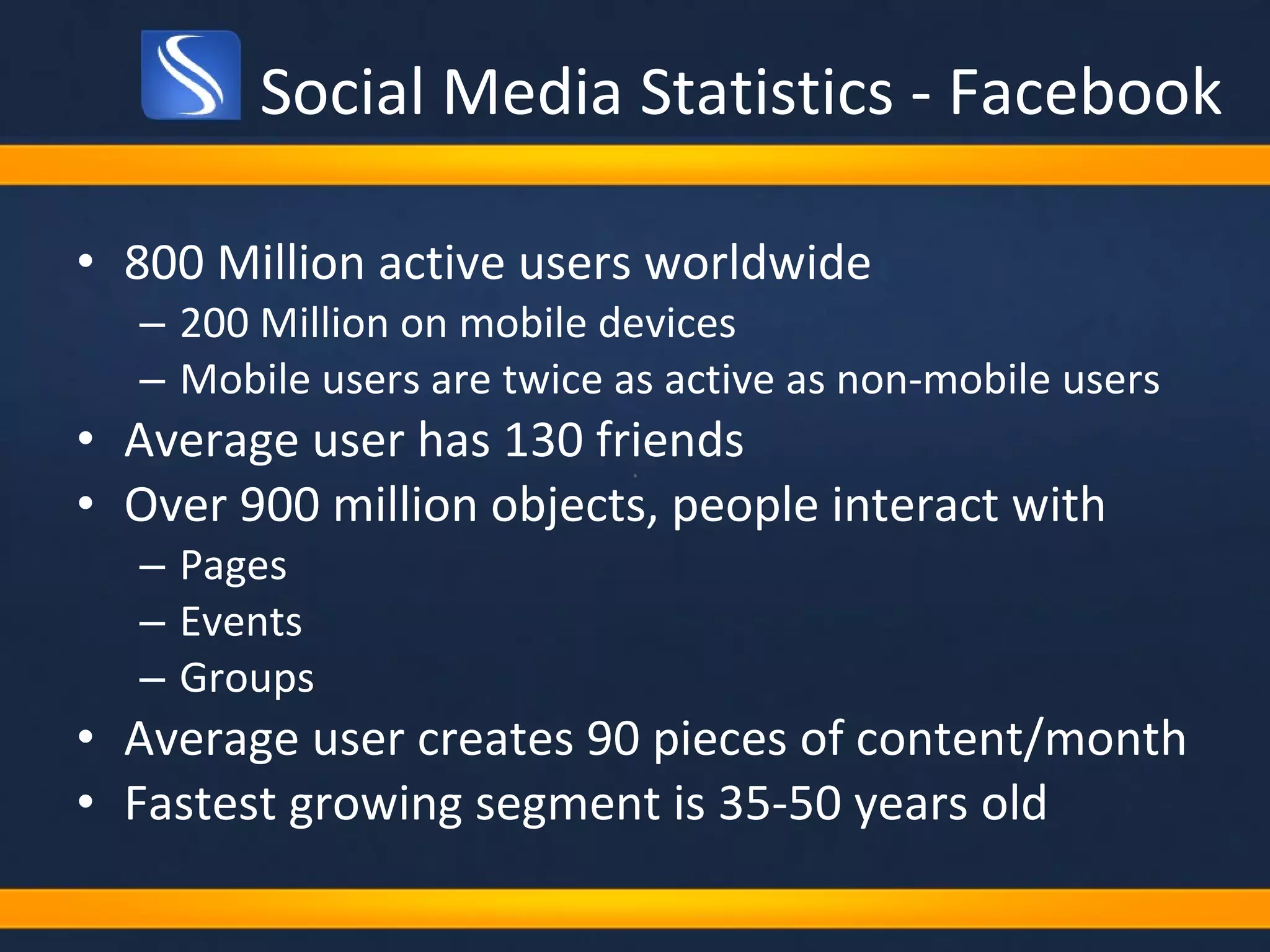
Social Media Statistics - Facebook 800 Million active users worldwide  200 Million on mobile devices Mobile users are twice as active as non-mobile users Average user has 130 friends Over 900 million objects, people interact with Pages Events Groups Average user creates 90 pieces of content/month Fastest growing segment is 35-50 years old
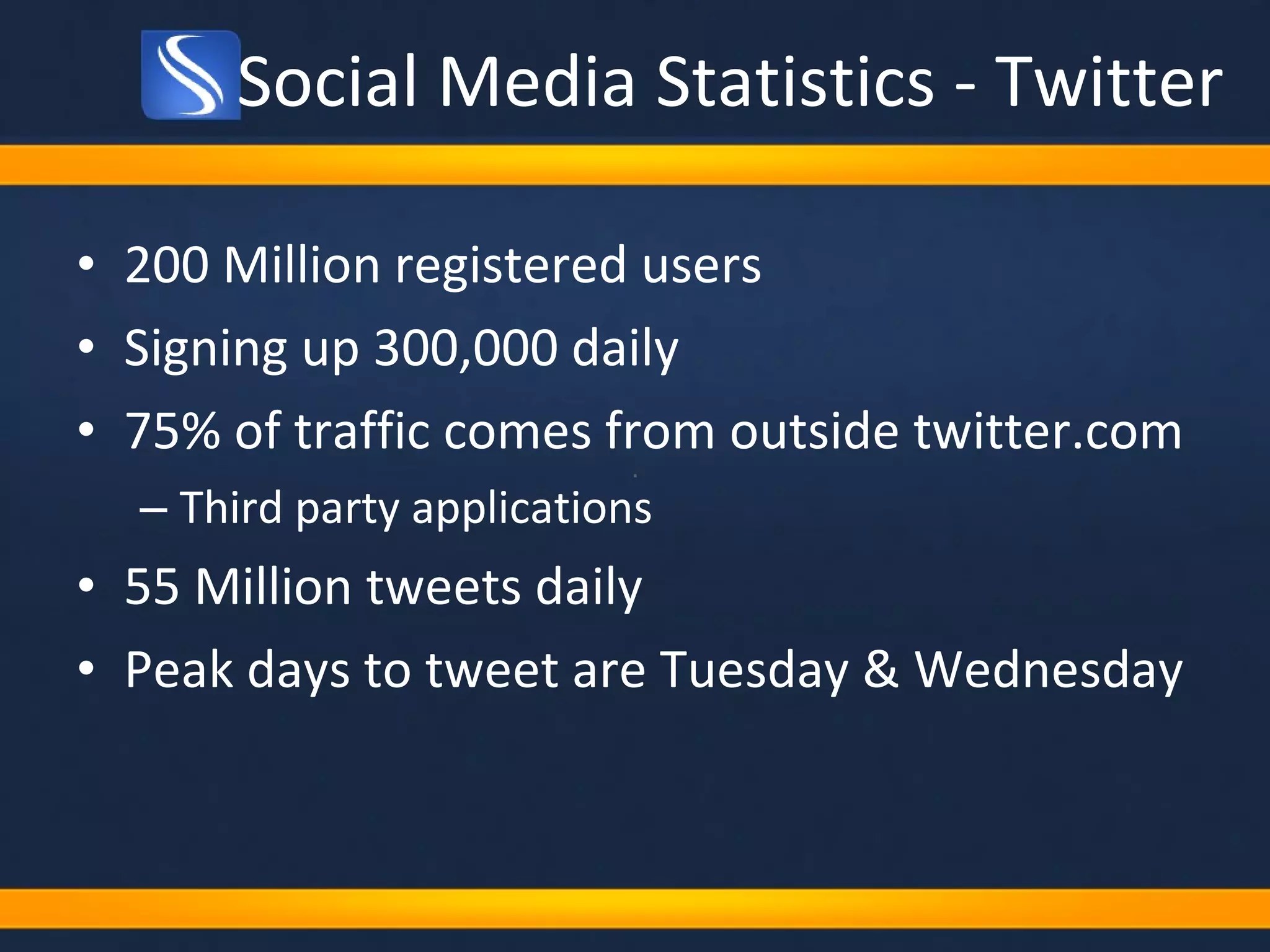
Social Media Statistics - Twitter 200 Million registered users Signing up 300,000 daily 75% of traffic comes from outside twitter.com Third party applications 55 Million tweets daily Peak days to tweet are Tuesday & Wednesday
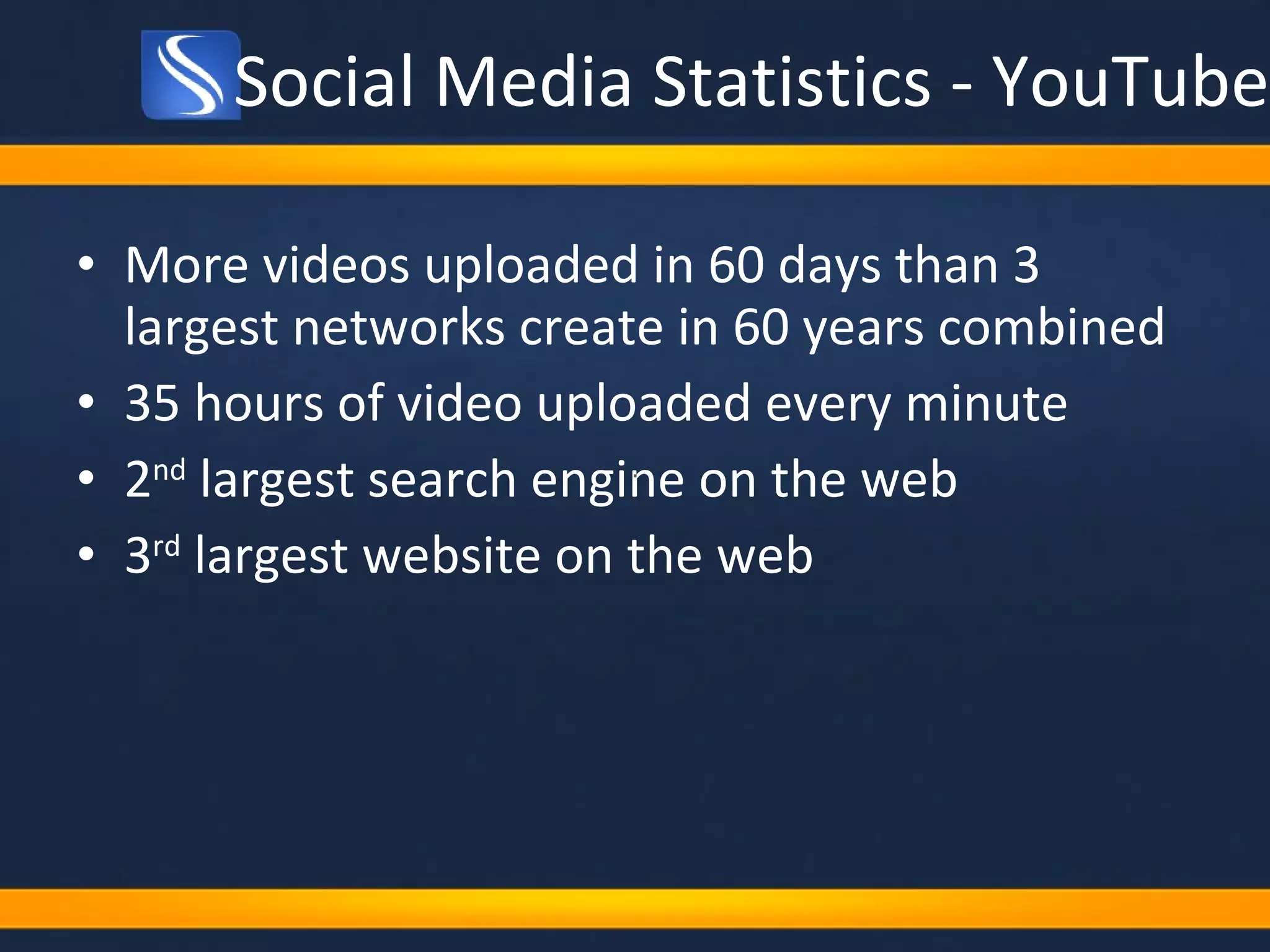
Social Media Statistics - YouTube More videos uploaded in 60 days than 3 largest networks create in 60 years combined 35 hours of video uploaded every minute 2 nd  largest search engine on the web 3 rd  largest website on the web
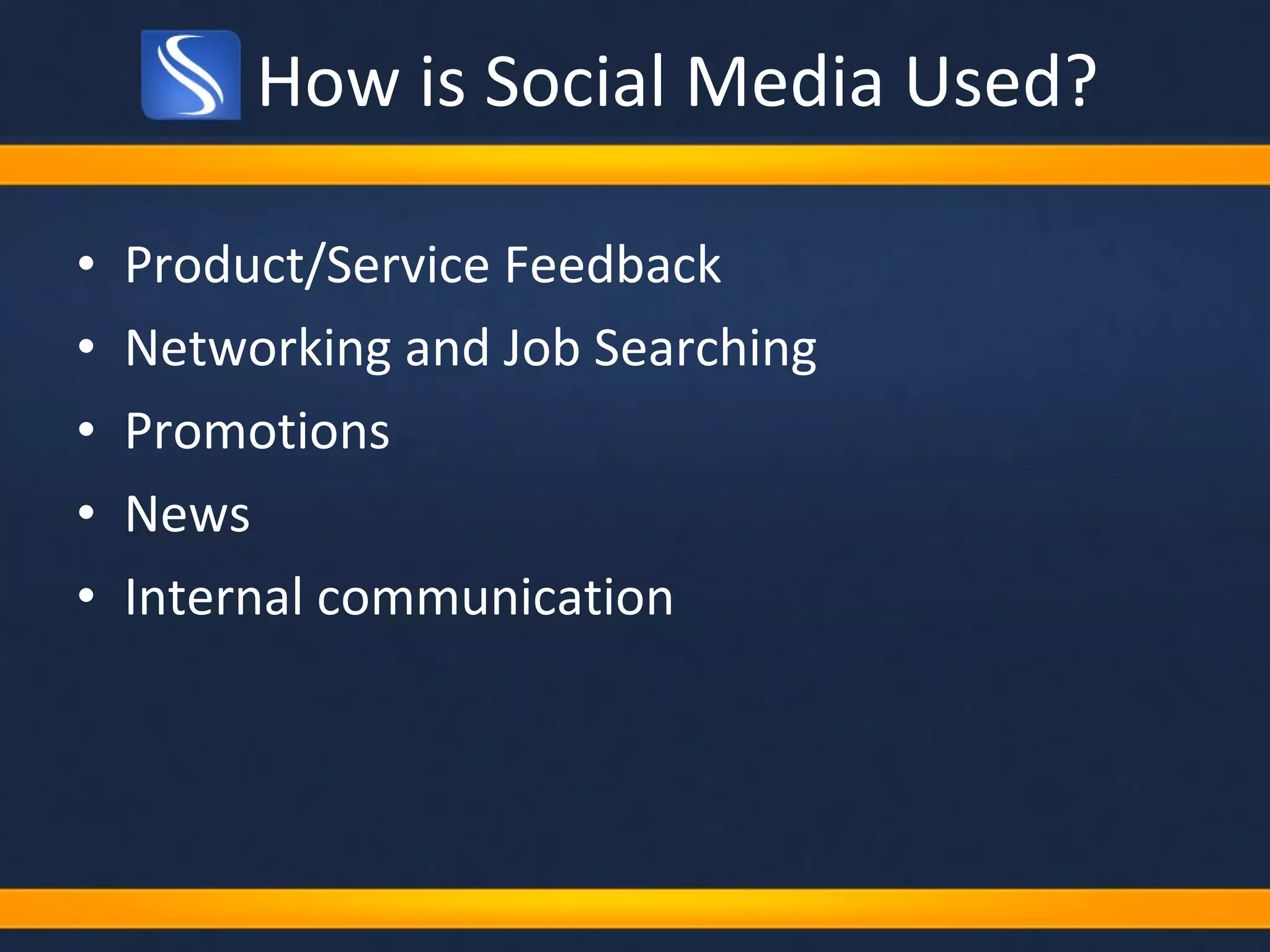
How is Social Media Used? Product/Service Feedback Networking and Job Searching Promotions News Internal communication
Case Study: Martell Home Builders Start using social media in May 2007 Uses Twitter, SmugMug, Facebook, Blog, Yelp Works on social media 1 hour per day Sold 16 homes in 2007, 40 in 2008, and over 100 in 2009 Sold one home using only social media Never met the client in person
Case Study: Martell Home Builders Customer-centric strategy  Fresh blog content GPS tracking in trucks with Google Maps Keeps customers informed and workers accountable  YouTube videos introduce customers to employees SmugMug keeps photo logs of customer projects Customers log in to see project progress Currently has 12,000 twitter followers Tweets about projects, tips, company updates
Case Study: Martell Home Builders Why they are successful: Realized importance of relationships with customers Transparent Well defined Social Objectives Internal shared vision Streamlined communication process Sell experience to customers
Creating a Social Media Plan Preplanning Listen to the Conversation Create Your Target Profiles Set Specific Goals Join the Conversation Measure ROI
Step 1 - Preplanning Questions to ask internally: Where do our customers get their information What influences our customers?  How does information flow in our industry? What promotional channels are we currently using? Are they working? Asking questions indicates how social media can be used to complement your business goals.
Step 2 –  Listen to the Conversation Secure your brand on social platforms Usernames are often unique Use consistent usernames across all platforms Set up monitoring channels Google Alerts Social Mention Technorati Twitter Search Radian6 Monitor influencers, competitors, blogs/comments, and industry news sources
Step 3 – Create Your Target Focusing on key target segments lowers marketing costs Example: Target Audience is 25-35 $350 Billion in spending power Spend 20 hours online weekly 96% of them join social networks This information can be gathered through market research, surveys, or previous studies
Step 4 – Set Specific Social Goals Increase brand awareness Increase traffic/Opt-ins Develop business partnerships Boost SEO results Generate Leads Reduce CRM costs Increase Revenue
3 Phases of Social Equity Awareness Qualify fans and followers as leads Engagement Increase long-term communication Exclusive promotions will help turn advocates into customers Social Commerce Determine small data set to introduce products to Gather product reviews Step 5 – Join the Conversation
Step 5 – Join the Conversation Be Transparent and Authentic Don’t be evasive Offer your name, title, experience Admit your interests in the topic Define your credibility Strive to answer questions about your authenticity Don’t focus on selling, focus on engagement Earn a reputation, then introduce trusted products
Step 5 – Join the Conversation Be the expert in your industry Write  about what you know Offer insights to those who ask for it Share links to resources you think add to the conversation When customers trust your content, they’ll trust your products
Step 5 – Join the Conversation Have rules of engagement  Know what to do with negative comments Determine who is involved in responses Admit to mistakes and thank those who bring it to attention  Respond Kindly Share the rules with your team Turn brand “detractors” into “advocates”  People remember bad experiences, but will buy again if it’s corrected
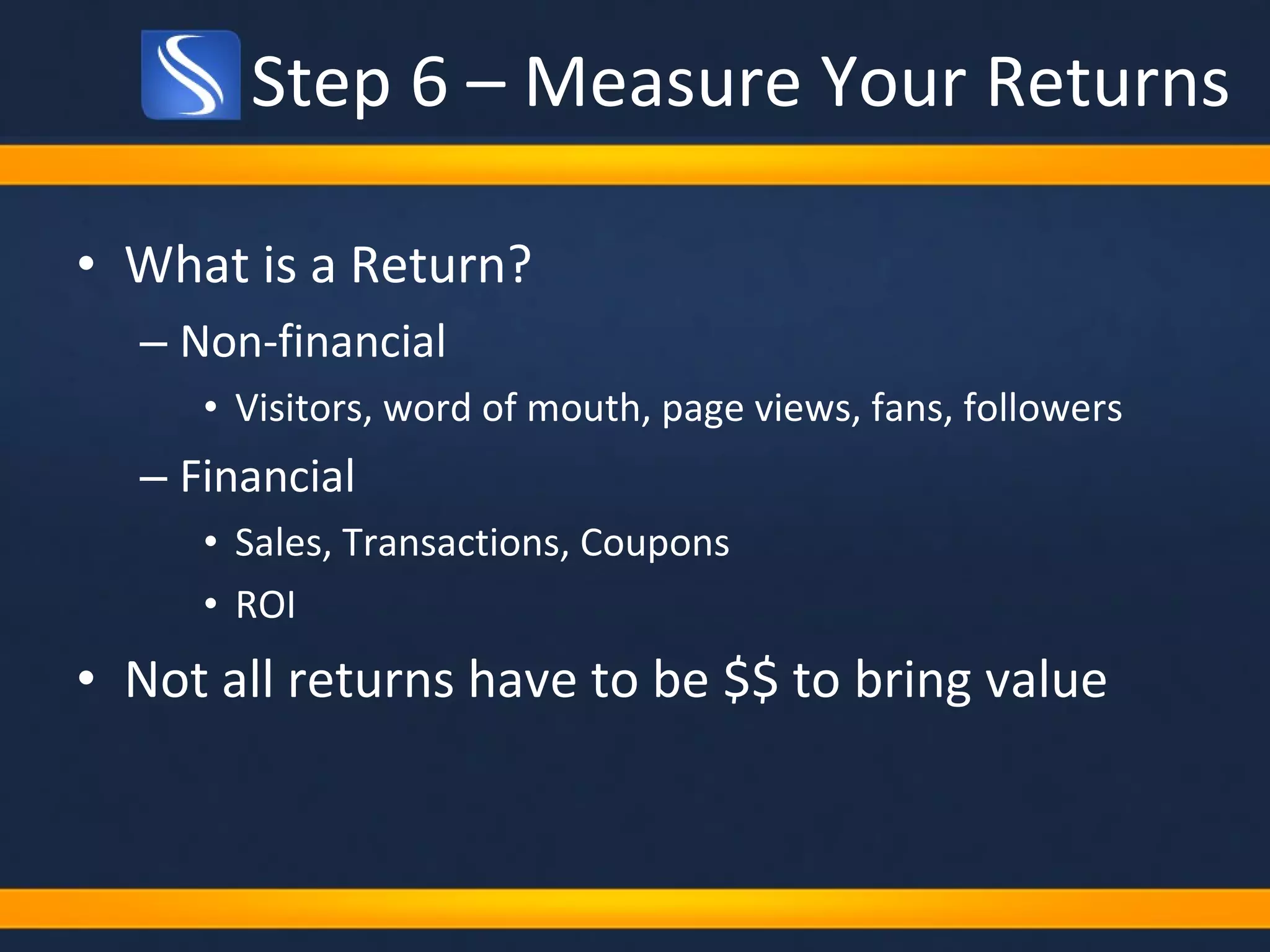
Step 6 – Measure Your Returns What is a Return? Non-financial  Visitors, word of mouth, page views, fans, followers Financial Sales, Transactions, Coupons ROI Not all returns have to be $$ to bring value
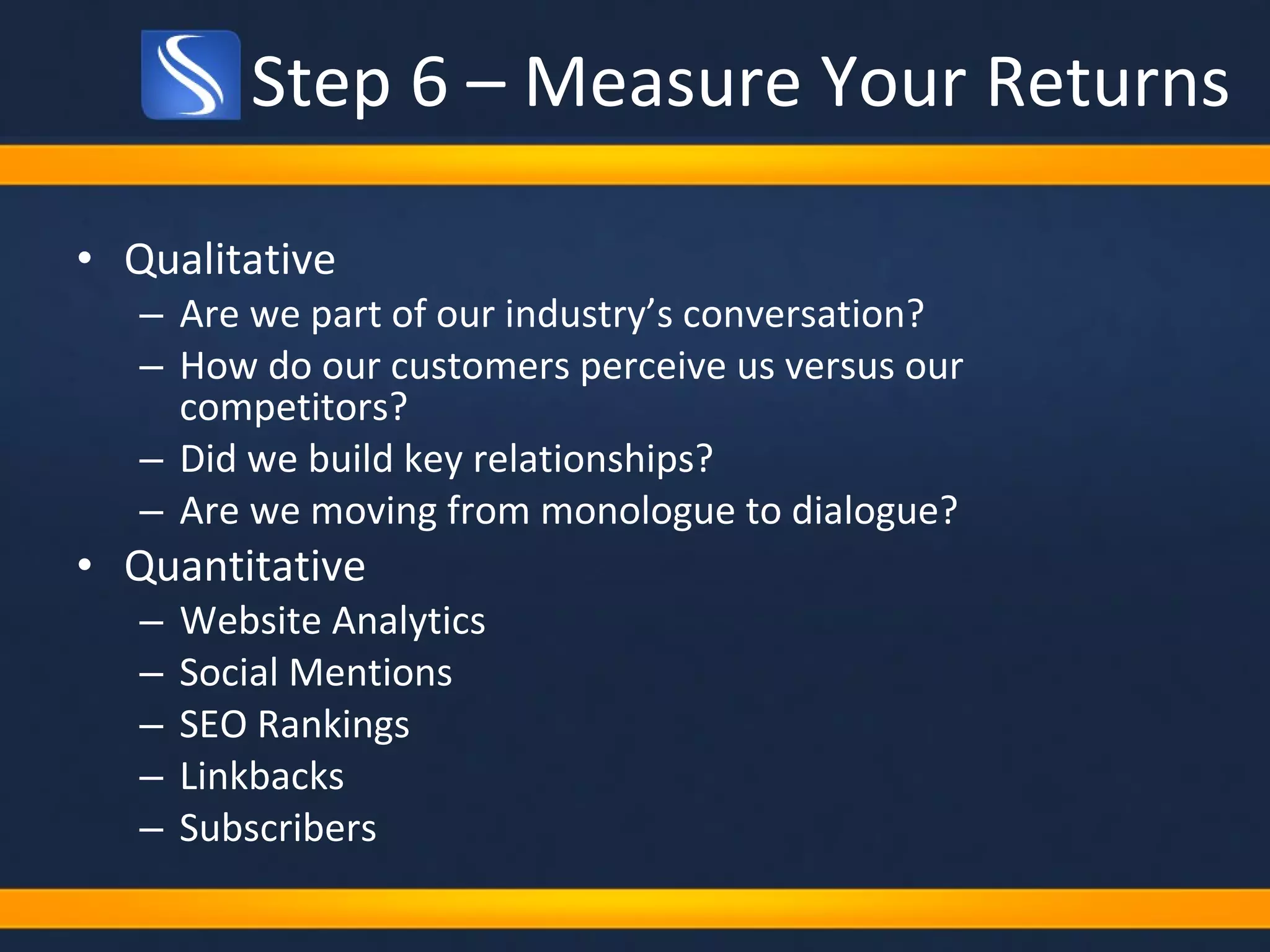
Step 6 – Measure Your Returns Qualitative Are we part of our industry’s conversation?  How do our customers perceive us versus our competitors?  Did we build key relationships? Are we moving from monologue to dialogue?  Quantitative Website Analytics Social Mentions SEO Rankings Linkbacks Subscribers
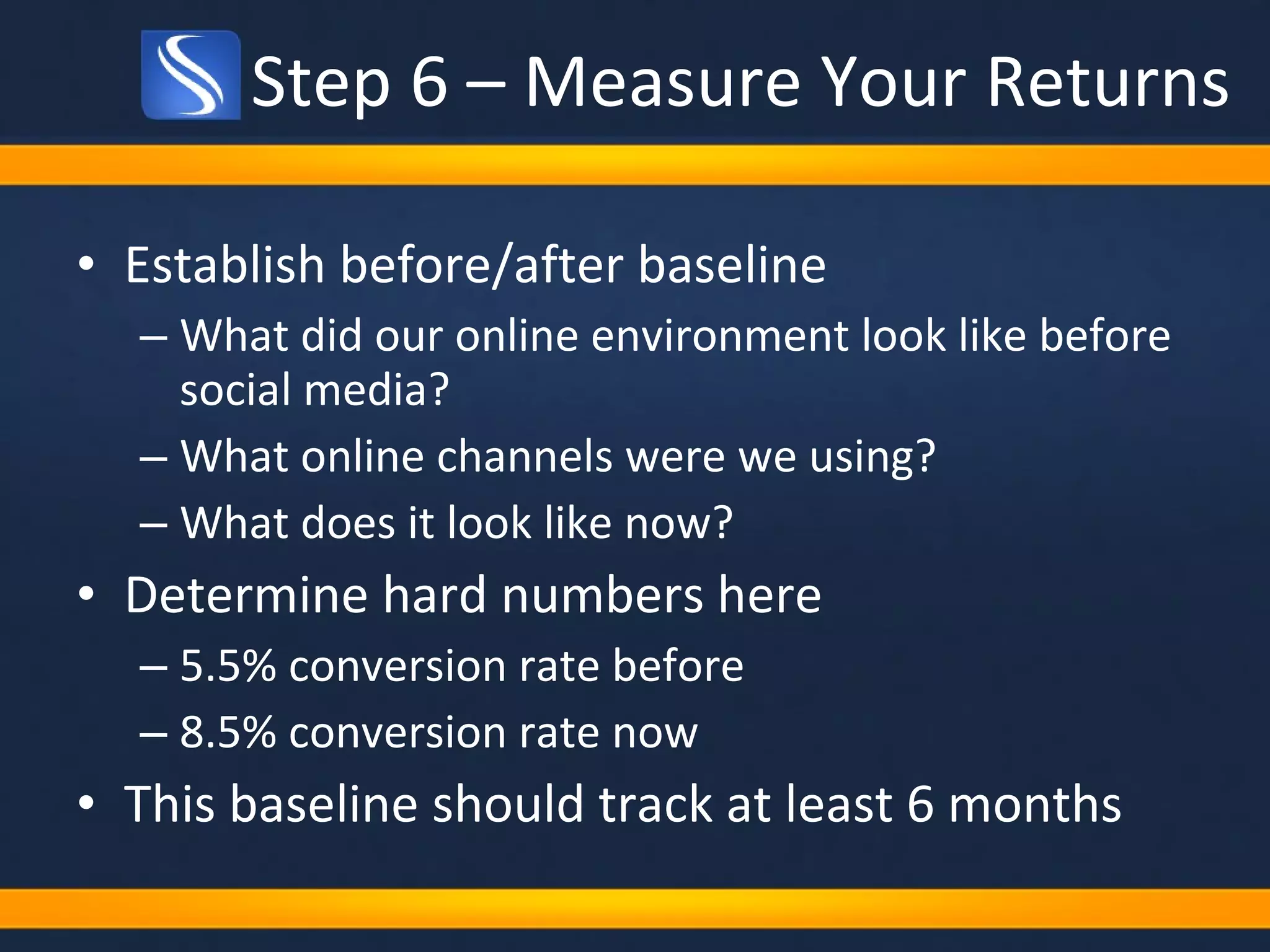
Step 6 – Measure Your Returns Establish before/after baseline What did our online environment look like before social media? What online channels were we using? What does it look like now?  Determine hard numbers here 5.5% conversion rate before 8.5% conversion rate now This baseline should track at least 6 months
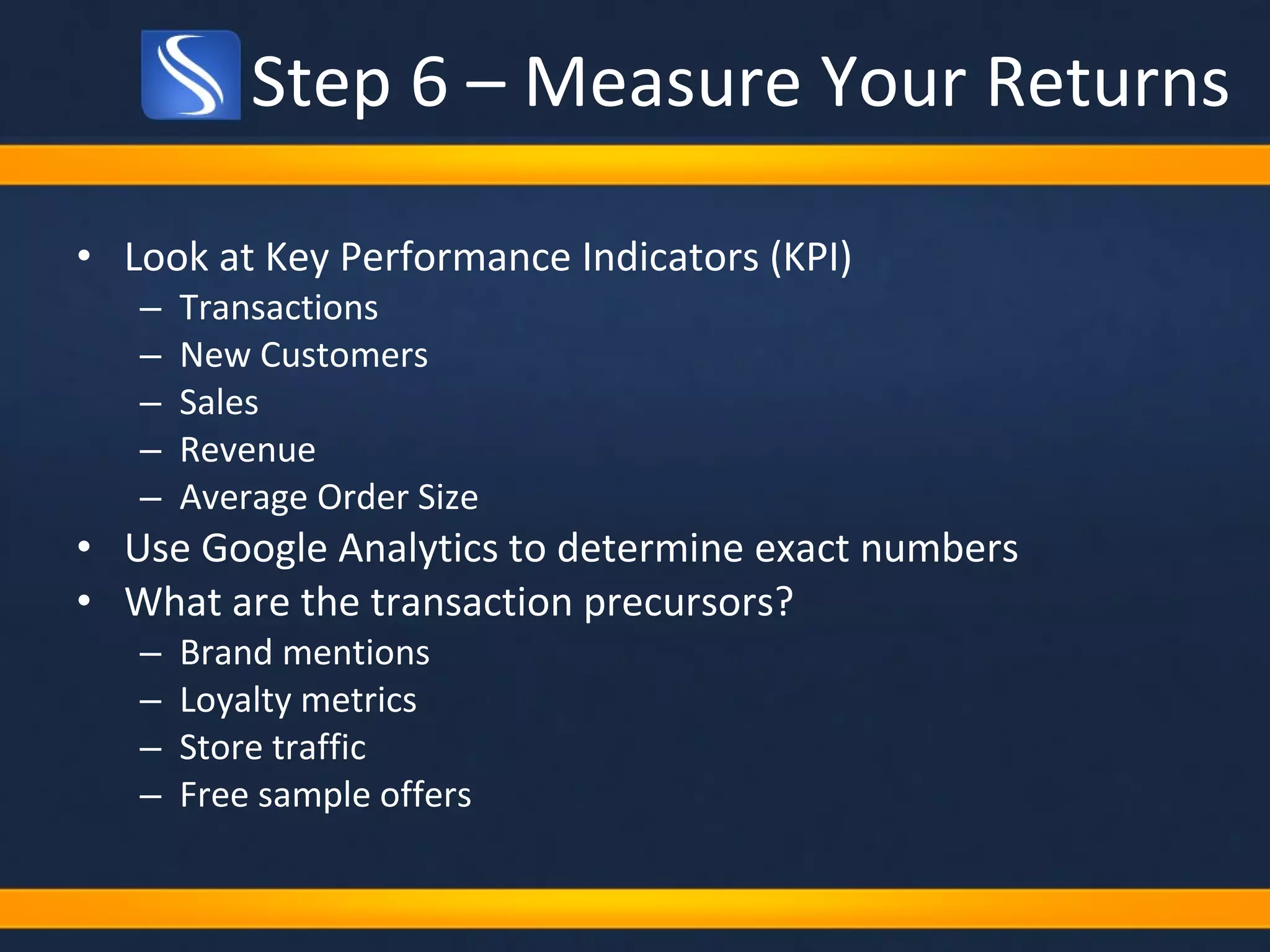
Step 6 – Measure Your Returns Look at Key Performance Indicators (KPI) Transactions New Customers Sales Revenue Average Order Size Use Google Analytics to determine exact numbers What are the transaction precursors? Brand mentions Loyalty metrics Store traffic Free sample offers
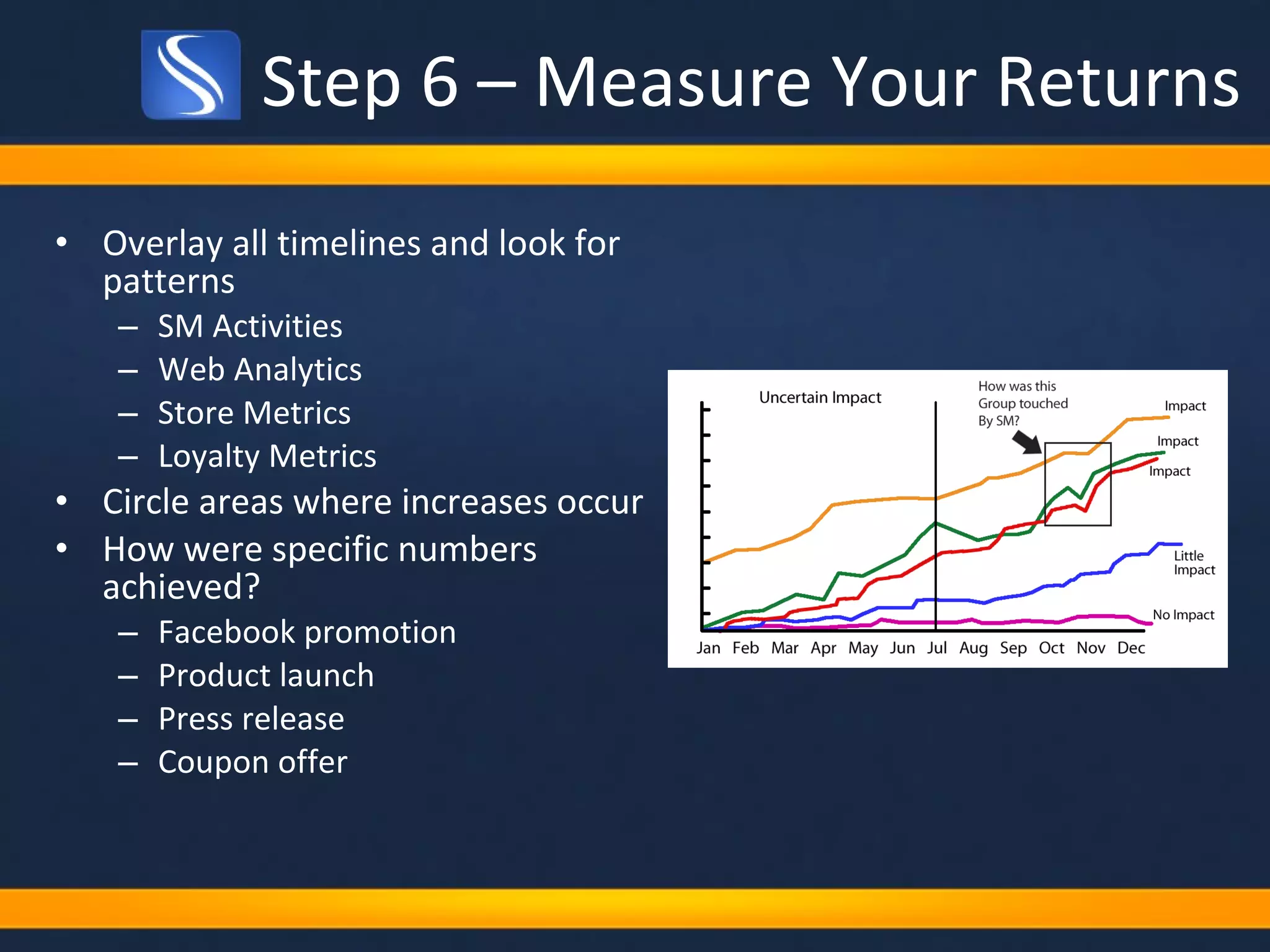
Step 6 – Measure Your Returns Overlay all timelines and look for patterns SM Activities Web Analytics Store Metrics Loyalty Metrics Circle areas where increases occur How were specific numbers achieved?  Facebook promotion Product launch Press release  Coupon offer
Budgeting for Social Media What to budget for: Time Design and Branding Analytics Tools Social Monitoring Automation Applications Social Media Advertising Outsources/Consulting
How to Get Started Start with platforms you can actively maintain What outsourcing is needed? Design, development, content management, market research Plan your content flow Will you push content through all channels? Find tools to automate processes Tweetdeck Hootsuite Sendible
Additional Resources Blogs Socialmediaexplorer.com Socialmediatoday.com BrianSolis.com Mashable.com Tools Tweetdeck.com Ping.fm Hootsuite.com Trackur.com Socialmention.com
Questions? For a free consultation on how we can help you take advantage of the opportunities provided by social media, please contact me with the details below: Email: de.d. boone@gmail.com Phone: 203.424-1243 Website: www.deboone.biz Facebook Page: facebook.com/SocialAbundance

Social Networking For Business Presentation

  • 1.
    What You Needto Know About Social Media to Promote Your Business Presenter: De Boone , Social Media Strategist & Speaker
  • 2.
    Overview Social MediaChannels 6 Steps to Creating a Social Media Plan Budgeting for Social Media Getting Started Questions
  • 3.
    What is SocialMedia? An ongoing conversation that’s happening RIGHT NOW A promotional channel for content distribution Steady stream of information for: Research Feedback Building Relationships with customers, clients, contacts
  • 4.
    Current Statistics Over80% of people in the US have at least 1 social media account Social media makes up over 17% of all online usage Overtaken email as #1 activity on the web As of February, 2011, there were 156 million public blogs 93% of Americans believe companies should have a social media presence
  • 5.
    Social Media Statistics- Facebook 800 Million active users worldwide 200 Million on mobile devices Mobile users are twice as active as non-mobile users Average user has 130 friends Over 900 million objects, people interact with Pages Events Groups Average user creates 90 pieces of content/month Fastest growing segment is 35-50 years old
  • 6.
    Social Media Statistics- Twitter 200 Million registered users Signing up 300,000 daily 75% of traffic comes from outside twitter.com Third party applications 55 Million tweets daily Peak days to tweet are Tuesday & Wednesday
  • 7.
    Social Media Statistics- YouTube More videos uploaded in 60 days than 3 largest networks create in 60 years combined 35 hours of video uploaded every minute 2 nd largest search engine on the web 3 rd largest website on the web
  • 8.
    How is SocialMedia Used? Product/Service Feedback Networking and Job Searching Promotions News Internal communication
  • 9.
    Case Study: MartellHome Builders Start using social media in May 2007 Uses Twitter, SmugMug, Facebook, Blog, Yelp Works on social media 1 hour per day Sold 16 homes in 2007, 40 in 2008, and over 100 in 2009 Sold one home using only social media Never met the client in person
  • 10.
    Case Study: MartellHome Builders Customer-centric strategy Fresh blog content GPS tracking in trucks with Google Maps Keeps customers informed and workers accountable YouTube videos introduce customers to employees SmugMug keeps photo logs of customer projects Customers log in to see project progress Currently has 12,000 twitter followers Tweets about projects, tips, company updates
  • 11.
    Case Study: MartellHome Builders Why they are successful: Realized importance of relationships with customers Transparent Well defined Social Objectives Internal shared vision Streamlined communication process Sell experience to customers
  • 12.
    Creating a SocialMedia Plan Preplanning Listen to the Conversation Create Your Target Profiles Set Specific Goals Join the Conversation Measure ROI
  • 13.
    Step 1 -Preplanning Questions to ask internally: Where do our customers get their information What influences our customers? How does information flow in our industry? What promotional channels are we currently using? Are they working? Asking questions indicates how social media can be used to complement your business goals.
  • 14.
    Step 2 – Listen to the Conversation Secure your brand on social platforms Usernames are often unique Use consistent usernames across all platforms Set up monitoring channels Google Alerts Social Mention Technorati Twitter Search Radian6 Monitor influencers, competitors, blogs/comments, and industry news sources
  • 15.
    Step 3 –Create Your Target Focusing on key target segments lowers marketing costs Example: Target Audience is 25-35 $350 Billion in spending power Spend 20 hours online weekly 96% of them join social networks This information can be gathered through market research, surveys, or previous studies
  • 16.
    Step 4 –Set Specific Social Goals Increase brand awareness Increase traffic/Opt-ins Develop business partnerships Boost SEO results Generate Leads Reduce CRM costs Increase Revenue
  • 17.
    3 Phases ofSocial Equity Awareness Qualify fans and followers as leads Engagement Increase long-term communication Exclusive promotions will help turn advocates into customers Social Commerce Determine small data set to introduce products to Gather product reviews Step 5 – Join the Conversation
  • 18.
    Step 5 –Join the Conversation Be Transparent and Authentic Don’t be evasive Offer your name, title, experience Admit your interests in the topic Define your credibility Strive to answer questions about your authenticity Don’t focus on selling, focus on engagement Earn a reputation, then introduce trusted products
  • 19.
    Step 5 –Join the Conversation Be the expert in your industry Write about what you know Offer insights to those who ask for it Share links to resources you think add to the conversation When customers trust your content, they’ll trust your products
  • 20.
    Step 5 –Join the Conversation Have rules of engagement Know what to do with negative comments Determine who is involved in responses Admit to mistakes and thank those who bring it to attention Respond Kindly Share the rules with your team Turn brand “detractors” into “advocates” People remember bad experiences, but will buy again if it’s corrected
  • 21.
    Step 6 –Measure Your Returns What is a Return? Non-financial Visitors, word of mouth, page views, fans, followers Financial Sales, Transactions, Coupons ROI Not all returns have to be $$ to bring value
  • 22.
    Step 6 –Measure Your Returns Qualitative Are we part of our industry’s conversation? How do our customers perceive us versus our competitors? Did we build key relationships? Are we moving from monologue to dialogue? Quantitative Website Analytics Social Mentions SEO Rankings Linkbacks Subscribers
  • 23.
    Step 6 –Measure Your Returns Establish before/after baseline What did our online environment look like before social media? What online channels were we using? What does it look like now? Determine hard numbers here 5.5% conversion rate before 8.5% conversion rate now This baseline should track at least 6 months
  • 24.
    Step 6 –Measure Your Returns Look at Key Performance Indicators (KPI) Transactions New Customers Sales Revenue Average Order Size Use Google Analytics to determine exact numbers What are the transaction precursors? Brand mentions Loyalty metrics Store traffic Free sample offers
  • 25.
    Step 6 –Measure Your Returns Overlay all timelines and look for patterns SM Activities Web Analytics Store Metrics Loyalty Metrics Circle areas where increases occur How were specific numbers achieved? Facebook promotion Product launch Press release Coupon offer
  • 26.
    Budgeting for SocialMedia What to budget for: Time Design and Branding Analytics Tools Social Monitoring Automation Applications Social Media Advertising Outsources/Consulting
  • 27.
    How to GetStarted Start with platforms you can actively maintain What outsourcing is needed? Design, development, content management, market research Plan your content flow Will you push content through all channels? Find tools to automate processes Tweetdeck Hootsuite Sendible
  • 28.
    Additional Resources BlogsSocialmediaexplorer.com Socialmediatoday.com BrianSolis.com Mashable.com Tools Tweetdeck.com Ping.fm Hootsuite.com Trackur.com Socialmention.com
  • 29.
    Questions? For afree consultation on how we can help you take advantage of the opportunities provided by social media, please contact me with the details below: Email: de.d. boone@gmail.com Phone: 203.424-1243 Website: www.deboone.biz Facebook Page: facebook.com/SocialAbundance