Social Media,
Internet use &
Suicide
attempts in
adolescent
Presented by -
Prof. Dr. Md. Shafiul Hasan,
Head of the department of psychiatry,
IAHS, USTC.
What is social media?
Social media is a platform
that allows users to
create, share, and interact
with content through the
internet.
e.g. Facebook, Twitter,
Instagram, and TikTok.
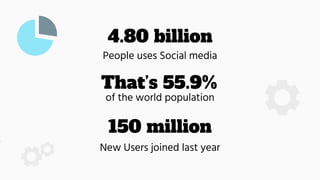
People uses Social media
of the world population
New Users joined last year
4.80 billion
That’s 55.9%
150 million
Recent data reveals that the typical social
media user actively uses or visits an
average of 6.6 different social platforms
each month, and spends an average of 2
hours 24 minutes per day using social
media.
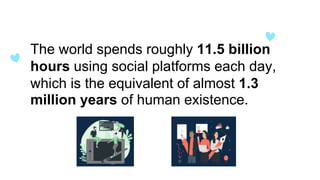
The world spends roughly 11.5 billion
hours using social platforms each day,
which is the equivalent of almost 1.3
million years of human existence.
Benefits of
social media
1. Connectionwithfriendsandfamily.
2.Accesstoinformationandnews.
3.Abilitytospreadpositivemessagesandraiseawareness.
4.Enhancedsocialsupportandsenseof belonging.
5.Businessandjobopportunities.
6.Promotescreativityandself-expression.
7.Platformsforentertainmentandleisureactivities.
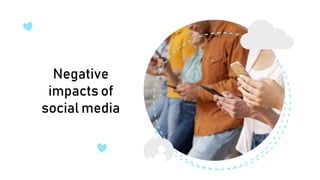
Negative
impacts of
social media
1. Excessiveusecanleadtonegativefeelingsandsocialisolation.
2. Exposuretoharmfulcontentsuchascyberbullyingandhatespeech.
3.Privacyandsecurityconcerns.
4.Impactonbodyimageandself-esteem.
5.Addictionandtime-wasting.
6.Spreadof misinformationandfakenews.
7.Cannegativelyimpactacademicandworkperformance.
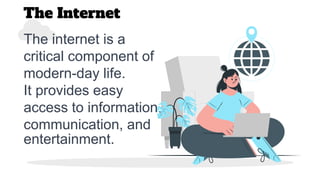
The Internet
The internet is a
critical component of
modern-day life.
It provides easy
access to information,
communication, and
entertainment.
Why do we need the internet?
1. Access to vast amounts of information and knowledge.
2. Communication and connection with people all over
the world.
3. Online shopping and e-commerce.
4. Entertainment and leisure activities.
5. Access to online education and training.
6. Online banking and financial transactions.
7. Job search and career advancement.
8. Research and innovation.
Some Negative impacts of internet in our
lives
1. Addiction and excessive use.
2. Exposure to harmful content such as cyberbullying and
hate speech.
3. Privacy and security concerns.
4. Impact on mental health, including depression and
anxiety.
5. Spread of misinformation and fake news.
6. Negative impact on face-to-face communication skills.
7. Impact on physical health due to sedentary lifestyles and
lack of exercise.
8. Loss of privacy and potential identity theft.
The link between social media, internet use, and suicide attempts in
adolescents.
• Social media and internet use are linked to negative effects on
adolescent mental health.
• Studies have found that increased social media use is
associated with higher rates of depression and anxiety in
adolescents.
• Cyberbullying and online harassment can contribute to suicidal
ideation and suicide attempts in young people.
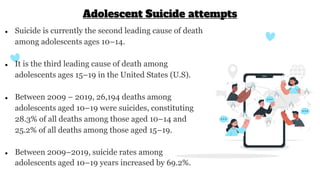
● Suicide is currently the second leading cause of death
among adolescents ages 10–14.
● It is the third leading cause of death among
adolescents ages 15–19 in the United States (U.S).
● Between 2009 – 2019, 26,194 deaths among
adolescents aged 10–19 were suicides, constituting
28.3% of all deaths among those aged 10–14 and
25.2% of all deaths among those aged 15–19.
● Between 2009–2019, suicide rates among
adolescents aged 10–19 years increased by 69.2%.
Adolescent Suicide attempts
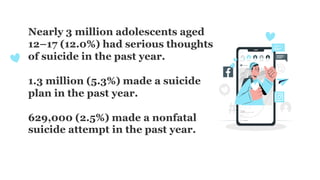
Nearly 3 million adolescents aged
12–17 (12.0%) had serious thoughts
of suicide in the past year.
1.3 million (5.3%) made a suicide
plan in the past year.
629,000 (2.5%) made a nonfatal
suicide attempt in the past year.
Risk factors that increase suicide attempts among
adolescents
• Cyberbullying and online harassment.
• Exposure to harmful content.
• Social isolation and loneliness.
• Lack of parental supervision or involvement in adolescent's
online activities.
• Pre-existing mental health conditions, such as depression
and anxiety.
• High levels of social media use and internet.
• Low self-esteem, poor body image, and feelings of
inadequacy resulting from comparison to others on social
media.
Preventive measures to minimize social media impacts
● Promote healthy social media habits, including setting limits on usage and
encouraging positive online interactions.
● Educate adolescents on the risks associated with social media use and encourage
open communication about online experiences.
● Provide access to mental health resources, such as counselling and support groups,
for those struggling with mental health issues.
● Encourage physical activity, face-to-face social interactions, and other offline
activities to reduce dependence on social media.
● Foster positive self-esteem and body image through support and positive
reinforcement.
● Promote positive relationships with family, friends, and peers to reduce feelings of
social isolation and loneliness.
● Promote awareness of the warning signs of suicide,such as
changesin mood, behaviour, or routine, and encourage early
intervention.
● Increase access to crisishotlines and support servicesfor
those at risk of suicideand their families.
● Encourage adolescentsto seek help if they are experiencing
suicidalthoughts or feelings,and provide them with a safe and
supportive environment to do so.
● Implement suicideprevention trainingand protocols for
teachers, healthcareproviders, and other professionals who
work with young people.
Suicide prevention among adolescents
Fosterpositivecopingskillsandresiliencethroughactivitiessuchas
mindfulness,self-care,andstress management.
Promotephysicalactivity,healthyeating,andotherlifestyle
behavioursthatcansupportpositivementalhealth.
Advocatefor policiesandprogramsthataddresstherootcausesof
suicide,suchaspoverty,discrimination,andsocialinequality.
Encouragecommunityinvolvementandsupport,includingpeer
supportgroups,mentoring,andotherprogramsthatpromote
positiverelationshipsandsocialconnectedness.
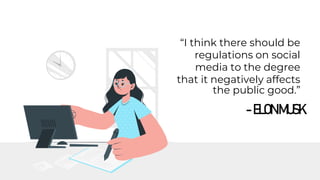
-ELONMUSK
“I think there should be
regulations on social
media to the degree
that it negatively affects
the public good.”
Thank
You!

Social Media Statistics Thesis by Slidesgo.pptx