UCSC science writing programMay 4, 2010David harris@physicsdavidSLAC National Accelerator LaboratoryandSymmetry MagazineSocial media for science writers
Your social media useWho in this room does each of these?uses facebookuses twitteruses LinkedInhas a blogis in some specialist social networkuses social bookmarkingregularly posts video/audio?
Why care about social media?Our trade is informationInformation is flowing in new ways due to social mediaWe need to understand those ways to take advantage of themIt gives us new ways to think about what we do
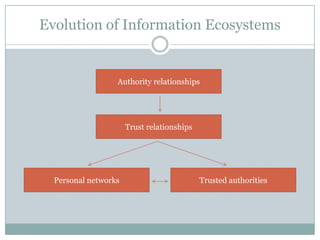
Evolution of Information EcosystemsAuthority relationshipsTrust relationshipsPersonal networksTrusted authorities
The secret life of social mediaKey points:It often doesn’t work the way you imagine or the way it claims toIt can be quite complicated and you really need to understand it to take advantage of itSocial bookmarking as a case studySee a full presentation on this from NASW 2009 at: http://bit.ly/9dip5J
Fundamental rule of social mediaIt’s just a toolorIt’s a tactic not a strategyorThe technology is not the sociology
Corollary of the fundamental ruleSocial media is often not about the content itself: It is often the meta-content or the distributionSocial media offers a chance for you to be entrepreneurial in reaching new audiencesYou’ve written the story, now get it to the peopleSocial media can be particularly useful to science writers as science interest is a non-geographically-specified niche.
Use the right tool for the right purposeQ: When would you use a facebook status update vs twitter update?Q: What’s the main difference between facebook and MySpace?Q: Why would you blog with LiveJournalvs Blogger vsWordPressvs … ?Q: What’s the difference between email and a twitter stream?Q: How do individuals matter in social media?
It’s the community, stupidThe use of social media tools is inextricably linked with the kinds of communities you wish to include, create, connect with, or be part of.The sociology is not really new in most cases. However, the power of the tools is much greater.There is a loose community of science fans who previously could only coalesce around popular science magazines. What does social media offer?
Journalists’ concernsHow does a journalist navigate the private-public spectrum that replaces the old private/public separation? (Risks and opportunities.)What is happening to the gatekeeper role of journalism? (Middleman problem. The importance of filters.)Can journalists beat the sources to breaking news any more? (The role of scoops. Scientists who blog.)What value does a journalist add? (Will “just the facts” cut it? Content vs. context vs. analysis)
Business modelsLike old media, still predominantly ad-basedThis means, it’s all about eyeballs on ads, and therefore about boosting trafficIncreased traffic is used as a proxy for just about everything else, but how valid is that? Does it matter if it’s valid?Some new models appearingContent is a loss leader in the form of community building. Monetized through other options, such as events. Example: thebolditalic.comRelying on sources for content such as Journalism/PIO partnerships. Example: US News & World Report/NSF
10 uses of social media for science writersFinding/tracking breaking eventsReporting on events as rapidly as possibleObserving remote events/conferencesParticipating in remote events/conferencesFinding ideas and commissioning storiesFinding sourcesBuilding community (among peers & readers)“Meeting” new people -> meeting new peopleHearing about useful eventsSpreading ideas, generating secondary pickup/stories
Adoption of social media by science writers	Where are the science writers’ social networks? Why are science writers so slow to adopt social media and so resistant to it?How will you cope with being seen as the expert on social media in your next job, just because you are young?
Planning social media strategiesRemember the fundamental rule: it’s a tactic not a strategyAs a tactic, you should experiment to see what works. If it works, keep it up (at least until something changes). If not, abandon it (at least until something changes).Cost of failure is low if you haven’t invested lots of time. The tech makes it easy to do without large time investments.A social media plan should naturally derive from a communications plan. It shouldn’t take long to plan.
CollaborationAn insufficiently answered question: How can science journalists use social media for collaboration?Tools of social media allow for easier blending of different media typesCollaborative workspaces share many features of social networksTools for other social media can be put to collaborative use in science writing. (e.g. Google Wave)Given the technical nature of much science writing, many questions arise for readers. How can social media help with this?
Old media recommendationsBooks:Clay Shirky, Here Comes Everybody, 2008Jeff Howe, Crowdsourcing, 2008Lewis Hyde, The Gift, 1979Mancur Olson, The Logic of Collective Action, 1965
Some new media recommendationsTwitter: @physicsdavid/forsciencewritingstudentsWeb: www.mashable.comwww.zephoria.org/thoughts ksjtracker.mit.edu www.niemanlab.orgwww.cjr.org/the_observatoryHow do you want me to share good links/resources?
Other stuffSome stuff from me:Secret life of social media (slides+audio): http://bit.ly/9dip5JWhat does twitter mean for breaking news stories? The ISS near-collision case study: http://bit.ly/bz6wEkSome recent articles:Who’s using twitter? http://bit.ly/aLbcTfHow Freelancers are Using Social Media for Real Results http://bit.ly/b0be4m
During this classWho has read some form of social media in this class?Who has updated some form of social media in this class?Who had the urge to either read or post during the class?

Social media for science writers

  • 1.
    UCSC science writingprogramMay 4, 2010David harris@physicsdavidSLAC National Accelerator LaboratoryandSymmetry MagazineSocial media for science writers
  • 2.
    Your social mediauseWho in this room does each of these?uses facebookuses twitteruses LinkedInhas a blogis in some specialist social networkuses social bookmarkingregularly posts video/audio?
  • 3.
    Why care aboutsocial media?Our trade is informationInformation is flowing in new ways due to social mediaWe need to understand those ways to take advantage of themIt gives us new ways to think about what we do
  • 4.
    Evolution of InformationEcosystemsAuthority relationshipsTrust relationshipsPersonal networksTrusted authorities
  • 5.
    The secret lifeof social mediaKey points:It often doesn’t work the way you imagine or the way it claims toIt can be quite complicated and you really need to understand it to take advantage of itSocial bookmarking as a case studySee a full presentation on this from NASW 2009 at: http://bit.ly/9dip5J
  • 6.
    Fundamental rule ofsocial mediaIt’s just a toolorIt’s a tactic not a strategyorThe technology is not the sociology
  • 7.
    Corollary of thefundamental ruleSocial media is often not about the content itself: It is often the meta-content or the distributionSocial media offers a chance for you to be entrepreneurial in reaching new audiencesYou’ve written the story, now get it to the peopleSocial media can be particularly useful to science writers as science interest is a non-geographically-specified niche.
  • 8.
    Use the righttool for the right purposeQ: When would you use a facebook status update vs twitter update?Q: What’s the main difference between facebook and MySpace?Q: Why would you blog with LiveJournalvs Blogger vsWordPressvs … ?Q: What’s the difference between email and a twitter stream?Q: How do individuals matter in social media?
  • 9.
    It’s the community,stupidThe use of social media tools is inextricably linked with the kinds of communities you wish to include, create, connect with, or be part of.The sociology is not really new in most cases. However, the power of the tools is much greater.There is a loose community of science fans who previously could only coalesce around popular science magazines. What does social media offer?
  • 10.
    Journalists’ concernsHow doesa journalist navigate the private-public spectrum that replaces the old private/public separation? (Risks and opportunities.)What is happening to the gatekeeper role of journalism? (Middleman problem. The importance of filters.)Can journalists beat the sources to breaking news any more? (The role of scoops. Scientists who blog.)What value does a journalist add? (Will “just the facts” cut it? Content vs. context vs. analysis)
  • 11.
    Business modelsLike oldmedia, still predominantly ad-basedThis means, it’s all about eyeballs on ads, and therefore about boosting trafficIncreased traffic is used as a proxy for just about everything else, but how valid is that? Does it matter if it’s valid?Some new models appearingContent is a loss leader in the form of community building. Monetized through other options, such as events. Example: thebolditalic.comRelying on sources for content such as Journalism/PIO partnerships. Example: US News & World Report/NSF
  • 12.
    10 uses ofsocial media for science writersFinding/tracking breaking eventsReporting on events as rapidly as possibleObserving remote events/conferencesParticipating in remote events/conferencesFinding ideas and commissioning storiesFinding sourcesBuilding community (among peers & readers)“Meeting” new people -> meeting new peopleHearing about useful eventsSpreading ideas, generating secondary pickup/stories
  • 13.
    Adoption of socialmedia by science writers Where are the science writers’ social networks? Why are science writers so slow to adopt social media and so resistant to it?How will you cope with being seen as the expert on social media in your next job, just because you are young?
  • 14.
    Planning social mediastrategiesRemember the fundamental rule: it’s a tactic not a strategyAs a tactic, you should experiment to see what works. If it works, keep it up (at least until something changes). If not, abandon it (at least until something changes).Cost of failure is low if you haven’t invested lots of time. The tech makes it easy to do without large time investments.A social media plan should naturally derive from a communications plan. It shouldn’t take long to plan.
  • 15.
    CollaborationAn insufficiently answeredquestion: How can science journalists use social media for collaboration?Tools of social media allow for easier blending of different media typesCollaborative workspaces share many features of social networksTools for other social media can be put to collaborative use in science writing. (e.g. Google Wave)Given the technical nature of much science writing, many questions arise for readers. How can social media help with this?
  • 16.
    Old media recommendationsBooks:ClayShirky, Here Comes Everybody, 2008Jeff Howe, Crowdsourcing, 2008Lewis Hyde, The Gift, 1979Mancur Olson, The Logic of Collective Action, 1965
  • 17.
    Some new mediarecommendationsTwitter: @physicsdavid/forsciencewritingstudentsWeb: www.mashable.comwww.zephoria.org/thoughts ksjtracker.mit.edu www.niemanlab.orgwww.cjr.org/the_observatoryHow do you want me to share good links/resources?
  • 18.
    Other stuffSome stufffrom me:Secret life of social media (slides+audio): http://bit.ly/9dip5JWhat does twitter mean for breaking news stories? The ISS near-collision case study: http://bit.ly/bz6wEkSome recent articles:Who’s using twitter? http://bit.ly/aLbcTfHow Freelancers are Using Social Media for Real Results http://bit.ly/b0be4m
  • 19.
    During this classWhohas read some form of social media in this class?Who has updated some form of social media in this class?Who had the urge to either read or post during the class?