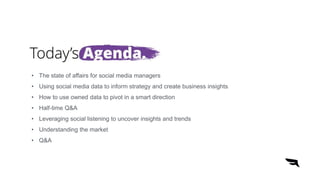




• The state of affairs for social media managers
• Using social media data to inform strategy and create business insights
• How to use owned data to pivot in a smart direction
• Half-time Q&A
• Leveraging social listening to uncover insights and trends
• Understanding the market
• Q&A
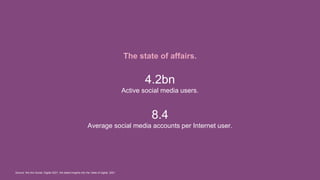
The state of affairs.
4.2bn
Active social media users.
8.4
Average social media accounts per Internet user.
Source: We Are Social, Digital 2021: the latest insights into the ‘state of digital, 2021
The amount of data passing through social media is massive.
For even the most experienced social media manager or marketer, this makes
the job of analysing and leveraging data a daunting task.
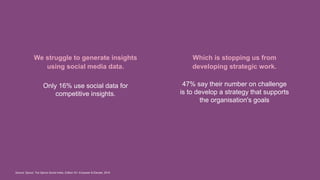
We struggle to generate insights
using social media data.
Only 16% use social data for
competitive insights.
Which is stopping us from
developing strategic work.
47% say their number on challenge
is to develop a strategy that supports
the organisation's goals
Source: Sprout, The Sprout Social Index, Edition XV: Empower & Elevate, 2019
What’s stopping us?
“Our strategy is to use Facebook link ads to drive
more users to our website.”
“Our new strategy is to use influencers to showcase
our products in different ways”
“Our strategic approach is to use TikTok to reach a
younger audience”
Strategy ≠ tactics
XX
XX
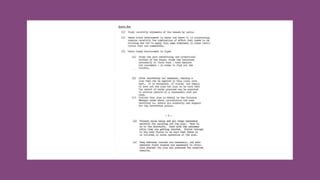
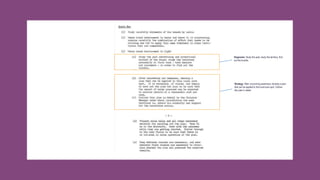
Diagnosis: Study the past, study the territory, find
out the trouble.
XX
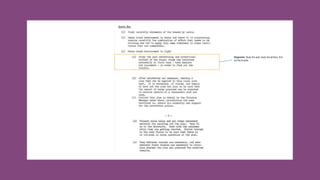
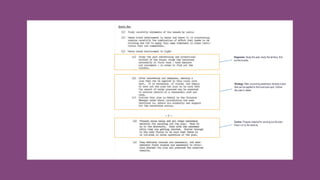
Diagnosis: Study the past, study the territory, find
out the trouble.
Strategy: After uncovering weakness, develop a plan
that can be applied to this local sore spot. Outline
this plan in detail.
XX
Diagnosis: Study the past, study the territory, find
out the trouble.
Strategy: After uncovering weakness, develop a plan
that can be applied to this local sore spot. Outline
this plan in detail.
Tactics: Prepare material for carrying out the plan.
Pass it on to the districts.
XX
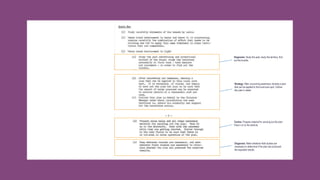
Diagnosis: Study the past, study the territory, find
out the trouble.
Strategy: After uncovering weakness, develop a plan
that can be applied to this local sore spot. Outline
this plan in detail.
Tactics: Prepare material for carrying out the plan.
Pass it on to the districts.
Diagnosis: Make whatever field studies are
necessary to determine if the plan has produced
the expected results.
XX
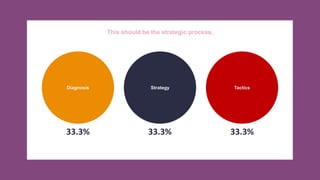
This should be the strategic process.
Diagnosis Strategy Tactics
33.3% 33.3% 33.3%
XX
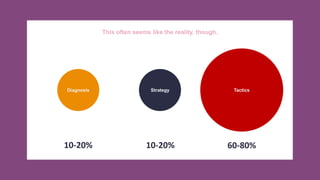
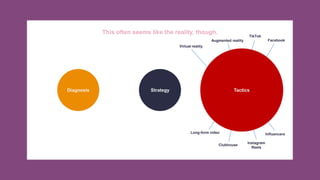
This often seems like the reality, though.
Diagnosis Strategy Tactics
10-20% 10-20% 60-80%
XX
Diagnosis Strategy Tactics
Facebook
TikTok
Augmented reality
Virtual reality
Clubhouse
Long-form video
Instagram
Reels
Influencers
This often seems like the reality, though.
Put down the tactical toolbox and
start with diagnosis.
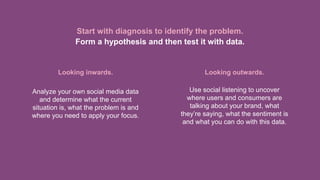
Looking inwards.
Analyze your own social media data
and determine what the current
situation is, what the problem is and
where you need to apply your focus.
Looking outwards.
Use social listening to uncover
where users and consumers are
talking about your brand, what
they’re saying, what the sentiment is
and what you can do with this data.
Start with diagnosis to identify the problem.
Form a hypothesis and then test it with data.
Looking inwards.
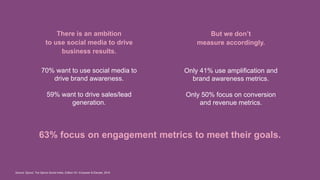
There is an ambition
to use social media to drive
business results.
70% want to use social media to
drive brand awareness.
59% want to drive sales/lead
generation.
But we don’t
measure accordingly.
Only 41% use amplification and
brand awareness metrics.
Only 50% focus on conversion
and revenue metrics.
63% focus on engagement metrics to meet their goals.
Source: Sprout, The Sprout Social Index, Edition XV: Empower & Elevate, 2019
Measure the right metrics.
Identify the brand problem/challenge &
align your analysis and metrics/KPIs with this.
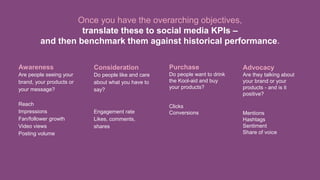
Once you have the overarching objectives,
translate these to social media KPIs –
and then benchmark them against historical performance.
Awareness
Are people seeing your
brand, your products or
your message?
Reach
Impressions
Fan/follower growth
Video views
Posting volume
Consideration
Do people like and care
about what you have to
say?
Engagement rate
Likes, comments,
shares
Purchase
Do people want to drink
the Kool-aid and buy
your products?
Clicks
Conversions
Advocacy
Are they talking about
your brand or your
products - and is it
positive?
Mentions
Hashtags
Sentiment
Share of voice
XX
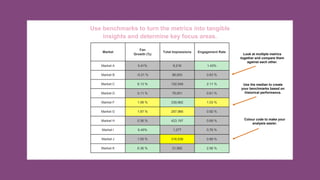
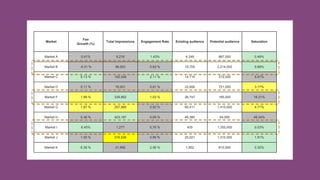
Market
Fan
Growth (%)
Total Impressions Engagement Rate
Market A 0.41% 8,216 1.43%
Market B -0.31 % 96,003 0.63 %
Market C 6.13 % 152,549 2.11 %
Market D 0.11 % 76,001 0.61 %
Market F 1.99 % 339,962 1.03 %
Market G 1.87 % 257,985 0.92 %
Market H 0.36 % 423,197 0.69 %
Market I 6.45% 1,277 0,76 %
Market J 1.05 % 316,536 0.89 %
Market K 6.36 % 31,992 2.56 %
Use benchmarks to turn the metrics into tangible
insights and determine key focus areas.
Use the median to create
your benchmarks based on
historical performance.
Colour code to make your
analysis easier.
Look at multiple metrics
together and compare them
against each other.
Moving in the right direction.
Use social media data to pivot to the right market or platform.
XX
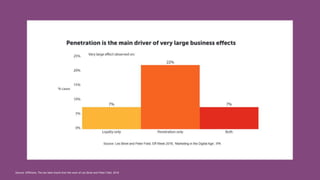
Source: EffWorks, The ten best charts from the work of Les Binet and Peter Field, 2018
PRESENTED BY @adweek @socialmediaweek @yourbrand
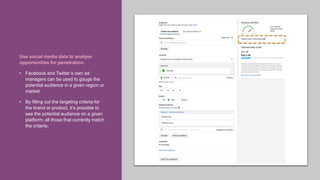
Use social media data to analyse
opportunities for penetration.
• Facebook and Twitter’s own ad
managers can be used to gauge the
potential audience in a given region or
market.
• By filling out the targeting criteria for
the brand or product, it’s possible to
see the potential audience on a given
platform; all those that currently match
the criteria.
XX
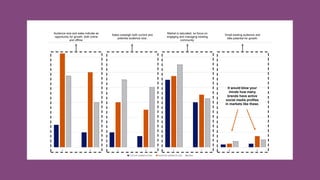
Sales outweigh both current and
potential audience size.
Small existing audience and
little potential for growth.
Market is saturated, so focus on
engaging and managing existing
community.
Audience size and sales indicate an
opportunity for growth, both online
and offline.
It would blow your
minds how many
brands have active
social media profiles
in markets like these.
XX
Market
Fan
Growth (%)
Total Impressions Engagement Rate Existing audience Potential audience Saturation
Market A 0.41% 8,216 1.43% 4,248 867,000 0.49%
Market B -0.31 % 96,003 0.63 % 19,705 2,214,000 0.89%
Market C 6.13 % 152,549 2.11 % 14,715 272,000 5.41%
Market D 0.11 % 76,001 0.61 % 22,856 721,000 3.17%
Market F 1.99 % 339,962 1.03 % 26,747 165,000 16.21%
Market G 1.87 % 257,985 0.92 % 66,411 1,410,000 4.71%
Market H 0.36 % 423,197 0.69 % 46,380 94,000 49.34%
Market I 6.45% 1,277 0,76 % 405 1,350,000 0.03%
Market J 1.05 % 316,536 0.89 % 25,021 1,310,000 1.91%
Market K 6.36 % 31,992 2.56 % 1,952 610,000 0.32%
XX
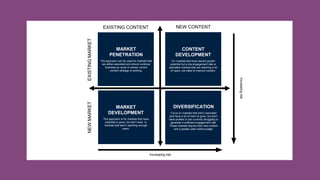
EXISTING
MARKET
NEW
MARKET
EXISTING CONTENT NEW CONTENT
MARKET
PENETRATION
The approach can be used for markets that
are either saturated and should continue
business as usual or whose current
content strategy is working.
Increasing
risk
Increasing risk
CONTENT
DEVELOPMENT
For markets that have decent growth
potential but a low engagement rate or
saturated markets that are reaching a lot
of users, but need to improve content.
MARKET
DEVELOPMENT
This approach is for markets that have
potential to grow, but don’t exist, or
markets that aren’t reaching enough
users.
DIVERSIFICATION
Focus on markets that aren’t saturated
and have a lot of room to grow, but don’t
have profiles or are currently struggling to
generate a sufficient engagement rate.
These markets require both new content
and a greater paid media budget.
Questions so far?
Looking outwards.
PRESENTED BY @adweek @socialmediaweek @yourbrand
Headline.
• Bullet points.
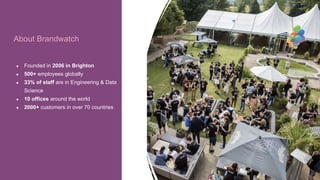
About Brandwatch
● Founded in 2006 in Brighton
● 500+ employees globally
● 33% of staff are in Engineering & Data
Science
● 10 offices around the world
● 2000+ customers in over 70 countries
XX
2007 2014 2017 2018 2021
[Acquisition]
[Acquisition]
[Merger]
The future
Digital
Consumer
Intelligence
[Acquired by]
Social Suite
+
The Evolution of Brandwatch.
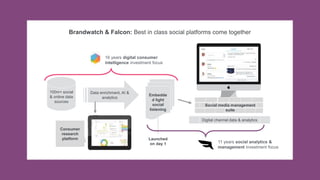
Brandwatch & Falcon: Best in class social platforms come together
100m+ social
& online data
sources
Embedde
d light
social
listening
Data enrichment, AI &
analytics
16 years digital consumer
intelligence investment focus
Social media management
suite
Launched
on day 1
Consumer
research
platform
Digital channel data & analytics
11 years social analytics &
management investment focus
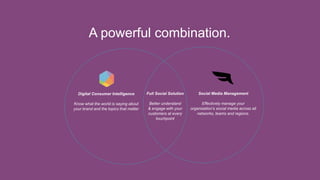
Digital Consumer Intelligence
Know what the world is saying about
your brand and the topics that matter
Social Media Management
Effectively manage your
organization’s social media across all
networks, teams and regions.
A powerful combination.
Full Social Solution
Better understand
& engage with your
customers at every
touchpoint
PRESENTED BY @adweek @socialmediaweek @yourbrand
Brandwatch’s
Vision:
To bring structure and
meaning to billions of
consumer voices, for
smarter, data-driven
decision-making.
PRESENTED BY @adweek @socialmediaweek @yourbrand
In a digital world, change happens quickly...
PRESENTED BY @adweek @socialmediaweek @yourbrand
...in 2021, change is being accelerated.
PRESENTED BY @adweek @socialmediaweek @yourbrand
Understanding
consumers in
the digital era
• Technology offers consumers
more choice and more power than
ever before
• Consumer behaviour is
evolving faster than ever before
• We have access to more data
than ever before
• But we are still relying on what
we did before
PRESENTED BY @adweek @socialmediaweek @yourbrand
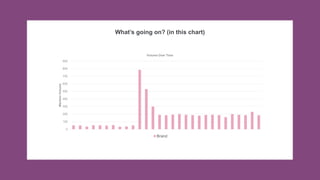
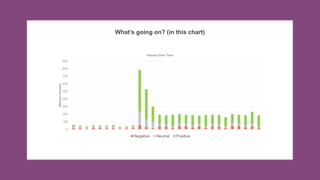
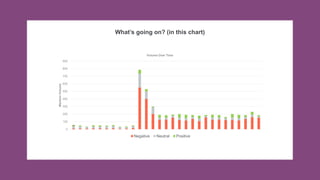
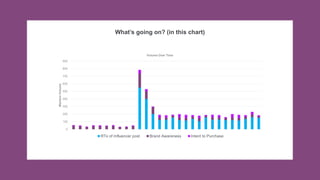
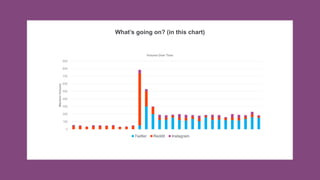
What’s going on?
To turn data into insights we
need to ask the right
questions…
XX
What’s going on? (in this chart)
0
100
200
300
400
500
600
700
800
900
Mention
Volume
Volume Over Time
Brand
XX
What’s going on? (in this chart)
0
100
200
300
400
500
600
700
800
900
Mention
Volume
Volume Over Time
Negative Neutral Positive
XX
What’s going on? (in this chart)
0
100
200
300
400
500
600
700
800
900
Mention
Volume
Volume Over Time
Negative Neutral Positive
XX
What’s going on? (in this chart)
0
100
200
300
400
500
600
700
800
900
Mention
Volume
Volume Over Time
RTs of Influencer post Brand Awareness Intent to Purchase
XX
What’s going on? (in this chart)
0
100
200
300
400
500
600
700
800
900
Mention
Volume
Volume Over Time
Twitter Reddit Instagram
PRESENTED BY @adweek @socialmediaweek @yourbrand
• Bullet points.
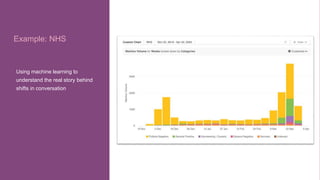
Example: NHS
Using machine learning to
understand the real story behind
shifts in conversation
PRESENTED BY @adweek @socialmediaweek @yourbrand
• Bullet points.
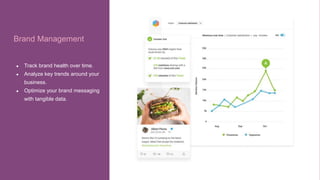
Brand Management
● Track brand health over time.
● Analyze key trends around your
business.
● Optimize your brand messaging
with tangible data.
PRESENTED BY @adweek @socialmediaweek @yourbrand
• Bullet points.
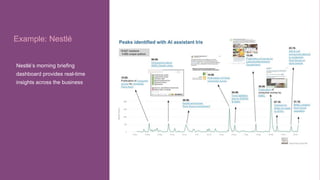
Example: Nestlé
Nestlé’s morning briefing
dashboard provides real-time
insights across the business
PRESENTED BY @adweek @socialmediaweek @yourbrand
• Bullet points.
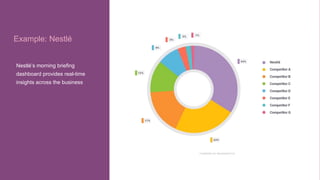
Example: Nestlé
Nestlé’s morning briefing
dashboard provides real-time
insights across the business
PRESENTED BY @adweek @socialmediaweek @yourbrand
• Bullet points.
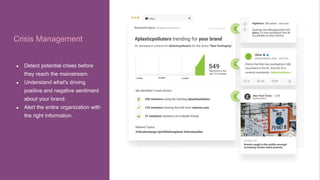
Crisis Management
● Detect potential crises before
they reach the mainstream.
● Understand what's driving
positive and negative sentiment
about your brand.
● Alert the entire organization with
the right information.
PRESENTED BY @adweek @socialmediaweek @yourbrand
• Bullet points.
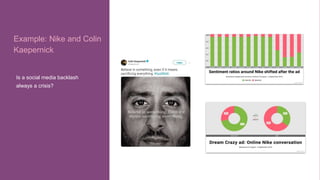
Example: Nike and Colin
Kaepernick
Is a social media backlash
always a crisis?
PRESENTED BY @adweek @socialmediaweek @yourbrand
• Bullet points.
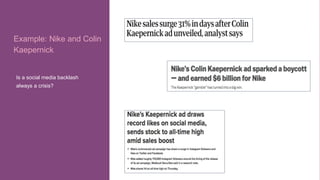
Example: Nike and Colin
Kaepernick
Is a social media backlash
always a crisis?
XX
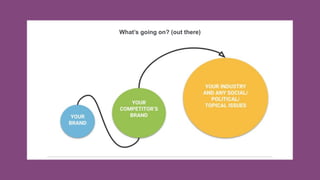
What’s going on? (out there)
PRESENTED BY @adweek @socialmediaweek @yourbrand
• Bullet points.
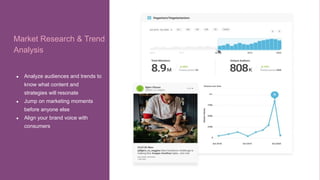
Market Research & Trend
Analysis
● Analyze audiences and trends to
know what content and
strategies will resonate​
● Jump on marketing moments
before anyone else
● Align your brand voice with
consumers
PRESENTED BY @adweek @socialmediaweek @yourbrand
• Bullet points.
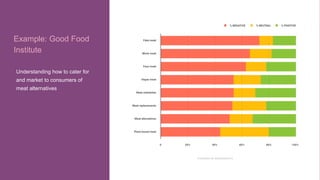
Example: Good Food
Institute
Understanding how to cater for
and market to consumers of
meat alternatives
PRESENTED BY @adweek @socialmediaweek @yourbrand
• Bullet points.
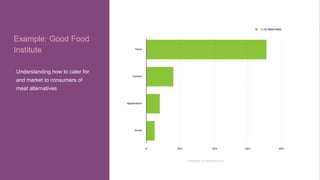
Example: Good Food
Institute
Understanding how to cater for
and market to consumers of
meat alternatives
PRESENTED BY @adweek @socialmediaweek @yourbrand
• Bullet points.
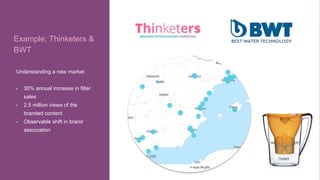
Example: Thinketers &
BWT
Understanding a new market
• 30% annual increase in filter
sales
• 2.5 million views of the
branded content
• Observable shift in brand
association
Summary
1. Finding insights starts with asking the right questions
2. Brand Management: Who's actually talking about you
and what are they saying?
3. Crisis Management: When is a backlash really a crisis
and how should you respond?
4. Market Research & Trend Analysis: What do
consumers want and how should you talk to them?
Leave your bias at the door.
“You are the least qualified person in the world to
know anything about your brand.”
- Mark Ritson
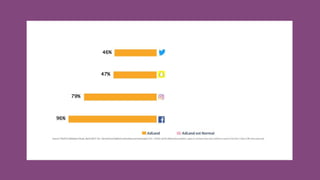
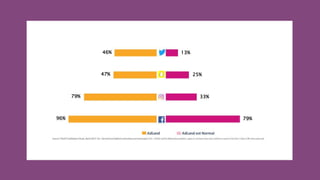
46%
47%
79%
96%
13%
25%
33%
79%
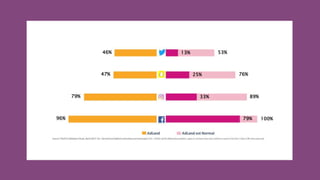
46%
47%
79%
96%
53%
76%
89%
100%
13%
25%
33%
79%
46%
47%
79%
96%
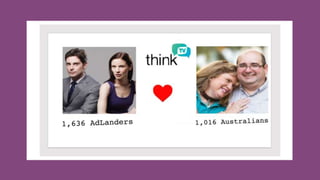
Be aware of the bias you bring into
the strategic process.
Social Media Data Has Entered the Chat

Social Media Data Has Entered the Chat

  • 4.
    • The stateof affairs for social media managers • Using social media data to inform strategy and create business insights • How to use owned data to pivot in a smart direction • Half-time Q&A • Leveraging social listening to uncover insights and trends • Understanding the market • Q&A
  • 5.
    The state ofaffairs.
  • 6.
    The state ofaffairs. 4.2bn Active social media users. 8.4 Average social media accounts per Internet user. Source: We Are Social, Digital 2021: the latest insights into the ‘state of digital, 2021
  • 7.
    The amount ofdata passing through social media is massive. For even the most experienced social media manager or marketer, this makes the job of analysing and leveraging data a daunting task.
  • 8.
    We struggle togenerate insights using social media data. Only 16% use social data for competitive insights. Which is stopping us from developing strategic work. 47% say their number on challenge is to develop a strategy that supports the organisation's goals Source: Sprout, The Sprout Social Index, Edition XV: Empower & Elevate, 2019
  • 9.
  • 10.
    “Our strategy isto use Facebook link ads to drive more users to our website.” “Our new strategy is to use influencers to showcase our products in different ways” “Our strategic approach is to use TikTok to reach a younger audience”
  • 11.
  • 12.
  • 13.
    XX Diagnosis: Study thepast, study the territory, find out the trouble.
  • 14.
    XX Diagnosis: Study thepast, study the territory, find out the trouble. Strategy: After uncovering weakness, develop a plan that can be applied to this local sore spot. Outline this plan in detail.
  • 15.
    XX Diagnosis: Study thepast, study the territory, find out the trouble. Strategy: After uncovering weakness, develop a plan that can be applied to this local sore spot. Outline this plan in detail. Tactics: Prepare material for carrying out the plan. Pass it on to the districts.
  • 16.
    XX Diagnosis: Study thepast, study the territory, find out the trouble. Strategy: After uncovering weakness, develop a plan that can be applied to this local sore spot. Outline this plan in detail. Tactics: Prepare material for carrying out the plan. Pass it on to the districts. Diagnosis: Make whatever field studies are necessary to determine if the plan has produced the expected results.
  • 17.
    XX This should bethe strategic process. Diagnosis Strategy Tactics 33.3% 33.3% 33.3%
  • 18.
    XX This often seemslike the reality, though. Diagnosis Strategy Tactics 10-20% 10-20% 60-80%
  • 19.
    XX Diagnosis Strategy Tactics Facebook TikTok Augmentedreality Virtual reality Clubhouse Long-form video Instagram Reels Influencers This often seems like the reality, though.
  • 20.
    Put down thetactical toolbox and start with diagnosis.
  • 21.
    Looking inwards. Analyze yourown social media data and determine what the current situation is, what the problem is and where you need to apply your focus. Looking outwards. Use social listening to uncover where users and consumers are talking about your brand, what they’re saying, what the sentiment is and what you can do with this data. Start with diagnosis to identify the problem. Form a hypothesis and then test it with data.
  • 22.
  • 23.
    There is anambition to use social media to drive business results. 70% want to use social media to drive brand awareness. 59% want to drive sales/lead generation. But we don’t measure accordingly. Only 41% use amplification and brand awareness metrics. Only 50% focus on conversion and revenue metrics. 63% focus on engagement metrics to meet their goals. Source: Sprout, The Sprout Social Index, Edition XV: Empower & Elevate, 2019
  • 24.
    Measure the rightmetrics. Identify the brand problem/challenge & align your analysis and metrics/KPIs with this.
  • 25.
    Once you havethe overarching objectives, translate these to social media KPIs – and then benchmark them against historical performance. Awareness Are people seeing your brand, your products or your message? Reach Impressions Fan/follower growth Video views Posting volume Consideration Do people like and care about what you have to say? Engagement rate Likes, comments, shares Purchase Do people want to drink the Kool-aid and buy your products? Clicks Conversions Advocacy Are they talking about your brand or your products - and is it positive? Mentions Hashtags Sentiment Share of voice
  • 26.
    XX Market Fan Growth (%) Total ImpressionsEngagement Rate Market A 0.41% 8,216 1.43% Market B -0.31 % 96,003 0.63 % Market C 6.13 % 152,549 2.11 % Market D 0.11 % 76,001 0.61 % Market F 1.99 % 339,962 1.03 % Market G 1.87 % 257,985 0.92 % Market H 0.36 % 423,197 0.69 % Market I 6.45% 1,277 0,76 % Market J 1.05 % 316,536 0.89 % Market K 6.36 % 31,992 2.56 % Use benchmarks to turn the metrics into tangible insights and determine key focus areas. Use the median to create your benchmarks based on historical performance. Colour code to make your analysis easier. Look at multiple metrics together and compare them against each other.
  • 27.
    Moving in theright direction. Use social media data to pivot to the right market or platform.
  • 28.
    XX Source: EffWorks, Theten best charts from the work of Les Binet and Peter Field, 2018
  • 29.
    PRESENTED BY @adweek@socialmediaweek @yourbrand Use social media data to analyse opportunities for penetration. • Facebook and Twitter’s own ad managers can be used to gauge the potential audience in a given region or market. • By filling out the targeting criteria for the brand or product, it’s possible to see the potential audience on a given platform; all those that currently match the criteria.
  • 30.
    XX Sales outweigh bothcurrent and potential audience size. Small existing audience and little potential for growth. Market is saturated, so focus on engaging and managing existing community. Audience size and sales indicate an opportunity for growth, both online and offline. It would blow your minds how many brands have active social media profiles in markets like these.
  • 31.
    XX Market Fan Growth (%) Total ImpressionsEngagement Rate Existing audience Potential audience Saturation Market A 0.41% 8,216 1.43% 4,248 867,000 0.49% Market B -0.31 % 96,003 0.63 % 19,705 2,214,000 0.89% Market C 6.13 % 152,549 2.11 % 14,715 272,000 5.41% Market D 0.11 % 76,001 0.61 % 22,856 721,000 3.17% Market F 1.99 % 339,962 1.03 % 26,747 165,000 16.21% Market G 1.87 % 257,985 0.92 % 66,411 1,410,000 4.71% Market H 0.36 % 423,197 0.69 % 46,380 94,000 49.34% Market I 6.45% 1,277 0,76 % 405 1,350,000 0.03% Market J 1.05 % 316,536 0.89 % 25,021 1,310,000 1.91% Market K 6.36 % 31,992 2.56 % 1,952 610,000 0.32%
  • 32.
    XX EXISTING MARKET NEW MARKET EXISTING CONTENT NEWCONTENT MARKET PENETRATION The approach can be used for markets that are either saturated and should continue business as usual or whose current content strategy is working. Increasing risk Increasing risk CONTENT DEVELOPMENT For markets that have decent growth potential but a low engagement rate or saturated markets that are reaching a lot of users, but need to improve content. MARKET DEVELOPMENT This approach is for markets that have potential to grow, but don’t exist, or markets that aren’t reaching enough users. DIVERSIFICATION Focus on markets that aren’t saturated and have a lot of room to grow, but don’t have profiles or are currently struggling to generate a sufficient engagement rate. These markets require both new content and a greater paid media budget.
  • 33.
  • 34.
  • 35.
    PRESENTED BY @adweek@socialmediaweek @yourbrand Headline. • Bullet points. About Brandwatch ● Founded in 2006 in Brighton ● 500+ employees globally ● 33% of staff are in Engineering & Data Science ● 10 offices around the world ● 2000+ customers in over 70 countries
  • 36.
    XX 2007 2014 20172018 2021 [Acquisition] [Acquisition] [Merger] The future Digital Consumer Intelligence [Acquired by] Social Suite + The Evolution of Brandwatch.
  • 37.
    Brandwatch & Falcon:Best in class social platforms come together 100m+ social & online data sources Embedde d light social listening Data enrichment, AI & analytics 16 years digital consumer intelligence investment focus Social media management suite Launched on day 1 Consumer research platform Digital channel data & analytics 11 years social analytics & management investment focus
  • 38.
    Digital Consumer Intelligence Knowwhat the world is saying about your brand and the topics that matter Social Media Management Effectively manage your organization’s social media across all networks, teams and regions. A powerful combination. Full Social Solution Better understand & engage with your customers at every touchpoint
  • 39.
    PRESENTED BY @adweek@socialmediaweek @yourbrand Brandwatch’s Vision: To bring structure and meaning to billions of consumer voices, for smarter, data-driven decision-making.
  • 40.
    PRESENTED BY @adweek@socialmediaweek @yourbrand In a digital world, change happens quickly...
  • 41.
    PRESENTED BY @adweek@socialmediaweek @yourbrand ...in 2021, change is being accelerated.
  • 42.
    PRESENTED BY @adweek@socialmediaweek @yourbrand Understanding consumers in the digital era • Technology offers consumers more choice and more power than ever before • Consumer behaviour is evolving faster than ever before • We have access to more data than ever before • But we are still relying on what we did before
  • 43.
    PRESENTED BY @adweek@socialmediaweek @yourbrand What’s going on? To turn data into insights we need to ask the right questions…
  • 44.
    XX What’s going on?(in this chart) 0 100 200 300 400 500 600 700 800 900 Mention Volume Volume Over Time Brand
  • 45.
    XX What’s going on?(in this chart) 0 100 200 300 400 500 600 700 800 900 Mention Volume Volume Over Time Negative Neutral Positive
  • 46.
    XX What’s going on?(in this chart) 0 100 200 300 400 500 600 700 800 900 Mention Volume Volume Over Time Negative Neutral Positive
  • 47.
    XX What’s going on?(in this chart) 0 100 200 300 400 500 600 700 800 900 Mention Volume Volume Over Time RTs of Influencer post Brand Awareness Intent to Purchase
  • 48.
    XX What’s going on?(in this chart) 0 100 200 300 400 500 600 700 800 900 Mention Volume Volume Over Time Twitter Reddit Instagram
  • 49.
    PRESENTED BY @adweek@socialmediaweek @yourbrand • Bullet points. Example: NHS Using machine learning to understand the real story behind shifts in conversation
  • 50.
    PRESENTED BY @adweek@socialmediaweek @yourbrand • Bullet points. Brand Management ● Track brand health over time. ● Analyze key trends around your business. ● Optimize your brand messaging with tangible data.
  • 51.
    PRESENTED BY @adweek@socialmediaweek @yourbrand • Bullet points. Example: Nestlé Nestlé’s morning briefing dashboard provides real-time insights across the business
  • 52.
    PRESENTED BY @adweek@socialmediaweek @yourbrand • Bullet points. Example: Nestlé Nestlé’s morning briefing dashboard provides real-time insights across the business
  • 53.
    PRESENTED BY @adweek@socialmediaweek @yourbrand • Bullet points. Crisis Management ● Detect potential crises before they reach the mainstream. ● Understand what's driving positive and negative sentiment about your brand. ● Alert the entire organization with the right information.
  • 54.
    PRESENTED BY @adweek@socialmediaweek @yourbrand • Bullet points. Example: Nike and Colin Kaepernick Is a social media backlash always a crisis?
  • 55.
    PRESENTED BY @adweek@socialmediaweek @yourbrand • Bullet points. Example: Nike and Colin Kaepernick Is a social media backlash always a crisis?
  • 56.
  • 57.
    PRESENTED BY @adweek@socialmediaweek @yourbrand • Bullet points. Market Research & Trend Analysis ● Analyze audiences and trends to know what content and strategies will resonate​ ● Jump on marketing moments before anyone else ● Align your brand voice with consumers
  • 58.
    PRESENTED BY @adweek@socialmediaweek @yourbrand • Bullet points. Example: Good Food Institute Understanding how to cater for and market to consumers of meat alternatives
  • 59.
    PRESENTED BY @adweek@socialmediaweek @yourbrand • Bullet points. Example: Good Food Institute Understanding how to cater for and market to consumers of meat alternatives
  • 60.
    PRESENTED BY @adweek@socialmediaweek @yourbrand • Bullet points. Example: Thinketers & BWT Understanding a new market • 30% annual increase in filter sales • 2.5 million views of the branded content • Observable shift in brand association
  • 61.
    Summary 1. Finding insightsstarts with asking the right questions 2. Brand Management: Who's actually talking about you and what are they saying? 3. Crisis Management: When is a backlash really a crisis and how should you respond? 4. Market Research & Trend Analysis: What do consumers want and how should you talk to them?
  • 62.
    Leave your biasat the door.
  • 63.
    “You are theleast qualified person in the world to know anything about your brand.” - Mark Ritson
  • 65.
  • 66.
  • 67.
  • 68.
    Be aware ofthe bias you bring into the strategic process.