

Social media analytics: why bother?
Claire Bower, April 2014
Social media analytics: why bother?
•Digital Communications Manager
(BMJ)
•MA in Electronic Communication
and Publishing (UCL)
•Completing a Diploma in Digital
Marketing (IDM)
My background
What can they teach us?
What tools are out there?
What impact can they have?
What tools are out there?
Google Analytics
What tools are out there?
Google Analytics
1 hit per minute
What tools are out there?
Crowdbooster
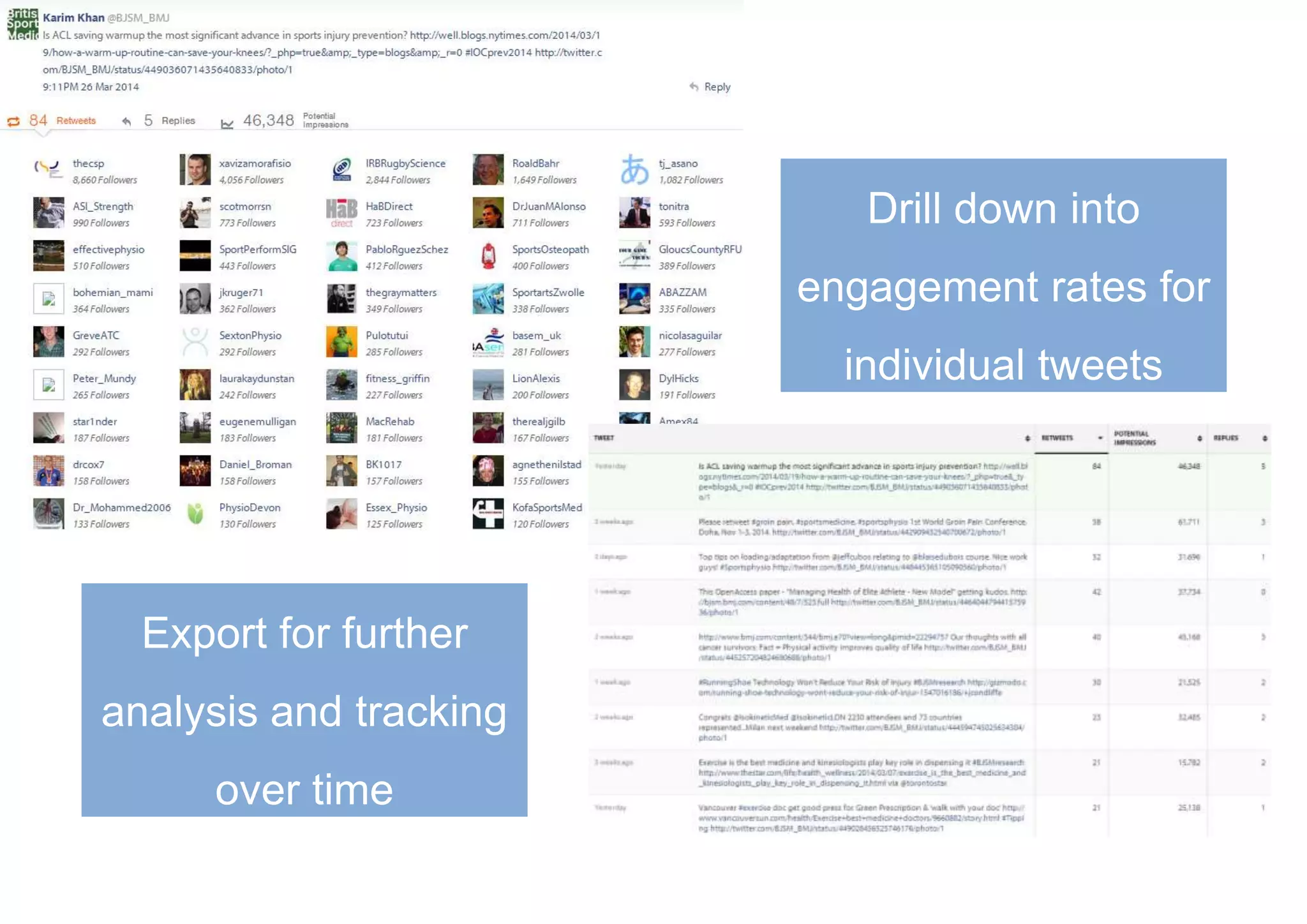
Drill down into
engagement rates for
individual tweets
Export for further
analysis and tracking
over time
What tools are out there?
Followerwonk
What can these tools teach us?
1. Know your audience
2. Keep things simple
3. Image is everything
1. Know your audience
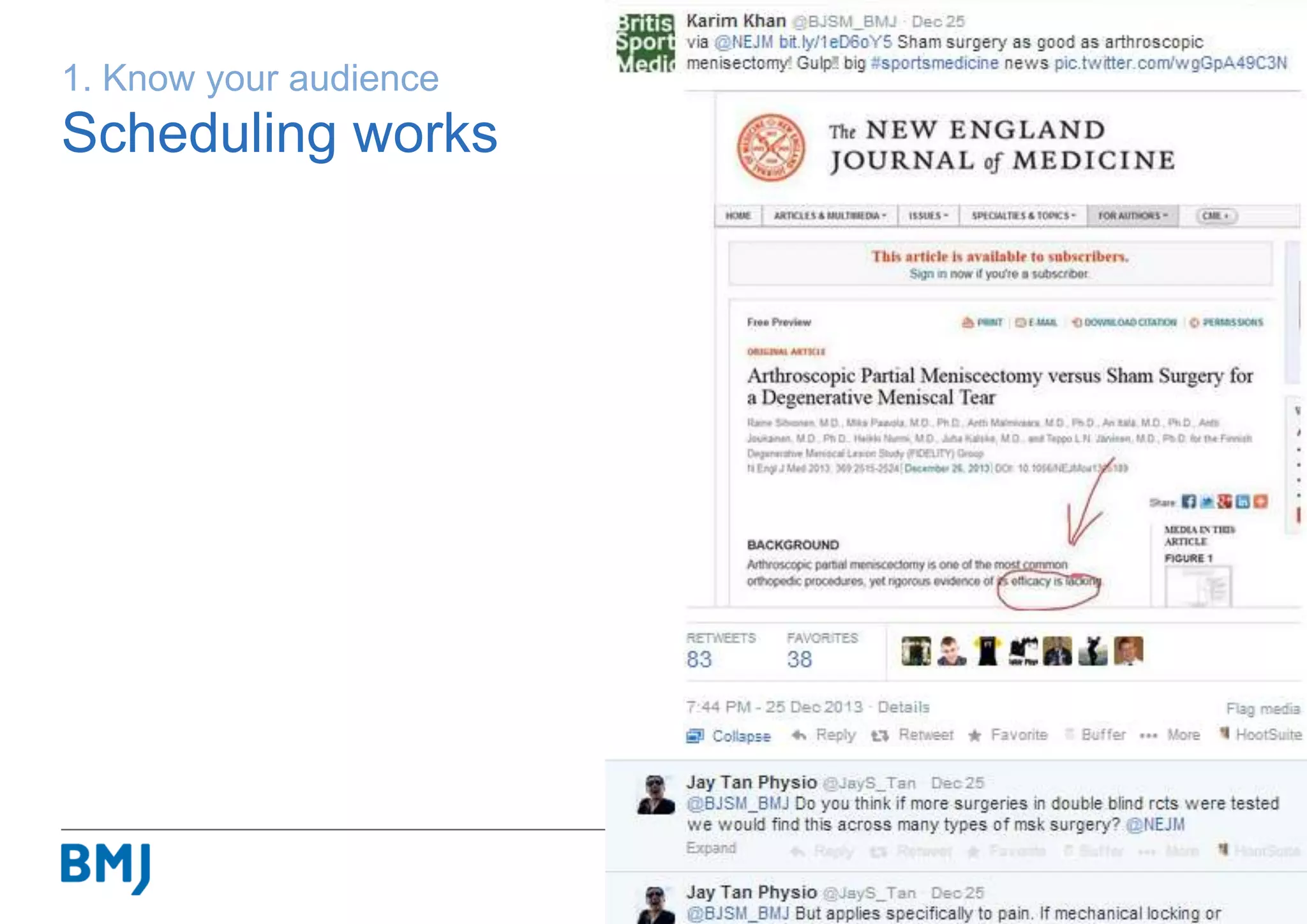
Scheduling works
1. Know your audience
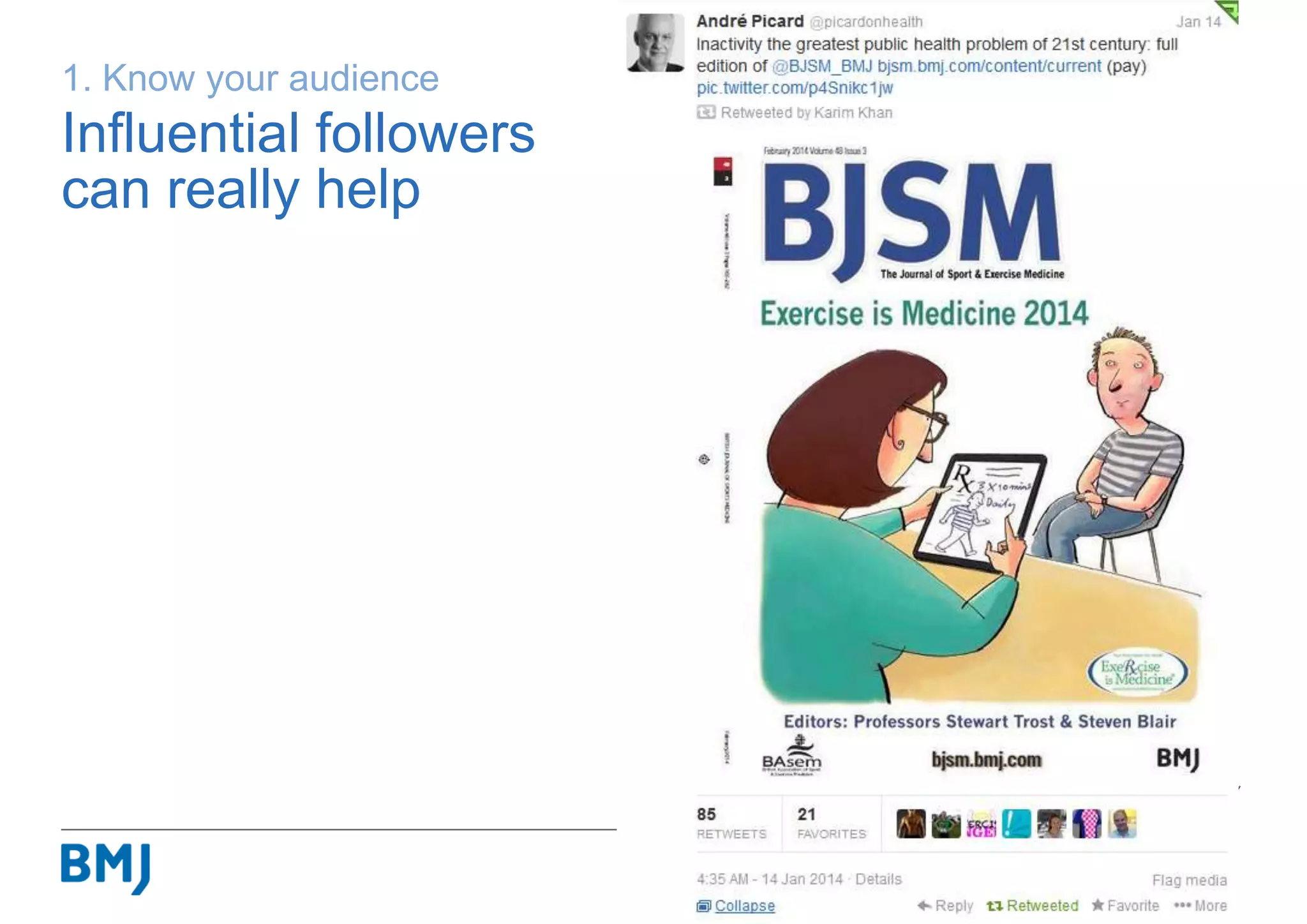
Influential followers
can really help
2. Keep things simple
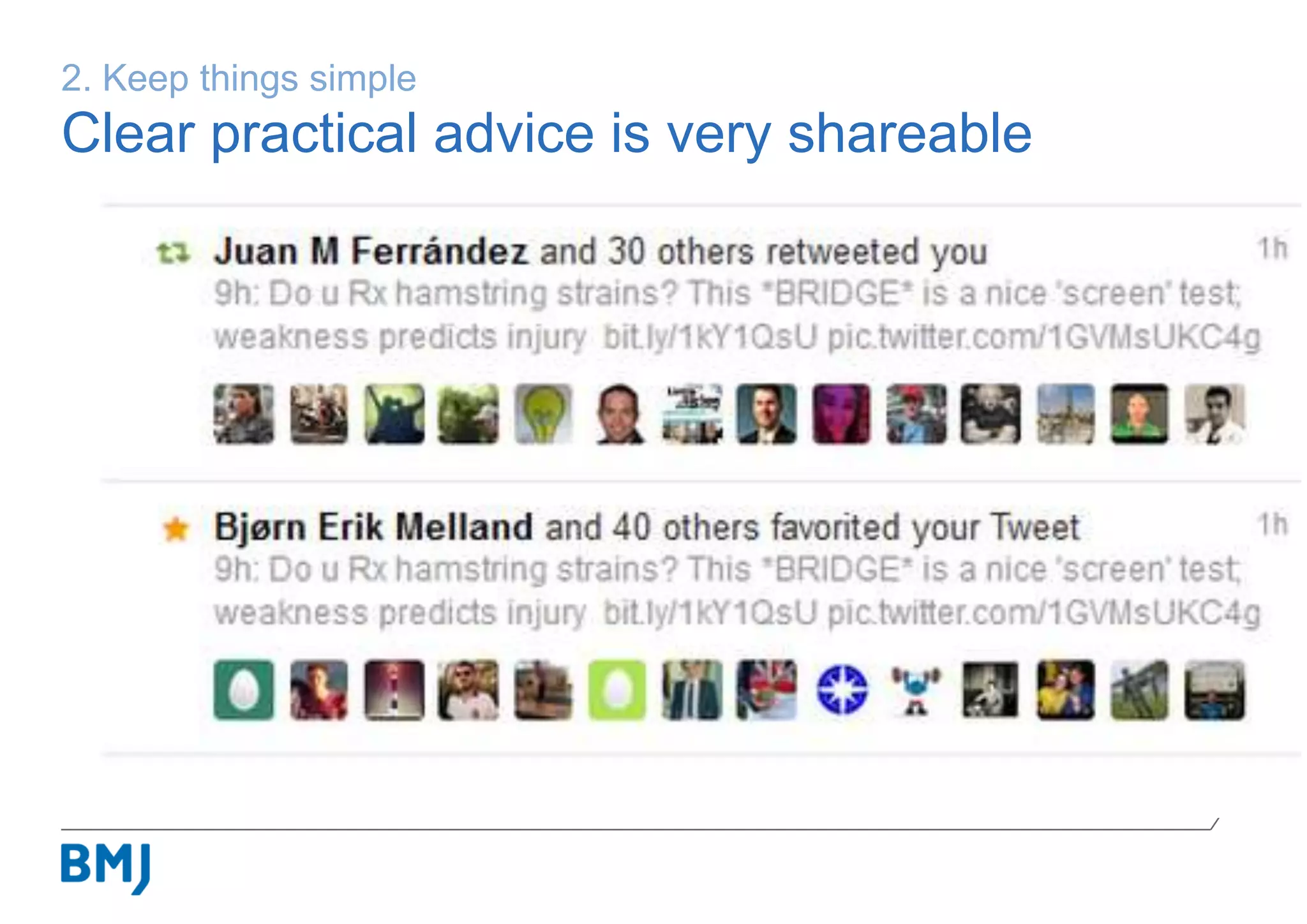
Clear practical advice is very shareable
2. Keep things simple
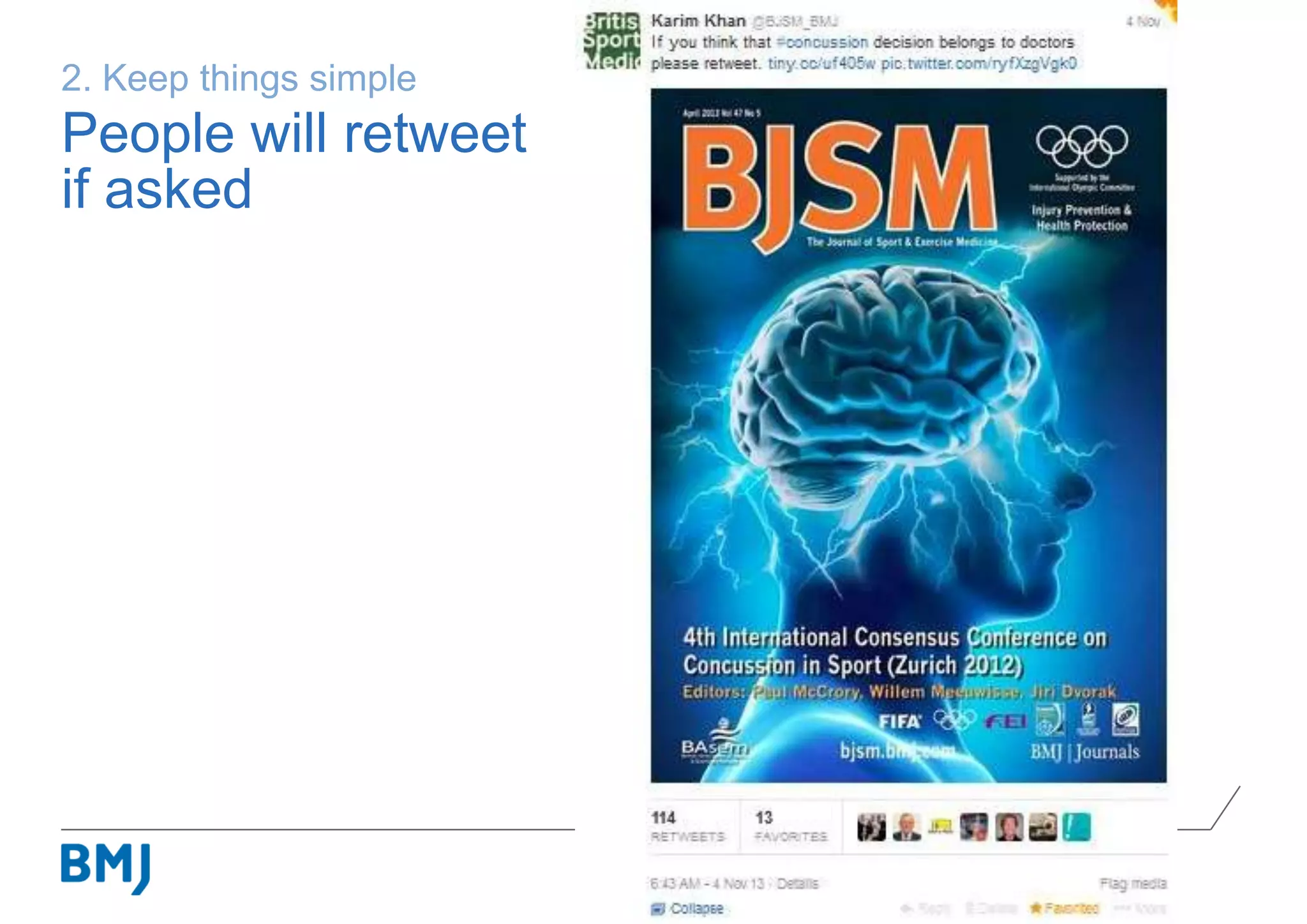
People will retweet
if asked
2. Keep things simple
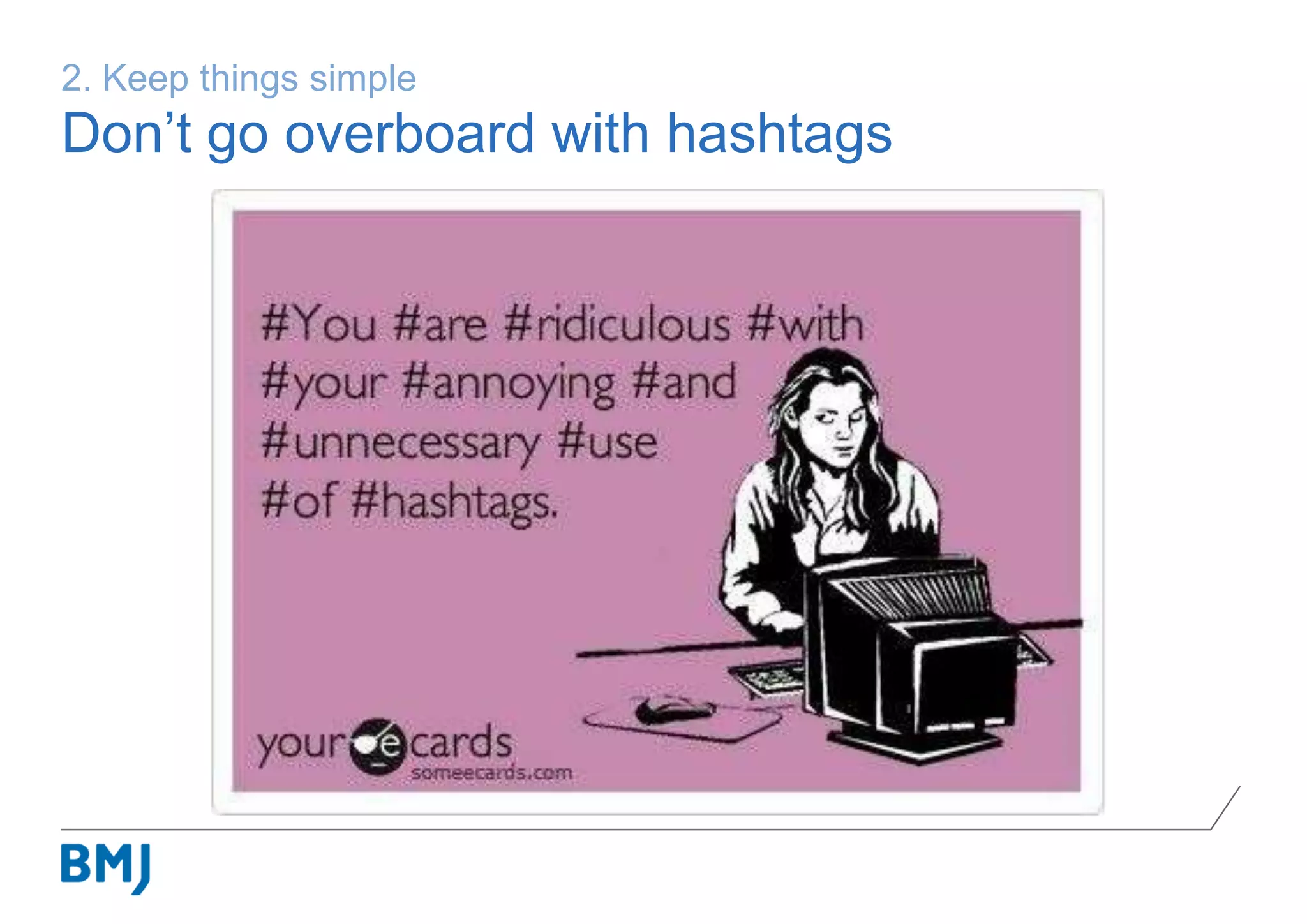
Don’t go overboard with hashtags
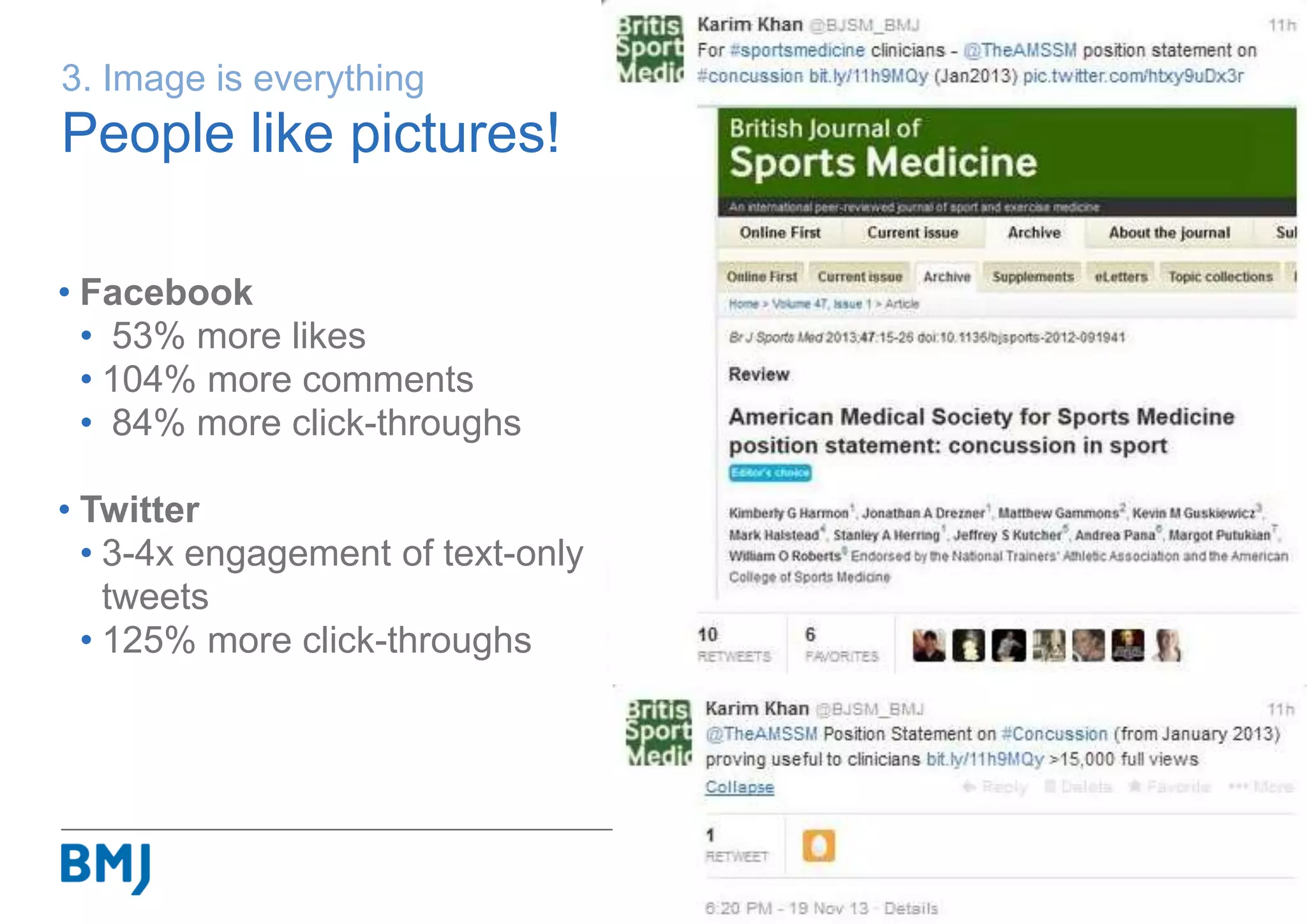
3. Image is everything
• Facebook
• 53% more likes
• 104% more comments
• 84% more click-throughs
• Twitter
• 3-4x engagement of text-only
tweets
• 125% more click-throughs
People like pictures!
What impact can all of this have?
Social media can help make a difference
What impact can all of this have?
Social media can help make a difference
What impact can all of this have?
Social media can help make a difference
“For me, the paper is only a small part of the
process - it's what happens to the debate after
the paper is out that is more important.”
Dr Richard Weiler
BMJ Publishing Group Limited 2014. All rights reserved.
Blog: http://blogs.bmj.com/bmj-journals-development-blog/
Email: cbower@bmj.com
Twitter: @clairebower
Thank You
Social media analytics - why bother?

Social media analytics - why bother?

  • 2.
    Social media analytics:why bother? Claire Bower, April 2014
  • 3.
    Social media analytics:why bother? •Digital Communications Manager (BMJ) •MA in Electronic Communication and Publishing (UCL) •Completing a Diploma in Digital Marketing (IDM) My background
  • 4.
    What can theyteach us? What tools are out there? What impact can they have?
  • 5.
    What tools areout there?
  • 6.
    What tools areout there? Google Analytics
  • 7.
    What tools areout there? Google Analytics 1 hit per minute
  • 9.
    What tools areout there? Crowdbooster
  • 10.
    Drill down into engagementrates for individual tweets Export for further analysis and tracking over time
  • 15.
    What tools areout there? Followerwonk
  • 18.
    What can thesetools teach us? 1. Know your audience 2. Keep things simple 3. Image is everything
  • 19.
    1. Know youraudience Scheduling works
  • 20.
    1. Know youraudience Influential followers can really help
  • 21.
    2. Keep thingssimple Clear practical advice is very shareable
  • 22.
    2. Keep thingssimple People will retweet if asked
  • 23.
    2. Keep thingssimple Don’t go overboard with hashtags
  • 24.
    3. Image iseverything • Facebook • 53% more likes • 104% more comments • 84% more click-throughs • Twitter • 3-4x engagement of text-only tweets • 125% more click-throughs People like pictures!
  • 26.
    What impact canall of this have?
  • 27.
    What impact canall of this have? Social media can help make a difference
  • 28.
    What impact canall of this have? Social media can help make a difference
  • 29.
    What impact canall of this have? Social media can help make a difference
  • 30.
    “For me, thepaper is only a small part of the process - it's what happens to the debate after the paper is out that is more important.” Dr Richard Weiler
  • 31.
    BMJ Publishing GroupLimited 2014. All rights reserved. Blog: http://blogs.bmj.com/bmj-journals-development-blog/ Email: cbower@bmj.com Twitter: @clairebower Thank You

Editor's Notes

  • #4 I currently manage over 75 social media accounts, including twitter, facebook, pinterest and google+.Our journal websites receive over 2 million referrals from twitter and facebook combined each year.How do I keep track of all of these accounts? How can I tell what is doing well and what not so well?
  • #5 Social media analytics tools are a key part of my job. I need to be able to monitor the performance of our social channels right down to individual tweets and facebook posts.But it’s not just about meeting KPIs, it can be about making a real difference.
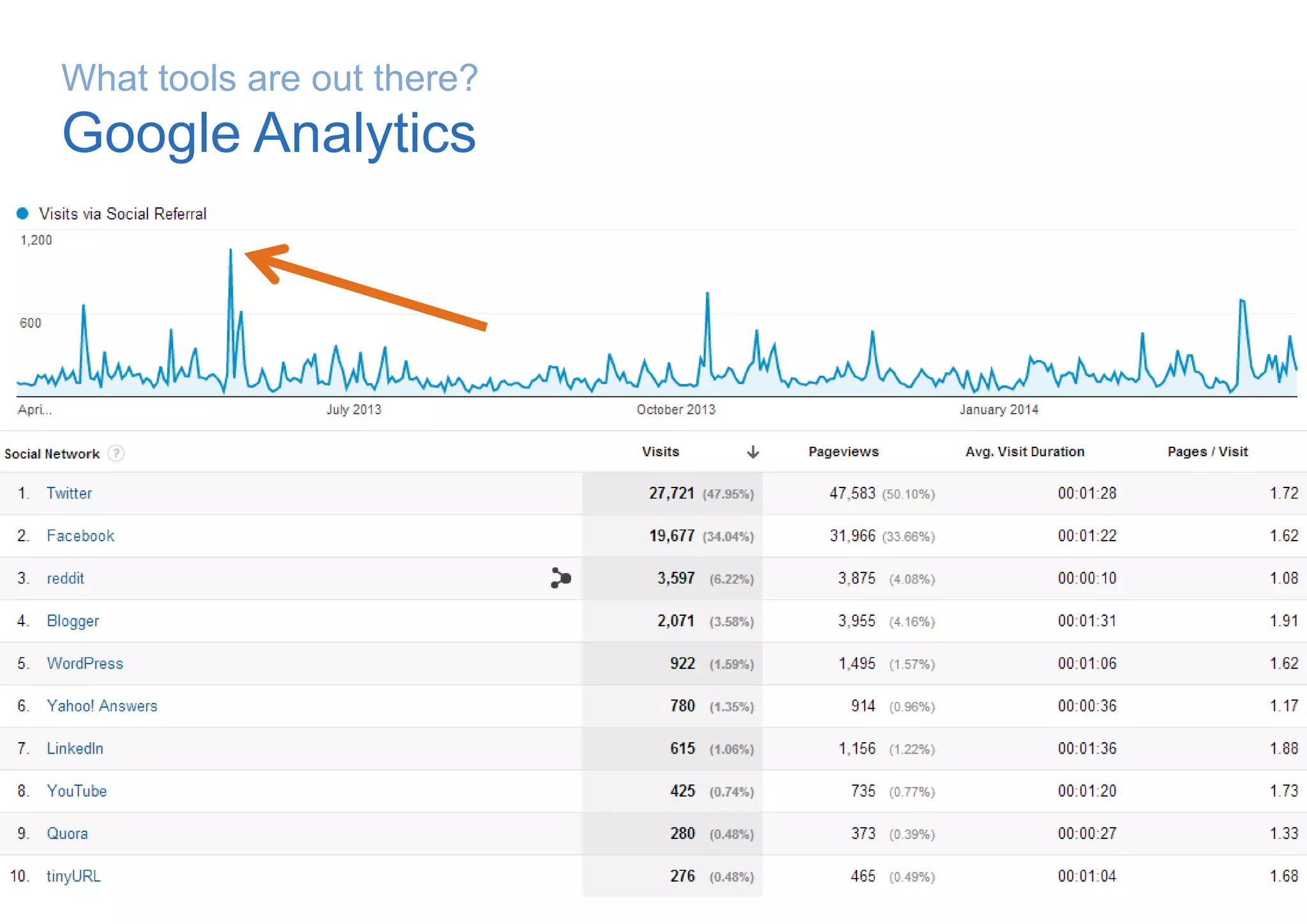
  • #7 Google Analytics is the most widely used website analytics service and the basic tools are free.Here’s an example ofreferrals to bjsm.bmj.com from social media websites over the past year.Pulling together this information can help us identify where our users are sharing content and where we should focus our efforts.It can also identify the source of mysterious amounts of traffic. For example, this peak in traffic in May last year.
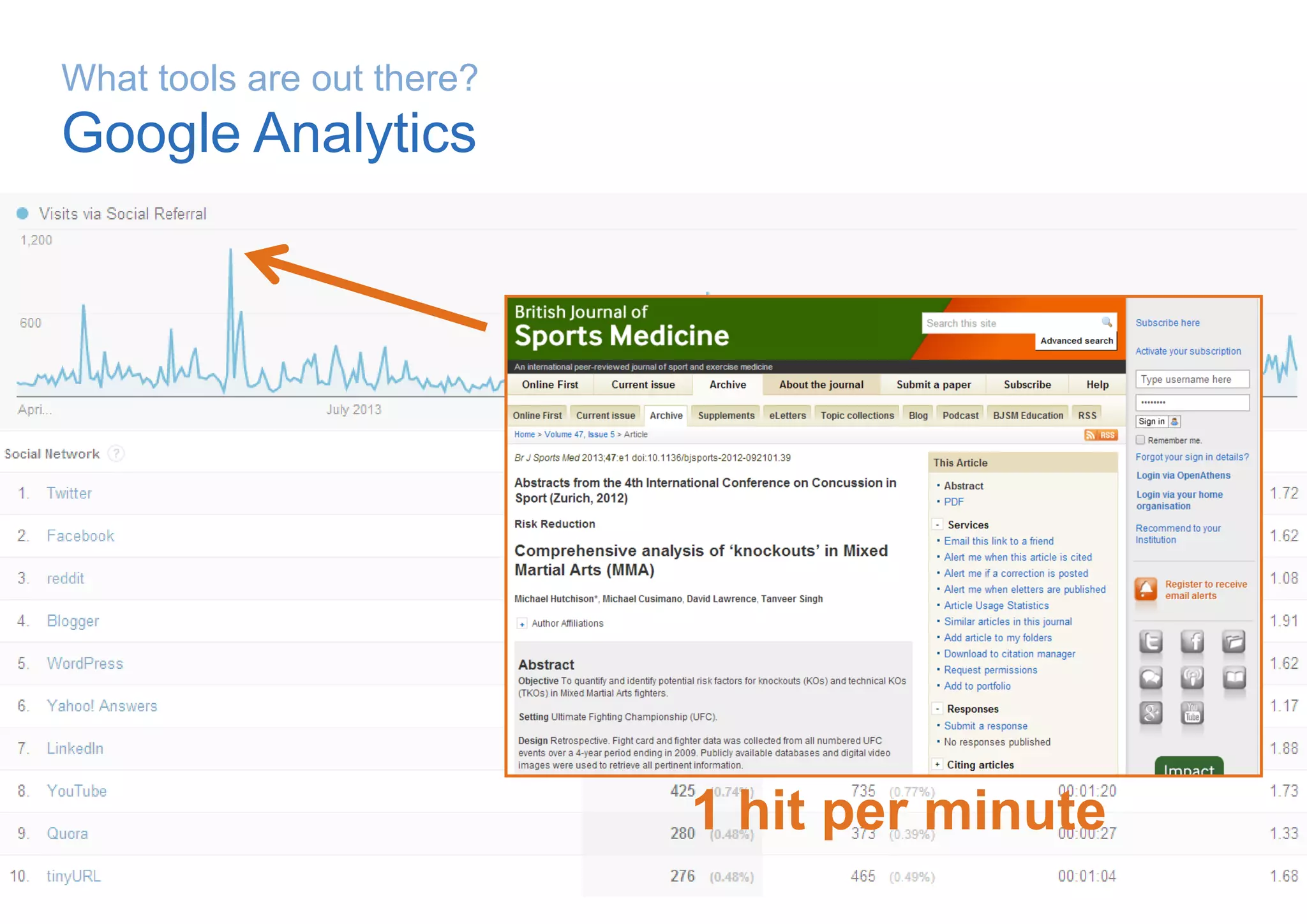
  • #8 Using Google Analytics, we discovered that we’d received over 1500 referrals in the space of 24 hours all to this single article.
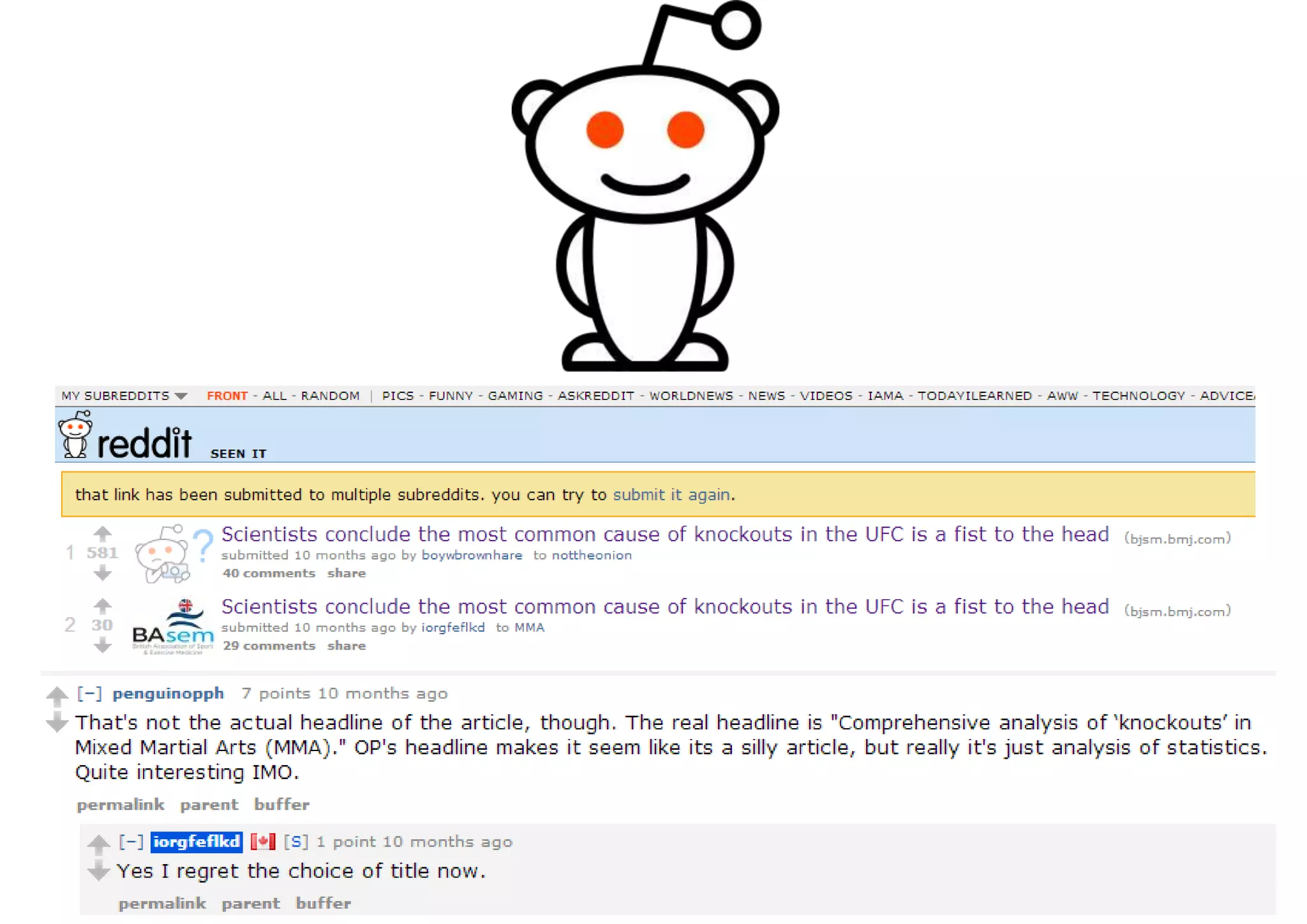
  • #9 We were also able to identify the source of this traffic as Reddit, a social sharing website that we have no presence on.
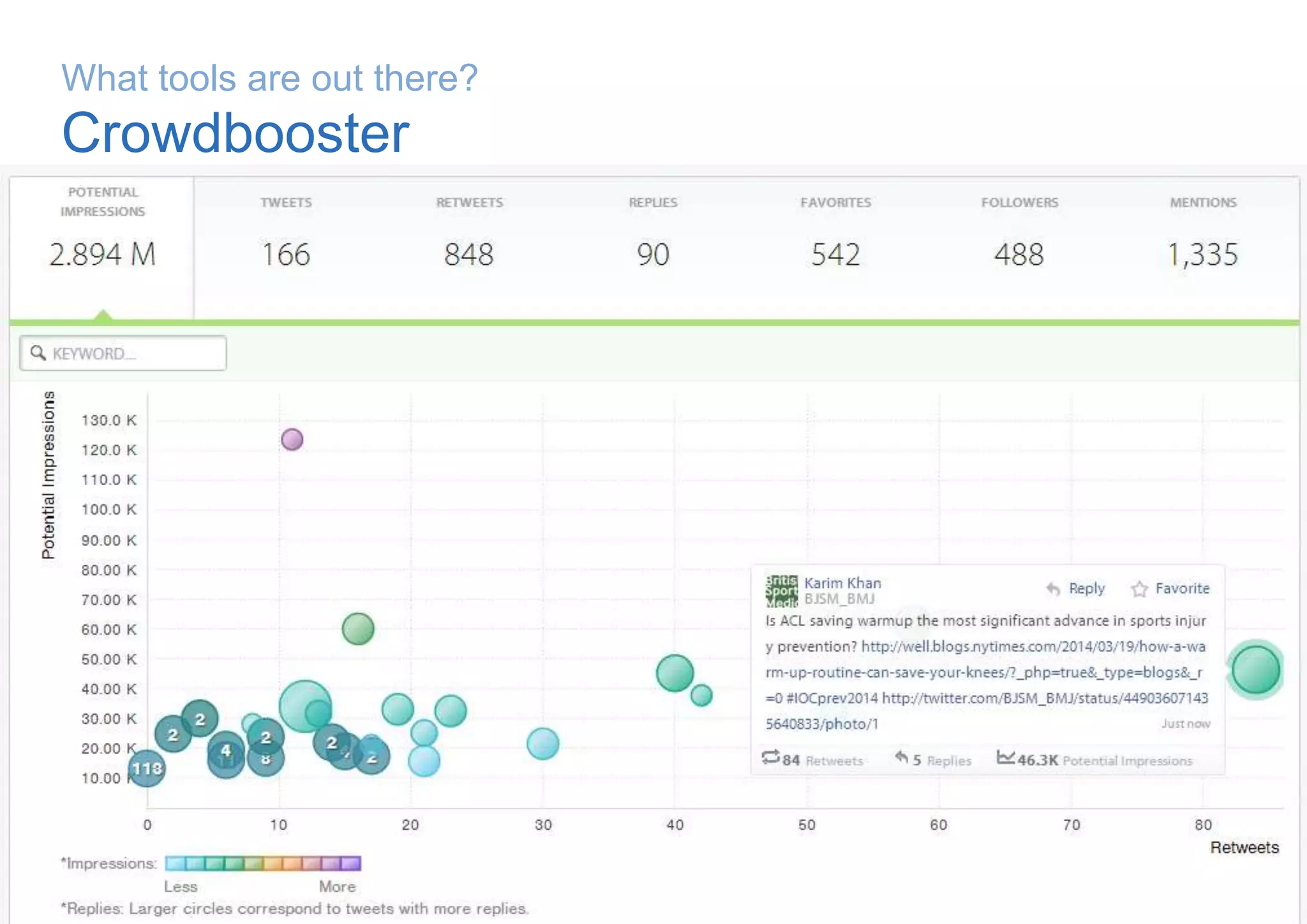
  • #10 Moving on to social media analytics packages, Crowdbooster is the one we use, but there are plenty out there to choose from and they all do similar things.We can choose data parameters for both facebook and twitter and pull up all activity within that timeframe.Here you can see our twitter dashboard for the past month – you have the headline figures at the top and then individual tweets plotted on the graph to give a snapshot view of performance.
  • #11 You can then drill down into individual tweets and see what’s been happening.This was our top performing tweet in the period set and we can see all 84 users who retweeted this information and their number of followers.
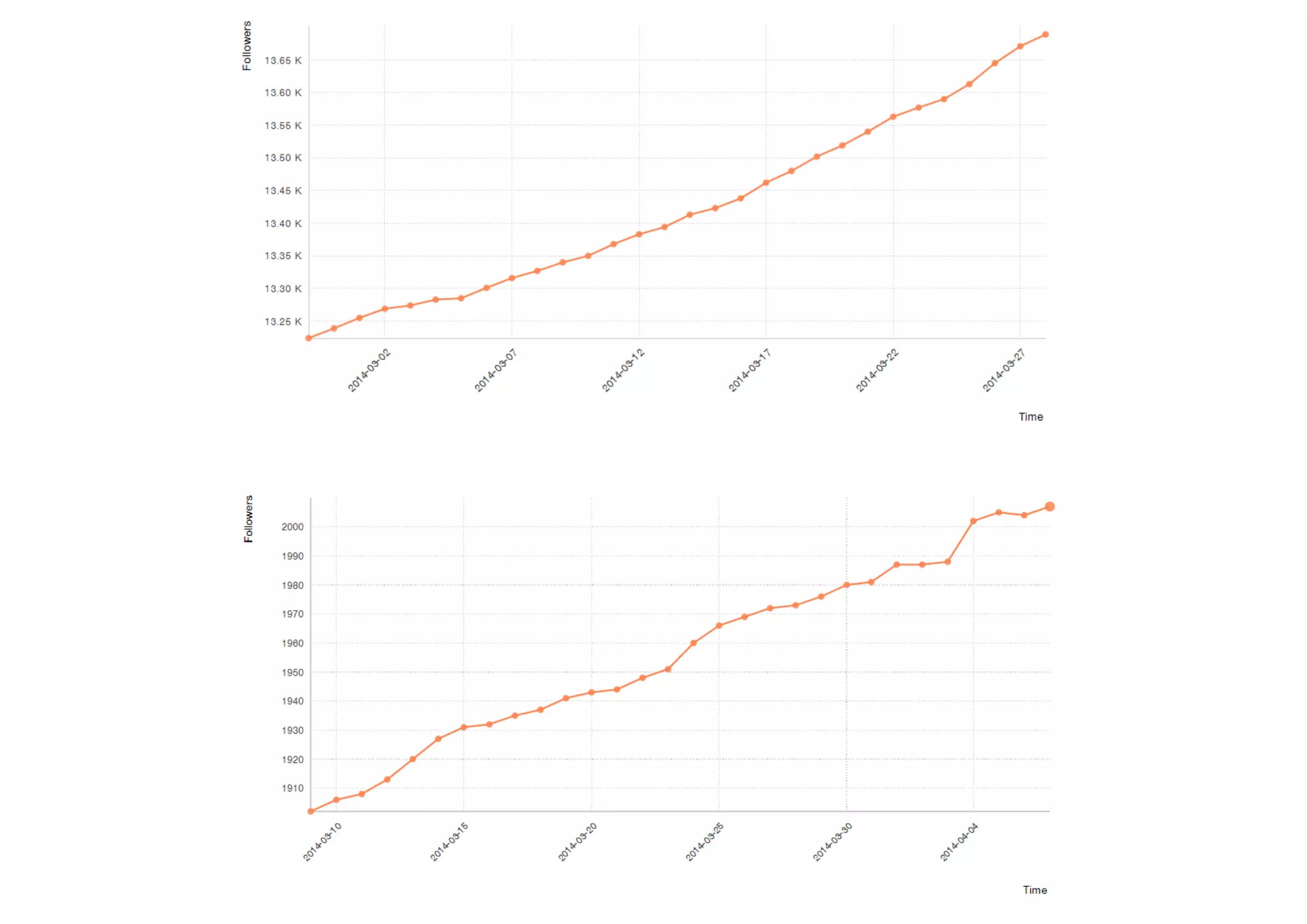
  • #12 Something that we find really useful is being able to monitor follower growth/decline over time.The top line is pretty consistent but some of our journals are more jagged and show us that perhaps people are following us and not getting on with the content we’re putting out.
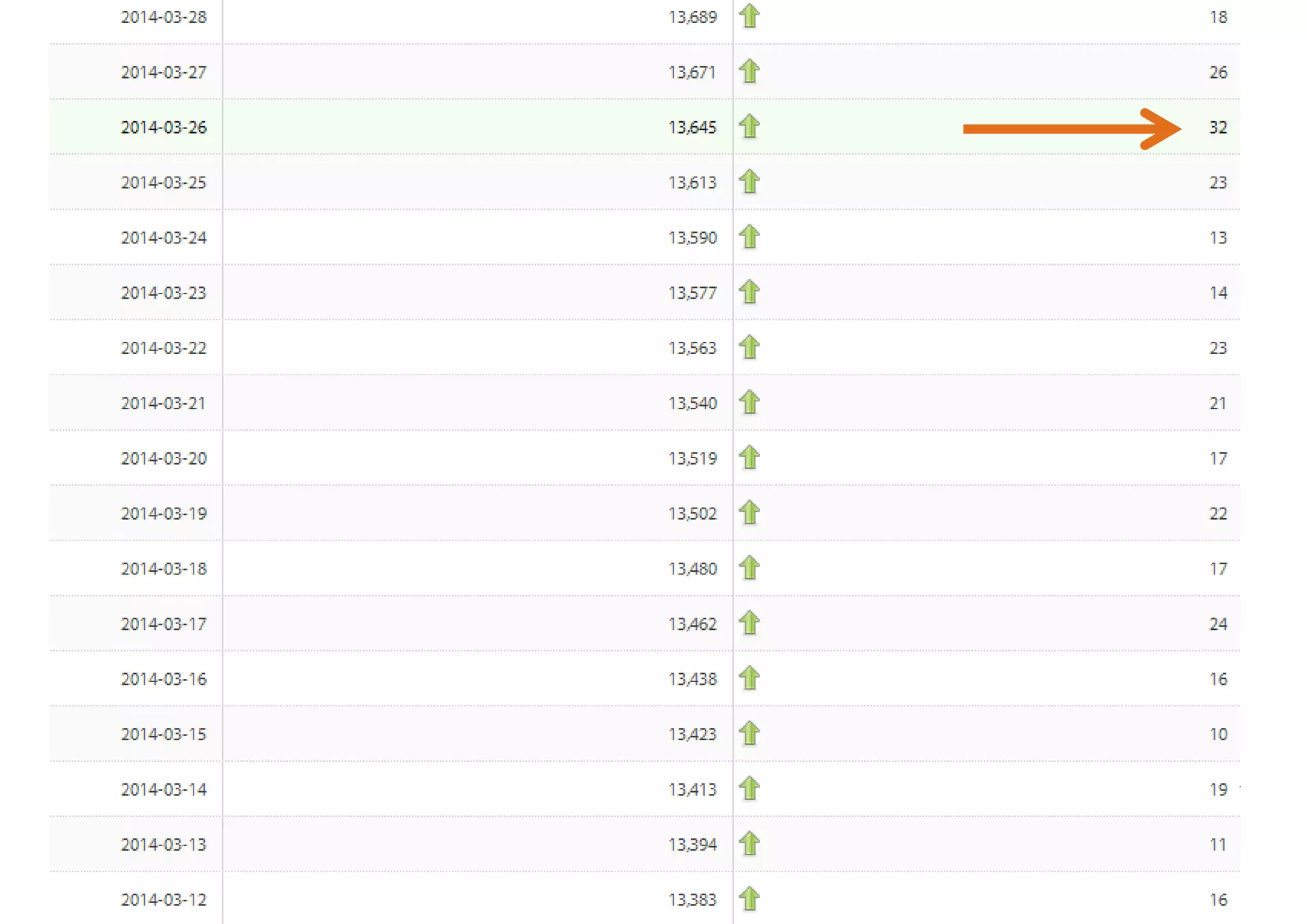
  • #13 We can easily identify which days we lose/gain followers and see the kind of content we’ve put out and adapt it accordingly.For example, we gained the most followers on 26th march.
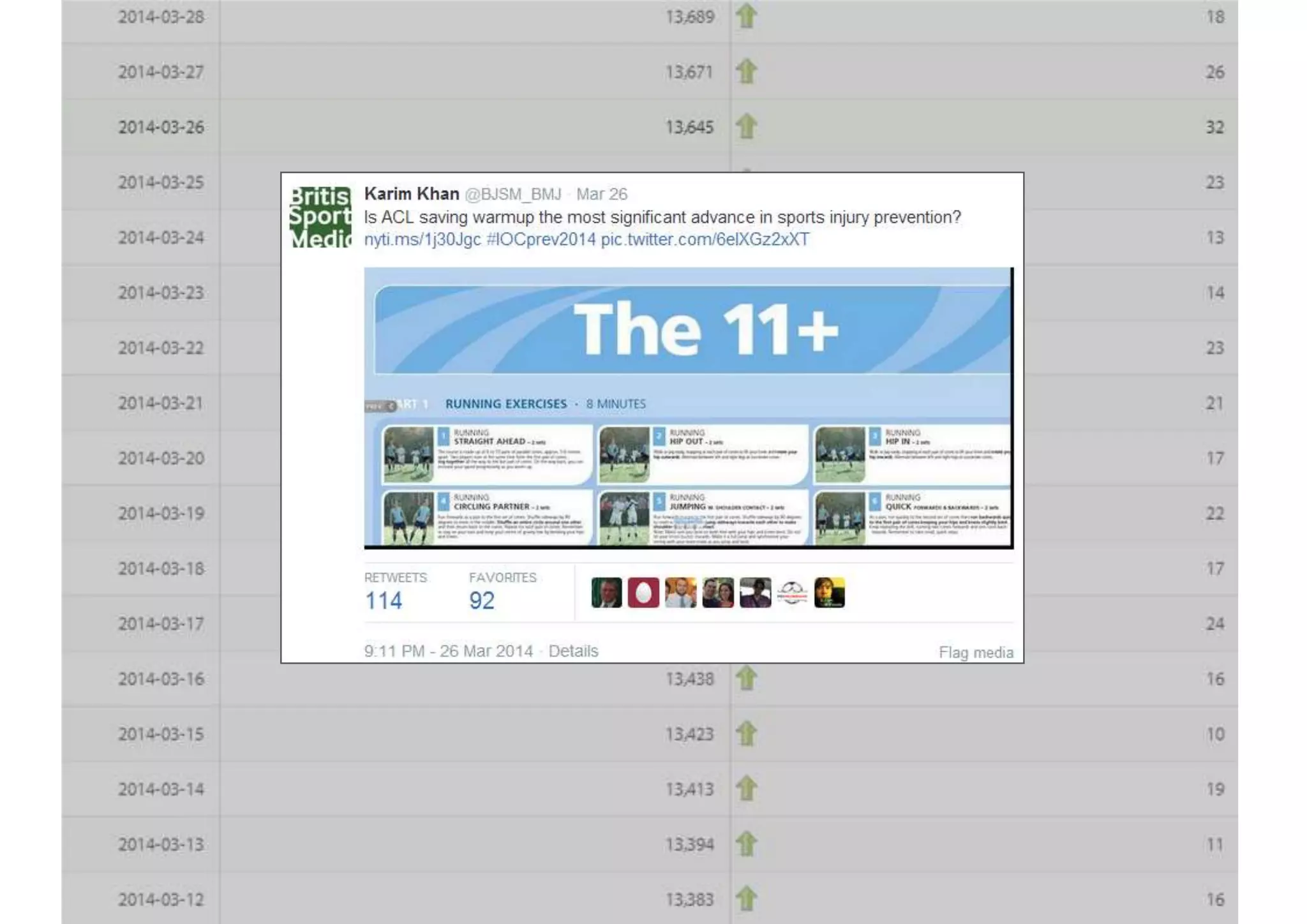
  • #14 Which may have had something to do with this tweet that we sent out about the IOC conference!
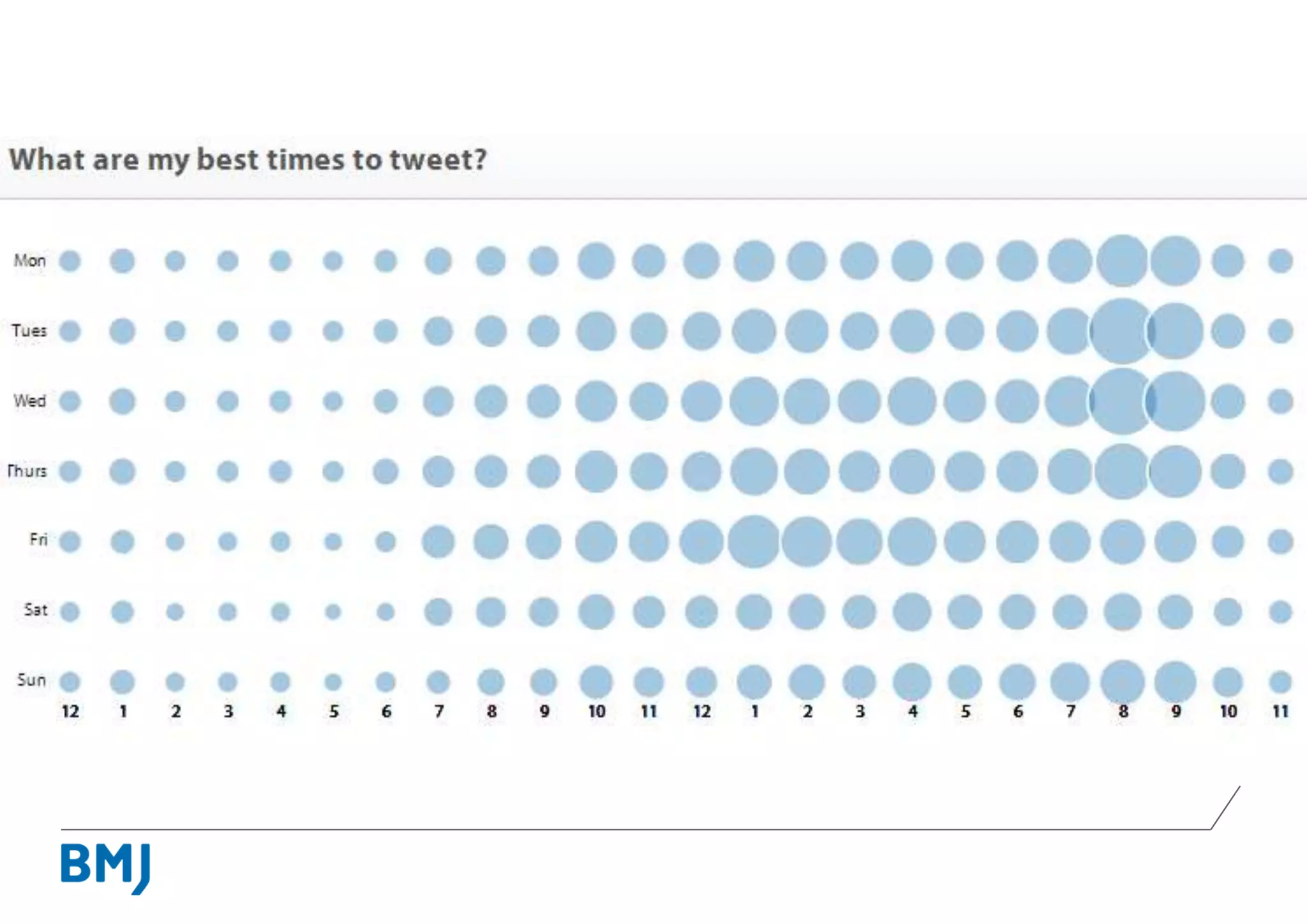
  • #15 We can also see what time we should be sending our content out – Crowdbooster analyses the past performance of our posts and makes recommendations.So you can see from this chart that Tues/Weds evenings GMT are good for us.
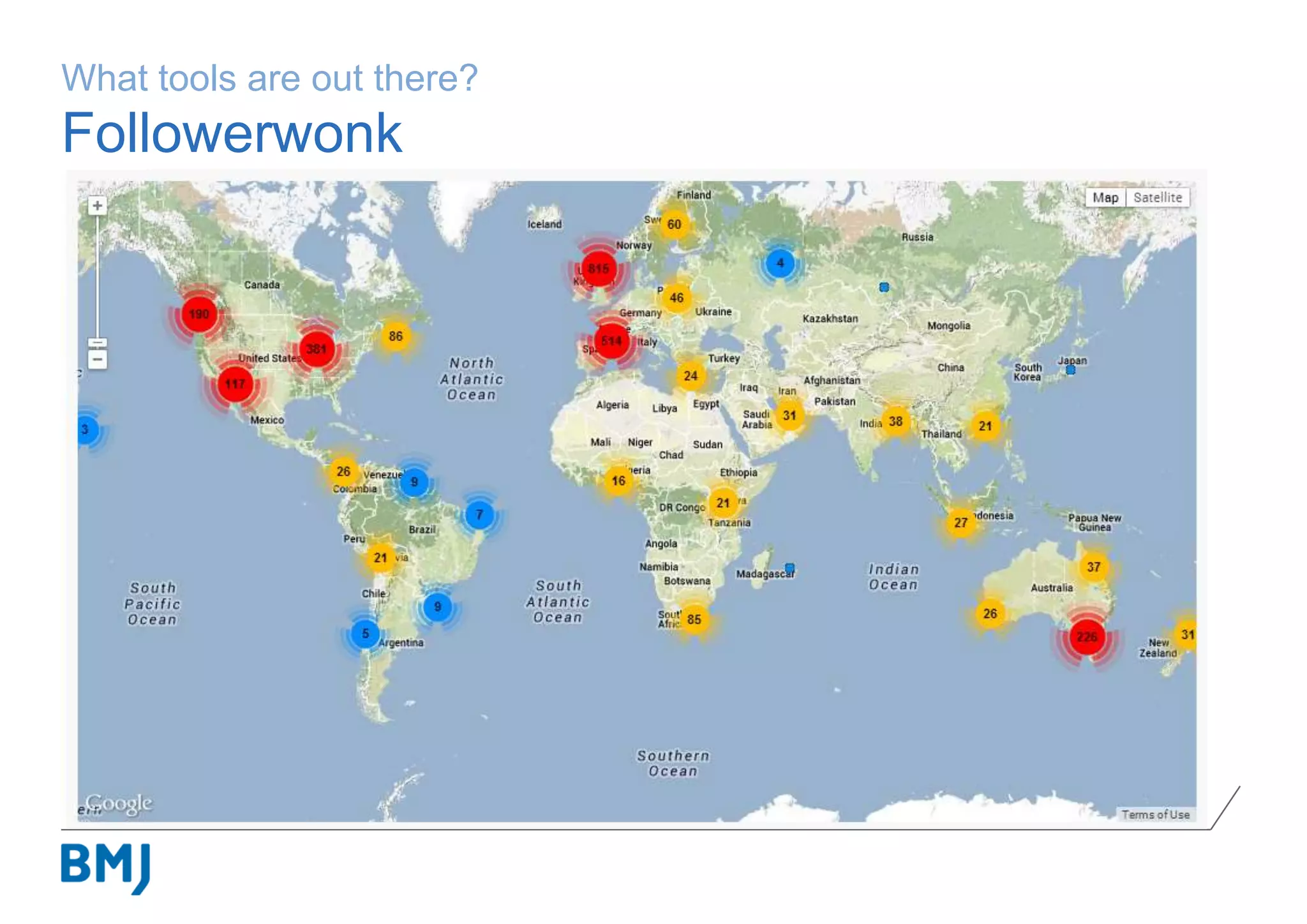
  • #16 Moving on to Followerwonk (please forgive the name) which focuses specifically on twitter follower analytics and has many free reports.One of the most useful reports allows you to plot the location of your followers around the world.
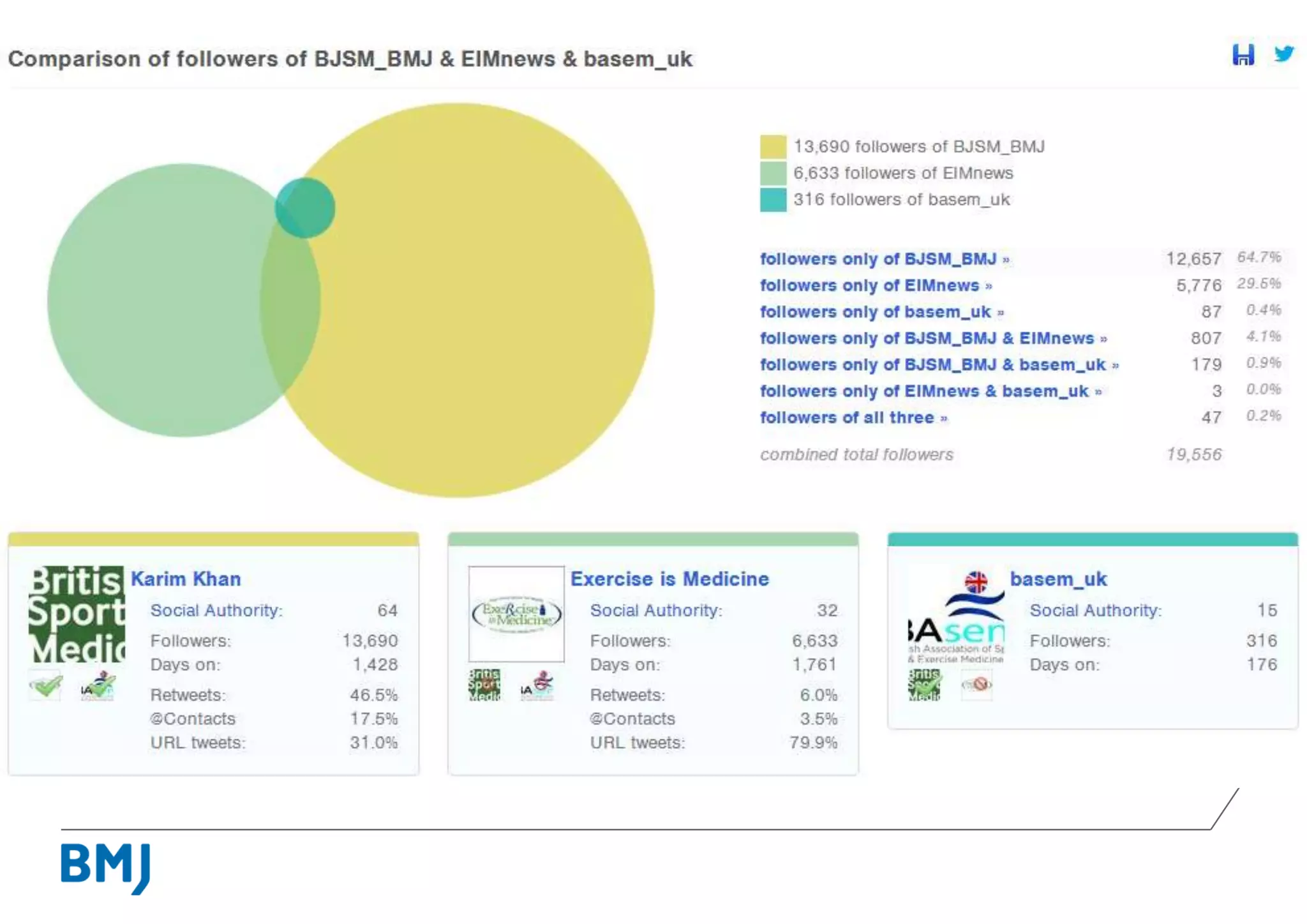
  • #17 You can also compare your own followers with those of other accounts and see where the overlap is. You can even see who your competitors are following and try to build a connection with them.
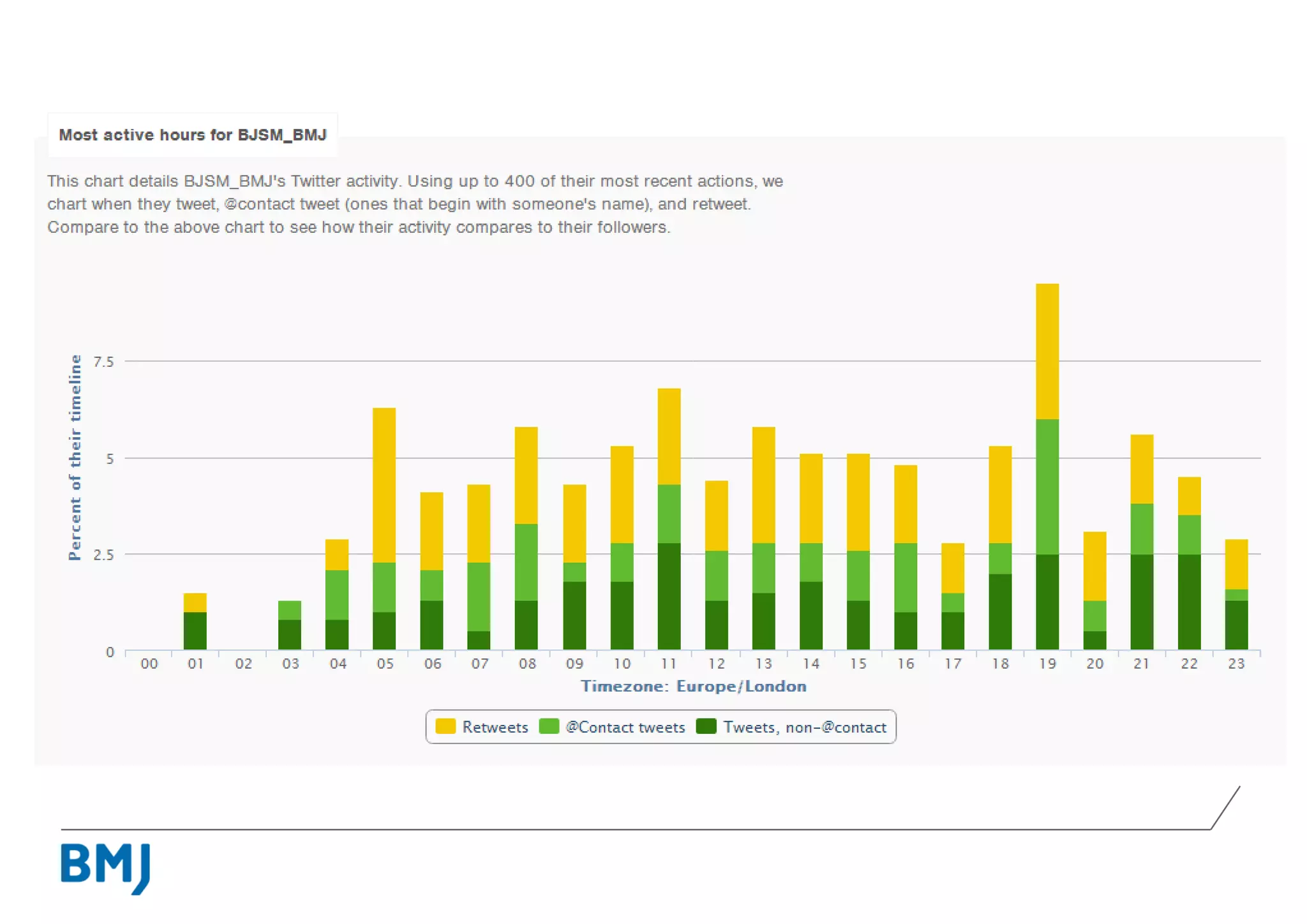
  • #18 Tying into the idea of scheduling your content updates for your audience’s optimum times, you can also see when you are most active and whether you are matching your users’ needs.
  • #19 So, it’s great to have all of this data available to us but it’s pretty pointless unless we act upon it.We’ve learned a great deal through analysis and experimentation, which I’d like to share with you now.
  • #20 Perhaps an obvious one, but scheduling your posts for your audience’s peak hours of activity really does work. We’ve experimented with various times of day but when we post between 8pm-10pm (as shown by Crowdbooster) we see a huge increase in engagement.
  • #21 Getting on the right side of your influential followers (as identified by Crowdbooster) can have a profound effect on how your posts perform.
  • #22 Simple and practical use posts are also very shareable.
  • #23 Another lesson we’ve learned is that your followers want to help you spread a message (if it is relevant and genuine).If you ask followers to "RT," you'll get a 12X higher retweet If you spell out the word "retweet," that figure jumps to 23X
  • #24 However, you can annoy your followers very easily by overusing hashtags.Using one or two hashtags in a tweet is fine, but if you add a third, you apparently see an average 17% drop in engagement.
  • #25 Something else that really works on both facebook and twitter is the inclusion of images.Both platforms have been through various redesigns in the past year to place more and more emphasis on full screen, high quality images.It’s no surprise then that including this kind of content in your updates will cause a big increase in engagement levels. Looking at the top 10 performing tweets of the past month for BJSM, 7 of them contain images.
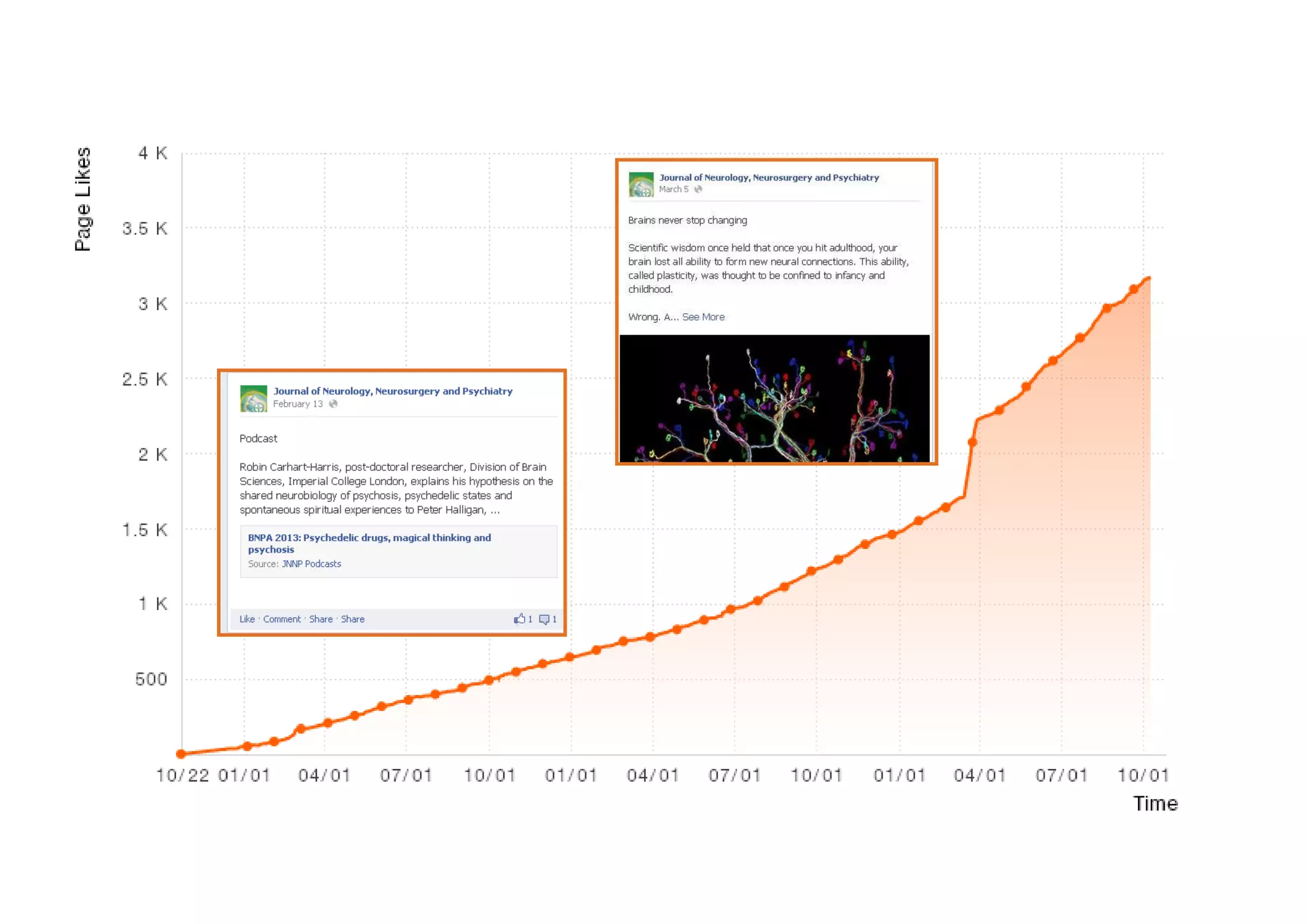
  • #26 On another BMJ journal, a change in our facebookcontent strategy created rapid growth – 400 new followers in less than a week and much steeper growth thereafter
  • #27 The final lesson that we’ve learned is that all of these tips and tricks picked up from social analytics tools can be used to make a real difference.
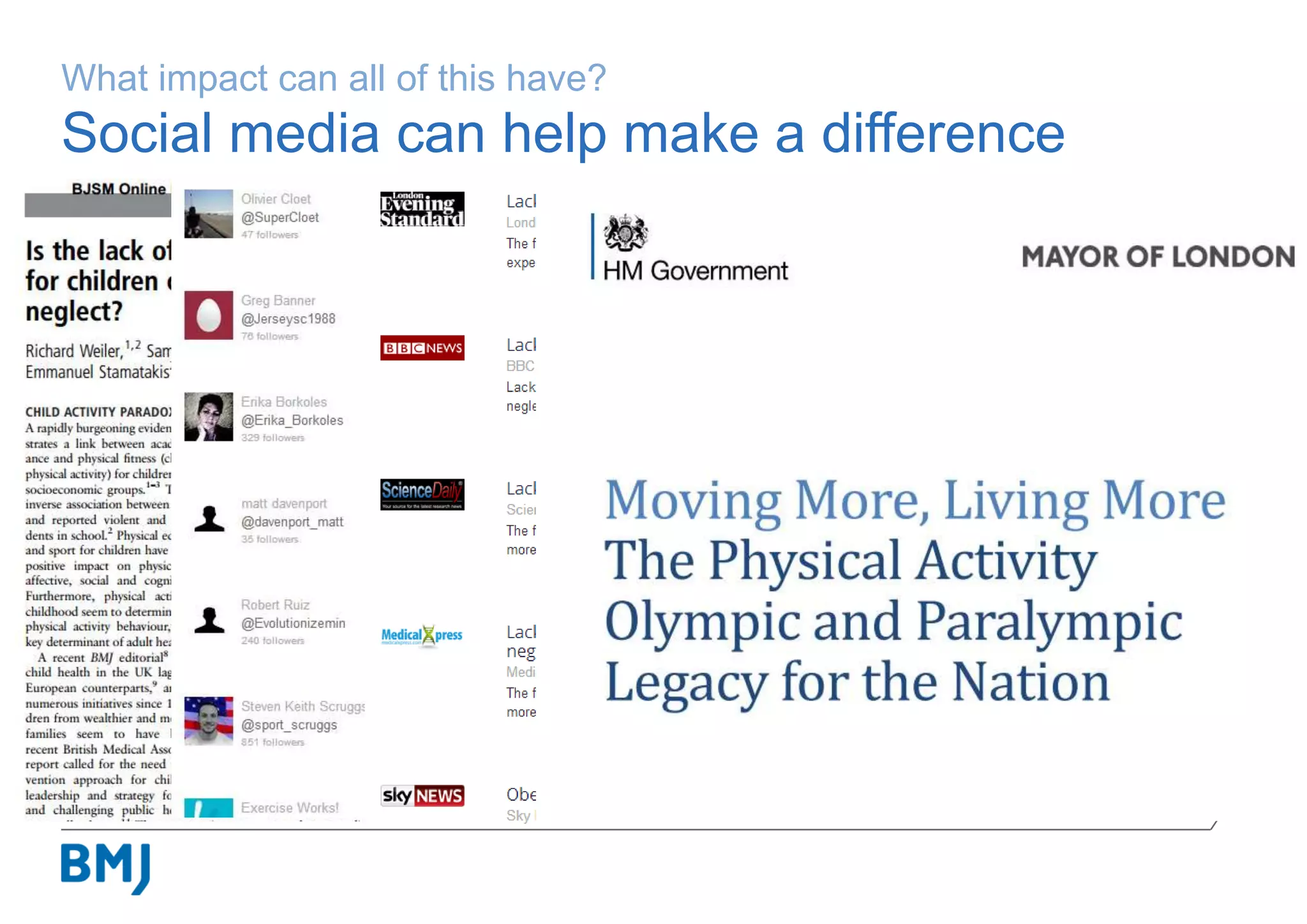
  • #28 For example, this paper published in Dec 2013 went viral on social media. Spent 48 hours on UK front pages – also tv and radio – equivalent to £150,000+ in media timeA month later the government released ‘Moving more, living more’, which was no accident
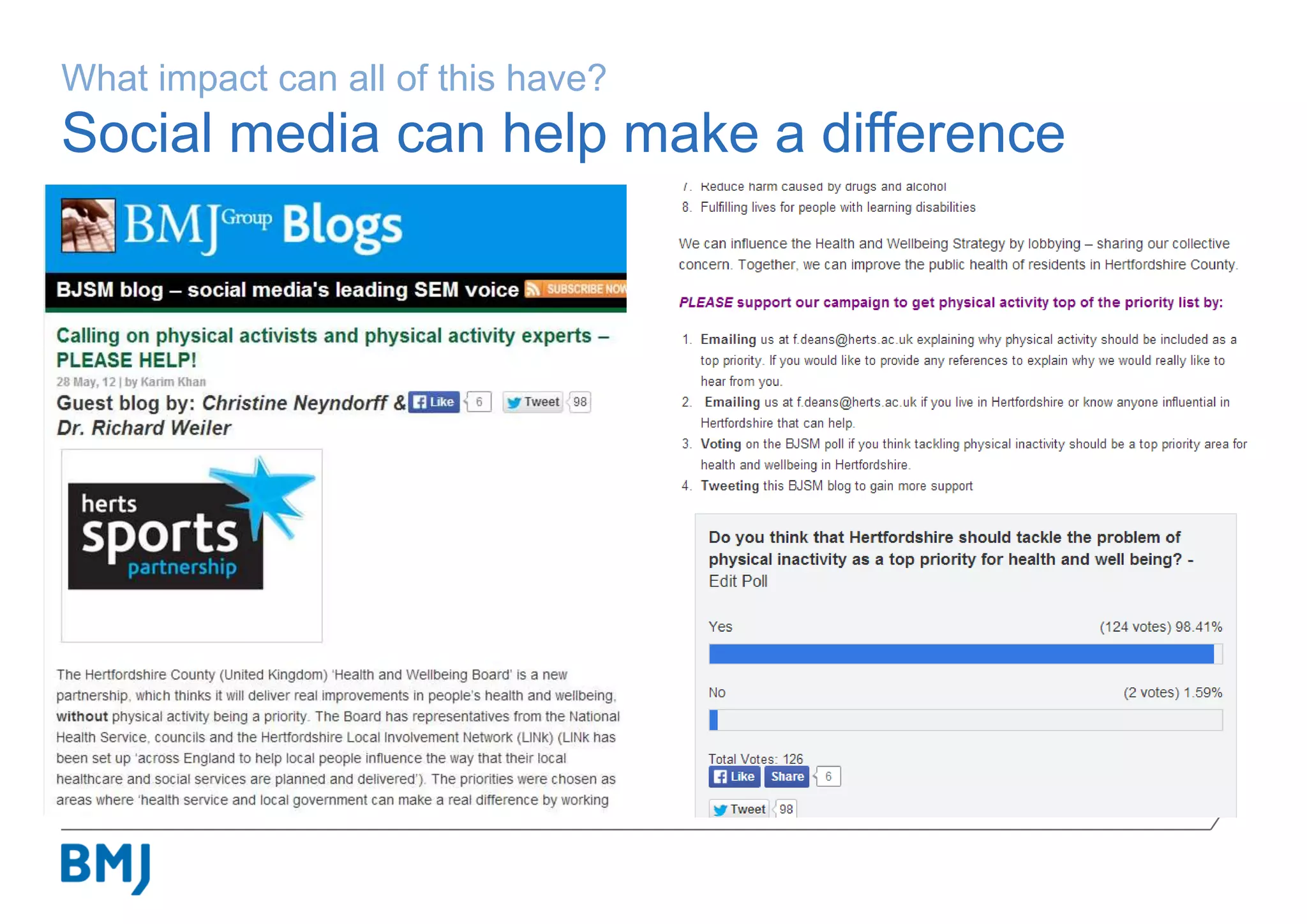
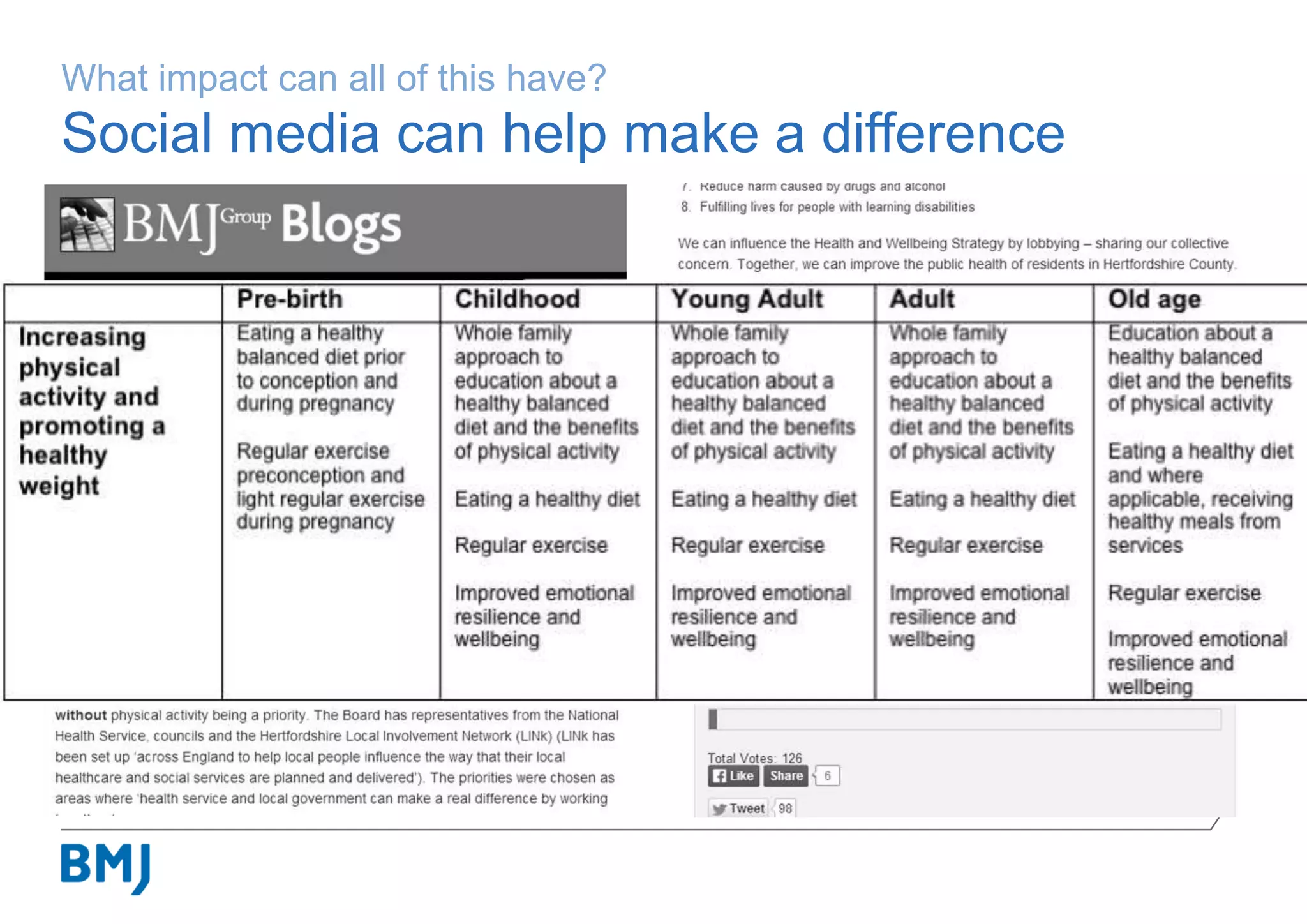
  • #29 A more localised success story came from the same author but this time in the form of a blog post.By whipping up a storm of support on social media and encouraging user involvement via a poll, we managed to get physical activity promotion into the 2013-2016 Hertfordshire Health and Wellbeing Strategy.
  • #30 The hope is that this story in Hertfordshire will encourage others to try and affect local change to ensure physical activity promotion is firmly on the agenda.
  • #31 I think the author behind both of these success stories hits the nail on the head here.It’s no longer just about putting content out there and expecting people to find it. We need to be proactive and sophisticated in our use of communication channels, using social media analytics to perfect exactly how we reach out to our target audiences.