Social Media For
    Nonprofits:
Don’t Get Left Behind
    April 19, 2012

     Eileen O’Brien
     @eileenobrien
What is Social Media?

• “A social trend in which people
  use technologies to get the
  things they need from each
  other, rather than from
  traditional institutions like
  corporations”
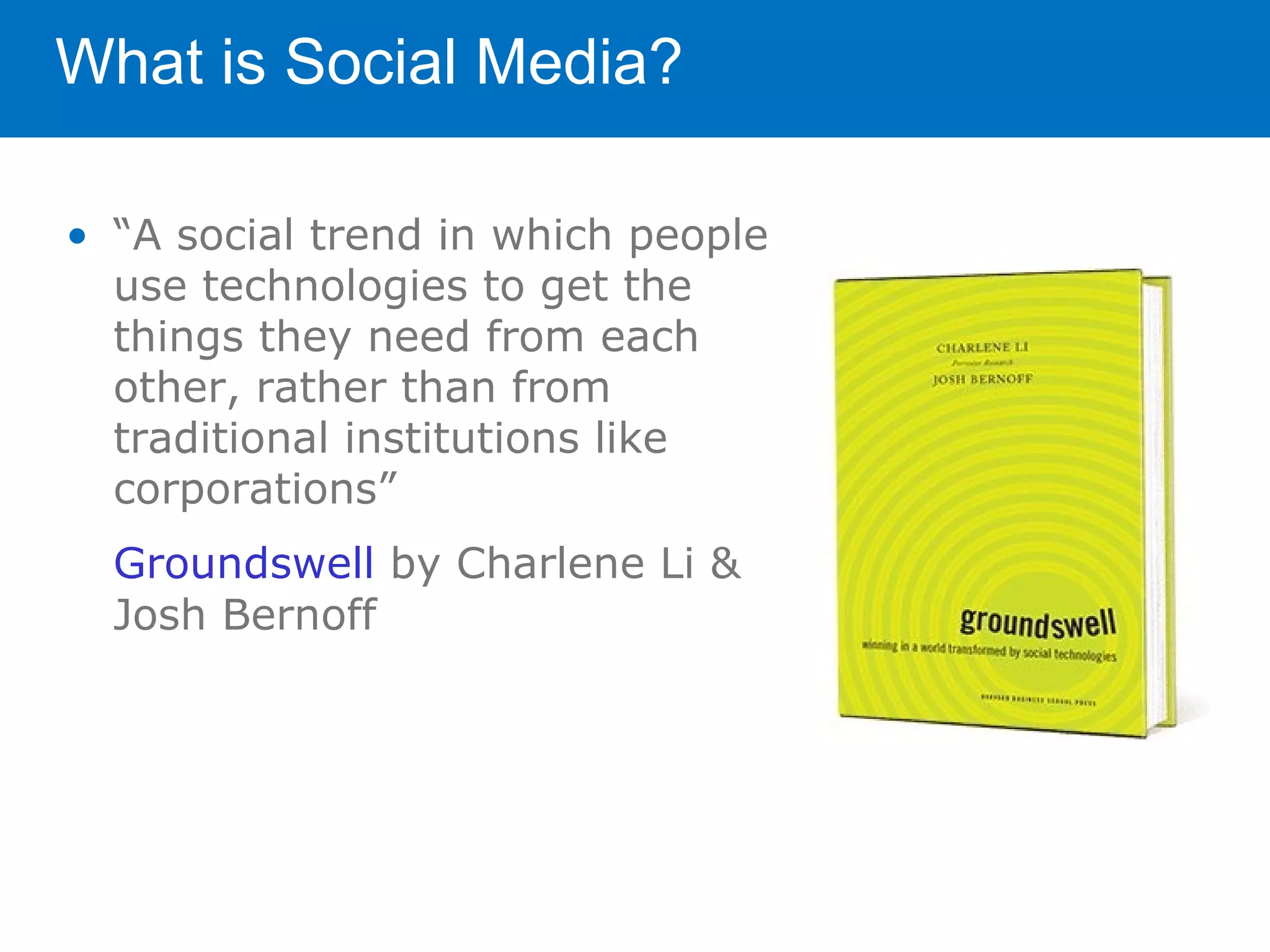
  Groundswell by Charlene Li &
  Josh Bernoff
Social Media is a Tactic

• Social media is not a strategy but a tactic
• Start with an objective, create a strategy and
  determine the best tactics
• Integrate into your overall marketing objectives
• Key to marketing is telling a compelling story
    Social media can enable this
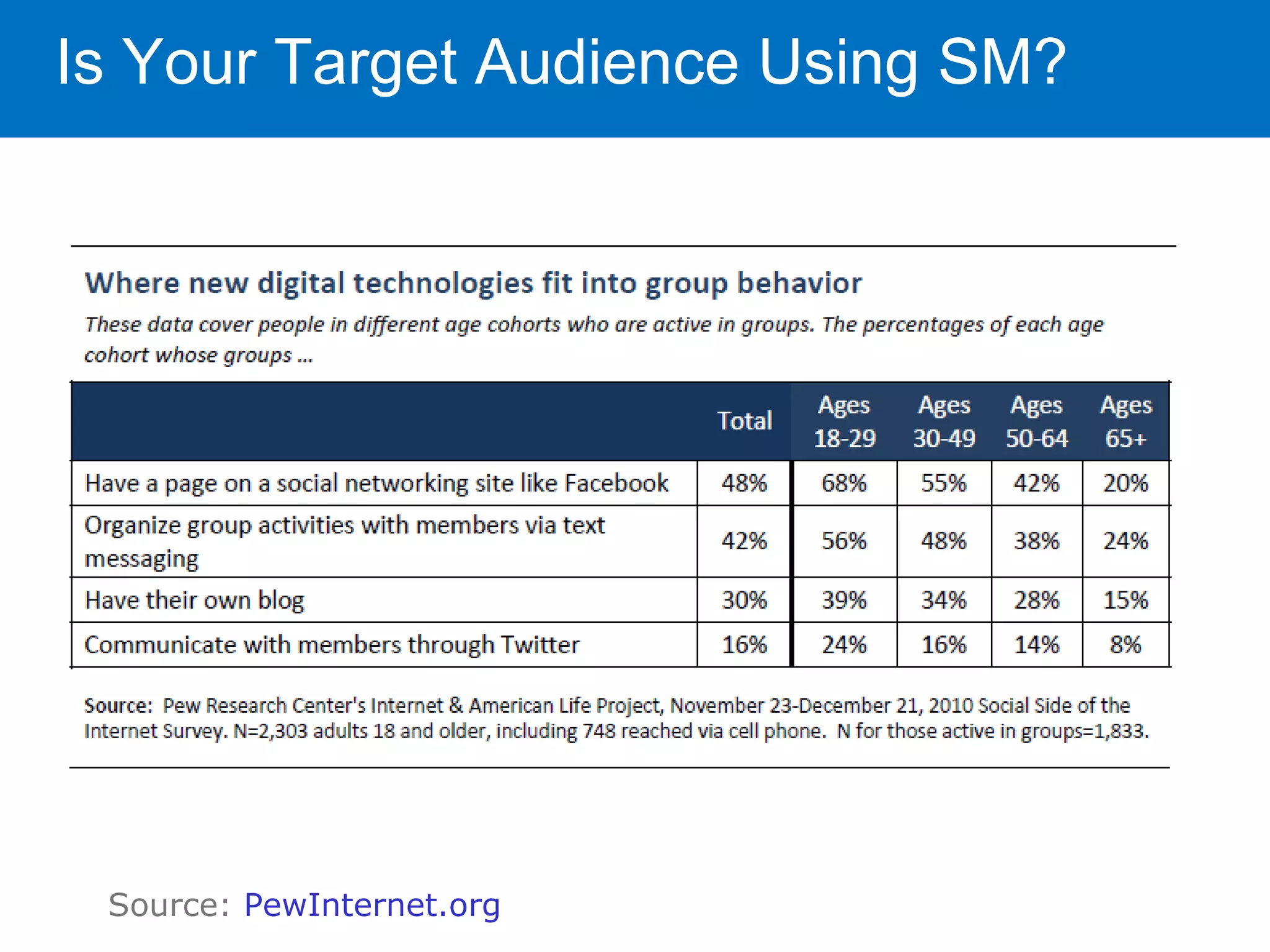
Is Your Target Audience Using SM?


 Source: PewInternet.org
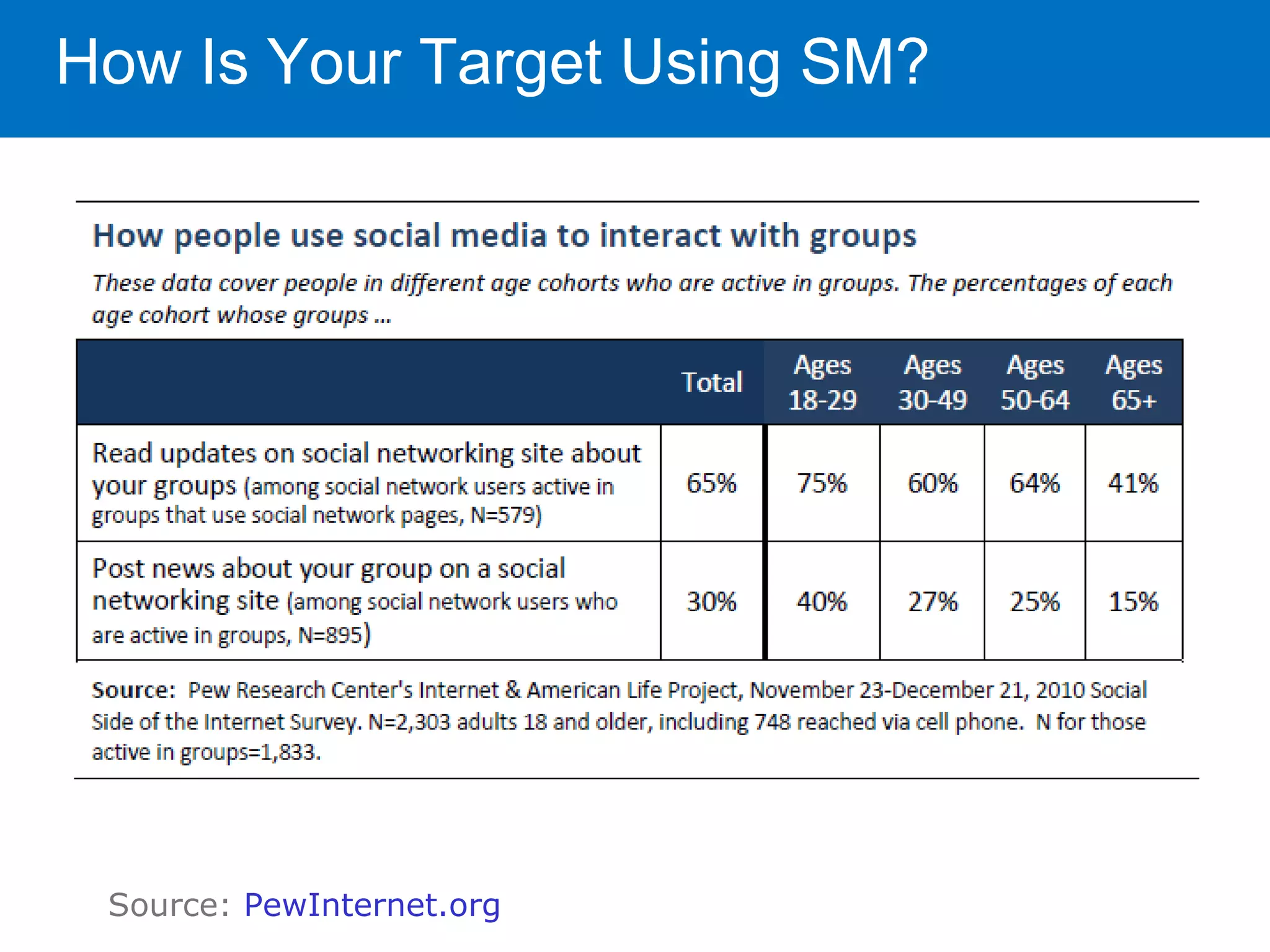
How Is Your Target Using SM?


 Source: PewInternet.org
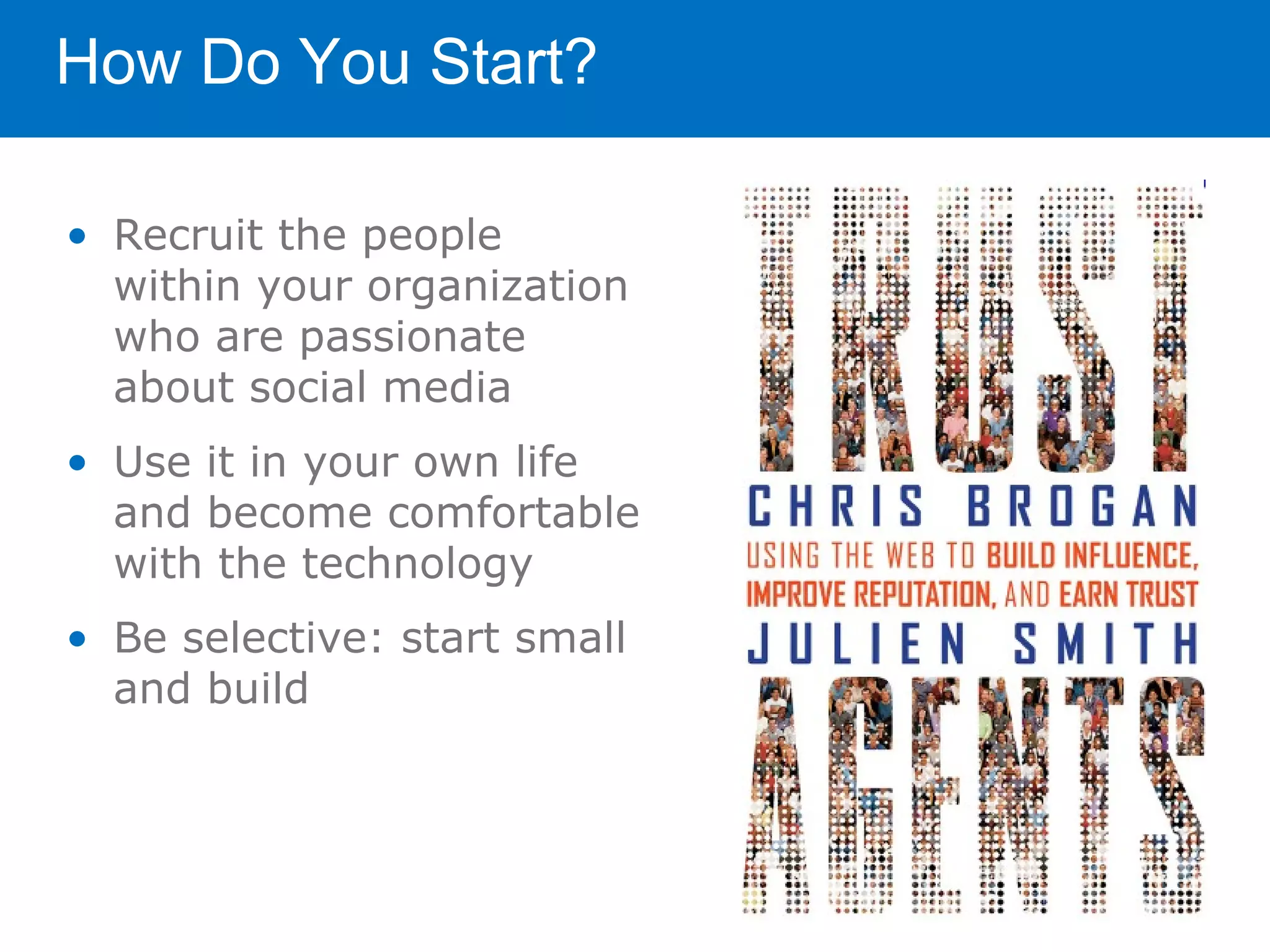
How Do You Start?

• Recruit the people
  within your organization
  who are passionate
  about social media
• Use it in your own life
  and become comfortable
  with the technology
• Be selective: start small
  and build
Monitor Social Media

• Pay attention to what is being said about your
  organization
   Free Google alerts
   Take it private

• Don’t delegate to intern
• Have a crisis communications plan
   Be prepared to act quickly using same media
   Be nimble
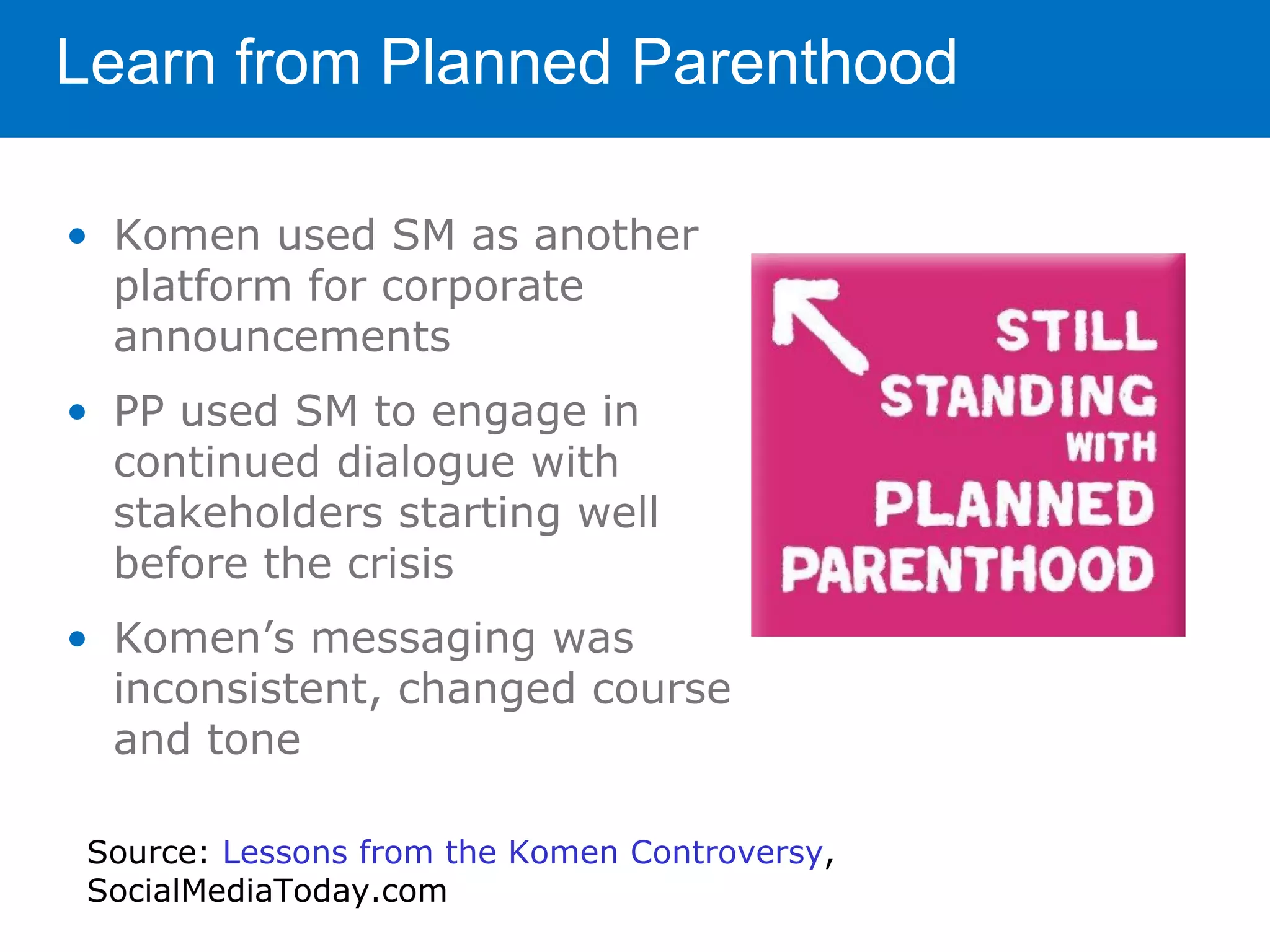
Learn from Planned Parenthood

• Komen used SM as another
  platform for corporate
  announcements
• PP used SM to engage in
  continued dialogue with
  stakeholders starting well
  before the crisis
• Komen’s messaging was
  inconsistent, changed course
  and tone

 Source: Lessons from the Komen Controversy,
 SocialMediaToday.com
Listen

• Listening may give you insights which will lead the
  strategy
• Learn what’s important to your audience
   Can you fill a need? How can you add value?

• Check out what the competition is doing
• Pay attention
• Social media has been compared to a cocktail
  party
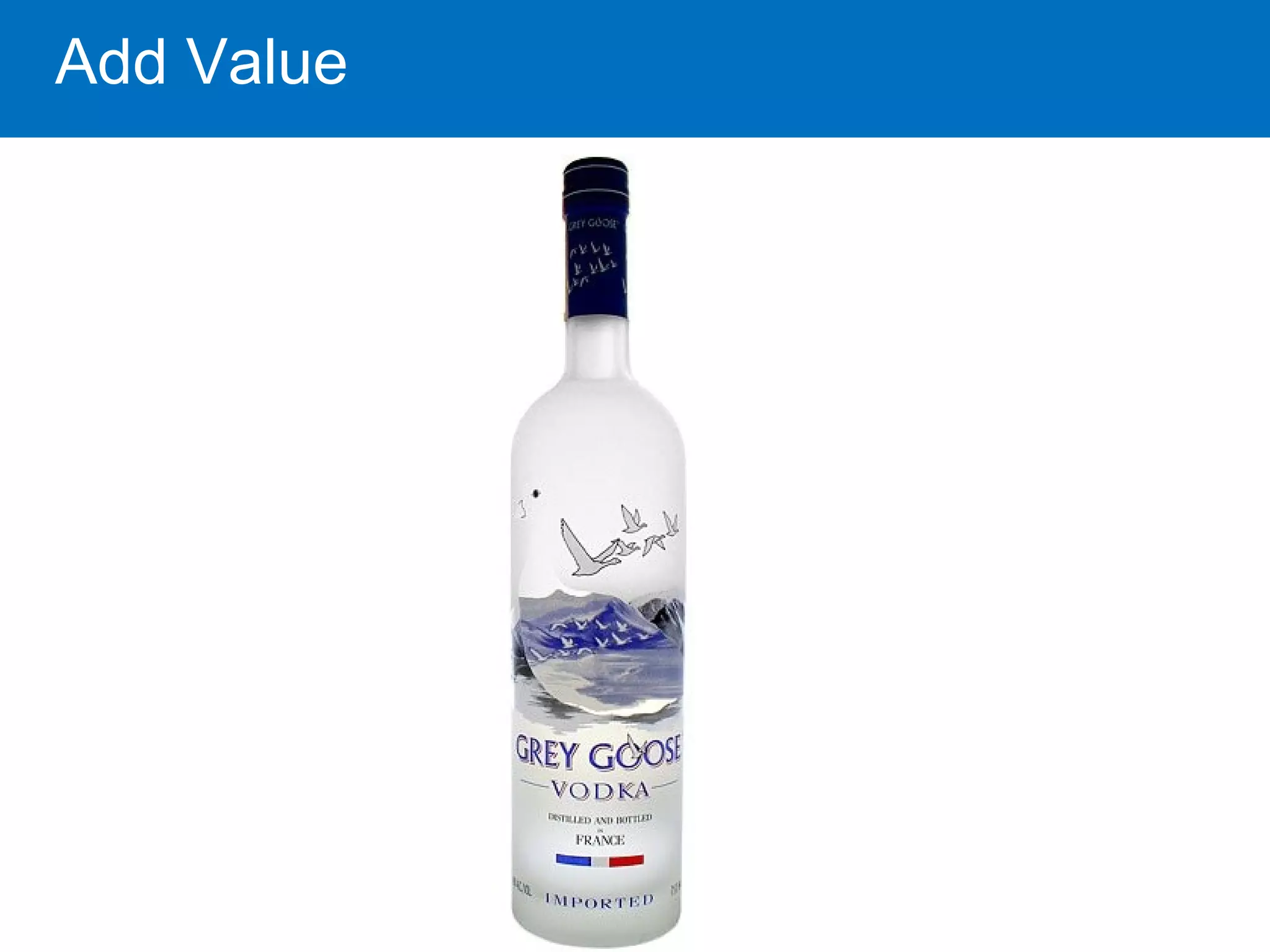
Add Value
Be Thoughtful

• Many social media tools are
  free, but they require
  resources to create content
  and keep them updated
• You can damage your
  reputation by starting and
  then abandoning social
  media projects
• Squat on your name
   http://namechk.com
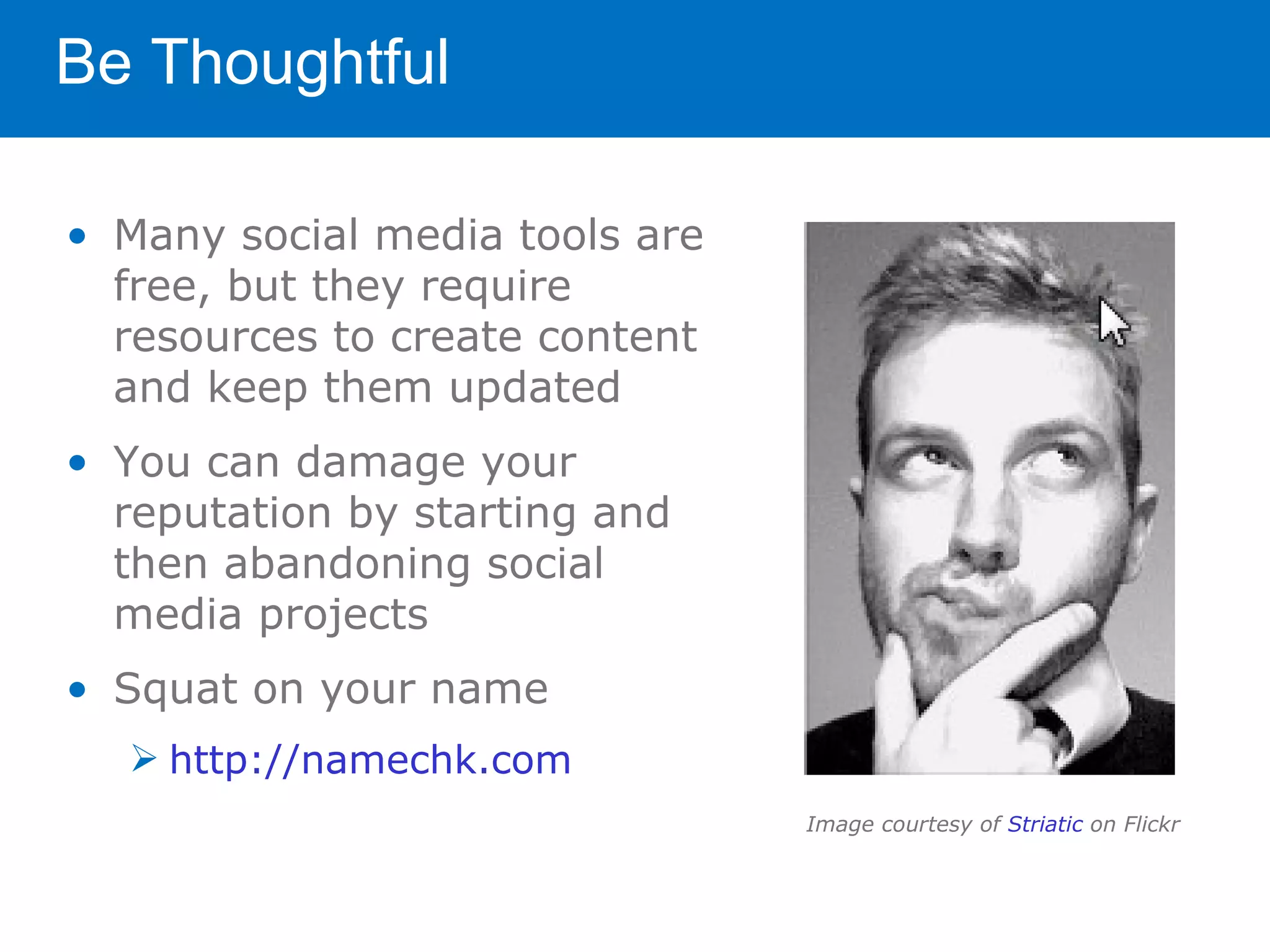
                                Image courtesy of Striatic on Flickr
How Do You Find The Time?

• Integrate into what you
  are currently doing
   Bring a video to an
    interview and post a
    teaser on YouTube

• Make a conscious
  decision: the time spent
  on social media may
  mean giving something
  else up

                             Image courtesy of D. Sharon Pruitt on Flickr
Use Your Time Wisely

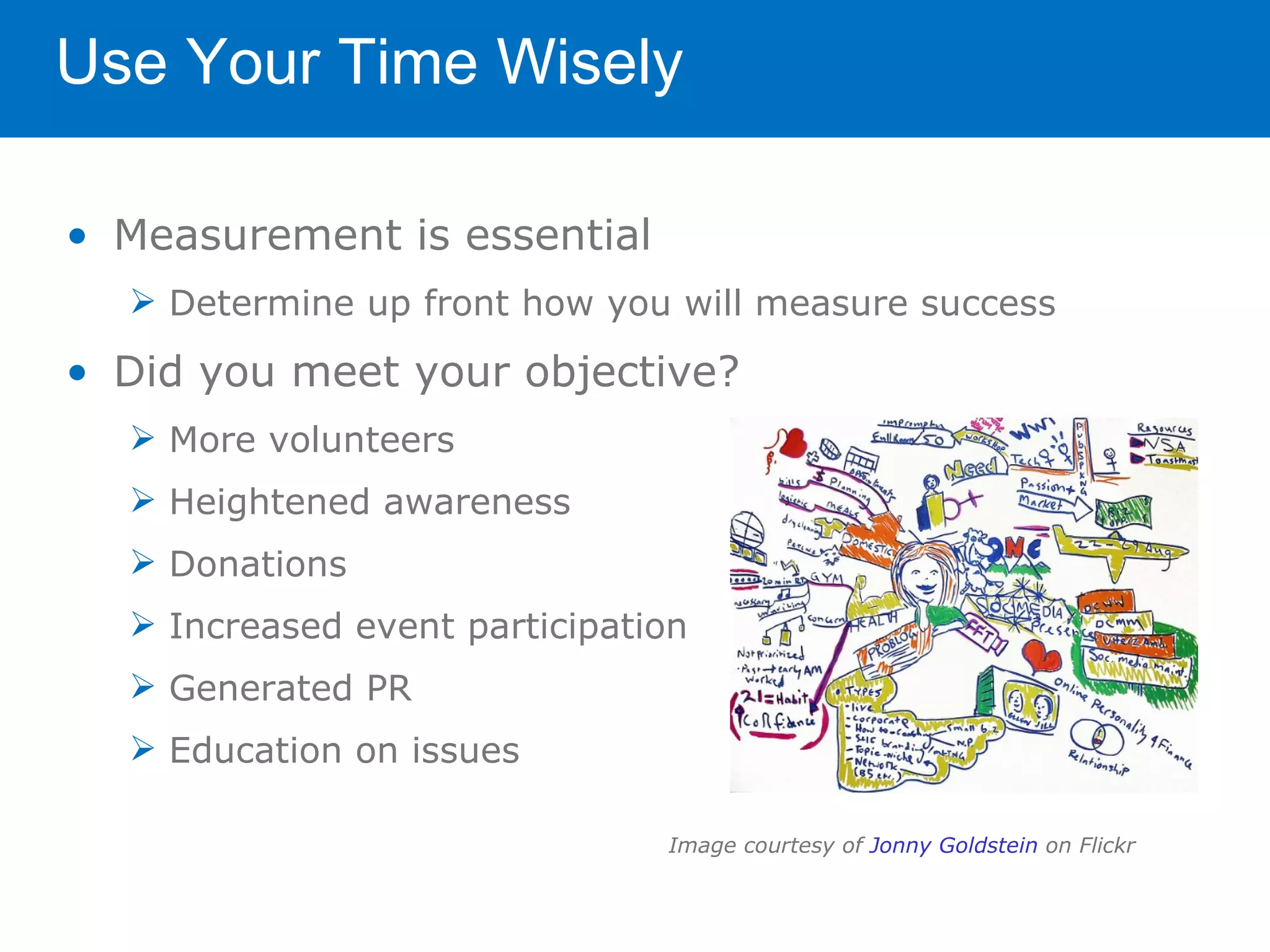
• Measurement is essential
   Determine up front how you will measure success

• Did you meet your objective?
   More volunteers
   Heightened awareness
   Donations
   Increased event participation
   Generated PR
   Education on issues

                               Image courtesy of Jonny Goldstein on Flickr
Make It Shareworthy

• Most effective online organizing programs

  whether fundraising or advocacy is to
  make each of your appeals part of a
  campaign
• People give to funds that generate an
  emotional response, tell your story
• Articulate in simple terms what you are
  trying to do
• Make it urgent, have a deadline
• Make it EASY
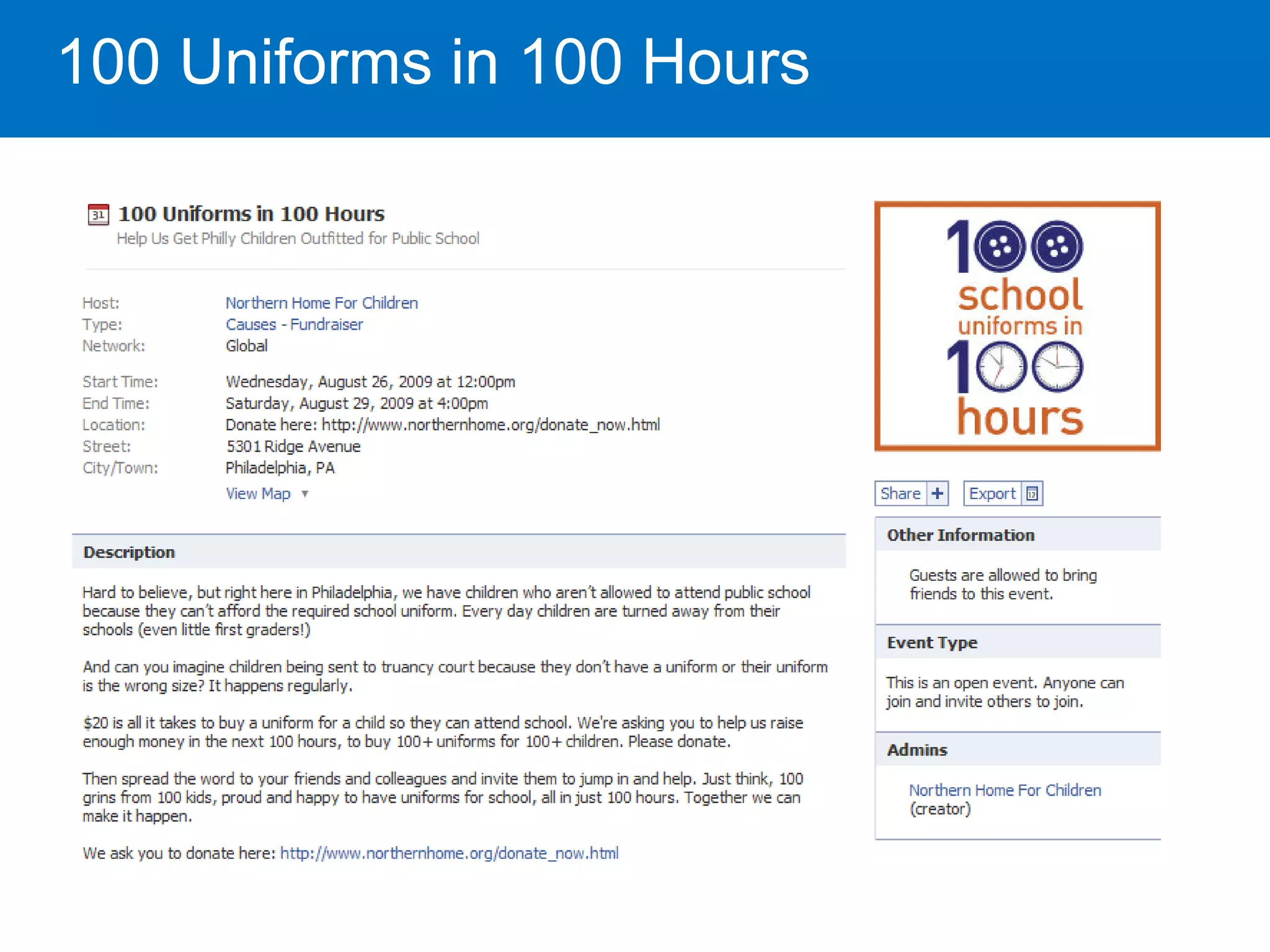
100 Uniforms in 100 Hours
Twitter
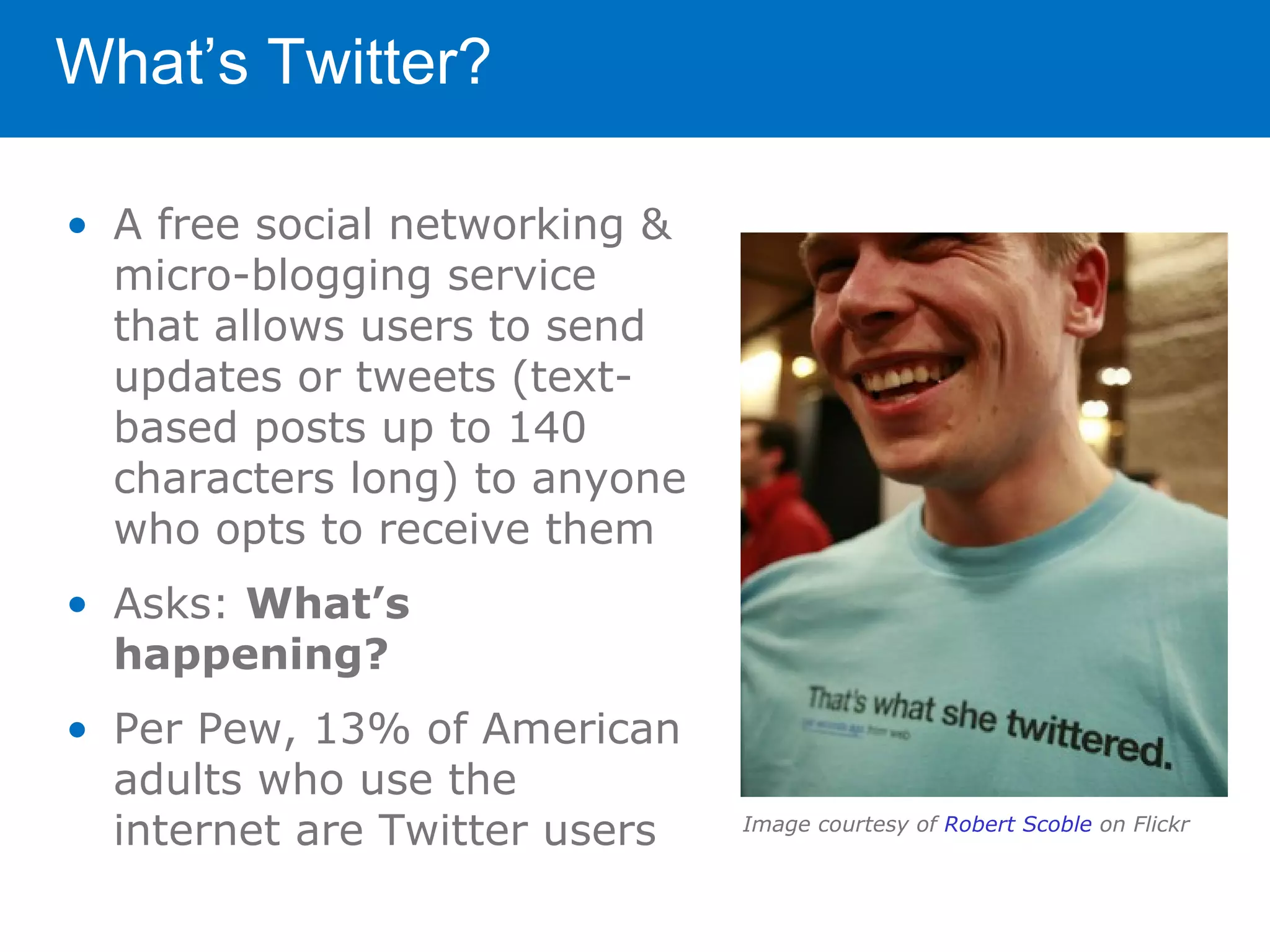
What’s Twitter?

• A free social networking &
  micro-blogging service
  that allows users to send
  updates or tweets (text-
  based posts up to 140
  characters long) to anyone
  who opts to receive them
• Asks: What’s
  happening?
• Per Pew, 13% of American
  adults who use the
  internet are Twitter users   Image courtesy of Robert Scoble on Flickr
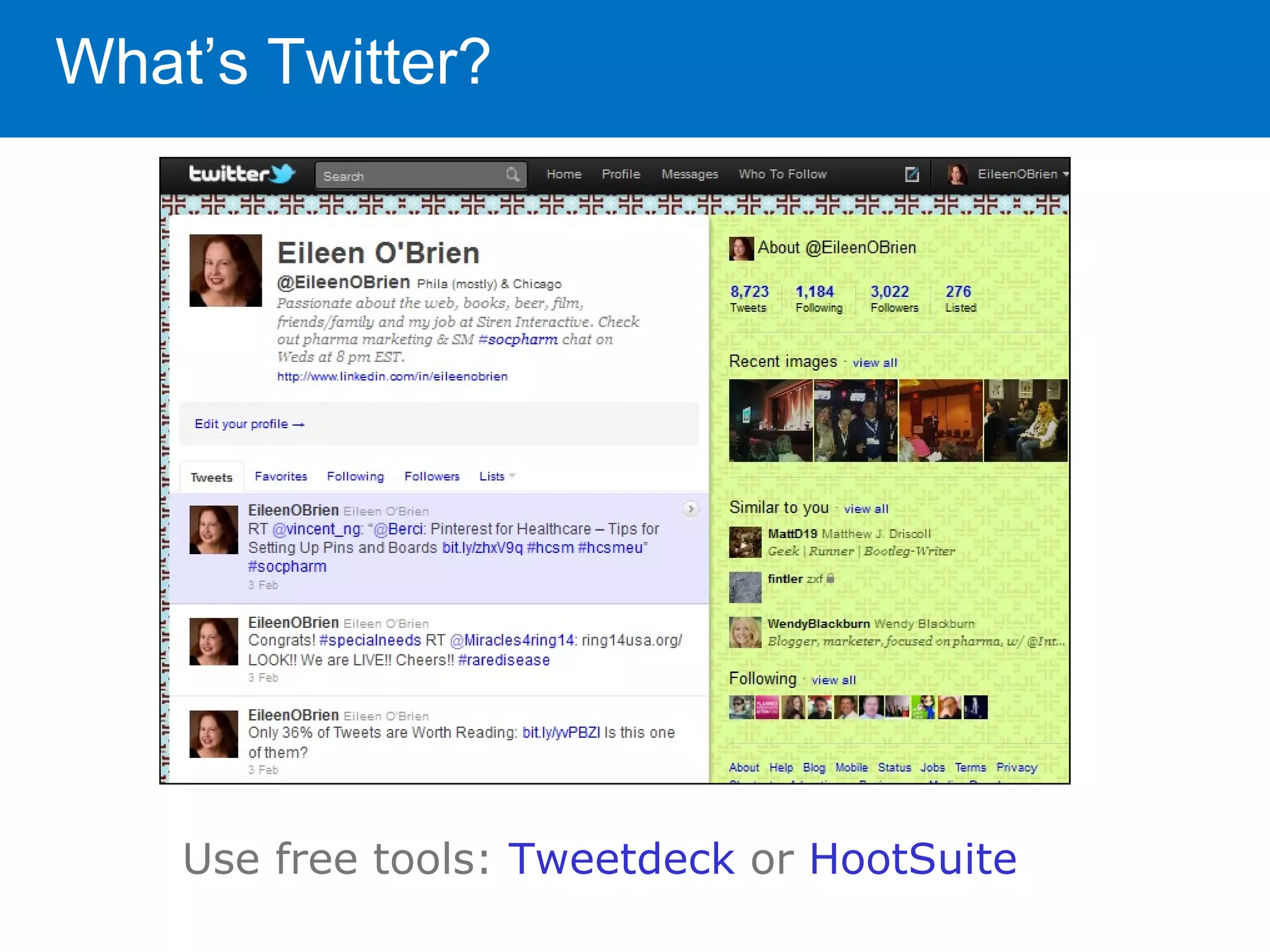
What’s Twitter?


    Use free tools: Tweetdeck or HootSuite
Types of Accounts

• Organization
   100% branded content, don’t follow people or interact
   Can be managed by a team, low risk of going off
    message
   Using interactive tool to push out information, not
    establishing relationships


 Source: Beth’s Blog: How Nonprofits Can Use Social Media
Types of Accounts

• Organization With Personality
   Employee(s) who tweet are identified & interact with
    followers
   Makes it personal, builds relationships
   May be difficult to scale, succession can be an issue if
    person becomes so associated with brand leaves, also
    risk of going off message


 Source: Beth’s Blog: How Nonprofits Can Use Social Media
Who To Follow

• Thought leaders and cause enthusiasts
   For social media & nonprofits: @kanter, @ntenhross,
    @beautifulthangs, @SocialBttrfly, @peterdeitz

• Search on your topics of interest
   Look at who others follow

• Take your time
How To Get Followers

• Quality over quantity
• When you follow someone send them a tweet
  explaining why you are following them
• Search on your area of interest and then answer
  questions or respond
   “Seek out people you can help and do it!” Wil
    Reynolds

• Add yourself to “yellow pages”
   http://twellow.com
   http://wefollow.com
How To Get Followers

• Engage with your
  followers, thank them for
  support, give them ways
  to get involved
• Utilize hashtages
  (#word)
• Weekly Chats
   Take part in existing ones
    or host a Tweetchat
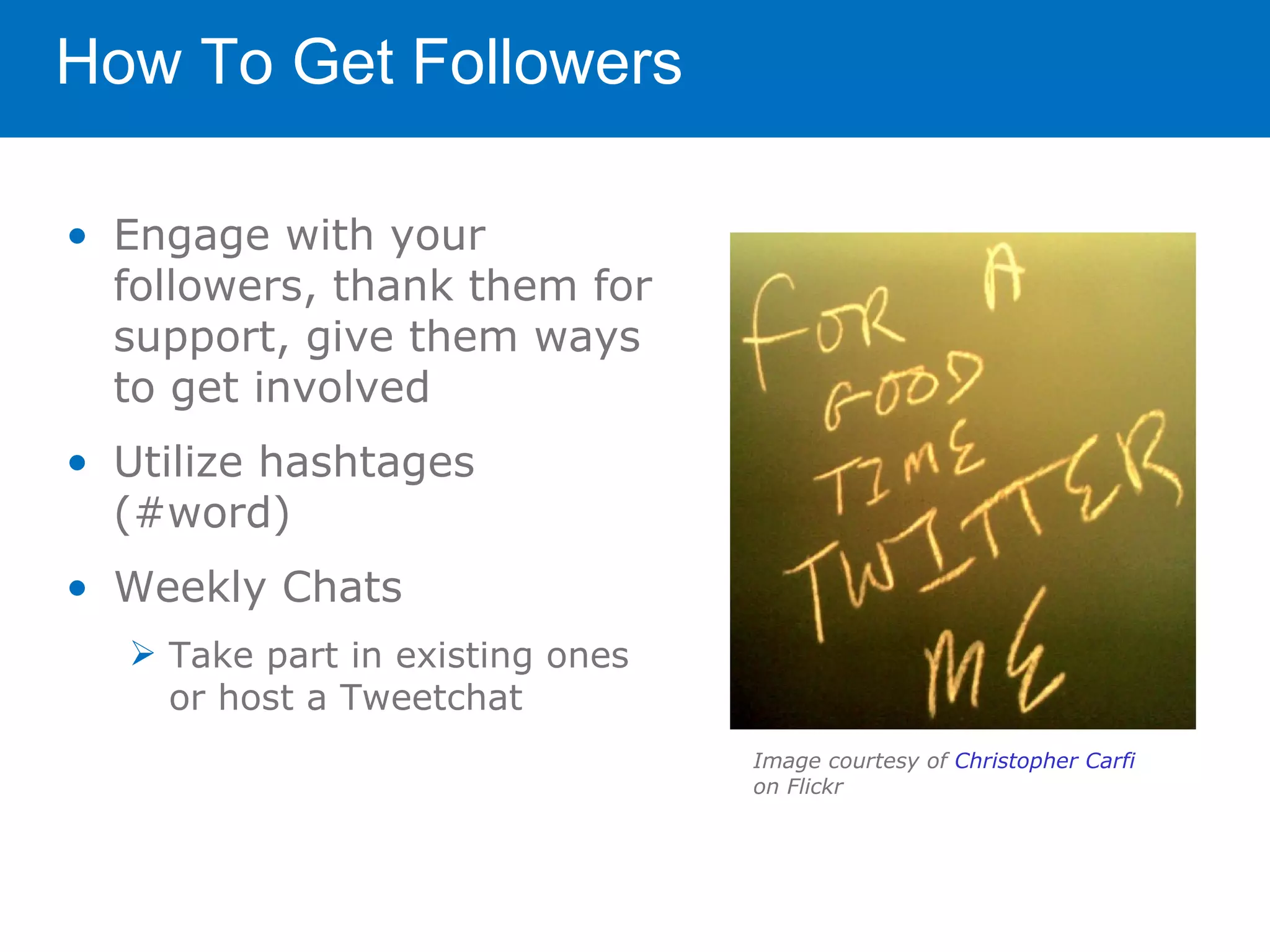
                                 Image courtesy of Christopher Carfi
                                 on Flickr
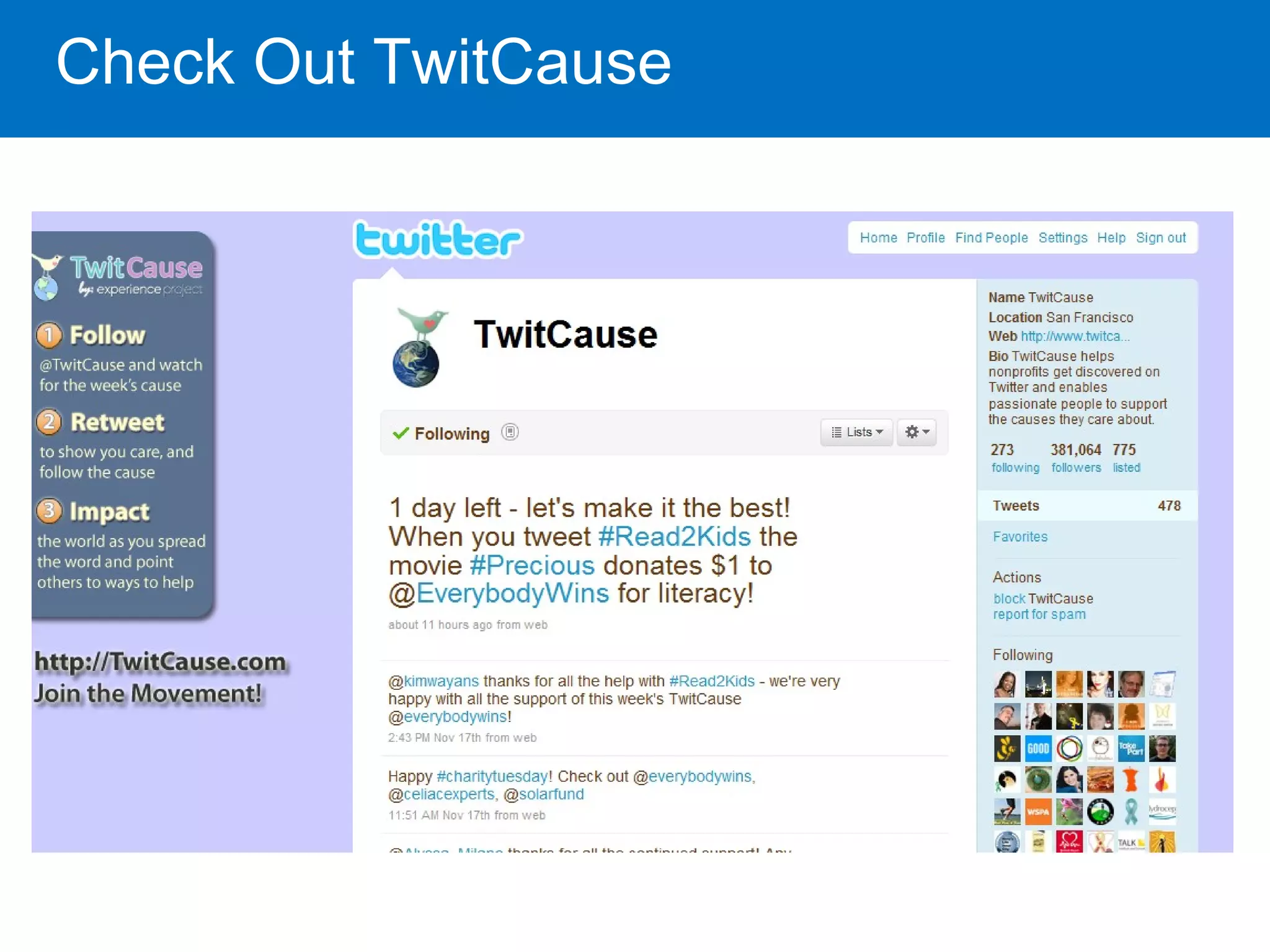
Check Out TwitCause
YouTube
YouTube

• Second largest volume
  of searches
• In December 2011
    85% of the total U.S.
     Internet audience views
     online video
    182 million U.S. Internet
     users viewed 43.5 billion
     videos
Source: comScore                 Image courtesy of Karl Jonsson on Flickr
YouTube

• A keyword-tagged video is 50 times more likely
  to appear on the 1st page of a Google search
  result compared with a traditional web page
  according to Forrester Research
• YouTube program for nonprofits
• YouTube Video Volunteers
   Can find someone who is willing to use their
    equipment and skills to help a nonprofit make a video
YouTube Channels

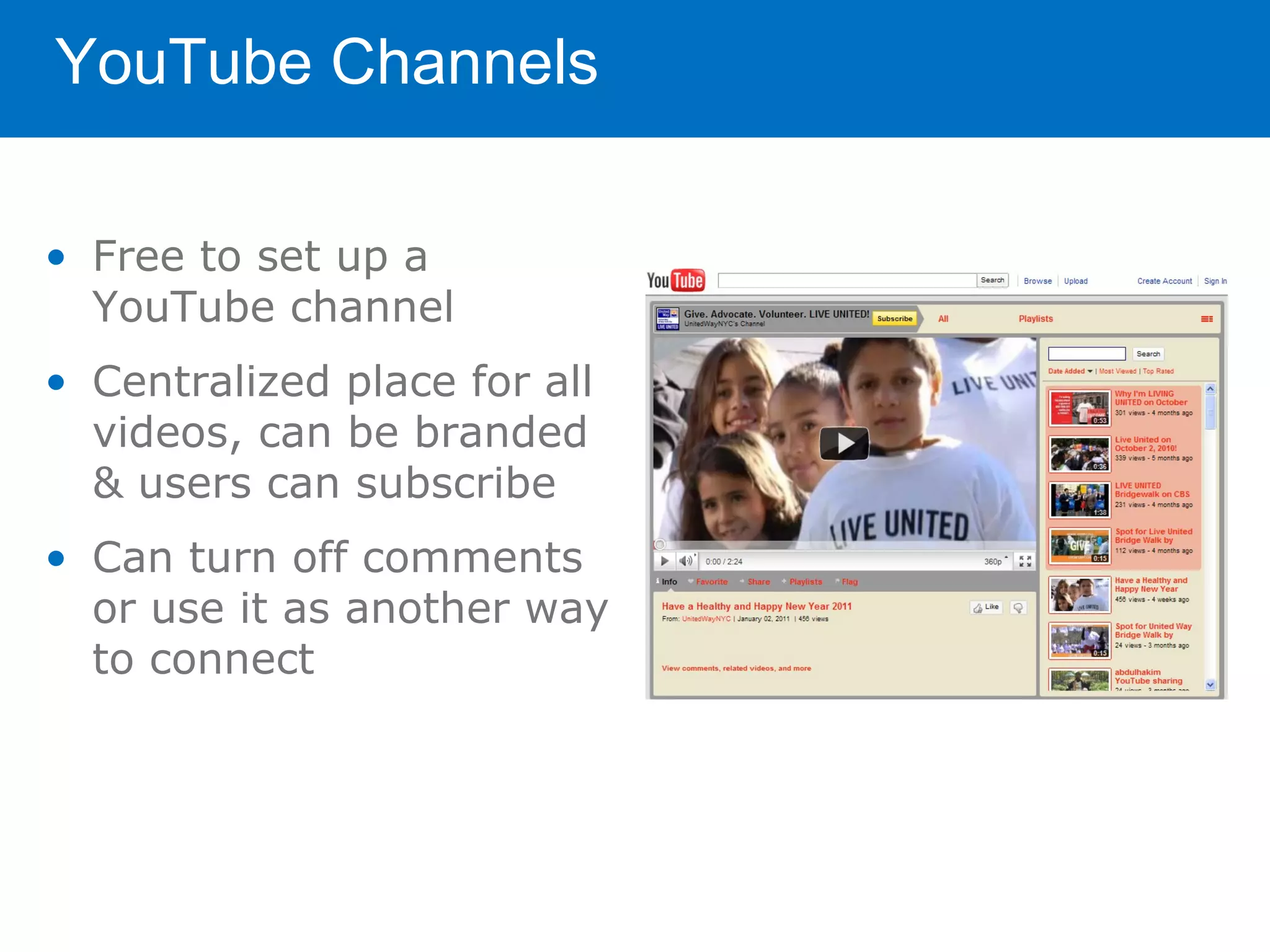
• Free to set up a
  YouTube channel
• Centralized place for all
  videos, can be branded
  & users can subscribe
• Can turn off comments
  or use it as another way
  to connect
How Do You Get Views?

• People have short attention spans, so capture
  attention in first 30 second
   Keep the whole video short
   Have a call to action at the end
   Shoot for a computer screen

• Ask for user-generated content
• Tell serial stories which engage viewers & keep
  them coming back
• React to current events
• Use endorsements
• Tag & title your videos with relevant keywords
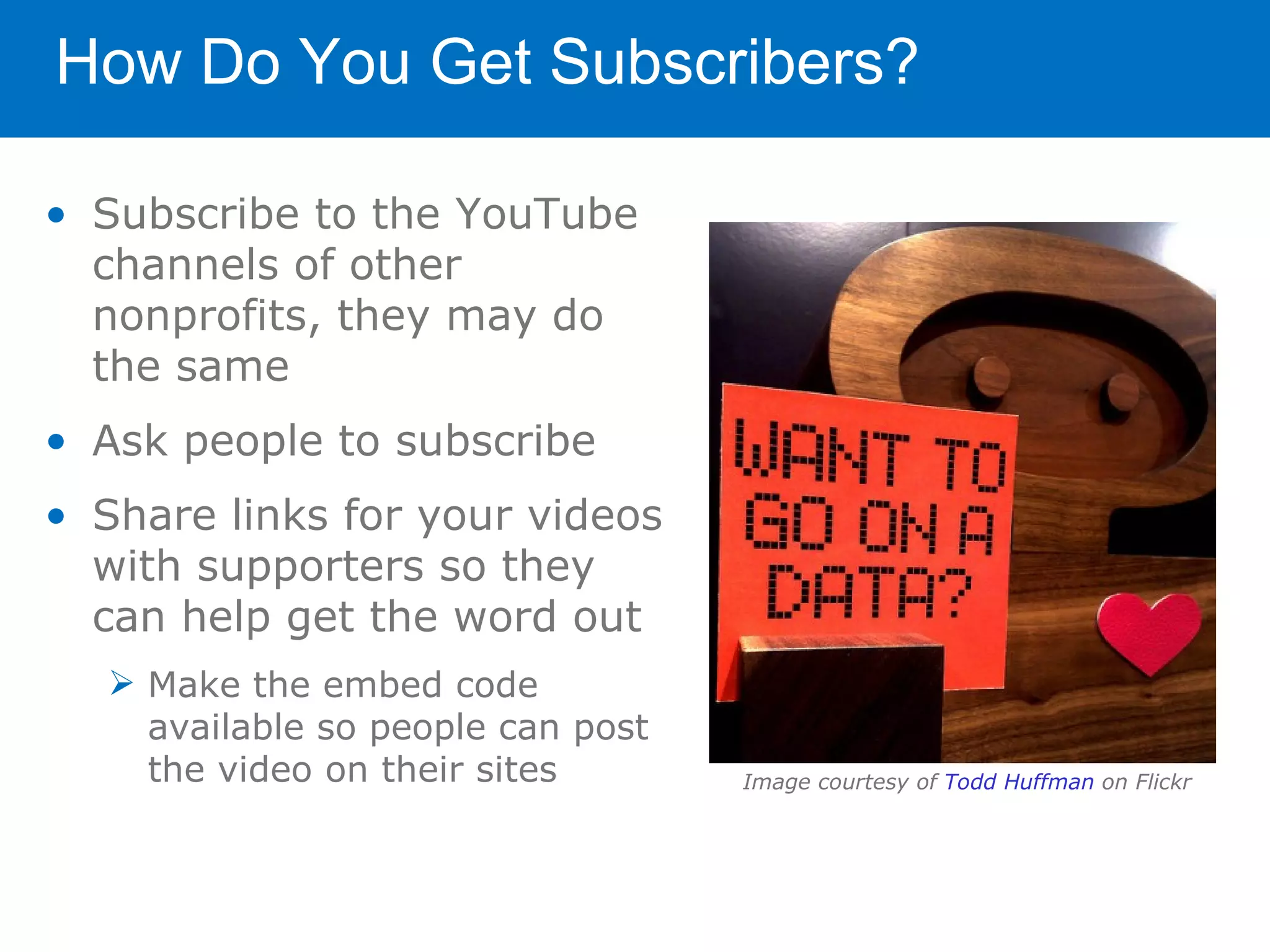
How Do You Get Subscribers?

• Subscribe to the YouTube
  channels of other
  nonprofits, they may do
  the same
• Ask people to subscribe
• Share links for your videos
  with supporters so they
  can help get the word out
   Make the embed code
    available so people can post
    the video on their sites       Image courtesy of Todd Huffman on Flickr
Facebook
Facebook

• Nonprofits can create customized pages
• Claim vanity URL
   http://www.twitter.com/yournonprofit

• Engage with fans
   Comment on their wall posts & help people connect
    with others

• Show people how to connect beyond Facebook
   Email sign up or drive to website
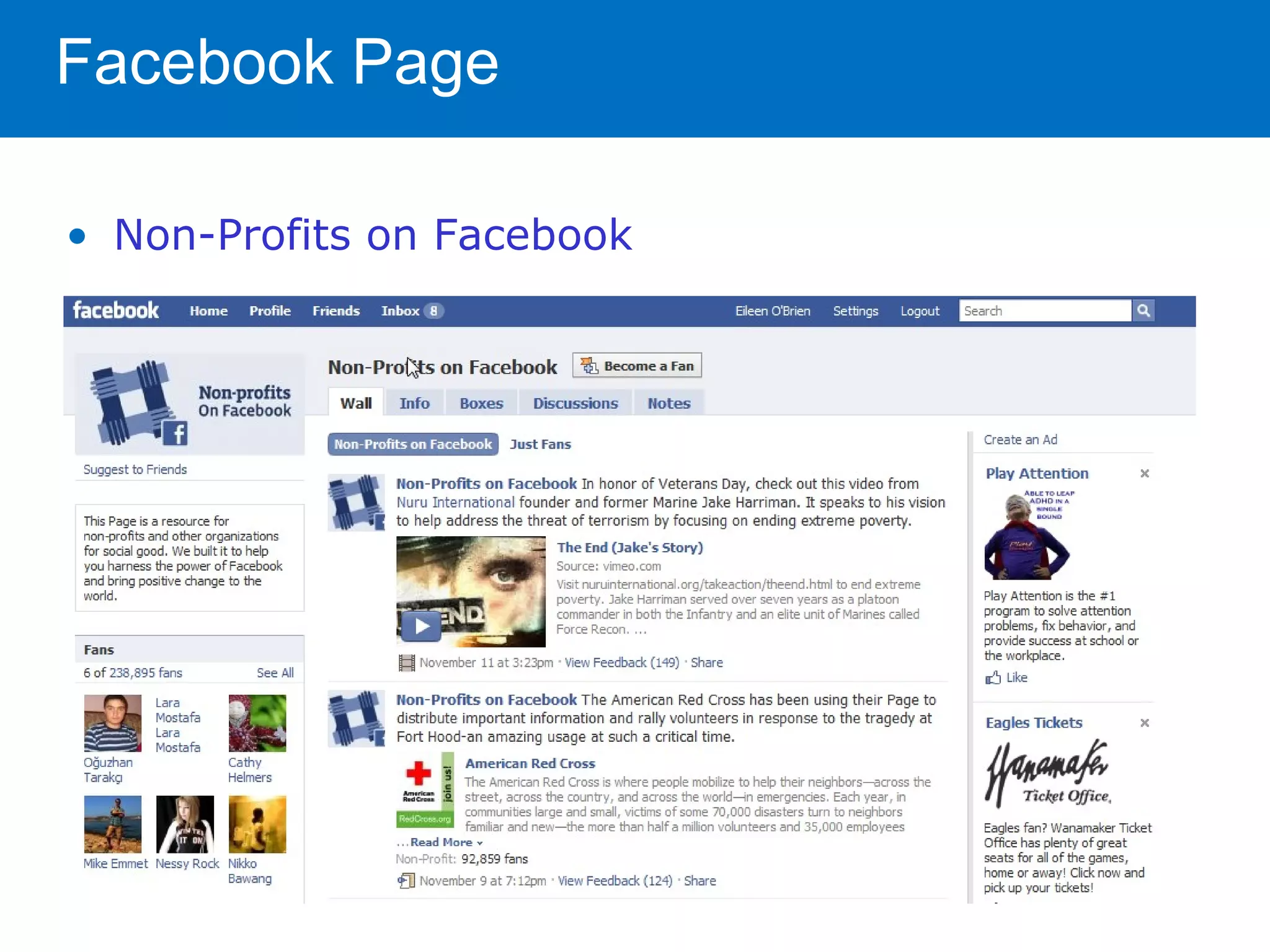
Facebook Page

• Non-Profits on Facebook
Facebook Stats

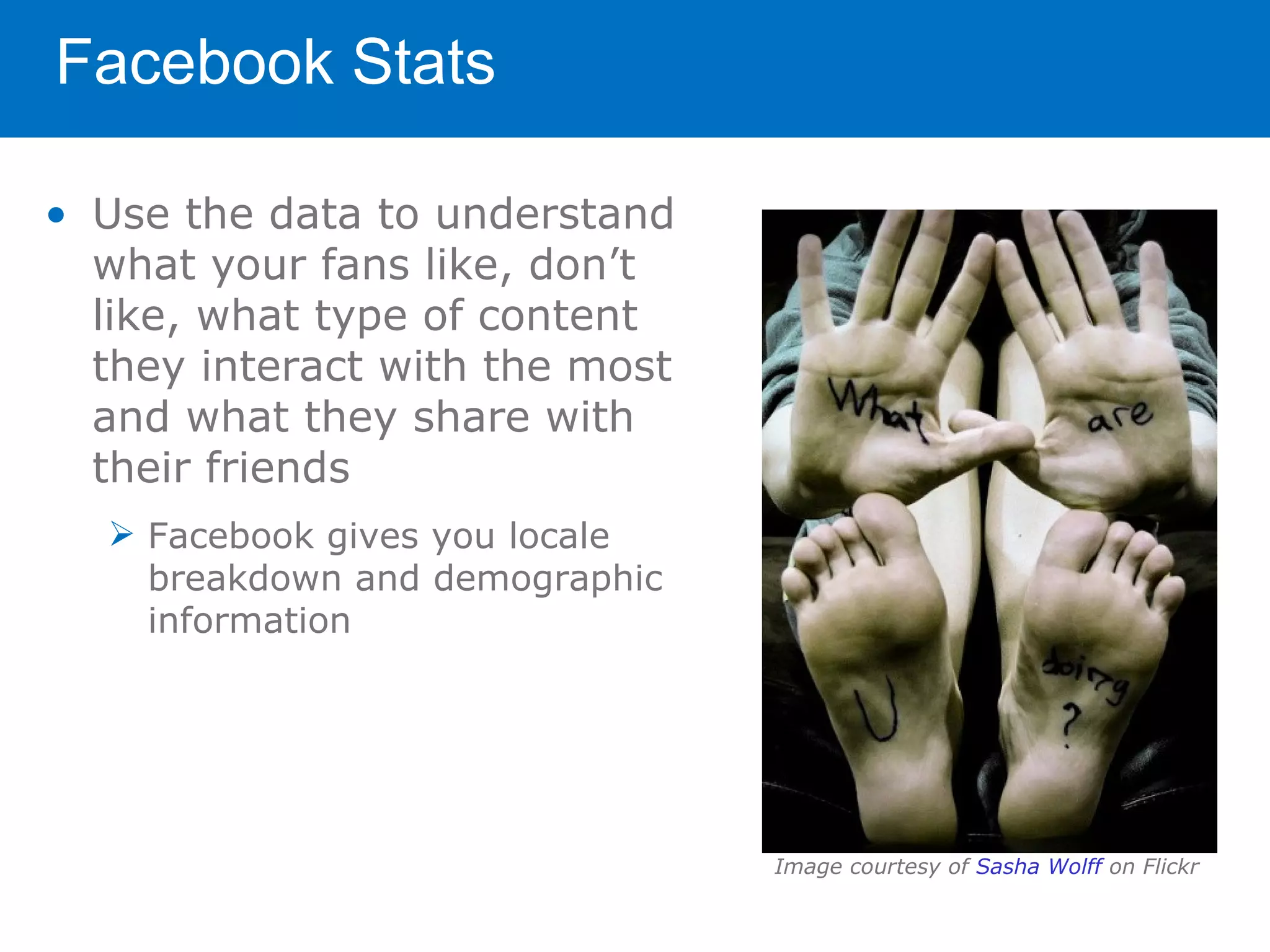
• Use the data to understand
  what your fans like, don’t
  like, what type of content
  they interact with the most
  and what they share with
  their friends
   Facebook gives you locale
    breakdown and demographic
    information


                                Image courtesy of Sasha Wolff on Flickr
How to Get Fans

• Promote via other marketing channels
• Encourage fans to suggest to their friends become
  fans
• Run promotion or contest
• Give fans what they want
   Be active and add content
   70% of all actions on social networks are related to
    viewing pictures or viewing other people's profiles
     Source: Understanding Users of Social Networks
Blogs
It’s All About Content

• Excellent for search
• Enables thought leadership
• Syndicate content
• Recommend WordPress
• If too time intensive, consider:
    Guest blogging
    Combining forces
    Comment on other blogs
Google+
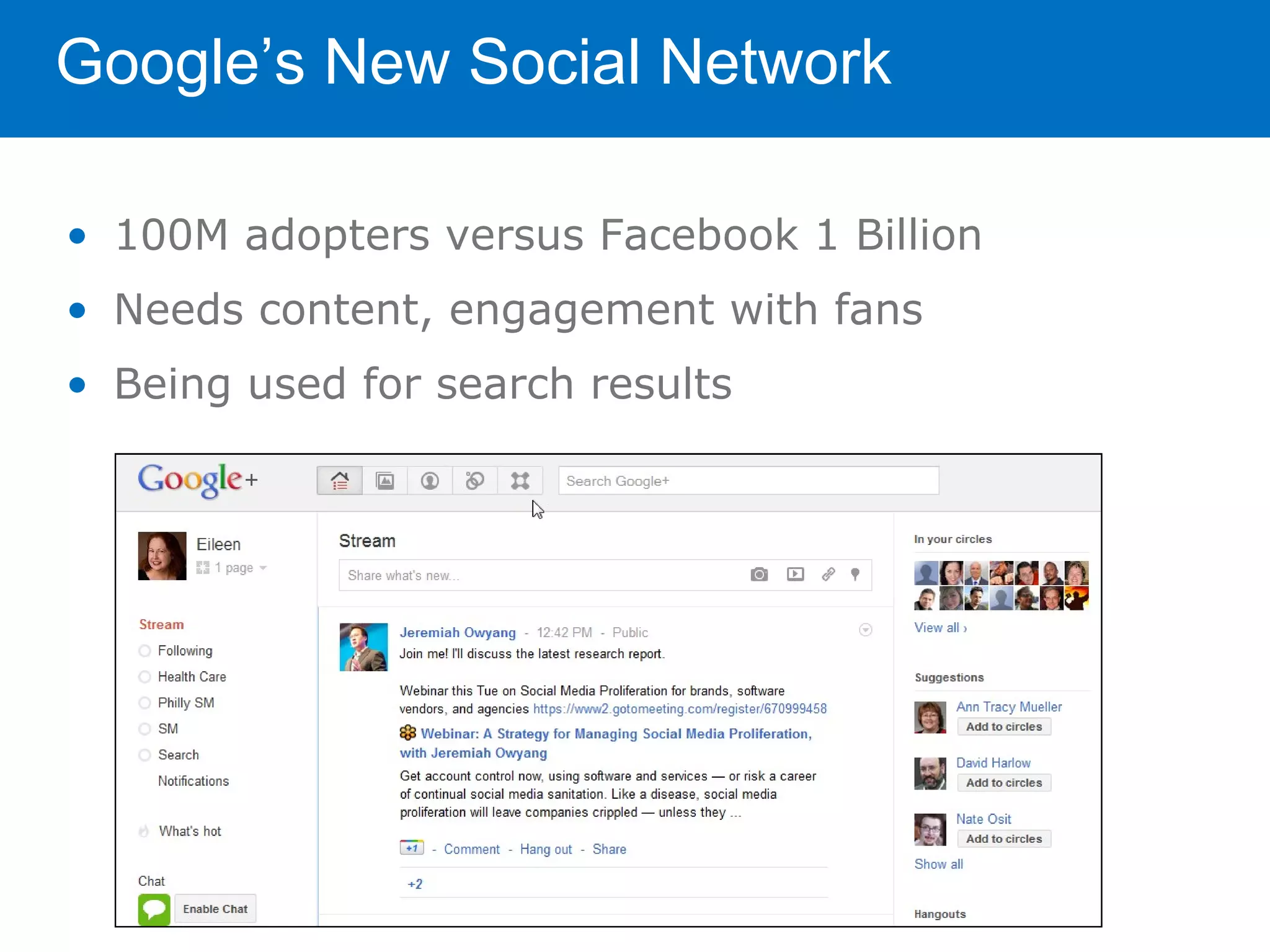
Google’s New Social Network

• 100M adopters versus Facebook 1 Billion
• Needs content, engagement with fans
• Being used for search results
SlideShare.net
Share Presentations

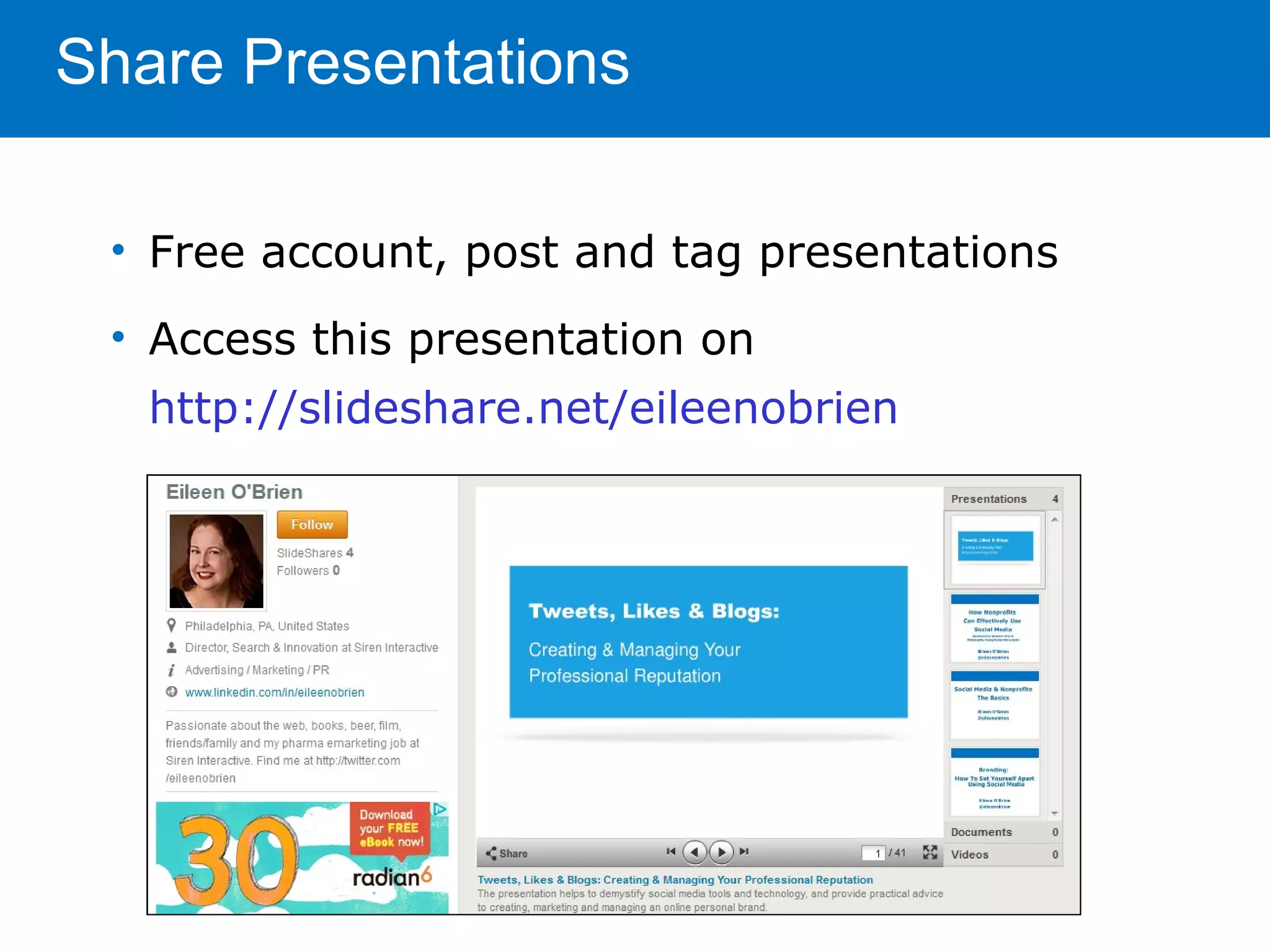
 • Free account, post and tag presentations
 • Access this presentation on
   http://slideshare.net/eileenobrien
Summary
Market Social Media

• Integrate the social tactics into the entire
  marketing strategy
• Promote social media tactics via all marketing
  such as: direct mail, email signature,
  newsletters, announce at events
• Leverage your content across various places
    Put video on YouTube
    Embed it into a blog post
    Promote blog post via Twitter, Facebook and LinkedIn
    Link to the blog post in an enewsletter
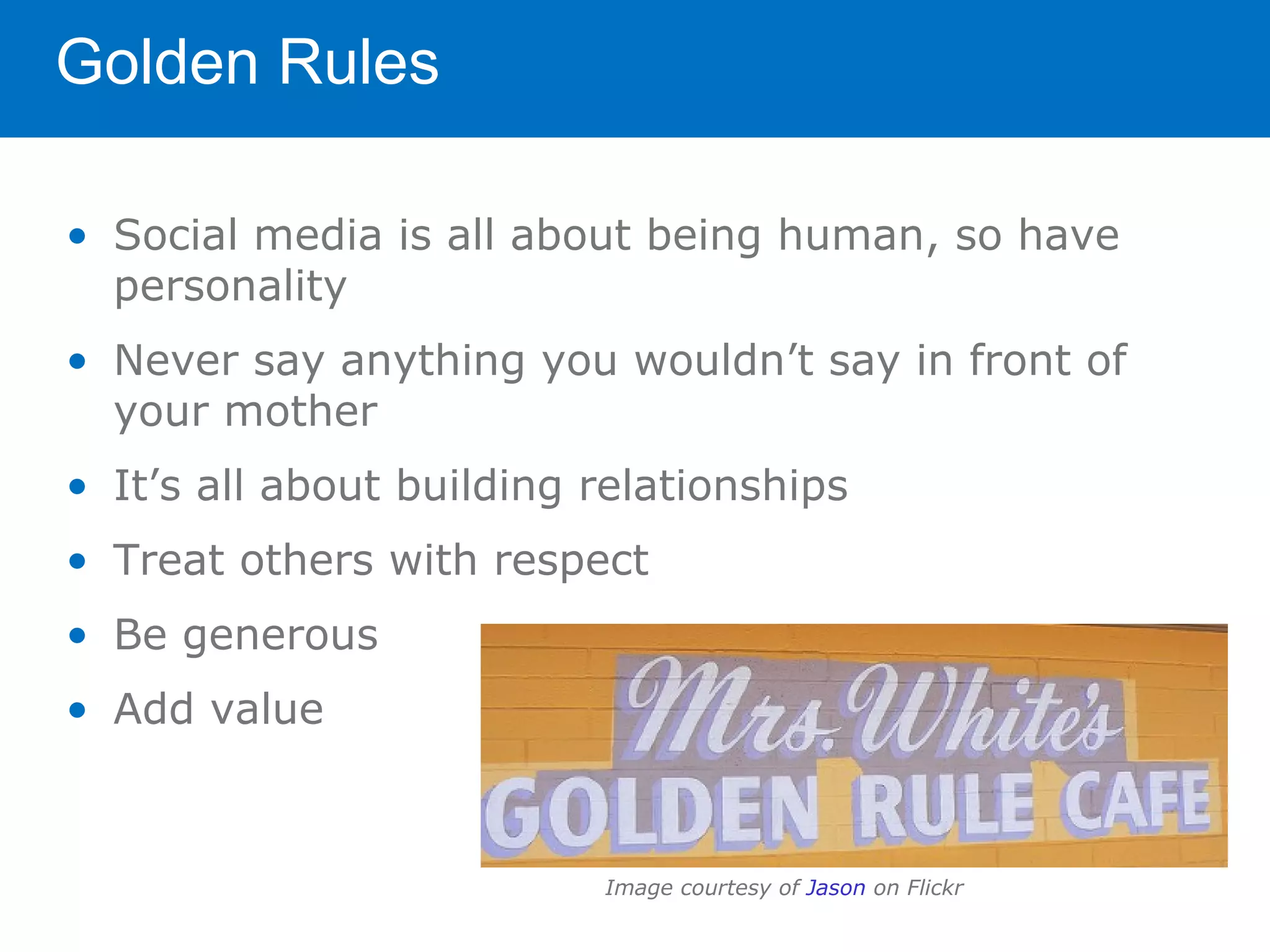
Golden Rules

• Social media is all about being human, so have
  personality
• Never say anything you wouldn’t say in front of
  your mother
• It’s all about building relationships
• Treat others with respect
• Be generous
• Add value


                          Image courtesy of Jason on Flickr
Resources

• ComcastNewMediaExchange.com
• Groundswell
   Examples of award winning non-profits

• Beth Kantar
   Beth’s Blog: How nonprofits can use social media

• Pew Internet & American Life Project
• Netsquared
• Momentum: Igniting Social Change in the
  Connected Age by AllisonFine
Questions?


             Thanks!


      eiobri@yahoo.com
        @EileenOBrien

Don't Be Left Behind: Social Media for NonProfits

  • 1.
    Social Media For Nonprofits: Don’t Get Left Behind April 19, 2012 Eileen O’Brien @eileenobrien
  • 2.
    What is SocialMedia? • “A social trend in which people use technologies to get the things they need from each other, rather than from traditional institutions like corporations” Groundswell by Charlene Li & Josh Bernoff
  • 3.
    Social Media isa Tactic • Social media is not a strategy but a tactic • Start with an objective, create a strategy and determine the best tactics • Integrate into your overall marketing objectives • Key to marketing is telling a compelling story  Social media can enable this
  • 4.
    Is Your TargetAudience Using SM? Source: PewInternet.org
  • 5.
    How Is YourTarget Using SM? Source: PewInternet.org
  • 6.
    How Do YouStart? • Recruit the people within your organization who are passionate about social media • Use it in your own life and become comfortable with the technology • Be selective: start small and build
  • 7.
    Monitor Social Media •Pay attention to what is being said about your organization  Free Google alerts  Take it private • Don’t delegate to intern • Have a crisis communications plan  Be prepared to act quickly using same media  Be nimble
  • 8.
    Learn from PlannedParenthood • Komen used SM as another platform for corporate announcements • PP used SM to engage in continued dialogue with stakeholders starting well before the crisis • Komen’s messaging was inconsistent, changed course and tone Source: Lessons from the Komen Controversy, SocialMediaToday.com
  • 9.
    Listen • Listening maygive you insights which will lead the strategy • Learn what’s important to your audience  Can you fill a need? How can you add value? • Check out what the competition is doing • Pay attention • Social media has been compared to a cocktail party
  • 10.
  • 11.
    Be Thoughtful • Manysocial media tools are free, but they require resources to create content and keep them updated • You can damage your reputation by starting and then abandoning social media projects • Squat on your name  http://namechk.com Image courtesy of Striatic on Flickr
  • 12.
    How Do YouFind The Time? • Integrate into what you are currently doing  Bring a video to an interview and post a teaser on YouTube • Make a conscious decision: the time spent on social media may mean giving something else up Image courtesy of D. Sharon Pruitt on Flickr
  • 13.
    Use Your TimeWisely • Measurement is essential  Determine up front how you will measure success • Did you meet your objective?  More volunteers  Heightened awareness  Donations  Increased event participation  Generated PR  Education on issues Image courtesy of Jonny Goldstein on Flickr
  • 14.
    Make It Shareworthy •Most effective online organizing programs whether fundraising or advocacy is to make each of your appeals part of a campaign • People give to funds that generate an emotional response, tell your story • Articulate in simple terms what you are trying to do • Make it urgent, have a deadline • Make it EASY
  • 15.
    100 Uniforms in100 Hours
  • 16.
  • 17.
    What’s Twitter? • Afree social networking & micro-blogging service that allows users to send updates or tweets (text- based posts up to 140 characters long) to anyone who opts to receive them • Asks: What’s happening? • Per Pew, 13% of American adults who use the internet are Twitter users Image courtesy of Robert Scoble on Flickr
  • 18.
    What’s Twitter? Use free tools: Tweetdeck or HootSuite
  • 19.
    Types of Accounts •Organization  100% branded content, don’t follow people or interact  Can be managed by a team, low risk of going off message  Using interactive tool to push out information, not establishing relationships Source: Beth’s Blog: How Nonprofits Can Use Social Media
  • 20.
    Types of Accounts •Organization With Personality  Employee(s) who tweet are identified & interact with followers  Makes it personal, builds relationships  May be difficult to scale, succession can be an issue if person becomes so associated with brand leaves, also risk of going off message Source: Beth’s Blog: How Nonprofits Can Use Social Media
  • 21.
    Who To Follow •Thought leaders and cause enthusiasts  For social media & nonprofits: @kanter, @ntenhross, @beautifulthangs, @SocialBttrfly, @peterdeitz • Search on your topics of interest  Look at who others follow • Take your time
  • 22.
    How To GetFollowers • Quality over quantity • When you follow someone send them a tweet explaining why you are following them • Search on your area of interest and then answer questions or respond  “Seek out people you can help and do it!” Wil Reynolds • Add yourself to “yellow pages”  http://twellow.com  http://wefollow.com
  • 23.
    How To GetFollowers • Engage with your followers, thank them for support, give them ways to get involved • Utilize hashtages (#word) • Weekly Chats  Take part in existing ones or host a Tweetchat Image courtesy of Christopher Carfi on Flickr
  • 24.
  • 25.
  • 26.
    YouTube • Second largestvolume of searches • In December 2011  85% of the total U.S. Internet audience views online video  182 million U.S. Internet users viewed 43.5 billion videos Source: comScore Image courtesy of Karl Jonsson on Flickr
  • 27.
    YouTube • A keyword-taggedvideo is 50 times more likely to appear on the 1st page of a Google search result compared with a traditional web page according to Forrester Research • YouTube program for nonprofits • YouTube Video Volunteers  Can find someone who is willing to use their equipment and skills to help a nonprofit make a video
  • 28.
    YouTube Channels • Freeto set up a YouTube channel • Centralized place for all videos, can be branded & users can subscribe • Can turn off comments or use it as another way to connect
  • 29.
    How Do YouGet Views? • People have short attention spans, so capture attention in first 30 second  Keep the whole video short  Have a call to action at the end  Shoot for a computer screen • Ask for user-generated content • Tell serial stories which engage viewers & keep them coming back • React to current events • Use endorsements • Tag & title your videos with relevant keywords
  • 30.
    How Do YouGet Subscribers? • Subscribe to the YouTube channels of other nonprofits, they may do the same • Ask people to subscribe • Share links for your videos with supporters so they can help get the word out  Make the embed code available so people can post the video on their sites Image courtesy of Todd Huffman on Flickr
  • 31.
  • 32.
    Facebook • Nonprofits cancreate customized pages • Claim vanity URL  http://www.twitter.com/yournonprofit • Engage with fans  Comment on their wall posts & help people connect with others • Show people how to connect beyond Facebook  Email sign up or drive to website
  • 33.
  • 34.
    Facebook Stats • Usethe data to understand what your fans like, don’t like, what type of content they interact with the most and what they share with their friends  Facebook gives you locale breakdown and demographic information Image courtesy of Sasha Wolff on Flickr
  • 35.
    How to GetFans • Promote via other marketing channels • Encourage fans to suggest to their friends become fans • Run promotion or contest • Give fans what they want  Be active and add content  70% of all actions on social networks are related to viewing pictures or viewing other people's profiles Source: Understanding Users of Social Networks
  • 36.
  • 37.
    It’s All AboutContent • Excellent for search • Enables thought leadership • Syndicate content • Recommend WordPress • If too time intensive, consider:  Guest blogging  Combining forces  Comment on other blogs
  • 38.
  • 39.
    Google’s New SocialNetwork • 100M adopters versus Facebook 1 Billion • Needs content, engagement with fans • Being used for search results
  • 40.
  • 41.
    Share Presentations •Free account, post and tag presentations • Access this presentation on http://slideshare.net/eileenobrien
  • 42.
  • 43.
    Market Social Media •Integrate the social tactics into the entire marketing strategy • Promote social media tactics via all marketing such as: direct mail, email signature, newsletters, announce at events • Leverage your content across various places  Put video on YouTube  Embed it into a blog post  Promote blog post via Twitter, Facebook and LinkedIn  Link to the blog post in an enewsletter
  • 44.
    Golden Rules • Socialmedia is all about being human, so have personality • Never say anything you wouldn’t say in front of your mother • It’s all about building relationships • Treat others with respect • Be generous • Add value Image courtesy of Jason on Flickr
  • 45.
    Resources • ComcastNewMediaExchange.com • Groundswell  Examples of award winning non-profits • Beth Kantar  Beth’s Blog: How nonprofits can use social media • Pew Internet & American Life Project • Netsquared • Momentum: Igniting Social Change in the Connected Age by AllisonFine
  • 46.
    Questions? Thanks! eiobri@yahoo.com @EileenOBrien

Editor's Notes

  • #5 Pew Internet & American Life Project is a nonpartisan, nonprofit "fact tank" that provides information on the issues and trends shaping America. They are a wonderful resource for data and statistics and recommend checking out their website. If you look at this table, it makes sense that age is the biggest predictor of social media use. I highlighted in red some of the social media activities.
  • #6 Pew Internet & American Life Project is a nonpartisan, nonprofit "fact tank" that provides information on the issues and trends shaping America. They are a wonderful resource for data and statistics and recommend checking out their website. If you look at this table, it makes sense that age is the biggest predictor of social media use. I highlighted in red some of the social media activities.
  • #8 the data shows us that those who have a social media strategy focused on stakeholder engagement, and manage it consistently before a crisis hits, like Planned Parenthood, are poised to navigate the crisis more successfully. Listening and engaging is more important than driving a defensive message. GaggleAMP analyzed posts made to Facebook and Twitter before and during the crisis. They found that Komen used social media as a monologue (just another platform for corporate announcements) while Planned Parenthood used social media to engage in a continuing dialogue with stakeholders, starting well before the crisis. Komen violated the most important rule of social media advocacy – the need to consistently engage stakeholders. It’s the difference between being credible and authentic versus being seen as out of touch and aloof. Another interesting element revealed by the data is that Komen’s poor handling of the initial messaging – not being consistent, changing course, changing tone – apparently helped organize their opposition. Disciplined message delivery through social media is critical to success in overcoming a crisis.
  • #12 New content and information are required to “feed the beast”
  • #13 New content and information are required to “feed the beast”
  • #18 It’s particularly popular with young adults, minorities, and those who live in cities.
  • #19 You can think of it as an instant message that goes out to lots of people. It can be mundane but it can also be a powerful tool to share information and build relationships. Use Tweedeck or HootSuite
  • #23 Legal Aide Society
  • #33 Most visited website in 2010 per Hitwise . Fastest growing group is women over 55 years old