SOCIAL LEARNING THEORY
Azamat Isamov
Introduction
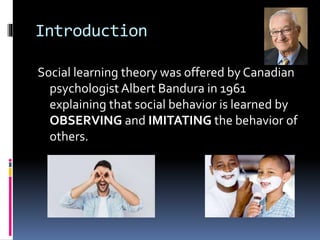
Social learning theory was offered by Canadian
psychologist Albert Bandura in 1961
explaining that social behavior is learned by
OBSERVING and IMITATING the behavior of
others.
Social learning theory
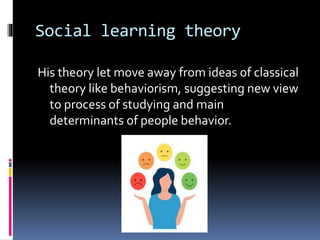
His theory let move away from ideas of classical
theory like behaviorism, suggesting new view
to process of studying and main
determinants of people behavior.
Social learning theory
There are 4 meditational processes in acquiring
a new behavior:
- Attention (highlights of a new behavior)
- Retention (saving the elements of behavior)
- Reproduction (imitating)
- Motivation (reinforcement)
Social learning theory
 Attention – this process defines which will be
directly selected from lots of model
influences.
Social learning theory
 Retention – this process responds for
remembering and saving observing behavior
in our memory by symbols.
Social learning theory
 Reproduction – this process provides
transformation of symbolic images to
actions.
Social learning theory
 Motivation – this process explains that
human reproduces that behavior which leads
to positive results. Everyone tries to act in a
way which brings self-satisfaction.
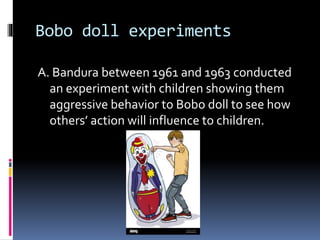
Bobo doll experiments
A. Bandura between 1961 and 1963 conducted
an experiment with children showing them
aggressive behavior to Bobo doll to see how
others’ action will influence to children.
Conclusion
 In a conclusion Bandura’s theory of social
learning says that LEARNING takes place in a
social circle with interactions, influencing
environment and behavior.

Social learning theory

  • 1.
  • 2.
    Introduction Social learning theorywas offered by Canadian psychologist Albert Bandura in 1961 explaining that social behavior is learned by OBSERVING and IMITATING the behavior of others.
  • 3.
    Social learning theory Histheory let move away from ideas of classical theory like behaviorism, suggesting new view to process of studying and main determinants of people behavior.
  • 4.
    Social learning theory Thereare 4 meditational processes in acquiring a new behavior: - Attention (highlights of a new behavior) - Retention (saving the elements of behavior) - Reproduction (imitating) - Motivation (reinforcement)
  • 5.
    Social learning theory Attention – this process defines which will be directly selected from lots of model influences.
  • 6.
    Social learning theory Retention – this process responds for remembering and saving observing behavior in our memory by symbols.
  • 7.
    Social learning theory Reproduction – this process provides transformation of symbolic images to actions.
  • 8.
    Social learning theory Motivation – this process explains that human reproduces that behavior which leads to positive results. Everyone tries to act in a way which brings self-satisfaction.
  • 9.
    Bobo doll experiments A.Bandura between 1961 and 1963 conducted an experiment with children showing them aggressive behavior to Bobo doll to see how others’ action will influence to children.
  • 10.
    Conclusion  In aconclusion Bandura’s theory of social learning says that LEARNING takes place in a social circle with interactions, influencing environment and behavior.