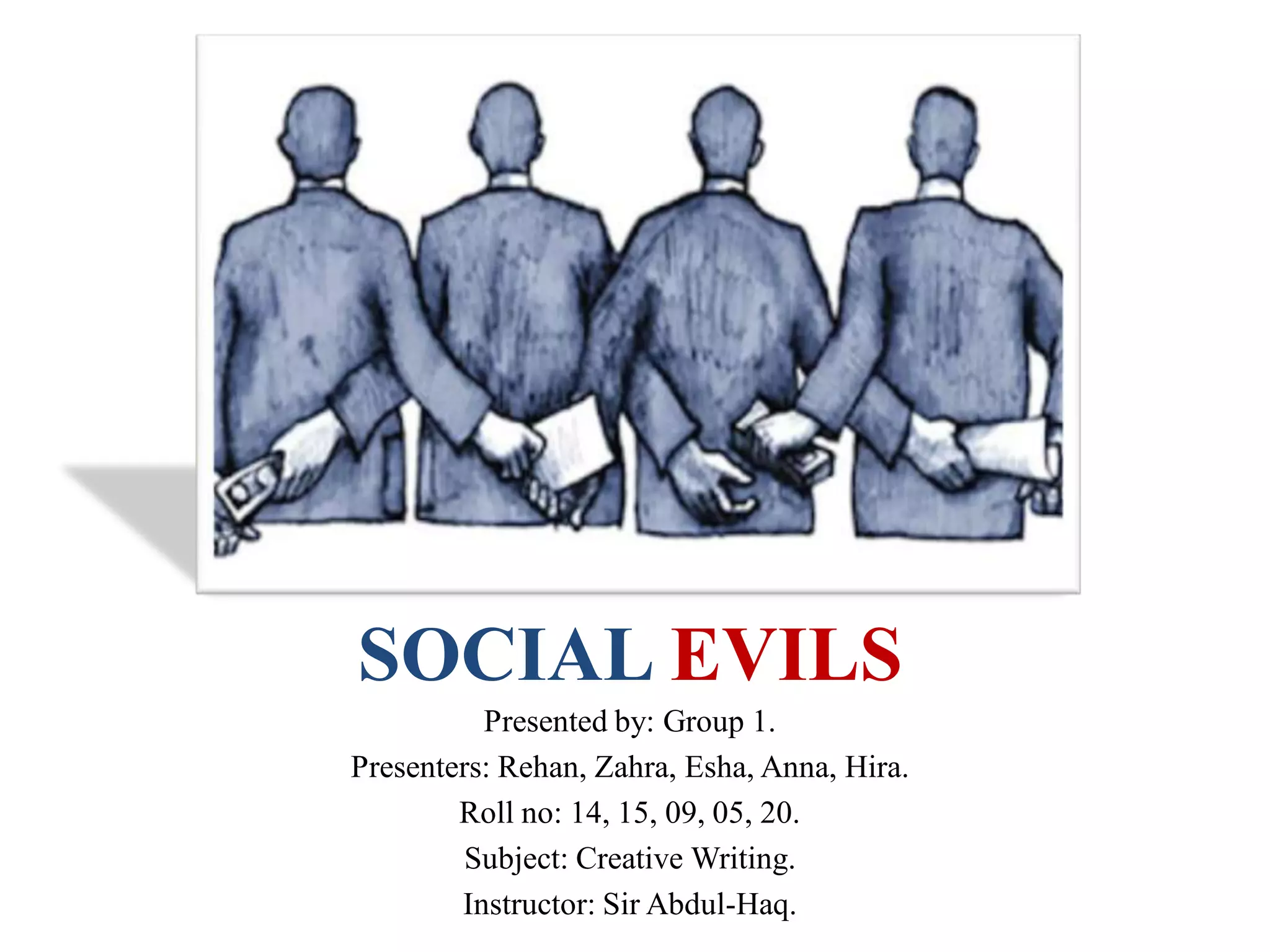
SOCIAL EVILS
Presented by: Group 1.
Presenters: Rehan, Zahra, Esha, Anna, Hira.
Roll no: 14, 15, 09, 05, 20.
Subject: Creative Writing.
Instructor: Sir Abdul-Haq.
SOCIAL EVILS - INTRO
• An evil is usually referred
to something troublesome
and harmful.
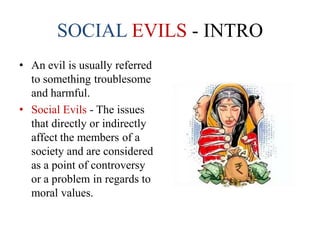
• Social Evils - The issues
that directly or indirectly
affect the members of a
society and are considered
as a point of controversy
or a problem in regards to
moral values.
• A society is a building
block of a country. So, it
can be said that social
evils are destructive to
the peace of a country.
They breakdown the
moral values of a
society of a country.
• Common social evils
include: corruption,
terrorism, poverty,
dowry system, gender
inequality, drug
addiction, child labour
etc.
SOCIAL EVILS - TYPES
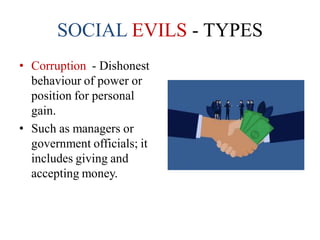
• Corruption - Dishonest
behaviour of power or
position for personal
gain.
• Such as managers or
government officials; it
includes giving and
accepting money.
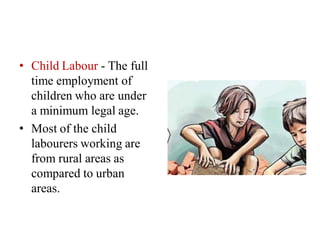
• Child Labour - The full
time employment of
children who are under
a minimum legal age.
• Most of the child
labourers working are
from rural areas as
compared to urban
areas.
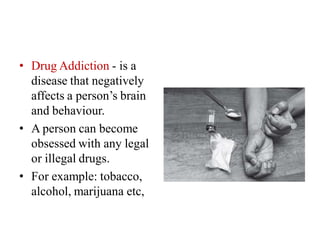
• Drug Addiction - is a
disease that negatively
affects a person’s brain
and behaviour.
• A person can become
obsessed with any legal
or illegal drugs.
• For example: tobacco,
alcohol, marijuana etc,
SOCIAL EVILS - REASONS
• Reasons Behind Social
Evils:
• Poverty.
• Inequality.
• Corruption.
• Unemployment.
• Death of Morals.
• Lack of education.
• Superstitious beliefs.
• Gender discrimination.
• Reasons Behind Child
Labour:
• Less awareness about
rules or laws.
• No source of in come.
• Illiteracy of people.
• Death of morals in
humans.
• Rights of the poor not
given to them.
• Reasons Behind Drug
Addiction:
• A desire to experiment.
• Enjoyment of risk
taking behaviour.
• A belief that drugs solve
personal, social, or
medical problems.
• A desire to escape
boredom or depression.
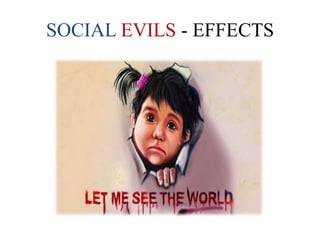
SOCIAL EVILS - EFFECTS
• Social evils destroy the
economy of the country.
• Affects humanity negatively
from all angles.
• Child labour destroys the
childhood of so many
children.
• Children are sent to work
stations instead of schools.
• Children suffer from serious
health issues because of
working in factories.
• Poverty causes people to get
into social evils.
• The people lose their trust in
the policies of the
government.
• There is exploitation of the
poor by the rich.
• People get affected mentally
and physically.
• Drugs cause serious health
problems.
• Alcohol badly affects liver.
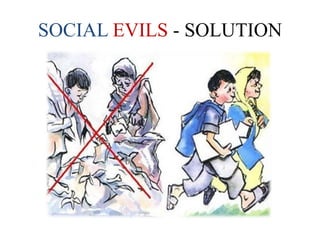
SOCIAL EVILS - SOLUTION
• Charity begins at home.
• Islamic education.
• Character building.
• Maintain system of
Zakat.
• Implementation of laws.
• Education and
awareness.
• Give equal rights to
poor people.
• Positive attitude.
• Providing good jobs to
unemployed people.
• Report evil incidents.
• Victims must raise their
voices.
SOCIAL EVILS - CONCLUSION
• Social evil is any pain
or suffering brought by
interactions of many
individuals.
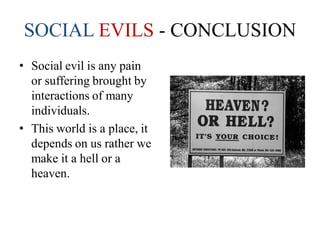
• This world is a place, it
depends on us rather we
make it a hell or a
heaven.
END OF THE PRESENTATION

Social Evils - Presentation Slides - By Rehan Butt

  • 1.
    SOCIAL EVILS Presented by:Group 1. Presenters: Rehan, Zahra, Esha, Anna, Hira. Roll no: 14, 15, 09, 05, 20. Subject: Creative Writing. Instructor: Sir Abdul-Haq.
  • 2.
    SOCIAL EVILS -INTRO • An evil is usually referred to something troublesome and harmful. • Social Evils - The issues that directly or indirectly affect the members of a society and are considered as a point of controversy or a problem in regards to moral values.
  • 3.
    • A societyis a building block of a country. So, it can be said that social evils are destructive to the peace of a country. They breakdown the moral values of a society of a country. • Common social evils include: corruption, terrorism, poverty, dowry system, gender inequality, drug addiction, child labour etc.
  • 4.
    SOCIAL EVILS -TYPES • Corruption - Dishonest behaviour of power or position for personal gain. • Such as managers or government officials; it includes giving and accepting money.
  • 5.
    • Child Labour- The full time employment of children who are under a minimum legal age. • Most of the child labourers working are from rural areas as compared to urban areas.
  • 6.
    • Drug Addiction- is a disease that negatively affects a person’s brain and behaviour. • A person can become obsessed with any legal or illegal drugs. • For example: tobacco, alcohol, marijuana etc,
  • 7.
    SOCIAL EVILS -REASONS • Reasons Behind Social Evils: • Poverty. • Inequality. • Corruption. • Unemployment. • Death of Morals. • Lack of education. • Superstitious beliefs. • Gender discrimination.
  • 8.
    • Reasons BehindChild Labour: • Less awareness about rules or laws. • No source of in come. • Illiteracy of people. • Death of morals in humans. • Rights of the poor not given to them. • Reasons Behind Drug Addiction: • A desire to experiment. • Enjoyment of risk taking behaviour. • A belief that drugs solve personal, social, or medical problems. • A desire to escape boredom or depression.
  • 9.
  • 10.
    • Social evilsdestroy the economy of the country. • Affects humanity negatively from all angles. • Child labour destroys the childhood of so many children. • Children are sent to work stations instead of schools. • Children suffer from serious health issues because of working in factories. • Poverty causes people to get into social evils. • The people lose their trust in the policies of the government. • There is exploitation of the poor by the rich. • People get affected mentally and physically. • Drugs cause serious health problems. • Alcohol badly affects liver.
  • 11.
  • 12.
    • Charity beginsat home. • Islamic education. • Character building. • Maintain system of Zakat. • Implementation of laws. • Education and awareness. • Give equal rights to poor people. • Positive attitude. • Providing good jobs to unemployed people. • Report evil incidents. • Victims must raise their voices.
  • 13.
    SOCIAL EVILS -CONCLUSION • Social evil is any pain or suffering brought by interactions of many individuals. • This world is a place, it depends on us rather we make it a hell or a heaven.
  • 14.
    END OF THEPRESENTATION