SUB:SOCIAL SCIENCE
TOPIC:SOCIAL PROBLEMS
By,
Vishwas.M
Shreyas URS
Prajwal.M.R
Our country India is a very small country with
wide variety of cast, religion & creed. In such a
country, their resides problems within societies
as it contains a large population in it. The main
problem which resides in Indian society is
DOWRY SYSTEM, CHILD LABOUR, POVERTY &
THE GROWING POPULATION
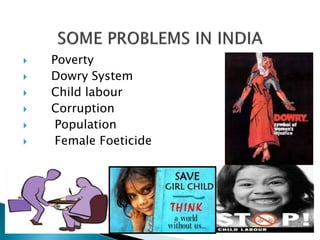
 Poverty
 Dowry System
 Child labour
 Corruption
 Population
 Female Foeticide
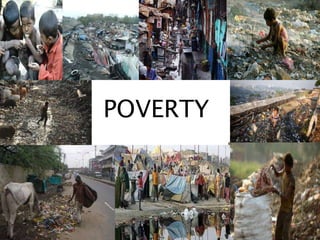
POVERTY
 Poverty in India is widespread, with the nation
estimated to have a third of the world's poor.
 In 2010, the World Bank reported that 32.7%
of the total Indian people falls below the
international poverty line of US$ 1.25 per day
(PPP) while 68.7% lives on less than US$ 2 per
day.
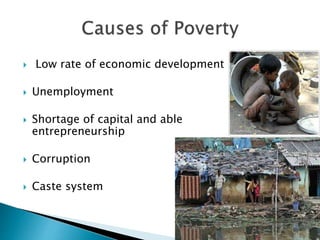
 Low rate of economic development
 Unemployment
 Shortage of capital and able
entrepreneurship
 Corruption
 Caste system
 80% of India does not have access to public
health facilities. (Dr. Anbumani Ramadoss,
Minister for Health and Family Welfare)
 47% of Indian children under the age of 5
years are undernourished. (Human
Development Report 2005, UNDP)
 This has to be seen in perspective as the
population of India has increased by 370
million from 1991 and 190 million from
2001 so the absolute number of poor has
increased.
However, we also know that…
 71% of the children in 15-19 age group have
not completed a secondary education, their
fundamental right. (National Sample Survey on
Education, 1999-00, NSSO)
 57% of India does not have access to electricity.
(World Development Indicators 2005, World
Bank)
 70% of India does not have access to a suitable
toilet. (National Sample Survey on Housing,
2004, NSSO)
 49% of India does not have proper shelter.
(National Sample Survey on Housing, 2004,
NSSO)
 38% of India does not have access to a nearby
water source. (National Family Health Survey,
1998-99, IIPS)
DOWRY SYSTEM
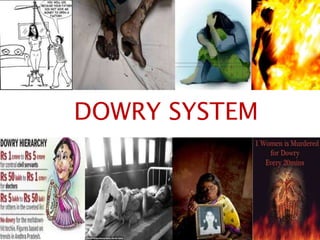
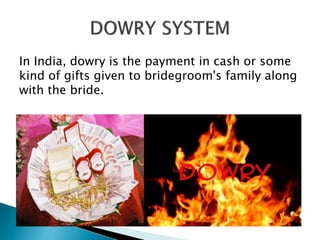
In India, dowry is the payment in cash or some
kind of gifts given to bridegroom's family along
with the bride.
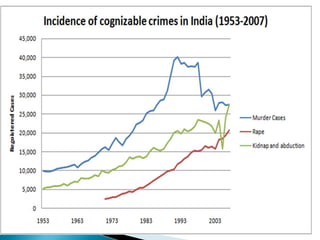
The underbelly of the dowry system revolves
around the treatment of brides. Referred to as
“bride-burning”, the act of maiming or even
killing brides whose family cannot or will
not meet a groom’s dowry demands is a
worrying practice in India. The National Crime
, negligence or murder than boys do
dowry-related deaths recorded Only a third of
all reported cases result in conviction of the
offenders.
Where the death of a woman is caused by any
burns or bodily injury or occurs otherwise than
under normal circumstances within seven years
of her marriage and it is shown that soon
before her death she was subjected to cruelty
or harassment by her husband or any relative of
her husband for, or in connection with, any
demand for dowry, such death shall be called
"dowry death" and such husband or relative
shall be deemed to have caused her death.
Sometimes the woman is killed by setting her
on fire; this is known as "bride burning”.
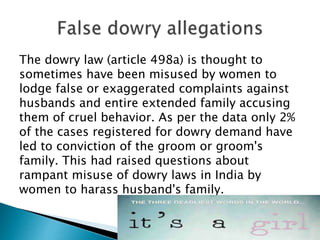
The dowry law (article 498a) is thought to
sometimes have been misused by women to
lodge false or exaggerated complaints against
husbands and entire extended family accusing
them of cruel behavior. As per the data only 2%
of the cases registered for dowry demand have
led to conviction of the groom or groom's
family. This had raised questions about
rampant misuse of dowry laws in India by
women to harass husband's family.
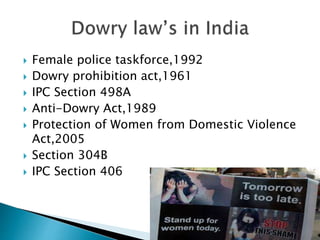
 Female police taskforce,1992
 Dowry prohibition act,1961
 IPC Section 498A
 Anti-Dowry Act,1989
 Protection of Women from Domestic Violence
Act,2005
 Section 304B
 IPC Section 406
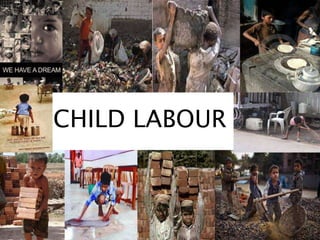
CHILD LABOUR
Child labour is the practicing of having children
engage in economic activity, on part or full-
time basis. The practice deprives children of
their childhood, and is harmful to their physical
and mental development. Poverty, lack of good
schools and growth of informal economy are
considered as the important causes of child
labour in India
The 2001 national census of India
estimated the total number of child
labour, aged 5–14, to be at 12.6
million, out of a total child population
of 253 million in 5-14 age group. The
child labour problem is not unique to
India; worldwide, about 217 million
children work, many full-time.
In 2001, out of a 12.6 million child
workers, about 120,000 children in
India were in a hazardous job.
¤ Poverty
¤ Non-availability of and non-accessibility to
schools
¤ Parental illiteracy
¤ Tradition of making children learn the family
skills
¤ Irrelevant and non-attractive school
curriculum
¤ Employers prefer children as they constitute
cheap labour and they are not able to
organize themselves against exploitation.
Section 12 of India's Child Labour
(Prohibition and Regulation) Act of
1986 requires prominent display of
'child labour is prohibited' signs in
many industries and construction
sites in local language and English.
The Factories Act of 1948: The Act
prohibits the employment of children
below the age of 14 years in any
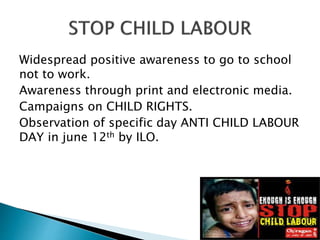
Widespread positive awareness to go to school
not to work.
Awareness through print and electronic media.
Campaigns on CHILD RIGHTS.
Observation of specific day ANTI CHILD LABOUR
DAY in june 12th by ILO.
The international Labour Organization has been
fighting child labour for many decades.
The United Nations declared the children must
be protected from dangerous work.
Over the past many years many agreements,
which protect the rights of children, have been
signed.
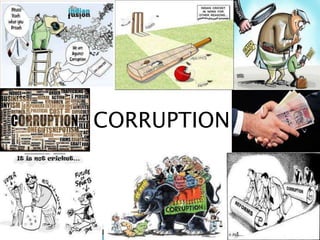
CORRUPTION
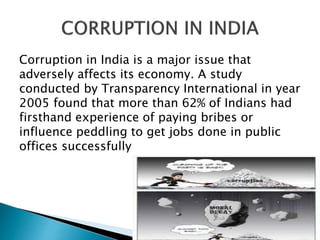
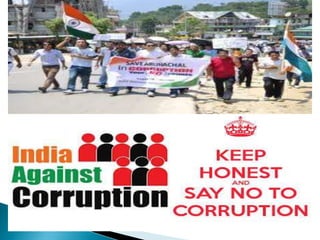
Corruption in India is a major issue that
adversely affects its economy. A study
conducted by Transparency International in year
2005 found that more than 62% of Indians had
firsthand experience of paying bribes or
influence peddling to get jobs done in public
offices successfully
1. It causes widespread bitterness in those
who cannot pay or refuse to pay for favors,
when they see those who do pay being
favored;
2. Corruption also enriches a few corrupt
people at the expense of the majority;
3. It distorts standards when it enables those
who less deserve to reach goals ahead of
those of greater merit.
4. It enables those who pay bribes to obtain
favors and services to which they are not entitled;
5. When bribes are paid to law enforcement
officers, respect for the law and rule of law is
lost;
6. It retards economic development as it shifts
services from the needy or priority areas. It
furthers the social and economic marginalization
of the poor; and if;
7. Allowed to expand unchecked, corruption
erodes political legitimacy to the point where
citizens see little point in following the rules and
might result into political instability.
IPC,1860
Prevention of Corruption Act,1988
Prevention of Money Laundering
Act,
2002
Right to Information Act,2005
Central Vigilance Commission Act
Lok Ayukta Acts of States etc.
If corruption levels in India were reduced to levels
in developed economies such as Singapore or the
United Kingdom, India's GDP growth rate could
increase at a higher rate annually.
Certain states such as Andhra Pradesh (Andhra
Pradesh Anti-corruption Bureau) and Karnataka
(Lokayukta) also have their own anti-corruption
agencies and courts.
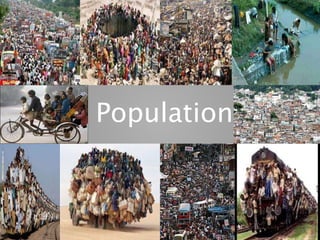
Population
The human population has been growing
continuously since the end of the Black
Death, around the year 1400, although the
most significant increase has been in the
last 50 years, mainly due to medical
advancements and increases in agricultural
productivity.
As of December 1, 2013 the world's
human population is estimated to be 7.128
billion by the United States Census Bureau,
and over 7 billion by the United Nations.
Current Population of India in 2014 1,270,272,105 (1.27 billion)
Total Male Population in India 655,875,026 (655.8 million)
Total Female Population in India 614,397,079 (614.4 million)
Sex Ratio 940 females per 1,000 males
Age structure
0 to 25 years 50% of India's current population
Currently, there are about 51 births in India in a minute.
India's Population in 2012 1.22 billion
India's Population in 2011 1.21 billion
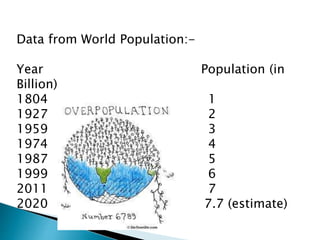
Data from World Population:-
Year Population (in
Billion)
1804 1
1927 2
1959 3
1974 4
1987 5
1999 6
2011 7
2020 7.7 (estimate)
For the world as a whole, the number of
children born per woman decreased from
5.02 to 2.65 between 1950 and 2005. A
breakdown by region is as follows:
Europe – 2.66 to 1.41
North America – 3.47 to 1.99
Oceania – 3.87 to 2.30
Central America – 6.38 to 2.66
South America – 5.75 to 2.49
Asia (excluding Middle East) – 5.85 to 2.43
Middle East & North Africa – 6.99 to 3.37
Sub-Saharan Africa – 6.7 to 5.53
1.High Inflation Rates.
2.Poor Girl Child Education
3.Poor Infrastructure
4.Balance of Payment Deterioration
5.High Levels of Debts
6.Inequality has risen
7.Large Budget Deficit
8.Rigid Labour Laws
The term female
foeticide means killing the
female foetus in the mother's
womb. How cruel? The practice
has been followed in India for
ages, a country that once
described its women as
godessessFor this reason, Indian women will soon get extinct.
Surprised? The most active part is being played by the women
themselves -- why? Just for the mere want of a boy, mothers
don't feel bad in strangulating their daughters in their wombs.
Can anyone be more cruel?
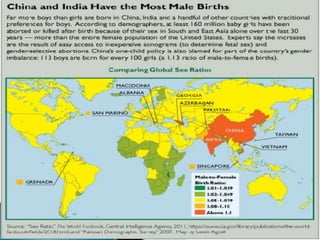
In India, sex ratio stands at a paltry 933:1000, i.e., 67 women
short of every 1,000 males.
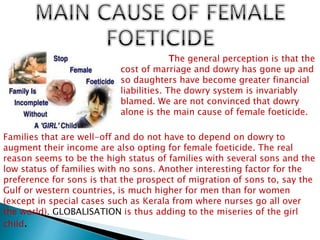
The general perception is that the
cost of marriage and dowry has gone up and
so daughters have become greater financial
liabilities. The dowry system is invariably
blamed. We are not convinced that dowry
alone is the main cause of female foeticide.
Families that are well-off and do not have to depend on dowry to
augment their income are also opting for female foeticide. The real
reason seems to be the high status of families with several sons and the
low status of families with no sons. Another interesting factor for the
preference for sons is that the prospect of migration of sons to, say the
Gulf or western countries, is much higher for men than for women
(except in special cases such as Kerala from where nurses go all over
the world). GLOBALISATION is thus adding to the miseries of the girl
child.
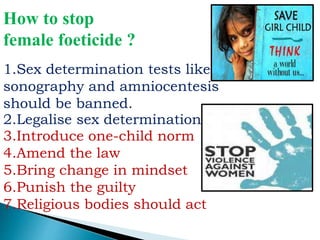
How to stop
female foeticide ?
1.Sex determination tests like
sonography and amniocentesis
should be banned.
2.Legalise sex determination
3.Introduce one-child norm
4.Amend the law
5.Bring change in mindset
6.Punish the guilty
7.Religious bodies should act
A number of steps have been taken by the
government and many organizations to abolish the
prevalent social evils. Many laws have been
implemented for the prevention of these acts. But
the common people have a role to play. The first
step towards mitigation is PUBLIC AWARENESS. Each
and every individual must take the oath to do
his/her path in abolishing these evils. The public
should be aware to report of any such incidence on
the respective authority. The victim must raise the
voice and resist such acts. Many other such simple
steps by a society as a whole can mitigate the social
evils and make social life happier
Fa 4 social problems

Fa 4 social problems

  • 1.
  • 2.
    Our country Indiais a very small country with wide variety of cast, religion & creed. In such a country, their resides problems within societies as it contains a large population in it. The main problem which resides in Indian society is DOWRY SYSTEM, CHILD LABOUR, POVERTY & THE GROWING POPULATION
  • 3.
     Poverty  DowrySystem  Child labour  Corruption  Population  Female Foeticide
  • 4.
  • 5.
     Poverty inIndia is widespread, with the nation estimated to have a third of the world's poor.  In 2010, the World Bank reported that 32.7% of the total Indian people falls below the international poverty line of US$ 1.25 per day (PPP) while 68.7% lives on less than US$ 2 per day.
  • 6.
     Low rateof economic development  Unemployment  Shortage of capital and able entrepreneurship  Corruption  Caste system
  • 7.
     80% ofIndia does not have access to public health facilities. (Dr. Anbumani Ramadoss, Minister for Health and Family Welfare)  47% of Indian children under the age of 5 years are undernourished. (Human Development Report 2005, UNDP)  This has to be seen in perspective as the population of India has increased by 370 million from 1991 and 190 million from 2001 so the absolute number of poor has increased. However, we also know that…
  • 8.
     71% ofthe children in 15-19 age group have not completed a secondary education, their fundamental right. (National Sample Survey on Education, 1999-00, NSSO)  57% of India does not have access to electricity. (World Development Indicators 2005, World Bank)  70% of India does not have access to a suitable toilet. (National Sample Survey on Housing, 2004, NSSO)  49% of India does not have proper shelter. (National Sample Survey on Housing, 2004, NSSO)  38% of India does not have access to a nearby water source. (National Family Health Survey, 1998-99, IIPS)
  • 9.
  • 10.
    In India, dowryis the payment in cash or some kind of gifts given to bridegroom's family along with the bride.
  • 12.
    The underbelly ofthe dowry system revolves around the treatment of brides. Referred to as “bride-burning”, the act of maiming or even killing brides whose family cannot or will not meet a groom’s dowry demands is a worrying practice in India. The National Crime , negligence or murder than boys do dowry-related deaths recorded Only a third of all reported cases result in conviction of the offenders.
  • 13.
    Where the deathof a woman is caused by any burns or bodily injury or occurs otherwise than under normal circumstances within seven years of her marriage and it is shown that soon before her death she was subjected to cruelty or harassment by her husband or any relative of her husband for, or in connection with, any demand for dowry, such death shall be called "dowry death" and such husband or relative shall be deemed to have caused her death. Sometimes the woman is killed by setting her on fire; this is known as "bride burning”.
  • 14.
    The dowry law(article 498a) is thought to sometimes have been misused by women to lodge false or exaggerated complaints against husbands and entire extended family accusing them of cruel behavior. As per the data only 2% of the cases registered for dowry demand have led to conviction of the groom or groom's family. This had raised questions about rampant misuse of dowry laws in India by women to harass husband's family.
  • 15.
     Female policetaskforce,1992  Dowry prohibition act,1961  IPC Section 498A  Anti-Dowry Act,1989  Protection of Women from Domestic Violence Act,2005  Section 304B  IPC Section 406
  • 16.
  • 17.
    Child labour isthe practicing of having children engage in economic activity, on part or full- time basis. The practice deprives children of their childhood, and is harmful to their physical and mental development. Poverty, lack of good schools and growth of informal economy are considered as the important causes of child labour in India
  • 18.
    The 2001 nationalcensus of India estimated the total number of child labour, aged 5–14, to be at 12.6 million, out of a total child population of 253 million in 5-14 age group. The child labour problem is not unique to India; worldwide, about 217 million children work, many full-time. In 2001, out of a 12.6 million child workers, about 120,000 children in India were in a hazardous job.
  • 19.
    ¤ Poverty ¤ Non-availabilityof and non-accessibility to schools ¤ Parental illiteracy ¤ Tradition of making children learn the family skills ¤ Irrelevant and non-attractive school curriculum ¤ Employers prefer children as they constitute cheap labour and they are not able to organize themselves against exploitation.
  • 20.
    Section 12 ofIndia's Child Labour (Prohibition and Regulation) Act of 1986 requires prominent display of 'child labour is prohibited' signs in many industries and construction sites in local language and English. The Factories Act of 1948: The Act prohibits the employment of children below the age of 14 years in any
  • 21.
    Widespread positive awarenessto go to school not to work. Awareness through print and electronic media. Campaigns on CHILD RIGHTS. Observation of specific day ANTI CHILD LABOUR DAY in june 12th by ILO.
  • 22.
    The international LabourOrganization has been fighting child labour for many decades. The United Nations declared the children must be protected from dangerous work. Over the past many years many agreements, which protect the rights of children, have been signed.
  • 23.
  • 24.
    Corruption in Indiais a major issue that adversely affects its economy. A study conducted by Transparency International in year 2005 found that more than 62% of Indians had firsthand experience of paying bribes or influence peddling to get jobs done in public offices successfully
  • 25.
    1. It causeswidespread bitterness in those who cannot pay or refuse to pay for favors, when they see those who do pay being favored; 2. Corruption also enriches a few corrupt people at the expense of the majority; 3. It distorts standards when it enables those who less deserve to reach goals ahead of those of greater merit.
  • 26.
    4. It enablesthose who pay bribes to obtain favors and services to which they are not entitled; 5. When bribes are paid to law enforcement officers, respect for the law and rule of law is lost; 6. It retards economic development as it shifts services from the needy or priority areas. It furthers the social and economic marginalization of the poor; and if; 7. Allowed to expand unchecked, corruption erodes political legitimacy to the point where citizens see little point in following the rules and might result into political instability.
  • 27.
    IPC,1860 Prevention of CorruptionAct,1988 Prevention of Money Laundering Act, 2002 Right to Information Act,2005 Central Vigilance Commission Act Lok Ayukta Acts of States etc.
  • 29.
    If corruption levelsin India were reduced to levels in developed economies such as Singapore or the United Kingdom, India's GDP growth rate could increase at a higher rate annually. Certain states such as Andhra Pradesh (Andhra Pradesh Anti-corruption Bureau) and Karnataka (Lokayukta) also have their own anti-corruption agencies and courts.
  • 30.
  • 31.
    The human populationhas been growing continuously since the end of the Black Death, around the year 1400, although the most significant increase has been in the last 50 years, mainly due to medical advancements and increases in agricultural productivity. As of December 1, 2013 the world's human population is estimated to be 7.128 billion by the United States Census Bureau, and over 7 billion by the United Nations.
  • 32.
    Current Population ofIndia in 2014 1,270,272,105 (1.27 billion) Total Male Population in India 655,875,026 (655.8 million) Total Female Population in India 614,397,079 (614.4 million) Sex Ratio 940 females per 1,000 males Age structure 0 to 25 years 50% of India's current population Currently, there are about 51 births in India in a minute. India's Population in 2012 1.22 billion India's Population in 2011 1.21 billion
  • 33.
    Data from WorldPopulation:- Year Population (in Billion) 1804 1 1927 2 1959 3 1974 4 1987 5 1999 6 2011 7 2020 7.7 (estimate)
  • 34.
    For the worldas a whole, the number of children born per woman decreased from 5.02 to 2.65 between 1950 and 2005. A breakdown by region is as follows: Europe – 2.66 to 1.41 North America – 3.47 to 1.99 Oceania – 3.87 to 2.30 Central America – 6.38 to 2.66 South America – 5.75 to 2.49 Asia (excluding Middle East) – 5.85 to 2.43 Middle East & North Africa – 6.99 to 3.37 Sub-Saharan Africa – 6.7 to 5.53
  • 35.
    1.High Inflation Rates. 2.PoorGirl Child Education 3.Poor Infrastructure 4.Balance of Payment Deterioration 5.High Levels of Debts 6.Inequality has risen 7.Large Budget Deficit 8.Rigid Labour Laws
  • 37.
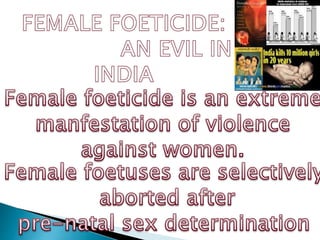
    The term female foeticidemeans killing the female foetus in the mother's womb. How cruel? The practice has been followed in India for ages, a country that once described its women as godessessFor this reason, Indian women will soon get extinct. Surprised? The most active part is being played by the women themselves -- why? Just for the mere want of a boy, mothers don't feel bad in strangulating their daughters in their wombs. Can anyone be more cruel? In India, sex ratio stands at a paltry 933:1000, i.e., 67 women short of every 1,000 males.
  • 40.
    The general perceptionis that the cost of marriage and dowry has gone up and so daughters have become greater financial liabilities. The dowry system is invariably blamed. We are not convinced that dowry alone is the main cause of female foeticide. Families that are well-off and do not have to depend on dowry to augment their income are also opting for female foeticide. The real reason seems to be the high status of families with several sons and the low status of families with no sons. Another interesting factor for the preference for sons is that the prospect of migration of sons to, say the Gulf or western countries, is much higher for men than for women (except in special cases such as Kerala from where nurses go all over the world). GLOBALISATION is thus adding to the miseries of the girl child.
  • 41.
    How to stop femalefoeticide ? 1.Sex determination tests like sonography and amniocentesis should be banned. 2.Legalise sex determination 3.Introduce one-child norm 4.Amend the law 5.Bring change in mindset 6.Punish the guilty 7.Religious bodies should act
  • 42.
    A number ofsteps have been taken by the government and many organizations to abolish the prevalent social evils. Many laws have been implemented for the prevention of these acts. But the common people have a role to play. The first step towards mitigation is PUBLIC AWARENESS. Each and every individual must take the oath to do his/her path in abolishing these evils. The public should be aware to report of any such incidence on the respective authority. The victim must raise the voice and resist such acts. Many other such simple steps by a society as a whole can mitigate the social evils and make social life happier