SOCIAL ETIQUETTES
Dr DINESH S
Assistant Professor
Management Sciences
Sri Ramakrishna College of Arts & Science
(Autonomous)
Coimbatore - 641 006
Tamil Nadu, India
Definition
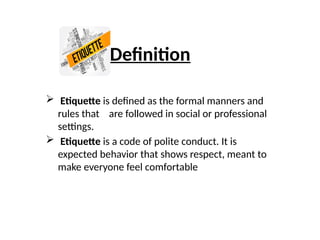
 Etiquette is defined as the formal manners and
rules that are followed in social or professional
settings.
 Etiquette is a code of polite conduct. It is
expected behavior that shows respect, meant to
make everyone feel comfortable
Definition
Social Etiquette
Social etiquettes are used to interact politely
in social situations.
Business Etiquette
Business etiquette is a set of manners that is
accepted or required in a profession.
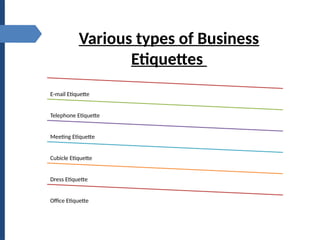
Various types of Business
Etiquettes
E-mail Etiquette
Telephone Etiquette
Meeting Etiquette
Cubicle Etiquette
Dress Etiquette
Office Etiquette
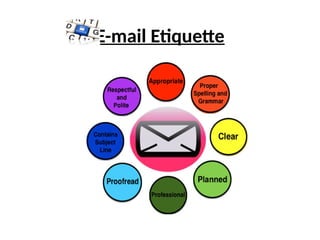
E-mail Etiquette
Telephone Etiquette
 Always introduce yourself at
the beginning of all calls
 Speak clearly and slowly
 Be sensitive to your tone of
voice
 Avoid interruptions
Meeting Etiquette
• Be on time
• Prepare well for the
meeting
• Do not use your mobile
phone
• Be brief and relevant
• Never interrupt anyone
Cubicle Etiquette
• Knock before entering someone else’s
cubicle
• Choose your food wisely
• Do not use speaker phones
• Keep your hand off others desk and
computers
• Never interrupt your colleagues
without permission
• Do not loiter
Dress Etiquette
• Wear professional clothes
• Neat and well-ironed
• Simple yet elegant
• Never wear strong deo,
perfumes
• Wear light make-up
Office Etiquette
Be punctual
Be a good team player
Avoid using slangs and
vulgar language in the
office
Treat all co-workers with
respect and courtesy
Social Etiquettes
• Social etiquettes is important for an
individual as it teaches him how to behave
in society.
• It will allow you to put best foot forward in
dealing with day-to-day social demands.
• It has two categories:
Personal etiquettes
Family etiquettes
Social Etiquettes- Personal
Etiquettes
• Personal Hygiene - Self cleaning is Personal Hygiene like
cleaning hands nails, tooth. Wearing clean and pressed cloths
and shoes.
• Dress code – Wearing different cloths at different situations.
Formal – At office and meetings etc.
Informal – At party and picnic etc.
• Postures – posture is our body language like how we sit and
stand in front of others, and how we talk to different peoples.
• Mind and soul – Our thinking and believes.
Thoughts – It refers to what one think about something.
Attitude – The way that one think, feel or behave.
Social Etiquettes - Family
Etiquettes
• It is all about doing the right things at
home.
• Proper family etiquette always starts
with the parents and how healthy
their relationship is.
• Keep our home and room clean.
• Respect the privacy of the other
members of your family.
Social Etiquettes - Family Etiquettes
• Empathy – It is wide range of experiences.
• Sympathy – It is feeling bad for someone.
• Responsibility – taking some responsibility.
• Respect – Respect is accepting someone as
he/she is.
• Mutuality- sharing of sentiments.
DIFFERENCE BETWEEN SOCIAL AND
BUSINESS ETIQUETTE
Introducing in Social and Business
Etiquette
• In a social situation, introduce the person you
wish to honor first, such as when you
introduce a friend to your family members or
an adult to a child.
• If you are introducing your boss or another
higher-level executive to someone of lower
rank, always name your boss first. In the
formal business environment, always
introduce someone using first and last names.
Technical Difference Between Social and
Business Etiquette
• When using technology, the rules for business
and social etiquette are vastly different. When
you are using email and cell phones for
personal reasons, you can be as informal as we
wish.
• when using your work email, and avoid sending
jokes or personal notes to work colleagues.
Turn off or silence your cell phones while you
are in the office or at a business meeting.
Meals
• In a social situation, you may order whatever you
like, but during a business meal, avoid foods that
are messy or need to be eaten with your hands.
• While conducting business during lunch, it is
acceptable to place documents or a small tablet
computer on the table, but never place your
briefcase or purse on the table, those items
should always be placed on the floor near your
seat.
IMPORTANCE OF SOCIAL ETIQUETTE
• Good behavior and manners are never
out of style.
• Without etiquette, members of society
would show far too much impatience
and disrespect for one another.
• The first impression count.
• Good social etiquettes make good and
strong friends.
IMPORTANCE OF SOCIAL ETIQUETTE
• Boost confidence and self-esteem.
• Develop strong social skills and
relationships.
• To know how to greet other person.
• Good etiquettes increase happiness.
IMPORTANCE OF BUSINESS
ETIQUETTE
• Business etiquette helps foster better
communication within office and externally.
• Business etiquette helps develop standard business
practices at all levels of your corporate rank.
• The key component of sales, after-sales service,
loyalty building, trouble-shooting and marketing
rely solely upon business etiquette. Products or
services offered by a company are secondary over
business etiquette.
IMPORTANCE OF BUSINESS
ETIQUETTE
• Excellent business etiquette boosts
staff confidence and creates healthy
working ambience.
• Companies with great business
etiquette are less prone to lawsuits
and adverse publicity.
• Helps better understanding of
foreign trade partners, associates
and customers.
THANK YOU

SOCIAL ETIQUETTES - INDIVIDUAL PERSPECTIVE

  • 1.
    SOCIAL ETIQUETTES Dr DINESHS Assistant Professor Management Sciences Sri Ramakrishna College of Arts & Science (Autonomous) Coimbatore - 641 006 Tamil Nadu, India
  • 2.
    Definition  Etiquette isdefined as the formal manners and rules that are followed in social or professional settings.  Etiquette is a code of polite conduct. It is expected behavior that shows respect, meant to make everyone feel comfortable
  • 3.
    Definition Social Etiquette Social etiquettesare used to interact politely in social situations. Business Etiquette Business etiquette is a set of manners that is accepted or required in a profession.
  • 4.
    Various types ofBusiness Etiquettes E-mail Etiquette Telephone Etiquette Meeting Etiquette Cubicle Etiquette Dress Etiquette Office Etiquette
  • 5.
  • 6.
    Telephone Etiquette  Alwaysintroduce yourself at the beginning of all calls  Speak clearly and slowly  Be sensitive to your tone of voice  Avoid interruptions
  • 7.
    Meeting Etiquette • Beon time • Prepare well for the meeting • Do not use your mobile phone • Be brief and relevant • Never interrupt anyone
  • 8.
    Cubicle Etiquette • Knockbefore entering someone else’s cubicle • Choose your food wisely • Do not use speaker phones • Keep your hand off others desk and computers • Never interrupt your colleagues without permission • Do not loiter
  • 9.
    Dress Etiquette • Wearprofessional clothes • Neat and well-ironed • Simple yet elegant • Never wear strong deo, perfumes • Wear light make-up
  • 10.
    Office Etiquette Be punctual Bea good team player Avoid using slangs and vulgar language in the office Treat all co-workers with respect and courtesy
  • 11.
    Social Etiquettes • Socialetiquettes is important for an individual as it teaches him how to behave in society. • It will allow you to put best foot forward in dealing with day-to-day social demands. • It has two categories: Personal etiquettes Family etiquettes
  • 12.
    Social Etiquettes- Personal Etiquettes •Personal Hygiene - Self cleaning is Personal Hygiene like cleaning hands nails, tooth. Wearing clean and pressed cloths and shoes. • Dress code – Wearing different cloths at different situations. Formal – At office and meetings etc. Informal – At party and picnic etc. • Postures – posture is our body language like how we sit and stand in front of others, and how we talk to different peoples. • Mind and soul – Our thinking and believes. Thoughts – It refers to what one think about something. Attitude – The way that one think, feel or behave.
  • 13.
    Social Etiquettes -Family Etiquettes • It is all about doing the right things at home. • Proper family etiquette always starts with the parents and how healthy their relationship is. • Keep our home and room clean. • Respect the privacy of the other members of your family.
  • 14.
    Social Etiquettes -Family Etiquettes • Empathy – It is wide range of experiences. • Sympathy – It is feeling bad for someone. • Responsibility – taking some responsibility. • Respect – Respect is accepting someone as he/she is. • Mutuality- sharing of sentiments.
  • 15.
    DIFFERENCE BETWEEN SOCIALAND BUSINESS ETIQUETTE
  • 16.
    Introducing in Socialand Business Etiquette • In a social situation, introduce the person you wish to honor first, such as when you introduce a friend to your family members or an adult to a child. • If you are introducing your boss or another higher-level executive to someone of lower rank, always name your boss first. In the formal business environment, always introduce someone using first and last names.
  • 17.
    Technical Difference BetweenSocial and Business Etiquette • When using technology, the rules for business and social etiquette are vastly different. When you are using email and cell phones for personal reasons, you can be as informal as we wish. • when using your work email, and avoid sending jokes or personal notes to work colleagues. Turn off or silence your cell phones while you are in the office or at a business meeting.
  • 18.
    Meals • In asocial situation, you may order whatever you like, but during a business meal, avoid foods that are messy or need to be eaten with your hands. • While conducting business during lunch, it is acceptable to place documents or a small tablet computer on the table, but never place your briefcase or purse on the table, those items should always be placed on the floor near your seat.
  • 19.
    IMPORTANCE OF SOCIALETIQUETTE • Good behavior and manners are never out of style. • Without etiquette, members of society would show far too much impatience and disrespect for one another. • The first impression count. • Good social etiquettes make good and strong friends.
  • 20.
    IMPORTANCE OF SOCIALETIQUETTE • Boost confidence and self-esteem. • Develop strong social skills and relationships. • To know how to greet other person. • Good etiquettes increase happiness.
  • 21.
    IMPORTANCE OF BUSINESS ETIQUETTE •Business etiquette helps foster better communication within office and externally. • Business etiquette helps develop standard business practices at all levels of your corporate rank. • The key component of sales, after-sales service, loyalty building, trouble-shooting and marketing rely solely upon business etiquette. Products or services offered by a company are secondary over business etiquette.
  • 22.
    IMPORTANCE OF BUSINESS ETIQUETTE •Excellent business etiquette boosts staff confidence and creates healthy working ambience. • Companies with great business etiquette are less prone to lawsuits and adverse publicity. • Helps better understanding of foreign trade partners, associates and customers.
  • 23.