ETHICS IN ORGANIZATION- AN
OVERVIEW
Dr DINESH S
Assistant Professor
Management Sciences
Sri Ramakrishna College of Arts & Science
(Autonomous)
Coimbatore - 641 006
Tamil Nadu, India
What are Ethics?
Ethics: To know right from wrong and to know when you’re practicing one instead of the
other
Acting ethically in business means more than simply obeying applicable laws and
regulations: It also means being:
● Honest
● Doing no harm to others
● Competing fairly
● Declining to put your own interests above those of your company, its owners, and its
workers
If you're in business, you obviously need a strong sense of what's right and
wrong
Ethical Issues and Dilemmas
● Ethical issues are the difficult social questions that involve some level of
controversy over what is the right thing to do. Environmental protection is an
example of a commonly discussed ethical issue, because there can be tradeoffs
between environmental and economic factors.
● Ethical dilemmas are situations in which it is difficult for an individual to make
decisions either because the right course of action is unclear or carries some
potential negative consequences for the person or people involved
Conflict of Interest
Individuals must choose between taking actions that promote their
personal interests over the interests of others or taking actions that don’t.
Examples:
● Can I buy office supplies from my brother-in-law?
● My uncle owns a bakery, should I encourage my subordinates to use
them for all meetings?
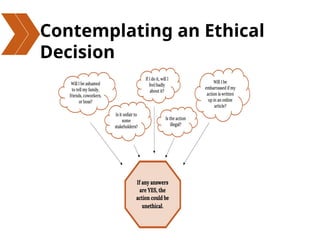
Contemplating an Ethical
Decision
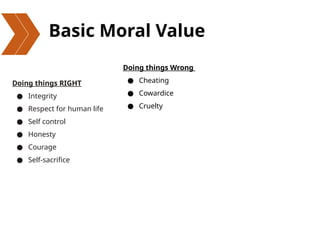
Basic Moral Value
Doing things RIGHT
● Integrity
● Respect for human life
● Self control
● Honesty
● Courage
● Self-sacrifice
Doing things Wrong
● Cheating
● Cowardice
● Cruelty
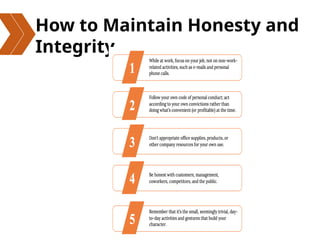
How to Maintain Honesty and
Integrity
Facing Ethical Dilemmas
● How do I know if an action is unethical?
● There's an app for that!
● The Golden Rule Test
● What if others find out, it becomes public?
● Do the right thing, even if no one is looking
Facing Ethical Dilemmas
How, for example, would you answer questions like the following?
1) Is it OK to accept a pair of sports tickets from a supplier?
2) Can I buy office supplies from my brother-in-law?
3) Is it appropriate to donate company funds to a local charity?
4) If I find out that a friend is about to be fired, can I warn her?
Refuse to Rationalize
There are four common rationalizations (excuses) for justifying misconduct:
1. My behavior isn’t really illegal or immoral. Rationalizers try to convince
themselves that an action is OK if it isn’t downright illegal or blatantly
immoral. They tend to operate in a gray area where there’s no clear evidence
that the action is wrong.
2. My action is in everyone’s best interests. Some rationalizers tell
themselves: “I know I lied to make the deal, but it’ll bring in a lot of business
and pay a lot of bills.” They convince themselves that they’re expected to act
in a certain way.
3. No one will find out what I’ve done. Here, the self-questioning comes
down to “If I didn’t get caught, did I really do it?” The answer is yes. There’s a
simple way to avoid succumbing to this rationalization: Always act as if you’re
being watched.
4. The company will condone my action and protect me. This justification
rests on a fallacy. Betty Vinson may honestly have believed that her actions
were for the good of the company and that her boss would, therefore, accept
full responsibility (as he promised). When she goes to jail, however she’ll go
on her own
How to Improve Business
Ethics
1. Top management must adopt and unconditionally support an explicit corporate
code of conduct.
2. Employees must understand that senior management expects all employees to
act ethically
3. Managers and others must be trained to consider the ethical implications of all
business decisions
How to Improve Business
Ethics
4. An ethics office and/or forum must be set up with which employees can
communicate anonymously. Whistleblowers --People who report illegal or
unethical behavior.
5.Involve outsiders (other Stakeholders) such as suppliers, subcontractors,
distributors and customers.
6.The ethics code must be enforced
Global Business Ethics
● Much more gray
● More open for abuse
● Know the customs
● Companies can have great positive influence
● Train and role play
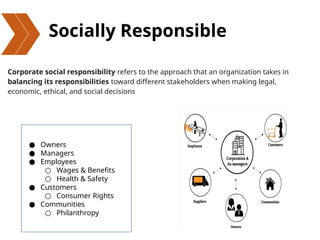
Socially Responsible
Corporate social responsibility refers to the approach that an organization takes in
balancing its responsibilities toward different stakeholders when making legal,
economic, ethical, and social decisions
● Owners
● Managers
● Employees
○ Wages & Benefits
○ Health & Safety
● Customers
○ Consumer Rights
● Communities
○ Philanthropy
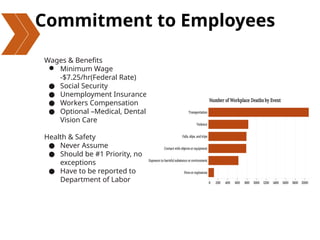
Commitment to Employees
Wages & Benefits
● Minimum Wage
-$7.25/hr(Federal Rate)
● Social Security
● Unemployment Insurance
● Workers Compensation
● Optional –Medical, Dental,
Vision Care
Health & Safety
● Never Assume
● Should be #1 Priority, no
exceptions
● Have to be reported to
Department of Labor
Consumer Rights- Kennedy
(1) The right to safe products. A company should sell no product that it suspects of
being unsafe for buyers. Thus, producers have an obligation to safety-test products
before releasing them for public consumption.
Ex. Automobile testing, Child Safety Products, UL® -Electrical Products
(2) The right to be informed about a product.Sellers should furnish consumers with
the product information that they need to make an informed purchase decision.
Ex. Pillows with tags, Clothing tags, Food labels
(3) The right to choose what to buy. Consumers have a right to decide which products
to purchase, and sellers should let them know what their options are.
Ex. Pharmacists, Telephone companies, Purchasing Car/Finance
(4) The right to be heard. Companies must tell customers how to contact them with
complaints or concerns. They should also listen and respond
Social Responsibility
Corporate Philanthropy– includes charitable donation
Corporate Social Initiatives– Includes enhanced forms of corporate
philanthropy
THANK YOU

ETHICS IN AN ORGANIZATION - AN OVERVIEWS

  • 1.
    ETHICS IN ORGANIZATION-AN OVERVIEW Dr DINESH S Assistant Professor Management Sciences Sri Ramakrishna College of Arts & Science (Autonomous) Coimbatore - 641 006 Tamil Nadu, India
  • 2.
    What are Ethics? Ethics:To know right from wrong and to know when you’re practicing one instead of the other Acting ethically in business means more than simply obeying applicable laws and regulations: It also means being: ● Honest ● Doing no harm to others ● Competing fairly ● Declining to put your own interests above those of your company, its owners, and its workers If you're in business, you obviously need a strong sense of what's right and wrong
  • 3.
    Ethical Issues andDilemmas ● Ethical issues are the difficult social questions that involve some level of controversy over what is the right thing to do. Environmental protection is an example of a commonly discussed ethical issue, because there can be tradeoffs between environmental and economic factors. ● Ethical dilemmas are situations in which it is difficult for an individual to make decisions either because the right course of action is unclear or carries some potential negative consequences for the person or people involved
  • 4.
    Conflict of Interest Individualsmust choose between taking actions that promote their personal interests over the interests of others or taking actions that don’t. Examples: ● Can I buy office supplies from my brother-in-law? ● My uncle owns a bakery, should I encourage my subordinates to use them for all meetings?
  • 5.
  • 6.
    Basic Moral Value Doingthings RIGHT ● Integrity ● Respect for human life ● Self control ● Honesty ● Courage ● Self-sacrifice Doing things Wrong ● Cheating ● Cowardice ● Cruelty
  • 7.
    How to MaintainHonesty and Integrity
  • 8.
    Facing Ethical Dilemmas ●How do I know if an action is unethical? ● There's an app for that! ● The Golden Rule Test ● What if others find out, it becomes public? ● Do the right thing, even if no one is looking
  • 9.
    Facing Ethical Dilemmas How,for example, would you answer questions like the following? 1) Is it OK to accept a pair of sports tickets from a supplier? 2) Can I buy office supplies from my brother-in-law? 3) Is it appropriate to donate company funds to a local charity? 4) If I find out that a friend is about to be fired, can I warn her?
  • 10.
    Refuse to Rationalize Thereare four common rationalizations (excuses) for justifying misconduct: 1. My behavior isn’t really illegal or immoral. Rationalizers try to convince themselves that an action is OK if it isn’t downright illegal or blatantly immoral. They tend to operate in a gray area where there’s no clear evidence that the action is wrong. 2. My action is in everyone’s best interests. Some rationalizers tell themselves: “I know I lied to make the deal, but it’ll bring in a lot of business and pay a lot of bills.” They convince themselves that they’re expected to act in a certain way. 3. No one will find out what I’ve done. Here, the self-questioning comes down to “If I didn’t get caught, did I really do it?” The answer is yes. There’s a simple way to avoid succumbing to this rationalization: Always act as if you’re being watched. 4. The company will condone my action and protect me. This justification rests on a fallacy. Betty Vinson may honestly have believed that her actions were for the good of the company and that her boss would, therefore, accept full responsibility (as he promised). When she goes to jail, however she’ll go on her own
  • 11.
    How to ImproveBusiness Ethics 1. Top management must adopt and unconditionally support an explicit corporate code of conduct. 2. Employees must understand that senior management expects all employees to act ethically 3. Managers and others must be trained to consider the ethical implications of all business decisions
  • 12.
    How to ImproveBusiness Ethics 4. An ethics office and/or forum must be set up with which employees can communicate anonymously. Whistleblowers --People who report illegal or unethical behavior. 5.Involve outsiders (other Stakeholders) such as suppliers, subcontractors, distributors and customers. 6.The ethics code must be enforced
  • 13.
    Global Business Ethics ●Much more gray ● More open for abuse ● Know the customs ● Companies can have great positive influence ● Train and role play
  • 14.
    Socially Responsible Corporate socialresponsibility refers to the approach that an organization takes in balancing its responsibilities toward different stakeholders when making legal, economic, ethical, and social decisions ● Owners ● Managers ● Employees ○ Wages & Benefits ○ Health & Safety ● Customers ○ Consumer Rights ● Communities ○ Philanthropy
  • 15.
    Commitment to Employees Wages& Benefits ● Minimum Wage -$7.25/hr(Federal Rate) ● Social Security ● Unemployment Insurance ● Workers Compensation ● Optional –Medical, Dental, Vision Care Health & Safety ● Never Assume ● Should be #1 Priority, no exceptions ● Have to be reported to Department of Labor
  • 16.
    Consumer Rights- Kennedy (1)The right to safe products. A company should sell no product that it suspects of being unsafe for buyers. Thus, producers have an obligation to safety-test products before releasing them for public consumption. Ex. Automobile testing, Child Safety Products, UL® -Electrical Products (2) The right to be informed about a product.Sellers should furnish consumers with the product information that they need to make an informed purchase decision. Ex. Pillows with tags, Clothing tags, Food labels (3) The right to choose what to buy. Consumers have a right to decide which products to purchase, and sellers should let them know what their options are. Ex. Pharmacists, Telephone companies, Purchasing Car/Finance (4) The right to be heard. Companies must tell customers how to contact them with complaints or concerns. They should also listen and respond
  • 17.
    Social Responsibility Corporate Philanthropy–includes charitable donation Corporate Social Initiatives– Includes enhanced forms of corporate philanthropy
  • 18.