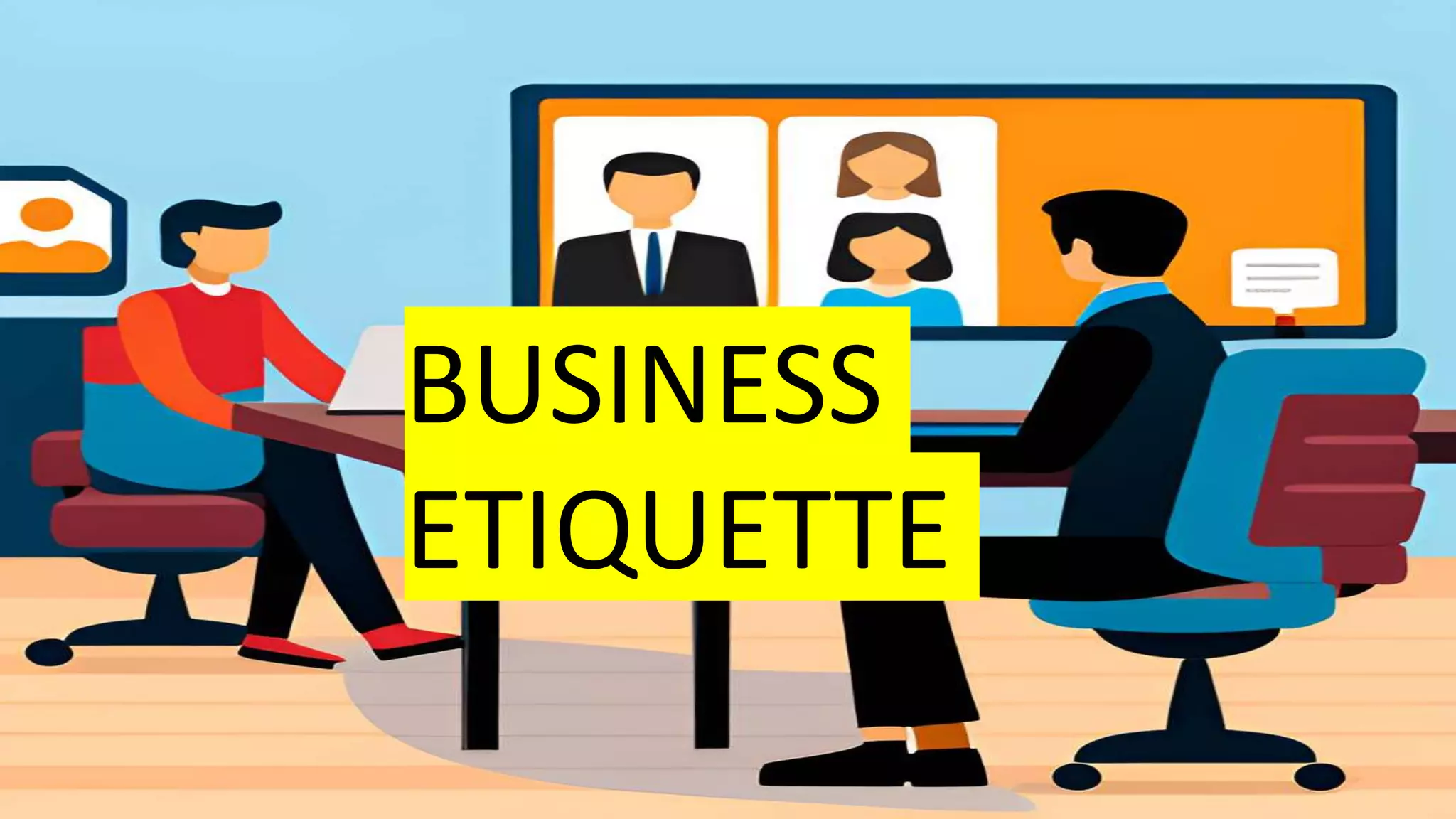
BUSINESS
ETIQUETTE
What is Etiquette?
Etiquette is a code of behavior that delineates
expectations for social behavior according to
contemporary conventional norms within a society,
social class, or group.
Some of the common etiquettes are –
Social Etiquette
Corporate Etiquette
Interview Etiquette
Business Etiquette
Impact Of Etiquettes In Today’s
Life
Etiquette provides personal security. Knowing how to
behave appropriately in a given situation
makes you more comfortable.
It protects the feelings of others. Proper etiquette
requires that you make others comfortable and
protect their feelings. You do not point out their errors or
draw attention to their mistakes.
It makes communication clearer. Etiquette enhances
communication by breaking down barriers, not
erecting them.
It will enhance your status at work. In any working
situation, you are perceived as more capable,
more professional, and more intelligent if you are
familiar with the proper code of conduct for the
workplace.
It makes good first impressions. The first five to
seven seconds after you meet someone are crucial.
Your first impression lingers in the other person's
mind long after you are gone. If you use proper
etiquette, that first impression will be a positive one.
Business Etiquettes
Business etiquette is an expected behaviors and
expectations for individual actions within
society, group, or class.
Within a place of business, it involves treating
co-workers and employer with respect and
courtesy in a way that creates a pleasant work
environment for everyone
Importance of Business
Etiquettes
Builds Strong Relationships
Promotes Positive Atmosphere
Reflects Confidence
Prevents Misunderstandings
Etiquette Basics
• Technical and job-related skills are a must, but
they are NOT sufficient when it comes to
progressing up the ladder.
• With the traditional paternalistic style of
leadership becoming passé, professional
managers expect their teams to be proactive
and communicate openly.
• "Soft skills are very important in business. It is
essential to be technically sound, but one should
also have the ability to convey the idea to the
masses in the simplest possible manner.
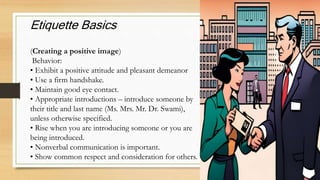
Etiquette Basics
(Creating a positive image)
Behavior:
• Exhibit a positive attitude and pleasant demeanor
• Use a firm handshake.
• Maintain good eye contact.
• Appropriate introductions – introduce someone by
their title and last name (Ms. Mrs. Mr. Dr. Swami),
unless otherwise specified.
• Rise when you are introducing someone or you are
being introduced.
• Nonverbal communication is important.
• Show common respect and consideration for others.
Professional Appearance
• Grooming is fundamental.
• Hair clean and styled appropriately.
• Clean nails, skin and teeth.
• Many professionals wear make-up
(depends on field).
• Check fragrance and clothing care.
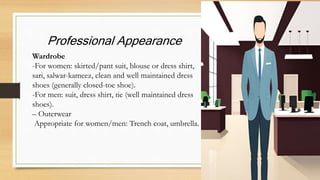
Professional Appearance
Wardrobe
-For women: skirted/pant suit, blouse or dress shirt,
sari, salwar-kameez, clean and well maintained dress
shoes (generally closed-toe shoe).
-For men: suit, dress shirt, tie (well maintained dress
shoes).
– Outerwear
Appropriate for women/men: Trench coat, umbrella.
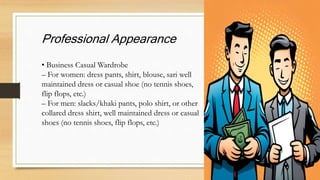
Professional Appearance
• Business Casual Wardrobe
– For women: dress pants, shirt, blouse, sari well
maintained dress or casual shoe (no tennis shoes,
flip flops, etc.)
– For men: slacks/khaki pants, polo shirt, or other
collared dress shirt, well maintained dress or casual
shoes (no tennis shoes, flip flops, etc.)
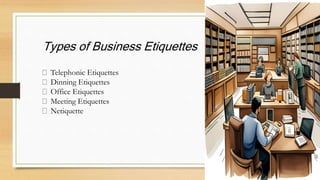
Types of Business Etiquettes
Telephonic Etiquettes
Dinning Etiquettes
Office Etiquettes
Meeting Etiquettes
Netiquette
Telephonic Etiquettes
Telephonic Etiquette refers to the principles of behavior
that one should use while having a business telephonic
calls. Some of the rules which should be followed while
chatting with colleagues on telephone are :
Identify yourself when making a call.
Address the caller by his name in a courteous manner.
Keep conversation brief.
Never be impatient.
Listen carefully.
Do not interrupt.
Do not eat or chew something while speaking on phone.
If you wish to put the caller on hold, request
his permission to do so.
Close your conversation with an appropriate
salutation.
Let the caller hang up first .
In case of missed calls, return the call within a
reasonable period of time.
If someone calls you by mistake, inform the
caller politely that he reached a wrong number.
Telephonic Etiquettes
Managing Angry Callers :
Listen his problem or complaint carefully.
Do not interrupt him, let him finish the whole thing
first.
Do not say, “you are wrong”.
Empathize with him.
You should be good in your area of work and
investigate about his complaint or problem
and solve it.
Tell him the process of solving the problem.
Do not mislead.
Call him back when you have the solution, this
feedback is important.
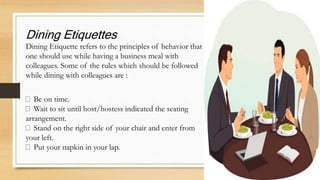
Dining Etiquettes
Dining Etiquette refers to the principles of behavior that
one should use while having a business meal with
colleagues. Some of the rules which should be followed
while dining with colleagues are :
Be on time.
Wait to sit until host/hostess indicated the seating
arrangement.
Stand on the right side of your chair and enter from
your left.
Put your napkin in your lap.
Decide on your menu selections quickly.
Never order the most expensive item.
Wait for all people to be served before
beginning.
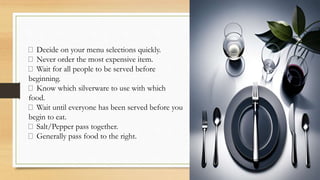
Know which silverware to use with which
food.
Wait until everyone has been served before you
begin to eat.
Salt/Pepper pass together.
Generally pass food to the right.
Show a healthy respect for colleagues
experience and expertise.
Leave your personal life at the front door.
Inquire about the proper way to respond to co-
workers, supervisors, clients
(Business letter head, phone call etc.)
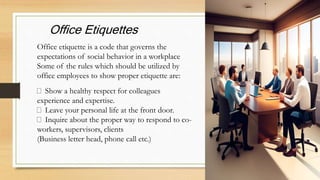
Office etiquette is a code that governs the
expectations of social behavior in a workplace
Some of the rules which should be utilized by
office employees to show proper etiquette are:
Office Etiquettes
Be timely. Arrive to work and meetings on time. Complete
work assignments on time.
Make your supervisor look good. Promotion and
opportunities will arise when you help to reach the
organization's goals.
Never go over the head supervisors, without telling
him/her first.
Appear as professional as possible. Being well groomed and
clean is essential.
Dress for your next job/promotion.
Adopt a can-do attitude. Those who accept challenges and
display creativity are valuable.
Be flexible. By remaining flexible and implementing change
you gain a reputation as a cooperative employee.
Meeting Etiquettes
Meeting Etiquette refers to the principles of behavior that
one should use while having a business meeting. Some
of the rules which should be followed while attending a
business meeting are :
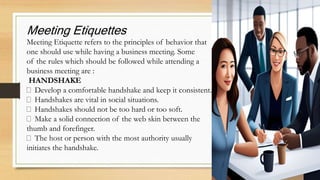
HANDSHAKE
Develop a comfortable handshake and keep it consistent.
Handshakes are vital in social situations.
Handshakes should not be too hard or too soft.
Make a solid connection of the web skin between the
thumb and forefinger.
The host or person with the most authority usually
initiates the handshake.
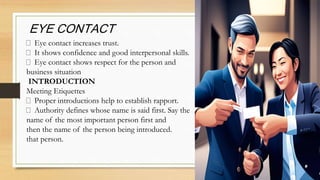
Eye contact increases trust.
It shows confidence and good interpersonal skills.
Eye contact shows respect for the person and
business situation
INTRODUCTION
Meeting Etiquettes
Proper introductions help to establish rapport.
Authority defines whose name is said first. Say the
name of the most important person first and
then the name of the person being introduced.
that person.
EYE CONTACT
Netiquettes
Netiquette is the correct or acceptable way of
using the internet. Main netiquettes that should
be followed in an organisation are :
Email Etiquette
Chatting Etiquette
E-mail Etiquettes
Email Etiquette refers to the principles
of behavior that one should use when
writing or answering email messages.
Some of the rules which should be
followed while writing a good business
emails are :
Be concise and to the point.
Use proper spelling, grammar &
punctuation.
Make it personal. Avoid using Bcc and Cc
unnecessarily.
Use templates for frequently used responses.
Answer swiftly.
Use a meaningful subject.
Read the email before you send it.
Keep attachments to a Minimum and mention
your attachment in the content.
Take care with abbreviations and emotions.
Take care with rich text and HTML messages.
Use active voice instead of passive voice.
Chatting Etiquettes
Chatting Etiquette refers to the principles of behavior
that one should use while having an online chatting
with colleagues, clients or boss. Some of the rules
which should be followed while chatting online are :
Create an identity.
Availability status feature.
Think before you hit enter.
Be polite.
Addressing.
Font, Text, Color and Animation.
Language and tone.
Listen and pay attention.
Don't rush it.
Conclusion
A good business etiquette allows a business to put its best
foot forward and can protect business owners and
employees from internal and external conflicts by setting a
high standard for behavior by all.
Business etiquette is a set of standards for behavior in
which individuals treat everyone respectfully and display
good manners in all interactions.
Good business etiquette is the recipe for advancing your
career.
Those who exemplify good business etiquette are proving
that they respect their position, job, co-workers and take
their performance seriously.

Presentation.pptx

  • 1.
  • 2.
    What is Etiquette? Etiquetteis a code of behavior that delineates expectations for social behavior according to contemporary conventional norms within a society, social class, or group. Some of the common etiquettes are – Social Etiquette Corporate Etiquette Interview Etiquette Business Etiquette
  • 3.
    Impact Of EtiquettesIn Today’s Life Etiquette provides personal security. Knowing how to behave appropriately in a given situation makes you more comfortable. It protects the feelings of others. Proper etiquette requires that you make others comfortable and protect their feelings. You do not point out their errors or draw attention to their mistakes. It makes communication clearer. Etiquette enhances communication by breaking down barriers, not erecting them.
  • 4.
    It will enhanceyour status at work. In any working situation, you are perceived as more capable, more professional, and more intelligent if you are familiar with the proper code of conduct for the workplace. It makes good first impressions. The first five to seven seconds after you meet someone are crucial. Your first impression lingers in the other person's mind long after you are gone. If you use proper etiquette, that first impression will be a positive one.
  • 5.
    Business Etiquettes Business etiquetteis an expected behaviors and expectations for individual actions within society, group, or class. Within a place of business, it involves treating co-workers and employer with respect and courtesy in a way that creates a pleasant work environment for everyone
  • 6.
    Importance of Business Etiquettes BuildsStrong Relationships Promotes Positive Atmosphere Reflects Confidence Prevents Misunderstandings
  • 7.
    Etiquette Basics • Technicaland job-related skills are a must, but they are NOT sufficient when it comes to progressing up the ladder. • With the traditional paternalistic style of leadership becoming passé, professional managers expect their teams to be proactive and communicate openly. • "Soft skills are very important in business. It is essential to be technically sound, but one should also have the ability to convey the idea to the masses in the simplest possible manner.
  • 8.
    Etiquette Basics (Creating apositive image) Behavior: • Exhibit a positive attitude and pleasant demeanor • Use a firm handshake. • Maintain good eye contact. • Appropriate introductions – introduce someone by their title and last name (Ms. Mrs. Mr. Dr. Swami), unless otherwise specified. • Rise when you are introducing someone or you are being introduced. • Nonverbal communication is important. • Show common respect and consideration for others.
  • 9.
    Professional Appearance • Groomingis fundamental. • Hair clean and styled appropriately. • Clean nails, skin and teeth. • Many professionals wear make-up (depends on field). • Check fragrance and clothing care.
  • 10.
    Professional Appearance Wardrobe -For women:skirted/pant suit, blouse or dress shirt, sari, salwar-kameez, clean and well maintained dress shoes (generally closed-toe shoe). -For men: suit, dress shirt, tie (well maintained dress shoes). – Outerwear Appropriate for women/men: Trench coat, umbrella.
  • 11.
    Professional Appearance • BusinessCasual Wardrobe – For women: dress pants, shirt, blouse, sari well maintained dress or casual shoe (no tennis shoes, flip flops, etc.) – For men: slacks/khaki pants, polo shirt, or other collared dress shirt, well maintained dress or casual shoes (no tennis shoes, flip flops, etc.)
  • 12.
    Types of BusinessEtiquettes Telephonic Etiquettes Dinning Etiquettes Office Etiquettes Meeting Etiquettes Netiquette
  • 13.
    Telephonic Etiquettes Telephonic Etiquetterefers to the principles of behavior that one should use while having a business telephonic calls. Some of the rules which should be followed while chatting with colleagues on telephone are : Identify yourself when making a call. Address the caller by his name in a courteous manner. Keep conversation brief. Never be impatient. Listen carefully. Do not interrupt. Do not eat or chew something while speaking on phone.
  • 14.
    If you wishto put the caller on hold, request his permission to do so. Close your conversation with an appropriate salutation. Let the caller hang up first . In case of missed calls, return the call within a reasonable period of time. If someone calls you by mistake, inform the caller politely that he reached a wrong number.
  • 15.
    Telephonic Etiquettes Managing AngryCallers : Listen his problem or complaint carefully. Do not interrupt him, let him finish the whole thing first. Do not say, “you are wrong”. Empathize with him. You should be good in your area of work and investigate about his complaint or problem and solve it. Tell him the process of solving the problem. Do not mislead. Call him back when you have the solution, this feedback is important.
  • 16.
    Dining Etiquettes Dining Etiquetterefers to the principles of behavior that one should use while having a business meal with colleagues. Some of the rules which should be followed while dining with colleagues are : Be on time. Wait to sit until host/hostess indicated the seating arrangement. Stand on the right side of your chair and enter from your left. Put your napkin in your lap.
  • 17.
    Decide on yourmenu selections quickly. Never order the most expensive item. Wait for all people to be served before beginning. Know which silverware to use with which food. Wait until everyone has been served before you begin to eat. Salt/Pepper pass together. Generally pass food to the right.
  • 18.
    Show a healthyrespect for colleagues experience and expertise. Leave your personal life at the front door. Inquire about the proper way to respond to co- workers, supervisors, clients (Business letter head, phone call etc.) Office etiquette is a code that governs the expectations of social behavior in a workplace Some of the rules which should be utilized by office employees to show proper etiquette are: Office Etiquettes
  • 19.
    Be timely. Arriveto work and meetings on time. Complete work assignments on time. Make your supervisor look good. Promotion and opportunities will arise when you help to reach the organization's goals. Never go over the head supervisors, without telling him/her first. Appear as professional as possible. Being well groomed and clean is essential. Dress for your next job/promotion. Adopt a can-do attitude. Those who accept challenges and display creativity are valuable. Be flexible. By remaining flexible and implementing change you gain a reputation as a cooperative employee.
  • 20.
    Meeting Etiquettes Meeting Etiquetterefers to the principles of behavior that one should use while having a business meeting. Some of the rules which should be followed while attending a business meeting are : HANDSHAKE Develop a comfortable handshake and keep it consistent. Handshakes are vital in social situations. Handshakes should not be too hard or too soft. Make a solid connection of the web skin between the thumb and forefinger. The host or person with the most authority usually initiates the handshake.
  • 21.
    Eye contact increasestrust. It shows confidence and good interpersonal skills. Eye contact shows respect for the person and business situation INTRODUCTION Meeting Etiquettes Proper introductions help to establish rapport. Authority defines whose name is said first. Say the name of the most important person first and then the name of the person being introduced. that person. EYE CONTACT
  • 22.
    Netiquettes Netiquette is thecorrect or acceptable way of using the internet. Main netiquettes that should be followed in an organisation are : Email Etiquette Chatting Etiquette
  • 23.
    E-mail Etiquettes Email Etiquetterefers to the principles of behavior that one should use when writing or answering email messages. Some of the rules which should be followed while writing a good business emails are : Be concise and to the point. Use proper spelling, grammar & punctuation. Make it personal. Avoid using Bcc and Cc unnecessarily.
  • 24.
    Use templates forfrequently used responses. Answer swiftly. Use a meaningful subject. Read the email before you send it. Keep attachments to a Minimum and mention your attachment in the content. Take care with abbreviations and emotions. Take care with rich text and HTML messages. Use active voice instead of passive voice.
  • 25.
    Chatting Etiquettes Chatting Etiquetterefers to the principles of behavior that one should use while having an online chatting with colleagues, clients or boss. Some of the rules which should be followed while chatting online are : Create an identity. Availability status feature. Think before you hit enter. Be polite. Addressing. Font, Text, Color and Animation. Language and tone. Listen and pay attention. Don't rush it.
  • 26.
    Conclusion A good businessetiquette allows a business to put its best foot forward and can protect business owners and employees from internal and external conflicts by setting a high standard for behavior by all. Business etiquette is a set of standards for behavior in which individuals treat everyone respectfully and display good manners in all interactions. Good business etiquette is the recipe for advancing your career. Those who exemplify good business etiquette are proving that they respect their position, job, co-workers and take their performance seriously.