SOCIAL
ENTERPRISE
LANDSCAPE
IN PAKISTAN
www.britishcouncil.org
SUSTAINABLE DEVELOPMENT
POLICY INSTITUTE
EXECUTIVE SUMMARY
Social enterprises (SEs) in Pakistan have evolved out of societal imperatives, based on the unmet demands
of the local communities. The SE ecosystem is in its nascent stages despite the rapid expansion and growth
in recent years. This sector, among other opportunities, presents an avenue to fill the gaps in public service
delivery and the services provided by the private sector which are often unaffordable for vulnerable and
marginalised communities. SEsoffer viable models of service delivery, having the potential to help
developing countries towards achievement of sustainable development goals (SDGs).
/britishcouncil.pakistan @pkbritish
SOCIAL
ENTERPRISE
LANDSCAPE
IN PAKISTAN
www.britishcouncil.pk
SUSTAINABLE DEVELOPMENT
POLICY INSTITUTE
EXECUTIVE SUMMARY
This study attempts to provide a broad understanding of the emerging SE sector in Pakistan, alongside the
policy and regulatory environment. It has been informed by interviews, focus group discussions and an
extensive literature review of international and national research studies. It reviews the context in which
SEs have evolved in Pakistan, their ways of addressing different economic, social and environmental needs,
the key barriers and enablers to SE development, and explores opportunities on how various stakeholders
might effectively engage and develop the regulatory and policy framework for SEs in Pakistan.
/britishcouncil.pakistan @pkbritish
Acknowledgements
This study was conducted by the Sustainable Development Policy Institute (SDPI), a non-profit, policy
research institute and the oldest civil society think tank in Pakistan. SDPI generates and shares
expertise in sustainable development to enhance the capacity of government, local communities and
the private sector to make informed decisions and to engage civil society on issues of public interest.
We would like to acknowledge the support of the British Council, Pakistan with this research.
Furthermore, data and technical inputs were provided by the following organisations:
• Pakistan Ministry of Planning, Development and Reforms
• Pakistan Ministry of Finance
• Pakistan Higher Education Commission
• Aga Khan Rural Support Programme
• Competition Commission of Pakistan
• Pakistan Federal Board of Revenue
• Pakistan Institute of Business Administration
• Pakistan Poverty Alleviation Fund
• Pakistan Small and Medium Enterprise Development Authority
The research team included Agha Yasir, Vaqar Ahmed, Shehryar Khan, Muhammad Adnan, Syed
Shujaat Ahmed, Asif Javed, Muhammad Awais Omer, Wasim Saleem, Irfan Qureshi, Fazal Hussain
Bukhari, Azizullah Khan Kakar, and Danish Hassan. For further detail or feedback, please contact
vaqar@sdpi.org.
ACKNOWLEDGEMENTS
LIST OF
FIGURES AND
TABLES
SDPI - Social Enterprise Landscape in Pakistan Table of Contents
List of facts and figures
Figure 1
The Role of Social Enterprise in Society
Table 1
Overview of Pakistan’s Economic and
Social Structure
Table 2
Gaps in Pakistan’s Social Enterprise
Ecosystem
Table 3
National Policy Frameworks, Policies
and Programmes Relevant to SEs
Table 4
Statutory Laws and Regulatory Frameworks
relevant to SEs
Table 5
Laws/Guidelines for Social Enterprise
Registration
Table 6
Intellectual Property Laws Relevant
to Social Enterprises
16
15
23
27
30
32
CONTENTS
01 35
45
03
11
13
15
Acronyms
6.References.
Annexure A.............................................
ANNEX B...................................................
Executive Summary
Summary of Recommendations........
1. Introduction
2. Methodology
3. SE Landscape in Pakistan
Country Overview..................................
Defining Social Enterprises................
Understanding the Social
Enterprise Ecosystem..........................
Government.............................................
Challenges and barriers to
the development of Social
Enterprise sector...................................
26
5. Findings and Policy Recommendations
Building the Data and Evidence
Base...........................................................
Social Enterprise Policy......................
Capacity Building..................................
Access to Finance and Support
in Taxation Issues.................................
Access to Public Procurement........
Inter-provincial Coordination............
The Role of Competition
Commission of Pakistan.....................
The Role of Academia and HEC......
The Role of Private Sector................
The Role of Civil Society....................
The Role of Social Enterprises.........
4. Policy Environment for SEs
Statutory and Regulatory Laws........
Public Private Partnerships (PPP)...
05
15
16
16
17
23
30
33
37
37
38
39
39
40
41
43
43
43
43
51
52
31
SDPI - Social Enterprise Landscape in Pakistan Acronyms
01 02
A
AIM Agensi Inovasi Malaysia
AKRSP Aga Khan Rural Support
B
BC British Council
BIC Business Incubation Centre
C
CBO Community Based
Organisation
CCI Council of Common Interests
CCP Competition Commission of
Pakistan
CED Centre for Entrepreneurial
Development
CFI Conventional Financial
Institutions
CGAP Consultative Group to Assist
the Poor
CSO Community Service
Organisation
CSE Centre for Social
Entrepreneurship
CSR Corporate Social
Responsibility
E
ECC Economic Coordination
Committee
EELY Enhanced Employability and
Leadership for Youth
EIU Economic Intelligence Unit
F
FATA Federally Administered Tribal Areas
FBR Federal Board of Revenue
FIND Foundation for Innovative
New Diagnostics
FMCG Fast moving consumer
goods
FIT Fund for Innovative Training
G
GAIN Global Alliance for Improved
Nutrition
GAVI Global Alliance for Vaccines
and Immunisation
GDP Gross Domestic Product
GIZ Deutsche Gesellschaft für
Internationale Zusammenarbeit
GoP Government of Pakistan
GVEP Global Village Energy
Partnership
I
IBA Institute of Business Administration
ICT Information and Communications
Technology
INGO International Non Governmental
Organisation
IP Intellectual Property
IPO Intellectual Property Organisation
H
HEC Higher Education Commission
K
KP Khyber Pakhtunkhwa
KPIs Key Performance Indicators
L
LFN Locally Funded NGOs
LUMS Lahore University of Management
Sciences
M
MDGs Millennium Development
Goals
MFB Micro Finance Banks
MFI Microfinance Institution
MIT Massachusetts Institute of
Technology
MMV Medicines for Malaria
Venture
MSE Micro and Small Enterprises
MSME Micro, Small and Medium
Enterprises
O
ORIC Office of Research, Innovation
&Commercialization
N
NCHD National Commission for
Human Development
NGO Non-Governmental
Organisation
NOC No Objection Certificate
NPO Non-Profit Organisation
P
P&D Planning and Development
PC Planning Commission
PEP Promotion of Education in
Pakistan Foundation
PKR Pakistani Rupee
PMN Pakistan Microfinance Network
PPAF Pakistan Poverty Alleviation Fund
PPP Public Private Partnership
PPRA Public Procurement Regulatory
Authority
PRSP Poverty Reduction Strategy
Papers
PSPP Public Social Private Partnership
R
R&D Research & Development
RSP Rural Support Programme
S
SBIR Small Business Innovation Research
Programme
SDGs Social Development Goals
SDPI Sustainable Development Policy
Institute
SE Social Enterprise
SECP Securities and Exchange
Commission of Pakistan
SEED Sustainable Energy and Economic
Development
SEZ Special Economic Zone
U
UBL United Bank Limited
UK United Kingdom
UKAS Unit Kerjasama Awam Swasta
UNCTAD United Nations Conference on Trade
and Development
USAID United States Agency for International
Development
USD United States Dollar
V
VC Venture Capital
VSWA Voluntary Social Welfare Agencies
W
WBIC Women Business Incubation Centre
WTO World Trade Organisation
WB World Bank
Y
YES Youth Engagement Services Network
Pakistan
YSEA Youth Social Enterprise Award
T
TMR Trade Marks Registry
TRIPs Trade-Related Aspects of Intellectual
Property Rights
TVET Technical Vocational Education and
Training
SIL Social Innovation Lab
SIP Social Investment Package
SITR Social Investment Tax Relief
SME Small and Medium Enterprise
SMEDA Small and Medium Enterprise
Development Authority
SPO Social Purpose Organisation
SYC Show Your Creativity
ACRONYMSACRONYMS
SDPI - Social Enterprise Landscape in Pakistan Executive Summary
03 04
WE HAVE ALSO
HIGHLIGHTED
OTHER GAPS TO
BE FURTHER
EXPLORED BY
RELEVANT HIGHER
EDUCATION,
PLANNING, TRADE
AND BUSINESS
INSTITUTIONS TO
ESTABLISH A
SUPPORTIVE
ECOSYSTEM FOR
SES ACROSS
PAKISTAN.
The Bottom of the Pyramid (BOP) refers to the four billion world’s poorest people. Most social entrepreneurs believe that
BOP is an unserved market.
1
Neither is there a bespoke legal form specifically
for SEs in Pakistan. Today, SEs in Pakistan take on
a variety of legal forms, which in turn influence
their character and ability to achieve impact.
A consensus around our proposed
recommendations has emerged from consultative
sessions hosted by SDPI and the British Council.
Our set of recommendations includes
the need to recognise and identify the vibrant
and growing SE sector.
effort required to put SEs on policymakers’
radar and a targeted set of policies as part of
the annual federal and provincial budgets,
trade, industrial and investment policies.
building the research and evidence base
vis-à-vis the scale and scope of social
enterprises in Pakistan
capacity building for social enterprises in
terms of scalability, legal and statutory
compliance, financial management, and
human resource, for example
ensuring a fair taxation playing field for social
enterprises
measures to ensure improved access to
finance and access to public procurement
•
•
•
•
•
•
Social enterprises (SEs) in Pakistan have evolved
out of societal imperatives, based on the unmet
demands of the local communities. The country’s
SE ecosystem is in its nascent stages but with
rapid expansion and growth in recent years.
This sector, among other roles, offers the potential
to fill the gap between public services which do
not currently reach the entire population and
services provided by the private sector which
are often unaffordable for vulnerable and
marginalised communities. SEs can offer viable
models of service delivery, with the potential to
assist Pakistan towards the achievement of the
sustainable development goals (SDGs).
SEs can also offer economic empowerment,
innovation and access to new markets at the
bottom of the pyramid.
This study attempts to provide a broad
understanding of the emerging SE sector in
Pakistan, alongside the policy and regulatory
environment. It has been informed by interviews,
focus group discussions and an extensive
literature review of international and national
research studies. It reviews the context in which
SEs have evolved in Pakistan, their ways of
addressing different economic, social and
environmental needs, the key barriers and
enablers to SE development, and explores
opportunities on how various stakeholders might
effectively engage and develop the regulatory
and policy framework for SEs in Pakistan.
There is no specific policy directed at SEs in
Pakistan. However, there are policies from a
number of government bodies that are relevant to
SEs. Policies relating to NGOs, SMEs and small
scale industries for example, all potentially have
an impact on SEs.
EXECUTIVE
SUMMARY
1
SDPI - Social Enterprise Landscape in Pakistan
05 06
SUMMARY OF
RECOMMENDATIONS
RECOMMENDATIONS2
IDENTITY AND
RECOGNITION
The Centre for Social Entrepreneurship (CSE)
established by the Planning Commission
needs to formulate, through consensus, a
broad definition of SE that is easy to interpret
within the Pakistan context. This definition may
be communicated to SECP so that SE-specific
company rules can be framed.
•
SOCIAL
ENTERPRISE
POLICY
The CSE should develop a comprehensive and
cohesive SE policy strategy
The CSE should work with SECP to develop an
improvedlegal framework for SEs, giving them
a (legal) identity,
The CSE should work with various
policymakers at e.g. trade policy at Ministry of
Commerce, sectoral policies at Ministry of
Industries and Production, investment
framework at Board of Investment etc. and on
the country’s development agenda (Pakistan
Vision 2025).
CSE should work with provincial Planning
& Development Departments to embed
the inclusion of SEs in province-specific
growth strategies.
•
•
•
•
THE EVIDENCE BASE
The CSE should develop its research capacity
to regularly monitor, evaluate and provide
feedback on the performance of SEs, and to
improve data and the evidence base on SEs .
•
3
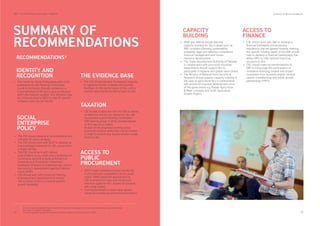
In all our recommendations there is an overarching advice to engage with civil society, private sector, local communities
etc. in the consultation processes.
In the UK, questions around the SE sector have been added to the annual survey of SMEs.
2
3
ACCESS TO
PUBLIC
PROCUREMENT
SECP’s legal framework should include SEs
in procurement competitions by the public
sector. PPRA should be approached by
CSE to amend the rules and introduce a
minimum quota for SEs, at least for projects
with social impact..
Community-benefit or social value clauses
should be included as performance conditions.
•
•
TAXATION
CSE should collaborate with the FBR to devise
an effective and fair tax regime for SEs. We
recommend a joint Planning Commission –
FBR working group in which representatives
of SEs may be co-opted.
As part of this proposed working group,
provincial revenue authorities may be invited
in order to resolve any double taxation issues
faced by SEs.
•
ACCESS TO
FINANCE
CSE should work with SBP to develop a
financial framework and prudential
regulations that are geared towards meeting
the specific funding needs of SEs.SBP should
help to develop a financial marketplace that
allows MFIs to offer tailored financing
solutions to SEs.
CSE should make recommendations to
SBP to encourage the participation of
innovative financing models and impact
investment from business angels, venture
capital, crowdfunding and public private
partnerships (PPPs).
•
•
CAPACITY
BUILDING
PPAF and SMEDA should lead the
capacity building for SEs in areas such as
R&D, business planning, sustainability,
scalability, legal and statutory compliance,
financial management and human
resource development
The Trade Development Authority of Pakistan
in collaboration with provincial industries
departments should support SEs to
participate in regional and global value chains
The Ministry of National Food Security &
Research should support capacity building in
the case of agricultural SEs in collaboration
with provincial business development arms
of the government e.g. Punjab Agriculture
& Meat Company and Sindh Agriculture
Growth Project.
•
•
•
Summary of Recommendations
We also make further recommendations with regard to the following stakeholders to promote the
development of SEs.
SDPI - Social Enterprise Landscape in Pakistan Recommendations
07 08
Summary of Recommendations
Planning
Commission’s CSE
STAKE HOLDERS RECOMMENDATIONS
In line with Vision 2025, establish a competitive R&D fund for innovative
products and services, particularly in start-up and early-stage SEs
Convene a working group between government, financial institutions and the
private sector that seek blended social and financial returns on investments.
The group’s recommendations should feed into the SBP prudential
regulations proposed for SEs suggested above.
Convene an inter-provincial co-ordination group for subsidised infrastructure
support (e.g. land, building and ICT services)
The inclusion of SEs in public sector procurement competitions and
customised training programmes through organizations such as SMEDA
and PPAF.
•
•
•
•
Work with the Planning Commission’s CSE and the SE community to provide
a set of company rules that group together various organisation models and
business structures under which SEs operate.
Directives to the FBR and provincial revenue authorities regarding the tax
registration of SEs.
Measures to rationalise costs and minimise time of registration for SEs.
•
•
•
Work with the Planning Commission’s CSE to introduce SE-specific tax laws
and incentives to help build and grow SEs. SEs contributing to capacity
building or export receipts should be allowed sales tax rebates similar to
the terms awarded to other mainstream export-oriented sectors.
CSE should form a tax working group comprising representatives from the
FBR and provincial authorities to reduce the tax related transaction and
compliance costs and remove any double taxation.
A one-time customs duty exemption on any plant and machinery import
by SEs.
The provincial revenue authorities should consider a reduction in general
sales tax on services provided by SEs.
•
•
•
•
SECP
FBR and provincial
revenue authorities
SBP Develop a financial framework including prudential regulations geared
towards meeting specific needs of SEs.
Work with the Planning Commission’s CSE to improve access to finance by
making microfinance laws more conducive for SEs.
Ensure a financial marketplace that allows MFIs to offer tailored financing
solutions to SEs. A minimum lending quota for SEs may be established.
Through appropriate amendment in banking regulations, encourage
mainstream financial institutions to participate in innovative financing models
and impact investing, including business angels, venture capital,
crowdfunding and PPPs
•
•
•
•
Competition
Commission of
Pakistan
STAKE HOLDERS RECOMMENDATIONS
Conduct a detailed regulatory impact assessment focusing on key barriers
that hinder the expansion of SEs, prevent them from exporting and stifle
product sophistication and diversification.
Regulation to remove unhealthy and anticompetitive behaviour that harms
producer and consumer welfare.
Give directions to relevant government institutions regarding harmonisation
of policy and regulatory regimes faced by SEs across the provinces.
•
•
•
Conduct a detailed study on how the export competitiveness of SEs can be
enhanced and on how SEs in other countries were enabled to grow and
become part of regional and global value chains
Develop and enhance market access for SEs, including their inclusion in
various trade-related facilitation measures and support services, such
as through the Strategic Trade Policy Framework, formulated by the Ministry
of Commerce.
Host foreign exhibitions showcasing products and services of SEs. The
Ministry of Commerce may access Export Development Fund to allow
subsidized rates to the interested SEs (for logistics and stall costs).
•
•
•
Create linkages between national and provincial youth programmes with SEs
to enhance employment potential of young people, particularly women.
Increase the size and number of grants for scalable SE initiatives that have
the potential to provide long term jobs.
Make detailed data of BISP beneficiaries open and available to SEs
and a pool for identifying innovative projects that can be funded to grow into
SEs themselves.
Identify areas where SEs can partner with BISP to offer solutions, such as
when introducing the Benazir Smart Card and Mobile Phone Banking.
•
•
•
•
Trade
Development
Authority of
Pakistan
Benazir Income
Support
Programme
Benazir Income
Support
Programme
British Council and
International
Partners
Provide support to the Planning Commission and provincial planning and
development departments to develop SE support systems
Provide support to social entrepreneurs and SEs to develop, grow and scale
through training, mentoring, consultancy and access to investment, through
PPAF and SMEDA.
British Council and public sector TVET institutions can also help in the design
and implementation training, and training of trainers.
Support social entrepreneurship to become embedded in the curricula and
ethos of higher education institutions—promote strategic research and
collaboration opportunities as well in schools.
Embed SE approaches in local civil society organisations, such as through
trainings to CSOs.
Persuade other multilateral and bilateral donors to streamline medium to
longer term support for SEs.
•
•
•
•
•
•
SDPI - Social Enterprise Landscape in Pakistan Summary of Recommendations
09 10
Higher Education
Commissions
(Federal &
Provincial)
STAKE HOLDERS RECOMMENDATIONS
Make resources available to faculty members in public sector universities for
developing SE initiatives at local level.
Support the diffusion and scale up of formal and informal innovations in
universities, such as through funding in rural areas.
Business schools should be host an annual conference of SEs to share
experience and showcase their work.
Support, through financial and technical assistance, public sector universities
to formally initiate an undergraduate major in SEs
•
•
•
•
Integrate university-level volunteering, internship and work placement
programmes with local SEs.
Host orientation and job fairs to give students greater awareness of SEs.
Broaden the existing ORIC and business incubation programmes to include
SE start up initiatives.
Conduct research and evaluation on the work of local SEs, for example,
documenting success determinants.
•
•
•
•
The Federation of Chambers of Commerce and Industries should develop a
private sector manifesto for the promotion of SEs.
Offer creative forms of support and sponsorship for SEs within their own
business mandate (i.e. exhibitions, marketing and advertising campaigns)
Share executive talent and provide mentoring to social enterprises
Encourage executive leadership to provide expert advice and stewardship
to SEs.
Purchase products and services of SEs in their business operations and
value chain
•
•
•
•
•
Public Sector
Universities
Chambers of
Commerce and
other Private
Sector
Associations
Civil Society
Organisations
Partner with SEs to deliver innovative solutions to meet societal needs;
allowing SEs to use existing networks to provide market access and enhance
outreach and help SEs identify gaps in public sector service delivery.
Bring in knowledge and experience to shape the plans of SEs and partner
with SEs when rolling out new plans and programmes at the grass root level.
Provide education, training, and networking opportunities to SEs.
Amplify the voice of SEs especially on forums which are usually inaccessible
to SEs
Hold the government, private sector and SEs accountable for actions to
support SEs.
Raise awareness of solutions offered by SEs within the community; provide
credibility and overcome public scepticism.
•
•
•
•
•
•
Social Enterprises
STAKE HOLDERS RECOMMENDATIONS
Organize through a national association that can be a voice for the sector,
for example in with the government.
Work with electronic, print and social media leaders to seek ways in which
SEs can secure greater public awareness.
Work with business schools to embed SE in the curriculum and an
undergraduate major in SEs.
•
•
•
PAKISTAN STANDS AT A CRITICAL
JUNCTURE ALONG ITS JOURNEY TOWARD
SOCIO-ECONOMIC AND POLITICAL
TRANSFORMATION.
8
The Government remains committed to
continuing reforms and the public sector
continues to play a critical role in creating an
enabling environment for strong and sustained
economic growth and poverty reduction. Pakistan
Vision 2025 envisages the private sector
becoming the engine of economic growth
innovation over the coming years.
Although recent economic advances have been
significant, 53 million Pakistanis are still classified
as living in poverty. Unemployment continues to
blight the country’s labour force of 61.4 million
and is a particular issue for young people
between the ages of 20-34. Additional
demographic challenges, such as high population
growth and rising rural-urban migration, as well as
gender inequality and human-made and natural
disasters are putting increasing pressure on the
country’s labour market. Compounding these
challenges is the fluid security situation as well as
environmental challenges.
The growth of civil society organizations (CSOs),
including SEs, in Pakistan has helped support the
limited capacity of the public sector. These
organisations are often providing market-based
solutions to social problems and can bring lower
transactions costs than the public sector).
Focusing on social impact rather than the need to
maximise profits, SEs in Pakistan base their
businesses on principles of mutualism and
participation, targeting the well-being and needs
of their users, local communities and the
environment in which they operate . SEs in
Pakistan operate across a range of economic
sectors, engaging in activities as diverse as
health, education, energy, housing, retail, trade,
and light manufacturing.
SEs can help realise the ‘demographic dividend’
and support local economic and social
development. SEs have the potential to be a key
part of the solution to the challenges which
Pakistan faces, by offering sustainable
opportunities for the economic engagement of
Pakistan’s youth, connecting them with society in
meaningful and innovative ways. SEs can help
create assets in deprived and marginalised
communities, whilst building the skills and
confidence of young people and empowering
them to lead independent lives.
We believe that the potential of SEs calls for
further bespoke support for this sector through
policy and legislation, through greater
understanding and by removing barriers to the
development of SEs. Engaging the government
and other institutional stakeholders can help
increase the recognition, and the positive
contribution of SEs to the socio-economic
landscape of the country.
4
5
6
7
9
Ahmed, A. (2016) Govt’s new poverty line to classify up to 59m as poor: Planning Commission report. Daily DAWN. May
31, 2016. http://www.dawn.com/news/1261693 accessed on August 20, 2016.
Pakistan Bureau of Statistics, Government of Pakistan, "Labour Force Survey 2014-15 (Annual Report)" (2015)
<http://www.pbs.gov.pk/content/labour-force-survey-2014-15-annual-report> accessed 22 February 2016. Abbasi, A.
(2016) states: ‘As such, by the end of 2014-15, the number of unemployed workers was 3.6 million. However, if the
number of discouraged workers is included and the normal increase in labour force allowed for, the total number of
unemployed rises to 5.3 million’.
Pakistan Bureau of Statistics, Government of Pakistan (2015)
See Ahmed (2015b)
Ahmed, V. (2016
Jon Woolfson, "HM Government Consultation On The Regional Growth Fund" (Social Enterprise UK 2010)
<http://www.socialenterprise.org.uk/uploads/editor/files/Poli-
cy/Consultations/regional_growth_fund_consultation_sec_response_sept_2010.pdf> accessed 22 February 2016
4
5
6
7
8
9
SDPI - Social Enterprise Landscape in Pakistan 1. Introduction
11 12
1.
INTRODUCTION
10
SDPI - Social Enterprise Landscape in Pakistan 2. Methodology
13 14-
This research sets out to map the SE policy
landscape in Pakistan and assist the Government
in developing a SE legislative, regulatory and
policy framework.
This was followed by interviews with experts and
analysts in the SE sector. These in-depth
interviews confirmed the need for greater data
and evidence and identified research questions
for further exploration, key challenges and policy
gaps at federal, provincial and local level.
In our initial round, almost a dozen key informant
interviews were conducted. Respondents were
Chief Executive Officers or the Managing
Directors of social enterprises who provided
insight from various perspectives to identify
common themes and patterns within Pakistan’s SE
landscape.
In our second round, 235 semi-structured
interviews were conducted with senior
management at SEs. A hundred of these SEs were
from the informal sector. The cities in which these
interviews were conducted included Faisalabad,
Lahore, Karachi, Peshawar, Quetta and Rawalpindi.
A long list was initially generated from records of
SEs held by NRSP, PPAF, SECP and SMEDA. We
then focused on respondents which met our
criteria, largely relying on the management’s own
characterisation of their work and if they strongly
felt that their work could be classified as a social
enterprise. This information was usually available
from the description of their work in registration
documents, prospectus, brochures and websites.
In the final phase of this study, a two-day national
policy symposium was organised by SDPI, the
Planning Commission and the British Council to
discuss our initial findings and to hear from a
wider spectrum of stakeholders. The responses
from the symposium were helpful in validating our
qualitative results. The symposium was attended
by the senior political leaders, members of
parliament, relevant civil servants, sector experts,
academia and media representatives. The findings
of our survey were corroborated with various
experts and stakeholders. This final report has
benefited from the valuable comments and
deliberations from the symposium.
WE DEVELOPED A
MULTI-METHOD
RESEARCH STRATEGY.
THE FIRST STEP WAS
AN EXTENSIVE
LITERATURE REVIEW
OF INTERNATIONAL
AND NATIONAL
PUBLICATIONS ON SES,
THEORETICAL
FRAMEWORKS AND
MODELS IN PRACTICE.
THIS PROVIDED
SUPPORT FOR
EXPANDING THE
TEAM’S CONCEPTUAL
UNDERSTANDING OF
SES AND THEIR WORK
IN PAKISTAN.
In the idenfication of informal SEs, we relied on the UK government’s definition i.e. SE may be ‘a business with
primarily social objectives whose surpluses are principally reinvested for that purpose in the business or in the
community, rather than being driven by the need to maximise profit for shareholders and owners’.
10
2.
METHODOLOGY
DEFINING SOCIAL
ENTERPRISES
This study avoided being prescriptive in its
definition of SEs. The sector is emerging and for
many, it is important that in its nascent stages an
inclusive and open approach is taken. The
research team focused on observing how SE in
Pakistan is understood by various stakeholders.
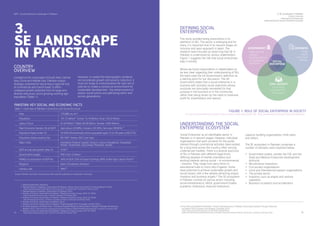
Figure 1 suggests the role that social enterprises
play in society.
Where we found respondents or stakeholders to
be less clear regarding their understanding of SEs,
the team used the UK Government’s definition as
a starting point for our discussion. The UK
Government states that a social enterprise is ‘a
business with primarily social objectives whose
surpluses are principally reinvested for that
purpose in the business or in the community,
rather than being driven by the need to maximise
profit for shareholders and owners’.
FIGURE 1: ROLE OF SOCIAL ENTERPRISE IN SOCIETY
For more on social enterprise, the British Council provide a useful starting point here - https://www.britishcouncil.org/society/social-enterprise
Priya Shah and Shailabh Shubhisham, "Social Enterpreneurship In Pakistan: Unlocking Innovation Through Enterprise
Incubation" (EPG Economic and Strategy Consulting 2013)
<http://www.economicpolicygroup.com/wp-content/uploads/down-
loads/2013/02/EPG-Social-Entrepreneurship-in-Pakistan-Unlocking-Innovation-February-20131.pdf> accessed 22 February 2016.
20
20
UNDERSTANDING THE SOCIAL
ENTERPRISE ECOSYSTEM
‘Social Enterprise’ as an identifiable sector in
Pakistan is in nascent stages. However, individual
organisations that work primarily for the public
interest through commercial activities have existed
for a long time across the country, often serving
underserved markets. There is a diverse spectrum
of SEs in Pakistan with different legal forms,
differing degrees of market orientation and
working towards various social – or environmental
- missions. They range from dairy farms to
educational hubs to micro drip irrigation. Some
have potential to achieve sustainable growth and
social impact, with a few already attracting impact
investors and business angels. The SE ecosystem
in Pakistan consists of various actors including
social entrepreneurs, NGOs, government bodies,
academic institutions, financial institutions,
capacity building organisations, think tanks
and others.
The SE ecosystem in Pakistan comprises a
number of domains, each explored below:
Government bodies, namely the CSE and the
Small and Medium Enterprise Development
Authority
Microfinance institutions
Civil society organisations
Local and international support organisations
The private sector
Investors, such as angels and venture
capitalists
Business incubators and accelerators
•
•
•
•
•
•
•
- Scale
- Capital
- Innovation
- Markets
- Community
empowerment
- Participation
GOVERNMENT BUSINESS
CIVIL SOCIETY
SOCIAL
ENTERPRISE
- Public service
delivery
- Enabling policies
and legislation
Enterprise
3. SE Landscape in Pakistan
Country Overview
Defining Social Enterprises
Understanding the Social Enterprise Ecosystem
SDPI - Social Enterprise Landscape in Pakistan
15 16
3.
SE LANDSCAPE
IN PAKISTAN
COUNTRY
OVERVIEW
Located at the crossroads of South Asia, Central
Asia, China and Middle East, Pakistan enjoys
strategic potential for becoming a regional hub
of commercial and transit trade. It offers
untapped growth potential from its large and
diverse resources, and a growing working-age
population (Table 1).
However, to realise the demographic dividend,
and accelerate growth and poverty reduction, it
must act today to institutionalise the right set of
policies to create a conducive environment for
sustainable development - the enhancement of
peace, social justice and well-being within and
across generations.
Area
Population
Labour Force
Main Economic Sectors (% of GDP)
Population Aged under 24
Population below poverty line
Major cities
GDP, annual real growth rates, %
Government budget
MSMEs as proportion of GDP etc
Religions
Literacy rate
770,880 sq. km
191.72 Million (Urban 75.19 Million, Rural 116.52 Million
61.04 Million (Male 46.38 Million, Female 14.66 Million)
Agriculture (20.88%), Industry (20.30%), Services (58.82%)
54.29% (Economically active populated aged 15 to 59 years is 60.21%)
60.19% (below USD 2 per day)
Islamabad (Federal Capital), Karachi, Lahore, Rawalpindi, Faisalabad,
Multan, Hyderabad, Gujranwala, Peshawar, Quetta
4.2%
PKR 4,451.3 billion
30% of GDP, 25% of Export Earnings, 80% of Non Agri Labour Force
Islam, Christianity, Hinduism
58%
PAKISTAN: KEY SOCIAL AND ECONOMIC FACTS
Table 1: Overview of Pakistan’s Economic and Social Structure
Source: Pakistan Economic Survey. Some other specific publications mentioned in footnotes.
11
12
13
14
16
17
18
19
15
World Development Indicators.
Pakistan Bureau of Statistics, Government of Pakistan, "Labour Force Survey 2014-15 (Annual Report)" (2015)
<http://www.pbs.gov.pk/content/labour-force-survey-2014-15-annual-report> accessed 22 February 2016.
Pakistan Bureau of Statistics, Government of Pakistan (2015)
Ministry of Finance, Government of Pakistan, "Pakistan Economic Survey 2014-15" (2015)
<http://www.finance.gov.pk/survey_1415.html> accessed 22 February 2016.
Ministry of Finance, Government of Pakistan. “Pakistan Economic Survey 2013-14” (2014)
<http://finance.gov.pk/survey_1314.html> accessed 22 February 2016; also see (Ahmed 2016).
Ministry of Finance, Government of Pakistan (2015)
Ministry of Finance, Government of Pakistan, "Federal Budget 2015-16: Budget In Brief" (2015).
Ali Akbar Ghanghro and Nafey Khan, "Estimating Potential Market For Microcredit In Pakistan" (Pakistan Microfinance
Network 2015) <http://www.pmn.org.pk/assets/articles/67bf9abc0a78d8557806bd0cbad2b5c6.pdf> accessed 22 February 2016.
Ministry of Finance, Government of Pakistan, "Pakistan Economic Survey 2014-15" (2015)
<http://www.finance.gov.pk/survey_1415.html> accessed 22 February 2016.
11
12
13
14
15
16
17
18
19
While MFIs can serve as an important tool for
nurturing and fostering SEs, their own
sustainability issues can limit their risk appetite
and they may tend to lend to less poor segments
of society. If microfinance is to support SE,
mechanisms may be required to focus more on
the promotion of innovation and competitiveness
and less on debt repayment.
Branchless banking in Pakistan is one of the
fastest developing markets contributing
significantly to the achievement of universal
financial inclusion. With the launch of the
Branchless Banking Regulation in April 2008,
the State Bank of Pakistan has been trying to
bring innovative banking solutions to the
otherwise ‘unbanked’ lower income groups and
rural population .
Operating outside the conventional banks,
branchless banking relies on information and
communication technology for transactions that
are carried out via mobile or through nearby retail
agents. These services cover deposits,
withdrawals, inward and outward remittances,
utility bill payments and payments for
products/services to vendors. The market,
dominated primarily by Easypaisa (by Tameer
Microfinance Bank and Telenor) and Omni (by
UBL), has made it easier to undertake economic
activity in otherwise untapped segments of
society. Despite security concerns, including
money laundering and terrorism financing, the
market has potential for SEs to capitalise on, as is
suggested by the early user adoption and use
rates .
22
25
26
27
State Bank of Pakistan, Government of Pakistan, "Quarterly Branchless Banking Newsletter" (Agricultural Credit &
Microfinance Department 2015).
Muhammad Adil Mulki and Syed Adnan Rizvi, "Branchless Banking: Branching Out" DAWN (2014).
Chris Bold, "Branchless Banking In Pakistan: A Laboratory For Innovation" (CGAP 2011)
<http://www.cgap.org/sites/default/files/CGAP-Brief-Branchless-Banking-in-Pakistan-A-Laboratory-for-Innovation-Oct-2011.pdf>
accessed 22 February 2016
25
26
27
SDPI - Social Enterprise Landscape in Pakistan
17 18
Pakistan Microfinance Network, "Microwatch" (2015)
<http://www.microfinanceconnect.info/assets/articles/3af7ddbce3065d4e229e47172818d79a.pdf> accessed 22 February 2016.
Pakistan Microfinance Network, "Microwatch" (2015)
International Labour Organisation, "Towards Achieving Social And Financial Sustainability: A Study On The Performance
Of Microfinance In Pakistan" (International Labour Organisation 2009)
<http://www.ilo.org/wcmsp5/groups/public/---asia/---ro-bangkok/---ilo-islamabad/documents/publication/wcms_143165.pdf> accessed 22
February 2016.
Mixmarket.org, "MFIs In Pakistan | Microfinance Pakistan" (2016)
<http://www.mixmarket.org/mfi/country/Pakistan> accessed 22 February 2016.
21
22
23
24
GOVERNMENT
CENTRE FOR SOCIAL ENTREPRENEURSHIP:
The Centre for Social Entrepreneurship (CSE) was established in 2015 by the Planning Commission to
promote innovation and enterprise development for addressing social issues. The Centre aims to serve as
a specialist agency for the promotion of social entrepreneurship in Pakistan. It is important to note that
the promotion of social entrepreneurship is different from the promotion of social enterprise,
nevertheless, the promotion of social entrepreneurship will strongly support the development of social
enterprise. The Centre has four main objectives
MICROFINANCE
INSTITUTIONS:
Over a period of three decades, the microfinance
industry in Pakistan has grown considerably to
help combat financial exclusion and poverty by
increasing the access to and the availability of,
finance to vulnerable groups. As of September
2015, there are approximately 3.63 million active
borrowers in Pakistan accessing loans worth
PKR84.9 billion with an average loan size of
PKR 33,374.
Initially concentrated with NGO-MFIs and RSPs,
the space has evolved to include regulated MFBs,
CFIs and NGOs (including co-operatives).
However, by international benchmarks, a low
penetration rate of 13.3% shows MFIs still have
the potential to target not only the marginally
poor but also the very poor.
The Microfinance industry currently has around
50 corporate entities regulated by the State
Bank of Pakistan (SBP). The Pakistan Microfinance
Network (PMN) is an association of MFIs, MFBs,
NGOs and RSPs, which functions as a key player
in creating an enabling environment for
microfinance, undertaking capacity building,
information sharing and stakeholder engagement.
Promoting and selecting social entrepreneurs – by
holding nationwide competitions across universities
in Pakistan. Every year, the top 25 innovative ideas
will be selected and provided a seed grant of PKR
500,000 each. Additional support, in the form of
skills training and advice, is given to the aspiring
social entrepreneurs to make their ideas a success.
Making the Accelerator/Incubator/Special
Purpose Vehicle an autonomous entity – by
developing a financial model that ensures its
long-term sustainability.
1.
3.
Establishing an Accelerator/Incubator/Special
Purpose Vehicle – with two four-month cycles
every year, with 4 to 5 incubations in each cycle.
Winners of the incubator awards will benefit from
strong networks with the private, social and
development sectors, and receive guidance,
support and resources.
Conducting research – to generate research
to be utilised by the Planning Commission to
develop ideas and formulate strategies to
benefit the growth of social entrepreneurship
and make policy recommendations to the
Government of Pakistan.
2.
4.
21
22
23
24
3. SE Landscape in Pakistan
Government
SMALL AND MEDIUM
ENTERPRISE DEVELOPMENT
AUTHORITY:
Established in 1998 by the Government of
Pakistan, SMEDA has played a pivotal role in
identifying, mobilising and capacity building of
SMEs across the country. The primary role of
SMEDA is to create an enabling environment for
the growth of the SME sector in Pakistan through
informed policy making, business development
services, facilitation in acquiring finance,
knowledge sharing, training, industry support
programmes and technical services. It is also
involved in helping SMEs obtain various
certifications for their products and processes to
enhance the competitiveness of the sector. The
wide range of services offered by SMEDA could
play an important part in building the capacity of
SEs, provided that these can be aligned with SE’s
unique need to blend commercial and social
missions.
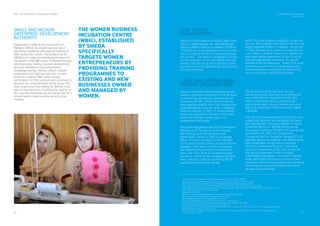
THE WOMEN BUSINESS
INCUBATION CENTRE
(WBIC), ESTABLISHED
BY SMEDA
SPECIFICALLY
TARGETS WOMEN
ENTREPRENEURS BY
PROVIDING TRAINING
PROGRAMMES TO
EXISTING AND NEW
BUSINESSES OWNED
AND MANAGED BY
WOMEN.
SDPI - Social Enterprise Landscape in Pakistan 3. SE Landscape in Pakistan
Government
19 20
Council on Foreign Relations, "Pakistan's Institutions And Civil Society" (2008)
<http://www.cfr.org/pakistan/pakistans-institutions-civil-society/p14731> accessed 22 February 2016.
Web Desk, "The Overlooked NGO Sector Of Pakistan At A Glance" (Brandsynario, 2014)
<http://www.brandsynario.com/the-overlooked-ngo-sector-of-pakistan-at-a-glance/> accessed 22 February 2016.
Nadia Naviwala, "Harnessing Local Capacity: U.S. Assistance And NGOs In Pakistan" (USAID 2010) <http://pdf.usaid.gov/pd-
f_docs/pnaea519.pdf> accessed 22 February 2016.
Nadia Naviwala (2010)
Ashoka.org, "Ashoka Pakistan | Ashoka - Innovators For The Public" (2016)
<https://ashoka.org/country/pakistan> accessed 22 February 2016.
YouthEngagementServices, "Snapshot Of YES" (2016)
<http://yesnetworkpakistan.org/snapshot-of-YES/> accessed 22 February 2016.
Acumen, "Acumen In Pakistan: Addressing Basic Needs On A Large Scale" (2016)
<http://acumen.org/regions/pakistan/> accessed 22 February 2016.
Deutsche GmbH, "Supporting Technical And Vocational Education And Training (TVET) Reform" (Giz.de, 2016) <https://www.giz.de/en/world-
wide/26783.html> accessed 22 February 2016.
Tvet Reform Pakistan, "Fund For Innovative Training (FIT)" (2016) <http://www.tvetreform.org.pk/fund-for-innovative-training/what-is-fit>
accessed 22 February 2016.
28
29
30
31
32
33
34
35
36
36
LOCAL AND INTERNATIONAL
SUPPORT ORGANISATIONS:
Other local and international organisations are
making a proactive contribution to the SE sector
by supporting, sponsoring, collaborating and
partnering with SEs. Ashoka, for example, has
been playing a leading role in the individual and
organisational development of SEs in Pakistan.
Since its inception in 1997, 47 Ashoka fellows
have been supported in the field of education,
health, environment, human rights, civic
engagement and finance .
The Youth Engagement Services (YES) Network
Pakistan, which focuses on youth, engages
them through practical entrepreneurial
experiences. Created in 2002 by an Ashoka
fellow, YES has successfully trained 200,000
young people across various vocations and has
engaged 1,500 teams of youth in designing
and implementing innovative business ideas
every year. Their Youth SE Generator project
focuses on unlocking the entrepreneurial talent
within Pakistan’s youth by supporting 18,000
students from low-income families .
CIVIL SOCIETY
ORGANISATIONS:
Pakistan’s CSOs comprise of NGOs, CBOs, Trade
Unions, Cultural Groups, bar associations and
informal platforms that total between 10,000 to
12,000 as active and registered, while this could
rise to as high as 60,000 if unregistered groups
are counted . The largest concentration of CSOs
is in the education sector, with official estimates
showing that the overall sector employs a total
work force of around 264,000 and an additional
212,000 volunteers .
With 87% of the funding coming from indigenous
sources, the Locally Funded NGOs (LFNs) form the
largest segment of NGOs in Pakistan. Almost half
of LFNs generate some revenue through fee and
user charges . However, there are no statistics on
how many identify themselves as SEs. It may be
that some are actually working as SEs yet are
unaware of the concept itself.. These CSOs could
be an integral part of the SE landscape as they
are well situated to respond to the needs of the
local communities in which they operate.
7
28
29
30
31
The Acumen Fund has also been serving
low-income groups including social enterprises
since 2002. With an investment of USD 14.6
million in affordable housing, microfinance,
safe drinking water, energy, livestock and micro
drip, it has impacted 4 million lives and created
3,500 jobs.
The German development agency (GIZ) has been
supporting (Technical and Vocational Education
and Training) TVET reforms in Pakistan. It targets
vocational training of 100,000 young people,
pedagogical training of 10,000 TVET teachers and
accreditation of 1,000 TVET programmes .
Through its Fund for Innovative Training (FIT), GIZ
has been stimulating projects in the field of green
skills (sustainable energy, natural resources
efficiency, renewable energy etc.), providing
access to marginalised groups such as women
and young people from under-privileged
communities and disaster- and conflict-affected
areas; getting SEs on board by enhancing their
relationship with training providers, and promoting
self-employment and entrepreneurship skills to
develop social enterprise .
4
7
32
33
34
35
SDPI - Social Enterprise Landscape in Pakistan 3. SE Landscape in Pakistan
Government
21 22
The Enhancing Employability and Leadership for
Youth (EELY) programme launched by the Aga
Khan Rural Support Programme (AKRSP), also
focuses on the economic empowerment of young
people by increasing their employability and
facilitating their engagement with state and civil
institutions. With a geographic focus towards the
northern areas of Pakistan (Gilgit Baltistan and
Chirtral), the programme aims to provide
employment for 24,600 young people by March
2017. It offers young people TVET and
entrepreneurship training, followed by placement
in government and private institutions. As of
September 2015, 300 young people have
received a start-up Micro-Challenge Award to
implement social and business ideas.
The Prime Minister’s Youth Programme (PMYP),
launched by the Prime Minister’s Office, focuses
on the socio-economic development of young
people. The programme aims to enhance the
employability skills of disadvantaged youth and
the poor, provide access to business loans with
a particular focus on female-led businesses, and
impart advisory services through its
implementation partners like PPAF, SMEDA etc.
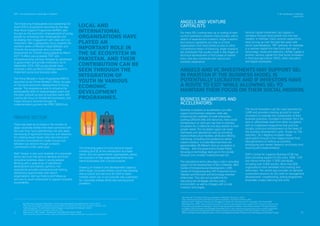
LOCAL AND
INTERNATIONAL
ORGANISATIONS HAVE
PLAYED AN
IMPORTANT ROLE IN
THE SE ECOSYSTEM IN
PAKISTAN, AND THEIR
CONTRIBUTION CAN BE
SEEN THROUGH THE
INTEGRATION OF
YOUTH IN VARIOUS
ECONOMIC
DEVELOPMENT
PROGRAMMES.
ANGELS AND VC INVESTMENTS MAY SUPPORT SES
IN PAKISTAN IF THE BUSINESS MODEL IS
POTENTIALLY LUCRATIVE AND IF INVESTORS HAVE
A ROUTE TO EXIT WHILE ALLOWING SES TO
MAINTAIN THEIR FOCUS ON THEIR SOCIAL MISSION.
Zain Peracha, "The Role Of Startup Incubators In Pakistan" (TechJuice, 2014)
<http://www.techjuice.pk/the-role-of-startup-incubators-in-pakistan/> accessed 22 February 2016.
Shehryar Hydri, "Pakistan’S Startups Are Struggling To Break Out, But Here Are 27 Incubators That Could Help"
(Techinasia.com, 2016) <https://www.techinasia.com/27-startup-incubator-programs-funds-in-pakistan-2014> accessed 22 February 2016.
Priya Shah and Shailabh Shubhisham, "Social Enterpreneurship In Pakistan: Unlocking Innovation Through Enterprise
Incubation" (EPG Economic and Strategy Consulting 2013) <http://www.economicpolicygroup.com/wp-content/uploads/down-
loads/2013/02/EPG-Social-Entrepreneurship-in-Pakistan-Unlocking-Innovation-February-20131.pdf> accessed 22 February 2016.
Other universities now promoting the work on SEs include National University of Science and Technology, and University of Gujrat.
40
41
42
43
38
37
PRIVATE SECTOR
There has been an increase in the number of
large corporate entities that have partnered with
SEs over time. Such partnerships not only allow
harnessing of significant resources and networks
for creating social impact, they also transcend
economic boundaries to create mutual trust
between two sectors through a shared
commitment to the same goal.
Shell Tameer is one such example of a corporate
sector-led trust that aims to develop and build
innovative business ideas in young people.
Working with a wide array of operational,
development and delivery partners, the
programme provides entrepreneurial training,
networking opportunities with expert
organisations, start-up finance and follow-up
services to youth enterprises to support business
sustainability .
The emerging space of cross-sectoral impact
investing and SE at the intersection of private
sector and non-government organisations, allows
the evolution of new organisational forms that
blend businesses with a social purpose.
Drawing on research and development capacity
within large corporate entities could help develop
new products and services for hard to reach
markets which can in turn provide new customers
for corporate entities whilst also solving social
problems.
39
Aga Khan Rural Support Programme, "Enhancing Employability & Leadership For Youth" (2011)
<http://www.akrsp.org.pk/img/pdf/enhanced-employability-and-eadership-for-Youth.pdf> accessed 22 February 2016.
Youth.pmo.gov.pk, "Prime Minister Youth Program | Government Of Pakistan" (2016)
<http://youth.pmo.gov.pk/> accessed 22 February 2016
Shell.com.pk, "Shell Tameer - Building On Young Business Ideas" (2016)
<http://www.shell.com.pk/environment-society/society-tpkg/local-initiatives/tameer.html> accessed 22 February 2016.
38
37
39
ANGELS AND VENTURE
CAPITALISTS:
For many SEs, funding start-up or scaling of their
current operations presents many hurdles, with a
dearth of experienced investors. Angel investors
and venture capitalists can step in to fund
organisations that have limited access to other
conventional means of financing. Angel investors
are individuals that usually invest in last stages of
technical development or first phase of market
entry, and also contribute their advice and
business experience.
Venture capital investment can support a
company through rapid growth and into new
markets. In Pakistan, many venture capital firms
have sprung up over the past few years with
sector specialisations. TMT ventures, for example,
is a venture capital firm that funds start-ups in
technology, media and telecoms. ImPakt Capital is
another venture capital firm that funds innovation
in food and agriculture, FMCG, retail, education,
and digital businesses.
BUSINESS INCUBATORS AND
ACCELERATORS:
Business incubators or accelerators can offer
support and business networks, while also
enhancing the credibility of small enterprises.
Lacking sufficient skills and resources, many social
entrepreneurs or start-ups may look to business
incubators for a collective one-stop solution to their
growth needs. The incubation space can lower
overheads and operational costs by providing
shared infrastructure facilities, while also offering
mentoring, consulting and guidance to attract
impact investors. It is estimated that there are
approximately 28 different start-up incubators in
Pakistan from the government funded Plan9
focusing on technology start-ups to the socially
focused ‘civic-minded’ invest2innovate (i2i) .
The educational sector also plays a role in providing
support to the development of SEs in Pakistan. IBA’s
Centre of Entrepreneurial Development, LUMS
Centre of Entrepreneurship, MIT Enterprise Forum
Pakistan and Microsoft and technology-oriented
enterprises. They also act as platforms for
discussing exit strategies and the policy
environment, as well as linkages with private
investors and angels.
The Social Innovation Lab (SIL) was launched by
LUMS and provides a testing ground for social
innovators to evaluate the sustainability of their
business practices. Founded in October 2013, SIL
aims to differentiate itself from other incubators
with its indigenised programme that puts the
socially conscious entrepreneurs at the heart of
the business development cycle.. Known as ‘The
Hatchery’, SIL’s flagship incubator helps
participants through a four-stage process from
idea generation to setting up business,
prototyping and market research, and finally fund
sourcing and implementation.
SDPI’s Centre for Capacity Building (CCB) has
been providing support to SEs since 1998. CCB
has trained more than 11,000 individuals,
including over 5,000 women. More than 600
organisations have benefited from training and
workshops. The centre also provides on-demand
customised sessions for SEs staff on management
development, crowdfunding, writing programme
proposals, project planning and more.
7
7
41
42
43
40
23 24
A majority of the gaps faced by SEs are the same which Small and Medium Enterprises have already been facing in
Pakistan.
44
CHALLENGES AND
BARRIERS TO THE
DEVELOPMENT OF SOCIAL
ENTERPRISE SECTOR
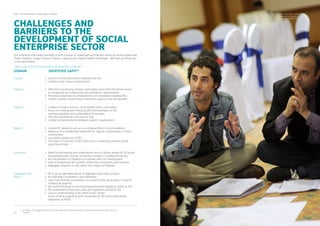
Our extensive interviews provided us with a series of challenges and barriers faced by social enterprises.
These include a range of policy, finance, capacity and market related challenges. We have set these out
in the table below:
Culture
DOMAIN IDENTIFIED GAPS44
Lack of a formal association representing SEs
Limited social impact measurement
•
•
Difficulty in accessing finance, particularly loans from the formal sector,
accompanied by cumbersome documentation requirements
Personal credentials of entrepreneurs not considered creditworthy
Impact investors have limited investment capacity and risk appetite
•
•
•
Limited incubator activity, concentrated within universities
Focus on creating and nurturing SEs, less emphasis on the
commercialisation and sustainability of business
Very few accelerators and small in size
Limited complementarity between support organisations
•
•
•
•
Finance
Support
Limited SE networks and no co-ordinated effort to build networks.
Absence of an established platforms for regular conferences or online
communities
Low public awareness of SEs
For export of services of SEs there are no marketing channels at the
government level
•
•
•
•
Market
Weak formal training and qualifications around SEand almost no SE/social
entrepreneurship courses, university modules or vocational training
No mechanisms or initiatives to translate skills into employment
Lack of student-led SEs outside of few elite universities and institutes
Negligible research on SEs within the context of Pakistan
•
•
•
•
Education
SE is not an identified sector of legislation and policy priority.
No Standing Committee in the parliament
Laws that promote competition not covering SEs, particularly in case of
intellectual property
No current thinking on providing legislative and regulatory cover to SEs
No assessment of business rules and regulations faced by SEs
Lack of understanding of SE within public sector
Issues of trust regarding work conducted by SEs particularly those
registered as NGOs
•
•
•
•
•
•
Legislation and
Policy
Table 2: Gap analysis of social enterprise ecosystem in Pakistan
3. SE Landscape in Pakistan
Challenges and barriers to the
development of Social Enterprise sector
SDPI - Social Enterprise Landscape in Pakistan
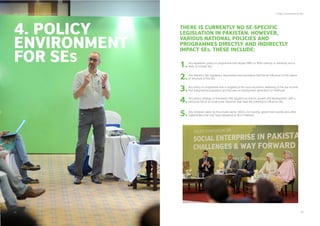
THERE IS CURRENTLY NO SE-SPECIFIC
LEGISLATION IN PAKISTAN. HOWEVER,
VARIOUS NATIONAL POLICIES AND
PROGRAMMES DIRECTLY AND INDIRECTLY
IMPACT SES. THESE INCLUDE:
4. Policy Environment for SEs
25 26
SDPI - Social Enterprise Landscape in Pakistan
Any legislation, policy or programme that targets SMEs or MSEs directly or indirectly and is
likely to include SEs1.
Any statutory law, regulatory requirement and procedure that has an influence on the nature
or structure of the SEs2.
Any policy or programme that is targeted at the socio-economic wellbeing of the low income
and marginalised population and focuses on employment generation or livelihood3.
Any policy, strategy or framework that supports economic growth and development, with a
particular focus on small scale industries that have the potential to influence SEs4.
Any initiatives taken by the private sector, NGOs, civil society, government bodies and other
stakeholders that may have relevance to SEs in Pakistan5.
4. POLICY
ENVIRONMENT
FOR SES
00 28
SDPI - Social Enterprise Landscape in Pakistan
27
4. Policy Environment for SEs
indirectly impact SEs. These schemes focus on
education, health, livelihood programmes, youth
entrepreneurship, financial credit, incentives and
subsidies, skills and capacity development, and
target-based schemes for the poor, women, and
other marginalised communities. Table 3 sets out
some examples of the policies and programmes
that have an impact on SE activity in Pakistan.
1
Pakistan’s policies for promoting private sector
activity has traditionally focused more on large
scale manufacturing industries. However, over
time there has been a growing focus on SMEs.
Some of these programmes and policy
frameworks have an impact on SE activity in
Pakistan, influencing ownership structure,
investment, taxation, and capacity building, for
example.
Several policies and programmes launched by the
federal and provincial governments directly or
Pakistan 2025
One Nation –
One Vision
POLICY/FRAMEWORK CONTENT
Vision document prepared by the Planning Commission that focuses on fast
track development with the ultimate goal of making Pakistan one of the top
ten economies in the world by 2047. It identifies social and human capital,
inclusive growth, entrepreneurship and knowledge economy as pillars to
sustainable prosperity.
Framework
for Economic
Growth 2011
Formulated by the Planning Commission, the framework emphasises
software aspects of growth, focusing on productivity by harnessing
creativity, innovation and the engagement of youth, cluster development
and innovation councils.
Punjab Growth
Strategy 2018
Enabling the private sector to lead Punjab’s growth with focus on skills and
job creation, and provision of education, healthcare and social protection.
Integrated
Development Strategy
2014-2018, Khyber
Pakhtunkhwa
Provides a framework for implementing a pro-poor, pro-people reform
agenda, including the creation of an enabling environment for private sector
(SMEs) and cottage industries through entrepreneurial friendly regulatory
framework and other support.
Balochistan
Development Vision &
Strategy 2015
Identifies small and medium industries (based on local materials) as one of
the priority sectors for driving Balochistan’s growth.
Reclaiming Prosperity
in Khyber Pakhtunkhwa
– A Medium term
strategy for inclusive
growth
A key instrument for fulfilling the Government of KP’s mandate to improve
citizen’s living standards. Focus on entrepreneurship development and skills,
and extension of small loans to micro enterprises to create an enabling
environment.
Table 3: National Policy Frameworks, Policies and Programmes Relevant to Social Enterprises
POLICY/FRAMEWORK CONTENT
Investment
Policy 2013
Issued by the Board of Investment with a focus on addressing and adjusting
economic priorities to facilitate SMEs and the creation of incentivised SEZs
Public Sector
Development
Programme 2015-16
A main instrument used by the Planning Commission for providing budgetary
resources for development projects and programmes at the federal,
provincial and local government level.
TVET Policy for
Pakistan 2015
Issued by the Ministry of Federal Education and Professional training, the
TVET Policy provides a national framework for transforming the economy by
focusing on skills development of the growing youth population.
National Youth Policy
2008
Formulated by the then Ministry of Youth Affairs, focuses on harnessing the
demographic dividend by enabling prospects of income generation for the
youth through skill development, entrepreneurship, microfinance and more.
SME Policy 2007 A policy issued by SMEDA under the umbrella of the Ministry of Industries
and Production providing the definition of SMEs and the resource and
implementation plan for fostering growth within the SME sector.
Khyber Pakhtunkhwa
Youth Policy
Creating an enabling environment for socio-economic and political
empowerment of youth in Khyber Pakhtunkhwa
Balochistan Youth
Policy 2015
Focusing on sustainable, rightful and gainful employment, livelihood, training,
financial credit and other services in Balochistan
Sindh Youth
Policy 2012
Providing economic, social and political empowerment to young people
through an institutional mechanism for governance of youth affairs spread
over various sectors and departments.
Punjab Youth
Policy 2012
Envisages the establishment of Youth Venture Capital Fund by public-private
partnership to support new business ideas and entrepreneurship among
young men and women.
Prime Minister’s Youth
Programme 2013
Special initiative comprising several schemes including Interest Free Loans,
Youth Business Loans, Youth Training Scheme, Youth Skills Development
Scheme, Scheme for Provision of Laptops and Reimbursement of Fees for
students from less developed areas.
Certification
Incentive Programme
for SMEs 2014
A programme designed for SMEs to enhance their competitiveness through
improved quality and productivity in line with international benchmarks, and
to create awareness for adopting international certifications.
Entrepreneurship
Development Policy
(Draft) 2012
Draft document prepared by HEC that focuses on unleashing the potential of
SMEs, that includes supporting student business ideas, innovation and
research, encouraging social entrepreneurship, improving access to finance,
access to enterprise education and creating an enabling policy environment.
Sindh Strategy for
Sustainable
Presents a 10 year sustainable development agenda that includes the
development of the SME sector.
00 30
SDPI - Social Enterprise Landscape in Pakistan
29
SOCIAL ENTERPRISE AND
INDUSTRIAL POLICY
SEs operate in a wide range of industries in
Pakistan. Historically, the federal and provincial
industrial development policies have focused on
large scale industries with little or no mention of
small scale enterprises. The 1990s witnessed a
slight shift in government’s priorities toward SMEs,
with the growing realisation of the sector’s
contribution to the national economy.
Subsequently, SMEs were made an integral part of
various economic policies such as the Poverty
Reduction Strategy Paper (PRSP), the Micro Finance
Sector Development Programme, the SME Sector
Development Programme, the Education Sector
Reforms 2001-05, the Reform of the Financial
Sector and the Reforms in Tax Administration .
This inclusion however has not been sufficient to
create an ideal enabling environment for SMEs ,
which would in turn impact on social enterprises.
The National Industrial Policy 2011 was drafted to
achieve rapid growth in industrial
competitiveness and value addition. Its execution
has been somewhat limited. . The policy makes
a passing mention of SMEs, the formation of
Industrial Clusters and Science Parks, subsidies
and tax incentives but falls short of focusing on
entrepreneurial activities and social innovation.
45
46
47
47
48 49 50
Nadeem Ul Haque, "Entrepreneurship In Pakistan" (2007) Pakistan Institute of Development Economics:
Working Papers: 29
Matthieu Chemin, "Entrepreneurship In Pakistan: Government Policy On Smes, Environment For Entrepreneurship,
Internationalisation Of Entrepreneurs And Smes" (2008) 5 International Journal of Business and Globalisation.
Government of Pakistan: SME Issues Paper for Deliberation, "Developing SME Policy In Pakistan" (SMEDA 2007).
DAWN, "Industrial Policy" (2012) <http://www.dawn.com/news/705502/industrial-policy> accessed 22 February 2016.
Hussain and Ahmed (2012).
Ministry of Industries and Production, "National Industrial Policy 2011: Implementation Framework" (Government of
Pakistan).
45
46
47
48
49
50
STATUTORY AND
REGULATORY LAWS
Table 4 and Table 5 provide the key statutory laws relevant to SEs in Pakistan. These laws are mostly
focusing on formalising business operations, the provision of a competitive environment and enabling
markets to provide finance and the regulation of microfinance.
Microfinance
Institutions
Ordinance 2001
POLICY/FRAMEWORK CONTENT
Issued by State Bank of Pakistan to regulate the establishment, business and
operations of MFIs.
Prudential Regulations
for Microfinance Banks,
2014
Income Tax Ordinance
2001 and Income Tax
Rules 2002
The Ordinance and Rules that govern the application of taxation to various
organisations and the exemptions thereof.
Competition Act
2010
Issued by the Competition Commission of Pakistan with the purpose of
engendering free competition including the prohibition of abuse of dominant
position, prohibited agreements, deceptive marketing etc.
Private Equity &
Venture Capital Fund
Rules, 2006
Rules drafted by SECP for establishing and operating private equity and
venture capital funds.
Table 4: Statutory Laws and Regulatory Frameworks relevant to Social Enterprises
4. Policy Environment for SEs
Social Enterprise and Industrial Policy
Statutory and Regulatory Laws
Issued by State Bank of Pakistan focusing on maximum loan size, eligibility
requirements for borrowers, and limitations to exposure.
SDPI - Social Enterprise Landscape in Pakistan
Companies
Ordinance 1984
LAWS/GUIDELINES CONTENT
A broad piece of legislation encompassing all legal rules and regulations for
registration and operations of business, enforced by SECP. Section 42, allows
a company to be incorporated for objectives such as Charity, Commerce,
Sport, Religion, Education, Culture, Arts and any other socially useful
Guide on Single
Member Company
(SMC)00
Relevant laws and procedure for establishing SMCs; subject to lower tax
rates, and are autonomous in making business decisions.
The Trusts Act, 1882 Public Charitable Trusts may be set up under this Act by executing a
trust deed
The Societies
Registration Act of
1860
Act for the registration of Societies, Associations, Clubs etc. Fine Arts,
Science, Museums, Libraries, educational endeavours, think tanks etc
Cooperative Societies
Act 1925
Act for the registration and establishment of a cooperative.
The Voluntary Social
Welfare Agencies (VSWA)
Ordinance, 1961
Registration and control of social welfare agencies, and their associated
matters with the respective Department of Social Welfare
Table 5: Laws/Guidelines for Social Enterprise Registration
32
The World Bank, "Doing Business 2016: Measuring Regulatory Quality And Efficiency, Economy: Profile Pakistan" (2016).
Shahab Khawaja, "Unleashing The Growth Potential Of Smes In Pakistan Through Productivity Enhancement", Pakistan
Development Forum (SMEDA 2006).
Amal Aslam, "Moving Towards Micro And Small Enterprise Lending: Opportunities & Challenges" (Pakistan Microfinance
Network 2013) <http://www.pmn.org.pk/assets/articles/Moving%20Towards%20MSEL%20Opportunities%20and%20Challenges.pdf>
accessed 22 February 2016.
51
52
53
Intellectual Property
Organisation of
Pakistan Act, 2012
LAWS CONTENT
All subject matters of Intellectual Property i.e Patents, Copyrights,
Trademarks, Designs, etc., and the registries related to these functions
Patents Ordinance
2000, Patents Rules
2003
Grant of exclusive rights for an inventor to make, use and sell the invention
for a limited period of 20 years. Excludes others from making, using, or
selling the invention.
Trademarks Rules
2004, Trademarks
Ordinance 2001
Registration of Trades and Services Marks with the Trade Marks Registry
(TMR)
Design Ordinance
2000, Registered
Layout-Designs of
Integrated Circuits
Ordinance, 2000
The ornamental or aesthetic aspect of an article. The design may consist of
three-dimensional features, such as the shape or surface of an article, or of
two dimensional features, such as patterns, lines or colour.
Copyright Ordinance
1962, Copyright Rules
1967
Provides the creator of a work of art or literature, or a work that conveys
information or ideas, the right to control how the work is used.
Table 6: Intellectual Property Laws Relevant to Social Enterprises
The lack of trust in the judicial system in Pakistan coupled with a relatively weak legal framework can
stifle business innovation alongside the weak enforcement of intellectual property rights. Pakistan, a
signatory to the TRIPs under WTO, has legislation (Table 6) around the integrated and efficient
management of IP in Pakistan, administered by IPO Pakistan. However, Pakistan’s rank of 151 out of 189
in enforcing contracts still draws a gloomy picture.51
A more knowledge-based economy requires that intellectual property laws are properly enforced.
MSMES ALONG WITH MEDIUM
ENTERPRISES CONTRIBUTE TO
30% OF GDP AND EMPLOY 80%
OF THE NON-AGRICULTURAL
LABOUR FORCE IN PAKISTAN.
SO A MORE CONDUCIVE
REGULATORY AND POLICY
ENVIRONMENT SHOULD AIM TO
STRIKE A BALANCE BETWEEN
MINIMISING THE REGULATORY
BURDEN, THUS ENHANCING
GROWTH AND COMPETITIVENESS,
WITH THE PROTECTION OF
THOSE WHO WORK.
1
In Pakistan, the federal and the provincial
governments have the authority to enact
legislation in their respective jurisdictions. As a
result, businesses are sometimes unsure of the
frameworks in which they are operating. It is
estimated that there are around 56 laws that
govern labour in Pakistan, with some being
industry specific .
The procedure for registration also differs across
various laws depending on the nature, capital
threshold, annual turnover, size and geographic
location of the business. At the same time, many
businesses who work outside the formal sector
have dim prospects of growth, low productivity
and poor working conditions.
52
53
31
4. Policy Environment for SEs
Social Enterprise and Industrial Policy
Statutory and Regulatory Laws
34
SDPI - Social Enterprise Landscape in Pakistan
While there has been a growing recognition of PPPs
in Pakistan, the arrangements have primarily been
restricted to large scale public projects such as
transport, logistics, mass urban public transport,
energy and industrial projects. Pakistan’s Policy on
PPPs identifies local government services
(including water supply and sanitation, solid waste
management, low cost housing, and
healthcare/education and skills development
facilities) and social infrastructure (including
education, health, culture etc.)
The National Commission for Human Development
(NCHD) is one example of PPP in Pakistan that aims
to fill in implementation gaps and improve the
delivery of public services within the broader
objective of achieving education for all . Despite
criticism on the Commission’s performance , there
has been some contribution in the areas of health,
Commission has also been entrusted to devise an
action plan for achieving 90% literacy by 2025 in
line with first pillar of Vision 2025—human
resource development .
Extending the PPP-model to include greater
involvement of the SE sector may require
supporting legislation. Legislative reforms may
also be accompanied by a dedicated government
unit that supports new public service delivery
models. This task could be performed, in part, by
the CSE which would develop rescources and
guidelines for ministries and communicate the
government’s intentions to the public and
potential investors.
54
55
56
57
58
Planning Commission (2011)
Infrastructure Project Development Facility, "Pakistan Policy On Public Private Partnerships" (Government of
Pakistan 2010).
National Commission on Human Development, "How NCHD Is Unique?"
<http://www.nchd.org.pk/ws/index.php?option=com_content&view=article&id=51&Itemid=55> accessed 23 February 2016.
Irfan Bukhari, "Audit Report Says NCHD Mostly A Failed Programme" Pakistan Today (2011)
<http://www.pakistantoday.com.pk/2011/06/21/national/audit-report-says-nchd-mostly-a-failed-programme/> accessed 23 February 2016.
Daily Times, "Ahsan Advises NCHD To Achieve 90% Adult Literacy By 2025" (2015)
<http://www.dailytimes.com.pk/national/20-Aug-2015/ahsan-advises-nchd-to-achieve-90-adult-literacy-by-2025> accessed
23 February 2016.
54
55
56
57
58
PUBLIC PRIVATE
PARTNERSHIPS (PPP)
33
4. Policy Environment for SEs
Public Private Partnerships (PPP)
5.
FINDINGS AND POLICY
RECOMMENDATIONS
SDPI - Social Enterprise Landscape in Pakistan 5. Findings and Policy Recommendations
35 36
THE EVIDENCE, INTERVIEWS AND ANALYSIS
UNDERTAKEN THROUGH THIS RESEARCH LEAD
US TO A NUMBER OF FINDINGS AND POLICY
RECOMMENDATIONS WHICH WE HAVE DIVIDED
INTO A NUMBER OF AREAS. THESE INCLUDE:
the need to recognise and identify the vibrant and
growing SE sector.
1.
effort required to put SEs on policymakers’ radar
and a targeted set of policies as part of the annual
federal and provincial budgets, trade, industrial
and investment policies.
2.
building the research and evidence base
vis-à-vis the scale and scope of social enterprises
in Pakistan
3.
capacity building for social enterprises in
terms of scalability, legal and statutory
compliance, financial management, and human
resource, for example
4.
ensuring a fair taxation playing field for s
ocial enterprises
5.
measures to ensure improved access to finance
and access to public procurement
6.
WE ALSO HIGHLIGHT
OTHER GAPS TO BE
FURTHER EXPLORED
BY RELEVANT HIGHER
EDUCATION,
PLANNING, TRADE
AND BUSINESS
INSTITUTIONS TO
ESTABLISH A
SUPPORTIVE
ECOSYSTEM FOR SES
ACROSS PAKISTAN.
SDPI - Social Enterprise Landscape in Pakistan
37 38
BUILDING
THE DATA
AND
EVIDENCE
BASE
Currently there is no mechanism for co-ordinating
the collection, analysis and dissemination of
information on SEs in Pakistan and only
fragmented information exists within limited
resources. The information available is often
general in nature and does not always stand up
to scrutiny. Without a more evidence-based
understanding of the SE sector, it is likely too
difficult for policy makers to formulate
appropriate policies and create an appropriate
and responsive legal and regulatory framework.
There is an underlying need to develop research
capacity on SE’s contribution to the economy,
society and national policies. The CSE at the
Planning Commission should undertake
comprehensive research annually, into the state
of the sector: identifying key growth patterns, the
changing operating environment, accompanying
challenges and barriers. The State of Social
Enterprise Survey in the UK can serve as a
benchmark for this exercise.
SOCIAL
ENTERPRISE
POLICY
Mainstreaming SE in the development landscape
of Pakistan requires the creation of a
comprehensive SE policy strategy that
subsequently enables legal and fiscal frameworks.
The CSE at the Planning Commission could
formulate such a strategic policy approach with
inputs from an expert working group with
representation from all provinces and key
institutions (e.g. SECP, FBR, CCP etc.).
The policy’s goal and objectives should be based
on a vision, prepared and documented in
consultation with representatives of SEs.
Social enterprise could also be given greater
consideration in existing policies, such as the
Finance Act, Competition Act and trade policy, for
example. Provincial development strategies (e.g.
Punjab Growth Strategy) could also be revisited
for their consideration of social enterprise.
CSE could also convene a special
inter-departmental and inter-governmental
committee comprising of officials from SECP, CCP
and FBR to support this work, also with support of
provincial Planning & Development Departments
and revenue authorities.
CAPACITY
BUILDING
Many of those consulted during our research
identified a growing need for SEs to not only
make the most from their existing skills but to
develop new expertise and capacity.
Key areas of support that have been identified
include: business planning, organisational
development, internal mentoring, legal and
statutory compliance, financial and human
resource management.
Appropriate support services would depend upon
a comprehensive organisational needs
assessment of SEs, reinforcing the
recommendation above with regard to evidence.
While self-assessment tools are readily available
for individual organisations, a wider sectoral
assessment could be carried out by an external
autonomous organisation or institution. This
process can be facilitated for the Planning
Commission by PPAF and SMEDA.
Academia and the corporate sector can act as a
way of facilitating collective responses to the
needs and opportunities of SEs. The Higher
Education Commission could take a lead in
hosting such a platform to foster productive
alliances, promote human resources
development, leadership and knowledge sharing.
The Social Enterprise Programme by British
Council can help by drawing in experience from
the UK to create opportunities for social
entrepreneurs, intermediary organisations and
investors in Pakistan.
ACCESS TO
FINANCE
AND
SUPPORT IN
TAXATION
ISSUES
Pakistan’s SEs, irrespective of their organisational
model or the sector in which they operate, may
seek external finance. Access to start-up finance
can be difficult while SEs may be perceived to be
higher risk lending propositions.
The SBP could help foster a stronger financial
marketplace through appropriate prudential
regulations that not only allow traditional MFIs to
offer tailored financing solutions for SEs but also
encourage participation of innovative financing
models and impact investing from business
angels, venture capital, crowdfunding and public
private partnerships, for example. The SBP should
work together with different stakeholders in the
SE sector (NGOs, INGOs, SEs, incubators etc.) to
develop financing options.
The FBR could consider tax-based incentives to
encourage thematic investments in SEs, linked
with improvements in service delivery and time
bound, for example. This can be done through
appropriate changes in the Finance Act.
5. Findings and Policy Recommendations
Building the data and evidence base
Social Enterprise Policy
Capacity Building
Access to Finance and Support
in Taxation Issues
SDPI - Social Enterprise Landscape in Pakistan
39 40
ACCESS TO
PUBLIC
PROCUREMENT
Unlike India, where the Public Procurement Bill
2012 clearly demarcates the national requirement
of 20% of procurement from MSMEs, 4% for
MSMEs owned by scheduled castes and
scheduled tribes, Pakistan’s Public Procurement
Rules 2004 and Public Procurement Regulations
2011 do not provide any similar rules.
The Public Procurement Regulatory Authority’s
rules may be amended to allow a quota for SEs in
public competitions. SEs could also compete
with conventional organisations where relevant
and appropriate thereby developing their
tendering skills and building productive capacity.
Community benefit – or social value - clauses can
be added as part of the performance conditions.
Procurement processes could be simplified for
social enterprises to reduce administrative
burdens, guidelines provided for tender
participation and where appropriate, contracts
reserved for SEs.
A key aspect of a future policy framework for SEs should be the coordination of measures at various tiers
of government. In line with the mandate provided by the 18th Amendment, Planning Commission’s CSE
can play the role of policy coordination and reform planning for SEs. This could include:
The success of the above initiatives would depend on how well the provincial Planning & Development
(P&D) departments are engaged by the CSE. The policies developed by the centre can only serve the
desired purpose if the provincial and local governments are taken fully on board, as they are the key
actors for implementing the policy framework.
The above mentioned SE policy should provide a
governance mechanism involving regulators and
all tiers of the government. In developing such a
mechanism, inputs from the Ministry of
Inter-provincial Coordination may be sought. The
approval of this arrangement should be sought
from Council of Common Interests.
• Work with SECP, CCP and the SE community to
provide a set of company rules that group
together various organisation models and
business structures under which SEs operate in
Pakistan. This will facilitate complete legal
recognition of SEs.
•
Provide inputs to SBP for revision to the
microfinance laws to create a combination of
government incentives and private capital
injection that can fuel the growth of SEs. It could
also include the development of a revolving fund
or specialised loan facility for SEs.
•
Link and integrate national and provincial youth
programmes with SEs.•
•Develop and enhance market access for SEs,
including their inclusion in various support
services, training programmes, educational
curricula and exhibitions by the Trade
Development Authority of Pakistan. This could be
supported by a nation-wide outreach campaign.
Provide infrastructural support (such as land,
building, ICT services etc.) at discounted rates
including the formation of SE zones with
state-of-the-art facilities and support services.
•
Work with FBR to develop time bound and
outcome specific, tax-based solutions to help
build and grow SEs. Here, the UK’s Social
Investment Tax Relief (SITR) can serve as a
starting point to encourage investment in SEs
and improving access to finance.
•
Fund research and development for innovative
products and services, particularly in start-up
companies and early stage technological
enterprises. Funding may take the form of tax
credits, grants, and technology collaborative
programmes with academia (including through
HEC) and industry. The government can launch a
programme on the lines of US Small Business
Innovation Research Programme (SBIR) , which is
a carefully structured competitive programme for
funding and encouraging R&D projects.
•
59
60
Government of UK, "Social Investment Tax Relief" (2015) <https://www.gov.uk/government/publications/social-invest-
ment-tax-relief-factsheet/social-investment-tax-relief> accessed 22 February 2016.
United States Government, "Small Business Innovation Research" <https://www.sbir.gov/> accessed 22 February 2016.
For details on the capacity to implement reforms at the local level see Ahmed et al. (2014).
59
60
61
61
INTER-PROVINCIAL
CO-ORDINATION
5. Findings and Policy Recommendations
Access to Public Procurement
Inter-provincial Co-ordination
SDPI - Social Enterprise Landscape in Pakistan
41 42
THE ROLE
OF THE COMPETITION
COMMISSION OF PAKISTAN
The Competition Act 2010 recognises the importance of competitive markets and ensures that no entity
has a monopoly on innovation, allowing all forms of enterprises to freely harness technology and human
resources. Innovation can be suppressed by well-established market powers either through collusion,
cartelisation, and abuse of size or dominant position with the aim of crowding out small players .
Unhealthy and anti-competitive behaviour can harm consumer welfare. The CSE should seek views on
the draft SE policy from CCP as well as on potential revisions to company rules.
THE ROLE OF ACADEMIA
AND HEC
Academia supports the development of the SE
sector in Pakistan through teaching, research and
evidence-based advocacy. The recently
established Business Incubation Centre (BIC) at
the University of Gujrat is a successful example of
promoting entrepreneurial culture within
universities. Realising the country’s
entrepreneurship potential, the HEC has signed
an agreement with Promotion of Education in
Pakistan (PEP) Foundation to set up business
incubation centres in nine different universities
across the country. Likewise, other universities
have followed suit and established business
incubators to foster entrepreneurial dynamism
within their students. This presents an opportunity
for the HEC and CSE to collaborate.
HEC could introduce a metrics system that
evaluates and ranks various universities in terms
of their contribution to society, including the
development of SEs. The SE curricula may be also
introduced in the TVET programmes and public
sector universities may supported by the Higher
Education Commission or the provincial Higher
Education Commissions to open their campuses
for TVET activity led by SEs.
The HEC could channel research grants to
support a wide range of research activities on SE
themes. Grants could be provided to tenured
faculty members who have research interests
relevant to SEs.
Universities UK, "Universities Enabling Social Enterprise: Delivering Benefits For All" (2012).63
Ahmed Qadir, "Social Enterprise In Pakistan: Legal, Policy And Regulatory Issues" (Policy Symposium on Social Enterprise
in Pakistan: Challenges and Way Forward. Islamabad, Pakistan, 2016).
62
Partnerships with industry, particularly the
corporate sector, can help catalyse the creative
processes and the transfer of expertise to
transform innovative ideas into sustainable
products and services. Many good ideas fail to
reach commercial success simply because of lack
of knowledge about marketplace realities. The
HEC and CSE should ensure a strong participation
of the private sector in pitch events held at
various universities.
As the SE sector grows in Pakistan, it offers
academia an opportunity to strengthen
community ties, support mission-driven
businesses, develop skills and foster innovation.
As identified by the survey respondents, talent
issues have hindered SE growth and capability.
Here Pakistan’s universities can play an important
role by integrating SEs within their volunteering,
internship and work placement programmes,
providing access to highly skilled talent. At the
same time, enabling students and graduates to
develop their entrepreneurial skills and work
closely with the community on social
issues—opening up exciting career opportunities
for young people.
Pakistani universities can also play a key role in
creating the next generation of social
entrepreneurs by integrating entrepreneurship
education in their curricula and providing tailored
modules and electives to students who wish to
pursue social enterprise. In the UK, many
universities encourage students to start up and
manage a SE during college years, allowing them
to develop their understanding of business and
equipping them with real-life experiences .
Technology and business incubators do exist in
Pakistan, but their capacity to facilitate social
innovation and diffuse creative solutions to
tangible ‘social’ problems could be enhanced.
63
62
5. Findings and Policy Recommendations
The Role of the Competition Commission of Pakistan
The Role of Academia and HEC
SDPI - Social Enterprise Landscape in Pakistan
43 44J. Mark Munoz, International Social Entrepreneurship (Business Expert Press 2010).64
61
THE ROLE
OF PRIVATE
SECTOR
The private sector is well placed to support SEs,
through CSR budgets, value chains and investing
in mission-driven sustainable businesses. The
private sector can support SEs to enhance their
impact by :
Collaborating directly or indirectly (via CSE,
HEC, universities, and CSOs)
Offering creative forms of support and
sponsorship for SEs within their own business
mandate (i.e. marketing and advertising
campaigns)
Sharing executive talent and providing
mentoring
Encouraging executive leadership to provide
advice to SEs
Using the products and services of SEs in
their business operations and value chain
•
•
•
•
•
THE ROLE OF SOCIAL
ENTERPRISES
Given the recommendations for various
stakeholders, SEs may themselves want to think
carefully before advocating for greater
government involvement. Some organisations
do not feel the need to engage with the
government for legislative, regulatory or policy
support; they felt that the lack of government
support in the early stages of the development
of a social enterprise culture may be beneficial,
allowing them to operate in a more flexible
environment.
Others advocated a greater role for government,
that recognition through appropriate regulatory
and legislative interventions which would
eventually lead to greater support (e.g. from
financial institutions) and preferential treatment of
SEs (e.g. by revenue authorities). Social
enterprises could establish a national association
of SEs, registered with the Ministry of Commerce
that may be regarded as an official body to
negotiate with the government on the needs of
social enterprises in Pakistan.
THE ROLE
OF CIVIL
SOCIETY
Several CSOs in Pakistan have started promoting
SEs, drawing on their local experience. CSOs can
play an essential role in supporting and
promoting SEs in Pakistan, for example:
partnering with SEs to deliver innovative
solutions to meet the SDGs and allowing SEs
to use existing networks to provide market
access bringing in experience to shape the
plans of SEs
partnering with SEs when rolling out new
plans and programmes
providing education, training, and networking
opportunities to build the capacity of SEs
giving power to the voice of SEs
holding the government, private sector and
even SEs to account
raising awareness of solutions offered by SEs,
providing credibility to SEs raising public
awareness.
•
•
•
•
•
64
5. Findings and Policy Recommendations
The Role of the Competition Commission of Pakistan
The Role of Academia and HEC
SDPI - Social Enterprise Landscape in Pakistan 6. References
45 46
61
A
Ahmed, A. (2016) Govt’s new poverty line to classify up to 59m as poor: Planning Commission report. Daily DAWN. May 31, 2016.
http://www.dawn.com/news/1261693 accessed on August 20, 2016.
Abbasi, A. (2016) Unemployment rate highest in 13 years. The News. January 29, 2016.
Abu-Saifan S, “Social Entrepreneurship: Definition And Boundaries” [2012] Technology Innovation Management Review
Acumen, “Acumen In Pakistan: Addressing Basic Needs On A Large Scale” (2016) <http://acumen.org/regions/pakistan/> accessed
22 February 2016
Aga Khan Rural Support Programme, “Enhancing Employability & Leadership For Youth” (2011)
<http://www.akrsp.org.pk/img/pdf/enhanced-employability-and-eadership-for-Youth.pdf> accessed 22 February 2016
Agensi Inovasi Malaysia, “Berbudi Berganda: Multiplying Social Impact Through Innovating The Social” (2015)
<http://innovationmy/wp/wp-content/uploads/2015/08/Social-PPP1pdf 2015> accessed 23 February 2016
Ahmed, V. (2016) Towards Sustainable Development in Pakistan. Proceedings from Conference on ‘Sustainable Development: Issues
and Challenges’, hosted by Fatima Jinnah Women University, Rawalpindi. Weblink:
http://www.slideshare.net/vahmed/towards-sustainable-development , accessed on August 25, 2016.
Ahmed, V., K. Ghaus, A. Iqbal, A.B.M.A. Islam, M. Mutambala (2014) Post MDGs – Issues for the Future. Southern Voice Occasional
Paper No. 5, Centre for Policy Dialogue.
Ahmed, V. and M. A. Wahab (2015) Declining investment inflows. The News, December 13, 2015.
Ahmed, V. and M. Adnan (2015) Energy and Tax Reforms: Household Analysis from Pakistan. Editors: A. Q. Suleri and V. Ahmed;
Making Growth Inclusive, Just, and Sustainable in South Asia. Sustainable Development Policy Institute.
Ahmed, Vaqar (2015) Economics of Energy Mix: The Case of Pakistan. Islamabad Policy Research Institute.
Ahmed, Vaqar (2015b) Capacity Building of Human Resource and Services Sector: Improving Education and Technical Skills, Using
Innovation and ICT. Chapter 4: Building Knowledge-Based Economy in Pakistan – Learning from Best Practices. Islamabad Policy
Research Institute.
Ahmed, Vaqar (2014) Contours of Pakistan’s Power Crisis. Editor: Z. I. Cheema, Energy Crisis and Nuclear Safety and Security of
Pakistan. Strategic Vision Institute.
Ahmed, V., A. Q. Suleri, A. Javed (2015) Strengthening South Asia Value Chain: Prospects and Challenges. South Asia Economic
Journal, September 2015 vol. 16 no. 2.
Akintoye A, Liyanage C and Renukappa S, “Public Private Partnerships” (ARCOM Doctoral Research Workshop, United Kingdom,
2011)
Alliance Magazine, “Skoll-AVINA Partnership To Halt Amazon Deforestation” (2009)
<http://www.alliancemagazine.org/news/skoll-avina-partnership-to-halt-amazon-deforestation/> accessed 22 February 2016
Alter K, “Social Enterprise Typology | The Four Lenses Strategic Framework” (4lenses.org) <http://www.4lenses.org/setypology>
accessed 22 February 2016
Ashoka.org, “Ashoka Pakistan | Ashoka – Innovators For The Public” (2016) <https://ashoka.org/country/pakistan> accessed 22
February 2016
Aslam A, “Moving Towards Micro And Small Enterprise Lending: Opportunities & Challenges” (Pakistan Microfinance Network 2013)
<http://www.pmn.org.pk/assets/articles/Moving%20Towards%20MSEL%20Opportunities%20and%20Challenges.pdf> accessed 22
February 2016
B
Bloom P and Dees J [2008] Stanford Social Innovation Review <http://ssir.org/articles/entry/cultivate_your_ecosystem> accessed
22 February 2016
Blue Ocean Strategy, “National Blue Ocean Strategy – Malaysia | NBOS” <https://www.blueoceanstrategy.com/malaysia-nbos/>
accessed 22 February 2016
Bold C, “Branchless Banking In Pakistan: A Laboratory For Innovation” (CGAP 2011)
<http://www.cgap.org/sites/default/files/CGAP-Brief-Branchless-Banking-in-Pakistan-A-Laboratory-for-Innovation-Oct-2011.pdf>
accessed 22 February 2016
Borzaga C and Defourny J, The Emergence Of Social Enterprise (Routledge 2001)
Borzaga C and Solari L, “Management Challenges For Social Enterprises”, The Emergence of Social Enterprise (1st edn, Routledge
2001)
British Council Pakistan, “Student Social Entrepreneurs Offer Promise In Pakistan | British Council”
<https://www.britishcouncil.org/society/social-enterprise/success-stories/student-social-entrepreneurs-offer-promise-pakistan>
accessed 22 February 2016
Britishcouncil.org, “Social Enterprise | British Council” (2016) <https://www.britishcouncil.org/society/social-enterprise> accessed
22 February 2016
Broadwater I and Kaul I, “Global Public-Private Partnerships: The Current Landscape (Study Outline)” (United Nations Development
Programme 2005)
Brueckner M and others, “A Case For Social Enterprise: At The Bottom Of The Top Of The Pyramid” (2010) 6 The International
Journal of Environmental, Cultural, Economic and Social Sustainability
Bukhari I, “Audit Report Says NCHD Mostly A Failed Programme” Pakistan Today (2011)
<http://www.pakistantoday.com.pk/2011/06/21/national/audit-report-says-nchd-mostly-a-failed-programme/> accessed 23
February 2016
C
Chemin M, “Entrepreneurship In Pakistan: Government Policy On Smes, Environment For Entrepreneurship, Internationalisation Of
Entrepreneurs And Smes” (2008) 5 International Journal of Business and Globalisation
Chertok M, Hamaoui J and Jamison E, “The Funding Gap” [2008] Stanford Social Innovation Review
<http://ssir.org/articles/entry/the_funding_gap> accessed 23 February 2016
Council on Foreign Relations, “Pakistan’s Institutions And Civil Society” (2008)
<http://www.cfr.org/pakistan/pakistans-institutions-civil-society/p14731> accessed 22 February 2016
Cung N and others, “Social Enterprise In Vietnam: Concept, Context And Policies” (British Council 2012)
<https://www.britishcouncil.org/sites/default/files/vietnam_report.pdf> accessed 22 February 2016
D
Daily Times, “Ahsan Advises NCHD To Achieve 90% Adult Literacy By 2025” (2015)
<http://www.dailytimes.com.pk/national/20-Aug-2015/ahsan-advises-nchd-to-achieve-90-adult-literacy-by-2025> accessed 23
February 2016
DAWN, “Industrial Policy” (2012) <http://www.dawn.com/news/705502/industrial-policy> accessed 22 February 2016
de Melo Costa D, “A New Era For Higher Education In Brazil” University World News (2014)
<http://www.universityworldnews.com/article.php?story=20140710115554910> accessed 22 February 2016
Desk W, “The Overlooked NGO Sector Of Pakistan At A Glance” (Brandsynario, 2014)
<http://www.brandsynario.com/the-overlooked-ngo-sector-of-pakistan-at-a-glance/> accessed 22 February 2016
Developmentadvisor.pk, “Pakistan’S Government Structure – Development Advisor” (2016)
<http://www.developmentadvisor.pk/pakistans-government-structure/> accessed 22 February 2016
Developmentadvisor.pk, “Pakistan’S Government Structure – Development Advisor” (2016)
<http://www.developmentadvisor.pk/pakistans-government-structure/> accessed 22 February 2016==
6.
REFERENCES
SDPI - Social Enterprise Landscape in Pakistan 6. References
47 48
61
Invest2Innovate, “Who We Are – Invest2innovate” (2016) <http://invest2innovate.com/who-we-are/> accessed 22 February 2016
Investing M, “Social Impact Measurement – Mars Centre For Impact Investing” (MaRS Centre for Impact Investing, 2016)
<http://impactinvesting.marsdd.com/social-impact-measurement/> accessed 22 February 2016
Isenberg D, “Introducing The Entrepreneurship Ecosystem: Four Defining Characteristics” Forbes/Leadership (2011)
<http://www.forbes.com/sites/danisenberg/2011/05/25/introducing-the-entrepreneurship-ecosystem-four-defining-characteristics/
#3653506d38c4> accessed 22 February 2016
K
Khalid, R. (2010) The Economic Contribution of Copyright-Based Industries in Pakistan. Creative Industries Series, World Intellectual
Property Organization.
L
L. Witters, R. Marom and S.A. Kurt. The role of Public Private Partnership in Driving Innovation. The Global Innovation Index (2012)
M
Manimala M and Bhati A, “Talent Acquisition And Retention In Social Enterprises: Innovations In HR Strategies” SSRN Electronic
Journal
Martin E, “Goldman Sachs’S MIST Topping Brics As Smaller Markets Outperform” BloombergBusiness (2012)
<http://www.bloomberg.com/news/articles/2012-08-07/goldman-sachs-s-mist-topping-brics-as-smaller-markets-outperform>
accessed 22 February 2016
Mayo MC, Brown GS. Building a competitive business model. Ivey Bus J 1999;63(3):18 – 23.
Millward S, “6 Civic-Minded Startups From Pakistan’S I2i Accelerator Are Looking To Solve Real Problems” (Techinasia.com, 2014)
<https://www.techinasia.com/pakistan-invest2innovate-startup-graduates-2014> accessed 22 February 2016
Ministry of Finance, Government of Pakistan, “Federal Budget 2015-16: Budget In Brief” (2015)
Ministry of Finance, Government of Pakistan, “Pakistan Economic Survey 2014-15” (2015)
<http://www.finance.gov.pk/survey_1415.html> accessed 22 February 2016
Ministry of Finance, Government of Pakistan, “Pakistan Economic Survey 2013-14” (2014)
<http://www.finance.gov.pk/survey_1314.html> accessed 22 February 2016
Ministry of Human Resource Development, Department of School Education and Literacy, Government of India, “Mid Day Meal
Scheme” <http://mdm.nic.in/> accessed 22 February 2016
Ministry of Industries and Production, “National Industrial Policy 2011: Implementation Framework” (Government of Pakistan)
Mixmarket.org, “MFIs In Pakistan | Microfinance Pakistan” (2016) <http://www.mixmarket.org/mfi/country/Pakistan> accessed 22
February 2016
Morris M, Schindehutte M and Allen J, “The Entrepreneur’s Business Model: Toward A Unified Perspective” (2005) 58 Journal of
Business Research
Mulki M and Rizvi S, “Branchless Banking: Branching Out” DAWN (2014)
Munoz J, International Social Entrepreneurship (Business Expert Press 2010)
E
Economic Intelligence Unity (EIU), “Global Microscope 2015: The Enabling Environment For Financial Inclusion” (The Economist
2015) <https://www.metlife.com/assets/cao/foundation/EIU_Global_Microscope_2015.pdf> accessed 22 February 2016
F
Yaseen, F., and V. Ahmed (2016) Women entrepreneurship in Pakistan. United Nations Development Programme, Regional Bureau
for Asia and the Pacific Bangkok Regional Hub.
Forum Europe, EMS, “Public Private Partnerships To Develop Social Policies” (2013)
<https://www.eu-ems.com/practical.asp?event_id=119&page_id=1400> accessed 22 February 2016
G
GmbH D, “Supporting Technical And Vocational Education And Training (TVET) Reform” (Giz.de, 2016)
<https://www.giz.de/en/worldwide/26783.html> accessed 22 February 2016
Government of Pakistan: SME Issues Paper for Deliberation, “Developing SME Policy In Pakistan” (SMEDA 2007)
Government of UK, “Social Investment Tax Relief” (2015)
<https://www.gov.uk/government/publications/social-investment-tax-relief-factsheet/social-investment-tax-relief> accessed 22
February 2016
Guide O, “Establish Legislation And Guidelines On Public Consultation In Policy Development – Open Government Guide” (Open
Government Guide, 2016)
<http://www.opengovguide.com/commitments/establish-legislation-and-guidelines-on-public-consultation-in-policy-development/>
accessed 22 February 2016
H
Hafeez M, ‘Poverty And Poor Health In Pakistan: Exploring The Effects Of Privatizing Healthcare’ (2014) 35 Harvard International
Review <http://hir.harvard.edu/poverty-and-poor-health-in-pakistan/> accessed 16 March 2016
Husain I, “Enabling Environment For Entrepreneurship”, Opening remarks at the INSEAD Alumni Association Conference (2011)
Husain I, “Formulating Public Policy” (Dawn.com, 2013) <http://www.dawn.com/news/1056309> accessed 22 February 2016
Hussain F, “The Judicial System Of Pakistan” (Federal Judicial Academy 2015)
<http://www.supremecourt.gov.pk/web/user_files/File/thejudicialsystemofPakistan.pdf> accessed 22 February 2016
Hussain, S.S., and V. Ahmed (2012) Experiments with Industrial Policy: The Case of Pakistan. Working paper 124, Sustainable
Development Policy Institute.
Hydri S, “Pakistan’S Startups Are Struggling To Break Out, But Here Are 27 Incubators That Could Help” (Techinasia.com, 2016)
<https://www.techinasia.com/27-startup-incubator-programs-funds-in-pakistan-2014> accessed 22 February 2016
I
International Labour Organisation, “Towards Achieving Social And Financial Sustainability: A Study On The Performance Of
Microfinance In Pakistan” (International Labour Organisation 2009)
<http://www.ilo.org/wcmsp5/groups/public/---asia/---ro-bangkok/---ilo-islamabad/documents/publication/wcms_143165.pdf>
accessed 22 February 2016
International Monetary Fund, “World Economic Outlook: Adjusting To Lower Commodity Prices” (2015)
<http://www.imf.org/external/pubs/ft/weo/2015/02/index.htm> accessed 22 February 2016
SDPI - Social Enterprise Landscape in Pakistan 6. References
49 50
Southsouth.org, “El Salvador-Mexico-Japan – TAISHIN (Earthquake-Resistant Popular Housing)” (2010)
<http://www.southsouth.org/uploads/El%20Salvador-Mexico-Japan_-_TAISHIN_(Earthquake-resistant_popular_housing)_project.pd
f> accessed 22 February 2016
Srinivas H, “Technology Transfer For Sustainable Development” (The Global Development Research Centre, 2015)
<http://www.gdrc.org/techtran/techtran-sustdev.html> accessed 22 February 2016
State Bank of Pakistan, Government of Pakistan, “Quarterly Branchless Banking Newsletter” (Agricultural Credit & Microfinance
Department 2015)
Stewart D and Zhao Q, “Internet Marketing, Business Models, And Public Policy” (2000) 19 Journal of Public Policy & Marketing
T
The World Bank, “Doing Business 2016: Measuring Regulatory Quality And Efficiency, Economy: Profile Pakistan” (2016)
The World Bank, “Getting Electricity: Measuring Reliability, Prices And Transparency” (2016)
<http://www.doingbusiness.org/reports/case-studies/2015/ge> accessed 22 February 2016
The World Bank, “Pakistan” (2013) <https://www.enterprisesurveys.org/data/exploreeconomies/2013/pakistan> accessed 22
February 2016
TVET Reform Pakistan, “Fund For Innovative Training (FIT)” (2016)
<http://www.tvetreform.org.pk/fund-for-innovative-training/what-is-fit> accessed 22 February 2016
U
Ul Haque N, “Entrepreneurship In Pakistan” (2007) 29 Pakistan Institute of Development Economics: Working Papers
United Nations Conference on Trade and Development, “Growing Micro And Small Enterprises: The “Missing Middle” In Ldcs: Why
Micro And Small Enterprises” (2001)
United States Government, “Small Business Innovation Research” <https://www.sbir.gov/> accessed 22 February 2016
Universities UK, “Universities Enabling Social Enterprise: Delivering Benefits For All” (2012)
Ur Rahman M, “Public Private Partnership (PPP) For Social Development: A South Asian Perspective” 1 International Journal of
Applied Public-Private Partnerships
USAID, “Innovation And Public/Private Partnerships”
<https://www.usaid.gov/afghanistan/innovation-and-publicprivate-partnerships> accessed 22 February 2016
W
Wilson Center, “Public-Private Partnerships Powering Entrepreneurs And Innovators” (2013)
<https://www.wilsoncenter.org/event/public-private-partnerships-powering-entrepreneurs-and-innovators> accessed 22 February
2016
Woolfson J, “HM Government Consultation On The Regional Growth Fund” (Social Enterprise UK 2010)
<http://www.socialenterprise.org.uk/uploads/editor/files/Policy/Consultations/regional_growth_fund_consultation_sec_response_
sept_2010.pdf> accessed 22 February 2016
Y
Yameen A, ‘Inauguration Of Business Incubation Center At University Of Gujrat By Chairman HEC’ (Tech Mag, 2016)
<http://techmag.pk/inauguration-of-business-incubation-center-at-university-of-gujrat/> accessed 18 March 2016
Youth.pmo.gov.pk, “Prime Minister Youth Programme | Government Of Pakistan” (2016) <http://youth.pmo.gov.pk/> accessed 22
February 2016
YouthEngagementServices, “Snapshot Of YES” (2016) <http://yesnetworkpakistan.org/snapshot-of-YES/> accessed 22 February
2016
Yvonna S Lincoln and Egon G Guba, Naturalistic Inquiry (Sage Publications 1985).
N
National Commission on Human Development, “How NCHD Is Unique?”
<http://www.nchd.org.pk/ws/index.php?option=com_content&view=article&id=51&Itemid=55> accessed 23 February 2016
Naviwala N, “Harnessing Local Capacity: U.S. Assitance And Ngos In Pakistan” (USAID 2010)
<http://pdf.usaid.gov/pdf_docs/pnaea519.pdf> accessed 22 February 2016
O
<Organisation for Economic Co-operation and Development, “Policy Brief On Social Impact Measurement” (European Commission
2015) <http://www.oecd.org/industry/Policy-Brief-social-impact.pdf> accessed 22 February 2016
P
Pakistan Bureau of Statistics, Government of Pakistan, “Labour Force Survey 2014-15 (Annual Report)” (2015)
<http://www.pbs.gov.pk/content/labour-force-survey-2014-15-annual-report> accessed 22 February 2016
Pakistan Bureau of Statistics, Government of Pakistan, “List Of Districts, Tehsils / Talukas” (2014)
Pakistan Microfinance Network, “Microwatch” (2015)
<http://www.microfinanceconnect.info/assets/articles/3af7ddbce3065d4e229e47172818d79a.pdf> accessed 22 February 2016
Pakistani.org, “Constitution (Eighteenth Amendment) Act, 2010” (2010)
<http://www.pakistani.org/pakistan/constitution/amendments/18amendment.html> accessed 22 February 2016
Papadopoulos V, “Role Of Academia In Innovation And Commercialisation: A Perspective” (The Research Institute of McGill
University Health Centre, Faculty of Medicine, McGill University)
Peracha Z, “The Role Of Startup Incubators In Pakistan” (TechJuice, 2014)
<http://www.techjuice.pk/the-role-of-startup-incubators-in-pakistan/> accessed 22 February 2016
Planning Commission, “Pakistan: Framework For Economic Growth” (Government of Pakistan 2011)
<http://www.pc.gov.pk/hot%20links/growth_document_english_version.pdf> accessed 22 February 2016
Project Juntos, “Project Juntos” <http://www.projectjuntos.org/> accessed 22 February 2016
Q
Qadir A, “Social Enterprise In Pakistan: Legal, Policy And Regulatory Issues” (Policy Symposium on Social Enterprise in Pakistan:
Challenges and Way Forward. Islamabad, Pakistan, 2016)
S
Schumpeter J and Opie R, The Theory Of Economic Development (Harvard University Press 1934)
Shah P and Shubhisham S, “Social Enterpreneurship In Pakistan: Unlocking Innovation Through Enterprise Incubation” (EPG
Economic and Strategy Consulting 2013)
<http://www.economicpolicygroup.com/wp-content/uploads/downloads/2013/02/EPG-Social-Entrepreneurship-in-Pakistan-Unlocki
ng-Innovation-February-20131.pdf> accessed 22 February 2016
Shell.com.pk, “Shell Tameer – Building On Young Business Ideas” (2016)
<http://www.shell.com.pk/environment-society/society-tpkg/local-initiatives/tameer.html> accessed 22 February 2016
Simanowitz A and Knotts K, The Business Of Doing Good, Practical Action Publishing, 2015
SMEDA, “FAQ, What Kind Of Labour Laws Exist In Pakistan?”
<http://www.smeda.org/index.php?option=com_fsf&view=faq&catid=5&faqid=39> accessed 22 February 2016.
Socialenterprise.org.uk, “What Makes A Social Enterprise A Social Enterprise? / Publications / Advice & Services / Social Enterprise
UK” (2016) <http://www.socialenterprise.org.uk/advice-services/publications/what-makes-social-enterprise-social-enterprises>
accessed 22 February 2016
SDPI - Social Enterprise Landscape in Pakistan 6. References
Annexure A
Annexure B
51 52
ANNEXURE A
ANNEXURE B
WE WOULD ALSO LIKE TO THANK AND
ACKNOWLEDGE THE FOLLOWING
INDIVIDUALS FOR THEIR CONTRIBUTIONS
TO THE REPORT:
Ahsan Iqbal, Federal Minister, Ministry of Planning, Development and Reforms
Marvi Memon, Chairperson, Benazir Income Support Programme
Jim Booth, Deputy Country Director, British Council Pakistan
Abid Q. Suleri, Executive Director, SDPI
Malik Uzair Khan, Member National Assembly and Coordinator, Prime Minister’s
Youth Programme
Faheem-ul-Islam, Member Private Sector Development, Ministry of Planning, Development
and Reforms
Asif Ali, Vice Chancellor, Muhammad Nawaz Sharif University of Agriculture
Noshaba Awais, Deputy Director, Research and Development Department, Higher Education
Commission
Nisar Ahmed, Deputy Chief (Incharge), Social Welfare Section, Ministry of Planning,
Development and Reforms.
Hamid Mehmood, Assistant Chief, Ministry of Planning Development and Reforms
Shazia Khawar, British Council Pakistan
Sadia Rehman, British Council Pakistan
Zeenia Faraz, British Council Pakistan
Tristan Ace, British Council, United Kingdom
Ahmed Qadir, Director General, Competition Commission of Pakistan
Saqib Siddiqui , General Manager Sector Development , Pakistan Poverty Alleviation Fund
Sheharyar Tahir, Head, External Relations, Small and Medium Enterprises
Development Authority
Sadaf Mahmood, Enterprise Development Strategist, Seed Ventures
Dan Gregory, Head of Policy, Social Enterprise UK, United Kingdom
Mohini Bhatia, Development Finance Specialist, World Bank, India
Ehon Chan, Executive Director, Social Entrepreneurship, Malaysian Global Innovation &
Creativity Centre
Maryam Mohiuddin Ahmed, Director, Social Innovation Lab
Kamran Shams, Member Board of Directors, Akhuwat Foundation
Umar Farooq, Founder, Tech Valley
Mansoor Malik, Chairman, Kamyab Pakistan
Maria Umer, Chief Executive Officer, Women’s Digital League
Meenah Tariq, Acceletor Lead, Invest2Innovate
Azhar Qureshi, Chief Executive Officer, Eco-Conservation Initiatives
Babar Zahoor, Founder, Open Source Foundation of Pakistan
Wasim Hashmi Syed, GM Monitoring, National ICT, R&D Funds
Mavra Bari, Manager, WECREATE
Musstanser Tinauli, CEO of Fori Mazdoori (Skill Bazaar)
Faisal Khan, Founder, Peshawar2.0
•
•
•
•
•
•
•
•
•
•
•
•
•
•
•
•
•
•
•
•
•
•
•
•
•
•
•
•
•
•
•
•
•
•
Eng. Mansoor Malik
Ms. Puruesh Chaudhary
Ms. Maryam Mohiuddin
Ahmed
Dr. Faisal Khan
Ms. Maria Umer
Dr. Fahad Saeed
Dr. Asif Ali
Mr. Huzaifa Shabbir
Hussain
Mr. Umar Farooq
Mr. Mian Waqas Masud
Ms. Meenah Tariq
Mr. Azhar Qureshi
Mr. Babar Zahoor
Mr. Atif Raees Khan
Mr. Wasim Hashmi Syed
Ms. Mavra Bari
Mr. Hamid Mehmood
Mr. Nisar Ahmed
Mr. Waseem Salim
Dr. Musstanser Tinauli
Mr. Ahsan Abbas
Dr. Sajid Amin
Mr. Ahmed Qadir
Dr. Saira Ahmed
Dr. Abid Q. Suleri
NAME DESIGNATION
KEY INFORMANT INTERVIEW LIST
ORGANIZATION
Founding Chairman
Founder and President
Director
Co-Founder and Leader
Founder & CEO
Research Fellow
Vice Chancellor
Assistant Programme Manager
Founder
Director
Acceletor Lead
Chief Executive Officer
Founder
Chairman and CEO
GM Monitoring
Manager
Economic Advisor
Deputy Chief (Incharge)
Doctoral Candidate
Chief Executive Officer
Asst. Professor
Associate Professor
Director General
Assistant Professor
Executive Director
Kamyab Pakistan, Islamabad
Aghai Pakistan, Islamabad
Social Innovation Lab, Lahore
Peshawar 2.0, Peshawar
Women Digital League, Peshawar
Sustainable Development Policy Institute
Muhammad Nawaz Sharif University of
Agriculture
CIPE Pakistan
Tech Valley
Fazal Industries
Invest2Innovate
Eco-Conservation Initiatives
Open Source Foundation of Pakistan
LMKT
National ICT, R&D Funds
WECREATE
Ministry of Planning, Development and
Reforms
Ministry of Planning, Development and
Reforms
Pakistan Institute of Development
Economics
Fori Mazdoori
GIFT University, Gujranwala
PIDE and Comsats University
Competition Commission of Pakistan
Capital University of Science and
Technology
Sustainable Development Policy Institute

Social Enterprise Landscape

  • 1.
    SOCIAL ENTERPRISE LANDSCAPE IN PAKISTAN www.britishcouncil.org SUSTAINABLE DEVELOPMENT POLICYINSTITUTE EXECUTIVE SUMMARY Social enterprises (SEs) in Pakistan have evolved out of societal imperatives, based on the unmet demands of the local communities. The SE ecosystem is in its nascent stages despite the rapid expansion and growth in recent years. This sector, among other opportunities, presents an avenue to fill the gaps in public service delivery and the services provided by the private sector which are often unaffordable for vulnerable and marginalised communities. SEsoffer viable models of service delivery, having the potential to help developing countries towards achievement of sustainable development goals (SDGs). /britishcouncil.pakistan @pkbritish SOCIAL ENTERPRISE LANDSCAPE IN PAKISTAN www.britishcouncil.pk SUSTAINABLE DEVELOPMENT POLICY INSTITUTE EXECUTIVE SUMMARY This study attempts to provide a broad understanding of the emerging SE sector in Pakistan, alongside the policy and regulatory environment. It has been informed by interviews, focus group discussions and an extensive literature review of international and national research studies. It reviews the context in which SEs have evolved in Pakistan, their ways of addressing different economic, social and environmental needs, the key barriers and enablers to SE development, and explores opportunities on how various stakeholders might effectively engage and develop the regulatory and policy framework for SEs in Pakistan. /britishcouncil.pakistan @pkbritish
  • 2.
    Acknowledgements This study wasconducted by the Sustainable Development Policy Institute (SDPI), a non-profit, policy research institute and the oldest civil society think tank in Pakistan. SDPI generates and shares expertise in sustainable development to enhance the capacity of government, local communities and the private sector to make informed decisions and to engage civil society on issues of public interest. We would like to acknowledge the support of the British Council, Pakistan with this research. Furthermore, data and technical inputs were provided by the following organisations: • Pakistan Ministry of Planning, Development and Reforms • Pakistan Ministry of Finance • Pakistan Higher Education Commission • Aga Khan Rural Support Programme • Competition Commission of Pakistan • Pakistan Federal Board of Revenue • Pakistan Institute of Business Administration • Pakistan Poverty Alleviation Fund • Pakistan Small and Medium Enterprise Development Authority The research team included Agha Yasir, Vaqar Ahmed, Shehryar Khan, Muhammad Adnan, Syed Shujaat Ahmed, Asif Javed, Muhammad Awais Omer, Wasim Saleem, Irfan Qureshi, Fazal Hussain Bukhari, Azizullah Khan Kakar, and Danish Hassan. For further detail or feedback, please contact vaqar@sdpi.org. ACKNOWLEDGEMENTS
  • 3.
    LIST OF FIGURES AND TABLES SDPI- Social Enterprise Landscape in Pakistan Table of Contents List of facts and figures Figure 1 The Role of Social Enterprise in Society Table 1 Overview of Pakistan’s Economic and Social Structure Table 2 Gaps in Pakistan’s Social Enterprise Ecosystem Table 3 National Policy Frameworks, Policies and Programmes Relevant to SEs Table 4 Statutory Laws and Regulatory Frameworks relevant to SEs Table 5 Laws/Guidelines for Social Enterprise Registration Table 6 Intellectual Property Laws Relevant to Social Enterprises 16 15 23 27 30 32 CONTENTS 01 35 45 03 11 13 15 Acronyms 6.References. Annexure A............................................. ANNEX B................................................... Executive Summary Summary of Recommendations........ 1. Introduction 2. Methodology 3. SE Landscape in Pakistan Country Overview.................................. Defining Social Enterprises................ Understanding the Social Enterprise Ecosystem.......................... Government............................................. Challenges and barriers to the development of Social Enterprise sector................................... 26 5. Findings and Policy Recommendations Building the Data and Evidence Base........................................................... Social Enterprise Policy...................... Capacity Building.................................. Access to Finance and Support in Taxation Issues................................. Access to Public Procurement........ Inter-provincial Coordination............ The Role of Competition Commission of Pakistan..................... The Role of Academia and HEC...... The Role of Private Sector................ The Role of Civil Society.................... The Role of Social Enterprises......... 4. Policy Environment for SEs Statutory and Regulatory Laws........ Public Private Partnerships (PPP)... 05 15 16 16 17 23 30 33 37 37 38 39 39 40 41 43 43 43 43 51 52 31
  • 4.
    SDPI - SocialEnterprise Landscape in Pakistan Acronyms 01 02 A AIM Agensi Inovasi Malaysia AKRSP Aga Khan Rural Support B BC British Council BIC Business Incubation Centre C CBO Community Based Organisation CCI Council of Common Interests CCP Competition Commission of Pakistan CED Centre for Entrepreneurial Development CFI Conventional Financial Institutions CGAP Consultative Group to Assist the Poor CSO Community Service Organisation CSE Centre for Social Entrepreneurship CSR Corporate Social Responsibility E ECC Economic Coordination Committee EELY Enhanced Employability and Leadership for Youth EIU Economic Intelligence Unit F FATA Federally Administered Tribal Areas FBR Federal Board of Revenue FIND Foundation for Innovative New Diagnostics FMCG Fast moving consumer goods FIT Fund for Innovative Training G GAIN Global Alliance for Improved Nutrition GAVI Global Alliance for Vaccines and Immunisation GDP Gross Domestic Product GIZ Deutsche Gesellschaft für Internationale Zusammenarbeit GoP Government of Pakistan GVEP Global Village Energy Partnership I IBA Institute of Business Administration ICT Information and Communications Technology INGO International Non Governmental Organisation IP Intellectual Property IPO Intellectual Property Organisation H HEC Higher Education Commission K KP Khyber Pakhtunkhwa KPIs Key Performance Indicators L LFN Locally Funded NGOs LUMS Lahore University of Management Sciences M MDGs Millennium Development Goals MFB Micro Finance Banks MFI Microfinance Institution MIT Massachusetts Institute of Technology MMV Medicines for Malaria Venture MSE Micro and Small Enterprises MSME Micro, Small and Medium Enterprises O ORIC Office of Research, Innovation &Commercialization N NCHD National Commission for Human Development NGO Non-Governmental Organisation NOC No Objection Certificate NPO Non-Profit Organisation P P&D Planning and Development PC Planning Commission PEP Promotion of Education in Pakistan Foundation PKR Pakistani Rupee PMN Pakistan Microfinance Network PPAF Pakistan Poverty Alleviation Fund PPP Public Private Partnership PPRA Public Procurement Regulatory Authority PRSP Poverty Reduction Strategy Papers PSPP Public Social Private Partnership R R&D Research & Development RSP Rural Support Programme S SBIR Small Business Innovation Research Programme SDGs Social Development Goals SDPI Sustainable Development Policy Institute SE Social Enterprise SECP Securities and Exchange Commission of Pakistan SEED Sustainable Energy and Economic Development SEZ Special Economic Zone U UBL United Bank Limited UK United Kingdom UKAS Unit Kerjasama Awam Swasta UNCTAD United Nations Conference on Trade and Development USAID United States Agency for International Development USD United States Dollar V VC Venture Capital VSWA Voluntary Social Welfare Agencies W WBIC Women Business Incubation Centre WTO World Trade Organisation WB World Bank Y YES Youth Engagement Services Network Pakistan YSEA Youth Social Enterprise Award T TMR Trade Marks Registry TRIPs Trade-Related Aspects of Intellectual Property Rights TVET Technical Vocational Education and Training SIL Social Innovation Lab SIP Social Investment Package SITR Social Investment Tax Relief SME Small and Medium Enterprise SMEDA Small and Medium Enterprise Development Authority SPO Social Purpose Organisation SYC Show Your Creativity ACRONYMSACRONYMS
  • 5.
    SDPI - SocialEnterprise Landscape in Pakistan Executive Summary 03 04 WE HAVE ALSO HIGHLIGHTED OTHER GAPS TO BE FURTHER EXPLORED BY RELEVANT HIGHER EDUCATION, PLANNING, TRADE AND BUSINESS INSTITUTIONS TO ESTABLISH A SUPPORTIVE ECOSYSTEM FOR SES ACROSS PAKISTAN. The Bottom of the Pyramid (BOP) refers to the four billion world’s poorest people. Most social entrepreneurs believe that BOP is an unserved market. 1 Neither is there a bespoke legal form specifically for SEs in Pakistan. Today, SEs in Pakistan take on a variety of legal forms, which in turn influence their character and ability to achieve impact. A consensus around our proposed recommendations has emerged from consultative sessions hosted by SDPI and the British Council. Our set of recommendations includes the need to recognise and identify the vibrant and growing SE sector. effort required to put SEs on policymakers’ radar and a targeted set of policies as part of the annual federal and provincial budgets, trade, industrial and investment policies. building the research and evidence base vis-à-vis the scale and scope of social enterprises in Pakistan capacity building for social enterprises in terms of scalability, legal and statutory compliance, financial management, and human resource, for example ensuring a fair taxation playing field for social enterprises measures to ensure improved access to finance and access to public procurement • • • • • • Social enterprises (SEs) in Pakistan have evolved out of societal imperatives, based on the unmet demands of the local communities. The country’s SE ecosystem is in its nascent stages but with rapid expansion and growth in recent years. This sector, among other roles, offers the potential to fill the gap between public services which do not currently reach the entire population and services provided by the private sector which are often unaffordable for vulnerable and marginalised communities. SEs can offer viable models of service delivery, with the potential to assist Pakistan towards the achievement of the sustainable development goals (SDGs). SEs can also offer economic empowerment, innovation and access to new markets at the bottom of the pyramid. This study attempts to provide a broad understanding of the emerging SE sector in Pakistan, alongside the policy and regulatory environment. It has been informed by interviews, focus group discussions and an extensive literature review of international and national research studies. It reviews the context in which SEs have evolved in Pakistan, their ways of addressing different economic, social and environmental needs, the key barriers and enablers to SE development, and explores opportunities on how various stakeholders might effectively engage and develop the regulatory and policy framework for SEs in Pakistan. There is no specific policy directed at SEs in Pakistan. However, there are policies from a number of government bodies that are relevant to SEs. Policies relating to NGOs, SMEs and small scale industries for example, all potentially have an impact on SEs. EXECUTIVE SUMMARY 1
  • 6.
    SDPI - SocialEnterprise Landscape in Pakistan 05 06 SUMMARY OF RECOMMENDATIONS RECOMMENDATIONS2 IDENTITY AND RECOGNITION The Centre for Social Entrepreneurship (CSE) established by the Planning Commission needs to formulate, through consensus, a broad definition of SE that is easy to interpret within the Pakistan context. This definition may be communicated to SECP so that SE-specific company rules can be framed. • SOCIAL ENTERPRISE POLICY The CSE should develop a comprehensive and cohesive SE policy strategy The CSE should work with SECP to develop an improvedlegal framework for SEs, giving them a (legal) identity, The CSE should work with various policymakers at e.g. trade policy at Ministry of Commerce, sectoral policies at Ministry of Industries and Production, investment framework at Board of Investment etc. and on the country’s development agenda (Pakistan Vision 2025). CSE should work with provincial Planning & Development Departments to embed the inclusion of SEs in province-specific growth strategies. • • • • THE EVIDENCE BASE The CSE should develop its research capacity to regularly monitor, evaluate and provide feedback on the performance of SEs, and to improve data and the evidence base on SEs . • 3 In all our recommendations there is an overarching advice to engage with civil society, private sector, local communities etc. in the consultation processes. In the UK, questions around the SE sector have been added to the annual survey of SMEs. 2 3 ACCESS TO PUBLIC PROCUREMENT SECP’s legal framework should include SEs in procurement competitions by the public sector. PPRA should be approached by CSE to amend the rules and introduce a minimum quota for SEs, at least for projects with social impact.. Community-benefit or social value clauses should be included as performance conditions. • • TAXATION CSE should collaborate with the FBR to devise an effective and fair tax regime for SEs. We recommend a joint Planning Commission – FBR working group in which representatives of SEs may be co-opted. As part of this proposed working group, provincial revenue authorities may be invited in order to resolve any double taxation issues faced by SEs. • ACCESS TO FINANCE CSE should work with SBP to develop a financial framework and prudential regulations that are geared towards meeting the specific funding needs of SEs.SBP should help to develop a financial marketplace that allows MFIs to offer tailored financing solutions to SEs. CSE should make recommendations to SBP to encourage the participation of innovative financing models and impact investment from business angels, venture capital, crowdfunding and public private partnerships (PPPs). • • CAPACITY BUILDING PPAF and SMEDA should lead the capacity building for SEs in areas such as R&D, business planning, sustainability, scalability, legal and statutory compliance, financial management and human resource development The Trade Development Authority of Pakistan in collaboration with provincial industries departments should support SEs to participate in regional and global value chains The Ministry of National Food Security & Research should support capacity building in the case of agricultural SEs in collaboration with provincial business development arms of the government e.g. Punjab Agriculture & Meat Company and Sindh Agriculture Growth Project. • • • Summary of Recommendations
  • 7.
    We also makefurther recommendations with regard to the following stakeholders to promote the development of SEs. SDPI - Social Enterprise Landscape in Pakistan Recommendations 07 08 Summary of Recommendations Planning Commission’s CSE STAKE HOLDERS RECOMMENDATIONS In line with Vision 2025, establish a competitive R&D fund for innovative products and services, particularly in start-up and early-stage SEs Convene a working group between government, financial institutions and the private sector that seek blended social and financial returns on investments. The group’s recommendations should feed into the SBP prudential regulations proposed for SEs suggested above. Convene an inter-provincial co-ordination group for subsidised infrastructure support (e.g. land, building and ICT services) The inclusion of SEs in public sector procurement competitions and customised training programmes through organizations such as SMEDA and PPAF. • • • • Work with the Planning Commission’s CSE and the SE community to provide a set of company rules that group together various organisation models and business structures under which SEs operate. Directives to the FBR and provincial revenue authorities regarding the tax registration of SEs. Measures to rationalise costs and minimise time of registration for SEs. • • • Work with the Planning Commission’s CSE to introduce SE-specific tax laws and incentives to help build and grow SEs. SEs contributing to capacity building or export receipts should be allowed sales tax rebates similar to the terms awarded to other mainstream export-oriented sectors. CSE should form a tax working group comprising representatives from the FBR and provincial authorities to reduce the tax related transaction and compliance costs and remove any double taxation. A one-time customs duty exemption on any plant and machinery import by SEs. The provincial revenue authorities should consider a reduction in general sales tax on services provided by SEs. • • • • SECP FBR and provincial revenue authorities SBP Develop a financial framework including prudential regulations geared towards meeting specific needs of SEs. Work with the Planning Commission’s CSE to improve access to finance by making microfinance laws more conducive for SEs. Ensure a financial marketplace that allows MFIs to offer tailored financing solutions to SEs. A minimum lending quota for SEs may be established. Through appropriate amendment in banking regulations, encourage mainstream financial institutions to participate in innovative financing models and impact investing, including business angels, venture capital, crowdfunding and PPPs • • • • Competition Commission of Pakistan STAKE HOLDERS RECOMMENDATIONS Conduct a detailed regulatory impact assessment focusing on key barriers that hinder the expansion of SEs, prevent them from exporting and stifle product sophistication and diversification. Regulation to remove unhealthy and anticompetitive behaviour that harms producer and consumer welfare. Give directions to relevant government institutions regarding harmonisation of policy and regulatory regimes faced by SEs across the provinces. • • • Conduct a detailed study on how the export competitiveness of SEs can be enhanced and on how SEs in other countries were enabled to grow and become part of regional and global value chains Develop and enhance market access for SEs, including their inclusion in various trade-related facilitation measures and support services, such as through the Strategic Trade Policy Framework, formulated by the Ministry of Commerce. Host foreign exhibitions showcasing products and services of SEs. The Ministry of Commerce may access Export Development Fund to allow subsidized rates to the interested SEs (for logistics and stall costs). • • • Create linkages between national and provincial youth programmes with SEs to enhance employment potential of young people, particularly women. Increase the size and number of grants for scalable SE initiatives that have the potential to provide long term jobs. Make detailed data of BISP beneficiaries open and available to SEs and a pool for identifying innovative projects that can be funded to grow into SEs themselves. Identify areas where SEs can partner with BISP to offer solutions, such as when introducing the Benazir Smart Card and Mobile Phone Banking. • • • • Trade Development Authority of Pakistan Benazir Income Support Programme Benazir Income Support Programme British Council and International Partners Provide support to the Planning Commission and provincial planning and development departments to develop SE support systems Provide support to social entrepreneurs and SEs to develop, grow and scale through training, mentoring, consultancy and access to investment, through PPAF and SMEDA. British Council and public sector TVET institutions can also help in the design and implementation training, and training of trainers. Support social entrepreneurship to become embedded in the curricula and ethos of higher education institutions—promote strategic research and collaboration opportunities as well in schools. Embed SE approaches in local civil society organisations, such as through trainings to CSOs. Persuade other multilateral and bilateral donors to streamline medium to longer term support for SEs. • • • • • •
  • 8.
    SDPI - SocialEnterprise Landscape in Pakistan Summary of Recommendations 09 10 Higher Education Commissions (Federal & Provincial) STAKE HOLDERS RECOMMENDATIONS Make resources available to faculty members in public sector universities for developing SE initiatives at local level. Support the diffusion and scale up of formal and informal innovations in universities, such as through funding in rural areas. Business schools should be host an annual conference of SEs to share experience and showcase their work. Support, through financial and technical assistance, public sector universities to formally initiate an undergraduate major in SEs • • • • Integrate university-level volunteering, internship and work placement programmes with local SEs. Host orientation and job fairs to give students greater awareness of SEs. Broaden the existing ORIC and business incubation programmes to include SE start up initiatives. Conduct research and evaluation on the work of local SEs, for example, documenting success determinants. • • • • The Federation of Chambers of Commerce and Industries should develop a private sector manifesto for the promotion of SEs. Offer creative forms of support and sponsorship for SEs within their own business mandate (i.e. exhibitions, marketing and advertising campaigns) Share executive talent and provide mentoring to social enterprises Encourage executive leadership to provide expert advice and stewardship to SEs. Purchase products and services of SEs in their business operations and value chain • • • • • Public Sector Universities Chambers of Commerce and other Private Sector Associations Civil Society Organisations Partner with SEs to deliver innovative solutions to meet societal needs; allowing SEs to use existing networks to provide market access and enhance outreach and help SEs identify gaps in public sector service delivery. Bring in knowledge and experience to shape the plans of SEs and partner with SEs when rolling out new plans and programmes at the grass root level. Provide education, training, and networking opportunities to SEs. Amplify the voice of SEs especially on forums which are usually inaccessible to SEs Hold the government, private sector and SEs accountable for actions to support SEs. Raise awareness of solutions offered by SEs within the community; provide credibility and overcome public scepticism. • • • • • • Social Enterprises STAKE HOLDERS RECOMMENDATIONS Organize through a national association that can be a voice for the sector, for example in with the government. Work with electronic, print and social media leaders to seek ways in which SEs can secure greater public awareness. Work with business schools to embed SE in the curriculum and an undergraduate major in SEs. • • •
  • 9.
    PAKISTAN STANDS ATA CRITICAL JUNCTURE ALONG ITS JOURNEY TOWARD SOCIO-ECONOMIC AND POLITICAL TRANSFORMATION. 8 The Government remains committed to continuing reforms and the public sector continues to play a critical role in creating an enabling environment for strong and sustained economic growth and poverty reduction. Pakistan Vision 2025 envisages the private sector becoming the engine of economic growth innovation over the coming years. Although recent economic advances have been significant, 53 million Pakistanis are still classified as living in poverty. Unemployment continues to blight the country’s labour force of 61.4 million and is a particular issue for young people between the ages of 20-34. Additional demographic challenges, such as high population growth and rising rural-urban migration, as well as gender inequality and human-made and natural disasters are putting increasing pressure on the country’s labour market. Compounding these challenges is the fluid security situation as well as environmental challenges. The growth of civil society organizations (CSOs), including SEs, in Pakistan has helped support the limited capacity of the public sector. These organisations are often providing market-based solutions to social problems and can bring lower transactions costs than the public sector). Focusing on social impact rather than the need to maximise profits, SEs in Pakistan base their businesses on principles of mutualism and participation, targeting the well-being and needs of their users, local communities and the environment in which they operate . SEs in Pakistan operate across a range of economic sectors, engaging in activities as diverse as health, education, energy, housing, retail, trade, and light manufacturing. SEs can help realise the ‘demographic dividend’ and support local economic and social development. SEs have the potential to be a key part of the solution to the challenges which Pakistan faces, by offering sustainable opportunities for the economic engagement of Pakistan’s youth, connecting them with society in meaningful and innovative ways. SEs can help create assets in deprived and marginalised communities, whilst building the skills and confidence of young people and empowering them to lead independent lives. We believe that the potential of SEs calls for further bespoke support for this sector through policy and legislation, through greater understanding and by removing barriers to the development of SEs. Engaging the government and other institutional stakeholders can help increase the recognition, and the positive contribution of SEs to the socio-economic landscape of the country. 4 5 6 7 9 Ahmed, A. (2016) Govt’s new poverty line to classify up to 59m as poor: Planning Commission report. Daily DAWN. May 31, 2016. http://www.dawn.com/news/1261693 accessed on August 20, 2016. Pakistan Bureau of Statistics, Government of Pakistan, "Labour Force Survey 2014-15 (Annual Report)" (2015) <http://www.pbs.gov.pk/content/labour-force-survey-2014-15-annual-report> accessed 22 February 2016. Abbasi, A. (2016) states: ‘As such, by the end of 2014-15, the number of unemployed workers was 3.6 million. However, if the number of discouraged workers is included and the normal increase in labour force allowed for, the total number of unemployed rises to 5.3 million’. Pakistan Bureau of Statistics, Government of Pakistan (2015) See Ahmed (2015b) Ahmed, V. (2016 Jon Woolfson, "HM Government Consultation On The Regional Growth Fund" (Social Enterprise UK 2010) <http://www.socialenterprise.org.uk/uploads/editor/files/Poli- cy/Consultations/regional_growth_fund_consultation_sec_response_sept_2010.pdf> accessed 22 February 2016 4 5 6 7 8 9 SDPI - Social Enterprise Landscape in Pakistan 1. Introduction 11 12 1. INTRODUCTION
  • 10.
    10 SDPI - SocialEnterprise Landscape in Pakistan 2. Methodology 13 14- This research sets out to map the SE policy landscape in Pakistan and assist the Government in developing a SE legislative, regulatory and policy framework. This was followed by interviews with experts and analysts in the SE sector. These in-depth interviews confirmed the need for greater data and evidence and identified research questions for further exploration, key challenges and policy gaps at federal, provincial and local level. In our initial round, almost a dozen key informant interviews were conducted. Respondents were Chief Executive Officers or the Managing Directors of social enterprises who provided insight from various perspectives to identify common themes and patterns within Pakistan’s SE landscape. In our second round, 235 semi-structured interviews were conducted with senior management at SEs. A hundred of these SEs were from the informal sector. The cities in which these interviews were conducted included Faisalabad, Lahore, Karachi, Peshawar, Quetta and Rawalpindi. A long list was initially generated from records of SEs held by NRSP, PPAF, SECP and SMEDA. We then focused on respondents which met our criteria, largely relying on the management’s own characterisation of their work and if they strongly felt that their work could be classified as a social enterprise. This information was usually available from the description of their work in registration documents, prospectus, brochures and websites. In the final phase of this study, a two-day national policy symposium was organised by SDPI, the Planning Commission and the British Council to discuss our initial findings and to hear from a wider spectrum of stakeholders. The responses from the symposium were helpful in validating our qualitative results. The symposium was attended by the senior political leaders, members of parliament, relevant civil servants, sector experts, academia and media representatives. The findings of our survey were corroborated with various experts and stakeholders. This final report has benefited from the valuable comments and deliberations from the symposium. WE DEVELOPED A MULTI-METHOD RESEARCH STRATEGY. THE FIRST STEP WAS AN EXTENSIVE LITERATURE REVIEW OF INTERNATIONAL AND NATIONAL PUBLICATIONS ON SES, THEORETICAL FRAMEWORKS AND MODELS IN PRACTICE. THIS PROVIDED SUPPORT FOR EXPANDING THE TEAM’S CONCEPTUAL UNDERSTANDING OF SES AND THEIR WORK IN PAKISTAN. In the idenfication of informal SEs, we relied on the UK government’s definition i.e. SE may be ‘a business with primarily social objectives whose surpluses are principally reinvested for that purpose in the business or in the community, rather than being driven by the need to maximise profit for shareholders and owners’. 10 2. METHODOLOGY
  • 11.
    DEFINING SOCIAL ENTERPRISES This studyavoided being prescriptive in its definition of SEs. The sector is emerging and for many, it is important that in its nascent stages an inclusive and open approach is taken. The research team focused on observing how SE in Pakistan is understood by various stakeholders. Figure 1 suggests the role that social enterprises play in society. Where we found respondents or stakeholders to be less clear regarding their understanding of SEs, the team used the UK Government’s definition as a starting point for our discussion. The UK Government states that a social enterprise is ‘a business with primarily social objectives whose surpluses are principally reinvested for that purpose in the business or in the community, rather than being driven by the need to maximise profit for shareholders and owners’. FIGURE 1: ROLE OF SOCIAL ENTERPRISE IN SOCIETY For more on social enterprise, the British Council provide a useful starting point here - https://www.britishcouncil.org/society/social-enterprise Priya Shah and Shailabh Shubhisham, "Social Enterpreneurship In Pakistan: Unlocking Innovation Through Enterprise Incubation" (EPG Economic and Strategy Consulting 2013) <http://www.economicpolicygroup.com/wp-content/uploads/down- loads/2013/02/EPG-Social-Entrepreneurship-in-Pakistan-Unlocking-Innovation-February-20131.pdf> accessed 22 February 2016. 20 20 UNDERSTANDING THE SOCIAL ENTERPRISE ECOSYSTEM ‘Social Enterprise’ as an identifiable sector in Pakistan is in nascent stages. However, individual organisations that work primarily for the public interest through commercial activities have existed for a long time across the country, often serving underserved markets. There is a diverse spectrum of SEs in Pakistan with different legal forms, differing degrees of market orientation and working towards various social – or environmental - missions. They range from dairy farms to educational hubs to micro drip irrigation. Some have potential to achieve sustainable growth and social impact, with a few already attracting impact investors and business angels. The SE ecosystem in Pakistan consists of various actors including social entrepreneurs, NGOs, government bodies, academic institutions, financial institutions, capacity building organisations, think tanks and others. The SE ecosystem in Pakistan comprises a number of domains, each explored below: Government bodies, namely the CSE and the Small and Medium Enterprise Development Authority Microfinance institutions Civil society organisations Local and international support organisations The private sector Investors, such as angels and venture capitalists Business incubators and accelerators • • • • • • • - Scale - Capital - Innovation - Markets - Community empowerment - Participation GOVERNMENT BUSINESS CIVIL SOCIETY SOCIAL ENTERPRISE - Public service delivery - Enabling policies and legislation Enterprise 3. SE Landscape in Pakistan Country Overview Defining Social Enterprises Understanding the Social Enterprise Ecosystem SDPI - Social Enterprise Landscape in Pakistan 15 16 3. SE LANDSCAPE IN PAKISTAN COUNTRY OVERVIEW Located at the crossroads of South Asia, Central Asia, China and Middle East, Pakistan enjoys strategic potential for becoming a regional hub of commercial and transit trade. It offers untapped growth potential from its large and diverse resources, and a growing working-age population (Table 1). However, to realise the demographic dividend, and accelerate growth and poverty reduction, it must act today to institutionalise the right set of policies to create a conducive environment for sustainable development - the enhancement of peace, social justice and well-being within and across generations. Area Population Labour Force Main Economic Sectors (% of GDP) Population Aged under 24 Population below poverty line Major cities GDP, annual real growth rates, % Government budget MSMEs as proportion of GDP etc Religions Literacy rate 770,880 sq. km 191.72 Million (Urban 75.19 Million, Rural 116.52 Million 61.04 Million (Male 46.38 Million, Female 14.66 Million) Agriculture (20.88%), Industry (20.30%), Services (58.82%) 54.29% (Economically active populated aged 15 to 59 years is 60.21%) 60.19% (below USD 2 per day) Islamabad (Federal Capital), Karachi, Lahore, Rawalpindi, Faisalabad, Multan, Hyderabad, Gujranwala, Peshawar, Quetta 4.2% PKR 4,451.3 billion 30% of GDP, 25% of Export Earnings, 80% of Non Agri Labour Force Islam, Christianity, Hinduism 58% PAKISTAN: KEY SOCIAL AND ECONOMIC FACTS Table 1: Overview of Pakistan’s Economic and Social Structure Source: Pakistan Economic Survey. Some other specific publications mentioned in footnotes. 11 12 13 14 16 17 18 19 15 World Development Indicators. Pakistan Bureau of Statistics, Government of Pakistan, "Labour Force Survey 2014-15 (Annual Report)" (2015) <http://www.pbs.gov.pk/content/labour-force-survey-2014-15-annual-report> accessed 22 February 2016. Pakistan Bureau of Statistics, Government of Pakistan (2015) Ministry of Finance, Government of Pakistan, "Pakistan Economic Survey 2014-15" (2015) <http://www.finance.gov.pk/survey_1415.html> accessed 22 February 2016. Ministry of Finance, Government of Pakistan. “Pakistan Economic Survey 2013-14” (2014) <http://finance.gov.pk/survey_1314.html> accessed 22 February 2016; also see (Ahmed 2016). Ministry of Finance, Government of Pakistan (2015) Ministry of Finance, Government of Pakistan, "Federal Budget 2015-16: Budget In Brief" (2015). Ali Akbar Ghanghro and Nafey Khan, "Estimating Potential Market For Microcredit In Pakistan" (Pakistan Microfinance Network 2015) <http://www.pmn.org.pk/assets/articles/67bf9abc0a78d8557806bd0cbad2b5c6.pdf> accessed 22 February 2016. Ministry of Finance, Government of Pakistan, "Pakistan Economic Survey 2014-15" (2015) <http://www.finance.gov.pk/survey_1415.html> accessed 22 February 2016. 11 12 13 14 15 16 17 18 19
  • 12.
    While MFIs canserve as an important tool for nurturing and fostering SEs, their own sustainability issues can limit their risk appetite and they may tend to lend to less poor segments of society. If microfinance is to support SE, mechanisms may be required to focus more on the promotion of innovation and competitiveness and less on debt repayment. Branchless banking in Pakistan is one of the fastest developing markets contributing significantly to the achievement of universal financial inclusion. With the launch of the Branchless Banking Regulation in April 2008, the State Bank of Pakistan has been trying to bring innovative banking solutions to the otherwise ‘unbanked’ lower income groups and rural population . Operating outside the conventional banks, branchless banking relies on information and communication technology for transactions that are carried out via mobile or through nearby retail agents. These services cover deposits, withdrawals, inward and outward remittances, utility bill payments and payments for products/services to vendors. The market, dominated primarily by Easypaisa (by Tameer Microfinance Bank and Telenor) and Omni (by UBL), has made it easier to undertake economic activity in otherwise untapped segments of society. Despite security concerns, including money laundering and terrorism financing, the market has potential for SEs to capitalise on, as is suggested by the early user adoption and use rates . 22 25 26 27 State Bank of Pakistan, Government of Pakistan, "Quarterly Branchless Banking Newsletter" (Agricultural Credit & Microfinance Department 2015). Muhammad Adil Mulki and Syed Adnan Rizvi, "Branchless Banking: Branching Out" DAWN (2014). Chris Bold, "Branchless Banking In Pakistan: A Laboratory For Innovation" (CGAP 2011) <http://www.cgap.org/sites/default/files/CGAP-Brief-Branchless-Banking-in-Pakistan-A-Laboratory-for-Innovation-Oct-2011.pdf> accessed 22 February 2016 25 26 27 SDPI - Social Enterprise Landscape in Pakistan 17 18 Pakistan Microfinance Network, "Microwatch" (2015) <http://www.microfinanceconnect.info/assets/articles/3af7ddbce3065d4e229e47172818d79a.pdf> accessed 22 February 2016. Pakistan Microfinance Network, "Microwatch" (2015) International Labour Organisation, "Towards Achieving Social And Financial Sustainability: A Study On The Performance Of Microfinance In Pakistan" (International Labour Organisation 2009) <http://www.ilo.org/wcmsp5/groups/public/---asia/---ro-bangkok/---ilo-islamabad/documents/publication/wcms_143165.pdf> accessed 22 February 2016. Mixmarket.org, "MFIs In Pakistan | Microfinance Pakistan" (2016) <http://www.mixmarket.org/mfi/country/Pakistan> accessed 22 February 2016. 21 22 23 24 GOVERNMENT CENTRE FOR SOCIAL ENTREPRENEURSHIP: The Centre for Social Entrepreneurship (CSE) was established in 2015 by the Planning Commission to promote innovation and enterprise development for addressing social issues. The Centre aims to serve as a specialist agency for the promotion of social entrepreneurship in Pakistan. It is important to note that the promotion of social entrepreneurship is different from the promotion of social enterprise, nevertheless, the promotion of social entrepreneurship will strongly support the development of social enterprise. The Centre has four main objectives MICROFINANCE INSTITUTIONS: Over a period of three decades, the microfinance industry in Pakistan has grown considerably to help combat financial exclusion and poverty by increasing the access to and the availability of, finance to vulnerable groups. As of September 2015, there are approximately 3.63 million active borrowers in Pakistan accessing loans worth PKR84.9 billion with an average loan size of PKR 33,374. Initially concentrated with NGO-MFIs and RSPs, the space has evolved to include regulated MFBs, CFIs and NGOs (including co-operatives). However, by international benchmarks, a low penetration rate of 13.3% shows MFIs still have the potential to target not only the marginally poor but also the very poor. The Microfinance industry currently has around 50 corporate entities regulated by the State Bank of Pakistan (SBP). The Pakistan Microfinance Network (PMN) is an association of MFIs, MFBs, NGOs and RSPs, which functions as a key player in creating an enabling environment for microfinance, undertaking capacity building, information sharing and stakeholder engagement. Promoting and selecting social entrepreneurs – by holding nationwide competitions across universities in Pakistan. Every year, the top 25 innovative ideas will be selected and provided a seed grant of PKR 500,000 each. Additional support, in the form of skills training and advice, is given to the aspiring social entrepreneurs to make their ideas a success. Making the Accelerator/Incubator/Special Purpose Vehicle an autonomous entity – by developing a financial model that ensures its long-term sustainability. 1. 3. Establishing an Accelerator/Incubator/Special Purpose Vehicle – with two four-month cycles every year, with 4 to 5 incubations in each cycle. Winners of the incubator awards will benefit from strong networks with the private, social and development sectors, and receive guidance, support and resources. Conducting research – to generate research to be utilised by the Planning Commission to develop ideas and formulate strategies to benefit the growth of social entrepreneurship and make policy recommendations to the Government of Pakistan. 2. 4. 21 22 23 24 3. SE Landscape in Pakistan Government
  • 13.
    SMALL AND MEDIUM ENTERPRISEDEVELOPMENT AUTHORITY: Established in 1998 by the Government of Pakistan, SMEDA has played a pivotal role in identifying, mobilising and capacity building of SMEs across the country. The primary role of SMEDA is to create an enabling environment for the growth of the SME sector in Pakistan through informed policy making, business development services, facilitation in acquiring finance, knowledge sharing, training, industry support programmes and technical services. It is also involved in helping SMEs obtain various certifications for their products and processes to enhance the competitiveness of the sector. The wide range of services offered by SMEDA could play an important part in building the capacity of SEs, provided that these can be aligned with SE’s unique need to blend commercial and social missions. THE WOMEN BUSINESS INCUBATION CENTRE (WBIC), ESTABLISHED BY SMEDA SPECIFICALLY TARGETS WOMEN ENTREPRENEURS BY PROVIDING TRAINING PROGRAMMES TO EXISTING AND NEW BUSINESSES OWNED AND MANAGED BY WOMEN. SDPI - Social Enterprise Landscape in Pakistan 3. SE Landscape in Pakistan Government 19 20 Council on Foreign Relations, "Pakistan's Institutions And Civil Society" (2008) <http://www.cfr.org/pakistan/pakistans-institutions-civil-society/p14731> accessed 22 February 2016. Web Desk, "The Overlooked NGO Sector Of Pakistan At A Glance" (Brandsynario, 2014) <http://www.brandsynario.com/the-overlooked-ngo-sector-of-pakistan-at-a-glance/> accessed 22 February 2016. Nadia Naviwala, "Harnessing Local Capacity: U.S. Assistance And NGOs In Pakistan" (USAID 2010) <http://pdf.usaid.gov/pd- f_docs/pnaea519.pdf> accessed 22 February 2016. Nadia Naviwala (2010) Ashoka.org, "Ashoka Pakistan | Ashoka - Innovators For The Public" (2016) <https://ashoka.org/country/pakistan> accessed 22 February 2016. YouthEngagementServices, "Snapshot Of YES" (2016) <http://yesnetworkpakistan.org/snapshot-of-YES/> accessed 22 February 2016. Acumen, "Acumen In Pakistan: Addressing Basic Needs On A Large Scale" (2016) <http://acumen.org/regions/pakistan/> accessed 22 February 2016. Deutsche GmbH, "Supporting Technical And Vocational Education And Training (TVET) Reform" (Giz.de, 2016) <https://www.giz.de/en/world- wide/26783.html> accessed 22 February 2016. Tvet Reform Pakistan, "Fund For Innovative Training (FIT)" (2016) <http://www.tvetreform.org.pk/fund-for-innovative-training/what-is-fit> accessed 22 February 2016. 28 29 30 31 32 33 34 35 36 36 LOCAL AND INTERNATIONAL SUPPORT ORGANISATIONS: Other local and international organisations are making a proactive contribution to the SE sector by supporting, sponsoring, collaborating and partnering with SEs. Ashoka, for example, has been playing a leading role in the individual and organisational development of SEs in Pakistan. Since its inception in 1997, 47 Ashoka fellows have been supported in the field of education, health, environment, human rights, civic engagement and finance . The Youth Engagement Services (YES) Network Pakistan, which focuses on youth, engages them through practical entrepreneurial experiences. Created in 2002 by an Ashoka fellow, YES has successfully trained 200,000 young people across various vocations and has engaged 1,500 teams of youth in designing and implementing innovative business ideas every year. Their Youth SE Generator project focuses on unlocking the entrepreneurial talent within Pakistan’s youth by supporting 18,000 students from low-income families . CIVIL SOCIETY ORGANISATIONS: Pakistan’s CSOs comprise of NGOs, CBOs, Trade Unions, Cultural Groups, bar associations and informal platforms that total between 10,000 to 12,000 as active and registered, while this could rise to as high as 60,000 if unregistered groups are counted . The largest concentration of CSOs is in the education sector, with official estimates showing that the overall sector employs a total work force of around 264,000 and an additional 212,000 volunteers . With 87% of the funding coming from indigenous sources, the Locally Funded NGOs (LFNs) form the largest segment of NGOs in Pakistan. Almost half of LFNs generate some revenue through fee and user charges . However, there are no statistics on how many identify themselves as SEs. It may be that some are actually working as SEs yet are unaware of the concept itself.. These CSOs could be an integral part of the SE landscape as they are well situated to respond to the needs of the local communities in which they operate. 7 28 29 30 31 The Acumen Fund has also been serving low-income groups including social enterprises since 2002. With an investment of USD 14.6 million in affordable housing, microfinance, safe drinking water, energy, livestock and micro drip, it has impacted 4 million lives and created 3,500 jobs. The German development agency (GIZ) has been supporting (Technical and Vocational Education and Training) TVET reforms in Pakistan. It targets vocational training of 100,000 young people, pedagogical training of 10,000 TVET teachers and accreditation of 1,000 TVET programmes . Through its Fund for Innovative Training (FIT), GIZ has been stimulating projects in the field of green skills (sustainable energy, natural resources efficiency, renewable energy etc.), providing access to marginalised groups such as women and young people from under-privileged communities and disaster- and conflict-affected areas; getting SEs on board by enhancing their relationship with training providers, and promoting self-employment and entrepreneurship skills to develop social enterprise . 4 7 32 33 34 35
  • 14.
    SDPI - SocialEnterprise Landscape in Pakistan 3. SE Landscape in Pakistan Government 21 22 The Enhancing Employability and Leadership for Youth (EELY) programme launched by the Aga Khan Rural Support Programme (AKRSP), also focuses on the economic empowerment of young people by increasing their employability and facilitating their engagement with state and civil institutions. With a geographic focus towards the northern areas of Pakistan (Gilgit Baltistan and Chirtral), the programme aims to provide employment for 24,600 young people by March 2017. It offers young people TVET and entrepreneurship training, followed by placement in government and private institutions. As of September 2015, 300 young people have received a start-up Micro-Challenge Award to implement social and business ideas. The Prime Minister’s Youth Programme (PMYP), launched by the Prime Minister’s Office, focuses on the socio-economic development of young people. The programme aims to enhance the employability skills of disadvantaged youth and the poor, provide access to business loans with a particular focus on female-led businesses, and impart advisory services through its implementation partners like PPAF, SMEDA etc. LOCAL AND INTERNATIONAL ORGANISATIONS HAVE PLAYED AN IMPORTANT ROLE IN THE SE ECOSYSTEM IN PAKISTAN, AND THEIR CONTRIBUTION CAN BE SEEN THROUGH THE INTEGRATION OF YOUTH IN VARIOUS ECONOMIC DEVELOPMENT PROGRAMMES. ANGELS AND VC INVESTMENTS MAY SUPPORT SES IN PAKISTAN IF THE BUSINESS MODEL IS POTENTIALLY LUCRATIVE AND IF INVESTORS HAVE A ROUTE TO EXIT WHILE ALLOWING SES TO MAINTAIN THEIR FOCUS ON THEIR SOCIAL MISSION. Zain Peracha, "The Role Of Startup Incubators In Pakistan" (TechJuice, 2014) <http://www.techjuice.pk/the-role-of-startup-incubators-in-pakistan/> accessed 22 February 2016. Shehryar Hydri, "Pakistan’S Startups Are Struggling To Break Out, But Here Are 27 Incubators That Could Help" (Techinasia.com, 2016) <https://www.techinasia.com/27-startup-incubator-programs-funds-in-pakistan-2014> accessed 22 February 2016. Priya Shah and Shailabh Shubhisham, "Social Enterpreneurship In Pakistan: Unlocking Innovation Through Enterprise Incubation" (EPG Economic and Strategy Consulting 2013) <http://www.economicpolicygroup.com/wp-content/uploads/down- loads/2013/02/EPG-Social-Entrepreneurship-in-Pakistan-Unlocking-Innovation-February-20131.pdf> accessed 22 February 2016. Other universities now promoting the work on SEs include National University of Science and Technology, and University of Gujrat. 40 41 42 43 38 37 PRIVATE SECTOR There has been an increase in the number of large corporate entities that have partnered with SEs over time. Such partnerships not only allow harnessing of significant resources and networks for creating social impact, they also transcend economic boundaries to create mutual trust between two sectors through a shared commitment to the same goal. Shell Tameer is one such example of a corporate sector-led trust that aims to develop and build innovative business ideas in young people. Working with a wide array of operational, development and delivery partners, the programme provides entrepreneurial training, networking opportunities with expert organisations, start-up finance and follow-up services to youth enterprises to support business sustainability . The emerging space of cross-sectoral impact investing and SE at the intersection of private sector and non-government organisations, allows the evolution of new organisational forms that blend businesses with a social purpose. Drawing on research and development capacity within large corporate entities could help develop new products and services for hard to reach markets which can in turn provide new customers for corporate entities whilst also solving social problems. 39 Aga Khan Rural Support Programme, "Enhancing Employability & Leadership For Youth" (2011) <http://www.akrsp.org.pk/img/pdf/enhanced-employability-and-eadership-for-Youth.pdf> accessed 22 February 2016. Youth.pmo.gov.pk, "Prime Minister Youth Program | Government Of Pakistan" (2016) <http://youth.pmo.gov.pk/> accessed 22 February 2016 Shell.com.pk, "Shell Tameer - Building On Young Business Ideas" (2016) <http://www.shell.com.pk/environment-society/society-tpkg/local-initiatives/tameer.html> accessed 22 February 2016. 38 37 39 ANGELS AND VENTURE CAPITALISTS: For many SEs, funding start-up or scaling of their current operations presents many hurdles, with a dearth of experienced investors. Angel investors and venture capitalists can step in to fund organisations that have limited access to other conventional means of financing. Angel investors are individuals that usually invest in last stages of technical development or first phase of market entry, and also contribute their advice and business experience. Venture capital investment can support a company through rapid growth and into new markets. In Pakistan, many venture capital firms have sprung up over the past few years with sector specialisations. TMT ventures, for example, is a venture capital firm that funds start-ups in technology, media and telecoms. ImPakt Capital is another venture capital firm that funds innovation in food and agriculture, FMCG, retail, education, and digital businesses. BUSINESS INCUBATORS AND ACCELERATORS: Business incubators or accelerators can offer support and business networks, while also enhancing the credibility of small enterprises. Lacking sufficient skills and resources, many social entrepreneurs or start-ups may look to business incubators for a collective one-stop solution to their growth needs. The incubation space can lower overheads and operational costs by providing shared infrastructure facilities, while also offering mentoring, consulting and guidance to attract impact investors. It is estimated that there are approximately 28 different start-up incubators in Pakistan from the government funded Plan9 focusing on technology start-ups to the socially focused ‘civic-minded’ invest2innovate (i2i) . The educational sector also plays a role in providing support to the development of SEs in Pakistan. IBA’s Centre of Entrepreneurial Development, LUMS Centre of Entrepreneurship, MIT Enterprise Forum Pakistan and Microsoft and technology-oriented enterprises. They also act as platforms for discussing exit strategies and the policy environment, as well as linkages with private investors and angels. The Social Innovation Lab (SIL) was launched by LUMS and provides a testing ground for social innovators to evaluate the sustainability of their business practices. Founded in October 2013, SIL aims to differentiate itself from other incubators with its indigenised programme that puts the socially conscious entrepreneurs at the heart of the business development cycle.. Known as ‘The Hatchery’, SIL’s flagship incubator helps participants through a four-stage process from idea generation to setting up business, prototyping and market research, and finally fund sourcing and implementation. SDPI’s Centre for Capacity Building (CCB) has been providing support to SEs since 1998. CCB has trained more than 11,000 individuals, including over 5,000 women. More than 600 organisations have benefited from training and workshops. The centre also provides on-demand customised sessions for SEs staff on management development, crowdfunding, writing programme proposals, project planning and more. 7 7 41 42 43 40
  • 15.
    23 24 A majorityof the gaps faced by SEs are the same which Small and Medium Enterprises have already been facing in Pakistan. 44 CHALLENGES AND BARRIERS TO THE DEVELOPMENT OF SOCIAL ENTERPRISE SECTOR Our extensive interviews provided us with a series of challenges and barriers faced by social enterprises. These include a range of policy, finance, capacity and market related challenges. We have set these out in the table below: Culture DOMAIN IDENTIFIED GAPS44 Lack of a formal association representing SEs Limited social impact measurement • • Difficulty in accessing finance, particularly loans from the formal sector, accompanied by cumbersome documentation requirements Personal credentials of entrepreneurs not considered creditworthy Impact investors have limited investment capacity and risk appetite • • • Limited incubator activity, concentrated within universities Focus on creating and nurturing SEs, less emphasis on the commercialisation and sustainability of business Very few accelerators and small in size Limited complementarity between support organisations • • • • Finance Support Limited SE networks and no co-ordinated effort to build networks. Absence of an established platforms for regular conferences or online communities Low public awareness of SEs For export of services of SEs there are no marketing channels at the government level • • • • Market Weak formal training and qualifications around SEand almost no SE/social entrepreneurship courses, university modules or vocational training No mechanisms or initiatives to translate skills into employment Lack of student-led SEs outside of few elite universities and institutes Negligible research on SEs within the context of Pakistan • • • • Education SE is not an identified sector of legislation and policy priority. No Standing Committee in the parliament Laws that promote competition not covering SEs, particularly in case of intellectual property No current thinking on providing legislative and regulatory cover to SEs No assessment of business rules and regulations faced by SEs Lack of understanding of SE within public sector Issues of trust regarding work conducted by SEs particularly those registered as NGOs • • • • • • Legislation and Policy Table 2: Gap analysis of social enterprise ecosystem in Pakistan 3. SE Landscape in Pakistan Challenges and barriers to the development of Social Enterprise sector SDPI - Social Enterprise Landscape in Pakistan
  • 16.
    THERE IS CURRENTLYNO SE-SPECIFIC LEGISLATION IN PAKISTAN. HOWEVER, VARIOUS NATIONAL POLICIES AND PROGRAMMES DIRECTLY AND INDIRECTLY IMPACT SES. THESE INCLUDE: 4. Policy Environment for SEs 25 26 SDPI - Social Enterprise Landscape in Pakistan Any legislation, policy or programme that targets SMEs or MSEs directly or indirectly and is likely to include SEs1. Any statutory law, regulatory requirement and procedure that has an influence on the nature or structure of the SEs2. Any policy or programme that is targeted at the socio-economic wellbeing of the low income and marginalised population and focuses on employment generation or livelihood3. Any policy, strategy or framework that supports economic growth and development, with a particular focus on small scale industries that have the potential to influence SEs4. Any initiatives taken by the private sector, NGOs, civil society, government bodies and other stakeholders that may have relevance to SEs in Pakistan5. 4. POLICY ENVIRONMENT FOR SES
  • 17.
    00 28 SDPI -Social Enterprise Landscape in Pakistan 27 4. Policy Environment for SEs indirectly impact SEs. These schemes focus on education, health, livelihood programmes, youth entrepreneurship, financial credit, incentives and subsidies, skills and capacity development, and target-based schemes for the poor, women, and other marginalised communities. Table 3 sets out some examples of the policies and programmes that have an impact on SE activity in Pakistan. 1 Pakistan’s policies for promoting private sector activity has traditionally focused more on large scale manufacturing industries. However, over time there has been a growing focus on SMEs. Some of these programmes and policy frameworks have an impact on SE activity in Pakistan, influencing ownership structure, investment, taxation, and capacity building, for example. Several policies and programmes launched by the federal and provincial governments directly or Pakistan 2025 One Nation – One Vision POLICY/FRAMEWORK CONTENT Vision document prepared by the Planning Commission that focuses on fast track development with the ultimate goal of making Pakistan one of the top ten economies in the world by 2047. It identifies social and human capital, inclusive growth, entrepreneurship and knowledge economy as pillars to sustainable prosperity. Framework for Economic Growth 2011 Formulated by the Planning Commission, the framework emphasises software aspects of growth, focusing on productivity by harnessing creativity, innovation and the engagement of youth, cluster development and innovation councils. Punjab Growth Strategy 2018 Enabling the private sector to lead Punjab’s growth with focus on skills and job creation, and provision of education, healthcare and social protection. Integrated Development Strategy 2014-2018, Khyber Pakhtunkhwa Provides a framework for implementing a pro-poor, pro-people reform agenda, including the creation of an enabling environment for private sector (SMEs) and cottage industries through entrepreneurial friendly regulatory framework and other support. Balochistan Development Vision & Strategy 2015 Identifies small and medium industries (based on local materials) as one of the priority sectors for driving Balochistan’s growth. Reclaiming Prosperity in Khyber Pakhtunkhwa – A Medium term strategy for inclusive growth A key instrument for fulfilling the Government of KP’s mandate to improve citizen’s living standards. Focus on entrepreneurship development and skills, and extension of small loans to micro enterprises to create an enabling environment. Table 3: National Policy Frameworks, Policies and Programmes Relevant to Social Enterprises POLICY/FRAMEWORK CONTENT Investment Policy 2013 Issued by the Board of Investment with a focus on addressing and adjusting economic priorities to facilitate SMEs and the creation of incentivised SEZs Public Sector Development Programme 2015-16 A main instrument used by the Planning Commission for providing budgetary resources for development projects and programmes at the federal, provincial and local government level. TVET Policy for Pakistan 2015 Issued by the Ministry of Federal Education and Professional training, the TVET Policy provides a national framework for transforming the economy by focusing on skills development of the growing youth population. National Youth Policy 2008 Formulated by the then Ministry of Youth Affairs, focuses on harnessing the demographic dividend by enabling prospects of income generation for the youth through skill development, entrepreneurship, microfinance and more. SME Policy 2007 A policy issued by SMEDA under the umbrella of the Ministry of Industries and Production providing the definition of SMEs and the resource and implementation plan for fostering growth within the SME sector. Khyber Pakhtunkhwa Youth Policy Creating an enabling environment for socio-economic and political empowerment of youth in Khyber Pakhtunkhwa Balochistan Youth Policy 2015 Focusing on sustainable, rightful and gainful employment, livelihood, training, financial credit and other services in Balochistan Sindh Youth Policy 2012 Providing economic, social and political empowerment to young people through an institutional mechanism for governance of youth affairs spread over various sectors and departments. Punjab Youth Policy 2012 Envisages the establishment of Youth Venture Capital Fund by public-private partnership to support new business ideas and entrepreneurship among young men and women. Prime Minister’s Youth Programme 2013 Special initiative comprising several schemes including Interest Free Loans, Youth Business Loans, Youth Training Scheme, Youth Skills Development Scheme, Scheme for Provision of Laptops and Reimbursement of Fees for students from less developed areas. Certification Incentive Programme for SMEs 2014 A programme designed for SMEs to enhance their competitiveness through improved quality and productivity in line with international benchmarks, and to create awareness for adopting international certifications. Entrepreneurship Development Policy (Draft) 2012 Draft document prepared by HEC that focuses on unleashing the potential of SMEs, that includes supporting student business ideas, innovation and research, encouraging social entrepreneurship, improving access to finance, access to enterprise education and creating an enabling policy environment. Sindh Strategy for Sustainable Presents a 10 year sustainable development agenda that includes the development of the SME sector.
  • 18.
    00 30 SDPI -Social Enterprise Landscape in Pakistan 29 SOCIAL ENTERPRISE AND INDUSTRIAL POLICY SEs operate in a wide range of industries in Pakistan. Historically, the federal and provincial industrial development policies have focused on large scale industries with little or no mention of small scale enterprises. The 1990s witnessed a slight shift in government’s priorities toward SMEs, with the growing realisation of the sector’s contribution to the national economy. Subsequently, SMEs were made an integral part of various economic policies such as the Poverty Reduction Strategy Paper (PRSP), the Micro Finance Sector Development Programme, the SME Sector Development Programme, the Education Sector Reforms 2001-05, the Reform of the Financial Sector and the Reforms in Tax Administration . This inclusion however has not been sufficient to create an ideal enabling environment for SMEs , which would in turn impact on social enterprises. The National Industrial Policy 2011 was drafted to achieve rapid growth in industrial competitiveness and value addition. Its execution has been somewhat limited. . The policy makes a passing mention of SMEs, the formation of Industrial Clusters and Science Parks, subsidies and tax incentives but falls short of focusing on entrepreneurial activities and social innovation. 45 46 47 47 48 49 50 Nadeem Ul Haque, "Entrepreneurship In Pakistan" (2007) Pakistan Institute of Development Economics: Working Papers: 29 Matthieu Chemin, "Entrepreneurship In Pakistan: Government Policy On Smes, Environment For Entrepreneurship, Internationalisation Of Entrepreneurs And Smes" (2008) 5 International Journal of Business and Globalisation. Government of Pakistan: SME Issues Paper for Deliberation, "Developing SME Policy In Pakistan" (SMEDA 2007). DAWN, "Industrial Policy" (2012) <http://www.dawn.com/news/705502/industrial-policy> accessed 22 February 2016. Hussain and Ahmed (2012). Ministry of Industries and Production, "National Industrial Policy 2011: Implementation Framework" (Government of Pakistan). 45 46 47 48 49 50 STATUTORY AND REGULATORY LAWS Table 4 and Table 5 provide the key statutory laws relevant to SEs in Pakistan. These laws are mostly focusing on formalising business operations, the provision of a competitive environment and enabling markets to provide finance and the regulation of microfinance. Microfinance Institutions Ordinance 2001 POLICY/FRAMEWORK CONTENT Issued by State Bank of Pakistan to regulate the establishment, business and operations of MFIs. Prudential Regulations for Microfinance Banks, 2014 Income Tax Ordinance 2001 and Income Tax Rules 2002 The Ordinance and Rules that govern the application of taxation to various organisations and the exemptions thereof. Competition Act 2010 Issued by the Competition Commission of Pakistan with the purpose of engendering free competition including the prohibition of abuse of dominant position, prohibited agreements, deceptive marketing etc. Private Equity & Venture Capital Fund Rules, 2006 Rules drafted by SECP for establishing and operating private equity and venture capital funds. Table 4: Statutory Laws and Regulatory Frameworks relevant to Social Enterprises 4. Policy Environment for SEs Social Enterprise and Industrial Policy Statutory and Regulatory Laws Issued by State Bank of Pakistan focusing on maximum loan size, eligibility requirements for borrowers, and limitations to exposure.
  • 19.
    SDPI - SocialEnterprise Landscape in Pakistan Companies Ordinance 1984 LAWS/GUIDELINES CONTENT A broad piece of legislation encompassing all legal rules and regulations for registration and operations of business, enforced by SECP. Section 42, allows a company to be incorporated for objectives such as Charity, Commerce, Sport, Religion, Education, Culture, Arts and any other socially useful Guide on Single Member Company (SMC)00 Relevant laws and procedure for establishing SMCs; subject to lower tax rates, and are autonomous in making business decisions. The Trusts Act, 1882 Public Charitable Trusts may be set up under this Act by executing a trust deed The Societies Registration Act of 1860 Act for the registration of Societies, Associations, Clubs etc. Fine Arts, Science, Museums, Libraries, educational endeavours, think tanks etc Cooperative Societies Act 1925 Act for the registration and establishment of a cooperative. The Voluntary Social Welfare Agencies (VSWA) Ordinance, 1961 Registration and control of social welfare agencies, and their associated matters with the respective Department of Social Welfare Table 5: Laws/Guidelines for Social Enterprise Registration 32 The World Bank, "Doing Business 2016: Measuring Regulatory Quality And Efficiency, Economy: Profile Pakistan" (2016). Shahab Khawaja, "Unleashing The Growth Potential Of Smes In Pakistan Through Productivity Enhancement", Pakistan Development Forum (SMEDA 2006). Amal Aslam, "Moving Towards Micro And Small Enterprise Lending: Opportunities & Challenges" (Pakistan Microfinance Network 2013) <http://www.pmn.org.pk/assets/articles/Moving%20Towards%20MSEL%20Opportunities%20and%20Challenges.pdf> accessed 22 February 2016. 51 52 53 Intellectual Property Organisation of Pakistan Act, 2012 LAWS CONTENT All subject matters of Intellectual Property i.e Patents, Copyrights, Trademarks, Designs, etc., and the registries related to these functions Patents Ordinance 2000, Patents Rules 2003 Grant of exclusive rights for an inventor to make, use and sell the invention for a limited period of 20 years. Excludes others from making, using, or selling the invention. Trademarks Rules 2004, Trademarks Ordinance 2001 Registration of Trades and Services Marks with the Trade Marks Registry (TMR) Design Ordinance 2000, Registered Layout-Designs of Integrated Circuits Ordinance, 2000 The ornamental or aesthetic aspect of an article. The design may consist of three-dimensional features, such as the shape or surface of an article, or of two dimensional features, such as patterns, lines or colour. Copyright Ordinance 1962, Copyright Rules 1967 Provides the creator of a work of art or literature, or a work that conveys information or ideas, the right to control how the work is used. Table 6: Intellectual Property Laws Relevant to Social Enterprises The lack of trust in the judicial system in Pakistan coupled with a relatively weak legal framework can stifle business innovation alongside the weak enforcement of intellectual property rights. Pakistan, a signatory to the TRIPs under WTO, has legislation (Table 6) around the integrated and efficient management of IP in Pakistan, administered by IPO Pakistan. However, Pakistan’s rank of 151 out of 189 in enforcing contracts still draws a gloomy picture.51 A more knowledge-based economy requires that intellectual property laws are properly enforced. MSMES ALONG WITH MEDIUM ENTERPRISES CONTRIBUTE TO 30% OF GDP AND EMPLOY 80% OF THE NON-AGRICULTURAL LABOUR FORCE IN PAKISTAN. SO A MORE CONDUCIVE REGULATORY AND POLICY ENVIRONMENT SHOULD AIM TO STRIKE A BALANCE BETWEEN MINIMISING THE REGULATORY BURDEN, THUS ENHANCING GROWTH AND COMPETITIVENESS, WITH THE PROTECTION OF THOSE WHO WORK. 1 In Pakistan, the federal and the provincial governments have the authority to enact legislation in their respective jurisdictions. As a result, businesses are sometimes unsure of the frameworks in which they are operating. It is estimated that there are around 56 laws that govern labour in Pakistan, with some being industry specific . The procedure for registration also differs across various laws depending on the nature, capital threshold, annual turnover, size and geographic location of the business. At the same time, many businesses who work outside the formal sector have dim prospects of growth, low productivity and poor working conditions. 52 53 31 4. Policy Environment for SEs Social Enterprise and Industrial Policy Statutory and Regulatory Laws
  • 20.
    34 SDPI - SocialEnterprise Landscape in Pakistan While there has been a growing recognition of PPPs in Pakistan, the arrangements have primarily been restricted to large scale public projects such as transport, logistics, mass urban public transport, energy and industrial projects. Pakistan’s Policy on PPPs identifies local government services (including water supply and sanitation, solid waste management, low cost housing, and healthcare/education and skills development facilities) and social infrastructure (including education, health, culture etc.) The National Commission for Human Development (NCHD) is one example of PPP in Pakistan that aims to fill in implementation gaps and improve the delivery of public services within the broader objective of achieving education for all . Despite criticism on the Commission’s performance , there has been some contribution in the areas of health, Commission has also been entrusted to devise an action plan for achieving 90% literacy by 2025 in line with first pillar of Vision 2025—human resource development . Extending the PPP-model to include greater involvement of the SE sector may require supporting legislation. Legislative reforms may also be accompanied by a dedicated government unit that supports new public service delivery models. This task could be performed, in part, by the CSE which would develop rescources and guidelines for ministries and communicate the government’s intentions to the public and potential investors. 54 55 56 57 58 Planning Commission (2011) Infrastructure Project Development Facility, "Pakistan Policy On Public Private Partnerships" (Government of Pakistan 2010). National Commission on Human Development, "How NCHD Is Unique?" <http://www.nchd.org.pk/ws/index.php?option=com_content&view=article&id=51&Itemid=55> accessed 23 February 2016. Irfan Bukhari, "Audit Report Says NCHD Mostly A Failed Programme" Pakistan Today (2011) <http://www.pakistantoday.com.pk/2011/06/21/national/audit-report-says-nchd-mostly-a-failed-programme/> accessed 23 February 2016. Daily Times, "Ahsan Advises NCHD To Achieve 90% Adult Literacy By 2025" (2015) <http://www.dailytimes.com.pk/national/20-Aug-2015/ahsan-advises-nchd-to-achieve-90-adult-literacy-by-2025> accessed 23 February 2016. 54 55 56 57 58 PUBLIC PRIVATE PARTNERSHIPS (PPP) 33 4. Policy Environment for SEs Public Private Partnerships (PPP)
  • 21.
    5. FINDINGS AND POLICY RECOMMENDATIONS SDPI- Social Enterprise Landscape in Pakistan 5. Findings and Policy Recommendations 35 36 THE EVIDENCE, INTERVIEWS AND ANALYSIS UNDERTAKEN THROUGH THIS RESEARCH LEAD US TO A NUMBER OF FINDINGS AND POLICY RECOMMENDATIONS WHICH WE HAVE DIVIDED INTO A NUMBER OF AREAS. THESE INCLUDE: the need to recognise and identify the vibrant and growing SE sector. 1. effort required to put SEs on policymakers’ radar and a targeted set of policies as part of the annual federal and provincial budgets, trade, industrial and investment policies. 2. building the research and evidence base vis-à-vis the scale and scope of social enterprises in Pakistan 3. capacity building for social enterprises in terms of scalability, legal and statutory compliance, financial management, and human resource, for example 4. ensuring a fair taxation playing field for s ocial enterprises 5. measures to ensure improved access to finance and access to public procurement 6. WE ALSO HIGHLIGHT OTHER GAPS TO BE FURTHER EXPLORED BY RELEVANT HIGHER EDUCATION, PLANNING, TRADE AND BUSINESS INSTITUTIONS TO ESTABLISH A SUPPORTIVE ECOSYSTEM FOR SES ACROSS PAKISTAN.
  • 22.
    SDPI - SocialEnterprise Landscape in Pakistan 37 38 BUILDING THE DATA AND EVIDENCE BASE Currently there is no mechanism for co-ordinating the collection, analysis and dissemination of information on SEs in Pakistan and only fragmented information exists within limited resources. The information available is often general in nature and does not always stand up to scrutiny. Without a more evidence-based understanding of the SE sector, it is likely too difficult for policy makers to formulate appropriate policies and create an appropriate and responsive legal and regulatory framework. There is an underlying need to develop research capacity on SE’s contribution to the economy, society and national policies. The CSE at the Planning Commission should undertake comprehensive research annually, into the state of the sector: identifying key growth patterns, the changing operating environment, accompanying challenges and barriers. The State of Social Enterprise Survey in the UK can serve as a benchmark for this exercise. SOCIAL ENTERPRISE POLICY Mainstreaming SE in the development landscape of Pakistan requires the creation of a comprehensive SE policy strategy that subsequently enables legal and fiscal frameworks. The CSE at the Planning Commission could formulate such a strategic policy approach with inputs from an expert working group with representation from all provinces and key institutions (e.g. SECP, FBR, CCP etc.). The policy’s goal and objectives should be based on a vision, prepared and documented in consultation with representatives of SEs. Social enterprise could also be given greater consideration in existing policies, such as the Finance Act, Competition Act and trade policy, for example. Provincial development strategies (e.g. Punjab Growth Strategy) could also be revisited for their consideration of social enterprise. CSE could also convene a special inter-departmental and inter-governmental committee comprising of officials from SECP, CCP and FBR to support this work, also with support of provincial Planning & Development Departments and revenue authorities. CAPACITY BUILDING Many of those consulted during our research identified a growing need for SEs to not only make the most from their existing skills but to develop new expertise and capacity. Key areas of support that have been identified include: business planning, organisational development, internal mentoring, legal and statutory compliance, financial and human resource management. Appropriate support services would depend upon a comprehensive organisational needs assessment of SEs, reinforcing the recommendation above with regard to evidence. While self-assessment tools are readily available for individual organisations, a wider sectoral assessment could be carried out by an external autonomous organisation or institution. This process can be facilitated for the Planning Commission by PPAF and SMEDA. Academia and the corporate sector can act as a way of facilitating collective responses to the needs and opportunities of SEs. The Higher Education Commission could take a lead in hosting such a platform to foster productive alliances, promote human resources development, leadership and knowledge sharing. The Social Enterprise Programme by British Council can help by drawing in experience from the UK to create opportunities for social entrepreneurs, intermediary organisations and investors in Pakistan. ACCESS TO FINANCE AND SUPPORT IN TAXATION ISSUES Pakistan’s SEs, irrespective of their organisational model or the sector in which they operate, may seek external finance. Access to start-up finance can be difficult while SEs may be perceived to be higher risk lending propositions. The SBP could help foster a stronger financial marketplace through appropriate prudential regulations that not only allow traditional MFIs to offer tailored financing solutions for SEs but also encourage participation of innovative financing models and impact investing from business angels, venture capital, crowdfunding and public private partnerships, for example. The SBP should work together with different stakeholders in the SE sector (NGOs, INGOs, SEs, incubators etc.) to develop financing options. The FBR could consider tax-based incentives to encourage thematic investments in SEs, linked with improvements in service delivery and time bound, for example. This can be done through appropriate changes in the Finance Act. 5. Findings and Policy Recommendations Building the data and evidence base Social Enterprise Policy Capacity Building Access to Finance and Support in Taxation Issues
  • 23.
    SDPI - SocialEnterprise Landscape in Pakistan 39 40 ACCESS TO PUBLIC PROCUREMENT Unlike India, where the Public Procurement Bill 2012 clearly demarcates the national requirement of 20% of procurement from MSMEs, 4% for MSMEs owned by scheduled castes and scheduled tribes, Pakistan’s Public Procurement Rules 2004 and Public Procurement Regulations 2011 do not provide any similar rules. The Public Procurement Regulatory Authority’s rules may be amended to allow a quota for SEs in public competitions. SEs could also compete with conventional organisations where relevant and appropriate thereby developing their tendering skills and building productive capacity. Community benefit – or social value - clauses can be added as part of the performance conditions. Procurement processes could be simplified for social enterprises to reduce administrative burdens, guidelines provided for tender participation and where appropriate, contracts reserved for SEs. A key aspect of a future policy framework for SEs should be the coordination of measures at various tiers of government. In line with the mandate provided by the 18th Amendment, Planning Commission’s CSE can play the role of policy coordination and reform planning for SEs. This could include: The success of the above initiatives would depend on how well the provincial Planning & Development (P&D) departments are engaged by the CSE. The policies developed by the centre can only serve the desired purpose if the provincial and local governments are taken fully on board, as they are the key actors for implementing the policy framework. The above mentioned SE policy should provide a governance mechanism involving regulators and all tiers of the government. In developing such a mechanism, inputs from the Ministry of Inter-provincial Coordination may be sought. The approval of this arrangement should be sought from Council of Common Interests. • Work with SECP, CCP and the SE community to provide a set of company rules that group together various organisation models and business structures under which SEs operate in Pakistan. This will facilitate complete legal recognition of SEs. • Provide inputs to SBP for revision to the microfinance laws to create a combination of government incentives and private capital injection that can fuel the growth of SEs. It could also include the development of a revolving fund or specialised loan facility for SEs. • Link and integrate national and provincial youth programmes with SEs.• •Develop and enhance market access for SEs, including their inclusion in various support services, training programmes, educational curricula and exhibitions by the Trade Development Authority of Pakistan. This could be supported by a nation-wide outreach campaign. Provide infrastructural support (such as land, building, ICT services etc.) at discounted rates including the formation of SE zones with state-of-the-art facilities and support services. • Work with FBR to develop time bound and outcome specific, tax-based solutions to help build and grow SEs. Here, the UK’s Social Investment Tax Relief (SITR) can serve as a starting point to encourage investment in SEs and improving access to finance. • Fund research and development for innovative products and services, particularly in start-up companies and early stage technological enterprises. Funding may take the form of tax credits, grants, and technology collaborative programmes with academia (including through HEC) and industry. The government can launch a programme on the lines of US Small Business Innovation Research Programme (SBIR) , which is a carefully structured competitive programme for funding and encouraging R&D projects. • 59 60 Government of UK, "Social Investment Tax Relief" (2015) <https://www.gov.uk/government/publications/social-invest- ment-tax-relief-factsheet/social-investment-tax-relief> accessed 22 February 2016. United States Government, "Small Business Innovation Research" <https://www.sbir.gov/> accessed 22 February 2016. For details on the capacity to implement reforms at the local level see Ahmed et al. (2014). 59 60 61 61 INTER-PROVINCIAL CO-ORDINATION 5. Findings and Policy Recommendations Access to Public Procurement Inter-provincial Co-ordination
  • 24.
    SDPI - SocialEnterprise Landscape in Pakistan 41 42 THE ROLE OF THE COMPETITION COMMISSION OF PAKISTAN The Competition Act 2010 recognises the importance of competitive markets and ensures that no entity has a monopoly on innovation, allowing all forms of enterprises to freely harness technology and human resources. Innovation can be suppressed by well-established market powers either through collusion, cartelisation, and abuse of size or dominant position with the aim of crowding out small players . Unhealthy and anti-competitive behaviour can harm consumer welfare. The CSE should seek views on the draft SE policy from CCP as well as on potential revisions to company rules. THE ROLE OF ACADEMIA AND HEC Academia supports the development of the SE sector in Pakistan through teaching, research and evidence-based advocacy. The recently established Business Incubation Centre (BIC) at the University of Gujrat is a successful example of promoting entrepreneurial culture within universities. Realising the country’s entrepreneurship potential, the HEC has signed an agreement with Promotion of Education in Pakistan (PEP) Foundation to set up business incubation centres in nine different universities across the country. Likewise, other universities have followed suit and established business incubators to foster entrepreneurial dynamism within their students. This presents an opportunity for the HEC and CSE to collaborate. HEC could introduce a metrics system that evaluates and ranks various universities in terms of their contribution to society, including the development of SEs. The SE curricula may be also introduced in the TVET programmes and public sector universities may supported by the Higher Education Commission or the provincial Higher Education Commissions to open their campuses for TVET activity led by SEs. The HEC could channel research grants to support a wide range of research activities on SE themes. Grants could be provided to tenured faculty members who have research interests relevant to SEs. Universities UK, "Universities Enabling Social Enterprise: Delivering Benefits For All" (2012).63 Ahmed Qadir, "Social Enterprise In Pakistan: Legal, Policy And Regulatory Issues" (Policy Symposium on Social Enterprise in Pakistan: Challenges and Way Forward. Islamabad, Pakistan, 2016). 62 Partnerships with industry, particularly the corporate sector, can help catalyse the creative processes and the transfer of expertise to transform innovative ideas into sustainable products and services. Many good ideas fail to reach commercial success simply because of lack of knowledge about marketplace realities. The HEC and CSE should ensure a strong participation of the private sector in pitch events held at various universities. As the SE sector grows in Pakistan, it offers academia an opportunity to strengthen community ties, support mission-driven businesses, develop skills and foster innovation. As identified by the survey respondents, talent issues have hindered SE growth and capability. Here Pakistan’s universities can play an important role by integrating SEs within their volunteering, internship and work placement programmes, providing access to highly skilled talent. At the same time, enabling students and graduates to develop their entrepreneurial skills and work closely with the community on social issues—opening up exciting career opportunities for young people. Pakistani universities can also play a key role in creating the next generation of social entrepreneurs by integrating entrepreneurship education in their curricula and providing tailored modules and electives to students who wish to pursue social enterprise. In the UK, many universities encourage students to start up and manage a SE during college years, allowing them to develop their understanding of business and equipping them with real-life experiences . Technology and business incubators do exist in Pakistan, but their capacity to facilitate social innovation and diffuse creative solutions to tangible ‘social’ problems could be enhanced. 63 62 5. Findings and Policy Recommendations The Role of the Competition Commission of Pakistan The Role of Academia and HEC
  • 25.
    SDPI - SocialEnterprise Landscape in Pakistan 43 44J. Mark Munoz, International Social Entrepreneurship (Business Expert Press 2010).64 61 THE ROLE OF PRIVATE SECTOR The private sector is well placed to support SEs, through CSR budgets, value chains and investing in mission-driven sustainable businesses. The private sector can support SEs to enhance their impact by : Collaborating directly or indirectly (via CSE, HEC, universities, and CSOs) Offering creative forms of support and sponsorship for SEs within their own business mandate (i.e. marketing and advertising campaigns) Sharing executive talent and providing mentoring Encouraging executive leadership to provide advice to SEs Using the products and services of SEs in their business operations and value chain • • • • • THE ROLE OF SOCIAL ENTERPRISES Given the recommendations for various stakeholders, SEs may themselves want to think carefully before advocating for greater government involvement. Some organisations do not feel the need to engage with the government for legislative, regulatory or policy support; they felt that the lack of government support in the early stages of the development of a social enterprise culture may be beneficial, allowing them to operate in a more flexible environment. Others advocated a greater role for government, that recognition through appropriate regulatory and legislative interventions which would eventually lead to greater support (e.g. from financial institutions) and preferential treatment of SEs (e.g. by revenue authorities). Social enterprises could establish a national association of SEs, registered with the Ministry of Commerce that may be regarded as an official body to negotiate with the government on the needs of social enterprises in Pakistan. THE ROLE OF CIVIL SOCIETY Several CSOs in Pakistan have started promoting SEs, drawing on their local experience. CSOs can play an essential role in supporting and promoting SEs in Pakistan, for example: partnering with SEs to deliver innovative solutions to meet the SDGs and allowing SEs to use existing networks to provide market access bringing in experience to shape the plans of SEs partnering with SEs when rolling out new plans and programmes providing education, training, and networking opportunities to build the capacity of SEs giving power to the voice of SEs holding the government, private sector and even SEs to account raising awareness of solutions offered by SEs, providing credibility to SEs raising public awareness. • • • • • 64 5. Findings and Policy Recommendations The Role of the Competition Commission of Pakistan The Role of Academia and HEC
  • 26.
    SDPI - SocialEnterprise Landscape in Pakistan 6. References 45 46 61 A Ahmed, A. (2016) Govt’s new poverty line to classify up to 59m as poor: Planning Commission report. Daily DAWN. May 31, 2016. http://www.dawn.com/news/1261693 accessed on August 20, 2016. Abbasi, A. (2016) Unemployment rate highest in 13 years. The News. January 29, 2016. Abu-Saifan S, “Social Entrepreneurship: Definition And Boundaries” [2012] Technology Innovation Management Review Acumen, “Acumen In Pakistan: Addressing Basic Needs On A Large Scale” (2016) <http://acumen.org/regions/pakistan/> accessed 22 February 2016 Aga Khan Rural Support Programme, “Enhancing Employability & Leadership For Youth” (2011) <http://www.akrsp.org.pk/img/pdf/enhanced-employability-and-eadership-for-Youth.pdf> accessed 22 February 2016 Agensi Inovasi Malaysia, “Berbudi Berganda: Multiplying Social Impact Through Innovating The Social” (2015) <http://innovationmy/wp/wp-content/uploads/2015/08/Social-PPP1pdf 2015> accessed 23 February 2016 Ahmed, V. (2016) Towards Sustainable Development in Pakistan. Proceedings from Conference on ‘Sustainable Development: Issues and Challenges’, hosted by Fatima Jinnah Women University, Rawalpindi. Weblink: http://www.slideshare.net/vahmed/towards-sustainable-development , accessed on August 25, 2016. Ahmed, V., K. Ghaus, A. Iqbal, A.B.M.A. Islam, M. Mutambala (2014) Post MDGs – Issues for the Future. Southern Voice Occasional Paper No. 5, Centre for Policy Dialogue. Ahmed, V. and M. A. Wahab (2015) Declining investment inflows. The News, December 13, 2015. Ahmed, V. and M. Adnan (2015) Energy and Tax Reforms: Household Analysis from Pakistan. Editors: A. Q. Suleri and V. Ahmed; Making Growth Inclusive, Just, and Sustainable in South Asia. Sustainable Development Policy Institute. Ahmed, Vaqar (2015) Economics of Energy Mix: The Case of Pakistan. Islamabad Policy Research Institute. Ahmed, Vaqar (2015b) Capacity Building of Human Resource and Services Sector: Improving Education and Technical Skills, Using Innovation and ICT. Chapter 4: Building Knowledge-Based Economy in Pakistan – Learning from Best Practices. Islamabad Policy Research Institute. Ahmed, Vaqar (2014) Contours of Pakistan’s Power Crisis. Editor: Z. I. Cheema, Energy Crisis and Nuclear Safety and Security of Pakistan. Strategic Vision Institute. Ahmed, V., A. Q. Suleri, A. Javed (2015) Strengthening South Asia Value Chain: Prospects and Challenges. South Asia Economic Journal, September 2015 vol. 16 no. 2. Akintoye A, Liyanage C and Renukappa S, “Public Private Partnerships” (ARCOM Doctoral Research Workshop, United Kingdom, 2011) Alliance Magazine, “Skoll-AVINA Partnership To Halt Amazon Deforestation” (2009) <http://www.alliancemagazine.org/news/skoll-avina-partnership-to-halt-amazon-deforestation/> accessed 22 February 2016 Alter K, “Social Enterprise Typology | The Four Lenses Strategic Framework” (4lenses.org) <http://www.4lenses.org/setypology> accessed 22 February 2016 Ashoka.org, “Ashoka Pakistan | Ashoka – Innovators For The Public” (2016) <https://ashoka.org/country/pakistan> accessed 22 February 2016 Aslam A, “Moving Towards Micro And Small Enterprise Lending: Opportunities & Challenges” (Pakistan Microfinance Network 2013) <http://www.pmn.org.pk/assets/articles/Moving%20Towards%20MSEL%20Opportunities%20and%20Challenges.pdf> accessed 22 February 2016 B Bloom P and Dees J [2008] Stanford Social Innovation Review <http://ssir.org/articles/entry/cultivate_your_ecosystem> accessed 22 February 2016 Blue Ocean Strategy, “National Blue Ocean Strategy – Malaysia | NBOS” <https://www.blueoceanstrategy.com/malaysia-nbos/> accessed 22 February 2016 Bold C, “Branchless Banking In Pakistan: A Laboratory For Innovation” (CGAP 2011) <http://www.cgap.org/sites/default/files/CGAP-Brief-Branchless-Banking-in-Pakistan-A-Laboratory-for-Innovation-Oct-2011.pdf> accessed 22 February 2016 Borzaga C and Defourny J, The Emergence Of Social Enterprise (Routledge 2001) Borzaga C and Solari L, “Management Challenges For Social Enterprises”, The Emergence of Social Enterprise (1st edn, Routledge 2001) British Council Pakistan, “Student Social Entrepreneurs Offer Promise In Pakistan | British Council” <https://www.britishcouncil.org/society/social-enterprise/success-stories/student-social-entrepreneurs-offer-promise-pakistan> accessed 22 February 2016 Britishcouncil.org, “Social Enterprise | British Council” (2016) <https://www.britishcouncil.org/society/social-enterprise> accessed 22 February 2016 Broadwater I and Kaul I, “Global Public-Private Partnerships: The Current Landscape (Study Outline)” (United Nations Development Programme 2005) Brueckner M and others, “A Case For Social Enterprise: At The Bottom Of The Top Of The Pyramid” (2010) 6 The International Journal of Environmental, Cultural, Economic and Social Sustainability Bukhari I, “Audit Report Says NCHD Mostly A Failed Programme” Pakistan Today (2011) <http://www.pakistantoday.com.pk/2011/06/21/national/audit-report-says-nchd-mostly-a-failed-programme/> accessed 23 February 2016 C Chemin M, “Entrepreneurship In Pakistan: Government Policy On Smes, Environment For Entrepreneurship, Internationalisation Of Entrepreneurs And Smes” (2008) 5 International Journal of Business and Globalisation Chertok M, Hamaoui J and Jamison E, “The Funding Gap” [2008] Stanford Social Innovation Review <http://ssir.org/articles/entry/the_funding_gap> accessed 23 February 2016 Council on Foreign Relations, “Pakistan’s Institutions And Civil Society” (2008) <http://www.cfr.org/pakistan/pakistans-institutions-civil-society/p14731> accessed 22 February 2016 Cung N and others, “Social Enterprise In Vietnam: Concept, Context And Policies” (British Council 2012) <https://www.britishcouncil.org/sites/default/files/vietnam_report.pdf> accessed 22 February 2016 D Daily Times, “Ahsan Advises NCHD To Achieve 90% Adult Literacy By 2025” (2015) <http://www.dailytimes.com.pk/national/20-Aug-2015/ahsan-advises-nchd-to-achieve-90-adult-literacy-by-2025> accessed 23 February 2016 DAWN, “Industrial Policy” (2012) <http://www.dawn.com/news/705502/industrial-policy> accessed 22 February 2016 de Melo Costa D, “A New Era For Higher Education In Brazil” University World News (2014) <http://www.universityworldnews.com/article.php?story=20140710115554910> accessed 22 February 2016 Desk W, “The Overlooked NGO Sector Of Pakistan At A Glance” (Brandsynario, 2014) <http://www.brandsynario.com/the-overlooked-ngo-sector-of-pakistan-at-a-glance/> accessed 22 February 2016 Developmentadvisor.pk, “Pakistan’S Government Structure – Development Advisor” (2016) <http://www.developmentadvisor.pk/pakistans-government-structure/> accessed 22 February 2016 Developmentadvisor.pk, “Pakistan’S Government Structure – Development Advisor” (2016) <http://www.developmentadvisor.pk/pakistans-government-structure/> accessed 22 February 2016== 6. REFERENCES
  • 27.
    SDPI - SocialEnterprise Landscape in Pakistan 6. References 47 48 61 Invest2Innovate, “Who We Are – Invest2innovate” (2016) <http://invest2innovate.com/who-we-are/> accessed 22 February 2016 Investing M, “Social Impact Measurement – Mars Centre For Impact Investing” (MaRS Centre for Impact Investing, 2016) <http://impactinvesting.marsdd.com/social-impact-measurement/> accessed 22 February 2016 Isenberg D, “Introducing The Entrepreneurship Ecosystem: Four Defining Characteristics” Forbes/Leadership (2011) <http://www.forbes.com/sites/danisenberg/2011/05/25/introducing-the-entrepreneurship-ecosystem-four-defining-characteristics/ #3653506d38c4> accessed 22 February 2016 K Khalid, R. (2010) The Economic Contribution of Copyright-Based Industries in Pakistan. Creative Industries Series, World Intellectual Property Organization. L L. Witters, R. Marom and S.A. Kurt. The role of Public Private Partnership in Driving Innovation. The Global Innovation Index (2012) M Manimala M and Bhati A, “Talent Acquisition And Retention In Social Enterprises: Innovations In HR Strategies” SSRN Electronic Journal Martin E, “Goldman Sachs’S MIST Topping Brics As Smaller Markets Outperform” BloombergBusiness (2012) <http://www.bloomberg.com/news/articles/2012-08-07/goldman-sachs-s-mist-topping-brics-as-smaller-markets-outperform> accessed 22 February 2016 Mayo MC, Brown GS. Building a competitive business model. Ivey Bus J 1999;63(3):18 – 23. Millward S, “6 Civic-Minded Startups From Pakistan’S I2i Accelerator Are Looking To Solve Real Problems” (Techinasia.com, 2014) <https://www.techinasia.com/pakistan-invest2innovate-startup-graduates-2014> accessed 22 February 2016 Ministry of Finance, Government of Pakistan, “Federal Budget 2015-16: Budget In Brief” (2015) Ministry of Finance, Government of Pakistan, “Pakistan Economic Survey 2014-15” (2015) <http://www.finance.gov.pk/survey_1415.html> accessed 22 February 2016 Ministry of Finance, Government of Pakistan, “Pakistan Economic Survey 2013-14” (2014) <http://www.finance.gov.pk/survey_1314.html> accessed 22 February 2016 Ministry of Human Resource Development, Department of School Education and Literacy, Government of India, “Mid Day Meal Scheme” <http://mdm.nic.in/> accessed 22 February 2016 Ministry of Industries and Production, “National Industrial Policy 2011: Implementation Framework” (Government of Pakistan) Mixmarket.org, “MFIs In Pakistan | Microfinance Pakistan” (2016) <http://www.mixmarket.org/mfi/country/Pakistan> accessed 22 February 2016 Morris M, Schindehutte M and Allen J, “The Entrepreneur’s Business Model: Toward A Unified Perspective” (2005) 58 Journal of Business Research Mulki M and Rizvi S, “Branchless Banking: Branching Out” DAWN (2014) Munoz J, International Social Entrepreneurship (Business Expert Press 2010) E Economic Intelligence Unity (EIU), “Global Microscope 2015: The Enabling Environment For Financial Inclusion” (The Economist 2015) <https://www.metlife.com/assets/cao/foundation/EIU_Global_Microscope_2015.pdf> accessed 22 February 2016 F Yaseen, F., and V. Ahmed (2016) Women entrepreneurship in Pakistan. United Nations Development Programme, Regional Bureau for Asia and the Pacific Bangkok Regional Hub. Forum Europe, EMS, “Public Private Partnerships To Develop Social Policies” (2013) <https://www.eu-ems.com/practical.asp?event_id=119&page_id=1400> accessed 22 February 2016 G GmbH D, “Supporting Technical And Vocational Education And Training (TVET) Reform” (Giz.de, 2016) <https://www.giz.de/en/worldwide/26783.html> accessed 22 February 2016 Government of Pakistan: SME Issues Paper for Deliberation, “Developing SME Policy In Pakistan” (SMEDA 2007) Government of UK, “Social Investment Tax Relief” (2015) <https://www.gov.uk/government/publications/social-investment-tax-relief-factsheet/social-investment-tax-relief> accessed 22 February 2016 Guide O, “Establish Legislation And Guidelines On Public Consultation In Policy Development – Open Government Guide” (Open Government Guide, 2016) <http://www.opengovguide.com/commitments/establish-legislation-and-guidelines-on-public-consultation-in-policy-development/> accessed 22 February 2016 H Hafeez M, ‘Poverty And Poor Health In Pakistan: Exploring The Effects Of Privatizing Healthcare’ (2014) 35 Harvard International Review <http://hir.harvard.edu/poverty-and-poor-health-in-pakistan/> accessed 16 March 2016 Husain I, “Enabling Environment For Entrepreneurship”, Opening remarks at the INSEAD Alumni Association Conference (2011) Husain I, “Formulating Public Policy” (Dawn.com, 2013) <http://www.dawn.com/news/1056309> accessed 22 February 2016 Hussain F, “The Judicial System Of Pakistan” (Federal Judicial Academy 2015) <http://www.supremecourt.gov.pk/web/user_files/File/thejudicialsystemofPakistan.pdf> accessed 22 February 2016 Hussain, S.S., and V. Ahmed (2012) Experiments with Industrial Policy: The Case of Pakistan. Working paper 124, Sustainable Development Policy Institute. Hydri S, “Pakistan’S Startups Are Struggling To Break Out, But Here Are 27 Incubators That Could Help” (Techinasia.com, 2016) <https://www.techinasia.com/27-startup-incubator-programs-funds-in-pakistan-2014> accessed 22 February 2016 I International Labour Organisation, “Towards Achieving Social And Financial Sustainability: A Study On The Performance Of Microfinance In Pakistan” (International Labour Organisation 2009) <http://www.ilo.org/wcmsp5/groups/public/---asia/---ro-bangkok/---ilo-islamabad/documents/publication/wcms_143165.pdf> accessed 22 February 2016 International Monetary Fund, “World Economic Outlook: Adjusting To Lower Commodity Prices” (2015) <http://www.imf.org/external/pubs/ft/weo/2015/02/index.htm> accessed 22 February 2016
  • 28.
    SDPI - SocialEnterprise Landscape in Pakistan 6. References 49 50 Southsouth.org, “El Salvador-Mexico-Japan – TAISHIN (Earthquake-Resistant Popular Housing)” (2010) <http://www.southsouth.org/uploads/El%20Salvador-Mexico-Japan_-_TAISHIN_(Earthquake-resistant_popular_housing)_project.pd f> accessed 22 February 2016 Srinivas H, “Technology Transfer For Sustainable Development” (The Global Development Research Centre, 2015) <http://www.gdrc.org/techtran/techtran-sustdev.html> accessed 22 February 2016 State Bank of Pakistan, Government of Pakistan, “Quarterly Branchless Banking Newsletter” (Agricultural Credit & Microfinance Department 2015) Stewart D and Zhao Q, “Internet Marketing, Business Models, And Public Policy” (2000) 19 Journal of Public Policy & Marketing T The World Bank, “Doing Business 2016: Measuring Regulatory Quality And Efficiency, Economy: Profile Pakistan” (2016) The World Bank, “Getting Electricity: Measuring Reliability, Prices And Transparency” (2016) <http://www.doingbusiness.org/reports/case-studies/2015/ge> accessed 22 February 2016 The World Bank, “Pakistan” (2013) <https://www.enterprisesurveys.org/data/exploreeconomies/2013/pakistan> accessed 22 February 2016 TVET Reform Pakistan, “Fund For Innovative Training (FIT)” (2016) <http://www.tvetreform.org.pk/fund-for-innovative-training/what-is-fit> accessed 22 February 2016 U Ul Haque N, “Entrepreneurship In Pakistan” (2007) 29 Pakistan Institute of Development Economics: Working Papers United Nations Conference on Trade and Development, “Growing Micro And Small Enterprises: The “Missing Middle” In Ldcs: Why Micro And Small Enterprises” (2001) United States Government, “Small Business Innovation Research” <https://www.sbir.gov/> accessed 22 February 2016 Universities UK, “Universities Enabling Social Enterprise: Delivering Benefits For All” (2012) Ur Rahman M, “Public Private Partnership (PPP) For Social Development: A South Asian Perspective” 1 International Journal of Applied Public-Private Partnerships USAID, “Innovation And Public/Private Partnerships” <https://www.usaid.gov/afghanistan/innovation-and-publicprivate-partnerships> accessed 22 February 2016 W Wilson Center, “Public-Private Partnerships Powering Entrepreneurs And Innovators” (2013) <https://www.wilsoncenter.org/event/public-private-partnerships-powering-entrepreneurs-and-innovators> accessed 22 February 2016 Woolfson J, “HM Government Consultation On The Regional Growth Fund” (Social Enterprise UK 2010) <http://www.socialenterprise.org.uk/uploads/editor/files/Policy/Consultations/regional_growth_fund_consultation_sec_response_ sept_2010.pdf> accessed 22 February 2016 Y Yameen A, ‘Inauguration Of Business Incubation Center At University Of Gujrat By Chairman HEC’ (Tech Mag, 2016) <http://techmag.pk/inauguration-of-business-incubation-center-at-university-of-gujrat/> accessed 18 March 2016 Youth.pmo.gov.pk, “Prime Minister Youth Programme | Government Of Pakistan” (2016) <http://youth.pmo.gov.pk/> accessed 22 February 2016 YouthEngagementServices, “Snapshot Of YES” (2016) <http://yesnetworkpakistan.org/snapshot-of-YES/> accessed 22 February 2016 Yvonna S Lincoln and Egon G Guba, Naturalistic Inquiry (Sage Publications 1985). N National Commission on Human Development, “How NCHD Is Unique?” <http://www.nchd.org.pk/ws/index.php?option=com_content&view=article&id=51&Itemid=55> accessed 23 February 2016 Naviwala N, “Harnessing Local Capacity: U.S. Assitance And Ngos In Pakistan” (USAID 2010) <http://pdf.usaid.gov/pdf_docs/pnaea519.pdf> accessed 22 February 2016 O <Organisation for Economic Co-operation and Development, “Policy Brief On Social Impact Measurement” (European Commission 2015) <http://www.oecd.org/industry/Policy-Brief-social-impact.pdf> accessed 22 February 2016 P Pakistan Bureau of Statistics, Government of Pakistan, “Labour Force Survey 2014-15 (Annual Report)” (2015) <http://www.pbs.gov.pk/content/labour-force-survey-2014-15-annual-report> accessed 22 February 2016 Pakistan Bureau of Statistics, Government of Pakistan, “List Of Districts, Tehsils / Talukas” (2014) Pakistan Microfinance Network, “Microwatch” (2015) <http://www.microfinanceconnect.info/assets/articles/3af7ddbce3065d4e229e47172818d79a.pdf> accessed 22 February 2016 Pakistani.org, “Constitution (Eighteenth Amendment) Act, 2010” (2010) <http://www.pakistani.org/pakistan/constitution/amendments/18amendment.html> accessed 22 February 2016 Papadopoulos V, “Role Of Academia In Innovation And Commercialisation: A Perspective” (The Research Institute of McGill University Health Centre, Faculty of Medicine, McGill University) Peracha Z, “The Role Of Startup Incubators In Pakistan” (TechJuice, 2014) <http://www.techjuice.pk/the-role-of-startup-incubators-in-pakistan/> accessed 22 February 2016 Planning Commission, “Pakistan: Framework For Economic Growth” (Government of Pakistan 2011) <http://www.pc.gov.pk/hot%20links/growth_document_english_version.pdf> accessed 22 February 2016 Project Juntos, “Project Juntos” <http://www.projectjuntos.org/> accessed 22 February 2016 Q Qadir A, “Social Enterprise In Pakistan: Legal, Policy And Regulatory Issues” (Policy Symposium on Social Enterprise in Pakistan: Challenges and Way Forward. Islamabad, Pakistan, 2016) S Schumpeter J and Opie R, The Theory Of Economic Development (Harvard University Press 1934) Shah P and Shubhisham S, “Social Enterpreneurship In Pakistan: Unlocking Innovation Through Enterprise Incubation” (EPG Economic and Strategy Consulting 2013) <http://www.economicpolicygroup.com/wp-content/uploads/downloads/2013/02/EPG-Social-Entrepreneurship-in-Pakistan-Unlocki ng-Innovation-February-20131.pdf> accessed 22 February 2016 Shell.com.pk, “Shell Tameer – Building On Young Business Ideas” (2016) <http://www.shell.com.pk/environment-society/society-tpkg/local-initiatives/tameer.html> accessed 22 February 2016 Simanowitz A and Knotts K, The Business Of Doing Good, Practical Action Publishing, 2015 SMEDA, “FAQ, What Kind Of Labour Laws Exist In Pakistan?” <http://www.smeda.org/index.php?option=com_fsf&view=faq&catid=5&faqid=39> accessed 22 February 2016. Socialenterprise.org.uk, “What Makes A Social Enterprise A Social Enterprise? / Publications / Advice & Services / Social Enterprise UK” (2016) <http://www.socialenterprise.org.uk/advice-services/publications/what-makes-social-enterprise-social-enterprises> accessed 22 February 2016
  • 29.
    SDPI - SocialEnterprise Landscape in Pakistan 6. References Annexure A Annexure B 51 52 ANNEXURE A ANNEXURE B WE WOULD ALSO LIKE TO THANK AND ACKNOWLEDGE THE FOLLOWING INDIVIDUALS FOR THEIR CONTRIBUTIONS TO THE REPORT: Ahsan Iqbal, Federal Minister, Ministry of Planning, Development and Reforms Marvi Memon, Chairperson, Benazir Income Support Programme Jim Booth, Deputy Country Director, British Council Pakistan Abid Q. Suleri, Executive Director, SDPI Malik Uzair Khan, Member National Assembly and Coordinator, Prime Minister’s Youth Programme Faheem-ul-Islam, Member Private Sector Development, Ministry of Planning, Development and Reforms Asif Ali, Vice Chancellor, Muhammad Nawaz Sharif University of Agriculture Noshaba Awais, Deputy Director, Research and Development Department, Higher Education Commission Nisar Ahmed, Deputy Chief (Incharge), Social Welfare Section, Ministry of Planning, Development and Reforms. Hamid Mehmood, Assistant Chief, Ministry of Planning Development and Reforms Shazia Khawar, British Council Pakistan Sadia Rehman, British Council Pakistan Zeenia Faraz, British Council Pakistan Tristan Ace, British Council, United Kingdom Ahmed Qadir, Director General, Competition Commission of Pakistan Saqib Siddiqui , General Manager Sector Development , Pakistan Poverty Alleviation Fund Sheharyar Tahir, Head, External Relations, Small and Medium Enterprises Development Authority Sadaf Mahmood, Enterprise Development Strategist, Seed Ventures Dan Gregory, Head of Policy, Social Enterprise UK, United Kingdom Mohini Bhatia, Development Finance Specialist, World Bank, India Ehon Chan, Executive Director, Social Entrepreneurship, Malaysian Global Innovation & Creativity Centre Maryam Mohiuddin Ahmed, Director, Social Innovation Lab Kamran Shams, Member Board of Directors, Akhuwat Foundation Umar Farooq, Founder, Tech Valley Mansoor Malik, Chairman, Kamyab Pakistan Maria Umer, Chief Executive Officer, Women’s Digital League Meenah Tariq, Acceletor Lead, Invest2Innovate Azhar Qureshi, Chief Executive Officer, Eco-Conservation Initiatives Babar Zahoor, Founder, Open Source Foundation of Pakistan Wasim Hashmi Syed, GM Monitoring, National ICT, R&D Funds Mavra Bari, Manager, WECREATE Musstanser Tinauli, CEO of Fori Mazdoori (Skill Bazaar) Faisal Khan, Founder, Peshawar2.0 • • • • • • • • • • • • • • • • • • • • • • • • • • • • • • • • • • Eng. Mansoor Malik Ms. Puruesh Chaudhary Ms. Maryam Mohiuddin Ahmed Dr. Faisal Khan Ms. Maria Umer Dr. Fahad Saeed Dr. Asif Ali Mr. Huzaifa Shabbir Hussain Mr. Umar Farooq Mr. Mian Waqas Masud Ms. Meenah Tariq Mr. Azhar Qureshi Mr. Babar Zahoor Mr. Atif Raees Khan Mr. Wasim Hashmi Syed Ms. Mavra Bari Mr. Hamid Mehmood Mr. Nisar Ahmed Mr. Waseem Salim Dr. Musstanser Tinauli Mr. Ahsan Abbas Dr. Sajid Amin Mr. Ahmed Qadir Dr. Saira Ahmed Dr. Abid Q. Suleri NAME DESIGNATION KEY INFORMANT INTERVIEW LIST ORGANIZATION Founding Chairman Founder and President Director Co-Founder and Leader Founder & CEO Research Fellow Vice Chancellor Assistant Programme Manager Founder Director Acceletor Lead Chief Executive Officer Founder Chairman and CEO GM Monitoring Manager Economic Advisor Deputy Chief (Incharge) Doctoral Candidate Chief Executive Officer Asst. Professor Associate Professor Director General Assistant Professor Executive Director Kamyab Pakistan, Islamabad Aghai Pakistan, Islamabad Social Innovation Lab, Lahore Peshawar 2.0, Peshawar Women Digital League, Peshawar Sustainable Development Policy Institute Muhammad Nawaz Sharif University of Agriculture CIPE Pakistan Tech Valley Fazal Industries Invest2Innovate Eco-Conservation Initiatives Open Source Foundation of Pakistan LMKT National ICT, R&D Funds WECREATE Ministry of Planning, Development and Reforms Ministry of Planning, Development and Reforms Pakistan Institute of Development Economics Fori Mazdoori GIFT University, Gujranwala PIDE and Comsats University Competition Commission of Pakistan Capital University of Science and Technology Sustainable Development Policy Institute