PEOPLE POWERED
 
Definition of Social Entrepreneur + = Credit: Pamela Hartigan - Schwab Foundation
Michael Young Open University Labour Manifesto 1945 Consumers’ Association Which? Magazine  Language Line (TIS)  & 50+ others  School for Social Entrepreneurs
Sheenagh Day  Maison Bengal Ros Spearing  Ebony Horse Club Tokunbo Ajasa-Oluwa  Catch22 Magazine
The difference: What is a  social entrepreneur ? A social entrepreneur is someone who works in an entrepreneurial manner, but for primarily social benefit. Driven by a social mission, they aim to address unmet needs to improve people’s lives.  What is a  social enterprise ? A social enterprise is a business with primarily social objectives, whose surpluses are reinvested in the business or in the community, rather than being driven by the need to maximise profit for shareholders or owners. VERB NOUN
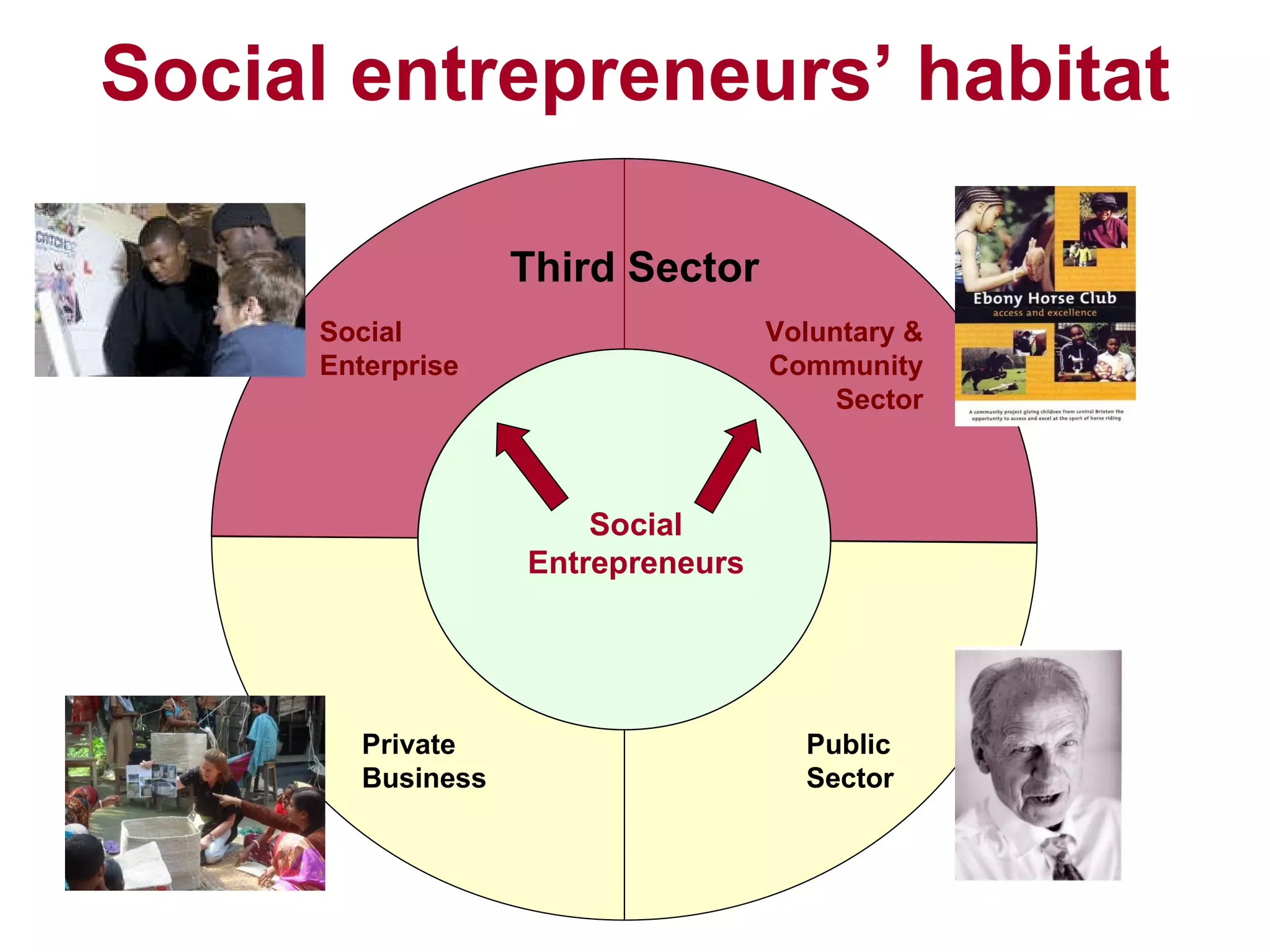
Social entrepreneurs’ habitat Private Business Public Sector Social Entrepreneurs Voluntary & Community Sector Social Enterprise Third Sector
SSE information Year-long learning + support programmes running for 10+ years Over 420 SSE Fellows have completed programmes; 150+ currently going through Active schools in 10 locations (incl. London, Hampshire, East Mids, Fife, Liverpool, Cornwall) Operates as social franchise  (best practice + quality system) International developments in progress  (SSE Australia running / + China, Canada etc)
All schools / programmes 1998 - 2009 +3
SSE evaluation 85% of organisations established at SSE are still in existence: strong  survival  rate  60% report  increased turnover  after attending SSE; on average, a five-fold increase 88% experience a  growth in confidence and skills  to lead their organisation Over 50% make 10 or more  useful contacts  that they attribute directly to SSE  Over half of SSE Fellows’ organisations gain more than 50%  income from trading For every 10 Fellows, 34  jobs  and  70 volunteering positions are created
MISSION (and motivation)
Mission:Why does it matter? Distinguishes social entrepreneurs in absence of purely financial motive Crucial first step for planning / evaluating Communication to people  (internal / external) Aid decision-making / avoid drift
Vision, mission, values… Vision : Desired or intended future state Mission : Fundamental purpose of org (methods used, people served) Values : Beliefs shared among stakeholders
Motivation?
Needs and stakeholders Market  research : is the need unmet? Who are your  stakeholders ? [stakeholder analysis] Competitors   (aka collaborators; aka partners)
MONEY
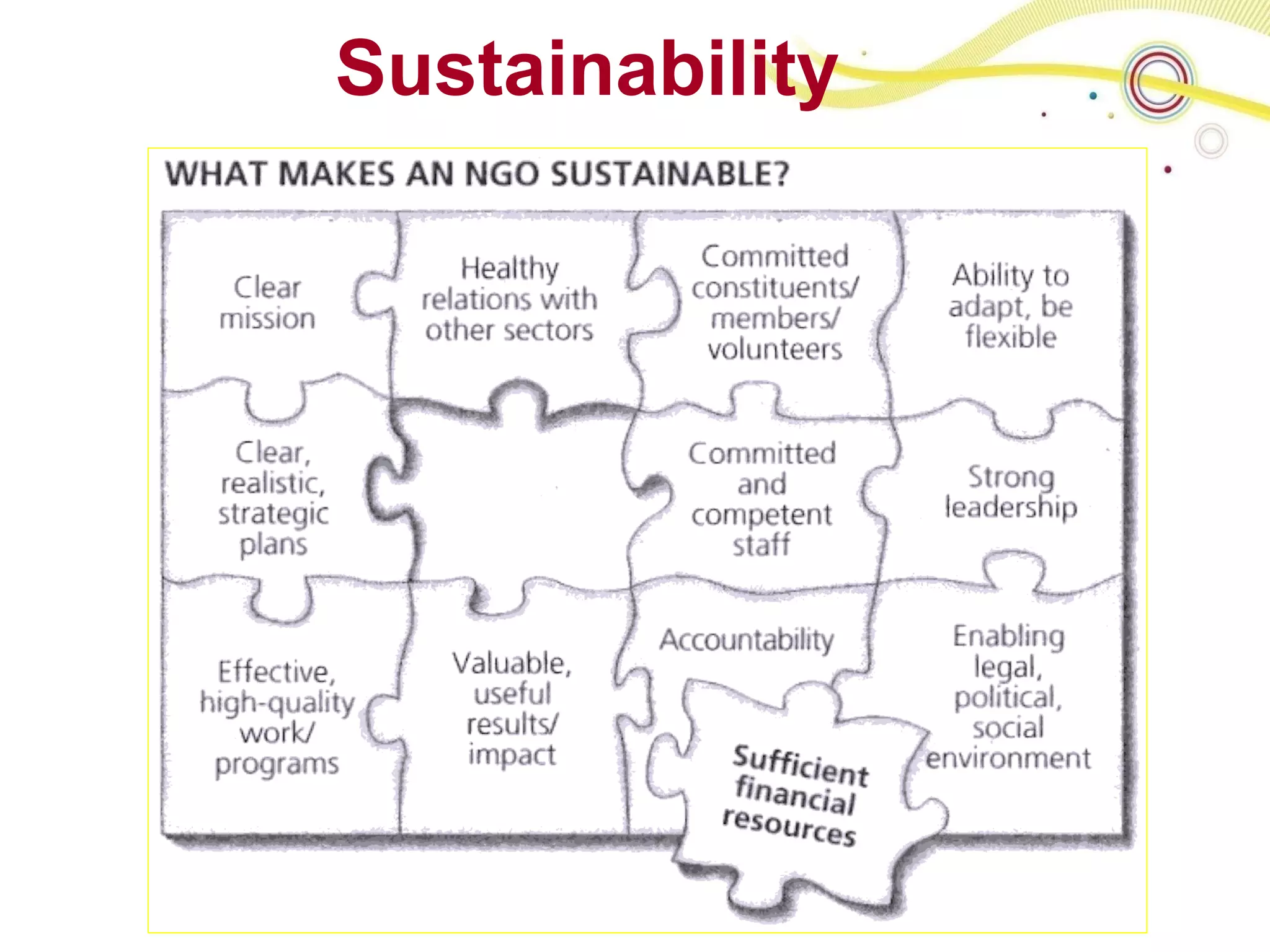
Sustainability
 
Funding types Trading:  selling, retail, trading Earning:  contracting, procurement Government:  local, regional, national, EU Lottery:  BLF, HLF, Awards for All Trusts & Foundations:  UK + international Corporate Support:  CSR, pro bono Individual Giving:  donations, philanthropy Social Investment:  loan, patient capital + other resources: in-kind, volunteering....
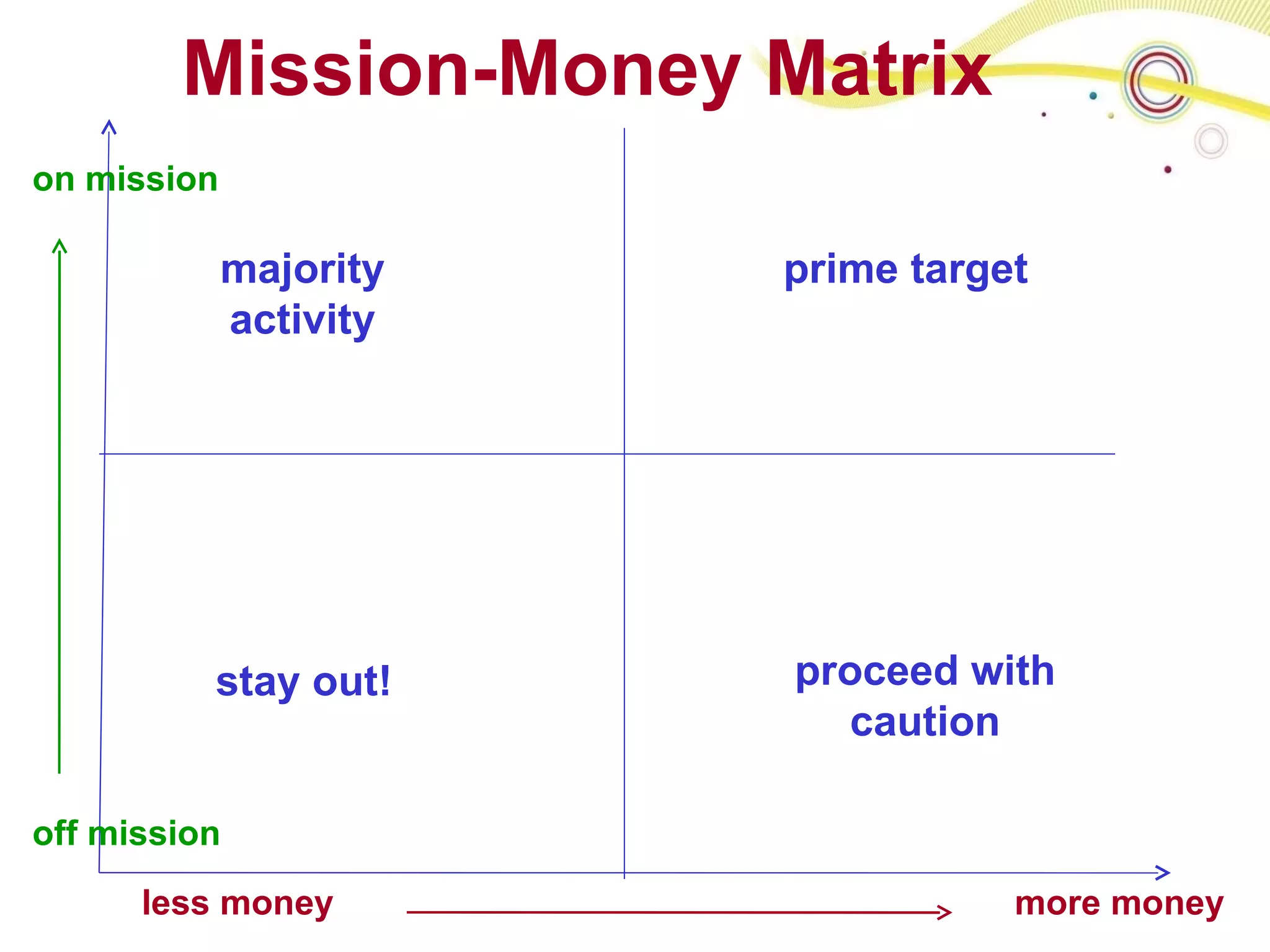
Mission-Money Matrix majority activity stay out! proceed with caution prime target on mission off mission more money less money
MEASUREMENT
The other bottom line Proving Improving Narrative (theory of change) Motivation
MANAGEMENT / MANPOWER
 
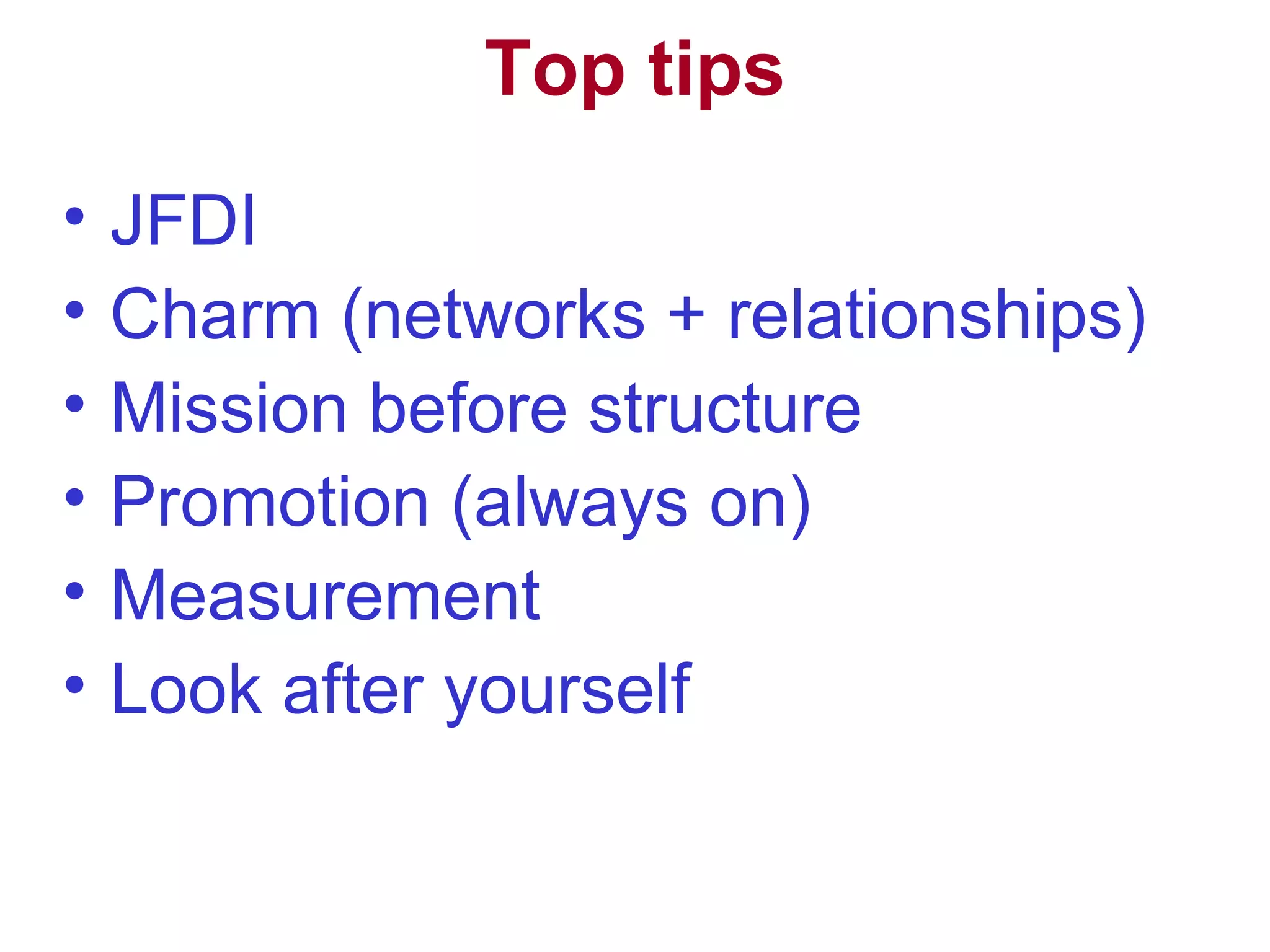
Top tips JFDI Charm (networks + relationships) Mission before structure Promotion (always on) Measurement Look after yourself
 
www.sse.org.uk http://del.icio.us/SSE @SchSocEnt www.slideshare.net/SSE [email_address] +44 (0)20 8981 0300 “ SSE is the UK’s most important contribution to  social entrepreneurship” - Pamela Hartigan
 
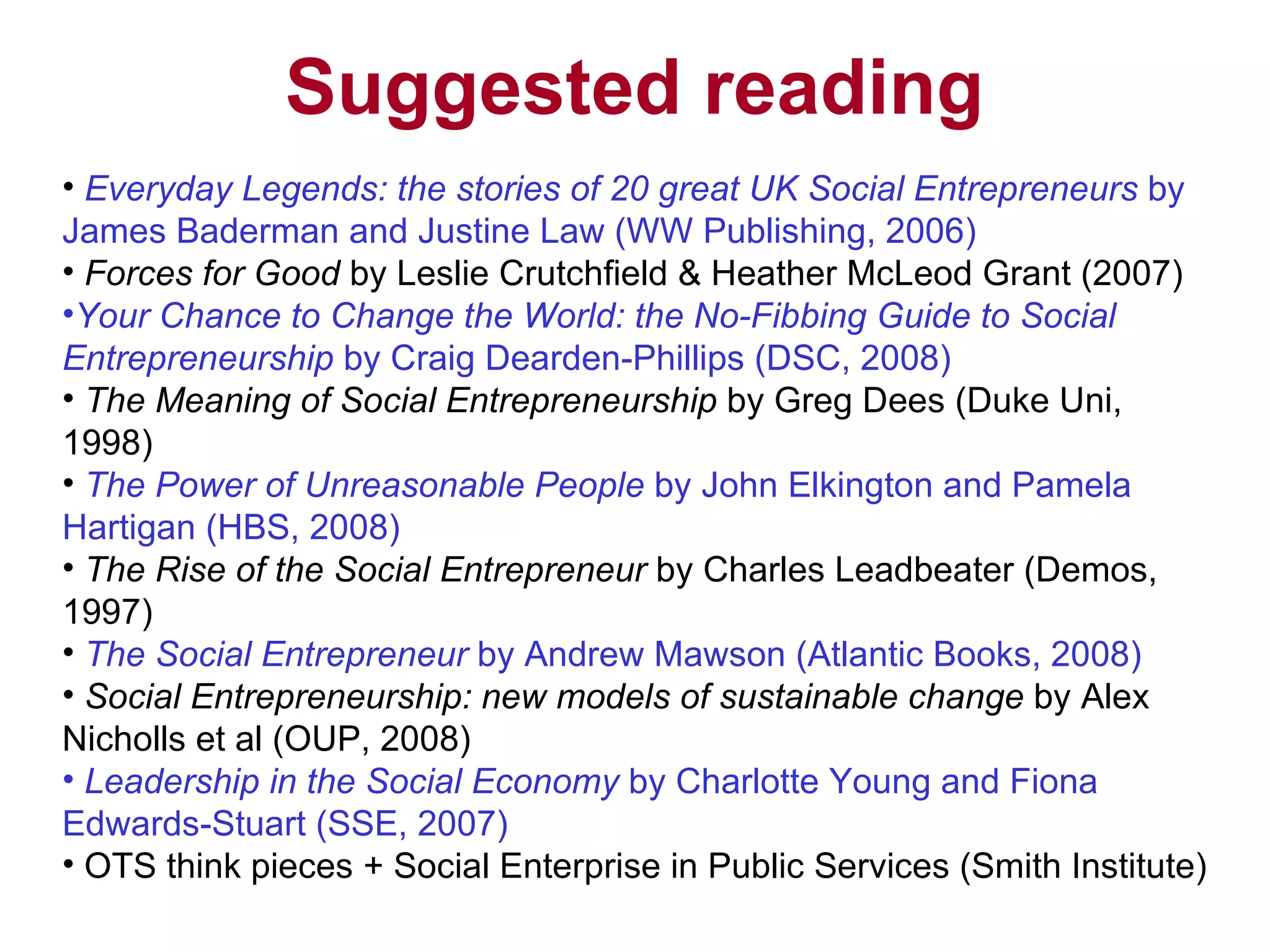
Suggested reading Everyday Legends: the stories of 20 great UK Social Entrepreneurs  by James Baderman and Justine Law (WW Publishing, 2006) Forces for Good   by Leslie Crutchfield & Heather McLeod Grant (2007) Your Chance to Change the World: the No-Fibbing Guide to Social Entrepreneurship  by Craig Dearden-Phillips (DSC, 2008) The Meaning of Social Entrepreneurship  by Greg Dees (Duke Uni, 1998)  The Power of Unreasonable People  by John Elkington and Pamela Hartigan (HBS, 2008) The Rise of the Social Entrepreneur  by Charles Leadbeater (Demos, 1997)  The Social Entrepreneur  by Andrew Mawson (Atlantic Books, 2008)  Social Entrepreneurship: new models of sustainable change  by Alex Nicholls et al (OUP, 2008)  Leadership in the Social Economy  by Charlotte Young and Fiona Edwards-Stuart (SSE, 2007) OTS think pieces + Social Enterprise in Public Services (Smith Institute)

Starting Out as a Social Entrepreneur

  • 1.
  • 2.
  • 3.
    Definition of SocialEntrepreneur + = Credit: Pamela Hartigan - Schwab Foundation
  • 4.
    Michael Young OpenUniversity Labour Manifesto 1945 Consumers’ Association Which? Magazine Language Line (TIS) & 50+ others School for Social Entrepreneurs
  • 5.
    Sheenagh Day Maison Bengal Ros Spearing Ebony Horse Club Tokunbo Ajasa-Oluwa Catch22 Magazine
  • 6.
    The difference: Whatis a social entrepreneur ? A social entrepreneur is someone who works in an entrepreneurial manner, but for primarily social benefit. Driven by a social mission, they aim to address unmet needs to improve people’s lives. What is a social enterprise ? A social enterprise is a business with primarily social objectives, whose surpluses are reinvested in the business or in the community, rather than being driven by the need to maximise profit for shareholders or owners. VERB NOUN
  • 7.
    Social entrepreneurs’ habitatPrivate Business Public Sector Social Entrepreneurs Voluntary & Community Sector Social Enterprise Third Sector
  • 8.
    SSE information Year-longlearning + support programmes running for 10+ years Over 420 SSE Fellows have completed programmes; 150+ currently going through Active schools in 10 locations (incl. London, Hampshire, East Mids, Fife, Liverpool, Cornwall) Operates as social franchise (best practice + quality system) International developments in progress (SSE Australia running / + China, Canada etc)
  • 9.
    All schools /programmes 1998 - 2009 +3
  • 10.
    SSE evaluation 85%of organisations established at SSE are still in existence: strong survival rate 60% report increased turnover after attending SSE; on average, a five-fold increase 88% experience a growth in confidence and skills to lead their organisation Over 50% make 10 or more useful contacts that they attribute directly to SSE Over half of SSE Fellows’ organisations gain more than 50% income from trading For every 10 Fellows, 34 jobs and 70 volunteering positions are created
  • 11.
  • 12.
    Mission:Why does itmatter? Distinguishes social entrepreneurs in absence of purely financial motive Crucial first step for planning / evaluating Communication to people (internal / external) Aid decision-making / avoid drift
  • 13.
    Vision, mission, values…Vision : Desired or intended future state Mission : Fundamental purpose of org (methods used, people served) Values : Beliefs shared among stakeholders
  • 14.
  • 15.
    Needs and stakeholdersMarket research : is the need unmet? Who are your stakeholders ? [stakeholder analysis] Competitors (aka collaborators; aka partners)
  • 16.
  • 17.
  • 18.
  • 19.
    Funding types Trading: selling, retail, trading Earning: contracting, procurement Government: local, regional, national, EU Lottery: BLF, HLF, Awards for All Trusts & Foundations: UK + international Corporate Support: CSR, pro bono Individual Giving: donations, philanthropy Social Investment: loan, patient capital + other resources: in-kind, volunteering....
  • 20.
    Mission-Money Matrix majorityactivity stay out! proceed with caution prime target on mission off mission more money less money
  • 21.
  • 22.
    The other bottomline Proving Improving Narrative (theory of change) Motivation
  • 23.
  • 24.
  • 25.
    Top tips JFDICharm (networks + relationships) Mission before structure Promotion (always on) Measurement Look after yourself
  • 26.
  • 27.
    www.sse.org.uk http://del.icio.us/SSE @SchSocEntwww.slideshare.net/SSE [email_address] +44 (0)20 8981 0300 “ SSE is the UK’s most important contribution to social entrepreneurship” - Pamela Hartigan
  • 28.
  • 29.
    Suggested reading EverydayLegends: the stories of 20 great UK Social Entrepreneurs by James Baderman and Justine Law (WW Publishing, 2006) Forces for Good by Leslie Crutchfield & Heather McLeod Grant (2007) Your Chance to Change the World: the No-Fibbing Guide to Social Entrepreneurship by Craig Dearden-Phillips (DSC, 2008) The Meaning of Social Entrepreneurship by Greg Dees (Duke Uni, 1998) The Power of Unreasonable People by John Elkington and Pamela Hartigan (HBS, 2008) The Rise of the Social Entrepreneur by Charles Leadbeater (Demos, 1997) The Social Entrepreneur by Andrew Mawson (Atlantic Books, 2008) Social Entrepreneurship: new models of sustainable change by Alex Nicholls et al (OUP, 2008) Leadership in the Social Economy by Charlotte Young and Fiona Edwards-Stuart (SSE, 2007) OTS think pieces + Social Enterprise in Public Services (Smith Institute)

Editor's Notes

  • #5 Large scale impact: disruptive innovations Foremost social entrepreneur of the 20th century etc.
  • #6 Explanation of methodology + SSE support Plus, a local, niche solution…..from someone who has gained (and given) significant personal development and additional benefits along the way
  • #7 WHO ARE THEY? ‘Beneficiaries’, ‘users’, ‘clients’ ; Career changers (corporate; public sector); Young people / graduates; Silver radicals; Third sector professionals and volunteers; Everyone? What do we look for? (personal) Responsibility; Prone to action / not risk-averse; Innovative / creative; Visionary: have clear mission; Pragmatic; Persistent / committed; Resourceful / adaptable / opportunistic; + Engagement with community they are aiming to serve
  • #8 More generally: habitat. Third Sector. Set up a variety of different legal structures depending on their mission, finance, and governance.
  • #9 No self-respecting social entrepreneur misses a chance to self-promote
  • #11 Available on request (download or hard copy)
  • #13 VISION, MISSION, VALUES
  • #14 Vision : Defines the desired or intended future state the organisation is trying to make happen: its ultimate objective. Mission : Defines the fundamental purpose of an organisation, concentrating on the present. Defines the methods used and the people served. Values : Beliefs that are shared among the stakeholders of an organisation, particularly in relation to how it operates.
  • #15 Personal injustice / experience Restlessness with status quo Identified problem / ‘wrong’ Identified opportunity / market niche Seeking purpose / meaning Faith (Inspirational) role model(s) [biographical vs. career]
  • #16 Large scale impact: disruptive innovations Foremost social entrepreneur of the 20th century etc.
  • #18 Soon to be 400.
  • #19 Soon to be 400.
  • #20 Friends, fools + family
  • #21 Soon to be 400.
  • #25 People management (trustees/directors, volunteers, funders/investors, stakeholders (and beneficiaries)