Тетерюков Д.О. 
Wearables. Can we wear 
them everywhere? 
Носимые технологии. 
Технологии без границ?
Wearable 
Electronics 
Google Glass 
Medical bands 
Accessorize for access 
Wristbands 
Smart Glove 
iWatch 
Wardrobe on the go 
Hi-tech fabrics
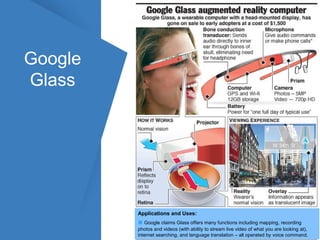
Google 
Glass 
Applications and Uses: 
■ Google claims Glass offers many functions including mapping, recording 
photos and videos (with ability to stream live video of what you are looking at), 
internet searching, and language translation – all operated by voice command.
Google Glass
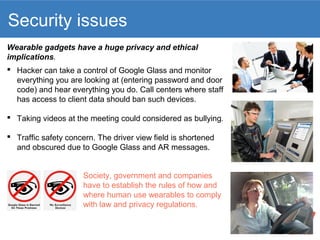
Security issues 
Wearable gadgets have a huge privacy and ethical 
implications. 
 Hacker can take a control of Google Glass and monitor 
everything you are looking at (entering password and door 
code) and hear everything you do. Call centers where staff 
has access to client data should ban such devices. 
 Taking videos at the meeting could considered as bullying. 
 Traffic safety concern. The driver view field is shortened 
and obscured due to Google Glass and AR messages. 
Society, government and companies 
have to establish the rules of how and 
where human use wearables to comply 
with law and privacy regulations.
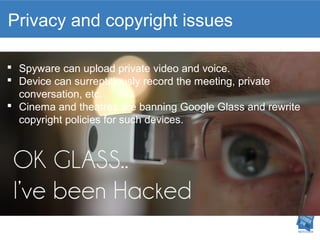
Privacy and copyright issues 
 Spyware can upload private video and voice. 
 Device can surreptitiously record the meeting, private 
conversation, etc. 
 Cinema and theatres are banning Google Glass and rewrite 
copyright policies for such devices.
Health 
monitoring 
and mind 
reading 
wearables 
Google smart contact lens
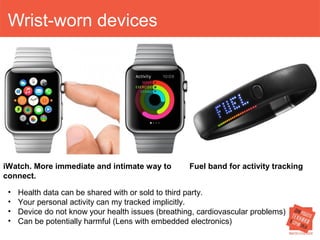
Wrist-worn devices 
iWatch. More immediate and intimate way to 
connect. 
Fuel band for activity tracking 
• Health data can be shared with or sold to third party. 
• Your personal activity can my tracked implicitly. 
• Device do not know your health issues (breathing, cardiovascular problems) 
• Can be potentially harmful (Lens with embedded electronics)
Mind reading device
Exoskeletons 
and robotic 
prosthesis
Robotic and visual prosthesis
Three laws of wearables/cyborgs 
1. Smart wearables may not injure 
a wearer or guide human to a 
dangerous situation. 
2. Wearables must obey the orders 
given to it by the wearer, except 
where such order would conflict 
with the First Law. 
3. Wearables must not take over 
the control of the wearer, obey 
privacy and information security 
of the human beings. 
Isaak Asimov 
Three Laws 
of Robotics
Future of human 
Battery? 
Freedom?

Робоэтика. Сочи 2014. Д. Тетерюков

  • 1.
    Тетерюков Д.О. Wearables.Can we wear them everywhere? Носимые технологии. Технологии без границ?
  • 2.
    Wearable Electronics GoogleGlass Medical bands Accessorize for access Wristbands Smart Glove iWatch Wardrobe on the go Hi-tech fabrics
  • 3.
    Google Glass Applicationsand Uses: ■ Google claims Glass offers many functions including mapping, recording photos and videos (with ability to stream live video of what you are looking at), internet searching, and language translation – all operated by voice command.
  • 4.
  • 5.
    Security issues Wearablegadgets have a huge privacy and ethical implications.  Hacker can take a control of Google Glass and monitor everything you are looking at (entering password and door code) and hear everything you do. Call centers where staff has access to client data should ban such devices.  Taking videos at the meeting could considered as bullying.  Traffic safety concern. The driver view field is shortened and obscured due to Google Glass and AR messages. Society, government and companies have to establish the rules of how and where human use wearables to comply with law and privacy regulations.
  • 6.
    Privacy and copyrightissues  Spyware can upload private video and voice.  Device can surreptitiously record the meeting, private conversation, etc.  Cinema and theatres are banning Google Glass and rewrite copyright policies for such devices.
  • 7.
    Health monitoring andmind reading wearables Google smart contact lens
  • 8.
    Wrist-worn devices iWatch.More immediate and intimate way to connect. Fuel band for activity tracking • Health data can be shared with or sold to third party. • Your personal activity can my tracked implicitly. • Device do not know your health issues (breathing, cardiovascular problems) • Can be potentially harmful (Lens with embedded electronics)
  • 9.
  • 10.
  • 11.
  • 12.
    Three laws ofwearables/cyborgs 1. Smart wearables may not injure a wearer or guide human to a dangerous situation. 2. Wearables must obey the orders given to it by the wearer, except where such order would conflict with the First Law. 3. Wearables must not take over the control of the wearer, obey privacy and information security of the human beings. Isaak Asimov Three Laws of Robotics
  • 13.
    Future of human Battery? Freedom?

Editor's Notes

  • #3 The market for wearable technology is set to grow from $1.6 billion to $5 billion, according to research by Gartner. Glass goes beyond smartphones and tablets. Glass can show firefighters to show a floor plan to navigate through a burning building.
  • #4 The market for wearable technology is set to grow from $1.6 billion to $5 billion, according to research by Gartner. Glass goes beyond smartphones and tablets. Glass can show firefighters to show a floor plan to navigate through a burning building.
  • #5 offer turn-by-turn navigation using voice commands to promote a hands-free driving experience
  • #6 offer turn-by-turn navigation using voice commands to promote a hands-free driving experience
  • #8 Novartis, the two companies said they will create a smart contact lens that contains a low power microchip and an almost invisible, hair-thin electronic circuit. The lens can measure diabetics’ blood sugar levels directly from tear fluid on the surface of the eyeball. The system sends data to a mobile device to keep the individual informed. Нейро-компьютерный интерфейс
  • #9 Activity Apps tells you how many calories you have burned, how often you stood up to take a break from seating. Suggests a new move goal. Профессор университета Райерсона считает что все что мотивирует заниматься спортом хорошо и полезно для людей которые нуждаются в поддержке. Пользователи могут делиться результатами и достижениями с друзьями в Facebook и Twitter. Результаты исследования показали что 65% пользователей которые просматривали свои персональные данные о здоровье скорее будут придерживаться рекомендаций.
  • #10 Нейро-компьютерный интерфейс (НКИ) (называемый также прямой нейронный интерфейс, мозговой интерфейс, интерфейс «мозг — компьютер»— система, созданная для обмена информацией между мозгом и электронным устройством. Кремний обладает возможностью соединять неживую материю с живыми нейронами, а окруженные нейронами транзисторы получают сигналы от нервных клеток NeuroSky. Неприкосновенность частной жизни
  • #11 Hybrid Assistive Limb, 23 kg, 2.40 min daily activities, holding and lifting heavy objects, био-кибернитическое управление. ReWalk
  • #12 Двигательная область коры головного мозга.