Saponification is the process of making soap where triglycerides are reacted with a base like sodium or potassium hydroxide to produce glycerol and fatty acid salts known as soap. The document provides instructions for making moringa and aloe vera soap using a saponification process where vegetable glycerin, extracts from the plants, and a melt and pour soap base are blended and molded.
SOAP MAKING –
SAPONIFICATION
PROCESS
RONALYNE. AGUILAR
Republic of the Philippines
CENTRAL BICOL STATE UNIVERSITY OF AGRICULTURE
Sta. Cruz Poblacion, Calabanga, Camarines Sur 4405
Website: www.cbsua.edu.ph
Email Address: ca.calabanga@cbsua.edu.ph
Trunkline: (054) 881-3258
ABEL 2A
2.
BACKGROUND INFORMATION
Soap arean integral part to maintain the good health
and hygiene of individuals. Soaps are essential to
cleanse dirt and oil of the objects including the skin
surface. Soaps are widely used in bathing, cleaning,
washing and in other household chores.
Saponification Definition
Saponification is the hydrolysis of an ester with NaOH
or KOH to give alcohol and sodium or potassium salt of
the acid.
3.
What is Saponification?
Saponificationis simply the process of making
soaps. Soaps are just potassium or sodium salts of
long-chain fatty acids. During saponification, ester
reacts with an inorganic base to produce alcohol and
soap.
Generally, it occurs when triglycerides are reacted
with potassium or sodium hydroxide (lye) to produce
glycerol and fatty acid salt, called ‘soap’.
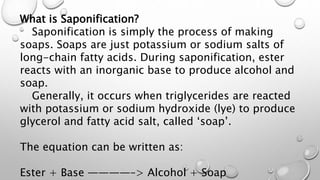
The equation can be written as:
Ester + Base ————–> Alcohol + Soap
4.
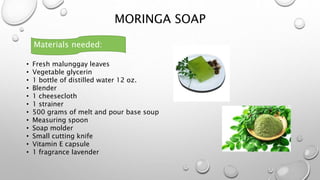
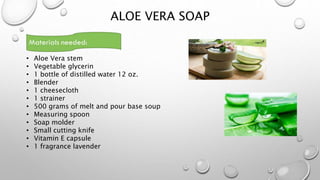
MORINGA SOAP
• Freshmalunggay leaves
• Vegetable glycerin
• 1 bottle of distilled water 12 oz.
• Blender
• 1 cheesecloth
• 1 strainer
• 500 grams of melt and pour base soup
• Measuring spoon
• Soap molder
• Small cutting knife
• Vitamin E capsule
• 1 fragrance lavender
Materials needed:
5.
1. Wash themalunggay leaves thoroughly then put it into the blender.
2. Add 3 tablespoon of vegetable glycerin and distilled water.
3. Blend it for 5 minutes.
4. Filter the malunggay extract using the cheesecloth.
5. Squeeze out the extract.
6. Take 500 grams of melt and pour base soup and cut into cubes.
7. Put the cubes in a heat resistant cup and melt using the double boiling
method.
8. When it has melted remove the cup from the water bath.
9. While the melted soap is still hot add malunggay extract and 3 capsule
of vitamin e and mix it thoroughly.
10.After mixing pour it into your soap molds.
11.Keep the molds in the fridge for about an hour for the soap to harden
or keep at room temperature for a day.
Procedures
6.
ALOE VERA SOAP
•Aloe Vera stem
• Vegetable glycerin
• 1 bottle of distilled water 12 oz.
• Blender
• 1 cheesecloth
• 1 strainer
• 500 grams of melt and pour base soup
• Measuring spoon
• Soap molder
• Small cutting knife
• Vitamin E capsule
• 1 fragrance lavender
7.
1. Thoroughly washthe Aloe Vera
2. Use knife to remove the outer skin of Aloe Vera
3. After removing the peel put it in a blendet
4. Add 3 tablespoon of vegetable glycerin and distilled water.
5. Blend it for 5 minutes.
6. Filter the Aloe Vera extract using the cheesecloth.
7. Squeeze out the extract.
8. Take 500 grams of melt and pour base soup and cut into cubes.
9. Put the cubes in a heat resistant cup and melt using the double boiling
method.
10.When it has melted remove the cup from the water bath.
11.While the melted soap is still hot add malunggay extract and 3 capsule
of vitamin e and mix it thoroughly.
12.After mixing pour it into your soap molds.
13.Keep the molds in the fridge for about an hour for the soap to harden
or keep at room temperature for a day.
Procedures