Service Oriented Modeling
              and
Business Process Management &
       Notation (BPMN)

                                  Presented by:
                            Nadeem Aftab
                    (naaf1001@student.miun.se)
                              Ayaz Shahid
                    (aysh1000@student.miun.se)
                          Addisu Lodamo
                    (adlo1001@student.miun.se)
Overview
•   Introduction
•   SOA life Cycle
•   Modeling Approaches
•   Service Oriented Modeling Framework (SOMF)
•   BPMN
•   Question/Answer Session
•   References
Introduction

• We tend to replace old technologies with new
  one
• The interoperability, reusability, and other
  issues
• Concept of SOA
 ▫ Maximize the software asset reuse.
 ▫ Addresses the challenges of tightly coupled
   software
 ▫ Favor the loosely coupled software
 ▫ Also tackles budget and ROI issues
What is SOA modeling
 “Service-oriented modeling is a software development
 practice that employees modeling disciplines and
 language to provide strategic and tactical solutions to
 enterprise problems. This anthropomorphic modeling
 paradigm advocates a holistic view of analysis, design
 and architecture of all organizational software entities,
 conceiving them as a service-oriented assets, namely
 services”. [Michael Bell]
SOA life Cycle
Service Metamorphosis
Strategy
Structure
Governance
Funding
Return on Investment(ROI)
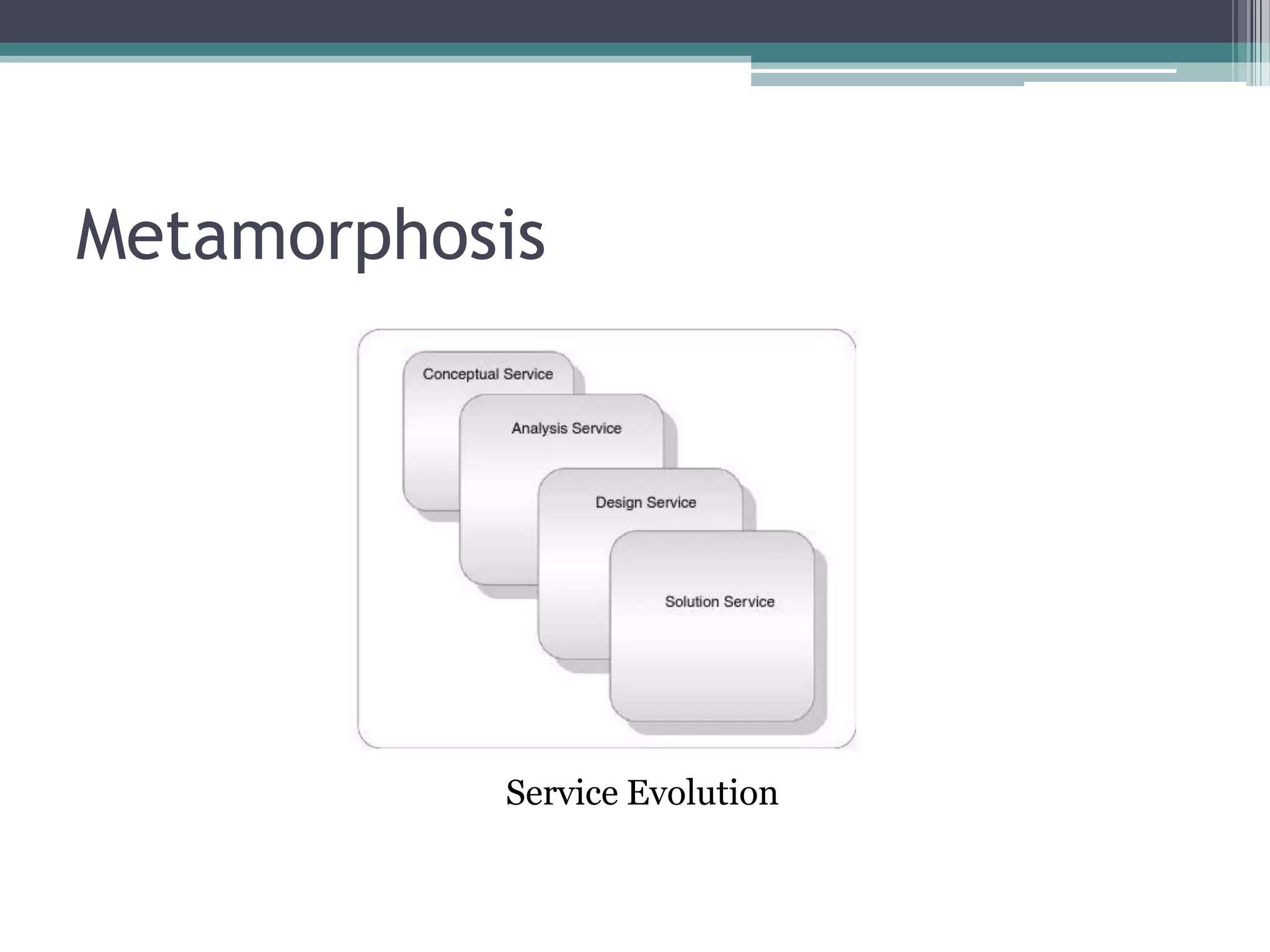
Metamorphosis


           Service Evolution
Strategy
• Driving Force of any Project.
• Long-Term plan for service life cycle.
• Essential for scheduling events, planning stage
  and create timetable.
• Should not offer small-scale solution.
• Should contribute
 ▫ Proactive approach to address unseen events and stability.
 ▫ Road map, alternative and agility.
 ▫ Reachable, measurable and realistic mile stone within budget and
   time.
Structure
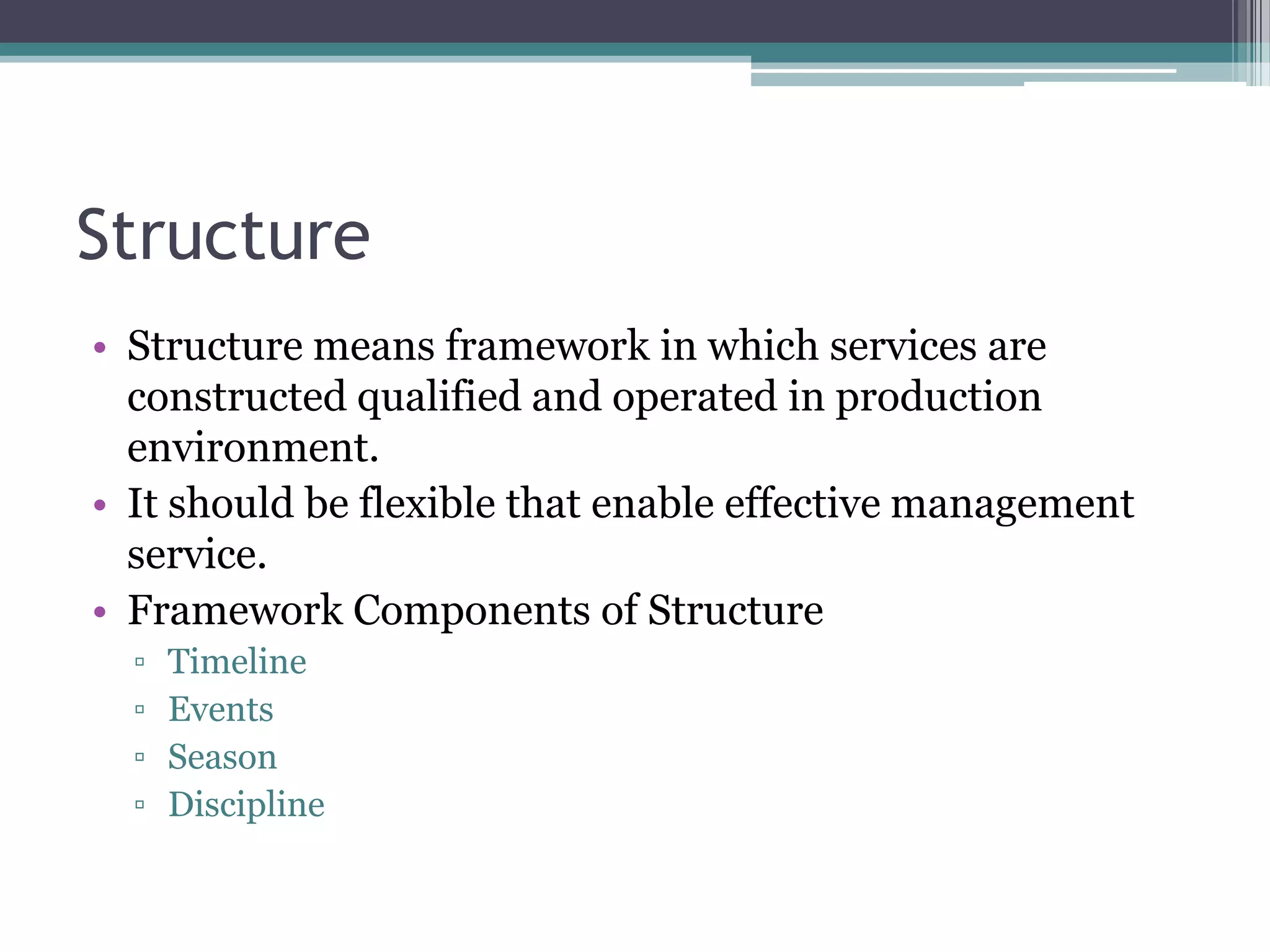
• Structure means framework in which services are
  constructed qualified and operated in production
  environment.
• It should be flexible that enable effective management
  service.
• Framework Components of Structure
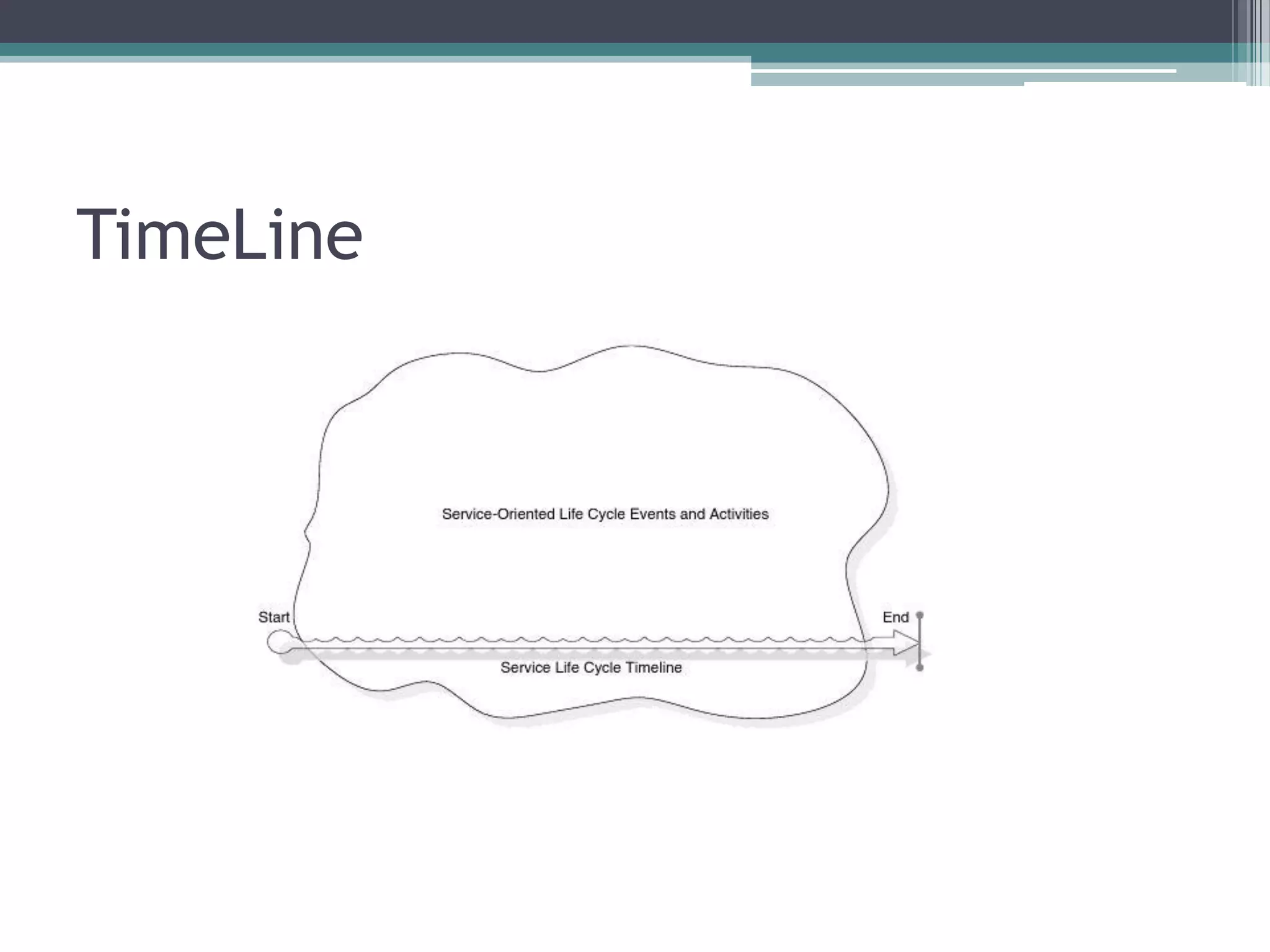
  ▫   Timeline
  ▫   Events
  ▫   Season
  ▫   Discipline
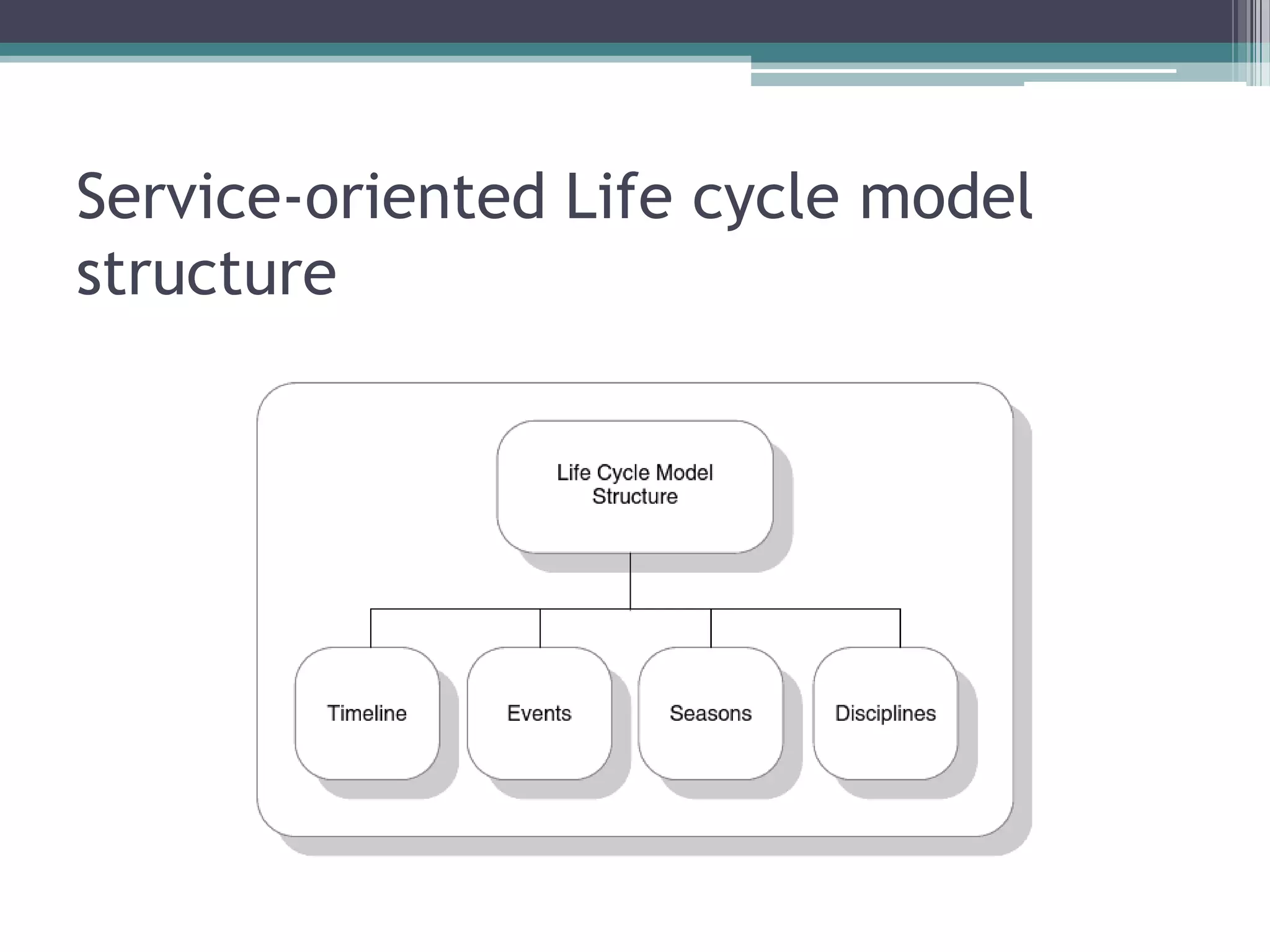
Service-oriented Life cycle model
structure
TimeLine
Events
•   Begins, last for while and then disappear.
•   Have pattern
•   Start at particular time.
•   Types of events
    ▫ Planned events
    ▫ Unplanned
• Four Major Events.
    ▫   Staged
    ▫   Unpredictable
    ▫   Random
    ▫   Conditional
Season
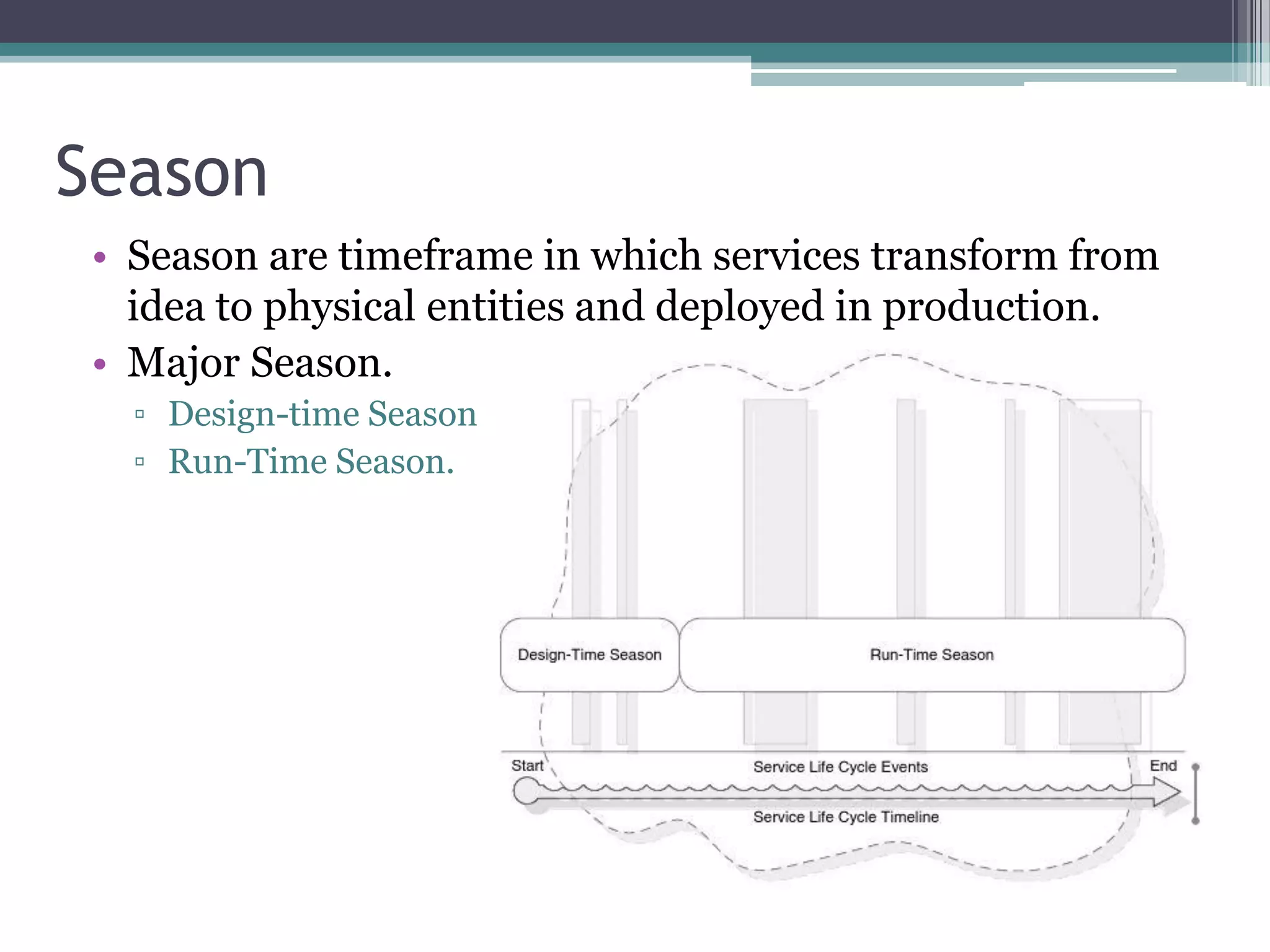
 • Season are timeframe in which services transform from
   idea to physical entities and deployed in production.
 • Major Season.
   ▫ Design-time Season
   ▫ Run-Time Season.
Discipline
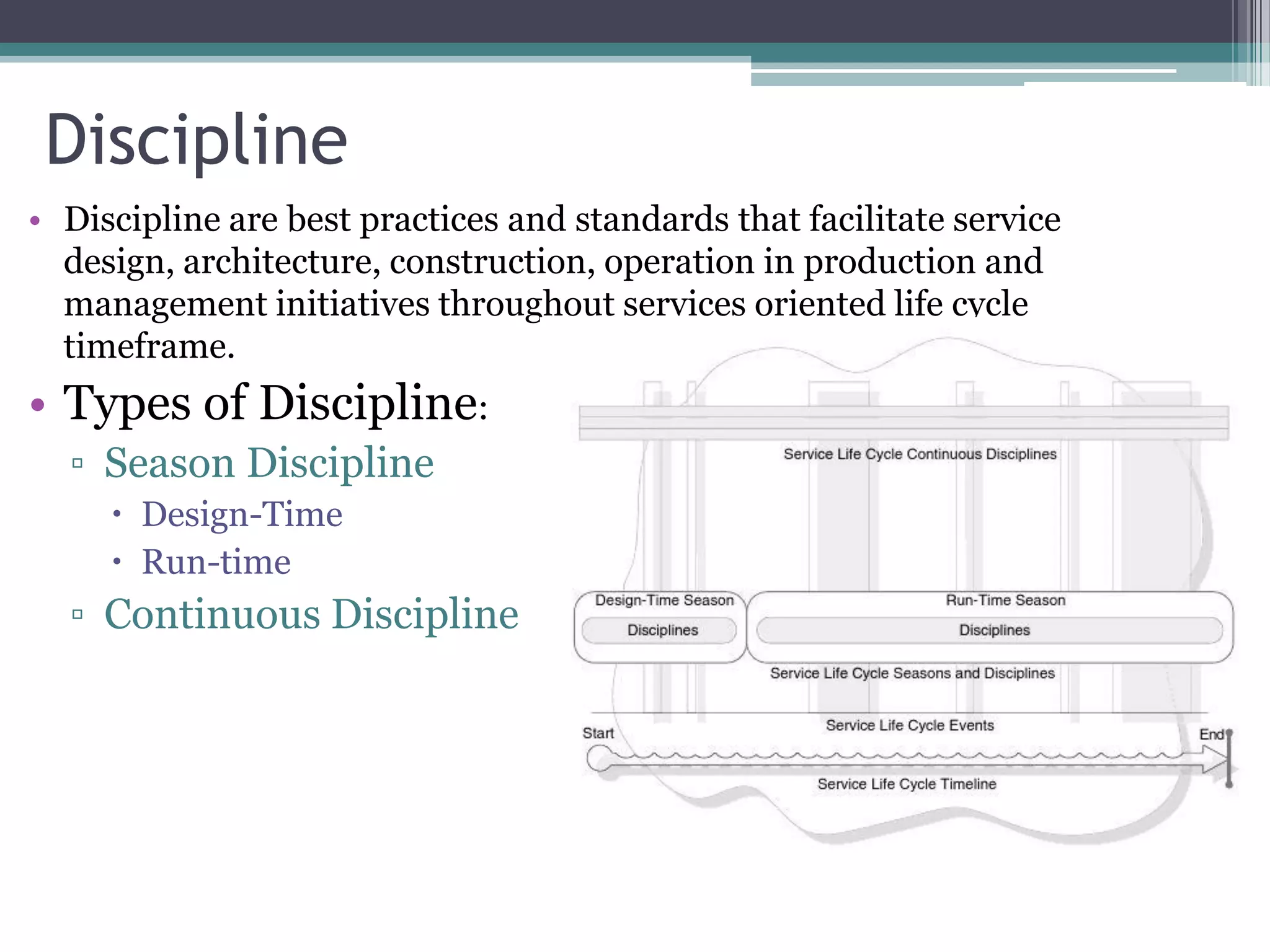
• Discipline are best practices and standards that facilitate service
  design, architecture, construction, operation in production and
  management initiatives throughout services oriented life cycle
  timeframe.
• Types of Discipline:
  ▫ Season Discipline
      Design-Time
      Run-time
  ▫ Continuous Discipline
SOA life Cycle Model (cont.)
• Governance
• Funding
• Return On Investment.
SOA Modeling Approaches


• Service-Oriented Modeling Architecture(SOMA)
• Service-Oriented Modeling Framework(SOMF)
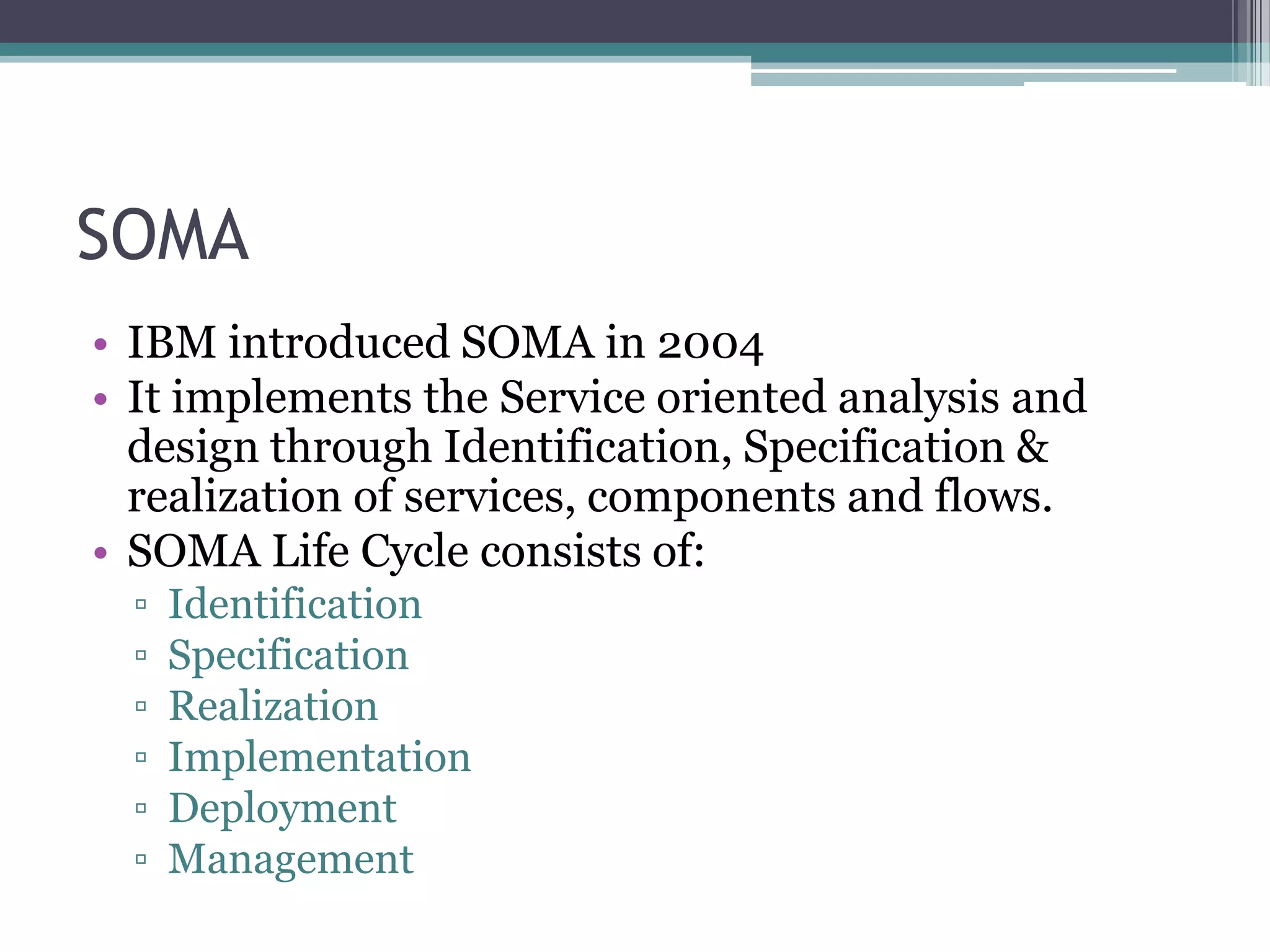
SOMA
• IBM introduced SOMA in 2004
• It implements the Service oriented analysis and
  design through Identification, Specification &
  realization of services, components and flows.
• SOMA Life Cycle consists of:
  ▫   Identification
  ▫   Specification
  ▫   Realization
  ▫   Implementation
  ▫   Deployment
  ▫   Management
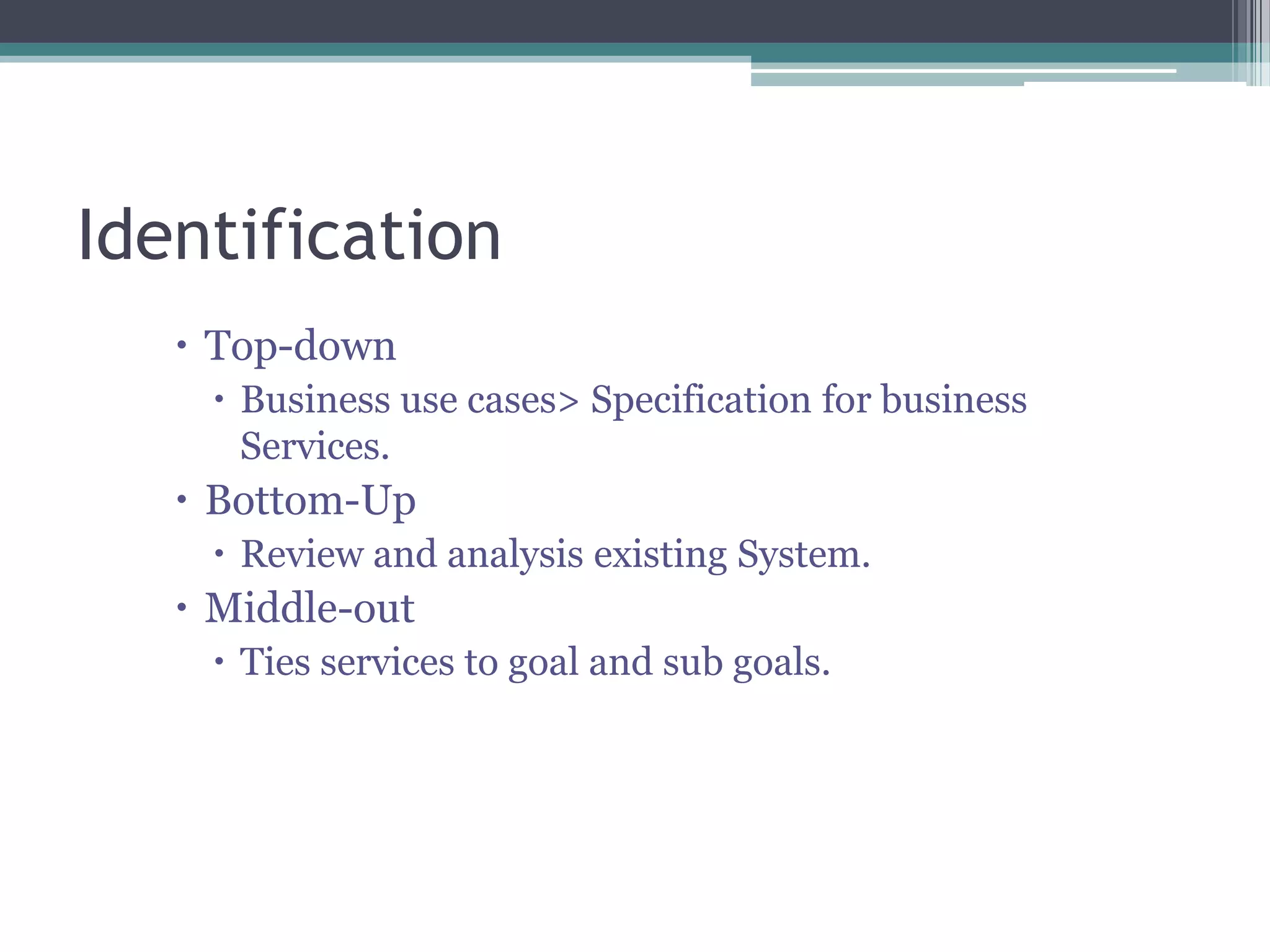
Identification
    Top-down
     Business use cases> Specification for business
      Services.
    Bottom-Up
     Review and analysis existing System.
    Middle-out
     Ties services to goal and sub goals.
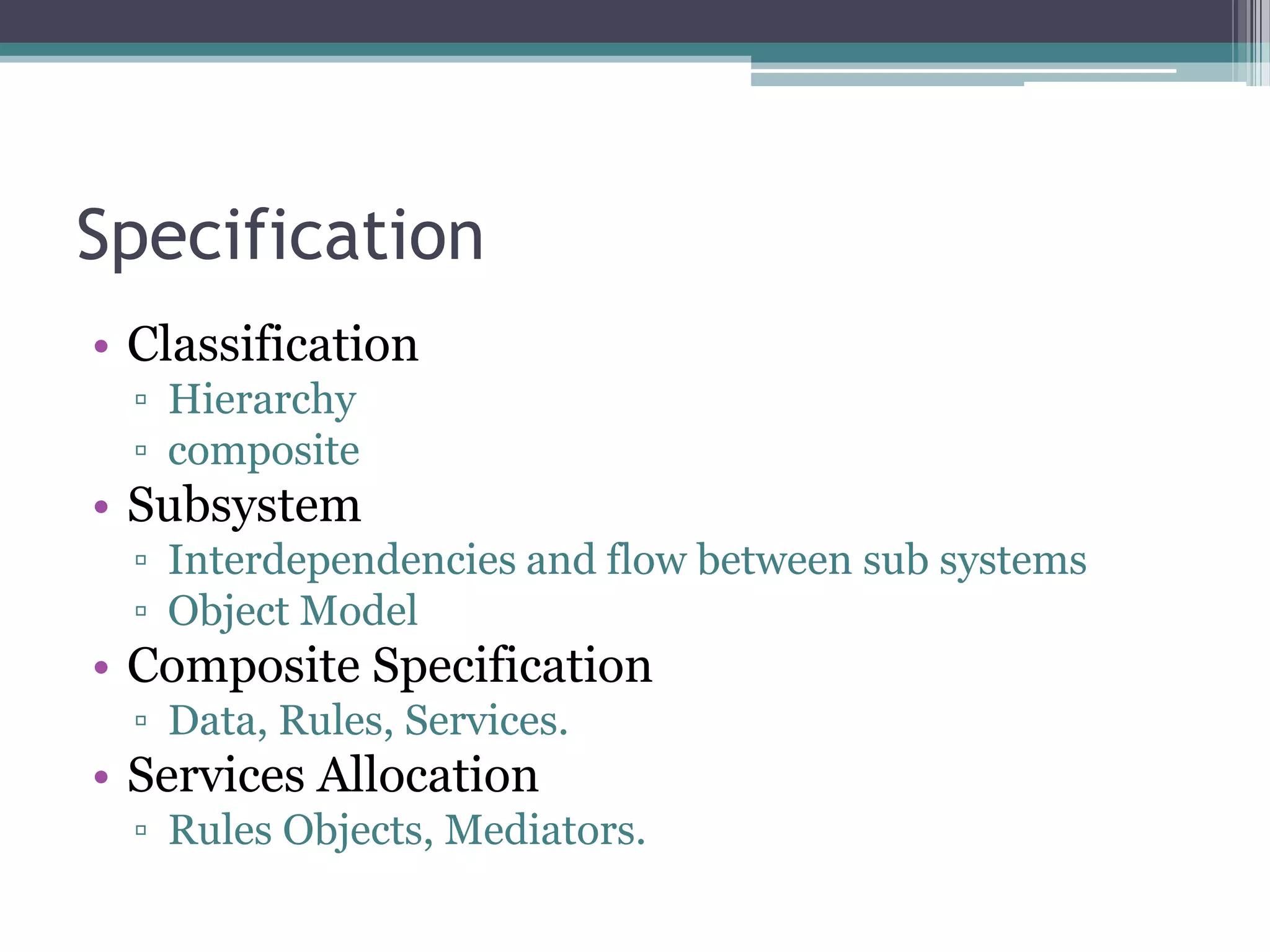
Specification
• Classification
  ▫ Hierarchy
  ▫ composite
• Subsystem
  ▫ Interdependencies and flow between sub systems
  ▫ Object Model
• Composite Specification
  ▫ Data, Rules, Services.
• Services Allocation
  ▫ Rules Objects, Mediators.
Realization
• Services realization
  ▫ Web services
  ▫ Legacy System
Service Oriented Modeling Framework
(SOMF)
• Modeling framework structure is a high level
  map that depicts various components that
  contribute a successful modeling approach
• It identifies “What to do” aspect of service
  development scheme
• Used for effective project planning and to
  identify the milestones of service oriented
  initiative
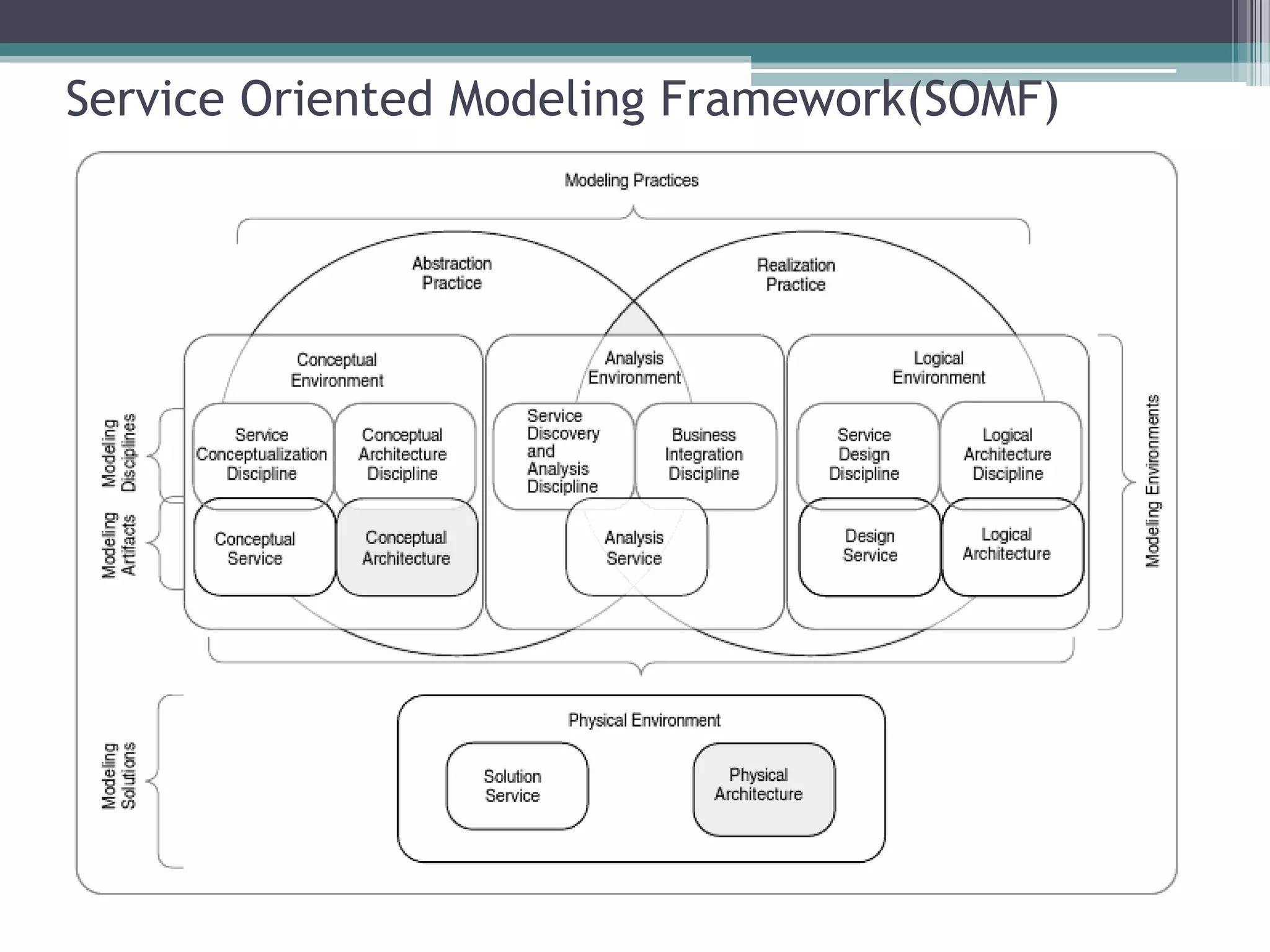
Service Oriented Modeling Framework(SOMF)
• Modeling Practices
 ▫ Abstraction
 ▫ Realization
• Modeling Environments
 ▫ Conceptual
 ▫ Analysis
 ▫ Logical
• Modeling Artifacts
• Modeling Disciplines
Modeling Practices
• Abstraction
     Concepts are intangible entities which originates from
      persons ideas and they reside in the mind of person
     The abstraction process employs conceptualization best
      practice that yields conceptual services which are treated
      like a valuable asset despite being intangible
• Realization
     The realization process starts when most of the ideas
      have been formalized and established as organizational
      concepts during abstraction phase
     The goal of realization practice is to transform the
      intangible services in to more concrete software assets
Modeling Environments
 • It is not a physical location where modeling process take
   place.
 • The modeling environment is about four P’s
   ▫ People: denotes the personnel involved in guiding and
     enforcing modeling disciplines which includes business and
     technological personnel as well.
   ▫ Planning: identifies the tactical and strategic aspects of
     the process. It includes project plans, strategy documents,
     design and architectural blueprints and diagrams.
   ▫ Process: the sequence of activities that business and
     technological personnel peruse to achieve modeling goals.
   ▫ Policies: how a solution can be proposed in environmental
     framework. Management perspectives, check and balance
     and modeling standards reflects the policies.
Modeling Environment (Cont.)
• Conceptual Environment
 ▫ Conceptual environment assist the following
   activities:
     Facilitate the studies of organization business model
      and business strategies
     Involving business and technology personnel in
      conceptualization session
     Helps architects, developers and modelers in
      development of conceptual services
Modeling Environment (Cont.)
• Analysis Environment
  ▫ The analysis environment facilitates the
    transformation of conceptual services into an
    analysis service for further inspection and
    categorization
• Logical Environment
  ▫ The logical environment supports the
    transformation of analysis services onto more
    tangible design services
Discipline Specific Modeling
• Modeling discipline is a field of knowledge that
  offers standards and policies to facilitate service
  oriented development activities during service
  life cycle.
• It identifies the core process in which business
  and technical personnel must be engaged
Discipline Specific Modeling (cont.)
• Service oriented modeling discipline focuses on
  the six areas of expertise:
 ▫   Conceptualization
 ▫   Discovery and analysis
 ▫   Business integration
 ▫   Design
 ▫   Conceptual Architecture
 ▫   Logical Architecture
Service Oriented Conceptualization

• Service oriented modeling process starts from
  service conceptualization phase
• Driving concepts behind future solution services
  are indentified
• The service oriented conceptualization process
  yields intangible service oriented assets called
  “conceptual services”
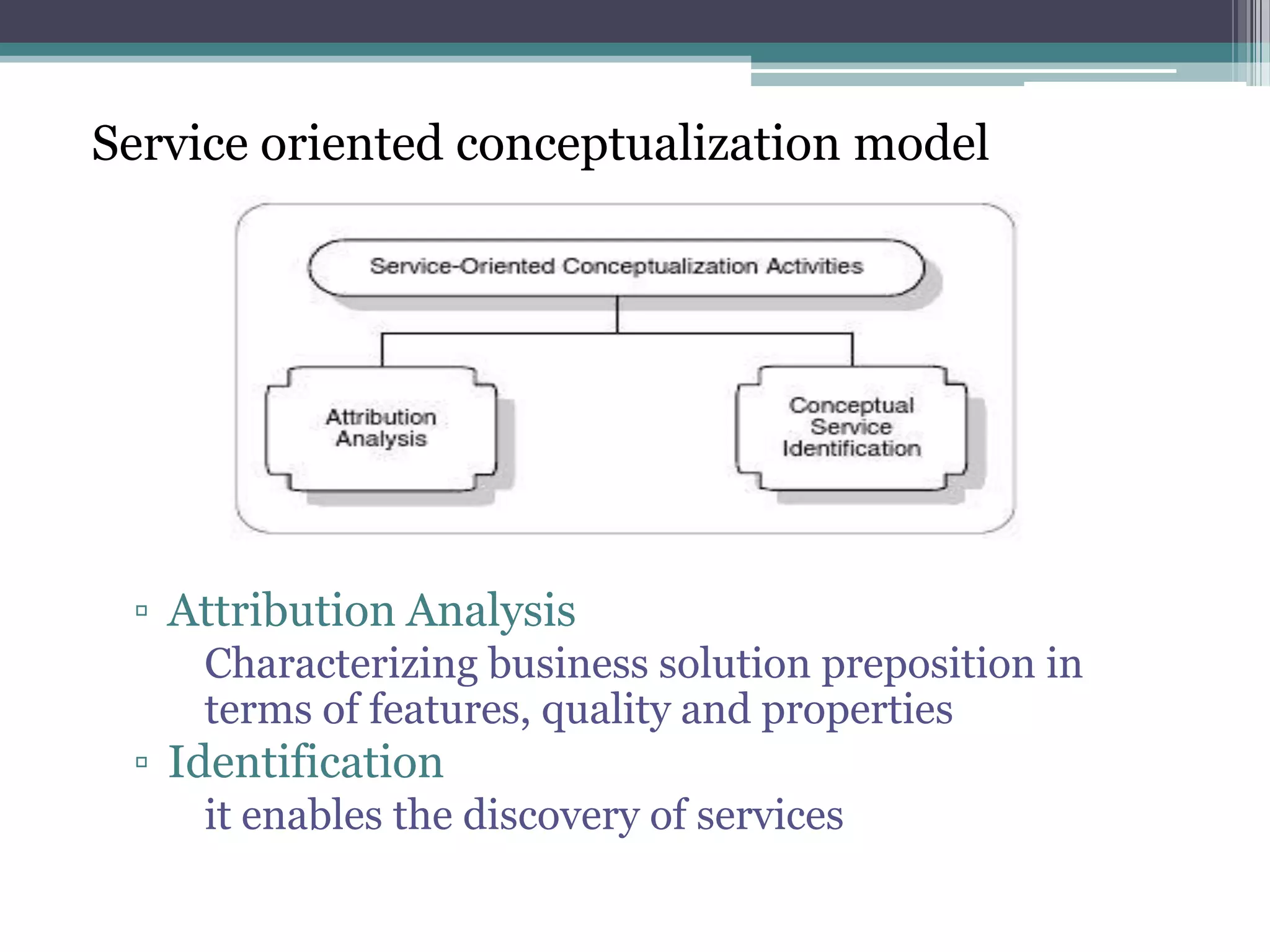
Service oriented conceptualization model


 ▫ Attribution Analysis
     Characterizing business solution preposition in
     terms of features, quality and properties
 ▫ Identification
     it enables the discovery of services
Service oriented discovery and analysis
• It is also used to identify the services that can
  contribute to business or technological
  solutions.
• In discovery and analysis we verify the
  conceptual services that are devised during
  conceptualization phase.
• The viability of the conceptual services are also
  checked in discovery and analysis phase
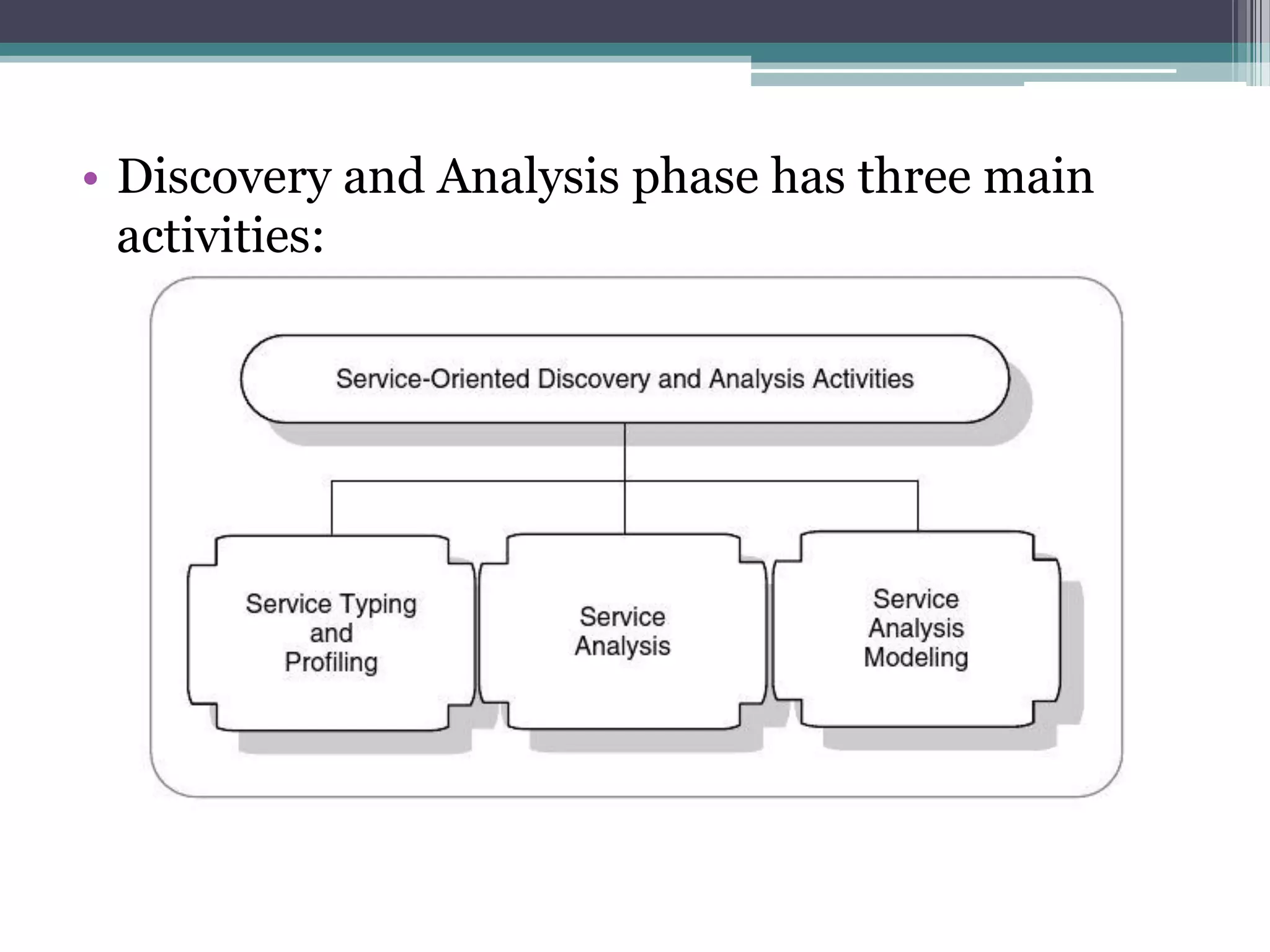
• Discovery and Analysis phase has three main
  activities:
Discovery and Analysis Activities
 • Typing & Profiling:
    It enables us to label a service base on its organizational
     identity and business & technological context.
• Service Analysis:
    Determines whether a business solution is viable to
     participate.
    Use service granularity assessment to check viability.
    It also validates the practicality, loose coupling and
     reusability of the services.
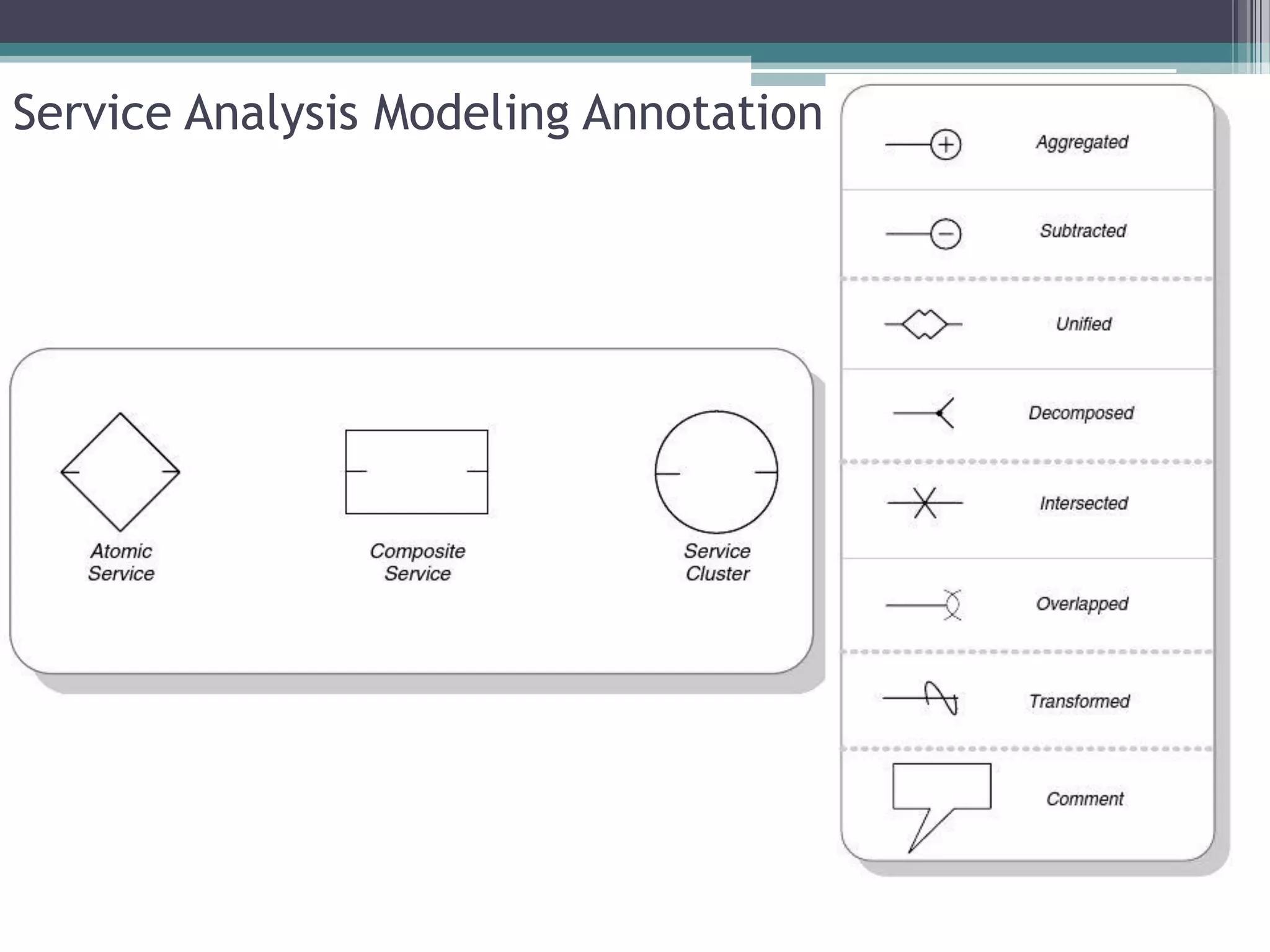
 • Service Analysis modeling:
   ▫ Service analysis modeling creates the miniature replica
     of future service oriented implementation
   ▫ Analysis modeling is presented in graphical artifacts or
     diagrams which show the sense of how the actual
     solution formation will look like
Service Analysis Modeling Annotations
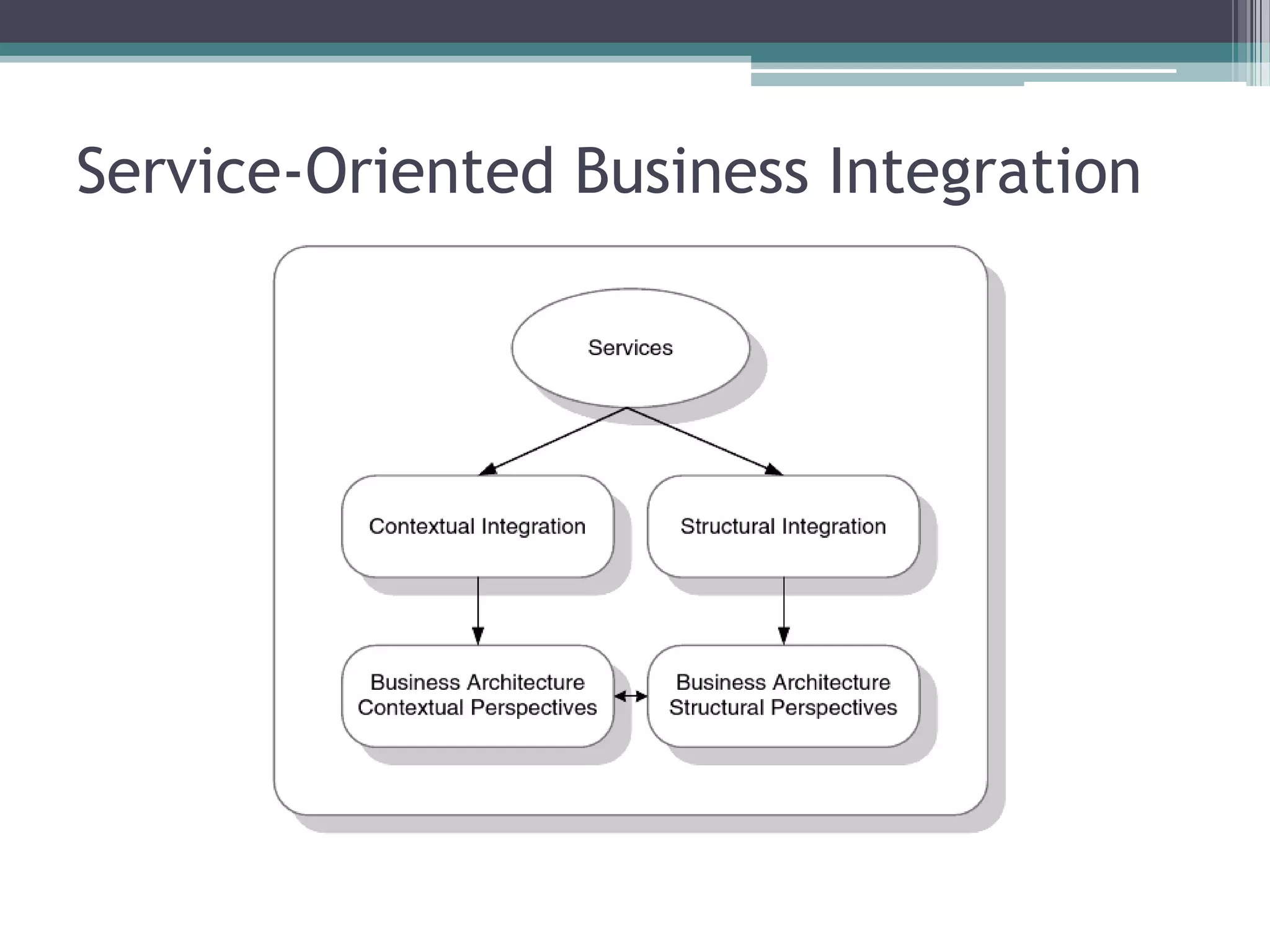
Service-Oriented Business Integration
• Service-Oriented Business Integration
  advocates finding the right match between services and their
  corresponding business architecture .
• Conceptual business integration
  Represent business architectures that support the
  organization’s products, maintain communications with
  clients and partners and facilitate better management
• Structural business integration
  Provides various methods to enable proper integration of
  services with various business domains
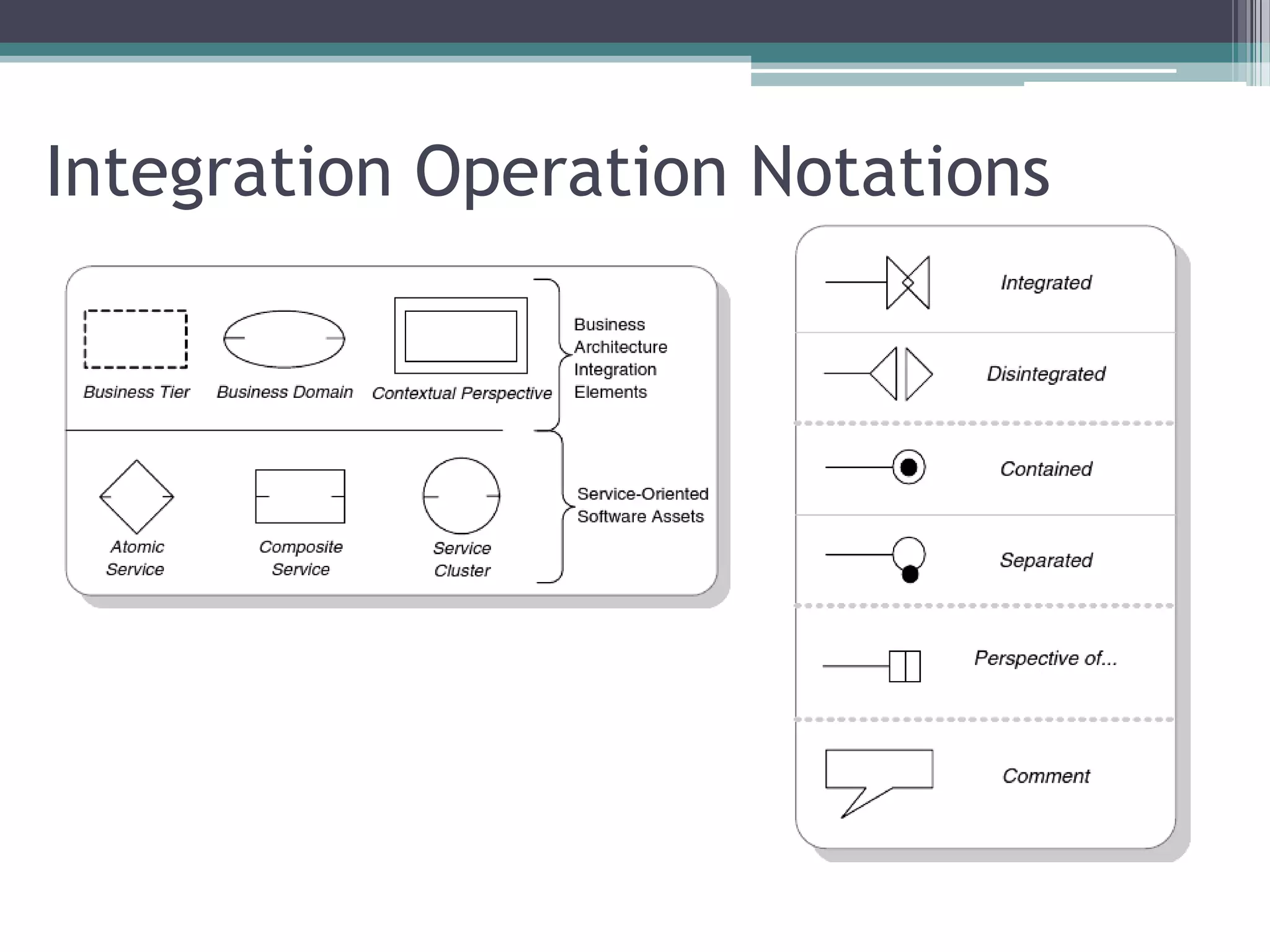
Integration Operation Notations
Service-Oriented Design Model
• Creates a solution wireframe that can facilitate
  service life cycle architecture initiatives.

• Offers tools and guidance to connect the dots,
  device service collaboration and interface
  mechanisms, establish solid service formations
  that can coexist in well-coordinated ecosystem
  and manage transactions.
Service-Oriented Design Model
 Service-oriented design steps
1. Service relationship modeling
  ▫   Specifies how message exchange and coordination between
      consumer and services are done
  ▫   Grant safe access to subscribers for public services
2. Logical structure modeling
  ▫ Represent the solution to the problem in structural perspective
3. Service behavioral modeling
  ▫  Concerned with behavior of services in a particular operating
   environment.
  ▫ Solves problems stemming from service interaction and
   collaboration as well as coordination between activities.
Conceptual Architecture
• The service oriented conceptual architecture
  process is to design a strategy and indentify the
  general directions before addressing the tangible
  aspects of the proposed architecture.
• To address the general direction of an
  organizational architecture and to identify the
  major architecture components a conceptual
  architecture diagram is used
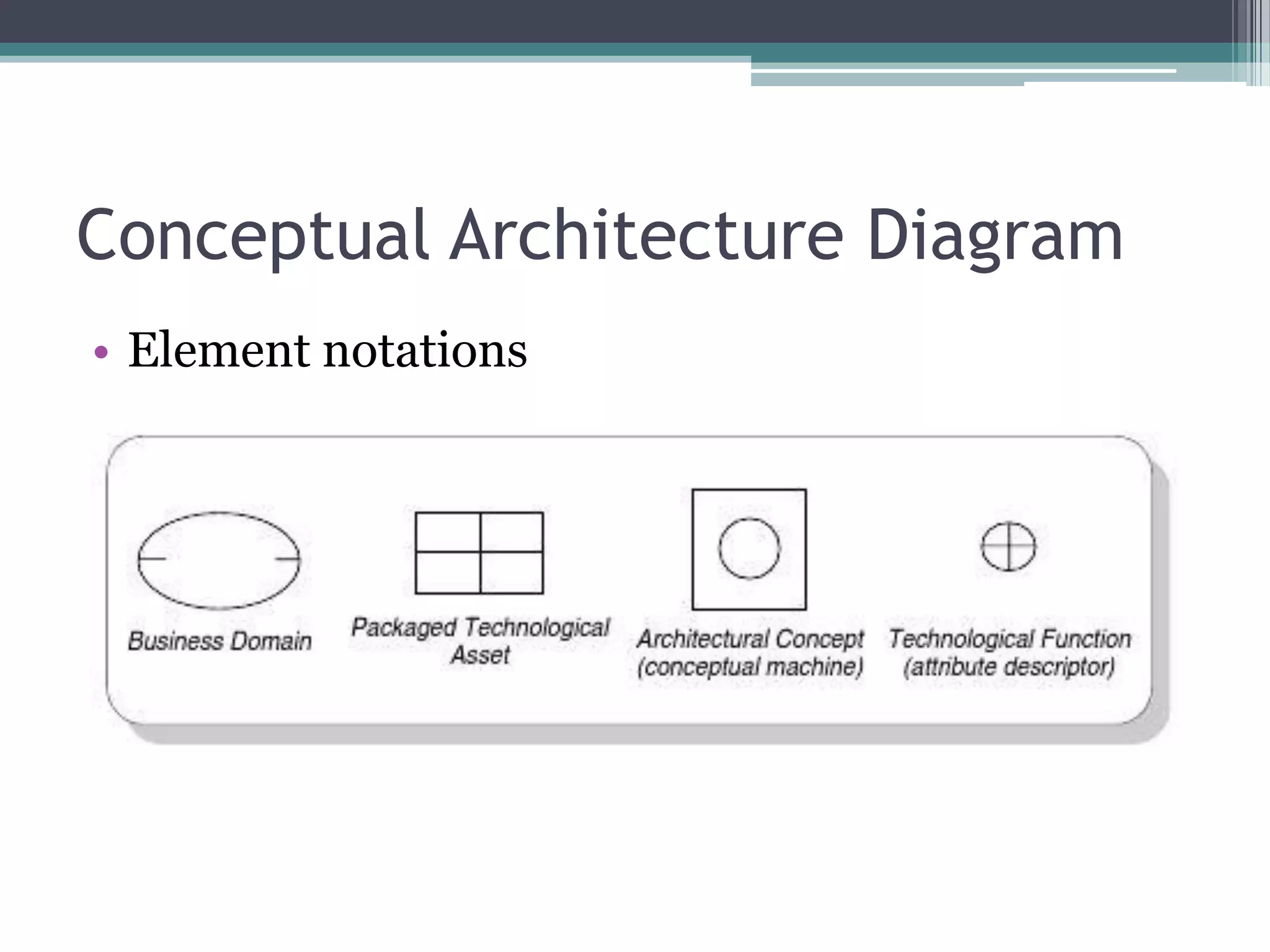
Conceptual Architecture Diagram
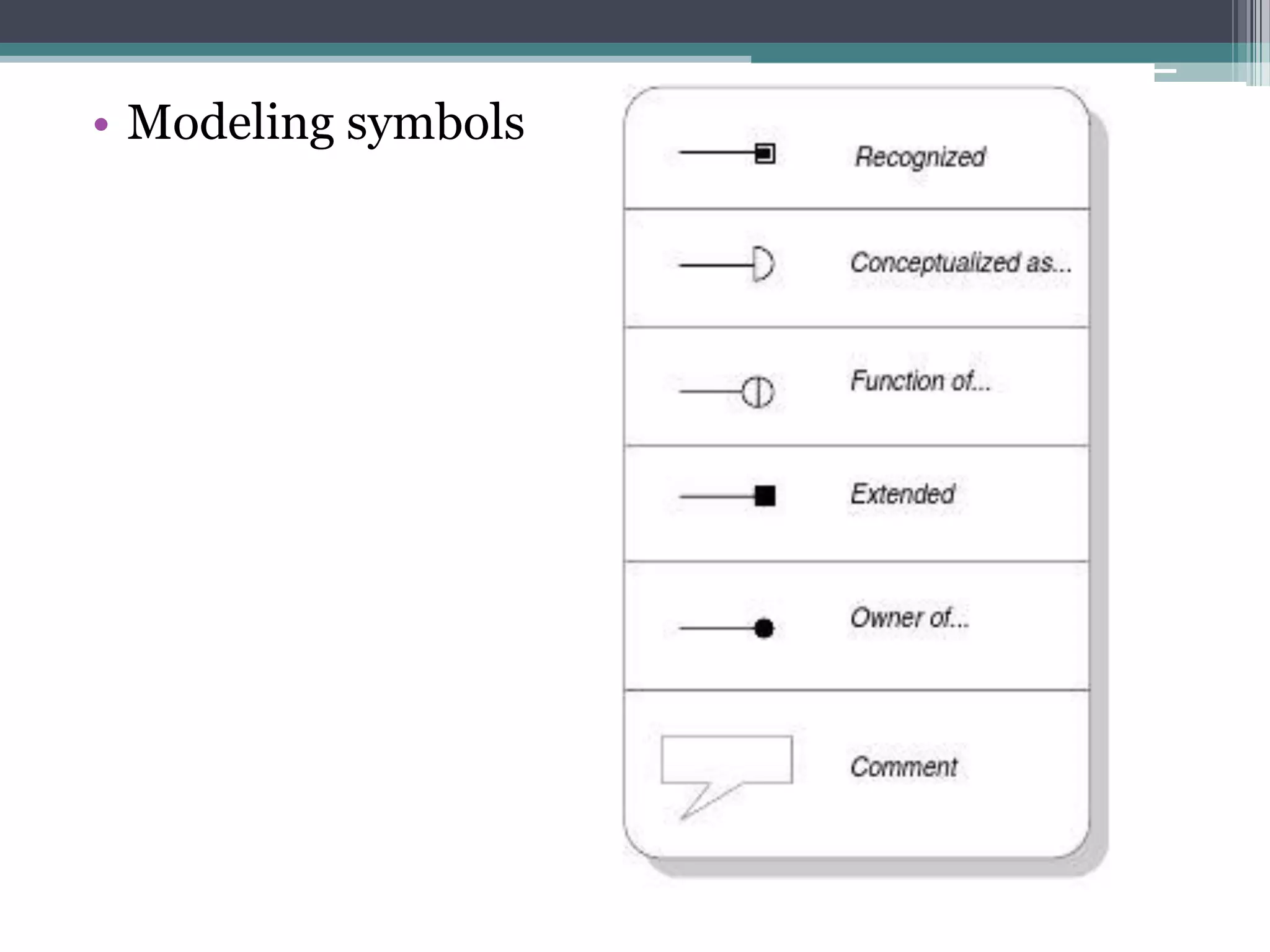
• Element notations
• Modeling symbols
Logical Architecture
• It addresses the asset utilization, consumption,
  reusability, interoperability and loose coupling.
• The asset utilization diagram provides detailed
  interaction between the deployed software
  package
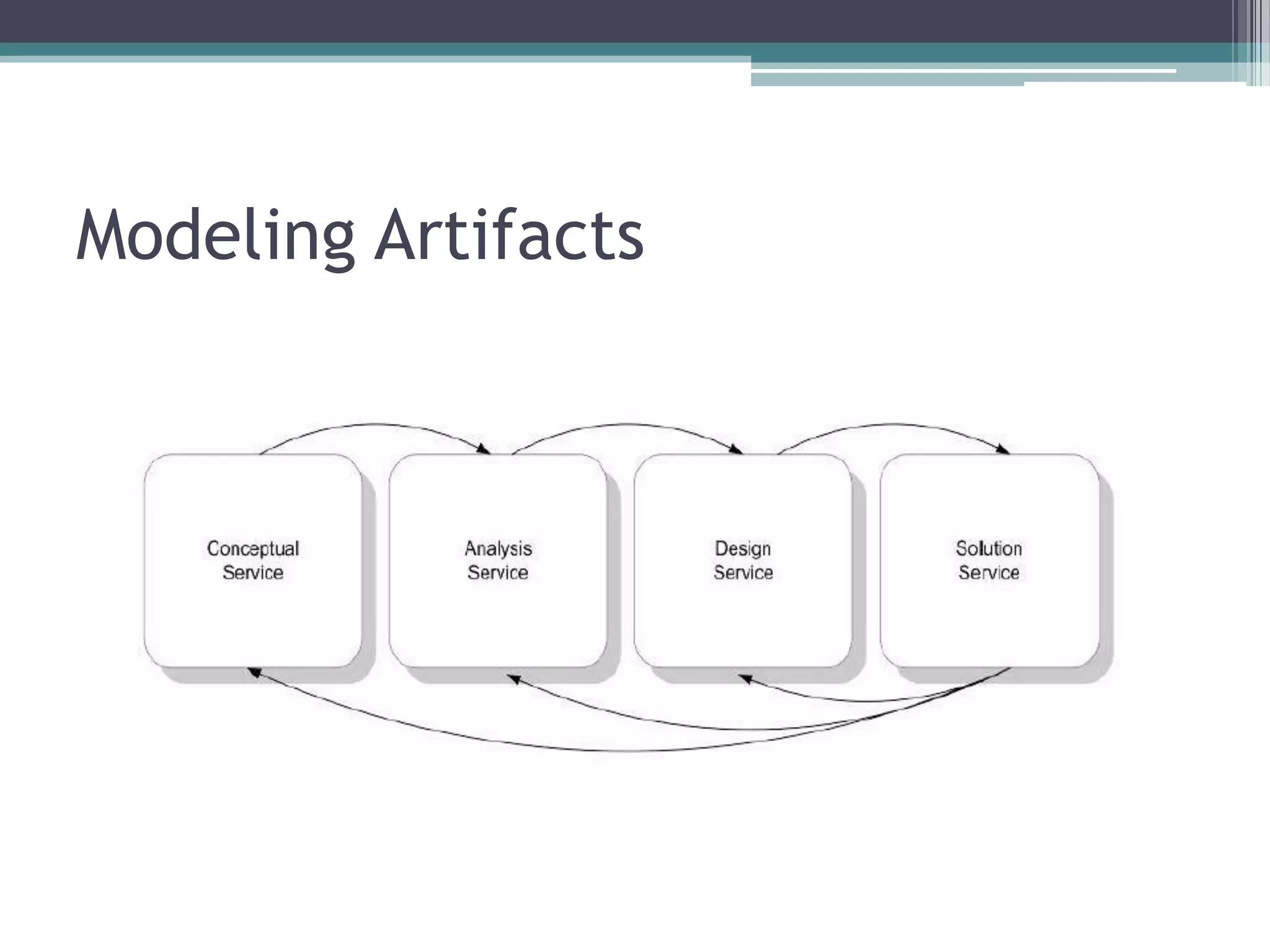
Modeling Artifacts
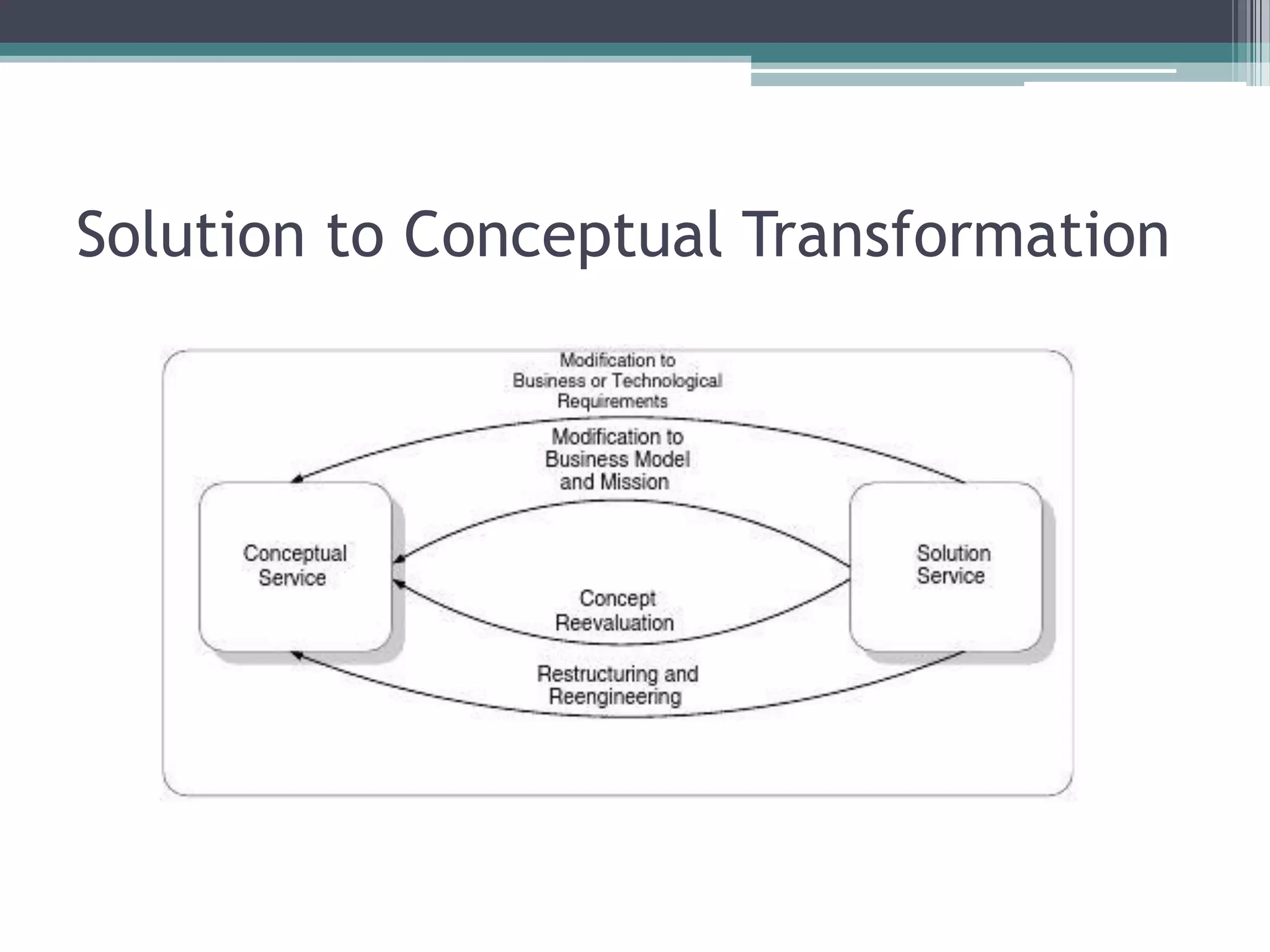
Solution to Conceptual Transformation
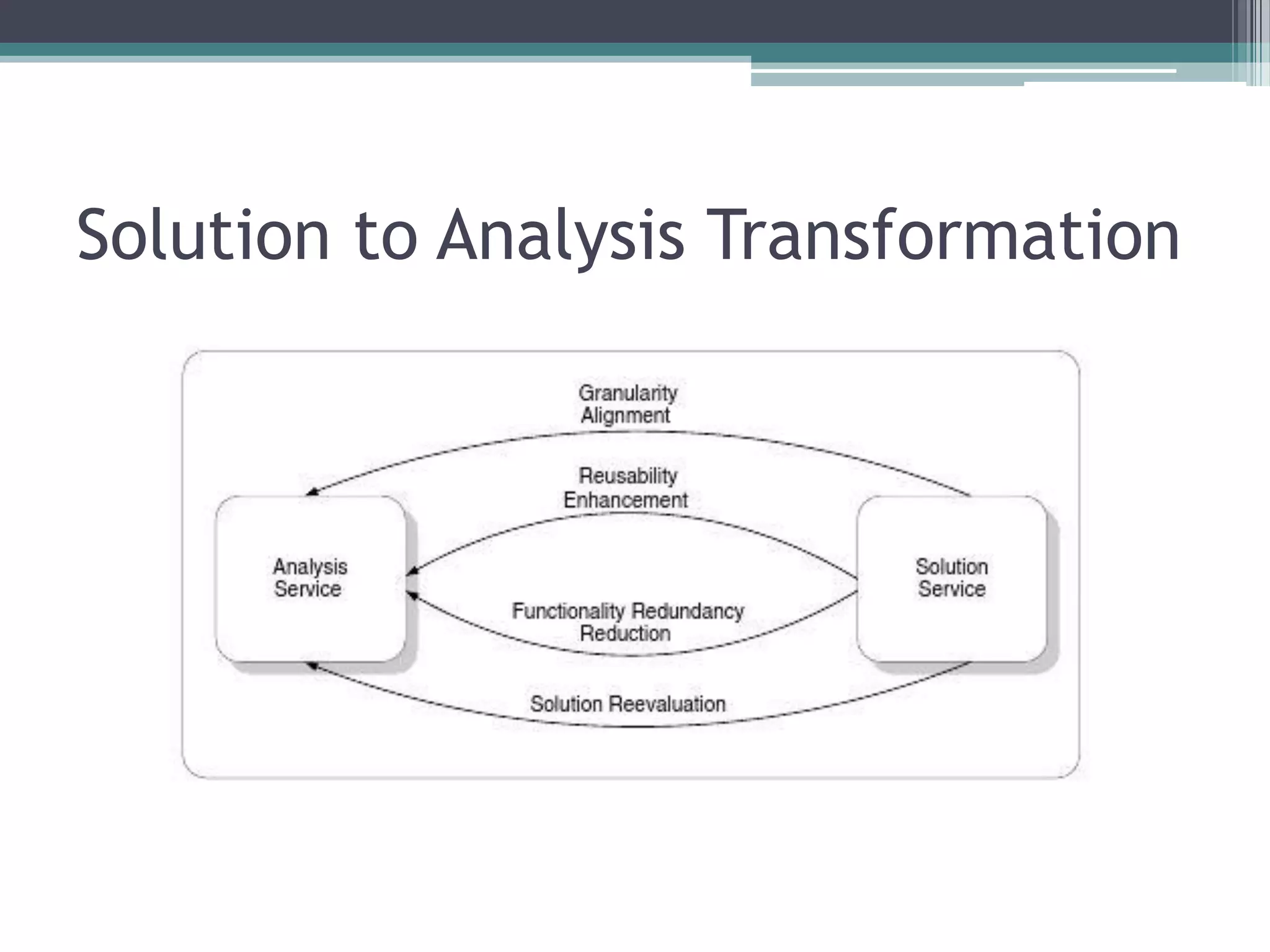
Solution to Analysis Transformation
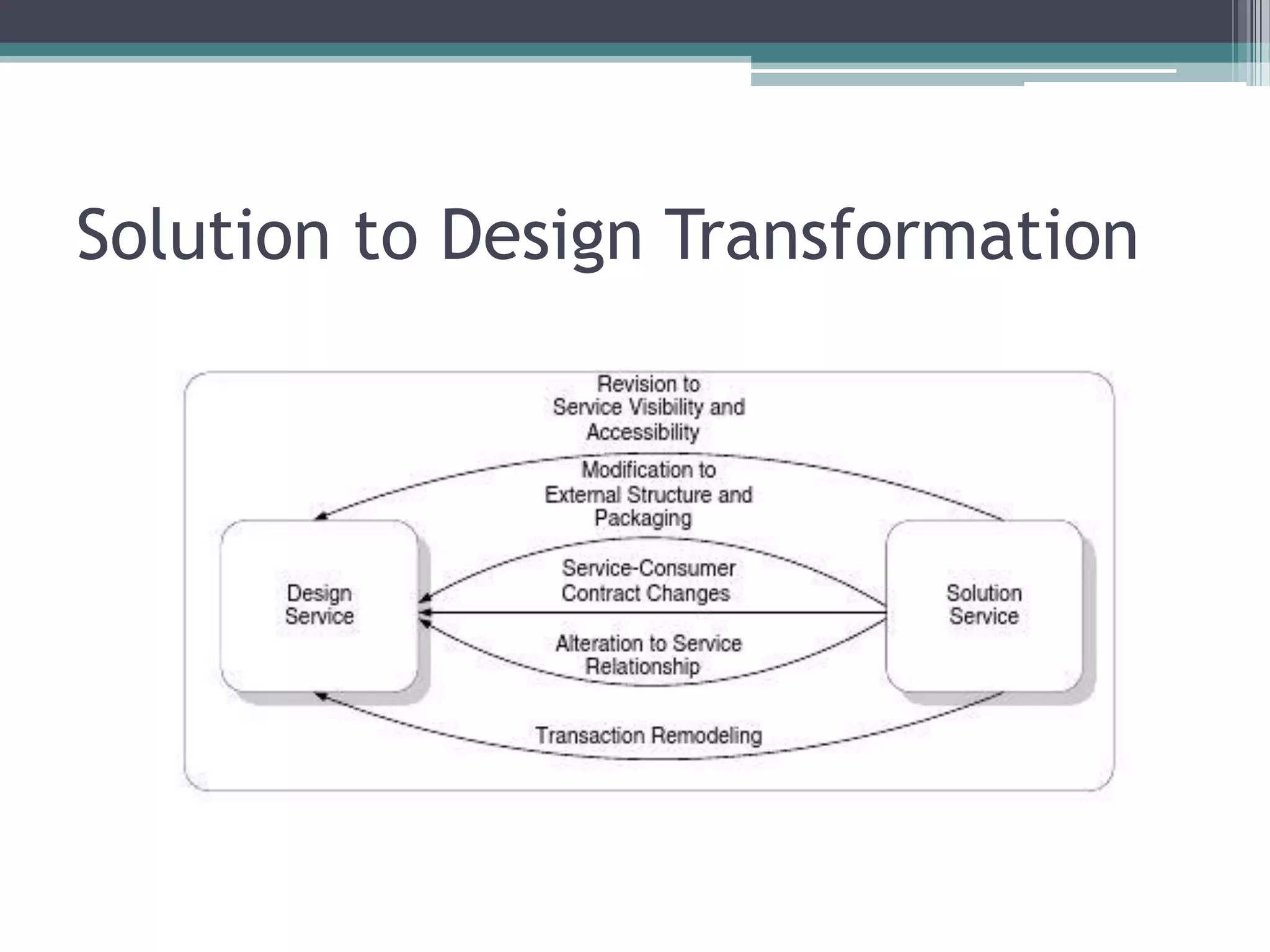
Solution to Design Transformation
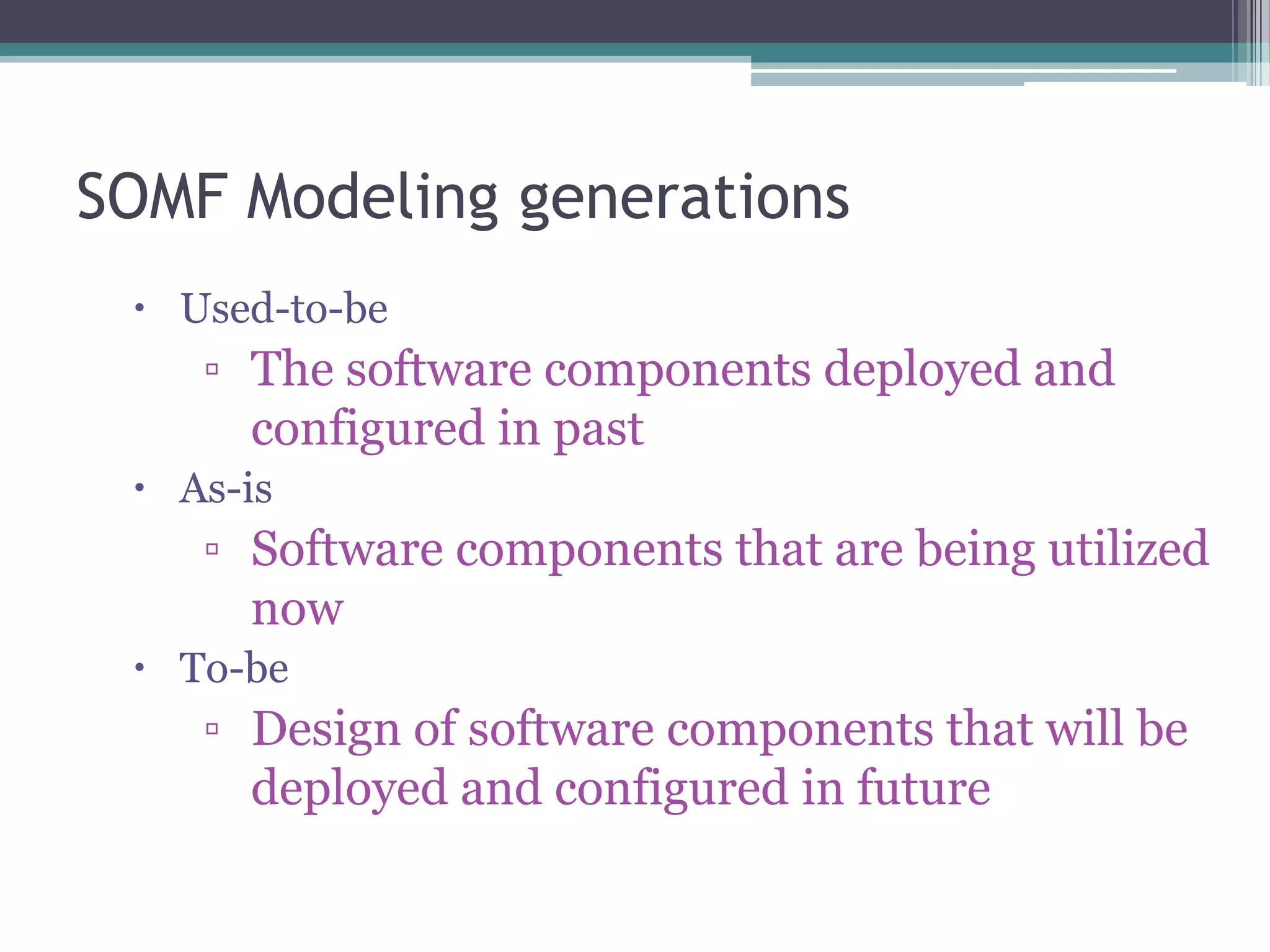
SOMF Modeling generations
  Used-to-be
    ▫ The software components deployed and
      configured in past
  As-is
    ▫ Software components that are being utilized
      now
  To-be
    ▫ Design of software components that will be
      deployed and configured in future
BPMN
(Business Process Management
Notations)
Contents
 General Overview
 Why BPMN ?
 Elements of BPMN
 Flow Objects
 Connection Objects
 SwimLanes
 Artifact Objects
General Overview
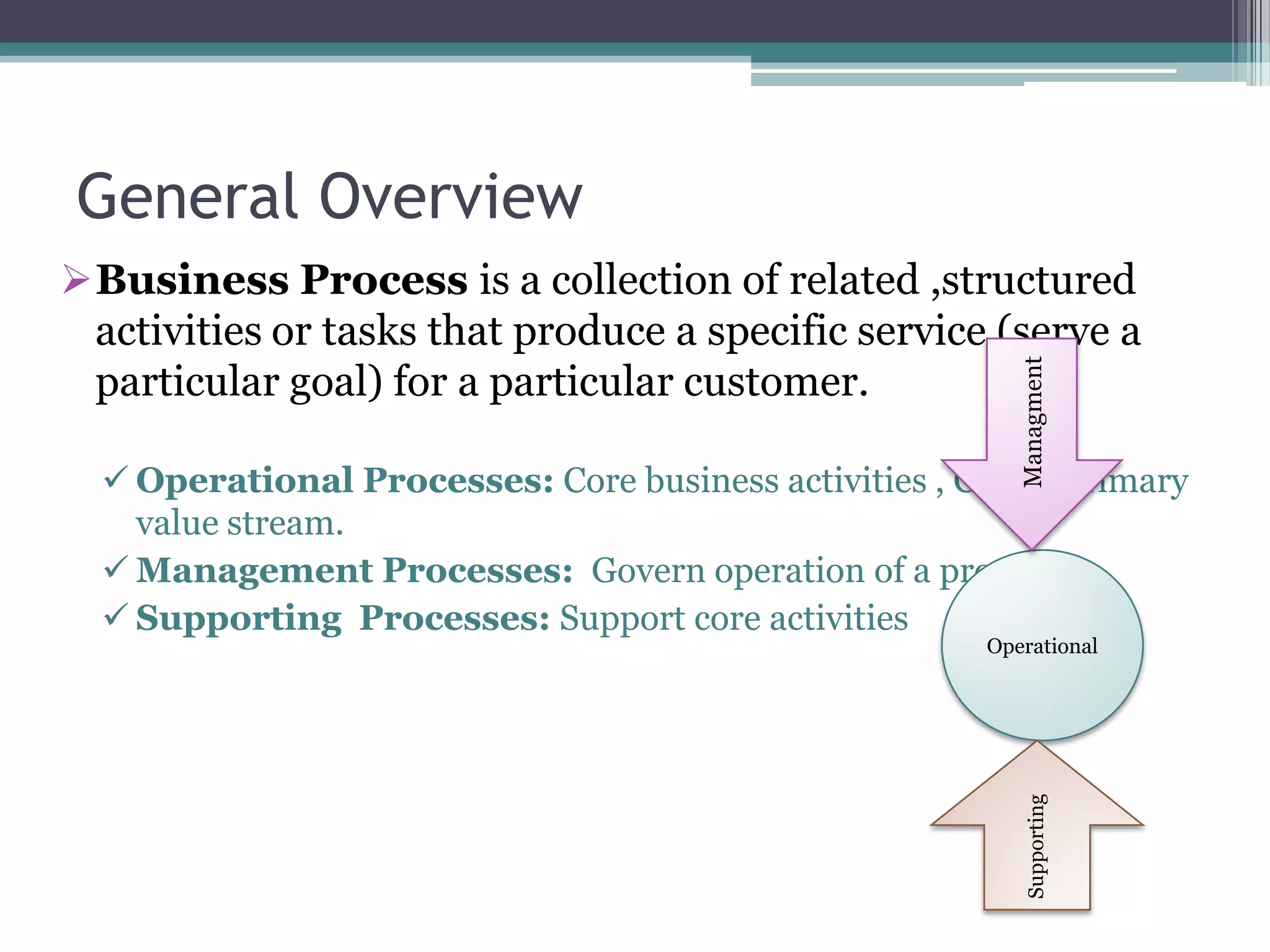
Business Process is a collection of related ,structured
 activities or tasks that produce a specific service (serve a


                                                          Managment
 particular goal) for a particular customer.

   Operational Processes: Core business activities , Create primary
    value stream.
   Management Processes: Govern operation of a process
   Supporting Processes: Support core activities
                                                       Operational


                                                           Supporting
General Overview
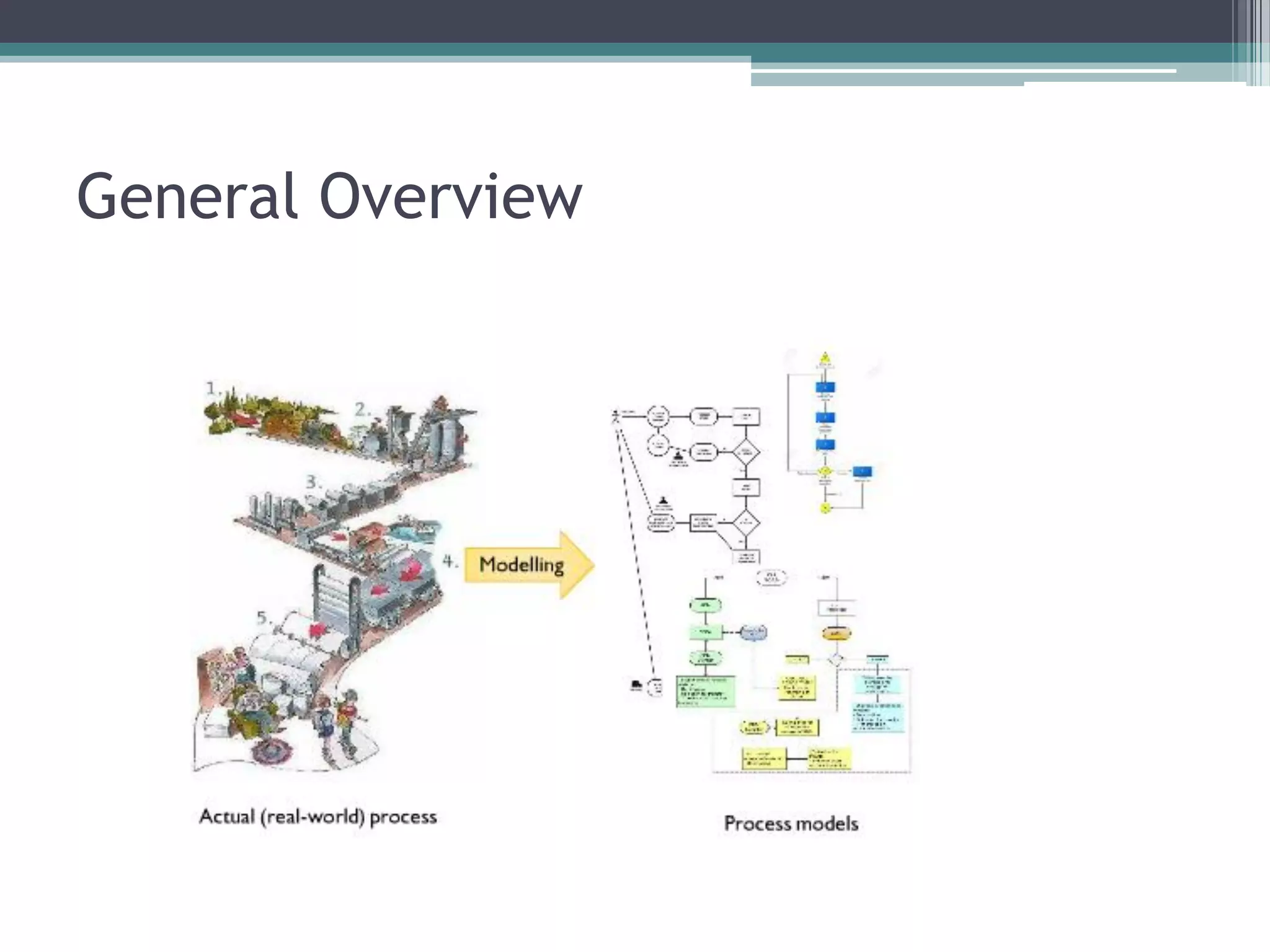
Business process modeling is the activity of representing
 processes of an enterprise, so that the current (“as is ”) process
 may be analyzed and improved in the future (“to be”).

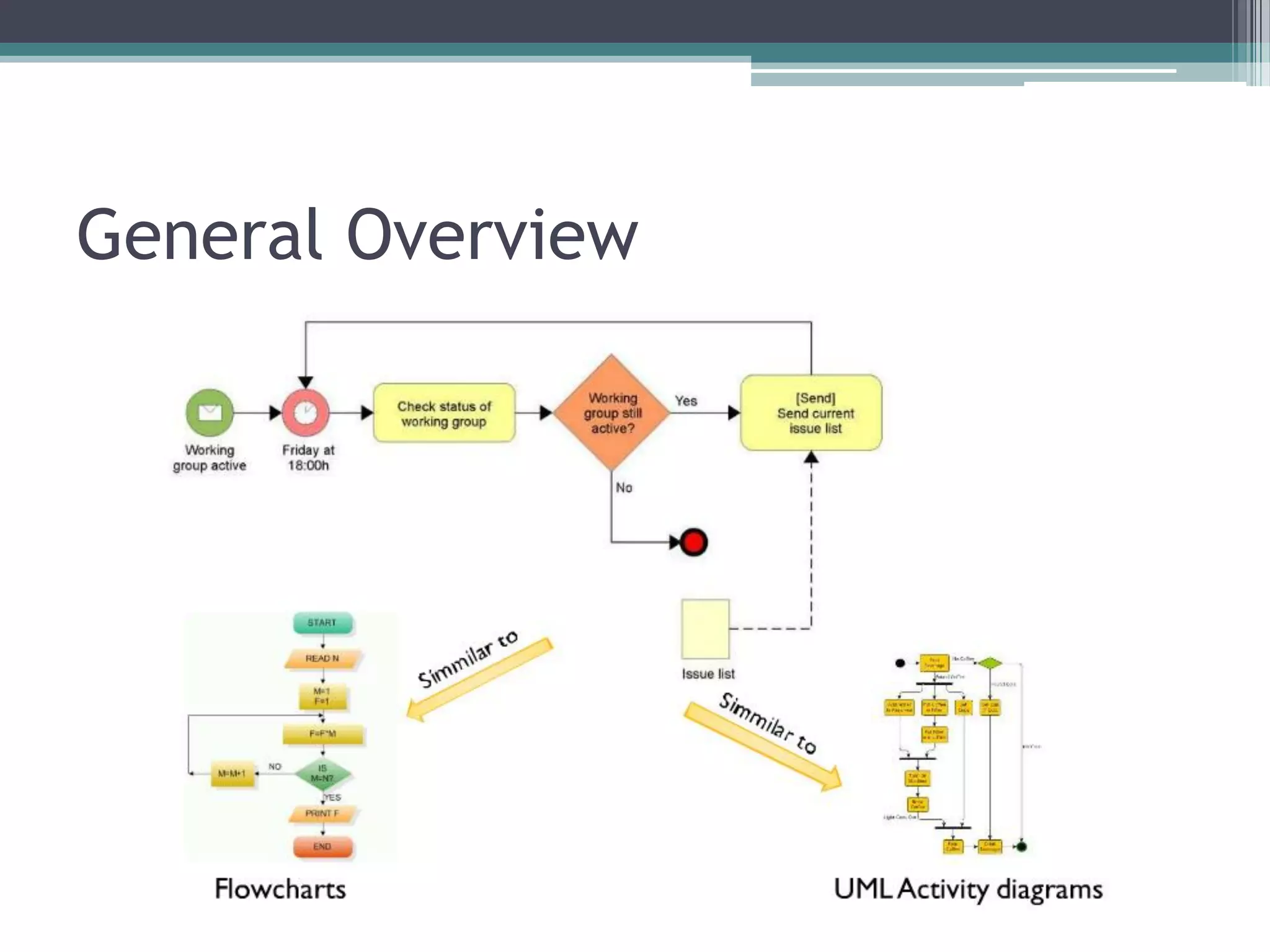
BPMN defines Business Process Diagram (BPD), which is made
 up of set of graphical elements. These elements enable easy
 development of simple diagrams that look familiar to most
 business analysts (e.g. a flowchart diagram)

Creating a simple mechanism to model business processes and
 at the same time handling the complexity inherent to business
 processes is one of the driving force for the development of
 BPMN.
General Overview
General Overview
General Overview
 The primary goal of BPMN is to provide a notation that is
 readily understandable by all business users, from the
 business analysts that create the initial drafts of the process ,
 to the technical developers responsible for implementing the
 technology that will perform those processes and finally, to
 the business people who will manage and monitor those
 processes.

The second goal of BPMN ensure that XML languages
 designed for the execution of business language such as
 WSBPEL, can be visualized with a business-oriented notation.
General Overview
Using BPMN it is possible to model

 Orchestration processes
  Private non-executable (internal) Business Processes
  Private executable (internal) Business processes
  Public processes
Choreographies
Collaborations
    A view of conversations
General Overview
Why BPMN + SOMF?

Allows for the emergence of a modeling viewpoint
 wherein business process activities are directly related
 to the services that realize them.
Early discovery of organizational core entities.
Clarifies the direction and scope for impending
 software development projects.
Enables practitioners to employ the SOMF
 transparency model to trace modifications to business
 processes and keep track on return on investments
 (ROI).
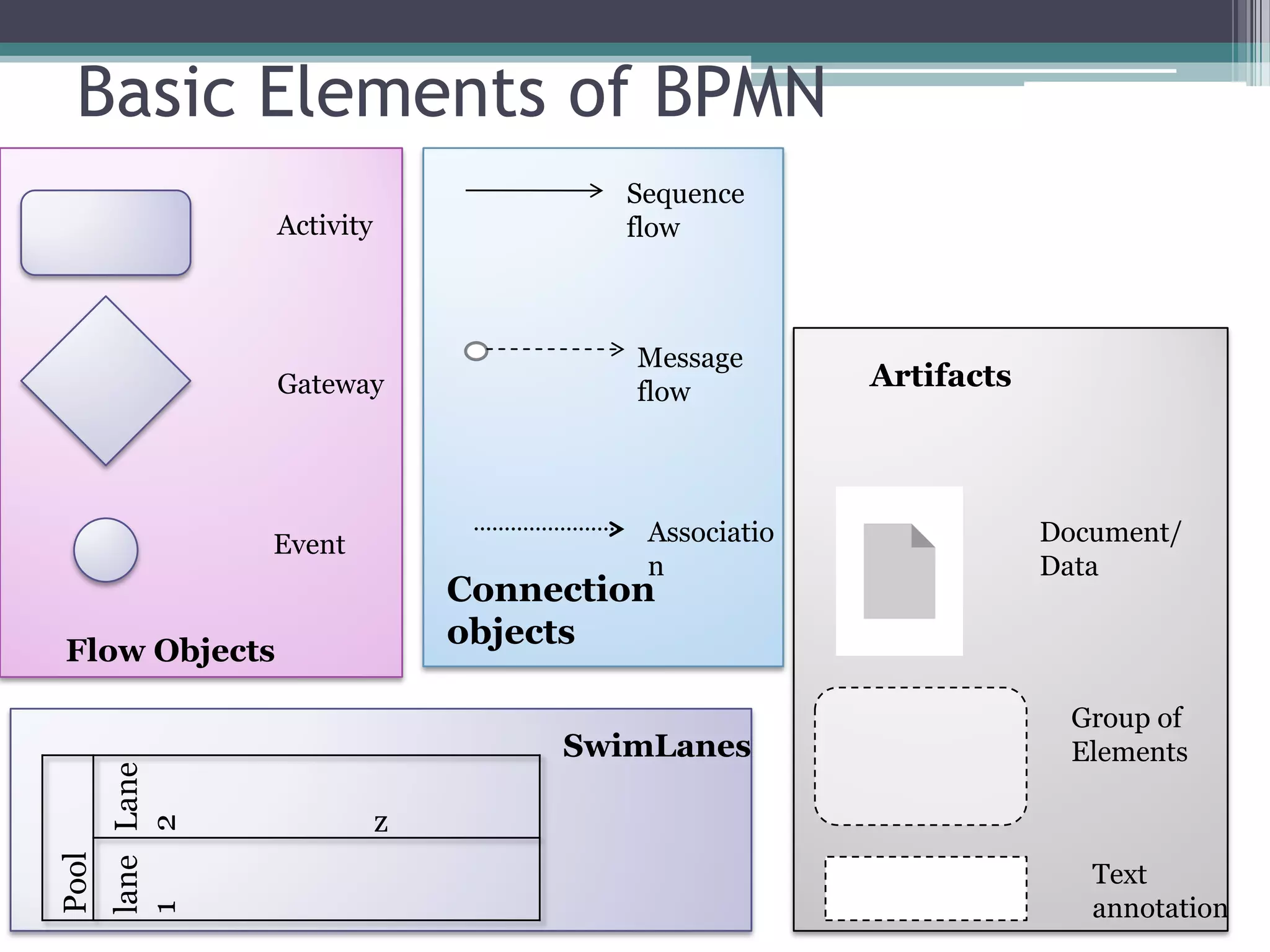
Basic Elements of BPMN
                                          Sequence
                   Activity               flow


                                           Message
                   Gateway                 flow
                                                        Artifacts


                   Event                   Associatio               Document/
                                           n                        Data
                                  Connection
                                  objects
 Flow Objects

                                                                     Group of
                                       SwimLanes                     Elements
       lane Lane


                              z
            2
Pool


                                                                       Text
                                                                       annotation
       1
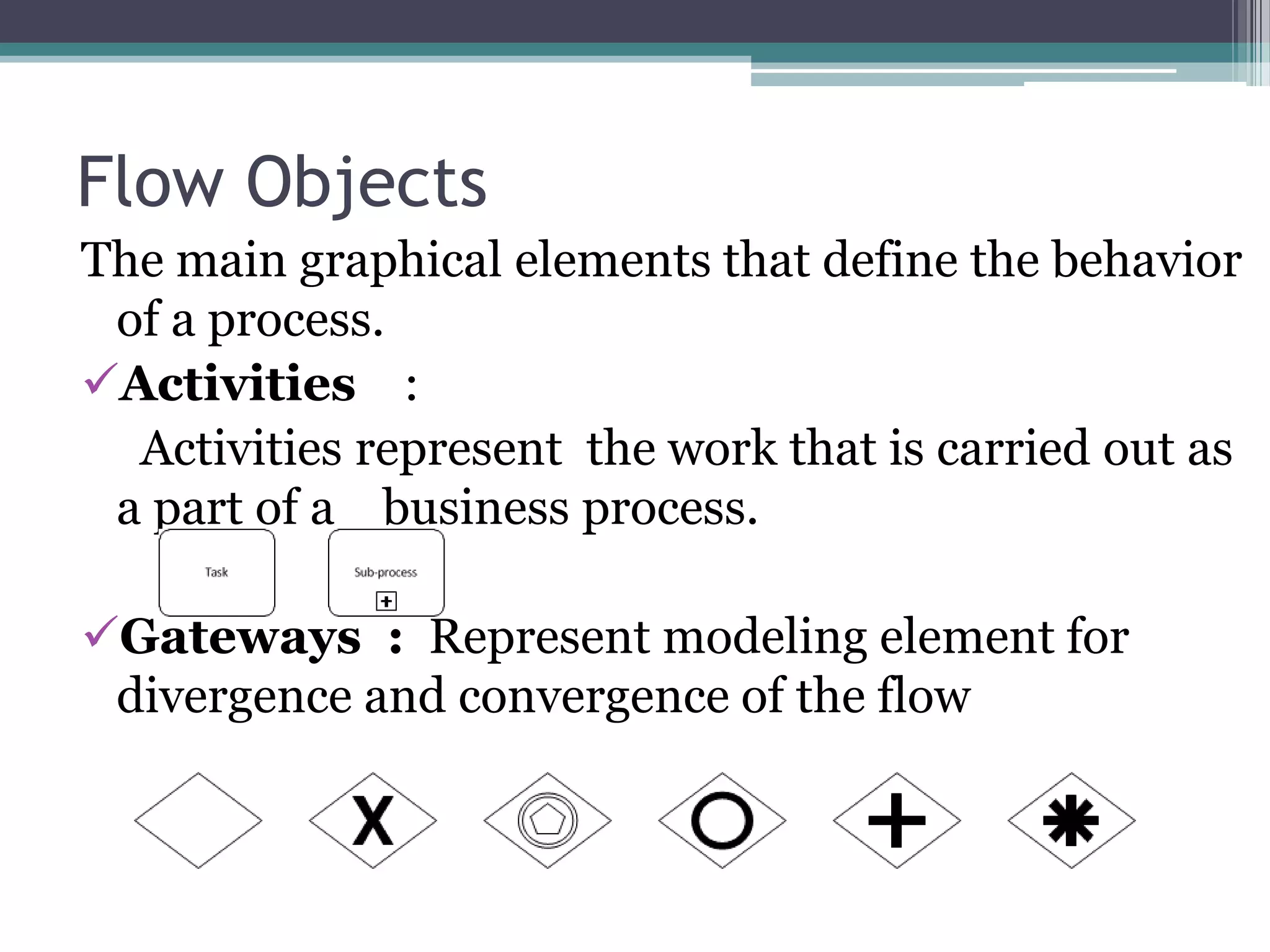
Flow Objects
The main graphical elements that define the behavior
 of a process.
Activities :
  Activities represent the work that is carried out as
 a part of a business process.

Gateways : Represent modeling element for
 divergence and convergence of the flow
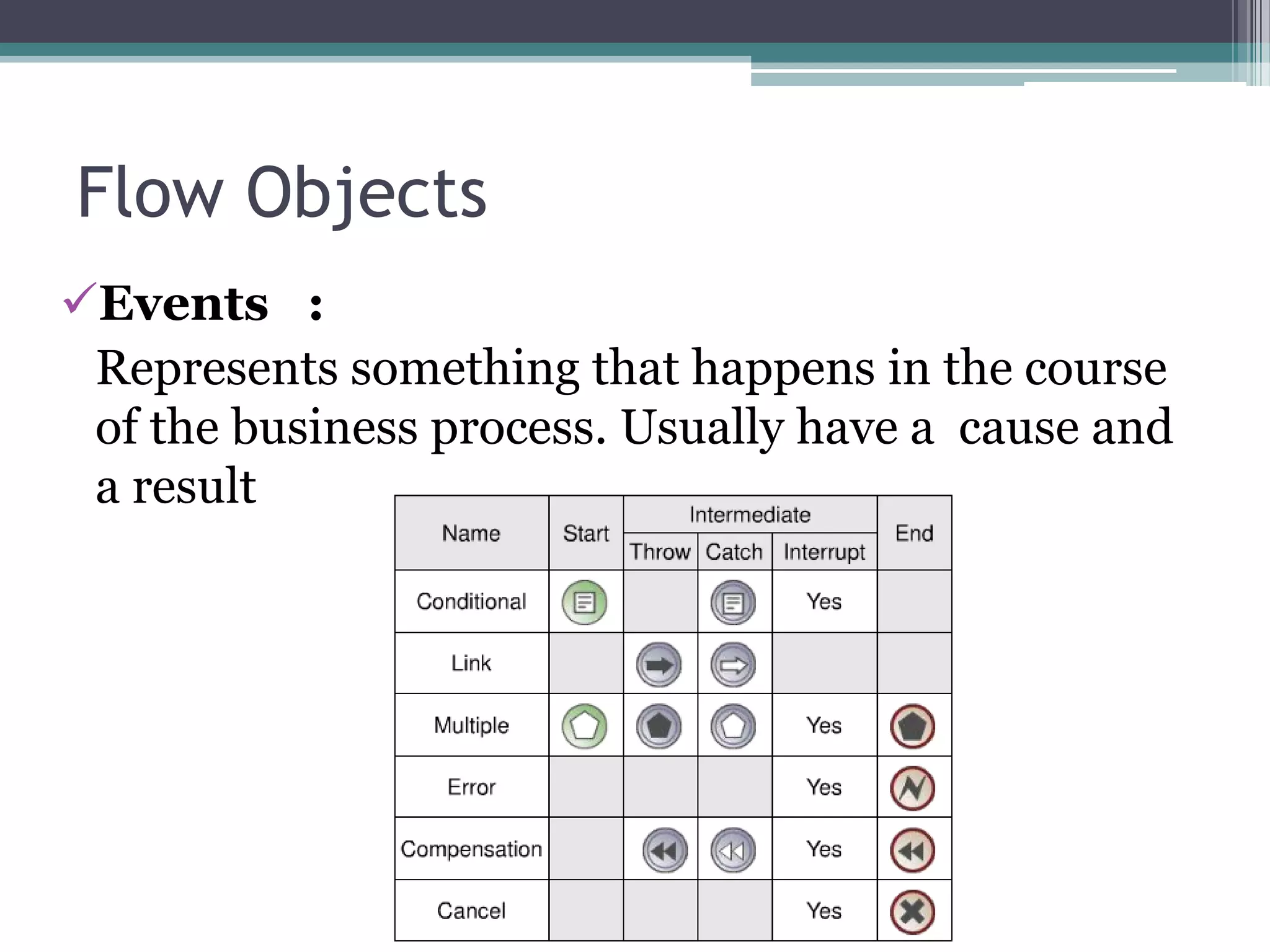
Flow Objects
Events :
 Represents something that happens in the course
 of the business process. Usually have a cause and
 a result
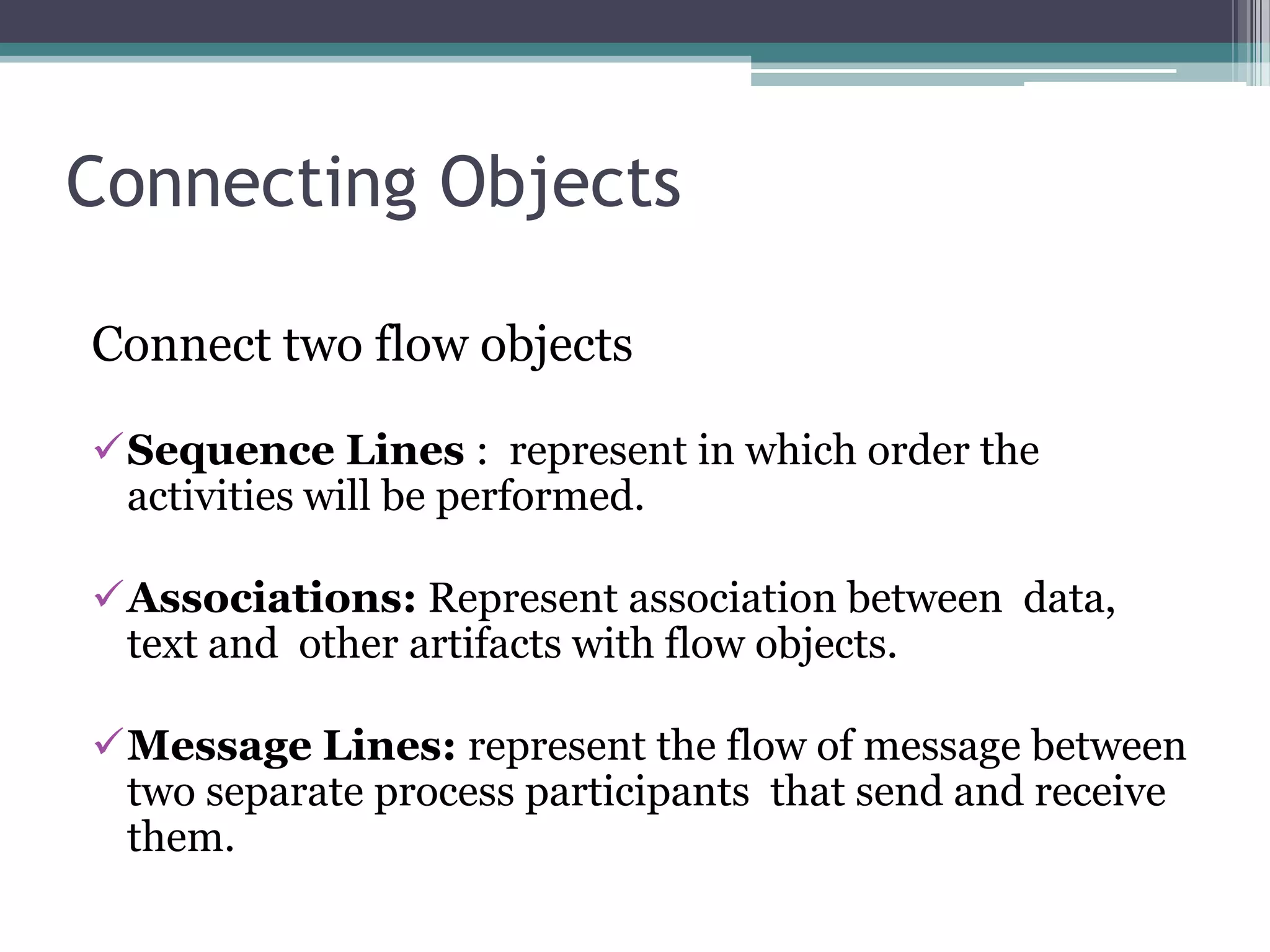
Connecting Objects

Connect two flow objects

Sequence Lines : represent in which order the
 activities will be performed.

Associations: Represent association between data,
 text and other artifacts with flow objects.

Message Lines: represent the flow of message between
 two separate process participants that send and receive
 them.
SwimLanes

 Organize activities into separate visual categories in
 order to illustrate different functional capabilities or
 responsibilities.

Pool : Represents different participants in a process.

Lanes: A sub partition within the pool.
Artifacts
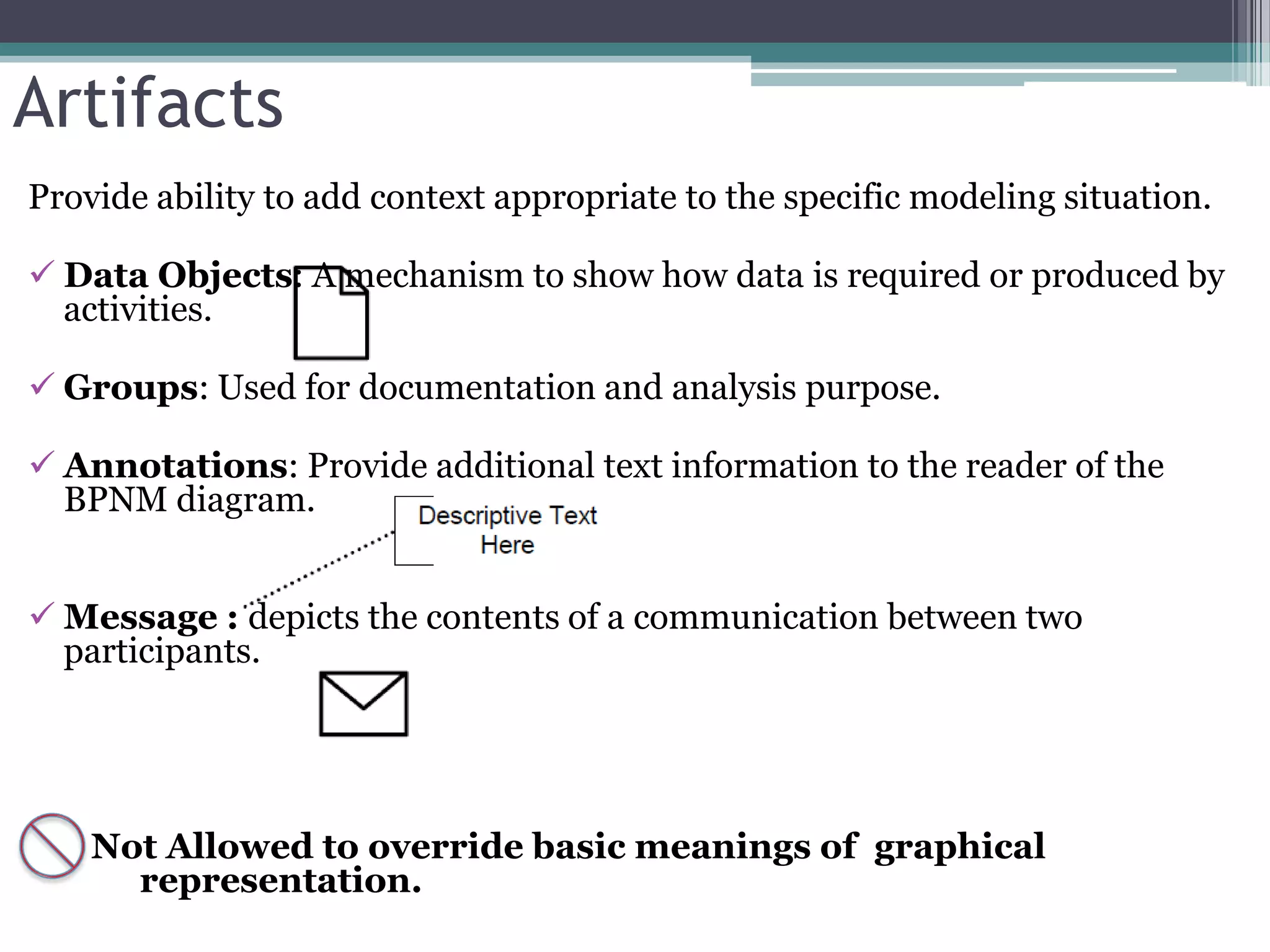
Provide ability to add context appropriate to the specific modeling situation.

 Data Objects: A mechanism to show how data is required or produced by
  activities.

 Groups: Used for documentation and analysis purpose.

 Annotations: Provide additional text information to the reader of the
  BPNM diagram.


 Message : depicts the contents of a communication between two
  participants.


    Not Allowed to override basic meanings of graphical
      representation.
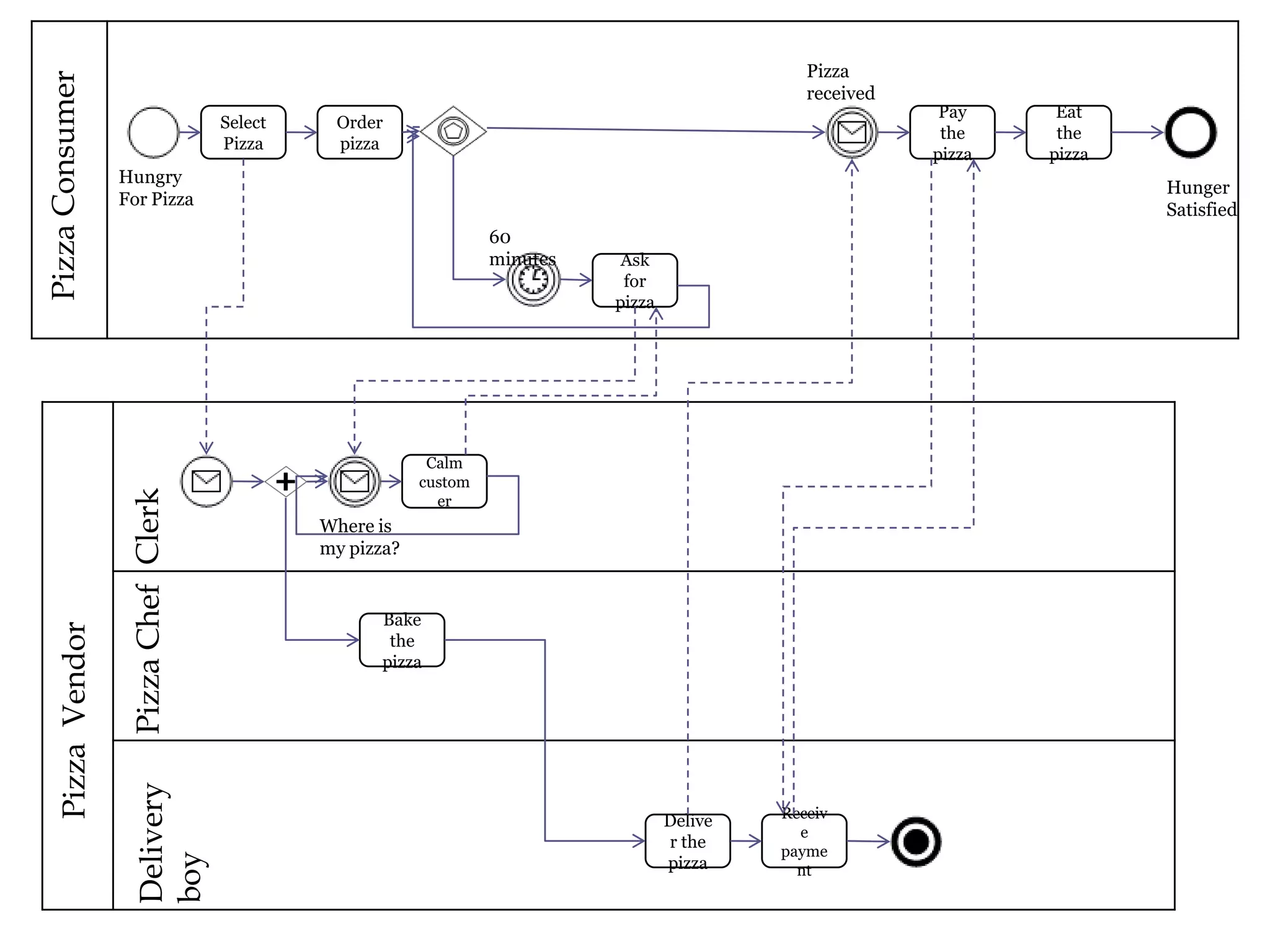
Pizza Consumer                                                                                    Pizza
                                                                                                  received
                                                                                                              Pay     Eat
                                      Select    Order
                                                                                                              the     the
                                      Pizza     pizza
                                                                                                             pizza   pizza
                  Hungry
                                                                                                                             Hunger
                  For Pizza
                                                                                                                             Satisfied
                                                                    60
                                                                    minutes    Ask
                                                                               for
                                                                              pizza


                                                            Calm
                                                           custom
                   Pizza Chef Clerk


                                                             er
                                               Where is
                                               my pizza?


                                                      Bake
   Pizza Vendor


                                                       the
                                                      pizza
                    Delivery


                                                                                               Receiv
                                                                                      Delive
                                                                                                 e
                                                                                      r the
                                                                                               payme
                    boy


                                                                                      pizza      nt
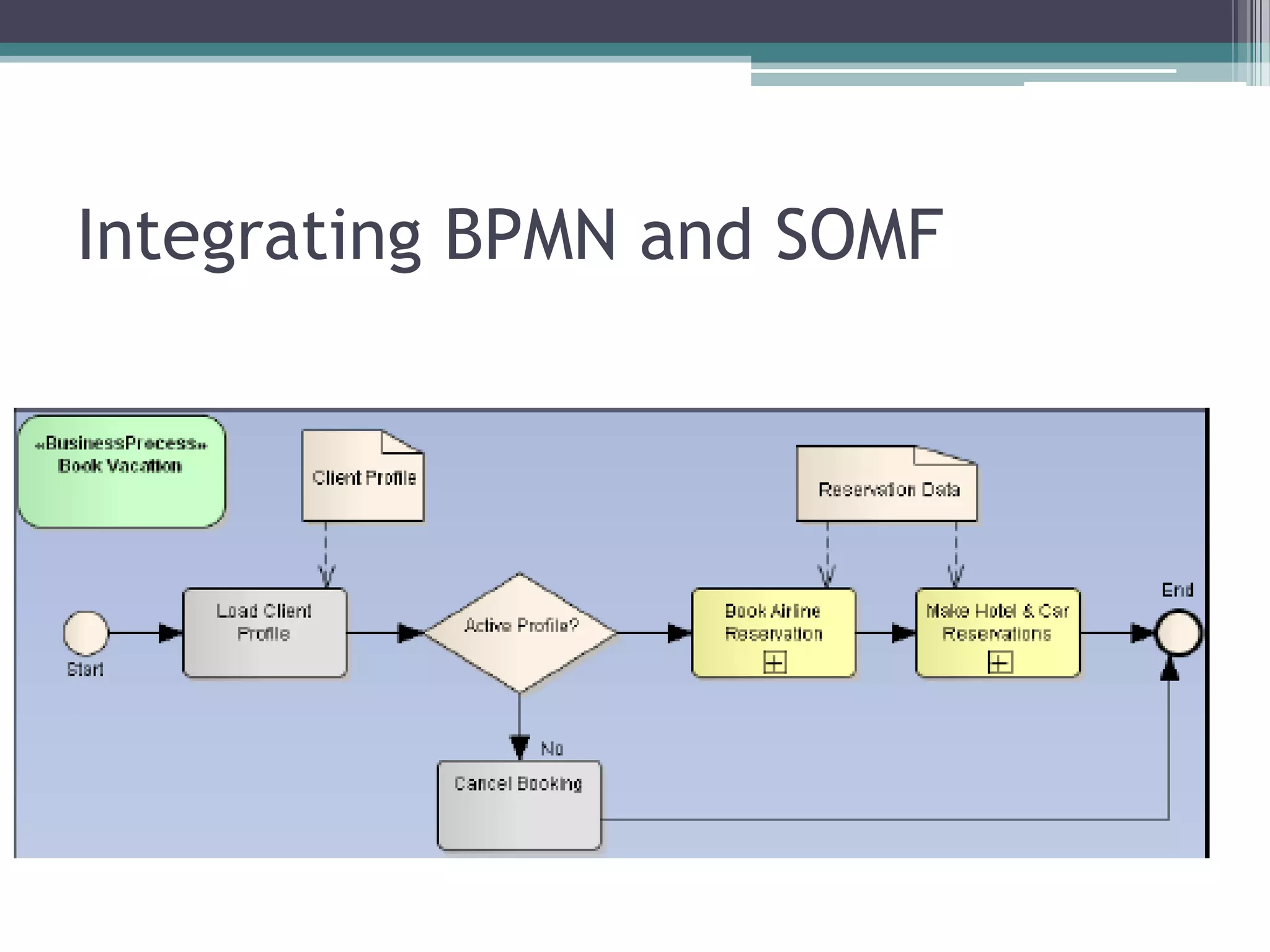
Integrating BPMN and SOMF
A Service can be correlated with one or more BPMN
 constructs at one of the three levels:

1. At a business process element level.
2. At the sub-process element level
3. At the individual , atomic activity level.
Integrating BPMN and SOMF
BPMN Rules
Chronological approach-process models should be oriented
 on time line(from left to right or topdown)
Processes generally begin with triggering events and flow
 through to significant business results.
All tasks or activities are assigned to roles that are
 meaningful to people in the business.
A complete model should display how objects or data (both )
 are transferred and where they are going.
BPMN Rules
A process can be modeled in hierarchical fashion
 (e.g. with sub process)
Establish organization standards or guidelines
 for developing models and naming model
 elements (process dictionary)
Establish standards for versioning methods
 associated with the process model and artifact
 level to provide requirement traceability(Version
 Control Systems).
Question/Answer Session
References
• Service-oriented modeling, Service analysis, Design and
  Architecture by Michael Bell(2008)

• Service-oriented modeling and architecture, How to identify,
  specify, and realize services for your SOA by Ali Arsanjani,
  Ph.D. (Nov 2004)

• Business Process Model and Notation (BPMN) Version 2.0

• Combining the Service Oriented Modeling
  Framework™(SOMF™) with the Business Process Modeling
  Notation™(BPMN™) Sep 2011
THANK YOU!

Soa modeling & bpmn

  • 1.
    Service Oriented Modeling and Business Process Management & Notation (BPMN) Presented by: Nadeem Aftab (naaf1001@student.miun.se) Ayaz Shahid (aysh1000@student.miun.se) Addisu Lodamo (adlo1001@student.miun.se)
  • 2.
    Overview • Introduction • SOA life Cycle • Modeling Approaches • Service Oriented Modeling Framework (SOMF) • BPMN • Question/Answer Session • References
  • 3.
    Introduction • We tendto replace old technologies with new one • The interoperability, reusability, and other issues • Concept of SOA ▫ Maximize the software asset reuse. ▫ Addresses the challenges of tightly coupled software ▫ Favor the loosely coupled software ▫ Also tackles budget and ROI issues
  • 4.
    What is SOAmodeling “Service-oriented modeling is a software development practice that employees modeling disciplines and language to provide strategic and tactical solutions to enterprise problems. This anthropomorphic modeling paradigm advocates a holistic view of analysis, design and architecture of all organizational software entities, conceiving them as a service-oriented assets, namely services”. [Michael Bell]
  • 5.
    SOA life Cycle ServiceMetamorphosis Strategy Structure Governance Funding Return on Investment(ROI)
  • 6.
    Metamorphosis Service Evolution
  • 7.
    Strategy • Driving Forceof any Project. • Long-Term plan for service life cycle. • Essential for scheduling events, planning stage and create timetable. • Should not offer small-scale solution. • Should contribute ▫ Proactive approach to address unseen events and stability. ▫ Road map, alternative and agility. ▫ Reachable, measurable and realistic mile stone within budget and time.
  • 8.
    Structure • Structure meansframework in which services are constructed qualified and operated in production environment. • It should be flexible that enable effective management service. • Framework Components of Structure ▫ Timeline ▫ Events ▫ Season ▫ Discipline
  • 9.
  • 10.
  • 11.
    Events • Begins, last for while and then disappear. • Have pattern • Start at particular time. • Types of events ▫ Planned events ▫ Unplanned • Four Major Events. ▫ Staged ▫ Unpredictable ▫ Random ▫ Conditional
  • 12.
    Season • Seasonare timeframe in which services transform from idea to physical entities and deployed in production. • Major Season. ▫ Design-time Season ▫ Run-Time Season.
  • 13.
    Discipline • Discipline arebest practices and standards that facilitate service design, architecture, construction, operation in production and management initiatives throughout services oriented life cycle timeframe. • Types of Discipline: ▫ Season Discipline  Design-Time  Run-time ▫ Continuous Discipline
  • 14.
    SOA life CycleModel (cont.) • Governance • Funding • Return On Investment.
  • 15.
    SOA Modeling Approaches •Service-Oriented Modeling Architecture(SOMA) • Service-Oriented Modeling Framework(SOMF)
  • 16.
    SOMA • IBM introducedSOMA in 2004 • It implements the Service oriented analysis and design through Identification, Specification & realization of services, components and flows. • SOMA Life Cycle consists of: ▫ Identification ▫ Specification ▫ Realization ▫ Implementation ▫ Deployment ▫ Management
  • 17.
    Identification  Top-down  Business use cases> Specification for business Services.  Bottom-Up  Review and analysis existing System.  Middle-out  Ties services to goal and sub goals.
  • 18.
    Specification • Classification ▫ Hierarchy ▫ composite • Subsystem ▫ Interdependencies and flow between sub systems ▫ Object Model • Composite Specification ▫ Data, Rules, Services. • Services Allocation ▫ Rules Objects, Mediators.
  • 19.
    Realization • Services realization ▫ Web services ▫ Legacy System
  • 20.
    Service Oriented ModelingFramework (SOMF) • Modeling framework structure is a high level map that depicts various components that contribute a successful modeling approach • It identifies “What to do” aspect of service development scheme • Used for effective project planning and to identify the milestones of service oriented initiative
  • 21.
  • 22.
    • Modeling Practices ▫ Abstraction ▫ Realization • Modeling Environments ▫ Conceptual ▫ Analysis ▫ Logical • Modeling Artifacts • Modeling Disciplines
  • 23.
    Modeling Practices • Abstraction  Concepts are intangible entities which originates from persons ideas and they reside in the mind of person  The abstraction process employs conceptualization best practice that yields conceptual services which are treated like a valuable asset despite being intangible • Realization  The realization process starts when most of the ideas have been formalized and established as organizational concepts during abstraction phase  The goal of realization practice is to transform the intangible services in to more concrete software assets
  • 24.
    Modeling Environments •It is not a physical location where modeling process take place. • The modeling environment is about four P’s ▫ People: denotes the personnel involved in guiding and enforcing modeling disciplines which includes business and technological personnel as well. ▫ Planning: identifies the tactical and strategic aspects of the process. It includes project plans, strategy documents, design and architectural blueprints and diagrams. ▫ Process: the sequence of activities that business and technological personnel peruse to achieve modeling goals. ▫ Policies: how a solution can be proposed in environmental framework. Management perspectives, check and balance and modeling standards reflects the policies.
  • 25.
    Modeling Environment (Cont.) •Conceptual Environment ▫ Conceptual environment assist the following activities:  Facilitate the studies of organization business model and business strategies  Involving business and technology personnel in conceptualization session  Helps architects, developers and modelers in development of conceptual services
  • 26.
    Modeling Environment (Cont.) •Analysis Environment ▫ The analysis environment facilitates the transformation of conceptual services into an analysis service for further inspection and categorization • Logical Environment ▫ The logical environment supports the transformation of analysis services onto more tangible design services
  • 27.
    Discipline Specific Modeling •Modeling discipline is a field of knowledge that offers standards and policies to facilitate service oriented development activities during service life cycle. • It identifies the core process in which business and technical personnel must be engaged
  • 28.
    Discipline Specific Modeling(cont.) • Service oriented modeling discipline focuses on the six areas of expertise: ▫ Conceptualization ▫ Discovery and analysis ▫ Business integration ▫ Design ▫ Conceptual Architecture ▫ Logical Architecture
  • 29.
    Service Oriented Conceptualization •Service oriented modeling process starts from service conceptualization phase • Driving concepts behind future solution services are indentified • The service oriented conceptualization process yields intangible service oriented assets called “conceptual services”
  • 30.
    Service oriented conceptualizationmodel ▫ Attribution Analysis Characterizing business solution preposition in terms of features, quality and properties ▫ Identification it enables the discovery of services
  • 31.
    Service oriented discoveryand analysis • It is also used to identify the services that can contribute to business or technological solutions. • In discovery and analysis we verify the conceptual services that are devised during conceptualization phase. • The viability of the conceptual services are also checked in discovery and analysis phase
  • 32.
    • Discovery andAnalysis phase has three main activities:
  • 33.
    Discovery and AnalysisActivities • Typing & Profiling:  It enables us to label a service base on its organizational identity and business & technological context. • Service Analysis:  Determines whether a business solution is viable to participate.  Use service granularity assessment to check viability.  It also validates the practicality, loose coupling and reusability of the services. • Service Analysis modeling: ▫ Service analysis modeling creates the miniature replica of future service oriented implementation ▫ Analysis modeling is presented in graphical artifacts or diagrams which show the sense of how the actual solution formation will look like
  • 34.
  • 35.
  • 36.
    Service-Oriented Business Integration •Service-Oriented Business Integration advocates finding the right match between services and their corresponding business architecture . • Conceptual business integration Represent business architectures that support the organization’s products, maintain communications with clients and partners and facilitate better management • Structural business integration Provides various methods to enable proper integration of services with various business domains
  • 37.
  • 38.
    Service-Oriented Design Model •Creates a solution wireframe that can facilitate service life cycle architecture initiatives. • Offers tools and guidance to connect the dots, device service collaboration and interface mechanisms, establish solid service formations that can coexist in well-coordinated ecosystem and manage transactions.
  • 39.
    Service-Oriented Design Model Service-oriented design steps 1. Service relationship modeling ▫ Specifies how message exchange and coordination between consumer and services are done ▫ Grant safe access to subscribers for public services 2. Logical structure modeling ▫ Represent the solution to the problem in structural perspective 3. Service behavioral modeling ▫ Concerned with behavior of services in a particular operating environment. ▫ Solves problems stemming from service interaction and collaboration as well as coordination between activities.
  • 40.
    Conceptual Architecture • Theservice oriented conceptual architecture process is to design a strategy and indentify the general directions before addressing the tangible aspects of the proposed architecture. • To address the general direction of an organizational architecture and to identify the major architecture components a conceptual architecture diagram is used
  • 41.
  • 42.
  • 43.
    Logical Architecture • Itaddresses the asset utilization, consumption, reusability, interoperability and loose coupling. • The asset utilization diagram provides detailed interaction between the deployed software package
  • 44.
  • 45.
    Solution to ConceptualTransformation
  • 46.
    Solution to AnalysisTransformation
  • 47.
    Solution to DesignTransformation
  • 48.
    SOMF Modeling generations  Used-to-be ▫ The software components deployed and configured in past  As-is ▫ Software components that are being utilized now  To-be ▫ Design of software components that will be deployed and configured in future
  • 49.
  • 50.
    Contents  General Overview Why BPMN ?  Elements of BPMN  Flow Objects  Connection Objects  SwimLanes  Artifact Objects
  • 51.
    General Overview Business Processis a collection of related ,structured activities or tasks that produce a specific service (serve a Managment particular goal) for a particular customer.  Operational Processes: Core business activities , Create primary value stream.  Management Processes: Govern operation of a process  Supporting Processes: Support core activities Operational Supporting
  • 52.
    General Overview Business processmodeling is the activity of representing processes of an enterprise, so that the current (“as is ”) process may be analyzed and improved in the future (“to be”). BPMN defines Business Process Diagram (BPD), which is made up of set of graphical elements. These elements enable easy development of simple diagrams that look familiar to most business analysts (e.g. a flowchart diagram) Creating a simple mechanism to model business processes and at the same time handling the complexity inherent to business processes is one of the driving force for the development of BPMN.
  • 53.
  • 54.
  • 55.
    General Overview  Theprimary goal of BPMN is to provide a notation that is readily understandable by all business users, from the business analysts that create the initial drafts of the process , to the technical developers responsible for implementing the technology that will perform those processes and finally, to the business people who will manage and monitor those processes. The second goal of BPMN ensure that XML languages designed for the execution of business language such as WSBPEL, can be visualized with a business-oriented notation.
  • 56.
    General Overview Using BPMNit is possible to model  Orchestration processes  Private non-executable (internal) Business Processes  Private executable (internal) Business processes  Public processes Choreographies Collaborations  A view of conversations
  • 57.
  • 58.
    Why BPMN +SOMF? Allows for the emergence of a modeling viewpoint wherein business process activities are directly related to the services that realize them. Early discovery of organizational core entities. Clarifies the direction and scope for impending software development projects. Enables practitioners to employ the SOMF transparency model to trace modifications to business processes and keep track on return on investments (ROI).
  • 59.
    Basic Elements ofBPMN Sequence Activity flow Message Gateway flow Artifacts Event Associatio Document/ n Data Connection objects Flow Objects Group of SwimLanes Elements lane Lane z 2 Pool Text annotation 1
  • 60.
    Flow Objects The maingraphical elements that define the behavior of a process. Activities : Activities represent the work that is carried out as a part of a business process. Gateways : Represent modeling element for divergence and convergence of the flow
  • 61.
    Flow Objects Events : Represents something that happens in the course of the business process. Usually have a cause and a result
  • 62.
    Connecting Objects Connect twoflow objects Sequence Lines : represent in which order the activities will be performed. Associations: Represent association between data, text and other artifacts with flow objects. Message Lines: represent the flow of message between two separate process participants that send and receive them.
  • 63.
    SwimLanes Organize activitiesinto separate visual categories in order to illustrate different functional capabilities or responsibilities. Pool : Represents different participants in a process. Lanes: A sub partition within the pool.
  • 64.
    Artifacts Provide ability toadd context appropriate to the specific modeling situation.  Data Objects: A mechanism to show how data is required or produced by activities.  Groups: Used for documentation and analysis purpose.  Annotations: Provide additional text information to the reader of the BPNM diagram.  Message : depicts the contents of a communication between two participants. Not Allowed to override basic meanings of graphical representation.
  • 65.
    Pizza Consumer Pizza received Pay Eat Select Order the the Pizza pizza pizza pizza Hungry Hunger For Pizza Satisfied 60 minutes Ask for pizza Calm custom Pizza Chef Clerk er Where is my pizza? Bake Pizza Vendor the pizza Delivery Receiv Delive e r the payme boy pizza nt
  • 66.
    Integrating BPMN andSOMF A Service can be correlated with one or more BPMN constructs at one of the three levels: 1. At a business process element level. 2. At the sub-process element level 3. At the individual , atomic activity level.
  • 67.
  • 68.
    BPMN Rules Chronological approach-processmodels should be oriented on time line(from left to right or topdown) Processes generally begin with triggering events and flow through to significant business results. All tasks or activities are assigned to roles that are meaningful to people in the business. A complete model should display how objects or data (both ) are transferred and where they are going.
  • 69.
    BPMN Rules A processcan be modeled in hierarchical fashion (e.g. with sub process) Establish organization standards or guidelines for developing models and naming model elements (process dictionary) Establish standards for versioning methods associated with the process model and artifact level to provide requirement traceability(Version Control Systems).
  • 70.
  • 71.
    References • Service-oriented modeling,Service analysis, Design and Architecture by Michael Bell(2008) • Service-oriented modeling and architecture, How to identify, specify, and realize services for your SOA by Ali Arsanjani, Ph.D. (Nov 2004) • Business Process Model and Notation (BPMN) Version 2.0 • Combining the Service Oriented Modeling Framework™(SOMF™) with the Business Process Modeling Notation™(BPMN™) Sep 2011
  • 72.