Software Metrics and Quality
         Assurance
Reference Books
• 1) Software Metrics – A Rigorous & Practical Approach, 2E
   – By:- Norman E Fenton & Shari Lawrence Pfleeger
   – Publication :- Thomson Learning.
   – (Chapter 1,2,3,7,8,9,10,12 )
   – Syllabus covered I,II,III Units

   2) Software Quality
      By :- Garry Marliss and Ben-Menachem
   – Publication :- Thomson Learning.
   – (Chapter,7,8,9,19 )
   – Syllabus covered IV Unit
                              Mr. M. E. Patil
                         S.S.B.T COET, Bambhori
• Software Engineering –A Practitioners approach, fifth
  edition.
       By :- Roger S Pressman.
       Chapters 27 28,29
       (Syllabus Covered:- V unit)


                              Mr. M. E. Patil
                         S.S.B.T COET, Bambhori
Software Metric and Quality Assurance
• Software Metric:
  – It is the combination of the various attributes of
    the software.
  – Attributes of the software are
     •   Length
     •   Functionality
     •   Reuse
     •   Number of faults


                                 Mr. M. E. Patil
                            S.S.B.T COET, Bambhori
• Quality Assurance:-
  – Fitness of purpose
  – Conformance to the given specifications
  – Degree of excellence
  – Timeliness


                          Mr. M. E. Patil
                     S.S.B.T COET, Bambhori
Measurement in everyday life
• Without measurement technology cant
  function
• Examples of Measurement
  – Radar System
  – Medical System
  – Whether forecasting system
  – Price act as value of an item
  – Journey from jalgaon to Mumbai

                         Mr. M. E. Patil
                    S.S.B.T COET, Bambhori
Measurement helps to
• Understand our world
• Interact with the surroundings
• Improve our lives.


                        Mr. M. E. Patil
                   S.S.B.T COET, Bambhori
• What is Measurement ?


              Mr. M. E. Patil
         S.S.B.T COET, Bambhori
• Measurement is the process by which
  numbers or symbols are assigned to attributes
  of entities in the real world, so as to describe
  them according to the clearly defined rules.


                         Mr. M. E. Patil
                    S.S.B.T COET, Bambhori
• An Entity :- an object (person or object)
                 an event (Journey or the testing
                 process)
 Attribute:- It is the feature or property of an
             entity.
            e.g. area or color of the room,
                    cost of the journey,

                          Mr. M. E. Patil
                     S.S.B.T COET, Bambhori
• Measurement can be called as quantification
• There are two types of quantification
  – Direct and Indirect quantification
  – Measurement is direct quantification
     • E. g. Height of a tree , length of software
  – Calculations are indirect quantification
     • E.g. Area of room = Length * Breadth


                              Mr. M. E. Patil
                         S.S.B.T COET, Bambhori
Measurement in software Engineering
• Software engineering Activity includes
  – Managing
  – Costing
  – Planning
  – Designing
  – Modeling
  – Analyzing
  – Implementing
  – Testing and maintaining

                          Mr. M. E. Patil
                     S.S.B.T COET, Bambhori
• As software engineering focuses on
  implementing the software in controlled and
  scientific way.
• To do this, all the above activities must be
  understood then we can control them and
  further we can improve.


                        Mr. M. E. Patil
                   S.S.B.T COET, Bambhori
Neglecting measurement in software
             engineering
• We fail to set measurable targets for our
  software products.
• We fail to understand and quantify the cost of
  software products.
• We can’t quantify the quality of the product
  we produce
• We can’t find out the improvements in out
  product development
                         Mr. M. E. Patil
                    S.S.B.T COET, Bambhori
Objectives of software measurement
• Measurement is needed for assessing the
  status of our
  – Projects
  – Products
  – Processes
  – Resources


                       Mr. M. E. Patil
                  S.S.B.T COET, Bambhori
Information required to understand
  and control software development
• Form Managers Perspective
  – What does each process cost ?
  – How productive is the staff ?
  – How good is the code being developed ?
  – Will the user be satisfied with the product ?
  – How we can improve ?


                           Mr. M. E. Patil
                      S.S.B.T COET, Bambhori
• From Engineers Perspective:-
  – Are the requirements testable ?
  – Have we found all the faults ?
  – Have we meet our product or process goals ?
  – What will happen in future ?


                         Mr. M. E. Patil
                    S.S.B.T COET, Bambhori
Representational theory of
            Measurement
• The data we obtain as measure should
  represent the attribute of the entities we
  observe and manipulation of data should
  preserve relationship that we observe among
  the entities
• It consists of
  – Empirical Relation
  – Rules of Mapping
  – Representation condition

                         Mr. M. E. Patil
                    S.S.B.T COET, Bambhori
Empirical relation
• We normally understand things by comparing
  them instead of assinging them numbers.
• Avinash is tall - ‘is tall’ is the unary relation
• Avinash is taller than Sushant.
  – Taller than is the binary relation


                            Mr. M. E. Patil
                       S.S.B.T COET, Bambhori
Rules of Mapping
• The real world is the domain of mapping and
  mathematical world is the range.
• When we map the attributes to a
  mathematical system, we have many choices
  for the mapping and the range.
  – E.g. To measure person height.


                          Mr. M. E. Patil
                     S.S.B.T COET, Bambhori
The representation condition
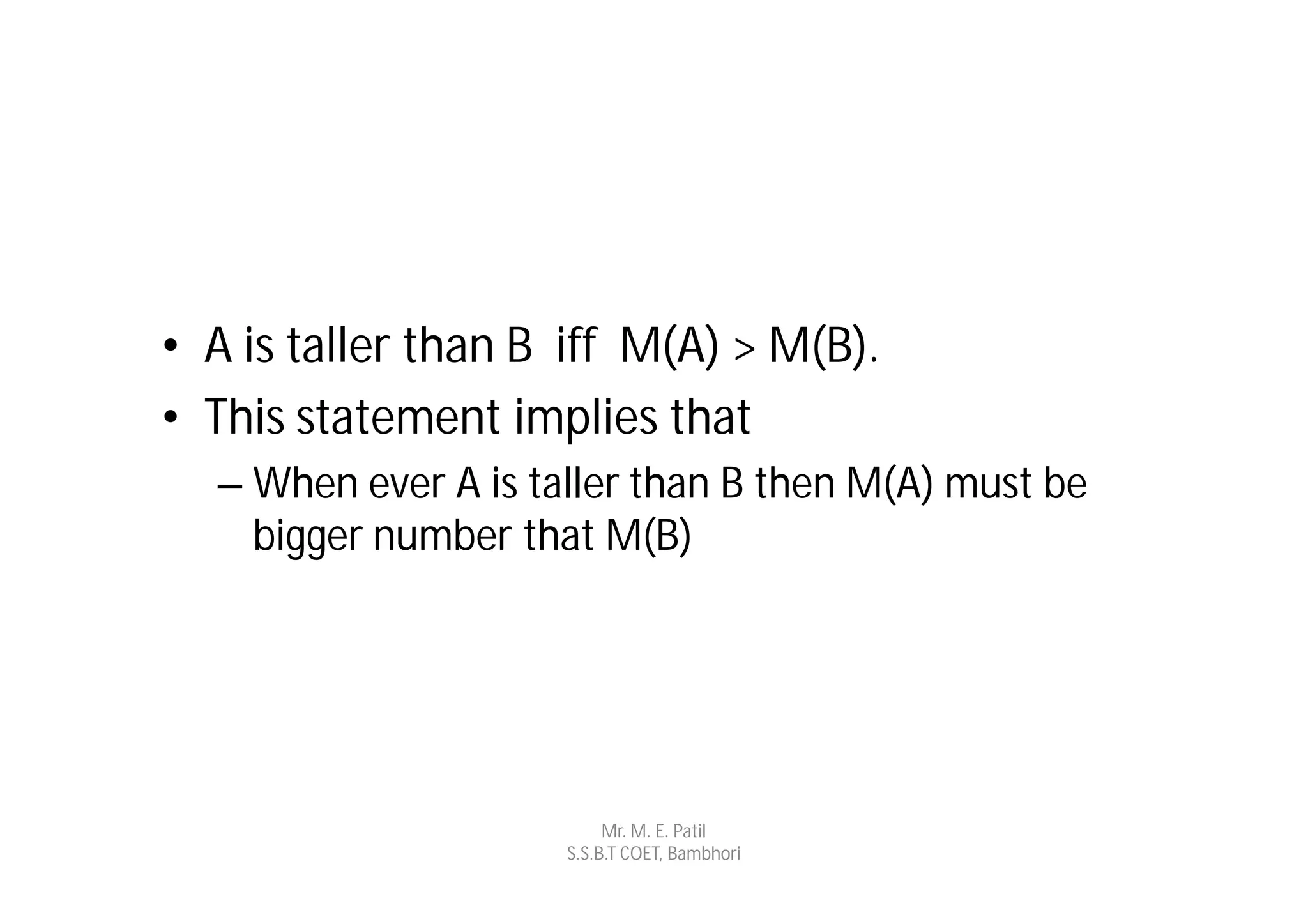
• The representation condition states that a
  measurement mapping M must map the
  entities in to numbers ans empirical relations
  into the numerical relations in such a way that
  the empirical relations preserve and are
  preserved by the numerical relations.
• For taller than in empirical relation is mapped
  to symbol > in numerical relation.

                         Mr. M. E. Patil
                    S.S.B.T COET, Bambhori
• A is taller than B iff M(A) > M(B).
• This statement implies that
  – When ever A is taller than B then M(A) must be
    bigger number that M(B)


                          Mr. M. E. Patil
                     S.S.B.T COET, Bambhori
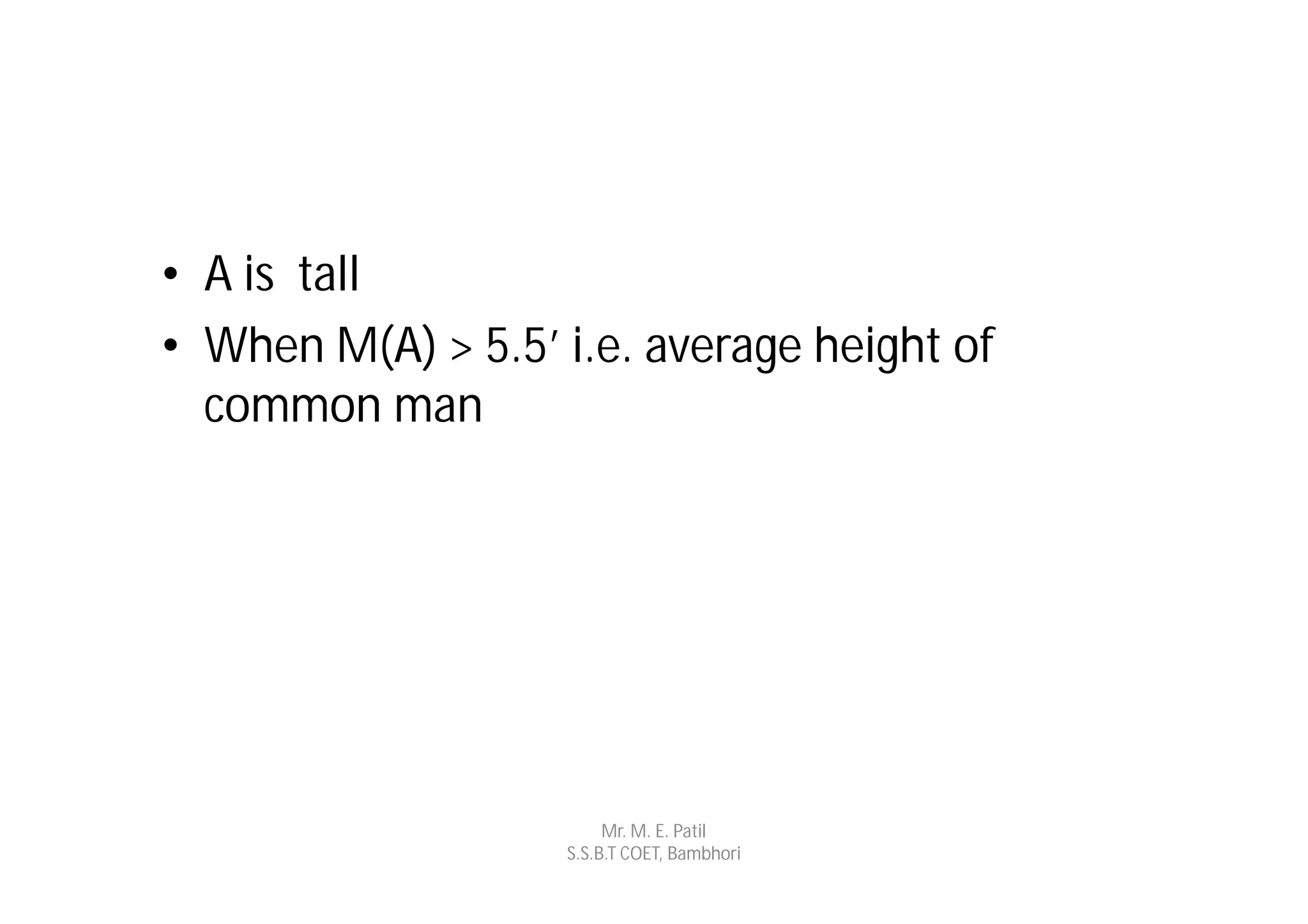
• A is tall
• When M(A) > 5.5’ i.e. average height of
  common man


                        Mr. M. E. Patil
                   S.S.B.T COET, Bambhori
Mr. M. E. Patil
S.S.B.T COET, Bambhori

Smqa unit i

  • 1.
    Software Metrics andQuality Assurance
  • 2.
    Reference Books • 1)Software Metrics – A Rigorous & Practical Approach, 2E – By:- Norman E Fenton & Shari Lawrence Pfleeger – Publication :- Thomson Learning. – (Chapter 1,2,3,7,8,9,10,12 ) – Syllabus covered I,II,III Units 2) Software Quality By :- Garry Marliss and Ben-Menachem – Publication :- Thomson Learning. – (Chapter,7,8,9,19 ) – Syllabus covered IV Unit Mr. M. E. Patil S.S.B.T COET, Bambhori
  • 3.
    • Software Engineering–A Practitioners approach, fifth edition. By :- Roger S Pressman. Chapters 27 28,29 (Syllabus Covered:- V unit) Mr. M. E. Patil S.S.B.T COET, Bambhori
  • 4.
    Software Metric andQuality Assurance • Software Metric: – It is the combination of the various attributes of the software. – Attributes of the software are • Length • Functionality • Reuse • Number of faults Mr. M. E. Patil S.S.B.T COET, Bambhori
  • 5.
    • Quality Assurance:- – Fitness of purpose – Conformance to the given specifications – Degree of excellence – Timeliness Mr. M. E. Patil S.S.B.T COET, Bambhori
  • 6.
    Measurement in everydaylife • Without measurement technology cant function • Examples of Measurement – Radar System – Medical System – Whether forecasting system – Price act as value of an item – Journey from jalgaon to Mumbai Mr. M. E. Patil S.S.B.T COET, Bambhori
  • 7.
    Measurement helps to •Understand our world • Interact with the surroundings • Improve our lives. Mr. M. E. Patil S.S.B.T COET, Bambhori
  • 8.
    • What isMeasurement ? Mr. M. E. Patil S.S.B.T COET, Bambhori
  • 9.
    • Measurement isthe process by which numbers or symbols are assigned to attributes of entities in the real world, so as to describe them according to the clearly defined rules. Mr. M. E. Patil S.S.B.T COET, Bambhori
  • 10.
    • An Entity:- an object (person or object) an event (Journey or the testing process) Attribute:- It is the feature or property of an entity. e.g. area or color of the room, cost of the journey, Mr. M. E. Patil S.S.B.T COET, Bambhori
  • 11.
    • Measurement canbe called as quantification • There are two types of quantification – Direct and Indirect quantification – Measurement is direct quantification • E. g. Height of a tree , length of software – Calculations are indirect quantification • E.g. Area of room = Length * Breadth Mr. M. E. Patil S.S.B.T COET, Bambhori
  • 12.
    Measurement in softwareEngineering • Software engineering Activity includes – Managing – Costing – Planning – Designing – Modeling – Analyzing – Implementing – Testing and maintaining Mr. M. E. Patil S.S.B.T COET, Bambhori
  • 13.
    • As softwareengineering focuses on implementing the software in controlled and scientific way. • To do this, all the above activities must be understood then we can control them and further we can improve. Mr. M. E. Patil S.S.B.T COET, Bambhori
  • 14.
    Neglecting measurement insoftware engineering • We fail to set measurable targets for our software products. • We fail to understand and quantify the cost of software products. • We can’t quantify the quality of the product we produce • We can’t find out the improvements in out product development Mr. M. E. Patil S.S.B.T COET, Bambhori
  • 15.
    Objectives of softwaremeasurement • Measurement is needed for assessing the status of our – Projects – Products – Processes – Resources Mr. M. E. Patil S.S.B.T COET, Bambhori
  • 16.
    Information required tounderstand and control software development • Form Managers Perspective – What does each process cost ? – How productive is the staff ? – How good is the code being developed ? – Will the user be satisfied with the product ? – How we can improve ? Mr. M. E. Patil S.S.B.T COET, Bambhori
  • 17.
    • From EngineersPerspective:- – Are the requirements testable ? – Have we found all the faults ? – Have we meet our product or process goals ? – What will happen in future ? Mr. M. E. Patil S.S.B.T COET, Bambhori
  • 18.
    Representational theory of Measurement • The data we obtain as measure should represent the attribute of the entities we observe and manipulation of data should preserve relationship that we observe among the entities • It consists of – Empirical Relation – Rules of Mapping – Representation condition Mr. M. E. Patil S.S.B.T COET, Bambhori
  • 19.
    Empirical relation • Wenormally understand things by comparing them instead of assinging them numbers. • Avinash is tall - ‘is tall’ is the unary relation • Avinash is taller than Sushant. – Taller than is the binary relation Mr. M. E. Patil S.S.B.T COET, Bambhori
  • 20.
    Rules of Mapping •The real world is the domain of mapping and mathematical world is the range. • When we map the attributes to a mathematical system, we have many choices for the mapping and the range. – E.g. To measure person height. Mr. M. E. Patil S.S.B.T COET, Bambhori
  • 21.
    The representation condition •The representation condition states that a measurement mapping M must map the entities in to numbers ans empirical relations into the numerical relations in such a way that the empirical relations preserve and are preserved by the numerical relations. • For taller than in empirical relation is mapped to symbol > in numerical relation. Mr. M. E. Patil S.S.B.T COET, Bambhori
  • 22.
    • A istaller than B iff M(A) > M(B). • This statement implies that – When ever A is taller than B then M(A) must be bigger number that M(B) Mr. M. E. Patil S.S.B.T COET, Bambhori
  • 23.
    • A istall • When M(A) > 5.5’ i.e. average height of common man Mr. M. E. Patil S.S.B.T COET, Bambhori
  • 24.
    Mr. M. E.Patil S.S.B.T COET, Bambhori