SMOKING AND ITS ILL
EFFECTS – AN
EDUCATIONAL INITIATIVE
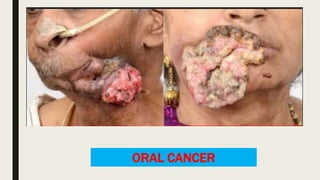
ORAL CANCER
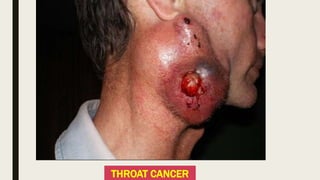
THROAT CANCER
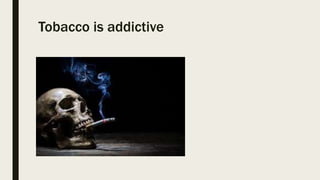
Tobacco is addictive
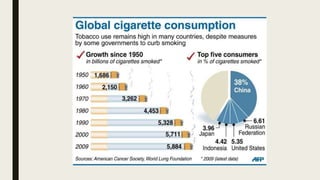
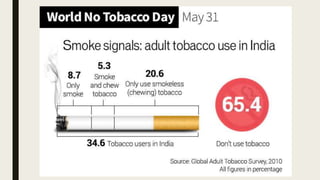
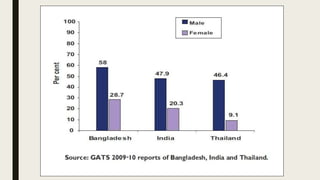
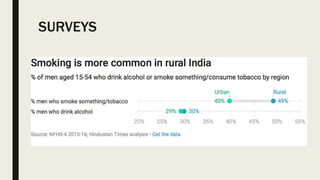
SURVEYS
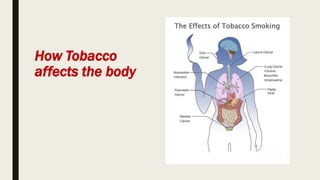
How Tobacco
affects the body
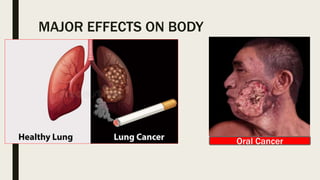
MAJOR EFFECTS ON BODY
Oral Cancer
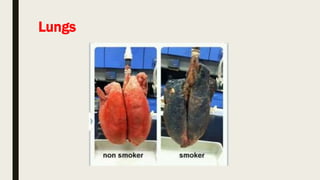
Lungs
Lung Diseases
COPD [Chronic Obstructive Pulmonary Disease]
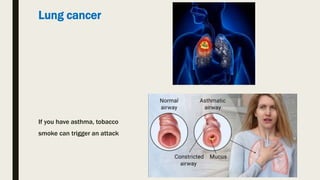
Lung cancer
If you have asthma, tobacco
smoke can trigger an attack
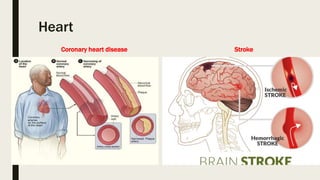
Heart
Coronary heart disease Stroke
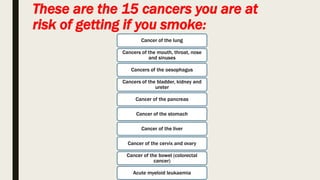
These are the 15 cancers you are at
risk of getting if you smoke:
Cancer of the lung
Cancers of the mouth, throat, nose
and sinuses
Cancers of the oesophagus
Cancers of the bladder, kidney and
ureter
Cancer of the pancreas
Cancer of the stomach
Cancer of the liver
Cancer of the cervix and ovary
Cancer of the bowel (colorectal
cancer)
Acute myeloid leukaemia
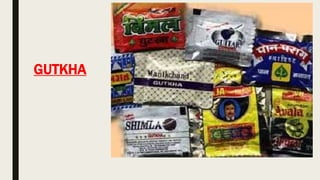
GUTKHA
WHY IS IT DIFFICULT TO QUIT
SMOKING???????
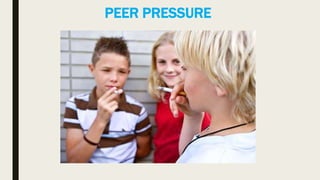
PEER PRESSURE
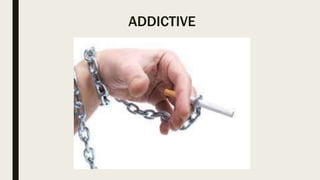
ADDICTIVE
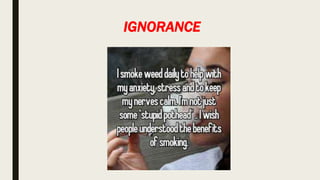
IGNORANCE
SURROGATE ADVERTISING
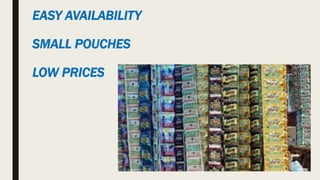
EASY AVAILABILITY
SMALL POUCHES
LOW PRICES
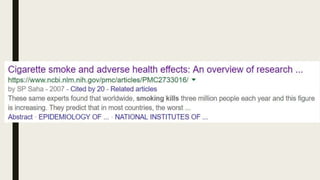
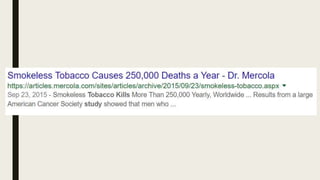
STUDIES ON EFFECTS OF
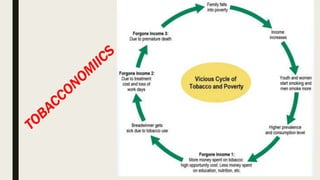
TOBACCO
What is being done?
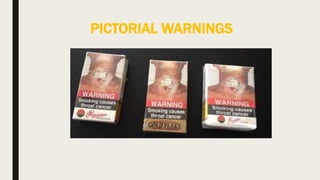
PICTORIAL WARNINGS
■ RECOMMENDATIONS FOR SCHOOL HEALTH PROGRAMS TO PREVENT TOBACCO
USE AND ADDICTION
■ Develop and enforce a school policy on tobacco use.
■ Provide instruction about the short- and long-term negative physiologic and social
consequences of tobacco use, social influences on tobacco use, peer norms
regarding tobacco use, and refusal skills.
■ Provide tobacco-use prevention education in kindergarten through 12th grade; this
instruction should be especially intensive in junior high or middle school and
should be reinforced in high school.
■ Provide program-specific training for teachers.
■ Involve parents or families in support of school-based programs to prevent tobacco
use.
■ Support cessation efforts among students and all school staff who use tobacco.
■ Assess the tobacco-use prevention program at regular intervals.
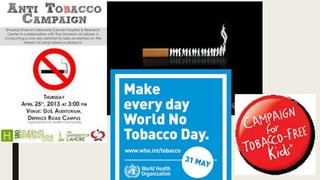
CAMPAIGNS
■ Media campaigns, a critical tool for tobacco control, are
underutilized globally.
■ Sustained large-scale campaigns can efficiently drive
millions to quit smoking, prevent initiation of new smokers,
and create an enabling environment for policy change.
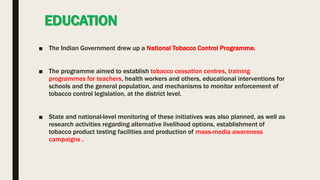
EDUCATION
■ The Indian Government drew up a National Tobacco Control Programme.
■ The programme aimed to establish tobacco cessation centres, training
programmes for teachers, health workers and others, educational interventions for
schools and the general population, and mechanisms to monitor enforcement of
tobacco control legislation, at the district level.
■ State and national-level monitoring of these initiatives was also planned, as well as
research activities regarding alternative livelihood options, establishment of
tobacco product testing facilities and production of mass-media awareness
campaigns .
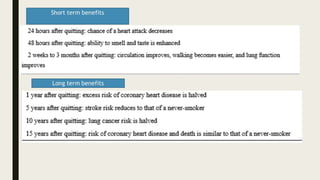
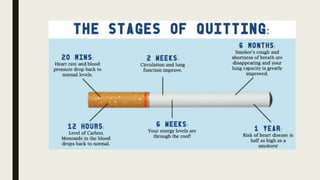
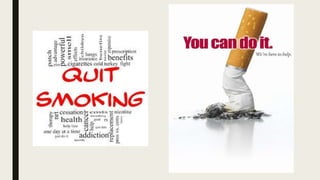
CESSATION
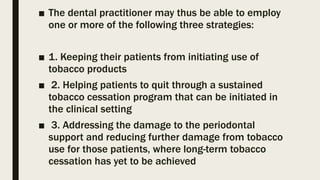
■ The dental practitioner may thus be able to employ
one or more of the following three strategies:
■ 1. Keeping their patients from initiating use of
tobacco products
■ 2. Helping patients to quit through a sustained
tobacco cessation program that can be initiated in
the clinical setting
■ 3. Addressing the damage to the periodontal
support and reducing further damage from tobacco
use for those patients, where long-term tobacco
cessation has yet to be achieved
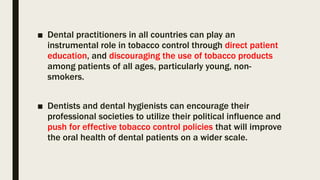
■ Dental practitioners in all countries can play an
instrumental role in tobacco control through direct patient
education, and discouraging the use of tobacco products
among patients of all ages, particularly young, non-
smokers.
■ Dentists and dental hygienists can encourage their
professional societies to utilize their political influence and
push for effective tobacco control policies that will improve
the oral health of dental patients on a wider scale.
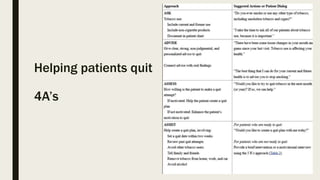
Helping patients quit
4A’s
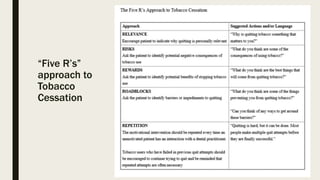
“Five R’s”
approach to
Tobacco
Cessation
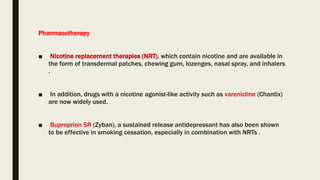
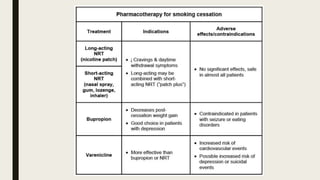
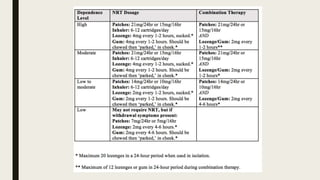
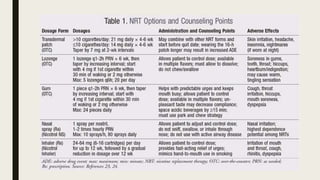
Pharmacotherapy
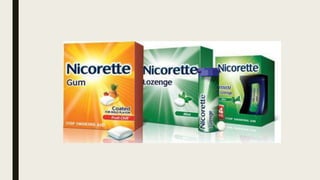
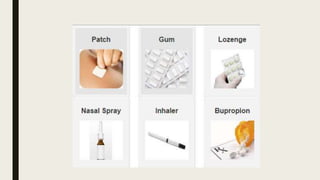
■ Nicotine replacement therapies (NRT), which contain nicotine and are available in
the form of transdermal patches, chewing gum, lozenges, nasal spray, and inhalers
.
■ In addition, drugs with a nicotine agonist-like activity such as varenicline (Chantix)
are now widely used.
■ Buproprion SR (Zyban), a sustained release antidepressant has also been shown
to be effective in smoking cessation, especially in combination with NRTs .
Smoking patient education

Smoking patient education

  • 1.
    SMOKING AND ITSILL EFFECTS – AN EDUCATIONAL INITIATIVE
  • 2.
  • 3.
  • 4.
  • 11.
  • 13.
  • 14.
    MAJOR EFFECTS ONBODY Oral Cancer
  • 15.
  • 16.
    Lung Diseases COPD [ChronicObstructive Pulmonary Disease]
  • 17.
    Lung cancer If youhave asthma, tobacco smoke can trigger an attack
  • 18.
  • 19.
    These are the15 cancers you are at risk of getting if you smoke: Cancer of the lung Cancers of the mouth, throat, nose and sinuses Cancers of the oesophagus Cancers of the bladder, kidney and ureter Cancer of the pancreas Cancer of the stomach Cancer of the liver Cancer of the cervix and ovary Cancer of the bowel (colorectal cancer) Acute myeloid leukaemia
  • 20.
  • 25.
    WHY IS ITDIFFICULT TO QUIT SMOKING???????
  • 26.
  • 27.
  • 29.
  • 30.
  • 31.
  • 32.
  • 36.
  • 37.
  • 38.
    ■ RECOMMENDATIONS FORSCHOOL HEALTH PROGRAMS TO PREVENT TOBACCO USE AND ADDICTION ■ Develop and enforce a school policy on tobacco use. ■ Provide instruction about the short- and long-term negative physiologic and social consequences of tobacco use, social influences on tobacco use, peer norms regarding tobacco use, and refusal skills. ■ Provide tobacco-use prevention education in kindergarten through 12th grade; this instruction should be especially intensive in junior high or middle school and should be reinforced in high school. ■ Provide program-specific training for teachers. ■ Involve parents or families in support of school-based programs to prevent tobacco use. ■ Support cessation efforts among students and all school staff who use tobacco. ■ Assess the tobacco-use prevention program at regular intervals.
  • 39.
    CAMPAIGNS ■ Media campaigns,a critical tool for tobacco control, are underutilized globally. ■ Sustained large-scale campaigns can efficiently drive millions to quit smoking, prevent initiation of new smokers, and create an enabling environment for policy change.
  • 41.
    EDUCATION ■ The IndianGovernment drew up a National Tobacco Control Programme. ■ The programme aimed to establish tobacco cessation centres, training programmes for teachers, health workers and others, educational interventions for schools and the general population, and mechanisms to monitor enforcement of tobacco control legislation, at the district level. ■ State and national-level monitoring of these initiatives was also planned, as well as research activities regarding alternative livelihood options, establishment of tobacco product testing facilities and production of mass-media awareness campaigns .
  • 42.
  • 43.
    ■ The dentalpractitioner may thus be able to employ one or more of the following three strategies: ■ 1. Keeping their patients from initiating use of tobacco products ■ 2. Helping patients to quit through a sustained tobacco cessation program that can be initiated in the clinical setting ■ 3. Addressing the damage to the periodontal support and reducing further damage from tobacco use for those patients, where long-term tobacco cessation has yet to be achieved
  • 44.
    ■ Dental practitionersin all countries can play an instrumental role in tobacco control through direct patient education, and discouraging the use of tobacco products among patients of all ages, particularly young, non- smokers. ■ Dentists and dental hygienists can encourage their professional societies to utilize their political influence and push for effective tobacco control policies that will improve the oral health of dental patients on a wider scale.
  • 45.
  • 46.
  • 49.
    Pharmacotherapy ■ Nicotine replacementtherapies (NRT), which contain nicotine and are available in the form of transdermal patches, chewing gum, lozenges, nasal spray, and inhalers . ■ In addition, drugs with a nicotine agonist-like activity such as varenicline (Chantix) are now widely used. ■ Buproprion SR (Zyban), a sustained release antidepressant has also been shown to be effective in smoking cessation, especially in combination with NRTs .