Project Report
On
Smartphones Usage in India
Submitted by,
Sukesh Chandra Gain
F-153, FMS, Delhi
1
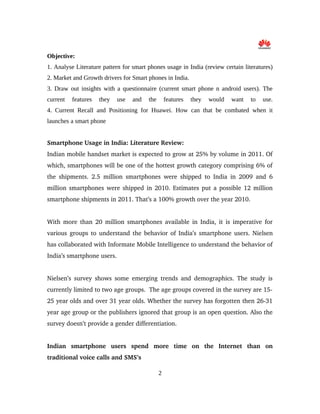
Objective:
1. Analyse Literature pattern for smart phones usage in India (review certain literatures)
2. Market and Growth drivers for Smart phones in India.
3. Draw out insights with a questionnaire (current smart phone n android users). The
current features they use and the features they would want to use.
4. Current Recall and Positioning for Huawei. How can that be combated when it
launches a smart phone
Smartphone Usage in India: Literature Review:
Indian mobile handset market is expected to grow at 25% by volume in 2011. Of 
which, smartphones will be one of the hottest growth category comprising 6% of 
the shipments. 2.5 million smartphones were shipped to India in 2009 and 6 
million smartphones were shipped in 2010. Estimates put a possible 12 million 
smartphone shipments in 2011. That’s a 100% growth over the year 2010.
With more than 20 million smartphones available in India, it is imperative for 
various groups to understand the behavior of India’s smartphone users. Nielsen 
has collaborated with Informate Mobile Intelligence to understand the behavior of 
India’s smartphone users.
Nielsen’s survey shows some emerging trends and demographics. The study is 
currently limited to two age groups.  The age groups covered in the survey are 15­
25 year olds and over 31 year olds. Whether the survey has forgotten then 26­31 
year age group or the publishers ignored that group is an open question. Also the 
survey doesn’t provide a gender differentiation.
Indian   smartphone   users   spend   more   time   on   the   Internet   than   on 
traditional voice calls and SMS’s
2
Smartphone usage by Indian users:
On an average Indian smartphone users spend  2 hours and 30 minutes with 
smartphones and 72% of that time goes into gaming, entertainment, and 
Internet. Traditional voice calls and text messaging take a mere 28% of the time. 
Smartphone Usage pattern of 15­24 year old:
The younger Indians prefer to spend most of their time browsing the internet on 
their smartphones with little time spent for SMS. Casual browsing of the phone 
3
like searching for contacts and setting alarms take 30 mins of the time for 15­24 
year olds.
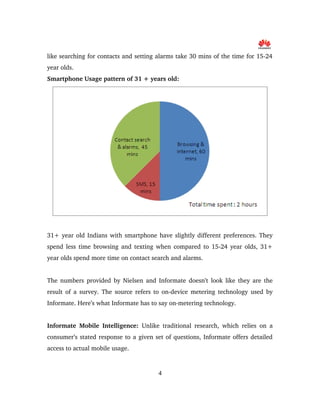
Smartphone Usage pattern of 31 + years old:
31+ year old Indians with smartphone have slightly different preferences. They 
spend less time browsing and texting when compared to 15­24 year olds, 31+ 
year olds spend more time on contact search and alarms.
The numbers provided by Nielsen and Informate doesn’t look like they are the 
result of a survey. The source refers to on­device metering technology used by 
Informate. Here’s what Informate has to say on­metering technology.
Informate Mobile Intelligence:  Unlike traditional research, which relies on a 
consumer’s stated response to a given set of questions, Informate offers detailed 
access to actual mobile usage.
4
Through its proprietary on­device metering technology Smart Meter, Informate 
captures real time and complete data onactual mobile phone usage. In addition, 
Informate Quest, our syndicated survey captures attitudinal data such as brand 
awareness, purchase intention, brand satisfaction and preference scores. So while 
the SmartMeter tracks What are the phone features used and When, the Informate 
Quest delves into Who the consumers are and the Why of their mobile phone 
behaviour.
The study further finds that data usage of 3G users is 44% more than that of 2G 
users. Despite Symbian’s popularity in India,  a Symbian user installs only 10 
apps while an Android user installs 19 apps in a month.
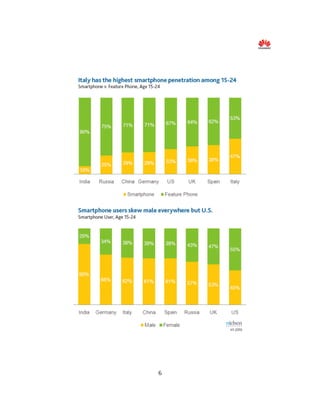
Interestingly, of all the Indian youth who have mobile phones, only 10 percent 
have smartphones and 90 percent of them still have feature phones. Density 
of smartphones amongst youth is highest in Italy where 47 percent of them carry 
smartphones. The report also reveals that most young people with mobile phones 
choose their own devices and only 16 percent youth go by their parent’s choice of 
the phone.
Smartphone Penetration – Male Vs Female
Among the youth, who have smartphones, only 20 percent comprise of females, 
again which is one of the lowest in the world. Even our neighbouring country 
China, has about 40 percent female smartphone users. While in the U.S, female 
Smartphone users (55 percent) out number their male counterparts (45 percent).
5
6
Price – Most important mobile purchase Driver:
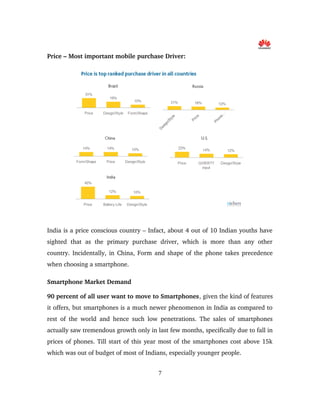
India is a price conscious country – Infact, about 4 out of 10 Indian youths have 
sighted   that   as   the   primary   purchase   driver,   which   is   more   than   any   other 
country. Incidentally, in China, Form and shape of the phone takes precedence 
when choosing a smartphone.
Smartphone Market Demand
90 percent of all user want to move to Smartphones, given the kind of features 
it offers, but smartphones is a much newer phenomenon in India as compared to 
rest of the world and hence such low penetrations. The sales of smartphones 
actually saw tremendous growth only in last few months, specifically due to fall in 
prices of phones. Till start of this year most of the smartphones cost above 15k 
which was out of budget of most of Indians, especially younger people. 
7
But   the   scenario   has   changes   drastically,   thanks   to   local   Indian   brands   like 
Micromax, Zen, Maxx and others, who have bought smartphones in every ones 
reach. Today one can buy a decent smartphone for as low as 3000 rupees.
Smartphone Market Potential in India
But, still the market potential remains huge – 80 percent of Smartphone market is 
still there for the taking (Imagine the numbers we are talking here). There will be 
two main factors that will decide how soon the Smartphones proliferate. The price 
of the handset and cost of Data usage. 
Apart from handset prices, Telecom Operators have to ensure that cost of data 
transfer   (especially   3G   going   forward)   has   to   be   affordable,   otherwise 
smartphones will always be looked as glorified bulkier feature phones!
Enterprise Smartphone Usage Trends:
Enterprise Mobility space is getting really interesting with the sudden explosion 
in the smartphone and tablet choices in the market. We have some interesting 
trends on enterprise smartphone usage.
Smartphone Usage Trends In Enterprise:
• As many as 66% of the surveyed organizations supply employees with 
smartphones. 
• 18%   of   the   organizations   have   75­100%   employees   using   smartphone 
whereas around 22% of organizations have less than 5% employees using 
smartphones. 
• Organizations are a little skeptical of supporting personal smartphones. 
Majority   (54%)   of   the   organizations   do   not   support   non­company 
supported smartphones. 
8
• Work   e­mail   is   the   primary   task   for   which   smartphones   are   used   in 
enterprises. 91% of the surveyed used their smartphone for checking work 
e­mails while a good 46% use smartphones to connect to company wireless 
networks 
Blackberry Continues To Be The Most Preferred Smartphone:
Blackberry with its encrypted security features does justify the preference for it, 
but assuming that this trend will change in favor of iPhone and Android phones as 
employees start using smartphones for more complex tasks. 
However, it is really interesting to see Android Based phone usage percentage 
what with the general enterprise scepticism about open source.
9
Heartening Usage Trends, But Are Enterprises Beefing Up Security
One would  think  that  of  all things  enterprises are concerned  about  security 
proofing all IT infrastructure in the organization. Be it intranet, internet or VPN 
networks,   enterprises   ensure   that   all   incoming/outgoing   channels   are   aptly 
secured.
However, it does not seem to be the case as far as securing smartphones go.
A meager 31% of the organization require a security software on smartphone 
used by employees
That   is   a   significantly   low   percentage   especially   when   compared   with   the 
increasing smartphone usage in the enterprise. As employees increasingly use 
their smartphone for more and more tasks, it is even more critical that the right 
security is put in place. 
One   possible   logic   that   could   explain   the   low   security   requirements   for 
smartphones could be due to the fact that not a lot of security threats would have 
taken   place.   However,   the   report   highlights   that   organizations   have   already 
witnessed a wide variety of security attacks from unsecured smartphone usage.
10
With as many as 85% of the surveyed organizations allowing employees to 
connect to public Wi­Fi networks, the possibility of security threats is bound to 
be there. It is surprising to see the significantly low levels of security concerns for 
smartphones.
What is even more surprising than organizations not providing security softwares 
is that very few even consider providing security awareness training for employees 
using smartphones. 
A lot of unwarranted attacks could be thwarted if employees are made aware of 
the kind of threats they can be exposed to be while using smartphone and the 
various channels they can spread from.
11
Personal   and   Enterprise   usage   of   smartphones   and   tablets   is   only   going   to 
increase over next few years.  Organizations globally  will have to beef up 
security measures specifically for these new enterprise mobility devices to 
ensure that productivity does not come at the cost of security.
Traffic by Smartphone Platform 
No surprises here – iPhone is a big winner – iPhone platform accounted for 50% 
of all the requests that came to Admob network. However, Android has surged 
ahead and taken the 2nd position accounting 24% of all the mobile internet 
traffic, while Nokia’s Symbian OS came in 3rd with 18% share.
12
India Handset & Operating System Share:
Nokia has been king in India since mobile revolution came about in India and it 
still holds it positions when it comes to top 10 mobile handsets used in India. 
However, with advent of smartphones, Nokia has started to slowly loose it Mobile 
handset Market Share. While, Samsung seems to be doing quite well and has seen 
surge in its Market Share.
Nokia, being so popular in India, its native OS – Symbian is also faring very well – 
Infact, more than 90% of all the mobile requests to Admob Network are from 
Symbian OS. iPhone accounts for around 5% market share while remaining 4% 
account for all the rest of Mobile Oses.
13
4G in India as early as next year:
The consumers who have subscribed to 3G services have been far from happy. 
Either the speed have been slow or the connectivity has been intermittent or both. 
3G has just not taken off as it was expected to.
However, from consumer point of view there are couple of things that need to be 
looked at – Jury is still out on what exactly are 4G services. The technology often 
referred to as "4G" are simply an advanced form of 3G, called 3.9G by the ITU. It 
is not really 4G per say. The real 4G speeds are expected to be in the region of 
upto 100 mbps. 
Another important aspect from consumers point of view is Handset compatibility. 
Most consumers are just switching to 3G handsets, which are rather expensive 
compared to normal 2G handsets. If 4G services get launched in next 12 to 18 
months as expected, very few consumers will actually move. The cost of 4G 
handset are also expected to be significantly higher.
We are atleast 3­4 years away from actually getting hands on with 4G. It will 
easily take Telecom Providers about 6 months to year for streamlining their 
14
existing 3G offerings itself. Only after that will consumers start adopting it in big 
numbers.
According to Nielsen:
• 72   percent   of   their   time   [is]   spent   on   activities   such   as   gaming, 
entertainment, apps and internet related content. Only 28 percent of their 
time is now used for voice calls and text messaging.
The shift is even more noticeable in younger users. Here are the five other key 
findings in addition to the one just mentioned:
• Younger smartphone users (15 to 25­year olds) spend more than three 
hours per day on their phones, and spend 60 percent of that time on 
entertainment and browsing
• 68 percent of 15 to 24­year olds used a chat app within the last month, as 
compared to 42 percent for the 31+ folks.
• Data usage for 3G users was close to 44 percent more than 2G users
• An Android user installs an average of 19 apps in a month compared to ten 
apps for a Symbian user
• 84 percent of Android users played a game in the last month compared to 
59 percent for Symbian users
So, basically, even older users now spend about three­times longer finger­swiping 
then jibber­jabbing, which is good news for smartphone makers that are popular 
in the country, such as Nokia and BlackBerry.
But lets not forget that hundreds of millions of Indian phone users have humbler 
devices, and neither a 2G nor 3G connection. Which is why Indian start­ups and 
major telcos alike are still pushing forward some neat message­oriented services, 
15
such as SMSGyan, the SMS­based search engine, as well as SMS GupShup, India’s 
Twitter­like messaging service.
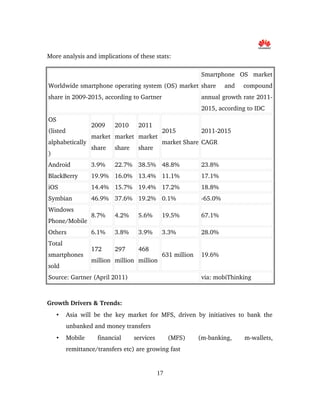
Android  is forecasted  to  become  the number  one smartphone operating 
system in 2011.
Gartner (April 2011) estimates that 468 million will be sold in 2011, that’s a 57.7 
percent increase from 2010. Of those phones, 38.5 percent will be powered by the 
Android   operating   system.   By   2015,   631   million   smartphones   will   be   sold, 
approaching half of those will be Android.
IDC (March 2011) estimates that 450 million will be sold in 2011, that’s a 49.2 
percent increase from 2010. Of those phones, 39.5 percent will be powered by the 
Android operating system. 
Both Gartner and IDC expect to see Symbian nose dive following Nokia’s decision 
to dump its smartphone operating system in favor of Microsoft’s Windows Phone. 
Windows phone shows strong growth, but considerably less market share than 
Symbian enjoyed to 2010.
16
More analysis and implications of these stats:
Worldwide smartphone operating system (OS) market 
share in 2009­2015, according to Gartner
Smartphone   OS   market 
share   and   compound 
annual growth rate 2011­
2015, according to IDC
OS
(listed 
alphabetically
) 
2009
market 
share
2010
market 
share
2011
market 
share
2015
market Share
2011­2015
CAGR
Android 3.9% 22.7% 38.5% 48.8% 23.8%
BlackBerry 19.9% 16.0% 13.4% 11.1% 17.1%
iOS 14.4% 15.7% 19.4% 17.2% 18.8%
Symbian 46.9% 37.6% 19.2% 0.1% ­65.0%
Windows 
Phone/Mobile
8.7% 4.2% 5.6% 19.5% 67.1%
Others 6.1% 3.8% 3.9% 3.3% 28.0%
Total 
smartphones 
sold
172 
million
297 
million
468 
million
631 million 19.6%
Source: Gartner (April 2011) via: mobiThinking
Growth Drivers & Trends:
• Asia will be the key market for MFS, driven by initiatives to bank the 
unbanked and money transfers
• Mobile   financial   services   (MFS)   (m­banking,   m­wallets, 
remittance/transfers etc) are growing fast
17
• M­coupons   will   dominate   mobile   retail   marketing   spend   until   2013, 
according to Juniper Research
• 1 in 8 mobile subscribers will use m­ticketing in 2015 for airline, rail and 
bus travel, festivals, cinemas and sports events.
• Worldwide mobile payments (m­payments) are growing strongly, but will 
still only be worth a fraction of e­commerce payments
• The most used apps across all smartphones – note that’s used as opposed to 
downloaded – according to Nielsen, are Facebook, Google Maps and The 
Weather Channel (TWC). The most popular categories are games; news; 
maps; social networking and music
• The average price of a mobile app is falling rapidly on all vendor app 
stores, except Android.
• Demand for app stores is expected to peak in 2013
• Mobile searches have quadrupled in the last year, according to Google, for 
many items one in seven searches are now mobile
• In 2011 over 85 percent of new handsets will be able to access the mobile 
Web. Today in US and Western Europe, 90 percent of mobile subscribers 
have an Internet­ready phone
• The number of people accessing the mobile Internet is growing fast and is 
expected to overtake the PC as the most popular way to get on the Web 
within five years
• Only   a   fraction   of   smartphones   and   tablets   are   protected   by   security 
software
• Android is forecasted to become the number one smartphone operating 
system in 2011­12
18
References:
1. http://trak.in/tags/business/2011/09/06/smartphone­usage­india­   
overview­numbers/
2. http://trak.in/tags/business/2010/12/16/smartphone­market­india­huge­   
potential/
3. http://trak.in/tags/business/2011/06/15/smartphone­usage­trends­   
enterprise/
4. http://www.penn­olson.com/2011/10/06/india­smartphone­users/   
5. http://mobithinking.com/mobile­marketing­tools/latest­mobile­stats   
6. http://www.slideshare.net/kleinerperkins/kpcb­top­10­mobile­trends­feb­   
2011
19

Smartphones usage in india