SUBMITTED TO :
COMPUTER DEPARTMENT
PRESENTED BY :
FRANKLIN SIMON
B.C.A. 1ST SEM
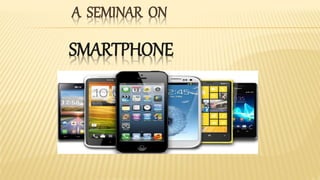
A SEMINAR ON
SMARTPHONE
 CONTENTS
INTRODUCTION
HISTORY
OPERATING SYSTEM (OS)
RAMROM
SCREEN TYPES
CHIPSET ,GRAPHICS CARDS
NETWORKS
SENSORS
BATTERY
LATEST SMART PHONE
TOP COMPANIES
LATEST SMARTPHONE TECHNOLOGY
GOOGLE PROJECT ARA
 INTRODUCTION
Smartphone are mobile devices that do a lot more than
just make calls and send texts. They have cameras; they
play music & videos; they send and receive email; they
browse the web; they have GPS satellite navigation.
They also have QWERTY keyboards (real, virtual
onscreen or both) and perhaps most important of all,
they run apps.
HISTORY
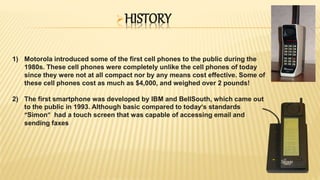
1) Motorola introduced some of the first cell phones to the public during the
1980s. These cell phones were completely unlike the cell phones of today
since they were not at all compact nor by any means cost effective. Some of
these cell phones cost as much as $4,000, and weighed over 2 pounds!
2) The first smartphone was developed by IBM and BellSouth, which came out
to the public in 1993. Although basic compared to today’s standards
“Simon” had a touch screen that was capable of accessing email and
sending faxes
OPERATING SYSTEMS
Mobile operating systems combine features of a
personal computer operating system with other
features useful for mobile or handheld use;
usually including, and most of the following
considered essential in modern mobile systems;
a touchscreen, cellular, Bluetooth, Wi-Fi, GPS
mobile navigation, camera, video camera,
speech recognition, voice recorder, music player,
near field communication and infrared blaster.
 ANDROID
 APPLE IOS
 WINDOWS
PHONE
 BLACKBERRY
 FIREFOX OS
 SAILFISH OS
TYPES OF OPERATING SYSTEMS
WHAT IS RAM ?
RAM-The RAM works quite different on your android
phones than on your PC which most of us basic
users are better acquainted with. The Apps that you
download and install are first loaded in the RAM and
then executed.
WHAT IS ROM ?
ROM-ROM or Read Only Memory is more permanent
by nature. What goes in there stays there. The ROM or
read only memory forms a part of your internal storage
and that part is not Accessible for users to write on and
is thus referred to as Read Only Memory.
 SCREEN TYPES
1)TFT LCD
2)IPS-LCD
3) OLED
4) AMOLED
5) Super AMOLED
6) Retina Display
7) Haptic / Tactile touchscreen
8) Gorilla Glass
1)Nvidia Tegra-Nvidia trgra processor are the best for playing games and give a decent battery
life.
2)SAMSUNG EXYNOS-samsung exynos processor are the best for running productivity tools.
3)Qualcomm snapdragon S4-Qualcomm snapdragon are the best for better battery life and if
you like playing HD movies.
4)Intel ATOM-Intel atom processor are the best choice for using web base application on
smartphone and tablets.
CHIPSET
1)ARM cortexTM-A15 or most popular chipset is Mali-400 MP
2)AMD Qualcomm or most popular chipset is Adreno
3)Nvidia TegraTM 3 imagination power VR. Tegra processor.
Compinous-Texas instruments,intel,Samsung,apple,etc
GRAPHICSCARD & CHIPSET
NETWORKS
1) GPRS(General Packet Radio Service).
2) EDGE(Enhanced Data GSM Evolution)
3) 3G
4) HSDPA(High-Speed Down-link Packet Access)
5) HSPA+(Evolved High-Speed Packet Access)
6) 4G LTE(Long Term Evolution)
Summary
GPRS(114Kbps) < EGDE(368Kbps) < 3G(3.1Mbps) <
HSDPA(14Mbps) < HSPA+(168Mbps) <
4G/LTE(299.6Mbps)
SENSORS
1)Acclerometer sensor-screen in facing upword or downword.
2)Gyroscope sensor-rotate in which direction (camera).
3)Magnetometer sensor-compan application point north pole
(compass).
4)Proximity sensor-place near the earpiece display off then on.
5)Light sensor-display brightness automatically.
6)Barometer sensor-atmospheric pressure ,sea level (Motorola
xoom and Samsung galaxy nexus)
7)Therometer sensor-over heating device (warning).
8)Air humidity-“comfort zone” temperature and humidity.
9)Pedometer sensor-counting the number of step you take.
10)Heart rate monitor-calculate heart rate
11)Fingerprint sensor-scan fingerprint and unlock phone.
12)Detecting harmful radiation-detect radiation on area.
13)Gesture sensor-Recognizes the user hand moving using
infared ray.
14)hall sensor-recognizes whether the cover in open or close.
 BATTERY
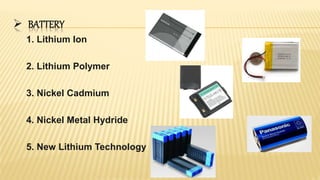
1. Lithium Ion
2. Lithium Polymer
3. Nickel Cadmium
4. Nickel Metal Hydride
5. New Lithium Technology
TOP 10 SMARTPHONE COMPANY
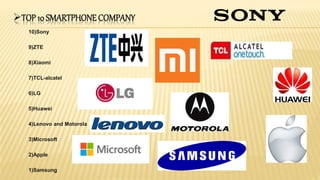
10)Sony
9)ZTE
8)Xiaomi
7)TCL-alcatel
6)LG
5)Huawei
4)Lenovo and Motorola
3)Microsoft
2)Apple
1)Samsung
LATEST SMARTPHONE
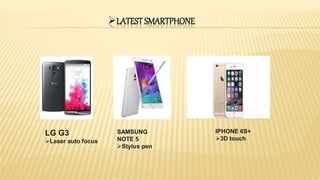
LG G3
Laser auto focus
SAMSUNG
NOTE 5
Stylus pen
IPHONE 6S+
3D touch
GOOGLE PROJECT ARA
ANY QUESTION …?
THANK YOU
EVERYONE

Smartphone 2015

  • 1.
    SUBMITTED TO : COMPUTERDEPARTMENT PRESENTED BY : FRANKLIN SIMON
  • 2.
  • 3.
  • 4.
     CONTENTS INTRODUCTION HISTORY OPERATING SYSTEM(OS) RAMROM SCREEN TYPES CHIPSET ,GRAPHICS CARDS NETWORKS SENSORS BATTERY LATEST SMART PHONE TOP COMPANIES LATEST SMARTPHONE TECHNOLOGY GOOGLE PROJECT ARA
  • 5.
     INTRODUCTION Smartphone aremobile devices that do a lot more than just make calls and send texts. They have cameras; they play music & videos; they send and receive email; they browse the web; they have GPS satellite navigation. They also have QWERTY keyboards (real, virtual onscreen or both) and perhaps most important of all, they run apps.
  • 6.
    HISTORY 1) Motorola introducedsome of the first cell phones to the public during the 1980s. These cell phones were completely unlike the cell phones of today since they were not at all compact nor by any means cost effective. Some of these cell phones cost as much as $4,000, and weighed over 2 pounds! 2) The first smartphone was developed by IBM and BellSouth, which came out to the public in 1993. Although basic compared to today’s standards “Simon” had a touch screen that was capable of accessing email and sending faxes
  • 7.
    OPERATING SYSTEMS Mobile operatingsystems combine features of a personal computer operating system with other features useful for mobile or handheld use; usually including, and most of the following considered essential in modern mobile systems; a touchscreen, cellular, Bluetooth, Wi-Fi, GPS mobile navigation, camera, video camera, speech recognition, voice recorder, music player, near field communication and infrared blaster.
  • 8.
     ANDROID  APPLEIOS  WINDOWS PHONE  BLACKBERRY  FIREFOX OS  SAILFISH OS TYPES OF OPERATING SYSTEMS
  • 9.
    WHAT IS RAM? RAM-The RAM works quite different on your android phones than on your PC which most of us basic users are better acquainted with. The Apps that you download and install are first loaded in the RAM and then executed.
  • 10.
    WHAT IS ROM? ROM-ROM or Read Only Memory is more permanent by nature. What goes in there stays there. The ROM or read only memory forms a part of your internal storage and that part is not Accessible for users to write on and is thus referred to as Read Only Memory.
  • 11.
     SCREEN TYPES 1)TFTLCD 2)IPS-LCD 3) OLED 4) AMOLED 5) Super AMOLED 6) Retina Display 7) Haptic / Tactile touchscreen 8) Gorilla Glass
  • 12.
    1)Nvidia Tegra-Nvidia trgraprocessor are the best for playing games and give a decent battery life. 2)SAMSUNG EXYNOS-samsung exynos processor are the best for running productivity tools. 3)Qualcomm snapdragon S4-Qualcomm snapdragon are the best for better battery life and if you like playing HD movies. 4)Intel ATOM-Intel atom processor are the best choice for using web base application on smartphone and tablets. CHIPSET 1)ARM cortexTM-A15 or most popular chipset is Mali-400 MP 2)AMD Qualcomm or most popular chipset is Adreno 3)Nvidia TegraTM 3 imagination power VR. Tegra processor. Compinous-Texas instruments,intel,Samsung,apple,etc GRAPHICSCARD & CHIPSET
  • 13.
    NETWORKS 1) GPRS(General PacketRadio Service). 2) EDGE(Enhanced Data GSM Evolution) 3) 3G 4) HSDPA(High-Speed Down-link Packet Access) 5) HSPA+(Evolved High-Speed Packet Access) 6) 4G LTE(Long Term Evolution) Summary GPRS(114Kbps) < EGDE(368Kbps) < 3G(3.1Mbps) < HSDPA(14Mbps) < HSPA+(168Mbps) < 4G/LTE(299.6Mbps)
  • 14.
    SENSORS 1)Acclerometer sensor-screen infacing upword or downword. 2)Gyroscope sensor-rotate in which direction (camera). 3)Magnetometer sensor-compan application point north pole (compass). 4)Proximity sensor-place near the earpiece display off then on. 5)Light sensor-display brightness automatically. 6)Barometer sensor-atmospheric pressure ,sea level (Motorola xoom and Samsung galaxy nexus) 7)Therometer sensor-over heating device (warning). 8)Air humidity-“comfort zone” temperature and humidity. 9)Pedometer sensor-counting the number of step you take. 10)Heart rate monitor-calculate heart rate 11)Fingerprint sensor-scan fingerprint and unlock phone. 12)Detecting harmful radiation-detect radiation on area. 13)Gesture sensor-Recognizes the user hand moving using infared ray. 14)hall sensor-recognizes whether the cover in open or close.
  • 15.
     BATTERY 1. LithiumIon 2. Lithium Polymer 3. Nickel Cadmium 4. Nickel Metal Hydride 5. New Lithium Technology
  • 16.
    TOP 10 SMARTPHONECOMPANY 10)Sony 9)ZTE 8)Xiaomi 7)TCL-alcatel 6)LG 5)Huawei 4)Lenovo and Motorola 3)Microsoft 2)Apple 1)Samsung
  • 17.
    LATEST SMARTPHONE LG G3 Laserauto focus SAMSUNG NOTE 5 Stylus pen IPHONE 6S+ 3D touch
  • 18.
  • 19.
  • 20.