MOBILES 	MOBILES 		MOBILES …….Amal Dev. Awww.inquisitive-instincts.blogspot.com
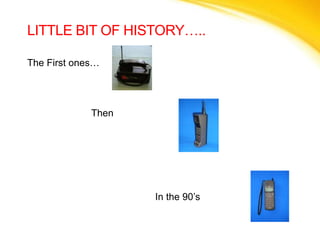
Little bit of history…..The First ones…		Then				In the 90’s
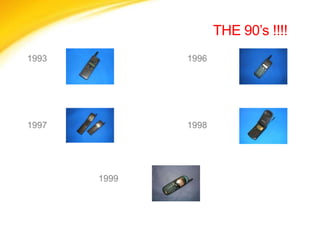
ThE 90’s !!!!1993					19961997					1998		   1999
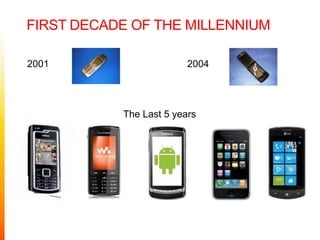
First decade OF THE millennium2001					2004			The Last 5 years
technologyGSM(Global System for Mobile)2nd Generation TechnologyMost widely used standardBased on TDMA(Time Division Multiple Access)Newer GSM networks supports GPRSCDMA(Code Division Multiple Access)3rd Generation, highest mobile and data throughputRapidly growing technology in US, South AmericaFewer drop calls, many times the channel capacity of GSM
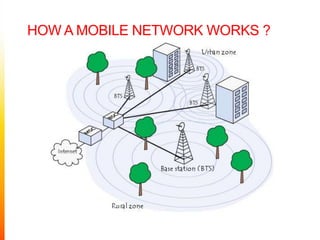
HOW A MOBILE network WORKS ?
Generations1G - Transmitted sound in analogue mode2G - Used digital signals to transfer sound3G – Based on IMT-2000 standard, which helped the  	networks to handle more voice and data.4G – Newest generation, expected to provide users with all-	internet protocol solution
MOBILE PLATFORMSSymbian/J2MEiOSAndroidWindows Phone 7
CREATING APPS – WITH iOSiOS SDKDevelopment Environment – XCODELanguage – Objective CDeploying Apps possible only after paying iPhone Developer Program Fee.AppStore -  Online app store from Apple
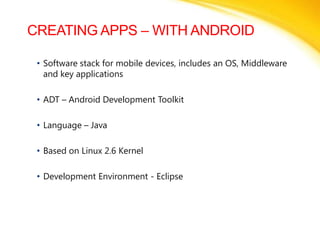
CREATING APPS – WITH ANDROIDSoftware stack for mobile devices, includes an OS, Middleware and key applicationsADT – Android Development ToolkitLanguage – JavaBased on Linux 2.6 KernelDevelopment Environment - Eclipse
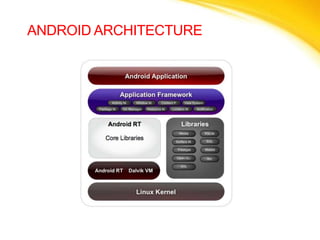
Android architecture
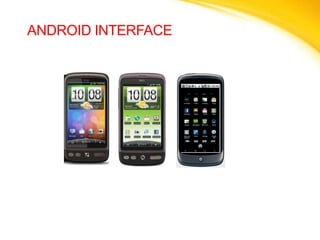
ANDROID INTERFACE
CREATING APPS – WITH WP7WP7 SDKLanguage - .NETDevelopment Environment – Visual Studio Web Developer 					/ Visual Studio 2010Based on .NET Compact FrameworkWindows Marketplace
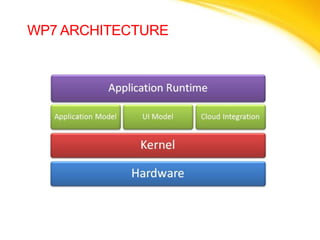
WP7 Architecture
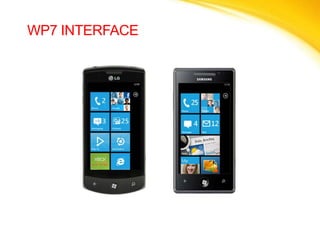
WP7 Interface
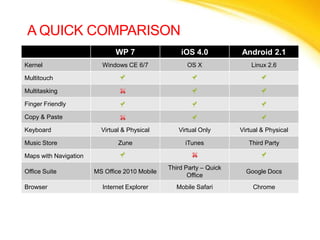
A quick comparison
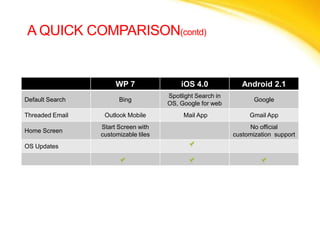
A quick comparison(contd)
Its time for some demo
Questions ?
RESOURCEShttp://developer.apple.com/devcenter/ios/index.actionhttp://developer.android.com/sdk/index.htmlhttp://www.microsoft.com/windowsphone/en-us/default.aspx
THANK YOUAmal Dev. Awww.inquisitive-instincts.blogspot.com

Mobiles

Editor's Notes

  • #3 1. Hardly mobile at all. They were handsets attached to a large and heavy battery, 20 min of talk time2. Dynatec 8000x, first truly handheld mobile phone by motorola in 1983, 1 hr talktime3. old analogue cellular technology to new digital networks in the early 1990s. EU Accepted GSM, 92 Nokia 101
  • #4 1. Gh337, Arrival of One2One and Orange in Europe saw pricess fall, Ericsson enters,2. GA628 ,Introduced in 1996, weighed 160g, 83 hrs of standby , 2 hrs of talktime3. NHE-6BM 8110i ,Nokia that first saw the potential for mobile phones as fashion items rather than mere gadgets. Matrix – new model 7110, first mass market device to have WAP technology4. StarTAC, the world’s first "clamshell" phone, worlds smallest and lightest phone- 88g, 4hrs tt, 47 hrs standby and a vibrating ringer5. world’s first mobile phone that would work in both Europe and the US. Its tri-band Motorola Timeport (L7089)
  • #5 Nokia hit back at Motorola with 6310 with a battery that seemed to go on and on. Introduced tri-band model 6310i that quickly surprassed the sales of ericssontimepart in usIntroduced the ultra slim models with razor series in 2004, by then 3g came to the forefront.Nseries, Walkman, Android, iPhone, WP7 all joined in. Era of smartphones
  • #6 1. General Packet Radio Service900(GSM)/1800/2100(3G)
  • #7 User terminal(mobile phone) is called a mobile station. Contains SIM(Subscriber Identification Module)2. Terminals are identified by 15-digit unique no IMEI(International Mobile Equipment Identity)3. MSC(gateway) – Mobile Switching Center, like telephone exchanges connects with diff protocols 4. BSC – Base station controller, BSC and BTS(base transceiver station) are responsible for connecting the call to handset
  • #8 1G – lacked range, huge batteries, sucessptible to interference2g – introduced in 1991, transmitted info as 0’s and 1’s, heralded the beginning of SMS and email over phone3g – introduced in 2001, exploded with the intro of iphone in 20074g – exponentially increases bandwidth, simultaneous use of voice,data,streamlined multimedia services such as TV and video streaming services.
  • #9 Open source platform designed for Smartphone, maintained by Nokia till now, created by migrating software assets of Nokia, NT DoCoMo, Sony Ericsson and Symbian LTDJ2ME subset of javaApple’s mobile OS, originally developed for iPhone now extended to iPod touch, iPad, does not license it to thrid party vendors. Android is another opensource framework from Google. Third party vendors can customize it as you like.WP7- its not free, from MS
  • #10 For every app downloaded from AppStore developer get 70% share
  • #11 Purchased by google in 2005ADT containsKernel for security, memory management, process management, network stack and driver model
  • #12 Libraries - a set of instructionstells the device how to handle diff kinds of data such as media framework supports playback and recording of various audio, video and , picture formats.Runtime – set of core java libraries, include Dalvik Virtual Machine, VM runs each applications in its own processApp Framework – manages phone’s basic operations such as resource allocations, tel apps, switching btw process or programs. App devs have full access to thisApplication -
  • #15 Hardware provided by various vendorsKernel comprises of device drivers provided by MSUI deals with session management and page oriented navigation modelCloud integration layer ties into XBOX live, Bing, Live ID integration, push notification serviceApplication model handles management, licensing and sw updatesApplication runtime can be Silverlight or XNA