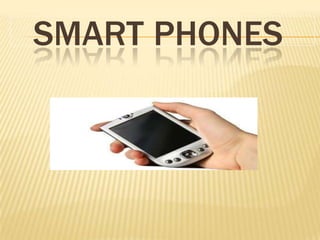
SMART PHONES
CONTENTS
   Introduction
   Definition
   History
   What makes smartphone smart.
   Why better then cellphones
   Best 10 in India
   Purposes
   Future of smartphones
   Drawbacks
   Conclusion
INTRODUCTIO
N:
    A Smartphone is a high-end mobile
     phone that offers more advanced
     computing ability and connectivity than a
     contemporary feature phone(i.e. a modern
     low-end phone).

    Combines the functions of a personal
     digital assistant (PDA) and a mobile phone.

    Also serve as portable media
     players and camera phones with high-
     resolution touchscreen, GPS navigation, W
     i-Fi and mobile broadband access.
DEFINITION:

   “Smart phone is the integration
    of the telephone system with
    the processing power of a
    computer system, to be able to
    run various applications that
    optimise communication within
    the home or office.”
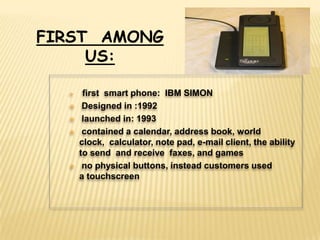
FIRST AMONG
     US:

      first smart phone: IBM SIMON
      Designed in :1992
      launched in: 1993
      contained a calendar, address book, world
      clock, calculator, note pad, e-mail client, the ability
      to send and receive faxes, and games
      no physical buttons, instead customers used
      a touchscreen
WHAT MAKES A SMART PHONE
        SMART?
FEATURES
:
   Operating system:
      -Apple iphone: ios
      -Blackberry: RIM
      -Other devices: Android, webOS,Symbian,Linux
    etc.
   Apps:
     - create/edit office documents
     - download various applications like bussiness or finance
    manager.
     - get directions through GPS.
     - edit photos.
     - create playlist etc.
   Web access:
     - faster
     - compatible with new 3G,4G Connections.
     - Wi-Fi supportable.
FEATURES
CNTND:
   Qwerty keyboard:
     - serves purpose as of computer keyboard
     - may be physical or touchscreen
     - not in alphabetical order
   Larger screen size and resolution:
     - makes visibility clear
     - easier to perform tasks
   Processor device and speed:
     - fast speed processor
     - processor depends on the purpose we want to serve
   Memory:
     - large amount of memory
     - comes with installed or installable memory
   Messaging:
     - handles text, multimedia messages.
     - email
     - instant messaging services(yahoo messenger, e-buddy etc)
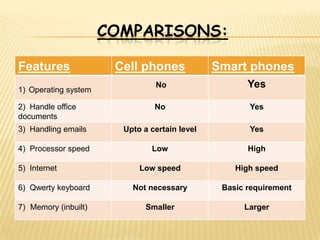
COMPARISONS:

Features               Cell phones             Smart phones
1) Operating system
                                No                    Yes

2) Handle office                No                    Yes
documents
3) Handling emails      Upto a certain level          Yes

4) Processor speed             Low                    High

5) Internet                 Low speed              High speed

6) Qwerty keyboard        Not necessary         Basic requirement

7) Memory (inbuilt)           Smaller                Larger
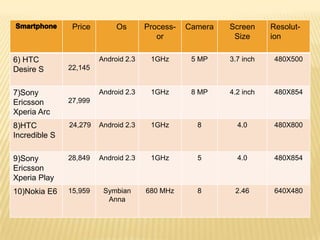
BEST 10 IN INDIA…
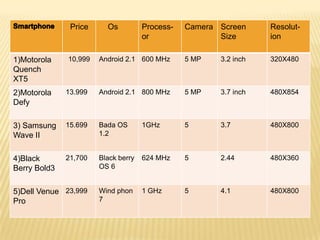
Price     Os          Process-   Camera Screen     Resolut-
                                     or                Size       ion

1)Motorola    10,999   Android 2.1 600 MHz      5 MP   3.2 inch   320X480
Quench
XT5
2)Motorola    13.999   Android 2.1 800 MHz      5 MP   3.7 inch   480X854
Defy

3) Samsung    15.699   Bada OS       1GHz       5      3.7        480X800
Wave II                1.2


4)Black       21,700   Black berry   624 MHz    5      2.44       480X360
Berry Bold3            OS 6


5)Dell Venue 23,999    Wind phon     1 GHz      5      4.1        480X800
Pro                    7
Price        Os       Process-   Camera   Screen     Resolut-
                                         or                Size      ion

6) HTC                  Android 2.3    1GHz       5 MP    3.7 inch    480X500
Desire S       22,145


7)Sony                  Android 2.3    1GHz       8 MP    4.2 inch    480X854
Ericsson       27,999
Xperia Arc
8)HTC          24,279   Android 2.3    1GHz        8        4.0       480X800
Incredible S

9)Sony         28,849   Android 2.3    1GHz        5        4.0       480X854
Ericsson
Xperia Play
10)Nokia E6    15,959    Symbian      680 MHz      8       2.46       640X480
                          Anna
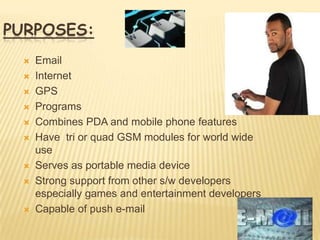
PURPOSES:
    Email
    Internet
    GPS
    Programs
    Combines PDA and mobile phone features
    Have tri or quad GSM modules for world wide
     use
    Serves as portable media device
    Strong support from other s/w developers
     especially games and entertainment developers
    Capable of push e-mail
ADDITIONAL PURPOSES:

  Data transfer to and from other devices
     via USB cable or bluetooth adapters.

    May have two or more cameras.

    Can take videos and pictures in many formats
FUTURE OF
SMARTPHONES
 Google Wallet
 Mobile Banking

 Medical Devices
         Blood pressure monitors
         Glucose meters
         Eye assessment tool
         Used for ultrasound monitoring
         Digital stethoscope
DRAWBACKS:

   Bulky in size

   Screen size smaller than Pocket PC

   Price
CONCLUSION
It's been three years since Apple brought the smartphone to a
mass consumer market, but smartphones have actually been
around in one form or another since 1993. The difference
between then and now is that early smartphones were
primarily used as enterprise devices and were prohibitively
expensive for most consumers. But with the enormous
success of the iPhone, carriers have discovered that they can
lock in customers for long periods of time by heavily
subsidizing their purchases of the latest and hottest
smartphones. In this slideshow we have tracked the evolution
of the smartphone, from its humble beginnings as a clunky
monochrome device to today's sleek multimedia devices
capable of supporting HD video.
REFERENCES

 http://en.wikipedia.org/wiki/Smartphone
 http://www.pcworld.com/article/199243/a_bri
  ef_history_of_smartphones.html
 http://www.webopedia.com/DidYouKnow/Har
  dware_Software/2008/smartphone_cellphon
  e_pda.asp
Smart phones

Smart phones

  • 1.
  • 2.
    CONTENTS  Introduction  Definition  History  What makes smartphone smart.  Why better then cellphones  Best 10 in India  Purposes  Future of smartphones  Drawbacks  Conclusion
  • 3.
    INTRODUCTIO N:  A Smartphone is a high-end mobile phone that offers more advanced computing ability and connectivity than a contemporary feature phone(i.e. a modern low-end phone).  Combines the functions of a personal digital assistant (PDA) and a mobile phone.  Also serve as portable media players and camera phones with high- resolution touchscreen, GPS navigation, W i-Fi and mobile broadband access.
  • 4.
    DEFINITION: “Smart phone is the integration of the telephone system with the processing power of a computer system, to be able to run various applications that optimise communication within the home or office.”
  • 5.
    FIRST AMONG US:  first smart phone: IBM SIMON  Designed in :1992  launched in: 1993  contained a calendar, address book, world clock, calculator, note pad, e-mail client, the ability to send and receive faxes, and games  no physical buttons, instead customers used a touchscreen
  • 6.
    WHAT MAKES ASMART PHONE SMART?
  • 7.
    FEATURES :  Operating system: -Apple iphone: ios -Blackberry: RIM -Other devices: Android, webOS,Symbian,Linux etc.  Apps: - create/edit office documents - download various applications like bussiness or finance manager. - get directions through GPS. - edit photos. - create playlist etc.  Web access: - faster - compatible with new 3G,4G Connections. - Wi-Fi supportable.
  • 8.
    FEATURES CNTND:  Qwerty keyboard: - serves purpose as of computer keyboard - may be physical or touchscreen - not in alphabetical order  Larger screen size and resolution: - makes visibility clear - easier to perform tasks  Processor device and speed: - fast speed processor - processor depends on the purpose we want to serve  Memory: - large amount of memory - comes with installed or installable memory  Messaging: - handles text, multimedia messages. - email - instant messaging services(yahoo messenger, e-buddy etc)
  • 10.
    COMPARISONS: Features Cell phones Smart phones 1) Operating system No Yes 2) Handle office No Yes documents 3) Handling emails Upto a certain level Yes 4) Processor speed Low High 5) Internet Low speed High speed 6) Qwerty keyboard Not necessary Basic requirement 7) Memory (inbuilt) Smaller Larger
  • 11.
    BEST 10 ININDIA…
  • 12.
    Price Os Process- Camera Screen Resolut- or Size ion 1)Motorola 10,999 Android 2.1 600 MHz 5 MP 3.2 inch 320X480 Quench XT5 2)Motorola 13.999 Android 2.1 800 MHz 5 MP 3.7 inch 480X854 Defy 3) Samsung 15.699 Bada OS 1GHz 5 3.7 480X800 Wave II 1.2 4)Black 21,700 Black berry 624 MHz 5 2.44 480X360 Berry Bold3 OS 6 5)Dell Venue 23,999 Wind phon 1 GHz 5 4.1 480X800 Pro 7
  • 13.
    Price Os Process- Camera Screen Resolut- or Size ion 6) HTC Android 2.3 1GHz 5 MP 3.7 inch 480X500 Desire S 22,145 7)Sony Android 2.3 1GHz 8 MP 4.2 inch 480X854 Ericsson 27,999 Xperia Arc 8)HTC 24,279 Android 2.3 1GHz 8 4.0 480X800 Incredible S 9)Sony 28,849 Android 2.3 1GHz 5 4.0 480X854 Ericsson Xperia Play 10)Nokia E6 15,959 Symbian 680 MHz 8 2.46 640X480 Anna
  • 14.
    PURPOSES:  Email  Internet  GPS  Programs  Combines PDA and mobile phone features  Have tri or quad GSM modules for world wide use  Serves as portable media device  Strong support from other s/w developers especially games and entertainment developers  Capable of push e-mail
  • 15.
    ADDITIONAL PURPOSES: Data transfer to and from other devices via USB cable or bluetooth adapters.  May have two or more cameras.  Can take videos and pictures in many formats
  • 16.
  • 17.
     Google Wallet Mobile Banking  Medical Devices  Blood pressure monitors  Glucose meters  Eye assessment tool  Used for ultrasound monitoring  Digital stethoscope
  • 18.
    DRAWBACKS:  Bulky in size  Screen size smaller than Pocket PC  Price
  • 19.
    CONCLUSION It's been threeyears since Apple brought the smartphone to a mass consumer market, but smartphones have actually been around in one form or another since 1993. The difference between then and now is that early smartphones were primarily used as enterprise devices and were prohibitively expensive for most consumers. But with the enormous success of the iPhone, carriers have discovered that they can lock in customers for long periods of time by heavily subsidizing their purchases of the latest and hottest smartphones. In this slideshow we have tracked the evolution of the smartphone, from its humble beginnings as a clunky monochrome device to today's sleek multimedia devices capable of supporting HD video.
  • 20.
    REFERENCES  http://en.wikipedia.org/wiki/Smartphone  http://www.pcworld.com/article/199243/a_bri ef_history_of_smartphones.html  http://www.webopedia.com/DidYouKnow/Har dware_Software/2008/smartphone_cellphon e_pda.asp