International Research Journal of Engineering and Technology (IRJET) e-ISSN: 2395-0056
Volume: 11 Issue: 01 | Jan 2024 www.irjet.net p-ISSN: 2395-0072
© 2024, IRJET | Impact Factor value: 8.226 | ISO 9001:2008 Certified Journal | Page 530
Smart Vending Machine System Using IOT
Shubham Thete1, Aditya Titare2, Siddhesh Vanikar3, Prof. Ganesh Madhikar4
1Student,Electronics and Telecommunication Engineering, Sinhgad College of Engineering, Vadgaon
2Student, Electronics and Telecommunication Engineering, Sinhgad College of Engineering, Vadgaon
3Student, Electronics and Telecommunication Engineering, Sinhgad College of Engineering, Vadgaon
4AssistantProfessor, Electronics and Telecommunication Engineering, Sinhgad College of Engineering, Vadgaon
---------------------------------------------------------------------***---------------------------------------------------------------------
Abstract -A smart vending machinesystemisproposedin
this paper, utilizing IoT, UPI, RFID, product level detection,
and GPS/GPRS notification to deliver a vending experience
that is more convenient, secure, and efficient for both
customers and operators. User authentication is achieved
through RFID, and payment transactions are facilitated by
UPI, allowing customers to make payments easily without
the need for cash or cards. Product level detection ensures
continuous availability of items, and when product levels
drop below a predefined threshold, notifications are sent to
the vending machine operator via GPS and GPRS, enabling
prompt restocking.
Several advantages are offered to vending machine
operators by the system. The real-time monitoring and
management capabilities of the IoT platform enable
operators to track inventory levels, sales data, and machine
status remotely. This information can be utilizedtooptimize
product mix and pricing, reduce operational costs, and
enhance customer satisfaction. In summary, the potential of
revolutionizing the vending machine industry lies in the
proposedsmartvendingmachinesystem.Throughproviding
a more convenient and secure customer experience,
lowering costs for operators, and offering valuable insights
into customer behavior, IoT-enabledvendingmachineshave
the capability to boost sales and profitability.
Key Words: Smart vending machine, IoT, UPI, RFID,
product level detection, GPS/GPRS notification.
1.INTRODUCTION
Vending machines have been around for many years, but
they are still a popular way to purchase food and drinks.
However, traditional vending machines have a number of
limitations. For example, they can only accept cash
payments, and they can be difficult to restock.
Smart vending machines using IoT address theselimitations
by offering a more convenient, secure, and efficient vending
machine experience for both customers and operators.
Smart vending machines use IoT sensors to collect data
about the machine, such as inventory levels, temperature,
and machine status. This data is then sent to the cloud,
where it can be analyzed by vending machine operators.
Vending machine operators can use the data collected from
smart vending machines to track inventory levels, optimize
the product mix and pricing, reduce costs, and improve
customer satisfaction.
In addition, smart vendingmachinesoffera moreconvenient
and secure customer experience. For example, customers
can use mobile apps to browse the machine's inventory,
make payments, and even pre-order items. Smart vending
machines can also be used to offer loyalty programs and
other incentives to customers.
Overall, smart vending machines have the potential to
revolutionize the vending machine industry. By offering a
more convenient and secure customer experience, reducing
costs for vending machine operators,andprovidingvaluable
insights into customer behavior, IoT-enabled vending
machines can help to increase sales and profitability.
2. PROPOSED METHOD
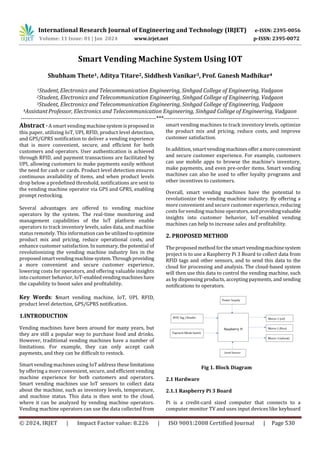
The proposed method forthesmart vendingmachinesystem
project is to use a Raspberry Pi 3 Board to collect data from
RFID tags and other sensors, and to send this data to the
cloud for processing and analysis. The cloud-based system
will then use this data to control the vending machine, such
as by dispensing products, accepting payments, and sending
notifications to operators.
Fig 1. Block Diagram
2.1 Hardware
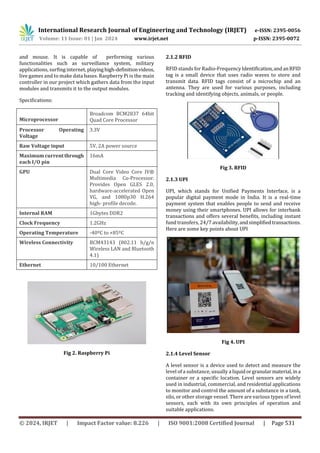
2.1.1 Raspberry Pi 3 Board
Pi is a credit-card sized computer that connects to a
computer monitor TV and uses input devices like keyboard
International Research Journal of Engineering and Technology (IRJET) e-ISSN: 2395-0056
Volume: 11 Issue: 01 | Jan 2024 www.irjet.net p-ISSN: 2395-0072
© 2024, IRJET | Impact Factor value: 8.226 | ISO 9001:2008 Certified Journal | Page 531
and mouse. It is capable of performing various
functionalities such as surveillance system, military
applications, surfing internet, playinghigh-definitionvideos,
live games and to make data bases. Raspberry Pi is the main
controller in our project which gathers data from the input
modules and transmits it to the output modules.
Specifications:
Microprocessor
Broadcom BCM2837 64bit
Quad Core Processor
Processor Operating
Voltage
3.3V
Raw Voltage input 5V, 2A power source
Maximum currentthrough
each I/O pin
16mA
GPU Dual Core Video Core IV®
Multimedia Co-Processor.
Provides Open GLES 2.0,
hardware-accelerated Open
VG, and 1080p30 H.264
high- profile decode.
Internal RAM 1Gbytes DDR2
Clock Frequency 1.2GHz
Operating Temperature -40ºC to +85ºC
Wireless Connectivity BCM43143 (802.11 b/g/n
Wireless LAN and Bluetooth
4.1)
Ethernet 10/100 Ethernet
Fig 2. Raspberry Pi
2.1.2 RFID
RFID stands for Radio-FrequencyIdentification,andanRFID
tag is a small device that uses radio waves to store and
transmit data. RFID tags consist of a microchip and an
antenna. They are used for various purposes, including
tracking and identifying objects, animals, or people.
Fig 3. RFID
2.1.3 UPI
UPI, which stands for Unified Payments Interface, is a
popular digital payment mode in India. It is a real-time
payment system that enables people to send and receive
money using their smartphones. UPI allows for interbank
transactions and offers several benefits, including instant
fund transfers, 24/7 availability,andsimplifiedtransactions.
Here are some key points about UPI
Fig 4. UPI
2.1.4 Level Sensor
A level sensor is a device used to detect and measure the
level of a substance, usually a liquidorgranularmaterial,in a
container or a specific location. Level sensors are widely
used in industrial, commercial, and residential applications
to monitor and control the amount of a substance in a tank,
silo, or other storage vessel. There are various types of level
sensors, each with its own principles of operation and
suitable applications.
International Research Journal of Engineering and Technology (IRJET) e-ISSN: 2395-0056
Volume: 11 Issue: 01 | Jan 2024 www.irjet.net p-ISSN: 2395-0072
© 2024, IRJET | Impact Factor value: 8.226 | ISO 9001:2008 Certified Journal | Page 532
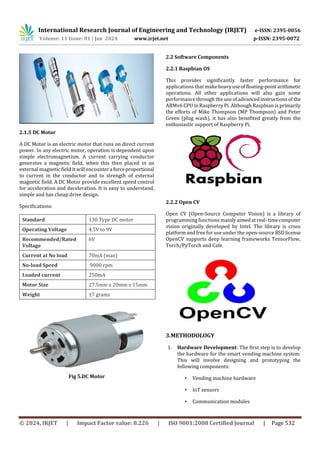
2.1.5 DC Motor
A DC Motor is an electric motor that runs on direct current
power. In any electric motor, operation is dependent upon
simple electromagnetism. A current carrying conductor
generates a magnetic field, when this then placed in an
external magnetic field it will encountera forceproportional
to current in the conductor and to strength of external
magnetic field. A DC Motor provide excellent speed control
for acceleration and deceleration. It is easy to understand,
simple and has cheap drive design.
Specifications:
Standard 130 Type DC motor
Operating Voltage 4.5V to 9V
Recommended/Rated
Voltage
6V
Current at No load 70mA (max)
No-load Speed 9000 rpm
Loaded current 250mA
Motor Size 27.5mm x 20mm x 15mm
Weight 17 grams
Fig 5.DC Motor
2.2 Software Components
2.2.1 Raspbian OS
This provides significantly faster performance for
applications that makeheavyuseoffloating-pointarithmetic
operations. All other applications will also gain some
performance through the use of advancedinstructionsof the
ARMv6 CPU in Raspberry Pi. Although Raspbian is primarily
the efforts of Mike Thompson (MP Thompson) and Peter
Green (plug wash), it has also benefited greatly from the
enthusiastic support of Raspberry Pi.
2.2.2 Open CV
Open CV (Open-Source Computer Vision) is a library of
programming functions mainlyaimedatreal-timecomputer
vision originally developed by Intel. The library is cross
platform and free for use under the open-source BSDlicense
OpenCV supports deep learning frameworks TensorFlow,
Torch/PyTorch and Cafe.
3.METHODOLOGY
1. Hardware Development: The first step is to develop
the hardware for the smart vending machine system.
This will involve designing and prototyping the
following components:
• Vending machine hardware
• IoT sensors
• Communication modules
International Research Journal of Engineering and Technology (IRJET) e-ISSN: 2395-0056
Volume: 11 Issue: 01 | Jan 2024 www.irjet.net p-ISSN: 2395-0072
© 2024, IRJET | Impact Factor value: 8.226 | ISO 9001:2008 Certified Journal | Page 533
The vending machine hardware should be designed to
be robust and withstand the demands of the vending
machine environment. The IoT sensors should be able
to accurately detect product levels and other
environmental conditions.Thecommunicationmodules
should be able to transmit data tothecloudreliablyand
securely.
2. Algorithms: The following algorithms will be usedin
the smart vending machine system:
•Product leveldetectionalgorithm:Thisalgorithm
will use the data from the IoT sensors to detect
product levels in the vending machine.
•User authentication algorithm: This algorithm
will use the RFID tags to authenticate users.
• Payment processing algorithm: This algorithm
will process contactless payments using UPI.
4. Literature Review
Title Author Methodology
RFID
Technology:
Beyond Cash-
Based Methods
in Vending
Machine
Aneeqa
Ramzan, Saad
Rehman, Aqib
Perwaiz
The methodology
integrates passive RFID
cards and Arduino Mega
with SPI protocol for
secure authentication,
featuring keypad
password protection,
LCD consumer
information display,
GSM-based SMS
notifications, and a
mechanical structure
with DC motors for
efficient product-
oriented vending.
Modeling and
Optimization of
Item Changes
in Vending
Machines
Gaku Nemoto,
Kunihiko
Hiraishi
This study focuses on
optimizing item changes
in Japanese beverage
vending machines, with
route men responsible
for replenishment. Using
an optimization model
based on item utility
values and vending
machine state
transitions, it achieves
up to a 2.8% sales
improvement compared
to heuristic methods.
NuiVend - Next
Generation
Vending
Machine
Robert Gruen,
Erich Liang
In this paper, we will
discuss NuiVend’s use of
a variety of technologies.
Such as: Microsoft
Kinect, variousMicrosoft
Cognitive API services,
relay and sensor boards,
as well as the overall
logic of the control
software. Finally, we
discuss potential
improvements to
NuiVend as well as
Microsoft Language
Understanding
IntelligentService(LUIS)
techniques that can be
applied to many other
future NUI based
projects.
5.APPLICATIONS
• Retail Stores: Offer smart vending solutionswithin
retail spaces, providing a wide range of products
and real-time inventory updates.
• Corporate Offices: Install intelligent vending
machines in office buildings for snacks, beverages,
and office supplies.
• ManufacturingFacilities: Offeremployeeaccessto
snacks and personal protective equipment in
industrial settings.
6. CONCLUSIONS
We utilised IOT technology in this article to create a sales
mechanism for smart vending machines.Itmaycomprehend
vending machine purchasers and markets. Face recognition
is used to analyse the vending machine's principal source in
order to alter sales and so achieve a larger profit.
ACKNOWLEDGEMENT
I wish to express my sincere thanks and deep sense of
gratitude to respected mentor and guideProf.G.V.Madhikar
Assistant Professor in Department of Electronics and
Telecommunication Engineering of Sinhgad college of
Engineering, Vadgaon (BK), Pune 41 forthetechnical advice,
encouragement and constructive criticism, which motivated
to strive harder for excellence
International Research Journal of Engineering and Technology (IRJET) e-ISSN: 2395-0056
Volume: 11 Issue: 01 | Jan 2024 www.irjet.net p-ISSN: 2395-0072
© 2024, IRJET | Impact Factor value: 8.226 | ISO 9001:2008 Certified Journal | Page 534
REFERENCES
[1] A. Ramzan, S. Rehman, and A. Perwaiz, "RFID
technology: Beyond cash-based methods in vending
machine," International Conference on Control and Robotics
Engineering, 2019, pp. 189-193.
[2] G. Nemoto and K. Hiraishi, "Modeling and
optimization of item changes in vending machines,"Asian
Control Conference, 2020, pp. 19-24.
[3] R. Gruen and E. Liang, "NuiVend - Next Generation
Vending Machine," International Conference on
ComputationalScienceandComputationalIntelligence,2020,
pp. 545-548.
BIOGRAPHIES
Shubham C. Thete
B.E Electronics and
Telecommunication
Sinhgad College Of Engineering,
Vadgaon, Maharashtra, India
Aditya V. Titare
B.E Electronics and
Telecommunication
Sinhgad College Of Engineering,
Vadgaon, Maharashtra, India
Siddhesh R.Vanikar
B.E Electronics and
Telecommunication
Sinhgad College Of Engineering,
Vadgaon, Maharashtra, India
Prof. Ganesh V. Madhikar
Assistant Professor
Electronics and
Telecommunication
Sinhgad College Of Engineering,
Vadgaon, Maharashtra, India

Smart Vending Machine System Using IOT

  • 1.
    International Research Journalof Engineering and Technology (IRJET) e-ISSN: 2395-0056 Volume: 11 Issue: 01 | Jan 2024 www.irjet.net p-ISSN: 2395-0072 © 2024, IRJET | Impact Factor value: 8.226 | ISO 9001:2008 Certified Journal | Page 530 Smart Vending Machine System Using IOT Shubham Thete1, Aditya Titare2, Siddhesh Vanikar3, Prof. Ganesh Madhikar4 1Student,Electronics and Telecommunication Engineering, Sinhgad College of Engineering, Vadgaon 2Student, Electronics and Telecommunication Engineering, Sinhgad College of Engineering, Vadgaon 3Student, Electronics and Telecommunication Engineering, Sinhgad College of Engineering, Vadgaon 4AssistantProfessor, Electronics and Telecommunication Engineering, Sinhgad College of Engineering, Vadgaon ---------------------------------------------------------------------***--------------------------------------------------------------------- Abstract -A smart vending machinesystemisproposedin this paper, utilizing IoT, UPI, RFID, product level detection, and GPS/GPRS notification to deliver a vending experience that is more convenient, secure, and efficient for both customers and operators. User authentication is achieved through RFID, and payment transactions are facilitated by UPI, allowing customers to make payments easily without the need for cash or cards. Product level detection ensures continuous availability of items, and when product levels drop below a predefined threshold, notifications are sent to the vending machine operator via GPS and GPRS, enabling prompt restocking. Several advantages are offered to vending machine operators by the system. The real-time monitoring and management capabilities of the IoT platform enable operators to track inventory levels, sales data, and machine status remotely. This information can be utilizedtooptimize product mix and pricing, reduce operational costs, and enhance customer satisfaction. In summary, the potential of revolutionizing the vending machine industry lies in the proposedsmartvendingmachinesystem.Throughproviding a more convenient and secure customer experience, lowering costs for operators, and offering valuable insights into customer behavior, IoT-enabledvendingmachineshave the capability to boost sales and profitability. Key Words: Smart vending machine, IoT, UPI, RFID, product level detection, GPS/GPRS notification. 1.INTRODUCTION Vending machines have been around for many years, but they are still a popular way to purchase food and drinks. However, traditional vending machines have a number of limitations. For example, they can only accept cash payments, and they can be difficult to restock. Smart vending machines using IoT address theselimitations by offering a more convenient, secure, and efficient vending machine experience for both customers and operators. Smart vending machines use IoT sensors to collect data about the machine, such as inventory levels, temperature, and machine status. This data is then sent to the cloud, where it can be analyzed by vending machine operators. Vending machine operators can use the data collected from smart vending machines to track inventory levels, optimize the product mix and pricing, reduce costs, and improve customer satisfaction. In addition, smart vendingmachinesoffera moreconvenient and secure customer experience. For example, customers can use mobile apps to browse the machine's inventory, make payments, and even pre-order items. Smart vending machines can also be used to offer loyalty programs and other incentives to customers. Overall, smart vending machines have the potential to revolutionize the vending machine industry. By offering a more convenient and secure customer experience, reducing costs for vending machine operators,andprovidingvaluable insights into customer behavior, IoT-enabled vending machines can help to increase sales and profitability. 2. PROPOSED METHOD The proposed method forthesmart vendingmachinesystem project is to use a Raspberry Pi 3 Board to collect data from RFID tags and other sensors, and to send this data to the cloud for processing and analysis. The cloud-based system will then use this data to control the vending machine, such as by dispensing products, accepting payments, and sending notifications to operators. Fig 1. Block Diagram 2.1 Hardware 2.1.1 Raspberry Pi 3 Board Pi is a credit-card sized computer that connects to a computer monitor TV and uses input devices like keyboard
  • 2.
    International Research Journalof Engineering and Technology (IRJET) e-ISSN: 2395-0056 Volume: 11 Issue: 01 | Jan 2024 www.irjet.net p-ISSN: 2395-0072 © 2024, IRJET | Impact Factor value: 8.226 | ISO 9001:2008 Certified Journal | Page 531 and mouse. It is capable of performing various functionalities such as surveillance system, military applications, surfing internet, playinghigh-definitionvideos, live games and to make data bases. Raspberry Pi is the main controller in our project which gathers data from the input modules and transmits it to the output modules. Specifications: Microprocessor Broadcom BCM2837 64bit Quad Core Processor Processor Operating Voltage 3.3V Raw Voltage input 5V, 2A power source Maximum currentthrough each I/O pin 16mA GPU Dual Core Video Core IV® Multimedia Co-Processor. Provides Open GLES 2.0, hardware-accelerated Open VG, and 1080p30 H.264 high- profile decode. Internal RAM 1Gbytes DDR2 Clock Frequency 1.2GHz Operating Temperature -40ºC to +85ºC Wireless Connectivity BCM43143 (802.11 b/g/n Wireless LAN and Bluetooth 4.1) Ethernet 10/100 Ethernet Fig 2. Raspberry Pi 2.1.2 RFID RFID stands for Radio-FrequencyIdentification,andanRFID tag is a small device that uses radio waves to store and transmit data. RFID tags consist of a microchip and an antenna. They are used for various purposes, including tracking and identifying objects, animals, or people. Fig 3. RFID 2.1.3 UPI UPI, which stands for Unified Payments Interface, is a popular digital payment mode in India. It is a real-time payment system that enables people to send and receive money using their smartphones. UPI allows for interbank transactions and offers several benefits, including instant fund transfers, 24/7 availability,andsimplifiedtransactions. Here are some key points about UPI Fig 4. UPI 2.1.4 Level Sensor A level sensor is a device used to detect and measure the level of a substance, usually a liquidorgranularmaterial,in a container or a specific location. Level sensors are widely used in industrial, commercial, and residential applications to monitor and control the amount of a substance in a tank, silo, or other storage vessel. There are various types of level sensors, each with its own principles of operation and suitable applications.
  • 3.
    International Research Journalof Engineering and Technology (IRJET) e-ISSN: 2395-0056 Volume: 11 Issue: 01 | Jan 2024 www.irjet.net p-ISSN: 2395-0072 © 2024, IRJET | Impact Factor value: 8.226 | ISO 9001:2008 Certified Journal | Page 532 2.1.5 DC Motor A DC Motor is an electric motor that runs on direct current power. In any electric motor, operation is dependent upon simple electromagnetism. A current carrying conductor generates a magnetic field, when this then placed in an external magnetic field it will encountera forceproportional to current in the conductor and to strength of external magnetic field. A DC Motor provide excellent speed control for acceleration and deceleration. It is easy to understand, simple and has cheap drive design. Specifications: Standard 130 Type DC motor Operating Voltage 4.5V to 9V Recommended/Rated Voltage 6V Current at No load 70mA (max) No-load Speed 9000 rpm Loaded current 250mA Motor Size 27.5mm x 20mm x 15mm Weight 17 grams Fig 5.DC Motor 2.2 Software Components 2.2.1 Raspbian OS This provides significantly faster performance for applications that makeheavyuseoffloating-pointarithmetic operations. All other applications will also gain some performance through the use of advancedinstructionsof the ARMv6 CPU in Raspberry Pi. Although Raspbian is primarily the efforts of Mike Thompson (MP Thompson) and Peter Green (plug wash), it has also benefited greatly from the enthusiastic support of Raspberry Pi. 2.2.2 Open CV Open CV (Open-Source Computer Vision) is a library of programming functions mainlyaimedatreal-timecomputer vision originally developed by Intel. The library is cross platform and free for use under the open-source BSDlicense OpenCV supports deep learning frameworks TensorFlow, Torch/PyTorch and Cafe. 3.METHODOLOGY 1. Hardware Development: The first step is to develop the hardware for the smart vending machine system. This will involve designing and prototyping the following components: • Vending machine hardware • IoT sensors • Communication modules
  • 4.
    International Research Journalof Engineering and Technology (IRJET) e-ISSN: 2395-0056 Volume: 11 Issue: 01 | Jan 2024 www.irjet.net p-ISSN: 2395-0072 © 2024, IRJET | Impact Factor value: 8.226 | ISO 9001:2008 Certified Journal | Page 533 The vending machine hardware should be designed to be robust and withstand the demands of the vending machine environment. The IoT sensors should be able to accurately detect product levels and other environmental conditions.Thecommunicationmodules should be able to transmit data tothecloudreliablyand securely. 2. Algorithms: The following algorithms will be usedin the smart vending machine system: •Product leveldetectionalgorithm:Thisalgorithm will use the data from the IoT sensors to detect product levels in the vending machine. •User authentication algorithm: This algorithm will use the RFID tags to authenticate users. • Payment processing algorithm: This algorithm will process contactless payments using UPI. 4. Literature Review Title Author Methodology RFID Technology: Beyond Cash- Based Methods in Vending Machine Aneeqa Ramzan, Saad Rehman, Aqib Perwaiz The methodology integrates passive RFID cards and Arduino Mega with SPI protocol for secure authentication, featuring keypad password protection, LCD consumer information display, GSM-based SMS notifications, and a mechanical structure with DC motors for efficient product- oriented vending. Modeling and Optimization of Item Changes in Vending Machines Gaku Nemoto, Kunihiko Hiraishi This study focuses on optimizing item changes in Japanese beverage vending machines, with route men responsible for replenishment. Using an optimization model based on item utility values and vending machine state transitions, it achieves up to a 2.8% sales improvement compared to heuristic methods. NuiVend - Next Generation Vending Machine Robert Gruen, Erich Liang In this paper, we will discuss NuiVend’s use of a variety of technologies. Such as: Microsoft Kinect, variousMicrosoft Cognitive API services, relay and sensor boards, as well as the overall logic of the control software. Finally, we discuss potential improvements to NuiVend as well as Microsoft Language Understanding IntelligentService(LUIS) techniques that can be applied to many other future NUI based projects. 5.APPLICATIONS • Retail Stores: Offer smart vending solutionswithin retail spaces, providing a wide range of products and real-time inventory updates. • Corporate Offices: Install intelligent vending machines in office buildings for snacks, beverages, and office supplies. • ManufacturingFacilities: Offeremployeeaccessto snacks and personal protective equipment in industrial settings. 6. CONCLUSIONS We utilised IOT technology in this article to create a sales mechanism for smart vending machines.Itmaycomprehend vending machine purchasers and markets. Face recognition is used to analyse the vending machine's principal source in order to alter sales and so achieve a larger profit. ACKNOWLEDGEMENT I wish to express my sincere thanks and deep sense of gratitude to respected mentor and guideProf.G.V.Madhikar Assistant Professor in Department of Electronics and Telecommunication Engineering of Sinhgad college of Engineering, Vadgaon (BK), Pune 41 forthetechnical advice, encouragement and constructive criticism, which motivated to strive harder for excellence
  • 5.
    International Research Journalof Engineering and Technology (IRJET) e-ISSN: 2395-0056 Volume: 11 Issue: 01 | Jan 2024 www.irjet.net p-ISSN: 2395-0072 © 2024, IRJET | Impact Factor value: 8.226 | ISO 9001:2008 Certified Journal | Page 534 REFERENCES [1] A. Ramzan, S. Rehman, and A. Perwaiz, "RFID technology: Beyond cash-based methods in vending machine," International Conference on Control and Robotics Engineering, 2019, pp. 189-193. [2] G. Nemoto and K. Hiraishi, "Modeling and optimization of item changes in vending machines,"Asian Control Conference, 2020, pp. 19-24. [3] R. Gruen and E. Liang, "NuiVend - Next Generation Vending Machine," International Conference on ComputationalScienceandComputationalIntelligence,2020, pp. 545-548. BIOGRAPHIES Shubham C. Thete B.E Electronics and Telecommunication Sinhgad College Of Engineering, Vadgaon, Maharashtra, India Aditya V. Titare B.E Electronics and Telecommunication Sinhgad College Of Engineering, Vadgaon, Maharashtra, India Siddhesh R.Vanikar B.E Electronics and Telecommunication Sinhgad College Of Engineering, Vadgaon, Maharashtra, India Prof. Ganesh V. Madhikar Assistant Professor Electronics and Telecommunication Sinhgad College Of Engineering, Vadgaon, Maharashtra, India