International Research Journal of Engineering and Technology (IRJET) e-ISSN: 2395-0056
Volume: 06 Issue: 03 | Mar 2019 www.irjet.net p-ISSN: 2395-0072
© 2019, IRJET | Impact Factor value: 7.211 | ISO 9001:2008 Certified Journal | Page 7832
RFID Based Shop Billing Machine using Raspberry Pi
Ms. Disha Dilip Ved1, Prof. P.B. Ghewari2
1Student, E&TC Dept. of AMGOI Engineering, Maharashtra, India
2HOD, E&TC Dept. of AMGOI Engineering, Maharashtra, India
---------------------------------------------------------------------***----------------------------------------------------------------------
Abstract - Abstract - Today's world thrives making
human life easier than it already is with every passing
moment. Creating a smart billing machine that takes
care of comfort while shopping is another step taken in
the same direction. RFID and barcodes are similar in
that they are both data collection technologies, If
compared, RFID technology is found to be more
comprehensive than barcode technology. Barcode
scanner requires line of sight whereas RFID can be read
without the line of sight. It is possible to read RFID tags
from a greater distance. An RFID reader can access the
information of the tag from a distance of around 300
feet, whereas barcode technology cannot be read from a
distance of more than 15 feet.
Key Words: RFID, Raspberry Pi, Python.
1. INTRODUCTION
Electronic Commerce has become extremely
popular with the rise in wireless technologies and
other communication techniques. Purchasing and
shopping in big malls are becoming a daily activity
in metro cities. There is a huge rush in such places
during weekends and holidays. People purchase
different items and put them in the trolley. After
completion of purchases, one needs to go to the
billing counter for payments. At the billing
counter, the cashier prepares the bill using bar
code reader which is a very time-consuming
process and results in a long queue at the billing
counter. A smart product is the one that aids
comfort, convenience, and efficiency in everyday
life. In this paper, we discuss an innovative
concept of Intelligent Smart Shopping and Billing.
The key idea here is to assist a person in everyday
shopping in terms of reduced time spent while
purchasing a product. The main goal is to provide
a technology-oriented, economical, easily scalable,
and rugged system for ease of his activity. The
barcode technology needs the direct line of sight
to read; sometimes it is unable to scan as well. So
this problem will be overcome by using RFID
technology. The aim of the project is to create a
convenient and user-friendly environment for the
customers. It also aims to intelligently coordinate
all appliances communicating together, thereby
ensuring greater comfort of purchasing things. In
our approach, the RFID tags will be given to the
customers. And the material they require will be
written to the card. And once they have done with
shopping, they will go to the billing system where
the reader will generate an appropriate bill. The
results of this project will be the Bill will be
generated by just putting the RFID card on the
reader which is interfaced with Raspberry Pi.
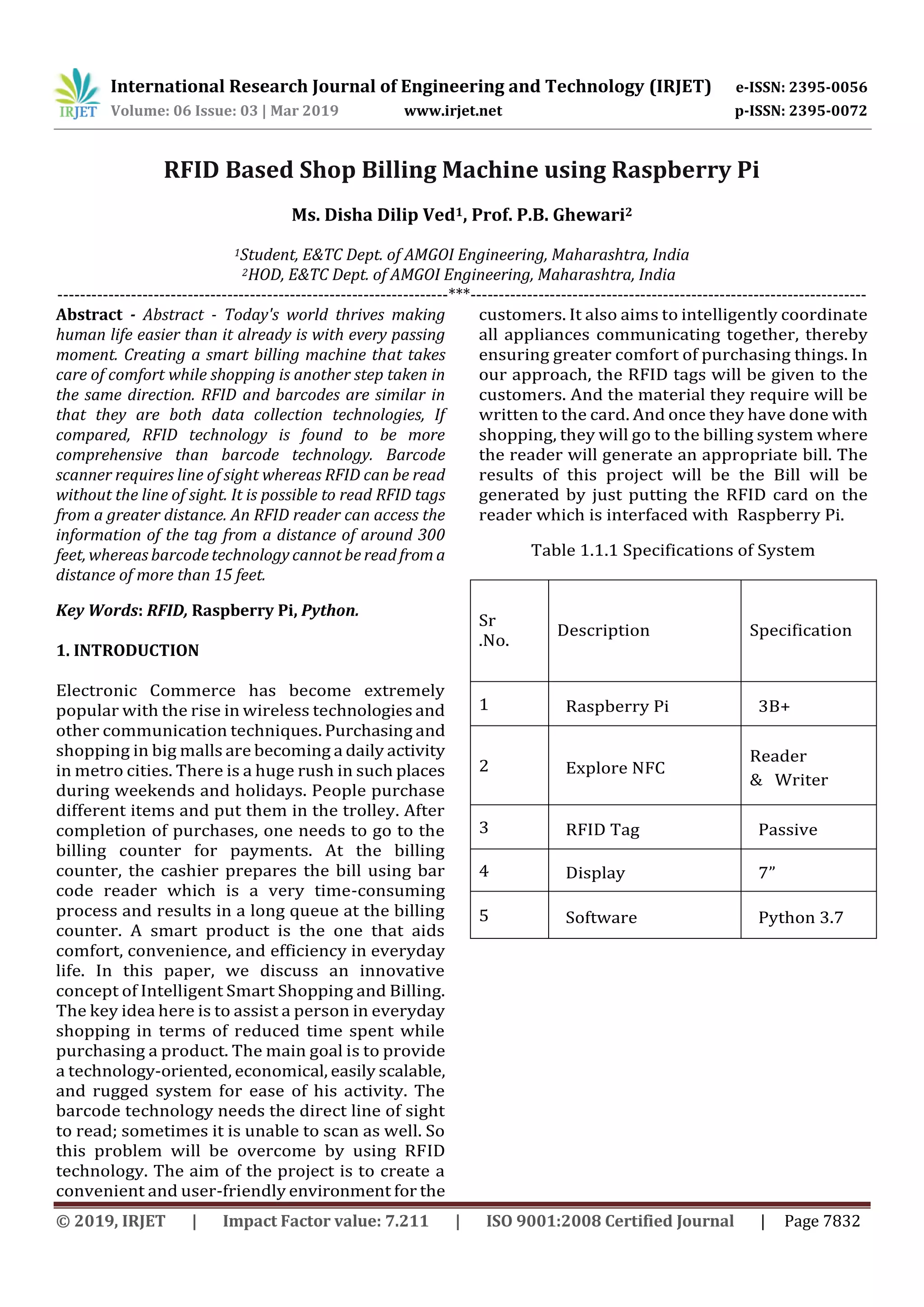
Table 1.1.1 Specifications of System
Sr
.No.
Description Specification
1 Raspberry Pi 3B+
2 Explore NFC
Reader
& Writer
3 RFID Tag Passive
4 Display 7”
5 Software Python 3.7
International Research Journal of Engineering and Technology (IRJET) e-ISSN: 2395-0056
Volume: 06 Issue: 03 | Mar 2019 www.irjet.net p-ISSN: 2395-0072
© 2019, IRJET | Impact Factor value: 7.211 | ISO 9001:2008 Certified Journal | Page 7833
2.1 ARCHITECTURE
FIGURE 2.1 BLOCK DIAGRAM OF SYSTEM
2.2 DETAILS OF ARCHITECTURE
2.2.1 RASPBERRY PI
Raspberry Pi is a compact size board which has
various ports to interface other peripherals like
mouse, keyboard, HDMI port, USB ports. It does
not include any of the peripheral. We can call it a
"Single Board Computer". So, just by connecting
those peripherals, they can communicate with
Raspberry Pi according to our requirement. The
Raspberry Pi which we are using operates on 1.4
GHz of frequency. The maximum power is 6.7 W
and the minimum is 1.5 W. It supports Linux,
Raspbian and Windows 10 IOT care operating
systems.
2.2.2 RFID Module
For communication of two devices i.e. RFID card and
Raspberry Pi, the Reader and Writer interface is
Explore NFC card. NFC stands for Near Field
Communications. These are mainly used for
contactless payments, RFID based attendance systems
etc. NFC is a peer to peer technology which works on
short-range wireless systems which operates at 13.56
MHz and the approximate baud rate is 106 kbit/s to
424 kbit/s. By fetching the data written on the RFID
card, we can generate the bill by using some software
interfaces.
2.2.3 RFID Tags
RFID is nothing but Radio Frequency Identification.
RFID uses electromagnetic fields to identify and track
tags attached to objects. Thetagscontainelectronically
saved information. There are two types of RFID cards.
The first is passive and the second is active card. The
passive tags do not need any power supply for its
operation; whereas active tags need the power supply
for reading and write operations.
2.2.4 Display
The display is there for a user interface. For the
purpose of adding and removing the purchased items,
it will be easier to use display. We are using the
touchscreen capacitive display which is of 7". We have
to take care that the drivers of a display must be
available unless the display will not work properly.
2.2.5 Software
Any embedded system needs some program to
operate in a required manner. For the raspberry
pi, Raspbean is the operating system and for the
programming of raspberry pi, Python 3.7 is used.
Python is a high-level general purpose
programming language. Created by Guido van
Rossum and first released in 1991, Python has a
design philosophy that emphasizes code
readability, notably using significant whitespace.
It provides constructs that enable clear
programming on both small and large scales. Van
Rossum led the language community until
stepping down as the leader in July 2018
International Research Journal of Engineering and Technology (IRJET) e-ISSN: 2395-0056
Volume: 06 Issue: 03 | Mar 2019 www.irjet.net p-ISSN: 2395-0072
© 2019, IRJET | Impact Factor value: 7.211 | ISO 9001:2008 Certified Journal | Page 7834
3.1 Key Steps of the system
FIGURE 3.1 Key Steps Of The System
The system is designed in such a way that, the person
who wants to buy the product will be given a RFID
card. The shopkeeper will insert one by one items on
the card just by putting the tag on the RFID Module.
The customer will keep this card with him tillheleaves
the shop. At the time of billing, that card will be again
put on the reader and the final bill will be generated.
For this particular operation, we will access web page
which will be available on one web page.
By using the network connections, we will be able to
determine the sale of the shop. Also therequirementof
particular goods in shop. Thus because of this, we will
be able to calculate the sale and purchase ratio.
4. CONCLUSION
This paper gives the detailed design of the Automatic
Shop Billing Machine using Raspberry Pi and RFID
Module.
REFERENCES
1] Zeeshan Ali, ReenaSonkusare, “RFID Based Smart
Shopping and Billing”, International Journal of
Advanced Research in Computer andCommunication
Engineering, Vol. 2, Issue 12, December 2013.
2]KalyaniDawkhar, ShraddhaDhomase,
SamruddhiMahabaleshwarkar “Electronic Shopping
Cart For Effective Shopping based on
RFID”,International Journal of Innovative Research In
Electrical, Electronic, Instrumentation And Control
Engineering Vol. 3, Issue 1 pp 84-86,January 2015.
3]Ms.Vrinda, Niharika, “Novel Model for Automating
Purchases using Intelligent Cart,” e-ISSN: 2278-0661,
p- ISSN:;1; 2278.8727Volume16,Issue 1, Ver. VII (Feb.
2014), PP 23-30.
4]Mr.P. Chandrasekar and Ms.T. Sangeetha “Smart
Shopping Cart with Automatic Billing System through
RFID and ZigBee”, IEEE, 2014.
5]Dr.Suryaprasad J, PraveenKumarBO,RoopaDArjun
A K, A Novel Low-Cost Intelligent Shopping Cart,
Proceedings of the 2nd IEEE
Electronics, Vol. 56, No. 11, November 2009.pp 4344-
4353.
6]Henry 2)Shu-Hung Chung, K. K. Tse, S. Y. Ron Hui,
Fellow, C. M. Mok, and M. T. Ho, A Novel Maximum
Power Point TrackingTechniqueforSolarPanelsUsing
a SEPIC or CukConverter, IEEE TransactionsonPower
Electronics, Vol. 18, No. 3, May 2003, pp.717- 724.
7]Sombuddha Chakraborty, Amit Kumar Jain, and Ned
Mohan, “A Novel Converter Topology for Multiple
Individually RegulatedOutputs”,IEEETransactionsOn
Power Electronics, Vol. 21, No. 2, 2006, pp. 361-369.

IRJET- RFID Based Shop Billing Machine using Raspberry Pi

  • 1.
    International Research Journalof Engineering and Technology (IRJET) e-ISSN: 2395-0056 Volume: 06 Issue: 03 | Mar 2019 www.irjet.net p-ISSN: 2395-0072 © 2019, IRJET | Impact Factor value: 7.211 | ISO 9001:2008 Certified Journal | Page 7832 RFID Based Shop Billing Machine using Raspberry Pi Ms. Disha Dilip Ved1, Prof. P.B. Ghewari2 1Student, E&TC Dept. of AMGOI Engineering, Maharashtra, India 2HOD, E&TC Dept. of AMGOI Engineering, Maharashtra, India ---------------------------------------------------------------------***---------------------------------------------------------------------- Abstract - Abstract - Today's world thrives making human life easier than it already is with every passing moment. Creating a smart billing machine that takes care of comfort while shopping is another step taken in the same direction. RFID and barcodes are similar in that they are both data collection technologies, If compared, RFID technology is found to be more comprehensive than barcode technology. Barcode scanner requires line of sight whereas RFID can be read without the line of sight. It is possible to read RFID tags from a greater distance. An RFID reader can access the information of the tag from a distance of around 300 feet, whereas barcode technology cannot be read from a distance of more than 15 feet. Key Words: RFID, Raspberry Pi, Python. 1. INTRODUCTION Electronic Commerce has become extremely popular with the rise in wireless technologies and other communication techniques. Purchasing and shopping in big malls are becoming a daily activity in metro cities. There is a huge rush in such places during weekends and holidays. People purchase different items and put them in the trolley. After completion of purchases, one needs to go to the billing counter for payments. At the billing counter, the cashier prepares the bill using bar code reader which is a very time-consuming process and results in a long queue at the billing counter. A smart product is the one that aids comfort, convenience, and efficiency in everyday life. In this paper, we discuss an innovative concept of Intelligent Smart Shopping and Billing. The key idea here is to assist a person in everyday shopping in terms of reduced time spent while purchasing a product. The main goal is to provide a technology-oriented, economical, easily scalable, and rugged system for ease of his activity. The barcode technology needs the direct line of sight to read; sometimes it is unable to scan as well. So this problem will be overcome by using RFID technology. The aim of the project is to create a convenient and user-friendly environment for the customers. It also aims to intelligently coordinate all appliances communicating together, thereby ensuring greater comfort of purchasing things. In our approach, the RFID tags will be given to the customers. And the material they require will be written to the card. And once they have done with shopping, they will go to the billing system where the reader will generate an appropriate bill. The results of this project will be the Bill will be generated by just putting the RFID card on the reader which is interfaced with Raspberry Pi. Table 1.1.1 Specifications of System Sr .No. Description Specification 1 Raspberry Pi 3B+ 2 Explore NFC Reader & Writer 3 RFID Tag Passive 4 Display 7” 5 Software Python 3.7
  • 2.
    International Research Journalof Engineering and Technology (IRJET) e-ISSN: 2395-0056 Volume: 06 Issue: 03 | Mar 2019 www.irjet.net p-ISSN: 2395-0072 © 2019, IRJET | Impact Factor value: 7.211 | ISO 9001:2008 Certified Journal | Page 7833 2.1 ARCHITECTURE FIGURE 2.1 BLOCK DIAGRAM OF SYSTEM 2.2 DETAILS OF ARCHITECTURE 2.2.1 RASPBERRY PI Raspberry Pi is a compact size board which has various ports to interface other peripherals like mouse, keyboard, HDMI port, USB ports. It does not include any of the peripheral. We can call it a "Single Board Computer". So, just by connecting those peripherals, they can communicate with Raspberry Pi according to our requirement. The Raspberry Pi which we are using operates on 1.4 GHz of frequency. The maximum power is 6.7 W and the minimum is 1.5 W. It supports Linux, Raspbian and Windows 10 IOT care operating systems. 2.2.2 RFID Module For communication of two devices i.e. RFID card and Raspberry Pi, the Reader and Writer interface is Explore NFC card. NFC stands for Near Field Communications. These are mainly used for contactless payments, RFID based attendance systems etc. NFC is a peer to peer technology which works on short-range wireless systems which operates at 13.56 MHz and the approximate baud rate is 106 kbit/s to 424 kbit/s. By fetching the data written on the RFID card, we can generate the bill by using some software interfaces. 2.2.3 RFID Tags RFID is nothing but Radio Frequency Identification. RFID uses electromagnetic fields to identify and track tags attached to objects. Thetagscontainelectronically saved information. There are two types of RFID cards. The first is passive and the second is active card. The passive tags do not need any power supply for its operation; whereas active tags need the power supply for reading and write operations. 2.2.4 Display The display is there for a user interface. For the purpose of adding and removing the purchased items, it will be easier to use display. We are using the touchscreen capacitive display which is of 7". We have to take care that the drivers of a display must be available unless the display will not work properly. 2.2.5 Software Any embedded system needs some program to operate in a required manner. For the raspberry pi, Raspbean is the operating system and for the programming of raspberry pi, Python 3.7 is used. Python is a high-level general purpose programming language. Created by Guido van Rossum and first released in 1991, Python has a design philosophy that emphasizes code readability, notably using significant whitespace. It provides constructs that enable clear programming on both small and large scales. Van Rossum led the language community until stepping down as the leader in July 2018
  • 3.
    International Research Journalof Engineering and Technology (IRJET) e-ISSN: 2395-0056 Volume: 06 Issue: 03 | Mar 2019 www.irjet.net p-ISSN: 2395-0072 © 2019, IRJET | Impact Factor value: 7.211 | ISO 9001:2008 Certified Journal | Page 7834 3.1 Key Steps of the system FIGURE 3.1 Key Steps Of The System The system is designed in such a way that, the person who wants to buy the product will be given a RFID card. The shopkeeper will insert one by one items on the card just by putting the tag on the RFID Module. The customer will keep this card with him tillheleaves the shop. At the time of billing, that card will be again put on the reader and the final bill will be generated. For this particular operation, we will access web page which will be available on one web page. By using the network connections, we will be able to determine the sale of the shop. Also therequirementof particular goods in shop. Thus because of this, we will be able to calculate the sale and purchase ratio. 4. CONCLUSION This paper gives the detailed design of the Automatic Shop Billing Machine using Raspberry Pi and RFID Module. REFERENCES 1] Zeeshan Ali, ReenaSonkusare, “RFID Based Smart Shopping and Billing”, International Journal of Advanced Research in Computer andCommunication Engineering, Vol. 2, Issue 12, December 2013. 2]KalyaniDawkhar, ShraddhaDhomase, SamruddhiMahabaleshwarkar “Electronic Shopping Cart For Effective Shopping based on RFID”,International Journal of Innovative Research In Electrical, Electronic, Instrumentation And Control Engineering Vol. 3, Issue 1 pp 84-86,January 2015. 3]Ms.Vrinda, Niharika, “Novel Model for Automating Purchases using Intelligent Cart,” e-ISSN: 2278-0661, p- ISSN:;1; 2278.8727Volume16,Issue 1, Ver. VII (Feb. 2014), PP 23-30. 4]Mr.P. Chandrasekar and Ms.T. Sangeetha “Smart Shopping Cart with Automatic Billing System through RFID and ZigBee”, IEEE, 2014. 5]Dr.Suryaprasad J, PraveenKumarBO,RoopaDArjun A K, A Novel Low-Cost Intelligent Shopping Cart, Proceedings of the 2nd IEEE Electronics, Vol. 56, No. 11, November 2009.pp 4344- 4353. 6]Henry 2)Shu-Hung Chung, K. K. Tse, S. Y. Ron Hui, Fellow, C. M. Mok, and M. T. Ho, A Novel Maximum Power Point TrackingTechniqueforSolarPanelsUsing a SEPIC or CukConverter, IEEE TransactionsonPower Electronics, Vol. 18, No. 3, May 2003, pp.717- 724. 7]Sombuddha Chakraborty, Amit Kumar Jain, and Ned Mohan, “A Novel Converter Topology for Multiple Individually RegulatedOutputs”,IEEETransactionsOn Power Electronics, Vol. 21, No. 2, 2006, pp. 361-369.