



THE MALAYSIAN SMART SCHOOL GROUP 6 AZFATINI BT NAWI  D20081032320 ZETY LIYANA BT ZAINAL ABIDIN  D20081032351 YIP SOOK HAN D20091034841 SYAFIQAH SHAARI D20091034832
 
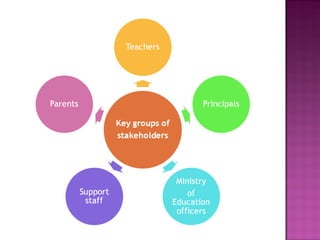
Support from many stakeholders, including all agencies in the educational system. Each group of stakeholders will have specific responsibilities in the overall implementation of Smart Schools.  To carry out their respective responsibilities, each stakeholder will need to be equipped with specific skills and have the requisite knowledge base and the right attitude.  This knowledge, skills and attitude will be developed through exhaustive training courses tailored for the development of each stakeholder group.
 
Appropriate policies, norms, and guidelines to support the schools. Implementing Smart Schools successfully in Malaysia will be a complex task, requiring changes to existing policies, procedures, and practices, both written and unwritten.  It may also require formulating entirely new policies and regulations.  A few of the important issues to be addressed include those outlined below, in the areas of the teaching-learning processes; management functions; people, skills and responsibilities; and technology.
Effective and efficient administrative practices in each school. Smart School management will be to manage efficiently and effectively the resources and processes required to support the teaching-learning functions.  Management will help to reallocate skilled human resources to more valuable activities, save costs over the long term, improve the quality of decisions through better access to information, and accelerate decision making.
Sufficient deployment of information technology to enable the Smart Schools to function properly. Information technology can enable the process of transforming traditional schools into Smart Schools.  Consequently, a nation-wide system of Smart Schools will depend on advanced information technology at the school, district and national levels. Sufficient funds to establish and maintain Smart Schools.
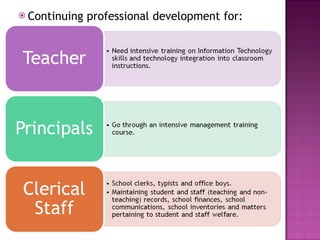
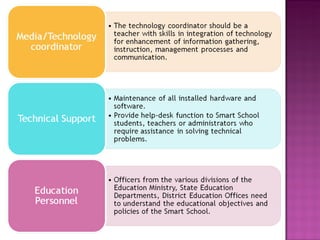
Continuing professional development for:
 
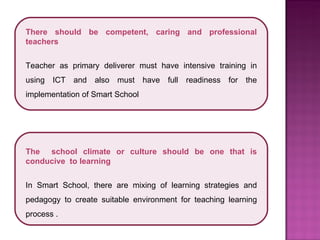
There should be competent, caring and professional teachers Teacher as primary deliverer must have intensive training in using ICT and also must have full readiness for the implementation of Smart School The  school climate or culture should be one that is conducive  to learning In Smart School, there are mixing of learning strategies and pedagogy to create suitable environment for teaching learning process .
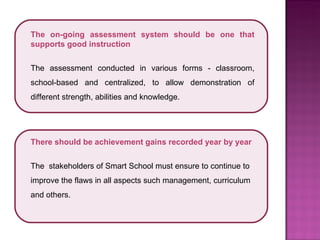
The on-going assessment system should be one that supports good instruction The assessment conducted in various forms - classroom, school-based and centralized, to allow demonstration of different strength, abilities and knowledge. There should be achievement gains recorded year by year The  stakeholders of Smart School must ensure to continue to improve the flaws in all aspects such management, curriculum and others.
There should be a decrease in discipline referrals and drop out rates. The teaching-learning process and school environment will develop the student potential based on their ability and readiness level. There should be high level of parent and community involvement The high participation of community stakeholders in school governance will help to develop the student and also the successful of Smart School implementation

Smart school

  • 1.
    THE MALAYSIAN SMARTSCHOOL GROUP 6 AZFATINI BT NAWI D20081032320 ZETY LIYANA BT ZAINAL ABIDIN D20081032351 YIP SOOK HAN D20091034841 SYAFIQAH SHAARI D20091034832
  • 2.
  • 3.
    Support from manystakeholders, including all agencies in the educational system. Each group of stakeholders will have specific responsibilities in the overall implementation of Smart Schools. To carry out their respective responsibilities, each stakeholder will need to be equipped with specific skills and have the requisite knowledge base and the right attitude. This knowledge, skills and attitude will be developed through exhaustive training courses tailored for the development of each stakeholder group.
  • 4.
  • 5.
    Appropriate policies, norms,and guidelines to support the schools. Implementing Smart Schools successfully in Malaysia will be a complex task, requiring changes to existing policies, procedures, and practices, both written and unwritten. It may also require formulating entirely new policies and regulations. A few of the important issues to be addressed include those outlined below, in the areas of the teaching-learning processes; management functions; people, skills and responsibilities; and technology.
  • 6.
    Effective and efficientadministrative practices in each school. Smart School management will be to manage efficiently and effectively the resources and processes required to support the teaching-learning functions. Management will help to reallocate skilled human resources to more valuable activities, save costs over the long term, improve the quality of decisions through better access to information, and accelerate decision making.
  • 7.
    Sufficient deployment ofinformation technology to enable the Smart Schools to function properly. Information technology can enable the process of transforming traditional schools into Smart Schools. Consequently, a nation-wide system of Smart Schools will depend on advanced information technology at the school, district and national levels. Sufficient funds to establish and maintain Smart Schools.
  • 8.
  • 9.
  • 10.
    There should becompetent, caring and professional teachers Teacher as primary deliverer must have intensive training in using ICT and also must have full readiness for the implementation of Smart School The school climate or culture should be one that is conducive to learning In Smart School, there are mixing of learning strategies and pedagogy to create suitable environment for teaching learning process .
  • 11.
    The on-going assessmentsystem should be one that supports good instruction The assessment conducted in various forms - classroom, school-based and centralized, to allow demonstration of different strength, abilities and knowledge. There should be achievement gains recorded year by year The stakeholders of Smart School must ensure to continue to improve the flaws in all aspects such management, curriculum and others.
  • 12.
    There should bea decrease in discipline referrals and drop out rates. The teaching-learning process and school environment will develop the student potential based on their ability and readiness level. There should be high level of parent and community involvement The high participation of community stakeholders in school governance will help to develop the student and also the successful of Smart School implementation