SSI3013 – INFORMATION AND COMMUNICATION TECHNOLOGY
IN SCIENCE
GROUP MEMBERS:  CHEE TENG KAI
D20151070951
 NATASA BINTI MOHD
SHAKRI
D20151070969
 OOI KO WEI
D20151070953
LECTURER’S NAME: ENCIK AZMI BIN IBRAHIM
CHALLENGES OF
IMPLEMENTATIONS
OF SMART SCHOOL IN
MALAYSIA
INTRODUCTION
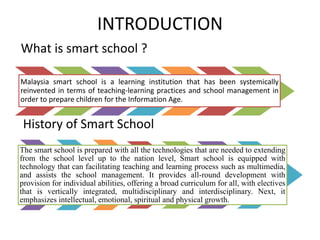
What is smart school ?
Malaysia smart school is a learning institution that has been systemically
reinvented in terms of teaching-learning practices and school management in
order to prepare children for the Information Age.
History of Smart School
The smart school is prepared with all the technologies that are needed to extending
from the school level up to the nation level, Smart school is equipped with
technology that can facilitating teaching and learning process such as multimedia,
and assists the school management. It provides all-round development with
provision for individual abilities, offering a broad curriculum for all, with electives
that is vertically integrated, multidisciplinary and interdisciplinary. Next, it
emphasizes intellectual, emotional, spiritual and physical growth.
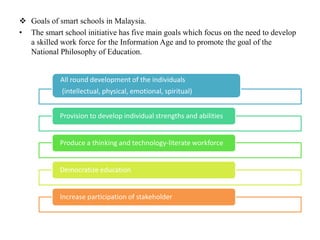
 Goals of smart schools in Malaysia.
• The smart school initiative has five main goals which focus on the need to develop
a skilled work force for the Information Age and to promote the goal of the
National Philosophy of Education.
All round development of the individuals
(intellectual, physical, emotional, spiritual)
Provision to develop individual strengths and abilities
Produce a thinking and technology-literate workforce
Democratize education
Increase participation of stakeholder
CHALLENGES OF IMPLEMENTATIONS
OF SMART SCHOOL IN MALAYSIA
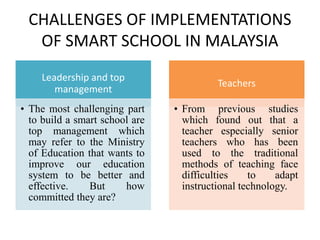
Leadership and top
management
• The most challenging part
to build a smart school are
top management which
may refer to the Ministry
of Education that wants to
improve our education
system to be better and
effective. But how
committed they are?
Teachers
• From previous studies
which found out that a
teacher especially senior
teachers who has been
used to the traditional
methods of teaching face
difficulties to adapt
instructional technology.
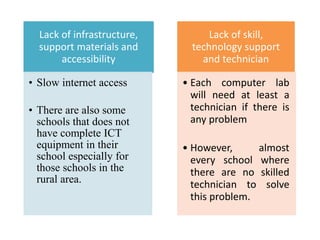
Lack of infrastructure,
support materials and
accessibility
• Slow internet access
• There are also some
schools that does not
have complete ICT
equipment in their
school especially for
those schools in the
rural area.
Lack of skill,
technology support
and technician
• Each computer lab
will need at least a
technician if there is
any problem
• However, almost
every school where
there are no skilled
technician to solve
this problem.
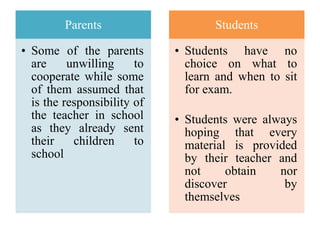
Parents
• Some of the parents
are unwilling to
cooperate while some
of them assumed that
is the responsibility of
the teacher in school
as they already sent
their children to
school
Students
• Students have no
choice on what to
learn and when to sit
for exam.
• Students were always
hoping that every
material is provided
by their teacher and
not obtain nor
discover by
themselves
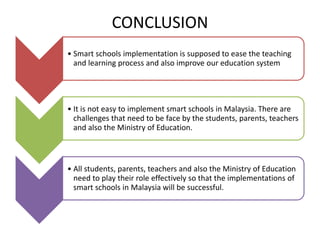
CONCLUSION
• Smart schools implementation is supposed to ease the teaching
and learning process and also improve our education system
• It is not easy to implement smart schools in Malaysia. There are
challenges that need to be face by the students, parents, teachers
and also the Ministry of Education.
• All students, parents, teachers and also the Ministry of Education
need to play their role effectively so that the implementations of
smart schools in Malaysia will be successful.
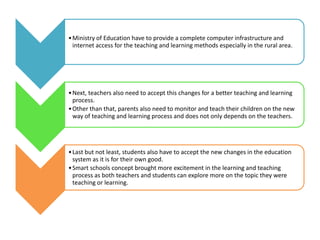
•Ministry of Education have to provide a complete computer infrastructure and
internet access for the teaching and learning methods especially in the rural area.
•Next, teachers also need to accept this changes for a better teaching and learning
process.
•Other than that, parents also need to monitor and teach their children on the new
way of teaching and learning process and does not only depends on the teachers.
•Last but not least, students also have to accept the new changes in the education
system as it is for their own good.
•Smart schools concept brought more excitement in the learning and teaching
process as both teachers and students can explore more on the topic they were
teaching or learning.
THANK YOU

SMART SCHOOL

  • 1.
    SSI3013 – INFORMATIONAND COMMUNICATION TECHNOLOGY IN SCIENCE GROUP MEMBERS:  CHEE TENG KAI D20151070951  NATASA BINTI MOHD SHAKRI D20151070969  OOI KO WEI D20151070953 LECTURER’S NAME: ENCIK AZMI BIN IBRAHIM
  • 2.
  • 3.
    INTRODUCTION What is smartschool ? Malaysia smart school is a learning institution that has been systemically reinvented in terms of teaching-learning practices and school management in order to prepare children for the Information Age. History of Smart School The smart school is prepared with all the technologies that are needed to extending from the school level up to the nation level, Smart school is equipped with technology that can facilitating teaching and learning process such as multimedia, and assists the school management. It provides all-round development with provision for individual abilities, offering a broad curriculum for all, with electives that is vertically integrated, multidisciplinary and interdisciplinary. Next, it emphasizes intellectual, emotional, spiritual and physical growth.
  • 4.
     Goals ofsmart schools in Malaysia. • The smart school initiative has five main goals which focus on the need to develop a skilled work force for the Information Age and to promote the goal of the National Philosophy of Education. All round development of the individuals (intellectual, physical, emotional, spiritual) Provision to develop individual strengths and abilities Produce a thinking and technology-literate workforce Democratize education Increase participation of stakeholder
  • 5.
    CHALLENGES OF IMPLEMENTATIONS OFSMART SCHOOL IN MALAYSIA Leadership and top management • The most challenging part to build a smart school are top management which may refer to the Ministry of Education that wants to improve our education system to be better and effective. But how committed they are? Teachers • From previous studies which found out that a teacher especially senior teachers who has been used to the traditional methods of teaching face difficulties to adapt instructional technology.
  • 6.
    Lack of infrastructure, supportmaterials and accessibility • Slow internet access • There are also some schools that does not have complete ICT equipment in their school especially for those schools in the rural area. Lack of skill, technology support and technician • Each computer lab will need at least a technician if there is any problem • However, almost every school where there are no skilled technician to solve this problem.
  • 7.
    Parents • Some ofthe parents are unwilling to cooperate while some of them assumed that is the responsibility of the teacher in school as they already sent their children to school Students • Students have no choice on what to learn and when to sit for exam. • Students were always hoping that every material is provided by their teacher and not obtain nor discover by themselves
  • 8.
    CONCLUSION • Smart schoolsimplementation is supposed to ease the teaching and learning process and also improve our education system • It is not easy to implement smart schools in Malaysia. There are challenges that need to be face by the students, parents, teachers and also the Ministry of Education. • All students, parents, teachers and also the Ministry of Education need to play their role effectively so that the implementations of smart schools in Malaysia will be successful.
  • 9.
    •Ministry of Educationhave to provide a complete computer infrastructure and internet access for the teaching and learning methods especially in the rural area. •Next, teachers also need to accept this changes for a better teaching and learning process. •Other than that, parents also need to monitor and teach their children on the new way of teaching and learning process and does not only depends on the teachers. •Last but not least, students also have to accept the new changes in the education system as it is for their own good. •Smart schools concept brought more excitement in the learning and teaching process as both teachers and students can explore more on the topic they were teaching or learning.
  • 10.