PART PICKING ROBOT
AI AGENT
GROUP MEMBER
• Tareque Rahman
• Ridwanul Islam
• Jarin tasnim
• 153-15-6563
• 153-15-6565
• 153-15-6687
INTRODUCTION
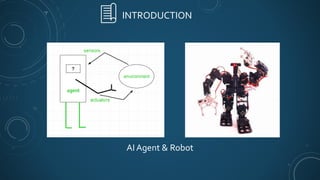
AI Agent & Robot
BRIEF DESCRIPTION
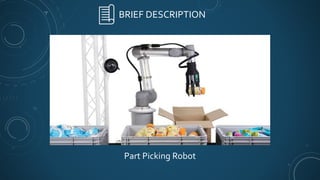
Part Picking Robot
PEAS DESCRIPTION
Agent: Part-picking Robot
Performance measure: Percentage of parts incorrect bins
Environment: Conveyor belt with parts, bins
Actuators: Jointed arm and hand
Sensors: Camera. joint angle sensors
WORKING PRINCIPLE
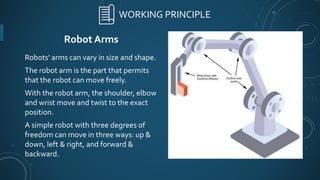
Robot Arms
Robots' arms can vary in size and shape.
The robot arm is the part that permits
that the robot can move freely.
With the robot arm, the shoulder, elbow
and wrist move and twist to the exact
position.
A simple robot with three degrees of
freedom can move in three ways: up &
down, left & right, and forward &
backward.
WORKING PRINCIPLE
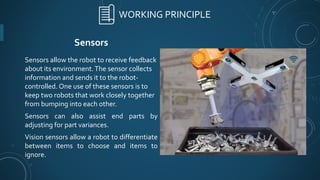
Sensors
Sensors allow the robot to receive feedback
about its environment.The sensor collects
information and sends it to the robot-
controlled. One use of these sensors is to
keep two robots that work closely together
from bumping into each other.
Sensors can also assist end parts by
adjusting for part variances.
Vision sensors allow a robot to differentiate
between items to choose and items to
ignore.
WORKING PRINCIPLE
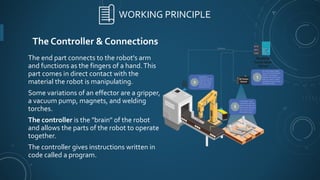
The Controller & Connections
The end part connects to the robot's arm
and functions as the fingers of a hand.This
part comes in direct contact with the
material the robot is manipulating.
Some variations of an effector are a gripper,
a vacuum pump, magnets, and welding
torches.
The controller is the "brain" of the robot
and allows the parts of the robot to operate
together.
The controller gives instructions written in
code called a program.
ADVANTAGESAND DISADVANTAGES
CONCLUSION
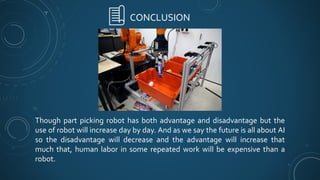
Though part picking robot has both advantage and disadvantage but the
use of robot will increase day by day. And as we say the future is all about AI
so the disadvantage will decrease and the advantage will increase that
much that, human labor in some repeated work will be expensive than a
robot.
THANK YOU
FOR YOU PATIENCE

Part Picking Robot

  • 1.
  • 2.
    GROUP MEMBER • TarequeRahman • Ridwanul Islam • Jarin tasnim • 153-15-6563 • 153-15-6565 • 153-15-6687
  • 3.
  • 4.
  • 5.
    PEAS DESCRIPTION Agent: Part-pickingRobot Performance measure: Percentage of parts incorrect bins Environment: Conveyor belt with parts, bins Actuators: Jointed arm and hand Sensors: Camera. joint angle sensors
  • 6.
    WORKING PRINCIPLE Robot Arms Robots'arms can vary in size and shape. The robot arm is the part that permits that the robot can move freely. With the robot arm, the shoulder, elbow and wrist move and twist to the exact position. A simple robot with three degrees of freedom can move in three ways: up & down, left & right, and forward & backward.
  • 7.
    WORKING PRINCIPLE Sensors Sensors allowthe robot to receive feedback about its environment.The sensor collects information and sends it to the robot- controlled. One use of these sensors is to keep two robots that work closely together from bumping into each other. Sensors can also assist end parts by adjusting for part variances. Vision sensors allow a robot to differentiate between items to choose and items to ignore.
  • 8.
    WORKING PRINCIPLE The Controller& Connections The end part connects to the robot's arm and functions as the fingers of a hand.This part comes in direct contact with the material the robot is manipulating. Some variations of an effector are a gripper, a vacuum pump, magnets, and welding torches. The controller is the "brain" of the robot and allows the parts of the robot to operate together. The controller gives instructions written in code called a program.
  • 9.
  • 10.
    CONCLUSION Though part pickingrobot has both advantage and disadvantage but the use of robot will increase day by day. And as we say the future is all about AI so the disadvantage will decrease and the advantage will increase that much that, human labor in some repeated work will be expensive than a robot.
  • 11.