TECHNICAL SEMINAR ON
Social Distance Shopping Using Embedded
Based Auto Cart and Android App
Under The Guidance of
MR. T. Venugopal
Associate Professor
By
Name : V. AKASH
Roll no : 19641A0211
Section : A
VAAGDEVI COLLEGE OF ENGINEERING
DEPARTMENT OF
ELECTRICAL AND ELECTRONICS ENGINEERING
INTRODUCTION
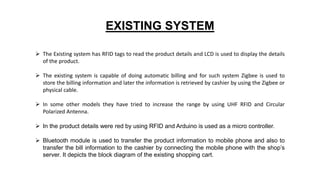
 The main purpose of this project is to provide centralized and automated billing
system using RFID and Zigbee communication.
 The centralized database will give product recommendation and information about
the product on the LCD screen present on the shopping cart, which will help the
customer in buying products.
 The COVID-19 pandemic has necessitated innovative solutions to ensure public safety
during shopping.
 Social distance shopping using an embedded-based auto cart and an Android app
offers a contactless and efficient shopping experience.
 This system combines advanced technologies, such as embedded systems, sensors, and
mobile apps, to enable a seamless and safe shopping process.
EXISTING SYSTEM
 The Existing system has RFID tags to read the product details and LCD is used to display the details
of the product.
 The existing system is capable of doing automatic billing and for such system Zigbee is used to
store the billing information and later the information is retrieved by cashier by using the Zigbee or
physical cable.
 In some other models they have tried to increase the range by using UHF RFID and Circular
Polarized Antenna.
 In the product details were red by using RFID and Arduino is used as a micro controller.
 Bluetooth module is used to transfer the product information to mobile phone and also to
transfer the bill information to the cashier by connecting the mobile phone with the shop’s
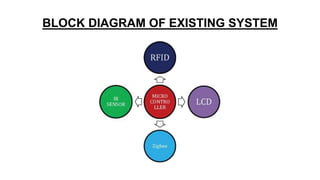
server. It depicts the block diagram of the existing shopping cart.
BLOCK DIAGRAM OF EXISTING SYSTEM
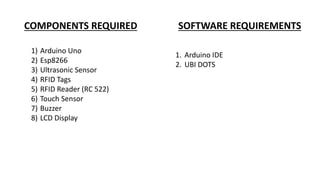
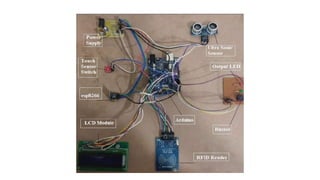
COMPONENTS REQUIRED SOFTWARE REQUIREMENTS
1) Arduino Uno
2) Esp8266
3) Ultrasonic Sensor
4) RFID Tags
5) RFID Reader (RC 522)
6) Touch Sensor
7) Buzzer
8) LCD Display
1. Arduino IDE
2. UBI DOTS
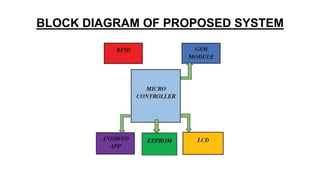
BLOCK DIAGRAM OF PROPOSED SYSTEM
WORKING METHODOLOGY
 The smart shopping device is attached to the trolley.
 The products in the supermarket are equipped with RFID tags.
 If the customer wish to remove the item from the trolley, the remove button is pressed and the
product is removed from the list.
 After the shopping completed the product details are transferred to the PHP web server at the
counter through Bluetooth module.
 Thus the automatic bill is generated which saves time by avoiding long queues at billing counter.
 The bill consists of customer name, phone number, product details and total cost, mode of payment.
 This system saves time by smart and fast shopping to the customers.
REFERENCES
1) IoT application on secure Smart Shopping system by Ruinian Li, Tianyi Song,
Nicholas Capurso, Jiguo Yu, Jason Couture, and Xiuzhen Cheng - 2017.
2) Nagaraj, Naveenprabu, Jagadesh, Mahalakshmi published Robust low-cost passive
UHF RFID based smart shopping trolley in 2020.
3) International Conference on Communication, Information & Computing Technology
published “A novel video processing-based cost-effective smart trolley system for
supermarkets using FPGA,” by R. Karishma, S.R. Rupanagudi, V.K. Bharadwaj, F.
Jabeen, V. G. Bhat V.R. Savarni and S. Adinarayana in 2015.
4) H. Anandakumar and K. Uma Maheswari, “Supervised machine learning techniques
in cognitive radio networks during cooperative spectrum handovers,” Cluster
Computing, vol. 20, no. 2, pp. 1505-1515, Mar. 2017.
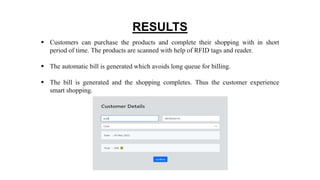
RESULTS
 Customers can purchase the products and complete their shopping with in short
period of time. The products are scanned with help of RFID tags and reader.
 The automatic bill is generated which avoids long queue for billing.
 The bill is generated and the shopping completes. Thus the customer experience
smart shopping.
CONCLUSION
 The implementation of social distance shopping using an
embedded-based auto cart and an Android app offers a
transformative approach to ensure public safety and
convenience during the shopping experience. By leveraging
advanced technologies and intelligent systems, this solution
provides several benefits.
akashveludandi324@gmail.com
www.linkedin.com/in/akash-veludandi-88a5111a4
https://www.instagram.com/veludandiakash/
https://wa.me/+918688714034

social distance shopping using embedded system based auto and android app .pptx

  • 1.
    TECHNICAL SEMINAR ON SocialDistance Shopping Using Embedded Based Auto Cart and Android App Under The Guidance of MR. T. Venugopal Associate Professor By Name : V. AKASH Roll no : 19641A0211 Section : A VAAGDEVI COLLEGE OF ENGINEERING DEPARTMENT OF ELECTRICAL AND ELECTRONICS ENGINEERING
  • 2.
    INTRODUCTION  The mainpurpose of this project is to provide centralized and automated billing system using RFID and Zigbee communication.  The centralized database will give product recommendation and information about the product on the LCD screen present on the shopping cart, which will help the customer in buying products.  The COVID-19 pandemic has necessitated innovative solutions to ensure public safety during shopping.  Social distance shopping using an embedded-based auto cart and an Android app offers a contactless and efficient shopping experience.  This system combines advanced technologies, such as embedded systems, sensors, and mobile apps, to enable a seamless and safe shopping process.
  • 3.
    EXISTING SYSTEM  TheExisting system has RFID tags to read the product details and LCD is used to display the details of the product.  The existing system is capable of doing automatic billing and for such system Zigbee is used to store the billing information and later the information is retrieved by cashier by using the Zigbee or physical cable.  In some other models they have tried to increase the range by using UHF RFID and Circular Polarized Antenna.  In the product details were red by using RFID and Arduino is used as a micro controller.  Bluetooth module is used to transfer the product information to mobile phone and also to transfer the bill information to the cashier by connecting the mobile phone with the shop’s server. It depicts the block diagram of the existing shopping cart.
  • 4.
    BLOCK DIAGRAM OFEXISTING SYSTEM
  • 5.
    COMPONENTS REQUIRED SOFTWAREREQUIREMENTS 1) Arduino Uno 2) Esp8266 3) Ultrasonic Sensor 4) RFID Tags 5) RFID Reader (RC 522) 6) Touch Sensor 7) Buzzer 8) LCD Display 1. Arduino IDE 2. UBI DOTS
  • 7.
    BLOCK DIAGRAM OFPROPOSED SYSTEM
  • 8.
    WORKING METHODOLOGY  Thesmart shopping device is attached to the trolley.  The products in the supermarket are equipped with RFID tags.  If the customer wish to remove the item from the trolley, the remove button is pressed and the product is removed from the list.  After the shopping completed the product details are transferred to the PHP web server at the counter through Bluetooth module.  Thus the automatic bill is generated which saves time by avoiding long queues at billing counter.  The bill consists of customer name, phone number, product details and total cost, mode of payment.  This system saves time by smart and fast shopping to the customers.
  • 9.
    REFERENCES 1) IoT applicationon secure Smart Shopping system by Ruinian Li, Tianyi Song, Nicholas Capurso, Jiguo Yu, Jason Couture, and Xiuzhen Cheng - 2017. 2) Nagaraj, Naveenprabu, Jagadesh, Mahalakshmi published Robust low-cost passive UHF RFID based smart shopping trolley in 2020. 3) International Conference on Communication, Information & Computing Technology published “A novel video processing-based cost-effective smart trolley system for supermarkets using FPGA,” by R. Karishma, S.R. Rupanagudi, V.K. Bharadwaj, F. Jabeen, V. G. Bhat V.R. Savarni and S. Adinarayana in 2015. 4) H. Anandakumar and K. Uma Maheswari, “Supervised machine learning techniques in cognitive radio networks during cooperative spectrum handovers,” Cluster Computing, vol. 20, no. 2, pp. 1505-1515, Mar. 2017.
  • 10.
    RESULTS  Customers canpurchase the products and complete their shopping with in short period of time. The products are scanned with help of RFID tags and reader.  The automatic bill is generated which avoids long queue for billing.  The bill is generated and the shopping completes. Thus the customer experience smart shopping.
  • 11.
    CONCLUSION  The implementationof social distance shopping using an embedded-based auto cart and an Android app offers a transformative approach to ensure public safety and convenience during the shopping experience. By leveraging advanced technologies and intelligent systems, this solution provides several benefits.
  • 13.