bq-magazine.com
bq | COVER STORY | TRANSPORT20
May 2017
21bq | COVER STORY | TRANSPORT
GCC
The automotive industry is on the
verge of a dramatic transformation
– numerous vehicle manufacturers,
along with tech companies like
Google are trying to manufacture a
completely autonomous vehicle, an
intelligent self-driving car which will,
in the near future, take us wherever
we like. Manufacturers around
the globe have got over the initial
setbacks in innovation and so cars
are becoming more intelligent than
ever before. But the same cannot be
said about the roads and highways.
Industry experts argue that the
development of intelligent roads is
lagging. The technology for building
them basically hasn’t changed for
more than one century, and the existing
roads are too costly to maintain. That
is also about to change soon, since our
cars are becoming more intelligent,
roads too have to become smarter,
they have to be able to communicate
with the vehicles, improve our safety
and save energy, or to put it even more
simply, the roads have to become
Intelligentroadswillbethebedrockofallfutureroadtransport,asvehiclesbecomemore
intelligent.Thisisnecessarytoensuresafetyandenergy-efficiency.
By Dada Zecic Pivac
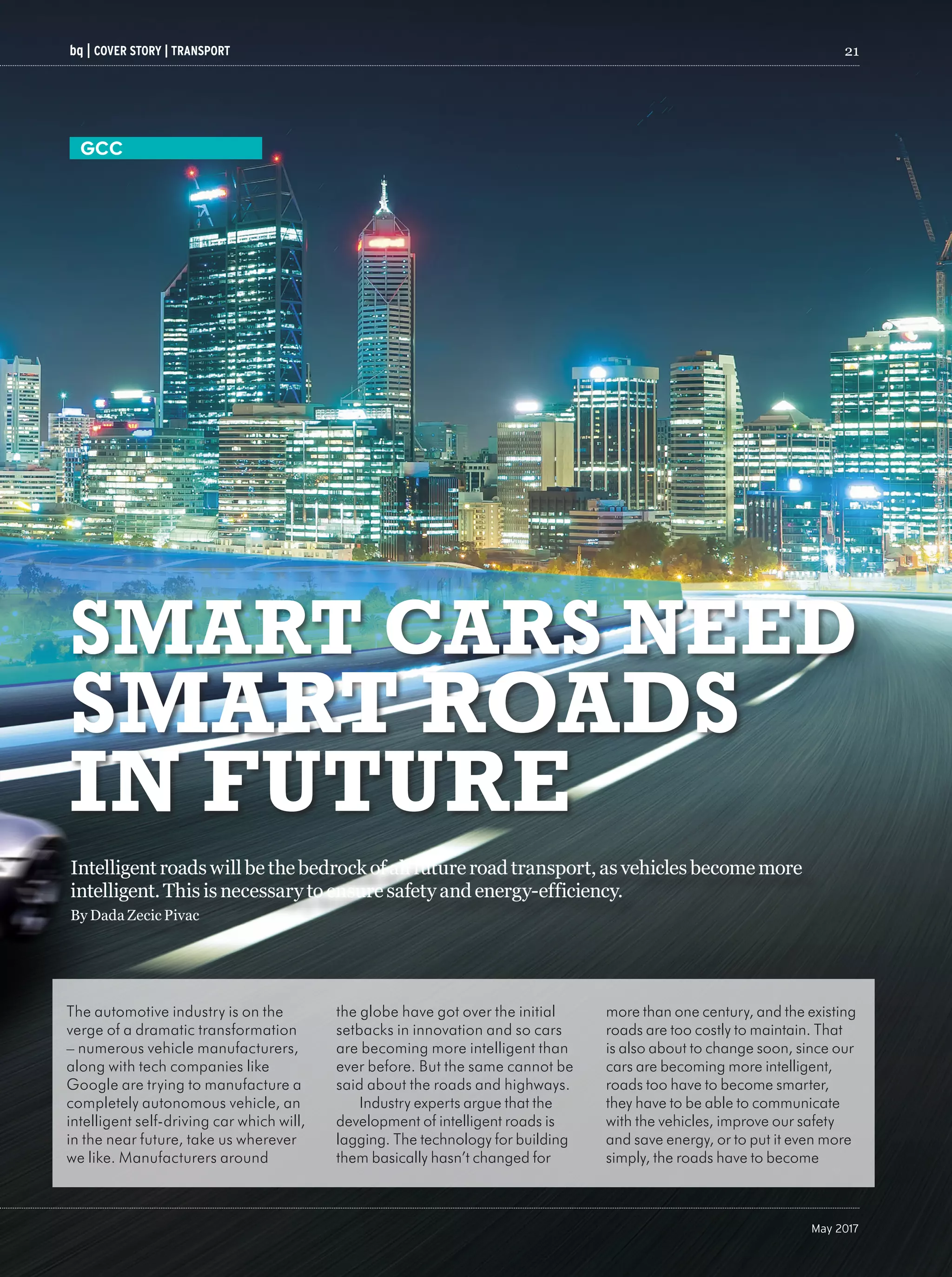
SMART CARS NEED
SMART ROADS
IN FUTURE
bq-magazine.com
22 bq | COVER STORY | TRANSPORT
alive. Intelligent roads are, in short, the
bedrock of all future road transport.
“There cannot be a smart city without
a smart road and together a smart
city with smart roads can provide
citizens with smart mobility”, the Smart
Transport Alliance (STA) stated in its
report, “Smart Roads: A vision 2015”.
Upgrading the infrastructure
The GCC region has some of the
smartest cities in the world and over
just a few decades they have made
significant progress in embedding
their public infrastructure with the
newest technologies. Euromonitor
International estimates that the
global market potential of smart cities
will reach $3.3 trillion by 2025 with
the GCC region expected to become
a global driver in the Internet of
Things (IoT) connected innovations.
By 2020, the combined
government expenditure in the GCC
is forecast to be $480 billion (bn),
of which the minimum of 60% or
around $288bn are to be invested
in road infrastructure and transport.
GCC is a highly competitive and
mature market for road builders,
and now they are forced to think
outside the box since it, Dubai,
recently announced that 25% of all
transportation trips within the emirate
will be smart and driverless by 2030.
Qatar is also working at
developing an intelligent transport
system which will quickly and safely
respond to incidents and events in
the likelihood of the roads network
being affected. But, according to
Akin Adamson, Director of transport
consultancy TRL Middle East, at the
moment, there are no developments
in building new smart roads in the
GCC. “Majority of the roads being
built in the GCC are still being
developed with the use of relatively
traditional technologies,” he stated.
It appears that the
countries in the
region are currently
working on upgrading
their existing road
infrastructure to
smart ones, making
them ready for all
future technologies
by developing safety
standards. Meanwhile,
government officials
are introducing
relevant legislations
in keeping with these
changes.
“Dubai’s Road and Transport
Authority (RTA) is probably the most
active in building smart roads and
are getting closer to achieving the
road infrastructure readiness targets
for autonomous vehicles. RTA has
been rolling out a number of new
and state-of-the-art technologies.
For instance, Dubai has installed
traffic surveillance and photo analysis
cameras that not only to detect
violations, but also analyze abnormal
traffic patterns and allow the traffic
center to pro-actively manage traffic
across the city,” said Camil Tahan,
Principal with consulting company ,
Strategy& (formerly Booz & Company),
and part of the PwC network.
“RTA has also been deploying
smart traffic sensors, virtual signs,
smart traffic light systems which
aim to enhance the traffic flow
and safety of passengers. More
importantly, these technologies
will also enable communicating
with autonomous and connected
cars in the future,” Camil said.
About Dubai’s plan to have 25%
of all transport driverless by 2030
and whether there was adequate
support infrastructure to ensure mass
appeal, he pointed out that Dubai
had progressed well in its plans to
develop smart infrastructure. “For
one, the metro system is increasingly
becoming the mode of choice for
a large segment of the population.
Second, Dubai has been piloting
autonomous vehicles in the city for
over a year now which allows it to
learn to better deploy the technology
for cars and buses once ready. Third,
Dubai has already started upgrading
its intelligent traffic systems (such
as connected traffic lights) to better
adapt for autonomous and connected
vehicles in the near future,” Camil said.
Akin partly agrees with this view,
but adds that it needs to be considered
on a case-to-case basis. “Dubai’s
metro and tram system could probably
be in the future. If other forms of public
transport (e. g. last mile buses/shuttles)
and delivery services become smart
and driverless, then it is conceivable
that 25% is achievable. But, if you are
looking at 25% of all personal vehicles
Camil Tahan, Principal with consulting company
Strategy
Akin Adamson, Director of transport consultancy
TRL Middle East
May 2017
bq | COVER STORY | TRANSPORT 23
being driverless by 2030, then this is
probably far-fetched at this point”, the
Director of TRL Middle East stated.
Redefining mobility
Further away from the GCC,
countries like Germany, Sweden, the
Netherlands, or the USA are already
testing various solutions for intelligent
roads. At the beginning of 2017,
according to the media, Amazon
developed and patented a unique
infrastructure that helps driverless
vehicles navigate and identify the
correct lane for their journey. Also,
start-up Solar Roadways is examining
if standard asphalt or concrete
surfaces can be paved with panels
fitted with photovoltaic cells that
generate and store electricity.
In October 2016, a $12.3-
mn smart bridge was opened in
Nuremberg, as a part of the project
“Digital Autobahn Test Field”,
launched in 2015, that allows tech
and automotive companies to test
their future technologies at the A9
highway in Bavaria in a real road
condition. In June 2016, Siemens
installed an overhead line for electric
and hybrid trucks on a 2-km highway
north of Stockholm. It allows hybrid
diesel-electric freight trucks to switch
to electric mode when they detect
the cables. In Oss, Netherlands,
light-emitting lines are painted
along the N329 highway – the 500-
meter long lines absorb light during
the day and glow at night for up
to eight hours and save electricity,
which would otherwise have been
consumed by overhead lighting.
In order to describe how the use
of technology could make future
roads safer, more intelligent and
more connected, Akin refers to
Dubai’s implementation of a series
of initiatives that have been created
to redefine what mobility would
mean within the city. They use new
transportation technologies that
include connected and autonomous
vehicles, alternative fuels, keyless fleet
management, traffic analytics, etc.
“The emergence of new
technologies being used for on-road
communications is expected to
drive a change in how vehicles will
operate and supply information.
This, in turn, can effect better, real-
time traffic management. Industry
experts have revealed that this is
being made possible through the
continuing development of essential
network infrastructure. Intelligent
transportation systems (ITS) will play
a key role in the efforts to transform
urban mobility into a seamlessly
connected and more dynamic
component of the city-as-a-system
(CaaS)”, he said, adding that the
experts have also explained that the
arrival of connected vehicles will
play a big role in the technological
shift within the mobility segment.
“This is particularly true for wireless
communication, e. g. vehicle-to-
vehicle (V2V), vehicle-to-pedestrian
(V2P) and vehicle-to-infrastructure
(V2I), collectively referred to as V2X.
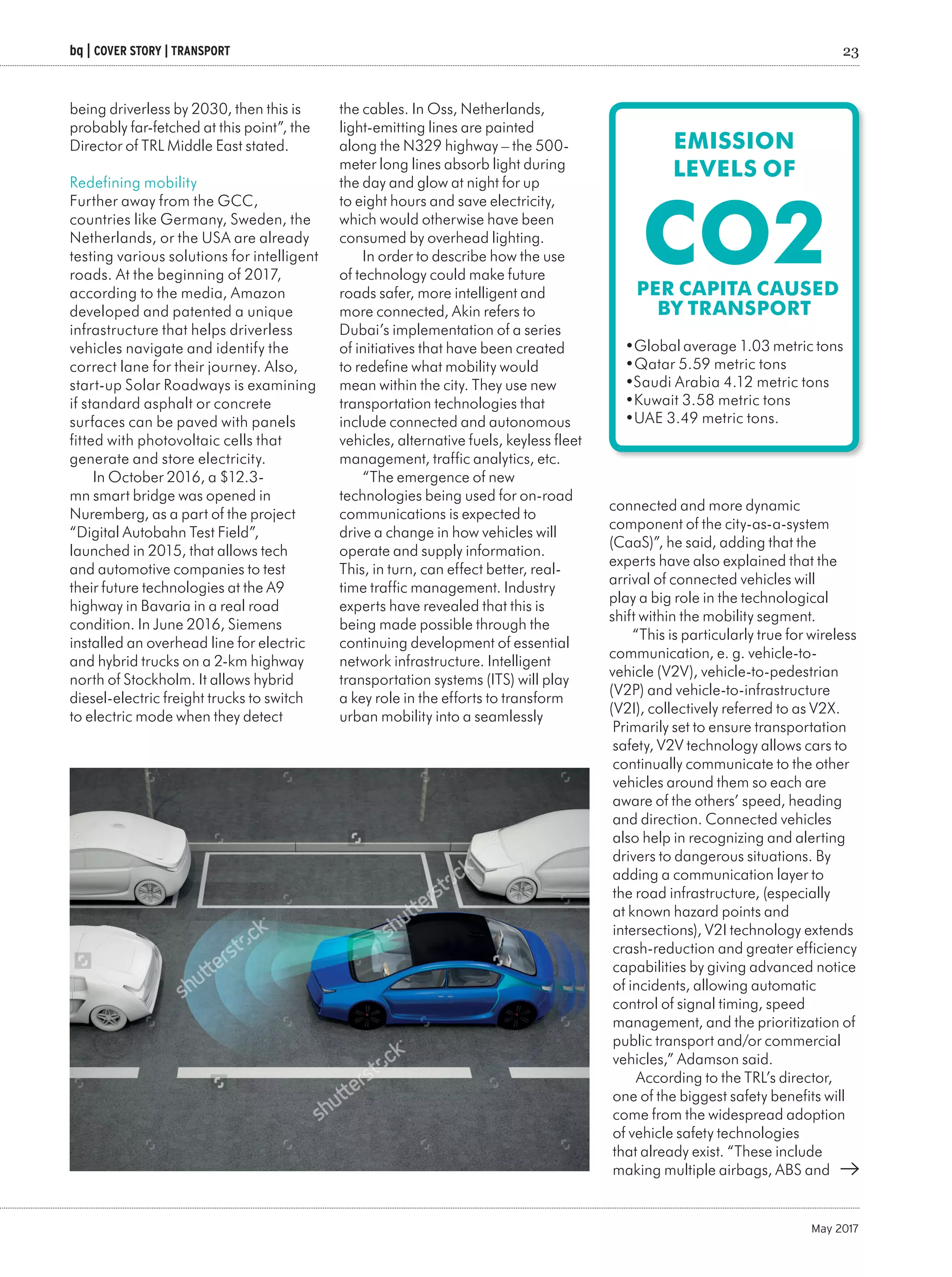
Primarily set to ensure transportation
safety, V2V technology allows cars to
continually communicate to the other
vehicles around them so each are
aware of the others’ speed, heading
and direction. Connected vehicles
also help in recognizing and alerting
drivers to dangerous situations. By
adding a communication layer to
the road infrastructure, (especially
at known hazard points and
intersections), V2I technology extends
crash-reduction and greater efficiency
capabilities by giving advanced notice
of incidents, allowing automatic
control of signal timing, speed
management, and the prioritization of
public transport and/or commercial
vehicles,” Adamson said.
According to the TRL’s director,
one of the biggest safety benefits will
come from the widespread adoption
of vehicle safety technologies
that already exist. “These include
making multiple airbags, ABS and
EMISSION
LEVELS OF
CO2PER CAPITA CAUSED
BY TRANSPORT
•Global average 1.03 metric tons
•Qatar 5.59 metric tons
•Saudi Arabia 4.12 metric tons
•Kuwait 3.58 metric tons
•UAE 3.49 metric tons.
bq-magazine.com
24 bq | COVER STORY | TRANSPORT
ESC (Electronic Stability Control)
standard on all vehicles. This is further
reinforced with the implementation of
newer technologies like Automated
Braking Systems, which will also bring
benefits if more widely adopted”.
Numerous benefits
When it comes to the benefits of
making roads intelligent, they are
easily transformed into numbers.
According to the RTA, their new
smart transport strategy will reduce
transportation costs by 44% or
more than $245mn, saving around
$408mn trough reduction of
environmental pollution, and $4.9bn
through raising efficiency of the
transport sector by 20%. Also, it will
increase productivity of individuals
by 13% by saving up to 396mn hours,
which are at present wasted every
year during travel on roads. It will
also help in reducing traffic accidents
and associated economic losses by
12%, thus saving $544 million a year.
Qatar’s Mobility Innovations
Center (QMIC) mentions in its 2016
Traffic Report that the average number
of extra hours spent due to congestion
is 109 hours per commuter, while
the economic cost of congestion in
2016 was estimated to have been
between $1.5bn and $1.8bn, which
translates to a loss of about 0.9 – 1.0%
of the GDP in 2016. The GCC region
has significantly higher rates of
death from road accidents than the
international benchmark, leading
to economic losses equivalent to
2.5% to 4.5% of the GDP among
GCC states including non-fatalities,
stated the report by Strategy& ‘Tech-
enabled transport: Building smarter
transportation networks in the GCC’.
Akin stresses that smart roads
can be classified according to three
characteristics: Adaptable – i.e.
self-monitoring, self-maintaining,
adaptable to traffic loads and
environmental conditions;
energy generating; Automated
– multi-layered, interoperable
communications systems embedded
enabling V2V, V2I and a host of
resulting applications; and Resilient
– sense environmental conditions to
(e.g.) harvest heat, de-ice, manage
drainage and provide warnings.
“The potential benefits and
advantages to be gained from
smart roads are enormous. Users
are likely to witness benefits such
as improvements in travel time,
enhanced road safety, reduction in
congestion, improved performance
of road systems and fuel efficiency.
Smart roads are able to work within
a connected infrastructure network,
which in turn, enhances the overall
transit of goods and people. It can
also provide drivers with advance
warnings and information regarding
hazards, such as ice, road blocks,
road construction work, etc. Smart
roads can also provide data on driver
performance, traffic flow and other
issues that can be considered as useful
and timely information”, he added.
he said. Explaining it further,
Strategy& principal is adding that
as a first step to take advantage of
emerging transportation technology,
governments will need to build the
correct regulatory foundation.
“Transportation regulations in
most countries were designed for an
analog world and are limited in their
ability to deal with new technologies.
For example, automobile liability and
insurance requirements currently fall
on drivers, which is meaningless for
autonomous vehicles. The authorities
will need to determine how to allocate
liability and insurance, potentially
to manufacturers or operators (or
even potentially to connectivity
Congestion Costs
(2016 Data)
•	 $121.4bn – the value ofactive
road construction projects
in the GCC, or 1,028
projects (about 74.43%)
of the total 1,381 active
transport projects, worth
$379.7bn in February 2017
•	 Europe – $11.22 (10.58
euros) per vehicle per
hour, or $106bn per year,
or 1% of the EU’s GDP
•	 US – more than 4bn hours
of travel delay, nearly
11bn liters of gas used,
or $80bn per year
•	 UK – an average $1,200
per drive or $38.4bn
• 	 Qatar – 109 hours per
commuter or between
$1.5bn and $1.8bn – or
about 0.9 - 1.0% of the GDP
• 	 UAE – $3.2bn or almost
1% of the GDP
EN-V_Pride_Jiao
May 2017
bq | COVER STORY | TRANSPORT 25
providers controlling the data flow
to vehicles) for driverless vehicles.”
According to Camil, the second
component of the framework is
to conduct pilot programs to test
new technologies, evaluate their
potential benefits, and improve
them over time. “In many cases,
this may require partnering with the
private sector, particularly given
that individual companies have the
technical expertise required to launch
such tests and most government
agencies do not. For example,
Dubai’s RTA recently partnered
with Emaar Properties to conduct
trial runs of a 10-seat autonomous
shuttle on a 700-meter track along
Mohammed bin Rashid Boulevard.”
New technologies
The third component of the adoption
framework entails building the
required infrastructure to support
new technologies. “That includes
both physical and IT infrastructure.
Physical elements include charging
stations, road sensors, LNG
bunkering facilities, automated port
terminals, and traffic management
control centers”, he explained.
And the fourth and final aspect of
the framework is to use incentives
to encourage both customers and
service providers to adopt new
technologies. “Governments have
a variety of mechanisms they can
use to create such incentives. On
the customer side, for example,
companies can encourage drivers
to use emerging technologies
by giving them access to richer
information, such as real-time traffic-
flow data, which can help drivers
avoid congestion (or choose to take
mass transit instead of driving)”, he
concluded.
Akin added that connectivity
continues to be most important aspect
– especially when it is powered by
high-speed, low latency networks.
“In addition to seamless and fast
connectivity, the ability to collect
and analyze data in real time is also
an essential factor. Regulation,
standards and type approvals will
also all need to keep pace with
technology development. Lastly, new
smart roads will require investment,
probably through trials and proofs
of concepts initially, in order to see
what works and what doesn’t.”
In the near future, the GCC
region will surely start building new,
smart roads capable of catering to
future means of transport, not just
cars, but also trucks and other heavy
equipment which are essential in
the region, where the construction
and logistics industry will continue
to play an important role in the
diversification of local economies.
The strategy of
continuously building
conventional roads
has already proven
to be inadequate,
especially in the
heavily congested
cities of the GCC,
because with more
vehicles on the
road the danger of
congestion is even
greater, threatening to
become a permanent
condition.
The numbers speak for themselves.
There will be a total of 19.1mn vehicles
on GCC roads by 2020, up from
14.35mn in 2015 – Saudi Arabia will
have 10.03mn vehicles by 2020,
the UAE 3.53mn, while the rest of
the region, which includes Kuwait,
Oman, Qatar and Bahrain, will
have 5.54mn vehicles, according
to Frost & Sullivan. In foreseeable
future cars will remain the dominant
mode of transportation, and as they
become more intelligent, they will
need similarly intelligent roads.
Will those future roads be solar
ones or wind-powered, or will they
be built by using high-tech materials
like self-healing concrete that glows
in the dark, remains to be seen,
but for sure the roads of the future
must address the people’s highest
expectations in relation to road
transport and define a model that
adapts to societal demands.
Some of the
Proposed Solutions
for Smart Roads
• Glow in the dark road markings
• Roadside sensors
• Motion-sensor lights
• Wind-powered lights
• Solar panel-paved roadway
• Self-healing concrete
GLOBAL VEHICLE
STATISTICS AND
FORECASTS
•	 By 2050 there will be 4bn
cars globally
•			 By 2035 there will be nearly
21mn self-driving cars on
the world’s roads
•			 $87bn – projected value of
driverless cars market by
2030
•			 In the 1930s, General
Motors’ engineers were
working on the concept
of driverless cars and a
smart highway that can
communicate with vehicles
•			 By 2030, 25% of all
transportation trips in Dubai
will be driverless
•			 GCC’s economic loss due to
road accidents is estimated
from 2.5% to 4.5% of the
region’s GDP including
non-fatalities
•			 of road accidents are
caused by human factor

Smart cars need smart roads in future

  • 1.
    bq-magazine.com bq | COVERSTORY | TRANSPORT20
  • 2.
    May 2017 21bq |COVER STORY | TRANSPORT GCC The automotive industry is on the verge of a dramatic transformation – numerous vehicle manufacturers, along with tech companies like Google are trying to manufacture a completely autonomous vehicle, an intelligent self-driving car which will, in the near future, take us wherever we like. Manufacturers around the globe have got over the initial setbacks in innovation and so cars are becoming more intelligent than ever before. But the same cannot be said about the roads and highways. Industry experts argue that the development of intelligent roads is lagging. The technology for building them basically hasn’t changed for more than one century, and the existing roads are too costly to maintain. That is also about to change soon, since our cars are becoming more intelligent, roads too have to become smarter, they have to be able to communicate with the vehicles, improve our safety and save energy, or to put it even more simply, the roads have to become Intelligentroadswillbethebedrockofallfutureroadtransport,asvehiclesbecomemore intelligent.Thisisnecessarytoensuresafetyandenergy-efficiency. By Dada Zecic Pivac SMART CARS NEED SMART ROADS IN FUTURE
  • 3.
    bq-magazine.com 22 bq |COVER STORY | TRANSPORT alive. Intelligent roads are, in short, the bedrock of all future road transport. “There cannot be a smart city without a smart road and together a smart city with smart roads can provide citizens with smart mobility”, the Smart Transport Alliance (STA) stated in its report, “Smart Roads: A vision 2015”. Upgrading the infrastructure The GCC region has some of the smartest cities in the world and over just a few decades they have made significant progress in embedding their public infrastructure with the newest technologies. Euromonitor International estimates that the global market potential of smart cities will reach $3.3 trillion by 2025 with the GCC region expected to become a global driver in the Internet of Things (IoT) connected innovations. By 2020, the combined government expenditure in the GCC is forecast to be $480 billion (bn), of which the minimum of 60% or around $288bn are to be invested in road infrastructure and transport. GCC is a highly competitive and mature market for road builders, and now they are forced to think outside the box since it, Dubai, recently announced that 25% of all transportation trips within the emirate will be smart and driverless by 2030. Qatar is also working at developing an intelligent transport system which will quickly and safely respond to incidents and events in the likelihood of the roads network being affected. But, according to Akin Adamson, Director of transport consultancy TRL Middle East, at the moment, there are no developments in building new smart roads in the GCC. “Majority of the roads being built in the GCC are still being developed with the use of relatively traditional technologies,” he stated. It appears that the countries in the region are currently working on upgrading their existing road infrastructure to smart ones, making them ready for all future technologies by developing safety standards. Meanwhile, government officials are introducing relevant legislations in keeping with these changes. “Dubai’s Road and Transport Authority (RTA) is probably the most active in building smart roads and are getting closer to achieving the road infrastructure readiness targets for autonomous vehicles. RTA has been rolling out a number of new and state-of-the-art technologies. For instance, Dubai has installed traffic surveillance and photo analysis cameras that not only to detect violations, but also analyze abnormal traffic patterns and allow the traffic center to pro-actively manage traffic across the city,” said Camil Tahan, Principal with consulting company , Strategy& (formerly Booz & Company), and part of the PwC network. “RTA has also been deploying smart traffic sensors, virtual signs, smart traffic light systems which aim to enhance the traffic flow and safety of passengers. More importantly, these technologies will also enable communicating with autonomous and connected cars in the future,” Camil said. About Dubai’s plan to have 25% of all transport driverless by 2030 and whether there was adequate support infrastructure to ensure mass appeal, he pointed out that Dubai had progressed well in its plans to develop smart infrastructure. “For one, the metro system is increasingly becoming the mode of choice for a large segment of the population. Second, Dubai has been piloting autonomous vehicles in the city for over a year now which allows it to learn to better deploy the technology for cars and buses once ready. Third, Dubai has already started upgrading its intelligent traffic systems (such as connected traffic lights) to better adapt for autonomous and connected vehicles in the near future,” Camil said. Akin partly agrees with this view, but adds that it needs to be considered on a case-to-case basis. “Dubai’s metro and tram system could probably be in the future. If other forms of public transport (e. g. last mile buses/shuttles) and delivery services become smart and driverless, then it is conceivable that 25% is achievable. But, if you are looking at 25% of all personal vehicles Camil Tahan, Principal with consulting company Strategy Akin Adamson, Director of transport consultancy TRL Middle East
  • 4.
    May 2017 bq |COVER STORY | TRANSPORT 23 being driverless by 2030, then this is probably far-fetched at this point”, the Director of TRL Middle East stated. Redefining mobility Further away from the GCC, countries like Germany, Sweden, the Netherlands, or the USA are already testing various solutions for intelligent roads. At the beginning of 2017, according to the media, Amazon developed and patented a unique infrastructure that helps driverless vehicles navigate and identify the correct lane for their journey. Also, start-up Solar Roadways is examining if standard asphalt or concrete surfaces can be paved with panels fitted with photovoltaic cells that generate and store electricity. In October 2016, a $12.3- mn smart bridge was opened in Nuremberg, as a part of the project “Digital Autobahn Test Field”, launched in 2015, that allows tech and automotive companies to test their future technologies at the A9 highway in Bavaria in a real road condition. In June 2016, Siemens installed an overhead line for electric and hybrid trucks on a 2-km highway north of Stockholm. It allows hybrid diesel-electric freight trucks to switch to electric mode when they detect the cables. In Oss, Netherlands, light-emitting lines are painted along the N329 highway – the 500- meter long lines absorb light during the day and glow at night for up to eight hours and save electricity, which would otherwise have been consumed by overhead lighting. In order to describe how the use of technology could make future roads safer, more intelligent and more connected, Akin refers to Dubai’s implementation of a series of initiatives that have been created to redefine what mobility would mean within the city. They use new transportation technologies that include connected and autonomous vehicles, alternative fuels, keyless fleet management, traffic analytics, etc. “The emergence of new technologies being used for on-road communications is expected to drive a change in how vehicles will operate and supply information. This, in turn, can effect better, real- time traffic management. Industry experts have revealed that this is being made possible through the continuing development of essential network infrastructure. Intelligent transportation systems (ITS) will play a key role in the efforts to transform urban mobility into a seamlessly connected and more dynamic component of the city-as-a-system (CaaS)”, he said, adding that the experts have also explained that the arrival of connected vehicles will play a big role in the technological shift within the mobility segment. “This is particularly true for wireless communication, e. g. vehicle-to- vehicle (V2V), vehicle-to-pedestrian (V2P) and vehicle-to-infrastructure (V2I), collectively referred to as V2X. Primarily set to ensure transportation safety, V2V technology allows cars to continually communicate to the other vehicles around them so each are aware of the others’ speed, heading and direction. Connected vehicles also help in recognizing and alerting drivers to dangerous situations. By adding a communication layer to the road infrastructure, (especially at known hazard points and intersections), V2I technology extends crash-reduction and greater efficiency capabilities by giving advanced notice of incidents, allowing automatic control of signal timing, speed management, and the prioritization of public transport and/or commercial vehicles,” Adamson said. According to the TRL’s director, one of the biggest safety benefits will come from the widespread adoption of vehicle safety technologies that already exist. “These include making multiple airbags, ABS and EMISSION LEVELS OF CO2PER CAPITA CAUSED BY TRANSPORT •Global average 1.03 metric tons •Qatar 5.59 metric tons •Saudi Arabia 4.12 metric tons •Kuwait 3.58 metric tons •UAE 3.49 metric tons.
  • 5.
    bq-magazine.com 24 bq |COVER STORY | TRANSPORT ESC (Electronic Stability Control) standard on all vehicles. This is further reinforced with the implementation of newer technologies like Automated Braking Systems, which will also bring benefits if more widely adopted”. Numerous benefits When it comes to the benefits of making roads intelligent, they are easily transformed into numbers. According to the RTA, their new smart transport strategy will reduce transportation costs by 44% or more than $245mn, saving around $408mn trough reduction of environmental pollution, and $4.9bn through raising efficiency of the transport sector by 20%. Also, it will increase productivity of individuals by 13% by saving up to 396mn hours, which are at present wasted every year during travel on roads. It will also help in reducing traffic accidents and associated economic losses by 12%, thus saving $544 million a year. Qatar’s Mobility Innovations Center (QMIC) mentions in its 2016 Traffic Report that the average number of extra hours spent due to congestion is 109 hours per commuter, while the economic cost of congestion in 2016 was estimated to have been between $1.5bn and $1.8bn, which translates to a loss of about 0.9 – 1.0% of the GDP in 2016. The GCC region has significantly higher rates of death from road accidents than the international benchmark, leading to economic losses equivalent to 2.5% to 4.5% of the GDP among GCC states including non-fatalities, stated the report by Strategy& ‘Tech- enabled transport: Building smarter transportation networks in the GCC’. Akin stresses that smart roads can be classified according to three characteristics: Adaptable – i.e. self-monitoring, self-maintaining, adaptable to traffic loads and environmental conditions; energy generating; Automated – multi-layered, interoperable communications systems embedded enabling V2V, V2I and a host of resulting applications; and Resilient – sense environmental conditions to (e.g.) harvest heat, de-ice, manage drainage and provide warnings. “The potential benefits and advantages to be gained from smart roads are enormous. Users are likely to witness benefits such as improvements in travel time, enhanced road safety, reduction in congestion, improved performance of road systems and fuel efficiency. Smart roads are able to work within a connected infrastructure network, which in turn, enhances the overall transit of goods and people. It can also provide drivers with advance warnings and information regarding hazards, such as ice, road blocks, road construction work, etc. Smart roads can also provide data on driver performance, traffic flow and other issues that can be considered as useful and timely information”, he added. he said. Explaining it further, Strategy& principal is adding that as a first step to take advantage of emerging transportation technology, governments will need to build the correct regulatory foundation. “Transportation regulations in most countries were designed for an analog world and are limited in their ability to deal with new technologies. For example, automobile liability and insurance requirements currently fall on drivers, which is meaningless for autonomous vehicles. The authorities will need to determine how to allocate liability and insurance, potentially to manufacturers or operators (or even potentially to connectivity Congestion Costs (2016 Data) • $121.4bn – the value ofactive road construction projects in the GCC, or 1,028 projects (about 74.43%) of the total 1,381 active transport projects, worth $379.7bn in February 2017 • Europe – $11.22 (10.58 euros) per vehicle per hour, or $106bn per year, or 1% of the EU’s GDP • US – more than 4bn hours of travel delay, nearly 11bn liters of gas used, or $80bn per year • UK – an average $1,200 per drive or $38.4bn • Qatar – 109 hours per commuter or between $1.5bn and $1.8bn – or about 0.9 - 1.0% of the GDP • UAE – $3.2bn or almost 1% of the GDP EN-V_Pride_Jiao
  • 6.
    May 2017 bq |COVER STORY | TRANSPORT 25 providers controlling the data flow to vehicles) for driverless vehicles.” According to Camil, the second component of the framework is to conduct pilot programs to test new technologies, evaluate their potential benefits, and improve them over time. “In many cases, this may require partnering with the private sector, particularly given that individual companies have the technical expertise required to launch such tests and most government agencies do not. For example, Dubai’s RTA recently partnered with Emaar Properties to conduct trial runs of a 10-seat autonomous shuttle on a 700-meter track along Mohammed bin Rashid Boulevard.” New technologies The third component of the adoption framework entails building the required infrastructure to support new technologies. “That includes both physical and IT infrastructure. Physical elements include charging stations, road sensors, LNG bunkering facilities, automated port terminals, and traffic management control centers”, he explained. And the fourth and final aspect of the framework is to use incentives to encourage both customers and service providers to adopt new technologies. “Governments have a variety of mechanisms they can use to create such incentives. On the customer side, for example, companies can encourage drivers to use emerging technologies by giving them access to richer information, such as real-time traffic- flow data, which can help drivers avoid congestion (or choose to take mass transit instead of driving)”, he concluded. Akin added that connectivity continues to be most important aspect – especially when it is powered by high-speed, low latency networks. “In addition to seamless and fast connectivity, the ability to collect and analyze data in real time is also an essential factor. Regulation, standards and type approvals will also all need to keep pace with technology development. Lastly, new smart roads will require investment, probably through trials and proofs of concepts initially, in order to see what works and what doesn’t.” In the near future, the GCC region will surely start building new, smart roads capable of catering to future means of transport, not just cars, but also trucks and other heavy equipment which are essential in the region, where the construction and logistics industry will continue to play an important role in the diversification of local economies. The strategy of continuously building conventional roads has already proven to be inadequate, especially in the heavily congested cities of the GCC, because with more vehicles on the road the danger of congestion is even greater, threatening to become a permanent condition. The numbers speak for themselves. There will be a total of 19.1mn vehicles on GCC roads by 2020, up from 14.35mn in 2015 – Saudi Arabia will have 10.03mn vehicles by 2020, the UAE 3.53mn, while the rest of the region, which includes Kuwait, Oman, Qatar and Bahrain, will have 5.54mn vehicles, according to Frost & Sullivan. In foreseeable future cars will remain the dominant mode of transportation, and as they become more intelligent, they will need similarly intelligent roads. Will those future roads be solar ones or wind-powered, or will they be built by using high-tech materials like self-healing concrete that glows in the dark, remains to be seen, but for sure the roads of the future must address the people’s highest expectations in relation to road transport and define a model that adapts to societal demands. Some of the Proposed Solutions for Smart Roads • Glow in the dark road markings • Roadside sensors • Motion-sensor lights • Wind-powered lights • Solar panel-paved roadway • Self-healing concrete GLOBAL VEHICLE STATISTICS AND FORECASTS • By 2050 there will be 4bn cars globally • By 2035 there will be nearly 21mn self-driving cars on the world’s roads • $87bn – projected value of driverless cars market by 2030 • In the 1930s, General Motors’ engineers were working on the concept of driverless cars and a smart highway that can communicate with vehicles • By 2030, 25% of all transportation trips in Dubai will be driverless • GCC’s economic loss due to road accidents is estimated from 2.5% to 4.5% of the region’s GDP including non-fatalities • of road accidents are caused by human factor