SMALL WORKING GROUPS (SWG)
          SET UP
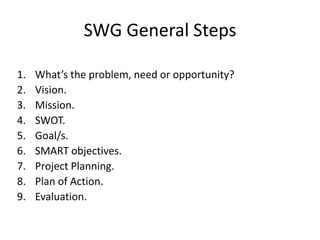
SWG General Steps

1.   What’s the problem, need or opportunity?
2.   Vision.
3.   Mission.
4.   SWOT.
5.   Goal/s.
6.   SMART objectives.
7.   Project Planning.
8.   Plan of Action.
9.   Evaluation.
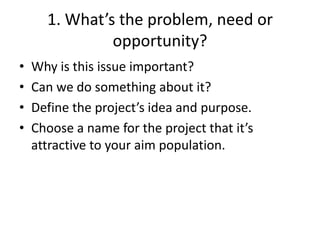
1. What’s the problem, need or
               opportunity?
•   Why is this issue important?
•   Can we do something about it?
•   Define the project’s idea and purpose.
•   Choose a name for the project that it’s
    attractive to your aim population.
2. Vision
• It’s the IDEAL situation that we want to
  achieve with the project.
• It doesn’t have to be a possible or achievable
  situation.
3. Mission
• It translates in HOW we will achieve our
  Vision.
• It summarizes the project, focusing on the
  activities for itself.
4. SWOT
• Strengths.          Strengths     Weaknesses

• Weaknesses.
• Opportunities.
• Threats.          Opportunities    Threats


                                                 6
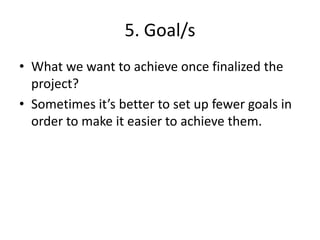
5. Goal/s
• What we want to achieve once finalized the
  project?
• Sometimes it’s better to set up fewer goals in
  order to make it easier to achieve them.
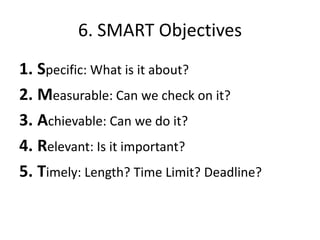
6. SMART Objectives
1. Specific: What is it about?
2. Measurable: Can we check on it?
3. Achievable: Can we do it?
4. Relevant: Is it important?
5. Timely: Length? Time Limit? Deadline?
7. Project Planning
• Recruitment.
• Necessary resources.
• Distribution of positions and assignments.
• Create a time bound calendar with
  assignments.
• Motivate the team!
8. Plan of Action

# Assignment Estimate Responsible   Necessary    Materials     *Others
              d Time                Resources

1     Get    2 months     Mr. Y         -       Professional
    Sponsors                                     Contacts


2    Contact    2 weeks   Mrs. X        -            -
    Authorities


3   Promote 3 months Mr. Y & Mrs.    US$100      •Posters.      Fb.
    Workshop              X                     •Pamphlets.    Twitter
                                                   •Etc.
9. Evaluation
• After the project execution, the team should
  analyze the work done, highlighting positive
  and negative aspects of the project in order to
  improve future activities by
  modifying, suppressing or adding things to the
  project.


                                                11
Already existing SCOME SWG
• General SWG:
  – SCOME Website.
  – NOME Handover manual.
  – LOME Manual.
  – SCOME Wiki.
  – Monthly Newsletter.
  – SCOMEdy.
Already existing SCOME SWG

• Thematic SWG:
  –   Medical ethics in medical education
  –   Global health in medical education
  –   Curriculum Database
  –   The Perfect Curriculum
  –   Mentorship and career orientation programs
  –   Patient safety in medical curriculum
  –   Student feedback
  –   Rational use of prescription drugs in medical education
  –   Interprofessional learning.
  –   Student representation on local and national level
  –   Teaching practical skills workshops/projects
  –   Teaching communication skills workshops/projects
PAMSA 2012 RM SCOME SWG Set Up


• Choose Top issues not present in the agenda.
• Choose a coordinator (preferably one
  experienced on the issue and/or SWG
  functioning).
• Work during the RM (assigned time and free
  time).
• Results presentation on the last day of RM.

Small working groups (swg) set up

  • 1.
  • 2.
    SWG General Steps 1. What’s the problem, need or opportunity? 2. Vision. 3. Mission. 4. SWOT. 5. Goal/s. 6. SMART objectives. 7. Project Planning. 8. Plan of Action. 9. Evaluation.
  • 3.
    1. What’s theproblem, need or opportunity? • Why is this issue important? • Can we do something about it? • Define the project’s idea and purpose. • Choose a name for the project that it’s attractive to your aim population.
  • 4.
    2. Vision • It’sthe IDEAL situation that we want to achieve with the project. • It doesn’t have to be a possible or achievable situation.
  • 5.
    3. Mission • Ittranslates in HOW we will achieve our Vision. • It summarizes the project, focusing on the activities for itself.
  • 6.
    4. SWOT • Strengths. Strengths Weaknesses • Weaknesses. • Opportunities. • Threats. Opportunities Threats 6
  • 7.
    5. Goal/s • Whatwe want to achieve once finalized the project? • Sometimes it’s better to set up fewer goals in order to make it easier to achieve them.
  • 8.
    6. SMART Objectives 1.Specific: What is it about? 2. Measurable: Can we check on it? 3. Achievable: Can we do it? 4. Relevant: Is it important? 5. Timely: Length? Time Limit? Deadline?
  • 9.
    7. Project Planning •Recruitment. • Necessary resources. • Distribution of positions and assignments. • Create a time bound calendar with assignments. • Motivate the team!
  • 10.
    8. Plan ofAction # Assignment Estimate Responsible Necessary Materials *Others d Time Resources 1 Get 2 months Mr. Y - Professional Sponsors Contacts 2 Contact 2 weeks Mrs. X - - Authorities 3 Promote 3 months Mr. Y & Mrs. US$100 •Posters. Fb. Workshop X •Pamphlets. Twitter •Etc.
  • 11.
    9. Evaluation • Afterthe project execution, the team should analyze the work done, highlighting positive and negative aspects of the project in order to improve future activities by modifying, suppressing or adding things to the project. 11
  • 12.
    Already existing SCOMESWG • General SWG: – SCOME Website. – NOME Handover manual. – LOME Manual. – SCOME Wiki. – Monthly Newsletter. – SCOMEdy.
  • 13.
    Already existing SCOMESWG • Thematic SWG: – Medical ethics in medical education – Global health in medical education – Curriculum Database – The Perfect Curriculum – Mentorship and career orientation programs – Patient safety in medical curriculum – Student feedback – Rational use of prescription drugs in medical education – Interprofessional learning. – Student representation on local and national level – Teaching practical skills workshops/projects – Teaching communication skills workshops/projects
  • 14.
    PAMSA 2012 RMSCOME SWG Set Up • Choose Top issues not present in the agenda. • Choose a coordinator (preferably one experienced on the issue and/or SWG functioning). • Work during the RM (assigned time and free time). • Results presentation on the last day of RM.