Freelancers and small business
Has the time now come?
“ all the forces in the world
are not so powerful as an
idea
whose time has come”
Victor Hugo 1802-1862
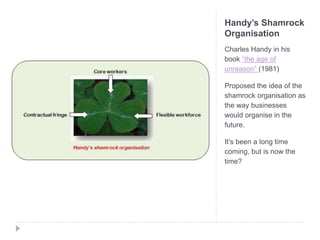
Handy’s Shamrock
Organisation
Charles Handy in his
book “the age of
unreason” (1981)
Proposed the idea of the
shamrock organisation as
the way businesses
would organise in the
future.
It’s been a long time
coming, but is now the
time?
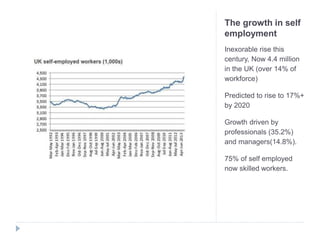
The growth in self
employment
Inexorable rise this
century, Now 4.4 million
in the UK (over 14% of
workforce)
Predicted to rise to 17%+
by 2020
Growth driven by
professionals (35.2%)
and managers(14.8%).
75% of self employed
now skilled workers.
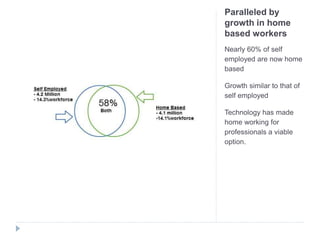
Paralleled by
growth in home
based workers
Nearly 60% of self
employed are now home
based
Growth similar to that of
self employed
Technology has made
home working for
professionals a viable
option.
The disruptive forces in the labour
market
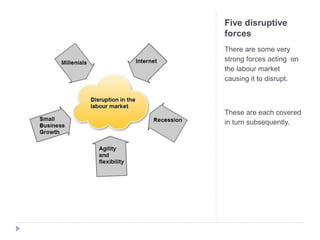
Five disruptive
forces
There are some very
strong forces acting on
the labour market
causing it to disrupt.
These are each covered
in turn subsequently.
1.The recession
Major “push factor”
Total number of available jobs reduced
Older people lost jobs and youth and graduate
unemployment increased
People looked elsewhere for jobs: Freelancing/Own
businesses
Large variety of self employed types:
Subcontractors
Self employed consultants
Temps
Interims
“solopreneurs”
2.The internet
The rise of communication and cloud
technologies has irrevocably broken the link
between work and workplaces. Enabled flexible
business models.
The rapid increase in jobs in the digital economy. It
is estimated that 4 out of 5 new jobs are now
predominantly digital. These are largely location
independent.
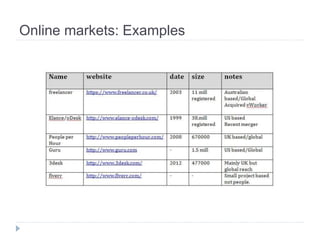
The establishment of a number of internet based
online markets aimed at matching skills with
employers. Some examples are summarised on the
next slide:
Online markets: Examples
3.The millennials
Born between1981 and 2000. They are already born!
(aged 14-33 today!)
Estimated that they will form 50% of the workforce
by 2020
Digital natives, always connected generation
Very different value set: reject 9-5 working, value
freedom, no company loyalty.
Freelancing/independent/DIY careers- fit on with
their aspirations
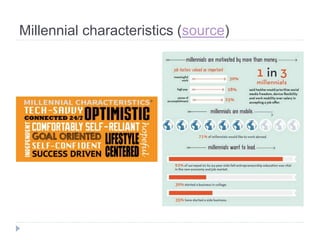
(see graphic on next slide for a summary of
millennials characteristics)
Millennial characteristics (source)
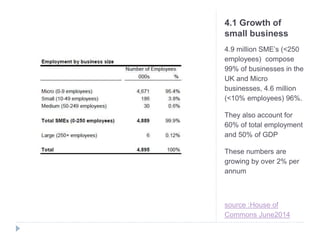
4.1 Growth of
small business
4.9 million SME’s (<250
employees) compose
99% of businesses in the
UK and Micro
businesses, 4.6 million
(<10% employees) 96%.
They also account for
60% of total employment
and 50% of GDP
These numbers are
growing by over 2% per
annum
source :House of
Commons June2014
4.2 Growth of Small Businesses
Historically SMB’s seen as sub-contractors to big
businesses or serving small markets. Bottom of the
food chain.
Now seen as key driving force in the economy
leading in innovation and competitiveness.
Greater status and rewards, allied to the greater
freedom, makes this sector increasingly attractive to
the brightest and best talent
Universities are now teaching entrepreneurship and
promoting this alongside traditional careers in the
professions and corporations.
5.Importance of flexibility and agility
Increased understanding from companies that they
need an agile and flexible workforce to be able to
compete in the highly competitive global marketplace
Employers now recognise the necessity of having an
“on demand” workforce.
Pressure from employers for a new flexible
employment models are therefore to supplement
traditional career based models.
This is particularly the case for small businesses that
operate in highly innovative areas where skills sets
are often scarce and rapidly changing ( see next
slide)
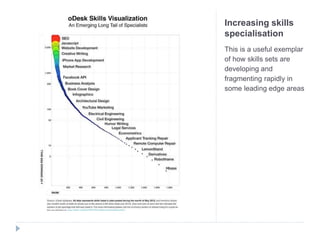
Increasing skills
specialisation
This is a useful exemplar
of how skills sets are
developing and
fragmenting rapidly in
some leading edge areas
Are Freelancers right (or not) for small
businesses?
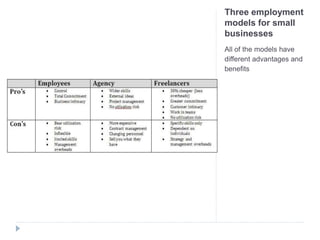
Three employment
models for small
businesses
All of the models have
different advantages and
benefits
So which one is best?
Ultimately each small business is in an unique
position and a different answer is right
Freelancers can offer some key benefits:
Access to wide range of scarce skills on an “on demand”
basis
Comparatively low cost ( no overheads or utilisation risk)
Can become intimately coupled into the business
There are a number of significant drawbacks:
You have to manage them on a strategic and day to day
basis!
Dependent on a individual who can leave.
So has the time come?
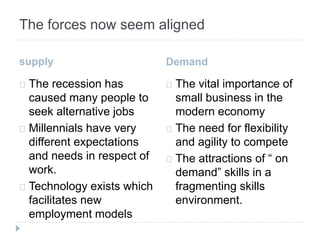
The forces now seem aligned
supply Demand
The recession has
caused many people to
seek alternative jobs
Millennials have very
different expectations
and needs in respect of
work.
Technology exists which
facilitates new
employment models
The vital importance of
small business in the
modern economy
The need for flexibility
and agility to compete
The attractions of “ on
demand” skills in a
fragmenting skills
environment.
So has the time come for handy’s vision of the
Shamrock Organisation to come about?
To return to Victor Hugo’s proposition.....
.....just maybe it now has!
Resources
Further information
Long form article:
http://www.scribd.com/doc/231934356/Has-the-
Time-Come-for-Freelancers-and-Small-Businesses
Curation of recent literature:
http://www.scoop.it/t/freelancers-and-small-
business?r=0.09557429942860507#post_40239607
86
contact
website: www.rjmasters.co.uk
Email: richard@rjmasters.co.uk
Slideshare:
http://www.slideshare.net/RichardMasters2
LinkedIn http://uk.linkedin.com/in/richardmastersj
G+ google.com/+RichardMasters
Twitter @mastersassoc

Freelancers and small business

  • 1.
    Freelancers and smallbusiness Has the time now come?
  • 2.
    “ all theforces in the world are not so powerful as an idea whose time has come” Victor Hugo 1802-1862
  • 3.
    Handy’s Shamrock Organisation Charles Handyin his book “the age of unreason” (1981) Proposed the idea of the shamrock organisation as the way businesses would organise in the future. It’s been a long time coming, but is now the time?
  • 4.
    The growth inself employment Inexorable rise this century, Now 4.4 million in the UK (over 14% of workforce) Predicted to rise to 17%+ by 2020 Growth driven by professionals (35.2%) and managers(14.8%). 75% of self employed now skilled workers.
  • 5.
    Paralleled by growth inhome based workers Nearly 60% of self employed are now home based Growth similar to that of self employed Technology has made home working for professionals a viable option.
  • 6.
    The disruptive forcesin the labour market
  • 7.
    Five disruptive forces There aresome very strong forces acting on the labour market causing it to disrupt. These are each covered in turn subsequently.
  • 8.
    1.The recession Major “pushfactor” Total number of available jobs reduced Older people lost jobs and youth and graduate unemployment increased People looked elsewhere for jobs: Freelancing/Own businesses Large variety of self employed types: Subcontractors Self employed consultants Temps Interims “solopreneurs”
  • 9.
    2.The internet The riseof communication and cloud technologies has irrevocably broken the link between work and workplaces. Enabled flexible business models. The rapid increase in jobs in the digital economy. It is estimated that 4 out of 5 new jobs are now predominantly digital. These are largely location independent. The establishment of a number of internet based online markets aimed at matching skills with employers. Some examples are summarised on the next slide:
  • 10.
  • 11.
    3.The millennials Born between1981and 2000. They are already born! (aged 14-33 today!) Estimated that they will form 50% of the workforce by 2020 Digital natives, always connected generation Very different value set: reject 9-5 working, value freedom, no company loyalty. Freelancing/independent/DIY careers- fit on with their aspirations (see graphic on next slide for a summary of millennials characteristics)
  • 12.
  • 13.
    4.1 Growth of smallbusiness 4.9 million SME’s (<250 employees) compose 99% of businesses in the UK and Micro businesses, 4.6 million (<10% employees) 96%. They also account for 60% of total employment and 50% of GDP These numbers are growing by over 2% per annum source :House of Commons June2014
  • 14.
    4.2 Growth ofSmall Businesses Historically SMB’s seen as sub-contractors to big businesses or serving small markets. Bottom of the food chain. Now seen as key driving force in the economy leading in innovation and competitiveness. Greater status and rewards, allied to the greater freedom, makes this sector increasingly attractive to the brightest and best talent Universities are now teaching entrepreneurship and promoting this alongside traditional careers in the professions and corporations.
  • 15.
    5.Importance of flexibilityand agility Increased understanding from companies that they need an agile and flexible workforce to be able to compete in the highly competitive global marketplace Employers now recognise the necessity of having an “on demand” workforce. Pressure from employers for a new flexible employment models are therefore to supplement traditional career based models. This is particularly the case for small businesses that operate in highly innovative areas where skills sets are often scarce and rapidly changing ( see next slide)
  • 16.
    Increasing skills specialisation This isa useful exemplar of how skills sets are developing and fragmenting rapidly in some leading edge areas
  • 17.
    Are Freelancers right(or not) for small businesses?
  • 18.
    Three employment models forsmall businesses All of the models have different advantages and benefits
  • 19.
    So which oneis best? Ultimately each small business is in an unique position and a different answer is right Freelancers can offer some key benefits: Access to wide range of scarce skills on an “on demand” basis Comparatively low cost ( no overheads or utilisation risk) Can become intimately coupled into the business There are a number of significant drawbacks: You have to manage them on a strategic and day to day basis! Dependent on a individual who can leave.
  • 20.
    So has thetime come?
  • 21.
    The forces nowseem aligned supply Demand The recession has caused many people to seek alternative jobs Millennials have very different expectations and needs in respect of work. Technology exists which facilitates new employment models The vital importance of small business in the modern economy The need for flexibility and agility to compete The attractions of “ on demand” skills in a fragmenting skills environment.
  • 22.
    So has thetime come for handy’s vision of the Shamrock Organisation to come about? To return to Victor Hugo’s proposition..... .....just maybe it now has!
  • 23.
  • 24.
    Further information Long formarticle: http://www.scribd.com/doc/231934356/Has-the- Time-Come-for-Freelancers-and-Small-Businesses Curation of recent literature: http://www.scoop.it/t/freelancers-and-small- business?r=0.09557429942860507#post_40239607 86
  • 25.
    contact website: www.rjmasters.co.uk Email: richard@rjmasters.co.uk Slideshare: http://www.slideshare.net/RichardMasters2 LinkedInhttp://uk.linkedin.com/in/richardmastersj G+ google.com/+RichardMasters Twitter @mastersassoc