STRATEGIC MANAGEMENT-
UNDERSTANDING SM
LESSON 19
LESSON OBJECTIVES
 At the end of the lesson students should be able to ask and answer the
following questions
a. Can I explain the meaning of strategic management
b. Can I explain the need for strategic management
c. Can I explain Chandler’s assertion that strategy determines
organizational structure
d. Can I explain the how business strategy determines competitive
advantage in an increasingly competitive world
INTRODUCTION
 Strategic management is the art of formulating, implementing and
evaluating cross-functional decisions that will enable an
organization to achieve its long-term objectives.
 It involves defining the organization’s mission, vision and
objectives, developing policies and plans and allocating resources to
achieve these objectives
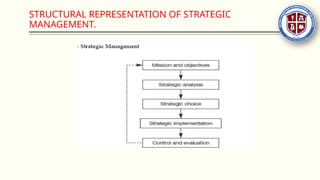
STRUCTURAL REPRESENTATION OF STRATEGIC
MANAGEMENT.
STRATEGIC MANAGEMENT
 Strategic management seeks to coordinate and integrate the
activities of the various functional areas of a business in order to
achieve long-term organizational objectives.
 Strategic management takes place at the highest level of
management; strategies are devised, authorized and implemented
under the supervision of the organization's top management team or
senior executives. Strategic management provides overall direction
to the enterprise
STAGES OF STRATEGIC MANAGEMENT
 Strategic management process can be divided into three main parts
or stages and these include
 Strategic analysis
 Strategic choice
 Strategic implementation
STRATEGY
 Strategy: The word “strategy” is derived from the Greek word
“strategies”; stratus (meaning army) and “ago” (meaning
leading/moving).
 Strategy: It is a long term business plan that integrates organizational
activities, allocating and using the scarce resources within the
organizational environment to achieve stated objectives.
 Alfred D. Chandler, Jr., author of Strategy and Structure (1962) defined
strategy as “the determination of the basic long-term goals and
objectives of an enterprise, and the adoption of courses of action and the
allocation of resources for carrying out these goals.
Chandler’s assertion that strategy should determine organizational structure
 Alfred Chandler’s thesis “structure follow strategy” was based on the
study of four giant US industries; he identified that company's strategy
in time determined its structure. For the organization to deliver its
plans, the strategy and the structure must be woven together
seamlessly.
 Chandler noted that strategy determines organizational structure and
changes in the environment result in strategic options which may
create the need for a change in organizational structure. Organizational
structure therefore tends to follow the growth strategy of an
organization
He identified that the giant businesses followed the following stages

 Acquired resources such as employees and raw materials and the buildup of
marketing and distribution channels
 established functional structures and departments to increase efficiency
 adopted growth and diversification strategy: diversification into new markets
and products to overcome limits of home market;
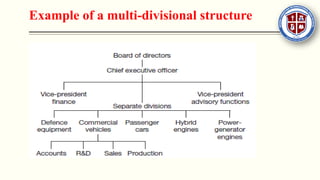
 Created multi-divisional organizations, with considerable independence in
terms of product or geographical groups with a headquarters that oversee the
corporate strategy.
Example of a multi-divisional structure
DIVISIONS OF STRATEGY
1. Functional strategy: these are organizational plans prepared for various
functional areas of a company's organizational structure (e.g.,
marketing strategy, financial strategy, production strategy etc.).
Functional strategies are aimed at achieving the overall strategies of the
business.
2. Business strategies: these are organizational plans prepared to achieve
and sustain competitiveness in separate business divisions or branches of
a large corporation or business.
3. Corporative strategy: This is a long term plan of action that covers the
whole organization, aimed at achieving a particular objective. It is usually
The need for strategic management
a. It helps business to determine the long-run goals, objectives vision
and mission of the business thereby defining the overall purpose
and direction of the business
b. It facilitates management decision making process
c. Strategic analysis: It helps the business to know its current position
where are we now e.g. SWOT and PEST.
The need for strategic management
. d. Strategic choices: strategic choice serves as a tool for business to
determine their future directions and make objective decisions e.g. the
use of decision trees. It helps businesses in formulating a strategy.
e. Strategic implementation: strategic implementation techniques
helps the business to put chosen strategies into effect and
monitoring performance against the long term plan e.g. the market
development strategy
Business strategy and competitive advantage
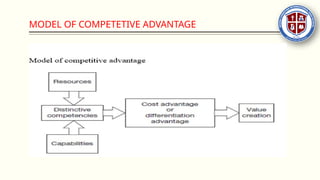
 Competitive advantage
 A superiority gained by a business when it can provide the same
value product/ service as competitors but at a lower price, or can
charge higher prices by providing greater value through
differentiation.
MODEL OF COMPETETIVE ADVANTAGE
Some of the strategies that can be adopted are discussed below
 Automation/use of modern technology: the use of robots, CAD, CAM
and automated machines for production helps to reduce costs of
manufacturing, allows flexibility in production and produce differentiated
product which leads to improved competitiveness. E.g. is BMW investing $
400 million in a 230 new robots at their UK factory? However the initial
cost is quite high
 Rationalization: two or more businesses can merge in order to cut down
cost and improve competitiveness by utilizing their existing resources,
expertise, technology and outlets. Example it the merging of Thomas Cook
and MyTravel.
 Research and development: this refers to investigative activities
carried out by a business to improve on existing products and
procedure or to develop an entirely new product. In 2008 Shell
petroleum increased R&D spending by 36% because they have
technology development as a strategy. They focused on product
differentiation.
 The above strategies have the capability of helping the business
gain competitive advantage in a competitive environment. It is
therefore important for a business to have a clear corporate strategy
that focuses.
ACTIVITY
 Discuss the extent to which the structure of that organization has
been determined by their business strategy and develop an
annotated organization chart during the discussion that explains the
structure in terms of the strategies employed.
SUMMARY
 According to Chandler, there are links between business strategy
and business structure.
 Corporate strategy can have a major impact on a company’s
competitive advantage and on its ability to create value in the
future.
STRATEGIC MANAGEMENT-
UNDERSTANDING SM
LESSON 20
LESSON OBJECTIVES
 At the end of the lesson students should be able to ask and answer the
following questions
a. Can I Explain and analyze business environment using SWOT
analysis
INTRODUCTION
 Strategic analysis is a process of developing strategies for a
business by researching into the business environment within which
the organization operates and the business itself. It helps to produce
relevant data for strategy formulation.
SWOT Analysis
 Key definition: this is a form of strategic analysis that identifies
and analyzes the internal strength and weaknesses and the external
opportunities and threats that affects the business.
 It is undertaken before major strategic decisions of the business are
taken.
STRENGTH
1. Strengths are resources and capabilities that can be used for competitive
advantage, they are factors that contribute to the ultimate success of the business,
and they can be tangible or intangible. It is usually done through internal audit,
e.g. of strengths are
 Strong brand names
 Good reputation
 Location of business
 Skilled workers
 Quality of product or process
WEAKNESSES
1. Weaknesses: these are factors within the business that can affect its
success; they are negative factors within the business that can
negatively affect the business. It includes
 Weak brand name
 Poor reputation
 Ineffective and high cost structure
 Poor quality product
 Poorly trained workforce
 complex decision making process
 narrow product range
 large wastage of raw materials
0PP0RTUNITY
Opportunity refers to factors outside the business that can give the
business a competitive advantage or factors which the business can exploit
to its advantage. Examples include
 new technology
 lower interest rate
 lower tariffs
 new market
 Information and research.
THREATS
These are factors in the external environment that have the potential
to negatively affect organization. These factors include
 New competitors
 Increase in interest rates
 Inflation
 Government legislation
USEFULNESS OF SWOT
 Helps to identify areas for action to reduce weaknesses
 Helps to identify the strengths that will help the business take
advantage of opportunities.
 It helps managers assess the most likely successful future strategies
and the constraints on them.
 It helps the business identify a good fit between its strength and
weaknesses
Weakness of SWOT
 subjectivity,
 different managers would have different results
 it is only a guide and not a prescription,
 It requires frequent updating.
GROUP ACTIVITY
 Prepare a SWOT analysis based on your assessment of the internal
and external factors that influence the success of your
school/college. Determine
 strategy to overcome a weakness using an opportunity
 a strategy to address a threat with a strength
SUMMARY
 Strategic analysis is the first stage of strategic management and
asks the question ‘where is the business now?’
 SWOT analysis is a form of strategic analysis and its usefulness
can be evaluated.

WEEK 10 - STRATEGIC MANAGEMENT 1....pptx

  • 1.
  • 2.
    LESSON OBJECTIVES  Atthe end of the lesson students should be able to ask and answer the following questions a. Can I explain the meaning of strategic management b. Can I explain the need for strategic management c. Can I explain Chandler’s assertion that strategy determines organizational structure d. Can I explain the how business strategy determines competitive advantage in an increasingly competitive world
  • 3.
    INTRODUCTION  Strategic managementis the art of formulating, implementing and evaluating cross-functional decisions that will enable an organization to achieve its long-term objectives.  It involves defining the organization’s mission, vision and objectives, developing policies and plans and allocating resources to achieve these objectives
  • 4.
    STRUCTURAL REPRESENTATION OFSTRATEGIC MANAGEMENT.
  • 5.
    STRATEGIC MANAGEMENT  Strategicmanagement seeks to coordinate and integrate the activities of the various functional areas of a business in order to achieve long-term organizational objectives.  Strategic management takes place at the highest level of management; strategies are devised, authorized and implemented under the supervision of the organization's top management team or senior executives. Strategic management provides overall direction to the enterprise
  • 6.
    STAGES OF STRATEGICMANAGEMENT  Strategic management process can be divided into three main parts or stages and these include  Strategic analysis  Strategic choice  Strategic implementation
  • 7.
    STRATEGY  Strategy: Theword “strategy” is derived from the Greek word “strategies”; stratus (meaning army) and “ago” (meaning leading/moving).  Strategy: It is a long term business plan that integrates organizational activities, allocating and using the scarce resources within the organizational environment to achieve stated objectives.  Alfred D. Chandler, Jr., author of Strategy and Structure (1962) defined strategy as “the determination of the basic long-term goals and objectives of an enterprise, and the adoption of courses of action and the allocation of resources for carrying out these goals.
  • 8.
    Chandler’s assertion thatstrategy should determine organizational structure  Alfred Chandler’s thesis “structure follow strategy” was based on the study of four giant US industries; he identified that company's strategy in time determined its structure. For the organization to deliver its plans, the strategy and the structure must be woven together seamlessly.  Chandler noted that strategy determines organizational structure and changes in the environment result in strategic options which may create the need for a change in organizational structure. Organizational structure therefore tends to follow the growth strategy of an organization
  • 9.
    He identified thatthe giant businesses followed the following stages   Acquired resources such as employees and raw materials and the buildup of marketing and distribution channels  established functional structures and departments to increase efficiency  adopted growth and diversification strategy: diversification into new markets and products to overcome limits of home market;  Created multi-divisional organizations, with considerable independence in terms of product or geographical groups with a headquarters that oversee the corporate strategy.
  • 10.
    Example of amulti-divisional structure
  • 11.
    DIVISIONS OF STRATEGY 1.Functional strategy: these are organizational plans prepared for various functional areas of a company's organizational structure (e.g., marketing strategy, financial strategy, production strategy etc.). Functional strategies are aimed at achieving the overall strategies of the business. 2. Business strategies: these are organizational plans prepared to achieve and sustain competitiveness in separate business divisions or branches of a large corporation or business. 3. Corporative strategy: This is a long term plan of action that covers the whole organization, aimed at achieving a particular objective. It is usually
  • 12.
    The need forstrategic management a. It helps business to determine the long-run goals, objectives vision and mission of the business thereby defining the overall purpose and direction of the business b. It facilitates management decision making process c. Strategic analysis: It helps the business to know its current position where are we now e.g. SWOT and PEST.
  • 13.
    The need forstrategic management . d. Strategic choices: strategic choice serves as a tool for business to determine their future directions and make objective decisions e.g. the use of decision trees. It helps businesses in formulating a strategy. e. Strategic implementation: strategic implementation techniques helps the business to put chosen strategies into effect and monitoring performance against the long term plan e.g. the market development strategy
  • 14.
    Business strategy andcompetitive advantage  Competitive advantage  A superiority gained by a business when it can provide the same value product/ service as competitors but at a lower price, or can charge higher prices by providing greater value through differentiation.
  • 15.
  • 16.
    Some of thestrategies that can be adopted are discussed below  Automation/use of modern technology: the use of robots, CAD, CAM and automated machines for production helps to reduce costs of manufacturing, allows flexibility in production and produce differentiated product which leads to improved competitiveness. E.g. is BMW investing $ 400 million in a 230 new robots at their UK factory? However the initial cost is quite high  Rationalization: two or more businesses can merge in order to cut down cost and improve competitiveness by utilizing their existing resources, expertise, technology and outlets. Example it the merging of Thomas Cook and MyTravel.
  • 17.
     Research anddevelopment: this refers to investigative activities carried out by a business to improve on existing products and procedure or to develop an entirely new product. In 2008 Shell petroleum increased R&D spending by 36% because they have technology development as a strategy. They focused on product differentiation.  The above strategies have the capability of helping the business gain competitive advantage in a competitive environment. It is therefore important for a business to have a clear corporate strategy that focuses.
  • 18.
    ACTIVITY  Discuss theextent to which the structure of that organization has been determined by their business strategy and develop an annotated organization chart during the discussion that explains the structure in terms of the strategies employed.
  • 19.
    SUMMARY  According toChandler, there are links between business strategy and business structure.  Corporate strategy can have a major impact on a company’s competitive advantage and on its ability to create value in the future.
  • 20.
  • 21.
    LESSON OBJECTIVES  Atthe end of the lesson students should be able to ask and answer the following questions a. Can I Explain and analyze business environment using SWOT analysis
  • 22.
    INTRODUCTION  Strategic analysisis a process of developing strategies for a business by researching into the business environment within which the organization operates and the business itself. It helps to produce relevant data for strategy formulation.
  • 23.
    SWOT Analysis  Keydefinition: this is a form of strategic analysis that identifies and analyzes the internal strength and weaknesses and the external opportunities and threats that affects the business.  It is undertaken before major strategic decisions of the business are taken.
  • 24.
    STRENGTH 1. Strengths areresources and capabilities that can be used for competitive advantage, they are factors that contribute to the ultimate success of the business, and they can be tangible or intangible. It is usually done through internal audit, e.g. of strengths are  Strong brand names  Good reputation  Location of business  Skilled workers  Quality of product or process
  • 25.
    WEAKNESSES 1. Weaknesses: theseare factors within the business that can affect its success; they are negative factors within the business that can negatively affect the business. It includes  Weak brand name  Poor reputation  Ineffective and high cost structure  Poor quality product
  • 26.
     Poorly trainedworkforce  complex decision making process  narrow product range  large wastage of raw materials
  • 27.
    0PP0RTUNITY Opportunity refers tofactors outside the business that can give the business a competitive advantage or factors which the business can exploit to its advantage. Examples include  new technology  lower interest rate  lower tariffs  new market  Information and research.
  • 28.
    THREATS These are factorsin the external environment that have the potential to negatively affect organization. These factors include  New competitors  Increase in interest rates  Inflation  Government legislation
  • 29.
    USEFULNESS OF SWOT Helps to identify areas for action to reduce weaknesses  Helps to identify the strengths that will help the business take advantage of opportunities.  It helps managers assess the most likely successful future strategies and the constraints on them.  It helps the business identify a good fit between its strength and weaknesses
  • 30.
    Weakness of SWOT subjectivity,  different managers would have different results  it is only a guide and not a prescription,  It requires frequent updating.
  • 31.
    GROUP ACTIVITY  Preparea SWOT analysis based on your assessment of the internal and external factors that influence the success of your school/college. Determine  strategy to overcome a weakness using an opportunity  a strategy to address a threat with a strength
  • 32.
    SUMMARY  Strategic analysisis the first stage of strategic management and asks the question ‘where is the business now?’  SWOT analysis is a form of strategic analysis and its usefulness can be evaluated.