1
IENT -3031 CONTEMPORARY BUSINESS MODELS
BBA-VI SEMESTER
BATCH 2021-24
UNIT # 1
PROF RAMPRASAD M V
2
CONTENTS- UNIT # 1
Environment Assessment
Elasticity test
Strategic Segmentation
Success Factors
Competitive Systems
Strategic Positioning
Value chain & Value network
Capabilities
Benchmarking
Generic Models of competitive strategy
Strategic Options
Choosing growth
Feasibility test
Granularity test
3
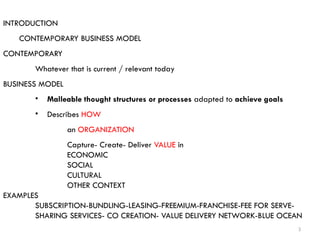
INTRODUCTION
CONTEMPORARY BUSINESS MODEL
CONTEMPORARY
Whatever that is current / relevant today
BUSINESS MODEL
• Malleable thought structures or processes adapted to achieve goals
• Describes HOW
an ORGANIZATION
Capture- Create- Deliver VALUE in
ECONOMIC
SOCIAL
CULTURAL
OTHER CONTEXT
EXAMPLES
SUBSCRIPTION-BUNDLING-LEASING-FREEMIUM-FRANCHISE-FEE FOR SERVE-
SHARING SERVICES- CO CREATION- VALUE DELIVERY NETWORK-BLUE OCEAN
4
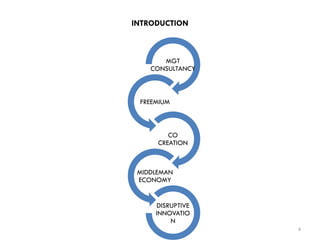
INTRODUCTION
MGT
CONSULTANCY
FREEMIUM
CO
CREATION
MIDDLEMAN
ECONOMY
DISRUPTIVE
INNOVATIO
N
5
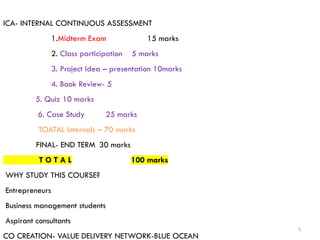
ICA- INTERNAL CONTINUOUS ASSESSMENT
1.Midterm Exam 15 marks
2. Class participation 5 marks
3. Project Idea – presentation 10marks
4. Book Review- 5
5. Quiz 10 marks
6. Case Study 25 marks
TOATAL Internals – 70 marks
FINAL- END TERM 30 marks
T O T A L 100 marks
WHY STUDY THIS COURSE?
Entrepreneurs
Business management students
Aspirant consultants
CO CREATION- VALUE DELIVERY NETWORK-BLUE OCEAN
6
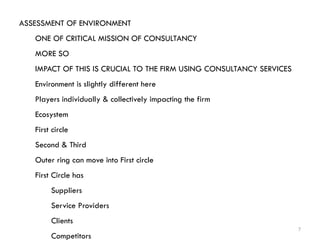
ENVIRONMENT ASSESSMENT OR ASSESSMENT OF ENVIRONMENT
ONE OF CRITICAL MISSION OF CONSULTANCY
MORE SO
IMPACT OF THIS IS CRUCIAL TO THE FIRM USING CONSULTANCY SERVICES
Environment is slightly different here
Players individually & collectively impacting the firm
Ecosystem
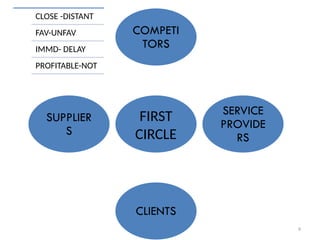
First circle
Second & Third
Outer ring can move into First circle
First Circle has
Suppliers
Service Providers
Clients
Competitors
7
ASSESSMENT OF ENVIRONMENT
ONE OF CRITICAL MISSION OF CONSULTANCY
MORE SO
IMPACT OF THIS IS CRUCIAL TO THE FIRM USING CONSULTANCY SERVICES
Environment is slightly different here
Players individually & collectively impacting the firm
Ecosystem
First circle
Second & Third
Outer ring can move into First circle
First Circle has
Suppliers
Service Providers
Clients
Competitors
8
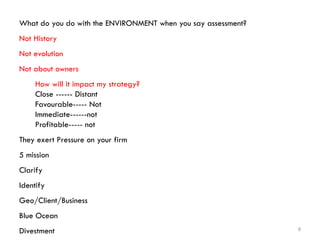
What do you do with the ENVIRONMENT when you say assessment?
Not History
Not evolution
Not about owners
How will it impact my strategy?
Close ------ Distant
Favourable----- Not
Immediate------not
Profitable----- not
They exert Pressure on your firm
5 mission
Clarify
Identify
Geo/Client/Business
Blue Ocean
Divestment
9
FIRST
CIRCLE
COMPETI
TORS
SERVICE
PROVIDE
RS
CLIENTS
SUPPLIER
S
CLOSE -DISTANT
FAV-UNFAV
IMMD- DELAY
PROFITABLE-NOT
10
MISSION 1-Clarify to CEO & TOP Managers (Boundaries & Challenges
• Internal Analysis (SW)
• Link those Opportunities & Challenges
• Set of Questions for this:
Which characteristics and opportunities of the market could be exploited by my company?
Which market segments allow me (or could allow me) to get the most value from the company’s
current competences and resources and create a solid competitive advantage?
11
MISSION 2-Identify the KEY PARTICIPANTS from the environment
• Who is my direct competitor
• Their policies in general
• Set of Questions for this:
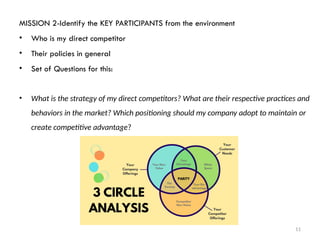
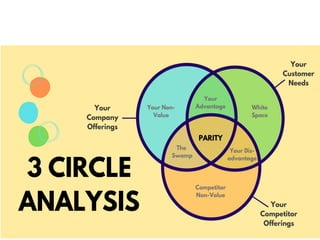
• What is the strategy of my direct competitors? What are their respective practices and
behaviors in the market? Which positioning should my company adopt to maintain or
create competitive advantage?
12
13
MISSION 3-Identify the KEY PARTICIPANTS from the environment
• Geographic Expansion
• My clients
• New Business
• Set of Questions :
• Which markets would be receptive to my company’s current offer? Do these target
markets possess many and high entry barriers or do they operate in an open and
integrative format such as a platform environment? How should my company adapt its
offer in this respect? Which new markets will allow my company to deploy my
company’s competences and resources and develop a new offer?
14
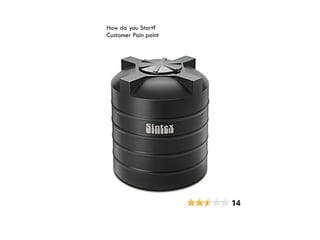
How do you Start?
Customer Pain point
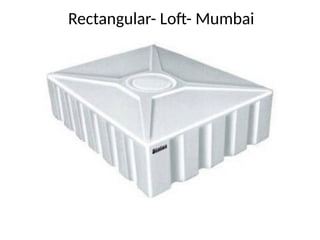
Rectangular- Loft- Mumbai
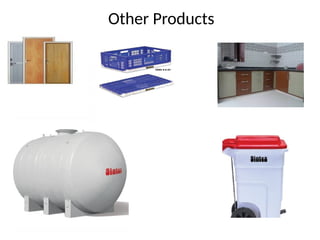
Other Products
18
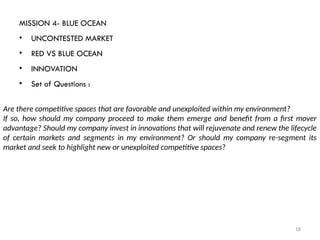
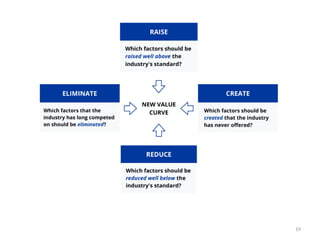
MISSION 4- BLUE OCEAN
• UNCONTESTED MARKET
• RED VS BLUE OCEAN
• INNOVATION
• Set of Questions :
Are there competitive spaces that are favorable and unexploited within my environment?
If so, how should my company proceed to make them emerge and benefit from a first mover
advantage? Should my company invest in innovations that will rejuvenate and renew the lifecycle
of certain markets and segments in my environment? Or should my company re-segment its
market and seek to highlight new or unexploited competitive spaces?
19
20
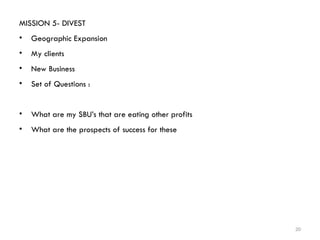
MISSION 5- DIVEST
• Geographic Expansion
• My clients
• New Business
• Set of Questions :
• What are my SBU’s that are eating other profits
• What are the prospects of success for these
21
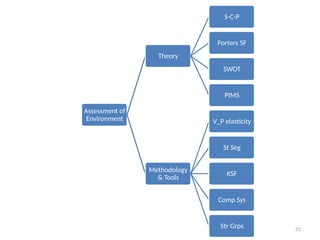
Assessment of
Environment
Theory
S-C-P
Porters 5F
SWOT
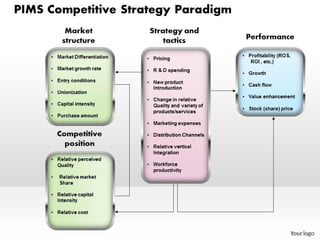
PIMS
Methodology
& Tools
V_P elasticity
St Seg
KSF
Comp Sys
Str Grps
22
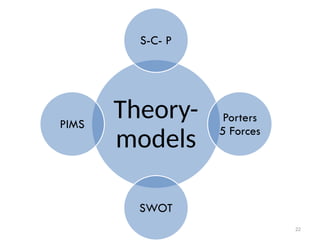
Theory-
models
S-C- P
Porters
5 Forces
SWOT
PIMS
23
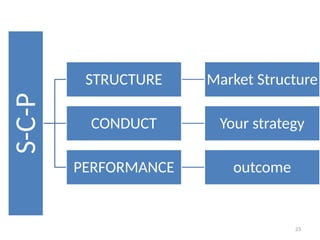
S-C-P
STRUCTURE Market Structure
CONDUCT Your strategy
PERFORMANCE outcome
24
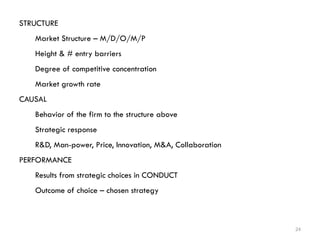
STRUCTURE
Market Structure – M/D/O/M/P
Height & # entry barriers
Degree of competitive concentration
Market growth rate
CAUSAL
Behavior of the firm to the structure above
Strategic response
R&D, Man-power, Price, Innovation, M&A, Collaboration
PERFORMANCE
Results from strategic choices in CONDUCT
Outcome of choice – chosen strategy
25
26
27
28
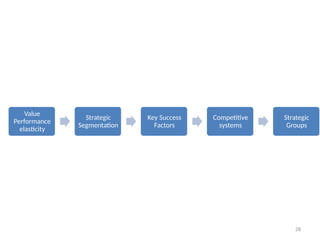
Value
Performance
elasticity
Strategic
Segmentation
Key Success
Factors
Competitive
systems
Strategic
Groups
29
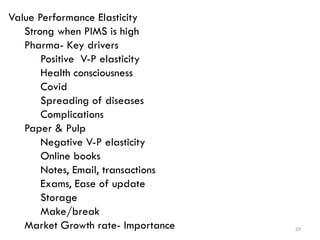
Value Performance Elasticity
Strong when PIMS is high
Pharma- Key drivers
Positive V-P elasticity
Health consciousness
Covid
Spreading of diseases
Complications
Paper & Pulp
Negative V-P elasticity
Online books
Notes, Email, transactions
Exams, Ease of update
Storage
Make/break
Market Growth rate- Importance
30
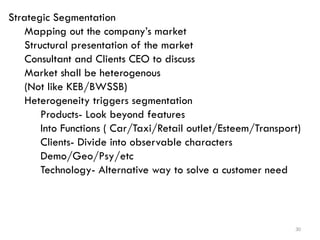
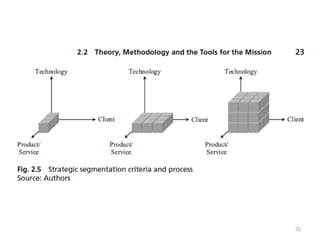
Strategic Segmentation
Mapping out the company’s market
Structural presentation of the market
Consultant and Clients CEO to discuss
Market shall be heterogenous
(Not like KEB/BWSSB)
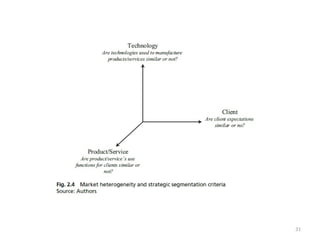
Heterogeneity triggers segmentation
Products- Look beyond features
Into Functions ( Car/Taxi/Retail outlet/Esteem/Transport)
Clients- Divide into observable characters
Demo/Geo/Psy/etc
Technology- Alternative way to solve a customer need
31
32
33
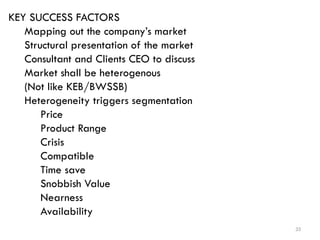
KEY SUCCESS FACTORS
Mapping out the company’s market
Structural presentation of the market
Consultant and Clients CEO to discuss
Market shall be heterogenous
(Not like KEB/BWSSB)
Heterogeneity triggers segmentation
Price
Product Range
Crisis
Compatible
Time save
Snobbish Value
Nearness
Availability
34
Competitive Systems
35
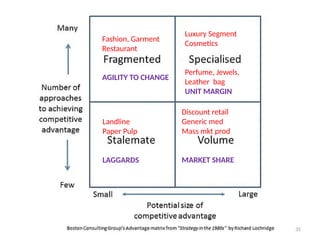
Discount retail
Generic med
Mass mkt prod
MARKET SHARE
Luxury Segment
Cosmetics
Perfume, Jewels,
Leather bag
UNIT MARGIN
Fashion, Garment
Restaurant
AGILITY TO CHANGE
Landline
Paper Pulp
LAGGARDS
36
Strategic Groups
37
38
39
40
41
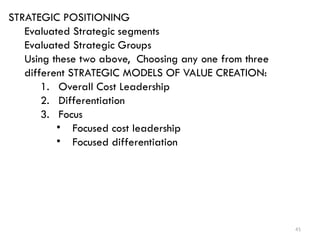
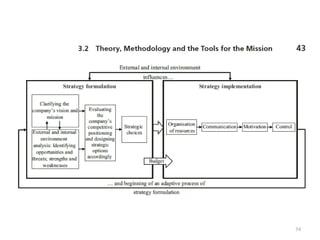
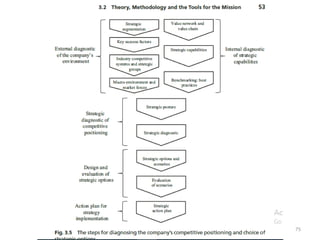
STRATEGIC POSITIONING
Evaluated Strategic segments
Evaluated Strategic Groups
Using these two above, Choosing any one from three
different STRATEGIC MODELS OF VALUE CREATION:
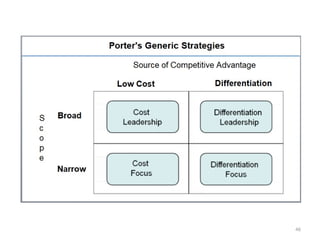
1. Overall Cost Leadership
2. Differentiation
3. Focus
• Focused cost leadership
• Focused differentiation
42
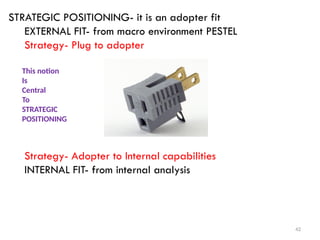
STRATEGIC POSITIONING- it is an adopter fit
EXTERNAL FIT- from macro environment PESTEL
Strategy- Plug to adopter
Strategy- Adopter to Internal capabilities
INTERNAL FIT- from internal analysis
This notion
Is
Central
To
STRATEGIC
POSITIONING
43
STRATEGIC POSITIONING- Internal Analysis
Resource based capabilities
Employees/Eqpt
Capital
Process
Patents
Reputation
Knowledge based capabilities
Implicit
Tacit
FIVE CONDITIONS OF RESOURCE GENERATION- Resulting in CA
1. Value- client to see higher value-profit-sales etc
2. Rare- very few comp has- toyota
3. Imitable- difficult to replicate
4. Organize
Acronym VRIO framework
44
STRATEGIC CAPABILITIES
Identify indispensable competencies
Identify resources
Human
Financial
Physical
Technical
Knowledge
Accent should be on competencies & resources
These are developed to master KSF of segments
STRATEGIC CAPABILITIES CHARACTERISED ON TWO LEVELS
Threshold Capabilities- LCD of Strategic Group
Distinctive Capabilities-VRIO / VRIST
45
BENCHMARKING
Comparative analysis of Strategic Capability taken in
TANDEM with competitive analysis
TWO Methodological approaches
Compare within the same industry
Compare with best in any class- ideal
Generic Model of Competitive Strategy
Porter’s generic model
46
47
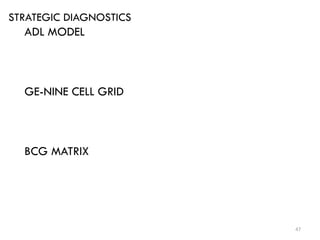
STRATEGIC DIAGNOSTICS
ADL MODEL
GE-NINE CELL GRID
BCG MATRIX
48
49
50
51
case.docx
TESTS OF GROWTH
TESTS OF GRANULARITY
TESTS OF DIVERSIFICATION
52
Introduction to contemporary Business Models
Whether you are a business leader, internal business partner or external consultant,
there are six key strategy missions that you will need to undertake as you deal with
the re-positioning and growth issues that all businesses face at one stage or another
during their life-cycle:
Assessing the environment
Defining a strategic positioning
Choosing a growth strategy
Expanding internationally
Combining strategy, and
Innovation or (re)designing the business model
Meschi and Chereau bridge the gaps between Academic Theory and Real-world
practice, between Strategic Analysis and Strategic Management, and between
Planning and Doing, by providing you with six essential mission briefings to help you
deliver the best possible outcome. Each briefing is structured the same way,
beginning with an outline of the consulting mission and its content before examining
the theoretical background, before setting out a complete and practical methodology
to complete the mission along with all the tools you will need along the way.
53
The Consulting Mission
The ENVIRONMENT is a generic term in STRATEGY. It does not have today’s
somewhat environmental meaning. In its strategic understanding, the
environment refers to an ecosystem where a set of distinct players interact
individually and collectively with the company. Thus, all companies
operating in a specific industry are embedded within the associated
ecosystem.
The players in the ecosystem have various levels of interaction with the
company.
A first circle of players interacts with it intensely and regularly. This immediate
environment is made up of the company’s clients, suppliers, service providers
and competitors. These players each have their own immediate
environment, also made up of their clients, suppliers and service providers.
These second- or third-tier players are distant from the company and its
immediate environment, even though they are connected to it indirectly. They
can also join the company’s first circle as new entrants if they manage to
overcome the entry barriers.
54
This assessment of the environment is one of the most classic missions for a
consulting firm. However, the consultant should not lose sight of the fact that the
conclusions of this mission are crucial for the client company. Indeed, the
environment’s value and attractiveness directly impact the company’s growth and
profitability.
Many different consulting missions relate to assessing the environment. Evaluating
the value of the company’s environment may be the main reason for initiating a
consulting mission, but today this is rather rare; it is more often the first step in a
broader mission whose objective is to help the company CEO to formalize, validate
and make a strategic choice.
A first series of consulting missions consists of helping CEOs and top managers
clarify the boundaries and challenges of their company’s current or future
environment. This involves updating their data and formalizing their observations
and intuitions related to assessing the value of the company’s environment. These
missions are often linked to an internal analysis of the company’s competences and
resources (human, technological, financial…).
For the company seeking to achieve strategic fit, this internal analysis has to be
aligned with the external analysis of the environment’s opportunities and threats.
55
On this basis, the consultant can check whether the client company is able to
respond to the environment’s opportunities and threats and thus build a solid
competitive advantage. In other words, such consulting missions mean answering
the following key questions of CEOs and top managers:
Which characteristics and opportunities of the market could be exploited by my
company? Which market segments allow me (or could allow me) to get the most
value from the company’s current competences and resources and create a solid
competitive advantage?
A second series of missions seeks
(i) to identify and evaluate the key players of an environment (in terms of threat,
competences and resources, profitability and value capture),
(ii) to monitor the behavior and strategy of these key players, and
(iii) to suggest strategic responses and scenarios, including direct competition or
collaboration with these players. Here, the key questions asked by CEOs and top
managers are:
56
What is the strategy of my direct competitors? What are their respective
practices and behaviors in the market? Which positioning should my company
adopt to maintain or create competitive advantage?
A third series of missions occurs when the company intends to grow into new
geographical markets, new client segments and/or new businesses. The
assessment of the associated environment is necessary before any decision to
expand is made. This assessment is unavoidable and is a prerequisite to
international expansion, product/service range extension to new client
segments, or diversification. By determining the value of a new geographical
market, client segment or business, the company can formalize and refine its
growth strategy. The conclusions of this type of mission are often useful in
helping CEOs to convince their boards, main shareholders and the company’s
employees of the pertinence of initiating a growth strategy. Here, the key
questions are:
57
Which markets would be receptive to my company’s current offer? Do these
target markets possess many and high entry barriers or do they operate in an
open and integrative format such as a platform environment? How should my
company adapt its offer in this respect? Which new markets will allow my
company to deploy my company’s competences and resources and develop a
new offer?
Consistent with the company’s intention to grow, a fourth series of missions
seeks to analyze the environment to detect new markets and client segments
and facilitate their emergence. Here, analyzing the environment serves to
identify new competitive spaces, or “blue oceans” as defined by W. Chan Kim
and Renée Mauborgne. In this case, consultants need to adopt a
“reconstructionist approach” whose objective is to “help companies
systematically reconstruct their industries and reverse the [environment]
structure-strategy sequence in their favor”2 (p. 74). Building on a scenario-
based or future anticipation approach, consultants help CEOs and top managers
to define the boundaries of these new high potential markets and segments. To
this end, they must also formalize the strategic actions required to give form
and reality to these new competitive spaces. Here, the key questions are:
58
Are there competitive spaces that are favorable and unexploited within my
environment?
If so, how should my company proceed to make them emerge and benefit from a
first mover advantage? Should my company invest in innovations that will
rejuvenate and renew the lifecycle of certain markets and segments in my
environment? Or should my company re-segment its market and seek to highlight
new or unexploited competitive spaces?
A fifth and final series of missions relates to business refocusing and divestment
decisions. For a diversified company, regular assessment of the environment (of
each geographical market, product/client segment and business) allows a review
of the company’s different (products, activities, competences, alliances…)
portfolios and to restructure them if needed. The evaluation of the relative value
and attractiveness of these different environments is one of the steps within the
process that can lead a CEO to sell off a business, divest a foreign subsidiary or
stop producing and selling a product range.
59
What is elasticity and elasticity in economics?
In the most basic sense, elasticity is a measure of a variable's sensitivity to a
change in another variable. Most commonly, elasticity refers to
an economic gauge that measures the change in the quantity demanded for a
good or service in relation to price movements of that good or service.
The Value/Performance Elasticity Test
The first step in the strategic analysis consists of defining the strategic nature of
the environment. This may be done by examining the strength of the
relationship between the value and attractiveness of a market and the
performance of companies operating in this market (otherwise known as
value/performance elasticity). An environment will be highly strategic if this
relationship is strong. In this event, the influence of the environment’s
characteristics on company performance is determinant and we find ourselves in
a perspective which is fully consistent with the PIMS principles. In other words,
here, the environment turns out to be strategic for the company due to the
presence of environment-performance causality
60
On the other hand, an environment loses its strategic nature if its value/performance
elasticity is weak. This type of environment configuration is found in industries and
segments where, despite their weak (strong) value, certain companies prosper (decline).
Nevertheless, in such an event, the client company may maintain the mission
of assessing its environment.
However, for the consultant, this mission will mean shifting from an SCP (or structuralist
approach) paradigm to a reconstructionist approach to the environment. In the event of
a weak value environment, the mission will then aim to seek one or several niches within
an unfavorable environment.
In the event of a strong value environment, the consulting objective will be to
concentrate on highlighting the reasons for the company’s under-performance and the
misalignment between the company’s competences and resources and the
environment’s characteristics.
61
Best Consulting Practices in Brief
The initial step of value/performance elasticity may be viewed as a “make or
break” test for the consultant. Indeed, the elasticity test is not only the first
step in the strategic analysis process, it also examines the pertinence of taking
this process further or not. If the elasticity is strong, the question is not
relevant: the whole strategic analysis process must be rolled out. On the other
hand, if the elasticity is weak, the question of whether to continue the mission
has to be discussed with the client company. This test can easily be carried out
during the negotiation and framing phase of the consulting mission and the
client company should be warned of these preliminary results. On this basis,
the client company will be able to make an informed decision about whether
to take the analysis further.
This first step, known as the value/performance elasticity test (or PIMS test),
is generally carried out using a simple direct measure of a company’s
environment and performance. As regards the assessment of environment
62
value, an immediately applicable and easily accessible measure
is market growth rate. This is an essential measure of value as
it occupies a central position in both Scherer’s SCP, Porter’s
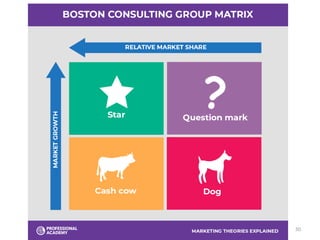
competitive forces and PIMS models. Some strategy tools have
also used market growth rate to measure the value of an
environment. This is notably the case of the Boston Consulting
Group’s matrix, which assesses the value and competitive
position of the company’s strategic business units. As regards
the assessment of the company’s performance, using the ROI
ratio (profit-to-assets ratio) presents the advantage of being
consistent with the PIMS model and avoids the inconclusive
debate on selecting an appropriate measure for performance.
63
Strategic Segmentation
 With strategic segmentation, the consultant steps right into the process of
the strategic analysis of the environment.
 This second step in the strategic analysis consists of mapping out the
company’s market. Strategic segmentation only concerns one aspect of the
company’s environment: its market.
 A company’s market can be seen as a competitive space that is often not
uniform and whose boundaries are more or less blurred. An initial approach
to strategic segmentation should result in a structured presentation of a
market, its boundaries and associated market sub-sets.
 It is a description seeking to identify the company’s critical market, i.e., one
or several market sub-sets in which the company operates. Indeed, it is rare
for a company and its product portfolio to occupy the whole of a competitive
space or achieve equivalent performance over all of the market sub-sets.
64
 This first approach to strategic segmentation therefore tries to organize a
market into homogenous sub-sets and restrict the company’s competitive
space to some of these.
 In a second, less descriptive approach, segmentation becomes more
strategic by offering the company’s CEO and top managers a map of the
positions and moves that the company could adopt within the different sub-
sets in its market.
 By taking this dynamic approach to segmentation, the market sub-sets
appear as both spaces of growth and opportunities for the company to
expand businesses sharing similar expenses and resources.
 From this view, segmentation lies at the intersection between the
environment assessment and strategic decision making. This implies that
segmentation should not be undertaken by the consultant alone or by the
consultant interacting with various departments (especially marketing).
 In all its phases, segmentation must result from discussions and interactions
involving the consultant and the client company’s CEO and top managers.
65
 In the first phase, the consultant must ask about the pertinence of
embarking onto segmenting the company’s market. He/she must know
whether the market in question is heterogeneous or not.
 The assessment of the level of market heterogeneity will trigger (or not) the
segmentation process.
 At this level and based on the method proposed by Derek F. Abell
(professor of strategy at IMD Lausanne) in Managing with Dual Strategies
(published in 1993), three criteria are usually mobilized to define the level
of market heterogeneity
66
Key Success Factors
 The third step in the strategic analysis process consists of identifying the
key success factors of each segment.
 Key success factors correspond to the specific purchasing criteria used by
clients in each segment.
 In other words, key success factors are the criteria that spur clients to
acquire the products or services that companies sell in a market or a
segment. For example, key success factors may include criteria such as
price, intrinsic product quality, product range, level of customization,
associated services and/or brand image.
 Key success factors are always defined with regard to the market or
segment to which they belong. They are unique to a segment. Even if key
success factors are intrinsically related to products and services sold in a
segment, they have nevertheless to be distinguished from the customer
function of these products and the benefits or value that clients obtain
from consuming them.
67
 Indeed, the customer and value functions of a product are defined with
regard to the satisfaction of one or several specific client needs; however,
key success factors refer to the conditions (price, quality, range…) in which
the customer and value functions are fulfilled and made available to
clients.
 Key success factors have a direct consequence on the ability of companies
in this segment to build a solid competitive advantage. Competition within
a segment is organized and competitive pressures are exerted around
these key success factors.
 The company’s ability to “control” key success factors, i.e., to identify and
respond to them effectively, will help it build a solid competitive
advantage. An effective response to key success factors means that the
company has to develop and deploy internally the capabilities and
resources that allow it to position itself as the best offer on one or several
purchasing criteria.
68
Competitive Systems
 The competitive systems step goes beyond describing segments based on
their specific combination of key success factors.
 This step complements the previous key success factors step by going
further in the environment value assessment and recommending which
strategy should be conducted in each segment.
 This is where the main benefit of the competitive systems analysis lies:
determining the rules of the game in the different types of environment in
which a company might operate.
 The competitive systems were initially developed by the Boston Consulting
Group in 1980, which explains why it is also known as BCG 80. They take
the form of a four quadrant matrix, which is easily accessible and whose
implications for the strategic analysis are relevant and straightforward for
companies to implement; this is why it has been so successful.
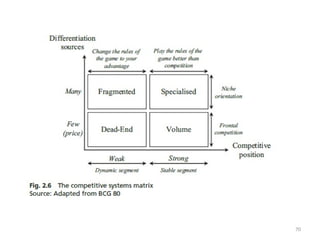
 Each matrix quadrant represents a particular type of environment, which,
according to the BCG, is defined as a competitive system. The basic idea of
the competitive systems matrix is that any segment or market can be
positioned in one of these four competitive systems.
69
The competitive systems matrix is organized with two axes:
 The first axis, solidity of competitive position, is split in two categories of
segments: in the first category, we can find strong segments, where
companies can build a solid competitive position.
 In the second category, we can find non-solid or weak segments, where it is
very difficult to build a solid competitive position.
 The distinction between stable and dynamic environments, proposed in
2011 by Christopher B. Bingham, Kathleen M. Eisenhardt and Nathan R.
Furr,5 echoes the solid (strong) and non-solid (weak) segment
categorization.
 Belonging to one or the other of these categories depends on how a solid
competitive position is defined and assessed.
70
71
Defining Strategic Positioning
 Defining a company’s strategic positioning as part of a consulting mission
usually means establishing its positioning with regard to the competition.
 This means defining its strengths and weaknesses compared to competitors
in the same strategic group, for each of its strategic segments in terms of
their value (or attractiveness).
 This process should provide the company with factual information as to the
intrinsic value of each of its strategic business units (SBUs) sometimes called
product/market domains—and suggest development choices relative to this
value.
 Understanding the company’s environment and thereby assessing its value is
key for building a company strategy.
 This external/internal approach to competitive advantage, embodied by
Michael E. Porter, was long- favored by strategy researchers and consultants;
however, its limitations are evident in highly competitive contexts where
numerous external influences are likely to weigh heavily on the company’s
adaptive capabilities.
72
 This view of strategy moves the company towards a strategic intent,
completing the value assessment of the competitive environment and
opening up a range of possible positioning's; it thus combines the
external/internal approach with an internal/external approach to
competitive advantage.
 In fact, evaluating the environment to identify strategic segments, (i.e.,
those likely to enhance the value of the company’s product portfolio), and
identifying its strategic groups, leads the company to choose from three
different strategic models of value creation: overall cost leadership,
differentiation and focus.
 These generic strategy models are built around notions of congruence,
alignment or fit between the company’s strategic choices and the resources,
structure and organizational processes that make these choices feasible.
73
Strategic Positioning: A Key Stage in Strategic Planning
 Formalization supposes that the strategic planning process is organized by
rules (methods) procedures (tools) and written records.
 Exhaustiveness implies that the company disposes of all the information
relative to its environment and that all aspects of its internal organization
are taken into account when formulating the strategy.
 Strategic control defines measurement criteria regarding the performance
expected from the chosen strategy; it also monitors the development and
effective deployment of that strategy.
74
75
76
The Value Chain and the Value Network
 Bringing to light the competences and resources upon which the company can
build a competitive advantage is based on the external diagnostic, described in
Chap. 2.
 This diagnostic of the company’s environment should show up key success
factors of market segments for the company’s future development by
highlighting the key factors specific to the strategic group to which the
company belongs.
 In a resource- centred approach, the company’s competitive advantage will
depend on its capacity to better master these key success factors than its
competitors by developing distinctive competences and resources.
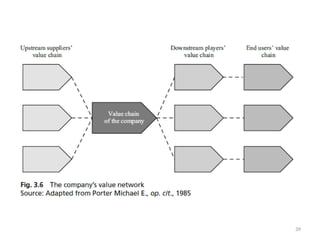
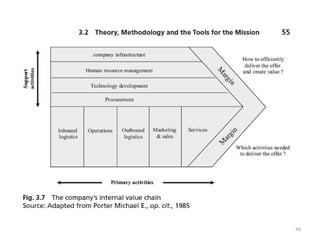
 It is important here to clearly identify the internal value chain (i.e., the
different categories of the company’s activities that finally result in creating a
product or service) and the external value chain—the value network (i.e., the
fabric of inter-company relationships needed to create that product or
service).
 Indeed, the key success factors of the segment’s value network require the
company to develop capabilities consistent with the actors both up and
downstream. Similarly, it is important for the company to organize its internal
activities so that it masters these key success factors as well as possible.
77
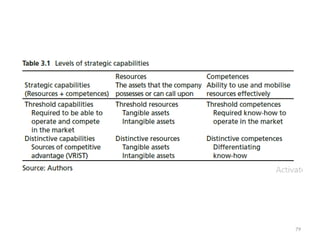
Strategic Capabilities
The analysis of strategic capabilities consists of, first, identifying the indispensable
competences and resources of any firm wishing to develop in one or several
market segments of its choice. In this process, the accent should be on the
company’s competences and resources that will allow it to engage in activities on
its specific value chain. As mentioned above, these strategic capabilities are
identified as being the competences and resources the company develops in order
to master the key success factors in its strategic segments. The company’s prior
positioning in its value network makes it possible to define the field of this
analysis, while highlighting the determinants of the competitive advantage the
company can generate within this network. Strategic capabilities are characterized
on two levels:
• “Threshold capabilities” that any company of the same strategic group must
possess to be able to enter the target market and exercise its activities.
• “Distinctive capabilities,” specific to the company; these allow it to develop a
more or less differentiating competitive advantage depending on their level of
VRIST (value creation, rarity, inimitability, substitutability and transferability;
78
Benchmarking
The evaluation of the soundness of the VRIST (value creation, rarity, inimitability,
substitutability and Transferability) level of the company’s strategic capabilities
must be undertaken in tandem with a comparative analysis of the strategic
capabilities of the company’s competitors.
 The quality of this benchmark depends on the competitor companies chosen
for analysis. There are two methodological approaches to benchmarking. The
first aims to compare companies within a same industry or market segment.
 The detractors of this approach argue that if the industry is not performing
well overall, the comparative analysis will not really show up good practices.
 However, we believe that even in ailing sectors there are many particularly
innovative companies that perform well.
79
80
Strategic Diagnostic
 The diagnostic of the company’s strategic positioning can now be carried out
on the basis of the analysis of a company’s external environment and the
internal analysis of the elements of its strategic posture.
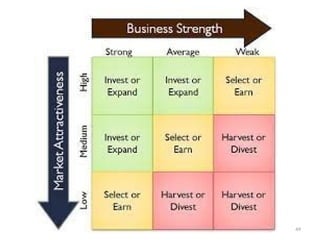
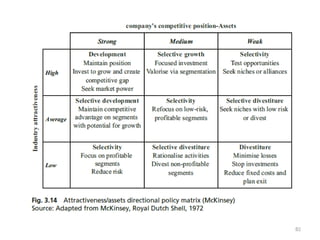
 Now we need to evaluate the attractiveness of the targeted strategic
segments through their specific characteristics and the company’s capability
to establish an advantageous competitive positioning of these segments by
mastering the corresponding key success factors.
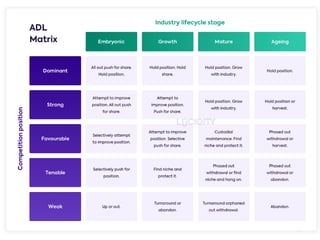
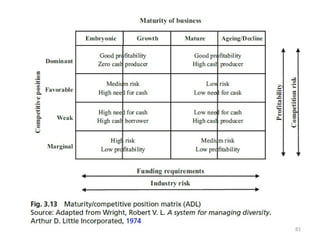
 There are many tools to establish this double positioning. Among the best
known is the ADL matrix (Arthur D. Little), which takes looks at the degree of
maturity of the company’s business units (beginning, growth, maturity,
decline), characterizing them by needs for financing and industry risks (the
influences of market forces).
 This means it is used less and less in missions of strategic consulting for
companies that are more inclined to seek go/no go type aids for decision-
making.
81
82
83
Assessing Strategic Options
 A strategic diagnostic makes it possible to define the company’s competitive
positioning on each strategic business unit and detail options for strategic
development related to this positioning.
 It is a key step in consulting because it constitutes the basis of decision-making
for future investments, the company’s organizational structure and its choices
for growth. At this stage, the consultant faces a double challenge.
 First, he/she has to formulate possible scenarios for each option and second,
the viability of each scenario must be assessed.
 Consultants neglect this double challenge all too often, considering that once
the strategic options have been defined, it is easy to formulate and implement
them as a natural extension of the preceding steps.
 However, even when the strategic choices make sense, implementing them
effectively is complicated because it often involves organizational alignment
towards the “ideal” strategic posture, developing new VRIST strategic
capabilities and undertaking a delicate planning exercise in a context of market
uncertainty and complexity.
84
Choosing a Growth Strategy
 Companies manage their growth daily, whether measured with the increase
in number of products sold or larger market share.
 Even though this quest for growth might seem like a kind of obsession, it is
also a source of anxiety.
 Indeed, growth cannot be taken for granted.
 To ensure growth a company must be able to develop a unique product (or
service) offer and then find a market for this (or conversely).
 For company top managers, not a day goes by without facing operational
and multifaceted issues related to managing the company’s offer and its
associated markets.
 This involves, for example, launching new products, organizing and training
the sales force, monitoring competitors’ products, adjusting sales prices,
promoting existing products, prospecting new clients or even opening up
new markets—and these often must be done simultaneously.
85
 However, when the company’s growth is analyzed over the long term, it is
clear that growth results from strategic choices.
 These choices may be deliberately taken by top managers who formalize the
details, steps and implementation process in the context of a strategic plan. On
the other hand, these choices may be “emerging” and decided on “along the
way,” in the light of arising opportunities.
 In this event, CEOs and top managers must seek to align strategic vision with
strategic action, constantly going back and forth between the two.
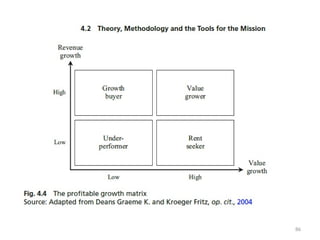
The Profitable Growth Test
For a long time, growth and performance as well as growth and profitability
were conflated. The idea of a virtuous circle whereby sales growth mechanically
induced profit growth was widespread across companies and consultants.
This idea came about through considering that growth had a leverage effect on
profit, occurring through size effect and economies of scale, which resulted from
the continuous increase in turnover.
However, observing the paradoxical situation of failing companies with strong
growth showed that the relationship between growth and profit was far from
being as mechanical as it first appeared.
Indeed, growth is not always profitable. In this situation, the company may find
itself trapped inside a vicious circle where sales growth is accompanied by profit
deterioration or even financial losses.
86
87
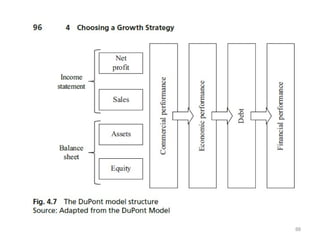
The Strategic Model for Profitability
As an extension to the profitable growth test (and if the
company has still decided to invest strongly in its business
growth), the consultant must ensure that these investments and
the resulting modification of the SBU portfolio will not be
detrimental to the company’s profitability.
In other words, investments for growth must lead to increased
profitability.
For this to happen, a necessary prerequisite is to understand
how the company “produces” its profitability and more
specifically, to highlight the company’s strategic leverages of
profitability.
A strategic model of the company’s profitability can be obtained
by aligning these strategic levers and integrating them into a
synthetic framework.
In this step, the consultant uses accounting and financial data to
respond to the following questions:
88
89
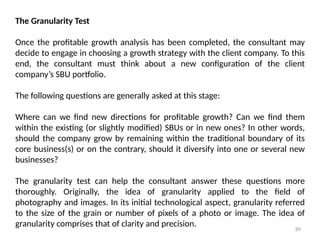
The Granularity Test
Once the profitable growth analysis has been completed, the consultant may
decide to engage in choosing a growth strategy with the client company. To this
end, the consultant must think about a new configuration of the client
company’s SBU portfolio.
The following questions are generally asked at this stage:
Where can we find new directions for profitable growth? Can we find them
within the existing (or slightly modified) SBUs or in new ones? In other words,
should the company grow by remaining within the traditional boundary of its
core business(s) or on the contrary, should it diversify into one or several new
businesses?
The granularity test can help the consultant answer these questions more
thoroughly. Originally, the idea of granularity applied to the field of
photography and images. In its initial technological aspect, granularity referred
to the size of the grain or number of pixels of a photo or image. The idea of
granularity comprises that of clarity and precision.
90
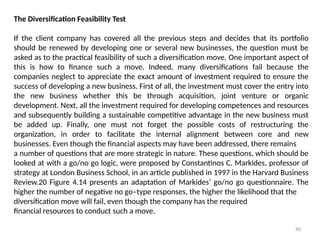
The Diversification Feasibility Test
If the client company has covered all the previous steps and decides that its portfolio
should be renewed by developing one or several new businesses, the question must be
asked as to the practical feasibility of such a diversification move. One important aspect of
this is how to finance such a move. Indeed, many diversifications fail because the
companies neglect to appreciate the exact amount of investment required to ensure the
success of developing a new business. First of all, the investment must cover the entry into
the new business whether this be through acquisition, joint venture or organic
development. Next, all the investment required for developing competences and resources
and subsequently building a sustainable competitive advantage in the new business must
be added up. Finally, one must not forget the possible costs of restructuring the
organization, in order to facilitate the internal alignment between core and new
businesses. Even though the financial aspects may have been addressed, there remains
a number of questions that are more strategic in nature. These questions, which should be
looked at with a go/no go logic, were proposed by Constantinos C. Markides, professor of
strategy at London Business School, in an article published in 1997 in the Harvard Business
Review.20 Figure 4.14 presents an adaptation of Markides’ go/no go questionnaire. The
higher the number of negative no go–type responses, the higher the likelihood that the
diversification move will fail, even though the company has the required
financial resources to conduct such a move.
91
(Re)Designing the Business Model
Business Model: What Exactly Does This Mean?
 If ever there were a contest for the greatest management buzzwords in recent
years, the concept of business model would come somewhere near the top.
 However, few of those who use the term are comfortable when they try to
give concrete expression to the different notions and dimensions it covers.
 This is a shame, because a good business model is essential for any company
wishing to expand, whether it is starting up or already well established.
 The term business model has flourished in the literature of management and
strategy since the 1990s, mainly with the advent of the Internet and e-
business.
 These new media obliged companies to question the way they proposed their
offers and gave rise to numerous opportunities for accessing new customers.
 From this viewpoint, as Magretta says, a business model is the story that
explains how a company works and responds to the three main questions:
Who are my clients?
What do they value?
How can we generate revenue by offering what they expect at an appropriate
cost for the company?
92
93
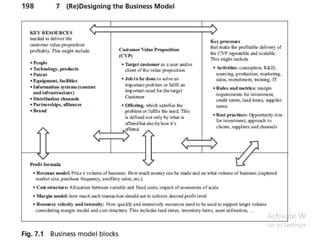
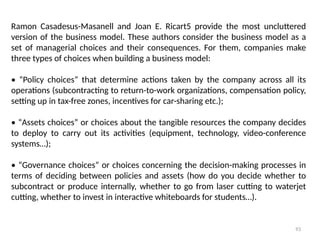
Ramon Casadesus-Masanell and Joan E. Ricart5 provide the most uncluttered
version of the business model. These authors consider the business model as a
set of managerial choices and their consequences. For them, companies make
three types of choices when building a business model:
• “Policy choices” that determine actions taken by the company across all its
operations (subcontracting to return-to-work organizations, compensation policy,
setting up in tax-free zones, incentives for car-sharing etc.);
• “Assets choices” or choices about the tangible resources the company decides
to deploy to carry out its activities (equipment, technology, video-conference
systems…);
• “Governance choices” or choices concerning the decision-making processes in
terms of deciding between policies and assets (how do you decide whether to
subcontract or produce internally, whether to go from laser cutting to waterjet
cutting, whether to invest in interactive whiteboards for students…).

Introduction to contemporary Business Models

  • 1.
    1 IENT -3031 CONTEMPORARYBUSINESS MODELS BBA-VI SEMESTER BATCH 2021-24 UNIT # 1 PROF RAMPRASAD M V
  • 2.
    2 CONTENTS- UNIT #1 Environment Assessment Elasticity test Strategic Segmentation Success Factors Competitive Systems Strategic Positioning Value chain & Value network Capabilities Benchmarking Generic Models of competitive strategy Strategic Options Choosing growth Feasibility test Granularity test
  • 3.
    3 INTRODUCTION CONTEMPORARY BUSINESS MODEL CONTEMPORARY Whateverthat is current / relevant today BUSINESS MODEL • Malleable thought structures or processes adapted to achieve goals • Describes HOW an ORGANIZATION Capture- Create- Deliver VALUE in ECONOMIC SOCIAL CULTURAL OTHER CONTEXT EXAMPLES SUBSCRIPTION-BUNDLING-LEASING-FREEMIUM-FRANCHISE-FEE FOR SERVE- SHARING SERVICES- CO CREATION- VALUE DELIVERY NETWORK-BLUE OCEAN
  • 4.
  • 5.
    5 ICA- INTERNAL CONTINUOUSASSESSMENT 1.Midterm Exam 15 marks 2. Class participation 5 marks 3. Project Idea – presentation 10marks 4. Book Review- 5 5. Quiz 10 marks 6. Case Study 25 marks TOATAL Internals – 70 marks FINAL- END TERM 30 marks T O T A L 100 marks WHY STUDY THIS COURSE? Entrepreneurs Business management students Aspirant consultants CO CREATION- VALUE DELIVERY NETWORK-BLUE OCEAN
  • 6.
    6 ENVIRONMENT ASSESSMENT ORASSESSMENT OF ENVIRONMENT ONE OF CRITICAL MISSION OF CONSULTANCY MORE SO IMPACT OF THIS IS CRUCIAL TO THE FIRM USING CONSULTANCY SERVICES Environment is slightly different here Players individually & collectively impacting the firm Ecosystem First circle Second & Third Outer ring can move into First circle First Circle has Suppliers Service Providers Clients Competitors
  • 7.
    7 ASSESSMENT OF ENVIRONMENT ONEOF CRITICAL MISSION OF CONSULTANCY MORE SO IMPACT OF THIS IS CRUCIAL TO THE FIRM USING CONSULTANCY SERVICES Environment is slightly different here Players individually & collectively impacting the firm Ecosystem First circle Second & Third Outer ring can move into First circle First Circle has Suppliers Service Providers Clients Competitors
  • 8.
    8 What do youdo with the ENVIRONMENT when you say assessment? Not History Not evolution Not about owners How will it impact my strategy? Close ------ Distant Favourable----- Not Immediate------not Profitable----- not They exert Pressure on your firm 5 mission Clarify Identify Geo/Client/Business Blue Ocean Divestment
  • 9.
  • 10.
    10 MISSION 1-Clarify toCEO & TOP Managers (Boundaries & Challenges • Internal Analysis (SW) • Link those Opportunities & Challenges • Set of Questions for this: Which characteristics and opportunities of the market could be exploited by my company? Which market segments allow me (or could allow me) to get the most value from the company’s current competences and resources and create a solid competitive advantage?
  • 11.
    11 MISSION 2-Identify theKEY PARTICIPANTS from the environment • Who is my direct competitor • Their policies in general • Set of Questions for this: • What is the strategy of my direct competitors? What are their respective practices and behaviors in the market? Which positioning should my company adopt to maintain or create competitive advantage?
  • 12.
  • 13.
    13 MISSION 3-Identify theKEY PARTICIPANTS from the environment • Geographic Expansion • My clients • New Business • Set of Questions : • Which markets would be receptive to my company’s current offer? Do these target markets possess many and high entry barriers or do they operate in an open and integrative format such as a platform environment? How should my company adapt its offer in this respect? Which new markets will allow my company to deploy my company’s competences and resources and develop a new offer?
  • 14.
  • 15.
    How do youStart? Customer Pain point
  • 16.
  • 17.
  • 18.
    18 MISSION 4- BLUEOCEAN • UNCONTESTED MARKET • RED VS BLUE OCEAN • INNOVATION • Set of Questions : Are there competitive spaces that are favorable and unexploited within my environment? If so, how should my company proceed to make them emerge and benefit from a first mover advantage? Should my company invest in innovations that will rejuvenate and renew the lifecycle of certain markets and segments in my environment? Or should my company re-segment its market and seek to highlight new or unexploited competitive spaces?
  • 19.
  • 20.
    20 MISSION 5- DIVEST •Geographic Expansion • My clients • New Business • Set of Questions : • What are my SBU’s that are eating other profits • What are the prospects of success for these
  • 21.
  • 22.
  • 23.
    23 S-C-P STRUCTURE Market Structure CONDUCTYour strategy PERFORMANCE outcome
  • 24.
    24 STRUCTURE Market Structure –M/D/O/M/P Height & # entry barriers Degree of competitive concentration Market growth rate CAUSAL Behavior of the firm to the structure above Strategic response R&D, Man-power, Price, Innovation, M&A, Collaboration PERFORMANCE Results from strategic choices in CONDUCT Outcome of choice – chosen strategy
  • 25.
  • 26.
  • 27.
  • 28.
  • 29.
    29 Value Performance Elasticity Strongwhen PIMS is high Pharma- Key drivers Positive V-P elasticity Health consciousness Covid Spreading of diseases Complications Paper & Pulp Negative V-P elasticity Online books Notes, Email, transactions Exams, Ease of update Storage Make/break Market Growth rate- Importance
  • 30.
    30 Strategic Segmentation Mapping outthe company’s market Structural presentation of the market Consultant and Clients CEO to discuss Market shall be heterogenous (Not like KEB/BWSSB) Heterogeneity triggers segmentation Products- Look beyond features Into Functions ( Car/Taxi/Retail outlet/Esteem/Transport) Clients- Divide into observable characters Demo/Geo/Psy/etc Technology- Alternative way to solve a customer need
  • 31.
  • 32.
  • 33.
    33 KEY SUCCESS FACTORS Mappingout the company’s market Structural presentation of the market Consultant and Clients CEO to discuss Market shall be heterogenous (Not like KEB/BWSSB) Heterogeneity triggers segmentation Price Product Range Crisis Compatible Time save Snobbish Value Nearness Availability
  • 34.
  • 35.
    35 Discount retail Generic med Massmkt prod MARKET SHARE Luxury Segment Cosmetics Perfume, Jewels, Leather bag UNIT MARGIN Fashion, Garment Restaurant AGILITY TO CHANGE Landline Paper Pulp LAGGARDS
  • 36.
  • 37.
  • 38.
  • 39.
  • 40.
  • 41.
    41 STRATEGIC POSITIONING Evaluated Strategicsegments Evaluated Strategic Groups Using these two above, Choosing any one from three different STRATEGIC MODELS OF VALUE CREATION: 1. Overall Cost Leadership 2. Differentiation 3. Focus • Focused cost leadership • Focused differentiation
  • 42.
    42 STRATEGIC POSITIONING- itis an adopter fit EXTERNAL FIT- from macro environment PESTEL Strategy- Plug to adopter Strategy- Adopter to Internal capabilities INTERNAL FIT- from internal analysis This notion Is Central To STRATEGIC POSITIONING
  • 43.
    43 STRATEGIC POSITIONING- InternalAnalysis Resource based capabilities Employees/Eqpt Capital Process Patents Reputation Knowledge based capabilities Implicit Tacit FIVE CONDITIONS OF RESOURCE GENERATION- Resulting in CA 1. Value- client to see higher value-profit-sales etc 2. Rare- very few comp has- toyota 3. Imitable- difficult to replicate 4. Organize Acronym VRIO framework
  • 44.
    44 STRATEGIC CAPABILITIES Identify indispensablecompetencies Identify resources Human Financial Physical Technical Knowledge Accent should be on competencies & resources These are developed to master KSF of segments STRATEGIC CAPABILITIES CHARACTERISED ON TWO LEVELS Threshold Capabilities- LCD of Strategic Group Distinctive Capabilities-VRIO / VRIST
  • 45.
    45 BENCHMARKING Comparative analysis ofStrategic Capability taken in TANDEM with competitive analysis TWO Methodological approaches Compare within the same industry Compare with best in any class- ideal Generic Model of Competitive Strategy Porter’s generic model
  • 46.
  • 47.
  • 48.
  • 49.
  • 50.
  • 51.
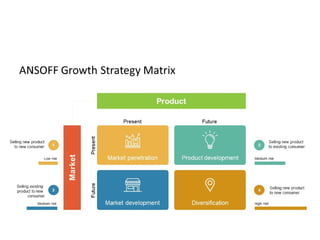
    51 case.docx TESTS OF GROWTH TESTSOF GRANULARITY TESTS OF DIVERSIFICATION
  • 52.
    52 Introduction to contemporaryBusiness Models Whether you are a business leader, internal business partner or external consultant, there are six key strategy missions that you will need to undertake as you deal with the re-positioning and growth issues that all businesses face at one stage or another during their life-cycle: Assessing the environment Defining a strategic positioning Choosing a growth strategy Expanding internationally Combining strategy, and Innovation or (re)designing the business model Meschi and Chereau bridge the gaps between Academic Theory and Real-world practice, between Strategic Analysis and Strategic Management, and between Planning and Doing, by providing you with six essential mission briefings to help you deliver the best possible outcome. Each briefing is structured the same way, beginning with an outline of the consulting mission and its content before examining the theoretical background, before setting out a complete and practical methodology to complete the mission along with all the tools you will need along the way.
  • 53.
    53 The Consulting Mission TheENVIRONMENT is a generic term in STRATEGY. It does not have today’s somewhat environmental meaning. In its strategic understanding, the environment refers to an ecosystem where a set of distinct players interact individually and collectively with the company. Thus, all companies operating in a specific industry are embedded within the associated ecosystem. The players in the ecosystem have various levels of interaction with the company. A first circle of players interacts with it intensely and regularly. This immediate environment is made up of the company’s clients, suppliers, service providers and competitors. These players each have their own immediate environment, also made up of their clients, suppliers and service providers. These second- or third-tier players are distant from the company and its immediate environment, even though they are connected to it indirectly. They can also join the company’s first circle as new entrants if they manage to overcome the entry barriers.
  • 54.
    54 This assessment ofthe environment is one of the most classic missions for a consulting firm. However, the consultant should not lose sight of the fact that the conclusions of this mission are crucial for the client company. Indeed, the environment’s value and attractiveness directly impact the company’s growth and profitability. Many different consulting missions relate to assessing the environment. Evaluating the value of the company’s environment may be the main reason for initiating a consulting mission, but today this is rather rare; it is more often the first step in a broader mission whose objective is to help the company CEO to formalize, validate and make a strategic choice. A first series of consulting missions consists of helping CEOs and top managers clarify the boundaries and challenges of their company’s current or future environment. This involves updating their data and formalizing their observations and intuitions related to assessing the value of the company’s environment. These missions are often linked to an internal analysis of the company’s competences and resources (human, technological, financial…). For the company seeking to achieve strategic fit, this internal analysis has to be aligned with the external analysis of the environment’s opportunities and threats.
  • 55.
    55 On this basis,the consultant can check whether the client company is able to respond to the environment’s opportunities and threats and thus build a solid competitive advantage. In other words, such consulting missions mean answering the following key questions of CEOs and top managers: Which characteristics and opportunities of the market could be exploited by my company? Which market segments allow me (or could allow me) to get the most value from the company’s current competences and resources and create a solid competitive advantage? A second series of missions seeks (i) to identify and evaluate the key players of an environment (in terms of threat, competences and resources, profitability and value capture), (ii) to monitor the behavior and strategy of these key players, and (iii) to suggest strategic responses and scenarios, including direct competition or collaboration with these players. Here, the key questions asked by CEOs and top managers are:
  • 56.
    56 What is thestrategy of my direct competitors? What are their respective practices and behaviors in the market? Which positioning should my company adopt to maintain or create competitive advantage? A third series of missions occurs when the company intends to grow into new geographical markets, new client segments and/or new businesses. The assessment of the associated environment is necessary before any decision to expand is made. This assessment is unavoidable and is a prerequisite to international expansion, product/service range extension to new client segments, or diversification. By determining the value of a new geographical market, client segment or business, the company can formalize and refine its growth strategy. The conclusions of this type of mission are often useful in helping CEOs to convince their boards, main shareholders and the company’s employees of the pertinence of initiating a growth strategy. Here, the key questions are:
  • 57.
    57 Which markets wouldbe receptive to my company’s current offer? Do these target markets possess many and high entry barriers or do they operate in an open and integrative format such as a platform environment? How should my company adapt its offer in this respect? Which new markets will allow my company to deploy my company’s competences and resources and develop a new offer? Consistent with the company’s intention to grow, a fourth series of missions seeks to analyze the environment to detect new markets and client segments and facilitate their emergence. Here, analyzing the environment serves to identify new competitive spaces, or “blue oceans” as defined by W. Chan Kim and Renée Mauborgne. In this case, consultants need to adopt a “reconstructionist approach” whose objective is to “help companies systematically reconstruct their industries and reverse the [environment] structure-strategy sequence in their favor”2 (p. 74). Building on a scenario- based or future anticipation approach, consultants help CEOs and top managers to define the boundaries of these new high potential markets and segments. To this end, they must also formalize the strategic actions required to give form and reality to these new competitive spaces. Here, the key questions are:
  • 58.
    58 Are there competitivespaces that are favorable and unexploited within my environment? If so, how should my company proceed to make them emerge and benefit from a first mover advantage? Should my company invest in innovations that will rejuvenate and renew the lifecycle of certain markets and segments in my environment? Or should my company re-segment its market and seek to highlight new or unexploited competitive spaces? A fifth and final series of missions relates to business refocusing and divestment decisions. For a diversified company, regular assessment of the environment (of each geographical market, product/client segment and business) allows a review of the company’s different (products, activities, competences, alliances…) portfolios and to restructure them if needed. The evaluation of the relative value and attractiveness of these different environments is one of the steps within the process that can lead a CEO to sell off a business, divest a foreign subsidiary or stop producing and selling a product range.
  • 59.
    59 What is elasticityand elasticity in economics? In the most basic sense, elasticity is a measure of a variable's sensitivity to a change in another variable. Most commonly, elasticity refers to an economic gauge that measures the change in the quantity demanded for a good or service in relation to price movements of that good or service. The Value/Performance Elasticity Test The first step in the strategic analysis consists of defining the strategic nature of the environment. This may be done by examining the strength of the relationship between the value and attractiveness of a market and the performance of companies operating in this market (otherwise known as value/performance elasticity). An environment will be highly strategic if this relationship is strong. In this event, the influence of the environment’s characteristics on company performance is determinant and we find ourselves in a perspective which is fully consistent with the PIMS principles. In other words, here, the environment turns out to be strategic for the company due to the presence of environment-performance causality
  • 60.
    60 On the otherhand, an environment loses its strategic nature if its value/performance elasticity is weak. This type of environment configuration is found in industries and segments where, despite their weak (strong) value, certain companies prosper (decline). Nevertheless, in such an event, the client company may maintain the mission of assessing its environment. However, for the consultant, this mission will mean shifting from an SCP (or structuralist approach) paradigm to a reconstructionist approach to the environment. In the event of a weak value environment, the mission will then aim to seek one or several niches within an unfavorable environment. In the event of a strong value environment, the consulting objective will be to concentrate on highlighting the reasons for the company’s under-performance and the misalignment between the company’s competences and resources and the environment’s characteristics.
  • 61.
    61 Best Consulting Practicesin Brief The initial step of value/performance elasticity may be viewed as a “make or break” test for the consultant. Indeed, the elasticity test is not only the first step in the strategic analysis process, it also examines the pertinence of taking this process further or not. If the elasticity is strong, the question is not relevant: the whole strategic analysis process must be rolled out. On the other hand, if the elasticity is weak, the question of whether to continue the mission has to be discussed with the client company. This test can easily be carried out during the negotiation and framing phase of the consulting mission and the client company should be warned of these preliminary results. On this basis, the client company will be able to make an informed decision about whether to take the analysis further. This first step, known as the value/performance elasticity test (or PIMS test), is generally carried out using a simple direct measure of a company’s environment and performance. As regards the assessment of environment
  • 62.
    62 value, an immediatelyapplicable and easily accessible measure is market growth rate. This is an essential measure of value as it occupies a central position in both Scherer’s SCP, Porter’s competitive forces and PIMS models. Some strategy tools have also used market growth rate to measure the value of an environment. This is notably the case of the Boston Consulting Group’s matrix, which assesses the value and competitive position of the company’s strategic business units. As regards the assessment of the company’s performance, using the ROI ratio (profit-to-assets ratio) presents the advantage of being consistent with the PIMS model and avoids the inconclusive debate on selecting an appropriate measure for performance.
  • 63.
    63 Strategic Segmentation  Withstrategic segmentation, the consultant steps right into the process of the strategic analysis of the environment.  This second step in the strategic analysis consists of mapping out the company’s market. Strategic segmentation only concerns one aspect of the company’s environment: its market.  A company’s market can be seen as a competitive space that is often not uniform and whose boundaries are more or less blurred. An initial approach to strategic segmentation should result in a structured presentation of a market, its boundaries and associated market sub-sets.  It is a description seeking to identify the company’s critical market, i.e., one or several market sub-sets in which the company operates. Indeed, it is rare for a company and its product portfolio to occupy the whole of a competitive space or achieve equivalent performance over all of the market sub-sets.
  • 64.
    64  This firstapproach to strategic segmentation therefore tries to organize a market into homogenous sub-sets and restrict the company’s competitive space to some of these.  In a second, less descriptive approach, segmentation becomes more strategic by offering the company’s CEO and top managers a map of the positions and moves that the company could adopt within the different sub- sets in its market.  By taking this dynamic approach to segmentation, the market sub-sets appear as both spaces of growth and opportunities for the company to expand businesses sharing similar expenses and resources.  From this view, segmentation lies at the intersection between the environment assessment and strategic decision making. This implies that segmentation should not be undertaken by the consultant alone or by the consultant interacting with various departments (especially marketing).  In all its phases, segmentation must result from discussions and interactions involving the consultant and the client company’s CEO and top managers.
  • 65.
    65  In thefirst phase, the consultant must ask about the pertinence of embarking onto segmenting the company’s market. He/she must know whether the market in question is heterogeneous or not.  The assessment of the level of market heterogeneity will trigger (or not) the segmentation process.  At this level and based on the method proposed by Derek F. Abell (professor of strategy at IMD Lausanne) in Managing with Dual Strategies (published in 1993), three criteria are usually mobilized to define the level of market heterogeneity
  • 66.
    66 Key Success Factors The third step in the strategic analysis process consists of identifying the key success factors of each segment.  Key success factors correspond to the specific purchasing criteria used by clients in each segment.  In other words, key success factors are the criteria that spur clients to acquire the products or services that companies sell in a market or a segment. For example, key success factors may include criteria such as price, intrinsic product quality, product range, level of customization, associated services and/or brand image.  Key success factors are always defined with regard to the market or segment to which they belong. They are unique to a segment. Even if key success factors are intrinsically related to products and services sold in a segment, they have nevertheless to be distinguished from the customer function of these products and the benefits or value that clients obtain from consuming them.
  • 67.
    67  Indeed, thecustomer and value functions of a product are defined with regard to the satisfaction of one or several specific client needs; however, key success factors refer to the conditions (price, quality, range…) in which the customer and value functions are fulfilled and made available to clients.  Key success factors have a direct consequence on the ability of companies in this segment to build a solid competitive advantage. Competition within a segment is organized and competitive pressures are exerted around these key success factors.  The company’s ability to “control” key success factors, i.e., to identify and respond to them effectively, will help it build a solid competitive advantage. An effective response to key success factors means that the company has to develop and deploy internally the capabilities and resources that allow it to position itself as the best offer on one or several purchasing criteria.
  • 68.
    68 Competitive Systems  Thecompetitive systems step goes beyond describing segments based on their specific combination of key success factors.  This step complements the previous key success factors step by going further in the environment value assessment and recommending which strategy should be conducted in each segment.  This is where the main benefit of the competitive systems analysis lies: determining the rules of the game in the different types of environment in which a company might operate.  The competitive systems were initially developed by the Boston Consulting Group in 1980, which explains why it is also known as BCG 80. They take the form of a four quadrant matrix, which is easily accessible and whose implications for the strategic analysis are relevant and straightforward for companies to implement; this is why it has been so successful.  Each matrix quadrant represents a particular type of environment, which, according to the BCG, is defined as a competitive system. The basic idea of the competitive systems matrix is that any segment or market can be positioned in one of these four competitive systems.
  • 69.
    69 The competitive systemsmatrix is organized with two axes:  The first axis, solidity of competitive position, is split in two categories of segments: in the first category, we can find strong segments, where companies can build a solid competitive position.  In the second category, we can find non-solid or weak segments, where it is very difficult to build a solid competitive position.  The distinction between stable and dynamic environments, proposed in 2011 by Christopher B. Bingham, Kathleen M. Eisenhardt and Nathan R. Furr,5 echoes the solid (strong) and non-solid (weak) segment categorization.  Belonging to one or the other of these categories depends on how a solid competitive position is defined and assessed.
  • 70.
  • 71.
    71 Defining Strategic Positioning Defining a company’s strategic positioning as part of a consulting mission usually means establishing its positioning with regard to the competition.  This means defining its strengths and weaknesses compared to competitors in the same strategic group, for each of its strategic segments in terms of their value (or attractiveness).  This process should provide the company with factual information as to the intrinsic value of each of its strategic business units (SBUs) sometimes called product/market domains—and suggest development choices relative to this value.  Understanding the company’s environment and thereby assessing its value is key for building a company strategy.  This external/internal approach to competitive advantage, embodied by Michael E. Porter, was long- favored by strategy researchers and consultants; however, its limitations are evident in highly competitive contexts where numerous external influences are likely to weigh heavily on the company’s adaptive capabilities.
  • 72.
    72  This viewof strategy moves the company towards a strategic intent, completing the value assessment of the competitive environment and opening up a range of possible positioning's; it thus combines the external/internal approach with an internal/external approach to competitive advantage.  In fact, evaluating the environment to identify strategic segments, (i.e., those likely to enhance the value of the company’s product portfolio), and identifying its strategic groups, leads the company to choose from three different strategic models of value creation: overall cost leadership, differentiation and focus.  These generic strategy models are built around notions of congruence, alignment or fit between the company’s strategic choices and the resources, structure and organizational processes that make these choices feasible.
  • 73.
    73 Strategic Positioning: AKey Stage in Strategic Planning  Formalization supposes that the strategic planning process is organized by rules (methods) procedures (tools) and written records.  Exhaustiveness implies that the company disposes of all the information relative to its environment and that all aspects of its internal organization are taken into account when formulating the strategy.  Strategic control defines measurement criteria regarding the performance expected from the chosen strategy; it also monitors the development and effective deployment of that strategy.
  • 74.
  • 75.
  • 76.
    76 The Value Chainand the Value Network  Bringing to light the competences and resources upon which the company can build a competitive advantage is based on the external diagnostic, described in Chap. 2.  This diagnostic of the company’s environment should show up key success factors of market segments for the company’s future development by highlighting the key factors specific to the strategic group to which the company belongs.  In a resource- centred approach, the company’s competitive advantage will depend on its capacity to better master these key success factors than its competitors by developing distinctive competences and resources.  It is important here to clearly identify the internal value chain (i.e., the different categories of the company’s activities that finally result in creating a product or service) and the external value chain—the value network (i.e., the fabric of inter-company relationships needed to create that product or service).  Indeed, the key success factors of the segment’s value network require the company to develop capabilities consistent with the actors both up and downstream. Similarly, it is important for the company to organize its internal activities so that it masters these key success factors as well as possible.
  • 77.
    77 Strategic Capabilities The analysisof strategic capabilities consists of, first, identifying the indispensable competences and resources of any firm wishing to develop in one or several market segments of its choice. In this process, the accent should be on the company’s competences and resources that will allow it to engage in activities on its specific value chain. As mentioned above, these strategic capabilities are identified as being the competences and resources the company develops in order to master the key success factors in its strategic segments. The company’s prior positioning in its value network makes it possible to define the field of this analysis, while highlighting the determinants of the competitive advantage the company can generate within this network. Strategic capabilities are characterized on two levels: • “Threshold capabilities” that any company of the same strategic group must possess to be able to enter the target market and exercise its activities. • “Distinctive capabilities,” specific to the company; these allow it to develop a more or less differentiating competitive advantage depending on their level of VRIST (value creation, rarity, inimitability, substitutability and transferability;
  • 78.
    78 Benchmarking The evaluation ofthe soundness of the VRIST (value creation, rarity, inimitability, substitutability and Transferability) level of the company’s strategic capabilities must be undertaken in tandem with a comparative analysis of the strategic capabilities of the company’s competitors.  The quality of this benchmark depends on the competitor companies chosen for analysis. There are two methodological approaches to benchmarking. The first aims to compare companies within a same industry or market segment.  The detractors of this approach argue that if the industry is not performing well overall, the comparative analysis will not really show up good practices.  However, we believe that even in ailing sectors there are many particularly innovative companies that perform well.
  • 79.
  • 80.
    80 Strategic Diagnostic  Thediagnostic of the company’s strategic positioning can now be carried out on the basis of the analysis of a company’s external environment and the internal analysis of the elements of its strategic posture.  Now we need to evaluate the attractiveness of the targeted strategic segments through their specific characteristics and the company’s capability to establish an advantageous competitive positioning of these segments by mastering the corresponding key success factors.  There are many tools to establish this double positioning. Among the best known is the ADL matrix (Arthur D. Little), which takes looks at the degree of maturity of the company’s business units (beginning, growth, maturity, decline), characterizing them by needs for financing and industry risks (the influences of market forces).  This means it is used less and less in missions of strategic consulting for companies that are more inclined to seek go/no go type aids for decision- making.
  • 81.
  • 82.
  • 83.
    83 Assessing Strategic Options A strategic diagnostic makes it possible to define the company’s competitive positioning on each strategic business unit and detail options for strategic development related to this positioning.  It is a key step in consulting because it constitutes the basis of decision-making for future investments, the company’s organizational structure and its choices for growth. At this stage, the consultant faces a double challenge.  First, he/she has to formulate possible scenarios for each option and second, the viability of each scenario must be assessed.  Consultants neglect this double challenge all too often, considering that once the strategic options have been defined, it is easy to formulate and implement them as a natural extension of the preceding steps.  However, even when the strategic choices make sense, implementing them effectively is complicated because it often involves organizational alignment towards the “ideal” strategic posture, developing new VRIST strategic capabilities and undertaking a delicate planning exercise in a context of market uncertainty and complexity.
  • 84.
    84 Choosing a GrowthStrategy  Companies manage their growth daily, whether measured with the increase in number of products sold or larger market share.  Even though this quest for growth might seem like a kind of obsession, it is also a source of anxiety.  Indeed, growth cannot be taken for granted.  To ensure growth a company must be able to develop a unique product (or service) offer and then find a market for this (or conversely).  For company top managers, not a day goes by without facing operational and multifaceted issues related to managing the company’s offer and its associated markets.  This involves, for example, launching new products, organizing and training the sales force, monitoring competitors’ products, adjusting sales prices, promoting existing products, prospecting new clients or even opening up new markets—and these often must be done simultaneously.
  • 85.
    85  However, whenthe company’s growth is analyzed over the long term, it is clear that growth results from strategic choices.  These choices may be deliberately taken by top managers who formalize the details, steps and implementation process in the context of a strategic plan. On the other hand, these choices may be “emerging” and decided on “along the way,” in the light of arising opportunities.  In this event, CEOs and top managers must seek to align strategic vision with strategic action, constantly going back and forth between the two. The Profitable Growth Test For a long time, growth and performance as well as growth and profitability were conflated. The idea of a virtuous circle whereby sales growth mechanically induced profit growth was widespread across companies and consultants. This idea came about through considering that growth had a leverage effect on profit, occurring through size effect and economies of scale, which resulted from the continuous increase in turnover. However, observing the paradoxical situation of failing companies with strong growth showed that the relationship between growth and profit was far from being as mechanical as it first appeared. Indeed, growth is not always profitable. In this situation, the company may find itself trapped inside a vicious circle where sales growth is accompanied by profit deterioration or even financial losses.
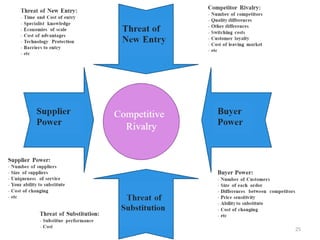
  • 86.
  • 87.
    87 The Strategic Modelfor Profitability As an extension to the profitable growth test (and if the company has still decided to invest strongly in its business growth), the consultant must ensure that these investments and the resulting modification of the SBU portfolio will not be detrimental to the company’s profitability. In other words, investments for growth must lead to increased profitability. For this to happen, a necessary prerequisite is to understand how the company “produces” its profitability and more specifically, to highlight the company’s strategic leverages of profitability. A strategic model of the company’s profitability can be obtained by aligning these strategic levers and integrating them into a synthetic framework. In this step, the consultant uses accounting and financial data to respond to the following questions:
  • 88.
  • 89.
    89 The Granularity Test Oncethe profitable growth analysis has been completed, the consultant may decide to engage in choosing a growth strategy with the client company. To this end, the consultant must think about a new configuration of the client company’s SBU portfolio. The following questions are generally asked at this stage: Where can we find new directions for profitable growth? Can we find them within the existing (or slightly modified) SBUs or in new ones? In other words, should the company grow by remaining within the traditional boundary of its core business(s) or on the contrary, should it diversify into one or several new businesses? The granularity test can help the consultant answer these questions more thoroughly. Originally, the idea of granularity applied to the field of photography and images. In its initial technological aspect, granularity referred to the size of the grain or number of pixels of a photo or image. The idea of granularity comprises that of clarity and precision.
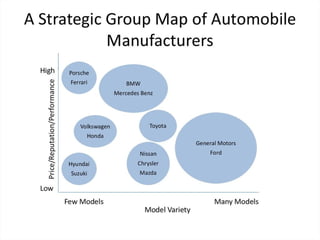
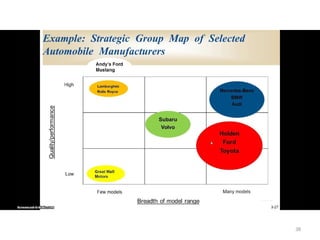
  • 90.
    90 The Diversification FeasibilityTest If the client company has covered all the previous steps and decides that its portfolio should be renewed by developing one or several new businesses, the question must be asked as to the practical feasibility of such a diversification move. One important aspect of this is how to finance such a move. Indeed, many diversifications fail because the companies neglect to appreciate the exact amount of investment required to ensure the success of developing a new business. First of all, the investment must cover the entry into the new business whether this be through acquisition, joint venture or organic development. Next, all the investment required for developing competences and resources and subsequently building a sustainable competitive advantage in the new business must be added up. Finally, one must not forget the possible costs of restructuring the organization, in order to facilitate the internal alignment between core and new businesses. Even though the financial aspects may have been addressed, there remains a number of questions that are more strategic in nature. These questions, which should be looked at with a go/no go logic, were proposed by Constantinos C. Markides, professor of strategy at London Business School, in an article published in 1997 in the Harvard Business Review.20 Figure 4.14 presents an adaptation of Markides’ go/no go questionnaire. The higher the number of negative no go–type responses, the higher the likelihood that the diversification move will fail, even though the company has the required financial resources to conduct such a move.
  • 91.
    91 (Re)Designing the BusinessModel Business Model: What Exactly Does This Mean?  If ever there were a contest for the greatest management buzzwords in recent years, the concept of business model would come somewhere near the top.  However, few of those who use the term are comfortable when they try to give concrete expression to the different notions and dimensions it covers.  This is a shame, because a good business model is essential for any company wishing to expand, whether it is starting up or already well established.  The term business model has flourished in the literature of management and strategy since the 1990s, mainly with the advent of the Internet and e- business.  These new media obliged companies to question the way they proposed their offers and gave rise to numerous opportunities for accessing new customers.  From this viewpoint, as Magretta says, a business model is the story that explains how a company works and responds to the three main questions: Who are my clients? What do they value? How can we generate revenue by offering what they expect at an appropriate cost for the company?
  • 92.
  • 93.
    93 Ramon Casadesus-Masanell andJoan E. Ricart5 provide the most uncluttered version of the business model. These authors consider the business model as a set of managerial choices and their consequences. For them, companies make three types of choices when building a business model: • “Policy choices” that determine actions taken by the company across all its operations (subcontracting to return-to-work organizations, compensation policy, setting up in tax-free zones, incentives for car-sharing etc.); • “Assets choices” or choices about the tangible resources the company decides to deploy to carry out its activities (equipment, technology, video-conference systems…); • “Governance choices” or choices concerning the decision-making processes in terms of deciding between policies and assets (how do you decide whether to subcontract or produce internally, whether to go from laser cutting to waterjet cutting, whether to invest in interactive whiteboards for students…).