1
Child Protection Training
2
PROGRAMME
 Introduction to the Policy
 Awareness of Abuse
 Dealing with disclosure
 Code of conduct for staff
3
The Summer Madness Directors have a number of
responsibilities in respect of Child Protection
including:
 Ensuring a Child Protection Panel is appointed
 Insurance
 Safety of buildings being used
 Encouraging and supporting training
 Contractual responsibilities for all who have access to
children and young people
4
The panel’s responsibilities include:
 approving persons willing to serve as Summer Madness
staff
 advising staff on their responsibilities in respect of the
Code
 advising the Management Group in respect of its
responsibilities
 being an immediate contact point for staff when a
suspicion or allegation of child abuse is made
CHILD PROTECTION PANEL
5
THE PURPOSE OF THE CODE
OF GOOD PRACTICE
Our Child Protection Policy is designed:
 to promote the well being of children
 to prevent the physical, sexual and emotional
abuse of children
 to set out the appropriate responses and
procedures in the event of abuse taking place
 to encourage safe practices for those who work
with children
 to safeguard those who work with children from
the consequences of unfounded accusations
6
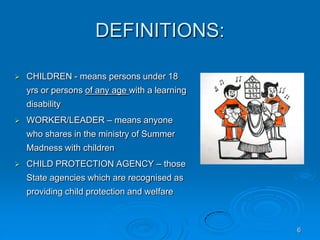
DEFINITIONS:
 CHILDREN - means persons under 18
yrs or persons of any age with a learning
disability
 WORKER/LEADER – means anyone
who shares in the ministry of Summer
Madness with children
 CHILD PROTECTION AGENCY – those
State agencies which are recognised as
providing child protection and welfare
7
Summer Madness
– A MODEL OF GOOD PRACTICE
 Children matter. They should be valued, listened to and
have their rights respected
 those who work with children should also be valued,
supported and have their rights respected
 the Church as one of the major providers of care to children
should provide a model of good practice
8
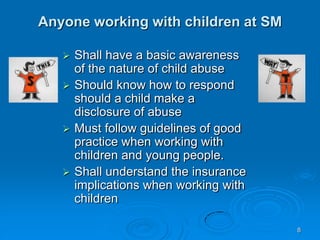
Anyone working with children at SM
 Shall have a basic awareness
of the nature of child abuse
 Should know how to respond
should a child make a
disclosure of abuse
 Must follow guidelines of good
practice when working with
children and young people.
 Shall understand the insurance
implications when working with
children
9
WHAT IS ABUSE?
TYPES OF ABUSE
 PHYSICAL
 EMOTIONAL
 SEXUAL
 NEGLECT
Even for ‘experts’ it is often
very hard to decide if a child
has been abused.
10
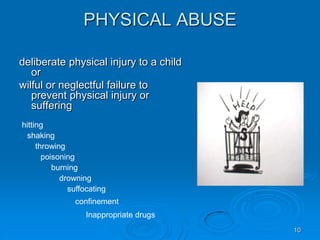
PHYSICAL ABUSE
deliberate physical injury to a child
or
wilful or neglectful failure to
prevent physical injury or
suffering
hitting
shaking
throwing
poisoning
burning
drowning
suffocating
confinement
Inappropriate drugs
11
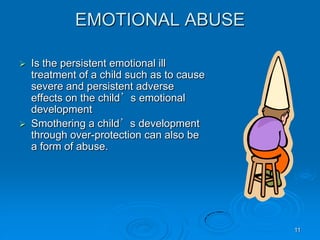
EMOTIONAL ABUSE
 Is the persistent emotional ill
treatment of a child such as to cause
severe and persistent adverse
effects on the child’s emotional
development
 Smothering a child’s development
through over-protection can also be
a form of abuse.
12
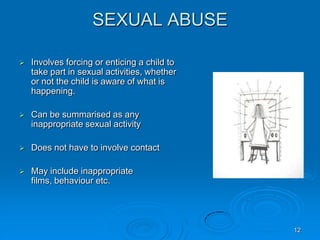
SEXUAL ABUSE
 Involves forcing or enticing a child to
take part in sexual activities, whether
or not the child is aware of what is
happening.
 Can be summarised as any
inappropriate sexual activity
 Does not have to involve contact
 May include inappropriate
films, behaviour etc.
13
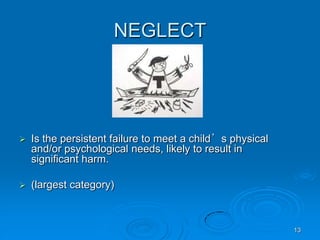
NEGLECT
 Is the persistent failure to meet a child’s physical
and/or psychological needs, likely to result in
significant harm.
 (largest category)
14
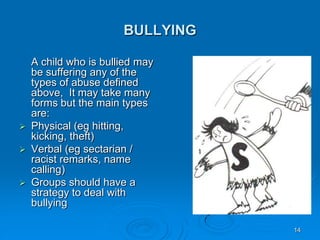
BULLYING
A child who is bullied may
be suffering any of the
types of abuse defined
above, It may take many
forms but the main types
are:
 Physical (eg hitting,
kicking, theft)
 Verbal (eg sectarian /
racist remarks, name
calling)
 Groups should have a
strategy to deal with
bullying
15
Who can abuse?
 Did you know?
 Abusers don’t
appear different from
the rest of society.
 Abusers come from all
classes of society, all
professions, all races
and both sexes
16
Who can abuse? continued
 Sexual abuse of children may
sometimes be carried out by
strangers but it is much more
common that the abuser is
known to the child and is in a
position of trust and/or
authority
 It is not only adults who abuse
children. Children may suffer
abuse from other children and
young people
17
PREVENTING ABUSE
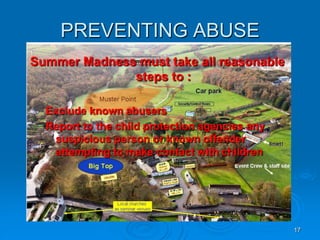
Summer Madness must take all reasonable
steps to :
Exclude known abusers
Report to the child protection agencies any
suspicious person or known offender
attempting to make contact with children
18
DEALING WITH CONCERNS
If you have any concerns
regarding the welfare and
protection of Children and
Young People, or any
concerns are expressed
to you by any person,
these should be passed
immediately to the SM
Child Protection Panel.
19
How do I contact the Panel?
During the Festival, the Panel can be
contacted via the Duty Officer in Comms
24 hours per day, or via the Venue
Manager during major meetings.
Outside of the Festival, the Panel can be
contacted via the Summer Madness office.
20
The leader as observer
 You may notice
 Physical injury to a child
 A child’s behaviour
 A church leader /
worker’s behaviour
The leader as listener
 Possible sources of concern
 Leader or worker
 Young person
 child
21
Disclosure by over 18s ?
 Confidence cannot and should not be
guaranteed
 Should be referred to the Panel in all situations
 Will be referred to the appropriate agencies as
the alleged offender may still have access to
children.
 NO DIFFERENCE IS DRAWN BETWEEN
DISCLOSURE BY OVER 18s and UNDER 18s
22
WHAT TO DO IF YOU ARE CONCERNED
THAT ABUSE IS OCCURRING / MAY
HAVE OCCURRED
 DO
 Stay calm
 Listen and hear
 REFER IMMEDIATELY TO
SUMMER MADNESS
PANEL MEMBER
 DON’T
 Panic
 Ask leading questions
 Make the child repeat the
story unnecessarily
 Promise to keep secrets
 Enquire into the details of
abuse
 Delay
 Start to investigate
 Communicate with any
person directly accused
Never do nothing, and
assume that someone
else will do something
23
SUMMARY OF THE REFERRAL
PROCEDURE
 Allegation / Suspicion / Concern / Query
raised
 Report immediately to a Panel member
 The Panel will speak directly with the person
raising the concern.
 The Panel will consult appropriate agency.
 The Panel will follow the advice given by the
appropriate agency
 NOTE – Any individual worker may make
direct contact with the agencies above if
he/she chooses
24
Your primary responsibility is to
IMMEDIATELY REPORT
any suspected abuse to the panel or to make
an individual report to the statutory agencies
25
Young people working with children
 Permission of the Panel must be
sought by the senior leader before
any young person is involved in
such a role
 Such young people must at all
times work under the supervision
of leaders who have been trained
to implement Child Protection.
 The Management group must
ensure that appropriate training is
provided to cope with: bullying,
shouting, physical contact,
emergency procedures, first aid
policy and include the need to
protect themselves without the
need to undergo the full training of
core leadership.
26
General Safety
 Safety is of prime
importance during any
activity. Be aware of the
following guidelines..
27
General safety
 Always have a quick look around the premises
you are about to use and identify any possible
sources of danger
 Be aware of the location of the fire exits and
ensure they are not obstructed.
 Occasional fire drills should be conducted and
ensure you know evacuation procedure.
 Know where the nearest fire extinguishers are
located.
 In the event of fire, evacuation and saving life is
more important than fighting a fire
 Know where the nearest help is available
28
More on safety
 There should be adequate supervision by
staff when using certain equipment
 During games or ‘icebreakers’ be
aware of the risks of physical injury and
guard against these
 Know where the first aid provision is
located
29
Code of conduct for staff
 Be aware of the dangers arising from
private meetings with children
 Such meetings should be transparent
and in the knowledge of another leader
 Where possible another child or staff
member should be present or within
sight or hearing
 Do not make unnecessary physical
contact with children - horseplay
 Conduct which could be misconstrued
should be avoided
30
Code of conduct for staff continued
 Distressed children may need comforting -
use your discretion and ensure that it will be
seen by others to be normal and natural
 First Aid is only to be given by designated First
Aiders accessed by the Duty officers
 Following an incident where a worker feels
that his/her actions may be misconstrued, a
member of the Panel must be contacted
immediately
 Take care in the setting of Summer Madness
where relationships tend to be quite informal
31
GOOD PRACTICE FOR LEADERS
 All young people who attend the
organisation should have a registration
form filled in by parent or guardian
giving: name, address, DOB, special
medical details, dietary needs,
emergency telephone nos, next of kin,
and parental consent to attend the
organisation
 An accident and incident log
 Do not take children off site without the
prior consent of parents and informing
another staff member
 Ensure adequate supervision – no
fewer than two adults present
32
Staff should NEVER
 Engage in sexually provocative games
 Allow or engage in inappropriate touching of any form
 Allow children to use inappropriate language
unchallenged
 Make sexually suggestive comments about or to a
child
 Strike a child or young person
 Use offensive, abusive or generally inappropriate
language
 Leave young people unsupervised
33
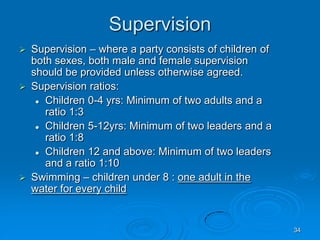
Leaders should make every effort
NOT TO:
 Do things of a personal nature for
children that they can do for
themselves
 Spend excessive amounts of time
alone with children away from others
 Interview a child alone
 Take children alone on car journeys –
unless with the full knowledge and
consent of another leader or the
child’s parents
 Have a young person in their home
34
Supervision
 Supervision – where a party consists of children of
both sexes, both male and female supervision
should be provided unless otherwise agreed.
 Supervision ratios:
 Children 0-4 yrs: Minimum of two adults and a
ratio 1:3
 Children 5-12yrs: Minimum of two leaders and a
ratio 1:8
 Children 12 and above: Minimum of two leaders
and a ratio 1:10
 Swimming – children under 8 : one adult in the
water for every child
35
THE PURPOSE OF THE CODE OF GOOD
PRACTICE - REMINDER
Child Protection is designed:
 to promote the well being of children
 to prevent the physical, sexual and emotional
abuse of children
 to set out the appropriate responses and
procedures in the event of abuse taking place
 to encourage safe practices for those who work with
children
 to safeguard those who work with children from
the consequences of unfounded accusations
36
THANKS FOR MAKING IT THROUGH TO
THE END
Please go to the following link to confirm that
you’ve completed the review of the training.
http://goo.gl/YgruOD

SM Child Protection Training

  • 1.
  • 2.
    2 PROGRAMME  Introduction tothe Policy  Awareness of Abuse  Dealing with disclosure  Code of conduct for staff
  • 3.
    3 The Summer MadnessDirectors have a number of responsibilities in respect of Child Protection including:  Ensuring a Child Protection Panel is appointed  Insurance  Safety of buildings being used  Encouraging and supporting training  Contractual responsibilities for all who have access to children and young people
  • 4.
    4 The panel’s responsibilitiesinclude:  approving persons willing to serve as Summer Madness staff  advising staff on their responsibilities in respect of the Code  advising the Management Group in respect of its responsibilities  being an immediate contact point for staff when a suspicion or allegation of child abuse is made CHILD PROTECTION PANEL
  • 5.
    5 THE PURPOSE OFTHE CODE OF GOOD PRACTICE Our Child Protection Policy is designed:  to promote the well being of children  to prevent the physical, sexual and emotional abuse of children  to set out the appropriate responses and procedures in the event of abuse taking place  to encourage safe practices for those who work with children  to safeguard those who work with children from the consequences of unfounded accusations
  • 6.
    6 DEFINITIONS:  CHILDREN -means persons under 18 yrs or persons of any age with a learning disability  WORKER/LEADER – means anyone who shares in the ministry of Summer Madness with children  CHILD PROTECTION AGENCY – those State agencies which are recognised as providing child protection and welfare
  • 7.
    7 Summer Madness – AMODEL OF GOOD PRACTICE  Children matter. They should be valued, listened to and have their rights respected  those who work with children should also be valued, supported and have their rights respected  the Church as one of the major providers of care to children should provide a model of good practice
  • 8.
    8 Anyone working withchildren at SM  Shall have a basic awareness of the nature of child abuse  Should know how to respond should a child make a disclosure of abuse  Must follow guidelines of good practice when working with children and young people.  Shall understand the insurance implications when working with children
  • 9.
    9 WHAT IS ABUSE? TYPESOF ABUSE  PHYSICAL  EMOTIONAL  SEXUAL  NEGLECT Even for ‘experts’ it is often very hard to decide if a child has been abused.
  • 10.
    10 PHYSICAL ABUSE deliberate physicalinjury to a child or wilful or neglectful failure to prevent physical injury or suffering hitting shaking throwing poisoning burning drowning suffocating confinement Inappropriate drugs
  • 11.
    11 EMOTIONAL ABUSE  Isthe persistent emotional ill treatment of a child such as to cause severe and persistent adverse effects on the child’s emotional development  Smothering a child’s development through over-protection can also be a form of abuse.
  • 12.
    12 SEXUAL ABUSE  Involvesforcing or enticing a child to take part in sexual activities, whether or not the child is aware of what is happening.  Can be summarised as any inappropriate sexual activity  Does not have to involve contact  May include inappropriate films, behaviour etc.
  • 13.
    13 NEGLECT  Is thepersistent failure to meet a child’s physical and/or psychological needs, likely to result in significant harm.  (largest category)
  • 14.
    14 BULLYING A child whois bullied may be suffering any of the types of abuse defined above, It may take many forms but the main types are:  Physical (eg hitting, kicking, theft)  Verbal (eg sectarian / racist remarks, name calling)  Groups should have a strategy to deal with bullying
  • 15.
    15 Who can abuse? Did you know?  Abusers don’t appear different from the rest of society.  Abusers come from all classes of society, all professions, all races and both sexes
  • 16.
    16 Who can abuse?continued  Sexual abuse of children may sometimes be carried out by strangers but it is much more common that the abuser is known to the child and is in a position of trust and/or authority  It is not only adults who abuse children. Children may suffer abuse from other children and young people
  • 17.
    17 PREVENTING ABUSE Summer Madnessmust take all reasonable steps to : Exclude known abusers Report to the child protection agencies any suspicious person or known offender attempting to make contact with children
  • 18.
    18 DEALING WITH CONCERNS Ifyou have any concerns regarding the welfare and protection of Children and Young People, or any concerns are expressed to you by any person, these should be passed immediately to the SM Child Protection Panel.
  • 19.
    19 How do Icontact the Panel? During the Festival, the Panel can be contacted via the Duty Officer in Comms 24 hours per day, or via the Venue Manager during major meetings. Outside of the Festival, the Panel can be contacted via the Summer Madness office.
  • 20.
    20 The leader asobserver  You may notice  Physical injury to a child  A child’s behaviour  A church leader / worker’s behaviour The leader as listener  Possible sources of concern  Leader or worker  Young person  child
  • 21.
    21 Disclosure by over18s ?  Confidence cannot and should not be guaranteed  Should be referred to the Panel in all situations  Will be referred to the appropriate agencies as the alleged offender may still have access to children.  NO DIFFERENCE IS DRAWN BETWEEN DISCLOSURE BY OVER 18s and UNDER 18s
  • 22.
    22 WHAT TO DOIF YOU ARE CONCERNED THAT ABUSE IS OCCURRING / MAY HAVE OCCURRED  DO  Stay calm  Listen and hear  REFER IMMEDIATELY TO SUMMER MADNESS PANEL MEMBER  DON’T  Panic  Ask leading questions  Make the child repeat the story unnecessarily  Promise to keep secrets  Enquire into the details of abuse  Delay  Start to investigate  Communicate with any person directly accused Never do nothing, and assume that someone else will do something
  • 23.
    23 SUMMARY OF THEREFERRAL PROCEDURE  Allegation / Suspicion / Concern / Query raised  Report immediately to a Panel member  The Panel will speak directly with the person raising the concern.  The Panel will consult appropriate agency.  The Panel will follow the advice given by the appropriate agency  NOTE – Any individual worker may make direct contact with the agencies above if he/she chooses
  • 24.
    24 Your primary responsibilityis to IMMEDIATELY REPORT any suspected abuse to the panel or to make an individual report to the statutory agencies
  • 25.
    25 Young people workingwith children  Permission of the Panel must be sought by the senior leader before any young person is involved in such a role  Such young people must at all times work under the supervision of leaders who have been trained to implement Child Protection.  The Management group must ensure that appropriate training is provided to cope with: bullying, shouting, physical contact, emergency procedures, first aid policy and include the need to protect themselves without the need to undergo the full training of core leadership.
  • 26.
    26 General Safety  Safetyis of prime importance during any activity. Be aware of the following guidelines..
  • 27.
    27 General safety  Alwayshave a quick look around the premises you are about to use and identify any possible sources of danger  Be aware of the location of the fire exits and ensure they are not obstructed.  Occasional fire drills should be conducted and ensure you know evacuation procedure.  Know where the nearest fire extinguishers are located.  In the event of fire, evacuation and saving life is more important than fighting a fire  Know where the nearest help is available
  • 28.
    28 More on safety There should be adequate supervision by staff when using certain equipment  During games or ‘icebreakers’ be aware of the risks of physical injury and guard against these  Know where the first aid provision is located
  • 29.
    29 Code of conductfor staff  Be aware of the dangers arising from private meetings with children  Such meetings should be transparent and in the knowledge of another leader  Where possible another child or staff member should be present or within sight or hearing  Do not make unnecessary physical contact with children - horseplay  Conduct which could be misconstrued should be avoided
  • 30.
    30 Code of conductfor staff continued  Distressed children may need comforting - use your discretion and ensure that it will be seen by others to be normal and natural  First Aid is only to be given by designated First Aiders accessed by the Duty officers  Following an incident where a worker feels that his/her actions may be misconstrued, a member of the Panel must be contacted immediately  Take care in the setting of Summer Madness where relationships tend to be quite informal
  • 31.
    31 GOOD PRACTICE FORLEADERS  All young people who attend the organisation should have a registration form filled in by parent or guardian giving: name, address, DOB, special medical details, dietary needs, emergency telephone nos, next of kin, and parental consent to attend the organisation  An accident and incident log  Do not take children off site without the prior consent of parents and informing another staff member  Ensure adequate supervision – no fewer than two adults present
  • 32.
    32 Staff should NEVER Engage in sexually provocative games  Allow or engage in inappropriate touching of any form  Allow children to use inappropriate language unchallenged  Make sexually suggestive comments about or to a child  Strike a child or young person  Use offensive, abusive or generally inappropriate language  Leave young people unsupervised
  • 33.
    33 Leaders should makeevery effort NOT TO:  Do things of a personal nature for children that they can do for themselves  Spend excessive amounts of time alone with children away from others  Interview a child alone  Take children alone on car journeys – unless with the full knowledge and consent of another leader or the child’s parents  Have a young person in their home
  • 34.
    34 Supervision  Supervision –where a party consists of children of both sexes, both male and female supervision should be provided unless otherwise agreed.  Supervision ratios:  Children 0-4 yrs: Minimum of two adults and a ratio 1:3  Children 5-12yrs: Minimum of two leaders and a ratio 1:8  Children 12 and above: Minimum of two leaders and a ratio 1:10  Swimming – children under 8 : one adult in the water for every child
  • 35.
    35 THE PURPOSE OFTHE CODE OF GOOD PRACTICE - REMINDER Child Protection is designed:  to promote the well being of children  to prevent the physical, sexual and emotional abuse of children  to set out the appropriate responses and procedures in the event of abuse taking place  to encourage safe practices for those who work with children  to safeguard those who work with children from the consequences of unfounded accusations
  • 36.
    36 THANKS FOR MAKINGIT THROUGH TO THE END Please go to the following link to confirm that you’ve completed the review of the training. http://goo.gl/YgruOD