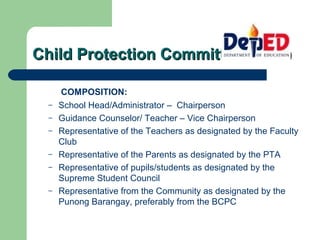
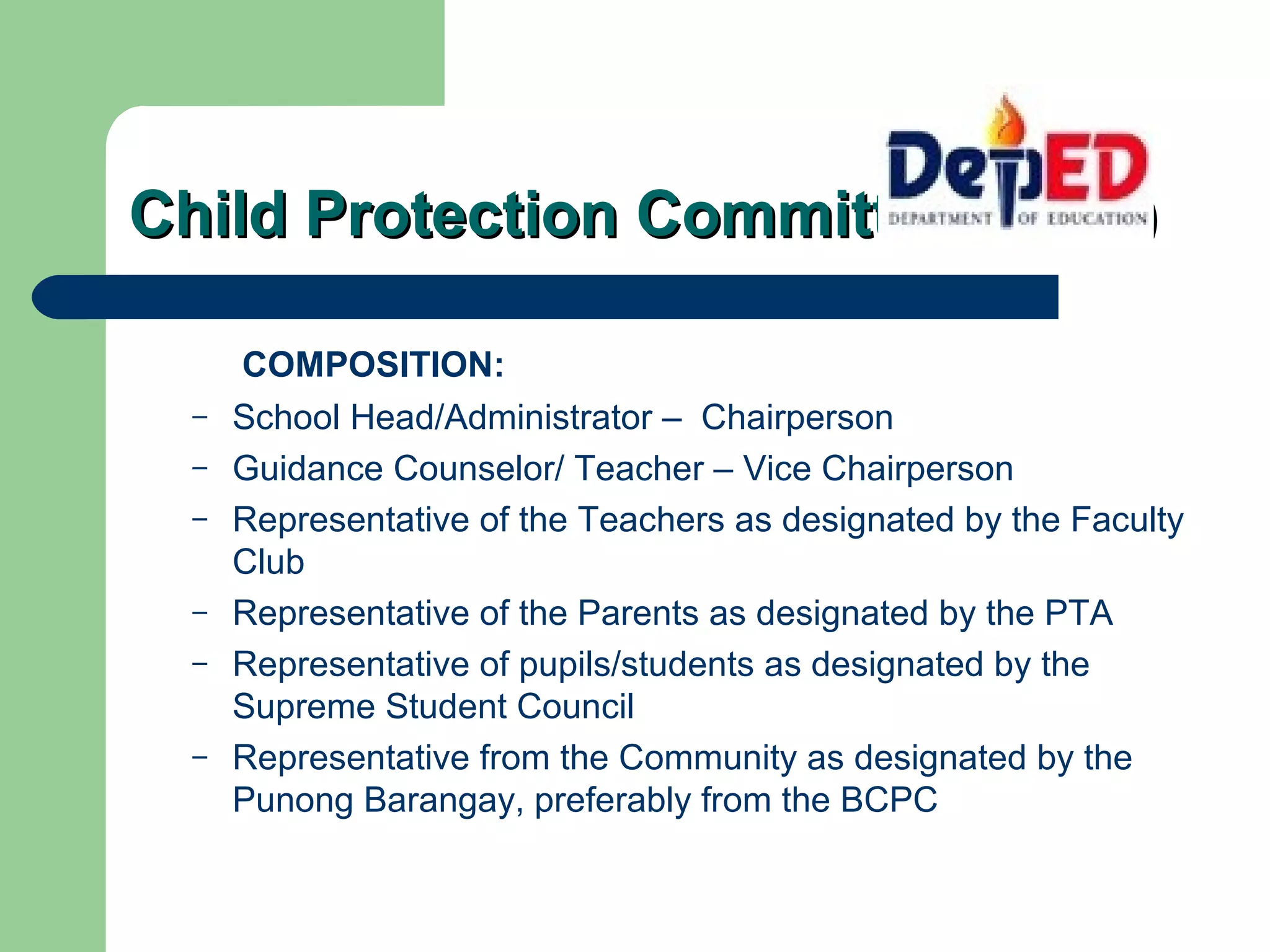
Child Protection Committee (CPC)Child Protection Committee (CPC)
COMPOSITION:
– School Head/Administrator – Chairperson
– Guidance Counselor/ Teacher – Vice Chairperson
– Representative of the Teachers as designated by the Faculty
Club
– Representative of the Parents as designated by the PTA
– Representative of pupils/students as designated by the
Supreme Student Council
– Representative from the Community as designated by the
Punong Barangay, preferably from the BCPC
DO NO. 40. S. 2012
The CPC shall accomplish an Intake Sheet to assess
both the victims and the offenders and report actions
taken on the case.
DO NO. 40. S. 2012
Policy and Guidelines on
Protecting Children in School from Abuse,
Violence, Exploitation, Discrimination, Bullying
and Other Forms of Abuse
The Department of Education is at the center
of efforts to protect children from all forms
of violence in all private and public primary
and secondary schools.
 Convention on the Rights of the Child
 Protects children from all forms of violence,
injury or abuse;
 Establishes the Right of the Child to Education
• The Philippine Constitution
 The State shall protect the right of children to
assistance, including proper care and
nutrition, and special protection from all forms
of neglect, abuse, cruelty, exploitation and
other conditions prejudicial to their
development;
• The Philippine Constitution
 All educational institutions shall…x x
x… foster love of humanity, respect for
human rights …x x x...develop moral
character and personal discipline…
Legal BasesLegal Bases
8
Case Analysis…Case Analysis…
 An alumnus of the high school borrowed
money from the student. When the student was
claiming payment, the debtor killed the student
inside the school grounds. The body of the
victim was seen lying on the grassy area at the
back of one of the classrooms.
Case Analysis…Case Analysis…
 A riot happened in front of the school
involving some students and unidentified
teenagers. A freshman student died due to
gunshot wounds brought about by a pen-gun.
Case Analysis…Case Analysis…
 Grade 4 student killed a Grade 1 pupil at the
back of one of the comfort rooms inside the
school premises. The perpetrator repeatedly hit
the head of the victim with a rock after the
latter ran away with his marble.
Case Analysis…Case Analysis…
 A 4th
year male student died after engaging
in a fight with a female classmate over the
collection of a P5.00 contribution from the
deceased student. The female student
repeatedly punched the male student on the
nape, causing his death.
Case Analysis…
 A fistfight occurred between two students
inside the classroom (while the teacher was
inside). In the altercation, the victim hit his
head on the steel part of the classroom’s
windowpanes. The victim subsequently
died in the hospital.
DO NO. 40, S. 2012
THE CHILD PROTECTION POLICY
OF THE DEPARTMENT OF
EDUCATION
CoverageCoverage
 Children who are enrolled in the basic educationChildren who are enrolled in the basic education
system;system;
 School PersonnelSchool Personnel
 School HeadSchool Head
 Teaching or Non-Teaching personnelTeaching or Non-Teaching personnel
 School Visitor or GuestSchool Visitor or Guest
 MediaMedia
 Suppliers or BiddersSuppliers or Bidders
 Parents and Guardians, etc.Parents and Guardians, etc.
PROHIBITED ACTSPROHIBITED ACTS
 Child Abuse;Child Abuse;
 Discrimination Against Children;Discrimination Against Children;
 Child Exploitation;Child Exploitation;
 Violence Against Children Committed in School:Violence Against Children Committed in School:
 Corporal PunishmentCorporal Punishment
PROHIBITED ACTS...PROHIBITED ACTS...
 Child Abuse:Child Abuse: Republic Act No. 7610 also knownRepublic Act No. 7610 also known as
“Special Protection of Children Against Abuse
Exploitation and Discrimination.”
 Refers to the maltreatment of a child;
 Includes:
1) Psychological Abuse or Physical Abuse;
2) Neglect or Cruelty;
3) Sexual Abuse and Emotional Maltreatment;
4) Any act by deeds or words that degrades
the dignity of a child as a human being;
PROHIBITED ACTS...PROHIBITED ACTS...
 Child Abuse...Child Abuse...
5) Unreasonable deprivation of the child’s basic5) Unreasonable deprivation of the child’s basic
needs for survival;needs for survival;
6) Failure to immediately give medical treatment6) Failure to immediately give medical treatment
to an injured child resulting in seriousto an injured child resulting in serious
impairment of the child’s growth andimpairment of the child’s growth and
development and permanent incapacity ordevelopment and permanent incapacity or
death.death.
PROHIBITED ACTS...PROHIBITED ACTS...
 Discrimination against children:
 Refers to an act of exclusion, distinction,
restriction or preference which impairs the
recognition, enjoyment or exercise by all pupils
or students on an equal footing, of all rights and
freedoms.
PROHIBITED ACTS...PROHIBITED ACTS...
 Child Exploitation:Child Exploitation:
 Refers to the use of children for someoneRefers to the use of children for someone
else’s advantage, gratification or profit resultingelse’s advantage, gratification or profit resulting
in unjust, cruel and harmful treatment of the childin unjust, cruel and harmful treatment of the child
PROHIBITED ACTS...PROHIBITED ACTS...
 Child Exploitation:Child Exploitation:
Forms:Forms:
1) Sexual1) Sexual Exploitation – refers to the abuse– refers to the abuse
of a positionof a position of vulnerability, differential power, or
trust, for sexual purposes.
2) Economic exploitation – refers to the use
of the child in work or other activities for the
benefit of others.
PROHIBITED ACTS...PROHIBITED ACTS...
 Violence Against Children:Violence Against Children:
 Refers to acts committed in school which result
in or is likely to result in physical, sexual,
psychological harm or suffering, or other abuses.
It includes, but is not limited to, the following
acts:
1. Physical violence
2. Sexual violence
3. Psychological violence
PROHIBITED ACTS...PROHIBITED ACTS...
 Corporal Punishment:Corporal Punishment:
 A kind of punishment or penalty imposed for
an alleged or actual offense, which is carried
out or inflicted, for the purpose of discipline,
training or control.
 It includes physical, humiliating or degrading
punishment.
 Administrative Proceedings
 Simple Misconduct
 Grave Misconduct
 Criminal and civil liability arising from child abuse,
discrimination, exploitation, and other acts of abuse
are separate and distinct, and shall not be a bar to
the filing of an administrative case.
Rules and Procedures in Handling Child Abuse, Exploitation
 A wilful aggressive behaviour that is directed,
towards a particular victim who may be out-
numbered, younger, weak, with disability,
less confident, or otherwise vulnerable.
 Forms:
1) Bullying - is committed when a student
commits an act directed towards another
student, which results in physical and mental
abuse, harassment, intimidation, or humiliation
2) Cyber Bullying
2) Cyber Bullying - any conduct defined in
the preceeding paragraph, as resulting in
harassment, intimidation, or humiliation,
through electronic means or other technology,
such as, but not limited to texting, email,
instant messaging, chatting, internet, social
networking websites or other platforms or
formats.
 All bullying incidents shall be reported to the
School Head.
 The School Head shall in turn inform the parents of
the pupils concerned and a meeting shall be held for
that purpose.
 The student shall be referred to the CPC for
counseling and other interventions.
 The School may impose Non-punitive Measures in
accordance with the principles of Positive and Non-
Violent Discipline.
 Punitive measures will be a last resort.
DepEd is conducting a nationwide information
dissemination campaign with training modules on
positive and non-violent discipline in classroom
management, anger and stress management, and
gender sensitivity.
 Discipline does not mean punishment
 Children are full human beings with basic human
rights
 Positive discipline begins with setting long term goals
that teacher want to have on their students’ adult
lives.
Positive and Non-Violent Discipline Programs include:
1. Integration of education sessions on positive
discipline to PTA initiatives
2. Capacity building for school personnel on children’s
rights
3. Encouraging support groups among school
personnel and PTA
4. Parenting sessions
COMPOSITION:
– School Head/Administrator – Chairperson
– Guidance Counselor/ Teacher – Vice Chairperson
– Representative of the Teachers as designated by the
Faculty Club
– Representative of the Parents as designated by the PTA
– Representative of pupils/students as designated by the
Supreme Student Council
– Representative from the Community as designated by the
Punong Barangay, preferably from the BCPC.
The CPC shall accomplish an
Intake Sheet to assess both the
victims and the offenders and report
actions taken on the case.
Referral and Monitoring System
The Intake Sheets will be forwarded to the DepEd
Division Office. The DO will consolidate the reports on
incidents and cases of all schools and submit a Division
Report to the Regional Office.
The RO will consolidate the reports on incidents and
cases of the Division Offices within the Region and
submit a Regional Report to the Undersecretary for
Legal and Legislative Affairs. The Central Office will be
the Central Repository of Regional Reports.
 Complaints of child abuse, violence, discrimination,
exploitation, bullying and other acts of abuse shall
be within the exclusive jurisdiction of the
Department;
 They shall not be brought for amicable settlement
before the Barangay, subject to existing laws, rules
and regulations
 In child abuse, violence, discrimination, exploitation,
bullying or peer abuse and other acts of abuse by a
student, the identity or other information that may
reasonably identify the pupil or student, shall be
withheld from the public to protect his or her privacy.
 The Magna Carta for Public School Teachers
protects the rights of teachers and no publicity
shall be given to any disciplinary action against a
teacher during the pendency of his or her case.
 The private school shall submit the report
(Annex “A”) to the Division Office after each school
year.
 Private Schools shall be responsible for
promulgating a school child protection policy:
: policy on bullying;
: protocol for reporting; and
: procedures for handling and management of
cases
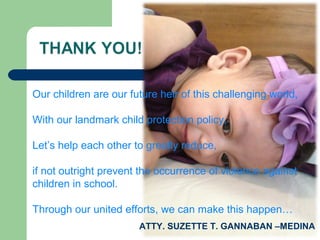
Our children are our future heir of this challenging world,
With our landmark child protection policy,
Let’s help each other to greatly reduce,
if not outright prevent the occurrence of violence against
children in school.
Through our united efforts, we can make this happen…
ATTY. SUZETTE T. GANNABAN –MEDINA

Child Protection Policy

  • 1.
    Child Protection Committee(CPC)Child Protection Committee (CPC) COMPOSITION: – School Head/Administrator – Chairperson – Guidance Counselor/ Teacher – Vice Chairperson – Representative of the Teachers as designated by the Faculty Club – Representative of the Parents as designated by the PTA – Representative of pupils/students as designated by the Supreme Student Council – Representative from the Community as designated by the Punong Barangay, preferably from the BCPC
  • 2.
    DO NO. 40.S. 2012 The CPC shall accomplish an Intake Sheet to assess both the victims and the offenders and report actions taken on the case.
  • 3.
    DO NO. 40.S. 2012 Policy and Guidelines on Protecting Children in School from Abuse, Violence, Exploitation, Discrimination, Bullying and Other Forms of Abuse
  • 4.
    The Department ofEducation is at the center of efforts to protect children from all forms of violence in all private and public primary and secondary schools.
  • 5.
     Convention onthe Rights of the Child  Protects children from all forms of violence, injury or abuse;  Establishes the Right of the Child to Education
  • 6.
    • The PhilippineConstitution  The State shall protect the right of children to assistance, including proper care and nutrition, and special protection from all forms of neglect, abuse, cruelty, exploitation and other conditions prejudicial to their development;
  • 7.
    • The PhilippineConstitution  All educational institutions shall…x x x… foster love of humanity, respect for human rights …x x x...develop moral character and personal discipline… Legal BasesLegal Bases
  • 8.
  • 9.
    Case Analysis…Case Analysis… An alumnus of the high school borrowed money from the student. When the student was claiming payment, the debtor killed the student inside the school grounds. The body of the victim was seen lying on the grassy area at the back of one of the classrooms.
  • 10.
    Case Analysis…Case Analysis… A riot happened in front of the school involving some students and unidentified teenagers. A freshman student died due to gunshot wounds brought about by a pen-gun.
  • 11.
    Case Analysis…Case Analysis… Grade 4 student killed a Grade 1 pupil at the back of one of the comfort rooms inside the school premises. The perpetrator repeatedly hit the head of the victim with a rock after the latter ran away with his marble.
  • 12.
    Case Analysis…Case Analysis… A 4th year male student died after engaging in a fight with a female classmate over the collection of a P5.00 contribution from the deceased student. The female student repeatedly punched the male student on the nape, causing his death.
  • 13.
    Case Analysis…  Afistfight occurred between two students inside the classroom (while the teacher was inside). In the altercation, the victim hit his head on the steel part of the classroom’s windowpanes. The victim subsequently died in the hospital.
  • 14.
    DO NO. 40,S. 2012 THE CHILD PROTECTION POLICY OF THE DEPARTMENT OF EDUCATION
  • 15.
    CoverageCoverage  Children whoare enrolled in the basic educationChildren who are enrolled in the basic education system;system;  School PersonnelSchool Personnel  School HeadSchool Head  Teaching or Non-Teaching personnelTeaching or Non-Teaching personnel  School Visitor or GuestSchool Visitor or Guest  MediaMedia  Suppliers or BiddersSuppliers or Bidders  Parents and Guardians, etc.Parents and Guardians, etc.
  • 16.
    PROHIBITED ACTSPROHIBITED ACTS Child Abuse;Child Abuse;  Discrimination Against Children;Discrimination Against Children;  Child Exploitation;Child Exploitation;  Violence Against Children Committed in School:Violence Against Children Committed in School:  Corporal PunishmentCorporal Punishment
  • 17.
    PROHIBITED ACTS...PROHIBITED ACTS... Child Abuse:Child Abuse: Republic Act No. 7610 also knownRepublic Act No. 7610 also known as “Special Protection of Children Against Abuse Exploitation and Discrimination.”  Refers to the maltreatment of a child;  Includes: 1) Psychological Abuse or Physical Abuse; 2) Neglect or Cruelty; 3) Sexual Abuse and Emotional Maltreatment; 4) Any act by deeds or words that degrades the dignity of a child as a human being;
  • 18.
    PROHIBITED ACTS...PROHIBITED ACTS... Child Abuse...Child Abuse... 5) Unreasonable deprivation of the child’s basic5) Unreasonable deprivation of the child’s basic needs for survival;needs for survival; 6) Failure to immediately give medical treatment6) Failure to immediately give medical treatment to an injured child resulting in seriousto an injured child resulting in serious impairment of the child’s growth andimpairment of the child’s growth and development and permanent incapacity ordevelopment and permanent incapacity or death.death.
  • 19.
    PROHIBITED ACTS...PROHIBITED ACTS... Discrimination against children:  Refers to an act of exclusion, distinction, restriction or preference which impairs the recognition, enjoyment or exercise by all pupils or students on an equal footing, of all rights and freedoms.
  • 20.
    PROHIBITED ACTS...PROHIBITED ACTS... Child Exploitation:Child Exploitation:  Refers to the use of children for someoneRefers to the use of children for someone else’s advantage, gratification or profit resultingelse’s advantage, gratification or profit resulting in unjust, cruel and harmful treatment of the childin unjust, cruel and harmful treatment of the child
  • 21.
    PROHIBITED ACTS...PROHIBITED ACTS... Child Exploitation:Child Exploitation: Forms:Forms: 1) Sexual1) Sexual Exploitation – refers to the abuse– refers to the abuse of a positionof a position of vulnerability, differential power, or trust, for sexual purposes. 2) Economic exploitation – refers to the use of the child in work or other activities for the benefit of others.
  • 22.
    PROHIBITED ACTS...PROHIBITED ACTS... Violence Against Children:Violence Against Children:  Refers to acts committed in school which result in or is likely to result in physical, sexual, psychological harm or suffering, or other abuses. It includes, but is not limited to, the following acts: 1. Physical violence 2. Sexual violence 3. Psychological violence
  • 23.
    PROHIBITED ACTS...PROHIBITED ACTS... Corporal Punishment:Corporal Punishment:  A kind of punishment or penalty imposed for an alleged or actual offense, which is carried out or inflicted, for the purpose of discipline, training or control.  It includes physical, humiliating or degrading punishment.
  • 24.
     Administrative Proceedings Simple Misconduct  Grave Misconduct  Criminal and civil liability arising from child abuse, discrimination, exploitation, and other acts of abuse are separate and distinct, and shall not be a bar to the filing of an administrative case. Rules and Procedures in Handling Child Abuse, Exploitation
  • 25.
     A wilfulaggressive behaviour that is directed, towards a particular victim who may be out- numbered, younger, weak, with disability, less confident, or otherwise vulnerable.
  • 26.
     Forms: 1) Bullying- is committed when a student commits an act directed towards another student, which results in physical and mental abuse, harassment, intimidation, or humiliation 2) Cyber Bullying
  • 27.
    2) Cyber Bullying- any conduct defined in the preceeding paragraph, as resulting in harassment, intimidation, or humiliation, through electronic means or other technology, such as, but not limited to texting, email, instant messaging, chatting, internet, social networking websites or other platforms or formats.
  • 28.
     All bullyingincidents shall be reported to the School Head.  The School Head shall in turn inform the parents of the pupils concerned and a meeting shall be held for that purpose.  The student shall be referred to the CPC for counseling and other interventions.
  • 29.
     The Schoolmay impose Non-punitive Measures in accordance with the principles of Positive and Non- Violent Discipline.  Punitive measures will be a last resort.
  • 30.
    DepEd is conductinga nationwide information dissemination campaign with training modules on positive and non-violent discipline in classroom management, anger and stress management, and gender sensitivity.
  • 31.
     Discipline doesnot mean punishment  Children are full human beings with basic human rights  Positive discipline begins with setting long term goals that teacher want to have on their students’ adult lives.
  • 32.
    Positive and Non-ViolentDiscipline Programs include: 1. Integration of education sessions on positive discipline to PTA initiatives 2. Capacity building for school personnel on children’s rights 3. Encouraging support groups among school personnel and PTA 4. Parenting sessions
  • 33.
    COMPOSITION: – School Head/Administrator– Chairperson – Guidance Counselor/ Teacher – Vice Chairperson – Representative of the Teachers as designated by the Faculty Club – Representative of the Parents as designated by the PTA – Representative of pupils/students as designated by the Supreme Student Council – Representative from the Community as designated by the Punong Barangay, preferably from the BCPC.
  • 34.
    The CPC shallaccomplish an Intake Sheet to assess both the victims and the offenders and report actions taken on the case.
  • 35.
  • 36.
    The Intake Sheetswill be forwarded to the DepEd Division Office. The DO will consolidate the reports on incidents and cases of all schools and submit a Division Report to the Regional Office. The RO will consolidate the reports on incidents and cases of the Division Offices within the Region and submit a Regional Report to the Undersecretary for Legal and Legislative Affairs. The Central Office will be the Central Repository of Regional Reports.
  • 37.
     Complaints ofchild abuse, violence, discrimination, exploitation, bullying and other acts of abuse shall be within the exclusive jurisdiction of the Department;  They shall not be brought for amicable settlement before the Barangay, subject to existing laws, rules and regulations
  • 38.
     In childabuse, violence, discrimination, exploitation, bullying or peer abuse and other acts of abuse by a student, the identity or other information that may reasonably identify the pupil or student, shall be withheld from the public to protect his or her privacy.
  • 39.
     The MagnaCarta for Public School Teachers protects the rights of teachers and no publicity shall be given to any disciplinary action against a teacher during the pendency of his or her case.
  • 40.
     The privateschool shall submit the report (Annex “A”) to the Division Office after each school year.  Private Schools shall be responsible for promulgating a school child protection policy: : policy on bullying; : protocol for reporting; and : procedures for handling and management of cases
  • 41.
    Our children areour future heir of this challenging world, With our landmark child protection policy, Let’s help each other to greatly reduce, if not outright prevent the occurrence of violence against children in school. Through our united efforts, we can make this happen… ATTY. SUZETTE T. GANNABAN –MEDINA

Editor's Notes

  • #5 I. INTRODUCTION   The Department of Education is at the center of efforts to protect children from all forms of violence in all private and public primary and secondary schools. While it is our mission to provide quality education for all, we are also tasked to address issues on corporal punishment, child sexual abuse, discrimination, exploitation and bullying by formulating a policy and guidelines that govern all schools that provide basic education.
  • #6 Violence against children   Article 19 of the Convention on the Rights of the Child protects children from as all forms of physical or mental violence, injury or abuse, neglect or negligent treatment, maltreatment or exploitation, including sexual abuse. Recognizing the child’s right to education, the CRC in Article 28 provides that “States Parties shall take all appropriate measures to ensure that school discipline is administered in a manner consistent with the child's human dignity and in conformity with the present Convention.”    
  • #23 The Child Protection Policy defines this as a single act or a series of acts committed by school administrators, academic and non-academic personnel against a child, which result in or is likely to result in physical, sexual, psychological harm or suffering, or other abuses including threats of such acts, battery, assault, coercion, harassment or arbitrary deprivation of liberty. It includes, but is not limited to, the following acts: 1.Physical violence refers to acts that inflict bodily or physical harm. 2.Sexual violence refers to acts that are sexual in nature. It includes, but is not limited to: a.rape, sexual harassment, acts of lasciviousness, making demeaning and sexually suggestive remarks, physically attacking the sexual parts of the victim's body; b.forcing the child to watch obscene publications and indecent shows or forcing the child to do indecent sexual acts and/or to engage or be involved in the creation or distribution of such films, indecent publication or material; and c.acts causing or attempting to cause the child to engage in any sexual activity by force, threat of force, physical or other harm or threat of physical or other harm or coercion. 3.Psychological violence refers to acts or omissions causing or likely to cause mental or emotional suffering of the child, such as but not limited to intimidation, harassment, stalking, damage to property, public ridicule or humiliation, deduction or threat of deduction from grade or merit as a form of punishment, and repeated verbal abuse.
  • #25 Corporal Punishment as a kind of punishment or penalty imposed for an alleged or actual offense, which is carried out or inflicted, for the purpose of discipline, training or control, by a teacher, school administrator, an adult, or any other child, who has been given or has assumed authority or responsibility for punishment or discipline. It includes physical, humiliating or degrading punishment, including but not limited to the following: 1)Blows such as, but not limited to, beating, kicking, hitting, slapping, or lashing, of any part of a child’s body, with or without the use of an instrument such as, but not limited to a cane, broom, stick, whip or belt; 2)Striking of a child’s face or head, such being declared as a “no contact zone”; 3)Pulling hair, shaking, twisting joints, cutting or piercing skin, dragging, pushing or throwing of a child; 4)Forcing a child to perform physically painful or damaging acts such as, but not limited to, holding a weight or weights for an extended period and kneeling on stones, salt, pebbles or other objects; 5)Deprivation of a child’s physical needs as a form of punishment; 6)Deliberate exposure to fire, ice, water, smoke, sunlight, rain, pepper, alcohol, or forcing the child to swallow substances, dangerous chemicals, and other materials that can cause discomfort or threaten the child’s health, safety and sense of security such as, but not limited to bleach or insecticides, excrement or urine; 7)Tying up a child; 8)Confinement, imprisonment or depriving the liberty of a child; 9)Verbal abuse or assaults, including intimidation or threat of bodily harm, swearing or cursing, ridiculing or denigrating the child; 10)Forcing a child to wear a sign or to put on anything that will make a child look or feel foolish, which belittles or humiliates the child in front of others; and 11) Permanent confiscation of personal property of pupils/students, except when such pieces of property pose a danger to the child or to others. 12)Other analogous acts.
  • #26 The Policy defines bullying as willful aggressive behavior that is directed, towards a particular victim who may be out-numbered, younger, weak, with disability, less confident, or otherwise vulnerable. It includes cyber bullying.
  • #29     2) Procedures in Handling Bullying Incidents in Schools   All bullying incidents shall be reported to the School Head. The School Head shall in turn inform the parents of the pupils concerned and a meeting shall be held for that purpose. The student shall be referred to the CPC for counseling and other interventions. The School may impose Non-punitive Measures in accordance with the principles of Positive and Non-Violent Discipline. Punitive measures will be a last resort.
  • #30     2) Procedures in Handling Bullying Incidents in Schools   All bullying incidents shall be reported to the School Head. The School Head shall in turn inform the parents of the pupils concerned and a meeting shall be held for that purpose. The student shall be referred to the CPC for counseling and other interventions. The School may impose Non-punitive Measures in accordance with the principles of Positive and Non-Violent Discipline. Punitive measures will be a last resort.
  • #31   Capacity Building   The DepEd is conducting a nationwide information dissemination campaign with training modules on positive and non-violent discipline in classroom management, anger and stress management and gender sensitivity
  • #32   Positive Discipline   It is imperative to understand that discipline does not mean punishment. Positive discipline requires that children are equally worthy of respect and just treatment. To end all corporal punishment, positive discipline is recommended as a means of teaching children rules, values and good behavior that respects their rights and the rights of others.   The Child Protection Policy defines Positive and Non-violent Discipline as a way of thinking and a holistic, constructive and pro-active approach to teaching that helps children develop appropriate thinking and behavior in the short and long-term and fosters self-iscipline. It is based on the fundamental principle that children are full human beings with basic human rights. Positive discipline begins with setting the long-term goals or impacts that teachers want to have on their students’ adult lives, and using everyday situations and challenges as opportunities to teach life-long skills and values to students.
  • #33 The programs that are intended to promote Positive and Non-Violent Discipline include, but are not limited to, the following:   Integration of education sessions on corporal punishment and positive discipline in the initiatives of the Parent-Teachers Associations (PTAs); Capacity-building programs for school administrators, teachers and non-academic personnel focused on children’s rights, child development and positive and nonviolent approaches in teaching and classroom management, to enable them to incorporate positive discipline messages in parent-teacher conferences and family counseling, and integrate messages on children’s rights and corporal punishment in classroom discussions; Encouraging and supporting the formation and initiatives of support groups among teaching and non-teaching staff, and parents and caregivers; Implementing specific parenting orientation sessions with parents and/or caregivers and other activities; Implementing school activities or events that raise awareness on children’s rights, corporal punishment and positive discipline, fostering the active involvement of and providing venues for bringing together parents, families and children; Encouraging and supporting student-led initiatives to raise awareness on children’s rights, corporal punishment and positive discipline; and Setting up child-friendly mechanisms for obtaining children’s views and participation in the formulation, monitoring and assessment of school rules and policies related to student discipline.  
  • #34 All public and private elementary and secondary schools shall establish a Child Protection Committee, tasked with information dissemination, quick response and referral, and reporting.   The CPC shall be composed of the following:   School Head/Administrator – Chairperson Guidance Counselor/ Teacher –Vice Chairperson Representative of the Teachers as designated by the Faculty Club Representative of the Parents as designated by the PTA Representative of pupils/students as designated by the Supreme Student Council Representative from the Community as designated by the Punong Barangay, preferably from the BCPC.
  • #35 The CPC shall accomplish an Intake Sheet to assess both the victims and the offenders and report actions taken on the case.
  • #36 The School Head may refer the victims and offenders to the Local Social Welfare and Development officer (LSWDO) for assessment and appropriate intervention. The CPC will coordinate closely with the Women and Child Protection Desks of the Philippine National Police, the LSWDO, other government agencies and NGOs, as may be appropriate.
  • #37 The Intake Sheets will be forwarded to the DepEd Division Office. The DepEd Division Office will consolidate the reports on incidents and cases of all schools and submit a Division Report to the Regional Office. The DepEd Regional Office will consolidate the reports on incidents and cases of the Division Offices within the Region and submit a Regional Report to the Undersecretary for Legal and Legislative Affairs. The Central Office will be the Central Repository of Regional Reports
  • #38 Issues and Challenges   Although it is still premature as of now to determine the net impact of the Child Protection Policy since it only took effect last May 3, 2012 and we are still in the process of roll-out in the field, nonetheless, we have already identified the following issues and challenges to these initiatives that we have developed to prevent and respond to violence against children:   Input gaps Lack of guidance counsellors. The LSWDO and the BCPC lack manpower and training in processing cases of violations of the child protection policy Inadequate budget and other resources   Social and Cultural Attitudes and Practices Lack of understanding of violence against children Societal preference for punitive measures in disciplining children. Reluctance of Social Workers to get involved in the case in the mistaken belief that it is a private conflict Reluctance of victims to file a complaint. Settlement of cases in lieu of strict enforcement of child protection laws Connivance among the teachers and school heads to cover up cases of violations of child protection policy, particularly those committed by their colleagues.   Inadequate legal frameworks   Lack of a law on bullying and corporal punishment
  • #39 Call for Support   With the realization that these initiatives are merely the start of a long road towards attainment of the zero tolerance policy in dealing with violence against children, the following are our call for support:   For Social Workers – conduct assessment and provide psycho-social intervention to children and adults referred to them by the schools;   For medical practitioners - report suspicious symptoms of cases of child abuse to the city fiscal, Local Council for the Protection of Children or Local Social Welfare and Development Office;   For teachers and parents – practice positive and non-violent discipline
  • #42 Conclusion   It is undeniable that we, at the Department of Education have a vital role to protect our children from violence in schools. We have more than 20 Million enrollees from private and public primary and secondary schools. Thus, it is indeed indispensable to make an effort to issue guidelines and policies for schools to follow in cases of child abuse, violence, exploitation, discrimination, bullying and other forms of abuse. The Department of Education has worked tirelessly to protect our children by issuing the policy. The roll-out has started and all cases of violence in schools are being addressed in accordance with the provisions of the DepEd Child Protection Policy.   With our landmark child protection policy and with the help of all the stakeholders, we can expect to greatly reduce, if not outright prevent the occurrence of violence against children in school. Through our united efforts, we can make this happen.