Power Supply Design Seminar
Bi-directional DC/DC converter
topology comparison and design
Reproduced from
2016 Texas Instruments Power Supply Design Seminar SEM2200
TI Literature Number: SLUP343
© 2016, 2017 Texas Instruments Incorporated
Power Seminar topics and online power training modules are available at:ti.com/psds
Texas Instruments – 2016/17 Power Supply Design Seminar
Bi-directional DC/DC converter topology
comparison and design
HEV/EV and server applications
Sanatan Rajagopalan
Zhong Ye
Texas Instruments – 2016/17 Power Supply Design Seminar
Agenda
• Application overview and specifications
o Automotive application
o Server and Datacenter
• Topology comparison
o Four-phase interleaved fixed frequency Bi-directional Buck converter
o Four-phase interleaved ZVS transition-mode Bi-directional Buck converter
• UCD3138-based control scheme and implementation
• Test data comparison
o Switching waveform comparison
o Efficiency comparison
o Loss Breakdown Comparison
o Thermal
o EMI
• Conclusions
4-2
Texas Instruments – 2016/17 Power Supply Design Seminar
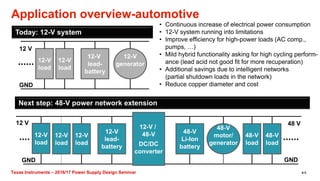
Application overview-automotive
• Continuous increase of electrical power consumption
• 12-V system running into limitations
• Improve efficiency for high-power loads (AC comp.,
pumps, …)
• Mild hybrid functionality asking for high cycling perform-
ance (lead acid not good fit for more recuperation)
• Additional savings due to intelligent networks
(partial shutdown loads in the network)
• Reduce copper diameter and cost
12-V
lead-
battery
12-V
load
12-V
generator
12-V
load
12 V
GND
Today: 12-V system
12 V
GND
48-V
Li-Ion
battery
48-V
motor/
generator
12-V /
48-V
DC/DC
converter
48 V
GND
48-V
load
48-V
load
Next step: 48-V power network extension
12-V
lead-
battery
12-V
load
12-V
load
12-V
load
4-3
Texas Instruments – 2016/17 Power Supply Design Seminar
48-V / 12-V electrical system with start/stop
12-V electrical system
12-V battery
48-V Li-Ion battery
management 48-V traction motor inverter
Active
suspension control
AC compressor
Water pump
Electric
power
steering
Cooling
fan
Transmission
oil/fluid pump
Fuel
pump
Parts using 48 V
48-V / 12-V bi-directional
DC/DC converter
4-4
Texas Instruments – 2016/17 Power Supply Design Seminar
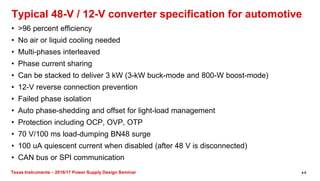
Typical 48-V / 12-V converter specification for automotive
• >96 percent efficiency
• No air or liquid cooling needed
• Multi-phases interleaved
• Phase current sharing
• Can be stacked to deliver 3 kW (3-kW buck-mode and 800-W boost-mode)
• 12-V reverse connection prevention
• Failed phase isolation
• Auto phase-shedding and offset for light-load management
• Protection including OCP, OVP, OTP
• 70 V/100 ms load-dumping BN48 surge
• 100 uA quiescent current when disabled (after 48 V is disconnected)
• CAN bus or SPI communication
4-5
Texas Instruments – 2016/17 Power Supply Design Seminar
Microsoft reinvented
data center
Traditional
data center
Bi-directional DC/DC
Advantages of local energy storage data center
deployments
• Reduce cost up to 5 times
• Eliminate up to 9% losses associated with UPS
• No requirement for a UPS or battery room
o 25% facility footprint reduction
• Improve serviceability significantly
o Hot-swappable
o Minimize potential failure impact zone
Other applications: data centers and servers
* Reference from Microsoft Publication
Generators
UPS
IT load
Substation Substation
IT load
Generators
4-6
Texas Instruments – 2016/17 Power Supply Design Seminar
Topology investigation
Hard-switching, non-Isolated
DC/DC (sync-buck) converter
Transition-mode ZVS DC/DC
(sync-buck) converter
PROS
• Simple control
• Fixed-frequency
• Low inductor current ripple
• Soft-switching, potentially high
efficiency
• Low common-mode noise
CONS
• High-switch ringing
• High common-mode noise
• High inductor current ripple
• Variable frequency
• Complex control
4-7
Texas Instruments – 2016/17 Power Supply Design Seminar
Hard-switching and soft-switching bi-directional converter
Buck-mode
Boost-mode
Buck-mode
Boost-mode
Energy transfer direction
Soft-switching converter
Hard-switching converter
Buck-mode
Boost-mode
4-8
Texas Instruments – 2016/17 Power Supply Design Seminar
UCD3138 overview
Key features
• Multi-nested loop isolated digital controller
• 3 loop with 14-bit DAC reference
• 2-pole 2-zero PID filters with multi-coeff
banks
• PWM, phase-shift and resonant-mode
control
• Constant voltage, current and power
modes
• Input voltage feed-forward and Vpri-
sensing
• Peak current mode with internal slope
comp.
• Cycle-by-cycle current limit with CLF
counter
• 8x over sampling or averaging at EADC
4-9
Texas Instruments – 2016/17 Power Supply Design Seminar
UCD3138 key features (cont.)
• 12-bit ADCs with hardware filters
• 12-bit ADCs with dual hold-sampling
• Auto PWM-LLC and PWM-PS mode
switching
• Burst-mode for light load operation
• Integrated copper trace current-sensing
• Integrated current-sharing circuit
• 8 high resolution DPWM outputs (250 ps)
• 32-bit, 32-MHz ARM 7 (32 KB PFlash, 4
KB DFlash)
• Multi-channel, 12-bit 256 ksps GP ADC
• On-chip (BOD / POR)
• Single-supply operation (3.3 V)
• Single supply operation (3.3 V)
• On-chip reference + oscillator
• 2 UART’s + programmable PMBus
interface
• 2 MHz max switching frequency
• 4 ns frequency resolution
• External interrupt + fault input and output
• –40°C to +125°C extended temp range
• 64 pin and 40 pin QFN packages
• Power-saving features
• And MORE!!!
4-10
Texas Instruments – 2016/17 Power Supply Design Seminar
UCD3138-based control
• Three control loops: current loop, 12-V
voltage loop, 48-V voltage loop
• Total current is sensed for current loop
control
• Current source operation before voltages
reach set points
• Phase currents are sensed for current
balance
• Current command set by digital
communication port or ADC input
Additional control for ZVS operation:
• Phase 1 negative current sensed
• Negative current thresholds programmed
by PWM0, one to generate a sync signal
• Sync signal controls frequency modulation
4-11
Texas Instruments – 2016/17 Power Supply Design Seminar
Current ripple and phase number selection
• Duty cycle directly determines phase number selection
• Optimal phase numbers for 48-V /12-V buck and boost power conversion are: 4, 8, 12
• Adding phases reduces current ripple further when duty cycle is away from:
o 0.25 in buck-mode
o 0.75 in boost-mode
IL2
/
V
0.2
0.4
0.6
0.8
1
IL1
/
V
0
0.2
0.4
0.6
0.8
time/uSecs 5uSecs/div
0 5 10 15 20 25 30
IL_Total
/
V
0
0.2
0.4
0.6
0.8
1
1.2
1.4
Time
IL1
IL2
IL1+ IL2
0
1
0
1
0
1.5
0.66A
Ripple Current Cancellation
0
0.1
0.2
0.3
0.4
0.5
0.6
0.7
0.8
0.9
1
1 2 3 4 5 6 7 8 9 10 11 12
Normalized Inductor Current Ripple vs Phase Number
Phase Number
Normalized
Current
Ripple
Zero current ripple at 12V
4-12
Texas Instruments – 2016/17 Power Supply Design Seminar
System block diagram for circuit test
4-13
Texas Instruments – 2016/17 Power Supply Design Seminar
Power stage component selection and design
Hard-switching Soft-switching
Switching frequency 140 kHz 100 kHz- 450 kHz
Current ripple at full load 16.25 A (±25% ripple) 65 A
Inductor value 4.7 uH 1.4 uH
Inductor DC resistance 1.86 mΩ 0.618 mΩ
Inductor part number SER2915H-472KL (Coilcraft ) Litz wire: AWG# 32, 110 strands
PQ26/20 core -TDK B65877B0000R097
Inductor photos
4-14
Texas Instruments – 2016/17 Power Supply Design Seminar
Power stage component selection and design (cont)
Hard-switching Soft-switching
Main MOSFETs Infineon IPB017N100N5:
100 V, 1.7 mΩ
Infineon IPB015N08N5:
80 V, 1.5 mΩ
Reverse protection
FETs
CSD16556Q5B:
TI, 20V, 1.062 mΩ @ 75ºC
CSD16556Q5B:
TI, 20 V, 1.062 mΩ @ 75ºC
48-V fuses Littlefuse:
0891030 30A,
2.06 mΩ @ 25ºC,
2.18 mΩ @ 90ºC
Littlefuse:
0891030 30 A,
2.06 mΩ @ 25ºC,
2.18 mΩ @ 90ºC
Low inductance shunt-
sensing resistor
Panasonic ERJ-M1WTF2M0U:
–2 mΩ
Panasonic ERJ-M1WTF2M0U:
–2 mΩ
48-V input filter
inductor
Coilcraft XAL1580-102 MEB:
1 uH 73.5 A, 0.93 mΩ typical
Coilcraft XAL1580-102 MEB:
–1 uH 73.5A, 0.93 mΩ typical
4-15
Texas Instruments – 2016/17 Power Supply Design Seminar
Bi-directional DC/DC converter prototype 110 A
5.0” x 7.5”
48 V
12 V
UCD3138
48 V
12 V
4-16
Texas Instruments – 2016/17 Power Supply Design Seminar
ZVS buck-switching waveform
ZVS Buck at 20A Io
• Max frequency = 450 kHz
• Min frequency = 104 kHz
Switching node voltage
Inductor current
4-17
Texas Instruments – 2016/17 Power Supply Design Seminar
Buck-switching waveform comparison 20 A
Soft-switching: negative current and ZVS
 Deadtime from SyncFET turn-off to main FET turn-on = constant 220 nS
 Deadtime from main FET turn-off to sync FET turn-on varies based on Io
Hard-switching
Soft on/off edges
6V overshoot
Hard switching
No overshoot
4-18
Texas Instruments – 2016/17 Power Supply Design Seminar
Buck switching waveform comparison 110 A
Soft-switching: Negative current and ZVS (104 kHz)
• Deadtime from sync FET turn-off to main FET turn-on = constant 220 nS
• Deadtime from main FET turn-off to sync FET turn-on varies based on Io
Hard-switching (140 kHz)
20V overshoot
Soft on/off edges
Hard switching
No overshoot
small undershoot
4-19
Texas Instruments – 2016/17 Power Supply Design Seminar
Boost-switching waveform comparison 20 A
• Deadtime from SyncFET turn-off to Main FET turn-on =
constant 220nS
• Deadtime from Main FET turn-off to SyncFET turn-on
varies based on Io
Soft-switching: Negative current and ZVS (353 kHz)
Hard-switching (140 kHz)
• Deadtime from sync FET turn-off to main FET turn-
on 37.5 nS
• Deadtime from main FET turn-off to sync FET
37.5nS
Soft on/off edges
Hard switching
4-20
Texas Instruments – 2016/17 Power Supply Design Seminar
Boost-switching waveform comparison 110 A
• Deadtime from sync FET turn-off to main FET turn-on =
constant 220 nS
• Deadtime from main FET turn-off to sync FET turn-on varies
based on Io
Soft-switching: Negative current and ZVS (104 kHz)
Hard-switching (140 kHz)
• Deadtime from sync FET turn-off to main FET turn-on
37.5 nS
• Deadtime from main FET turn-off to sync FET 37.5 nS
3V overshoot
Soft on/off edges
Hard switching
8V overshoot
4-21
Texas Instruments – 2016/17 Power Supply Design Seminar
Bi-directional operation
Ibat
IL
VSN
Programmable
parameters
• 12-V battery current at
buck- and boost modes
• Current ramp-up and ramp-
down time
• Idle time between buck and
boost operation
• 48-V and 12-V battery OVP
and UVP thresholds
4-22
Texas Instruments – 2016/17 Power Supply Design Seminar
GUI control screen
Device GUI for circuit configuration and
debug
• Facilitate firmware and hardware debug
• Change parameters while circuit is running
• Monitor register values firmware execution
• Converter status reporting
Control GUI for system test and monitoring
• Facilitate system test
• Ease system parameter setting
• Monitor system operating state and status
• Monitor battery voltage and phase currents
4-23
Texas Instruments – 2016/17 Power Supply Design Seminar
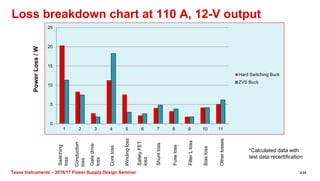
Loss breakdown chart at 110 A, 12-V output
0
5
10
15
20
25
1 2 3 4 5 6 7 8 9 10 11
Hard Switching Buck
ZVS Buck
Switching
loss
Conduction
loss
Gate
drive
loss
Core
loss
Winding
loss
Safety
FET
loss
Shunt
loss
Fuse
loss
Filter
L
loss
Bias
loss
Other
losses
Power
Loss
/
W
*Calculated data with
test data recertification
4-24
Texas Instruments – 2016/17 Power Supply Design Seminar
Efficiency comparison: buck-mode
84.00%
86.00%
88.00%
90.00%
92.00%
94.00%
96.00%
98.00%
0 20 40 60 80 100 120
ZVS Buck
Hard Switching Buck
ZVS Buck w/o safety parts
HS Buck w/o safety parts
Efficiency
12 V Current / A
4-25
Texas Instruments – 2016/17 Power Supply Design Seminar
Efficiency comparison: boost-mode
84.00%
86.00%
88.00%
90.00%
92.00%
94.00%
96.00%
0 20 40 60 80 100 120
ZVS Boost
Hard Switching Boost
Mode-switching and phase-shedding
can improve light-load efficiency.
Efficiency
12 V current / A
4-26
Texas Instruments – 2016/17 Power Supply Design Seminar
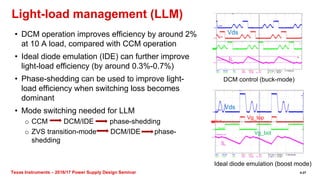
Light-load management (LLM)
• DCM operation improves efficiency by around 2%
at 10 A load, compared with CCM operation
• Ideal diode emulation (IDE) can further improve
light-load efficiency (by around 0.3%-0.7%)
• Phase-shedding can be used to improve light-
load efficiency when switching loss becomes
dominant
• Mode switching needed for LLM
o CCM DCM/IDE phase-shedding
o ZVS transition-mode DCM/IDE phase-
shedding
DCM control (buck-mode)
Ideal diode emulation (boost mode)
Vds
IL
Vds
IL
Vg_top
Vg_bot
4-27
Texas Instruments – 2016/17 Power Supply Design Seminar
Thermal data comparison 110 A
ZVS buck-mode
Hard-switching buck-mode
Top FET / C Bottom FET / C Core / C Winding / C
72.0/73* 61.5/64 56.5//59 62.3//64
Top FET / C Bottom FET / C Core / C Winding / C
84.75/92 68.25/69 64/65 77.5/78
*Avg. temp / max temp
Top FET
Bottom FET
Top FET
Bottom FET
Core
Winding
Core
Winding
4-28
Texas Instruments – 2016/17 Power Supply Design Seminar
Thermal data comparison 110 A
ZVS boost-mode
Hard-switching boost-mode
Top FET / C Bottom FET / C Core / C Winding / C
64.3/66* 75.3/76 65/66 66.75/71
Top FET / C Bottom FET / C Core / C Winding / C
67.25/72 75.25/77 63/64 69.25/73
Top FET
Bottom FET
Top FET
Bottom FET
Core
Winding
Winding
Core
*Avg. temp / max temp
4-29
Texas Instruments – 2016/17 Power Supply Design Seminar
EMI floor and bias noise (quasi-peak)
Noise floor
Bias noise
Class B QP
Class 5 avg
4-30
Texas Instruments – 2016/17 Power Supply Design Seminar
EMI comparison (quasi-peak)
Hard- versus soft-switching at buck-mode and full-load
15 dB
Class B QP
Class 5 Avg
Soft-switching
Hard-switching
4-31
Texas Instruments – 2016/17 Power Supply Design Seminar
Summary and conclusions
Hard-switching Soft-switching
Efficiency Better efficiency at light-load range Better efficiency potential at heavy loads
Voltage spike, dv/dt
and current ripple
Higher voltage spike and dV/dt but
lower current ripple
Softer dv/dt and lower voltage spike, but
much higher current ripple
Control complexity Fixed frequency, less complexity Hardware is required for cycle-by-cycle
phase synchronization
Thermal Higher FET temperature rise Lower temperature rise and less than
75ºC FET case temperature and windings
• One power stage designed for both hard- and soft-switching converter comparison tests
• Efficiency advantage of soft-switching at heavy load is insignificant
• Soft-switching converter can improve efficiency by optimizing inductor design
• Light-load management can improve light-load efficiency to a similar level for both controls
• EMI under 1 MHz has insignificant difference, but soft-switching exhibits up to 15 dB lower noise at higher
frequency
• UCD3138 is capable of doing both hard-switching and soft-switching control
• GUI eases circuit debug and facilitates system test and monitoring
o Download firmware with Fusion GUI here: www.ti.com/ucd3138.
4-32
The platform bar and E2E are trademarks of Texas Instruments.
All other trademarks are the property of their respective owners. SLUP343
TI Worldwide Technical Support
Internet
TI Semiconductor Product Information Center Home Page
support.ti.com
TI E2E™ Community Home Page
e2e.ti.com
Product Information Centers
Phone +1(512) 434-1560
Phone
Americas
Brazil
Mexico Phone
0800-891-2616
0800-670-7544
Fax
Internet/Email
+1(972) 927-6377
support.ti.com/sc/pic/americas.htm
Europe, Middle East, and Africa
Phone
European Free Call 00800-ASK-TEXAS
(00800 275 83927)
International +49 (0) 8161 80 2121
Russian Support +7 (4) 95 98 10 701
Note: The European Free Call (Toll Free) number is not active in all countries.
If you have technical difficulty calling the free call number, please use the
international number above.
Fax
Internet
Direct Email
+(49) (0) 8161 80 2045
www.ti.com/asktexas
asktexas@ti.com
Japan
Phone Domestic 0120-92-3326
Fax International
Domestic
+81-3-3344-5317
0120-81-0036
Internet/Email International
Domestic
support.ti.com/sc/pic/japan.htm
www.tij.co.jp/pic
Asia
Phone
+91-80-41381665
International
Domestic Toll-Free Number
Note: Toll-free numbers do not support mobile and IP phones.
1-800-999-084
Australia
China
Hong Kong
India
Indonesia
Korea
Malaysia
New Zealand
Philippines
Singapore
Taiwan
Thailand
800-820-8682
800-96-5941
000-800-100-8888
001-803-8861-1006
080-551-2804
1-800-80-3973
0800-446-934
1-800-765-7404
800-886-1028
0800-006800
001-800-886-0010
International
Fax
Email
Internet
+86-21-23073444
+8621-23073686
tiasia@ti.com or ti-china@ti.com
support.ti.com/sc/pic/asia.htm
B021014
Important Notice: The products and services of Texas Instruments Incorporated and its
subsidiaries described herein are sold subject to TI’s standard terms and conditions of sale.
Customers are advised to obtain the most current and complete information about TI
products and services before placing orders. TI assumes no liability for applications
assistance, customer’s applications or product designs, software performance, or
infringement of patents. The publication of information regarding any other company’s
products or services does not constitute TI’s approval, warranty or endorsement thereof.
IMPORTANT NOTICE
Texas Instruments Incorporated and its subsidiaries (TI) reserve the right to make corrections, enhancements, improvements and other
changes to its semiconductor products and services per JESD46, latest issue, and to discontinue any product or service per JESD48, latest
issue. Buyers should obtain the latest relevant information before placing orders and should verify that such information is current and
complete. All semiconductor products (also referred to herein as “components”) are sold subject to TI’s terms and conditions of sale
supplied at the time of order acknowledgment.
TI warrants performance of its components to the specifications applicable at the time of sale, in accordance with the warranty in TI’s terms
and conditions of sale of semiconductor products. Testing and other quality control techniques are used to the extent TI deems necessary
to support this warranty. Except where mandated by applicable law, testing of all parameters of each component is not necessarily
performed.
TI assumes no liability for applications assistance or the design of Buyers’ products. Buyers are responsible for their products and
applications using TI components. To minimize the risks associated with Buyers’ products and applications, Buyers should provide
adequate design and operating safeguards.
TI does not warrant or represent that any license, either express or implied, is granted under any patent right, copyright, mask work right, or
other intellectual property right relating to any combination, machine, or process in which TI components or services are used. Information
published by TI regarding third-party products or services does not constitute a license to use such products or services or a warranty or
endorsement thereof. Use of such information may require a license from a third party under the patents or other intellectual property of the
third party, or a license from TI under the patents or other intellectual property of TI.
Reproduction of significant portions of TI information in TI data books or data sheets is permissible only if reproduction is without alteration
and is accompanied by all associated warranties, conditions, limitations, and notices. TI is not responsible or liable for such altered
documentation. Information of third parties may be subject to additional restrictions.
Resale of TI components or services with statements different from or beyond the parameters stated by TI for that component or service
voids all express and any implied warranties for the associated TI component or service and is an unfair and deceptive business practice.
TI is not responsible or liable for any such statements.
Buyer acknowledges and agrees that it is solely responsible for compliance with all legal, regulatory and safety-related requirements
concerning its products, and any use of TI components in its applications, notwithstanding any applications-related information or support
that may be provided by TI. Buyer represents and agrees that it has all the necessary expertise to create and implement safeguards which
anticipate dangerous consequences of failures, monitor failures and their consequences, lessen the likelihood of failures that might cause
harm and take appropriate remedial actions. Buyer will fully indemnify TI and its representatives against any damages arising out of the use
of any TI components in safety-critical applications.
In some cases, TI components may be promoted specifically to facilitate safety-related applications. With such components, TI’s goal is to
help enable customers to design and create their own end-product solutions that meet applicable functional safety standards and
requirements. Nonetheless, such components are subject to these terms.
No TI components are authorized for use in FDA Class III (or similar life-critical medical equipment) unless authorized officers of the parties
have executed a special agreement specifically governing such use.
Only those TI components which TI has specifically designated as military grade or “enhanced plastic” are designed and intended for use in
military/aerospace applications or environments. Buyer acknowledges and agrees that any military or aerospace use of TI components
which have not been so designated is solely at the Buyer's risk, and that Buyer is solely responsible for compliance with all legal and
regulatory requirements in connection with such use.
TI has specifically designated certain components as meeting ISO/TS16949 requirements, mainly for automotive use. In any case of use of
non-designated products, TI will not be responsible for any failure to meet ISO/TS16949.
Products Applications
Audio www.ti.com/audio Automotive and Transportation www.ti.com/automotive
Amplifiers amplifier.ti.com Communications and Telecom www.ti.com/communications
Data Converters dataconverter.ti.com Computers and Peripherals www.ti.com/computers
DLP® Products www.dlp.com Consumer Electronics www.ti.com/consumer-apps
DSP dsp.ti.com Energy and Lighting www.ti.com/energy
Clocks and Timers www.ti.com/clocks Industrial www.ti.com/industrial
Interface interface.ti.com Medical www.ti.com/medical
Logic logic.ti.com Security www.ti.com/security
Power Mgmt power.ti.com Space, Avionics and Defense www.ti.com/space-avionics-defense
Microcontrollers microcontroller.ti.com Video and Imaging www.ti.com/video
RFID www.ti-rfid.com
OMAP Applications Processors www.ti.com/omap TI E2E Community e2e.ti.com
Wireless Connectivity www.ti.com/wirelessconnectivity
Mailing Address: Texas Instruments, Post Office Box 655303, Dallas, Texas 75265
Copyright © 2016, Texas Instruments Incorporated

slup343.pdf

  • 1.
    Power Supply DesignSeminar Bi-directional DC/DC converter topology comparison and design Reproduced from 2016 Texas Instruments Power Supply Design Seminar SEM2200 TI Literature Number: SLUP343 © 2016, 2017 Texas Instruments Incorporated Power Seminar topics and online power training modules are available at:ti.com/psds
  • 2.
    Texas Instruments –2016/17 Power Supply Design Seminar Bi-directional DC/DC converter topology comparison and design HEV/EV and server applications Sanatan Rajagopalan Zhong Ye
  • 3.
    Texas Instruments –2016/17 Power Supply Design Seminar Texas Instruments – 2016/17 Power Supply Design Seminar Agenda • Application overview and specifications o Automotive application o Server and Datacenter • Topology comparison o Four-phase interleaved fixed frequency Bi-directional Buck converter o Four-phase interleaved ZVS transition-mode Bi-directional Buck converter • UCD3138-based control scheme and implementation • Test data comparison o Switching waveform comparison o Efficiency comparison o Loss Breakdown Comparison o Thermal o EMI • Conclusions 4-2
  • 4.
    Texas Instruments –2016/17 Power Supply Design Seminar Texas Instruments – 2016/17 Power Supply Design Seminar Application overview-automotive • Continuous increase of electrical power consumption • 12-V system running into limitations • Improve efficiency for high-power loads (AC comp., pumps, …) • Mild hybrid functionality asking for high cycling perform- ance (lead acid not good fit for more recuperation) • Additional savings due to intelligent networks (partial shutdown loads in the network) • Reduce copper diameter and cost 12-V lead- battery 12-V load 12-V generator 12-V load 12 V GND Today: 12-V system 12 V GND 48-V Li-Ion battery 48-V motor/ generator 12-V / 48-V DC/DC converter 48 V GND 48-V load 48-V load Next step: 48-V power network extension 12-V lead- battery 12-V load 12-V load 12-V load 4-3
  • 5.
    Texas Instruments –2016/17 Power Supply Design Seminar Texas Instruments – 2016/17 Power Supply Design Seminar 48-V / 12-V electrical system with start/stop 12-V electrical system 12-V battery 48-V Li-Ion battery management 48-V traction motor inverter Active suspension control AC compressor Water pump Electric power steering Cooling fan Transmission oil/fluid pump Fuel pump Parts using 48 V 48-V / 12-V bi-directional DC/DC converter 4-4
  • 6.
    Texas Instruments –2016/17 Power Supply Design Seminar Texas Instruments – 2016/17 Power Supply Design Seminar Typical 48-V / 12-V converter specification for automotive • >96 percent efficiency • No air or liquid cooling needed • Multi-phases interleaved • Phase current sharing • Can be stacked to deliver 3 kW (3-kW buck-mode and 800-W boost-mode) • 12-V reverse connection prevention • Failed phase isolation • Auto phase-shedding and offset for light-load management • Protection including OCP, OVP, OTP • 70 V/100 ms load-dumping BN48 surge • 100 uA quiescent current when disabled (after 48 V is disconnected) • CAN bus or SPI communication 4-5
  • 7.
    Texas Instruments –2016/17 Power Supply Design Seminar Texas Instruments – 2016/17 Power Supply Design Seminar Microsoft reinvented data center Traditional data center Bi-directional DC/DC Advantages of local energy storage data center deployments • Reduce cost up to 5 times • Eliminate up to 9% losses associated with UPS • No requirement for a UPS or battery room o 25% facility footprint reduction • Improve serviceability significantly o Hot-swappable o Minimize potential failure impact zone Other applications: data centers and servers * Reference from Microsoft Publication Generators UPS IT load Substation Substation IT load Generators 4-6
  • 8.
    Texas Instruments –2016/17 Power Supply Design Seminar Texas Instruments – 2016/17 Power Supply Design Seminar Topology investigation Hard-switching, non-Isolated DC/DC (sync-buck) converter Transition-mode ZVS DC/DC (sync-buck) converter PROS • Simple control • Fixed-frequency • Low inductor current ripple • Soft-switching, potentially high efficiency • Low common-mode noise CONS • High-switch ringing • High common-mode noise • High inductor current ripple • Variable frequency • Complex control 4-7
  • 9.
    Texas Instruments –2016/17 Power Supply Design Seminar Texas Instruments – 2016/17 Power Supply Design Seminar Hard-switching and soft-switching bi-directional converter Buck-mode Boost-mode Buck-mode Boost-mode Energy transfer direction Energy transfer direction Soft-switching converter Hard-switching converter Buck-mode Boost-mode 4-8
  • 10.
    Texas Instruments –2016/17 Power Supply Design Seminar Texas Instruments – 2016/17 Power Supply Design Seminar UCD3138 overview Key features • Multi-nested loop isolated digital controller • 3 loop with 14-bit DAC reference • 2-pole 2-zero PID filters with multi-coeff banks • PWM, phase-shift and resonant-mode control • Constant voltage, current and power modes • Input voltage feed-forward and Vpri- sensing • Peak current mode with internal slope comp. • Cycle-by-cycle current limit with CLF counter • 8x over sampling or averaging at EADC 4-9
  • 11.
    Texas Instruments –2016/17 Power Supply Design Seminar Texas Instruments – 2016/17 Power Supply Design Seminar UCD3138 key features (cont.) • 12-bit ADCs with hardware filters • 12-bit ADCs with dual hold-sampling • Auto PWM-LLC and PWM-PS mode switching • Burst-mode for light load operation • Integrated copper trace current-sensing • Integrated current-sharing circuit • 8 high resolution DPWM outputs (250 ps) • 32-bit, 32-MHz ARM 7 (32 KB PFlash, 4 KB DFlash) • Multi-channel, 12-bit 256 ksps GP ADC • On-chip (BOD / POR) • Single-supply operation (3.3 V) • Single supply operation (3.3 V) • On-chip reference + oscillator • 2 UART’s + programmable PMBus interface • 2 MHz max switching frequency • 4 ns frequency resolution • External interrupt + fault input and output • –40°C to +125°C extended temp range • 64 pin and 40 pin QFN packages • Power-saving features • And MORE!!! 4-10
  • 12.
    Texas Instruments –2016/17 Power Supply Design Seminar Texas Instruments – 2016/17 Power Supply Design Seminar UCD3138-based control • Three control loops: current loop, 12-V voltage loop, 48-V voltage loop • Total current is sensed for current loop control • Current source operation before voltages reach set points • Phase currents are sensed for current balance • Current command set by digital communication port or ADC input Additional control for ZVS operation: • Phase 1 negative current sensed • Negative current thresholds programmed by PWM0, one to generate a sync signal • Sync signal controls frequency modulation 4-11
  • 13.
    Texas Instruments –2016/17 Power Supply Design Seminar Texas Instruments – 2016/17 Power Supply Design Seminar Current ripple and phase number selection • Duty cycle directly determines phase number selection • Optimal phase numbers for 48-V /12-V buck and boost power conversion are: 4, 8, 12 • Adding phases reduces current ripple further when duty cycle is away from: o 0.25 in buck-mode o 0.75 in boost-mode IL2 / V 0.2 0.4 0.6 0.8 1 IL1 / V 0 0.2 0.4 0.6 0.8 time/uSecs 5uSecs/div 0 5 10 15 20 25 30 IL_Total / V 0 0.2 0.4 0.6 0.8 1 1.2 1.4 Time IL1 IL2 IL1+ IL2 0 1 0 1 0 1.5 0.66A Ripple Current Cancellation 0 0.1 0.2 0.3 0.4 0.5 0.6 0.7 0.8 0.9 1 1 2 3 4 5 6 7 8 9 10 11 12 Normalized Inductor Current Ripple vs Phase Number Phase Number Normalized Current Ripple Zero current ripple at 12V 4-12
  • 14.
    Texas Instruments –2016/17 Power Supply Design Seminar Texas Instruments – 2016/17 Power Supply Design Seminar System block diagram for circuit test 4-13
  • 15.
    Texas Instruments –2016/17 Power Supply Design Seminar Texas Instruments – 2016/17 Power Supply Design Seminar Power stage component selection and design Hard-switching Soft-switching Switching frequency 140 kHz 100 kHz- 450 kHz Current ripple at full load 16.25 A (±25% ripple) 65 A Inductor value 4.7 uH 1.4 uH Inductor DC resistance 1.86 mΩ 0.618 mΩ Inductor part number SER2915H-472KL (Coilcraft ) Litz wire: AWG# 32, 110 strands PQ26/20 core -TDK B65877B0000R097 Inductor photos 4-14
  • 16.
    Texas Instruments –2016/17 Power Supply Design Seminar Texas Instruments – 2016/17 Power Supply Design Seminar Power stage component selection and design (cont) Hard-switching Soft-switching Main MOSFETs Infineon IPB017N100N5: 100 V, 1.7 mΩ Infineon IPB015N08N5: 80 V, 1.5 mΩ Reverse protection FETs CSD16556Q5B: TI, 20V, 1.062 mΩ @ 75ºC CSD16556Q5B: TI, 20 V, 1.062 mΩ @ 75ºC 48-V fuses Littlefuse: 0891030 30A, 2.06 mΩ @ 25ºC, 2.18 mΩ @ 90ºC Littlefuse: 0891030 30 A, 2.06 mΩ @ 25ºC, 2.18 mΩ @ 90ºC Low inductance shunt- sensing resistor Panasonic ERJ-M1WTF2M0U: –2 mΩ Panasonic ERJ-M1WTF2M0U: –2 mΩ 48-V input filter inductor Coilcraft XAL1580-102 MEB: 1 uH 73.5 A, 0.93 mΩ typical Coilcraft XAL1580-102 MEB: –1 uH 73.5A, 0.93 mΩ typical 4-15
  • 17.
    Texas Instruments –2016/17 Power Supply Design Seminar Texas Instruments – 2016/17 Power Supply Design Seminar Bi-directional DC/DC converter prototype 110 A 5.0” x 7.5” 48 V 12 V UCD3138 48 V 12 V 4-16
  • 18.
    Texas Instruments –2016/17 Power Supply Design Seminar Texas Instruments – 2016/17 Power Supply Design Seminar ZVS buck-switching waveform ZVS Buck at 20A Io • Max frequency = 450 kHz • Min frequency = 104 kHz Switching node voltage Inductor current 4-17
  • 19.
    Texas Instruments –2016/17 Power Supply Design Seminar Texas Instruments – 2016/17 Power Supply Design Seminar Buck-switching waveform comparison 20 A Soft-switching: negative current and ZVS  Deadtime from SyncFET turn-off to main FET turn-on = constant 220 nS  Deadtime from main FET turn-off to sync FET turn-on varies based on Io Hard-switching Soft on/off edges 6V overshoot Hard switching No overshoot 4-18
  • 20.
    Texas Instruments –2016/17 Power Supply Design Seminar Texas Instruments – 2016/17 Power Supply Design Seminar Buck switching waveform comparison 110 A Soft-switching: Negative current and ZVS (104 kHz) • Deadtime from sync FET turn-off to main FET turn-on = constant 220 nS • Deadtime from main FET turn-off to sync FET turn-on varies based on Io Hard-switching (140 kHz) 20V overshoot Soft on/off edges Hard switching No overshoot small undershoot 4-19
  • 21.
    Texas Instruments –2016/17 Power Supply Design Seminar Texas Instruments – 2016/17 Power Supply Design Seminar Boost-switching waveform comparison 20 A • Deadtime from SyncFET turn-off to Main FET turn-on = constant 220nS • Deadtime from Main FET turn-off to SyncFET turn-on varies based on Io Soft-switching: Negative current and ZVS (353 kHz) Hard-switching (140 kHz) • Deadtime from sync FET turn-off to main FET turn- on 37.5 nS • Deadtime from main FET turn-off to sync FET 37.5nS Soft on/off edges Hard switching 4-20
  • 22.
    Texas Instruments –2016/17 Power Supply Design Seminar Texas Instruments – 2016/17 Power Supply Design Seminar Boost-switching waveform comparison 110 A • Deadtime from sync FET turn-off to main FET turn-on = constant 220 nS • Deadtime from main FET turn-off to sync FET turn-on varies based on Io Soft-switching: Negative current and ZVS (104 kHz) Hard-switching (140 kHz) • Deadtime from sync FET turn-off to main FET turn-on 37.5 nS • Deadtime from main FET turn-off to sync FET 37.5 nS 3V overshoot Soft on/off edges Hard switching 8V overshoot 4-21
  • 23.
    Texas Instruments –2016/17 Power Supply Design Seminar Texas Instruments – 2016/17 Power Supply Design Seminar Bi-directional operation Ibat IL VSN Programmable parameters • 12-V battery current at buck- and boost modes • Current ramp-up and ramp- down time • Idle time between buck and boost operation • 48-V and 12-V battery OVP and UVP thresholds 4-22
  • 24.
    Texas Instruments –2016/17 Power Supply Design Seminar Texas Instruments – 2016/17 Power Supply Design Seminar GUI control screen Device GUI for circuit configuration and debug • Facilitate firmware and hardware debug • Change parameters while circuit is running • Monitor register values firmware execution • Converter status reporting Control GUI for system test and monitoring • Facilitate system test • Ease system parameter setting • Monitor system operating state and status • Monitor battery voltage and phase currents 4-23
  • 25.
    Texas Instruments –2016/17 Power Supply Design Seminar Texas Instruments – 2016/17 Power Supply Design Seminar Loss breakdown chart at 110 A, 12-V output 0 5 10 15 20 25 1 2 3 4 5 6 7 8 9 10 11 Hard Switching Buck ZVS Buck Switching loss Conduction loss Gate drive loss Core loss Winding loss Safety FET loss Shunt loss Fuse loss Filter L loss Bias loss Other losses Power Loss / W *Calculated data with test data recertification 4-24
  • 26.
    Texas Instruments –2016/17 Power Supply Design Seminar Texas Instruments – 2016/17 Power Supply Design Seminar Efficiency comparison: buck-mode 84.00% 86.00% 88.00% 90.00% 92.00% 94.00% 96.00% 98.00% 0 20 40 60 80 100 120 ZVS Buck Hard Switching Buck ZVS Buck w/o safety parts HS Buck w/o safety parts Efficiency 12 V Current / A 4-25
  • 27.
    Texas Instruments –2016/17 Power Supply Design Seminar Texas Instruments – 2016/17 Power Supply Design Seminar Efficiency comparison: boost-mode 84.00% 86.00% 88.00% 90.00% 92.00% 94.00% 96.00% 0 20 40 60 80 100 120 ZVS Boost Hard Switching Boost Mode-switching and phase-shedding can improve light-load efficiency. Efficiency 12 V current / A 4-26
  • 28.
    Texas Instruments –2016/17 Power Supply Design Seminar Texas Instruments – 2016/17 Power Supply Design Seminar Light-load management (LLM) • DCM operation improves efficiency by around 2% at 10 A load, compared with CCM operation • Ideal diode emulation (IDE) can further improve light-load efficiency (by around 0.3%-0.7%) • Phase-shedding can be used to improve light- load efficiency when switching loss becomes dominant • Mode switching needed for LLM o CCM DCM/IDE phase-shedding o ZVS transition-mode DCM/IDE phase- shedding DCM control (buck-mode) Ideal diode emulation (boost mode) Vds IL Vds IL Vg_top Vg_bot 4-27
  • 29.
    Texas Instruments –2016/17 Power Supply Design Seminar Texas Instruments – 2016/17 Power Supply Design Seminar Thermal data comparison 110 A ZVS buck-mode Hard-switching buck-mode Top FET / C Bottom FET / C Core / C Winding / C 72.0/73* 61.5/64 56.5//59 62.3//64 Top FET / C Bottom FET / C Core / C Winding / C 84.75/92 68.25/69 64/65 77.5/78 *Avg. temp / max temp Top FET Bottom FET Top FET Bottom FET Core Winding Core Winding 4-28
  • 30.
    Texas Instruments –2016/17 Power Supply Design Seminar Texas Instruments – 2016/17 Power Supply Design Seminar Thermal data comparison 110 A ZVS boost-mode Hard-switching boost-mode Top FET / C Bottom FET / C Core / C Winding / C 64.3/66* 75.3/76 65/66 66.75/71 Top FET / C Bottom FET / C Core / C Winding / C 67.25/72 75.25/77 63/64 69.25/73 Top FET Bottom FET Top FET Bottom FET Core Winding Winding Core *Avg. temp / max temp 4-29
  • 31.
    Texas Instruments –2016/17 Power Supply Design Seminar Texas Instruments – 2016/17 Power Supply Design Seminar EMI floor and bias noise (quasi-peak) Noise floor Bias noise Class B QP Class 5 avg 4-30
  • 32.
    Texas Instruments –2016/17 Power Supply Design Seminar Texas Instruments – 2016/17 Power Supply Design Seminar EMI comparison (quasi-peak) Hard- versus soft-switching at buck-mode and full-load 15 dB Class B QP Class 5 Avg Soft-switching Hard-switching 4-31
  • 33.
    Texas Instruments –2016/17 Power Supply Design Seminar Texas Instruments – 2016/17 Power Supply Design Seminar Summary and conclusions Hard-switching Soft-switching Efficiency Better efficiency at light-load range Better efficiency potential at heavy loads Voltage spike, dv/dt and current ripple Higher voltage spike and dV/dt but lower current ripple Softer dv/dt and lower voltage spike, but much higher current ripple Control complexity Fixed frequency, less complexity Hardware is required for cycle-by-cycle phase synchronization Thermal Higher FET temperature rise Lower temperature rise and less than 75ºC FET case temperature and windings • One power stage designed for both hard- and soft-switching converter comparison tests • Efficiency advantage of soft-switching at heavy load is insignificant • Soft-switching converter can improve efficiency by optimizing inductor design • Light-load management can improve light-load efficiency to a similar level for both controls • EMI under 1 MHz has insignificant difference, but soft-switching exhibits up to 15 dB lower noise at higher frequency • UCD3138 is capable of doing both hard-switching and soft-switching control • GUI eases circuit debug and facilitates system test and monitoring o Download firmware with Fusion GUI here: www.ti.com/ucd3138. 4-32
  • 34.
    The platform barand E2E are trademarks of Texas Instruments. All other trademarks are the property of their respective owners. SLUP343 TI Worldwide Technical Support Internet TI Semiconductor Product Information Center Home Page support.ti.com TI E2E™ Community Home Page e2e.ti.com Product Information Centers Phone +1(512) 434-1560 Phone Americas Brazil Mexico Phone 0800-891-2616 0800-670-7544 Fax Internet/Email +1(972) 927-6377 support.ti.com/sc/pic/americas.htm Europe, Middle East, and Africa Phone European Free Call 00800-ASK-TEXAS (00800 275 83927) International +49 (0) 8161 80 2121 Russian Support +7 (4) 95 98 10 701 Note: The European Free Call (Toll Free) number is not active in all countries. If you have technical difficulty calling the free call number, please use the international number above. Fax Internet Direct Email +(49) (0) 8161 80 2045 www.ti.com/asktexas asktexas@ti.com Japan Phone Domestic 0120-92-3326 Fax International Domestic +81-3-3344-5317 0120-81-0036 Internet/Email International Domestic support.ti.com/sc/pic/japan.htm www.tij.co.jp/pic Asia Phone +91-80-41381665 International Domestic Toll-Free Number Note: Toll-free numbers do not support mobile and IP phones. 1-800-999-084 Australia China Hong Kong India Indonesia Korea Malaysia New Zealand Philippines Singapore Taiwan Thailand 800-820-8682 800-96-5941 000-800-100-8888 001-803-8861-1006 080-551-2804 1-800-80-3973 0800-446-934 1-800-765-7404 800-886-1028 0800-006800 001-800-886-0010 International Fax Email Internet +86-21-23073444 +8621-23073686 tiasia@ti.com or ti-china@ti.com support.ti.com/sc/pic/asia.htm B021014 Important Notice: The products and services of Texas Instruments Incorporated and its subsidiaries described herein are sold subject to TI’s standard terms and conditions of sale. Customers are advised to obtain the most current and complete information about TI products and services before placing orders. TI assumes no liability for applications assistance, customer’s applications or product designs, software performance, or infringement of patents. The publication of information regarding any other company’s products or services does not constitute TI’s approval, warranty or endorsement thereof.
  • 35.
    IMPORTANT NOTICE Texas InstrumentsIncorporated and its subsidiaries (TI) reserve the right to make corrections, enhancements, improvements and other changes to its semiconductor products and services per JESD46, latest issue, and to discontinue any product or service per JESD48, latest issue. Buyers should obtain the latest relevant information before placing orders and should verify that such information is current and complete. All semiconductor products (also referred to herein as “components”) are sold subject to TI’s terms and conditions of sale supplied at the time of order acknowledgment. TI warrants performance of its components to the specifications applicable at the time of sale, in accordance with the warranty in TI’s terms and conditions of sale of semiconductor products. Testing and other quality control techniques are used to the extent TI deems necessary to support this warranty. Except where mandated by applicable law, testing of all parameters of each component is not necessarily performed. TI assumes no liability for applications assistance or the design of Buyers’ products. Buyers are responsible for their products and applications using TI components. To minimize the risks associated with Buyers’ products and applications, Buyers should provide adequate design and operating safeguards. TI does not warrant or represent that any license, either express or implied, is granted under any patent right, copyright, mask work right, or other intellectual property right relating to any combination, machine, or process in which TI components or services are used. Information published by TI regarding third-party products or services does not constitute a license to use such products or services or a warranty or endorsement thereof. Use of such information may require a license from a third party under the patents or other intellectual property of the third party, or a license from TI under the patents or other intellectual property of TI. Reproduction of significant portions of TI information in TI data books or data sheets is permissible only if reproduction is without alteration and is accompanied by all associated warranties, conditions, limitations, and notices. TI is not responsible or liable for such altered documentation. Information of third parties may be subject to additional restrictions. Resale of TI components or services with statements different from or beyond the parameters stated by TI for that component or service voids all express and any implied warranties for the associated TI component or service and is an unfair and deceptive business practice. TI is not responsible or liable for any such statements. Buyer acknowledges and agrees that it is solely responsible for compliance with all legal, regulatory and safety-related requirements concerning its products, and any use of TI components in its applications, notwithstanding any applications-related information or support that may be provided by TI. Buyer represents and agrees that it has all the necessary expertise to create and implement safeguards which anticipate dangerous consequences of failures, monitor failures and their consequences, lessen the likelihood of failures that might cause harm and take appropriate remedial actions. Buyer will fully indemnify TI and its representatives against any damages arising out of the use of any TI components in safety-critical applications. In some cases, TI components may be promoted specifically to facilitate safety-related applications. With such components, TI’s goal is to help enable customers to design and create their own end-product solutions that meet applicable functional safety standards and requirements. Nonetheless, such components are subject to these terms. No TI components are authorized for use in FDA Class III (or similar life-critical medical equipment) unless authorized officers of the parties have executed a special agreement specifically governing such use. Only those TI components which TI has specifically designated as military grade or “enhanced plastic” are designed and intended for use in military/aerospace applications or environments. Buyer acknowledges and agrees that any military or aerospace use of TI components which have not been so designated is solely at the Buyer's risk, and that Buyer is solely responsible for compliance with all legal and regulatory requirements in connection with such use. TI has specifically designated certain components as meeting ISO/TS16949 requirements, mainly for automotive use. In any case of use of non-designated products, TI will not be responsible for any failure to meet ISO/TS16949. Products Applications Audio www.ti.com/audio Automotive and Transportation www.ti.com/automotive Amplifiers amplifier.ti.com Communications and Telecom www.ti.com/communications Data Converters dataconverter.ti.com Computers and Peripherals www.ti.com/computers DLP® Products www.dlp.com Consumer Electronics www.ti.com/consumer-apps DSP dsp.ti.com Energy and Lighting www.ti.com/energy Clocks and Timers www.ti.com/clocks Industrial www.ti.com/industrial Interface interface.ti.com Medical www.ti.com/medical Logic logic.ti.com Security www.ti.com/security Power Mgmt power.ti.com Space, Avionics and Defense www.ti.com/space-avionics-defense Microcontrollers microcontroller.ti.com Video and Imaging www.ti.com/video RFID www.ti-rfid.com OMAP Applications Processors www.ti.com/omap TI E2E Community e2e.ti.com Wireless Connectivity www.ti.com/wirelessconnectivity Mailing Address: Texas Instruments, Post Office Box 655303, Dallas, Texas 75265 Copyright © 2016, Texas Instruments Incorporated