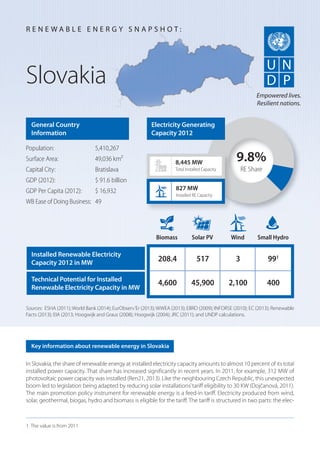
In Slovakia, the share of renewable energy at installed electricity capacity amounts to almost 10 percent of its total
installed power capacity. That share has increased significantly in recent years. In 2011, for example, 312 MW of
photovoltaic power capacity was installed (Ren21, 2013). Like the neighbouring Czech Republic, this unexpected
boom led to legislation being adapted by reducing solar installations’tariff eligibility to 30 KW (Dojčanová, 2011).
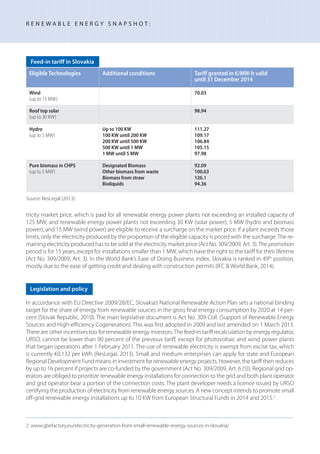
The main promotion policy instrument for renewable energy is a feed-in tariff. Electricity produced from wind,
solar, geothermal, biogas, hydro and biomass is eligible for the tariff. The tariff is structured in two parts: the elec-
Slovakia
General Country
Information
Population: 5,410,267
Surface Area: 49,036 km²
Capital City: Bratislava
GDP (2012): $ 91.6 billion
GDP Per Capita (2012): $ 16,932
WB Ease of Doing Business: 49
Sources: ESHA (2011); World Bank (2014); EurObserv’Er (2013); WWEA (2013); EBRD (2009); INFORSE (2010); EC (2013); Renewable
Facts (2013); EIA (2013; Hoogwijk and Graus (2008); Hoogwijk (2004); JRC (2011); and UNDP calculations.
R E N E W A B L E E N E R G Y S N A P S H O T :
Key information about renewable energy in Slovakia
Empowered lives.
Resilient nations.
9.8%
RE Share
8,445 MW
Total Installed Capacity
Biomass Solar PV Wind Small Hydro
208.4 517 3 991
4,600 45,900 2,100 400
827 MW
Installed RE Capacity
Electricity Generating
Capacity 2012
Installed Renewable Electricity
Capacity 2012 in MW
Technical Potential for Installed
Renewable Electricity Capacity in MW
1 The value is from 2011
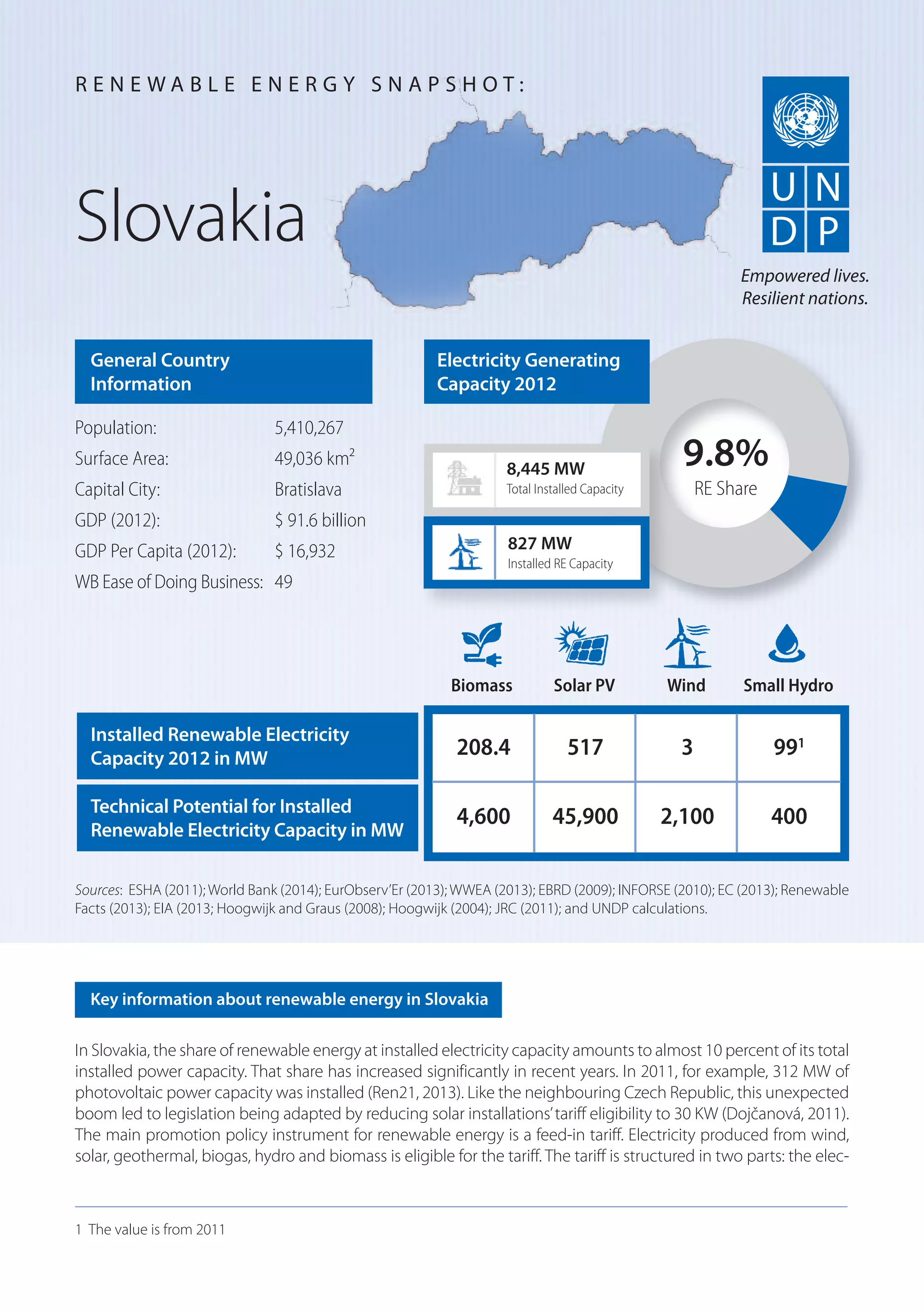
tricity market price, which is paid for all renewable energy power plants not exceeding an installed capacity of
125 MW; and renewable energy power plants not exceeding 30 KW (solar power), 5 MW (hydro and biomass
power), and 15 MW (wind power) are eligible to receive a surcharge on the market price. If a plant exceeds those
limits, only the electricity produced by the proportion of the eligible capacity is priced with the surcharge.The re-
maining electricity produced has to be sold at the electricity market price (Act No. 309/2009, Art. 3).The promotion
period is for 15 years, except for installations smaller than 1 MW, which have the right to the tariff for their lifetime
(Act No. 309/2009, Art. 3). In the World Bank’s Ease of Doing Business index, Slovakia is ranked in 49th
position,
mostly due to the ease of getting credit and dealing with construction permits (IFC & World Bank, 2014).
In accordance with EU Directive 2009/28/EC, Slovakia’s National Renewable Action Plan sets a national binding
target for the share of energy from renewable sources in the gross final energy consumption by 2020 at 14 per-
cent (Slovak Republic, 2010). The main legislative document is Act No. 309 Coll. (Support of Renewable Energy
Sources and High-efficiency Cogeneration). This was first adopted in 2009 and last amended on 1 March 2013.
There are other incentives too for renewable energy investors.The feed-in tariff recalculation by energy regulator,
URSO, cannot be lower than 90 percent of the previous tariff, except for photovoltaic and wind power plants
that began operations after 1 February 2011. The use of renewable electricity is exempt from excise tax, which
is currently €0.132 per kWh (ResLegal, 2013). Small and medium enterprises can apply for state and European
Regional Development Fund means in investment for renewable energy projects. However, the tariff then reduces
by up to 16 percent if projects are co-funded by the government (Act No. 309/2009, Art. 6 (5)). Regional grid op-
erators are obliged to prioritize renewable energy installations for connection to the grid and both plant operator
and grid operator bear a portion of the connection costs. The plant developer needs a licence issued by URSO
certifying the production of electricity from renewable energy sources. A new concept intends to promote small
off-grid renewable energy installations up to 10 KW from European Structural Funds in 2014 and 2015.2
Legislation and policy
R E N E W A B L E E N E R G Y S N A P S H O T :
2 www.gbefactory.eu/electricity-generation-from-small-renewable-energy-sources-in-slovakia/
Feed-in tariff in Slovakia
Source: ResLegal (2013)
Eligible Technologies Additional conditions Tariff granted in €/MW-h valid
until 31 December 2014
Wind
(up to 15 MW)
70.03
Roof top solar
(up to 30 KW)
98.94
Hydro
(up to 5 MW)
Up to 100 KW
100 KW until 200 KW
200 KW until 500 KW
500 KW until 1 MW
1 MW until 5 MW
111.27
109.17
106.84
105.15
97.98
Pure biomass in CHPS
(up to 5 MW)
Designated Biomass
Other biomass from waste
Biomass from straw
Bioliquids
92.09
100.63
126.1
94.36
Slovakia
Institutions
Organization Responsibility Website
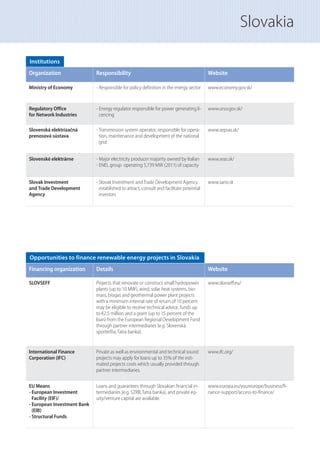
Ministry of Economy - Responsible for policy definition in the energy sector www.economy.gov.sk/
Regulatory Office
for Network Industries
- Energy regulator responsible for power generating li-
cencing
www.urso.gov.sk/
Slovenská elektrizačná
prenosová sústava
- Transmission system operator, responsible for opera-
tion, maintenance and development of the national
grid
www.sepsas.sk/
Slovenské elektrárne - Major electricity producer majority owned by Italian
- ENEL group  operating 5,739 MW (2011) of capacity
www.seas.sk/
Slovak Investment
and Trade Development
Agency
- Slovak Investment and Trade Development Agency
established to attract, consult and facilitate potential
investors
www.sario.sk
Opportunities to finance renewable energy projects in Slovakia
Financing organization Details Website
SLOVSEFF Projects that renovate or construct small hydropower
plants (up to 10 MW), wind, solar heat systems, bio-
mass, biogas and geothermal power plant projects
with a minimum internal rate of return of 10 percent
may be eligible to receive technical advice, funds up
to €2.5 million and a grant (up to 15 percent of the
loan) from the European Regional Development Fund
through partner intermediaries (e.g. Slovenská
sporiteľňa, Tatra banka).
www.slovseff.eu/
International Finance
Corporation (IFC)
Private as well as environmental and technical sound
projects may apply for loans up to 35% of the esti-
mated projects costs which usually provided through
partner intermediaries.
www.ifc.org/
EU Means
- European Investment
Facility (EIF)/
- European Investment Bank
(EIB)
- Structural Funds
Loans and guarantees through Slovakian financial in-
termediaries (e.g. SZRB, Tatra banka), and private eq-
uity/venture capital are available.
www.europa.eu/youreurope/business/fi-
nance-support/access-to-finance/
Slovakia
References
Dojčanová, L., 2011: Renewable energy in Slovakia:
problems and prospects. Available at:
http://europeandcis.undp.org/news/show/AEA42619-
F203-1EE9-BC5C3AA170C8DE7D
EurObserv’Er, 2013: Photovoltaic Barometer 2013.
Available at: www.energies-renouvelables.org/observ-
er/stat_baro/observ/baro-jdp9.pdf
European Bank for Reconstruction and Development
(EBRD), 2009: Romania – Country Profile. Available at:
www.ebrdrenewables.com/sites/renew/countries/Rom
ania/profile.aspx
European Commission (EC), 2013: EU Energy in Figures -
Statistical Pocket Book 2013. Available at:
http://ec.europa.eu/energy/publications/doc/2013_
pocketbook.pdf
European Small Hydropower Association (ESHA), 2011:
HYDI Database. Available at: http://streammap.esha.be/
Government of Slovakia, 2009: Act No. 309/2009 Coll.
on the Support of Renewable Energy Sources and High-
efficiency Cogeneration and on Amendments to
Certain Acts. Available at:
www.zakonypreludi.sk/zz/2009-309 (Slovak)
Hoogwijk, M., 2004: On the global and regional
potential of renewable energy sources. Utrecht:
Universiteit Utrecht, Faculteit Scheikunde. Dissertation.
Available at: http://igitur-archive.library.uu.nl/
dissertations/2004-0309-123617/full.pdf
Hoogwiijk, M. andW. Graus, 2008: Global Potential of
Renewable Energy Sources: A Literature Assessment.
Available at: www.ecofys.com/files/files
/report_global_potential_of_renewable_energy_sourc
es_a_literature_assessment.pdf
International Finance Corporation (IFC) andWorld Bank,
2014: Doing Business – Measuring Business
Regulations. Available at: www.doingbusiness.org
/data/exploreeconomies/slovakia/
International Network for Sustainable Energy (INFORSE),
2010:Vision 2050 for Slovakia. Available at:
www.inforse.org/europe/VisionSK.htm
Joint Research Centre of the European Commission
(JRC), 2011:Technical Assessment of the Renewable
Energy Action Plans. Available at:
http://ec.europa.eu/dgs/jrc/downloads/jrc_reference
_report_2011_reap.pdf
Renewable energy policy database and support
(ResLegal), 2013: An initiative of the European
Commission – Romania. Available at:
www.res-legal.eu
Renewable Facts, 2013: Slovakia. Available at:
www.renewablefacts.com/country/slovakia
Slovak Republic, 2010: National Renewable Action
Plan Slovak Republic. Available at:
http://ec.europa.eu/ energy/renewables/
action_plan_en.htm
U.S. Energy Information Administration (EIA), 2013:
Levelized Cost of New Generation Resources in the
Annual Energy Outlook 2013. Available at:
www.eia.gov/forecasts/aeo/electricity_generation.cfm
WorldWind Energy Association (WWEA), 2013: 2012
Annual Report. Available at:
www.wwindea.org/webimages/WorldWindEnergy
Report2012_final.pdf
World Bank, 2014: Data Catalog. Available at:
http://datacatalog.worldbank.org/
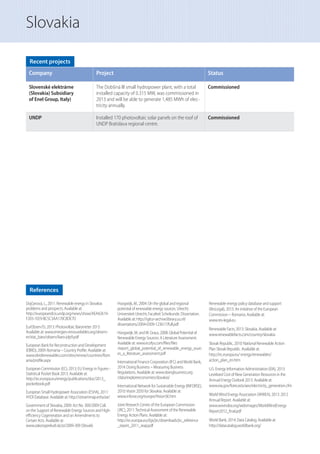
Recent projects
Company Project Status
Slovenské elektrárne
(Slovakia) Subsidiary
of Enel Group, Italy)
The Dobšiná III small hydropower plant, with a total
installed capacity of 0.315 MW, was commissioned in
2013 and will be able to generate 1,485 MWh of elec-
tricity annually.
Commissioned
UNDP Installed 170 photovoltaic solar panels on the roof of
UNDP Bratislava regional centre.
Commissioned

Slovakia

  • 1.
    In Slovakia, theshare of renewable energy at installed electricity capacity amounts to almost 10 percent of its total installed power capacity. That share has increased significantly in recent years. In 2011, for example, 312 MW of photovoltaic power capacity was installed (Ren21, 2013). Like the neighbouring Czech Republic, this unexpected boom led to legislation being adapted by reducing solar installations’tariff eligibility to 30 KW (Dojčanová, 2011). The main promotion policy instrument for renewable energy is a feed-in tariff. Electricity produced from wind, solar, geothermal, biogas, hydro and biomass is eligible for the tariff. The tariff is structured in two parts: the elec- Slovakia General Country Information Population: 5,410,267 Surface Area: 49,036 km² Capital City: Bratislava GDP (2012): $ 91.6 billion GDP Per Capita (2012): $ 16,932 WB Ease of Doing Business: 49 Sources: ESHA (2011); World Bank (2014); EurObserv’Er (2013); WWEA (2013); EBRD (2009); INFORSE (2010); EC (2013); Renewable Facts (2013); EIA (2013; Hoogwijk and Graus (2008); Hoogwijk (2004); JRC (2011); and UNDP calculations. R E N E W A B L E E N E R G Y S N A P S H O T : Key information about renewable energy in Slovakia Empowered lives. Resilient nations. 9.8% RE Share 8,445 MW Total Installed Capacity Biomass Solar PV Wind Small Hydro 208.4 517 3 991 4,600 45,900 2,100 400 827 MW Installed RE Capacity Electricity Generating Capacity 2012 Installed Renewable Electricity Capacity 2012 in MW Technical Potential for Installed Renewable Electricity Capacity in MW 1 The value is from 2011
  • 2.
    tricity market price,which is paid for all renewable energy power plants not exceeding an installed capacity of 125 MW; and renewable energy power plants not exceeding 30 KW (solar power), 5 MW (hydro and biomass power), and 15 MW (wind power) are eligible to receive a surcharge on the market price. If a plant exceeds those limits, only the electricity produced by the proportion of the eligible capacity is priced with the surcharge.The re- maining electricity produced has to be sold at the electricity market price (Act No. 309/2009, Art. 3).The promotion period is for 15 years, except for installations smaller than 1 MW, which have the right to the tariff for their lifetime (Act No. 309/2009, Art. 3). In the World Bank’s Ease of Doing Business index, Slovakia is ranked in 49th position, mostly due to the ease of getting credit and dealing with construction permits (IFC & World Bank, 2014). In accordance with EU Directive 2009/28/EC, Slovakia’s National Renewable Action Plan sets a national binding target for the share of energy from renewable sources in the gross final energy consumption by 2020 at 14 per- cent (Slovak Republic, 2010). The main legislative document is Act No. 309 Coll. (Support of Renewable Energy Sources and High-efficiency Cogeneration). This was first adopted in 2009 and last amended on 1 March 2013. There are other incentives too for renewable energy investors.The feed-in tariff recalculation by energy regulator, URSO, cannot be lower than 90 percent of the previous tariff, except for photovoltaic and wind power plants that began operations after 1 February 2011. The use of renewable electricity is exempt from excise tax, which is currently €0.132 per kWh (ResLegal, 2013). Small and medium enterprises can apply for state and European Regional Development Fund means in investment for renewable energy projects. However, the tariff then reduces by up to 16 percent if projects are co-funded by the government (Act No. 309/2009, Art. 6 (5)). Regional grid op- erators are obliged to prioritize renewable energy installations for connection to the grid and both plant operator and grid operator bear a portion of the connection costs. The plant developer needs a licence issued by URSO certifying the production of electricity from renewable energy sources. A new concept intends to promote small off-grid renewable energy installations up to 10 KW from European Structural Funds in 2014 and 2015.2 Legislation and policy R E N E W A B L E E N E R G Y S N A P S H O T : 2 www.gbefactory.eu/electricity-generation-from-small-renewable-energy-sources-in-slovakia/ Feed-in tariff in Slovakia Source: ResLegal (2013) Eligible Technologies Additional conditions Tariff granted in €/MW-h valid until 31 December 2014 Wind (up to 15 MW) 70.03 Roof top solar (up to 30 KW) 98.94 Hydro (up to 5 MW) Up to 100 KW 100 KW until 200 KW 200 KW until 500 KW 500 KW until 1 MW 1 MW until 5 MW 111.27 109.17 106.84 105.15 97.98 Pure biomass in CHPS (up to 5 MW) Designated Biomass Other biomass from waste Biomass from straw Bioliquids 92.09 100.63 126.1 94.36
  • 3.
    Slovakia Institutions Organization Responsibility Website Ministryof Economy - Responsible for policy definition in the energy sector www.economy.gov.sk/ Regulatory Office for Network Industries - Energy regulator responsible for power generating li- cencing www.urso.gov.sk/ Slovenská elektrizačná prenosová sústava - Transmission system operator, responsible for opera- tion, maintenance and development of the national grid www.sepsas.sk/ Slovenské elektrárne - Major electricity producer majority owned by Italian - ENEL group  operating 5,739 MW (2011) of capacity www.seas.sk/ Slovak Investment and Trade Development Agency - Slovak Investment and Trade Development Agency established to attract, consult and facilitate potential investors www.sario.sk Opportunities to finance renewable energy projects in Slovakia Financing organization Details Website SLOVSEFF Projects that renovate or construct small hydropower plants (up to 10 MW), wind, solar heat systems, bio- mass, biogas and geothermal power plant projects with a minimum internal rate of return of 10 percent may be eligible to receive technical advice, funds up to €2.5 million and a grant (up to 15 percent of the loan) from the European Regional Development Fund through partner intermediaries (e.g. Slovenská sporiteľňa, Tatra banka). www.slovseff.eu/ International Finance Corporation (IFC) Private as well as environmental and technical sound projects may apply for loans up to 35% of the esti- mated projects costs which usually provided through partner intermediaries. www.ifc.org/ EU Means - European Investment Facility (EIF)/ - European Investment Bank (EIB) - Structural Funds Loans and guarantees through Slovakian financial in- termediaries (e.g. SZRB, Tatra banka), and private eq- uity/venture capital are available. www.europa.eu/youreurope/business/fi- nance-support/access-to-finance/
  • 4.
    Slovakia References Dojčanová, L., 2011:Renewable energy in Slovakia: problems and prospects. Available at: http://europeandcis.undp.org/news/show/AEA42619- F203-1EE9-BC5C3AA170C8DE7D EurObserv’Er, 2013: Photovoltaic Barometer 2013. Available at: www.energies-renouvelables.org/observ- er/stat_baro/observ/baro-jdp9.pdf European Bank for Reconstruction and Development (EBRD), 2009: Romania – Country Profile. Available at: www.ebrdrenewables.com/sites/renew/countries/Rom ania/profile.aspx European Commission (EC), 2013: EU Energy in Figures - Statistical Pocket Book 2013. Available at: http://ec.europa.eu/energy/publications/doc/2013_ pocketbook.pdf European Small Hydropower Association (ESHA), 2011: HYDI Database. Available at: http://streammap.esha.be/ Government of Slovakia, 2009: Act No. 309/2009 Coll. on the Support of Renewable Energy Sources and High- efficiency Cogeneration and on Amendments to Certain Acts. Available at: www.zakonypreludi.sk/zz/2009-309 (Slovak) Hoogwijk, M., 2004: On the global and regional potential of renewable energy sources. Utrecht: Universiteit Utrecht, Faculteit Scheikunde. Dissertation. Available at: http://igitur-archive.library.uu.nl/ dissertations/2004-0309-123617/full.pdf Hoogwiijk, M. andW. Graus, 2008: Global Potential of Renewable Energy Sources: A Literature Assessment. Available at: www.ecofys.com/files/files /report_global_potential_of_renewable_energy_sourc es_a_literature_assessment.pdf International Finance Corporation (IFC) andWorld Bank, 2014: Doing Business – Measuring Business Regulations. Available at: www.doingbusiness.org /data/exploreeconomies/slovakia/ International Network for Sustainable Energy (INFORSE), 2010:Vision 2050 for Slovakia. Available at: www.inforse.org/europe/VisionSK.htm Joint Research Centre of the European Commission (JRC), 2011:Technical Assessment of the Renewable Energy Action Plans. Available at: http://ec.europa.eu/dgs/jrc/downloads/jrc_reference _report_2011_reap.pdf Renewable energy policy database and support (ResLegal), 2013: An initiative of the European Commission – Romania. Available at: www.res-legal.eu Renewable Facts, 2013: Slovakia. Available at: www.renewablefacts.com/country/slovakia Slovak Republic, 2010: National Renewable Action Plan Slovak Republic. Available at: http://ec.europa.eu/ energy/renewables/ action_plan_en.htm U.S. Energy Information Administration (EIA), 2013: Levelized Cost of New Generation Resources in the Annual Energy Outlook 2013. Available at: www.eia.gov/forecasts/aeo/electricity_generation.cfm WorldWind Energy Association (WWEA), 2013: 2012 Annual Report. Available at: www.wwindea.org/webimages/WorldWindEnergy Report2012_final.pdf World Bank, 2014: Data Catalog. Available at: http://datacatalog.worldbank.org/ Recent projects Company Project Status Slovenské elektrárne (Slovakia) Subsidiary of Enel Group, Italy) The Dobšiná III small hydropower plant, with a total installed capacity of 0.315 MW, was commissioned in 2013 and will be able to generate 1,485 MWh of elec- tricity annually. Commissioned UNDP Installed 170 photovoltaic solar panels on the roof of UNDP Bratislava regional centre. Commissioned