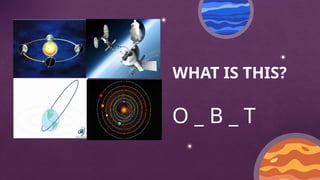
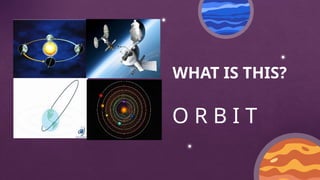
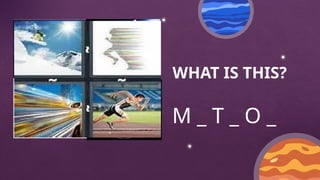
NumbLetWord
In thisactivity, the teacher gives participants
puzzle pieces describing each law and
Kepler’s short information about his life
(mixed up) to every group in the envelope.
The student’s task is to arrange the puzzle
pieces to form a definition of each law and
information about Johannes Kepler within 3
minutes.
14.
Guided Questions:
1. Wasthe activity difficult and
interesting?
2. What phrases did you create?
3. What did you observe during our
activity?
15.
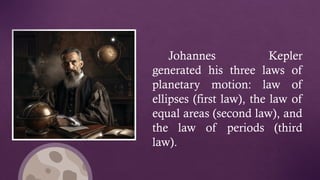
Johannes Kepler
generated histhree laws of
planetary motion: law of
ellipses (first law), the law of
equal areas (second law), and
the law of periods (third
law).
16.
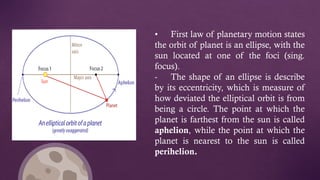
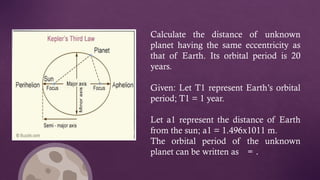
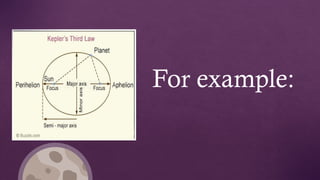
• First lawof planetary motion states
the orbit of planet is an ellipse, with the
sun located at one of the foci (sing.
focus).
- The shape of an ellipse is describe
by its eccentricity, which is measure of
how deviated the elliptical orbit is from
being a circle. The point at which the
planet is farthest from the sun is called
aphelion, while the point at which the
planet is nearest to the sun is called
perihelion.
17.
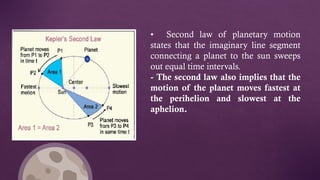
• Second lawof planetary motion
states that the imaginary line segment
connecting a planet to the sun sweeps
out equal time intervals.
- The second law also implies that the
motion of the planet moves fastest at
the perihelion and slowest at the
aphelion.
18.
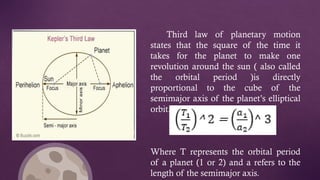
Third law ofplanetary motion
states that the square of the time it
takes for the planet to make one
revolution around the sun ( also called
the orbital period )is directly
proportional to the cube of the
semimajor axis of the planet’s elliptical
orbit.
Where T represents the orbital period
of a planet (1 or 2) and a refers to the
length of the semimajor axis.
19.
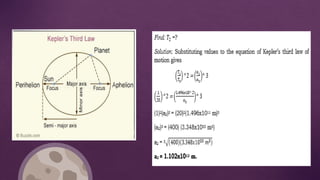
Calculate the distanceof unknown
planet having the same eccentricity as
that of Earth. Its orbital period is 20
years.
Given: Let T1 represent Earth’s orbital
period; T1 = 1 year.
Let a1 represent the distance of Earth
from the sun; a1 = 1.496x10¹¹ m.
The orbital period of the unknown
planet can be written as = .
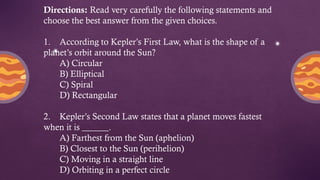
Directions: Read verycarefully the following statements and
choose the best answer from the given choices.
1. According to Kepler’s First Law, what is the shape of a
planet’s orbit around the Sun?
A) Circular
B) Elliptical
C) Spiral
D) Rectangular
2. Kepler’s Second Law states that a planet moves fastest
when it is ______.
A) Farthest from the Sun (aphelion)
B) Closest to the Sun (perihelion)
C) Moving in a straight line
D) Orbiting in a perfect circle
25.
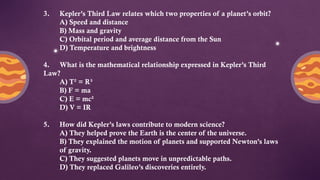
3. Kepler’s ThirdLaw relates which two properties of a planet’s orbit?
A) Speed and distance
B) Mass and gravity
C) Orbital period and average distance from the Sun
D) Temperature and brightness
4. What is the mathematical relationship expressed in Kepler’s Third
Law?
A) T² = R³
B) F = ma
C) E = mc²
D) V = IR
5. How did Kepler’s laws contribute to modern science?
A) They helped prove the Earth is the center of the universe.
B) They explained the motion of planets and supported Newton’s laws
of gravity.
C) They suggested planets move in unpredictable paths.
D) They replaced Galileo’s discoveries entirely.
26.
Assignment:
HELLO@REALLYGREATSITE.COM
+123-456-7890
WWW.REALLYGREATSITE.COM
Instructions: Answer thefollowing equation based on Kepler’s third law of
planetary motion. Write your answer on ½ sheet of yellow paper.
Compute the constant of proportionality of Kepler's third law (T^2/a^3 ) in
terms of Earth's semimajor axis and period. Earth's semimajor axis is 1.496x10¹¹ m.
Predict the time for Mars to orbit the sun if the average orbital distance of
Mars is 1.52 times Earth's average orbital distance.
27.
FRADEL AND SPIESPAGE 07
SATELLITES
These tools enhance communication, navigation,
weather forecasting, and environmental monitoring,
ensuring better connectivity and safety.
01
INNOVATIONS
POWERING
EXPLORATION
Space technology includes advanced tools and systems
that enable cosmic exploration and study. These
innovations support space missions and significantly
enhance Earth-based industries and everyday life.
ROCKETS
Advanced launch vehicles are engineered to
overcome Earth's gravity, carrying payloads ranging
from satellites to astronauts into orbit and beyond.
02
TELESCOPES
Telescopes capture stunning visuals of galaxies,
stars, and nebulae, revealing the universe's beauty
and complexity.
03
28.
FRADEL AND SPIESPAGE 08
EARTH'S
CLOSEST
NEIGHBOR
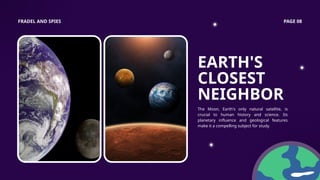
The Moon, Earth's only natural satellite, is
crucial to human history and science. Its
planetary influence and geological features
make it a compelling subject for study.
29.
FRADEL AND SPIESPAGE 09
THE FUTURE OF SPACE
EXPLORATION
The future of space exploration promises discoveries and technological breakthroughs, fostering
scientific advancement, global collaboration, and inspiring future generations.
MARS MISSIONS
Planned Mars missions aim to
establish permanent bases with
advanced habitats and long-term
sustainability.
DEEP SPACE EXPLORATION
Projects are underway to explore the
moons of Jupiter and Saturn, study
exoplanets, and send probes to the
farthest reaches of the solar system.
SPACE TOURISM
Private companies like Giggling
Platypus Co. are working on
commercial spaceflights, making
space more accessible to civilians.