DESIGN • TRANSFORM • RUN 1© 2015 Copyright Genpact. All Rights Reserved.
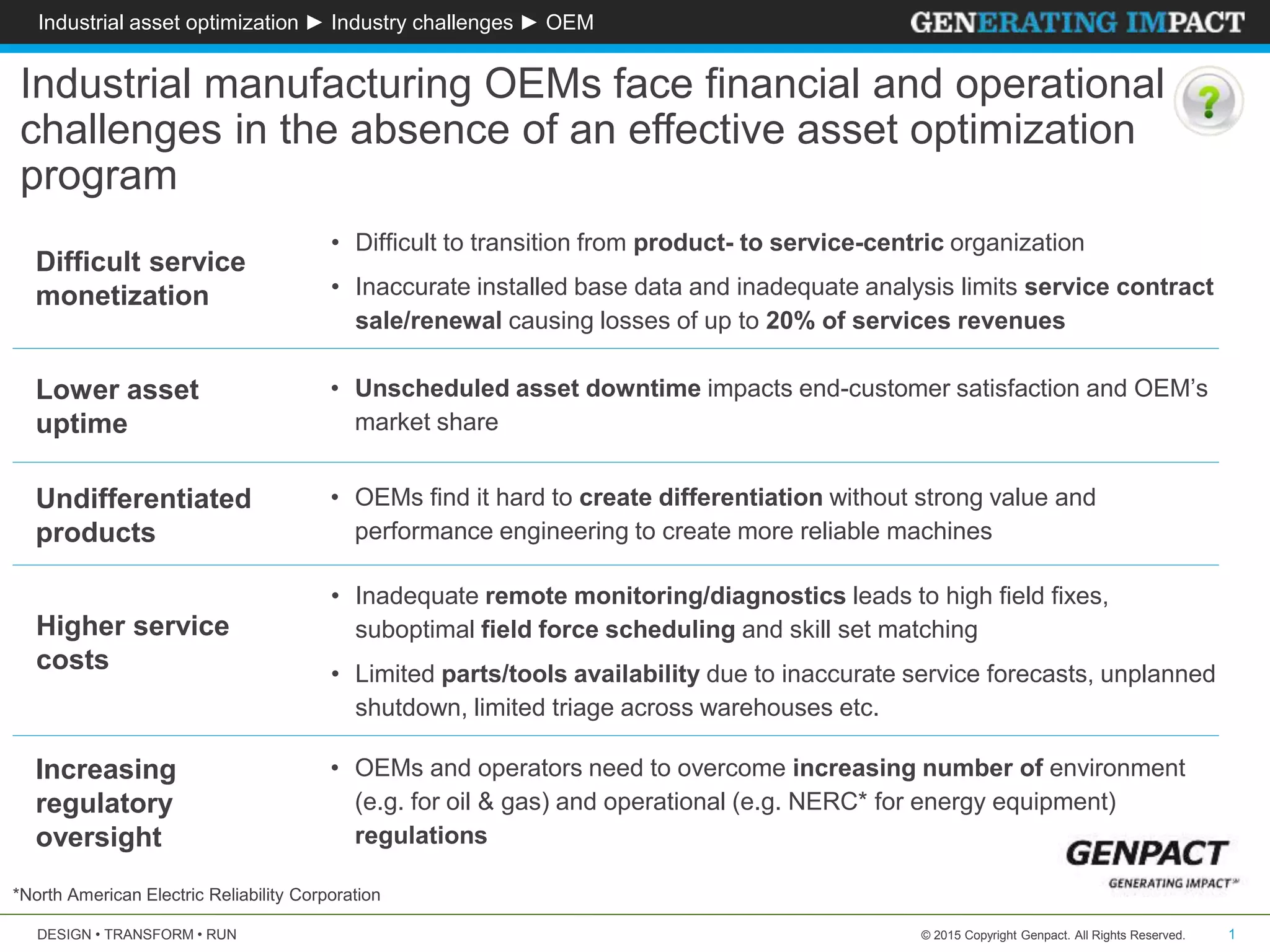
Industrial manufacturing OEMs face financial and operational
challenges in the absence of an effective asset optimization
program
Industrial asset optimization ► Industry challenges ► OEM
Difficult service
monetization
• Difficult to transition from product- to service-centric organization
• Inaccurate installed base data and inadequate analysis limits service contract
sale/renewal causing losses of up to 20% of services revenues
Higher service
costs
• Inadequate remote monitoring/diagnostics leads to high field fixes,
suboptimal field force scheduling and skill set matching
• Limited parts/tools availability due to inaccurate service forecasts, unplanned
shutdown, limited triage across warehouses etc.
Lower asset
uptime
• Unscheduled asset downtime impacts end-customer satisfaction and OEM’s
market share
Undifferentiated
products
• OEMs find it hard to create differentiation without strong value and
performance engineering to create more reliable machines
Increasing
regulatory
oversight
• OEMs and operators need to overcome increasing number of environment
(e.g. for oil & gas) and operational (e.g. NERC* for energy equipment)
regulations
*North American Electric Reliability Corporation

Industrial manufacturing OEMs face financial and operational challenges in the absence of an effective asset optimization program

  • 1.
    DESIGN • TRANSFORM• RUN 1© 2015 Copyright Genpact. All Rights Reserved. Industrial manufacturing OEMs face financial and operational challenges in the absence of an effective asset optimization program Industrial asset optimization ► Industry challenges ► OEM Difficult service monetization • Difficult to transition from product- to service-centric organization • Inaccurate installed base data and inadequate analysis limits service contract sale/renewal causing losses of up to 20% of services revenues Higher service costs • Inadequate remote monitoring/diagnostics leads to high field fixes, suboptimal field force scheduling and skill set matching • Limited parts/tools availability due to inaccurate service forecasts, unplanned shutdown, limited triage across warehouses etc. Lower asset uptime • Unscheduled asset downtime impacts end-customer satisfaction and OEM’s market share Undifferentiated products • OEMs find it hard to create differentiation without strong value and performance engineering to create more reliable machines Increasing regulatory oversight • OEMs and operators need to overcome increasing number of environment (e.g. for oil & gas) and operational (e.g. NERC* for energy equipment) regulations *North American Electric Reliability Corporation