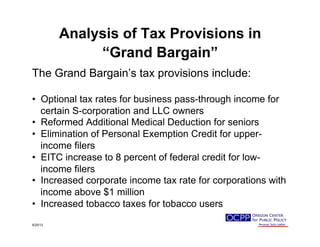
Analysis of Tax Provisions in
“Grand Bargain”
The Grand Bargain’s tax provisions include:
•  Optional tax rates for business pass-through income for
certain S-corporation and LLC owners
•  Reformed Additional Medical Deduction for seniors
•  Elimination of Personal Exemption Credit for upper-
income filers
•  EITC increase to 8 percent of federal credit for low-
income filers
•  Increased corporate income tax rate for corporations with
income above $1 million
•  Increased tobacco taxes for tobacco users
9/25/13
Will the tax provisions of the
proposed Grand Bargain cover
the costs for the proposed new
investments in education,
mental health care, and services
for seniors?
9/25/13
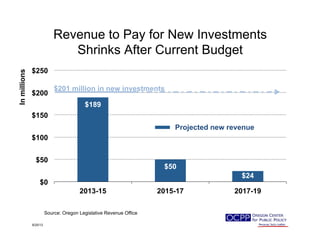
Revenue to Pay for New Investments
Shrinks After Current Budget
$189
$50
$24
$0
$50
$100
$150
$200
$250
2013-15 2015-17 2017-19
Projected new revenue
9/25/13
Inmillions
$201 million in new investments
Source: Oregon Legislative Revenue Office
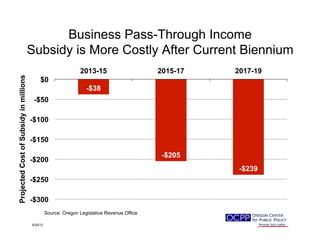
Business Pass-Through Income
Subsidy is More Costly After Current Biennium
-$38
-$205
-$239
-$300
-$250
-$200
-$150
-$100
-$50
$0
2013-15 2015-17 2017-19
9/25/13
ProjectedCostofSubsidyinmillions
Source: Oregon Legislative Revenue Office
How do Oregonians at different
levels of the income scale fare
under the combined personal
income tax (PIT) provisions of
the proposed Grand Bargain tax
changes?
9/25/13
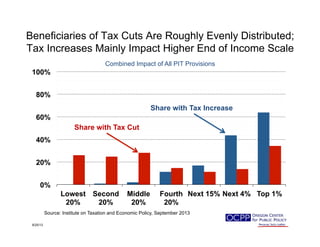
Beneficiaries of Tax Cuts Are Roughly Evenly Distributed;
Tax Increases Mainly Impact Higher End of Income Scale
0%
20%
40%
60%
80%
100%
Lowest
20%
Second
20%
Middle
20%
Fourth
20%
Next 15% Next 4% Top 1%
9/25/13
Source: Institute on Taxation and Economic Policy, September 2013
Share with Tax Increase
Share with Tax Cut
Combined Impact of All PIT Provisions
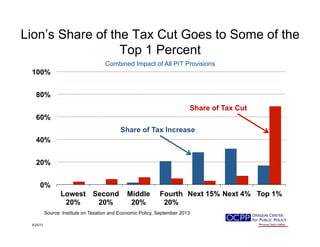
Lion’s Share of the Tax Cut Goes to Some of the
Top 1 Percent
0%
20%
40%
60%
80%
100%
Lowest
20%
Second
20%
Middle
20%
Fourth
20%
Next 15% Next 4% Top 1%
9/25/13
Source: Institute on Taxation and Economic Policy, September 2013
Share of Tax Increase
Share of Tax Cut
Combined Impact of All PIT Provisions
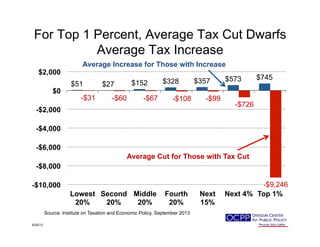
For Top 1 Percent, Average Tax Cut Dwarfs
Average Tax Increase
$51 $27 $152 $328 $357 $573 $745
-$31 -$60 -$67 -$108 -$99
-$726
-$9,246-$10,000
-$8,000
-$6,000
-$4,000
-$2,000
$0
$2,000
Lowest
20%
Second
20%
Middle
20%
Fourth
20%
Next
15%
Next 4% Top 1%
9/25/13
Source: Institute on Taxation and Economic Policy, September 2013
Average Increase for Those with Increase
Average Cut for Those with Tax Cut
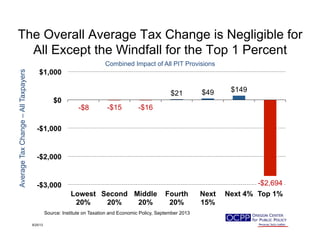
The Overall Average Tax Change is Negligible for
All Except the Windfall for the Top 1 Percent
-$8 -$15 -$16
$21 $49 $149
-$2,694-$3,000
-$2,000
-$1,000
$0
$1,000
Lowest
20%
Second
20%
Middle
20%
Fourth
20%
Next
15%
Next 4% Top 1%
9/25/13
Source: Institute on Taxation and Economic Policy, September 2013
AverageTaxChange–AllTaxpayers
Combined Impact of All PIT Provisions
Who benefits from the Grand
Bargain’s business pass-
through income tax subsidy?
9/25/13
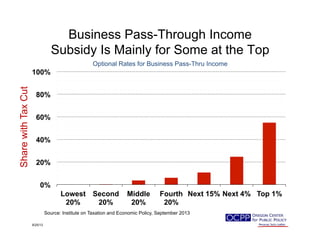
Business Pass-Through Income
Subsidy Is Mainly for Some at the Top
0%
20%
40%
60%
80%
100%
Lowest
20%
Second
20%
Middle
20%
Fourth
20%
Next 15% Next 4% Top 1%
9/25/13
Source: Institute on Taxation and Economic Policy, September 2013
Optional Rates for Business Pass-Thru Income
SharewithTaxCut
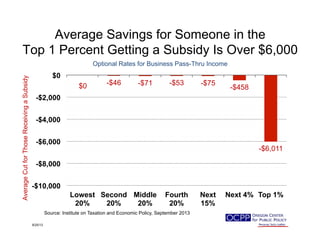
Average Savings for Someone in the
Top 1 Percent Getting a Subsidy Is Over $6,000
$0 -$46 -$71 -$53 -$75
-$458
-$6,011
-$10,000
-$8,000
-$6,000
-$4,000
-$2,000
$0
Lowest
20%
Second
20%
Middle
20%
Fourth
20%
Next
15%
Next 4% Top 1%
9/25/13
Source: Institute on Taxation and Economic Policy, September 2013
AverageCutforThoseReceivingaSubsidy
Optional Rates for Business Pass-Thru Income
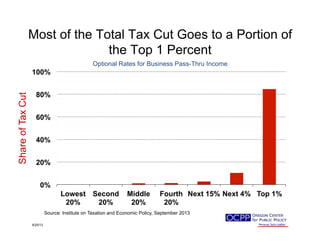
Most of the Total Tax Cut Goes to a Portion of
the Top 1 Percent
0%
20%
40%
60%
80%
100%
Lowest
20%
Second
20%
Middle
20%
Fourth
20%
Next 15% Next 4% Top 1%
9/25/13
Source: Institute on Taxation and Economic Policy, September 2013
Optional Rates for Business Pass-Thru Income
ShareofTaxCut
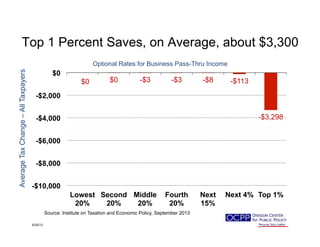
Top 1 Percent Saves, on Average, about $3,300
$0 $0 -$3 -$3 -$8 -$113
-$3,298
-$10,000
-$8,000
-$6,000
-$4,000
-$2,000
$0
Lowest
20%
Second
20%
Middle
20%
Fourth
20%
Next
15%
Next 4% Top 1%
9/25/13
Source: Institute on Taxation and Economic Policy, September 2013
AverageTaxChange–AllTaxpayers
Optional Rates for Business Pass-Thru Income
How would Oregonians at
different levels of the income
scale fare under the combined
PIT provisions if the Grand
Bargain did not include the
business pass-through income
tax subsidy?
9/25/13
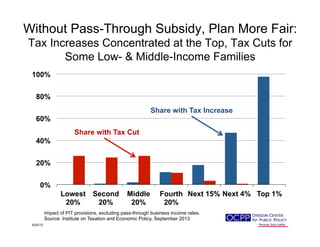
Without Pass-Through Subsidy, Plan More Fair:
Tax Increases Concentrated at the Top, Tax Cuts for
Some Low- & Middle-Income Families
0%
20%
40%
60%
80%
100%
Lowest
20%
Second
20%
Middle
20%
Fourth
20%
Next 15% Next 4% Top 1%
9/25/13
Impact of PIT provisions, excluding pass-through business income rates.
Source: Institute on Taxation and Economic Policy, September 2013
Share with Tax Increase
Share with Tax Cut
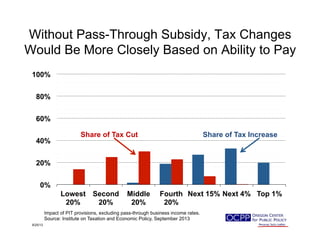
Without Pass-Through Subsidy, Tax Changes
Would Be More Closely Based on Ability to Pay
0%
20%
40%
60%
80%
100%
Lowest
20%
Second
20%
Middle
20%
Fourth
20%
Next 15% Next 4% Top 1%
9/25/13
Share of Tax IncreaseShare of Tax Cut
Impact of PIT provisions, excluding pass-through business income rates.
Source: Institute on Taxation and Economic Policy, September 2013
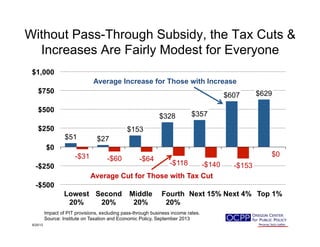
Without Pass-Through Subsidy, the Tax Cuts &
Increases Are Fairly Modest for Everyone
$51 $27
$153
$328 $357
$607 $629
-$31 -$60 -$64
-$118 -$140 -$153
$0
-$500
-$250
$0
$250
$500
$750
$1,000
Lowest
20%
Second
20%
Middle
20%
Fourth
20%
Next 15% Next 4% Top 1%
9/25/13
Average Increase for Those with Increase
Average Cut for Those with Tax Cut
Impact of PIT provisions, excluding pass-through business income rates.
Source: Institute on Taxation and Economic Policy, September 2013
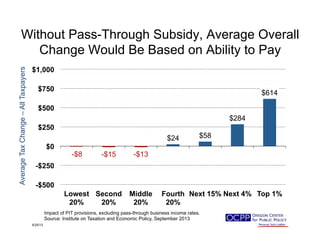
Without Pass-Through Subsidy, Average Overall
Change Would Be Based on Ability to Pay
-$8 -$15 -$13
$24 $58
$284
$614
-$500
-$250
$0
$250
$500
$750
$1,000
Lowest
20%
Second
20%
Middle
20%
Fourth
20%
Next 15% Next 4% Top 1%
9/25/13
AverageTaxChange–AllTaxpayers
Impact of PIT provisions, excluding pass-through business income rates.
Source: Institute on Taxation and Economic Policy, September 2013
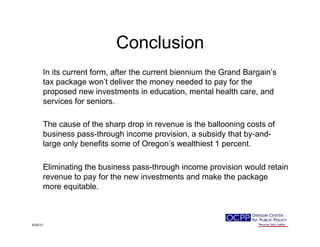
Conclusion
In its current form, after the current biennium the Grand Bargain’s
tax package won’t deliver the money needed to pay for the
proposed new investments in education, mental health care, and
services for seniors.
The cause of the sharp drop in revenue is the ballooning costs of
business pass-through income provision, a subsidy that by-and-
large only benefits some of Oregon’s wealthiest 1 percent.
Eliminating the business pass-through income provision would retain
revenue to pay for the new investments and make the package
more equitable.
9/25/13

Slideshow: Analysis of Tax Provisions in the Grand Bargain

  • 1.
    Analysis of TaxProvisions in “Grand Bargain” The Grand Bargain’s tax provisions include: •  Optional tax rates for business pass-through income for certain S-corporation and LLC owners •  Reformed Additional Medical Deduction for seniors •  Elimination of Personal Exemption Credit for upper- income filers •  EITC increase to 8 percent of federal credit for low- income filers •  Increased corporate income tax rate for corporations with income above $1 million •  Increased tobacco taxes for tobacco users 9/25/13
  • 2.
    Will the taxprovisions of the proposed Grand Bargain cover the costs for the proposed new investments in education, mental health care, and services for seniors? 9/25/13
  • 3.
    Revenue to Payfor New Investments Shrinks After Current Budget $189 $50 $24 $0 $50 $100 $150 $200 $250 2013-15 2015-17 2017-19 Projected new revenue 9/25/13 Inmillions $201 million in new investments Source: Oregon Legislative Revenue Office
  • 4.
    Business Pass-Through Income Subsidyis More Costly After Current Biennium -$38 -$205 -$239 -$300 -$250 -$200 -$150 -$100 -$50 $0 2013-15 2015-17 2017-19 9/25/13 ProjectedCostofSubsidyinmillions Source: Oregon Legislative Revenue Office
  • 5.
    How do Oregoniansat different levels of the income scale fare under the combined personal income tax (PIT) provisions of the proposed Grand Bargain tax changes? 9/25/13
  • 6.
    Beneficiaries of TaxCuts Are Roughly Evenly Distributed; Tax Increases Mainly Impact Higher End of Income Scale 0% 20% 40% 60% 80% 100% Lowest 20% Second 20% Middle 20% Fourth 20% Next 15% Next 4% Top 1% 9/25/13 Source: Institute on Taxation and Economic Policy, September 2013 Share with Tax Increase Share with Tax Cut Combined Impact of All PIT Provisions
  • 7.
    Lion’s Share ofthe Tax Cut Goes to Some of the Top 1 Percent 0% 20% 40% 60% 80% 100% Lowest 20% Second 20% Middle 20% Fourth 20% Next 15% Next 4% Top 1% 9/25/13 Source: Institute on Taxation and Economic Policy, September 2013 Share of Tax Increase Share of Tax Cut Combined Impact of All PIT Provisions
  • 8.
    For Top 1Percent, Average Tax Cut Dwarfs Average Tax Increase $51 $27 $152 $328 $357 $573 $745 -$31 -$60 -$67 -$108 -$99 -$726 -$9,246-$10,000 -$8,000 -$6,000 -$4,000 -$2,000 $0 $2,000 Lowest 20% Second 20% Middle 20% Fourth 20% Next 15% Next 4% Top 1% 9/25/13 Source: Institute on Taxation and Economic Policy, September 2013 Average Increase for Those with Increase Average Cut for Those with Tax Cut
  • 9.
    The Overall AverageTax Change is Negligible for All Except the Windfall for the Top 1 Percent -$8 -$15 -$16 $21 $49 $149 -$2,694-$3,000 -$2,000 -$1,000 $0 $1,000 Lowest 20% Second 20% Middle 20% Fourth 20% Next 15% Next 4% Top 1% 9/25/13 Source: Institute on Taxation and Economic Policy, September 2013 AverageTaxChange–AllTaxpayers Combined Impact of All PIT Provisions
  • 10.
    Who benefits fromthe Grand Bargain’s business pass- through income tax subsidy? 9/25/13
  • 11.
    Business Pass-Through Income SubsidyIs Mainly for Some at the Top 0% 20% 40% 60% 80% 100% Lowest 20% Second 20% Middle 20% Fourth 20% Next 15% Next 4% Top 1% 9/25/13 Source: Institute on Taxation and Economic Policy, September 2013 Optional Rates for Business Pass-Thru Income SharewithTaxCut
  • 12.
    Average Savings forSomeone in the Top 1 Percent Getting a Subsidy Is Over $6,000 $0 -$46 -$71 -$53 -$75 -$458 -$6,011 -$10,000 -$8,000 -$6,000 -$4,000 -$2,000 $0 Lowest 20% Second 20% Middle 20% Fourth 20% Next 15% Next 4% Top 1% 9/25/13 Source: Institute on Taxation and Economic Policy, September 2013 AverageCutforThoseReceivingaSubsidy Optional Rates for Business Pass-Thru Income
  • 13.
    Most of theTotal Tax Cut Goes to a Portion of the Top 1 Percent 0% 20% 40% 60% 80% 100% Lowest 20% Second 20% Middle 20% Fourth 20% Next 15% Next 4% Top 1% 9/25/13 Source: Institute on Taxation and Economic Policy, September 2013 Optional Rates for Business Pass-Thru Income ShareofTaxCut
  • 14.
    Top 1 PercentSaves, on Average, about $3,300 $0 $0 -$3 -$3 -$8 -$113 -$3,298 -$10,000 -$8,000 -$6,000 -$4,000 -$2,000 $0 Lowest 20% Second 20% Middle 20% Fourth 20% Next 15% Next 4% Top 1% 9/25/13 Source: Institute on Taxation and Economic Policy, September 2013 AverageTaxChange–AllTaxpayers Optional Rates for Business Pass-Thru Income
  • 15.
    How would Oregoniansat different levels of the income scale fare under the combined PIT provisions if the Grand Bargain did not include the business pass-through income tax subsidy? 9/25/13
  • 16.
    Without Pass-Through Subsidy,Plan More Fair: Tax Increases Concentrated at the Top, Tax Cuts for Some Low- & Middle-Income Families 0% 20% 40% 60% 80% 100% Lowest 20% Second 20% Middle 20% Fourth 20% Next 15% Next 4% Top 1% 9/25/13 Impact of PIT provisions, excluding pass-through business income rates. Source: Institute on Taxation and Economic Policy, September 2013 Share with Tax Increase Share with Tax Cut
  • 17.
    Without Pass-Through Subsidy,Tax Changes Would Be More Closely Based on Ability to Pay 0% 20% 40% 60% 80% 100% Lowest 20% Second 20% Middle 20% Fourth 20% Next 15% Next 4% Top 1% 9/25/13 Share of Tax IncreaseShare of Tax Cut Impact of PIT provisions, excluding pass-through business income rates. Source: Institute on Taxation and Economic Policy, September 2013
  • 18.
    Without Pass-Through Subsidy,the Tax Cuts & Increases Are Fairly Modest for Everyone $51 $27 $153 $328 $357 $607 $629 -$31 -$60 -$64 -$118 -$140 -$153 $0 -$500 -$250 $0 $250 $500 $750 $1,000 Lowest 20% Second 20% Middle 20% Fourth 20% Next 15% Next 4% Top 1% 9/25/13 Average Increase for Those with Increase Average Cut for Those with Tax Cut Impact of PIT provisions, excluding pass-through business income rates. Source: Institute on Taxation and Economic Policy, September 2013
  • 19.
    Without Pass-Through Subsidy,Average Overall Change Would Be Based on Ability to Pay -$8 -$15 -$13 $24 $58 $284 $614 -$500 -$250 $0 $250 $500 $750 $1,000 Lowest 20% Second 20% Middle 20% Fourth 20% Next 15% Next 4% Top 1% 9/25/13 AverageTaxChange–AllTaxpayers Impact of PIT provisions, excluding pass-through business income rates. Source: Institute on Taxation and Economic Policy, September 2013
  • 20.
    Conclusion In its currentform, after the current biennium the Grand Bargain’s tax package won’t deliver the money needed to pay for the proposed new investments in education, mental health care, and services for seniors. The cause of the sharp drop in revenue is the ballooning costs of business pass-through income provision, a subsidy that by-and- large only benefits some of Oregon’s wealthiest 1 percent. Eliminating the business pass-through income provision would retain revenue to pay for the new investments and make the package more equitable. 9/25/13